High-Precision River Network Mapping Using River Probability Learning and Adaptive Stream Burning

 ,
,  and
and
Highlights
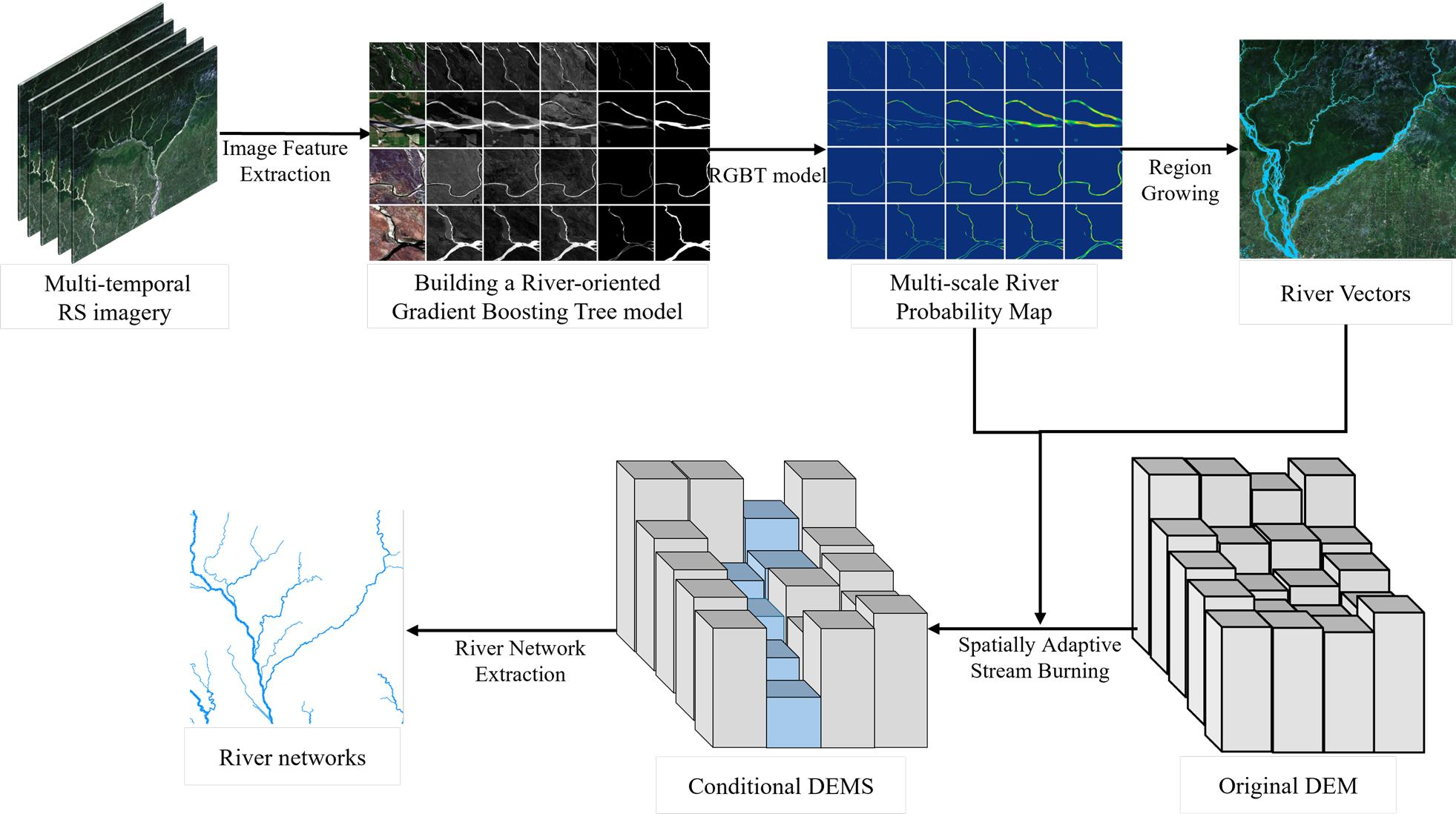
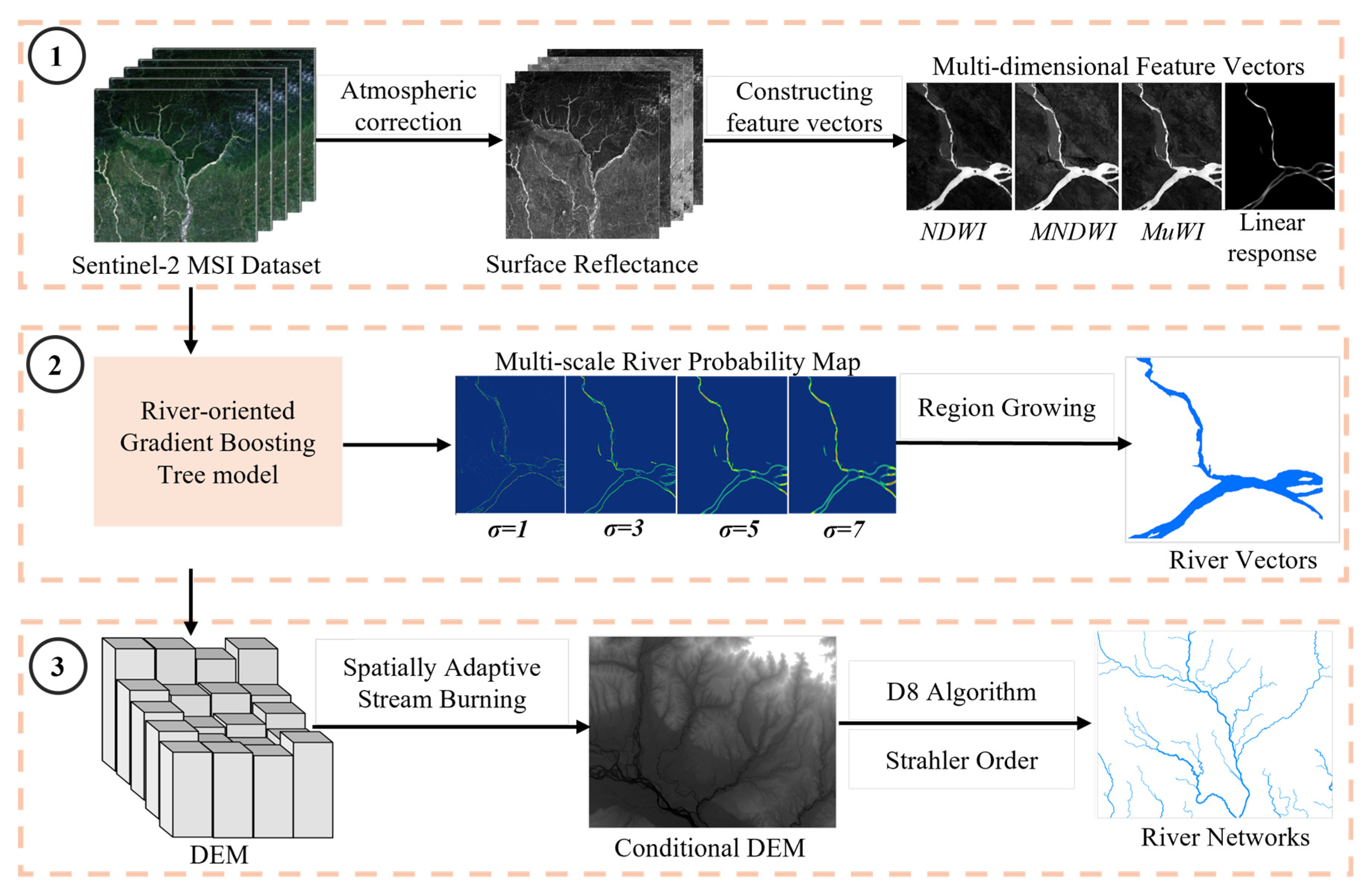
- A novel method integrating river probability learning with adaptive stream burning is proposed for high-precision river network extraction.
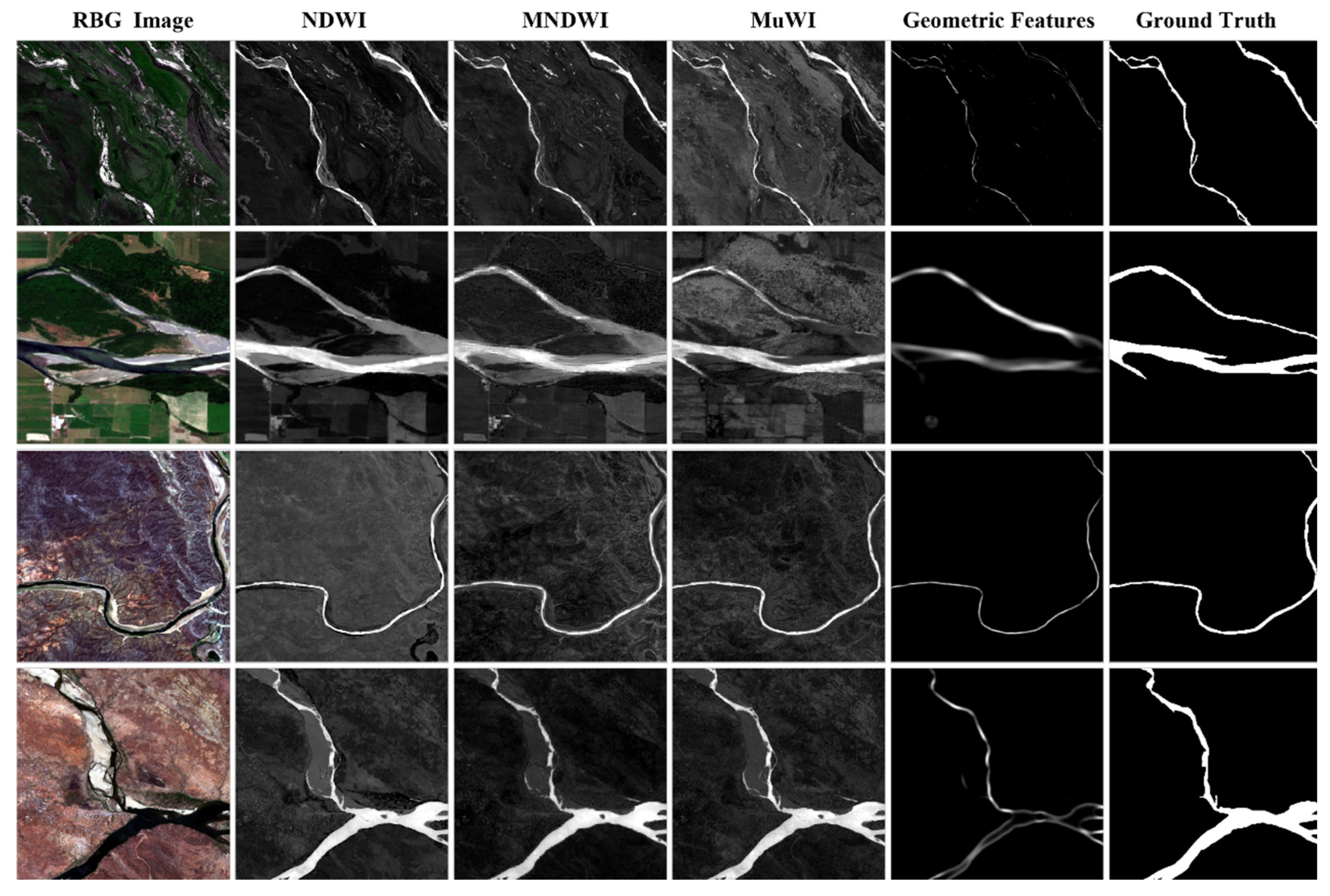
- Multi-dimensional feature vectors combining spectral indices and multi-scale linear geometric features enhance river identification in complex environments.
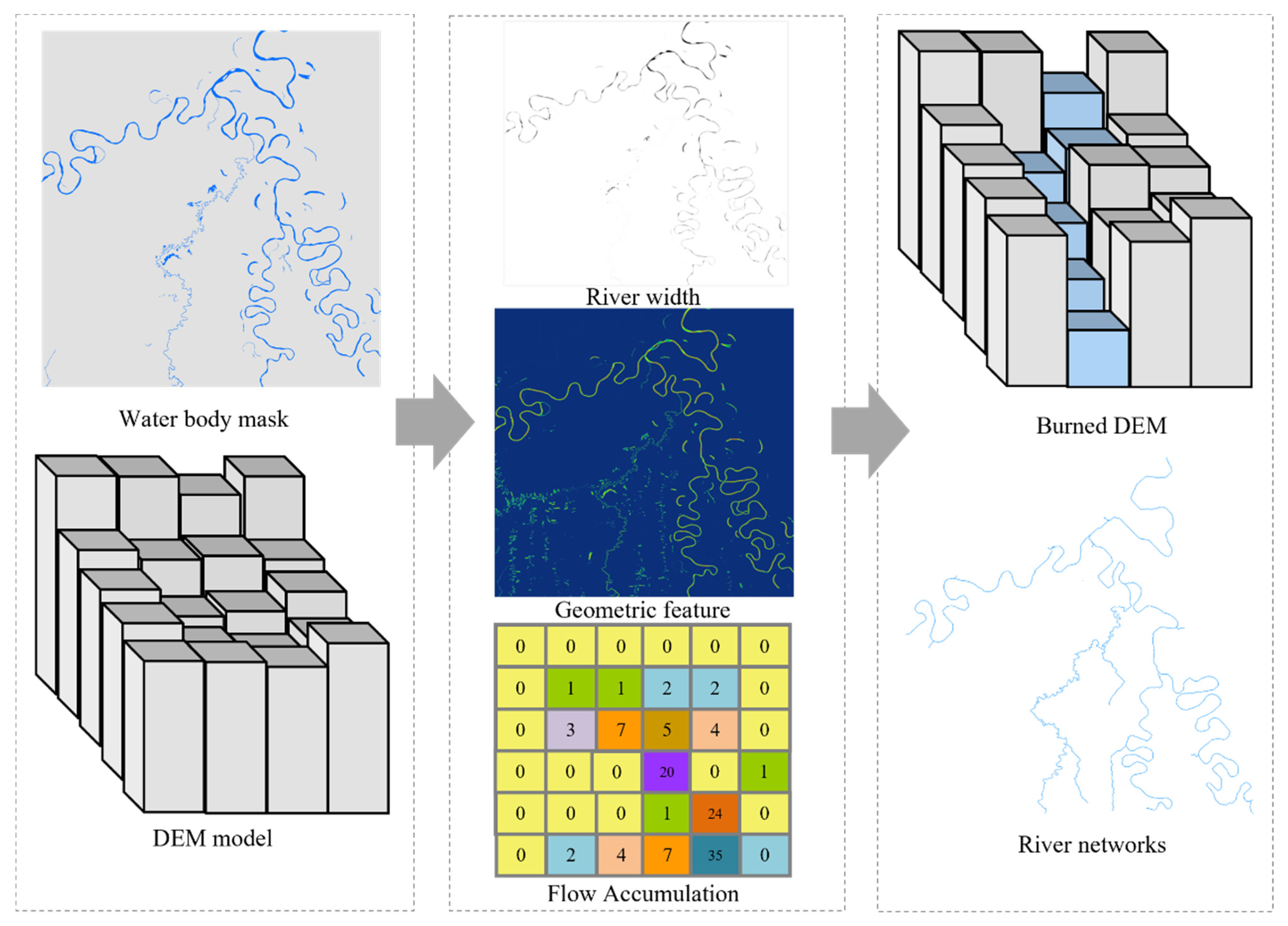
- An adaptive stream burning algorithm dynamically adjusts burning depth based on flow accumulation, channel width, and linear features, improving hydrological consistency.
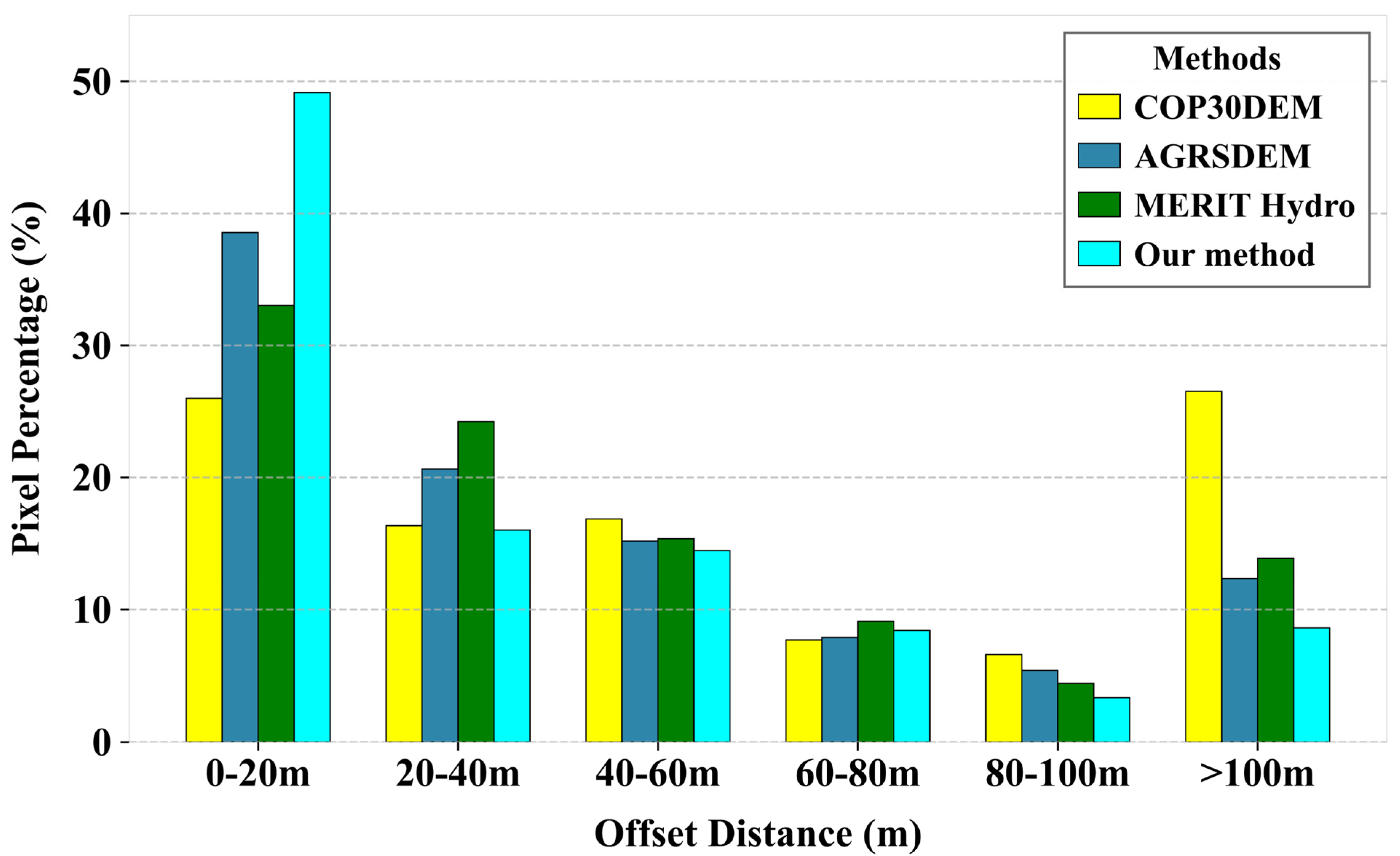
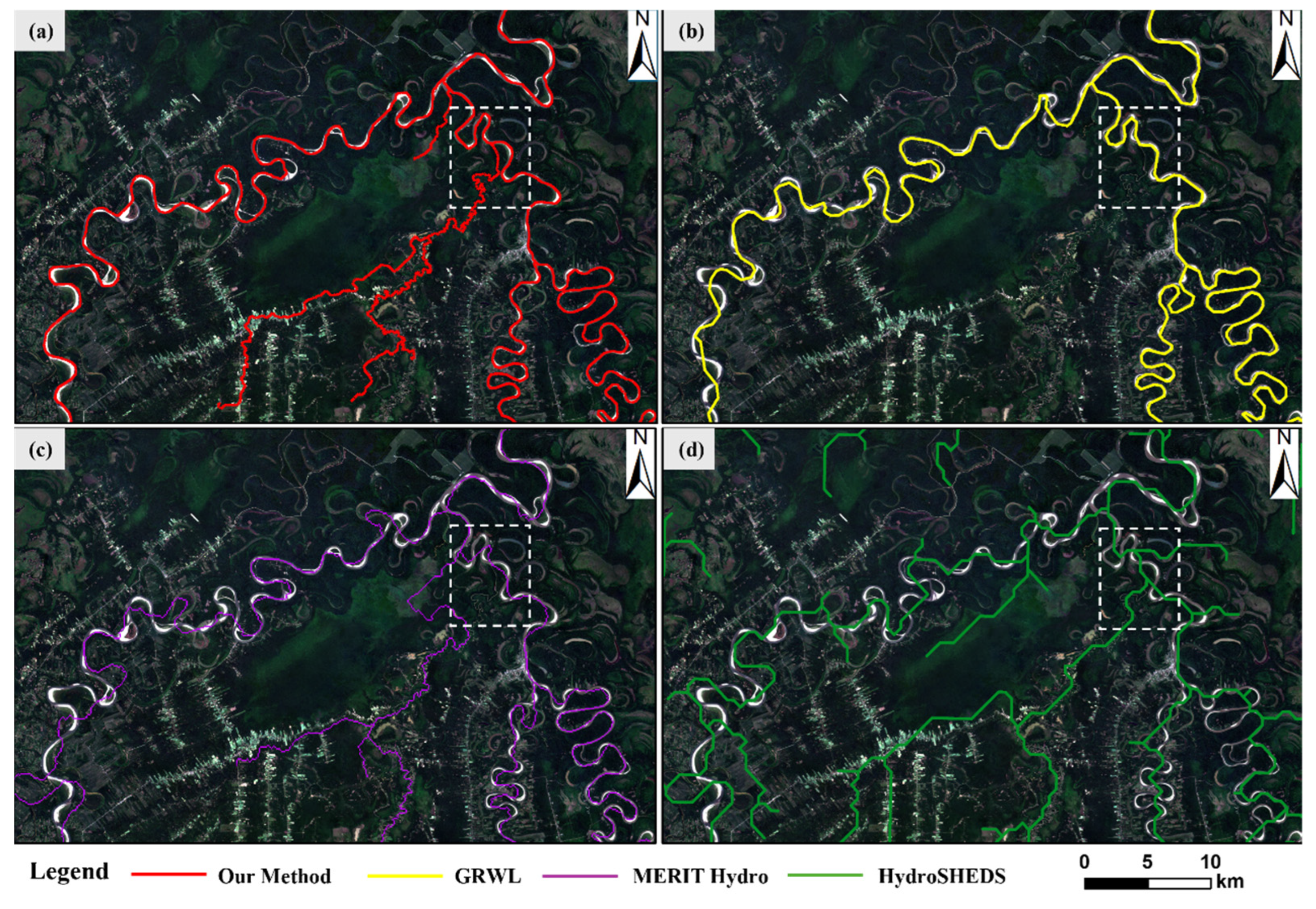
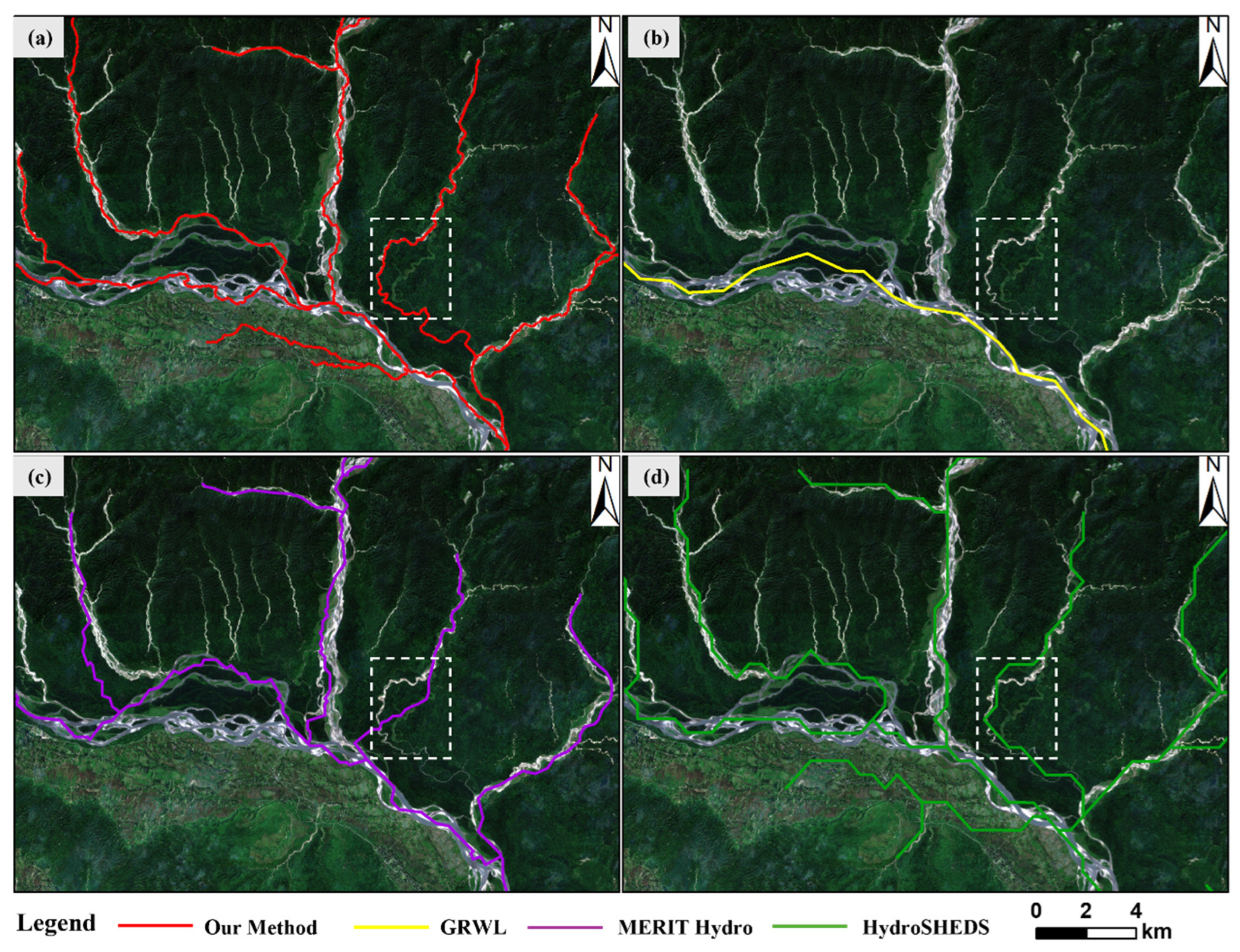
- The method outperforms existing methods in positional accuracy and morphological fidelity, especially for narrow, meandering, and braided rivers.
Abstract
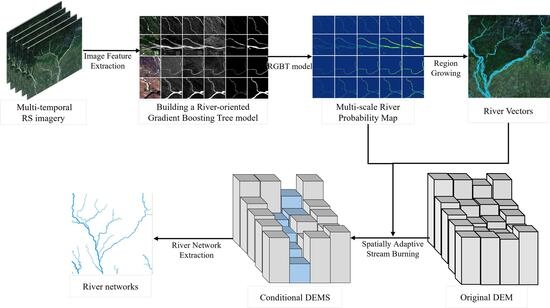
1. Introduction
Contributions of the Research
- Unified multi-dimensional feature vectors are constructed, integrating water-oriented spectral indices and multi-scale linear geometric features to provide a comprehensive representation for distinguishing complex morphological rivers from complex backgrounds.
- A probabilistic and morphology-aware extraction framework is developed, combining a River-oriented Gradient Boosting Tree model with direction-constrained region growing to generate geometrically accurate river vectors.
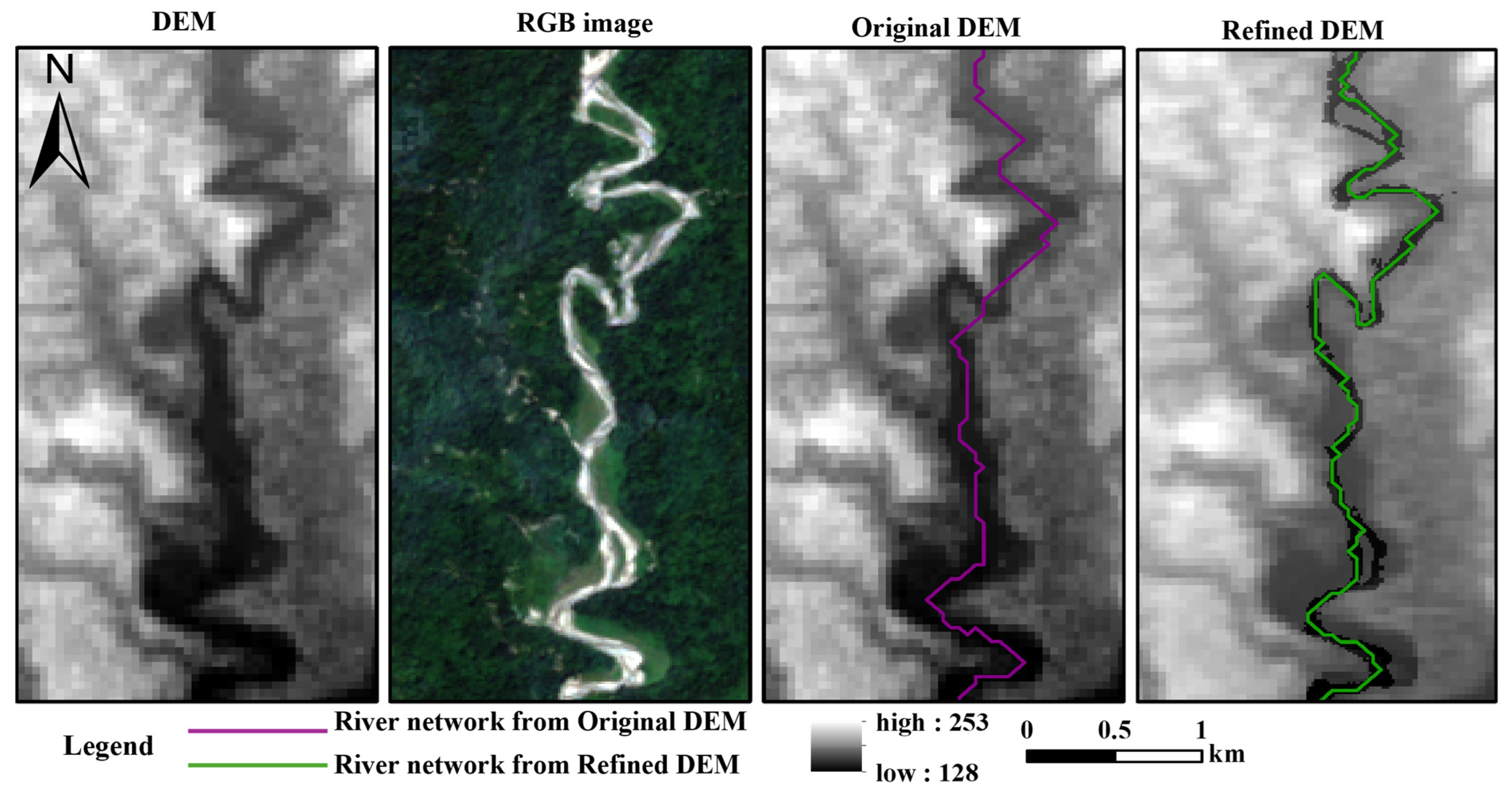
- We propose spatially adaptive stream burning, which dynamically adjusts burning depth using local channel characteristics to produce a hydrologically conditioned DEM, significantly enhancing the positional accuracy and network continuity.
2. Related Works
2.1. River Extraction from Remote Sensing Imagery
2.2. River Network Extraction: From Skeletons to Data Fusion
3. Study Area and Datasets
3.1. Study Area
3.2. Satellite Imagery and DEM Data
4. Methods
4.1. Construction of Multi-Dimensional Feature Vectors
4.2. River Extraction Based on Multi-Scale Probabilistic and Directional Constraints
4.2.1. Construction of River-Oriented Gradient Boosting Tree Model
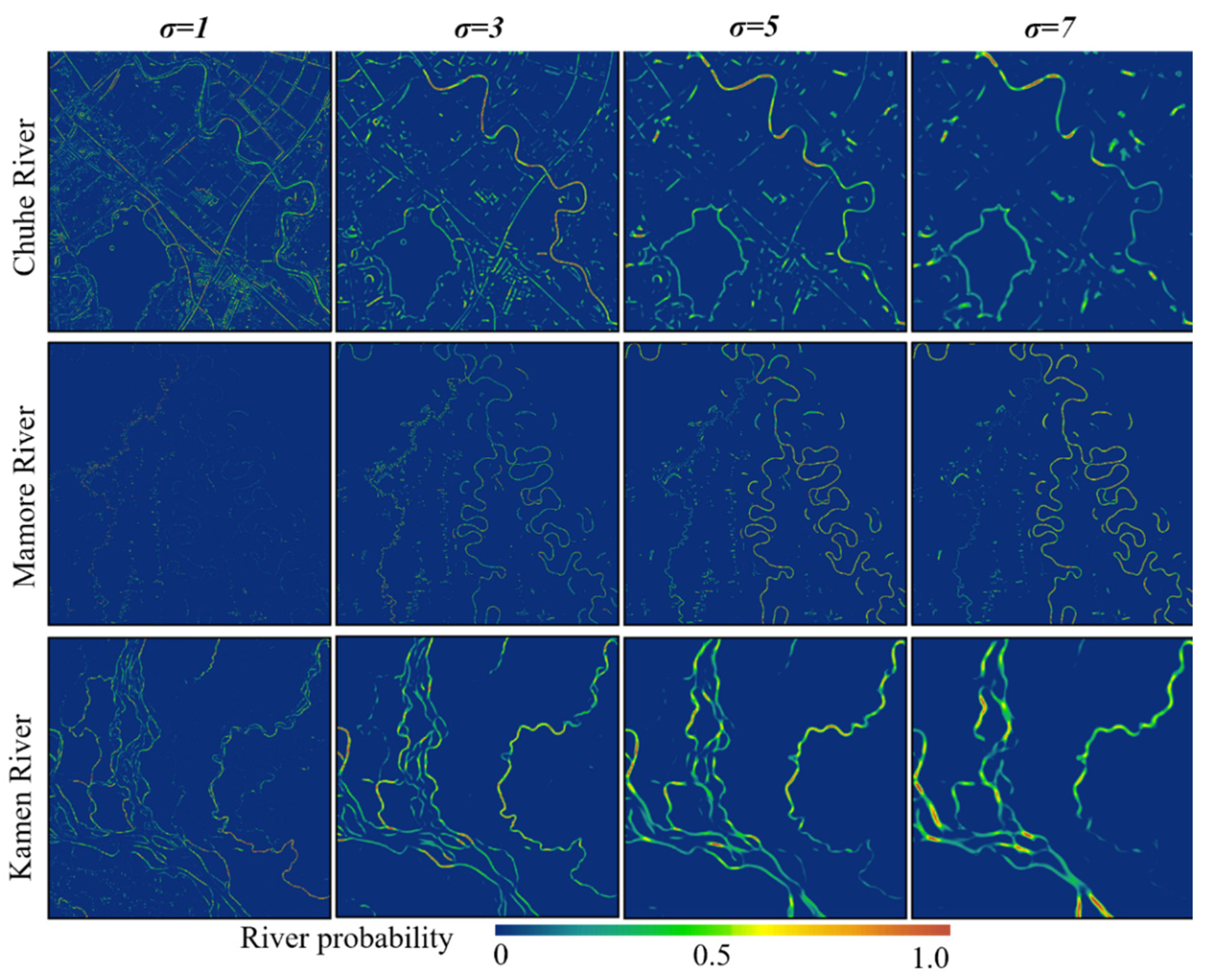
4.2.2. Region Growing by Multi-Scale Probabilistic and Directional Constraints
4.3. Adaptive Stream Burning-Based River Network Classification
5. Results
5.1. Evaluation Metrics
5.2. River Network Extraction Analysis
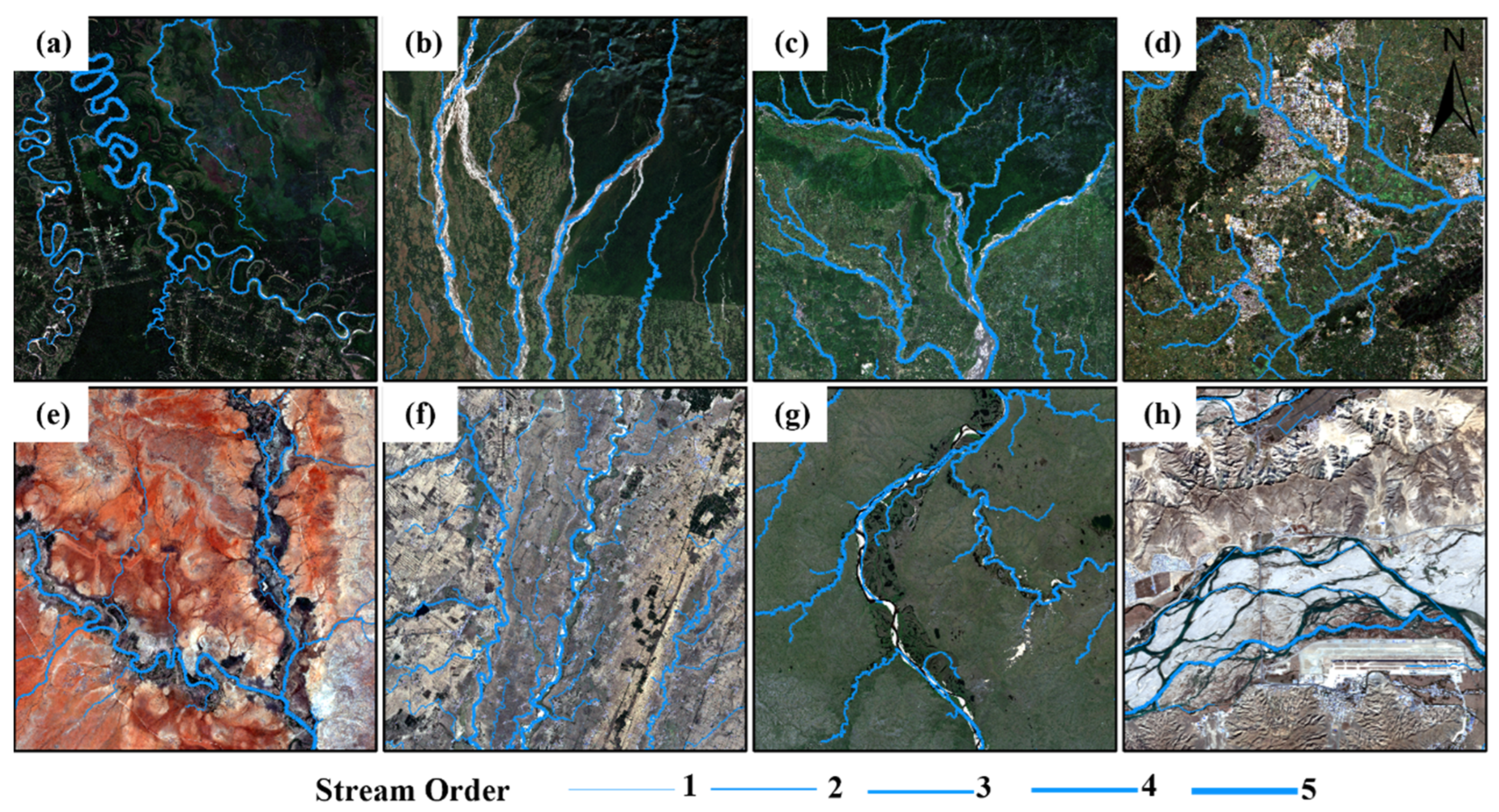
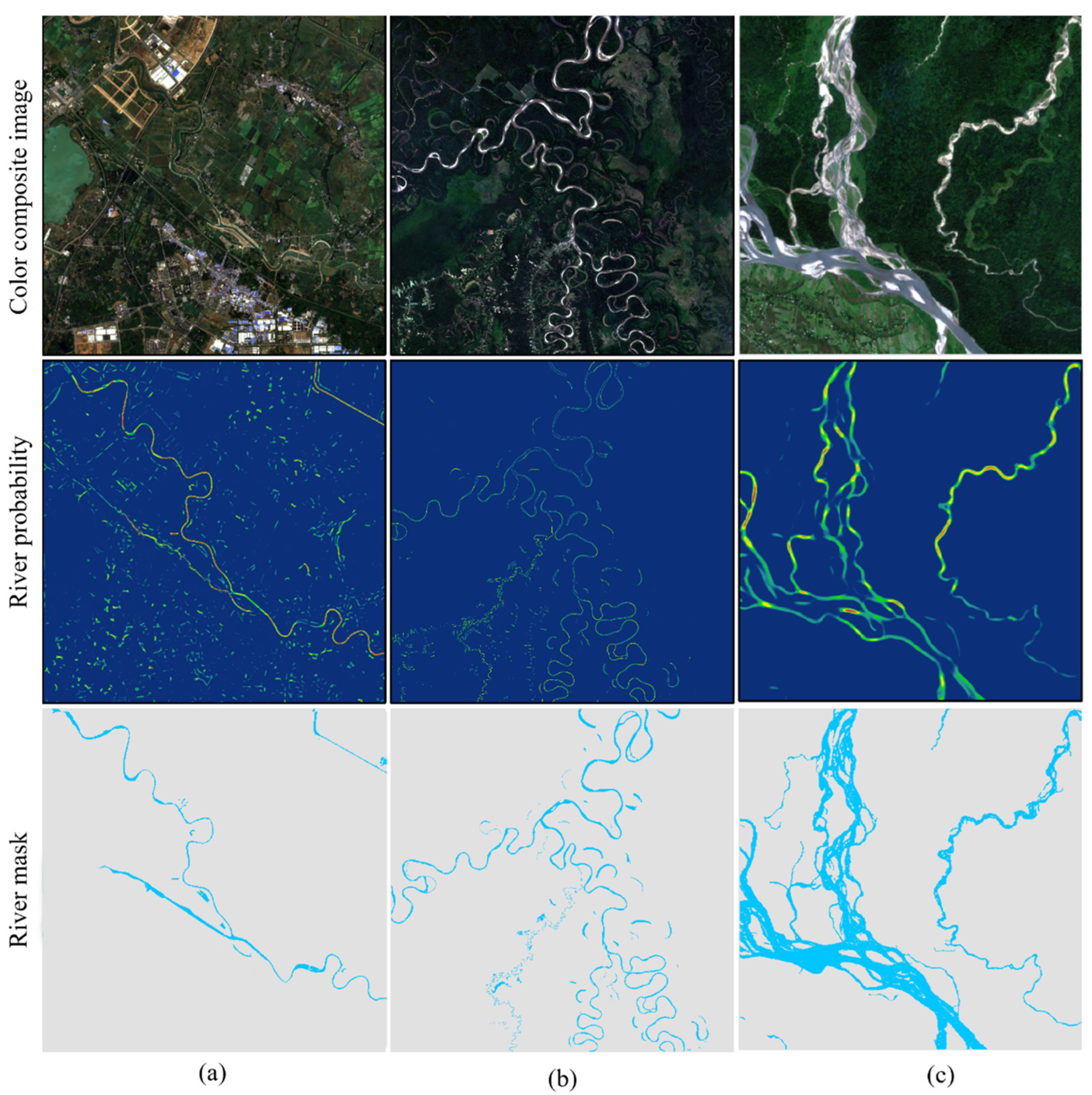
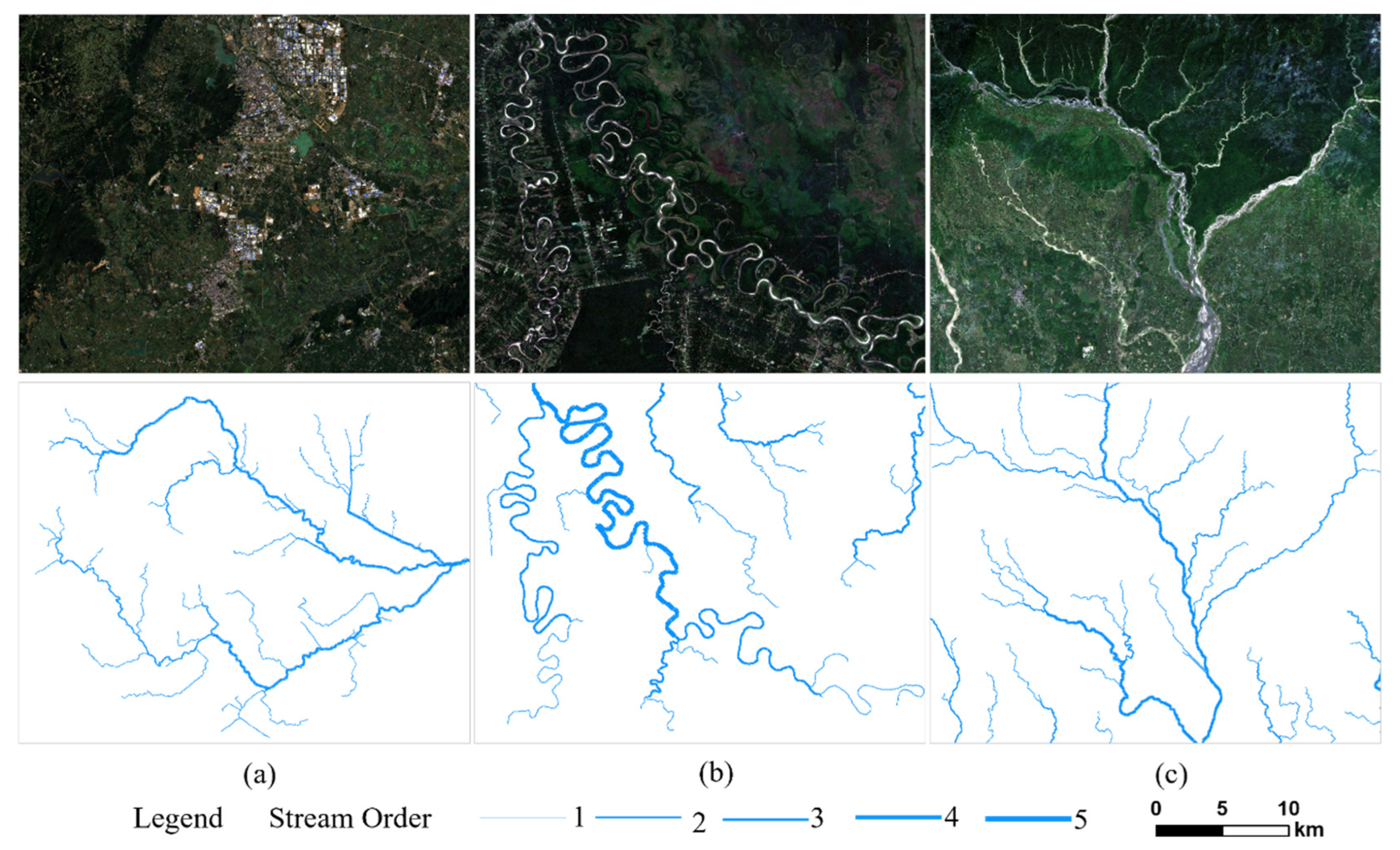
5.2.1. Qualitative Analysis of Experimental Results
5.2.2. Quantitative Assessment of Extracted River Networks
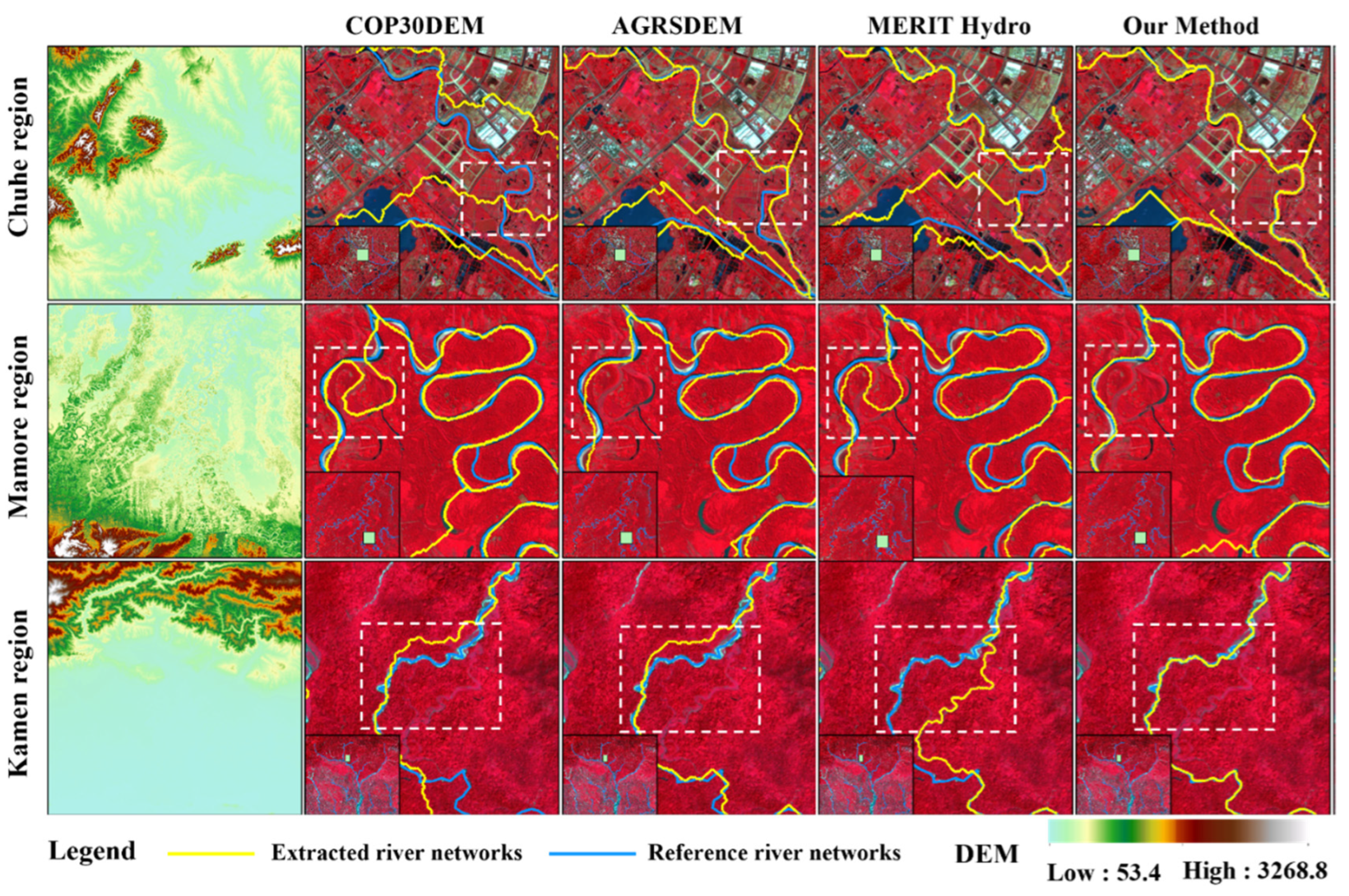
5.3. Comparison with Existing River Network Products
6. Discussion
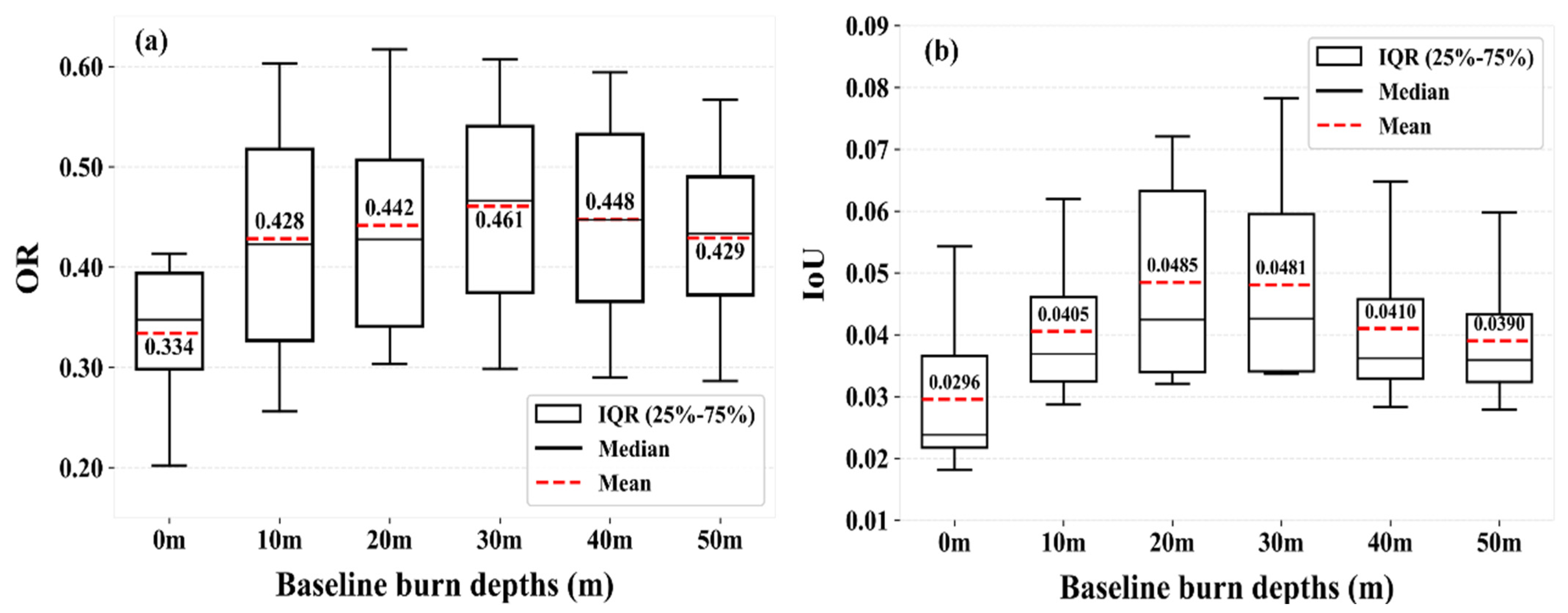
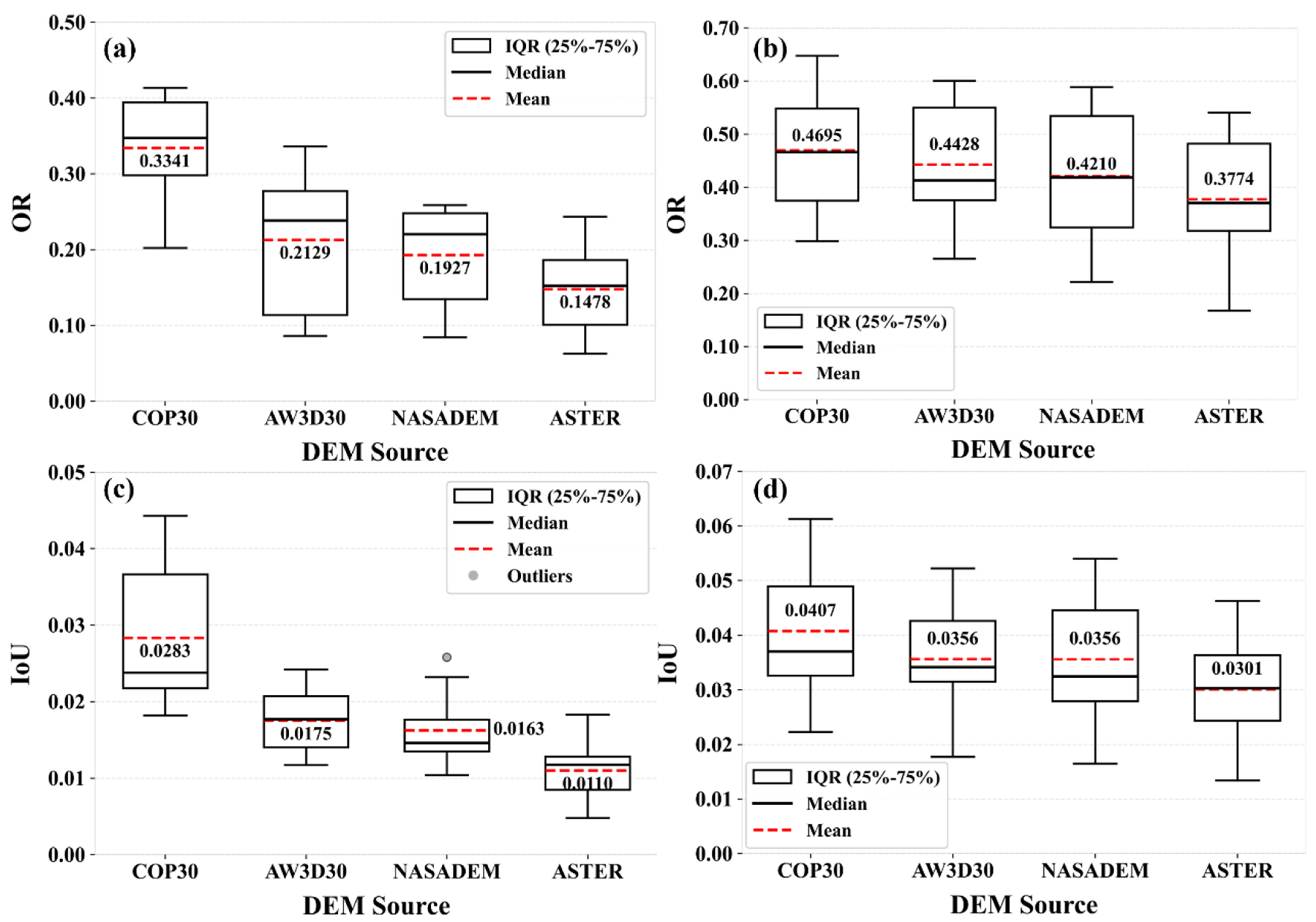
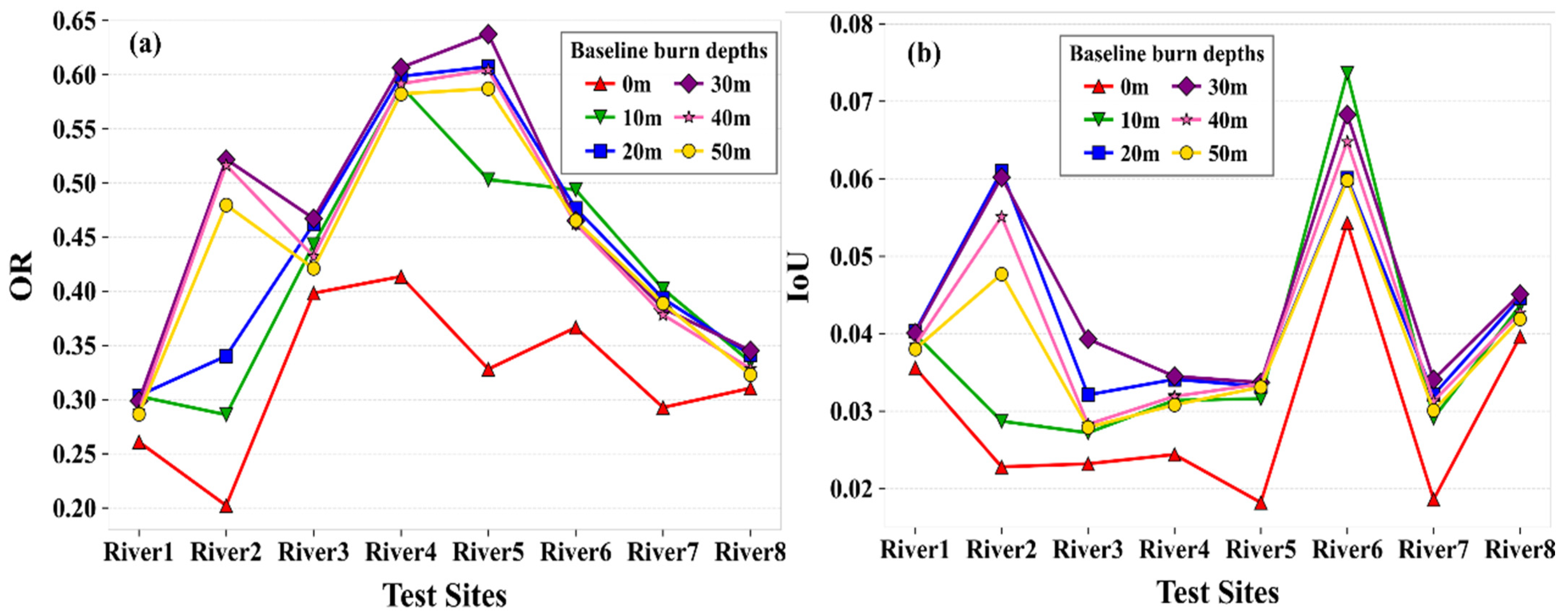
6.1. Hyperparameter Experiments
6.2. Performance Evaluation Under Different Topographical Conditions
6.3. Limitations and Future Work
7. Conclusions
Author Contributions
Funding
Data Availability Statement
Conflicts of Interest
References
- Wu, T.; Li, J.; Li, T.; Sivakumar, B.; Zhang, G.; Wang, G. High-efficient extraction of drainage networks from digital elevation models constrained by enhanced flow enforcement from known river maps. Geomorphology 2019, 340, 184–201. [Google Scholar] [CrossRef]
- Tonkin, J.D.; Poff, N.L.; Bond, N.R.; Horne, A.; Merritt, D.M.; Reynolds, L.V.; Olden, J.D.; Ruhi, A.; Lytle, D.A. Prepare river ecosystems for an uncertain future. Nature 2019, 570, 301–303. [Google Scholar] [CrossRef]
- Sun, S.; Bao, C.; Fang, C. Freshwater use in China: Relations to economic development and natural water resources availability. Int. J. Water Resour. Dev. 2020, 36, 738–756. [Google Scholar] [CrossRef]
- Belletti, B.; Garcia de Leaniz, C.; Jones, J.; Bizzi, S.; Börger, L.; Segura, G.; Castelletti, A.; van de Bund, W.; Aarestrup, K.; Barry, J.; et al. More than one million barriers fragment Europe’s rivers. Nature 2020, 588, 436–441. [Google Scholar] [CrossRef] [PubMed]
- Waite, T.; Jankowski, K.J.; Bruesewitz, D.A.; Van Appledorn, M.; Johnston, M.; Houser, J.N.; Baumann, D.A.; Bennie, B. River geomorphology affects biogeochemical responses to hydrologic events in a large river ecosystem. Water Resour. Res. 2023, 59, e2022WR033662. [Google Scholar] [CrossRef]
- Sharnagat, N.; Nema, A.K.; Mishra, P.K.; Patidar, N.; Kumar, R.; Suryawanshi, A.; Radha, L. State-of-the-art status of Google Earth Engine (GEE) application in land and water resource management: A scientometric analysis. J. Geovis. Spat. Anal. 2025, 9, 16. [Google Scholar] [CrossRef]
- Bijeesh, T.V.; Narasimhamurthy, K.N. Surface water detection and delineation using remote sensing images: A review of methods and algorithms. Sustain. Water Resour. Manag. 2020, 6, 68. [Google Scholar] [CrossRef]
- Marshak, C.; Simard, M.; Denbina, M.; Lamb, M.P.; Liao, T.-Y.; Perkovic-Martin, D.; Nattino, F.; Michael, G.; Goudge, T.A. Orinoco: Retrieving a river delta network with the fast marching method and Python. ISPRS Int. J. Geo-Inf. 2020, 9, 658. [Google Scholar] [CrossRef]
- Yang, X.; Pavelsky, T.M.; Allen, G.H.; Donchyts, G. RivWidthCloud: An automated Google Earth Engine algorithm for river width extraction from remotely sensed imagery. IEEE Geosci. Remote Sens. Lett. 2020, 17, 217–221. [Google Scholar] [CrossRef]
- Gnann, S.; Baldwin, J.W.; Cuthbert, M.O.; Gleeson, T.; Schwanghart, W.; Wagener, T. The influence of topography on the global terrestrial water cycle. Rev. Geophys. 2025, 63, e2023RG000810. [Google Scholar] [CrossRef]
- Fei, J.; Liu, J.; Ke, L.; Wang, W.; Wu, P.; Zhou, Y. A deep learning-based method for mapping alpine intermittent rivers and ephemeral streams of the Tibetan Plateau from Sentinel-1 time series and DEMs. Remote Sens. Environ. 2022, 282, 113271. [Google Scholar] [CrossRef]
- Okolie, C.J.; Smit, J.L. A systematic review and meta-analysis of digital elevation model (DEM) fusion: Pre-processing, methods and applications. ISPRS J. Photogramm. Remote Sens. 2022, 188, 1–29. [Google Scholar] [CrossRef]
- Yamazaki, D.; Ikeshima, D.; Sosa, J.; Bates, P.D.; Allen, G.H.; Pavelsky, T.M. MERIT Hydro: A high-resolution global hydrography map based on latest topography dataset. Water Resour. Res. 2019, 55, 5053–5073. [Google Scholar] [CrossRef]
- Wang, Z.; Liu, J.; Li, J.; Meng, Y.; Pokhrel, Y.; Zhang, H. Basin-scale high-resolution extraction of drainage networks using 10-m Sentinel-2 imagery. Remote Sens. Environ. 2021, 255, 112281. [Google Scholar] [CrossRef]
- Fisher, A.; Flood, N.; Danaher, T. Comparing Landsat water index methods for automated water classification in eastern Australia. Remote Sens. Environ. 2016, 175, 167–182. [Google Scholar] [CrossRef]
- Feyisa, G.L.; Meilby, H.; Fensholt, R.; Proud, S.R. Automated water extraction index: A new technique for surface water mapping using Landsat imagery. Remote Sens. Environ. 2014, 146, 23–37. [Google Scholar] [CrossRef]
- Jiang, W.; Ni, Y.; Pang, Z.; Li, X.; He, G.; Yang, G. An effective water body extraction method with new water index for Sentinel-2 imagery. Water 2021, 13, 1647. [Google Scholar] [CrossRef]
- Wu, W.; Li, Q.; Zhang, Y.; Du, X.; Wang, H. Two-step urban water index (TSUWI): A new technique for high-resolution mapping of urban surface water. Remote Sens. 2018, 10, 1704. [Google Scholar] [CrossRef]
- Xie, C.; Huang, X.; Zeng, W.; Fang, X. A novel water index for urban high-resolution eight-band WorldView-2 imagery. Int. J. Digit. Earth 2016, 9, 925–941. [Google Scholar] [CrossRef]
- Chen, F.; Wang, L.; Bull, E.L.; MacKenzie, R.A.; Morzillo, A.T.; Somarathne, S.M.P.S.; Lokesha, G.S.N.A.; Kadupitiya, H.K.; Weerasinghe, V.P.A.; Nandalal, K.D.W. Open water detection in urban environments using high spatial resolution remote sensing imagery. Remote Sens. Environ. 2020, 242, 111706. [Google Scholar] [CrossRef]
- Li, Y.; Zhang, Y.; Zheng, N.; Li, L.; Ji, H.; Bao, Z.; Feng, Z. Global classification of river morphology based on inland water dynamics characterization and digital elevation data. Sci. Rep. 2025, 15, 14258. [Google Scholar] [CrossRef]
- Li, P.; Yang, S.; Feng, D.; Liu, Y.; Cheng, L.; Liu, X.; Liu, X.; Zheng, C.; Zheng, Y.; Wang, H. High spatiotemporal resolution river networks mapping on catchment scale using satellite remote sensing imagery and DEM data. Geophys. Res. Lett. 2024, 51, e2023GL107956. [Google Scholar] [CrossRef]
- Jin, S.; Liu, Y.; Fagherazzi, S.; Mi, H.; Qiao, G.; Xu, W.; Yang, X.; Li, J.; Gao, P.; Zhou, Y.; et al. River body extraction from Sentinel-2A/B MSI images based on an adaptive multi-scale region growth method. Remote Sens. Environ. 2021, 255, 112297. [Google Scholar] [CrossRef]
- Li, H.; Zech, J.; Ludwig, C.; Fendrich, S.; Shapiro, A.; Schultz, M.; Zipf, A. Automatic mapping of national surface water with OpenStreetMap and Sentinel-2 MSI data using deep learning. Int. J. Appl. Earth Obs. Geoinf. 2021, 104, 102571. [Google Scholar] [CrossRef]
- Juna, A.; Umer, M.; Sadiq, S.; Karamti, H.; Eshmawi, A.A.; Mohamed, A.; Ashraf, I. Water quality prediction using KNN imputer and multilayer perceptron. Water 2022, 14, 2592. [Google Scholar] [CrossRef]
- Chen, H.; Liang, Q.; Liang, Z.; Liu, Y.; Ren, T. Extraction of connected river networks from multi-temporal remote sensing imagery using a path tracking technique. Remote Sens. Environ. 2020, 246, 111868. [Google Scholar] [CrossRef]
- Chen, J.; Chen, S.; Fu, R.; Li, D.; Jiang, H.; Wang, C.; Peng, Y.; Liu, Y.; Jia, K.; Huang, J.; et al. Remote sensing big data for water environment monitoring: Current status, challenges, and future prospects. Earth’s Future 2022, 10, e2021EF002289. [Google Scholar] [CrossRef]
- Feng, Y.; Zhang, J.; Guo, S.; Zhang, Y.; Zhang, Z. High precision water quality retrieval in Dianchi Lake using Gaofen 5 data and machine learning methods. Sci. Rep. 2025, 15, 6760. [Google Scholar] [CrossRef] [PubMed]
- Xue, Y.; Qin, C.; Wu, B.; Li, D.; Fu, X. Automatic extraction of mountain river surface and width based on multisource high-resolution satellite images. Remote Sens. 2022, 14, 2370. [Google Scholar] [CrossRef]
- Isikdogan, L.F.; Bovik, A.; Passalacqua, P. Seeing through the clouds with DeepWaterMap. IEEE Geosci. Remote Sens. Lett. 2019, 17, 1662–1666. [Google Scholar] [CrossRef]
- Isikdogan, F.; Bovik, A.; Passalacqua, P. RivaMap: An automated river analysis and mapping engine. Remote Sens. Environ. 2017, 202, 88–97. [Google Scholar] [CrossRef]
- Allen, G.H.; Pavelsky, T.M. Global extent of rivers and streams. Science 2018, 361, 585–588. [Google Scholar] [CrossRef]
- O’Callaghan, J.F.; Mark, D.M. The extraction of drainage networks from digital elevation data. Comput. Vis. Graph. Image Process. 1984, 28, 323–344. [Google Scholar] [CrossRef]
- Lindsay, J.B. The practice of DEM stream burning revisited. Earth Surf. Process. Landf. 2016, 41, 658–668. [Google Scholar] [CrossRef]
- Lu, L.; Wang, L.; Yang, Q.; Zhao, P.; Du, Y.; Xiao, F.; Ling, F. Extracting a connected river network from DEM by incorporating surface river occurrence data and Sentinel-2 imagery in the Danjiangkou Reservoir area. Remote Sens. 2023, 15, 1014. [Google Scholar] [CrossRef]
- Liang, X.; Mao, W.; Yang, K.; Ji, L. Automated Small River Mapping (ASRM) for the Qinghai-Tibet Plateau Based on Sentinel-2 Satellite Imagery and MERIT DEM. Remote Sens. 2022, 14, 4693. [Google Scholar] [CrossRef]
- Lehner, B.; Verdin, K.; Jarvis, A. New global hydrography derived from spaceborne elevation data. EOS Trans. AGU 2008, 89, 93–94. [Google Scholar] [CrossRef]
- Lin, P.; Pan, M.; Wood, E.F.; Yamazaki, D.; Allen, G.H. A new vector-based global river network dataset accounting for variable drainage density. Sci. Data 2021, 8, 28. [Google Scholar] [CrossRef] [PubMed]
- Close, O.; Petit, S.; Beaumont, B.; Hallot, E. Evaluating the potentiality of Sentinel-2 for change detection analysis associated to LULUCF in Wallonia, Belgium. Land 2021, 10, 55. [Google Scholar] [CrossRef]
- Li, D.; Wu, B.; Chen, B.; Qin, C.; Wang, Y.; Zhang, Y.; Xue, Y. Open-surface river extraction based on Sentinel-2 MSI imagery and DEM data: Case study of the Upper Yellow River. Remote Sens. 2020, 12, 2737. [Google Scholar] [CrossRef]
- Rizzoli, P.; Martone, M.; Gonzalez, C.; Wecklich, C.; Tridon, D.B.; Bräutigam, B.; Bachmann, M.; Schulze, D.; Fritz, T.; Huber, M.; et al. Generation and performance assessment of the global TanDEM-X digital elevation model. ISPRS J. Photogramm. Remote Sens. 2017, 132, 119–139. [Google Scholar] [CrossRef]
- Meadows, M.; Jones, S.; Reinke, K. Vertical accuracy assessment of freely available global DEMs (FABDEM, Copernicus DEM, NASADEM, AW3D30 and SRTM) in flood-prone environments. Int. J. Digit. Earth 2024, 17, 2308734. [Google Scholar] [CrossRef]
- Takaku, J.; Tadono, T.; Doutsu, M.; Ohgushi, F.; Kai, H. Updates of ‘AW3D30’ ALOS global digital surface model with other open access datasets. Int. Arch. Photogramm. Remote Sens. Spat. Inf. Sci. 2020, 43, 183–189. [Google Scholar] [CrossRef]
- Hawker, L.; Uhe, P.; Paulo, L.; Sosa, J.; Savage, J.; Sampson, C.; Neal, J. A 30 m global map of elevation with forests and buildings removed. Environ. Res. Lett. 2022, 17, 024016. [Google Scholar] [CrossRef]
- Zhu, Z.; Wang, S.; Woodcock, C.E. Improvement and expansion of the Fmask algorithm: Cloud, cloud shadow, and snow detection for Landsats 4–7, 8, and Sentinel 2 images. Remote Sens. Environ. 2015, 159, 269–277. [Google Scholar] [CrossRef]
- McFeeters, S.K. The use of the normalized difference water index (NDWI) in the delineation of open water features. Int. J. Remote Sens. 1996, 17, 1425–1432. [Google Scholar] [CrossRef]
- Xu, H. Modification of normalised difference water index (NDWI) to enhance open water features in remotely sensed imagery. Int. J. Remote Sens. 2006, 27, 3025–3033. [Google Scholar] [CrossRef]
- Wang, Z.; Liu, J.; Li, J.; Meng, Y.; Zhang, H.; Zhang, Y.; Pokhrel, Y.; Lin, H. Multi-spectral water index (MuWI): A native 10-m multi-spectral water index for accurate water mapping on Sentinel-2. Remote Sens. 2018, 10, 1643. [Google Scholar] [CrossRef]
- Arévalo, P.; Baccini, A.; Woodcock, C.E.; Olofsson, P.; Walker, W.S. Continuous mapping of aboveground biomass using Landsat time series. Remote Sens. Environ. 2023, 288, 113483. [Google Scholar] [CrossRef]
- Pilesjö, P.; Hasan, A. A triangular form-based multiple flow algorithm to estimate overland flow distribution and accumulation on a digital elevation model. Trans. GIS 2014, 18, 108–124. [Google Scholar] [CrossRef]
- Strahler, A.N. Quantitative analysis of watershed geomorphology. EOS Trans. Am. Geophys. Union 1957, 38, 913–920. [Google Scholar] [CrossRef]









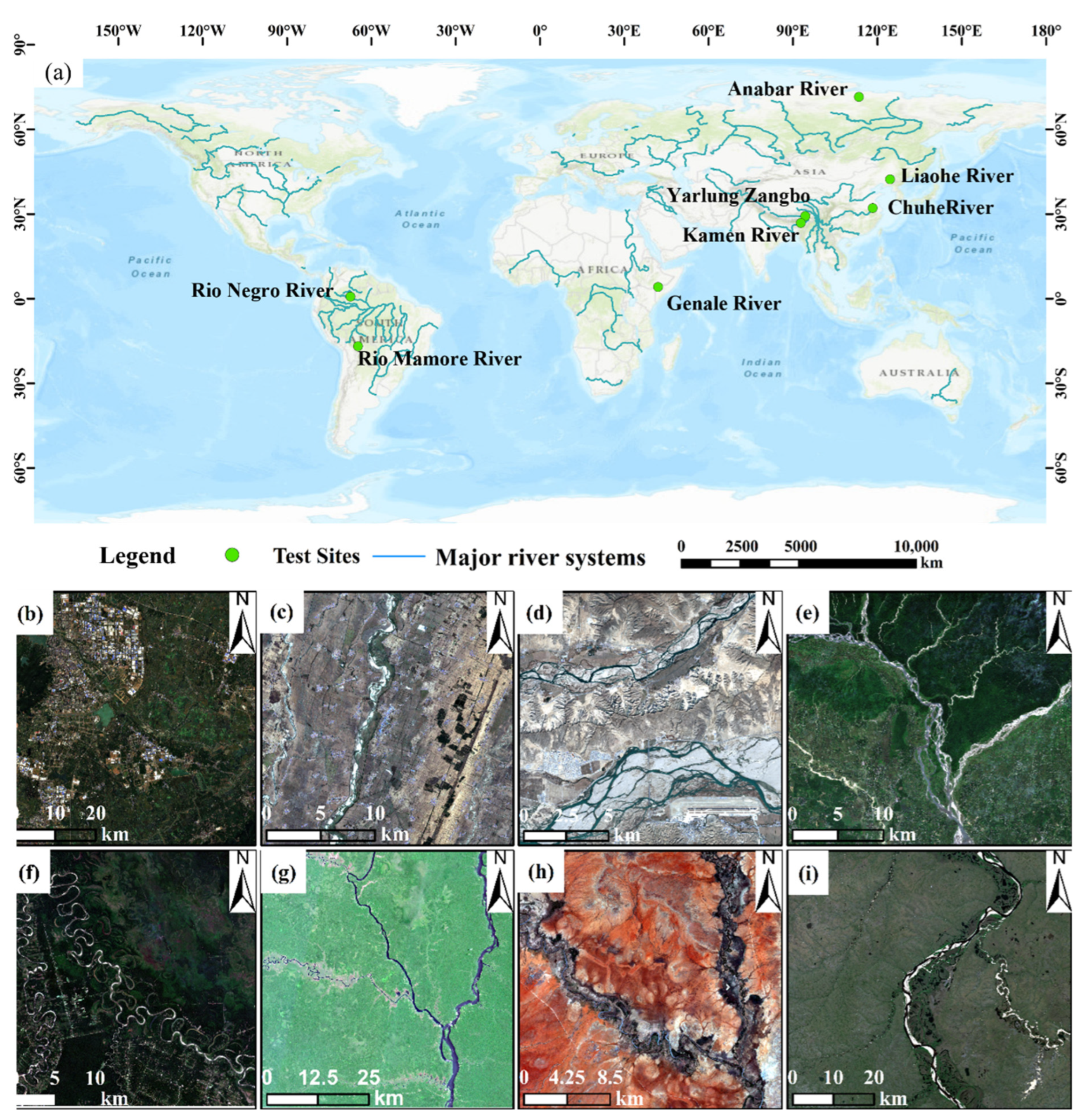
| Names | Sites | Background | River Type | Characteristics |
|---|---|---|---|---|
| Chuhe River | China | Plains, city | Thread | Urban interference, narrow channels |
| Dongliao River | China | hills | Wandering | Channel migration |
| Yarlung Zangbo River | China | Plateau, canyon | Braided | Topographic shadows, snow cover |
| Kamen River | India | Hills, plains | Wandering | Snowmelt, seasonal variations |
| Rio Mamore River | Bolivia | Lowland plains | Branching | Dynamic riverbed, frequent shifts |
| Rio Negro River | Brazil | Rainforest | Thread | Width variation, vegetation shading |
| Genale River | Ethiopia | Bare land | Wandering | Dense narrow channels |
| Anabar River | Russia | Tundra | Braided | Permafrost, freeze–thaw cycles |
| Dataset | Resolution | Vertical Accuracy (RMSE) | Data Collection Time | Data Source |
|---|---|---|---|---|
| COP30DEM [41] | 30 m | ~4 m | 2010–2015 | TanDEM-X mission radar observations |
| NASADEM [42] | 30 m | ~5.6 m | 2000 | NASA’s reprocessing of SRTM data |
| AW3D30 [43] | 30 m | ~8.6 m | 2006–2011 | JAXA’s ALOS PRISM-based product |
| ASTER [44] | 30 m | ~8.7 m | 2000–2013 | Collaborative product of NASA |
| Test Site | Chuhe River Region | Mamore River | Kamen River | ||||||
|---|---|---|---|---|---|---|---|---|---|
| Indicators | Median(m) | Max(m) | Mean(m) | Median(m) | Max(m) | Mean(m) | Median(m) | Max(m) | Mean(m) |
| COP30DEM | 93.78 | 1053.35 | 145.78 | 26.28 | 422.18 | 67.70 | 6.71 | 718.98 | 36.83 |
| AGRSDEM | 35.11 | 1051.94 | 126.88 | 10.63 | 480.77 | 62.76 | 4.00 | 723.56 | 30.85 |
| MERIT Hydro | 77.28 | 1055.10 | 138.46 | 17.46 | 432.20 | 64.66 | 8.49 | 715.71 | 39.86 |
| Our Method | 23.71 | 1050.32 | 117.24 | 5.00 | 420.77 | 42.50 | 2.00 | 706.09 | 22.91 |
Disclaimer/Publisher’s Note: The statements, opinions and data contained in all publications are solely those of the individual author(s) and contributor(s) and not of MDPI and/or the editor(s). MDPI and/or the editor(s) disclaim responsibility for any injury to people or property resulting from any ideas, methods, instructions or products referred to in the content. |
© 2026 by the authors. Licensee MDPI, Basel, Switzerland. This article is an open access article distributed under the terms and conditions of the Creative Commons Attribution (CC BY) license.
Share and Cite
Zang, Y.; Chu, Z.; Cui, Z.; Shi, Z.; Jiang, Q.; Shen, Y.; Ding, J. High-Precision River Network Mapping Using River Probability Learning and Adaptive Stream Burning. Remote Sens. 2026, 18, 362. https://doi.org/10.3390/rs18020362
Zang Y, Chu Z, Cui Z, Shi Z, Jiang Q, Shen Y, Ding J. High-Precision River Network Mapping Using River Probability Learning and Adaptive Stream Burning. Remote Sensing. 2026; 18(2):362. https://doi.org/10.3390/rs18020362
Chicago/Turabian StyleZang, Yufu, Zhaocai Chu, Zhen Cui, Zhuokai Shi, Qihan Jiang, Yueqian Shen, and Jue Ding. 2026. "High-Precision River Network Mapping Using River Probability Learning and Adaptive Stream Burning" Remote Sensing 18, no. 2: 362. https://doi.org/10.3390/rs18020362
APA StyleZang, Y., Chu, Z., Cui, Z., Shi, Z., Jiang, Q., Shen, Y., & Ding, J. (2026). High-Precision River Network Mapping Using River Probability Learning and Adaptive Stream Burning. Remote Sensing, 18(2), 362. https://doi.org/10.3390/rs18020362