The Sequential Joint-Scatterer InSAR for Sentinel-1 Long-Term Deformation Estimation
Highlights
- The sequential-based JS-InSAR framework is proposed to solve the problem of large computation burden and temporal decorrelation in the long time series InSAR analysis with DS processing.
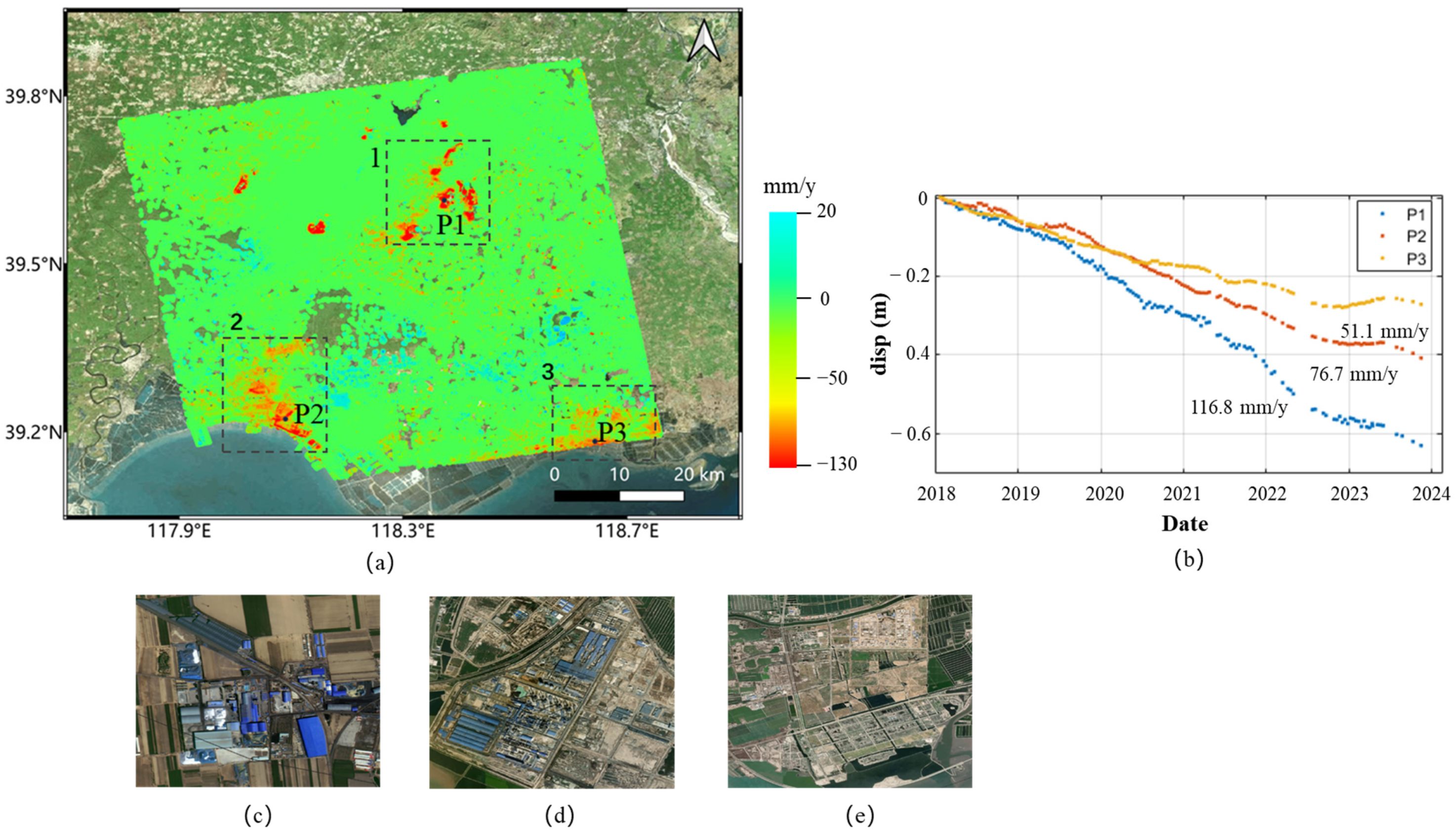
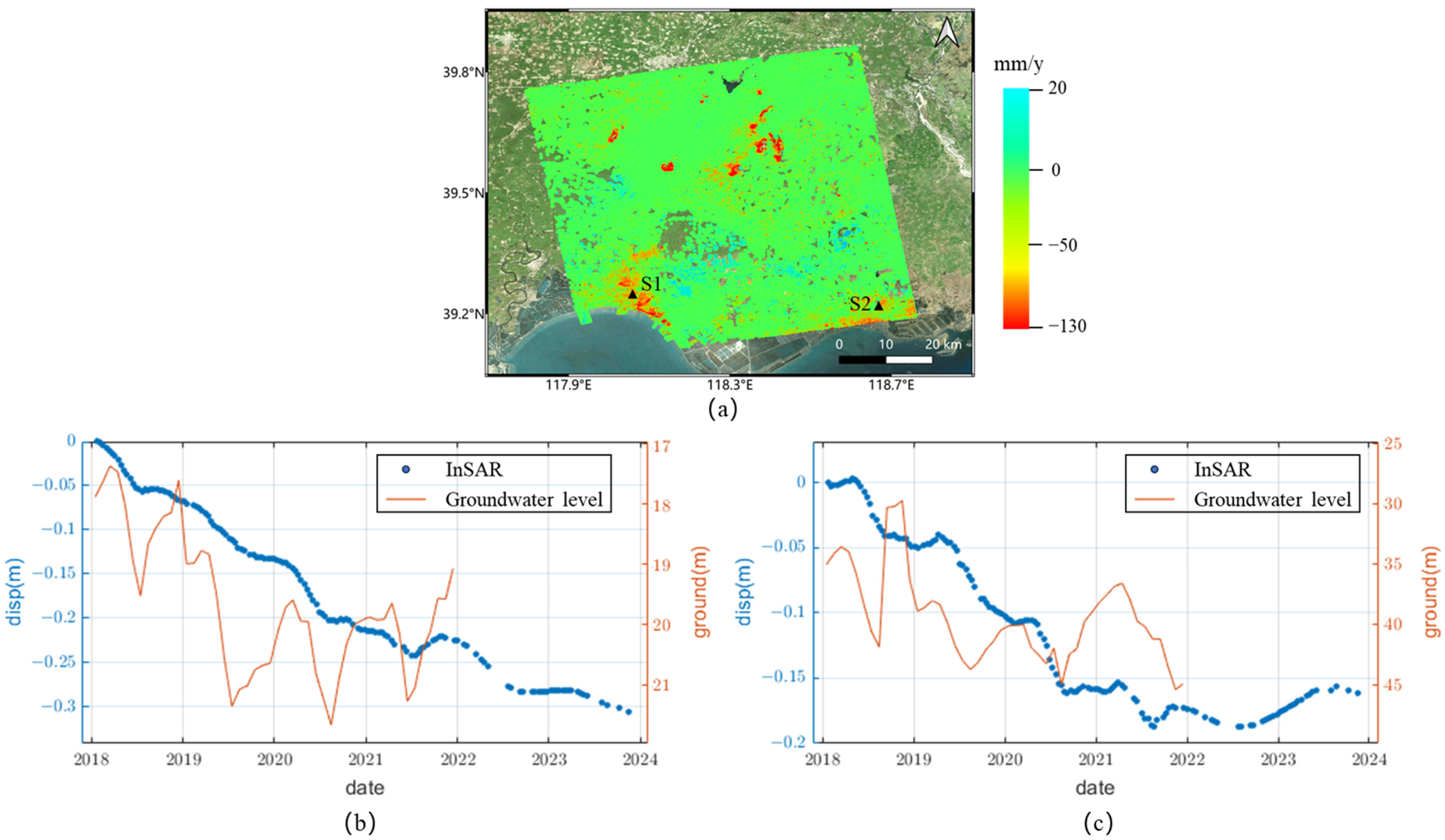
- The long-term deformation results in Tangshan with high precision and more details have revealed the decreasing trend in subsidence rate, and have shown strong relationship between subsidence pattern and groundwater level.
- The sequential estimator with appropriate grouping method has greatly improved the processing efficiency of DS without significant accuracy loss.
- The spatial–temporal deformation trend in Tangshan has proven the effectiveness of the groundwater protection measures of the local government in recent years.
Abstract
1. Introduction
2. Methods
2.1. SHP Identification with JS Vector
2.2. Dataset Segmentation
2.3. Stepwise JS-InSAR Processing for Subsets
2.4. Data Integration
3. Experiment
3.1. Study Region and Dataset
3.2. Results
4. Discussion
4.1. Subsidence Analysis
4.2. Advantages and Limitations of the Proposed Method
5. Conclusions
Author Contributions
Funding
Data Availability Statement
Acknowledgments
Conflicts of Interest
References
- Lu, Z.; Kwoun, O.; Rykhus, R. Interferometric synthetic aperture radar (InSAR): Its past, present and future. Photogramm. Eng. Remote Sens. 2007, 73, 217. [Google Scholar]
- Patrick, K.; Kersten, S.; Jakob, G.; Matteo, N.; Andrea, P.; Pau, P.; Marco, S. Initial Results of DLR’s Independent Verification of the Sentinel-1C System Calibration. In Proceedings of the International Geoscience and Remote Sensing Symposium (IGARSS), Brisbane, Australia, 3–8 August 2025. [Google Scholar]
- Wang, R.; Liu, K.; Cai, Y.; Liang, D. LuTan-1: An innovative l-band spaceborne bistatic interferometric SAR mission. In Proceedings of the EUSAR 2024: 15th European Conference on Synthetic Aperture Radar, Munich, Germany, 23–26 April 2024; IEEE: Piscataway, NJ, USA, 2024; pp. 984–988. [Google Scholar]
- Rosen, P.A.; Bawden, G.W.; Barela, P.; Chapman, B.; Fattahi, H. The NASA-ISRO SAR Mission: A summary. IEEE Geosci. Remote Sens. Mag. 2025, 13, 8–34. [Google Scholar] [CrossRef]
- Xue, F.; Lv, X.; Dou, F.; Yun, Y. A review of time-series interferometric SAR techniques: A tutorial for surface deformation analysis. IEEE Geosci. Remote Sens. Mag. 2020, 8, 22–42. [Google Scholar] [CrossRef]
- Osmanoğlu, B.; Sunar, F.; Wdowinski, S.; Cabral-Cano, E. Time series analysis of InSAR data: Methods and trends. J. Photogramm. Remote Sens. (ISPRS) 2016, 115, 90–102. [Google Scholar] [CrossRef]
- Ferretti, A.; Prati, C.; Rocca, F. Nonlinear subsidence rate estimation using permanent scatterers in differential SAR interferometry. IEEE Trans. Geosci. Remote Sens. 2000, 38, 2202–2212. [Google Scholar] [CrossRef]
- Hooper, A. A multi-temporal InSAR method incorporating both persistent scatterer and small baseline approaches. Geophys. Res. Lett. 2008, 35, L16302. [Google Scholar] [CrossRef]
- Berardino, P.; Fornaro, G.; Lanari, R.; Sansosti, E. A new algorithm for surface deformation monitoring based on small baseline differential SAR interferograms. IEEE Trans. Geosci. Remote Sens. 2002, 40, 2375–2383. [Google Scholar] [CrossRef]
- Li, S.; Xu, W.; Li, Z. Review of the SBAS InSAR Time-series algorithms, applications, and challenges. Geod. Geodyn. 2022, 13, 114–126. [Google Scholar] [CrossRef]
- Chaussard, E.; Wdowinski, S.; Cabral-Cano, E.; Amelung, F. Land subsidence in central Mexico detected by ALOS InSAR time-series. Remote Sens. Environ. 2014, 140, 94–106. [Google Scholar] [CrossRef]
- Zhong, W.; Chu, T.; Tissot, P.; Wu, Z.; Chen, J.; Zhang, H. Integrated coastal subsidence analysis using InSAR, LiDAR, and land cover data. Remote Sens. Environ. 2022, 282, 113297. [Google Scholar] [CrossRef]
- Jiang, H.; Feng, G.; Wang, Y.; Xiong, Z.; Chen, H.; Li, N.; Lin, Z. Land Subsidence in the Yangtze River Delta, China Explored Using InSAR Technique From 2019 to 2021. IEEE J. Sel. Top. Appl. Earth Obs. Remote Sens. 2025, 18, 4174–4187. [Google Scholar] [CrossRef]
- Moretto, S.; Bozzano, F.; Mazzanti, P. The Role of Satellite InSAR for Landslide Forecasting: Limitations and Openings. Remote Sens. 2021, 13, 3735. [Google Scholar] [CrossRef]
- Zhao, C.; Kang, Y.; Zhang, Q.; Lu, Z.; Li, B. Landslide identification and monitoring along the Jinsha River catchment (Wudongde reservoir area), China, using the InSAR method. Remote Sens. 2018, 10, 993. [Google Scholar] [CrossRef]
- Zhang, J.; Zhu, W.; Cheng, Y.; Li, Z. Landslide Detection in the Linzhi–Ya’an Section along the Sichuan–Tibet Railway Based on InSAR and Hot Spot Analysis Methods. Remote Sens. 2021, 13, 3566. [Google Scholar] [CrossRef]
- Van Natijne, A.L.; Bogaard, T.A.; van Leijen, F.J.; Hanssen, R.F.; Lindenbergh, R.C. World-wide InSAR sensitivity index for landslide deformation tracking. Int. J. Appl. Earth Obs. Geoinf. 2022, 111, 102829. [Google Scholar] [CrossRef]
- Ferretti, A.; Fumagalli, A.; Novali, F.; Prati, C.; Rocca, F.; Rucci, A. A new algorithm for processing interferometric data-stacks: SqueeSAR. IEEE Trans. Geosci. Remote Sens. 2011, 49, 3460–3470. [Google Scholar] [CrossRef]
- Even, M.; Schulz, K. InSAR Deformation Analysis with Distributed Scatterers: A Review Complemented by New Advances. Remote Sens. 2018, 10, 744. [Google Scholar] [CrossRef]
- Goel, K.; Adam, N. A Distributed Scatterer Interferometry Approach for Precision Monitoring of Known Surface Deformation Phenomena. IEEE Geosci. Remote Sens. 2014, 52, 5454–5468. [Google Scholar] [CrossRef]
- Jiang, M.; Ding, X.L.; Hanssen, R.F.; Malhotra, R.; Chang, L. Fast statistically homogeneous pixel selection for covariance matrix estimation for multitemporal InSAR. IEEE Geosci. Remote Sens. 2015, 53, 1213–1224. [Google Scholar] [CrossRef]
- Wang, D.; Even, M.; Kutterer, H. Deep learning based distributed scatterers acceleration approach: Distributed scatterers prediction Net. Int. J. Appl. Earth Obs. Geoinf. 2022, 115, 103112. [Google Scholar] [CrossRef]
- Ansari, H.; De Zan, F.; Adam, N.; Goel, K.; Bamler, R. Sequential estimator for distributed scatterer interferometry. In Proceedings of the IEEE International Geoscience and Remote Sensing Symposium (IGARSS 2016), Beijing, China, 10–15 July 2016; IEEE: Piscataway, NJ, USA, 2016; pp. 6859–6862. [Google Scholar]
- Liu, Y.; Yang, H.; Fan, J.; Han, J.; Lu, Z. NL-MMSE: A hybrid phase optimization method in multimaster interferogram stack for DS-InSAR applications. IEEE J. Sel. Top. Appl. Earth Obs. Remote Sens. 2022, 15, 8332–8345. [Google Scholar] [CrossRef]
- Vu, P.V.H.; Breloy, A.; Brigui, F.; Member, Y.Y.; Ginolhac, G. Covariance Fitting Interferometric Phase Linking: Modular Framework and Optimization Algorithms. IEEE Trans. Geosci. Remote Sens. 2025, 63, 5207718. [Google Scholar] [CrossRef]
- Bai, Y.; Kang, J.; Ding, X.; Zhang, A.; Zhang, Z.; Yokoya, N. LaMIE: Large-dimensional multipass InSAR phase estimation for distributed scatterers. IEEE Trans. Geosci. Remote Sens. 2023, 61, 5221215. [Google Scholar] [CrossRef]
- Lv, X.; Yazıcı, B.; Zeghal, M.; Bennett, V.; Abdoun, T. Joint-scatterer processing for time-series InSAR. IEEE Trans. Geosci. Remote Sens. 2014, 52, 7205–7221. [Google Scholar]
- Wang, B.; Zhao, C.; Zhang, Q.; Lu, Z.; Li, Z.; Liu, Y. Sequential estimation of dynamic deformation parameters for SBAS-InSAR. IEEE Geosci. Remote Sens. Lett. 2019, 17, 1017–1021. [Google Scholar] [CrossRef]
- El Hajjar, D.; Ginolhac, G.; Yan, Y.; El Korso, M.N. Robust sequential phase estimation using Multi-temporal SAR image series. IEEE Signal Process. Lett. 2025, 32, 811–815. [Google Scholar] [CrossRef]
- El Hajjar, D.; Ginolhac, G.; Yan, Y.; El Korso, M.N. Sequential Covariance Fitting for InSAR Phase Linking. IEEE Trans. Geosci. Remote Sens. 2025, 63, 5215113. [Google Scholar] [CrossRef]
- Ansari, H.; De Zan, F.; Bamler, R. Sequential estimator: Toward efficient InSAR time series analysis. IEEE Trans. Geosci. Remote Sens. 2017, 55, 5637–5652. [Google Scholar] [CrossRef]
- Gu, X.; Li, Y.; Zuo, X.; Bu, J.; Yang, F.; Yang, X. Image compression–based DS-InSAR method for landslide identification and monitoring of alpine canyon region: A case study of Ahai Reservoir area in Jinsha River Basin. Landslides 2024, 21, 2501–2517. [Google Scholar] [CrossRef]
- Ao, M.; Wei, L.; Liao, M.; Zhang, L.; Dong, J.; Liu, S. Incremental multi temporal InSAR analysis via recursive sequential estimator for long-term landslide deformation monitoring. ISPRS J. Photogramm. Remote Sens. 2024, 215, 313–330. [Google Scholar] [CrossRef]
- Qin, Y.; Perissin, D.; Bai, J. Investigations on the Coregistration of Sentinel-1 TOPS with the Conventional Cross-Correlation Technique. Remote Sens. 2018, 10, 1405. [Google Scholar] [CrossRef]
- Tian, Z.; Fan, H.; Cao, F.; He, L. Monitoring Surface Subsidence Using Distributed Scatterer InSAR with an Improved Statistically Homogeneous Pixel Selection Method in Coalfield Fire Zones. Remote Sens. 2023, 15, 3574. [Google Scholar] [CrossRef]
- Shi, X.; Jin, Y.; Ge, D.; Tang, W.; Wang, G.; Zhang, L. Land subsidence and groundwater storage change from decadal InSAR measurements in Southern Tangshan, China. Adv. Space Res. 2025, 77, 203–218. [Google Scholar] [CrossRef]
- Zou, J.; Cai, H.; Bo, Y.; Xia, C.; Fu, J.; Gong, Y. Quantification of sector-specific groundwater withdrawals considering water diversion projects in the Hebei Province, China. J. Hydrol. Reg. Stud. 2024, 55, 101923. [Google Scholar] [CrossRef]
- Wang, M.; Yao, J.; Chang, H.; Liu, R.; Cao, Y.; Zhao, Y. Monthly Groundwater Level Grid Dataset of China Region (2005–2022). National Tibetan Plateau/Third Pole Environment Data Center. 2024. Available online: https://data.tpdc.ac.cn/en/data/96e53121-8c2e-419d-92e6-ff0e495087a3 (accessed on 9 September 2024).






| SAR Parameter | Value |
|---|---|
| Sensor | Sentinel-1 A |
| Path | 69 |
| Orbit direction | Ascending |
| Polarization/mode | VV/IW |
| Wavelength (m) | 0.055 |
| Incidence angle | 33.27° |
| Resolution (m) | 14.0 (Azimuth), 2.3 (Range) |
| SAR image number | 145 |
| Revisit time (Day) | 12 |
| Date | 22 January 2018~16 November 2023 |
Disclaimer/Publisher’s Note: The statements, opinions and data contained in all publications are solely those of the individual author(s) and contributor(s) and not of MDPI and/or the editor(s). MDPI and/or the editor(s) disclaim responsibility for any injury to people or property resulting from any ideas, methods, instructions or products referred to in the content. |
© 2026 by the authors. Licensee MDPI, Basel, Switzerland. This article is an open access article distributed under the terms and conditions of the Creative Commons Attribution (CC BY) license.
Share and Cite
Zhang, J.; Duan, W.; Hu, H.; Chai, H.; Yun, Y.; Lv, X. The Sequential Joint-Scatterer InSAR for Sentinel-1 Long-Term Deformation Estimation. Remote Sens. 2026, 18, 329. https://doi.org/10.3390/rs18020329
Zhang J, Duan W, Hu H, Chai H, Yun Y, Lv X. The Sequential Joint-Scatterer InSAR for Sentinel-1 Long-Term Deformation Estimation. Remote Sensing. 2026; 18(2):329. https://doi.org/10.3390/rs18020329
Chicago/Turabian StyleZhang, Jinbao, Wei Duan, Huihua Hu, Huiming Chai, Ye Yun, and Xiaolei Lv. 2026. "The Sequential Joint-Scatterer InSAR for Sentinel-1 Long-Term Deformation Estimation" Remote Sensing 18, no. 2: 329. https://doi.org/10.3390/rs18020329
APA StyleZhang, J., Duan, W., Hu, H., Chai, H., Yun, Y., & Lv, X. (2026). The Sequential Joint-Scatterer InSAR for Sentinel-1 Long-Term Deformation Estimation. Remote Sensing, 18(2), 329. https://doi.org/10.3390/rs18020329