Non-Linear Global Ice and Water Storage Changes from a Combination of Satellite Laser Ranging and GRACE Data

Highlights
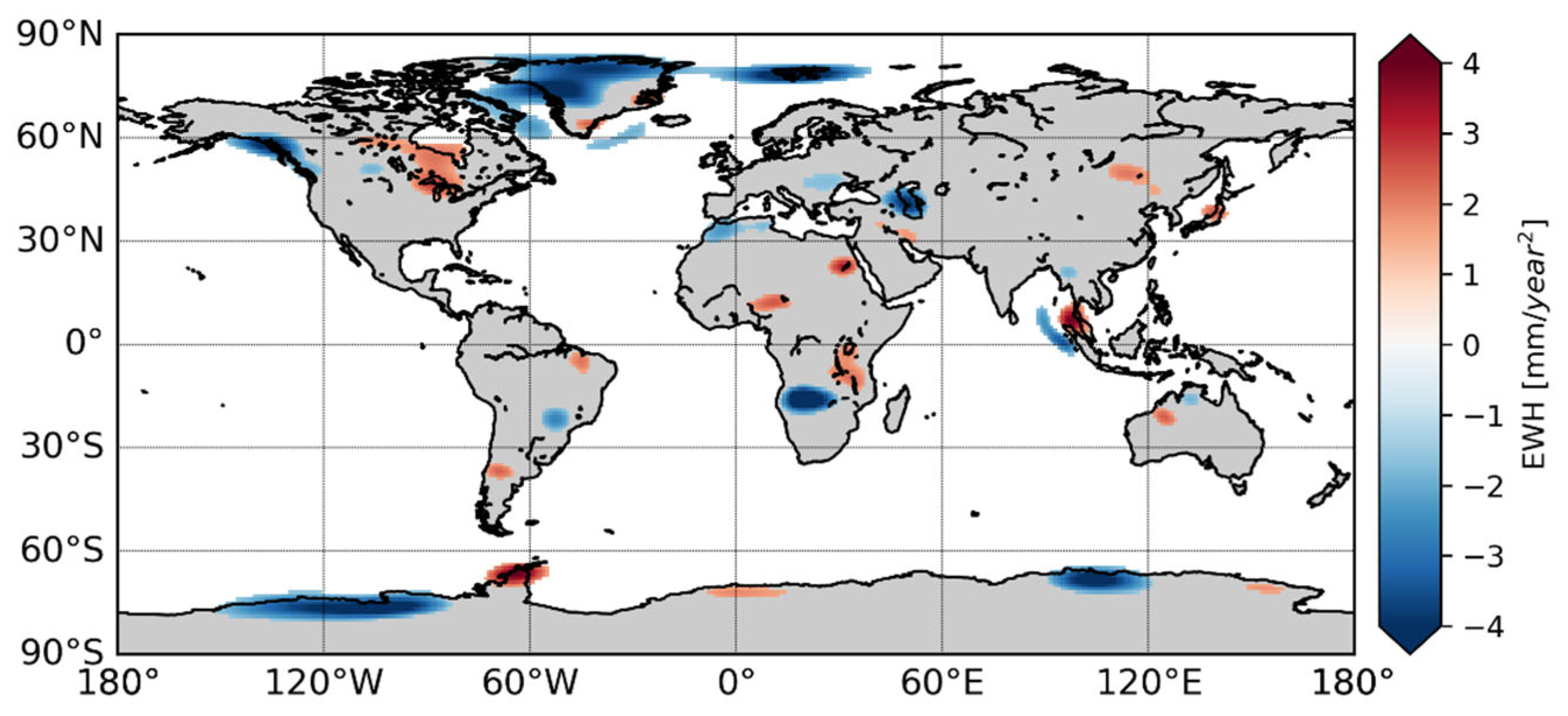
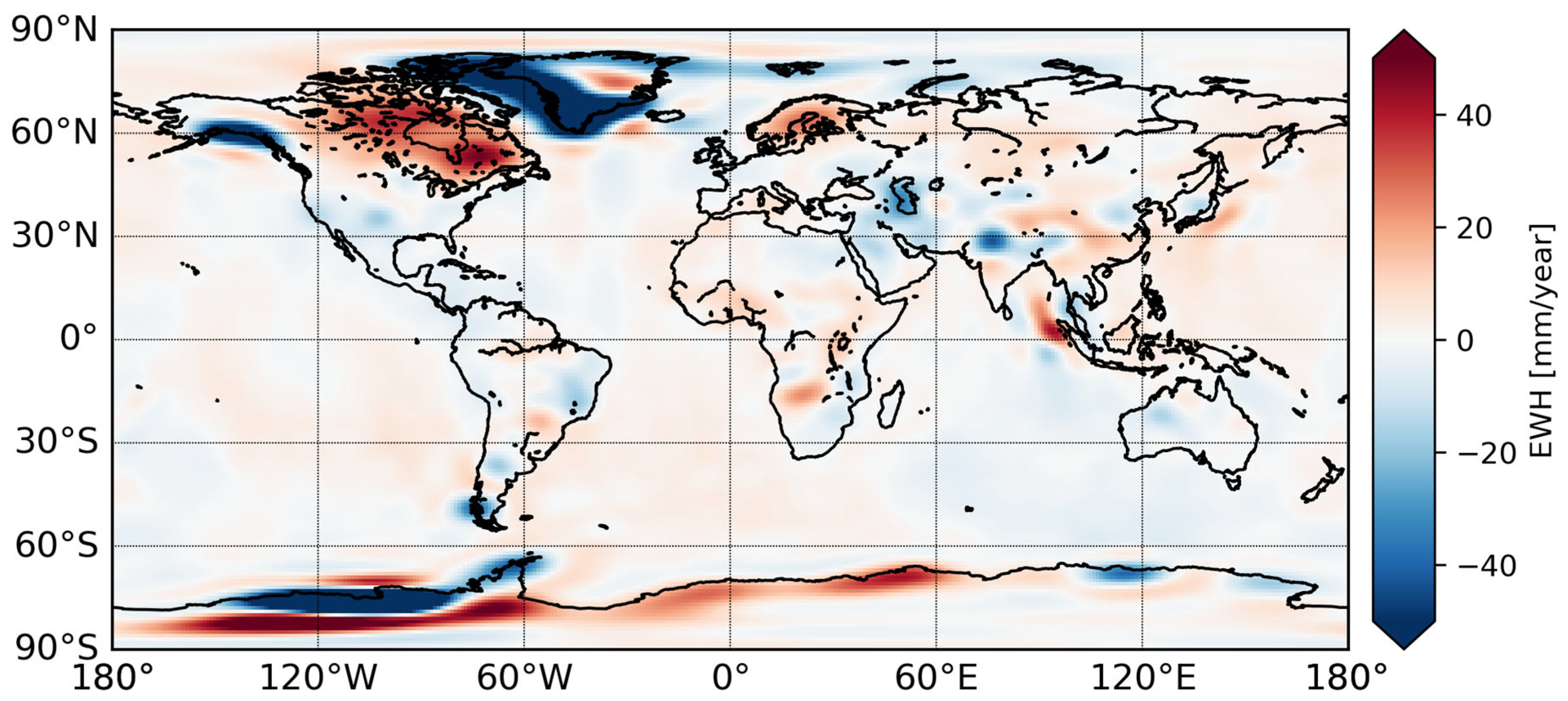
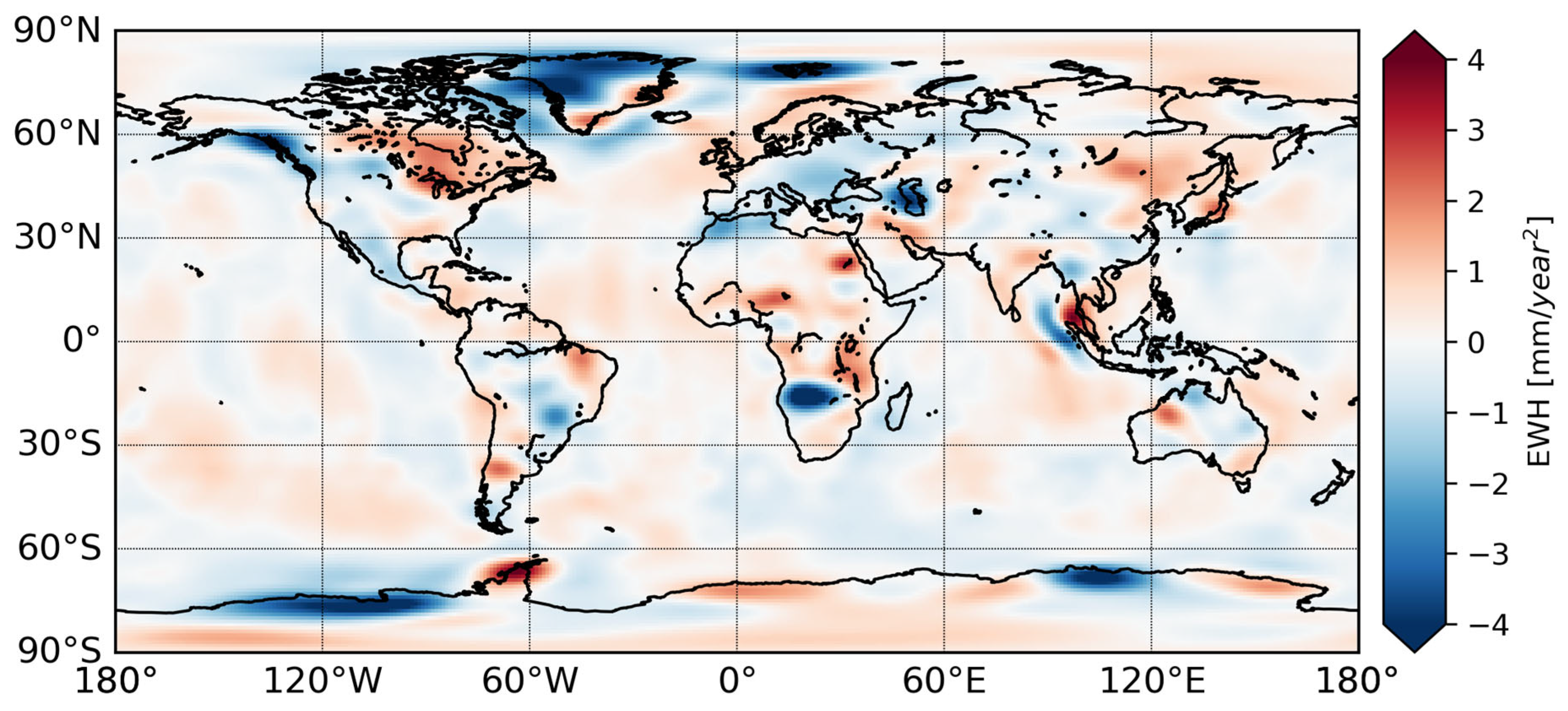
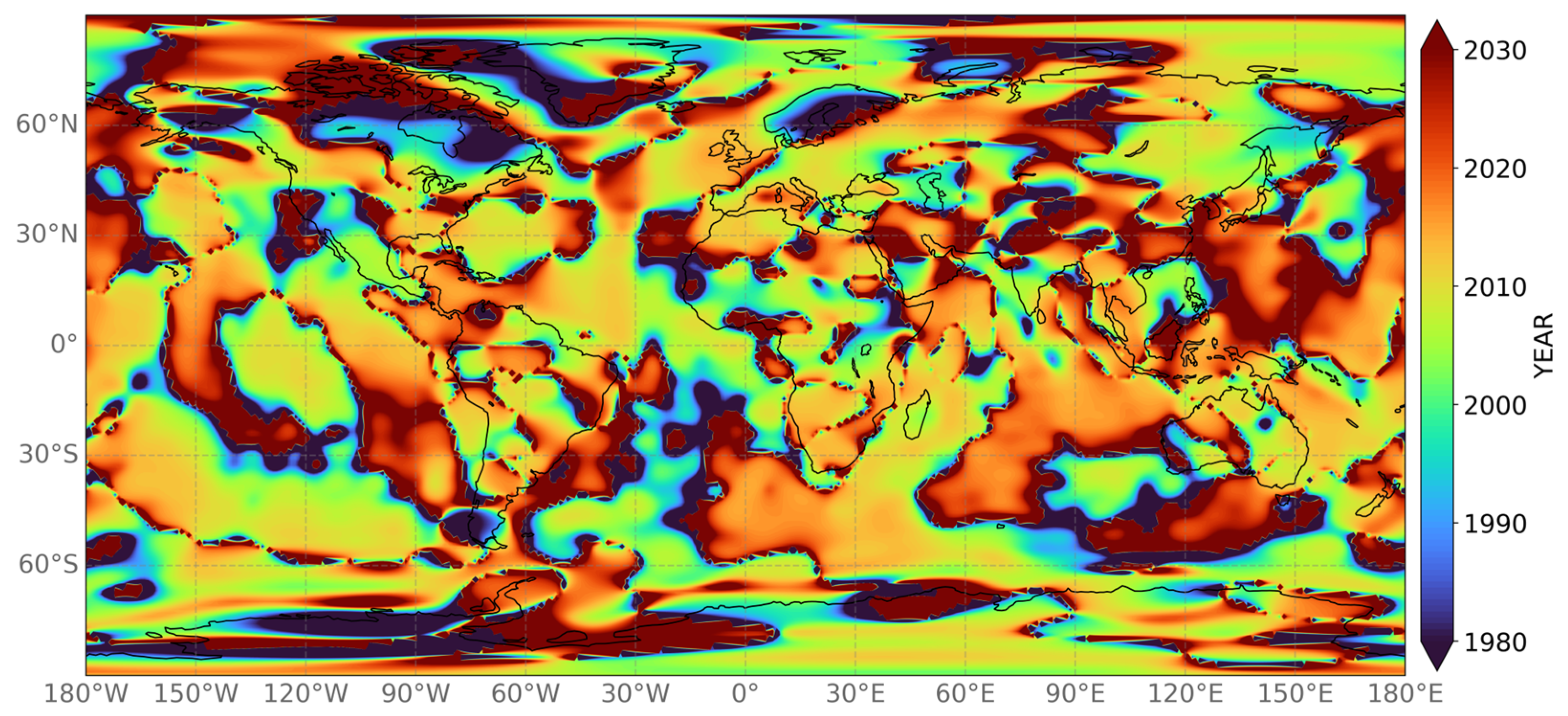
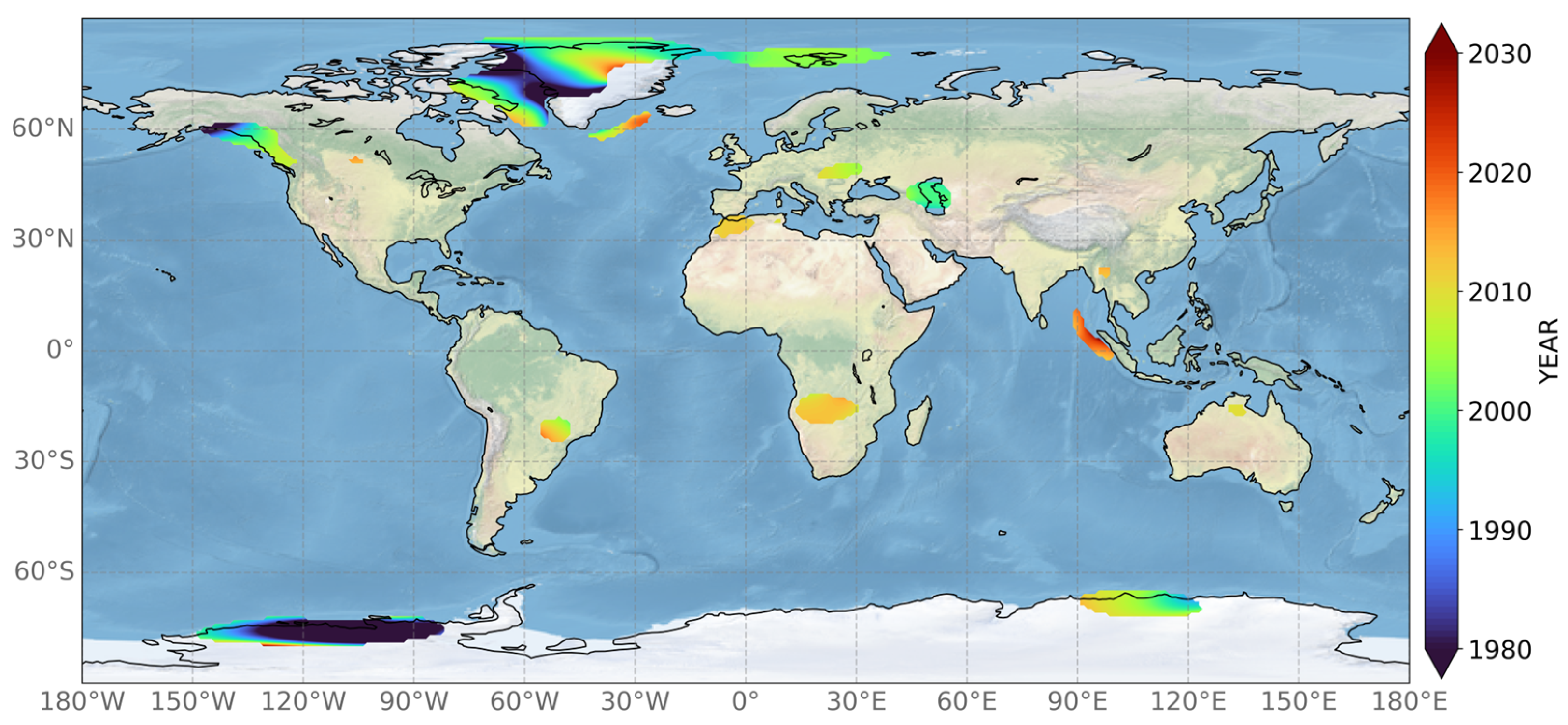
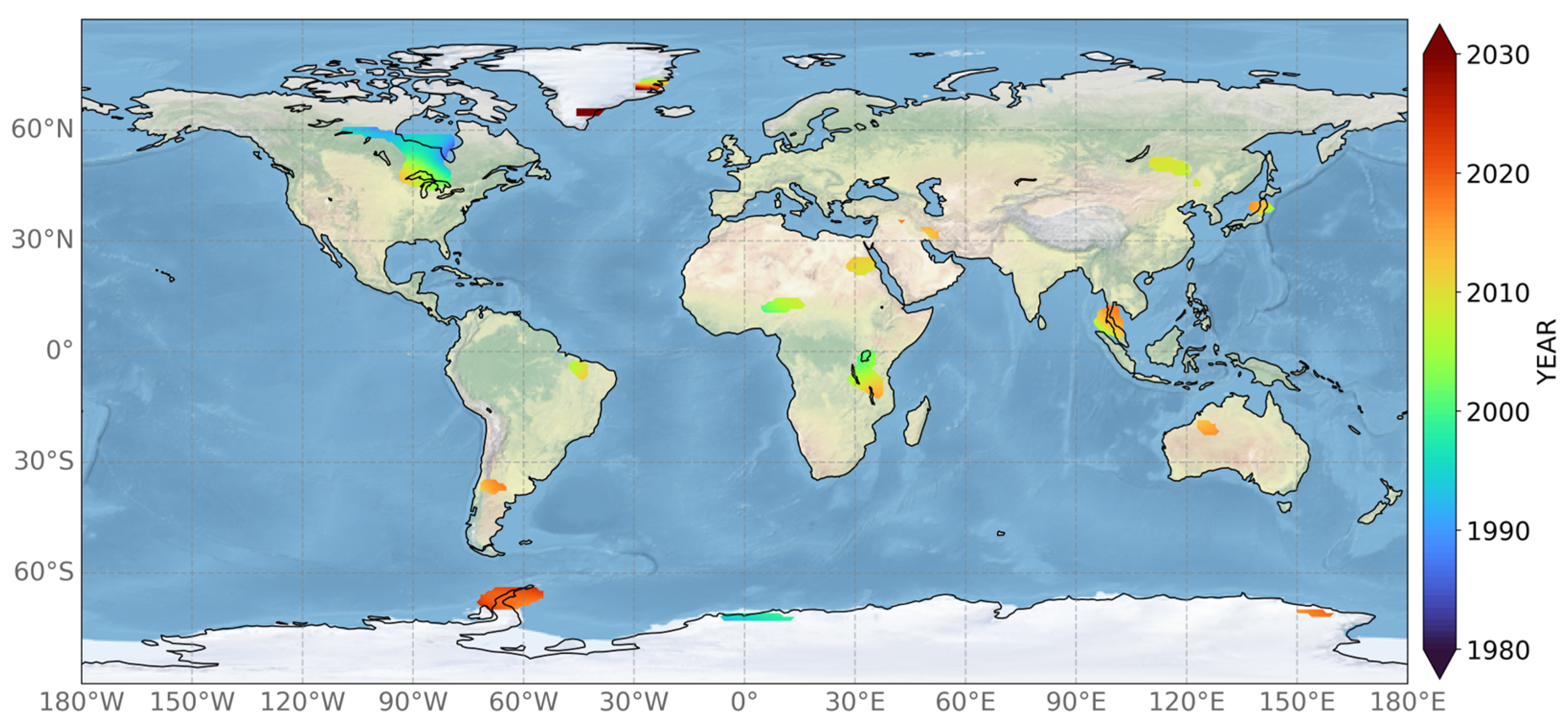
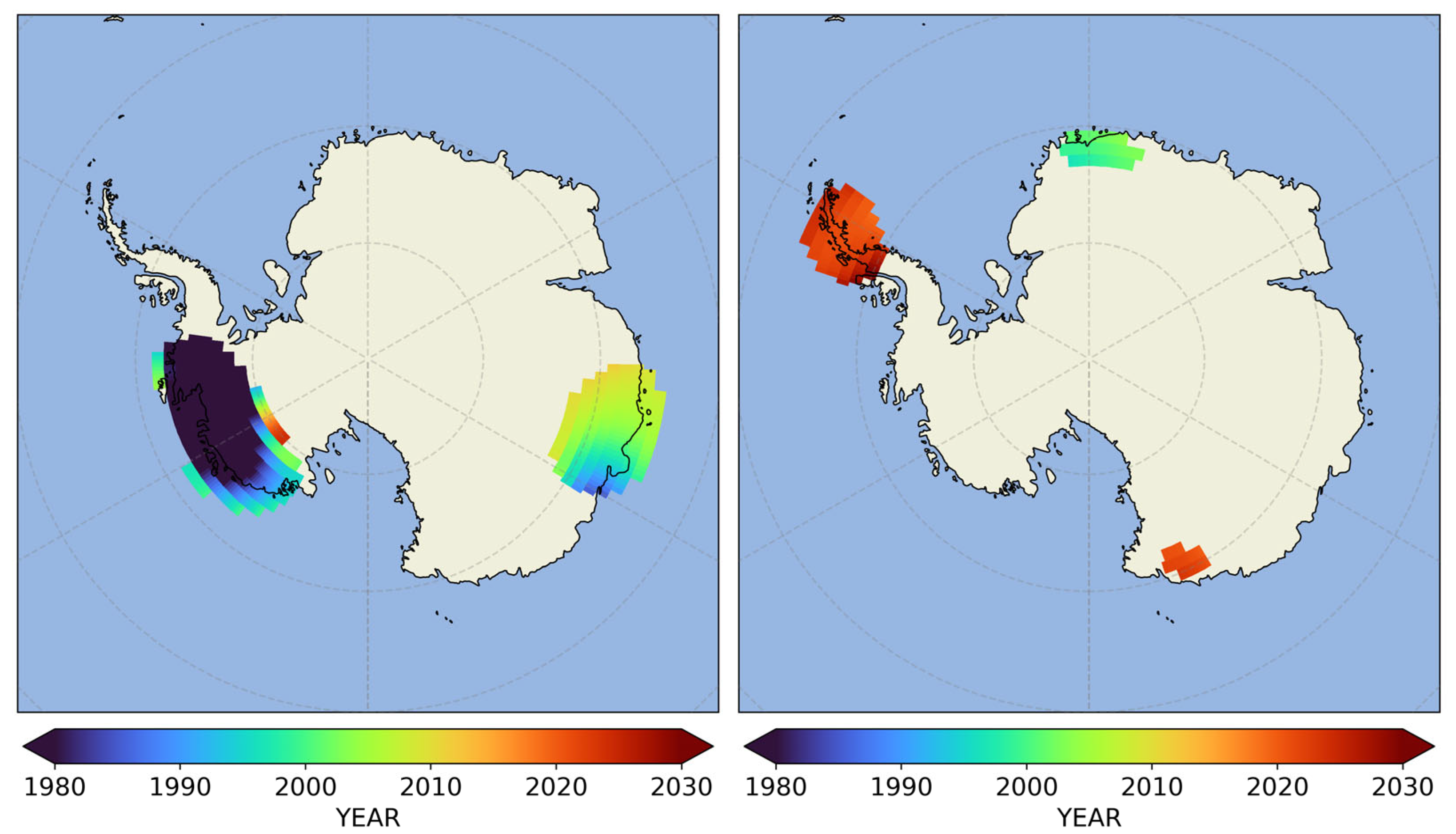
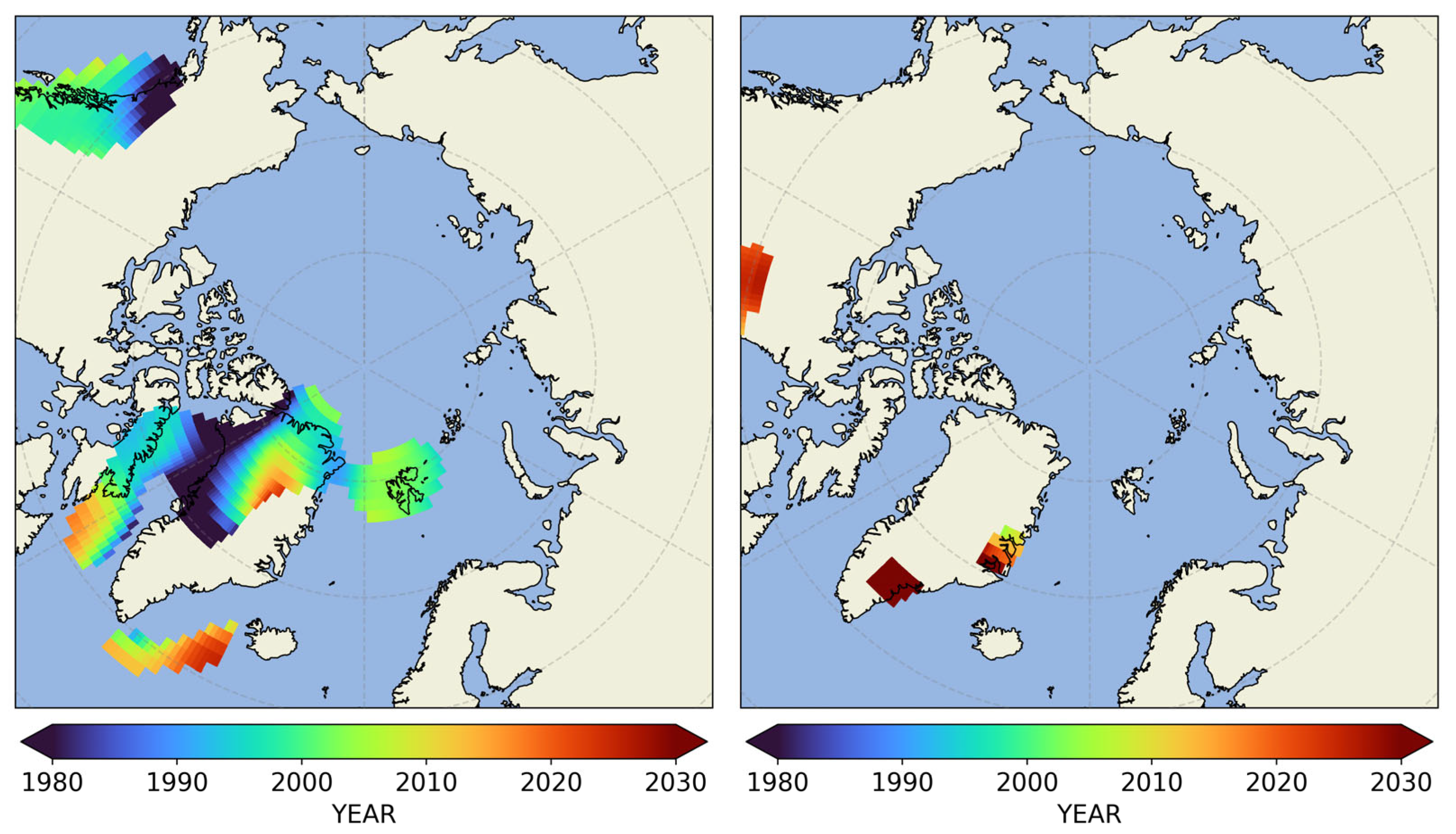
- A combined SLR and GRACE gravity model spanning 1995–2024 reveals significant non-linear mass changes, identifying specific trend reversal dates for global ice and water reservoirs, such as the 2004 peak in Svalbard and the 2021 trend reversal in the Antarctic Peninsula.
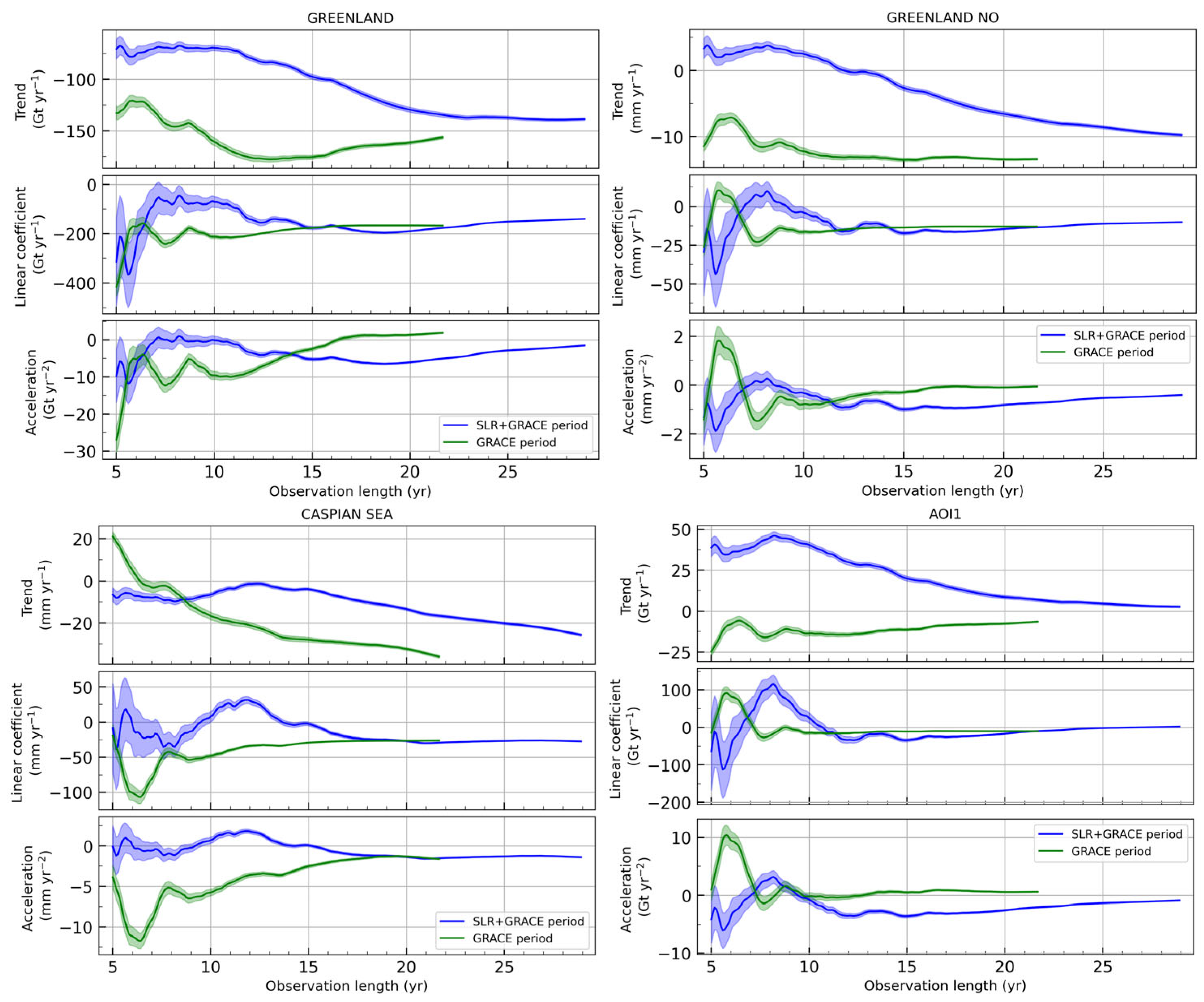
- The analysis demonstrates that linear trend models fail to stabilize even with 30 years of data, whereas models incorporating acceleration parameters achieve stabilization for most polar regions after 15–20 years.
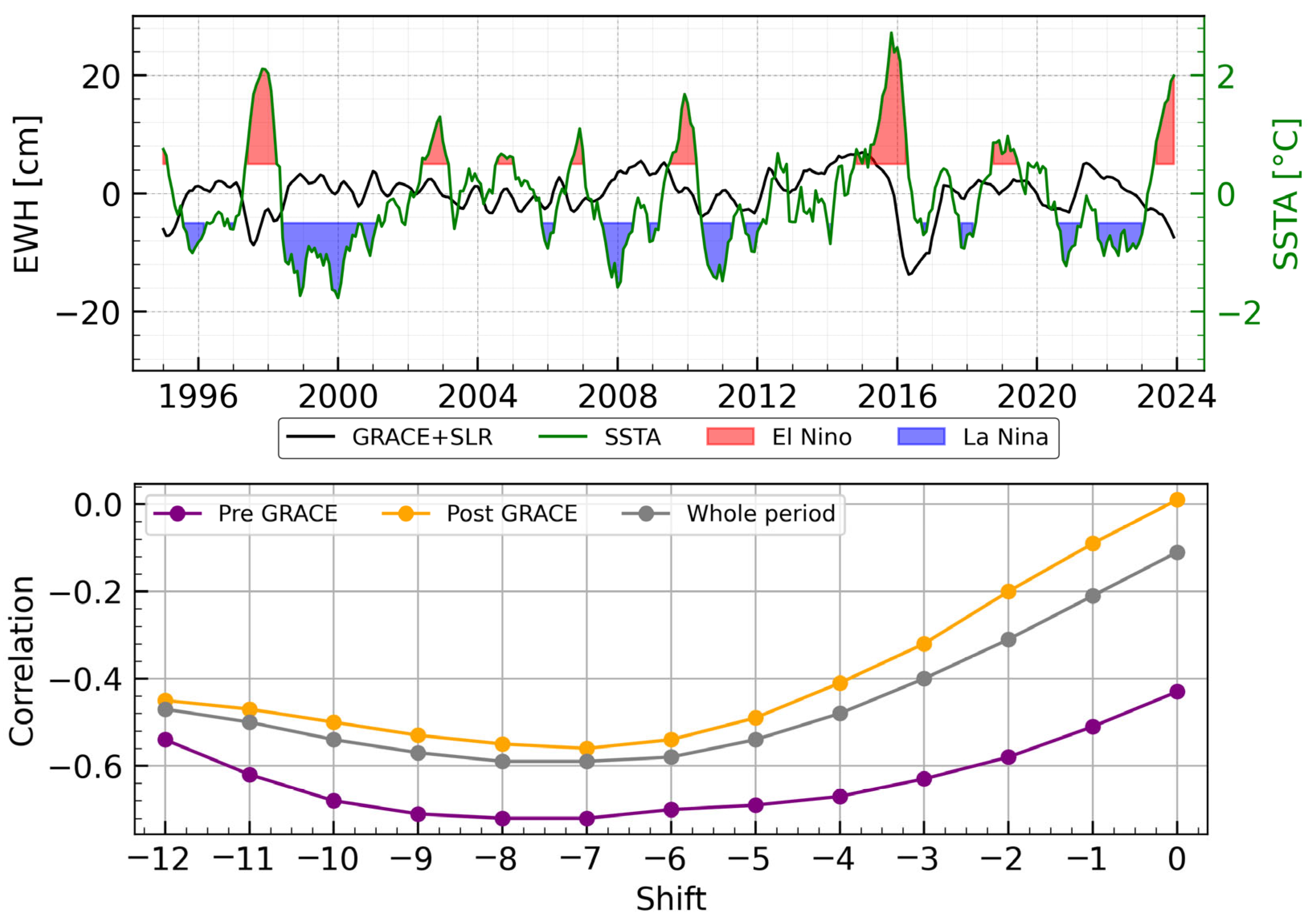
- This study proves that extending the satellite gravimetry record back to 1995 using SLR allows for the accurate detection of climate-driven hydrological events, e.g., the 1997/1998 El Niño, prior to the GRACE mission launch.
- Incorporating acceleration terms into long-term gravity models provides a more reliable metric for monitoring climate change impacts than linear trends alone, particularly for detecting the onset of rapid ice mass depletion or recovery.
Abstract
1. Introduction
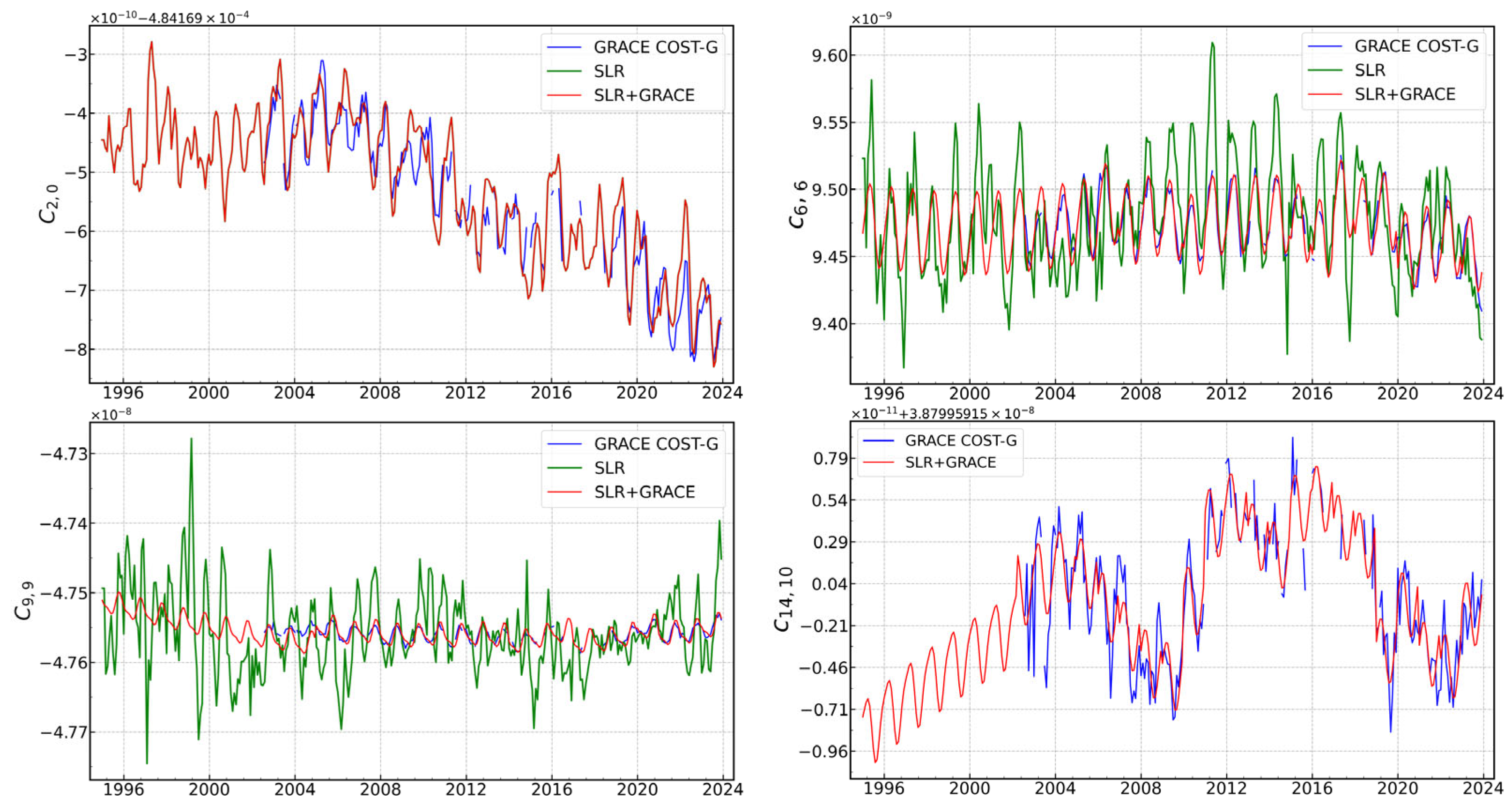
2. Satellite Gravimetry Ice and Water Mass Estimates
- (1)
- From the beginning of 1995 to the start of the GRACE mission (2002.4);
- (2)
- From the start of the GRACE mission (2002.4) to the end of the analyzed data (2023.12).
- is the time of observation (epoch), expressed in decimal years;
- is the time centered around the reference epoch;
- is the reference epoch;
- are the intercept and linear trend;
- are seasonal amplitudes;
- are the semiannual signal amplitudes;
- is the coefficient of the quadratic (second-order polynomial) term;
- are the magnitudes of the estimated annual step pulses;
- is the residual;
- is the number of years in the estimation interval.
3. Validation
3.1. Validation with Sea Surface Temperature Anomaly
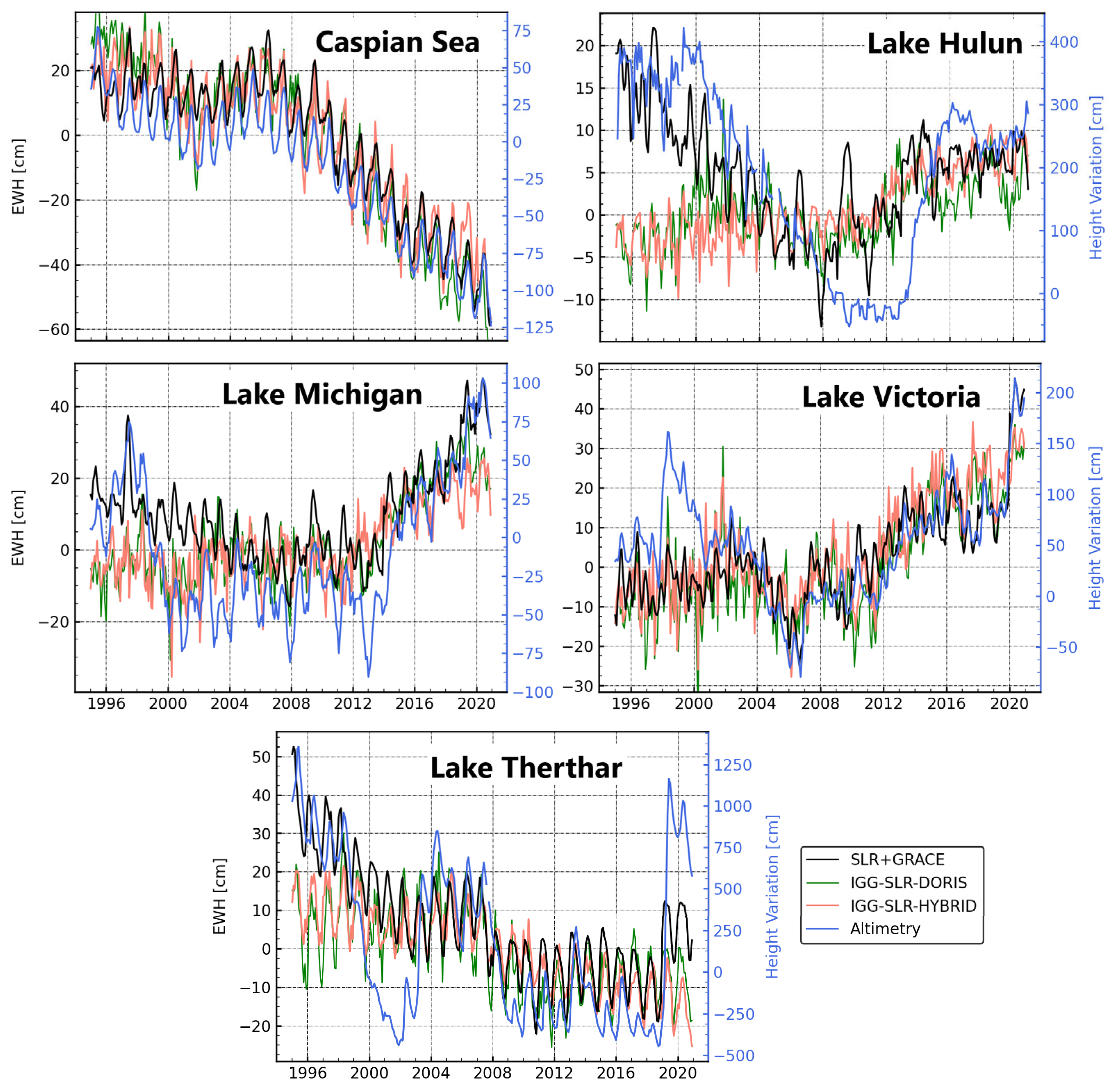
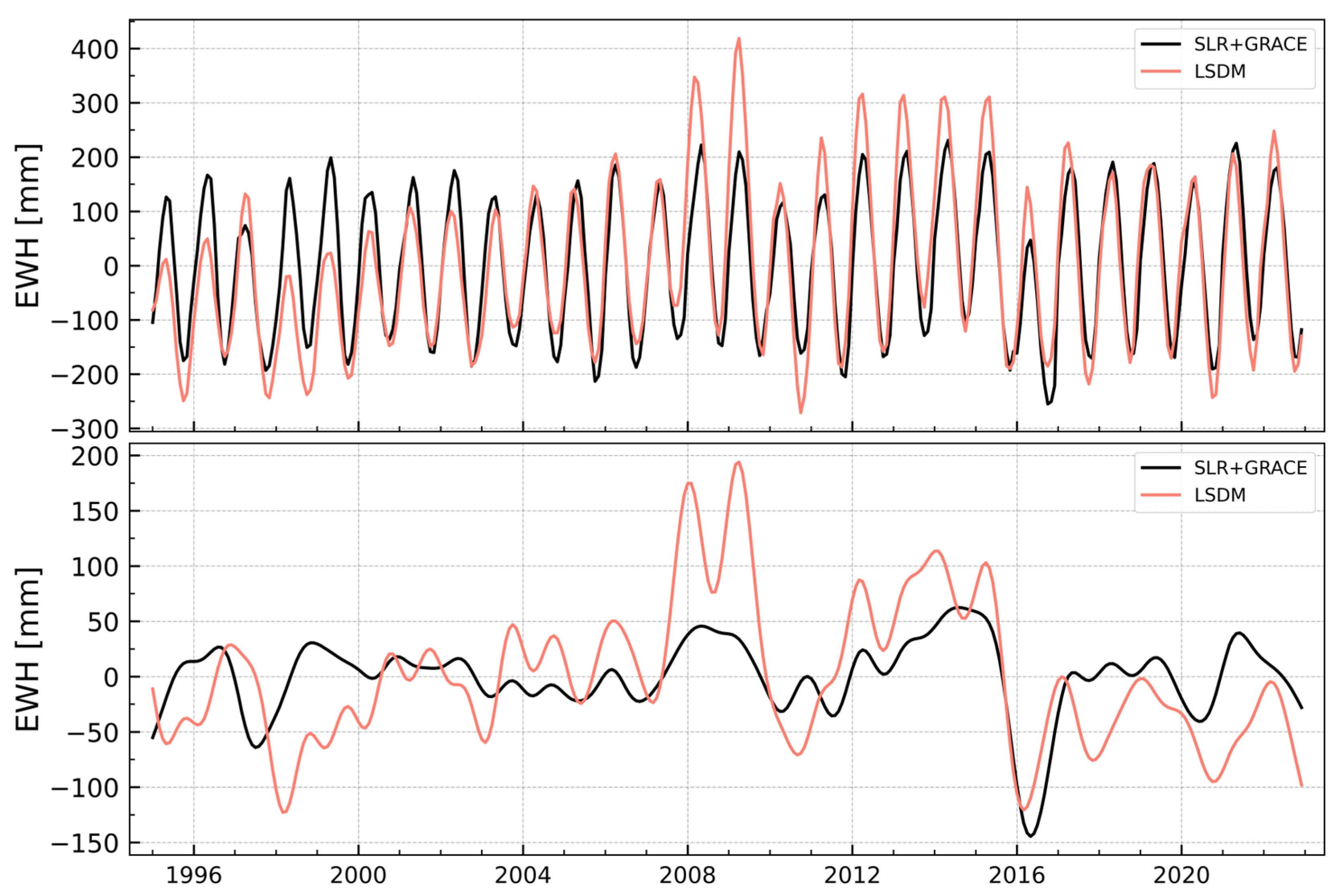
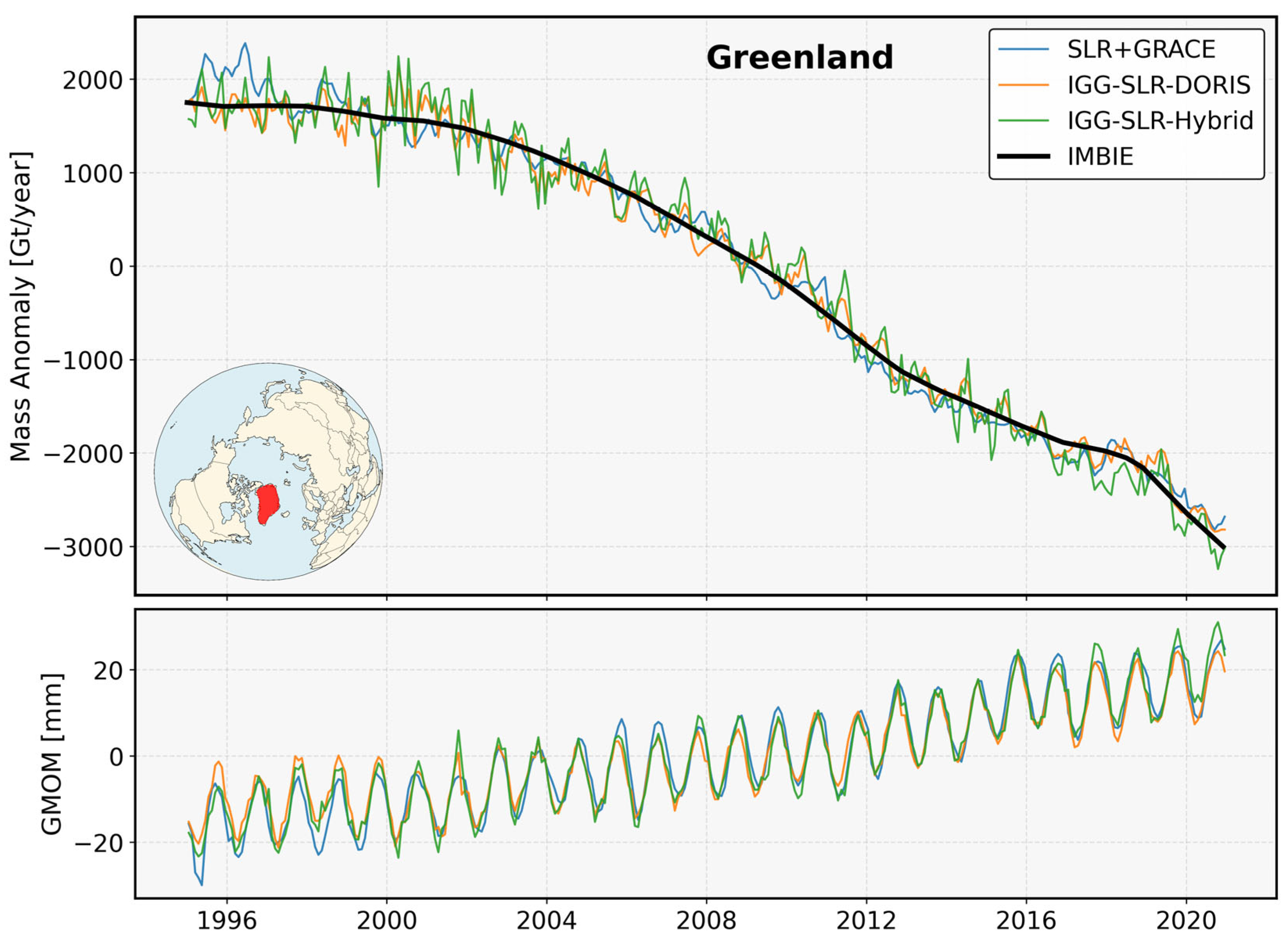
3.2. Validation with Different Models and Altimetry Data
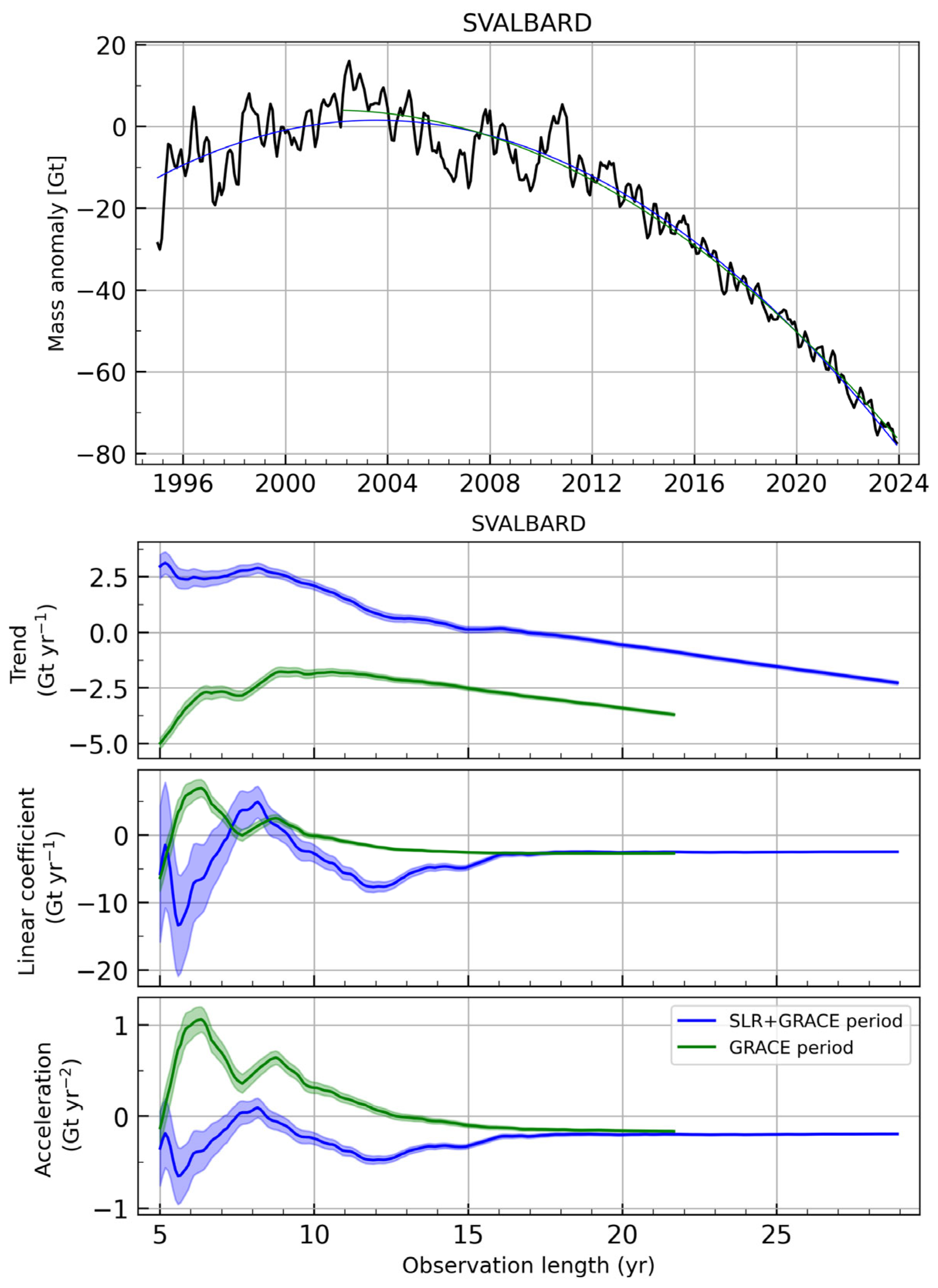
3.3. Methodological Validation: Sensitivity to Record Length
4. Water Storage Accelerations
4.1. Antarctica Region—Accelerating Ice Mass Depletion
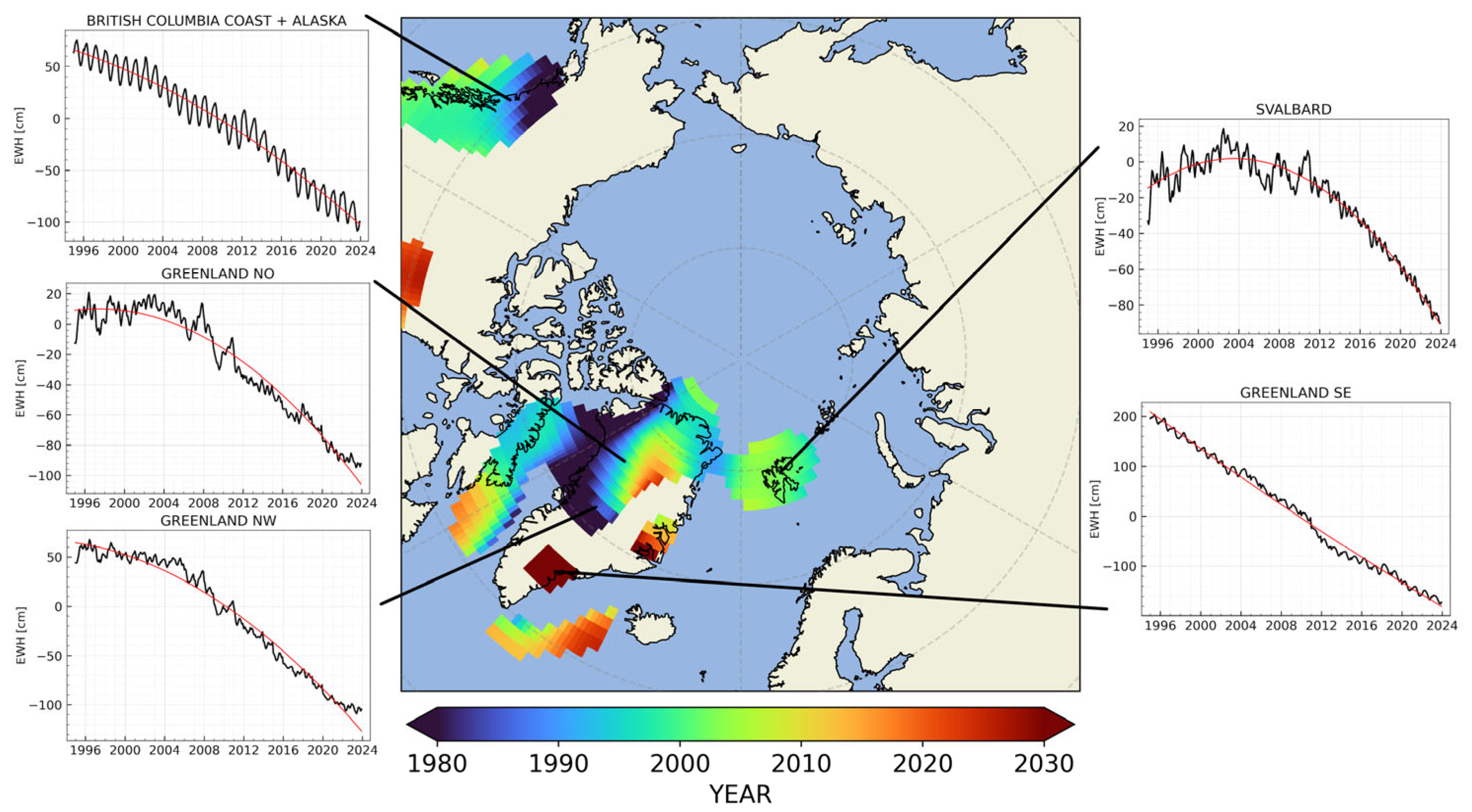
4.2. Arctic Region—Accelerating Ice Mass Depletion
5. Discussion and Summary
Author Contributions
Funding
Data Availability Statement
Acknowledgments
Conflicts of Interest
Appendix A



References
- Famiglietti, J.S. The global groundwater crisis. Nat. Clim. Change 2014, 4, 945–948. [Google Scholar] [CrossRef]
- Rodell, M.; Reager, J.T. Water cycle science enabled by the GRACE and GRACE-FO satellite missions. Nat. Water 2023, 1, 47–59. [Google Scholar] [CrossRef]
- Wouters, B.; Bamber, J.L.; Van Den Broeke, M.R.; Lenaerts, J.T.M.; Sasgen, I. Limits in detecting acceleration of ice sheet mass loss due to climate variability. Nat. Geosci. 2013, 6, 613–616. [Google Scholar] [CrossRef]
- Tapley, B.D.; Watkins, M.M.; Flechtner, F.; Reigber, C.; Bettadpur, S.; Rodell, M.; Sasgen, I.; Famiglietti, J.S.; Landerer, F.W.; Chambers, D.P.; et al. Contributions of GRACE to understanding climate change. Nat. Clim. Change 2019, 9, 358–369. [Google Scholar] [CrossRef]
- Velicogna, I.; Wahr, J. Acceleration of Greenland ice mass loss in spring 2004. Nature 2006, 443, 329–331. [Google Scholar] [CrossRef] [PubMed]
- Chambers, D.P.; Cazenave, A.; Champollion, N.; Dieng, H.; Llovel, W.; Forsberg, R.; von Schuckmann, K.; Wada, Y. Evaluation of the Global Mean Sea Level Budget between 1993 and 2014. Surv. Geophys. 2017, 38, 309–327. [Google Scholar] [CrossRef]
- Tapley, B.D.; Bettadpur, S.; Ries, J.C.; Thompson, P.F.; Watkins, M.M. GRACE Measurements of Mass Variability in the Earth System. Science 2004, 305, 503–505. [Google Scholar] [CrossRef] [PubMed]
- Landerer, F.W.; Flechtner, F.M.; Save, H.; Webb, F.H.; Bandikova, T.; Bertiger, W.I.; Bettadpur, S.V.; Byun, S.H.; Dahle, C.; Dobslaw, H.; et al. Extending the Global Mass Change Data Record: GRACE Follow-On Instrument and Science Data Performance. Geophys. Res. Lett. 2020, 47, e2020GL088306. [Google Scholar] [CrossRef]
- Pearlman, M.; Arnold, D.; Davis, M.; Barlier, F.; Biancale, R.; Vasiliev, V.; Ciufolini, I.; Paolozzi, A.; Pavlis, E.C.; Sośnica, K.; et al. Laser geodetic satellites: A high-accuracy scientific tool. J. Geod. 2019, 93, 2181–2194. [Google Scholar] [CrossRef]
- Altamimi, Z.; Rebischung, P.; Collilieux, X.; Métivier, L.; Chanard, K. ITRF2020: An augmented reference frame refining the modeling of nonlinear station motions. J. Geod. 2023, 97, 47. [Google Scholar] [CrossRef]
- Cheng, M.; Tapley, B.D.; Ries, J.C. Deceleration in the Earth’s oblateness. J. Geophys. Res. Solid Earth 2013, 118, 740–747. [Google Scholar] [CrossRef]
- Matsuo, K.; Chao, B.F.; Otsubo, T.; Heki, K. Accelerated ice mass depletion revealed by low-degree gravity field from satellite laser ranging: Greenland, 1991–2011. Geophys. Res. Lett. 2013, 40, 4662–4667. [Google Scholar] [CrossRef]
- Cheng, M. Laser ranging in 5×5 spherical harmonics. Zenodo 2017. [Google Scholar] [CrossRef]
- Sośnica, K.; Jäggi, A.; Meyer, U.; Thaller, D.; Beutler, G.; Arnold, D.; Dach, R. Time variable Earth’s gravity field from SLR satellites. J. Geod. 2015, 89, 945–960. [Google Scholar] [CrossRef]
- Loomis, B.; Rachlin, K.; Luthcke, S. Improved Earth Oblateness Rate Reveals Increased Ice Sheet Losses and Mass-Driven Sea Level Rise. Geophys. Res. Lett. 2019, 46, 6910–6917. [Google Scholar] [CrossRef]
- Loomis, B.; Rachlin, K.; Wiese, D.; Landerer, F.; Luthcke, S. Replacing GRACE/GRACE-FO with Satellite Laser Ranging: Impacts on Antarctic Ice Sheet Mass Change. Geophys. Res. Lett. 2020, 47, e2019GL085488. [Google Scholar] [CrossRef]
- Cheng, M.; Ries, J. The unexpected signal in GRACE estimates of C20. J. Geod. 2017, 91, 897–914. [Google Scholar] [CrossRef]
- Cheng, M.; Ries, J. C20 and C30 Variations from SLR for GRACE/GRACE-FO Science Applications. J. Geophys. Res. Solid Earth 2023, 128, e2022JB025459. [Google Scholar] [CrossRef]
- Löcher, A.; Kusche, J. A hybrid approach for recovering high-resolution temporal gravity fields from satellite laser ranging. J. Geod. 2021, 95, 6. [Google Scholar] [CrossRef]
- Uz, M.; Akyılmaz, O.; Shum, C.K.; Atman, K.G.; Olgun, S.; Güneş, Ö. High-resolution temporal gravity field data products: Monthly mass grids and spherical harmonics from 1994 to 2021. Sci. Data 2024, 11, 71. [Google Scholar] [CrossRef]
- Chen, Q.; Wang, F.; Shen, Y.; Zhang, X.; Nie, Y.; Chen, J. Monthly Gravity Field Solutions from Early LEO Satellites’ Observations Contribute to Global Ocean Mass Change Estimates over 1993∼2004. Geophys. Res. Lett. 2022, 49, e2022GL099917. [Google Scholar] [CrossRef]
- Gałdyn, F.; Sośnica, K.; Zajdel, R.; Meyer, U.; Jäggi, A. Long-term ice mass changes in Greenland and Antarctica derived from satellite laser ranging. Remote Sens. Environ. 2024, 302, 113994. [Google Scholar] [CrossRef]
- Chen, J.L.; Wilson, C.R.; Tapley, B.D.; Yang, Z.L.; Niu, G.Y. 2005 drought event in the Amazon River basin as measured by GRACE and estimated by climate models. J. Geophys. Res. Solid Earth 2009, 114, B05404. [Google Scholar] [CrossRef]
- Rodell, M.; Famiglietti, J.S.; Wiese, D.N.; Reager, J.T.; Beaudoing, H.K.; Landerer, F.W.; Lo, M.H. Emerging trends in global freshwater availability. Nature 2018, 557, 651–659. [Google Scholar] [CrossRef]
- Sun, Z.; Long, D.; Yang, W.; Li, X.; Pan, Y. Reconstruction of GRACE Data on Changes in Total Water Storage Over the Global Land Surface and 60 Basins. Water Resour. Res. 2020, 56, e2019WR026250. [Google Scholar] [CrossRef]
- Velicogna, I.; Wahr, J. Measurements of Time-Variable Gravity Show Mass Loss in Antarctica. Science 2006, 311, 1754–1756. [Google Scholar] [CrossRef]
- Velicogna, I.; Wahr, J. Greenland mass balance from GRACE. Geophys. Res. Lett. 2005, 32. [Google Scholar] [CrossRef]
- Shepherd, A.; Ivins, E.; Rignot, E.; Smith, B.; van den Broeke, M.; Velicogna, I.; Whitehouse, P.; Briggs, K.; Joughin, I.; Krinner, G.; et al. Mass balance of the Greenland Ice Sheet from 1992 to 2018. Nature 2020, 579, 233–239. [Google Scholar] [CrossRef]
- Otosaka, I.N.; Shepherd, A.; Ivins, E.R.; Schlegel, N.-J.; Amory, C.; Broeke, M.R.v.D.; Horwath, M.; Joughin, I.; King, M.D.; Krinner, G.; et al. Mass balance of the Greenland and Antarctic ice sheets from 1992 to 2020. Earth Syst. Sci. Data 2023, 15, 1597–1616. [Google Scholar] [CrossRef]
- Ciracì, E.; Velicogna, I.; Swenson, S. Continuity of the Mass Loss of the World’s Glaciers and Ice Caps from the GRACE and GRACE Follow-On Missions. Geophys. Res. Lett. 2020, 47, e2019GL086926. [Google Scholar] [CrossRef]
- Velicogna, I.; Sutterley, T.C.; van den Broeke, M.R. Regional acceleration in ice mass loss from Greenland and Antarctica using GRACE time-variable gravity data. Geophys. Res. Lett. 2014, 41, 8130–8137. [Google Scholar] [CrossRef]
- Svendsen, P.L.; Andersen, O.B.; Nielsen, A.A. Acceleration of the Greenland ice sheet mass loss as observed by GRACE: Confidence and sensitivity. Earth Planet. Sci. Lett. 2013, 364, 24–29. [Google Scholar] [CrossRef]
- Velicogna, I.; Mohajerani, Y.; Geruo, A.; Landerer, F.; Mouginot, J.; Noel, B.; Rignot, E.; Sutterley, T.; Broeke, M.v.D.; van Wessem, M.; et al. Continuity of Ice Sheet Mass Loss in Greenland and Antarctica from the GRACE and GRACE Follow-On Missions. Geophys. Res. Lett. 2020, 47, e2020GL087291. [Google Scholar] [CrossRef]
- Rignot, E.; Velicogna, I.; van den Broeke, M.R.; Monaghan, A.; Lenaerts, J. Acceleration of the contribution of the Greenland and Antarctic ice sheets to sea level rise. Geophys. Res. Lett. 2011, 38, 1–5. [Google Scholar] [CrossRef]
- Ogawa, R.; Chao, B.F.; Heki, K. Acceleration signal in GRACE time-variable gravity in relation to interannual hydrological changes. Geophys. J. Int. 2011, 184, 673–679. [Google Scholar] [CrossRef]
- Loomis, B.D.; Luthcke, S.B. Mass evolution of Mediterranean, Black, Red, and Caspian Seas from GRACE and altimetry: Accuracy assessment and solution calibration. J. Geod. 2017, 91, 195–206. [Google Scholar] [CrossRef]
- Eicker, A.; Forootan, E.; Springer, A.; Longuevergne, L.; Kusche, J. Does GRACE see the terrestrial water cycle ‘intensifying’? J. Geophys. Res. 2016, 121, 733–745. [Google Scholar] [CrossRef]
- Swenson, S.; Wahr, J. Multi-sensor analysis of water storage variations of the Caspian Sea. Geophys. Res. Lett. 2007, 34. [Google Scholar] [CrossRef]
- Chen, J.; Wilson, C.; Seo, K.-W.; Cazenave, A.; Wang, S.; Li, J.; Nie, Y. Validation of GRACE/GRACE-FO Solutions Using Caspian Sea Level Change. IEEE J. Sel. Top. Appl. Earth Obs. Remote Sens. 2024, 17, 15885–15899. [Google Scholar] [CrossRef]
- Meyer, U.; Lasser, M.; Dahle, C.; Förste, C.; Behzadpour, S.; Koch, I.; Jäggi, A. Combined monthly GRACE-FO gravity fields for a Global Gravity-based Groundwater Product. Geophys. J. Int. 2024, 236, 456–469. [Google Scholar] [CrossRef]
- Beutler, G.; Jäggi, A.; Mervart, L.; Meyer, U. The celestial mechanics approach: Theoretical foundations. J. Geod. 2010, 84, 605–624. [Google Scholar] [CrossRef]
- Dach, R.; Lutz, S.; Walser, P.; Fridez, P. Bernese GNSS Software Version 5.2. User manual; Astronomical Institute, University of Bern: Bern, Switzerland, 2015. [Google Scholar] [CrossRef]
- Sośnica, K.; Jäggi, A.; Thaller, D.; Beutler, G.; Dach, R. Contribution of Starlette, Stella, and AJISAI to the SLR-derived global reference frame. J. Geod. 2014, 88, 789–804. [Google Scholar] [CrossRef]
- Rubincam, D.P. Radiative Spin-up and Spin-down of Small Asteroids. Icarus 2000, 148, 2–11. [Google Scholar] [CrossRef]
- Appleby, G.M. Long-arc analyses of SLR observations of the Etalon geodetic satellites. J. Geod. 1998, 72, 333–342. [Google Scholar] [CrossRef]
- Kusche, J. Approximate decorrelation and non-isotropic smoothing of time-variable GRACE-type gravity field models. J. Geod. 2007, 81, 733–749. [Google Scholar] [CrossRef]
- Kusche, J.; Schmidt, R.; Petrovic, S.; Rietbroek, R. Decorrelated GRACE time-variable gravity solutions by GFZ, and their validation using a hydrological model. J. Geod. 2009, 83, 903–913. [Google Scholar] [CrossRef]
- Wahr, J.; Molenaar, M.; Bryan, F. Time variability of the Earth’s gravity field: Hydrological and oceanic effects and their possible detection using GRACE. J. Geophys. Res. Solid Earth 1998, 103, 30205–30229. [Google Scholar] [CrossRef]
- Kvas, A.; Brockmann, J.M.; Krauss, S.; Schubert, T.; Gruber, T.; Meyer, U.; Mayer-Gürr, T.; Schuh, W.-D.; Jäggi, A.; Pail, R. GOCO06s—A satellite-only global gravity field model. Earth Syst. Sci. Data 2021, 13, 99–118. [Google Scholar] [CrossRef]
- Petit, G.; Luzum, B. IERS Conventions (2010); Petit, G., Luzum, B., Eds.; IERS: Frankfurt am Main, Germany, 2010. [Google Scholar]
- Dobslaw, H.; Bergmann-Wolf, I.; Dill, R.; Poropat, L.; Thomas, M.; Dahle, C.; Esselborn, S.; König, R.; Flechtner, F. A new high-resolution model of non-tidal atmosphere and ocean mass variability for de-aliasing of satellite gravity observations: AOD1B RL06. Geophys. J. Int. 2017, 211, 263–269. [Google Scholar] [CrossRef]
- Ries, J. Geocenter Motion. Implementation with ITRF2020. In Proceedings of the GGOS Unified Analysis Workshop, Thessaloniki, Greece, 21 October 2022; Available online: https://zenodo.org/records/7298630/files/Ries_Geocenter_Implemntation.pdf (accessed on 12 December 2025).
- Bjerknes, J. Atmospheric teleconnections from the equatorial pacific. Mon. Weather Rev. 1969, 97, 163–172. [Google Scholar] [CrossRef]
- Neelin, J.D.; Battisti, D.S.; Hirst, A.C.; Jin, F.; Wakata, Y.; Yamagata, T.; Zebiak, S.E. ENSO theory. J. Geophys. Res. Oceans 1998, 103, 14261–14290. [Google Scholar] [CrossRef]
- Cook, E.R.; Seager, R.; Cane, M.A.; Stahle, D.W. North American drought: Reconstructions, causes, and consequences. Earth-Sci. Rev. 2007, 81, 93–134. [Google Scholar] [CrossRef]
- Jiménez-Muñoz, J.C.; Mattar, C.; Barichivich, J.; Santamaría-Artigas, A.; Takahashi, K.; Malhi, Y.; Sobrino, J.A.; van der Schrier, G. Record-breaking warming and extreme drought in the Amazon rainforest during the course of El Niño 2015–2016. Sci. Rep. 2016, 6, 33130. [Google Scholar] [CrossRef]
- Supari; Tangang, F.; Salimun, E.; Aldrian, E.; Sopaheluwakan, A.; Juneng, L. ENSO modulation of seasonal rainfall and extremes in Indonesia. Clim. Dyn. 2018, 51, 2559–2580. [Google Scholar] [CrossRef]
- Chen, J.L.; Wilson, C.R.; Tapley, B.D. The 2009 exceptional Amazon flood and interannual terrestrial water storage change observed by GRACE. Water Resour. Res. 2010, 46. [Google Scholar] [CrossRef]
- Morishita, Y.; Heki, K. Characteristic precipitation patterns of El Niño/La Niña in time-variable gravity fields by GRACE. Earth Planet. Sci. Lett. 2008, 272, 677–682. [Google Scholar] [CrossRef]
- Xavier, L.; Becker, M.; Cazenave, A.; Longuevergne, L.; Llovel, W.; Filho, O.C.R. Interannual variability in water storage over 2003–2008 in the Amazon Basin from GRACE space gravimetry, in situ river level and precipitation data. Remote Sens. Environ. 2010, 114, 1629–1637. [Google Scholar] [CrossRef]
- Williamson, G.B.; Laurance, W.F.; Oliveira, A.A.; Delamônica, P.; Gascon, C.; Lovejoy, T.E.; Pohl, L. Amazonian Tree Mortality during the 1997 El Niño Drought. Conserv. Biol. 2000, 14, 1538–1542. [Google Scholar] [CrossRef]
- Ni, S.; Chen, J.; Wilson, C.R.; Li, J.; Hu, X.; Fu, R. Global Terrestrial Water Storage Changes and Connections to ENSO Events. Surv. Geophys. 2018, 39, 1–22. [Google Scholar] [CrossRef]
- Dill, R. Hydrological model LSDM for operational Earth rotation and gravity field variations. Potsdam 2008. [Google Scholar] [CrossRef]
- Löcher, A.; Kusche, J.; Nie, Y. A 40-year record of the Earth’s time-variable gravity field from SLR and DORIS. Adv. Space Res. 2025, 76, 1281–1291. [Google Scholar] [CrossRef]
- Peltier, R.W.; Argus, D.F.; Drummond, R. Comment on ‘An Assessment of the ICE-6G_C (VM5a) Glacial Isostatic Adjustment Model’ by Purcell et al. J. Geophys. Res. Solid Earth 2018, 123, 2019–2028. [Google Scholar] [CrossRef]
- Chen, J.L.; Wilson, C.R.; Li, J.; Zhang, Z. Reducing leakage error in GRACE-observed long-term ice mass change: A case study in West Antarctica. J. Geod. 2015, 89, 925–940. [Google Scholar] [CrossRef]
- Nie, Y.; Chen, J.; Peng, D. Global Ocean Mass Change Estimation Using Low-Degree Gravity Field from Satellite Laser Ranging. Geophys. Res. Lett. 2024, 51, e2024GL109717. [Google Scholar] [CrossRef]
- Caron, L.; Ivins, E.R.; Larour, E.; Adhikari, S.; Nilsson, J.; Blewitt, G. GIA Model Statistics for GRACE Hydrology, Cryosphere, and Ocean Science. Geophys. Res. Lett. 2018, 45, 2203–2212. [Google Scholar] [CrossRef]
- Chen, J.L.; Wilson, C.R.; Blankenship, D.; Tapley, B.D. Accelerated Antarctic ice loss from satellite gravity measurements. Nat. Geosci. 2009, 2, 859–862. [Google Scholar] [CrossRef]
- Rignot, E.; Mouginot, J.; Scheuchl, B.; van den Broeke, M.; van Wessem, M.J.; Morlighem, M. Four decades of Antarctic Ice Sheet mass balance from 1979–2017. Proc. Natl. Acad. Sci. USA 2019, 116, 1095–1103. [Google Scholar] [CrossRef]
- Mouginot, J.; Rignot, E.; Scheuchl, B.; Millan, R. Comprehensive Annual Ice Sheet Velocity Mapping Using Landsat-8, Sentinel-1, and RADARSAT-2 Data. Remote Sens. 2017, 9, 364. [Google Scholar] [CrossRef]
- van Pelt, W.J.J.; Schuler, T.V.; Pohjola, V.A.; Pettersson, R. Accelerating future mass loss of Svalbard glaciers from a multi-model ensemble. J. Glaciol. 2021, 67, 485–499. [Google Scholar] [CrossRef]
- Noël, B.; Jakobs, C.L.; Van Pelt, W.J.J.; Lhermitte, S.; Wouters, B.; Kohler, J.; Hagen, J.O.; Luks, B.; Reijmer, C.H.; Van De Berg, W.J.; et al. Low elevation of Svalbard glaciers drives high mass loss variability. Nat. Commun. 2020, 11, 4597. [Google Scholar] [CrossRef]
- Arendt, A.; Luthcke, S.; Gardner, A.; O’nEel, S.; Hill, D.; Moholdt, G.; Abdalati, W. Analysis of a GRACE global Mascon solution for Gulf of Alaska glaciers. J. Glaciol. 2013, 59, 913–924. [Google Scholar] [CrossRef]
- Lang, C.; Fettweis, X.; Erpicum, M. Stable climate and surface mass balance in Svalbard over 1979–2013 despite the Arctic warming. Cryosphere 2015, 9, 83–101. [Google Scholar] [CrossRef]
- Walczowski, W.; Piechura, J. Influence of the West Spitsbergen Current on the local climate. Int. J. Climatol. 2011, 31, 1088–1093. [Google Scholar] [CrossRef]
- Morris, A.; Moholdt, G.; Gray, L. Spread of Svalbard Glacier Mass Loss to Barents Sea Margins Revealed by CryoSat-2. J. Geophys. Res. Earth Surf. 2020, 125, e2019JF005357. [Google Scholar] [CrossRef]
- Rignot, E.; Casassa, G.; Gogineni, P.; Krabill, W.; Rivera, A.; Thomas, R. Accelerated ice discharge from the Antarctic Peninsula following the collapse of Larsen B ice shelf. Geophys. Res. Lett. 2004, 31. [Google Scholar] [CrossRef]
- Scambos, T.A.; Bohlander, J.A.; Shuman, C.A.; Skvarca, P. Glacier acceleration and thinning after ice shelf collapse in the Larsen B embayment, Antarctica. Geophys. Res. Lett. 2004, 31. [Google Scholar] [CrossRef]
- Royston, S.; Gudmundsson, G.H. Changes in ice-shelf buttressing following the collapse of Larsen A Ice Shelf, Antarctica, and the resulting impact on tributaries. J. Glaciol. 2016, 62, 905–911. [Google Scholar] [CrossRef][Green Version]
- van Dalum, C.T.; van de Berg, W.J.; van den Broeke, M.R.; van Tiggelen, M. The surface mass balance and near-surface climate of the Antarctic ice sheet in RACMO2.4p1. Cryosphere 2025, 19, 4061–4090. [Google Scholar] [CrossRef]
- Wang, W.; Shen, Y.; Chen, Q.; Wang, F. Unprecedented mass gain over the Antarctic ice sheet between 2021 and 2022 caused by large precipitation anomalies. Environ. Res. Lett. 2023, 18, 124012. [Google Scholar] [CrossRef]
- Ince, E.S.; Barthelmes, F.; Reißland, S.; Elger, K.; Förste, C.; Flechtner, F.; Schuh, H. ICGEM—15 years of successful collection and distribution of global gravitational models, associated services, and future plans. Earth Syst. Sci. Data 2019, 11, 647–674. [Google Scholar] [CrossRef]
- Pearlman, M.R.; Noll, C.E.; Pavlis, E.C.; Lemoine, F.G.; Combrink, L.; Degnan, J.J.; Kirchner, G.; Schreiber, U. The ILRS: Approaching 20 years and planning for the future. J. Geod. 2019, 93, 2161–2180. [Google Scholar] [CrossRef]





| SH | Time | |
|---|---|---|
| January 1995–April 2002 | April 2002–December 2023 | |
| 2–4 | SLR-only | SLR-only |
| raw estimates | ||
| 5–10 | SLR-only with fitted annual and semiannual signals and the second-degree polynomial with annual step pulses * for January 1995–April 2002 | GRACE from COST-G |
| fitted annual and semiannual signals and the second-degree polynomial with annual step pulses for the period January 1995–December 2023 | ||
| 11–60 | GRACE from COST-G | GRACE from COST-G |
| backward extrapolation of the full deterministic model from the period April 2002–December 2023 | fitted annual and semiannual signals and the second-degree polynomial with annual step pulses | |
| 1995–2021 | 2002–2021 | 1995–2002 | ||||||||
|---|---|---|---|---|---|---|---|---|---|---|
| SLR+GRACE (This Study) | IGG-SLR-HYBRID | IGG-SLR-DORIS | SLR+GRACE (This Study) | IGG-SLR-HYBRID | IGG-SLR-DORIS | COST-G | SLR+GRACE (This Study) | IGG-SLR-HYBRID | IGG-SLR-DORIS | |
| Caspian Sea | 0.93 | 0.91 | 0.92 | 0.97 | 0.93 | 0.92 | 0.99 | 0.51 | 0.64 | 0.78 |
| Lake Michigan | 0.82 | 0.50 | 0.59 | 0.83 | 0.68 | 0.77 | 0.89 | 0.64 | 0.38 | 0.43 |
| Lake Hulun | 0.71 | −0.18 | 0.04 | 0.53 | 0.53 | 0.49 | 0.53 | 0.32 | 0.14 | −0.09 |
| Lake Victoria | 0.63 | 0.49 | 0.53 | 0.90 | 0.79 | 0.79 | 0.92 | 0.44 | −0.05 | 0.15 |
| Lake Therthar | 0.64 | 0.50 | 0.44 | 0.58 | 0.34 | 0.39 | 0.72 | 0.76 | 0.52 | 0.33 |
| Trend [cm/yr] | Acceleration [cm/yr2] | Extremum [yr.mth] | |
|---|---|---|---|
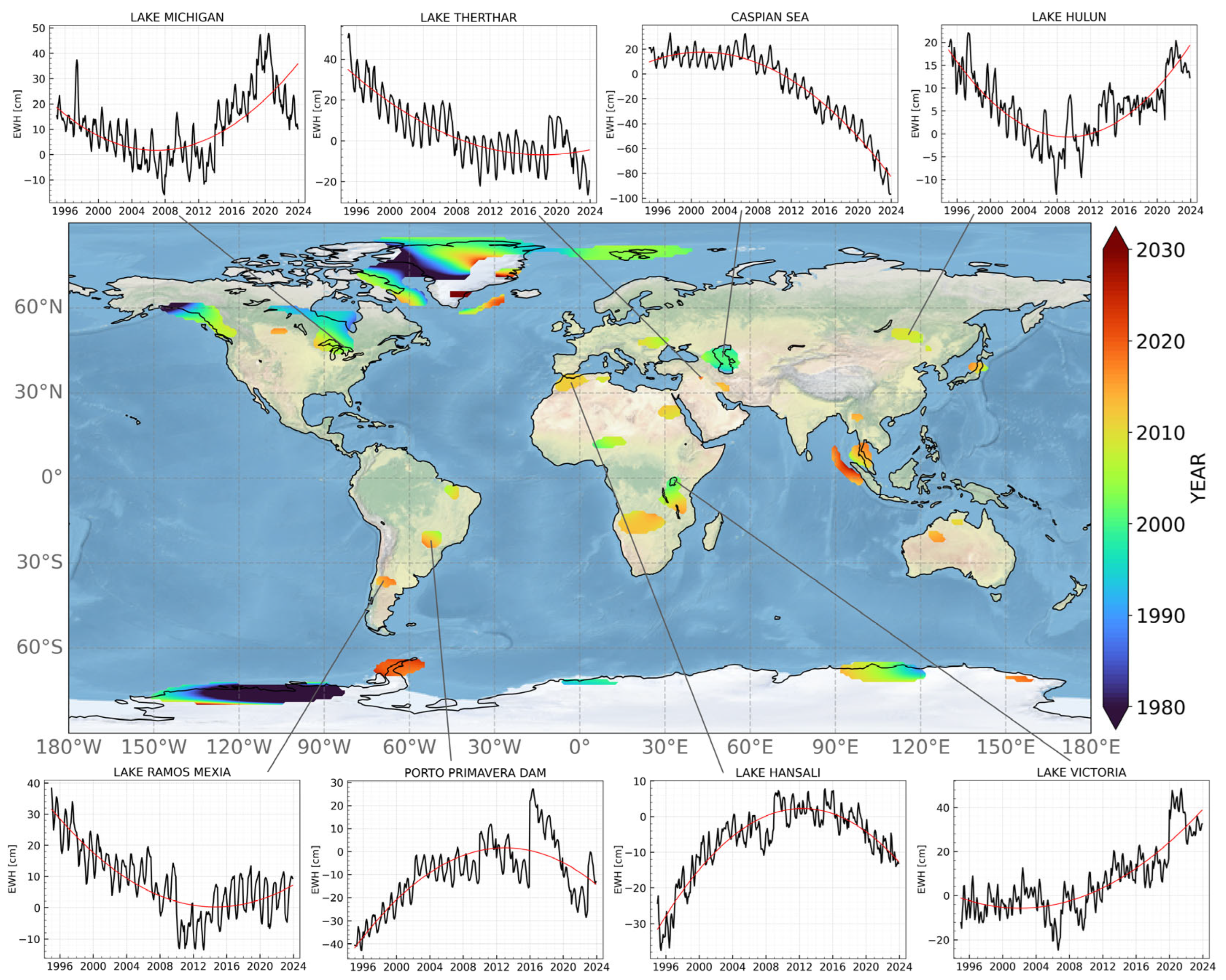
| Lake Michigan | 0.60 ± 0.07 | 0.118 ± 0.007 | December 2006 |
| Lake Therthar | −1.34 ± 0.05 | 0.077 ± 0.005 | February 2018 |
| Caspian Sea | −3.05 ± 0.08 | −0.139 ± 0.004 | April 2000 |
| Lake Hulun | 0.03 ± 0.04 | 0.093 ± 0.003 | April 2009 |
| Lake Ramos Mexia | −0.86 ± 0.04 | 0.081 ± 0.004 | September 2014 |
| Porto Primavera Dam | 0.96 ± 0.07 | −0.128 ± 0.007 | January 2013 |
| Lake Hansali | 0.66 ± 0.05 | −0.123 ± 0.002 | May 2012 |
| Lake Victoria | 1.38 ± 0.06 | 0.093 ± 0.006 | January 2002 |
| Trend [cm/yr] | Acceleration [cm/yr2] | Extremum [yr.mth] | |
|---|---|---|---|
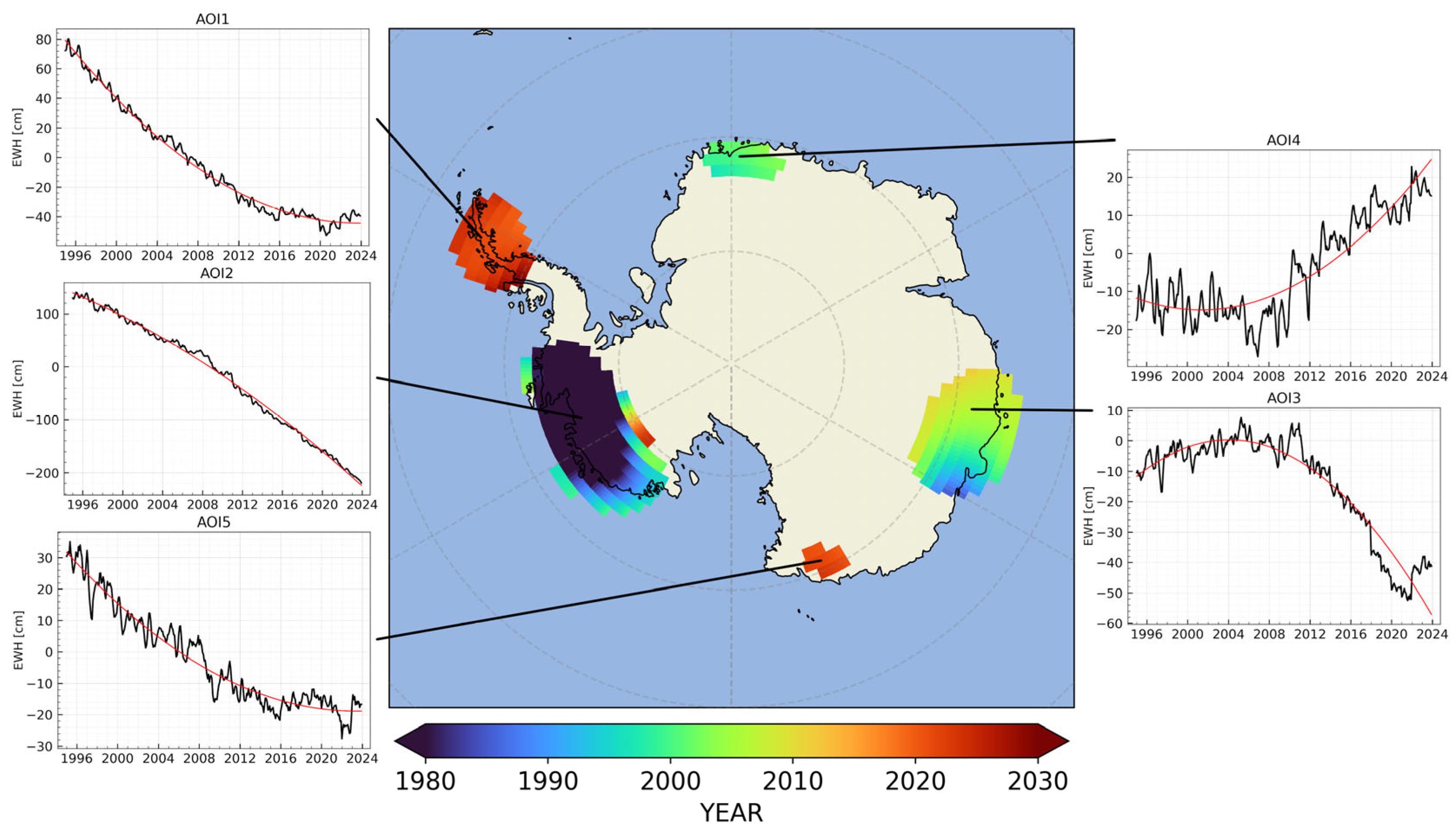
| AOI1 | −3.35 ± 0.06 | 0.149 ± 0.003 | August 2020 |
| AOI2 | −11.34 ± 0.08 | −0.156 ± 0.006 | February 1973 |
| AOI3 | −1.12 ± 0.07 | −0.145 ± 0.004 | July 2005 |
| AOI4 | 1.92 ± 0.04 | 0.077 ± 0.004 | January 1997 |
| AOI5 | −1.32 ± 0.03 | 0.062 ± 0.003 | December 2019 |
| Trend [cm/yr] | Acceleration [cm/yr2] | Extremum [yr.mth] | |
|---|---|---|---|
| British Columbia + Alaska | −5.54 ± 0.05 | −0.091 ± 0.004 | January 1979 |
| Greenland NO | −2.79 ± 0.08 | 0.164 ± 0.006 | December 2001 |
| Greenland NW | −6.65 ± 0.09 | −0.172 ± 0.007 | February 1990 |
| Greenland SE | −13.3 ± 0.06 | 0.052 ± 0.008 | September 2138 |
| Svalbard | −2.07 ± 0.10 | −0.223 ± 0.005 | October 2004 |
Disclaimer/Publisher’s Note: The statements, opinions and data contained in all publications are solely those of the individual author(s) and contributor(s) and not of MDPI and/or the editor(s). MDPI and/or the editor(s) disclaim responsibility for any injury to people or property resulting from any ideas, methods, instructions or products referred to in the content. |
© 2026 by the authors. Licensee MDPI, Basel, Switzerland. This article is an open access article distributed under the terms and conditions of the Creative Commons Attribution (CC BY) license.
Share and Cite
Gałdyn, F.; Sośnica, K.; Zajdel, R.; Meyer, U.; Jäggi, A. Non-Linear Global Ice and Water Storage Changes from a Combination of Satellite Laser Ranging and GRACE Data. Remote Sens. 2026, 18, 313. https://doi.org/10.3390/rs18020313
Gałdyn F, Sośnica K, Zajdel R, Meyer U, Jäggi A. Non-Linear Global Ice and Water Storage Changes from a Combination of Satellite Laser Ranging and GRACE Data. Remote Sensing. 2026; 18(2):313. https://doi.org/10.3390/rs18020313
Chicago/Turabian StyleGałdyn, Filip, Krzysztof Sośnica, Radosław Zajdel, Ulrich Meyer, and Adrian Jäggi. 2026. "Non-Linear Global Ice and Water Storage Changes from a Combination of Satellite Laser Ranging and GRACE Data" Remote Sensing 18, no. 2: 313. https://doi.org/10.3390/rs18020313
APA StyleGałdyn, F., Sośnica, K., Zajdel, R., Meyer, U., & Jäggi, A. (2026). Non-Linear Global Ice and Water Storage Changes from a Combination of Satellite Laser Ranging and GRACE Data. Remote Sensing, 18(2), 313. https://doi.org/10.3390/rs18020313