Article

Hydrological Changes Drive the Seasonal Vegetation Carbon Storage of the Poyang Lake Floodplain Wetland

1
Key Laboratory of Ecosystem Network Observation and Modeling, Institute of Geographic Sciences and Natural Resources Research, Chinese Academy of Sciences, Beijing 100101, China
2
College of Resources and Environment, University of Chinese Academy of Sciences, Beijing 100049, China
*
Author to whom correspondence should be addressed.
Remote Sens. 2026, 18(2), 276; https://doi.org/10.3390/rs18020276
Submission received: 22 November 2025 / Revised: 29 December 2025 / Accepted: 10 January 2026 / Published: 14 January 2026

Highlights

What are the main findings?
  • The vegetation carbon storage in the Poyang Lake wetland was significantly higher in spring than in autumn, and the Carex cinerascens community was the most dominant contributor to vegetation carbon storage.
  • An earlier start or end of floods could enhance vegetation carbon storage in spring or autumn, while the effects of meteorological factors vary by season.
What are the implications of the main findings?
  • Hydrological conditions could directly or indirectly influence vegetation carbon storage in the floodplain wetland by constraining the distribution range of communities and the water availability of vegetation.
  • Seasonal hydrological conditions play a crucial role in modulating the response of vegetation carbon storage in floodplain wetlands to climate change.

Abstract

Wetlands are a critical component of the global biogeochemical cycle and have great potential for carbon sequestration under the changing climate. However, previous studies have mainly focused on the dynamics of soil organic carbon while paying little attention to the vegetation carbon storage in wetlands. Poyang Lake is the largest freshwater lake in China, where intra-annual and inter-annual variations in water levels significantly affect the vegetation carbon storage in the floodplain wetland. Therefore, we assessed the seasonal distribution and carbon storage of six typical plant communities (Arundinella hirta, Carex cinerascens, Miscanthus lutarioriparius, Persicaria hydropiper, Phalaris arundinacea, and Phragmites australis) in Poyang Lake wetlands from 2019 to 2024 based on field surveys, the literature, and remote sensing data. Then, we used 16 preseason meteorological and hydrological variables for two growing seasons to investigate the impacts of environmental factors on vegetation carbon storage based on four correlation and regression methods (including Pearson and partial correlation, ridge, and elastic net regression). The results show that the C. cinerascens community was the most dominant contributor to vegetation carbon storage, occupying 12.68% to 44.22% of the Poyang Lake wetland area. The vegetation carbon storage in the Poyang Lake wetland was significantly (p < 0.01) higher in spring (87.75 × 10⁴ t to 239.10 × 10⁴ t) than in autumn (77.32 × 10⁴ t to 154.78 × 10⁴ t). Water body area emerged as a key explanatory factor, as it directly constrains the spatial extent available for vegetation colonization and growth by alternating inundation and exposure. In addition, an earlier start or end to floods could both enhance vegetation carbon storage in spring or autumn. However, preseason precipitation and temperature are negative to carbon storage in spring but exhibited opposite effects in autumn. These results assessed the seasonal dynamics of dominant vegetation communities and helped understand the response of the wetland carbon cycle under the changing climate.

1. Introduction

Wetlands play a crucial role in global biogeochemical cycles and have significant potential for carbon sequestration in mitigating climate warming [1,2]. Despite covering only 6–8% of the land area, wetlands contain approximately 20–30% of the global carbon pool [3]. In wetlands, the major forms of carbon sequestration are plant biomass and soil organic carbon, and the anoxic conditions caused by perennial or periodic flooding further enhance soil organic carbon stores and wetlands’ sink functions [4,5]. Furthermore, environmental changes may turn these carbon sinks into sources, and wetland extent and functionality would be significantly affected by future climate change [6]. For example, the wetland soil organic carbon (SOC) storage would decrease by 30.48 ± 3.18 Tg C due to a 1.5 °C warming, but a 20% increase in precipitation could offset this decline by enhancing SOC storage by 55.35 ± 4.24 Tg C [7]. However, compared with SOC, quantitative research on how wetland vegetation carbon storage responds to environmental changes remains limited [8]. Therefore, accurately assessing wetland vegetation carbon storage potential is crucial for understanding and mitigating climate change and also for enhancing wetland ecosystem resilience [2,9,10].
Hydrological conditions, including water levels, timing of the start and end of flooding, etc., significantly influence the wetland vegetation [11]. These conditions determine the availability of surface and underground resources in wetlands and thus regulate the photosynthesis in leaves and respiration, absorption, and transportation in roots of plant communities [12,13]. Generally, wetland plant community structure exhibits zonal patterns along gradients of water availability or topography, reflecting the adaptation and response of wetland plant populations to varying moisture conditions [14,15,16]. For instance, research on the Sanjiang Plain marsh wetlands found that prolonged drought would gradually lead to the replacement of wetland sedge (Carex lasiocarpa) and gray moss Carex cinerascens communities with narrow-leaved grass (Deyeuxia angustifolia) communities [17]. Zhang et al. observed that areas with a high frequency of hydrological changes had higher plant biomass than those with a low frequency of hydrological changes [18]. Hydrological changes under climate change can alter the distribution and biomass of wetland plant communities, thereby impacting wetland plant carbon storage.
Seasonal floodplain wetlands are profoundly influenced by hydrological fluctuations, which affect vegetation distribution, community composition and productivity [14,19,20]. Poyang Lake, China’s largest freshwater lake, experiences significant intra-annual and inter-annual variations in floodplain wetland water levels due to regional climate conditions and human activities [21,22,23]. Changes in hydrological processes expose plants to different water depths and durations of inundation, affecting aboveground and belowground biomass and their distribution, leading to changes in island vegetation [24]. Despite several attempts to assess vegetation carbon storage in Poyang Lake, uncertainties remain [25,26]. Most assessments have focused on vegetation carbon storage during specific periods, and lack quantitative expressions and analyses of inter-annual hydrological changes. They have often concentrated on a single species (such as C. cinerascens). Different wetland plants respond differently to varying inundation times and depths, a response which is also influenced by the seasons [27]. To investigate the impacts of hydrological conditions on vegetation carbon storage in floodplain wetlands, we assessed the distribution and carbon storage of six typical plant communities (Arundinella hirta, C. cinerascens, Miscanthus lutarioriparius, Persicaria hydropiper, Phalaris arundinacea, and Phragmites australis) in spring and autumn growing seasons from 2019 to 2024 in Poyang Lake wetlands based on field surveys, the literature data, and remote sensing inversion. This study quantifies the regional vegetation carbon storage and its response to environmental factors in Poyang Lake wetlands, enhancing our understanding of wetland carbon cycling, sequestration processes, and their responses to climate change.

2. Materials and Methods

2.1. Study Area

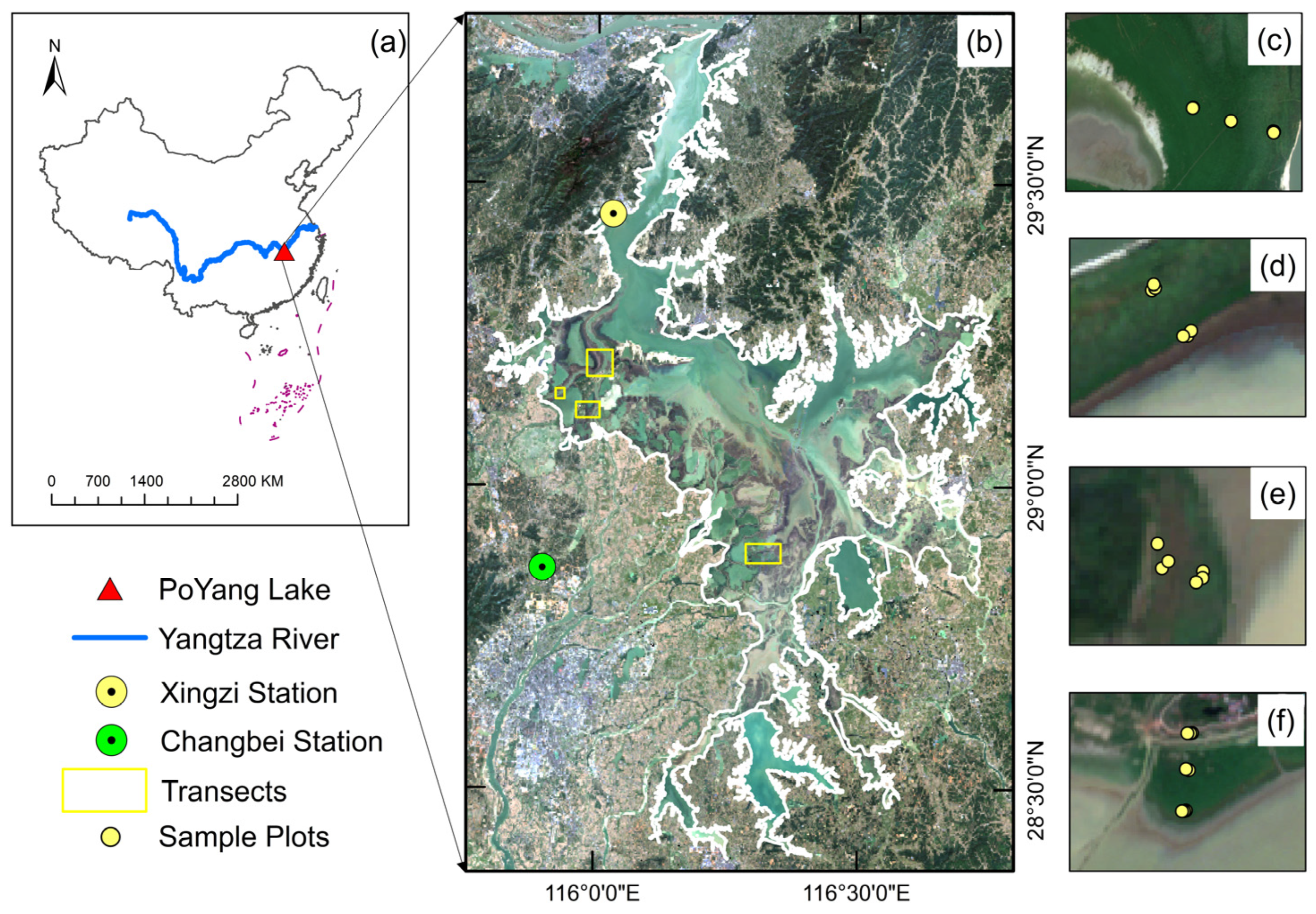
Poyang Lake (28°11′~29°51′N, 115°31′~117°06′E) is situated on the southern bank of the lower reaches of the Yangtze River basin within the subtropical zone. It has an average annual precipitation ranging from 1400 to 2400 mm and an average annual temperature in the range from 16 to 19 °C (Figure 1) [28]. There are significant seasonal fluctuations in the water level of Poyang Lake, characterized by high-water periods from June to August and low-water periods from September to the next March [29]. The lake would expand during the wet season to more than four times its area in the dry season, and the flooding pattern is described as “lake phase in high water level but river phase in low water level” [30,31,32]. These unique hydrological processes lead to distinct zonal distribution patterns among wetland plants. The dominant species include P. australis, M. lutarioriparius, C. cinerascens, and P. arundinacea, etc. Due to the seasonal flooding and temperature variation, the vegetation in the Poyang Lake wetland generally exhibits two growing seasons each year, i.e., spring (March to June) and autumn (October to the next January) [27,33]. However, the continuous decline in water levels, increased frequency of droughts, and the early onset and extended duration of the dry season in Poyang Lake have posed significant challenges to the local wetland ecosystem [34].

2.2. Satellite Imagery and Vegetation Identification

We used Sentinel-1 Level 1 Ground Range Detected (GRD) and Sentinel-2 Level 2A Surface Reflectance (SR) data to obtain the distribution of vegetation communities in the Poyang Lake wetland based on the Google Earth Engine (GEE) platform [35]. The Sentinel-1 GRD data is collected from the C-band synthetic aperture radar, which can provide imagery in 10 m spatial resolution and is not limited by clouds or illumination conditions. The Sentinel-2 SR data provided 12 bands of global surface reflectance images at spatial resolutions of 10 m, 20 m, and 60 m from 2017 [36].
To obtain the distribution of six vegetation communities in the whole Poyang Lake wetland, a random forest (RF) classification model was trained. Based on a field investigation in late April 2024, we identified 1887 ground reference points of ten classes of wetland land cover types, including six communities, cropland, sand or mudflat, water body, and built-up areas. To identify these ten types of land cover, we selected the ‘VV’, ‘VH’ bands in Sentinel-1 GRD and ‘B2’, ‘B3’, ‘B4’, ‘B5’, ‘B6’, ‘B7’, ‘B8’, ‘B8A’, ‘B11’ bands in Sentinel-2 SR for calculating spectral index and constructing RF model. Five indices were calculated, including the normalized difference vegetation index (NDVI, Equation (1)), enhanced vegetation index (EVI, Equation (2)), normalized difference water index (NDWI, Equation (3)), land surface water index (LSWI, Equation (4)), and normalized difference built-up index (NDBI, Equation (5)). Concretely, NDVI and EVI are used to characterize canopy growth, NDWI is used to detect water bodies, LSWI and NDBI are used to assist in extracting sand or mudflat, and built-up areas [37,38,39].
NDVI = ρ NIR ρ red ρ NIR + ρ red
EVI = 2.5 × ( ρ NIR ρ red ) ρ NIR + 6 × ρ red 7.5 × ρ blue + 1
NDWI = ρ green ρ NIR ρ green + ρ NIR
LSWI = ρ NIR ρ SWIR ρ NIR + ρ SWIR
NDBI = ρ SWIR ρ NIR ρ NIR + ρ SWIR
where ρred represents the ‘B4’ band, ρgreen represents the ‘B3’ band, ρblue represents the ‘B2’ band, ρNIR represents the ‘B8’ band, and ρSWIR represents the ‘B11’ band in Sentinel-2 SR images.
Because Sentinel-2 SR data has been atmospherically corrected, we only removed the pixels that were classified as cloud shadows, thin cirrus, and cloud in medium and high probability before the model training according to the Scene Classification (SCL) map [34]. In addition, the images with a percentage of cloud cover of more than 20% were also filtered. There are 16 features (‘VV’, ‘VH’, ‘B2’, ‘B3’, ‘B4’, ‘B5’, ‘B6’, ‘B7’, ‘B8’, ‘B8A’, ‘NDVI’, ‘EVI’, ‘NDWI’, ‘LSWI’, ‘NDBI’) to train the RF model, and 70% of the whole ground reference dataset (1322 points) for model training and 30% (565 points) for model validation. To enhance the comparability of interannual variations in vegetation distribution, we only selected images from a single month of each growing season for retrieving vegetation distribution, i.e., May (spring) and November (autumn). In addition, we conducted pixel-based median compositing within the one-month time window, which could maximize the utilization of “clear-sky” information, effectively mitigating the impacts of cloud cover and atmospheric noise cloud noise and providing the representative spectral signatures of vegetation communities. Finally, we obtained an RF classification model with an overall accuracy of 86.90% (confusion matrix see Table S3). As a result, we obtained vegetation community distributions for the spring (May) and autumn (November) growing seasons of the Poyang Lake wetland from 2019 to 2024.

2.3. Vegetation Carbon Density Data and Carbon Storage Estimation

There are more than 300 species of plants in the Poyang Lake wetland, but only a small number of these species are capable of forming communities and account for 70% of the vegetation coverage, such as C. cinerascens, M. lutarioriparius, P. hydropiper, P. arundinacea, and P. australis [29,40]. In addition, A. hirta is also one of the common vegetation communities in the Poyang Lake [41]. Due to the limitations of data availability, we finally selected six types of vegetation communities, including A. hirta, C. cinerascens, M. lutarioriparius, P. hydropiper, P. arundinacea, and P. australis.
We collected plant samples of A. hirta, C. cinerascens, M. lutarioriparius, P. hydropiper, P. arundinacea, and P. australis communities from four vegetation transects perpendicular to the lakeshore in May 2023 (Spring growing season) and early January 2024 (Autumn growing season). The transects were conducted perpendicular to the shoreline with two to three sample points along with altitudinal gradients to reveal the spatial heterogeneity of vegetation communities. For each sample points, their aboveground samples were harvested from three randomly set sample plots (1 m × 1 m), and the root samples were obtained from the 10 cm deep soil core (10 cm diameter) at the same position using the manual core sampler. Samples were put into plastic bags and promptly transported to the laboratory after collection at 4 °C cold storage until processed. All roots were carefully collected from the soil core and thoroughly cleaned with distilled water. Both aboveground and root samples were dried to a constant weight at 65 °C and subsequently weighed to determine the above- and belowground dry biomass [42,43]. Finally, the dry plant samples were ground, and the total carbon content was measured using the elemental analyzer (Vario Max CN, Elemental, Hanau, Germany).
Gathering the biomass data of six communities in different years from previous studies could reduce the uncertainty associated with sampling conducted over a limited period. We searched Web of Science Core Collection and China National Knowledge Infrastructure (CNKI) dataset for relevant literature produced before 31 May 2023, using the keywords “Poyang Lake Carbon,” “Poyang Lake Biomass,” “Poyang Lake,” and “Biomass”. As a result, a total of 746 relevant publications were found, including 286 in Web of Science Core Collection and 460 in CNKI. After filtering by growing season (spring or autumn), we finally obtained 366 records with a time range from 2009 to 2023, of which 310 were derived from the literature and 56 from field investigations. The outliers were removed from the original data for each community that records outside the range median ±2.5 times the median absolute deviation, resulting in a final dataset of 297 records [44].
The Integrated Valuation of Ecosystem Services and Tradeoffs model (InVEST, V 3.12.0) was used to estimate the carbon storage of the six dominant plant communities in Poyang Lake. InVEST can simulate the change in biomass of ecosystem services under different land cover scenarios and express the results of its evaluation intuitively [45]. To determine the carbon density distribution of the dominant vegetation areas in the 12 periods (6 years × 2 growing seasons), the above- and belowground carbon density data and the distribution of the six communities were fed into the InVEST model. The model divides ecosystem carbon storage into four parts: aboveground biological carbon, belowground biological carbon, soil carbon, and dead organic carbon. In this study, only vegetation carbon storage is considered, and is calculated as follows:
C veg = C above + C below
C vegtotal = i = 1 n C i × S i
where Cvegtotal is the vegetation carbon density (t/hm2), and Cabove and Cbelow represent above- and belowground biological carbon (t/hm2). In the formula, i represents a certain type of vegetation; Ci represents the total carbon density (t/hm2) of vegetation type i, and Si represents the area (hm2) of vegetation type i.
Finally, we assessed the accuracy of the InVEST model in estimating vegetation carbon storage based on carbon density data derived from vegetation samples by root mean square error (RMSE, Equation (8)) and mean bias error (MBE, Equation (9)). RMSE is a common metric to evaluate the accuracy of model estimation. MBE states the tendency of the model in estimating vegetation carbon storage, that a negative value of MBE represents an underestimation and a positive value represents an overestimation.
RMSE = i = 1 n ( y i y ^ i ) 2 n
MBE = i = 1 n ( y i y ^ i ) n
where yi is the carbon density of vegetation sample (t/ha), y ^ i is the estimated vegetation carbon storage (t/ha) and n is the number of samples.

2.4. Potential Factors and Analytical Approaches

To investigate the impacts of environmental factors on vegetation carbon storage in Poyang Lake, we selected 16 preseason meteorological and hydrological variables for two growing seasons (Table S1). The preseason was defined as February to April for the spring and August to October for the autumn growing season because the lagged influence of meteorological factors generally does not exceed three months [46,47]. For meteorological factors, we selected monthly temperature and precipitation because of their critical regulation of vegetation growth [48]. The temperature and precipitation data were obtained from the Global Historical Climatology Network-Daily (GHCN-Daily), Version 3 [49]. Hydrological factors were calculated based on the daily water level data of Poyang Lake recorded at the Xingzi Station. First, we calculated the preseason water level, i.e., the average of daily water levels from February to April for spring, and August to October for autumn. To quantify the seasonal hydrological regime, we also calculated the start of flooding (SOF) for spring and the end of flooding (EOF) for autumn based on the daily water level time series smoothed by the sliding window method (step = 5 d). The SOF was determined as the first date that the water level reached the threshold (THSOF, Equation (10)) before the peak water level, and the EOF was the first date that the water level reached the threshold (THEOF, Equation (11)) after the peak water level. We used the daily water level that exceeds the minimum water level by 0.25 times the maximum water level amplitude to calculate THSOF and THEOF. This is because the traditional criterion for drought identification in Poyang Lake is based on the daily water level being lower than the 25th percentile threshold, or having less than a 25% occurrence probability within a given year [50]. Additionally, the proportional areas of various land cover types were considered as potential factors, which were categorized into eight classes, including six vegetation communities, water bodies, and others (cropland, sand or mudflats, and built-up areas).
TH SOF = 0.25 × ( WL peak WL low 1 ) + WL low 1
TH EOF = 0.25 × ( WL peak WL low 2 ) + WL low 2
where WLpeak is the peak water level of the year, WLlow1 is the lowest water level after the peak water level in the previous year, and WLlow2 is the lowest water level after the peak water level in the year.
To investigate the effects of environmental factors on wetland vegetation carbon storage, we first analyzed the relationship between the carbon storage and each factor by the Pearson correlation coefficient. Due to the probable multicollinearity among these factors, we quantified the effects of four factors (mean temperature and precipitation in April, SOF, and water body area for spring, and mean temperature and precipitation in October, EOF, and water body area for autumn) that might more likely influence vegetation carbon storage based on partial correlation, ridge regression, and elastic net regression. Partial correlation quantifies the net correlation between two investigated variables while controlling for the effects of the remaining variables, thereby mitigating multicollinearity interference [51]. Ridge regression introduces the L2 norm as a penalty term on the basis of the least squares method, which can effectively mitigate the impacts of multicollinearity [52,53]. Elastic net regression integrates ridge and Lasso regression, which can address multicollinearity by simultaneously applying L1 and L2 regularization [52,54]. The best hyperparameters of the two regression methods were determined using leave-one-out cross-validation, and the data were standardized before the model fitting (Equation (12)). All the data processing and analysis were carried out in Python 3.11. The Pearson and Partial correlation coefficients were calculated using the “SciPy v1.15.3” library and “pingouin v0.5.5” in Python 3.11 [55,56]. Ridge regression and elastic net regression were also performed by a Python library “scikit-learn v1.6.1” [57].
X n = x n μ σ
where Xn is the standard score of xn, xn is the original value, μ and σ are the mean and standard deviation of the x1, x2, …, xn.

3. Results

3.1. The Distribution of Dominant Communities in the Poyang Lake Wetland

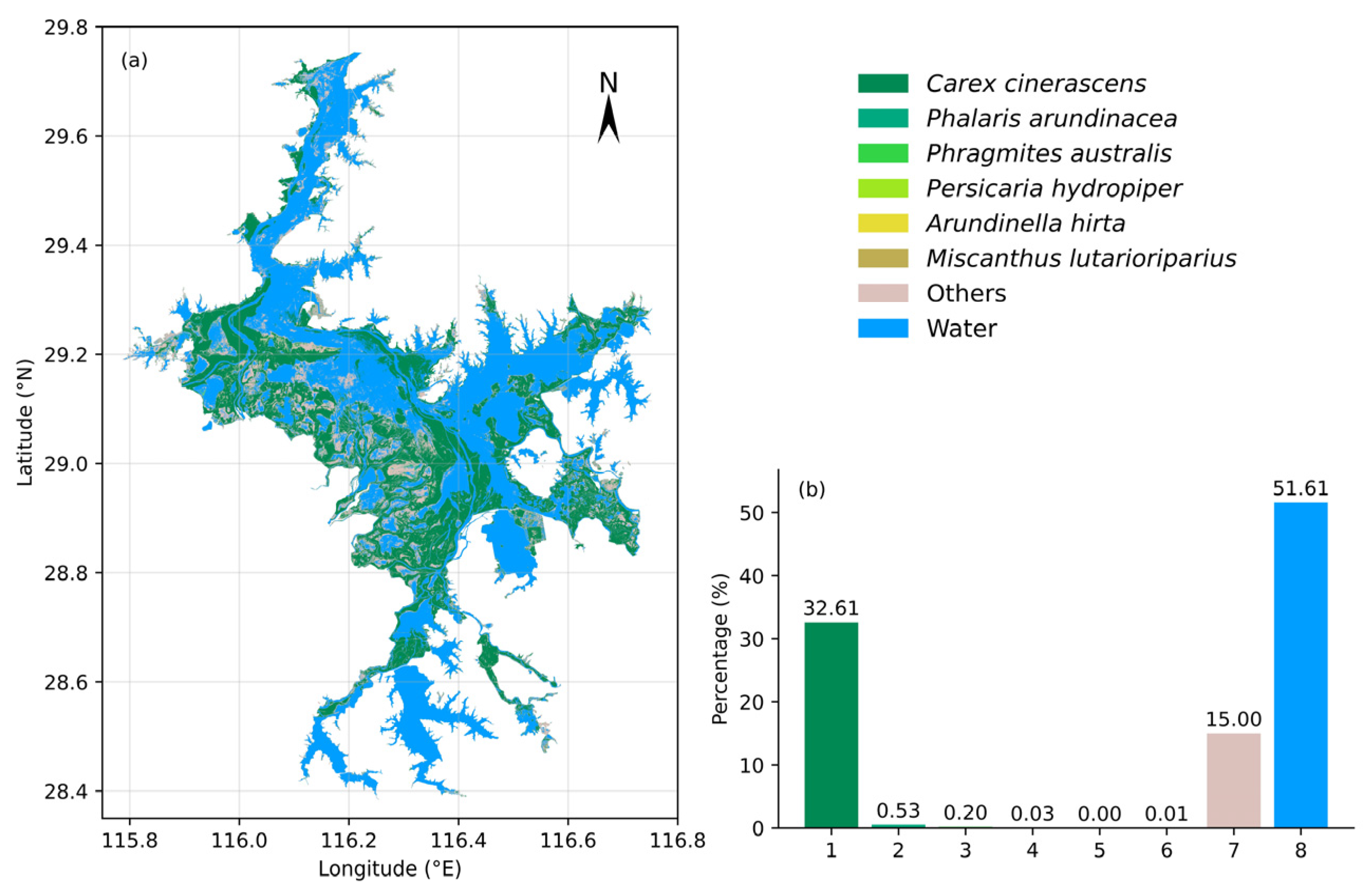
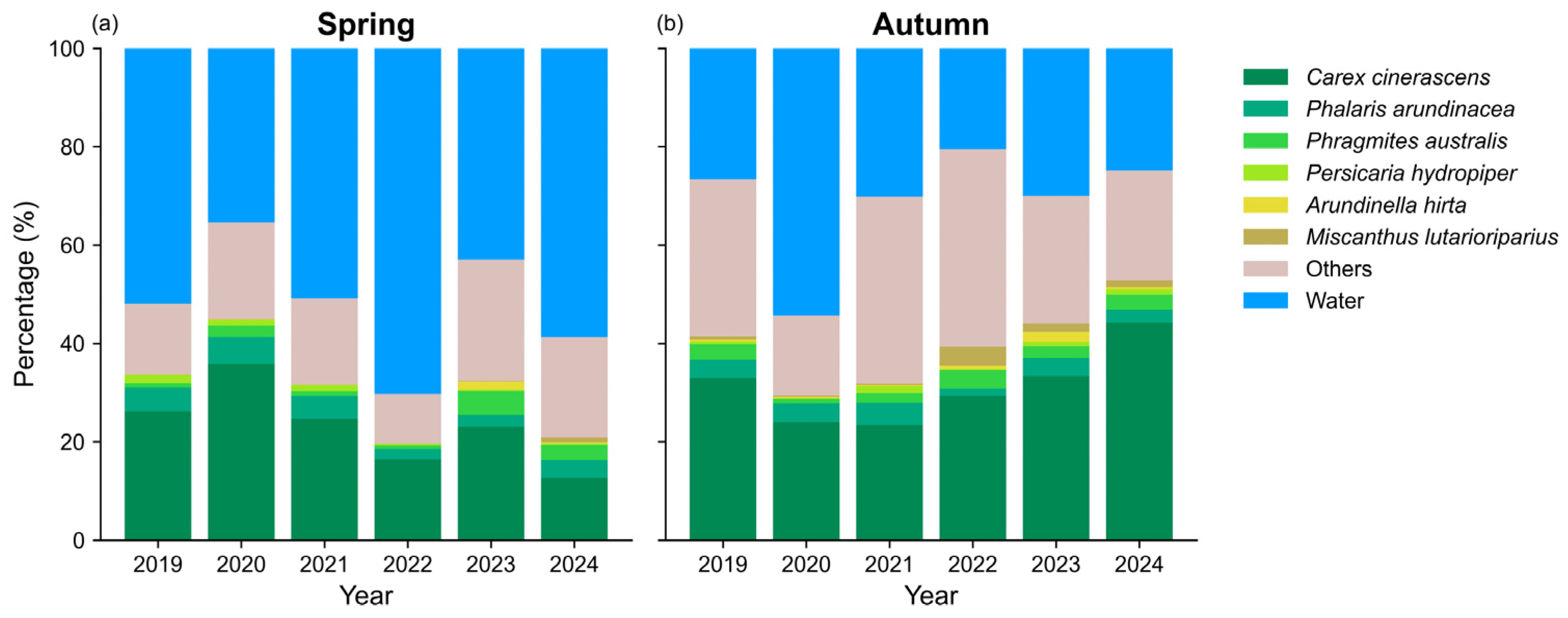
We first counted the most frequently occurring land cover type for each pixel based on the results of land cover classifications of the Poyang Lake wetland obtained from Sentinel images in the two growing seasons across 2019 to 2024 (Figure 2). The results show that C. cinerascens has the greatest dominant area among the six types of plant communities, with its distribution area accounting for 32.61% of the entire wetland area. In contrast, the area of the A. hirta community is the smallest and has nearly disappeared in the past several years. The proportions of the other four types of communities ranged from 0.01% to 0.53%. For the entire Poyang Lake wetland region, water bodies remain the dominant land cover type, accounting for 51.61% of the total wetland area. Other types of land cover, including sand or mudflats and built-up areas, account for approximately 15% of the total area. From the perspective of the inter-annual changes in land cover types, C. cinerascens remains the most dominant community among the six types of communities, ranging from 12.68% to 44.22% (Figure 3). However, for each growing season investigated in this study, the proportions of other vegetation types were slightly higher than the proportions in Figure 2. For example, the proportion of P. arundinacea ranges from 1.49% to 5.50%, and that of P. australis ranges from 0.67% to 4.87%. The total area of vegetation is slightly higher in autumn than in spring, but the difference is not significant. In contrast, the total area of water bodies is significantly higher in spring than in autumn (p < 0.05), and the areas of other land cover types are significantly higher in autumn than in spring (p < 0.05).

3.2. The Vegetation Carbon Storage of the Poyang Lake from 2019 to 2024

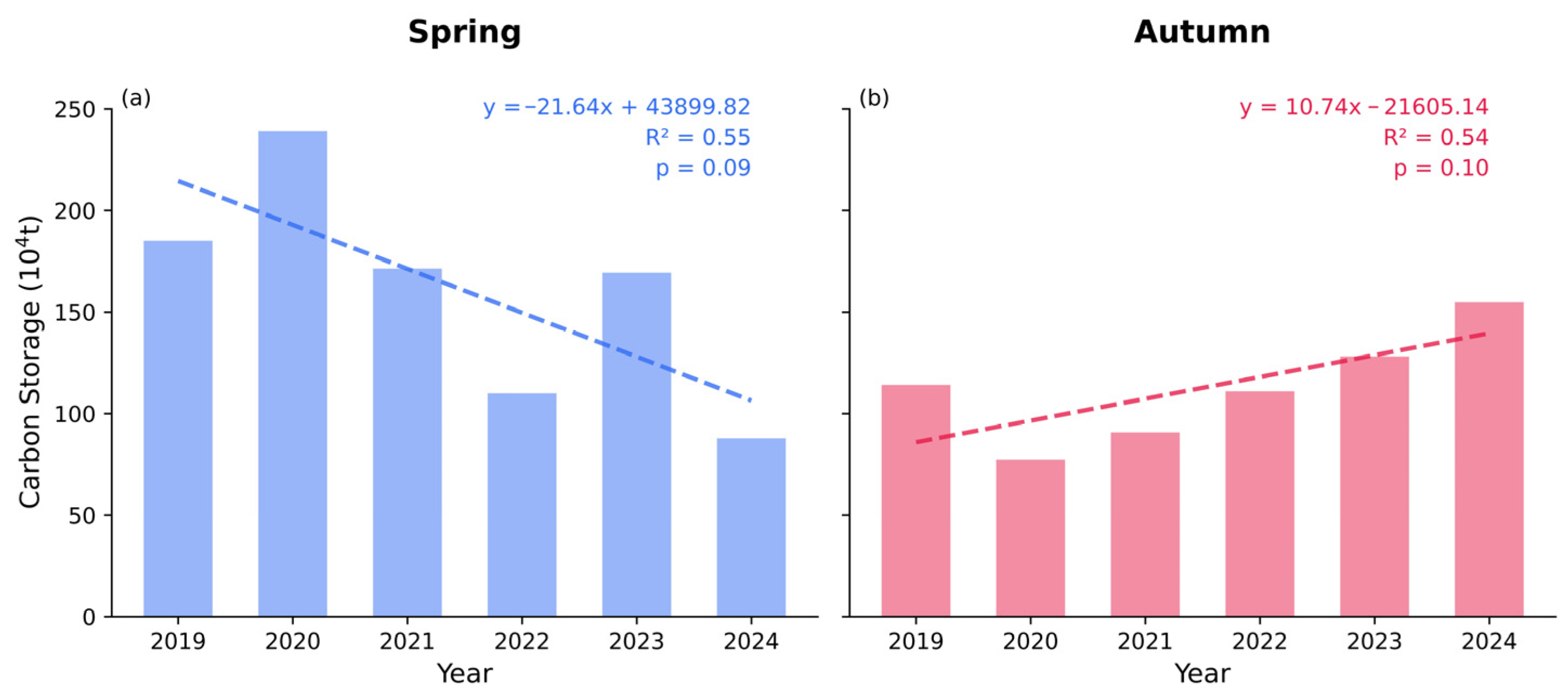
The seasonal vegetation carbon storage in the Poyang Lake wetland from 2019 to 2024 was simulated using the InVEST model. The model attained an RMSE of 5.82 t/ha and an MBE of −0.12 t/ha, suggesting a precise estimation of the total carbon storage while revealing limitations in capturing its spatial heterogeneity. The vegetation carbon storage in spring ranged from 87.75 × 10⁴ t to 239.10 × 10⁴ t, while in autumn it ranged from 77.32 × 10⁴ t to 154.78 × 10⁴ t (Figure 4). On average, the vegetation carbon storage in spring was significantly (p < 0.01) higher than in autumn, with 47.80 × 10⁴ t. From the perspective of the interannual variation in seasonal vegetation carbon storage, the spring vegetation carbon storage has been decreasing (21.64 × 10⁴ t/year) in fluctuations, but the trend is not significant at the 0.05 level (Figure 4). However, autumn vegetation carbon storage has shown a continuous increase since 2020, with an overall increasing rate of 10.74 × 10⁴ t/year from 2019 to 2024, although this trend is also not significant at the 0.05 level.
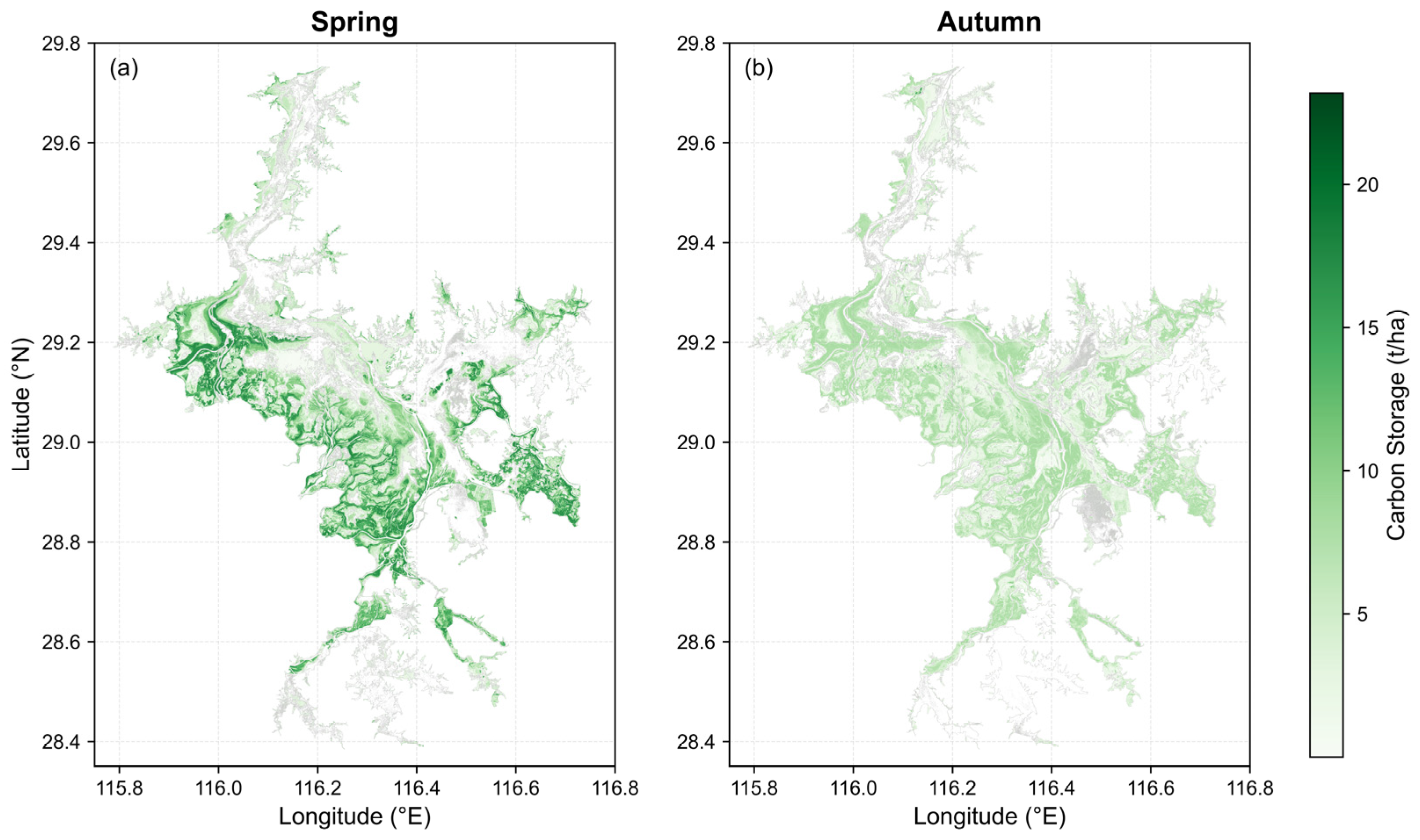
There is also a spatial variation in vegetation carbon storage in the Poyang Lake wetland between spring and autumn. For the spring growing season, the vegetation carbon storage is mainly concentrated in the western, central-southern, and southeastern parts of the wetland area, and the carbon storage per unit area is much higher than that in other areas of the wetland. This might be due to the higher water level in spring, and the water body covers most of the northern and northeastern parts, with less vegetation growth (Figure 5). During the autumn growing season, vegetation carbon storage was lower but more evenly distributed compared to the spring season (Figure 5). This is because the lower water levels in autumn expose more bare ground, allowing vegetation to regrow. In addition, the carbon storage per unit area of vegetation in most regions during spring is significantly higher than that in autumn, indicating that vegetation growth in spring is better than that in autumn. This might be due to the more suitable water and heat conditions in spring, which promote plant production.

3.3. The Potential Impact Factors on Vegetation Carbon Storage of the Poyang Lake Wetland

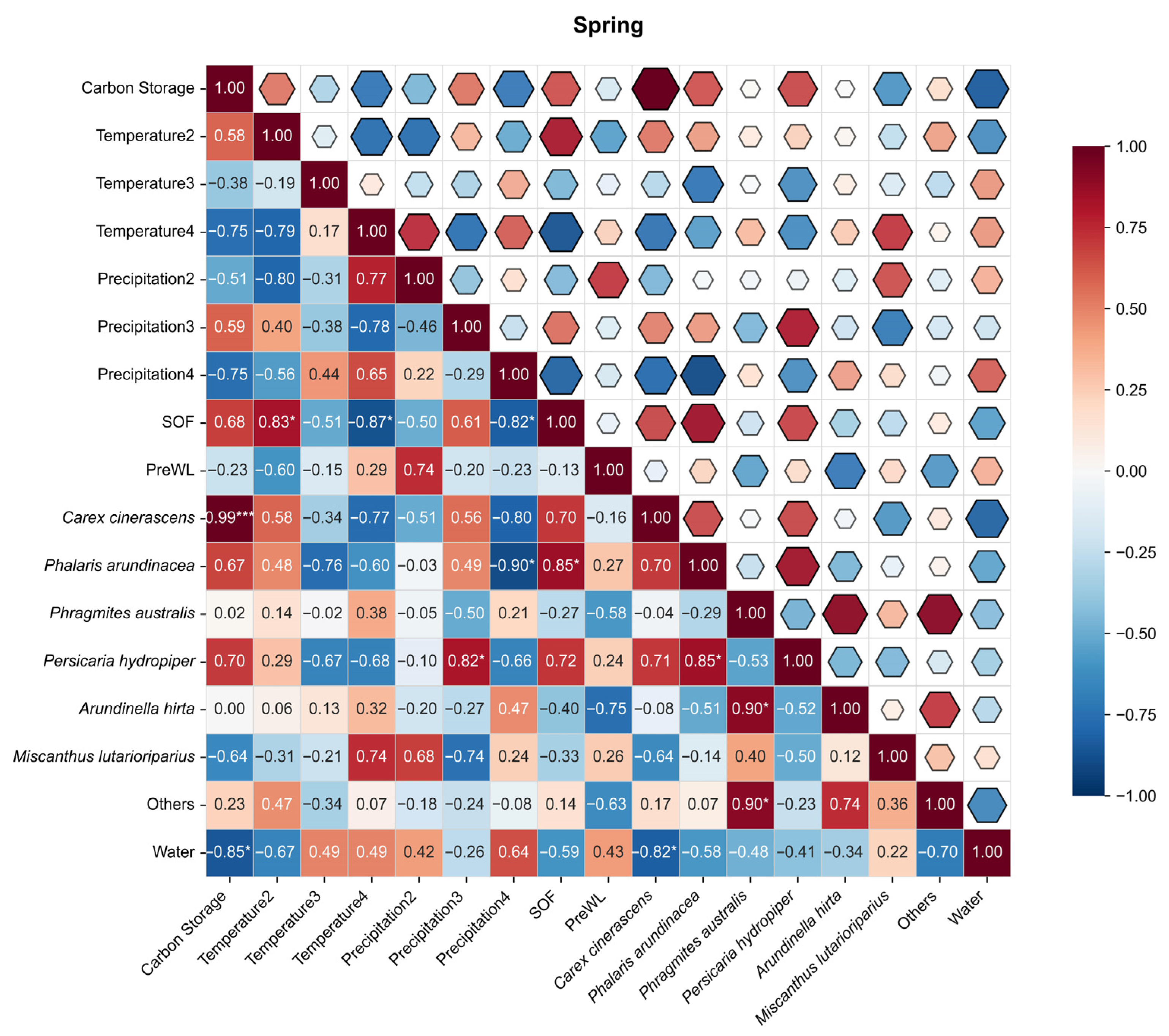
To investigate the potential driving factors of vegetation carbon storage of Poyang Lake wetland, we first conducted correlation analysis between the carbon storage and meteorological and hydrological variables for each growing season. The results show that only a few variables have a significant correlation with vegetation carbon storage for the spring growing season (Figure 6, Figures S1 and S2). First, the vegetation carbon storage is highly significantly positively correlated with the area of C. cinerascens (r = 0.99, p < 0.001), indicating that C. cinerascens may be the major contributor to the carbon storage of spring vegetation. Conversely, the area of the water body is significantly negatively correlated with both the vegetation carbon storage (r = −0.85, p < 0.05) and the area of C. cinerascens (r = −0.82, p < 0.05), suggesting the water body area is likely a key factor regulating spring vegetation carbon storage, negatively influencing it through the limited distribution of C. cinerascens.
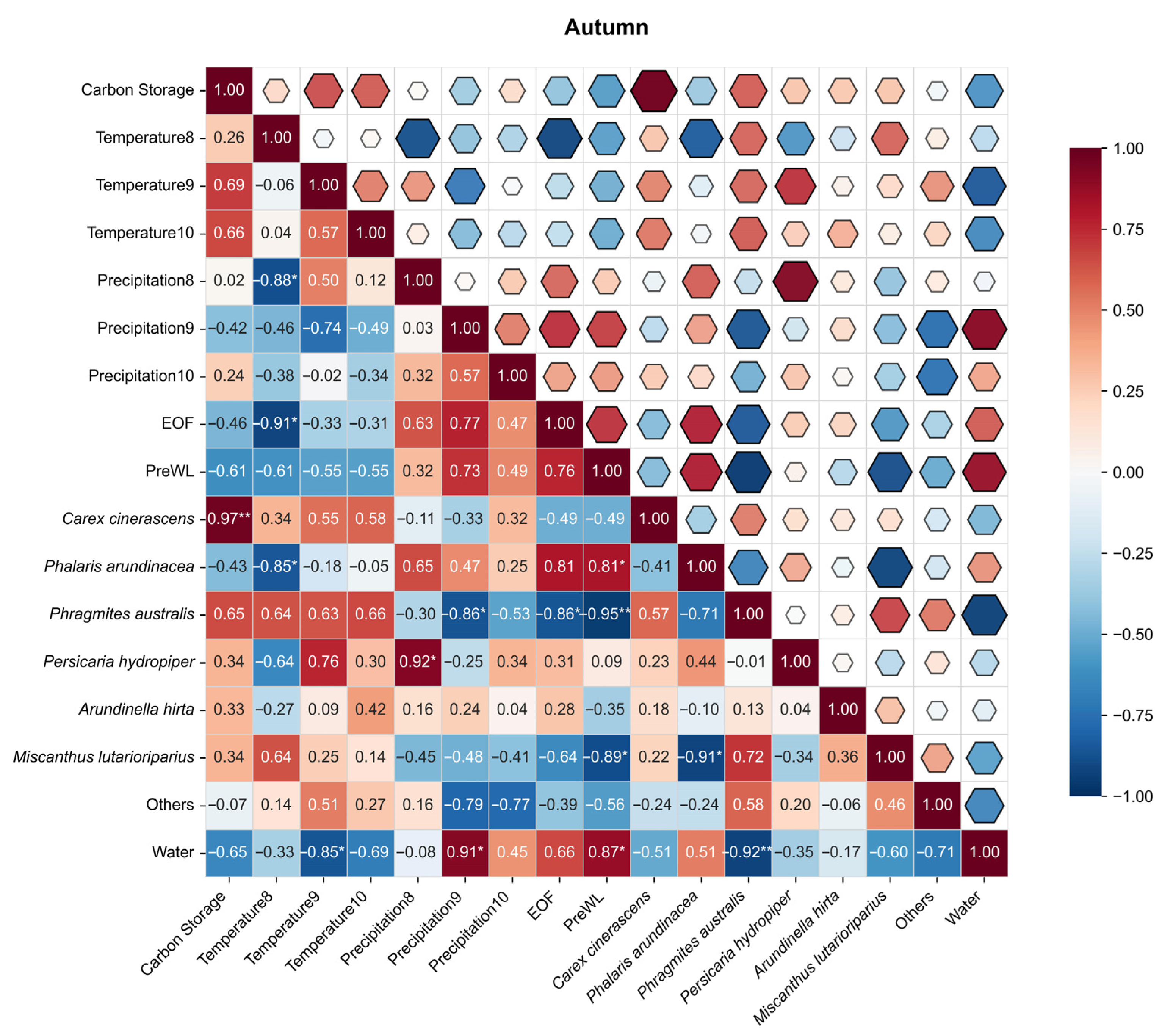
For the autumn growing season, the vegetation carbon storage remains highly significantly positively correlated with the area of C. cinerascens (r = 0.97, p < 0.01), indicating that C. cinerascens is still the most important community to the autumn vegetation carbon storage in the Poyang Lake wetland (Figure 7, Figures S1 and S3). Although the water body area remained negatively correlated with vegetation carbon storage (r = −0.65), the relationship was no longer significant at the 0.05 level. Notably, the correlations of most preseason temperature and precipitation with autumn vegetation carbon storage were opposite to those observed in spring, although the correlations for these variables were not statistically significant. For example, while the mean temperature and total precipitation in April were negatively correlated with spring vegetation carbon storage (r = −0.75 and −0.75, respectively), the mean temperature and total precipitation in October showed a positive effect on autumn storage (r = 0.66 and 0.24, respectively). These results indicate that the recession of the autumn water body area expands the habitat for vegetation growth. However, this potential is countered by the seasonal decline in temperature and water availability. Therefore, sufficient water and warmer temperatures in autumn may extend the vegetation growth period, which in turn increases the vegetation carbon storage.
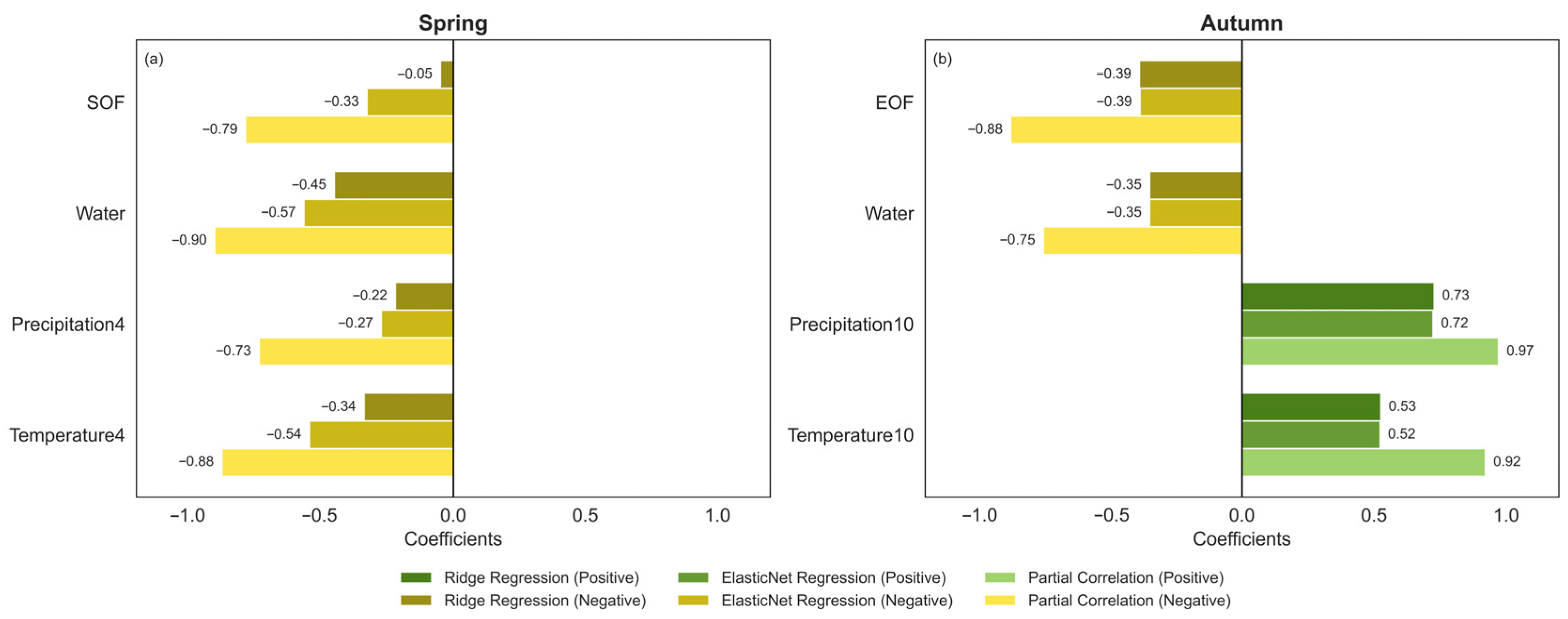
Due to the multicollinearity among meteorological (temperature and precipitation in the previous month) and hydrological factors (SOF/EOF, and the proportion of water surface area), we used 3 methods (ridge regression, elastic net regression, and partial correlation analysis) to evaluate their individual impacts on seasonal vegetation carbon storage in the Poyang Lake wetland. Overall, both ridge and elastic net regression methods performed well in model fitting, with R2 ranging from 0.87 to 0.97 (Figures S4 and S5). The partial correlation coefficients are generally higher than those produced by regression methods, but none of them reached statistical significance in both spring and autumn (Figure 8). In addition, the signs of the coefficients derived from the 3 methods are consistent for both spring and autumn, although their coefficient values were different. For the spring growing season, both meteorological and hydrological factors would restrain the vegetation carbon storage. In particular, the water body area exhibited the highest coefficients among these factors, with values of −0.57 (elastic net regression) and −0.45 (ridge regression). For the autumn growing season, both the end of the flooding period and the water body area were negatively associated with vegetation carbon storage, with identical coefficients of −0.39 and −0.35, respectively, from both elastic net and ridge regression. However, meteorological factors, i.e., the mean temperature and total precipitation in October, were positive factors of the vegetation carbon storage, and the absolute values of their coefficients are even higher (0.53 and 0.73 for ridge regression, 0.52 and 0.72 for elastic net regression). These results suggest that environmental factors may impact vegetation carbon storage through distinct pathways in the spring and autumn growing seasons.

4. Discussion

4.1. The Distribution and Carbon Storage of Dominant Communities in Poyang Lake Wetland

In this study, we inverted the seasonal distribution of six dominant communities in the Poyang Lake wetland from 2019 to 2024 based on Sentinel satellite data. As a result, the C. cinerascens community was identified as the most dominant community, with its proportion of the vegetation area ranging from 60.63% to 83.99%. From the perspective of frequency statistics, 32.61% of the entire wetland area was most frequently covered by the C. cinerascens community. It is reported that over 80% of the vegetated area was covered by Carex spp., and these communities covered the 22% to 35% area of the wetland in four lake regions (southeast, southwest, northeast, and northwest) of Poyang Lake, which is consistent with our results [25,58]. Some studies have shown that C. cinerascens has a stronger tolerance to an extended duration of flooding and increased flooding depth, which has made it highly adaptable to the variable hydrological conditions in Poyang Lake [20]. Such tolerance and adaptations make it the most important contributor to the vegetation carbon storage community in the Poyang Lake wetland [59]. In addition, we found an obvious increase in the area of C. cinerascens in autumn compared to spring. This is because the seasonal inundation areas are exposed again, and C. cinerascens has a distinct advantage in establishing communities during the rapid transition from aquatic to littoral habitats [19]. Furthermore, rising temperatures and rapid water-level fluctuations amplified the competitive advantage of C. cinerascens, resulting in a greater increase in the proportion of the C. cinerascens community compared to other plant communities of Poyang Lake in recent years [27,29]. In contrast, the distribution range of other communities is very small in our results, although there are other dominant communities widely distributed in the Poyang Lake wetland, e.g., P. australis and Triarrhena lutarioriparia communities [60]. In addition to the succession of community composition, another potential reason is that C. cinerascens is also a component of neighboring communities, with no clear boundaries between them and the monospecific C. cinerascens community [14,29,41].
Based on the land cover map, we estimated the vegetation carbon storage and spatial patterns of the six dominant communities in Poyang Lake wetland using the InVEST model. In this study, the dominant plant communities have a zonal distribution, and the carbon storage of these communities gradually decreases from the shore to the center of the lake. This distributional pattern of plants is attributed to different water conditions resulting from elevations, including groundwater level, duration, and frequency of inundation, etc. [61,62]. For example, in a gradient experiment for C. cinerascens, the group in the higher (10 cm) groundwater level exhibited a greater number of stems, higher individual biomass, and increased total carbon storage compared to the group exposed to the lower (20 cm) groundwater level [59]. However, the impact of hydrological conditions on vegetation carbon storage may not be linear. A study in Poyang Lake found that the relationship between end-of-season biomass and inundation depth (AID) varies with water depth: it is negatively correlated in areas with deep inundation and positively correlated in areas with shallow inundation [25]. In addition, P. hydropiper, a dominant species in the Dongting Lake wetland, also showed such a clinal change along with groundwater level, i.e., its biomass would increase with the increase in groundwater level [63]. However, our results indicate that vegetation carbon storage in spring tends to increase when far away from the lake shore (Figure 5).
Our results found that vegetation carbon storage in spring was significantly (p < 0.01) higher than in autumn, a recent biomass study in Poyang Lake also found higher values in spring than autumn [64]. This is because spring was more conducive for the growth of vegetation communities in Poyang Lake compared to autumn, making flood inundation the primary limiting factor for vegetation carbon storage rather than groundwater level [65]. For autumn, water levels drop and the summer-flooded continental beach wetlands are exposed, plants at lower elevations begin to enter the growth phase, and plants at higher elevations begin to senescence [27,66,67]. As a result, the vegetated area in autumn expands, while the vegetation carbon storage of unit area tends to decrease (Figure 5).

4.2. The Driving Factors of Vegetation Carbon Storage in the Poyang Lake Wetland

To quantify the effects of the key drivers on vegetation carbon storage, we employed four correlation and regression methods and obtained coefficients that were consistent in sign. First, the water body area was the most important factor that played a dominant role in determining where vegetation could live on the floodplain. Poyang Lake is a seasonal lake that is flooded for a long time in summer, and the inundation makes it impossible for plants to survive [27]. Therefore, during both spring and autumn, larger water body areas would reduce vegetation coverage and restrict vegetation carbon storage [40]. In addition, the negative effects of the water body area on vegetation carbon storage were greater in spring compared to autumn, according to the regression coefficients (Figure 8). This is because the wetter conditions in spring promote a rapid and widespread growth of vegetation, while the extent of vegetation expansion is mainly constrained by the area covered by water inundation rather than meteorological factors [19].
The timing of the flood is also a critical factor in regulating vegetation carbon storage. Although both the spring SOF and autumn EOF negatively affect vegetation carbon storage, the underlying mechanisms may differ. In this study, SOF generally appeared from February to March, providing early water recharge to the Poyang Lake wetland without resulting in widespread inundation. In the Poyang Lake, the water requirement of wetland vegetation for the early growth is primarily supplied by lake water rather than soil moisture or rainfall [68]. Therefore, the higher water level in spring enhances water availability for vegetation growth, thereby increasing carbon density and promoting greater vegetation carbon storage [69]. However, the response of vegetation carbon storage to water level may vary with different elevations. For example, Lou et al. found that the biomass of Carex spp. communities at higher elevations were positive to the groundwater level, while those at lower elevations were negative to the groundwater level [17]. For EOF, which appeared from August to November, was also negative for the vegetation carbon storage. During autumn, vegetation would regrow on re-exposed alluvial plains, but the boundary of vegetation is still limited by the water level [19]. Therefore, an earlier EOF resulted in an expanded area for vegetation growth and enhanced vegetation carbon storage in the autumn growing season.
Finally, the two meteorological factors obtained opposite coefficients across spring and autumn. Most areas of the Poyang Lake wetland suffer from periodical inundation, which divides the whole year into two separate seasons for vegetation growth [25]. Therefore, the communities would experience the same phenology stage (i.e., growth stage) in May and November, with their water supply primarily reliant on the lake water [68]. Generally, vegetation growth requires water availability and heat within an optimal range. For spring, increased precipitation and temperature in the preseason have an inhibitory effect on vegetation carbon storage (Figure 8). First, the water in April might already be sufficient for plant growth because of a relatively high water level; thus, additional precipitation could lead to soil waterlogging, especially for areas with high soil moisture content (e.g., lakeshore), which induces root anoxia and impairs nutrient uptake [70]. However, the April temperatures in this study range approximately between 17 and 20 °C, a range unlikely to impose a direct limiting effect on the growth of subtropical vegetation [71]. The April temperature was found to exhibit a significant negative correlation with SOF, suggesting a potential association between temperature and hydrological dynamics, which may indirectly influence vegetation carbon storage (Figure 6). For autumn, increased precipitation and temperature would promote vegetation carbon storage. During the recession period of Poyang Lake, the decline in water availability adversely affected both established and emerging vegetation, whereas increased precipitation has the potential to enhance soil moisture conditions, thereby promoting plant growth [60].
Although our study integrates field surveys and literature data collection, it still has certain limitations. The existing research and our data primarily focused on the periodically inundated vegetation communities in Poyang Lake. However, some areas of the Poyang Lake wetland are located at higher elevations and may not be affected by seasonal inundation. Therefore, our conclusions may overestimate the impact of hydrological dynamics on these communities. With the development of climate change and the intensification of drought events, the dynamics and succession of the communities need further attention.

5. Conclusions

Using field surveys, the literature, and remote sensing data, we assessed the seasonal distribution and carbon storage of six typical plant communities in Poyang Lake from 2019 to 2024. The results show that the C. cinerascens community was the most dominant contributor to vegetation carbon storage, occupying 12.68% to 44.22% of the Poyang Lake wetland area. The vegetation carbon storage of the Poyang Lake wetland in spring ranged from 87.75 × 10⁴ t to 239.10 × 10⁴ t and was significantly higher than in autumn. Based on four correlation and regression methods, we identified water body area as the most important factor regulating vegetation carbon storage by constraining the potential range of vegetation. In addition, an earlier start or end of floods could both enhance vegetation carbon storage in spring or autumn. However, preseason precipitation and temperature exhibited opposite effects in regulating carbon storage during the spring and autumn growing seasons due to different hydrological conditions. This study highlights the interaction between hydrological and meteorological factors in influencing wetland vegetation carbon storage, thereby offering valuable insights into the response of wetland carbon cycles to climate change.

Supplementary Materials

The following supporting information can be downloaded at: https://www.mdpi.com/article/10.3390/rs18020276/s1, Figure S1: The relationship between vegetation carbon storage and the proportion of each land cover type in the total area of the Poyang Lake wetland. CS, vegetation carbon storage. FL, Linear fitting line. Others, sand or mudflats and built-up areas. Water, water body; Figure S2: The relationship between spring vegetation carbon storage and meteorological and hydrological factors in the Poyang Lake wetland. Temperature2 (3 or 4), the mean temperature in February (March or April). Precipitation2 (3 or 4), the total precipitation in February (March or April). SOF, the start of the flooding period. PreWL, the preseason mean water level from February to April; Figure S3: The relationship between autumn vegetation carbon storage and meteorological and hydrological factors in the Poyang Lake wetland. Temperature8 (9 or 10), the mean temperature in August (September or October). Precipitation8 (9 or 10), the total precipitation in August (September or October). EOF, the end of the flooding period. PreWL, the preseason mean water level from August to October; Figure S4: Comparisons between the vegetation carbon storage (CS) in the Poyang Lake wetland estimated by ridge regression and the InVEST model. The CS values in the plot are standardized; Figure S5: Comparisons between the vegetation carbon storage (CS) in the Poyang Lake wetland estimated by elastic net regression and the InVEST model. The CS values in the plot are standardized; Figure S6: Schematic diagram illustrating the workflow of remote sensing inversion and carbon storage simulation methods; Table S1: The meteorological and hydrological variables used in this study; Table S2: The numbers of Sentinel-2 images used in the study for each year; Table S3: Confusion matrix for RF classification model accuracy evaluation (86.90%).

Author Contributions

Conceptualization, Z.Y. and S.X.; Methodology, Z.Y.; Software, Z.Y.; Writing—Original Draft Preparation, Z.Y.; Writing—Review and Editing, H.D., S.X. and X.Y.; Visualization, Z.Y.; Funding Acquisition, X.Y. and S.X. All authors have read and agreed to the published version of the manuscript.

Funding

This research was funded by the Jiangxi Province Poyang Lake Water Conservancy Project Office (No. JXDM-2025135), the National Natural Science Foundation of China (No. 42171105).

Data Availability Statement

The raw data supporting the conclusions of this article will be made available by the authors on request.

Conflicts of Interest

The authors declare no conflicts of interest.

References

  1. Li, J.; Hao, T.; Yang, M.; Yu, G. Key Processes of Carbon Cycle and Sink Enhancement Paths in Natural Wetland Ecosystems in China. Sci. China Earth Sci. 2024, 67, 2444–2459. [Google Scholar] [CrossRef]
  2. Nahlik, A.M.; Fennessy, M.S. Carbon Storage in US Wetlands. Nat. Commun. 2016, 7, 13835. [Google Scholar] [CrossRef] [PubMed]
  3. Tootchi, A.; Jost, A.; Ducharne, A. Multi-Source Global Wetland Maps Combining Surface Water Imagery and Groundwater Constraints. Earth Syst. Sci. Data 2019, 11, 189–220. [Google Scholar] [CrossRef]
  4. Lane, C.R.; Nahlik, A.M.; Christensen, J.; Golden, H.; Dumelle, M.; D’Amico, E.; Olsen, A.R. Non-Floodplain Wetlands Are Carbon-Storage Powerhouses Across the United States. Earth’s Future 2025, 13, e2024EF005594. [Google Scholar] [CrossRef]
  5. Temmink, R.J.M.; Lamers, L.P.M.; Angelini, C.; Bouma, T.J.; Fritz, C.; van de Koppel, J.; Lexmond, R.; Rietkerk, M.; Silliman, B.R.; Joosten, H.; et al. Recovering Wetland Biogeomorphic Feedbacks to Restore the World’s Biotic Carbon Hotspots. Science 2022, 376, eabn1479. [Google Scholar] [CrossRef]
  6. Hassett, E.; Bohrer, G.; Kinsman-Costello, L.; Onyango, Y.; Pope, T.; Smith, C.; Missik, J.; Eberhard, E.; Villa, J.; McMurray, S.E.; et al. Changes in Inundation Drive Carbon Dioxide and Methane Fluxes in a Temperate Wetland. Sci. Total Environ. 2024, 915, 170089. [Google Scholar] [CrossRef] [PubMed]
  7. Ren, Y.; Mao, D.; Wang, Z.; Yu, Z.; Xu, X.; Huang, Y.; Xi, Y.; Luo, L.; Jia, M.; Song, K.; et al. China’s Wetland Soil Organic Carbon Pool: New Estimation on Pool Size, Change, and Trajectory. Glob. Change Biol. 2023, 29, 6139–6156. [Google Scholar] [CrossRef]
  8. Li, L.; Xu, H.; Zhang, Q.; Zhan, Z.; Liang, X.; Xing, J. Estimation Methods of Wetland Carbon Sink and Factors Influencing Wetland Carbon Cycle: A Review. Carbon Res. 2024, 3, 50. [Google Scholar] [CrossRef]
  9. Zhang, Z.; Poulter, B.; Feldman, A.F.; Ying, Q.; Ciais, P.; Peng, S.; Li, X. Recent Intensification of Wetland Methane Feedback. Nat. Clim. Change 2023, 13, 430–433. [Google Scholar] [CrossRef]
  10. Moomaw, W.R.; Chmura, G.L.; Davies, G.T.; Finlayson, C.M.; Middleton, B.A.; Natali, S.M.; Perry, J.E.; Roulet, N.; Sutton-Grier, A.E. Wetlands In a Changing Climate: Science, Policy and Management. Wetlands 2018, 38, 183–205. [Google Scholar] [CrossRef]
  11. Zhang, Y.; Zhang, X.; Fang, W.; Cai, Y.; Zhang, G.; Liang, J.; Chang, J.; Chen, L.; Wang, H.; Zhang, P.; et al. Carbon Sequestration Potential of Wetlands and Regulating Strategies Response to Climate Change. Environ. Res. 2025, 269, 120890. [Google Scholar] [CrossRef]
  12. Zhang, D.; Tong, S.; Qi, Q.; Zhang, M.; An, Y.; Wang, X.; Lu, X. Effects of Drought and Re-Flooding on Growth and Photosynthesis of Carex Schmidtii Meinsh: Implication for Tussock Restoration. Ecol. Indic. 2019, 103, 134–144. [Google Scholar] [CrossRef]
  13. Lin, H.J.; Huang, C.H.; Hwang, G.W.; Hsu, C.B.; Chen, C.P.; Hsieh, H.L. Hydrology Drives Vegetation Succession in a Tidal Freshwater Wetland of Subtropical Taiwan. Wetlands 2016, 36, 1109–1117. [Google Scholar] [CrossRef]
  14. Huang, W.; Hu, T.; Mao, J.; Montzka, C.; Bol, R.; Wan, S.; Li, J.; Yue, J.; Dai, H. Hydrological Drivers for the Spatial Distribution of Wetland Herbaceous Communities in Poyang Lake. Remote Sens. 2022, 14, 4870. [Google Scholar] [CrossRef]
  15. Luo, W.; Song, F.; Xie, Y. Trade-off between Tolerance to Drought and Tolerance to Flooding in Three Wetland Plants. Wetlands 2008, 28, 866–873. [Google Scholar] [CrossRef]
  16. Zweig, C.L.; Kitchens, W.M. Multi-State Succession in Wetlands: A Novel Use of State and Transition Models. Ecology 2009, 90, 1900–1909. [Google Scholar] [CrossRef]
  17. Lou, Y.; Pan, Y.; Gao, C.; Jiang, M.; Lu, X.; Xu, Y.J. Response of Plant Height, Species Richness and Aboveground Biomass to Flooding Gradient along Vegetation Zones in Floodplain Wetlands, Northeast China. PLoS ONE 2016, 11, e0153972. [Google Scholar] [CrossRef] [PubMed]
  18. Zhang, Q.; Wang, Z.; Xia, S.; Zhang, G.; Li, S.; Yu, D.; Yu, X. Hydrologic-Induced Concentrated Soil Nutrients and Improved Plant Growth Increased Carbon Storage in a Floodplain Wetland over Wet-Dry Alternating Zones. Sci. Total Environ. 2022, 822, 153512. [Google Scholar] [CrossRef] [PubMed]
  19. Dai, X.; Wan, R.; Yang, G.; Wang, X.; Xu, L.; Li, Y.; Li, B. Impact of Seasonal Water-Level Fluctuations on Autumn Vegetation in Poyang Lake Wetland, China. Front. Earth Sci. 2019, 13, 398–409. [Google Scholar] [CrossRef]
  20. Yuan, S.; Yang, Z.; Liu, X.; Wang, H. Key Parameters of Water Level Fluctuations Determining the Distribution of Carex in Shallow Lakes. Wetlands 2017, 37, 1005–1014. [Google Scholar] [CrossRef]
  21. Blindow, I. Long- and Short-term Dynamics of Submerged Macrophytes in Two Shallow Eutrophk Lakes. Freshw. Biol. 1992, 28, 15–27. [Google Scholar] [CrossRef]
  22. Gafny, S.; Gasith, A. Spatially and Temporally Sporadic Appearance of Macrophytes in the Littoral Zone of Lake Kinneret, Israel: Taking Advantage of a Window of Opportunity. Aquat. Bot. 1999, 62, 249–267. [Google Scholar] [CrossRef]
  23. Yao, X.; Cao, Y.; Zheng, G.; Devlin, A.T.; Li, X.; Li, M.; Tang, S.; Xu, L. Ecological Adaptability and Population Growth Tolerance Characteristics of Carex Cinerascens in Response to Water Level Changes in Poyang Lake, China. Sci. Rep. 2021, 11, 4887. [Google Scholar] [CrossRef]
  24. Liu, W.; Liu, G.; Liu, H.; Song, Y.; Zhang, Q. Subtropical Reservoir Shorelines Have Reduced Plant Species and Functional Richness Compared with Adjacent Riparian Wetlands. Environ. Res. Lett. 2013, 8, 044007. [Google Scholar] [CrossRef]
  25. Dai, X.; Yu, Z.; Yang, G.; Wan, R. Role of Flooding Patterns in the Biomass Production of Vegetation in a Typical Herbaceous Wetland, Poyang Lake Wetland, China. Front. Plant Sci. 2020, 11, 521358. [Google Scholar] [CrossRef]
  26. Shen, R.; Yang, H.; Rinklebe, J.; Bolan, N.; Hu, Q.; Huang, X.; Wen, X.; Zheng, B.; Shi, L. Seasonal Flooding Wetland Expansion Would Strongly Affect Soil and Sediment Organic Carbon Storage and Carbon-Nutrient Stoichiometry. Sci. Total Environ. 2022, 828, 154427. [Google Scholar] [CrossRef] [PubMed]
  27. Dai, X.; Wan, R.; Yang, G.; Wang, X.; Xu, L. Responses of Wetland Vegetation in Poyang Lake, China to Water-Level Fluctuations. Hydrobiologia 2016, 773, 35–47. [Google Scholar] [CrossRef]
  28. Liao, F.; Wang, G.; Yi, L.; Shi, Z.; Cheng, G.; Kong, Q.; Mu, W.; Guo, L.; Cheng, K.; Dong, N.; et al. Applying Radium Isotopes to Estimate Groundwater Discharge into Poyang Lake, the Largest Freshwater Lake in China. J. Hydrol. 2020, 585, 124782. [Google Scholar] [CrossRef]
  29. Zhen, H.; Tang, C.; Zhang, S.; Wang, H.; Wu, C.; Sun, J.; Liu, W. Exploring the Vegetation Changes in Poyang Lake Wetlands: Succession and Key Drivers over Past 30 Years. Remote Sens. 2025, 17, 1370. [Google Scholar] [CrossRef]
  30. Li, Y.; Zhang, Q.; Liu, X.; Tan, Z.; Yao, J. The Role of a Seasonal Lake Groups in the Complex Poyang Lake-Floodplain System (China): Insights into Hydrological Behaviors. J. Hydrol. 2019, 578, 124055. [Google Scholar] [CrossRef]
  31. Liu, X.; Zhang, Q.; Li, Y.; Tan, Z.; Werner, A.D. Satellite Image-Based Investigation of the Seasonal Variations in the Hydrological Connectivity of a Large Floodplain (Poyang Lake, China). J. Hydrol. 2020, 585, 124810. [Google Scholar] [CrossRef]
  32. Zheng, L.; Wang, X.; Li, D.; Xu, G.; Guo, Y. Spatial Heterogeneity of Vegetation Extent and the Response to Water Level Fluctuations and Micro-Topography in Poyang Lake, China. Ecol. Indic. 2021, 124, 107420. [Google Scholar] [CrossRef]
  33. Li, Y.; Yu, X.; Guo, Q.; Liu, Y.; Xia, S.; Zhang, G.; Zhang, Q.; Duan, H.; Zhao, L. Estimating the Biomass of Carex Cinerascens (Cyperaceae) in Floodplain Wetlands in Poyang Lake, China. J. Freshw. Ecol. 2019, 34, 379–394. [Google Scholar] [CrossRef]
  34. Li, B.; Yang, G.; Wan, R. Reassessment of the Declines in the Largest Freshwater Lake in China (Poyang Lake): Uneven Trends, Risks and Underlying Causes. J. Environ. Manag. 2023, 342, 118157. [Google Scholar] [CrossRef]
  35. Gorelick, N.; Hancher, M.; Dixon, M.; Ilyushchenko, S.; Thau, D.; Moore, R. Google Earth Engine: Planetary-Scale Geospatial Analysis for Everyone. Remote Sens. Environ. 2017, 202, 18–27. [Google Scholar] [CrossRef]
  36. Malenovský, Z.; Rott, H.; Cihlar, J.; Schaepman, M.E.; García-Santos, G.; Fernandes, R.; Berger, M. Sentinels for Science: Potential of Sentinel-1, -2, and -3 Missions for Scientific Observations of Ocean, Cryosphere, and Land. Remote Sens. Environ. 2012, 120, 91–101. [Google Scholar] [CrossRef]
  37. Xue, J.; Su, B. Significant Remote Sensing Vegetation Indices: A Review of Developments and Applications. J. Sens. 2017, 2017, 1353691. [Google Scholar] [CrossRef]
  38. Chen, Q.; Vaudour, E.; Richer-de-Forges, A.C.; Arrouays, D. Spectral Indices in Remote Sensing of Soil: Definition, Popularity, and Issues. A Critical Overview. Remote Sens. Environ. 2025, 329, 114918. [Google Scholar] [CrossRef]
  39. Kaur, R.; Pandey, P. A Review on Spectral Indices for Built-up Area Extraction Using Remote Sensing Technology. Arab. J. Geosci. 2022, 15, 391. [Google Scholar] [CrossRef]
  40. Wan, R.; Dai, X.; Shankman, D. Vegetation Response to Hydrological Changes in Poyang Lake, China. Wetlands 2019, 39, 99–112. [Google Scholar] [CrossRef]
  41. Zhang, L.; Yin, J.; Jiang, Y.; Wang, H. Relationship between the Hydrological Conditions and the Distribution of Vegetation Communities within the Poyang Lake National Nature Reserve, China. Ecol. Inform. 2012, 11, 65–75. [Google Scholar] [CrossRef]
  42. Pardi, R.; Gargano, M.L.; Lasorella, C.; Terzaghi, M. Optimizing Soil Core Fine Root Collection and Characterization: Significant Time Reduction with a Sub-Sampling Approach. Plant Soil 2025, 508, 347–360. [Google Scholar] [CrossRef]
  43. Edwards, K.R.; Čižková, H.; Zemanová, K.; Šantrůčková, H. Plant Growth and Microbial Processes in a Constructed Wetland Planted with Phalaris Arundinacea. Ecol. Eng. 2006, 27, 153–165. [Google Scholar] [CrossRef]
  44. Leys, C.; Ley, C.; Klein, O.; Bernard, P.; Licata, L. Detecting Outliers: Do Not Use Standard Deviation around the Mean, Use Absolute Deviation around the Median. J. Exp. Soc. Psychol. 2013, 49, 764–766. [Google Scholar] [CrossRef]
  45. Bhagabati, N.K.; Ricketts, T.; Sulistyawan, T.B.S.; Conte, M.; Ennaanay, D.; Hadian, O.; McKenzie, E.; Olwero, N.; Rosenthal, A.; Tallis, H.; et al. Ecosystem Services Reinforce Sumatran Tiger Conservation in Land Use Plans. Biol. Conserv. 2014, 169, 147. [Google Scholar] [CrossRef]
  46. Zeng, Z.; Wu, W.; Ge, Q.; Li, Z.; Wang, X.; Zhou, Y.; Zhang, Z.; Li, Y.; Huang, H.; Liu, G.; et al. Legacy Effects of Spring Phenology on Vegetation Growth under Preseason Meteorological Drought in the Northern Hemisphere. Agric. For. Meteorol. 2021, 310, 108630. [Google Scholar] [CrossRef]
  47. Meng, F.; Liu, D.; Wang, Y.; Wang, S.; Wang, T. Negative Relationship between Photosynthesis and Late-stage Canopy Development and Senescence over Tibetan Plateau. Glob. Change Biol. 2023, 29, 3147–3158. [Google Scholar] [CrossRef]
  48. Xiao, D.; Deng, L.; Kim, D.G.; Huang, C.; Tian, K. Carbon Budgets of Wetland Ecosystems in China. Glob. Change Biol. 2019, 25, 2061–2076. [Google Scholar] [CrossRef]
  49. Menne, M.J.; Durre, I.; Vose, R.S.; Gleason, B.E.; Houston, T.G. An Overview of the Global Historical Climatology Network-Daily Database. J. Atmos. Ocean. Technol. 2012, 29, 897–910. [Google Scholar] [CrossRef]
  50. Li, M.; Zhang, Q.; Li, Y.; Yao, J.; Tan, Z. Inter-Annual Variations of Poyang Lake Area during Dry Seasons: Characteristics and Implications. Hydrol. Res. 2016, 47, 40–50. [Google Scholar] [CrossRef]
  51. Zani, D.; Crowther, T.W.; Mo, L.; Renner, S.S.; Zohner, C.M. Increased Growing-Season Productivity Drives Earlier Autumn Leaf Senescence in Temperate Trees. Science 2020, 370, 1066–1071. [Google Scholar] [CrossRef]
  52. Pichler, M.; Hartig, F. Machine Learning and Deep Learning—A Review for Ecologists. Methods Ecol. Evol. 2023, 14, 994–1016. [Google Scholar] [CrossRef]
  53. Hoerl, A.E.; Kennard, R.W. Ridge Regression: Biased Estimation for Nonorthogonal Problems. Technometrics 1970, 12, 55–67. [Google Scholar] [CrossRef]
  54. Zou, H.; Hastie, T. Regularization and Variable Selection Via the Elastic Net. J. R. Stat. Soc. Ser. B Stat. Methodol. 2005, 67, 301–320. [Google Scholar] [CrossRef]
  55. Virtanen, P.; Gommers, R.; Oliphant, T.E.; Haberland, M.; Reddy, T.; Cournapeau, D.; Burovski, E.; Peterson, P.; Weckesser, W.; Bright, J.; et al. SciPy 1.0: Fundamental Algorithms for Scientific Computing in Python. Nat. Methods 2020, 17, 261–272. [Google Scholar] [CrossRef]
  56. Vallat, R. Pingouin: Statistics in Python. J. Open Source Softw. 2018, 3, 1026. [Google Scholar] [CrossRef]
  57. Pedregosa, F.; Varoquaux, G.; Gramfort, A.; Michel, V.; Thirion, B.; Grisel, O.; Blondel, M.; Prettenhofer, P.; Weiss, R.; Dubourg, V.; et al. Scikit-Learn: Machine Learning in Python. J. Mach. Learn. Res. 2011, 12, 2825–2830. [Google Scholar] [CrossRef]
  58. Lin, Y.; Li, X.; Tan, Z.; Song, Y.; Xu, C. Dynamic Characteristics of Vegetation Communities in the Floodplain Wetland of Lake Poyang Based on Spatio-Temporal Fusion of Remote Sensing Data. J. Lake Sci. 2023, 35, 1408–1422. [Google Scholar] [CrossRef]
  59. Feng, W.; Mariotte, P.; Xu, L.; Buttler, A.; Bragazza, L.; Jiang, J.; Santonja, M. Seasonal Variability of Groundwater Level Effects on the Growth of Carex Cinerascens in Lake Wetlands. Ecol. Evol. 2020, 10, 517–526. [Google Scholar] [CrossRef]
  60. Fan, H.; Xu, L.; Wang, X.; Jiang, J.; Feng, W.; You, H. Relationship Between Vegetation Community Distribution Patterns and Environmental Factors in Typical Wetlands of Poyang Lake, China. Wetlands 2019, 39, 75–87. [Google Scholar] [CrossRef]
  61. Fraser, L.H.; Karnezis, J.P. A Comparative Assessment of Seedling Survival and Biomass Accumulation for Fourteen Wetland Plant Species Grown under Minor Water-Depth Differences. Wetlands 2005, 25, 520–530. [Google Scholar] [CrossRef]
  62. Scholte, P. Maximum Flood Depth Characterizes Above-Ground Biomass in African Seasonally Shallowly Flooded Grasslands. J. Trop. Ecol. 2007, 23, 63–72. [Google Scholar] [CrossRef][Green Version]
  63. Pan, Y.; Xie, Y.H.; Deng, Z.M.; Tang, Y.; Pan, D.D. High Water Level Impedes the Adaptation of Polygonum Hydropiper to Deep Burial: Responses of Biomass Allocation and Root Morphology. Sci. Rep. 2014, 4, 5612. [Google Scholar] [CrossRef]
  64. Li, X.; Lin, Y.; Lv, Z.; Song, Y.; Huang, X. Estimating and Mapping Aboveground Biomass of Vegetation in Typical Lake Flooding Wetland Based on MODIS and Landsat Images Fusion. Remote Sens. 2025, 17, 3754. [Google Scholar] [CrossRef]
  65. Hu, Q.; Wu, Q.; Yao, B.; Xu, X. Ecosystem Respiration and Its Components from a Carex Meadow of Poyang Lake during the Drawdown Period. Atmos. Environ. 2015, 100, 124–132. [Google Scholar] [CrossRef]
  66. Sang, H.; Zhang, J.; Lin, H.; Zhai, L. Multi-Polarization ASAR Backscattering from Herbaceous Wetlands in Poyang Lake Region, China. Remote Sens. 2014, 6, 4621–4646. [Google Scholar] [CrossRef]
  67. Wan, R.; Wang, P.; Wang, X.; Yao, X.; Dai, X. Mapping Aboveground Biomass of Four Typical Vegetation Types in the Poyang Lake Wetlands Based on Random Forest Modelling and Landsat Images. Front. Plant Sci. 2019, 10, 1281. [Google Scholar] [CrossRef]
  68. Zhang, M.; Wang, H.; Wang, C.; Wang, K.; Zhou, Y.; Bai, X. Water Use Strategy of Carex Cinerascens and Its Response to Water Condition Changes in Poyang Lake Wetland, China. Ecol. Indic. 2023, 146, 109863. [Google Scholar] [CrossRef]
  69. Ma, J.; Shugart, H.H.; Yan, X.; Cao, C.; Wu, S.; Fang, J. Evaluating Carbon Fluxes of Global Forest Ecosystems by Using an Individual Tree-Based Model FORCCHN. Sci. Total Environ. 2017, 586, 939–951. [Google Scholar] [CrossRef]
  70. Manghwar, H.; Hussain, A.; Alam, I.; Khoso, M.A.; Ali, Q.; Liu, F. Waterlogging Stress in Plants: Unraveling the Mechanisms and Impacts on Growth, Development, and Productivity. Environ. Exp. Bot. 2024, 224, 105824. [Google Scholar] [CrossRef]
  71. Wang, Y.; Sarmah, S.; Singha, M.; Chen, W.; Ge, Y.; Liang, L.L.; Goswami, S.; Niu, S. Increasing Optimum Temperature of Vegetation Activity Over the Past Four Decades. Earth’s Future 2024, 12, e2024EF004489. [Google Scholar] [CrossRef]
Figure 1. The location of the Poyang Lake (a) and the composite image of Poyang Lake in November 2024 derived from the Sentinel-2 data (b). The four transects from north to south correspond to sub-figures (cf). Xingzi Station is the hydrological station, and Changbei Station is the meteorological station.
Remotesensing 18 00276 g001
Figure 2. The most frequently occurring land cover types from 2019 to 2024 (a) and the proportions of the whole wetland area for each type of land cover (b). 1: C. cinerascens, 2: P. arundinacea, 3: P. australis, 4: P. hydropiper, 5: A. hirta, 6: M. lutarioriparius, 7: Others, including sand or mudflats and built-up areas, 8: Water, water bodies.
Remotesensing 18 00276 g002
Figure 3. The proportions of land cover types in the Poyang Lake wetland during spring (a) and autumn (b) from 2019 to 2024. Others represent sand or mudflats and built-up areas. Water represents water bodies.
Remotesensing 18 00276 g003
Figure 4. The spring (a) and autumn (b) vegetation carbon storage of the Poyang Lake wetland from 2019 to 2024.
Remotesensing 18 00276 g004
Figure 5. Average vegetation carbon storage of the Poyang Lake wetland in spring (a) and autumn (b) from 2019 to 2024.
Remotesensing 18 00276 g005
Figure 6. Pearson correlation analysis among vegetation carbon storage, environmental factors, and the proportional area of various land cover types in the Poyang Lake wetland for the spring growing season. Temperature2 (3 or 4), the mean temperature in February (March or April). Precipitation2 (3 or 4), the total precipitation in February (March or April). SOF, the start of the flooding period. PreWL, the preseason mean water level from February to April. C. cinerascens, P. arundinacea, P. australis, P. hydropiper, A. hirta, M. lutarioriparius, Others (including sand or mudflats and built-up areas), and Water (water body) represent the proportion of the area of corresponding land cover type. “*” represents p < 0.05, and “***” represents p < 0.001.
Remotesensing 18 00276 g006
Figure 7. Pearson correlation analysis among vegetation carbon storage, environmental factors, and the proportional area of various land cover types in the Poyang Lake wetland for the autumn growing season. Temperature8 (9 or 10), the mean temperature in August (September or October). Precipitation8 (9 or 10), the total precipitation in August (September or October). EOF, the end of the flooding period. PreWL, the preseason mean water level from August to October. C. cinerascens, P. arundinacea, P. australis, P. hydropiper, A. hirta, M. lutarioriparius, Others (including sand or mudflats and built-up areas), and Water (water body) represent the proportion of the area of corresponding land cover type. “*” represents p < 0.05, and “**” represents p < 0.01.
Remotesensing 18 00276 g007
Figure 8. The coefficients of 4 meteorological and hydrological factors were derived from ridge regression, elastic net regression, and partial correlation for spring (a) and autumn (b) data. SOF, the start of the flooding period. EOF, the end of the flooding period. Water, the proportion of the water body area. Temperature4 (10), the mean temperature in April (October). Precipitation4 (10), the mean temperature in April (October).
Remotesensing 18 00276 g008
Disclaimer/Publisher’s Note: The statements, opinions and data contained in all publications are solely those of the individual author(s) and contributor(s) and not of MDPI and/or the editor(s). MDPI and/or the editor(s) disclaim responsibility for any injury to people or property resulting from any ideas, methods, instructions or products referred to in the content.