Article

Dynamic Monitoring and Analysis of Mountain Excavation and Land Creation Projects in Lanzhou Using Multi-Source Remote Sensing and Machine Learning

1
School of Civil Engineering, Lanzhou University of Technology, Lanzhou 730050, China
2
Emergency Mapping Engineering Research Center of Gansu, Lanzhou 730050, China
3
Academician Expert Workstation of Gansu Dayu Jiuzhou Space Information Technology Co., Ltd., Lanzhou 730050, China
4
School of Engineering Management, Lanzhou Bowen College of Science and Technology, Lanzhou 730101, China
*
Author to whom correspondence should be addressed.
Remote Sens. 2026, 18(2), 273; https://doi.org/10.3390/rs18020273
Submission received: 8 December 2025 / Revised: 2 January 2026 / Accepted: 8 January 2026 / Published: 14 January 2026

Highlights

  • This study establishes an integrated multi-source remote sensing framework to monitor Mountain Excavation and Land Creation Projects (MELCPs) in Lanzhou. Fusing ascending and descending Sentinel-1 SAR data significantly enhances excavation area detection accuracy to 87.1%. Optimized Random Forest classification achieves 91.2% accuracy in mapping reclaimed land. InSAR revealed that construction-induced deep consolidation caused subsidence up to 333.8 mm, offering key insights for engineering safety in mountainous cities.
What are the main findings?
  • Dual-orbit fusion improves detection accuracy.
  • Two-layer mechanism explains subsidence causes.
What are the implications of the main findings?
  • Establishes a monitoring and assessment system for mountainous city expansion.
  • Offers evidence-based guidance for optimizing ecological restoration policies.

Abstract

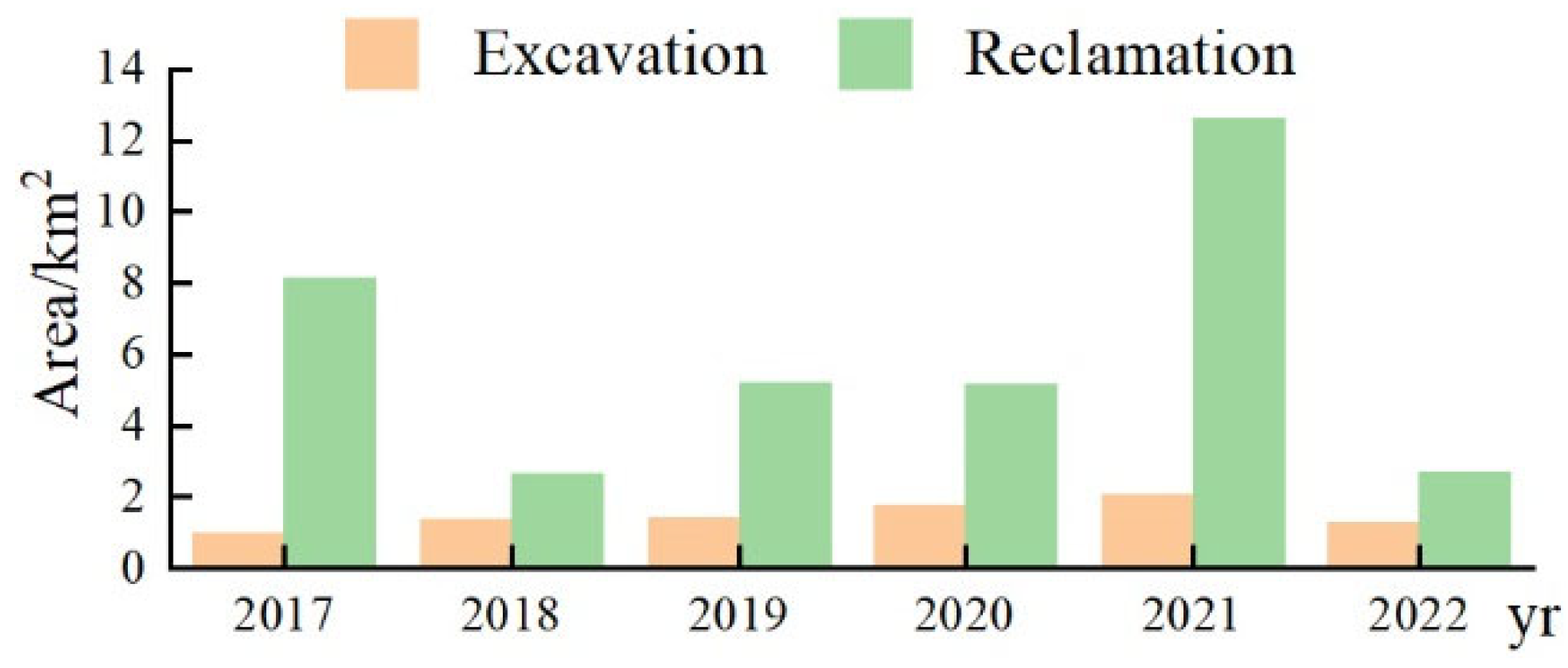
Mountain Excavation and Land Creation Projects (MELCPs) have emerged as a critical strategy for expanding urban development space in mountainous regions facing land scarcity. Dynamic monitoring and risk management of these projects are essential for promoting sustainable urban development. This study develops an integrated monitoring framework for MELCPs by combining ascending and descending Sentinel-1 SAR data, Sentinel-2 optical imagery, SRTM digital elevation models (DEM), and field survey data. The framework incorporates multi-temporal change detection, random forest classification, and time-series InSAR analysis to systematically capture the spatiotemporal evolution and subsidence mechanisms associated with MELCPs. Key findings include: (1) The use of dual-orbit SAR data significantly improves the detection accuracy of excavation areas, achieving an overall accuracy of 87.1% (Kappa = 0.85) and effectively overcoming observation limitations imposed by complex terrain. (2) By optimizing the combination of spectral, texture, topographic, and polarimetric features using a random forest algorithm, the classification accuracy of MELCPs is enhanced to 91.2% (Kappa = 0.889). This enables precise annual identification of MELCP progression from 2017 to 2022, revealing a three-stage evolution pattern: concentrated expansion, peak activity, and restricted slowdown. Specifically, the reclaimed area increased from 2.66 km2 (pre-2018) to a peak of 12.61 km2 in 2021, accounting for 34.56% of the total area of the study region, before decreasing to 2.69 km2 in 2022. (3) InSAR monitoring from 2017 to 2023 indicates that areas with only filling experience minor shallow subsidence (<50 mm), whereas subsequent building loads and underground engineering activities lead to continuous deep soil consolidation, with maximum cumulative subsidence reaching 333.8 mm. This study demonstrates that subsidence in MELCPs follows distinct spatiotemporal patterns and is predictable, offering important theoretical insights and practical tools for engineering safety management and territorial spatial optimization in mountainous cities.

1. Introduction

Land resources serve as a critical foundation for urban development and spatial expansion, and their rational utilization directly impacts the sustainable development of cities [1,2]. However, with rapid socioeconomic growth and population increase in China, contradictions in human-land relationships caused by urbanization have become increasingly pronounced—particularly in valley-type cities constrained by topography, such as Lanzhou, where available urban construction land is severely limited [3,4]. To address urban land shortages, many cities have turned to utilizing surrounding underutilized land, including low hills, gentle slopes, and gullies, by implementing Mountain excavation and land creation Projects (MELCPs). Examples include Jakarta [5] and Kuala Lumpur [6], as well as Chinese cases like Yan’an [7], the Dongchuan Industrial Park in Kunming [8], and Shiyan [9], all of which have expanded urban land by leveling mountains and filling valleys.
As a key city in western China, Lanzhou is situated in the Yellow River Valley, characterized by a typical valley-type basin topography. The city is traversed by the Yellow River, featuring a narrow north-south span (averaging 2–8 km) and an elongated east-west layout (extending >35 km) [10]. Its distinctive “two mountains sandwiching a valley” geomorphology, with the Beita mountain to the north and the Gaolan mountain to the south, severely restricts available land for urban expansion, with buildable area accounting for only 11.6% of the total administrative region [11]. To resolve these spatial constraints, since 2000, Lanzhou’s municipal government has implemented a strategic shift toward developing surrounding underutilized terrain, targeting low hills (slopes 6–15°), gentle slopes (15–25°), and gullies through leveling mountains and filling valleys to expand urban land. Key projects include: The Jiuzhou Development Zone’s MELCPs in the 1990s [12]. The Shajingyi, Anningbao, and Xiguoyan Town MELCPs in 2008 [13]. In 2012, Lanzhou launched its largest new-city project in Qingbaishi. The project aimed to level over 700 barren hills and develop underutilized land to build a new urban district [14].
MELCPs refer to the process of partially or completely cutting and leveling hills/mountains, then using the excavated earth to fill the valley to create new flat land [13]. This technique is primarily implemented to meet the land demands of urban construction, infrastructure development, and other large-scale projects [15,16]. As a typical arid and semi-arid region in northwest China’s upper Yellow River basin, the Lanzhou area is characterized by widespread loess gullies, low precipitation (average 300–400 mm annually), sparse vegetation cover (<30%), and a fragile ecosystem [17]. While MELCPs have partially alleviated land shortages for urban expansion and industrial growth, they have simultaneously induced significant negative impacts on regional eco-environmental and geological systems. These include: large-scale vegetation destruction and habitat fragmentation, aggravated soil erosion [18], and increased risks of geological hazards [19,20]. However, effectively monitoring the entire lifecycle of MELCPs presents significant challenges for conventional single-source remote sensing methods. In mountainous areas, persistent cloud cover and shadows often lead to the unavailability of crucial optical imagery, severely disrupting the continuity of monitoring essential for mapping surface changes. While synthetic aperture radar [21] provides all-weather deformation data, its side-looking geometry induces severe geometric distortions, such as layover and foreshortening, in steep terrain, resulting in critical observational blind spots. Consequently, relying solely on a single data type can only capture fragmented information—either land cover change or surface displacement—failing to deliver a comprehensive, spatiotemporally consistent perspective required for holistic risk management. This fundamental limitation means that existing single-source approaches are inadequate for achieving comprehensive and accurate monitoring of MELCPs’ spatial extent, implementation progress, and environmental consequences, which is essential for sustainable land resource management, ecological conservation, and balanced regional development. Therefore, constructing an innovative multi-source data fusion framework is particularly urgent.
To address these challenges, remote sensing technologies have emerged as crucial tools for global monitoring of land transformation activities like MELCPs, owing to their large-scale coverage and high efficiency [22]. Optical remote sensing leverages spectral reflectance differences and multi-temporal imagery, combined with machine learning classifiers (e.g., Random Forest), to identify newly created land areas [23]. For instance, in Lanzhou, using Landsat imagery, the center of MELCPs shifted northward by 15.5 km from 1989 to 2016, with land creation accelerating to 36 km2/year during 2013–2016 [16]. While optical data (including sub-meter to 30 m resolution) effectively capture surface morphology, cloud cover, fog, and topographic shadows result in >40% data gaps in mountainous regions, limiting temporal continuity [24]. Recent advances in deep learning, such as convolutional neural networks (CNNs) and vision transformers, have improved cloud removal and shadow correction in optical imagery [25,26], yet the fundamental dependency on clear-sky observations remains a constraint for real-time monitoring. Synthetic Aperture Radar [27], with its weather-independent microwave imaging capability, enables all-weather monitoring and high sensitivity to surface deformation. Time-series InSAR (TS-InSAR) techniques detect centimeter-level terrain changes, revealing annual subsidence rates of up to 25 mm in Lanzhou’s MELCPs areas [28]. Advanced techniques like PS-InSAR and SBAS-InSAR are now standard for deformation monitoring [29], and their integration with high-resolution commercial SAR data (e.g., TerraSAR-X, COSMO-SkyMed) has enabled more detailed displacement mapping in engineering contexts [21]. Beyond C-band Sentinel-1, recent studies demonstrate the enhanced sensitivity of L-band SAR (e.g., ALOS-2/PALSAR-2) for detecting subtle deformations in vegetated or newly filled areas [30]. However, SAR is still constrained by geometric distortions (e.g., layover, foreshortening) and noise, particularly in steep terrains [31]. Hyperspectral remote sensing, a specialized branch of optical remote sensing, captures nanometer-scale spectral resolution (e.g., 5 nm) to discern unique features of rocks, soil degradation, and vegetation stress [32]. However, its massive data volume demands high-performance computing and deep learning models for efficient classification [33]. Recent applications of deep learning to hyperspectral data have shown promise in automatically identifying material composition changes in excavation sites [34]. LiDAR generates high-precision 3D terrain models with ±15 cm vertical accuracy, enabling precise quantification of excavation and filling volumes [35]. Despite its effectiveness, high equipment costs restrict large-scale deployment [36]. The emergence of UAV-LiDAR and multi-view stereo photogrammetry has increased flexibility and reduced costs for local-scale volume calculations [37], but city-scale monitoring still relies on satellite platforms.
In summary, while remote sensing technologies are widely applied in surface change monitoring, single-source data still face challenges in dynamically monitoring of MELCPs due to inherent limitations. In contrast, multi-source data fusion has demonstrated increasing advantages in high-precision land classification and environmental monitoring [38]. For instance, in monitoring MELCPs in Lanzhou’s Beita mountain, integrating Sentinel-2 optical and Sentinel-1 SAR data—combined with spectral, textural, and topographic features—not only improved monitoring continuity in cloudy regions but also enhanced classification accuracy (Kappa = 0.83) [39]. Another study coupled LiDAR point clouds with InSAR deformation data to develop a “deformation-volume” quantification model, enabling effective forest height extraction [40]. Recent machine learning advances, particularly combining Random Forest and U-Net models, have optimized feature selection and change detection, achieving >84% accuracy in classifying eight distinct urban land cover types in Kigali, Rwanda [41]. Furthermore, the latest research trend focuses on end-to-end deep learning frameworks that integrate multi-temporal, multi-sensor data (e.g., SAR and optical) for simultaneous change detection and characterization, showing superior performance in complex urban expansion monitoring [42]. These improvements enable more precise monitoring of urban expansion and environmental changes. However, a dedicated, integrated framework that synergistically combines dual-orbit SAR (for all-weather, terrain-robust change detection), multi-spectral optical data (for detailed land cover classification), and machine learning (for feature fusion and optimization) specifically for the full lifecycle monitoring of MELCPs—from excavation to settlement—remains under-explored, which constitutes the core gap this study aims to address.
Given the focus on new urban expansion and planning, MELCP remote sensing monitoring prioritizes two key areas: one is to obtain newly created lands which are used for urban spatial expansion, and the other is to gain excavation zones which are used for identifying suitable engineering construction sites. To address the dual needs of identifying excavation zones and monitoring land creation in mountainous urban expansion, this study focuses on typical MELCP areas in Lanzhou. Based on the Google Earth Engine (GEE) platform, we integrate multi-temporal dual-orbit (ascending and descending) Sentinel-1 SAR data, Sentinel-2 optical imagery, and topographic data, combined with machine learning algorithms such as Random Forest, to construct an integrated monitoring framework that incorporates change detection, land classification, and time-series InSAR analysis. The framework aims to accurately delineate the spatiotemporal dynamics of excavation and land creation activities and reveal the associated surface deformation mechanisms. The findings are expected to provide a scientific basis for ecological impact assessment, geohazard risk prevention and control, and sustainable territorial spatial planning in mountainous cities.

2. Materials and Methods

2.1. A Brief Description of the Study Area

Lanzhou, the capital city of Gansu Province, is located in Northwest China (E102°36′–104°35′, N35°34′–37°07′) with a total area of approximately 13,100 km2. Its unique topography features the Yellow River flowing westward to eastward through the urban area. The city is nestled between northern and southern mountains, distributed like beads along both banks of the river—narrow north-south and elongated east-west—forming a typical valley-shaped, strip-like inland city (Figure 1). With rapid economic growth, construction land has become increasingly scarce. To expand urban development space, Lanzhou government has implemented a “mountain excavation and land creation” project in the barren hills and gullies of the northern mountains. This initiative aims to develop loess hills, shallow gullies, and mountainous terrain to increase construction land and urban capacity.

2.2. Data

(1)
Sentinel data and pre-processing
This study utilized Sentinel-1 SAR data and Sentinel-2 optical data, both downloaded from Google Earth Engine (GEE, https://code.earthengine.google.com/, accessed on 9 October 2025) [43]. Sentinel-1 consists of two polar-orbiting satellites equipped with C-band sensors, featuring a revisit cycle of 6 days and four imaging modes: Stripmap, Extra Wide Swath [44], Wave (WM), and Interferometric Wide Swath (IW) [45]. This research primarily employed Ground Range Detected (GRD) products in IW mode, which include cross-polarization (VH) and co-polarization (VV) data, covering both ascending and descending orbits, with backscatter coefficient information. The selected imagery spans from 2017 to 2022. Sentinel-2A/2B are wide-swath, high-resolution multispectral imaging satellites carrying the MSI (Multispectral Instrument), offering 13 spectral bands: four visible/near-infrared bands at 10 m resolution, six red-edge/shortwave infrared bands at 20 m resolution, and three bands at 60 m resolution, with a revisit cycle of 5 days [46]. Following the principles of cloud-free coverage, high quality, and absence of striping noise, geometrically and radiometrically corrected Level-1C imagery from 2017 to 2022 was selected to align with the temporal range of Sentinel-1 data [47].
The preprocessing of Sentinel-1 GRD and Sentinel-2 MSI data was conducted on the GEE cloud platform, using the WGS84 datum and UTM projection. For Sentinel-1 data preprocessing, the study first extracted Sentinel-1 imagery over the research area from GEE, which had undergone thermal noise removal, radiometric calibration, and terrain correction based on the 30 m SRTM DEM. Given the presence of vegetation in the study area and the sensitivity of cross-polarized (VH) backscatter to forest biomass structure [48], this study selected VH-polarized data in IW mode. Additionally, all Sentinel-1 GRD pixel backscatter values were converted to decibels (dB) using the formula 10 × l o g 10 ( A ) . Here, A denotes the original backscatter coefficient [49]. To further reduce noise, pixels with backscatter values ≤ −30 dB were excluded [45]. For Sentinel-2 multispectral data, images with cloud cover less than 5% were first filtered using the filter(·) function [43], followed by radiometric correction, atmospheric correction, and geometric correction with Sen2Cor2.9. The cloud mask information provided by the QA60 band was utilized to perform pixel-level screening for images containing minimal clouds, where pixels exceeding the defined threshold were set to null to eliminate cloud interference [50]. To address potential overlap and discontinuity issues in image mosaicking on the GEE platform, the median(·) function was employed to calculate pixel median values for image fusion [51]. This study selected six commonly used bands (Blue, Green, Red, NIR, SWIR1, and SWIR2) for image composition, and all Sentinel-2 multispectral images were finally clipped to the study area extent [52].
(2)
Sample data for land cover classification in MELCPs
The sample data in this study was primarily used for land cover classification in MELCPs areas. Based on field surveys, the land cover types in the study region were classified into seven categories: MELCPs areas, buildings, water bodies, forests, grassland, cropland, and bare land (Table 1). The sample data were collected using high-resolution satellite imagery from the GEE platform combined with Sentinel-2 imagery of the study region. A spatially stratified random sampling approach was adopted to ensure balanced sample distribution across different land cover types [39,53], critically, to minimize spatial autocorrelation between training and validation sets. During the sampling and subsequent dataset splitting, we enforced a minimum spatial buffer of 30 m (approximately 3 Sentinel-2 pixels) between any training sample and its nearest validation sample. This step was implemented to prevent samples from the same homogeneous ground object or immediate spatial neighborhood from appearing in both sets, thereby upholding the principle of spatial independence for a more robust accuracy assessment.
The final sample sizes were as follows: forests (24 samples), buildings (162 samples), MELCPs areas (150 samples), water bodies (16 samples), grassland (123 samples), bare land (164 samples), and cropland (155 samples). For model development, 70% of the samples were randomly selected for training, while the remaining 30% were reserved for validation.
(3)
Digital Elevation Model and terrain derivatives
The Digital Elevation Model (DEM) data utilized in this study were derived from the Shuttle Radar Topography Mission (SRTM) dataset accessed through the Google Earth Engine (GEE) cloud platform. This global elevation dataset was collaboratively developed by the National Aeronautics and Space Administration (NASA) and the German Aerospace Center (DLR), acquired in February 2000 during the Space Shuttle Endeavour mission using C-band synthetic aperture radar interferometry (InSAR) technology [54]. Its spatial resolution is 1-arcsecond (approximately 30 m). From this elevation data, we computed two primary terrain derivatives of slope and total curvature. All terrain analyses were performed using a 3 × 3 pixel moving window to ensure robust local topographic characterization while maintaining the original 30 m spatial resolution.

2.3. Methods

(1)
Multi-temporal change detection to gain excavation areas
The identification of mountain excavation and land creation areas primarily relies on multi-temporal remote sensing change detection. The bi-temporal method generates results by directly differencing two SAR images before and after the engineering activity, whereas the multi-temporal method synthesizes multiple pre- and post-construction images separately before change calculation [55]. Compared to bi-temporal detection, the multi-temporal approach demonstrates superior noise suppression capability. This study adopts the multi-temporal method: First, Sentinel-1 SAR datasets (including both ascending and descending orbits) from pre- and post-construction periods are collected and preprocessed. The data are then grouped into three configurations (ascending-only, descending-only, and combined ascending + descending). To maximize the reduction of observation blind spots inherent to single-orbit SAR in complex terrain and provide a more complete spatial data foundation for subsequent change detection, this study adopts an “ascending + descending” fusion strategy. This approach prioritizes a robust and direct data-layer combination, aiming to ensure the reliability and processing efficiency of the entire integrated monitoring framework.
To enhance noise reduction, median values are computed for multi-temporal ascending/descending datasets, while the combined configuration undergoes median synthesis followed by averaging (the “ascending + descending” combination is prioritized when both orbit types are available; otherwise, single-orbit data are used). Finally, intensity change values are calculated between pre- and post-construction images. Although the log-ratio method is commonly used in SAR change detection [56,57], in the context of monitoring MELCPs, excavation significantly increases surface roughness, leading to a pronounced absolute increase in backscatter intensity. Differential processing directly captures this change, aligning well with subsequent percentile-based thresholding. Therefore, our study employs mathematically equivalent differencing to simplify computation:
A d e f = A p r e A p o s t
where, A d e f is the backscatter intensity change value, A p r e is the pre-excavation backscatter intensity value, and A p o s t is the post-excavation backscatter intensity value.
A d e f may assume either positive or negative values, with positive values specifically indicating backscatter intensity enhancement resulting from surface excavation. To mitigate false positives among these positive-value pixels, we implemented a percentile-based thresholding approach [58]. The methodology comprised three sequential steps: (1) arranging all computed A d e f values in ascending order; (2) establishing intensity change thresholds at the 90th (top 10%), 95th (top 5%), and 99th (top 1%) percentiles; and (3) validating these candidate thresholds against independently interpreted excavation data from concurrent Google Earth imagery to identify the optimal classification threshold. The percentile value is calculated as:
A d e f   0 = 1 α A d e f   j + α A d e f   j + 1
j = p n + 1
α = p n + 1 j
where, j represents the index number after ascending sorting, α denotes the scaling factor for interpolating specific percentile values, p indicates the probability corresponding to the percentile value, [·] signifies integer rounding of the enclosed value.
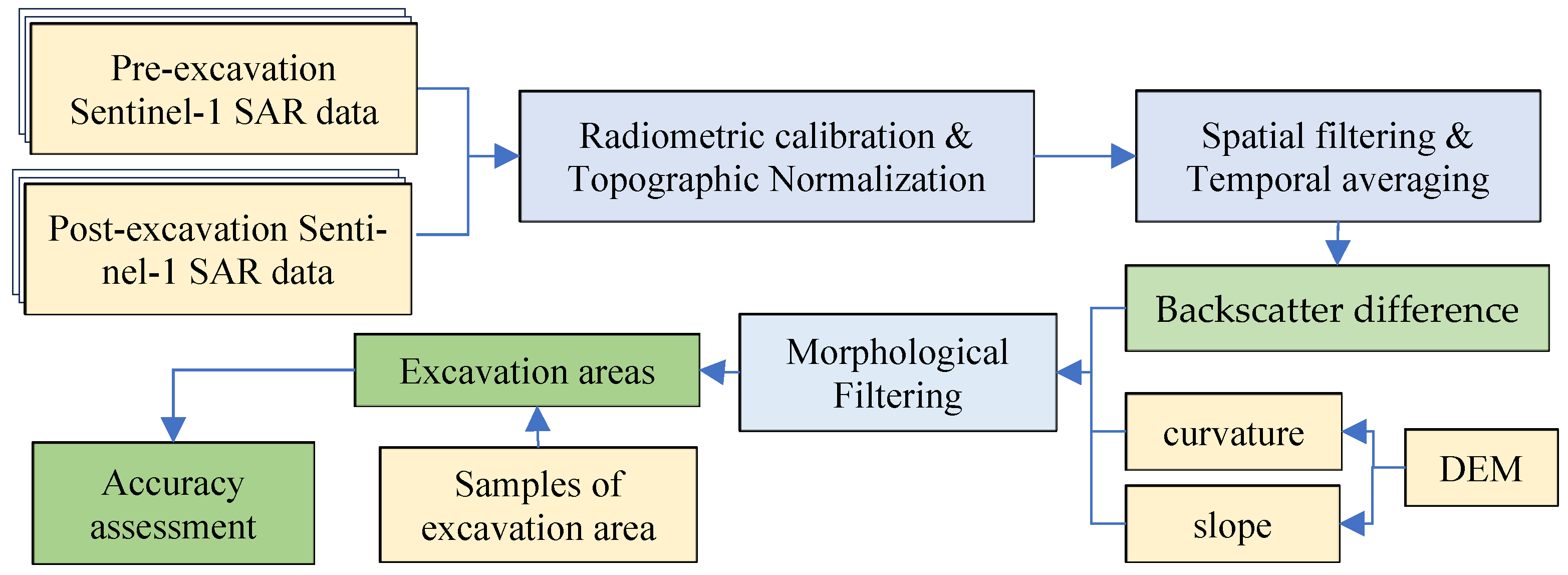
Our research focuses on the barren hills and gullies of Lanzhou’s northern mountains, a typical underutilized land area. Using DEM-derived slope and total curvature parameters alongside field survey data, we applied masking thresholds of slope ≤ 5° and total curvature ≥ −0.005 to exclude urban and flat terrains. The technical workflow for excavation area extraction was then implemented as follows (Figure 2):
(2)
Mapping spatiotemporal distribution of land creations using Random Forest
Random Forest (RF) is a nonlinear nonparametric classifier based on ensemble learning. Its core mechanism involves generating multiple independent decision trees via Bootstrap resampling, with the final classification result determined by voting. In this study, a total of 29 feature variables were meticulously selected for constructing the Random Forest (RF) model. To circumvent the potential decline in land cover classification accuracy caused by feature redundancy, the out-of-bag (OOB) error was employed as a key metric to quantify the importance of each feature. Feature importance is evaluated based on the reduction in node impurity.
For classification tasks, it is commonly measured by the decrease in the Gini index [59], which can be represented by the following formula:
G i n i   i m p o r t a n c e f = t = 1 T G i n i ( t , f ) × n t N
where, f represents the feature variable, T denotes the total number of decision trees, G i n i ( t , f ) signifies the reduction in the Gini index brought about by feature f within the t -th tree, n t stands for the sample size of the t-th tree after Bootstrap sampling, and N represents the overall sample size.
The out-of-bag (OOB) error is calculated using out-of-bag data, and it can be expressed by the following formula:
O O B   e r r o r = 1 N i = 1 N I ( y i y ^ O O B ( i ) )
where, I (·) represents the indicator function, which outputs 0 for a correct classification and 1 for an incorrect one. Here, y i denotes the true label, and y ^ O O B ( i ) is the predicted label derived from out-of-bag (OOB) data
In this study, we initially considered 32 feature variables, then employed out-of-bag (OOB) error-based feature importance evaluation (quantified by Gini index reduction) coupled with recursive feature elimination (RFE) to select 29 optimal features (importance threshold > 0.01) [60]. To determine the optimal model hyperparameters, we conducted a sensitivity analysis using a grid search over key parameters: the number of decision trees was tested within [100, 200, 350, 500], and the minimum node size within [1, 3, 5, 10]. The analysis was performed on multiple random training-validation splits. The results indicated that the OOB error stabilized (with relative variation < 1%) when the number of decision trees reached 350, with no substantial accuracy gain beyond this point [61]. Concurrently, setting the minimum node size to 5 effectively balanced model performance and generalization, yielding consistently high overall accuracy while minimizing the gap between training and validation scores, thus mitigating overfitting. This value aligns with the general recommendation by Breiman [62] and proved effective in our 29-dimensional optimized feature space [63]. Consequently, we determined the optimal hyperparameters as 350 decision trees with a minimum node size of 5 for the final model.
To accurately extract the historical extent of mountain excavation and land creation activities, we constructed a multi-dimensional feature datasets (Table 2) incorporating spectral feature (SF), index feature (IF), topographic feature (TGF), polarimetric feature (PF), and textural feature (TF), combined with field survey and land-cover analysis. The Random Forest (RF) algorithm was employed for classification. To evaluate the impact of feature combinations, seven experimental schemes were designed: (1) RF-optimized spectral features (RSF) only; (2) RSF + IF; (3) RSF + IF + TF; (4) RSF + IF + TF + TGF; (5) RSF + IF + TF + TGF + PF; (6) All features combined (SF + IF + TF + TGF + PF); and (7) RF-optimized feature subset selected based on Out-of-Bag (OOB) error and Gini importance.
To uncover the synergistic mechanisms behind classification performance, we analyze feature interactions through complementary approaches. This includes profiling the category distribution of the top features based on Gini importance ranking from the optimized model, alongside a comparative error analysis to trace how refined feature combinations resolve specific confusion patterns, such as distinguishing MELCPs from shadowed forests.
Our comprehensive accuracy assessment protocol involves three key steps: First, we randomly generate five independent and non-overlapping training-validation subsets from the sample dataset to ensure robust evaluation. Second, each subset is partitioned into 70% training data for Random Forest classifier optimization and 30% validation data for performance testing, with classification quality systematically assessed through four principal metrics: Overall Accuracy for global performance, Kappa coefficient (K) for agreement beyond chance, Producer’s Accuracy (PA) for class detection rates, and User’s Accuracy (UA) for classification reliability, complemented by F1-score analysis for targeted evaluation of critical classes. Finally, after computing mean accuracy values across all five trials, we determine the optimal feature combination based on these aggregated performance measures, thereby ensuring statistically sound and reproducible results.
(3)
Enhanced SBAS-InSAR for Monitoring Engineering-Induced Subsidence
Interferometric Synthetic Aperture Radar (InSAR) serves as a core technique for landslide monitoring [64]. However, SAR image’s side-looking geometry (20–45° incidence angles) induces three geometric distortions: radar shadows in steep slopes (>30°) [65], layover in foreslopes [66], and foreshortening along radar-facing slopes [67], causing 3–5 pixel geolocation errors in mountainous areas [68]. Conventional Persistent Scatterer InSAR (PS-InSAR) achieves millimeter-scale accuracy (±1.2 mm/yr) through phase-stable targets (coherence γ > 0.7) [69], but suffers severe performance degradation in vegetated areas (γ < 0.3) with point density dropping below 10 points/km2 [70]. The Small Baseline Subset (SBAS) approach improves vegetation coverage (30–50 points/km2) by incorporating distributed scatterers [71], yet remains limited by atmospheric phase errors (3–5 mm RMS) [72].
Mountainous Engineered Land Reclamation Projects (MELCPs) present unique challenges for deformation monitoring, where SBAS-InSAR demonstrates inherent algorithmic advantages over conventional techniques due to its: (1) slope-adaptive capability through phased-array coherence preservation; (2) large-area coverage overcoming terrain accessibility constraints; and (3) high-temporal-resolution monitoring of fill-loading-induced settlement. To address residual SBAS-InSAR limitations, we developed an Enhanced SBAS-InSAR (ESBAS-InSAR) method that integrates GNSS-aided orbit correction [73], ERA5/MERIS-based atmospheric modeling [4,74], and high-resolution DEM (e.g., SRTM DEM 30 m) with slope-adaptive phase compensation [75]. The proposed method dynamically adjusts spatiotemporal baselines using coherence-deformation metrics [76] through the optimization function:
φ o p t = a r g m i n ( γ φ + λ φ 2 )
where φ represents the phase field, γ ( · ) denotes the coherence metric, and λ controls the smoothness constraint. The method implements eigenvalue-decomposed hybrid scatterer classification [44] to enhance vegetated-area measurement density by 3–5 times, and applies machine learning-based nonlinear deformation extraction [77] through the decomposition model:
d n l = f M L ( φ o p t φ l i n e a r )
where, d n l represents the nonlinear deformation component and f M L (·) denotes the machine learning operator, achieving millimeter-level accuracy.
(4)
Accuracy analysis
To reduce classification errors, the extraction results were post-processed using morphological methods: first, small pixel clusters were removed via erosion operation, and then gaps were filled through dilation operation. On this basis, filtering was further applied to eliminate small particle noise and small holes. Accuracy evaluation was conducted using a confusion matrix, with the selected evaluation metrics including overall accuracy, Kappa coefficient (K), producer’s accuracy (PA), and user’s accuracy (UA) [77,78].

3. Results

3.1. Analysis of Backscatter Coefficient Variations Before and After MELCPs

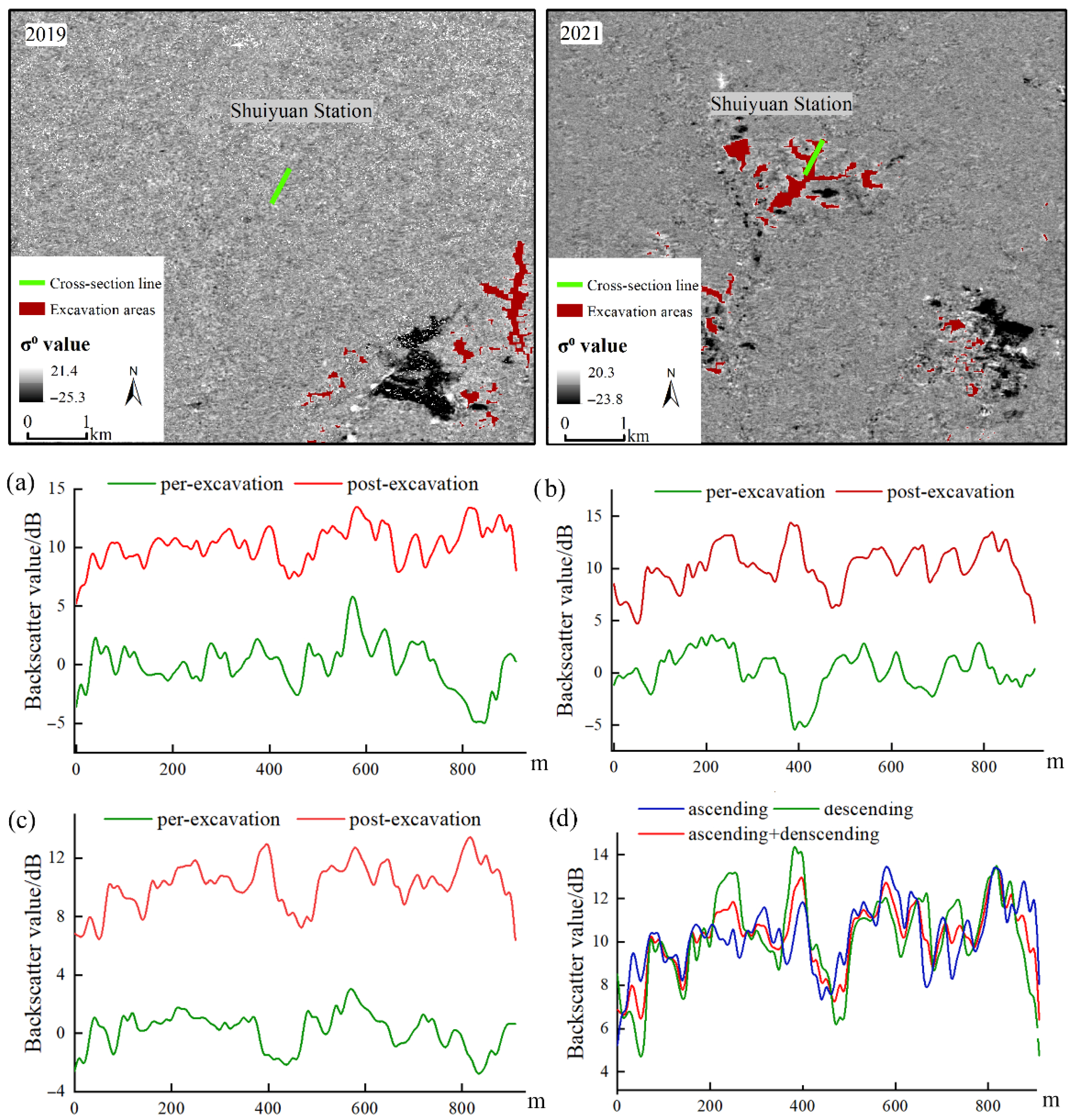
To thoroughly analyze the impact of MELCPs on the backscatter coefficient (σ0) of Sentinel-1 Synthetic Aperture Radar [27] data, our study deployed a 920-m-long cross-section along the north-south direction in the area adjacent to the Shuiyuan Station (Figure 3), systematically collecting spatiotemporal variation information of backscatter coefficients from different orbital data. The area had not yet initiated mountain excavation and land creation works in 2019, and the entire project was completed by 2021.
Three data schemes (ascending orbit, descending orbit, and ascending + descending orbit combination) were adopted to systematically analyze the variation characteristics of backscatter coefficient (σ0) before and after MELCPs. A comparison of Figure 3a–c shows that whether using single ascending orbit, single descending orbit, or the combined scheme, the backscatter intensity (σ0 value) after excavation is clearly higher than that before excavation. This phenomenon is directly related to the microwave scattering mechanism of SAR: the MELCPs altered surface morphology and material composition—original surfaces (mainly vegetation-covered and natural slopes) were dominated by volume scattering with weak intensity; after excavation, the exposed surface roughness (both micro and macro) increased significantly, and the distribution of scatterers (e.g., gravels, loose deposits) became more complex, leading to enhanced surface scattering and volume scattering, thus significantly increasing the backscatter energy received by the SAR sensor.
As shown in Figure 3d, the red (ascending orbit), blue (descending orbit), and green (ascending + descending orbit combination) curves are intertwined, with the variation trends of the three data schemes showing significant similarity. These differences are closely related to the observation geometry of SAR: in the 0–200 m interval, the incident angle of ascending orbit data is more suitable for capturing the surface roughness characteristics after excavation in this area, resulting in higher backscatter variation values than descending orbit data; in the 200–400 m interval, changes in surface slope and microstructures make the observation angle of descending orbit data more compatible with scattering conditions, causing its variation values to exceed those of ascending orbit data; the combined data curve remains between the two, integrating scattering characteristics under both observation geometries and reducing angle-dependent errors of single-orbit data.
To further analyze the optimality of three schemes in monitoring the excavation range of MELCPs, our study conducted quantitative accuracy analysis through random sampling (sample size accounting for 5% of the total monitoring area, covering various terrain gradients) based on Sentinel-1 VH polarization data after the completion of the project in 2021 (Table 3). The results show that the overall accuracy of ascending orbit data is 78.7% with a Kappa coefficient of 0.75; the OA of descending orbit data is 72.6% with a Kappa coefficient of 0.69. In contrast, the ascending + descending orbit combination scheme exhibits significant advantages, with its OA increased to 87.1% and Kappa coefficient reaching 0.85, both significantly outperforming single-orbit schemes.
Our findings align with the side-looking imaging geometry of Sentinel-1 SAR. To mitigate the inherent limitations of single-orbit (ascending or descending) monitoring, we adopt a combined ascending and descending orbit approach. This dual-orbit strategy ensures that for excavation areas with arbitrary slope aspects, at least one dataset will have an incident angle within the optimal sensitivity range, thereby eliminating the single-perspective blind zones and significantly enhancing observation accuracy. Furthermore, the observed increase in backscatter coefficients post-MELCPs compared to pre-MELCPs provides a theoretical foundation for the accurate extraction of mountain excavation areas.

3.2. Dynamic Monitoring of Excavation Zones in Lanzhou North New Urban

In MELCPs, excavation zones serve as crucial sources of construction land, with their development intensity directly affecting the efficiency of intensive land use. Meanwhile, fill zones play key roles in ecological greening, and their stability is vital for regional ecological balance. Therefore, high-precision, dynamic monitoring of excavation zones using Synthetic Aperture Radar [27] technology provides essential technical support for balancing land resource development and ecological conservation.
Based on Equation (1), the monitoring periods were selected by considering SAR data characteristics, data availability, and the project construction cycle. To mitigate severe backscatter fluctuations caused by dust from earthwork during peak construction periods, the initial monitoring phase was set from January 2015 to February 2017, while the later phase was selected as January–February 2018 (winter hiatus with minimal construction activity and stable ground conditions). Subsequent years followed the same standard—“initial phase: January–February of the current year; later phase: January–February of the following year”—to eliminate seasonal interference and ensure temporal consistency and comparability of the monitoring data. Sentinel-1 data for each monitoring year are detailed in Table 4.
To address potential blind spots due to single-orbit observation angles, our study adopted an ascending + descending orbit combination to delineate excavation zones. Leveraging the geometric complementarity of dual-orbit data effectively reduced signal attenuation caused by terrain occlusion, enabling the extraction of annual excavation boundaries and area changes from 2017 to 2022. To enhance extraction accuracy, a percentile thresholding method at a 95% confidence level was applied. Field surveys revealed that pre-excavation surfaces (vegetation or undisturbed soil) exhibited low roughness, dominated by volume scattering (vegetation) and specular reflection (bare ground), resulting in low σ0 values. Post-excavation surfaces, covered with loose deposits, showed significantly increased roughness and higher σ0 values due to enhanced surface scattering. Thus, binary classification of backscatter changes effectively distinguished excavation zones from non-excavated areas. To minimize extraction errors from noise (e.g., atmospheric phase residuals, thermal noise), post-processing was applied: Small isolated regions (<6 pixels, ~0.015 km2, based on Sentinel-1’s 10 m × 10 m resolution) were removed and replaced via interpolation with neighboring pixel values, significantly improving spatial continuity and boundary accuracy.
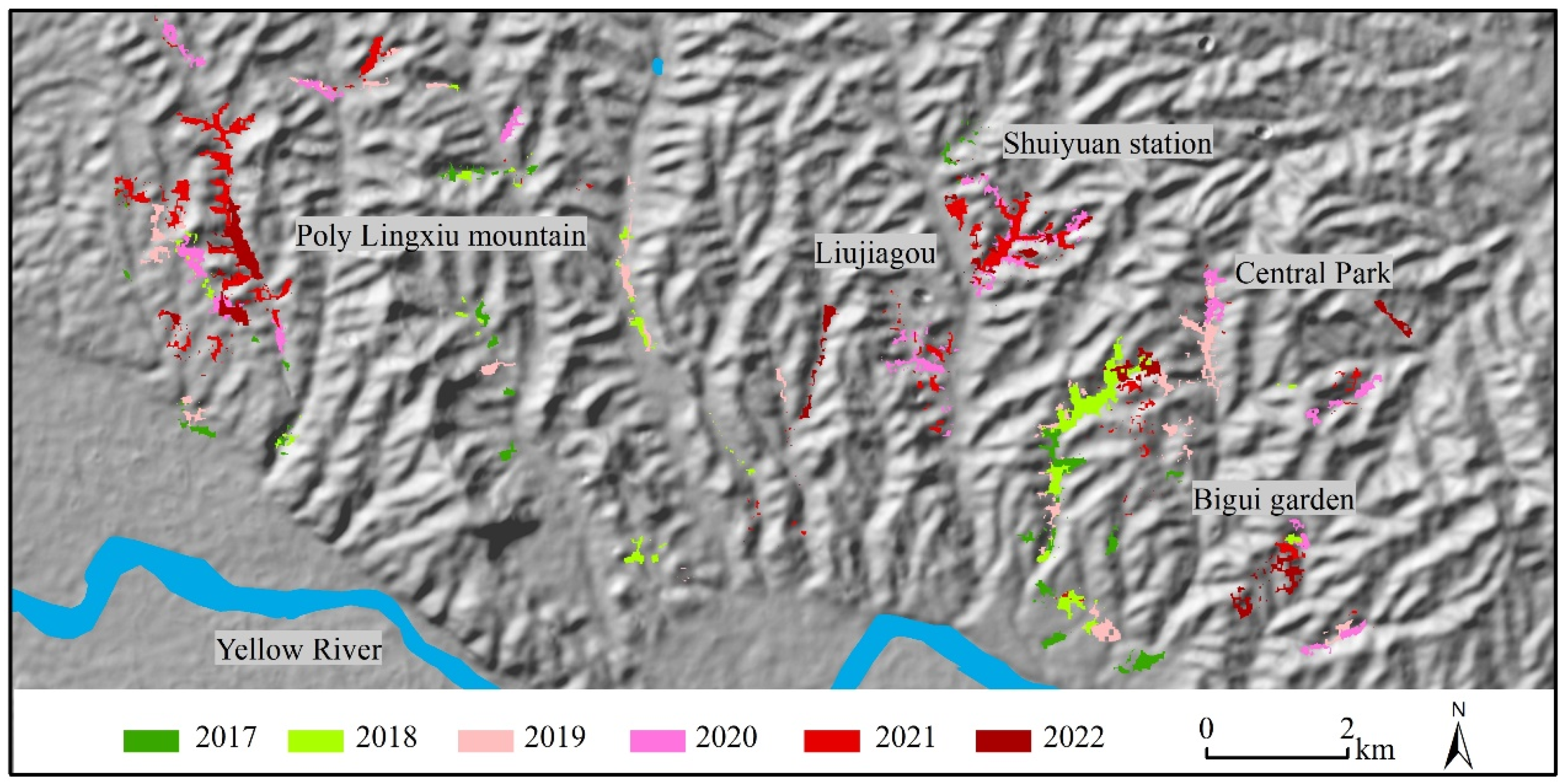
Figure 4 presents the spatial distribution of excavation zones derived from combined ascending and descending orbit Sentinel-1 data. The results indicate that excavation primarily occurred on gentle slopes of unused land (e.g., barren gullies), leveraging SAR’s high sensitivity to low-gradient terrain and 10 m-resolution detection capability. Temporally, in 2017, limited by the sparse Sentinel-1 data coverage (only 36 images), only sporadic excavation areas such as Bigui garden were detected (total area: 0.08 km2). During the 2018–2019 expansion phase, Sentinel-1 data clearly captured the “zigzag” advancement of excavation boundaries, consistent with the roughness variations induced by stepwise slope-cutting techniques, with the area increasing to 0.8 km2. The 2020–2021 peak construction period saw SAR data precisely record the initiation of new excavation zones (e.g., Liujiagou in March 2020, Shuiyuan Station in January 2021). The excavated area peaked at 1.63 km2 in 2021 (20.4% of the total monitored excavation), accompanied by an expansion of low-coherence zones (γ < 0.3). By 2022, the project transitioned to refined construction within existing excavation areas, resulting in a reduced footprint compared to the peak period. The recovery of SAR coherence (γ > 0.5) further confirmed stabilized ground disturbance.

3.3. Evolution Trajectory of MELCPs in 2017–2022

To validate the reliability of the proposed remote sensing classification method, comparative experiments based on the RF algorithm were conducted. By progressively incorporating spectral features, index features, texture features, topographic features, and polarimetric features, the UA and PA of different land cover types under various feature combinations were quantitatively analyzed (p < 0.05) (Table 5). The experimental key findings are as follows.
After adding index features to spectral features, significant accuracy improvements were observed for all land types except grassland. This stems from RF’s amplification effect on spectral differences: index features enhance spectral contrast between features (e.g., NDBI difference between buildings and bare land). However, low grassland coverage (<30%) and high mixed-pixel proportion in the study area limited the effectiveness of index features. Texture features improved classification accuracy for MELCPs areas, buildings, grassland, and cropland. This demonstrates RF’s capability in utilizing spatial heterogeneity (e.g., regular textures in urban areas, striped patterns in cropland). Nevertheless, water bodies (high homogeneity), forests (complex textures easily confused with shadows), and bare land (simple textures) showed limited improvement due to RF’s “majority voting” mechanism. Topographic features significantly enhanced accuracy for all land types except built-up areas. RF compensated for illumination variations in mountainous optical imagery through topographic features, particularly improving forests and grassland classification. Polarimetric features boosted accuracy for all land types except bare land, owing to RF’s ability to fuse multidimensional features and additional physical property differences provided by polarimetric features (e.g., polarization reflection differences between vegetation and bare land). Notably, when all features are involved in classification (Scheme 6), the accuracy improvement of most land types is limited, and the overall accuracy (OA = 84.9%, K = 0.814) even decreases compared to some simpler schemes. Although RF can handle high-dimensional data, excessive features introduce redundancy and noise, enhancing “inter-tree correlation” and causing overfitting risks. In sharp contrast, the optimized feature subset (Scheme 7) achieved the highest accuracy, with an average OA of 91.2% and Kappa of 0.889 for MELCPs areas, confirming the effectiveness of feature selection in improving model robustness.
Special analysis for MELCPs region (p < 0.05) showed that with only spectral feature (Scheme 1), the average OA of 5 experiments was 83.6% with a K of 0.792 (Table 6). After sequentially adding index, texture, topography, and polarization features (Scheme 2–5), and finally all features (Scheme 6), the average OA reached 87.6%, 83.7%, 90.1%, 88.5%, and 84.9% respectively. The optimized Scheme 7 achieved the highest accuracy, with an average OA of 91.2% and a K of 0.889. These results demonstrate that the RF algorithm effectively avoids the “curse of dimensionality” through feature importance quantification.
A direct comparison between Scheme 4 (OA = 90.1%, K = 0.867) and Scheme 7 (OA = 91.2%, K = 0.889) indicates that incorporating additional features, such as topography, does not automatically result in the best feature set. The accuracy improvement in Scheme 7 (p = 0.022) is associated with two key differences in its feature composition. First, its recursive feature elimination process removed features present in Scheme 4 that showed high mutual correlation or low discriminative power, resulting in a more compact subset. Second, the optimization in Scheme 7 selected features that function synergistically. For instance, Scheme 7 concurrently retained Slope, B5, and the variance texture of SAR-VH backscatter. This combination leverages complementary information: Slope influences drainage and material stability, often correlating with land use intensity; B5 indicates vegetation vigor or soil exposure; and VH variance reflects surface roughness. Their synergy enables finer discrimination—gentle slopes with high B5 reflectance and moderate texture entropy are indicative of engineered flat land (MELCPs), while steep slopes with similar spectral-textural patterns are more likely natural bare rock or erosion features. Although Scheme 4, by including these features among many redundant ones, failed to leverage this specific interaction as effectively, as the “majority voting” mechanism could be diluted by less relevant features.
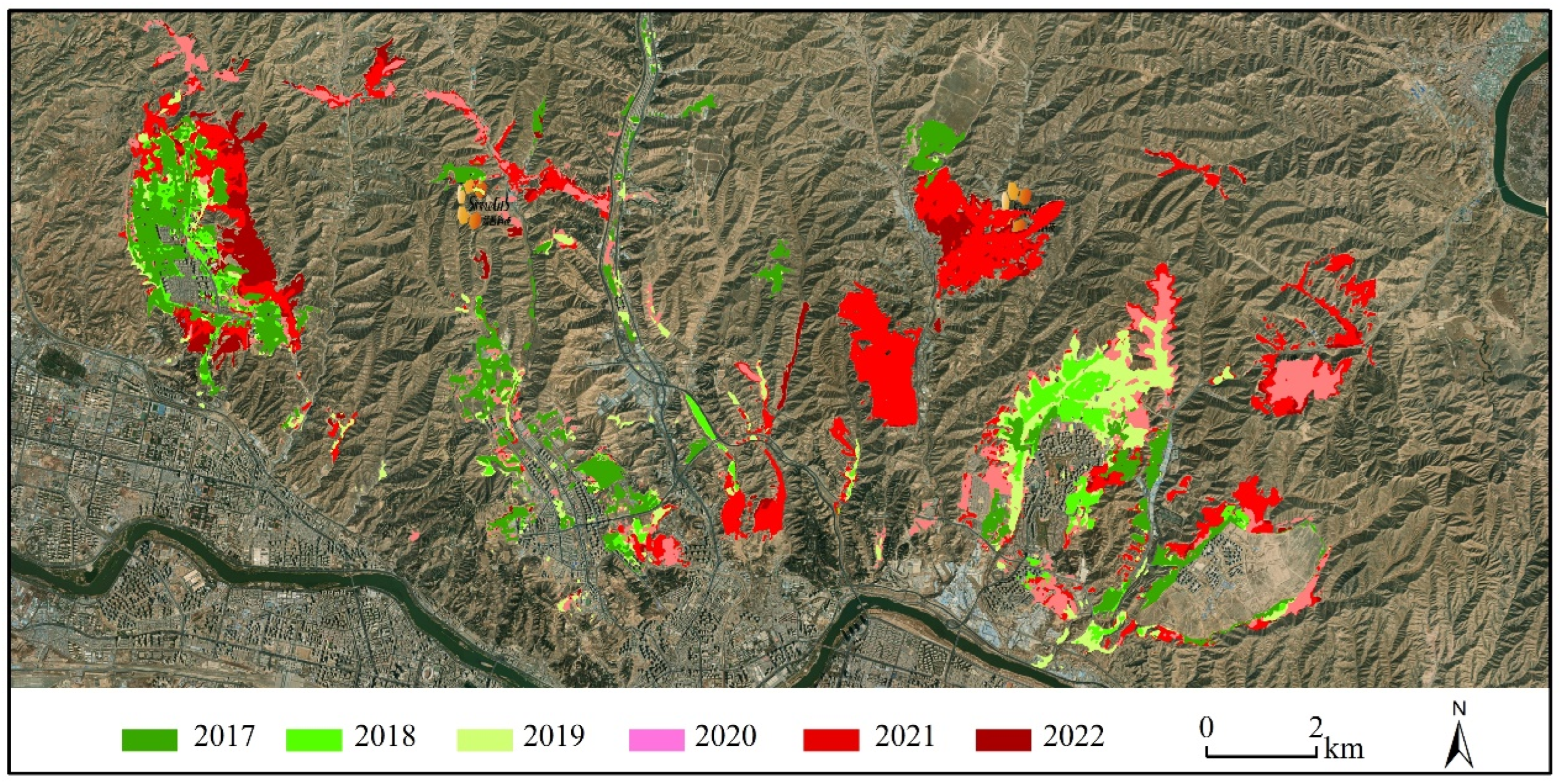
Figure 5 presents the spatial distribution of MELCPs areas in Lanzhou’s North New Urban area from 2017 to 2022, extracted using optimized feature combinations and the RF algorithm. Results reveal an overall expansion pattern of “east-west extension and south-north development”. Terrain analysis shows: initial phases (2017–2018) primarily targeted gentle slopes (<5°) of barren gullies, identifiable in Sentinel-2 optical imagery by uniform low reflectance; later stages gradually expanded to moderate slopes (5–15°). Slope statistics indicate over 90% of excavated areas occur within 15°, aligning with the terrain feature’s importance weight (0.18) in RF classification—areas beyond 15° showed limited development due to spectral interference from topographic shadows (easily confused with forests) and steeply rising construction costs. Temporal evolution characteristics demonstrate: pre-2017 development focused on Jiuzhou Development Zone (8.163 km2), appearing as scattered high-reflectance patches; 2018–2019 shifted to Bigui garden (2.655 km2) and Poly Lingxiu Mountain (5.219 km2), where high texture entropy (>0.6) distinguished them from natural terrain; the 2020–2021 peak construction period saw synchronized multi-zone excavation, with 2021 alone contributing 12.607 km2 (34.56% of total area) as new zones like Liujiagou and Shuiyuan Station commenced, where polarimetric features (VH < 0.8) effectively identified disturbed areas (Figure 6); 2022 saw reduced activity (2.686 km2) due to >15° slope constraints. The cumulative 36.494 km2 reclamation area clearly traces an evolution trajectory from “pilot zones (pre-2017)” to “large-scale expansion (2018–2021)” and finally “slope-limited slowdown (2022)”.

3.4. InSAR-Based Analysis of Engineering-Induced Subsidence Dynamics

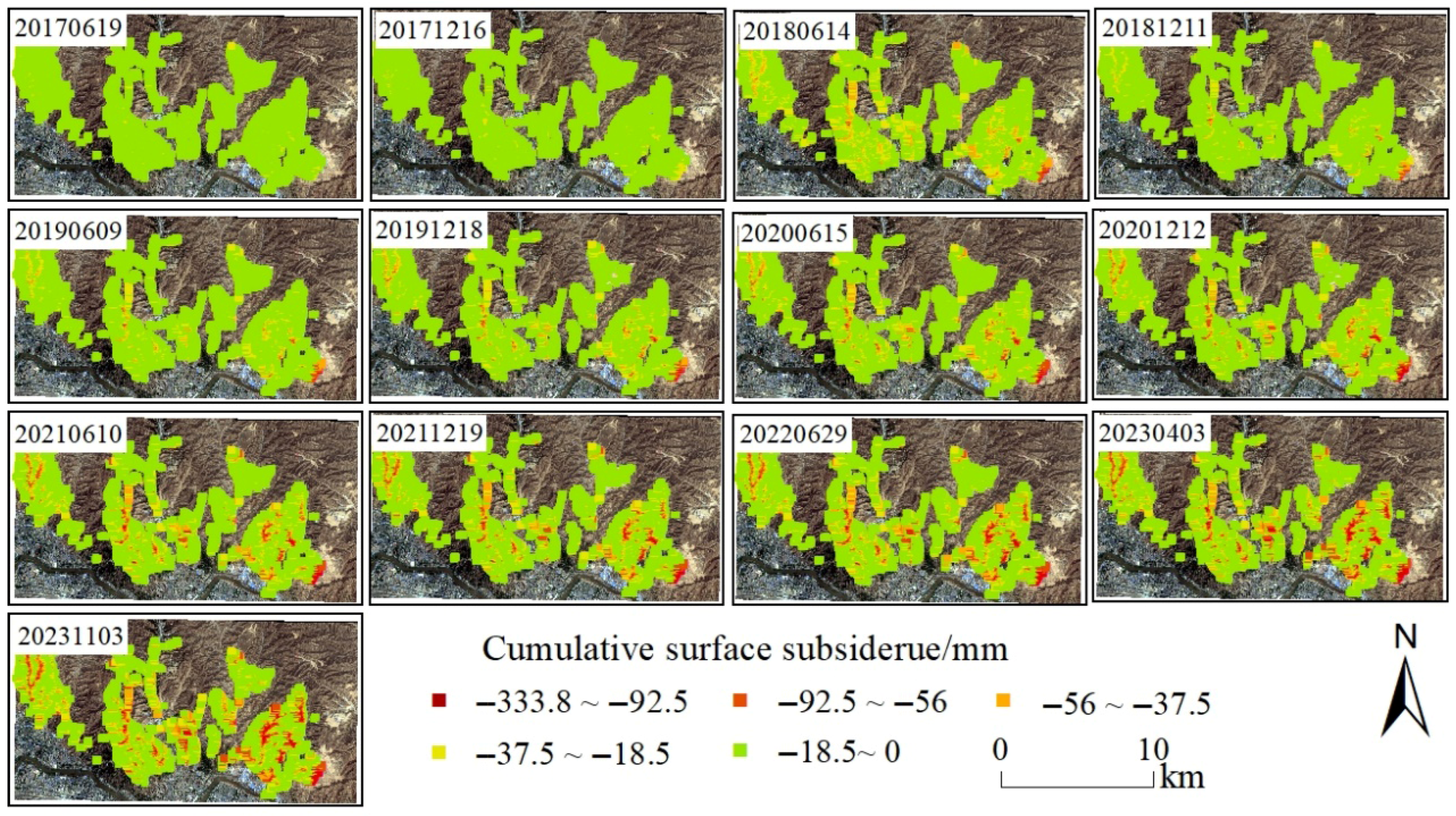
Figure 7 presents the cumulative surface subsidence in Lanzhou North New Urban (2017–2023) derived from Enhanced SBAS-InSAR (ESBAS-InSAR) processing. The spatially continuous displacement field—even across challenging vegetated and filled areas—demonstrates the improved point density and phase reliability achieved by the hybrid scatterer strategy and atmospheric correction. The corresponding time-series subplots illustrate the deformation histories at selected sites marked in the main figure. They reveal distinct dynamic patterns: in high-fill zones, settlement progressed at a sustained rate after 2019, accumulating up to 333.8 mm by 2023, whereas shallow-fill areas underwent rapid initial compaction (~50 mm within one year) before stabilizing at negligible rates. The smooth, physically consistent trajectories of these time series attest to the robustness of the ESBAS-InSAR processing chain in mitigating atmospheric and orbital phase errors.
Initial subsidence stage (starting from December 2017): Affected by early site preparation, minor subsidence signals appeared in local areas of Jiuzhou Development Zone, with a subsidence rate of <−5 mm/year. The subsidence was mainly concentrated in the shallow loose soil layer (0–3 m), confirming the disturbance characteristics of initial engineering to the shallow foundation. Accelerated subsidence stage (December 2018–December 2020): With the large-scale excavation and filling projects in areas such as Bigui garden and Poly Lingxiu Mountain, the subsidence areas showed a “multi-point scattered” feature. The maximum cumulative subsidence during this stage reached 185.3 mm, concentrated in areas with filling thickness exceeding 5 m. Sustained intensification stage (January 2021-November 2023): The high-intensity advancement of MELCPs, especially in 2021, led to further expansion of the subsidence range. By November 2023, the maximum cumulative subsidence monitored reached −333.8 mm. This extreme value area completely overlaps with high-fill areas such as Bigui garden, confirming the “filling load-foundation consolidation” driving mechanism of subsidence. From the perspective of spatial distribution, the subsidence areas showed a uniform downward trend in the time-series monitoring, indicating that the surface deformation in this area is continuously affected by engineering activities, with significant regularity and predictability.
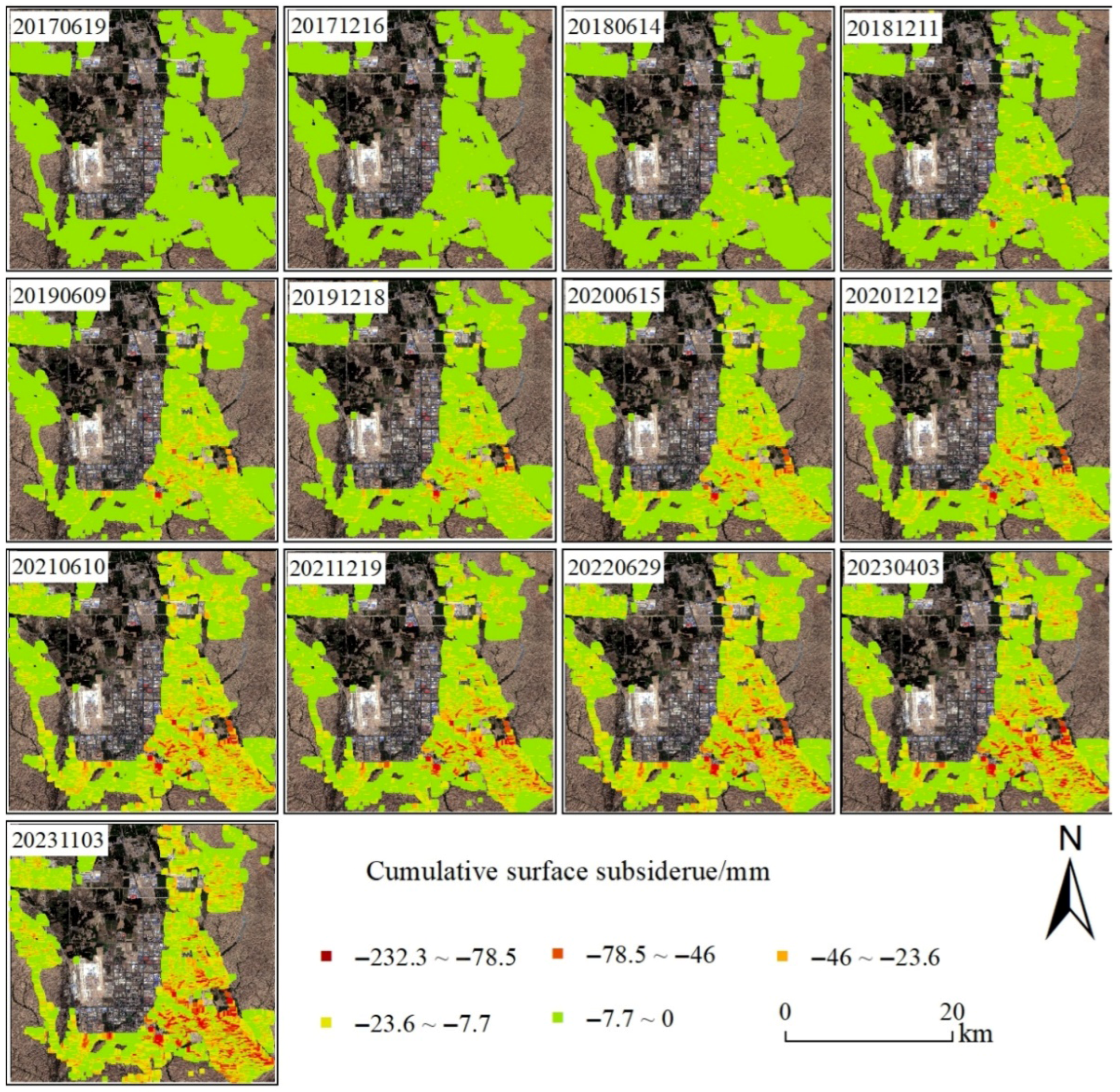
Figure 8 reveals the cumulative land subsidence characteristics in Lanzhou New District from 2017 to 2023, obtained using the same Enhanced SBAS-InSAR (ESBAS-InSAR) framework. The detailed displacement map reveals a clear spatial pattern: subsidence remained below 50 mm in areas with only filling operations, while values between −188.6 mm and −232.3 mm were observed in zones where structural construction followed land creation. The overall spatial coherence and continuity of the displacement field reflect the phase stability achieved through atmospheric and orbital error mitigation in the processing chain.
For example, the South Expressway subsidence in 2019 essentially results from the combined effect of road hardening (concrete pavement load) and underground pipeline construction (disturbing shallow soil). Artificial construction broke the original stress balance of the foundation, accelerating the consolidation settlement of filled soil. In the Xiyunshan Road area, artificial construction (residential and commercial buildings) was carried out simultaneously from MELCPs in 2018. Slight sporadic subsidence appeared in June 2019, and intensified with the completion of buildings and the expansion of surface hardening. This confirms that cumulative building load is a key variable for accelerating subsidence. Notably, in the southeastern region from 2017 to 2021, as the scope of MELCPs continued to expand, the cumulative subsidence increased from the initial −56.6 mm to −188.6 mm, which shown a significant positive correlation between the intensity of engineering activities and the subsidence rate. In addition, after large-scale MELCPs in Yangjiagou during 2021–2022, subsidence showed a stepwise increase. From 2022 to 2023, the focus of MELCPs shifted to the vicinity of Yilihe Street. Due to the cumulative load from concentrated construction in this area, significant surface subsidence occurred, with the maximum cumulative subsidence in the entire region reaching −232.3 mm.
Comprehensive analysis shows that surface subsidence caused solely by MELCPs is relatively limited. Subsequent artificial construction (such as building pile foundation construction, subgrade compaction, and cumulative loads) accelerates deep soil consolidation by altering the ground stress state, becoming a key driving factor for intensified surface subsidence.

4. Discussion

4.1. Accurate Extraction of MELCPs Driven by Multi-Source Data and Machine Learning

In MELCPs, excavated areas serve as the primary source of construction land, and their development intensity directly affects land use efficiency. Landfill areas are mainly used for environmental greening; meanwhile, dynamic monitoring of surface subsidence in these areas is crucial for urban spatial expansion and maintaining safe operations in MELCPs.
To accurately obtain the spatial distribution of excavated areas in MELCPs, based on microwave remote sensing principles, our study focuses on exploring the relationship between changes in surface physical properties caused by MELCPs and the backscattering characteristics of Sentinel-1. Our research shows that before MELCPs, vegetation areas are dominated by volume scattering, while some bare areas exhibit specular reflection, with the backscattering coefficient (σ0) typically ranging from −10 to 5 dB. After MELCPs, the surface roughness increases (microtopography changes from <2 cm to 5–50 cm), enhancing surface scattering, which makes the σ0 value larger than that before MELCPs, even exceeding 17 dB (Figure 4). These characteristic changes provide a reliable physical basis for identifying excavated areas. Therefore, we propose a dynamic monitoring model based on backscattering differences. By combining multi-temporal median filtering with a percentile threshold algorithm, it can effectively suppress atmospheric interference and random noise while achieving automatic extraction of excavated area boundaries. To improve the extraction accuracy of excavated areas and overcome monitoring blind spots caused by topographic occlusion in single-orbit data, based on side-looking radar principles, our study innovatively proposes a dual-orbit observation scheme. Using complementary incidence angle data from Sentinel-1 ascending and descending orbits, the recognition accuracy of excavated areas reaches 87.1% (Kappa coefficient = 0.85), providing quantitative and reliable basic data for urban planning and construction in the study area.
The 8.4% improvement in Overall Accuracy (OA), from approximately 75% using single-orbit data to 87.1% with dual-orbit fusion (Table 3), signifies a critical advancement beyond a mere numerical increment. This enhancement directly translates to the effective mitigation of observation blind spots inherent to single-track SAR in complex terrain. Consequently, the method transitions monitoring capability from one hampered by severe, geometry-dependent data gaps to one providing consistent, spatially comprehensive coverage. This leap in reliability is of paramount practical importance for engineering safety and change detection in risk-prone mountainous environments.
To accurately extract MELCPs, we systematically evaluated multi-source features (spectral, index, texture, topographic, and polarimetric) using the RF algorithm. While individual feature types provided foundational discrimination, each exhibited limitations: spectral features alone achieved modest accuracy (OA = 83.6%, K = 0.792) and struggled with spectrally similar classes; index features improved contrast but were less effective in mixed-pixel areas like sparse grassland; texture features captured spatial heterogeneity but showed limited sensitivity to homogeneous features; topographic and polarimetric features provided valuable physical corrections and complementary scattering information. Notably, using all features together reduced accuracy (OA = 84.9%) due to redundancy, underscoring the need for optimization. The feature set optimized via OOB error and Gini importance (Scheme 7) achieved significantly higher accuracy (OA = 91.2%, K = 0.889). This gain is attributed not merely to selecting informative features, but to exploiting synergistic interactions between them. A key mechanism is how topographic features modulate the interpretation of other signals. For example, gentle slopes combined with high SAR texture variance strongly indicate engineered land, while the same texture on steep slopes suggests natural terrain. Similarly, slope context refines the meaning of optical indices like NDBI, helping separate construction materials from bare rock. The RF optimization in Scheme 7 successfully identified such coupled “topographic-scattering-spectral” diagnostic rules. Thus, the superiority of Scheme 7 over Scheme 4 arises from its ability to distill a subset where features interact synergistically, whereas Scheme 4’s performance was diluted by redundant variables that obscured these interactions. This highlights a transferable insight: effective monitoring of complex terrain engineering requires feature optimization that actively seeks cross-modal combinations encoding the unique physical-contextual interactions of the target phenomenon.
In summary, the framework developed herein—integrating dual-orbit SAR for robust change detection, optimized multi-source features for precise classification, and time-series InSAR for mechanistic analysis—provides a holistic approach to monitoring the MELCP lifecycle. While the specific magnitudes in the identified ‘hierarchical subsidence mechanism’ are influenced by local geotechnical conditions, its core conceptual separation between shallow filling effects and deep consolidation driven by structural loads offers a transferable model for understanding similar projects. Furthermore, the noted limitation of 10-m resolution potentially missing very small excavations does not diminish the validity of the large-scale patterns, comparative method advantages, or fundamental mechanisms revealed, as this study is fundamentally aimed at regional-scale monitoring and risk assessment critical for urban planning.

4.2. Unraveling the Hierarchical Mechanisms of MELCPs-Induced Land Subsidence

Our study monitored the cumulative land subsidence in Lanzhou North New Urban area and Lanzhou New District from 2017 to 2023, aiming to explore the driving mechanism of land subsidence caused by MELCPs and their subsequent construction. The research revealed that the subsidence in Lanzhou North New Urban area is highly correlated with the progress of the projects. For instance, in the initial stage (December 2017), some parts of Jiuzhou Development Zone showed slight subsidence (<−5 mm/year) in the shallow layer (0–3 m) due to site preparation, reflecting early foundation disturbance. During the acceleration stage (December 2018 to December 2020), large-scale soil filling, such as in the Bigui garden, led to “multi-point scattered” subsidence, with the maximum cumulative value reaching 185.3 mm, overlapping with areas where the filling thickness exceeded 5 m, confirming the dominant role of filling loads. In the continuous intensification stage (January 2021 to November 2023), high-intensity projects expanded the subsidence range, reaching a maximum of −333.8 mm by November 2023, coinciding with the high-fill areas in Bigui garden, which verified the “filling load-foundation consolidation” mechanism.
In Lanzhou New district, our study found that the subsidence in areas with only soil filling was less than 50 mm, while the subsidence in construction areas ranged from −188.6 to −232.3 mm, highlighting subsequent construction as the main aggravating factor. For example, the subsidence on the South expressway was caused by the combined effects of road hardening and pipeline construction; the subsidence on Xiyunshan Road intensified with the increase in building loads; the engineering intensity in the southeast showed a positive correlation with the subsidence rate; and the concentrated construction in Yangjiagou resulted in a subsidence of −232.3 mm.
The identified land subsidence in MELCPs exhibits a clear hierarchical mechanism: within the study area, subsidence resulting solely from land creation is primarily limited to shallow compression, whereas subsequent construction activities significantly accelerate deep consolidation. This acceleration is driven by the combined effects of structural loading, subsoil disturbance, and altered drainage conditions. The superposition of these anthropogenic loads thus plays a decisive role in intensifying settlement, a finding that offers a mechanistic basis for engineering management in analogous settings.
The proposed hierarchical mechanism—distinguishing between shallow filling-induced compression and deep construction-driven consolidation—is rooted in fundamental geotechnical principles of load-induced settlement, endowing it with a physically generalizable core. However, its quantitative expressions, such as the magnitude, rate, and duration of each stage, are inherently site-specific. These are governed by local factors including the prevalent loess properties in Lanzhou, fill thickness, construction intensity, and hydrogeological context. Consequently, while this mechanism provides a transferable conceptual framework for diagnosing subsidence in similar engineered landscapes, its predictive application for risk assessment requires calibration with local geotechnical and engineering parameters.

4.3. The Limitations of the Research

Although our study effectively captured the scope of excavation and land creation in MELCPs using multi-source data and RF, several limitations should be acknowledged. First, the 10-m spatial resolution of Sentinel-1 SAR data employed in the experiments may miss very small-scale excavation areas (<0.01 km2). However, this limitation does not fundamentally undermine the core findings regarding large-scale spatiotemporal patterns, the comparative advantage of the dual-orbit fusion method, or the identified subsidence mechanisms. Our study focused on regional-scale monitoring and the predominant phases of engineering activity, which are accurately captured at this resolution. The omission of extremely small sites does not affect the validity of the observed evolution trajectory (e.g., the three-stage pattern) or the hierarchical subsidence mechanism, both of which are derived from contiguous, large-area changes. Future research could incorporate higher-resolution SAR or optical data to capture finer details and precisely quantify excavation volumes.
Second, the temporal scope of this study (2017–2023) was designed to align with the most intensive period of mountain excavation and land creation activities. Consequently, the subsequent phase focusing on ecological governance and re-greening in recent years was not covered, which represents a direction for future monitoring work.
Additionally, the generalizability of the RF model developed herein to other loess regions remains to be further verified, which is crucial for exploring the application potential of this methodology in similar engineering projects. It is also pertinent to note that, while the minimum spatial buffer applied during sample splitting mitigated local spatial autocorrelation, a more rigorous evaluation design—such as spatial cross-validation (e.g., block- or cluster-based splitting)—could be adopted in future studies to fully isolate and quantify the potential influence of spatial dependence on classification performance estimates. It is also pertinent to note that, while the minimum spatial buffer applied during sample splitting mitigated local spatial autocorrelation, a more rigorous evaluation design—such as spatial cross-validation (e.g., block- or cluster-based splitting)—could be adopted in future studies to fully isolate and quantify the potential influence of spatial dependence on classification performance estimates.
It is noteworthy that in the monitoring of land subsidence using InSAR, despite the adoption of advanced techniques such as ESBAS-InSAR, Sentinel-1 ascending/descending orbit data, and ERAS atmospheric correction, residual atmospheric errors still affect the reliability of subsidence monitoring. Therefore, future research should incorporate higher-resolution SAR data (e.g., Planet imagery) and introduce transfer learning to optimize the RF algorithm, thereby further enhancing the monitoring accuracy of MELCPs.

5. Conclusions

Facing the dual challenges of rapid urbanization and ecological conservation, Mountain Excavation and Land Creation Projects (MELCPs) have become essential for mountainous cities to overcome terrain limitations. This study develops an innovative monitoring framework that integrates multi-orbit Sentinel-1 SAR, Sentinel-2 optical imagery, SRTM DEM, and field data. Our approach demonstrates significant improvements: combining ascending and descending SAR orbits with the percentile thresholding approach achieves 87.1% accuracy in excavation area detection, revealing a clear three-phase evolution pattern of rapid expansion, peak activity, and constrained slowdown. Through optimized feature selection using Random Forest, we improve classification accuracy to 91.2%, enabling precise annual monitoring of land reclamation. The results quantify dramatic changes: reclaimed area expanded from 2.66 km2 before 2018 to a peak of 12.61 km2 in 2021 (34.56% of total), then decreased to 2.69 km2 in 2022 due to land reuse, showing spatial pattern of east-west expansion and north-south extension. Most significantly, our InSAR results (2017–2023) reveal the unique subsidence mechanisms in MELCP areas: while initial land creation causes only minimal subsidence (<50 mm) due to shallow compaction, subsequent construction activities trigger severe deep consolidation with maximum settlement reaching 333.8 mm. This progression reveals a three-stage subsidence mechanism: initial settlement from filling loads, accelerated consolidation from foundation compression, and substantially amplified settlement from structural loads. These findings provide critical insights for predicting and managing settlement risks in mountain development projects.

Author Contributions

Q.N.: Conceptualization, Software, Validation, Visualization, Writing—original draft, Funding acquisition. J.L.: Conceptualization, Formal analysis, Validation, Visualization, Writing—review & editing. Q.F.: Data curation, Validation, Visualization. L.Z.: Validation, Writing—review & editing. All authors have read and agreed to the published version of the manuscript.

Funding

This research was supported by the National Natural Science Foundation of China (Grants No. 42261069), and Key Program of Gansu Provincial Natural Science Foundation (25JRRA064).

Data Availability Statement

The original contributions presented in this study are included in the article. Further inquiries can be directed to the corresponding author.

Acknowledgments

The authors gratefully acknowledge the many important contributions from the researchers of all the reports cited in this paper.

Conflicts of Interest

Author Quanfu Niu was employed by the company Academician Expert Workstation of Gansu Dayu Jiuzhou Space Information Technology Co., Ltd. The remaining authors declare that the research was conducted in the absence of any commercial or financial relationships that could be construed as a potential conflict of interest.

References

  1. Seto, K.C.; Fragkias, M.; Güneralp, B.; Reilly, M.K. A meta-analysis of global urban land expansion. PLoS ONE 2011, 6, e23777. [Google Scholar] [CrossRef] [PubMed]
  2. Angel, S.; Parent, J.; Civco, D.L.; Blei, A.; Potere, D. The dimensions of global urban expansion: Estimates and projections for all countries, 2000–2050. Prog. Plan. 2011, 75, 53–107. [Google Scholar] [CrossRef]
  3. Li, P.; Qian, H.; Wu, J. Environment: Accelerate research on land creation. Nature 2014, 510, 29–31. [Google Scholar] [CrossRef]
  4. Zhang, Y.; Cai, C.; Chen, B.; Dai, W. Consistency evaluation of precipitable water vapor derived from ERA5, ERA-Interim, GNSS, and radiosondes over China. Radio Sci. 2019, 54, 561–571. [Google Scholar] [CrossRef]
  5. Firman, T. The continuity and change in mega-urbanization in Indonesia: A survey of Jakarta–Bandung Region (JBR) development. Habitat Int. 2009, 33, 327–339. [Google Scholar] [CrossRef]
  6. Hadi, A.S.; Idrus, S.; Mohamed, A.F.; Taha, M.R.; Othman, M.R.; Ismail, S.M.F.S.; Ismail, S.M. Managing the Growing Kuala Lumpur Mega Urban Region for Livable City: The Sustainable Development Goals as Guiding Frame. In Handbook of Sustainability Science and Research; Leal Filho, W., Ed.; Springer International Publishing: Cham, Switzerland, 2018; pp. 357–368. [Google Scholar] [CrossRef]
  7. Pu, C.; Xu, Q.; Wang, X. Vegetation response to large-scale mountain excavation and city construction projects on the Loess Plateau of China. Sci. Total Environ. 2024, 946, 174256. [Google Scholar] [CrossRef]
  8. Gong, J.; Cao, E.; Xie, Y. Integrating ecosystem services and landscape ecological risk into adaptive management: Insights from a western mountain-basin area, China. J. Environ. Manag. 2021, 281, 111817. [Google Scholar] [CrossRef]
  9. Liu, F.; Zhang, Z.; Zhao, X.; Liu, B.; Wang, X.; Yi, L.; Zuo, L.; Xu, J.; Hu, S.; Sun, F.; et al. Urban Expansion of China from the 1970s to 2020 Based on Remote Sensing Technology. Chin. Geogr. Sci. 2021, 31, 765–781. [Google Scholar] [CrossRef]
  10. Cui, X.; Fang, C.; Liu, H.; Liu, X. Assessing sustainability of urbanization by a coordinated development index for an Urbanization-Resources-Environment complex system: A case study of Jing-Jin-Ji region, China. Ecol. Indic. 2019, 96, 383–391. [Google Scholar] [CrossRef]
  11. Fuchs, M.; Torizin, J.; Wang, L. Identification and temporally-spatial quantification of geomorphic relevant changes by construction projects in loess landscapes: Case study Lanzhou City, NW China. Big Earth Data 2019, 3, 395–410. [Google Scholar] [CrossRef]
  12. Zhang, H.; Shi, A. Development Zones and Evolvement of Urban Spatial Structure. Procedia Environ. Sci. 2011, 11, 1529–1534. [Google Scholar] [CrossRef]
  13. Niu, Q.; Bai, J.; Cheng, W. Mapping the dynamics of urban land creation from hilltop removing and gully filling Projects in the river-valley city of Lanzhou, China. J. Indian Soc. Remote Sens. 2022, 50, 1813–1826. [Google Scholar] [CrossRef]
  14. Chen, J.; Gao, J.; Chen, W. Urban land expansion and the transitional mechanisms in Nanjing, China. Habitat Int. 2016, 53, 274–283. [Google Scholar] [CrossRef]
  15. Fu, B. Ecological and environmental effects of land-use changes in the Loess Plateau of China. Chin. Sci. Bull. 2022, 67, 3769–3779. [Google Scholar] [CrossRef]
  16. Wang, L.; Anna, H.; Zhang, L. Spatial and Temporal Changes of Arable Land Driven by Urbanization and Ecological Restoration in China. Chin. Geogr. Sci. 2019, 29, 809–819. [Google Scholar] [CrossRef]
  17. Luo, M.; Jia, X.; Zhao, Y. Ecological vulnerability assessment and its driving force based on ecological zoning in the Loess Plateau, China. Ecol. Indic. 2024, 159, 111658. [Google Scholar] [CrossRef]
  18. Yan, R.; Zhang, X.; Yan, S.; Chen, H. Estimating soil erosion response to land use/cover change in a catchment of the Loess Plateau, China. Int. Soil Water Conserv. Res. 2018, 6, 13–22. [Google Scholar] [CrossRef]
  19. Wang, D.; Hao, M.; Chen, S. Assessment of landslide susceptibility and risk factors in China. Nat. Hazards 2021, 108, 3045–3059. [Google Scholar] [CrossRef]
  20. Zhang, F.; Shu, H.; Yan, B. Characteristic analysis and potential hazard assessment of reclaimed mountainous areas in Lanzhou, China. CATENA 2023, 221, 106771. [Google Scholar] [CrossRef]
  21. Olsen, K.M.; Calef, M.T.; Agram, P.S. Contextual uncertainty assessments for InSAR-based deformation retrieval using an ensemble approach. Remote Sens. Environ. 2023, 287, 113456–113470. [Google Scholar] [CrossRef]
  22. Zhu, Z.; Qiu, S.; Ye, S. Remote sensing of land change: A multifaceted perspective. Remote Sens. Environ. 2022, 282, 113266. [Google Scholar] [CrossRef]
  23. Melichar, M.; Didan, K.; Barreto-Muñoz, A.; Duberstein, J.N.; Jiménez Hernández, E.; Crimmins, T.; Li, H.; Traphagen, M.; Thomas, K.A.; Nagler, P.L. Random Forest Classification of Multitemporal Landsat 8 Spectral Data and Phenology Metrics for Land Cover Mapping in the Sonoran and Mojave Deserts. Remote Sens. 2023, 15, 1266. [Google Scholar] [CrossRef]
  24. Li, D.; Wang, M.; Jiang, J. China’s high-resolution optical remote sensing satellites and their mapping applications. Geo-Spat. Inf. Sci. 2021, 24, 85–94. [Google Scholar] [CrossRef]
  25. de Gélis, I.; Lefèvre, S.; Corpetti, T. Siamese KPConv: 3D multiple change detection from raw point clouds using deep learning. ISPRS J. Photogramm. Remote Sens. 2023, 197, 274–291. [Google Scholar] [CrossRef]
  26. Wang, X.; Yao, S.; Tang, Y.; Yang, S.; Liu, Z. Shadow-aware decomposed transformer network for shadow detection and removal. Pattern Recognit. 2024, 156, 110771. [Google Scholar] [CrossRef]
  27. Xia, J.; Niu, S.; Ciais, P.; Janssens, I.A.; Chen, J.; Ammann, C.; Arain, A.; Blanken, P.D.; Cescatti, A.; Bonal, D.; et al. Joint control of terrestrial gross primary productivity by plant phenology and physiology. Proc. Natl. Acad. Sci. USA 2015, 112, 2788–2793. [Google Scholar] [CrossRef]
  28. Gong, X.; Xu, Q.; Pu, C. InSAR Time Series Monitoring and Analysis of Land Deformation After Mountain Excavation and City Construction in Lanzhou New Area. Geomat. Inf. Sci. Wuhan Univ. 2024, 49, 236–245. [Google Scholar] [CrossRef]
  29. Hakim, W.L.; Fadhillah, M.F.; Won, J.S.; Park, Y.C.; Lee, C.W. Advanced time-series InSAR analysis to estimate surface deformation and utilization of hybrid deep learning for susceptibility mapping in the Jakarta metropolitan region. GISci. Remote Sens. 2025, 62, 2465349. [Google Scholar] [CrossRef]
  30. Tang, F.; Ji, Y.; Zhang, Y.; Dong, Z.; Wang, Z.; Zhang, Q.; Zhao, B.; Gao, H. Drifting Ionospheric Scintillation Simulation for L-Band Geosynchronous SAR. IEEE J. Sel. Top. Appl. Earth Obs. Remote Sens. 2024, 17, 842–854. [Google Scholar] [CrossRef]
  31. Crosetto, M.; Monserrat, O.; Cuevas-González, M. Persistent Scatterer Interferometry: A review. ISPRS J. Photogramm. Remote Sens. 2016, 115, 78–89. [Google Scholar] [CrossRef]
  32. Seydi, S.T.; Shah-Hosseini, R.; Hasanlou, M. New framework for hyperspectral change detection based on multi-level spectral unmixing. Appl. Geomat. 2021, 13, 763–780. [Google Scholar] [CrossRef]
  33. Chen, Y.; Wang, Y.; Gu, Y. Deep Learning Ensemble for Hyperspectral Image Classification. IEEE J. Sel. Top. Appl. Earth Obs. Remote Sens. 2019, 12, 1882–1897. [Google Scholar] [CrossRef]
  34. Cao, C.; Zhang, G.; Luo, Y.; Liang, C.; Duan, J.; Ran, S.; Zhang, J. Wavefield Separation-Driven High-Precision Deep-Learning Karst Caves Recognition Method. IEEE Geosci. Remote Sens. Lett. 2025, 22, 1–5. [Google Scholar] [CrossRef]
  35. Reutebuch, S.E.; McGaughey, R.J.; Andersen, H.E.; Carson, W.W. Accuracy of a high-resolution lidar terrain model under a conifer forest canopy. Can. J. Remote Sens. 2003, 29, 527–535. [Google Scholar] [CrossRef]
  36. Yu, X.; Ergun, K.; Cherkasova, L.; Rosing, T.S. Optimizing Sensor Deployment and Maintenance Costs for Large-Scale Environmental Monitoring. IEEE Trans. Comput. Aided Des. Integr. Circuits Syst. 2020, 39, 3918–3930. [Google Scholar] [CrossRef]
  37. Mokhtari, A.; Ahmadi, A.; Daccache, A.; Drechsler, K. Actual Evapotranspiration from UAV Images: A Multi-Sensor Data Fusion Approach. Remote Sens. 2021, 13, 2315. [Google Scholar] [CrossRef]
  38. Nourani, V.; Tosan, M.; Huang, J.J.; Gebremichael, M.; Kantoush, S.A.; Dastourani, M. Advances in multi-source data fusion for precipitation estimation: Remote sensing and machine learning perspectives. Earth-Sci. Rev. 2025, 270, 105253. [Google Scholar] [CrossRef]
  39. Niu, Q.; Liu, M.; Liu, B.; Wang, G.; Wang, Z.; Liu, X.; Li, K. Mapping the forests and their spatiotemporal changes in the Yellow River Basin (Gansu section) in China from 2008 to 2018. Eur. J. Remote Sens. 2025, 58, 2451046. [Google Scholar] [CrossRef]
  40. Gamba, P.; Dell’acqua, F.; Houshmand, B. Comparison and fusion of LIDAR and InSAR digital elevation models over urban areas. Int. J. Remote Sens. 2003, 24, 4289–4300. [Google Scholar] [CrossRef]
  41. Mugiraneza, T.; Hafner, S.; Haas, J.; Ban, Y. Monitoring urbanization and environmental impact in Kigali, Rwanda using Sentinel-2 MSI data and ecosystem service bundles. Int. J. Appl. Earth Obs. Geoinf. 2022, 109, 102775. [Google Scholar] [CrossRef]
  42. Valencia Ortiz, J.A.; Martínez-Graña, A.M.; Méndez, L.M. Evaluation of Susceptibility by Mass Movements through Stochastic and Statistical Methods for a Region of Bucaramanga, Colombia. Remote Sens. 2023, 15, 4567. [Google Scholar] [CrossRef]
  43. Gorelick, N.; Hancher, M.; Dixon, M. Google Earth Engine: Planetary-scale geospatial analysis for everyone. Remote Sens. Environ. 2017, 202, 18–27. [Google Scholar] [CrossRef]
  44. Hooper, A.; Bekaert, D.; Spaans, K.; Arıkan, M. Recent advances in SAR interferometry time series analysis for measuring crustal deformation. Tectonophysics 2012, 514–517, 1–13. [Google Scholar] [CrossRef]
  45. Torres, R.; Snoeij, P.; Geudtner, D. GMES Sentinel-1 mission. Remote Sens. Environ. 2012, 120, 9–24. [Google Scholar] [CrossRef]
  46. Drusch, M.; Del Bello, U.; Carlier, S. Sentinel-2: ESA’s optical high-resolution mission for GMES operational services. Remote Sens. Environ. 2012, 120, 25–36. [Google Scholar] [CrossRef]
  47. Main-Knorn, M.; Pflug, B.; Louis, J. Sen2Cor for Sentinel-2. In Proceedings of the Image and Signal Processing for Remote Sensing XXIII, Warsaw, Poland, 11–13 September 2017. [Google Scholar]
  48. Joshi, N.; Baumann, M.; Ehammer, A. A review of the application of optical and radar remote sensing data fusion to land use mapping and monitoring. Remote Sens. 2016, 8, 70. [Google Scholar] [CrossRef]
  49. Bauer-Marschallinger, B.; Cao, S.; Navacchi, C.; Freeman, V.; Reuß, F.; Geudtner, D.; Rommen, B.; Vega, F.C.; Snoeij, P.; Attema, E.; et al. The normalised Sentinel-1 Global Backscatter Model, mapping Earth’s land surface with C-band microwaves. Sci. Data 2021, 8, 277. [Google Scholar] [CrossRef] [PubMed]
  50. Zhu, Z.; Wang, S.; Woodcock, C.E. Improvement and expansion of the Fmask algorithm: Cloud, cloud shadow, and snow detection for Landsats 4–7, 8, and Sentinel 2 images. Remote Sens. Environ. 2015, 159, 269–277. [Google Scholar] [CrossRef]
  51. Kennedy, R.E.; Yang, Z.; Gorelick, N. Implementation of the LandTrendr algorithm on Google Earth Engine. Remote Sens. 2018, 10, 691. [Google Scholar] [CrossRef]
  52. Tamiminia, H.; Salehi, B.; Mahdianpari, M. Google Earth Engine for geo-big data applications: A meta-analysis and systematic review. ISPRS J. Photogramm. Remote Sens. 2020, 164, 152–170. [Google Scholar] [CrossRef]
  53. Stehman, S.V. Sampling designs for accuracy assessment of land cover. Int. J. Remote Sens. 2009, 30, 5243–5272. [Google Scholar] [CrossRef]
  54. Farr, T.G. The Shuttle Radar Topography Mission. Rev. Geophys. 2007, 45, RG2004. [Google Scholar] [CrossRef]
  55. Bovolo, F.; Bruzzone, L. A theoretical framework for unsupervised change detection based on change vector analysis in the polar domain. IEEE Trans. Geosci. Remote Sens. 2007, 45, 218–236. [Google Scholar] [CrossRef]
  56. Rignot, E.J.M.; van Zyl, J.J. Change detection techniques for ERS-1 SAR data. IEEE Trans. Geosci. Remote Sens. 1993, 31, 896–906. [Google Scholar] [CrossRef]
  57. Wong, B.A.; Thomas, C.; Halpin, P. Automating offshore infrastructure extractions using synthetic aperture radar & Google Earth Engine. Remote Sens. Environ. 2019, 233, 111412. [Google Scholar] [CrossRef]
  58. Li, H.; Wang, X.; Choy, S. Detecting heavy rainfall using anomaly-based percentile thresholds of predictors derived from GNSS-PWV. Atmos. Res. 2022, 265, 105912. [Google Scholar] [CrossRef]
  59. Díaz-Uriarte, R.; Alvarez de Andrés, S. Gene selection and classification of microarray data using random forest. BMC Bioinform. 2006, 7, 3. [Google Scholar] [CrossRef]
  60. Gregorutti, B.; Michel, B.; Saint-Pierre, P. Correlation and variable importance in random forests. Stat. Comput. 2017, 27, 659–678. [Google Scholar] [CrossRef]
  61. Probst, P.; Wright, M.; Boulesteix, A.L. Hyperparameters and Tuning Strategies for Random Forest. WIREs Data Min. Knowl. Discov. 2019, 9, e1301. [Google Scholar] [CrossRef]
  62. Breiman, L. Random Forests. Mach. Learn. 2001, 45, 5–32. [Google Scholar] [CrossRef]
  63. Scornet, E. Random Forests and Kernel Methods. IEEE Trans. Inf. Theory 2016, 62, 1485–1500. [Google Scholar] [CrossRef]
  64. Colesanti, C.; Wasowski, J. Investigating landslides with space-borne Synthetic Aperture Radar (SAR) interferometry. Eng. Geol. 2006, 88, 173–199. [Google Scholar] [CrossRef]
  65. Gisinger, C. Precise three-dimensional stereo localization of corner reflectors in mountainous terrain using TerraSAR-X. IEEE Trans. Geosci. Remote Sens. 2015, 53, 1782–1802. [Google Scholar] [CrossRef]
  66. De Zan, F.; Guarnieri, A.M. TOPSAR: Terrain observation by progressive scans. IEEE Trans. Geosci. Remote Sens. 2006, 44, 2352–2360. [Google Scholar] [CrossRef]
  67. Prats-Iraola, P. On the processing of very high resolution spaceborne SAR data. IEEE Trans. Geosci. Remote Sens. 2012, 52, 6003–6016. [Google Scholar] [CrossRef]
  68. Wu, R.; Liu, G.; Bao, X. Eliminating geometric distortion with dual-orbit Sentinel-1 SAR fusion for accurate glacial lake extraction in Southeast Tibet Plateau. Int. J. Appl. Earth Obs. Geoinf. 2025, 136, 104329. [Google Scholar] [CrossRef]
  69. Ferretti, A.; Prati, C.; Rocca, F. Permanent scatterers in SAR interferometry. IEEE Trans. Geosci. Remote Sens. 2001, 39, 8–20. [Google Scholar] [CrossRef]
  70. Telli, C.; Lavalle, M.; Pierdicca, N. Vegetation height from L-band SAR backscatter and interferometric temporal coherence measurements. Remote Sens. Environ. 2025, 328, 114879. [Google Scholar] [CrossRef]
  71. Berardino, P.; Fornaro, G.; Lanari, R. A new algorithm for surface deformation monitoring based on small baseline differential SAR interferograms. IEEE Trans. Geosci. Remote Sens. 2002, 40, 2375–2383. [Google Scholar] [CrossRef]
  72. Jolivet, R. Improving InSAR geodesy using Global Atmospheric Models. J. Geophys. Res. Solid Earth. 2014, 119, 2324–2341. [Google Scholar] [CrossRef]
  73. Fattahi, H.; Amelung, F. InSAR Bias and Uncertainty Due to the Systematic and Stochastic Tropospheric Delay. J. Geophys. Res. Solid Earth. 2015, 120, 8758–8773. [Google Scholar] [CrossRef]
  74. Jolivet, R.; Grandin, R.; Lasserre, C.; Doin, M.P.; Peltzer, G. Systematic InSAR tropospheric phase delay corrections from global meteorological reanalysis data. Geophys. Res. Lett. 2011, 38, L17311. [Google Scholar] [CrossRef]
  75. Zebker, H.A.; Villasenor, J. Decorrelation in Interferometric Radar Echoes. IEEE Trans. Geosci. Remote Sens. 2010, 30, 950–959. [Google Scholar] [CrossRef]
  76. Pepe, A.; Lanari, R. On the Extension of the Minimum Cost Flow Algorithm for Phase Unwrapping of Multitemporal Differential SAR Interferograms. IEEE Trans. Geosci. Remote Sens. 2011, 44, 2374–2383. [Google Scholar] [CrossRef]
  77. Anantrasirichai, N.; Biggs, J.; Albino, F. Application of machine learning to classification of volcanic deformation in routinely generated InSAR data. J. Geophys. Res. Solid Earth. 2018, 123, 6592–6606. [Google Scholar] [CrossRef]
  78. Olofsson, P. Good Practices for Assessing Accuracy and Estimating Area of Land Change. Remote Sens. Environ. 2014, 148, 42–57. [Google Scholar] [CrossRef]
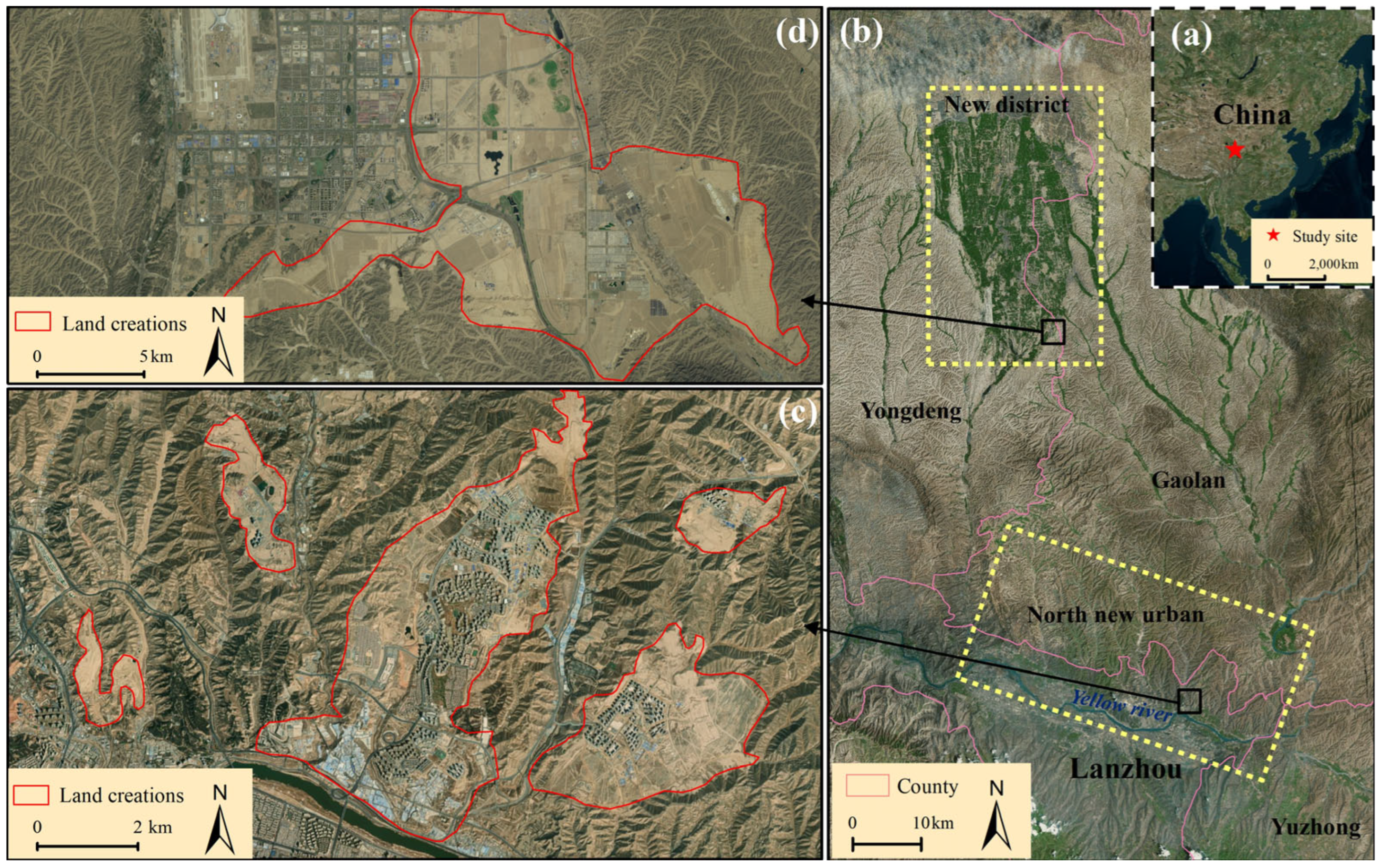
Figure 1. The study area is Lanzhou city, Gansu, China, lies along the Yellow River. The gentle hills and shallow gullies north of the new urban area and new district make them suitable for MELCPs. The red star in the inset map (a) marks the location of the study area. The yellow boxes in (b) mark Lanzhou’s MELCPs regions, with (c,d) displaying detailed local views of the projects, respectively.
Remotesensing 18 00273 g001
Figure 2. Excavation areas extraction flowchart.
Remotesensing 18 00273 g002
Figure 3. Comparison of backscatter value during pre- and post-excavation periods ((a) ascending orbit; (b) descending orbit; (c) ascending + descending; (d) three schemes).
Remotesensing 18 00273 g003
Figure 4. Spatiotemporal distribution of land excavation area in Lanzhou north new urban.
Remotesensing 18 00273 g004
Figure 5. Spatiotemporal patterns of land reclamation in Lanzhou north new urban (2017–2022).
Remotesensing 18 00273 g005
Figure 6. Area of land excavation and reclamation in Lanzhou north new urban (2017–2022).
Remotesensing 18 00273 g006
Figure 7. Map of cumulative surface subsidence in Lanzhou north new urban (2017–2023).
Remotesensing 18 00273 g007
Figure 8. Map of cumulative surface subsidence in Lanzhou new district (2017–2023).
Remotesensing 18 00273 g008
Table 1. Interpretation keys for typical land cover types in the study area.
No.NameDistinctive FeaturesImage
1Bare landHigh reflectance in visible bands and absence of vegetation characteristicsRemotesensing 18 00273 i001
2CroplandRegular geometric boundaries with significant seasonal variationsRemotesensing 18 00273 i002
3BuildingsRegular geometric shapes with homogeneous textures and high reflectance in visible bandsRemotesensing 18 00273 i003
4MELCPs areasShow clear artificial modification traces with rough surfaces, typically exhibiting platform-like distributions, distinct image texturesRemotesensing 18 00273 i004
5Water bodiesStrong absorption in near-infrared bands, natural shapes, and smooth texturesRemotesensing 18 00273 i005
6ForestsHigh near-infrared reflectance, coarse textures, and distinct canopy structuresRemotesensing 18 00273 i006
7GrasslandSpectral characteristics similar to vegetation but with lower near-infrared reflectance than forestsRemotesensing 18 00273 i007
Table 2. Feature datasets.
DatasetsFeatureVariable Description
Spectral featureB2, B3, B4, B5, B8, B8a, B11blue, green, red, red edge, NIR, NNIR, SWIR
Index featureRVI B 8 / B 4
NDVI ( B 8 B 4 ) / ( B 8 + B 4 )
NDWI ( B 3 B 8 ) / ( B 3 + B 8 )
NDBI ( B 11 B 8 ) / ( B 11 + B 8 )
MSAVI ( ( 2 B 4 + 1 ) ( 2 B 4 + 1 ) 2 8 ( B 8 B 4 ) ) / 2
EVI 2.5 ( B 8 B 4 ) / ( B 7 + 6 B 4 7.5 B 2 + 1 )
BSI ( ( B 4 + B 11 ) ( B 4 + B 2 ) ) / ( ( B 4 + B 11 ) + ( B 8 + B 2 ) )
Topographic featureDEM, Slope/
Polarimetric feature σ V V , σ V H /
Textural featureSecond moment B 8 a s m ,   V V a s m ,   V H a s m
Contrast B 8 c o n ,   V V c o n ,   V H c o n
Correlation B 8 c o r r ,   V V c o r r ,   V H c o r r
Variance B 8 v a r ,   V V v a r ,   V H v a r
Inverse variance B 8 i d m ,   V V i d m ,   V H i d m
Entropy B 8 e n t ,   V V e n t ,   V H e n t
Table 3. Accuracy assessment of three data schemes for excavation area extraction.
Accuracy MetricsAscendingDescendingAscending + Descending
OA/%78.772.687.1
Kappa0.750.690.85
Table 4. The numbers of Sentinel-1 image.
Periods (yr)Initial Phase/SceneLater Phase/Scene
Ascending OrbitDescending OrbitAscending OrbitDescending Orbit
20178122413
20181582230
201915182426
202016222732
202115252425
202212141521
Table 5. Classification accuracy by land cover type across seven experimental schemes.
Land Cover
Types
Metrics
(%)
Seven Experimental Schemes
(1)(2)(3)(4)(5)(6)(7)
MELCPs areasPA84.287.083.086.086.579.192.1
UA73.482.075.080.083.276.092.8
BuildingsPA85.980.482.183.979.379.186.7
UA76.780.886.675.982.174.386.2
Water bodiesPA91.085.284.186.983.683.290.9
UA83.988.783.889.987.385.191.3
GrasslandPA78.980.075.073.878.975.882.5
UA76.777.088.668.985.776.079.7
ForestsPA72.885.079.980.379.674.583.0
UA70.271.685.978.774.770.882.4
Bare landPA72.979.780.581.985.482.186.5
UA75.389.974.975.381.779.287.1
CroplandPA72.979.780.581.985.482.0786.5
UA75.389.974.975.381.779.287.1
Table 6. Classification accuracy of MELCPs areas across seven experimental schemes.
TimesSeven Experimental Schemes (%)
(1)(2)(3)(4)(5)(6)(7)
OAKOAKOAKOAKOAKOAKOAK
182.278.182.676.490.988.091.088.388.385.087.284.393.993.1
288.084.383.177.185.381.191.088.389.786.386.082.993.091.0
384.380.093.091.082.180.090.286.092.990.186.082.993.091.0
482.078.390.387.679.374.388.385.184.083.181.475.088.184.9
581.775.489.286.481.077.190.086.087.984.983.980.188.184.9
Avg.83.679.287.683.783.780.190.186.788.585.884.981.491.288.9
Disclaimer/Publisher’s Note: The statements, opinions and data contained in all publications are solely those of the individual author(s) and contributor(s) and not of MDPI and/or the editor(s). MDPI and/or the editor(s) disclaim responsibility for any injury to people or property resulting from any ideas, methods, instructions or products referred to in the content.