Article

High-Frequency Monitoring of Explosion Parameters and Vent Morphology During Stromboli’s May 2021 Crater-Collapse Activity Using UAS and Thermal Imagery


1
Istituto Nazionale di Geofisica e Vulcanologia, Sezione Roma 1, Via di Vigna Murata 605, 00143 Roma, Italy
2
Istituto Nazionale di Geofisica e Vulcanologia, Sezione di Napoli—Osservatorio Vesuviano, Via Diocleziano 328, 80125 Napoli, Italy
3
Istituto Nazionale di Geofisica e Vulcanologia, Sezione di Catania—Osservatorio Etneo, Piazza Roma 2, 95125 Catania, Italy
*
Author to whom correspondence should be addressed.
These authors contributed equally to this work.
Remote Sens. 2026, 18(2), 264; https://doi.org/10.3390/rs18020264
Submission received: 24 October 2025 / Revised: 19 December 2025 / Accepted: 7 January 2026 / Published: 14 January 2026

Highlights

What are the main findings?
  • Before the May 2021 collapse at Stromboli, explosions intensified in frequency, spattering, bomb- and gas-rich events, and number of active vents (including gas-dominated explosions, puffing and spattering).
  • Post-collapse vent realignment reflected magma adaptation to lithostatic load and magma level drop.
What are the implications of the main findings?
  • Monitoring multiple eruption parameters, not just explosion frequency, improves early detection of vent instability.
  • High-resolution morphological surveys enhance hazard assessment and risk mitigation at Stromboli and similar volcanoes.

Abstract

Stromboli’s volcanic activity fluctuates in intensity and style, and periods of heightened activity can trigger hazardous events such as crater collapses and lava overflows. This study investigates the volcano’s explosive behavior surrounding the 19 May 2021 crater-rim failure, which primarily affected the N2 crater and partially involved N1, by integrating high-frequency thermal imaging and high-resolution unmanned aerial system (UAS) surveys to quantify eruption parameters and vent morphology. Typically, eruptive periods preceding vent instability are characterized by evident changes in geophysical parameters and by intensified explosive activity. This is quantitatively monitored mainly through explosion frequency, while other eruption parameters are assessed qualitatively and sporadically. Our results show that, in addition to explosion rate, the spattering rate, the predominance of bomb- and gas-rich explosions, and the number of active vents increased prior to the collapse, reflecting near-surface magma pressurization. UAS surveys revealed that the pre-collapse configuration of the northern craters contributed to structural vulnerability, while post-collapse vent realignment reflected magma’s adaptation to evolving stress conditions. The May 2021 events were likely influenced by morphological changes induced by the 2019 paroxysms, which increased collapse frequency and amplified the 2021 failure. These findings highlight the importance of integrating quantitative time series of multiple eruption parameters and high-frequency morphological surveys into monitoring frameworks to improve early detection of system disequilibrium and enhance hazard assessment at Stromboli and similar volcanic systems.

1. Introduction

Open-vent basaltic volcanoes, such as Stromboli (Italy), Etna (Italy), Batu Tara (Indonesia), Yasur (Vanuatu), and Fuego (Guatemala), are characterized by persistent Strombolian activity occurring at multiple active vents [1,2,3,4]. The activity of these volcanoes is dynamic, with vent position and morphology shifting frequently, and explosive styles and intensities changing on timescales of hours to days [5,6]. These rapid transitions provide insights into shallow magma plumbing systems, crucial for eruption forecasting and ensuring visitors’ safety. Stromboli exemplifies such dynamic behavior. Its eruptive activity occurs at the summit crater terrace, hosting distinct crater areas where vents eject magma, gas, and pyroclastic material (e.g., [7,8,9]). Vents may be single or form clusters of sub-vents (e.g., [2]). The stability of these features reflects the interplay of constructive and destructive processes that shape the volcanic edifice and influence eruption styles, intensity, and associated hazards (e.g., [10,11,12]).
In the short term (hours to days), shifts in explosion frequency, intensity, and styles cause rapid variation in vent configuration [2,6]. Sub-vents align along fractures, reflecting conduit processes and magma redistribution. Structural collapse occurs due to magma pressure reorganization or excessive material accumulation [13,14]. In the long term (months to years), major or paroxysmal explosions lead to transformations of the crater terrace [15]. Structural instabilities have shaped the Sciara del Fuoco, a scar formed during major flank failures over the last 13,000 years [16,17]. Large collapses can trigger hazardous phenomena, including hot avalanches, pyroclastic density currents (PDCs), and occasionally tsunamis [18,19,20,21]. These events highlight the importance of continuous monitoring.
Monitoring requires advanced tools to track eruptive changes. Thermal infrared cameras capture high-resolution spatial and temporal explosion data (e.g., [1,2,6,22,23,24,25]). UAS surveys at Stromboli allowed systematic analysis of vents and morphological changes over short timescales (e.g., [15,26,27,28]). Prior to 2019, UAS surveys were conducted sporadically during ad hoc campaigns; since then, they have become systematic, with acquisitions every ca. three months or more frequently during eruptive crises ([15,20] and references therein).
This study combined high-frequency thermal imagery and UAS photogrammetry surveys designed for mapping and morphology analyses, acquired during 2 field campaigns conducted in the days before (7–16 May 2021) and after (25–27 May 2021) the 19 May 2021 crater collapse event in the north crater area, which primarily affected one crater (N2) and partially involved another (N1). We analyzed 180 explosions, measuring key eruption parameters such as pyroclast velocities, explosion frequencies, ejection intensity, and distribution of gas-, ash-, and bomb-dominated explosions. By correlating these parameters with vent migration observed through repeated UAS surveys, we provided insights into Stromboli’s evolving summit dynamics. This research aims to improve volcanic hazard assessments by identifying new eruptive parameters that could indicate hazardous phenomena.

2. Stromboli Volcano

Stromboli Island is the northeasternmost volcanic edifice of the Aeolian Islands, north of Sicily in Italy’s Tyrrhenian Sea (Figure 1). It is a stratovolcano with an emerged surface area of 12.2 km2, a base 2000 m below sea level, and a summit 924 m above sea level. Its volcanic activity is centered on a crater terrace at ~750 m elevation (before the 4–11 July 2024 eruption collapsed it by ~100 m; [20]), where explosions occur at two main crater areas: North (N) and Central-South (CS) (e.g., [29,30], nomenclature in [31], see https://cme.ingv.it/bollettini-e-comunicati/bollettini-ingv-stromboli, accessed on 23 October 2025). The volcano has been continuously active for 2000 years [32], characterized by: (i) continuous degassing (puffing, [33,34,35]), (ii) frequent short explosions [9,30,36], (iii) lava emissions (e.g., [37,38]), and (iv) less frequent major or paroxysmal explosions (0.1 to 3 per year, [39]). Its mild activity in the last 40 years has made it accessible for scientists and tourists, earning it the status of a laboratory volcano for continuous monitoring and multi-parametric experiments [25,26,27,35,40].
Stromboli’s ordinary activity features continuous degassing with repetitive mild explosions, ejecting bombs, black scoriae, lapilli, and ash. These explosions occur at ∼10 events per hour, last a few seconds (up to 30 s), and produce tephra masses of 10–104 kg (1–10 m3) reaching 50–400 m above the vents [8,9,30,36,41]. They result from gas slugs rising through low-viscosity magma, formed when bubbles in a viscous reservoir coalesce into slugs at ∼800–3000 m depth [42] that ascend faster than magma [43]. This activity is maintained by a steady-state convective regime in the shallow conduit (<3 km), where gas-rich magma ascends, degasses, crystallizes, and sinks back [44,45,46].
Strombolian explosions are classified by ejection style. The most common, type 1, is ballistic-dominated, while type 2 is ash-dominated, subdivided into 2a (bomb and ash-rich) and 2b (ash-rich) [36]. Type 0 (gas-rich) explosions, later described by Leduc et al. (2015) [47], involve rapid gas release with minimal particle ejection and often exhibit distinctive acoustic signatures, including shock waves and supersonic velocities [48]. Simons et al. (2020) [1] introduced type 3 at Yasur (Vanuatu), involving prolonged ash jetting through a debris-occluded vent. Variations in explosion style likely result from magma composition, degassing efficiency, and conduit dynamics [23,34,35,36,47]: Type 1 explosions occur in debris-free vents, while type 2 suggests increased magma viscosity or overlying deposits; Type 0 reflects efficient shallow degassing, whereas type 3 indicates overpressure beneath a debris cap.
Larger explosions include major events and paroxysms [8,9,30]. At least 20 major events occurred between 2000–2019 [39], with 24 in the last five years, affecting only the summit, with bombs falling up to 1.5 km away. Paroxysms, occurring roughly once every 4–12 years (e.g., 2003, 2007, twice in 2019, 2024), are more violent, involving greater tephra fallout, meter-sized scoria bombs up to 2 km from craters, hot avalanches, and small tsunamis affecting southeastern Tyrrhenian coasts (such as the 30 December 2002 event, which was triggered by a major flank collapse, the largest in recent years) [16,30,49,50].

3. Methods

Data were acquired during two field campaigns, from 7 to 16 May and from 25 to 27 May 2021, including repeated UAS surveys and the installation of a portable FLIR thermal camera at two locations: Roccette (ROC) and Pizzo Sopra la Fossa (PSF) (Figure 1). The ROC site on the N flank, at 750 m a.s.l., provided optimal observation of the N crater area, while PSF, at 918 m a.s.l., offered a view of the entire crater terrace. Each crater is named based on its area followed by a numerical designation (e.g., N1, N2, CS1), with vents identified alphabetically (e.g., N1a, N1b, etc.).

3.1. Thermal Analysis of Explosive Activity with FLIR Camera

The FLIR SC655 (Teledyne FLIR LLC, Wilsonville, OR, USA) camera captured high-speed videos (640 × 480 pixels at 25–50 fps) on 10, 11, 13, 16, 25, and 26 May, with additional data from 113 explosions in October 2020 as a baseline reference for ‘normal’ Strombolian activity levels. The specific camera orientations, distances from the target areas, and acquisition conditions, including the focal length of the lens used, are detailed in Table 1.
Each infrared image captured by the FLIR camera is a matrix where each pixel represents a temperature value. We corrected raw thermal data for atmospheric effects and emissivity (20 °C air temperature, 50% humidity, 0.92 emissivity) using FLIR thermaCAM Researcher Pro version 2.10 software and correcting for the specific target distances (SDs) listed in Table 1 to minimize attenuation artifacts. Using a Matlab code (compatible with version R2016 and above) by INGV [4,35], we visualize the evolution of temperature anomalies over time and space by constructing kymographs (height–time diagrams). For each frame, the maximum pixel temperature value (after background subtraction) is extracted for each image row (i.e., for each elevation). These row-wise maxima are then plotted against time on the x-axis and elevation on the y-axis (Supplementary Figures S1–S11). The elevation axis is derived by converting pixel measurements into meters using a pixel size conversion factor specific to the camera’s configuration and orientation (Table 1) and assuming predominantly vertical ejection of the pyroclasts.
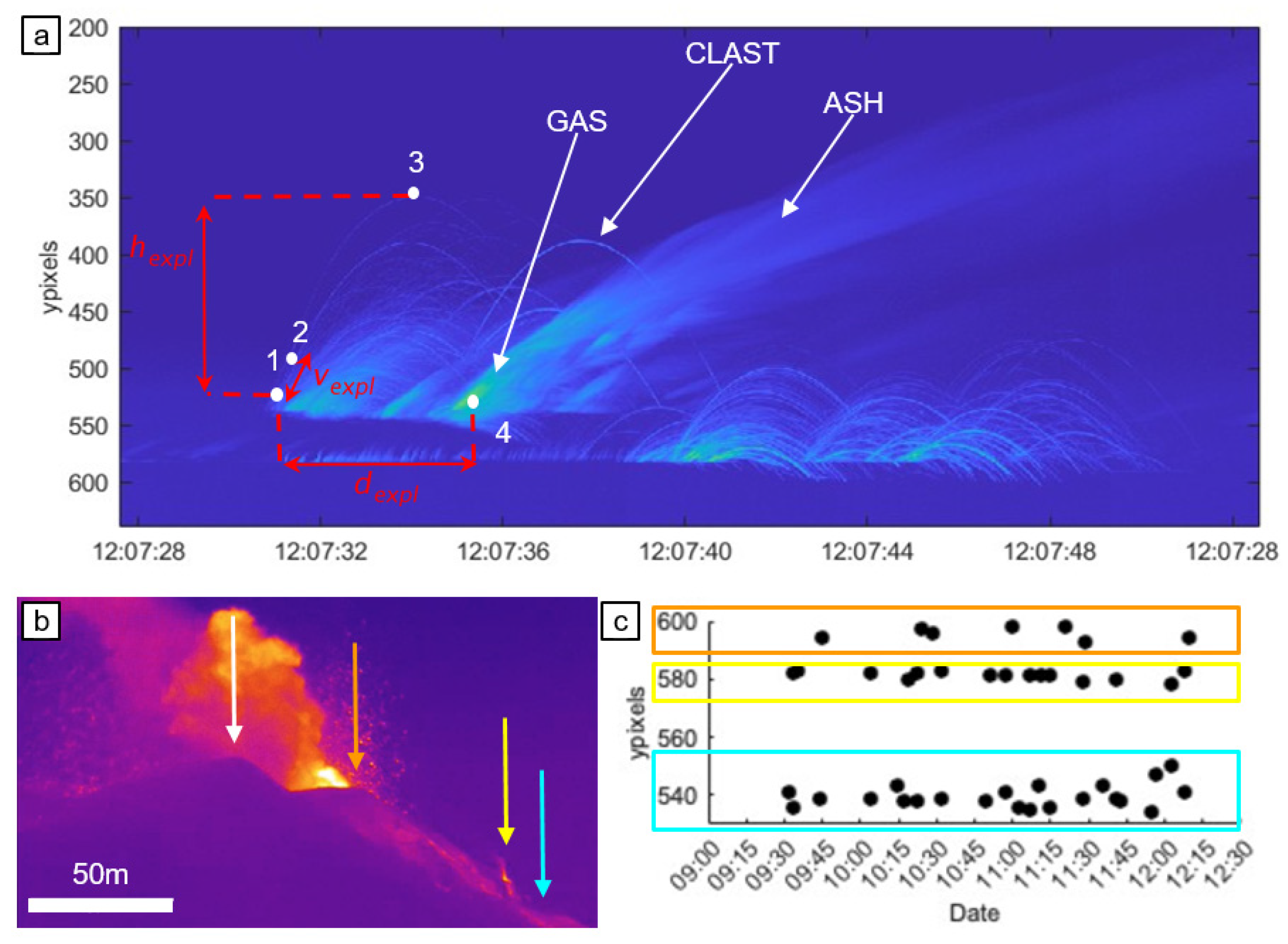
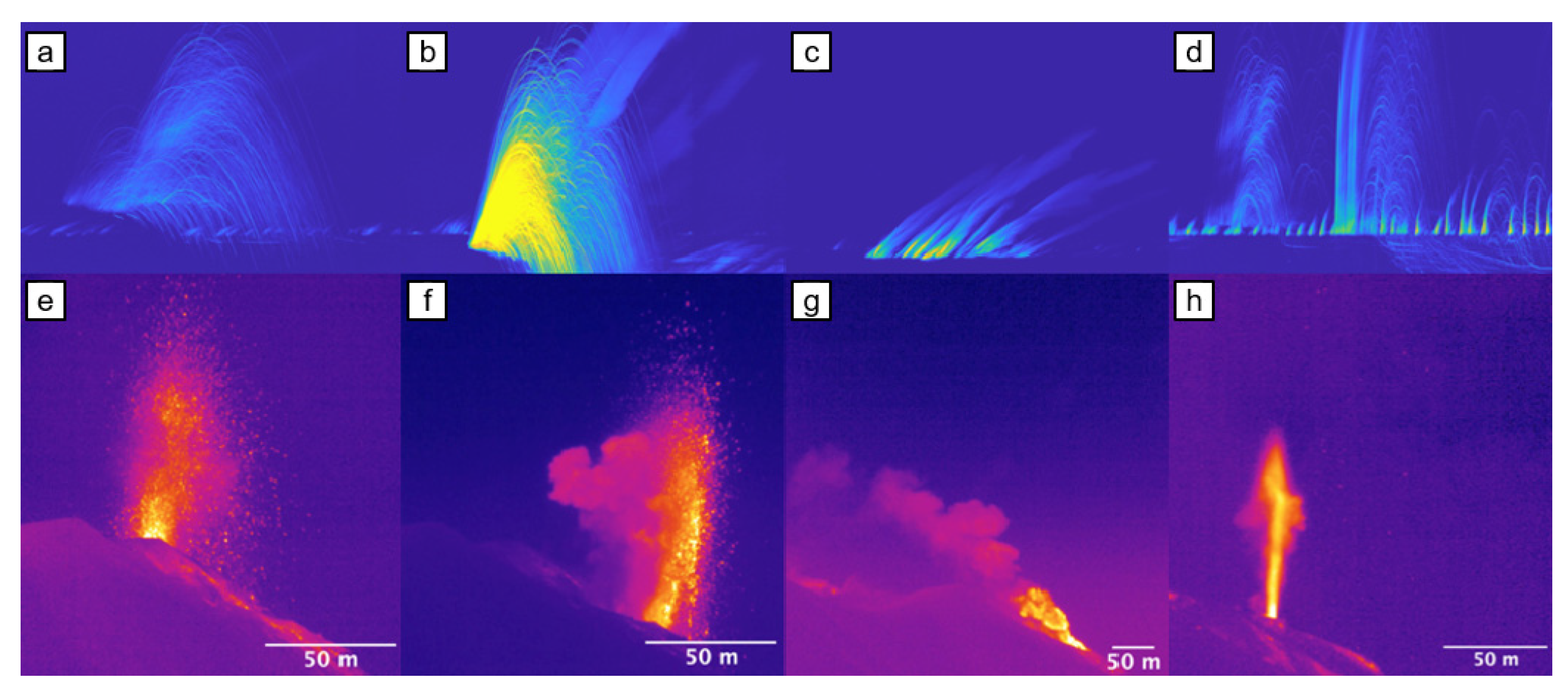
The resulting kymographs exhibit distinct thermal features corresponding to specific explosive products (Figure 2a): (i) incandescent pyroclasts appear as sharp parabola-shaped features, with their apex denoting maximum projected pyroclast height and their slope corresponding to projected rise and fallout velocities; (ii) ash emissions appear as diffuse ‘streaks’ with positive slopes; (iii) gas emissions emerge as continuous or impulsive anomalies rapidly dissipating a few meters above the vent. These features allow both the identification of the source vent and the classification of explosion types (e.g., 0, 1, 2a, 2b, Figure 3). Explosions are categorized based on the observed products as follows: ballistic-dominated events showing only parabolic trajectories are classified as type 1; ash-dominated events characterized by inclined streaks are classified as type 2b; mixed events displaying both parabolic trajectories and ash streaks are classified as type 2a; and gas-dominated events producing sharp, near-vertical thermal anomalies are classified as type 0. This classification is performed manually by the operator through combined analysis of the kymographs (Figure 2a,b) and the original FLIR thermal videos.
To quantify each explosion, four key points were manually picked on the kymographs, recording both time (x) and vertical position (y, in meters): the exit time of the first and last pyroclasts (points 1 and 4 in Figure 2a), the maximum projected pyroclast height (point 3), and a secondary point along the ascending trajectory of the first pyroclast or gas thrust region (point 2). Using these points, the following parameters were calculated from their x–y coordinates in Matlab:
(1)
Explosion duration (seconds):
d e x p l = x 4 x 1 ;
(2)
Maximum elevation (in meters) of the incandescent pyroclasts/gas thrust region:
h e x p l = ( y 3 y 1 ) p s i z e ,
The pixel size p s i z e was determined as:
p s i z e = S D p f c o s ( θ π 180 ) ,
where SD is the camera-target distance in meters, measured in the field, p is the physical size of the camera pixel (17 μm), f is the focal length of the lens (13, 24, or 41 mm) and θ, the angle tilt of the camera relative to the horizontal (Table 1). The maximum measurable elevation depends on the camera’s vertical field of view (VFOV, Table 1). In only 2 cases (13 May 2021) the bomb’s trajectory exceeded this limit. Although strong winds or inclined vents could introduce geometric errors if the jet is angled toward or away from the camera, visual inspection confirmed that most explosions were near-vertical. Thus, measuring the projected vertical component provides a reliable proxy for relative intensity, with inclination-related errors considered negligible for this comparative analysis.
(3)
Approximate maximum speed of the incandescent pyroclasts/gas thrust region measured close to the vent:
v e x p l = ( y 2 y 1 )   p s i z e   ( x 2 x 1 ) ,
computed from the initial slope, converting pixel units to meters for the vertical axis and seconds for the horizontal axis. For type 1 and 2a explosions, velocity reflects pyroclast speed; for type 0, it reflects gas speed, while type 2b velocity cannot be estimated with this method. Calculated values for p s i z e , and hence for h e x p l and v e x p l , are subject to systematic uncertainties associated with camera tilt (θ), target distance (SD), and lens distortion. Combined measurement errors (θ ± 2°), (SD ± 1 m) produce a pixel-size variation of <2%. For the acquisition at ROC, this is the maximum uncertainty as all targets were centered in the field of view. For the acquisitions at PSF, optical distortion may reach 3–5% at the edges of the frame (using 24° and 13° lenses, respectively). In this case, the cumulative uncertainty is <7% worst-case).
(4)
Explosion frequency for each manually picked explosion was calculated as the inverse of the inter-event time dt, the time between two consecutive explosions at the same area or vent:
f e x p l = 1 d t = 1 t i + 1 t i .
Vent identification was achieved by correlating kymograph explosion times with y-pixel clusters on diagrams (Figure 2b,c) cross-referenced with thermal footage. This correlation varied due to changing camera positions and morphological changes. Specific camera positions (e.g., PSF on May 10, 16, and 26) allowed more precise vent identification in the CS crater area.
Manual analysis focused on clearly distinguishable explosions, though intense activity on certain days (e.g., May 10, 13, and 16) necessitated focusing on the largest events only. Manual frequency analysis was supplemented by automatic frequency analysis using the MATLAB findpeaks function (within the Signal Processing Toolbox of MATLAB version R2023b) to identify all thermal peaks, including spattering and puffing, particularly in the N crater. Peaks with a minimum prominence of 4 were detected, and for each peak, the algorithm returned its height (y-value), location (x-value), width at half-prominence, and prominence. Outlier values in the peak prominence distribution—corresponding to actual explosions—were excluded to discriminate the frequency based solely on spattering or puffing-related thermal peaks (hereafter named f s p a t t ). For comparison with INGV bulletin data, the daily-averaged hourly frequency of explosive events in the N and CS crater areas was also considered.

3.2. UAS-Derived Morphological Analysis

Unmanned Aircraft System (UAS) photogrammetry surveys were conducted during key periods in May 2021 (Table 2), allowing us to monitor morphological changes in the N crater area before and after the May 19 collapse. The UAS flights captured high-resolution imagery (photos and videos) of the entire crater terrace, focusing on its N crater area, enabling a quantitative assessment of crater-rim collapses, scoria-cones growth, vents number and migration, and volcanic activity characterizing each vent. Due to the difficult and hazardous terrain, we did not collect ground control points during surveys. Data on camera position were obtained using GNSS-RTK (Global Navigation Satellite System—Real Time Kinematic) information embedded in the image metadata for the 7 and 8 May surveys. To improve the spatial accuracy of our surveys, we aligned the point clouds resulting from all the flights to the 7 May survey (designated as the reference dataset) using virtual ground control points identified from natural features in unchanged areas. Digital surface models (DSMs) and orthophotos were then generated by using the Agisoft Metashape Pro® software package (version 2.1.2) based on the Structure-from-Motion and multi-view stereo algorithm (SfM–MVS; [51]). Morphological analysis was performed by using the freely available Geomorphic Change Detection (GCD) plugin (version 7) [52] (see https://gcd.riverscapes.net/, accessed on 23 October 2025) for ESRI ArcGIS® Pro (version 3.2). We obtained elevation change detection and estimated volume change by differencing the 8 and 26–27 May 2021 DSMs, setting the threshold elevation change (minimum level of detection or minimum elevation change that can confidently be considered a true change) to 0.5 m. For additional technical details refer to Civico et al. (2024) [20].

4. Overview of Volcanic Activity in April–May 2021

Here, we summarize the volcanic activity as reported by bulletins from the Istituto Nazionale di Geofisica e Vulcanologia [31] (see https://cme.ingv.it/bollettini-e-comunicati/bollettini-ingv-stromboli, accessed on 23 October 2025) and Università di Firenze, Laboratorio di Geofisica Sperimentale [53] (see https://cme.ingv.it/bollettini-e-comunicati/categoria-1, accessed on 23 October 2025). Starting in February 2021, explosions in the CS crater area began to increase in height, often exceeding 150 m, while in the N1 crater, bomb heights ranged from low (<80 m) to high (>150 m). This variation in explosion intensity was accompanied by rising seismic tremor, infrasound pressure, Very Long Period (VLP) seismic activity, and SO2 and CO2 fluxes [54,55].
Spattering activity in the N crater area began on 17 April 2021. This activity was concentrated in one of the vents in the N2 crater, and it was intermittent with brief periods of intense spattering on 27–30 April and on 2 and 6 May. Concomitant explosions ranged from low (<80 m) to medium (<150 m) bomb elevation in the N crater area, with a frequency of 9–14 events per hour, to medium-high (>150 m) in the CS crater area, with a frequency of 1–5 events per hour. By 8–10 May, spattering went from intermittent to continuous, leading to the growth of a scoria cone [55,56,57]. Explosion frequency increased up to 12–15 events per hour and remained low to medium intensity until 19 May [58,59,60]. In the CS crater area, the frequency ranged 5–7 events per hour remaining medium-high in intensity. The increase in explosive activity coincided with a rise in seismic tremor amplitude, reaching very high levels on 19 May. VLP seismic events remained high, with the source depth stable in the shallow conduit [56,57,58,59,61,62]. At 12:32 UTC, seismic tremor increased further, accompanied by significant deformation of the volcanic edifice, as detected by summit tiltmeters [60]. A significant collapse of the cone occurred on 19 May 2021. The main collapse occurred at 12:51 UTC and led to the formation of a pyroclastic flow (~50 m/s, [59]) extending over 1 km into the sea, followed by a lava flow at 13:08. The collapse involved ~0.79 × 10⁵ ± 0.07 × 10⁵ m3 of material (estimated at ~0.71 × 10⁵ m3, [21]), excluding the spattering activity which formed a 13,600 ± 500 m3 scoria cone [58,59,60,63]. Analysis of the tiltmeters signal revealed a 1.8 µrad deflation linked to the collapse [60].
Following the 19 May collapse the event frequency decreased to 9–11 events per hour in the N crater area and remained stable in the 5–7 events per hour range in the CS crater area. Explosion heights in the N1 crater area decreased to medium levels (<150 m), whereas they remained high (>150 m) for the N2 crater area, while they remained medium to high in the CS crater area [59]. Heights returned to medium-low levels only after 30 May [61,62].
The infrasound source shifted from the CS to the N crater area after 19 May. SO2 fluxes increased up to 230 t/d on 20 May and remained at high levels (>170 tons per day) until 24 May, when it decreased to medium levels, while CO2 flux remained stable (960–1060 t/d) before and after the collapse. The seismic tremor, acoustic pressures, and VLP events slightly decreased [63].
According to monitoring reports, in October 2020 the frequency of explosions in the N crater area was 6–10 events per hour, with low-medium intensity, and ranged 1–2 events per hour in the CS crater area, with medium-high intensity. Seismic and infrasonic activities were low and this latter concentrated in the CS crater area, with SO2 and CO2 fluxes at low levels with averages of 35 t/d and 275 t/d, respectively [64,65].

5. Results

5.1. Temporal and Spatial Changes in Explosion Parameters

5.1.1. Explosion Parameters Pre- and Post- Collapse

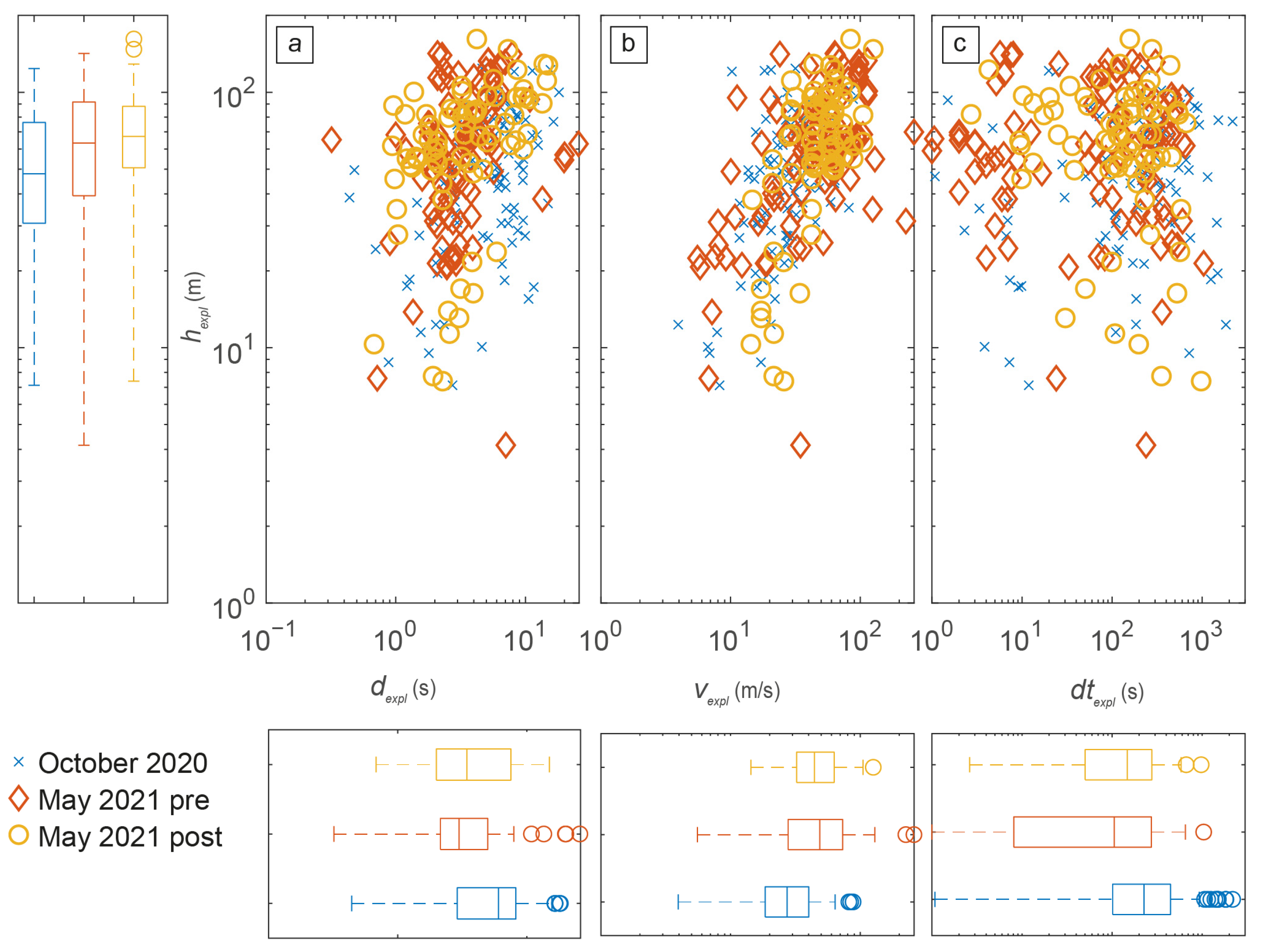
Statistically, the May 2021 period (both pre- and post-collapse) shows larger median elevations and bomb speeds, and shorter durations and inter-event times with respect to the October 2020 period (Figure 4). In May 2021, two distinct distributions of key explosion parameters before and after collapse are found: pre-collapse explosions in May 2021 exhibited shorter durations (interquartile range IQR: 2–5 s, median: 3 s) compared to the post-collapse period (IQR: 2–7.5 s, median: 3.4 s). Post-collapse durations more closely resemble the October 2020 baseline (IQR: 2.9–8 s, median: 6 s), characteristic of normal Strombolian activity, albeit with slightly lower median values than October 2020.
Maximum speeds peaked during the pre-collapse phase, with an IQR of 28–73 m/s and a median of 49 m/s, reflecting high explosion vigor. Post-collapse speeds decreased, clustering between 32 and 63 m/s (median: 44 m/s), though they remained higher than those recorded in October 2020 (IQR: 18–40 m/s, median: 27 m/s).
The explosion’s inter-event time was shortest during the pre-collapse phase (IQR: 8–273 s, median: 106 s), consistent with heightened eruption frequency. Post-collapse inter-event time increased (IQR: 50–276 s, median: 147 s), approaching the longer intervals of October 2020 (IQR: 101–446 s, median: 226 s).
Pyroclast elevations in May 2021 were generally higher than those observed in October 2020 (IQR: 30–76 m, median: 48 m). However, post-collapse variability decreased (IQR: 51–88 m, median: 67 m) compared to pre-collapse explosions (IQR: 39–92 m, median: 63 m).
When looking at individual explosions, a general moderate positive correlation (R2 = 0.33) is evident between explosion speed and bomb elevation (Figure 4), indicating that more vigorous, faster explosions, generally reach higher ejections, regardless of the period. While such a relationship is expected from basic ballistic considerations—especially for coarse clasts (bombs) that are only weakly affected by drag—its observation in a natural volcanic setting is not trivial. The correlation suggests a systematic coupling between explosion intensity and preferentially vertical bomb ejection, rather than dispersal. Very weak to no correlation is instead observed when elevation is correlated with explosion duration (R2 = 0.14) and inter-event time (R2 = 0.01), respectively. Notably, a cluster of long-duration explosions in the pre-collapse phase (10–25 s) with lower-than-median elevations is linked to type 1 explosions recorded on 13 May 2021 at vent N1a. These explosions were prolonged due to multiple pulses, often transitioning into spattering behavior.

5.1.2. Daily Variation of Explosion Parameters

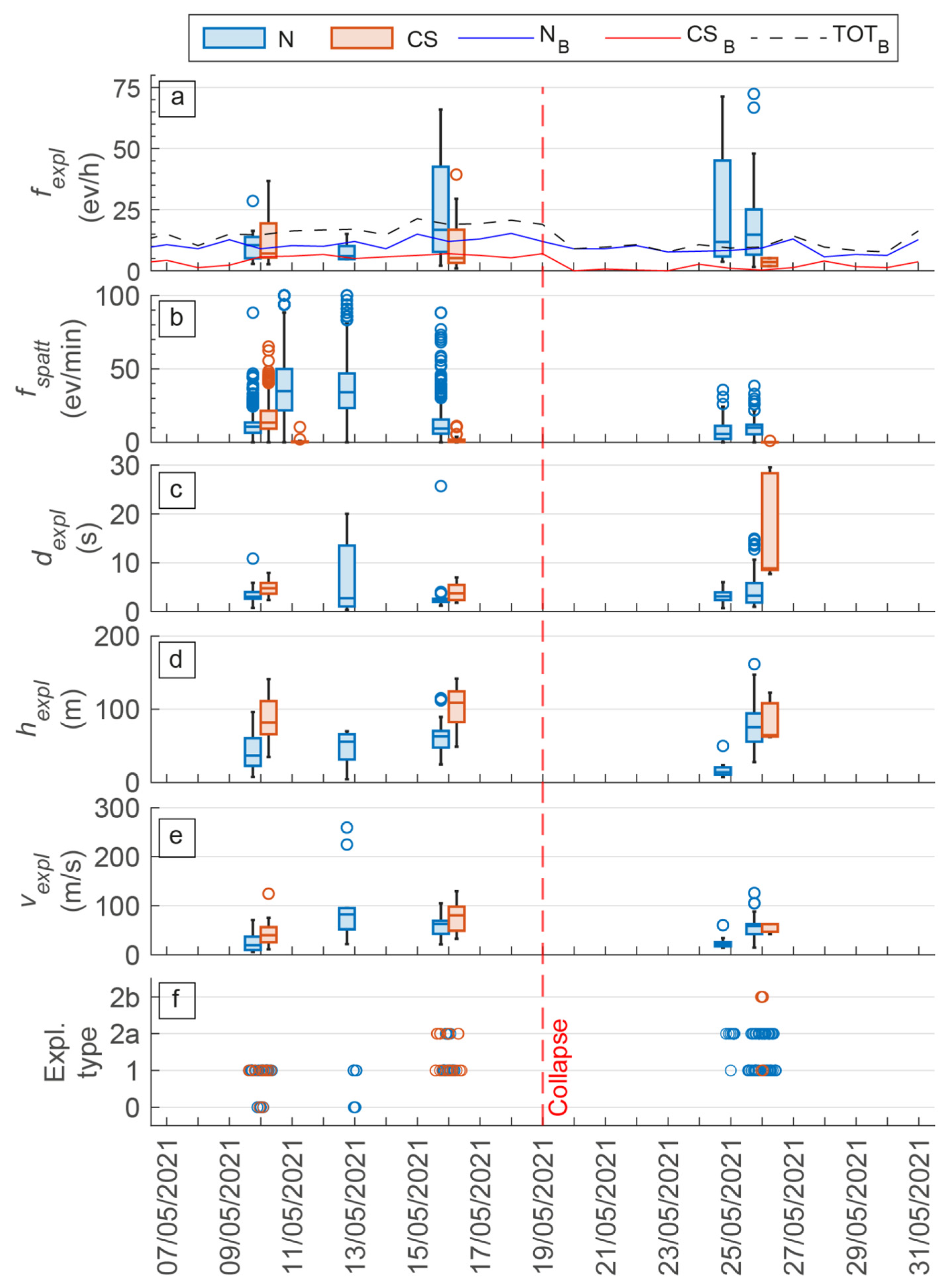
In May 2021, daily variations in key explosion parameters were observed in both the N and CS crater areas before and after the 19 May collapse (Figure 5). In the N crater area, explosion frequency rose from medium levels on 10 May (median: 10 ev./h, IQR: 5–14) and 13 May (median: 6 ev./h, IQR: 5–10) to high levels on 16 May (median: 17 ev./h, IQR: 8–43). After the collapse, median values returned to medium levels, though IQRs still reached high values on 25 May (median: 12 ev./h, IQR: 6–45) and 26 May (median: 15 ev./h, IQR: 7–25). These IQR ranges encompass the daily averaged, mean hourly explosion frequencies reported by INGV surveillance cameras (revised bulletin data).
Spattering and puffing frequencies also fluctuated. The median increased from ~11 events/min on 10 May to ~34 events/min on 11–13 May, then dropped back to ~10 events/min on 16 May, remaining at comparable values after the collapse, on 25–26 May (6–10 events/min). Although intensity was not quantified, thermal camera videos and kymographs provided additional insights (Supplementary Figures S1–S11). On 10 May, continuous puffing was observed at three vents in N2, while N1 showed rapid, intermittent spattering. On 11–13 May, spattering at N2 became more frequent and exhibited higher thermal pulse amplitudes. On 16 May, it was continuous at one N2 vent but intermittent at others. After the collapse, spattering became intermittent at N2a and intermittent-to-continuous at the N2d sub-vents, accompanied by puffing.
In the CS crater area, explosion frequency remained at medium–low levels on 10 May (median: 7 ev./h, IQR: 5–20) and 16 May (median: 5 ev./h, IQR: 3–17) but dropped to low levels after the collapse, on 26 May (median: 4 ev./h, IQR: 2–5). Spattering was consistent at a single vent only on 10 May (median: 13 ev./min), then decreased to <1 event/min.
Explosion durations at the N crater area varied between ~2–3 s (median) in the pre-collapse period, whereas durations at the CS crater area ranged between 4–5 s (median). After the collapse, the explosion’s duration in the N crater area remained consistent (median ~1–3 s) while showing slightly longer durations (up to 28 s, median ~8 s) in the CS crater area.
Pre-collapse bomb-ejection heights exhibited increasing values from 10 to 16 May both at the N (median from ~37 to ~63 m) and the CS crater area (median from ~82 m to ~109 m), being consistently higher at CS. Post collapse, at the N crater area, bomb elevation dropped on the 25 May, increasing again on the 26 May (median from 14 to 76 m), while the CS crater area showed maintained bomb elevations similar to the pre-collapse period (63–108 m, median ~65 m).
During the pre-collapse period, the N crater area displayed slightly lower bomb speeds (9–95 m/s, median ~20–82 m/s) than the CS crater area (25–98 m/s, median ~40–80 m/s). Similarly to bomb elevation, the values increased from 10 to 16 May at both craters. Post-collapse, the bomb speeds in the N crater area dropped then increased again (median from ~22 to ~59 m/s), while in the CS crater area, speeds remained largely unchanged (62–108 m/s, median ~65 m/s).
Before the collapse, activity was dominated by type 1 explosions (69%) and short, high-velocity type 0 events (13%), with type 2a observed only on 16 May (18%) (Table 3, Supplementary Figure S12). After the collapse, type 0 explosions ceased and long-lasting, ash-rich type 2b events appeared (5% only at CS crater), while type 2a became more frequent than type 1 at the N crater area but with reduced intensity. Overall, the data indicate a progressive shift from gas- to ash-dominated explosions during the study period (Figure 5f).

5.2. Morphological Changes and Explosion Parameters in the N Crater Area

5.2.1. Vent-Specific Variations in N Crater Area

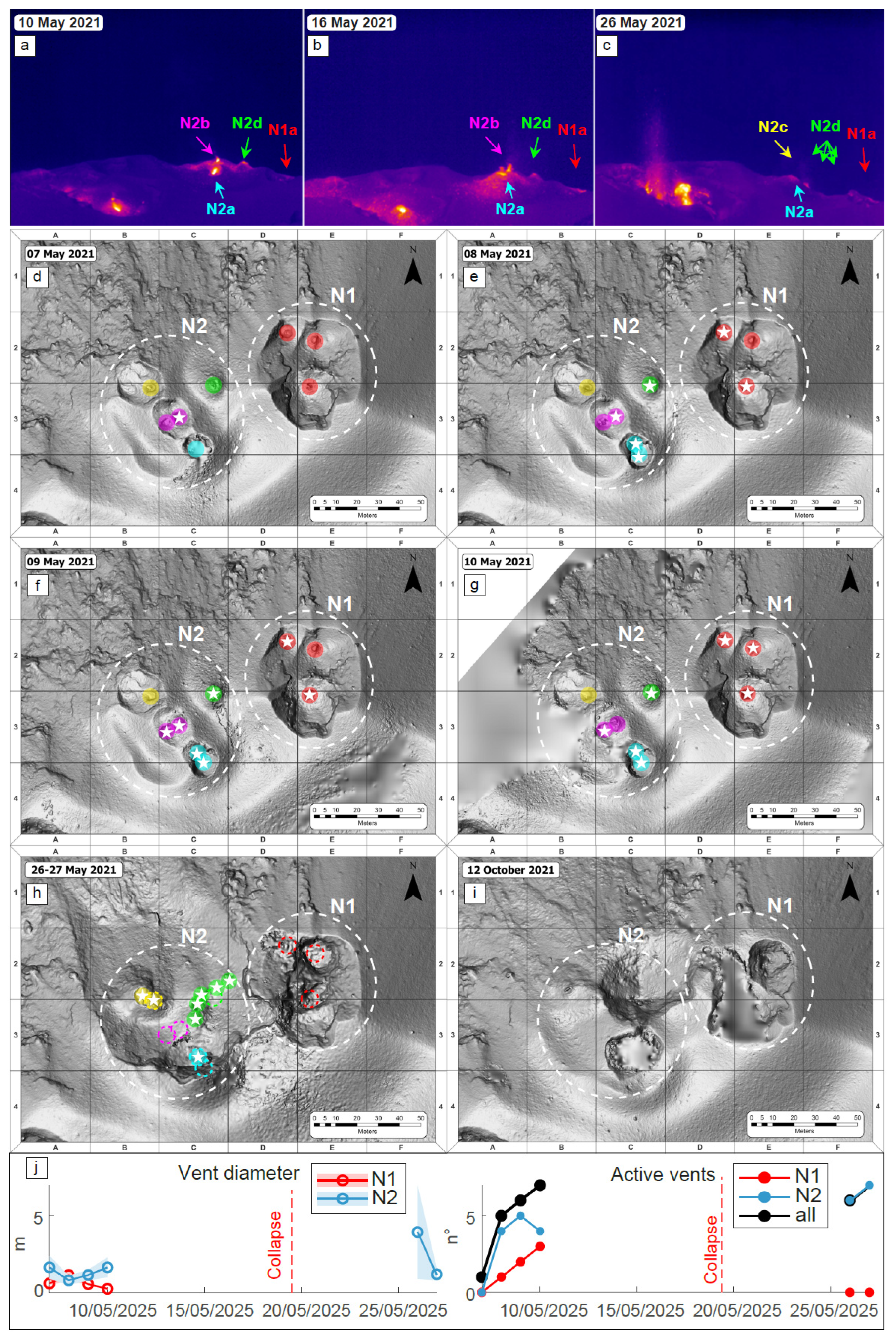
The evolution of the N crater area before and after the 19 May collapse was documented through thermal infrared images from PSF (10, 16, and 26 May, Figure 6a–c) and high-resolution DSM data (7 and 27 May, Figure 6d–h). Between 7 and 10 May, UAS imagery recorded 1 to 7 explosive sub-vents distributed between the N1 and N2 craters (see also Figure 6j). At N1, the number of active vents increased from zero to three by 10 May (N1a, b, c), while at N2, activity occurred at up to five sub-vents located at three vents (N2a, b, d, Supplementary Figure S13). Activity at N2a and N2b occurred through pairs of closely spaced sub-vents, alternating or erupting simultaneously. N2d persisted as a single vent, whereas N2c displayed only passive degassing. By 10 May, UAS and thermal imagery showed that spattering activity at N2a progressively built a scoria cone.
On 16 May, activity was only detectable in thermal data, which revealed up to four active vents (Figure 6b), largely dominated by spattering. Since no DSM data are available for this period, the actual number of active vents may be underestimated. By this date, the N2a scoria cone had further grown due to spattering.
Post-collapse, all vents in the N1 crater were inactive and activity was confined to N2. Observations on 26 and 27 May revealed two active sub-vents at the former location of N2c and up to five new vents emerging from N2d, indicating significant vent-system rearrangement (Figure 6c,h). These newly formed vents were active along with N2a and N2c, erupting alternately or simultaneously, with up to six vents on 26 May and up to seven on 27 May (Figure 6j). After the collapse, all active N2 vents had shifted slightly northwest compared to their pre-collapse positions (Figure 6h, Supplementary Figure S13). N crater area had recovered its original configuration by October 2021 (Figure 6i).
Between 7 and 10 May, N2 vents showed a progressive widening, maintaining the largest diameters in the N crater area (Figure 6j). Following the collapse, N2 exhibited a widening with respect to pre-collapse, reducing from 26 to 27 May, while N1 could not be measured due to inactivity and debris coverage.
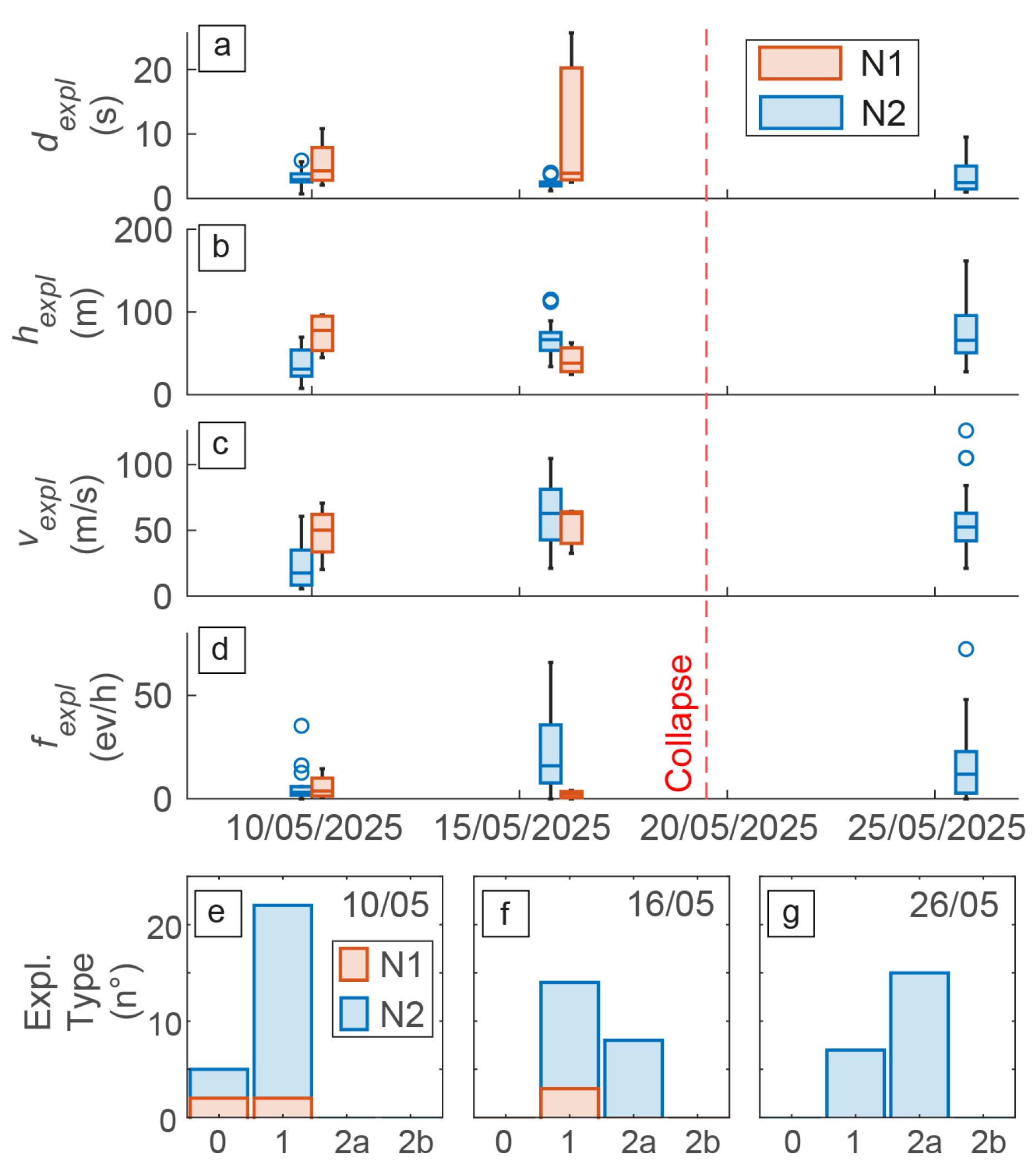
Focusing on the evolution of explosive activity at craters N1 and N2 (Figure 7), clear differences emerge over the three observation periods. On 10 May, explosions from N1 were generally longer in duration, and reached greater heights and velocities compared to those from N2, while also occurring at slightly higher frequency. By 16 May, this pattern reversed: N2 became the more vigorous crater, producing higher, faster, and more frequent explosions than N1. After the 19 May collapse, explosive activity persisted exclusively at N2, with parameters comparable to those of 16 May, though activity shifted mainly from vents N2a–b to N2c–d.
The distribution of explosion types (Figure 7e–g) further highlights this evolution. On 10 May, ballistic-rich (type 1) explosions dominated at N2, while N1 produced only a few explosions of types 0–1. On 16 May, N2 activity was still dominated by type 1 events but showed a transition toward ash-rich explosions, with the disappearance of gas-dominated (type 0) activity at both craters. After the collapse (26 May), explosions were restricted to N2 and shifted further toward bomb- and ash-rich events (type 2a), which became predominant over type 1.

5.2.2. Topographic Impact of the May 19 Collapse on the N Crater Area

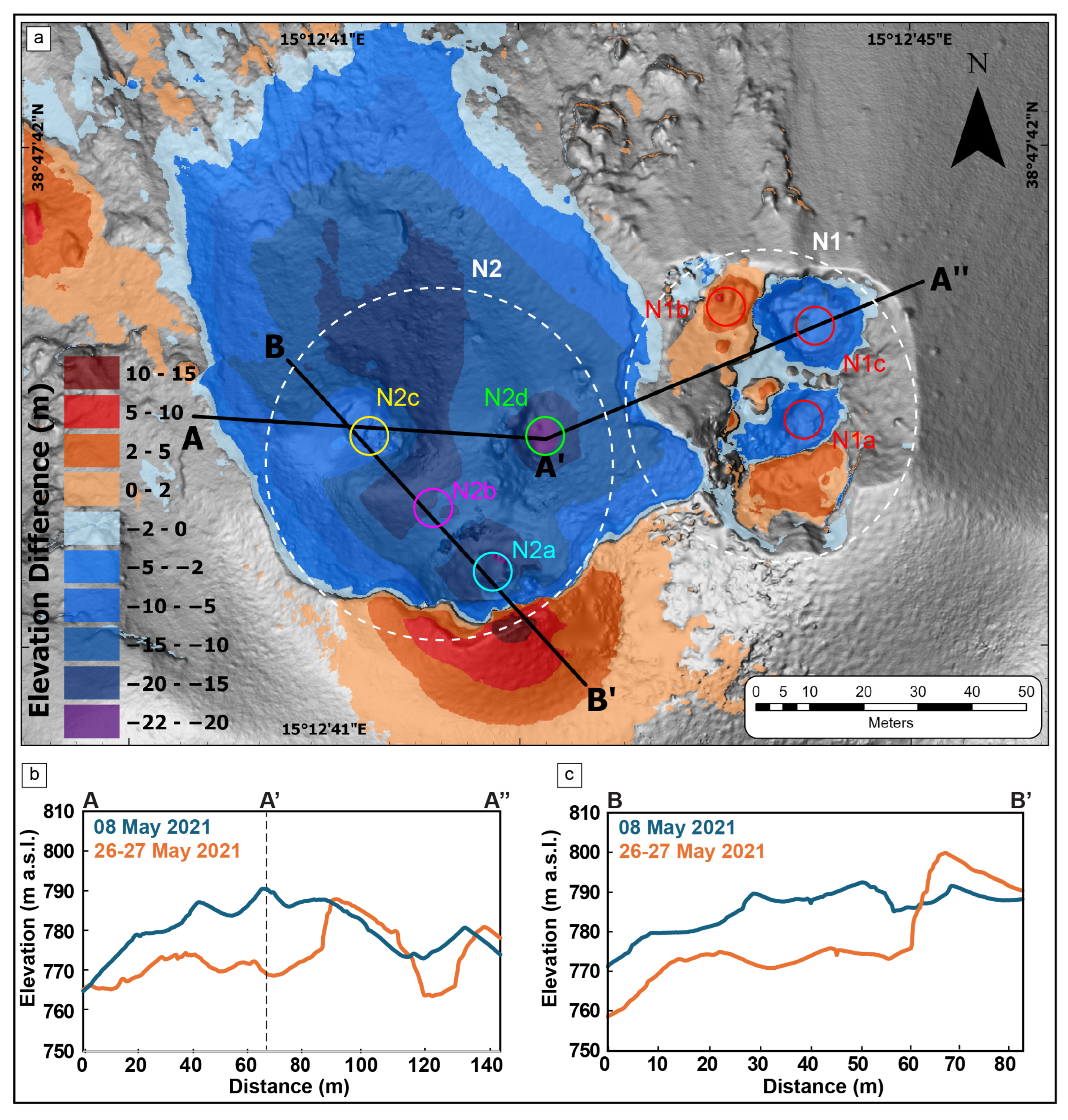
The difference in DEMs between 8 and 26–27 May (Figure 8) and the topographic profiles detailed insights into the morphological changes affecting the N crater area.
Over a surface of ~2.45 × 10⁴ m2 encompassing the N crater area (Table S1), the net volume loss was calculated as −7.36 × 10⁴ m3 (±4 × 10³ m3; 5.8% error), corresponding to 90.8% of the total volume difference (8.11 × 10⁴ m3 ± 6 × 10³ m3, 7.3% error). Conversely, the total volume of accumulated material in the same area was +7.46 × 10³ m3 (±2 × 10³ m3; 21.9% error). It is important to underline that the net volume change estimates reflect only the topographic difference between the two UAS surveys (8 and 26–27 May 2021) and do not capture the total volume mobilized by collapses or continuous cone-building and loss over the 19-day period. The calculated loss underestimates collapse volumes, as material moving onto the Sciara del Fuoco or into the sea lies outside the surveyed area. Additionally, minor slumping or ash fallout below the 0.5 m Minimum Level of Detection (MOLD) is excluded from the analysis. Likewise, the measured accumulation represents only the remaining net buildup, a fraction of the material ejected and deposited between 8 and 19 May.
While the overall rim morphology of the N1 crater area remained unaffected by the collapse, vent-specific changes occurred. The N1b vent grew by up to +5 m, while the N1a and N1c vents deepened by up to −11 m, with localized material accumulation of +4 m observed in the southern part of N1a.
The N2 crater rim underwent significant alterations. Its central–northern portion and the upper Sciara del Fuoco slope were entirely dismantled due to the collapse. The N2a cone was disrupted in its northern half, losing up to −21 m. In contrast, the southern half accumulated up to +15 m of eruptive deposits between 8 and 26–27 May. The N2b vent collapsed entirely. However, during the pre-collapse period (7–10 May 2021), constructive eruptive activity had raised the N2b cone by up to +7 m, as observed in the DSMs (Figure 6). Major losses at its location reached −18 m. The N2c vent experienced minor changes, with a maximum elevation loss of −8 m. However, significant losses were recorded at its eastern rim (−15 m). The N2d cone was completely destroyed, creating a depressed area with elevation differences of up to −22 m. New vents formed in this region along an ENE-WSW alignment.

6. Discussion and Conclusions

The integrated analysis carried out using DSM and FLIR data offers insights into how variations in physical parameters and morphological changes influenced Stromboli’s eruption dynamics before and after the 19 May crater collapse, providing a rare opportunity to study the feedback between explosive activity and crater–vent morphology.

6.1. Explosion Parameters

Our findings reveal two distinct distributions of eruption parameters before and after the 19 May collapse, highlighting the feedback between volcanic activity and morphological variations.
Consistent with previous observations [58,59,66], our data confirm that explosive activity intensified prior to the collapse: in the N crater area, explosions were shorter, more intense, faster, and more frequent than in the post-collapse period, with concurrent increases in spattering and puffing frequency. Following this peak, spattering frequency steadily declined until 16 May and remained relatively constant in the days after the 19 May collapse. In contrast, explosion frequency remained elevated until the collapse [59].
Continuous monitoring showed a precursory rise in explosion frequency from low to medium levels starting 12 April, followed by a sharper increase from 9 May, reaching high levels during 15–19 May [59], as reflected in both our data and bulletin reports (Figure 5). Satellite, geodetic, seismic, ground deformation and degassing data support a picture of increasing pressurization [66]: (i) MODIS detected moderate to low radiant heat flux in early April, rising sharply on 8–10 May and from 16 May onwards, peaking on 19 May; (ii) VLP size and seismic amplitude increased from ca 11–13 May until the collapse; (iii) GNSS showed significant areal dilatation from 11–16 May, tilt indicated progressive uplift with a 2.0 μrad lowering on 15 May; (iv) GBInSAR recorded inflation from ~1 mm/day until 31 March to ~2.6 mm/day until 19 May; SO2 flux data increased gradually from the end of March to peak at high values between 300 and 460 t/d before the collapse. Together, these data indicate that magma pressurization became clearly detectable from early May, reaching a peak around 15–16 May, this latter consistent with our observed peaks in explosion intensity, frequency, spattering, and puffing.
Our data also indicate an increased number of active vents before and after the collapse in the N crater area, reaching up to seven sub-vents (Figure 6 and Figure 7), compared with three to four vents in October 2020. Similar relationships between vent number, explosion rate, and geophysical parameters were documented before the August-November 2014 eruption [38,67].
The elevated explosion frequencies in May 2021 also align with patterns observed before previous collapses, such as the 31 March 2020 and 12 January 2013 events [13,68], which involved spattering, scoria cone formation, overflows, and small-scale crater instability. In these cases, daily average explosion frequency increased steadily—from ~3 to 13 events per hour—roughly 15 days before the collapse. Compared to typical activity (~7.8 explosions per hour in October 2020), the May 2021 explosion frequencies were higher, though lower than those preceding larger-scale events such as the effusive phases of 2007 (>20 events per hour; [69,70]), 2014 (maximum 25 events per hour; [38,71]), and the 2019 paroxysms (15–25 events per hour; [72]).

6.2. Explosion Types

Our data illustrate that pre- and post-19 May explosive activity differs not only in terms of physical parameters but also in terms of explosion types. The significant presence of gas rich type 0 (13%) and ballistic-rich type 1 explosions (69%) (Table 3) before the collapse suggests the involvement of fresh, volatile-rich magma, in line with what hypothesized by Calvari et al. (2022) [66], based on the rise in SO2 and CO2 emissions from mid-April [63], and consistent with prior studies of similar pressurization-collapse events (e.g., [35,38]). In line with these observations, Landi et al. (2011) [73] had already observed that “ash-poor” and hotter products are more consistently erupted from the vents where puffing occurs, suggesting that the slightly higher temperature reflects an enhanced two-phase bubble flow.
In contrast, after the collapse, gas-dominated explosions disappeared, while ash-dominated explosions increased, reflected by a higher number of type 2a (49%) and the appearance of type 2b explosions (6%), producing long-lived ash plumes (up to 30 s, Supplementary Figure S12). This shift suggests that the collapse of the N2 crater and the lowering of magma in the conduits (as confirmed also by the ceasing of activity at N1) left a cooler, more stagnant magma with reduced volatile content. In such conditions, the increased fragmentation and ash formation in the post-collapse explosions could be linked to the presence of a cooler, more viscous plug on top of the magma column [74,75,76], or to the debris/ash cover on the free surface resulting from the collapse [36,47,77]. Notably, the prolonged duration of the post-collapse 2b explosions (Supplementary Figure S12), combined with the ash-rich content, strongly supports the hypothesis of gas release through a debris-obstructed vent. This mechanism is physically analogous to the ‘Type 3′ activity described at Yasur volcano [1]. While the generation mechanism is likely the same, we retain the established ‘Type 2b’ classification [36] to maintain consistency with the long-term nomenclature used at Stromboli.
The distribution of explosion types at Stromboli in May 2021 differs from that in October 2020 (Table 3), when type 2a explosions (41%) were slightly more frequent than type 1 (40%) and type 2b (19%). This aligns with typical activity patterns at Stromboli, where type 1 and type 2 (2a and 2b) dominate [36]. At Yasur, type 2a eruptions are most common, followed by 2b, 1, and 3 [1], while type 0 has not been reported. At Stromboli, type 0 was reported in 1.72% of events during normal periods [35]. Previous studies of type 0 velocities at Stromboli report averages of 30–58 m/s, with maxima up to 140 m/s [25], consistent with the 150–250 m/s range defined by [47], confirming the reliability of explosion velocity measurements across studies.
Prior to the 3 July and 28 August 2019 paroxysms, type 0 explosion frequency increased [72], in line with rise in SO2 and CO2 emissions [78]. Giudicepietro et al. (2020) [79] showed that the main VLP seismo-acoustic cluster associated with type 0 explosions began to dominate persistent activity about three months before the 3 July event, exceeding 96% in the final month. Pontesilli et al. (2023) [80] reported rates of 5–7 type 0 explosions per hour between 9–11 May 2019. Similarly, the periods preceding both 19 May 2021 and 3 July 2019 were characterized by heightened explosion parameters about a month in advance, including increased type 0 frequency and a higher number of active vents [72,81]. But unlike before the paroxysm, in the May 2021 case, type 0 explosions did not dominate, and overpressure was released through small explosions and partial collapse, suggesting the volume of rising gas-rich magma was smaller and insufficient to trigger a full-scale paroxysm.

6.3. N Crater: Branched Conduit Dynamics and Activity Pattern

The N crater area at Stromboli exhibits distinct activity patterns compared to the CS crater area during the 19 May 2021 collapse. Explosion frequencies in the N crater area were 2–3 times higher than in the CS crater area, which remained comparatively low, despite a simultaneous increase. Other eruption parameters also showed stronger variations in the N sector. This disparity, along with intense spattering limited to the N crater area, points to structural differences in the shallow plumbing system—particularly conduit branching [8,16,30]—that modulate the distribution of magma and gas fluxes between the two craters.
Geophysical investigations [82,83,84] indicate that both the N and CS crater areas are connected at shallow levels to a common source region, where very-long-period (VLP) seismic events are located at ~400–500 m a.s.l. [85]. From this zone, two dike-like branches ascend independently toward the N and CS crater areas, forming a bifurcated conduit system. This configuration provides a schematic model for the shallow plumbing system: a shared pressurized reservoir feeding two partially decoupled conduits that can independently vary in degassing efficiency, magma ascent rate, and explosion style.
This structural arrangement explains the recurrent activity asymmetry observed at Stromboli (e.g., [2]). When a gas-rich magma pulse enters the common source, pressure increases simultaneously beneath both branches, raising the overall explosion frequency. However, if one branch (as in May 2021, the N crater) offers a more efficient gas pathway, it will dominate the activity through enhanced spattering, faster vent renewal, and more frequent explosions, while the other (CS crater) remains comparatively subdued.
Petrological data [73,80] support this model, showing that products from the two areas differ in temperature and residence time, consistent with independent shallow feeding systems. The long-term morphological stability of both craters [29] is evidenced by the reformation of the N1 and N2 craters to their pre-collapse positions by October 2021 (Figure 6i). Over the past 20 years, the CS and N crater areas have repeatedly recovered after major disruptions, such as paroxysmal eruptions [72] or flank effusions [20], indicating a persistent and resilient branching conduit structure.
The N crater area, with its sustained spattering and cone-building activity, is the more dynamic and instability-prone [14,18]. The identified pattern of high-frequency spattering, morphological change, and collapse occurred in May 2021, has preceded multiple collapse events at Stromboli in the same sector (e.g., 28 December 2002, 12 January 2013, 6–7 August 2014, and 31 March 2020; [13,71,86,87]), highlighting the N crater area’s high susceptibility to volcanic instability.

6.4. Vent Reconfiguration and Structural Modification Induced by the N Crater Area Collapse

The analysis of vent number and migration highlights critical aspects of vent alignment in Stromboli’s N2 crater area before and after the 19 May 2021 event. Pre-collapse, vents N2a–c were aligned NW–SE, consistent with previous surveys [15,85,88] and reflecting “subdominant dike segments” influenced by gravitational stress from the Sciara del Fuoco. Post-collapse, the disruption and excavation in the N2 crater, led to the emergence of multiple smaller ENE–WSW-aligned vents (Figure 6h), similar to patterns after the 3 July 2019 paroxysm [15], suggesting that collapses reduce lithostatic load and allow magma to ascend through new pathways. In N1, activity cessation indicates magma drainage toward lower N2 vents, highlighting the role of conduit drainage in the redistribution of explosive activity. As eruptive material accumulates, the system reorganizes, favoring a dominant conduit while abandoning auxiliary pathways.
These observations align with shallow conduit reconfigurations documented during early fissure/cone eruptions, where magma ascent is controlled by stress adjustments and lithostatic pressure changes [88,89,90].
Structural instabilities and rising magma-static pressure likely triggered the May 2021 collapse. The estimated volume loss on 19 May (7.36 × 10⁴ m3) is comparable to previous estimates [19]. Cumulative changes since 2019, including negative elevation differences and prior excavations, have further increased N crater instability [15,18]. The pronounced lowering of the N2 area amplified pre-existing destabilization from the 2019 paroxysms, which left elevation differences up to –27 m and a volume loss of 4.47 × 10⁵ m3 in the N sector [15]. Our May 2021 observations show a similar –21 m decrease, though with a smaller involved volume. Overall, these factors underscore the N crater’s heightened susceptibility to future collapses [18].
We conclude that the May 2021 instability reflects morphological changes induced by the July 2019 paroxysms. The frequency of collapses in the northern sector has increased in recent years [91], with significant events in 2022 and 2024 displacing millions of cubic meters and creating elevation differences of tens of meters [12,18,20]. This increased susceptibility is primarily linked to the long-term morphological modifications induced by the 2019 paroxysmal events, which resulted in significant pre-existing volume loss and deep excavation in the NE crater area. Thus, the May 2021 collapse was not merely an isolated event, but a direct consequence of the systematically weakened edifice that responded to subsequent magma pressurization events with heightened instability and cone failure. These patterns show that large-scale eruptions significantly elevate the risk of occurrence of collapses, explosions, and lava flows over both short- and long-term timescales.

6.5. Future Challenges

Our findings highlight the need to enhance high-resolution monitoring of explosions and morphological changes, which act as early indicators of system disturbances. Recent studies emphasize the importance of improving precursor detection for civil protection purposes, enabling better forecasting and understanding of eruptions using both existing and novel tools [92,93]. In light of the PDC generated by the 19 May event, monitoring cone growth and stability becomes particularly critical to mitigate risks to the frequent tourist boats navigating near the Sciara del Fuoco highly vulnerable to collapse-generated PDCs entering the sea.
Beyond explosion frequency, variations in spattering, vent numbers, and Type 0 events may indicate the arrival of gas-rich magma, increased pressurization, and a higher likelihood of vent instability and collapse, complementing well-established geochemical, seismic, and deformation precursors [78,83,94]. The dataset presented here is somewhat limited by its focus on a single event and discontinuous data acquisition, underscoring the necessity for future statistical analyses using longer, continuous datasets to fully characterize low-frequency events; future work will include statistical analyses of Type 0 event frequency and occurrence encompassing a range of activity levels, including normal, high, crater collapse, and lava effusion phases. In any case, expanding the monitoring network to collect quantitative time series on explosion type, height, duration, and vent activity—not just frequency—will further improve tracking of eruptive behavior.
The May 2021 events were likely influenced by morphological changes resulting from the 2019 paroxysms, which increased collapse frequency and contributed to the collapse, illustrating how structural modifications can amplify hazardous phenomena. Integrating the current monitoring system with high-resolution, high-frequency morphological surveys of the crater terrace and surroundings is an essential improvement for enhancing early detection of system disequilibrium and mitigating eruption risks.

Supplementary Materials

The following supporting information can be downloaded at: https://www.mdpi.com/article/10.3390/rs18020264/s1, Figure S1: Height-time kymograph generated of the CS crater area from FLIR data acquired on 10 May 2021 from PSF; Figure S2: Height-time kymograph generated of the N crater area from FLIR data acquired on 10 May 2021 from PSF; Figure S3: Height-time kymograph generated of the CS crater area from FLIR data acquired on 11 May 2021 from ROC. The video recording ended at 10:27:45 GMT; Figure S4: Height-time kymograph generated of the N crater area from FLIR data acquired on 11 May 2021 from ROC. The video recording ended at 10:27:45 GMT; Figure S5: Height-time kymograph generated of the N crater area from FLIR data acquired on 13 May 2021 from ROC. The video recording ended at 10:41:00 GMT; Figure S6: Height-time kymograph generated of the CS crater area from FLIR data acquired on 16 May 2021 from PSF. The video recording ended at 10:37:31 GMT; Figure S7: Height-time kymograph generated of the N crater area from FLIR data acquired on 16 May 2021 from PSF. The video recording ended at 10:37:31 GMT; Figure S8: Height-time kymograph generated of the N crater area from FLIR data acquired on 25 May 2021 from ROC. The video recording ended at 18:32:18 GMT; Figure S9: Height-time kymograph generated of the CS crater area from FLIR data acquired on 26 May 2021 from ROC; Figure S10: Height-time kymograph generated of the CS crater area from FLIR data acquired on 26 May 2021 from PSF. The video recording ended at 13:24:32 GMT; Figure S11: Height-time kymograph generated of the N crater area from FLIR data acquired on 26 May 2021 from PSF. The video recording ended at 13:24:32 GMT; Figure S12: Box chart of explosion duration dexpl (a), bomb elevation ℎexpl (b), bomb speed vexpl (c) and explosion frequency fexpl (d) for pre-collapse (10, 13 and 16 May 2021) and post-collapse activity (25 and 26 May 2021). The data are cumulative for CS and N crater areas and are grouped in different colors corresponding to the Strombolian-style activity types (shown in legend). For type 0 explosions, bomb elevation is associated with the thermal elevation of the gas thrust region. Notably, bomb elevation and speed cannot be quantified for type 2b explosions due to the scarcity or absence of bombs. The periods of activity are marked by a vertical black dashed line; Figure S13: Evolution of the identified vents in the N crater area of the crater area between 7 May and 27 May 2021, based on UAS imagery (a–f). The snapshots show the daily spatial arrangement and morphological changes of vents. All identified vents are highlighted by colored circles. The stars indicate active vents. N1 and N2 craters are marked by dashed white circles; Table S1: Change detection results between 8 and 26–27 May DSMs.

Author Contributions

E.D.B. conceived and designed research. E.D.B., R.C., T.R., J.T., P.S., D.A. conducted field data acquisition and analysis, G.Z. and E.D.B. analyzed thermal data. R.C. and T.R. analyzed UAS data, E.D.B. and G.Z. wrote the manuscript. A.C. analyzed bulletin data on explosion frequency. T.R. and R.C. contributed to the manuscript. All authors have read and agreed to the published version of the manuscript.

Funding

This study received funding from the Ministero dell’università e della ricerca: Next-Generation EU—National Recovery and Resilience Plan (NRRP)—MISSION 4 COMPO-NENT 2, INVESTMENT No. 1.1, CALL PRIN 2022 D.D. 104 02-02-2022—(PROVES: an integrated PetRO-Volcanological monitoring approach applied to Mt. Etna and Stromboli—2022N4FBAA—CUP D53D23004780006); Istituto Nazionale di Geofisica e Vulcanologia: INGV Departmental Strategic Projects UNO (UNderstanding the Ordinary to forecast the extraordinary: An integrated approach for studying and interpreting the explosive activity at Stromboli volcano (CUP D59C19000140005).

Data Availability Statement

All datasets available on request from the authors. UAS data are publicly available via Open Topography (https://doi.org/10.5069/G9WS8RGB, https://doi.org/10.5069/G9HD7SX0, accessed on 19 December 2025).

Acknowledgments

Francesco Pennacchia is warmly thanked for its invaluable field support. Carlo and all Lanza members of ‘La Lampara’ are warmly thanked for their hospitality and kindness throughout the years.

Conflicts of Interest

The authors declare no conflicts of interest.

References

  1. Simons, B.C.; Jolly, A.D.; Eccles, J.D.; Cronin, S.J. Spatiotemporal Relationships between Two Closely-spaced Strombolian-style Vents, Yasur, Vanuatu. Geophys. Res. Lett. 2020, 47, e2019GL085687. [Google Scholar] [CrossRef]
  2. Salvatore, V.; Silleni, A.; Corneli, D.; Taddeucci, J.; Palladino, D.M.; Sottili, G.; Bernini, D.; Andronico, D.; Cristaldi, A. Parameterizing Multi-Vent Activity at Stromboli Volcano (Aeolian Islands, Italy). Bull. Volcanol. 2018, 80, 64. [Google Scholar] [CrossRef]
  3. Spina, L.; Taddeucci, J.; Cannata, A.; Sciotto, M.; Del Bello, E.; Scarlato, P.; Kueppers, U.; Andronico, D.; Privitera, E.; Ricci, T.; et al. Time-Series Analysis of Fissure-Fed Multi-Vent Activity: A Snapshot from the July 2014 Eruption of Etna Volcano (Italy). Bull. Volcanol. 2017, 79, 51. [Google Scholar] [CrossRef]
  4. Spina, L.; Del Bello, E.; Ricci, T.; Taddeucci, J.; Scarlato, P. Multi-Parametric Characterization of Explosive Activity at Batu Tara Volcano (Flores Sea, Indonesia). J. Volcanol. Geotherm. Res. 2021, 413, 107199. [Google Scholar] [CrossRef]
  5. Houghton, B.F.; Taddeucci, J.; Andronico, D.; Gonnermann, H.M.; Pistolesi, M.; Patrick, M.R.; Orr, T.R.; Swanson, D.A.; Edmonds, M.; Gaudin, D.; et al. Stronger or Longer: Discriminating between Hawaiian and Strombolian Eruption Styles. Geology 2016, 44, 163–166. [Google Scholar] [CrossRef]
  6. Taddeucci, J.; Palladino, D.M.; Sottili, G.; Bernini, D.; Andronico, D.; Cristaldi, A. Linked Frequency and Intensity of Persistent Volcanic Activity at Stromboli (Italy). Geophys. Res. Lett. 2013, 40, 3384–3388. [Google Scholar] [CrossRef]
  7. Ripepe, M.; Rossi, M.; Saccorotti, G. Image Processing of Explosive Activity at Stromboli. J. Volcanol. Geotherm. Res. 1993, 54, 335–351. [Google Scholar] [CrossRef]
  8. Ripepe, M.; Delle Donne, D.; Harris, A.; Marchetti, E.; Ulivieri, G. Dynamics of Strombolian Activity. In The Stromboli Volcano: An Integrated Study of the 2002–2003 Eruption; Calvari, S., Inguaggiato, S., Puglisi, G., Ripepe, M., Rosi, M., Eds.; Geophysical Monograph Series; American Geophysical Union: Washington, DC, USA, 2008; Volume 182, pp. 39–48. [Google Scholar] [CrossRef]
  9. Barberi, F.; Rosi, M.; Sodi, A. Volcanic hazard assessment at Stromboli based on review of historical data. Acta Vulcanol. 1993, 3, 173–187. [Google Scholar]
  10. Di Traglia, F.; Bartolini, S.; Artesi, E.; Nolesini, T.; Ciampalini, A.; Lagomarsino, D.; Martí, J.; Casagli, N. Susceptibility of Intrusion-Related Landslides at Volcanic Islands: The Stromboli Case Study. Landslides 2018, 15, 21–29. [Google Scholar] [CrossRef]
  11. Di Traglia, F.; Fornaciai, A.; Casalbore, D.; Favalli, M.; Manzella, I.; Romagnoli, C.; Chiocci, F.L.; Cole, P.; Nolesini, T.; Casagli, N. Subaerial-Submarine Morphological Changes at Stromboli Volcano (Italy) Induced by the 2019–2020 Eruptive Activity. Geomorphology 2022, 400, 108093. [Google Scholar] [CrossRef]
  12. Zuccarello, L.; Gheri, D.; De Angelis, S.; Civico, R.; Ricci, T.; Scarlato, P. Geophysical Fingerprint of the 4–11 July 2024 Eruptive Activity at Stromboli Volcano, Italy. Nat. Hazards Earth Syst. Sci. 2025, 25, 2317–2330. [Google Scholar] [CrossRef]
  13. Calvari, S.; Intrieri, E.; Di Traglia, F.; Bonaccorso, A.; Casagli, N.; Cristaldi, A. Monitoring Crater-Wall Collapse at Active Volcanoes: A Study of the 12 January 2013 Event at Stromboli. Bull. Volcanol. 2016, 78, 39. [Google Scholar] [CrossRef]
  14. Di Traglia, F.; Borselli, L.; Nolesini, T.; Casagli, N. Crater-Rim Collapse at Stromboli Volcano: Understanding the Mechanisms Leading from the Failure of Hot Rocks to the Development of Glowing Avalanches. Nat. Hazards 2023, 115, 2051–2068. [Google Scholar] [CrossRef]
  15. Civico, R.; Ricci, T.; Scarlato, P.; Andronico, D.; Cantarero, M.; Carr, B.B.; De Beni, E.; Del Bello, E.; Johnson, J.B.; Kueppers, U.; et al. Unoccupied Aircraft Systems (UASs) Reveal the Morphological Changes at Stromboli Volcano (Italy) before, between, and after the 3 July and 28 August 2019 Paroxysmal Eruptions. Remote Sens. 2021, 13, 2870. [Google Scholar] [CrossRef]
  16. Tibaldi, A.; Corazzato, C.; Apuani, T.; Pasquaré, F.A.; Vezzoli, L. Geological-Structural Framework of Stromboli Volcano, Past Collapses, and the Possible Influence on the Events of the 2002–2003 Crisis. In The Stromboli Volcano: An Integrated Study of the 2002–2003 Eruption; Calvari, S., Inguaggiato, S., Puglisi, G., Ripepe, M., Rosi, M., Eds.; Geophysical Monograph Series; American Geophysical Union: Washington, DC, USA, 2008; Volume 182, pp. 5–17. [Google Scholar] [CrossRef]
  17. Romagnoli, C.; Kokelaar, P.; Casalbore, D.; Chiocci, F.L. Lateral Collapses and Active Sedimentary Processes on the Northwestern Flank of Stromboli Volcano, Italy. Mar. Geol. 2009, 265, 101–119. [Google Scholar] [CrossRef]
  18. Di Traglia, F.; Berardino, P.; Borselli, L.; Calabria, P.; Calvari, S.; Casalbore, D.; Casagli, N.; Casu, F.; Chiocci, F.L.; Civico, R.; et al. Generation of Deposit-Derived Pyroclastic Density Currents by Repeated Crater Rim Failures at Stromboli Volcano (Italy). Bull. Volcanol. 2024, 86, 69. [Google Scholar] [CrossRef]
  19. Casalbore, D.; Di Traglia, F.; Romagnoli, C.; Favalli, M.; Gracchi, T.; Tacconi Stefanelli, C.; Nolesini, T.; Rossi, G.; Del Soldato, M.; Manzella, I.; et al. Integration of Remote Sensing and Offshore Geophysical Data for Monitoring the Short-Term Morphological Evolution of an Active Volcanic Flank: A Case Study from Stromboli Island. Remote Sens. 2022, 14, 4605. [Google Scholar] [CrossRef]
  20. Civico, R.; Ricci, T.; Cecili, A.; Scarlato, P. High-Resolution Topography Reveals Morphological Changes of Stromboli Volcano Following the July 2024 Eruption. Sci. Data 2024, 11, 1219. [Google Scholar] [CrossRef]
  21. Ripepe, M.; Lacanna, G. Volcano Generated Tsunami Recorded in the near Source. Nat. Commun. 2024, 15, 1802. [Google Scholar] [CrossRef] [PubMed]
  22. Patrick, M.R. Dynamics of Strombolian Ash Plumes from Thermal Video: Motion, Morphology, and Air Entrainment. J. Geophys. Res. Solid Earth 2007, 112, B06202. [Google Scholar] [CrossRef]
  23. Gaudin, D.; Taddeucci, J.; Scarlato, P.; Harris, A.; Bombrun, M.; Del Bello, E.; Ricci, T. Characteristics of Puffing Activity Revealed by Ground-Based, Thermal Infrared Imaging: The Example of Stromboli Volcano (Italy). Bull. Volcanol. 2017, 79, 24. [Google Scholar] [CrossRef]
  24. Bombrun, M.; Harris, A.; Gurioli, L.; Battaglia, J.; Barra, V. Anatomy of a Strombolian Eruption: Inferences from Particle Data Recorded with Thermal Video. J. Geophys. Res. Solid Earth 2015, 120, 2367–2387. [Google Scholar] [CrossRef]
  25. Thivet, S.; Harris, A.J.L.; Gurioli, L.; Bani, P.; Barnie, T.; Bombrun, M.; Marchetti, E. Multi-Parametric Field Experiment Links Explosive Activity and Persistent Degassing at Stromboli. Front. Earth Sci. 2021, 9, 669661. [Google Scholar] [CrossRef]
  26. Turner, N.; Houghton, B.; Taddeucci, J.; von der Lieth, J.; Kueppers, U.; Gaudin, D.; Ricci, T.; Kim, K.; Scarlato, P. Drone Peers into Open Volcanic Vents. Eos 2017, 98, 16–21. [Google Scholar] [CrossRef]
  27. Schmid, M.; Kueppers, U.; Civico, R.; Ricci, T.; Taddeucci, J.; Dingwell, D.B. Characterising Vent and Crater Shape Changes at Stromboli: Implications for Risk Areas. Volcanica 2021, 4, 87–105. [Google Scholar] [CrossRef]
  28. Gracchi, T.; Tacconi Stefanelli, C.; Rossi, G.; Di Traglia, F.; Nolesini, T.; Tanteri, L.; Casagli, N. UAV-Based Multitemporal Remote Sensing Surveys of Volcano Unstable Flanks: A Case Study from Stromboli. Remote Sens. 2022, 14, 2489. [Google Scholar] [CrossRef]
  29. Harris, A.; Ripepe, M. Synergy of Multiple Geophysical Approaches to Unravel Explosive Eruption Conduit and Source Dynamics—A Case Study from Stromboli. Geochemistry 2007, 67, 1–35. [Google Scholar] [CrossRef]
  30. Rosi, M.; Pistolesi, M.; Bertagnini, A.; Landi, P.; Pompilio, M.; Di Roberto, A. Chapter 14 Stromboli Volcano, Aeolian Islands (Italy): Present Eruptive Activity and Hazards. Geol. Soc. Lond. Mem. 2013, 37, 473–490. [Google Scholar] [CrossRef]
  31. CME. INGV Stromboli Weekly Bulletins. Available online: https://cme.ingv.it/bollettini-e-comunicati/bollettini-ingv-stromboli (accessed on 23 October 2025).
  32. Rosi, M.; Bertagnini, A.; Landi, P. Onset of the Persistent Activity at Stromboli Volcano (Italy). Bull. Volcanol. 2000, 62, 294–300. [Google Scholar] [CrossRef]
  33. Harris, A.; Ripepe, M. Temperature and Dynamics of Degassing at Stromboli. J. Geophys. Res. Solid Earth 2007, 112, B03205. [Google Scholar] [CrossRef]
  34. Colò, L.; Ripepe, M.; Baker, D.R.; Polacci, M. Magma Vesiculation and Infrasonic Activity at Stromboli Open Conduit Volcano. Earth Planet. Sci. Lett. 2010, 292, 274–280. [Google Scholar] [CrossRef]
  35. Gaudin, D.; Taddeucci, J.; Scarlato, P.; del Bello, E.; Ricci, T.; Orr, T.; Houghton, B.; Harris, A.; Rao, S.; Bucci, A. Integrating Puffing and Explosions in a General Scheme for Strombolian-style Activity. J. Geophys. Res. Solid Earth 2017, 122, 1860–1875. [Google Scholar] [CrossRef]
  36. Patrick, M.R.; Harris, A.J.L.; Ripepe, M.; Dehn, J.; Rothery, D.A.; Calvari, S. Strombolian Explosive Styles and Source Conditions: Insights from Thermal (FLIR) Video. Bull. Volcanol. 2007, 69, 769–784. [Google Scholar] [CrossRef]
  37. Calvari, S.; Spampinato, L.; Lodato, L.; Harris, A.J.L.; Patrick, M.R.; Dehn, J.; Burton, M.R.; Andronico, D. Chronology and Complex Volcanic Processes during the 2002–2003 Flank Eruption at Stromboli Volcano (Italy) Reconstructed from Direct Observations and Surveys with a Handheld Thermal Camera. J. Geophys. Res. Solid Earth 2005, 110, B02201. [Google Scholar] [CrossRef]
  38. Valade, S.; Lacanna, G.; Coppola, D.; Laiolo, M.; Pistolesi, M.; Donne, D.D.; Genco, R.; Marchetti, E.; Ulivieri, G.; Allocca, C.; et al. Tracking Dynamics of Magma Migration in Open-Conduit Systems. Bull. Volcanol. 2016, 78, 78. [Google Scholar] [CrossRef]
  39. Bevilacqua, A.; Bertagnini, A.; Pompilio, M.; Landi, P.; Del Carlo, P.; Di Roberto, A.; Aspinall, W.; Neri, A. Major Explosions and Paroxysms at Stromboli (Italy): A New Historical Catalog and Temporal Models of Occurrence with Uncertainty Quantification. Sci. Rep. 2020, 10, 17357. [Google Scholar] [CrossRef]
  40. Taddeucci, J.; Scarlato, P.; Del Bello, E.; Tamburello, G.; Gaudin, D. Eruptions from UV to TIR: Multispectral High-Speed Imaging of Explosive Volcanic Activity. In Light, Energy and the Environment 2018 (E2, FTS, HISE, SOLAR, SSL); OSA: Washington, DC, USA, 2018; p. HM2C.2. [Google Scholar] [CrossRef]
  41. Harris, A.J.L.; Delle Donne, D.; Dehn, J.; Ripepe, M.; Worden, A.K. Volcanic Plume and Bomb Field Masses from Thermal Infrared Camera Imagery. Earth Planet. Sci. Lett. 2013, 365, 77–85. [Google Scholar] [CrossRef]
  42. Burton, M.; Allard, P.; Muré, F.; La Spina, A. Magmatic Gas Composition Reveals the Source Depth of Slug-Driven Strombolian Explosive Activity. Science (1979) 2007, 317, 227–230. [Google Scholar] [CrossRef] [PubMed]
  43. Jaupart, C.; Vergniolle, S. Laboratory Models of Hawaiian and Strombolian Eruptions. Nature 1988, 331, 58–60. [Google Scholar] [CrossRef]
  44. Allard, P.; Carbonnelle, J.; Métrich, N.; Loyer, H.; Zettwoog, P. Sulphur Output and Magma Degassing Budget of Stromboli Volcano. Nature 1994, 368, 326–330. [Google Scholar] [CrossRef]
  45. Allard, P.; Aiuppa, A.; Burton, M.; Caltabiano, T.; Federico, C.; Salerno, G.; La Spina, A. Crater Gas Emissions and the Magma Feeding System of Stromboli Volcano. In The Stromboli Volcano: An Integrated Study of the 2002–2003 Eruption; Calvari, S., Inguaggiato, S., Puglisi, G., Ripepe, M., Rosi, M., Eds.; Geophysical Monograph Series; American Geophysical Union: Washington, DC, USA, 2008; Volume 182, pp. 65–80. [Google Scholar] [CrossRef]
  46. Aiuppa, A.; Bertagnini, A.; Métrich, N.; Moretti, R.; Di Muro, A.; Liuzzo, M.; Tamburello, G. A Model of Degassing for Stromboli Volcano. Earth Planet. Sci. Lett. 2010, 295, 195–204. [Google Scholar] [CrossRef]
  47. Leduc, L.; Gurioli, L.; Harris, A.; Colò, L.; Rose-Koga, E.F. Types and Mechanisms of Strombolian Explosions: Characterization of a Gas-Dominated Explosion at Stromboli. Bull. Volcanol. 2015, 77, 8. [Google Scholar] [CrossRef]
  48. Goto, A.; Ripepe, M.; Lacanna, G. Wideband Acoustic Records of Explosive Volcanic Eruptions at Stromboli: New Insights on the Explosive Process and the Acoustic Source. Geophys. Res. Lett. 2014, 41, 3851–3857. [Google Scholar] [CrossRef]
  49. Maramai, A.; Graziani, L.; Alessio, G.; Burrato, P.; Colini, L.; Cucci, L.; Nappi, R.; Nardi, A.; Vilardo, G. Near- and Far-Field Survey Report of the 30 December 2002 Stromboli (Southern Italy) Tsunami. Mar. Geol. 2005, 215, 93–106. [Google Scholar] [CrossRef]
  50. Tinti, S.; Maramai, A.; Armigliato, A.; Graziani, L.; Manucci, A.; Pagnoni, G.; Zaniboni, F. Observations of Physical Effects from Tsunamis of December 30, 2002 at Stromboli Volcano, Southern Italy. Bull. Volcanol. 2006, 68, 450–461. [Google Scholar] [CrossRef]
  51. James, M.R.; Robson, S. Straightforward Reconstruction of 3D Surfaces and Topography with a Camera: Accuracy and Geoscience Application. J. Geophys. Res. Earth Surf. 2012, 117, F03017. [Google Scholar] [CrossRef]
  52. Geomorphic Change Detection Software. Available online: https://gcd.riverscapes.net/ (accessed on 23 October 2025).
  53. CME. UNIFI LGS Stromboli Weekly Bulletins. Available online: https://cme.ingv.it/bollettini-e-comunicati/categoria-1 (accessed on 23 October 2025).
  54. INGV. Weekly Volcanic Activity Report: 12/04/2021–18/04/2021. Available online: https://cme.ingv.it/bollettini-e-comunicati/bollettini-ingv-stromboli/668-bollettinostromboli20210420/file (accessed on 30 January 2025).
  55. LGS_UNIFI. Weekly Volcanic Activity Report. 06/05/2021–13/05/2021. Available online: https://cme.ingv.it/bollettini-e-comunicati/categoria-1/683-70-bollettino-unifi-lgs-stromboli-20210513/file (accessed on 30 January 2025).
  56. INGV. Weekly Volcanic Activity Report: 26/04/2021–02/05/2021. Available online: https://cme.ingv.it/bollettini-e-comunicati/bollettini-ingv-stromboli/675-bollettinostromboli20210504/file (accessed on 30 January 2025).
  57. INGV. Weekly Volcanic Activity Report: 03/05/2021–09/05/2021. Available online: https://cme.ingv.it/bollettini-e-comunicati/bollettini-ingv-stromboli/682-bollettinostromboli20210511/file (accessed on 30 January 2025).
  58. INGV. Weekly Volcanic Activity Report: 10/05/2021–16/05/2021. Available online: https://cme.ingv.it/bollettini-e-comunicati/bollettini-ingv-stromboli/684-bollettinostromboli20210518/file (accessed on 30 January 2025).
  59. INGV. Weekly Volcanic Activity Report: 17/05/2021–23/05/2021. Available online: https://cme.ingv.it/bollettini-e-comunicati/bollettini-ingv-stromboli/720-bollettinostromboli20210525/filehttps://cme.ingv.it/bollettini-e-comunicati/bollettini-ingv-stromboli/720-bollettinostromboli20210525/file (accessed on 30 January 2025).
  60. LGS_UNIFI. Weekly Volcanic Activity Report. 13/05/2021–20/05/2021. Available online: https://cme.ingv.it/bollettini-e-comunicati/categoria-1/691-71-bollettino-unifi-lgs-stromboli-20210520/file (accessed on 30 January 2025).
  61. INGV. Weekly Volcanic Activity Report: 24/05/2021–30/05/2021. Available online: https://cme.ingv.it/bollettini-e-comunicati/bollettini-ingv-stromboli/730-bollettinostromboli20210601/file (accessed on 30 January 2025).
  62. INGV. Weekly Volcanic Activity Report: 31/05/2021–06/06/2021. Available online: https://cme.ingv.it/bollettini-e-comunicati/bollettini-ingv-stromboli/736-bollettinostromboli20210608/file (accessed on 30 January 2025).
  63. LGS_UNIFI. Weekly Volcanic Activity Report. 21/05/2021–27/05/2021. Available online: https://cme.ingv.it/bollettini-e-comunicati/categoria-1/717-72-bollettino-unifi-lgs-stromboli-20210527/file (accessed on 30 January 2025).
  64. INGV. Weekly Volcanic Activity Report: 05/10/2020–11/10/2020. Available online: https://cme.ingv.it/bollettini-e-comunicati/bollettini-ingv-stromboli/512-bollettinostromboli20201013/file (accessed on 30 January 2025).
  65. LGS. Weekly Volcanic Activity Report. 08/10/2020–15/10/2020. Available online: https://cme.ingv.it/bollettini-e-comunicati/categoria-1/490-41-bollettino-settimanale-dell-attivita-del-vulcano-stromboli-08-ottobre-15-ottobre-2020/file (accessed on 30 January 2025).
  66. Calvari, S.; Di Traglia, F.; Ganci, G.; Bruno, V.; Ciancitto, F.; Di Lieto, B.; Gambino, S.; Garcia, A.; Giudicepietro, F.; Inguaggiato, S.; et al. Multi-Parametric Study of an Eruptive Phase Comprising Unrest, Major Explosions, Crater Failure, Pyroclastic Density Currents and Lava Flows: Stromboli Volcano, 1 December 2020–30 June 2021. Front. Earth Sci. 2022, 10, 899635. [Google Scholar] [CrossRef]
  67. Delle Donne, D.; Tamburello, G.; Aiuppa, A.; Bitetto, M.; Lacanna, G.; D’Aleo, R.; Ripepe, M. Exploring the Explosive-effusive Transition Using Permanent Ultraviolet Cameras. J. Geophys. Res. Solid Earth 2017, 122, 4377–4394. [Google Scholar] [CrossRef]
  68. INGV. Weekly Volcanic Activity Report: 30/03/2020–05/04/2020. Available online: https://cme.ingv.it/bollettini-e-comunicati/bollettini-ingv-stromboli/32-bollettinostromboli20200407/file (accessed on 30 January 2025).
  69. Ripepe, M.; Delle Donne, D.; Lacanna, G.; Marchetti, E.; Ulivieri, G. The Onset of the 2007 Stromboli Effusive Eruption Recorded by an Integrated Geophysical Network. J. Volcanol. Geotherm. Res. 2009, 182, 131–136. [Google Scholar] [CrossRef]
  70. Calvari, S.; Lodato, L.; Steffke, A.; Cristaldi, A.; Harris, A.J.L.; Spampinato, L.; Boschi, E. The 2007 Stromboli Eruption: Event Chronology and Effusion Rates Using Thermal Infrared Data. J. Geophys. Res. Solid Earth 2010, 115, B04201. [Google Scholar] [CrossRef]
  71. Di Traglia, F.; Calvari, S.; D’Auria, L.; Nolesini, T.; Bonaccorso, A.; Fornaciai, A.; Esposito, A.; Cristaldi, A.; Favalli, M.; Casagli, N. The 2014 Effusive Eruption at Stromboli: New Insights from In Situ and Remote-Sensing Measurements. Remote Sens. 2018, 10, 2035. [Google Scholar] [CrossRef]
  72. Andronico, D.; Del Bello, E.; D’Oriano, C.; Landi, P.; Pardini, F.; Scarlato, P.; de’ Michieli Vitturi, M.; Taddeucci, J.; Cristaldi, A.; Ciancitto, F.; et al. Uncovering the Eruptive Patterns of the 2019 Double Paroxysm Eruption Crisis of Stromboli Volcano. Nat. Commun. 2021, 12, 4213. [Google Scholar] [CrossRef] [PubMed]
  73. Landi, P.; Marchetti, E.; La Felice, S.; Ripepe, M.; Rosi, M. Integrated Petrochemical and Geophysical Data Reveals Thermal Distribution of the Feeding Conduits at Stromboli Volcano, Italy. Geophys. Res. Lett. 2011, 38, L08305. [Google Scholar] [CrossRef]
  74. Gurioli, L.; Colo’, L.; Bollasina, A.J.; Harris, A.J.L.; Whittington, A.; Ripepe, M. Dynamics of Strombolian Explosions: Inferences from Field and Laboratory Studies of Erupted Bombs from Stromboli Volcano. J. Geophys. Res. Solid Earth 2014, 119, 319–345. [Google Scholar] [CrossRef]
  75. Del Bello, E.; Lane, S.J.; James, M.R.; Llewellin, E.W.; Taddeucci, J.; Scarlato, P.; Capponi, A. Viscous Plugging Can Enhance and Modulate Explosivity of Strombolian Eruptions. Earth Planet. Sci. Lett. 2015, 423, 210–218. [Google Scholar] [CrossRef]
  76. Capponi, A.; James, M.R.; Lane, S.J. Gas Slug Ascent in a Stratified Magma: Implications of Flow Organisation and Instability for Strombolian Eruption Dynamics. Earth Planet. Sci. Lett. 2016, 435, 159–170. [Google Scholar] [CrossRef]
  77. Calvari, S.; Pinkerton, H. Birth, Growth and Morphologic Evolution of the ‘Laghetto’ Cinder Cone during the 2001 Etna Eruption. J. Volcanol. Geotherm. Res. 2004, 132, 225–239. [Google Scholar] [CrossRef]
  78. Aiuppa, A.; Bitetto, M.; Delle Donne, D.; La Monica, F.P.; Tamburello, G.; Coppola, D.; Della Schiava, M.; Innocenti, L.; Lacanna, G.; Laiolo, M.; et al. Volcanic CO2 Tracks the Incubation Period of Basaltic Paroxysms. Sci. Adv. 2021, 7, eabh0191. [Google Scholar] [CrossRef]
  79. Giudicepietro, F.; Calvari, S.; D’Auria, L.; Di Traglia, F.; Layer, L.; Macedonio, G.; Caputo, T.; De Cesare, W.; Ganci, G.; Martini, M.; et al. Changes in the Eruptive Style of Stromboli Volcano before the 2019 Paroxysmal Phase Discovered through SOM Clustering of Seismo-Acoustic Features Compared with Camera Images and GBInSAR Data. Remote Sens. 2022, 14, 1287. [Google Scholar] [CrossRef]
  80. Pontesilli, A.; Del Bello, E.; Scarlato, P.; Mollo, S.; Ellis, B.; Andronico, D.; Taddeucci, J.; Nazzari, M. The Efficacy of High Frequency Petrological Investigation at Open-Conduit Volcanoes: The Case of May 11 2019 Explosions at Southwestern and Northeastern Craters of Stromboli. Lithos 2023, 454–455, 107255. [Google Scholar] [CrossRef]
  81. Giordano, G.; De Astis, G. The Summer 2019 Basaltic Vulcanian Eruptions (Paroxysms) of Stromboli. Bull. Volcanol. 2021, 83, 1. [Google Scholar] [CrossRef]
  82. Ripepe, M.; Harris, A.J.L.; Marchetti, E. Coupled Thermal Oscillations in Explosive Activity at Different Craters of Stromboli Volcano. Geophys. Res. Lett. 2005, 32, L17302. [Google Scholar] [CrossRef]
  83. Ripepe, M.; Delle Donne, D.; Legrand, D.; Valade, S.; Lacanna, G. Magma Pressure Discharge Induces Very Long Period Seismicity. Sci. Rep. 2021, 11, 20065. [Google Scholar] [CrossRef]
  84. Sugimura, S.; Nishimura, T.; Lacanna, G.; Legrand, D.; Valade, S.; Ripepe, M. Seismic Source Migration During Strombolian Eruptions Inferred by Very-Near-Field Broadband Seismic Network. J. Geophys. Res. Solid Earth 2021, 126, e2021JB022623. [Google Scholar] [CrossRef]
  85. Chouet, B.; Dawson, P.; Martini, M. Shallow-Conduit Dynamics at Stromboli Volcano, Italy, Imaged from Waveform Inversions. Geol. Soc. Lond. Spec. Publ. 2008, 307, 57–84. [Google Scholar] [CrossRef]
  86. Pioli, L.; Calvari, S.; Inguaggiato, S.; Puglisi, G.; Ripepe, M.; Rosi, M. The eruptive activity of 28 and 29 December 2002. In The Stromboli Volcano: An Integrated Study of the 2002–2003 Eruption; Calvari, S., Inguaggiato, S., Puglisi, G., Ripepe, M., Rosi, M., Eds.; Geophysical Monograph Series; American Geophysical Union: Washington, DC, USA, 2008; Volume 182, pp. 105–115. [Google Scholar]
  87. Calvari, S.; Di Traglia, F.; Ganci, G.; Giudicepietro, F.; Macedonio, G.; Cappello, A.; Nolesini, T.; Pecora, E.; Bilotta, G.; Centorrino, V.; et al. Overflows and Pyroclastic Density Currents in March-April 2020 at Stromboli Volcano Detected by Remote Sensing and Seismic Monitoring Data. Remote Sens. 2020, 12, 3010. [Google Scholar] [CrossRef]
  88. Acocella, V.; Neri, M.; Scarlato, P. Understanding Shallow Magma Emplacement at Volcanoes: Orthogonal Feeder Dikes during the 2002–2003 Stromboli (Italy) Eruption. Geophys. Res. Lett. 2006, 33, L17310. [Google Scholar] [CrossRef]
  89. Witt, T.; Walter, T.R.; Müller, D.; Guðmundsson, M.T.; Schöpa, A. The Relationship Between Lava Fountaining and Vent Morphology for the 2014–2015 Holuhraun Eruption, Iceland, Analyzed by Video Monitoring and Topographic Mapping. Front. Earth Sci. 2018, 6, 235. [Google Scholar] [CrossRef]
  90. Marotta, E.; Calvari, S.; Cristaldi, A.; D’Auria, L.; Di Vito, M.A.; Moretti, R.; Peluso, R.; Spampinato, L.; Boschi, E. Reactivation of Stromboli’s Summit Craters at the End of the 2007 Effusive Eruption Detected by Thermal Surveys and Seismicity. J. Geophys. Res. Solid Earth 2015, 120, 7376–7395. [Google Scholar] [CrossRef]
  91. Calvari, S.; Nunnari, G. Statistical Insights on the Eruptive Activity at Stromboli Volcano (Italy) Recorded from 1879 to 2023. Remote Sens. 2023, 15, 4822. [Google Scholar] [CrossRef]
  92. Acocella, V.; Ripepe, M.; Rivalta, E.; Peltier, A.; Galetto, F.; Joseph, E. Towards Scientific Forecasting of Magmatic Eruptions. Nat. Rev. Earth Environ. 2023, 5, 5–22. [Google Scholar] [CrossRef]
  93. Stix, J.; de Moor, J.M.; Aiuppa, A. Understanding and Forecasting Sudden Explosive Eruptions. Bull. Volcanol. 2025, 87, 99. [Google Scholar] [CrossRef] [PubMed]
  94. Giudicepietro, F.; López, C.; Macedonio, G.; Alparone, S.; Bianco, F.; Calvari, S.; De Cesare, W.; Delle Donne, D.; Di Lieto, B.; Esposito, A.M.; et al. Geophysical Precursors of the July-August 2019 Paroxysmal Eruptive Phase and Their Implications for Stromboli Volcano (Italy) Monitoring. Sci. Rep. 2020, 10, 10296. [Google Scholar] [CrossRef] [PubMed]
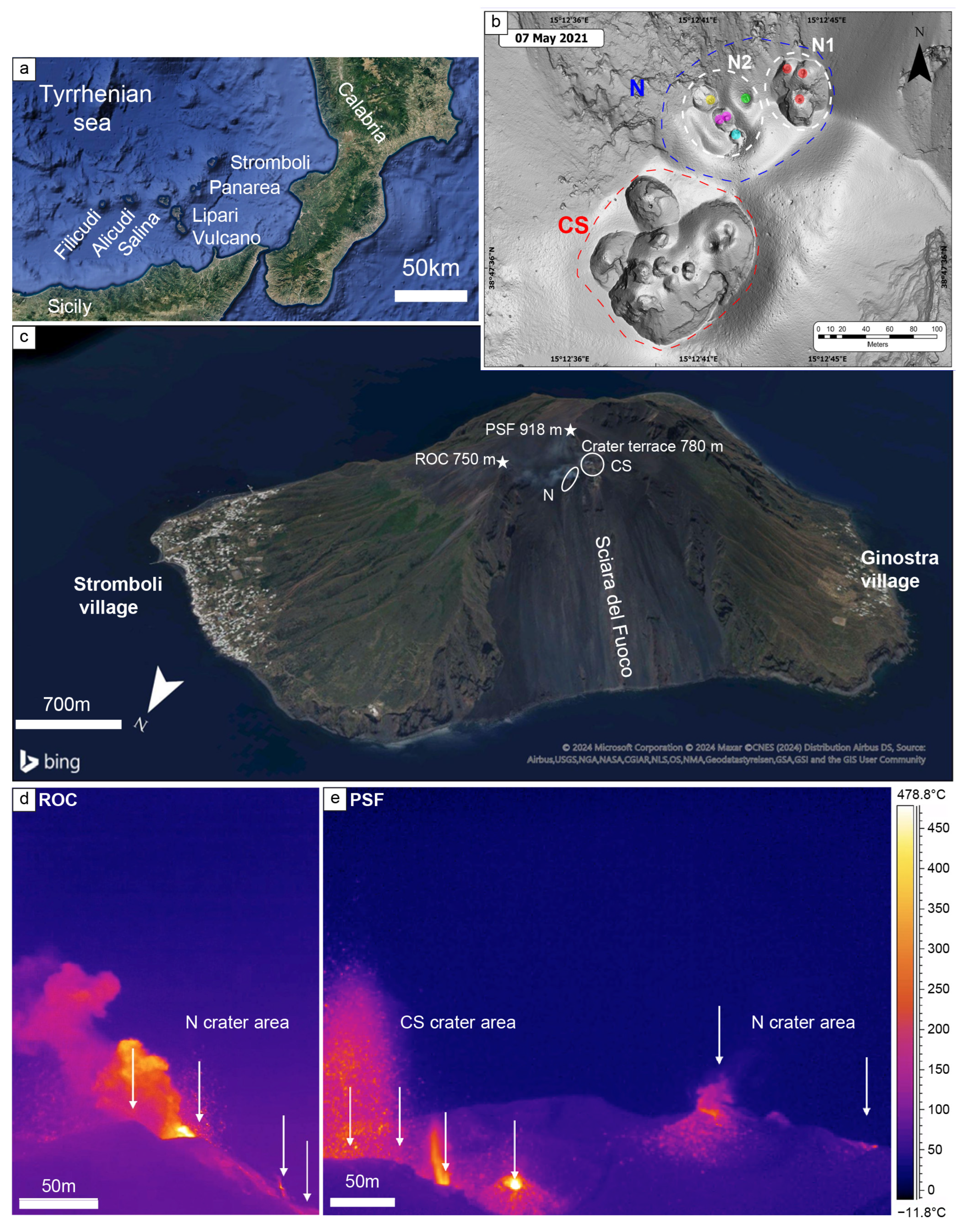
Figure 1. (a) Location of Stromboli within the Aeolian Islands in the Tyrrhenian Sea. (b) Digital Surface Model of the crater terrace showing the CS and N crater areas, N1 and N2 craters, and their active vents (colored circles) on 7 May 2021. (c) Oblique view of Stromboli volcano highlighting key landmarks and localities, including the two observation sites for the FLIR thermal camera: Roccette (ROC) and Pizzo Sopra la Fossa (PSF). The northeast (N), central, and southwest (CS) crater areas are labeled. The Sciara del Fuoco, a steep slope to the north of the crater terrace, is also identified. (d) Thermal infrared image captured from the ROC site on 26 May 2021 at 10:09:34 GMT, showing the N crater area. (e) Thermal infrared image captured from the PSF site on 16 May 2021 at 09:19:22 GMT, displaying both the N and CS crater areas. The active vents identified in the images are marked with white arrows. Scale bars in the bottom left corner indicate the spatial scale at the vents.
Remotesensing 18 00264 g001
Figure 2. (a). Height–time kymograph generated from FLIR data (example is from 9 October 2020, 09:00 and 12:30 GMT, ROC site) showing key points used for analysis: (1) the exit time of the first pyroclast, (2) a point along the initial trajectory of the first pyroclast, (3) the maximum height of the highest projected pyroclast, and (4) the exit time of the last pyroclast. White arrows indicate the distinct volcanic products: gas, ash, and clasts. (b) Example thermal infrared image (FLIR), with colored arrows marking the locations of four identified vents. (c) Temporal distribution of explosion heights (y-pixels) across time, with each vent distinguished by corresponding colors of the arrows, and highlighted boxes.
Remotesensing 18 00264 g002
Figure 3. Examples of Strombolian-style activity types captured in kymographs (ad) and corresponding FLIR thermal images (eh). Color scales in (ad) and (eh) differ because kymographs show row-wise maximum temperatures after background subtraction; in both, brighter colors indicate hotter clasts and gas jets, darker colors the cooler background. Type 1 (a,e): Ballistic-dominated explosions with well-defined parabolic trajectories and absent/faint ash plume. Type 2a (b,f): Explosions ejecting bombs and thick ash plumes, where ballistic trajectories are overlaid with a prominent ash signal. Type 2b (c,g): Ash-dominated explosions with minimal or no ballistic ejection, showing positively ascending, gently inclined stripes associated with ash clouds. Type 0 (d,h): Gas jet explosions with sharp vertical anomalies and rapid dissipation. Lower anomalies in (d) represent puffing/spattering events.
Remotesensing 18 00264 g003
Figure 4. Comparison of explosion parameters at Stromboli during May 2021 pre-collapse (10, 13 and 16, red diamonds), and May 2021 post-collapse (25, 26 yellow circles). For comparison, analyzed data from October 2020 are also reported (8, 9, 10 and 11 blue stars). The main panels display scatterplots of (a) bomb elevation hexpl (m), against explosion duration dexpl (s), (b) bomb speed vexpl (m/s), and (c) explosion inter-event time dt (s), illustrating the variability in eruption dynamics across the datasets. The central mark of each box represents the median, while the bottom and top edges indicate the 25th and 75th percentiles, respectively. The whiskers extend to data points within 1.5 times the interquartile range, and any points beyond this range are shown as circles.
Remotesensing 18 00264 g004
Figure 5. Temporal evolution of explosion parameters at Stromboli’s North (N, blue) and Central-South (CS, red) crater areas during May 2021. The vertical red dashed line marks the 19 May 2021 collapse. NB (North crater area) and CSB (Central–South crater area) refer to mean hourly explosion frequencies data from INGV bulletins, with TOTB representing their sum. Panels show: (a) explosion frequency fexpl (events per hour), (b) spattering/puffing frequency fspatt (events per minute), (c) explosion duration dexpl (s), (d) bomb elevation hexpl (m), (e) bomb speed vexpl (m/s), and (f) explosion type (type 1, type 2a, type 2b, or type 0). Data from CS were unavailable on 13 and 25 May, due to camera position at ROC. For the statistical definition of the boxes, whiskers, and outlier circles see Figure 4 caption.
Remotesensing 18 00264 g005
Figure 6. Temporal evolution of active vents in Stromboli’s North crater area during May 2021. (ac) Thermal infrared images showing vent activity on 10, 16, and 26 May 2021, with labels indicating the main active vents (N1a, N2a–d, N2c). (dh) Digital Surface Models from UAS surveys between 7 and 27 May 2021, illustrating the spatial distribution (colored circles) and persistence (white stars) of active vents/sub-vents within the N1 and N2 craters. Dashed white lines mark the crater rims. Note the progressive shift and reorganization of vents in N2 following the 19 May 2021 collapse, and the decline of N1 activity. Dashed colored outlines in (h) indicate the pre-collapse (7–10 May) vent positions. (i) DSM of the crater area acquired on 12 October 2021, showing the reformation of the N1 and N2 craters in positions consistent with their pre-collapse morphology. (j) Variations in mean vent diameter and number of active vents/sub-vents derived from UAS imagery.
Remotesensing 18 00264 g006
Figure 7. Temporal evolution of explosive activity at craters N1 and N2 (each comprising multiple vents; see Figure 6) around the 19 May 2021 crater collapse event (red dashed line). (ad) Boxplots of explosion duration (dexpl), bomb elevation (hexpl), bomb speed (vexpl), and explosion frequency (fexpl) from thermal camera data collected on 10, 16, and 26 May 2021. (eg) Distribution of explosion types (0, 1, 2a, 2b) on 10, 16, and 26 May 2021. For the statistical definition of the boxes, whiskers, and outlier circles see Figure 4 caption.
Remotesensing 18 00264 g007
Figure 8. (a) Elevation difference map of the N crater area showing changes between the elevation models of 8 and 26–27 May 2021 (Figure 6). The color scale indicates elevation differences in meters, with blue/purple colours representing areas of material loss and red colours showing areas of material accumulation. Colored circles indicate the pre-collapse positions of identified vents in the N1 and N2 craters (marked by dashed white circles). Cross-sections of the N crater area before and after the collapse of 19 May 2021 along profiles (b) A-A″ and (c) B-B′ marked in panel (a).
Remotesensing 18 00264 g008
Table 1. List of FLIR thermal recordings analyzed in this study, showing recording start (ti) and end (tf) times, respectively, observation point (OP), camera-target distance (SD, m), lens focal length (f, mm), camera tilt angle (θ, °), pixel size (psize, m, Equation (3)), and the estimated maximum error (%) for the conversion into meters, vertical field of view (VFOV, m), image acquisition frequency (Fr, Hz), and number of explosions analyzed (No. Expl.). When two values are shown, they refer to the CS and N crater areas, respectively separated by the | symbol.
DayTime
(titf)
OPCam. Setup
(SD/f/θ/psize)
Max. ErrorVFOV (m)Fr (Hz)No. Expl.
08/10/202013:06:07–14:03:28ROC387/13/0/0.5<2%323.95011
09/10/2020 (1)09:25:46–12:21:22ROC387/24/0/0.3<2%175.45044
09/10/2020 (2)12:23:40–13:15:46ROC387/41/0/0.2<2%102.75010
09/10/2020 (3)13:19:40–14:15:10ROC387/41/0/0.2<2%102.7509
10/10/202010:02:55–13:46:04ROC387/41/0/0.2<2%102.75017
11/10/202008:55:38–11:31:17ROC387/41/0/0.2<2%102.45022
10/05/202110:04:59–12:36:03PSF248|302/13/20/0.3|0.4<7%165.7|201.72544
13/05/202109:46:51–10:41:00ROC417/41/0/0.2<2%83.05010
16/05/202108:56:32–10:37:31PSF248|302/13/20/0.3|0.4<7%165.7|201.75046
25/05/202117:40:30–18:32:18ROC415/41/0/0.2<2%82.65011
26/05/2021
(1)
08:33:42–11:22:11ROC415/24/0/0.3<2%188.15040
26/05/2021
(2)
12:13:54–13:24:32PSF248|302/13/20/0.4|0.4<7%165.7|201.75029
Table 2. Details of the UAS surveys.
DateUASNo. DSM Images
(Total)
Flight PathDSMs Res. (cm/pix)Orto Res. (cm/pix)Camera Location Tot. Error (cm)
7 May 20211 */2/31064 (3013)Predefined11.3101.5
8 May 20211 */2/3847 (1120)Predefined10.9101.2
9 May 20212 */395 (311)Manual4.810110
10 May 20212/3 *103 (103)Manual5.11094
26 May 20213 *,°269 (1017) Manual11.210910
27 May 20213 *,°74 (192)Manual
* UAS used for DSM/orthophoto reconstruction. The numbers indicate the UAS model: (1) DJI Phantom 4 RTK, (2) DJI Mavic 2 Pro, (3) DJI Mini 2 (DJI, Shenzhen, China). ° Surveys combined to obtain a single DSM.
Table 3. Number of explosions as a function of days and of Strombolian-type activity types, cumulative for N and CS crater areas. see Figure 5f.
DateExplosion TypesTotal
12a2b0
08/10/2020704011
09/10/202024309063
10/10/20200134017
11/10/20201435022
Total October45 (40%)46 (41%)22 (19%)0 (0%)113
10/05/20213500944
13/05/2021600410
16/05/202128180046
Total pre69 (69%)18 (18%)0 (0%)13 (13%)100
26/05/20211100011
26/05/202135295069
Total post36 (45%)39 (49%)5 (6%)0 (0%)80
Total May105 (58%)57 (32%)5 (3%)13 (7%)180
Total150 (51%)103 (35%)27 (9%)13 (5%)293
Disclaimer/Publisher’s Note: The statements, opinions and data contained in all publications are solely those of the individual author(s) and contributor(s) and not of MDPI and/or the editor(s). MDPI and/or the editor(s) disclaim responsibility for any injury to people or property resulting from any ideas, methods, instructions or products referred to in the content.