


Highlights
What are the main findings?
- Midlatitude Ionospheric disturbances showed significant longitudinal differences in North America, characterized by a prominent storm-enhanced density that formed sharp gradients of 60–65 TECU against a negative phase on its eastern side.
- Storm-time ionospheric responses exhibited substantial latitudinal variations in the European sector, with the midlatitude trough exhibiting a notable equatorward expansion down to ~35° MLAT and broadening to a latitudinal width of 20°.
What are the implications of the main findings?
- This study facilitates an in-depth understanding of ionospheric dynamics and their regionally distinct responses during geomagnetic storms.
- The huge density gradients indicate the ionosphere’s extreme spatial non-uniformity during storms, underscoring the necessity of region-specific space weather analysis and forecast.
Abstract
This study examines the spatiotemporal evolution of midlatitude ionospheric disturbances during the intense geomagnetic storm on 10–11 October 2024, focusing on the North American and European sectors. It utilizes multi-instrument datasets from ground-based observations, including Global Navigation Satellite System (GNSS) receivers and ionosondes, supplemented by the measurements from the Swarm, DMSP and GUVI/TIMED satellites. The results reveal significant longitudinal and latitudinal variations in regional ionospheric responses, specifically related to Storm Enhanced Density (SED) and the midlatitude trough. Key findings include: (a) During the main phase of the storm, the North American midlatitude ionosphere exhibited a pronounced longitudinal contrast: a positive SED-driven phase in the west versus a negative trough-dominated phase in the east. In the early recovery phase, the western sector transitioned to a trough-induced negative phase, while the eastern sector showed a positive phase related to auroral particle precipitation during substorms. (b) The North American SED featured a strong northwest-extending plume with a westward shift velocity of 200–300 m/s at 45°N, and a sharp density gradient of 60–65 TECU on its northeastern side, in contrast to the trough. (c) The European sector displayed a “sandwich-like” latitudinal pattern, with “positive–negative–positive” variations during the storm. (d) The European sector’s storm-time trough expanded rapidly equatorward, reaching a minimum of ~35° magnetic latitude (MLAT), while broadening latitudinally to a width of 18–20°. These density gradient structures, along with the longitudinal/latitudinal differences, highlight the dynamic processes occurring in the magnetosphere–ionosphere–thermosphere system during intense storms and contribute to the understanding of storm-response mechanisms across different sectors.
1. Introduction
During geomagnetic storms, intense solar wind–magnetosphere–ionosphere coupling induces significant perturbations in key ionosphere parameters, such as electron density (Ne) and total electron content (TEC), causing them to deviate substantially from their quiet-time values and manifest as ionospheric storms. Within the coupled magnetosphere–ionosphere–thermosphere system, the storm-time ionospheric response is primarily driven by three processes: (a) Electric field perturbations—initiated by a sudden southward turning of the interplanetary magnetic field (IMF), the interplanetary electric field (IEF) can rapidly penetrate through the magnetosphere to the low-latitude and equatorial ionosphere, typically during the main phase of a magnetic storm, known as the prompt penetration electric field (PPEF) [1]. Specifically, the undershielding PPEF exhibits an eastward polarity on the dayside, driving upward E × B plasma drift. This triggers the equatorial super-fountain effect and promotes the poleward expansion of equatorial ionization anomaly (EIA) crests. By lifting the ionosphere to higher altitudes, where the recombination rate is slower, this process creates favorable conditions for the formation of a positive ionospheric storm at mid-to-low latitudes, typically during the main phase of a storm [2,3]. Additionally, the overshielding electric field may become dominant when a sudden northward turn of the IMF leads to a rapid reduction in magnetospheric convection. On the other hand, the disturbance dynamo electric field (DDEF) is generated by a dynamo process, driven by altered global neutral wind circulation patterns resulting from enhanced Joule and auroral heating in the polar regions during a geomagnetic storm. The DDEF typically develops several hours after the onset of a geomagnetic storm, but its effects can persist for hours to days [4]. Its zonal polarity is opposite to that of the PPEF, with a westward component on the dayside and an eastward component on the nightside at the mid-to-low latitudes [5]. These storm-time electric fields modify the plasma drift through electrodynamics, leading to significant spatiotemporal variations and positive-negative phase changes in the ionosphere. (b) Disturbed thermospheric neutral winds—during a geomagnetic storm, energy deposited in the upper atmosphere induces strong Joule and auroral heating at high latitudes [6,7], creating a pressure gradient with high pressure in the polar and auroral regions and low pressure at mid-to-low latitudes. This pressure gradient drives equatorward neutral wind surges, which drag plasma along magnetic field lines to higher altitudes with lower recombination loss, thus contributing to the formation of a positive ionospheric storm phase [8]. (c) Thermospheric composition changes—polar heating and expansion induce upwelling of the neutral atmosphere across isobaric surfaces, forming a composition disturbance zone characterized by a reduced O/N2 ratio [9]. This composition disturbance zone is advected to mid-to-low latitudes by equatorward neutral winds, generating large-scale negative-phase storms, often during the late stages of a geomagnetic storm [10,11]. Overall, the ionospheric storm-time response is a complex and dynamic phenomenon, arising from the interaction of various mechanisms with notable dependencies on latitude, longitude, local time, and season [12].
The midlatitude ionosphere is a crucial region where dynamic processes are significantly altered during storms, reflecting the complex interaction of various driving factors. On the equatorward side of the region, the net effect of storm-time electric fields directly influences local plasma drift and the expansion or contraction of the EIA crest. The poleward side is affected by processes such as auroral particle precipitation, subauroral polarization stream (SAPS), and equatorward neutral winds surges. The interaction of these processes can lead to steep density gradients across the midlatitude ionosphere, with typical phenomena including Storm Enhanced Density (SED) and the midlatitude trough. SED primarily occurs in the subauroral ionosphere during the early phase of geomagnetic storms, manifesting as large-scale increases in Ne/TEC from the afternoon to the pre-midnight sector [13]. The characteristic signature of SED is a plume-like structure, marked by a narrow latitudinal channel with significant density enhancement, extending sunward/poleward from the high-density base region at midlatitudes towards the dayside cusp [14,15,16]. The formation of SED remains a subject of debate, with several dynamic mechanisms proposed, including enhanced E × B drift driven by PPEF and convection expansion [17,18], plasma uplifting due to storm-time equatorward neutral winds [3], and zonal flux transport and O/N2 enhancement associated with SAPS [19,20]. For example, the snowplow effect model, proposed by Foster (1993) [13], suggests that expanded convection cells continually encounter newly produced plasma at their equatorward edge, generating a latitudinally narrow region of SED and transporting it sunward/poleward along convection trajectories to form the distinctive plume-like feature. In contrast to the density enhancement in SED, the midlatitude trough is a zonal band of plasma depletion that coincides with the plasmapause boundary in the subauroral ionosphere. The midlatitude trough exhibits a well-defined morphology at night, with a latitudinal width of several degrees and a wide zonal extension spanning multiple local time hours. During geomagnetic storms, the trough shifts equatorward, accompanied by an increase in both its depth and width as geomagnetic activity intensifies [21,22]. Several mechanisms have been proposed for the formation of the trough, such as the stagnation mechanism [23,24,25], increased recombination due to enhanced ion temperature [26], and field-aligned plasma upflow [27]. The sharp density gradient associated with SED and the large-scale depletion in the trough can severely degrade navigation and communication systems [28], highlighting the need for further detailed investigations.
Due to the ionosphere’s electromagnetic coupling with the solar wind-magnetosphere and its collisional coupling with the thermosphere, its storm-time responses are complex, exhibiting pronounced latitudinal/longitudinal dependencies along with significant spatial variability [29,30]. Studies on longitudinal variations reveal considerable discrepancies in ionospheric responses across different sectors [31,32]. For instance, Codrescu (1997) [33] observed that ionospheric responses very significantly across longitudinal sectors, primarily due to differences in local time and storm phases. Furthermore, the relative importance of driving factors can vary across different longitudinal and latitudinal sectors. For example, the offset and tilt of the geomagnetic dipole result in a longitude-dependent competitive relationship among solar radiation, electric fields, and neutral winds [34]. This indicates that the ionosphere’s response to a geomagnetic storm is not uniform and may exhibit highly heterogeneous activity across different longitudes. Moreover, distinct spatial gradients from high-to-low latitudes are driven by latitudinal variations in energy input intensity, electric field penetration efficiency, and the propagation of compositional disturbance across different latitudinal regions [1,35]. Among these regions, the midlatitude and subauroral ionosphere display particularly prominent spatial gradients due to complex dynamic and electrodynamical processes, with SED and the trough being notable density gradient structures in this region.
An intense geomagnetic storm on 10–11 October 2024, with a minimum Dst index of −335 nT, is classified as the second most severe geomagnetic storm event in nearly two decades, surpassed only by the May 2024 super geomagnetic storm. Recent studies of this event have begun documenting its significant impacts on the ionosphere, including effects on the global ionosphere [36], the occurrence of super equatorial plasma bubbles and strong longitudinal variability [37,38], and regional ionospheric variation across Europe [39]. To further explore ionospheric responses in the midlatitude and subauroral regions during this intense storm, this study conducts a multi-instrument analysis of storm-time midlatitude ionospheric disturbances and density gradient structures, focusing on the longitudinal and latitudinal variations of SED and the trough. The results reveal that the midlatitude ionosphere exhibited the following characteristics during the main phase of this geomagnetic storm: (a) The North American sector displayed significant longitudinal discrepancies and density gradients, with a positive phase in the western part marked by a pronounced SED structure and a negative phase to its northeastern characterized by the midlatitude trough. The TEC gradients near the boundary of SED and trough reached as high as 60–65 TEC unit (TECU). (b) In the European sector, influenced simultaneously by auroral precipitation and electrodynamics, a distinct latitudinal pattern with a “positive–negative–positive” configuration was observed during the main phase of this storm. The midlatitude trough in European sector exhibited a rapid equatorward expansion and significant broadening, extending down to ~35o MLAT and expanding to a latitudinal width of nearly 20°.
2. Instruments and Data Sets
The GNSS-TEC is routinely produced by the Massachusetts Institute of Technology’s Haystack Observatory (http://cedar.openmadrigal.org/ (accessed on 1 December 2025)). It is calculated using a dense network of over 6000 GNSS receivers worldwide, and the gridded vertical TEC products are made available to the scientific community with a spatial resolution of 1° (longitude) by 1° (latitude) and a time cadence of 5 min [40,41]. The F2-layer peak height (hmF2) and critical frequency (foF2) are key parameters in ionospheric research, serving as crucial indicators of the ionospheric state. In this study, we examined temporal variations in hmF2 and foF2 data from selected ionosonde stations in the North American and European regions. The ionosonde data were available through the DID Base of Global Ionosphere Radio Observatory (https://giro.uml.edu/didbase/scaled.php (accessed on 1 December 2025)). Ionosonde stations within the region of interest were selected based on their geomagnetic distribution and data continuity. This selection strategy aimed to enhance the spatiotemporal coverage and statistical reliability of ionospheric characteristics in the region.
Additionally, the European Space Agency’s Swarm constellation comprises three identical polar-orbiting satellites (A, B, and C) with an orbital inclination of approximately 88° (https://swarm-diss.eo.esa.int/ (accessed on 1 December 2025)). Swarm A and C operate in a side-by-side configuration at an altitude of about 450 km, separated longitudinally by 1.4°. Swarm-B orbits at a higher altitude of approximately 510 km [42]. Each satellite is equipped with two Langmuir Probe measurements that provide in situ Ne-data. This study utilizes Level 1B in situ Ne data from Swarm satellites, with a 2 Hz sampling rate, to analyze storm-time electron density variations in the specific region. Furthermore, thermospheric composition variations over the European longitudinal sector during the recovery phase are analyzed using the [O]/[N2] data retrieved by the Global Ultraviolet Imager (GUVI) onboard the TIMED satellite (http://guvitimed.jhuapl.edu/ (accessed on 1 December 2025)). In this study, in situ ion density and cross-track drift data observed by the SSIES (Top-side Ionospheric Plasma Monitor) instrument onboard the DMSP F17 satellite are also used to analyze plasma transport processes and the state of the topside ionosphere during geomagnetic storms (http://cedar.openmadrigal.org/ (accessed on 1 December 2025)). Solar wind, interplanetary conditions and geomagnetic indices are analyzed using data from the OMNI database [43] (https://cdaweb.gsfc.nasa.gov/ (accessed on 1 December 2025)).
3. Results
3.1. Interplanetary and Geomagnetic Conditions
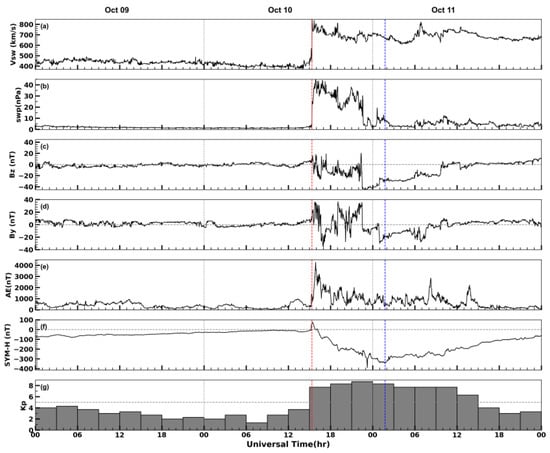
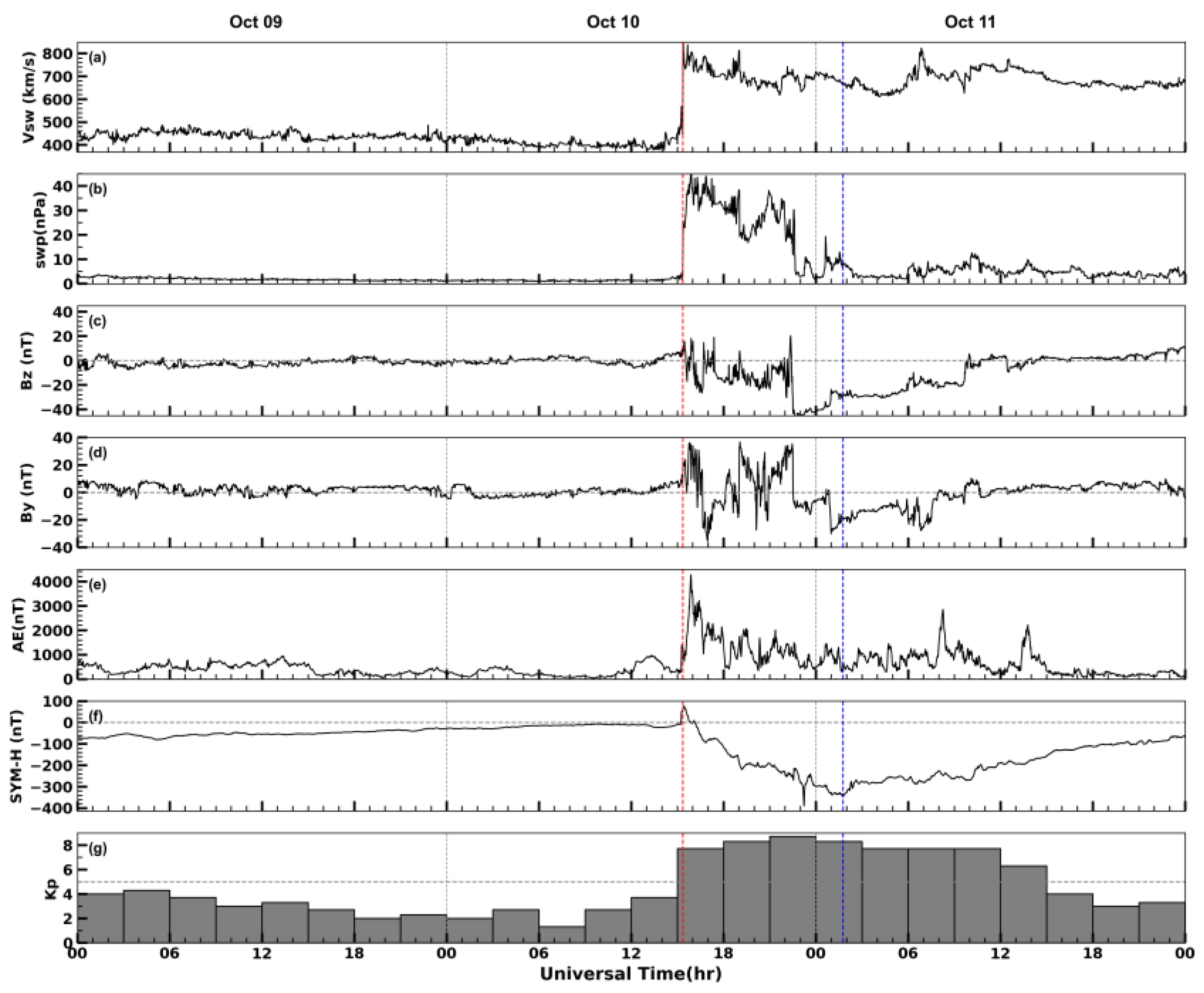
The October 2024 geomagnetic storm was caused by an X-class solar flare generated from Active Region AR3848 [38], which occurred on 9 October and was followed by a full-halo coronal mass ejection (CME) detected by SOHO/LASCO. This CME propagated through interplanetary space and reached Earth around 15:00 universal time (UT) on 10 October 2024, exhibiting an average velocity of approximately 1200 km/s. Figure 1 illustrates the temporal variation of interplanetary parameters and geomagnetic indices during 9–11 October 2024. The geomagnetic conditions were relatively quiet on 9 October, with both solar wind speed and dynamic pressure remaining at low levels. The AE index showed no significant fluctuations, the SYM-H index remained below −100 nT, and the Kp index stayed within the range of 2–4, indicating minor geomagnetic perturbation. The Storm Sudden Commencement (SSC) of the storm, marked by a red dashed line in Figure 1 (15:14 UT on 10 October), was caused by the rapid compression of the magnetosphere due to impulsive increase in dynamic pressure associated with the CME shock. At 15:14 UT on 10 October, following the CME shock, the solar wind speed rapidly increased from 400–500 km/s to 700–800 km/s, maintaining this elevated level for approximately 36 h (Figure 1a). Solar wind dynamic pressure increased sharply from a quiet level of 0–5 nPa to a high value of approximately 45 nPa, remaining above 20 nPa for nearly 8 h (Figure 1b). Following the shock’s arrival, the interplanetary magnetic field (IMF) Bz exhibited intense fluctuations in the sheath. As the magnetic cloud moved in, IMF Bz plunged sharply from 20 nT to around −45 nT between 22:20 UT and 22:45 UT on 10 October, remaining strongly negative below −20 nT until 10:00 UT on 11 October (Figure 1c). Similarly, IMF By displayed significant fluctuations after 15:14 UT on 10 October (Figure 1d). Regarding geomagnetic indices, the longitudinally symmetric H-component (SYM-H) index spiked to around 80 nT at the time of SSC, indicating intensification of the magnetopause current. This was followed by a sharp decrease in the SYM-H index, indicating the onset of the storm’s main phase. The SYM-H reached a minimum value of −346 nT at 01:46 UT on 11 October, with an instantaneous spike of around −390 nT at 23:14 UT on 10 October. It then gradually increased, signaling the start of the recovery phase (Figure 1f). The AE index exhibited frequent fluctuations and multiple spike-like enhancements over a 24 h period starting from SSC, indicating the occurrence of substorm events during the storm interval (Figure 1e). The Kp index increased to 8+ after the SSC and peaked at 9− during 21:00–24:00 UT on 10 October, as the storm intensified, reaching the level of an extreme geomagnetic storm (Figure 1g). With its intensity, this October 2024 storm was classified as the second most intense geomagnetic storm in Solar Cycle 25 to date.
Figure 1.
The parameters of the solar wind and interplanetary magnetic field (IMF), and certain geomagnetic indices during 9–11 October 2024: (a) Solar wind speed (Vsw); (b) Solar wind dynamic pressure (swp); (c) IMF Bz component; (d) IMF By component; (e) AE index; (f) Longitudinally symmetric H-component (SYM-H) index and (g) Kp index. The red dashed line represents the time of the sudden storm commencement onset at about 15:14 UT on 10 October 2024. The blue dashed line indicates the time of the SYM-H index minimum.
3.2. Storm-Time Ionospheric Responses
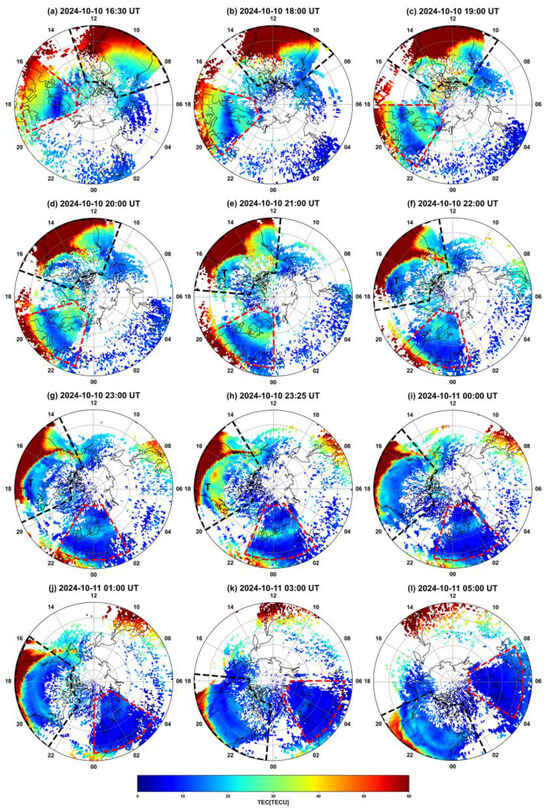
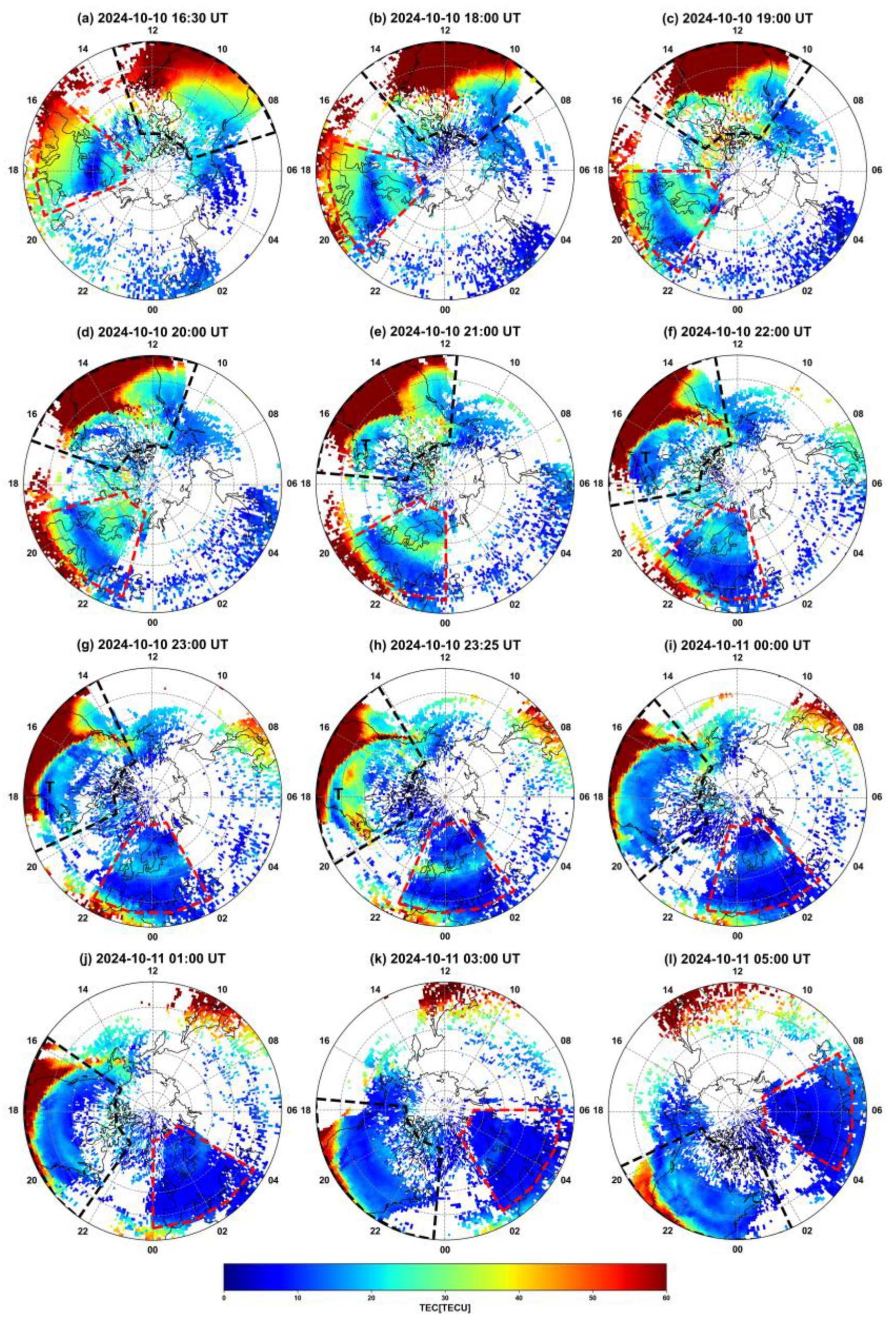
To comprehensively analyze the ionospheric responses during the main phase and early recovery phase of the geomagnetic storm, we selected the polar view of GNSS-TEC over the Northern Hemisphere (30–90° MLAT) covering the period from 16:30 UT on 10 October to 05:00 UT on 11 October 2024, as presented in Figure 2. This figure illustrates the prominent development of the SED and the trough in the subauroral ionosphere during the storm, with their dynamic evolution clearly visible. At 16:30 UT on 10 October (Figure 2a), slight TEC enhancements are observed in the dayside midlatitude and subauroral ionosphere, along with a portion of the midlatitude trough exhibiting low TEC values in the post-sunset to dusk sector (within the red dashed box in Figure 2a) at approximately 65° MLAT. From 18:00 UT to 23:00 UT on 10 October (Figure 2b–g), the North American sector was in the post-noon to dusk local time interval, where distinct SED plumes developed, with the plume intensity exceeding 60 TECU higher than the adjacent non-plume region. Driven by expanded convection and storm-time SAPS, the SED plume maintained a westward extension throughout the main phase of the geomagnetic storm, spanning from the central US to Alaska, with a longitudinal extension exceeding 70°. In the post-sunset to midnight local time interval (Figure 2e–h), a distinct zonal midlatitude trough structure appeared on the northeastern side of the SED. Under the influence of intense storm-time expansion of magnetic convection, the trough’s location showed a significant equatorward migration toward mid-to-low latitudes. The simultaneous occurrence of SED and the trough featured a longitudinal difference, characterized by a positive phase in the west and a negative phase in the east. At around 23:25 UT, a high-latitude nighttime TEC enhancement was observed in the auroral region of eastern North American (Figure 2h–l), induced by enhanced particle precipitation associated with auroral substorm activities [44,45,46]. This process contributed to the buildup of the poleward wall of the trough, partially inhibiting the intensity of the trough in the pre-midnight region due to this nighttime TEC enhancement, resulting in a storm response difference characterized by a negative phase in the west and a positive phase in the east. As local time progressed and the trough migrated toward mid-to-low latitudes, the SED feature in the North American region gradually diminished. Overall, the storm-time ionospheric response displayed clear longitudinal variation, marked by the evolution of the SED-induced TEC positive phase and the depletion region corresponding to the trough across eastern and western North America.
Figure 2.
Polar views of GNSS-TEC over the Northern Hemisphere between 16:30 UT on 10 October and 05:00 UT on 11 October 2024. This view employs the coordinates of magnetic local time (MLT) and geomagnetic latitude, the concentric dashed circles are plotted at 10° intervals. The key research areas are demarcated by dashed boxes in the figure, where the black dashed box represents the North American longitude sector (corresponding to the geographic range: 140°W–50°W, 30°N–70°N) and the red dashed box denotes the European longitude sector (corresponding to the geographic range: 15°W–45°E, 35°N–75°N). The label “T” in Figure 2e–h denotes the TEC depletion region induced by the observed midlatitude trough over the North American sector.
Additionally, the subauroral ionospheric response within the European longitude sector was marked by notable latitudinal variability. Specifically, the midlatitude trough exhibited distinct morphological traits, characterized as a zonal depletion region with rapid meridional migration and considerable latitudinal extent. Based on an analysis of the ionosphere-magnetosphere coupling processes, the key characteristics of the trough in this region are as follows: (a) it migrated from mid-to-high latitudes of approximately 65° (Figure 2a) to mid-to-low-latitudes (Figure 2b–k), with its equatorward boundary extending to an unusually low latitude of ~35° MLAT, which exceeds the typical spatial extent; (b) throughout the main phase and early recovery phase of the storm, the trough’s latitudinal extent continuously expanded, reaching a maximum latitudinal extent of approximately 18–20° (Figure 2j–k).
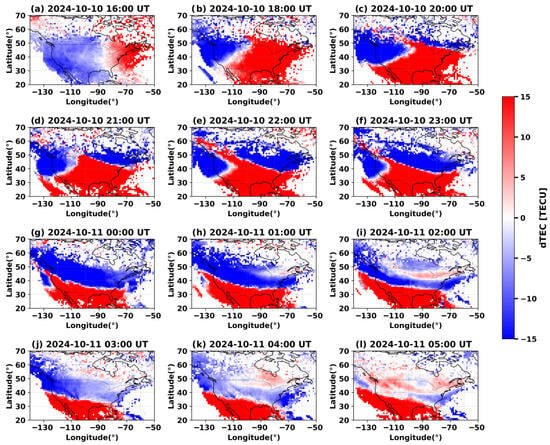
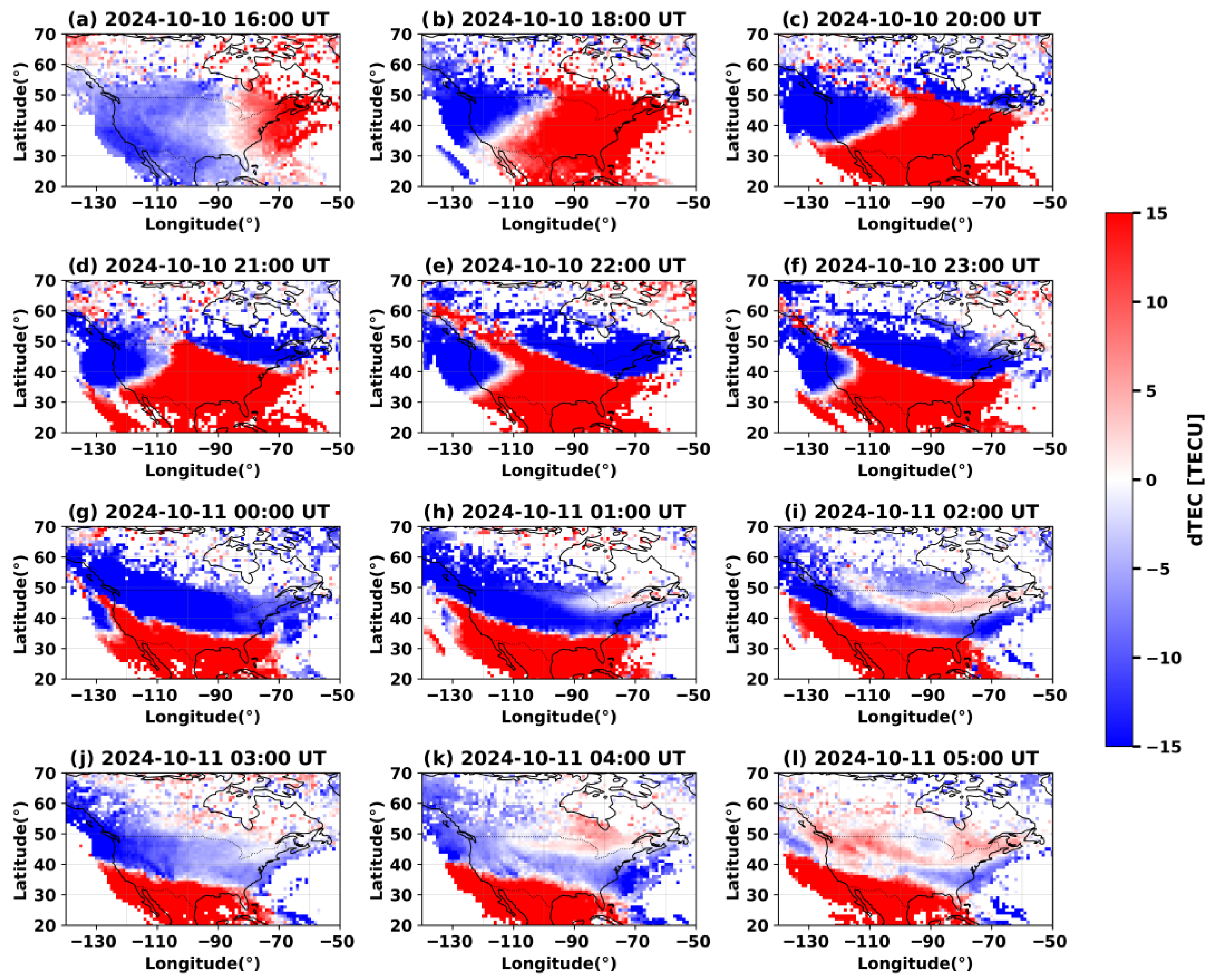
To quantify the ionospheric variations induced by the storm, Figure 3 presents the spatiotemporal evolution of storm-time differential TEC focusing on the North American longitude sector. The dTEC was calculated using the 5-day average of GNSS-TEC from 5 October to 9 October as the reference for the quiet period. A prominent feature of the storm was a pronounced longitudinal difference in dTEC, which resulted from the co-evolution of SED and the poleward-flank trough. At 16:00 UT on 10 October, a distinct emerged in this longitude sector: positive phases in the east and negative phases in the west. As the storm intensified (Figure 3b,c), eastern North America entered the noon-to-dusk local time window. This period saw a significant positive dTEC enhancement of 40–45 TECU at midlatitude and subauroral latitudes (around 40–65°N). Notably, an SED plume structure was observed, with its equatorward side connected to the EIA crest and a steep density gradient (60–65 TECU) on its poleward side. From 21:00 UT to 23:00 UT (Figure 3d–f), the IMF Bz sharply turned southward and dropped to −45 nT around 22:00 UT (Figure 1b). This shift enhanced the PPEF at mid-to-low latitudes and subauroral ionosphere. At 120°W, the corresponding magnetic local time (MLT) was approximately 13–15 MLT. During this period, the PPEF exhibited a daytime eastward polarity, promoting vertical plasma drift and uplifting of the ionospheric F-layer. The enhanced PPEF also caused the SED plume to propagate northwestward, with a westward drift velocity of 200–300 m/s at 45°N. The spatial extent of this drift covered the subauroral to high-latitude regions of western North America. To quantify this drift, the easternmost boundary of the plume at 45°N was defined and tracked as an observational marker. Its drift velocity was calculated as v = Δs/Δt, where Δs is the longitudinal displacement of this marker between consecutive observations, and Δt is the fixed time interval of 1 h used throughout the analysis. Concurrent to the sub-corotation of SED, eastern North America transitioned into a negative storm phase in the post-sunset-to-midnight sector that characterized by the TEC depletion related to the trough and composition changes. The trough, positioned poleward of the SED plume, exhibited well-defined morphological features that progressively migrated equatorward toward mid-to-low latitudes as magnetospheric convection intensified. This depletion was further influenced by the equatorward expansion of the composition disturbance zone, linked to reduced O/N2 ratios. The longitudinal difference was evident as a plume-like TEC enhancement in the west, driven by SED, and a TEC depletion band in the east and poleward side of SED, formed by the trough. The TEC gradients between the SED plume and its poleward depletion reached up to 60–65 TECU. Between 23:00 UT on 10 October and 01:00 UT on 11 October (Figure 3f–h), TEC enhancement was predominantly observed in the subauroral region of western North America. As the SED shifted westward, the northwestward-extending plume-like TEC enhancement rotated out of the North American observational coverage. In combination with Figure 2, a subsequent auroral substorm, occurring around 23:25 UT, triggered a nighttime TEC enhancement in the auroral region of eastern North America. This auroral-related positive TEC phase continued to expand for several hours. Meanwhile, the TEC depletion within trough in east was affected by this auroral event, showing a reduction in depth and narrowing in width. The longitudinal difference evolved into a contrast between the SED and trough in the west and the nighttime TEC enhancement in the east. After 01:00 UT on 11 October, as the SYM-H index began to increase, the geomagnetic storm entered the recovery phase. The large-scale TEC enhancement in eastern North America, induced by auroral substorms, continued to expand, while the SED signature gradually diminished and rotated out of the region. As areas from east to west transitioned into the midnight period, the distinct longitudinal difference was characterized by a “positive phase in the east and negative phase in the west”. After 04:00 UT on 11 October, the combination of the nighttime westward DDEF and the expansion of the composition disturbance zone caused the TEC positive phase to contract toward lower latitudes. Eventually, the longitudinal difference in the ionosphere within this sector diminished.
Figure 3.
Spatiotemporal distributions of differential TEC (dTEC = TECstorm − TECquiet) over the North American region from 16:00 UT on 10 October to 05:00 UT on 11 October. The dTEC was calculated using the 5-day average value of GNSS-TEC from 5 October to 9 October as the quiet-time reference (TECquiet).
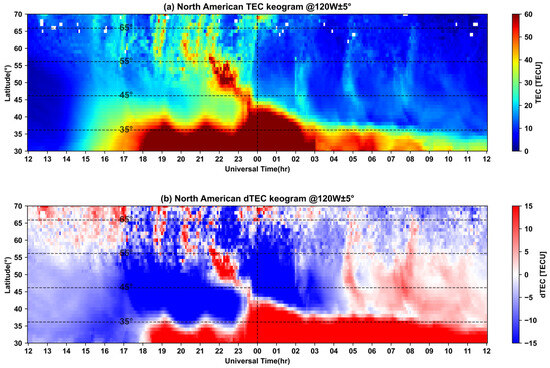
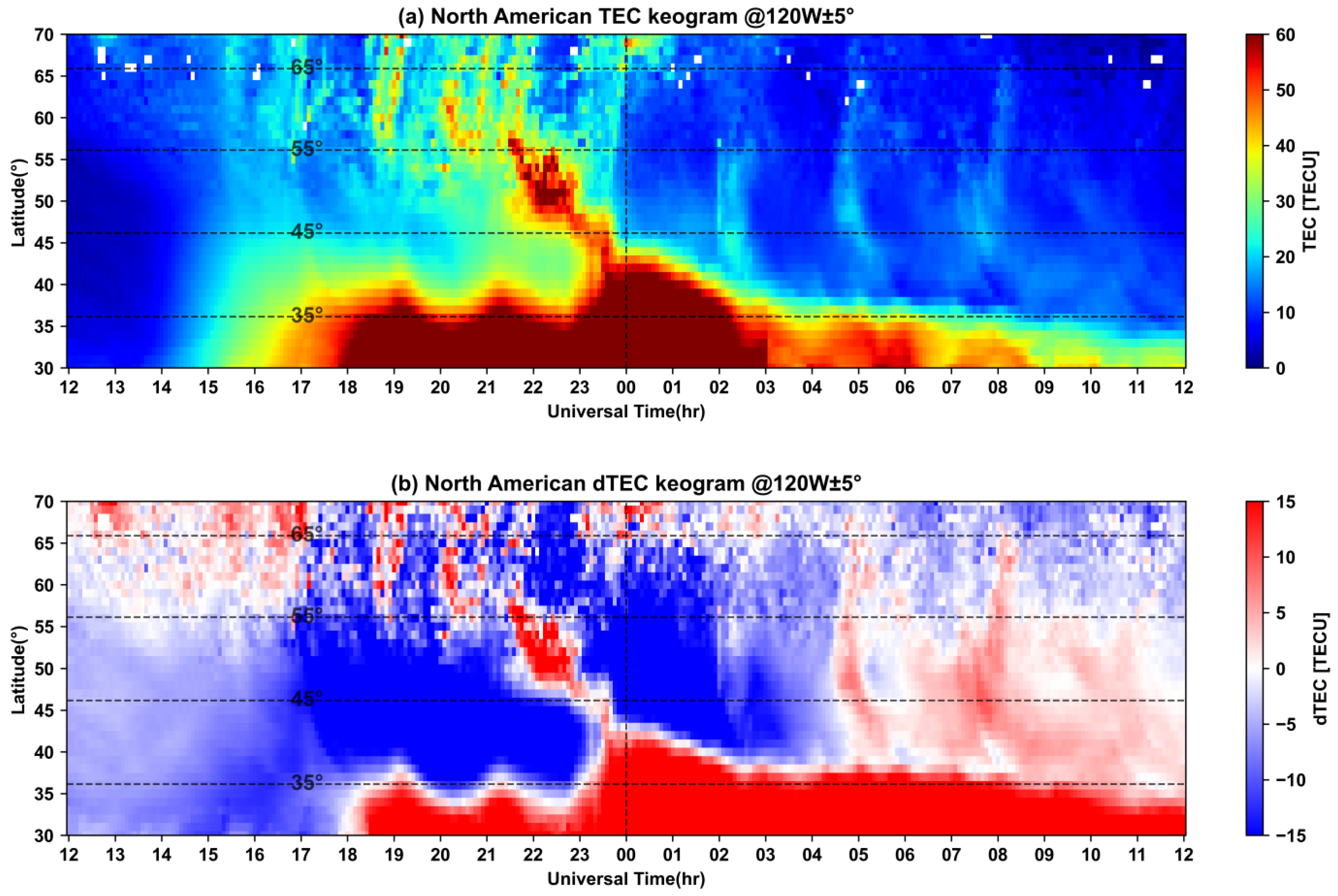
Figure 4 presents the TEC and dTEC keogram along the 120°W longitude as a function of latitude and universal time (UT). Between 22:00 and 23:00 UT on 10 October, the abrupt southward turn of the IMF Bz, coupled with the storm-time PPEF, led to the poleward expansion of the EIA crest. By this time, the poleward edge of the EIA crest reached approximately 40° MLAT forming a positive TEC anomaly in the mid-to-low latitudes. This anomaly persisted until around 04:00 UT on 11 October, providing plasma for SED development. After 04:00–06:00 UT on 11 October, corresponding to approximately 20:00–22:00 MLT, the strength of the eastward PPEF gradually diminished in response to the decreasing southward amplitude of the IMF Bz. Meanwhile, the westward DDEF remained in-tense during the early recovery phase. Collectively, the net electric field effect resulted in a contraction of the EIA crest, accompanied by a reduction in the spatial range of the TEC positive [2,8,47]. From 20:00 UT to 23:30 UT on 10 October, a significant TEC enhancement band occurred during the local dusk period and exhibited the structural characteristics of SED. Specifically, the SED was manifested as a strong TEC enhancement channel that extended to subauroral ionosphere (55–60° MLAT) at this longitude, while its base region connected with the TEC positive formed by the poleward edge of the EIA. A steep density gradient was observed on both the poleward and equatorward side of the SED. Coincident with the PPEF and intensifying magnetospheric convection, a TEC depletion trough appeared poleward of the SED, migrating toward mid-to-low latitudes on the eastern side of SED. Between 02:00 UT and 03:00 UT on 11 October, the SED feature transitioned into a TEC depletion region associated with the trough. At 21:00 UT on 10 October, the trough was clearly delineated at approximately 65° MLAT, and it exhibited a prominent equatorward migration during the storm’s main phase. By 04:00 UT on 11 October, the trough had reached its minimum latitudinal position at approximately 38° MLAT.
Figure 4.
TEC and dTEC keograms as a function of time and latitude along 120°W from 12:00 UT on 10 October to 12:00 UT on 11 October 2024. The geomagnetic latitude tick marks are labeled at 10° intervals.
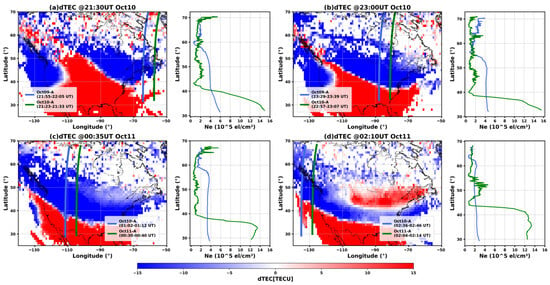
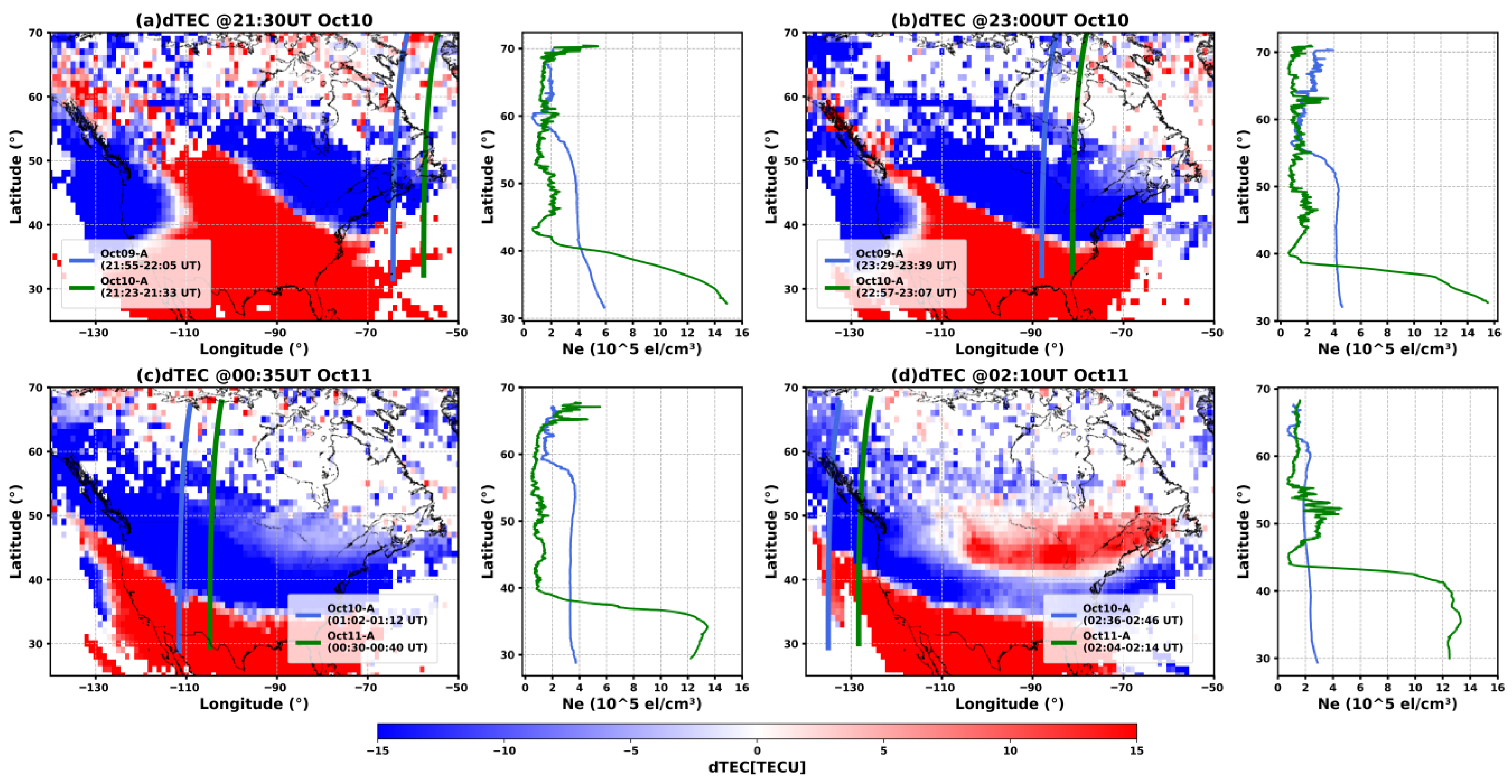
Figure 5 displays four GNSS-dTEC maps for the North American sector during 10–11 October 2024, overlaid with the trajectory of the Swarm A satellite. The corresponding 10 min variations in in situ Ne measured by Swarm A over North America are shown in the right subplot. These measurements were taken around 17:40 LT and include both geomagnetically quiet conditions (9 October) and disturbed conditions (11 October) for comparison. As the Swarm A satellite traversed North America from east to west, it provided detailed observations of the SED structure and the trough, offering critical evidence for analyzing of the longitudinal differences therein. In the dTEC maps (Figure 5a,b), a prominent SED plume was visible, originating from the high-density base in central U.S. and extending northwestward towards Alaska. During this period, the Swarm A satellite was located in the eastern part of the region. Although no SED features were detected in the in situ Ne profile, a significant Ne enhancement (200%–300% increase compared to 9 October) was observed in the high-density base region. At the poleward edge of SED base, the midlatitude trough was found to extend to approximately 40°N, whereas the quiet-time trough was located at 55°N and high latitudes. In addition, the Ne profile within the trough exhibited small-scale fluctuations, including irregularities associated with the auroral precipitation. During the late main phase of the geomagnetic storm (Figure 5c), the remnants of the SED base were detected in the Ne profile near 35°N, while the trough had shifted further equatorward, now extending below 40°N. In the early recovery phase (Figure 5d), the Ne profile revealed the presence of SED base near 40°N, characterized by a shoulder-like Ne enhancement. This SED base was connected to the high-density region of the EIA crest on its equatorial side. On its polar side, adjacent to the trough, the SED featured a sharp decrease in Ne, with the density reduced by up to 90%.
Figure 5.
(a–d) GNSS dTEC maps of the North American sector during 11 October, where dTEC is defined as dTEC = TECstorm − TECquiet, and TECquiet is calculated as the mean value of GNSS-TEC over the period from 5 October to 9 October 2024. The maps are overlaid with the orbit of Swarm A satellite (green: storm period; blue: quiet period). The subplots on the right display the corresponding in situ electron density profiles, with 9 October selected as the quiet reference day for the in-situ electron density profiles.
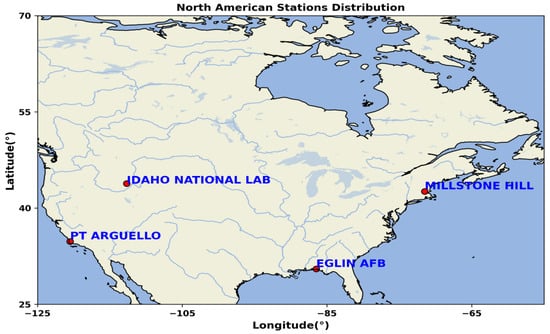
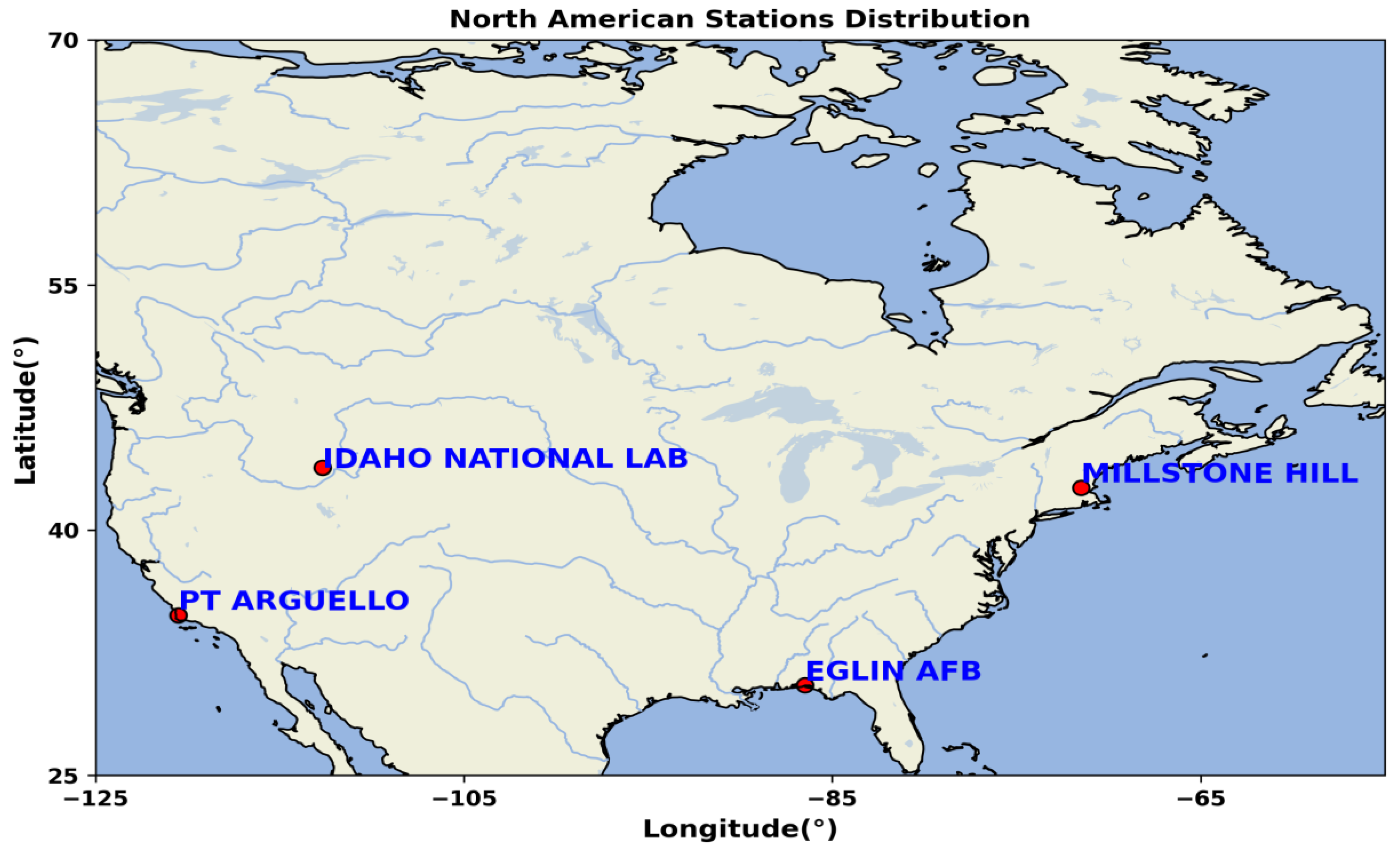
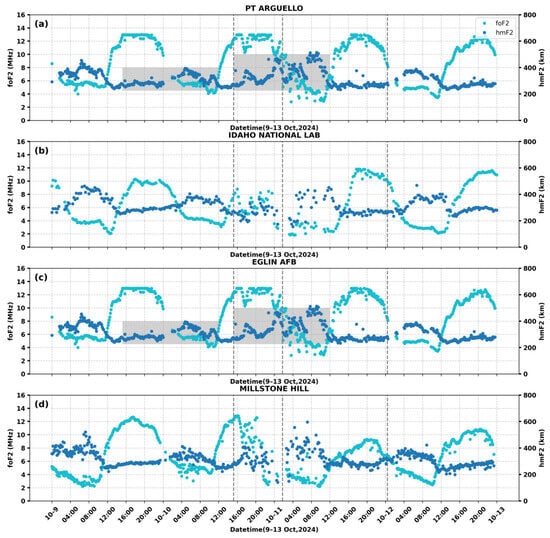
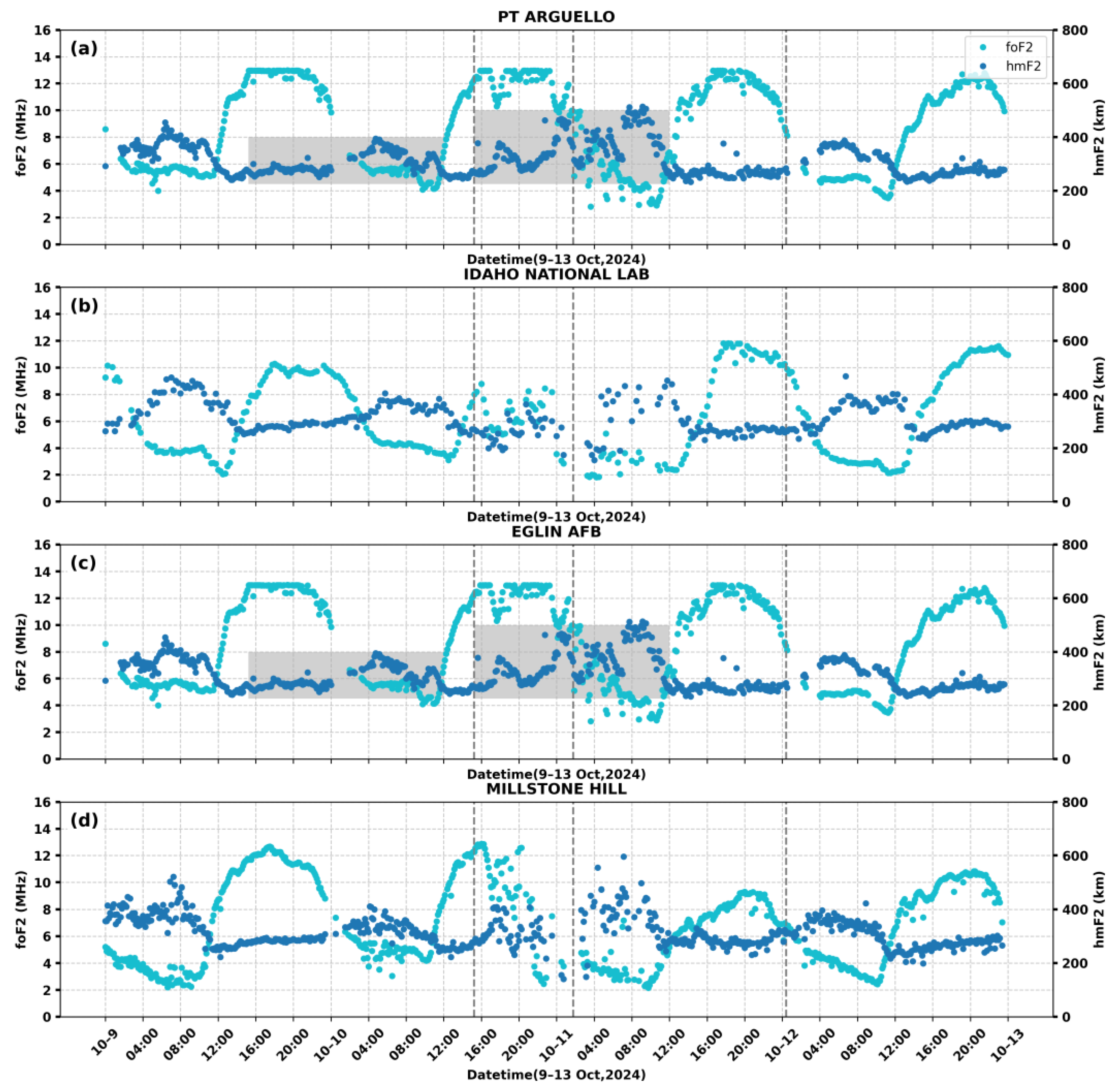
For a more systematic analysis, we analyzed the foF2 and hmF2 data from ionosonde observations across four stations in North America: Pt. Arguello (34.8°N, 120.5°W), Idaho National Lab (43.81°N, 112.68°W), Eglin AFB (30.5°N, 86.5°W), and Millstone Hill (42.6°N, 71.5°W), selected based on data availability and the need to examine longitudinal differences. The spatial distribution of these stations is presented in Figure 6, the temporal variations of their foF2 and hmF2 data from 00:00 UT on 9 October to 23:59 UT on 12 October are illustrated in Figure 7. Due to data gaps at the Idaho National Lab and Millstone Hill stations during the main phase of the geomagnetic storm, the analysis focused on Figure 7a,c. In these figures, the gray-shaded regions indicate the comparison of hmF2 variations between the storm’s main phase, early recovery phase, and the day before the storm. During both the main and early recovery phase, hmF2 showed a slight increase compared to the quiet period. At both stations, hmF2 reached a maximum uplift of approximately 200 km, potentially driven by the uplifting effects of PPEF and neutral winds. Subsequently, it gradually returned to pre-storm levels during the mid-to-late recovery phase. A prominent longitudinal difference was observed in the foF2 variations among the four stations. The western station (Figure 7a,b) experienced wavelike disturbances in foF2 during the main phase, which may be indicative of traveling ionospheric disturbances (TIDs) driven by atmospheric gravity waves. In the early recovery phase, the westernmost station, Pt. Arguello (Figure 7a), displayed a relative foF2 enhancement due to the influence of SED and its equatorial high-density base. This was followed by a decrease in foF2, likely caused by the trough. Meanwhile, the Idaho National Lab station (Figure 7b) showed an immediate decline in foF2 at the onset of the early recovery phase, driven by the trough. For the central and eastern stations (Figure 7c,d), the Eglin AFB station (Figure 7c) exhibited a decrease in foF2 during the early recovery phase, reaching a minimum at around 09:00 UT on 11 October. The Millstone Hill station (Figure 7d) showed a continuous decline in foF2 during both the early main phase and the initial early recovery phase of the storm, as this region was located poleward of the SED and dominated by the trough. Overall, during the early recovery phase, foF2 enhancement associated with the SED was observed over western North America (Figure 7a). For the stations located farther east (Figure 7b,c), the significant foF2 reduction induced by the trough occurred earlier with increasing longitude. This indicates that the northeastern flank of SED corresponds to large density gradients associated with the trough’s depletion region, which migrated to progressively lower latitudes at more easterly longitudes.
Figure 6.
The geographic locations of ionosonde stations in the North American sector utilized in this study, spanning longitudes from 125°W to 55°W and latitudes from 25°N to 70°N.
Figure 7.
Temporal variations in the critical frequency (foF2, light blue scatter) and the peak height (hmF2, dark blue scatter) of the F2-layer over multiple ionosonde stations located in North America. (a) Pt. Arguello; (b) Idaho National Lab; (c) Eglin AFB; (d) Millstone Hill. The gray vertical lines represent the SSC, the time of the SYM-H index minimum, and the time when the SYM-H index basically recovered to the pre-storm level. The gray-shaded regions in Figure 7a,c present a comparison of hmF2 between the two stations for the corresponding periods during the main phase, early recovery phase of the geomagnetic storm, and the pre-storm day (9 October).
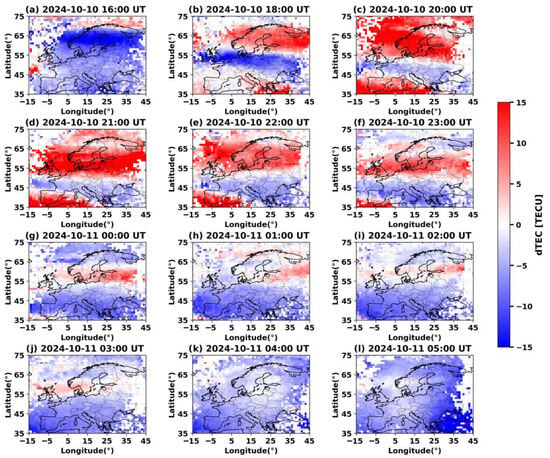
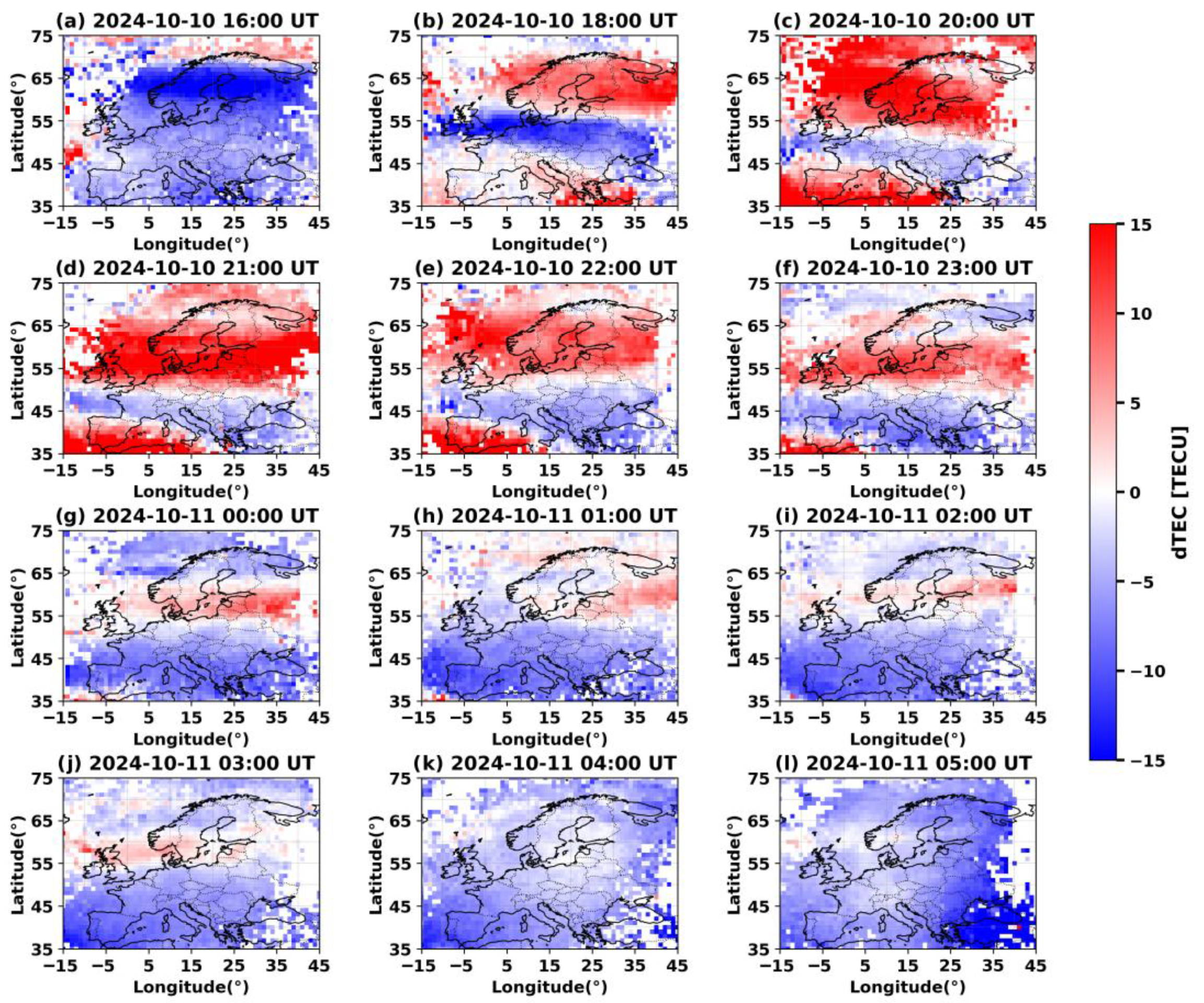
Figure 8 illustrates the spatiotemporal evolution of dTEC over the European sector during the 10–11 October 2024 geomagnetic storm, revealing considerable latitudinal differences in ionospheric TEC variation. These differences are manifested as a “sandwich-type” gradient structure, characterized by a positive–negative–positive pattern with respect to latitudes. This structure consists of three distinct regions: (a) a nightside TEC enhancement at higher latitudes, driven by substorm-induced auroral precipitation; (b) a plasma depletion region associated with the trough in the middle; (c) enhanced Ne at mid-to-low latitudes corresponding to the intense expansion of EIA crest. During the pre-midnight sector over eastern Europe (Figure 8a), the trough was clearly identifiable at 65° MLAT. As the storm progressed into its main phase (Figure 8b–g), the trough rapidly migrated equatorward, expanding in latitudinal width to a maximum of 15–20° (Figure 8g,h). The poleward edge of the trough was dominated by the nightside TEC enhancement, which was driven by auroral precipitation. This enhancement gradually moved equatorward during the storm’s main phase, leading to a decrease in the trough’s depth. In Figure 8b–h, a positive phase emerged at mid-to-low latitude, resulting from the poleward expansion of the EIA crest. However, as the eastward PPEF reversed to westward during the local time dusk-to midnight period, the equatorial fountain effect was suppressed, leading to the contraction of the EIA crests. The mid-to-low latitude positive phase was progressively eroded by the equatorward-migrating trough, the nightside westward electric field, and the composition disturbance zone, ultimately causing its eventual diminish (Figure 8i). During 05:00–09:00 UT on October 11 (Figure 8j–l), the thermospheric composition disturbance zone, marked by a reduced O/N2 ratio, expanded into the European sector, contributing to the formation of a large-scale negative storm phase during the late stage of the storm. The negative phase, associated with the disturbance zone, ultimately masked the pre-existing latitudinal differences.
Figure 8.
Spatiotemporal distributions of differential TEC (dTEC = TECstorm − TECquiet) over European region from 16:00 UT on 10 October to 09:00 UT on 11 October. The dTEC was calculated using the 5-day average value of GNSS-TEC data from 5 October to 9 October as the quiet-time reference.
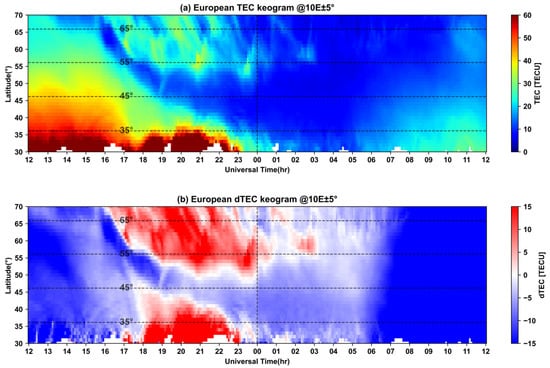
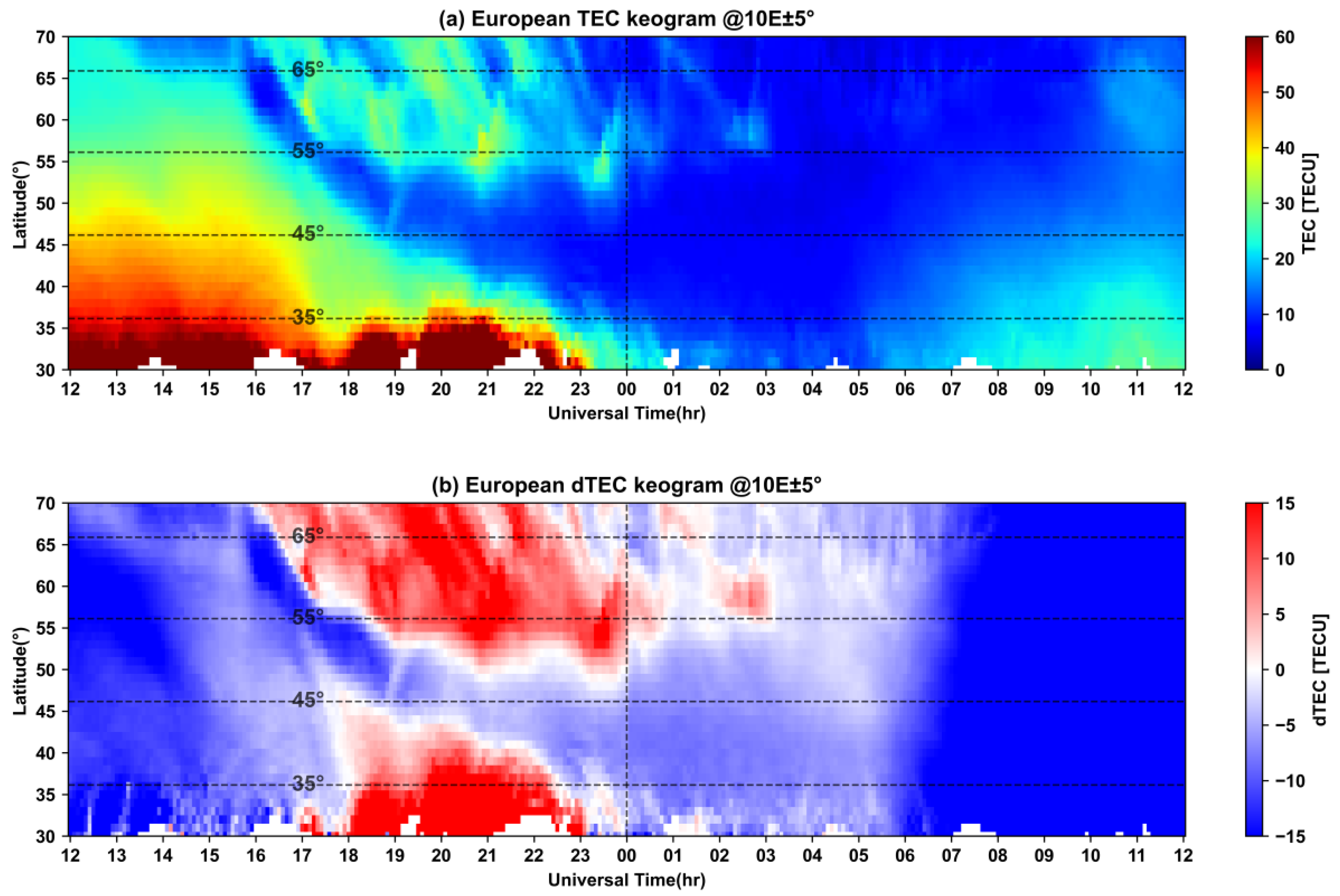
Figure 9 presents the TEC and dTEC keogram along 10°E during the main phase and recovery phase of the storm on 10–11 October 2024, clearly demonstrating the latitudinal differences and dynamic evolution of ionospheric responses. The trough first appeared at 65° MLAT around 16:00 UT on 10 October and then migrated equatorward while continuously widening. By 01:00–03:00 UT on 11 October, the trough reached its maximum width (nearly 20°) and lowest latitudes (approximately 35° MLAT). On the poleward side of the trough, the nighttime TEC enhancement persisted from post-sunset to midnight, expanding significantly toward lower latitudes during the storm’s main phase. However, the magnitude of this enhancement decreased in the recovery phase due to the thermospheric composition changes. On the equatorward side of the trough, driven by the pre-reversal enhancement (PRE) effect of the eastward PPEF, the EIA crest expanded poleward to 42° MLAT, enabling the TEC enhancement between 17:00–23:00 UT on 10 October (corresponding to a magnetic local time of approximately 17:40–23:40 MLT) [37,48,49]. As the eastward PPEF reversed to westward, combined with the equatorward migration of the trough, the positive TEC phase at mid-to-low latitudes disappeared by 01:00 UT on 11 October. Later, around 05:00 UT on 11 October, a significant negative storm induced by the composition disturbances erased the latitudinal differences.
Figure 9.
(a) TEC and (b) dTEC keograms as a function of time and latitude along 10°E from 12:00 UT on 10 October to 12:00 UT on 11 October 2024. The geomagnetic latitude tick marks are labeled at 10° intervals.
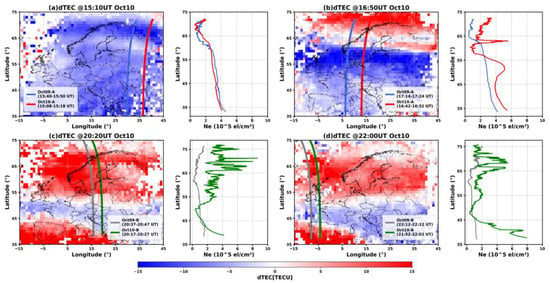
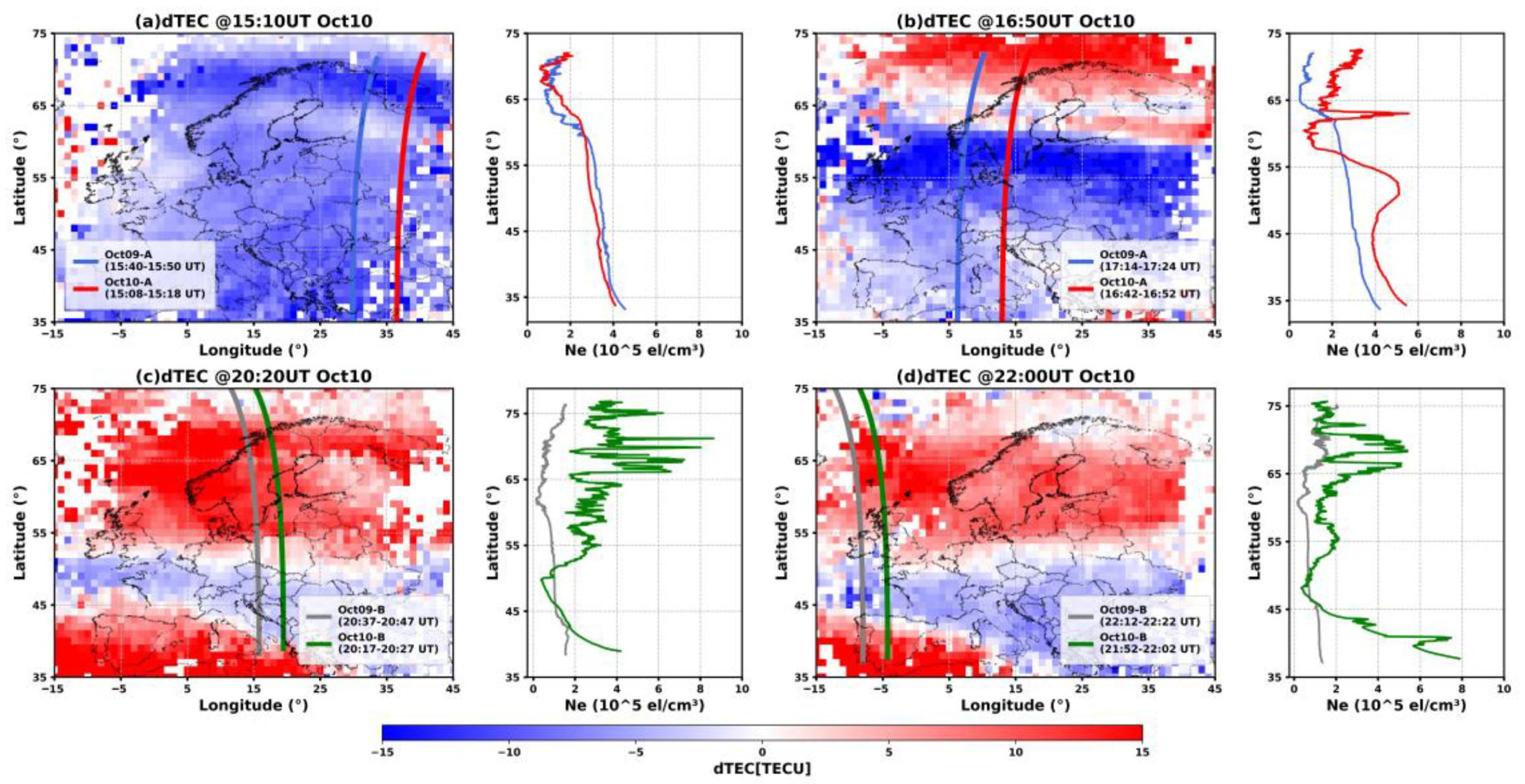
Figure 10 synthesizes the observational results from the Swarm satellites over the European sector during the main phase of the magnetic storm on 10 October 2024. The right-hand panels present a comparative analysis of the in situ Ne profiles under geomagnetically quiet and disturbed conditions. Specifically, the observation from Swarm A (Figure 10a,b) corresponds to around 17:40 LT, and those from Swarm B (Figure 10c,d) correspond to around 02:30 LT. During 15:08–15:18 UT (Figure 10a), Swarm A detected no pronounced variations in Ne, with the trough located near 65°N.
Figure 10.
GNSS dTEC maps of the European sector during 10 October, where dTEC is defined as dTEC = TECstorm − TECquiet, and TECquiet is calculated as the mean value of GNSS-TEC over the period from 5 October to 9 October 2024. The maps are overlaid with the orbit of Swarm A (red: storm period; blue: quiet period) and B (green: disturbed period; gray: quiet period) satellite. The subplots on the right display the corresponding in situ electron density profiles, with 9 October selected as the quiet reference day for the in situ electron density profiles.
As the storm progressed into the early main phase between 16:42 and 16:52 UT (Figure 10b), the Ne profile exhibited a distinct longitudinal structure characterized by enhancements at lower and higher latitudes separated by a depletion at midlatitudes. Specifically, a shoulder-like Ne enhancement appeared near 50°N, followed by a rapid decrease on its poleward side. This depletion corresponded to the trough located between 55° and 60°N, consistent with the dTEC map. In addition, a sharp Ne enhancement was observed near 62°N, indicative of intensified auroral particle precipitation. In contrast, Swarm B recorded significant Ne enhancements during 21:17–21:27 UT (Figure 10c) and 21:52–22:02 UT (Figure 10d), which were primarily driven by high-latitude auroral substorms. During both intervals, the Ne profiles exhibited strong fluctuations associated with small-scale plasma irregularities. Compared with conditions at around 16:50 UT, the trough had rapidly extended equatorward to approximately 45–50°N and widened substantially, resulting in a much broader spatial extent. Furthermore, the equatorward extension of the EIA crest was suppressed by the westward DDEF, leading to a contraction of the positive phase toward lower latitudes. These observations collectively demonstrate the pronounced latitudinal and local-time-dependent variations in the ionospheric Ne structure during the storm.
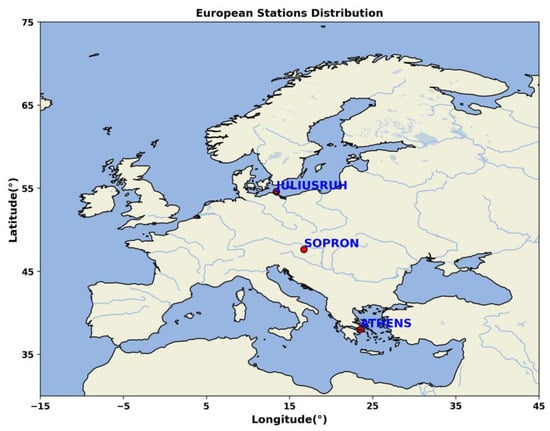
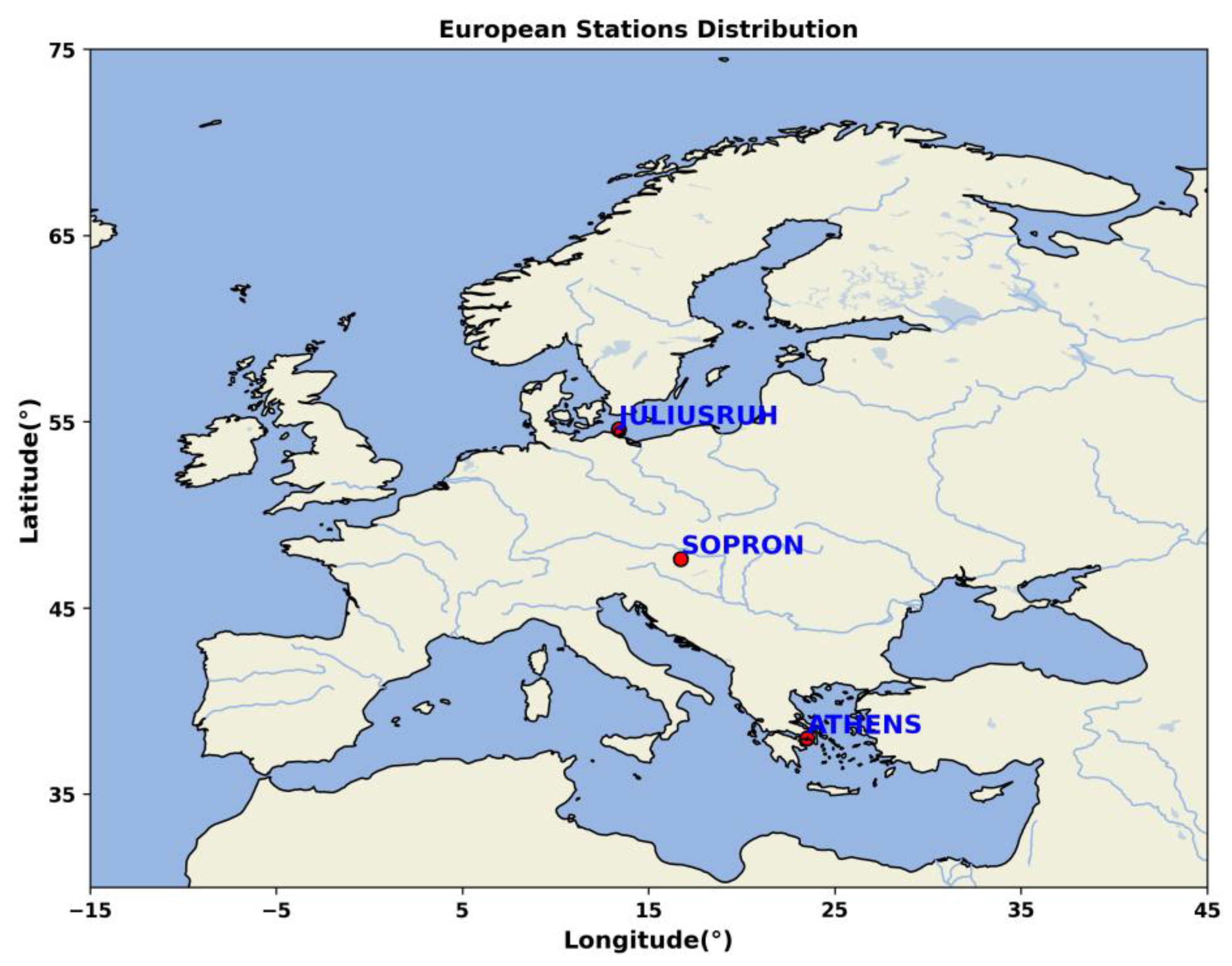
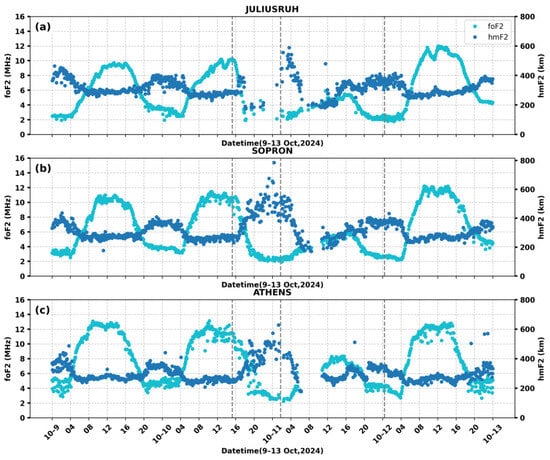
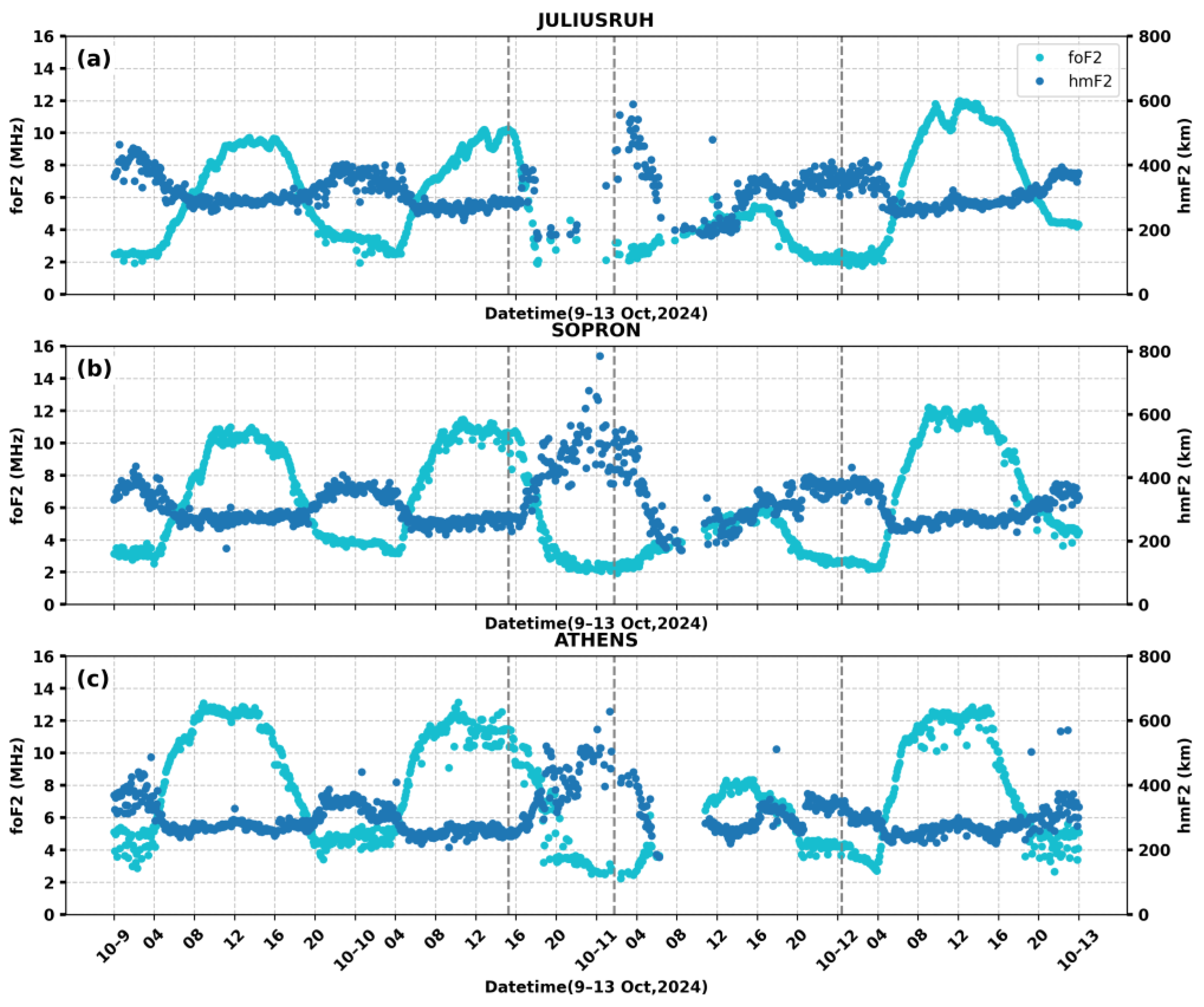
We selected European ionosonde stations for analysis by applying a geographical domain (15°W–45°E,35°N–75°N), as shown in Figure 11. To focus on latitudinal differences, we chose stations with minimal longitudinal spread but broad latitudinal coverage. However, intense ionospheric disturbances during storms often prevent ionosondes from obtaining echoes, resulting in significant data gaps, particularly at high-latitude stations. Based on this, three stations were selected for analysis: Juliusruh (54.6°N, 13.4°E), Sopron (47.63°N, 16.72°E) and Athens (38°N, 23.5°E) (Figure 11). We extracted foF2 and hmF2 parameters from 00:00 UT on 9 October to 23:59 UT on 12 October 2024, with temporal variations shown in Figure 12. The results indicated significant storm-time responses at all three stations with common characteristics: (a) Geomagnetic storms drive intense energy input into the high-latitude thermosphere, primarily through Joule heating and particle precipitation. This heating creates a pronounced pressure gradient from high to midlatitudes, which enhances equatorward neutral winds. These increased equatorward neutral winds can drag plasma upward along the magnetic field lines effectively lifting the ionospheric F-layer [8,50]. In addition, the storm-time perturbed electric fields, such as the eastward PPEF during the daytime. can drive the upward vertical E × B drift of plasma, thereby facilitating the uplift of the ionospheric F-layer [51]. As shown in Figure 12, this process manifests as a distinct increase in hmF2 throughout the storm’s main phase and early recovery phase. (b) A negative storm phase is characterized by a large-scale depletion of foF2 due to compositional disturbances in the mid-to-late recovery phase. A comparison of the stations at different latitudes revealed latitudinal differences in their foF2 behavior. During the early phase, Juliusruh (54.6°N, subauroral latitude) was affected by the equatorward-expanding trough, leading to a sharp decrease in foF2. In contrast, Athens’foF2 (38°N, low-latitude) was higher than that in the quiet period during the same phase, but decreased in the late main phase (evening of 10 October) due to the trough expansion. These observations delineate a clear latitudinal progression. In the early stage of the magnetic storm, the subauroral latitude region experienced a negative phase driven by the trough, while the low-latitude region exhibited a positive phase caused by PPEF and equatorward neutral winds. After entering the storm’s main phase, the trough rapidly migrated toward lower latitudes with an extremely large coverage area, resulting in foF2 decreases in both subauroral and mid-to-low latitudes.
Figure 11.
The geographic locations of ionosonde stations in the European sector utilized in this study, spanning longitudes from 15°W to 45°E and latitudes from 30°N to 75°N.
Figure 12.
Temporal variations in the critical frequency (foF2, light blue scatter) and the peak height (hmF2, dark blue scatter) of the F2-layer over multiple ionosonde stations located in Europe. (a) Juliusruh; (b) Sopron; (c) Athens. The gray vertical lines represent the SSC, the time of the SYM-H index minimum, and the time when the SYM-H index basically recovered to the pre-storm level.
4. Discussion
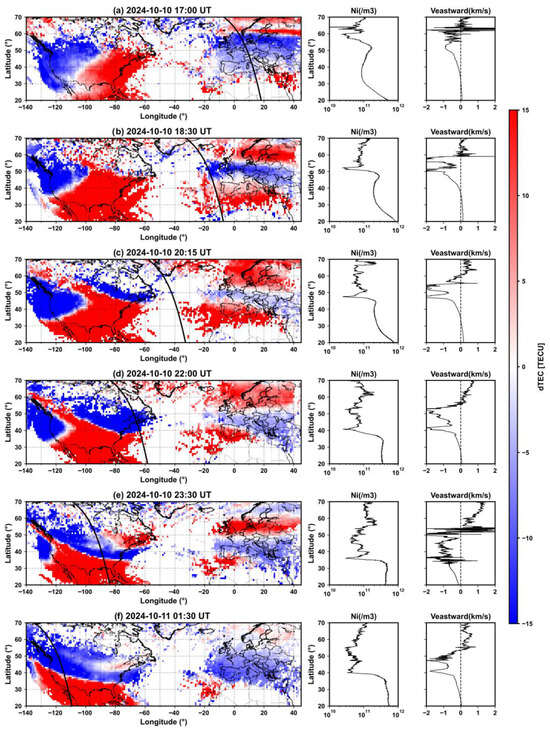
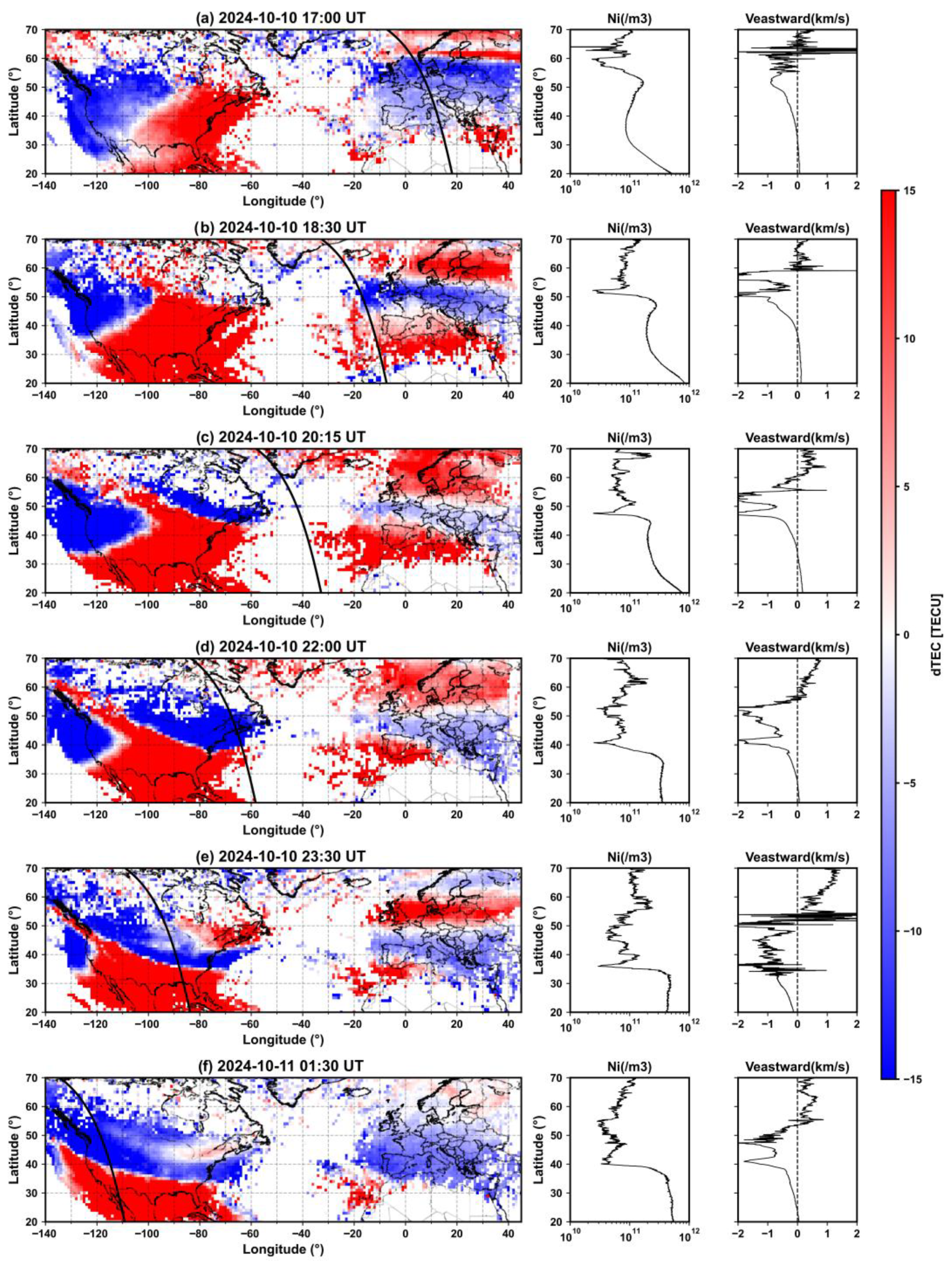
During the main and early recovery phase of the intense geomagnetic storm on 10–11 October 2024, significant TEC spatial gradients were observed in both the North American and European sectors. However, notable differences were found in their TEC spatiotemporal. Multi-instrument data analysis revealed the significant development of SED structures in North America during this storm. Due to the local time difference across North America, the western region was in the early morning while the eastern region was near local noon at SSC. As a result, the SED in North America was dominated by a high-density base region in the east and a large-scale northwestward-extending plume during the main phase. This produced a strong positive phase (around 40–45 TECU enhancement relative to the quiet time), accompanied by rapid westward extension (200–300 m/s) and broad longitudinal coverage (exceeds 70°). In the early recovery phase, eastern North America transitioned into the post-sunset–midnight period, while the western region entered the dusk period. During this stage, the western region was characterized by a prominent SED plume, primarily marked by its residual high-density base. In contrast, the eastern SED was replaced by the trough. The formation of the prominent SED in the North American sector is attributed to two main factors. First, the region progressively entered the afternoon-dusk local time window during the storm’s main phase, which is favorable for SED formation. Additionally, the occurrence of PPEF, associated with the southward turning of IMF Bz, also played a crucial role. The PPEF during the dayside and local dusk drives the upward and poleward transport of plasma [2,3]. This upward drift can lift plasma to higher-altitude regions, where recombination loss is lower and continuous solar radiation maintains ionization, leading to the progressive accumulation of Ne [52]. Combined with Figure 13e, it can be seen that during the main phase of the storm, westward plasma flows in the subauroral region (50–60°N) of the North American sector, indicating the presence of SAPS. This process could rapidly transport plasma westward within this region, which significantly contributed to the formation of the northwestward-extending plume of the SED structure. Second, the base of SED plume over North America was characterized by a higher TEC background, which provided a sufficient plasma supply. Previous studies have confirmed that this high TEC background is associated with the “close-to -dipole” geomagnetic configuration in the North American sector, where the geomagnetic latitude is approximately 10° higher than corresponding geographic latitudes [17]. This unique factor results in several key characteristics in this region: a lower geographic latitude in the magnetospheric subauroral latitude, a smaller solar zenith angle, and higher ionization efficiency of the neutral atmosphere by solar radiation. As a result, a higher background Ne is sustained compared to other longitudes. When the North American sector, containing the magnetic pole, tilts toward the dayside, these advantages are further amplified, providing an ample electron density reservoir for the initial development of SED [14,19].
Figure 13.
(a–f) GNSS dTEC maps overlapped with DMSP F17 satellite orbits at several fixed times during 10–11 October 2024. The dTEC was calculated using the quiet-time reference, defined as the average GNSS-TEC from 5–9 October 2024. The right-side sub-panels display the corresponding latitudinal profiles of ion density (Ni) and eastward ion velocity (Veastward) measured by the SSIES instrument onboard DMSP F17.
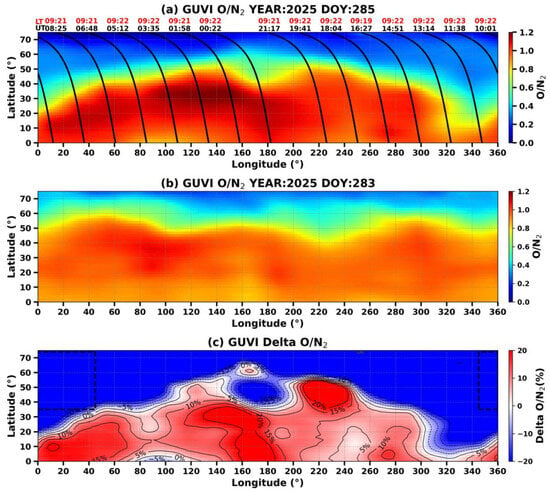
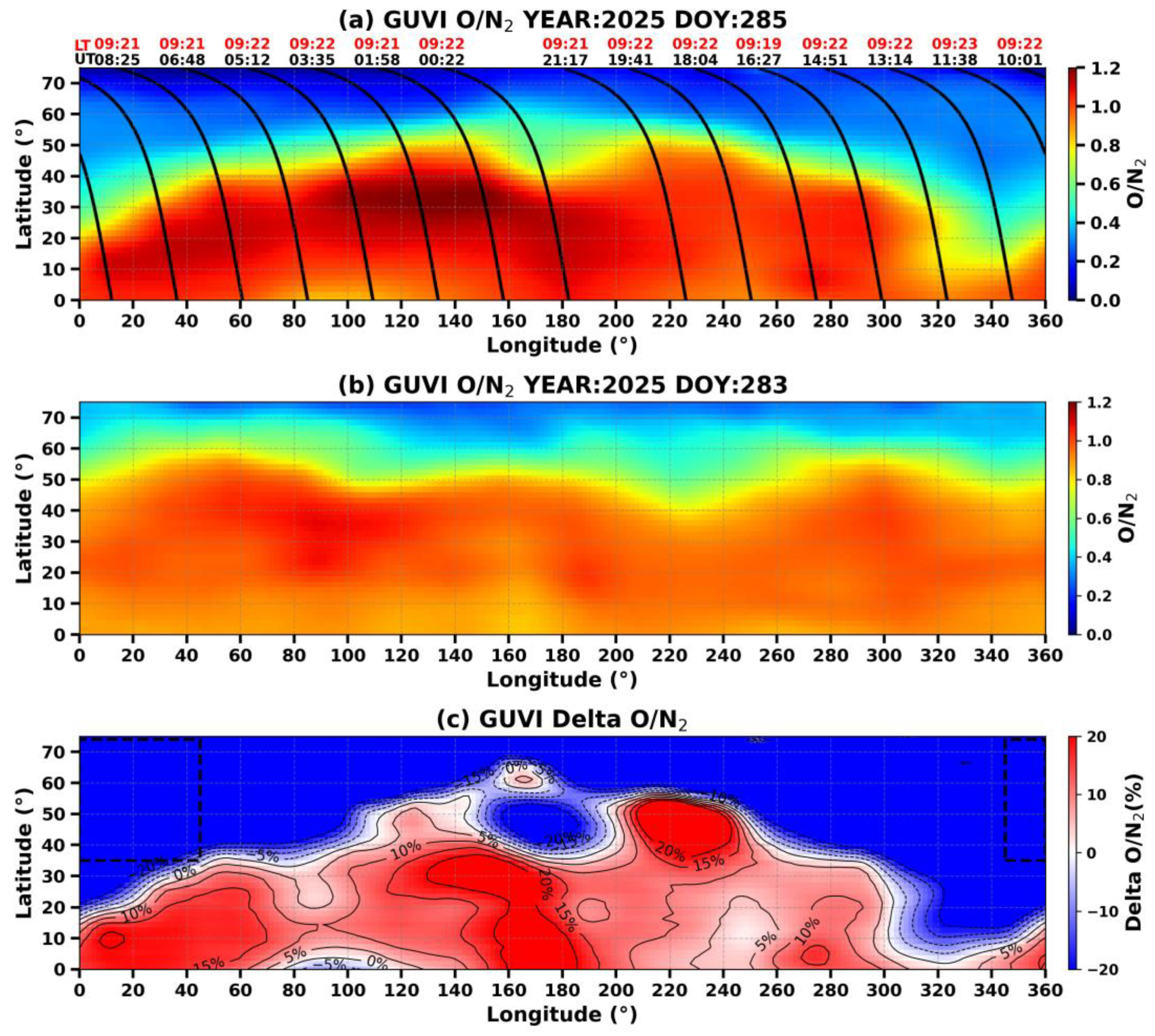
During the main phase over the European sector, a sandwich-like structure in latitude was observed, manifested in three distinct aspects: (a) auroral precipitation associated with substorms caused high-latitude TEC enhancement, which then diffused extensively toward mid-to-low latitudes; (b) the trough, located in the midlatitude and subauroral ionosphere, moved rapidly equatorward with an abnormally expanded range; (c) the mid-to-low latitude TEC positive phase, induced by the PPEF, underwent a directional transition from dayside eastward to nightside westward, with the positive phase’s spatial coverage of gradually contracting. In the early recovery phase, the mid-to-low latitude positive phase was overtaken by the trough. Subsequently, as shown in Figure 14, the equatorward-propagating thermospheric composition disturbances reduced the [O]/[N2] ratio across the European sector by 20% compared to 9 October. This depletion triggered a large-scale TEC negative phase across the European sector, resulting in the eventual disappearance of the latitudinal difference. The trough evolution was particularly dramatic in the European sector. Initially, the trough was located at a relatively high latitude around 65°N. Enhanced magnetospheric convection during the main phase drove the trough rapidly equatorward, with an equatorward velocity of 5–6° per hour (approximately 150–200 m/s) and a significant expansion in width. By the early recovery phase, the trough covered most the mid-to-low latitude in the European region, with its equatorward boundary extending to an unusually low latitude of around 35° MLAT and a maximum latitudinal width of around 18–20°. Compared to typical storms [21], the midlatitude trough in the European sector during this storm exhibited greater development.
Figure 14.
Thermospheric [O]/[N2] composition ratio maps obtained by the GUVI/TIMED satellite. Figure 14a–c correspond to the maps constructed from data on 11 October 2024, data on 9 October 2024, and the relative [O]/[N2] (Delata [O]/[N2] = (([O]/[N2]11 Oct − [O]/[N2]09 Oct)/[O]/[N2]09 Oct) × 100%) on 11 October compared to 9 October. The universal time (black) and local time (red) corresponding to the satellite orbits are labeled in the figures. The dashed box in Figure 14c denotes the region corresponding to the European sector.
Figure 13 presents the ion density and eastward ion velocity distributions measured by the SSIES instrument onboard the DMSP F17 satellite across the North American and European longitude sectors during the main phase of the geomagnetic storm. The latitudinal profiles of ion density (Figure 13a,b) reveal that the European sector exhibited a typical latitudinal “sandwich-like” structure during the storm period, as the trough continuously expanded equatorward. In the corresponding profiles of horizontal ion velocity, the significant negative peak (corresponding to westward plasma flow) in the subauroral ionosphere can be observed in this sector, which is a clear signature of the SAPS [53]. With respect to the expansion of the magnetospheric convection during the storm’s main phase, both the SAPS and the trough signatures exhibited a significant equatorward shift reaching as low as 35–40° (Figure 13d,e). The intense westward plasma transport driven by SAPS served as a key dynamic mechanism for the plasma loss within the trough [54]. Meanwhile, the frictional heating induced by SAPS further intensified the plasma recombination process, leading to more pronounced density depletion within the trough. In addition, the low-density region of the midlatitude trough reduced the electrical conductivity, thereby inducing a stronger electric field and subsequently enhancing SAPS. These two processes formed a positive feedback loop, which ultimately exacerbated the equatorward expansion and density depletion of the trough.
5. Conclusions
In this paper, we investigate midlatitude and subauroral ionospheric disturbances in the North American and European sectors during the intense geomagnetic storm on 10–11 October 2024. Our study utilized a variety of observational data from multiple instruments, including ground-based GNSS-TEC and ionosonde data, as well as space-borne observation from Swarm, DMSP and GUVI/TIMED. The results reveal substantial density gradients and spatial differences in both longitude sectors, with the key findings summarized as follows:
- In the North American sector, significant longitudinal differences were observed in the ionosphere, primarily characterized by the development of two density gradient structures: the SED and the midlatitude trough. During the main phase of the storm, the longitude difference exhibited a “positive phase in the west and negative phase in the east”. The SED-plume extended strongly toward the northwest, with a longitudinal extension exceeding 70°. Its westward shift velocity was estimated to be 200–300 m/s, forming a positive phase with an amplitude of approximately 40–45 TECU in the subauroral region of western North America. The trough developed on the poleward side of the SED plume. As the storm and local time progressed, this trough gradually migrated toward lower latitudes, producing a large-scale negative phase in eastern North America. The resulting longitudinal density gradient reached an amplitude of 60–65 TECU. During the late main phase and early recovery phase of the geomagnetic storm, high-latitude auroral substorms inhibited further development of the trough in the east, triggering large-scale positive phases in eastern North America. Meanwhile, in western North America, the trough became prominent as the region entered the post-sunset to midnight period. These changes resulted in a phase reversal in the longitudinal differences, with the “negative phase in the west and positive phase in the east” distribution. As the regions from east to west progressively entered the midnight period, the combination of the nighttime westward DDEF and the expansion of composition disturbance zone caused the positive phase range to contract toward lower latitudes, leading to the disappearance of ionospheric longitudinal differences in this sector.
- In contrast, the European sector exhibited latitudinal differences that persisted from the SSC to the early recovery phase. These differences manifested as a “sandwich-like” structure with a positive–negative–positive pattern in latitude, characterized by large-scale TEC enhancement at high-latitude due to substorm-induced auroral precipitation, an expanded trough in the midlatitude, and a positive phase at the EIA crest in the mid-to-low latitudes. In the late stage of the storm, a large-scale negative phase formed as the thermospheric composition disturbance zone, with a reduced O/N2 ratio, expanded over the European sector, masking the pre-existing latitudinal differences. During the storm period, the trough developed prominently over the European sector, with the main characteristics as follows: (a) Rapid equatorward migration at a rate of 5° per hour (approximately 150–200 m/s), with its equatorward boundary reaching an unusually low latitude of 35° MLAT; (b) Significant latitudinal widening: statistical results indicate that the storm-time widening of the trough was approximately several degrees, while during this storm, the maximum widening of the trough in the European sector reached 18–20° at 10°E.
Through this study, we have clarified the longitudinal and latitudinal differences in the ionosphere of North America and Europe during the geomagnetic storm on 10–11 October 2024, as well as the spatiotemporal evolution of density gradient such as SED and the midlatitude trough. These findings enhance our understanding of geomagnetic storm impacts on different regions, providing critical insights for space weather specification and prediction.
Author Contributions
Conceptualization, E.A. and X.L.; methodology, E.A. and X.L.; investigation, X.L.; data curation, X.L. and E.A.; writing—original draft preparation, X.L.; writing—review and editing, E.A., X.W. and B.L.; visualization, X.L.; supervision, E.A. All authors have read and agreed to the published version of the manuscript.
Funding
This research was funded by the Strategic Priority Research Program of the Chinese Academy of Sciences (Grant XDB0560000 and XDA0470301), National Science Foundation of China (42574233, 42504172, and U2541289), National Key Research and Development Program of China (Project 2024YFC2206902), and the Chinese Sponsored Postdoctoral Fellowship Program (Grant GZC20232695).
Data Availability Statement
GNSS-TEC products and DMSP F17 data are provided through the Madrigal distributed data system at (http://cedar.openmadrigal.org/ (accessed on 1 December 2025)) by MIT Haystack Observatory. SWARM data are provided by European Space Agency (https://swarm-diss.eo.esa.int/ (accessed on 1 December 2025)). The ionosonde data are available at the DID Base of Global Ionosphere Radio Observatory (https://giro.uml.edu/didbase/scaled.php (accessed on 1 December 2025)). Solar wind and interplanetary parameters data are available at Coordinated Data Analysis Web (https://cdaweb.gsfc.nasa.gov/ (accessed on 1 December 2025)). The [O]/[N2] data from GUVI/TIMED were retrieved from http://guvitimed.jhuapl.edu/ (accessed on 1 December 2025).
Acknowledgments
Data for TEC processing is provided from the following organizations: UNAVCO, SOPAC, IGN (France), IGS, CDDIS, NGS, IBGE (Brazil), RAMSAC (Argentina), CORS (Panama), Arecibo Observatory, LISN, Topcon, CHAIN (Canada), CRS (Italy), SONEL, RENAG (New Zealand), GNSS Reference Networks, Finnish Meteorological Institute, SWEPOS, Chinese Meridian Project, and International Meridian Circle Program (IMCP).
Conflicts of Interest
The authors declare no conflicts of interest.
References
- Huang, C.-S.; Sazykin, S.; Chau, J.L.; Maruyama, N.; Kelley, M.C. Penetration Electric Fields: Efficiency and Characteristic Time Scale. J. Atmos. Sol. Terr. Phys. 2007, 69, 1135–1146. [Google Scholar] [CrossRef] [Scilit]
- Basu, S.; Groves, K.M.; Yeh, H.-C.; Su, S.-Y.; Rich, F.J.; Sultan, P.J.; Keskinen, M.J. Response of the Equatorial Ionosphere in the South Atlantic Region to the Great Magnetic Storm of July 15, 2000. Geophys. Res. Lett. 2001, 28, 3577–3580. [Google Scholar] [CrossRef] [Scilit]
- Kelley, M.C.; Vlasov, M.N.; Foster, J.C.; Coster, A.J. A Quantitative Explanation for the Phenomenon Known as Storm-Enhanced Density. Geophys. Res. Lett. 2004, 31, L19809. [Google Scholar] [CrossRef] [Scilit]
- Richmond, A.D.; Peymirat, C.; Roble, R.G. Long-lasting Disturbances in the Equatorial Ionospheric Electric Field Simulated with a Coupled Magnetosphere-ionosphere-thermosphere Model. J. Geophys. Res. Space Phys. 2003, 108, 1118. [Google Scholar] [CrossRef] [Scilit]
- Blanc, M.; Richmond, A.D. The Ionospheric Disturbance Dynamo. J. Geophys. Res. Space Phys. 1980, 85, 1669–1686. [Google Scholar] [CrossRef] [Scilit]
- Wang, X.; Miao, J.; Aa, E.; Ren, T.; Wang, Y.; Liu, J.; Liu, S. Statistical Analysis of Joule Heating and Thermosphere Response during Geomagnetic Storms of Different Magnitudes. J. Geophys. Res. Space Phys. 2020, 125, e2020JA027966. [Google Scholar] [CrossRef] [Scilit]
- Wang, X.; Miao, J.; Lu, X.; Aa, E.; Liu, J.; Wang, Y.; Liu, S. Latitudinal Impacts of Joule Heating on the High-Latitude Thermospheric Density Enhancement during Geomagnetic Storms. J. Geophys. Res. Space Phys. 2021, 126, e2020JA028747. [Google Scholar] [CrossRef] [Scilit]
- Buonsanto, M.J. Ionospheric Storms—A Review. Space Sci. Rev. 1999, 88, 563–601. [Google Scholar] [CrossRef] [Scilit]
- Rishbeth, H.; Fuller-Rowell, T.J.; Rodger, A.S. F-Layer Storms and Thermospheric Composition. Phys. Scr. 1987, 36, 327–336. [Google Scholar] [CrossRef] [Scilit]
- Wang, X.; Aa, E.; Chen, Y.; Zhang, J.; Zhu, Y.; Cai, L.; Lu, X.; Luo, B.; Liu, S.; Li, M.; et al. Midlatitude Neutral Wind Response during the Mother’s Day Super-Intense Geomagnetic Storm in 2024 Using Observations from the Chinese Meridian Project. J. Geophys. Res. Space Phys. 2025, 130, e2024JA033574. [Google Scholar] [CrossRef] [Scilit]
- Zhai, C.; Cai, X.; Yu, T.; Peng, W.; Cheng, X.; Yue, D.; Cai, L. A Complete Chain of the Generating Processes of Ionospheric Negative Storm over the North America. J. Geophys. Res. Space Phys. 2024, 129, e2024JA033091. [Google Scholar] [CrossRef] [Scilit]
- Srinivasu, V.K.D.; Prasad, D.S.V.V.D.; Niranjan, K.; Seemala, G.K.; Venkatesh, K. L-Band Scintillation and TEC Variations on St. Patrick’s Day Storm of 17 March 2015 over Indian Longitudes Using GPS and GLONASS Observations. J. Earth Syst. Sci. 2019, 128, 69. [Google Scholar] [CrossRef] [Scilit]
- Foster, J.C. Storm Time Plasma Transport at Middle and High Latitudes. J. Geophys. Res. Space Phys. 1993, 98, 1675–1689. [Google Scholar] [CrossRef] [Scilit]
- Aa, E.; Dzwill, P.; Zhang, S.; Erickson, P.J. A Statistical Analysis of the Morphology of Storm-Enhanced Density Plumes Over the North American Sector. J. Geophys. Res. Space Phys. 2024, 129, e2024JA032750. [Google Scholar] [CrossRef] [Scilit]
- Coster, A.J.; Colerico, M.J.; Foster, J.C.; Rideout, W.; Rich, F. Longitude Sector Comparisons of Storm Enhanced Density. Geophys. Res. Lett. 2007, 34, 2007GL030682. [Google Scholar] [CrossRef] [Scilit]
- Foster, J.C.; Zou, S.; Heelis, R.A.; Erickson, P.J. Ionospheric Storm-Enhanced Density Plumes. In Geophysical Monograph Series; Huang, C., Lu, G., Zhang, Y., Paxton, L.J., Eds.; Wiley: Hoboken, NJ, USA, 2021; pp. 115–126. ISBN 978-1-119-50755-0. [Google Scholar]
- Heelis, R.A.; Sojka, J.J.; David, M.; Schunk, R.W. Storm Time Density Enhancements in the Middle-Latitude Dayside Ionosphere. J. Geophys. Res. Space Phys. 2009, 114, A03315. [Google Scholar] [CrossRef] [Scilit]
- Zou, S.; Ridley, A.J.; Moldwin, M.B.; Nicolls, M.J.; Coster, A.J.; Thomas, E.G.; Ruohoniemi, J.M. Multi-instrument Observations of SED during 24–25 October 2011 Storm: Implications for SED Formation Processes. J. Geophys. Res. Space Phys. 2013, 118, 7798–7809. [Google Scholar] [CrossRef] [Scilit]
- Aa, E.; Zhang, S.; Wang, W.; Erickson, P.J.; Coster, A.J. Multiple Longitude Sector Storm-enhanced Density (SED) and Long-lasting Subauroral Polarization Stream (SAPS) during the 26–28 February 2023 Geomagnetic Storm. J. Geophys. Res. Space Phys. 2023, 128, e2023JA031815. [Google Scholar] [CrossRef] [Scilit]
- Li, S.; Liu, J.; Wang, W.; Liang, J.; Zhang, K. Impacts of Subauroral Polarization Streams on Storm-Enhanced Density Plume and Consequently on Polar Tongue of Ionization. Earth Space Sci. 2023, 10, e2023EA002827. [Google Scholar] [CrossRef] [Scilit]
- Aa, E.; Zou, S.; Erickson, P.J.; Zhang, S.; Liu, S. Statistical Analysis of the Main Ionospheric Trough Using Swarm in Situ Measurements. J. Geophys. Res. Space Phys. 2020, 125, e2019JA027583. [Google Scholar] [CrossRef] [Scilit]
- Moffett, R.J.; Quegan, S. The Mid-Latitude Trough in the Electron Concentration of the Ionospheric F-Layer: A Review of Observations and Modelling. J. Atmos. Terr. Phys. 1983, 45, 315–343. [Google Scholar] [CrossRef] [Scilit]
- Collis, P.N.; Häggström, I. Plasma Convection and Auroral Precipitation Processes Associated with the Main Ionospheric Trough at High Latitudes. J. Atmos. Terr. Phys. 1988, 50, 389–404. [Google Scholar] [CrossRef] [Scilit]
- Nilsson, H.; Sergienko, T.I.; Ebihara, Y.; Yamauchi, M. Quiet-Time Mid-Latitude Trough: Influence of Convection, Field-Aligned Currents and Proton Precipitation. Ann. Geophys. 2005, 23, 3277–3288. [Google Scholar] [CrossRef] [Scilit]
- Rodger, A. The Mid-Latitude Trough—Revisited. In Midlatitude Ionospheric Dynamics and Disturbances; American Geophysical Union (AGU): Washington, DC, USA, 2008; pp. 25–33. ISBN 978-1-118-66655-5. [Google Scholar]
- Voiculescu, M.; Nygrén, T.; Aikio, A.T.; Vanhamäki, H.; Pierrard, V. Postmidnight Ionospheric Troughs in Summer at High Latitudes. J. Geophys. Res. Space Phys. 2016, 121, 12171–12185. [Google Scholar] [CrossRef] [Scilit]
- Anderson, P.C.; Hellis, R.A.; Hanson, W.B. The Ionospheric Signatures of Rapid Subauroral Ion Drifts. J. Geophys. Res. Space Phys. 1991, 96, 5785–5792. [Google Scholar] [CrossRef] [Scilit]
- Doherty, P.; Coster, A.J.; Murtagh, W. Space Weather Effects of October?November 2003. GPS Solut. 2004, 8, 267–271. [Google Scholar] [CrossRef] [Scilit]
- Coster, A.; Foster, J. Space-Weather Impacts of the Sub-Auroral Polarization Stream. URSI Radio Sci. Bull. 2007, 2007, 28–36. [Google Scholar] [CrossRef]
- Prölss, G.W.; von Zahn, U. ON THE LOCAL TIME VARIATION OF ATMOSPHERIC-IONOSPHERIC DISTURBANCES. In Space Research; Rycroft, M.J., Ed.; Pergamon: Hoddesdon, UK, 1978; pp. 159–162. ISBN 978-0-08-022021-5. [Google Scholar]
- Kuai, J.; Ma, Q.; Yu, T.; Wu, K.; Sun, H.; Zhang, Y. Significant East-West Electron Density Differences Occurring in Less than 30° Longitude over the Ocean during the Recovery Phase of a Strong Geomagnetic Storm in Solar Minimum. J. Geophys. Res. Space Phys. 2025, 130, e2024JA033549. [Google Scholar] [CrossRef] [Scilit]
- Kuai, J.; Liu, L.; Lei, J.; Liu, J.; Zhao, B.; Chen, Y.; Le, H.; Wang, Y.; Hu, L. Regional Differences of the Ionospheric Response to the July 2012 Geomagnetic Storm. J. Geophys. Res. Space Phys. 2017, 122, 4654–4668. [Google Scholar] [CrossRef] [Scilit]
- Codrescu, M.V.; Fuller-Rowell, T.J.; Kutiev, I.S. Modeling the F Layer during Specific Geomagnetic Storms. J. Geophys. Res. Space Phys. 1997, 102, 14315–14329. [Google Scholar] [CrossRef] [Scilit]
- Mendillo, M.; He, X.-Q.; Rishbeth, H. How the Effects of Winds and Electric Fields in F2-Layer Storms Vary with Latitude and Longitude: A Theoretical Study. Planet. Space Sci. 1992, 40, 595–606. [Google Scholar] [CrossRef] [Scilit]
- Lissa, D.; Srinivasu, V.K.D.; Prasad, D.S.V.V.D.; Niranjan, K. Ionospheric Response to the 26 August 2018 Geomagnetic Storm Using GPS-TEC Observations along 80°E and 120°E Longitudes in the Asian Sector. Adv. Space Res. 2020, 66, 1427–1440. [Google Scholar] [CrossRef] [Scilit]
- Paul, K.S.; Haralambous, H.; Moses, M.; Tripathi, S.C. Effects of the October 2024 Storm over the Global Ionosphere. Remote Sens. 2025, 17, 2329. [Google Scholar] [CrossRef] [Scilit]
- Aa, E.; Zhang, S.; Coster, A.J.; Hairston, M.R.; Kerr, R.B.; Souza, J.R.; Cai, X.; Luo, B. Super Equatorial Plasma Bubbles and Strong Longitudinal Variability During the 10–11 October 2024 Geomagnetic Storm. J. Geophys. Res. Space Phys. 2025, 130, e2025JA034224. [Google Scholar] [CrossRef] [Scilit]
- Zakharenkova, I.; Cherniak, I.; Krankowski, A.; Valladares, C.E.; De La Jara Sanchez, C. On Detection of Super Equatorial Plasma Bubbles in the American Sector During the 10–11 October 2024 Geomagnetic Storm. J. Geophys. Res. Space Phys. 2025, 130, e2025JA033709. [Google Scholar] [CrossRef] [Scilit]
- Tripathi, S.C.; Haralambous, H.; Biswas, T. Ionospheric Variability During the 10 October 2024 Geomagnetic Storm: A Regional Analysis Across Europe. Atmosphere 2025, 16, 1029. [Google Scholar] [CrossRef] [Scilit]
- Rideout, W.; Coster, A. Automated GPS Processing for Global Total Electron Content Data. GPS Solut. 2006, 10, 219–228. [Google Scholar] [CrossRef] [Scilit]
- Vierinen, J.; Coster, A.J.; Rideout, W.C.; Erickson, P.J.; Norberg, J. Statistical Framework for Estimating GNSS Bias. Atmos. Meas. Tech. 2016, 9, 1303–1312. [Google Scholar] [CrossRef] [Scilit]
- Friis-Christensen, E.C.; Lühr, H.; Knudsen, D.J. Swarm—An Earth Observation Mission Investigating Geospace—ScienceDirect. Available online: https://www.sciencedirect.com/science/article/abs/pii/S0273117706005497?via%3Dihub (accessed on 4 November 2025).
- King, J.H.; Papitashvili, N.E. Solar Wind Spatial Scales in and Comparisons of Hourly Wind and ACE Plasma and Magnetic Field Data. J. Geophys. Res. Space Phys. 2005, 110, A02104. [Google Scholar] [CrossRef] [Scilit]
- Essex, E.A.; Watkins, B.J. Enhancements of Ionospheric Total Electron Content in the Southern Auroral Zone Associated with Magnetospheric Substorms. J. Atmos. Terr. Phys. 1973, 35, 1015–1018. [Google Scholar] [CrossRef] [Scilit]
- Watson, C.; Jayachandran, P.T.; Spanswick, E.; Donovan, E.F.; Danskin, D.W. GPS TEC Technique for Observation of the Evolution of Substorm Particle Precipitation. J. Geophys. Res. Space Phys. 2011, 116, A00I90. [Google Scholar] [CrossRef] [Scilit]
- Weygand, J.M.; Wing, S. Temporal and Spatial Development of TEC Enhancements during Substorms. J. Geophys. Res. Space Phys. 2020, 125, e2019JA026985. [Google Scholar] [CrossRef] [Scilit]
- Mendillo, M. Storms in the Ionosphere: Patterns and Processes for Total Electron Content. Rev. Geophys. 2006, 44, 2005RG000193. [Google Scholar] [CrossRef] [Scilit]
- Abadi, P.; Otsuka, Y.; Tsugawa, T. Effects of Pre-Reversal Enhancement of E × B Drift on the Latitudinal Extension of Plasma Bubble in Southeast Asia. Earth Planet Space 2015, 67, 74. [Google Scholar] [CrossRef] [Scilit]
- Farley, D.T.; Bonelli, E.; Fejer, B.G.; Larsen, M.F. The Prereversal Enhancement of the Zonal Electric Field in the Equatorial Ionosphere. J. Geophys. Res. Space Phys. 1986, 91, 13723–13728. [Google Scholar] [CrossRef] [Scilit]
- Balan, N.; Shiokawa, K.; Otsuka, Y.; Kikuchi, T.; Vijaya Lekshmi, D.; Kawamura, S.; Yamamoto, M.; Bailey, G.J. A Physical Mechanism of Positive Ionospheric Storms at Low Latitudes and Midlatitudes. J. Geophys. Res. Space Phys. 2010, 115, A02304. [Google Scholar] [CrossRef] [Scilit]
- Bagiya, M.S.; Iyer, K.N.; Joshi, H.P.; Thampi, S.V.; Tsugawa, T.; Ravindran, S.; Sridharan, R.; Pathan, B.M. Low-Latitude Ionospheric-Thermospheric Response to Storm Time Electrodynamical Coupling between High and Low Latitudes. J. Geophys. Res. Space Phys. 2011, 116, A01303. [Google Scholar] [CrossRef] [Scilit]
- Yin, P.; Mitchell, C.N.; Spencer, P.S.J.; Foster, J.C. Ionospheric Electron Concentration Imaging Using GPS over the USA during the Storm of July 2000. Geophys. Res. Lett. 2004, 31, L12806. [Google Scholar] [CrossRef] [Scilit]
- Zhao, B.; Zhang, J.; Zhang, Q.; Wang, W.; Xing, Z.; Lyons, L.R.; Nishimura, Y.; Oksavik, K.; Wang, X.; Li, H.; et al. Simultaneous Observation of Duskside and Dawnside Subauroral Polarization Streams during an Intense Magnetic Storm. Geophys. Res. Lett. 2025, 52, e2024GL114160. [Google Scholar] [CrossRef] [Scilit]
- Liu, J.; Wang, W.; Liang, J.; Cao, T.; Li, S. The Effects of Storm-Enhanced Zonal Ion Drifts and Plasmaspheric Heat Flux on Middle-Latitude Ionospheric Trough. J. Geophys. Res. Space Phys. 2025, 130, e2024JA033615. [Google Scholar] [CrossRef] [Scilit]
Disclaimer/Publisher’s Note: The statements, opinions and data contained in all publications are solely those of the individual author(s) and contributor(s) and not of MDPI and/or the editor(s). MDPI and/or the editor(s) disclaim responsibility for any injury to people or property resulting from any ideas, methods, instructions or products referred to in the content. |
© 2026 by the authors. Licensee MDPI, Basel, Switzerland. This article is an open access article distributed under the terms and conditions of the Creative Commons Attribution (CC BY) license.