Highlights
What are the main findings?
- Long-term evaluation shows stable radiometric performance for OMPS Nadir and CrIS instruments across SNPP, NOAA-20, and NOAA-21.
- The iSensor-RCBA portal effectively identifies calibration and geolocation issues, including: A 280 nm radiometric inconsistency between SNPP and NOAA-20 OMPS NP. An unusual radiometric feature in NOAA-21 CrIS over southern high latitudes. Decade-long degradation rates for Metop-B GOME-2 wavelengths. Two geolocation anomalies in SNPP CrIS using SNO-based comparisons with GOES-16 ABI.
What is the implication of the main finding?
- iSensor-RCBA is not just a visualization tool but a powerful diagnostic system that enables early detection of radiometric and geolocation issues across JPSS and other missions.
- The analysis methods are readily transferable to future satellite missions, improving long-term calibration consistency and mission readiness for JPSS-03, JPSS-04, and beyond.
Abstract
This study provides a comprehensive, long-term evaluation of inter-sensor radiometric calibration biases for the NOAA OMPS Nadir and CrIS instruments using four complementary validation methodologies implemented within the Inter-Sensor Radiometric Bias Assessment (iSensor-RCBA) portal, a component of the STAR Integrated Calibration/Validation System. Overall, SDR data quality from the three OMPS Nadir instruments and three CrIS instruments aboard SNPP, NOAA-20, and NOAA-21 remains stable. The iSensor-RCBA portal has also proven to be a powerful diagnostic resource, enabling the detection of both new and previously unrecognized calibration issues and anomalies. Using the 32-day averaged difference method, we were the first to discover and identify the root cause of an inconsistency near 280 nm in inter-sensor radiometric biases between the SNPP and NOAA-20 OMPS NP instruments. The same method also revealed an unusual radiometric feature in NOAA-21 CrIS SDRs over the southern high latitudes during spring and summer. In addition, we derived decade-long degradation rates at 11 Metop-B GOME-2 wavelengths using an independent dataset—Simultaneous Nadir Overpass observations between SNPP OMPS and Metop-B GOME-2. Furthermore, iSensor-RCBA monitoring confirmed two geolocation anomalies in SNPP CrIS through a new approach involving SNO-based inter-sensor biases between GOES-16 ABI and SNPP CrIS. These cases demonstrate that iSensor-RCBA is not only a monitoring visualization tool but also a diagnostic tool that delivers unique, complementary insight into instrument performance, enabling early identification of radiometric and geolocation issues across JPSS and other satellite missions. Importantly, the analysis methods used in this study are broadly applicable to current and future missions, including JPSS-03, JPSS-04, and non-NOAA satellite systems.
Keywords:
long-term inter-sensor radiometric calibration biases; OMPS nadir and CrIS instruments onboard the SNPP, NOAA-20, and NOAA-21; Metop-B GOME-2 decade-long degradation rate; simultaneous nadir overpass (SNO); double differences via the third sensor; double differences via a radiative transfer model; 32-day average of radiance differences; web-based Long-Term Inter-Sensor Radiometric Calibration Bias Assessment (iSensor-RCBA) 1. Introduction
The successful launch of the Suomi National Polar-orbiting Partnership (SNPP) satellite on 28 October 2011 started a new era for NOAA, which is being followed by four Joint Polar Satellite System (JPSS) satellites from JPSS-1 through JPSS-4. The JPSS-1, aka NOAA-20, was successfully launched on 18 November 2017, while the JPSS-2, aka NOAA-21, was successfully launched on 10 November 2022. Over the past decade, extensive post-launch calibration and validation efforts have been carried out to ensure that Sensor Data Record (SDR) products from key instruments aboard the SNPP and JPSS satellites—including Ozone Mapping and Profiler Suite (OMPS) Nadir Mapper (NM), OMPS Nadir Profiler (NP), and Cross-track Infrared Sounder (CrIS)—continue to meet scientific requirements [1,2,3,4,5,6,7,8,9,10,11,12,13,14,15,16]. In reality, however, the quality of the data after these intensive calibration activities might be degraded anytime during each satellite mission due to new anomalies or degradations occurring in spacecrafts, sensors, calibration algorithms, and the SDR data processing stream. This calls for the necessity of keeping track of the lifetime performance for satellite spacecrafts, instruments, and scientific SDR data during the entire mission.
In the NOAA/STAR, an operational ICVS Long-Term Monitoring (LTM) web-based system has been developed for more than a decade to monitor the quality of SDR (TDR) data for more than 30 sensors in a near-real-time (NRT) mode [17,18]. The monitored sensors include operational JPSS instruments onboard from SNPP to NOAA-21, and legacy Meteorological Operational satellite (Metop)- B and Metop-C instruments (e.g., Advanced Microwave Sounding Unit-A or AMSU-A, Microwave Humidity Sounder or MHS, and Advanced Very-High-Resolution Radiometer or AVHRR). For simplification, ICVS-LTM is frequently referred to as ICVS. Beyond individual sensor-based data quality monitoring, inter-sensor radiometric calibration consistency is becoming increasingly essential and will remain crucial for enhancing the understanding of science product quality. This is because the uncertainty of SDR data records depends not only on the calibration accuracy and long-term stability of individual sensors, but also on their calibration consistency across instruments and platforms. Therefore, a new portal—the Long-Term Inter-Sensor Radiometric Calibration Bias Assessment (iSensor-RCBA)—has been developed within the ICVS framework.
The iSensor-RCBA portal or tool is a web-based monitoring system designed to track inter-sensor radiometric calibration biases among selected instrument pairs. Publicly accessible monitoring pages (e.g., OMPS NM in https://www.star.nesdis.noaa.gov/icvs/comparison_OMPS_NM.php (accessed on 1 January 2024)) and restricted-access pages (e.g., CrIS in https://www.star.nesdis.noaa.gov/icvs-beta/comparison_CrIS_FSR.php (accessed on 1 January 2022)) are provided for transparency. This study will first provide a concise overview of the tool’s relevant components—its data sources, instrument pairs, and comparison methodologies—to ensure readers can understand and interpret the monitoring results used in the study without shifting the focus toward software development. This tool covers a few pairs of the instruments, which are categorized into the JPSS inter-sensor instrument pairs onboard the SNPP, NOAA-20, and NOAA-21, the LEO-LEO inter-sensor instrument pairs, which consist of one SNPP/JPSS instrument and one Metop-B (Metop-C) instrument, and the Low Earth Orbit (LEO)–Geosynchronous Equatorial Orbit (GEO) inter-sensor instrument pairs, which consist of one SNPP/JPSS instrument and ABI onboard the GOES-16 and GOES-18. The JPSS instruments are categorized as an independent component, separate from the LEO–LEO component, to highlight their significance in supporting JPSS missions.
More importantly, this study will focus on the scientific interpretation of the long-term inter-sensor bias patterns for a few pairs of instruments revealed by the iSensor-RCBA tool. This is done by assessing the long-term stability of three OMPS nadir instruments and three CrIS instruments aboard SNPP, NOAA-20, and NOAA-21. Evaluating the long-term stability of OMPS NM, OMPS NP, and CrIS SDR data quality is essential for JPSS missions, as past studies for the validated maturity review primarily focused on limited data sets collected shortly after launch to determine whether the SDR data met JPSS scientific requirements. Here, the validated maturity review is the final stage in the JPSS SDR calibration algorithm review cycle [19], ensuring that the data quality meets the Level 1 requirement [20]. For example, the calibration and validation analyses supporting the validated maturity review of OMPS NM and NP SDR data, including inter-sensor comparisons, were generally based on less than one year of post-launch observations [9,13,14,15]. Similarly, SDR calibration and validation for the validated maturity review of three CrIS instruments were conducted with limited data sets too, usually spanning less than one-year post-launch time [1,4,5,21]. However, SDR data quality may degrade at any point during a satellite mission due to new anomalies or degradation in the spacecraft, instruments, calibration algorithms, or processing streams. Continuous monitoring of inter-sensor biases over the long term is therefore critical, as it enables the identification of newly emerging anomalies caused by spacecraft or instrument degradation or calibration errors that could impact SDR data quality. This information is particularly useful for the broad user community.
This study is organized as follows. The next section introduces the iSensor-RCBA portal overview, including the portal architecture, analyzed instruments, assessment methods, and SDR data sets. Section 3 presents applications of iSensor-RCBA to inter-sensor radiometric bias analysis, while Section 4 provides a discussion. Conclusions are provided in Section 5. The acronyms used in this study are further explained in Abbreviation for the readers’ convenience.
2. iSensor-RCBA Portal Overview
The iSensor-RCBA portal leverages SDR data collected from SNPP/NOAA-20/NOAA-21 instruments, legacy Metop-B and Metop-C instruments, as well as GOES ABI instruments. It applies one or more analytical methods to estimate long-term inter-sensor radiometric calibration biases for each instrument pair. An overview of the iSensor-RCBA portal architecture, instruments, methods, and SDR data sets is presented below.
2.1. iSensor-RCBA Portal Architecture
The iSensor-RCBA framework now supports a broad suite of JPSS instruments, including OMPS NM, OMPS NP, CrIS, the Advanced Technology Microwave Sounder (ATMS), and the Visible Infrared Imaging Radiometer Suite (VIIRS). In addition, several non-JPSS instruments have been incorporated to facilitate inter-sensor comparisons between JPSS (including SNPP) payloads and sensors from other satellite missions. The instruments within the iSensor-RCBA portal currently include:
- -
- OMPS NM, OMPS NP, CrIS, ATMS and VIIRS onboard SNPP, NOAA-20, and NOAA-21
- -
- The Advanced Baseline Imager (ABI) onboard GOES-16 and GOES-18
- -
- The Global Ozone Monitoring Experiment-2 (GOME-2) onboard Metop-B
- -
- AMSU-A, MHS, and the Infrared Atmospheric Sounding Interferometer (IASI) onboard Metop-B and Metop-C
Functionally, the iSensor-RCBA comprises three basic components: (1) JPSS inter-sensor comparison, (2) LEO-LEO inter-sensor comparison, and (3) LEO-GEO comparison.
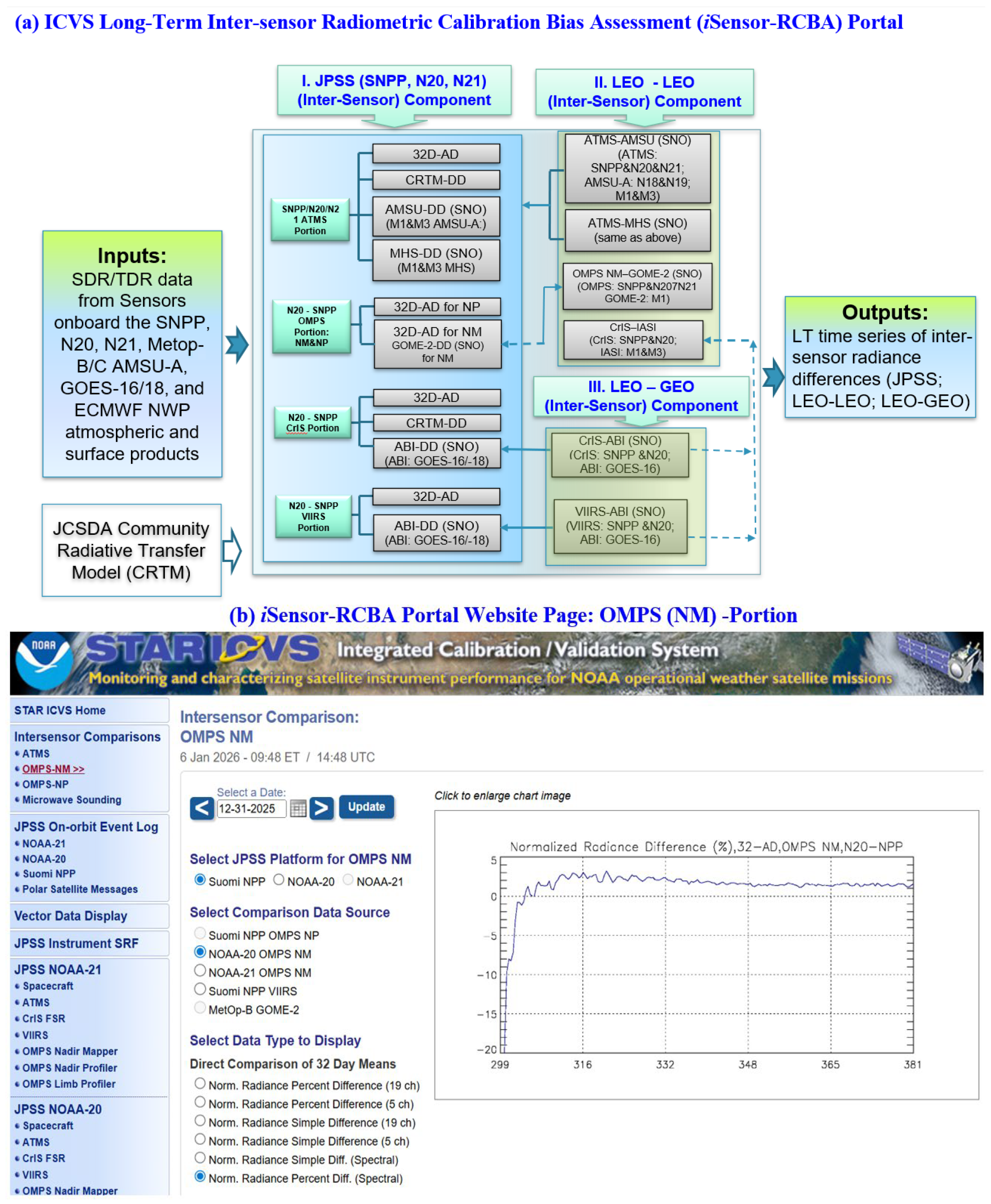
Figure 1a draws its diagram along with the involved instruments within each component. The JPSS component includes each JPSS instrument pair that is onboard two of the SNPP, NOAA-20, and NOAA-21 satellites, such as OMPS NM pairs, OMPS NP pairs, CrIS pairs, ATMS pairs, and VIIRS pairs. The LEO–LEO component focuses on evaluating inter-sensor radiometric consistency among polar-orbiting instruments with comparable spectral coverage. It currently includes three instrument pairs: OMPS NM–GOME-2, CrIS–IASI, and ATMS–AMSU-A. For the OMPS NM–GOME-2 comparison, only OMPS NM onboard SNPP and GOME-2 onboard Metop-B are included. The CrIS–IASI comparison involves CrIS instruments onboard SNPP, NOAA-20, and NOAA-21, and IASI instruments onboard Metop-B and Metop-C. Similarly, the ATMS and AMSU-A comparison includes ATMS instruments onboard SNPP, NOAA-20, and NOAA-21, together with AMSU-A instruments onboard Metop-B and Metop-C.
Figure 1.
(a) ICVS iSensor-RCBA portal processing diagram and (b) An example of the portal for OMPS portion about NM within the JPSS component. In (a), NOAA-20 and NOAA-21 are simplified to be N20 and N21, respectively, while Metop-B and Metop-C are for M1 and M3 to save space in the box. In (b), the example figure shows the 32-day averaged normalized radiance differences (%) at all OMPS NM wavelengths between NOAA-21 and NOAA-20 OMPS NM observations, using the data sets from 16 January to 17 February 2025.
In contrast, the LEO–GEO component is designed to assess cross-platform radiometric consistency between polar-orbiting and geostationary sensors. This component currently includes instrument pairs such as CrIS–ABI and VIIRS–ABI, where ABI is hosted on the geostationary GOES-16 and GOES-18 satellites. For the CrIS–ABI comparison, CrIS instruments from SNPP, NOAA-20, and NOAA-21 are included. For the VIIRS–ABI comparison, VIIRS instruments from SNPP and NOAA-20 are currently used, while extensions to include NOAA-21 VIIRS are under development. In summary, the JPSS inter-sensor component focuses on the instruments onboard the SNPP, NOAA-20, and NOAA-21 platforms. Meanwhile, the LEO–LEO and LEO–GEO components correspond to the inter-sensor comparison of one JPSS instrument with a non-JPSS instrument onboard another satellite.
Additionally, the portal is a web-based monitoring tool. As an example, the website page of the OMPS portion about NM within the iSensor-RCBA JPSS component is described in Figure 1b.
2.2. Instruments Analyzed
Although the iSensor-RCBA system encompasses this wide range of instruments, the inter-sensor comparison analysis presented in this study focuses specifically on the OMPS nadir instrument (NM and NP), CrIS, ABI, and GOME-2. These instruments are flown on different satellite platforms, and sensors sharing the same designation may exhibit radiometric differences arising from platform-dependent effects and mission evolution. Despite these differences, the selected instruments are designed with comparable spectral coverage, spectral resolution, and spatial sampling characteristics. These common design features provide a solid foundation for robust inter-sensor radiometric assessments. Accordingly, the key spectral and spatial characteristics of the four instruments analyzed in this study are summarized below. Detailed descriptions of the instruments can be found in [10,22,23,24,25,26,27,28,29,30,31,32,33,34,35].
2.2.1. OMPS Nadir Instrument
OMPS nadir instrument includes two grating spectrometers, the Nadir Profiler (NP) and Nadir Mapper (NM), which cover the UV spectral range of 250–310 nm across about 147 channels and 300–380 nm across about 196 channels, respectively. The two spectrometers have a spectral sampling of 0.42 nm and a full-width half maximum (FWHM) of around 1 nm. The OMPS NM and NP contain two scanning modes of observations: Earth radiance observations and solar irradiance (flux) observations, as briefed below.
For the Earth radiance scanning mode, the total column observations from the NM are collected over the full 110° cross-track field-of-view (FOV) across a 2800 km Earth-view swath, while the NP observations are taken only for the central 16.7° cross-track FOVs along a swath of 250 km. Each CCD image consists of 340 micropixels (or CCD cells) along the spectral dimension and 740 micropixels in the spatial dimension. Valid measurements in the NM sensor are obtained by illuminating approximately 196 spectral cells and 708 spatial cells within the active photosensitive regions. For the NP sensor, valid measurements include approximately 147 spectral and 93 spatial cells spanning the nadir. While no spectral aggregation is applied—resulting in approximate 196 wavelength channels—aggregation is performed in the spatial dimension within the ground processing system as follows: for NM Sensor, 708 CCD cells are aggregated into 35 macro-pixels (fields of views or FOVs) for SNPP and NOAA-20, or 177 macro-pixels for NOAA-21; for NP Sensor: 93 CCD cells are aggregated into one macro-pixel for SNPP, or five macro-pixels for NOAA-20 and NOAA-21. These different aggregation methods result in varying spatial resolutions. A detailed discussion about these features is referred to a previous study in [16,33]. Table 1 presents the information on key OMPS spectral characteristics across the different JPSS satellites.
Table 1.
Key information for the analyzed channels of OMPS and GOME-2 spectrometers.
Besides the Earth radiance measurements, the orbital solar observations are made via a reflective working diffuser once every two weeks for short-term monitoring, and a reflective reference diffuser once every six months (later reduced to once per year) for the long-term monitoring of sensor degradation. The measurements are conducted near the Northern Earth terminator, with solar zenith angles ranging from about 80° to 100°, producing a sequence of CCD images [10]. It should be noted that these routine solar measurements from both the working and reference diffusers are used exclusively to monitor and correct instrument wavelength shifts and throughput degradation over time. In other words, these observations are not used as solar flux inputs in the daily OMPS SDR products. Instead, the solar flux used in OMPS SDR processing is derived from an updated solar reference spectrum, commonly referred to as the “day-1” solar spectrum with an updated wavelength scale, which can be referred to a previous study in [10] and will be further discussed in Section 3.1 below.
Generally, radiometric and spectral calibration rely on onboard solar working diffusers, reference diffusers, and lamp sources, with regular solar observations used to track wavelength drift and degradation. Ground processing converts raw counts to radiances, applies stray-light, nonlinearity, and dark current corrections, and generates calibrated SDR products [6,7,8,9,10,11,12,13,14,15,16,33,34,35].
2.2.2. GOME-2 Instrument
GOME-2 is also an optical spectrometer that covers the spectral coverage of the OMPS nadir instrument, fed by a scan mirror which enables across-track scanning in nadir [30,31,32]. GOME-2 measures Earth’s backscattered solar radiation from 240–790 nm to retrieve atmospheric trace gases, including ozone, NO2, SO2, and HCHO. It operates by measuring solar light reflected and scattered by the Earth’s atmosphere or surface in the ultraviolet and visible parts of the spectrum. It covers four spectral bands: band 1: 240–315 nm; band 2: 311–403 nm; band 3: 401–500 nm; band 4: 590–790 nm. The GOME-2 data has variable spectral resolutions of a full width at FWHM between 0.26 nm and 0.51 nm, and a nominal 80 × 40 km2 ground pixel within a 960 km swath, achieving global coverage every 1–3 days. Four spectral bands cover 240–315 nm (1024 channels), 308–402 nm, 401–500 nm, and 590–790 nm [32]. Only the GOME-2 data at the second band is used in the inter-sensor comparison in this study. Table 1 above also includes the key information concerning the spectral and spatial resolutions for GOME-2 band 2.
GOME-2 employs onboard spectral lamps, solar diffusers, and white light sources for wavelength and radiometric calibration, alongside polarization monitoring units to correct for viewing geometry and polarization sensitivity. Data processing corrects for dark current, stray light, and detector degradation, then derives calibrated radiances and irradiances used in atmospheric composition retrieval algorithms [30,31].
2.2.3. CrIS Instrument
The CrIS instrument is a high-spectral-resolution Fourier Transform Spectrometer designed to measure Earth-emitted infrared radiance. It records Earth-view interferograms in three spectral bands: Longwave infrared (LWIR): 650–1095 cm−1, Mid-wave infrared (MWIR): 1210–1750 cm−1, and Shortwave infrared (SWIR): 2155–2550 cm−1. At full spectral resolution (FSR), the instrument provides a total of 2211 spectral channels. Each CrIS scan consists of 30 cross-track positions, with each field of regard comprising a 3 × 3 array of instantaneous field of views (IFOV) acquired through a shared interferometer. At nadir, this configuration yields an effective spatial resolution of approximately 14 km at nadir and a swath width of about 2200 km, enabling near-global coverage. Table 2 provides a summary of the spectral and spatial resolution information for FSR CrIS.
Table 2.
Key instrument characteristics of CrIS in Full Spectral Resolution Mode.
Radiometric calibration uses onboard blackbody references and space views to determine gain and offset, while spectral calibration derives from interferometer metrology. SDR processing converts raw interferograms to calibrated radiances, correcting for nonlinearity, instrument line shape, spectral registration, and noise, yielding high-fidelity data for numerical weather prediction and long-term monitoring [1,2].
2.2.4. ABI Instrument
The ABI instrument is the primary imager for geostationary weather observation, measuring the Earth’s radiance over the Western Hemisphere across 16 bands. These include six solar reflective bands (SRBs) covering 0.47–2.25 μm and ten thermal emissive bands (TEBs) covering 3.9–13.3 μm. For this study, we are utilizing Mode 3 data, which provides a full disk image every 15 min with a 2 km spatial resolution for nine TEBs from band 7 to band 15. Table 3 summarizes the key information on ABI channel characteristics.
Table 3.
Key information for ABI instrument [28,29].
Radiometric calibration for the SRBs is conducted during scheduled solar calibration events using an onboard solar diffuser within ABI instrument, which was manufactured by L3Harris Technologies, Inc., Fort Wayne, IN, USA. The measured signal is normalized based on pre-launch characterization, corrected for Earth–Sun distance, and referenced to a standard solar irradiance model. While TEBs’ calibration coefficients are updated continuously, SRB updates occur during these specific solar events. Ground processing applies detector linearization, dark signal correction, geometric registration, and resampling to generate calibrated Level-1B radiances and derived Level-2 environmental products [28,29].
2.3. Overview of the Four Validation Methods
iSensor-RCBA portal integrates multiple existing methods to monitor the mission-long radiometric consistency of SDR data, i.e., Simultaneous Nadir Overpass (SNO) [36,37], 3rdSensor-double difference (DD) via SNO observations, 32-day averaged difference (32D-AD [38,39], Community Radiative Transfer Model [40,41,42], and Double Difference (CRTM-DD). Using multiple methods leverages the strengths of each approach—such as geographical coverage and channel usage—to provide a more comprehensive assessment of inter-sensor radiance differences. A summary of these methods is given below.
The 32D-AD is a statistical method for calculating a 32-day average of radiometric differences between the same instrument onboard two of the SNPP and JPSS platforms. This method is based on the assumption that, after a satellite completes one orbit repeat cycle, each orbit on the first day can typically cover the entire globe and return to its initial measurement point, ensuring complete global coverage by both sensors. The computation equation is expressed as follows.
Here, the superscripts Sensor 1 and Sensor 2 indicate the same instrument type (such as OMPS or CrIS) carried by two different satellites among SNPP, NOAA-20, and NOAA-21. The terms and represent the global mean radiance of quality-controlled observations on the ith day within the 32-day window for the Sensor 1 and Sensor 2 instruments, respectively. Consequently, the quantity denotes the 32-day mean of all quality-controlled daily global radiometric differences between Sensor 1 and Sensor 2. Because the two satellites have an inherent overpass time difference of approximately 50 min, diurnal variations introduce unavoidable radiometric differences between their observations. Although these biases cannot be fully removed—particularly for window channels that are sensitive to rapidly changing weather conditions—they are mitigated through the following procedures [38]:
(a). Data Set Length: Two orbit cycles of observations (e.g., 32 days for JPSS instruments) are used to reduce sampling noise.
(b). Quality Control (QC): A QC threshold is applied to eliminate observations affected by large atmospheric or surface variability. The threshold is set to one standard deviation for CrIS and two standard deviations for OMPS NM and NP. All observations failing this criterion are excluded.
(c). Averaging: The final calibration bias is computed as the global mean of all QC-screened inter-sensor differences.
The RTM-DD method calculates the double difference of radiance deviations from CRTM simulations for two selected instruments, as described below.
where and represent the averaged radiance deviations at sensor 1 and sensor 2, respectively, compared to RTM simulations; denotes the radiometric difference average between Sensor 1 and Sensor 2 through a double difference of and . It is assumed that the averaged simulation errors arising from RTM limitations and input inaccuracies are comparable for the two evaluated instruments and largely cancel out in (2). Therefore, the double difference resulting from (2) primarily reflects inter-sensor radiometric calibration errors between two instruments. In this study, the JCSDA CRTM [40,41,42] is used. Accordingly, RTM-DD is hereinafter replaced by CRTM-DD.
The SNO method was well presented in [36,37]. The method was initialized based on two polar-orbiting satellites that circle the Earth at slightly different periods, will have simultaneous nadir overpass (SNO) events, where the satellites view the same nadir location at nearly the same time. Ideally, identical radiometers flown on different satellites should produce redundant observations at SNO locations; thus, any deviation from these results would be primarily attributable to relative calibration differences between the radiometers. In this study, this method is applied to SNO analyses between OMPS NM and GOME-2, CrIS, and ABI. Additionally, proper quality control criteria are applied to remove outliers from obtained SNO observations (see Section 3.3 below for details).
The principle of the 3rdSensor-DD method is similar to that of the RTM-DD method, except that a third sensor, rather than an RTM, is used as the transfer reference. Specifically, inter-sensor radiometric calibration biases are derived from the double differences of SNO-based inter-sensor radiometric comparisons using the third sensor as the transfer, as outlined below.
where and denote the average radiance deviations of sensor 1 and sensor 2, respectively, compared to the sensor 3. These values are computed based on the specific SNO observations. An average is utilized to reduce the impacts of imperfect SNO observations due to small differences in time, spatial, and spectral response, distance, and azimuthal viewing conditions. Similar to the SNO method above, different quality control criteria are applied to remove outliers from computations of and depending upon selected instrument pairs (refer to Section 3.3 below).
2.4. Description of SDR Data Sets
Data per satellite sensor is typically divided into three levels: RDR (level 0), SDR (level 1), and EDR (level 2). Although satellite radiance measurements are generally provided as SDR data, the radiometric parameter in SDR data is available in one or another unit—radiance, normalized radiance, reflectance, brightness temperature—depending upon the sensor or channel. Consequently, the three quantities representing the averaged inter-sensor radiometric calibration bias using different methods in the above subsection—, , and —can be expressed in radiance, normalized radiance, reflectance, and brightness temperature. For example, for OMPS, the inter-sensor bias can be as radiance, normalized radiance or reflectance (see Section 3.1 below). Conversely, for CrIS, the inter-sensor bias is measured usually as brightness temperature, commonly referred to as (see Section 3.2 below).
The SDR data from SNPP, NOAA-20, and NOAA-21 are operationally processed within the NOAA JPSS Interface Data Processing Segment (IDPS). All operational SDR data are distributed through the OSPO Production Distribution and Access (PDA) (registration is required) in near-real time mode and archived through the NOAA Comprehensive Large Array-data Stewardship System (CLASS) for the broad national and international user community. Metop-B GOME-2 L1B (i.e., SDR) data are accessible in the NOAA CLASS too. Detailed descriptions of SDR datasets from each of the ABI instrument, GOME-2 instrument, OMPS nadir instrument, and CrIS instrument are referred to the previous studies, e.g., [29,32,43,44], respectively.
3. Applications of iSensor-RCBA to Inter-Sensor Radiometric Bias Analysis
The iSensor-RCBA portal offers various long-term inter-sensor comparison results across a number of satellite instruments, such as (SNPP) JPSS instruments, Metop AMSU-A and MHS, GOES-16 and GOES-18 ABI. Most of the products are operationally showcased on a publicly accessible ICVS website (https://www.star.nesdis.noaa.gov/icvs/index.php (accessed on 1 January 2024)). The analysis in this study will focus on long-term inter-sensor radiance difference assessments for the following instrument pairs: OMPS pairs and CrIS pairs across SNPP, NOAA-20 and NOAA-21 platforms, the SNPP OMPS NM and Metop-B GOME-2 pair, and the SNPP CrIS and GOES-16 ABI pair. Application of the portal in other instrument pairs will be given in future studies.
3.1. Inter-Sensor Radiometric Biases Among OMPS Instruments
The OMPS NM and NP are two nadir spectrometers onboard the SNPP and NOAA-20 and NOAA-21 platforms. They measure Earth radiance and Solar irradiance spectra in the UV bands. In particular, the NM covers wavelengths from 300 nm to 380 nm for operational observations of nadir total column ozone, while the NP covers wavelengths from 250 to 310 nm for observations of ozone vertical distributions. An initial analysis of the inter-sensor comparison was conducted using either the CRTM-DD or the 3rdSensor-DD, based on a limited data period in previous studies [13,15]. Additionally, a conceptual analysis was conducted using the 32D-AD for a limited data set between the SNPP and NOAA-20 OMPS NPs [38,39]. These analyses demonstrated good agreement in the SDR data over the short-term period for most channels between the two OMPS NMs and NPs.
This study will extend from existing studies to three OMPS NMs and NPs to assess the relatively long-term stability of inter-sensor radiometric calibration biases among the OMPS instruments primarily using the 32D-AD method. The CRTM-DD method will not be used here due to its very poor computation efficiency (about a few days are needed to complete one day of OMPS NM data radiance simulations). The SNO method will be applied to SNPP OMPS NM and Metop-B GOME-2 inter-sensor comparison analysis. Hence, only three methods, i.e., 32D-AD, SNO, and GOME-2-DD via SNO, are used in the OMPS portion of the JPSS component, depending upon sensors (see Figure 1a above).
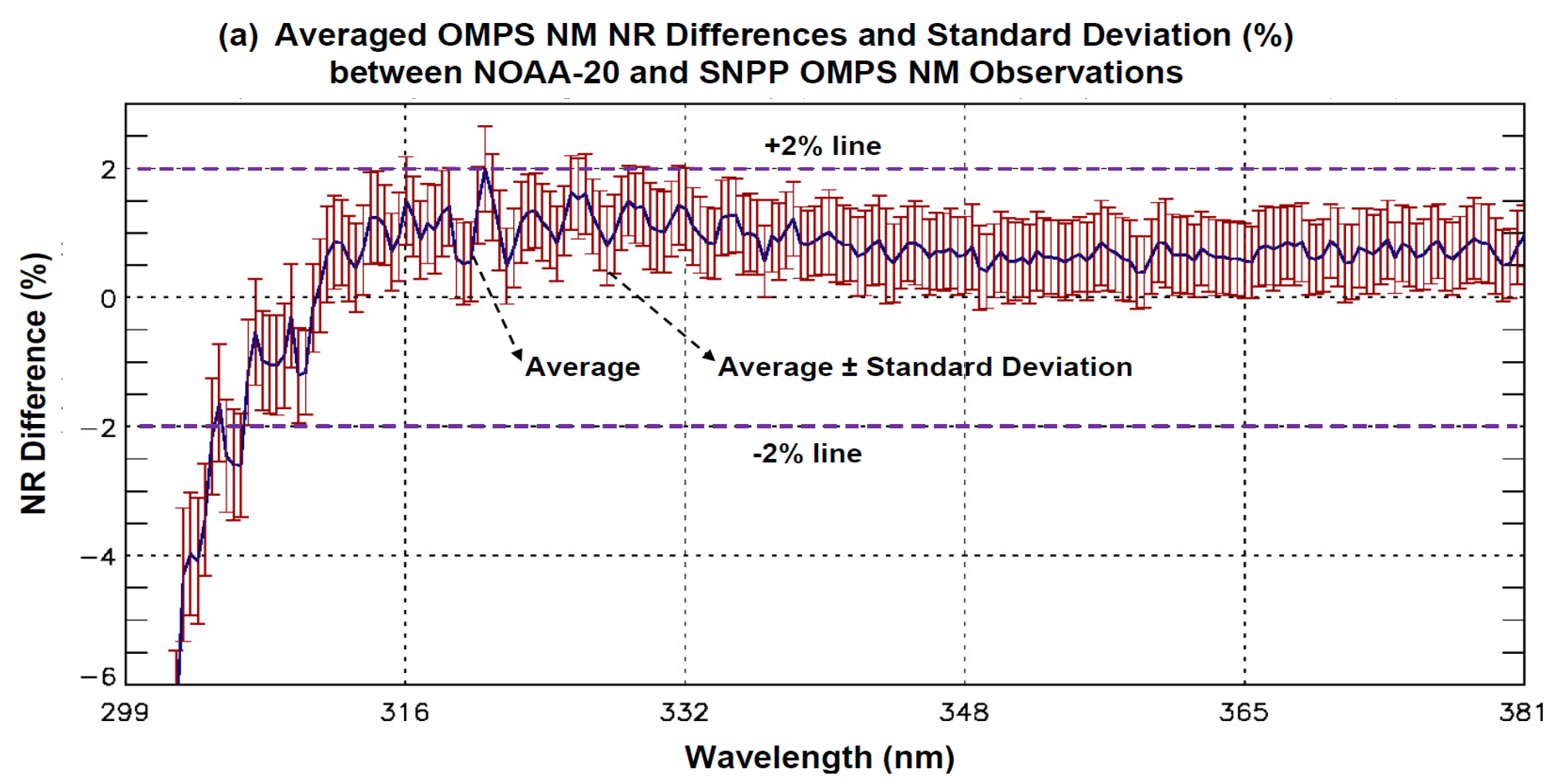
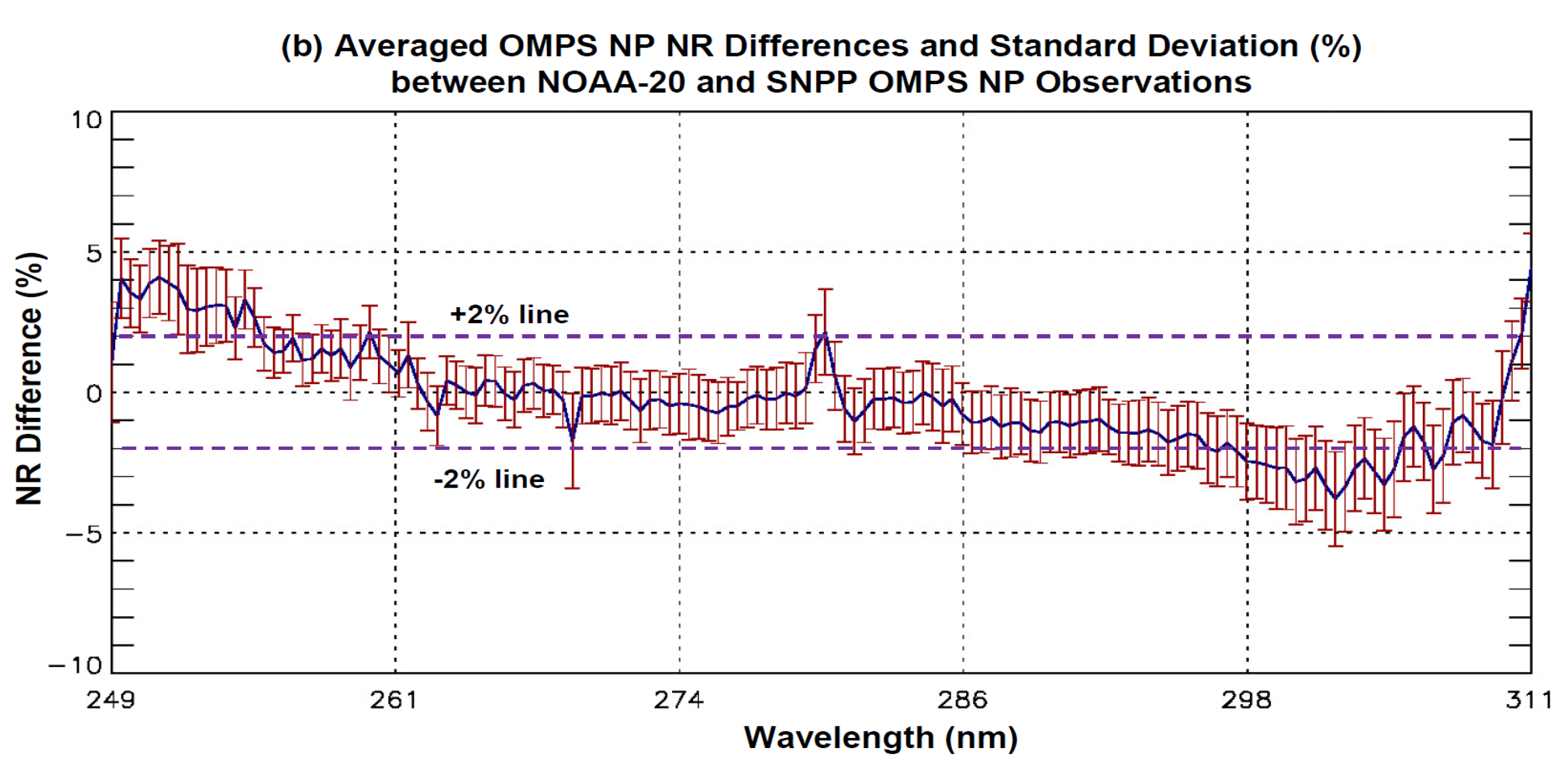
Figure 2a,b displays averages and standard deviations of long-term inter-sensor normalized radiance (NR) differences (%) at all channels between NOAA-20 and SNPP OMPS NM and NP, respectively. Here, the NR is defined as the ratio of Earth-view radiance to the on-board reference solar irradiance (or the Day-1 solar irradiance spectrum with an updated wavelength scale), rather than the solar measurements in the onboard working diffuser. A further description will be given slightly later. These results are a statistical analysis of multiple 32-day averages by using the data sets spanning the period from 7 November 2019, to 12 January 2025. As illustrated in the figures, the mean NR differences vary with wavelength for both OMPS NMs and OMPS NPs. Their magnitudes generally remain within ±2% (requirement) for the NM and NP channels with certain exceptions. For example, the mean NR differences often exceed ±2% at wavelengths between 300 and 305 nm for both NMs, and at wavelengths below 255 nm and between 300 and 305 nm for both NPs. These discrepancies are relevant to one or both of the residual stray light effect and mismatch of wavelength scales in the dichroic range [16]. Non-identical OMPS spectral bandpass features between SNPP and NOAA-20 OMPS NP also contribute to the discrepancies [14]. Fortunately, these large inter-sensor errors do not impact the quality of current OMPS NM SDR-derived atmospheric ozone products since the data below 305 nm are not used.

Figure 2.
(a) Averages and standard deviations of long-term 32D-AD normalized radiance differences between NOAA−20 and SNPP OMPS NM in the whole wavelength range from 310 nm to 380 nm, by using the data sets spanning the period from 7 November 2019 to 12 January 2025. (b) Same as (a) except for OMPS NP in the whole wavelength range from 250 nm to 310 nm. In (a), the average is expressed in a thick line, while the standard deviation is expressed in the vertical direction (average ± standard deviation), which is also applicable for Figure (b). In the figure, the NR difference is calculated using the formula: (NOAA-20 − SNPP) × 100/SNPP.
In addition to these expected features, an unusual bump with a peak of about 2% occurs around 280 nm. The NR values from NOAA-20 are consistently higher than those from SNPP within this wavelength range. This feature persists beyond the period analyzed in Figure 2. To investigate whether this is due to a possible calibration issue in the OMPS NP SDR data from SNPP, NOAA-20, or both, we analyzed the on-board solar irradiance reference spectra around this wavelength range as well as the 32-day average Earth radiance spectra for both SNPP and NOAA-20 OMPS NP sensors. This comparison was necessary because the NR values are computed using the ratio of Earth-view radiance to on-board reference solar irradiance.
The on-board solar irradiance reference spectrum per sensor is derived using a day-1 solar spectrum and a routinely updated wavelength scale every other week. The day-1 solar spectrum is a well-calibrated spectrum of a synthetic solar irradiance spectrum after applying necessary corrections from ground to orbit, including sensor wavelength shift, including the one-time wavelength shift from ground to flight, satellite orbital Doppler shift, and wavelength variations with time and/or latitude [12,13,14,15,16,33]. The synthetic solar spectrum, is constructed by convolving an extraterrestrial solar reference spectrum with the OMPS instrument spectral bandpass function [10].
where is the pre-launch synthetic solar spectrum, which is calculated using an extraterrestrial solar reference spectrum data set convolved with the OMPS instrument bandpass function; is the extraterrestrial solar reference spectrum; denotes the instrument bandpass function at the central wavelength with a width of , which was measured in pre-launch measurements; the index of spatial resolution is omitted in each variable for simplification. In this study, the reference solar dataset is based on the ATLAS SUSIM solar flux atlas [45,46] and the Kitt Peak National Solar Observatory solar spectrum [47], consistent with the calibration approaches used for the SNPP, NOAA-2,0 and NOAA-21 OMPS instruments. However, the bandpass characteristics of OMPS instruments onboard different satellites are not identical, which can lead to differences in the derived day-1 solar reference spectra.
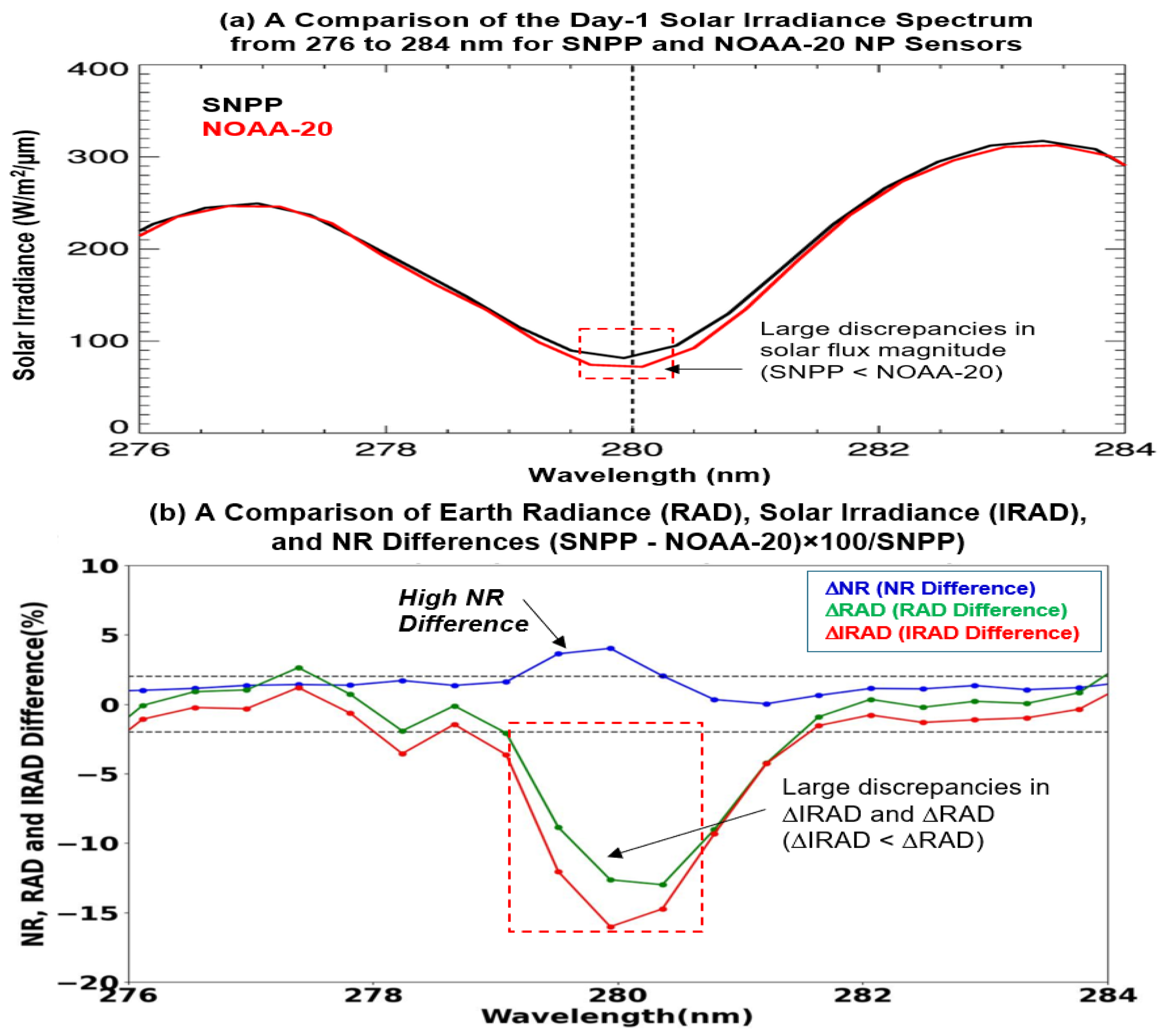
Figure 3a illustrates a comparison of two day-1 solar spectra (from 276 nm to 284 nm) for the SNPP and NOAA-20 OMPS NP sensors. The day-1 solar spectra show magnitude discrepancies at some wavelengths, particularly around 280 nm, with the highest values coming from the SNPP NP solar spectrum. This discrepancy is carried into the actual on-board solar reference spectrum in the SDR data, since it is a result of a shifted day-1 solar spectrum by applying a bi-weekly wavelength scale update with time [10].
Figure 3.
(a) A comparison of two on-board solar reference spectra (from 275 nm to 285 nm) for the SNPP and NOAA-20 OMPS NP sensors. (b) A comparison of the 32-day average Earth radiance (RAD), Solar irradiance (IRAD), and NR differences in the same wavelength range between SNPP and NOAA-20, which are represented in the figure using ΔRAD, ΔIRAD, and ΔNR, respectively. The data used in the figure covers the period from 6 October 2025 to 7 November 2025.
Moreover, NR is a ratio that reflects the consistency between solar irradiance and Earth radiance at the same wavelength, rather than the individual magnitude of the two parameters. As an example, Figure 3b shows a comparison of 32-day average Earth radiance (RAD), Solar irradiance (IRAD), and NR differences in the same wavelength range between SNPP and NOAA-20. A random period is selected since the discrepancy persists throughout the entire SNPP and NOAA-20 OMPS NP SDR data set. The results reveal that the largest discrepancy in NR occurs around 280 nm due to the largest discrepancy between the radiance and irradiance difference magnitudes in that region for both sensors (see the feature highlighted within a rectangle in dashed line in the figure). A potential solution we are considering is to recalibrate the day-1 solar spectrum around 280 nm for either the SNPP or NOAA-20 NP to reduce their inconsistency with the radiance spectrum, potentially using another instrument in this wavelength range as a reference. A separate study will be conducted to resolve this calibration discrepancy.
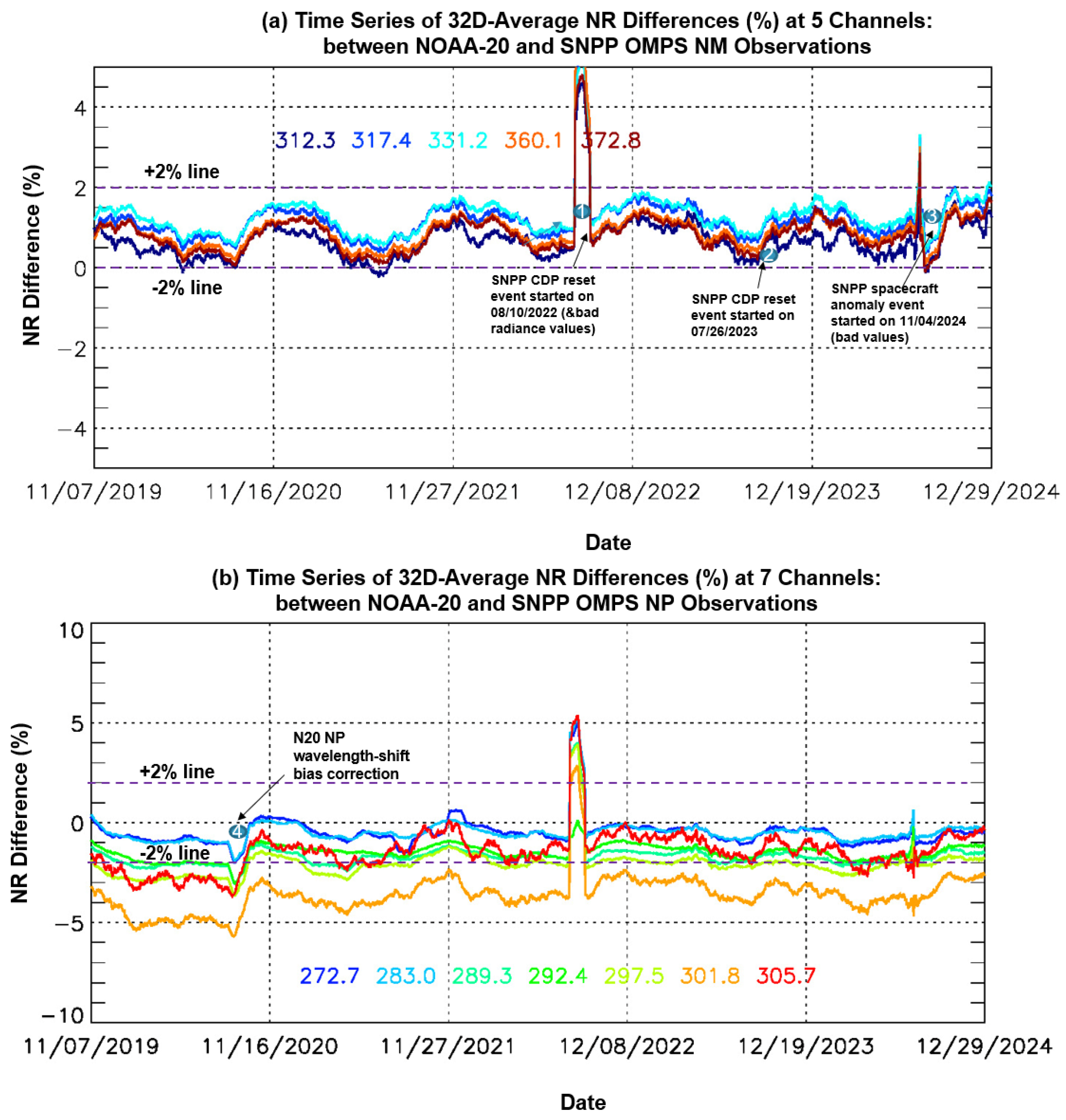
Nevertheless, the SNPP and NOAA-20 NP sensors exhibit stable long-term comparability across most channels, including those used for ozone retrievals. Figure 4a,b further displays time series of 32-day running average radiometric biases between the two OMPS NMs and NPs at a few channels that are used in the current ozone retrievals [6]. The results confirm the long-term stability of inter-sensor radiometric calibration performance between SNPP and NOAA-20 OMPS NMs and NPs in the absence of satellite spacecraft issues. Apparently, the updates of calibration tables reduce the inter-sensor biases. For example, an updated NOAA-20 OMPS wavelength table on 4 September 2020, reduced inter-sensor NR differences approximately by 1%. In addition, a seasonal pattern appears in both the NM and NP inter-sensor bias time series. A few factors contribute to this feature, including the high sensitivity of UV radiance to the solar zenith angle (SZA), the difference in orbit equator crossing times (approximately 50 min) between SNPP and NOAA-20 satellites, and seasonal variations in atmospheric composition (e.g., ozone and aerosols) and surface albedo. As a result, seasonal variations are still not fully eliminated in the 32-day average inter-sensor radiometric calibration differences between the two OMPS instruments. In contrast, such a seasonal pattern is not evident for the two CrIS instruments (see Section 3.2). This suggests that a more stringent quality control criterion—such as restricting analysis to low- and mid-latitude regions and clear-sky observations—may be necessary for UV sensor inter-sensor comparisons to mitigate solar-geometry and seasonal SZA effects. Further investigation is required to refine the QC thresholds and expand the applicability of the 32D-AD method.
Figure 4.
(a) Time series of 32D-AD running normalized radiance differences between NOAA-20 and SNPP OMPS NM at 5 wavelengths, covering the period from 7 November 2019 to 29 December 2024. (b) Time series of 32D-AD running normalized radiance differences between NOAA-20 and SNPP OMPS NP at 7 wavelengths, covering the period from 7 November 2019 to 29 December 2024. In (a), three labelled numbers from 1 to 3 are to mark approximate positions with occurrences of SNPP spacecraft anomaly, which are applicable for (b). Label 4 in Figure (b) shows the approximate position after applying the NOAA-20 OMPS NP wavelength table updated on 21 August 2020.
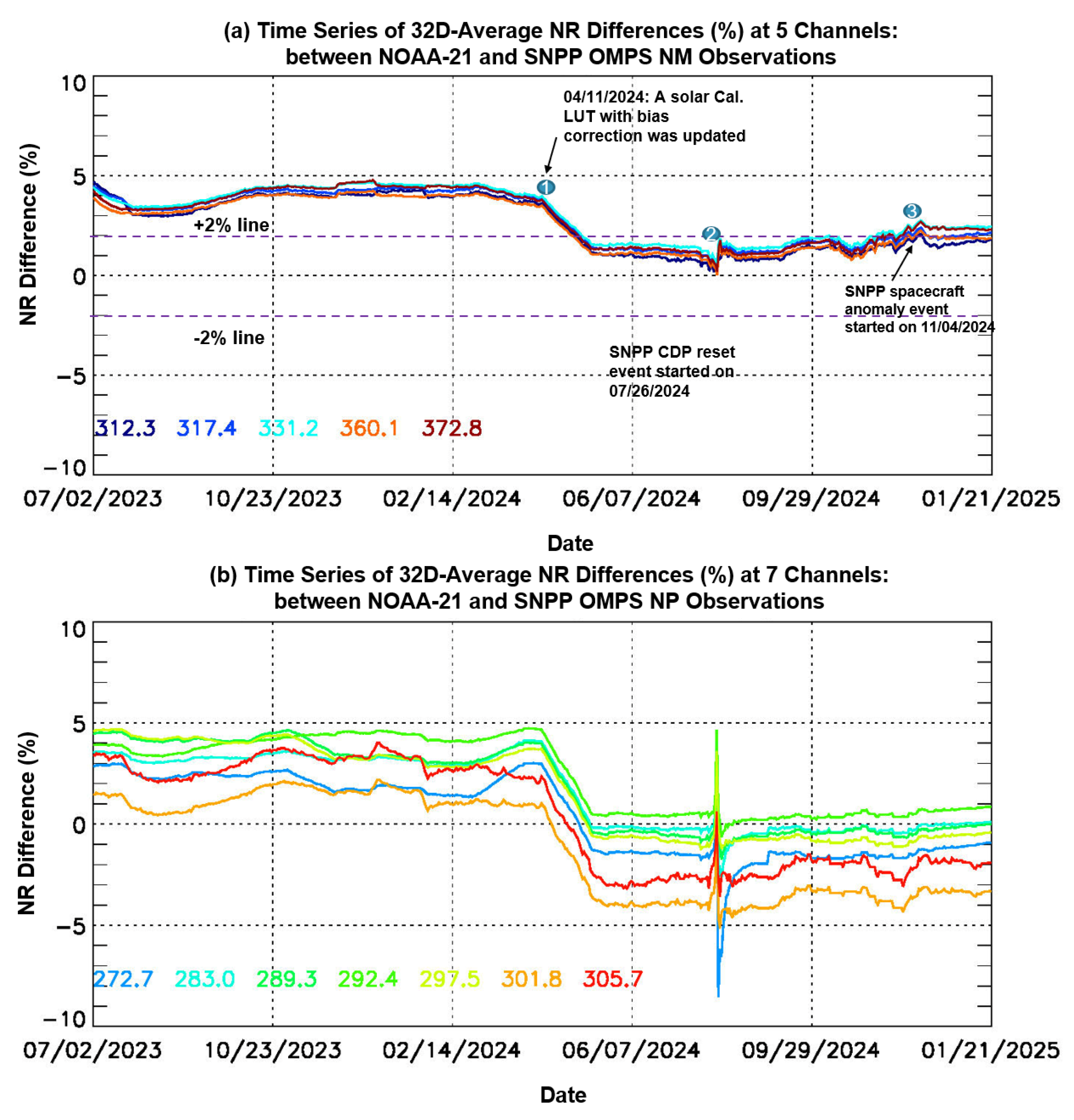
A similar analysis is conducted for the SNPP and NOAA-21 OMPS nm and OMPS-NP pairs. Figure 5a,b shows the 32-day average inter-sensor biases from 2 July 2023, to 21 January 2025, for five channels in the two NMs and seven channels in the two NPs, respectively. An important feature is that the absolute inter-sensor NR biases across the displayed channels decrease markedly after 11 April 2024, falling within the ±2% requirement. This is due to the implementation of an updated solar flux calibration table in the NOAA-21 OMPS NM and NP SDR processing system. The pre-launch albedo calibration of the NOAA-21 OMPS nadir instruments (NM and NP) was reported to have errors of several percent, varying by wavelength, either in the OMPS response or in the solar irradiance calibrations [courtesy of Jaros G. from NASA for an email communication in 2024]. This issue resulted in significant radiometric calibration errors in the NOAA-21 OMPS SDRs, averaging 2.2% for the OMPS NM and 4.3% for the OMPS NP [16]. The updated solar flux calibration table was designed to eliminate these average biases in the OMPS NM and NP SDR data. However, substantial calibration errors still persist in some channels between 300 nm and 310 nm due to strong wavelength-dependent biases in the NOAA-21 solar calibration coefficients [16]. This also explains why the inter-sensor biases in Figure 5b still exceed the ±2% requirement for the NOAA-21 NP channels at 301.8 nm and 305.7 nm.
Figure 5.
(a) Time series of 32D-AD running normalized radiance differences between NOAA-21 and SNPP OMPS NM at 5 wavelengths, covering the period from 2 July 2023 to 21 January 2025. (b) Time series of 32D-AD running normalized radiance differences between NOAA-21 and SNPP OMPS NP at 7 wavelengths. The datasets cover the period from 2 July 2023 to 21 January 2025.
3.2. Inter-Sensor Radiometric Biases Among CrIS Instruments
The CrIS is a hyperspectral infrared (IR) sounder that provides high-resolution, vertical temperature and moisture profiles of the atmosphere, aiding in weather forecasting. It covers 2211 spectral channels at a full spectral resolution (FRS) mode. The SDR data of CrIS instruments onboard SNPP, NOAA-20, and NOAA-21 have met the scientific requirements for a while [1,2,3,4,5]. The inter-sensor comparison performance of CrIS data during the limited data sets was also assessed by using either the CRTM-DD or the Sensor-DD in the previous studies [4,5]. A preliminary analysis covering 32 days of the data was also given for all CrIS channels by using the 32D-AD method [38,39]. This study extends previous analyses to longer time periods to evaluate the long-term stability of inter-sensor radiometric biases across three CrIS instruments.
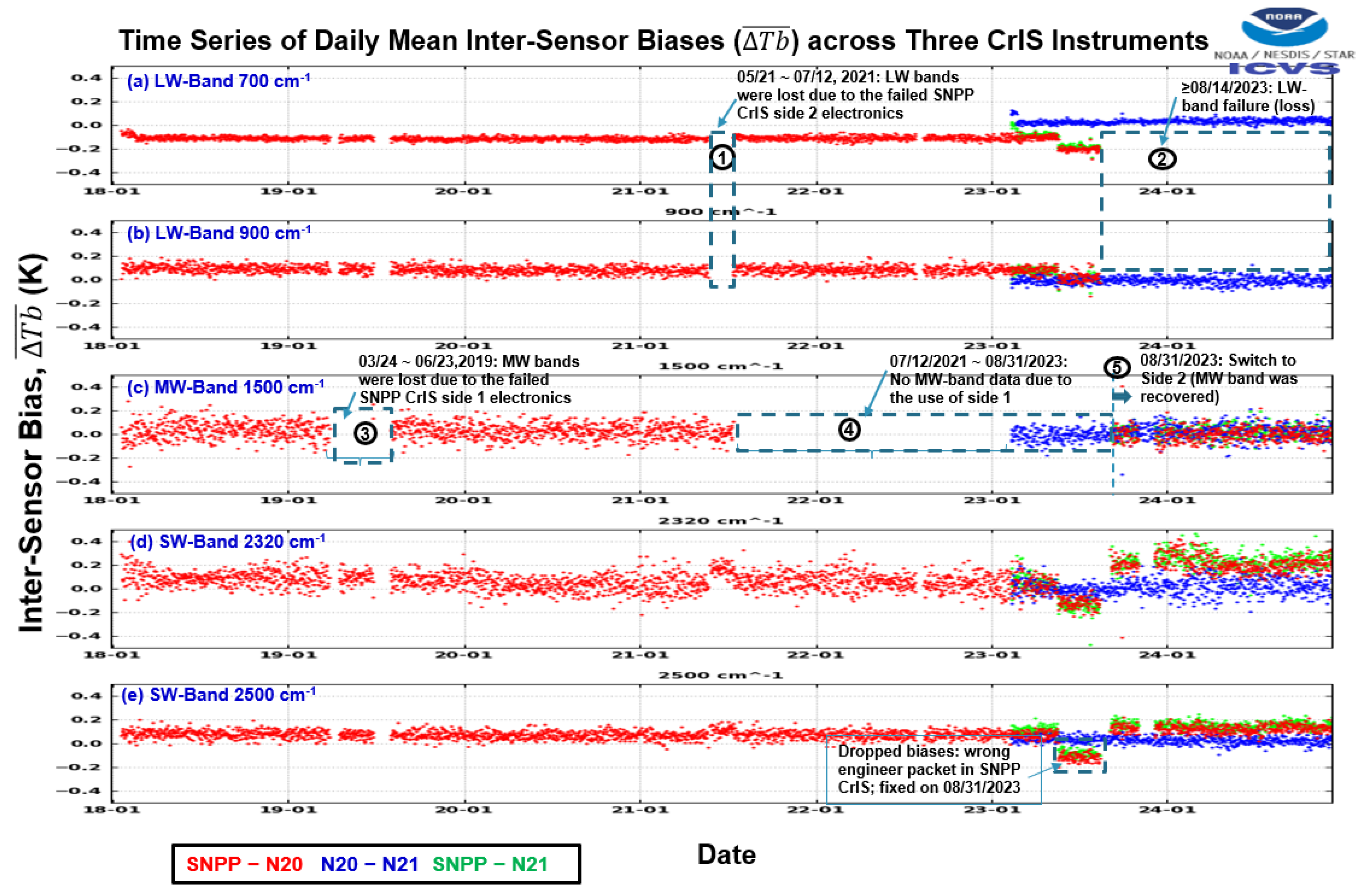
The CRTM-DD method, detailed in Equation (2) above, calculates the double difference of radiance deviations from CRTM simulations for two selected instruments. This method is commonly used to evaluate CrIS inter-sensor radiometric calibration biases within the ICVS iSensor-RCBA portal, due to its balanced computational efficiency and simulation accuracy for clear-sky observations over open oceans. Figure 6 presents the long-term stability of SDR data across three CrIS instruments through time series of daily-average inter-sensor radiometric calibration biases at five channels. These results are derived by applying CRTM-DD to CrIS observations under clear sky conditions over ocean regions between 55°S and -55°N to reduce simulation errors due to inaccurate surface emissivity over land or sea-ice conditions. The simulations use European Centre for Medium-Range Weather Forecasts (ECMWF) surface and atmospheric profiles [48,49] as inputs to the CRTM. ECMWF model data is based on the assimilation of data from a diverse set of Earth observing systems, providing sufficient robustness to estimate the state of the atmosphere with high accuracy. Biases observed in satellite data are dynamically corrected before the assimilation of the satellite observations. This process effectively reduces the impact of any remained CrIS biases on the CrIS radiance simulations used in this study.
Figure 6.
Time series of daily-average inter-sensor radiometric calibration biases at 5 channels among 3 CrIS instruments using CRTM-DD for CrIS observations during the daytime and nighttime under clear skies over oceans between −55°S and +55°N. In the figure, the results for different pairs of CrIS instruments are marked in a different color; NOAA-20 and NOAA-21 are replaced using N20 and N21 to save space; the data coverage varies with each pair of CrIS instruments, depending on their availability. Five dash boxes with numbers from 1 to 5, respectively, in the figure mark approximate positions of the permanent loss in the SNPP SDR data due to different reasons. (a) 700 cm−1. (b) 900 cm−1. (c) 1500 cm−1. (d) 2320 cm−1. (e) 2500 cm−1.
In this study, an empirical scheme is proposed to exclude cloud-contaminated CrIS pixels by analyzing brightness temperature differences at the 925 cm−1 window channel between the central FOV and each of the other eight FOV positions in a 9-FOV array. A pixel is flagged as cloud-contaminated if any of the eight differences exceeds 0.5 K. Additionally, if any brightness temperature among the eight surrounding FOVs is below 267 K, the pixel is also considered cloud-contaminated. Pixels meeting either criterion are excluded from the CRTM simulation.
Generally, observations at three instruments during the analyzed period are in a family with the averaged differences smaller than 0.2. Certain fluctuations or data gaps were observed, particularly in relation to the SNPP CrIS instrument issues. Due to the mission extending well beyond its standard lifetime, the CrIS instrument experienced failures in both the side-1 and side-2 electronics. As a result, three switches occurred between side-1 and side-2 electronics, as indicated in the figure. Each failure caused permanent loss of the data in the MW band or LW band. For example, the first failure of the side-1 electronics from 24 March to 23 June 2019, resulted in permanent loss of the MW bands data (see the gap labeled as #3 in Figure 6c). The use of the side-1 electronics further caused permanent loss of the MW bands data from 12 July 2021 to 31 August 2023 (see the long gap labeled as # 4 in Figure 6c). An excellent analysis and recalibration of SNPP CrIS SDR data after the side switch was given in a previous study of SNPP CrIS SDR data [5]. Additionally, the impact of the wrong calibration table is detected in the long-term inter-sensor biases. For instance, a wrong engineering packet with a neon laser wavelength default value was set up for a few months until 31 August 2023 for the SNPP CrIS after its electronics were switched from side-1 to side-2. This resulted in a sudden drop by approximately 0.1 K.
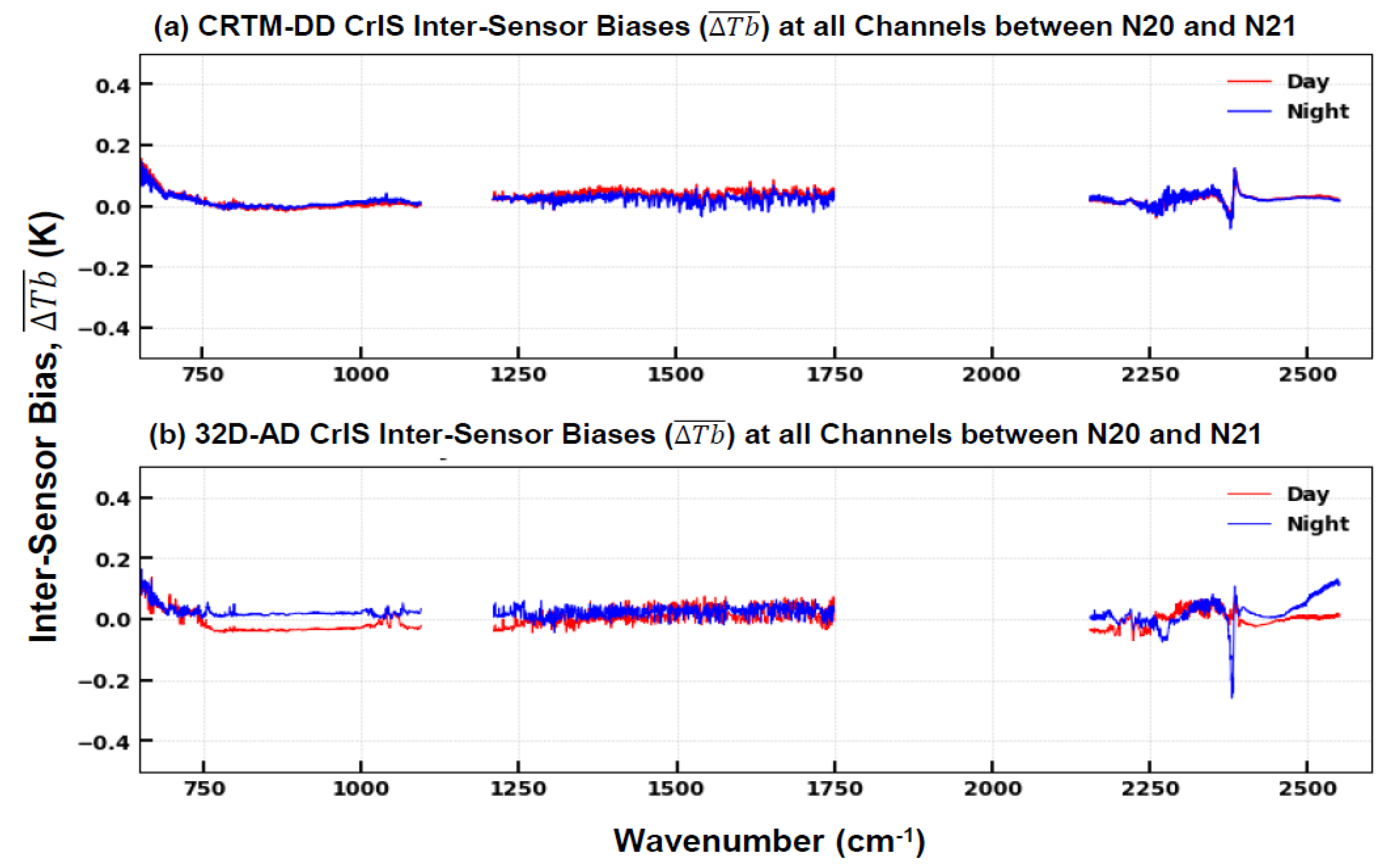
The CRTM-DD method provides insights into the quality of CrIS SDR data under clear skies in low- and mid-latitude regions. However, its effectiveness in detecting regional calibration inconsistencies remains insufficient, particularly when such deviations occur at non-CRTM simulation regions. In contrast, the 32D-AD method is suitable for global CrIS observations, thus identifying an unexpected feature on NOAA-21 observations over high latitudes. Figure 7a,b showcases the average inter-sensor biases between NOAA-20 and NOAA-21 CrIS observations from 1 January to 3 February 2025, by using the CRTM-DD and the 32D-AD methods, respectively. The computations were performed separately for nighttime (descending data) and daytime (ascending data) to better assess the impact of potential regional calibration differences on the observations.
Figure 7.
Averaged inter-sensor radiometric calibration biases between NOAA-21 and NOAA-20 CrIS instruments, for ascending (daytime) and descending (nighttime), respectively. The data covers the period from 5 January to 4 February 2025, and the results under clear skies over oceans between −55°S and +55°N using CRTM-DD method in (a) are an average of 32-day results to provide a consistent temporal period with that using the 32D-AD method. (a) CRTM-DD. (b) 32D-AD.
Generally, the two methods reveal that the NOAA-20 and NOAA-21 CrIS observations at both ascending and descending nodes are very comparable: is typically within ±0.2 K, with an exception appearing around 2350 cm−1, where | exceeds 0.2 K from the 32D-AD method. Another important feature in the 32D-AD-based results is that the differences of around 2500 cm−1 between ascending and descending nodes exceed 0.1 K (see Figure 7b). This discrepancy was not found in the CRTM-DD results. Recall that the CRTM-DD results for both ascending and descending nodes were computed using data between −55°S and +55°N, thus being unable to identify anomalous features in the CrIS data outside the CRTM simulation analysis region.
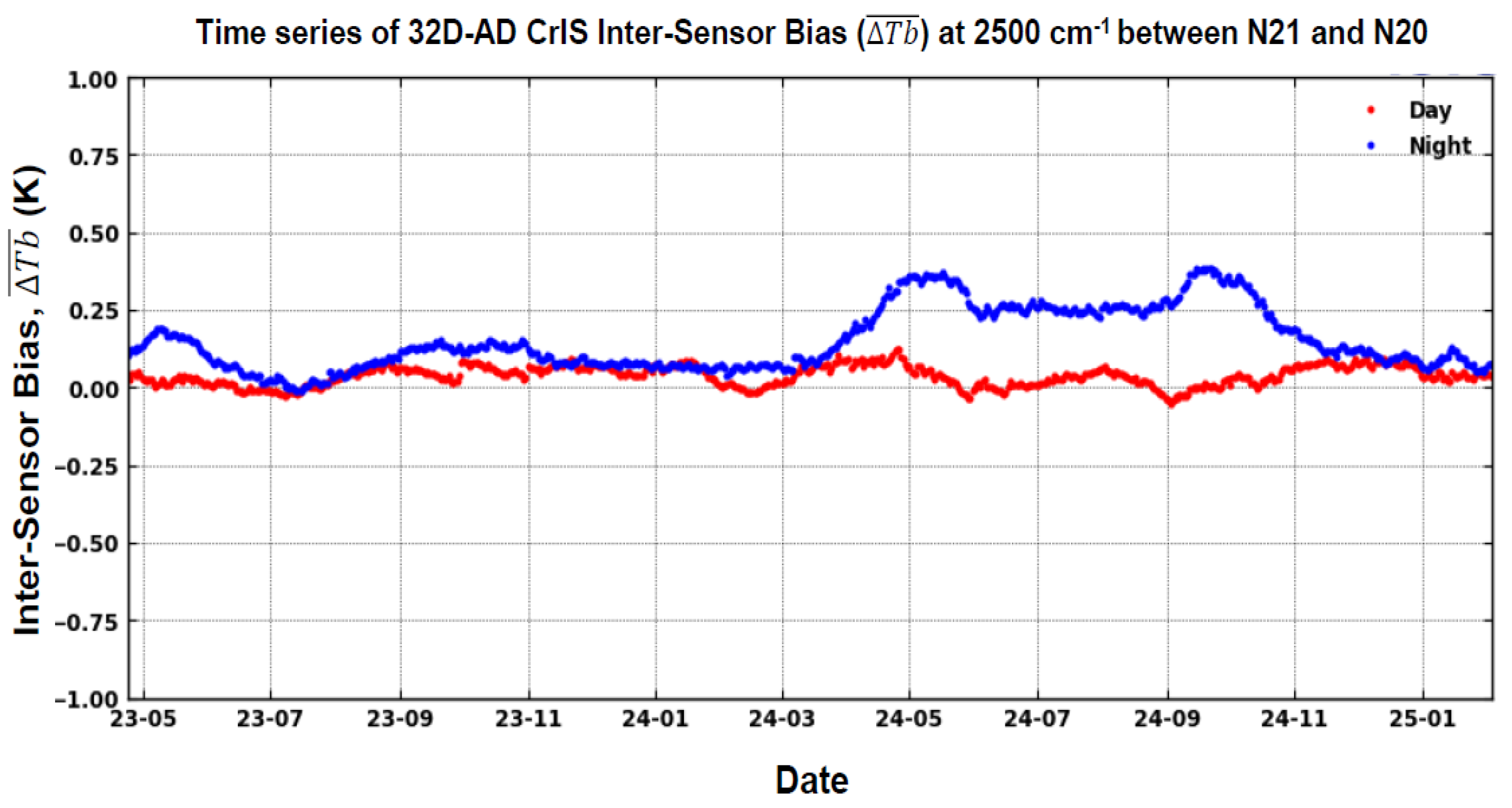
To understand this discrepancy, at 2500 cm−1 from the 32D-AD method between two nodes (daytime and nighttime) of observations was used, and further analysis was performed. Figure 8 shows the time series of at 2500 cm−1, from 1 April 2023 to 3 February 2025, obtained using the 32D-AD method. The dates in the x-axis represent the end dates of the 32-day dataset periods. The large differences in between ascending and descending data are observed primarily from March through September. This seasonal discrepancy indicates that some inconsistencies might remain in either NOAA-21 or NOAA-20 CrIS during this period. Based on our analysis, unexpected variations in the calibration target temperatures of NOAA-21 CrIS have been observed as the instrument transitions from orbital darkness into sunlight, which displays some latitude dependency. These variations are believed to contribute to the observed errors in the NOAA-21 CrIS Earth-view radiances. Non-negligible CrIS radiance errors occur primarily from April to September, which remains primarily from 65° through 80° in latitude over the Southern Hemisphere, though this range may be slightly changeable with the year. Thus, increased NOAA-21 CrIS radiance errors are likely responsible for the increase in inter-sensor radiometric biases between NOAA-21 and NOAA-20 CrIS during the nighttime period. While a detailed root-cause analysis of this performance behavior is beyond the scope of the present manuscript, it is being actively investigated in a dedicated study conducted by the operational CrIS calibration and validation (Cal/Val) team, which is currently under review. That study explores several preliminary hypotheses related to this behavior. The analysis presented here complements those efforts by providing independent cross-instrument comparisons and contributing to the long-term monitoring and assessment of radiometric consistency across CrIS sensors.
Figure 8.
Time series of 32D-AD average of inter-sensor radiometric calibration biases () at 2500 cm−1 between NOAA-21 and NOAA-20 CrIS observations at day-time and night-time separately. The time series of the results is carried out in a running 32-day window of the data sets with one day-shift. The data sets used in the figure cover the period from 1 April 2023 to 3 February 2025, since the end date of each 32-day dataset in the computation is used as a date index.
Therefore, the 32D-AD methodology has demonstrated its effectiveness in identifying and monitoring radiometric inconsistencies, such as the unusual feature observed in the NOAA-21 CrIS data, even in regions where other methods are unavailable.
3.3. Inter-Sensor Radiometric Biases for Other Instrument Pairs
In addition to the above results about the JPSS instrument pairs, the iSensor-RCBA portal produces various results of inter-sensor radiometric biases across JPSS (SNPP) and non-JPSS instruments using the SNO and Sensor-DD methods, as described in the LEO–LEO and LEO–GEO components in Figure 1a. Therefore, we conduct the following inter-sensor comparison analyses to illustrate scientific applications in identifying issues that impact the quality of SDR data in one SNPP or non-JPSS instrument: SNPP OMPS NM and Metop-B GOME-2, SNPP CrIS, and GOES-16 ABI.
3.3.1. SNPP OMPS NM and Metop-B GOME-2
The SNPP OMPS NM SDR data show long-term stability, particularly at wavelengths above 310 nm [50,51,52], which is further confirmed in this study. In contrast, the Metop-B GOME-2 is undergoing significant sensor degradation over a long mission period [53]. Therefore, it is interesting to investigate the feasibility of using OMPS and GOME-2 SNO-based inter-sensor biases to estimate GOME-2 sensor degradation rate. These SNOs happen in the Northern Hemisphere with a latitude between 70N and 80N. The overlapped channels cover the following 11 central wavelengths: 310.73, 311.98, 312.41, 313.24, 314.49, 317.42, 322.43, 331.20, 345.38, 359.98, 372.93 nm.
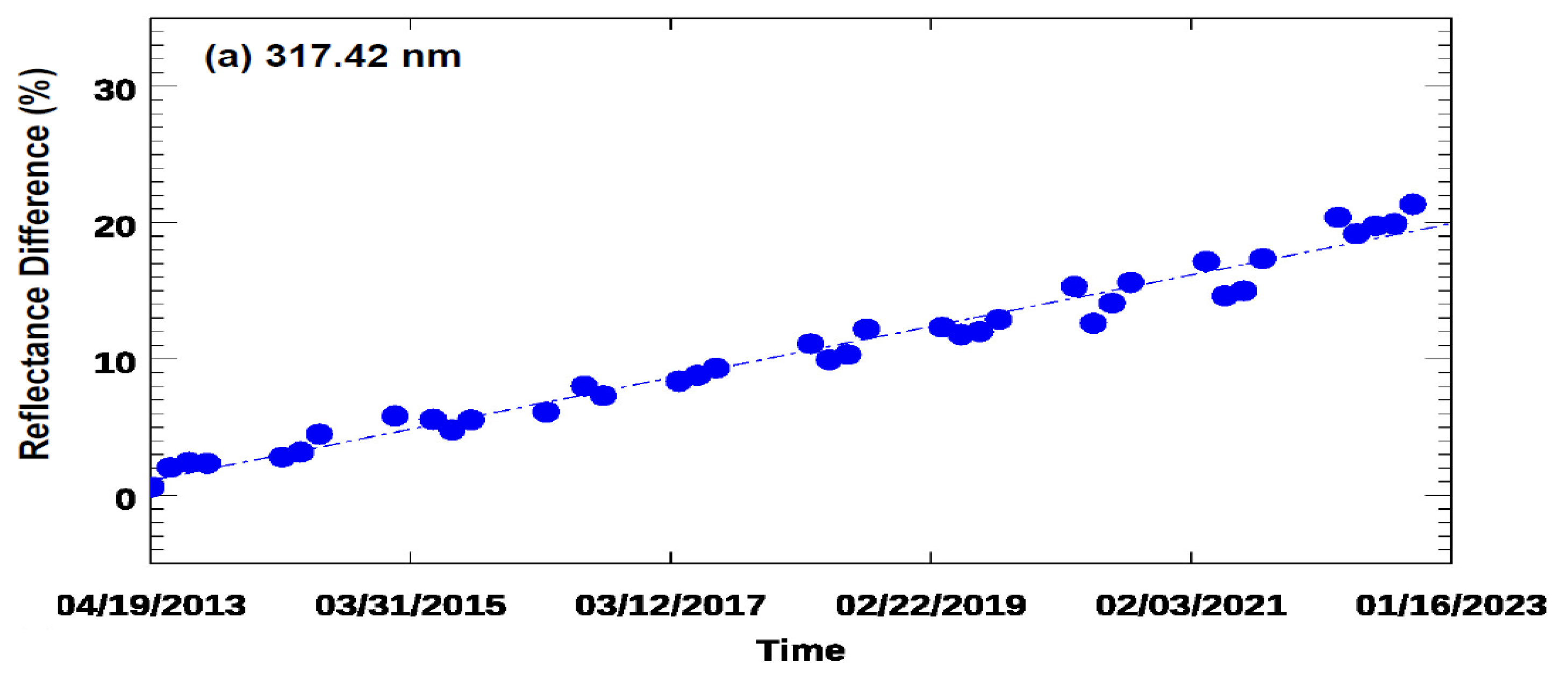
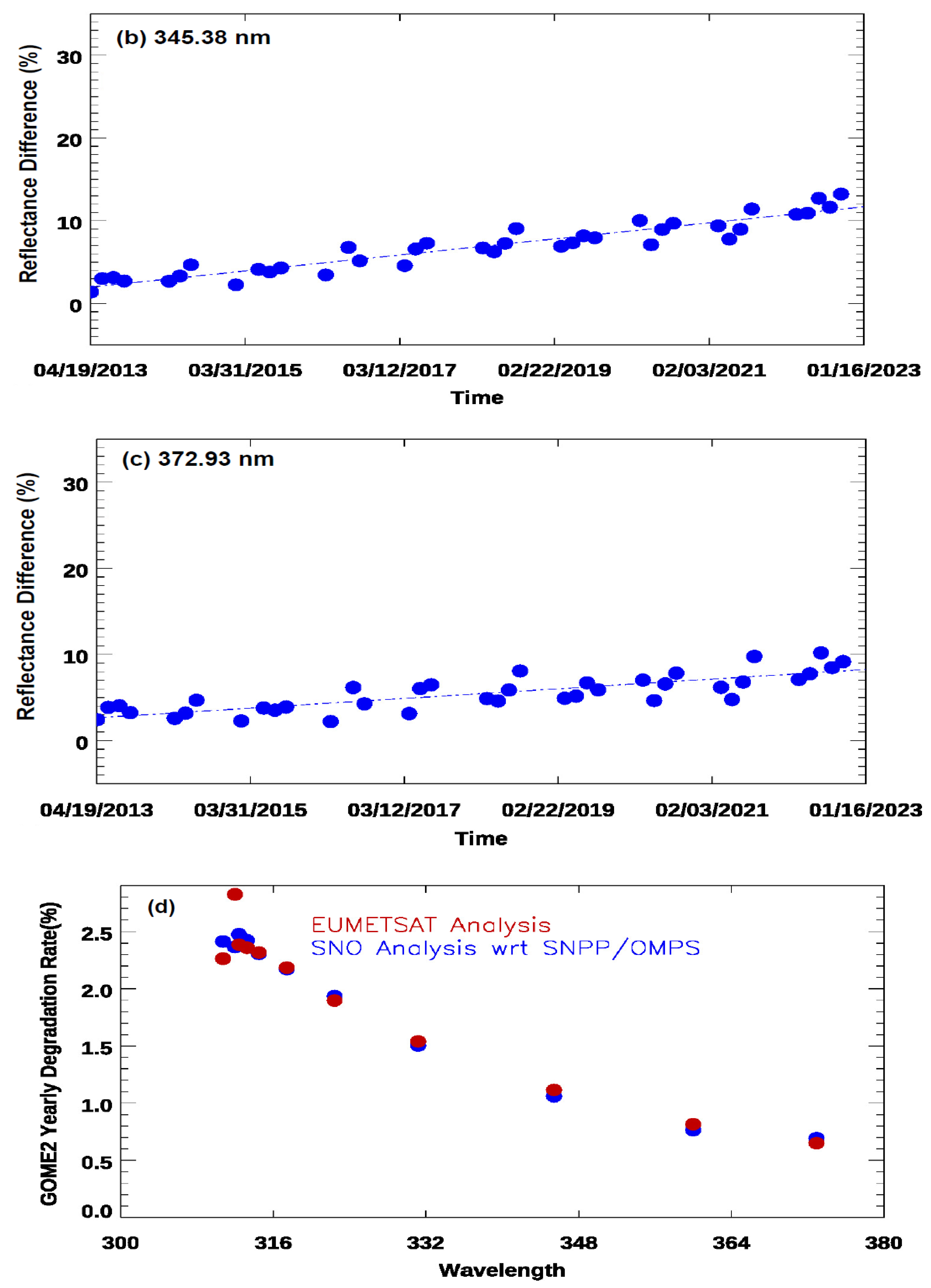
Figure 9a–c presents time series of SNO-average inter-sensor biases at 317.42 nm, 345.38 nm, and 372.93 nm, respectively. The SNO observations are selected based on a window with less than 80 km spatial distance and 120 s temporal difference. The computation procedure is referred to two previous studies in [54,55]. The inter-sensor biases exhibit a gradual increase with time, having an obvious wavelength dependency from a smaller trend at longer wavelengths to a larger trend at shorter wavelengths.

Figure 9.
(a) Time series of averaged inter-sensor radiometric calibration biases at 317.42 nm, using the SNO data sets spanning the period from 19 April 2013 to 16 January 2023. (b) Same as (a) except for at 345.38 nm. (c) Same as (a) except for at 372.93 nm. (d) Estimated yearly degradation rate per year at 11 channels, i.e., 310.73, 311.98, 312.41, 313.24, 314.49, 317.42, 322.43, 331.20, 345.38, 359.98, 372.93 nm, that were computed using two methods. In the figures, (a) through (c), reflectance difference is calculated using the formula: (GOME-2 − OMPS) × 00/OMPS. The results marked in blue in (d) were computed using a linearly fit for the time series of SNO-averaged inter-sensor biases per channel during an almost ten-year period, which was carried out in this study. The results in red were provided by the EUMETSAT Pieter Valks using Metop-B GOME-2 Earth radiance and solar flux measurements.
The SNPP OMPS NM sensor exhibits a long-term stability with a small degradation, less than 0.3% per decade, at wavelengths above 310 nm [50]. The long-term stability of SNPP OMPS NM radiances was evaluated using deep convective cloud (DCC) targets, which serve as widely used natural and radiometrically stable reference scenes with nearly Lambertian reflectance [51]. It was found that the maximum variation of mean reflectance at wavelengths above 330 nm within DCC targets is approximately 0.296% per decade [51]. As a result, it is reasonable to assume that the discovered trends in Figure 9a–c are caused primarily by the degradation of Metop-B GOME-2. The GOME-2 degradation results in gradually decreased solar irradiance with time, thus leading to gradually increased reflectance. Additionally, the derived inter-sensor reflectance differences increase approximately linearly over time, suggesting that the GOME-2 sensor degradation rate remains nearly constant throughout the analyzed period. Hence, the GOME-2 sensor degradation rate can be estimated using the slope of the linear fit for the inter-sensor reflectance difference trend. Note that the SNO observations between OMPS NM and GOME-2 were collected at nadir pixels. So, the derived degradation rates represent the performance of GOME-2 at nadir positions. Figure 9d presents the GOME-2 yearly degradation rates, estimated at 11 overlapping channels. As a comparison, the results using GOME-2 Earth radiance and solar flux measurements from EUMETSAT, which were provided by Dr. Pieter Valks at EUMETSAT, are added in Figure 9d. The yearly degradation rates computed using those two methods are very consistent. This indicates the reasonability of the above assumptions.
3.3.2. SNPP CrIS and GOES-16 ABI
It is important to continuously monitor geolocation performance for on-orbit instruments, particularly for satellites nearing or exceeding their standard lifespan. This is especially relevant for SNPP, which has been in operation for over 13 years, significantly exceeding its six-year lifespan. As a fact, the SNPP spacecraft has experienced several geolocation anomalies in the past year, notably on 25 May 2024, 9 July 2024, and 2 November 2024. The last two GPS anomaly events resulted in significant geolocation problems, with errors exceeding 100 km (Courtesy of NOAA STAR VIIRS SDR team), affecting all CrIS, OMPS, ATMS, and Visible Infrared Imaging Radiometer Suite (VIIRS) instruments on SNPP.
For CrIS SDR data, geolocation accuracy is typically assessed by comparing it with spatially collocated radiance measurements from the VIIRS image band I5 [56]. This approach leverages VIIRS’s high spatial resolution and accurate geolocation, which has a geolocation error as high as a few tens of meters [57]. However, this method is compromised if VIIRS is also experiencing the same geolocation issues. The following analysis aims to explore the feasibility of identifying the impact of vital geolocation errors through sudden and large fluctuations in long-term inter-sensor radiometric calibration biases. This work is carried out based on SNO observations at three overlapped channels (ABI channels 8 through 10, as shown in Table 3 above) between SNPP CrIS and GOES-16 (or GOES-18) ABI. GOES-16 (and GOES-18) ABI was selected as a reference sensor due to its stable calibration accuracy, as shown in previous studies [58,59]. Geolocation accuracy of ABI radiance data is as high as 10–13 µrad, which is well within the mission requirement of 28 µrad (1 km at nadir) [60,61].
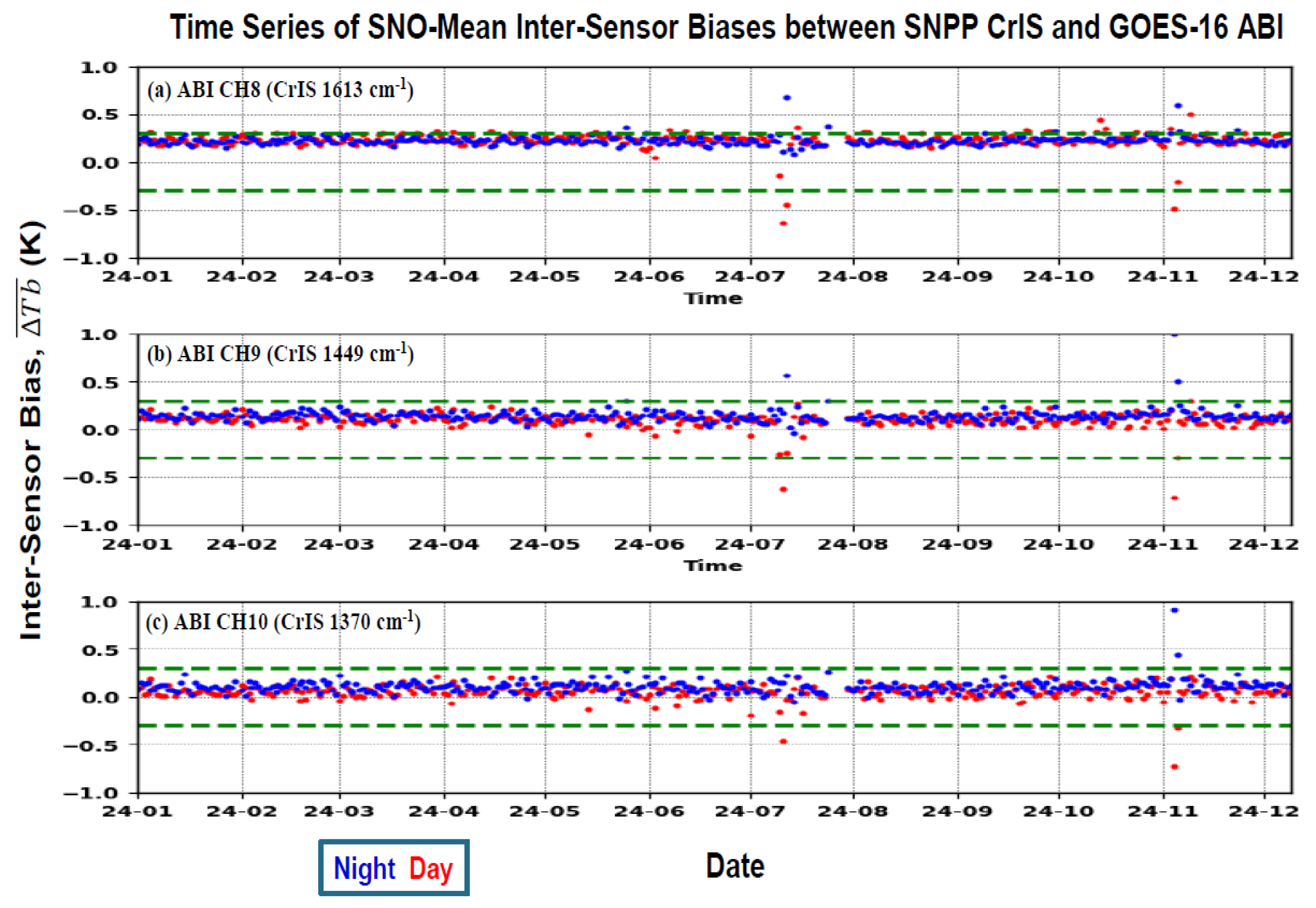
Figure 10 shows the time series of the daily average of inter-sensor radiometric calibration biases at three ABI channels for all QC-selected SNO pairs during day and night, respectively, between SNPP CrIS and GOES-16 ABI. Each SNO pair of ABI-CrIS SDR data is selected based on ABI measurements that are the nearest in time to CrIS measurements. Several additional criteria are also applied to the selection of SNO observations, for example, the maximal nadir difference is smaller than 500 km, meaning 0° < Local Zenith Angle (LZA) < 5.3°. Additionally, abs(1 − cos(θ1)/cos(θ2)) < 0.006, where θ1 and θ2 are the LZA of CrIS and ABI, respectively. CrIS nadir Field-Of-Regards (FOR) are limited to FOR14~17, meaning 0° < LZA < 7.2°. More discussions about the selection of CRIS and ABI SNO pairs are referring to [62]. Additionally, the CrIS radiance data are convolved into broadband radiance using the spectral response function of 10 ABI infrared channels. The spectral gaps in ABI channel 7 (3.9 µm) and 11 (8.4 µm) are filled using the principal component method [63]. The utilization of an average in SNO observations per day in the figure is employed to reduce the impacts of imperfect SNO observations, which can arise from remaining differences in time, spatial and spectral response, distance, and azimuthal viewing conditions. This is done even after the application of the abovementioned QC criteria.
Figure 10.
Time series of daily average of inter-sensor radiometric calibration biases at three ABI channels for the observations during day and night, respectively between SNPP CrIS and GOES-16 ABI. In the figure, the inter-sensor biases are computed using the SNO method [62]. To fill up the spectral gaps between CrIS and ABI, an existing method in [63] is employed to predict the CrlS gap channels in the figure. (a) ABI Channel 8 (corresponding to the CrIS channel at 1613 cm−1). (b) ABI Channel 9 (corresponding to the CrIS channel at 1449 cm−1). (c) ABI Channel 10 (corresponding to the CrIS channel at 1370 cm−1). The green lines in the figures denote the positions of ±0.3 K.
As illustrated in Figure 10, the inter-sensor biases at the three ABI channels (8 to 10) between SNPP CrIS and GOES-16 ABI remain stable within ±0.5 K, except during two periods affected by the aforementioned two SNPP GPS anomalies. On 12 July 2024 and 6 November 2024, the geolocation errors were over 100 km, thus showing unexpectedly large fluctuations in the inter-sensor biases. A similar feature was observed for the inter-sensor biases between SNPP CrIS and GOES-18 ABI (the figure is omitted). During these periods, no anomalous events were reported in either spacecraft or calibration relevant to GOES-16 ABI. Instead, large geolocation errors in SNPP CrIS SDR data led to suddenly increased inter-sensor radiance differences in the figure. Therefore, this capability is stimulating the development of a new algorithm for quantifying geolocation errors of CrIS SDR data using ABI SDR data, which will be discussed in a separate manuscript.
4. Discussion
While our iSensor-RCBA portal involves a series of instruments onboard the SNPP, NOAA-20, NOAA-21, Metop-B, Metop-C, GOES-16, and GOES-18 satellites, the above analysis focuses on long-term SDR datasets from three OMPS nadir instruments and three CrIS instruments across various JPSS satellites. Additionally, it includes approximately ten years of SDR datasets from the Metop-B GOME-2 sensor at UV bands to derive the GOME-2 instrument degradation rate against SNPP OMPS NM observations.
The analysis results, utilizing assessment methods such as 32D-AD and CRTM-DD, have provided vital supplemental information on calibration consistency, specifically focusing on global average inter-sensor radiance biases. However, it is important to note that the results from these methods are not error-free, as they may contain residual diurnal variation. This occurs because observations from two instruments across different satellites are not made simultaneously.
Firstly, to ensure the accuracy of our results, we implemented several measures to minimize uncertainties arising from this residual diurnal variation:
- -
- Increased sample sizes of collected observations.
- -
- Utilized 32-day global averages.
- -
- Applied strict quality control thresholds, including the removal of cloud-contaminated and high-latitude observations and the exclusion of data outside standard deviations.
Even so, the diurnal errors might still remain with each method and computed inter-sensor radiometric biases. However, it is difficult, if not impossible, at this point to quantify residual errors due to the lack of an absolutely accurate method that we can use. In addition, the diurnal variation changes with time and scenery, thus leading to different errors over different locations on Earth and times. Due to this, the impact of these remaining diurnal variations on the global average of inter-sensor radiometric biases can be small.
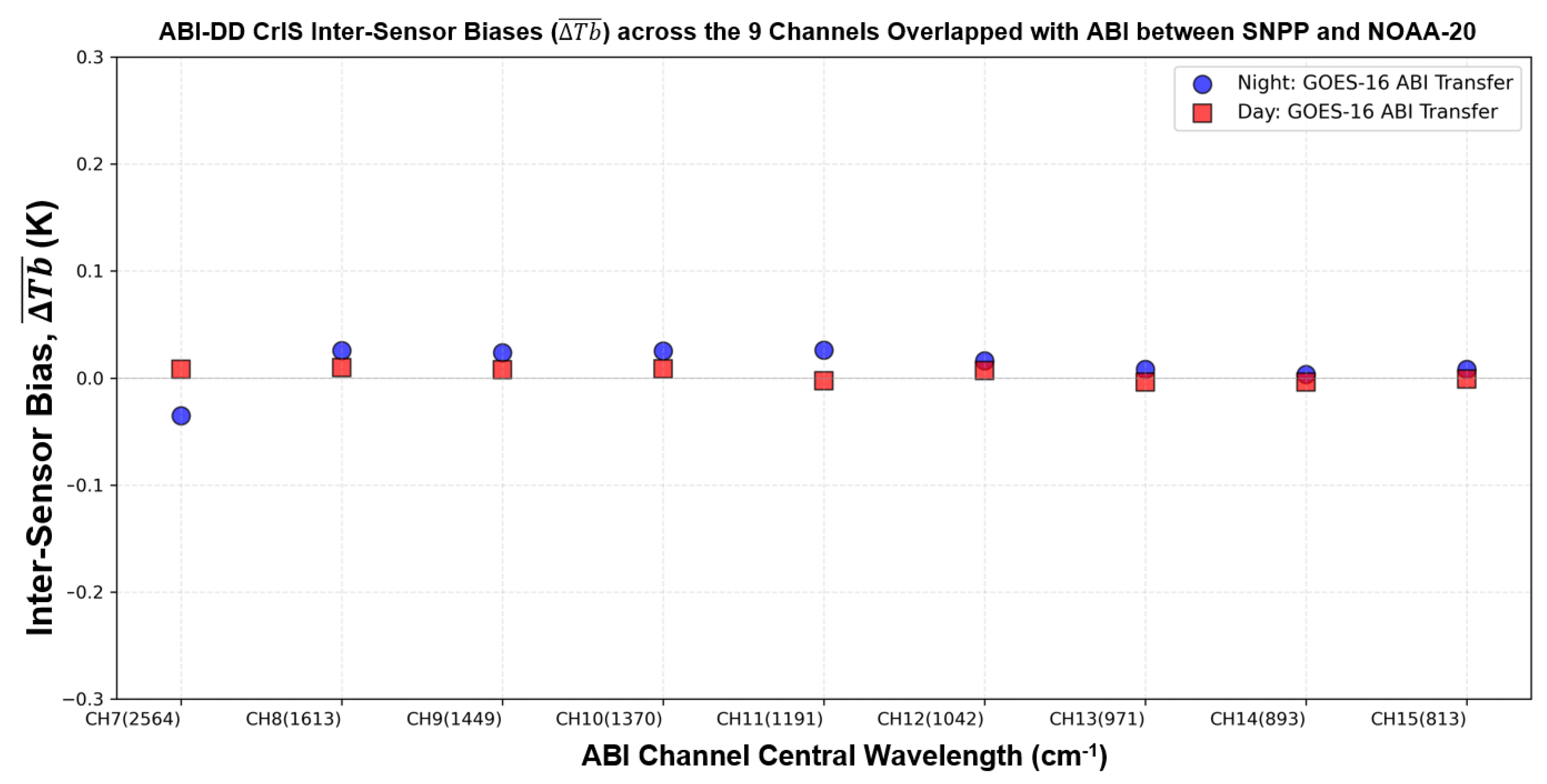
Consequently, we do not attempt to quantify accurate errors with each method. Instead, we cross-validated these biases upon selected data sets using multiple independent methods to determine the accuracy of the results in the previous and/or current studies. For OMPS NP SDR, differences between 32D-AD and RTM-DD were within a smaller range of ±0.1% for most wavelengths. The exception was a few wavelengths near 250 nm and between 300 nm to 305 nm, which were within ±0.5%, and are found to be relevant to inaccurate RTM simulations around these wavelength ranges [38]. For CrIS instruments, differences between 32D-AD and CRTM-DD were approximately within ±0.01 K across most channels (see Figure 7 above). This conclusion was further confirmed by SNO-based biases using GOES-16 ABI as a bridge (ABI-DD method), as shown in Figure 11 here. This strong consistency across methods even thus allowed us to identify a seasonal calibration discrepancy in NOAA-21 CrIS (see Figure 8 above).
Figure 11.
SNO-based averaged inter-sensor radiometric calibration biases between NOAA-21 and NOAA-20 CrIS instruments using GOES-16 ABI as a bridge, for ascending (daytime) and descending (nighttime), respectively. The data covers the period from 5 January to 4 February 2025.
While this particular study focuses on global averages rather than dependencies on radiometric dynamic ranges or latitudes (which are covered in previous works [38,62]), it successfully demonstrates the potential scientific applications of the iSensor-RCBA portal across different satellite instruments. Specifically, the SDR datasets in three OMPS nadir instruments and three CrIS instruments are used as examples, although they have no physical correlation. Importantly, the long-term calibration consistency of the SDR data sets observed by these instruments is well understood.
5. Conclusions
Using the iSensor-RCBA portal within the STAR ICVS monitoring system, this study assesses long-term inter-sensor radiometric calibration performance across eleven instruments—three OMPS NM, three OMPS NP, three CrIS sensors on SNPP, NOAA-20, and NOAA-21, as well as Metop-B GOME-2 and GOES-16 ABI. The key findings are summarized below.
First, the analysis provides new insight into the long-term radiometric stability of JPSS SDRs from the OMPS nadir and CrIS instruments. Most channels exhibit stable inter-sensor consistency across the three satellites from SNPP to NOAA-21. For CrIS, mean inter-sensor radiance differences are typically below 0.2 K. For OMPS NM and NP, inter-sensor biases generally meet the ±2% requirement, with notable exceptions in the 300–305 nm range for OMPS NM and below ~255 nm for OMPS NP. Degraded performance is usually linked to early orbit behavior, anomalies, malfunctions, calibration updates, or specific channels.
Second, iSensor-RCBA enables identification of calibration issues and anomalies, including several previously unreported radiometric features. Using the 32D-AD method, this study first detected and traced the cause of an inconsistency near 280 nm between SNPP and NOAA-21 OMPS NM. The method also reveals an unusual feature in NOAA-21 CrIS SDRs over high-latitude Southern Hemisphere regions, prompting further investigation by NOAA CrIS scientists. SNO analyses further detect calibration discrepancies by comparing sensors against long-term stable references. For example, annual degradation rates derived for Metop-B GOME-2 using SNPP OMPS NM SNOs agree with EUMETSAT findings, demonstrating the value of inter-sensor bias analyses for identifying under-performing instruments. In another case, GOES-16 ABI data helps diagnose CrIS geolocation issues on SNPP related to spacecraft GPS anomalies, showing the potential for quantifying CrIS geolocation errors using ABI cross-checks.
Overall, the results show that iSensor-RCBA provides more than visualization tools; it enables detection and interpretation of subtle long-term radiometric behaviors, supplies independent evidence for calibration and validation, and supports both JPSS and non-JPSS users, including the GSICS community. Its approaches are applicable to future missions such as JPSS-03 and JPSS-04 and to non-NOAA satellites, making the portal a useful model for supplemental long-term data quality assessments.
Some limitations remain. For example, while this study focuses on the global average of inter-sensor radiometric calibration biases, an analysis of the dependencies of these biases upon different dynamic ranges and/or latitude was not conducted at this time. Additionally, the 32D-AD method, while offering excellent global coverage, uses a quality-control threshold that insufficiently mitigates diurnal effects for OMPS NM window channels, which are highly sensitive to solar variability. Further refinement is needed for this method, especially when it is applied to window channels over a limited geophysical region. This will allow for a more detailed analysis of the dependencies of inter-sensor radiometric calibration biases on radiometric dynamic ranges or latitudes. Additional methods and functions are also being developed to extend iSensor-RCBA capabilities to Metop-SG and commercial satellite instruments.
Author Contributions
Conceptualization, B.Y.; methodology, B.Y., D.L. and X.J.; software, D.L., X.J. and L.W.; validation, B.Y., D.L., X.J., N.S., F.I.-S., X.W. and L.W.; formal analysis, D.L., X.J. and L.W.; investigation, B.Y., D.L. and X.J.; resources, B.Y.; data curation, D.L., X.J. and N.S.; writing—original draft preparation, B.Y.; writing—review and editing, B.Y., X.W. and F.I.-S.; visualization, D.L. and X.J.; supervision, B.Y.; project administration, B.Y.; funding acquisition, B.Y. All authors have read and agreed to the published version of the manuscript.
Funding
This study is sponsored by the JPSS program via STAR. Likun Wang was supported by NOAA grant NA24NESX432C0001 (Cooperative Institute for Satellite Earth System Studies-CISESS) at the University of Maryland/ESSIC.
Data Availability Statement
All SDR data sets are available in the NOAA Comprehensive Large Array-data Stewardship System (CLASS).
Acknowledgments
Thank Jingfeng Huang, Warren Porter, and C. Cao for their long-term efforts in support of ICVS maintenance and development; thank Lori Brown for supporting the development of the ICVS monitoring system; thank Pieter Valks at EUMETSAT for providing the analysis results about Metop-B GOME-2 sensor degradation rates at nadir position; thank L. Zhou, Mitch Goldberg, Satya Kalluri, and Ingrid Guch for their support of the ICVS project; thank two STAR interval reviewers for providing many valuable comments in improving the quality of the manuscript. Last but not least, thank three anonymous reviewers for providing very valuable comments in improving the quality of the manuscript.
Conflicts of Interest
Authors Ding Liang, Xin Jin, and Ninghai Sun were employed by the company ERT Inc. The remaining authors declare that the research was conducted in the absence of any commercial or financial relationships that could be construed as a potential conflict of interest.
Disclaimer
The contents in this manuscript are solely the opinions of the authors and do not constitute a statement of policy, decision, or position on behalf of NOAA or the U. S. Government.
Abbreviations
| ATMS | Advanced Technology Microwave Sounder |
| CrIS | Cross-track Infrared Sounder |
| OMPS | Ozone Mapping and Profiler Suite |
| NM | Nadir Mapper |
| NP | Nadir Profiler |
| VIIRS | Visible Infrared Imaging Radiometer Suite |
| AMSU-A | Advanced Microwave Sounding Unit-A |
| AVHRR | Advanced Very High-Resolution Radiometer |
| MHS | Microwave Humidity Sounder |
| IASI | Infrared Atmospheric Sounding Interferometer |
| GOME-2 | Global Ozone Monitoring Experiment-2 |
| ABI | Advanced Baseline Imager |
| GOES | Geostationary Operational Environmental Satellite |
| RDR | Raw Data Record |
| TDR | Temperature Data Record |
| SDR | Sensor data record |
| EDR | Environmental Data Record |
| RSB | Reflective Solar Band |
| TEB | Thermal Emissive Band |
| SNO | Simultaneously Nadir Overpass |
| 32D-AD | 32-day averaged differences |
| LEO | Low Earth Orbit |
| GEO | Geosynchronous Equatorial Orbit |
| JPSS | Joint Polar Satellite System |
| SNPP | Suomi National Polar-orbiting Partnership |
| ICVS | Integrated Calibration/Validation System |
| PDA | Production Distribution and Access |
| IDPS | Interface Data Processing Segment |
| GSICS | Global Space-based Inter-Calibration System |
| CLASS | Comprehensive Large Array-data Stewardship System |
| RTM | Radiative Transfer Model |
| CRTM | Community Radiative Transfer Model |
| LTM | Long-Term Monitoring |
| NRT | Near-Real Time |
| STAR | Center for Satellite Application and Research |
| OSPO | Office of Satellite and Product Operations |
| NOAA | National Oceanic and Atmospheric Administration |
| JCSDA | Joint Center of Satellite Data Assimilation |
| NWP | Numerical Weather Prediction |
| ECMWF | European Centre for Medium-Range Weather Forecasts |
References
- Han, Y.; Revercomb, H.; Cromp, M.; Gu, D.; Johnson, D.; Mooney, D.; Scott, D.; Strow, L.; Bingham, G.; Borg, L.; et al. Suomi NPP CrIS measurements, sensor data record algorithm, calibration and validation activities, and record data quality. J. Geophys. Res. Atmos. 2013, 118, 12734–12748. [Google Scholar] [CrossRef]
- Han, Y.; Scott, D.; Revercomb, H.; Strow, L. Suomi NPP CrIS SDR Task Overview; NOAA JPSS Science Review; NOAA Center for Weather and Climate Prediction: College Park, MD, USA, 2013. Available online: https://www.star.nesdis.noaa.gov/jpss/documents/AMM/NPP/CrIS_SDR_Val.pdf (accessed on 10 January 2014).
- Chen, Y.; Han, Y.; Weng, F. Characterization of long-term stability of Suomi NPP Cross-Track Infrared Sounder spectral calibration. IEEE Trans. Geosci. Remote Sens. 2017, 55, 1147–1159. [Google Scholar] [CrossRef]
- Iturbide-Sanchez, F.; Tobin, D.; Strow, L. Validated Maturity Science Review for NOAA-20 CrIS SDR; NOAA JPSS Science Review; NOAA Center for Weather and Climate Prediction: College Park, MD, USA, 2018. Available online: https://www.star.nesdis.noaa.gov/jpss/documents/AMM/N20/CrIS_SDR_Validated.pdf (accessed on 15 December 2018).
- Iturbide-Sanchez, F.; Strow, L.; Tobin, D.; Chen, Y.; Tremblay, D.; Knuteson, R.O.; Johnson, D.G.; Buttles, C.; Suwinski, L.; Thomas, B.P.; et al. Recalibration and Assessment of the SNPP CrIS Instrument: A Successful History of Restoration After Midwave Infrared Band Anomaly. IEEE Trans. Geosci. Remote Sens. 2022, 60, 5514421. [Google Scholar] [CrossRef]
- Flynn, L.; Long, C.; Wu, X.; Evans, R.; Beck, C.T.; Petropavlovskikh, I.; McConville, G.; Yu, W.; Zhang, Z.; Niu, J.; et al. Performance of the Ozone Mapping and Profiler Suite (OMPS) products. J. Geophys. Res. Atmos. 2014, 119, 6181–6195. [Google Scholar] [CrossRef]
- Wu, X.; Liu, Q.; Zeng, J.; Grotenhuis, M.; Qian, H.; Caponi, M.; Flynn, L.; Jaross, G.; Sen, B.; Buss, R.H.; et al. Evaluation of the sensor data record from the nadir instruments of the Ozone Mapping Profiler Suite (OMPS). J. Geophys. Res. Atmos. 2014, 119, 6170–6180. [Google Scholar] [CrossRef]
- Pan, C.; Flynn, L.; Buss, R.; Wu, X.; Yu, W.; Grotenhuis, M. Performance Monitoring of the S-NPP Ozone Mapping and Profiler Suite’s Sensor Data Records. IEEE J. Sel. Top. Appl. Earth Obs. Remote Sens. 2014, 7, 1763–1770. [Google Scholar] [CrossRef]
- Wu, F.; OMPS SDR Team Lead. Validated Maturity Review for SNPP OMPS SDR Earth View Products; NOAA JPSS Science Review; NOAA Center for Weather and Climate Prediction: College Park, MD, USA, 2015. Available online: https://www.star.nesdis.noaa.gov/jpss/documents/AMM/NPP/OMPS_SDR_Val.pdf (accessed on 10 January 2014).
- Pan, C.; Weng, F.; Flynn, L. Spectral performance and calibration of the Suomi NPP OMPS Nadir Profiler sensor. Earth Space Sci. 2017, 4, 737–745. [Google Scholar] [CrossRef]
- Pan, C.; Zhou, L.; Cao, C.; Flynn, L.; Beach, E. Suomi-NPP OMPS Nadir Mapper’s, Operational SDR Performance. IEEE Trans. Geosci. Remote Sens. 2019, 57, 1015–1024. [Google Scholar] [CrossRef]
- Pan, C.; Yan, B.; Cao, C.; Flynn, L.; Xiong, X.; Beach, E.; Zhou, L. Performance of OMPS Nadir Profilers’ Sensor Data Records. IEEE Trans. Geosci. Remote Sens. 2020, 59, 6885–6893. [Google Scholar] [CrossRef]
- Yan, B.; Pan, C.; Beck, T.; Xiong, X.; Liang, D.; Chen, J.; Jaross, G.; Flynn, L. NOAA-20 OMPS NM SDR Report for Validated Maturity Review; NOAA JPSS Science Review; NOAA Center for Weather and Climate Prediction: College Park, MD, USA, 2019. Available online: https://www.star.nesdis.noaa.gov/jpss/documents/AMM/N20/OMPS_TC_SDR_Validated.pdf (accessed on 10 October 2019).
- Yan, B.; Pan, C.; Beck, T.; Xiong, X.; Liang, D.; Chen, J.; Jaross, G.; Flynn, L. NOAA-20 OMPS NP SDR Report for Validated Maturity Review; NOAA JPSS Science Review; NOAA Center for Weather and Climate Prediction: College Park, MD, USA, 2020. Available online: https://www.star.nesdis.noaa.gov/jpss/documents/AMM/N20/OMPS_NP_SDR_Validated.pdf (accessed on 10 May 2020).
- Yan, B.; Beck, T.; Uprety, S.; Starry, M.; Flynn, L. Validated Maturity Science Review for NOAA-21 OMPS Nadir Mapper and Nadir Profiler Sensor Data Record Algorithm; NOAA Center for Weather and Climate Prediction: College Park, MD, USA, 2024. Available online: https://www.star.nesdis.noaa.gov/jpss/documents/AMM/N21/NOAA-21_OMPS_Validated.pdf (accessed on 5 April 2024).
- Yan, B.; Beck, T.; Chen, J.; Buckner, S.; Jin, X.; Liang, D.; Uprety, S.; Huang, J.; Flynn, L.E.; Wang, L.; et al. Calibration and Validation of NOAA-21 Ozone Mapping and Profiler Suite (OMPS) Nadir Mapper Sensor Data Record Data. Remote Sens. 2024, 16, 4488. [Google Scholar] [CrossRef]
- Sun, N.; Weng, F. Advances in STAR Integrated Calibration/Validation System (ICVS) for instrument status, data quality, and application monitoring. In Proceedings of the AMS 2017 Annual Meeting, 13th Annual Symposium on New Generation Operational Environmental Satellite Systems, GOES-R/JPSS Poster Session II, Seattle, WA, USA, 22–26 January 2017. [Google Scholar]
- Yan, B.; Sun, N.; Jin, X.; Huang, J.; Liang, D.; Porter, W.; Zhou, L.; Goldberg, M. Exploring New Developments of the STAR Integrated Calibration/Validation System, American Geophysical Union, Fall Meeting 2018. Available online: https://ui.adsabs.harvard.edu/abs/2018AGUFM.A23A..03B/abstract (accessed on 15 January 2019).
- Zhou, L.; Divakarla, M.; Liu, X. An Overview of the Joint Polar Satellite System (JPSS) Science Data Product Calibration and Validation. Remote Sens. 2016, 8, 139. [Google Scholar] [CrossRef]
- Joint Polar Satellite System (JPSS): Program Level 1 Requirements Document Supplement (L1RDS)-Final. Version 2.11; 7 February 2024. Available online: https://www.nesdis.noaa.gov/s3/2022-03/L1RDS.pdf (accessed on 10 April 2024).
- Iturbide-Sanchez, F.; Tobin, D.; Strow, L.; Antonelli, P.; Chen, Y.; DeSouza-Machado, S.; Gambacorta, A.; Gopalakrishnan, S.; Liu, X.; Monson, D.; et al. Validated Maturity Science Review for NOAA-21 CrIS SDR, NOAA JPSS Science Review, 28 September 2023. Available online: https://www.star.nesdis.noaa.gov/jpss/documents/AMM/N21/NOAA-21_CRIS_Validated.pdf (accessed on 15 November 2023).
- Dittman, M.G.; Ramberg, E.; Chrisp, M.; Rodriguez, J.V.; Sparks, A.L.; Zaun, N.H.; Hendershot, P.; Dixon, T.; Philbrick, R.H.; Wasinger, D. Nadir ultraviolet imaging spectrometer for the NPOESS Ozone Mapping and Profiler Suite (OMPS). In Proceedings of the International Symposium on Optical Science and Technology, Seattle, WA, USA, 24 September 2002; Volume 4814. [Google Scholar]
- Rodriguez, J.V.; Seftor, C.J.; Wellemeyer, C.G.; Chance, K. An overview of the nadir sensor and algorithms for the NPOESS Ozone Mapping and Profiler Suite (OMPS). Proc. SPIE 2003, 4891, 65–76. [Google Scholar]
- Remund, Q.P.; Newell, D.; Rodriguez, J.V.; Asbury, S.; Jaross, G. The Ozone Mapping and Profiler Suite (OMPS): On-orbit calibration design. Proc. SPIE 2004, 5652, 165–173. [Google Scholar]
- Joint Polar Satellite System (JPSS). OMPS Nadir Profile Ozone Algorithm Theoretical Basis Document (ATBD); JPSS Ground Project Code 474-00026; Goddard Space Flight Center: Greenbelt, MD, USA, 2014. [Google Scholar]
- Joint Polar Satellite System (JPSS). OMPS Nadir Total Column Ozone Algorithm Theoretical Basis Document (ATBD); JPSS Ground Project Code 474-00029; Goddard Space Flight Center: Greenbelt, MD, USA, 2014. [Google Scholar]
- Joint Polar Satellite System (JPSS). Cross Track Infrared Sounder (CrIS) Sensor Data Records (SDR) Algorithm Theoretical Basis Document (ATBD) for Full Spectral Resolution; Document D0001-M01-S01-002_JPSS_ATBD_CrIS-SDR_fsr_201806, Version 1.1; NOAA Center for Satellite Applications and Research: College Park, MD, USA, 14 June 2018. Available online: https://www.star.nesdis.noaa.gov/jpss/documents/ATBD/D0001-M01-S01-002_JPSS_ATBD_CRIS-SDR_fsr_20180614.pdf (accessed on 10 July 2018).
- Schmit, T.T.; Griffith, P.; Gunshor, M.M.; Daniel, J.G.; Goodman, S.J.; Cintineo, J.L.; Berkowitz, D.S. A closer look at the ABI on the GOES-R Series. Bull. Am. Meteorol. Soc. 2017, 98, 681–698. [Google Scholar] [CrossRef]
- Wu, X.; Schmit, T. Product Performance Guide for Data Users of GOES-18 ABI Level 1b and Cloud and Moisture Imagery (CMI) Products Released for Full Validation Data Quality. 1 November 2023. Available online: https://www.noaasis.noaa.gov/pdf/ps-pvr/goes18/ABI/Cloud%20and%20Moisture%20Imagery/Full/G18_ABI_L1b-CMI_FullValidation_ProductPerformanceGuide_Publish.pdf (accessed on 10 December 2023).
- Munro, R.; Lang, R.; Klaes, D.; Poli, G.; Retscher, C.; Lindstrot, R.; Huckle, R.; Lacan, A.; Grzegorski, M.; Holdak, A.; et al. The GOME-2 instrument on the Metop series of satellites: Instrument design, calibration, and level 1 data processing—An overview. Atmos. Meas. Tech. 2016, 9, 1279–1301. [Google Scholar] [CrossRef]
- Callies, J.; Corpaccioli, E.; Eisinger, M.; Hahne, A.; Lefebvre, A. GOME-2: MetOp’s Second-Generation Sensor for Operational Ozone Monitoring. ESA Bull. 2000, 102, 28–36. [Google Scholar]
- EUMETSAT Product_User_Guide_GOME2_FDR_R3, v2A E-signed, EUM/OPS/DOC/21/1124654, 22 April 2022. Available online: https://user.eumetsat.int/s3/eup-strapi-media/Product_User_Guide_GOME_2_FDR_R3_b61d51d452.pdf (accessed on 15 May 2022).
- Pan, C.; Flynn, L.; Wu, X.; Buss, R. Suomi National Polar-orbiting Partnership Ozone Mapping Profiler Suite Nadir instruments in-flight performance. J. Appl. Remote Sens. 2014, 8, 83499. [Google Scholar] [CrossRef]
- Pan, C.; Kowalewski, M.; Buss, R.; Flynn, L.; Wu, X.; Caponi, M.; Weng, F. Performance and Calibration of the Nadir Suomi-NPP Ozone Mapping Profiler Suite from Early-Orbit Images. IEEE J. Sel. Top. Appl. Earth Obs. Remote Sens. 2013, 6, 1539–1551. [Google Scholar]
- Pan, C.; Flynn, L. Solar observation of Ozone Mapping and Profiler Suite nadir system during the first 3 years of on-orbit operation. J. Appl. Remote Sens. 2015, 9, 94095. [Google Scholar]
- Cao, C.; Weinreb, M.; Xu, H. Predicting simultaneous nadir overpasses among polar-orbiting meteorological satellites for the intersatellite calibration of radiometers. J. Atmos. Ocean. Technol. 2004, 21, 537–542. [Google Scholar]
- Cao, C.; Weng, F.; Goldberg, M.; Wu, X.; Xu, H.; Ciren, P. Intersatellite calibration of polar-orbiting radiometers using the SNO/SCO method. In Proceedings of the 2005 IEEE International Geoscience and Remote Sensing Symposium, Seoul, Republic of Korea, 25–29 July 2005; pp. 2432–2435. [Google Scholar] [CrossRef]
- Yan, B.; Goldberg, M.; Jin, X.; Liang, D.; Huang, J.; Porter, W.; Sun, N.; Zhou, L.; Pan, C.; Iturbide-Sanchez, F.; et al. A New 32-Day Average-Difference Method for Calculating Inter-Sensor Calibration Radiometric Biases between SNPP and NOAA-20 Instruments within ICVS Framework. Remote Sens. 2021, 13, 3079. [Google Scholar] [CrossRef]
- Yan, B.; Goldberg, M.; Zhou, L.; Cao, C.; Sun, N.; Wang, L.; Ignatov, A.; Liang, C.; Blonski, S.; Iturbide-Sanchez, F.; et al. A New 32-Day Averaged Difference (32D-AD) Method for Calculating Inter-Sensor Calibration Radiometric Biases Between SNPP and NOAA-20 Instruments Within the NOAA ICVS LTM. GSICS Quarterly, Volume 16 No. 1. Available online: https://www.star.nesdis.noaa.gov/smcd/GCC/documents/newsletter/v16_no1_2022.pdf (accessed on 10 January 2014).
- Han, Y.; Delst, P.; Liu, Q.; Weng, F.; Yan, B.; Treadon, R.; Derber, J. JCSDA Community Radiative Transfer Model (CRTM)—Version 1; NOAA Technical Report NESDIS 122; U.S. Department of Commerce, National Oceanic and Atmospheric Administration: Washington, DC, USA, 2006; pp. 1–33. [Google Scholar]
- Chen, Y.; Weng, F.; Han, Y.; Liu, Q. Validation of the Community Radiative Transfer Model by using CloudSat data. J. Geophys. Res. Atmos. 2008, 113. [Google Scholar] [CrossRef]
- Ding, S.; Yang, P.; Weng, F.; Liu, Q.; Han, Y.; Delst, P.; Li, J.; Baum, B. Validation of the community radiative transfer model. J. Quant. Spectrosc. Radiat. Transf. 2011, 112, 1050–1064. [Google Scholar] [CrossRef]
- Joint Polar Satellite System (JPSS). Algorithm Specification Volume II: Data Dictionary for the OMPS Nadir Profile RDR/SDR; 474-00448-02-05, Revision M, Joint Polar Satellite System (JPSS) Code 474; Goddard Space Flight Center: Greenbelt, MD, USA, 2022. [Google Scholar]
- Jin, X.; Han, Y.; Chen, Y.; Tremblay, D. Cross Track Infrared Sounder (CrIS) Sensor Data Record (SDR) User’s Guide, version 1.0; NOAA Technical Report NESDIS 143; U.S. Department of Commerce, National Oceanic and Atmospheric Administration: Washington, DC, USA, 2013; Available online: https://www.researchgate.net/publication/264859589_Cross_Track_Infrared_Sounder_CrIS_Sensor_Data_Record_SDR_User’s_Guide (accessed on 10 May 2013).
- Woods, T.N.; Prinz, D.K.; Rottman, G.J.; London, J.; Crane, P.C.; Cebula, R.P.; Hilsenrath, E.; Brueckner, G.E.; Andrews, M.D.; White, O.R.; et al. Validation of the UARS solar ultraviolet irradiances: Comparison with the ATLAS 1 and 2 measurements. J. Geophys. Res. Atmos. 1996, 101, 9541–9569. [Google Scholar] [CrossRef]
- Brueckner, G.E.; Edlow, K.L.; Floyd, L.E.; Lean, J.L.; VanHoosier, M.E. The Solar Ultraviolet Spectral Irradiance Monitor (SUSIM) experiment on board the Upper Atmosphere Research Satellite (UARS). J. Geophys. Res. 1993, 98, 10695–10711. [Google Scholar] [CrossRef]
- Kurucz, R.L.; Furenlid, I.; Brault, J.; Testerman, L. Solar Flux Atlas from 296 to 1300 nm; National Solar Observatory: Sunspot, NM, USA, 1984; p. 240. [Google Scholar]
- Carminati, F.; Migliorini1, S.; Ingleby, B.; Bell, W.; Lawrence, H.; Newman, S.; Hōpfner, M.; Bramstedt, K. Using reference radiosondes to characterize NWP model uncertainty for improved satellite calibration and validation. Atmos. Meas. Tech. 2019, 12, 83–106. [Google Scholar] [CrossRef]
- Ingleby, B. An Assessment of Different Radiosonde Types 2015/2016; ECMWF Technical Memoranda; European Centre for Medium-Range Weather Forecasts: Reading, UK, 2017; Available online: https://www.ecmwf.int/en/publications (accessed on 10 January 2014).
- Pan, C.; Yan, B.; Flynn, L.; Beck, T.; Jin, X.; Beach, E. 10-Year Stability Performance of S-NPP OMPS Nadir Sensor. In Proceedings of the GSICS Annual Meeting, College Park, MD, USA, 10 March 2022. [Google Scholar]
- Liang, D.; Yan, B.; Flynn, L.; Beck, T.; Sun, N.; Huang, J.; Jin, X. Feasibility analysis of OMPS NM SDR data long-term stability assessment using deep convective cloud targets. In Proceedings of the 2023 IEEE International Geoscience and Remote Sensing Symposium, Pasadena, CA, USA, 16–21 July 2023. [Google Scholar]
- Yan, B.; Pan, C.; Beck, T.; Jin, X.; Wang, L.; Liang, D.; Flynn, L.; Chen, J.; Huang, J.; Buckner, S.; et al. New Reprocessing towards Life-Time Quality-Consistent Suomi NPP OMPS Nadir Sensor Data Records (SDR): Calibration Improvements and Impact Assessments on Long-Term Quality Stability of OMPS SDR Data Sets. Remote Sens. 2022, 14, 3125. [Google Scholar] [CrossRef]
- Rasool, H.F. Metop-B GOME Annual In-Flight Performance Report; EUM/FLO/REP/24/1427821; EUMETSAT: Darmstadt, Germany, 2024. [Google Scholar]
- Liang, D.; Yan, B.; Flynn, L. Characterization and Correction of Intersensor Calibration Convolution Errors Between S-NPP OMPS Nadir Mapper and Metop-B GOME-2. IEEE Trans. Geosci. Remote Sens. 2022, 60, 5521114. [Google Scholar] [CrossRef]
- Liang, D.; Yan, B.; Pan, C.; Beck, T.; Flynn, L.; Sun, N. Characterizing Inter-Sensor Calibration Radiometric Biases at Selected Channels between S-NPP and NOAA-20 OMPS Nadir Mapper (NM) Using Metop-B GOME-2 as a Transfer. In Proceedings of the 2022 AMS Collective Madison Meeting, Madison, WI, USA, 8–12 August 2022. [Google Scholar]
- Wang, L.; Zhang, B.; Tremblay, D.; Han, Y. Improved scheme for Cross-track Infrared Sounder geolocation assessment and optimization. J. Geophys. Res. Atmos. 2017, 122, 519–536. [Google Scholar] [CrossRef]
- Wang, W.; Cao, C.; Bai, Y.; Blonski, S.; Schull, M. Assessment of the NOAA S-NPP VIIRS Geolocation Reprocessing Improvements. Remote Sens. 2017, 9, 974. [Google Scholar] [CrossRef]
- Yu, F.; Wu, X.; Yoo, H.; Qian, H.; Shao, X.; Wang, Z.; Iacovazzi, R. Radiometric calibration accuracy and stability of GOES-16 ABI Infrared radiance. J. Appl. Rem. Sens. 2021, 15, 048504. [Google Scholar] [CrossRef]
- Yu, F.; Wu, X.; Yoo, H.; Xu, H.; Qian, H. Direct Comparison of Infrared Channel Measurements by Two ABIs to Monitor Their Calibration Stability. Remote Sens. 2025, 17, 1656. [Google Scholar] [CrossRef]
- Tan, B.; Dellomo, J.J.; Folley, C.N.; Grycewicz, T.J.; Houchin, S.; Isaacson, P.J.; Johnson, P.D.; Porter, B.C.; Reth, A.D.; Thiyanaratnam, P.; et al. GOESR series image navigation and registration performance assessment tool set. J. Appl. Remote Sens. 2020, 14, 032405. [Google Scholar] [CrossRef]
- Khan, A.M.; Stoy, P.C.; Douglas, J.T.; Anderson, M.; Diak, G.; Otkin, J.A.; Hain, C.; Rehbein, E.M.; McCorkel, J. Reviews and syntheses: Ongoing and emerging opportunities to improve environmental science using observations from the Advanced Baseline Imager on the Geostationary Operational Environmental Satellites. Biogeosciences 2021, 18, 4117–4141. [Google Scholar] [CrossRef]
- Jin, X.; Yan, B.; Sun, N. Improving SNPP and NOAA-20 CrIS LTM Inter-sensor Radiometric Bias Assessment by Using Interpolating ABI Measurements as Transfer. In Proceedings of the 101st AMS Virtual Conference, Online, 10–15 January 2021. [Google Scholar]
- Xu, H.; Chen, Y.; Wang, L. Cross-Track Infrared Sounder Spectral Gap Filling Toward Improving Intercalibration Uncertainties. IEEE Trans. Geosci. Remote Sens. 2019, 57, 509–519. [Google Scholar] [CrossRef]
Disclaimer/Publisher’s Note: The statements, opinions and data contained in all publications are solely those of the individual author(s) and contributor(s) and not of MDPI and/or the editor(s). MDPI and/or the editor(s) disclaim responsibility for any injury to people or property resulting from any ideas, methods, instructions or products referred to in the content. |
© 2026 by the authors. Licensee MDPI, Basel, Switzerland. This article is an open access article distributed under the terms and conditions of the Creative Commons Attribution (CC BY) license.