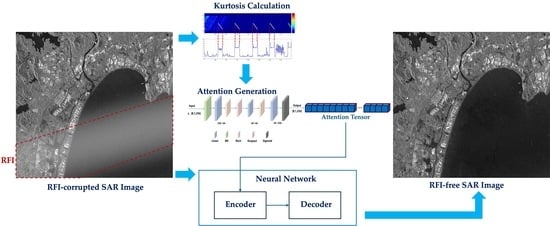
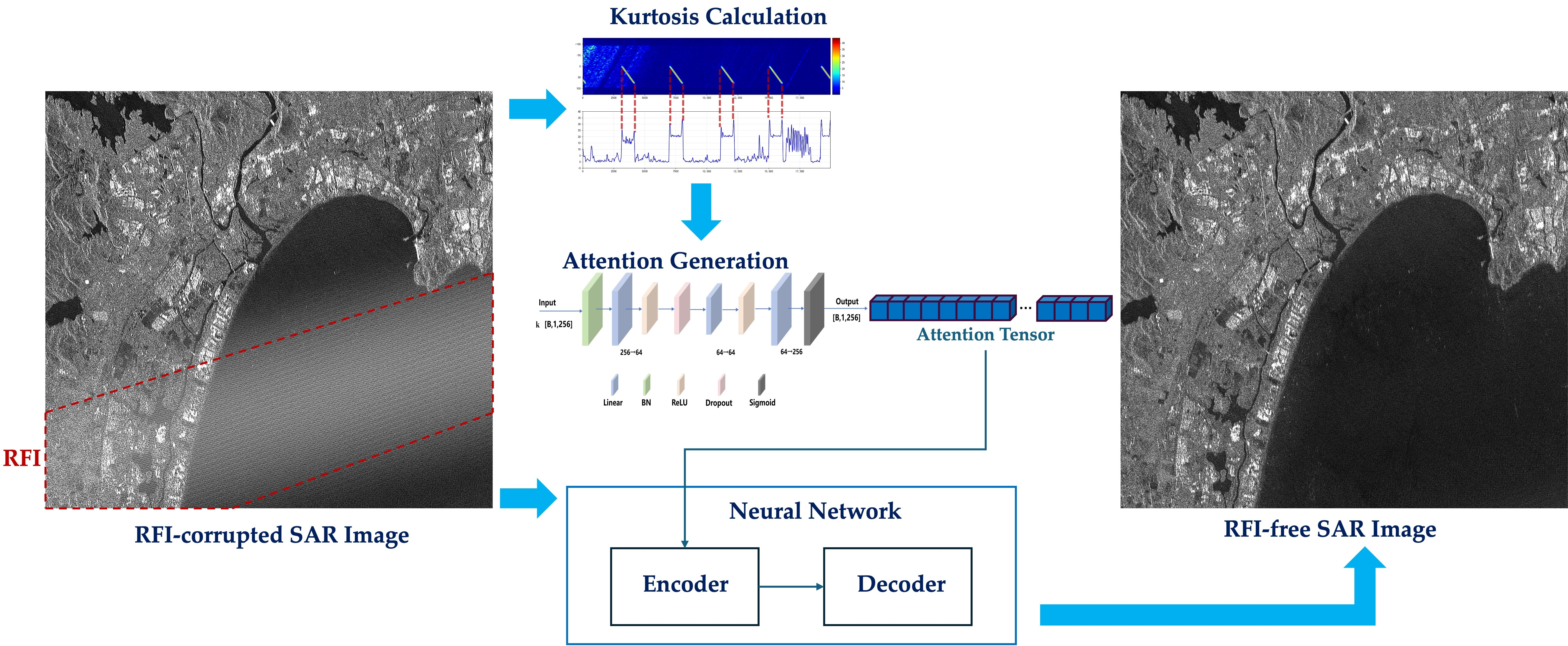
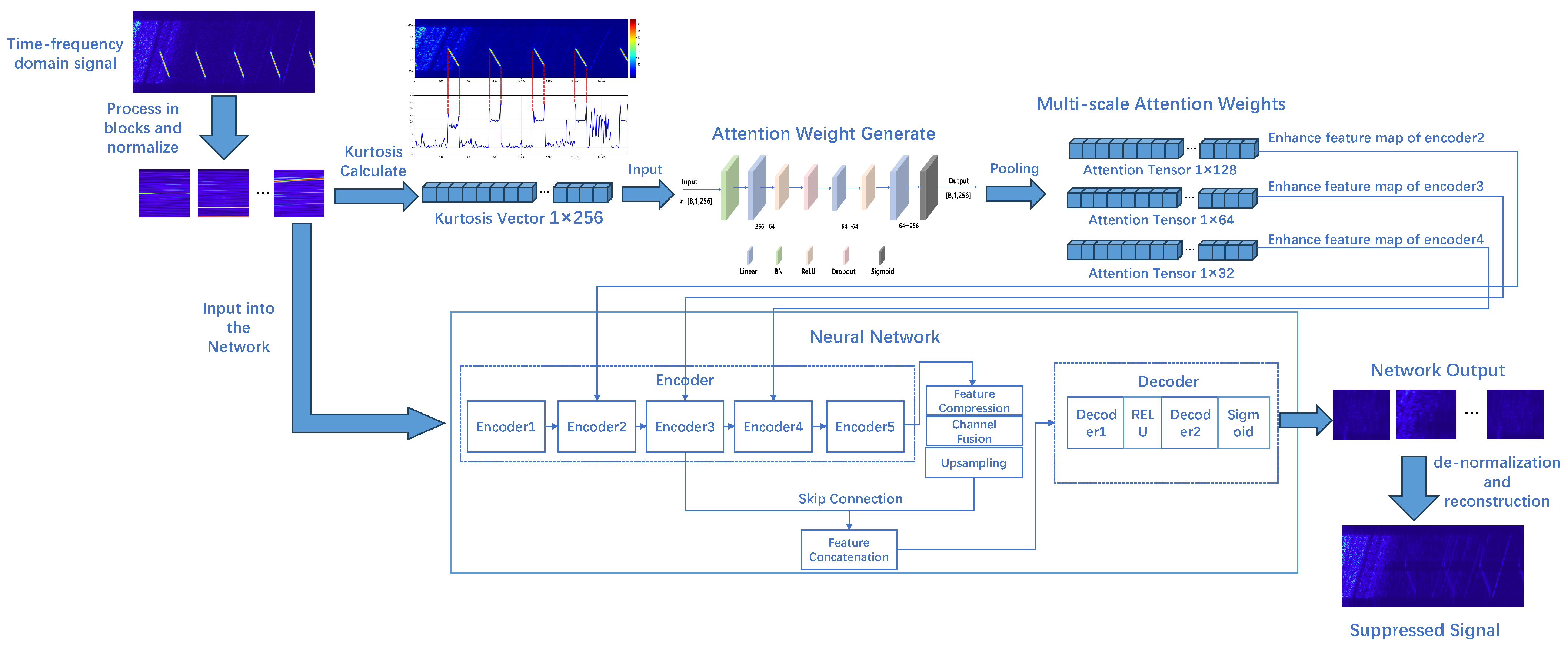
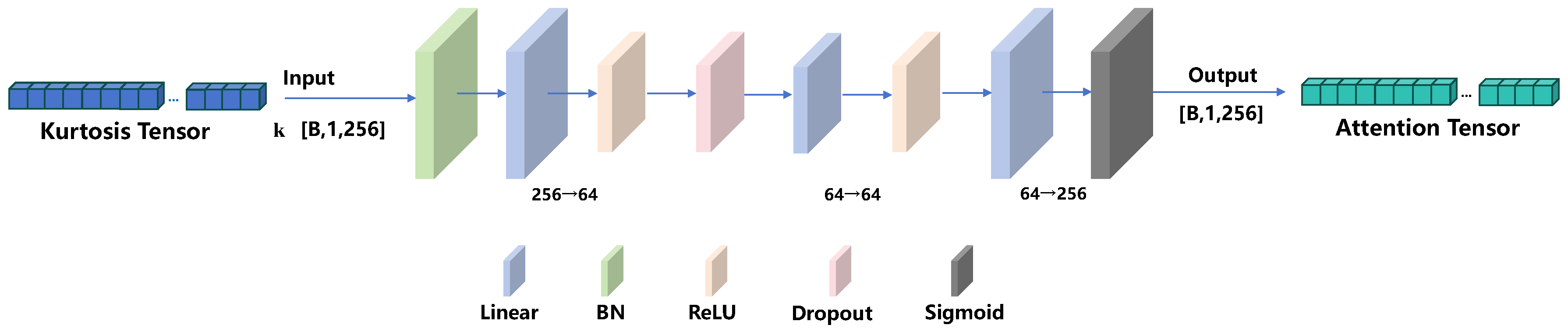
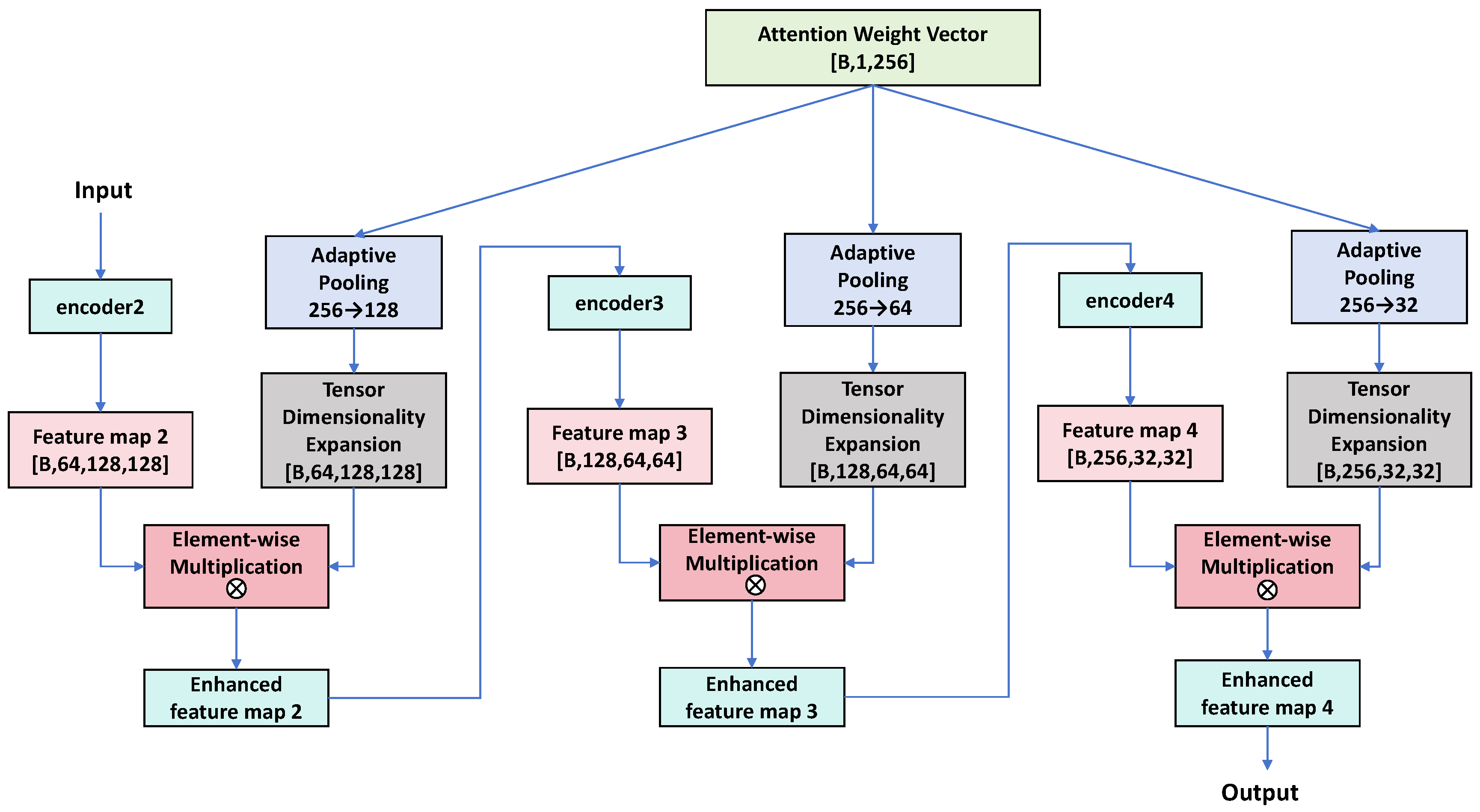
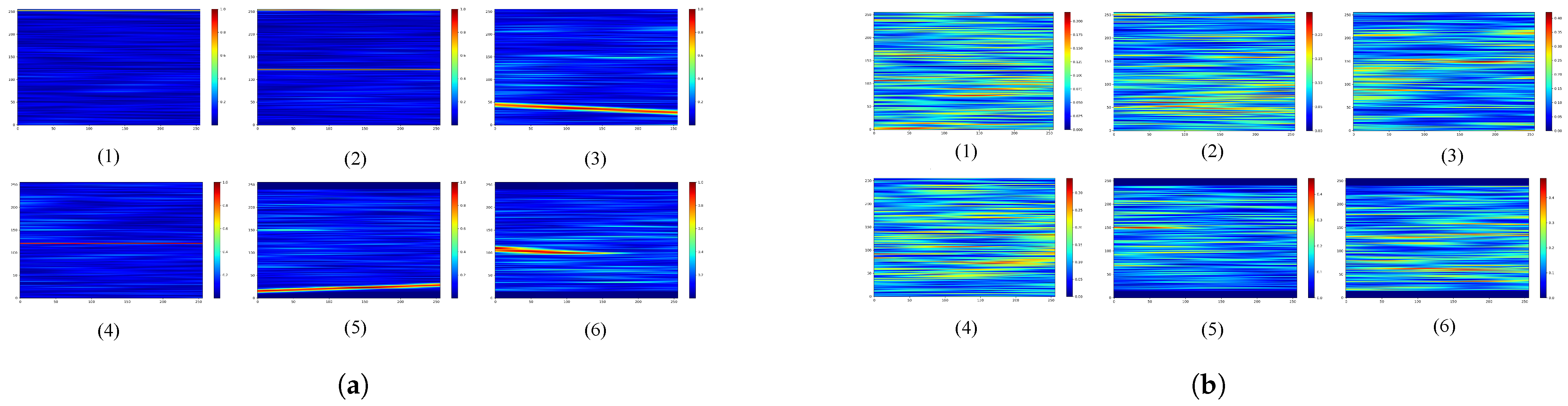
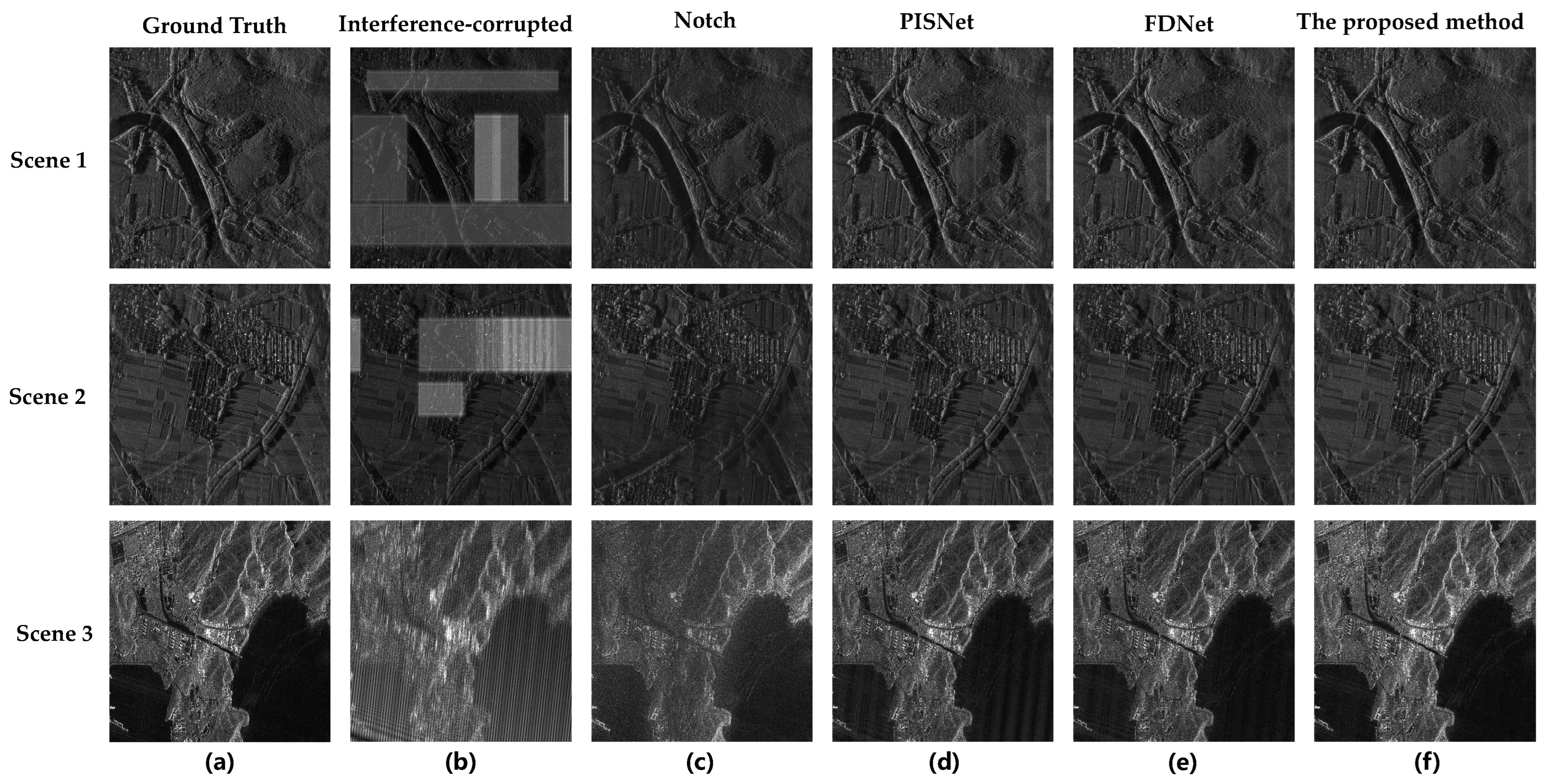
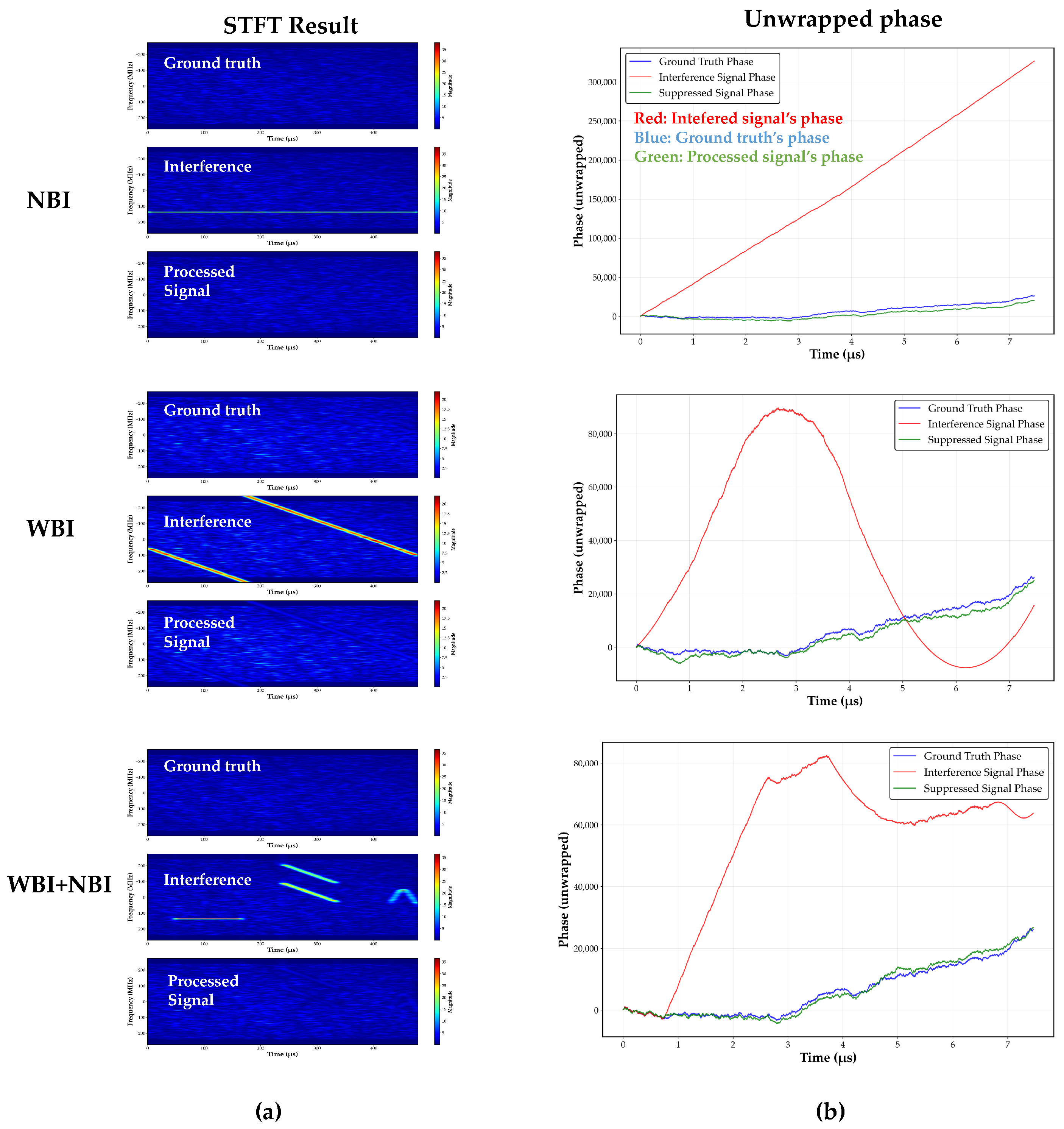
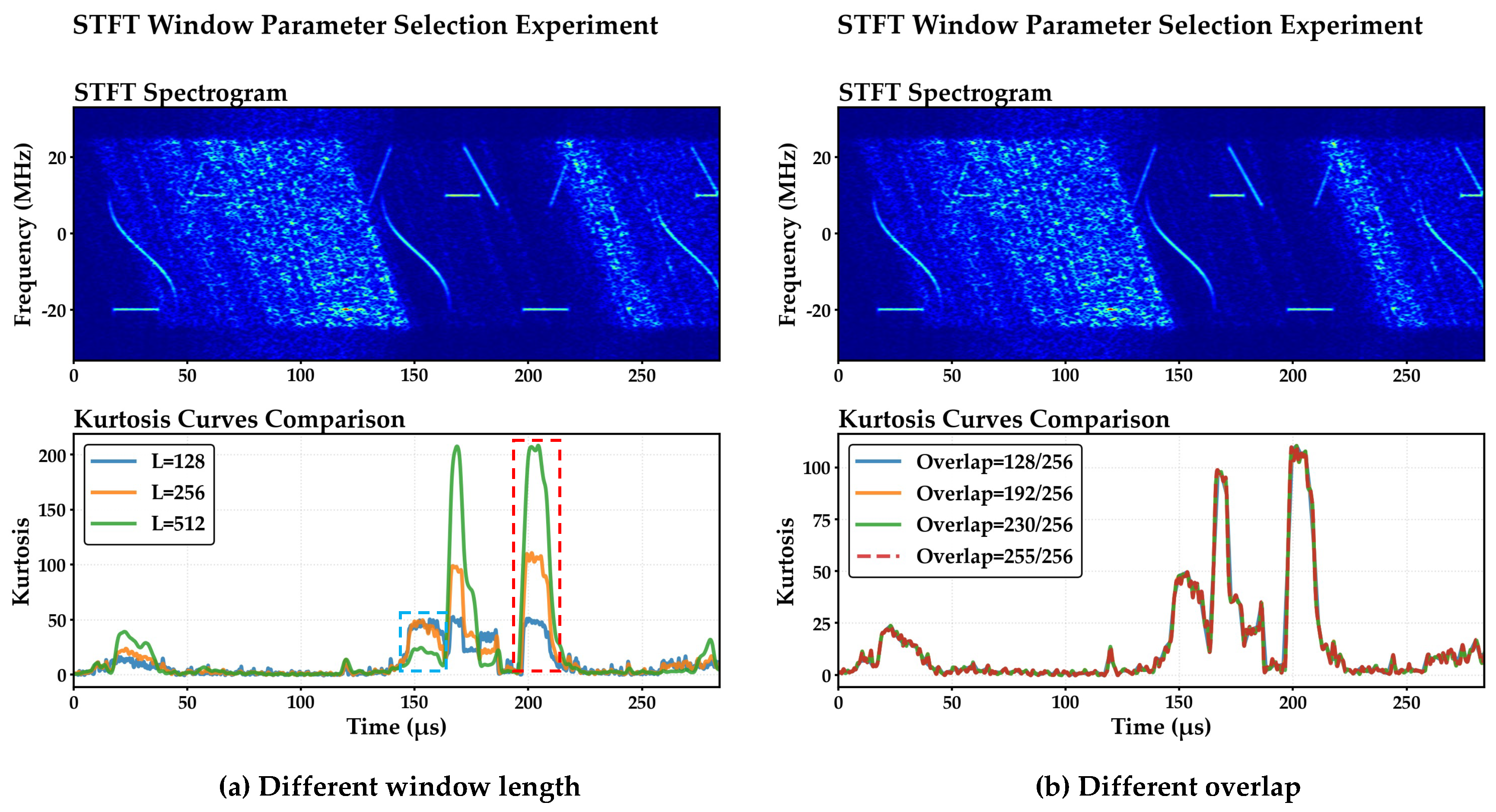
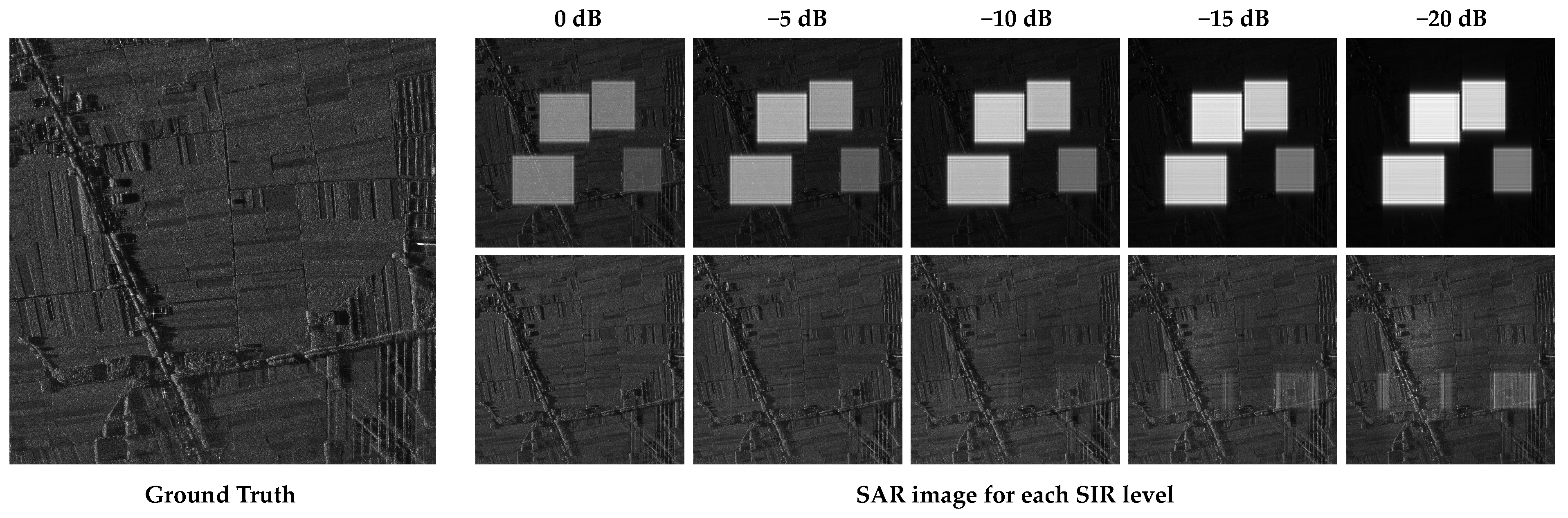
This chapter elaborates on the core principles and architectural design of the proposed kurtosis-guided attention-based interference suppression network (KANet). The main innovation of this method lies in the design of a kurtosis prior guidance module. Its effectiveness is based on the significant difference in the statistical distributions of SAR signals and RFI. This module aims to quantify the impulsive characteristics of the signal along the time dimension, thereby generating a statistical metric capable of accurately identifying RFI.
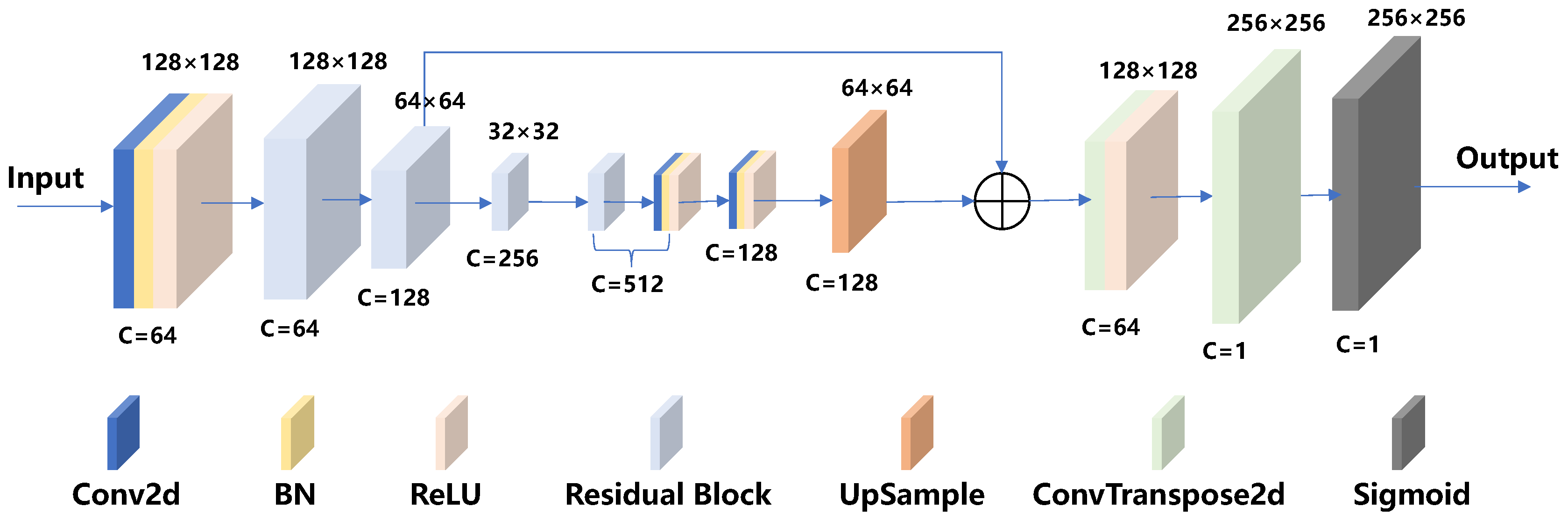
To clearly elucidate the method, the content of this chapter is organized as follows: First, we analyze the theoretical feasibility and practical effectiveness of using kurtosis as an indicator of RFI presence, providing the theoretical justification for the method. Building on this foundation, we then introduce the key technical details, including the overall network framework, the backbone architecture, the specific implementation of the kurtosis prior guidance module, and the data normalization strategy.
3.1. Analysis of the Kurtosis Prior
Specifically, the complex representation of the SAR signal and background noise exhibits quasi-Gaussian statistical characteristics. In contrast, most RFI exhibits non-Gaussian, impulsive, and transient characteristics, manifesting as short-duration, high-energy spikes. To effectively capture this disparity, this study employs instantaneous kurtosis as a key statistical measure. The kurtosis of the signal’s time-frequency spectrogram is calculated using a sliding time window to characterize the likelihood of RFI presence within each time unit. Kurtosis is a fourth-order moment that characterizes the peakedness and tailedness of a probability distribution. It is calculated as follows.
Given an input Short-Time Fourier Transform (STFT) time-frequency matrix
, as shown in Equation (
6), with dimensions
, where
F is the number of frequency units and
T is the number of time windows.
Equation (
7) represents the vector composed of signal amplitudes across all frequency units at time index
t.
, the mean of the signal within the
t-th time window is given by Equation (
8):
The central second-order moment (variance),
, is given by Equation (
9):
The central fourth-order moment,
, is given by Equation (
10):
The kurtosis,
, within this time window is given by Equation (
11):
Kurtosis is defined as the standardized fourth-order moment minus 3. Since the standardized fourth-order moment of a standard Gaussian distribution is 3, this subtraction (of 3) serves to calibrate the kurtosis of the standard Gaussian distribution to zero.
To theoretically demonstrate why kurtosis can effectively identify RFI, we analyze two distinct cases: the interference-free SAR signal and the interference-corrupted signal. We then calculate the range of kurtosis values for each case.
Firstly, for an interference-free SAR signal, the echo
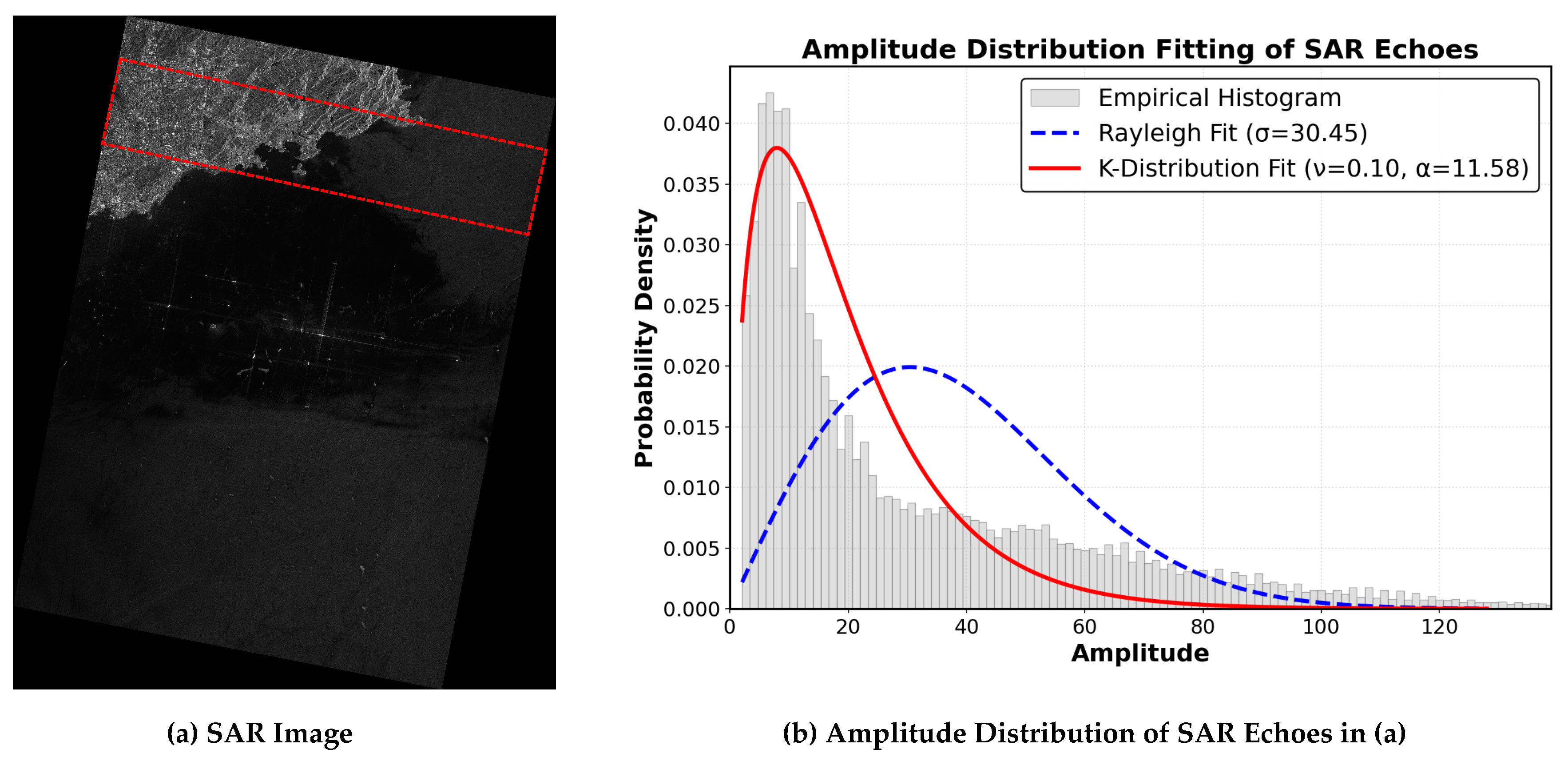
is traditionally modeled as the coherent superposition of numerous independent scatterers within a resolution cell. According to the Central Limit Theorem (CLT), this leads to a complex Gaussian representation of the echo and Rayleigh distribution for its amplitude. While the Rayleigh model provides an adequate description for homogeneous media, SAR echoes often exhibit pronounced spatial heterogeneity due to complex ground textures and land cover variability, resulting in heavy-tailed statistics that deviate substantially from the Rayleigh distribution. To accurately capture this behavior, we employ the K-distribution, which arises from a multiplicative combination of Rayleigh speckle and Gamma distributed texture [
26,
27,
28]. By parameterizing the scene heterogeneity through its shape parameter, the K-distribution not only recovers the Rayleigh law as a limiting special case corresponding to homogeneous echoes, but also provides an excellent fit to the highly heterogeneous, heavy-tailed echoes observed over complex terrains.
After transforming the signal to the time-frequency domain via the STFT, we consider the signal’s amplitude distribution along the frequency axis within a fixed time window. The STFT is a linear transformation of the underlying random process, so within each time window the set of signal samples can be modeled as samples drawn from a K-distributed amplitude random process. Specifically, the statistical calculation is performed using the time-frequency amplitudes within a single time window. Consider the amplitude vector of the interference-free SAR signal across all
F frequency units at the
t-th time index. Let this vector be denoted as
, which corresponds to the magnitude of
(defined in Equation (
7)) in the absence of interference. The elements
of this vector are modeled as independent realizations of a K-distributed random variable
X. Its probability density function (PDF) under the K-distribution model is given by Equation (
12):
where
is the shape parameter controlling the degree of heterogeneity,
is the scale parameter,
is the Gamma function, and
denotes the modified Bessel function of the second kind of order
.
The raw
n-th-order moment of the K-distributed
,
, can be computed in closed form as in Equation (
13):
The kurtosis of the K-distributed interference-free signal,
, is defined analogously to Equation (
11), and can be written in terms of raw moments as in Equation (
14):
By substituting Equation (
13) with
into Equation (
14), we obtain an explicit expression of the kurtosis of signal
X. After straightforward algebra, the scale parameter
cancels out and the resulting kurtosis depends only on
, as given in Equation (
15):
This result shows that the kurtosis
of the interference-free SAR signal becomes an explicit function of the parameter
. For homogeneous or mildly heterogeneous scenes (large
),
approaches the Rayleigh limit and remains a small positive value; for more heterogeneous backgrounds,
increases accordingly but still remains within a relatively small range in practice. For example, using the closed-form expression in Equation (
15), we obtain
for a highly heterogeneous scene, whereas for
the value drops to
. Therefore, for an interference-free SAR signal, the calculated kurtosis remains a small value close to zero.
Next, we consider the case where the SAR signal is superimposed with RFI, and calculate the kurtosis of the corrupted signal within a fixed time window. Assume the signal within this time window has F total samples along the frequency axis. The amplitude vector of the interference-free SAR signal, denoted as , consists of samples that follow the K-distribution described above. Concurrently, assume an RFI with an intensity far greater than that of the SAR signal corrupts M of the F frequency units. The signal amplitudes at these M interfered frequency samples are defined as a vector . For analytical simplicity, we assume the RFI is a single-tone interference affecting only one frequency unit (i.e., , thus simplifies to a scalar A). Therefore, the amplitude vector of the SAR signal superimposed with RFI can be expressed as . We now calculate the kurtosis of the combined signal .
The raw
n-th-order moment about the origin of the mixed signal
,
, is given by Equation (
16):
where
is the raw
n-th-order moment about the origin for the K-distribution, calculated as shown in Equation (
13). According to the kurtosis calculation in Equation (
11), we need to compute the central fourth-order moment and second-order moment of
. The central fourth-order moment is given by Equation (
17):
The
(for
) are calculated by substituting Equation (
13) into Equation (
16). These moments are then substituted into Equation (
17) to yield a result expressed in terms of
F,
A,
and
, as given by Equation (
18):
where
,
,
, and
follow from the K-distribution model in Equation (
13).
The central second-order moment of
Z is given by Equation (
19):
Similarly, by substituting
and
(obtained from Equation (
16) with
given by Equation (
13)), we derive a result expressed in terms of
F,
A,
and
, as given by Equation (
20):
Finally, the kurtosis of signal
is calculated as shown in Equation (
21):
where
are again given by the K-distribution moments in Equation (
13).
To evaluate Equation (
21), we substitute practical data to estimate the kurtosis of the interference-corrupted signal. We set
and in this case, each time window of the time-frequency signal contains 256 sampling points along the frequency axis. Since
depends on the background statistics through
as well as on the interference amplitude
A, we consider a representative parameter setting with
and
. Subsequently, let
A be
k times the mean amplitude of the SAR signal. Based on a comparative analysis of the amplitudes of interference-corrupted signals in real-world SAR data, we set the range of
k to be between 3 and 10. Substituting the values of
,
,
and
into Equation (
21) demonstrates that the kurtosis of the interference-corrupted signal is significantly increased, reaching a magnitude that is typically more than 5 to 10 times higher than that of the interference-free signal (given in Equation (
15)). For instance, with
, numerical evaluation yields
, indicating more than an order-of-magnitude increase. Evidently, unlike the interference-free SAR signal, the kurtosis value increases rapidly when a time window is superimposed with interference. It is also worth noting that although the above derivation assumes a single-tone interference (
) for analytical simplicity, the conclusion generalizes to multi-tone RFI (
). Since RFI typically exhibits sparsity in the time-frequency domain (
), the signal retains distinct heavy-tailed characteristics even with increased
M. Consequently, the kurtosis remains significantly higher than that of the interference-free background, ensuring the metric’s robustness against diverse RFI forms.
To validate the practical effectiveness of the proposed theory, verification was performed using real-world GF-3 SAR data.
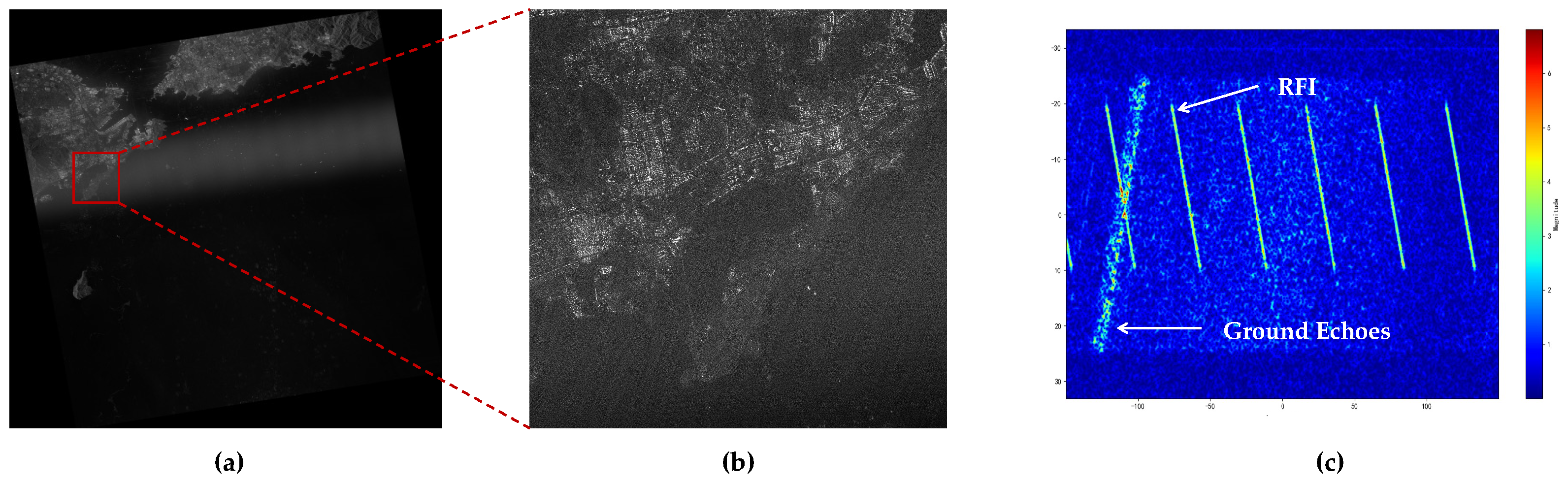
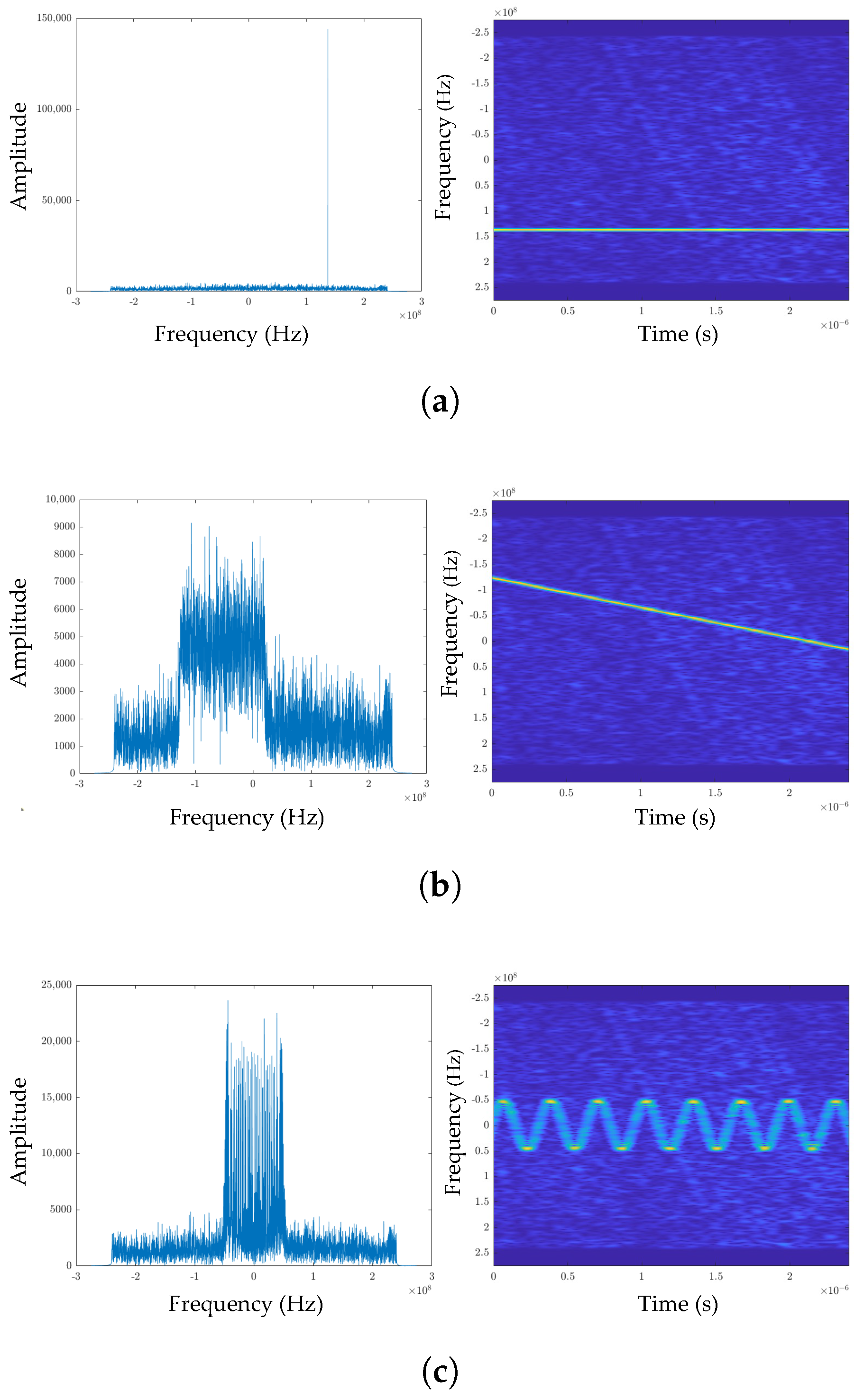
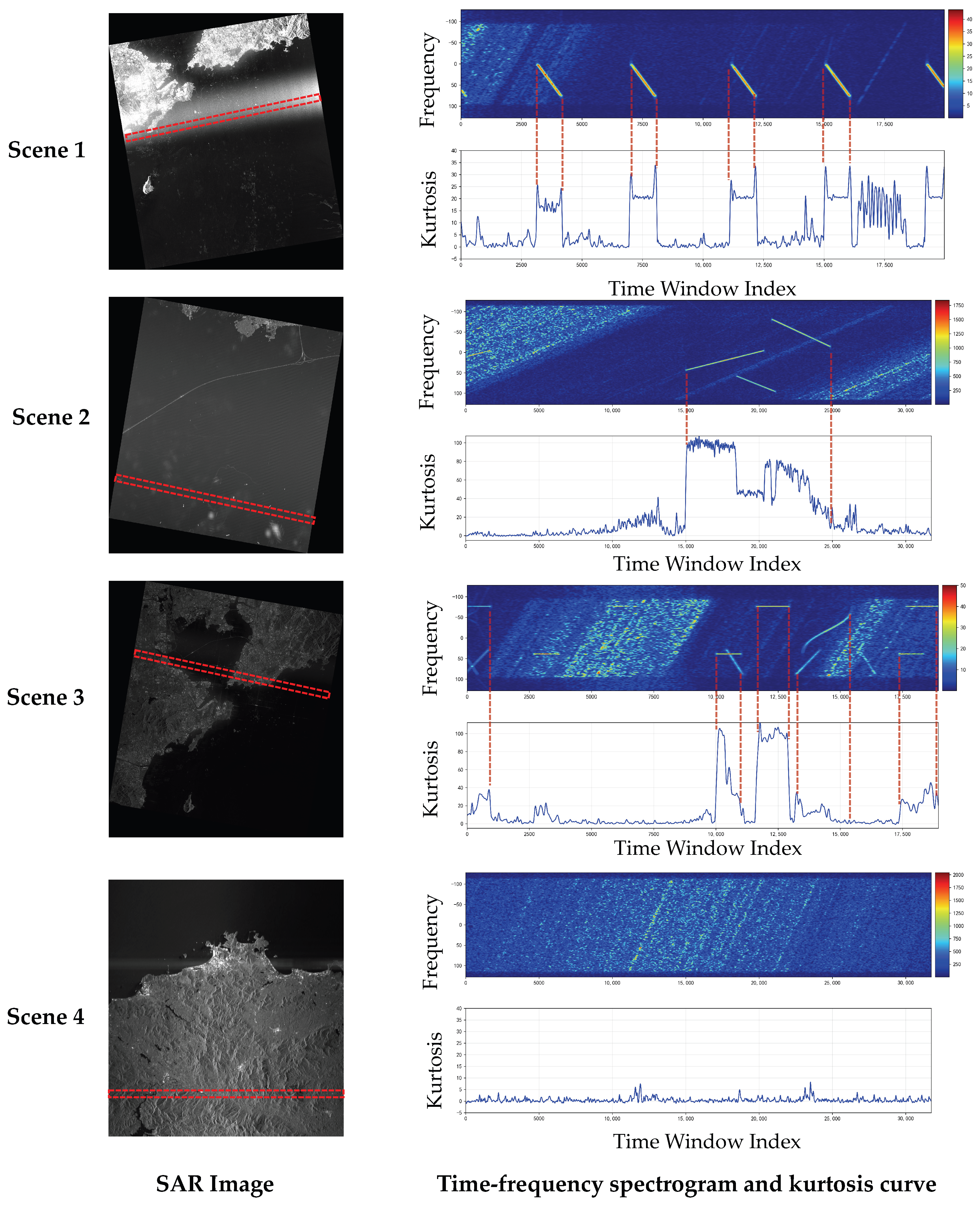
Figure 3 presents the analysis across four distinct scenarios, displaying SAR images alongside time-frequency domain spectrograms and their corresponding time-sequenced kurtosis curves. The results demonstrate a precise temporal alignment between kurtosis peaks and RFI presence. In the interference-corrupted cases (Scenarios 1, 2, and 3), the kurtosis values increase significantly, exhibiting a strong response to RFI. In contrast, Scenario 4 confirms the metric’s robustness against complex ground echoes: in the absence of RFI, the kurtosis curve remains stable at a low level despite the presence of strong terrain backscatter. This verifies that the kurtosis metric effectively targets impulsive interference while remaining insensitive to typical Gaussian-like background echoes.
This experiment strongly demonstrates that the kurtosis calculation is insensitive to Gaussian-like signals, such as ground echoes, and responds strongly only to RFI. It can serve as a highly sensitive and robust RFI localization metric. In summary, a kurtosis value close to zero indicates the absence of RFI within that time window; conversely, a large positive kurtosis value clearly indicates RFI contamination. Therefore, this kurtosis value can be used to guide the attention mechanism, directing the network to focus on RFI-affected regions and thereby improving suppression efficacy.