Improvement of the Semi-Analytical Algorithm Integrating Ultraviolet Band and Deep Learning for Inverting the Absorption Coefficient of Chromophoric Dissolved Organic Matter in the Ocean
 , and
, and
Highlights
- The DQAAG algorithm significantly improves the retrieval accuracy of the ag(443) in both coastal and ocean waters by integrating UV bands and deep learning model.
- Compared with established models (S2011, A2018, and QAA-CDOM), DQAAG achieves superior performance, demonstrating high accuracy across both simulated (IOCCG) and in situ (NOMAD) datasets.
- The integration of UV bands providing a more effective approach for future ocean color satellite missions to retrieve CDOM accurately.
- Combining deep learning with semi-analytical algorithms offers a robust and adaptable method for processing hyperspectral ocean color data.
Abstract
1. Introduction
2. Data and Materials
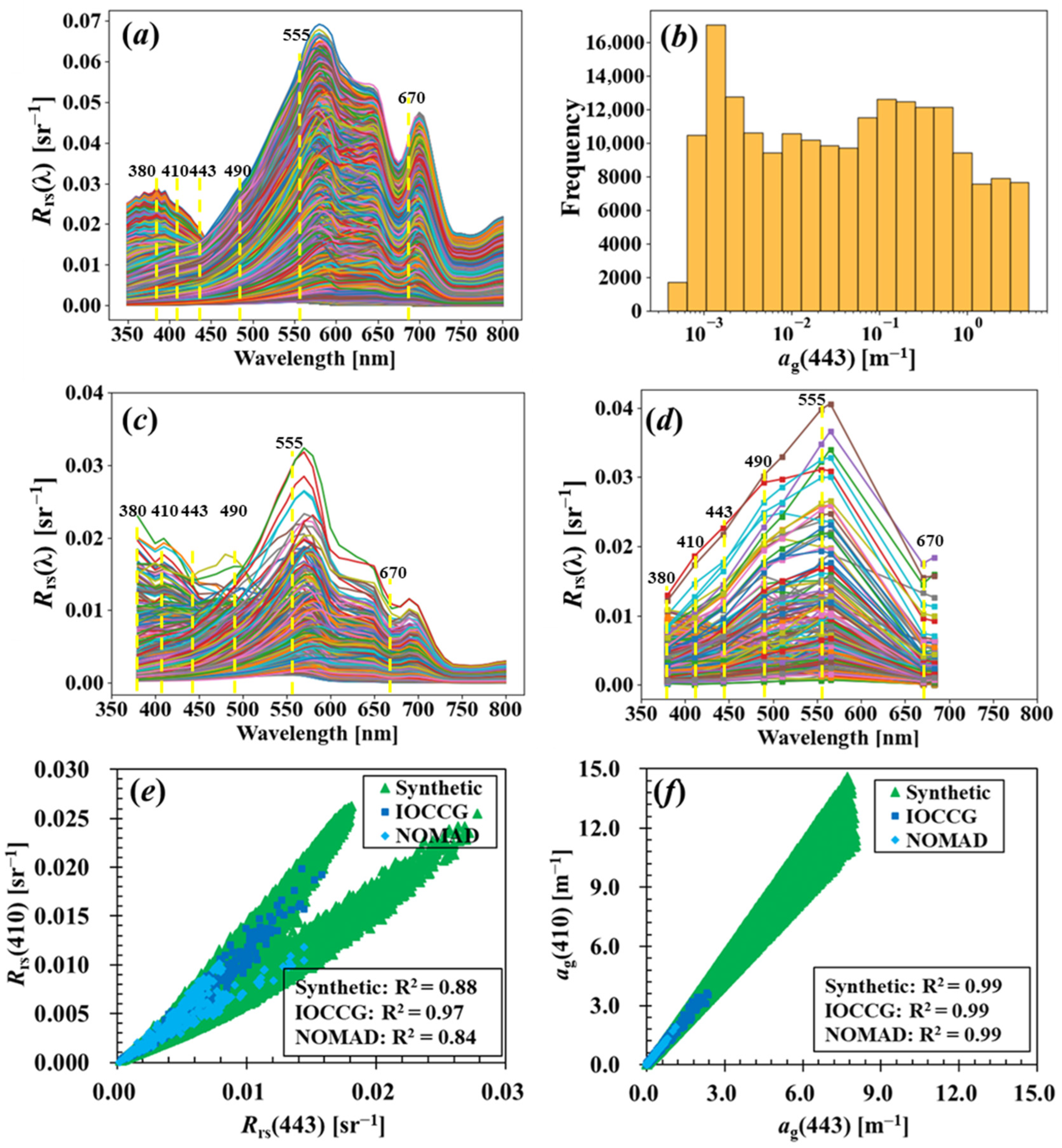
2.1. Training Data
2.2. Validation Data
2.2.1. Simulated Data
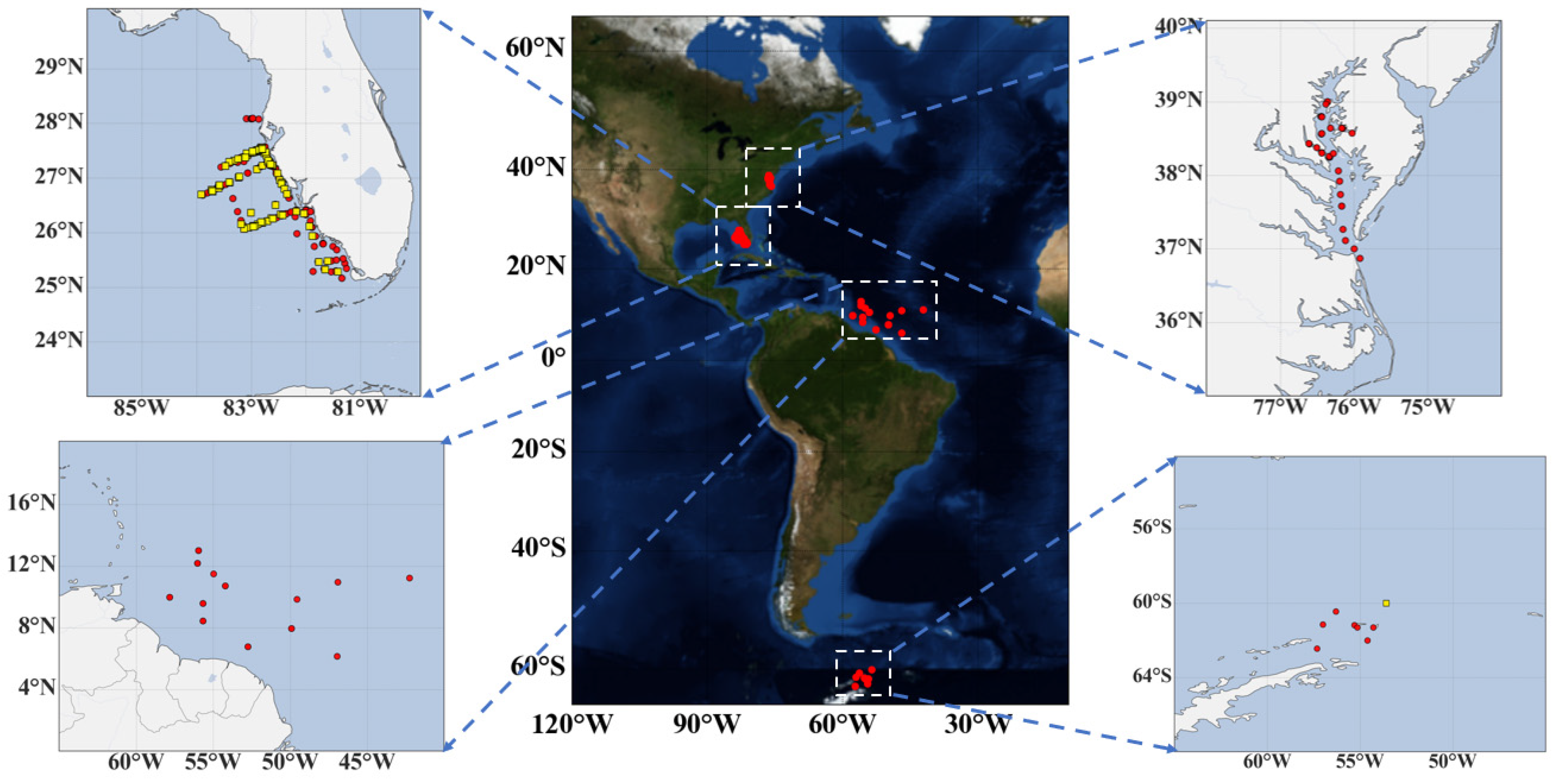
2.2.2. NOMAD Dataset
2.2.3. Remote Sensing Image Data
2.3. Accuracy Assessment
3. Methods
3.1. S2011
3.2. A2018
3.3. QAA-CDOM
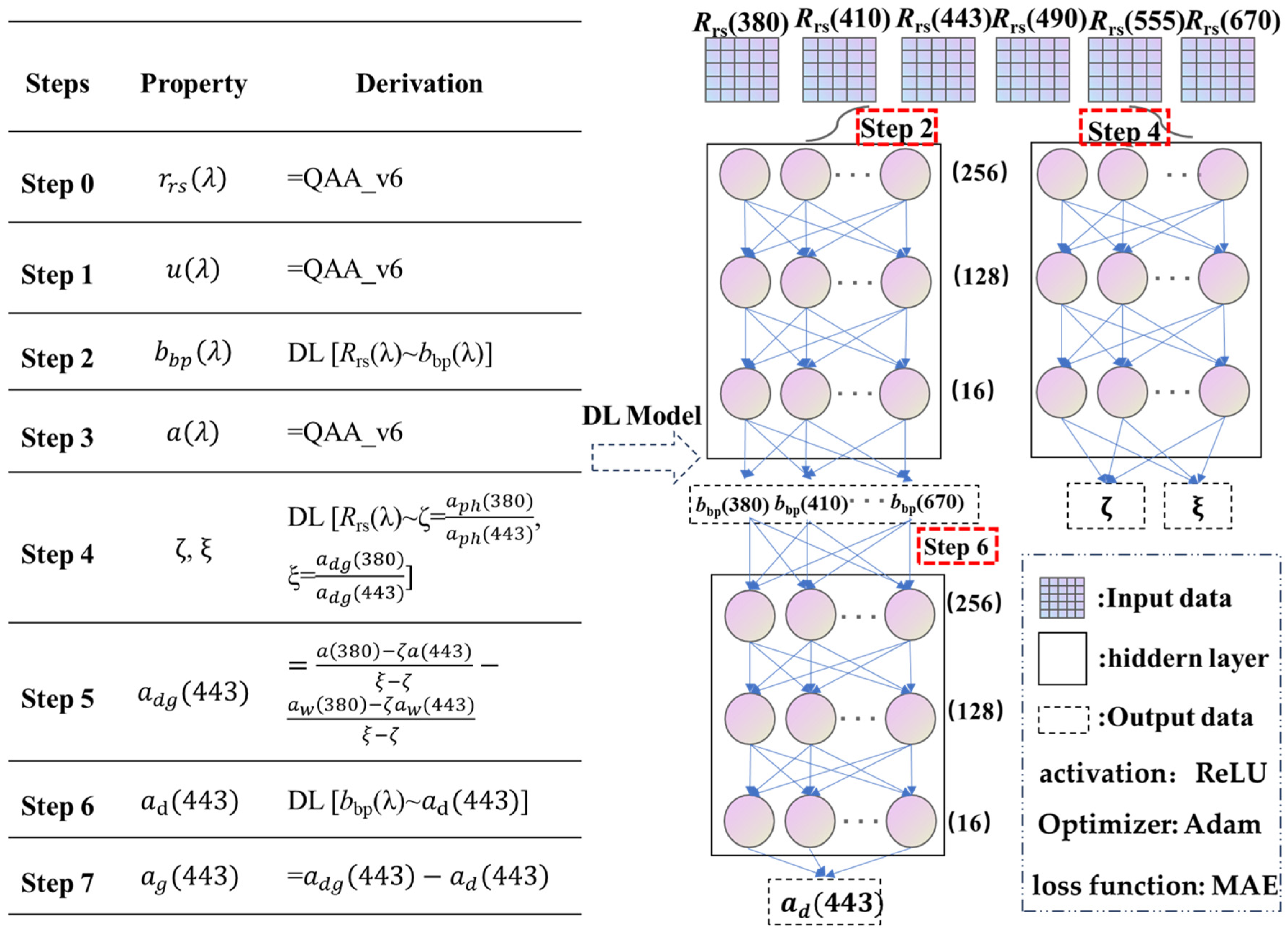
3.4. DQAAG
4. Results
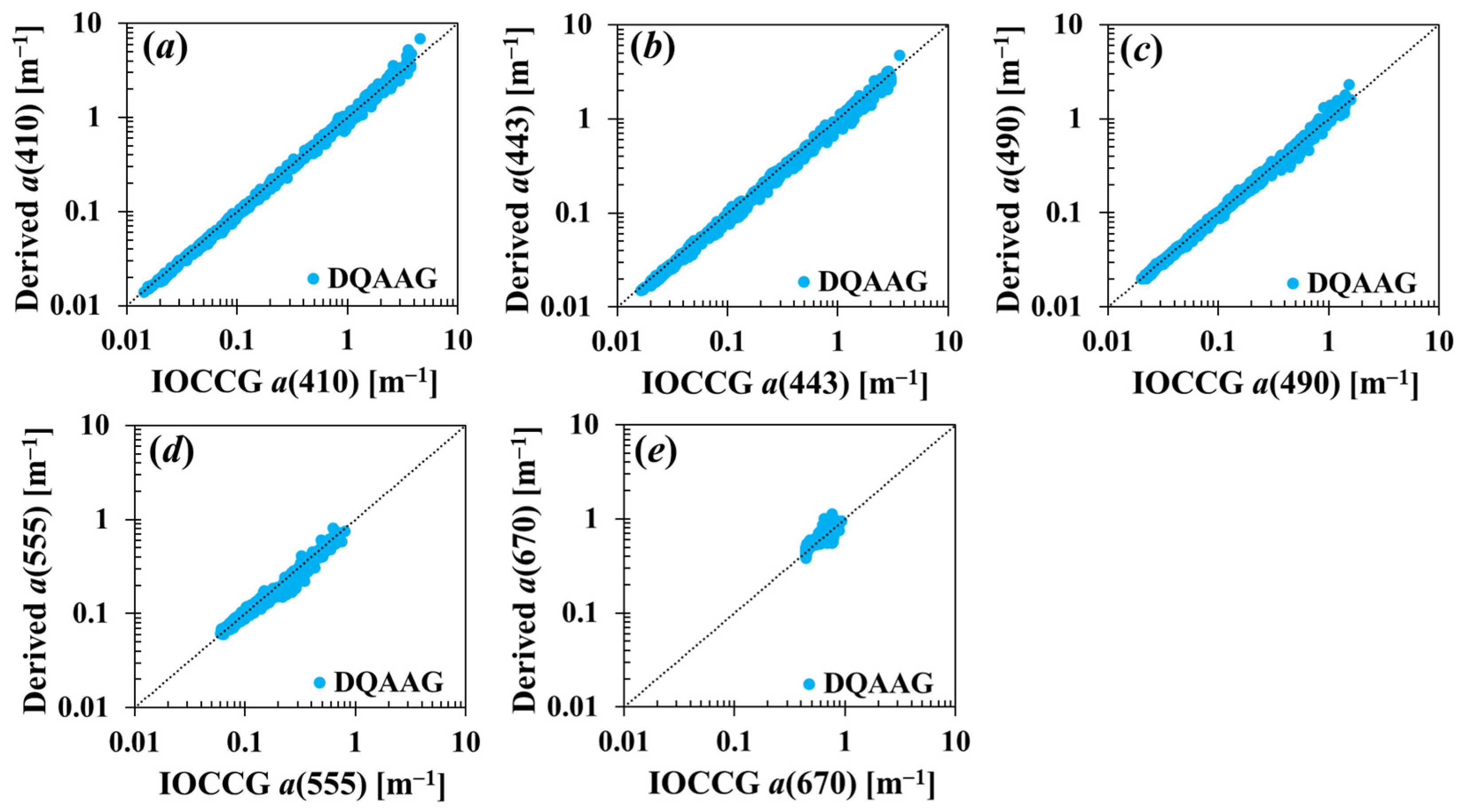
4.1. Evaluation of bbp(λ) and a(λ)
4.2. Evaluation of ag(443)
4.2.1. S2011
4.2.2. A2018
4.2.3. QAA_CDOM
4.2.4. DQAAG
4.3. Comparison of SeaWiFS Remote Sensing ag(443) Data
5. Discussion
5.1. Model Performance
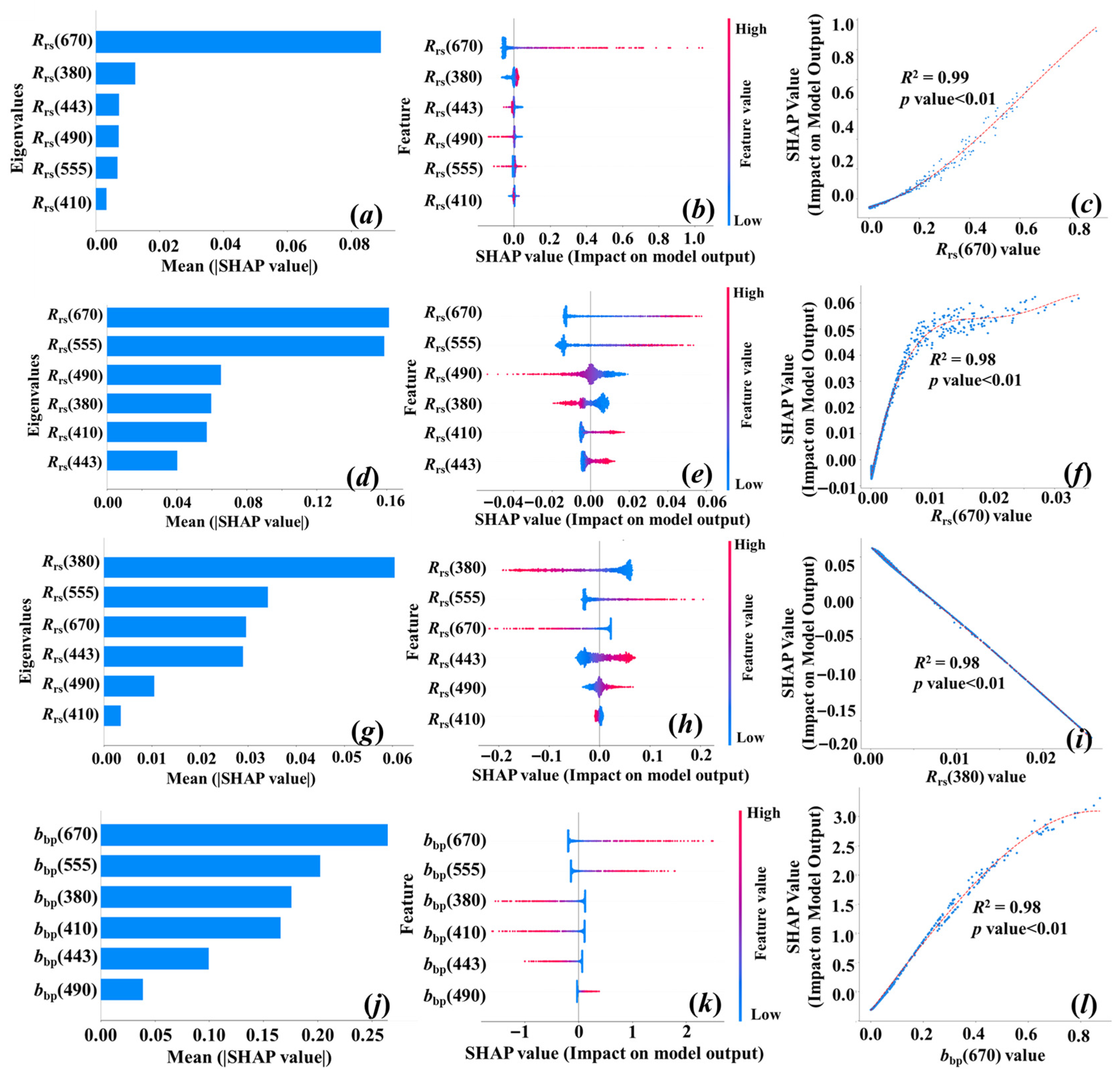
5.2. Sensitivity Analysis
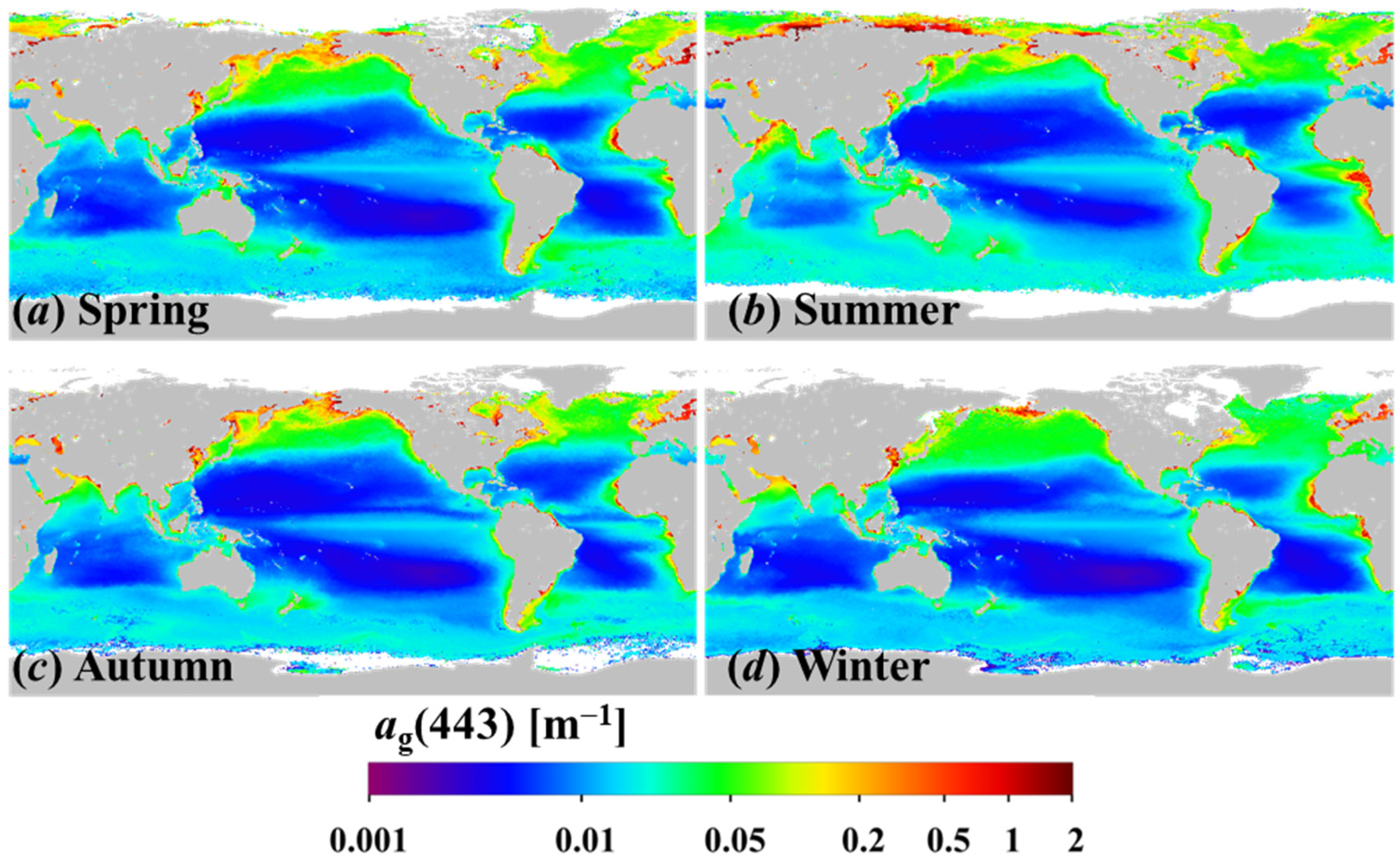
5.3. Global CDOM Distribution Patterns
6. Conclusions
Author Contributions
Funding
Data Availability Statement
Acknowledgments
Conflicts of Interest
References
- Cao, F.; Tzortziou, M.; Hu, C.; Mannino, A.; Fichot, C.G.; Del Vecchio, R.; Najjar, R.G.; Novak, M. Remote sensing retrievals of colored dissolved organic matter and dissolved organic carbon dynamics in North American estuaries and their margins. Remote Sens. Environ. 2018, 205, 151–165. [Google Scholar] [CrossRef]
- Aurin, D.; Mannino, A.; Lary, D.J. Remote sensing of CDOM, CDOM spectral slope, and dissolved organic carbon in the global ocean. Appl. Sci. 2018, 8, 2687. [Google Scholar] [CrossRef]
- Stedmon, C.A.; Nelson, N.B. The optical properties of DOM in the ocean. In Biogeochemistry of Marine Dissolved Organic Matter; Elsevier: Amsterdam, The Netherlands, 2015; pp. 481–508. [Google Scholar]
- Nebbioso, A.; Piccolo, A.J.A.; Chemistry, B. Molecular characterization of dissolved organic matter (DOM): A critical review. Anal. Bioanal. Chem. 2013, 405, 109–124. [Google Scholar] [CrossRef]
- Huang, J.; Chen, J.; Mu, Y.; Cao, C.; Shen, H. Remote-sensing monitoring of colored dissolved organic matter in the Arctic Ocean. Mar. Pollut. Bull. 2024, 204, 116529. [Google Scholar] [CrossRef]
- Bonelli, A.G.; Vantrepotte, V.; Jorge, D.S.F.; Demaria, J.; Jamet, C.; Dessailly, D.; Mangin, A.; D’Andon, O.F.; Kwiatkowska, E.; Loisel, H. Colored dissolved organic matter absorption at global scale from ocean color radiometry observation: Spatio-temporal variability and contribution to the absorption budget. Remote Sens. Environ. 2021, 265, 112637. [Google Scholar] [CrossRef]
- Jiao, N.; Luo, T.; Chen, Q.; Zhao, Z.; Xiao, X.; Liu, J.; Jian, Z.; Xie, S.; Thomas, H.; Herndl, G.J.; et al. The microbial carbon pump and climate change. Nat. Rev. Microbiol. 2024, 22, 408–419. [Google Scholar] [CrossRef]
- Ducklow, H.W.; Steinberg, D.K.; Buesseler, K.O.J.O. Upper ocean carbon export and the biological pump. Oceanography 2001, 14, 50–58. [Google Scholar] [CrossRef]
- Norman, L.; Thomas, D.N.; Stedmon, C.A.; Granskog, M.A.; Papadimitriou, S.; Krapp, R.H.; Meiners, K.M.; Lannuzel, D.; van der Merwe, P.; Dieckmann, G.S. The characteristics of dissolved organic matter (DOM) and chromophoric dissolved organic matter (CDOM) in Antarctic sea ice. Deep. Sea Res. Part II Top. Stud. Oceanogr. 2011, 58, 1075–1091. [Google Scholar] [CrossRef]
- De Mora, S.; Demers, S.; Vernet, M. The Effects of UV Radiation in the Marine Environment; Cambridge University Press: Cambridge, UK, 2000. [Google Scholar]
- Wang, Y.; Lee, Z.; Wei, J.; Shang, S.; Wang, M.; Lai, W. Extending satellite ocean color remote sensing to the near-blue ultraviolet bands. Remote Sens. Environ. 2021, 253, 112228. [Google Scholar] [CrossRef]
- Mahrad, B.E.; Newton, A.; Icely, J.D.; Kacimi, I.; Abalansa, S.; Snoussi, M.J.R.S. Contribution of remote sensing technologies to a holistic coastal and marine environmental management framework: A review. Remote Sens. 2020, 12, 2313. [Google Scholar] [CrossRef]
- Kutser, T.; Pierson, D.C.; Kallio, K.Y.; Reinart, A.; Sobek, S. Mapping lake CDOM by satellite remote sensing. Remote Sens. Environ. 2005, 94, 535–540. [Google Scholar] [CrossRef]
- Isada, T.; Hooker, S.B.; Taniuchi, Y.; Suzuki, K. Evaluation of retrieving chlorophyll a concentration and colored dissolved organic matter absorption from satellite ocean color remote sensing in the coastal waters of Hokkaido, Japan. J. Oceanogr. 2022, 78, 263–276. [Google Scholar] [CrossRef]
- Nguyen, V.S.; Loisel, H.; Vantrepotte, V.; Mériaux, X.; Tran, D.L. An Empirical Algorithm for Estimating the Absorption of Colored Dissolved Organic Matter from Sentinel-2 (MSI) and Landsat-8 (OLI) Observations of Coastal Waters. Remote Sens. 2024, 16, 4061. [Google Scholar] [CrossRef]
- Mannino, A.; Russ, M.E.; Hooker, S.B. Algorithm development and validation for satellite-derived distributions of DOC and CDOM in the US Middle Atlantic Bight. J. Geophys. Res.-Ocean. 2008, 113, C07051. [Google Scholar] [CrossRef]
- Sathyendranath, S.; Cota, G.; Stuart, V.; Maass, M.; Platt, T. Remote sensing of phytoplankton pigments: A comparison of empirical and theoretical approaches. Int. J. Remote Sens. 2001, 22, 249–273. [Google Scholar] [CrossRef]
- Lee, Z.P.; Carder, K.L.; Steward, R.G.; Peacock, T.G.; Davis, C.O.; Patch, J.S. An empirical algorithm for light absorption by ocean water based on color. J. Geophys. Res. 1998, 103, 27967–27978. [Google Scholar] [CrossRef]
- Wang, Y.; Shen, F.; Sokoletsky, L.; Sun, X. Validation and Calibration of QAA Algorithm for CDOM Absorption Retrieval in the Changjiang (Yangtze) Estuarine and Coastal Waters. Remote Sens. 2017, 9, 1192. [Google Scholar] [CrossRef]
- Hoge, F.E.; Lyon, P.E. Satellite retrieval of inherent optical properties by linear matrix inversion of oceanic radiance models: An analysis of model and radiance measurement errors. J. Geophys. Res. Ocean. 1996, 101, 16631–16648. [Google Scholar] [CrossRef]
- D’Sa, E.J.; Miller, R.L.; Del Castillo, C. Bio-optical properties and ocean color algorithms for coastal waters influenced by the Mississippi River during a cold front. Appl. Opt. 2006, 45, 7410–7428. [Google Scholar] [CrossRef]
- Barnard, A.H.; Zaneveld, J.R.V.; Pegau, W.S. In situ determination of the remotely sensed reflectance and the absorption coefficient: Closure and inversion. Appl. Opt. 1999, 38, 5108–5117. [Google Scholar] [CrossRef]
- Zhu, W.; Yu, Q.; Tian, Y.Q.; Chen, R.F.; Gardner, G.B. Estimation of chromophoric dissolved organic matter in the Mississippi and Atchafalaya river plume regions using above-surface hyperspectral remote sensing. J. Geophys. Res.-Ocean. 2011, 116, C02011. [Google Scholar] [CrossRef]
- Maritorena, S.; Siegel, D.A.; Peterson, A.R. Optimization of a semianalytical ocean color model for global-scale applications. Appl. Opt. 2002, 41, 2705–2714. [Google Scholar] [CrossRef]
- Lee, Z.; Carder, K.L.; Arnone, R.A. Deriving inherent optical properties from water color: A multiband quasi-analytical algorithm for optically deep waters. Appl. Opt. 2002, 41, 5755–5772. [Google Scholar] [CrossRef]
- Wei, J.; Lee, Z. Retrieval of phytoplankton and colored detrital matter absorption coefficients with remote sensing reflectance in an ultraviolet band. Appl. Opt. 2015, 54, 636–649. [Google Scholar] [CrossRef] [PubMed]
- Liu, H.; He, X.; Li, Q.; Kratzer, S.; Wang, J.; Shi, T.; Hu, Z.; Yang, C.; Hu, S.; Zhou, Q. Estimating ultraviolet reflectance from visible bands in ocean colour remote sensing. Remote Sens. Environ. 2021, 258, 112404. [Google Scholar] [CrossRef]
- Zheng, L.; Lee, Z.; Wang, Y.; Yu, X.; Lai, W.; Shang, S. Evaluation of near-blue UV remote sensing reflectance over the global ocean from SNPP VIIRS, PACE OCI, and GCOM-C SGLI. Opt. Express 2025, 33, 40465–40488. [Google Scholar] [CrossRef] [PubMed]
- Siswanto, E. Assessing optical water types in Asian coastal ocean waters from space using GCOM-C/SGLI observations. Int. J. Remote Sens. 2025, 46, 2337–2357. [Google Scholar] [CrossRef]
- Li, S.; Chen, S.; Ma, C.; Peng, H.; Wang, J.; Hu, L.; Song, Q. Construction of a radiometric degradation model for ocean color sensors of HY1C/D. In IEEE Transactions on Geoscience Remote Sensing; IEEE: New York, NY, USA, 2024; Volume 62, pp. 1–13. [Google Scholar]
- Wang, J.; Wang, Y.; Lee, Z.; Wang, D.; Chen, S.; Lai, W. A revision of NASA SeaDAS atmospheric correction algorithm over turbid waters with artificial Neural Networks estimated remote-sensing reflectance in the near-infrared. ISPRS J. Photogramm. Remote Sens. 2022, 194, 235–249. [Google Scholar] [CrossRef]
- Zhao, D.; Feng, L.; Yang, Z.; Yu, X.; Wang, M. A deep-learning assisted algorithm to improve inherent optical properties estimations over inland and nearshore coastal waters. In IEEE Transactions on Geoscience Remote Sensing; IEEE: New York, NY, USA, 2025. [Google Scholar]
- Zhang, Z.; Chen, P.; Zhang, S.; Huang, H.; Pan, Y.; Pan, D. A Review of Machine Learning Applications in Ocean Color Remote Sensing. Remote Sens. 2025, 17, 1776. [Google Scholar] [CrossRef]
- Chen, J.; Quan, W.; Cui, T.; Song, Q.; Lin, C. Remote sensing of absorption and scattering coefficient using neural network model: Development, validation, and application. Remote Sens. Environ. 2014, 149, 213–226. [Google Scholar] [CrossRef]
- Sauzède, R.; Claustre, H.; Uitz, J.; Jamet, C.; Dall’Olmo, G.; d’Ortenzio, F.; Gentili, B.; Poteau, A.; Schmechtig, C. A neural network-based method for merging ocean color and Argo data to extend surface bio-optical properties to depth: Retrieval of the particulate backscattering coefficient. J. Geophys. Res. Ocean. 2016, 121, 2552–2571. [Google Scholar] [CrossRef]
- Ioannou, I.; Gilerson, A.; Gross, B.; Moshary, F.; Ahmed, S. Deriving ocean color products using neural networks. Remote Sens. Environ. 2013, 134, 78–91. [Google Scholar] [CrossRef]
- Yuan, Q.; Shen, H.; Li, T.; Li, Z.; Li, S.; Jiang, Y.; Xu, H.; Tan, W.; Yang, Q.; Wang, J. Deep learning in environmental remote sensing: Achievements and challenges. Remote Sens. Environ. 2020, 241, 111716. [Google Scholar] [CrossRef]
- Sun, X.; Zhang, Y.; Zhang, Y.; Shi, K.; Zhou, Y.; Li, N. Machine learning algorithms for chromophoric dissolved organic matter (CDOM) estimation based on Landsat 8 images. Remote Sens. 2021, 13, 3560. [Google Scholar] [CrossRef]
- Chen, J.; He, X.; Zhou, B.; Pan, D. Deriving colored dissolved organic matter absorption coefficient from ocean color with a neural quasi-analytical algorithm. J. Geophys. Res. Ocean. 2017, 122, 8543–8556. [Google Scholar] [CrossRef]
- IOCCG. Remote Sensing of Inherent Optical Properties: Fundamentals, Tests of Algorithms, and Applications. In Reports of the International Ocean-Colour Coordinating Group, No. 5; Lee, Z.-P., Stuart, V., Eds.; IOCCG: Dartmouth, NS, Canada, 2006; Volume 5, p. 126. [Google Scholar]
- IOCCG-OCAG (International Ocean Colour Coordinating Group). Model, Parameters, and Approaches That Used to Generate Wide Range of Absorption and Backscattering Spectra. 2003. Available online: http://www.ioccg.org/groups/OCAG_data.html (accessed on 25 July 2025).
- Werdell, P.J.; Bailey, S.W. An improved in-situ bio-optical data set for ocean color algorithm development and satellite data product validation. Remote Sens. Environ. 2005, 98, 122–140. [Google Scholar] [CrossRef]
- Bailey, S.W.; Werdell, P.J. A multi-sensor approach for the on-orbit validation of ocean color satellite data products. Remote Sens. Environ. 2006, 102, 12–23. [Google Scholar] [CrossRef]
- Wei, J.; Lee, Z.; Shang, S. A system to measure the data quality of spectral remote sensing reflectance of aquatic environments. J. Geophys. R. 2016, 121, 8189–8207. [Google Scholar] [CrossRef]
- Wang, Y.; Lee, Z.; Ondrusek, M.; Li, X.; Zhang, S.; Wu, J. An evaluation of remote sensing algorithms for the estimation of diffuse attenuation coefficients in the ultraviolet bands. Opt. Express 2022, 30, 6640–6655. [Google Scholar] [CrossRef]
- Shanmugam, P. New models for retrieving and partitioning the colored dissolved organic matter in the global ocean: Implications for remote sensing. Remote Sens. Environ. 2011, 115, 1501–1521. [Google Scholar] [CrossRef]
- Chollet, F. Keras. 2015. Available online: https://github.com/fchollet/keras (accessed on 25 July 2025).
- Géron, A. Hands-On Machine Learning with Scikit-Learn, Keras, and Tensorflow: Concepts, Tools, and Techniques to Build Intelligent Systems; O’Reilly Media: Santa Rosa, CA, USA, 2019. [Google Scholar]
- Krizhevsky, A.; Sutskever, I.; Hinton, G.E. Imagenet classification with deep convolutional neural networks. In Proceedings of the Advances in Neural Information Processing Systems, Lake Tahoe, NV, USA, 3–8 December 2012; pp. 1097–1105. [Google Scholar]
- Kingma, D.P.; Ba, J. Adam: A method for stochastic optimization. arXiv 2014, arXiv:1412.6980. [Google Scholar]
- Aurin, D.A.; Dierssen, H.M. Advantages and limitations of ocean color remote sensing in CDOM-dominated, mineral-rich coastal and estuarine waters. Remote Sens. Environ. 2012, 125, 181–197. [Google Scholar] [CrossRef]
- Zhu, W.; Yu, Q.; Tian, Y.Q.; Becker, B.L.; Zheng, T.; Carrick, H.J. An assessment of remote sensing algorithms for colored dissolved organic matter in complex freshwater environments. Remote Sens. Environ. 2014, 140, 766–778. [Google Scholar] [CrossRef]
- Antoine, D.; d’Ortenzio, F.; Hooker, S.B.; Bécu, G.; Gentili, B.; Tailliez, D.; Scott, A.J. Assessment of uncertainty in the ocean reflectance determined by three satellite ocean color sensors (MERIS, SeaWiFS and MODIS-A) at an offshore site in the Mediterranean Sea (BOUSSOLE project). J. Geophys. Res. Ocean. 2008, 113, C07013. [Google Scholar] [CrossRef]
- Zibordi, G.; Berthon, J.-F.; Mélin, F.; D’Alimonte, D.; Kaitala, S. Validation of satellite ocean color primary products at optically complex coastal sites: Northern Adriatic Sea, Northern Baltic Proper and Gulf of Finland. Remote Sens. Environ. 2009, 113, 2574–2591. [Google Scholar] [CrossRef]
- Wei, J.; Lee, Z.; Garcia, R.; Zoffoli, L.; Armstrong, R.A.; Shang, Z.; Sheldon, P.; Chen, R.F. An assessment of Landsat-8 atmospheric correction schemes and remote sensing reflectance products in coral reefs and coastal turbid waters. Remote Sens. Environ. 2018, 215, 18–32. [Google Scholar] [CrossRef]
- Wang, M. Remote sensing of the ocean contributions from ultraviolet to near-infrared using the shortwave infrared bands: Simulations. Appl. Opt. 2007, 46, 1535–1547. [Google Scholar] [CrossRef] [PubMed]
- Wang, J.; Lee, Z.; Wei, J.; Du, K. Atmospheric correction in coastal region using same-day observations of different sun-sensor geometries with a revised POLYMER model. Opt. Express 2020, 28, 26953–26976. [Google Scholar] [CrossRef]
- Lundberg, S.M.; Lee, S.-I. A unified approach to interpreting model predictions. In Proceedings of the Advances in Neural Information Processing Systems 30, Long Beach, CA, USA, 4–9 December 2017. [Google Scholar]
- Najah, A.; Al-Shehhi, M.R. Performance of the ocean color algorithms: QAA, GSM, and GIOP in inland and coastal waters. Remote Sens. Earth Syst. Sci. 2021, 4, 235–248. [Google Scholar] [CrossRef]
- Nelson, N.B.; Siegel, D.A. The global distribution and dynamics of chromophoric dissolved organic matter. Annu. Rev. Mar. Sci. 2013, 5, 447–476. [Google Scholar] [CrossRef]
- Nolan, C.; Overpeck, J.T.; Allen, J.R.; Anderson, P.M.; Betancourt, J.L.; Binney, H.A.; Brewer, S.; Bush, M.B.; Chase, B.M.; Cheddadi, R. Past and future global transformation of terrestrial ecosystems under climate change. Science 2018, 361, 920–923. [Google Scholar] [CrossRef] [PubMed]
- Zhang, Y.; Zhou, L.; Zhou, Y.; Zhang, L.; Yao, X.; Shi, K.; Jeppesen, E.; Yu, Q.; Zhu, W. Chromophoric dissolved organic matter in inland waters: Present knowledge and future challenges. Sci. Total Environ. 2021, 759, 143550. [Google Scholar] [CrossRef]
- Bricaud, A.; Ciotti, A.M.; Gentili, B. Spatial-temporal variations in phytoplankton size and colored detrital matter absorption at global and regional scales, as derived from twelve years of SeaWiFS data (1998–2009). Glob. Biogeochem. Cycles 2012, 26, GB1010. [Google Scholar] [CrossRef]
- Mannino, A.; Novak, M.G.; Hooker, S.B.; Hyde, K.; Aurin, D. Algorithm development and validation of CDOMproperties for estuarine and continental shelf waters along the northeastern U.S. coast. Remote Sens. Environ. 2014, 152, 576–602. [Google Scholar] [CrossRef]
- Bai, Y.; Pan, D.; Cai, W.J.; He, X.; Wang, D.; Tao, B.; Zhu, Q. Remote sensing of salinity from satellite-derived CDOM in the Changjiang River dominated East China Sea. J. Geophys. Res. Ocean. 2013, 118, 227–243. [Google Scholar] [CrossRef]







| Data | Data Sources (Data Number) | Parameter | Min | Max | Mean | CV |
|---|---|---|---|---|---|---|
| Training data | Simulated data (N = 200,000) | Rrs(555) [sr−1] | 6.0 × 10⁻⁴ | 0.059 | 0.0062 | 1.18 |
| ag(443) [m−1] | 3.9 × 10⁻⁴ | 8.05 | 0.54 | 2.19 | ||
| Validation data | IOCCG data (N = 500) | Rrs(555) [sr−1] | 1.0 × 10⁻³ | 0.029 | 0.0061 | 0.77 |
| ag(443) [m−1] | 2.5 × 10⁻³ | 2.37 | 0.33 | 1.45 | ||
| NOMAD data (N = 287) | Rrs(555) [sr−1] | 6.4 × 10⁻⁴ | 0.040 | 0.0061 | 1.08 | |
| ag(443) [m−1] | 5.4 × 10⁻⁴ | 1.12 | 0.17 | 1.18 |
| Steps | Property | Derivation | Approach |
|---|---|---|---|
| Step 0 | Semi-analytical | ||
| Step 1 | Semi-analytical | ||
| Step 2 | if else | Empirical | |
| Step 3 | Analytical | ||
| Step 4 | Empirical | ||
| Step 5 | Semi-analytical | ||
| Step 6 | Analytical | ||
| Step 7 | Empirical | ||
| Step 8 | Empirical | ||
| Step 9 | Analytical | ||
| Step 10 | Analytical |
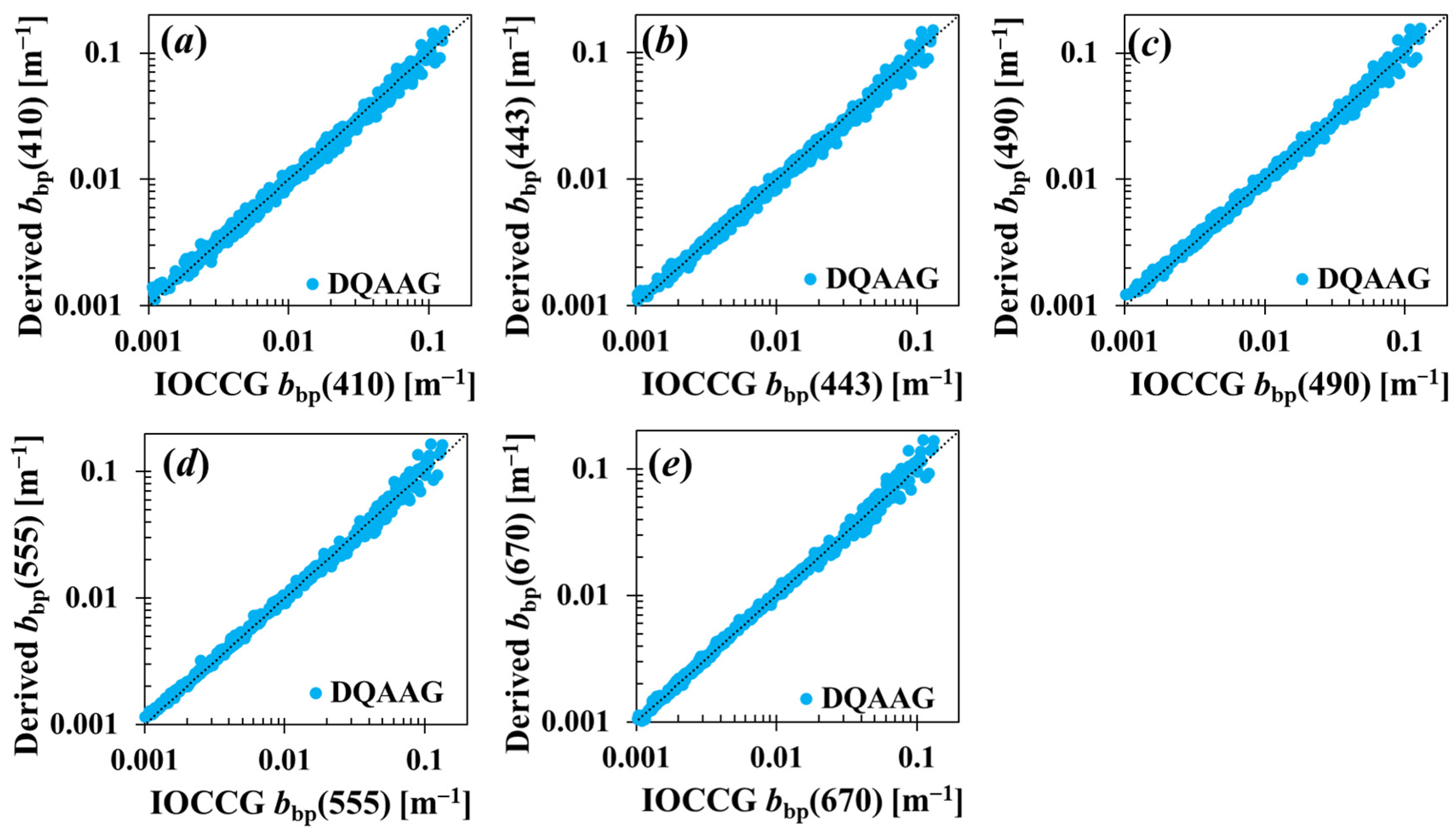
| Data | N | RMSD (m−1) | MARD | Bias (m−1) | R2 |
|---|---|---|---|---|---|
| bbp(410) | 500 | 0.0052 | 0.087 | −0.00039 | ~0.97 |
| bbp(443) | 0.0053 | 0.078 | −0.00085 | ~0.97 | |
| bbp(490) | 0.0060 | 0.084 | 0.00032 | ~0.96 | |
| bbp(555) | 0.0068 | 0.081 | 0.00075 | ~0.96 | |
| bbp(670) | 0.0074 | 0.073 | 0.0012 | ~0.96 |
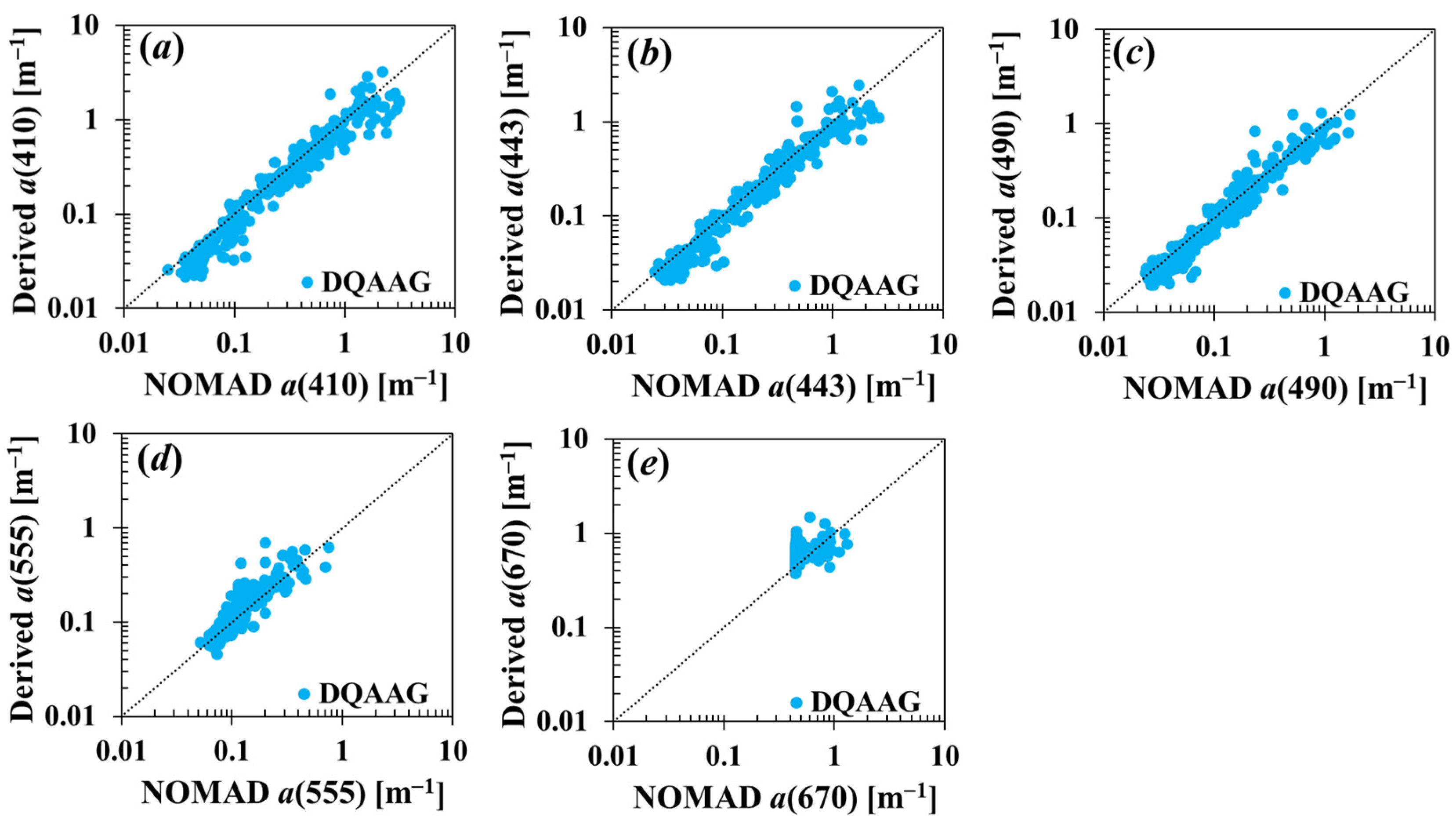
| Algorithms | Data | N | RMSD (m−1) | MARD | Bias (m−1) | R2 |
|---|---|---|---|---|---|---|
| a(410) | IOCCG | 500 | 0.23 | 0.069 | 0.031 | 0.96 |
| NOMAD | 287 | 0.31 | 0.23 | −0.064 | 0.75 | |
| a(443) | IOCCG | 500 | 0.14 | 0.12 | −0.042 | 0.97 |
| NOMAD | 287 | 0.23 | 0.21 | −0.045 | 0.76 | |
| a(490) | IOCCG | 500 | 0.082 | 0.063 | 0.0094 | 0.96 |
| NOMAD | 287 | 0.12 | 0.20 | −0.016 | 0.82 | |
| a(555) | IOCCG | 500 | 0.033 | 0.083 | −0.0066 | 0.95 |
| NOMAD | 287 (286) * | 0.059 | 0.17 | 0.011 | 0.72 | |
| a(670) | IOCCG | 500 | 0.075 | 0.10 | 0.039 | 0.73 |
| NOMAD | 287 (283) * | 0.15 | 0.22 | 0.083 | 0.79 |
| Algorithms | Data | N | RMSD (m−1) | MARD | Bias (m−1) | R2 | |
|---|---|---|---|---|---|---|---|
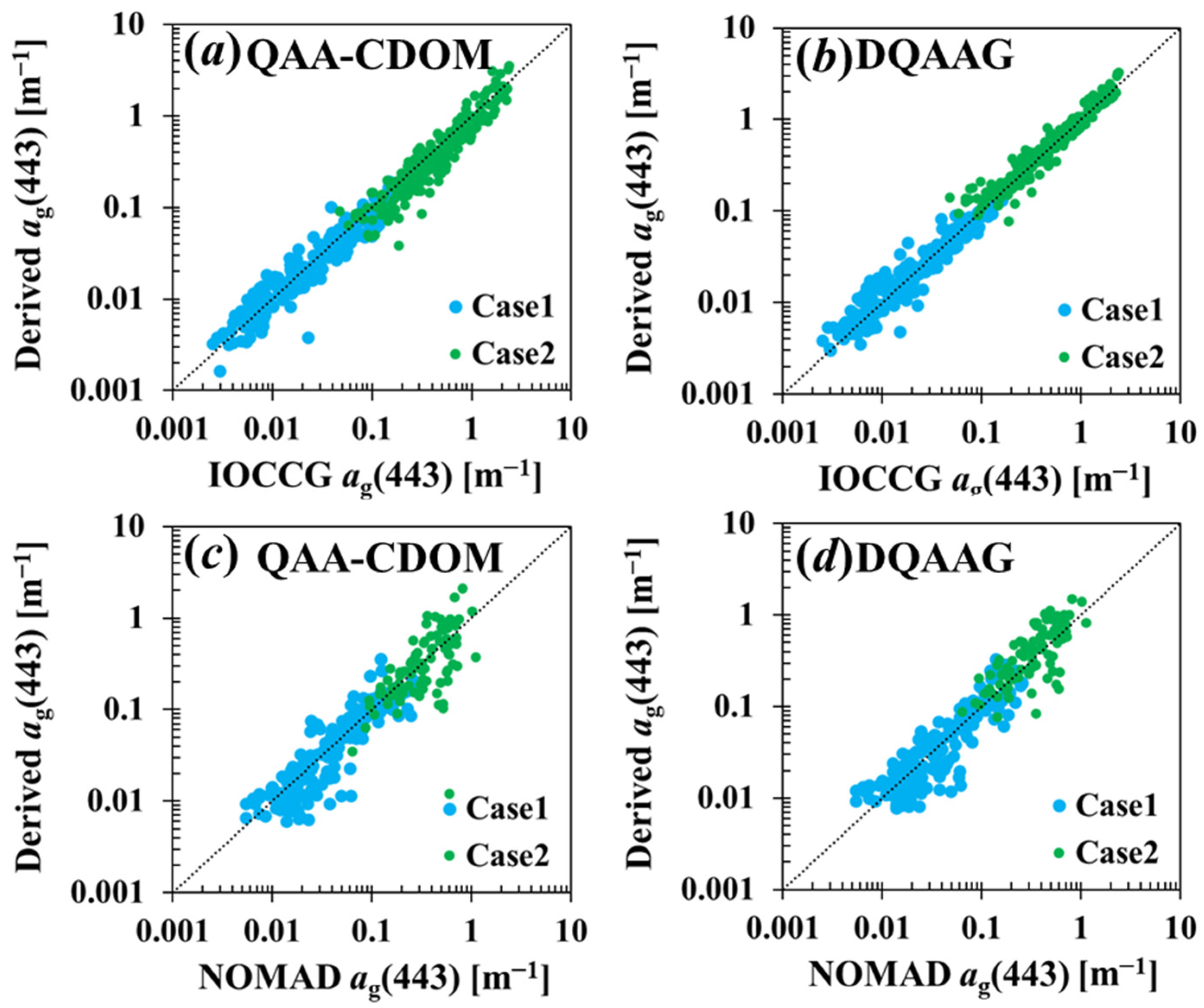
| QAA-CDOM | IOCCG | 500 | 0.20 | 0.32 | −0.078 | 0.89 | |
| Nomad | 287 | 0.15 | 0.42 | −0.047 | 0.50 | ||
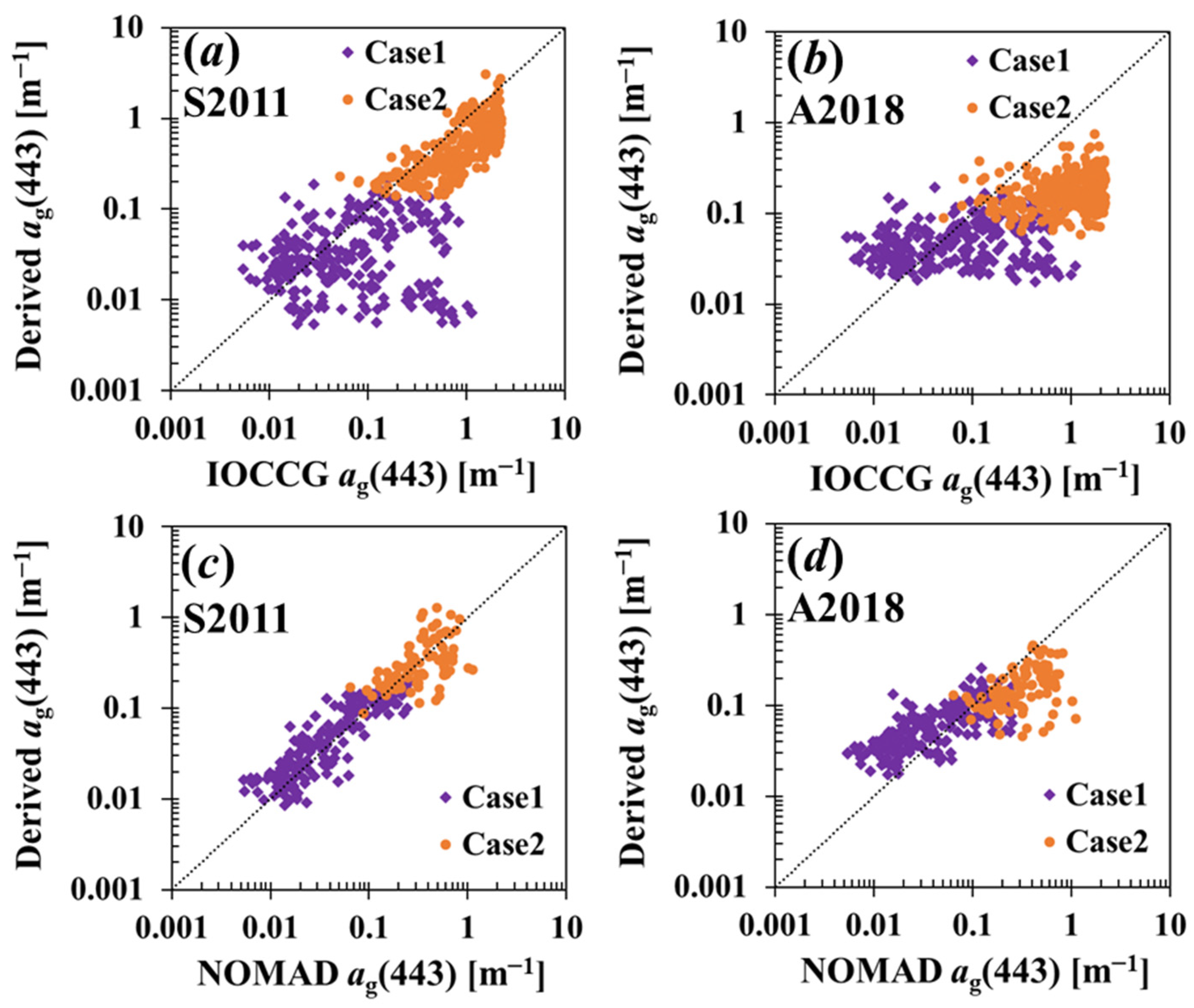
| S2011 | IOCCG | 500 | 0.29 | 0.53 | 0.023 | 0.64 | |
| Nomad | 287 | 0.15 | 0.44 | −0.0046 | 0.54 | ||
| A2018 | IOCCG | 500 | 0.45 | 1.01 | −0.18 | 0.38 | |
| Nomad | 287 | 0.17 | 0.82 | −0.064 | 0.45 | ||
| DQAAG | IOCCG | 500 | 0.11 | 0.19 | 0.0076 | 0.96 | |
| Nomad | 287 | 0.13 | 0.30 | 0.028 | 0.78 |
Disclaimer/Publisher’s Note: The statements, opinions and data contained in all publications are solely those of the individual author(s) and contributor(s) and not of MDPI and/or the editor(s). MDPI and/or the editor(s) disclaim responsibility for any injury to people or property resulting from any ideas, methods, instructions or products referred to in the content. |
© 2026 by the authors. Licensee MDPI, Basel, Switzerland. This article is an open access article distributed under the terms and conditions of the Creative Commons Attribution (CC BY) license.
Share and Cite
Wang, Y.; Xin, Q.; Wei, X.; Xu, L.; Bi, J.; Bao, K.; Song, Q. Improvement of the Semi-Analytical Algorithm Integrating Ultraviolet Band and Deep Learning for Inverting the Absorption Coefficient of Chromophoric Dissolved Organic Matter in the Ocean. Remote Sens. 2026, 18, 207. https://doi.org/10.3390/rs18020207
Wang Y, Xin Q, Wei X, Xu L, Bi J, Bao K, Song Q. Improvement of the Semi-Analytical Algorithm Integrating Ultraviolet Band and Deep Learning for Inverting the Absorption Coefficient of Chromophoric Dissolved Organic Matter in the Ocean. Remote Sensing. 2026; 18(2):207. https://doi.org/10.3390/rs18020207
Chicago/Turabian StyleWang, Yongchao, Quanbo Xin, Xiaodao Wei, Luoning Xu, Jinqiang Bi, Kexin Bao, and Qingjun Song. 2026. "Improvement of the Semi-Analytical Algorithm Integrating Ultraviolet Band and Deep Learning for Inverting the Absorption Coefficient of Chromophoric Dissolved Organic Matter in the Ocean" Remote Sensing 18, no. 2: 207. https://doi.org/10.3390/rs18020207
APA StyleWang, Y., Xin, Q., Wei, X., Xu, L., Bi, J., Bao, K., & Song, Q. (2026). Improvement of the Semi-Analytical Algorithm Integrating Ultraviolet Band and Deep Learning for Inverting the Absorption Coefficient of Chromophoric Dissolved Organic Matter in the Ocean. Remote Sensing, 18(2), 207. https://doi.org/10.3390/rs18020207