A Study on Radar–Gauge Rainfall Data Merging and Its Impact on Flood Simulation

Highlights
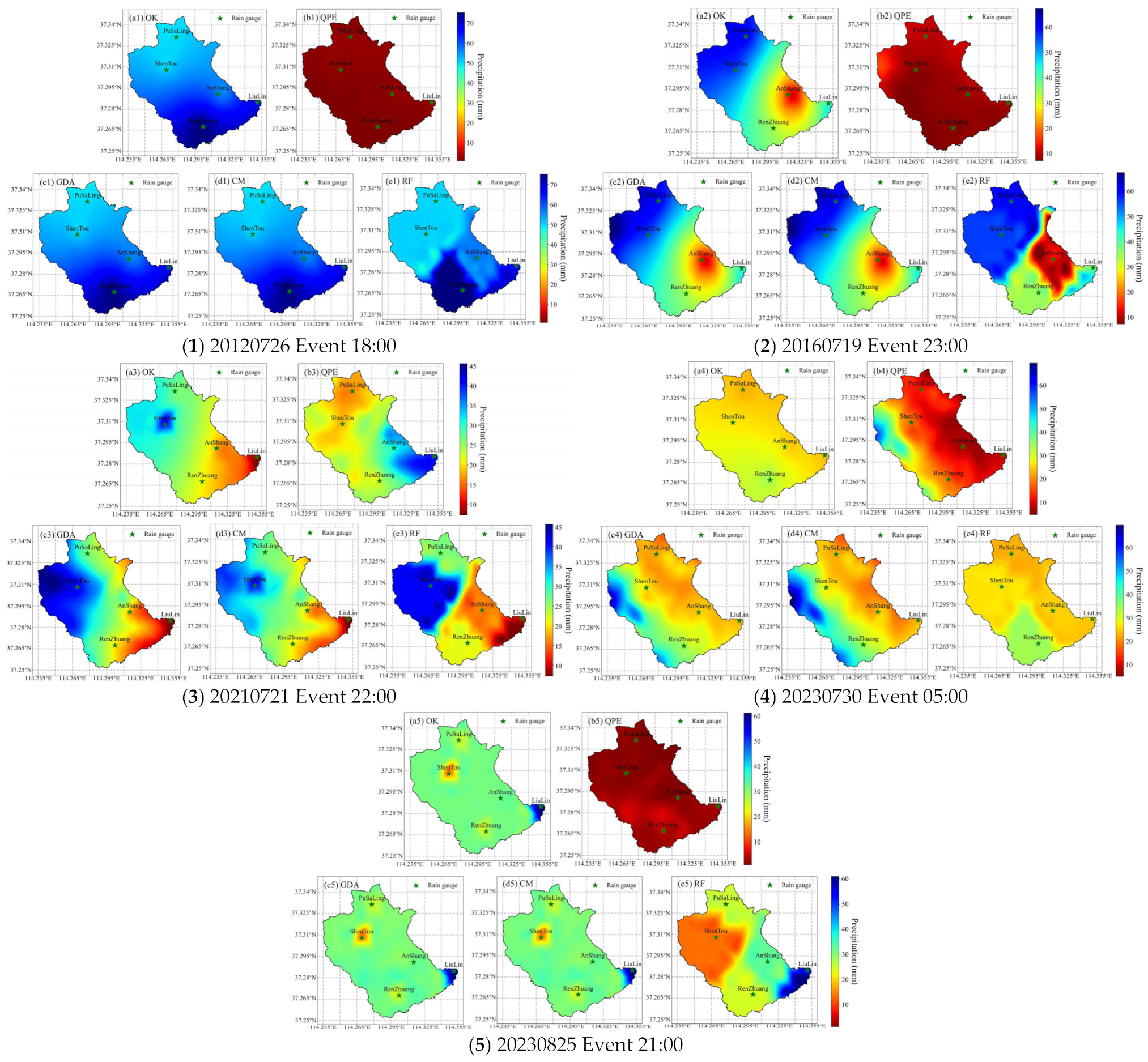
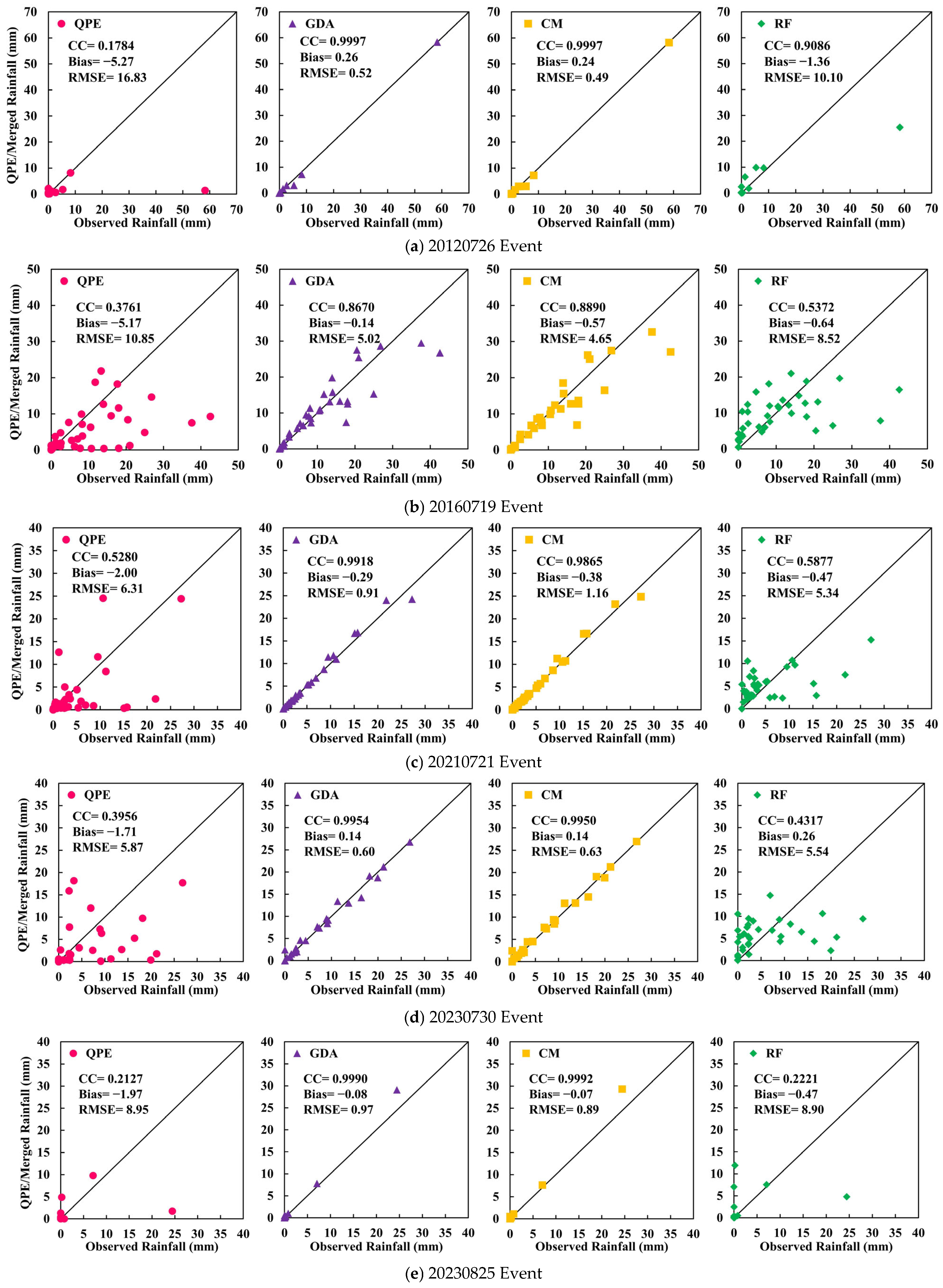
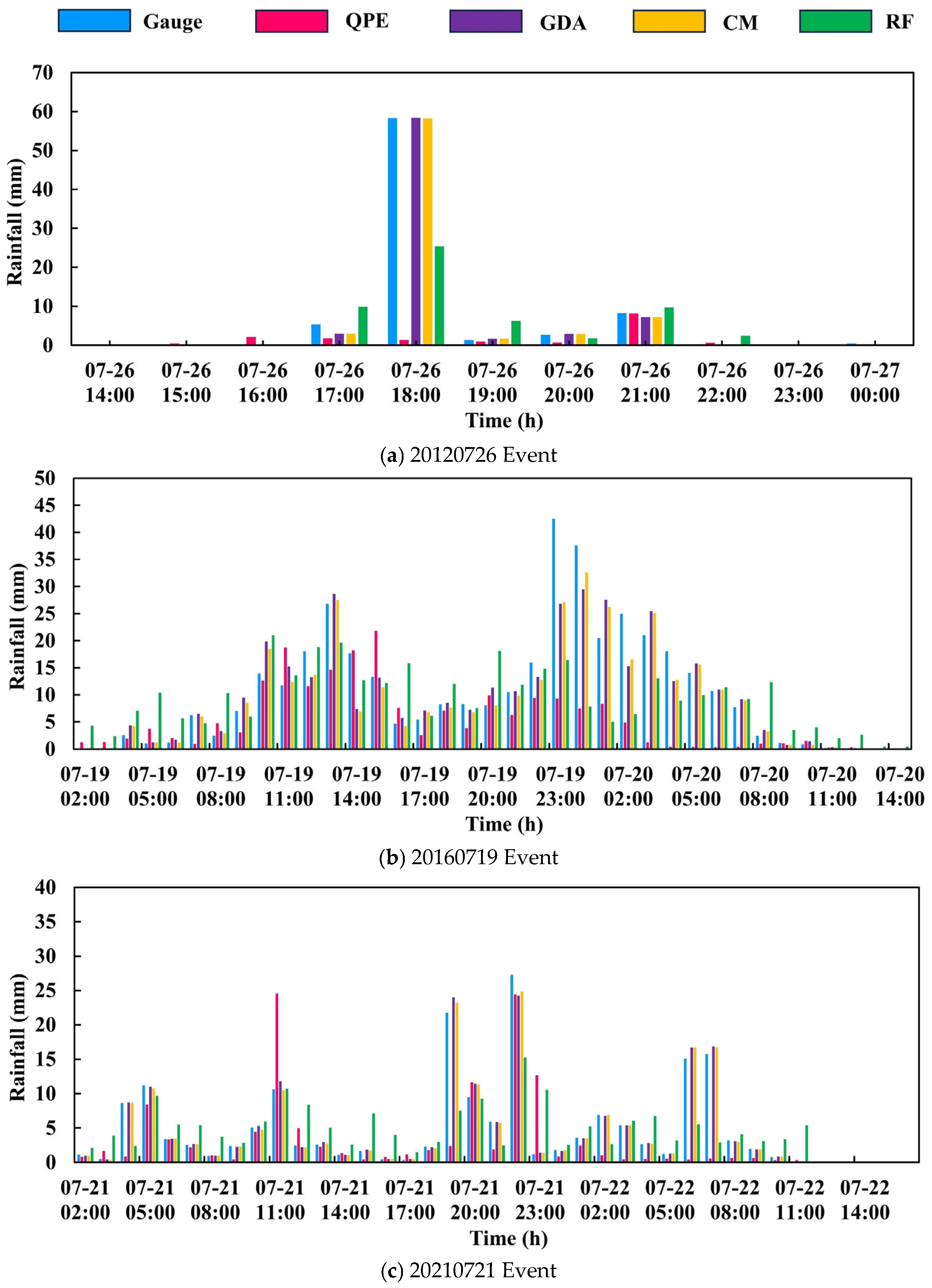
- All three radar–gauge fusion methods (GDA, CM, RF) substantially corrected the systematic underestimation in radar QPE. Under leave-one-gauge-out cross-validation, GDA and CM exhibited similar and robust point-scale accuracy (overall CC ≈ 0.81), whereas RF showed substantially lower generalization (CC ≈ 0.48).
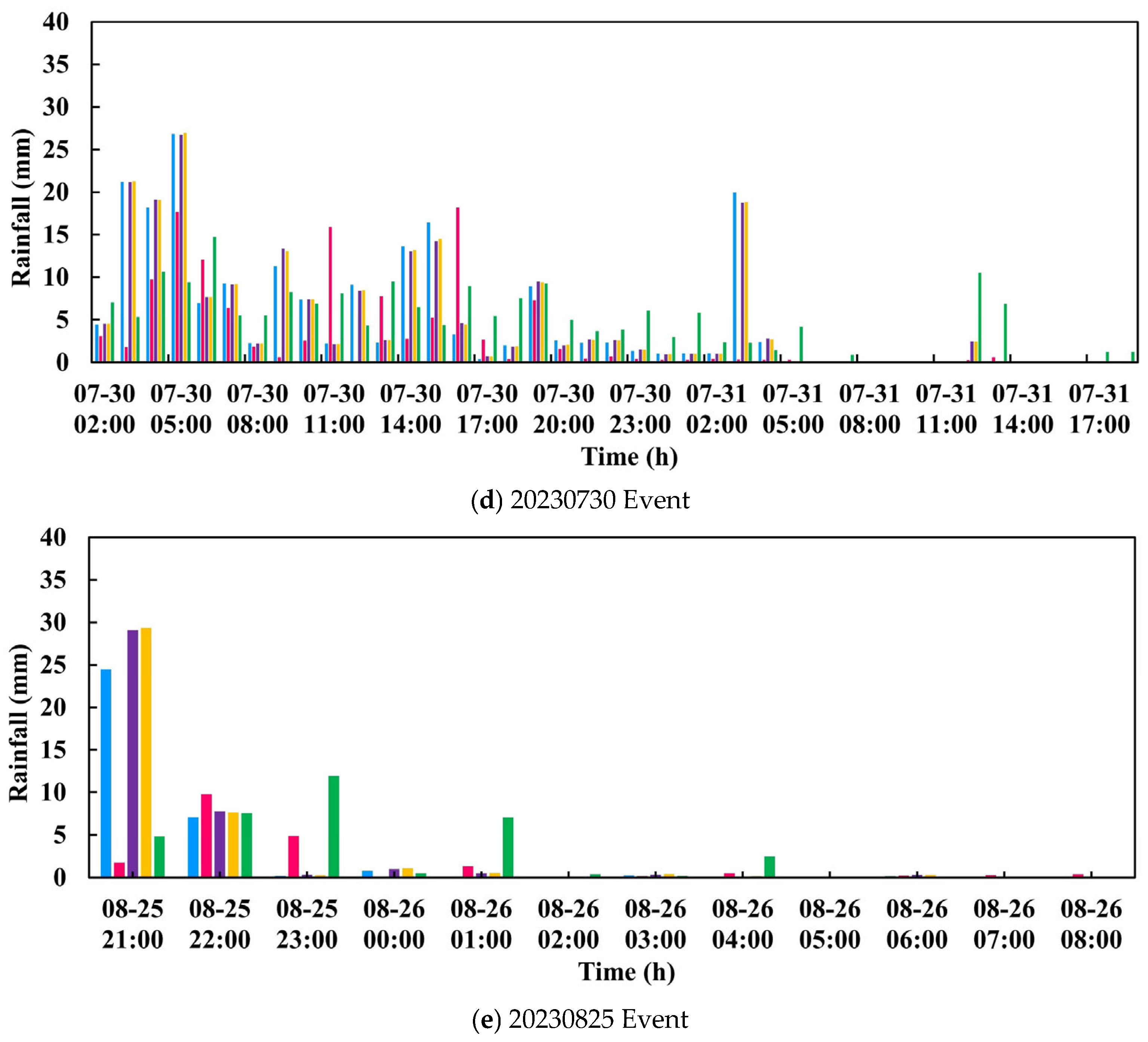
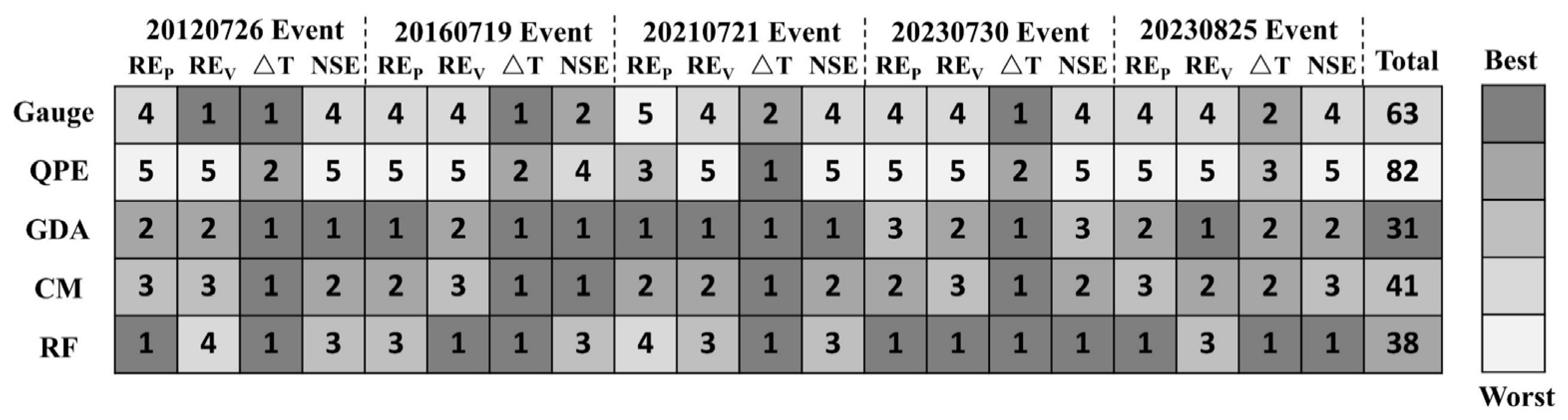
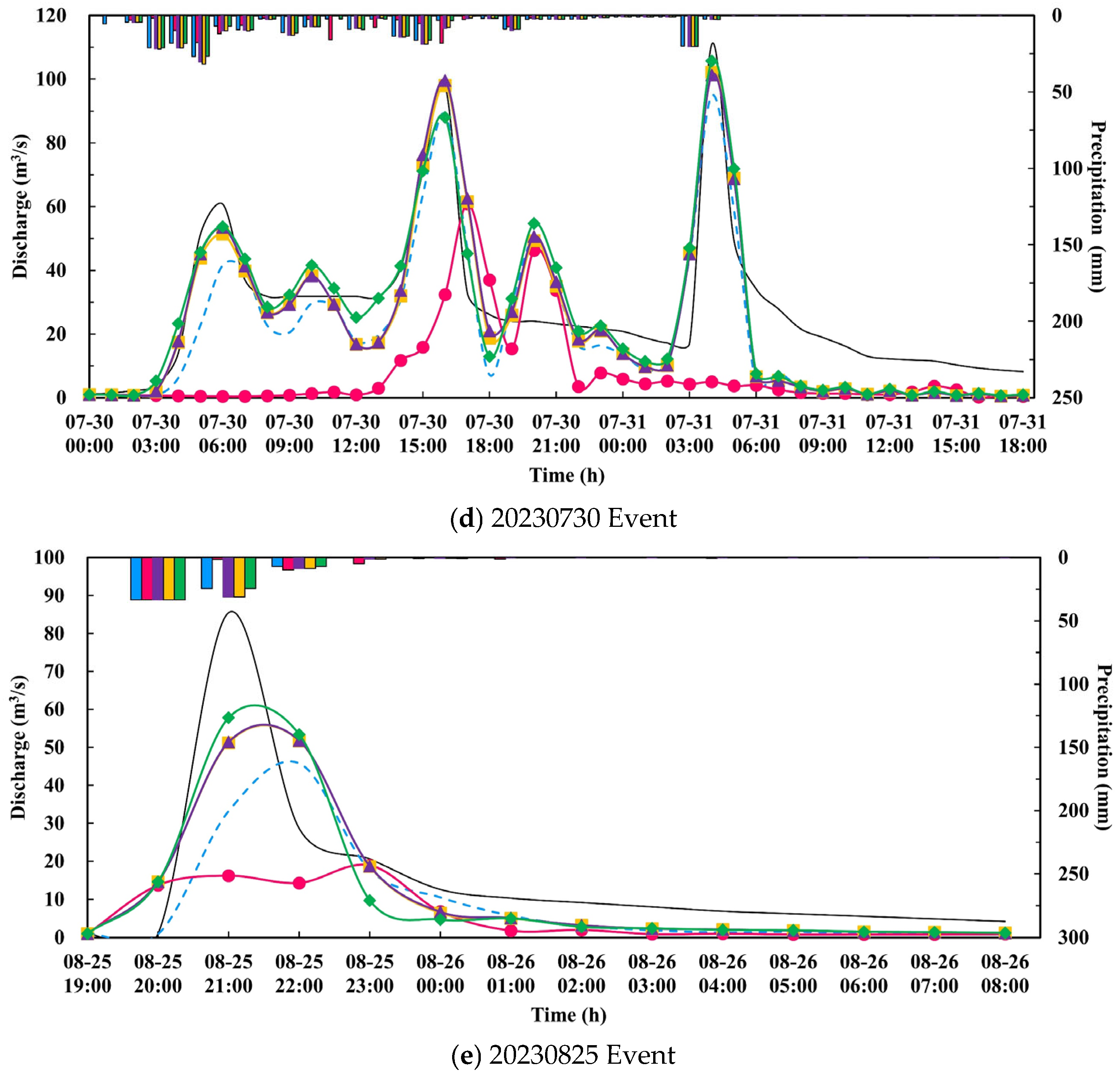
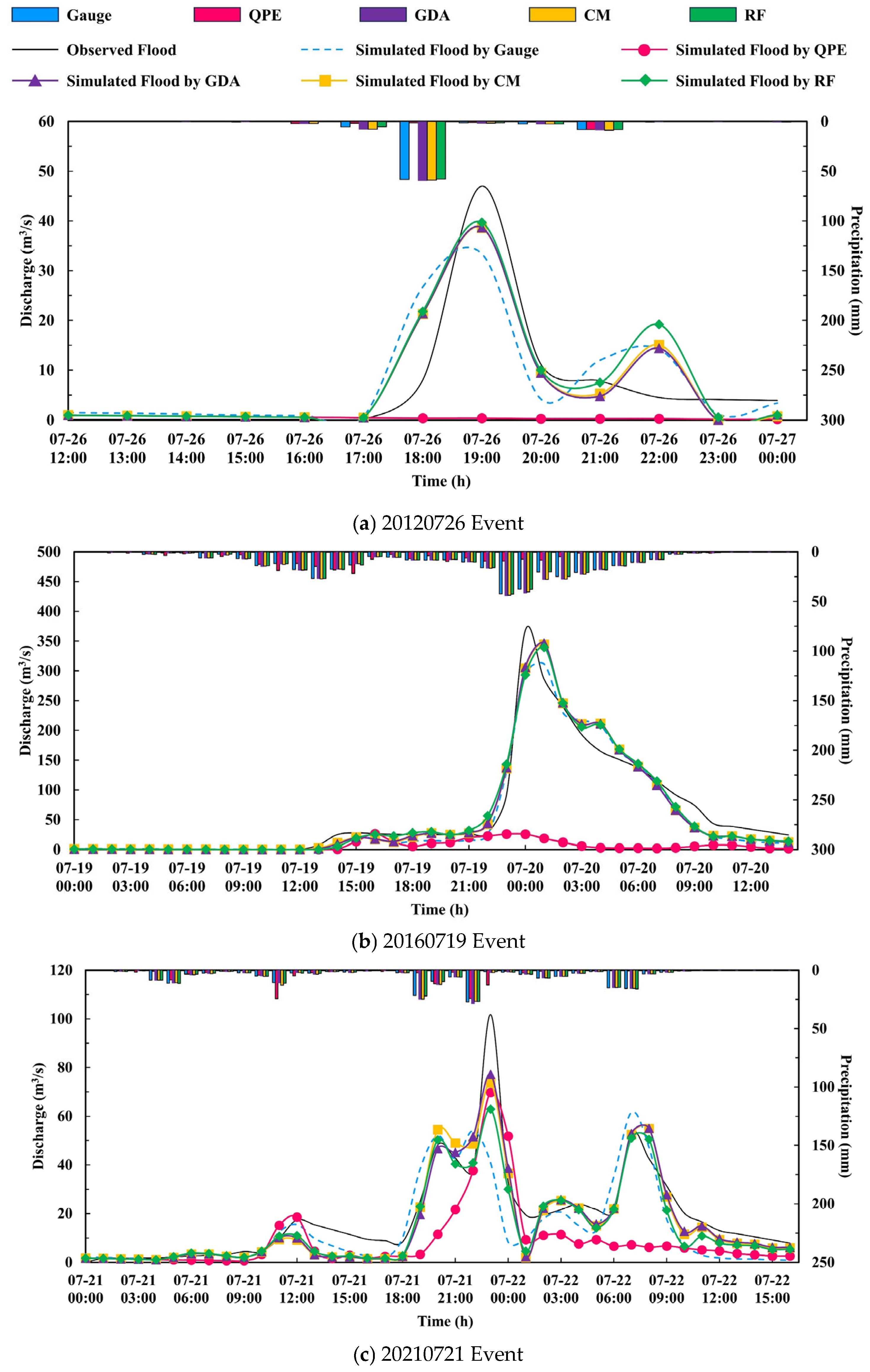
- In HEC-HMS flood simulations, GDA-fused rainfall delivered the most robust overall performance across diverse flood types, while all three fused products consistently outperformed single-source rainfall inputs.
- Radar–gauge data fusion provides a reliable pathway to enhance rainfall input quality and improve operational flood forecasting in semi-arid watersheds.
- Independent cross-validation reveals a notable contrast: while CM marginally achieved the highest statistical accuracy (overall CC ≈ 0.81 for point scale, CC ≈ 0.96 for basin scale), GDA delivered the most robust flood simulations. This finding demonstrates that optimal statistical fidelity does not automatically translate into optimal hydrological performance, underscoring the importance of application-oriented validation when evaluating rainfall fusion methods.
Abstract
1. Introduction
2. Materials and Methods
2.1. Study Area
2.2. Data Acquisition and Preprocessing
2.3. Radar Quantitative Precipitation Estimation
2.3.1. Dynamically Optimized Z-I Relationship
2.3.2. Calculation of Radar Hourly Accumulated Rainfall
2.4. Radar–Gauge Rainfall Data Fusion Methods
2.4.1. Geographic Differential Analysis (GDA)
2.4.2. Conditional Merging (CM)
2.4.3. Machine Learning-Based Fusion Method
2.5. Hydrological Model Configuration
2.5.1. HEC-HMS Model Overview
2.5.2. Runoff Generation and Flow Routing Methods
2.6. Accuracy Evaluation Metrics
2.6.1. Leave-One-Gauge-Out Cross-Validation Strategy
- (1)
- The target gauge is withheld as the validation station, and the remaining four gauges serve as the training set.
- (2)
- The fusion model (GDA, CM, or RF) is constructed using only the training gauges.
- (3)
- The model predicts the hourly precipitation at the location of the withheld gauge.
- (4)
- Steps 1–3 are repeated until each gauge has been withheld exactly once.
2.6.2. Evaluation Metrics for Radar QPE and Fused Rainfall
2.6.3. Evaluation Metrics for Flood Simulation
3. Results
3.1. Radar Quantitative Precipitation Estimation Performance
3.2. Independent Validation of Radar–Gauge Rainfall Data Fusion Accuracy
3.3. HEC-HMS Model Calibration and Validation
3.3.1. Parameter Optimization
3.3.2. Flood Simulation Performance
3.4. Flood Simulation with Multi-Source Rainfall Inputs
4. Discussion
4.1. Quantitative Accuracy of Fused Rainfall Products
4.2. Accuracy Analysis of Flood Simulation Using Multi-Source Rainfall Data
4.3. Limitations and Future Research
5. Conclusions
- (1)
- The dynamically optimized Z-I relationship provides a flexible framework for radar rainfall estimation, performing adequately for long-duration uniform events but showing limited skill for short-duration, high-intensity convective storms. Radar-derived rainfall exhibited a systematic underestimation bias, though its spatial structure was significantly more detailed than gauge-only interpolations.
- (2)
- All three fusion methods—GDA, CM, and RF—substantially improved rainfall data quality and corrected the systematic underestimation in radar QPE. Under independent cross-validation, GDA and CM yielded comparable point-scale accuracy (overall CC ≈ 0.81), with CM achieving slightly higher basin-scale accuracy (areal CC ≈ 0.964 vs. 0.960 for GDA), while RF exhibited markedly lower generalization (point CC ≈ 0.48, areal CC ≈ 0.62). Among the three, GDA and CM most effectively combined the high accuracy of gauge measurements with the high spatial resolution of radar.
- (3)
- In flood simulation, radar-only QPE produced the poorest results, with severe underestimation of peak discharge and runoff volume. Gauge-corrected fused rainfall significantly enhanced simulation accuracy and consistently outperformed any single-source data across diverse flood types. Among the fusion methods, GDA achieved the most robust overall flood simulation performance, followed by RF and CM. While differences among the three methods were not substantial, their collective superiority over single-source inputs confirms that radar–gauge data fusion provides a reliable and effective technical pathway for improving operational flood forecasting.
Author Contributions
Funding
Data Availability Statement
Conflicts of Interest
Appendix A

| Event | Station | Method | CC | Bias | RMSE |
|---|---|---|---|---|---|
| 20120726 | Shentou | GDA | 0.9995 | 0.69 | 1.87 |
| CM | 0.9995 | 0.68 | 1.84 | ||
| RF | 0.1436 | −3.31 | 14.52 | ||
| Pusaling | GDA | 0.9968 | 0.31 | 1.30 | |
| CM | 0.9970 | 0.25 | 1.19 | ||
| RF | 0.9502 | 2.54 | 5.16 | ||
| Anshang | GDA | 0.9830 | 2.47 | 5.20 | |
| CM | 0.9831 | 2.46 | 5.19 | ||
| RF | 0.9416 | 2.61 | 6.12 | ||
| Renzhuang | GDA | 0.9982 | −1.07 | 3.97 | |
| CM | 0.9982 | −1.07 | 3.98 | ||
| RF | 0.7961 | −5.32 | 18.06 | ||
| Liulin | GDA | 0.9388 | −4.27 | 9.26 | |
| CM | 0.9389 | −4.25 | 9.23 | ||
| RF | 0.8457 | 0.93 | 11.62 | ||
| 20160719 | Shentou | GDA | 0.3854 | −0.94 | 13.07 |
| CM | 0.5059 | −1.91 | 11.85 | ||
| RF | 0.4784 | −2.76 | 11.98 | ||
| Pusaling | GDA | 0.7641 | −1.02 | 8.28 | |
| CM | 0.7711 | −1.71 | 8.28 | ||
| RF | 0.4132 | 0.13 | 11.84 | ||
| Anshang | GDA | 0.4178 | −0.93 | 10.65 | |
| CM | 0.4189 | −0.90 | 10.63 | ||
| RF | 0.3806 | −0.86 | 9.72 | ||
| Renzhuang | GDA | 0.8458 | 2.75 | 6.01 | |
| CM | 0.8505 | 2.85 | 6.06 | ||
| RF | 0.2691 | 2.11 | 10.21 | ||
| Liulin | GDA | 0.7006 | −0.73 | 9.03 | |
| CM | 0.6689 | −0.75 | 9.38 | ||
| RF | 0.2693 | 0.57 | 12.43 | ||
| 20210721 | Shentou | GDA | 0.8629 | −1.33 | 3.96 |
| CM | 0.8755 | −1.26 | 3.77 | ||
| RF | 0.4568 | −1.87 | 6.81 | ||
| Pusaling | GDA | 0.7228 | 1.31 | 5.46 | |
| CM | 0.6471 | 1.12 | 5.96 | ||
| RF | 0.4002 | 1.24 | 7.15 | ||
| Anshang | GDA | 0.9374 | −0.34 | 2.55 | |
| CM | 0.8873 | −0.37 | 3.36 | ||
| RF | 0.4125 | 0.48 | 6.84 | ||
| Renzhuang | GDA | 0.8790 | −0.27 | 3.79 | |
| CM | 0.7997 | −0.62 | 4.74 | ||
| RF | 0.1727 | −0.88 | 8.28 | ||
| Liulin | GDA | 0.9035 | 1.44 | 4.11 | |
| CM | 0.9035 | 1.44 | 4.11 | ||
| RF | 0.4083 | 1.38 | 5.64 | ||
| 20230730 | Shentou | GDA | 0.9166 | 0.00 | 2.53 |
| CM | 0.9187 | 0.00 | 2.51 | ||
| RF | 0.4172 | 0.69 | 6.23 | ||
| Pusaling | GDA | 0.8700 | 0.30 | 3.15 | |
| CM | 0.8698 | 0.27 | 3.14 | ||
| RF | 0.2989 | −0.03 | 6.08 | ||
| Anshang | GDA | 0.9642 | −0.25 | 1.92 | |
| CM | 0.9608 | −0.23 | 2.00 | ||
| RF | 0.1938 | −0.54 | 7.03 | ||
| Renzhuang | GDA | 0.9256 | 0.77 | 2.83 | |
| CM | 0.9179 | 0.77 | 2.91 | ||
| RF | 0.3270 | 0.70 | 6.62 | ||
| Liulin | GDA | 0.9425 | −0.38 | 2.63 | |
| CM | 0.9426 | −0.38 | 2.63 | ||
| RF | 0.2520 | −0.37 | 7.70 | ||
| 20230825 | Shentou | GDA | 0.9982 | 0.88 | 1.65 |
| CM | 0.9984 | 0.86 | 1.60 | ||
| RF | −0.0375 | 0.10 | 9.05 | ||
| Pusaling | GDA | 0.9784 | 2.71 | 7.15 | |
| CM | 0.9793 | 2.74 | 7.16 | ||
| RF | 0.4495 | 2.33 | 5.20 | ||
| Anshang | GDA | 0.9966 | −1.18 | 2.66 | |
| CM | 0.9950 | −1.27 | 2.87 | ||
| RF | 0.3370 | −0.78 | 8.62 | ||
| Renzhuang | GDA | 0.9853 | −3.29 | 10.96 | |
| CM | 0.9874 | −3.11 | 10.45 | ||
| RF | 0.0421 | −3.67 | 17.50 | ||
| Liulin | GDA | 0.9970 | 1.56 | 4.12 | |
| CM | 0.9964 | 1.48 | 4.05 | ||
| RF | 0.6969 | 0.97 | 5.01 |
References
- Cheng, X.T.; Liu, C.J.; Li, C.Z.; Yu, Q.; Li, N. Evolution characteristics of flood risk under changing environment and strategy of urban resilience improvement. J. Hydraul. Eng. 2022, 53, 757–768. [Google Scholar] [CrossRef]
- Gu, W.; Chen, L.-J.; Wang, Y.-G.; Gao, H.; Wang, L.; Liu, Y.-Y. Extreme precipitation over northern China in autumn 2021 and joint contributions of tropical and mid-latitude factors. Adv. Clim. Change Res. 2022, 13, 835–842. [Google Scholar] [CrossRef] [Scilit]
- Ma, Q.; Li, Z.M.; Dong, F.R.; Zhang, K.; Yang, B.; Liu, C. Flood modeling developed for digital twin watershed: A case study of “23·7” great flood assessment in Ziya River Basin. J. Hydraul. Eng. 2025, 56, 73–84. [Google Scholar] [CrossRef]
- Duan, R.; Huang, G.; Zhou, X.; Lu, C.; Tian, C. Record-breaking heavy rainfall around Henan Province in 2021 and future projection of extreme conditions under climate change. J. Hydrol. 2023, 625, 130102. [Google Scholar] [CrossRef] [Scilit]
- Yuan, X.M.; Li, D.; Tian, F.C.; He, X.; Wang, X.; Guo, L. Research on flood classified intelligent forecasting method based on AE-RCNN. J. Hydraul. Eng. 2023, 54, 1070–1079. [Google Scholar] [CrossRef]
- Liu, W.; Xie, S.; Zhong, D.Y.; Wang, Y.; Bao, S.; Zhu, X. Coupled forecasting of rainstorms and floods in small watershed based on Deep Learning and HEC-HMS Model. J. Hydraul. Eng. 2025, 56, 364–374. [Google Scholar] [CrossRef]
- Liu, J.; Qiu, Q.T.; Li, C.Z.; Jiao, Y.; Wang, W.; Yu, F. Advances of precipitation nowcasting and its application in hydrological forecasting. Adv. Water Sci. 2020, 31, 129–142. [Google Scholar] [CrossRef]
- Zheng, Y.C.; Li, J.Z.; Rong, Y.T.; Du, Y.; Feng, P. Quantification of rainfall spatial and temporal distribution characteristics on the flood hydrograph and its application in flood type classification. J. Hydraul. Eng. 2022, 53, 560–573. [Google Scholar] [CrossRef]
- Li, Z.; Yang, D.W.; Hong, Y.; Qi, Y. Radar-based quantitative precipitation estimate in the Three Gorges region of Yangtze River. J. Hydraul. Eng. 2014, 33, 29–54. [Google Scholar]
- Renard, B.; Kavetski, D.; Kuczera, G.; Thyer, M.; Franks, S.W. Understanding predictive uncertainty in hydrologic modeling: The challenge of identifying input and structural errors. Water Resour. Res. 2010, 46, W05521. [Google Scholar] [CrossRef] [Scilit]
- Liu, X.Y.; Diallo, T.D.; Mao, J.T.; Li, J. Monthly Precipitation Estimation over Western China Using GMS Satellite Data. Chin. J. Atmos. Sci. 2005, 29, 518–525. [Google Scholar]
- Smith, J.A.; Baeck, M.L.; Zhang, Y.; Doswell, C.A. Extreme rainfall and flooding from supercell thunderstorms. J. Hydrometeorol. 2001, 2, 469–489. [Google Scholar] [CrossRef] [Scilit]
- Hazenberg, P.; Leijnse, H.; Uijlenhoet, R. Radar rainfall estimation of stratiform winter precipitation in the Belgian Ardennes. Water Resour. Res. 2011, 47, W02507. [Google Scholar] [CrossRef] [Scilit]
- He, X.; Refsgaard, J.C.; Sonnenborg, T.O.; Vejen, F.; Jensen, K.H. Statistical Analysis of the Impact of Radar Rainfall Uncertainties on Water Resources Modeling: Radar Rainfall Uncertainties on Hydrological Modeling. Water Resour. Res. 2011, 47, W09526. [Google Scholar] [CrossRef] [Scilit]
- Chang, W.-Y.; Vivekanandan, J.; Ikeda, K.; Lin, P.-L. Quantitative Precipitation Estimation of the Epic 2013 Colorado Flood Event: Polarization Radar-Based Variational Scheme. J. Appl. Meteorol. Climatol. 2016, 55, 1477–1495. [Google Scholar] [CrossRef] [Scilit]
- Vieux, B.; Bedient, P. Assessing Urban Hydrologic Prediction Accuracy through Event Reconstruction. J. Hydrol. 2004, 299, 217–236. [Google Scholar] [CrossRef] [Scilit]
- Marshall, J.S.; Langille, R.C.; Palmer, W.M.K. Measurement of Rainfall by Radar. J. Atmos. Sci. 1947, 4, 186–192. [Google Scholar] [CrossRef] [Scilit]
- Joss, J.; Waldvogel, A.; Collier, C.G. Precipitation Measurement and Hydrology. In Radar in Meteorology: Battan Memorial and 40th Anniversary Radar Meteorology Conference; American Meteorological Society: Boston, MA, USA, 1990. [Google Scholar]
- Orellana-Alvear, J.; Célleri, R.; Rollenbeck, R.; Bendix, J. Analysis of Rain Types and Their Z–R Relationships at Different Locations in the High Andes of Southern Ecuador. J. Appl. Meteorol. Climatol. 2017, 56, 3065–3080. [Google Scholar] [CrossRef] [Scilit]
- Bringi, V.N.; Chandrasekar, V. Polarimetric Doppler Weather Radar: Principles and Applications; Cambridge University Press: Cambridge, UK, 2001. [Google Scholar]
- Montopoli, M.; Roberto, N.; Adirosi, E.; Gorgucci, E.; Baldini, L. Investigation of Weather Radar Quantitative Precipitation Estimation Methodologies in Complex Orography. Atmosphere 2017, 8, 34. [Google Scholar] [CrossRef] [Scilit]
- Alqudah, A.; Chandrasekar, V.; Le, M. Investigating Rainfall Estimation from Radar Measurements Using Neural Networks. Nat. Hazards Earth Syst. Sci. 2013, 13, 535–544. [Google Scholar] [CrossRef] [Scilit]
- Orellana-Alvear, J.; Célleri, R.; Rollenbeck, R.; Bendix, J. Optimization of X-Band Radar Rainfall Retrieval in the Southern Andes of Ecuador Using a Random Forest Model. Remote Sens. 2019, 11, 1632. [Google Scholar] [CrossRef] [Scilit]
- Villarini, G.; Krajewski, W.F. Review of the Different Sources of Uncertainty in Single Polarization Radar-Based Estimates of Rainfall. Surv. Geophys. 2010, 31, 107–129. [Google Scholar] [CrossRef] [Scilit]
- Ośródka, K.; Szturc, J.; Jurczyk, A. Chain of Data Quality Algorithms for 3-D Single-Polarization Radar Reflectivity (RADVOL-QC System). Meteorol. Appl. 2012, 21, 256–270. [Google Scholar] [CrossRef] [Scilit]
- Krajewski, W.F.; Vignal, B.; Seo, B.-C.; Villarini, G. Statistical Model of the Range-Dependent Error in Radar-Rainfall Estimates Due to the Vertical Profile of Reflectivity. J. Hydrol. 2011, 402, 306–316. [Google Scholar] [CrossRef] [Scilit]
- Sebastianelli, S.; Russo, F.; Napolitano, F.; Baldini, L. On Precipitation Measurements Collected by a Weather Radar and a Rain Gauge Network. Nat. Hazards Earth Syst. Sci. 2013, 13, 605–623. [Google Scholar] [CrossRef] [Scilit]
- Angulo, I.; Grande, O.; Jenn, D.C.; Guerra-Pereda, D.; De La Vega, D. Estimating Reflectivity Values from Wind Turbines for Analyzing the Potential Impact on Weather Radar Services. Atmos. Meas. Tech. 2015, 8, 2183–2193. [Google Scholar] [CrossRef] [Scilit]
- Norin, L. A Quantitative Analysis of the Impact of Wind Turbines on Operational Doppler Weather Radar Data. Atmos. Meas. Tech. 2015, 8, 593–609. [Google Scholar] [CrossRef] [Scilit]
- Seo, B.C.; Krajewski, W.F.; Mishra, K.V. Using the New Dual-Polarimetric Capability of WSR-88D to Eliminate Anomalous Propagation and Wind Turbine Effects in Radar-Rainfall. Atmos. Res. 2015, 153, 296–309. [Google Scholar] [CrossRef] [Scilit]
- Bech, J.; Gjertsen, U.; Haase, G. Modelling Weather Radar Beam Propagation and Topographical Blockage at Northern High Latitudes. Q. J. R. Meteorol. Soc. 2007, 133, 1191–1204. [Google Scholar] [CrossRef] [Scilit]
- McRoberts, D.B.; Nielsen-Gammon, J.W. Detecting Beam Blockage in Radar-Based Precipitation Estimates. J. Atmos. Ocean. Technol. 2017, 34, 1407–1422. [Google Scholar] [CrossRef] [Scilit]
- Gu, J.-Y.; Ryzhkov, A.; Zhang, P.; Neilley, P.; Knight, M.; Wolf, B.; Lee, D.-I. Polarimetric Attenuation Correction in Heavy Rain at C Band. J. Appl. Meteorol. Climatol. 2011, 50, 39–58. [Google Scholar] [CrossRef] [Scilit]
- Lee, H.; Kim, S. Ensemble Classification for Anomalous Propagation Echo Detection with Clustering-Based Subset-Selection Method. Atmosphere 2017, 8, 11. [Google Scholar] [CrossRef] [Scilit]
- Saltikoff, E.; Haase, G.; Delobbe, L.; Gaussiat, N.; Martet, M.; Idziorek, D.; Leijnse, H.; Novák, P.; Lukach, M.; Stephan, K. OPERA the Radar Project. Atmosphere 2019, 10, 320. [Google Scholar] [CrossRef] [Scilit]
- Michelson, D.; Henja, A.; Ernes, S.; Haase, G.; Koistinen, J.; Ośródka, K.; Peltonen, T.; Szewczykowski, M.; Szturc, J. BALTRAD Advanced Weather Radar Networking. J. Open Res. Softw. 2018, 6, 12. [Google Scholar] [CrossRef] [Scilit]
- Krajewski, W.F. Cokriging radar-rainfall and rain gage data. J. Geophys. Res. 1987, 92, 9571–9580. [Google Scholar] [CrossRef] [Scilit]
- Wang, L.-P.; Ochoa-Rodríguez, S.; Simões, N.E.; Onof, C.; Maksimović, Č. Radar-rain gauge data combination techniques: A revision and analysis of their suitability for urban hydrology. Water Sci. Technol. 2013, 68, 737–747. [Google Scholar] [CrossRef] [Scilit] [PubMed]
- McKee, J.L.; Binns, A.D. A review of gauge–radar merging methods for quantitative precipitation estimation in hydrology. Can. Water Resour. J. 2015, 41, 186–203. [Google Scholar] [CrossRef] [Scilit]
- Conti, F.L.; Francipane, A.; Pumo, D.; Noto, L.V. Exploring single polarization X-band weather radar potentials for local meteorological and hydrological applications. J. Hydrol. 2015, 531, 508–522. [Google Scholar] [CrossRef] [Scilit]
- Goudenhoofdt, E.; Delobbe, L. Evaluation of radar-gauge merging methods for quantitative precipitation estimates. Hydrol. Earth Syst. Sci. 2009, 13, 195–203. [Google Scholar] [CrossRef] [Scilit]
- Jewell, S.A.; Gaussiat, N. An assessment of kriging-based rain gauge–radar merging techniques. Q. J. R. Meteorol. Soc. 2015, 141, 2300–2313. [Google Scholar] [CrossRef] [Scilit]
- Zhang, T.; Li, Y.; Li, J.Z.; Feng, P. Research progress on multi-source rainfall data fusion and their hydrological application. J. Nat. Disasters 2022, 31, 15–28. [Google Scholar] [CrossRef]
- Ochoa-Rodriguez, S.; Wang, L.-P.; Willems, P.; Onof, C. A review of radar-rain gauge data merging methods and their potential for urban hydrological applications. Water Resour. Res. 2019, 55, 6356–6391. [Google Scholar] [CrossRef] [Scilit]
- Harrison, D.L.; Scovell, R.W.; Kitchen, M. High-resolution precipitation estimates for hydrological uses. Proc. Inst. Civ. Eng. Water Manag. 2009, 162, 125–135. [Google Scholar] [CrossRef] [Scilit]
- Smith, J.A.; Baeck, M.L.; Meierdiercks, K.L.; Miller, A.J.; Krajewski, W.F. Radar rainfall estimation for flash flood forecasting in small urban watersheds. Adv. Water Resour. 2007, 30, 2087–2097. [Google Scholar] [CrossRef] [Scilit]
- Brandes, E.A. Optimizing rainfall estimates with the aid of radar. J. Appl. Meteorol. 1975, 14, 1339–1345. [Google Scholar] [CrossRef] [Scilit]
- Cole, S.J.; Moore, R.J. Hydrological modelling using rain gauge and radar-based estimators of areal rainfall. J. Hydrol. 2008, 358, 159–181. [Google Scholar] [CrossRef] [Scilit]
- Michelson, D.B.; Andersson, T.; Koistinen, J.; Collier, C.G.; Riedl, J.; Szturc, J.; Gjertsen, U.; Nielsen, A.; Overgaard, S. BALTEX Radar Data Centre Products and Their Methodologies; SMHI Reports Meteorology and Climatology Nr. 90; SMHI: Norrköping, Sweden, 2000. [Google Scholar]
- Sideris, I.V.; Gabella, M.; Erdin, R.; Germann, U. Real-time radar-rain-gauge merging using spatio-temporal co-kriging with external drift in the alpine terrain of Switzerland. Q. J. R. Meteorol. Soc. 2014, 140, 1097–1111. [Google Scholar] [CrossRef] [Scilit]
- Sinclair, S.; Pegram, G. Combining radar and rain gauge rainfall estimates using conditional merging. Atmos. Sci. Lett. 2005, 6, 19–22. [Google Scholar] [CrossRef] [Scilit]
- Schuurmans, J.M.; Bierkens, M.F.P.; Pebesma, E.J.; Uijlenhoet, R. Automatic prediction of high-resolution daily rainfall fields for multiple extents: The potential of operational radar. J. Hydrometeorol. 2007, 8, 1204–1224. [Google Scholar] [CrossRef] [Scilit]
- Velasco-Forero, C.A.; Sempere-Torres, D.; Cassiraga, E.F.; Gómez-Hernández, J.J. A non-parametric automatic blending methodology to estimate rainfall fields from rain gauge and radar data. Adv. Water Resour. 2009, 32, 986–1002. [Google Scholar] [CrossRef] [Scilit]
- Todini, E. A Bayesian technique for conditioning radar precipitation estimates to rain-gauge measurements. Hydrol. Earth Syst. Sci. 2001, 5, 187–199. [Google Scholar] [CrossRef] [Scilit]
- Ji, Y.M.; Jiang, D.K.; Chen, C.L.; Ren, Z.; Meng, Y.; Cai, K.; Hu, P.; Zhang, S. Quantitative precipitation inversion algorithm based on the multi-radar mosaic I: Dynamic Z-I relationship. J. Meteorol. Environ. 2018, 34, 18–25. [Google Scholar]
- Gunathilake, B.; Amaratunga, Y.V.; Perera, A. Statistical evaluation and hydrologic simulation capacity of different satellite-based precipitation products (SbPPs) in the Upper Nan River Basin, Northern Thailand. J. Hydrol. Reg. Stud. 2020, 32, 100743. [Google Scholar] [CrossRef] [Scilit]
- Li, J.; Peng, Y.; Zhang, T.; Kang, Y.; Zhang, B. Effects of runoff generation methods and simulation time steps on flood simulation: A case study in Liulin experimental watershed. Nat. Hazards 2024, 120, 5639–5666. [Google Scholar] [CrossRef] [Scilit]
- Jin, H.; Liang, R.; Wang, Y.; Tumula, P. Flood–runoff in semi-arid and semi-humid regions, a case study: A simulation of Jianghe watershed in northern China. Water 2015, 7, 5155–5172. [Google Scholar] [CrossRef] [Scilit]
- Zema, D.A.; Labate, A.; Martino, D.; Zimbone, S.M. Comparing different infiltration methods of the HEC-HMS model: The case study of the MÉSIMA Torrent (Southern Italy). Land Degrad. Dev. 2017, 28, 294–308. [Google Scholar] [CrossRef] [Scilit]
- Sintayehu, L.G. Application of the HEC-HMS model for runoff simulation of Upper Blue Nile River Basin. Hydrol. Curr. Res. 2015, 6, 1000199. [Google Scholar]
- Willmott, C.J.; Matsuura, K. Advantages of the mean absolute error (MAE) over the root mean square error (RMSE) in assessing average model performance. Clim. Res. 2005, 30, 79–82. [Google Scholar] [CrossRef] [Scilit]
- Roberts, D.R.; Bahn, V.; Ciuti, S.; Boyce, M.S.; Elith, J.; Guillera-Arroita, G.; Hauenstein, S.; Lahoz-Monfort, J.J.; Schröder, B.; Thuiller, W.; et al. Cross-validation strategies for data with temporal, spatial, hierarchical, or phylogenetic structure. Ecography 2017, 40, 913–929. [Google Scholar] [CrossRef] [Scilit]
- Baez-Villanueva, O.M.; Zambrano-Bigiarini, M.; Beck, H.E.; McNamara, I.; Ribbe, L.; Nauditt, A.; Birkel, C.; Verbist, K.; Giraldo-Osorio, J.D.; Thinh, N.X. RF-MEP: A novel random forest method for merging gridded precipitation products and ground-based measurements. Remote Sens. Environ. 2020, 239, 111606. [Google Scholar] [CrossRef] [Scilit]
- Giraldo, R.; Delicado, P.; Mateu, J. Ordinary kriging for function-valued spatial data. Environ. Ecol. Stat. 2011, 18, 411–426. [Google Scholar] [CrossRef] [Scilit]
- Cheng, X.; Ma, X.; Wang, W.; Xiao, Y.; Wang, Q.; Liu, X. Application of HEC-HMS parameter regionalization in small watershed of hilly area. Water Resour. Manag. 2021, 35, 1961–1976. [Google Scholar] [CrossRef] [Scilit]
- Deng, X.; Dong, X.H.; Bo, H.J. Research on Influence of Objective Function on HEC-HMS Model Parameter Calibration. Water Resour. Power 2010, 28, 1467–1478. [Google Scholar]
- Krause, P.; Boyle, D.P.; Bäse, F. Comparison of different efficiency criteria for hydrological model assessment. Adv. Geosci. 2005, 5, 89–97. [Google Scholar] [CrossRef] [Scilit]
- Van Liew, M.W.; Garbrecht, J. Hydrologic simulation of the little Washita torrent experimental watershed using SWAT. J. Am. Water Resour. Assoc. 2003, 39, 413–426. [Google Scholar] [CrossRef] [Scilit]
- Gourley, J.J.; Tabary, P.; Parent du Chatelet, J. A fuzzy logic algorithm for the separation of precipitating from nonprecipitating echoes using polarimetric radar observations. J. Atmos. Ocean. Technol. 2007, 24, 1439–1451. [Google Scholar] [CrossRef] [Scilit]
- Bech, J.; Codina, B.; Lorente, J.; Bebbington, D. The sensitivity of single polarization weather radar beam blockage correction to variability in the vertical refractivity gradient. J. Atmos. Ocean. Technol. 2003, 20, 845–855. [Google Scholar] [CrossRef] [Scilit]
- Ryzhkov, A.V.; Giangrande, S.E.; Schuur, T.J. Rainfall estimation with a polarimetric prototype of WSR-88D. J. Appl. Meteorol. 2005, 44, 502–515. [Google Scholar] [CrossRef] [Scilit]
- Steiner, M.; Smith, J.A.; Burges, S.J.; Alonso, C.V.; Darden, R.W. Effect of bias adjustment and rain gauge data quality control on radar rainfall estimation. Water Resour. Res. 1999, 35, 2487–2503. [Google Scholar] [CrossRef] [Scilit]
- Goovaerts, P. Geostatistical approaches for incorporating elevation into the spatial interpolation of rainfall. J. Hydrol. 2000, 228, 113–129. [Google Scholar] [CrossRef] [Scilit]
- Shi, X.; Chen, Z.; Wang, H.; Yeung, D.-Y.; Wong, W.-K.; Woo, W.-C. Convolutional LSTM network: A machine learning approach for precipitation nowcasting. Adv. Neural Inf. Process. Syst. 2015, 28, 802–810. [Google Scholar]








| Metrics | 20120726 | 20160719 | 20210721 | 20230730 | 20230825 | Overall |
|---|---|---|---|---|---|---|
| CC | 0.1784 | 0.3761 | 0.5280 | 0.3956 | 0.2127 | 0.3983 |
| Bias | −5.27 | −5.17 | −2.00 | −1.71 | −1.97 | −2.83 |
| RMSE | 16.83 | 10.85 | 6.31 | 5.87 | 8.95 | 8.65 |
| Method | Gauge | CC | Bias | RMSE |
|---|---|---|---|---|
| GDA | Shentou | 0.7358 | −0.42 | 6.74 |
| Pusaling | 0.8134 | 0.42 | 5.52 | |
| Anshang | 0.8092 | −0.31 | 5.58 | |
| Renzhuang | 0.8665 | 0.55 | 4.97 | |
| Liulin | 0.8383 | −0.15 | 5.68 | |
| Overall | 0.8115 | 0.02 | 5.73 | |
| CM | Shentou | 0.7780 | −0.62 | 6.18 |
| Pusaling | 0.8027 | 0.20 | 5.64 | |
| Anshang | 0.8020 | −0.31 | 5.69 | |
| Renzhuang | 0.8580 | 0.50 | 5.11 | |
| Liulin | 0.8309 | −0.15 | 5.80 | |
| Overall | 0.8131 | −0.08 | 5.69 | |
| RF | Shentou | 0.4218 | −1.02 | 8.90 |
| Pusaling | 0.5723 | 0.66 | 7.90 | |
| Anshang | 0.5580 | −0.17 | 7.75 | |
| Renzhuang | 0.2729 | −0.08 | 10.09 | |
| Liulin | 0.5616 | 0.45 | 8.77 | |
| Overall | 0.4798 | −0.03 | 8.72 |
| Event | Method | CC | Bias | RMSE |
|---|---|---|---|---|
| 20120726 | QPE | 0.1784 | −5.27 | 16.83 |
| GDA | 0.9997 | 0.26 | 0.52 | |
| CM | 0.9997 | 0.24 | 0.49 | |
| RF | 0.9086 | −1.36 | 10.10 | |
| 20160719 | QPE | 0.3761 | −5.17 | 10.85 |
| GDA | 0.8670 | −0.14 | 5.02 | |
| CM | 0.8890 | −0.57 | 4.65 | |
| RF | 0.5372 | −0.64 | 8.52 | |
| 20210721 | QPE | 0.5280 | −2.00 | 6.31 |
| GDA | 0.9918 | −0.29 | 0.91 | |
| CM | 0.9865 | −0.38 | 1.16 | |
| RF | 0.5877 | −0.47 | 5.34 | |
| 20230730 | QPE | 0.3956 | −1.71 | 5.87 |
| GDA | 0.9954 | 0.14 | 0.60 | |
| CM | 0.9950 | 0.14 | 0.63 | |
| RF | 0.4317 | 0.26 | 5.54 | |
| 20230825 | QPE | 0.2127 | −1.97 | 8.95 |
| GDA | 0.9990 | −0.08 | 0.97 | |
| CM | 0.9992 | −0.07 | 0.89 | |
| RF | 0.2221 | −0.47 | 8.90 | |
| Overall | QPE | 0.3983 | −2.83 | 8.65 |
| GDA | 0.9596 | −0.03 | 2.48 | |
| CM | 0.9644 | −0.15 | 2.34 | |
| RF | 0.6193 | −0.28 | 6.94 |
| Parameter | Range | R50 | R60 | R70 | R80 |
|---|---|---|---|---|---|
| x | 0~0.5 | 0.31 | 0.23 | 0.12 | 0.27 |
| K | 0.1~150 h | 0.83 | 0.10 | 0.35 | 0.10 |
| Parameter | W180 | W170 | W160 | W150 | W140 | W130 | W120 | W110 | W100 |
|---|---|---|---|---|---|---|---|---|---|
| Constant loss rate | 0.77 | 0.31 | 0.23 | 0.22 | 0.39 | 0.26 | 0.25 | 0.25 | 0.23 |
| Tp | 0.75 | 0.73 | 0.74 | 0.73 | 0.74 | 0.74 | 0.76 | 0.76 | 0.75 |
| k | 0.04 | 0.03 | 0.02 | 0.04 | 0.02 | 0.04 | 0.02 | 0.02 | 0.02 |
| Period | Events | Qo m3/s | Vo mm | Qs m3/s | REP % | Vs mm | REV % | ΔT h | NSE |
|---|---|---|---|---|---|---|---|---|---|
| Calibration | 19950617 | 37.00 | 6.88 | 39.70 | 7.30 | 7.53 | 9.45 | 0.0 | 0.95 |
| 19950713 | 27.90 | 5.48 | 28.10 | 0.72 | 4.95 | −9.67 | 2.0 | 0.50 | |
| 19950714 | 103.00 | 11.36 | 63.80 | −38.06 | 11.11 | −2.20 | 0.0 | 0.75 | |
| 19950815 | 42.10 | 23.08 | 36.20 | −14.01 | 18.70 | −18.98 | 4.0 | 0.80 | |
| 19960716 | 15.70 | 2.30 | 14.80 | −5.73 | 2.70 | 17.39 | 0.0 | 0.73 | |
| 19960804 | 543.00 | 225.04 | 603.70 | 11.18 | 255.70 | 13.62 | 1.0 | 0.73 | |
| 19960821 | 53.20 | 8.58 | 51.40 | −3.38 | 6.90 | −19.58 | 0.0 | 0.98 | |
| 19980718 | 15.80 | 1.78 | 11.90 | −24.68 | 1.80 | 1.12 | 0.0 | 0.81 | |
| 19980814 | 30.30 | 2.66 | 16.90 | −44.22 | 3.48 | 30.83 | 0.0 | 0.55 | |
| 20000705 | 260.00 | 90.75 | 229.10 | −11.88 | 97.01 | 6.90 | 0.0 | 0.79 | |
| 20000811 | 34.10 | 5.01 | 31.10 | −8.80 | 5.06 | 1.00 | 1.0 | 0.71 | |
| 20030916 | 33.30 | 4.85 | 19.70 | −40.84 | 3.01 | −37.94 | 1.0 | 0.30 | |
| Absolute mean value | 17.57 | 14.06 | 0.75 | 0.72 | |||||
| Validation | 20040729 | 32.70 | 4.20 | 27.40 | −16.21 | 4.07 | −3.10 | 1.0 | 0.80 |
| 20040812 | 124.90 | 35.36 | 137.90 | −8.68 | 35.30 | −0.17 | 0.0 | 0.58 | |
| 20060813 | 65.30 | 10.39 | 61.80 | −5.36 | 12.08 | 16.27 | 1.0 | 0.81 | |
| 20120726 | 47.00 | 7.37 | 33.40 | −28.94 | 7.73 | 4.88 | 0.0 | 0.65 | |
| 20160719 | 368.00 | 147.01 | 311.60 | −15.33 | 142.70 | −18.50 | 1.0 | 0.94 | |
| 20160807 | 48.10 | 11.91 | 30.00 | −37.63 | 6.90 | −42.07 | 1.0 | 0.55 | |
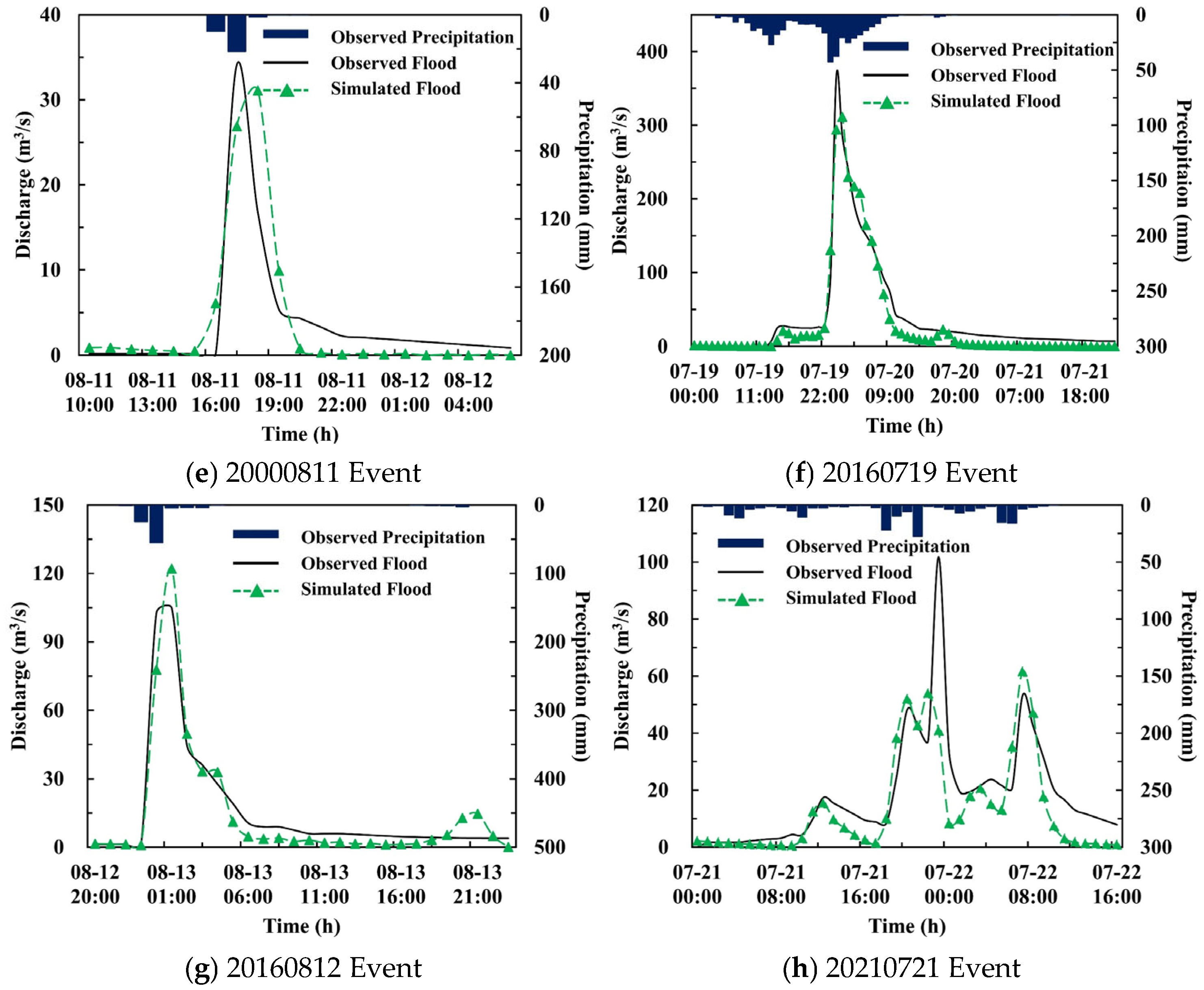
| 20160812 | 105.00 | 28.93 | 122.10 | 16.29 | 26.29 | −9.13 | 0.0 | 0.93 | |
| 20210721 | 101.80 | 47.65 | 61.60 | −39.49 | 36.16 | −24.11 | 8.0 | 0.55 | |
| 20230730 | 111.00 | 75.06 | 94.90 | −14.50 | 57.16 | −23.85 | 0.0 | 0.66 | |
| 20230825 | 85.50 | 12.87 | 45.80 | −46.43 | 7.92 | −38.46 | 1.0 | 0.47 | |
| Absolute mean value | 22.88 | 16.50 | 1.30 | 0.69 | |||||
| Event | Source | REP % | REV % | ΔT h | NSE |
|---|---|---|---|---|---|
| 20120726 | Gauge | −28.94 | 4.88 | 0 | 0.651 |
| QPE | −97.87 | −93.04 | −7 | −0.278 | |
| GDA | −17.66 | 8.61 | 0 | 0.799 | |
| CM | −17.87 | 9.71 | 0 | 0.793 | |
| RF | −15.53 | 20.33 | 0 | 0.748 | |
| 20160719 | Gauge | −15.33 | −2.93 | 1 | 0.942 |
| QPE | −92.80 | −88.76 | −8 | −0.302 | |
| GDA | −5.84 | −1.44 | 1 | 0.943 | |
| CM | −6.39 | −1.85 | 1 | 0.943 | |
| RF | −7.80 | −0.22 | 1 | 0.938 | |
| 20210721 | Gauge | −39.49 | −24.11 | 8 | 0.550 |
| QPE | −31.53 | −51.86 | 0 | 0.336 | |
| GDA | −24.17 | −13.87 | 0 | 0.858 | |
| CM | −27.60 | −14.35 | 0 | 0.844 | |
| RF | −38.21 | −21.11 | 0 | 0.806 | |
| 20230730 | Gauge | −14.50 | −23.85 | 0 | 0.656 |
| QPE | −45.14 | −72.22 | −11 | −0.845 | |
| GDA | −8.74 | −11.38 | 0 | 0.695 | |
| CM | −7.93 | −13.03 | 0 | 0.698 | |
| RF | −4.77 | −7.34 | 0 | 0.717 | |
| 20230825 | Gauge | −46.43 | −38.46 | 1 | 0.471 |
| QPE | −77.89 | −61.07 | 2 | 0.103 | |
| GDA | −39.42 | −20.05 | 1 | 0.657 | |
| CM | −39.53 | −20.44 | 1 | 0.656 | |
| RF | −32.40 | −21.68 | 0 | 0.685 |
| Event | Gauge | QPE | GDA | CM | RF |
|---|---|---|---|---|---|
| 20120726 | 76.34 | 16.55 | 82.76 | 82.93 | 75.94 |
| 20160719 | 385.03 | 200.28 | 404.75 | 403.36 | 386.16 |
| 20210721 | 181.28 | 122.13 | 190.28 | 190.89 | 183.47 |
| 20230730 | 200.17 | 122.25 | 233.15 | 233.32 | 201.26 |
| 20230825 | 33.00 | 19.40 | 42.46 | 42.48 | 32.85 |
Disclaimer/Publisher’s Note: The statements, opinions and data contained in all publications are solely those of the individual author(s) and contributor(s) and not of MDPI and/or the editor(s). MDPI and/or the editor(s) disclaim responsibility for any injury to people or property resulting from any ideas, methods, instructions or products referred to in the content. |
© 2026 by the authors. Licensee MDPI, Basel, Switzerland. This article is an open access article distributed under the terms and conditions of the Creative Commons Attribution (CC BY) license.
Share and Cite
Peng, Y.; Li, J.; Feng, P.; Zhang, T. A Study on Radar–Gauge Rainfall Data Merging and Its Impact on Flood Simulation. Remote Sens. 2026, 18, 2587. https://doi.org/10.3390/rs18152587
Peng Y, Li J, Feng P, Zhang T. A Study on Radar–Gauge Rainfall Data Merging and Its Impact on Flood Simulation. Remote Sensing. 2026; 18(15):2587. https://doi.org/10.3390/rs18152587
Chicago/Turabian StylePeng, Yunfei, Jianzhu Li, Ping Feng, and Ting Zhang. 2026. "A Study on Radar–Gauge Rainfall Data Merging and Its Impact on Flood Simulation" Remote Sensing 18, no. 15: 2587. https://doi.org/10.3390/rs18152587
APA StylePeng, Y., Li, J., Feng, P., & Zhang, T. (2026). A Study on Radar–Gauge Rainfall Data Merging and Its Impact on Flood Simulation. Remote Sensing, 18(15), 2587. https://doi.org/10.3390/rs18152587