In the backbone of the YOLO series, strided convolution undertakes the dual functions of feature extraction and spatial downsampling, and the quality of its output features indirectly affects the performance of the neck and head. However, native strided convolution has multiple shortcomings for wind turbine blade damage detection tasks. First, the coupled design of feature extraction and downsampling causes mutual restriction between the two core tasks, which fails to realize directional enhancement of damage features before dimensionality reduction and easily leads to weak features overwhelmed by complex backgrounds. Second, the downsampling process discards massive pixel information, and small targets are easily lost in multiple downsampling processes, resulting in a high missed detection rate of micro-damage. Third, native strided convolution designed for general visual scenarios cannot be directionally optimized for the feature extraction of linear cracks and local pitting on wind turbine blades. Therefore, optimizing strided convolution in the backbone is an effective way to improve the detection performance.
Based on the inspection mechanism of the human visual system that selectively focuses on defect areas and ignores invalid background [
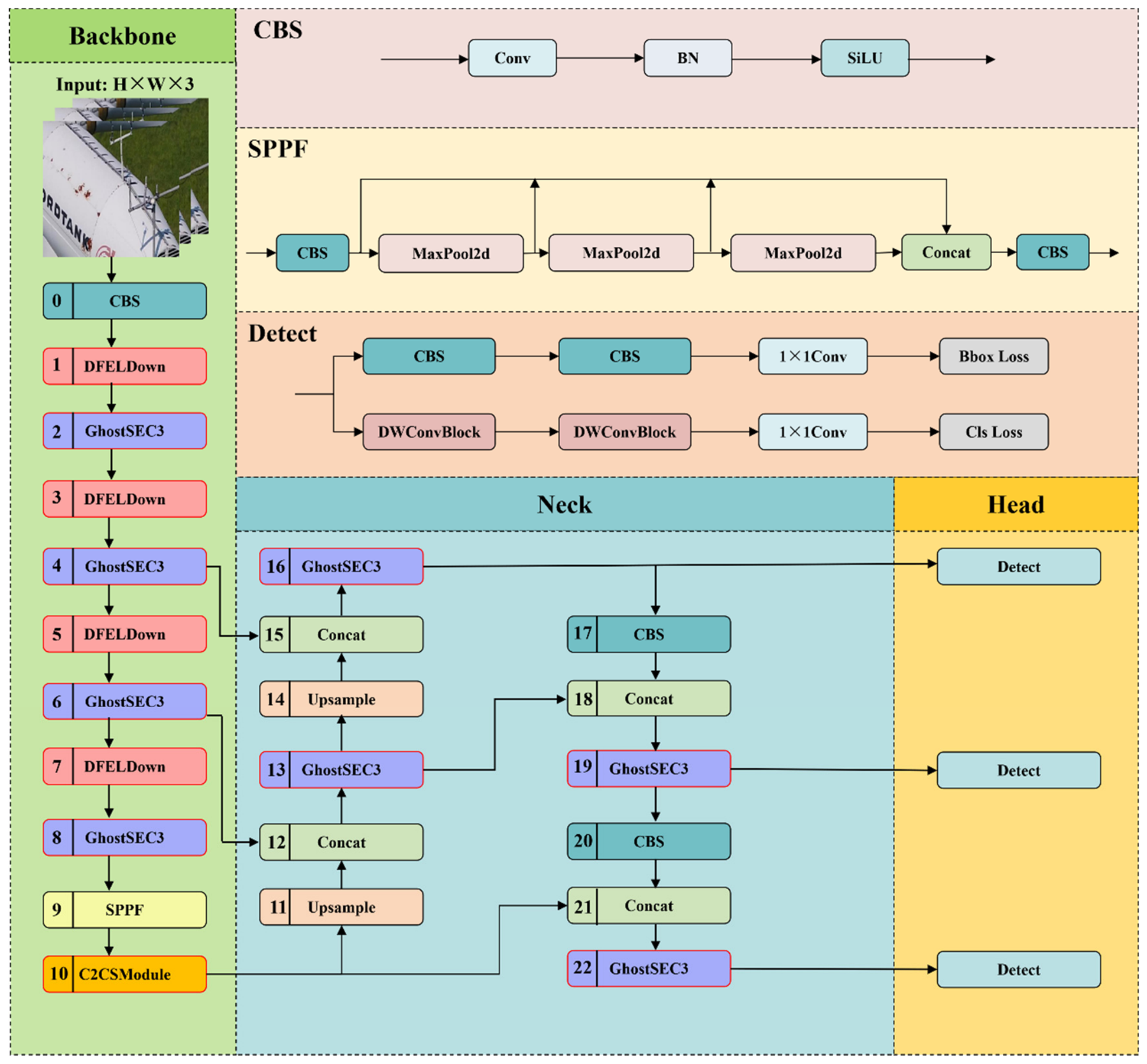
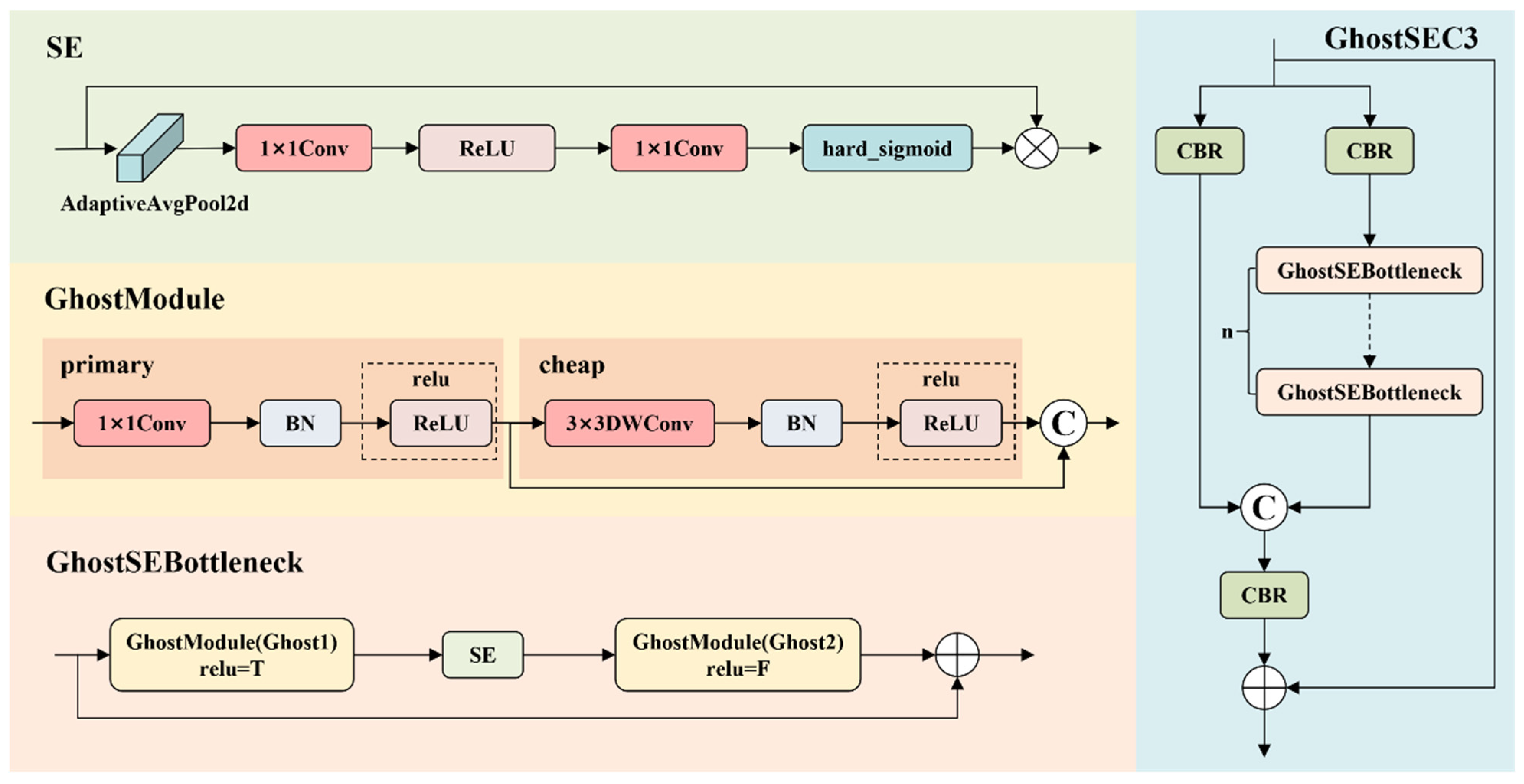
33], we propose a Decoupled Feature Enhancement Pixel-preserving Downsampling Module (DFELDown) to replace the four strided convolutions in the backbone, while retaining the initial CBS module to avoid excessive computational growth. The structure of each component and the overall architecture of DFELDown are presented in
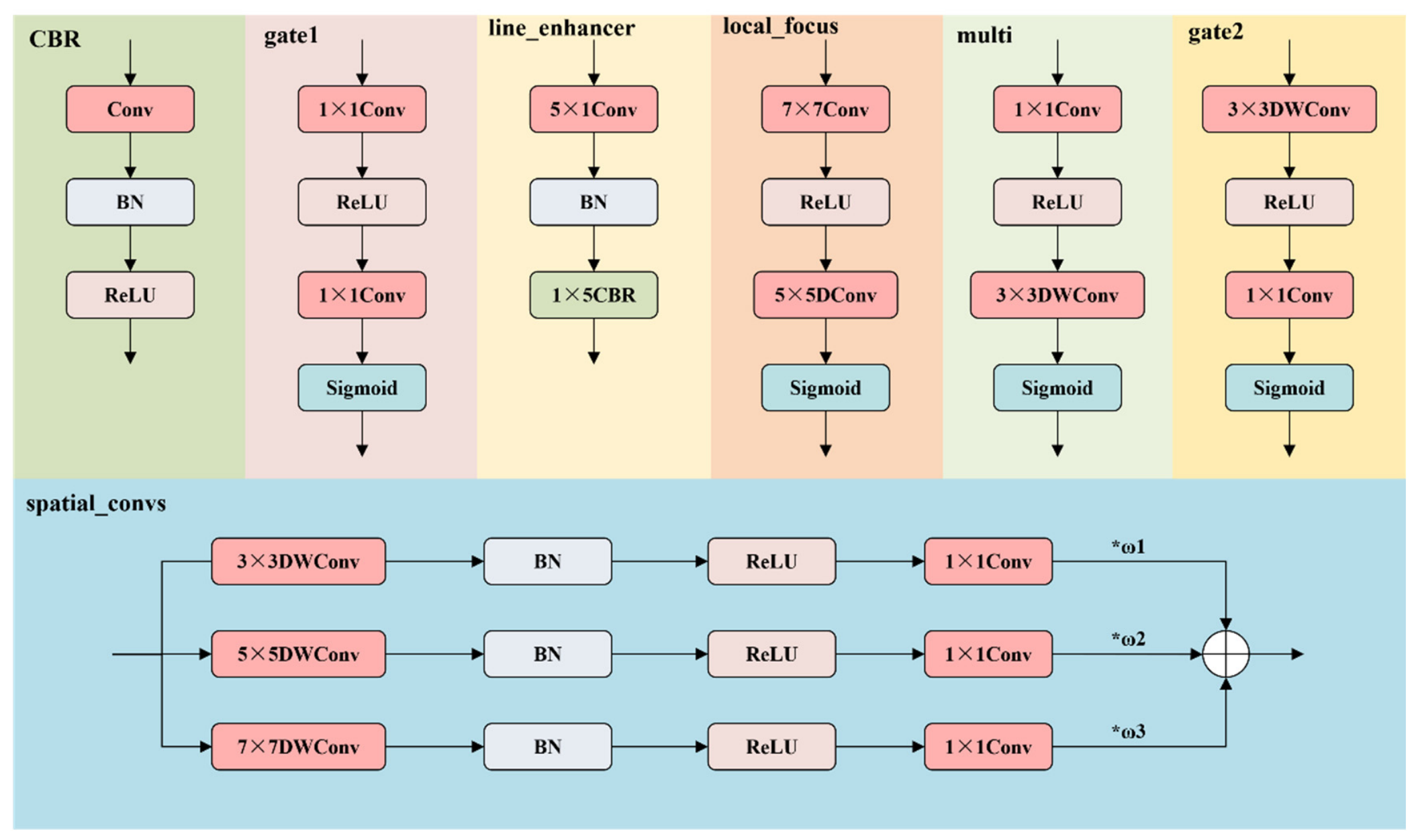
Figure 2 and
Figure 3. The design logic of the module is to first directionally enhance damage features and then apply pixel-preserving downsampling for information preservation. First, it utilizes Dual Attention with Line and Local Enhancement (DALL) to realize directional extraction and enhancement of damage features. Then, via the Lossless Space-to-Depth Downsampling Module (LSDD), it adopts the Channel-Wise Space-to-Depth Module (Cw-SPD) to achieve pixel-preserving downsampling, which avoids the semantic continuity disruption of damage features caused by the original SPD. Finally, it is equipped with fully learnable gating weights to adaptively adjust the feature fusion ratio. Therefore, the proposed scheme effectively addresses the inherent defects of native strided convolution without significantly increasing computations.
3.2.1. DALL
DALL is the key feature enhancement unit of DFELDown, which makes targeted improvements based on the CBAM [
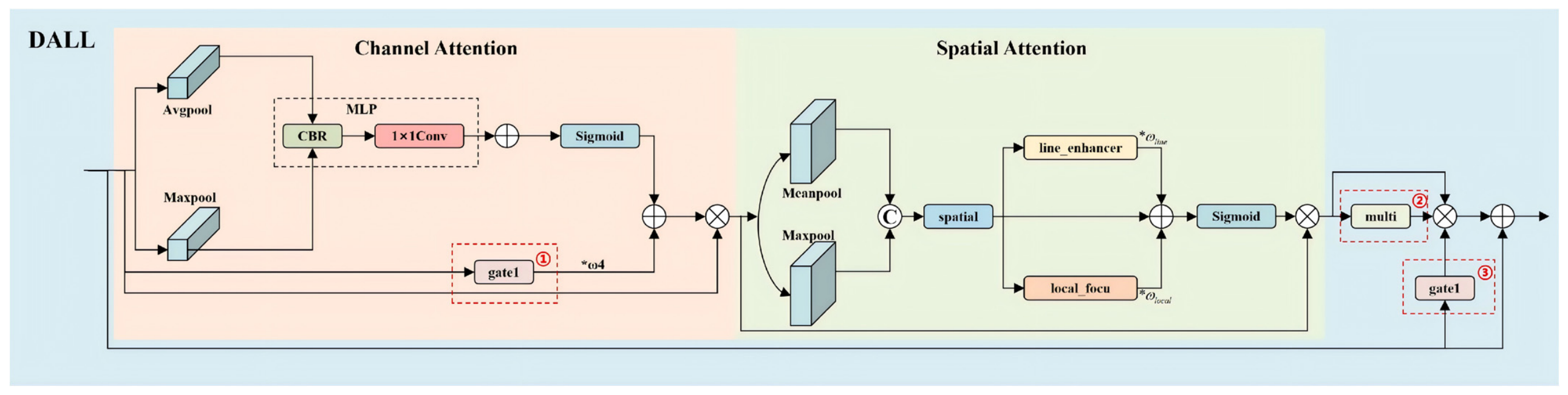
30] for geometric features of wind turbine blade damage. The structure of DALL is presented in
Figure 4. The module consists of three components, including a channel attention branch, a spatial attention branch, and an adaptive feature fusion unit. These steps are performed in a predefined order, with the underlying design rationale of each step elaborated in detail below.
Step 1: The function of the channel attention branch is to select valid channels related to damage, suppress invalid channels corresponding to background textures, supplement global contextual information, and enhance the modeling capability of long-range dependencies.
First, AvgPool and MaxPool are applied to the input feature map
(where B is the batch size, C is the number of input channels, and H and W are the height and width of the feature map, respectively). AvgPool captures the overall channel feature distribution, while MaxPool highlights local extreme features of damage regions within channels, as damage regions are usually extreme points. The two generated global feature vectors are fed into a shared multi-layer perceptron (MLP) to obtain the initial channel attention weight
, as shown in Equation (1):
where MLP is implemented by two 1 × 1 convolutions, and
denotes the Sigmoid activation function that normalizes the weights into the range of 0 to 1.
Then, to address the insufficient capture of long-range dependencies by dual pooling, we introduce a global context branch numbered ① in
Figure 4, which learns the global context weights
of feature maps through dimension reduction and dimension increasing operations of 1 × 1 convolutions, as shown in Equation (2):
The final channel attention weight
, which is the weighted fusion of the initial weight and the global context weight, adaptively adjusts the contribution ratio of the global context via a learnable parameter
, as shown in Equation (3):
The output feature map
, which is generated after channel attention enhancement, is obtained by element-wise multiplication of the input feature
and the channel weight
, as shown in Equation (4):
where ⊙ denotes element-wise multiplication.
Step 2: The function of the spatial attention branch is to precisely locate the spatial position of damage regions, suppress the feature weights of background regions, and simultaneously realize directional feature enhancement for linear cracks and micro-pitting on wind turbine blades.
First, we perform AvgPool and MaxPool on the channel-enhanced feature map
along the channel dimension to obtain two single-channel spatial feature maps, which are concatenated as the input of spatial attention
, as shown in Equation (5):
Then, to fulfill the demand for cross-scale detection, we design three depthwise separable convolutional branches with kernel sizes of 3, 5, and 7 to capture small, medium, and large damage features, respectively. Each branch, which consists of depthwise convolution (DWConv) and pointwise convolution (PWConv), achieves multi-scale feature extraction while maintaining the lightweight property. For the convolution kernel size
, the feature extraction process is shown in Equation (6):
where
is the output feature map, and
and
denote depthwise convolution and pointwise convolution, respectively.
We adaptively fuse multi-scale features with learnable weights normalized by Softmax, which allows the model to automatically assign feature weights for damage of different scales, as shown in Equations (7) and (8):
where
is the output feature map after multi-scale fusion,
is the learnable weight parameter initialized as
, and
is the normalized fusion coefficient for the corresponding scale.
Simultaneously, to address the geometric characteristics of linear cracks, we design a linear enhancement branch with asymmetric convolution, which adopts serial 5 × 1 and 1 × 5 convolution to enhance the feature representation of horizontal and vertical linear cracks, as shown in Equation (9):
where
is the output of the asymmetric convolution, and
and
denote vertical convolution and horizontal convolution, respectively.
Next, to meet the detection demand for micro-pitting and microcracks, we design a local focus branch that adopts the combination of standard convolution and dilated convolution to further expand the receptive field without increasing parameters and focuses on local micro-damage regions, as shown in Equation (10):
where
is the output feature map of the local focus branch,
is the 7 × 7 standard convolution, and
is the 5 × 5 dilated convolution with an effective receptive field of 9 × 9.
Finally, we obtain the spatial attention weight
, which is the learnable weighted fusion of multi-scale basic features, linear enhancement features, and local focus features with Sigmoid activation, as shown in Equation (11):
where
and
are learnable weight parameters corresponding to the linear enhancement branch and the local focus branch, respectively.
The output feature map
, which is generated after spatial attention enhancement, is obtained by element-wise multiplication of the channel attention output feature map
and the spatial weight
, as shown in Equation (12):
Step 3: To avoid background noise amplification caused by excessive feature enhancement and balance contributions of original and enhanced features, we design a dual-gated adaptive fusion mechanism, numbered ② and ③ in
Figure 4. This mechanism adjusts the fusion ratio via learnable gating weights and introduces a residual connection to ensure gradient backpropagation stability, as shown in Equations (13)–(15):
where
is the final output feature map of DALL,
is the fusion gating weight,
is the multi-scale fusion weight, and
is the grouped convolution for lightweight feature transformation.
3.2.2. LSDD
LSDD realizes pixel-preserving downsampling after directional enhancement of damage features by DALL, which addresses the hard pixel discard problem of native strided convolution. Based on the channel semantic specificity of damage, whereby some channels specifically respond to linear cracks and others to pitting damage, we optimize the feature arrangement mode based on SPD [
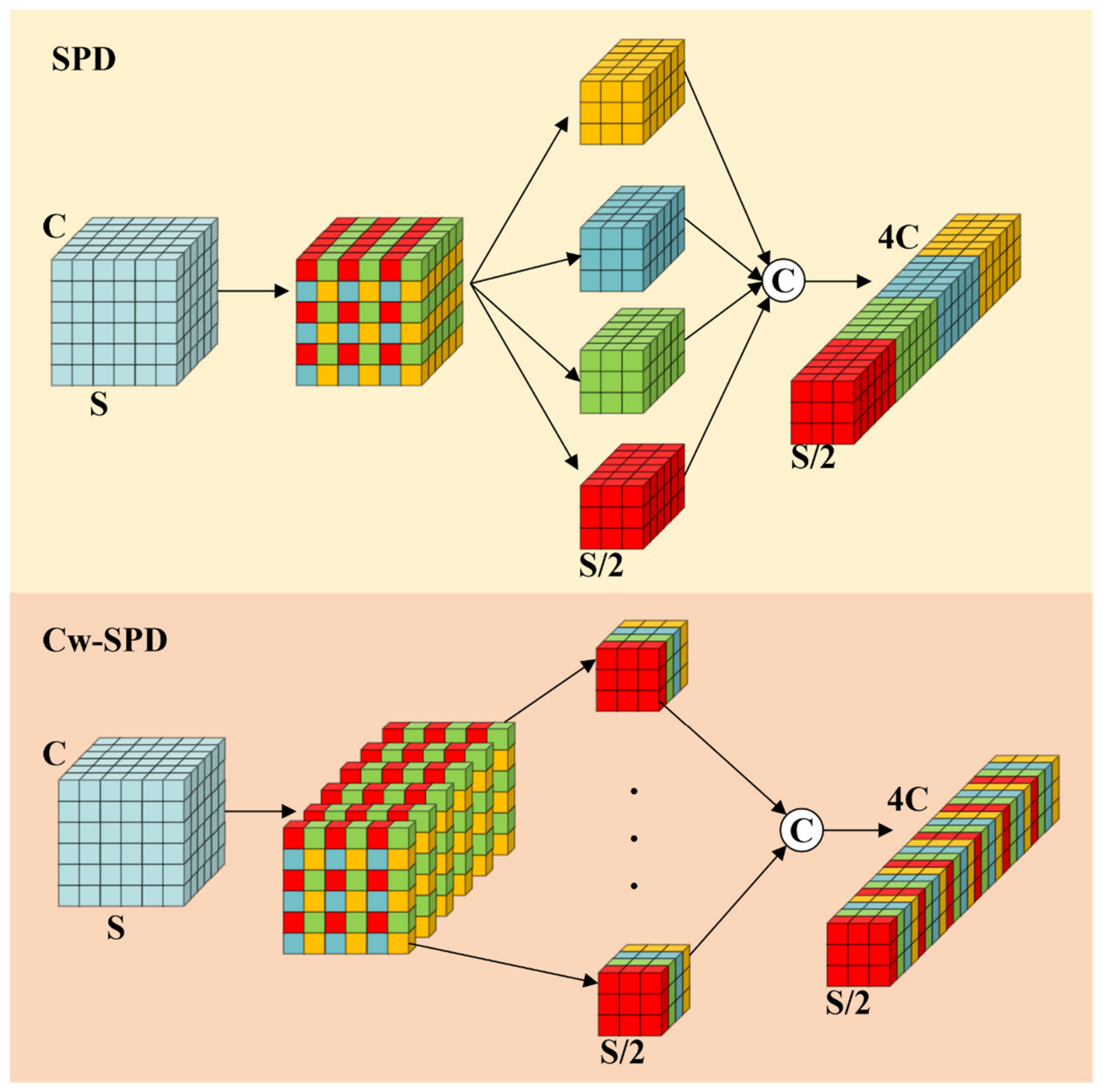
12] to propose Cw-SPD. Notably, Cw-SPD itself is a parameter-free feature rearrangement operation, identical to the original SPD in computational cost and parameter count, with no additional learnable operations introduced. The only difference from the original SPD is the feature arrangement order. The original SPD splits four sampling features from the same input channel into four non-contiguous channel segments, while Cw-SPD arranges all sampling features from a single channel continuously along the channel dimension, fully inheriting the channel semantic division learned by the preceding DALL.
Although both methods retain all sampled pixels, the effect of channel permutation cannot be fully absorbed by the subsequent 1 × 1 convolution in practical training. Constrained by the local connection inductive bias of convolutional networks and the small sample size of industrial detection scenarios, the scattered semantic arrangement of the original SPD increases the learning difficulty of subsequent feature aggregation, while the semantically continuous arrangement of Cw-SPD aligns with the output by DALL, providing a more reasonable optimization inductive bias and leading to stable performance improvement.
For the input feature map, , which is the output feature map enhanced by DALL, with the downsampling scale s = 2.
The original SPD adopts a feature arrangement strategy based on blocking by sampling positions. It first generates four sub-feature maps for different sampling positions, then concatenates all sub-feature maps along the channel dimension to generate the transformed feature map. This strategy splits four sampling features from the same input channel into four non-contiguous channel segments, with each segment corresponding to only one sampling position. The above operation disrupts the semantic continuity within a single input channel and presents significant adaptation defects for the feature representation characteristics of wind turbine blade damage.
To address this issue, we propose Cw-SPD, an SPD implementation with blocking by input channel, where the feature arrangements of Cw-SPD and the original SPD are shown in
Figure 5. Cw-SPD takes the input channel as the basic processing unit and arranges all sampling features from a single channel in a continuous manner along the channel dimension, which fully inherits the channel semantic division learned by the preceding DALL. The specific implementation is described below. First, for each input channel
, we extract the corresponding four sampling position features
and concatenate them along the channel dimension to form a continuous feature segment for the input channel. Then, we concatenate the feature segments of all input channels in the original channel order to obtain the transformed feature map
, as shown in Equation (16):
After the Cw-SPD transformation, the number of channels expands from C to 4C. Next, we adopt a 1 × 1 non-strided convolution to adjust the channel number to the target output channel number
of DFELDown, which generates the output feature map
, as shown in Equation (17):
To further preserve small damage features after downsampling, we design a multi-scale information enhancement branch implemented by grouped convolution, numbered ④ in
Figure 3. This branch performs adaptive weighting on the channel-adjusted features to enhance the feature salience of damage regions and obtains the output feature map
of LSDD, as shown in Equation (18):