Article

DFELD-YOLO: A Decoupled Lightweight Detection Model for UAV-Based Wind Turbine Blade Damage Inspection

School of Computer Science, Jiangsu University of Science and Technology, Zhenjiang 212003, China
*
Author to whom correspondence should be addressed.
Remote Sens. 2026, 18(14), 2422; https://doi.org/10.3390/rs18142422
Submission received: 28 April 2026 / Revised: 11 July 2026 / Accepted: 17 July 2026 / Published: 21 July 2026

Highlights

What are the main findings?
  • We propose a novel decoupled design that breaks the inherent limitation of coupled feature extraction and downsampling in traditional strided convolution, solving the irreversible loss of micro-damage features during downsampling.
  • We develop DFELD-YOLO with DFELDown, GhostSEC3, and C2CSModule, which has 2.05 M parameters and 5.9 GFLOPs and is compatible with real-time deployment on resource-constrained UAVs.
What are the implications of the main findings?
  • The lightweight properties of DFELD-YOLO make its deployment on edge devices technically feasible, providing a practical, low-cost intelligent inspection solution for the operation and maintenance of large-scale wind farms.
  • The decoupled design offers an effective feature extraction paradigm for small-target detection, serving as a novel implementation of strided convolution that enables directional optimization for diverse application scenarios, including UAV remote sensing and industrial visual inspection.

Abstract

Accurate and efficient detection of surface damage on wind turbine blades is important for ensuring the safe operation and maintenance of wind farms. Existing models have problems of irreversible loss of micro-damage features, insufficient modeling of long cracks, and weak anti-interference ability. To address these issues, we propose a Decoupled Feature Enhancement and Pixel-preserving Downsampling YOLO model (DFELD-YOLO). The model features the following three innovations: (1) Feature extraction and downsampling are innovatively decoupled to construct DFELDown, which completes feature extraction via an attention mechanism and achieves pixel-preserving downsampling through a Cw-SPD transformation, effectively solving the problem of micro-damage feature loss. (2) We built a lightweight anti-interference GhostSEC3 module, which reduces parameters and computations while adaptively suppressing background interference. (3) We designed a Cross-Shaped Stripe Attention Module (C2CSModule), which achieves a global receptive field with linear complexity, while accurately capturing continuous features of long cracks. Extensive experiments on the UAV-based wind turbine blade damage dataset show that DFELD-YOLO has 2.05 M parameters and 5.9 GFLOPs, with 20.8% and 7.8% reductions compared with the baseline YOLOv11, respectively. The lightweight properties make it suitable for deployment on edge devices, including UAVs. Meanwhile, it achieves a 3.4% improvement in mAP@0.5.

1. Introduction

Against the background of the global energy transition, wind power is a technically mature and cost-effective form of renewable energy, with global installed capacity maintaining sustained and rapid growth [1]. Wind turbine blades are critical load-bearing components of wind turbines for wind energy capture. Long-term service in complex working conditions inevitably causes various types of damage, including microcracks, pitting corrosion, coating peeling, and interlayer delamination [2]. Therefore, efficient and non-contact detection of wind turbine blade damage holds important engineering value and practical significance for wind farms to cut operation and maintenance costs, avoid safety risks, and ensure long-term stable turbine operation [3].
Traditional wind turbine blade damage detection methods mainly cover manual visual inspection, ultrasonic testing, and acoustic emission testing. Manual visual inspection relies on the engineering experience of inspectors, with inherent disadvantages including high operational safety risk, low inspection efficiency, insufficient micro-damage recognition rate, and strong subjectivity of detection results [4]. Contact-based inspection methods include ultrasonic testing, acoustic emission testing, and vibration testing, which require long inspection cycles and high equipment costs [5,6]. In recent years, deep-learning-based object detection algorithms have become a research hotspot in intelligent wind turbine blade damage detection, with advantages of high detection efficiency, excellent recognition accuracy, and good adaptability for edge deployment [7,8]. Single-stage object detection algorithms represented by the YOLO series [9,10,11] are the mainstream framework for industrial visual defect detection. They achieve a balance between detection accuracy and inference speed and are well suited for real-time industrial deployment. In the YOLO series, YOLOv5 adopts the CSPDarknet backbone and features a complete engineering implementation system [9]. YOLOv8 introduces the C2f module and decoupled detection head, enhancing cross-scale detection performance and generalization ability [10]. YOLOv11 further optimizes the network architecture and incorporates the C2PSA attention mechanism, achieving a superior balance between accuracy, inference speed, and light weight [11].
Although the YOLO series has achieved continuous performance breakthroughs through multiple generations of technical iteration, there are still four technical bottlenecks for the special engineering scenario of wind turbine blade damage detection. First, feature loss easily occurs during traditional strided convolution and pooling, which causes a high missed detection rate of micro-damage [12]. Second, affected by complex backgrounds including illumination changes and surface stains, the algorithms have insufficient ability to focus and filter effective damage features, which easily leads to false detection [13]. Third, long cracks on blades have obvious geometric features of longitudinal or transverse continuity. The limited receptive field of local window attention cannot effectively model long-distance continuous features, which leads to broken detection and overall missed detection of long cracks [14,15]. Fourth, even high-precision variants of the YOLO series suffer from large parameters and high computations, which restrict their real-time deployment on edge devices.
To address the aforementioned technical bottlenecks, in combination with the geometric features of blade damage and the engineering requirements of field inspection, we conducted three targeted improvements, namely, downsampling optimization, lightweight feature extraction, and long-range dependency modeling. Then, we propose a decoupled lightweight detection model named DFELD-YOLO for wind turbine blade damage detection. The main innovations are as follows:
(1)
We designed a Decoupled Feature Enhancement Pixel-preserving Downsampling Module named DFELDown, which replaces traditional strided convolution with input-channel block-partitioned SPD to realize pixel-complete transfer, improves CBAM to enhance damage feature extraction, and solves the problem of weak feature loss during downsampling.
(2)
We propose a Ghost-SqueezeExcite C3 Module named GhostSEC3, which compresses parameters through GhostModule, introduces SqueezeExcite (SE) to suppress background interference, and achieves a lightweight design and enhanced anti-interference capability.
(3)
We constructed a Cross-Shaped Stripe C2 Module named C2CSModule, which achieves a global receptive field with striped attention, balances computational efficiency and feature representation capability through soft compression and position-free-encoding strategies, and solves the difficulty of modeling continuous features of long cracks in high-resolution images.
(4)
We designed a lightweight detection model, DFELD-YOLO, which is validated on the self-developed wind turbine blade damage dataset WTB-SDD, and exhibits excellent detection performance for micro-damage and long cracks.
The remainder of this paper is organized as follows: Section 2 reviews the relevant research. Section 3 elaborates on the proposed DFELD-YOLO model in detail. Section 4 introduces a series of experiments conducted to verify the effectiveness of the proposed model. Finally, Section 5 summarizes the conclusions.

2. Related Work

2.1. Traditional Detection Technologies

Traditional wind turbine blade damage detection is mainly based on contact detection technologies. Mainstream technologies include acoustic emission testing, ultrasonic testing, and infrared thermal imaging, which have formed complete theoretical systems and engineering application specifications. Tang et al. [6] verified the capability of acoustic emission testing technology for online monitoring of blade crack propagation and established a damage location and growth trend analysis method based on acoustic emission signals. Amenabar et al. [5] systematically compared the detection capabilities of four mainstream technologies, including ultrasonic testing, shear speckle interferometry, infrared thermal imaging, and X-ray CT, and verified the high detection accuracy of ultrasonic testing for internal composite delamination defects. Overall, traditional detection technologies provide a basic guarantee for blade structural safety. However, these methods generally have problems, such as low detection efficiency and required shutdown operation, which can hardly meet the full coverage inspection requirements of large-scale wind farms.

2.2. Detection Methods Based on Deep Learning

Deep-learning-based detection provides a novel technical path for intelligent blade damage inspection with powerful automatic feature learning capability and end-to-end detection characteristics. These methods can be classified into two categories: two-stage and single-stage.
Two-stage detection methods, which are represented by Faster R-CNN [16] and Mask R-CNN [17], first generate target candidate regions via a region proposal network and then perform fine-grained classification and coordinate regression on these regions. These methods have certain advantages in detection accuracy and have been widely applied in various industrial defect detection scenarios. Shihavuddin et al. [18] constructed a UAV-based wind turbine blade damage detection system with Faster R-CNN, optimized the detection performance of small-scale defects through multi-scale data augmentation, and achieved high-precision identification of multiple blade damage types. Hou et al. [19] combined Cascade Mask R-CNN with transfer learning to realize precise detection of stay cable surface defects, effectively solved the training challenge of small-sample defects, and provided a reference for blade damage detection. Although two-stage methods achieve high detection accuracy, they have prominent problems of high computational complexity and slow inference speed, which cannot meet the requirements of industrial real-time detection.
Single-stage detection methods, represented by SSD [20], the YOLO series, and the DETR series [21,22,23], directly realize object classification and localization through an end-to-end framework. They significantly improve inference efficiency while maintaining detection accuracy. Among these, YOLO series models have been widely used in industrial vision fields for the advantages of simple structure, fast inference speed, and convenient deployment. Zou et al. [13] proposed lightweight AUD-YOLO model for complex-environment blade damage detection. However, it only covers two damage types, lacks long-range feature modeling for long cracks, and retains the traditional coupled downsampling paradigm. Zhao et al. [24] proposed an RDD-YOLO surface defect detection model based on YOLOv5, which effectively improved the detection accuracy of small and vague defects. Zheng et al. [25] proposed an MD-YOLO industrial surface defect detection model based on YOLOv5, which solved the problems of large defect scale difference and low contrast. However, it lacks targeted optimization for the unique geometric features of wind turbine blade damage. Ye et al. [26] constructed a wind turbine blade defect detection model based on YOLOv5s with ODConv, GSConv, and DyHead, and adopted a semi-supervised learning strategy to reduce annotation cost, which effectively improved the detection accuracy of weak features and small-sized defects. These methods show better performance than two-stage detection methods in model structure and inference speed. But existing methods still suffer from three key limitations: irreversible micro-damage feature loss during downsampling, insufficient continuous feature modeling for long cracks, and a lack of targeted optimization for multi-type blade damage.

2.3. Lightweight Convolution and Attention Mechanisms

In terms of lightweight convolution design, Han et al. [27] proposed the GhostNet architecture, which follows a lightweight paradigm that generates intrinsic core feature maps through a small number of primary convolutions and redundant ghost feature maps via cheap depthwise convolutions. This architecture greatly reduces parameters and computations without degrading feature representation capability and provides a reference for the lightweight design of industrial inspection models. Zhu et al. [28] proposed MI-YOLO based on YOLOv5s for the detection challenge of light-colored and low-definition cracks on wind turbine blade surfaces, which achieves lightweight feature extraction and effectively improves the detection accuracy of weak features. However, GhostNet lacks targeted optimization for the long strip geometric features of wind turbine blade damage, and its continuous feature modeling ability for long cracks is insufficient. MI-YOLO has no special design for the continuous spatial distribution feature of long cracks.
In terms of attention mechanisms, channel attention, spatial attention, and the self-attention mechanism have become effective methods to improve the feature extraction capability of detection models. Hu et al. [29] proposed a channel attention mechanism that realizes effective feature enhancement and invalid feature suppression through adaptive channel weight learning, with the advantages of lightweight design and convenient deployment. Woo et al. [30] proposed CBAM, which realizes dual feature filtering and enhancement through serial cascading of channel and spatial attention, boosting identification performance for small defects. To address the balance between computations and the receptive field of self-attention, Dong et al. [14] proposed CSWin Transformer, which achieves a near-global receptive field within a single block through cross-shaped window self-attention. Tang et al. [31] proposed light-PDD based on YOLOv4 for micro-defect detection in PCB, which achieves collaborative feature enhancement across channel and spatial dimensions and improves the capability to capture small defects. Hu et al. [32] proposed YOLO-Tiny-attention, which introduces spatial and channel attention modules that enhance the spatial localization and channel classification capability for defect targets, improving the detection accuracy of small-sized damage. However, existing attention mechanisms generally face some limitations: they mostly adopt simple serial or parallel structures, leading to insufficient cross-dimensional information interaction; it is difficult to achieve an ideal balance between computational complexity and receptive field.

3. Methods

3.1. Overall Structure of DFELD-YOLO

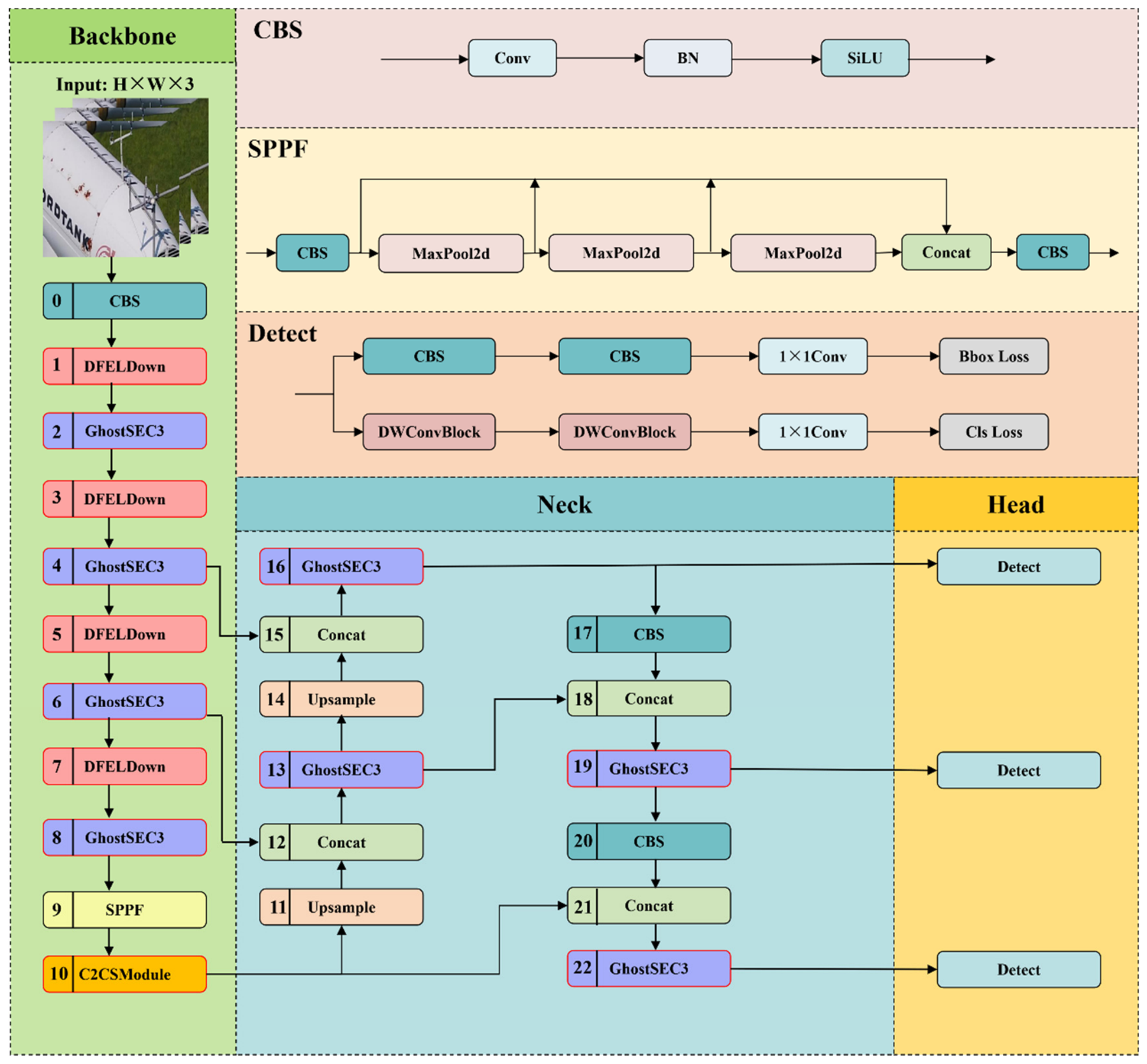
To address key challenges in wind turbine blade damage detection, including micro-damage missed detection, insufficient continuous feature modeling for long cracks, and strong complex field background interference, we propose DFELD-YOLO based on YOLOv11. DFELD-YOLO achieves high-precision, lightweight, and end-to-end detection via three targeted improvements. The overall structure is presented in Figure 1.
First, we replace the original strided convolution in the backbone with the proposed DFELDown. The module adopts a decoupled design to enhance damage features via a dual attention mechanism, realize pixel-complete transfer without hard pixel discard through input-channel block-partitioned Cw-SPD, and address micro-damage feature loss during downsampling. Second, we replace C3k2 with GhostSEC3 in both the backbone and neck. GhostSEC3 integrates Ghost lightweight convolution and SE, adaptively suppresses background interference while greatly reducing parameters, and balances lightweight performance, anti-interference capability, and small-sample training stability. Finally, we embed C2CSModule into the backbone. C2CSModule achieves a global receptive field through horizontal and vertical parallel attention, balances accuracy and computational efficiency with soft compression and position-encoding-free strategies, and accurately captures continuous features of long cracks.

3.2. DFELDown

In the backbone of the YOLO series, strided convolution undertakes the dual functions of feature extraction and spatial downsampling, and the quality of its output features indirectly affects the performance of the neck and head. However, native strided convolution has multiple shortcomings for wind turbine blade damage detection tasks. First, the coupled design of feature extraction and downsampling causes mutual restriction between the two core tasks, which fails to realize directional enhancement of damage features before dimensionality reduction and easily leads to weak features overwhelmed by complex backgrounds. Second, the downsampling process discards massive pixel information, and small targets are easily lost in multiple downsampling processes, resulting in a high missed detection rate of micro-damage. Third, native strided convolution designed for general visual scenarios cannot be directionally optimized for the feature extraction of linear cracks and local pitting on wind turbine blades. Therefore, optimizing strided convolution in the backbone is an effective way to improve the detection performance.
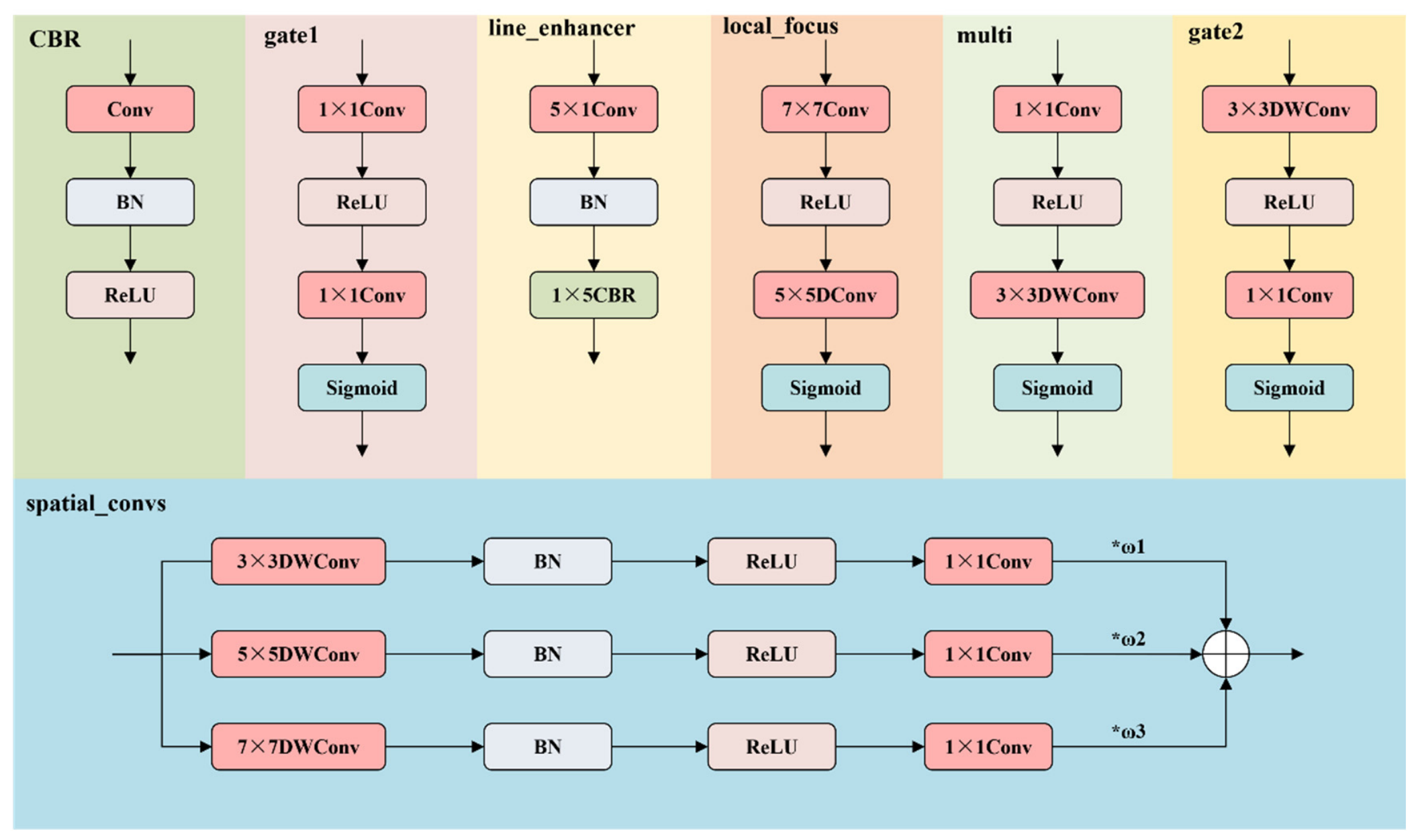
Based on the inspection mechanism of the human visual system that selectively focuses on defect areas and ignores invalid background [33], we propose a Decoupled Feature Enhancement Pixel-preserving Downsampling Module (DFELDown) to replace the four strided convolutions in the backbone, while retaining the initial CBS module to avoid excessive computational growth. The structure of each component and the overall architecture of DFELDown are presented in Figure 2 and Figure 3. The design logic of the module is to first directionally enhance damage features and then apply pixel-preserving downsampling for information preservation. First, it utilizes Dual Attention with Line and Local Enhancement (DALL) to realize directional extraction and enhancement of damage features. Then, via the Lossless Space-to-Depth Downsampling Module (LSDD), it adopts the Channel-Wise Space-to-Depth Module (Cw-SPD) to achieve pixel-preserving downsampling, which avoids the semantic continuity disruption of damage features caused by the original SPD. Finally, it is equipped with fully learnable gating weights to adaptively adjust the feature fusion ratio. Therefore, the proposed scheme effectively addresses the inherent defects of native strided convolution without significantly increasing computations.

3.2.1. DALL

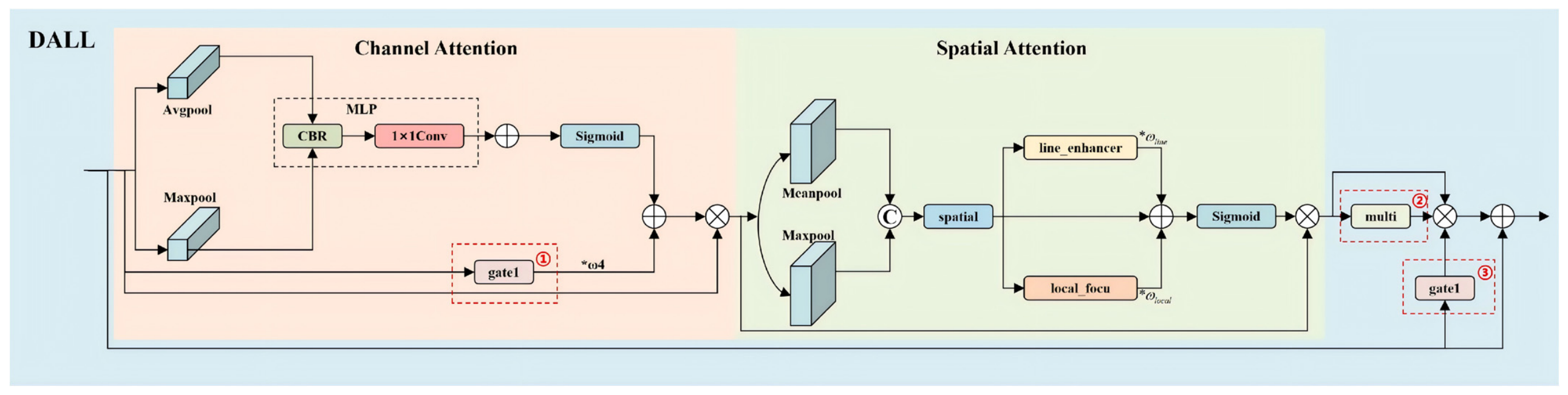
DALL is the key feature enhancement unit of DFELDown, which makes targeted improvements based on the CBAM [30] for geometric features of wind turbine blade damage. The structure of DALL is presented in Figure 4. The module consists of three components, including a channel attention branch, a spatial attention branch, and an adaptive feature fusion unit. These steps are performed in a predefined order, with the underlying design rationale of each step elaborated in detail below.
Step 1: The function of the channel attention branch is to select valid channels related to damage, suppress invalid channels corresponding to background textures, supplement global contextual information, and enhance the modeling capability of long-range dependencies.
First, AvgPool and MaxPool are applied to the input feature map X R B × C × H × W (where B is the batch size, C is the number of input channels, and H and W are the height and width of the feature map, respectively). AvgPool captures the overall channel feature distribution, while MaxPool highlights local extreme features of damage regions within channels, as damage regions are usually extreme points. The two generated global feature vectors are fed into a shared multi-layer perceptron (MLP) to obtain the initial channel attention weight M c _ i n i t R B × C × 1 × 1 , as shown in Equation (1):
M c _ i n i t = σ ( MLP ( AvgPool ( X ) ) + MLP ( MaxPool ( X ) ) )
where MLP is implemented by two 1 × 1 convolutions, and σ ( ) denotes the Sigmoid activation function that normalizes the weights into the range of 0 to 1.
Then, to address the insufficient capture of long-range dependencies by dual pooling, we introduce a global context branch numbered ① in Figure 4, which learns the global context weights M g c R B × C × H × W of feature maps through dimension reduction and dimension increasing operations of 1 × 1 convolutions, as shown in Equation (2):
M g c = σ ( Conv 1 × 1 ( ReLU ( Conv 1 × 1 ( X ) ) ) )
The final channel attention weight M c R B × C × H × W , which is the weighted fusion of the initial weight and the global context weight, adaptively adjusts the contribution ratio of the global context via a learnable parameter ω c t x , as shown in Equation (3):
M c = M c _ i n i t + σ ( w c t x ) M g c
The output feature map X c , which is generated after channel attention enhancement, is obtained by element-wise multiplication of the input feature X and the channel weight M c , as shown in Equation (4):
X c = X M c R B × C × H × W
where ⊙ denotes element-wise multiplication.
Step 2: The function of the spatial attention branch is to precisely locate the spatial position of damage regions, suppress the feature weights of background regions, and simultaneously realize directional feature enhancement for linear cracks and micro-pitting on wind turbine blades.
First, we perform AvgPool and MaxPool on the channel-enhanced feature map X c along the channel dimension to obtain two single-channel spatial feature maps, which are concatenated as the input of spatial attention F s p a t i a l _ c a t R B × 2 × H × W , as shown in Equation (5):
F s p a t i a l _ c a t = Concat ( AvgPool ( X c ) , MaxPool ( X c ) )
Then, to fulfill the demand for cross-scale detection, we design three depthwise separable convolutional branches with kernel sizes of 3, 5, and 7 to capture small, medium, and large damage features, respectively. Each branch, which consists of depthwise convolution (DWConv) and pointwise convolution (PWConv), achieves multi-scale feature extraction while maintaining the lightweight property. For the convolution kernel size k { 3 , 5 , 7 } , the feature extraction process is shown in Equation (6):
F p w _ k = Conv pw ( ReLU ( BN ( Conv dw ( F s p a t i a l _ c a t , k ) ) ) )
where F p w _ k R B × 1 × H × W is the output feature map, and Conv dw and Conv pw denote depthwise convolution and pointwise convolution, respectively.
We adaptively fuse multi-scale features with learnable weights normalized by Softmax, which allows the model to automatically assign feature weights for damage of different scales, as shown in Equations (7) and (8):
ω = Softmax ( w s p a t i a l )
F s p a t i a l _ m u l t i = k { 3 , 5 , 7 } ω k F p w _ k
where F s p a t i a l _ m u l t i R B × 1 × H × W is the output feature map after multi-scale fusion, ω s p a t i a l is the learnable weight parameter initialized as [ 1 3 , 1 3 , 1 3 ] , and ω k is the normalized fusion coefficient for the corresponding scale.
Simultaneously, to address the geometric characteristics of linear cracks, we design a linear enhancement branch with asymmetric convolution, which adopts serial 5 × 1 and 1 × 5 convolution to enhance the feature representation of horizontal and vertical linear cracks, as shown in Equation (9):
F l i n e = ReLU ( BN ( Conv 1 × 5 ( BN ( Conv 5 × 1 ( F s p a t i a l _ m u l t i ) ) ) ) )
where F l i n e R B × 1 × H × W is the output of the asymmetric convolution, and Conv 1 × 5 and Conv 5 × 1 denote vertical convolution and horizontal convolution, respectively.
Next, to meet the detection demand for micro-pitting and microcracks, we design a local focus branch that adopts the combination of standard convolution and dilated convolution to further expand the receptive field without increasing parameters and focuses on local micro-damage regions, as shown in Equation (10):
F l o c a l = σ ( Conv dilate ( ReLU ( Conv norm ( F s p a t i a l _ m u l t i ) ) ) )
where F l o c a l R B × 1 × H × W is the output feature map of the local focus branch, Conv norm is the 7 × 7 standard convolution, and Conv dilate is the 5 × 5 dilated convolution with an effective receptive field of 9 × 9.
Finally, we obtain the spatial attention weight M s R B × 1 × H × W , which is the learnable weighted fusion of multi-scale basic features, linear enhancement features, and local focus features with Sigmoid activation, as shown in Equation (11):
M s = σ ( F s p a t i a l _ m u l t i + σ ( w l i n e ) F l i n e + σ ( w l o c a l ) F l o c a l )
where ω l i n e and ω l o c a l are learnable weight parameters corresponding to the linear enhancement branch and the local focus branch, respectively.
The output feature map X s , which is generated after spatial attention enhancement, is obtained by element-wise multiplication of the channel attention output feature map X c and the spatial weight M s , as shown in Equation (12):
X s = X c M s R B × C × H × W
Step 3: To avoid background noise amplification caused by excessive feature enhancement and balance contributions of original and enhanced features, we design a dual-gated adaptive fusion mechanism, numbered ② and ③ in Figure 4. This mechanism adjusts the fusion ratio via learnable gating weights and introduces a residual connection to ensure gradient backpropagation stability, as shown in Equations (13)–(15):
λ = σ ( Conv 1 × 1 ( ReLU ( Conv 1 × 1 ( X ) ) ) ) R B × 1 × H × W
μ = σ ( Conv group ( ReLU ( Conv 1 × 1 ( X s ) ) ) ) R B × C × H × W
X d a l l = X + λ ( X s μ ) R B × C × H × W
where X d a l l is the final output feature map of DALL, λ is the fusion gating weight, μ is the multi-scale fusion weight, and Conv group is the grouped convolution for lightweight feature transformation.

3.2.2. LSDD

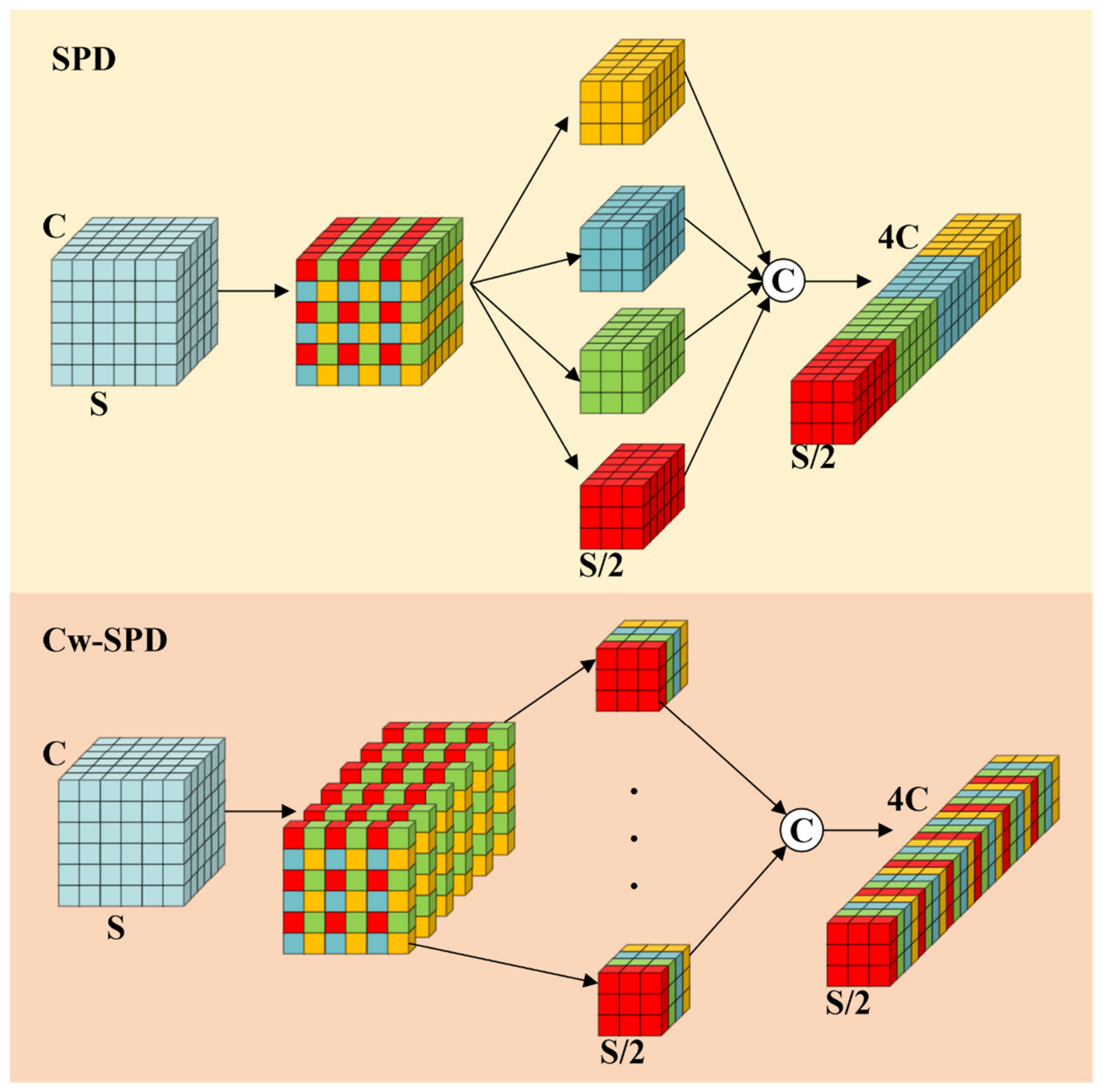
LSDD realizes pixel-preserving downsampling after directional enhancement of damage features by DALL, which addresses the hard pixel discard problem of native strided convolution. Based on the channel semantic specificity of damage, whereby some channels specifically respond to linear cracks and others to pitting damage, we optimize the feature arrangement mode based on SPD [12] to propose Cw-SPD. Notably, Cw-SPD itself is a parameter-free feature rearrangement operation, identical to the original SPD in computational cost and parameter count, with no additional learnable operations introduced. The only difference from the original SPD is the feature arrangement order. The original SPD splits four sampling features from the same input channel into four non-contiguous channel segments, while Cw-SPD arranges all sampling features from a single channel continuously along the channel dimension, fully inheriting the channel semantic division learned by the preceding DALL.
Although both methods retain all sampled pixels, the effect of channel permutation cannot be fully absorbed by the subsequent 1 × 1 convolution in practical training. Constrained by the local connection inductive bias of convolutional networks and the small sample size of industrial detection scenarios, the scattered semantic arrangement of the original SPD increases the learning difficulty of subsequent feature aggregation, while the semantically continuous arrangement of Cw-SPD aligns with the output by DALL, providing a more reasonable optimization inductive bias and leading to stable performance improvement.
For the input feature map, X d a l l R B × C × H × W , which is the output feature map enhanced by DALL, with the downsampling scale s = 2.
The original SPD adopts a feature arrangement strategy based on blocking by sampling positions. It first generates four sub-feature maps for different sampling positions, then concatenates all sub-feature maps along the channel dimension to generate the transformed feature map. This strategy splits four sampling features from the same input channel into four non-contiguous channel segments, with each segment corresponding to only one sampling position. The above operation disrupts the semantic continuity within a single input channel and presents significant adaptation defects for the feature representation characteristics of wind turbine blade damage.
To address this issue, we propose Cw-SPD, an SPD implementation with blocking by input channel, where the feature arrangements of Cw-SPD and the original SPD are shown in Figure 5. Cw-SPD takes the input channel as the basic processing unit and arranges all sampling features from a single channel in a continuous manner along the channel dimension, which fully inherits the channel semantic division learned by the preceding DALL. The specific implementation is described below. First, for each input channel c [ 0 , C 1 ] , we extract the corresponding four sampling position features f 0 , 0 c , f 0 , 1 c , f 1 , 0 c , f 1 , 1 c and concatenate them along the channel dimension to form a continuous feature segment for the input channel. Then, we concatenate the feature segments of all input channels in the original channel order to obtain the transformed feature map X C w S P D R B × 4 C × H 2 × W 2 , as shown in Equation (16):
X C w S P D = Concat ( Concat ( f 0 , 0 c , f 0 , 1 c , f 1 , 0 c , f 1 , 1 c ) )
After the Cw-SPD transformation, the number of channels expands from C to 4C. Next, we adopt a 1 × 1 non-strided convolution to adjust the channel number to the target output channel number C o u t of DFELDown, which generates the output feature map X c h a n n e l R B × C o u t × H 2 × W 2 , as shown in Equation (17):
X c h a n n e l = ReLU ( BN ( Conv 1 × 1 ( X C w S P D ) ) )
To further preserve small damage features after downsampling, we design a multi-scale information enhancement branch implemented by grouped convolution, numbered ④ in Figure 3. This branch performs adaptive weighting on the channel-adjusted features to enhance the feature salience of damage regions and obtains the output feature map X l s d d R B × C o u t × H 2 × W 2 of LSDD, as shown in Equation (18):

X l s d d = X c h a n n e l σ ( Conv 1 × 1 ( ReLU ( Conv group ( X c h a n n e l ) ) ) )

3.2.3. Confidence Enhancement

To further amplify the confidence of damage regions and suppress invalid features of background regions, we perform final confidence-weighted enhancement on the output of LSDD, numbered ⑤ in Figure 3. This operation obtains the final output X o u t R B × C o u t × H 2 × W 2 of DFELDown, as shown in Equation (19):
X o u t = X l s d d σ ( Conv 1 × 1 ( ReLU ( Conv group ( X l s d d ) ) ) )

3.3. GhostSEC3

To meet the real-time detection requirements, detection models require further lightweight design to reduce parameters and computations. Meanwhile, early-stage microcracks, pitting, and other damages are small targets with a low pixel ratio, which are highly vulnerable to strong background interference, including illumination reflection and stains. After multiple feature extractions with conventional convolution, detailed features are easily submerged by background noise, resulting in an elevated missed detection rate for early-stage damage. In addition, while the C2f architecture of YOLOv11 improves detection accuracy via multi-branch feature reuse, it also generates a complex computational graph structure. Thus, C2f not only raises optimization difficulty and latency of edge inference frameworks but also brings complex gradient backpropagation paths, which easily trigger overfitting risk on small-sample datasets.
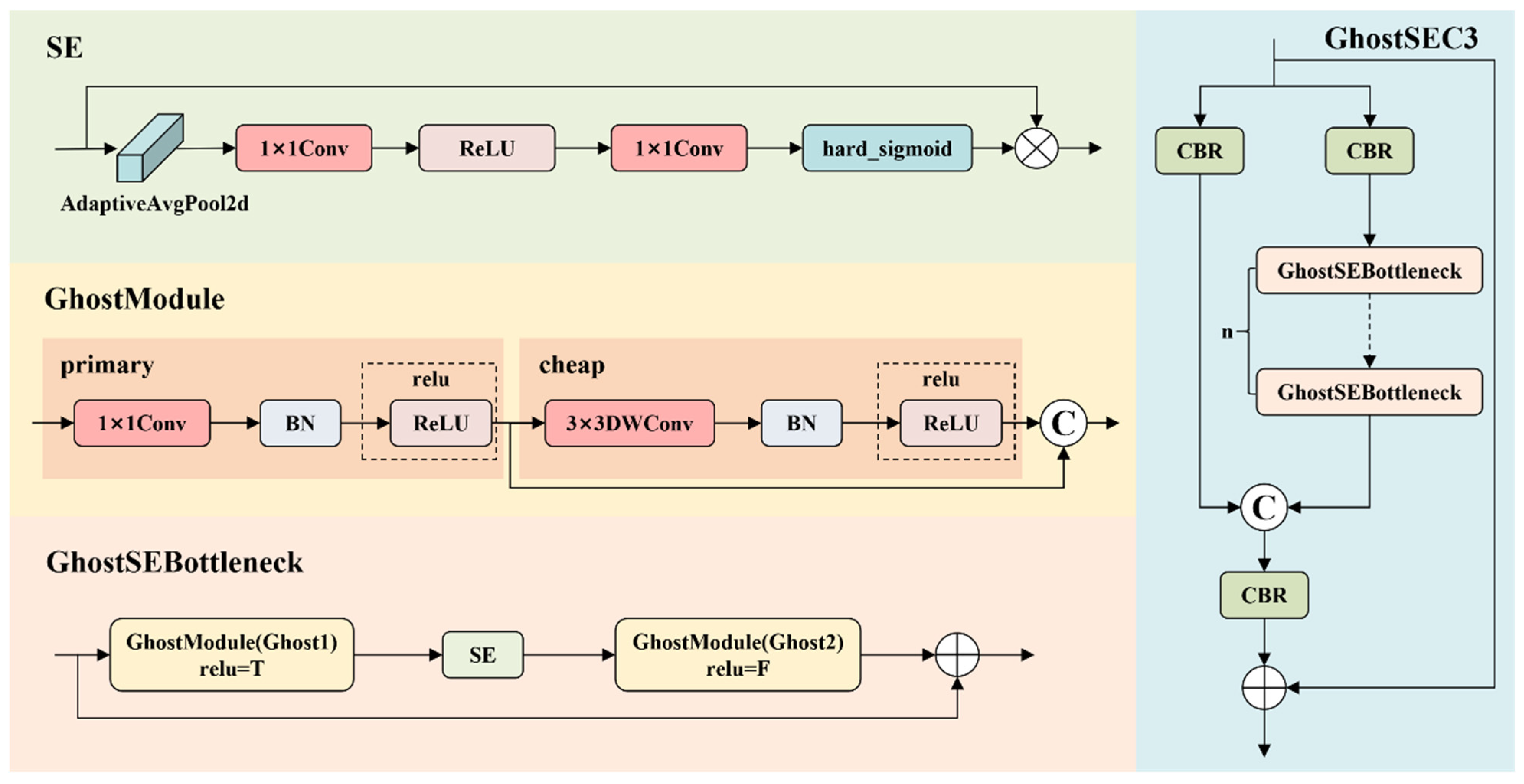
To address the above issues, we propose GhostSEC3 as the main module for lightweight design, with its structure presented in Figure 6. Based on the C3 architecture, GhostSEC3 integrates the lightweight design of GhostModule [27] and SE [29], which achieves light weight while balancing tiny damage detail preservation, background interference suppression, and edge inference adaptability.
After processing by DFELDown, the network output holds strong semantic discrimination ability to effectively distinguish damage features from background interference. Meanwhile, the inherent redundancy of CNN feature maps provides feasible space for lightweight feature generation. Therefore, we introduce GhostModule as the key lightweight feature generation unit with the paradigm of generating intrinsic core features through a small number of primary convolutions and redundant ghost features via cheap depthwise convolutions. GhostModule significantly reduces parameters and computations without compromising feature representation ability, and even enhances the robustness of weak damage features.
First, to avoid redundant computations of the standard convolution, we apply a small number of conventional convolutions to the input F i n R B × C i n × H × W to generate an intrinsic feature map F p r i with core semantic information, where C i n is the number of input channels. The number of channels of the intrinsic feature map is set to C m i d = C o u t / r , where r denotes the feature expansion ratio and C o u t is the number of target output channels. The feature generation process is formulated in Equation (20):
F p r i = ReLU ( BN ( Conv pri ( F i n ) ) ) R B × C m i d × H × W
where Conv pri is the conventional convolution. This step only adopts a small number of conventional convolutions, which fully retain the core semantic information enhanced by DFELDown and provide high-quality intrinsic features for subsequent feature expansion.
Next, for each channel of the intrinsic feature map, we perform a low-cost linear transformation via depthwise convolution (DWConv) to generate a redundant ghost feature F g h o s t , with the feature generation process presented in Equation (21):
F g h o s t = ReLU ( BN ( Conv dw ( F p r i ) ) ) R B × C m i d ( r 1 ) × H × W
Different from the splitting and shuffling operations by other lightweight convolutions, the ghost features generated by the linear transformation inherit the semantic information in the intrinsic features. This operation does not split or lose weak features and has stronger robustness against background interference.
Finally, we concatenate the intrinsic features and ghost features along the channel dimension to obtain the fused feature with a total channel number of C m i d r . The fused feature is then cropped to the target output channel number C o u t , which yields the final output F o u t of GhostModule, as shown in Equation (22):
F o u t = Concat ( F p r i , F g h o s t ) [ : , : C o u t , : , : ] R B × C o u t × H × W
Therefore, we build the GhostSEBottleneck by taking GhostModule as the critical feature extraction unit, integrating the SE attention mechanism, and using residual connections to guarantee gradient backpropagation stability. The workflow of GhostSEBottleneck is described below. First, as shown in Figure 6, Ghost1 expands the input channel number to the intermediate channel number and introduces nonlinearity via the ReLU activation function for dimension expansion and semantic enrichment. Then, SE is applied to the intermediate features to adaptively enhance damage features, suppress background interference, and improve the signal-to-noise ratio of damage features. Next, Ghost2 compresses the channel number from the intermediate back to the target output channel number, where linear projection is used instead of the ReLU activation function to avoid destroying feature representation. Finally, we build a residual connection, which ensures smooth gradient flow during backpropagation and improves training stability. The overall process is presented in Equation (23):
X o u t = X i n + Ghost 2 ( SE ( Ghost 1 ( X i n ) ) )
where X i n and X o u t denote the input and output of the GhostSEBottleneck, respectively.
After constructing GhostSEBottleneck, we further build GhostSEC3, which retains the design of the C3 architecture: dual path parallelism and single-feature concatenation. All bottlenecks in the main branch are replaced with the improved GhostSEBottleneck, while the direct connect branch preserves the complete original features through 1 × 1 convolution. This design forms a complementary structure that achieves complete retention of basic features and directional enhancement of key features.

3.4. C2CSModule

Long cracks on blade surfaces exhibit cross-regional continuous distribution characteristics, while early-stage microcracks and others are small targets with a low pixel ratio. High-resolution image input puts extremely high demands on the model in terms of long-range dependency modeling ability, computational efficiency, and weak feature representation ability. Although C2PSA achieves lightweight global attention via query and key compression, its attention architecture, designed for general visual scenarios, lacks directional optimization for the geometric and distribution characteristics of long cracks, which brings limitations in blade damage detection tasks. The limited receptive field of local window self-attention fails to effectively capture the cross-region continuity of long cracks and easily fragments long cracks into multiple short segments.
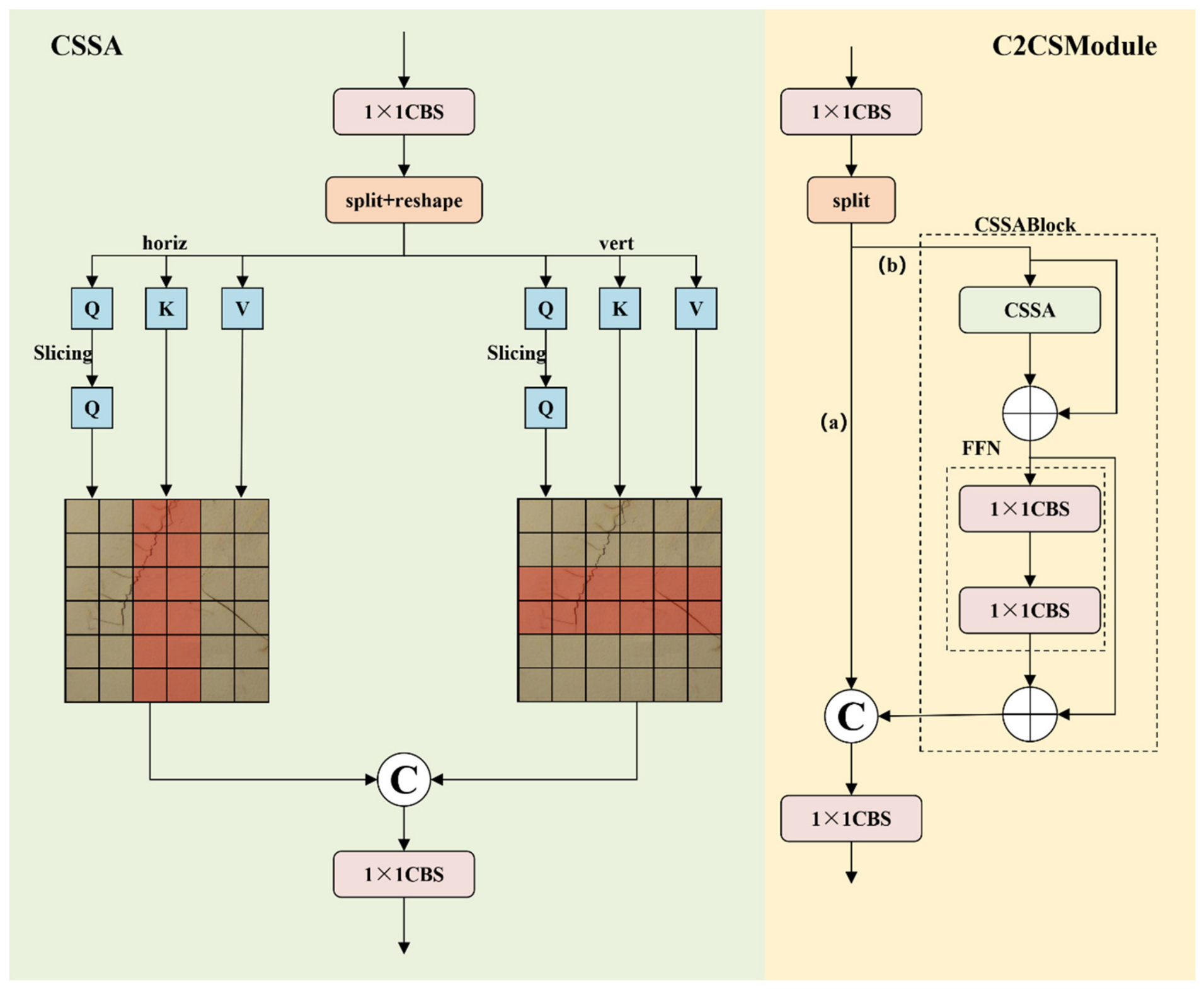
To address the above issues, we propose C2CSModule, which embeds the Cross-Shaped Stripe Attention mechanism (CSSA) [14] into the C2 dual branch framework while retaining the residual structure and feedforward network (FFN). The structure of C2CSModule is shown in Figure 7. This design maintains light weight while replacing the native self-attention module of C2PSA with CSSA, which achieves synergistic optimization of long-range dependency modeling and weak damage feature enhancement.
First, the input X i n R B × C × H × W undergoes channel adjustment via 1 × 1 convolution; then, it is split into a shortcut branch (a) and an enhancement branch (b). The shortcut branch (a) directly retains original features to minimize information loss and provide stable basic features for subsequent feature fusion. The process is presented in Equation (24):
X a , X b = Split ( Conv 1 × 1 ( X i n ) )
where the 1 × 1 convolution expands the input channel number to 2 × C m i d , with C m i d = C × e and e denoting the channel compression ratio. After splitting, the channel number of the shortcut branch X a and the enhancement branch X b is the same, C m i d .
The feature extraction of the enhancement branch (b) is performed by multiple stacked CSSABlocks. Each CSSABlock is composed of CSSA and FFN through a serial residual connection. CSSA adopts a soft compression strategy with slice alignment via key compression and query non-compression, a position-encoding-free strategy, and a parallel stripe attention design, which addresses the trade-off difficulty between receptive field and computational efficiency of traditional self-attention. Specifically, the query keeps the full dimension to ensure the representation ability of long-range damage features, the key undergoes dimension compression to reduce computations, and value retains the full dimension to guarantee feature output quality.
Assume that the number of CSSA attention heads is K (an even number), the single head dimension is d = C m i d / K , the key compression ratio is r, and the compressed key dimension is d k = d × r . The process is shown in Equation (25):
Q g l o b a l , K h o r i z , V h o r i z , K v e r t , V v e r t = Split ( Conv 1 × 1 ( X b ) , [ C m i d , K 2 d k , K 2 d , K 2 d k , K 2 d ] )
where Q g l o b a l denotes the global query, K h o r i z and K v e r t denote the key of the horizontal and vertical branches, respectively, and V h o r i z and V v e r t denote the value of the horizontal and vertical branches, respectively.
We perform slicing processing on the global query to achieve query and key dimension alignment. First, slicing introduces lightweight regularization to improve generalization on small-sample datasets. Second, the sliced query focuses on the most critical d k dimensional features and filters out part of the redundant background information. Specifically, we take the leading d k dimensions of the former K 2 attention heads as the horizontal branch query Q h o r i z , and take the leading d k dimensions of the latter K 2 attention heads as the vertical branch query Q v e r t . The slicing process is shown in Equations (26) and (27):
Q h o r i z = Reshape ( Q g l o b a l , B , K , d , H , W ) [ : , : K 2 , : d k , : , : ]
Q v e r t = Reshape ( Q g l o b a l , B , K , d , H , W ) [ : , K 2 : , : d k , : , : ]
We reshape the dimensions of key and value in the horizontal branch to match the query dimension, with the same operation applied to the vertical branch as presented in Equations (28) and (29):
K h o r i z = Reshape ( K h o r i z , B , K 2 , d k , H , W )
V h o r i z = Reshape ( V h o r i z , B , K 2 , d , H , W )
Then, we acquire the stripe width W s via a dynamic stripe width acquisition function and conduct parallel horizontal and vertical stripe attention based on the obtained optimal W s . This design brings no serial delay between the two branches, which efficiently captures the vertical and horizontal continuity of long cracks. Taking horizontal stripe attention for example, the feature map is split into H W s non-overlapping horizontal stripes by height, each with a size of ( W s , W ) . Self-attention calculation is performed within each stripe. The process is presented in Equations (30) and (31):
Q h o r i z = Reshape ( Q h o r i z , B , K 2 , d k , H W s , W s , W ) . Permute ( 0 , 1 , 3 , 4 , 5 , 2 )
Q h o r i z = Reshape ( Q h o r i z , B K 2 H W s , W s W , d k )
where Q h o r i z is the query of the horizontal branch after splitting based on W s .
We perform dimension reshaping operations on K h o r i z and V h o r i z consistent with Equations (30) and (31) to obtain K h o r i z and V h o r i z , and then complete intra-stripe self-attention calculation, as shown in Equation (32):
A t t n h o r i z = Softmax ( Q h o r i z K h o r i z T d k ) V h o r i z
After calculation, we reshape the horizontal attention output into a 5-dimensional feature map format. The vertical stripe attention works in the same way.
Subsequently, we concatenate the attention outputs A t t n h o r i z and A t t n v e r t from the horizontal and vertical branches along the head dimension for cross-fusion of long-range features. We then obtain the output C S S A o u t through 1 × 1 convolution projection, as shown in Equation (33):
C S S A o u t = Conv 1 × 1 ( Concat ( A t t n h o r i z , A t t n v e r t ) . Reshape ( B , C m i d , H , W ) )
Notably, this unit leverages the spatial position information implied by stripe partitioning to eliminate position encoding in traditional self-attention, which further realizes light weight without sacrificing performance.
After CSSA completes long-range dependency modeling, FFN applies a nonlinear transformation in the channel dimension to the output features of CSSA through a bottleneck structure, which strengthens the fine-grained feature representation. The serial stacking of the two modules realizes dual enhancement of global and local channel features. The enhancement branch outputs X b e n h a n c e after n times of CSSABlock, as shown in Equation (34):
X b e n h a n c e = CSSABlock n ( X b )
FFN is implemented by two serially connected 1 × 1 convolutions, which first double the channel number and then restore it to the original dimension. The calculation logic of a single CSSABlock is presented in Equations (35) and (36):
X c s s a = X b l o c k i n + CSSA ( X b l o c k i n )
X b l o c k o u t = X c s s a + FFN ( X c s s a )
where X b l o c k i n and X b l o c k o u t denote the input and output of a single CSSABlock, respectively.
Finally, we concatenate the shortcut branch feature X a with the enhanced feature X b e n h a n c e along the channel dimension and perform feature fusion via 1 × 1 convolution to acquire the final output X o u t , as presented in Equation (37):
X o u t = Conv 1 × 1 ( Concat ( X a , X b e n h a n c e ) )

4. Experiment Setup and Results Analysis

4.1. Datasets

To evaluate the overall performance of DFELD-YOLO on wind turbine blade damage detection tasks, we constructed the UAV-Based Wind Turbine Blade Surface Damage Dataset (WTB-SDD). WTB-SDD integrates authoritative public datasets in the field of wind turbine blade damage detection [34] and real images collected via UAV inspection in wind farms. It contains a total of 3601 images, all of which are uniformly adjusted to 640 × 640 resolution.
We adopt a stratified split strategy based on damage category distribution to divide the dataset into training, validation, and test sets, containing 2893, 362, and 346 images, respectively. Since public datasets in this field lack complete metadata, including turbine ID, inspection sequence, and wind farm information, strict turbine-level or sequence-level independent splitting cannot be achieved under current conditions. To quantitatively evaluate the potential data leakage risk across subsets, we conduct a two-stage near-duplicate image analysis combining perceptual hashing (pHash) and the structural similarity index (SSIM). The results show that only 10 images in the test set have near-duplicate counterparts in the training or validation sets, accounting for 2.89% of the total test samples. Manual verification confirms that all near-duplicate pairs correspond to images of the same blade captured from different shooting angles or covering different damage regions, with no identical damage instances appearing across subsets. Therefore, data leakage risk is controlled at a lower level, which does not significantly affect the validity of subsequent experimental conclusions.
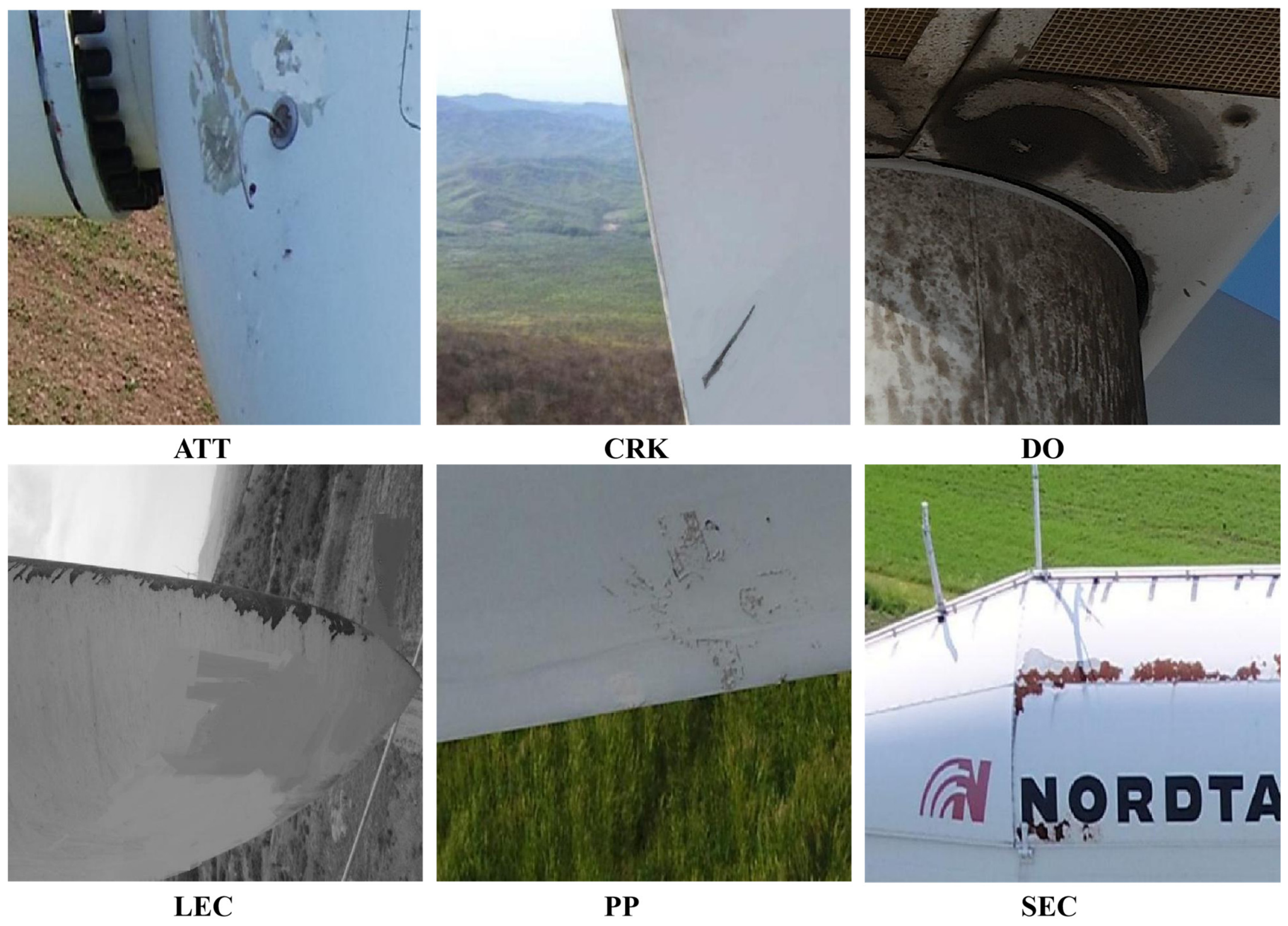
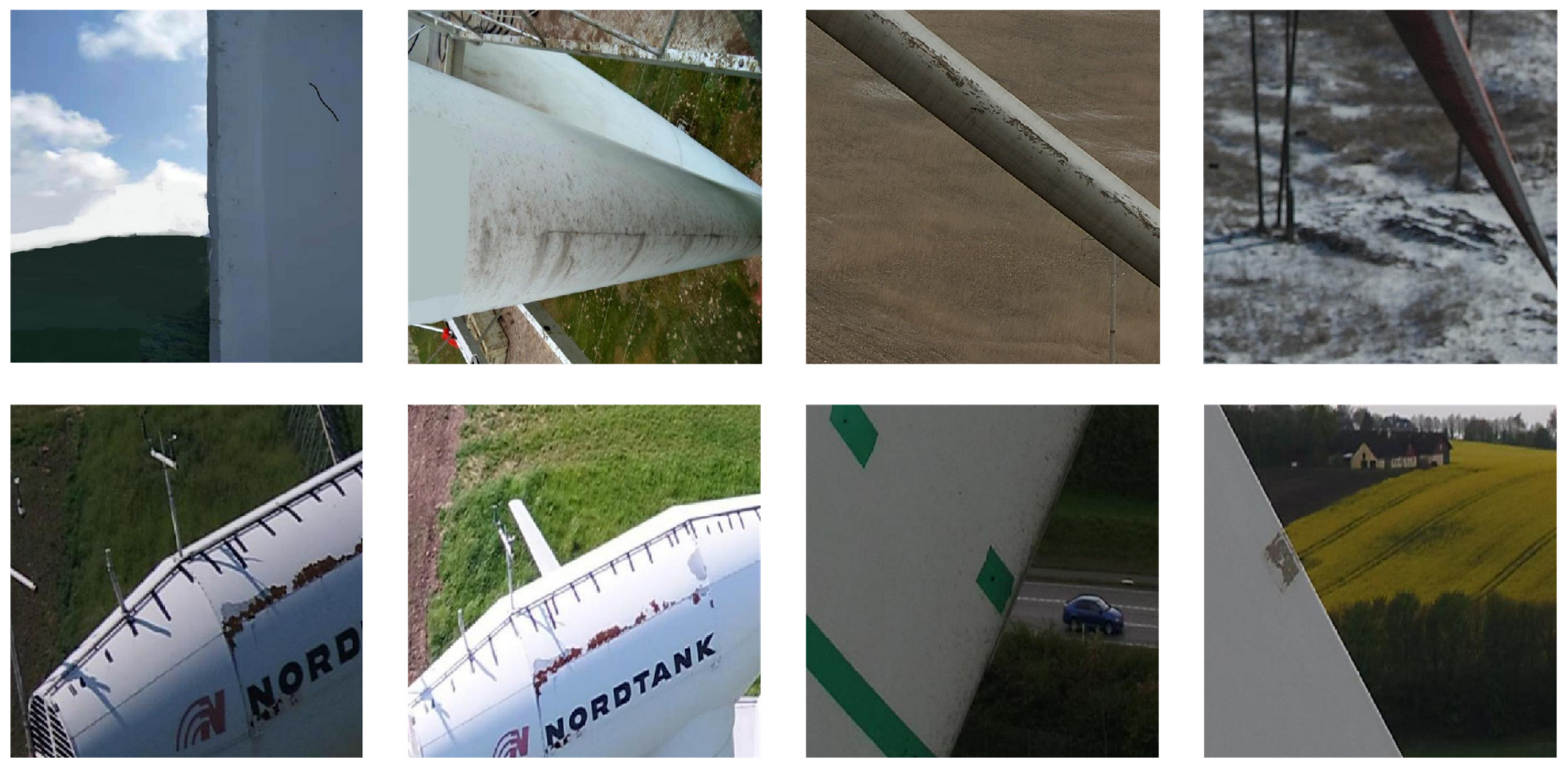
The WTB-SDD dataset defines six typical damage categories, namely attachments (ATT), cracking (CRK), dust and oil contamination (DO), leading edge corrosion (LEC), paint peeling (PP), and surface corrosion (SEC). Considering that a single UAV image may contain multiple independent damage instances simultaneously, we count each damage instance separately for the corresponding category. Specifically, the dataset contains 306 instances of ATT, 333 instances of CRK, 643 instances of DO, 315 instances of LEC, 2005 instances of PP, and 758 instances of SEC, with a total of 4360 damage instances. Typical samples of each type of damage are shown in Figure 8.
The dataset includes abundant background interference samples to comprehensively evaluate the anti-interference performance of the model. The main interference types cover natural environmental backgrounds (mountains, farmland, and sky), artificial structural backgrounds (roads and buildings), and blade surface inherent interference (uneven stains and shadows). Typical background interference samples are shown in Figure 9.

4.2. Experimental Setup

We conducted all experiments under a unified hardware and software environment. The platform adopts an NVIDIA A100-40GB GPU and an Intel Xeon Gold 6240R CPU. The software system is built on the Linux operating system with the PyTorch 2.5.0 deep learning framework, CUDA 12.1 parallel computing platform, and Python 3.9.25. The specific parameter settings are shown in Table 1.
In addition, we adopt a data augmentation strategy during the training process to improve the robustness of the model to complex backgrounds, illumination variations, and changes in shooting angle. The specific training augmentation hyperparameters are shown in Table 2.

4.3. Evaluation Metrics

We adopt a standardized evaluation system widely used in industrial defect detection fields, which covers two dimensions of detection performance and model deployment. For the detection performance, we adopt precision (P) and recall (R) as the basic metrics, whose calculation formulas are given in Equations (38) and (39). True positive (TP) is positive sample targets correctly detected and class-matched, false positive (FP) is false detection samples with background or negative samples misjudged as positive targets, and false negative (FN) is real positive samples missed. Precision reflects the accuracy of detection results from the model. Recall reflects the detection and coverage ability of the model for all real positive samples. We further introduce the F1-score as the harmonic mean of precision and recall to comprehensively balance detection precision and recall, as shown in Equation (42).
P r e c i s i o n = T P T P + F P
R e c a l l = T P T P + F N
A P = 0 1 P ( R ) d R
m A P = 1 N i = 1 N A P i
F 1 = 2 × P × R P + R
M D R = F N T P + F N = 1 R
F A R = F P T P + F P = 1 P
Meanwhile, we adopt average precision (AP) and mean average precision (mAP) as core quantitative metrics to measure the comprehensive detection performance, as shown in Equations (40) and (41). AP is the area under the P-R curve, which can comprehensively quantify the detection performance for single-class targets. The mAP is the mean of AP values for all target classes, which is the most core comprehensive evaluation metric in object detection tasks, where N denotes the total number of target classes. We mainly adopt mAP@0.5 to conduct a refined evaluation of model performance. mAP@0.5 refers to the mAP calculated when the IOU is set to 0.5, which is used to measure the overall detection accuracy of the model. Targeting industrial inspection requirements, we explicitly define two key industrial metrics, including missed detection rate (MDR) and false alarm rate (FAR), as shown in Equations (43) and (44). MDR reflects the proportion of missed real damage targets, which directly corresponds to the safety risk of missed inspection in industrial scenarios. FAR reflects the proportion of false alarms in all detection results, which corresponds to the manual recheck cost in practical UAV inspection deployment. For model lightweight evaluation, we adopt Parameters (Params) and Giga Floating-point Operations (GFLOPs) to quantify model size and computational complexity, respectively.

4.4. Comparison Experiment

4.4.1. Performance Evaluation for DFELD-YOLO and Baseline YOLOv11n

We present the comparison results between DFELD-YOLO and YOLOv11n in Table 3. The overall results demonstrate that DFELD-YOLO achieves significant detection performance improvement for the core structural damage. For CRK, mAP and recall increased by 7.6% and 10.7%, respectively. This improvement is attributed to the linear feature enhancement branch and pixel-preserving downsampling design of DFELDown, which retains the spatial continuous features of cracks. Meanwhile, the cross-shaped stripe attention of C2CSModule realizes long-range dependency modeling across regions for long cracks. The two designs jointly solve the problems of missed detection and fragmented recognition of long cracks from the baseline. For LEC, DFELD-YOLO achieves 11.3% improvement in mAP and 14.8% improvement in recall, the largest among all damage types. The result validates the multi-scale feature extraction capability of DFELDown, which effectively captures features of large-scale continuous corrosion damage and resolves the high missed detection rate of the baseline for low-contrast damage.
For conventional damage, including PP and SEC, DFELD-YOLO achieved stable performance optimization with 1.9% and 0.5% improvements in mAP, respectively. It proves that our improved modules enhance the detection performance of hard-to-detect damage without degrading that of conventional damage, exhibiting good general adaptability. For two non-structural and easily confused samples, including ATT and DO, mAP decreased slightly by 0.6% and 0.4%, respectively, with overall performance basically consistent with the baseline. This fluctuation arises as the improved modules mainly enhance the feature representation of structural damage, which slightly reduces the discrimination of ATT and DO with visual features highly similar to real damage and causes a minor increase in the false detection rate. However, both types of samples are non-structural damage, which has no direct impact on the structural safety of the blades.
Therefore, compared with the baseline YOLOv11n, DFELD-YOLO achieves significant detection performance improvement for wind turbine blade structural damage while maintaining light weight, which validates the effectiveness of our three improvements.

4.4.2. Visualization Analysis for DFELD-YOLO and Baseline YOLOv11n

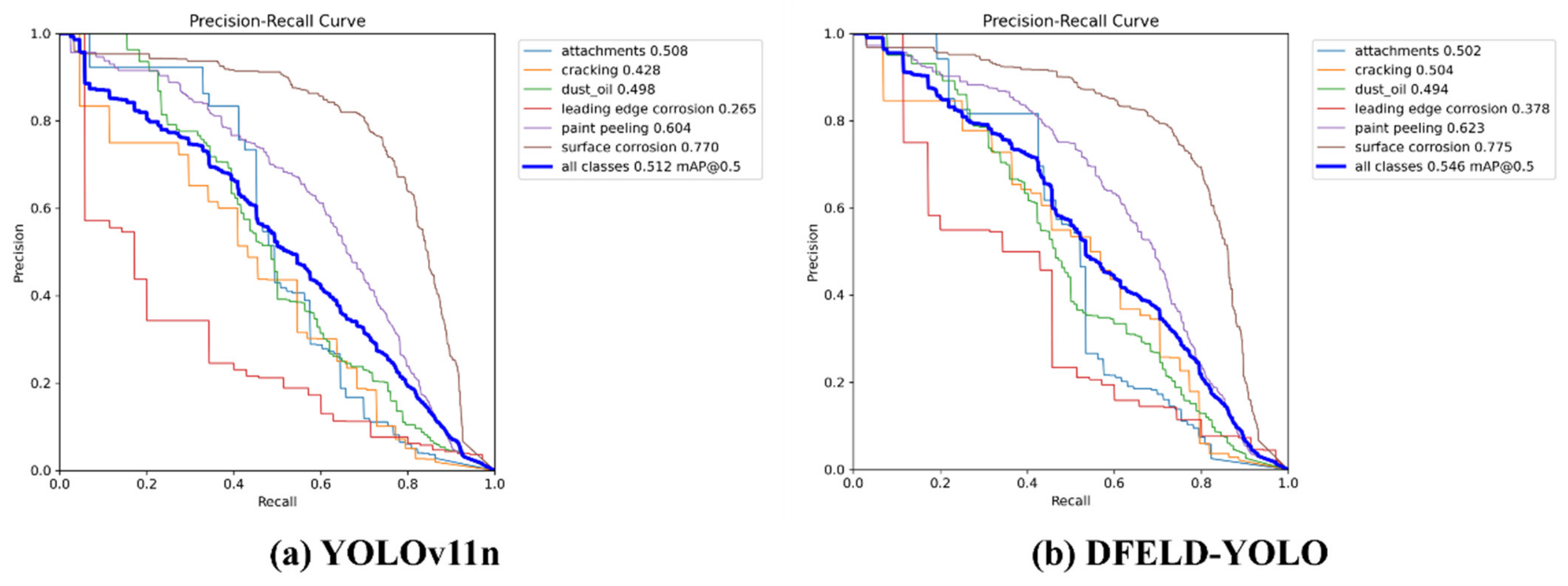
As shown in Figure 10, the mAP@0.5 of DFELD-YOLO increased from 51.2% to 54.6%, with the enclosed area of the all-category P-R curve outperforming that of the baseline. For wind turbine blade structural damage, the AP of CRK increased from 42.8% to 50.4%, and the AP of LEC increased from 26.5% to 37.8%. The P-R curves of these two damage types cover the corresponding curves of the baseline. It can be confirmed that DFELD-YOLO delivers higher detection precision under the same recall and effectively alleviates missed detection and false positive detection of structural damage from the baseline.
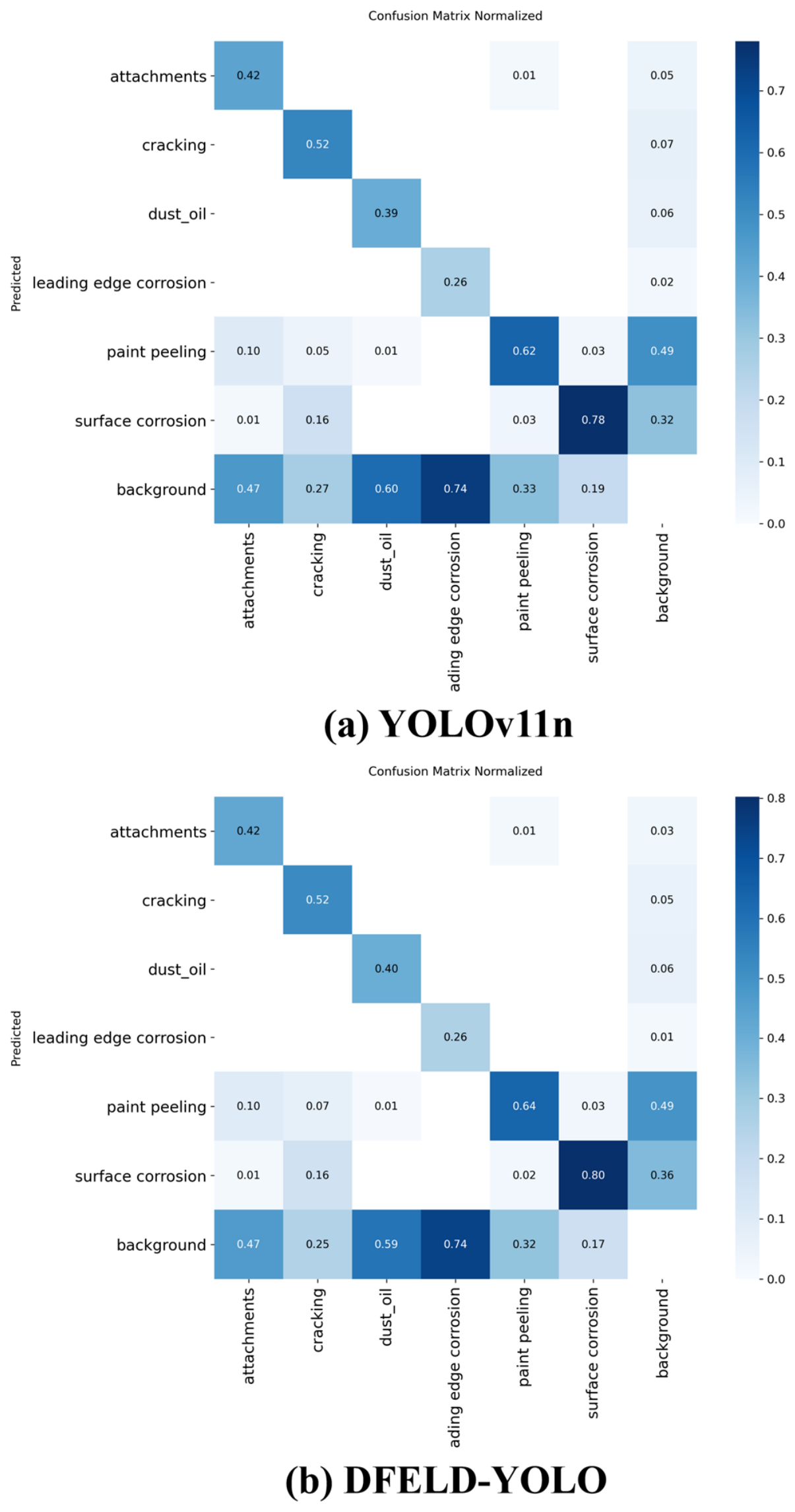
As shown in Figure 11, DFELD-YOLO achieves optimized correct classification performance for all damage types, with the correct classification rate rising from 78% to 80% for SEC and from 62% to 64% for PP. Meanwhile, the false negative rate of structural damage was significantly reduced, with the proportion of CRK misclassified as background dropping from 7% to 5% and that of LEC dropping from 2% to 1%. Only the false positive rates of ATT and DO show slight fluctuations, which is consistent with the previous quantitative analysis results. These findings collectively validate the classification accuracy and false negative suppression ability of DFELD-YOLO for blade damage.

4.4.3. Comparative Experiments Between DFELD-YOLO and Other Models

To validate the comprehensive advantages of DFELD-YOLO in lightweight design and detection accuracy, we selected mainstream YOLO series models for comparative experiments, with results presented in Table 4. In terms of lightweight, DFELD-YOLO achieves the best overall performance, with only 2.05M parameters and 5.9 GFLOPs computations. Compared with the baseline YOLOv11n, DFELD-YOLO reduces parameters by 20.8% and computations by 7.8%. For similar lightweight models, YOLOv8n and YOLOv5n, it reduces parameters by 31.9% and 18.3%, as well as computations by 28.0% and 18.1%, respectively. In terms of detection accuracy, the mAP@0.5 of DFELD-YOLO reaches 54.6%, ranking second among all comparative models. Compared with the baseline, DFELD-YOLO improves mAP by 3.4% and recall by 6.7%, significantly alleviating the high missed detection rate of early-stage blade damage. Although YOLOv8s achieves slightly higher detection accuracy, its parameters and computations are far higher than those of DFELD-YOLO.
For cross-architecture comparison with DETR-based detectors, we add RT-DETR-ResNet as an additional non-YOLO baseline to improve comparison comprehensiveness. RT-DETR-ResNet50, RT-DETR-l, and RT-DETR-ResNet18 achieve 46.5%, 42.6%, and 19.5% mAP@0.5, with 42.77 M, 32.82 M, and 20.09 M parameters, respectively. Due to the inherent structural features of the DETR architecture, no mature open-source RT-DETR variant matches the parameter and computation scale of nano-grade YOLO models, so a completely fair comparison under equivalent computational constraints cannot be achieved at this stage. Even compared with the lightweight RT-DETR-ResNet18, DFELD-YOLO delivers 35.1% higher mAP@0.5 with only 10.2% of its parameters and 10.1% of its GFLOPs. For industrial inspection-oriented evaluation metrics, DFELD-YOLO achieves a missed detection rate (MDR) of 46.0%, which is 6.7% lower than that of YOLOv11n; its false alarm rate (FAR) is 43.3%, maintaining a competitive level among mainstream lightweight models, with an F1-score of 0.54, achieving a good balance between detection precision and recall. DFELD-YOLO also reaches 27.1% mAP@0.5:0.95. Notably, within the scope of all currently evaluated models, including three RT-DETR variants and ten mainstream YOLO series detectors, DFELD-YOLO achieves the optimal accuracy–efficiency trade-off among nano-grade lightweight detectors, which satisfies the edge deployment requirements.
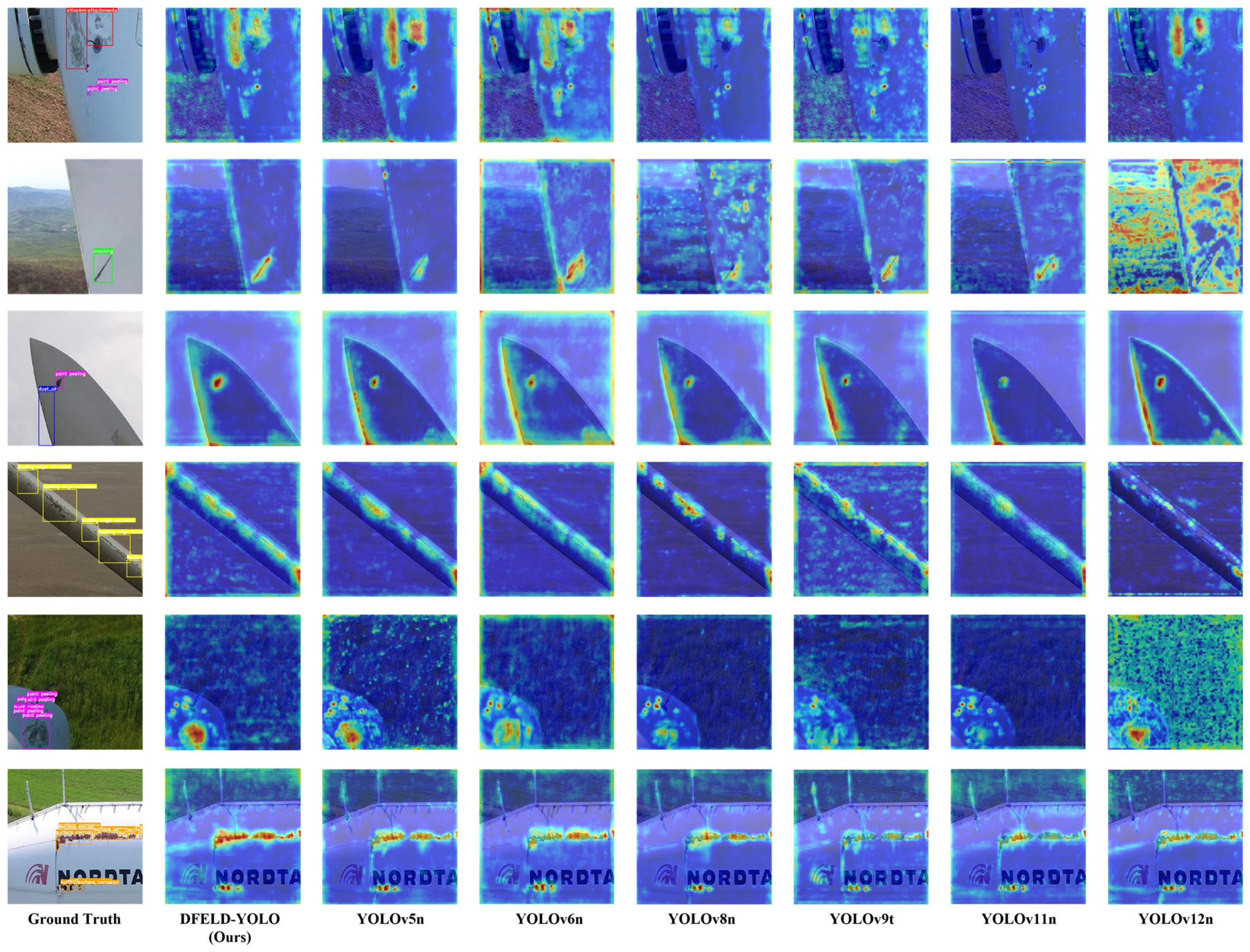
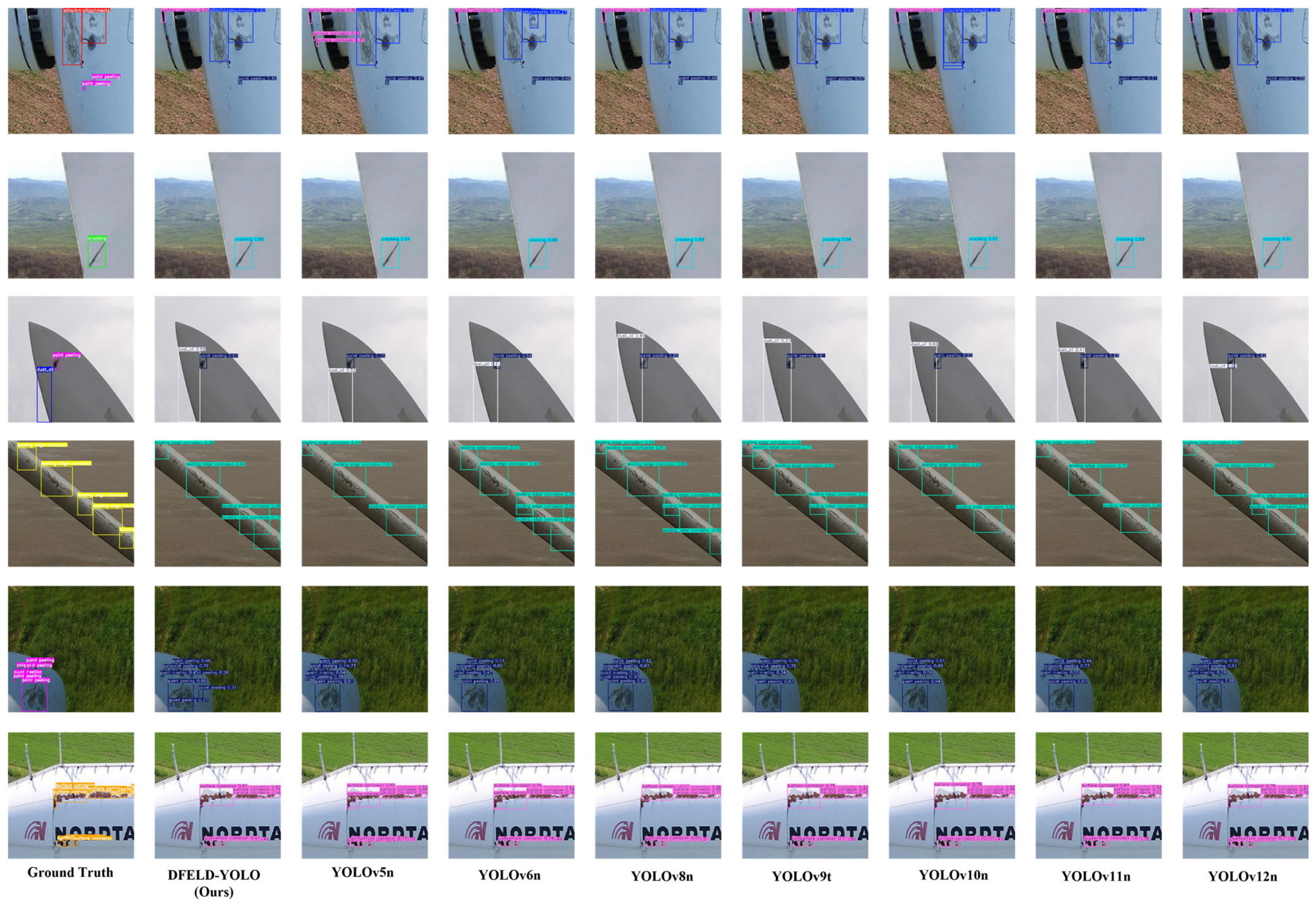
As shown by the visual comparison of detection results in Figure 12, DFELD-YOLO achieves better detection completeness and bounding box localization accuracy for various types of damage, including micro-pitting, slender cracks, and large-area corrosion, compared with YOLOv5n, YOLOv11n, and others. It can fully detect dense micro-damage and continuous long cracks without obvious missed detection or false positive detection, with detection results highly consistent with ground truth annotations. In contrast, the comparative models generally have shortcomings such as missed detection of micro-damage, fragmented recognition of long cracks, and inaccurate localization of large-scale damage. Figure 13 presents the heatmap visualization results. As shown by the results, DFELD-YOLO can precisely focus on the critical regions of blade damage, exhibits higher activation intensity for weak damage features than comparative models, and effectively suppresses invalid activations in background regions. The results confirm that the decoupled design can effectively enhance the damage feature and suppress background interference, which is well corroborated by the quantitative experimental results.

4.5. Ablation Experiments with Discussion and Analysis

To verify the contribution of each improved module to DFELD-YOLO, we conducted ablation experiments by introducing the improved modules individually and in combination. The results are shown in Table 5.
The overall experimental results demonstrate that the three improved modules can optimize model performance across different dimensions, whether introduced individually or in combination. With all three modules integrated, the final model reduces parameters to 2.05 M and computations to 5.9 GFLOPs, while improving 3.4% in mAP@0.5 over the baseline. Among them, DFELDown is responsible for the targeted enhancement of damage features and preservation of pixel information in the downsampling stage, GhostSEC3 achieves lightweight feature extraction and background interference suppression without accuracy loss, and C2CSModule completes long-range dependency modeling of long cracks in the high-level feature extraction stage. These modules together form a division and cooperation mechanism that is logically coherent and complementary in advantages.
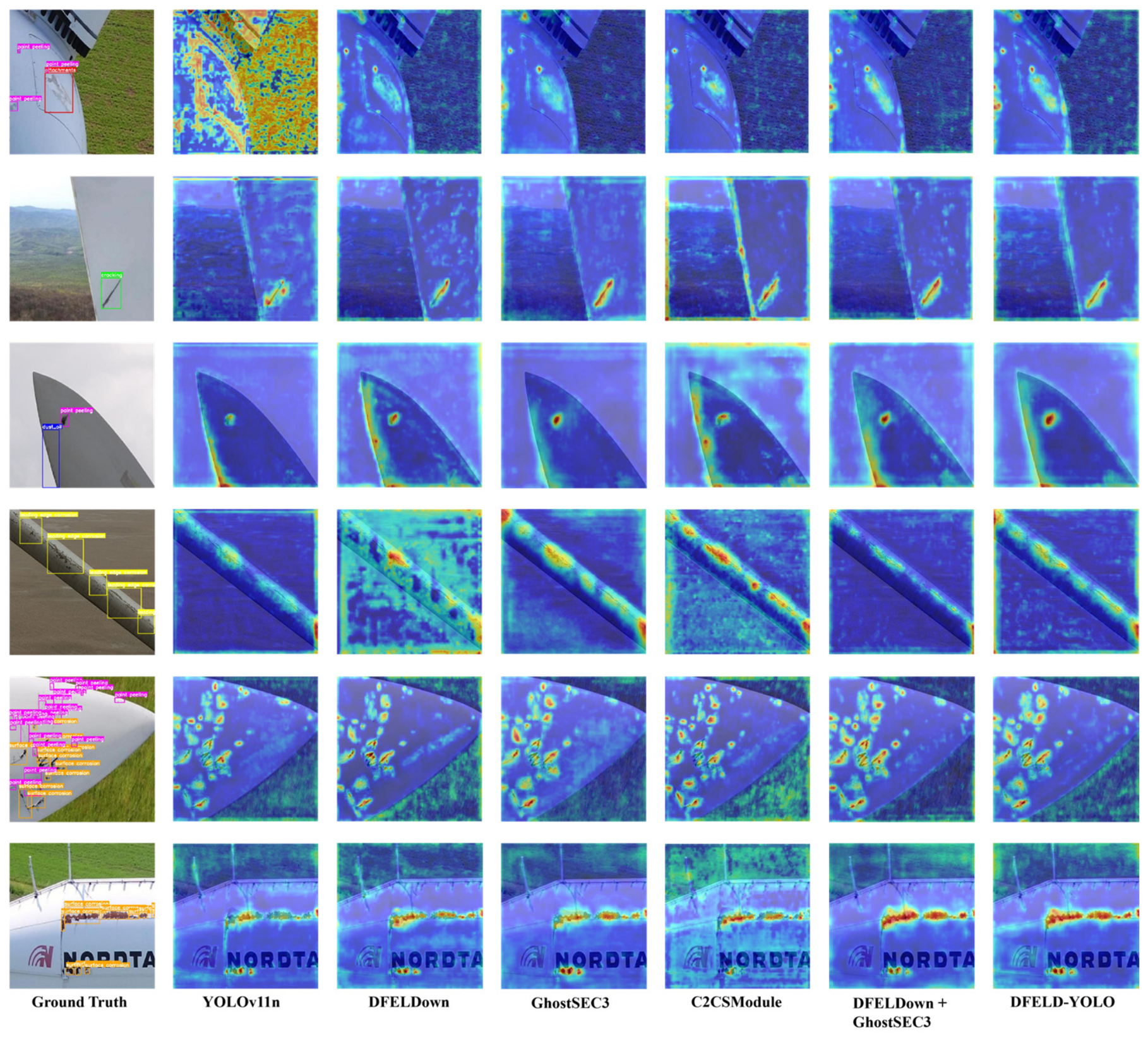
To intuitively illustrate the contribution of each improved module, we conducted a heatmap visualization analysis on the ablation experiment results, as shown in Figure 14. Compared with the baseline YOLOv11n, which shows scattered attention distribution and strong invalid activation in background regions, all three improved modules can effectively enhance the activation intensity of damage regions while suppressing background interference. DFELDown boosts the activation of micro-damage and low-contrast damage features. GhostSEC3 further reduces invalid activation in complex background regions. C2CSModule achieves continuous and uniform activation along the entire length of long cracks, avoiding fragmented recognition. The final DFELD-YOLO, integrating all three modules, achieves concentrated attention distribution and suppressed background activation. To further clarify the working mechanism and performance contribution of each improved module, this section presents a detailed analysis and discussion of the ablation results.

4.5.1. Discussion and Analysis of DFELDown

As shown in Table 6, the comparison results of detection performance indicate that DFELDown optimizes detection performance for different types of damage. Specifically, the detection accuracy of CRK increased by 8.8%. The benefit comes from the asymmetric convolution linear enhancement branch of DALL, which strengthens the feature representation of linear cracks. Meanwhile, Cw-SPD preserves the spatial continuity of long cracks, which solves the problems of easily missed detection and fragmented recognition of long cracks from the baseline. The detection accuracy of LEC increased by 3.7%, which validates the ability of the multi-scale feature extraction branch to capture large-scale continuous corrosion damage. The detection accuracy of both ATT and PP increased by 2.5%, which proves the general enhancement effect of the DALL for damage with different forms. For large size and easily detectable damage of SEC, the detection accuracy remains stable without performance loss. The detection accuracy of DO shows a slight decline, which can be further compensated for by the subsequent anti-interference module.
To verify the necessity of five learnable gating units in DFELDown and rule out redundancy in the module design, we set the complete DFELDown as the baseline for our ablation study. We perform the ablation study through individual and combined removal of the gating units, including ① global context gating, ② multi-scale fusion gating, ③ feature fusion gating, ④ Cw-SPD downsampling enhancement gating, and ⑤ confidence enhancement gating. The serial numbers correspond to the specific positions as shown in Figure 3 and Figure 4. The ablation results in Table 7 demonstrate that all five gating units are key supports for the performance of DFELDown. When all five gating units are removed in combination, mAP@0.5 decreases to 51.5%, which almost falls back to the baseline level of YOLOv11n. This result proves that the five gating units are not redundant designs. They achieve targeted enhancement of damage features and suppression of invalid features through learnable adaptive weights, which are necessary guarantees for the performance improvement. After the removal of gating units, the module degenerates into a basic downsampling structure without adaptive enhancement ability, which cannot capture the weak damage features accurately.
To verify the effectiveness of the proposed Cw-SPD strategy, we conducted a single-variable ablation experiment on the downsampling unit of DFELDown, with all experimental groups sharing identical module structures and training hyperparameters and differing only in downsampling implementations. As shown in Table 8, the original SPD implementation reduces mAP@0.5 to 49.5%, which is 1.7% lower than YOLOv11, due to the destruction of intra-channel semantic continuity. When Cw-SPD is replaced with traditional stride convolution, the model achieves an mAP@0.5 of 53.1%, while Cw-SPD reaches the optimal mAP@0.5 of 53.8% without introducing additional parameters or computational overhead. This performance improvement originates from the channel-wise design of Cw-SPD, which preserves both pixel integrity and feature continuity. This design serves as the foundation for the feature retention of micro-damage and long cracks, which is consistent with the detection accuracy improvement presented in Table 6.
The above experimental results validate the feasibility and superiority of the decoupled design. Traditional stride convolution couples feature extraction and spatial downsampling into a single operation, where the two tasks restrict each other. It cannot achieve targeted enhancement of weak damage features before dimensionality reduction and easily causes irreversible loss of weak features such as microcracks and pitting during multiple downsampling processes. DFELDown decouples these two functions, first using DALL to complete targeted extraction and enhancement of damage features, and then using spatial downsampling without pixel information loss through the improved Cw-SPD. This forms a complete pipeline of enhancement first and dimensionality reduction later, and can even be regarded as a novel convolution adapted to defect detection. DFELDown not only avoids the loss of weak damage features during dimensionality reduction but also achieves task-oriented feature extraction through the attention mechanism. Meanwhile, it adopts lightweight gating and convolution designs to realize the synergy between accuracy improvement and lightweight optimization, which provides a new technical idea for the design of downsampling modules in industrial defect detection.

4.5.2. Discussion and Analysis of GhostSEC3

As shown in Table 5, the combination of GhostSEC3 and DFELDown reduces parameters to 2.04 M, computations to 5.9 GFLOPs, and increases mAP@0.5 to 54.4%, which validates the synergistic gain between the two modules.
The critical logic behind this excellent performance is that DFELDown has already completed targeted enhancement and sufficient extraction of damage features, and the output features have strong semantic discriminability, which provides a reliable foundation for the lightweight design of GhostSEC3. GhostSEC3 is based on the C3 architecture and integrates GhostModule and SE. It adopts the paradigm of generating intrinsic core feature maps through a small number of primary convolutions and redundant ghost feature maps via cheap depthwise convolutions, which greatly reduces parameters and computations while retaining effective damage features. Meanwhile, SE can adaptively suppress background interference and further enhance the signal-to-noise ratio of damage features. GhostSEC3 ultimately realizes the synergistic improvement of lightweight performance, anti-interference ability, and detection accuracy.
To verify the necessity of the SE and C3 in GhostSEC3, we conducted a single-variable ablation study. After DFELDown completes feature enhancement and extraction, GhostSEC3 further performs feature extraction and background interference suppression under the premise of lightweight design; thus, ablation under the DFELD-YOLO framework can more accurately reflect the contribution of each component. All experimental groups share identical training hyperparameters except for GhostSEC3 configurations, with results shown in Table 9. Integrating complete GhostSEC3 with SE and C3 into YOLOv11n improves mAP@0.5 by 0.8% and reduces parameters by 14.3%, verifying the inherent performance advantage of the module. Removing SE or replacing C3 with C2f in DFELD-YOLO reduces mAP@0.5 to 50.3% and 51.4%, respectively, confirming the value of both components for interference suppression and lightweight optimization. The complete GhostSEC3 achieves the optimal mAP@0.5 of 54.6% with only 2.05 M parameters and 5.9 GFLOPs. Ablation results confirm no redundant design in GhostSEC3.

4.5.3. Discussion and Analysis of C2CSModule

To balance the long-range feature representation capability and computational cost, we designed three schemes, including full compression, soft compression, and non-compression, to carry out comparative experiments, with the results shown in Table 10. The experimental results show that the mAP@0.5 of the full compression is only 50.8%, which is lower than the performance of the baseline YOLOv11n. This proves that full compression severely impairs the feature representation capability of the query and cannot achieve accurate retrieval of long-range damage features. The non-compression scheme achieves the optimal mAP@0.5 of 53.4% in the single-module experiment, but it has the highest parameters and computations. Moreover, in DFELD-YOLO, the mAP@0.5 of the non-compression is only 51.3%, with a significant performance drop. The results indicate that the high computational complexity brought by non-compression has poor adaptability with the small-sample dataset of wind turbine blades and is prone to cause overfitting. The proposed soft compression achieves an mAP@0.5 of 53.2% in the single module experiment, with a difference of only 0.2% from non-compression. Meanwhile, it has lower parameters and computations and even achieves the optimal detection accuracy of 54.6% in DFELD-YOLO. It proves that the soft compression scheme achieves the optimal balance between feature representation capability and computational efficiency and has better compatibility with other improved modules.
To verify the necessity of position encoding, we conducted additional ablation experiments, with the results shown in No.5 in Table 10. After additional introduction of position encoding based on the soft compression scheme, the mAP@0.5 decreased from 53.2% to 52.3%, along with an increase in computational complexity. This is because the stripe division mode inherently contains the spatial position information, and the additional introduction of position encoding causes feature redundancy. It not only increases computations but also interferes with the expression of effective features, leading to a decrease in detection accuracy. Therefore, we removed the redundant position encoding design, which ensures the detection performance while simplifying the model structure and reducing computations.

4.6. Edge Deployment Performance Evaluation

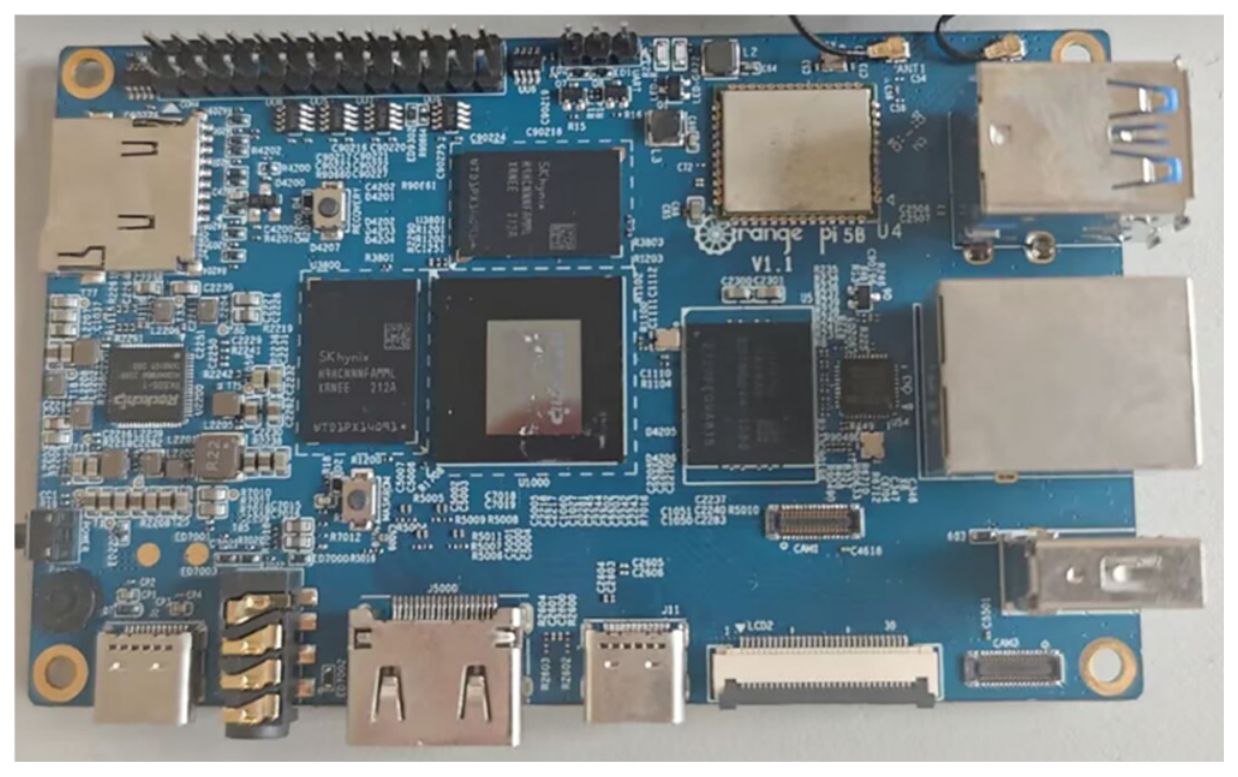
To verify the real-world engineering applicability of DFELD-YOLO, we deployed the proposed model on an embedded edge device to evaluate its actual inference performance in resource-constrained environments. Figure 15 displays Orange Pi 5B as the testing device, equipped with the RK3588S 8-core 64-bit processor, featuring a quad-core A76 and a quad-core A55, with a maximum frequency of 2.4 GHz. We utilized ONNX as the inference computing framework to evaluate the performance of all models, with the input image resolution uniformly set to 256 × 256. Additionally, we select the baseline YOLOv11n for comparative experiments, with detailed edge deployment performance metrics provided in Table 11.
As illustrated in Table 11, the proposed DFELD-YOLO achieves a favorable lightweight performance. Specifically, DFELD-YOLO only has 2.05 M parameters, which is 20.8% lower than YOLOv11n. Meanwhile, the model file size of DFELD-YOLO is only 7.99 MB, which is 19.6% smaller than YOLOv11n, reducing the storage and memory occupation requirements for edge devices. Under the same 256 × 256 deployment setting, DFELD-YOLO achieves 36.9% mAP@0.5, which is 1.0 percentage points higher than the baseline, achieving accuracy improvement while maintaining lightweight advantages.
For the inference speed, we clarify the real-time criterion for industrial inspection scenarios. Due to the gentle flight speed of inspection UAVs and low single-frame response requirement, ≥15 FPS is generally accepted as the real-time detection threshold for this scenario. DFELD-YOLO achieves 23.68 FPS under 256 × 256 input, which meets the real-time detection requirement. Notably, although DFELD-YOLO has fewer parameters and lower theoretical computational complexity, the attention operators and multi-branch structures are less optimized for CPU-side ONNX inference than standard convolutional operations, resulting in slightly higher latency. However, the accuracy improvement brings higher practical value for blade damage inspection tasks. The experimental results demonstrate that DFELD-YOLO achieves an excellent balance between detection accuracy and lightweight performance and can operate stably on resource-constrained edge devices, showing promising application potential for UAV-based inspection scenarios.

5. Conclusions

This paper introduces the DFELD-YOLO model based on YOLOv11, a lightweight model for wind turbine blade damage detection. Specifically, we propose a novel design paradigm that decouples feature extraction from downsampling in conventional strided convolution, and develop DFELDown to address the problem of micro-damage feature loss. Furthermore, we integrate GhostSEC3, which further realizes feature extraction and background interference suppression while guaranteeing the lightweight design. Finally, we design C2CSModule, which achieves a global receptive field with linear computational complexity, accurately captures the continuous features of long cracks, and realizes the balance between detection accuracy and computational cost for high-resolution input.
Although DFELD-YOLO achieves excellent performance on blade damage detection tasks, three limitations remain. First, the discrimination ability for easily confused categories, including complex backgrounds, dust–oil, and leading-edge corrosion, remains to be further improved. Second, detection robustness under extreme environmental conditions requires additional enhancement. Third, due to the lack of turbine and inspection sequence metadata in public datasets, the current dataset split cannot eliminate potential data leakage from the same turbine or inspection sequence. Although near-duplicate analysis verifies that leakage risk is extremely low, the cross-wind-farm and cross-turbine generalization ability of the model still requires further validation on large-scale datasets with complete metadata.
Future work will focus on three targeted directions. First, we will introduce a class-aware attention mechanism and class center constraint loss to enhance fine-grained feature distinction between visually similar categories. Second, we will explore multi-modal auxiliary detection combined with spectral features to distinguish damage types with similar visual morphology. Third, we will collect a large-scale wind turbine blade damage dataset with complete turbine, wind farm, and inspection sequence metadata to conduct strict cross-scenario generalization verification. We will further optimize the model to address the above limitations and extend its application to intelligent inspection of broader wind power equipment.

Author Contributions

Conceptualization, X.Z. and H.T.; methodology, X.Z.; software, X.Z.; validation, X.Z., H.T. and B.H.; formal analysis, X.Z. and B.H.; investigation, X.Z.; resources, X.S.; data curation, X.Z.; writing—original draft preparation, X.Z.; writing—review and editing, X.Z. and X.S.; visualization, X.Z.; supervision, H.L.; project administration, X.Z. and X.S. All authors have read and agreed to the published version of the manuscript.

Funding

This research received no external funding.

Data Availability Statement

Data will be made available on request.

Conflicts of Interest

The authors declare no conflicts of interest.

References

  1. GWEC. Global Wind Report 2024; Global Wind Energy Council: Brussels, Belgium, 2024. [Google Scholar]
  2. Liu, W.Y.; Tang, B.P.; Han, J.G.; Lu, X.N.; Hu, N.N.; He, Z.Z. The structure healthy condition monitoring and fault diagnosis methods in wind turbines: A review. Renew. Sustain. Energy Rev. 2015, 44, 466–472. [Google Scholar] [CrossRef] [Scilit]
  3. Du, Y.; Zhou, S.; Jing, X.; Peng, Y.; Wu, H.; Kwok, N. Damage detection techniques for wind turbine blades: A review. Mech. Syst. Signal Process. 2020, 141, 106445. [Google Scholar] [CrossRef] [Scilit]
  4. Chen, L.; Zou, L.; Fan, C.; Liu, Y. Feature weighting network for aircraft engine defect detection. Int. J. Wavelets Multiresolut. Inf. Process. 2020, 18, 2050012. [Google Scholar] [CrossRef] [Scilit]
  5. Amenabar, I.; Mendikute, A.; López-Arraiza, A.; Lizaranzu, M.; Aurrekoetxea, J. Comparison and analysis of non-destructive testing techniques suitable for delamination inspection in wind turbine blades. Compos. Part B Eng. 2011, 42, 1298–1305. [Google Scholar] [CrossRef] [Scilit]
  6. Tang, J.; Soua, S.; Mares, C.; Gan, T.-H. An experimental study of acoustic emission methodology for in service condition monitoring of wind turbine blades. Renew. Energy 2016, 99, 170–179. [Google Scholar] [CrossRef] [Scilit]
  7. Liu, H.; Liu, S.; Liu, Z.; Niu, B.; Xie, J.; Luo, C.; Shi, Z. Wind turbine blade surface defect detection model based on improved you only look once version 10 small and integrated compression. Eng. Appl. Artif. Intell. 2025, 159, 111645. [Google Scholar] [CrossRef] [Scilit]
  8. Sheiati, S.; Jia, X.; McGugan, M.; Branner, K.; Chen, X. Artificial intelligence-based blade identification in operational wind turbines through similarity analysis aided drone inspection. Eng. Appl. Artif. Intell. 2024, 137, 109234. [Google Scholar] [CrossRef] [Scilit]
  9. Redmon, J.; Divvala, S.; Girshick, R.; Farhadi, A. You only look once: Unified, real-time object detection. In Proceedings of the IEEE Conference on Computer Vision and Pattern Recognition, Las Vegas, NV, USA, 27–30 June 2016; pp. 779–788. [Google Scholar]
  10. Varghese, R.; Sambath, M. Yolov8: A novel object detection algorithm with enhanced performance and robustness. In 2024 International Conference on Advances in Data Engineering and Intelligent Computing Systems (ADICS); IEEE: New York, NY, USA, 2024; pp. 1–6. [Google Scholar]
  11. Khanam, R.; Hussain, M. Yolov11: An overview of the key architectural enhancements. arXiv 2024, arXiv:2410.17725. [Google Scholar]
  12. Sunkara, R.; Luo, T. No more strided convolutions or pooling: A new CNN building block for low-resolution images and small objects. In Joint European Conference on Machine Learning and Knowledge Discovery in Databases; Springer Nature: Cham, Switzerland, 2022; pp. 443–459. [Google Scholar]
  13. Zou, L.; Chen, A.; Yang, X.; Sun, Y. An improved method of AUD-YOLO for surface damage detection of wind turbine blades. Sci. Rep. 2025, 15, 5833. [Google Scholar] [CrossRef] [Scilit] [PubMed]
  14. Dong, X.; Bao, J.; Chen, D.; Zhang, W.; Yu, N.; Yuan, L.; Chen, D.; Guo, B. Cswin transformer: A general vision transformer backbone with cross-shaped windows. In Proceedings of the IEEE/CVF Conference on Computer Vision and Pattern Recognition, New Orleans, LA, USA, 18–24 June 2022; pp. 12124–12134. [Google Scholar]
  15. Ho, J.; Kalchbrenner, N.; Weissenborn, D.; Salimans, T. Axial attention in multidimensional transformers. arXiv 2019, arXiv:1912.12180. [Google Scholar]
  16. Ren, S.; He, K.; Girshick, R.; Sun, J. Faster R-CNN: Towards real-time object detection with region proposal networks. IEEE Trans. Pattern Anal. Mach. Intell. 2016, 39, 1137–1149. [Google Scholar] [PubMed]
  17. He, K.; Gkioxari, G.; Dollar, P.; Girshick, R. Mask r-cnn. In Proceedings of the IEEE International Conference on Computer Vision, Venice, Italy, 22–29 October 2017; pp. 2961–2969. [Google Scholar]
  18. Shihavuddin, A.; Chen, X.; Fedorov, V.; Christensen, A.N.; Riis, N.A.B.; Branner, K.; Dahl, A.B.; Paulsen, R.R. Wind turbine surface damage detection by deep learning aided drone inspection analysis. Energies 2019, 12, 676. [Google Scholar] [CrossRef] [Scilit]
  19. Hou, S.; Dong, B.; Wang, H.; Wu, G. Inspection of surface defects on stay cables using a robot and transfer learning. Autom. Constr. 2020, 119, 103382. [Google Scholar] [CrossRef] [Scilit]
  20. Liu, W.; Anguelov, D.; Erhan, D.; Szegedy, C.; Reed, S.; Fu, C.-Y.; Berg, A.C. SSD: Single shot multibox detector. In European Conference on Computer Vision; Springer International Publishing: Cham, Switzerland, 2016; pp. 21–37. [Google Scholar]
  21. Carion, N.; Massa, F.; Synnaeve, G.; Usunier, N.; Kirillov, A.; Zagoruyko, S. End-to-end object detection with transformers. In European Conference on Computer Vision; Springer International Publishing: Cham, Switzerland, 2020; pp. 213–229. [Google Scholar]
  22. Zhu, X.; Su, W.; Lu, L.; Li, B.; Wang, X.; Dai, J. Deformable detr: Deformable transformers for end-to-end object detection. arXiv 2020, arXiv:2010.04159. [Google Scholar]
  23. Zhao, Y.; Lv, W.; Xu, S.; Wei, J.; Wang, G.; Dang, Q.; Liu, Y.; Chen, J. Detrs beat yolos on real-time object detection. In Proceedings of the IEEE/CVF Conference on Computer Vision and Pattern Recognition, Seattle, WA, USA, 16–22 June 2024; pp. 16965–16974. [Google Scholar]
  24. Zhao, C.; Shu, X.; Yan, X.; Zuo, X.; Zhu, F. RDD-YOLO: A modified YOLO for detection of steel surface defects. Measurement 2023, 214, 112776. [Google Scholar] [CrossRef] [Scilit]
  25. Zheng, H.; Chen, X.; Cheng, H.; Du, Y.; Jiang, Z. MD-YOLO: Surface defect detector for industrial complex environments. Opt. Lasers Eng. 2024, 178, 108170. [Google Scholar] [CrossRef] [Scilit]
  26. Ye, X.; Wang, L.; Huang, C.; Luo, X. Wind turbine blade defect detection with a semi-supervised deep learning framework. Eng. Appl. Artif. Intell. 2024, 136, 108908. [Google Scholar] [CrossRef] [Scilit]
  27. Han, K.; Wang, Y.; Tian, Q.; Guo, J.; Xu, C.; Xu, C. Ghostnet: More features from cheap operations. In Proceedings of the IEEE/CVF Conference on Computer Vision and Pattern Recognition, Seattle, WA, USA, 13–19 June 2020; pp. 1580–1589. [Google Scholar]
  28. Zhu, X.; Hang, X.; Gao, X.; Yang, X.; Xu, Z.; Wang, Y.; Liu, H. Research on crack detection method of wind turbine blade based on a deep learning method. Appl. Energy 2022, 328, 120241. [Google Scholar] [CrossRef] [Scilit]
  29. Hu, J.; Shen, L.; Sun, G. Squeeze-and-excitation networks. In Proceedings of the IEEE Conference on Computer Vision and Pattern Recognition, Salt Lake City, UT, USA, 18–23 June 2018; pp. 7132–7141. [Google Scholar]
  30. Woo, S.; Park, J.; Lee, J.Y.; Kweon, I.S. Cbam: Convolutional block attention module. In Proceedings of the European Conference on Computer Vision (ECCV), Munich, Germany, 8–14 September 2018; pp. 3–19. [Google Scholar]
  31. Tang, J.; Wang, Z.; Zhang, H.; Li, H.; Wu, P.; Zeng, N. A lightweight surface defect detection framework combined with dual-domain attention mechanism. Expert Syst. Appl. 2024, 238, 121726. [Google Scholar] [CrossRef] [Scilit]
  32. Hu, Y.; Wang, L.; Kou, T.; Zhang, M. Yolo-tiny-attention: An improved algorithm for fault detection of wind turbine blade. In 2023 8th International Conference on Intelligent Computing and Signal Processing (ICSP); IEEE: New York, NY, USA, 2023; pp. 1228–1232. [Google Scholar]
  33. Corbetta, M.; Shulman, G.L. Control of goal-directed and stimulus-driven attention in the brain. Nat. Rev. Neurosci. 2002, 3, 201–215. [Google Scholar] [CrossRef] [Scilit] [PubMed]
  34. Foster, A.; Best, O.; Gianni, M.; Khan, A.; Collins, K.; Sharma, S. Drone footage wind turbine surface damage detection. In 2022 IEEE 14th Image, Video, and Multidimensional Signal Processing Workshop (IVMSP); IEEE: New York, NY, USA, 2022; pp. 1–5. [Google Scholar]
Figure 1. Overall architecture of DFELD-YOLO. The proposed modules are marked with red boxes.
Remotesensing 18 02422 g001
Figure 2. Structure of each component within DFELDown.
Remotesensing 18 02422 g002
Figure 3. Overall structure of DFELDown.
Remotesensing 18 02422 g003
Figure 4. The structure of DALL.
Remotesensing 18 02422 g004
Figure 5. Feature arrangement modes of the improved Cw-SPD and the original SPD.
Remotesensing 18 02422 g005
Figure 6. The structure of GhostSEC3.
Remotesensing 18 02422 g006
Figure 7. The structure of C2CSModule.
Remotesensing 18 02422 g007
Figure 8. Six defect types of the WTB-SDD dataset.
Remotesensing 18 02422 g008
Figure 9. Typical background interference samples in the WTB-SDD dataset.
Remotesensing 18 02422 g009
Figure 10. Precision–recall curves for YOLOv11n and DFELD-YOLO.
Remotesensing 18 02422 g010
Figure 11. Confusion matrices for YOLOv11n and DFELD-YOLO.
Remotesensing 18 02422 g011
Figure 12. Detection results of various models on the WTB-SDD dataset. Rows 1 to 6 correspond to attachments (ATT), cracking (CRK), dust–oil (DO), leading edge corrosion (LEC), paint peeling (PP), and surface corrosion (SEC), respectively.
Remotesensing 18 02422 g012
Figure 13. Comparison of GradCAMPlusPlus visualization results on the WTB-SDD dataset.
Remotesensing 18 02422 g013
Figure 14. GradCAMPlusPlus visualization comparison of ablation experiments on the WTB-SDD Dataset.
Remotesensing 18 02422 g014
Figure 15. Orange Pi 5B.
Remotesensing 18 02422 g015
Table 1. Experimental parameter settings.
ParameterValue
Image size640
Total epochs400
Batch size16
OptimizerSGD
Initial learning rate0.01
Final learning rate0.01
Momentum0.937
Weight decay0.0005
Close mosaic epochs10
Workers6
Table 2. Training augmentation hyperparameters.
ParameterValue
Translate0.1
Scale0.5
Flipud0.0
Fliplr0.5
Mosaic1.0
Hue0.015
Saturation0.7
Value0.4
Erasing0.4
Table 3. Performance comparison between DFELD-YOLO and YOLOv11n.
ModelDefect TypeP (%)R (%)AP (%)
YOLOv11nATT58.945.250.8
CRK42.946.142.8
DO71.135.949.8
LEC43.119.526.5
PP61.260.460.4
SEC71.376.677.0
DFELD-YOLOATT57.546.650.2 (↓0.6)
CRK46.756.850.4 (↑7.6)
DO61.440.349.4 (↓0.4)
LEC53.034.337.8 (↑11.3)
PP55.065.562.3 (↑1.9)
SEC66.480.777.5 (↑0.5)
Table 4. Comparative experiments of DFELD-YOLO with other models.
ModelParams (M)GFLOPsP (%)R (%)mAP50 (%)mAP50-95 (%)MDR (%)FAR (%)F1
RT-DETR-ResNet5042.77130.548.851.346.523.148.751.20.50
RT-DETR-l32.82108.046.147.442.620.852.653.90.46
RT-DETR-ResNet1820.0958.333.923.719.54.3476.366.10.28
YOLOv5n2.517.256.449.052.226.951.043.60.51
YOLOv5s9.1224.152.554.254.028.045.847.50.53
YOLOv6n4.2411.850.546.346.124.753.749.50.48
YOLOv8n3.018.255.254.053.227.546.044.80.55
YOLOv8s11.1428.760.554.954.728.645.139.50.57
YOLOv9t2.017.958.252.153.227.947.941.80.54
YOLOv10n2.718.454.347.347.925.952.745.70.50
YOLOv11n2.596.458.147.351.226.852.741.90.51
YOLOv11s9.4321.653.355.653.628.044.446.70.54
YOLOv12n2.576.559.644.851.127.155.240.40.50
DFELD-YOLO
(Ours)
2.055.956.754.054.627.146.043.30.54
Table 5. Ablation experiment results on the WTB-SDD dataset.
MethodEvaluation Indicators
YOLOv11nDFELDownGhostSEC3C2CSModuleParams (M)GFLOPsP (%)R (%)mAP (%)
2.596.458.147.351.2
2.416.354.952.753.8
2.226.059.649.852.0
2.606.556.651.053.2
2.045.956.952.854.4
2.416.353.552.054.0
2.236.056.949.953.3
2.055.956.754.054.6
Table 6. Comparison results of DFELDown and YOLOv11n on different damage types.
ModelDefect TypeP (%)R (%)AP (%)
YOLOv11nATT58.945.250.8
CRK42.946.142.8
DO71.135.949.8
LEC43.119.526.5
PP61.260.460.4
SEC71.376.677.0
YOLOv11n + DFELDownATT59.749.353.3 (↑2.5)
CRK48.553.551.6 (↑8.8)
DO60.242.347.7 (↓2.1)
LEC33.827.730.2 (↑3.7)
PP58.964.162.9 (↑2.5)
SEC68.779.477.1 (↑0.1)
Table 7. Ablation experiments on the necessity of five gating units in DFELDown.
Removed Gating IDParams (M)GFLOPsP (%)R (%)mAP (%)
Without ①2.406.258.649.852.9
Without ②2.396.152.655.053.0
Without ③2.406.357.448.352.1
Without ④2.386.264.446.051.9
Without ⑤2.386.264.446.051.9
Without ②③2.396.057.352.352.5
Without ④⑤2.356.154.551.852.9
Without ①②③④⑤2.335.852.152.451.5
With ①②③④⑤2.416.354.952.753.8
Table 8. Ablation results of different downsampling implementations.
No.BaselineMethodParams (M)GFLOPsP (%)R (%)mAP (%)
1YOLOv11n-2.596.458.147.351.2
2YOLOv11n with DFELDownWith original SPD2.416.353.044.549.5
3YOLOv11n with DFELDownWithout Cw-SPD2.416.354.852.553.1
4YOLOv11n with DFELDownWith Cw-SPD2.416.354.952.753.8
Table 9. Ablation results of the GhostSEC3 module.
No.BaselineMethodParams (M)GFLOPsP (%)R (%)mAP (%)
1YOLOv11n-2.596.458.147.351.2
2YOLOv11n with GhostSEC3With SE and C32.226.059.649.852.0
3DFELD-YOLO with GhostSEC3With C3 and without SE1.945.854.647.650.3
4DFELD-YOLO with GhostSEC3With SE and C2f2.156.253.349.251.4
5DFELD-YOLO with GhostSEC3With SE and C32.055.956.754.054.6
Table 10. Ablation experiments of C2CSModule on the WTB-SDD dataset.
No.BaselineMethodParams (M)GFLOPsP (%)R (%)mAP (%)
1YOLOv11n with C2PSA-2.596.458.147.351.2
2YOLOv11n with C2CSModuleFull Compression without Positional Encoding2.596.454.050.350.8
3YOLOv11n with C2CSModuleSoft Compression without Positional Encoding2.606.556.651.053.2
4YOLOv11n with C2CSModuleNon-Compression without Positional Encoding2.616.558.248.853.4
5YOLOv11n with C2CSModuleSoft Compression with Positional Encoding2.606.560.349.752.3
6DFELD-YOLONon-Compression without Positional Encoding2.055.952.051.051.3
7DFELD-YOLOSoft Compression without Positional Encoding2.055.956.754.054.6
Table 11. Edge deployment performance comparison of different models (256 × 256 input).
ModelParams (M)mAP (%)Model Size (MB)Latency (ms)FPS
YOLOv11n2.5935.99.9435.6328.06
DFELD-YOLO2.0536.97.9942.2423.68
Disclaimer/Publisher’s Note: The statements, opinions and data contained in all publications are solely those of the individual author(s) and contributor(s) and not of MDPI and/or the editor(s). MDPI and/or the editor(s) disclaim responsibility for any injury to people or property resulting from any ideas, methods, instructions or products referred to in the content.