Assessment of Feature Selection Methods for Machine Learning-Based Chlorophyll-a Retrieval Across Optical Water Types


Highlights
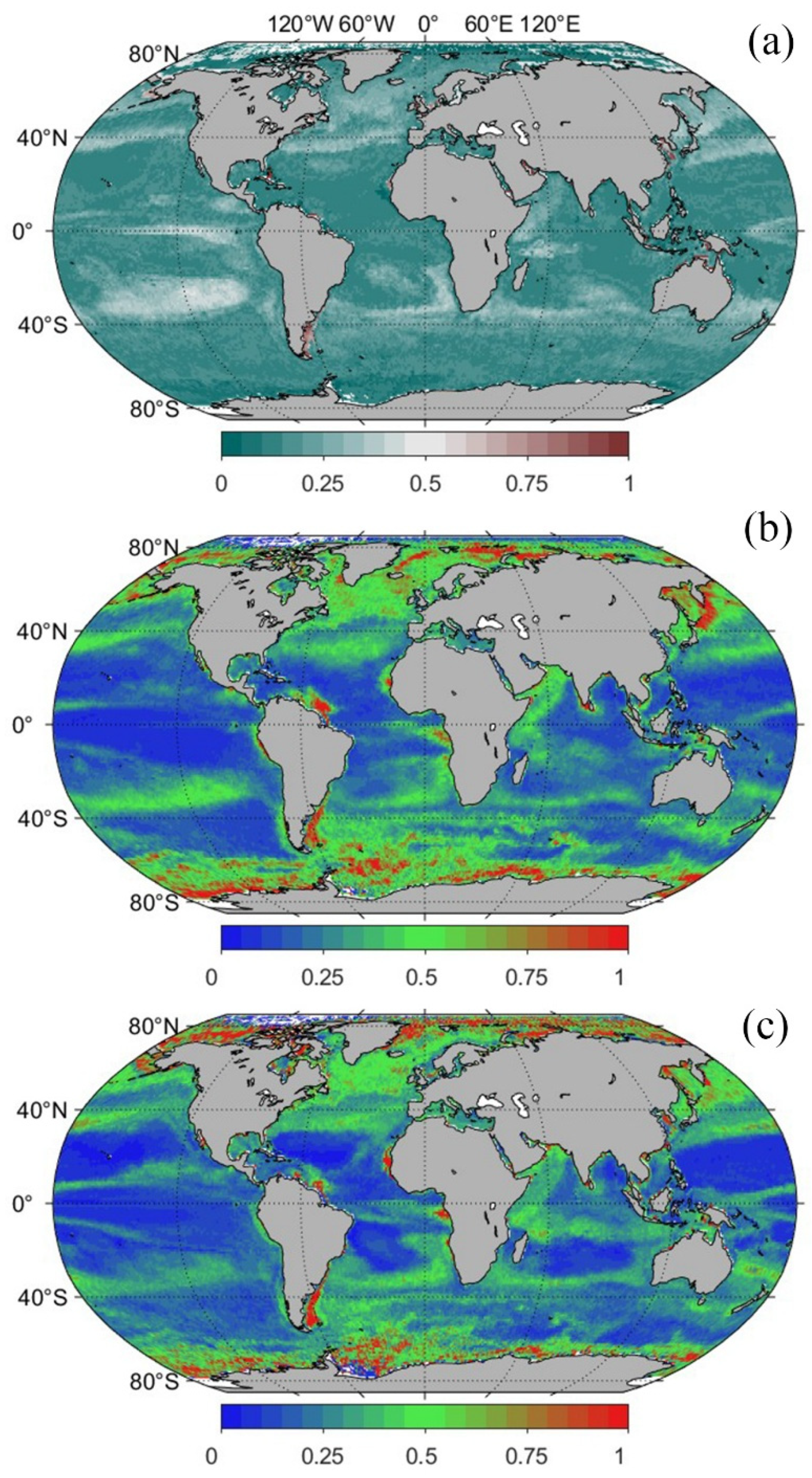
- Optical water type (OWT)-adaptive feature selection and machine learning (FS–ML) model pairings achieved high Chlorophyll-a retrieval accuracy (R2 up to 0.97 in oligotrophic waters and 0.91–0.92 in optically complex coastal waters), with minimal overfitting, successful transferability to independent MODIS and GlobColour datasets, and spatially consistent global Chlorophyll-a maps exhibiting reduced regional bias and lower relative uncertainty than standard GlobColour products.
- Importance-driven feature selection methods (i.e., BorutaShap and Random Forest) consistently identified compact, physically interpretable spectral predictors and, when coupled with OWT-specific machine learning models, provided the highest retrieval accuracy and robust performance across four OWTs.
- The proposed OWT-specific FS–ML framework provided a physically grounded, statistically robust, and operationally scalable approach for improving global Chlorophyll-a retrieval from multispectral ocean color observations, particularly in optically complex coastal and productive waters.
- This study demonstrates that integrating feature selection, spatially blocked validation, and OWT stratification improves the generalizability and cross-sensor applicability of machine learning models, supporting long-term ocean biogeochemical monitoring and climate-related applications.
Abstract
1. Introduction
2. Data
2.1. Global In Situ Dataset
2.2. Satellite Data
3. Methods
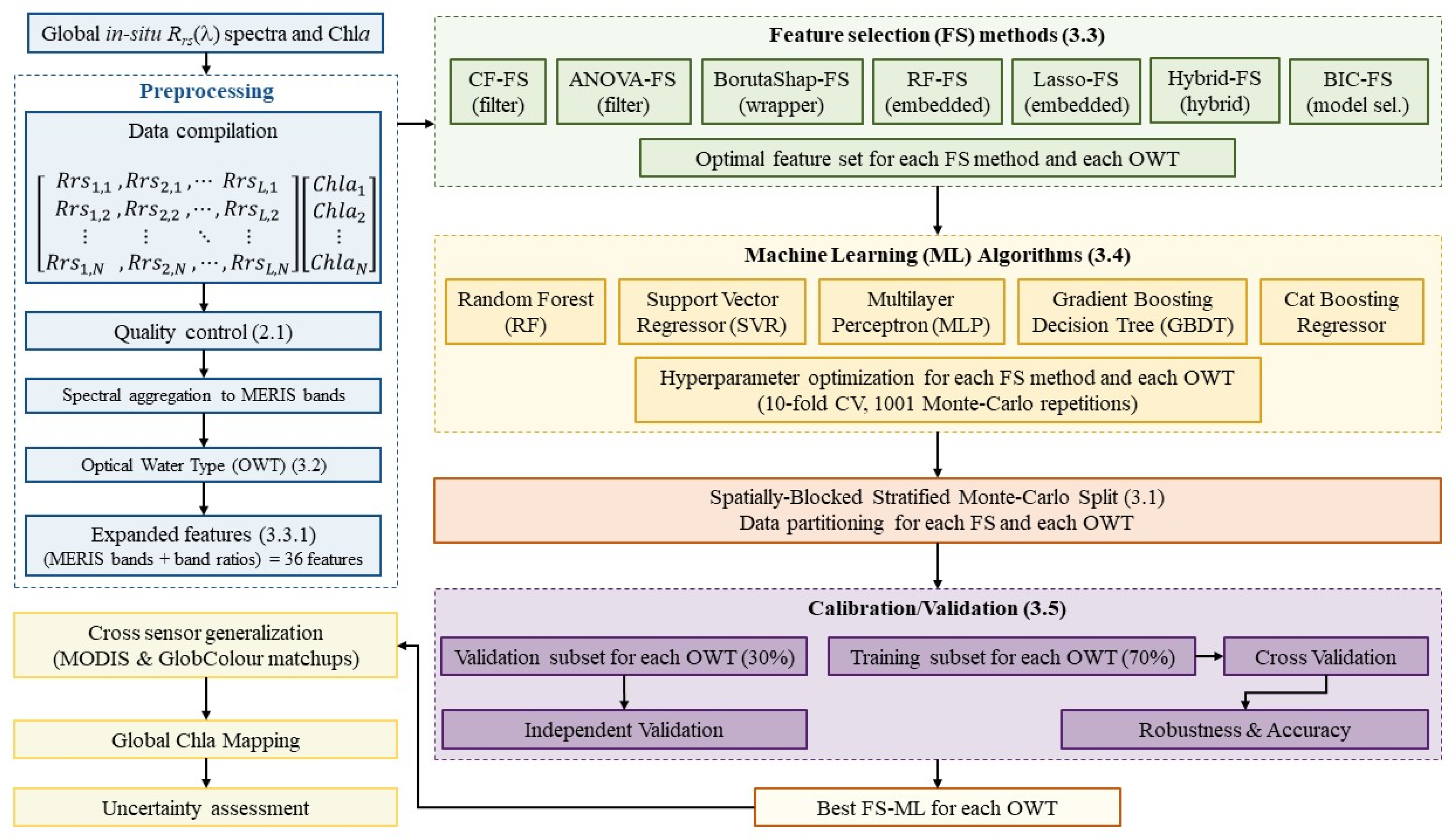
3.1. Data Partitioning
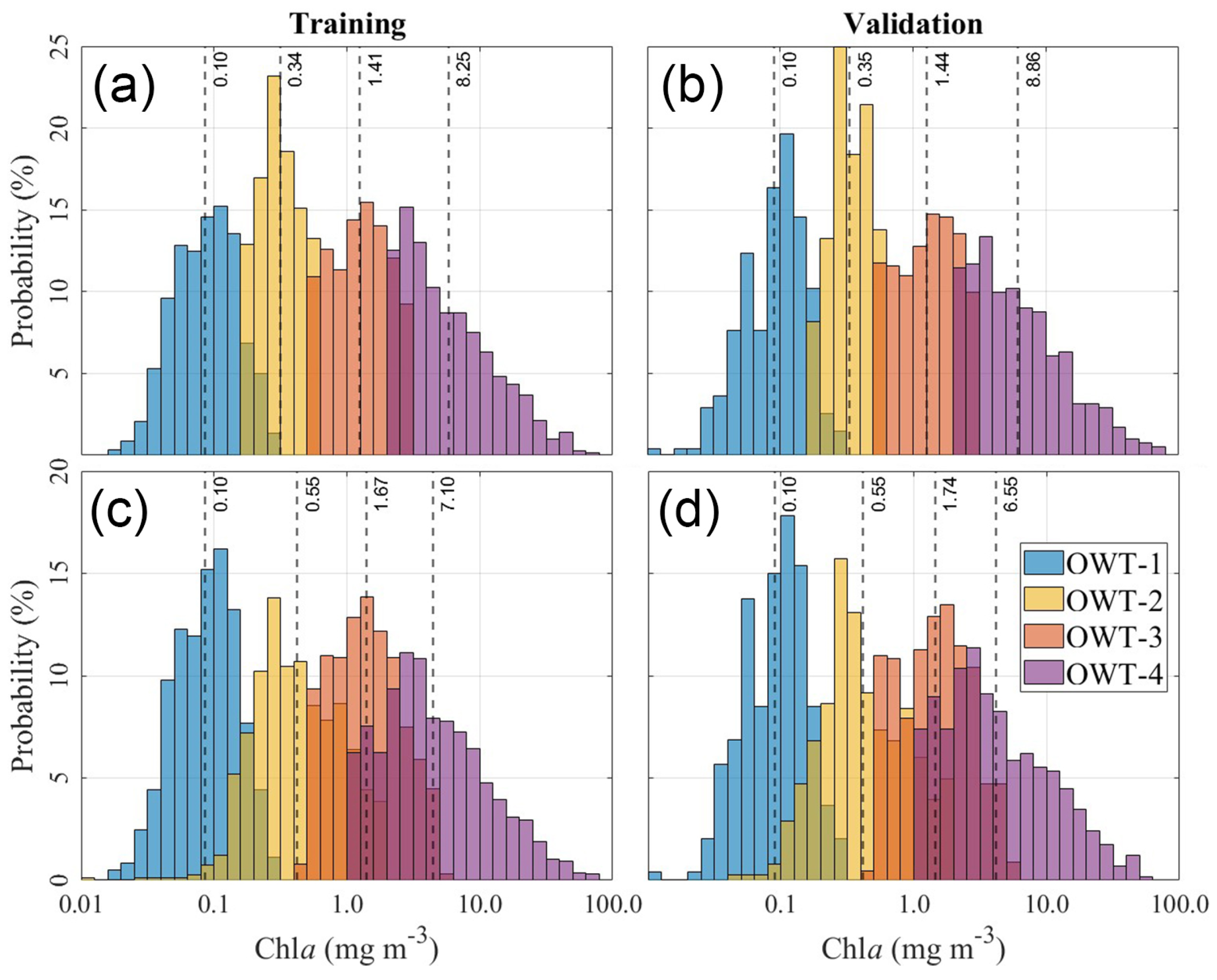
3.2. Optical Water Types
3.3. Feature Selection Methods
3.3.1. Feature Expansion
3.3.2. Feature Selection Methods

| FS Method | Type | Key Idea | Strengths | Limitations | Ref. |
|---|---|---|---|---|---|
| Combined-filter-FS | Filter | Removes noisy, low-variance, redundant, or zero-dominant Rrs features | Very fast; reduces obvious redundancy; simple to implement | Ignores relation with target; may remove informative features; less effective in nonlinear relationships | [33,68] |
| ANOVA-FS | Filter | Rank Rrs features using univariate F-statistics against Chla | Computationally efficient; useful for initial screening | Ignores feature interactions; prone to overfitting | [58,69] |
| BorutaShap-FS | Wrapper | Compare SHAP importance of Rrs bands to randomized shadow features in tree-based regression | Captures nonlinear relationships and interactions; robust selection; interpretable | Computationally intensive; requires tree-based ML model | [60,70] |
| Random Forest FS (RF-FS) | Embedded | Feature importance derived from out-of-bag error in Random Forest regression of Chla | Captures nonlinearities and interactions; minimal parameter tuning | May bias toward correlated features; threshold selection heuristic | [61,62] |
| Lasso-FS | Embedded | L1-regularized linear regression shrinks coefficients of less informative Rrs feature | Produces sparse, interpretable models; reduces overfitting; suitable for small samples | Assumes linear relationships; sensitive to multicollinearity | [63,64] |
| Hybrid-FS | Hybrid (Filter + Wrapper) | Correlation-based filter followed by RFECV with tree-based regressor | Balances computational efficiency and predictive performance; accounts for interactions; reduces redundancy | Computationally demanding; depends on chosen ML algorithm | [32,69] |
| BIC–FS | Model Selection/Criterion | Selects subset minimizing Bayesian Information Criterion | Promotes parsimonious models; reduces overfitting; suitable for small-sample hyperspectral regression | Does not perform feature selection by itself; assumes correct likelihood specification; may favor overly simple models | [65,66] |
3.3.3. Configuration of Feature Selection Methods
3.4. Machine Learning Algorithms
3.5. Model Evaluation
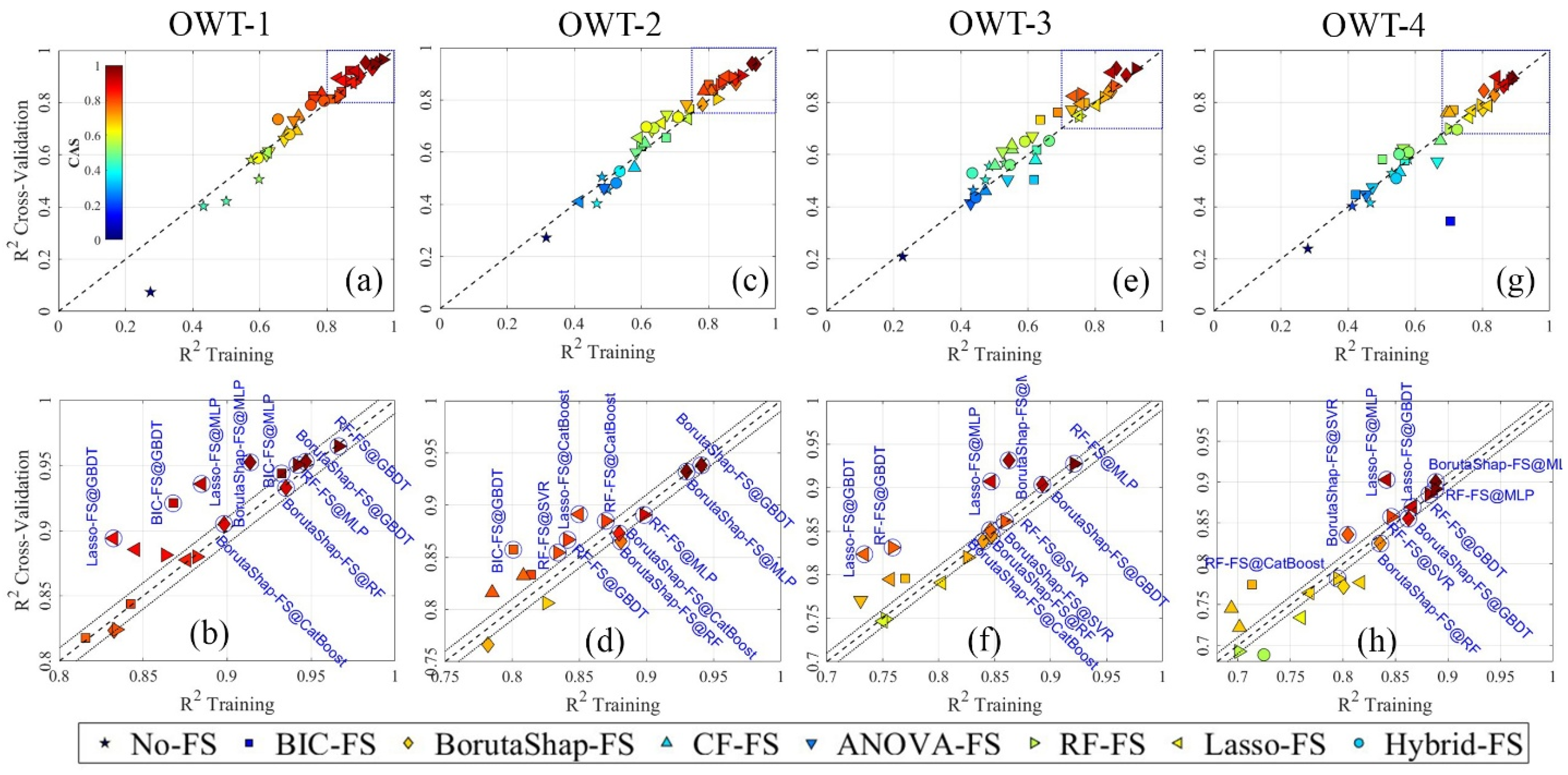
3.5.1. Cross-Validation
3.5.2. Robustness
3.5.3. Validation
3.6. Uncertainty Assessment
3.7. Evaluation Metrics
4. Results
4.1. Comparison of ‘Spatially Blocked Stratified Monte-Carlo Split’ with Conventional Random Data Partitioning
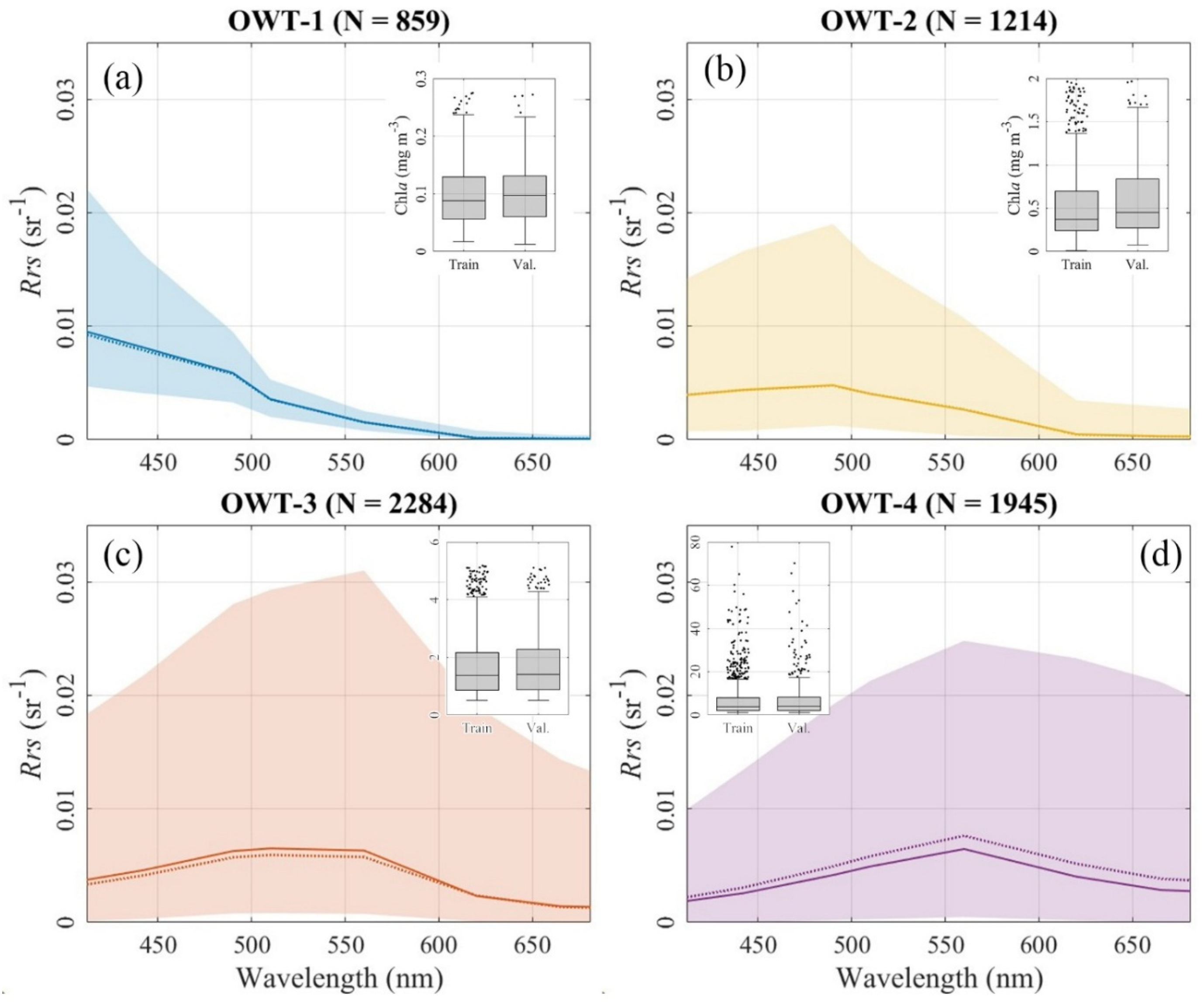
4.2. Characteristics of In Situ Data
4.3. Feature Selection
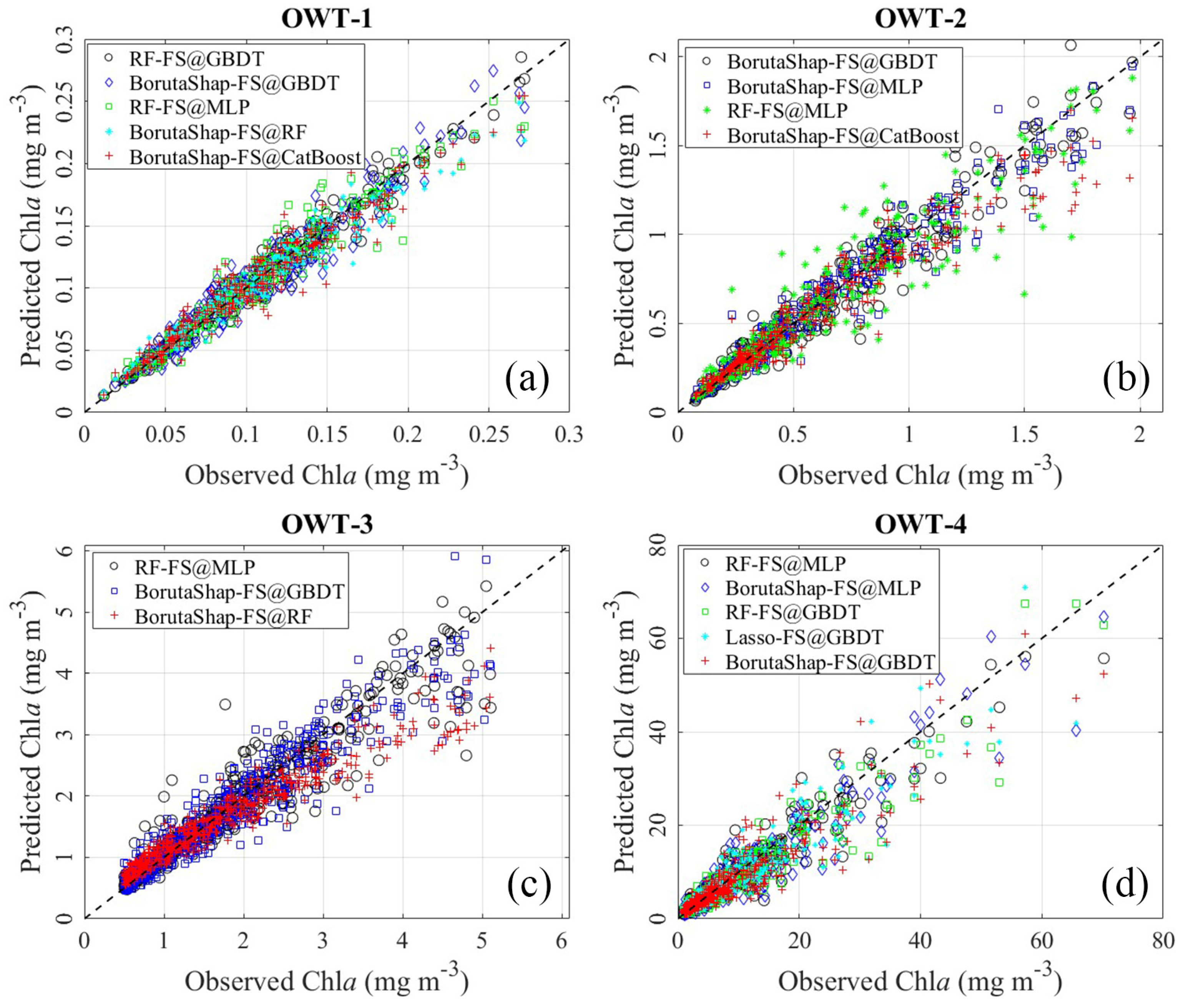
4.4. Cross-Validation Analysis
4.5. Robustness Analysis
4.6. Validation Analysis
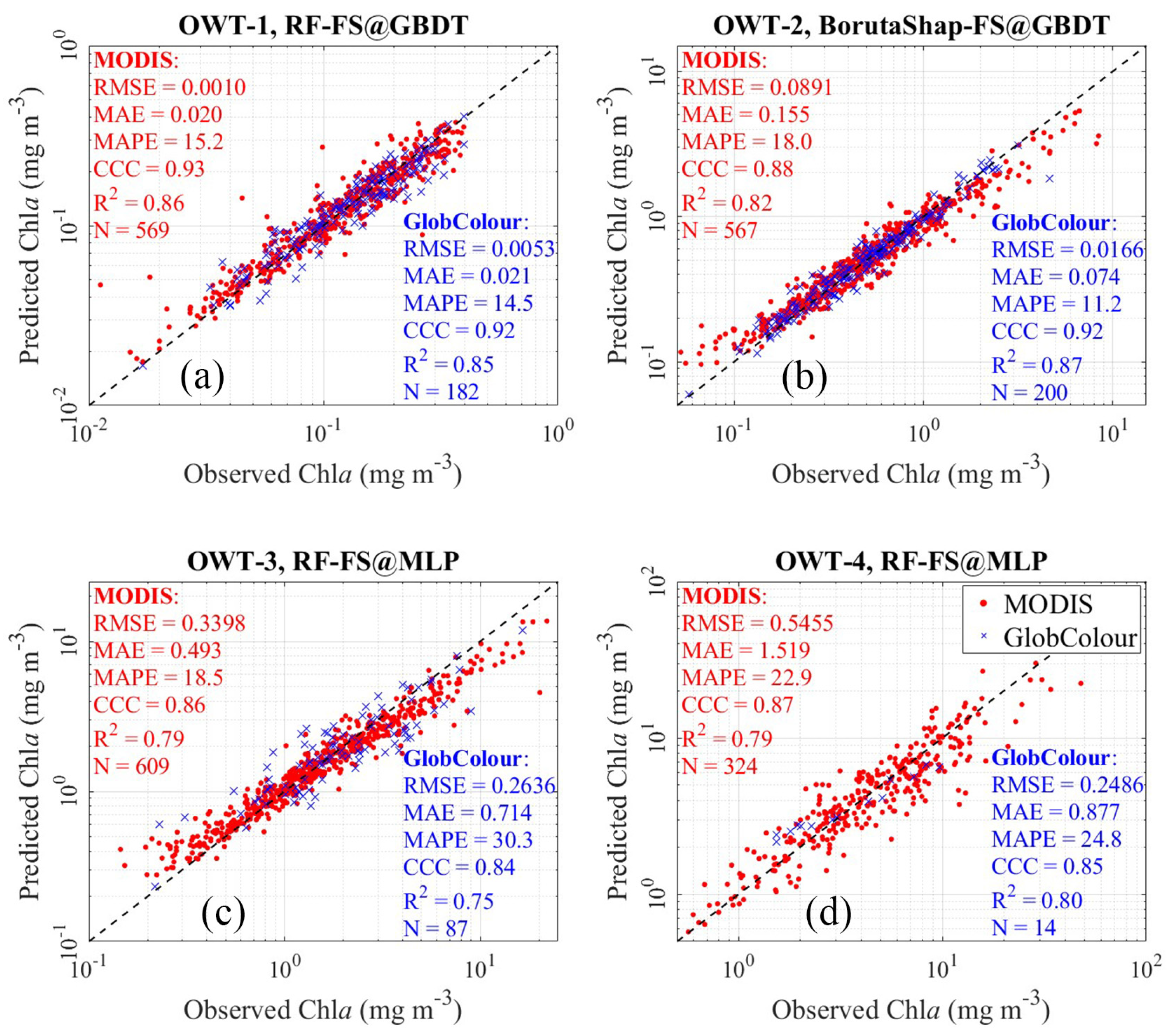
4.7. Cross-Sensor Generalizability of the FS-ML Models
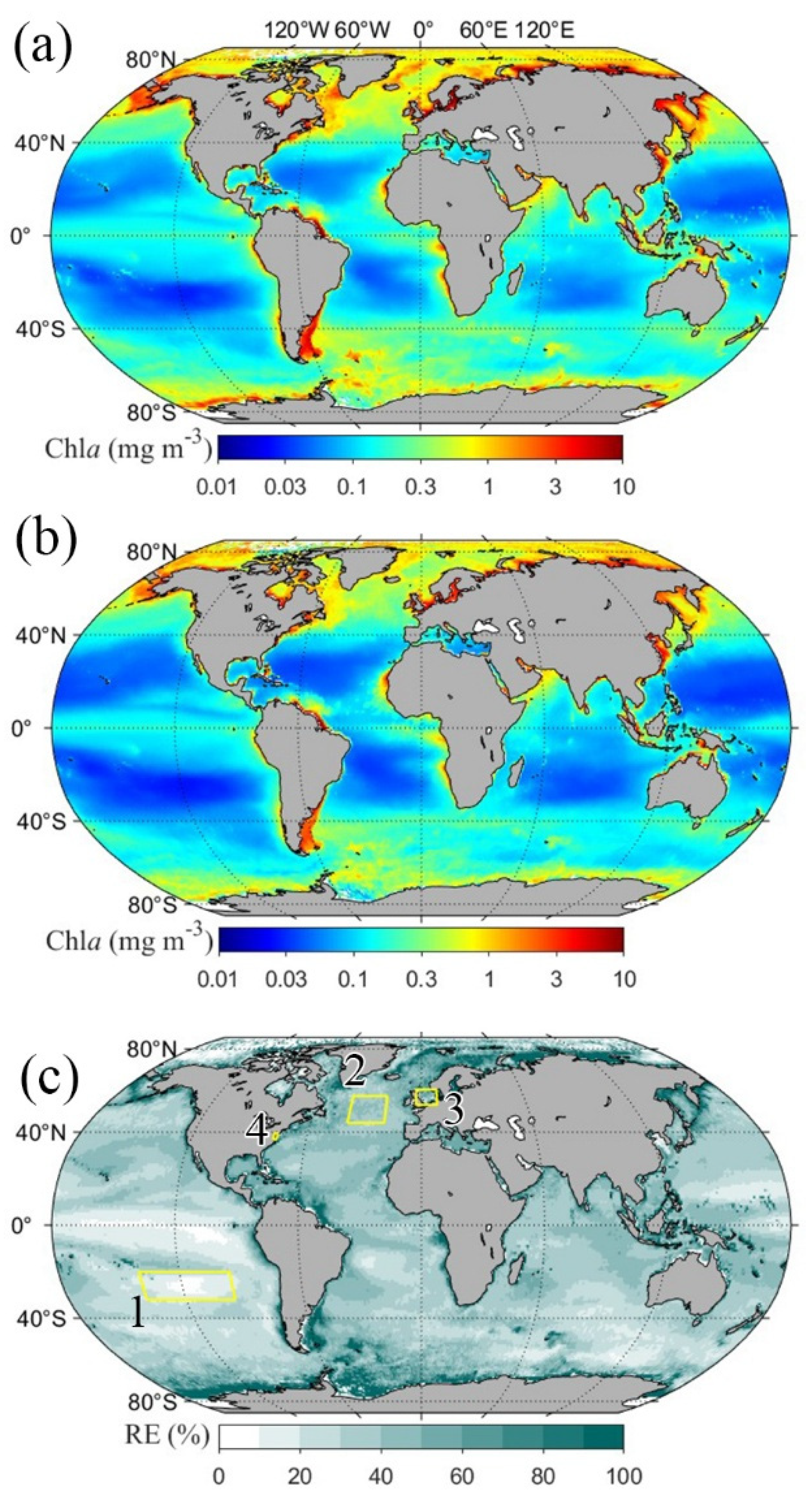
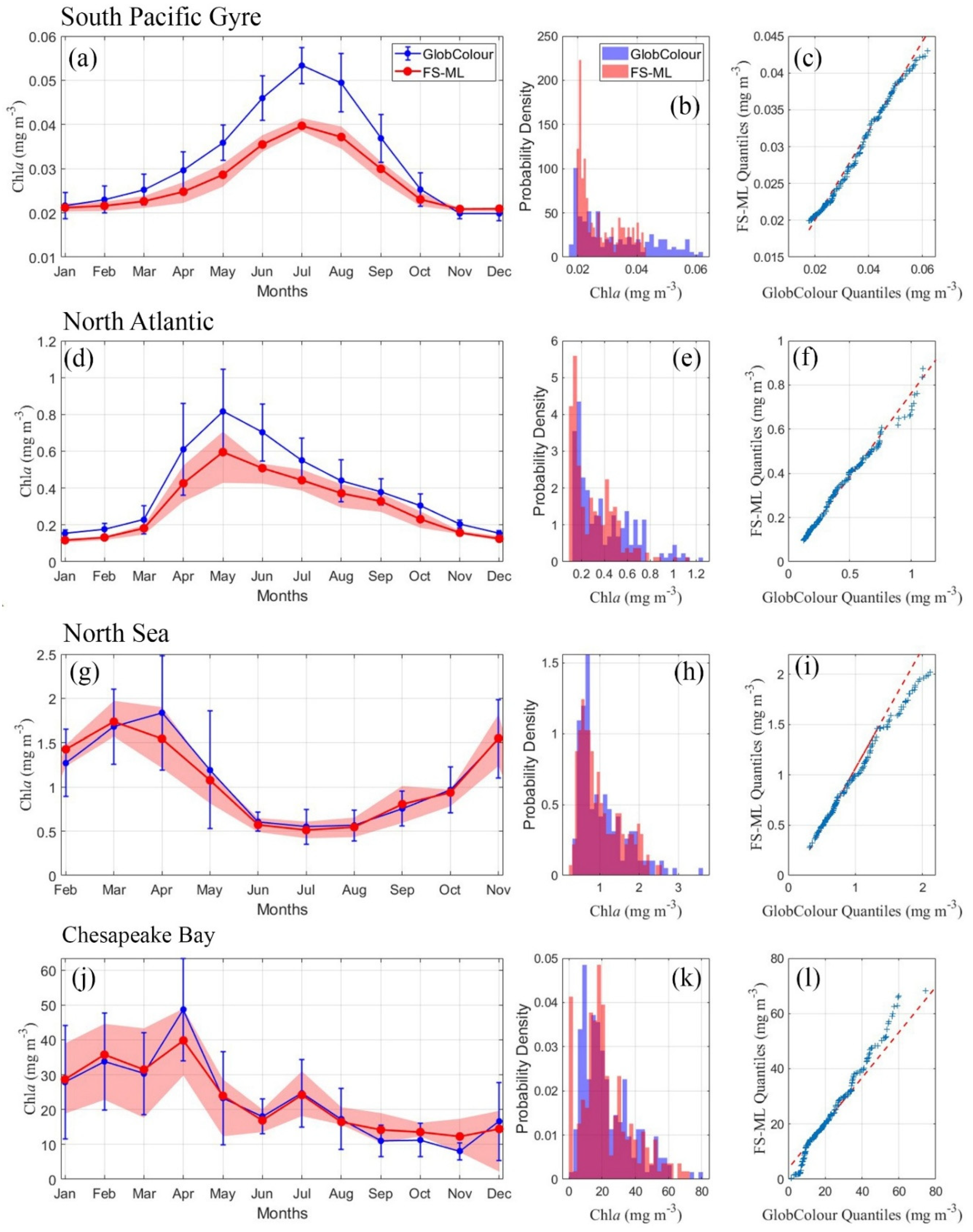
4.8. Spatial Mapping Capability of the FS-ML Models
4.9. Uncertainty Assessment of Satellite-Derived Chla
5. Discussion
5.1. OWT-Dependent Sensitivities
5.2. Importance of FS Methods in ML Algorithms for Chla Retrievals
5.3. Feature Selection Strategies
5.4. Optimal FS–ML Configuration
5.5. Cross-Sensor Transferability and Operational Applicability
6. Conclusions
Supplementary Materials
Author Contributions
Funding
Data Availability Statement
Acknowledgments
Conflicts of Interest
References
- Kolluru, S.; Tiwari, S.P. Modeling Ocean Surface Chlorophyll-a Concentration from Ocean Color Remote Sensing Reflectance in Global Waters Using Machine Learning. Sci. Total Environ. 2022, 844, 157191. [Google Scholar] [CrossRef] [Scilit] [PubMed]
- O’Reilly, J.E.; Werdell, P.J. Chlorophyll Algorithms for Ocean Color Sensors—OC4, OC5 & OC6. Remote Sens. Environ. 2019, 229, 32–47. [Google Scholar] [CrossRef] [Scilit] [PubMed]
- Bellacicco, M.; Cornec, M.; Organelli, E.; Brewin, R.J.W.; Neukermans, G.; Volpe, G.; Barbieux, M.; Poteau, A.; Schmechtig, C.; D’Ortenzio, F.; et al. Global Variability of Optical Backscattering by Non-algal Particles From a Biogeochemical-Argo Data Set. Geophys. Res. Lett. 2019, 46, 9767–9776. [Google Scholar] [CrossRef] [Scilit]
- Chang, C.-I.; Du, Q. Estimation of Number of Spectrally Distinct Signal Sources in Hyperspectral Imagery. IEEE Trans. Geosci. Remote Sens. 2004, 42, 608–619. [Google Scholar] [CrossRef] [Scilit]
- Dierssen, H.M.; Vandermeulen, R.A.; Barnes, B.B.; Castagna, A.; Knaeps, E.; Vanhellemont, Q. QWIP: A Quantitative Metric for Quality Control of Aquatic Reflectance Spectral Shape Using the Apparent Visible Wavelength. Front. Remote Sens. 2022, 3, 869611. [Google Scholar] [CrossRef] [Scilit]
- Liu, C.C.; Miller, R.L. Spectrum Matching Method for Estimating the Chlorophyll-a Concentration, CDOM Ratio, and Backscatter Fraction from Remote Sensing of Ocean Color. Can. J. Remote Sens. 2008, 34, 343–355. [Google Scholar] [CrossRef] [Scilit]
- Neil, C.; Spyrakos, E.; Hunter, P.D.; Tyler, A.N. A Global Approach for Chlorophyll-a Retrieval across Optically Complex Inland Waters Based on Optical Water Types. Remote Sens. Environ. 2019, 229, 159–178. [Google Scholar] [CrossRef] [Scilit]
- Pahlevan, N.; Smith, B.; Binding, C.; O’Donnell, D.M. Spectral Band Adjustments for Remote Sensing Reflectance Spectra in Coastal/Inland Waters. Opt. Express 2017, 25, 28650–28667. [Google Scholar] [CrossRef] [Scilit]
- Siegel, D.A.; Behrenfeld, M.J.; Maritorena, S.; McClain, C.R.; Antoine, D.; Bailey, S.W.; Bontempi, P.S.; Boss, E.S.; Dierssen, H.M.; Doney, S.C.; et al. Regional to Global Assessments of Phytoplankton Dynamics from the SeaWiFS Mission. Remote Sens. Environ. 2013, 135, 77–91. [Google Scholar] [CrossRef] [Scilit]
- Dall’Olmo, G.; Gitelson, A.A.; Rundquist, D.C.; Leavitt, B.; Barrow, T.; Holz, J.C. Assessing the Potential of SeaWiFS and MODIS for Estimating Chlorophyll Concentration in Turbid Productive Waters Using Red and Near-Infrared Bands. Remote Sens. Environ. 2005, 96, 176–187. [Google Scholar] [CrossRef] [Scilit]
- Duan, H.; Ma, R.; Zhang, Y.; Loiselle, S.A.; Xu, J.; Zhao, C.; Zhou, L.; Shang, L. A New Three-Band Algorithm for Estimating Chlorophyll Concentrations in Turbid Inlandlakes. Environ. Res. Lett. 2010, 5, 044009. [Google Scholar] [CrossRef] [Scilit]
- Duan, H.; Ma, R.; Xu, J.; Zhang, Y.; Zhang, B. Comparison of Different Semi-Empirical Algorithms to Estimate Chlorophyll-a Concentration in Inland Lake Water. Environ. Monit. Assess. 2010, 170, 231–244. [Google Scholar] [CrossRef] [Scilit] [PubMed]
- Hu, C.; Lee, Z.; Franz, B. Chlorophyll a Algorithms for Oligotrophic Oceans: A Novel Approach Based on Three-Band Reflectance Difference. J. Geophys. Res. Ocean. 2012, 117, 1011. [Google Scholar] [CrossRef] [Scilit]
- Qin, T.; Liang, T.; Fan, D.; He, H.; Lan, G.; Fu, B. A Novel Hybrid Machine Learning Approach for Accurate Retrieval of Ocean Surface Chlorophyll-a across Oligotrophic to Eutrophic Waters. Environ. Res. 2025, 279, 121864. [Google Scholar] [CrossRef] [Scilit] [PubMed]
- Chen, S.; Hu, C.; Barnes, B.B.; Xie, Y.; Lin, G.; Qiu, Z. Improving Ocean Color Data Coverage through Machine Learning. Remote Sens. Environ. 2019, 222, 286–302. [Google Scholar] [CrossRef] [Scilit]
- Kwon, Y.S.; Baek, S.H.; Lim, Y.K.; Pyo, J.; Ligaray, M.; Park, Y.; Cho, K.H. Monitoring Coastal Chlorophyll-a Concentrations in Coastal Areas Using Machine Learning Models. Water 2018, 10, 1020. [Google Scholar] [CrossRef] [Scilit]
- Mobley, C.D. Estimation of the Remote-Sensing Reflectance from above-Surface Measurements. Appl. Opt. 1999, 38, 7442–7455. [Google Scholar] [CrossRef] [Scilit] [PubMed]
- Pahlevan, N.; Smith, B.; Schalles, J.; Binding, C.; Cao, Z.; Ma, R.; Alikas, K.; Kangro, K.; Gurlin, D.; Hà, N. Seamless Retrievals of Chlorophyll-a from Sentinel-2 (MSI) and Sentinel-3 (OLCI) in Inland and Coastal Waters: A Machine-Learning Approach. Remote Sens. Environ. 2020, 240, 111604. [Google Scholar] [CrossRef] [Scilit]
- Smith, M.E.; Robertson Lain, L.; Bernard, S. An Optimized Chlorophyll a Switching Algorithm for MERIS and OLCI in Phytoplankton-Dominated Waters. Remote Sens. Environ. 2018, 215, 217–227. [Google Scholar] [CrossRef] [Scilit]
- Tran, M.D.; Vantrepotte, V.; El Hourany, R.; Jorge, D.S.F.; Kampel, M.; Cardoso Dos Santos, J.F.; Oliveira, E.N.; Paranhos, R.; Jamet, C. Combination of Neural Network Models for Estimating Chlorophyll-a over Turbid and Clear Waters (CONNECT). Front. Remote Sens. 2025, 6, 1570827. [Google Scholar] [CrossRef] [Scilit]
- Moore, T.S.; Dowell, M.D.; Bradt, S.; Verdu, A.R. An Optical Water Type Framework for Selecting and Blending Retrievals from Bio-Optical Algorithms in Lakes and Coastal Waters. Remote Sens. Envrion. 2014, 143, 97–111. [Google Scholar] [CrossRef] [Scilit] [PubMed]
- Hieronymi, M.; Müller, D.; Doerffer, R. The OLCI Neural Network Swarm (ONNS): A Bio-Geo-Optical Algorithm for Open Ocean and Coastal Waters. Front. Mar. Sci. 2017, 4, 140. [Google Scholar] [CrossRef] [Scilit]
- Li, T.; Sun, G.; Yang, C.; Liang, K.; Ma, S.; Huang, L. Using Self-Organizing Map for Coastal Water Quality Classification: Towards a Better Understanding of Patterns and Processes. Sci. Total Environ. 2018, 628–629, 1446–1459. [Google Scholar] [CrossRef] [Scilit] [PubMed]
- Kanungo, T.; Mount, D.M.; Netanyahu, N.S.; Piatko, C.D.; Silverman, R.; Wu, A.Y. An Efficient K-Means Clustering Algorithms: Analysis and Implementation. IEEE Trans. Pattern Anal. Mach. Intell. 2002, 24, 881–892. [Google Scholar] [CrossRef] [Scilit]
- Xi, H.; Losa, S.N.; Mangin, A.; Soppa, M.A.; Garnesson, P.; Demaria, J.; Liu, Y.; d’Andon, O.H.F.; Bracher, A. Global Retrieval of Phytoplankton Functional Types Based on Empirical Orthogonal Functions Using CMEMS GlobColour Merged Products and Further Extension to OLCI Data. Remote Sens. Environ. 2020, 240, 111704. [Google Scholar] [CrossRef] [Scilit]
- Liu, X.; Yang, C. A Kernel Spectral Angle Mapper Algorithm for Remote Sensing Image Classification. In Proceedings of the 2013 6th International Congress on Image and Signal Processing (CISP); IEEE: Piscataway, NJ, USA, 2013; Volume 2, pp. 814–818. [Google Scholar]
- Vantrepotte, V.; Loisel, H.; Dessailly, D.; Mériaux, X. Optical Classification of Contrasted Coastal Waters. Remote Sens. Environ. 2012, 123, 306–323. [Google Scholar] [CrossRef] [Scilit]
- Barbosa, C.C.F. A Machine Learning Approach for Monitoring Brazilian Optical Water Types Using Sentinel-2 MSI. Available online: http://www.dpi.inpe.br/labisa/en/publication/freire-rem-sens-2021/ (accessed on 4 July 2026).
- Wei, J.; Lee, Z.; Shang, S. A System to Measure the Data Quality of Spectral Remote-Sensing Reflectance of Aquatic Environments. J. Geophys. Res. Ocean. 2016, 121, 8189–8207. [Google Scholar] [CrossRef] [Scilit]
- Hawkins, D.M. The Problem of Overfitting. J. Chem. Inf. Comput. Sci. 2004, 44, 1–12. [Google Scholar] [CrossRef] [Scilit] [PubMed]
- Karl, F.; Pielok, T.; Moosbauer, J.; Pfisterer, F.; Coors, S.; Binder, M.; Schneider, L.; Thomas, J.; Richter, J.; Lang, M.; et al. Multi-Objective Hyperparameter Optimization in Machine Learning—An Overview. ACM Trans. Evol. Learn. Optim. 2023, 3, 1–50. [Google Scholar] [CrossRef] [Scilit]
- Chandrashekar, G.; Sahin, F. A Survey on Feature Selection Methods. Comput. Electr. Eng. 2014, 40, 16–28. [Google Scholar] [CrossRef] [Scilit]
- Guyon, I.; Elisseeff, A. An Introduction to Variable and Feature Selection. J. Mach. Learn. Res. 2003, 3, 1157–1182. [Google Scholar]
- Bolón-Canedo, V.; Alonso-Betanzos, A. Ensembles for Feature Selection: A Review and Future Trends. Inf. Fusion 2019, 52, 1–12. [Google Scholar] [CrossRef] [Scilit]
- Cui, Y.; Xie, T.; Li, J.; Zhang, X.; Bai, S.; Wang, C.; Liu, H. A Chlorophyll Concentration Inversion Method Based on OWTs and 1D CNN-Transformer Feature Extraction. IEEE J. Sel. Top. Appl. Earth Obs. Remote Sens. 2025, 19, 2006–2032. [Google Scholar] [CrossRef] [Scilit]
- Merder, J.; Zhao, G.; Pahlevan, N.; Rigby, R.A.; Stasinopoulos, D.M.; Michalak, A.M. A Novel Algorithm for Ocean Chlorophyll-a Concentration Using MODIS Aqua Data. ISPRS J. Photogramm. Remote Sens. 2024, 210, 198–211. [Google Scholar] [CrossRef] [Scilit]
- Hafeez, S.; Wong, M.S.; Ho, H.C.; Nazeer, M.; Nichol, J.; Abbas, S.; Tang, D.; Lee, K.H.; Pun, L. Comparison of Machine Learning Algorithms for Retrieval of Water Quality Indicators in Case-II Waters: A Case Study of Hong Kong. Remote Sens. 2019, 11, 617. [Google Scholar] [CrossRef] [Scilit]
- Zhang, L.; Zhang, C.; Ma, C.; Chen, X.; Li, Q.; Ye, X.; Yu, Z.; Tian, L. Machine Learning-Based Retrieval of Chlorophyll-a and Total Suspended Matter from HY-3A CZI: Model Development, Validation, and Application. ISPRS J. Photogramm. Remote Sens. 2025, 227, 613–631. [Google Scholar] [CrossRef] [Scilit]
- Kim, Y.W.; Kim, T.; Shin, J.; Lee, D.-S.; Park, Y.-S.; Kim, Y.; Cha, Y. Validity Evaluation of a Machine-Learning Model for Chlorophyll a Retrieval Using Sentinel-2 from Inland and Coastal Waters. Ecol. Indic. 2022, 137, 108737. [Google Scholar] [CrossRef] [Scilit]
- Liu, T.; Yu, G.; Kwok, H.Y.; Xue, R.; He, D.; Liang, W. Enhancing Tree-Based Machine Learning for Chlorophyll-a Prediction in Coastal Seawater through Spatiotemporal Feature Integration. Mar. Environ. Res. 2025, 209, 107170. [Google Scholar] [CrossRef] [Scilit] [PubMed]
- Valente, A.; Sathyendranath, S.; Brotas, V.; Groom, S.; Grant, M.; Jackson, T.; Chuprin, A.; Taberner, M.; Airs, R.; Antoine, D.; et al. A Compilation of Global Bio-Optical in Situ Data for Ocean-Colour Satellite Applications–Version Three. Earth Syst. Sci. Data Discuss. 2022, 14, 5737–5770. [Google Scholar] [CrossRef] [Scilit]
- Moradi, M.; Arabi, B.; Hommersom, A.; van der Molen, J.; Samimi, C. Quality Control Tests for Automated Above-Water Hyperspectral Measurements: Radiative Transfer Assessment. ISPRS J. Photogramm. Remote Sens. 2024, 215, 292–312. [Google Scholar] [CrossRef] [Scilit]
- Gleratti, G.; Martinez-Vicente, V.; Atwood, E.C.; Simis, S.G.H.; Jackson, T. Validation of Full Resolution Remote Sensing Reflectance from Sentinel-3 OLCI across Optical Gradients in Moderately Turbid Transitional Waters. Front. Remote Sens. 2024, 5, 1359709. [Google Scholar] [CrossRef] [Scilit]
- Lehmann, M.K.; Gurlin, D.; Pahlevan, N.; Alikas, K.; Conroy, T.; Anstee, J.; Balasubramanian, S.V.; Barbosa, C.C.; Binding, C.; Bracher, A. GLORIA-A Globally Representative Hyperspectral in Situ Dataset for Optical Sensing of Water Quality. Sci. Data 2023, 10, 100. [Google Scholar] [CrossRef] [Scilit] [PubMed]
- Hadjal, M.; Medina-Lopez, E.; Ren, J.; Gallego, A.; McKee, D. An Artificial Neural Network Algorithm to Retrieve Chlorophyll a for Northwest European Shelf Seas from Top of Atmosphere Ocean Colour Reflectance. Remote Sens. 2022, 14, 3353. [Google Scholar] [CrossRef] [Scilit]
- Zibordi, G.; Berthon, J.-F. Coastal Atmosphere and Sea Time Series (CoASTS) and Bio-Optical Mapping of Marine Properties (BiOMaP): The CoASTS-BiOMaP Dataset. Earth Syst. Sci. Data 2024, 16, 5477–5502. [Google Scholar] [CrossRef] [Scilit]
- Maciel, D.A.; Barbosa, C.C.F.; de Moraes Novo, E.M.L.; do Nascimento Wanderley, R.L.; Bacellar, P.; Baia, L.B.; Bernini, H.; Chasles, R.G.; Ciotti, A.; Fassoni-Andrade, A.; et al. A Bio-Optical Database for the Remote Sensing of Water Quality in BRAZil coA s Tal and Inland Waters (BRAZA). Sci. Data 2025, 12, 1270. [Google Scholar] [CrossRef] [Scilit] [PubMed]
- Maciel, D.A.; Pahlevan, N.; Barbosa, C.C.; Martins, V.S.; Smith, B.; O’Shea, R.E.; Balasubramanian, S.V.; Saranathan, A.M.; Novo, E.M. Towards Global Long-Term Water Transparency Products from the Landsat Archive. Remote Sens. Environ. 2023, 299, 113889. [Google Scholar] [CrossRef] [Scilit]
- Maritorena, S.; D’Andon, O.H.F.; Mangin, A.; Siegel, D.A. Merged Satellite Ocean Color Data Products Using a Bio-Optical Model: Characteristics, Benefits and Issues. Remote Sens. Environ. 2010, 114, 1791–1804. [Google Scholar] [CrossRef] [Scilit]
- Doerffer, R.; Schiller, H. The MERIS Case 2 Water Algorithm. Int. J. Remote Sens. 2007, 28, 517–535. [Google Scholar] [CrossRef] [Scilit]
- Mélin, F.; Sclep, G. Band Shifting for Ocean Color Multi-Spectral Reflectance Data. Opt. Express 2015, 23, 2262–2279. [Google Scholar] [CrossRef] [Scilit] [PubMed]
- Roberts, D.R.; Bahn, V.; Ciuti, S.; Boyce, M.S.; Elith, J.; Guillera-Arroita, G.; Hauenstein, S.; Lahoz-Monfort, J.J.; Schröder, B.; Thuiller, W.; et al. Cross-validation Strategies for Data with Temporal, Spatial, Hierarchical, or Phylogenetic Structure. Ecography 2017, 40, 913–929. [Google Scholar] [CrossRef] [Scilit]
- Valavi, R.; Elith, J.; Lahoz-Monfort, J.J.; Guillera-Arroita, G. blockCV: An r Package for Generating Spatially or Environmentally Separated Folds for k-Fold Cross-Validation of Species Distribution Models. Methods Ecol. Evol. 2018, 10, 225–232. [Google Scholar] [CrossRef] [Scilit]
- Meyer, H.; Reudenbach, C.; Wöllauer, S.; Nauss, T. Importance of Spatial Predictor Variable Selection in Machine Learning Applications–Moving from Data Reproduction to Spatial Prediction. Ecol. Model. 2019, 411, 108815. [Google Scholar] [CrossRef] [Scilit]
- Mushagalusa, C.A.; Fandohan, A.B.; Glèlè Kakaï, R. Random Forest and Spatial Cross-Validation Performance in Predicting Species Abundance Distributions. Environ. Syst. Res. 2024, 13, 23. [Google Scholar] [CrossRef] [Scilit]
- Jackson, T.; Sathyendranath, S.; Mélin, F. An Improved Optical Classification Scheme for the Ocean Colour Essential Climate Variable and Its Applications. Remote Sens. Environ. 2017, 203, 152–161. [Google Scholar] [CrossRef] [Scilit]
- Ferhatoglu, C.; Miller, B.A. Choosing Feature Selection Methods for Spatial Modeling of Soil Fertility Properties at the Field Scale. In Proceedings of the 30th International Conference on Advances in Geographic Information Systems, Seattle, WA, USA, 1–4 November 2022; ACM: New York, NY, USA, 2022; pp. 1–2. [Google Scholar]
- Hall, M.A.; Holmes, G. Benchmarking Attribute Selection Techniques for Discrete Class Data Mining. IEEE Trans. Knowl. Data Eng. 2003, 15, 1437–1447. [Google Scholar] [CrossRef] [Scilit]
- Saeys, Y.; Inza, I.; Larranaga, P. A Review of Feature Selection Techniques in Bioinformatics. Bioinformatics 2007, 23, 2507–2517. [Google Scholar] [CrossRef] [Scilit] [PubMed]
- Kursa, M.B.; Rudnicki, W.R. Feature Selection with the Boruta Package. J. Stat. Softw. 2010, 36, 1–13. [Google Scholar] [CrossRef] [Scilit]
- Strobl, C.; Boulesteix, A.-L.; Zeileis, A.; Hothorn, T. Bias in Random Forest Variable Importance Measures: Illustrations, Sources and a Solution. BMC Bioinform. 2007, 8, 25. [Google Scholar] [CrossRef] [Scilit] [PubMed]
- Breiman, L. Random Forests. Mach. Learn. 2001, 45, 5–32. [Google Scholar] [CrossRef] [Scilit]
- Tibshirani, R. Regression Shrinkage and Selection via the Lasso. J. R. Stat. Soc. Ser. B Stat. Methodol. 1996, 58, 267–288. [Google Scholar] [CrossRef] [Scilit]
- Zou, H.; Hastie, T. Regularization and Variable Selection via the Elastic Net. J. R. Stat. Soc. Ser. B Stat. Methodol. 2005, 67, 301–320. [Google Scholar] [CrossRef] [Scilit]
- Schwarz, G. Estimating the Dimension of a Model. Ann. Stat. 1978, 6, 461–464. [Google Scholar] [CrossRef] [Scilit]
- Burnham, K.P.; Anderson, D.R. Multimodel Inference: Understanding AIC and BIC in Model Selection. Sociol. Methods Res. 2004, 33, 261–304. [Google Scholar] [CrossRef] [Scilit]
- Das, J.; Harvey, J.; Py, F.; Vathsangam, H.; Graham, R.; Rajan, K.; Sukhatme, G.S. Multistage Bayesian Regression for Adaptive Sampling of Marine Phenomena. In Proceedings of the Workshop on Environmental Sensing, Robotics Science and Systems, Sydney, Australia, 9–13 July 2012. [Google Scholar]
- Kuhn, M.; Johnson, K. Applied Predictive Modeling; Springer: New York, NY, USA, 2013. [Google Scholar]
- Sayer, A.M.; Munchak, L.A.; Hsu, N.C.; Levy, R.C.; Bettenhausen, C.; Jeong, M.-J. MODIS Collection 6 Aerosol Products: Comparison between Aqua’s e-Deep Blue, Dark Target, and “Merged” Data Sets, and Usage Recommendations. J. Geophys. Res. Atmos. 2014, 119, 13–965. [Google Scholar] [CrossRef] [Scilit]
- Lundberg, S.M.; Erion, G.G.; Lee, S.-I. Consistent Individualized Feature Attribution for Tree Ensembles. arXiv 2019, arXiv:1802.03888. [Google Scholar]
- Pedregosa, F.; Varoquaux, G.; Gramfort, A.; Michel, V.; Thirion, B.; Grisel, O.; Blondel, M.; Prettenhofer, P.; Weiss, R.; Dubourg, V.; et al. Scikit-Learn: Machine Learning in Python. J. Mach. Learn. Res. 2011, 12, 2825–2830. [Google Scholar]
- Efron, B. Bootstrap Methods: Another Look at the Jackknife. In Breakthroughs in Statistics; Springer: Berlin/Heidelberg, Germany, 1992; pp. 569–593. [Google Scholar]
- Sinha, B.; Shah, A.; Xu, D.; Lin, J.; Park, J. Bootstrap Procedures for Testing Homogeneity Hypotheses. Citeseer 2012, 11, 183–195. [Google Scholar]
- Cheng, Y.; Bhoot, V.N.; Kumbier, K.; Sison-Mangus, M.P.; Brown, J.B.; Kudela, R.; Newcomer, M.E. A Novel Random Forest Approach to Revealing Interactions and Controls on Chlorophyll Concentration and Bacterial Communities during Coastal Phytoplankton Blooms. Sci. Rep. 2021, 11, 19944. [Google Scholar] [CrossRef] [Scilit] [PubMed]
- Smola, A.J.; Schölkopf, B. A Tutorial on Support Vector Regression. Stat. Comput. 2004, 14, 199–222. [Google Scholar] [CrossRef] [Scilit]
- Rumelhart, D.E.; Hinton, G.E.; Williams, R.J. Learning Representations by Back-Propagating Errors. Nature 1986, 323, 533–536. [Google Scholar] [CrossRef] [Scilit]
- Friedman, J.H. Greedy Function Approximation: A Gradient Boosting Machine. Ann. Stat. 2001, 29, 1189–1232. [Google Scholar] [CrossRef] [Scilit]
- Yao, H.; Huang, Y.; Wei, Y.; Zhong, W.; Wen, K. Retrieval of Chlorophyll-a Concentrations in the Coastal Waters of the Beibu Gulf in Guangxi Using a Gradient-Boosting Decision Tree Model. Appl. Sci. 2021, 11, 7855. [Google Scholar] [CrossRef] [Scilit]
- Prokhorenkova, L.; Gusev, G.; Vorobev, A.; Dorogush, A.V.; Gulin, A. CatBoost: Unbiased Boosting with Categorical Features. Adv. Neural Inf. Process. Syst. 2018, 31, 6639–6649. [Google Scholar]
- Chen, B.; Chen, Y.; Chen, H. An Interpretable CatBoost Model Guided by Spectral Morphological Features for the Inversion of Coastal Water Quality Parameters. Water 2024, 16, 3615. [Google Scholar] [CrossRef] [Scilit]
- Akiba, T.; Sano, S.; Yanase, T.; Ohta, T.; Koyama, M. Optuna: A next-Generation Hyperparameter Optimization Framework. In Proceedings of the 25th ACM SIGKDD International Conference On Knowledge Discovery & Data Mining, Anchorage, AK, USA, 4–8 August 2019; pp. 2623–2631. [Google Scholar]
- Kelcey, B. Covariate Selection in Propensity Scores Using Outcome Proxies. Multivar. Behav. Res. 2011, 46, 453–476. [Google Scholar] [CrossRef] [Scilit]
- Arlot, S.; Celisse, A. A Survey of Cross-Validation Procedures for Model Selection. Stat. Surv. 2010, 4, 40–79. [Google Scholar] [CrossRef] [Scilit]
- Yates, L.A.; Aandahl, Z.; Richards, S.A.; Brook, B.W. Cross Validation for Model Selection: A Review with Examples from Ecology. Ecol. Monogr. 2023, 93, e1557. [Google Scholar] [CrossRef] [Scilit]
- Meinshausen, N.; Bühlmann, P. Stability Selection. J. R. Stat. Soc. Ser. B Stat. Methodol. 2010, 72, 417–473. [Google Scholar] [CrossRef] [Scilit]
- Hastie, T.; Tibshirani, R.; Friedman, J. The Elements of Statistical Learning; Springer: Berlin/Heidelberg, Germany, 2009. [Google Scholar]
- Shabbir, J. An Introduction to Statistical Learning with Applications in R. Stat. Theory Relat. Fields 2021, 6, 87. [Google Scholar] [CrossRef] [Scilit]
- Lawrence, I.; Lin, K. A Concordance Correlation Coefficient to Evaluate Reproducibility. Biometrics 1989, 45, 255–268. [Google Scholar] [CrossRef] [Scilit]
- Chai, T.; Draxler, R.R. Root Mean Square Error (RMSE) or Mean Absolute Error (MAE)?—Arguments against Avoiding RMSE in the Literature. Geosci. Model Dev. 2014, 7, 1247–1250. [Google Scholar] [CrossRef] [Scilit]
- Robert, C. Machine Learning, a Probabilistic Perspective. CHANCE 2014, 27, 62–63. [Google Scholar] [CrossRef] [Scilit]
- Cianca, A.; Helmke, P.; Mouriño, B.; Rueda, M.J.; Llinás, O.; Neuer, S. Decadal Analysis of Hydrography and in Situ Nutrient Budgets in the Western and Eastern North Atlantic Subtropical Gyre. J. Geophys. Res. Ocean. 2007, 112, C07025. [Google Scholar] [CrossRef] [Scilit]
- McClain, C.R. A Decade of Satellite Ocean Color Observations. Annu. Rev. Mar. Sci. 2009, 1, 19–42. [Google Scholar] [CrossRef] [Scilit] [PubMed]
- Volpe, G.; Colella, S.; Brando, V.E.; Forneris, V.; La Padula, F.; Di Cicco, A.; Sammartino, M.; Bracaglia, M.; Artuso, F.; Santoleri, R. Mediterranean Ocean Colour Level 3 Operational Multi-Sensor Processing. Ocean Sci. 2019, 15, 127–146. [Google Scholar] [CrossRef] [Scilit]
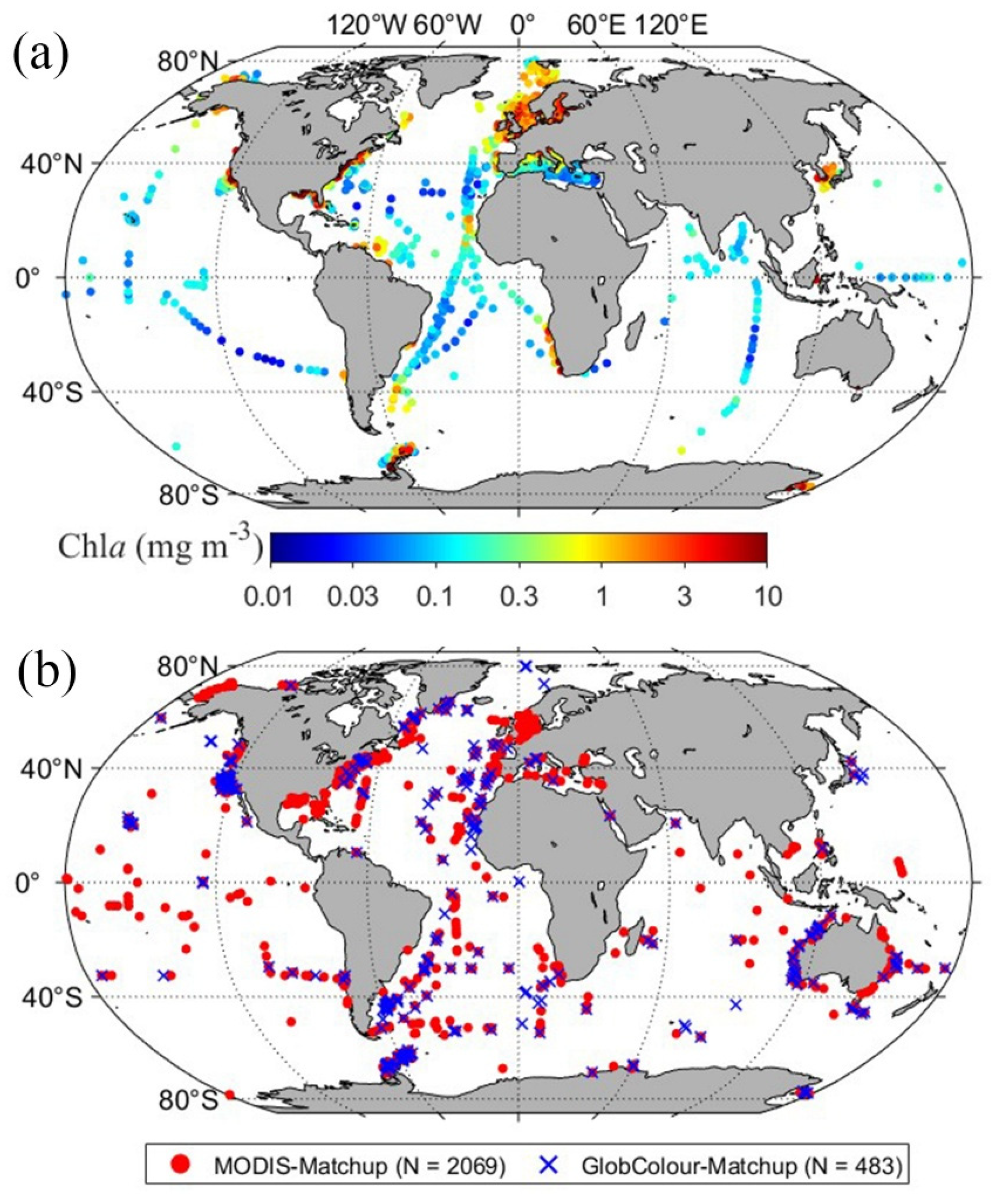





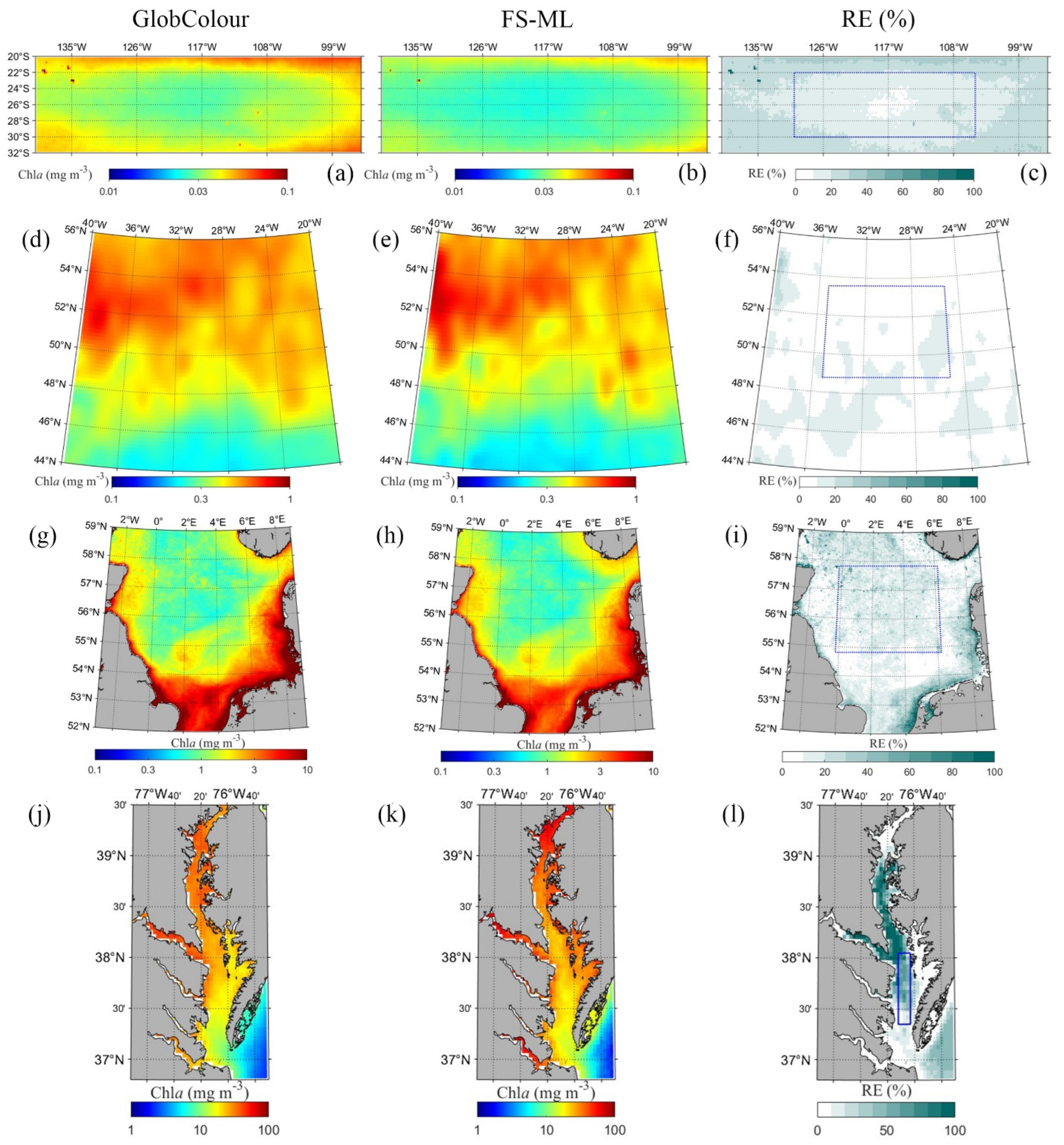

| Dataset | Acronym | Ref. | N |
|---|---|---|---|
| A globally representative hyperspectral in situ dataset for optical sensing of water quality | GLORIA | [44] | 243 |
| Global Bio-optical In Situ Data for Ocean-Colour Satellite Applications A compilation of: | Compiled and validated by [41] Ver. 3 | 3710 | |
| Aerosol Robotic NETwork-Ocean Color | AERONETOC | ||
| Atlantic, Pacific, and Southern oceans cruises | AWI | ||
| MERIS Matchup In situ Database | MERMAID | ||
| NASA bio-Optical Marine Algorithm Dataset | NOMAD | ||
| SeaWiFS Bio-optical Archive and Storage System | SeaBASS | ||
| Data collection from the TARA global transects | TARA | ||
| CoastColour Round Robin | CoastColour | ||
| Northwest European Shelf Seas | NWESS | [45] | 3479 |
| Coastal Atmosphere and Sea Time Series and Bio-Optical mapping of Marine Properties datasets | CoASTS-BiOMaP | [46] | 2469 |
| A bio-optical database for the remote sensing of water quality in Brazil coastal and inland waters | BRAZA | [47] | 127 |
| Atlantic Meridional Transect | AMT | [48] | 127 |
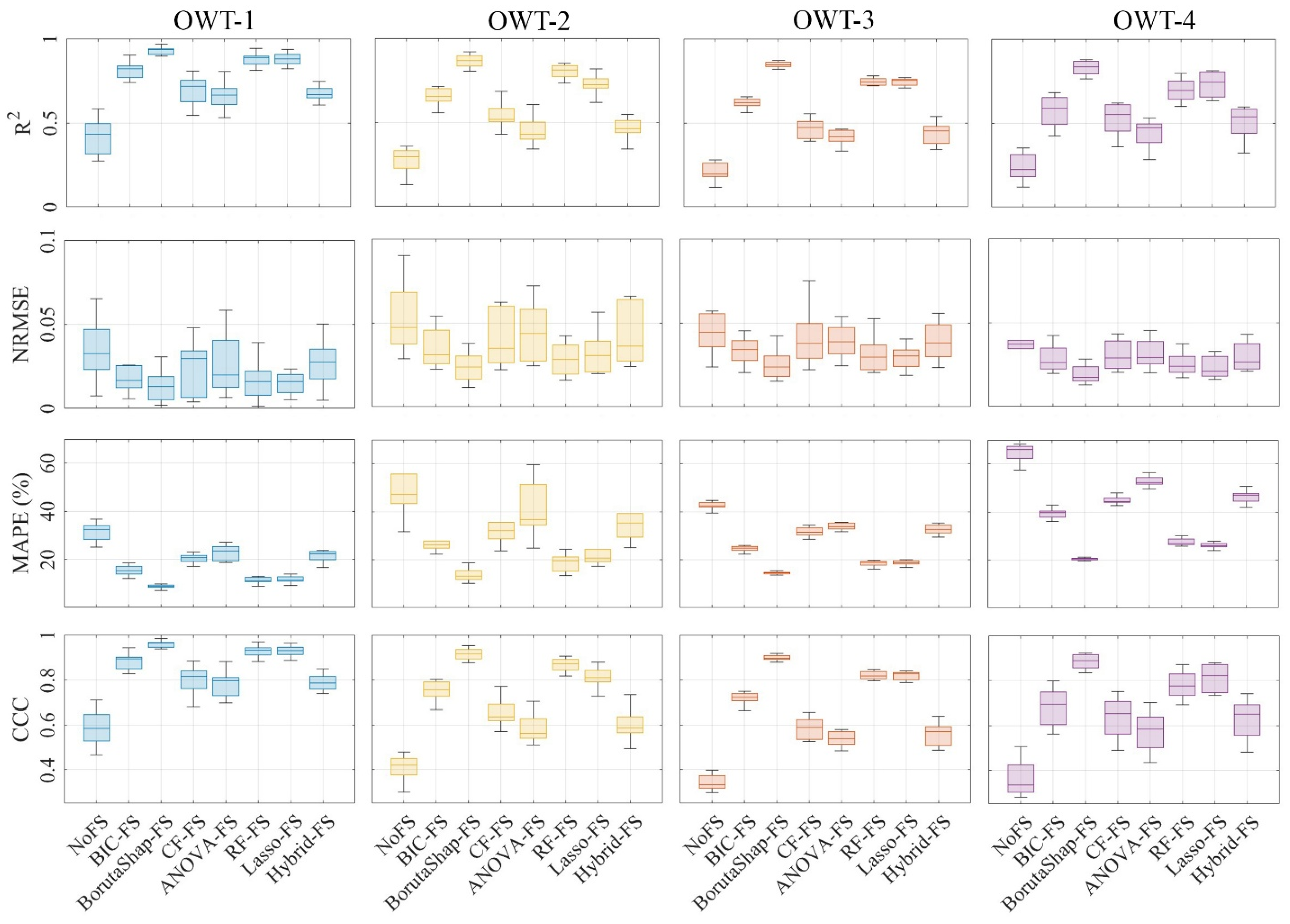
| FS Method | OWT-1 | OWT-2 | OWT-3 | OWT-4 |
|---|---|---|---|---|
| BIC-FS | 412, 442, 560, 665, 412/560, 490/510 | 412, 442, 560, 665, 412/560, 490/510 | 412, 442, 560, 665, 412/665, 490/510 | 412, 442, 560, 665, 412/665, 490/510 |
| BorutaShap-FS | 560/665, 442/560, 412/560, 665/681, 490/560, 442, 442/490, 442/510, 510/560, 620/681 | 412/560, 490/510, 665/681 | 412/665, 490/510, 665/681 | 412/665, 490/510, 665/681 |
| CF-FS | 412/560, 442/490, 510/560, 412/620, 412/665, 665/681 | 560/665, 442/560, 412/560, 665/681, 490/560, 442, 442/490, 442/510, 510/560, 620/681 | 510/560, 442/620, 490/620, 665/681 | 510/560, 442/620, 490/620, 665/681 |
| ANOVA-FS | 412, 442, 490, 412/490, 442/490, 412/510, 442/510, 490/510, 412/560, 442/560, 490/560, 510/560 | 510/620, 412, 490/510, 412/560, 620, 490, 442/620, 442/510, 510/560, 620/681, 620/665 | 560/665, 442/560, 412/665, 665/681, 490/560, 442, 442/490, 442/510, 510/560, 620/681 | 620, 490/560, 510/560 |
| RF-FS | 412, 442, 490, 412/560, 442/490, 442/510, 490/510, 412/560, 490/560, 510/560, 560/620, 620/665, 620/681, 665/681 | 412/560, 442/490, 510/560, 412/620, 412/665, 665/681 | 510/620, 412, 490/510, 412/665, 620, 490, 442/620, 442/510, 510/560, 620/681, 620/665 | 560/665, 442/560, 412/665, 665/681, 490/560, 442, 442/490, 442/510, 510/560, 620/681 |
| Lasso-FS | 442, 620, 665, 412/560, 442/510, 490/510, 490/560 | 412/560, 442/510, 490/620, 412/665, 665/681 | 490/681, 510/620, 412/665, 442/620, 442/681, 510/560, 620/681, 620/665 | 510/620, 412, 490/510, 412/665, 620, 490, 442/620, 442/510, 510/560, 620/681, 620/665 |
| Hybrid-FS | 412, 412/560, 490/510, 510/560, 665/681 | 412, 442, 490, 412/490, 442/490, 412/510, 442/510, 490/510, 412/560, 442/560, 490/560, 510/560 | 412/442, 442/490, 510/560, 412/620, 412/665, 665/681 | 490/681, 510/620, 412/665, 442/620, 442/681, 510/560, 620/681, 620/665 |
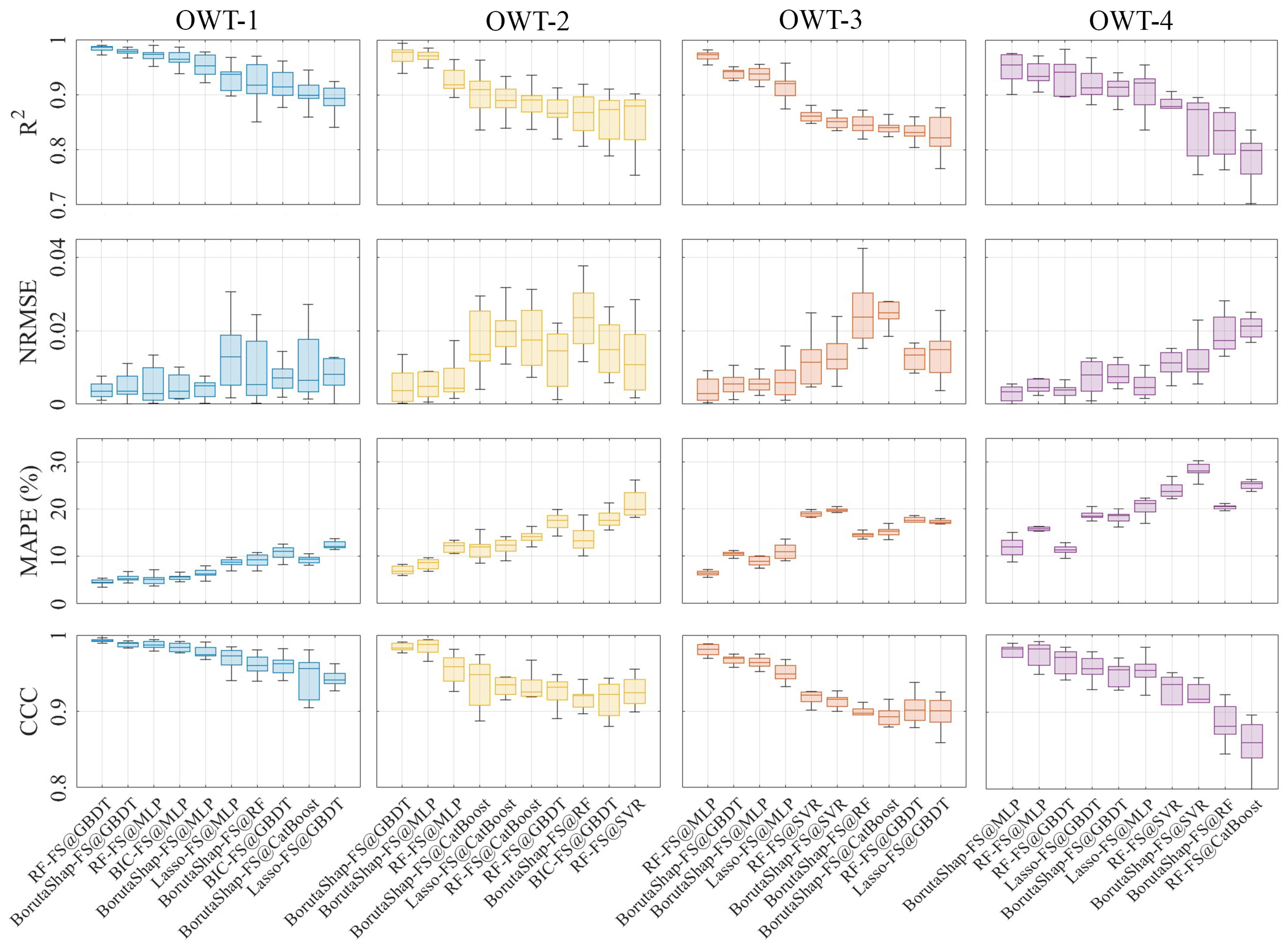
| OWT | Model | R2 Train | R2 Cross-Val. | CAS | Gap (×10−3) |
|---|---|---|---|---|---|
| OWT-1 | RF-FS@GBDT | 0.966 | 0.965 | 0.989 | −1.39 |
| BorutaShap-FS@GBDT | 0.947 | 0.952 | 0.977 | 5.55 | |
| RF-FS@MLP | 0.942 | 0.947 | 0.979 | 5.41 | |
| BorutaShap-FS@RF | 0.935 | 0.931 | 0.900 | −3.76 | |
| BorutaShap-FS@CatBoost | 0.898 | 0.905 | 0.894 | 6.72 | |
| OWT-2 | BorutaShap-FS@GBDT | 0.941 | 0.936 | 0.969 | −4.32 |
| BorutaShap-FS@MLP | 0.930 | 0.939 | 0.980 | 9.64 | |
| RF-FS@MLP | 0.898 | 0.894 | 0.909 | −4.21 | |
| BorutaShap-FS@CatBoost | 0.880 | 0.880 | 0.861 | 0.47 | |
| OWT-3 | RF-FS@MLP | 0.921 | 0.930 | 0.978 | 4.78 |
| BorutaShap-FS@GBDT | 0.892 | 0.904 | 0.930 | 6.43 | |
| RF-FS@SVR | 0.859 | 0.863 | 0.804 | 3.95 | |
| OWT-4 | RF-FS@MLP | 0.888 | 0.893 | 0.955 | 4.76 |
| BorutaShap-FS@MLP | 0.888 | 0.895 | 0.965 | 6.54 | |
| RF-FS@GBDT | 0.882 | 0.883 | 0.924 | 0.88 | |
| Lasso-FS@GBDT | 0.866 | 0.870 | 0.890 | 4.05 | |
| BorutaShap-FS@GBDT | 0.862 | 0.862 | 0.881 | 0.38 |
| OWT | Model | R2 | RMSE | MAE | MAPE | CCC |
|---|---|---|---|---|---|---|
| OWT-1 (N = 275) | RF-FS@GBDT | 0.969 | 0.0002 | 0.01 | 7.1 | 0.984 |
| BorutaShap-FS@GBDT | 0.951 | 0.0014 | 0.01 | 8.5 | 0.975 | |
| RF-FS@MLP | 0.946 | 0.0005 | 0.01 | 7.7 | 0.972 | |
| BorutaShap-FS@RF | 0.945 | 0.0023 | 0.01 | 8.4 | 0.969 | |
| BorutaShap-FS@CatBoost | 0.938 | 0.0013 | 0.01 | 9.4 | 0.966 | |
| OWT-2 (N = 366) | BorutaShap-FS@MLP | 0.953 | 0.0088 | 0.06 | 10.0 | 0.975 |
| BorutaShap-FS@GBDT | 0.951 | 0.0066 | 0.06 | 11.0 | 0.975 | |
| BorutaShap-FS@CatBoost | 0.914 | 0.0319 | 0.07 | 12.1 | 0.950 | |
| RF-FS@MLP | 0.876 | 0.0192 | 0.09 | 15.2 | 0.933 | |
| OWT-3 (N = 567) | RF-FS@MLP | 0.910 | 0.0342 | 0.19 | 10.6 | 0.952 |
| BorutaShap-FS@GBDT | 0.902 | 0.0367 | 0.22 | 13.2 | 0.946 | |
| BorutaShap-FS@RF | 0.837 | 0.1308 | 0.28 | 15.8 | 0.891 | |
| OWT-4 (N = 529) | RF-FS@MLP | 0.917 | 0.2528 | 1.23 | 17.6 | 0.957 |
| BorutaShap-FS@MLP | 0.908 | 0.4282 | 1.36 | 19.7 | 0.950 | |
| RF-FS@GBDT | 0.901 | 0.5618 | 1.45 | 22.3 | 0.944 | |
| BorutaShap-FS@GBDT | 0.853 | 0.6735 | 1.76 | 23.3 | 0.915 | |
| Lasso-FS@GBDT | 0.852 | 0.3926 | 1.72 | 25.2 | 0.925 |
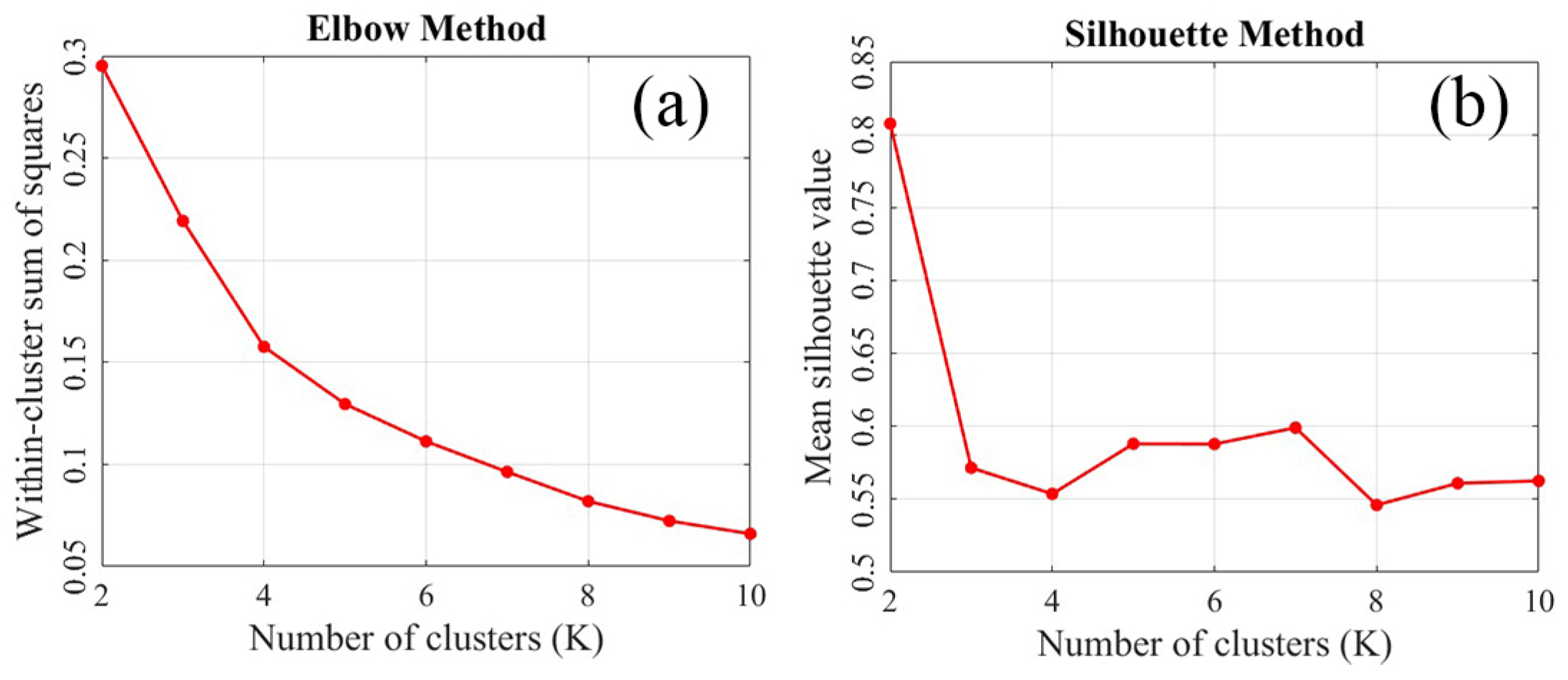
| K | OWT | Best Model | N | Chla | R2 | RMSE | CCC |
|---|---|---|---|---|---|---|---|
| K = 3 | OWT-1 | RF@GBDT | 275 | 0.10 ± 0.05 | 0.939 | 0.152 | 0.934 |
| OWT-2 | BorutaShap@MLP | 218 | 0.62 ± 0.44 | 0.923 | 6.410 | 0.925 | |
| OWT-3 | RF@MLP | 1244 | 3.92 ± 6.57 | 0.637 | 124.09 | 0.745 | |
| K = 4 | OWT-1 | RF@GBDT | 275 | 0.10 ± 0.05 | 0.969 | 0.152 | 0.984 |
| OWT-2 | BorutaShap@MLP | 366 | 0.59 ± 0.42 | 0.953 | 8.782 | 0.975 | |
| OWT-3 | RF@MLP | 567 | 1.73 ± 1.08 | 0.910 | 34.204 | 0.952 | |
| OWT-4 | RF@MLP | 529 | 7.21 ± 9.01 | 0.917 | 252.77 | 0.957 | |
| K = 5 | OWT-1 | RF@GBDT | 247 | 0.10 ± 0.05 | 0.901 | 0.009 | 0.905 |
| OWT-2 | BorutaShap@GBDT | 331 | 0.56 ± 0.43 | 0.887 | 7.0541 | 0.898 | |
| OWT-3 | RF@MLP | 318 | 1.45 ± 1.01 | 0.854 | 29.853 | 0.879 | |
| OWT-4 | RF@MLP | 703 | 5.24 ± 7.81 | 0.857 | 163.08 | 0.882 | |
| OWT-5 | BorutaShap@MLP | 138 | 4.93 ± 6.79 | 0.855 | 210.71 | 0.880 | |
| K = 6 | OWT-1 | RF@GBDT | 222 | 0.11 ± 0.05 | 0.899 | 0.229 | 0.904 |
| OWT-2 | BorutaShap@GBDT | 320 | 0.54 ± 0.44 | 0.889 | 6.893 | 0.899 | |
| OWT-3 | RF@MLP | 252 | 1.14 ± 0.95 | 0.890 | 17.171 | 0.899 | |
| OWT-4 | BorutaShap@MLP | 488 | 3.48 ± 6.99 | 0.871 | 121.51 | 0.888 | |
| OWT-5 | RF@MLP | 222 | 6.04 ± 7.44 | 0.814 | 518.15 | 0.852 | |
| OWT-6 | BorutaShap@MLP | 233 | 6.48 ± 7.28 | 0.836 | 289.45 | 0.871 |
Disclaimer/Publisher’s Note: The statements, opinions and data contained in all publications are solely those of the individual author(s) and contributor(s) and not of MDPI and/or the editor(s). MDPI and/or the editor(s) disclaim responsibility for any injury to people or property resulting from any ideas, methods, instructions or products referred to in the content. |
© 2026 by the authors. Licensee MDPI, Basel, Switzerland. This article is an open access article distributed under the terms and conditions of the Creative Commons Attribution (CC BY) license.
Share and Cite
Arabi, B.; Moradi, M.; Lu, M. Assessment of Feature Selection Methods for Machine Learning-Based Chlorophyll-a Retrieval Across Optical Water Types. Remote Sens. 2026, 18, 2381. https://doi.org/10.3390/rs18142381
Arabi B, Moradi M, Lu M. Assessment of Feature Selection Methods for Machine Learning-Based Chlorophyll-a Retrieval Across Optical Water Types. Remote Sensing. 2026; 18(14):2381. https://doi.org/10.3390/rs18142381
Chicago/Turabian StyleArabi, Behnaz, Masoud Moradi, and Meng Lu. 2026. "Assessment of Feature Selection Methods for Machine Learning-Based Chlorophyll-a Retrieval Across Optical Water Types" Remote Sensing 18, no. 14: 2381. https://doi.org/10.3390/rs18142381
APA StyleArabi, B., Moradi, M., & Lu, M. (2026). Assessment of Feature Selection Methods for Machine Learning-Based Chlorophyll-a Retrieval Across Optical Water Types. Remote Sensing, 18(14), 2381. https://doi.org/10.3390/rs18142381