An Adaptive Wet Tropospheric Correction Method Using a Spaceborne Microwave Radiometer

Highlights
- An adaptive wet tropospheric correction (WTC) method was developed based on the HY-2C Calibration Microwave Radiometer by integrating overlapping wind-regime modeling, multi-scale collaborative sample balancing, and model soft fusion, significantly improving WTC retrieval accuracy and stability and reducing systematic biases relative to the operational WTC product;
- The proposed method achieved robust performance under low-, moderate-, and high-wind-speed conditions, with particularly improved systematic bias control and generalization in wind-speed regimes with sparse observations.
- The results show that incorporating overlapping wind-regime modeling together with a multi-scale sample-balancing mechanism and soft fusion is an effective strategy for improving WTC retrieval performance;
- The proposed method provides a robust and practical approach for generating high-quality WTC products for satellite altimetry missions, supporting more reliable ocean dynamic environment monitoring.
Abstract
1. Introduction
2. Materials
2.1. Data Description and Study Area
2.2. Along-Track Simulation of WTC Based on ERA5 Data
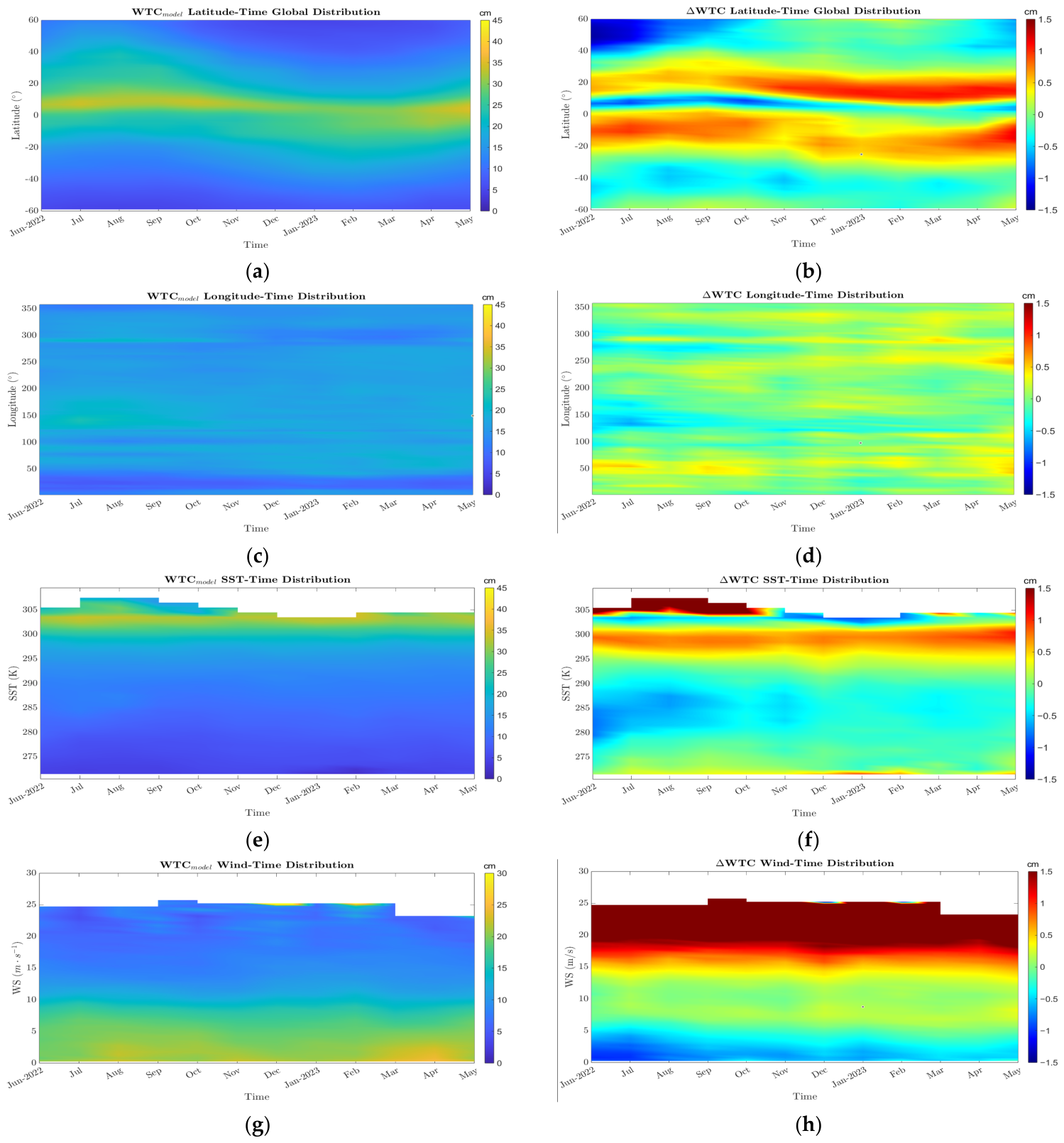
2.3. Error Analysis of the Operational WTC Product
3. Methods
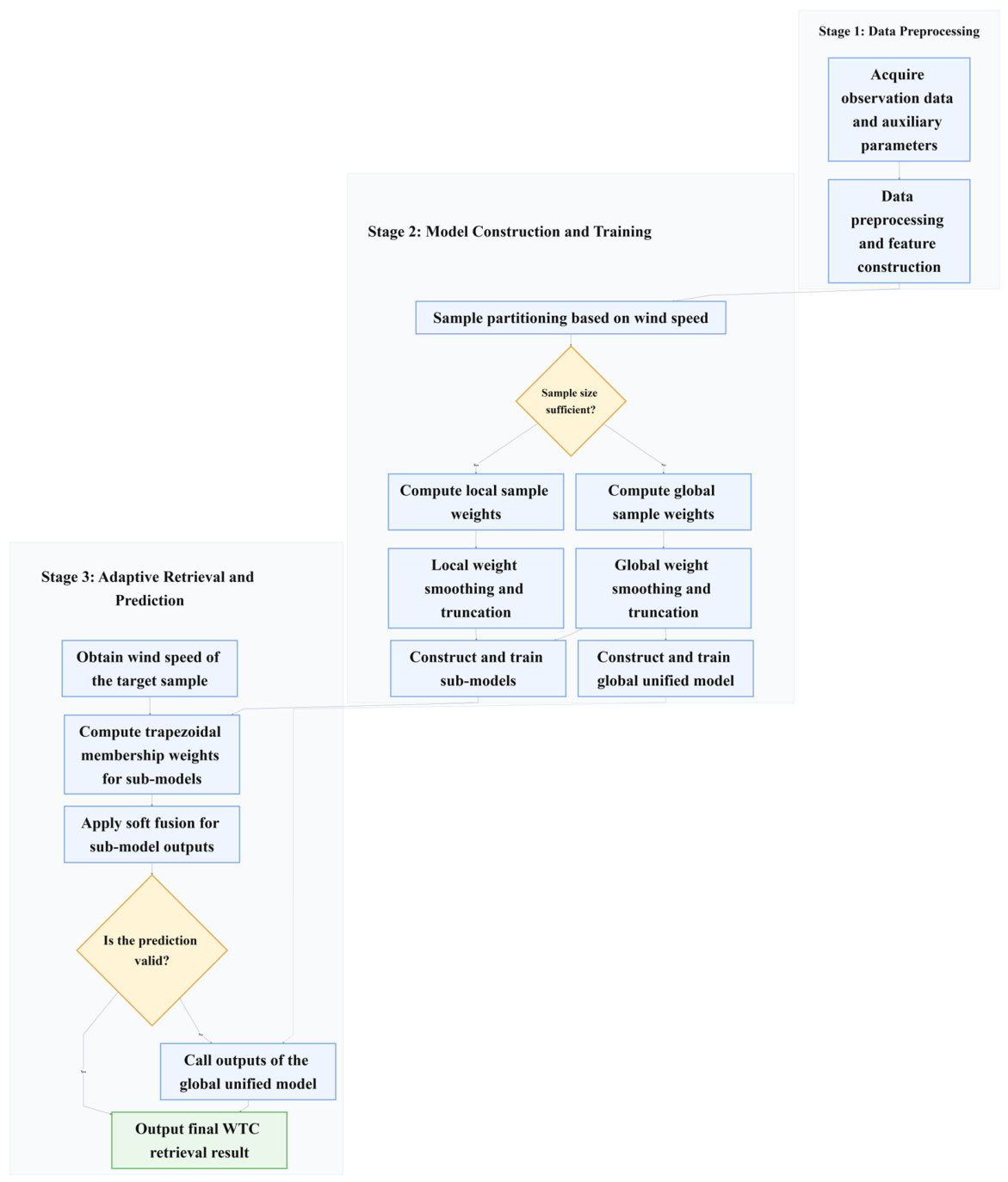
3.1. Overall Architecture
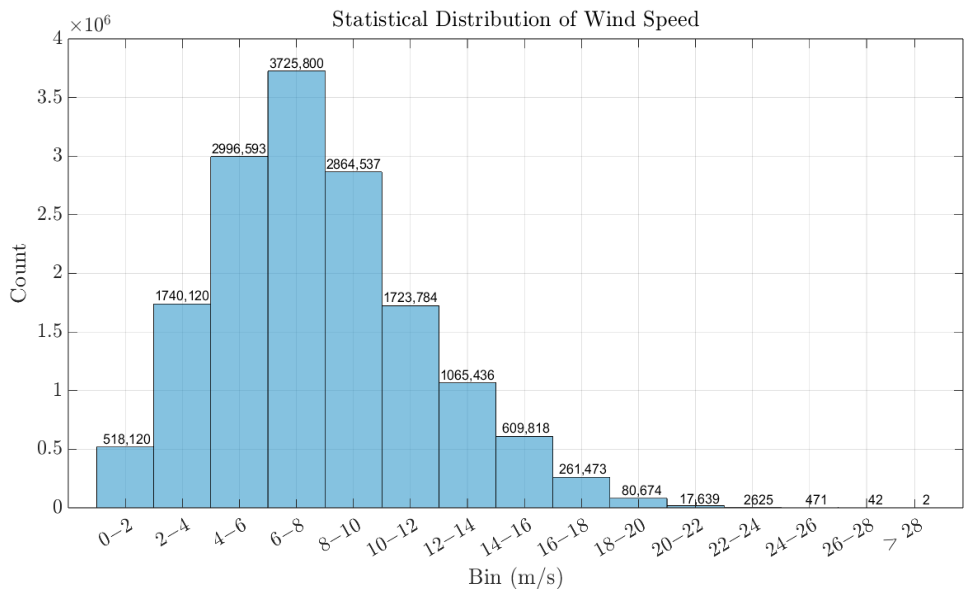
3.2. Multi-Scale Collaborative Sample-Balancing Strategy
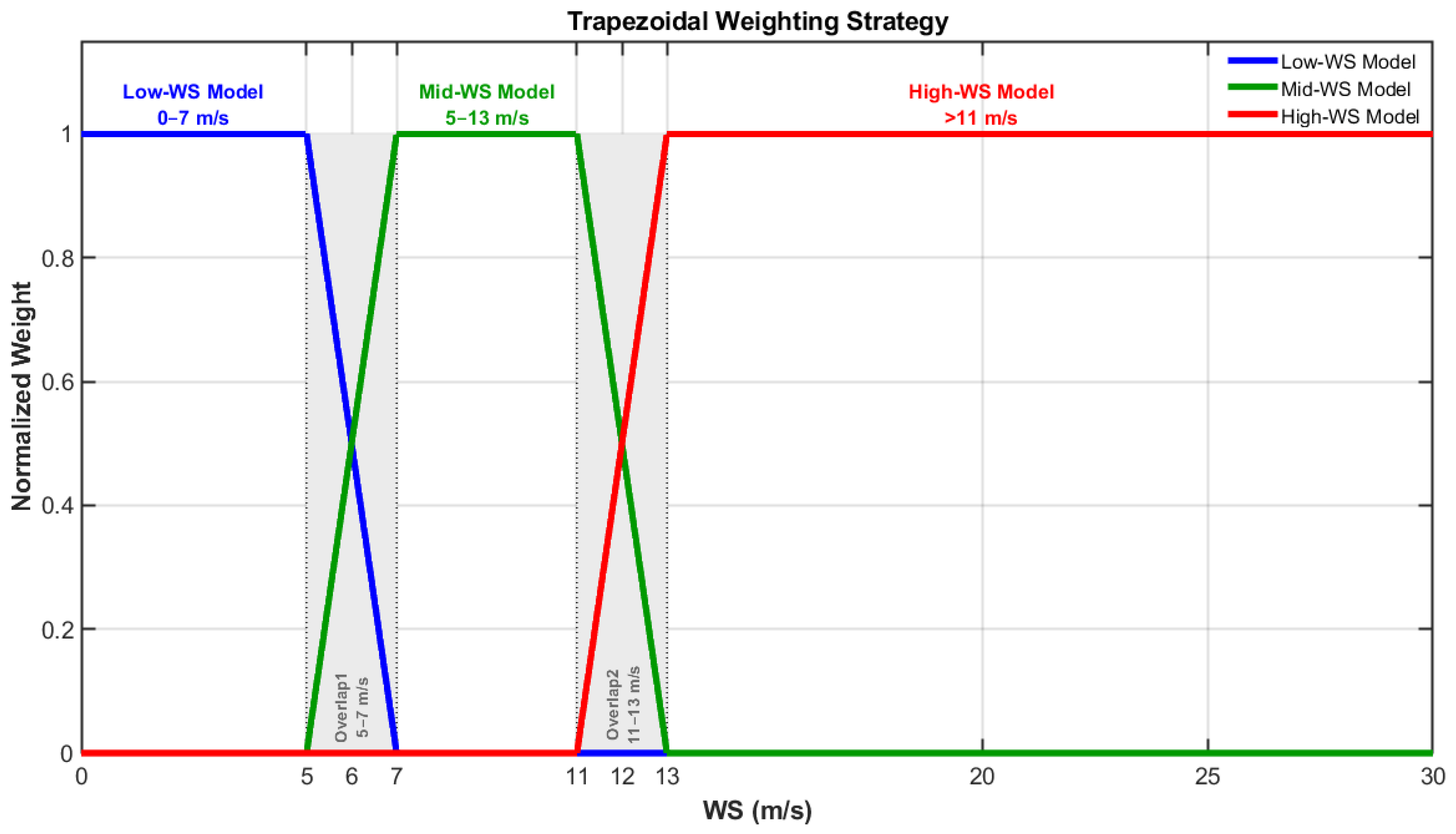
3.3. Model Soft-Fusion Strategy Based on Trapezoidal Membership Functions
4. Experiments and Results
4.1. Contrastive Model Design
4.2. Experimental Implementation
4.2.1. Multi-Source Feature Construction
4.2.2. Spatiotemporal Feature Transformation and Normalization
4.2.3. Implementation of Overlapping Wind-Speed Partitioning and Multi-Scale Sample Balancing
4.3. Network Architecture Configuration, Training Strategy, and Output Fusion
4.4. Assessment with Model-Derived WTC from ERA5
4.5. Assessment with WTC Derived from Jason-3 AMR-2
5. Discussion and Conclusions
Author Contributions
Funding
Data Availability Statement
Acknowledgments
Conflicts of Interest
References
- Keihm, S.J.; Janssen, M.A.; Ruf, C.S. TOPEX/Poseidon microwave radiometer (TMR): III. Wet troposphere range correction algorithm and pre-launch error budget. IEEE Trans. Geosci. Remote Sens. 1995, 33, 147–161. [Google Scholar] [CrossRef]
- Brown, S. A novel near-land radiometer wet path-delay retrieval algorithm: Application to the Jason-2/OSTM advanced microwave radiometer. IEEE Trans. Geosci. Remote Sens. 2010, 48, 1986–1992. [Google Scholar] [CrossRef]
- Chae, C.S.; Desai, S. Sentinel-6 Project: Advanced Microwave Radiometer Level 2 Algorithm Theoretical Basis Document, JPL D-103429; NASA Jet Propulsion Laboratory, California Institute of Technology: Pasadena, CA, USA, 2020.
- Zheng, G.; Yang, J.; Ren, L. Retrieval models of water vapor and wet tropospheric path delay for the HY-2A calibration microwave radiometer. J. Atmos. Ocean. Technol. 2014, 31, 1516–1528. [Google Scholar] [CrossRef]
- Wu, Z.; Wang, J.; Liu, Y.; He, X.; Liu, Y.; Xu, W. Validation of 7 years in-flight HY-2A calibration microwave radiometer products using numerical weather model and radiosondes. Remote Sens. 2019, 11, 1616. [Google Scholar] [CrossRef]
- Obligis, E.; Eymard, L.; Tran, N.; Labroue, S.; Femenias, P. First three years of the microwave radiometer aboard Envisat: In-flight calibration, processing, and validation of the geophysical products. J. Atmos. Ocean. Technol. 2006, 23, 802–814. [Google Scholar] [CrossRef]
- Fernandes, M.J.; Lázaro, C. Independent assessment of Sentinel-3A wet tropospheric correction over the open and coastal ocean. Remote Sens. 2018, 10, 484. [Google Scholar] [CrossRef]
- Picard, B.; Frery, M.-L.; Obligis, E.; Eymard, L.; Steunou, N.; Picot, N. SARAL/AltiKa wet tropospheric correction: In-flight calibration, retrieval strategies and performances. Mar. Geod. 2015, 38, 277–296. [Google Scholar] [CrossRef]
- Brown, S.; Desai, S. Error structures in altimetry data from the wet tropospheric correction. In Proceedings of the International Symposium on Geoscience and Remote Sensing Symposium (IGARSS), Honolulu, HI, USA, 25–30 July 2010. [Google Scholar]
- Chen, G.; Bi, S.; Ezraty, R. Global structure of extreme wind and wave climate derived from TOPEX altimeter data. Int. J. Remote Sens. 2004, 25, 1005–1018. [Google Scholar] [CrossRef]
- Monahan, A.H. The probability distribution of sea surface wind speeds. Part I: Theory and SeaWinds observations. J. Clim. 2006, 19, 497–520. [Google Scholar] [CrossRef]
- Sun, J.; Yang, J.; Cui, W.; Wang, R.; Jiang, X. Wet tropospheric correction for the HY-2C altimeter over the coastal ocean based on GNSS and ERA5 data. Mar. Geod. 2024, 47, 150–172. [Google Scholar] [CrossRef]
- Fernandes, M.J.; Lázaro, C.; Vieira, T. On the role of the troposphere in satellite altimetry. Remote Sens. Environ. 2021, 252, 112149. [Google Scholar] [CrossRef]
- Swanson, P.; Riley, A. The Seasat scanning multichannel microwave radiometer (SMMR): Radiometric calibration algorithm development and performance. IEEE J. Ocean. Eng. 1980, 5, 116–124. [Google Scholar] [CrossRef]
- Fernandes, M.J.; Vieira, T.; Aguiar, P.; Lázaro, C. How different ECMWF atmospheric models impact the estimation of sea-level trends. IEEE J. Sel. Top. Appl. Earth Obs. Remote Sens. 2024, 17, 3069–3077. [Google Scholar] [CrossRef]
- Collecte Localisation Satellites (CLS). Surface Topography Mission (STM) SRAL/MWR L2 Algorithms Definition, Accuracy and Specification; Collecte Localisation Satellites (CLS): Ramonville St-Agne, France, 2011; Available online: https://user.eumetsat.int/s3/eup-strapi-media/pdf_s3_alt_level_2_adas_23dcc1ef2d.pdf (accessed on 30 June 2026).
- Zheng, X.; Zhang, D.; Zhao, J.; Jiang, M. On-orbit calibration and wet tropospheric correction of HY-2C correction microwave radiometer. Remote Sens. 2023, 15, 3633. [Google Scholar] [CrossRef]
- Zheng, X.; Zhang, D.; Zhao, J.; Jiang, M. Brightness temperature and wet tropospheric correction of HY-2C calibration microwave radiometer using model-derived wet troposphere path delay from ECMWF. Remote Sens. 2023, 15, 1318. [Google Scholar] [CrossRef]
- Vieira, T.; Fernandes, M.J.; Lázaro, C. Impact of the new ERA5 reanalysis in the computation of radar altimeter wet path delays. IEEE Trans. Geosci. Remote Sens. 2019, 57, 9849–9857. [Google Scholar] [CrossRef]
- Vieira, T.; Fernandes, M.J.; Lázaro, C. Modelling the altitude dependence of the wet path delay for coastal altimetry using 3-D fields from ERA5. Remote Sens. 2019, 11, 2973. [Google Scholar] [CrossRef]
- Jiang, C.; Xu, T.; Wang, S.; Nie, W.; Sun, Z. Evaluation of zenith tropospheric delay derived from ERA5 data over China using GNSS observations. Remote Sens. 2020, 12, 663. [Google Scholar] [CrossRef]
- Nordberg, W.; Conaway, J.; Ross, D.B.; Wilheit, T. Measurements of microwave emission from a foam-covered wind driven sea. J. Atmos. Sci. 1971, 38, 429–435. [Google Scholar]
- Webster, W.J., Jr.; Wilheit, T.T.; Ross, D.B.; Gloersen, P. Spectral characteristics of the microwave emission from a wind-driven foam-covered sea. J. Geophys. Res. 1976, 81, 3095–3099. [Google Scholar]
- Wilheit, T.T. The effect of wind on the microwave emission from the ocean’s surface at 37 GHz. J. Geophys. Res. 1979, 84, 4921–4926. [Google Scholar]
- Campos, R.M.; Gramcianinov, C.B.; de Camargo, R.; da Silva Dias, P.L. Assessment and Calibration of ERA5 Severe Winds in the Atlantic Ocean Using Satellite Data. Remote Sens. 2022, 14, 4918. [Google Scholar] [CrossRef]
- Sharmar, V.; Markina, M. Validation of global wind wave hindcasts using ERA5, MERRA2, ERA-Interim and CFSRv2 reanalyzes. IOP Conf. Ser. Earth Environ. Sci. 2020, 606, 012056. [Google Scholar] [CrossRef]



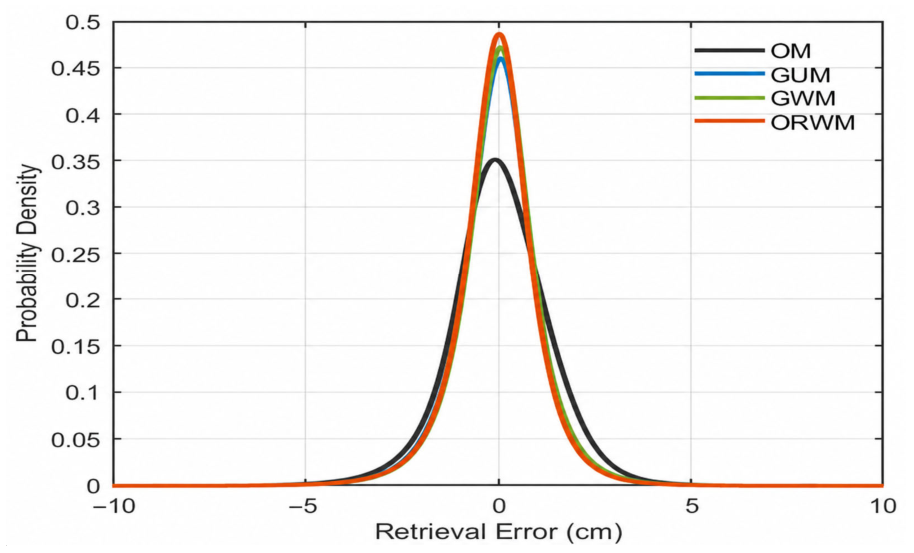
| RMSE (cm) | STD (cm) | Bias (cm) | R | |
|---|---|---|---|---|
| OM | 1.3029 | 1.3026 | 0.0273 | 0.9906 |
| GUM | 1.1088 | 1.1088 | −0.0015 | 0.9932 |
| GWM | 1.0882 | 1.0881 | 0.0167 | 0.9934 |
| ORWM | 1.0653 | 1.0646 | −0.0408 | 0.9937 |
| Median KS D | Median p-Value | Rejection Rate | |
|---|---|---|---|
| ORWM vs. OM | 0.0881 | <0.001 | 1.00 |
| ORWM vs. GUM | 0.0264 | 0.0603 | 0.35 |
| ORWM vs. GWM | 0.0247 | 0.0933 | 0.12 |
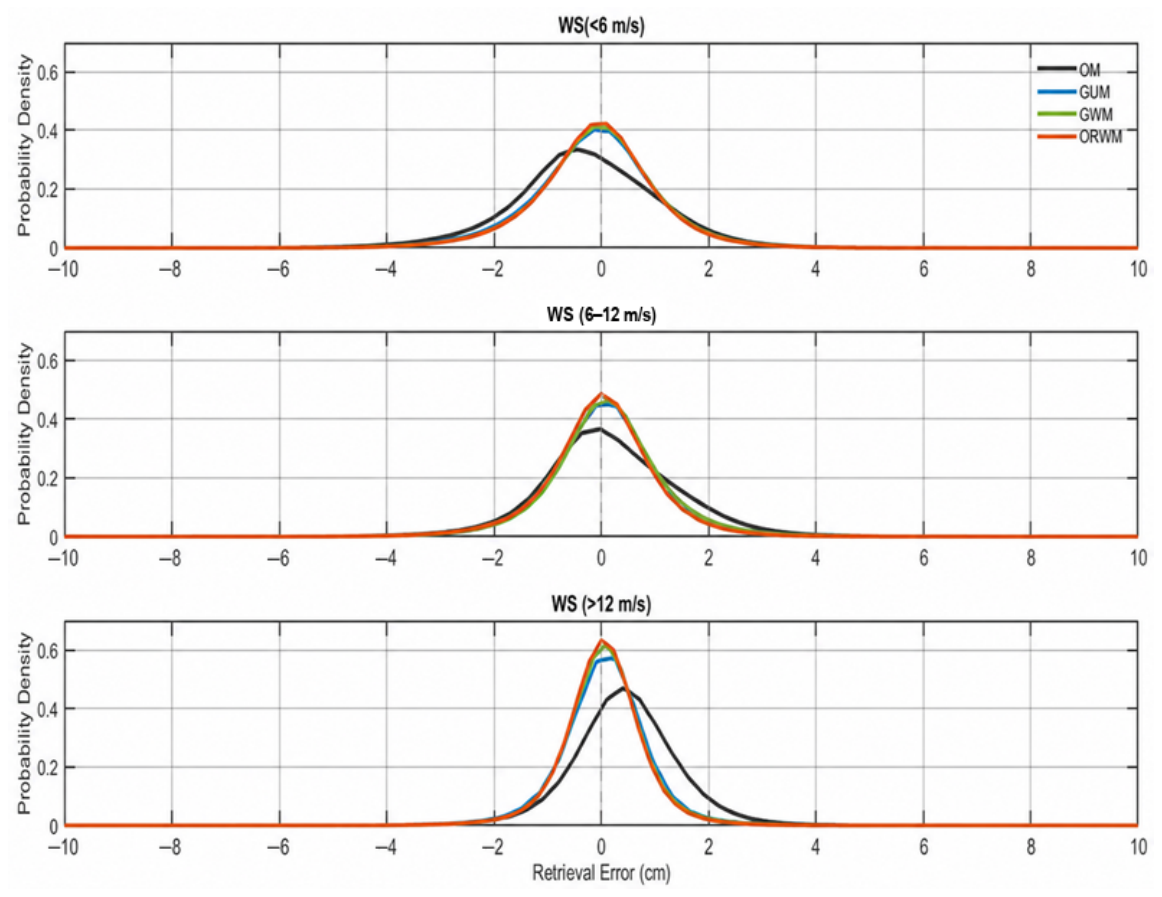
| Low | Moderate | High | |||||||
|---|---|---|---|---|---|---|---|---|---|
| RMSE (cm) | STD (cm) | Bias (cm) | RMSE (cm) | STD (cm) | Bias (cm) | RMSE (cm) | STD (cm) | Bias (cm) | |
| OM | 1.4005 | 1.3657 | −0.3106 | 1.2863 | 1.2783 | 0.1425 | 1.0919 | 1.0038 | 0.4296 |
| GUM | 1.2112 | 1.2019 | −0.1489 | 1.0978 | 1.0951 | 0.0766 | 0.8457 | 0.8436 | 0.0601 |
| GWM | 1.1882 | 1.1832 | −0.1093 | 1.0813 | 1.0775 | 0.0898 | 0.8110 | 0.8099 | 0.0432 |
| ORWM | 1.1706 | 1.1653 | −0.1120 | 1.0541 | 1.0540 | −0.0115 | 0.7902 | 0.7898 | 0.0233 |
| Wind Regime | Comparison | Median KS D | Median p-Value | Rejection Rate |
|---|---|---|---|---|
| Low | ORWM vs. OM | 0.1202 | <0.001 | 1.00 |
| ORWM vs. GUM | 0.0226 | 0.1536 | 0.04 | |
| ORWM vs. GWM | 0.0112 | 0.9110 | 0.00 | |
| Moderate | ORWM vs. OM | 0.1043 | <0.001 | 1.00 |
| ORWM vs. GUM | 0.0433 | <0.001 | 1.00 | |
| ORWM vs. GWM | 0.0385 | 0.0012 | 1.00 | |
| High | ORWM vs. OM | 0.2451 | <0.001 | 1.00 |
| ORWM vs. GUM | 0.0464 | <0.001 | 1.00 | |
| ORWM vs. GWM | 0.0130 | 0.7896 | 0.00 |
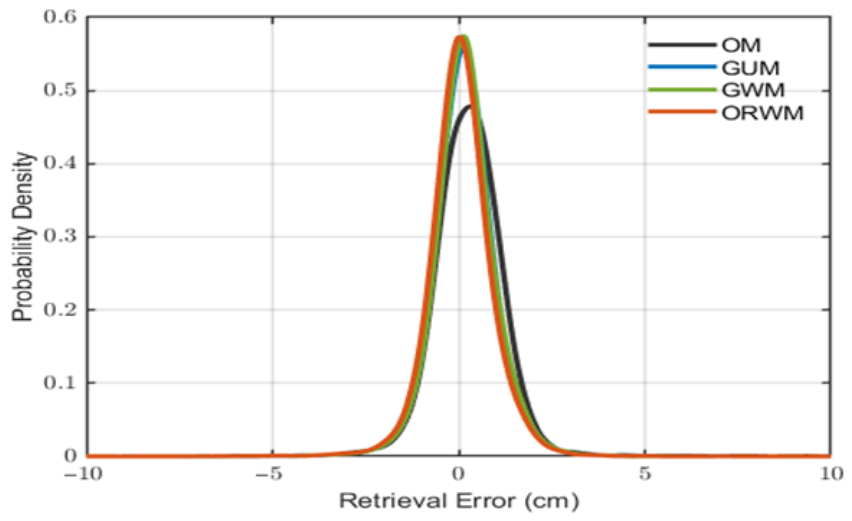
| RMSE (cm) | STD (cm) | Bias (cm) | R | |
|---|---|---|---|---|
| OM | 1.1579 | 1.1190 | 0.2976 | 0.9937 |
| GUM | 1.1193 | 1.1071 | 0.1651 | 0.9940 |
| GWM | 0.9341 | 0.9191 | 0.1668 | 0.9960 |
| ORWM | 0.8823 | 0.8803 | 0.0601 | 0.9962 |
| Median KS D | Median p-Value | Rejection Rate | |
|---|---|---|---|
| ORWM vs. OM | 0.1443 | <0.001 | 1.00 |
| ORWM vs. GUM | 0.0290 | 0.3647 | 0.00 |
| ORWM vs. GWM | 0.0425 | 0.0525 | 0.45 |
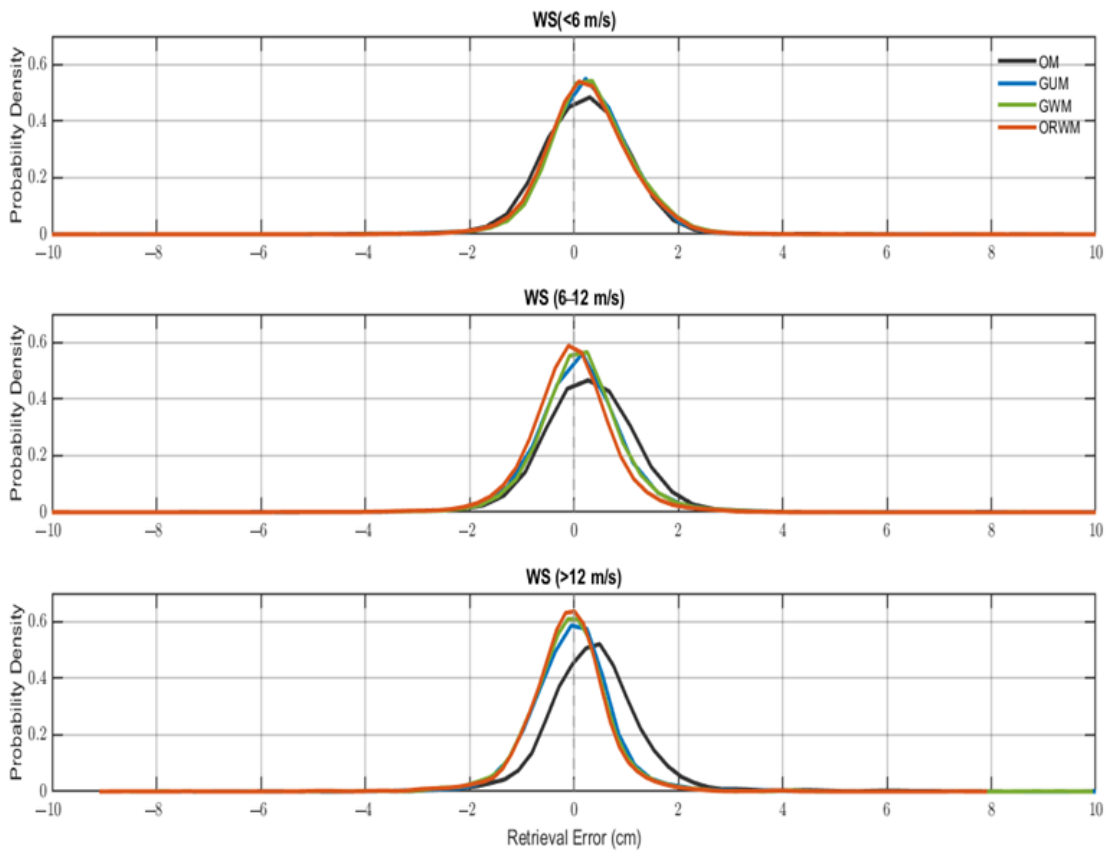
| Low | Moderate | High | |||||||
|---|---|---|---|---|---|---|---|---|---|
| RMSE (cm) | STD (cm) | Bias (cm) | RMSE (cm) | STD (cm) | Bias (cm) | RMSE (cm) | STD (cm) | Bias (cm) | |
| OM | 1.0801 | 1.0538 | 0.2374 | 1.2027 | 1.1606 | 0.3154 | 1.1871 | 1.1135 | 0.4120 |
| GUM | 1.0977 | 1.0583 | 0.2916 | 1.1547 | 1.1487 | 0.1186 | 1.0115 | 1.0112 | −0.0315 |
| GWM | 0.9643 | 0.9113 | 0.3155 | 0.9256 | 0.9180 | 0.1184 | 0.8711 | 0.8661 | −0.0942 |
| ORWM | 0.9259 | 0.8875 | 0.2638 | 0.8621 | 0.8610 | −0.0441 | 0.8285 | 0.8207 | −0.1144 |
| Wind Regime | Comparison | Median KS D | Median p-Value | Rejection Rate |
|---|---|---|---|---|
| Low | ORWM vs. OM | 0.0523 | 0.0081 | 0.89 |
| ORWM vs. GUM | 0.0410 | 0.0753 | 0.34 | |
| ORWM vs. GWM | 0.0210 | 0.7658 | 0.00 | |
| Moderate | ORWM vs. OM | 0.2075 | <0.001 | 1.00 |
| ORWM vs. GUM | 0.0560 | 0.0040 | 1.00 | |
| ORWM vs. GWM | 0.0650 | <0.001 | 1.00 | |
| High | ORWM vs. OM | 0.2850 | <0.001 | 1.00 |
| ORWM vs. GUM | 0.0490 | 0.0158 | 1.00 | |
| ORWM vs. GWM | 0.0198 | 0.8262 | 0.00 |
Disclaimer/Publisher’s Note: The statements, opinions and data contained in all publications are solely those of the individual author(s) and contributor(s) and not of MDPI and/or the editor(s). MDPI and/or the editor(s) disclaim responsibility for any injury to people or property resulting from any ideas, methods, instructions or products referred to in the content. |
© 2026 by the authors. Licensee MDPI, Basel, Switzerland. This article is an open access article distributed under the terms and conditions of the Creative Commons Attribution (CC BY) license.
Share and Cite
Zheng, X.; Li, Y.; Zhao, J.; He, J.; Zhang, D. An Adaptive Wet Tropospheric Correction Method Using a Spaceborne Microwave Radiometer. Remote Sens. 2026, 18, 2250. https://doi.org/10.3390/rs18132250
Zheng X, Li Y, Zhao J, He J, Zhang D. An Adaptive Wet Tropospheric Correction Method Using a Spaceborne Microwave Radiometer. Remote Sensing. 2026; 18(13):2250. https://doi.org/10.3390/rs18132250
Chicago/Turabian StyleZheng, Xiaomeng, Yuhang Li, Jin Zhao, Jieying He, and Dehai Zhang. 2026. "An Adaptive Wet Tropospheric Correction Method Using a Spaceborne Microwave Radiometer" Remote Sensing 18, no. 13: 2250. https://doi.org/10.3390/rs18132250
APA StyleZheng, X., Li, Y., Zhao, J., He, J., & Zhang, D. (2026). An Adaptive Wet Tropospheric Correction Method Using a Spaceborne Microwave Radiometer. Remote Sensing, 18(13), 2250. https://doi.org/10.3390/rs18132250