1. Introduction
Individual tree crown (ITC) delineation from high-resolution aerial images and airborne LiDAR data is a core task in forest remote sensing with significant implications for forest inventory, carbon stock estimation, biodiversity monitoring, and ecosystem management [
1,
2,
3]. The cost of acquiring remote sensing data from UAVs and airborne LiDAR systems has significantly decreased due to the increased availability of these technologies. However, translating raw sensor observations into reliable instance-level crown maps still represents a persistent challenge, especially in structurally complex mixed forest environments [
2,
3].
There are three main groups of methods for ITC segmentation. The first consists of classical CHM-based methods, most notably local maximum detection [
4] and marker-controlled watershed segmentation [
5,
6]. These methods are physically interpretable, but their robustness is strongly affected by CHM quality and parameter tuning, especially in dense mixed-species forests where uneven effective height-structure support produces gaps and block-like artifacts. The second group includes end-to-end deep learning methods, including DeepForest [
7], Detectree2 [
8], and recent StarDist-based variants [
9]. These methods can achieve strong performance when the training and target domains are structurally similar, but their reported performance is affected by forest type, species composition, spatial resolution, and cross-site transfer conditions [
10,
11,
12]. The third group consists of foundation model-based routes, including SAM [
13] and its extensions, such as FM-SAM [
14] for ITC delineation in UAV imagery and BalSAM [
15] for incorporating elevation information through prompt learning. Recent tree crown studies indicate that out-of-the-box SAM-based segmentation does not necessarily outperform task-specific Mask R-CNN, and that DSM or height information can improve tree crown segmentation [
15,
16].
Annotation quality and evaluation protocol also influence how ITC segmentation results should be interpreted. In closed-canopy forests, manually delineated labels and annotation consistency can affect the apparent performance of deep learning models [
17,
18]. More broadly, object-detection and instance-segmentation benchmarks use different matching and aggregation conventions, including VOC-style IoU-threshold hit counting [
19] and COCO-style multi-threshold AP [
20]. These protocols can yield different conclusions on the same prediction set. In small plots with only a few hundred reference crowns, the hit status of a single crown can noticeably shift Recall, and this sensitivity is amplified when crown adhesion causes one predicted region to overlap several reference crowns.
Practical constraints encountered in real-world forestry plots are often more severe than those assumed by benchmark studies. Small plot sizes, limited annotation budgets, uneven effective height-structure support and severe canopy adhesion in structurally complex mixed conifer–broadleaf forests jointly create a setting in which large instance-level training sets are unavailable and CHM-only delineation is unstable. Semi-supervised strategies [
21] and LiDAR-derived pseudo-label approaches [
22] represent important routes for reducing annotation dependency on the training side, while a recent zero-shot framework uses canopy semantic segmentation as a spatial prior for instance-level delineation on the inference side [
23]. The latter direction—operating directly on existing semantic outputs without enlarging the training set—remains comparatively underexplored under extremely small reference sets, severe canopy adhesion, and locally degraded CHM quality.
This study focuses on a structurally complex mixed conifer–broadleaf natural secondary forest plot with fewer than 350 manually annotated crowns, uneven effective height-structure support, and severe inter-crown adhesion. The framework is intended for high-density or closed-canopy forest plots where a semantic canopy probability field and height information are available, but dense instance-level annotation is limited. Its intended role is object-level reconstruction in annotation-scarce closed-canopy settings, and its claims are limited to this application regime. The proposed method treats the output of a semantic segmentation network as an interpretable canopy prior and builds a structured object-level reconstruction pipeline around it. The primary methodological contributions are three modules. A height-aware canopy support mask (HCSM) converts the continuous probability field into a credible operational domain through hysteresis thresholding, morphological reconstruction, and a height constraint. Constrained recovery within the support domain (E2GROW) repairs coverage deficiency through spatially bounded boundary adjustment with explicit guard rails on area ratio and buffer distance. Selective splitting addresses residual merge errors through branch-specific seed-guided partitioning, including an aggressive Voronoi reference branch and a more conservative LOCAL/MCWS branch with explicit trigger and child-object filtering criteria. An instance-level evaluation loop is used throughout module development for auditing, screening, and iterative safeguard purposes.
The rest of the manuscript is organized as follows:
Section 2 describes the study area, input data, annotations, and experimental scope;
Section 3 presents the probabilistic prior-constrained instance reconstruction framework and the instance-level evaluation protocol;
Section 4 reports the experimental results;
Section 5 discusses mechanism interpretation, methodological positioning, applicable conditions, limitations, and future directions; and
Section 6 concludes the paper.
2. Study Area and Data
2.1. Study Area
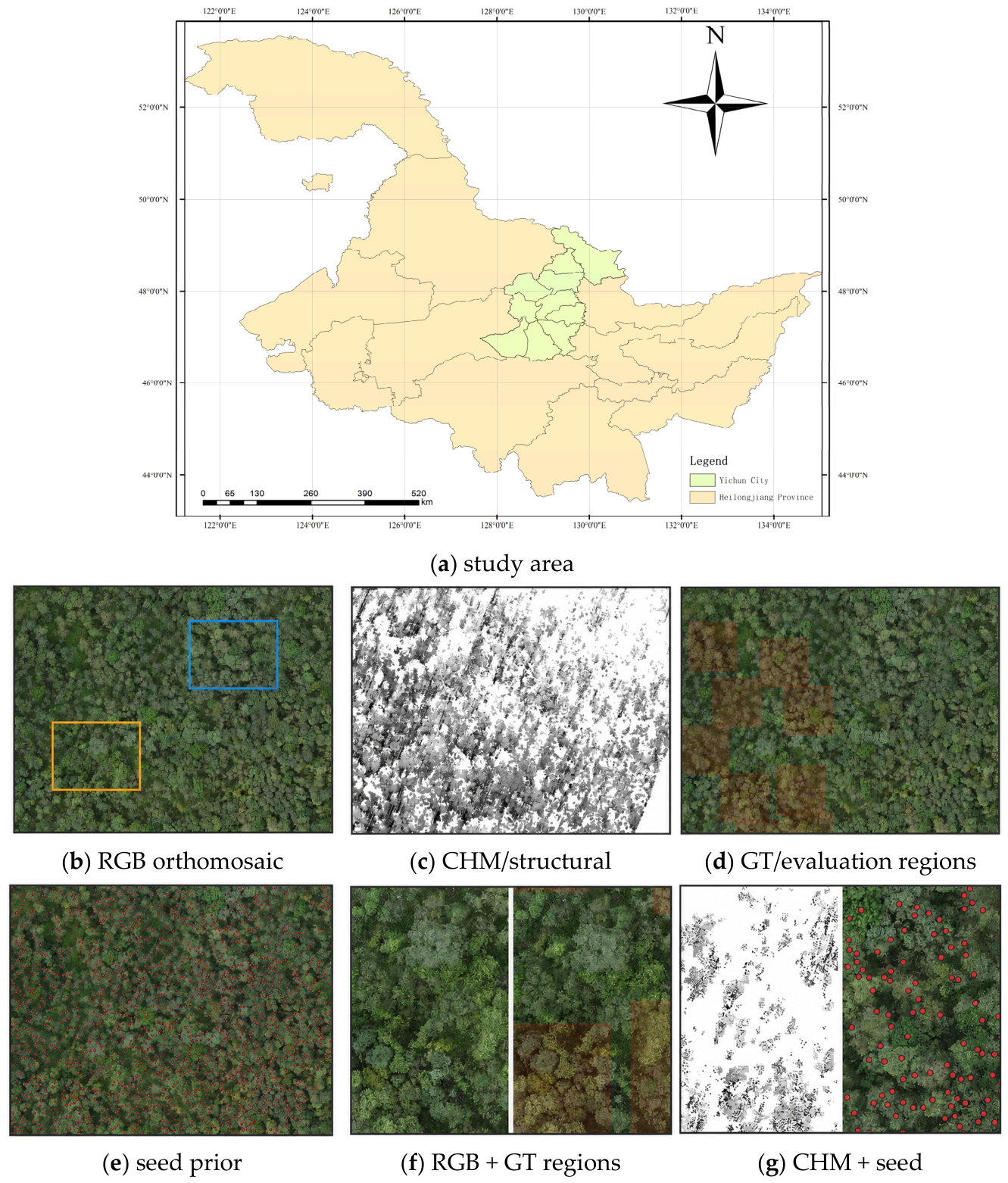
The study area is Shangganling Xiushui Forest Farm, located on the southern slope of the Xiaoxing’an Mountains in northeastern China. The terrain is dominated by mountainous and hilly landforms, with slopes ranging from 5° to 25° and elevations of approximately 200–800 m above sea level. The forest is a mixed conifer–broadleaf natural secondary forest; dominant and common species include poplar, elm, Manchurian ash, larch, and black birch. The study plot covers approximately 500 × 500 m and is characterized by high species diversity, severe inter-crown adhesion and occlusion, and locally multi-layer canopy structures.
2.2. Data Acquisition and Preprocessing
Two co-registered remote sensing data sources are used. The high-resolution RGB orthomosaic was produced from UAV aerial photogrammetry. Image acquisition was performed in clear, low-wind conditions with a flight altitude of approximately 120 m above ground, an 80% forward overlap, and a 70% side overlap, resulting in an original ground sampling distance of about 0.04 m. After tie-point matching and bundle adjustment, the orthomosaic was generated and georeferenced to the WGS-84/UTM coordinate system used throughout the experiment.
The airborne laser scanning (ALS) point cloud was collected during a separate campaign over the same plot. After ground filtering with the SMRF algorithm [
24], height-structure products, including CHM and HAG, were generated and aligned with the orthomosaic for joint processing. LiDAR quality is characterized here through effective structural support after rasterization, which is spatially uneven across the plot. Canopy occlusion, local gaps, and NoData propagation produce block-like artifacts and height discontinuities in parts of the CHM. DSM and COUNT were generated on the 0.05 m ROI grid, while the DTM was constructed as a 0.5 m terrain reference and then resampled and matched to the 0.05 m ROI grid for CHM derivation. CHM, HAG, and the associated validity masks were finally organized on the same 0.05 m grid as the RGB orthomosaic and manual annotations. All HCSM construction, E2GROW adjustment, selective splitting, and area-based measurements reported below refer to this common 0.05 m ROI grid.
2.3. Reference Annotations and Hyperparameter-Selection Protocol
Field data for the monitoring plot were collected on 15 November 2023. Ground-truth (GT) tree crown polygons were manually delineated in QGIS by trained interpreters using the orthomosaic and the CHM jointly, yielding 322 crowns in total. After applying the valid evaluation mask to exclude crowns outside the reliable evaluation/inference coverage, 306 crowns were retained for quantitative evaluation. Three-dimensional seed points are derived from CHM local maxima with NMS deduplication and serve as instance markers in the reconstruction pipeline.
The present experiment is a single-site methodological demonstration of the proposed reconstruction framework under annotation scarcity. Module hyperparameters for HCSM, E2GROW, and selective splitting were explored iteratively on the same plot used for the reported quantitative evaluation, guided by F1_proxy and HitDelta auditing. Consequently, the headline numbers reported in this manuscript should be read as a within-plot diagnostic characterization under the present data conditions and should not be interpreted as independent test-set performance; independent out-of-sample performance remains untested. Independent multi-site validation with spatially disjoint development and reporting subsets is identified as the principal direction for future work. All performance claims in this manuscript are restricted to the current mixed conifer–broadleaf natural secondary forest plot and to similar settings in which a usable semantic canopy prior and height information are available.
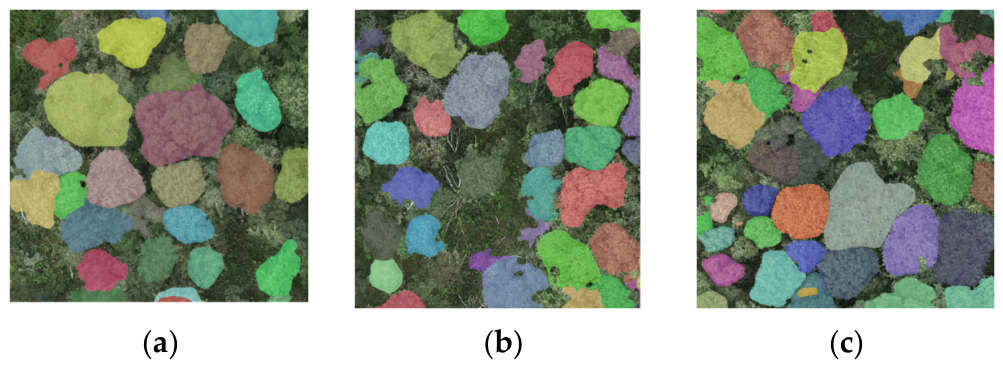
Figure 1 summarizes the input data and reference annotations used throughout the experiments.
3. Methodology
3.1. Overall Framework
The proposed framework consists of three connected reconstruction modules, including HCSM construction, constrained coverage recovery, and selective splitting, built on top of a semantic canopy probability prior whose construction and quality are described in
Section 3.2. During module development, an instance-level evaluation loop audits module updates, localizes harmful changes, and screens candidate refinements under Recall, Prec_proxy, F1_proxy, and HitDelta. This evaluation loop serves as an iterative safeguard. The semantic segmentation backbone uses DeepLabV3+ [
25] without architectural modification. The probability field is treated as a continuously adjustable interpretable prior. Seeds are extracted from CHM local maxima [
4] with NMS deduplication [
26] and serve as instance initialization markers and split-trigger evidence. Throughout the experiments, the R2 baseline denotes the initial internal instance set produced by the semantic-prior-to-instance initialization procedure before HCSM-based support-domain correction is applied. It differs from the fixed semantic-to-instance baselines in
Table 1, which apply default connected-component instance generation directly to the raw semantic probability fields without the internal initialization, filtering, and validity-control steps used in the reconstruction pipeline.
3.2. Semantic Prior Construction and Quality
The semantic probability prior is produced by a DeepLabV3+ canopy/background segmentation backbone [
25] initialized from standard pretrained weights and adapted using limited binary canopy/background annotations under the current annotation protocol. The backbone uses a ResNet-50 encoder with output stride 16 and a combined cross-entropy and Dice loss. Let I denote the co-registered input used by the semantic backbone and
denote the canopyprobability at pixel x; the semantic prior is formalized as Equation (1). Recorded pixel-level validation results for semantic-prior construction are approximately mIoU = 0.58 and mDice = 0.74. These values are reported to characterize the quality of the canopy probability prior rather than to claim a standalone semantic segmentation contribution or an independent benchmark of semantic segmentation performance.
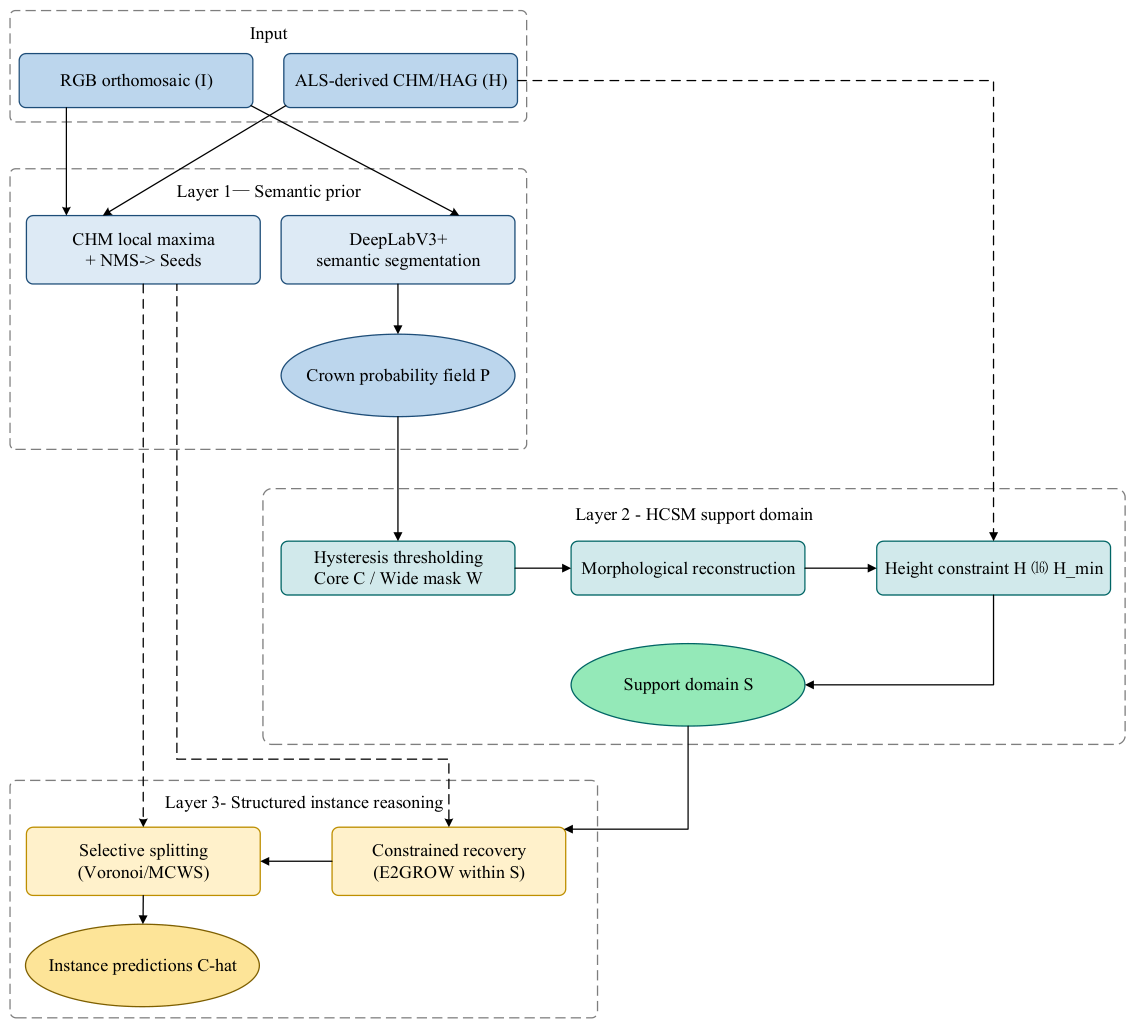
The role of this prior in the proposed framework is to provide a soft spatial constraint for crown-support reconstruction, not to generate final tree instances. Because HCSM reliability is bounded by prior quality, missed canopy regions cannot be recovered by support-constrained growth, and false canopy responses can enlarge the legal operating domain. The probability field is therefore treated as an explicit experimental input whose uncertainty propagates to all later modules. This separation makes the reconstruction process auditable: failure cases can be attributed to prior-quality errors, support-domain errors, seed-coverage errors, or split-trigger errors, allowing the contribution of the prior to be tracked separately from the contributions of later modules. The overall pipeline, comprising the semantic prior, the support domain, and the structured instance reasoning modules, is illustrated in
Figure 2.
3.3. Height-Aware Canopy Support Mask (HCSM)
The crown probability field carries non-zero responses in background regions such as grassland and shadow, and the CHM contains block-shaped artifacts related to uneven effective height-structure support. Applying a single threshold directly for grow or split operations tends to produce false positive expansion. HCSM therefore combines hysteresis thresholding [
27], morphological reconstruction [
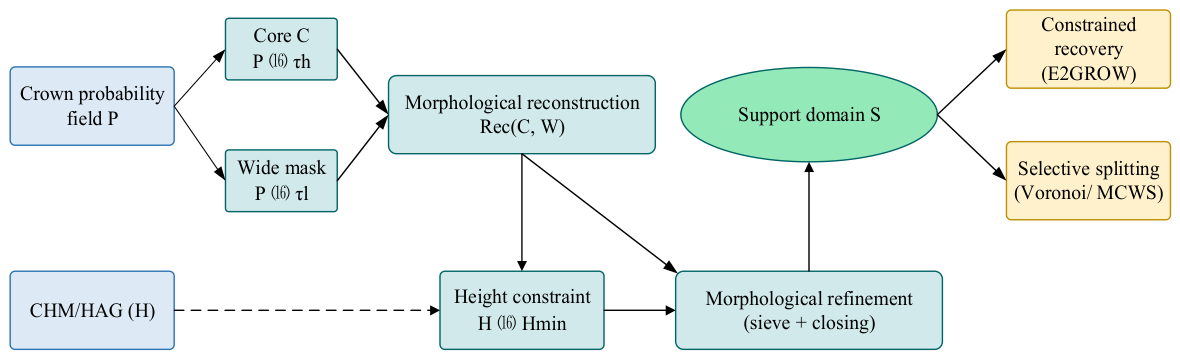
28], and a height constraint to obtain a credible support domain. The construction is formalized in Equations (2)–(4).
In Equations (2)–(4), denotes the image domain, P(x) is the semantic canopy probability, H(x) is the height-structure response, is the valid height-structure mask, anchors the high-confidence semantic core, t_lo controls support-domain openness, Rec(·) denotes morphological reconstruction constrained by the low-threshold mask, is the height lower bound, and denotes lightweight morphological cleaning and small-component filtering. The final support mask defines the legal operating space for subsequent boundary adjustment and splitting.
The construction pipeline is illustrated in
Figure 3.
The three essential distinctions between HCSM and single-threshold masking are: hysteresis thresholding balances reliability and spatial continuity, avoiding the trade-off imposed by a single threshold; connected-component reconstruction filters isolated noise through spatial connectivity; and the height constraint provides a physical bound that is independent of the network output, suppressing shrubs and ground-level responses that the probability field alone cannot reliably exclude. The support domain S* defines the legal operating space for all subsequent grow and split operations and constitutes a key component of the system’s risk control mechanism.
The tunable hyperparameters of HCSM include the high-confidence core threshold, the low support-domain threshold (TLO in experiments), the height lower bound (typically 2.0 m), the sieve minimum area, and the morphological closing kernel size. The low threshold controls support-domain openness, while the high-confidence core anchors morphologically connected canopy regions. All morphological operations are performed on the common 0.05 m ROI grid defined in
Section 2.2, so that area-based parameters such as the sieve minimum area are interpreted consistently at this resolution.
3.4. Constrained Coverage Recovery Within the Support Domain (E2GROW)
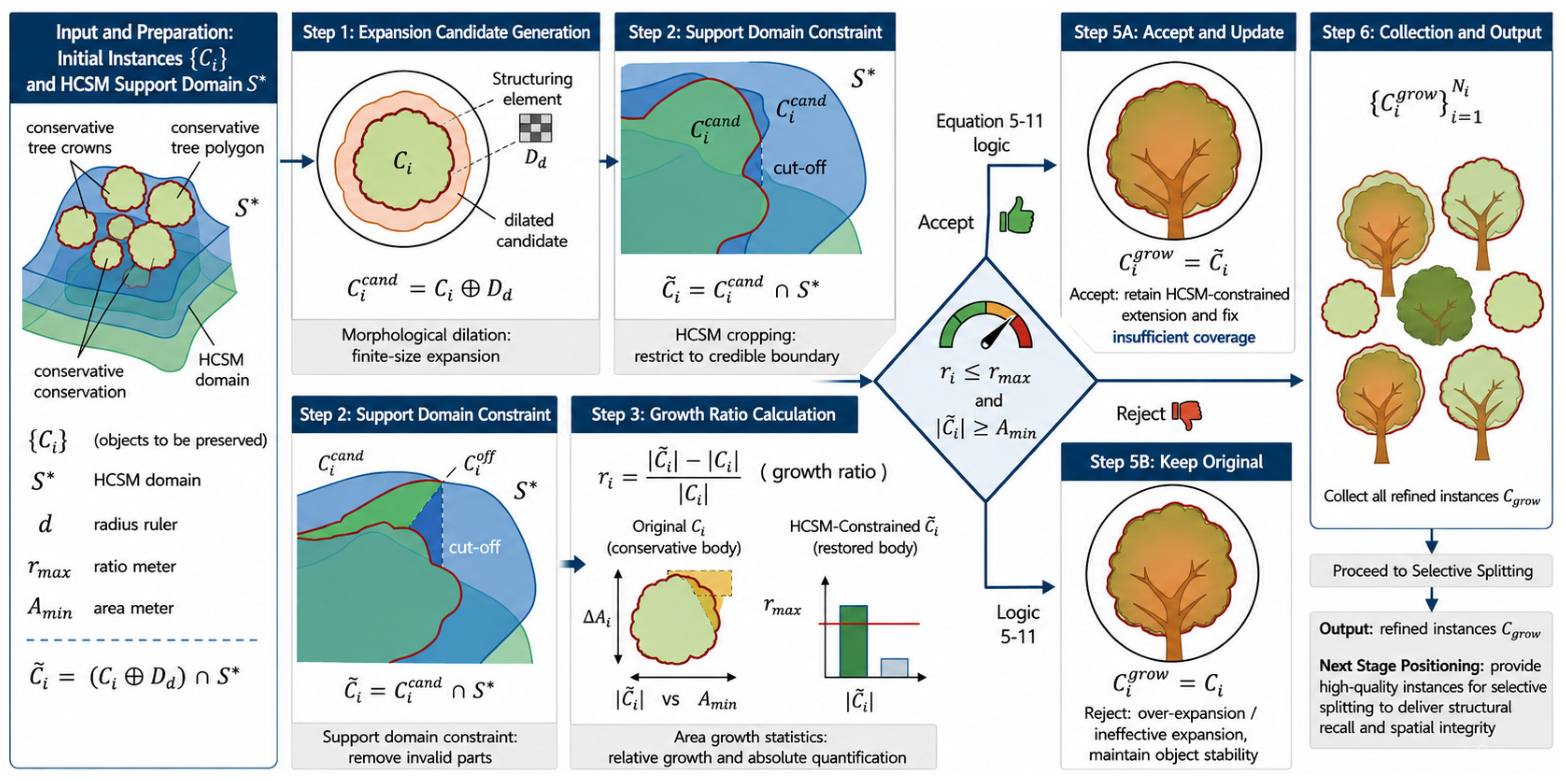
For each instance in the initial set, E2GROW (Evaluate-then-Grow within constraints) follows a fixed update procedure consisting of candidate generation, support-domain clipping, area-ratio checking, and write-back. After HCSM construction, the procedure adjusts under-covered object boundaries within
and leaves structural decomposition to the selective-splitting stage. Equations (5)–(7) define the constrained update rule.
In Equations (5)–(7),
denotes the support-domain-clipped candidate instance,
is the buffer element associated with buffer distance
,
is the candidate-to-original area ratio,
prevents division by zero for degenerate objects, and AR is the maximum permitted area ratio. In the experimental configuration names,
160,
200, and
250 correspond to maximum area-ratio thresholds of 1.6, 2.0, and 2.5, respectively. In most under-covered cases, this operation expands the crown boundary, while support-domain clipping may also remove invalid over-extended regions. The accepted results are consolidated into the coverage-repaired instance set, which subsequently enters the selective splitting stage. The E2GROW workflow is illustrated in
Figure 4.
3.5. Selective Splitting Within the Support Domain
Algorithmically, selective splitting is organized around five stages: trigger-object identification, trigger-condition screening, branch-specific partitioning, child-object filtering, and local write-back. Within S*, selective splitting addresses residual merge errors where a single predicted region covers multiple GT crowns. The strategy targets only connected regions satisfying a multi-condition trigger and uses CHM-derived seed points to avoid arbitrary fragmentation.
For a candidate region
, the trigger function combines seed count, object area, and spatial span, as shown in Equation (8). LOCAL/MCWS applies explicit thresholds for structural keypoint count, object area, seed-span, and minimum child area, whereas VORv1 is treated as a more aggressive Voronoi reference branch whose seed-based partitions are clipped by the support domain and filtered by a minimum-area rule. In the LOCALv10 configuration used in the experiments, a candidate object is considered for local MCWS splitting only when it contains at least three structural keypoints, has an object area of at least 8.0 m
2, has a seed-span of at least 1.5 m, and produces accepted child objects no smaller than 1.0 m
2 after filtering. The thresholds are plot-specific operational parameters selected within the within-plot screening protocol by jointly considering Recall, Prec_proxy, F1_proxy, prediction count, and HitDelta behavior.
Once a candidate region passes the trigger test, one of two branch-specific partition operators is applied depending on the structural configuration. In the VOR branch, partitioning is carried out by assigning each location in the triggered region to its nearest valid seed, thereby producing a set of geometrically defined child regions. In the LOCAL/MCWS branch, partitioning is instead performed through conservative local reconstruction within the support domain, constructing a local energy surface from height and probability fields and executing seed-guided watershed segmentation only within the local support subregion defined by the intersection between the triggered candidate region and the HCSM support domain.
In both branches, generated child objects are subject to filtering on minimum area, support-domain consistency, and structural attribution before being accepted. If
denotes the accepted child set produced from a triggered parent
, Equations (9) and (10) summarize the child filtering and local write-back operations.
The two branches are designed for different structural configurations: the VOR branch emphasizes more exhaustive geometric partitioning for clearer multi-center candidates, whereas the LOCAL/MCWS branch adopts stricter triggering and more conservative local reconstruction for structurally ambiguous regions. Their empirical behavior is further examined in the experimental section.
3.6. Instance-Level Evaluation Protocol and Module-Screening Safeguards
The instance-level evaluation protocol has two roles. First, it provides the reported metrics used to compare external baselines, intermediate pipeline stages, and final configurations. Second, during module development, it acts as a safeguard for identifying harmful updates before they are propagated to later stages. The protocol produces standardized outputs, including gt_maxiou.csv and summary.json, allowing threshold-crossing events and unmatched instances to be inspected consistently across modules.
3.6.1. Why a Tailored Protocol Is Needed
A tailored instance-level protocol is used because the current plot contains severe crown adhesion and only a few hundred reference crowns. Under these conditions, strict one-to-one matching can be unstable: a single predicted region may partially cover several GT crowns, but a bipartite assignment can match it to only one of them and count the remaining overlaps as misses. Conversely, a prediction set with many fragments may inflate apparent overlap counts if precision is not checked on the prediction side. The adopted protocol, therefore, evaluates each GT instance against its best-overlapping prediction and evaluates each prediction against its best-overlapping GT instance. This many-to-many diagnostic view is complemented by the one-to-one bridge evaluation in
Appendix A to improve comparability with conventional VOC-style reporting [
19].
3.6.2. The Gate-3 Recall and Precision Proxies
Let G denote the retained GT instance set and C denote the prediction set after applying the same valid evaluation-domain mask (OutsideOnly). For each GT instance, its best-overlapping prediction is used for Gate-3 Recall; symmetrically, each predicted instance is evaluated against its best-overlapping GT instance for Prec_proxy. Equations (11)–(13) define the metrics used in the main protocol.
3.6.3. HitDelta and Module-Screening Safeguard
Each module is further audited by tracking threshold-crossing events between a base prediction and a new prediction. Using the GT-side maxima in Equation (11), the Delta-positive and Delta-negative counts are defined in Equation (14).
Here, counts GT crowns that cross the hit threshold upward, whereas counts GT crowns that cross the threshold downward. HitDelta is used as a diagnostic safeguard during module screening. For example, at = 0.50, if the maximum IoU of a GT crown increases from 0.47 under the base prediction to 0.52 after E2GROW, this crown is counted as a Delta-positive case; conversely, a decrease from 0.53 to 0.49 after splitting is counted as a Delta-negative case.
5. Discussion
5.1. Mechanism Interpretation of the Observed Gains
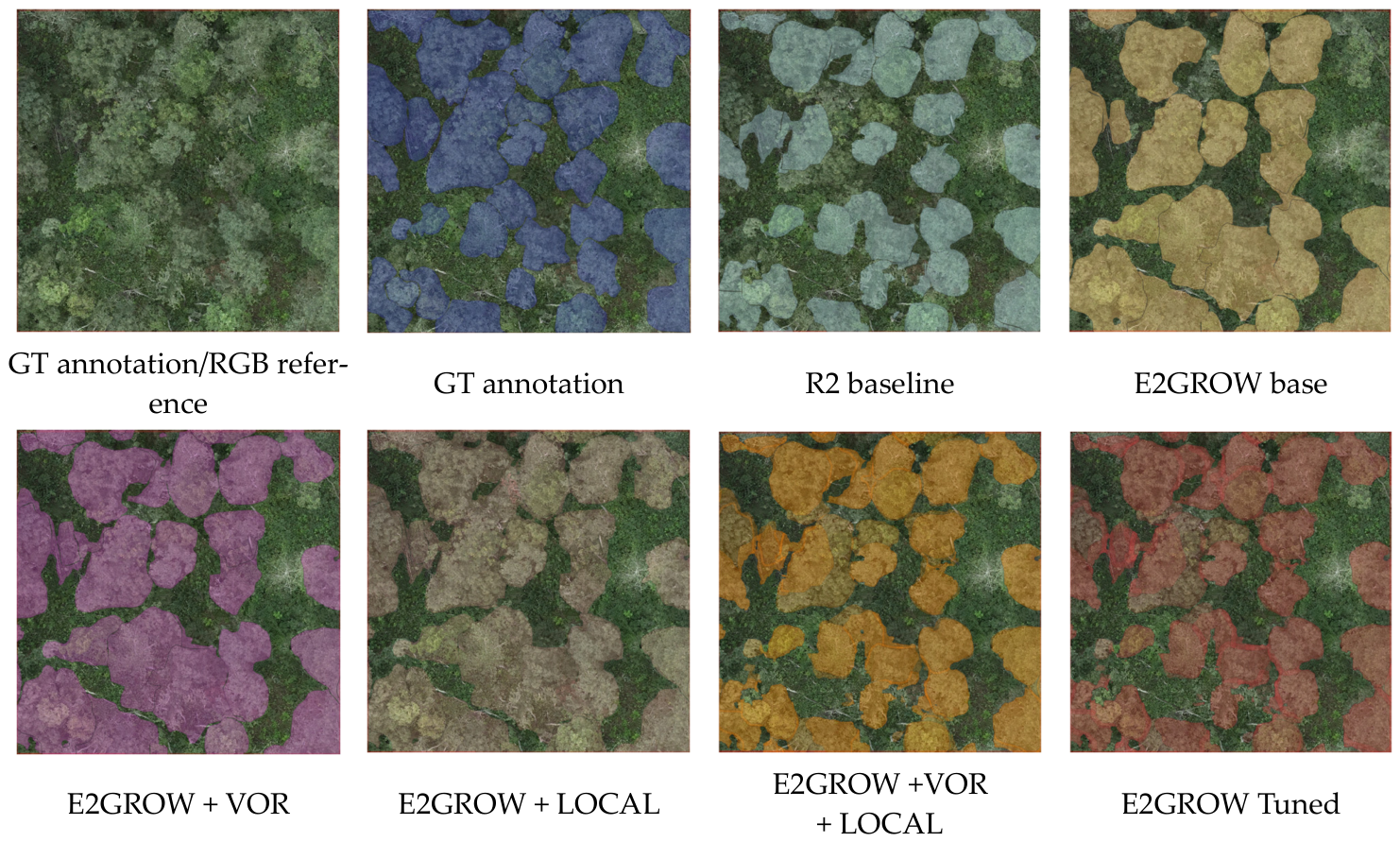
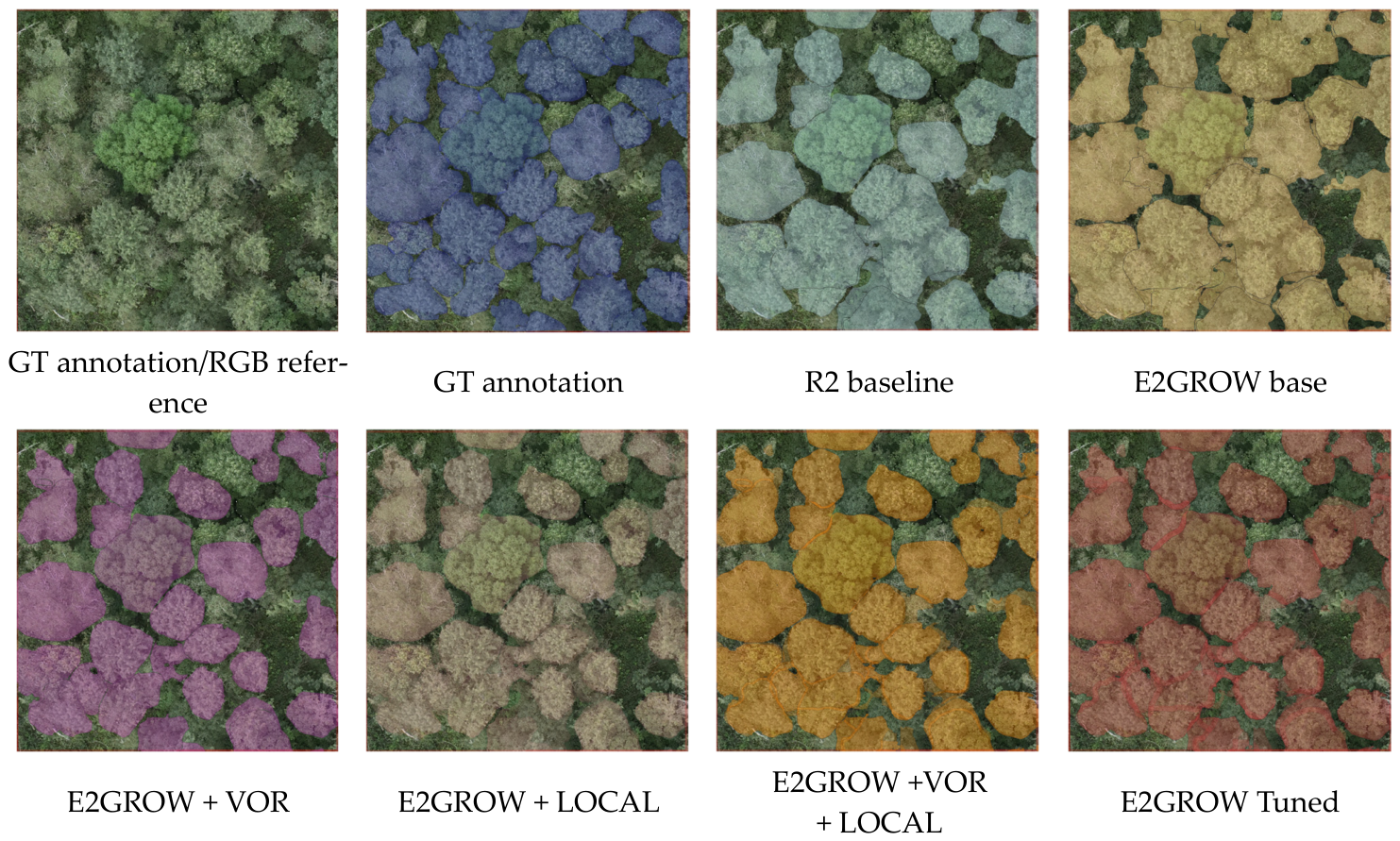
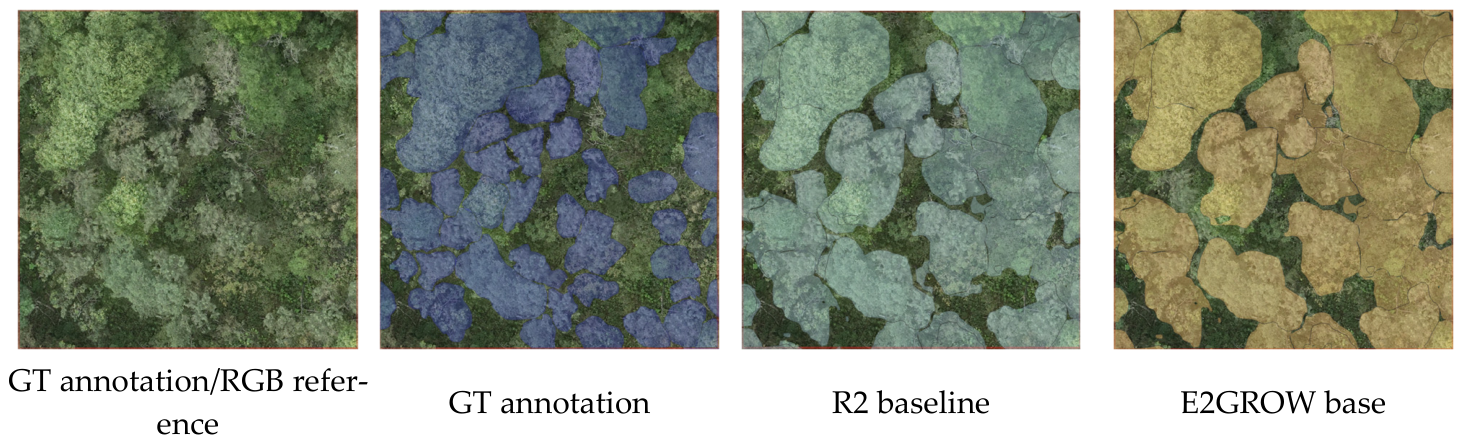
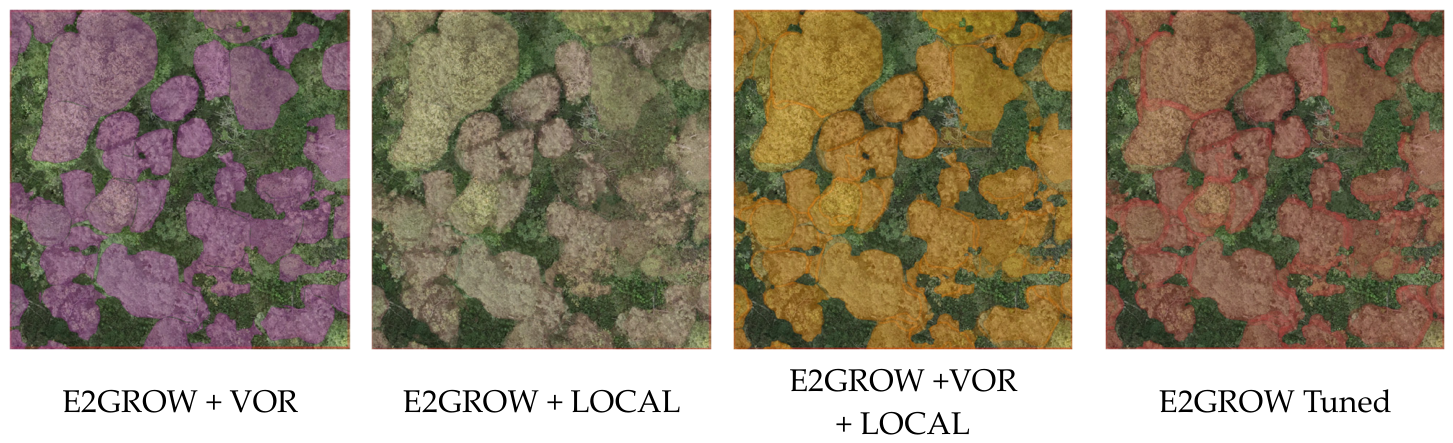
Within the current plot, the observed performance gains arise from two qualitatively different mechanisms that operate at different stages of the pipeline. The largest single gain occurs between the R2 baseline and E2GROW, where Recall increases from 0.369 to 0.621 at the best-Recall configuration. Inspection of the affected GT instances shows that this gain is not primarily driven by the discovery of entirely new crowns. Most of the newly recovered hits correspond to instances that were already roughly localized under the R2 anchor but remained slightly under-covered around the crown boundary, leaving the maximum IoU just below the hit threshold. By allowing spatially bounded boundary completion within the support domain, E2GROW pushes a portion of these near-miss instances across the threshold, converting sub-threshold overlaps into valid hits. The boundary-completion nature of this gain is consistent with the cross-threshold view in
Table 3, where the gap between hits@0.40 and hits@0.50 narrows after E2GROW, and with the qualitative cases shown in
Figure 6 and
Figure 8.
The further improvement from E2GROW to VORv1 reflects a different mechanism: structural repair of merged crowns after boundary-completion gains have largely been realized. VORv1 is most effective when a single connected predicted region carries multiple distinct seed cues after constrained recovery but is still assigned as a single instance. In such regions, the dominant residual error is the failure to separate neighboring crowns that share a connected canopy response. Seed-driven Voronoi partitioning decomposes these merged regions into independent child instances, so previously suppressed GT crowns are recovered. The cost is a substantial increase in pred_used from 593 to 1044 and a decrease in Prec_proxy from 0.503 to 0.362, reflecting fragmentation introduced by global geometric splitting.
LOCALv10 follows a more conservative pattern. Its trigger conditions are stricter, so fewer candidate regions enter the splitting stage, and its child objects are filtered through tighter local-reconstruction constraints before write-back. As a result, LOCALv10 limits pred_used to 793 and maintains a higher F1_proxy than VORv1 (0.486 vs. 0.471), although it does not increase strict-threshold Recall beyond the E2GROW base. This behavior makes LOCALv10 the more controlled branch under structurally ambiguous local canopy configurations.
The combined VORv1 + LOCALv10 configuration adds only +11 gt_hits over the E2GROW base while increasing pred_used by 651 (
Table 9), indicating that the two branches largely target overlapping merge candidates. Their combination therefore behaves as a complementarity probe, and the structural Recall–precision trade-off they produce is best read as two operating points along a single axis.
5.2. Methodological Positioning Relative to Existing Work
The proposed framework differs from end-to-end ITC instance segmentation methods primarily in how the network output is used. Methods such as DeepForest [
7], Detectree2 [
8], and other task-specific instance segmentation models aim to predict crown instances directly from imagery, placing the main burden of separation on the network itself. In the present study, the semantic output is treated as an interpretable canopy prior, and the main reconstruction burden is assigned to a structured object-level pipeline. This distinction is particularly relevant under the present plot conditions, where instance-level annotation is extremely limited and direct end-to-end supervision is difficult to obtain.
The framework is also distinct from training-side annotation-reduction strategies, such as semi-supervised delineation [
21] and LiDAR-derived pseudo-label learning [
22]. Those approaches enlarge the effective supervision pool for network training, whereas the present framework operates on the inference side. Its central question is how to recover more instance-level structure from an already available probability field through support-domain construction, constrained recovery, and seed-guided local repair. In this sense, the framework should be read as an object-level reconstruction route.
The closest conceptual neighbors are methods that constrain instance delineation by a semantic support region or by structural evidence, including SAM-based approaches [
15,
16] and zero-shot semantic-prior segmentation routes such as ZS-TreeSeg [
23]. Compared with these methods, the current framework emphasizes the explicit organization of the reconstruction process: HCSM defines a credible support domain, E2GROW repairs coverage-deficient instances within that domain, and selective splitting addresses residual merge errors only when seed and geometry conditions jointly justify local reconstruction. The contribution is therefore a more explicit and auditable object-level reconstruction logic under annotation-scarce forest conditions.
The external baselines reported in
Table 1 are consistent with this positioning. The classical CHM + MCWS pipeline performs poorly under the present plot conditions (Recall = 0.050), reflecting the direct impact of uneven and locally degraded CHM quality on local-maximum detection and watershed partitioning. The two fixed semantic-to-instance baselines (DeepLabV3+ and SegFormer-B1) perform better than CHM + MCWS but remain substantially below the R2 anchor (0.369), suggesting that the gain of the proposed framework does not stem from the semantic backbone alone but is primarily associated with the subsequent object-level reconstruction process.
5.3. Applicable Conditions and Scope of the Framework
The framework is most appropriate for forest plots that simultaneously exhibit four characteristics: a high-density or closed canopy with severe inter-crown adhesion; limited instance-level annotations that preclude direct end-to-end training; imperfect but usable CHM/HAG information; and a semantic probability field that captures the main canopy extent at moderate quality. Under these conditions, semantic output carries enough spatial information to be useful as a prior, but not enough to be used directly as instance evidence, and the structured object-level pipeline contributes the missing instance-level reasoning.
First, in open forests or sparse tree distributions, individual crowns are already well separated and the support-domain construction provides little additional benefit relative to direct CHM-based delineation. Second, in regular plantations or single-species rows, simpler geometric rules typically suffice and the splitting machinery is unnecessary. Third, in sites where the semantic probability prior fails to identify canopy regions reliably—for example, due to severe domain shift, sensor mismatch, or atmospheric artifacts—the support domain may either omit valid crowns or admit excessive background, so downstream reconstruction loses its operational basis.
This applicability profile is consistent with the intended use condition stated in
Section 1. All quantitative claims in this manuscript are restricted to settings that satisfy the four characteristics above and resemble the mixed conifer–broadleaf natural secondary forest plot used in the present experiments.
5.4. Limitations and Generalization Considerations
First, the conclusions are based on a single 500 × 500 m mixed conifer–broadleaf natural secondary forest plot. The experimental setting—extremely limited annotations, uneven and locally degraded effective height-structure support, and severe canopy adhesion—is practically relevant and underserved by existing benchmarks, but it does not by itself establish generalization to other forest types, plot sizes, latitudes, point-cloud densities, or sensor configurations. Generalization across these axes requires multi-site validation with spatially disjoint development and reporting subsets and is identified as the principal direction for future work.
Second, the framework depends on the quality of the semantic probability field. The pixel-level metrics reported in
Section 3.2 place the prior in a moderate-quality regime; this is sufficient for support-domain construction in the present plot but has limited transferability evidence. In a new domain in which the network fails to localize the canopy reliably, the HCSM support domain becomes either too restrictive or too permissive, and the accuracy of E2GROW and selective splitting degrade accordingly. This dependency is inherent to approaches that treat network output as a prior.
Third, seed extraction remains sensitive to CHM quality. Occluded crowns, height gaps, and weak local maxima can leave valid GT crowns without effective seed evidence, as documented in the failure-mode analysis. Improvements in this direction will likely require richer three-dimensional cues from the original point cloud beyond CHM local maxima.
Fourth, the HCSM, E2GROW, and selective splitting hyperparameters are currently set manually within the within-plot screening protocol. The sensitivity analysis indicates that the optimum is stable over the explored TLO range and that the influence of CHM lower bound and area-ratio constraint is small. Nevertheless, a systematic search strategy such as Bayesian optimization [
29] could further reduce reliance on human judgment and improve portability across sites.
Fifth, the external baseline comparison should still be regarded as limited in scope. The current experiments do not yet include carefully calibrated DeepForest, Detectree2, SAM-like constrained routes, or task-specific ITC methods evaluated under the same plot and protocol. The present baseline analysis is therefore sufficient for minimum external positioning but not for exhaustive benchmarking.
5.5. Practical Implications and Future Directions
First, useful instance-level reconstruction does not necessarily require a fully retrained or highly specialized end-to-end instance model. A semantic probability field of moderate quality, when treated as an interpretable prior and combined with structured object-level reasoning, can support meaningful crown recovery in difficult forest plots. This is particularly relevant for small-plot scenarios where annotation resources are insufficient for direct instance-level supervision.
Second, modularity has operational value. Because HCSM, constrained recovery, and selective splitting operate as distinct yet connected modules, error sources can be localized and adjusted without full-model retraining, and the audit trail produced by HitDelta statistics makes iterative refinement traceable. This makes the pipeline more adaptable in resource-limited settings, where iteration often has to proceed under strict data and computation constraints.
Third, height information retains value when effective height-structure support is uneven or locally noisy, because it provides a physical bound that RGB-based probability alone cannot fully replace [
1]. In the current framework, height information constrains support-domain construction and stabilizes local object reconstruction, while CHM itself is not used as the final delineation output.
Future work follows directly from the failure-mode breakdown. Specifically: (i) multi-site validation across additional forest types, plot sizes, and sensor configurations, with spatially disjoint development and reporting subsets, to test generalization beyond the present plot; (ii) explicit pixel-level reporting of semantic-prior quality on each new site, to make prior-quality propagation auditable across the pipeline; (iii) calibrated comparisons with additional open-source ITC methods (DeepForest, Detectree2, and SAM-like constrained routes) under a common plot and evaluation protocol; (iv) richer three-dimensional seed extraction directly from the point cloud, targeting the identified seed-coverage failures; and (v) using reconstruction outputs as pseudo-labels for refining the probability field through network retraining, closing the loop between inference-side reconstruction and training-side improvement. Recent lightweight graph-based LiDAR sensing and spherical-harmonic tree-structure learning further indicate that compact geometric representations and explicit three-dimensional descriptors could support future seed extraction, morphology-aware reconstruction, and cross-site transfer analysis [
30,
31].
6. Conclusions
This study addresses individual tree crown segmentation under annotation scarcity by treating semantic segmentation output as an interpretable canopy prior and building a structured object-level reconstruction pipeline around it. The framework consists of three connected modules: a height-aware canopy support mask that converts the probability field into a credible operational domain through hysteresis thresholding, morphological reconstruction, and a height constraint; a constrained recovery procedure (E2GROW) that repairs coverage deficiency through spatially bounded morphological growth with explicit guard rails; and selective splitting that addresses residual merge errors through branch-specific seed-guided partitioning, including an aggressive Voronoi reference branch and a more conservative LOCAL/MCWS branch with explicit trigger and child-object filtering criteria. An instance-level evaluation loop is used throughout module development as a diagnostic safeguard for screening module updates and localizing harmful threshold-crossing cases.
In the present single-site mixed conifer–broadleaf experiment, the proposed pipeline improves Recall over the R2 baseline through two qualitatively different mechanisms: threshold-crossing boundary recovery for coverage-deficient crowns and local structural decomposition for merged crown groups. Sensitivity analysis indicates that the support-domain construction is stable over the explored parameter ranges, and that the two splitting branches realize a structural Recall–precision trade-off with no evidence of simple additive gains. The reported numbers, therefore, characterize within-plot behavior under the present data conditions and do not establish cross-site generalization.
The framework is modular and auditable and does not require GPU-intensive retraining during iterative refinement. Its demonstrated applicability is strongest for annotation-scarce closed-canopy plots where a usable semantic canopy prior and height information are available and weaker in settings outside this regime. Multi-site validation, explicit pixel-level reporting of semantic-prior quality, calibrated comparisons with additional open-source ITC methods, and richer three-dimensional seed extraction are identified as the principal next steps for establishing transferability.