Article

An Innovative Coastal Altimetry Waveform Processing Approach Based on Wave-Transformer Classifier

1
The CAS Key Laboratory of Microwave Remote Sensing, National Space Science Center, Chinese Academy of Sciences (CAS), Beijing 100190, China
2
University of Chinese Academy of Sciences, Beijing 100049, China
*
Author to whom correspondence should be addressed.
Remote Sens. 2026, 18(12), 1950; https://doi.org/10.3390/rs18121950 (registering DOI)
Submission received: 25 March 2026 / Revised: 1 June 2026 / Accepted: 8 June 2026 / Published: 12 June 2026

Highlights

What are the main findings?
  • We proposed a Wave-Transformer classifier. To train the model, we simulated 17 categories of waveforms (LRM/SAR): standard ocean waveforms/sharp ocean waveforms, ocean abnormal peak/sharp abnormal peak waveforms, ocean multi-peak/sharp multi-peak waveforms, ocean trailing noise/sharp trailing noise, and clutter. Additionally, we analyzed the variation of Sentinel-3A PRLM, SAR, and FFSAR real waveforms with distance from the coast.
  • Based on the classification results, we adopted different waveform processing strategies: for abnormal peak waveforms, we applied the 3-sigma principle for denoising; for multi-peak waveforms, we used the Dijkstra algorithm to identify the optimal leading edge and performed retracking only on sub-waveforms; for sharp waveforms with trailing edge noise, we proposed a Modified-Adaptive sub-waveform retracking method.
What are the implications of the main findings?
  • We applied the above processing workflow to Sentinel-3A PRLM, UFSAR, and FFSAR waveforms and compared four indicators: data availability, retracking success rate, MQE, and SSH standard deviation. The results show that FFSAR and UFSAR outperform PRLM in all indicators. Within 10 km of the coast, the RSS of FFSAR SSH is approximately 4.31 cm lower than that of UFSAR, while beyond 10 km, UFSAR is 2.06 cm lower than FFSAR.
  • Validation using tide gauge measurements shows that FFSAR achieves a correlation coefficient of 0.82 and an RMSE of 6.20 cm, both superior to UFSAR (0.76, 7.55 cm) and PRLM (0.74, 9.49 cm).

Abstract

Aiming at the issues of complex waveforms and low retracking accuracy in coastal satellite altimetry, this paper proposes a complete data processing workflow comprising Fully Focused Synthetic Aperture Radar (FFSAR) waveform processing, waveform classification, denoising, and retracking. Based on actual Sentinel-3A waveforms offshore of Hong Kong, a simulated dataset containing 35,409 waveforms across 17 categories was constructed. A Wave-Transformer classifier based on the Transformer architecture is proposed, achieving 89.16% accuracy with F1-scores above 78% for all categories. Differentiated strategies are adopted for different waveform types: a 3 σ riterion for abnormal peaks, the Dijkstra algorithm for multi-peak waveforms, sub-waveform secondary retracking for trailing noise, and a Modified-Adaptive model for sharp waveforms. Multi-metric evaluation shows that UFSAR and FFSAR outperform PLRM in data validity, retracking success rate, and MQE. In this study, within 10 km of the coast, the Root Sum Square (RSS) of FFSAR sea surface height (SSH) is 4.31 cm lower than that of UFSAR. Validation against tide gauge data shows FFSAR achieves a correlation coefficient of 0.82 and an RMSE of 6.20 cm, superior to UFSAR (0.76, 7.55 cm) and PLRM (0.74, 9.49 cm).

1. Introduction

Coastal areas, as the transition zone between ocean and land, are not only crucial for global biogeochemical cycles but are also the most densely populated regions for human economic activities [1]. Precise monitoring of the dynamic environment in these areas is of great significance. However, traditional pulse-limited radar altimeters have relatively low cross-track resolution (approximately 2 km diameter [2,3]), making echoes in nearshore regions easily contaminated by land and resulting in severe challenges for data availability and measurement accuracy [4].
The emergence of synthetic aperture radar (SAR) altimetry improved across-track resolution to approximately 300 m [5], significantly enhancing the signal-to-noise ratio and substantially improving nearshore observation accuracy. In recent years, Fully Focusing SAR (FFSAR) technology [6,7] has further improved resolution through coherent processing of raw echo data, markedly enhancing SSH and Significant Wave Height (SWH) measurement accuracy in coastal areas. For the area within 1 to 3 km from the coast, the accuracy of FFSAR and UFSAR has increased by up to 29% [8]. However, since FFSAR still employs the pulse-limited mode in the across-track direction, its measurements in nearshore regions cannot completely avoid interference from land signals [9], while in open ocean areas, it is susceptible to the influence of ocean dynamic variations [10,11], leading to degraded accuracy. Therefore, it is beneficial to systematically evaluate the performance of LRM, SAR, and FFSAR modes from nearshore to open ocean areas and construct a complete data processing workflow suitable for measurements in complex coastal environments.
Currently, extensive research has been conducted on nearshore complex waveform data processing, with the mainstream approach being waveform classification followed by corresponding retracking algorithms for different waveform types.
In terms of waveform classification, Schwatke [8] used skewness, kurtosis, sharpness, signal-to-noise ratio, and maximum power as characteristic parameters to classify inland water echoes into four categories: contaminated waveforms, unimodal waveforms, ocean-like waveforms, and noise-spike waveforms. Berry [12] developed an expert system to classify ERS-1 altimeter echoes into categories including ocean, coast, water, desert, forest, and land. Dabo-Niang [13] implemented unsupervised classification methods for radar waveform classification. Zheng [14] applied RNN models to classify waveforms into standard and land-contaminated categories. Although these methods have achieved good results, they generally categorize all contaminated waveforms into a single “abnormal” class and directly discard them, resulting in significant loss of valid nearshore data.
In terms of retracking, researchers have proposed various strategies to handle contaminated waveforms, including the ALES [15] algorithm for PLRM trailing noise, the BAGP model designed by Halimi [16] for waveform peak asymmetry, the BP (Brown-Peaky) retracking algorithm by Peng [17], the MWapp algorithm for SAR inland river and water body echoes [18], and the SAMOSA+ and SAMOSA++ series algorithms proposed by Dinardo based on SAMOSA [19]. It can be observed that the above methods are mostly designed for specific waveform types or specific sensors. Although we also draw on some of these ideas, we place greater emphasis on the overall waveform processing workflow.
To address these limitations, this study constructs a complete data processing workflow for coastal areas based on FFSAR waveforms, aiming to improve SSH retrieval accuracy and data availability. The specific research contents include: (1) conducting fully focused waveform reconstruction to obtain high-quality nearshore waveform data; (2) developing a Wave-Transformer classifier based on the Transformer architecture, which subdivides nearshore echoes into 17 categories (including standard ocean waveforms, standard sharp waveforms, abnormal peak waveforms, multi-peak waveforms, trailing noise waveforms, etc.), fully exploiting the feature differences among different waveform types to maximize waveform data utilization; (3) based on the classification results, applying different retracking methods for different waveform types: a 3 σ riterion for abnormal peak removal, the Dijkstra algorithm for optimal leading edge identification in multi-peak waveforms, sub-waveform secondary retracking for trailing noise waveforms, and Modified-Adaptive model for sharp waveforms with trailing noise, thereby improving retracking accuracy while maximizing valid data retention; (4) and comprehensive evaluation across five metrics: data validity rate, Mean Quality Evaluation (MQE), retracking success rate, SSH stability, and validation using SSHA data from tide gauges.

2. Data and Methodology

2.1. Study Area and Data Description

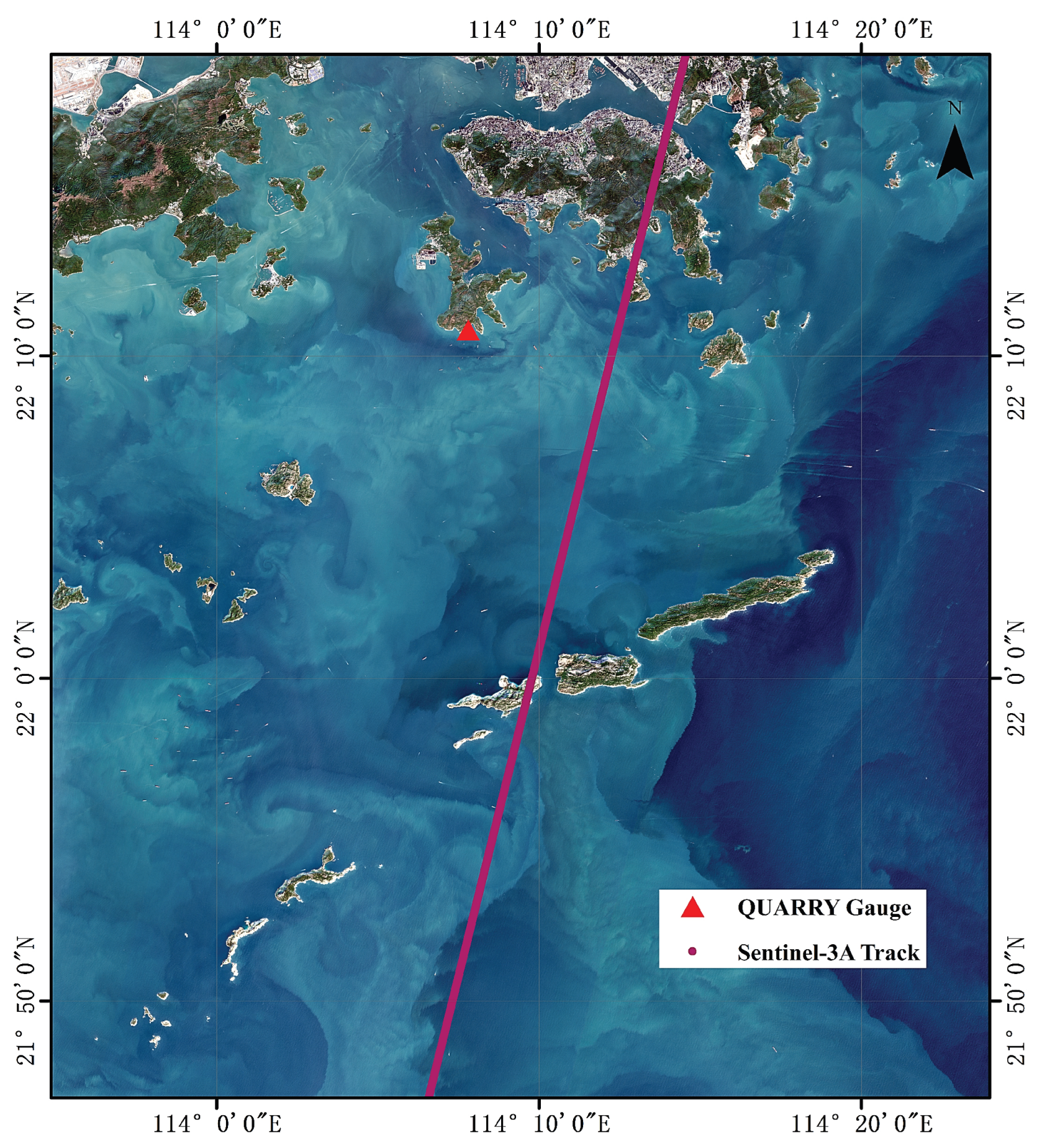
This paper focuses on the South China Sea (Hong Kong area). The reasons for selecting this study area are twofold: firstly, the region is influenced by various climate processes (ENSO, eddies, storm surges, monsoon, etc.) [20]; secondly, tide gauge data are available for validation in this area, and the Quarry Bay tide gauge data in Hong Kong can be obtained from the University of Hawaii Sea Level Center (UHSLC). Based on the matching results of the Sentinel-3A altimeter orbit and tidal measurements, we selected the Hong Kong sea area between 21°N and 23°N as the study region. The study region is shown in Figure 1.
The experimental data were derived from the Sentinel-3A Level-1A (L1A) data and Level-2 (L2) products of pass 260 during 2022. The L1A data were used for FFSAR waveform reconstruction, while the PLRM (Pseudo Low Resolution Mode) and SAR waveforms from L2 products were implemented for comparative evaluation with the fully focused waveform. Additionally, the correction terms for SSH calculation were obtained from the L2 products.
The tide gauge data were obtained from the Quarry Bay station in Hong Kong, which is located at 22.29°N, 114.21°E, and provides hourly SSH data.
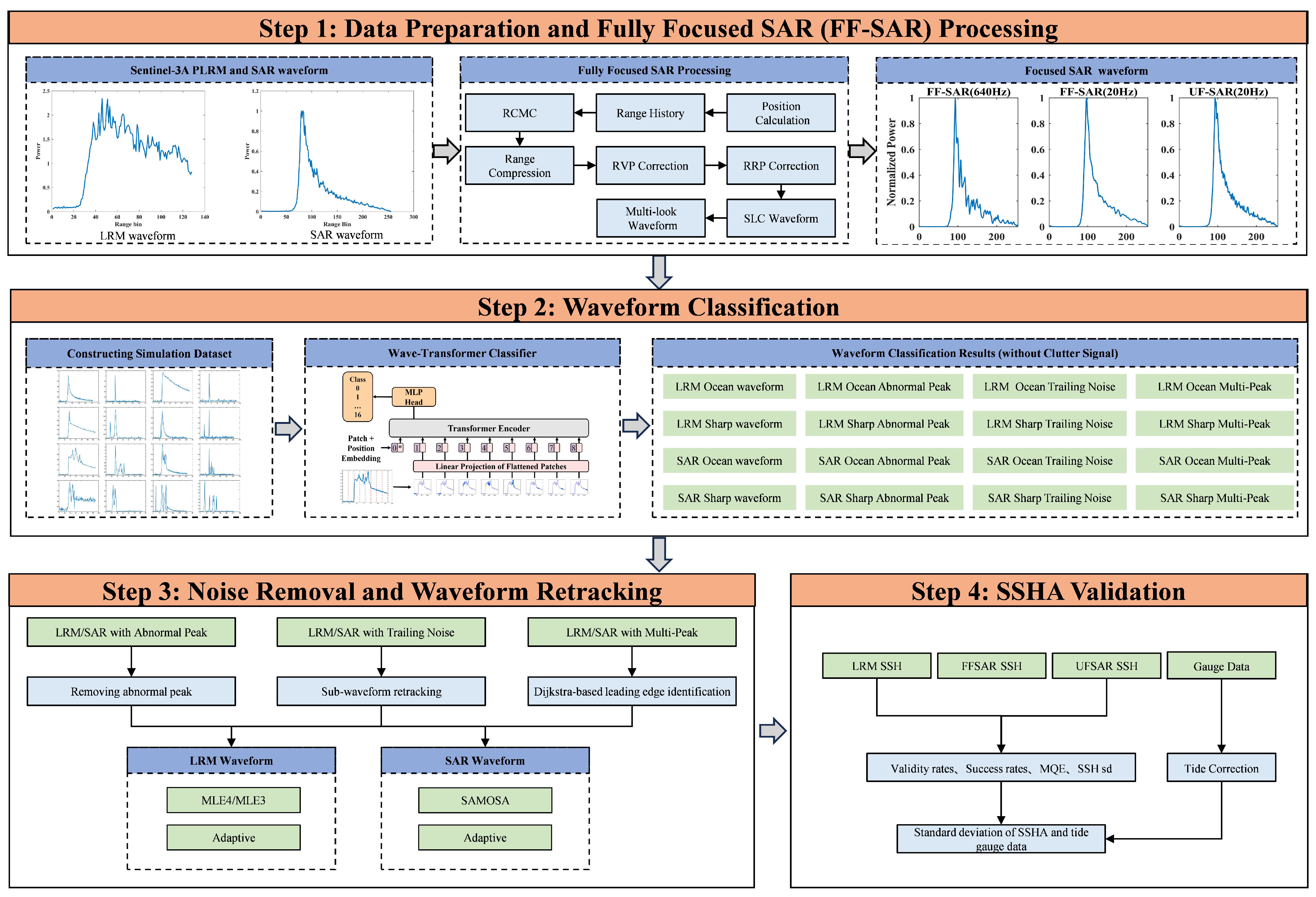
The overall research methodology is shown in Figure 2, which includes four main steps: (1) FFSAR waveform reconstruction, (2) waveform classification, (3) waveform denoising and retracking, and (4) validation of SSHA measurements.

2.2. FFSAR Processing

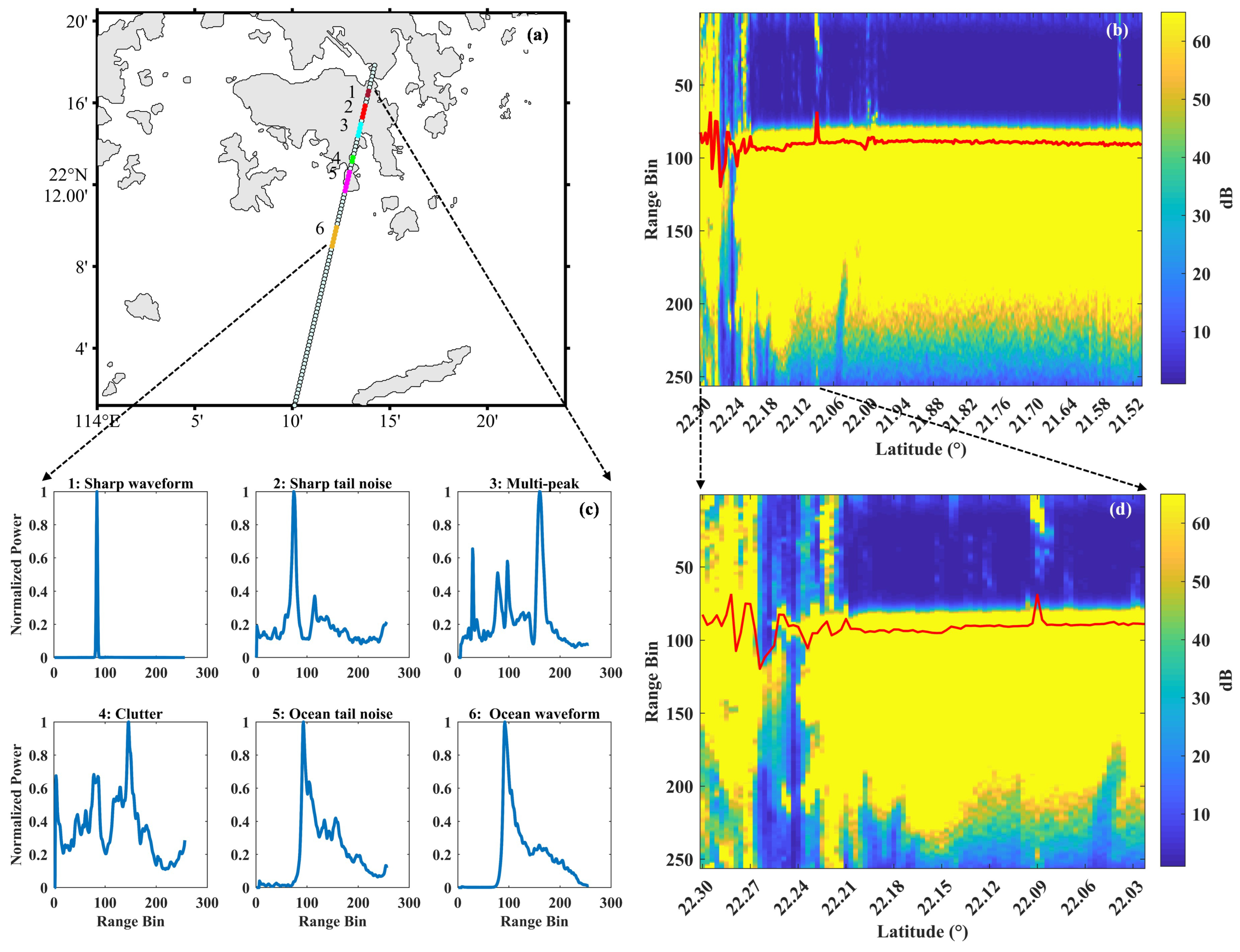
The FFSAR processing method provided by the Standalone Multi-Mission Altimetry Processor (SMAP-FFSAR, https://github.com/cls-obsnadir-dev/SMAP-FFSAR) (accessed on 1 January 2026) was applied to process the Level-1A data. The details of the processing parameters are shown in Table 1. The processing results are shown in Figure 3.
As shown in Figure 3a,c, the radar waveforms exhibit a significant and regular evolution with increasing offshore distance. In the nearshore region, the waveforms are predominantly characterized by typical sharp (spike-like) waveforms. As the distance from the coast increases, the waveforms transition successively to sharp trailing noise, sharp multi-peak, and clutter patterns. When entering the offshore region, the waveforms gradually evolve into ocean trailing noise and standard ocean waveforms. The detailed waveform classification criteria will be thoroughly discussed in the subsequent section.
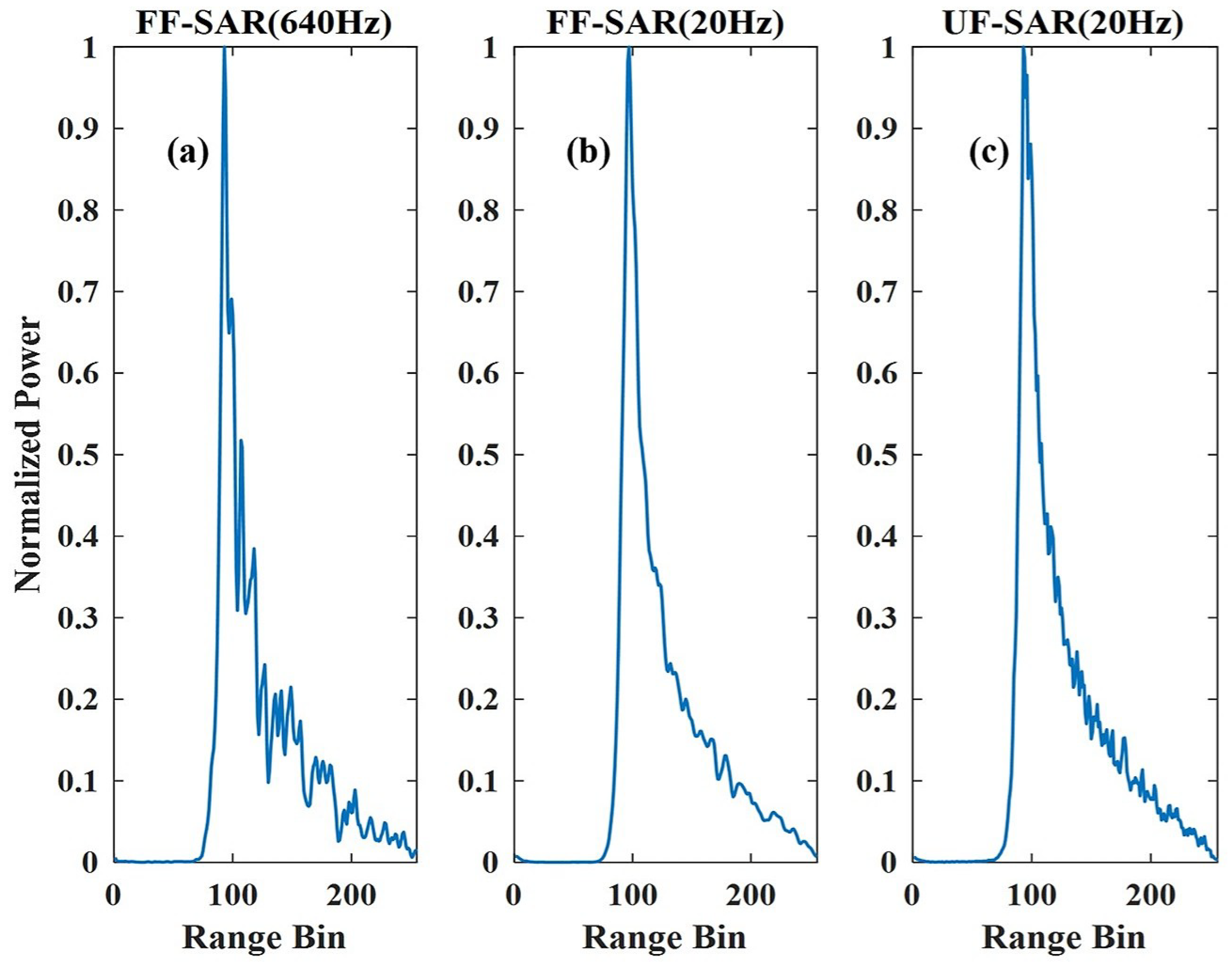
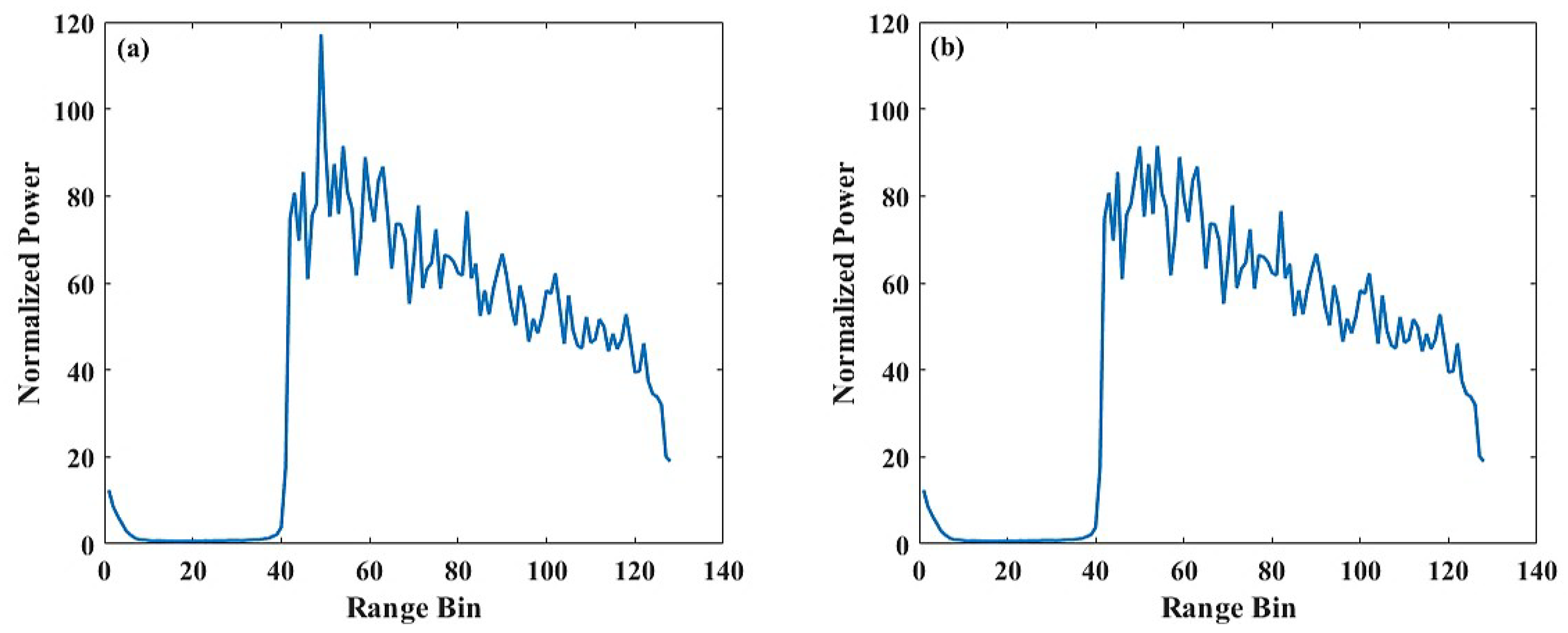
The reconstruction results are presented in Figure 4. The comparison between the reconstructed FFSAR and UFSAR (L2 data) in the nearshore region reveals that at the same resolution (20 Hz), the FFSAR waveforms have a smoother trailing edge; at the same noise level, FFSAR exhibits higher resolution. For Sentinel-3A, unfocused and fully focused SAR waveforms resemble each other (on average). Hence, the same waveform model should be used for consistent retracking [21].

2.3. Wave-Transformer: A Transformer-Based Classifier for Altimeter Waveform Classification

Due to the complex coastal environment and land interference, both PLRM and SAR waveforms cannot be processed using a universal retracking algorithm. A strategy adopted by previous studies is to first classify the waveforms and then apply corresponding retracking methods to different waveform types to improve retracking accuracy. In this process, the accuracy of waveform classification directly determines the reliability of subsequent retracking results.
Currently, waveform classifiers mainly include three categories: feature-based methods, traditional machine learning-based methods, and deep learning-based methods. Among these, feature-based classification methods mainly utilize different characteristic thresholds of echo data under various categories for classification. Schwatke [8] computed five features of echo waveforms and classified them into four major categories: Corrupted Waveforms, Single Peak Waveforms, Ocean-Like Waveforms and Noisy + Peaky Waveforms. However, the waveform features of different categories often overlap, and relying solely on threshold segmentation can lead to ambiguous classification boundaries and insufficient generalization capability.
To address these issues, this section conducts a systematic analysis of the typical morphology of PLRM and SAR waveforms and their variation characteristics in coastal regions using actual Sentinel-3A waveforms from the Hong Kong sea area. Based on this analysis, a simulated dataset containing various typical waveform types, including standard ocean waveforms, standard spike-like waveforms, waveforms with abnormal peaks, and waveforms with trailing noise, was constructed. Finally, using the Transformer architecture, a Wave-Transformer waveform classification model was designed to capture the global features and structural information in echo waveforms. Using this model, classification experiments were performed on Sentinel-3A coastal observation echoes.
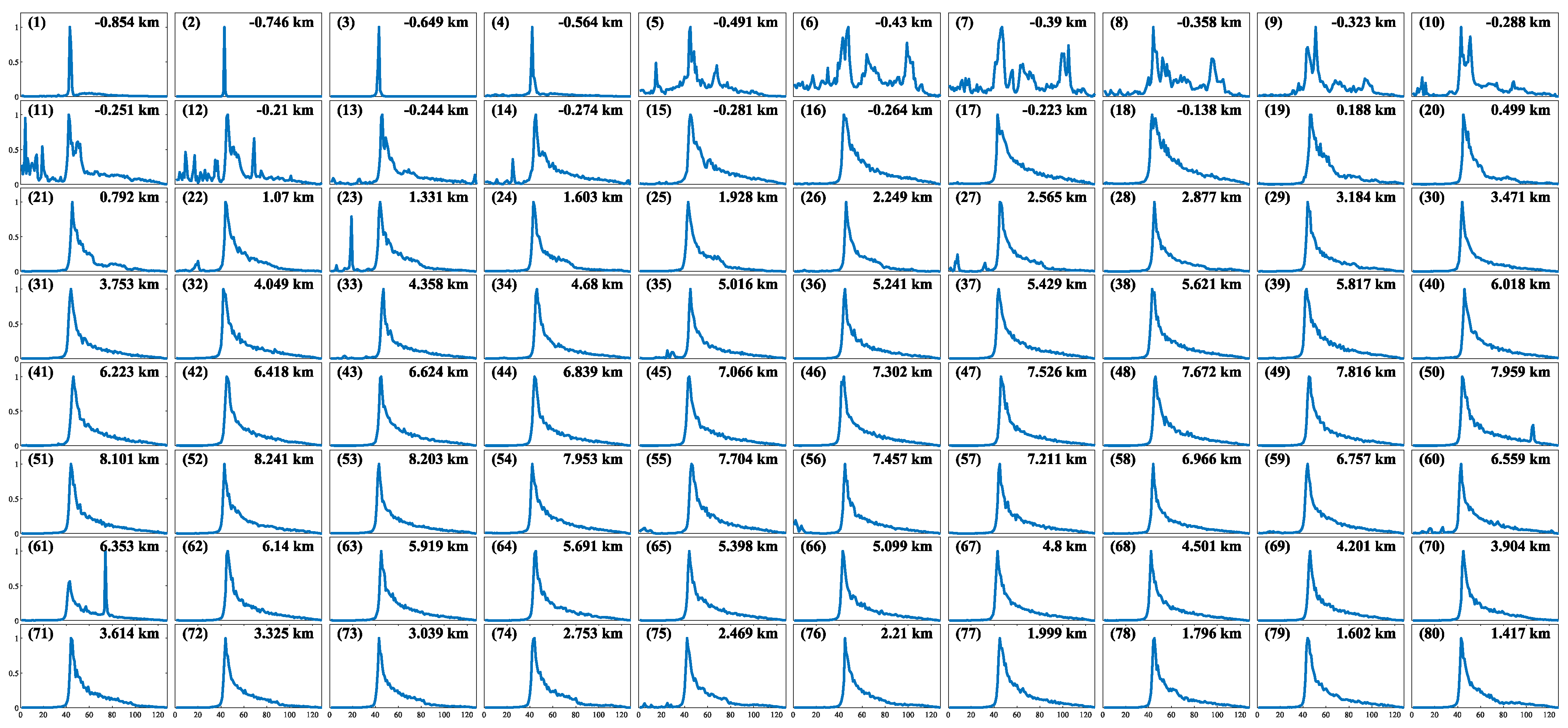
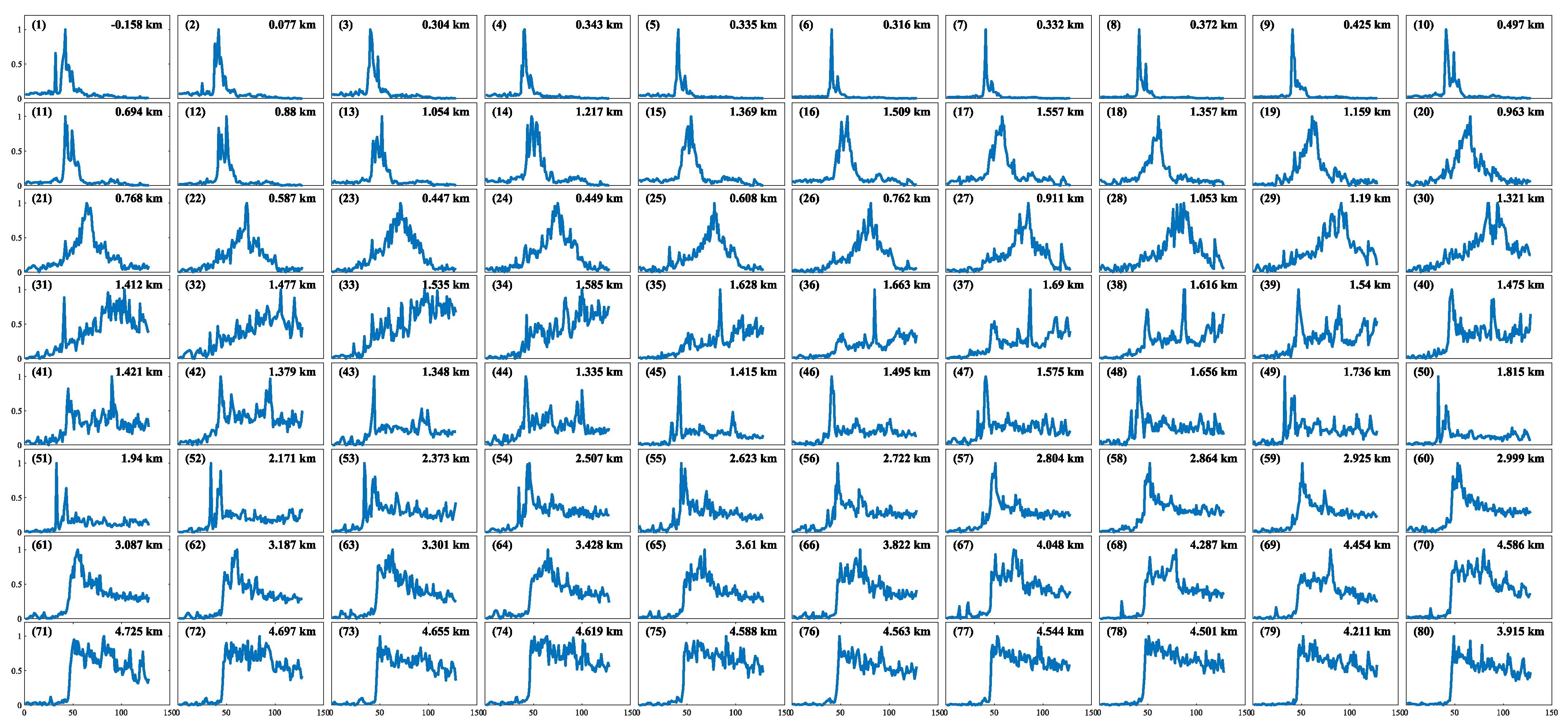
Figure 5 presents the waveforms within the range of 22.03°N and 22.30°N. As shown in the figure, the waveform morphology becomes more irregular with decreasing distance to the coast, and the proportion of non-ocean waveforms increases. Additionally, the peak power of non-ocean waveforms near land is considerably higher than that of ocean waveforms.
Waveforms 1–14 exhibit spike-like characteristics as they approach the land region. Waveforms 17–34 represent clutter signals that cannot be retracked. As the satellite sub-point approaches the ocean, the thermal noise level of waveforms 35–53 increases, presenting a multi-peak shape. Waveforms 54–80 belong to ocean waveforms, with some exhibiting abnormal peaks and trailing noise.
From the waveform analysis, even the ocean waveforms do not strictly exhibit the “standard ocean waveform” shape, but rather contain a mixture of “abnormal peaks” and “trailing noise” characteristics. A series of regular patterns similar to waveform 23 appears in the nearshore region; however, these cannot be fitted by existing retracking models. In the coastal region, waveforms tend to be more “spike-like” with varying degrees of trailing noise. Denoising for these different cases will be discussed in the next section.
Figure 6 presents the detailed SAR waveforms in the study area. Waveforms 1–4 are located near land, presenting sharp characteristics. Waveforms 13–80 belong to SAR “ocean waveforms,” among which some exhibit abnormal peaks (e.g., waveforms 23 and 61) and trailing noise (e.g., waveforms 8 and 9). From the waveform analysis, SAR waveforms exhibit clearer variations compared to LRM waveforms, which are more strictly correlated with the underlying surface conditions. Additionally, “clean” waveforms are predominant in the SAR data.
Based on the above analysis, we conclude that standard waveforms refer to clean and uncontaminated waveforms, including “standard ocean waveforms” and “standard sharp waveforms (pure quasi-specular waveforms [22])”. Furthermore, based on standard waveforms, the following derived waveform types are identified: waveforms containing abnormal peaks, waveforms with trailing noise, and multi-peak waveforms.

2.3.1. Constructing Simulation Dataset

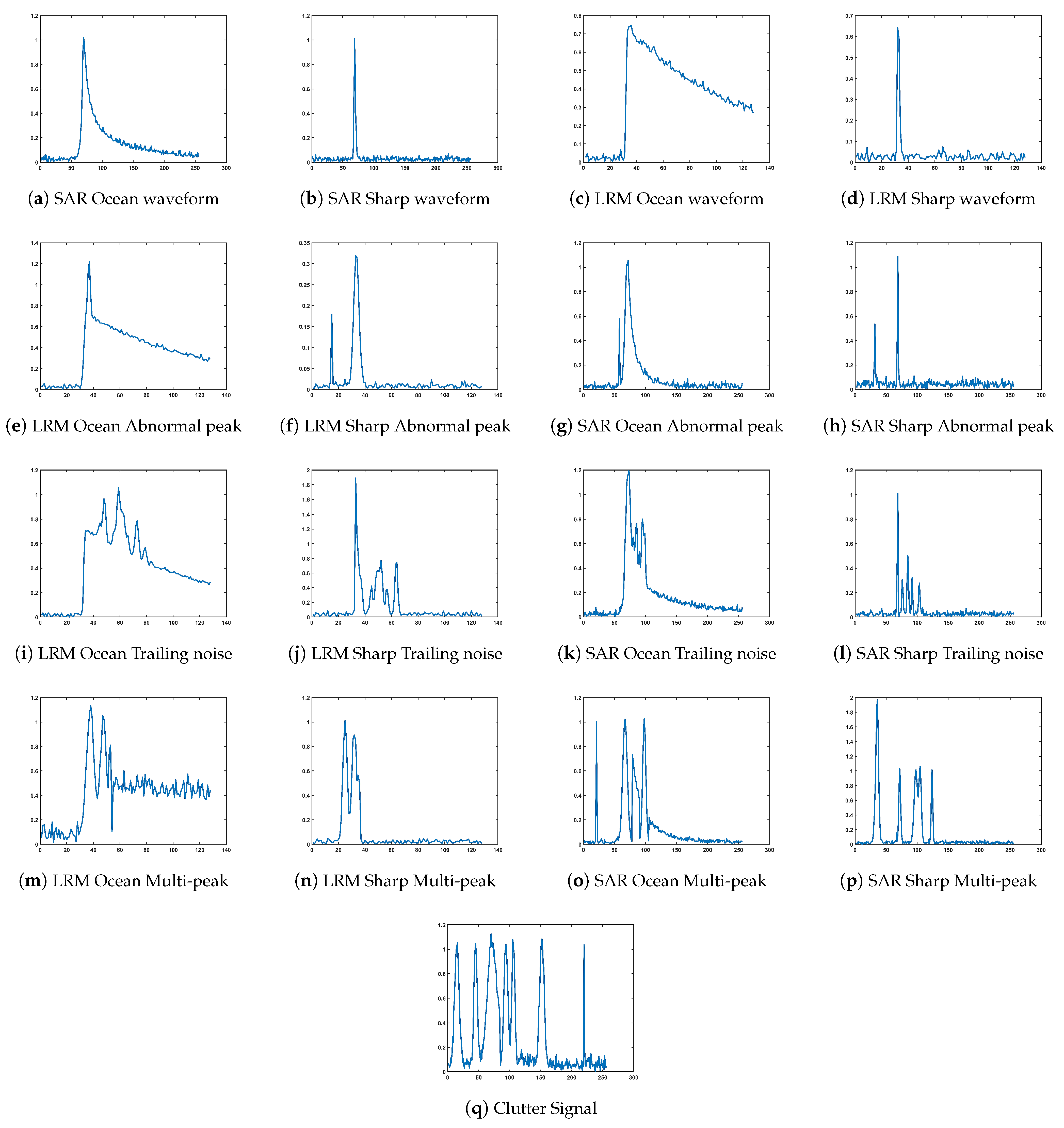
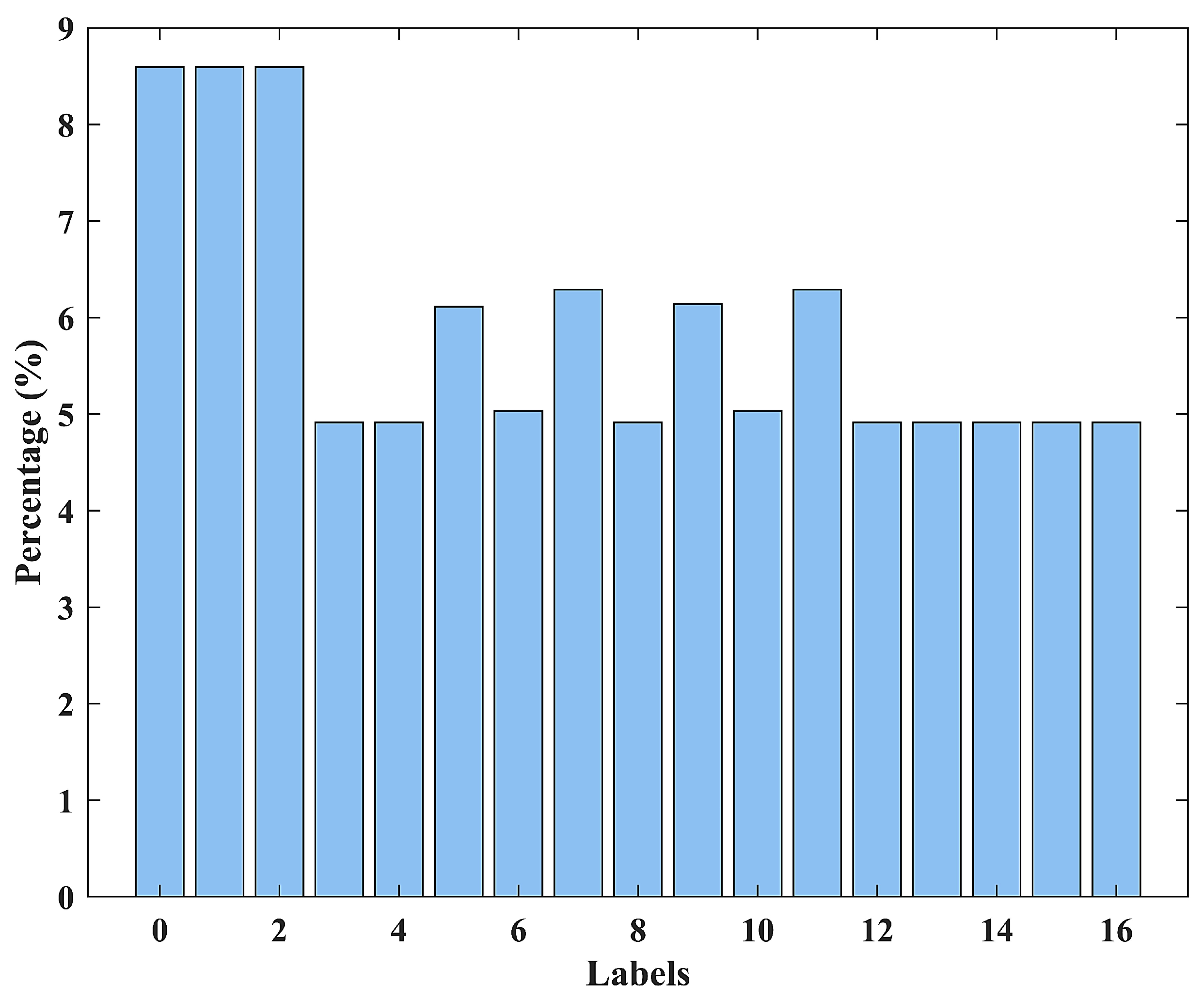
To prevent model overfitting, researchers typically train models with large datasets. Since there is no publicly available classified altimeter waveform dataset, this study independently constructed a dataset containing 35,409 waveforms, which combines simulated and real waveforms. Specifically, it includes 17 categories of waveforms from conventional PLRM and SAR, such as standard ocean/sharp waveforms, ocean/sharp abnormal peaks, ocean/sharp trailing noise, ocean/sharp multi-peak waveforms, and clutter signals. The detailed label definitions are shown in Table 2.
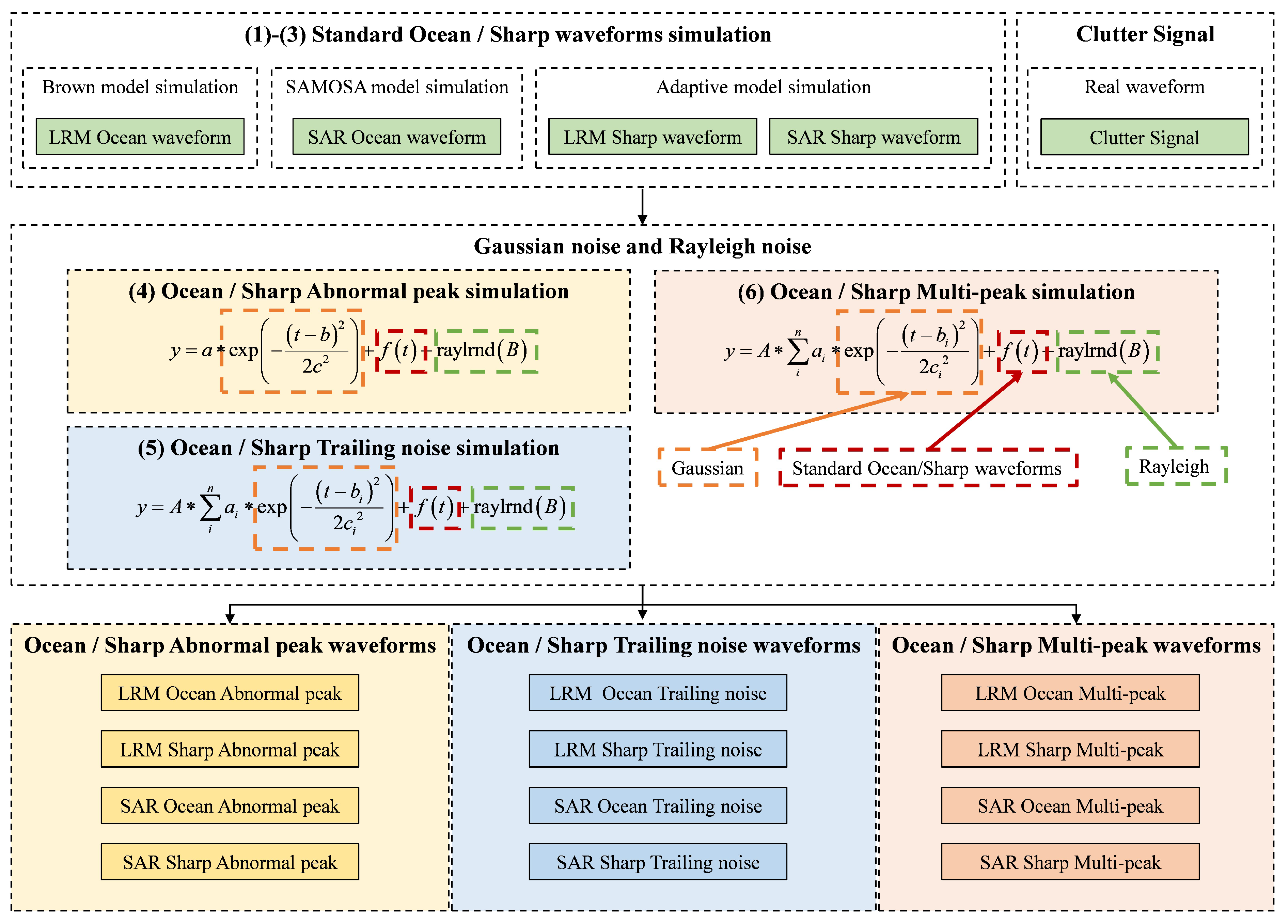
The Brown model was implemented to simulate the ocean waveform for PLRM, the SAMOSA model was used to simulate the ocean waveform for SAR, and the Adaptive model was applied to simulate the sharp waveforms with speckle noise superimposed. The flowchart illustrating the construction process of the simulation dataset is presented in Figure 7, and the detailed simulation formulas are as follows:
(1) Standard LRM Ocean Waveform Simulation;
The first-order exponential approximation of the Brown model [2,23] was implemented to simulate the “standard ocean” waveform for conventional altimeters,
W t = K t C 1 t + C 2 t + N t
K t = A 0 · exp 4 γ sin 2 ξ · exp d U + d 2
C 1 t = 1 2 e r f U 2 + 1 1 1 6 λ σ s σ c 3 d 3 3 d
C 2 t = 1 6 exp U 2 2 1 6 λ σ s σ c 3 U 2 + 3 d U + d 2 1
where U = t σ c d , d = σ c α β 2 4 , α = 4 γ c h cos 2 ξ , β = 4 γ c h sin 2 ξ , h = H 1 + H R e , H is the orbital altitude, R e is the Earth radius, ξ is the antenna pointing angle error, and  N t is the thermal noise.
(2) Standard SAR Ocean Waveform Simulation:
The SAMOSA (Synthetic Aperture Radar Altimeter Mode Studies and Applications) model [24] was utilized to simulate the standard ocean and standard sharp waveforms for SAR altimeters. This model establishes the echo model by integrating the radar equation with the probability distribution of sea surface significant wave height, which can be simplified to the corresponding analytical form,
P k , l ( P u , k 0 , H s ) = P u · Γ k , l · g l · f 0 g l · ( k k 0 ) + σ z L g T k , l · g l σ s f 1 g l · ( k k 0 )
P k ( P u , k 0 , H s ) = l = 1 N b P k , l ( P u , k 0 , H s )
where P k ( P u , k 0 , H s ) denote the multi-look waveform, k and l denote the range cell index and azimuth Doppler frequency index of the echo model, and N b denotes the number of effective looks, respectively.
(3) Standard LRM and SAR Sharp Waveform Simulation:
The Adaptive model was implemented to simulate the “standard sharp” waveform [25],
S S R ( t ) = A σ 0 2 1 + e r f ( t τ 4 c γ h σ s 2 σ s ) × exp 4 c flh ( t Ø 2 c flh œ s 2 ) + N t
where τ is the echo delay, and N t is the additive noise. The final expression can be represented as the convolution of the PTR (Pulse Target Response) with SSR: S ( t ) = SSR ( t ) PTR ( t ) . This simplification not only improves computational efficiency but also enhances the model’s adaptability to different types of echo signals.
(4) Ocean/Sharp Abnormal Peak Simulation:
Gaussian noise and Rayleigh noise with different intensity levels are superimposed on each standard waveform to simulate abnormal peaks. The calculation formula is
y = a exp ( ( t b ) 2 2 c 2 ) + f ( t ) + raylrnd ( B )
where α is the amplitude of Gaussian noise, b is the location of Gaussian noise, c is the standard deviation of Gaussian noise, f ( t ) is the standard ocean or sharp waveform, and B is the standard deviation of Rayleigh noise.
(5) Ocean/Sharp Trailing Noise Simulation:
Multiple Gaussian noise and Rayleigh noise forms with different intensity levels are superimposed on each standard waveform to simulate trailing noise. The calculation formula is
y = A i n a i exp ( ( t b i ) 2 2 c i 2 ) + f ( t ) + raylrnd ( B )
where a i is the amplitude of Gaussian noise, b i is the location of Gaussian noise, c i is the standard deviation of Gaussian noise, n is the n-th Gaussian noise, A is the overall amplitude of trailing noise (to prevent the waveform from being too high), f ( t ) is the standard ocean or sharp waveform, and B is the standard deviation of Rayleigh noise. The requirement is that the spacing between b i values is less than 20 range gates.
(6) Ocean/Sharp Multi-peak Simulation:
Multiple Gaussian noise and Rayleigh noise forms with different intensity levels are superimposed on each standard waveform to simulate multi-peak situations. The calculation formula is
y = i n a i exp ( ( t b i ) 2 2 c i 2 ) + f ( t ) + raylrnd ( B )
where a i is the amplitude of Gaussian noise, b i is the location of Gaussian noise, c i is the standard deviation of Gaussian noise, n is the n-th Gaussian noise, f ( t ) is the standard ocean or sharp waveform, and B is the standard deviation of Rayleigh noise. The requirement is that the spacing between b i values must be sufficiently large such that b i ± B do not overlap.
The value ranges of the parameters in the waveform simulation are listed in Table 3. For the specific calculation formula, please refer to the Supplementary Materials.
A total of 35,409 waveform samples across 17 categories were simulated, with significant wave height (SWH) ranging from 0 to 20 m. The distribution of waveforms in the dataset is shown in Figure 8, and the simulation results are presented in Figure 9. The dataset was divided into training, validation, and test sets in the ratio of 70%, 15%, and 15%, respectively.
Here, we conduct a quantitative comparative analysis by calculating the KL divergence between the three simulated representative waveforms (LRM standard ocean, SAR standard ocean, and SAR standard sharp) and the actual waveform, and the corresponding results are listed in Table 4.

2.3.2. Design of Wave-Transformer Classifier

The Transformer model, proposed by Vaswani [26], achieves a fundamental breakthrough by completely abandoning traditional recurrent neural networks (RNNs) and convolutional neural networks (CNNs) and, instead, relying entirely on the self-attention mechanism to model global dependencies among sequence elements.
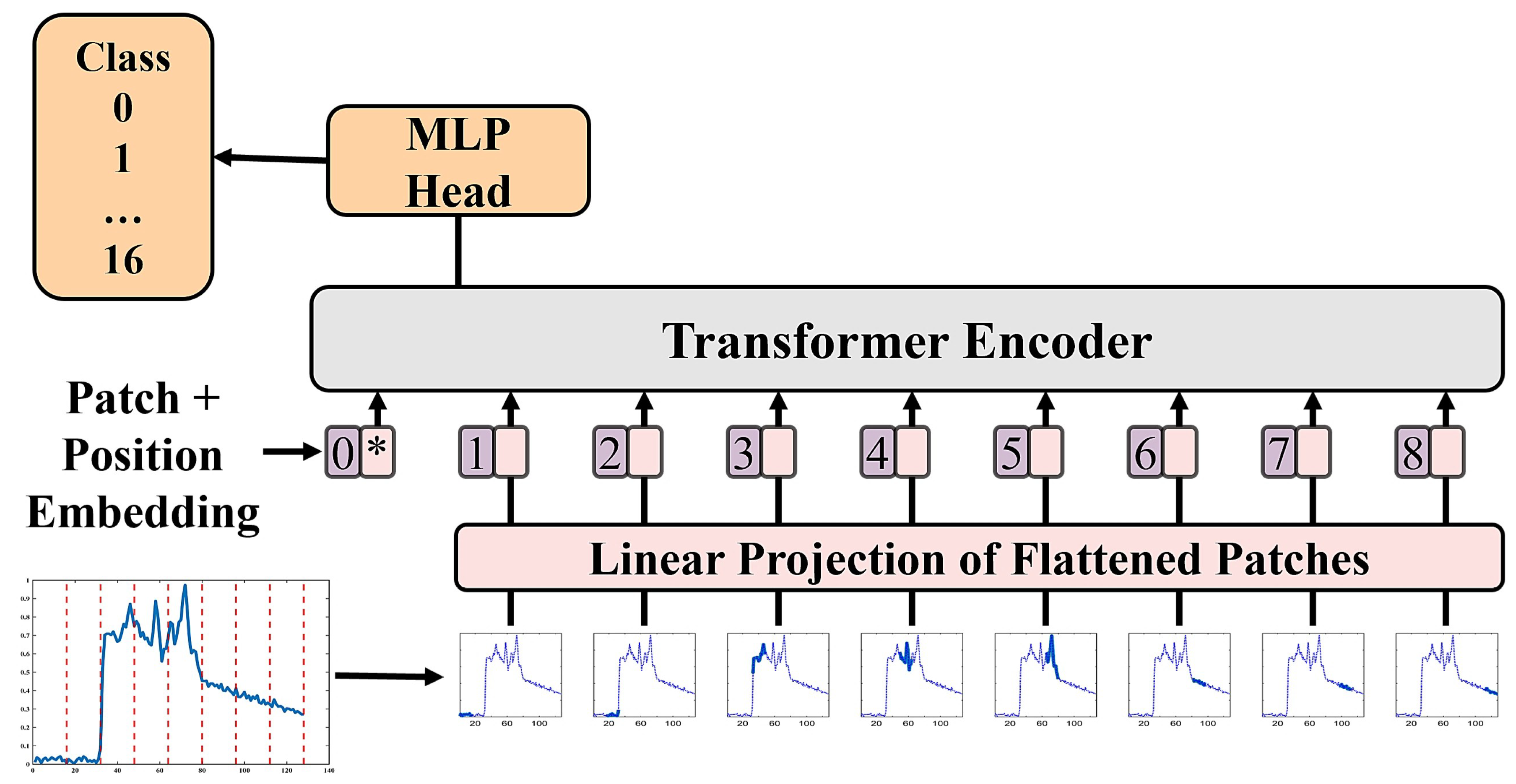
The Wave-Transformer model in this paper draws on the concepts of Transformer from large language models and Vision Transformer (ViT) [27], adopting an encoder-only architecture to extract “semantic information” from waveforms for classification purposes. Since the objective is to extract inter-waveform features for classification rather than generating outputs, the decoder component is omitted. Furthermore, since the multi-head attention mechanism is insensitive to positional information and the token matrix lacks “temporal” information, a positional encoding was added before vectorization to preserve the temporal sequence information.
The overall model architecture is illustrated in Figure 10, which primarily consists of four core modules: signal serialization, positional encoding, the Transformer encoder, and the classification head.
(1) Signal Serialization and Positional Encoding
The original one-dimensional radar echo signal is denoted as X R L , where L represents the signal length. The signal X is divided into N = 9 consecutive and non-overlapping segments (patches). Each patch has a length of P = L / 9 . Subsequently, each patch is mapped into a D-dimensional vector space through a trainable linear projection layer.
This process can be formulated as
X p = [ x p a t c h 1 E ; x p a t c h 2 E ; ; x p a t c h N E ]
where x p a t c h i R P represents the i-th signal patch, E R P × D is the linear projection matrix, and  X p R N × D denotes the serialized signal embedding.
To preserve the sequential order of the information, a positional encoding E p o s R N × D with the same dimension as the signal embedding is generated and added to the signal embedding,
Z 0 = X p + E p o s
where Z 0 is the initial embedding sequence input to the Transformer encoder. The positional encoding is typically computed using sine and cosine functions at different frequencies,
P E ( p o s , 2 i ) = sin ( p o s 10000 2 i / D )
P E ( p o s , 2 i + 1 ) = cos ( p o s 10000 2 i / D )
where p o s denotes the position index, and i represents the dimension index.
(2) Transformer Encoder
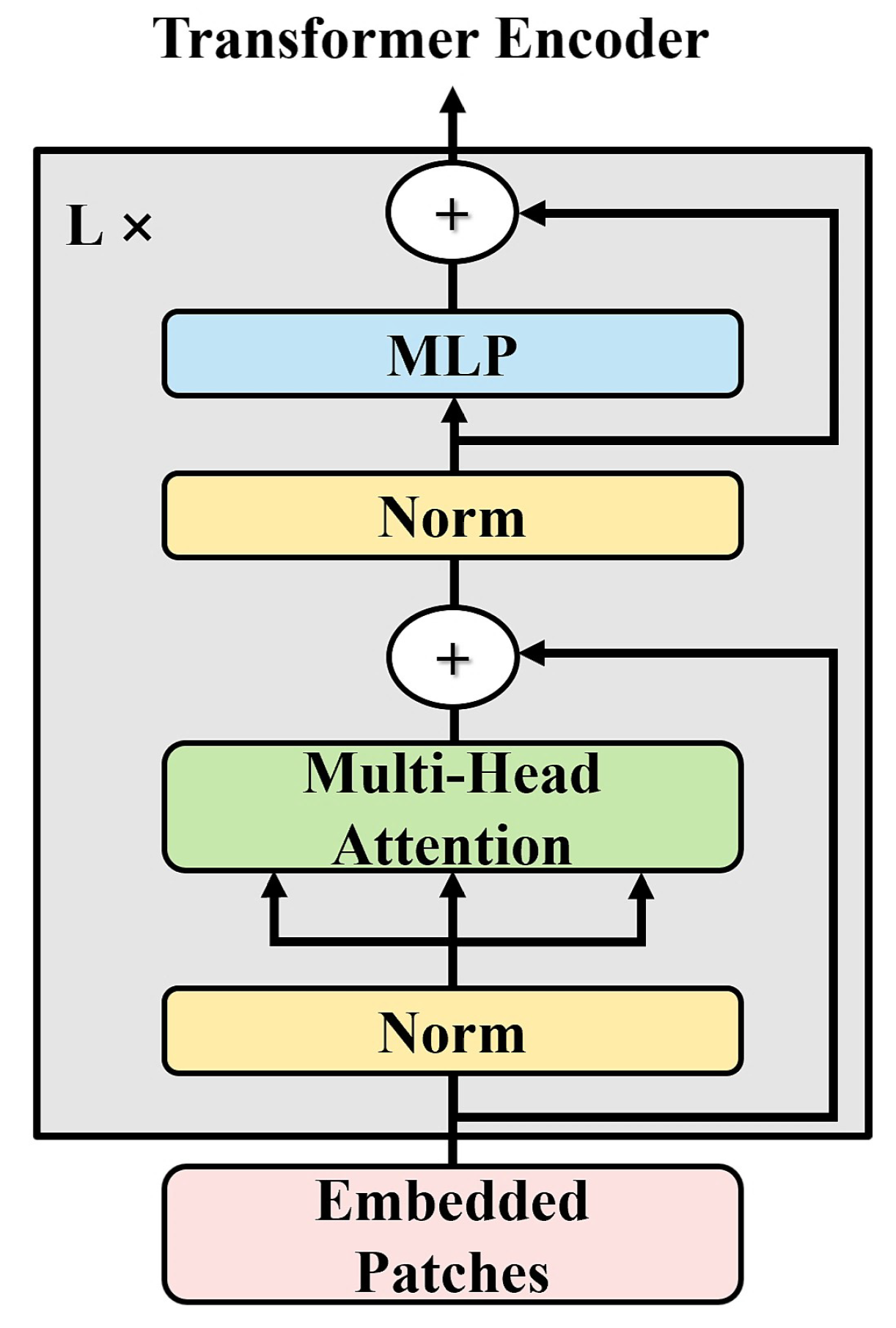
The initial embedding Z 0 is fed into a stack of 6 Transformer encoder layers, as illustrated in Figure 11. The computation for each layer l is formulated as:
Z l = M u l t i H e a d A t t e n t i o n ( L a y e r N o r m ( Z l 1 ) ) + Z l 1
Z l = M L P ( L a y e r N o r m ( Z l ) ) + Z l
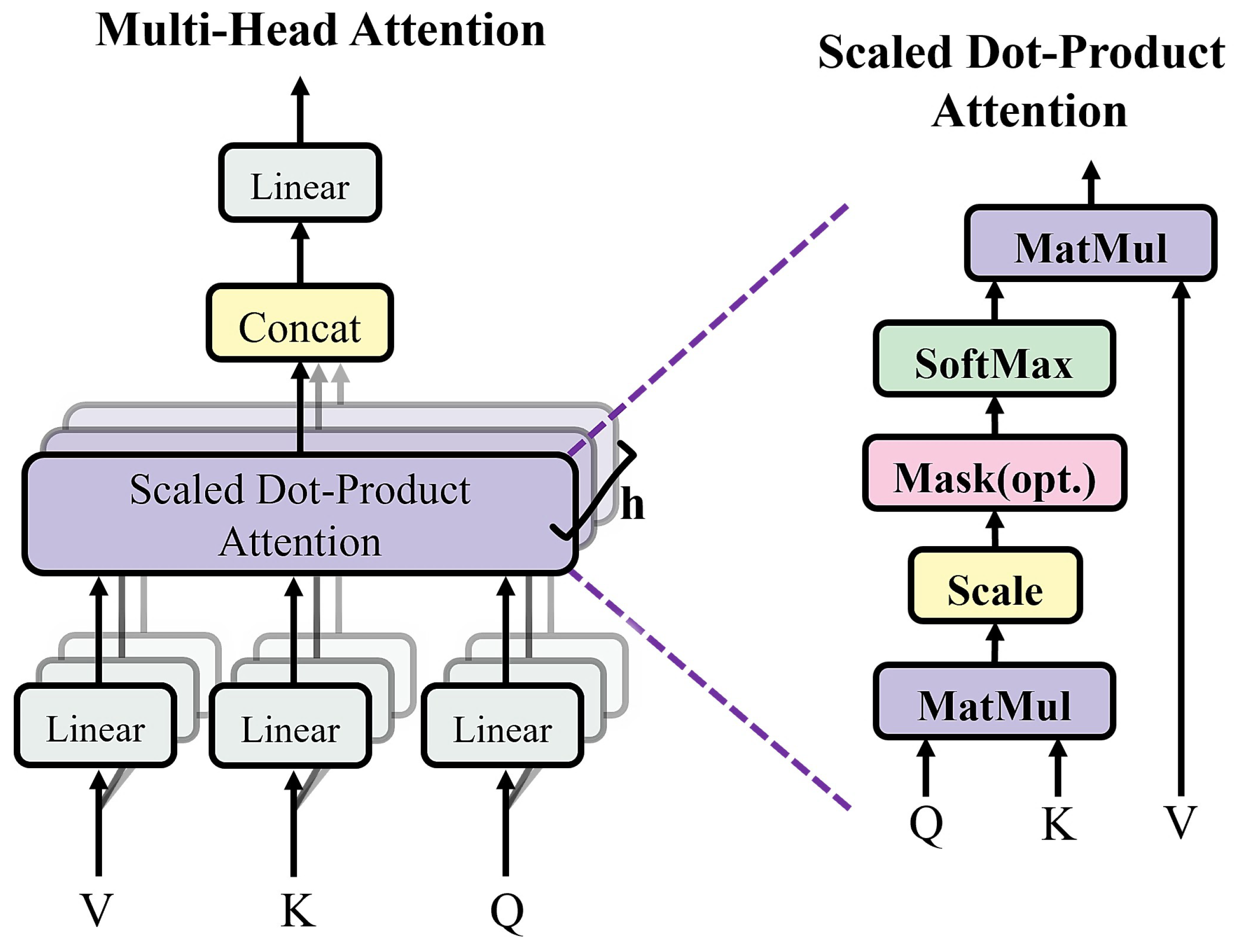
The core of multi-head self-attention is scaled dot-product attention, as illustrated in Figure 12. For each head h and multihead,
A t t e n t i o n ( Q h , K h , V h ) = s o f t m a x ( Q h K h T d k ) V h
M u l t i H e a d ( Q , K , V ) = C o n c a t ( h e a d 1 , . . . , h e a d h ) W 0
where Q h , K h , and  V h are the query, key, and value matrices obtained through linear transformations of the input Z, and  d k is the dimension of the key vectors. The number of attention heads is 8. The outputs from multiple heads are concatenated and subsequently transformed via another linear projection.
The MLP is implemented as a simple two-layer neural network,
F F N ( z ) = G e L U ( z W 1 + b 1 ) W 2 + b 2
where W 1 , b 1 and W 2 , b 2 are learnable parameters, and GeLU denotes the Gaussian Error Linear Unit activation function.
(3) Classification Head
The feature vector from the first position of the Transformer encoder output sequence is extracted and fed into a linear classifier, followed by a Softmax function to obtain the class probability distribution,
y ^ = S o f t m a x ( W c l s · z L 0 + b c l s )
where W cls R C × D and b cls R C are the parameters of the classification layer, and  C = 17 is the total number of classes. The final prediction y ^ R C is a probability vector.
The loss function is defined using the cross entropy,
L c l s = 1 N n = 1 N c = 1 C y c ( n ) log y ^ ( n )
where N denotes the number of samples in the batch, C denotes the number of classes, y c ( n ) denotes the one-hot label for the sample, and y ^ ( n ) denotes the model output. The batch size was 32, and the dropout rate was 0.2. The dataset was partitioned into three subsets: 70% for training, 15% for validation, and 15% for testing. The training parameters are shown in Table 5. The test accuracy is 89.16%.
To visually illustrate the classification performance, the following four metrics were selected:
(1) Accuracy: Accuracy measures the proportion of correctly classified instances across all classes, providing an overall assessment of the model’s performance—especially useful for balanced datasets.
Accuracy = T P + T N T P + T N + F P + F N
(2) Precision: Precision measures the model’s ability to avoid false positive predictions, calculated as the ratio of true positive predictions to the total positive predictions made by the model.
Precision = T P T P + F P
(3) Recall: Also known as sensitivity or true positive rate, it quantifies the model’s ability to identify all relevant instances, computed as the ratio of true positive predictions to the total actual positive instances.
Recall = T P T P + F N
(4) F1-score: The F1-score provides a balanced evaluation of the model’s performance by computing the harmonic mean of precision and recall,
F 1 = 2 · Precision · Recall Precision + Recall
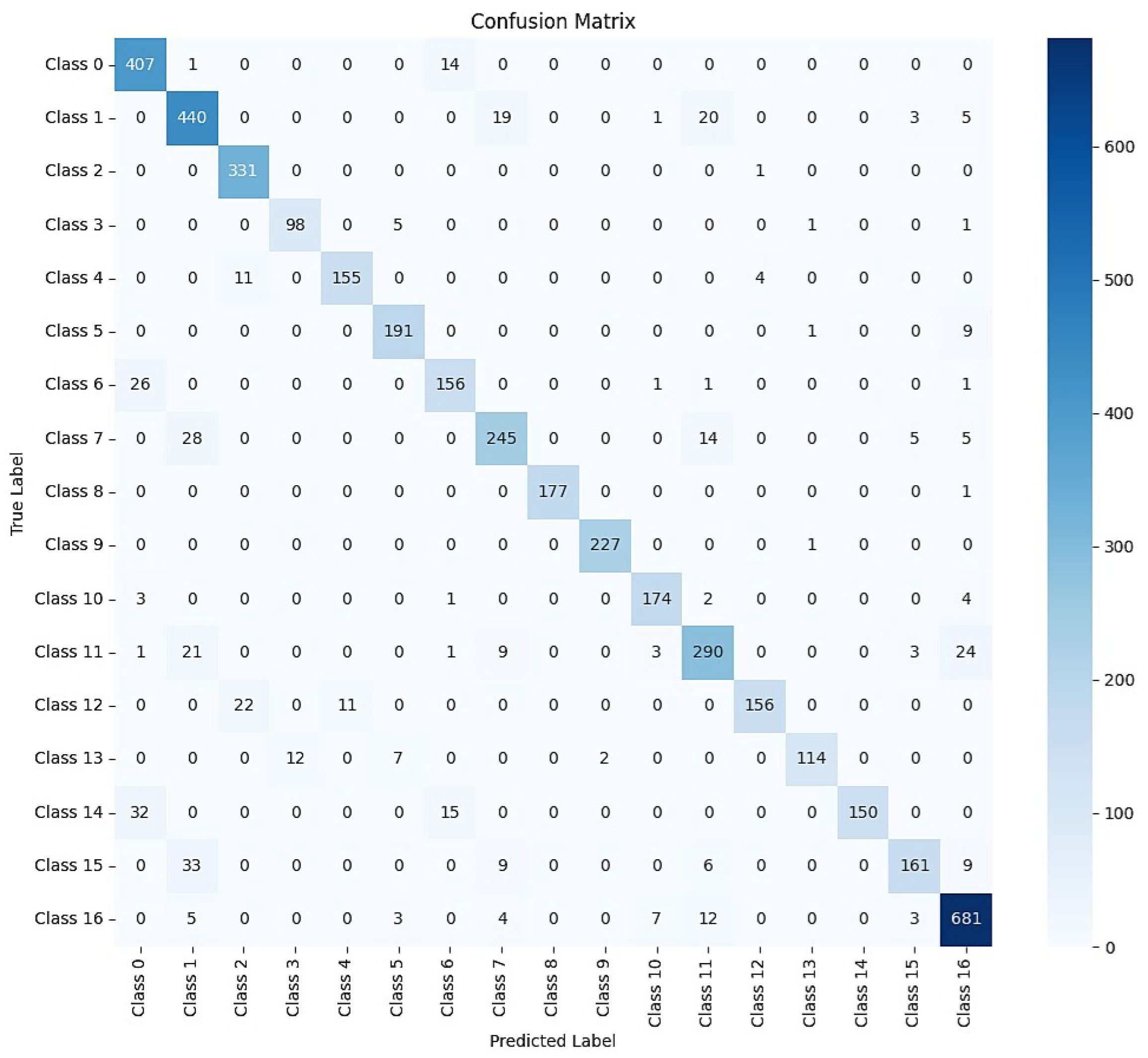
where T P , T N , F P , and  F N denote the number of true positive, true negative, false positive, and false negative samples, respectively. To further analyze the classification performance, the confusion matrix of the Wave-Transformer on the test set is presented in Figure 13, and the per-class evaluation metrics are shown in Table 6. The results demonstrate that all classes achieve F1-scores of 0.78 or above. Specifically, the F1-scores for LRM standard ocean waveform, SAR standard ocean waveform, LRM abnormal peak, SAR abnormal peak, LRM trailing noise, and SAR trailing noise all exceed 90%. The features of PLRM and SAR sharp waveforms exhibit high similarity, leading to confusion in the classification and, consequently, compromising the recall of such samples.
Recurrent neural networks (RNNs) [28] are neural networks designed for sequential data processing, propagating information through hidden states across time steps. However, RNNs struggle to capture long-range dependencies due to gradient vanishing. Long Short-Term Memory (LSTM) [29] networks mitigate this issue through gating mechanisms, enabling effective modeling of long-term dependencies, and have served as a classical baseline for sequence classification tasks. Here, RNN and LSTM networks were implemented for comparative experiments on waveform classification:
The classification results of the three models are compared in Table 7. Overall, the Transformer model demonstrates the best performance, with an average F1-score exceeding 87%. The LSTM model ranks second, with an average F1-score of approximately 83%, while the RNN model shows weaker performance, with an average F1-score of approximately 79%. Specifically, all three models achieve excellent classification results for standard ocean waveforms (Class 0, 2) and trailing noise waveforms (Class 8, 9, 10), with F1-scores exceeding 80%, particularly for Class 8 and Class 9, where the F1-scores exceed 94%. However, for sharp waveforms (Classes 3, 13, and 15), the recall rates of all three models are relatively low, resulting in comparatively lower F1-scores. This is due to the limited sample size of sharp waveforms and the feature overlap with other categories. In terms of average metrics, the Transformer model outperforms both LSTM and RNN models in precision, recall, and F1-score, validating the effectiveness of the self-attention mechanism in waveform classification tasks.

2.4. Noise Removal and Retracking

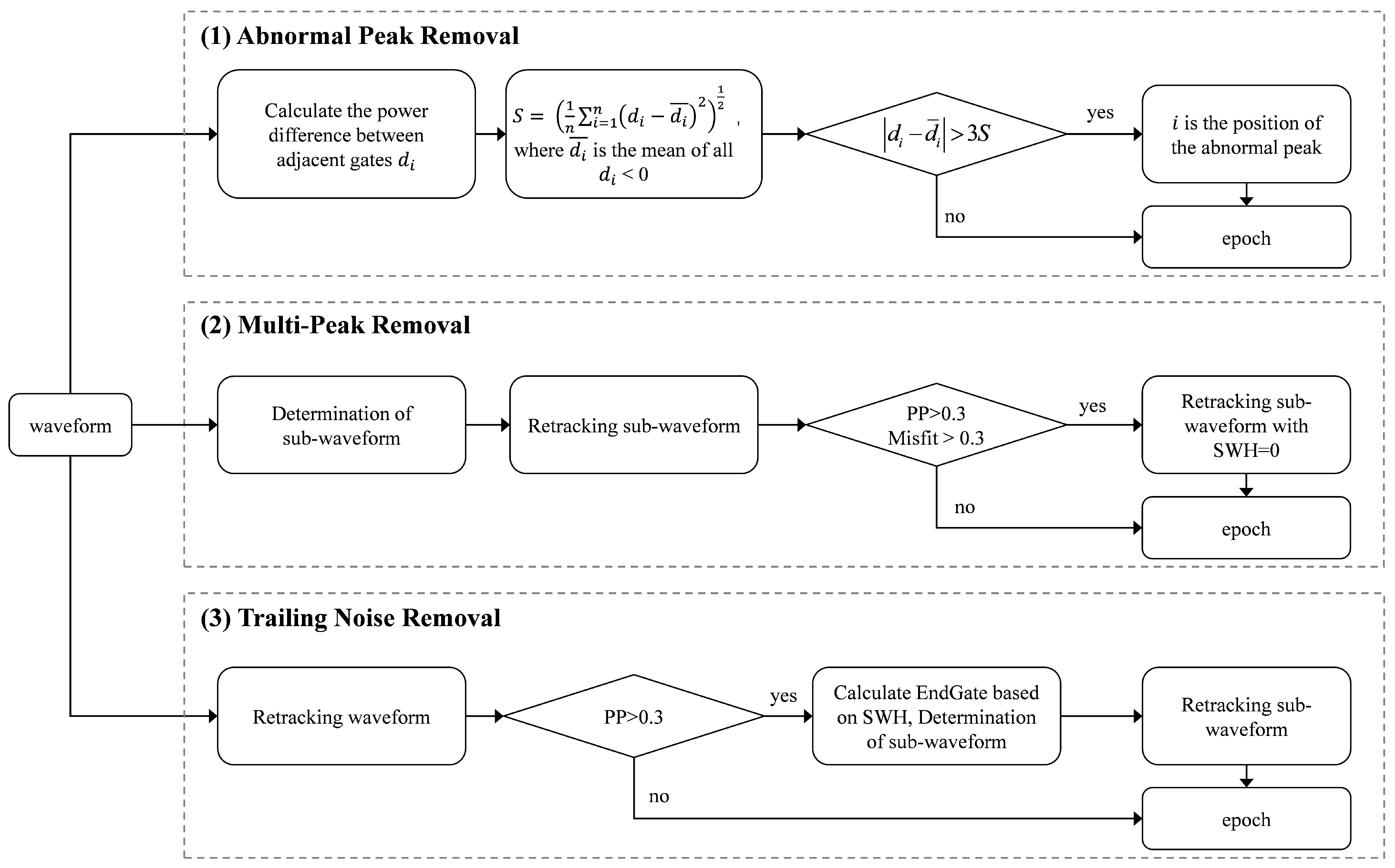
For standard waveforms, retracking can be performed directly. However, for waveforms with abnormal peaks, trailing noise, and multi-peak waveforms, retracking often fails. Therefore, it is necessary to first remove noise before retracking. The flowchart for noise removal and retracking is shown in Figure 14.
(1) Abnormal Peak Removal Method
For ocean-like waveforms, abnormal peaks may appear in the thermal noise region, the rising edge, or the trailing edge, which significantly differ from typical ocean waveforms. These abnormal peaks adversely affect the retracking performance of such waveforms, potentially leading to retracking failure. The approach is to remove these abnormal peaks first, and then apply the ocean retracking algorithm to the remaining samples of the waveform.
The outlier removal method identifies the locations of abnormal peaks by detecting outliers in the echo power difference. The range gates corresponding to abnormal peaks are then flagged as 0 and excluded from least squares fitting.
Figure 15 presents the retracking results of the abnormal peak waveform. As shown in Figure 15a, the ocean retracking algorithm fails due to the presence of a large abnormal peak at the rising edge. After removing the abnormal peak, retracking can be successfully performed, as illustrated in Figure 15b.
(2) Multi-peak Processing Procedure
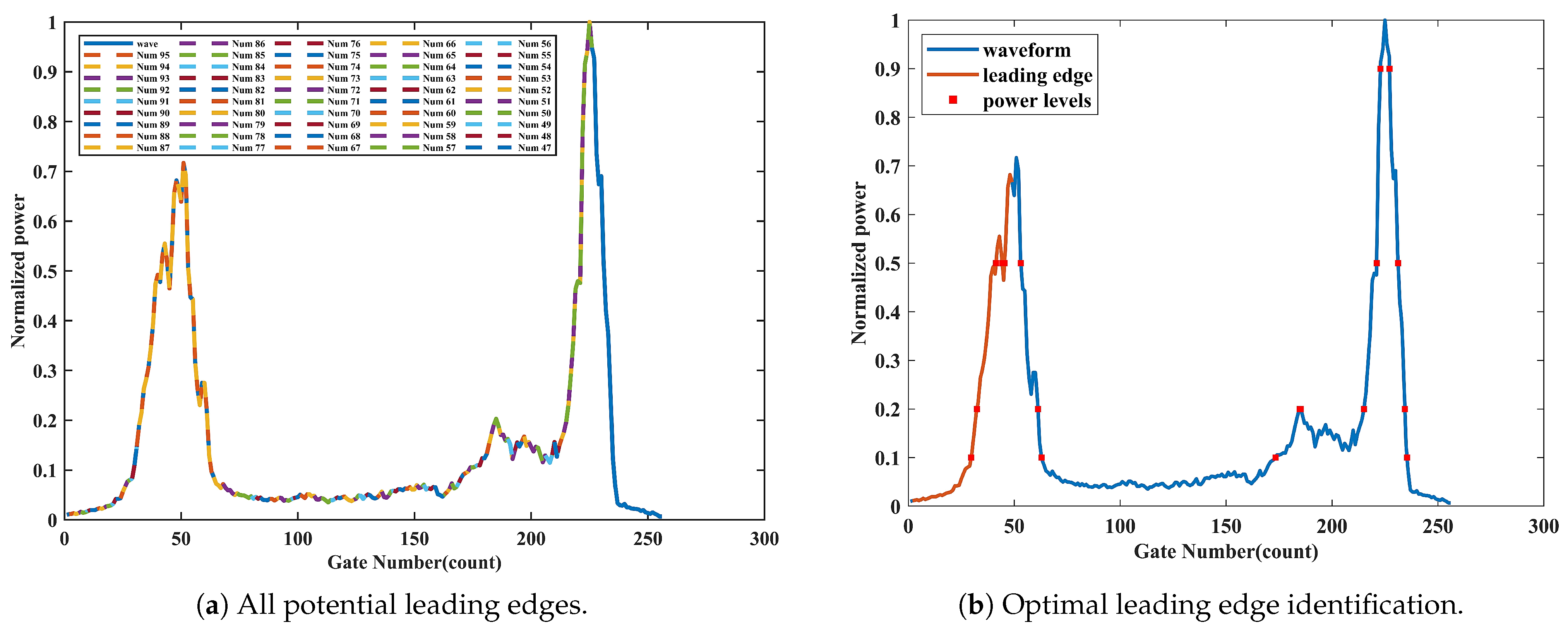
Peng [30] proposed an ASCR algorithm designed to accurately identify the rising edge of a waveform. First, the waveform is normalized, and the power difference between adjacent windows is calculated to determine the range of the leading edge; then, the intersection points with power level lines at 0.1, 0.2, 0.5, and 0.9 are extracted to screen for candidate leading edges that meet the thresholds; finally, the Dijkstra algorithm is used to select the optimal leading edge, effectively eliminating noise disturbances at the beginning of the waveform and improving positioning accuracy.
The identification results are shown in Figure 16.
(3) Processing Method for Waveforms with Trailing Noise
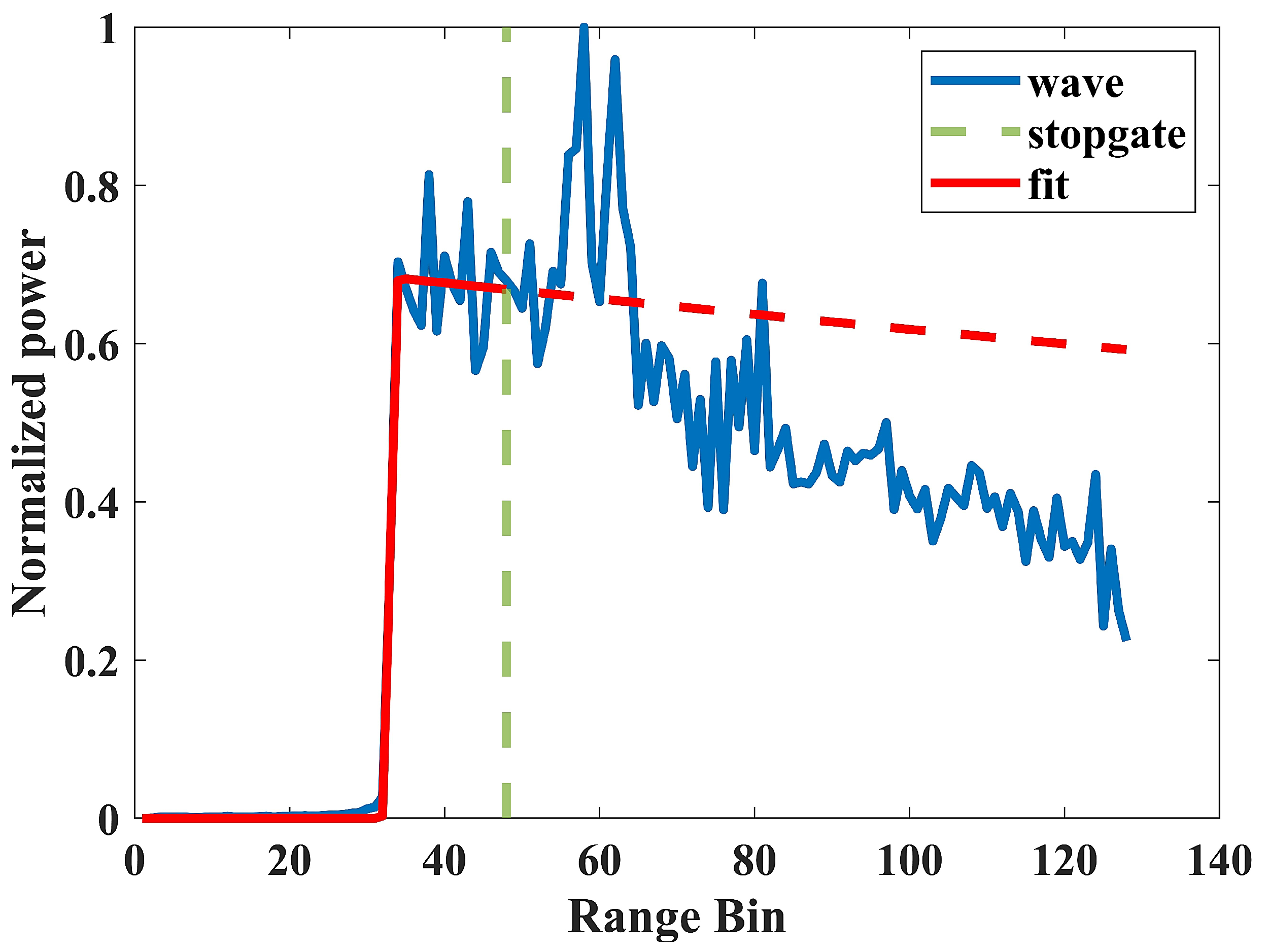
The ALES [15] algorithm is applied to the tagged ocean waveforms using the Brown–Hayne model. The specific implementation steps are as follows: First, the leading edge start and end points of the sub-waveform window are identified, and the Brown–Hayne model is applied to the waveform leading edge to obtain the coarse SWH and leading edge midpoint position. Then, an empirical cut-off gate is selected based on the coarse SWH. Finally, fitting is performed on the sub-waveform to obtain the final waveform Amplitude, Epoch and SWH. The advantage of this algorithm is that it suppresses the influence of trailing noise by selecting an appropriate cut-off gate. The fitting results of ALES are shown in Figure 17.
The same sub-waveform retracking concept is also applied to contaminated SAR ocean waveforms [14], where the contaminated trailing edge is truncated to reduce the impact of noise on the fitting curve.
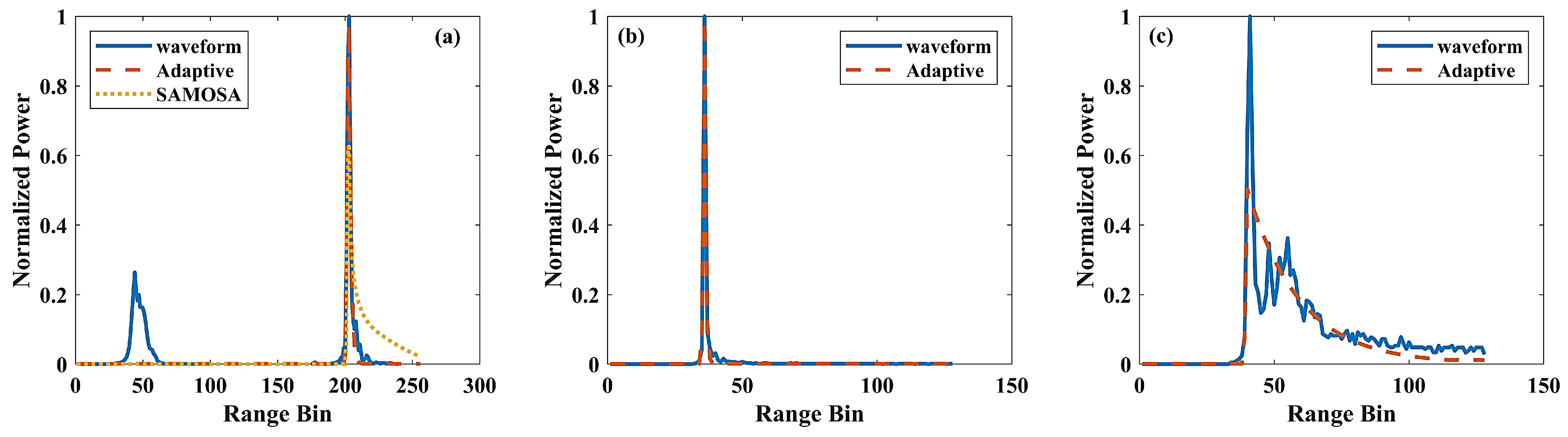
However, for sharp waveforms, it is difficult to achieve a good fit in the second retracking process, even when adjusting the SWH value (set to 0). As illustrated in Figure 18a, the trailing edge of the SAMOSA fitting result is difficult to reduce to a low level. In contrast, the Adaptive model is particularly suitable for sharp waveforms [25], as shown in Figure 18b, where the SAMOSA model fails to produce good fitting results regardless of the SWH initial value.
However, the Adaptive model is also susceptible to trailing noise. As shown in the third and fourth rows of Figure 18c, although the residual function appears to converge to the global minimum, the waveform peak is not aligned, and the fitted waveform tends to overfit the trailing edge, resulting in an underestimated SWH.
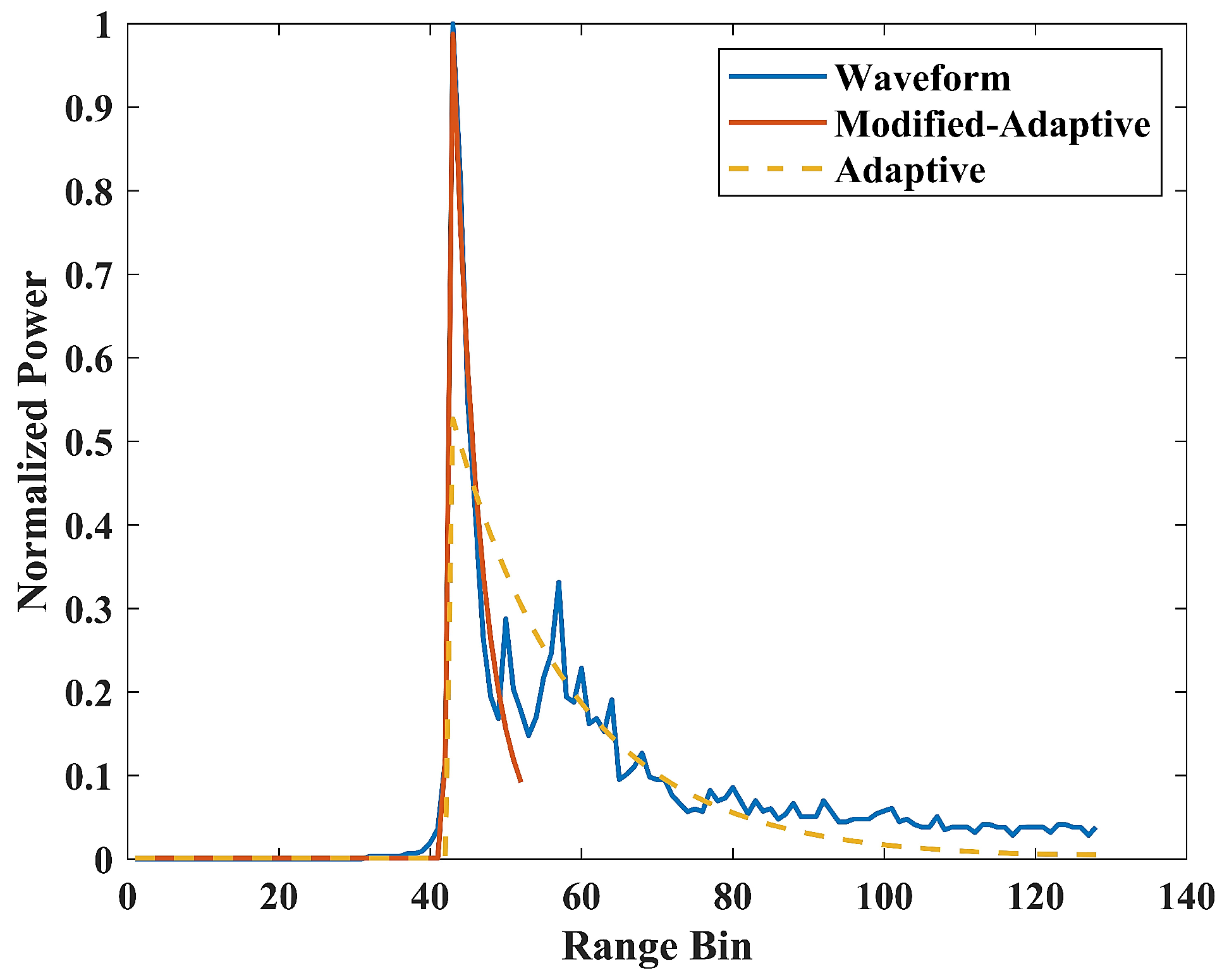
To endow the Adaptive model with improved robustness against trailing noise, this paper proposes a Modified-Adaptive retracking model based on Monte Carlo simulation. Drawing on the concept of truncation gates, the model first utilizes the coarse SWH obtained from the first retracking to evaluate the misfit and PP. If the fitting is satisfactory, the result is directly output; otherwise, the truncation gate is calculated based on Monte Carlo simulation results, and the sub-waveform is truncated for a second retracking. The improved retracking procedure is presented in Algorithm 1.
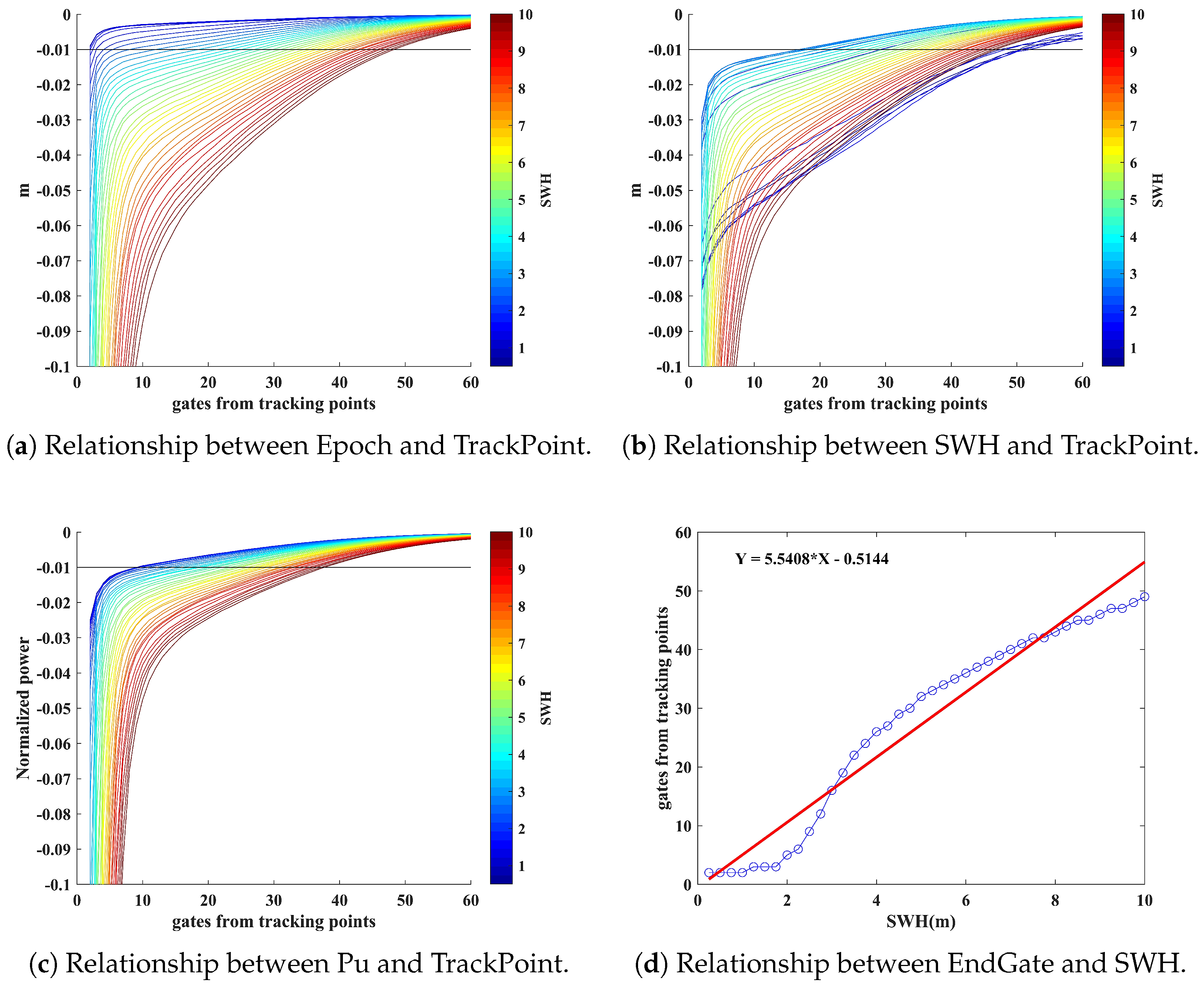
Figure 19 presents the Root Mean Square Error (RMSE) of various parameters relative to full-waveform fitting at different truncation gates, simulated using the Monte Carlo method for SWH, ranging from 1 m to 10 m, with a sampling interval of 0.5 m. Additionally, the relationship between the truncation gate and SWH at an RMSE of 1 cm is shown. It can be observed that as SWH increases, the corresponding truncation gate must also increase to maintain the same fitting accuracy. Therefore, the selection of the truncation gate significantly affects the waveform retracking accuracy.
Within the 1 cm error range, the relationship between the truncation gate required for Epoch parameter estimation and SWH is expressed as:
EndGate = TrackPoint + 5 . 5408 × SWH 0 . 5144
To assess the statistical reliability of the regression coefficients, 95% confidence intervals were calculated for each parameter. The results show that the estimated value of the slope is 5.5408, with a 95% confidence interval of (5.1333, 5.9483). The estimated value of the intercept is −0.5144, with a 95% confidence interval of (−2.9108, 1.8820), and the calculated sensitivity coefficient for SWH is 1.0279.
Algorithm 1: Modified-Adaptive Retracking Process
Remotesensing 18 01950 i001
As can be seen from Figure 20, for waveforms affected by trailing noise, direct retracking is susceptible to noise interference, leading to the failure of retracking. In contrast, the Modified-Adaptive model truncates the waveform before the onset of noise, preventing noise contamination. The retracking performed on the truncated waveform yields significantly improved fitting results.

3. Results

3.1. Classification Results

The classification results of real waveforms are presented in the Table 8. The SAR mode exhibits a higher proportion of clean standard waveforms.
The waveform classification results as a function of offshore distance are presented in Table 9, Table 10 and Table 11. The proportion of non-ocean waveforms increases sharply within 5 km of the coast.
The waveform classification results exhibit a significant pattern with varying offshore distances. As illustrated in Figure 5 and Figure 6, all waveform distributions demonstrate common characteristics: as the offshore distance increases, the proportion of standard ocean waveforms increases significantly, while clutter and sharp waveforms rapidly decrease. Specifically, when the offshore distance is less than 2 km, the clutter proportion in LRM mode reaches as high as 48.61%, while SAR mode clutter accounts for 4.06%. When the offshore distance increases to 10–20 km, the LRM ocean waveform proportion rises to 96.90%, and the SAR standard ocean waveform reaches 99.20%, with clutter essentially disappearing. The nearshore region (<10 km) is influenced by land topography and other factors, resulting in complex echo signals and diverse waveform classifications. In contrast, in offshore open sea areas, the radar echoes are dominated by standard ocean waveforms.
FFSAR processing in the nearshore region (<5 km) increases the noise proportion; however, beyond 5 km, the clutter proportion rapidly decreases, and the proportion of clean waveforms is higher than that of UFSAR.

3.2. Retracking Results

To verify the effectiveness of the coastal echo retracking processing method, validation was conducted considering four aspects: retracking success rate, data validity rate, sea surface height stability, and tide gauge validation. Due to the chaotic nature of coastal waveforms, if the FFSAR retracking success rate, data validity rate, and sea surface height stability are all improved, it demonstrates that the proposed coastal waveform processing method is effective. This will significantly enhance the utilization of coastal echo waveforms and make solid contributions to coastal altimetry.
(1) Data Availability Rate
The echo data in Sentinel-3A HR are 20 Hz data (20 waveforms per second). Each waveform in the 20 Hz data is retracked to obtain 20 Hz range values. The 20 Hz range values are then converted to 1 Hz data through regression, and range values that deviate significantly from the regression line are discarded. The lower the proportion of 20 Hz data discarded to obtain 1 Hz data, the better the data availability rate.
Data availability Rate = N valid N total × 100 %
where N total = 20 represents the total number of 20 Hz waveforms within one second, and N valid denotes the number of waveforms whose range estimates fall within the acceptance threshold from the regression line.
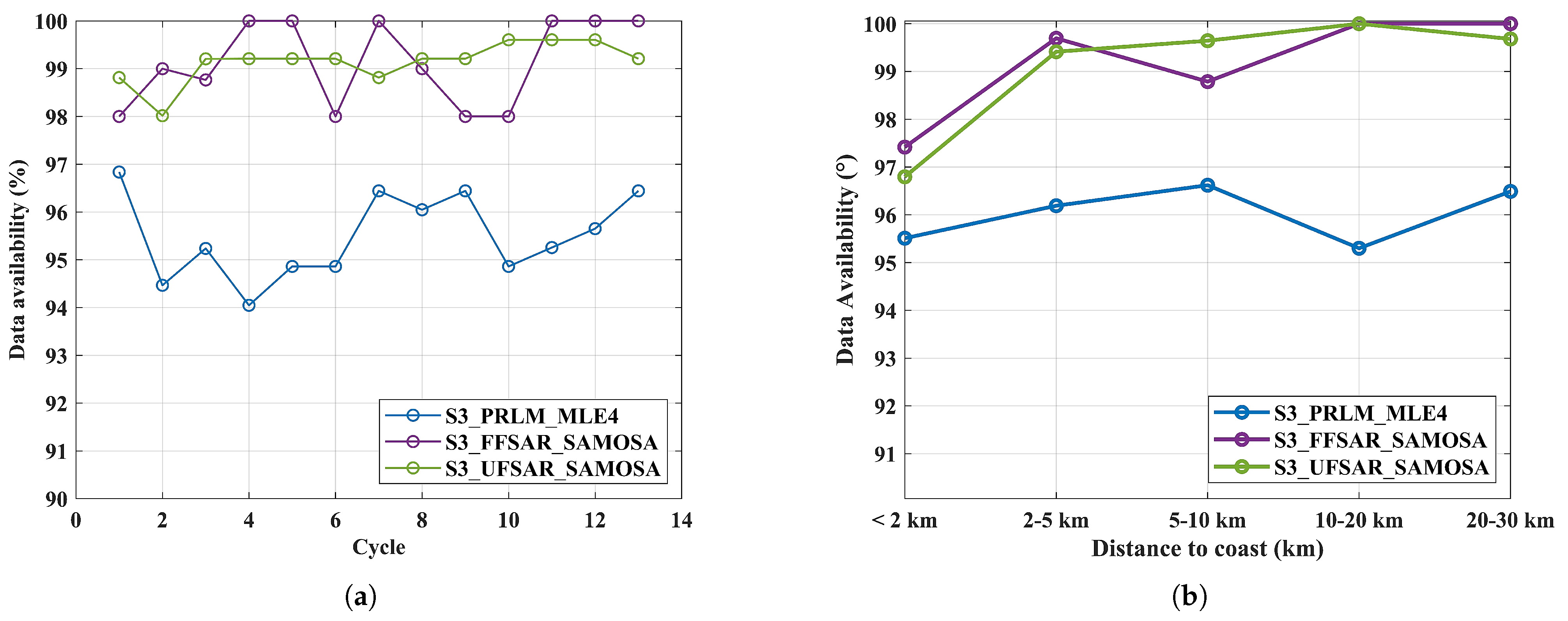
The data validity rates of the three Sentinel-3A waveform retracking methods are presented in Figure 21. Overall, both FFSAR_SAMOSA and UFSAR_SAMOSA demonstrate significantly higher data validity rates compared to the PLRM methods, with averages of approximately 99.1% and 99.1%, while PLRM methods average around 95.3–95.5%. Notably, FFSAR_SAMOSA and UFSAR_SAMOSA maintain validity rates above 98% across all cycles.
In terms of offshore distance variation, both FFSAR_SAMOSA and UFSAR_SAMOSA outperform PLRM across all distance ranges. In the nearshore region (2 km), FFSAR_SAMOSA achieves 97.42%, compared to 96.79% for UFSAR_SAMOSA and 93.91–95.51% for PLRM. The advantages become more pronounced in the 2–5 km range, reaching 99.70% and 99.41% for FFSAR_SAMOSA and UFSAR_SAMOSA, respectively, versus approximately 96% for PLRM. In offshore areas beyond 10 km, both FFSAR_SAMOSA and UFSAR_SAMOSA achieve nearly 100% validity, while PLRM reaches 95–98%. Notably, FFSAR_SAMOSA achieves 100% data validity in the 10–20 km, 20–30 km, and >30 km ranges. These results indicate that fully focused processing combined with SAR retracking can significantly improve data validity from nearshore to open ocean areas.
(2) Success rates of retracking and MQE (Mean Quadratic Error)
Ocean retracking algorithms have low retracking success rates for coastal waveforms, as they often fail to fit non-ocean waveforms. An improved retracking success rate means that more coastal waveforms can be successfully retracked, thereby obtaining the required ocean parameters.
Retracking Success Rate = N s u c c e s s N t o t a l × 100 %
where N t o t a l denotes the total number of target waveforms to be processed, and N s u c c e s s denotes the number of waveforms for which the retracking algorithm converges successfully and outputs a valid epoch.
As shown in Table 12, the retracking success rate of PLRM waveforms in coastal areas is generally poor: within 2 km of the coast, the success rate is less than 50%, and even at 10 km offshore, it only increases to approximately 95%. In contrast, SAR waveforms exhibit a significantly improved retracking success rate, reaching approximately 99% at 10 km offshore.
Further comparison between FFSAR and UFSAR waveforms reveals that their performance is generally comparable in open ocean areas; however, the advantage of FFSAR is particularly notable within 5 km of the coast. Specifically, within 2 km of the coast, the FFSAR retracking success rate is 11.57% higher than that of UFSAR, and in the range of 2–5 km, it is 17.21% higher.
To further evaluate the retracking performance for waveforms with successful retracking, the MQE is calculated. MQE is an indicator of the degree of waveform fitting, calculated as follows:
M Q E = 1 N i = 1 N y i y ^ i 2
where N is the number of samples, y i is the power of the i-th range gate of the actual waveform, and y ^ i is the power of the i-th range gate of the fitted waveform.
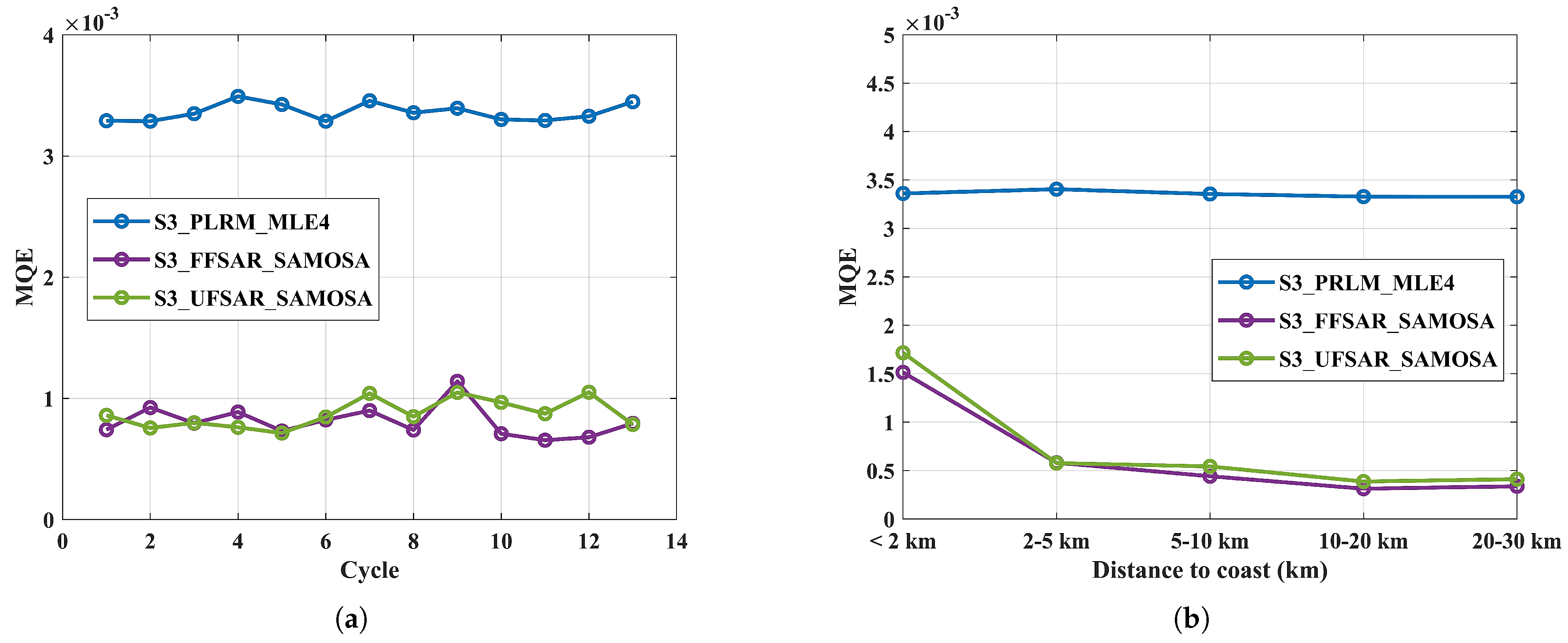
The MQE of Sentinel-3A data is presented in Figure 22:
From the results, the waveform fitting quality of UFSAR and FFSAR is significantly better than that of PLRM throughout the entire coastal study area. As analyzed in the waveform section, for standard ocean waveforms, the fluctuation of PLRM waveforms (particularly in the trailing edge region) is significantly larger than that of SAR waveforms, so even with excellent fitting, the MQE cannot achieve the same MQE level as SAR waveforms. Within 5 km of the coast, the MQE of FFSAR is lower than that of UFSAR, and as the offshore distance increases, the difference between the two becomes negligible. As pointed out in the FFSAR waveform reconstruction section, at the same resolution, the trailing edge of FFSAR waveforms is smoother, which is also the reason why FFSAR exhibits better MQE performance than UFSAR in coastal areas.
(3) SSH Stability
For ocean applications, the most critical parameter is sea surface height. The waveform retracker can obtain the satellite-to-sea surface range, and the SSH can be computed by correcting the errors in the range measurements. Tide gauges are used to measure water level variations at station locations.
The SSHA calculation is expressed as follows:
S S H A = H R a n g e Δ R Δ R = Δ R d r y + Δ R w e t + Δ R i o n o + Δ R S S B + Δ R s o l i d + Δ R O T + Δ R p o l e + Δ R I B + Δ R H F + Δ R i n t e r n a l + Δ R O T N L C
H is the satellite orbital altitude, R a n g e is the satellite-to-sea surface distance, Δ R represents the geophysical correction terms, including: dry tropospheric delay ( Δ R d r y ), wet tropospheric delay ( Δ R w e t ), ionospheric delay ( Δ R i o n o ), sea state bias ( Δ R S S B ), solid earth tide height ( Δ R s o l i d ), ocean tide height ( Δ R O T ), geocentric pole tide height ( Δ R p o l e ), inverted barometer height correction ( Δ R I B ), high frequency fluctuations of the sea surface topography ( Δ R H F ), internal tide ( Δ R i n t e r n a l ) and ocean tide non equilibrium long period component ( Δ R O T N L C ). The correction terms are obtained from the Sentinel-3A L2 product and interpolated to the corresponding positions.
For the Sentinel-3A radar altimeter, the R a n g e is calculated as follows:
R a n g e = R a n g e _ t r a c k + E p o c h c 0.5
where R a n g e _ t r a c k is the tracking range, E p o c h is the retracking-derived offset (from the reference gate, units: s), and c is the speed of light. The variation of SSH standard deviation with offshore distance is shown in Table 13.
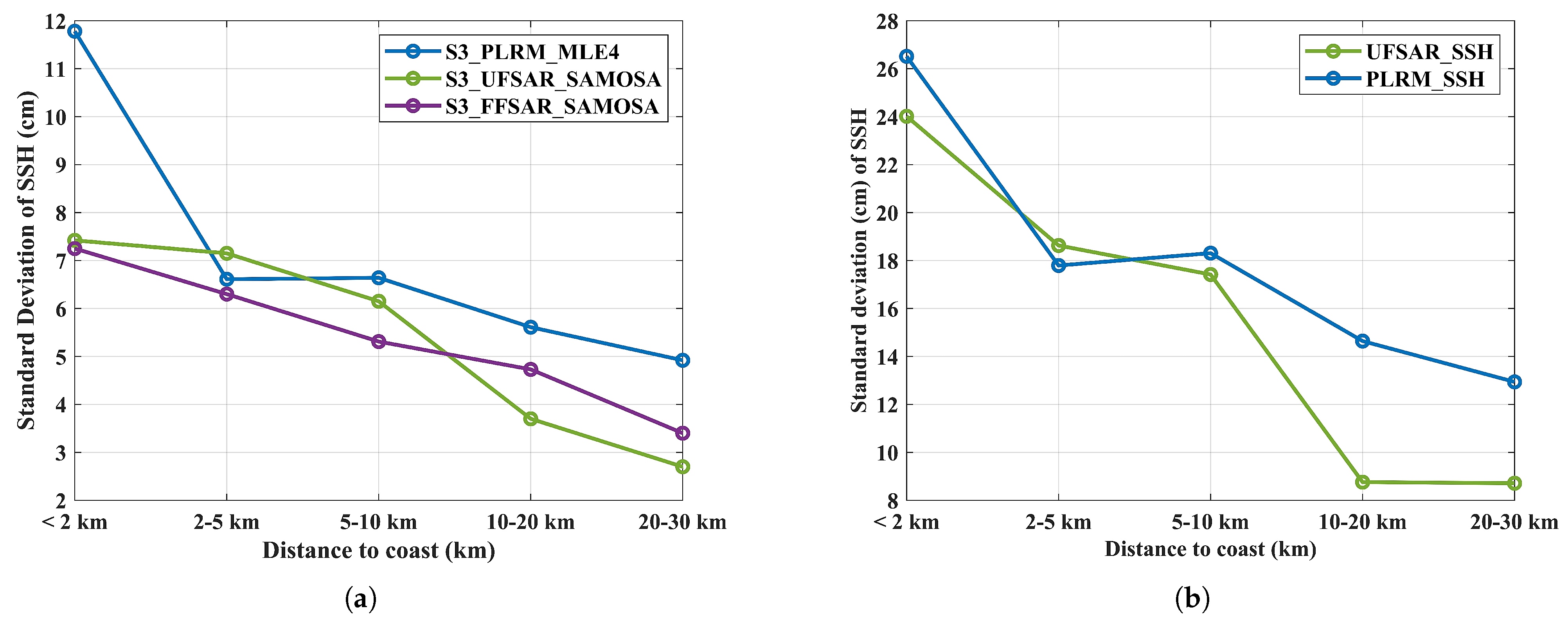
As shown in Figure 23, in coastal areas, the SSH standard deviation of UFSAR and FFSAR is significantly lower than that of PLRM, particularly within 5 km of the coast. Specifically, the standard deviation of UFSAR and FFSAR is approximately 7 cm, while that of PLRM is approximately 12 cm.
Compared to UFSAR, FFSAR exhibits a significantly lower standard deviation within 10 km of the coast. At the same resolution, FFSAR waveforms have lower noise levels, resulting in the SSH standard deviation being approximately 1 cm smaller than that of UFSAR. However, beyond 10 km offshore, UFSAR demonstrates better performance than FFSAR, with the standard deviation approximately 0.7 cm lower than that of FFSAR. This may be attributed to the influence of ocean fluctuations on synthetic aperture radar (SAR) altimetry. Although the ranging standard deviation of SAR is smaller than that of PLRM, its fluctuation with ocean wave parameters (wind direction and wind speed) is higher than that of PLRM [11]. The long-wave geometric effect causes Doppler sub-beams to cover surfaces with different phases, leading to discontinuities in the leading edge of multi-look echo waveforms, resulting in high noise in significant wave height and range estimation [31]. During the stack time, different Doppler sub-beams cover different phase regions of long waves, causing periodic perturbations in echo delay and waveform leading edge breaks, which significantly increase the range estimation noise [32]. UFSAR performs non-coherent averaging over the illumination time, while FFSAR performs coherent averaging. The impact arising from ocean fluctuations is more pronounced in FFSAR. The reason for this phenomenon may also be related to the sea area of Hong Kong. If the SSH standard deviations of the two waveforms are to be validated in open ocean areas, considerable work remains to be carried out in the future.

3.3. Correlation with Tide Gauge Data

To evaluate the impact of the proposed method on sea surface height, the Hong Kong tide gauge data represents a record of water level variations at the station. Using tide gauge data as external validation criteria, the SSHA results were compared with tide gauge data through differencing. The RMSE of the differenced series can reflect the stability of sea surface height. To verify the impact of the proposed method on sea surface height, the original SSH from the Quarry Bay tide gauge station was used to evaluate the SSHA results.
The Quarry Bay station is located at 22.29°N, 114.21°E and provides hourly sea surface height data. First, spatiotemporal matching was performed between the Hong Kong tide gauge station and Sentinel-3A satellite orbit 260, with a time span from January 2022 to December 2022, comprising 13 cycles in total. The minimum distance between the satellite orbit and the Quarry Bay station is approximately 5 km. The tide gauge water level is extrapolated to the nearest point of the satellite track, which can be expressed as
S S H A n a d i r = S S H g a u g e Δ M S S Δ R T i d e Δ R D A C
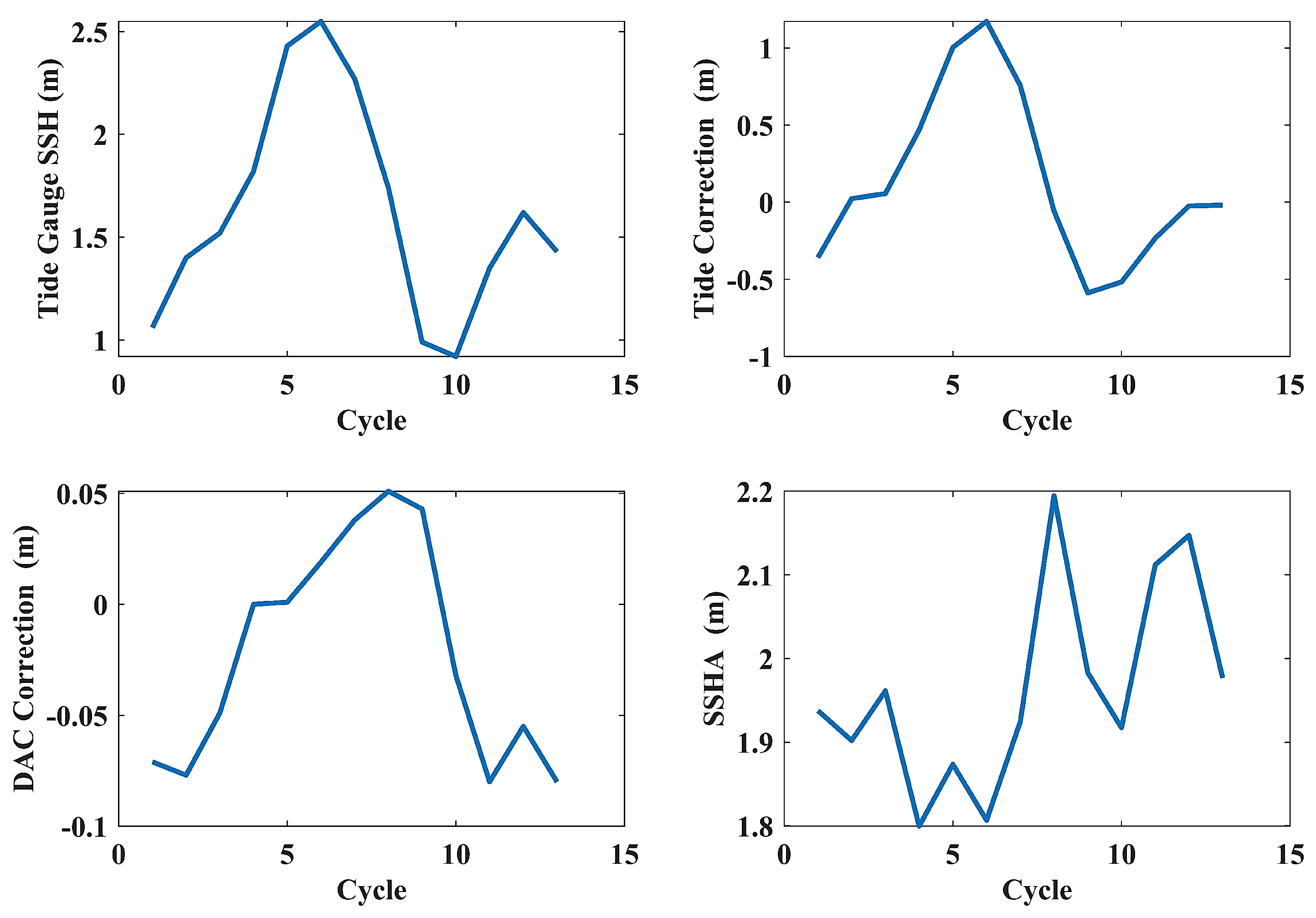
where S S H g a u g e is the original sea surface height from the tide gauge, S S H s 3 is the sea surface height calculated from the altimeter, Δ M S S is the difference in mean sea level between the tide gauge location and the nearest point, Δ R T i d e is the ocean tide correction, and Δ R D A C is the dynamic atmospheric correction. In this study, the CLS2015 model was used for MSS, and the Dynamic Atmospheric Correction (DAC) generated by CLS using the Mog2D model and distributed by Aviso+ (https://www.aviso.altimetry.fr/) (accessed on 1 January 2026) was used to maintain synchronization with the Sentinel-3A product. Tide gauge measurements and corresponding correction terms are presented in Figure 24.
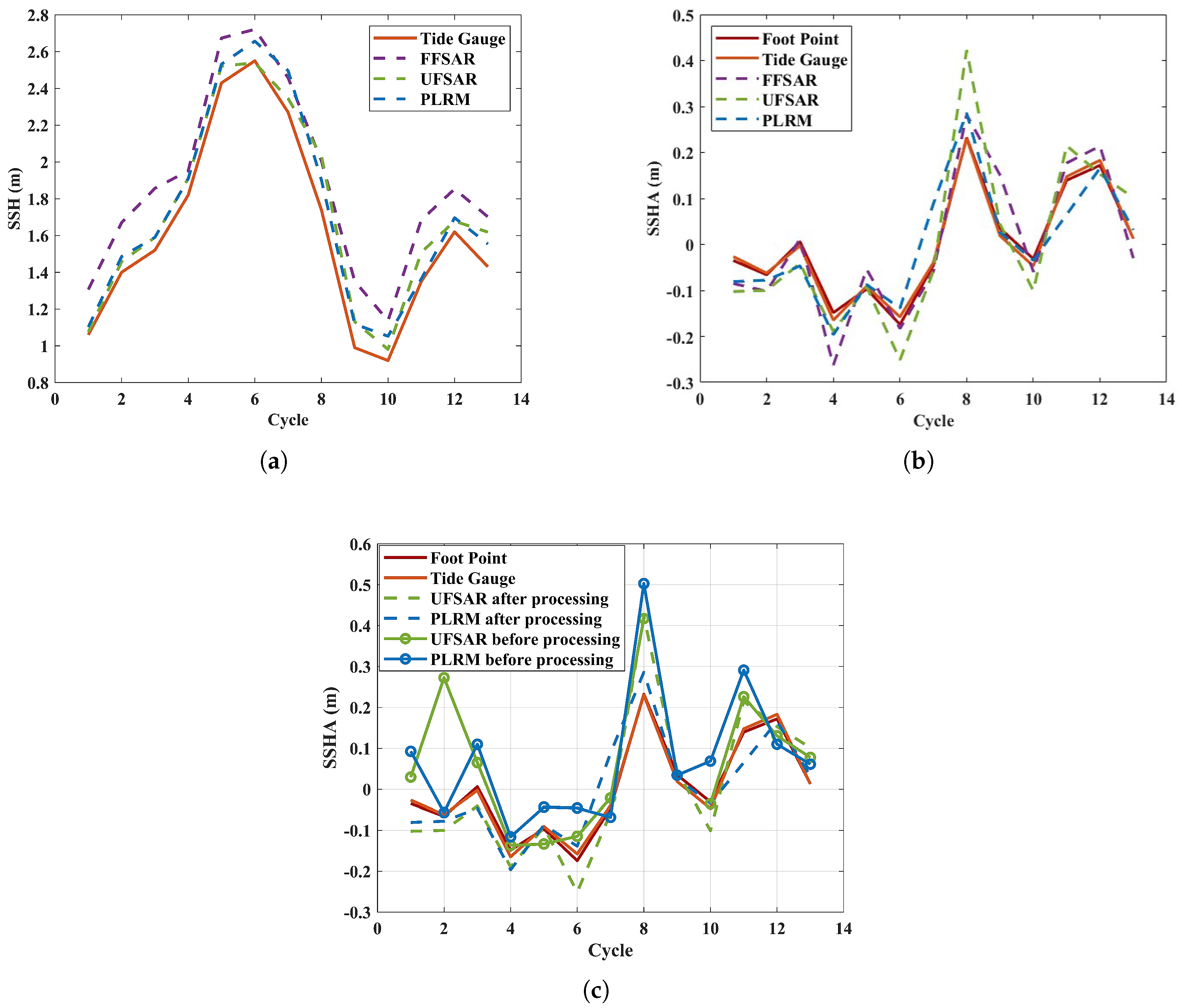
After retracking the different waveforms of Sentinel-3A, the SSH was converted to SSHA and compared with the corrected SSH at the foot point. The results are shown in Figure 25.
Overall, the SSH obtained from FFSAR retracking generally follows the same trend as the SSH observed by the tide gauge (Figure 25a). Fluctuations of approximately 0.3 m exist in the 3rd and 12th cycles, while the SSH differences between the two data sources in the remaining cycles are within 0.2 m. After converting the tide gauge data to the foot point location perpendicular to the Sentinel-3A orbit, the SSHA shows an offset of approximately 0.3 m compared to the original data (Figure 25b). The fluctuation range of FFSAR is closer to zero. The RMSE values are listed in Table 14 as follows: FFSAR = 6.20 cm, UFSAR = 7.55 cm, and PLRM = 9.49 cm.
Correlation analysis shows that the correlation coefficient between FFSAR and foot point SSHA is 0.82, which is higher than that of UFSAR (0.76) and PLRM (0.74), demonstrating superior correlation. This suggests that the FFSAR waveform performs better than the existing PLRM and UFSAR in coastal areas.
However, it should be emphasized that these conclusions are based on the specific case study. Further validation with more cycles and across multiple coastal regions is needed to confirm the generalizability of FFSAR performance.
Comparisons of SSHA from PLRM and UFSAR waveforms before and after coastal processing were conducted. The SSHA values before processing were obtained from Level-2 products. The standard deviation of the difference between UFSAR-derived SSHA and tide gauge SSHA decreases by 2.8 cm, and the standard deviation for PLRM decreases by 3.3 cm, demonstrating the effectiveness of the proposed coastal processing workflow.


4. Discussion

The nearshore environment is highly heterogeneous; in the future, we will conduct more detailed experimental analyses for different sea areas, seasons, satellite orbits, and sea conditions to thoroughly examine the generalizability of our results.

5. Conclusions

This study constructs a complete data processing workflow suitable for coastal areas, including fully focused waveform reconstruction, waveform classification, denoising, and retracking. The main contributions are as follows:
(1) Based on actual waveforms from the sea area near Hong Kong, echoes are classified into 17 categories: standard LRM/SAR ocean waveforms, standard LRM/SAR sharp waveforms, LRM/SAR ocean waveforms with abnormal peaks, LRM/SAR sharp waveforms with abnormal peaks, LRM/SAR ocean waveforms with trailing noise, LRM/SAR sharp waveforms with trailing noise, LRM/SAR ocean waveforms with multi-peak, LRM/SAR sharp waveforms with multi-peak, and clutter. A dataset containing 35,409 waveforms was constructed.
(2) A Wave-Transformer waveform classifier is proposed, achieving a test accuracy of 89.16%. All categories have F1-scores above 78%, with standard ocean waveforms, abnormal peak waveforms, and trailing noise waveforms achieving F1-scores above 90%. The classifier was applied to classify actual PLRM, SAR, and FFSAR waveforms, and the variation of category proportions with offshore distance was analyzed.
(3) Denoising methods are proposed for different waveform types: abnormal peaks are removed using the 3 σ riterion; multi-peak waveforms use the Dijkstra algorithm to identify the optimal leading edge for retracking; waveforms with trailing noise employ sub-waveform secondary retracking, and a Modified-Adaptive model suitable for sharp waveforms with trailing noise is proposed to effectively avoid trailing noise interference during waveform fitting.
(4) Multi-metric evaluation (data validity rate, retracking success rate, MQE, and SSH stability) of retracking results was conducted. Results show that FFSAR appears advantageous in the nearshore zone of this case study, especially within approximately 5–10 km, while UFSAR may be more stable farther offshore under some conditions. At 10 km from the coast, the SSH of FFSAR is approximately 4.31 cm lower than that of UFSAR in RSS.
(5) Validation using actual tide gauge SSHA data shows that FFSAR achieves a correlation coefficient of 0.82 and an RMSE of 6.20 cm, which are superior to those of UFSAR (0.76 and 7.55 cm) and PLRM (0.74 and 9.49 cm), demonstrating the reliability and application potential of the proposed coastal processing workflow.

Supplementary Materials

The following supporting information can be downloaded at: https://www.mdpi.com/article/10.3390/rs18121950/s1, Figure S1: Comparison between the integral form of f n ( ξ ) and its Bessel approximation; References [2,3,23,24,33,34,35,36,37] cited in the supplementary material file.
Author Contributions

Conceptualization, M.L. and X.-Y.X.; methodology, M.L., J.W. and X.-Y.X.; software, M.L. and J.W.; validation, M.L. and J.W.; formal analysis, M.L.; investigation, M.L. and P.L.; resources, M.L.; data curation, M.L.; writing—original draft preparation, M.L.; writing—review and editing, P.L., J.W. and X.-Y.X.; visualization, M.L.; supervision, X.-Y.X. and K.X.; project administration, X.-Y.X. and K.X.; funding acquisition, X.-Y.X., K.X. and P.L. All authors have read and agreed to the published version of the manuscript.

Funding

This research was funded by China’s HY-2E/F Satellite Radar Altimeter Mission (Grant Number: E41Z200101; funder: Chinese Academy of Space Technology) and the Natural Science Foundation of China (Grant Number: 41876209).

Data Availability Statement

The Sentinel-3A data were acquired from the Copernicus Open Access Hub (https://sentinels.copernicus.eu/) (accessed on 1 January 2026), a mission jointly managed by ESA and EUMETSAT. The tide gauge data (QUARRY BAY) used in this study were obtained from the Permanent Service for Mean Sea Level (PSMSL) (http://www.psmsl.org/data/obtaining/) (accessed on 1 January 2026).

Acknowledgments

The authors thank EUMETSAT for Sentinel-3A altimetry data, PSMSL for tide gauge data, and CLS for the SMAP processor.

Conflicts of Interest

The authors declare no conflicts of interest.

References

  1. Barbier, E.B. Marine ecosystem services. Curr. Biol. 2017, 27, R507–R510. [Google Scholar] [CrossRef]
  2. Moore, R.K.; Williams, C.S. Radar Terrain Return at Near-Vertical Incidence. Proc. IRE 1957, 45, 228–238. [Google Scholar] [CrossRef]
  3. Brown, G. The average impulse response of a rough surface and its applications. IEEE Trans. Antennas Propag. 1977, 25, 67–74. [Google Scholar] [CrossRef]
  4. Kulp, S.A.; Strauss, B.H. New elevation data triple estimates of global vulnerability to sea-level rise and coastal flooding. Nat. Commun. 2019, 10, 4844. [Google Scholar] [CrossRef]
  5. Raney, R. The delay/Doppler radar altimeter. IEEE Trans. Geosci. Remote Sens. 1998, 36, 1578–1588. [Google Scholar] [CrossRef]
  6. Egido, A.; Smith, W.H. Fully focused SAR altimetry: Theory and applications. IEEE Trans. Geosci. Remote Sens. 2016, 55, 392–406. [Google Scholar] [CrossRef]
  7. Guccione, P.; Scagliola, M.; Giudici, D. 2D Frequency Domain Fully Focused SAR Processing for High PRF Radar Altimeters. Remote Sens. 2018, 10, 1943. [Google Scholar] [CrossRef]
  8. Schlembach, F.; Ehlers, F.; Kleinherenbrink, M.; Passaro, M.; Dettmering, D.; Seitz, F.; Slobbe, C. Benefits of fully focused SAR altimetry to coastal wave height estimates: A case study in the North Sea. Remote Sens. Environ. 2023, 289, 113517. [Google Scholar] [CrossRef]
  9. Shi, H.; Wu, Y.; Shi, Y.; He, X.; Zheng, X.; Andersen, O.B. Enhanced Sea Surface Height Estimation with Interference Rejection Using High-Frequency Fully-focused SAR Altimetry data Over Island Areas. IEEE Trans. Geosci. Remote Sens. 2025, 63, 1–16. [Google Scholar] [CrossRef]
  10. Buchhaupt, C.; Fenoglio, L.; Becker, M.; Kusche, J. Impact of vertical water particle motions on focused SAR altimetry. Adv. Space Res. 2021, 68, 853–874. [Google Scholar] [CrossRef]
  11. Wang, J.; Jiang, M.; Xu, K. Range and Wave Height Corrections to Account for Ocean Wave Effects in SAR Altimeter Measurements Using Neural Network. Remote Sens. 2025, 17, 1031. [Google Scholar] [CrossRef]
  12. Berry, P.A.M.; Bracke, H.; Jasper, A. Retracking ERS-1 altimeter waveforms over land for topographic height determination: An expert systems approach. In Proceedings of the Third ERS Symposium on Space at the Service of our Environment, Florence, Italy, 14–21 March 1997; Volume 414, pp. 403–408. Available online: http://pascal-francis.inist.fr/vibad/index.php?action=getRecordDetail&idt=2291608 (accessed on 24 March 2026).
  13. Dabo-Niang, S.; Ferraty, F.; Vieu, P. On the using of modal curves for radar waveforms classification. Comput. Stat. Data Anal. 2007, 51, 4878–4890. [Google Scholar] [CrossRef]
  14. Zheng, J.; Xu, X.Y.; Xu, Y.; Guo, C. Coastal Waveform Retracking for Synthetic Aperture Altimeters Using a Multiple Optimization Parabolic Cylinder Algorithm. Remote Sens. 2023, 15, 4665. [Google Scholar] [CrossRef]
  15. Passaro, M.; Cipollini, P.; Vignudelli, S.; Quartly, G.D.; Snaith, H.M. ALES: A multi-mission adaptive subwaveform retracker for coastal and open ocean altimetry. Remote Sens. Environ. 2014, 145, 173–189. [Google Scholar] [CrossRef]
  16. Halimi, A.; Mailhes, C.; Tourneret, J.Y. Cramér-Rao bounds and estimation algorithms for delay/Doppler and conventional altimetry. In Proceedings of the 21st European Signal Processing Conference (EUSIPCO 2013); IEEE: Piscataway, NJ, USA, 2013; pp. 1–5. [Google Scholar]
  17. Peng, F.; Deng, X. A New Retracking Technique for Brown Peaky Altimetric Waveforms. Mar. Geod. 2018, 41, 99–125. [Google Scholar] [CrossRef]
  18. Villadsen, H.; Deng, X.; Andersen, O.B.; Stenseng, L.; Nielsen, K.; Knudsen, P. Improved inland water levels from SAR altimetry using novel empirical and physical retrackers. J. Hydrol. 2016, 537, 234–247. [Google Scholar] [CrossRef]
  19. Dinardo, S. Techniques and Applications for Satellite SAR Altimetry over Water, Land and Ice. Ph.D. Thesis, Technische Universität Darmstadt, Darmstadt, Germany, 2020. [Google Scholar] [CrossRef]
  20. Xu, X.Y.; Birol, F.; Cazenave, A. Evaluation of Coastal Sea Level Offshore Hong Kong from Jason-2 Altimetry. Remote Sens. 2018, 10, 282. [Google Scholar] [CrossRef]
  21. Ehlers, F. A detailed analysis of S3 and S6 fully-focused SAR waveforms: Enabling SAMOSA-based retracking. In Proceedings of the Ocean Surface Topography Science Team Meeting 2022, Venice, Italy, 31 October–4 November 2022. [Google Scholar] [CrossRef]
  22. Schwatke, C.; Dettmering, D. Classification of altimeter waveforms for an improved estimation of water level time series over inland water. In Proceedings of the 9th Coastal Altimetry Workshop, Reston, VA, USA, 18–19 October 2015. [Google Scholar]
  23. Hayne, G. Radar altimeter mean return waveforms from near-normal-incidence ocean surface scattering. IEEE Trans. Antennas Propag. 1980, 28, 687–692. [Google Scholar] [CrossRef]
  24. Ray, C.; Martin-Puig, C.; Clarizia, M.P.; Ruffini, G.; Dinardo, S.; Gommenginger, C.; Benveniste, J. SAR Altimeter Backscattered Waveform Model. IEEE Trans. Geosci. Remote Sens. 2015, 53, 911–919. [Google Scholar] [CrossRef]
  25. Tourain, C.; Piras, F.; Ollivier, A.; Hauser, D.; Poisson, J.C.; Boy, F.; Thibaut, P.; Hermozo, L.; Tison, C. Benefits of the adaptive algorithm for retracking altimeter nadir echoes: Results from simulations and CFOSAT/SWIM observations. IEEE Trans. Geosci. Remote Sens. 2021, 59, 9927–9940. [Google Scholar] [CrossRef]
  26. Vaswani, A.; Shazeer, N.; Parmar, N.; Uszkoreit, J.; Jones, L.; Gomez, A.N.; Kaiser, Ł.; Polosukhin, I. Attention is all you need. Adv. Neural Inf. Process. Syst. 2017, 11, 6000–6010. Available online: https://proceedings.neurips.cc/paper_files/paper/2017/file/3f5ee243547dee91fbd053c1c4a845aa-Paper.pdf (accessed on 24 March 2026).
  27. Dosovitskiy, A.; Beyer, L.; Kolesnikov, A.; Weissenborn, D.; Zhai, X.; Unterthiner, T.; Dehghani, M.; Minderer, M.; Heigold, G.; Gelly, S.; et al. An image is worth 16x16 words: Transformers for image recognition at scale. arXiv 2020, arXiv:2010.11929. [Google Scholar] [CrossRef]
  28. Lipton, Z.C.; Berkowitz, J.; Elkan, C. A Critical Review of Recurrent Neural Networks for Sequence Learning. arXiv 2015, arXiv:1506.00019. [Google Scholar] [CrossRef]
  29. Hochreiter, S.; Schmidhuber, J. Long Short-Term Memory. Neural Comput. 1997, 9, 1735–1780. [Google Scholar] [CrossRef] [PubMed]
  30. Peng, F.; Deng, X.; Shen, Y. Assessment of an Adaptive Subwaveform Coastal Retracker (ASCR) over global coastal oceans for SAR altimetry. Remote Sens. Environ. 2025, 316, 114495. [Google Scholar] [CrossRef]
  31. Moreau, T.; Tran, N.; Aublanc, J.; Tison, C.; Le Gac, S.; Boy, F. Impact of long ocean waves on wave height retrieval from SAR altimetry data. Adv. Space Res. 2018, 62, 1434–1444. [Google Scholar] [CrossRef]
  32. Amarouche, L.; Tran, N.; Herra, D. Impact of the ocean waves motion on the delay/doppler altimeters measurements. In Proceedings of the Ocean Surface Topography Science Team Meeting, Chicago, IL, USA, 21–25 October 2019; pp. 21–25. [Google Scholar]
  33. Srokosz, M.A. On the joint distribution of surface elevation and slopes for a nonlinear random sea, with an application to radar altimetry. J. Geophys. Res. Ocean. 1986, 91, 995–1006. [Google Scholar] [CrossRef]
  34. Gómez-Enri, J.; Gommenginger, C.P.; Srokosz, M.A.; Challenor, P.G.; Benveniste, J. Measuring global ocean wave skewness by retracking RA-2 Envisat waveforms. J. Atmos. Ocean. Technol. 2007, 24, 1102–1116. [Google Scholar] [CrossRef]
  35. Rodríguez, E. Altimetry for non-Gaussian oceans: Height biases and estimation of parameters. J. Geophys. Res. Ocean. 1988, 93, 14107–14120. [Google Scholar] [CrossRef]
  36. Dinelli, B.M.; Castelli, E.; Papandrea, E.; Casadio, S.; Valeri, M. AIRWAVE-SLSTR: An Algorithm to Retrieve TCWV from SLSTR Measurements over Water Surfaces, Algorithm Theoretical Basis Document (ATBD), D6-AIRWAVE-SLSTR-ATBD, Issue 1.0; EUMETSAT. 2020. Available online: https://www-cdn.eumetsat.int/files/2023-01/D6_AIRWAVE-SLSTR_ATBD-v1.1.pdf (accessed on 24 March 2026).
  37. Makhoul, E.; Roca, M.; Ray, C.; Escolà, R.; Garcia-Mondéjar, A. Evaluation of the precision of different Delay-Doppler Processor (DDP) algorithms using CryoSat-2 data over open ocean. Adv. Space Res. 2018, 62, 1464–1478. [Google Scholar] [CrossRef]
Figure 1. Geographic locations of the tide gauge station in Hong Kong and the Sentinel-3A track.
Remotesensing 18 01950 g001
Figure 2. Technical flowchart.
Remotesensing 18 01950 g002
Figure 3. (a,c) Typical FFSAR waveforms along the S3 orbit with increasing distance from the coast, Each color represents the footprint of one type of waveform; (b,d) FFSAR radargram of S3A 260 with echo positions (red scatters) from OCOG.
Remotesensing 18 01950 g003
Figure 4. Comparison of UFSAR and FFSAR waveforms: (a) 640 Hz FFSAR waveform; (b) FFSAR waveform downsampled from 640 Hz to 20 Hz; (c) 20 Hz UFSAR waveform.
Remotesensing 18 01950 g004
Figure 5. Changes in the PLRM waveform as the offshore distance increases; the vertical axis represents normalized power, and the horizontal axis represents the range bin. The top-left corner of each subplot shows the waveform number, and the top-right corner shows the offshore distance (in km).
Remotesensing 18 01950 g005
Figure 6. Changes in the SAR waveform as the offshore distance increases; the vertical axis represents normalized power, and the horizontal axis represents the range bin. The top-left corner of each subplot shows the waveform number, and the top-right corner shows the offshore distance (in km).
Remotesensing 18 01950 g006
Figure 7. Flowchart of the construction of the simulation dataset. The standard ocean/sharp simulation was performed as described in (1)–(3); the ocean/sharp abnormal peak simulation was performed as described in (4); the ocean/sharp trailing noise simulation was performed as described in (5); the ocean/sharp multi-peak simulation was performed as described in (6). The clutter signal is derived from the clutter present in real waveforms.
Remotesensing 18 01950 g007
Figure 8. Quantity distribution of various waveforms in the dataset.
Remotesensing 18 01950 g008
Figure 9. Simulation results of waveforms with different labels in the dataset.
Remotesensing 18 01950 g009
Figure 10. Transformer architecture, * denotes extra learnable positional embedding.
Remotesensing 18 01950 g010
Figure 11. Encoder layer.
Remotesensing 18 01950 g011
Figure 12. Multi-head attention and scaled dot-product attention.
Remotesensing 18 01950 g012
Figure 13. The confusion matrix.
Remotesensing 18 01950 g013
Figure 14. Flowchart for noise removal and retracking. The value of peak power (PP) is calculated as one over the sum of normalized waveform power, while the misfit is the difference between the maximum power of the normalized waveform and the estimated waveform amplitude. “(1) Abnormal Peak Removal” is applied to the LRM ocean abnormal peak, LRM sharp abnormal peak, SAR ocean abnormal peak, and SAR sharp abnormal peak waveforms; “(2) Multi-Peak Removal” is applied to the LRM ocean multi-peak, LRM sharp multi-peak, SAR ocean multi-peak, and SAR sharp multi-peak waveforms; “(3) Trailing Noise Removal” is applied to the LRM ocean trailing noise, SAR ocean trailing noise, LRM sharp trailing noise, and SAR sharp trailing noise waveforms. The EndGate calculation formula for the LRM ocean waveform is derived from Equation (4) in [15], while the EndGate calculation formula for the SAR ocean waveform is derived from Equation (6) in [30]; the EndGate calculation formula for the LRM and SAR sharp waveforms is derived from Equation (26) in this paper.
Remotesensing 18 01950 g014
Figure 15. Schematic diagrams showing the waveform before and after outlier peak removal. (a) The waveform before removal; (b) the waveform after removal.
Remotesensing 18 01950 g015
Figure 16. Process of identifying the optimal leading edge in multi-peak waveforms.
Remotesensing 18 01950 g016
Figure 17. Waveform fitting before and after ALES processing.
Remotesensing 18 01950 g017
Figure 18. Fitting results. (a) The fitting results for the SAMOSA and Adaptive models. (b) The results of the Adaptive model fitting a sharp waveform. (c) The Adaptive model fitting a sharp waveform with trailing noise.
Remotesensing 18 01950 g018
Figure 19. RMSE of full waveform and sub-waveform fitting for different parameters under various SWH conditions. The black line represents an RMSE of 1 cm.
Remotesensing 18 01950 g019
Figure 20. Modified-Adaptive fitting of sharp waveform with trailing noise.
Remotesensing 18 01950 g020
Figure 21. Data availability of Sentinel-3A for PLRM, UFSAR, and FFSAR. (a) Data availability rate of Sentinel-3A PLRM, UFSAR, and FFSAR waveform retracking over different cycles. (b) Data availability rate of Sentinel-3A PLRM, UFSAR, and FFSAR waveform retracking as a function of offshore distance.
Remotesensing 18 01950 g021
Figure 22. MQE of Sentinel-3A for PLRM, UFSAR, and FFSAR. (a) MQE of Sentinel-3A PLRM, UFSAR, and FFSAR waveform retracking over different cycles. (b) MQE of Sentinel-3A PLRM, UFSAR, and FFSAR waveform retracking as a function of offshore distance.
Remotesensing 18 01950 g022
Figure 23. Variation in the standard deviation of SSH before and after processing as a function of distance from the coast. (a) Standard deviation (cm) of SSH for different retracking algorithms as a function of offshore distance. (b) Variation in the standard deviation of SSH in products before processing as a function of offshore distance.
Remotesensing 18 01950 g023
Figure 24. Tide gauge data and correction terms.
Remotesensing 18 01950 g024
Figure 25. Comparison between tide gauge observations and waveform 1 Hz results. (a) Comparison chart of SSH results for tide gauge, PLRM, UFSAR, and FFSAR. (b) Comparison chart of SSHA results for foot point, tide gauge, PLRM, UFSAR, and FFSAR. (c) Variation of SSHA before and after treatment as a function of distance from the coast.
Remotesensing 18 01950 g025
Table 1. Parameters for FFSAR processing.
ParameterValueParameterValue
illumination time2.3 sposting rate20 Hz
multi looking890along track resolution335 m
zp2range ext factor1
Table 2. Dataset label definition.
LabelWave TypeLabelWave Type
0SAR Ocean waveform1SAR Sharp waveform
2LRM Ocean waveform3LRM Sharp waveform
4LRM Ocean Abnormal peak5LRM Sharp Abnormal peak
6SAR Ocean Abnormal peak7SAR Sharp Abnormal peak
8LRM Ocean Trailing noise9LRM Sharp Trailing noise
10SAR Ocean Trailing noise11SAR Sharp Trailing noise
12LRM Ocean Multi-peak13LRM Sharp Multi-peak
14SAR Ocean Multi-peak15SAR Sharp Multi-peak
16Clutter Signal
Table 3. The value ranges of the parameters in the waveform simulation.
ParametersValue RangeParametersValue Range
SWHrange (0:0.5:20)Pu1.0
MSSrange (1 × 10 6 :−2.25 × 10 7 :1 × 10 7 ) ξ range (0:0.1:0.7)
a i range (0.01:0.01:0.50) b i [50, 100]
c i range (0.01:0.02:0.2)n (Multi-peak)[3, 15]
n (Trailing Noise)[0, 5]Brange (0:0.01:0.1)
A[0, 1]
Table 4. KL divergence between simulated and real waveforms.
LabelSAR Ocean WaveformSAR Sharp WaveformLRM Ocean Waveform
KL Divergence0.07550.09030.0609
Table 5. Training parameter settings.
ParameterValueParameterValue
OptimizerAdamLearning rate0.001
Batch size32Epochs500
Early stopping10Dropout rate0.2
Table 6. Precision, recall, F1-score and accuracy evaluation.
ClassAccuracy (%)Precision (%)Recall (%)F1-Score (%)
097.8985.8397.8991.47
193.0780.8493.0786.52
298.0388.2098.0392.86
377.65100.0077.6587.42
490.9192.4990.9191.69
589.1580.0889.1584.38
686.2791.6786.2788.89
779.1590.6779.1584.52
898.9599.4798.9599.21
998.6596.0798.6597.35
1094.5891.4394.5892.98
1181.9285.4381.9283.64
1280.3592.6780.3586.07
1368.8594.3868.8579.62
1473.8991.7273.8981.85
1565.5395.0765.5377.59
1696.2391.1996.2393.64
Table 7. Overall classification performance comparison of different models.
ModelAccuracy (%)Precision (%)Recall (%)F1-Score (%)
Wave-Transformer89.1688.4586.2387.31
Con-LSTM86.5885.7384.9185.31
LSTM83.2484.1281.5682.82
RNN78.4580.2377.3478.75
1D-CNN75.6377.8574.1275.93
Table 8. Sentinel-3A real waveform classification results (Unit: %).
LabelCategoryCountPercentageLabelCategoryCountPercentage
0SAR Ocean waveform22,65888.72LRM Ocean waveform11,54783.0
1SAR Sharp waveform510.23LRM Sharp waveform3202.3
6SAR Ocean Abnormal peak1280.54LRM Ocean Abnormal peak6544.7
7SAR Sharp Abnormal peak30.015LRM Sharp Abnormal peak10.01
10SAR Ocean Trailing noise10994.38LRM Ocean Trailing noise3902.8
11SAR Sharp Trailing noise5112.09LRM Sharp Trailing noise560.4
14SAR Ocean Multi-peak2561.012LRM Ocean Multi-peak60.04
15SAR Sharp Multi-peak5112.013LRM Sharp Multi-peak30.02
16Clutter Signal (SAR)7673.016Clutter Signal (LRM)189213.6
Total SAR waveforms25,556 Total LRM waveforms13,912
Table 9. Sentinel-3A PLRM waveform classification distribution (Unit: %).
Offshore Distance2 km2–5 km5–10 km10–20 km20–30 km
LRM Ocean waveform18.8840.2082.9296.9096.50
LRM Sharp waveform14.003.770.000.000.00
LRM Ocean Abnormal peak11.333.912.552.262.12
LRM Sharp Abnormal peak0.050.000.000.000.00
LRM Ocean Trailing noise4.0412.780.000.140.69
LRM Sharp Trailing noise2.620.070.000.000.00
LRM Ocean Multi-peak0.310.000.000.000.00
LRM Sharp Multi-peak0.160.000.000.000.00
Clutter Signal48.6139.2712.670.690.69
Table 10. Sentinel-3A SAR (UFSAR) waveform classification distribution (Unit: %).
Offshore Distance2 km2–5 km5–10 km10–20 km20–30 km
SAR Ocean waveform76.7850.4592.8999.2098.86
SAR Sharp waveform0.580.000.000.000.00
SAR Ocean Abnormal peak0.580.990.510.290.08
SAR Sharp Abnormal peak0.040.000.000.000.00
SAR Ocean Trailing noise6.3710.903.260.151.06
SAR Sharp Trailing noise4.064.960.160.000.00
SAR Ocean Multi-peak2.900.000.000.000.00
SAR Sharp Multi-peak4.633.960.000.000.00
Clutter Signal4.063.963.170.370.00
Table 11. Sentinel-3A FFSAR waveform classification distribution (Unit: %).
Offshore Distance2 km2–5 km5–10 km10–20 km20–30 km
SAR Ocean waveform68.3558.9794.2599.3399.02
SAR Sharp waveform0.673.953.150.000.00
SAR Ocean Abnormal peak2.366.990.560.000.00
SAR Sharp Abnormal peak3.372.430.000.000.00
SAR Ocean Trailing noise2.026.081.860.670.66
SAR Sharp Trailing noise0.000.610.190.000.00
SAR Ocean Multi-peak0.000.000.000.000.00
SAR Sharp Multi-peak4.386.380.000.000.00
Clutter Signal18.8614.590.000.000.00
Table 12. Success rates of retracking for different models (in %).
Offshore Distance2 km2–5 km5–10 km10–20 km20–30 km
PLRM_MLE445.2572.2989.2893.9694.33
UFSAR_SAMOSA49.0478.8488.9499.5999.08
FFSAR_SAMOSA60.6196.0595.9299.7899.67
Table 13. Standard deviation of SSH from different retrackers as a function of distance from the coast (in cm).
Offshore Distance2 km2–5 km5–10 km10–20 km20–30 km
PLRM_MLE411.797.336.425.394.15
UFSAR_SAMOSA7.427.156.153.702.70
FFSAR_SAMOSA7.256.305.314.733.40
Table 14. Comparison of RMSE and correlation coefficients between different waveforms and the nadir point.
WaveformRMSE (cm)Correlation Coefficient
PLRM9.490.74359
UFSAR7.550.76923
FFSAR6.200.82051
Disclaimer/Publisher’s Note: The statements, opinions and data contained in all publications are solely those of the individual author(s) and contributor(s) and not of MDPI and/or the editor(s). MDPI and/or the editor(s) disclaim responsibility for any injury to people or property resulting from any ideas, methods, instructions or products referred to in the content.