Article

An Adaptive Loose Integration Method for High-Rate GNSS and Strong Motion with Colored Noise

1
College of Oceanography and Space Informatics, China University of Petroleum (East China), Qingdao 266580, China
2
China Railway Design Corporation, Tianjin 300308, China
3
First Institute of Oceanography, Ministry of Natural Resources, Qingdao 266061, China
4
School of Geodesy and Geomatics, Wuhan University, Wuhan 430079, China
*
Author to whom correspondence should be addressed.
Remote Sens. 2026, 18(12), 1932; https://doi.org/10.3390/rs18121932
Submission received: 17 May 2026 / Revised: 8 June 2026 / Accepted: 8 June 2026 / Published: 11 June 2026

Highlights

What are the main findings?
  • A novel two-step loose integration method is proposed to jointly mitigate high-rate GNSS colored noise and strong-motion baseline shift.
  • Colored noise in high-rate GNSS is suppressed by using a colored-noise-based Kalman filter with an adaptive strategy.
What are the implications of the main findings?
  • The proposed method improves the accuracy and stability of coseismic displacement estimation, achieving an approximately 21% RMSE reduction compared with the KFb solution in the shake table experiment.
  • Validations using a shake table experiment and three real earthquake cases demonstrate that the method effectively suppresses GNSS low-frequency colored noise and SM baseline shift, enabling more reliable broadband coseismic displacement.

Abstract

Integration of high-rate Global Navigation Satellite Systems (GNSS) with strong motion (SM) sensors enables accurate broadband coseismic displacements, which are critical for earthquake early warning and rapid source inversion. However, GNSS colored noise and SM baseline shift can degrade the accuracy and stability of the integrated displacements. In this study, we propose a novel loose integration approach where a two-step Kalman filter (KF) is used. In the first step, the high-rate GNSS displacements without colored noise are estimated using an adaptive KF that parameterizes the colored noise. Then, the denoised high-rate GNSS displacements are integrated with SM in the second KF where the baseline shift in SM is parameterized as a random walk process. The effectiveness of the proposed method was validated with co-located high-rate GNSS and strong motion data collected from a shake table experiment, the 2010 Mw 7.2 El Mayor-Cucapah earthquake, the 2016 Mw 7.8 Kaikōura earthquake, and the 2019 Mw 7.1 Ridgecrest earthquake. The results show that the proposed method achieves an RMSE of 1.1 mm, a 21% improvement over the KFb solution when shake table recordings are used as the reference. Application to three real earthquake cases demonstrates that the method effectively mitigates low-frequency GNSS noise and SM baseline shift, resulting in more accurate and stable coseismic displacement estimates.

1. Introduction

Accurate and real-time measurement of coseismic displacements is essential for earthquake early warning (EEW) and rapid response systems, as it enables timely estimation of earthquake magnitude and source parameters, facilitates the generation of early alerts, and ultimately reduces casualties and property losses. Both high-rate Global Navigation Satellite Systems (GNSS) and strong motion (SM) sensors can be used for near-field ground motion monitoring. Compared with SM, high-rate GNSS can directly record near-field displacement without saturation and has been widely applied in seismology [1,2,3,4,5,6,7]. However, the high-rate GNSS-derived coseismic displacements are contaminated by significant background noise, and the sampling rate of high-rate GNSS is relatively low. In contrast, SM can record ground accelerations with high precision, and their sampling rates typically exceed 100 Hz, enabling the capture of broadband coseismic waveforms with richer information. Nevertheless, SM suffers from significant baseline shift when discrete accelerations are integrated into velocities and displacements, due to the tilting or rotation of the SM caused by the ground motion during the coseismic shaking [8,9]. To recover reliable displacements from SM recordings, high-pass filtering was initially used to suppress baseline shift, but it may also remove long-period signals and permanent offsets [10,11]. Subsequently, piecewise baseline-correction methods were introduced to remove baseline shift in different time segments, but their performance depends on the determination of segmentation parameters [12,13]. In addition, signal-processing and data-driven approaches, including hybrid empirical mode decomposition–deep neural network (EMD–DNN) and Hilbert spectral analysis-based methods, have been proposed to further enhance baseline correction performance [14,15]. Although these methods improve displacement recovery from SM records, they are primarily suited for post-processing applications and may involve substantial computational costs.
To address the limitations of individual sensors and enable real-time retrieval of high-accuracy broadband coseismic displacements, integration methods that combine high-rate GNSS and SM data have been extensively investigated. For the loose integration, high-rate GNSS displacements derived from Precise Point Positioning (PPP) or relative positioning are used to construct the observation equation of the Kalman filter (KF), while accelerations from SM are incorporated into the state equation [16,17,18]. For the tight integration, the observation equation of the KF is directly constructed using raw GNSS phase and code observations [19,20]. Whether it is loose integration or tight integration, what is most critical is the determination of appropriate weights or noise parameters for the observation equation and state equation. Niu and Xu [21] proposed a loose integration method based on Helmert variance component estimation to adaptively estimate the process noise. Tu and Chen [22] incorporated an adaptive method into the tight integration based on variance component estimation. To address the problem of insufficient observations in the variance component estimation, Zang et al. [23] proposed a robust tight integration algorithm that adaptively adjusts the weight between GNSS and SM. Zhang et al. [24] proposed a Sage–Husa adaptive method for the loose integration. Additionally, some studies investigated the adaptively loose or tight integration methods for high-rate GNSS and inertial measurement units (IMUs) or micro-electro-mechanical systems (MEMS) accelerations to monitor structural health and landslides. For example, Qu et al. [25,26] proposed a robust filtering method to reduce the influence of outliers and further developed a multi-antenna GNSS/accelerometer fusion framework for large civil infrastructures monitoring; Yang [27] proposed a variational Bayesian adaptive Rauch–Tung–Striebel (RTS) filter for bridge monitoring; Jing et al. proposed the adaptive fusion strategies based on sensor noise modeling [28] and deep learning [29] for the landslide monitoring. These studies demonstrated that adaptive integration can effectively improve the accuracy of displacement and enhance robustness of deformation monitoring under a complex observation environment.
Although various methods have been developed to adaptively determine the relative weight between high-rate GNSS and SM observations, most integration methods primarily suppress high-frequency noise in high-rate GNSS displacements. Moschas and Stiros [30] showed that low-frequency noise below 0.2 Hz in high-rate GNSS displacements is mainly characterized by colored noise. Unlike white noise, colored noise exhibits significant temporal correlation and spectral dependence, causing errors to accumulate over time and dominate the low-frequency components of GNSS-derived displacements. These temporally correlated errors are generally attributed to multipath effects, satellite geometry, atmospheric residuals, and other unmodeled systematic biases [31,32,33]. To improve the accuracy of integrated displacement, Song and Xu [34] modeled colored noise as a random-walk (RW) process in the loose integration of high-rate GNSS and SM data. Although this method reduces the influence of low-frequency noise, the process noise had to be inflated by a factor of 100 to absorb the baseline shift in SM records. Gul and Ocalan [35] modeled colored noise as a combination of RW, flicker noise, and Gauss–Markov processes in the loose integration of high-rate GNSS and smartphone acceleration data; however, baseline shift errors were not explicitly addressed. Chen et al. [36] further incorporated time-correlated noise covariance into the stochastic model to describe colored noise. However, the baseline shift error from the SM data also influences the low-frequency components of integrated displacements. Most existing methods fail to account for colored noise and baseline shift errors simultaneously.
In this study, we introduce a novel two-step loose integration method for high-rate GNSS and SM data, which addresses GNSS colored noise and SM baseline shift simultaneously. In the following sections, we first describe the proposed two-step loose integration method, and then validate it using co-located high-rate GNSS and SM observations obtained from a shake table experiment and the 2010 Mw 7.2 El Mayor-Cucapah earthquake, the 2016 Mw 7.8 Kaikōura earthquake, and the 2019 Mw 7.1 Ridgecrest earthquake. Finally, the discussion and conclusions are presented.

2. Methodology

To mitigate the effects of colored noise in high-rate GNSS data and baseline shift in SM data on loose integration, a two-step KF approach is provided. In the first step, the colored noise is estimated and removed from the high-rate GNSS displacements using an adaptive KF. In the second step, the SM baseline shift is parameterized, and the denoised high-rate GNSS displacements are integrated with SM accelerations to obtain high-accuracy broadband coseismic displacements.

2.1. First Step: Estimation of High-Rate GNSS Displacements Without Colored Noise by an Adaptive KF

In the traditional loose integration method, high-rate GNSS displacements are directly incorporated into the observation equation of the KF. However, these displacements are often contaminated by colored noise, which may introduce low-frequency errors into the integrated displacements if not properly addressed. To mitigate this issue, the proposed method first parameterizes and estimates GNSS colored noise before integrating high-rate GNSS and SM data. A study has shown that GNSS displacement noise can be modeled as a combination of white and colored noise, with the variation in colored noise represented by a random walk process [34]. Therefore, in this study, GNSS displacement colored noise is parameterized as a random walk process. The observation equation incorporating colored noise can be expressed as follows:
L k = 1 0 1 . d k v k Δ k + ε k
where L k is the high-rate GNSS displacement in the north, east, or up component at epoch k ; d k and v k represent coseismic displacement and velocity, Δ k is the colored-noise parameter; ε k is the measurement noise with the covariance R = σ w 2 / τ d , σ w 2 is the white-noise variance, and τ d is the sampling interval of high-rate GNSS.
The state equation of the first KF is given as follows:
d k v k Δ k = 1 τ d 0 0 1 0 0 0 1 . d k 1 v k 1 Δ k 1 + ω k 1
Q k 1 = q k τ d 3 / 3 q k τ d 2 / 2 0 q k τ d 2 / 2 q k τ d 0 0 0 σ Δ 2 τ d
where ω k 1 is the system noise with the covariance matrix of Q k 1 ; σ Δ 2 is the process noise of colored noise; q k is the process noise of displacement and velocity.
For the first KF, one key task is the determination of σ w 2 , σ Δ 2 , and q k . The value of q k is related to the accuracy of the state equation. If a relatively small q k is adopted, the state equation will contribute more in the filtering process of the KF. However, during the coseismic period, a small q k might fail to capture abrupt ground motion caused by the earthquake. Here, we determine the q k adaptively based on the true state of ground motion. Usually, this process is implemented by analyzing variations in innovations or residuals within a sliding window [21,23,24,37,38,39]. In this study, accelerations from SM are used to determine the q k adaptively, as SM can directly measure true ground motion. The standard deviation (STD) of SM accelerations within a sliding window is calculated as follows:
β k = i = k n k ( a i ( j = k n k a j ) / n ) 2 / n
β k > 3 β 0 , s e i s m i c β k 3 β 0 , s t a b l e
where β k denotes the STD of SM acceleration at epoch k , and n represents the size of the sliding window, which is determined by the difference in sampling intervals between the high-rate GNSS and SM data. For instance, when integrating 100 Hz SM accelerations with 1 Hz high-rate GNSS displacements, n is set to 100. β 0 represents the STD of SM acceleration before the seismic event. If β k exceeds 3 times the β 0 , we adjust the value of q k adaptively as follows:
δ k = β k / β 0
q k = δ k q 0
where δ k represents the inflation factor, and q k is determined by multiplying its empirical initial value q 0 with the dilation factor δ k .
In addition to q k , σ Δ 2 and σ w 2 should also be determined in advance to perform the first KF successfully. Here, pre-seismic high-rate GNSS displacements and the Minimum Norm Quadratic Unbiased Estimation (MINQUE) method are used to estimate σ Δ 2 and σ w 2 . The pre-seismic high-rate GNSS time series can be modeled as:
y = A x + α
A = 1 t 1 cos ( 2 π t 1 ) sin ( 2 π t 1 ) 1 t 2 cos ( 2 π t 2 ) sin ( 2 π t 2 ) 1 t n cos ( 2 π t n ) sin ( 2 π t n )
x = x ( 1 ) x ( 2 ) x ( 3 ) x ( 4 ) T
where y is the high-rate GNSS displacement time series in the north, east, or up components; A is the design matrix; x is the parameter vector: x ( 1 ) and x ( 2 ) denote the initial displacement and linear trend; x ( 3 ) and x ( 4 ) represent the amplitudes of periodic signals; α is the stochastic noise term composed of white noise and colored noise. The covariance matrix of the observation is given by:
D ( y ) = σ w 2 Q w + σ Δ 2 Q Δ
Q Δ = T Q w T Τ
where D ( y ) is the covariance matrix; Q w is the white-noise cofactor matrix that is equal to the identity matrix I . Because colored noise exhibits temporal correlation, it can be interpreted as the result of filtering or convolving a white-noise sequence with a temporal correlation kernel. Accordingly, the colored-noise cofactor matrix Q Δ can be constructed from the white-noise cofactor matrix Q w through the convolution matrix T [40,41]. In this representation, the colored noise at the current epoch depends only on the current and previous white-noise terms and is independent of future white-noise terms. As a result, the convolution matrix T takes a lower-triangular form, which can be expressed as:
T = ψ 0 0 0 ψ 1 ψ 0 0 ψ n 1 ψ n 2 ψ 0
ψ n = ( K / 2 ( 1 K / 2 ) ( 2 K / 2 ) ( n 2 K / 2 ) ( n 1 K / 2 ) ) / n !
where K is the spectral index of the colored noise and, here, the spectral index is set to −2.
Based on the MINQUE principle, the variance components can be estimated by:
σ ^ = σ w 2 σ Δ 2 = S 1 W
where S and W are calculated by:
S = t r ( C Q w C Q w ) t r ( C Q w C Q Δ ) t r ( C Q Δ C Q w ) t r ( C Q Δ C Q Δ )
W = y T C Q w C y y T C Q Δ C y
C = M 1 M 1 A ( A Τ M 1 A ) 1 A Τ M 1
where C is the projection matrix constructed from a covariance matrix M = Q w + Q Δ and the design matrix A . Through the above variance estimation, the variance parameters of σ Δ 2 and σ w 2 can be determined in advance, thereby providing the necessary stochastic model information for implementing the first-step adaptive KF.

2.2. Second Step: Integration of Denoised High-Rate GNSS Displacements with SM Accelerations

Once the first KF generates high-rate GNSS displacements without colored noise, these refined displacements are then used in the second KF. At this stage, the SM baseline shift is modeled as a random walk process and incorporated into the state vector. The corresponding measurement equations are given by:
L k = 1 0 0 d k v k u k + ε k
where L k is the GNSS displacement without colored noise; u k represents the baseline shift. The state equation and the covariance matrix of system noise are given by:
d k v k u k = 1 τ a τ a 2 / 2 0 1 τ a 0 0 1 d k 1 v k 1 u k 1 + τ a 2 / 2 τ a 0 a k 1 + ω k 1
Q = q a τ a 5 / 20 q a τ a 4 / 8 q a τ a 3 / 6 q a τ a 4 / 8 q a τ a 3 / 6 q a τ a 2 / 2 q a τ a 3 / 6 q a τ a 2 / 2 q a τ a
where a k 1 is the SM acceleration, τ a is the sampling interval of the SM data, and the ω k 1 denotes the system noise with covariance matrix Q . Here, the process noise q a is the variance of the SM acceleration.
With the observation Equation (19) and state Equation (20), the integrated ground displacement and velocity can be estimated epoch by epoch with the second KF. This process is analogous to the traditional loose integration method: a time update is performed using only SM accelerations, whereas a measurement update is carried out when both GNSS displacements and SM accelerations are available. The combination of these two steps forms the proposed two-step loose integration method, hereafter referred to as KFb-cn. In the following sections, the corresponding integrated displacement estimates are denoted as the KFb-cn solution.

3. Results and Analysis

To validate the performance of the proposed method, co-located high-rate GNSS and SM data collected from a shake table experiment, the 2010 Mw 7.2 El Mayor-Cucapah earthquake, 2016 Mw 7.8 Kaikōura earthquake, and the 2019 Mw 7.1 Ridgecrest earthquake were utilized. The shake table data are used to verify accuracy under controlled conditions, whereas the three earthquake cases are used to evaluate the robustness and applicability of the method under real-world seismic conditions. For the comparison, these data were processed with the traditional loose integration method (KF), an improved traditional loose integration method with the SM baseline parameterized as a random walk process (KFb), the colored-noise-aware loose integration method of Song and Xu (CNKF) [34], and the proposed two-step KF approach (KFb-cn), respectively.

3.1. Shake Table Experiment

In this study, co-located high-rate GNSS and accelerometer data recorded with a shake table experiment from Geng et al. [42] were employed, in which the shake table simulated an east–west motion at the Centro-Meloland station during the 2010 Mw 7.2 El Mayor-Cucapah earthquake. The sampling rates of the high-rate GNSS and accelerometer data were 10 Hz and 100 Hz, respectively. To simulate the tilting of SM during the ground motion, a wedge was inserted in the east–west direction of the shake table at approximately 62 s. To retrieve the high-accuracy GNSS displacement, a second GNSS station was installed about 10 m away from the shake table. This ultra-short baseline was solved with the open-source software package RTKLIB 2.4.2, where the final satellite orbit and clock products from the Center for Orbit Determination in Europe (CODE) were employed, and the cut-off angle was set to be 25° to decrease the influence of multipath error [23]. To test the influence of pre-seismic window length on the determination of σ w 2 and σ Δ 2 , we performed KFb-cn solutions with a 5 min pre-seismic window (KFb-cn5), 10 min pre-seismic window (KFb-cn10), and 15 min pre-seismic window (KFb-cn15), respectively. Taking shake table recordings as a reference, we calculated the Root Mean Square Errors (RMSEs) for different integration strategies and the raw GNSS displacements. The resulting RMSEs for all solutions are presented in Table 1. Note that only the shake table records prior to 62 s were used for RMSE calculation, as the tilting offset introduced by the wedge could not be directly measured by the shake table.
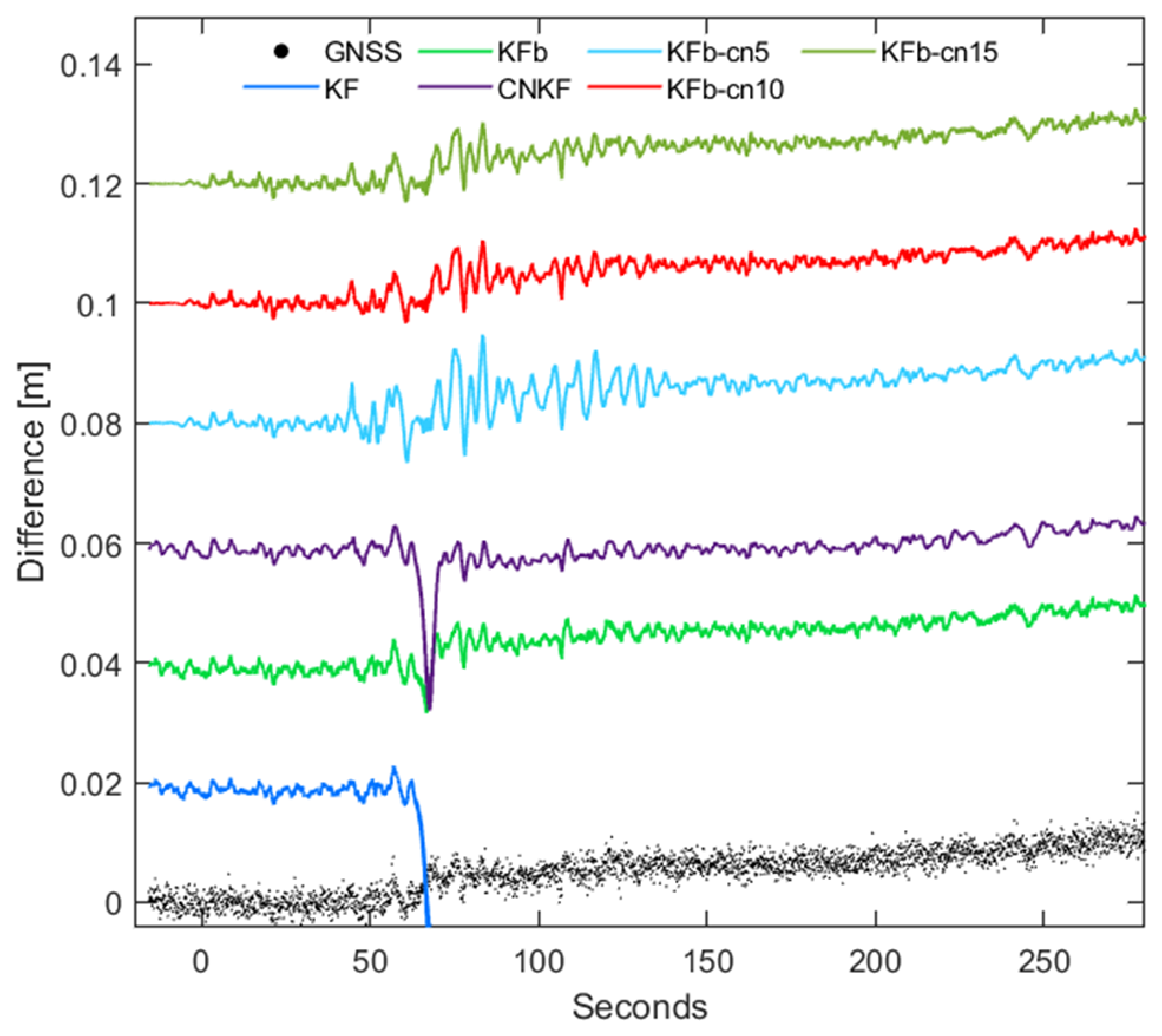
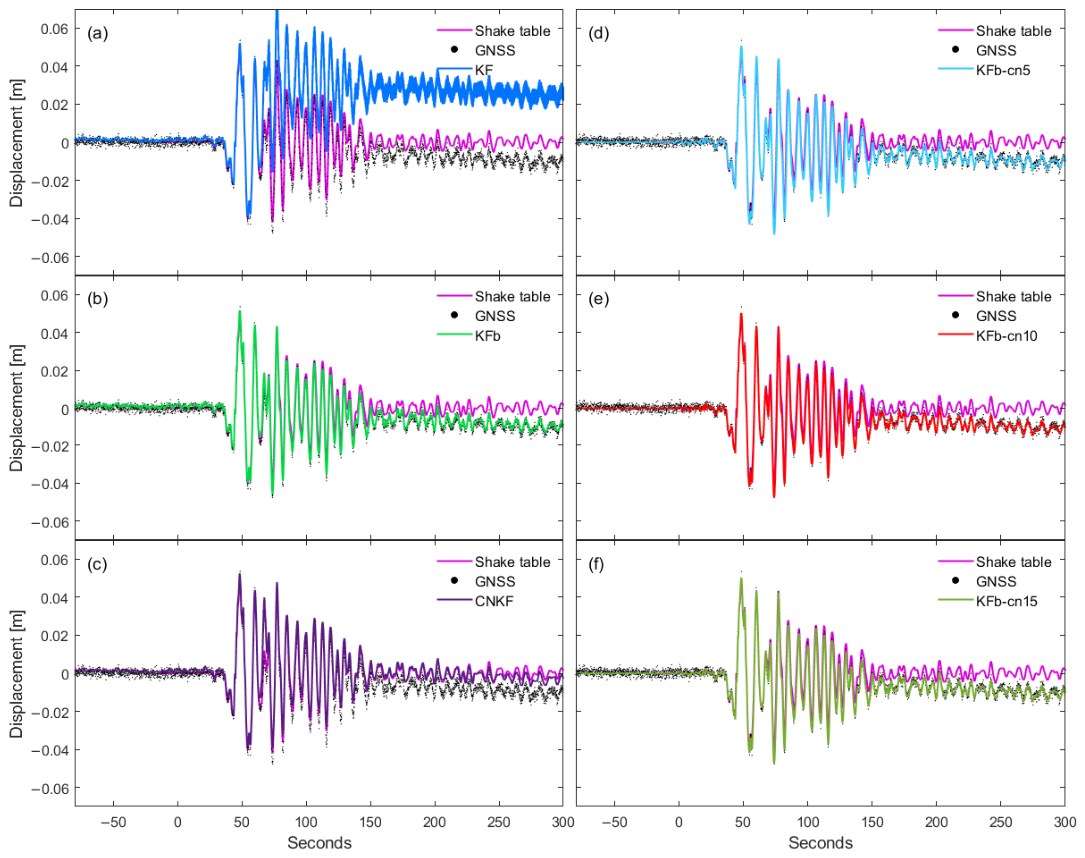
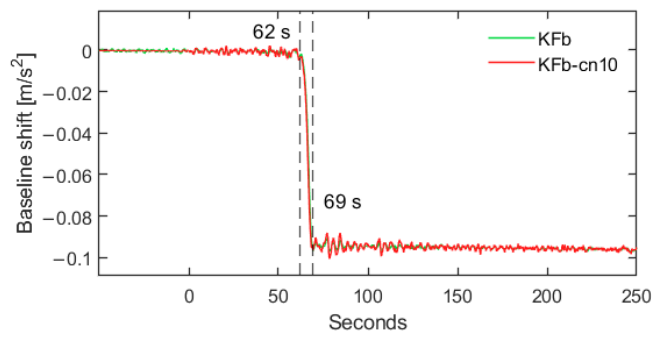
Figure 1 shows the displacements derived from different solutions, while the corresponding displacement differences between the shake table recordings and other solutions are shown in Figure 2. It is observed that, although GNSS captures the permanent offset of the shake table caused by the wedge, considerable background noise in the GNSS displacement results in a relatively large RMSE of 16.1 mm. By integrating SM, the RMSE of KF decreases to 1.5 mm. However, the traditional KF solution does not capture the permanent offset caused by the wedge, and displacements derived from the KF solution diverge from GNSS displacements after approximately 62 s due to the unmodeled SM baseline shift (Figure 1a). For the CNKF solution, following Ref. [34], the process noise was inflated by a factor of 100 to absorb baseline shift errors in the strong-motion records. However, the CNKF fails to capture the permanent displacement caused by station tilting, and a residual offset appears after approximately 62 s (Figure 1c). Although the KFb solution shows a similar RMSE with CNKF before 62 s, it successfully captures the permanent displacements (Figure 1b) and estimates the baseline shift well (Figure 3). For the KFb-cn15 solution, it shows the best agreement with the shake table recordings with an RMSE of 1.1 mm, which improves by 21% compared with the KFb solution. When comparing different KFb-cn solutions, it can be found that the KFb-cn5 solution exhibits greater fluctuations in the displacement differences, and there is no notable difference between the KFb-cn10 solution and the KFb-cn15 solution. The RMSEs for the KFb-cn10 and KFb-cn15 solutions are 1.2 mm and 1.1 mm, respectively, which are superior to the 1.6 mm of KFb-cn5 solution. This relatively larger RMSE value for the KFb-cn5 solution might be related to the inaccurate estimation of σ w 2 and σ Δ 2 . As nearly similar performances of the KFb-cn15 solution and the KFb-cn10 solution were obtained, for the following earthquake case studies, we used a 10 min pre-earthquake window to estimate σ w 2 and σ Δ 2 , and the resulting displacement is denoted as KFb-cn.
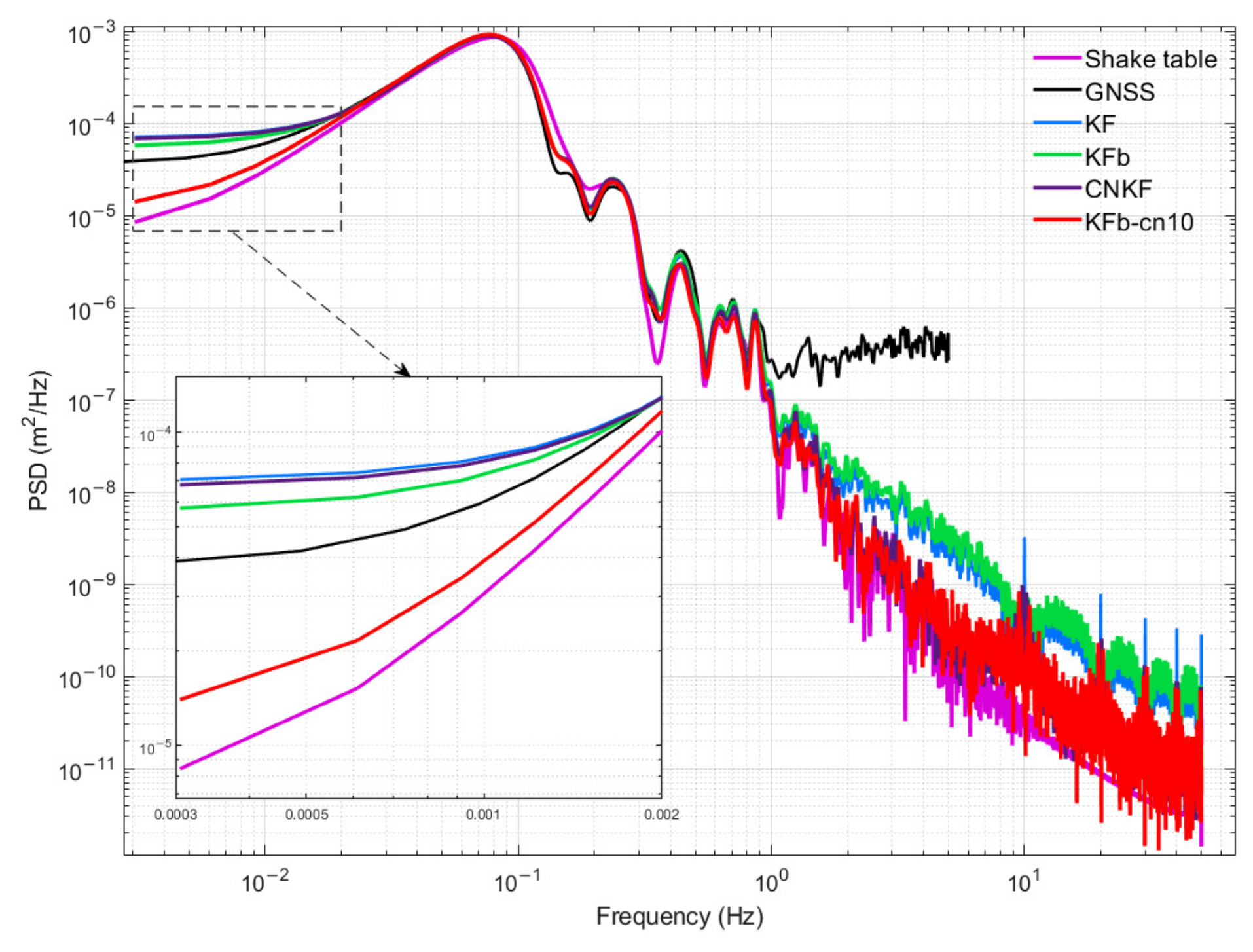
Figure 4 compares the power spectral density (PSD) for shake table recordings, GNSS, KF, KFb, CNKF, and KFb-cn10 displacements, prior to 62 s. It is evident that all integrated solutions capture richer spectral content than the single GNSS solution. For KF and KFb solutions, no significant difference is observed at high frequencies. But for frequencies below approximately 0.01 Hz, the PSD of KFb is slightly lower than that of KF. For the CNKF solution, it shows relatively smaller PSD at frequencies exceeding about 1 Hz when compared with the KF and KFb solutions. Overall, the KFb-cn10 solution presents the best agreement with the shake table solution, particularly in frequency bands above approximately 1 Hz and below about 0.01 Hz. These results demonstrate that the proposed method reduces the combined displacement noise effectively across a broad frequency range, from below 0.01 Hz to above 1 Hz. Notably, all integrated solutions exhibit spurious spectral peaks above 1 Hz, which can be attributed to the discrepancy in sampling rates between GNSS and SM observations.

3.2. Earthquake Validation

To further evaluate the performance of the proposed method under real-world seismic conditions, co-located high-rate GNSS and SM data collected during the 2010 Mw 7.2 El Mayor-Cucapah earthquake, the 2016 Mw 7.8 Kaikōura earthquake, and the 2019 Mw 7.1 Ridgecrest earthquake were used. The high-rate GNSS displacements were retrieved by solving original GNSS phase and code observations with the Precise Point Positioning (PPP) model, in which the final orbit and clock products provided by CODE were used. Other PPP-related processing strategies are presented in detail in [23,43].

3.2.1. The 2010 Mw 7.2 El Mayor-Cucapah Earthquake

The Mw 7.2 El Mayor-Cucapah earthquake occurred at 22:40:41 UTC on 4 April 2010. Ground motion resulting from this event was recorded by both the Southern California GNSS and SM networks. In this study, high-rate GNSS displacements and SM accelerations from five co-located stations were processed (Table S1).
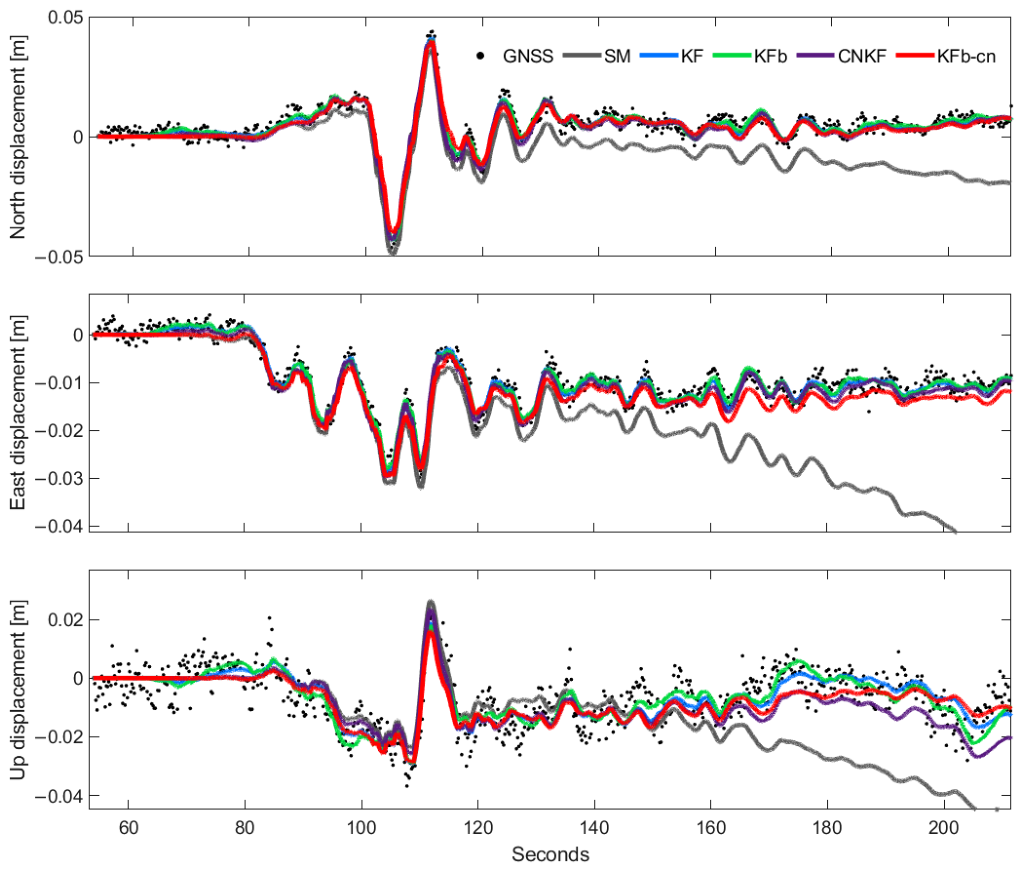
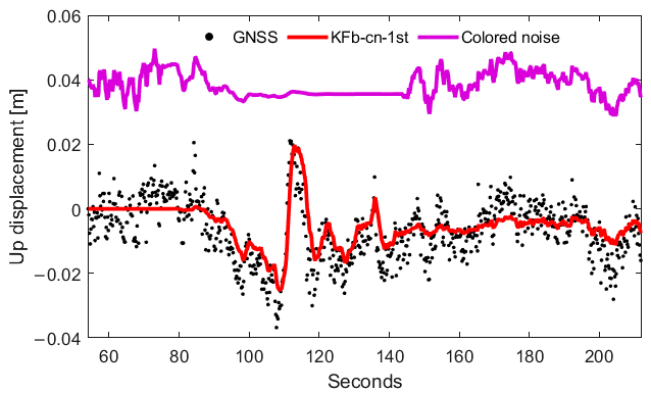
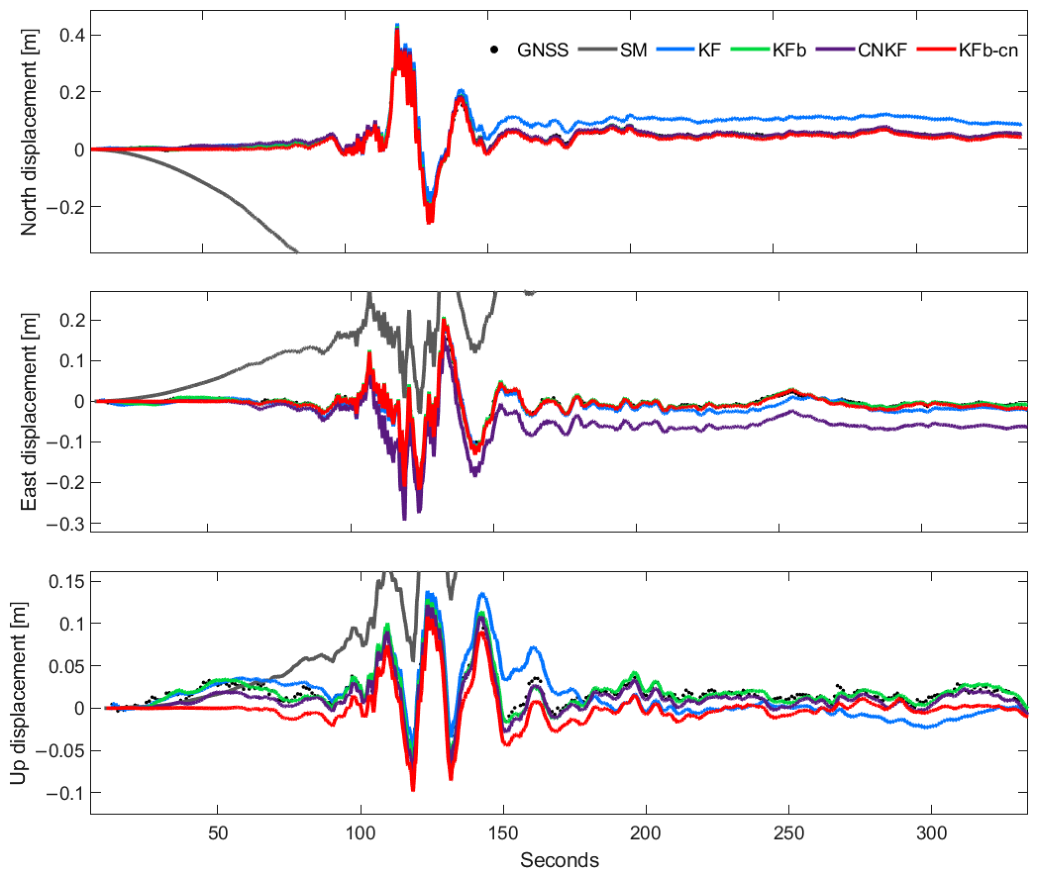
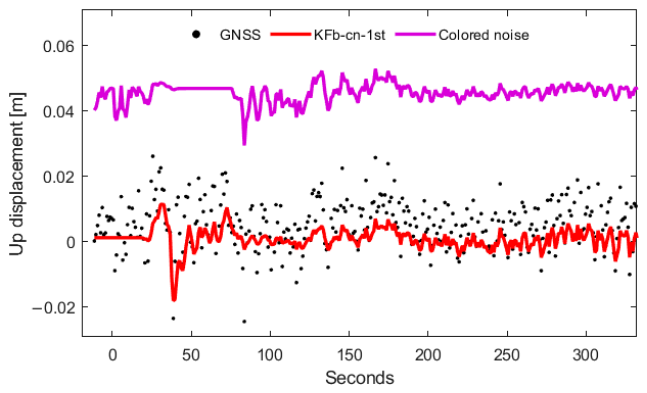
Figure 5 shows the coseismic displacements derived from different solutions at the co-located station P473/SDR, and the corresponding velocities are presented in Figure S1. For the GNSS solution, the derived displacements suffer from serious noise, especially in the up component. For the SM solution, the integrated displacements agree well with GNSS displacements before approximately 90 s, but show clear deviations after about 120 s. When comparing KF displacements with KFb displacements, no significant difference is observed. This is because the baseline shift of SDR is minor, and an empirical process noise is sufficient to absorb this error. For the CNKF solution, it shows similar performance with KF and KFb solutions in the north and east components, but is slightly superior to these two solutions before approximately 90 s in the up component when compared with integrated SM displacements. Overall, the KFb-cn displacements show the best agreement with the integrated SM displacements before approximately 90 s for all three components, and are more stable than other solutions after approximately 130 s, especially in the up component. The superior performance of the KFb-cn solution can be attributed to its effective modeling of high-rate GNSS colored noise. Figure 6 presents the up displacements derived from the first-step KF of the KFb-cn (KFb-cn-1st) solution, together with the estimated colored noise. It can be observed that the displacements from KFb-cn-1st are more stable than the GNSS displacements approximately before 90 s and after 130 s, with the colored noise during these periods being well estimated. Between approximately 90 s and 130 s, no significant variation is observed in the estimated colored noise, as the process noise is adaptively increased to better capture the ground motion.
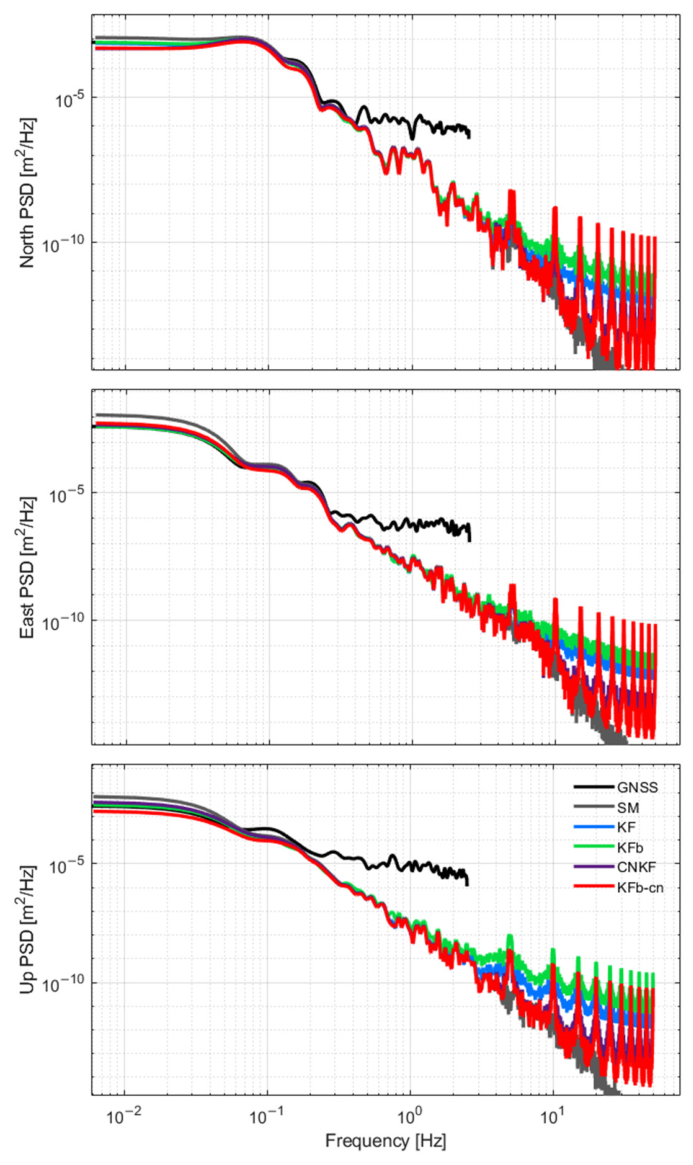
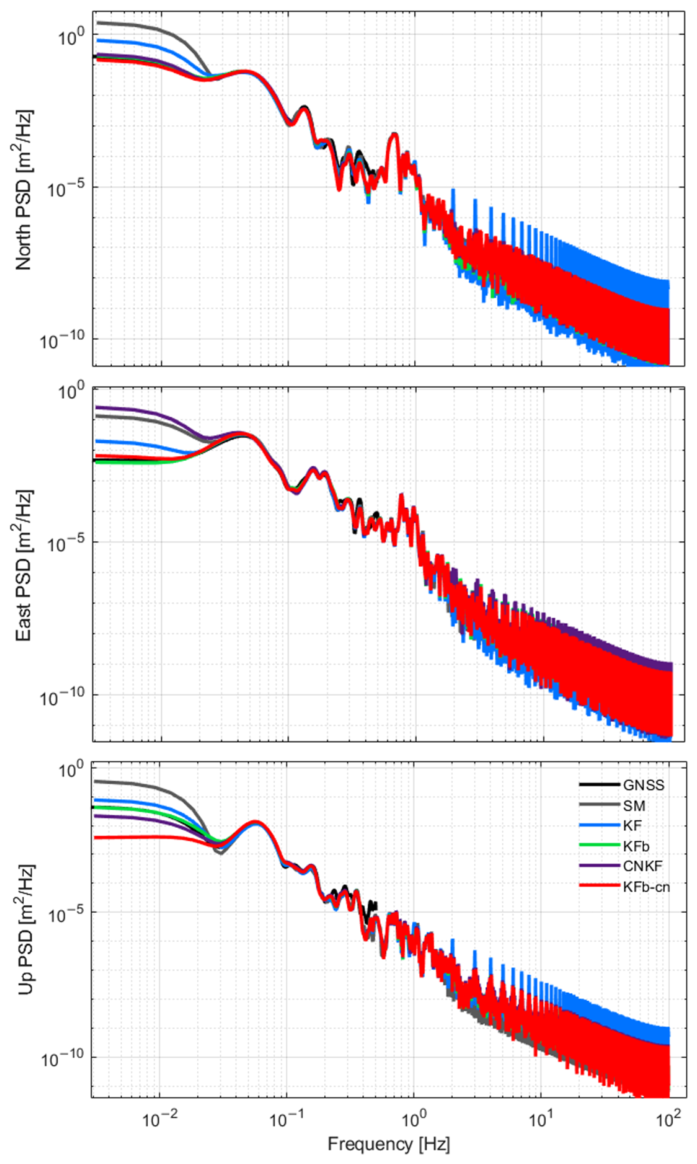
Figure 7 presents the PSDs of different displacements. It can be observed that the GNSS solution captures signals below 2 Hz and exhibits higher spectral power in the up component, particularly at frequencies above approximately 0.1 Hz. By contrast, the SM and all integration solutions record signals over a broader frequency band. When comparing KFb-cn with KF, KFb, and CNKF, both KFb-cn and CNKF show better agreement with SM in the high-frequency range across all three components. However, in the low-frequency range below approximately 0.05 Hz, KFb-cn exhibits the lowest spectral power among all three components. These results indicate that the proposed method not only integrates the advantages of high-rate GNSS and SM but also effectively suppresses low-frequency noise.
For the other co-located stations, the results also demonstrate the superior performance of KFb-cn in mitigating baseline shift and reducing displacement noise (Figure S2). It is evident that the integrated SM displacements exhibit significant drifts following the ground motion across all stations. This drift is also reflected in the CNKF solution at station GMPK/GLA, where severe drift appears in the up component nearly simultaneously with that in the SM solution. In contrast, KFb-cn is not affected by the SM baseline shift. Furthermore, it yields more stable displacements, especially before and after the strong shaking and in the up component. For instance, the KFb-cn displacements at station THMG/THM show good agreement with integrated SM displacements in all three components before approximately 100 s. This good performance highlights the potential of the KFb-cn method for accurate identification of seismic wave arrivals from the integrated displacements. However, it should be noted that the KFb-cn displacements still exhibit noticeable drift when the GNSS displacements experience severe drift, as observed in the up component at station P494/WES after approximately 150 s. This pronounced drift may be associated with severe multipath effects or poor satellite geometry. Nevertheless, compared with the KF, KFb, and CNKF solutions, KFb-cn still demonstrates an improvement in mitigating this pronounced drift.

3.2.2. The 2016 Mw 7.8 Kaikōura Earthquake

The 2016 Mw 7.8 Kaikōura earthquake in New Zealand occurred at 22:02:56 UTC on 13 November 2016. To validate the performance of the proposed method, high-rate GNSS displacements, and SM accelerations from six co-located stations were processed (Table S2).
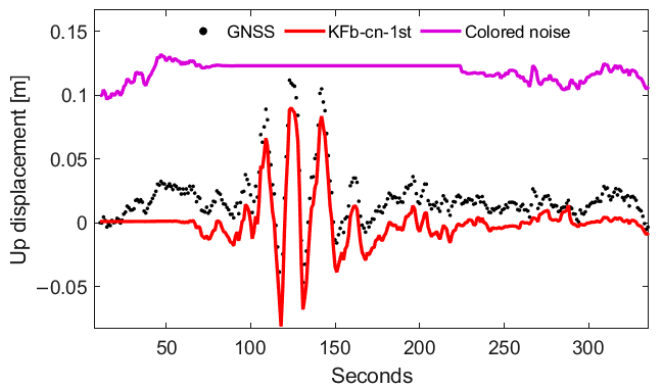
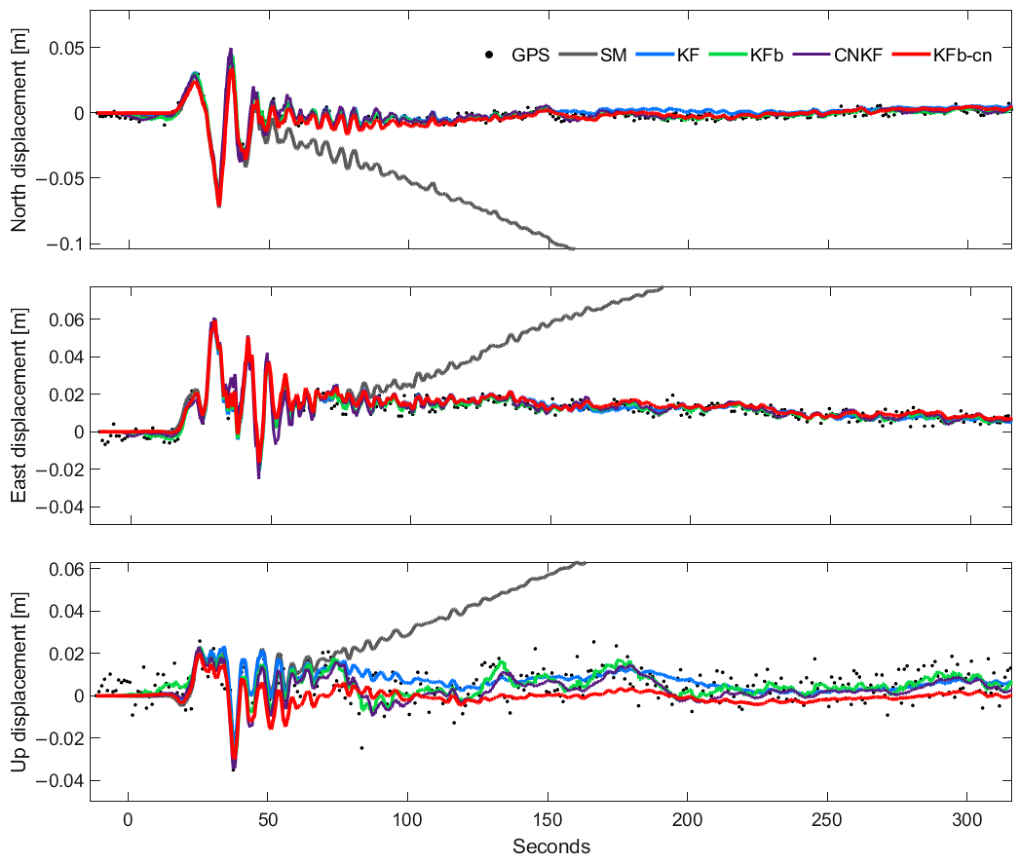
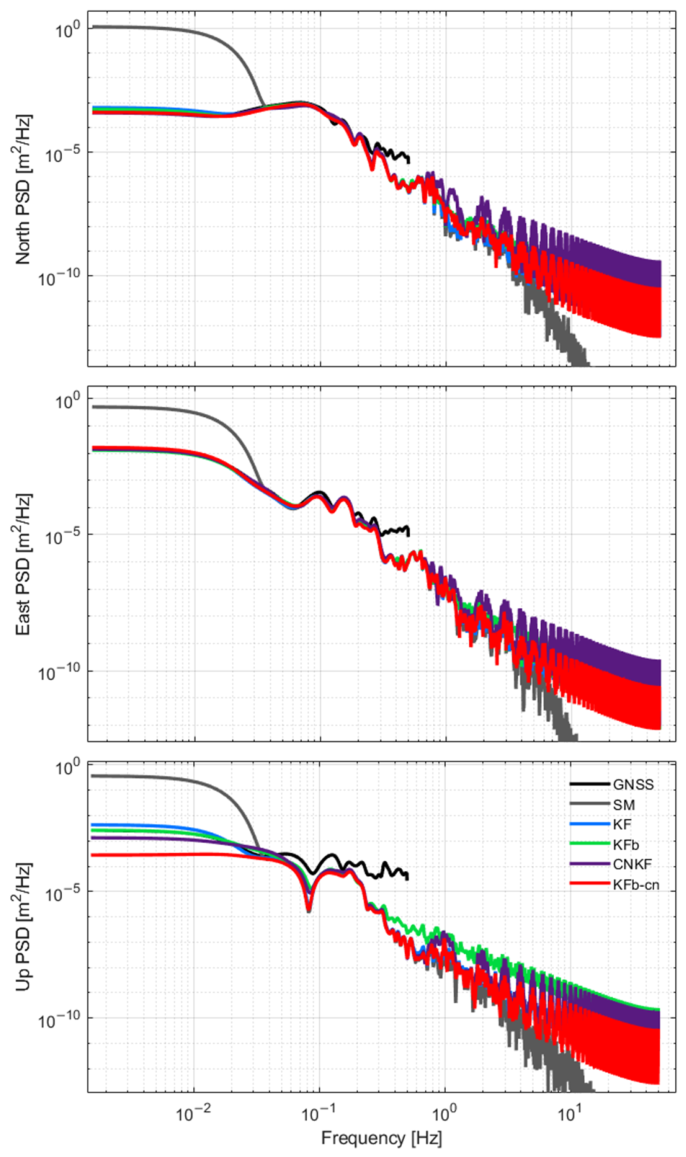
Figure 8 shows the coseismic displacements derived from different solutions at co-located station AVLN/NBSS; the corresponding displacement PSDs for different solutions are presented in Figure 9; and the coseismic velocities are shown in Figure S3. It can be observed that the integrated SM displacements exhibit pronounced drift in all three components, resulting in higher PSD values below 0.02 Hz compared with the other solutions. Although the KF solution reduces the influence of baseline shift, the north component still exhibits a permanent offset after approximately 150 s. In contrast, the KFb solution effectively corrects the baseline shift, and the PSD of the derived coseismic displacements is lower than that of the KF solution at low-frequency range. The CNKF solution is generally comparable to KFb in the north and up components, but exhibits an offset in the east component due to the influence of baseline shift, resulting in a higher PSD than the other integration solutions in this component. However, CNKF still shows some ability to suppress low-frequency noise in the up component, as its PSD below approximately 0.02 Hz is clearly lower than those of GNSS and KFb. Compared with other solutions, KFb-cn displacements are more stable before about 75 s and after 200 s, particularly in the up component. This advantage is also evident in the frequency domain, where KFb-cn exhibits the lowest PSD in the low-frequency band below 0.02 Hz. The up displacements derived from the first-step KF of the KFb-cn solution and the estimated colored noise are presented in Figure 10. It can be observed that the colored noise is well determined before and after the ground motion, and the displacements estimated with the KFb-cn-1st are more stable than the GNSS displacements before approximately 75 s.
The coseismic displacements derived from different solutions for other co-located stations are presented in Figure S4. It can be observed that the SM-derived displacements exhibit significant drifts across all stations, and the KF solutions also suffer from baseline shift at some stations, such as the north and east components at WGTN/MISS. In addition, the CNKF solution at WGTN/MISS is also affected by baseline shift. In contrast, the KFb-cn and KFb solutions are free from baseline shift. Further comparison between these two solutions shows that KFb-cn can better reduce low-frequency noise. This can be demonstrated at station AVLN/BMTS, where the up displacements from KFb-cn show the best agreement with the SM displacements before approximately 75 s, when the SM displacements in the up component are still not significantly contaminated by the baseline shift.

3.2.3. The 2019 Mw 7.1 Ridgecrest Earthquake

The Ridgecrest earthquake sequence occurred on 4 July 2019, beginning with an Mw 6.4 event at 07:33 UTC, followed by an Mw 7.1 earthquake at 03:19:53 UTC on 6 July. For the Mw 7.1 event, high-rate GNSS displacements and SM accelerations from five co-located stations were processed (Table S3).
Figure 11 shows the coseismic displacements derived from different solutions at the co-located station P811/CCA, with the corresponding displacement PSDs shown in Figure 12, and the coseismic velocities displayed in Figure S5. The SM-derived displacements exhibit pronounced drifts across all three components, with the highest PSDs observed at frequencies below approximately 0.02 Hz. For the KF and KFb solutions, displacements in the three components follow the GNSS trend and are not affected by baseline shifts. The KF, KFb, and CNKF solutions are generally comparable across all three components, aligning with the GNSS trend and showing no obvious baseline shift effects. For KFb-cn, no significant differences are observed in the north and east displacements compared with the corresponding displacements of other solutions. However, in the up component, the KFb-cn displacements are more stable before and after the strong motion, with the corresponding PSD being the lowest among all solutions at frequencies below about 0.02 Hz. This improvement can be attributed to the effective modeling of colored noise in the first-step KF of KFb-cn. As illustrated in Figure 13, the KFb-cn-1st displacements are more stable before and after the earthquake compared with the GNSS displacements. For the other co-located stations, KFb-cn also exhibits the best performance among all solutions. However, noticeable fluctuations remain when GNSS displacements display severe noise, such as in the up component at station P466/CGO (Figure S6).

4. Discussion

In the integration of high-rate GNSS and SM, the accuracy of the resulting displacements is simultaneously affected by GNSS colored noise and SM baseline shift. The traditional loose integration method, represented by the KF solution, fails to capture permanent coseismic offsets at stations with severe baseline shift, as demonstrated in shake table experiments. Although the KFb solution corrects the baseline shift, the derived integrated displacements remain significantly influenced by GNSS colored noise, as evidenced by the up-component displacements at stations P473/SDR (Figure 5) and P811/CCA (Figure 11). The CNKF solution mitigates low-frequency noise by parameterizing colored noise. However, the integrated displacements are still affected by baseline shift, such as in the east component displacement at station AVLN/NBSS. In contrast, the method presented in this study accounts for both GNSS colored noise and SM baseline shift, yielding more accurate integrated displacements.
In addition to GNSS colored noise and SM baseline shift, the accuracy of integrated displacements is also affected by the GNSS sampling rate. For the integration using 1 Hz GNSS and 100 Hz SM in the shake table experiment (Figure S7), the KFb-cn solution exhibits noticeable fluctuations between 50 s and 75 s, which are not observed in the KFb-cn15 solution (Figure 1) during the same period. These fluctuations are primarily caused by the low GNSS sampling rate and severe baseline shift. For 10 Hz GNSS, although SM suffers from substantial baseline shift, the high-rate GNSS can correct them timely with 0.1 s intervals. In contrast, for 1 Hz GNSS, SM baseline shift may undergo significant variations over 1 s intervals, making them difficult to correct accurately. These results indicate that increasing the GNSS sampling rate can improve the accuracy and stability of integrated displacements. Using shake table recordings as a reference, the RMSEs for the KF, KFb, CNKF, and KFb-cn solutions are 2.4 mm, 2.1 mm, 2.1 mm, and 1.8 mm, respectively (Table S4), all larger than the RMSEs of the corresponding solutions in Table 1. Nevertheless, based on the PSDs, the KFb-cn solution still demonstrates the best overall performance (Figure S8).
Despite the good performance of the proposed method for addressing colored noise and baseline shift, the method still has limitations. When GNSS displacements contain severe long-period fluctuations, such as those observed in the up component at stations GMPK/GLA (Figure S2), ISLK/ISA, and P466/CGO (Figure S6), residual errors remain in the integrated displacements. The KFb-cn solution cannot fully suppress such long-period errors, which may be related to satellite orbit errors or multipath effects. Therefore, mitigating long-period errors in integrated displacements remains an important topic for future research.

5. Conclusions

To mitigate the effects of high-rate GNSS colored noise and SM baseline shift on GNSS/SM integration, this study proposes a novel loose integration method. In the first step, a Kalman filter accounting for colored noise is applied to reduce high-rate GNSS noise, with an adaptive strategy introduced to adjust the process noise during the coseismic period. In the second step, a loose integration model is employed in which the SM baseline shift is parameterized as a random walk process to integrate the denoised high-rate GNSS displacements with SM accelerations. The proposed method is validated using both a shake table experiment and three earthquake events. Results show that, in the shake table test, the method improves displacement accuracy by approximately 21% compared with the KFb solution, while effectively reducing background noise in high-rate GNSS displacements. In the earthquake case studies, the method effectively suppresses low-frequency noise and baseline shift effects while preserving seismic signals. Consequently, the integrated displacements are more stable before and after the earthquakes, facilitating more reliable coseismic displacement recovery.

Supplementary Materials

The following supporting information can be downloaded at: https://www.mdpi.com/article/10.3390/rs18121932/s1, Figure S1: Velocities derived from different solutions for co-located station P473/SDR. For clarity, the curves of KF, KFb, CNKF, KFb-cn, and SM are vertically shifted. The minimum and maximum accelerations of the SM record are −0.3216 and 0.3242 m/s2, respectively. The resultant velocity magnitudes are 0.0345 m/s (KF), 0.0342 m/s (KFb), 0.0343 m/s (CNKF), and 0.0344 m/s (KFb-cn); Figure S2: Displacements from different solutions at the co-located stations P494/WES, GMPK/GLA, BOMG/BOM and THMG/THM; Figure S3: Velocities derived from different solutions for co-located station AVLN/NBSS. For clarity, the curves of KF, CNKF, KFb, KFb-cn, and SM are vertically shifted. The minimum and maximum accelerations of the SM record are −1.9238 and 1.8839 m/s2, respectively. The resultant velocity magnitudes are 0.4233 m/s (KF), 0.4318 m/s (KFb), 0.4362 m/s (CNKF), and 0.4348 m/s (KFb-cn); Figure S4: Displacements derived from different solutions at co-located stations LTKA/LTZ, GLDB/QRZ, WGTN/MISS, WGTN/WANS and AVLN/BMTS; Figure S5: Velocities derived from different solutions for co-located station P811/CCA. For clarity, the curves of KF, KFb, CNKF, KFb-cn, and SM are vertically shifted. The minimum and maximum accelerations of the SM record are −0.4252 and 0.3431 m/s2, respectively. The resultant velocity magnitudes are 0.0534 m/s (KF), 0.0538 m/s (KFb), 0.0548 m/s (CNKF), and 0.0535 m/s (KFb-cn); Figure S6: Coseismic displacements derived from different solutions at co-located stations P591/CCA, P812/CCA, ISLK/ISA and P466/CGO; Figure S7: Displacements derived from GNSS and different integration solutions (KF, KFb, CNKF, and KFb-cn), together with the corresponding displacement differences with respect to the shake table recordings. The displacement differences are vertically shifted by −0.06 m for clarity. In panel (a), the KF waveform after 69 s is omitted due to severe baseline drift for better visualization. All integration solutions are obtained by combining 1 Hz GNSS displacements and SM accelerations, where the GNSS displacements are downsampled from the original 10 Hz data; Figure S8: PSDs of the shake table, GNSS, and integrated displacements (KF, KFb, CNKF, and KFb-cn) prior to 62 s, for integrations using 1 Hz GNSS data; Table S1: Co-located station information for the 2010 Mw 7.2 El Mayor-Cucapah earthquake; Table S2: Co-located station information for the 2016 Mw 7.8 Kaikōura earthquake; Table S3: Co-located station information for the 2019 Mw 7.1 Ridgecrest earthquake; Table S4: RMSEs of different displacement solutions relative to the shake table recordings within the first 62 s, for integrations using 1 Hz GNSS data.

Author Contributions

Conceptualization, S.F., C.W., J.Z. and C.X.; methodology, S.F., C.W. and J.Z.; software, S.F., C.W., J.Z. and G.C.; validation, S.F., C.W., J.Z. and C.M.; formal analysis, S.F. and J.Z.; investigation, S.F., C.W. and J.Z.; resources, S.F., C.W. and J.Z.; data curation, C.W., C.M., Z.Y. and G.C.; writing—original draft preparation, S.F. and C.W.; writing—review and editing, S.F., C.W., J.Z. and C.M.; visualization, C.W. and Z.Y.; supervision, C.X.; funding acquisition, J.Z. and G.C. All authors have read and agreed to the published version of the manuscript.

Funding

This work is supported by the National Natural Science Foundation of China (42304024), the Shandong Provincial Natural Science Foundation (ZR2023QD135), the State Key Laboratory of Spatial Datum (SKLSD2025-KF-12), and the Shandong Provincial Natural Science Foundation (ZR2023QD179).

Data Availability Statement

The datasets we analyzed can be obtained with permission from the corresponding author.

Conflicts of Interest

Author Chunlin Mu is employed by the China Railway Design Corporation. The remaining authors declare that the research was conducted in the absence of any commercial or financial relationships that could be construed as a potential conflict of interest.

References

  1. Allen, R.M.; Ziv, A. Application of Real-Time GPS to Earthquake Early Warning. Geophys. Res. Lett. 2011, 38, L16310. [Google Scholar] [CrossRef]
  2. Minson, S.E.; Murray, J.R.; Langbein, J.O.; Gomberg, J.S. Real-time Inversions for Finite Fault Slip Models and Rupture Ge-ometry Based on High-rate GPS Data. J. Geophys. Res. Solid Earth 2014, 119, 3201–3231. [Google Scholar] [CrossRef]
  3. Psimoulis, P.A.; Houlié, N.; Behr, Y. Real-Time Magnitude Characterization of Large Earthquakes Using the Predominant Period Derived from 1 Hz GPS Data. Geophys. Res. Lett. 2018, 45, 517–526. [Google Scholar] [CrossRef]
  4. Shu, Y.; Fang, R.; Li, M.; Shi, C.; Li, M.; Liu, J. Very High-Rate GPS for Measuring Dynamic Seismic Displacements without Aliasing: Performance Evaluation of the Variometric Approach. GPS Solut. 2018, 22, 121. [Google Scholar] [CrossRef]
  5. Zang, J.; Fan, S.; Xu, C.; Li, Z.; Fang, R.; Lou, Y. Performance Assessment of the BDS-3 PPP-B2b Service for Real-Time Earth-quake Source Description: A Case Study for the 2021 Mw 7.4 Maduo Earthquake. GPS Solut. 2023, 28, 26. [Google Scholar] [CrossRef]
  6. Zheng, J.; Fang, R.; Li, M.; Luo, X.; Zhao, Q.; Li, Z.; Chen, X.; Liu, J. Improved Capture of Ultra-High-Rate GNSS Co-Seismic Displacement Waveforms with Dynamic Stress Error Correction for General Geodetic GNSS Receivers. J. Geod. 2025, 99, 83. [Google Scholar] [CrossRef]
  7. Li, Z.; Zang, J.; Fan, S.; Wen, Y.; Xu, C.; Yang, F.; Peng, X.; Zhao, L.; Zhou, X. Real-Time Source Modeling of the 2022 Mw 6.6 Menyuan, China Earthquake with High-Rate GNSS Observations. Remote Sens. 2022, 14, 5378. [Google Scholar] [CrossRef]
  8. Graizer, V. Tilts in Strong Ground Motion. Bull. Seismol. Soc. Am. 2006, 96, 2090–2102. [Google Scholar] [CrossRef]
  9. Pillet, R.; Virieux, J. The Effects of Seismic Rotations on Inertial Sensors. Geophys. J. Int. 2007, 171, 1314–1323. [Google Scholar] [CrossRef][Green Version]
  10. Akkar, S.; Boore, D.M. On Baseline Corrections and Uncertainty in Response Spectrafor Baseline Variations Commonly Encounteredin Digital Accelerograph Records. Bull. Seismol. Soc. Am. 2009, 99, 1671–1690. [Google Scholar] [CrossRef]
  11. Boore, D.M. Effect of Baseline Corrections on Displacements and Response Spectra for Several Recordings of the 1999 Chi-Chi, Taiwan, Earthquake. Bull. Seismol. Soc. Am. 2001, 91, 1199–1211. [Google Scholar] [CrossRef]
  12. Wang, R.; Schurr, B.; Milkereit, C.; Shao, Z.; Jin, M. An Improved Automatic Scheme for Empirical Baseline Correction of Digital Strong-Motion Records. Bull. Seismol. Soc. Am. 2011, 101, 2029–2044. [Google Scholar] [CrossRef]
  13. Wang, G.-Q.; Zhou, X.-Y. Baseline Correction of Near Fault Ground Motion Recordings of the 1999 Chi-Chi, Taiwan Earthquake. Seismol. Geol. 2004, 26, 1–14. [Google Scholar]
  14. Chen, Z.; Fu, J.; Peng, Y.; Chen, T.; Zhang, L.; Yuan, C. Baseline Correction of Acceleration Data Based on a Hybrid EMD–DNN Method. Sensors 2021, 21, 6283. [Google Scholar] [CrossRef]
  15. Chen, X.; Wang, D. Baseline Correction of Near-Fault Ground Motion Records Based on the Hilbert Spectral Analysis. Soil Dyn. Earthq. Eng. 2022, 154, 107162. [Google Scholar] [CrossRef]
  16. Smyth, A.; Wu, M. Multi-Rate Kalman Filtering for the Data Fusion of Displacement and Acceleration Response Measurements in Dynamic System Monitoring. Mech. Syst. Signal Process. 2007, 21, 706–723. [Google Scholar] [CrossRef]
  17. Bock, Y.; Melgar, D.; Crowell, B.W. Real-Time Strong-Motion Broadband Displacements from Collocated GPS and Accelerometers. Bull. Seismol. Soc. Am. 2011, 101, 2904–2925. [Google Scholar] [CrossRef]
  18. Shu, Y.; Fang, R.; Geng, J.; Zhao, Q.; Liu, J. Broadband Velocities and Displacements From Integrated GPS and Accelerometer Data for High-Rate Seismogeodesy. Geophys. Res. Lett. 2018, 45, 8939–8948. [Google Scholar] [CrossRef]
  19. Geng, J.; Bock, Y.; Melgar, D.; Crowell, B.W.; Haase, J.S. A New Seismogeodetic Approach Applied to GPS and Accelerometer Observations of the 2012 Brawley Seismic Swarm: Implications for Earthquake Early Warning. Geochem. Geophys. Geosyst. 2013, 14, 2124–2142. [Google Scholar] [CrossRef]
  20. Li, X.; Ge, M.; Zhang, Y.; Wang, R.; Guo, B.; Klotz, J.; Wickert, J.; Schuh, H. High-Rate Coseismic Displacements from Tightly Integrated Processing of Raw GPS and Accelerometer Data. Geophys. J. Int. 2013, 195, 612–624. [Google Scholar] [CrossRef]
  21. Niu, J.; Xu, C. Real-Time Assessment of the Broadband Coseismic Deformation of the 2011 Tohoku-Oki Earthquake Using an Adaptive Kalman Filter. Seismol. Res. Lett. 2014, 85, 836–843. [Google Scholar] [CrossRef]
  22. Tu, R.; Chen, K. Tightly Integrated Processing of High-Rate GPS and Accelerometer Observations by Real-Time Estimation of Transient Baseline Shifts. J. Navig. 2014, 67, 869–880. [Google Scholar] [CrossRef][Green Version]
  23. Zang, J.; Xu, C.; Chen, G.; Wen, Q.; Fan, S. Real-Time Coseismic Deformations from Adaptively Tight Integration of High-Rate GNSS and Strong Motion Records. Geophys. J. Int. 2019, 219, 1757–1772. [Google Scholar] [CrossRef]
  24. Zhang, Y.; Nie, Z.; Wang, Z.; Zhang, G.; Shan, X. Integration of High-Rate GNSS and Strong Motion Record Based on Sage–Husa Kalman Filter with Adaptive Estimation of Strong Motion Acceleration Noise Uncertainty. Remote Sens. 2024, 16, 2000. [Google Scholar] [CrossRef]
  25. Qu, X.; Ding, X.; Xu, Y.-L.; Yu, W. Real-Time Outlier Detection in Integrated GNSS and Accelerometer Structural Health Monitoring Systems Based on a Robust Multi-Rate Kalman Filter. J. Geod. 2023, 97, 38. [Google Scholar] [CrossRef]
  26. Qu, X.; Ding, X.; Xu, Y.-L.; Yu, W. Correction of Misalignment Errors in the Integrated GNSS and Accelerometer System for Structural Displacement Monitoring. Struct. Control Health Monit. 2023, 2023, 4919151. [Google Scholar] [CrossRef]
  27. Yang, A.; Wang, P.; Yang, H. Bridge Dynamic Displacement Monitoring Using Adaptive Data Fusion of GNSS and Accelerometer Measurements. IEEE Sens. J. 2021, 21, 24359–24370. [Google Scholar] [CrossRef]
  28. Jing, C.; Huang, G.; Li, X.; Zhang, Q.; Yang, H.; Zhang, K.; Liu, G. GNSS/Accelerometer Integrated Deformation Monitoring Algorithm Based on Sensors Adaptive Noise Modeling. Measurement 2023, 218, 113179. [Google Scholar] [CrossRef]
  29. Jing, C.; Bertolesi, E.; Huang, G.; Li, X.; Zhang, Q.; Zhai, W.; Liu, G.; Li, H. Predicting Accelerometer Baseline Correction and Nondivergent Deformation Velocity Based on Convolutional Neural Network (CNN) During GNSS Downgrade. IEEE Sens. J. 2025, 25, 11982–11994. [Google Scholar] [CrossRef]
  30. Moschas, F.; Stiros, S. Noise Characteristics of Short-Duration, High Frequency GPS-Records. Measurement 2013, 46, 1488–1506. [Google Scholar] [CrossRef]
  31. Genrich, J.F.; Bock, Y. Instantaneous Geodetic Positioning with 10–50 Hz GPS Measurements: Noise Characteristics and Implications for Monitoring Networks. J. Geophys. Res. Solid Earth 2006, 111, B03403. [Google Scholar] [CrossRef]
  32. Elósegui, P.; Davis, J.L.; Oberlander, D.; Baena, R.; Ekström, G. Accuracy of High-Rate GPS for Seismology. Geophys. Res. Lett. 2006, 33, L11308. [Google Scholar] [CrossRef]
  33. Melgar, D.; Crowell, B.W.; Melbourne, T.I.; Szeliga, W.; Santillan, M.; Scrivner, C. Noise Characteristics of Operational Real-Time High-Rate GNSS Positions in a Large Aperture Network. J. Geophys. Res. Solid Earth 2020, 125, e2019JB019197. [Google Scholar] [CrossRef]
  34. Song, C.; Xu, C. Loose Integration of High-Rate GPS and Strong Motion Data Considering Coloured Noise. Geophys. J. Int. 2018, 215, 1530–1539. [Google Scholar] [CrossRef]
  35. Gul, C.; Ocalan, T. A Two-Stage Kalman Filtering Approach Using GNSS and Smartphone Sensors for Seismogeodetic Applications. Adv. Space Res. 2023, 71, 3109–3121. [Google Scholar] [CrossRef]
  36. Chen, C.; Lin, X.; Li, W.; Cheng, L.; Wang, H.; Zhang, Q.; Wang, Z. Adaptive Coloured Noise Multirate Kalman Filter and Its Application in Coseismic Deformations. Geophys. J. Int. 2023, 234, 1236–1253. [Google Scholar] [CrossRef]
  37. Yang, Y.; Gao, W. An Optimal Adaptive Kalman Filter. J. Geod. 2006, 80, 177–183. [Google Scholar] [CrossRef]
  38. Tu, R.; Ge, M.; Wang, R.; Walter, T.R. A New Algorithm for Tight Integration of Real-Time GPS and Strong-Motion Records, Demonstrated on Simulated, Experimental, and Real Seismic Data. J. Seismol. 2014, 18, 151–161. [Google Scholar] [CrossRef]
  39. Tu, R.; Zhang, Q.; Wang, L.; Liu, Z.; Huang, G. An Improved Method for Tight Integration of GPS and Strong-Motion Records: Complementary Advantages. Adv. Space Res. 2015, 56, 2335–2344. [Google Scholar] [CrossRef]
  40. Williams, S.D.P. The Effect of Coloured Noise on the Uncertainties of Rates Estimated from Geodetic Time Series. J. Geod. 2003, 76, 483–494. [Google Scholar] [CrossRef]
  41. Granger, C.W.J.; Joyeux, R. An Introduction to Long-Memory Time Series Models and Fractional Differencing. J. Time Ser. Anal. 1980, 1, 15–29. [Google Scholar] [CrossRef]
  42. Geng, J.; Wen, Q.; Chen, Q.; Chang, H. Six-Degree-of-Freedom Broadband Seismogeodesy by Combining Collocated High-Rate GNSS, Accelerometers, and Gyroscopes. Geophys. Res. Lett. 2019, 46, 708–716. [Google Scholar] [CrossRef]
  43. Zang, J.; Xu, C.; Wen, Y.; Wang, X.; He, K. Rapid Earthquake Source Description Using Variometric-Derived GPS Displacements toward Application to the 2019 Mw 7.1 Ridgecrest Earthquake. Seismol. Res. Lett. 2021, 93, 56–67. [Google Scholar] [CrossRef]
Figure 1. Displacement comparisons between GNSS, shake table recordings, and other integration solutions: (a) KF; (b) KFb; (c) CNKF; (d) KFb-cn5; (e) KFb-cn10; (f) KFb-cn15.
Remotesensing 18 01932 g001
Figure 2. Displacement differences between the shake table recordings and the GNSS and other integration solutions (KF, KFb, CNKF, KFb-cn5, KFb-cn10, and KFb-cn15). For clarity, each solution is vertically shifted by 0.02 m.
Remotesensing 18 01932 g002
Figure 3. Estimated baseline shift from the KFb and KFb-cn10 solutions.
Remotesensing 18 01932 g003
Figure 4. PSDs of the shake table, GNSS, and different integrated displacements (KF, KFb, CNKF, and KFb-cn10) prior to 62 s.
Remotesensing 18 01932 g004
Figure 5. Coseismic displacements derived from the GNSS, SM, KF, KFb, CNKF, and KFb-cn solutions at the co-located station P473/SDR, where the SM displacements are obtained by double integration of the raw SM accelerations.
Remotesensing 18 01932 g005
Figure 6. Coseismic displacements derived from KFb-cn-1st and estimated colored noise in the up component at co-located station P473/SDR. For clarity, the colored noise is shifted with 0.04 m along the vertical axis.
Remotesensing 18 01932 g006
Figure 7. PSDs of displacements derived from the GNSS, SM, KF, KFb, CNKF, and KFb-cn solutions at the co-located station P473/SDR.
Remotesensing 18 01932 g007
Figure 8. Coseismic displacements derived from the GNSS, SM, KF, KFb, CNKF, and KFb-cn solutions at the co-located station AVLN/NBSS.
Remotesensing 18 01932 g008
Figure 9. PSDs of displacements derived from the GNSS, SM, KF, KFb, CNKF, and KFb-cn solutions at the co-located station AVLN/NBSS.
Remotesensing 18 01932 g009
Figure 10. Coseismic displacements derived from KFb-cn-1st and estimated colored noise in the up component at co-located station AVLN/NBSS. For clarity, the colored noise is shifted with 0.1 m along the vertical axis.
Remotesensing 18 01932 g010
Figure 11. Coseismic displacements derived from the GNSS, SM, KF, KFb, CNKF, and KFb-cn solutions at the co-located station P811/CCA.
Remotesensing 18 01932 g011
Figure 12. PSDs of displacements derived from the GNSS, SM, KF, KFb, CNKF, and KFb-cn solutions at the co-located station P811/CCA.
Remotesensing 18 01932 g012
Figure 13. Coseismic displacements derived from KFb-cn-1st and estimated colored noise in the up component at co-located station P811/CCA. For clarity, the colored noise is shifted with 0.04 m along the vertical axis.
Remotesensing 18 01932 g013
Table 1. RMSEs of the GNSS, KF, KFb, CNKF, and KFb-cn displacement solutions with respect to the shake table recordings prior to 62 s.
SolutionsRMSE (mm)
GNSS16.1
KF1.5
KFb1.4
CNKF1.4
KFb-cn51.6
KFb-cn101.2
KFb-cn151.1
Disclaimer/Publisher’s Note: The statements, opinions and data contained in all publications are solely those of the individual author(s) and contributor(s) and not of MDPI and/or the editor(s). MDPI and/or the editor(s) disclaim responsibility for any injury to people or property resulting from any ideas, methods, instructions or products referred to in the content.