1. Introduction
Contemporary agricultural production is transitioning from traditional modes to precision agriculture, a shift that drives agricultural modernization and supports rural revitalization [
1]. Precision agriculture utilizes modern information technologies to optimize agricultural production [
2]. Remote sensing technology, characterized by its high efficiency, low cost, and high precision, enables rapid acquisition of data on environmental conditions, crop growth status, and disease incidence [
3,
4,
5]. Consequently, it has become a pivotal tool for information acquisition in precision agriculture. Within this domain, the accurate and efficient retrieval of crop phenotypic information constitutes a central focus of current agricultural remote sensing research [
6].
Aboveground biomass (AGB) is a key indicator of crop growth and directly links to yield [
7]. Its accurate monitoring facilitates early prediction of yield changes, thereby informing policy decisions and market planning. Compared to traditional destructive sampling methods, remote sensing offers significant advantages by eliminating crop damage and reducing monitoring costs. Technologies for agricultural remote sensing-based phenotypic monitoring primarily include three categories: near-surface, unmanned aerial vehicle (UAV), and satellite remote sensing. In UAV-based monitoring, extensive studies have demonstrated that various data sources can be used for crop biomass monitoring. For example, Red-Green-Blue (RGB) images can extract structural parameters such as plant height and canopy coverage [
8], multispectral or hyperspectral images can calculate vegetation indices [
9,
10], and Light Detection and Ranging (LiDAR) can obtain Three-Dimensional (3D) point cloud data to accurately depict canopy structures [
11,
12]. Nowadays, UAV-scale biomass monitoring is no longer limited to single spectral analysis. It has entered a precise stage of multi-parameter [
13], multi-sensor fusion [
14], and model coupling. In terms of satellite monitoring, multiple studies have confirmed its effectiveness and value in estimating AGB of crops at a regional scale. For instance, Dong et al. successfully estimated the AGB of six major crops (e.g., soybean, wheat, corn) in Manitoba, Canada, by integrating Landsat 8 and Sentinel-2 data [
15]. Fang et al. significantly improved the AGB mapping accuracy for winter wheat and corn by incorporating red-edge band information from Sentinel-2 to refine the Carnegie-Ames-Stanford approach (CASA) model [
16]. Khan et al. effectively estimated the biomass of mint crops using Landsat 8 OLI data combined with an Artificial Neural Network [
17]. Although satellite remote sensing offers the advantages of broad coverage and periodic monitoring, its relatively coarse spatial resolution constrains estimation precision [
18]. In contrast, UAV remote sensing offers higher spatial resolution, yet it faces challenges such as short endurance and limited coverage per mission [
19,
20].
UAV–satellite integrated remote sensing technology can address the limitations that single data sources cannot overcome in the short term [
21]. This collaborative framework establishes a multi-tiered quantitative remote sensing system. It uses ground-based monitoring as the foundation, with space-based and airborne remote sensing as supplements and extensions. This system provides information support over wide-area spaces [
22]. It enables timely, full-domain, and accurate acquisition of crop phenotypic information, meeting the needs of precision agriculture information perception [
23,
24]. In recent years, research on this integration has been increasing. Researchers have tried to use multiple methods to integrate satellite data, UAV data, and traditional ground monitoring into technical systems. Current research on fusion methods for remote sensing data from different platforms is still in the exploratory stage. The fusion methods used in existing studies can be roughly divided into two categories. Some studies directly use remote sensing data from different platforms as input variables to build inversion models. For example, Jiang et al. [
25] calibrated satellite-based models for wheat growth and nitrogen status estimation at the county scale by upscaling UAV-derived growth variables and employing a random forest algorithm. Their approach, while effective, relied on data from specific growth stages (jointing and booting), and its applicability under more diverse agronomic conditions warrants further validation. Qi et al. [
26] studied the impact of integrating UAV and satellite remote sensing data on the estimation of comprehensive soil properties. These studies consistently demonstrate that data fusion can improve the accuracy of research results. While straightforward, this approach may not fully exploit the respective strengths of each data source to achieve precise inversions. The second category employs UAV-acquired data to enhance the spectral resolution or radiometric consistency of satellite imagery. Various algorithms have been proposed, such as the reflectance correction method used by Zhang et al. [
27], to fuse UAV and satellite spectral images for integrated chlorophyll content in winter wheat. Brook et al. [
28] applied a convolutional neural network to pan-sharpen satellite imagery using high-resolution UAV data, enabling detailed vineyard assessment.
A review of the current research landscape reveals that multi-source optical remote sensing fusion for crop growth inversion is indeed a growing focus. However, for large-area rice growth monitoring, single-platform remote sensing exhibits limitations. Satellite remote sensing is constrained by its low spatial and temporal resolution. UAV remote sensing suffers from limited coverage and high operational costs, making it difficult to support large-scale agricultural management decisions effectively. Therefore, exploring the synergistic observation and fusion mechanisms of satellite and UAV remote sensing provides a pathway for improving the efficiency and reducing the costs of agricultural decision-making at county-scale. Although preliminary studies on data fusion have been conducted, the methodologies require further development. For large-scale applications, it is necessary to explore more suitable inversion procedures. Additionally, in the construction of quantitative remote sensing inversion models, there is a need to further improve model accuracy and stability. Based on the issues identified above, this study aims to (1) develop a data fusion-based estimation model for rice AGB; (2) conduct county-scale inversion research on rice growth status; and (3) derive variable-rate fertilization decisions based on the growth status inversion results.
2. Materials and Methods
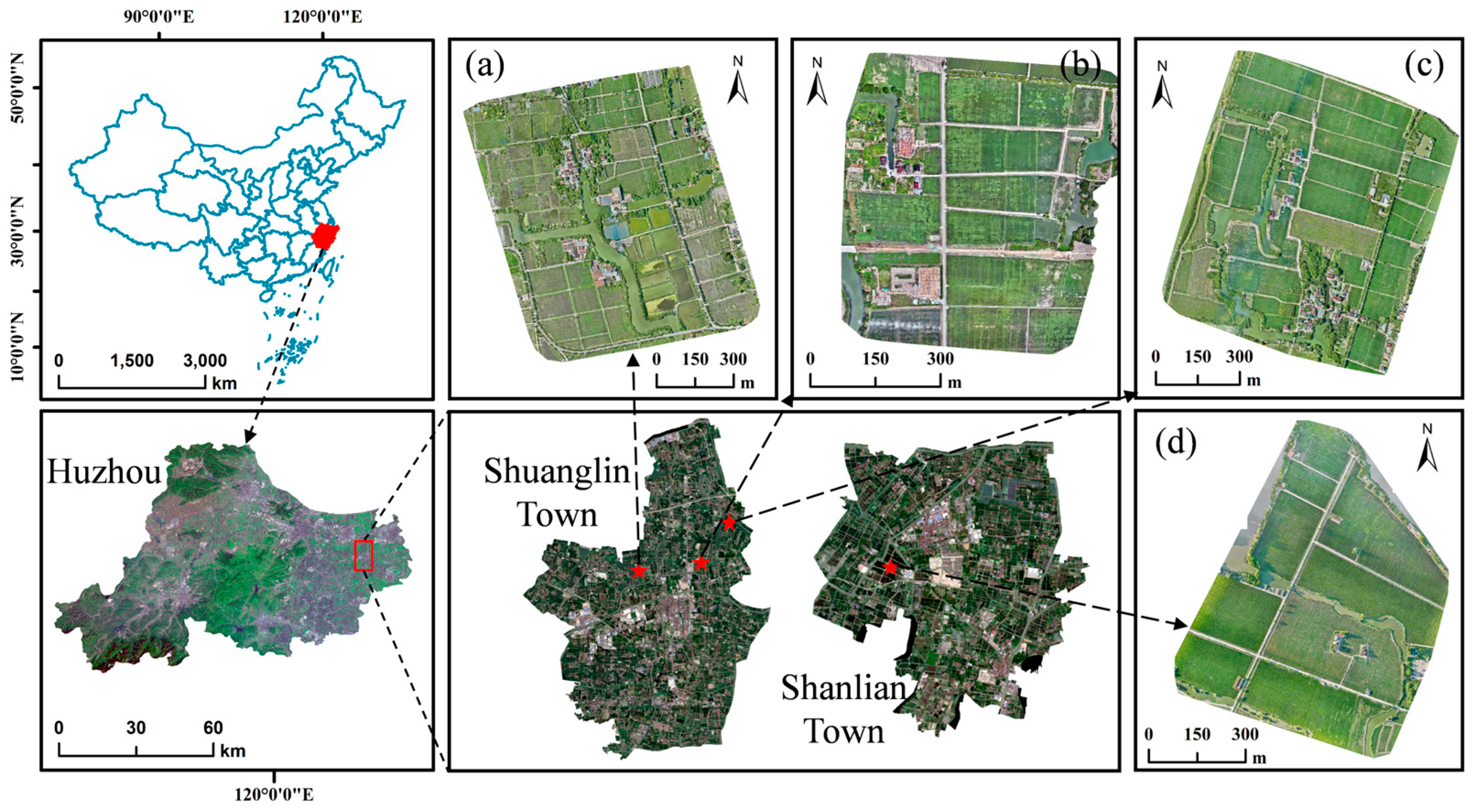
The study area is located in Nanxun District, Huzhou City, Zhejiang Province, China (30.52–31.11°N, 120.08–120.43°E), as shown in
Figure 1. It is a typical Jiangnan water net plain in the core hinterland of the Yangtze River Delta. It features an average elevation of less than 5 m and a river network density of up to 12%, with soils dominated by fertile alluvial and paddy types exhibiting a homogeneous texture. The region has a northern subtropical monsoon climate, characterized by a mean annual temperature of 15.5–16.0 °C, annual precipitation ranging from 1050 to 1850 mm over 142–155 rainy days, a frost-free period of 224–246 days, and an annual sunshine percentage of approximately 45% [
29]. These conditions create an optimal environment for rice cultivation. This study included a total of four study areas for ground data and UAV data acquisition, as shown in
Figure 1a–d. In this paper, the four study areas are referred to as A, B, C, and D. The paddy field areas of the four study regions are approximately 34, 32, 45, and 39 hectares for Regions A, B, C, and D, respectively.
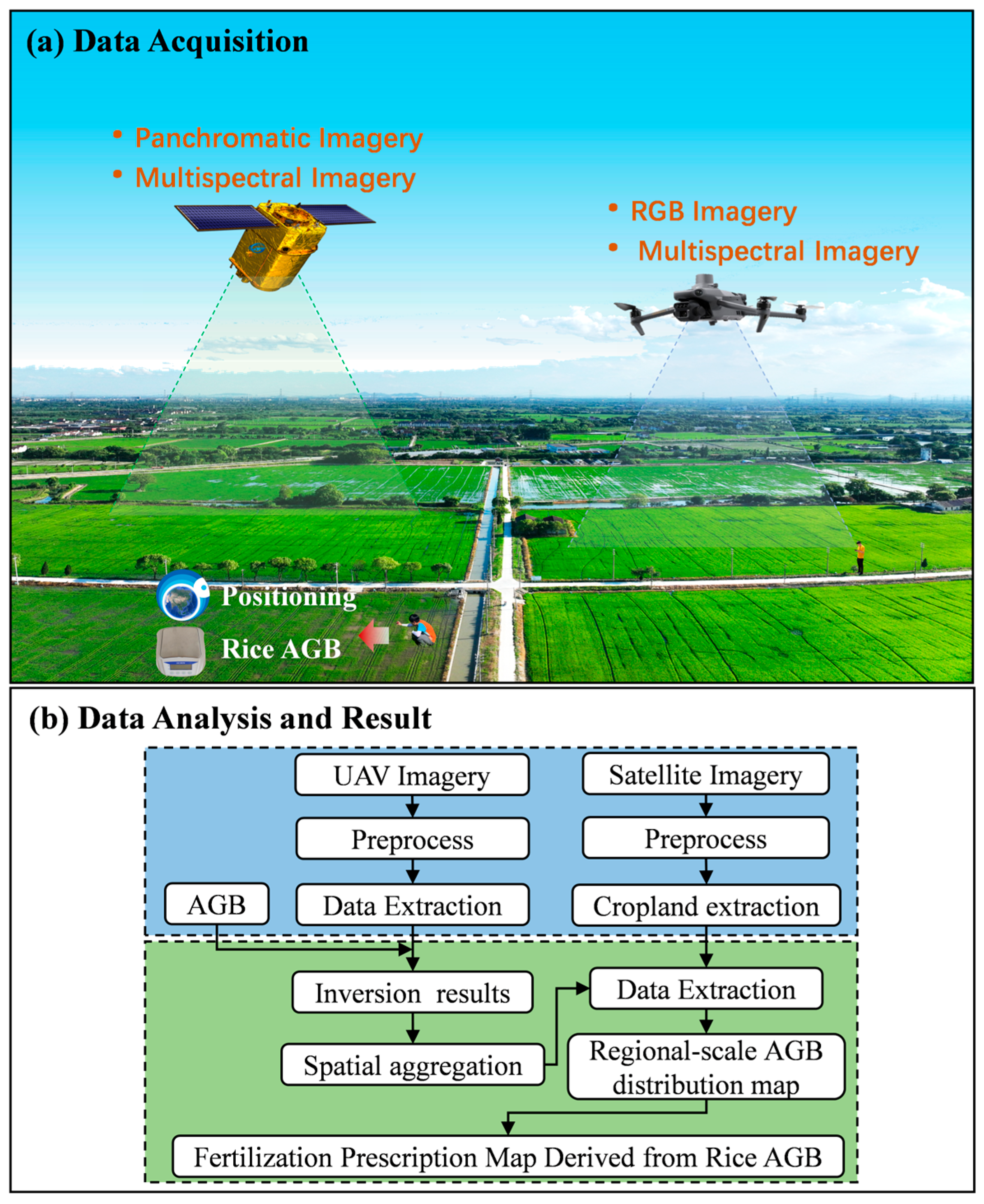
Data collection was conducted from July to October 2024 under clear and windless weather conditions to minimize the impact of weather on data quality. The workflow for data acquisition and analysis is shown in
Figure 2.
2.1. Ground Data
Across study areas A, B and D, rice AGB samples were collected daily (10:00–15:00) via randomized point placement (
Figure S1). A standardized 15 × 15 cm quadrat was deployed to demarcate harvest zones, with all enclosed plants completely extracted. Geographic coordinates were recorded using OviMap (Android OS V10.0.5). Samples were immediately sealed in Ziplock bags. They were then transferred to a cooler box (GINT AS2200, 22 L nominal capacity; Zhejiang Gint Vacuum Flask Technology Co., Ltd., Pinghu, Zhejiang, China) during transport. After bringing the samples back to the laboratory, they were placed in an oven and first heated to 105 °C for 30 min. Subsequently, they were dried at 75 °C until a constant weight was achieved, then weighed to obtain the dry weight (0.01 g precision). The five sampling events correspond to 23 July (seedling stage), 30 July (tillering stage), 6 August (tillering stage), 23 August (jointing stage), and 7 September (heading stage). The numbers of sampling points in these four campaigns were 62, 76, 55, 55, and 47, respectively.
2.2. UAV Data
2.2.1. UAV Image Acquisition and Processing
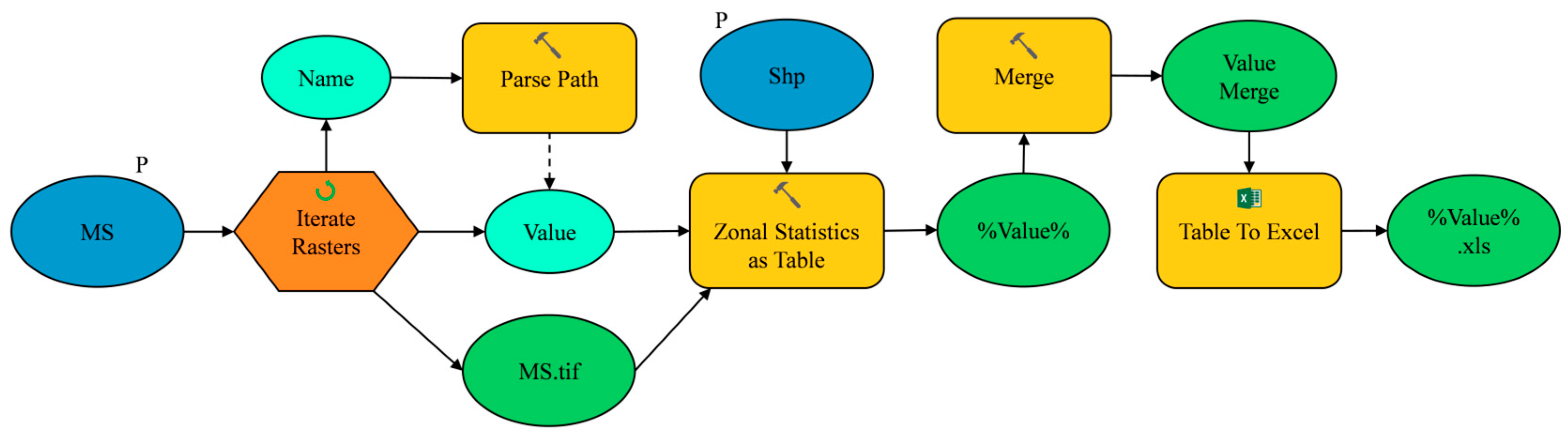
UAV RGB and multispectral images were taken with a DJI Mavic 3M (SZ DJI Technology Co., Ltd., Shenzhen, China). The flight height of the UAV was set to approximately 80 m, and the course overlap rate was 80%. The multispectral camera provides images with four bands, namely, the green, red, red-edge and near-infrared bands. The images were taken in clear, windless or low-wind conditions, generally from 9 am to 16 pm local time. Upon completion of the flight mission, image mosaicking and radiometric calibration were performed using Pix4D mapper 4.4.10. RGB DN values and multispectral reflectance at each sampling point were extracted using ArcGIS 10.6, leveraging the data extraction model shown in
Figure 3 to simplify batch extraction across multiple images.
In this study, we calculated various vegetation indices based on these values (see
Tables S1 and S2). Simultaneously, texture features of each sampling point were extracted from the RGB images using the gray-level co-occurrence matrix (GLCM), including mean, Standard Deviation (SD), contrast (CON), dissimilarity (DISL), homogeneity (HOMO), Angular Second Moment (ASM), energy, and entropy. A total of 78 initial features, comprising spectral indices and texture features, were obtained.
2.2.2. Image Shadow Detection
When processing UAV imagery, we identified shadow regions in paddy fields caused by gullies within the farmland or obstructions (such as buildings and trees) at the edges. Shadows significantly reduce the reflectance of rice canopies. During rice AGB inversion, this creates coupled interference of radiative attenuation, texture disruption, and phenological dynamics. Therefore, this study employs a shadow detection algorithm for identifying shadow regions in paddy fields. First, the UAV RGB imagery is converted to HSV color space to extract the value channel (V channel), with potential shadow areas preliminarily located through threshold segmentation. Second, the variance σ
2 of the three RGB channels is calculated because shadow regions exhibit low variance characteristics due to light attenuation. Shadow sensitivity is further enhanced by scaling the variance map.
where
S represents the scaling coefficient (
S = 3 in this study).
Then, the brightness mask and variance map are fused, and a Gaussian-weighted adaptive threshold is applied to extract the shadow regions.
where
μv is the local window brightness mean,
C is the fine-tuning amount (default 3), and the window size must be an odd number to ensure a unique central pixel for symmetrical computation.
Finally, the obtained shadow regions are subjected to median filtering, closing operations, hole filling, and small region removal to refine the detected areas.
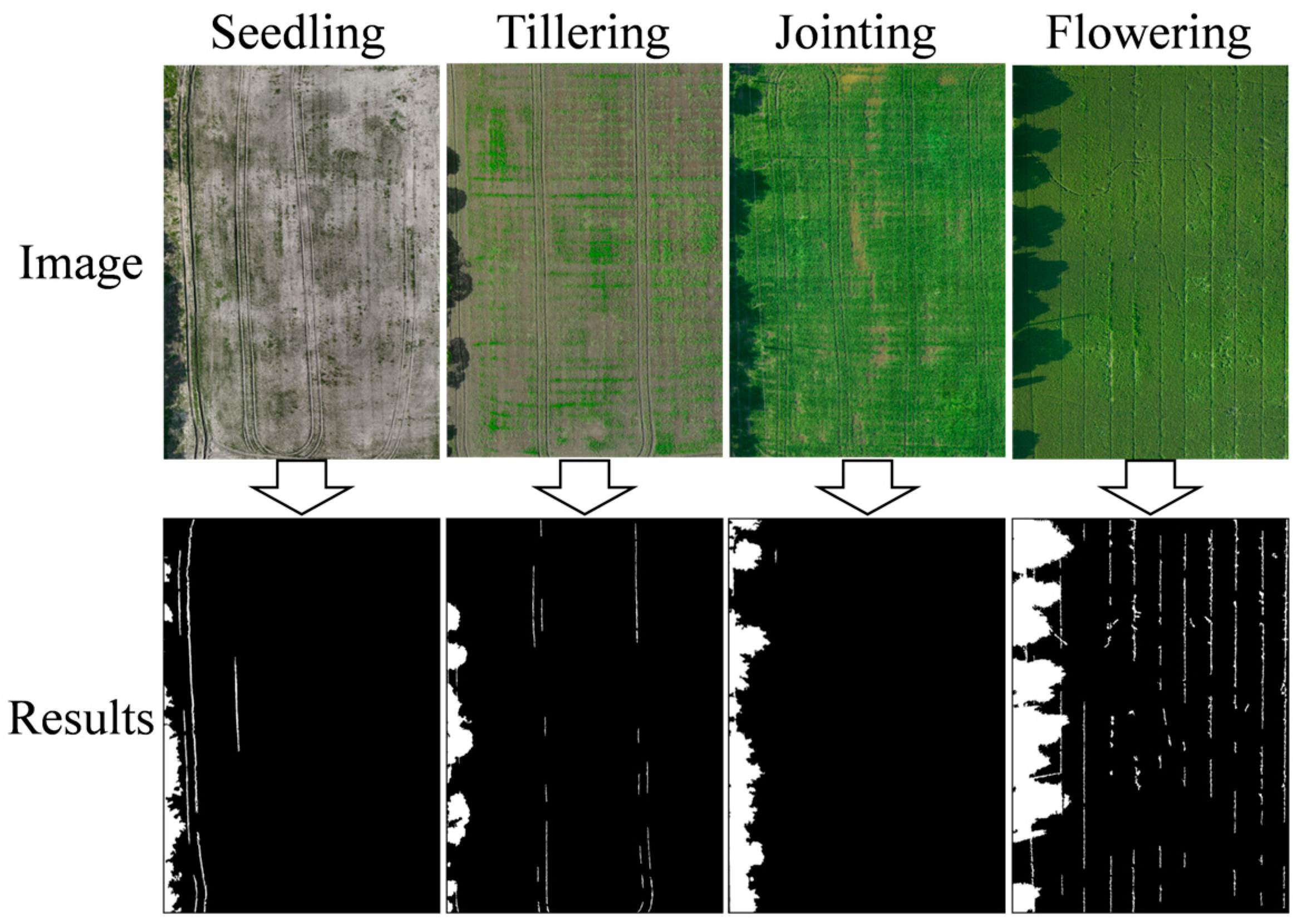
Figure 4 shows the algorithm detection results, indicating that this method can effectively detect shadow regions in rice imagery across different growth stages. Shadow masks are generated from UAV RGB imagery using the aforementioned method. All masks are used to clip both RGB and multispectral images, ensuring that rice AGB inversion remains unaffected by shadows.
2.3. Satellite Scale
2.3.1. Satellite Image Acquisition and Processing
Due to persistent overcast and rainy conditions during the critical growth period of rice (July–September) in the study area, a single satellite data source was unable to provide effective observations. To construct a complete time-series dataset covering the entire growth period, this study adopted a multi-source satellite data synergy strategy, acquiring imagery from the European Space Agency’s Sentinel-2 (European Space Agency, Paris, France) and China’s Gaofen-1 Wide Field View (WFV) (China National Space Administration, Beijing, China).
Sentinel-2 images (Level-2A surface reflectance products) were downloaded from the Copernicus Open Access Hub. Gaofen-1 WFV images (16 m resolution) were obtained from the China Remote Sensing Data and Application Service Platform. Consequently, we successfully acquired four periods of high-quality cloud-free imagery covering key rice growth stages (seedling, tillering, and jointing phases), as detailed in
Table 1.
To achieve synergistic analysis of multi-source remote sensing data, image preprocessing is required to mitigate sensor differences, atmospheric effects, and geometric distortions. The Sentinel-2 L2A surface reflectance product has undergone systematic radiometric calibration and atmospheric correction. Thus, all images were exported to standard ENVI raster format via SNAP 10.0.0 software for subsequent unified analysis. Preprocessing of the GF-1 WFV L1A images was completed in ENVI 5.6 software, involving radiometric calibration, atmospheric correction (using the FLAASH Atmospheric Correction Model), and orthorectification (based on the sensor RPC model), with the results saved in standard ENVI raster format. After preprocessing, comparison with synchronous UAV imagery revealed that the processed GF-1 images still exhibited geolocation deviations. Therefore, using the Sentinel-2 imagery as a spatial reference, geometric fine registration of the GF-1 imagery was performed in ENVI software using the Image Registration Workflow tool. Then, 21 vegetation indices listed in
Table S3 were calculated, and feature subsets for each period were generated using the DC-CFS, serving as the dataset for training the satellite-scale rice AGB inversion model. For the fusion of UAV and satellite data, a spatial aggregation strategy was adopted. Specifically, the AGB estimates derived from UAV imagery were spatially aggregated to match the satellite pixel resolution, and the aggregated results were subsequently used as ground truth values for training the satellite-scale inversion model.
2.3.2. Farmland Extraction
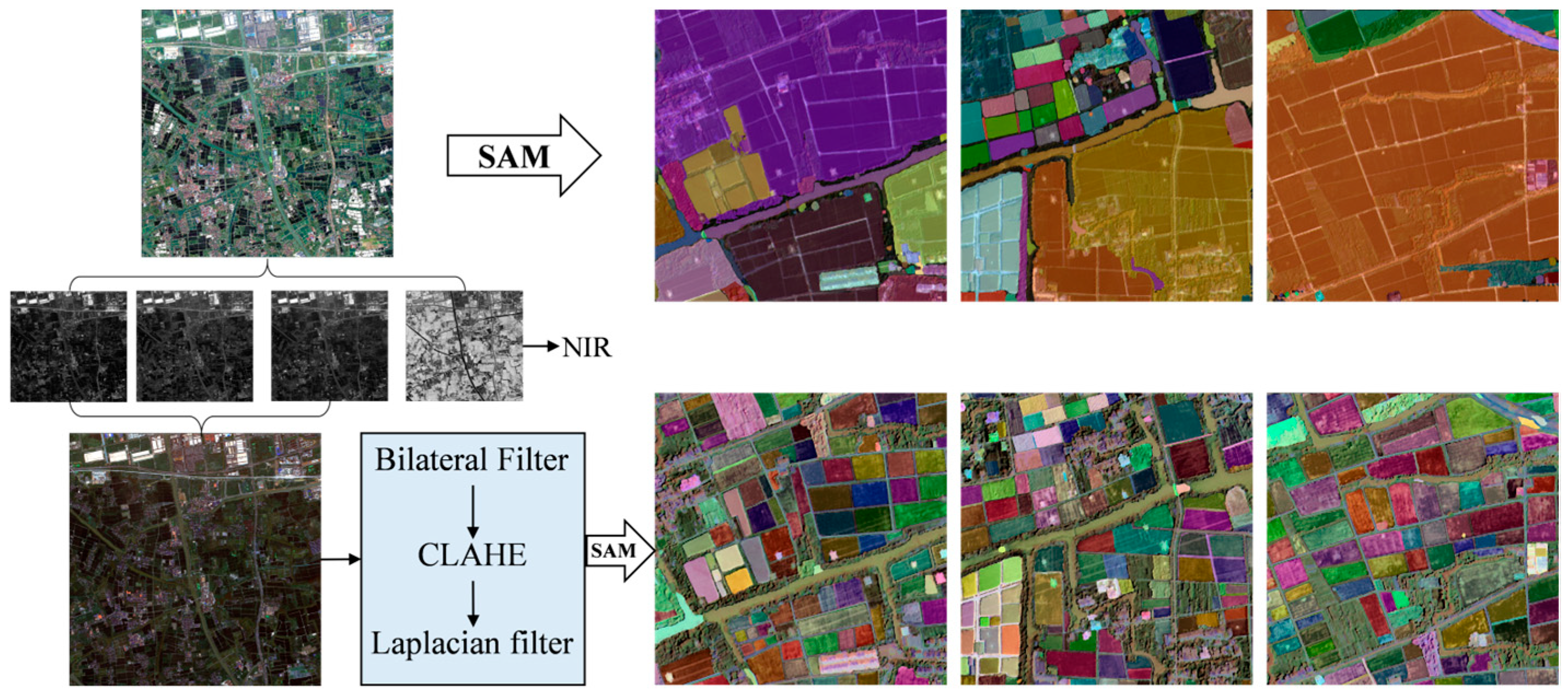
To achieve inversion of rice AGB at the county scale, accurate extraction of farmland areas is required. This study proposes an automatic farmland extraction framework that integrates sliding window sampling and the Segment Anything Model (SAM). The overall workflow of the framework includes (1) image tiling; (2) automatic segmentation based on SAM; (3) vector boundary generation and output; and (4) mask classification using time-series medium-resolution satellite imagery. The model was developed in a Python 3.10 environment with PyTorch 2.7.1 as the deep learning framework. Key dependency packages include OpenCV 4.12.0, Rasterio 1.4.3, and GeoPandas 1.1.1. The method aims to leverage segmentation capability of SAM in zero-shot scenarios, thereby eliminating the need for sample labeling and model training. The data source selected was GaoFen-2 satellite imagery (obtained from the National Remote Sensing Data and Application Service Platform), with a spatial resolution of 0.8 m for the panchromatic band. Radiometric calibration, orthorectification, image fusion, and cropping/mosaicking were applied to the panchromatic and multispectral images to obtain improved satellite imagery of Nanxun District. The pretrained SAM used was Vision Transformer-Large (ViT-L). Only two hyperparameters were adaptively optimized based on the original SAM configuration, while all other parameters were kept at the default settings. Specifically, pred_iou_thresh was increased from the default value of 0.88 to 0.90 to enhance the mask prediction confidence and improve scene segmentation reliability. Combined with the actual spatial scale characteristics of rice field parcels, min_mask_region_area was set to 200 to eliminate tiny and invalid fragmentary masks. This strategy retains only the segmented regions that conform to the actual field size and effectively suppresses background noise and pseudo-target interference. Preliminary experiments revealed that directly inputting the preprocessed GF-2 imagery into the SAM failed to effectively delineate farmland boundaries, as shown in
Figure 5. Therefore, the near-infrared band was separated from the image and combined with the RGB bands to better meet SAM’s input requirements. Subsequently, a bilateral filtering algorithm was applied to smooth noise in homogeneous regions while maintaining the sharpness of object boundaries. Then, Contrast Limited Adaptive Histogram Equalization (CLAHE) was applied to the L-channel of the LAB color space to enhance local contrast and improve the separability of different land cover types. Finally, a 3 × 3 Laplacian operator (kernel matrix [[0, −1, 0], [−1, 5, −1], [0, −1, 0]]) was convolved with the image to strengthen high-frequency edge information while suppressing noise, thereby further highlighting the contour features of farmlands and other land objects. As shown in
Figure 5, after image enhancement, the SAM algorithm effectively identifies farmland boundaries. The masks obtained from SAM segmentation are converted into vector polygons, which are then overlaid onto time-series medium-resolution satellite imagery to extract the spectral mean value within each mask-covered region in every image scene. Given that paddy fields exhibit distinct spectral evolution patterns during the growth cycle, threshold segmentation was used to screen paddy field masks. After this screening process, the remaining masks are the paddy field masks for Nanxun District, as shown in
Figure S2 of the Supplementary Materials.
2.4. Feature Selection
Feature selection is a key preprocessing step in machine learning and pattern recognition. It aims to select the most relevant subset of features from high-dimensional data. This helps improve model performance, reduce computational complexity, and enhance interpretability. Traditional feature selection methods can be categorized into three main types: filter methods, wrapper methods, and embedded methods [
30]. Among the various feature selection techniques, filter methods have garnered widespread attention due to their efficiency and independence. These methods evaluate features by analyzing the intrinsic properties of the data, independent of the subsequent regression model, offering the advantages of high computational efficiency and strong generalizability. Although filter methods have achieved notable success in the field of feature selection, their inherent limitations have gradually become apparent in different application scenarios. The Pearson correlation coefficient, as the most commonly used linear metric in filter methods, can only assess the linear relationship between features and the target variable; its performance significantly deteriorates when complex nonlinear relationships exist between variables. Similarly, variance-based screening methods focus on the dispersion of the features themselves, neglecting their association with the target variable, which may lead to the erroneous removal of features with low variance but strong relevance to the target. Distance-based methods, such as DCSIS and DisCoMax, can handle nonlinear relationships but require preset parameters, potentially resulting in unstable model performance [
31]. The optimal values of threshold parameters or feature subset size are typically dataset-dependent, an issue that is particularly pronounced in small-sample datasets, making them difficult to determine automatically in practice.
To address the limitations of traditional filter methods in the agricultural remote sensing domain, the DCFS algorithm proposed by Tan Hongwei [
30] is improved by incorporating the CFS framework, resulting in the Distance-Correlation–Correlation-Feature-Selection (DC-CFS) algorithm. DC-CFS leverages the strengths of the distance correlation coefficient in capturing nonlinear relationships and integrates the forward selection strategy of CFS, enabling a comprehensive evaluation of feature interrelationships.
The distance correlation coefficient offers two core advantages: distribution-free properties and the ability to capture nonlinear relationships. Unlike the Pearson correlation coefficient, the distance correlation coefficient does not assume a linear relationship between variables and does not require the data to follow a specific distribution. Given a feature vector X and a target variable Y, the distance correlation coefficient is defined as
where dCov (X, Y) represents the distance covariance between X and Y, and dVar (X) and dVar (Y) denote the distance variances of X and Y, respectively. This metric is zero when X and Y are independent and nonzero otherwise, with a range of [0, 1], facilitating comparisons between different features.
The evaluation function for the feature subset
S is given by
where
k is the number of features in the subset
S,
is the average distance correlation coefficient between features and the target variable, and
is the average Pearson correlation coefficient between features. This evaluation function simultaneously considers the relevance of features to the target and the redundancy among features, encouraging the selection of feature combinations that are highly relevant to the target and complementary to each other.
The DC-CFS algorithm employs a forward search strategy, starting from an empty set and iteratively adding the feature that maximizes the Merit score. Another distinction from the traditional CFS is the introduction of a feature autocorrelation threshold. When a candidate feature exhibits high autocorrelation with the features currently in the subset, it is excluded. This effectively mitigates the issue of multicollinearity within the feature subset. In summary, the main contributions of the DC-CFS algorithm are threefold. First, by introducing the distance correlation coefficient as the core metric, it effectively captures both linear and nonlinear relationships between features and the target variable. Second, the algorithm does not rely on preset parameters; instead, it automatically determines the size of the feature subset in a data-driven manner, enhancing stability and usability. Finally, the high autocorrelation among spectral indices has long been an unavoidable challenge. By incorporating a built-in threshold for feature autocorrelation, the DC-CFS algorithm ensures that the constructed feature subset excludes highly autocorrelated features, making it more suitable for the agricultural remote sensing domain.
2.5. Rice AGB Inversion Model
This study employed multiple algorithms to construct prediction models for rice AGB and evaluated their performance through repeated cross-validation. Specifically, the evaluation protocol was designed with 5-fold cross-validation repeated 100 times, where the dataset was reshuffled in each repetition to assess model robustness. The predictive algorithms utilized encompassed a variety of types. For linear models, Bayesian Ridge Regression (BayesianRidge) was adopted. Among tree-based ensemble methods, the Extra Trees Regressor (ExtraTrees) was employed with the number of trees set to 100. This algorithm introduces additional randomness compared to Random Forest, as both the splitting feature and the split threshold at each node are chosen randomly to reduce variance. For Support Vector Regression (SVR), a linear kernel was used, with the regularization parameter C set to 1.0 and the epsilon-tube parameter epsilon set to 0.1. Regarding neural network models, a Multi-layer Perceptron Regressor (MLP) was implemented. Its architecture contained two hidden layers with 100 and 50 neurons, respectively, utilizing the ReLU activation function and the Adam optimizer. Early stopping was enabled to prevent overfitting. The adaptive boosting ensemble algorithm was represented by the AdaBoost Regressor (AdaBoost), configured with 50 base learners and a learning rate of 1.0. For gradient boosting, the eXtreme Gradient Boosting Regressor (XGBoost) was applied, with its number of boosting rounds set to 100, a learning rate of 0.1, and a maximum tree depth of 3. All machine learning models were implemented in Python using scikit-learn (version 1.7.1) and XGBoost (version 3.1.2). Within the modeling pipeline, data were standardized using a Standard Scaler prior to each training iteration. Model performance was comprehensively evaluated using the coefficient of determination (R2), the Root Mean Square Error (RMSE), and the Ratio of Performance to Interquartile Range (RPIQ). For each metric, the mean, Standard Deviation (StD), and Coefficient of Variation (CV) were calculated to assess both the central tendency and the stability of model predictions.
3. Results
3.1. UAV-Scale Feature Selection
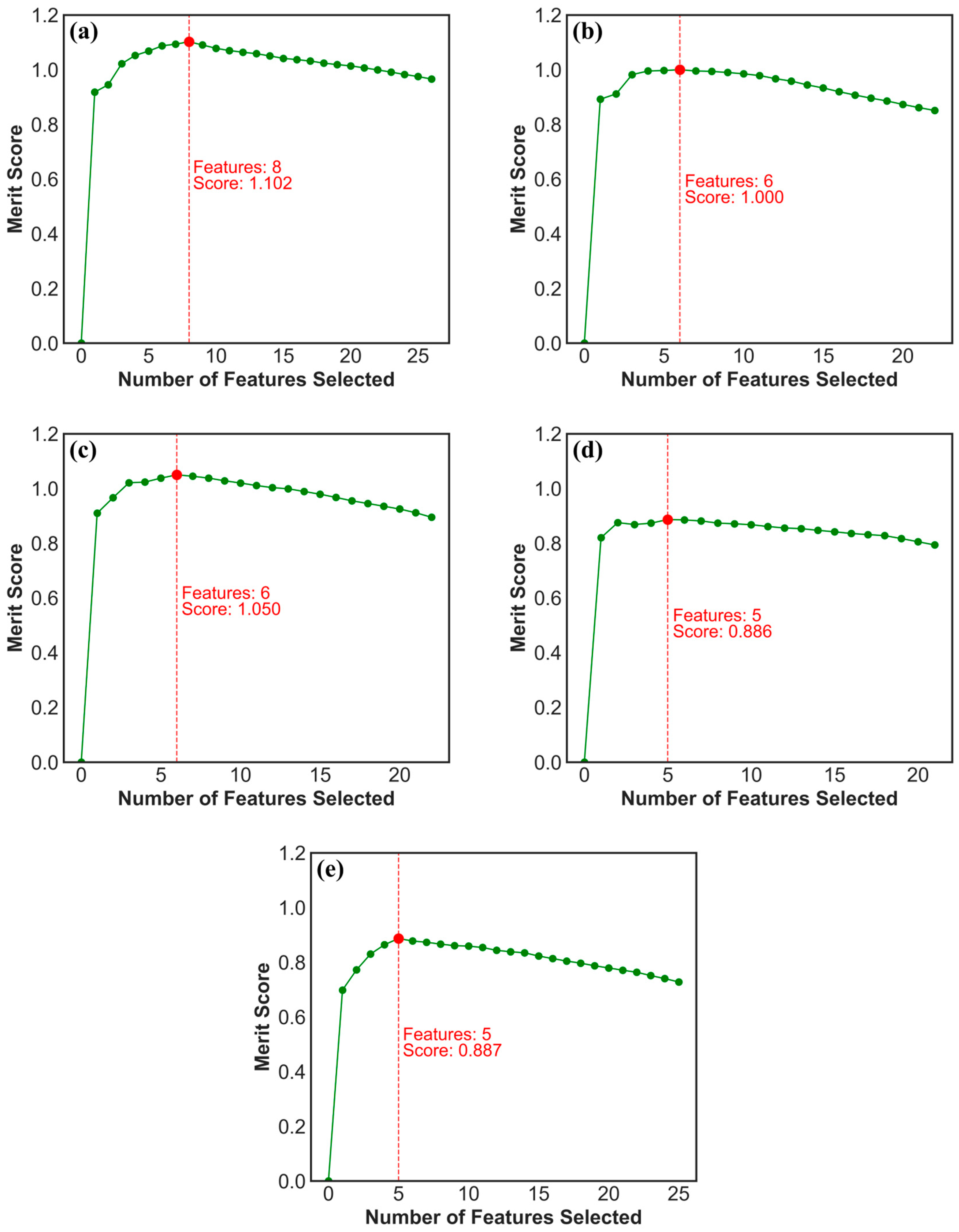
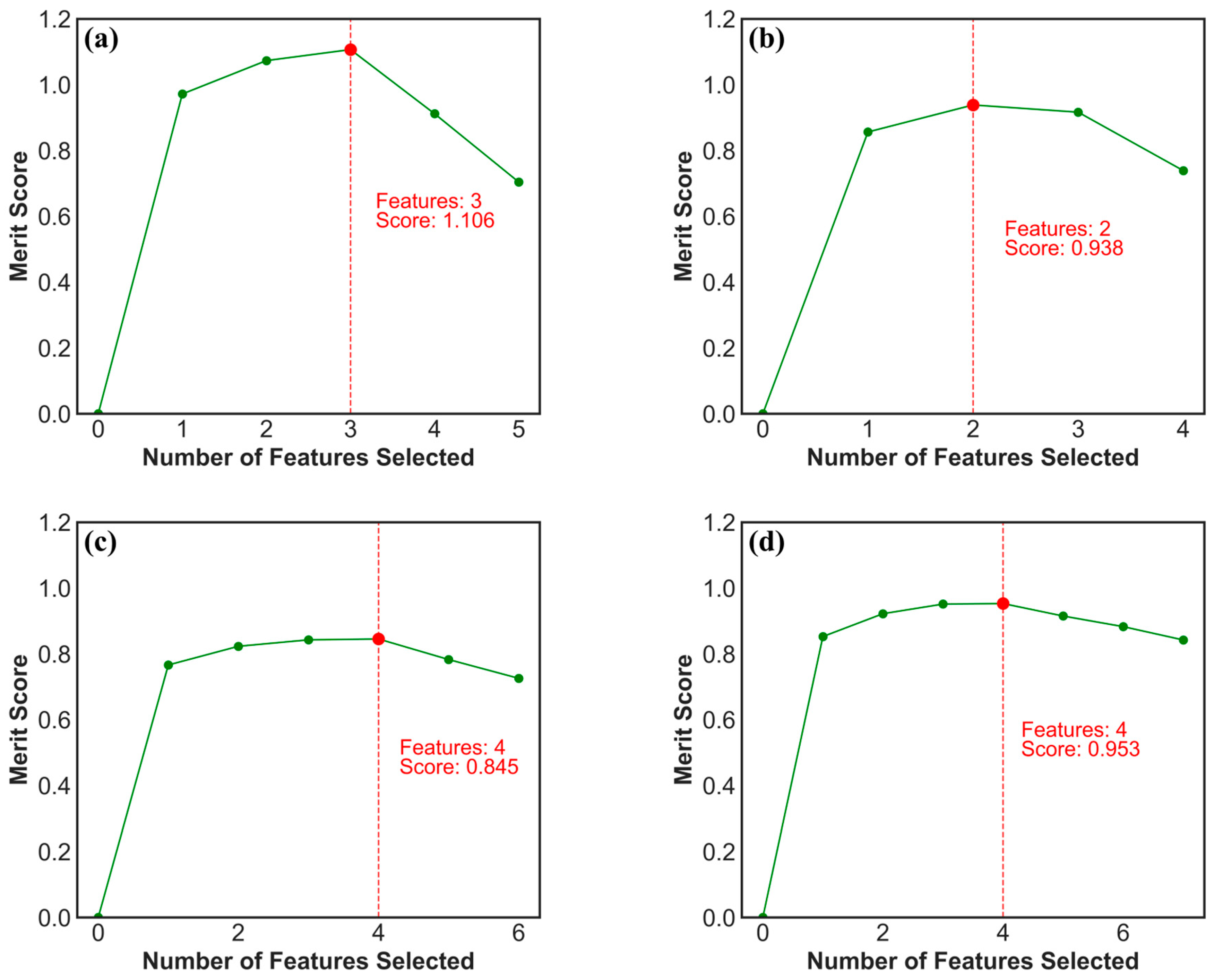
To optimize the feature set, eliminate redundancy, and enhance model performance, all 78 features were input into the DC-CFS feature selection algorithm proposed in this study. The selection results are shown in
Figure 6. Overall, the performance curves for all growth stages exhibited a pattern of rapid initial ascent followed by stabilization or a gradual decline, indicating the existence of an optimal number of features that balances model performance and complexity. Before reaching the peak, the performance score increased sharply with the addition of features, indicating that the initially included features were of high importance and contributed significantly to model performance. After the peak, the curves either plateaued or declined. The plateau phase suggests that subsequent added features provided limited marginal information gain, while the declining trend implies the introduction of redundant or irrelevant features, potentially leading to slight overfitting. The optimal number of features for all growth stages was relatively small, demonstrating the feasibility of constructing a lightweight and high-accuracy AGB inversion model through feature selection. The number and combination of features in the optimal feature subsets varied across growth stages, reflecting the dynamic changes in features characterizing AGB as crops progress through different growth phases. Therefore, customizing the feature subset for a specific growth stage is more effective than using a globally uniform feature set.
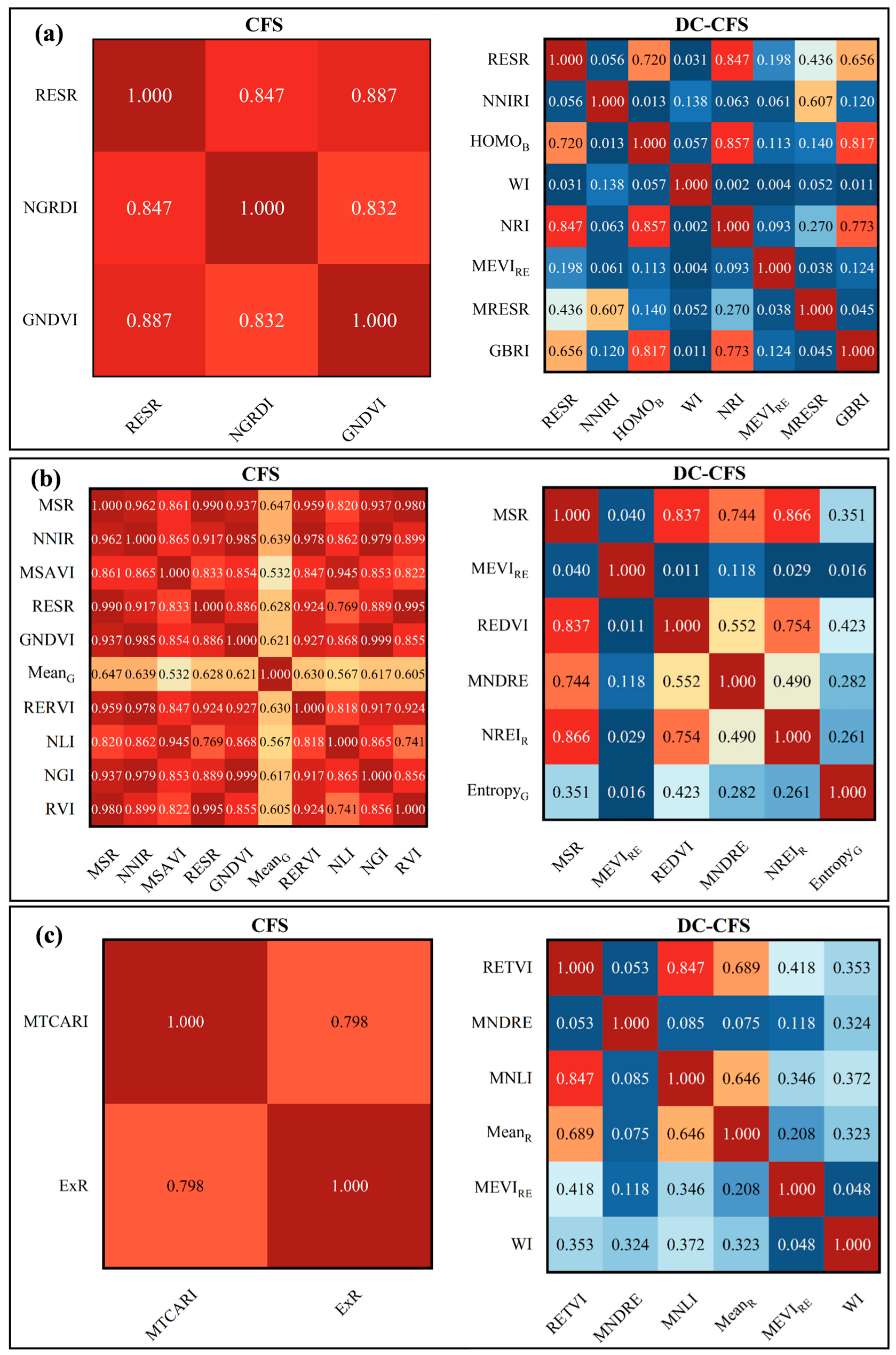
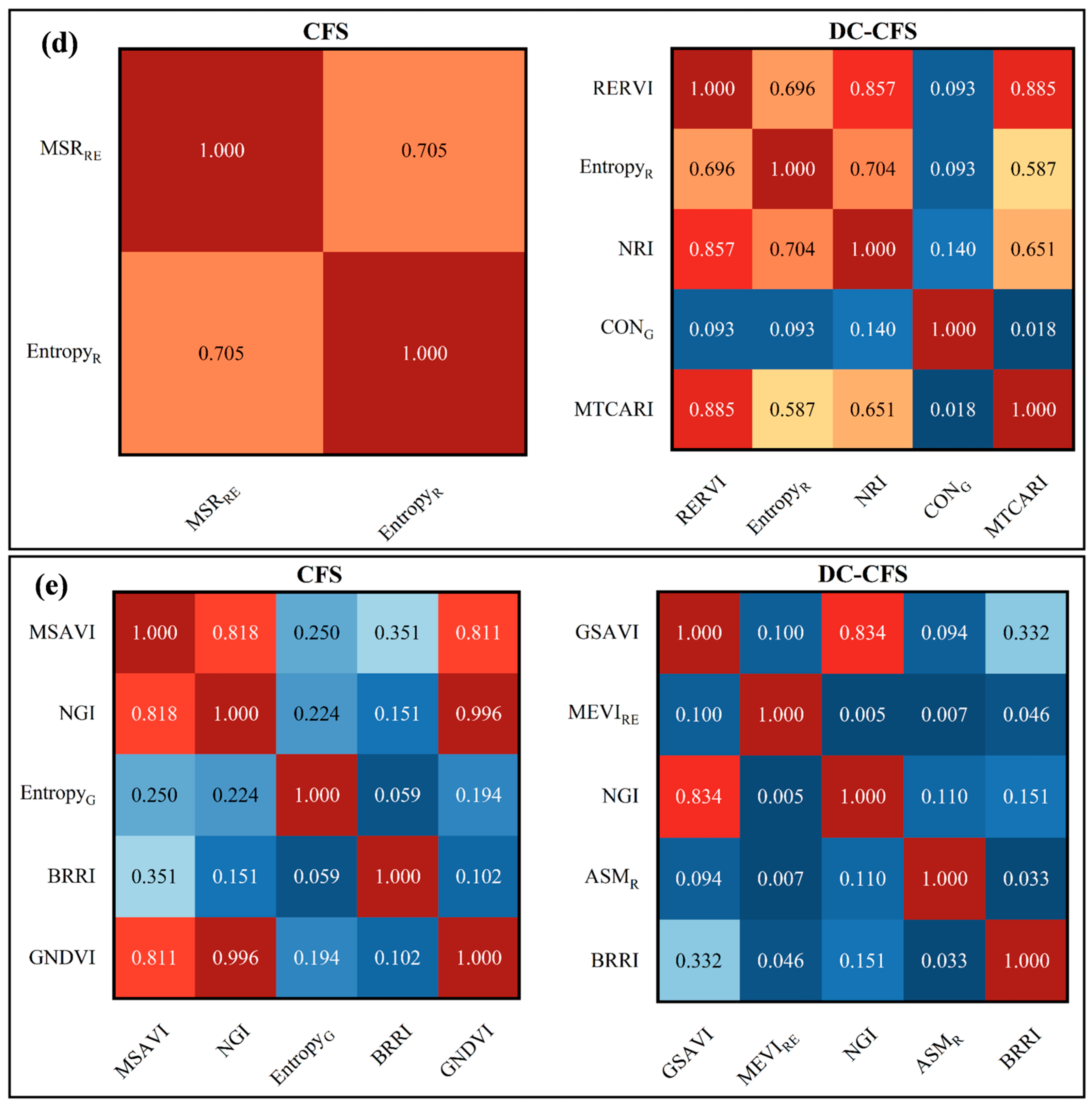
A comparative analysis of feature autocorrelation provides further insight into the efficacy of the DC-CFS algorithm.
Figure 7 presents heatmaps contrasting the feature subsets selected by the proposed DC-CFS algorithm against those chosen by the standard CFS method. The visual and quantitative comparison clearly demonstrates the superior ability of DC-CFS in minimizing feature redundancy. As shown in the heatmaps, the feature subsets selected by DC-CFS exhibited substantially lower inter-feature correlations compared to those from CFS. While the highest correlation coefficient observed within any DC-CFS subset was 0.87 (
Figure 7d), the corresponding correlations within CFS subsets were consistently higher. In summary, the DC-CFS algorithm successfully automates the identification of compact, stage-specific feature subsets with low internal redundancy, thereby establishing a robust foundation for constructing a lightweight, high-precision, and phenology-aware model for rice AGB inversion.
3.2. UAV-Scale Rice AGB Inversion Model
To identify the optimal UAV-scale inversion model for rice AGB that is adapted to different phenological stages, this study conducted a comprehensive performance evaluation of six distinct algorithms. The accuracy metrics for all models across key growth stages are summarized in
Table 2. The results reveal significant disparities in performance among the different model types.
During the early growth stages (23 July and 30 July), ExtraTrees demonstrated superior performance. On 23 July, it achieved the highest R2 (0.826) and RPIQ (3.588), while maintaining a reasonable RMSE, indicating excellent predictive accuracy. BayesianRidge also exhibited competent fitting performance during this period (R2 = 0.795 on 23 July). This suggests that the relationship between spectral features and AGB in the seedling and tillering stages can be effectively characterized by a relatively simple linear pattern. This is primarily attributed to the short plant stature during this phase, where canopy development shows a direct and proportional correlation with biomass accumulation.
As the crop progressed into the late tillering and jointing stages (6 August and 23 August), the performance gap between model types widened considerably. ExtraTrees maintained its leading position, achieving peak R2 values of 0.801 and 0.690 for the two dates, respectively. In contrast, the accuracy of simpler models declined sharply. Notably, the performance of SVR and the MLP deteriorated more significantly. The MLP model became increasingly ineffective, with an R2 of only 0.162 on 6 August and a negative R2 value on 23 August. This indicates that under lower-resolution imagery, simpler models struggle to capture the increasingly complex, nonlinear relationship between spectral/textural features and AGB during the rapid vegetative growth phase. By the heading stage (7 September), a substantial decline in inversion accuracy was observed for all models. Even ExtraTrees attained an R2 of merely 0.335. This strongly confirms the presence of a pronounced spectral saturation effect during this late stage. Relying solely on two-dimensional spectral features becomes insufficient for effectively characterizing the actual variation in AGB.
An analysis of model stability, based on the CV for R2, indicates that prediction reliability was highest in the early growth stage (23 July), with CV for both ExtraTrees and BayesianRidge below 2.2%. Model stability decreased consistently thereafter. By 7 September, the CV for the best model’s R2 increased to 13.7%, signifying a substantial rise in prediction uncertainty. This trend in diminishing stability aligns with the observed pattern of declining accuracy.
In summary, the multi-model comparative experiment confirms that the optimal model for rice AGB inversion is dependent on the growth stage. For the early growth stages, employing BayesianRidge offers a good balance between prediction accuracy and computational efficiency. During the jointing stage, however, the ExtraTrees emerges as the optimal modeling choice due to its superior capability in fitting complex, nonlinear relationships.
3.3. Satellite-Scale Rice AGB Inversion Model
For constructing the satellite-scale rice AGB inversion model, AGB data with high spatial consistency and sufficient sample density relative to the satellite imagery were required. To achieve this, the UAV-scale inversion models developed in the previous section were first used to generate AGB distribution maps for the four study areas in each growth period. These high-resolution UAV-derived AGB maps were then spatially aggregated to the grid of the satellite image pixels. For each individual satellite pixel, the AGB values of all UAV-scale pixels within its corresponding geometric boundary were summed to obtain a simulated biomass value for that satellite pixel. Finally, a total of 3000 samples were compiled for each growth period.
Figure 8 displays the accuracy curves for the optimal feature subsets selected at the satellite scale using the DC-CFS algorithm.
Table 3 presents the feature subsets selected for different growth periods. Consistent with the trend observed at the UAV scale, the merit score for satellite-scale features also exhibited an initial increase followed by a decline. However, the optimal number of features selected at the satellite scale was only 2 to 4, which is fewer than the number selected at the UAV scale. The primary reason for this difference lies in the data sources. The satellite imagery utilized in this study contained only four multispectral bands: red, green, blue, and near-infrared. In contrast, the UAV data also included RGB imagery. Consequently, the satellite data offered a substantially smaller pool of candidate spectral features for selection, and the variables derived from these limited bands showed lower discriminative power, leading to a more compact optimal feature subset.
Employing the same six regression algorithms used for UAV-scale modeling and inputting the optimal feature subset for each growth stage, satellite-scale rice AGB inversion models were constructed. The accuracy metrics for the models at each stage are presented in
Table 4. The results indicate that the ExtraTrees and XGBoost models achieved favorable and stable performance across all four key growth stages. Their R
2 consistently exceeded 0.74, validating the reliability of the UAV data-driven, satellite-scale inversion framework. Furthermore, the CV for R
2 of these two models remained at a low level (below 1%) throughout all growth stages, demonstrating excellent numerical stability and strong generalization capability of the established models. Model performance exhibited a clear temporal pattern. On 16 July, all models showed exceptionally high prediction stability, with CV for R
2 ranging from 0.008% to 0.110%. Among them, XGBoost achieved the highest inversion accuracy (mean R
2 = 0.950, CV = 0.055%), while BayesianRidge demonstrated the best stability (CV = 0.008%). As the rice progressed into the tillering and jointing stages, the mean R
2 of the models gradually declined. Notably, the R
2 of SVR turned negative on 23 August, and the MLP model also failed, yielding a mean R
2 of −2.532. This reveals the poor adaptability and robustness of these models under complex canopy growth conditions.
Comprehensively considering the prediction accuracy, numerical stability, and stage-wise adaptability of all algorithms across the four growth stages, the ExtraTrees and XGBoost algorithms are recommended as suitable models for satellite-scale rice AGB inversion.
3.4. Satellite-Scale Rice AGB Inversion Result
To generate the rice AGB distribution map at the satellite scale, cropland segmentation was first conducted based on the cropland extraction framework proposed in this study, with the results shown in
Figure S1b. Five regions captured by UAV were selected to validate the accuracy of the cropland extraction. High-resolution RGB images from the UAV were visually interpreted to create reference cropland masks, which were then compared with the cropland masks extracted using the SAM-based method. The accuracy evaluation metrics for each region are shown in
Table 5. Based on the combined results from the five regions, the proposed method achieved average precision, recall, Dice coefficient, and IoU scores of 0.975, 0.939, 0.957, and 0.918, respectively. These results indicate a high agreement between the satellite-based cropland extraction and the manually annotated reference masks, demonstrating the accuracy and reliability of the method for automated cropland extraction. Subsequently, the cropland satellite images of Nanxun District were processed to extract the required feature variables for each period, which were then input into the pre-trained models from
Section 3.3 to generate the final county-level rice AGB distribution map. To avoid performance overestimation due to data leakage, Region E, which was not used in model training, was selected to evaluate the inversion results.
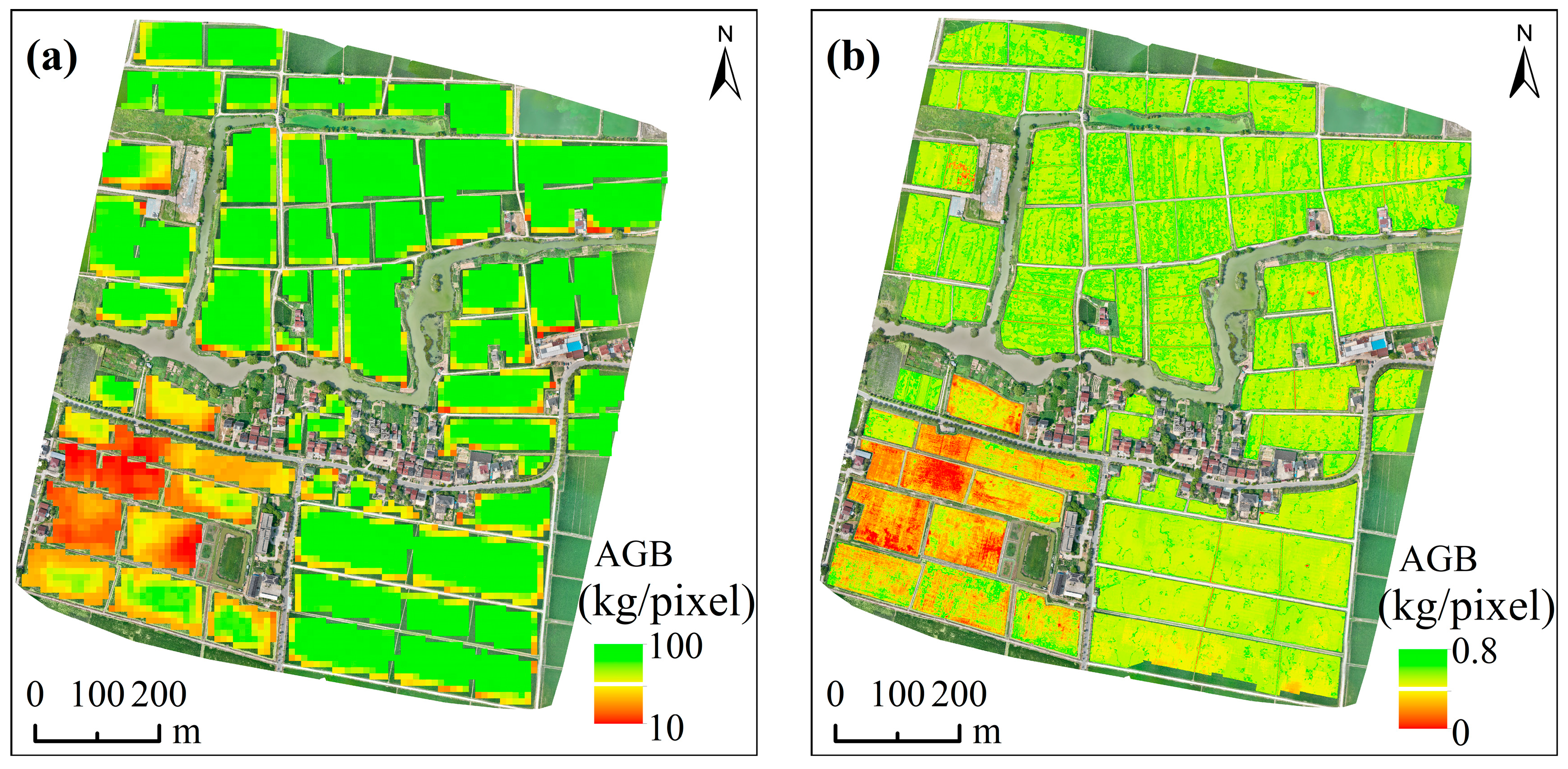
Figure 9 presents a comparative map of rice AGB inversion results at the satellite and UAV scales in this region, with
Figure 9a showing the AGB distribution from the satellite-scale inversion model and
Figure 9b displaying the UAV-scale simulated AGB. A comparison of the two subfigures reveals a high consistency between the satellite-scale model results and the UAV-scale simulations. Discrepancies are observed only at the edges of the fields, where the satellite-based inversion results are slightly lower than the UAV-based values. This is due to shadow effects in these areas leading to lower pixel reflectance in the satellite imagery. In conclusion, the multi-source remote sensing collaborative approach proposed in this study is feasible.
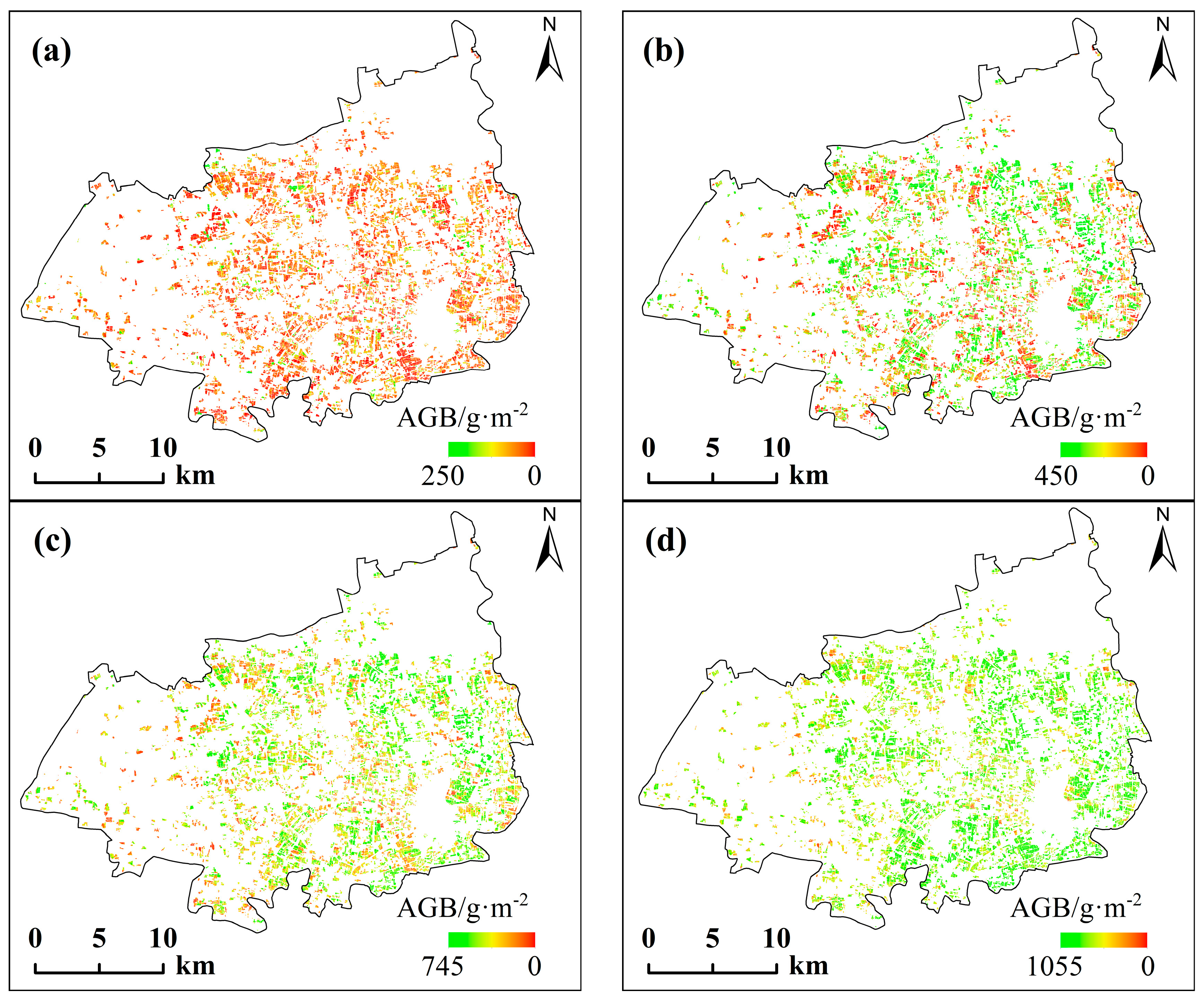
Figure 10 shows the temporal distribution maps of rice AGB in Nanxun District derived from the satellite-scale inversion model. On 16 July, during the rice seedling stage, AGB values were low across all fields. As the growth period progressed, the AGB increased continuously. Furthermore, the distribution maps visually illustrate the spatial variability in rice biomass across the region, helping to identify areas of weaker and stronger growth, which can inform targeted agricultural management practices.
3.5. Fertilization Decision-Making Based on AGB Inversion Results
To translate the remote sensing monitoring results of crop vigor into actionable field management practices, this study developed a decision-making framework for variable-rate fertilization based on the spatial distribution maps of AGB during the tillering and jointing stages. Based on the conventional population traits of indica and japonica rice in the middle and lower reaches of the Yangtze River, the normal range of AGB is defined as 30–80 g/m
2 at the tillering stage and 150–280 g/m
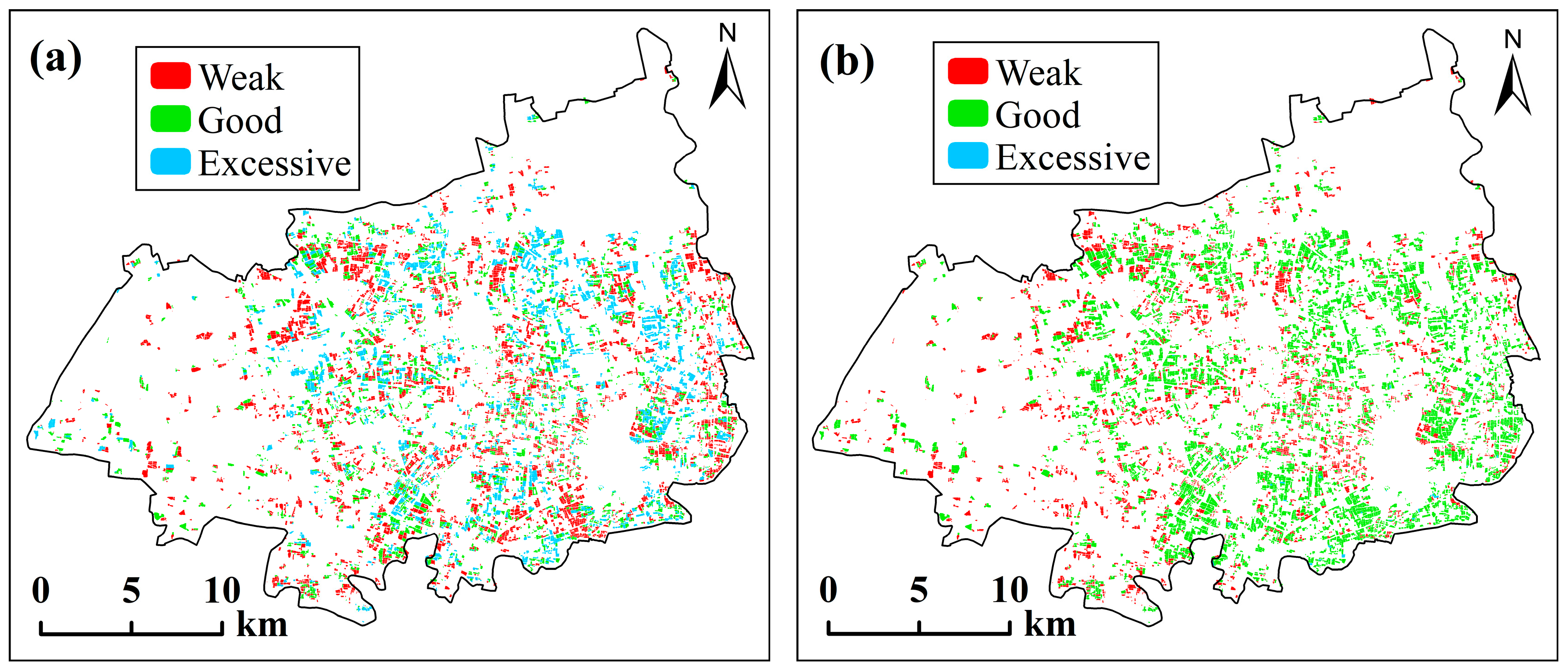
2 at the jointing stage. First, the average AGB of rice in each plot was calculated. Then, based on the conventional values of AGB data for each stage, the field vigor was classified into three grades, Weak, Good, and Excessive, as shown in
Figure 11. Subsequently, differentiated fertilization recommendations were proposed according to the key growth requirements of crops at different developmental stages.
The tillering stage is critical for determining the number of effective panicles per unit area, and the primary objective of fertilization at this stage is to promote effective tillering and establish a sufficient population in rice. For plots with weak vigor, it is recommended to increase the application of quick-acting nitrogen fertilizer by 15–25% above the conventional recommended rate to promote tiller formation. For plots with good vigor, fertilization should follow the conventional recommended rate. For plots with excessive vigor, rice plants may have already completed tillering and entered the jointing stage; therefore, nitrogen fertilizer application can be reduced by 20–30%, while potassium fertilizer should be increased to strengthen stems and prevent lodging.
The objective of fertilization during the jointing and booting stage is to meet the nutrient demands for panicle differentiation and control the internode elongation at the basal stem. For plots with weak vigor, the application of panicle fertilizer should be increased by 10–15% to compensate for earlier nutritional deficits and support ongoing floret differentiation and development. For plots with good vigor, fertilization should adhere to the conventional recommended rate. For plots with excessive vigor, nitrogen fertilizer application should be reduced, while potassium and silicon fertilizers should be increased to enhance stress resistance and prevent excessive vegetative growth and lodging.
4. Discussion
Satellite imagery offers extensive coverage, making it well-suited for large-scale monitoring of rice AGB. However, ground-based monitoring data are often too sparse relative to the scale of satellite imagery due to the limitations of manual sampling, and accurately georeferencing in situ observation points on satellite images remains challenging. With the advancement of low-altitude remote sensing, obtaining high-density simulated AGB values through high-precision inversion models at the UAV-scale has become an effective approach to addressing this issue [
32,
33]. This method transforms traditionally sparse and discrete ground sampling points into a dense, pixel-level reference dataset that covers the entire UAV survey area and aligns perfectly with the satellite observation grid. On the one hand, it significantly increases the number of samples available for training and validating satellite-scale models. On the other hand, it fundamentally ensures strict pixel-level spatial consistency between AGB values and satellite spectral features, effectively avoiding the inherent representativeness error in scaling from point measurements to areal estimates. This lays a reliable data foundation for constructing robust satellite-scale AGB inversion models.
The DC-CFS feature selection algorithm developed in this study demonstrated stable screening performance at different observation scales. This indicates that, for a given set of remote sensing data and target variables, there exists a finite optimal feature subset. Beyond this subset, the information gain from additional features diminishes sharply, and introducing redundant or noisy features can even impair model stability. Therefore, this feature selection algorithm serves as a reliable link between multi-source remote sensing data and crop parameter inversion. Using DC-CFS, feature subsets for each growth stage were generated and input into various regression algorithms to construct UAV-scale rice AGB inversion models. The results showed that during the rice vegetative growth period, the inversion models achieved high prediction accuracy, with the accuracy on the validation set exceeding 0.7 for all stages. This confirms that the constructed UAV-scale inversion models can provide sufficient and reliable rice AGB data for satellite-scale inversion modeling. However, as the UAVs used in this study were equipped only with RGB and multispectral sensors, and capturing 3D structural information of the canopy was challenging at an 80 m flight altitude, the contribution of canopy 3D structure to AGB estimation was not considered. Future work could incorporate LiDAR sensors to acquire 3D structural information of rice, thereby further improving model accuracy [
34].
In the process of achieving UAV-scale rice AGB inversion, image shadows can adversely affect the inversion results. This study found that traditional shadow correction methods struggle to fully restore the spectral information of the rice canopy under normal illumination conditions. This is primarily due to inherent differences in the spectral characteristics between shadowed and sunlit areas, making it difficult for simple radiometric corrections to reconstruct the true reflectance properties of the canopy. Fortunately, in the study area, field shadows are typically located at the edges of the plots. As the monitored area expands, the relative proportion of shadow coverage gradually decreases. Based on this, this study employed a shadow detection algorithm to identify and remove shadowed areas from the UAV images, effectively mitigating the negative impact of shadows on AGB inversion accuracy. The effectiveness of this method was validated in this study, but its applicability to other crops requires further investigation. Different crops exhibit variations in canopy structure, planting density, and row orientation, leading to distinct shadow distribution patterns. For example, shadows from tall-stem crops like corn may be more widely distributed within the field, and simple shadow removal could result in significant loss of valid data [
35].
Although this study achieved promising results in the synergistic inversion of rice AGB using UAV and satellite data, the regional adaptability of the model warrants further validation. The inversion model constructed in this study was trained on data from a specific area, and its applicability across different climatic zones and crop types needs to be further tested. Future work could employ joint observations across multiple regions and crops, along with transfer learning methods, to enhance the model’s generality and transferability. The county-level rice AGB distribution maps generated in this study hold broad prospects for agricultural applications. Firstly, the AGB distribution maps can guide agricultural management. By identifying areas with anomalous AGB values from the satellite inversion results, this information can be fed back to agricultural producers and management departments, prompting timely attention from relevant personnel. Secondly, combined with meteorological data and crop growth models, the AGB maps can be used for yield prediction and damage assessment, providing data support for food security early warning systems. Thirdly, as AGB is a key component of carbon storage in farmland ecosystems, its spatial distribution information can provide a data foundation for agricultural carbon sink accounting and the formulation of carbon neutrality policies.
5. Conclusions
This study aims to address the inefficiency and high cost of large-scale rice AGB monitoring, and its main contribution is the development of a UAV–satellite collaborative inversion framework and the proposal of an improved DC-CFS algorithm.
The key findings of this study are as follows: First, the DC-CFS algorithm effectively selects compact, low-redundancy feature subsets for each rice growth stage, which provides a reliable basis for high-precision AGB inversion. Second, at the UAV-scale, the optimal machine learning model type varies with the phenological stage, among which ExtraTrees exhibits superior overall performance, while BayesianRidge serves as a computationally efficient alternative. Third, at the satellite scale, both the XGBoost and ExtraTrees algorithms maintain stable and high inversion performance (R2 ≥ 0.74) across all growth stages, verifying the feasibility and reliability of the UAV–satellite collaborative inversion framework based on UAV-simulated AGB data. Third, this study achieved precise extraction of farmland at the satellite scale through the customized application of the Segment Anything Model, providing reliable spatial scope assurance for regional biomass mapping. In the finally generated satellite-scale rice AGB distribution map, an independent validation was conducted in Region E, which was not involved in model training. The results showed good consistency between satellite-derived AGB results and UAV-simulated values, demonstrating to some extent the strong generalization capability and practical applicability of the constructed collaborative inversion framework. Based on the spatial AGB distribution results, this study further classified rice growth levels and formulated corresponding variable-rate fertilization strategies. In summary, the multi-source remote sensing collaborative inversion strategy proposed in this study effectively integrates the high-resolution advantages of UAV observations and the wide-coverage advantages of satellite remote sensing, providing support for large-scale crop growth monitoring and precision field management.
The major outcome of this study is the successful generation of a county-scale rice growth classification map and corresponding variable-rate fertilization recommendations based on satellite-scale inversion results, which directly provides technical support for precision agriculture. This framework effectively bridges the gap between high-precision UAV monitoring and large-scale satellite monitoring, offering a practical and cost-effective solution for large-scale crop AGB monitoring.