1. Introduction
As a dynamic geographical boundary of land–sea interaction, the coastline is not only a core identifier for delineating the spatial extent of marine and terrestrial areas but also a key factor in maintaining the stability of coastal zone ecosystems and supporting regional sustainable development [
1,
2]. Defined by the trace of the average high tide level, both ecological vulnerability and functional complexity characterize the coastline. It serves as a carrier for critical habitats such as coastal wetlands, mangroves, and coral reefs [
3,
4,
5,
6], plays an irreplaceable role as an ecological barrier by regulating regional climate, buffering marine disasters, and preserving biodiversity [
7]. Meanwhile, as the primary spatial carrier for economic activities, including port shipping, aquaculture, and coastal tourism [
8,
9], it provides a valuable resource base and development platform for coastal regions. However, driven by rapid urbanization and industrialization, human activities such as reclamation projects, coastline hardening, and overexploitation of nearshore resources have significantly altered the natural morphology and ecological processes of the coastline [
10,
11,
12]. Coupled with natural stressors such as sea-level rise and increased frequency of extreme events induced by global climate change, the coastal zone is confronting systemic risks, including intensified erosion, habitat fragmentation, and degradation of ecological functions [
10,
13]. Therefore, accurate and up-to-date coastline information is crucial for optimizing coastal spatial planning, safeguarding ecological security, and promoting high-quality development.
Dynamic monitoring and accurate extraction of coastlines are fundamental for coastal zone resource management and ecological security assessment [
14], and the quality of these data directly determines the scientific validity of subsequent research and decision-making. While traditional field surveys can provide high-precision local data, they are constrained by inherent limitations such as restricted spatial coverage, high time costs, and significant labor requirements [
15,
16], making it difficult to meet the demands for regular and high-frequency monitoring of large-scale coastal zones. With technical advantages including broad spatial coverage, non-contact observation, integration of multi-source and multi-scale data, and near-real-time response [
17,
18,
19], remote sensing technology has become the mainstream method for coastline extraction, effectively overcoming the limitations of traditional approaches. Current remote sensing extraction methods are mainly categorized into two types: visual interpretation and automatic extraction [
20,
21,
22]. The former relies on manual interpretation of land-water boundary markers; although it offers some flexibility in special coastal sections, it suffers from high subjectivity, low efficiency, and poor repeatability, thereby hindering standardized and large-scale applications. In contrast, automatic extraction methods establish algorithmic models based on image features such as spectrum, texture, and geometric characteristics to achieve intelligent identification of land-water boundaries [
22,
23], significantly improving extraction efficiency and objectivity and enabling large-scale processing of multi-source remote sensing data.
In automatic coastline extraction, threshold segmentation and image classification are two mainstream paradigms. Threshold segmentation separates land-water boundaries using spectral indices (e.g., NDWI, MNDWI, and AWEI) and is characterized by simple principles and high computational efficiency. However, it relies heavily on single spectral features and is susceptible to interference from environmental factors such as clouds, tidal levels, and suspended solids. In complex coastal sections—such as estuarine wetlands or areas where artificial and natural coastlines intersect—spectral confusion between land and water features frequently occurs, and a single global threshold often leads to discontinuities, offsets, or misclassifications [
24]. To address these limitations, classical machine learning methods, including Random Forest (RF), Support Vector Machine, and object-based image analysis (OBIA), have been employed [
25,
26,
27,
28]. Boussetta et al. (2023) demonstrated that an OBIA-RF combined approach achieved 95% overall accuracy for coastline extraction on Jerba Island using Landsat and Sentinel-2 imagery [
29], and Baselice et al. (2013) utilized unsupervised learning with Bayesian estimation to achieve accurate extraction of the Naples bay coastline from SAR imagery [
30].
The integration of deep learning (DL) with remote sensing has further transformed coastline extraction, shifting the paradigm from feature engineering to end-to-end representation learning. Convolutional neural networks (CNNs) form the cornerstone of this evolution. Seale et al. [
31] implemented automated coastline extraction from Sentinel-2 imagery using a CNN-based semantic segmentation framework [
31], while Çelik and Gazioğlu [
32] leveraged a pre-trained VGG16 with transfer learning to classify five coastal types, achieving 89.2% accuracy and demonstrating that transfer learning improves classification performance by 19.3% in data-scarce coastal environments. Beyond standard CNNs, encoder–decoder architectures—particularly U-Net and its variants—have become the dominant framework. Heidler et al. [
33] integrated semantic segmentation with edge detection in a dual-framework design to achieve rapid extraction of Antarctic coastlines from Sentinel-1 imagery. Li et al. [
34] further optimized deep learning algorithms and verified robust coastline recognition across different geomorphological regions.
Despite the remarkable performance of DL-based methods, their practical applicability to the present study context warrants careful consideration regarding the choice of classifier. First, DL models—particularly deep CNNs and Transformer-based architectures—are inherently data-hungry, typically requiring large volumes of high-quality pixel-level labels to generalize effectively without overfitting. In the PRE, where historical land-cover reference maps are sparse and labor-intensive manual digitization is constrained by the optically complex environment, such labeled datasets are not readily available at the spatial and temporal scales required for this study. Second, the core objective of this work is not to maximize classification accuracy through model complexity, but to test a specific information-representation hypothesis: whether AEF embeddings—which encode multi-source Earth observation signals beyond surface reflectance—provide systematically richer discriminative features than conventional optical imagery. A well-established, interpretable classifier such as RF serves as a controlled experimental vehicle for this purpose: its feature importance metrics allow direct quantification of each input band’s contribution, enabling a transparent attribution of performance gains to the AEF inputs rather than to architectural innovations. Third, RF’s ensemble-based bagging strategy is inherently robust to small sample sizes and high-dimensional feature spaces, and its low sensitivity to hyperparameter choices reduces the risk of confounding the input-signal hypothesis with tuning artifacts—a concern that is difficult to fully eliminate in deep networks. Finally, from an operational standpoint, RF’s computational efficiency and ease of deployment align with the practical goal of establishing a repeatable, transparent coastline monitoring workflow that can be maintained by coastal management agencies without specialized deep learning infrastructure.
A more fundamental issue, however, transcends the choice of classifier: the vast majority of existing approaches—whether CNN-, Transformer-, or RF-based—fundamentally depend on surface reflectance as the primary information source. In optically complex coastal environments—characterized by persistent cloud cover, high atmospheric humidity, complex suspended sediment dynamics, and large tidal ranges—surface-reflectance-only approaches face well-documented physical constraints on temporal frequency and spatial accuracy. The PRE exemplifies these challenges. With an annual average cloud fraction exceeding 70%, high atmospheric humidity, complex suspended sediment dynamics, and tidal ranges of approximately 1.0–2.5 m, the PRE presents a particularly challenging environment for optical remote sensing. Existing studies on PRE coastline change (Hu et al., 2022; Ai et al., 2019; Wang et al., 2013) all relied on traditional optical imagery and were consequently constrained by cloud gaps, tidal-phase inconsistency across scenes, and spectral confusion in turbid estuarine waters—limitations explicitly acknowledged by those authors [
35,
36,
37]. These well-documented failures point to a deeper question: whether an alternative information paradigm can overcome the inherent physical limitations of surface-reflectance-only approaches in such environments. This study addresses this question by employing AEF (geospatial foundation model embeddings) in conjunction with Sentinel-2 data. The scientific significance of AEF lies not in its novelty as a dataset, but in testing a fundamentally different information paradigm: whether geospatial foundation model embeddings—which integrate multi-source Earth observation signals including SAR, optical, and ancillary data through self-supervised learning—can overcome the well-documented physical limitations of surface-reflectance-only approaches in optically complex coastal environments. This is a testable hypothesis about information representation, not a claim of data novelty.
Accordingly, using multi-temporal AEF and Sentinel-2 remote sensing data, this study adopts the RF algorithm to automatically extract coastlines and classify coastal land use in the PRE. The main objectives are threefold:
(1) Can AEF, which encode multi-source Earth observation information beyond surface reflectance, achieve systematically higher land-cover classification accuracy than conventional optical imagery in a cloud-prone, tidally complex estuarine environment, and if so, what is the magnitude and consistency of this improvement?
(2) Over the 2017–2023 period—during which the Guangdong–Hong Kong–Macao GBA experienced both accelerated development and the implementation of marine ecological red-line policies—what are the spatiotemporal patterns of coastline length change and associated land area gains/losses, and do they reveal a transition in the dominant mode of coastal modification?
(3) What is the coupling relationship between specific land-use conversion pathways (aquaculture expansion, urban construction, mangrove change) and coastline morphological evolution, and does the land-use composition of newly reclaimed land shift over time in response to changing policy and economic drivers?
4. Discussion
This study systematically revealed the spatiotemporal coupling characteristics of coastline length fluctuations and land use transformation in the PRE from 2017 to 2023 by comparing the classification performance of AEF and Sentinel-2 data under the RF method. The reliability of the results is supported by a threefold guarantee system of data characteristics, algorithm adaptation, and a validation closed loop: first, as a 64-dimensional embedding vector generated by a geospatial foundation model, AEF integrates multi-source earth observation information through self-supervised learning, enabling effective capture of long-range geographical feature correlations and complex surface patterns [
38]. This approach fundamentally overcomes the limitations of traditional remote sensing data that rely solely on surface reflectance bands, significantly reducing the impact of high-humidity environmental interference and mixed pixel effects in coastal zones. This directly explains the intrinsic mechanism by which AEF is systematically superior to raw Sentinel-2 data in terms of overall accuracy and Kappa coefficient (
Table 3). In terms of classification model selection, the RF algorithm exhibits high compatibility with AEF: its ability to suppress overfitting through voting among multiple decision trees and inherent robustness to high-dimensional and collinear features can fully exploit the information potential of the 64-dimensional encoding [
41,
42]. The control experiment with Sentinel-2 (with identical training samples, parameter settings, and post-processing procedures) eliminates the interference of confounding factors, ensuring that the observed accuracy differences are solely determined by the inherent quality of the data. Finally, post-processing steps including morphological filtering, simplification with a 10 m tolerance, and subsequent semi-automatic deviation correction via human–computer interaction effectively suppressed noise during the classification process in the PRE, maintaining land cover classification accuracy at a high level. These procedures provide key support for the reliability of calculations related to coastline length and area changes.
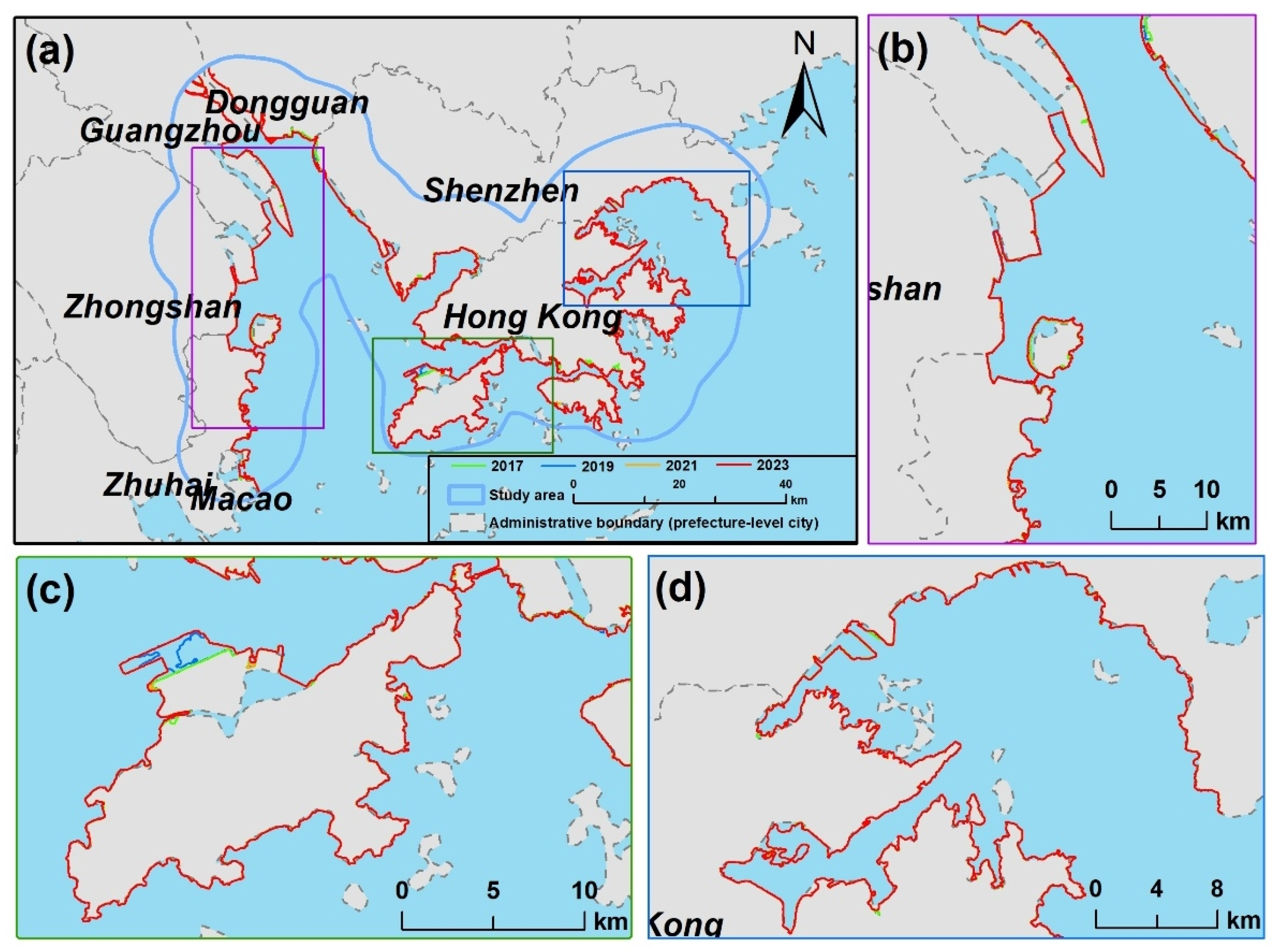
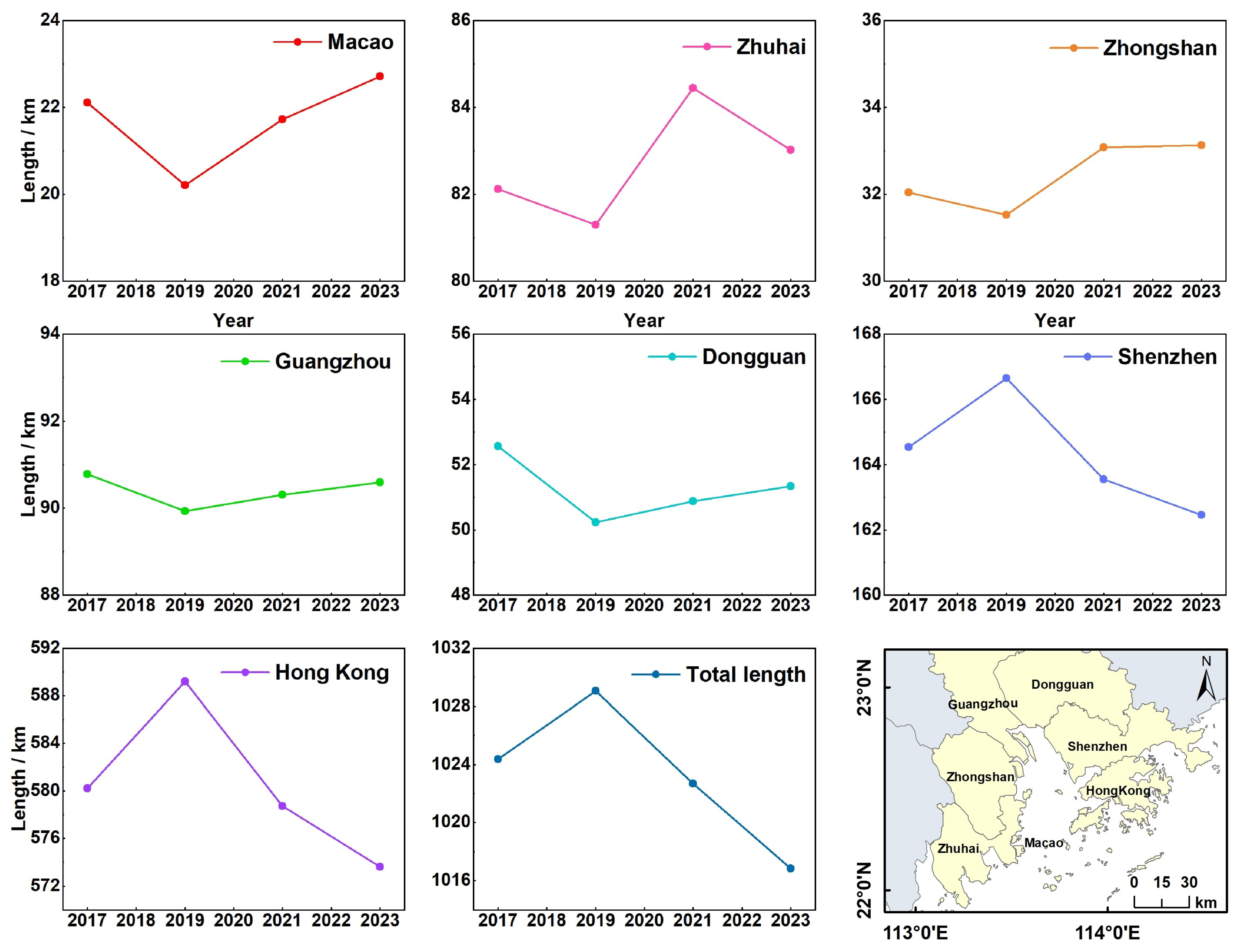
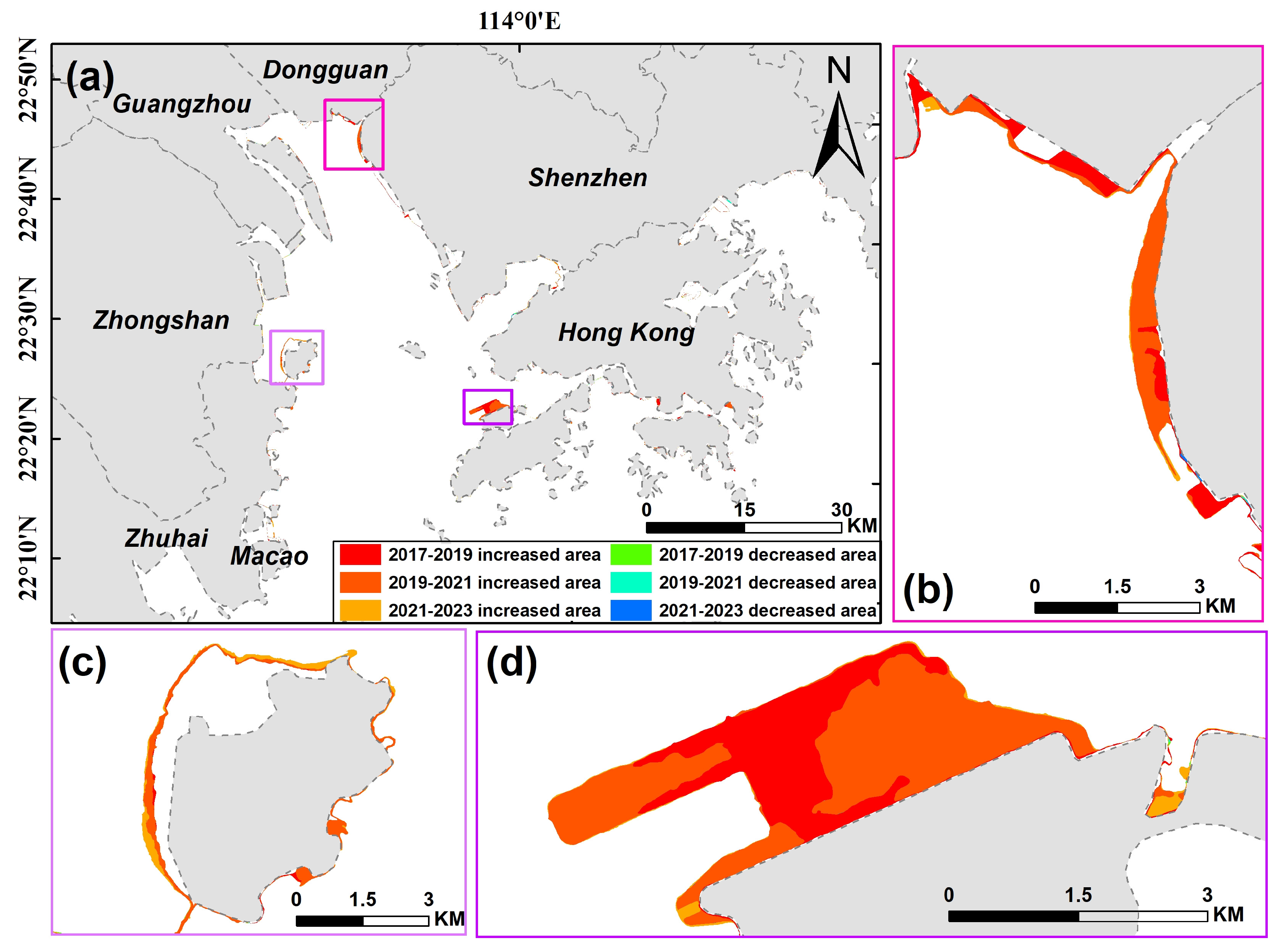
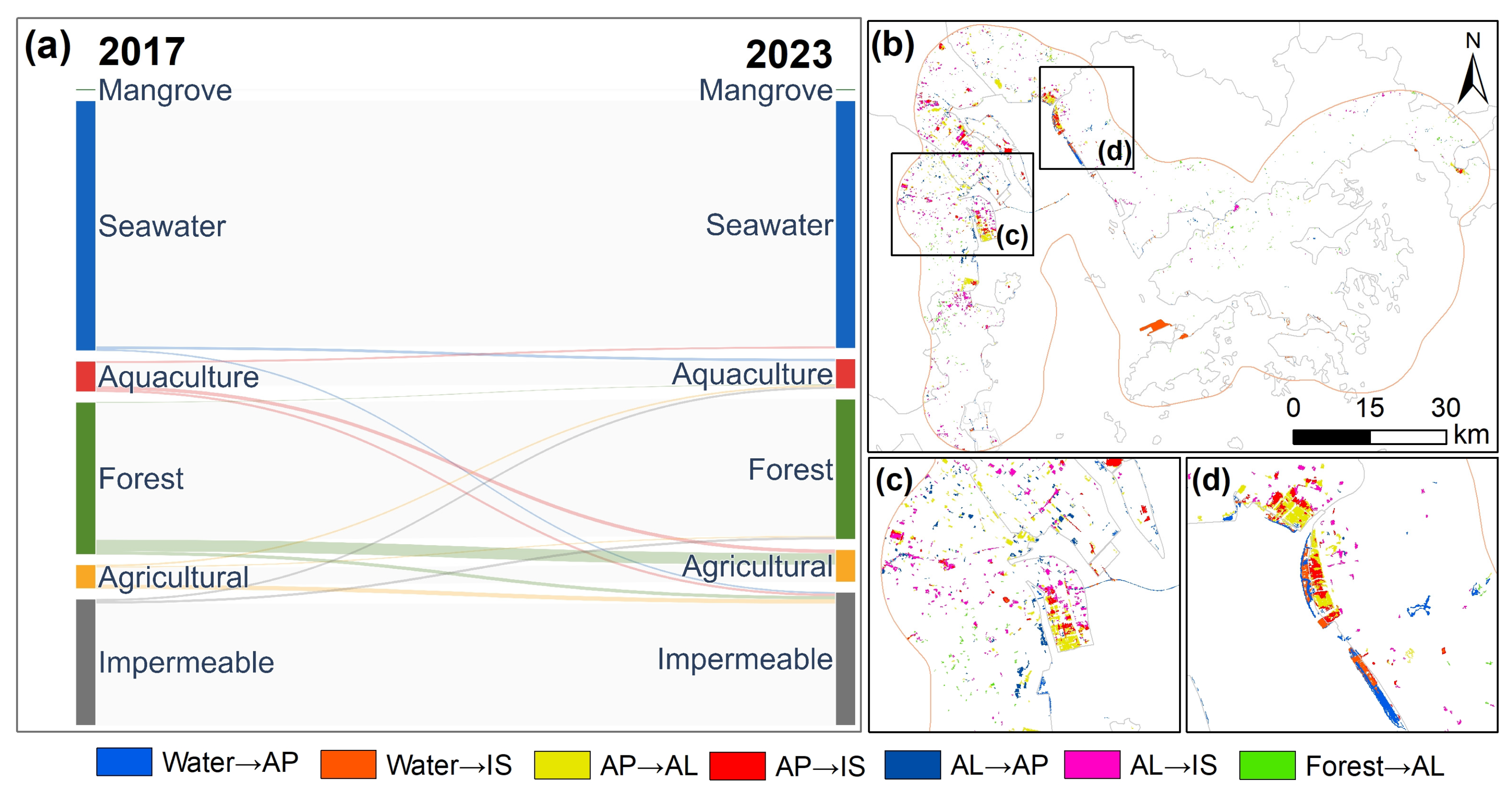
The observed unimodal attenuation of the total coastline length from 2017 to 2023 is a remote sensing manifestation of the two-stage engineering logic of “meandering filling–straightening integration”: the length increase phase (2017–2019) corresponds to the initial implementation phase of reclamation. During this period, artificial coastlines followed the meandering trend of natural coastlines, forming numerous headland-bay details, resulting in a length increase of 14.61 km. After 2019, the reclaimed areas entered the “leveling and functionalization” phase. Through coastline cut-off, straightening, and revetment engineering solidification, the coastlines tended to become smoother, characterized by reduced length but continuous net increase in land area. Regarding the coastline contraction in Hong Kong and Shenzhen, we referred to publicly available engineering records. For instance, the Hong Kong International Airport Third Runway Project commenced in 2016 and entered a period of large-scale land reclamation and leveling in 2019, which may be temporally correlated with the observed trend of coastline smoothing after 2019. To further verify this correlation, we conducted a spatial overlay analysis between the coastline change patches detected from remote sensing during 2017–2023 and the vector extent of the Hong Kong Airport Third Runway reclamation area. The results show that approximately 80.8% of the coastline expansion in western Hong Kong can be attributed to this project, indicating a potential linkage between engineering activities and the observed geomorphic changes. Changes in this region may also be influenced by factors such as natural sediment dynamics and other concurrent projects.
The expansion of AP as the primary driver of area change is essentially the fastest path to realizing the economic value of land in reclamation activities [
43,
44]. As a core area of traditional pond-dyke agriculture, the PRE boasts mature aquaculture technologies and a complete industrial chain. Additionally, its construction cycle is much shorter than the extended cycle of construction land, which involves “reclamation–approval–construction”. This drives AP to become the preferred transitional and functional land use type after reclamation. The concentrated expansion of IS from 2019 to 2021 coincided temporally with the policy window of the Outline Development Plan for the Guangdong-Hong Kong-Macao Greater Bay Area. We infer that this may reflect the release of land demand driven by the plan, given the typical 2–3 years lag between planning approval and project construction. Nevertheless, this outline is not the sole explanation for the construction peak; macroeconomic cycles, local land supply policies, and other administrative factors may have also played significant roles. Meanwhile, the increase in mangrove area after 2020 overlapped temporally with the implementation of Guangdong Province’s Mangrove Conservation Plan (2020). Although this trend aligns with expected restoration effects, potential contributions from other factors—such as natural colonization or reduced anthropogenic disturbance—cannot be ruled out.
During the monitoring period of this study, the reclamation expansion efficiency of the PRE increased from 2.36 km
2/km in the historical period to −3.35 km
2/km. The shift from positive to negative values may suggest that modern coastal reclamation projects have transitioned from extensive expansion to intensive development. Conceptually, such coastal transformation can be delineated into three sequential stages [
45]: an agricultural phase, a port–petrochemical industrial phase, and a rational constraint phase oriented toward quality construction. From a historical perspective, early reclamation in the PRE was dominated by fragmented agricultural pondering and aquaculture pond construction. For instance, during 1978–1987, agricultural land and aquaculture ponds accounted for 88.07% of reclaimed land [
46], characterized by dispersed spatial patterns and low areal output per unit coastline length. With accelerated industrialization, coastal land use underwent a massive transition from agriculture and aquaculture toward transportation, port-based industries, and petrochemical sectors [
47], as major projects such as the Qianhai Shenzhen–Hong Kong Modern Service Industry Cooperation Zone and Dongguan Human Port drove seaward progradation and functional upgrading from singular agricultural protection to industrial clustering and logistics. After 2015, and particularly during this study’s monitoring window (2017–2023), stringent controls on marine ecological red lines and high-quality development policies have further steered coastal utilization toward high-tech industries, modern service sectors, and public ecological spaces [
46]. We detected a coastline expansion of 29.61 km
2 and a loss of 6.85 km
2 during 2017–2021, resulting in a net increase of 22.76 km
2. Similarly, Yin et al. [
48] reported an expansion area of 28.68 km
2, an erosion area of 6.91 km
2, and a net increase of 21.77 km
2 for 2016–2021 in PRE. The findings of the two studies are highly consistent, with the difference in net increase area being less than 1 km
2, and both expansion and erosion areas showing strong agreement. In addition, landmark projects, including the Third Runway System of Hong Kong International Airport and the Qianhai Cooperation Zone, have maximized areal output per unit coastline length through optimized shoreline planning and land use layout. Although reclamation expansion efficiency has turned negative, land use intensification has increased markedly. This trajectory is highly consistent with the findings of Li et al [
49], who documented a progressive shift from an “agriculture–aquaculture orientation” toward a “transportation–industry–urban composite orientation” in the PRE, with artificial shorelines evolving from singular protective functions to diversified and efficient utilization. The emergence of negative efficiency values in this study represents a direct quantitative manifestation of the third stage. The observed unimodal attenuation pattern—characterized by a net reduction in total coastline length (−7.54 km) concurrent with a net increase in land area (25.26 km
2)—reflects a refinement in engineering practices from “meandering filling” to “straightening integration”, rather than an absolute decline in development intensity.
The spatiotemporal pattern analysis provided in this study does not constitute causal empirical evidence for the underlying driving forces. Constrained by the availability of engineering data, the associations between specific projects or policies are mainly inferred based on spatiotemporal synchronization and regional contextual knowledge. The main limitations of this study are as follows: First, spatial data are insufficient, as construction vector files are lacking to verify the spatial correspondence between observed changes and individual projects. Second, it is difficult to remove natural background trends to isolate the net effects of policies. Third, the scarcity of process data prevents the establishment of a mechanistic logical chain using investment records or planning documents. Therefore, in future research, in-depth integration of administrative records and socioeconomic data is required to achieve more scientifically robust causal attribution.
In short, the dual characteristics of “stable moderate growth” and “efficiency improvement” of reclamation in the PRE from 2017 to 2023 are not only a direct manifestation of the national ecological civilization strategy in coastal zone development but also reflect that the PRE, as the core area of the Guangdong-Hong Kong-Macao GBA, has entered a quality-prioritized transformation phase in its coastal zone development. This transformation provides a reference paradigm for coastal zone development under ecological constraints in other coastal regions and offers a PRE case study for an in-depth understanding of the interactive relationship between human activities, ecological constraints, and coastal zone evolution.
Several limitations should be acknowledged, each pointing toward productive directions for future research. First, the associations drawn between observed coastline changes and specific engineering projects or policies (e.g., Hong Kong Airport Third Runway, Guangdong Mangrove Conservation Plan) are based on spatiotemporal overlap and contextual knowledge, not formal causal inference. Construction vector files, tide-gauge records, and administrative investment data were not available for this study. Future work should integrate these data sources within a difference-in-differences or synthetic control framework to isolate the causal effects of individual policies and projects on coastline evolution. Second, residual tidal uncertainty, transitional land-cover ambiguity in active reclamation zones (e.g., cofferdam water bodies), and the simplification inherent in a six-class classification scheme represent irreducible sources of error at the 10 m pixel scale. The reported ~8.4 m mean coastline RMSE includes contributions from genuine geomorphic change, interpreter digitizing error, and any residual tidal offset; disentangling these components requires per-overpass tide-gauge data. A hierarchical or fuzzy-membership classification scheme for transitional surfaces would further refine reclamation-stage tracking. Finally, the generalizability of the AEF + RF framework beyond the Pearl River Estuary—an anthropogenically dominated, microtidal, sediment-rich estuary—remains untested. Comparative multi-estuary validation in contrasting settings (e.g., a macrotidal estuary, a sediment-starved erosional delta, and a mangrove-dominated tropical estuary) is needed to establish the boundary conditions under which the approach is reliable. Coupling the resulting land-use transition probabilities with sea-level rise projections (IPCC SSP scenarios) would further enable scenario-based forward modeling of coastline configurations to 2035 and 2050, directly supporting marine spatial planning in the Greater Bay Area and comparable coastal regions.
5. Conclusions
Based on the GEE platform, this study systematically monitored the spatiotemporal evolution characteristics of the coastline and coastal land use in the PRE from 2017 to 2023, utilizing AEF remote sensing data and Sentinel-2 images with the RF classification method. The coupling mechanism between coastal zone resources and environmental changes under intensive human activities was elucidated. The main conclusions are as follows:
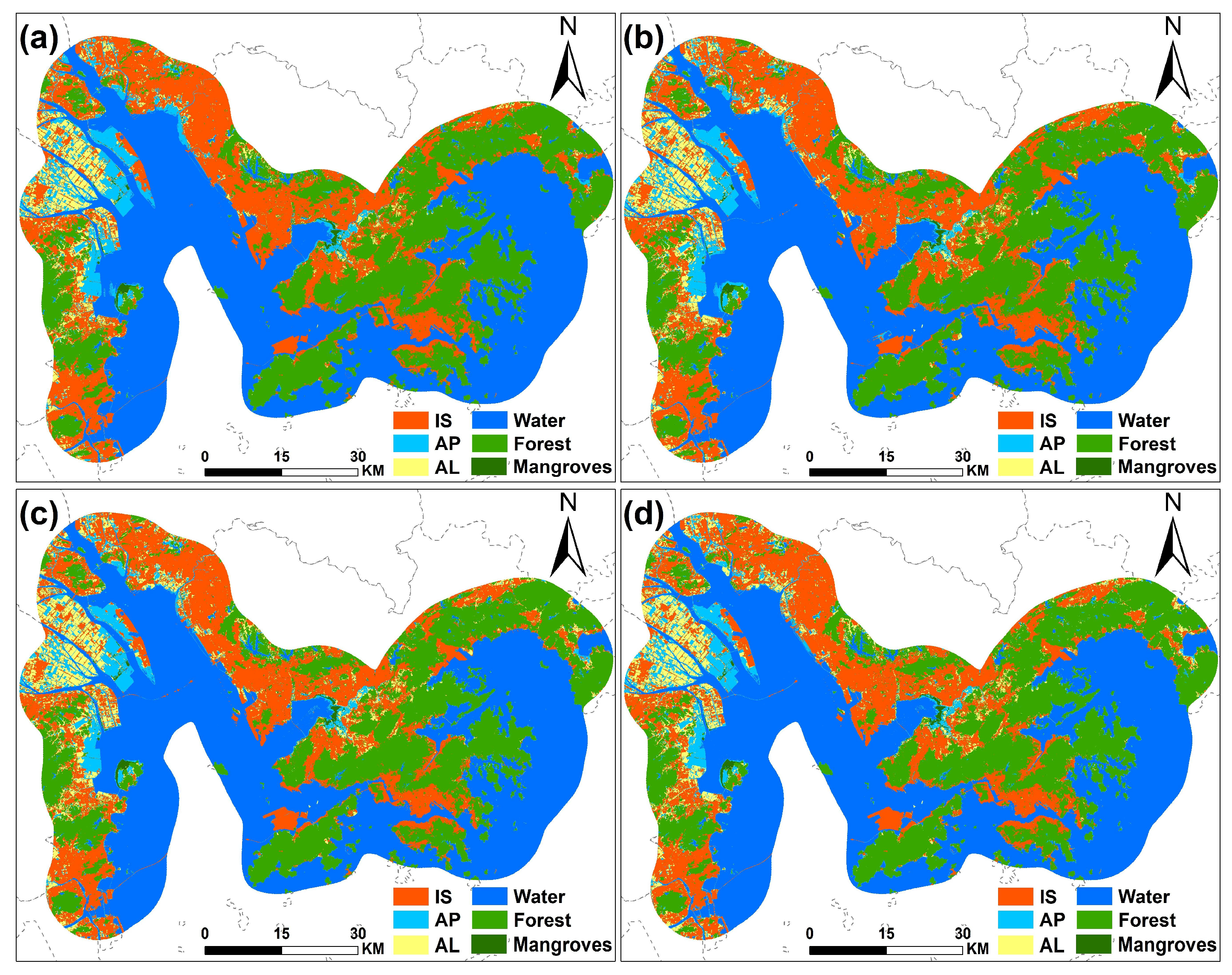
(1) AEF data demonstrates significant advantages for coastal zone monitoring. Compared with Sentinel-2 images, the AEF increased the average overall classification accuracy by 5.03% to over 92%, and the average Kappa coefficient by 11.47% to over 89%. This approach enables high-precision land cover identification under small-sample conditions.
(2) The PRE coastline exhibits an evolutionary pattern of “overall contraction with regional differentiation”. From 2017 to 2023, the total length of the coastline showed a unimodal “increase-then-decrease” trend: after reaching a peak of 1029.05 km in 2019, it continued to decrease to 1016.84 km in 2023, resulting in a cumulative net reduction of 7.54 km over the entire study period. Hong Kong recorded the largest net reduction in coastline length (6.61 km), which is closely associated with the timeline of large-scale reclamation projects; in contrast, Zhongshan achieved a net increase of 1.08 km, representing the most significant growth in the region.
(3) The area expansion driven by reclamation activities displays a trend of “slowing intensity and structural transformation,” with a close spatiotemporal coupling between land use changes and coastline artificialization. During the study period, the cumulative net expansion area reached 25.26 km2: the expansion intensity was relatively high in 2017–2021, but slowed down during 2021–2023. The utilization structure of the newly added land is characterized as “aquaculture-dominated and construction-followed”: AP accounted for over 50% of the total for an extended period, while the expansion of IS reached a peak of 4.97 km2 in 2019–2021, accounting for 33.1% of the newly added area in the same period, indicating that urban construction demand remains strong.
This study delivers novel insights and a robust scientific foundation for the refined governance of coastlines, sustainable land use planning, and coastal-marine ecological conservation in the Pearl River Estuary, as well as other similar coastal regions across the globe.






 ,
,