Article

First Application of AlphaEarth Data for Detecting Coastline and Land Use Changes in the Pearl River Estuary, China

1
School of YonYou Digital and Intelligence, Nantong Institute of Technology, Nantong 226002, China
2
State Key Laboratory for Geological Processes and Mineral Resources, China University of Geosciences Beijing, Beijing 100083, China
3
School of Marine Science, Nanjing University of Information Science and Technology, Nanjing 210044, China
4
School of Nursing, The Hong Kong Polytechnic University, Hong Kong 999777, China
5
Department of Information Engineering, Electronics and Telecommunications, Sapienza University of Rome, Via Eudossiana, 00185 Rome, Italy
6
College of Marine Science and Technology, Zhejiang Ocean University, Zhoushan 316022, China
7
Department of Architecture and Civil Engineering, City University of Hong Kong, Hong Kong 999777, China
8
Department of Engineering, Università di Napoli Parthenope, 80143 Napoli, Italy
*
Author to whom correspondence should be addressed.
Remote Sens. 2026, 18(12), 1921; https://doi.org/10.3390/rs18121921
Submission received: 2 May 2026 / Revised: 4 June 2026 / Accepted: 5 June 2026 / Published: 10 June 2026
(This article belongs to the Special Issue Emerging Remote Sensing Technologies in Coastal Observation)

Highlights

What are the main findings?
  • AlphaEarth Foundations (AEF) data significantly outperforms Sentinel-2 imagery for coastal zone classification in the Pearl River Estuary, achieving mean overall accuracy of >91% and mean Kappa coefficient of >89% under the same Random Forest framework.
  • The PRE coastline followed a unimodal “increase–then–decrease” trajectory over 2017–2023, peaking at 1029.05 km in 2019 before declining to a cumulative net reduction of 7.54 km over the seven-year period.
  • Land area expanded by a net 25.26 km2, driven predominantly by aquaculture pond expansion (>50% of newly reclaimed land) and impervious surface growth (24.52%), while reclamation intensity slowed markedly after 2021.
What are the implications of the main findings?
  • AEF data offers a reliable, cloud-robust, and tidally stable alternative to traditional optical imagery, enabling high-precision, small-sample coastline and land-use monitoring in complex estuarine environments.
  • The observed shift from “meandering filling” to “straightening integration” in reclamation practices signals a transition from extensive coastal expansion toward intensive, quality-oriented development under tightening marine ecological red-line policies.
  • The quantified coupling between aquaculture-driven land expansion and coastline artificialization provides a scientific baseline for refined coastline governance, sustainable land-use zoning, and coastal ecological conservation in the Pearl River Estuary and comparable regions globally.

Abstract

Continuous dynamic monitoring of coastline changes is essential for revealing the evolutionary laws and spatiotemporal characteristics of coastal systems. In this study, we employed AlphaEarth Foundations (AEF) data and Sentinel-2 imagery to investigate coastline and land use changes in the Pearl River Estuary (PRE) region over the period 2017–2023. The Random Forest (RF) algorithm was adopted to extract coastlines and classify coastal land-use types, after which their spatiotemporal evolution was quantitatively analyzed. The results demonstrate that the classification performance of AEF data is significantly better than that of Sentinel-2 imagery, with the average overall accuracy and Kappa coefficient exceeding 92% and 89%, respectively. The PRE coastline shows an evolutionary pattern of “overall contraction accompanied by regional differentiation”: its total length first increased and then decreased, peaking at 1029.05 km in 2019, representing a cumulative net reduction of 7.54 km over the 2017–2023 period. Meanwhile, land use expansion driven by reclamation resulted in a cumulative net increase of 25.26 km2. Aquaculture ponds (AP) constitute the dominant type of newly reclaimed land, accounting for more than 50%, while the expansion of impervious surface (IS) accounts for 24.52%. This study provides novel insights and a scientific basis for the refined management of coastlines, sustainable land use planning, and coastal-marine ecological protection in the Pearl River Estuary and similar regions worldwide.

1. Introduction

As a dynamic geographical boundary of land–sea interaction, the coastline is not only a core identifier for delineating the spatial extent of marine and terrestrial areas but also a key factor in maintaining the stability of coastal zone ecosystems and supporting regional sustainable development [1,2]. Defined by the trace of the average high tide level, both ecological vulnerability and functional complexity characterize the coastline. It serves as a carrier for critical habitats such as coastal wetlands, mangroves, and coral reefs [3,4,5,6], plays an irreplaceable role as an ecological barrier by regulating regional climate, buffering marine disasters, and preserving biodiversity [7]. Meanwhile, as the primary spatial carrier for economic activities, including port shipping, aquaculture, and coastal tourism [8,9], it provides a valuable resource base and development platform for coastal regions. However, driven by rapid urbanization and industrialization, human activities such as reclamation projects, coastline hardening, and overexploitation of nearshore resources have significantly altered the natural morphology and ecological processes of the coastline [10,11,12]. Coupled with natural stressors such as sea-level rise and increased frequency of extreme events induced by global climate change, the coastal zone is confronting systemic risks, including intensified erosion, habitat fragmentation, and degradation of ecological functions [10,13]. Therefore, accurate and up-to-date coastline information is crucial for optimizing coastal spatial planning, safeguarding ecological security, and promoting high-quality development.
Dynamic monitoring and accurate extraction of coastlines are fundamental for coastal zone resource management and ecological security assessment [14], and the quality of these data directly determines the scientific validity of subsequent research and decision-making. While traditional field surveys can provide high-precision local data, they are constrained by inherent limitations such as restricted spatial coverage, high time costs, and significant labor requirements [15,16], making it difficult to meet the demands for regular and high-frequency monitoring of large-scale coastal zones. With technical advantages including broad spatial coverage, non-contact observation, integration of multi-source and multi-scale data, and near-real-time response [17,18,19], remote sensing technology has become the mainstream method for coastline extraction, effectively overcoming the limitations of traditional approaches. Current remote sensing extraction methods are mainly categorized into two types: visual interpretation and automatic extraction [20,21,22]. The former relies on manual interpretation of land-water boundary markers; although it offers some flexibility in special coastal sections, it suffers from high subjectivity, low efficiency, and poor repeatability, thereby hindering standardized and large-scale applications. In contrast, automatic extraction methods establish algorithmic models based on image features such as spectrum, texture, and geometric characteristics to achieve intelligent identification of land-water boundaries [22,23], significantly improving extraction efficiency and objectivity and enabling large-scale processing of multi-source remote sensing data.
In automatic coastline extraction, threshold segmentation and image classification are two mainstream paradigms. Threshold segmentation separates land-water boundaries using spectral indices (e.g., NDWI, MNDWI, and AWEI) and is characterized by simple principles and high computational efficiency. However, it relies heavily on single spectral features and is susceptible to interference from environmental factors such as clouds, tidal levels, and suspended solids. In complex coastal sections—such as estuarine wetlands or areas where artificial and natural coastlines intersect—spectral confusion between land and water features frequently occurs, and a single global threshold often leads to discontinuities, offsets, or misclassifications [24]. To address these limitations, classical machine learning methods, including Random Forest (RF), Support Vector Machine, and object-based image analysis (OBIA), have been employed [25,26,27,28]. Boussetta et al. (2023) demonstrated that an OBIA-RF combined approach achieved 95% overall accuracy for coastline extraction on Jerba Island using Landsat and Sentinel-2 imagery [29], and Baselice et al. (2013) utilized unsupervised learning with Bayesian estimation to achieve accurate extraction of the Naples bay coastline from SAR imagery [30].
The integration of deep learning (DL) with remote sensing has further transformed coastline extraction, shifting the paradigm from feature engineering to end-to-end representation learning. Convolutional neural networks (CNNs) form the cornerstone of this evolution. Seale et al. [31] implemented automated coastline extraction from Sentinel-2 imagery using a CNN-based semantic segmentation framework [31], while Çelik and Gazioğlu [32] leveraged a pre-trained VGG16 with transfer learning to classify five coastal types, achieving 89.2% accuracy and demonstrating that transfer learning improves classification performance by 19.3% in data-scarce coastal environments. Beyond standard CNNs, encoder–decoder architectures—particularly U-Net and its variants—have become the dominant framework. Heidler et al. [33] integrated semantic segmentation with edge detection in a dual-framework design to achieve rapid extraction of Antarctic coastlines from Sentinel-1 imagery. Li et al. [34] further optimized deep learning algorithms and verified robust coastline recognition across different geomorphological regions.
Despite the remarkable performance of DL-based methods, their practical applicability to the present study context warrants careful consideration regarding the choice of classifier. First, DL models—particularly deep CNNs and Transformer-based architectures—are inherently data-hungry, typically requiring large volumes of high-quality pixel-level labels to generalize effectively without overfitting. In the PRE, where historical land-cover reference maps are sparse and labor-intensive manual digitization is constrained by the optically complex environment, such labeled datasets are not readily available at the spatial and temporal scales required for this study. Second, the core objective of this work is not to maximize classification accuracy through model complexity, but to test a specific information-representation hypothesis: whether AEF embeddings—which encode multi-source Earth observation signals beyond surface reflectance—provide systematically richer discriminative features than conventional optical imagery. A well-established, interpretable classifier such as RF serves as a controlled experimental vehicle for this purpose: its feature importance metrics allow direct quantification of each input band’s contribution, enabling a transparent attribution of performance gains to the AEF inputs rather than to architectural innovations. Third, RF’s ensemble-based bagging strategy is inherently robust to small sample sizes and high-dimensional feature spaces, and its low sensitivity to hyperparameter choices reduces the risk of confounding the input-signal hypothesis with tuning artifacts—a concern that is difficult to fully eliminate in deep networks. Finally, from an operational standpoint, RF’s computational efficiency and ease of deployment align with the practical goal of establishing a repeatable, transparent coastline monitoring workflow that can be maintained by coastal management agencies without specialized deep learning infrastructure.
A more fundamental issue, however, transcends the choice of classifier: the vast majority of existing approaches—whether CNN-, Transformer-, or RF-based—fundamentally depend on surface reflectance as the primary information source. In optically complex coastal environments—characterized by persistent cloud cover, high atmospheric humidity, complex suspended sediment dynamics, and large tidal ranges—surface-reflectance-only approaches face well-documented physical constraints on temporal frequency and spatial accuracy. The PRE exemplifies these challenges. With an annual average cloud fraction exceeding 70%, high atmospheric humidity, complex suspended sediment dynamics, and tidal ranges of approximately 1.0–2.5 m, the PRE presents a particularly challenging environment for optical remote sensing. Existing studies on PRE coastline change (Hu et al., 2022; Ai et al., 2019; Wang et al., 2013) all relied on traditional optical imagery and were consequently constrained by cloud gaps, tidal-phase inconsistency across scenes, and spectral confusion in turbid estuarine waters—limitations explicitly acknowledged by those authors [35,36,37]. These well-documented failures point to a deeper question: whether an alternative information paradigm can overcome the inherent physical limitations of surface-reflectance-only approaches in such environments. This study addresses this question by employing AEF (geospatial foundation model embeddings) in conjunction with Sentinel-2 data. The scientific significance of AEF lies not in its novelty as a dataset, but in testing a fundamentally different information paradigm: whether geospatial foundation model embeddings—which integrate multi-source Earth observation signals including SAR, optical, and ancillary data through self-supervised learning—can overcome the well-documented physical limitations of surface-reflectance-only approaches in optically complex coastal environments. This is a testable hypothesis about information representation, not a claim of data novelty.
Accordingly, using multi-temporal AEF and Sentinel-2 remote sensing data, this study adopts the RF algorithm to automatically extract coastlines and classify coastal land use in the PRE. The main objectives are threefold:
(1) Can AEF, which encode multi-source Earth observation information beyond surface reflectance, achieve systematically higher land-cover classification accuracy than conventional optical imagery in a cloud-prone, tidally complex estuarine environment, and if so, what is the magnitude and consistency of this improvement?
(2) Over the 2017–2023 period—during which the Guangdong–Hong Kong–Macao GBA experienced both accelerated development and the implementation of marine ecological red-line policies—what are the spatiotemporal patterns of coastline length change and associated land area gains/losses, and do they reveal a transition in the dominant mode of coastal modification?
(3) What is the coupling relationship between specific land-use conversion pathways (aquaculture expansion, urban construction, mangrove change) and coastline morphological evolution, and does the land-use composition of newly reclaimed land shift over time in response to changing policy and economic drivers?

2. Materials and Methods

2.1. The Study Area

The study area is delineated between 22.12°N–22.89°N latitude and 113.44°E–114.56°E longitude, and is located in the south-central part of Guangdong Province. It covers cities including Zhuhai, Zhongshan, Guangzhou, Dongguan, Shenzhen, Hong Kong, and Macau, serving as a critical hub connecting the inland regions of the Guangdong-Hong Kong-Macau Greater Bay Area (GBA) to the northern part of the South China Sea. Geomorphologically, the region is a complex estuary characterized by the coexistence of a network of river systems and relic estuaries in the Pearl River Delta. Climatically, the area experiences a southern subtropical monsoon climate, with an annual average temperature of approximately 22 °C and abundant precipitation, providing favorable physical geographical conditions. As the economic core zone of China’s southern coast and a key node of land–sea interaction, the PRE has undergone significant artificial transformation of its coastlines driven by intensive economic activities such as the construction of shipping hubs, development of port-adjacent industries, urban expansion, and coastal tourism. These characteristics make the PRE a representative study area for investigating resource-environment coupling relationships in coastal zones.

2.2. Data Collection and Preprocessing

Based on the GEE platform, this study acquired annual AEF and Sentinel-2 images at one-year intervals from 2017 to 2023.
AEF is a geospatial foundation model released by Google DeepMind in 2025 [38]. Built on a Spatiotemporal Precision Encoder (STP) trained via contrastive learning on over 3 billion image frames from 5+ million global locations, AEF ingests more than 10 Earth observation modalities—including optical satellite imagery (Sentinel-2, Landsat), C-band Synthetic Aperture Radar (Sentinel-1), LiDAR (GEDI, ICESat-2), digital elevation models (SRTM, Copernicus DEM), and climate reanalysis data (ERA5)—and fuses them into a compact 64-dimensional embedding vector at each 10 m × 10 m grid cell. The embedding simultaneously encodes spectral reflectance, surface structural properties (from SAR and LiDAR), seasonal phenological patterns (from multi-temporal sequences), and terrain/climatic context. Because the model inherently prioritizes stable topographic and structural features over instantaneous water column optical properties, the resulting embeddings are substantially less sensitive to tidal phase, suspended sediment concentration, and cloud gaps than conventional surface reflectance data—a decisive advantage for coastline extraction in turbid, high-humidity estuarine environments. Annual embedding snapshots are available from 2017 to 2024 via the Google Earth Engine data catalog (Satellite Embedding V1), enabling direct temporal alignment with the Sentinel-2 imagery used as a control in this study. Sentinel-2 Level-2A (surface reflectance) imagery was retrieved from the COPERNICUS/S2_SR_HARMONIZED collection, which is pre-processed with atmospheric correction via Sen2Cor. To address cloud interference caused by the high-humidity environment of the PRE coastal zone, images with cloud cover ≤20% were selected. Clouds and cloud-shadow pixels were removed using the QA60 band combined with a threshold method, and the cloud-removed areas were filled using the median compositing method. Topographic correction was also performed to ensure the temporal consistency of the data. Median compositing integrates dozens to hundreds of images acquired under various tidal conditions. By utilizing the robustness of median statistics to extreme values, the results naturally converge to a stable water-land boundary close to the mean sea level. Statistically, this acts as a smoothing filter for tidal fluctuations, effectively eliminating random errors caused by inconsistent tidal phases at the acquisition time of single images.
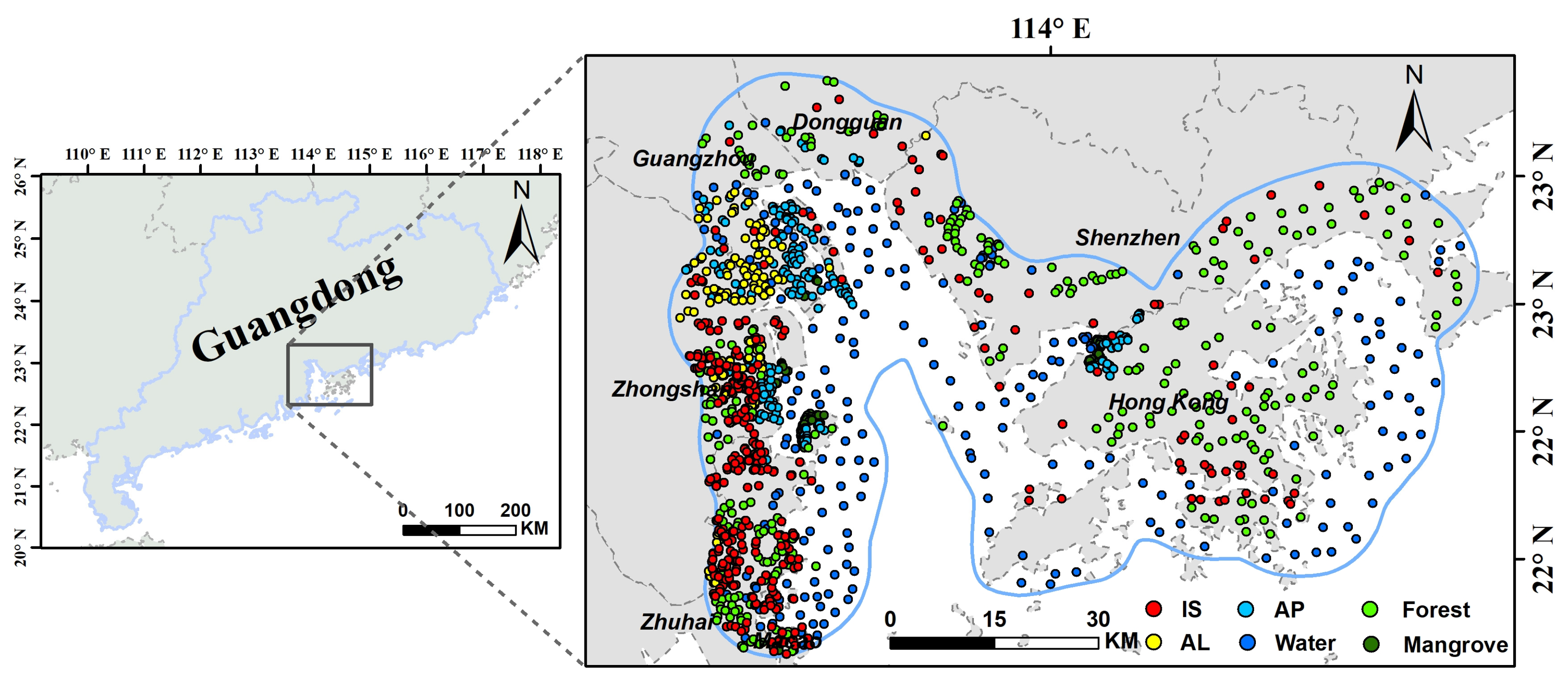
For classification label samples, manual visual interpretation was conducted using high-resolution historical imagery from Google Earth Pro (spatial resolution ≤1 m) within ±3 months of each annual composite date. Six land-cover classes were delineated: impervious surfaces (IS), aquaculture ponds (AP), forest, agricultural land (AL), water, and mangroves. Class assignment followed a spectral–textural–contextual decision key: IS was identified by high visible-band reflectance, rough texture, and clustering in urban/industrial zones; AP by regular rectangular grid patterns with distinct embankment networks adjacent to water bodies; AL by regular parcel geometry and inland location without embankment grids; forest by continuous canopy cover with coarse natural texture on hillslopes; mangrove by intertidal position with low NIR reflectance and irregular patch boundaries along tidal channels; and water by open, low-reflectance, smooth-textured continuous surfaces. Ambiguous mixed-boundary pixels were excluded. A second interpreter independently verified 15% of randomly selected samples, yielding Cohen’s κ > 0.91 for all years. The spatial distribution of annual label samples is shown in Figure 1.
Annual sample counts are summarized in Table 1. Each year’s training set contains approximately 840–910 samples, with 360–395 independent validation samples (70%/30% split). Sample adequacy is supported by three lines of evidence: (1) even the smallest class (mangrove, 98–105 training samples) exceeds the widely accepted threshold of ≥10 × the number of splitting features for stable RF probability estimation; (2) AEF embeddings are inherently sample-efficient—Brown et al. [38] reported 24% lower classification error in low-label regimes—reducing the labeling burden relative to raw reflectance data; and (3) out-of-bag error stabilized at ~300–350 trees for both AEF and Sentinel-2 in all years (Section 3.1), well before the 500-tree ensemble size, indicating classification performance was not sample-limited.

2.3. Random Forest Classification and Coastline Extraction Method

The 64-dimensional encoded data of AEF has been shown to enable high-precision classification without augmentation under small-sample conditions. Based on this characteristic, this study directly uses AEF encoded information as input features to drive the RF ensemble model. RF suppresses overfitting through voting among multiple decision trees, exhibits inherent robustness to high-dimensional and collinear features, and can output feature importance without parameter tuning. It has been widely applied in remote sensing image classification [39,40], thus showing high compatibility with the characteristics of AEF data.
The RF classifier was implemented on the GEE platform with the following hyperparameter configuration: 500 decision trees; 8 features considered at each split (√64 for the AEF 64-dimensional embedding); minimum leaf population of 1; bag fraction of 0.632; and out-of-bag (OOB) mode enabled for convergence assessment. A fixed random seed (0) was set to ensure deterministic reproducibility (Table 2). To maintain a rigorous and unbiased comparison, a control experiment with the same RF configuration was conducted on Sentinel-2 images at the same 10 m spatial resolution: the input features were atmospherically corrected surface reflectance bands (B2–B8, B8A, B11, B12), while other parameters, including training samples, training-validation split ratio, hyperparameters, and post-processing procedures, remained consistent. This design eliminates interference from the RF algorithm, and rigorously verifies that accuracy improvements are solely attributed to the advanced geographic information extraction capability of the AEF foundational model. After RF classification, morphological filtering was first applied to the “water” class raster to remove salt-and-pepper noise, which was then aggregated into vector polygons. The initial coastline was obtained by simplifying the land-water boundary with a 10 m tolerance, and finally, referring to the coastline distribution obtained from OpenStreetMap, semi-autonomous human–machine correction was performed based on the texture continuity and morphological characteristics of surface features. This further suppressed tidal uncertainty and yielded annual high-precision coastlines.
To ensure the unbiased learning rationality of the RF model, several measures were adopted. First, validation accuracy was assessed via stratified random sampling with class allocation proportional to observed area distribution, ensuring that minority classes (e.g., mangroves, <0.5% of the study area) contributed meaningfully to all reported accuracy metrics. Second, the RF bagging mechanism (bag fraction = 0.632) provides an intrinsic OOB error estimate—an asymptotically unbiased estimator of generalization error—computed without consuming any validation data. OOB error stabilized at approximately 300–350 trees for both AEF and Sentinel-2 classifications, well within the 500-tree ensemble, and OOB estimates were within 1.2–1.8% of independent validation OA, confirming the absence of systematic overfitting. Third, training and validation samples were spatially separated with a mean nearest-neighbor distance exceeding 500 m between splits (50 × 10 m), yielding Moran’s I < 0.15 for classification residuals at all spatial lags—well below the threshold for spatial autocorrelation bias (Moran’s I < 0.20).

3. Results

3.1. Classification Accuracy Analysis

Classified datasets from AEF and Sentinel-2 were obtained using the RF classification method. To evaluate classification performance, a stratified sampling strategy was applied within the study area to generate 500 random points (IS 24%, Water 20%, AP 20%, Forest 10%, AL 18%, Mangrove 8%) for each years (2017, 2019, 2021, and 2023), and confusion matrices were computed to derive Overall Accuracy (OA) and Kappa coefficients. As presented in Table 3, the classification performance of AEF data is significantly superior to that of Sentinel-2 data. From the perspective of core evaluation metrics, the OA of AEF exceeds 90% for all years, with an average improvement of 5.03% compared to Sentinel-2. Furthermore, the Kappa coefficients of AEF all surpass 89%, showing an average increase of up to 11.47% relative to Sentinel-2, which demonstrates a more pronounced advantage. The dual verification of the above accuracy and consistency metrics indicates that AEF data can provide more reliable support for classification tasks compared to Sentinel-2 data.
The accuracy of AEF-extracted coastlines was validated against manually interpreted reference coastlines derived from high-resolution Google Earth Pro imagery (≤1 m) for four target years (2017, 2019, 2021, and 2023). Reference coastlines were digitized at a fixed scale of 1:2000 by an experienced analyst, with ambiguous segments independently verified by a second interpreter. RMSE was computed using 500 equally spaced evaluation points (~2 km spacing) along the AEF-extracted coastline, measuring the shortest orthogonal distance to the reference coastline at each point. The results are presented in Table 4.
As a supplementary position-specific check, horizontal displacement was measured at 100 coastal inflection points. The mean displacement ranged from 6.15 m (2017) to 8.80 m (2019), with a four-year average of 7.33 m—all below the 10 m pixel resolution. These results confirm that the AEF-extracted coastlines are geometrically accurate and provide a reliable basis for the subsequent length change and area expansion analyses.

3.2. Analysis of Coastline Changes in the PRE from 2017 to 2023

3.2.1. Analysis of Spatiotemporal Distribution of Coastline Length

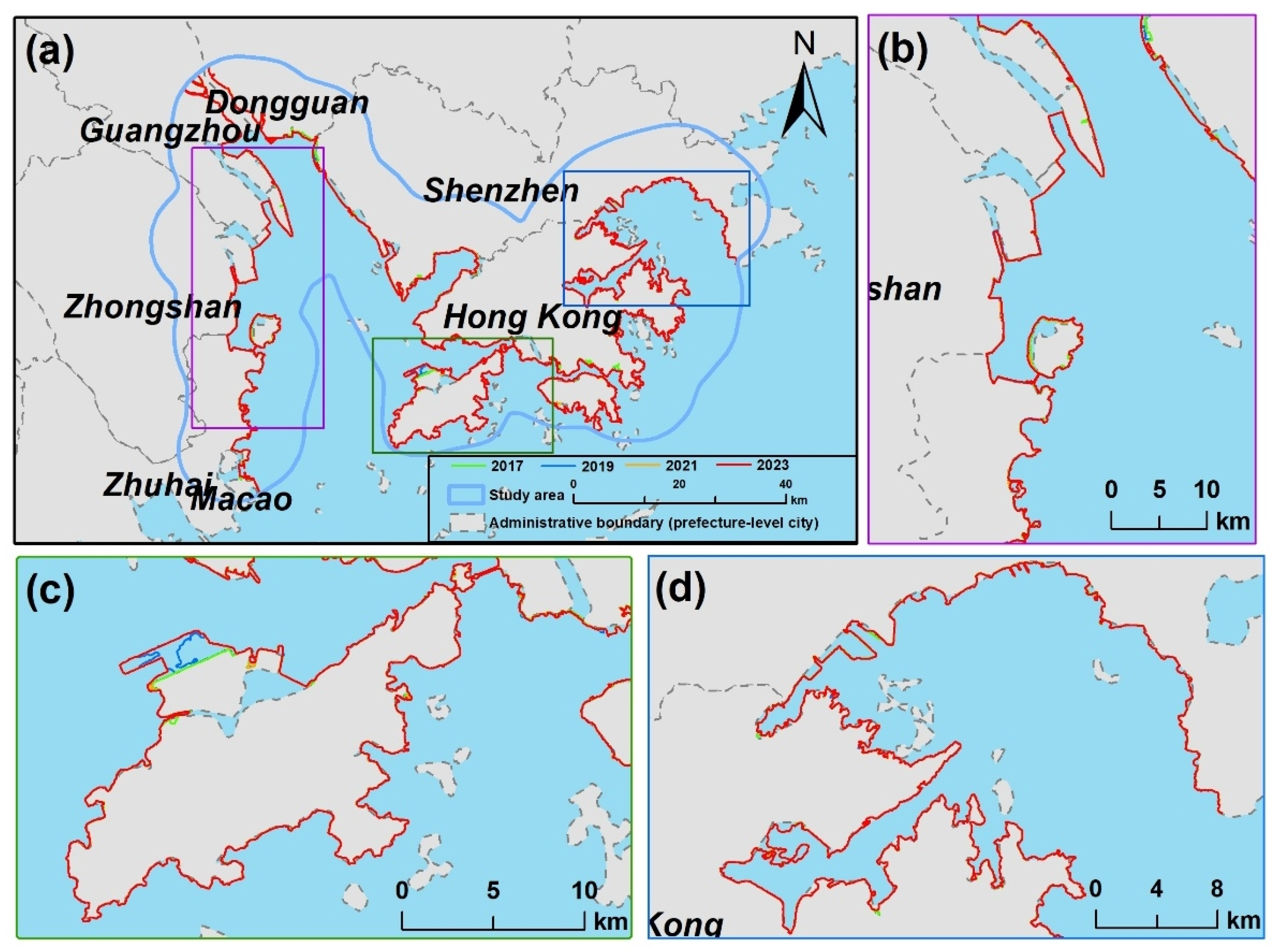
Based on the AEF data, annual coastlines of the PRE were extracted for the period 2017–2023 (Figure 2). Spatially, the coastlines exhibit a distinct binary pattern: one category comprises linear and regular segments with pronounced anthropogenic modification, while the other is characterized by tortuous and fragmented configurations retaining substantial natural geomorphological features. Over the seven-year period, the overall coastal configuration remained largely stable, with most segments showing minimal inter-annual displacement. Notable changes were concentrated in localized areas of Hong Kong, Shenzhen, Dongguan, and Zhuhai, predominantly manifesting as seaward progradation without significant erosional retreat.
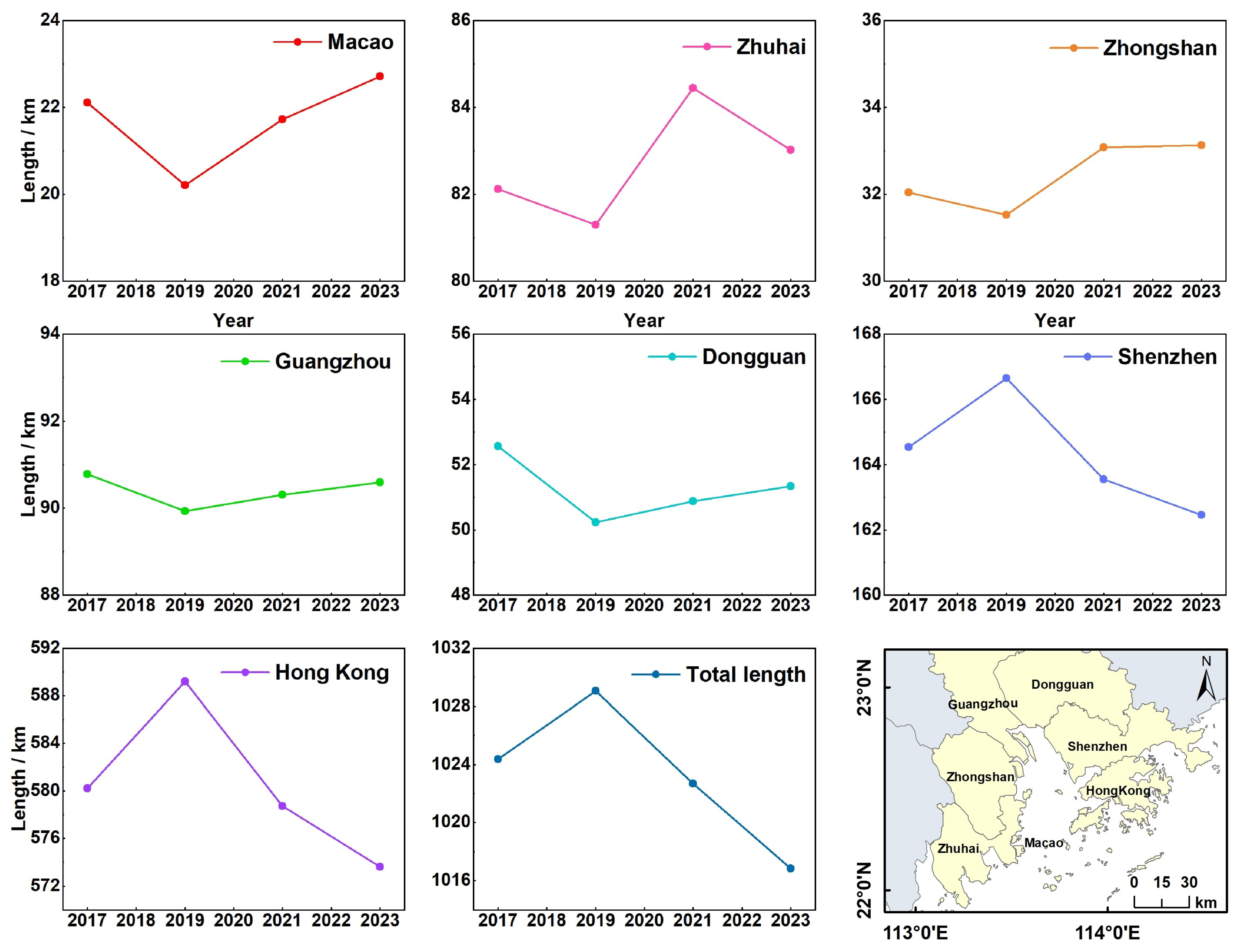
Further quantification of coastline length changes (Figure 3) reveals that, during 2017–2023, the total length of the PRE coastline exhibited a unimodal “increase-then-decrease” pattern. After reaching a peak of 1029.05 km in 2019, it continued to decline, resulting in a cumulative net reduction of 7.54 km by 2023. The study area exhibits distinct regional heterogeneity, with the evolutionary trajectories of each city categorized into three types: (1) Macao, Zhongshan, Guangzhou, and Dongguan followed a “decrease-then-increase” trend but with variations. Zhongshan recorded the highest growth rate across the region, increasing from 32.04 km to 33.12 km (a net increase of 1.08 km). Macao recovered from a trough of 20.21 km in 2019 to 22.72 km (a net increase of 0.61 km). Guangzhou slightly decreased from 90.78 km to 90.59 km (a net reduction of 0.19 km) with the smallest fluctuation amplitude. Dongguan declined from 52.57 km to 51.34 km (a net reduction of 1.23 km). (2) Shenzhen and Hong Kong displayed an “increase-then-decrease” peak attenuation type. Shenzhen reached a peak of 166.65 km in 2019 before dropping to 162.45 km (a net reduction of 2.08 km). Hong Kong increased from 580.22 km to 589.20 km and then continued to decline to 573.61 km (a net reduction of 6.61 km), representing the largest reduction in the region. (3) Zhuhai exhibited a unique three-stage fluctuating adjustment of “decrease-increase-decrease”: starting from 82.12 km, it transitioned through 81.30 km and 84.45 km before eventually settling at 83.02 km, maintaining a net increase of 0.90 km by the end of the period.

3.2.2. Analysis of Area Expansion Driven by Coastline Changes

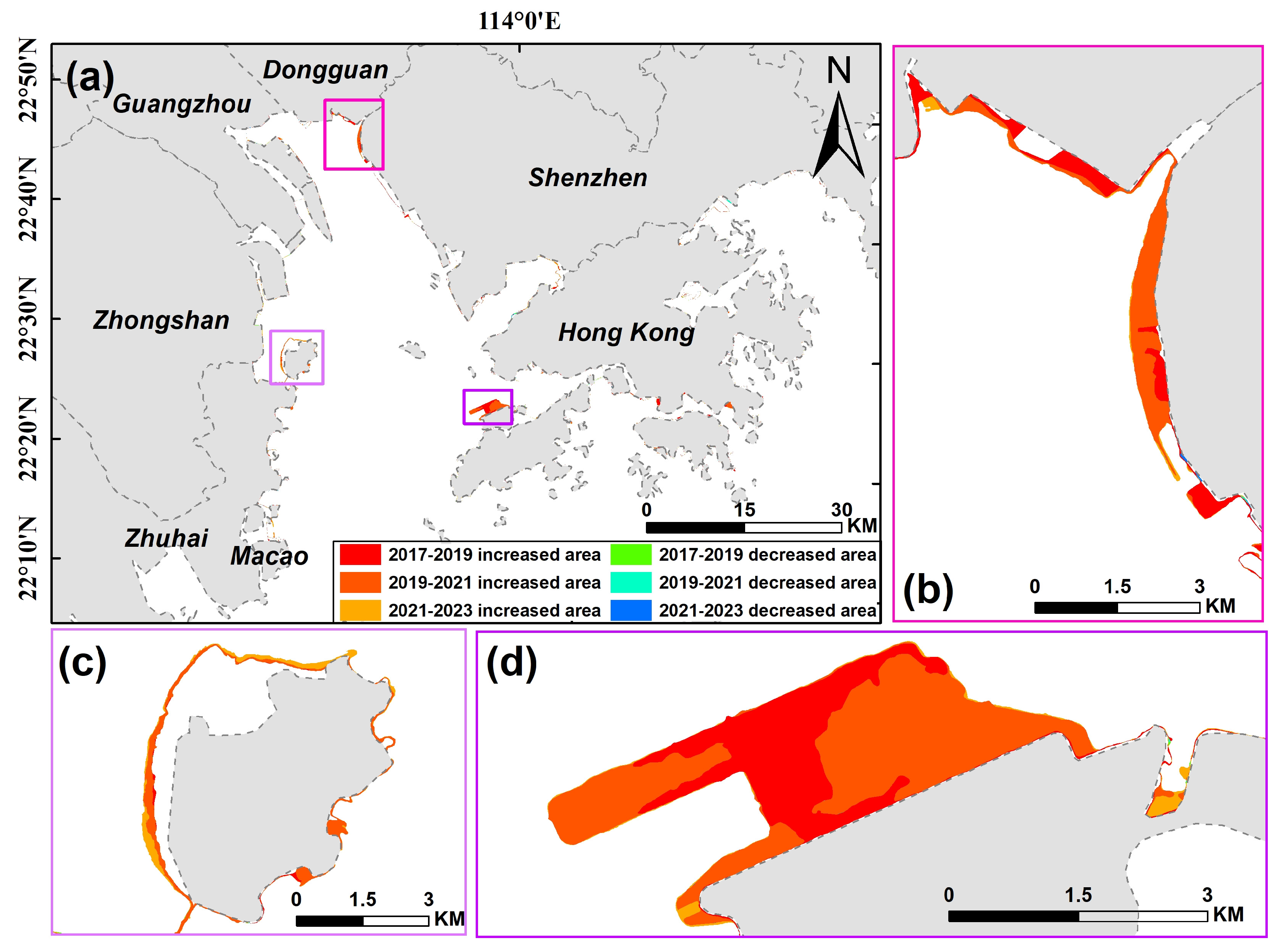
Based on monitoring data from 2017 to 2023, the coastal cities of the PRE exhibited an overall dominance of seaward expansion (Figure 4). In terms of total area (Table 5), the cumulative expansion area across the three periods reached 35.40 km2, while the reduced area was only 10.14 km2, demonstrating a prominent net expansion effect.
Spatially (Figure 4), the core areas of expansion are concentrated at the junction of Dongguan and Shenzhen, as well as Zhuhai and Hong Kong, with the expansion varying across different regions. Hong Kong is the region with the largest total expansion area, accumulating 18.55 km2 over the three periods. Notably, the 2017–2021 periods contributed about 85.01% to expansion, while the expansion rate slowed during 2021–2023. This trend aligns with the construction of Hong Kong International Airport. During the same period, Hong Kong’s total reduced area was 4.09 km2, indicating a significant overall net expansion. Shenzhen experienced its largest expansion during the second period (3.45 km2), which was higher than in the first and third periods (2.74 km2 and 0.91 km2, respectively). In contrast, Dongguan showed a declining trend of small-scale expansion (from 1.76 km2 to 0.83 km2 and then to 0.36 km2), while the corresponding reduced area exhibited an increasing trend (from 0.19 km2 to 0.34 km2 and then to 0.46 km2).
For Zhuhai, the expansion areas in three periods were 0.55 km2, 1.23 km2, and 0.38 km2, respectively. Although the scale was smaller, the expansion exhibited strong continuity. Its reduction area showed a “decrease-increase” fluctuation, with expansion remaining dominant overall. Furthermore, the expansion area in other regions was relatively limited. Among these, Guangzhou showed a net increase of 1.2 km2 from 2017 to 2023. The expanded and reduced areas in Zhongshan were relatively balanced. But due to its small base area, Macao exhibited low magnitudes of change across all periods.

3.3. Spatiotemporal Coupling Characteristics of Land Use and Coastline Artificialization in the PRE from 2017 to 2023

3.3.1. Analysis of Land Use Change

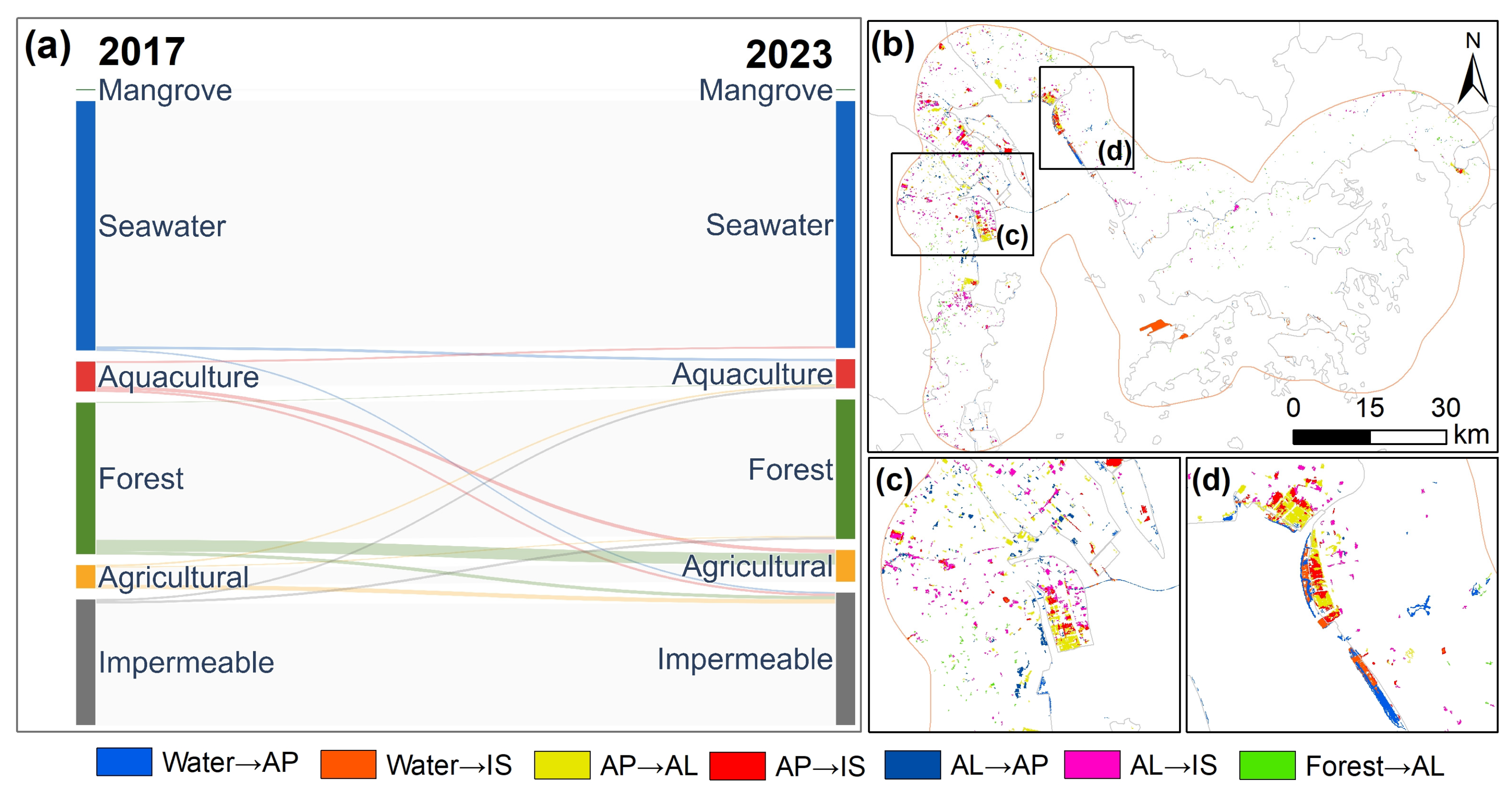
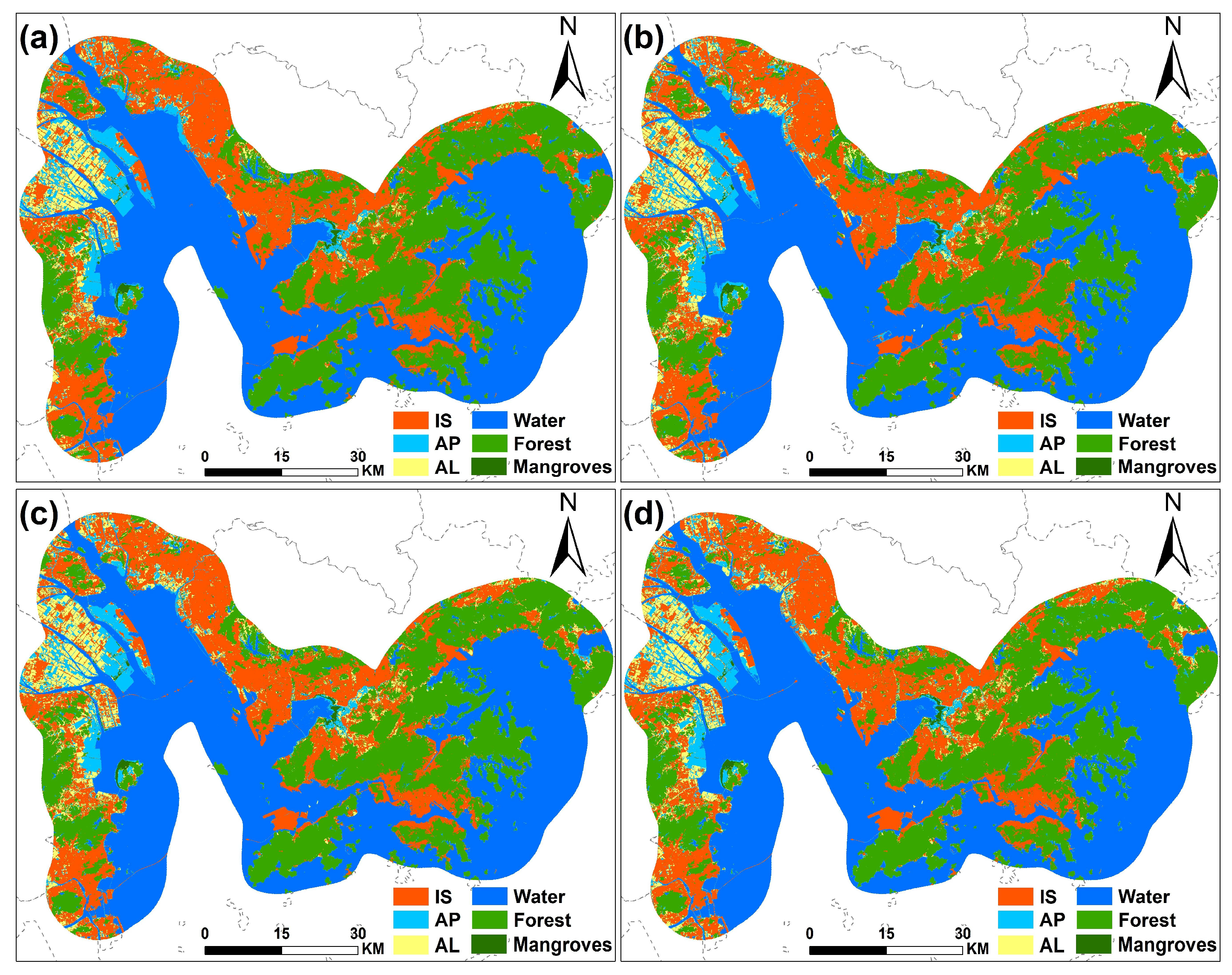
Figure A1 reveals that the nearshore land use in the PRE exhibits a significant spatial differentiation pattern: mangroves are distributed in fragmented patches along the western junction of Shenzhen and Hong Kong. AP and AL are concentrated along the coasts of Guangzhou, Zhongshan, Dongguan, and Shenzhen, with limited conversion from IS to AP. Notably, a prominent trend of AP converting to AL is observed at the Dongguan–Shenzhen junction. Forests form large, continuous areas in Hong Kong and eastern Shenzhen, while remaining relatively scarce in Zhongshan and Zhuhai. IS are distributed in a continuous zone along the Guangzhou–Dongguan–Shenzhen coastal corridor.
Conversions from AP to AL and IS dominate the transition matrix, whereas cropland expansion is primarily derived from forestland (Figure 5). Spatial visualization indicates that land cover changes are concentrated mainly in Guangzhou, Zhongshan and Shenzhen. Inland zones are featured by conversions from AL to IS, while coastal areas are dominated by transitions toward AL and AP.
Table 6 further quantifies the area changes in each land use type from 2017 to 2023. The water area decreased by 25.36 km2, confirming the crowding-out effect of seaward coastline expansion on water space. Among these, forests and IS, as the dominant land use types in the study area, decreased by 2.22% and 1.66%, respectively, with a relatively gentle reduction rate. AL was the only type that exhibited continuous growth, with an area increase of 89.39 km2, mainly derived from AP and forest land. The total loss of AP was 6.91 km2. Although mangroves had the smallest area, they exhibited a “V”-shaped recovery trend with an overall increase of 1.66 km2, which may indicate that the effectiveness of ecological conservation amid intense development.

3.3.2. Dynamic Coupling Mechanism of Land Use and Coastline Changes in the PRE

From 2021 to 2023, the newly added land area was 14.61 km2, among which AL accounted for 8.84 km2 (60.5%), indicating that aquaculture remained the primary driver of coastline changes. Construction land expanded the second most, with an area of 3.11 km2, accounting for 21.3%. From 2019 to 2021, the total newly added land reached 15.01 km2, reaching the peak in the seven years. Although AP maintained dominance (7.43 km2, 49.5%), its proportion decreased. The scale of IS increased significantly to 4.97 km2, with the proportion rising to 33.1%, reflecting the growing influence of urban construction on coastline transformation. From 2021 to 2023, the newly added land fell to 5.78 km2, with AP accounting for 66.1%, while IS dropped sharply to 0.60 km2 (only 10.4%), indicating a slowdown in land reclamation activities. However, cofferdam water bodies maintained a stable increase of 1.27–2.33 km2 across all three periods, accounting for 10.5–16.0% of the total newly added area. This reflects the persistent presence of semi-developed areas. Among ecological restoration land types, the mangrove area showed a trend of “growth followed by slowdown”, with a slight increase in all three stages and a total net increase of 0.58 km2, indicating that ecological protection measures have achieved tangible effects.
In summary, during 2017–2023 (see Table 7), the coastline changes in the PRE exhibited new characteristics of being “dominated by aquaculture, followed by construction, and generally slowing down”. The continuous expansion of AP remains the primary driver of coastline changes. However, the concentrated release of IS during 2019–2021 indicates that the land demand for urban development remains strong, while the significant decline in reclamation intensity after 2021 is likely closely associated with the tightening of marine ecological red line control policies.

4. Discussion

This study systematically revealed the spatiotemporal coupling characteristics of coastline length fluctuations and land use transformation in the PRE from 2017 to 2023 by comparing the classification performance of AEF and Sentinel-2 data under the RF method. The reliability of the results is supported by a threefold guarantee system of data characteristics, algorithm adaptation, and a validation closed loop: first, as a 64-dimensional embedding vector generated by a geospatial foundation model, AEF integrates multi-source earth observation information through self-supervised learning, enabling effective capture of long-range geographical feature correlations and complex surface patterns [38]. This approach fundamentally overcomes the limitations of traditional remote sensing data that rely solely on surface reflectance bands, significantly reducing the impact of high-humidity environmental interference and mixed pixel effects in coastal zones. This directly explains the intrinsic mechanism by which AEF is systematically superior to raw Sentinel-2 data in terms of overall accuracy and Kappa coefficient (Table 3). In terms of classification model selection, the RF algorithm exhibits high compatibility with AEF: its ability to suppress overfitting through voting among multiple decision trees and inherent robustness to high-dimensional and collinear features can fully exploit the information potential of the 64-dimensional encoding [41,42]. The control experiment with Sentinel-2 (with identical training samples, parameter settings, and post-processing procedures) eliminates the interference of confounding factors, ensuring that the observed accuracy differences are solely determined by the inherent quality of the data. Finally, post-processing steps including morphological filtering, simplification with a 10 m tolerance, and subsequent semi-automatic deviation correction via human–computer interaction effectively suppressed noise during the classification process in the PRE, maintaining land cover classification accuracy at a high level. These procedures provide key support for the reliability of calculations related to coastline length and area changes.
The observed unimodal attenuation of the total coastline length from 2017 to 2023 is a remote sensing manifestation of the two-stage engineering logic of “meandering filling–straightening integration”: the length increase phase (2017–2019) corresponds to the initial implementation phase of reclamation. During this period, artificial coastlines followed the meandering trend of natural coastlines, forming numerous headland-bay details, resulting in a length increase of 14.61 km. After 2019, the reclaimed areas entered the “leveling and functionalization” phase. Through coastline cut-off, straightening, and revetment engineering solidification, the coastlines tended to become smoother, characterized by reduced length but continuous net increase in land area. Regarding the coastline contraction in Hong Kong and Shenzhen, we referred to publicly available engineering records. For instance, the Hong Kong International Airport Third Runway Project commenced in 2016 and entered a period of large-scale land reclamation and leveling in 2019, which may be temporally correlated with the observed trend of coastline smoothing after 2019. To further verify this correlation, we conducted a spatial overlay analysis between the coastline change patches detected from remote sensing during 2017–2023 and the vector extent of the Hong Kong Airport Third Runway reclamation area. The results show that approximately 80.8% of the coastline expansion in western Hong Kong can be attributed to this project, indicating a potential linkage between engineering activities and the observed geomorphic changes. Changes in this region may also be influenced by factors such as natural sediment dynamics and other concurrent projects.
The expansion of AP as the primary driver of area change is essentially the fastest path to realizing the economic value of land in reclamation activities [43,44]. As a core area of traditional pond-dyke agriculture, the PRE boasts mature aquaculture technologies and a complete industrial chain. Additionally, its construction cycle is much shorter than the extended cycle of construction land, which involves “reclamation–approval–construction”. This drives AP to become the preferred transitional and functional land use type after reclamation. The concentrated expansion of IS from 2019 to 2021 coincided temporally with the policy window of the Outline Development Plan for the Guangdong-Hong Kong-Macao Greater Bay Area. We infer that this may reflect the release of land demand driven by the plan, given the typical 2–3 years lag between planning approval and project construction. Nevertheless, this outline is not the sole explanation for the construction peak; macroeconomic cycles, local land supply policies, and other administrative factors may have also played significant roles. Meanwhile, the increase in mangrove area after 2020 overlapped temporally with the implementation of Guangdong Province’s Mangrove Conservation Plan (2020). Although this trend aligns with expected restoration effects, potential contributions from other factors—such as natural colonization or reduced anthropogenic disturbance—cannot be ruled out.
During the monitoring period of this study, the reclamation expansion efficiency of the PRE increased from 2.36 km2/km in the historical period to −3.35 km2/km. The shift from positive to negative values may suggest that modern coastal reclamation projects have transitioned from extensive expansion to intensive development. Conceptually, such coastal transformation can be delineated into three sequential stages [45]: an agricultural phase, a port–petrochemical industrial phase, and a rational constraint phase oriented toward quality construction. From a historical perspective, early reclamation in the PRE was dominated by fragmented agricultural pondering and aquaculture pond construction. For instance, during 1978–1987, agricultural land and aquaculture ponds accounted for 88.07% of reclaimed land [46], characterized by dispersed spatial patterns and low areal output per unit coastline length. With accelerated industrialization, coastal land use underwent a massive transition from agriculture and aquaculture toward transportation, port-based industries, and petrochemical sectors [47], as major projects such as the Qianhai Shenzhen–Hong Kong Modern Service Industry Cooperation Zone and Dongguan Human Port drove seaward progradation and functional upgrading from singular agricultural protection to industrial clustering and logistics. After 2015, and particularly during this study’s monitoring window (2017–2023), stringent controls on marine ecological red lines and high-quality development policies have further steered coastal utilization toward high-tech industries, modern service sectors, and public ecological spaces [46]. We detected a coastline expansion of 29.61 km2 and a loss of 6.85 km2 during 2017–2021, resulting in a net increase of 22.76 km2. Similarly, Yin et al. [48] reported an expansion area of 28.68 km2, an erosion area of 6.91 km2, and a net increase of 21.77 km2 for 2016–2021 in PRE. The findings of the two studies are highly consistent, with the difference in net increase area being less than 1 km2, and both expansion and erosion areas showing strong agreement. In addition, landmark projects, including the Third Runway System of Hong Kong International Airport and the Qianhai Cooperation Zone, have maximized areal output per unit coastline length through optimized shoreline planning and land use layout. Although reclamation expansion efficiency has turned negative, land use intensification has increased markedly. This trajectory is highly consistent with the findings of Li et al [49], who documented a progressive shift from an “agriculture–aquaculture orientation” toward a “transportation–industry–urban composite orientation” in the PRE, with artificial shorelines evolving from singular protective functions to diversified and efficient utilization. The emergence of negative efficiency values in this study represents a direct quantitative manifestation of the third stage. The observed unimodal attenuation pattern—characterized by a net reduction in total coastline length (−7.54 km) concurrent with a net increase in land area (25.26 km2)—reflects a refinement in engineering practices from “meandering filling” to “straightening integration”, rather than an absolute decline in development intensity.
The spatiotemporal pattern analysis provided in this study does not constitute causal empirical evidence for the underlying driving forces. Constrained by the availability of engineering data, the associations between specific projects or policies are mainly inferred based on spatiotemporal synchronization and regional contextual knowledge. The main limitations of this study are as follows: First, spatial data are insufficient, as construction vector files are lacking to verify the spatial correspondence between observed changes and individual projects. Second, it is difficult to remove natural background trends to isolate the net effects of policies. Third, the scarcity of process data prevents the establishment of a mechanistic logical chain using investment records or planning documents. Therefore, in future research, in-depth integration of administrative records and socioeconomic data is required to achieve more scientifically robust causal attribution.
In short, the dual characteristics of “stable moderate growth” and “efficiency improvement” of reclamation in the PRE from 2017 to 2023 are not only a direct manifestation of the national ecological civilization strategy in coastal zone development but also reflect that the PRE, as the core area of the Guangdong-Hong Kong-Macao GBA, has entered a quality-prioritized transformation phase in its coastal zone development. This transformation provides a reference paradigm for coastal zone development under ecological constraints in other coastal regions and offers a PRE case study for an in-depth understanding of the interactive relationship between human activities, ecological constraints, and coastal zone evolution.
Several limitations should be acknowledged, each pointing toward productive directions for future research. First, the associations drawn between observed coastline changes and specific engineering projects or policies (e.g., Hong Kong Airport Third Runway, Guangdong Mangrove Conservation Plan) are based on spatiotemporal overlap and contextual knowledge, not formal causal inference. Construction vector files, tide-gauge records, and administrative investment data were not available for this study. Future work should integrate these data sources within a difference-in-differences or synthetic control framework to isolate the causal effects of individual policies and projects on coastline evolution. Second, residual tidal uncertainty, transitional land-cover ambiguity in active reclamation zones (e.g., cofferdam water bodies), and the simplification inherent in a six-class classification scheme represent irreducible sources of error at the 10 m pixel scale. The reported ~8.4 m mean coastline RMSE includes contributions from genuine geomorphic change, interpreter digitizing error, and any residual tidal offset; disentangling these components requires per-overpass tide-gauge data. A hierarchical or fuzzy-membership classification scheme for transitional surfaces would further refine reclamation-stage tracking. Finally, the generalizability of the AEF + RF framework beyond the Pearl River Estuary—an anthropogenically dominated, microtidal, sediment-rich estuary—remains untested. Comparative multi-estuary validation in contrasting settings (e.g., a macrotidal estuary, a sediment-starved erosional delta, and a mangrove-dominated tropical estuary) is needed to establish the boundary conditions under which the approach is reliable. Coupling the resulting land-use transition probabilities with sea-level rise projections (IPCC SSP scenarios) would further enable scenario-based forward modeling of coastline configurations to 2035 and 2050, directly supporting marine spatial planning in the Greater Bay Area and comparable coastal regions.

5. Conclusions

Based on the GEE platform, this study systematically monitored the spatiotemporal evolution characteristics of the coastline and coastal land use in the PRE from 2017 to 2023, utilizing AEF remote sensing data and Sentinel-2 images with the RF classification method. The coupling mechanism between coastal zone resources and environmental changes under intensive human activities was elucidated. The main conclusions are as follows:
(1) AEF data demonstrates significant advantages for coastal zone monitoring. Compared with Sentinel-2 images, the AEF increased the average overall classification accuracy by 5.03% to over 92%, and the average Kappa coefficient by 11.47% to over 89%. This approach enables high-precision land cover identification under small-sample conditions.
(2) The PRE coastline exhibits an evolutionary pattern of “overall contraction with regional differentiation”. From 2017 to 2023, the total length of the coastline showed a unimodal “increase-then-decrease” trend: after reaching a peak of 1029.05 km in 2019, it continued to decrease to 1016.84 km in 2023, resulting in a cumulative net reduction of 7.54 km over the entire study period. Hong Kong recorded the largest net reduction in coastline length (6.61 km), which is closely associated with the timeline of large-scale reclamation projects; in contrast, Zhongshan achieved a net increase of 1.08 km, representing the most significant growth in the region.
(3) The area expansion driven by reclamation activities displays a trend of “slowing intensity and structural transformation,” with a close spatiotemporal coupling between land use changes and coastline artificialization. During the study period, the cumulative net expansion area reached 25.26 km2: the expansion intensity was relatively high in 2017–2021, but slowed down during 2021–2023. The utilization structure of the newly added land is characterized as “aquaculture-dominated and construction-followed”: AP accounted for over 50% of the total for an extended period, while the expansion of IS reached a peak of 4.97 km2 in 2019–2021, accounting for 33.1% of the newly added area in the same period, indicating that urban construction demand remains strong.
This study delivers novel insights and a robust scientific foundation for the refined governance of coastlines, sustainable land use planning, and coastal-marine ecological conservation in the Pearl River Estuary, as well as other similar coastal regions across the globe.


Author Contributions

Conceptualization, Y.Z. and Q.C.; methodology, J.F., F.N. and M.M.; software, H.F. and J.Q.; validation, F.W. and K.P.W.; formal analysis, H.F., F.N. and M.M.; investigation, Y.Z., J.F. and F.W.; resources, J.Q. and J.Y.T.; data curation, H.F. and J.F.; writing—original draft preparation, Y.Z. and H.F.; writing—review and editing, Q.C. and K.P.W.; visualization, H.F. and F.W.; supervision, Q.C. and J.Y.T.; project administration, F.W.; funding acquisition, J.Q. All authors have read and agreed to the published version of the manuscript.

Funding

This research is supported by Open Research Project from the State Key Laboratory of Geological Processes and Mineral Resources, China University of Geosciences, Beijing (No. 2026).

Data Availability Statement

This study utilizes the AlphaEarth global satellite embedding dataset (10 m resolution, Satellite Embedding V1), which is natively hosted on the Google Earth Engine (GEE) platform. Additionally, Sentinel-2 imagery was retrieved from the GEE data catalog via the COPERNICUS/S2_SR_HARMONIZED collection. Detailed technical specifications and access paths for these datasets are as follows: AlphaEarth Embedding: Earth Engine Data Catalog—Satellite Embedding V1. Sentinel-2 SR: https://developers.google.com/earth-engine/datasets/catalog/COPERNICUS_S2_SR_HARMONIZED, accessed on 16 April 2026.

Conflicts of Interest

The authors declare no conflicts of interest.

Abbreviations

The following abbreviations are used in this manuscript:
AEFAlphaEarth Foundations
PREPearl River Estuary
RFRandom Forest
APAquaculture ponds
ISimpervious surface
ALagricultural land
OAOverall Accuracy
GBAGreater Bay Area
OBIAObject-based image analysis
DLDeep learning
CNNsConvolutional neural networks
OOBOut-of-bag
PAProducer’s Accuracy
UAUser’s Accuracy
CIConfidence Interval

Appendix A

Figure A1. Spatial distribution of land use changes in the PRE from 2017 to 2023. (a) 2017; (b) 2019; (c) 2021; (d) 2023.
Remotesensing 18 01921 g0a1
Table A1. Accuracy assessment with 95% Bootstrap CI (2017).
ClassPA MeanPA 95% CIUA MeanUA 95% CI
Mangrove99.98%[100.00%, 100.00%]99.98%[100.00%, 100.00%]
Water99.32%[97.71%, 100.00%]96.13%[92.62%, 98.73%]
AP72.94%[56.25%, 87.10%]92.32%[79.41%, 100.00%]
AL76.85%[58.06%, 91.67%]86.94%[70.83%, 100.00%]
Forest98.99%[96.55%, 100.00%]97.03%[93.14%, 100.00%]
IS95.07%[88.71%, 100.00%]90.62%[82.61%, 96.88%]
OA: 94.69% [92.29%, 96.81%]; Kappa: 0.9270 [0.8943, 0.9556].
Table A2. Accuracy assessment with 95% Bootstrap CI (2019).
ClassPA MeanPA 95% CIUA MeanUA 95% CI
Mangrove99.93%[100.00%, 100.00%]88.85%[60.00%, 100.00%]
Water99.31%[97.44%, 100.00%]92.87%[88.31%, 96.55%]
AP69.72%[52.00%, 84.38%]88.48%[73.91%, 100.00%]
AL66.75%[48.28%, 82.76%]95.23%[83.33%, 100.00%]
Forest98.00%[94.74%, 100.00%]96.96%[92.93%, 100.00%]
IS91.72%[83.82%, 98.08%]86.18%[76.79%, 93.65%]
OA: 92.54% [89.60%, 94.93%]; Kappa: 0.8979 [0.8591, 0.9308].
Table A3. Accuracy assessment with 95% Bootstrap CI (2021).
ClassPA MeanPA 95% CIUA MeanUA 95% CI
Mangrove89.07%[62.50%, 100.00%]99.99%[100.00%, 100.00%]
Water99.32%[97.62%, 100.00%]94.20%[90.07%, 97.50%]
AP69.99%[51.72%, 85.71%]91.22%[76.92%, 100.00%]
AL84.94%[70.73%, 96.15%]100.00%[100.00%, 100.00%]
Forest99.01%[96.55%, 100.00%]98.04%[94.64%, 100.00%]
IS94.90%[88.24%, 100.00%]88.93%[80.00%, 95.83%]
OA: 94.73% [92.35%, 96.83%]; Kappa: 0.9278 [0.8948, 0.9562].
Table A4. Accuracy assessment with 95% Bootstrap CI (2023).
ClassPA MeanPA 95% CIUA MeanUA 95% CI
Mangrove63.11%[0.00%, 100.00%]63.11%[0.00%, 100.00%]
Water99.32%[97.66%, 100.00%]96.66%[93.24%, 99.30%]
AP71.46%[52.00%, 87.50%]87.03%[70.59%, 100.00%]
AL74.22%[56.67%, 88.57%]95.82%[85.19%, 100.00%]
Forest95.05%[90.20%, 98.92%]97.99%[94.50%, 100.00%]
IS96.53%[90.70%, 100.00%]80.92%[70.59%, 89.39%]
OA: 93.42% [90.66%, 95.88%]; Kappa: 0.9085 [0.8699, 0.9408]. All Bootstrap CIs computed with niter = 10,000.

References

  1. Liu, Y.; Huang, H.; Qiu, Z.; Fan, J. Detecting Coastline Change from Satellite Images Based on Beach Slope Estimation in a Tidal Flat. Int. J. Appl. Earth Obs. Geoinf. 2013, 23, 165–176. [Google Scholar] [CrossRef]
  2. Sesli, F.A.; Caniberk, M. Estimation of the Coastline Changes Using LIDAR. Acta Montan. Slovaca 2015, 20, 225–233. [Google Scholar]
  3. Quataert, E.; Storlazzi, C.; van Rooijen, A.; Cheriton, O.; van Dongeren, A. The Influence of Coral Reefs and Climate Change on Wave-Driven Flooding of Tropical Coastlines. Geophys. Res. Lett. 2015, 42, 6407–6415. [Google Scholar] [CrossRef]
  4. Nayak, S. Coastal Zone Management in India—Present Status and Future Needs. Geo-Spat. Inf. Sci. 2017, 20, 174–183. [Google Scholar] [CrossRef]
  5. Fang, H.; Chen, X.; Liu, M.; Zhang, Y.; Miao, Z.; Man, W.; Zhang, Q.; Kou, C.; Li, X. Analysis on the Potential Habitat Suitability of Spartina Alterniflora Based on Maxent Model. Acta Agrestia Sin. 2023, 31, 3514–3524. [Google Scholar]
  6. Fang, H.; Man, W.; Liu, M.; Zhang, Y.; Chen, X.; Li, X.; He, J.; Tian, D. Leaf Area Index Inversion of Spartina Alterniflora Using UAV Hyperspectral Data Based on Multiple Optimized Machine Learning Algorithms. Remote Sens. 2023, 15, 4465. [Google Scholar] [CrossRef]
  7. Nemer Pelliza, K.A.; Pucheta, M.A.; Flesia, A.G. Optimal Canny’s Parameters Regressions for Coastal Line Detection in Satellite-Based SAR Images. IEEE Geosci. Remote Sens. Lett. 2020, 17, 82–86. [Google Scholar] [CrossRef]
  8. Sesli, F.A. Mapping and Monitoring Temporal Changes for Coastline and Coastal Area by Using Aerial Data Images and Digital Photogrammetry: A Case Study from Samsun, Turkey. Int. J. Phys. Sci. 2010, 5, 1567–1575. [Google Scholar]
  9. Alboo-Hassan, A.S.; ELMewafi, M.; Zidan, Z.M.; Metwally, S.; Elnaggar, A.A. Changes in Coastal Line and Their Impact on Coastal Tourist Services in Damietta Governorate, Egypt by Using Remote Sensing and GIS Techniques. Int. J. Eng. Res. 2015, 6, 61–71. [Google Scholar]
  10. Ouma, Y.O.; Tateishi, R. A Water Index for Rapid Mapping of Shoreline Changes of Five East African Rift Valley Lakes: An Empirical Analysis Using Landsat TM and ETM+ Data. Int. J. Remote Sens. 2006, 27, 3153–3181. [Google Scholar] [CrossRef]
  11. Ryabchuk, D.; Spiridonov, M.; Zhamoida, V.; Nesterova, E.; Sergeev, A. Long Term and Short Term Coastal Line Changes of the Eastern Gulf of Finland. Problems of Coastal Erosion. J. Coast. Conserv. 2012, 16, 233–242. [Google Scholar] [CrossRef]
  12. Chen, C.; Fu, J.; Zhang, S.; Zhao, X. Coastline Information Extraction Based on the Tasseled Cap Transformation of Landsat-8 OLI Images. Estuar. Coast. Shelf Sci. 2019, 217, 281–291. [Google Scholar] [CrossRef]
  13. Hinkel, J.; Brown, S.; Exner, L.; Nicholls, R.J.; Vafeidis, A.T.; Kebede, A.S. Sea-Level Rise Impacts on Africa and the Effects of Mitigation and Adaptation: An Application of DIVA. Reg. Environ. Change 2012, 12, 207–224. [Google Scholar] [CrossRef]
  14. Liu, Y.; Feng, J.; Cheng, Q.; Tsou, J.Y.; Huang, B.; Ji, C.; Yang, Y.; Zhang, Y. Investigating Spatiotemporal Coastline Changes and Impacts on Coastal Zone Management: A Case Study in Pearl River Estuary and Hong Kong’s Coast. Ocean. Coast. Manag. 2024, 257, 107354. [Google Scholar] [CrossRef]
  15. Ghosh, M.K.; Kumar, L.; Roy, C. Monitoring the Coastline Change of Hatiya Island in Bangladesh Using Remote Sensing Techniques. Isprs J. Photogramm. Remote Sens. 2015, 101, 137–144. [Google Scholar] [CrossRef]
  16. Zhu, L.; Huang, Y.; Yang, G.; Sun, W.; Chen, C.; Huang, K. Information Extraction and Spatio—Temporal Evolution Analysis of the Coastline in Hangzhou Babased on Google Earth Engine and Remote Sensing Technology. Remote Sens. Nat. Resour. 2023, 35, 50–60. [Google Scholar]
  17. Ryu, J.; Won, J.; Min, K. Waterline Extraction from Landsat TM Data in a Tidal flatA Case Study in Gomso Bay, Korea. Remote Sens. Environ. 2002, 83, 442–456. [Google Scholar] [CrossRef]
  18. Zhao, B.; Guo, H.; Yan, Y.; Wang, Q.; Li, B. A Simple Waterline Approach for Tidelands Using Multi-Temporal Satellite Images: A Case Study in the Yangtze Delta. Estuar. Coast. Shelf Sci. 2008, 77, 134–142. [Google Scholar] [CrossRef]
  19. Sagar, S.; Roberts, D.; Bala, B.; Lymburner, L. Extracting the Intertidal Extent and Topography of the Australian Coastline from a 28 Year Time Series of Landsat Observations. Remote Sens. Environ. 2017, 195, 153–169. [Google Scholar] [CrossRef]
  20. Maglione, P.; Parente, C.; Vallario, A. Coastline Extraction Using High Resolution WorldView-2 Satellite Imagery. Eur. J. Remote Sens. 2014, 47, 685–699. [Google Scholar] [CrossRef]
  21. Toure, S.; Diop, O.; Kpalma, K.; Maiga, A.S. Shoreline Detection Using Optical Remote Sensing: A Review. ISPRS Int. J. Geo-Inf. 2019, 8, 75. [Google Scholar] [CrossRef]
  22. Sun, W.; Chen, C.; Liu, W.; Yang, G.; Meng, X.; Wang, L.; Ren, K. Coastline Extraction Using Remote Sensing: A Review. Gisci. Remote Sens. 2023, 60, 2243671. [Google Scholar] [CrossRef]
  23. Wang, Y.; Jin, S.; Dardanelli, G. Vegetation Classification and Evaluation of Yancheng Coastal Wetlands Based on Random Forest Algorithm from Sentinel-2 Images. Remote Sens. 2024, 16, 1124. [Google Scholar] [CrossRef]
  24. Ding, Y.; Yang, X.; Jin, H.; Wang, Z.; Liu, Y.; Liu, B.; Zhang, J.; Liu, X.; Gao, K.; Meng, D. Monitoring Coastline Changes of the Malay Islands Based on Google Earth Engine and Dense Time-Series Remote Sensing Images. Remote Sens. 2021, 13, 3842. [Google Scholar] [CrossRef]
  25. Jayanth, J.; Ashok Kumar, T.; Koliwad, S.; Krishnashastry, S. Identification of Land Cover Changes in the Coastal Area of Dakshina Kannada District, South India during the Year 2004–2008. Egypt. J. Remote Sens. Space Sci. 2016, 19, 73–93. [Google Scholar] [CrossRef]
  26. Sayre, R.; Noble, S.; Hamann, S.; Smith, R.; Wright, D.; Breyer, S.; Butler, K.; Van Graafeiland, K.; Frye, C.; Karagulle, D.; et al. A New 30 Meter Resolution Global Shoreline Vector and Associated Global Islands Database for the Development of Standardized Ecological Coastal Units. J. Oper. Oceanogr. 2019, 12, S47–S56. [Google Scholar] [CrossRef]
  27. Zhang, F.; Yang, X. Improving Land Cover Classification in an Urbanized Coastal Area by Random Forests: The Role of Variable Selection. Remote Sens. Environ. 2020, 251, 112105. [Google Scholar] [CrossRef]
  28. Chen, C.; Liang, J.; Sun, W.; Yang, G.; Meng, X. An Automatically Recursive Feature Elimination Method Based on Threshold Decision in Random Forest Classification. Geo-Spat. Inf. Sci. 2025, 28, 1494–1519. [Google Scholar] [CrossRef]
  29. Guan, Z.; Li, J.; Xie, L.; Zheng, Q.; Ye, X. Analysis of Coastline Changes in Zhanjiang Bay from 1973 to 2023. Trop. Geogr. 2024, 44, 2025–2038. [Google Scholar] [CrossRef]
  30. Baselice, F.; Ferraioli, G. Unsupervised Coastal Line Extraction from SAR Images. IEEE Geosci. Remote Sens. Lett. 2013, 10, 1350–1354. [Google Scholar] [CrossRef]
  31. Seale, C.; Redfern, T.; Chatfield, P.; Luo, C.; Dempsey, K. Coastline Detection in Satellite Imagery: A Deep Learning Approach on New Benchmark Data. Remote Sens. Environ. 2022, 278, 113044. [Google Scholar] [CrossRef]
  32. Çelik, O.İ.; Gazioğlu, C. Leveraging Deep Learning for Coastal Monitoring: A VGG16-Based Approach to Spectral and Textural Classification of Coastal Areas with Sentinel-2A Data. Appl. Ocean. Res. 2024, 151, 104163. [Google Scholar] [CrossRef]
  33. Heidler, K.; Mou, L.; Baumhoer, C.; Dietz, A.; Zhu, X.X. HED-UNet: Combined Segmentation and Edge Detection for Monitoring the Antarctic Coastline. IEEE Trans. Geosci. Remote Sens. 2022, 60, 4300514. [Google Scholar] [CrossRef]
  34. Li, X.; Wang, X.; Ye, H.; Qiu, S.; Liao, X. Multinetwork Algorithm for Coastal Line Segmentation in Remote Sensing Images. IEEE Trans. Geosci. Remote Sens. 2024, 62, 4208312. [Google Scholar] [CrossRef]
  35. Hu, X.; Wang, Y. Monitoring Coastline Variations in the Pearl River Estuary from 1978 to 2018 by Integrating Canny Edge Detection and Otsu Methods Using Long Time Series Landsat Dataset. CATENA 2022, 209, 105840. [Google Scholar] [CrossRef]
  36. Ai, B.; Zhang, R.; Zhang, H.; Ma, C.; Gu, F. Dynamic Process and Artificial Mechanism of Coastline Change in the Pearl River Estuary. Reg. Stud. Mar. Sci. 2019, 30, 100715. [Google Scholar] [CrossRef]
  37. Wang, X.-Z.; Zhang, H.-G.; Fu, B.; Shi, A. Analysis on the Coastline Change and Erosion-Accretion Evolution of the Pearl River Estuary, China, Based on Remote-Sensing Images and Nautical Charts. J. Appl. Remote Sens. 2013, 7, 073519. [Google Scholar] [CrossRef]
  38. Brown, C.F.; Kazmierski, M.R.; Pasquarella, V.J.; Rucklidge, W.J.; Samsikova, M.; Zhang, C.; Shelhamer, E.; Lahera, E.; Wiles, O.; Ilyushchenko, S.; et al. AlphaEarth Foundations: An Embedding Field Model for Accurate and Efficient Global Mapping from Sparse Label Data. arXiv 2025, arXiv:2507.22291. [Google Scholar] [CrossRef]
  39. Mahdianpari, M.; Salehi, B.; Mohammadimanesh, F.; Motagh, M. Random Forest Wetland Classification Using ALOS-2 L-Band, RADARSAT-2 C-Band, and TerraSAR-X Imagery. Isprs J. Photogramm. Remote Sens. 2017, 130, 13–31. [Google Scholar] [CrossRef]
  40. Berhane, T.M.; Lane, C.R.; Wu, Q.; Autrey, B.C.; Anenkhonov, O.A.; Chepinoga, V.V.; Liu, H. Decision-Tree, Rule-Based, and Random Forest Classification of High-Resolution Multispectral Imagery for Wetland Mapping and Inventory. Remote Sens. 2018, 10, 580. [Google Scholar] [CrossRef]
  41. Hayes, M.M.; Miller, S.N.; Murphy, M.A. High-Resolution Landcover Classification Using Random Forest. Remote Sens. Lett. 2014, 5, 112–121. [Google Scholar] [CrossRef]
  42. Amini, S.; Saber, M.; Rabiei-Dastjerdi, H.; Homayouni, S. Urban Land Use and Land Cover Change Analysis Using Random Forest Classification of Landsat Time Series. Remote Sens. 2022, 14, 2654. [Google Scholar] [CrossRef]
  43. Ren, C.; Wang, Z.; Zhang, Y.; Zhang, B.; Chen, L.; Xi, Y.; Xiao, X.; Doughty, R.B.; Liu, M.; Jia, M.; et al. Rapid Expansion of Coastal Aquaculture Ponds in China from Landsat Observations during 1984–2016. Int. J. Appl. Earth Obs. Geoinf. 2019, 82, 101902. [Google Scholar] [CrossRef]
  44. Duan, Y.; Li, X.; Zhang, L.; Liu, W.; Liu, S.; Chen, D.; Ji, H. Detecting Spatiotemporal Changes of Large-Scale Aquaculture Ponds Regions over 1988–2018 in Jiangsu Province, China Using Google Earth Engine. Ocean. Coast. Manag. 2020, 188, 105144. [Google Scholar] [CrossRef]
  45. Huang, J.; Liu, X.; Lin, Y.; Ge, L. Spatio-temporal pattern analysis of coastal zone in nansha based on remote sensing technology. Remote Sens. Appl. Soc. Environ. 2024, 35, 101222. [Google Scholar] [CrossRef]
  46. Zhang, X.; Lin, J.; Huang, H.; Deng, J.; Chen, A. Analysis on the Dynamics of Coastline and Reclamation in Pearl River Estuary in China for Nearly Last Half Century. Water 2022, 14, 1228. [Google Scholar] [CrossRef]
  47. He, Q.; Wu, X.; Huang, Y.; Ma, E.; Yang, J.; Wang, J. Spatiotemporal Evolution of Shorelines in Shenzhen Bay (1986–2020): Contrasting Impacts of Rapid Urbanization in Shenzhen and Natural Processes in Hong Kong. Front. Mar. Sci. 2025, 12, 1695029. [Google Scholar] [CrossRef]
  48. Yin, N.; Tang, J.; Yang, Y.; Gao, X.; Song, S.; Hu, Q. Variations of Shoreline and Land Use in Guangdong-Hong Kong-Macao Greater Bay Area from 1989 to 2021. Mar. Geol. Front. 2023, 39, 1–11. [Google Scholar]
  49. Li, X.; Yan, H.; Yang, Y.; Xu, Z.; Yang, H. Spatiotemporal Coastline Variations in the Pearl River Estuary and the Relationship with Multiple Human Disturbances. Front. Mar. Sci. 2022, 9, 1032105. [Google Scholar] [CrossRef]
Figure 1. The figure of the study area. Land-cover classes: impervious surfaces (IS), aquaculture ponds (AP), forest, agricultural land (AL), water, and mangroves.
Remotesensing 18 01921 g001
Figure 2. Spatial distribution of the PRE coastline from 2017 to 2023. (a) the whole study area coastline; (b) Zhongshan coastline; (c) Hong Kong airport and coastline; (d) Shenzhen eastern coastline.
Remotesensing 18 01921 g002
Figure 3. Changes in the length of coastlines and total length in various cities from 2017 to 2023.
Remotesensing 18 01921 g003
Figure 4. Spatial distribution of area changes in the PRE. (a) PRE; (b) the border between Dongguan and Shenzhen; (c) Zhuhai; (d) Hong Kong.
Remotesensing 18 01921 g004
Figure 5. Land use changes in the PRE from 2017 to 2023. (a) Land transfer; (b) Spatial distribution of land use conversion; (c,d) are enlarged view of panel (b).
Remotesensing 18 01921 g005
Table 1. Training and validation sample counts per class and year.
Class2017 (Train/Val)2019 (Train/Val)2021 (Train/Val)2023 (Train/Val)
IS210/90206/88201/86197/84
Water175/75171/73166/71162/69
AP175/75171/73166/71162/69
Forest88/3885/3783/3681/35
AL158/68153/66149/64144/62
Mangrove105/45100/43102/4498/42
Total906/391886/380867/372844/361
Table 2. Configuration parameters of the Random Forest classifier.
ParameterValueJustification
Number of decision trees500Sufficient to ensure OBB error convergence for high-dimensional (64-D) input features while maintaining computational tractability.
Number of features per split8Set to the square root of the input feature dimensionality (√64 ≈ 8).
Minimum leaf population1Default value; retained to allow full growth of individual trees and maximize classification detail for heterogeneous coastal landscapes.
Bag fraction0.632Default GEE value.
Out-of-bag modeEnabledOOB error estimates were used to monitor model convergence and confirm that 500 trees were sufficient.
Random seed0Fixed to ensure deterministic and reproducible results across runs.
Table 3. Comparison of classification accuracy between AlphaEarth and Sentinel-2.
YearAEF OASentinel-2 OAAEF KappaSentinel-2 Kappa
201794.69%-92.70%-
201992.54%92.74%89.79%81.20%
202194.73%89.42%92.78%85.21%
202393.42%84.81%90.85%78.61%
Table 4. Accuracy of AEF-extracted coastlines against manually interpreted reference coastlines.
YearRMSE (m)Mean Absolute Error (m)Points Within 10 m (%)
20177.285.6178.4
201910.328.1565.2
20218.156.3473.8
20237.916.0875.6
Table 5. Area changes driven by the coastline changes in the PRE (unit: km2).
Expansion Area2017–20192019–20212021–2023Reduced Area2017–20192019–20212021–2023
Macau0.340.130.38Macau0.030.080.02
Dongguan1.760.830.36Dongguan0.190.340.46
Guangzhou1.140.810.56Guangzhou0.420.460.43
Shenzhen2.743.450.91Shenzhen0.260.510.71
Hong Kong7.917.862.78Hong Kong1.201.731.16
Zhongshan0.170.710.42Zhongshan0.690.200.19
Zhuhai0.551.230.38Zhuhai0.570.180.32
Total14.6115.015.78Total3.363.493.29
Table 6. Statistics of coastal land use area in PRE (unit: km2).
Land Use Type2017201920212023
Mangrove28.3925.1030.5030.05
Water2684.592656.052662.862659.23
Aquaculture pond335.54336.26320.68328.63
Agricultural land263.34320.15350.17352.73
Forest1640.301621.431608.171603.96
Impervious surfaces1351.511344.691331.311329.08
Table 7. Land use area statistics of newly added land in the PRE (unit: km2).
Land Use Type2017–20192019–20212021–2023
Mangrove0.220.280.08
Cofferdam water2.332.181.27
Aquaculture pond8.847.433.82
Agricultural land0.040.060.00
Forest0.070.090.00
Impervious surfaces3.114.970.60
Total14.6115.015.78
Disclaimer/Publisher’s Note: The statements, opinions and data contained in all publications are solely those of the individual author(s) and contributor(s) and not of MDPI and/or the editor(s). MDPI and/or the editor(s) disclaim responsibility for any injury to people or property resulting from any ideas, methods, instructions or products referred to in the content.