Article

The Abuduo Fault on the Eastern Margin of the Tibetan Plateau: Geometric Structure Interpretation and Slip Rate Estimation


1
Sichuan Earthquake Agency, Chengdu 610041, China
2
Chengdu Institute of Tibetan Plateau Earthquake Research, China Earthquake Administration, Chengdu 610041, China
3
Chongqing Earthquake Agency, Chongqing 401147, China
*
Author to whom correspondence should be addressed.
Remote Sens. 2026, 18(12), 1916; https://doi.org/10.3390/rs18121916 (registering DOI)
Submission received: 22 April 2026 / Revised: 3 June 2026 / Accepted: 8 June 2026 / Published: 10 June 2026

Highlights

What are the main findings?
  • Based on GF-7 and other remote sensing data combined with field seismo-geological investigations, the fine geometric structure of the Abuduo Fault was obtained for the first time, and the fault was divided into three segments according to geometric discontinuities. Meanwhile, remote sensing interpretation and field validation of tectonic landforms along the fault were conducted, yielding 25 sets of left-lateral offset parameters and revealing the displacement distribution characteristics.
  • 14C dating and offset extraction were performed on a typical offset gully, yielding a slip rate of 2.5–2.8 mm/yr for the western segment of the Abuduo Fault.
What are the implications of the main findings?
  • This study enriches the fundamental research data of the Abuduo Fault and provides important supporting material for regional seismic hazard assessment and the compilation of the fifth-generation seismic ground motion parameter map of China.
  • These findings are of great significance for exploring the slip rate partitioning characteristics of the Garzê–Yushu Fault and the dynamic evolution of the eastern margin of the Tibetan Plateau.

Abstract

The Abuduo Fault is a Holocene left-lateral strike-slip fault located on the eastern margin of the Tibetan Plateau, potentially connecting eastward with the Garzê–Yushu Fault. Due to its high-altitude setting, this fault remains poorly studied, and knowledge of its detailed surface geometry and slip rate is still insufficient. Using GF-7 and other multi-source remote sensing data, field surveys, semi-automatic offset extraction software, and radiocarbon (14C) dating, we determined the fault’s fine surface geometry, offsets, and slip rate. The results show that the fault can be divided into western, central, and eastern segments based on geometric discontinuities. The central segment consists of four right-stepping en echelon faults. The western and central segments are separated by a left-stepping compressional ridge with a step-over width of ~3.1 km, while the central and eastern segments are separated by a right-stepping pull-apart basin with a step-over width of ~9.4 km. Offsets generally increase from west to east. The western and central segments may exhibit stronger Late Quaternary activity, but this understanding remains to be further validated. Based on offset measurement and the dating of a typical offset gully, the Holocene slip rate of the western segment is estimated at 2.5–2.8 mm/yr.

1. Introduction

The eastern margin of the Tibetan Plateau is one of the most intensely tectonically deformed continental regions, where tectonic deformations primarily include thrust faulting, strike-slip shearing, crustal shortening and thickening, crustal extension, and lateral block extrusion [1]. During the formation of these deformations and the fault system, the strong compressive stress generated by the India–Eurasia plate collision dominates the overall tectonic framework, while the lateral gravitational force resulting from differences in gravitational potential energy within the plateau, together with the buttressing effect of rigid blocks such as the Sichuan Basin, plays a key role in fault activity and deformation partitioning [1,2,3]. The geometric and kinematic characteristics of the internal and boundary faults in this region constitute the fundamental basis for understanding plateau growth and material extrusion mechanisms, as well as for assessing regional seismic hazards [3,4]. The Abuduo Fault, located within the Qiangtang Block on the eastern margin of the Tibetan Plateau, is a Holocene active left-lateral strike-slip fault with a nearly E–W strike and a main fault length of approximately 110 km [5]. It may intersect eastward with the Garzê–Yushu Fault [6]. The fault lies in a high-altitude region above 4500 m, characterized by harsh natural conditions. Previous studies on this fault were limited to simple remote sensing image interpretation, lacking systematic field seismo-geological investigations [5,7]. In the project (until 2023), the authors’ team, through field investigations, discovered the first evidence of Holocene activity on this fault and the fact that it is suggested that it has the potential to generate large earthquakes [6]. However, due to the high altitude, limited accessibility, and lack of high-resolution topographic and geomorphic data, current understanding of the fault’s detailed geometric structure and slip rate remains insufficient. Therefore, conducting a detailed interpretation of the geometric structure and estimation of the slip rate of the Abuduo Fault is of great significance for enriching the fundamental research data of this fault, assessing regional seismic hazards, and understanding the dynamic evolution of the eastern margin of the Tibetan Plateau.
High-precision, high-resolution topographic and geomorphic data are the foundation of quantitative research in active tectonics. Using high-resolution remote sensing images to interpret fault details allows for the acquisition of fine geometric structures and for the surface deformation characteristics of faults [8], which is crucial for advancing refined research on active faults. In recent years, the development of advanced remote sensing and innovative surveying technologies has enabled the efficient acquisition of high-precision, high-resolution topographic and geomorphic data, significantly promoting the development of active tectonics research [9,10,11,12]. The Google Earth platform provides high-resolution satellite imagery, offering first-hand data for active fault research. The combination of unmanned aerial vehicle (UAV) and Structure from Motion (SfM) 3D reconstruction technology offers advantages such as high efficiency, low cost, and ease of operation, making it particularly suitable for small-scale, high-precision topographic and geomorphic measurements in sparsely vegetated areas [13,14]. It has become an important tool for field investigations of active faults. The Gaofen-7 (GF-7) satellite is China’s first optical stereo mapping satellite with a resolution of 0.8 m. Its stereo pair data can generate digital elevation models (DEMs) with wide coverage and high resolution, showing great potential in active fault research [15]. Remote sensing technology has become an indispensable tool in active fault research, providing critical data support for detailed interpretation of active faults.
The fine geometric structure and slip rate of active faults serve as the essential baseline data for quantitative seismic hazard assessment, fault behavior interpretation, and strain partitioning analysis. This study comprehensively utilizes multi-source remote sensing data, including Google Earth imagery, GF-7 stereo pairs, and UAV-based photogrammetry, to generate high-resolution digital orthophoto maps (DOM) and digital elevation models (DEM). Combined with field geological surveys, these data are used to perform a detailed interpretation of the surface geometric structure of the Abuduo Fault. In addition, 14C dating is conducted on typical offset landforms, and the LaDiCaoz_v2.1 software is employed to semi-automatically extract offsets, thereby estimating the slip rate of the fault.

2. Tectonic Setting

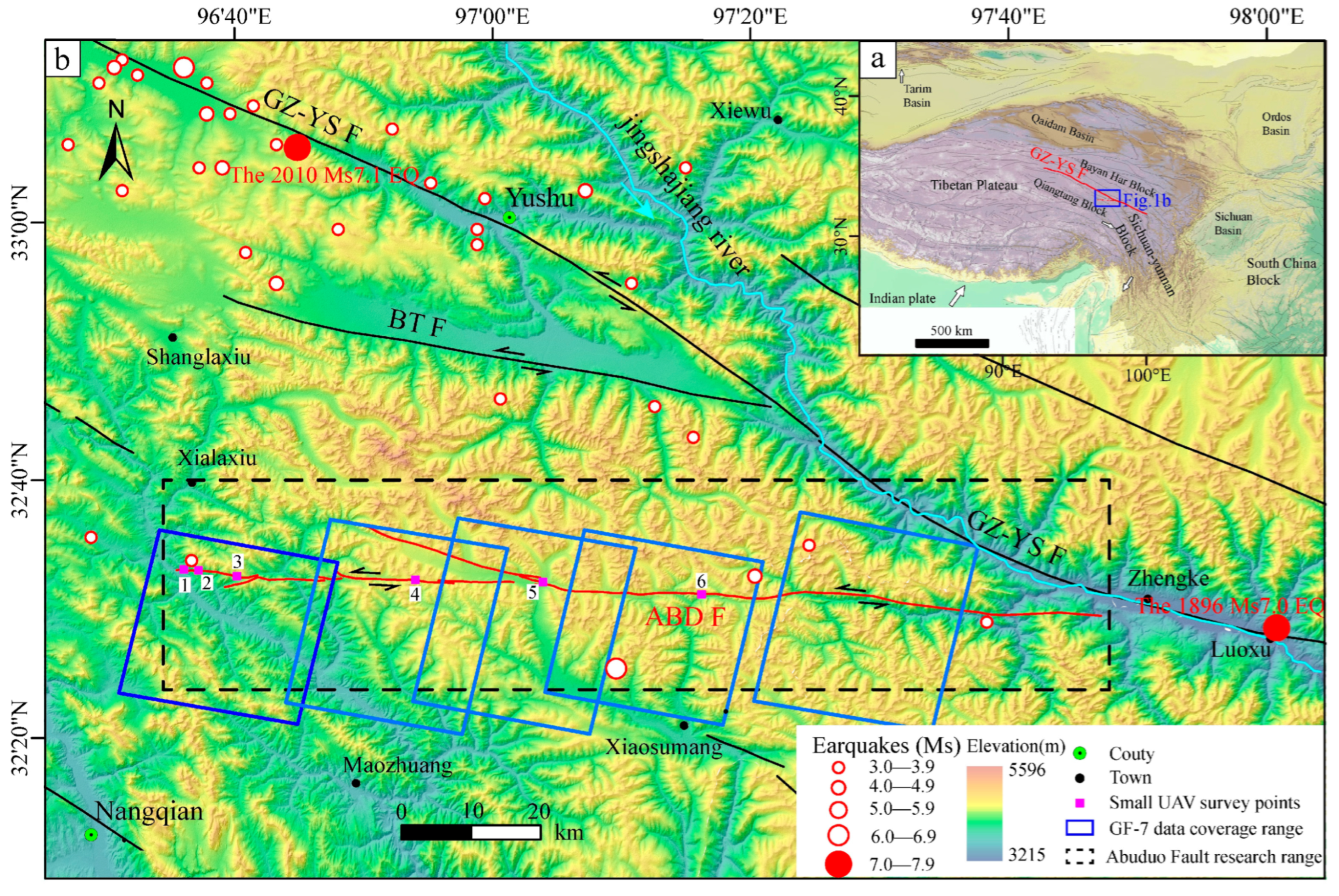
The Abuduo Fault is located on the eastern margin of the Tibetan Plateau, south of Yushu City, Qinghai Province, with a nearly E-W strike. It is a Holocene active left-lateral strike-slip fault within the Qiangtang Block (Figure 1a). To the east, this fault may intersect with the large-scale left-lateral strike-slip Garzê–Yushu Fault (Figure 1b), which has experienced several major earthquakes of Ms ≥ 7 throughout the course of history [16,17], e.g., the Ms 8.0 earthquake in Manigange, Sichuan Province (1320); the Ms 7.0 earthquake in Luoxu (1896); and the Ms 7.1 earthquake in Yushu (2010). The study area exhibits strong seismicity. According to statistics, a total of 2 earthquakes of magnitude 7.0–7.9, 2 of magnitude 6.0–6.9, 9 of magnitude 4.0–4.9, and 31 of magnitude 3.0–3.9 have been recorded. Seismic activity is mainly distributed along the Garzê–Yushu fault zone, with the highest concentration in the Yushu area. In addition, three earthquakes with Ms ≥ 3.0 have occurred near the Abuduo Fault. To the north of the Abuduo Fault lies the Batang Fault (Figure 1b), which is also a Holocene active left-lateral strike-slip fault with a slip rate of 2.3–3.7 mm/yr [18]. The Batang Fault plays a role in strain partitioning along the Yushu segment of the Garzê–Yushu Fault [18,19].

3. Data and Methods

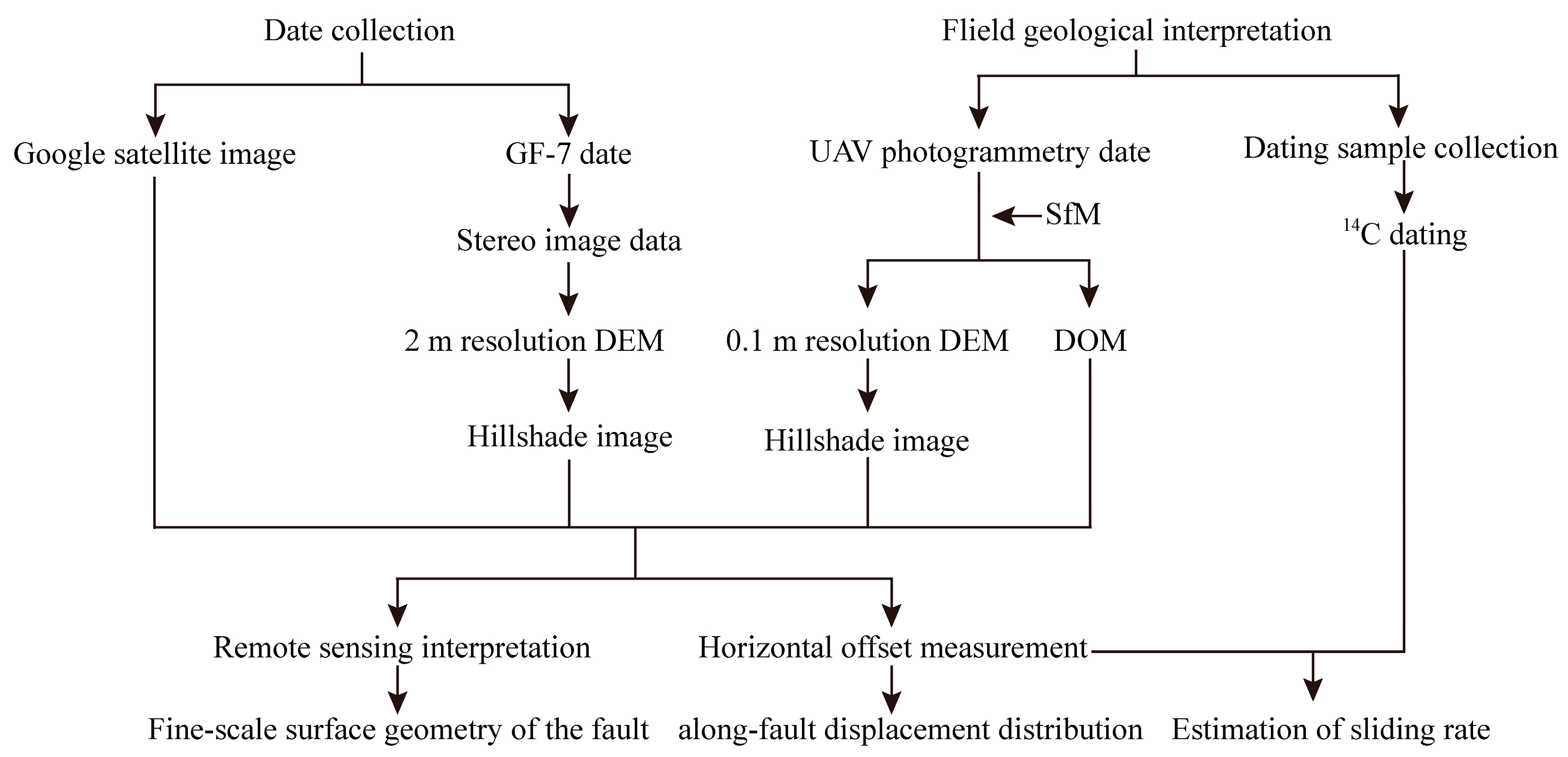
In this study, we integrated multi-source remote sensing data, including Google Earth imagery, GF-7 stereo pairs, and UAV-based topographic surveys. Initially, a preliminary interpretation of the fault was conducted using Google Earth imagery. Subsequently, high-resolution DEMs derived from GF-7 stereo imagery and UAV field surveys were employed for detailed fault interpretation. The interpretation results were further validated through field seismotectonic investigations, enabling the characterization of the fault’s fine geometric structure. Offset measurements were performed on typical offset landforms, and 14C dating was conducted to estimate the fault slip rate. The detailed workflow is illustrated in Figure 2.

3.1. Google Satellite Image

Since its launch in June 2005, Google Earth has provided satellite imagery that greatly facilitates the study of active tectonics [20]. Owing to its extensive spatial coverage and relatively high spatial resolution, Google Earth enables preliminary fault interpretation to delineate the geometric patterns and structural characteristics of faults, thereby providing valuable guidance for field investigations and significantly improving fieldwork efficiency. In this study, we selected Google Earth satellite imagery with minimal vegetation and snow/ice cover in the vicinity of the fault, which allows for the effective identification of linear fault traces and tectonic geomorphic features.

3.2. GF-7 Data and Processing

GF-7, China’s first sub-meter resolution optical stereo mapping satellite, was launched in November 2019. It employs a composite surveying mode combining a stereo camera and a laser altimeter to acquire high-resolution stereo mapping remote sensing data and high-precision altimetry data [21]. The satellite’s panchromatic camera has forward and backward resolutions of 0.8 m and 0.65 m, respectively, while its backward-view multispectral camera has a resolution of 2.6 m [22]. In recent years, GF-7 stereo pair data have been extensively used in remote sensing interpretation of active faults, becoming a critical data source for active fault research.
In this study, all five GF-7 scenes used are Level-1A products, with acquisition dates of 27 February 2021; 21 April 2022; 20 November 2024; 18 January 2025; and 23 January 2025. These scenes essentially cover the entire Abudo Fault (Figure 1b). These data were provided by the High-Resolution Remote Sensing Data Center (HRSDC) of the China Earthquake Administration. Each scene covers an area of 20 km × 20 km, with cloud coverage of less than 5% and minimal snow/ice cover. The panchromatic stereo pair data were processed using the “Generate Point Clouds and DSM by Dense Image Matching” module in ENVI 5.6 software. The parameter configuration was as follows: the GMTED2010 topographic map was added as a reference in the Input DEM Raster; Block Adjustment was set to “Yes”; Terrain Type was set to “Mountainous”; Matching Threshold was set to 12; Quality Threshold was set to 80; and Refine Point Clouds was set to “No”. By setting appropriate parameters, we extracted point cloud data and DEMs, ultimately generating DEMs with a spatial resolution of approximately 2 m. The DEM data are referenced to the WGS84 coordinate system. These DEMs provide critical support for characterizing the fine surface structure of the fault. To facilitate fault interpretation, a hillshade map highlighting detailed topographic features and clear linear traces was generated in ArcGIS 10.6.

3.3. Acquired UAV Photogrammetry Data and Processing Applied

In recent years, with the advancement of the unmanned aerial vehicle (UAV) and of digital surveying technologies, Structure from Motion (SfM) has emerged as a highly efficient, cost-effective, and user-friendly technique for 3D scene reconstruction. It has been widely adopted for small-scale, high-precision, and high-resolution topographic and geomorphic surveys [9,23,24], proving particularly suitable for high-altitude regions with sparse vegetation.
During the field investigation, a DJI Phantom 3 Pro was employed to acquire both orthophoto and oblique imagery for six typical segments of the Abuduo Fault (Figure 1b). This compact UAV system, equipped with a 20 mm low-distortion wide-angle camera (FC300X), a high-precision anti-shake gimbal, and a 12-megapixel image sensor, ensured the acquisition of high-resolution imagery characterized by low distortion and high color fidelity. Additionally, its visual positioning system, used for precise hovering and stable flight, facilitated the effective recognition of ground texture and relative elevation. Ultimately, a total of 545 high-resolution orthophoto images and 60 oblique images were collected. The UAV was flown at an altitude of approximately 80 m, with forward and side overlaps of 80% and 70%, respectively. More than 80% of the area of each measuring point had an image overlap greater than 9. No ground control points (GCPs) were used. Taking the surveying results of Survey Point 2 (Figure 1b) as an example: camera calibration was performed using the self-calibration module of Agisoft Metashape. The solved intrinsic parameters include a focal length F = 2267.51 pixels; principal point offsets Cx = 20.57 pixels and Cy = 0.80 pixels; radial distortion coefficients K1 = 0.0031, K2 = −0.0290, K3 = 0.0603, and K4 = −0.0260; and tangential distortion coefficients P1 = 9.74 × 10⁻⁵ and P2 = 4.67 × 10⁻⁴. The point density was 63.8 points/m2, and the RMS reprojection error was 0.673 pixels.
The SfM methodology allows for the integrated processing of imagery datasets captured from varying altitudes, angles, and potentially even from different cameras [14]. In this study, the acquired UAV orthophoto dataset was processed using Agisoft PhotoScan Professional-1.2.5software, which integrates SfM algorithms. The processing workflow primarily consisted of five steps: photo alignment, generation of dense point clouds, mesh generation, orthomosaic generation, and DEM construction [6]. This procedure yielded orthophoto mosaics with a resolution of approximately 1.5 cm/pixel and DEMs with a resolution of approximately 5 cm/pixel. To facilitate fault interpretation, hillshade maps highlighting geomorphic details and distinct linear features were generated using ArcGIS 10.6.

3.4. Remote Sensing Interpretation and Mapping Criteria Used

Remote sensing interpretation is a crucial approach in active fault research, contributing to our understanding of the geometric and kinematic characteristics of faults [24]. Under the influence of tectonic stress fields, fault activity modifies surface morphology, generating a series of tectonic landforms that serve as key indicators for active fault interpretation. In practice, fault identification is primarily based on geometric morphology and tonal differences. The main remote sensing interpretation criteria for active faults fall into three categories: (1) Linear criterion: Active faults generally appear as linear features on remote sensing images, manifesting as anomalously light- or dark-toned bands with distinct tonal contrasts on either side of the fault trace, facilitating interpretation. Examples include boundaries between different tones and morphologies, and synchronously offset alignments of rivers and gullies. (2) Lateral offset criterion: When active faults move horizontally, they typically cut across landforms such as gullies, ridges, rivers, and terrace surfaces, thereby generating characteristic tectonic landforms including offset gullies and offset ridges. By analyzing the offset directions and morphologies of these geomorphic features, the horizontal kinematic characteristics of the fault can be determined: (1) Kinematic sense determination: For a gully offset left-laterally, its upstream segment is displaced leftward relative to its downstream segment; the opposite applies for right-lateral offset. For a ridge, the slip sense can be similarly inferred from the offset direction of its crest line. Linear markers such as terrace scarps and ridge lines also allow slip sense determination based on their offset directions. (2) Displacement estimation: By restoring the original continuity of offset geomorphic markers (e.g., gully thalwegs, terrace risers) and measuring their horizontal separations, the cumulative horizontal displacement along the fault can be obtained. (3) Vertical offset criterion: When active faults move vertically, they cause uplift or subsidence on either side of the fault, resulting in tectonic landforms such as fault scarps and reversal troughs. Given that the Abuduo Fault is predominantly strike-slip, we focused on linear and lateral offset criteria during remote sensing interpretation. Based on high-precision, high-resolution DEM data acquired from GF-7 and UAV surveys combined with Google Earth satellite imagery, this study performed a detailed interpretation of the fault trace, segment boundaries, and micro-geomorphic features (e.g., offset gullies/ridges, pull-apart basins, pressure ridges) of the Abuduo Fault. The interpretation results were subsequently validated and refined through field investigations.

3.5. Active Fault Horizontal Offset Measurement Applied

The offset of an active fault is a critical parameter in active tectonic studies [25]. Traditional measurements, primarily obtained through field observations and tape measurements by geologists, are prone to significant errors due to visual estimation. LaDiCaoz_v2.1 is a professional software package developed by Zielke et al. [26] using MATLAB, specifically designed for measuring offsets along strike-slip faults. In this study, based on high-precision, high-resolution DEM data of typical offset landforms, we employed the LaDiCaoz_v2.1 software to semi-automatically extract offset parameters of the geomorphic features [26], thereby obtaining the displacement amounts of these typical offset landforms. The extraction workflow includes the following steps: defining the fault trace and the upstream/downstream profiles, tracing offset geomorphic features, constructing longitudinal profiles, calculating the best-fit offset, and performing offset back-slipping restoration. After obtaining the best-fit offset, a trial-and-error approach is adopted to adjust the back-slipping displacement around the optimal value, and an acceptable range of offset is determined based on the visual matching quality of the landform; all offset values within this range yield a relatively good morphological match. To enhance the objectivity of the measurements, each geomorphic marker is digitized 3–4 times. The matching criteria for upstream and downstream geomorphic markers are as follows: (1) the plan-view curvature and width variations in the offset landforms on both sides should be consistent; (2) after back-slipping the longitudinal profiles by the calculated offset, the elevations should merge smoothly without abrupt changes. When setting specific parameters, appropriate contour intervals, as well as the width, length, and spacing of the upstream/downstream profile swaths, should be chosen according to the actual characteristics of each offset landform.

3.6. Dating Sample Collection and Testing

The age of the geomorphic surface of typical offset landforms is one of the key parameters for estimating the slip rate of a fault. During the field geological investigation, we determined the sampling horizon or geomorphic position for dating samples based on the principles of geology and geomorphology, as well as the relationship between stratigraphic sedimentary evolution and the cumulative offset process of the active fault. The collected dating samples were sent to the Beta Analytic Laboratory in the USA, where chronological parameters of the typical offset landforms were obtained using accelerator mass spectrometry (AMS) 14C dating techniques [27].

4. Results

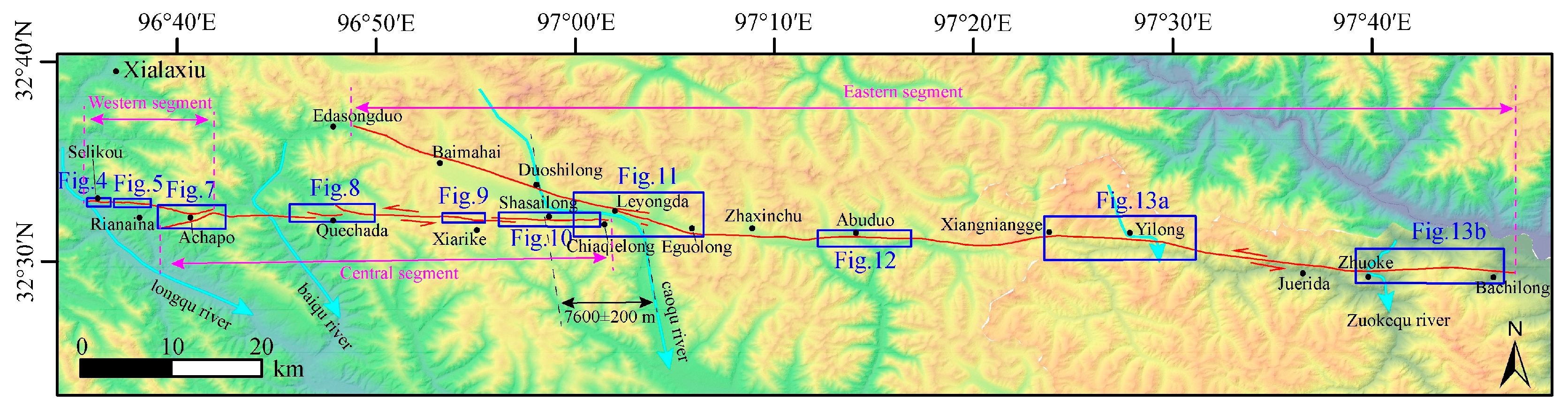
Our results were based on the remote sensing imagery we received and from the high-precision, high-resolution topographic and geomorphic data acquired from Google Earth, GF-7 stereo pairs, and UAV surveys, combined with field geological investigations. Thanks to all these, we were able to conduct a detailed interpretation of the surface geometry of the Abuduo Fault. Consequently, we obtained the detailed surface geometry of the Abuduo Fault (Figure 3), as well as the offset characteristics of typical offset landforms, and acquired chronological parameters for a representative offset geomorphic surface. Based on these geometric characteristics, the Abuduo Fault can be divided into three segments: the western segment, the central segment, and the eastern segment (Figure 3).

4.1. Western Segment

The western segment of the Abuduo Fault exhibits continuous geometry and clear fault traces, with a total length of approximately 10.1 km. In this study, we selected three areas that essentially cover this segment (Figure 3) for focused interpretation and field seismo-geological investigations.
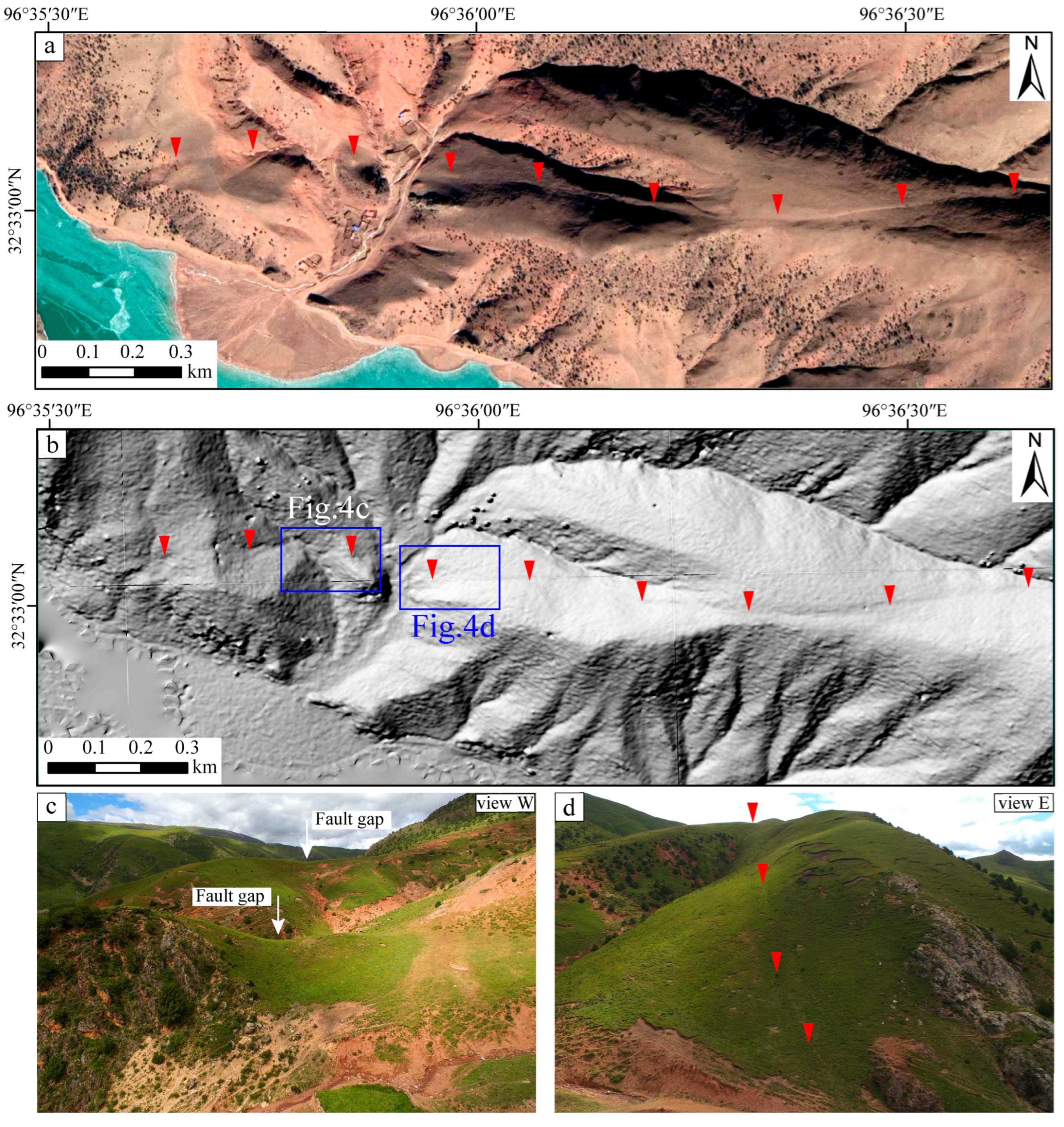
In the Selikou area (Figure 4), the fault cuts across ridges and river valleys. Clear fault traces can be identified both on Google Earth satellite imagery (Figure 4a) and on hillshade maps derived from GF-7 stereo pairs (Figure 4b). During field investigations, we observed fault gaps and distinct fault traces (Figure 4c,d). This segment represents the westernmost part of the Abuduo Fault; beyond the Longqu River, no obvious fault traces were found.
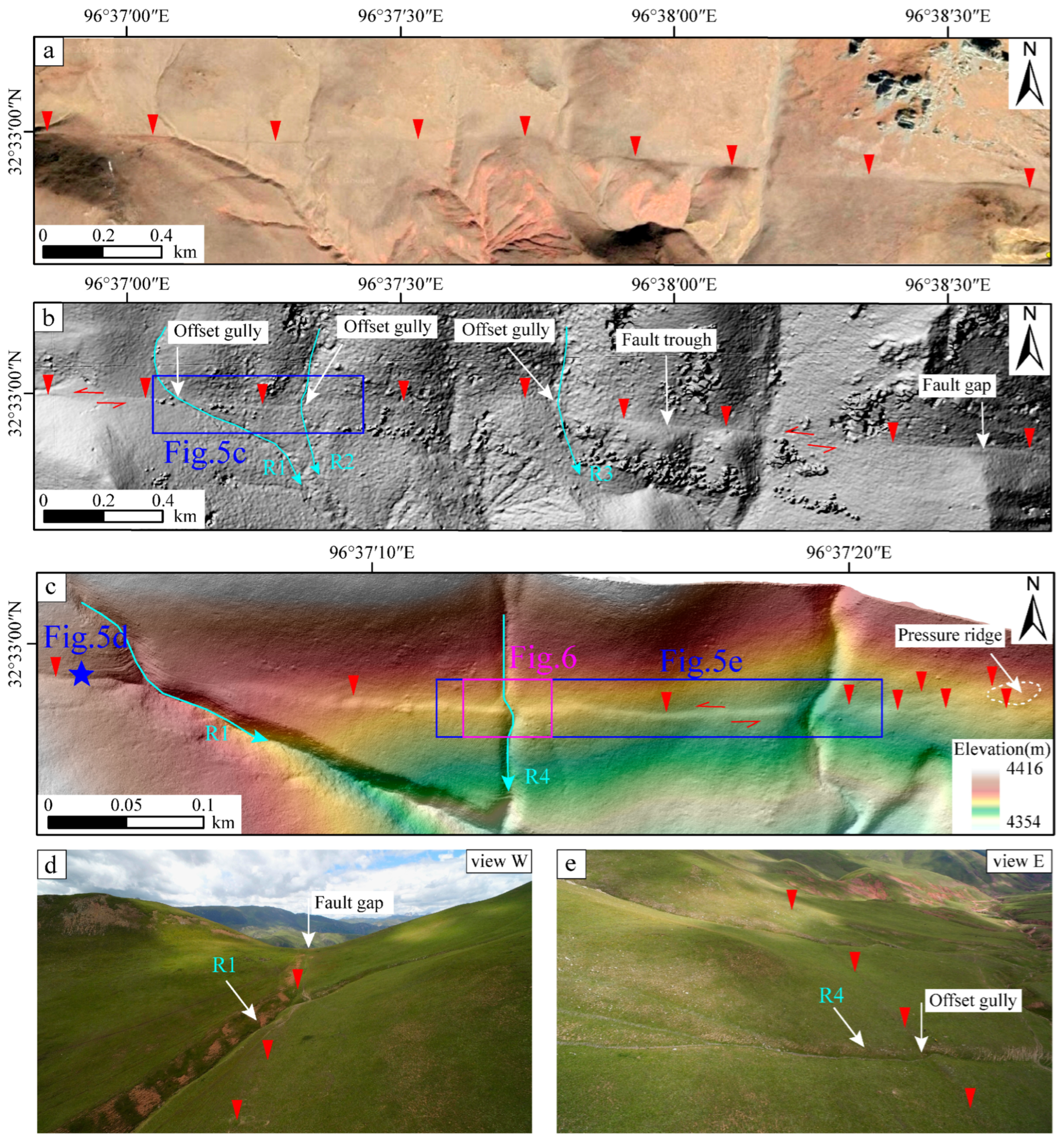
In the northeastern Rianaina area (Figure 5), the fault cuts across multiple gullies and ridges along the hillslope, with clearly discernible linear traces. Based on Google Earth satellite imagery (Figure 5a) and hillshade maps (Figure 5b), at least four gullies exhibit evident left-lateral offsets. Among them, the R1 gully shows a nearly 90° deflection due to fault movement, and the R4 gully represents a typical left-laterally offset feature, which was investigated in detail in this study (Figure 6). In this area, tectonic landforms such as offset gullies, fault troughs, and fault gaps are developed (Figure 5b). Additionally, a pressure ridge was locally identified from hillshade maps derived from small UAV surveys (Figure 5c). Field investigations also revealed fault gaps, offset gullies, and clear fault traces (Figure 5d,e). The well-developed tectonic landforms and distinct fault traces suggest that this fault may be relatively active.
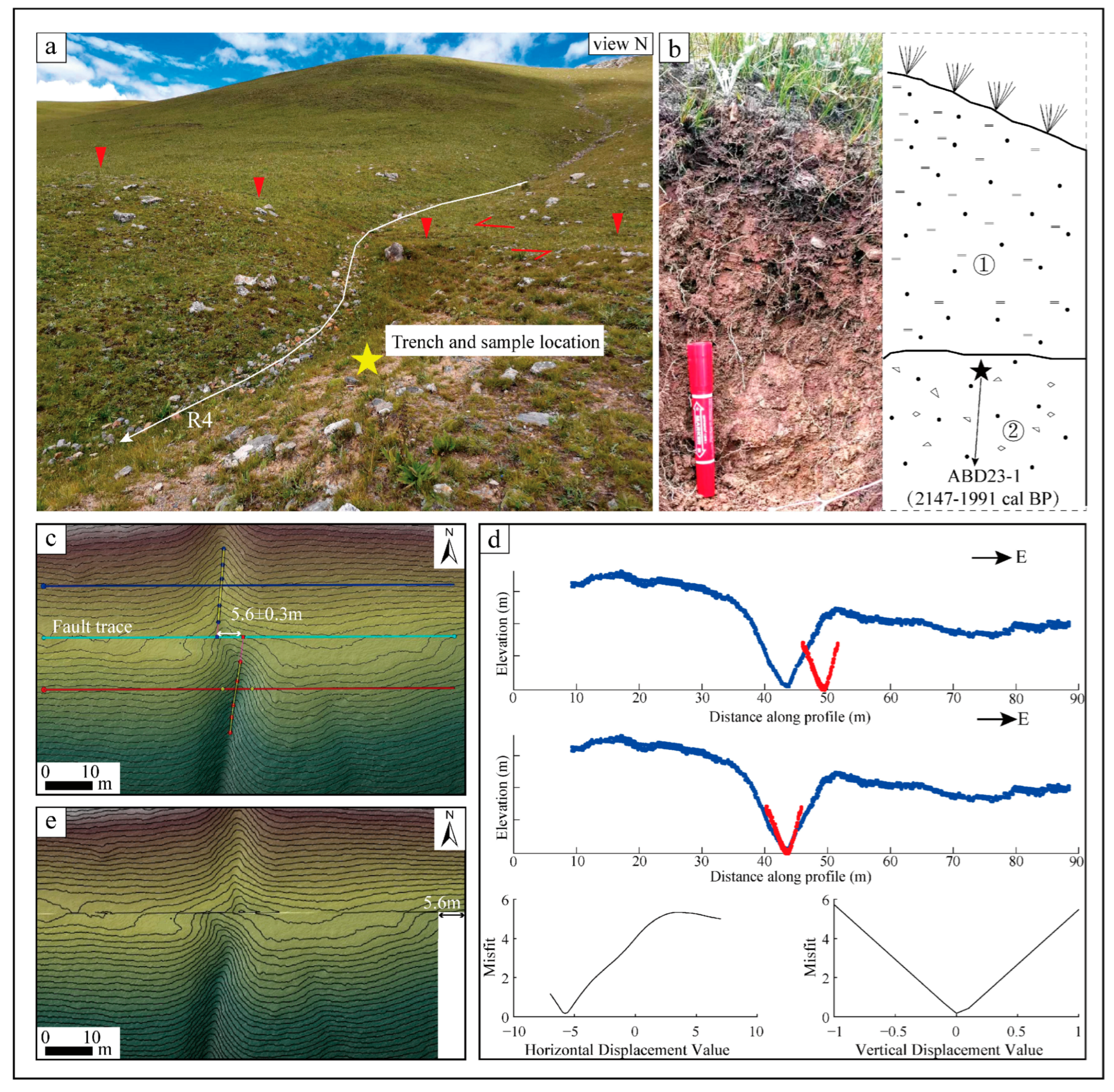
R4 is a small gully with a clearly defined morphology, and its bed contains poorly rounded gravels (Figure 6a; 96.6204°E, 32.5471°N). Using LaDiCaoz_v2.1 software, the left-lateral offset of this gully was measured as 5.6 ± 0.3 m (Figure 6c–e). The offset restoration plot (Figure 6e) helps verify the reliability of the measured offset. A trench was excavated on the flank of the R4 gully (Figure 6a), revealing two stratigraphic units: Unit ① consists of reddish-brown sandy soil, and Unit ② is a sandy gravel layer located approximately 0.3 m below the surface, containing angular gravels. A dating sample (ABD23-1) was collected from the top of Unit ②. The tested material (organic sediment) yielded an age of 2147–1991 cal BP (Figure 6b).
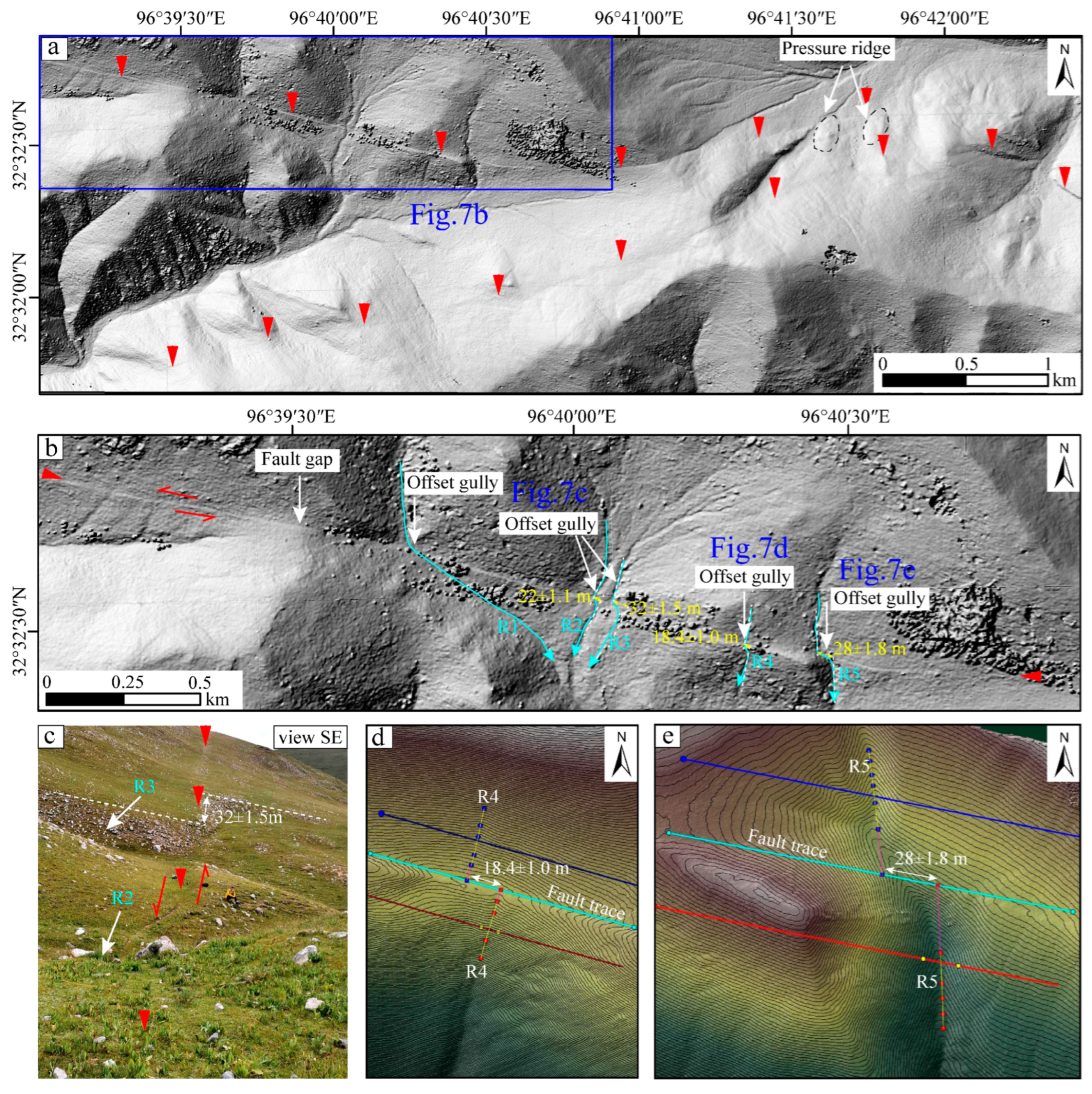
In the Achapo area (Figure 7), an area which marks the boundary between the western and central segments of the Abuduo Fault, the fault traces are clearly visible, and a pressure ridge is developed at the junction of the two segments (Figure 7a). The western segment of the Abuduo Fault cuts across ridges and gullies, forming tectonic landforms such as fault gaps, fault troughs, and offset gullies (Figure 7b). Based on hillshade maps, at least five gullies (R1–R5) exhibiting left-lateral offsets can be identified, among which the R1 gully shows a nearly 60° deflection due to fault movement. Using LaDiCaoz_v2.1 software, the left-lateral offsets of gullies R2, R3, R4, and R5 were measured as 22 ± 1.1 m, 32 ± 1.5 m, 18.4 ± 1.0 m, and 28 ± 1.8 m, respectively (Figure 7b–e).

4.2. Central Segment

The central segment of the Abuduo Fault is composed of four right-stepping en echelon faults, with clear fault traces and a total length of approximately 38.6 km. In this study, the four areas essentially covering this segment (Figure 3) were selected for focused interpretation and field seismo-geological investigations.
In the Achapo area the fault cuts across a ridge, exhibiting a clear linear trace and forming a pronounced bend (Figure 7a). Due to the high altitude and difficult accessibility, no field investigation was conducted in this area.
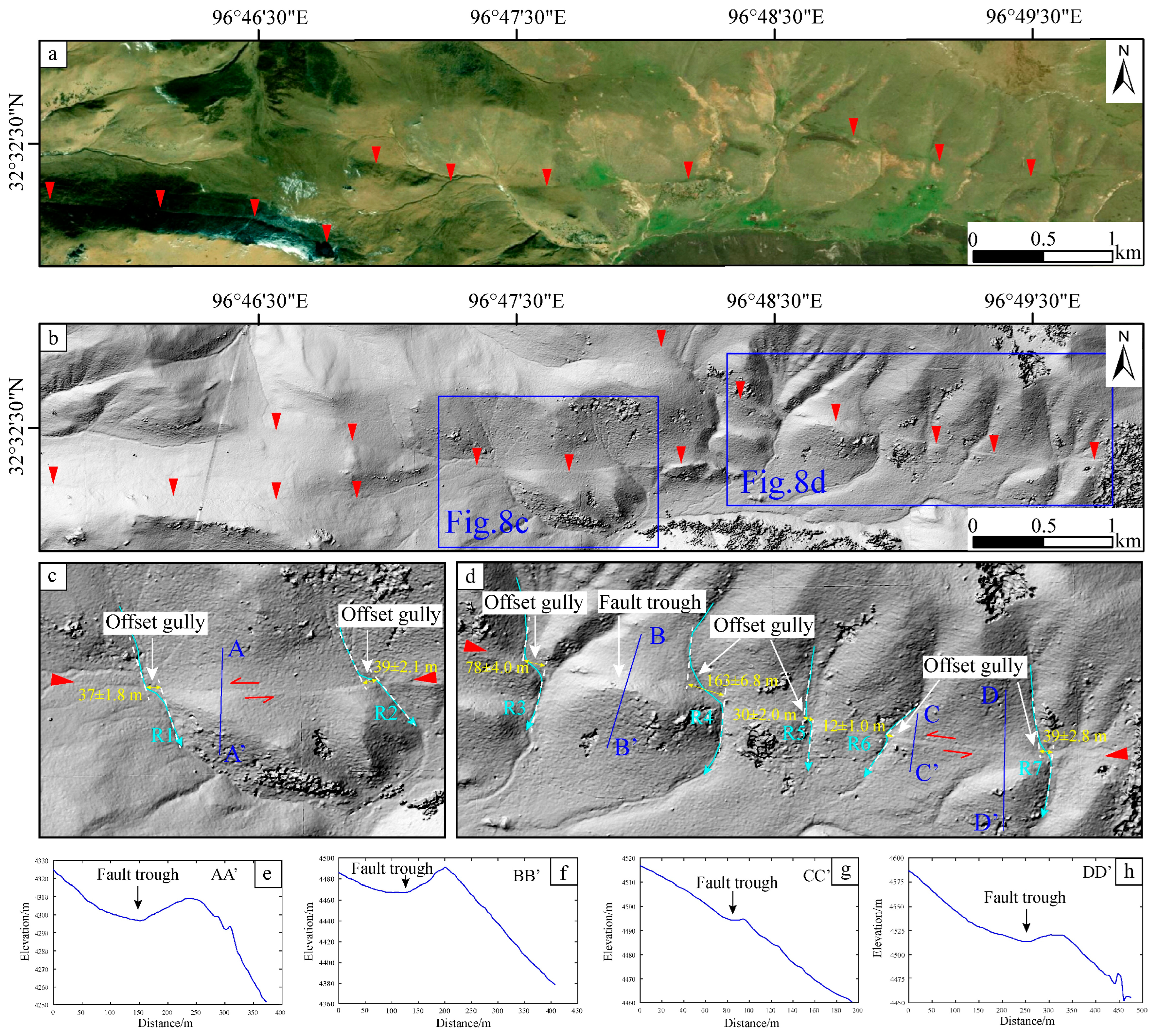
In the Quechada area (Figure 8), the fault exhibits a right-stepping en echelon arrangement, cutting across several gullies with distinct linear traces (Figure 8a,b). Based on hillshade maps derived from GF-7 stereo pairs, at least seven gullies (R1–R7) showing left-lateral offsets were identified, and the left-lateral offset of each gully was measured. Among them, the R4 gully exhibits the largest offset (163 ± 6.8 m), while the R6 gully shows the smallest offset (12 ± 1.0 m) (Figure 8b,c). In addition to offset gullies, tectonic landforms such as fault troughs are also observed (Figure 8c–h).
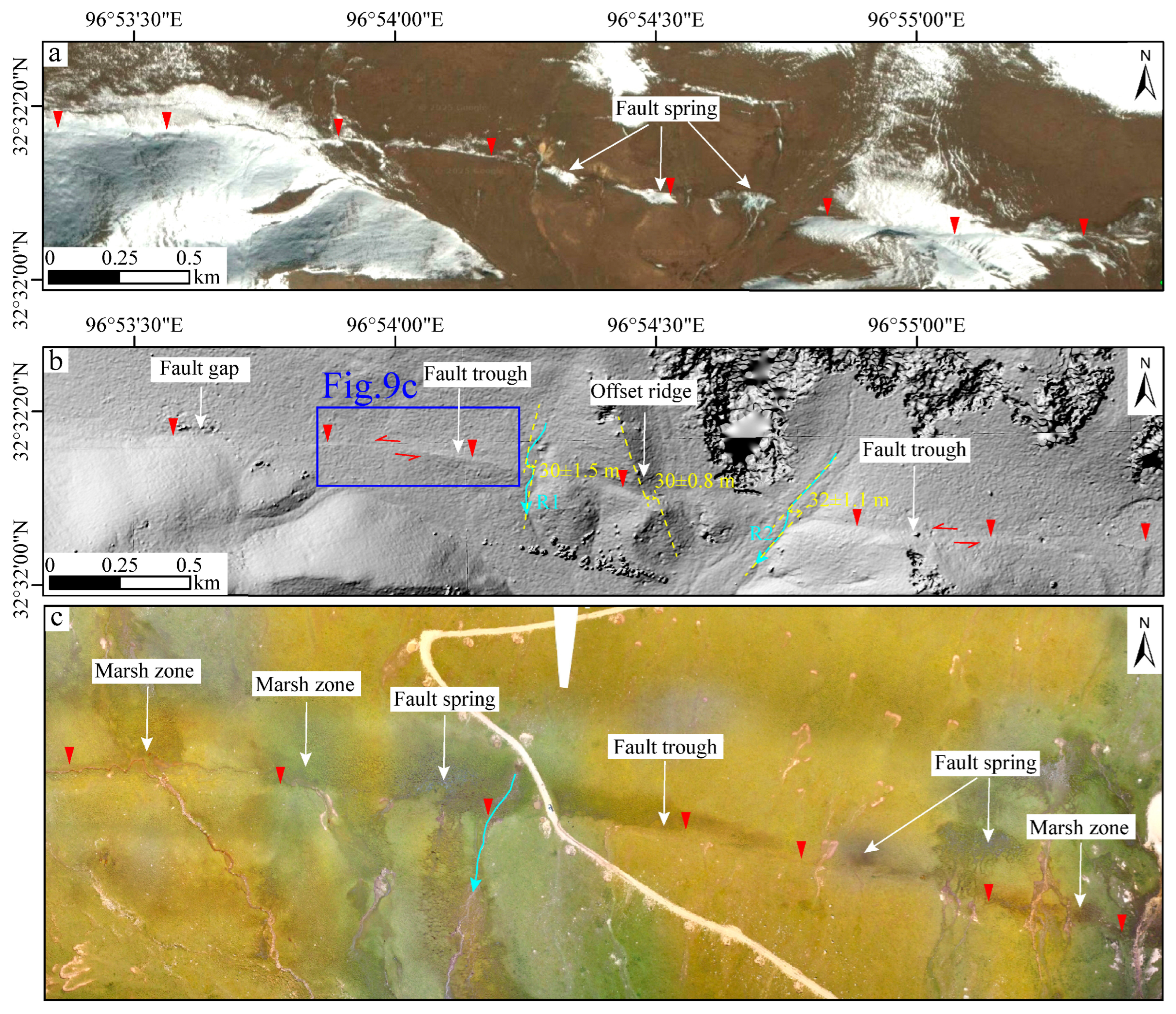
In the northeastern Xiarike area (Figure 9) the fault is distributed along a hillslope, cutting across several ridges and gullies, with clear linear traces and a relatively straight geometry (Figure 9a,b). The tectonic landforms resulting from fault activity in this segment are diverse. In both Google Earth satellite imagery (Figure 9b) and small UAV orthophoto maps (Figure 9c), a series of fault springs and marsh zones developed along the fault can be clearly identified, indicating well-developed fractures and strong permeability within the fault zone, where the groundwater table is controlled by the fault and discharges to the surface. Based on hillshade maps derived from GF-7 stereo pairs (Figure 9b), typical tectonic landforms such as fault gaps, fault troughs, and left-laterally offset ridges and gullies (R1, R2) were further identified. Measurements show that the left-lateral offset of the offset ridge is 30 ± 0.8 m, and the left-lateral offsets of gullies R1 and R2 are 30 ± 1.5 m and 32 ± 1.1 m, respectively. The consistent offset values among different markers on the same geomorphic unit reflect their cooperative recording of cumulative fault displacement, enhancing the reliability of the offset data.
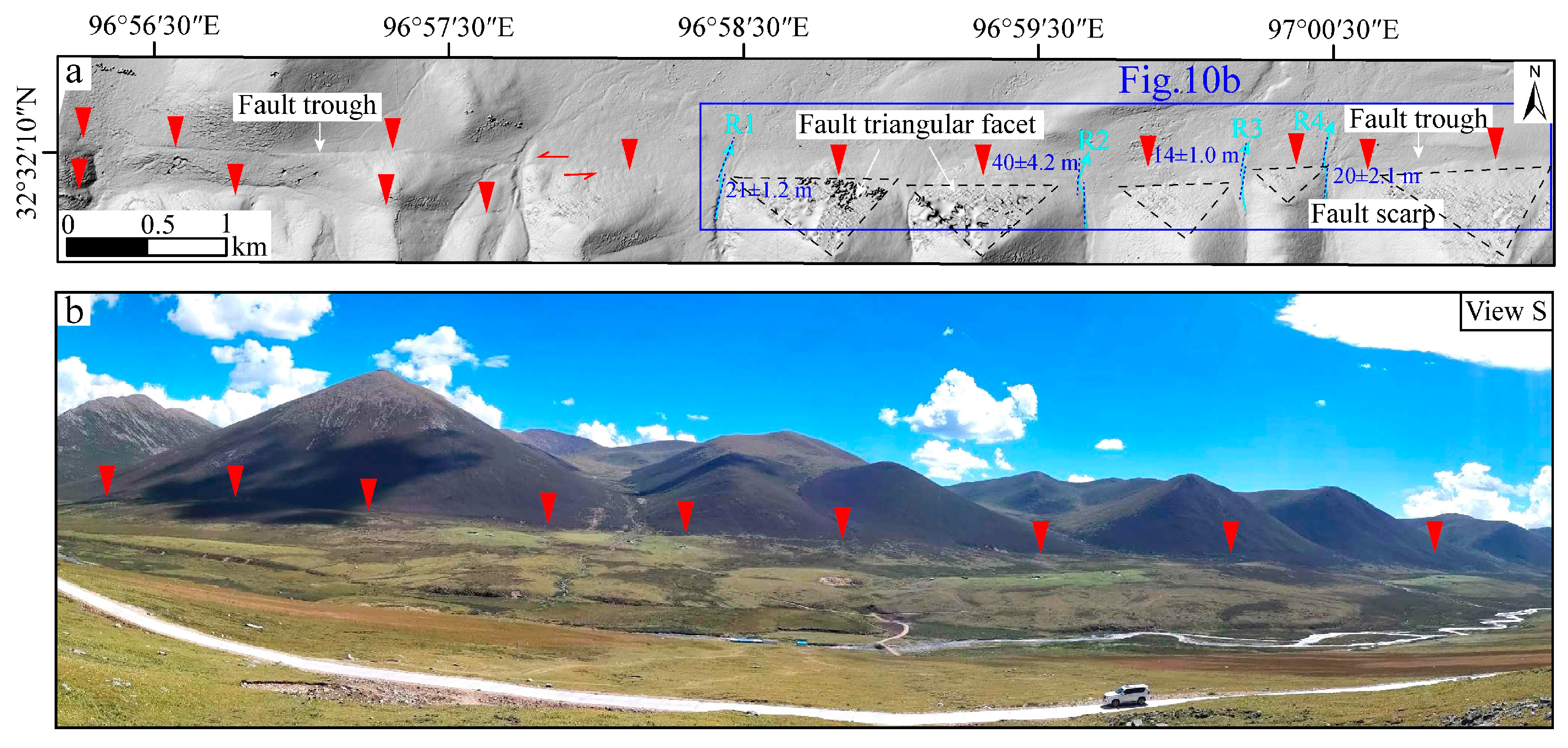
In the Shasailong area (Figure 10) the fault cuts straight across a piedmont alluvial fan, exhibiting clear linear traces indicating that the fault geometry in this segment is simple and highly continuous. Tectonic landforms developed along the fault include fault troughs, offset gullies (R1–R4), fault triangular facets, and fault scarps (Figure 10a,b). Among these, the fault trough reflects negative topography formed by long-term erosion along the fault zone, the fault scarp indicates the vertical component of near-surface fault activity or differential erosion, and the fault triangular facet reveals the control of the fault on piedmont topography, serving as a prominent geomorphic marker of active faulting. On the western side of this area, the fault consists of two subparallel faults, forming a secondary subparallel structure within the fault zone, reflecting local strain partitioning or intra-fault branching. Measurements show that the left-lateral offsets of gullies R1, R2, R3, and R4 in this area are 21 ± 1.2 m, 40 ± 4.2 m, 14 ± 1.0 m, and 20 ± 3.0 m, respectively.

4.3. Eastern Segment

The eastern segment of the Abuduo Fault exhibits continuous geometry and relatively clear fault traces, with a total length of approximately 93.6 km. In this study the four areas essentially covering this segment (Figure 3) were selected for focused interpretation and field seismo-geological investigations. The area from east of Abuduo to the Jinsha River is predominantly characterized by high mountains and deep valleys, where field investigation was largely inaccessible. Therefore, the fault geometry interpretation was mainly conducted using GF-7 and remote sensing image data.
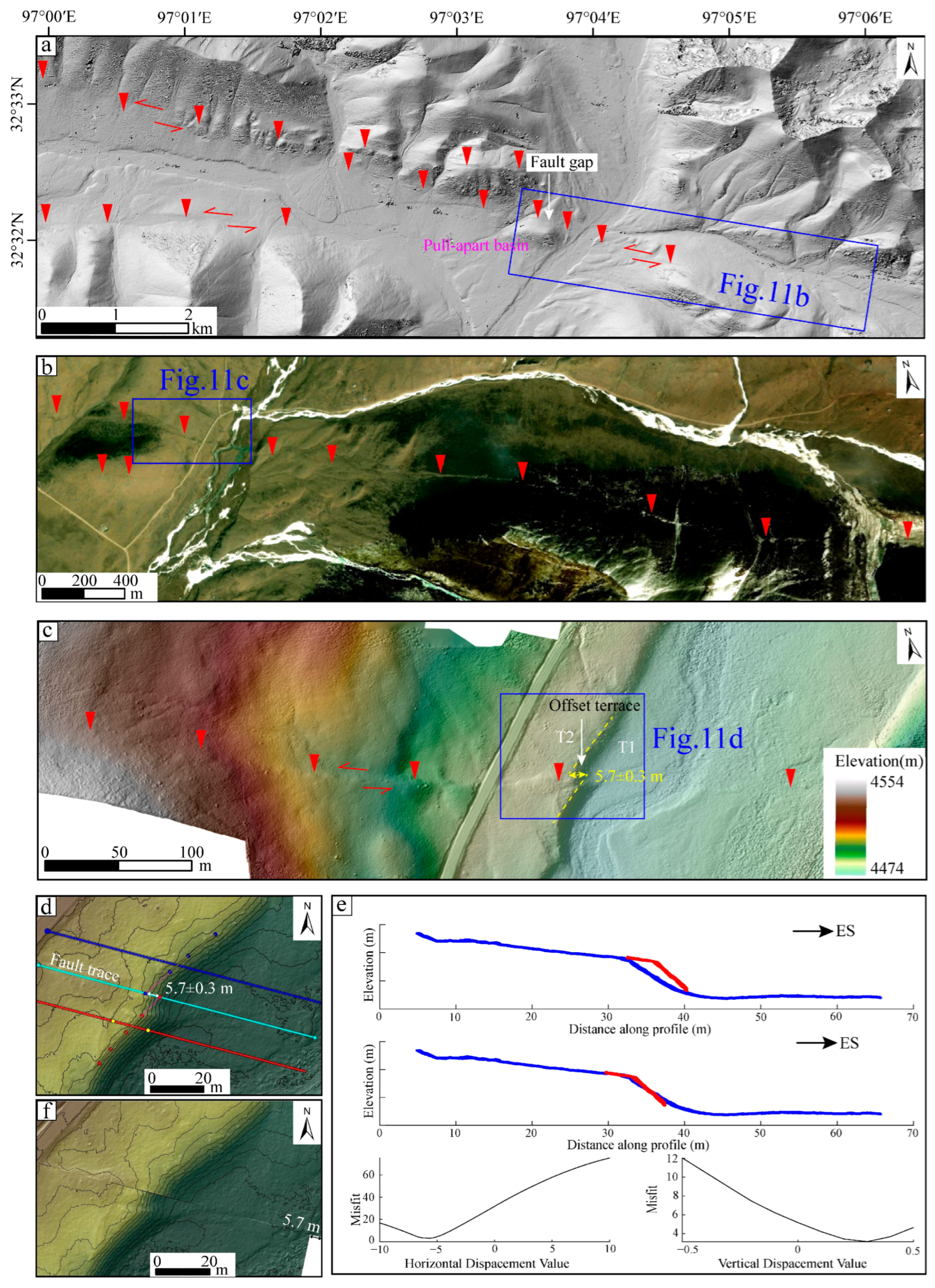
In the Leyongda area (Figure 11), where the boundary between the central and eastern segments of the Abuduo Fault occurs, a small pull-apart basin has formed at the intersection of the two segments. The westernmost part of the eastern segment begins at Edasongduo, where the fault strike changes from NWW to nearly E-W in the Eguolong area (Figure 3). The Caochu River is offset by the fault, forming a river offset landform with an offset of 7600 ± 200 m (Figure 3). The fault cuts across the river and piedmont alluvial fans, displaying clear linear traces and tectonic landforms such as fault gaps (Figure 11a,b). During field investigation we identified offset river terrace landforms and conducted detailed surveys using a small UAV (Figure 11c). Using LaDiCaoz_v2.1 software, the left-lateral offset of the T2 river terrace was measured as 5.7 ± 0.3 m (Figure 11d–f). The offset restoration plot (Figure 11f) verifies the reliability of this measurement.
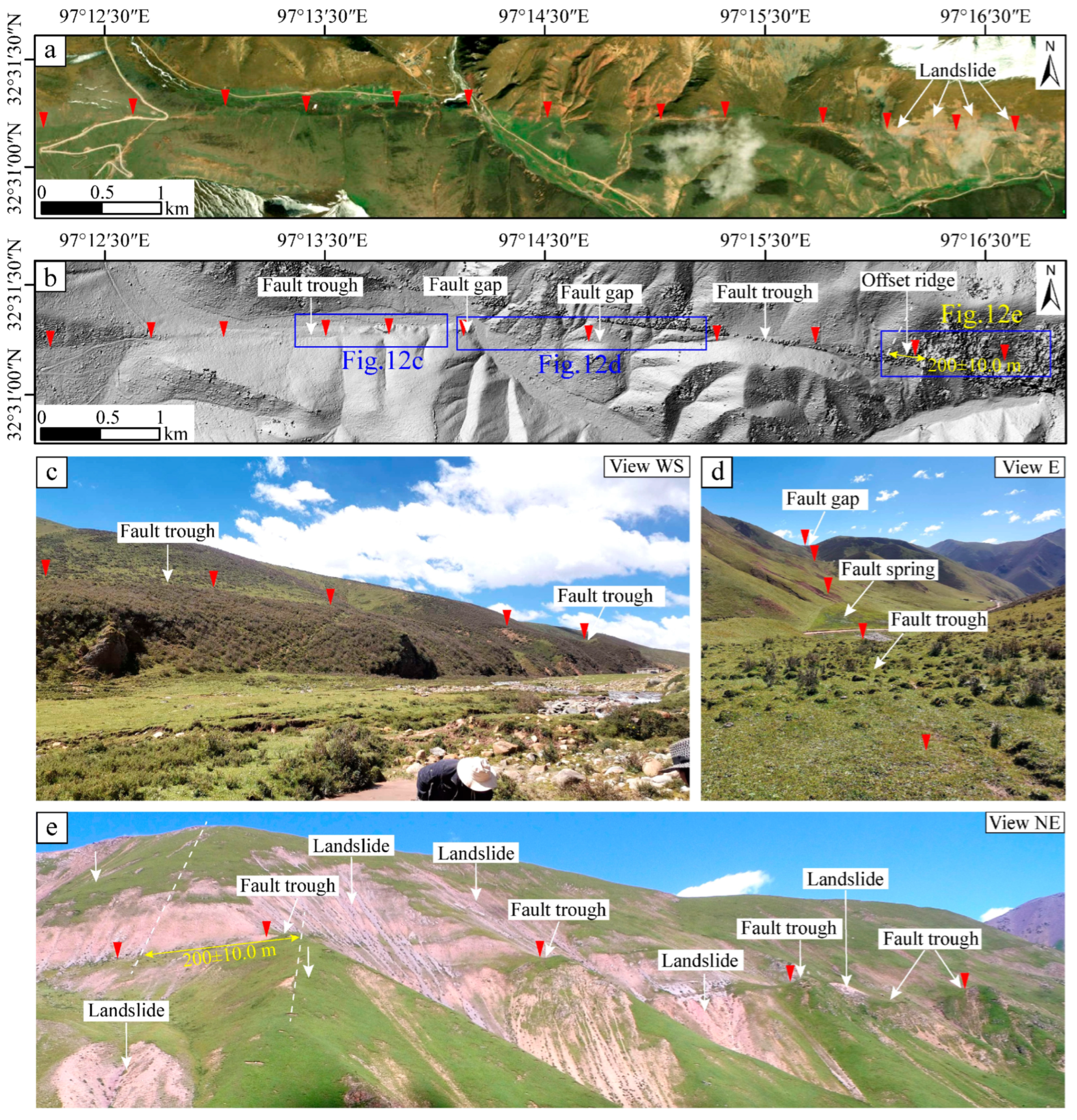
In the Abuduo area (Figure 12) the fault cuts across a hillslope, strikes nearly E–W, and exhibits clear linear traces. Based on hillshade maps derived from GF-7 stereo pair data (Figure 12b) and field investigation data (Figure 12c–e), tectonic landforms such as fault troughs, fault gaps, and fault springs can be identified. In addition, a ridge was found to be left-laterally offset by the fault, with an offset of 200 ± 10 m (Figure 12e). A series of landslides have also developed along the fault (Figure 12a,e), indicating that when the fault traverses steep slopes, landslides are prone to develop along it. During long-term tectonic activity, rocks within the fault zone undergo intense compression, shearing, and fracturing, forming fault fracture zones, fault gouge, and densely spaced joint zones. The strength of these fractured rocks is significantly reduced while their permeability is enhanced, providing an intrinsic material basis for the occurrence of landslides [28,29]. Previous studies have found a strong correlation between fault structures and the spatial distribution of landslides; in some regions, active faults even control the spatial distribution of landslides [30,31].
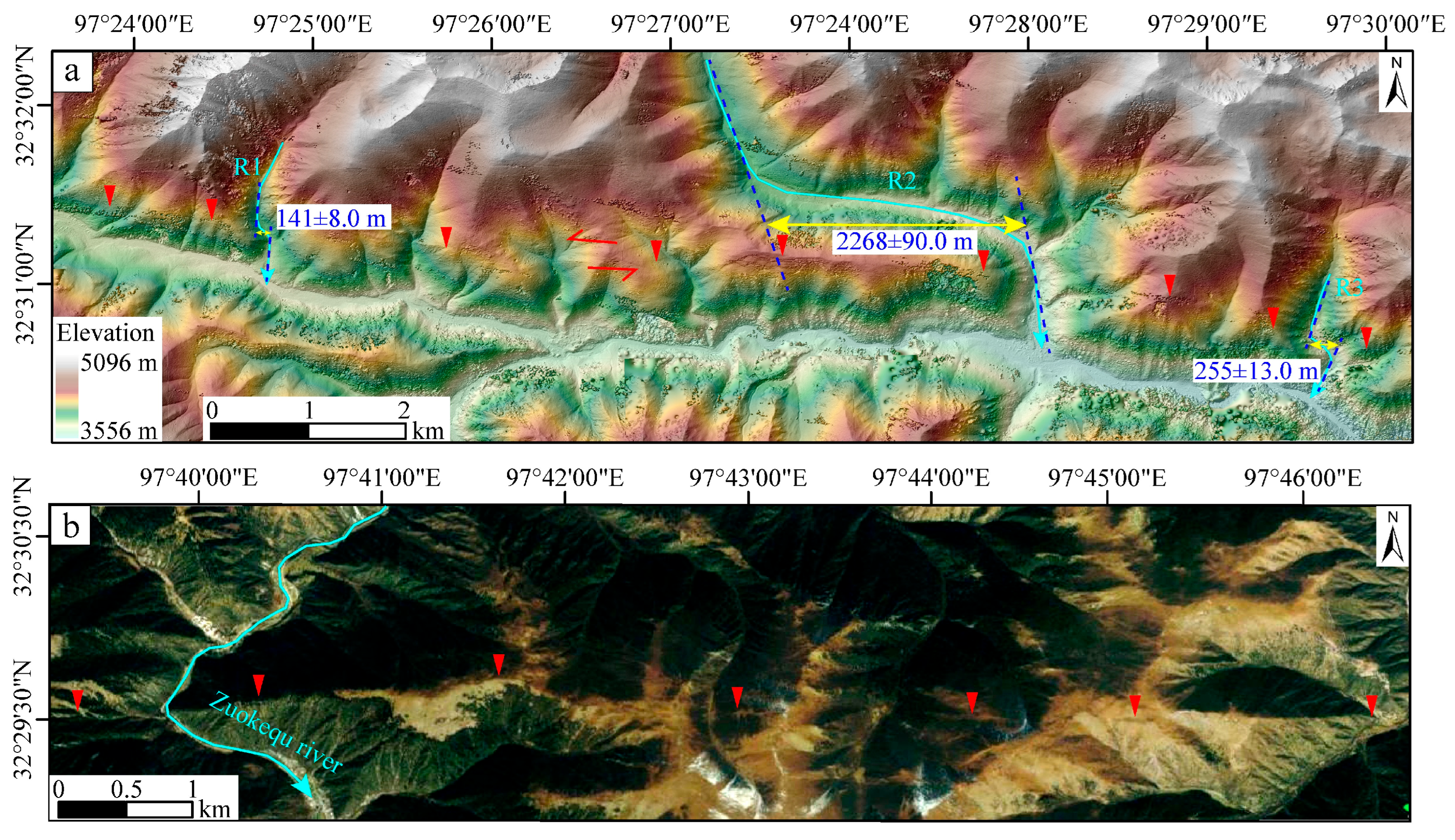
In the Yilong area (Figure 13a) and the Zhuoke area (Figure 13b), although field investigations were not possible due to natural constraints, clear fault traces and tectonic landforms can still be identified based on remote sensing image data. In the Yilong area, hillshade maps derived from GF-7 stereo pairs (Figure 13a) show that the fault cuts through hillslopes, gullies, and rivers. At least three gullies or rivers (R1–R3) exhibiting left-lateral offsets can be interpreted. Measurements show that the offset of R1 is 141 ± 8.0 m, that of R2 is 2268 ± 90.0 m, and that of R3 is 255 ± 13.0 m. In the Zhuoke area, Google Earth satellite imagery (Figure 13b) reveals relatively clear linear fault traces, and a nearly 90° river deflection is developed at the intersection of the Zuokequ River and the fault. The eastern segment of the Abuduo Fault extends to the Bachilong area on the western bank of the Jinsha River, and further east it may cross the Jinsha River and intersect the Garzê–Yushu Fault (Figure 3).

5. Discussion

5.1. Geometry of the Abuduo Fault

The Abuduo Fault generally strikes NWW to nearly E-W and can be divided into three segments (western, central, and eastern) based on geometric discontinuities (Figure 3). The western segment exhibits continuous geometry and clear fault traces with a relatively stable strike and a length of approximately 10.1 km. The central segment consists of four right-stepping en echelon faults, with clear fault traces, a nearly E–W strike, and a length of approximately 38.6 km. The eastern segment displays continuous geometry and relatively clear fault traces, with a strike changing from NWW to nearly E-W and a length of approximately 93.6 km. The main characteristics of each segment are shown in Table 1.
In the Achapo area both the western and central segments undergo a bend, and the two segments are connected by a left-stepping, left-lateral pressure ridge, with a step-over width of approximately 3.1 km, forming a distinct geometric discontinuity boundary. In the Leyongda area, the central and eastern segments transition through a right-stepping pull-apart basin, with a step-over width of approximately 9.4 km, reflecting geometric adjustment under a local extensional setting. These two geometric discontinuities are both characterized by obvious deflection or bending of the fault trace, controlling the geometric segmentation pattern of the fault. Geometric discontinuities of faults (e.g., step-overs and bends) play an important role in controlling the earthquake rupture behavior of strike-slip faults [32]. Studies have shown that when the step-over width exceeds 5 km in a strike-slip fault zone, large earthquake ruptures are generally difficult to propagate through [33,34]. Numerical simulations further reveal that the ability of a rupture to cross a step-over depends on a combination of geometric parameters, including step-over width, linking segment length, and bend angle [35]. The Achapo step-over has a width of 3.1 km, which is less than the empirical threshold of 5 km, theoretically providing geometric conditions for rupture propagation. In contrast, the Leyongda step-over has a width of 9.4 km, significantly exceeding this threshold, and may thus constitute a termination boundary for earthquake ruptures. However, it has been shown that even step-over widths exceeding 10 km can be breached during large earthquakes, as exemplified by the 2001 M8.0 Kunlun Mountain Pass earthquake [36]. Furthermore, the mechanical nature of the step-over influences rupture propagation behavior. Numerical simulations indicate that extensional step-overs (such as the right-stepping pull-apart basin at Leyongda) are more easily breached by ruptures than compressional step-overs (such as the left-stepping pressure ridge at Achapo) [37], which, together with the difference in step-over widths, jointly determines their different controls on fault segmentation.
In the Eguolong area, the fault strike changes from NWW to nearly E-W, with a bend angle of approximately 18°, further reflecting spatial variation in fault geometry. Bends represent another important manifestation of geometric complexity in strike-slip faults [32]. A study of strike-slip faults in Turkey by Barka and Kadinsky-Cade (1988) showed that when the bend angle exceeds about 30°, large earthquake ruptures generally cannot propagate through [33]. The bend angle of the Abuduo Fault at Edasongduo is about 18°, lower than this empirical threshold, indicating that this bend may not completely prevent rupture propagation but could still significantly affect strain accumulation and stress distribution.
Overall, the geometric structure of the Abuduo Fault is characterized by segmentation, discontinuity, and strike variation. The western and central segments are separated by a left-stepping compressional step-over 3.1 km wide, the central and eastern segments are separated by a right-stepping extensional step-over 9.4 km wide, and a strike bend of about 18° is developed within the eastern segment. According to existing studies, step-over width and bend angle are key geometric parameters controlling the seismic rupture segmentation of strike-slip faults [34,38]. These geometric characteristics provide an important basis for understanding the fault’s evolutionary history and segmentation behavior.

5.2. Displacement Distribution Characteristics of the Abuduo Fault

Analyzing the displacement distribution of active faults is fundamental for understanding fault geometry and kinematics [39] and is crucial for seismic hazard assessment [34]. As geological records of long-term fault activity, displacement data contain rich information on rupture behavior, segmentation, and displacement accumulation patterns along the fault strike [40].
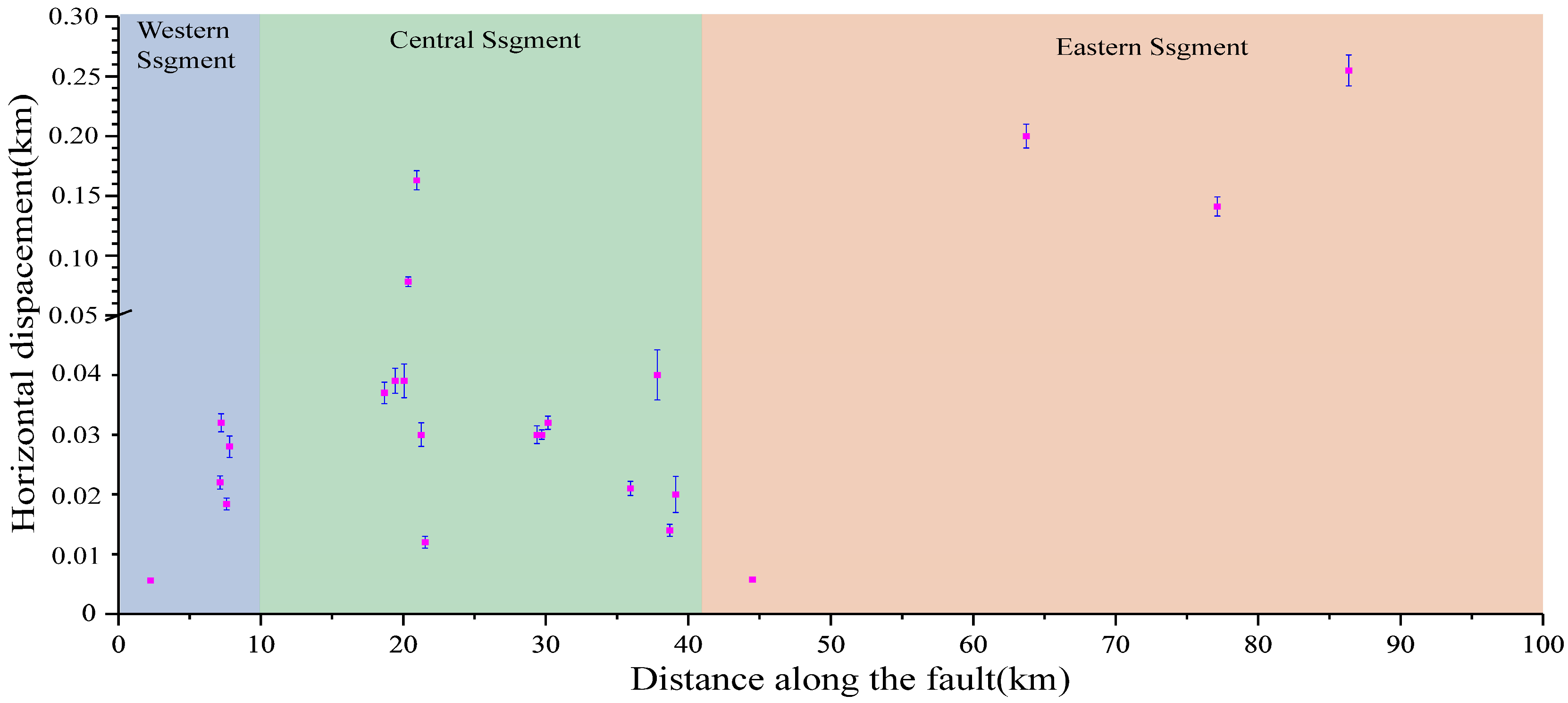
Using remote sensing interpretation, field investigations, and the semi-automatic offset extraction software LaDiCaoz_v2.1, this study obtained 25 offset measurements from typical offset landforms along the Abuduo Fault, including gullies, ridges, river terraces, and rivers. With the exception of the Caochu River offset (7600 ± 200 m) in the Leyongda area (Figure 3) and the R2 gully offset (2268 ± 90 m) in the Yilong area (Figure 13), the other 23 offsets are all less than 260 m (Figure 14). Overall, the offset magnitude increases from the western segment toward the eastern segment, suggesting that the eastern segment may have initiated earlier and thus accumulated a larger total displacement.
Remote sensing interpretation and field investigations reveal that the western, central, and Leyongda area of the eastern segment (Figure 11c) all exhibit well-developed small gully offsets and very clear linear traces. In contrast, in the east of Leyongda no obvious small gully offsets are observed, and the fault traces are less clear. This indicates that the western and central segments are the more active parts of the Abuduo Fault during the Late Quaternary. A step-over approximately 9.4 km wide, namely the Leyongda pull-apart basin, is developed between the central and eastern segments. Studies on strike-slip faults indicate that step-overs wider than 5 km typically act as rupture termination boundaries [33,34]. This geometric discontinuity effectively limits the propagation of earthquake ruptures further eastward along the eastern segment.

5.3. Slip Rate Estimation of the Abuduo Fault

On the hillslope northeast of Rianaina in the western segment of the Abuduo Fault, a typical offset gully (R4) is developed (Figure 5a). Using LaDiCaoz_v2.1 software, we precisely extracted its offset as 5.6 ± 0.3 m (Figure 5c–e). 14C dating of the top of the sandy gravel layer of this offset landform yielded an age of 2147–1991 cal BP (Figure 5b). Based on these data, the slip rate at this location is estimated to be approximately 2.5–2.8 mm/yr. This offset site is located in the western segment, where the fault geometry is continuous and fault traces are clear, and the geomorphic features are well preserved, giving it good representativeness. The offset was measured using high-precision UAV survey data and the semi-automatic extraction software LaDiCaoz_v2.1, with an error controlled within ±0.3 m. The 14C sample was collected from the top of the sandy gravel layer on the offset geomorphic surface, which effectively constrains the time window since the abandonment of the geomorphic surface. This slip rate provides a preliminary but valuable constraint.
Wu et al. [5] obtained a maximum left-lateral offset of 7600 ± 200 m for the Abuduo Fault through remote sensing image interpretation and estimated a slip rate of approximately 1.48–1.56 mm/yr, assuming 5.0 Ma as the initiation time of fault activity. However, the slip rate of an active fault should be calculated based on the time window since the abandonment of the geomorphic surface rather than the initiation time of the fault [41]. Harkins and Kirby [42] pointed out that directly using the fault initiation time obscures the true Late Quaternary activity. Therefore, the slip rate estimated on the long-term timescale (5.0 Ma) may not accurately reflect the Late Quaternary activity intensity of the Abuduo Fault. This discrepancy may reflect that there was an intensification of fault activity during the Late Quaternary, or that there was an underestimation of the long-term average slip rate due to the inclusion of an earlier period of low activity.
To the north of the Abuduo Fault lies the Batang Fault, a Holocene left-lateral strike-slip fault with a nearly E-W strike. Its horizontal slip rate during the Late Quaternary is 2.3–3.7 mm/yr [18], which is consistent with the rate of 2.5–2.8 mm/yr obtained in this study. The two faults are spatially close and share similar geometric patterns and tectonic settings. Therefore, the Holocene slip rate (2.5–2.8 mm/yr) estimated for the western segment of the Abuduo Fault in this study is reasonable. This result not only provides a quantitative constraint on the activity of the Abuduo Fault but also further demonstrates that the fault has been highly active since the Holocene. However, geochronological data for typical offset landforms are still lacking in the central and eastern segments of the fault, and future dating efforts at more offset sites are required to verify the spatial stability of the slip rate.

5.4. Uncertainties and Limitations

(1)
DEM accuracy and subjectivity in manual interpretation
Although the DEM data used in this study meet the basic requirements for active fault remote sensing interpretation, the harsh high-altitude conditions of the study area prevented the establishment of corresponding ground control points. Consequently, the accuracy of the DEM data still requires further improvement. Interpretation of the surface geometry of a fault involves a certain degree of subjectivity and requires the interpreter to have substantial experience in recognizing tectonic geomorphology. For fault segments that lack field validation, the interpretation results are uncertain. Furthermore, while the use of the LaDiCaoz_2.1 software enables semi-automated offset measurements, the influence of subjective factors on measurement accuracy cannot be overlooked, particularly in the manual tracing of offset geomorphic markers along upstream and downstream reaches, as well as in the determination of offset uncertainties.
(2)
Uncertainty in the age of geomorphic surfaces
The age of typical offset geomorphic surfaces is one of the key parameters for calculating slip rates. In this study, chronological parameters were obtained using the 14C dating method, which offers relatively high dating accuracy. However, due to the complexity of sedimentary processes, dating samples may be affected by inherited age, reworking, and depositional lag, leading to some deviation between the sample age and the true abandonment age of the offset geomorphic surface.
(3)
Limited representativeness of a single-site slip-rate estimate
In this study, offset parameters were obtained for 25 typical offset landforms along the Abduo Fault. However, 14C dating was performed on only one typical offset geomorphic surface in the western segment, yielding a single-site slip rate. This single-site slip rate can only represent the local slip rate along a specific portion of the fault and is therefore subject to considerable limitations. In general, constraining the slip rate of a fault typically requires more than three control points. Hence, future work should focus on determining slip rates at typical offset geomorphic sites in the central and eastern segments.
(4)
Limitations of field survey data
Due to the high altitude and limited accessibility of the study area, field geological investigations along some fault segments were relatively restricted, especially along the eastern segment. Some offset geomorphic features were interpreted solely from remote sensing images, lacking field examination and validation, which may lead to misinterpretation of the origin of these landforms. Furthermore, the determination of fault locations during field surveys was mainly based on linear traces and tectonic geomorphic features, without support from fault exposures or lithological data. Although we made every effort to locate fault exposures during the earlier fieldwork, unfortunately, no clear fault exposures were found at the surface. Future work will involve more detailed field geological investigations or trench excavation to reveal fault exposures.
(5)
Influence of periglacial processes, hillslope processes, and erosion on geomorphic preservation
The study area is located in a high-altitude, high-cold region, particularly in its central and eastern segments. The Abduo Fault is predominantly distributed along hillslopes. Periglacial processes, hillslope processes, and erosion may have modified the original morphology of tectonic landforms and horizontal offset markers. For example, freeze–thaw creep can blur the linear characteristics of fault scarps, and lateral transport associated with hillslope processes may lead to either underestimation or overestimation of gully offsets. Furthermore, long-term fluvial erosion may completely eliminate offset features on older geomorphic surfaces, resulting in an observational bias toward younger events.

6. Conclusions

This study systematically analyzed the geometric structure, displacement distribution, and slip rate of the Abuduo Fault on the eastern margin of the Tibetan Plateau by integrating multi-source remote sensing data (GF-7 stereo pairs, Google Earth imagery, and small UAV surveys), field seismo-geological investigations, the semi-automatic offset extraction software LaDiCaoz_v2.1, and 14C dating. The main findings are as follows:
(1)
In high-altitude regions, the integrated use of multi-source remote sensing data plays a key role in the detailed interpretation of active faults. Optical remote sensing imagery (e.g., Google Earth images and small UAV orthophotos) offers unique advantages in identifying fault springs and marsh zones along faults. Meanwhile, high-precision topographic and geomorphic data derived from GF-7 stereo pairs and UAV surveys provide critical support for detailed fault interpretation and accurate offset extraction.
(2)
The Abuduo Fault strikes NWW to nearly E-W and is divided into three segments based on geometric discontinuities: the western segment (~10.1 km), the central segment (~38.6 km, consisting of four right-stepping en echelon faults), and the eastern segment (~93.6 km). The western and central segments are separated by a left-stepping pressure ridge with a 3.1 km-wide step-over, whereas the central and eastern segments are separated by a right-stepping pull-apart basin with a 9.4 km-wide step-over.
(3)
A total of 25 offset measurements were obtained along the Abuduo Fault. Except for the Caochu River offset (7600 ± 200 m) and the R2 gully offset (2268 ± 90 m) in the Yilong area, the remaining 23 offsets are all less than 260 m. The offset magnitude generally increases from west to east, and the western and central segments were relatively more active during the Late Quaternary.
(4)
The R4 gully on the hillslope northeast of Rianaina in the western segment has a left-lateral offset of 5.6 ± 0.3 m. Radiocarbon dating of the top of its sandy gravel layer yielded an age of 2147–1991 cal BP, corresponding to a slip rate of approximately 2.5–2.8 mm/yr. This indicates that the Abuduo Fault has been highly active since the Holocene, consistent with the Late Quaternary slip rate (2.3–3.7 mm/yr) of the nearby Batang Fault.
The geometric structure, displacement distribution, and local slip rate of the Abuduo Fault derived from this study can directly serve regional seismic hazard assessment and the development of the fifth-generation seismic ground motion parameter map for China.

Author Contributions

Writing—original draft, software, methodology, field seismotectonic investigation, formal analysis, and writing—review and editing, C.L.; conceptualization, supervision, M.L.; project administration, funding acquisition, W.W.; data curation, C.C.; field seismotectonic investigation, H.Z., F.H. and Y.D.; visualization, A.C. and S.L. All authors have read and agreed to the published version of the manuscript.

Funding

This work was jointly funded by the Deep Earth National Science and Technology Major Project 2024 Public Project: Surface Multi-Physical Parameter Integrated Observation System [2024ZD1000506-01], and Special Project on Earthquake Science and Technology of the Sichuan Earthquake Agency [LY2610].

Data Availability Statement

GF-7 stereo image data are from the High-Resolution Remote Sensing Data Center, China Earthquake Administration. Earthquake catalog data are from https://data.earthquake.cn. The ENVI 5.6 software is available from: https://envi.geoscene.cn/install/.

Acknowledgments

We thank the anonymous reviewers and the editor for their constructive comments.

Conflicts of Interest

The authors declare no conflicts of interest.

References

  1. Zhang, Y.Q.; Yang, N.; Shi, W.; Dong, S.E. Neotectonics of Eastern Tibet and Its Control on the Wenchuan Earthquake. Acta Geol. Sin. 2008, 82, 1668–1678. [Google Scholar] [CrossRef]
  2. Zhang, Y.Q.; Li, H.L.; Li, J. Neotectonics of the Eastern Margin of the Tibetan Plateau: New Geological Evidence for the Change from Early Pleistocene Transpression to Late Pleistocene-Holocene Strike-slip Faulting. Acta Geol. Sin. (Engl. Ed.) 2016, 90, 467–485. [Google Scholar]
  3. Zhang, P.Z. Present-day tectonic deformation, strain partitioning and deep dynamic process of western Sichuan region in the eastern Tibetan Plateau. Sci. China Ser. D Earth Sci. 2008, 38, 1041–1056. [Google Scholar]
  4. Deng, Q.D. Active tectonics in China. Geol. Rev. 1996, 42, 295–299. [Google Scholar]
  5. Wu, Z.H.; Zhou, J.C.; Feng, H.; Zhang, K.Q.; Li, J.C.; Ye, P.S.; Li, Y.H.; Tian, T.T. Active Faults and Earthquakes Around Yushu in Eastern Tibetan Plateau. Geol. Bull. China 2014, 33, 419–469. [Google Scholar]
  6. Liao, C.; Liang, M.J.; Chen, H.; Mao, Z.B.; Wu, W.W.; Gong, Y.; Zuo, H.; Liu, S.H.; Li, T.; Li, Z.Y. Holocene Activity and Seismic Surface Rupture Zone of the Abuduo Fault, Eastern Tibetan Plateau. Front. Earth Sci. 2024, 12, 1351970. [Google Scholar] [CrossRef]
  7. Li, J.C.; Wu, Z.H.; Zhang, D.; Liu, X.D. Remote Sensing Image Interpretation and Tectonic Activity Study of the Main Active Faults in Yushu Area, Qinghai Province. Geol. Bull. China 2014, 33, 535–550. [Google Scholar]
  8. Guo, L.; He, Z.T.; Ren, Z.K.; Li, X.G.; Li, L.L. Active Fault Interpretation in the Northern Segment of the Red River Fault Based on Multisource Remote Sensing Data. Remote Sens. 2024, 16, 3925. [Google Scholar] [CrossRef]
  9. Liu, J.R.; Ren, Z.K.; Min, W.; Li, Z.M.; Zhang, Z.L.; Zhang, C.; Wu, D.Y.; Zhu, X.X. A Quintessential Strike-Slip Contractional Duplex: Deciphering the Geometric Kinematics of the Elashan Fault, NE Margin of Tibetan Plateau, China. Tectonics 2025, 44, e2024TC008783. [Google Scholar] [CrossRef]
  10. Han, N.; Shan, X.J.; Zhang, Y.F.; Wang, J.Q.; Chen, H.; Zhang, G.H. Three-Dimensional Surface Deformation of the 2022 Mw 6.6 Menyuan Earthquake from InSAR and GF-7 Stereo Satellite Images. Remote Sens. 2024, 16, 2147. [Google Scholar] [CrossRef]
  11. Zhu, X.X.; Ren, Z.K.; Nie, S.; Bao, G.D.; Ha, G.H.; Bai, M.K.; Liang, P. DEM Generation from GF-7 Satellite Stereo Imagery Assisted by Space-Borne LiDAR and Its Application to Active Tectonics. Remote Sens. 2023, 15, 1480. [Google Scholar] [CrossRef]
  12. Bi, H.Y.; Zheng, W.J.; Ge, W.P.; Zhang, P.Z.; Zeng, J.Y.; Yu, J.X. Constraining the Distribution of Vertical Slip on the South Heli Shan Fault (Northeastern Tibet) from High-Resolution Topographic Data. J. Geophys. Res. Solid Earth 2018, 123, 2484–2501. [Google Scholar] [CrossRef]
  13. Harwin, S.; Lucieer, A. Assessing the Accuracy of Georeferenced Point Clouds Produced via Multi-View Stereopsis from Unmanned Aerial Vehicle Imagery. Remote Sens. 2012, 4, 1573–1599. [Google Scholar] [CrossRef]
  14. Ai, M.; Bi, H.Y.; Zheng, W.J.; Ying, J.H.; Yuan, D.Y.; Ren, Z.K.; Cheng, G.; Liu, J.R. Using Unmanned Aerial Vehicle Photogrammetry Technology to Obtain Quantitative Parameters of Active Tectonics. Seismol. Geol. 2018, 40, 1276–1293. [Google Scholar]
  15. Li, X.G.; He, Z.T.; Ren, Z.K.; Li, L.L.; Wang, L.; Ji, H.M.; Zhu, X.X.; Guo, L.; Wu, L.L. Spatial Distribution and Regional Tectonic Significance of the Newly Discovered Kalawenguquan Fault in the Interior of the Tian Shan Mountain Range, Western China. J. Asian Earth Sci. 2024, 272, 106242. [Google Scholar] [CrossRef]
  16. Zhou, R.J.; Wen, X.Z.; Cai, C.X.; Ma, S.H. Recent Earthquakes and Assessment of Seismic Tendency on the Garzê-Yushu Fault Zone. Seismol. Geol. 2018, 1, 20–29. [Google Scholar]
  17. Lin, A.M.; Rao, G.; Jia, D.; Wu, X.J.; Yan, B.; Ren, Z.K. Co-seismic Strike-Slip Surface Rupture and Displacement Produced by the 2010 Mw6.9 Yushu Earthquake, China, and Implications for Tibetan Tectonics. J. Geodyn. 2011, 52, 249–259. [Google Scholar] [CrossRef]
  18. Huang, X.M.; Tian, K.; Du, Y.; He, Z.T.; Ma, B.Q.; Xie, F.R. Late Quaternary Slip Rate of the Batang Fault and Its Strain Partitioning Role in Yushu Area, Central Tibet. Acta Sci. Nat. Univ. Pekin. 2015, 51, 65–78. [Google Scholar] [CrossRef]
  19. Lü, L.X.; Li, C.Y.; Wei, Z.Y.; Dong, J.Y.; Tan, X.B.; Shi, F.; Su, P. Late Quaternary Strike-Slip Rate and Slip Partitioning Along the Garzê-Yushu Fault Belt. Technol. Earthq. Disaster Prev. 2017, 12, 456–468. [Google Scholar] [CrossRef]
  20. Lisle, R.J. Google Earth: A New Geological Resource. Geol. Today 2016, 22, 29–32. [Google Scholar] [CrossRef]
  21. Xie, J.F.; Huang, G.H.; Liu, R.; Zhao, C.; Dai, J.; Jin, T.Y.; Mo, F.; Zhen, Y.; Xi, S.L.; Tang, H.; et al. Design and Data Processing of China’s First Spaceborne Laser Altimeter System for Earth Observation: GaoFen-7. IEEE J. Sel. Top. Appl. Earth Obs. Remote Sens. 2020, 13, 1034–1044. [Google Scholar] [CrossRef]
  22. Cao, H.Y.; Liu, F.Q.; Zhao, C.G.; Dai, J. The Study of High Resolution Stereo Mapping Satellite. Natl. Remote Sens. Bull. 2021, 25, 1400–1410. [Google Scholar] [CrossRef]
  23. Bemis, S.P.; Micklethwaite, S.; Turner, D.; James, M.K.; Akciz, S.; Thiele, S.T.; Bangash, H.A. Ground-Based and UAV-Based Photogrammetry: A Multi-Scale, High-Resolution Mapping Tool for Structural Geology and Paleoseismology. J. Struct. Geol. 2014, 69, 163–178. [Google Scholar] [CrossRef]
  24. Jiang, W.L.; Zhang, J.F.; Shen, X.H.; Jiao, Q.S.; Tian, T.; Wang, X. Geometric and Geomorphic Features of Active Fault Structures Interpreted from High-Resolution Remote Sensing Data. J. Remote Sens. 2018, 22, 192–211. [Google Scholar]
  25. Perrin, C.; Manighetti, I.; Ampuero, J.P.; Cappa, F.; Gaudemer, Y. Location of Largest Earthquake Slip and Fault Rupture Controlled by Along-Strike Change in Fault Structural Maturity Due to Fault Growth. J. Geophys. Res. Solid Earth 2016, 121, 3666–3685. [Google Scholar] [CrossRef]
  26. Zielke, O.; Arrowsmith, J.R. LaDiCaoz and LiDARimager-MATLAB GUIs for LiDAR Data Handling and Lateral Displacement Measurement. Geosphere 2012, 8, 206–221. [Google Scholar] [CrossRef]
  27. Talma, A.S.; Vogel, J.C. A Simplified Approach to Calibrating 14C Dates. Radiocarbon 1993, 35, 317–322. [Google Scholar] [CrossRef]
  28. Sun, D.; Yin, Z.Q.; Li, D.M.; Yue, J.J.; Shao, H.; Cao, N. Development of the Large-Scale Landslides Controlled by Geological Structures in Meigu River Basin. Chin. J. Geol. Hazard Control 2019, 30, 49–58. [Google Scholar]
  29. Ehteshami-Moinabadi, M. Properties of Fault Zones and Their Influences on Rainfall-Induced Landslides, Examples from Alborz and Zagros Ranges. Environ. Earth Sci. 2022, 81, 168. [Google Scholar] [CrossRef]
  30. Chen, C.W.; Iida, T.; Yamada, R. Effects of Active Fault Types on Earthquake-Induced Deep-Seated Landslides: A Study of Historical Cases in Japan. Geomorphology 2017, 295, 599–609. [Google Scholar] [CrossRef]
  31. Xu, W.; Cui, Y.L.; Wang, J.Z.; Gong, L.F.; Zhu, L.L. Landslide Susceptibility Zoning with Five Data Models and Performance Comparison in Liangshan Prefecture, China. Front. Earth Sci. 2024, 12, 1417671. [Google Scholar] [CrossRef]
  32. King, G.; Nábělek, J. Role of Fault Bends in the Initiation and Termination of Earthquake Rupture. Science 1985, 228, 984–987. [Google Scholar] [CrossRef]
  33. Barka, A.A.; Kadinsky-Cade, K. Strike-Slip Fault Geometry in Turkey and Its Influence on Earthquake Activity. Tectonics 1988, 7, 663–684. [Google Scholar]
  34. Wesnousky, S.G. Displacement and Geometrical Characteristics of Earthquake Surface Ruptures: Issues and Implications for Seismic-Hazard Analysis. Bull. Seismol. Soc. Am. 2008, 98, 1609–1632. [Google Scholar] [CrossRef]
  35. Shao, Y.X. Paleoseismological Study of Step-Overs on the Altyn Tagh-Haiyuan Fault System. Recent Dev. World Seismol. 2019, 5, 41–42. [Google Scholar]
  36. Antolik, M.; Abercrombie, R.E.; Ekström, G. The 14 November 2001 Kokoxili (Kunlunshan), Tibet, Earthquake: Rupture Transfer through a Large Extensional Step-Over. Bull. Seismol. Soc. Am. 2004, 94, 1173–1194. [Google Scholar] [CrossRef]
  37. Li, Z.F.; Xiao, H.B.; Zhou, B.G. Effect of Fault Steps on Propagation and Termination Behavior of Strike-Slip Earthquake Surface Ruptures. Seismol. Geol. 2015, 37, 126–137. [Google Scholar]
  38. Biasi, G.P.; Wesnousky, S.G. Bends and Ends of Surface Ruptures. Bull. Seismol. Soc. Am. 2017, 107, 2543–2560. [Google Scholar] [CrossRef]
  39. Wang, H.; Cao, J.L.; Yao, Q.; Wang, L.W.; Zhu, Y.L. Effects of Strike-Slip Fault Geometric Complexity on Earthquake Ruptures Propagation: A Review. Seismol. Geol. 2024, 46, 201–219. [Google Scholar]
  40. Zielke, O.; Klinger, Y.; Arrowsmith, J.R. Fault Slip and Earthquake Recurrence Along Strike-Slip Faults–Contributions of High-Resolution Geomorphic Data. Tectonophysics 2014, 638, 43–62. [Google Scholar] [CrossRef]
  41. Wang, S.Y.; Jiao, R.H.; Ren, Z.K.; Wu, C.Y.; Ren, G.G.; Zhang, H.P.; Lei, Q.Y. Active Thrusting in an Intermontane Basin: The Kumysh Fault, Eastern Tian Shan. Tectonics 2020, 39, e2019TC006029. [Google Scholar] [CrossRef]
  42. Harkins, N.; Kirby, E. Fluvial Terrace Riser Degradation and Determination of Slip Rates on Strike-Slip Faults: An Example from the Kunlun Fault, China. Geophys. Res. Lett. 2008, 35, L05406. [Google Scholar] [CrossRef]
Figure 1. Location of the study area and distribution of major faults. ABD F, Abuduo Fault; GZ-YS F, Garzê–Yushu fault; BT F, Batang fault. (a) The location of the Abuduo Fault on the eastern margin of the Tibetan Plateau; (b) Distribution of major faults, Small UAV survey points, and GF-7 data coverage range.
Remotesensing 18 01916 g001
Figure 2. Methodological workflow chart.
Remotesensing 18 01916 g002
Figure 3. Surface geometry of the Abuduo Fault (the area outlined in blue represents the key region interpreted in this study).
Remotesensing 18 01916 g003
Figure 4. Remote sensing interpretation and field investigation data in the Selikou region. (a) Fault trace interpreted from Google Earth satellite imagery; (b) Fault trace interpreted from the hillshade image extracted from GF-7 satellite stereo pair; (c,d) Field photographs taken by a small UAV.
Remotesensing 18 01916 g004
Figure 5. Remote sensing interpretation and field investigation data in the area northeast of Rianaina. (a) Fault trace interpreted from Google Earth satellite imagery; (b) Fault trace and offset landforms interpreted from the hillshade image extracted from a GF-7 satellite stereo pair; (c) Hillshade image derived from small UAV mapping data; (d,e) Field photographs taken by a small UAV.
Remotesensing 18 01916 g005
Figure 6. Dating results of the offset geomorphic surface of the R4 gully, and the displacement results extracted from the UAV-derived DEM using the LaDiCaoz_v2.1 software. (a) Field photograph of the R4 gully; (b) Sampling and dating results for offset landforms; (c) R4 gully location and fault trace; (d) Restored displacement profiles and left-lateral displacement values for the upstream and downstream segments of the R4 gully; the blue and red lines represent the gully profiles on both sides of the fault; (e) Dislocation recovery results for the R4 gully.
Remotesensing 18 01916 g006
Figure 7. Remote sensing interpretation and field investigation data in the Achapo area. (a,b) Fault trace and offset landforms interpreted from the hillshade image extracted from GF-7 satellite stereo pair; (c) Field photograph of an offset gully landform; (d,e) Displacement results extracted from gullies R4 and R5 using LaDiCaoz_v2.1 software.
Remotesensing 18 01916 g007
Figure 8. Remote sensing interpretation in the Quechada region. (a) Fault trace and fault spring interpreted from Google Earth satellite imagery; (bd) Fault trace and offset landforms interpreted from the hillshade image extracted from a GF-7 satellite stereo pair; (eh) topographic profile.
Remotesensing 18 01916 g008
Figure 9. Remote sensing interpretation and field investigation data in the area northeast of Xiarike. (a) Fault trace and fault spring interpreted from Google Earth satellite imagery; (b) Fault trace and tectonic landforms interpreted from the hillshade image extracted from a GF-7 satellite stereo pair; (c) Fault traces revealed by a small UAV orthophoto.
Remotesensing 18 01916 g009
Figure 10. Remote sensing interpretation and field investigation data in the Shasailong region. (a) Fault trace and tectonic landforms interpreted from the hillshade image extracted from a GF-7 satellite stereo pair; (b) Fault trace interpreted from a field photograph.
Remotesensing 18 01916 g010
Figure 11. Remote sensing interpretation and field investigation data in the Leyongda region. (a) Fault trace and tectonic landforms interpreted from the hillshade image extracted from a GF-7 satellite stereo pair; (b) Fault trace and fault spring interpreted from Google Earth satellite imagery; (c) Hillshade image derived from a GF-7 satellite stereo pair revealing the fault trace and offset terrace; (d) Offset terrace location and fault trace; (e) Displacement result extracted from the offset terrace using LaDiCaoz_v2.1 software, The blue and red lines represent the river terrace profiles on both sides of the fault; (f) Dislocation recovery results for the offset terrace.
Remotesensing 18 01916 g011
Figure 12. Remote sensing interpretation and field investigation data in the Abuduo region. (a) Fault trace and landslide interpreted from Google Earth satellite imagery; (b) Fault trace and tectonic landforms interpreted from the hillshade image extracted from a GF-7 satellite stereo pair; (ce) Inferred fault trace, tectonic landforms, and landslide distribution.
Remotesensing 18 01916 g012
Figure 13. Interpreted fault trace and tectonic landforms in the Yilong and Zhuoke regions. (a) Fault trace and tectonic landforms interpreted from the hillshade image extracted from a GF-7 satellite stereo pair in the Yilong region; (b) Fault trace and landslide interpreted from Google Earth satellite imagery in the Zhuoke region.
Remotesensing 18 01916 g013
Figure 14. Displacement distribution along the Abuduo Fault.
Remotesensing 18 01916 g014
Table 1. Main characteristics of each segment.
Descriptive IndicatorsWestern SegmentCentral SegmentEastern Segment
Start coordinates96.592°E, 32.511°N96.654°E, 32.529°N96.815°E, 32.613°N
End coordinates96.697°E, 32.544°N97.027°E, 32.535°N97.786°E, 32.491°N
Length (km)10.138.693.6
Strike variationNWWNEE, E-WNWW, E-W
Step-over width3.13.1 and 9.49.4
Geometric typeGeometrically simpleConsists of four right-stepping en echelon faultsGeometrically simple
Main geomorphic indicatorsOffset gully, Fault trough, Fault gapOffset gully, Fault trough, Fault gap, Fault spring, Fault triangular facetOffset gually, Fault trough, Fault gap, Landslide, ridge offse
Field validation statusLargely validatedLargely validatedPartially validated
Number of representative offset sites5146
Disclaimer/Publisher’s Note: The statements, opinions and data contained in all publications are solely those of the individual author(s) and contributor(s) and not of MDPI and/or the editor(s). MDPI and/or the editor(s) disclaim responsibility for any injury to people or property resulting from any ideas, methods, instructions or products referred to in the content.