Article

Characterizing the Three-Dimensional Urban Morphology and Vertical Growth Trajectory of Major Chinese Megacities over the Past Three Decades

1
School of Civil Engineering and Architecture, Zhejiang University of Science and Technology, Hangzhou 310023, China
2
Research Center of Urban and Rural Development, Zhejiang University of Science and Technology, Hangzhou 310023, China
3
Institute of Digital Agriculture, Zhejiang Academy of Agricultural Sciences, Hangzhou 310021, China
4
Natural Resources and Planning Bureau of Kaihua County, Quzhou 324300, China
5
Department of Geography, Faculty of Social Sciences, The University of Hong Kong, Hong Kong 999077, China
*
Author to whom correspondence should be addressed.
Remote Sens. 2026, 18(12), 1895; https://doi.org/10.3390/rs18121895 (registering DOI)
Submission received: 1 April 2026 / Revised: 28 May 2026 / Accepted: 2 June 2026 / Published: 8 June 2026
(This article belongs to the Special Issue Remote Sensing of Urban Morphology Changes)

Highlights

What are the main findings?
  • All six Chinese megacities share a center-to-periphery 3D morphological gradient yet follow three distinct vertical growth trajectories: inverted V, sustained acceleration, and early-peak deceleration.
  • Horizontal expansion consistently outpaces vertical densification in Chinese megacities, diverging from global trends; only land-constrained Shenzhen has shifted to high-density infill.
  • The most morphologically complex zone sits 8–14 km from city centers, where high-rise construction and low-rise fabric coexist in a transitional peri-core ring.
What are the implications of the main findings?
  • The proposed UMT classification provides a transferable framework for 3D urban benchmarking, heat-risk zoning, and low-carbon renewal planning.
  • Vertical densification is a contingent outcome of land constraint, not a universal urban phase; planners should not assume it follows naturally from urbanization maturity.
  • Cities past their construction peak need stock-optimization policies; those still expanding benefit from proactive vertical planning around transport nodes.

Abstract

The three-dimensional (3D) built environment encodes critical information about urban form intensity, environmental exposure, and resource consumption. However, previous studies have often overlooked the integration of long-term analyses of both horizontal expansion and vertical growth. This study aims to identify the spatial differentiation, morphology types, and vertical growth trajectories of major Chinese megacities over the past three decades. Using high-resolution GABLE building data and time-series GAIA impervious surface data, we examine the evolution of urban 3D morphology across six major Chinese megacities from 1991 to 2023 through a retrospective analysis of building construction years combined with spatial gradient analysis. The results reveal that although the megacities exhibit distinct differences in vertical structure, shape complexity, and spatial compactness, they share a consistent center-to-periphery gradient across most 3D indicators. The most active volumetric growth was concentrated in a zone 8–14 km from city centers, which accounted for 23.6% of total new development, whereas the inner core within 6 km contributed less than 2.68%. In terms of temporal dynamics, Beijing, Shanghai and Guangzhou follow an inverted-V-shaped 3D expansion trajectory driven by mid-rise construction; Tianjin and Hangzhou show accelerated growth with a higher proportion of high-rise clusters; while Shenzhen demonstrates an early peak and a decelerated growth rate, accompanied by a pronounced polycentric pattern. While recent global-scale studies have suggested a shift from outward urban sprawl to vertical development, our findings indicate that horizontal expansion still dominates in the selected Chinese megacities, with outward sprawl exceeding vertical densification during the study period. The integrated approach provides a robust framework for mapping 3D urbanization and offers practical insights for policymakers seeking to manage horizontal expansion, guide vertical intensification, and optimize land-use efficiency in rapidly urbanizing megacities.

1. Introduction

Urban areas across developing countries are expanding at a dramatic rate and are expected to grow significantly over the coming decades [1,2]. To meet the infrastructural demands from growing populations, many space-constrained regions build upwards remarkably, leading to more complex urban fabrics [3]. The transformation from scattered low-rise suburbs to concentrated clusters of tall buildings profoundly affects the urban environment and sustainability [4]. For instance, dense and tightly packed blocks create a “canyon” that intensifies the urban heat island effect [5], while less concentrated and lower urban areas have different ventilation patterns and energy consumption intensity [6]. Hence, a thorough knowledge of both the horizontal and vertical structures of cities has critical implications for energy saving, climate mitigation, and social benefits. Such considerations are especially crucial in China, where fast urbanization and industrialization, along with national commitments to reach carbon neutrality by 2060, are particularly pressing [7].
Research on urban morphology has experienced a methodological shift, moving the field beyond the limitations of conventional two-dimensional (2D) analysis, which only describes the horizontal building footprint pattern or patch density of built-up land [8]. This progress has been driven by advanced data acquisition methods and new computational techniques. In particular, the integration of multisource remote sensing data, including optical imagery, LiDAR, and synthetic aperture radar (SAR), has enabled researchers to precisely generate urban 3D models from a regional to global scale [9,10,11,12,13]. By fusing these datasets, scientists have developed various geometric and topological indices to quantify the 3D morphology of cities. Common indicators, including building volume and density, building average height, floor area ratios, street canyon aspect ratio (the ratio of building height to street width), and sky view factor (the proportion of visible sky from a given point), are widely used measurements for characterizing urban vertical composition and configuration [14,15,16]. In addition to these core metrics, the Local Climate Zone (LCZ) framework has been widely adopted to classify urban form and function into standardized categories based on surface properties [17,18,19]. Such analytical frameworks enable consistent classification of urban 3D landscape attributes across cities and can be applied from the neighborhood to the city level [20,21]. Although existing urban 3D morphology studies have been conducted at various scales, there has been limited exploration of its differential characteristics along the urban–rural gradient [22], leaving the large-scale spatial heterogeneity in urban vertical form inadequately understood.
While a static snapshot of urban 3D morphology provides a baseline for mapping urbanization, a growing number of studies have explored urban vertical growth over time [13,23,24]. High-frequency satellite imagery combined with data fusion techniques allows for the production of maps of building age and change detection of tree canopy height, thereby creating a detailed temporal profile of urban construction and vegetation activity [10,13]. By comparing the multi-temporal datasets such as 3D point clouds, previous studies have identified specific patterns and trajectories of building dynamics, such as densification, infill, or demolition [25]. Recent academic efforts generated global long-term 3D attributes and future projections of built height volume, providing insights for urban 3D growth under alternative socioeconomic scenarios [26,27]. However, existing studies on urban 3D expansion have predominantly focused on single cities or specific regions; the few studies at a global scale often suffer from insufficient high-resolution data, and thus high-precision analysis on urban 3D expansion at regional scales remains limited.
Recent studies indicate a global trend toward urban 3D expansion, where cities are increasingly shifting from outward sprawl to vertical densification. Several studies have found that growth in land coverage has decelerated while indicators of building volume have increased, indicating an obvious shift from lateral urban expansion to more vertical urban development [3,28]. However, regional variations are pronounced, with Asian cities exhibiting the most significant surges in vertical development and often coexisting with substantial horizontal expansion [29,30,31]. Understanding urban 3D expansion in rapidly urbanizing areas such as Chinese megacities is crucial, as it informs sustainable planning to balance vertical intensification with horizontal dominance, mitigate disparities in infrastructure, and address environmental challenges amid booming population growth [4].
To fill these gaps, the main objective of this study is to enhance our knowledge of spatiotemporal patterns of urban 3D morphology. Six major Chinese megacities—Beijing, Tianjin, Shanghai, Hangzhou, Guangzhou, and Shenzhen—were selected as the study area. We employed high-resolution building datasets to compute a set of urban morphology indicators and establish a grid-based classification framework. We applied gradient analysis and spatial statistics to calculate the variations in the 3D measurements between the urban core and the periphery. Furthermore, we adopted a retrospective analysis to determine the building age, thereby identifying the diverse trajectory of urban 3D growth over the past three decades. This study not only aims to advance the understanding of urban 3D morphology and spatiotemporal dynamics in rapidly developing megacities but also provides practical insights for planners and policymakers to optimize land use strategy and mitigate disservices associated with vertical urban expansion.

2. Materials and Methods

2.1. Study Area and Data Sources

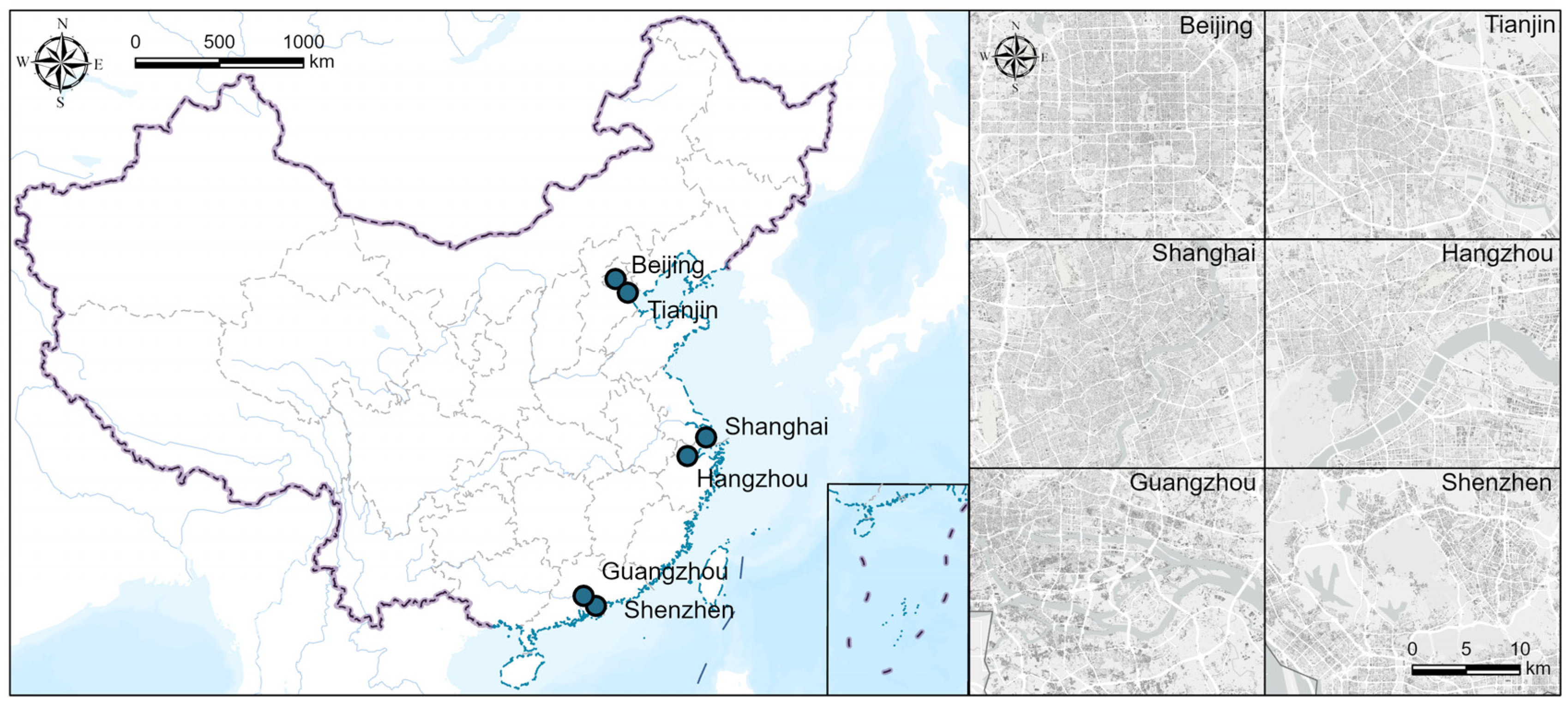
This study focuses on six major Chinese megacities: Beijing, Tianjin, Shanghai, Hangzhou, Guangzhou, and Shenzhen (Figure 1). These cities were selected through a purposive comparative case-study design rather than as a statistically representative sample of all Chinese cities. The selection was based on four considerations. First, these cities are among the most important high-level urban centers in China, with large population concentrations, strong economic output, and high levels of urbanization. Second, they are located in three major national urban agglomerations, namely the Beijing–Tianjin–Hebei region, the Yangtze River Delta, and the Pearl River Delta/Greater Bay Area, where China’s rapid urbanization and vertical development have been most pronounced. Third, the six cities represent contrasting development contexts and spatial forms. Beijing and Tianjin represent capital-region and northern coastal megacities; Shanghai and Hangzhou represent mature and emerging cores of the Yangtze River Delta; Guangzhou and Shenzhen represent highly dynamic and more polycentric urban development in South China. Finally, these cities provide relatively complete and comparable building footprint, building height, and long-term impervious surface records, which ensures the feasibility and consistency of the retrospective 3D urban morphology analysis.
The study area, comprising three municipalities and three sub-provincial cities, collectively spans over 60,900 km2. The total resident population of these cities had exceeded 109 million, representing 7.7% of the national aggregate by 2023. As strategic development hubs and regional cores of China’s three major urban agglomerations (the Beijing–Tianjin–Hebei region, the Yangtze River Delta, and the Pearl River Delta), the study area contributes 15.29% of the nation’s GDP, and each city boasts an urbanization rate of over 85% [32]. Yet, decades of intensive development in space have led to significant pressure on their ecological and infrastructural carrying capacity. In response to the growing demand for smart growth and urban renewal, there is an urgent need to ease the tensions between urban expansion and land resources, which can be achieved through spatial restructuring and the strategic optimization of existing built environments.
The datasets used here include the following: (1) Building Footprint Data: High-resolution, high-accuracy building footprint vectors from the GABLE (Geospatial Artificial-intelligence for Building Extraction) dataset, derived from Beijing-3 satellite imagery (0.5–0.8 m) [10]. GABLE was constructed based on a dual-branch deep learning framework that identifies vectorized roof polygons and estimates building heights. The dataset covers approximately 510 million buildings across China, which include accurate polygon footprints, classified roof types, and height attributes. The spatial resolution can reach as high as 1 m, and height accuracy was tested to 84.9%, with a mean height absolute error of 1.16 m. We then performed topological verification and error correction on the original building footprint data products. (2) Impervious Surface Data: The Global Artificial Impervious Area (GAIA) dataset with 30 m resolution provides temporal dynamics of impervious surface from 1985 to 2024, based on processing from time-series Landsat imagery from the Google Earth Engine platform [33]. The overall accuracy of impervious surface classification exceeds 90%. (3) Administrative Boundaries: Official boundaries on the prefecture, city and county levels were used to delineate urban areas and to perform spatial statistics.

2.2. Methods

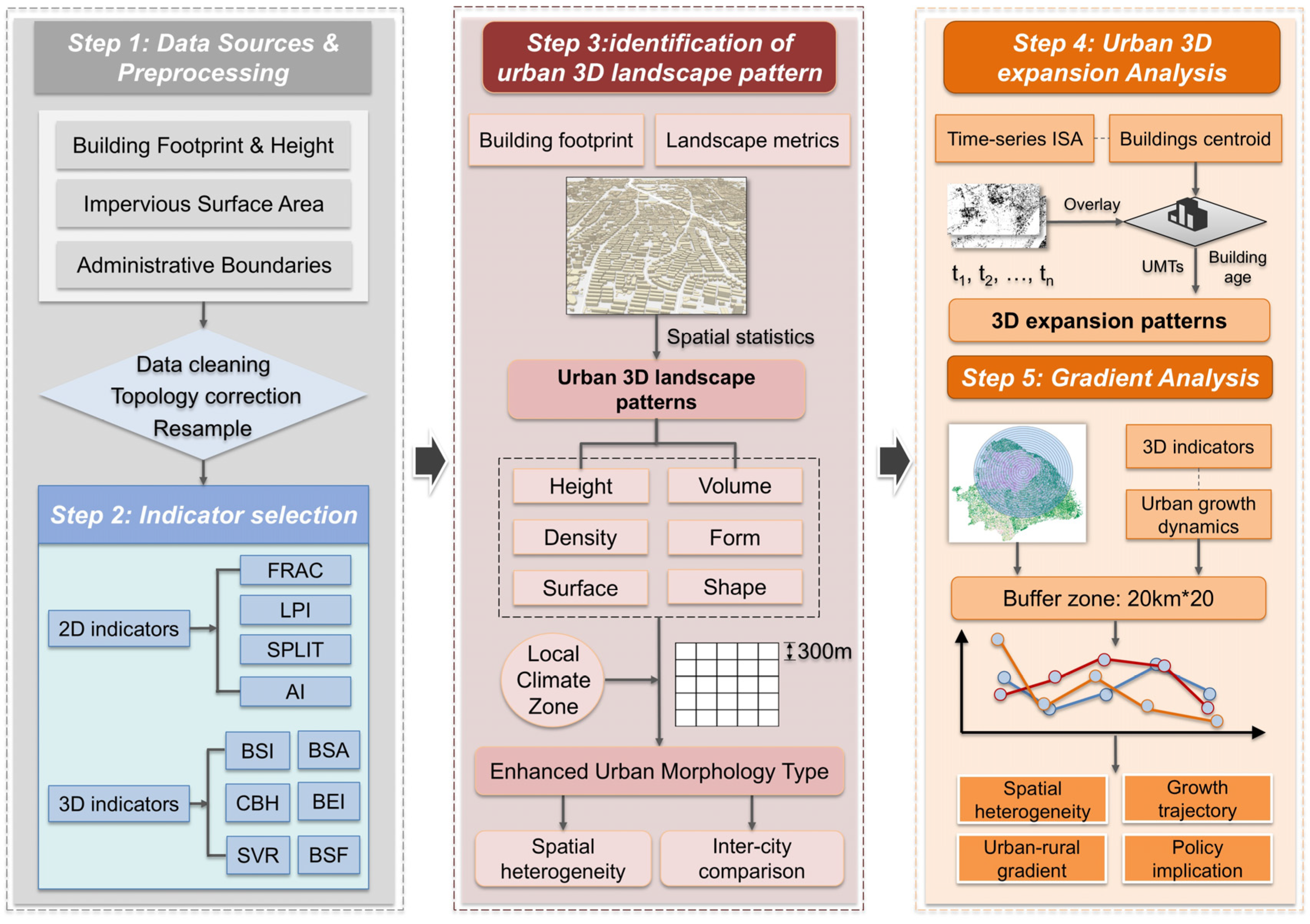
The methods employed in this study include five main steps: data preprocessing, indicator selection, identification of the urban 3D morphology pattern, analysis of the urban 3D expansion process, and analysis of urban–rural gradient characteristics (Figure 2).

2.2.1. Selection of Multidimensional Urban Morphological Indicators

First, we employed a set of indicators to capture the spatial configuration of the built environment. Specifically, four typical landscape metrics were chosen for quantifying the complexity, fragmentation, and connectivity of the urban construction landscape: the Largest Patch Index (LPI), Area-weighted Mean Fractal Dimension (FRAC), Splitting Index (SPLIT), and Aggregation Index (AI). Then, we adopted a grid-based approach for analyzing the vertical features of urban areas, establishing a 300 m × 300 m grid as the basic spatial unit for our analysis. This spatial scale was chosen because it effectively reflects a city neighborhood or block in the context of a Chinese megacity, and also aligns with widely acknowledged frameworks such as the LCZ classification system [21]. Within each grid, key 3D building attributes, including height, density, footprint area and volume, were calculated. Further, a set of metrics was selected to comprehensively identify the key characteristics of 3D morphology (Table 1): Average Building Height (AH), Coefficient of Variation of Building Height (CBH), Average Volume (AV), Building Evenness Index (BEI), Building Shape Index (BSI), Building Surface Area (BSA), Surface Area to Volume Ratio (SVR), and Building Footprint Fraction (BSF). These indicators collectively provide a holistic depiction of urban morphology in both horizontal and vertical dimensions [8]. The abovementioned metrics were computed using the FRAGSTATS 4.2and ArcGIS Pro 3.4 platform.

2.2.2. Refined Urban Morphology Classification Based on 3D Morphology Metrics

Based on the calculated metrics, we developed a refined classification of Urban Morphology Type (UMT) to identify distinct building clusters. The development of our UMT classification system was informed by the established principles and standards of the LCZ framework [13]. While grounded in height thresholds for low-, mid-, and high-rise buildings, our approach provides more detail in characterizing the nuanced heterogeneity within the analysis unit, which facilitates a more accurate comparison of urban structures across China’s megacities. Specifically, the chosen metrics, including AH, CBH, BEI, BSI and BSF, represent four aspects, which are height variation, volumetric characteristics, spatial density and the shape of the building clusters. By synthesizing these quantitative indicators and considering data feasibility, this framework defines nine primary classes, each characterized by a range of metric values (Table 2). To clarify the basis of the threshold settings, we further examined the empirical distributions of the five key indicators across all grid cells in the six selected megacities. The threshold design followed a combined logic of literature reference, LCZ-based morphology principles, expert-informed adjustment, and empirical distribution validation. The empirical distributions of AH, BSF, CBH, BSI, and BEI are provided in Figures S1–S5. In addition, a threshold sensitivity analysis was conducted by perturbing the main thresholds by ±10%, and the results confirmed that the UMT classification remained reasonably stable across different urban contexts. Details of the threshold-setting rationale and sensitivity analysis are provided in Supplementary Information Texts S1 and S2, Figures S1–S5 and Tables S1–S3.

2.2.3. Measurement of Urban 3D Expansion

To quantify the long-term dynamics and spatial heterogeneity of 3D urban expansion, we divided the urban growth analysis into three consecutive stages (1991–2000, 2001–2010, and 2011–2023). An existing methodological challenge is the absence of reliable high-resolution historical building datasets, as direct retrieval from early coarse-resolution satellite imagery remains challenging [34]. To overcome this data gap, we used the widely adopted retrospective analysis by overlapping the time-series GAIA dataset (1991–2023) with a contemporary, high-resolution building dataset. The method involves inferring building construction dates by identifying the year each building’s footprint first appeared as a new impervious surface pixel in the historical ISA record [12,35]. We then assigned the estimated year of construction to the corresponding building. This integration strategy facilitates a cost-efficient, large-scale reconstruction of the urban vertical growth model and enables the comparison of the spatiotemporal patterns and intensities of vertical and horizontal growth across the six selected megacities.

2.2.4. Gradient Analysis for the Urban–Rural Continuum

To investigate how urban 3D morphology varies spatially from the urban center to the fringe area, we employed a concentric ring-based gradient analysis. For each megacity, the location of the municipal government was defined as the reference center [22]. This choice was made because the analysis covers a long-term period from 1991 to 2023, during which many secondary centers emerged or changed substantially. At the early stage of the study period, the built-up areas and major administrative, employment, and public-service functions of these cities were generally more concentrated around their traditional or administrative cores. Therefore, using the municipal government location provides a consistent basis for comparing broad center-to-periphery gradients across cities and periods. Nevertheless, this approach does not imply that all cities are strictly monocentric, especially in the later stages of development.
Based on this reference center, we generated 20 concentric buffer rings at 2 km intervals, extending to 40 km from the city center. The buffer width was determined considering the large spatial extent of the study area and the need to ensure that each ring contained a sufficient number of grid cells and building samples. The aforementioned 3D metrics and temporal growth indicators were then calculated within each buffer ring to examine how the city’s three-dimensional structure changed along the urban–rural gradient.

3. Results

3.1. Overall Urban Morphology Characteristics at City Level

The city-level average of 2D and 3D metrics reveals significant differences in spatial configuration for each megacity (Table 3). Shanghai exemplifies highly consolidated and dense building configurations, characterized by the most integrated horizontal fabric (highest LPI, lowest SPLIT) and obvious shape complexity (highest FRAC). It also leads in BSA and BSI, while also having the lowest SVR, indicating a cohesive and compact structure in 3D urban form. In contrast, Shenzhen represents a vertically dominant model, leading in building height and exhibiting the greatest vertical unevenness (highest CH and BEI). This is coupled with the highest building footprint area percentage at 0.154, showing the most intensive ground coverage of infrastructure. Hangzhou presents the most fragmented building patterns, with an intermediate construction intensity marked by low AH and the lowest BSF. In addition, Tianjin is characterized by the highest building volume and a high BSI, suggesting a landscape of massive and compact buildings. While Guangzhou and Beijing tend to exhibit moderate values, Beijing and Hangzhou stand out for having the highest SVR, reflecting a predominance of less-dense building shapes.

3.2. Multidimensional 3D Urban Morphology at Grid Level

3.2.1. Vertical Structure

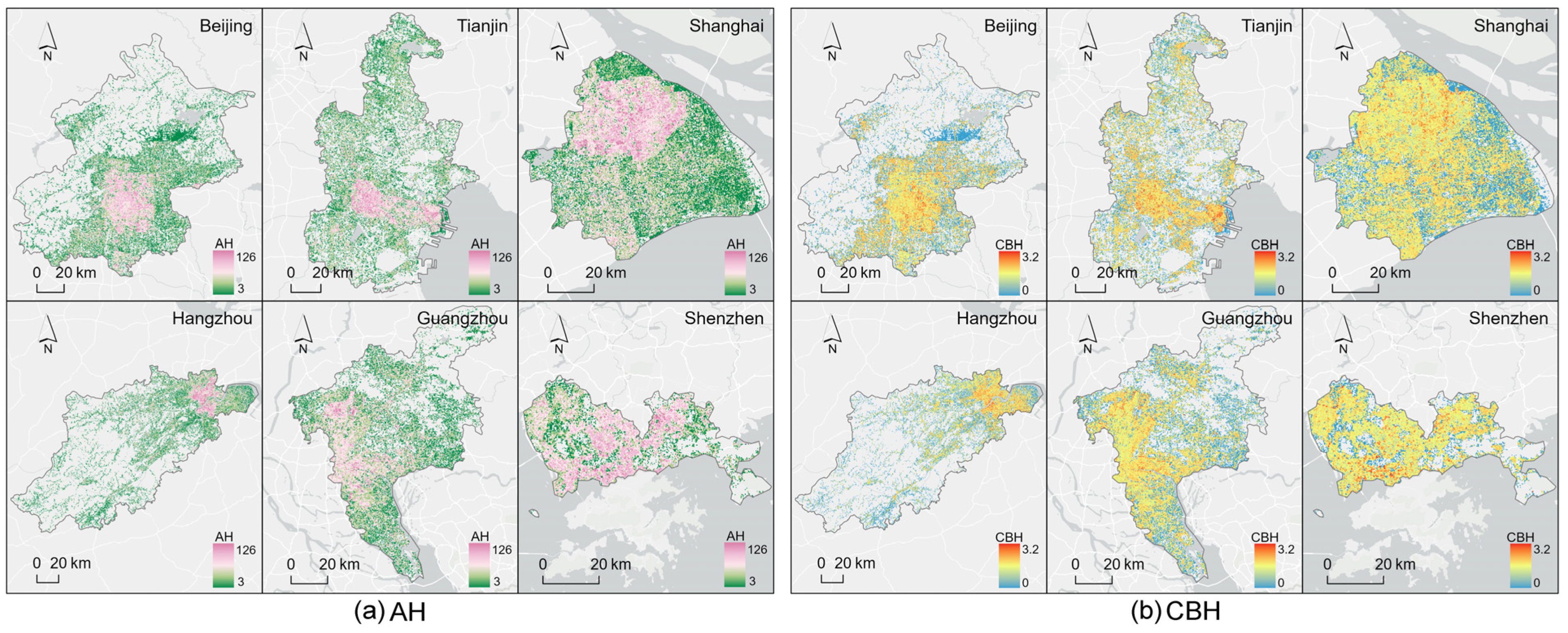
As illustrated in Figure 3a, the spatial pattern of AH reveals that most cities conform to a classic concentric model in which building height decreases from the city core toward the periphery. Yet, Shenzhen presents an evident polycentric model, exhibiting a more dispersed vertical structure where high-AH zones are more evenly distributed throughout the urban area. Furthermore, Beijing and Hangzhou are distinguished by a high proportion of low-AH areas. In these cities, a large proportion of low-rise fabric coexists with concentrated clusters of tall structures, resulting in a form of vertical complexity. The distribution of the CBH shows significant spatial heterogeneity across the study area (Figure 3). Higher CBH values are generally found in central urban areas, reflecting the coexistence of high-rise and low-rise structures due to urban redevelopment and infill. Among the cities, Hangzhou and Beijing exhibit the greatest intra-urban variability in building height, whereas Shenzhen displays a more uniform pattern. Notably, one-third of the total grid has a CBH value of zero, and these areas are predominantly composed of low-rise structures with a mean height of 3.7 m. This suggests that a considerable component of the regional built-up areas consists of homogeneous low-rise developments.

3.2.2. Volumetric Variation

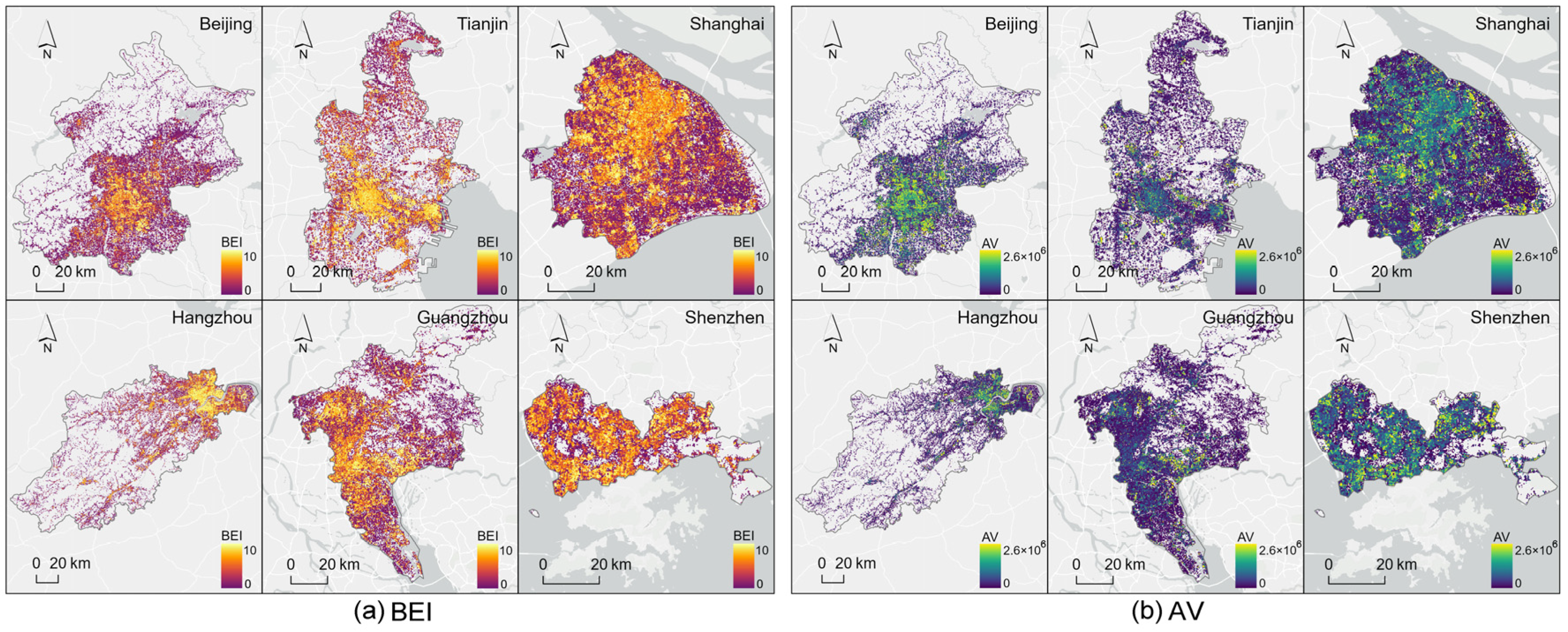
As shown in Figure 4a, grids with greater CBH values also tend to have higher BEI values, which indicates a diverse mixture of building sizes. Moreover, high BEI values are distributed closer to city centers than those of CBH, suggesting that the disparity in building volume between urban core and peripheral areas is more remarkable than height variation. Specifically, Shanghai is characterized by its high and extensive BEI, suggesting a widespread and complex vertical structure across its vast urban area. Similarly, the distribution of building mass confirms the abovementioned structural typologies (Figure 4b). The 3D urban forms of these megacities are evidenced by a strong concentration of high AV around their centers. The polycentric structures of Shenzhen and Guangzhou are more evident through their multiple high-AV nodes. Shanghai also has the most substantial building mass among the cities.

3.2.3. Form Diversity

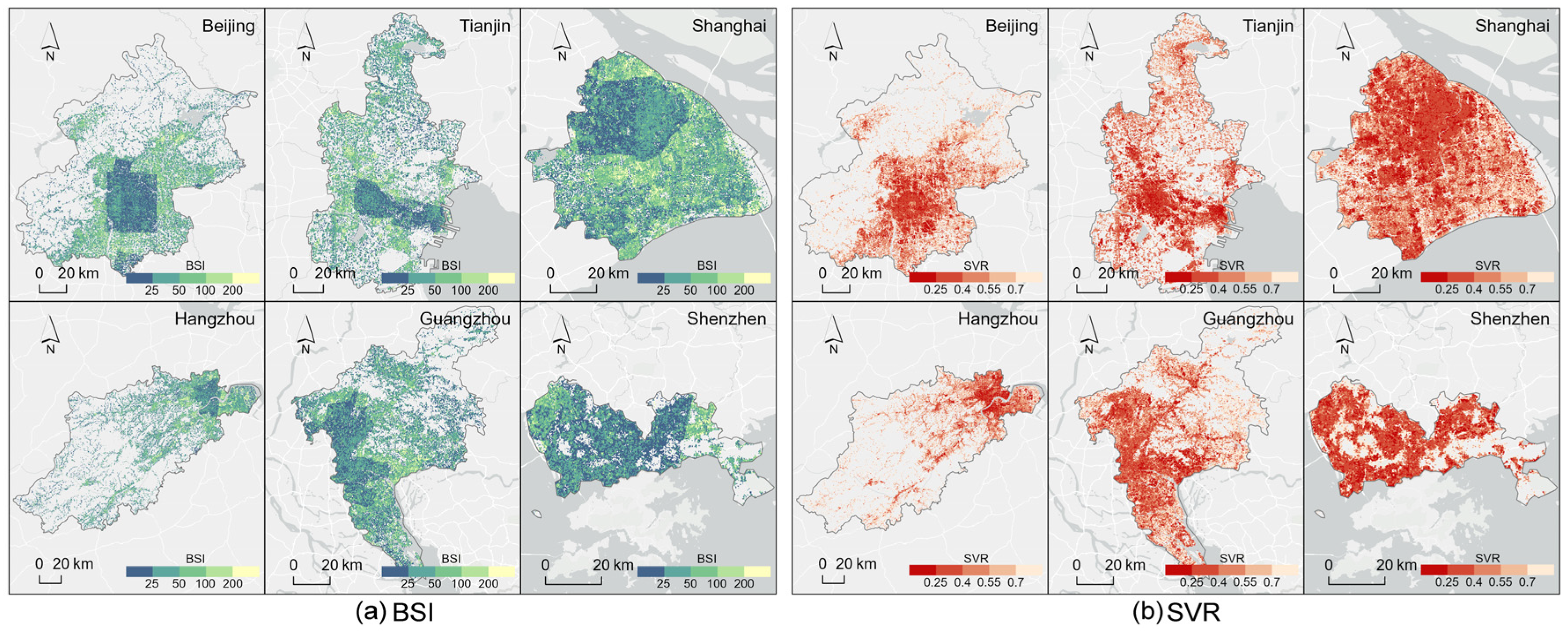
Figure 5a shows that Shenzhen consistently exhibits the lowest average BSI and the smallest degree of variation among all cities in the study area, suggesting a high degree of spatial compactness. Guangzhou ranks second in both metrics. In contrast, Shanghai and Tianjin record the highest mean BSI values and the greatest variability, indicating relatively lower development intensity and more heterogeneous building structures. The grid cells with the lowest BSI values are also concentrated in Shenzhen, further reinforcing its overall efficient and compact urban form. Across the study area, most BSI values fall within the 0–50 range. However, Shanghai and Tianjin display noticeably higher BSI distributions, with a substantial share of grid cells exceeding 50. By comparison, BSI values in Shenzhen are tightly clustered within the lower range, underscoring its consistently high spatial efficiency. The spatial distribution of SVR (Figure 5b) reveals that Shanghai and Tianjin not only have less vertical development but also feature the most structurally complex buildings, evidenced by their widespread high SVR values. Conversely, Shenzhen and Guangzhou display predominantly low SVR values, suggesting that their building stock is characterized by more regular and geometrically simple forms. This combination of low BSI and low SVR in Shenzhen points to a cityscape defined by architecturally efficient high-rises. Notably, Beijing’s urban core presents a unique profile, combining low BSI with high SVR, which suggests a concentration of tall buildings that are nonetheless morphologically complex.

3.3. Spatiotemporal Change in Urban Morphology Types

3.3.1. Identification of Urban Morphology Type

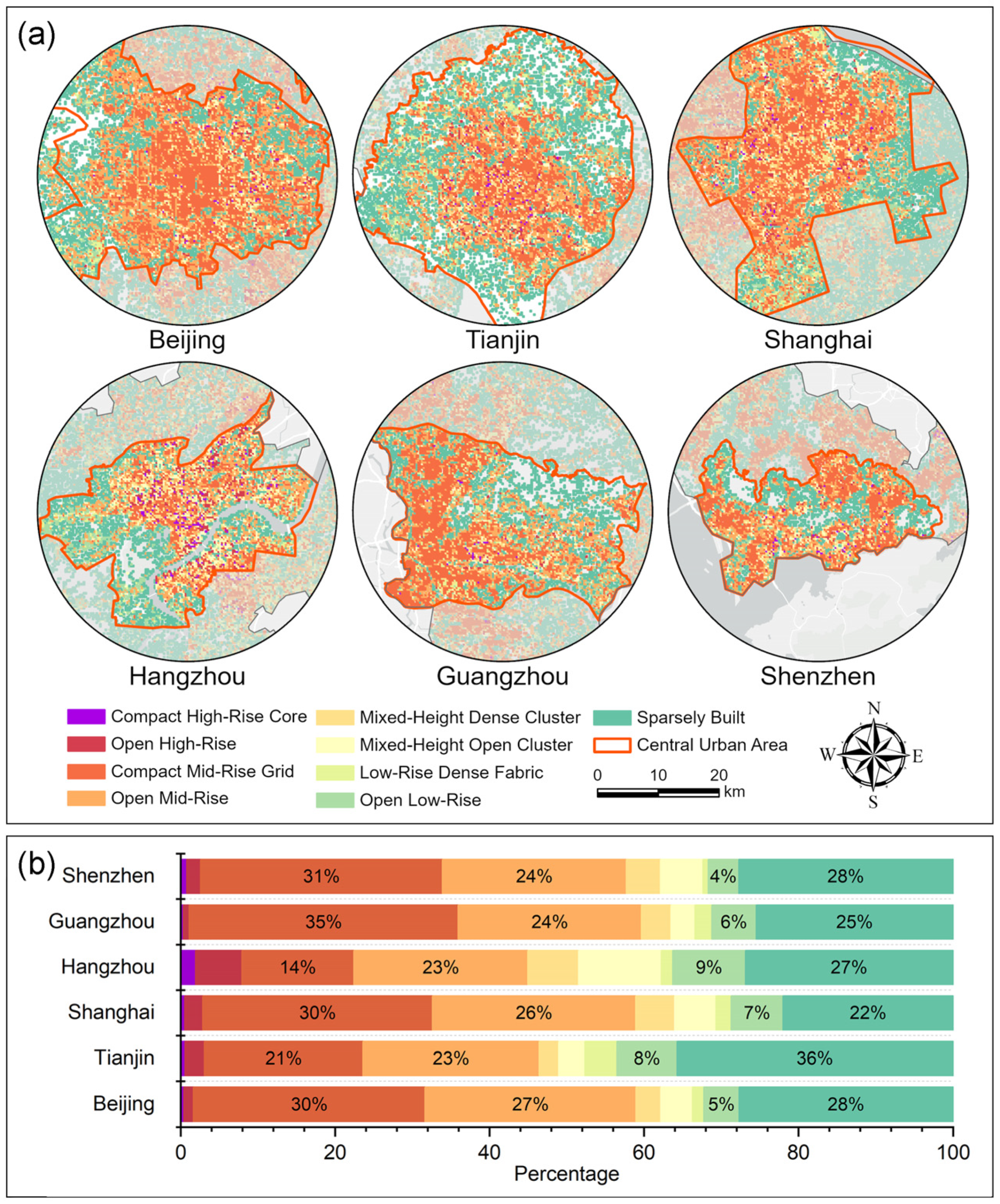
The refined classification of the urban landscape reveals that the central urban areas of the selected megacities are predominantly composed of mid-rise and mixed-height morphologies. As detailed in Figure 6, Open Mid-Rise and Compact Mid-Rise Grids are fundamental types, which accounted for over 50% of the urban fabric across most cities. Furthermore, a significant portion of the UMT within the boundaries remains sparsely built. This category is particularly prominent in Tianjin and Shenzhen, where it constitutes 36% and 28% of the central urban area, suggesting the presence of substantial green spaces or undeveloped land. While sharing a similar structure of morphological components, the six cities show a different spatial organization of UMTs. Cities like Beijing and Tianjin display a relatively concentric spatial configuration, where high-density buildings are concentrated centrally and transition to mixed 3D structures and sparsely built areas toward the periphery. Hangzhou is distinguished by a higher proportion of Compact High-Rise Core and Open High-Rise than other cities and also leads in the proportion of mixed-height development, at 7% and 11%, respectively. Accordingly, the spatial pattern of UMTs of Hangzhou is notably fragmented, characterized by multiple high-density clusters distributed throughout the landscape rather than a single, dominant core.

3.3.2. Temporal Change in Urban Morphology Types

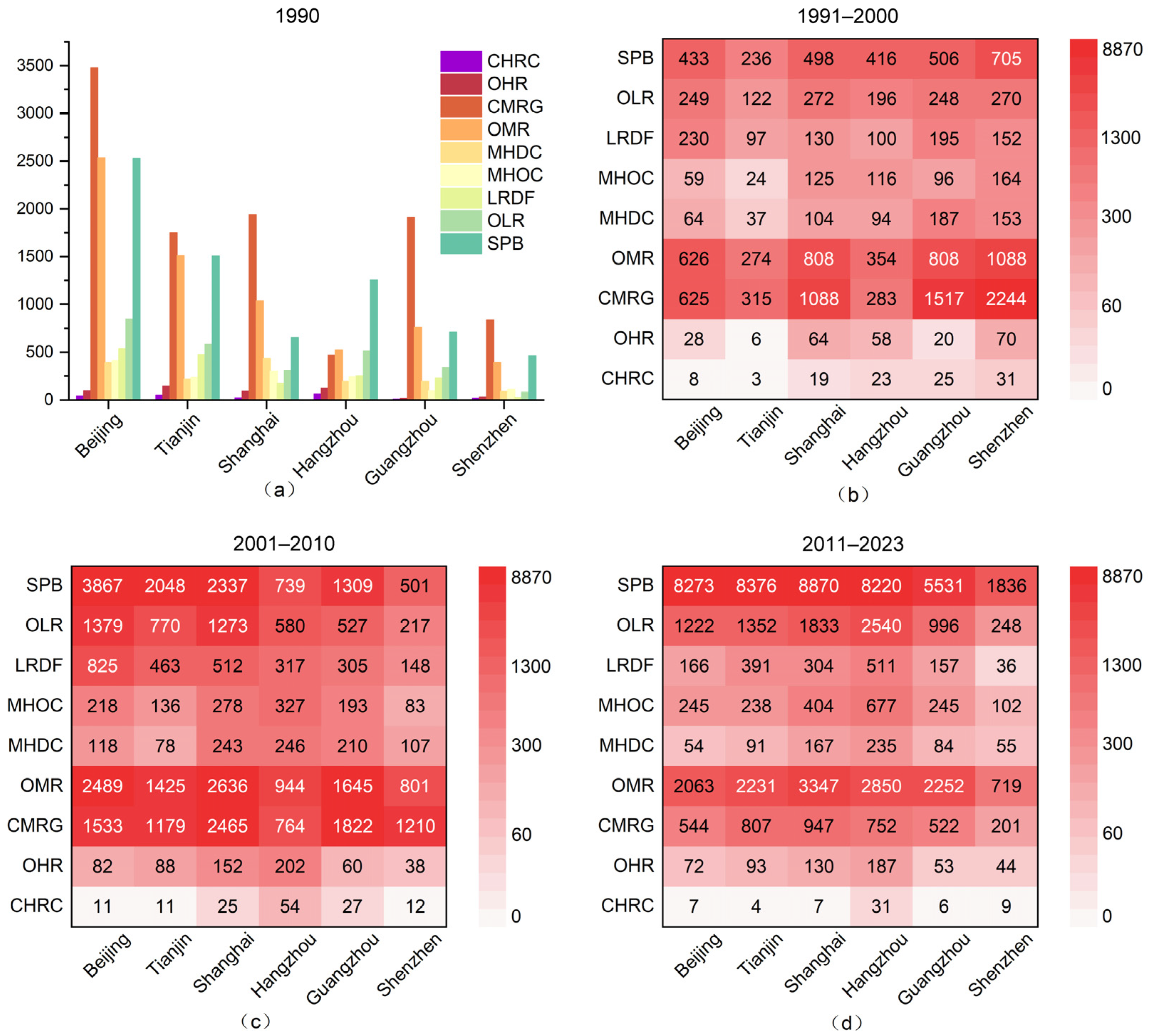
The temporal change in UMTs shows different urban 3D growth trajectories that are shaped by divergent planning strategies (Figure 7). The inverted-V-shaped expansion observed in Beijing, Shanghai and Guangzhou is driven by the mid-rise construction. Dominant growth of the Open Mid-Rise (OMR) and Compact Mid-Rise Grid (CMRG) types peaked in 2001–2010 before declining sharply in the 2011–2023 period. This indicates that the mid-rise suburban infill and expansion in these cities was maturing. Shenzhen exhibited a sustained decline in 3D expansion intensity, and its peak growth for OMR and CMRG occurred a decade earlier. Its subsequent decline in growth rate of these categories confirms its earlier transition into a stock-based planning phase focused on optimizing existing land. Conversely, the cities with accelerating overall growth, Tianjin and Hangzhou, demonstrate a clear morphological shift. While their mid-rise growth also peaked in the 2000s, their Open High-Rise (OHR) development notably accelerated in the 2011–2023 period, suggesting a more recent pivot toward higher-density development.

3.4. Characteristics of 3D Urbanization Along the Urban–Rural Gradient

3.4.1. Gradient Analysis of 3D Morphology

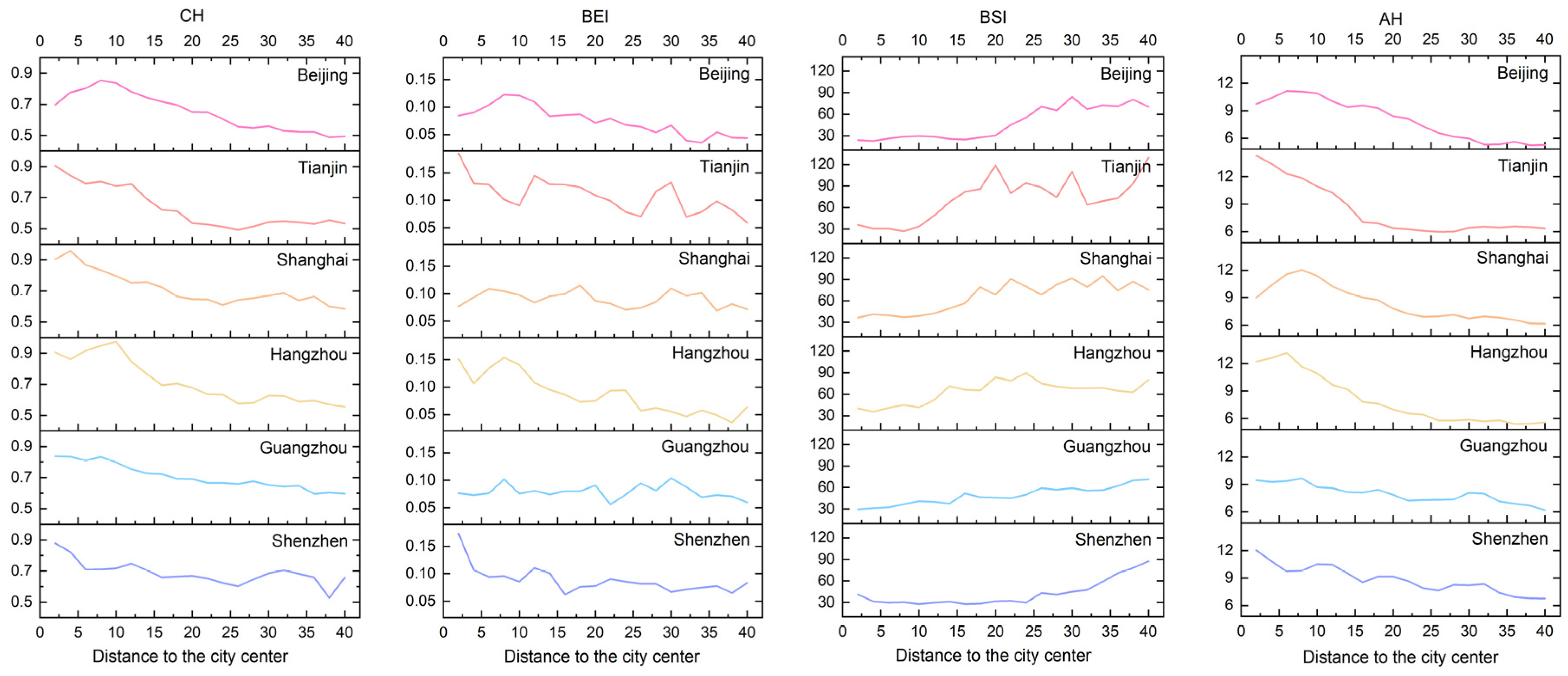
Overall, the gradient analysis shows that 3D morphology metrics have similar but often distinct patterns across the studied megacities (Figure 8). The AH and CBH generally conform to a gradual decay model, while BEI demonstrates a more fluctuating decrease. These metrics largely peak near the city center (2–10 km), then are followed by a notable decline that occurs between 12 and 24 km from the urban center. For instance, Hangzhou, Shanghai and Beijing display an obvious increase in these indicators within the 4–10 km buffer zone, indicating that a large number of tall, diverse building clusters surround the core area. However, Shenzhen and Guangzhou present a flatter gradient for these metrics, which is consistent with their dispersed urban form.
Conversely, the BSI shows a steadily increasing trend along the urban–rural gradient. BSI values are lowest near the center and reach their highest value in the peripheral area (30–40 km); however, fluctuations appear in the middle-range buffer zones. This pattern reflects the general spatial logic of Chinese megacities. The central districts are dominated by intensive land developments, which foster clusters of tall and slender buildings with high floor area ratios. In contrast, the outskirts, characterized by their lower floor area ratio and less intensive land utilization, are covered by low-rise or large-footprint area structures such as suburban residential housing and large industrial compounds.

3.4.2. Urban Vertical and Horizontal Expansion Dynamics from 1991 to 2023

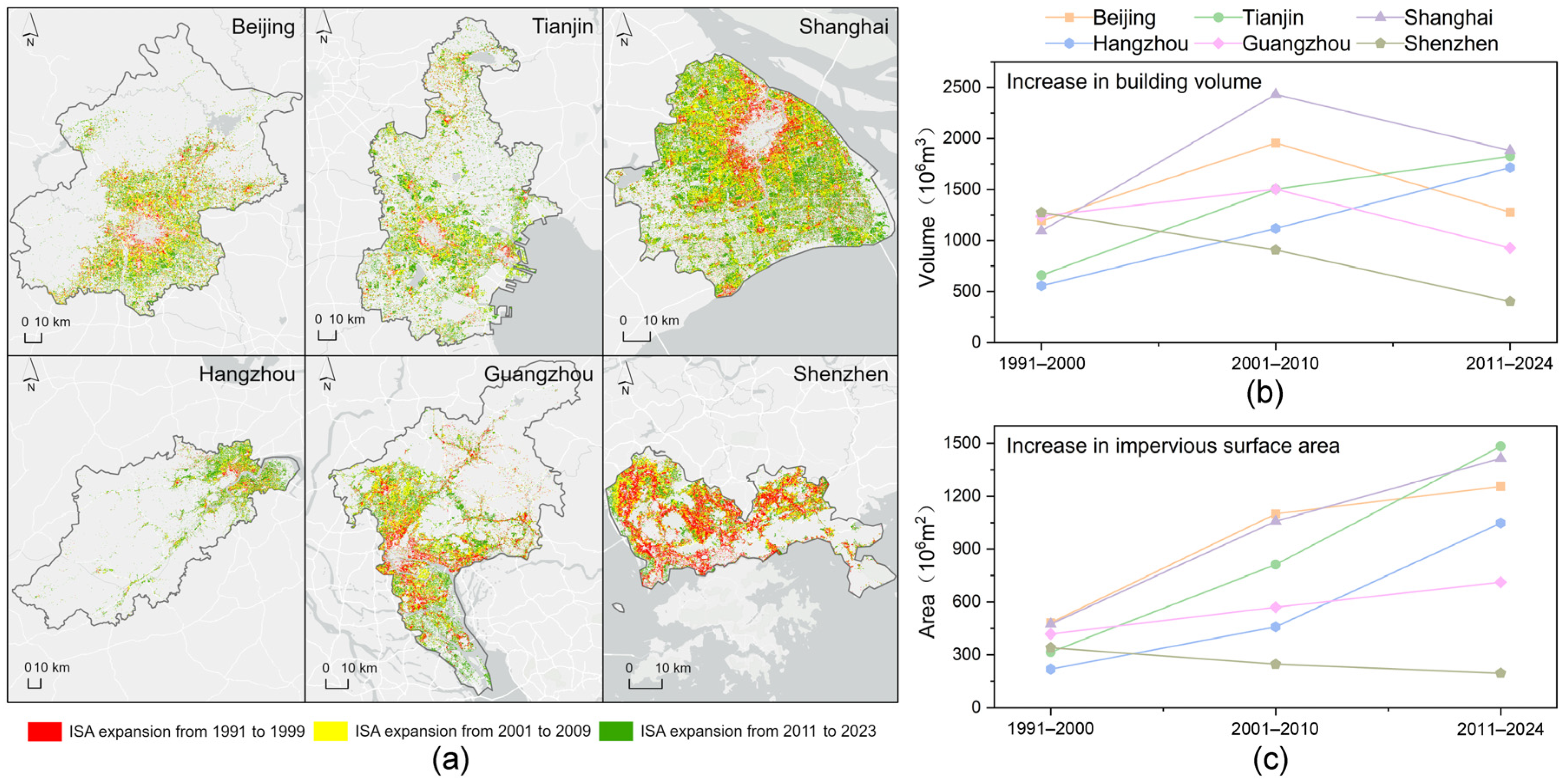
The spatial pattern and temporal dynamics of 2D and 3D urban expansion reveal a clear transition in urban growth trend across the six megacities. Initially, during the 1990s, growth was characterized by typical intense urban sprawl, with new development occurring in areas directly connected to the urban core (Figure 9a). This pattern shifted in the 2000s toward a more polycentric structure as cities began expanding from secondary growth poles and satellite towns. By the 2010s, development strategies diverged significantly. Shenzhen focused on high-density infill to add volume to existing urban areas, while other cities continued with extensive peripheral expansion into their suburbs.
The patterns of increase in building volume can be categorized into three distinct groups (Figure 9b). First, Beijing, Shanghai, and Guangzhou exhibited a rise-and-fall pattern of 3D growth. Construction in these cities peaked during the 2001–2010 period before entering a phase of decline, suggesting a maturation of their primary construction cycles. In contrast, the second group, Tianjin and Hangzhou, demonstrated a trend of continuously accelerating volumetric growth across all three decades, indicating sustained and intensifying vertical development. Third, Shenzhen experienced a substantial increase in building volume in the 1990s, followed by a sharp decline to 4.01 × 10⁸ m3, which is the lowest of all cities during the whole period. While the increase in building volume for Beijing, Shanghai, and Guangzhou peaked in the 2000s, their horizontal expansion showed a different pattern. The growth rate of impervious surface area for these cities continued to accelerate throughout the entire study period (Figure 9c). The trend difference between land consumption and 3D expansion reveals decoupling in the urbanization trajectory, which is more pronounced in cities that have passed their peak construction era but still face pressure for land development. The only exception to this trend is Shenzhen, where a declining rate of ISA increase confirms its unique transition toward a development model focused almost exclusively on vertical densification rather than outward sprawl.

3.4.3. Urban 3D Growth Along the Urban–Rural Gradient

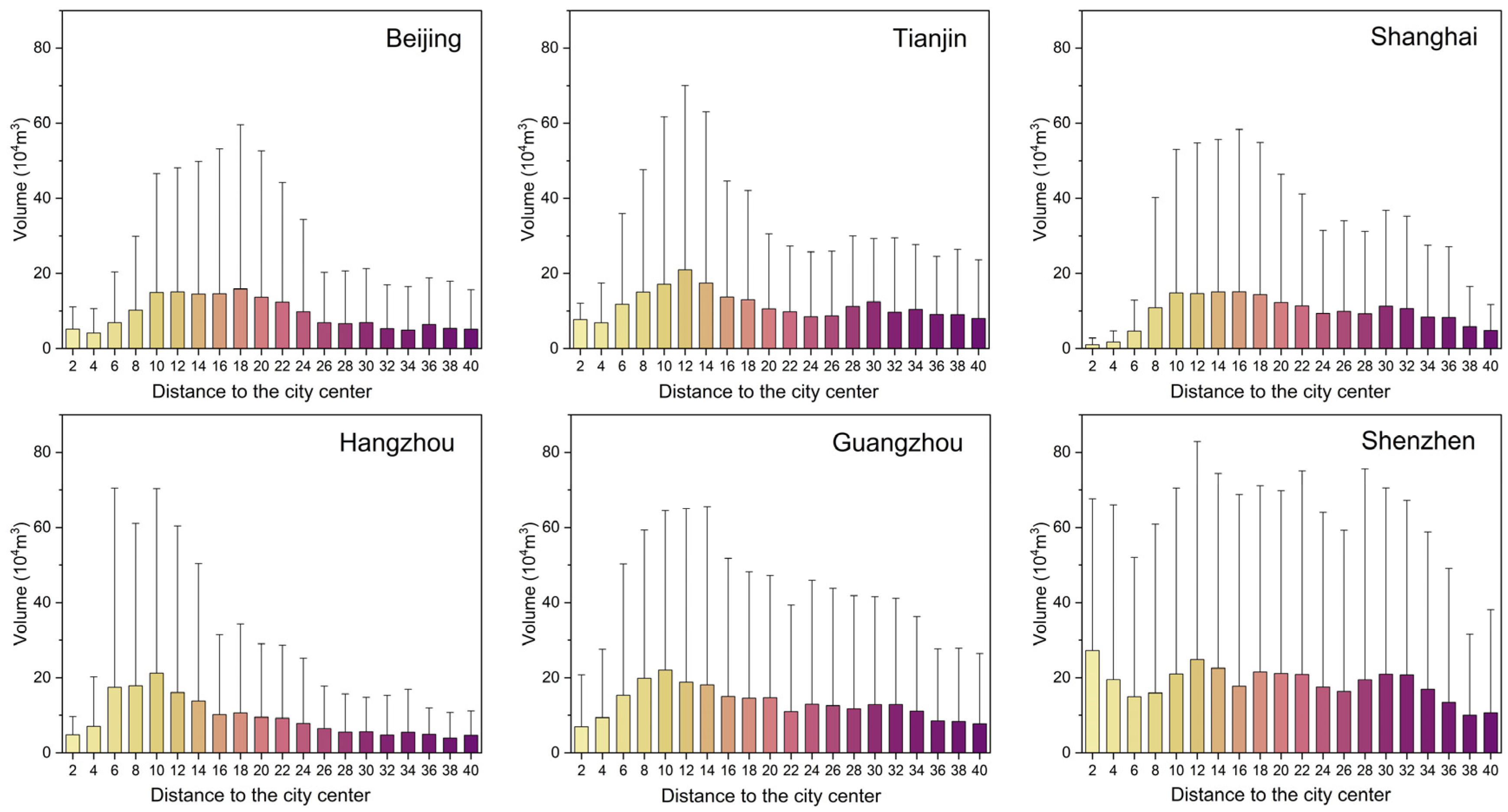
As illustrated in Figure 10, the predominant pattern is a unimodal distribution of volumetric growth along the urban–rural gradient. Specifically, 3D development was minimal in the city centers (typically <6 km), which contributed less than 2.68% to the total growth since 1990. Instead, 3D expansion, concentrated in a concentric ring located between 8 and 14 km from the city center, accounted for 23.6% of all new development. In contrast, Shenzhen exhibits a multi-peaked and more decentralized development model. Shenzhen’s most intense vertical development occurred within the central core, with the largest volume increase of approximately 27 × 104 m3 located at the 2 km zone. The other growth peaks are also located at greater distances from the center, which indicates multiple nodes of intense construction along the gradient.
In all, the comparative analysis of six major Chinese megacities highlights both common trajectories and significant differences in vertical growth patterns over the past three decades. A common phenomenon is that the most dynamic zones of 3D expansion are mainly distributed within 8–14 km of city centers. Such areas often overlap with major ring roads, redevelopment zones and mixed-function construction, leading to high variability in building height and volume. During the phase of rapid urban sprawl, the edges of urban cores in China experienced the proliferation of high-rise buildings with diverse functional uses. These areas were also often interspersed with low-rise housing and historic neighborhoods, resulting in zones of high density and pronounced vertical heterogeneity.

4. Discussion

4.1. Insights for Monitoring the Urban 3D Landscape Dynamics

This study underscores the necessity of moving beyond two-dimensional metrics to characterize urban expansion, because focusing on land cover change or impervious surface dynamics only may obscure the vertical dimension of urban transformation [4,31]. Moreover, the complexity of urban landscapes underlies the 3D form and configuration across multiple scales; urban areas with similar building footprints or average height may show significant differences in building shape or form across spatial units or along urban–rural gradients. For instance, while Shenzhen and Shanghai both exhibit intensive urban 3D forms, the grid-based analysis reveals significant differences in terms of vertical structure, spatial variation and growth trajectory. The presented landscape metrics also reveal distinct urban 3D characteristics: Shenzhen exemplifies a vertically intensive and geometrically regular morphology, whereas Shanghai is characterized by a more sprawling and structurally complex built environment. In summary, a multi-indicator system that incorporates metrics for building height, volume, density, and shape can provide a more nuanced description of urban morphology.
Second, our case study shows that 3D urbanization has similar but often distinct patterns across the studied megacities, while such gradient features of landscape dynamics are often neglected in conventional urban 2D expansion analysis. The proposed UMT classification based on a set of 3D indicators also offers a useful tool for analyzing the urban landscape dynamics. Based on the established LCZ framework and incorporating more detail on volumetric variations and shape complexity, these measurements have the potential to improve our understanding of the relationships between urban morphological features and environmental impact assessment. Although this study does not directly model land surface temperature, previous studies have shown that building height variability, compactness, and surface-to-volume configuration may influence radiation trapping, surface energy fluxes, ventilation, and pollutant dispersion [36,37,38,39]. Practically, the UMT framework may provide a morphological basis for future studies on building energy consumption, heat-risk zoning, and low-emission planning, helping planners identify specific urban units for targeted mitigation.

4.2. Dominant Outward Sprawl in Chinese Megacities Against the Background of Global Evidence

A major finding of this study is the dual growth in both urban horizontal and vertical dimensions, which positions China’s megacities in contrast to recent global observations. Previous work identified a profound shift from spreading out to building up in a global analysis, particularly in the mature, post-industrial cities of Europe and North America [3,28]. While global trends indicate a shift from urban sprawl to vertical densification, our high-resolution temporal analysis reveals that horizontal expansion continues to dominate in Chinese megacities, with outward sprawl growth rates exceeding those of vertical development over the study period. In cities like Beijing, Shanghai, and Guangzhou, the expansion of the ISA footprint continued to accelerate throughout the entire study period, even as their volume growth peaked and entered a phase of decline.
This divergence from the global trend is not uniform, and the nuances within our results offer critical insights. The primary driver of this dual expansion stems from China’s unique state-led development model. The land finance system creates powerful economic incentives for local governments to continually convert peripheral rural land for new construction [40,41]. In addition, massive state-led investment in new infrastructure, such as extensive ring roads and subway networks, continuously opens up previously inaccessible suburban land [42], making horizontal expansion a core component of state spatial planning. In this context, Shenzhen stands as the prominent exception, the only city in our study to demonstrate a clear deceleration in both vertical and horizontal expansion, transitioning to a model focused on high-density infill and urban regeneration. Shenzhen’s trajectory does not contradict the global trend, but rather confirms the important pre-condition for urban renewal, namely, the exhaustion of available land for outward sprawl [43]. The other five megacities, while featuring significant vertical development, still possess a viable sprawl frontier. Therefore, the global shift from horizontal sprawl to vertical densification is not a necessary phase of urban development, but a transition contingent upon exhausting the economic and spatial opportunities for horizontal expansion.

4.3. Determinants of the Vertical Growth Trajectories of Chinese Megacities

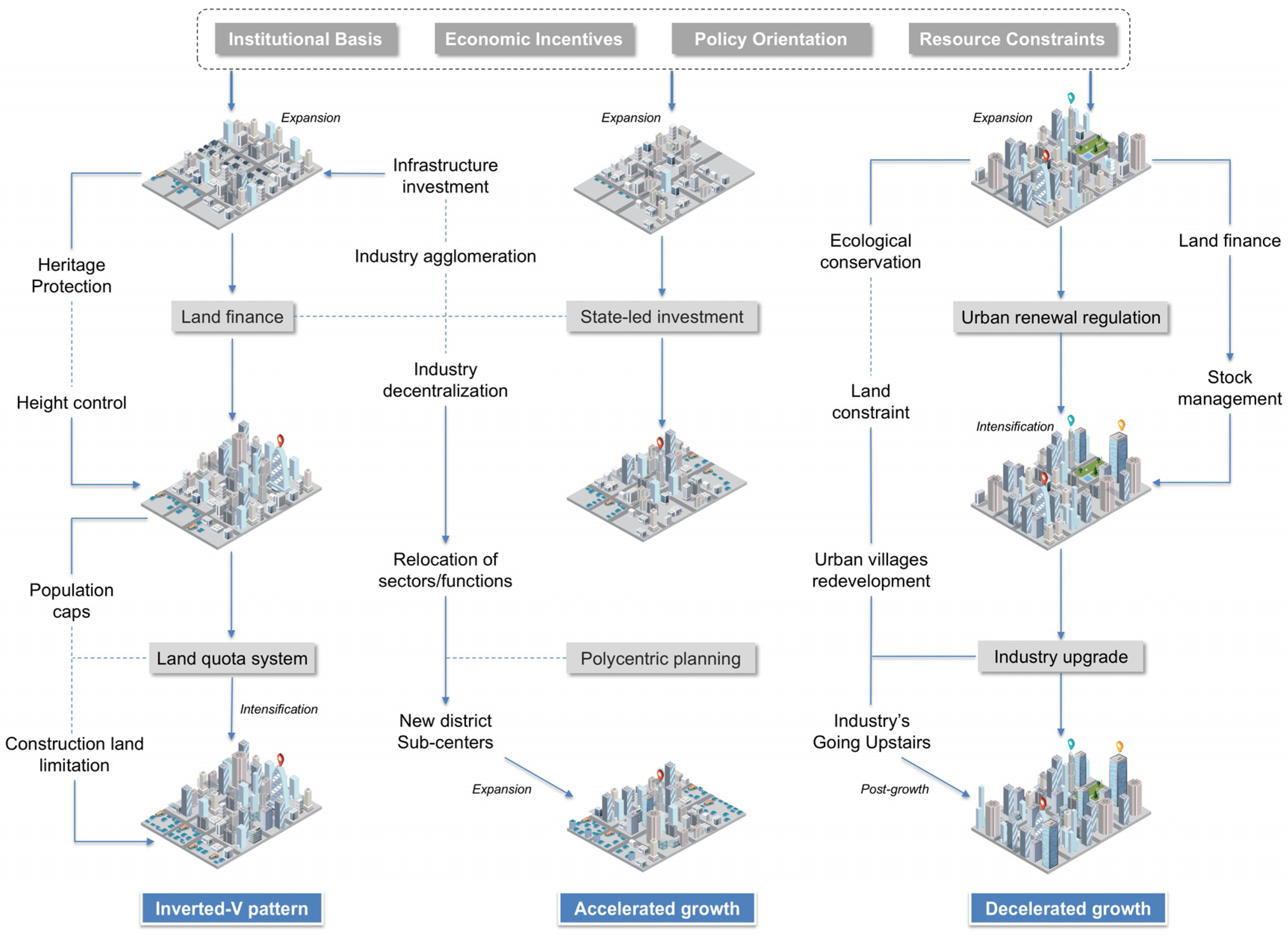
The inverted-V pattern in Beijing, Shanghai and Guangzhou suggests a rapid urban densification followed by a transition to lower-density sprawl. This was first influenced by institutional constraints in the city centers, where strict height limits and historical preservation mandates limit vertical growth (Figure 11). As land supplies in core districts were exhausted, the impact of land finance shifted from city centers to suburban areas [44]. The dispersal of urban functions and sectors, such as Shanghai’s industrial shift to port areas, displaced mid-rise growth to the suburbs where sprawl space remained. For the latter period, the primary drivers are strict population caps and “negative-growth” land policies that legally halt vertical accumulation in these megacities [45].
In contrast, Tianjin and Hangzhou’s accelerating growth implies both continued massive horizontal expansion and vertical intensification in newer suburban districts and secondary centers. Bolstered by state-led regional restructuring and development strategies like the digital economy [46], these cities utilize a tract development model to sustain growth. The continuous explosion of emerging industries, combined with polycentric-oriented planning, drives high-intensity development. Furthermore, these cities benefit from abundant undeveloped land resources like saline-alkali lands and open fields, which allow for unhindered vertical expansion. Shenzhen’s unique pattern reflects an early shift toward urban regeneration and stock management. The decelerating pattern is a direct consequence of resource constraints regarding land scarcity and ecological conservation. With the smallest total land volume and a high proportion of mountainous terrain restricted by ecological red lines, Shenzhen was forced to pioneer urban village renovation and industrial upgrading [43]. This physical limitation coincided with an economic pivot from manufacturing-driven density to high-end innovation, explaining the city’s early growth peak followed by a structural deceleration.
In general, as megacities experienced growing demand for high-efficiency land use fueled by economic agglomeration, models centered on urban renewal and redevelopment emerged. Hence, cities follow distinct 3D growth trajectories, suggesting targeted policy responses [47]. Cities that have passed a construction peak may require policies emphasizing stock optimization, urban regeneration, and mitigation of density-related disservices. Cities of developing countries that are still in an expansion phase may benefit from proactive spatial planning that navigates vertical growth toward nodes with adequate transport and services. Overall, the urban 3D landscape dynamics are directly linked to underlying development models, and the UMTs and gradient analysis presented here provide valid evidence for such targeted interventions.

4.4. Limitations and Future Prospects

While this study provides a comprehensive comparative analysis, several limitations should be acknowledged. First, the accuracy of the building dataset, though generally high, may not fully capture the extreme heights of super-tall skyscrapers [10]. This could lead to a slight underestimation of building volume in the central business districts of cities like Shanghai and Shenzhen. Second, the retrospective reconstruction of building construction years and vertical growth trajectories involves uncertainty. In this study, the first appearance of impervious surfaces in the GAIA dataset was used to estimate the construction period of present-day buildings, while the contemporary GABLE dataset provides the building footprints and height information in 2023. Therefore, our analysis should be interpreted as an approximation of the formation timing and accumulated 3D morphology of the current building stock, rather than a complete reconstruction of the annual height history of each individual building. This approach implicitly assumes that the present-day building height can represent the final morphology of buildings assigned to different historical periods. However, this assumption may not hold in areas where buildings have experienced floor additions, demolition and reconstruction, urban renewal, or industrial land redevelopment. Such uncertainty is likely to be more pronounced in older and highly regenerated urban cores, such as parts of Shanghai, Guangzhou, and Shenzhen. As a result, recent vertical growth associated with redevelopment may be underestimated, and some rebuilt high-rise structures may be assigned to earlier development periods if their underlying impervious surfaces appeared earlier in the GAIA record.
Despite this limitation, the retrospective strategy remains useful for large-scale comparative analysis because reliable historical building-height datasets are still scarce for the early stages of the study period. Similar indirect strategies have been adopted in recent long-term 3D urban expansion studies by combining historical impervious surface dynamics with contemporary building-height data [24]. Future studies should incorporate archival high-resolution satellite images, historical land-use records, building permit data, cadastral archives, or multi-temporal building-height products to better identify reconstruction, floor additions, and redevelopment processes. To address the challenge of identifying urban redevelopment, future research could incorporate archival high-resolution satellite imagery or historical land-use records to detect changes in building stock over time. Further, extending this comparative framework to a broader range of cities within China and across other rapidly urbanizing regions would help to validate the generalizability of these findings and further deepen our understanding of the global dynamics of three-dimensional urban growth. Finally, extending UMTs by integrating land use, building functions [48], population density and mobility data would allow researchers to test how 3D form interacts with socioeconomic functions, energy use and travel behavior.

5. Conclusions

This study developed a multidimensional indicator system for evaluating 3D urbanization based on high-resolution building footprint and time-series ISA data. Using grid-based and spatial gradient analysis, it comprehensively assessed the 3D morphological patterns and growth trajectory of six representative Chinese megacities. The six examined Chinese megacities display pronounced differences in vertical structure, shape complexity and spatial compactness while sharing a consistent center-to-periphery gradient and a common concentration of recent volumetric additions in a near-suburban zone. These spatial patterns of typical Chinese megacities coexist with diverse temporal dynamics of vertical growth, namely rise-and-fall, sustained acceleration, and decelerating vertical growth.
The principal contribution of this research is its demonstration of the decoupling between horizontal expansion and vertical growth, highlighting the necessity of moving beyond conventional 2D analysis to a more nuanced understanding of urban transformation. Methodologically, the refined urban morphology type classification and the combined use of high-resolution building geometry with retrospective impervious surface inference offer a feasible approach for mapping 3D urbanization across space and time. The diverse 3D growth trajectories identified in this study further suggest that planning responses should be differentiated according to the development stage, land-resource condition, and dominant growth mode of each city. For cities with an inverted-V-shaped trajectory, such as Beijing, Shanghai, and Guangzhou, future planning should place greater emphasis on stock optimization, urban regeneration, heritage-sensitive renewal, and the mitigation of density-related environmental risks in already built-up areas [49]. For cities with sustained acceleration, such as Tianjin and Hangzhou, proactive vertical planning is needed to guide high-density development toward transport nodes, new towns, and emerging subcenters while preventing excessive outward sprawl [50]. For land-constrained cities with an early peak and decelerating growth, such as Shenzhen, policies should further promote stock-based redevelopment, mixed-use vertical intensification, and efficient land reuse under ecological and spatial constraints [51]. These differentiated strategies may help policymakers balance horizontal expansion, vertical intensification, urban renewal, and environmental sustainability in rapidly urbanizing megacities.

Supplementary Materials

The following supporting information can be downloaded at: https://www.mdpi.com/article/10.3390/rs18121895/s1, Text S1: Basis for UMT threshold setting; Text S2: Threshold sensitivity analysis of UMT classification; Figure S1: Distribution of AH across grid cells in the six megacities; Figure S2: Distribution of BSF across grid cells in the six megacities; Figure S3: Distribution of CBH across grid cells in the six megacities; Figure S4: Distribution of BSI across grid cells in the six megacities; Figure S5: Distribution of BEI across grid cells in the six megacities; Table S1: Sensitivity analysis under single-threshold perturbation; Table S2: Sensitivity analysis under simultaneous threshold perturbation; Table S3: City-level agreement rates under simultaneous threshold perturbation.

Author Contributions

G.L.: conceptualization, methodology, validation, investigation, resources, writing—original draft preparation, visualization; X.J.: formal analysis, investigation, data curation; J.L.: formal analysis; Q.W.: writing—review and editing; B.L.: data curation; M.M.: investigation; Y.H.: writing—review and editing, project administration. M.X.: supervision, project administration, funding acquisition. All authors contributed to the design or analysis and interpretation of the data, approved the submitted version, and agree to be accountable for all aspects of the work. All authors have read and agreed to the published version of the manuscript.

Funding

This research was financially supported by the Fundamental Research Funds of Zhejiang University of Science and Technology (No. 2025QN101), the Natural Science Foundation of Zhejiang Province (No. LQN25D010009), the Major Humanities and Social Sciences Research Projects in Zhejiang higher education institutions (No. 2024QN128), and the Research Project on Graduate Teaching Reform of Zhejiang University of Science and Technology (2025yjsjg03).

Data Availability Statement

The datasets used and analyzed in this study are available from the corresponding author upon reasonable request.

Acknowledgments

The authors would like to express their sincere gratitude to the open-access data platforms that supported this research. The authors also gratefully acknowledge Zhichao He and Daoxiang Wu for their constructive suggestions on this manuscript.

Conflicts of Interest

The authors declare no conflicts of interest.

References

  1. Huang, K.; Li, X.; Liu, X.; Seto, K.C. Projecting global urban land expansion and heat island intensification through 2050. Environ. Res. Lett. 2019, 14, 114037. [Google Scholar] [CrossRef]
  2. Simkin, R.D.; Seto, K.C.; McDonald, R.I.; Jetz, W. Biodiversity impacts and conservation implications of urban land expansion projected to 2050. Proc. Natl. Acad. Sci. USA 2022, 119, e2117297119. [Google Scholar] [CrossRef] [PubMed]
  3. Frolking, S.; Mahtta, R.; Milliman, T.; Esch, T.; Seto, K.C. Global urban structural growth shows a profound shift from spreading out to building up. Nat. Cities 2024, 1, 555–566. [Google Scholar] [CrossRef]
  4. Zhou, Y.; Li, X.; Chen, W.; Meng, L.; Wu, Q.; Gong, P.; Seto, K.C. Satellite mapping of urban built-up heights reveals extreme infrastructure gaps and inequalities in the Global South. Proc. Natl. Acad. Sci. USA 2022, 119, e2214813119. [Google Scholar] [CrossRef]
  5. Sun, J.; Liu, Z.; Xia, F.; Gu, Y.; Gao, X.; Lu, S.; Xu, Y.; Meng, F.; Zhang, Q.; Zhou, T. Uncovering the Impacts of 2D and 3D Urbanization on Urban Heat Islands in 384 Chinese Cities. Environ. Sci. Technol. 2025, 59, 7106–7116. [Google Scholar] [CrossRef] [PubMed]
  6. Rode, P.; Keim, C.; Robazza, G.; Viejo, P.; Schofield, J. Cities and Energy: Urban Morphology and Residential Heat-Energy Demand. Environ. Plan. B Plan. Des. 2014, 41, 138–162. [Google Scholar] [CrossRef]
  7. Chen, Y.; Wang, Z.; Wen, Q.; Meng, J.; Huo, J.; Li, S.; Zhou, L.; Chen, P.; Liang, D.; Bi, J.; et al. A building-scale modeling framework for urban net-zero transitions in Nanjing. Nat. Commun. 2025, 16, 8954. [Google Scholar] [CrossRef]
  8. Li, K.; Zeng, H. Multidisciplinary parameters for characterizing the 3D urban morphology: An overview based on the relational perspective. Sustain. Cities Soc. 2024, 106, 105364. [Google Scholar] [CrossRef]
  9. Esch, T.; Brzoska, E.; Dech, S.; Leutner, B.; Palacios-Lopez, D.; Metz-Marconcini, A.; Marconcini, M.; Roth, A.; Zeidler, J. World Settlement Footprint 3D—A first three-dimensional survey of the global building stock. Remote Sens. Environ. 2022, 270, 112877. [Google Scholar] [CrossRef]
  10. Sun, X.; Huang, X.; Mao, Y.; Sheng, T.; Li, J.; Wang, Z.; Lu, X.; Ma, X.; Tang, D.; Chen, K. GABLE: A first fine-grained 3D building model of China on a national scale from very high resolution satellite imagery. Remote Sens. Environ. 2024, 305, 114057. [Google Scholar] [CrossRef]
  11. Wu, W.-B.; Ma, J.; Banzhaf, E.; Meadows, M.E.; Yu, Z.-W.; Guo, F.-X.; Sengupta, D.; Cai, X.-X.; Zhao, B. A first Chinese building height estimate at 10 m resolution (CNBH-10 m) using multi-source earth observations and machine learning. Remote Sens. Environ. 2023, 291, 113578. [Google Scholar] [CrossRef]
  12. Zhang, Y.; Zhao, H.; Long, Y. CMAB: A Multi-Attribute Building Dataset of China. Sci. Data 2025, 12, 430. [Google Scholar] [CrossRef] [PubMed]
  13. Zhao, C.; Weng, Q.; Hersperger, A.M. Characterizing the 3-D urban morphology transformation to understand urban-form dynamics: A case study of Austin, Texas, USA. Landsc. Urban Plan. 2020, 203, 103881. [Google Scholar] [CrossRef]
  14. Biljecki, F.; Chow, Y.S. Global Building Morphology Indicators. Comput. Environ. Urban Syst. 2022, 95, 101809. [Google Scholar] [CrossRef]
  15. Ren, C.; Cai, M.; Li, X.; Shi, Y.; See, L. Developing a rapid method for 3-dimensional urban morphology extraction using open-source data. Sustain. Cities Soc. 2020, 53, 101962. [Google Scholar] [CrossRef]
  16. Yang, L.; Zhou, X.; Yang, X.; Chen, Y.; Zhang, H.; Na, J. A new hierarchical analysis framework of building heights: Towards a more intuitive understanding of 3D urban structure. Trans. GIS 2024, 28, 40–57. [Google Scholar] [CrossRef]
  17. Labetski, A.; Vitalis, S.; Biljecki, F.; Arroyo Ohori, K.; Stoter, J. 3D building metrics for urban morphology. Int. J. Geogr. Inf. Sci. 2023, 37, 36–67. [Google Scholar] [CrossRef]
  18. Li, S.; Liu, P.; Stouffs, R. Fine-grained local climate zone classification using graph networks: A building-centric approach. Build. Environ. 2025, 278, 112928. [Google Scholar] [CrossRef]
  19. Stewart, I.D.; Oke, T.R. Local Climate Zones for Urban Temperature Studies. Bull. Am. Meteorol. Soc. 2012, 93, 1879–1900. [Google Scholar] [CrossRef]
  20. Demuzere, M.; Kittner, J.; Martilli, A.; Mills, G.; Moede, C.; Stewart, I.D.; van Vliet, J.; Bechtel, B. A global map of local climate zones to support earth system modelling and urban-scale environmental science. Earth Syst. Sci. Data 2022, 14, 3835–3873. [Google Scholar] [CrossRef]
  21. Quan, S.J.; Bansal, P. A systematic review of GIS-based local climate zone mapping studies. Build. Environ. 2021, 196, 107791. [Google Scholar] [CrossRef]
  22. Li, K.; Li, Y.; Yang, X.; Liu, X.; Huang, Q. Comparing the three-dimensional morphologies of urban buildings along the urban-rural gradients of 91 cities in China. Cities 2023, 133, 104123. [Google Scholar] [CrossRef]
  23. Wang, K.; Ruan, L.; Xiao, W.; Yang, R.; Zhou, J. A shift toward extensive utilization: The long-term relations between building volume and utilization intensity in China’s 267 natural cities. Landsc. Urban Plan. 2025, 264, 105466. [Google Scholar] [CrossRef]
  24. Yin, C.; Chen, R.; Xiao, X.; Van de Voorde, T.; Qin, Y.; Guo, X.; Meng, F.; Pan, L.; Yao, Y.; Li, Y. Thirty years of 3-D urbanization in the Yangtze River Delta, China. Sci. Total Environ. 2024, 949, 174909. [Google Scholar] [CrossRef]
  25. Stilla, U.; Xu, Y. Change detection of urban objects using 3D point clouds: A review. ISPRS J. Photogramm. Remote Sens. 2023, 197, 228–255. [Google Scholar] [CrossRef]
  26. Wang, K.; He, T.; Xiao, W.; Yang, R. Projections of future spatiotemporal urban 3D expansion in China under shared socioeconomic pathways. Landsc. Urban Plan. 2024, 247, 105043. [Google Scholar] [CrossRef]
  27. Zhao, Q.; Meng, Q.; Gao, L.; Zhu, M. FU3D: The first global projections of future urban three-dimensional (3D) expansion for the 21st century under shared socioeconomic pathways. Sci. Data 2025, 12, 1555. [Google Scholar] [CrossRef]
  28. Mahtta, R.; Mahendra, A.; Seto, K.C. Building up or spreading out? Typologies of urban growth across 478 cities of 1 million+. Environ. Res. Lett. 2019, 14, 124077. [Google Scholar] [CrossRef]
  29. Liu, X.; Wu, X.; Li, X.; Xu, X.; Liao, W.; Jiao, L.; Zeng, Z.; Chen, G.; Li, X. Global Mapping of Three-Dimensional Urban Structures Reveals Escalating Utilization in the Vertical Dimension and Pronounced Building Space Inequality. Engineering 2025, 47, 86–99. [Google Scholar] [CrossRef]
  30. Qiu, Y.; Xu, S.; Xiao, W.; He, T.; Lu, D.; Ruan, L.; Wang, K. Urban Concrete Forest: China’s 3D Urban Expansion over the Last Three Decades. J. Urban Plan. Dev. 2024, 150, 04024003. [Google Scholar] [CrossRef]
  31. Wang, Y.; Li, X.; Yin, P.; Yu, G.; Cao, W.; Liu, J.; Pei, L.; Hu, T.; Zhou, Y.; Liu, X.; et al. Characterizing annual dynamics of urban form at the horizontal and vertical dimensions using long-term Landsat time series data. ISPRS J. Photogramm. Remote Sens. 2023, 203, 199–210. [Google Scholar] [CrossRef]
  32. Hu, Y.; Connor, D.S.; Stuhlmacher, M.; Peng, J.; Turner Ii, B.L. More urbanization, more polarization: Evidence from two decades of urban expansion in China. npj Urban Sustain. 2024, 4, 33. [Google Scholar] [CrossRef]
  33. Gong, P.; Li, X.; Wang, J.; Bai, Y.; Chen, B.; Hu, T.; Liu, X.; Xu, B.; Yang, J.; Zhang, W.; et al. Annual maps of global artificial impervious area (GAIA) between 1985 and 2018. Remote Sens. Environ. 2020, 236, 111510. [Google Scholar] [CrossRef]
  34. Li, M.; Koks, E.; Taubenböck, H.; van Vliet, J. Continental-scale mapping and analysis of 3D building structure. Remote Sens. Environ. 2020, 245, 111859. [Google Scholar] [CrossRef]
  35. He, T.; Wang, K.; Xiao, W.; Xu, S.; Li, M.; Yang, R.; Yue, W. Global 30 meters spatiotemporal 3D urban expansion dataset from 1990 to 2010. Sci. Data 2023, 10, 321. [Google Scholar] [CrossRef] [PubMed]
  36. Hang, J.; Li, Y.; Sandberg, M.; Buccolieri, R.; Di Sabatino, S. The influence of building height variability on pollutant dispersion and pedestrian ventilation in idealized high-rise urban areas. Build. Environ. 2012, 56, 346–360. [Google Scholar] [CrossRef]
  37. Lee, G.; Jeong, Y. Impact of Urban and Building Form and Microclimate on the Energy Consumption of Buildings—Based on Statistical Analysis. J. Asian Archit. Build. Eng. 2017, 16, 565–572. [Google Scholar] [CrossRef]
  38. Yuan, B.; Li, X.; Zhou, L.; Bai, T.; Hu, T.; Huang, J.; Liu, D.; Li, Y.; Guo, J. Global distinct variations of surface urban heat islands in inter- and intra-cities revealed by local climate zones and seamless daily land surface temperature data. ISPRS J. Photogramm. Remote Sens. 2023, 204, 1–14. [Google Scholar] [CrossRef]
  39. Huang, Y.; Zhong, C.; He, T.; Jiang, Y. Dynamics of street environmental features and emotional responses in urban areas: Implications for public health and sustainable development. Front. Public Health 2025, 13, 1589183. [Google Scholar] [CrossRef]
  40. Liu, Y.; Yue, W.; Fan, P.; Peng, Y.; Zhang, Z. Financing China’s Suburbanization: Capital Accumulation through Suburban Land Development in Hangzhou. Int. J. Urban Reg. Res. 2016, 40, 1112–1133. [Google Scholar] [CrossRef]
  41. Tong, D.; Chu, J.; MacLachlan, I.; Qiu, J.; Shi, T. Modelling the Impacts of land finance on urban expansion: Evidence from Chinese cities. Appl. Geogr. 2023, 153, 102896. [Google Scholar] [CrossRef]
  42. Shen, X.; Wu, C.; Wang, J.; Zhang, X.; Li, G. Local government competition and centralised urban growth management policy implementation: Evidence from China. J. Chin. Gov. 2024, 9, 348–371. [Google Scholar] [CrossRef]
  43. Wei, Q.; Zhang, Y. Vertical expansion in the making: Planning against deindustrialization by promoting “Industry’s Going Upstairs” in Shenzhen. Environ. Plan. A Econ. Space 2024, 56, 1447–1461. [Google Scholar] [CrossRef]
  44. Wu, F. Land financialisation and the financing of urban development in China. Land Use Policy 2022, 112, 104412. [Google Scholar] [CrossRef]
  45. Wang, X.; Shi, R.; Zhou, Y. Dynamics of urban sprawl and sustainable development in China. Socio-Econ. Plan. Sci. 2020, 70, 100736. [Google Scholar] [CrossRef]
  46. Zhu, W.; Chen, J. The spatial analysis of digital economy and urban development: A case study in Hangzhou, China. Cities 2022, 123, 103563. [Google Scholar] [CrossRef]
  47. Zhao, C.; He, Z.; Hersperger, A.M. How do planning intentions spatiotemporally drive 3-D urban growth? Habitat Int. 2025, 157, 103307. [Google Scholar] [CrossRef]
  48. Chen, W.; Zhou, Y.; Stokes, E.C.; Zhang, X. Large-scale urban building function mapping by integrating multi-source web-based geospatial data. Geo-Spat. Inf. Sci. 2024, 27, 1785–1799. [Google Scholar] [CrossRef]
  49. Liu, Z.; Wang, S.; Wang, F. Isolated or integrated? Planning and management of urban renewal for historic areas in Old Beijing city, based on the association network system. Habitat Int. 2019, 93, 102049. [Google Scholar] [CrossRef]
  50. Bibri, S.E.; Krogstie, J.; Kärrholm, M. Compact city planning and development: Emerging practices and strategies for achieving the goals of sustainability. Dev. Built Environ. 2020, 4, 100021. [Google Scholar] [CrossRef]
  51. Cao, K.; Deng, Y.; Song, C. Exploring the drivers of urban renewal through comparative modeling of multiple types in Shenzhen, China. Cities 2023, 137, 104294. [Google Scholar] [CrossRef]
Figure 1. Location of six selected cities and building maps of their urban area.
Remotesensing 18 01895 g001
Figure 2. Flowchart of data analysis.
Remotesensing 18 01895 g002
Figure 3. Spatial patterns of AH (a) and CBH (b) of each city at the grid level.
Remotesensing 18 01895 g003
Figure 4. Spatial patterns of BEI (a) and AV (b) of each city at the grid level.
Remotesensing 18 01895 g004
Figure 5. Spatial patterns of BSI (a) and SVR (b) of each city at the grid level.
Remotesensing 18 01895 g005
Figure 6. (a) Spatial distribution and (b) proportions of different urban morphology types in the central urban area in 2023 across the study area.
Remotesensing 18 01895 g006
Figure 7. Temporal dynamics of urban morphology types within the 40 km buffer zone. (a) Composition and quantity of UMTs in 1990. (bd) Growth quantity of each UMT across the six megacities for the periods 1991–2000 (b), 2001–2010 (c), and 2011–2023 (d).
Remotesensing 18 01895 g007
Figure 8. Urban–rural gradients of the 3D morphology metrics.
Remotesensing 18 01895 g008
Figure 9. (a) Spatial pattern of ISA expansion for each city; (b) temporal variation in total building volume and (c) ISA area for each city.
Remotesensing 18 01895 g009
Figure 10. Gradient patterns of urban 3D expansion of six megacities from 1991 to 2023.
Remotesensing 18 01895 g010
Figure 11. Key drivers and influencing factors of the diverse vertical growth trajectories of Chinese megacities.
Remotesensing 18 01895 g011
Table 1. Definitions and formula of selected metrics.
CategoryIndicatorAbbreviation/FormulaDescription
HeightAverage Height A H = Σ i = 1 n H i n Measures the average height of buildings in the analysis area.
Coefficient of Variation of Height C B H = i = 1 n H i H m e a n 2 / n H m e a n Reflects the uniformity of the building height. A low value indicates that buildings are similar in height, while a high value indicates a large variation between tall and short buildings.
VolumeAverage Volume A V = Σ i = 1 n V i n Measures the average building volume.
Building Evenness Index B E I = i = 1 n [ V i A V ] 2 / n A Measures the spatial evenness of building volume distribution. A high value suggests that volume is concentrated in a few large buildings, while a low value suggests a more even distribution.
FormBuilding Shape Index B S I = 1 n i = 1 n F i H i Describes building form and shape as the ratio of footprint area to height, A high value indicates that the area is dominated by short, wide buildings, while a low value suggests a prevalence of tall, slender buildings.
Building Surface Area B S A = 1 n i = 1 n ( F i + P i H i ) Measures the average exposed surface area of buildings.
Surface Area to Volume Ratio S V R = B S A Σ i = 1 n V i Represents the average building’s morphological complexity. A high value indicates that buildings have more complex, less compact shapes. A low value suggests that building shapes are more regular and compact.
DensityBuilding footprint fraction B S F = Σ i = 1 n F i A Measures the proportion of the ground surface area covered by buildings.
Notes: Hi refers to the height of the building. Vi denotes the volume of the building. Fi represents the footprint area of the building. Pi indicates the perimeter of the building. A is the total area of the analysis unit. Hmean refers to the mean building height within the unit. n denotes the number of buildings in the analysis unit.
Table 2. Classification of UMT based on 3D metrics for Chinese megacities.
TypeValuesDescriptionExample
AHBSFCBHBEIBSI
Compact High-Rise Core>18>0.20.6–1.5<0.8<40Dense clusters of tall buildings or towers with high site coverage.Remotesensing 18 01895 i001
Open High-Rise>18<0.20.7–2<1.5<40High-rise towers arranged with open space, characterized by tall, widely spaced buildings.Remotesensing 18 01895 i002
Compact Mid-Rise Grid6–18>0.20.4–1<0.7<50Continuous mid-rise blocks with uniform building heights forming dense street grids.Remotesensing 18 01895 i003
Open Mid-Rise6–18<0.20.5–1<1.4<50Mid-rise buildings organized with open spacing areas; moderate density and balanced built-open ratios.Remotesensing 18 01895 i004
Mixed-Height Dense Cluster6–18>0.2>1.2<0.8<75Areas combining low-, mid-, and high-rise buildings within a compact footprint.Remotesensing 18 01895 i005
Mixed-Height Open Cluster6–18<0.2>1.2<1.5<75Morphologically diverse areas mixing buildings of various heights with open spaces.Remotesensing 18 01895 i006
Low-Rise Dense Cluster<6>0.20.3–1.2<0.6>80Packed low-rise buildings with high ground coverage and limited open space.Remotesensing 18 01895 i007
Open Low-Rise<6<0.20.4–1.7<1.3>90Low and detached buildings with abundant open space.Remotesensing 18 01895 i008
Sparsely Built <0.05<1<0.1 Areas with minimal building coverage, lowest infrastructure density.Remotesensing 18 01895 i009
Table 3. City-level average of landscape metrics across the study area.
2D Landscape Metrics3D Morphology Metrics
LPIFRACSPLITAIAHBSACHBEIAVBSISVRBSF
Beijing0.0451.15648,72876.66.11751.800.5175.902654.3057.100.570.095
Tianjin0.0631.19838,89576.36.37919.300.53101.004721.6071.700.490.095
Shanghai0.1531.21517,17777.37.271046.500.64121.804596.0077.000.450.114
Hangzhou0.0541.13885,47376.36.05733.000.5270.202838.8059.100.570.066
Guangzhou0.1111.20722,37176.16.47809.500.5790.503367.3052.500.520.098
Shenzhen0.0541.17846,03275.88.52964.100.67157.004100.3042.500.460.154
Disclaimer/Publisher’s Note: The statements, opinions and data contained in all publications are solely those of the individual author(s) and contributor(s) and not of MDPI and/or the editor(s). MDPI and/or the editor(s) disclaim responsibility for any injury to people or property resulting from any ideas, methods, instructions or products referred to in the content.