Article

A Geometry-Induced Lower Bound for Plane-Based Image Registration Error in High-Resolution Satellite Imagery

by
Jin-Woo Koh
* and
HyunSeong Sung
Agency for Defense Development, Yuseong P.O. Box 35, Daejeon 34186, Republic of Korea
*
Author to whom correspondence should be addressed.
Remote Sens. 2026, 18(12), 1889; https://doi.org/10.3390/rs18121889 (registering DOI)
Submission received: 30 April 2026 / Revised: 3 June 2026 / Accepted: 4 June 2026 / Published: 8 June 2026
(This article belongs to the Section Remote Sensing Image Processing)

Highlights

What are the main findings?
  • A closed-form expression for a geometry-induced lower bound of the plane-based image registration error is derived.
  • The lower bound is formulated as a function of incidence angles, convergence angle, and height offset.
  • The experimental results show that the derived lower bound is satisfied in nearly all cases, with only a few marginal deviations attributable to measurement uncertainty.
What are the implications of the main findings?
  • Imaging geometry imposes a fundamental lower bound on the plane-based registration error.
  • The proposed lower bound provides a useful reference for interpreting image registration performance in high-resolution satellite imagery.

Abstract

Image registration accuracy is strongly influenced by imaging geometry, yet this effect has not been explicitly characterized in a closed-form expression under practical plane-based image registration conditions. This paper establishes a geometry-induced lower bound on the image registration error within a plane-based image registration framework. While prior work has primarily focused on improving accuracy through algorithmic advancements, we show that the residual registration error under practical 2D registration conditions is fundamentally influenced by imaging geometry and height variation, regardless of the image registration performance. A closed-form expression of the lower bound is derived as a function of imaging geometry and height offset. The formulation explicitly characterizes how geometric configuration governs displacement in the reference image space or registration plane. The analysis reveals that, even under reliable matching conditions, residual errors may persist due to the inherent coupling between viewing geometry and elevation variation. The derived bound is validated using multiple image pairs acquired under different geometric configurations. The experimental results show that the formulation captures the dominant geometric effect. The proposed formulation provides a practical and interpretable geometric reference for analyzing registration accuracy under varying imaging configurations.

1. Introduction

Image registration is a critical requirement for a wide range of remote sensing applications, including change detection, stereo reconstruction, multi-view fusion, and time-series analysis [1,2,3,4,5]. With the increasing availability of high-resolution optical satellite imagery, sub-pixel registration accuracy is often assumed or required in both operational and research settings [6,7]. Consequently, substantial efforts have been devoted to the development of advanced image registration algorithms, ranging from intensity-based and feature-based methods [8,9,10,11] to recent deep learning-based approaches [12,13].
Despite these advances, image co-registration accuracy is commonly evaluated and discussed in terms of algorithmic performance, implementation details, or training data characteristics. Several studies have analyzed the theoretical limits of image registration accuracy using the Cramér–Rao Lower Bound (CRLB) [14,15]; however, these approaches primarily focus on uncertainty associated with the key parameters driven by image content and noise characteristics, rather than explicitly modeling or isolating the impact of acquisition geometry on registration accuracy. Comparatively less attention has been paid to the fundamental limitations imposed by the image acquisition geometry itself [16,17]. In particular, Wang et al. [16] addressed geometric imaging relationships for preprocessing and terrain correction in multi-angle hyperspectral imagery, whereas Han et al. [17] investigated the impact of convergence angle on image registration accuracy and its dependence on different transformation models.
In most existing studies, the registration error is primarily attributed to imperfections in feature extraction and matching, noise, and limitations of the transformation model. Considerable efforts have therefore been devoted to improving algorithmic components, such as designing robust feature descriptors, enhancing matching strategies, and refining outlier rejection techniques. These approaches implicitly assume that the registration error can be reduced arbitrarily with sufficiently advanced algorithms.
However, in practice, residual misalignment often persists even when high-quality features and robust estimation methods are employed. This observation suggests that not all components of the registration error are algorithm-dependent, and raises a fundamental question: does an intrinsic lower bound exist in the image registration error that cannot be eliminated by improving the algorithm? In this context, the proposed formulation complements CRLB-based analyses by characterizing a deterministic geometric limitation induced by imaging geometry and terrain variation, rather than the statistical uncertainty associated with image content and noise characteristics.
In this study, we address this question from a geometric perspective. We establish a geometry-induced lower bound on the image registration error and derive its closed-form expression within a plane-based image registration framework. The bound directly relates the image–plane displacement to imaging geometry and height offset. While angular parameters, such as incidence and convergence angles, are uniquely determined by the imaging configuration, the height offset is defined with respect to the image registration plane, whose orientation is estimated from matched points. As a result, the height offset cannot be completely eliminated in practice, even under ideal registration conditions.
Based on this analysis, we demonstrate that a geometry-induced lower bound in the displacement exists under practical plane-based image registration conditions. This lower bound arises not from imperfections in the registration algorithm, but from the geometric configuration and the plane-based nature of the registration process itself.
The proposed formulation is derived under a plane-based image registration framework using affine transformation and locally planar approximation assumptions. Therefore, the presented lower bound should be interpreted within the context of practical 2D image registration rather than as a universal lower bound applicable to all possible registration and reprojection scenarios. In more generalized frameworks incorporating DEM-assisted orthorectification, rigorous 3D reprojection, or fully geometry-corrected image formation models, the geometry-induced displacement behavior may differ from that analyzed in the present study.
Classical photogrammetric concepts, such as relief displacement, stereo parallax, DEM-induced orthorectification error, and RPC-based geometric distortion, are all related to the geometric displacement caused by imaging geometry and terrain variation. However, these concepts are typically discussed in the context of geometric correction, stereo reconstruction, or sensor modeling. By contrast, the present study focuses specifically on the existence and interpretation of a geometry-induced lower bound in the practical plane-based image registration error and formulates this effect in a closed-form expression directly linked to the residual image–space displacement.
The main contributions of this study are as follows:
  • we provide a geometric formulation of displacement as a closed-form expression that explicitly incorporates the role of height offset;
  • we demonstrate the existence of a non-zero lower bound in the plane-based image registration error; and
  • we show that this lower bound is primarily governed by imaging geometry rather than algorithmic performance.
These findings indicate that image registration accuracy is inherently limited by geometric and structural factors, establishing a fundamental constraint that cannot be overcome by algorithmic improvements alone.
The remainder of this paper is organized as follows. Section 2 describes the geometric model and derives the displacement formulation. Section 3 presents the data set and the experimental validation results. Section 4 discusses the implications and limitations, followed by the conclusions in Section 5.

2. Geometry-Induced Lower Bound on Image Registration

2.1. Stereo Geometry

Stereo image pairs are introduced in image registration because they facilitate the computation and analysis of displacement, which represents the registration error. This is also why stereo image pairs are mainly selected as the experimental data for this study. Further details will be provided in Section 3.1.
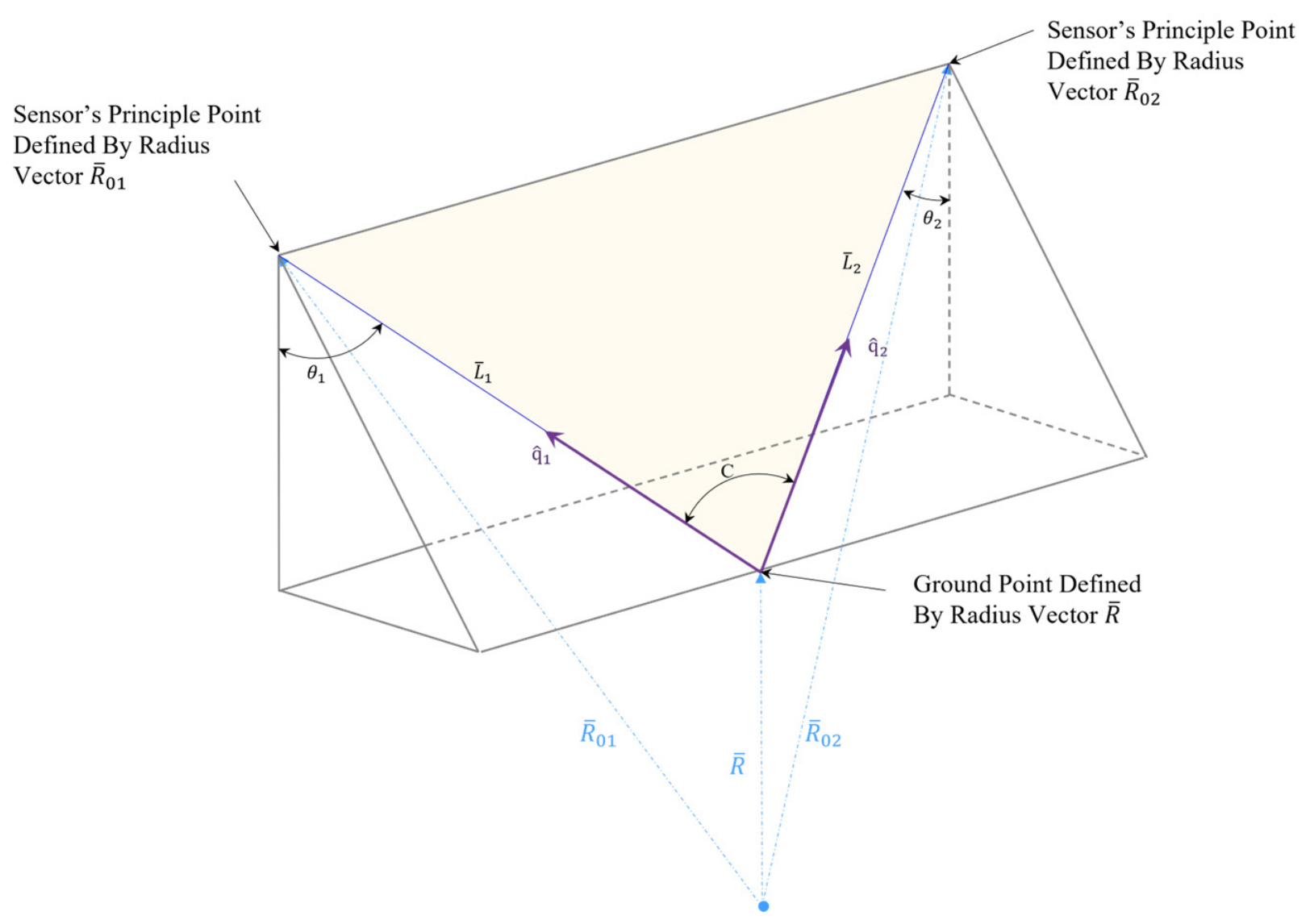
Consider two optical satellite images acquired from different viewing positions. Figure 1 shows the stereo geometry [18], including the convergence angle, the incidence angle, and the line of sight (LOS) vectors. Given the geocentric radius vectors to the sensor’s principle point for the two images, R ¯ 01 and R ¯ 02 , the two LOS vectors to the ground point are given by the following equations:
L ¯ 1 = R ¯ R ¯ 01 L ¯ 2 = R ¯ R ¯ 02
And, let
q ^ 1 = L ¯ 1   /   | L ¯ 1 | q ^ 2 = L ¯ 2   /   | L ¯ 2 |
The convergence angle is the angle between q ^ 1 and q ^ 2 , and is given by the following:
C = cos 1 ( q ^ 1 · q ^ 2 ) ,   0 C π
where · indicates the dot product.
Stereo geometry, particularly incidence and convergence angles, can lead to apparent displacement between images during the registration process. The convergence angle can significantly influence the quality of a digital surface model (DSM) generated through stereo processing, as it governs the parallax and thus the sensitivity and accuracy of height estimation [19]. The convergence angle and stereo processing are discussed here because, in stereo image pairs, the concept of strict image registration is not directly applicable. Instead, epipolar alignment is required, and the resulting parallax between corresponding points is used to estimate height. Consequently, enforcing precise image registration in such cases inevitably leads to apparent discrepancies due to the inherent geometric differences between the two views.

2.2. Imaging Geometry

Image registration is performed with respect to a reference surface, which is implicitly defined during the transformation model estimation process. In this study, this surface is assumed to be planar and is referred to as the registration plane.
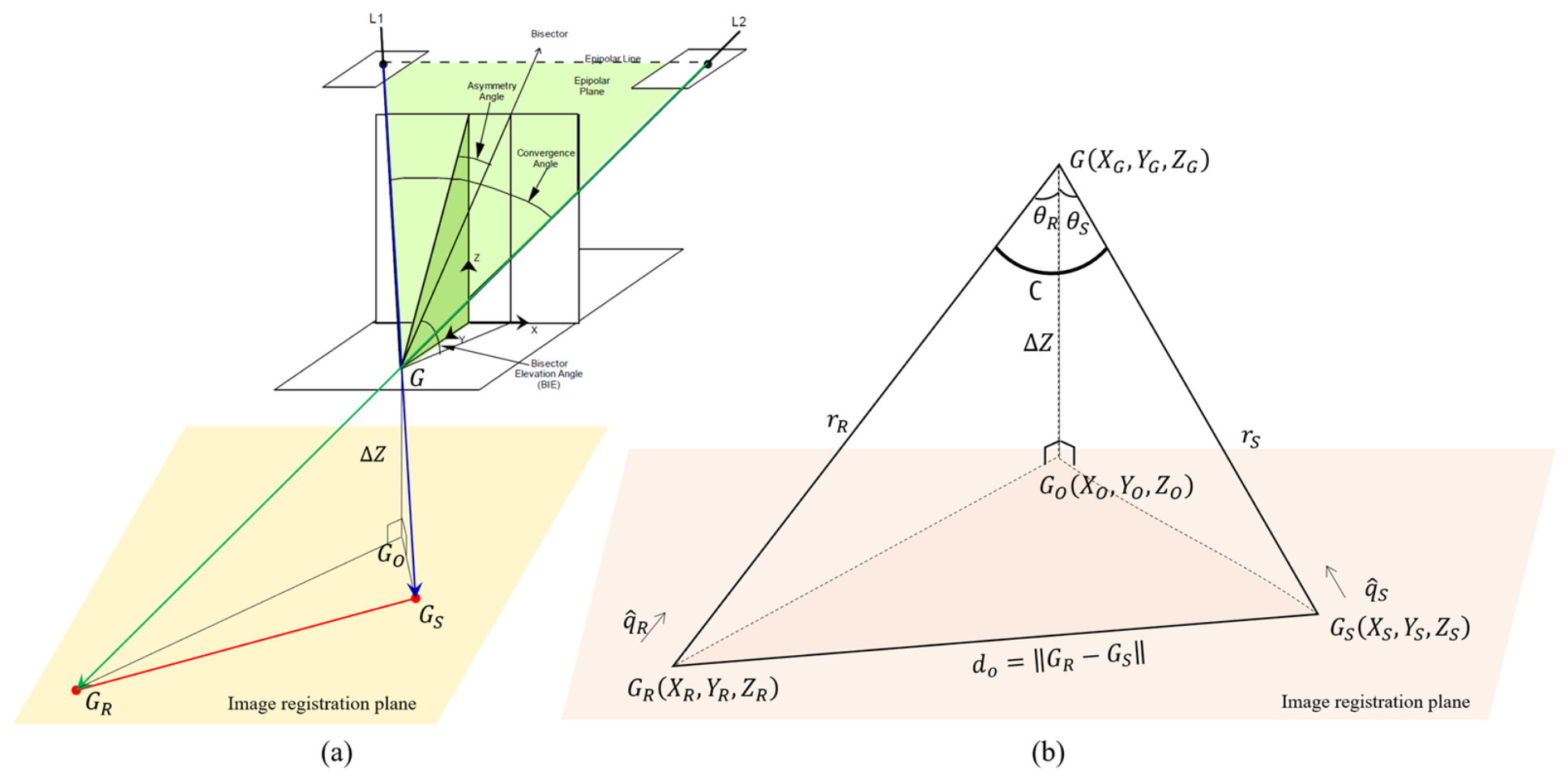
Figure 2 introduces the height offset Z defined with respect to a horizontal registration plane, forming the basis of the displacement model. The upper part of Figure 2a is the stereo geometry shown in Figure 1. The lower part of Figure 2a illustrates the geometry when a ground point G does not lie on the image registration plane, and its projection onto the plane is considered. It can be observed that a tetrahedral geometry is formed by the ground point G , its nadir point, and the two projected points on the image registration plane. The height offset Z with the two different viewing geometries may cause the displacement, and the displacement can be quantified as the length of the red line shown in Figure 2a.
Figure 2b provides a detailed illustration of this tetrahedral geometry. A ground point G ( X G , Y G , Z G ) is projected onto the image registration plane, resulting in G S ( X S , Y S , Z S ) and G R ( X R , Y R , Z R ) . The incidence angle is defined as the angle between the local vertical at the ground point G (i.e., the line connecting G and its nadir point G O ) and the viewing direction from G to the sensor (i.e., the lines connecting G to G R and G S ). In the figure, θ R is the incidence angle of the reference image (denoted as R ) at the ground point G and θ S is the incidence angle of the sensed or target image (denoted as S ) at the ground point G . The observed displacement, d o , is the distance between the two points G R and G S on the image registration plane in the object (ground) space or the distance between the two projected points I R ( x R , y R ) and I S ( x S , y S ) on the image registration plane in the reference image space. This can be computed as follows:
d o = G R G S = ( X R X S ) 2 + ( Y R Y S ) 2 + ( Z R Z S ) 2 G S D or d o = ( x R x S ) 2 + ( y R y S ) 2
In this study, the observed and computed displacements are evaluated in image–space pixel units for consistency with a practical image registration accuracy assessment. Ground–space displacement quantities are converted to pixel units using the corresponding ground sample distance (GSD).
On the other hand, the computed displacement, d c , can be derived from the triangle formed by G , G R , G S using the law of cosines. This can be expressed as follows:
d c = f ( θ R , θ S , C , Z ) = r R 2 + r S 2 2 · r R · r S · cos C ,
where r R = Z cos θ R and r S = Z cos θ S .
Up to this point, the case where the image registration plane is horizontal has been discussed. We now consider the more general scenario—commonly encountered in automatic image registration—where the image registration plane is not horizontal.
In practice, the affine transformation model T is estimated from matched points using MLESAC [20]. Under the affine transformation framework adopted in this study, the matched correspondences are interpreted using a locally planar approximation in the object space. Accordingly, the resulting registration geometry can be represented using a plane-based geometric model, and the corresponding registration plane may therefore exhibit a local surface tilt. Robust estimators, such as MLESAC, are employed only to estimate geometrically consistent correspondences and to reject outliers, rather than to impose coplanarity on the control points. Accordingly, the displacement model must also be generalized to the tilted-plane case.
The displacement model is derived under the assumption that the image registration is defined with respect to a planar surface, referred to as the registration plane. Given the control points G i = ( X i , Y i , Z i ) T ,   ( i = 1 , , n ) , where ( X i , Y i , Z i ) denotes the 3D cartesian coordinates, the registration plane P is estimated from these by solving A P = 0 using singular value decomposition (SVD), where each row of A corresponds to G i T , i.e., A = [ G 1 T ,   ,   G n T ] T . The solution is given by the right singular vector associated with the smallest singular value [21].
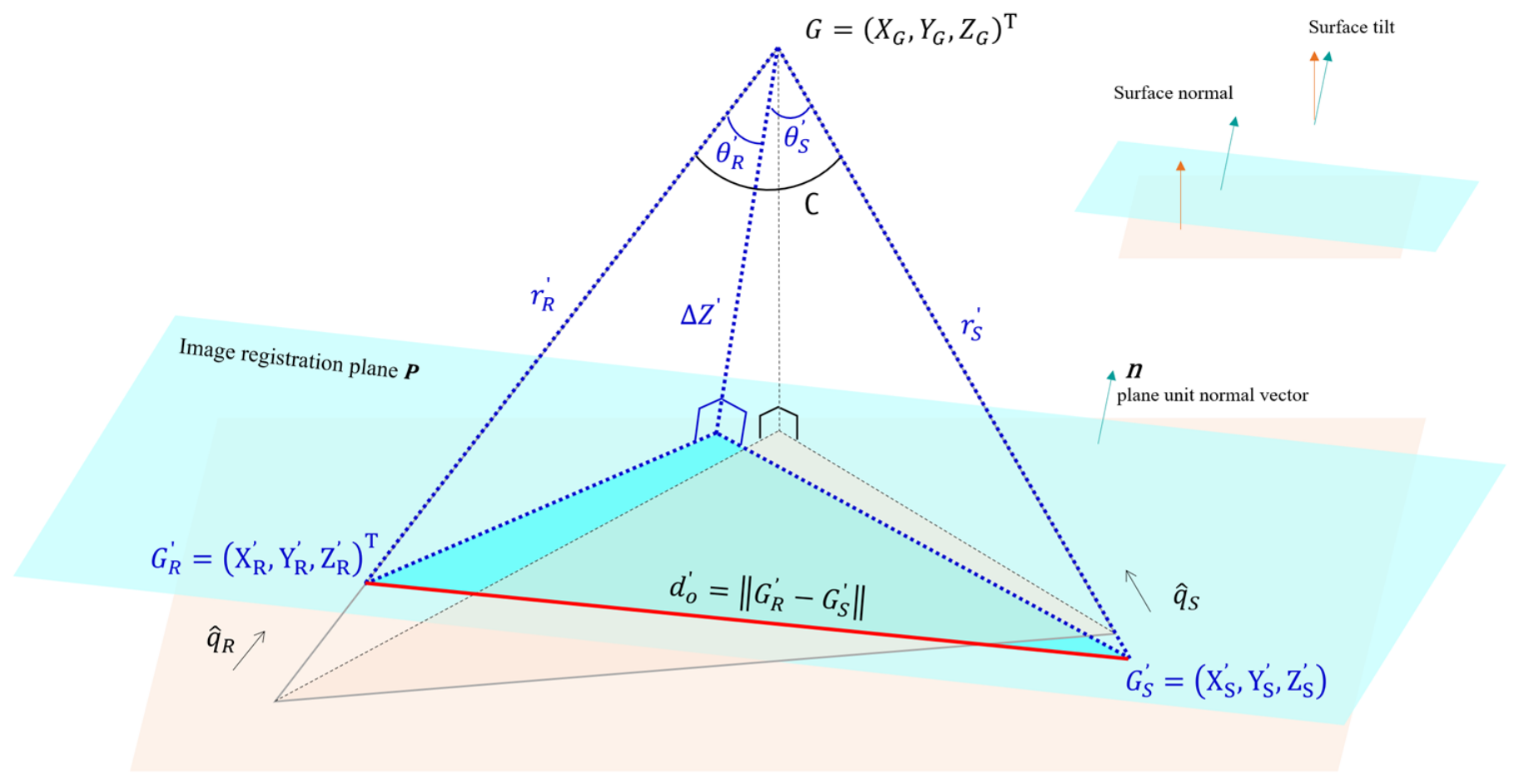
Figure 3 presents the generalized case with a tilted plane, where the height offset is defined relative to the estimated surface. In the case of a tilted registration plane, the incidence angles and displacement can be computed similarly to the horizontal case, while the convergence angle remains unchanged. This is because the convergence angle depends only on the LOS vectors q ^ R and q ^ S , which are determined by the sensor–ground geometry at G , and are independent of the registration plane orientation.
The height offset Z is defined as the signed distance from the ground point to the registration plane. Figure 3 illustrates the case where Z > 0 , the same formulation applies symmetrically for Z < 0 .
Let P be the registration plane and let n denote the unit normal vector satisfying n = 1 . This can be computed as follows:
P :   A X + B Y + C Z + D = 0 n = ( A , B , C ) T , n = 1
Then the height offset Z , defined as the signed distance from G to the registration plane, can be computed as follows:
Z = n T G + D
A positive value of Z indicates that the ground point lies on the side of the plane pointed to by the normal vector, whereas a negative value indicates that it lies on the opposite side. The orientation of the unit normal vector n is chosen to point toward the sensor side of the registration plane so that the incidence angles are consistently represented as acute angles. The incidence angles θ R and θ S can be computed as follows:
θ R = cos 1 ( n · q ^ R ) , θ S = cos 1 ( n · q ^ S )
Thus the computed displacement on the registration plane, d c , can be computed as follows:
d c = r R 2 + r S 2 2 r R r S cos C ,
where r R = Z cos θ R and r S = Z cos θ S .
While the observed displacement on the registration plane, d o , can be computed as follows:
d o = G R G S = ( X R X S ) 2 + ( Y R Y S ) 2 + ( Z R Z S ) 2 G S D or d o = ( x R x S ) 2 + ( y R y S ) 2
Unless otherwise stated, the displacement formulation is first derived in a geometric ground–space form and subsequently converted to the image–space pixel units for experimental evaluation.

2.3. Geometry-Induced Lower Bound

The incidence angle(s) can be computed from the rational polynomial coefficient (RPC) model [22], which is commonly provided with most high-resolution commercial satellite imagery, and the convergence angle can be computed using Equation (3). However, in push-broom imaging systems, the viewing direction varies across the image pixels due to the linear array geometry, so the incidence angle may vary depending on the ground point G . As a result, the effective off-nadir angle can vary with the ground point G , similar to the incidence angle when computed from RPC models.
Under fixed height offset and practical imaging geometry, the displacement predicted by Equation (9) increases monotonically with increasing incidence and convergence angles. Therefore, the displacement is minimized when the incidence angles and convergence angle are small. Since the incidence angles and convergence angle exhibit little variation, the displacement can be approximated as proportional to the height offset. Nevertheless, because the incidence angles and convergence angle still vary depending on the ground point, they should therefore be computed a priori.
Let R denote the overlapping area or region of the two images, which can be obtained from the RPCs of the images and corresponds to the effective ground space. Let G R = { G i } be the set of ground points within R . For each ground point G i G R , let θ R i and θ S i denote the incidence angles to the registration plane of the two images, and let C i denote the convergence angle. The minimum values of these angles are given by the following:
θ R m i n = min i ( θ R i ) , θ S m i n = min i ( θ S i ) , C m i n = min i C i
These values are used to determine the lower bound of the displacement. That is, the minimum values of the incidence and convergence angles are selected from the overlapping region and treated as constants in the displacement model. Under this condition, the displacement is expressed solely as a function of the height offset Z , while the imaging geometry is held constant.
Consequently, the geometric lower bound in the image registration error, d c l o w e r _ b o u n d = f ( Z ) , can be computed as follows:
d c l o w e r _ b o u n d = f ( Z )   = ( Z cos θ R m i n ) 2 + ( Z cos θ S m i n ) 2 2 ( Z cos θ R m i n ) ( Z cos θ S m i n ) cos C m i n
In practice, the computed displacement d c in Equation (9) at a given point may be regarded as the tightest geometric displacement predicted by the displacement model under the corresponding local imaging geometry. Under accurate registration conditions, the observed displacement d o is therefore expected to be close to d c . However, because the imaging geometry varies over the overlapping region, a practical geometric lower bound is additionally defined by using the minimum incidence angles and minimum convergence angle obtained over the ground points within the overlapping area. Since these minimum angular values may not necessarily occur simultaneously at the same ground point, the resulting lower bound should be interpreted as a practical geometry-induced lower-bound approximation under the plane-based registration framework rather than as a strict global mathematical minimum. Accordingly, d c l o w e r _ b o u n d represents a conservative lower bound determined from the most favorable geometric configuration within the overlapping region.
Similarly, an upper bound of the displacement, d c u p p e r _ b o u n d , can also be obtained by substituting the maximum incidence angles and maximum convergence angle within the overlapping region into Equations (11) and (12). This quantity represents the maximum geometric sensitivity of displacement to a given height offset under the considered imaging geometry. Unlike the proposed lower bound, however, the upper bound should be interpreted as a geometric reference rather than a strict limit on the observed displacement.

3. Data Set, Experimental Design, and Validation Results

Although the proposed lower bound is derived in a closed-form expression and can be fully justified through geometric analysis, experimental evaluation is conducted as a practical means of validation, as is commonly adopted in related studies.

3.1. Data Set

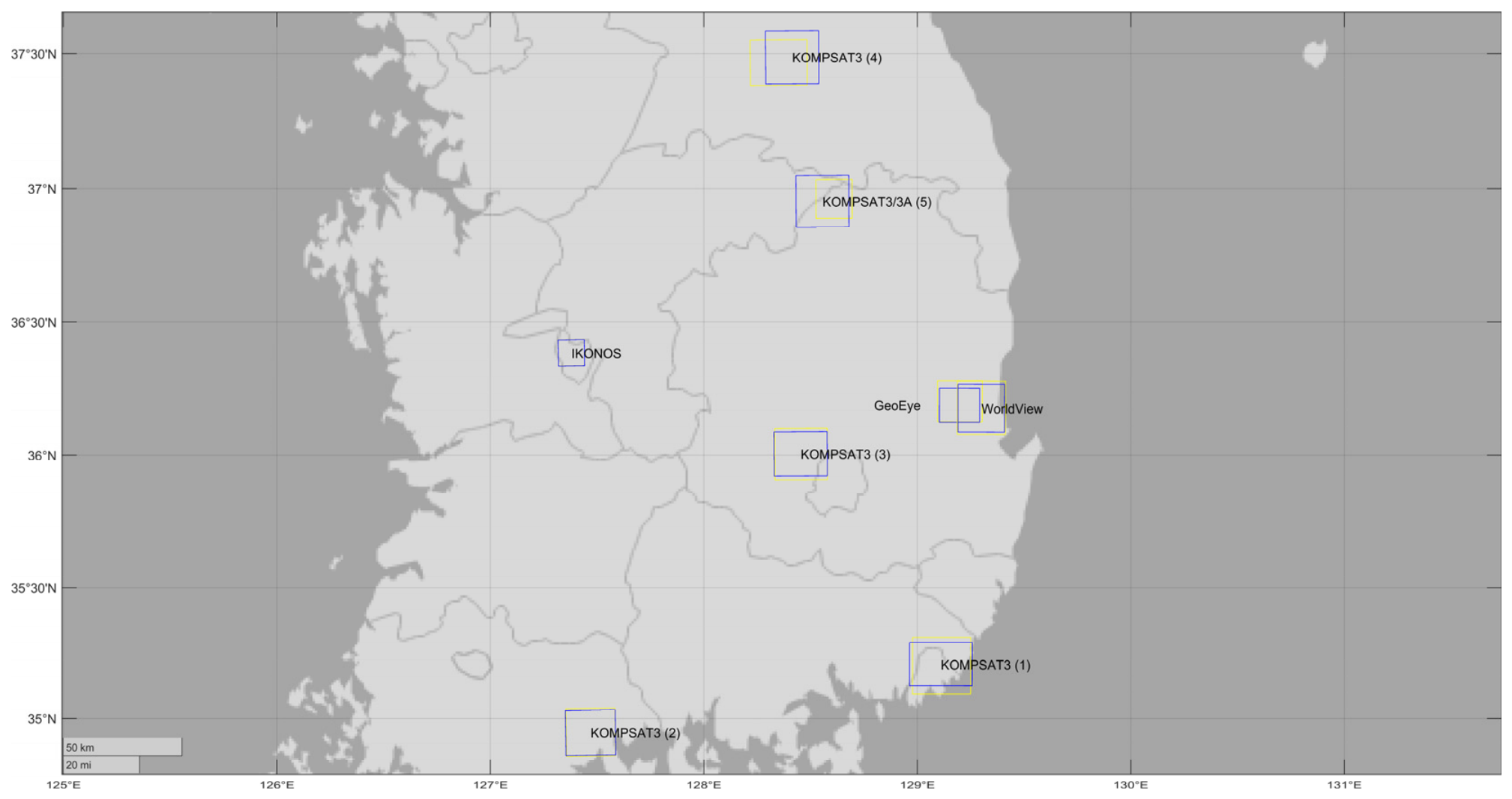
The spatial coverage of the satellite images used in this study is shown in Figure 4. The dataset consists of stereo satellite image pairs and cross-track image pairs over multiple terrain types, covering variations in elevation and surface characteristics. These images are selected to ensure sufficient overlap and geometric diversity for evaluating the proposed model under different viewing configurations.
Table 1 provides the corresponding image specifications of Figure 4 and presents the nine test cases. In the Mode column, ST (Stereo) denotes stereo pairs, whereas NS (Not Stereo) indicates non-stereo images. Among TC-1 to TC-9, six cases correspond to stereo pairs. Of the remaining three test cases, TC-8 comprises same-sensor images acquired on different dates, whereas TC-4 and TC-9 correspond to cross-sensor images acquired on different dates.

3.2. Image Registration Pipeline and Experimental Design

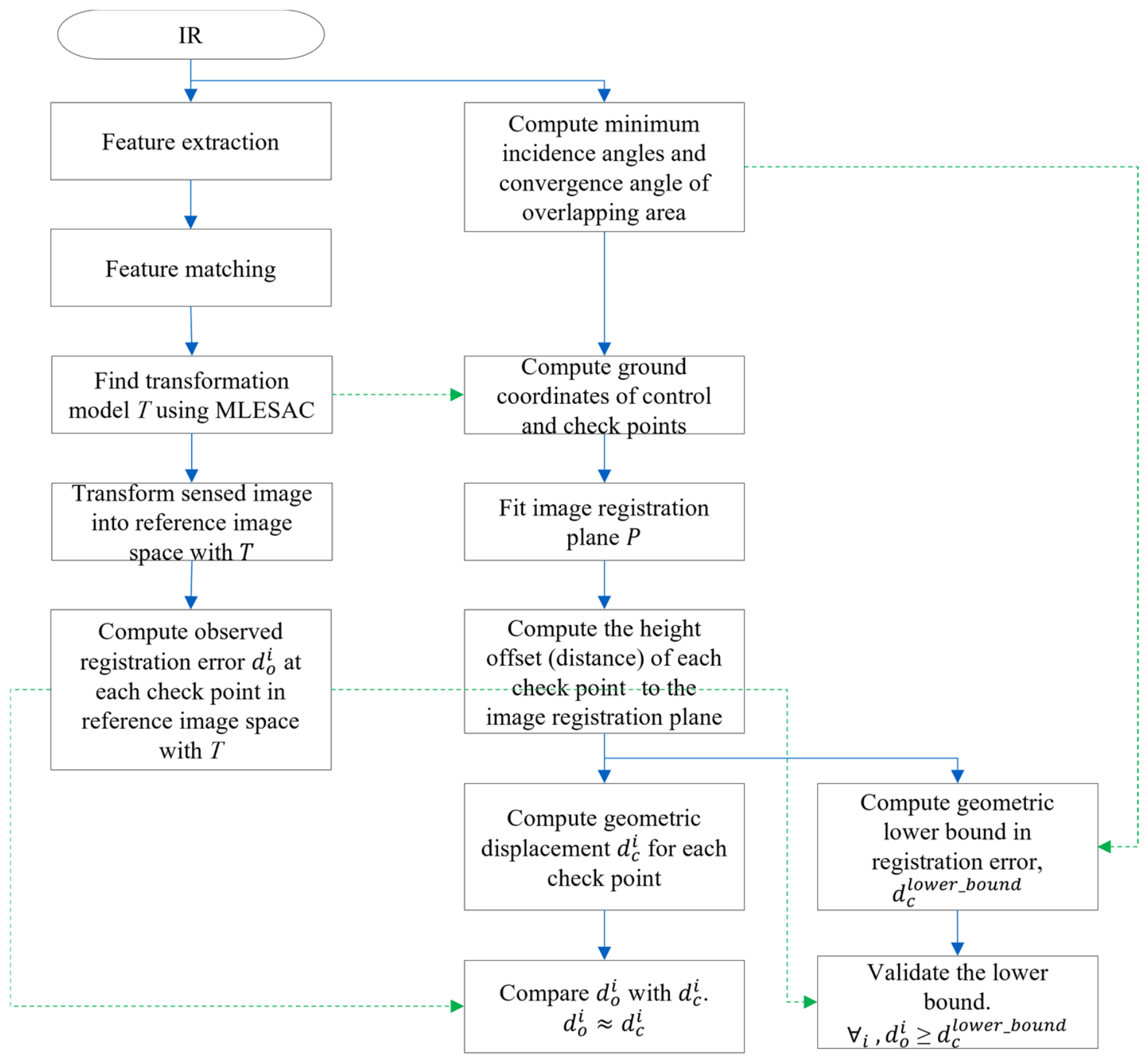
Figure 5 illustrates the image registration pipeline employed in this study in the form of a flowchart. In this figure, the blue arrows indicate the processing sequence, whereas the green dashed arrows represent the data flow.
In this study, an affine transformation is adopted as the transformation model for image registration. While satellite imagery is commonly provided as Level-1R products, Level-1G imagery is often directly employed when a timely multi-temporal analysis is required. As most geometric distortions are already corrected in these products, an affine transformation provides a suitable and simplified framework for modeling residual misalignment and for analyzing displacement behavior. For consistency and ease of analysis, all images were converted to Level-1G (WGS84, UTM) and resampled to a GSD of 1 m, although the native GSDs range from 0.5 m to 1 m. In this study, the term “high-resolution” primarily refers to very high resolution (VHR) optical satellite imagery with native GSDs approximately ranging from 0.5 m to 1 m. This normalization was performed to enable a consistent geometric comparison across heterogeneous image pairs acquired from different sensors and imaging configurations. Although resampling may slightly smooth the image–space residuals, the primary objective of this study is to analyze the geometry-induced displacement behavior at a consistent spatial scale.
In the feature matching stage, the matched point pairs are used to robustly estimate the affine transformation model using MLESAC. Since an affine transformation is adopted as the transformation model in this study, the resulting registration geometry can be interpreted using a plane-based geometric model. Accordingly, the registration plane is estimated from the matched control points and may exhibit a local surface tilt. After estimating the transformation model, the matched points are divided into control points and check points, from which the incidence angles and the convergence angle at each check point can be computed. Independently, the minimum values of the incidence angles and the convergence angle over the overlapping region of the images can also be determined. Once the control points are determined, the transformation model T can be obtained, and the transformed coordinates of the control and check points are calculated as follows:
I S r e g i s t e r e d = T I S
where I S is the set of image points of the sensed image and I S r e g i s t e r e d is the set of transformed/registered image points of the sensed image in the reference image space.
In addition, the registration plane P , as defined by the control points, can also be fitted. With the registration plane estimated, the perpendicular distance or the height offset from each check point ground coordinate G c h e c k i to the plane is computed as Z c h e c k i = n T G c h e c k i + D (see Equation (7)). Subsequently, the displacement on the registration plane is calculated using the height offset at each check point, together with the incidence angles and the convergence angle (see Equation (9)).
The validity of the displacement model in Equation (9) is evaluated by comparing the observed (or measured) displacement d o c h e c k i with the computed displacement d c c h e c k i at each check point. In addition, as the model predicts that all d o c h e c k i should exceed the lower bound d c l o w e r _ b o u n d in Equation (12), this condition is also examined.

3.3. Experimental Validation Results

In this section, a representative test case is presented to illustrate the steps of the image registration pipeline and the validation procedure.

3.3.1. Image Registration Pipeline

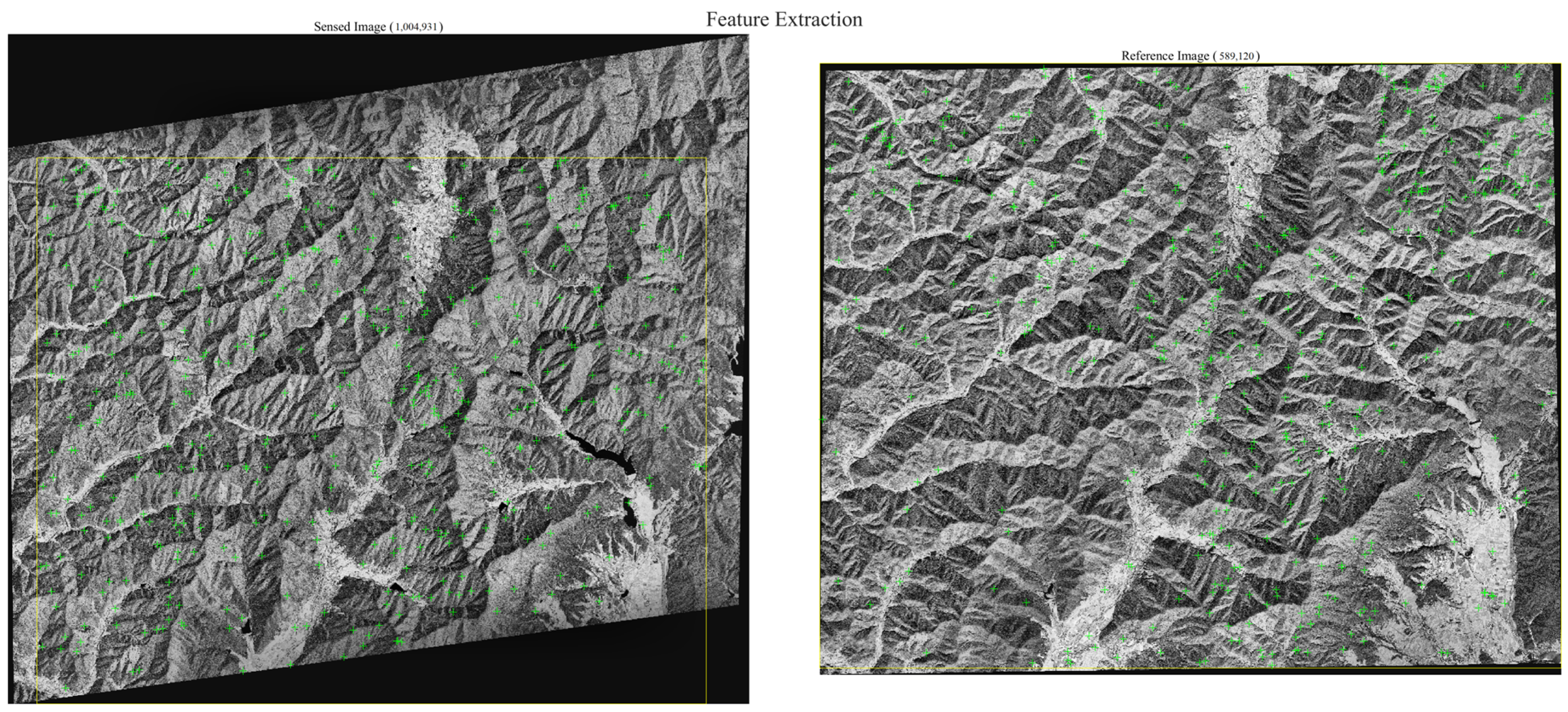
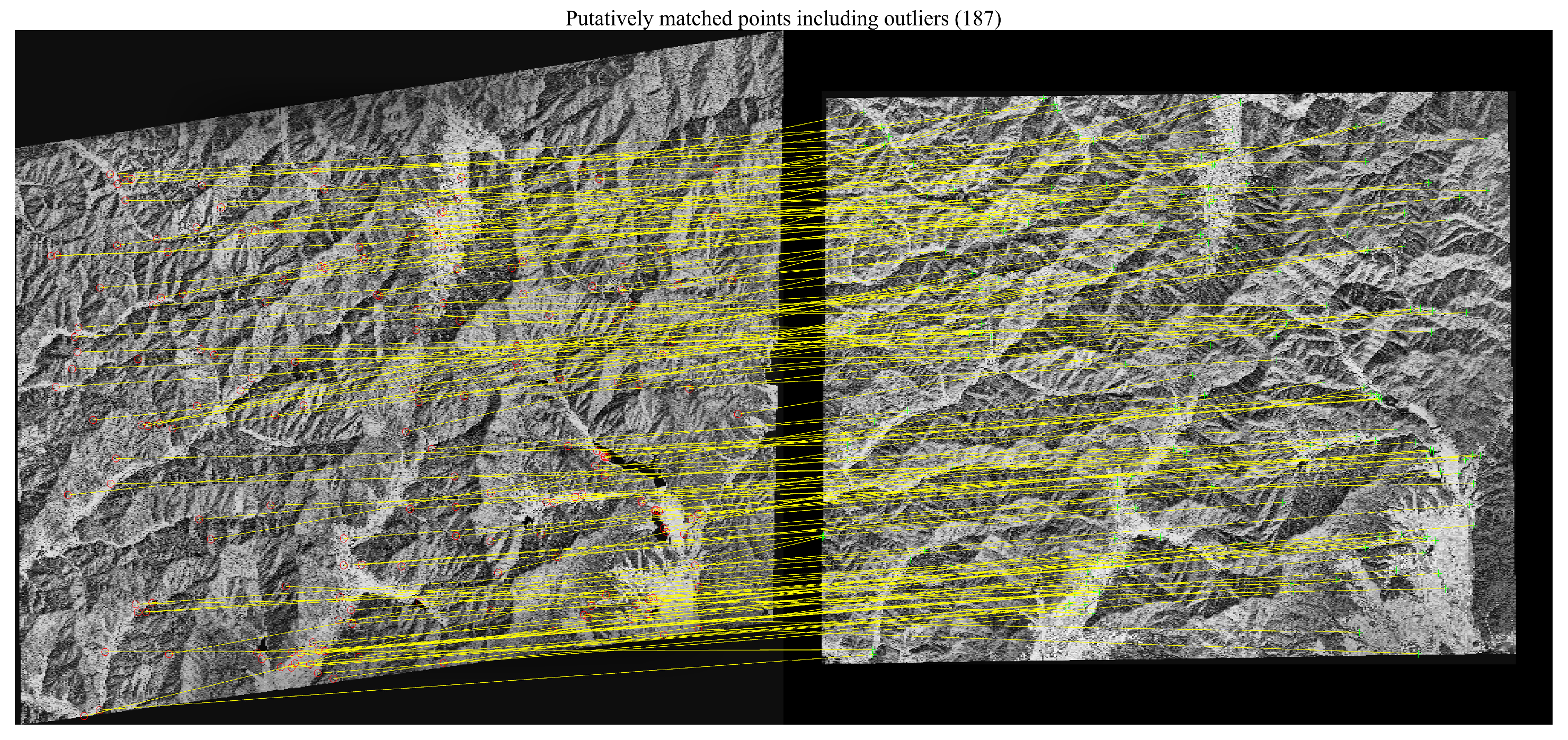
The main results of each stage of the image registration pipeline are summarized using the figures and tables in this section. Figure 6 and Figure 7 present the feature extraction results and the initial (putative) feature matching results, including outliers, for TC-1. In the feature extraction stage, BRISK [23], FAST [24], Harris [25], ORB [26], SIFT [27], and SURF [28] were employed, while binary feature matching [29] was used in the feature matching stage. As stated earlier, the objective of this study is not to optimize the image registration performance, but rather to analyze the geometry-induced registration displacement under conditions where the image registration process produces sufficiently reliable correspondences for a geometric analysis. Accordingly, the feature detector and the corresponding matched-point configuration used for each test case were selected based on the availability and spatial distribution of the geometrically consistent matched control points required for stable registration–plane estimation. Preliminary experiments were also conducted using multiple feature detectors, and the overall geometric trend remained consistent despite variations in the number and spatial distribution of the matched points.
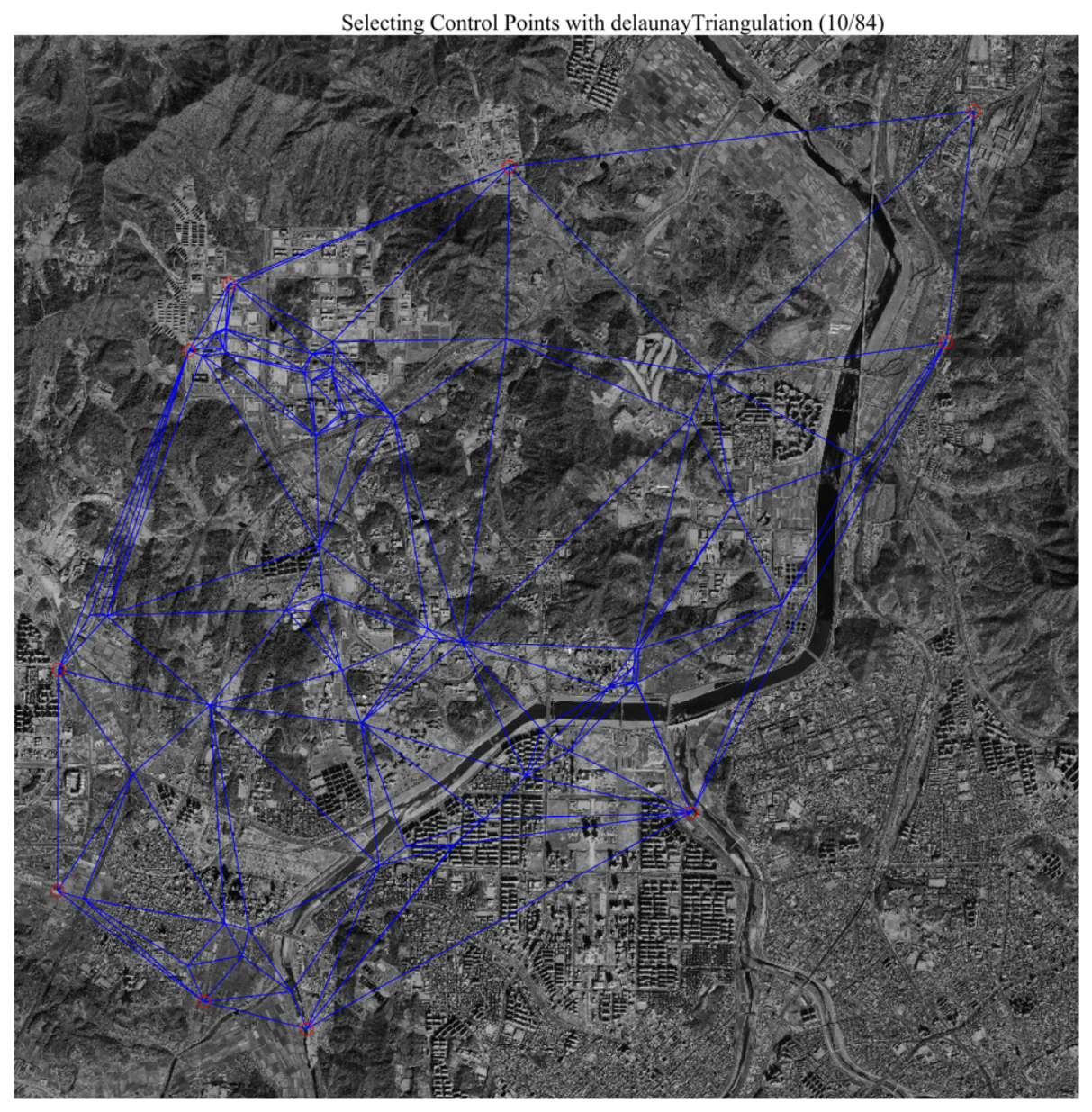
Figure 8 illustrates the process in TC-2, where the transformation model T is estimated, candidate control points are selected, and the convex hull formed by the Delaunay triangulation of these candidate control points is finally determined as the set of control points.
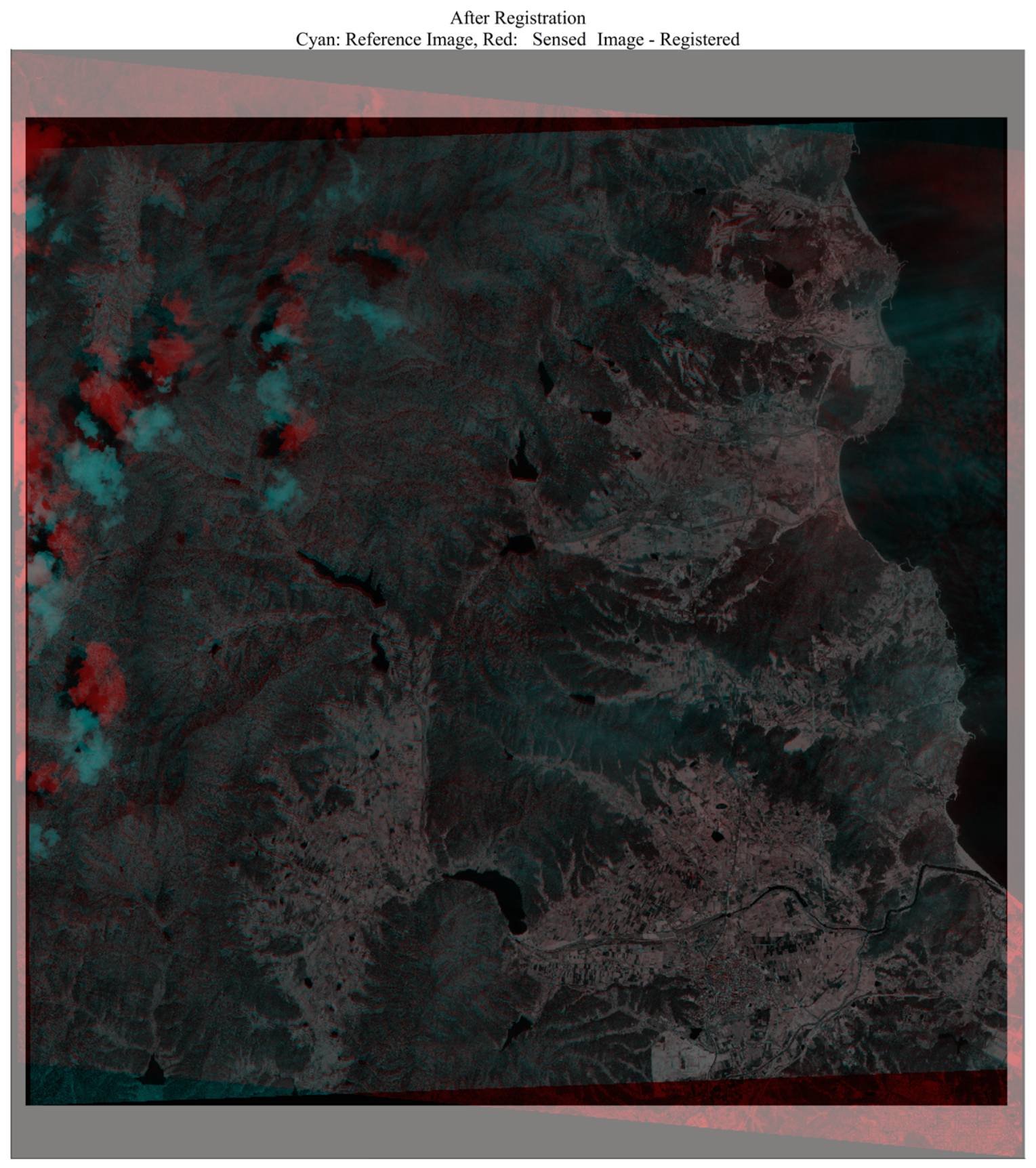
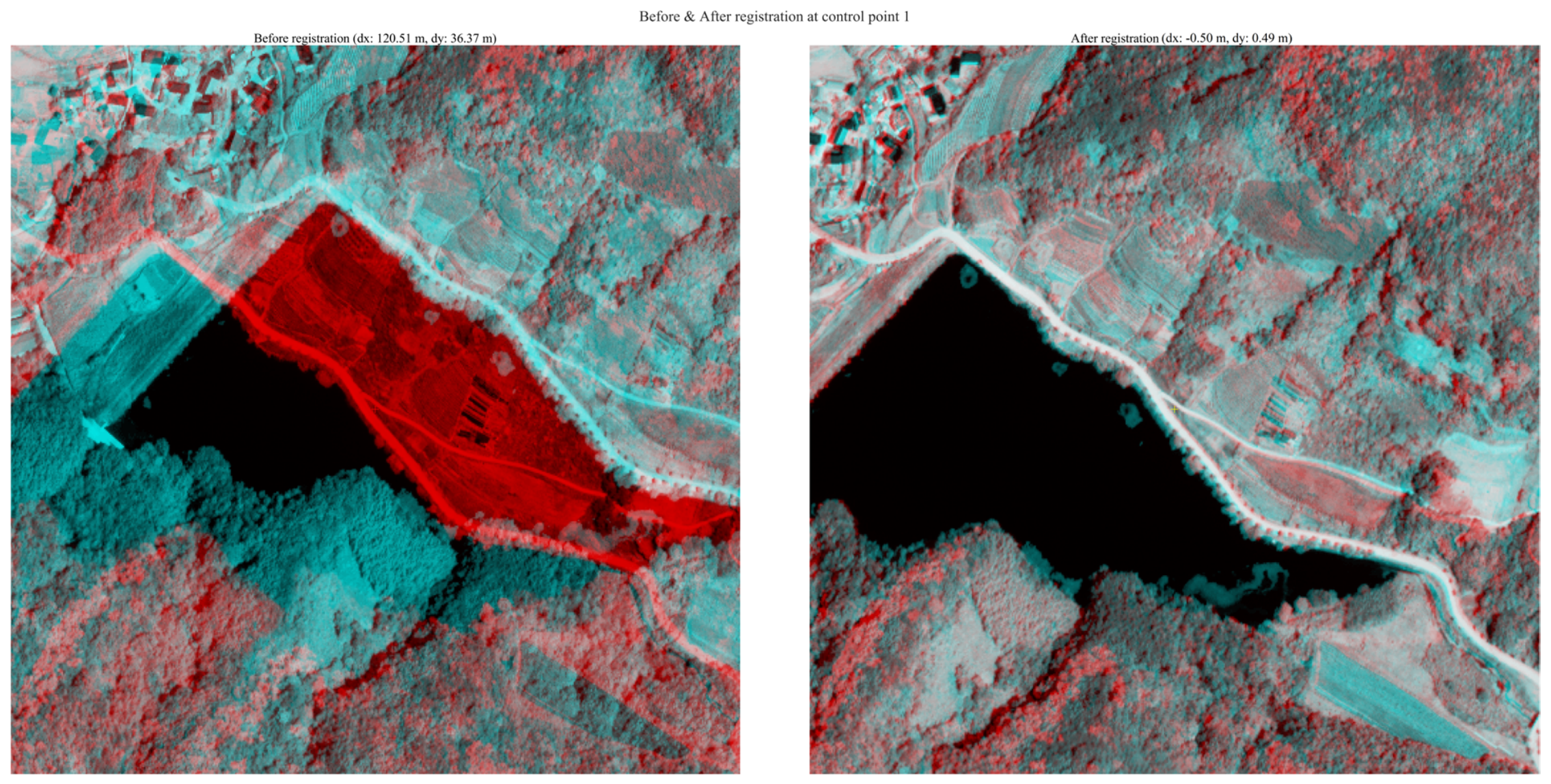
Figure 9 shows the final image registration results for TC-3. In addition, Figure 10 provides an example of the registration results at one of the control points in TC-4.

3.3.2. Validation of the Proposed Lower Bound

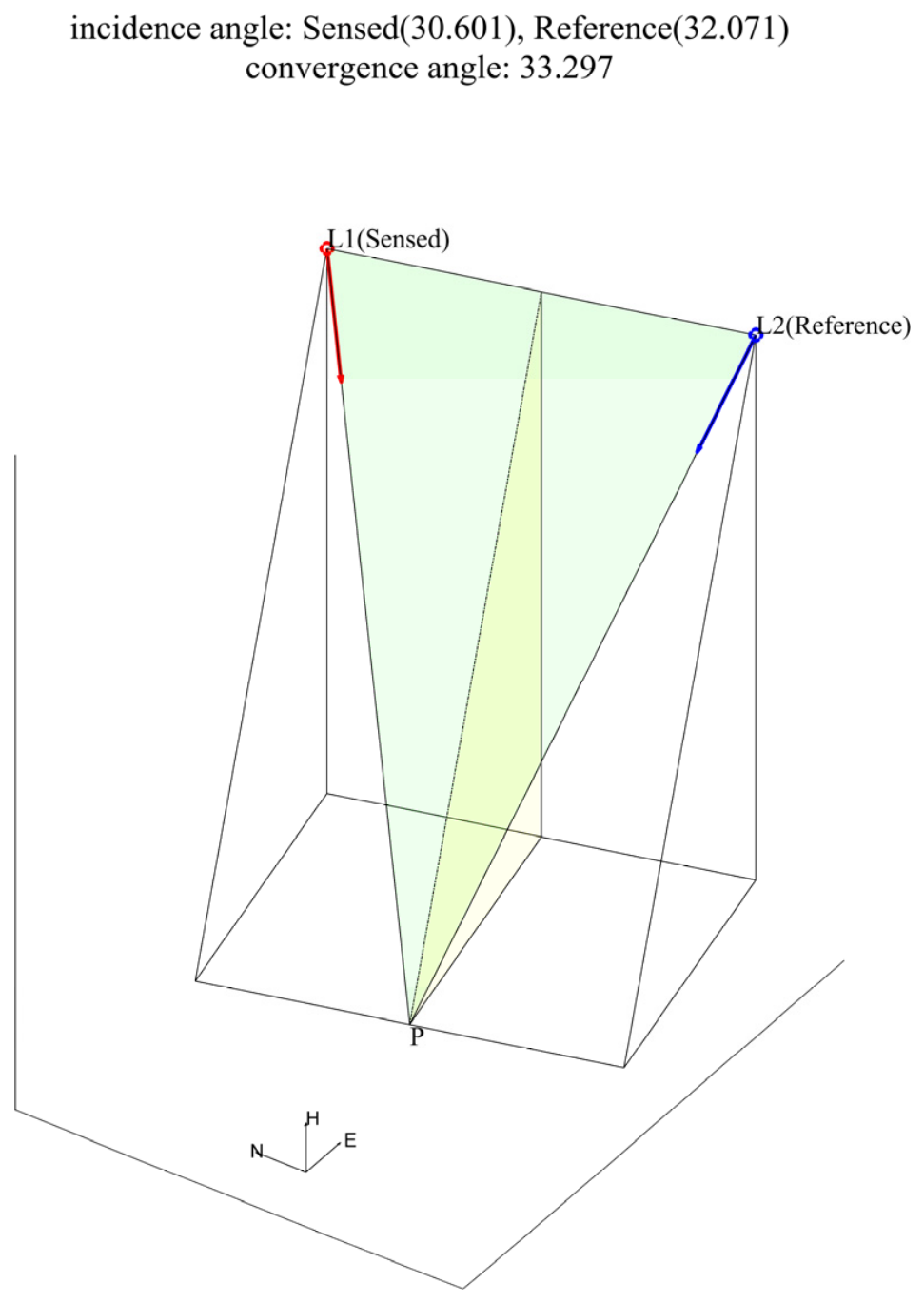
In this section, the error analysis procedure shown on the right part of the flowchart in Figure 5 is described with figures and tables. First, the overlapping region of the image pair is extracted from their sensor models (RPCs), and the incidence angles and convergence angle are computed together with the minimum values of the incidence angles and the convergence angle within this region. Figure 11 shows the imaging geometry at the center point of the overlapping region in TC-5. Based on the angular parameters and the height offset, the lower bound of the registration error (displacement) can be expressed as a function of Z (see Figure 3).
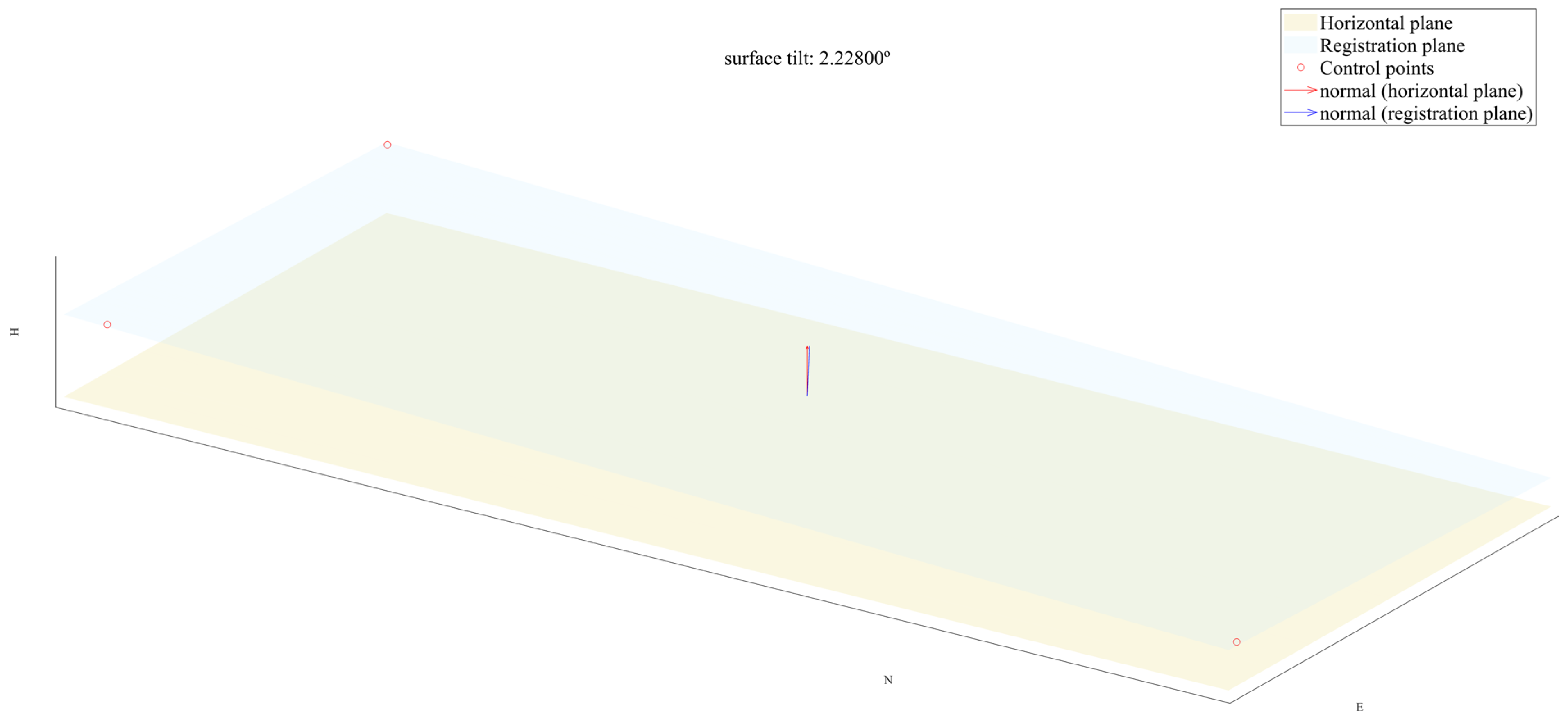
The matched image point pairs obtained from the feature matching stage are utilized as control points and check points. Their corresponding ground coordinates can be computed via space intersection [30]; the detailed procedures are omitted here for brevity. Subsequently, the ground coordinates of the control points are used for plane fitting. Figure 12 shows the plane-fitting result using the control points in TC-8, indicating that the fitted registration plane has a tilt angle of 2.228° with respect to the horizontal plane.
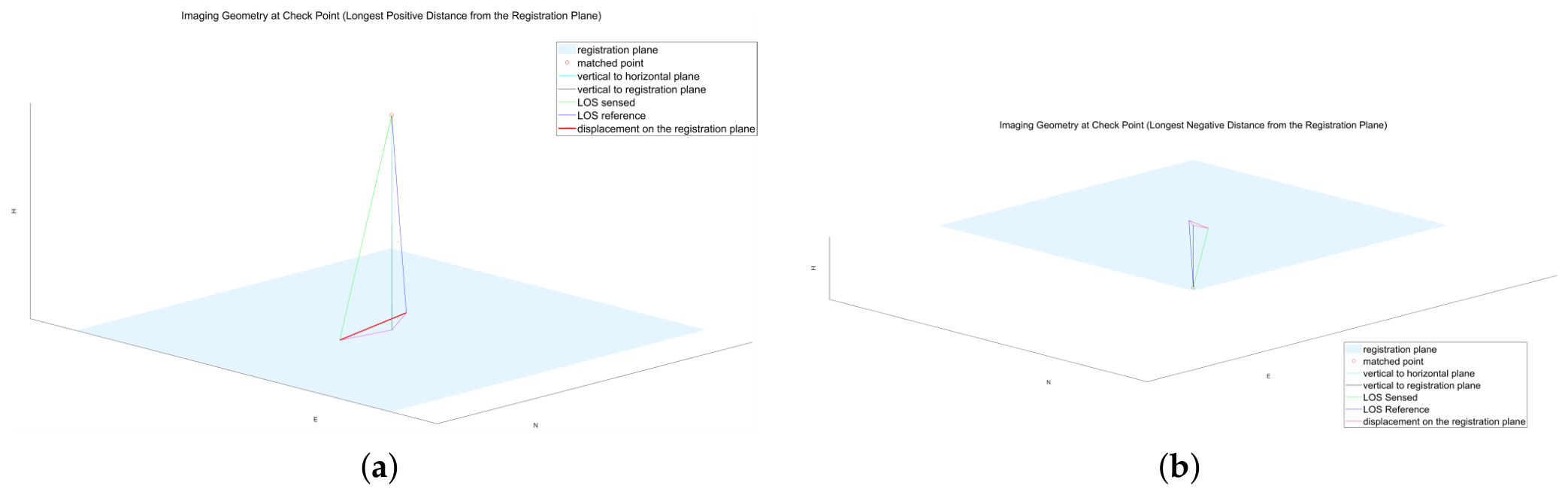
Once the plane defined by the control points is determined, the remaining matched points (check points) are used to compute the distance to the plane ( Z ) for each point. In addition, the incidence angles and the convergence angle with respect to the registration plane are calculated at each point (note that the convergence angle is independent of the registration plane and can therefore be computed in advance). Figure 13 shows the imaging geometry at two check points in TC-6, one is located above the plane (i.e., with a positive height offset along the plane normal) and the other is located below the plane (i.e., with a negative height offset, in the opposite direction of the plane normal). Table 2 provides the results of calculating the angles for all TCs.
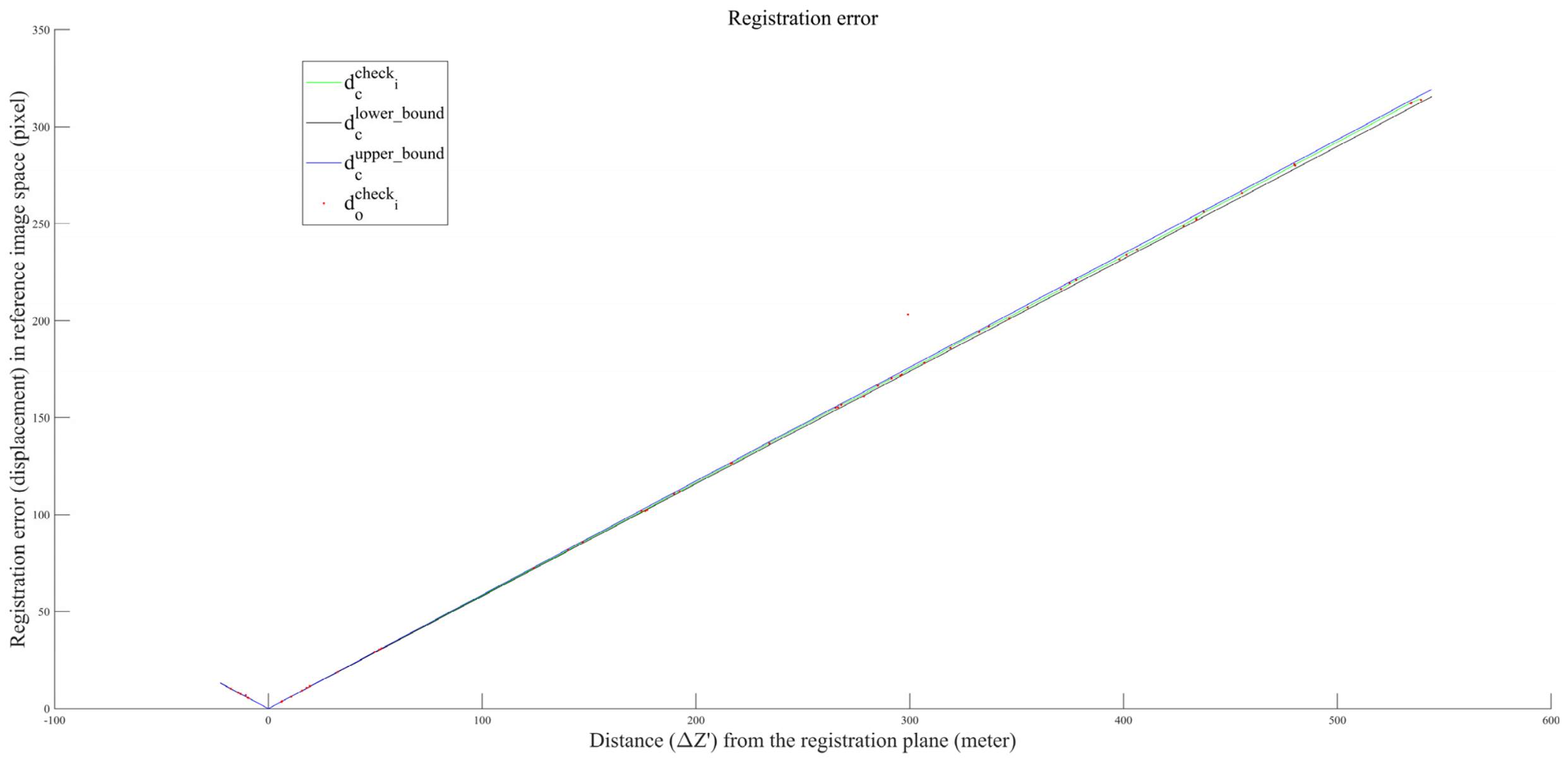
Figure 14 plots the displacement as a function of Z in TC-8. The horizontal axis represents Z , while the vertical axis shows d o c h e c k , d c c h e c k , and d c l o w e r _ b o u n d , corresponding to the observed displacements, the model-predicted displacement, and the derived lower bound, respectively. This representation enables a direct comparison between the observed values and the theoretically derived lower bound.
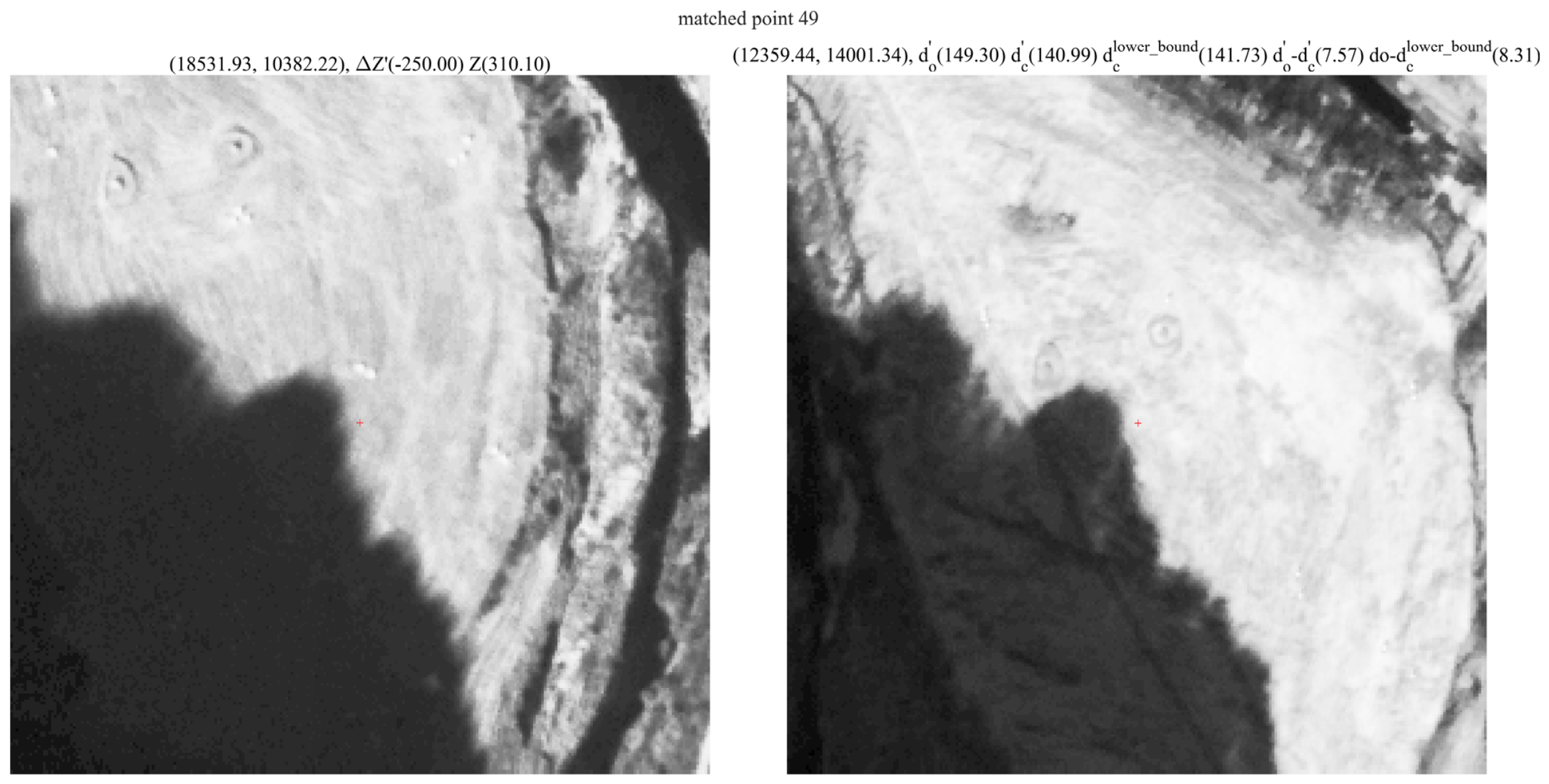
In this figure, a red dot on the left exceeds d c u p p e r _ b o u n d and may appear to be a blunder; however, this is due to a matching error, caused by shadows, which is illustrated in Figure 15.
Table 3 summarizes the results for all test cases. It reports the number of check points, the mean and standard deviation of d o c h e c k d c c h e c k , and the validation statistics related to the proposed lower bound. The reported standard deviations were computed using the sample standard deviation (N-1 denominator). The min ( δ ) column is included to identify whether violations ( δ < 0 ) occur, while the “Violations ( δ < 0 )” column reports both the number and percentage of violations among the total check points. For TC-1, TC-4, and TC-8, SIFT-based matching was used because the number and spatial distribution of the matched points obtained using the Harris detector were limited. Since the registration plane is estimated from matched control points, the corresponding geometric parameters—including surface tilt and incidence angles—may vary depending on the feature detector and the spatial distribution of the matched points. Therefore, the conclusions of this study are based on the overall geometric consistency observed across all test cases rather than on any individual case with a limited number of check points.
Although d c l o w e r _ b o u n d is mathematically derived from the displacement model, the observed quantity d o c h e c k is obtained from the practical image–space measurements and therefore contains unavoidable uncertainties. Consequently, the small negative values of d o c h e c k i d c l o w e r _ b o u n d may occasionally occur due to factors such as feature matching noise, check point localization error, and RPC modeling error, thereby producing marginal residuals. To account for this effect, the fifth column of Table 3 reports the minimum value of δ , defined as δ i = d o c h e c k i d c l o w e r _ b o u n d . The sixth column, denoted as “violations ( δ < 0 )” indicates the number of check points for which δ i < 0 among all check points. In a few cases, δ < 0 was observed with a small margin (on the order of 10 2 ). The relatively larger residuals observed for TC-4 may plausibly be influenced by temporal scene changes and non-geometric appearance variations between the two acquisitions, since the image pair was acquired by different sensors at different times with an interval of approximately five months. Such factors may include land cover change, shadow variation, and radiometric inconsistency, which can affect the feature matching quality and the residual registration behavior in practical experiments.
Overall, the experimental results confirm that the derived inequality, d o c h e c k d c l o w e r _ b o u n d , is satisfied in nearly all test cases, with only a few marginal exceptions. Although the displacement model and the corresponding lower bound are independent of the registration algorithm, their validation necessarily involves feature matching, space intersection, and plane fitting, each of which introduces inherent uncertainty. These uncertainties may propagate through the validation process and affect the evaluation of the model and its lower bound. Typical sources of uncertainty include sub-pixel feature-matching noise, check-point localization uncertainty, RPC residual error, and space-intersection uncertainty, which are generally sufficient to account for the observed marginal residuals on the order of 10 2 ~ 10 1 m. Despite the closed-form and geometrically derived nature of the proposed formulation, its experimental validation inevitably relies on such processes, which may introduce additional uncertainty.
Nevertheless, the overall consistency between the theoretical prediction and the experimental observations indicates that the proposed lower bound effectively captures the underlying geometric constraints of the problem.

4. Discussion

The experimental results confirm that the proposed closed-form expression of the lower bound in Section 2 provides a consistent geometric interpretation of the plane-based image registration error. In particular, the close agreement between the observed displacement d o and the calculated displacement d c demonstrates that the formulation d = f ( θ R , θ S , C , Z ) captures the dominant geometric factors governing the registration error.
Furthermore, the observation that nearly all d o c h e c k values exceed d c l o w e r _ b o u n d validates the proposed lower bound as a physically meaningful limit determined by imaging geometry. This result indicates that, under accurate registration conditions, the minimum achievable displacement is primarily constrained by the incidence angles, the convergence angle, and the height variation within the overlapping region.
CRLB-based analyses characterize the statistical lower bounds associated with image content and noise models, whereas the proposed formulation characterizes a deterministic geometric lower bound induced by imaging geometry and terrain variation.
An upper bound d c u p p e r _ b o u n d can also be derived from the same model by substituting the maximum incidence and convergence angles within the overlapping region. This quantity represents the maximum geometric sensitivity of displacement to a given height offset Z . However, unlike the lower bound, d c u p p e r _ b o u n d does not constitute a strict limit on the observed displacement, as practical registration results are influenced by additional error sources, including feature localization uncertainty, mismatches, and sensor model errors. Therefore, d c u p p e r _ b o u n d should be interpreted as a geometric reference rather than an achievable accuracy bound.
The experimental results suggest that highly challenging imaging geometries—such as large convergence angles and substantial terrain variation—may impose practical limitations on achievable registration accuracy even under reliable feature matching conditions. Accordingly, the proposed formulation may provide useful guidance for establishing geometry-aware expectations for achievable registration performance under different imaging conditions.
Finally, it is emphasized that this study assumes reliable feature matching and transformation estimation. As such, the presented analysis isolates the geometric error behavior and does not explicitly account for performance degradation due to algorithmic limitations. In practice, however, the estimated registration plane and the corresponding geometric parameters may become unstable when the number or spatial distribution of the matched control points is insufficient. In addition, substantial terrain elevation variation within the overlapping region may reduce the validity of the locally planar approximation adopted in the present formulation. Furthermore, while the current study focuses on affine transformation-based registration, extending the registration–plane concept to projective or non-rigid transformation models remains an important direction for future work.

5. Conclusions

This paper established a geometry-induced lower bound on the plane-based image registration error and presented its closed-form expression. The results show that the registration accuracy is fundamentally limited by imaging geometry and height variation, independent of the image registration algorithm.
The proposed formulation provides a clear and interpretable limit on the achievable accuracy and offers a new perspective on the residual registration error as a geometric consequence rather than solely as an algorithmic deficiency. Experimental validation confirms that the observed displacements are consistent with the derived bound.
These findings emphasize that understanding imaging geometry is essential both for interpreting registration performance and for setting realistic expectations for achievable accuracy. The proposed formulation may also support practical applications, such as pre-acquisition imaging-geometry planning and post-acquisition interpretation of residual registration behavior under varying stereo imaging configurations.

Author Contributions

Conceptualization, J.-W.K.; methodology, J.-W.K. and H.S.; software, J.-W.K. and H.S.; validation, H.S.; formal analysis, J.-W.K.; investigation, J.-W.K. and H.S.; resources, J.-W.K.; data curation, H.S.; writing—original draft preparation, J.-W.K.; writing—review and editing, J.-W.K. and H.S.; visualization, HS; supervision, J.-W.K. All authors have read and agreed to the published version of the manuscript.

Funding

This work was supported by the Agency for Defense Development Grant funded by the Korean Government (691MM5-291057001).

Data Availability Statement

The data and code used in this study cannot be shared due to licensing and proprietary restrictions.

Acknowledgments

The authors would like to thank the Korea Aerospace Research Institute (KARI) for providing KOMPSAT-3/3A imagery used in this study.

Conflicts of Interest

The authors declare no conflicts of interest.

Abbreviations

The following abbreviations are used in this manuscript:
BRISKBinary Robust Invariant Scalable Keypoints
CAConvergence Angle
CMVColor Multiple View
CRLBCramér–Rao Lower Bound
DSMDigital Surface Model
FASTFeatures from Accelerated Segment Test
GSDGround Sample Distance
IAIncidence Angle
KARIKorea Aerospace Research Institute
KOMPSATKorean Multi-Purpose Satellite
LOSLine Of Sight
ORBOriented FAST and Rotated BRIEF
MLESACMaximum Likelihood Estimate Sample Consensus
RPCRational Polynomial Coefficient
SIFTScale Invariant Feature Transform
SURFSpeeded Up Robust Features
SVDSingular Value Decomposition
UTMUniversal Transverse Mercator
WGS84World Geodetic System 1984

References

  1. Zitová, B.; Flusser, J. Image registration methods: A survey. Image Vis. Comput. 2003, 21, 977–1000. [Google Scholar] [CrossRef]
  2. Toutin, T. Review article: Geometric processing of remote sensing images: Models, algorithms and methods. Int. J. Remote Sens. 2004, 25, 1893–1924. [Google Scholar] [CrossRef]
  3. Tondewad, P.S.; Dale, M.P. Remote Sensing Image Registration Methodology: Review and Discussion. Procedia Comput. Sci. 2020, 171, 2390–2399. [Google Scholar] [CrossRef]
  4. Zhang, X.; Leng, C.; Hong, Y.; Pei, Z.; Cheng, I.; Basu, A. Multimodal Remote Sensing Image Registration Methods and Advancements: A Survey. Remote Sens. 2021, 13, 5128. [Google Scholar] [CrossRef]
  5. Jiang, X.; Ma, J.; Xiao, G.; Shao, Z.; Guo, X. A review of multimodal image matching: Methods and applications. Inf. Fusion 2021, 73, 22–71. [Google Scholar] [CrossRef]
  6. Dai, X.; Khorram, S. The effects of image misregistration on the accuracy of remotely sensed change detection. IEEE Trans. Geosci. Remote Sens. 1998, 36, 1566–1577. [Google Scholar] [CrossRef]
  7. Han, Y.; Oh, J. Automated Geo/Co-Registration of Multi-Temporal Very-High-Resolution Imagery. Sensors 2018, 18, 1599. [Google Scholar] [CrossRef]
  8. Behling, R.; Roessner, S.; Segl, K.; Kleinschmit, B.; Kaufmann, H. Robust Automated Image Co-Registration of Optical Multi-Sensor Time Series Data: Database Generation for Multi-Temporal Landslide Detection. Remote Sens. 2014, 6, 2572–2600. [Google Scholar] [CrossRef]
  9. Uss, M.L.; Vozel, B.; Lukin, V.V.; Chehdi, K. Multimodal Remote Sensing Image Registration with Accuracy Estimation at Local and Global Scales. IEEE Trans. Geosci. Remote Sens. 2016, 54, 6587–6605. [Google Scholar] [CrossRef]
  10. Jin, Y.; Mishkin, D.; Mishchuk, A.; Matas, J.; Fua, P.; Yi, K.M.; Trulls, E. Image Matching Across Wide Baselines: From Paper to Practice. Int. J. Comput. Vis. 2020, 129, 517–547. [Google Scholar] [CrossRef]
  11. Borovec, J.; Munoz-Barrutia, A.; Kybic, J. Benchmarking of Image Registration Methods for Differently Stained Histological Slides. In Proceedings of the 25th IEEE International Conference on Image Processing (ICIP), Athens, Greece, 7–10 October 2018; pp. 3368–3372. [Google Scholar]
  12. Lee, W.; Sim, D.; Oh, S.-J. A CNN-Based High-Accuracy Registration for Remote Sensing Images. Remote Sens. 2021, 13, 1482. [Google Scholar] [CrossRef]
  13. Li, L.; Han, L.; Ye, Y.; Xiang, Y.; Zhang, T. Deep learning in remote sensing image matching: A survey. ISPRS J. Photogramm. Remote Sens. 2025, 225, 88–112. [Google Scholar] [CrossRef]
  14. Robinson, D.; Milanfar, P. Fundamental Performance Limits in Image Registration. IEEE Trans. Image Process. 2004, 13, 1185–1199. [Google Scholar] [CrossRef] [PubMed]
  15. Yetik, I.; Nehorai, A. Performance bounds on image registration. IEEE Trans. Signal Process. 2006, 54, 1737–1749. [Google Scholar] [CrossRef]
  16. Wang, Q.; Pang, Y.; Jia, W.; Zhang, H.; Wang, C. Effective and Universal Pre-Processing for Multi-Angle CHRIS/PROBA Images. J. Indian Soc. Remote Sens. 2021, 49, 1581–1591. [Google Scholar] [CrossRef]
  17. Han, Y.; Kim, T.; Ye, Y.; Jung, M.; Kim, Y.; Lee, J. Analysis of image-to-image registration performance of multitemporal KOMPSAT-3∙3A imagery with respect to convergence angle. Int. J. Remote Sens. 2022, 43, 4454–4476. [Google Scholar] [CrossRef]
  18. STDI-0002, Version 3.0; The Compendium of Controlled Extensions (CE) for the National Imagery Imagery Transmission Format (NITF). National Geospatial-Intelligence Agency (NGA): Springfield, VA, USA, 2007.
  19. Aguilar, M.A.; del Mar Saldana, M.; Aguilar, F.J. Generation and Quality Assessment of Stereo-Extracted DSM From GeoEye-1 and WorldView-2 Imagery. IEEE Trans. Geosci. Remote Sens. 2014, 52, 1259–1271. [Google Scholar] [CrossRef]
  20. Torr, P.H.S.; Zisserman, A. MLESAC: A New Robust Estimator with Application to Estimating Image Geometry. Comput. Vis. Image Underst. 2000, 78, 138–156. [Google Scholar] [CrossRef]
  21. Hartley, R.; Zisserman, A. Multiple View Geometry in Computer Vision, 2nd ed.; Cambridge University Press: Cambridge, UK, 2003; pp. 262–278. [Google Scholar] [CrossRef]
  22. Yi, H.; Chen, X.; Wang, D.; Du, S.; Guo, N.; Ma, Y. Satellite Imaging Direction Angles Estimation Method Based on Rational Polynomial Coefficients. ISPRS—Int. Arch. Photogramm. Remote Sens. Spat. Inf. Sci. 2020, XLIII-B2-2020, 527–532. [Google Scholar] [CrossRef]
  23. Leutenegger, S.; Chli, M.; Siegwart, R.Y. BRISK: Binary Robust Invariant Scalable Keypoints. In Proceedings of the 2011 International Conference on Computer Vision, Barcelona, Spain, 6–13 November 2011; pp. 2548–2555. [Google Scholar]
  24. Rosten, E.; Drummond, T. Fusing points and lines for high performance tracking. In Proceedings of the 10th IEEE International Conference on Computer Vision (ICCV’05), Beijing, China, 17–20 October 2005; pp. 1508–1515. [Google Scholar]
  25. Harris, C.G.; Stephens, M.J. A Combined Corner and Edge Detector. In Proceedings of the Alvey Vision Conference, Manchester, UK, 31 August–2 September 1988. [Google Scholar]
  26. Rublee, E.; Rabaud, V.; Konolige, K.; Bradski, G. ORB: An efficient alternative to SIFT or SURF. In Proceedings of the IEEE International Conference on Computer Vision, Barcelona, Spain, 6–13 November 2011; pp. 2564–2571. [Google Scholar] [CrossRef]
  27. Lowe, D.G. Distinctive Image Features from Scale-Invariant Keypoints. Int. J. Comput. Vis. 2004, 60, 91–110. [Google Scholar] [CrossRef]
  28. Bay, H.; Tuytelaars, T.; Van Gool, L. Surf: Speeded up robust features. In Proceedings of the 9th European Conference on Computer Vision, Computer Vision—ECCV 2006, Graz, Austria, 7–13 May 2006; Springer: Berlin/Heidelberg, Germany, 2006; pp. 404–417. [Google Scholar] [CrossRef]
  29. Muja, M.; Lowe, D.G. Fast Matching of Binary Features. In Proceedings of the 9th Canadian Conference on Computer and Robot Vision (CRV), Toronto, ON, Canada, 28–30 May 2012; pp. 404–410. [Google Scholar]
  30. Grodecki, J.; Dial, G. Block Adjustment of High-Resolution Satellite Images Described by Rational Polynomials. Photogramm. Eng. Remote Sens. 2003, 69, 59–68. [Google Scholar] [CrossRef]
Figure 1. Stereo imaging geometry partially adapted from Ref. [18], showing the incidence angle and convergence angle determined by the imaging configuration.
Remotesensing 18 01889 g001
Figure 2. Imaging geometry with a horizontal registration plane. (a) Conceptual illustration showing how a ground point is projected along the reference and sensed image lines of sight onto the image registration plane, resulting in a displacement on the plane. The stereo geometry is adapted from [18]. (b) Detailed geometry defining the incidence angles, convergence angle, and height offset Z with respect to a horizontal registration plane. The ground point G is projected onto the registration plane as G R and G S along the reference and sensed image lines of sight, respectively, and the resulting displacement d o is measured between the two projected points.
Remotesensing 18 01889 g002
Figure 3. Imaging geometry with a tilted registration plane. The tilted registration plane P is shown in cyan, while the underlying horizontal registration plane is shown in light beige for reference. The figure illustrates the modified incidence angles, height offset, and displacement resulting from the tilted plane geometry.
Remotesensing 18 01889 g003
Figure 4. Data Set. The spatial coverage of the data set used in this study. Blue and yellow rectangles indicate the footprints of the reference and sensed images, respectively. GeoEye, IKONOS, WorldView Imagery© Vantor, KOMPSAT-3/3A Imagery courtesy of KARI (Korea Aerospace Research Institute).
Remotesensing 18 01889 g004
Figure 5. Image registration pipeline. Flowchart of the image registration pipeline employed in this study. Blue arrows indicate the processing sequence, while green dashed arrows represent the data flow.
Remotesensing 18 01889 g005
Figure 6. Feature Detection/Extraction. An example of the feature extraction result in TC-1. The yellow rectangles indicate the overlapping area between the reference and sensed images, while the green crosses denote the extracted feature points. The numbers in parentheses in the image titles indicate the total number of extracted feature points in each image.
Remotesensing 18 01889 g006
Figure 7. Feature Matching. An example of the feature matching result in TC-1. The (left) and (right) images correspond to the sensed and reference images, respectively. Red circles and green crosses indicate the detected feature points in the sensed and reference images, respectively. Yellow lines connect the putatively matched feature points obtained by binary feature matching [29]. The number in parentheses in the title indicates the total number of putatively matched point pairs.
Remotesensing 18 01889 g007
Figure 8. Control Point Selection. An example of the control points selection in TC-2. The blue lines represent the Delaunay triangulation constructed from the 84 putatively matched points retained after MLESAC-based affine transformation estimation. Red circles indicate the vertices of the convex hull, which are selected as control points. The numbers in the title denote the number of selected control points and the total number of retained matched points, respectively (10/84).
Remotesensing 18 01889 g008
Figure 9. Registration Result. An example of the image registration result in TC-3. The cyan and red overlays represent the reference and sensed images, respectively.
Remotesensing 18 01889 g009
Figure 10. Registration Result at a Control Point. An example of the image registration result in TC-4. The image (chip) pair is visualized using the two-color multiple view (2CMV) representation, where cyan and red correspond to the reference and sensed images, respectively. ((Left): Before Registration; (Right): After Registration).
Remotesensing 18 01889 g010
Figure 11. Imaging Geometry at the Center Point of Overlapping Region in TC-5.
Remotesensing 18 01889 g011
Figure 12. Fitting registration plane. An example of fitting registration plane using control points in TC-8.
Remotesensing 18 01889 g012
Figure 13. Registration Plane and Imaging Geometry. An example of the imaging geometry at two matched points in TC-6. (a) A matched point located above the registration plane (i.e., with a positive height offset along the plane normal); (b) A matched point located below the registration plane (i.e., with a negative height offset, in the opposite direction of the plane normal).
Remotesensing 18 01889 g013
Figure 14. Registration error. Plot of the registration error in TC-8. The horizontal axis represents Z , the vertical axis represents the displacement, the green line represents d c c h e c k , the black line represents d c l o w e r _ b o u n d , the blue line represents d c u p p e r _ b o u n d , and the red dots represent d o c h e c k i .
Remotesensing 18 01889 g014
Figure 15. Illustration of a matching error caused by shadows, corresponding to the red dot in Figure 14 that appears as a blunder. Relevant geometric and registration error parameters associated with the mismatched point are displayed above the image chips.
Remotesensing 18 01889 g015
Table 1. Data Set. Image specifications of the data set used in this study. Image IDs are assigned to the reference and sensed images. The same ID indicates the same source image across test cases.
Test Case IDInput
Images
Image IDSatelliteImaging DateMode 1
TC-1Reference14SEP27022043-P1BS_R1C1-053535387010_01_P001GeoEye2014-09-27ST
Sensed14SEP27022224-P1BS_R1C1-053535387010_01_P001
TC-2Referencepo_7341_pan_0000000IKONOS2002-02-07ST
Sensedpo_7341_pan_0010000
TC-3Reference14APR22020006-P1BS-052963376010_01_P001WorldView2014-04-22ST
Sensed14APR22020044-P1BS-052963376010_01_P001
TC-4Reference14APR22020044-P1BS-052963376010_01_P001 2WorldView2014-04-22NS
Sensed14SEP27022224-P1BS_R1C1-053535387010_01_P001 3GeoEye2014-09-27
TC-5ReferenceK3_20130130041549_03763_09371263_L0FKOMPSAT32013-01-30ST
SensedK3_20130130041649_03763_09371263_L0F
TC-6ReferenceK3_20130225043355_04143_09251261_L0FKOMPSAT32013-02-25ST
SensedK3_20130225043447_04143_09251261_L0F
TC-7ReferenceK3_20140318042908_09782_09341269_L0FKOMPSAT32014-03-18ST
SensedK3_20140318043035_09782_09341269_L0F
TC-8ReferenceK3_20241228052123_67314_09361280_L0FKOMPSAT32024-12-28NS
SensedK3_20251115053145_72019_09361280_L0F2025-11-15
TC-9ReferenceK3_20241228052123_67314_09361276_L0FKOMPSAT32024-12-28NS
SensedK3A_20250203055024_54496_00419134_L0FKOMPSAT3A2025-02-03
1 ST: Stereo; NS: Not Stereo. 2 Reused from the sensed image in TC-3. 3 Reused from the sensed image in TC-1.
Table 2. Incidence and Convergence Angles (degree) Calculated for all TCs.
Test
Case
Angles at Center Point
of Overlapping Region
Minimum
CA
Surface
Tilt
Minimum
IA
to the Registration Plane
Feature
Detector
IA 1CA 2
125.64459.42359.1381.01525.983SIFT
34.83232.248
223.58134.98634.9570.31023.564Harris
21.70021.081
318.51431.26731.1540.40917.681Harris
27.84526.534
428.16624.85124.3621.95625.940SIFT
35.07532.817
532.07133.29733.2760.40431.343Harris
30.60130.295
616.95131.12231.1130.14916.703Harris
16.29516.246
725.59151.32951.3090.05125.371Harris
28.83828.656
826.24729.06129.0190.67724.913SIFT
32.36432.650
926.56712.42412.2710.98125.110Harris
22.38520.937
1 Incidence Angle, 2 Convergence Angle.
Table 3. Analysis of displacements. Statistical measures of d o c h e c k d c c h e c k (mean and standard deviation), along with the minimum difference m i n ( δ ) = min i ( d o c h e c k i d c l o w e r b o u n d ) and number of violations for all test cases.
Test Case# of Check Points d o c h e c k d c c h e c k min ( δ ) Violations ( δ < 0 )
μ σ
1173−0.1790.372−0.09316 (9.25%)
23190.0550.187−0.02811 (3.45%)
39040.0260.066−0.05525 (2.77%)
4112.4554.567−0.0421 (9.09%)
5560.0380.210−0.0371 (1.79%)
65340.0500.067−0.0001 (0.19%)
7370.1440.3950.0070 (0%)
8550.4643.908−0.0972 (3.64%)
91210.1730.450−0.0441 (0.83%)
Disclaimer/Publisher’s Note: The statements, opinions and data contained in all publications are solely those of the individual author(s) and contributor(s) and not of MDPI and/or the editor(s). MDPI and/or the editor(s) disclaim responsibility for any injury to people or property resulting from any ideas, methods, instructions or products referred to in the content.