Article

Assessing Decade-Long Ground Deformation from Geological Influences to Urban Expansion Using Sentinel-1 PSI in the Region of Cluj-Napoca, Romania


1
Geo-Sentinel Ltd., 2132 Göd, Hungary
2
Department of Geophysics and Space Science, Institute of Geography and Earth Sciences, ELTE Eötvös Loránd University, 1053 Budapest, Hungary
3
HUN-REN Institute of Earth Physics and Space Science, Csatkai Endre utca 6–8, 9400 Sopron, Hungary
*
Author to whom correspondence should be addressed.
Remote Sens. 2026, 18(12), 1877; https://doi.org/10.3390/rs18121877
Submission received: 23 April 2026 / Revised: 3 June 2026 / Accepted: 5 June 2026 / Published: 7 June 2026

Highlights

What are the main findings?
  • Large-scale and long-term slope movements are present in multiple locations in Cluj-Napoca, with velocities exceeding 1.5 cm/year.
  • On a smaller scale, numerous anomalies are detected, attributable to anthropogenic activities such as water pumping or unsuccessful mine recultivation.
What are the implications of the main findings?
  • In urban expansion planning of the city, it is recommended to account for currently detectable movements and the associated risks derived from these data.
  • Continuous monitoring of affected areas is necessary and should incorporate local expertise alongside geotechnical investigations where feasible, thereby enabling the most robust risk evaluations.

Abstract

The continuous analysis of ground deformation is essential for both the assessment of natural hazards and the monitoring of human-induced activities. In this study, we present the results of a Persistent Scatterer Interferometry (PSI) analysis of ground deformations in the region of Cluj-Napoca, Romania. The PSI was performed using more than 10 years of Sentinel-1 ascending and descending Synthetic Aperture Radar data from 2014 to 2025, using a dual master approach. Results show significant displacements at many locations, including recently built-up areas at the edges of the city, often caused by the combined effect of anthropogenic activities and geological conditions. In this study, we highlight three case studies: the surroundings of a reclaimed mine, subsidence induced by dewatering, and a large-area, slow landslide, wherein we examined natural and anthropogenic influences. The accurately mapped and quantified ground deformations can be used for a better understanding of the geological processes and assessing the risk of the urban development in the area.

1. Introduction

Slope instability, encompassing landslides and various mass-wasting processes, constitutes the primary source of natural surface movements. These phenomena can inflict substantial damage [1]. Consequently, their investigation, comprehension of past events, risk estimation, and evaluation of impacts on their environment constitute a primary focus of numerous research efforts. Climatic effects may also contribute to their prevalence, as it is expected that the increased number of severe rainfall events would trigger rapid-moving landslides more frequently [2]. The expansion of major cities increasingly necessitates the development of areas susceptible to landslides. These may include recently anthropogenically occupied natural terrains with questionable soil stability, formerly utilized pastures, agricultural, or industrial lands, where changes in land-use practices lead to elevated risk [3].
A similarly significant proportion of surface deformation is attributable to anthropogenic activities, among which the most substantial impacts arise from alterations in subsurface gas and fluid pressure regimes, for example, groundwater extraction [4], oil and gas production [5], and dewatering associated with surface mining [6]. These surface deformations pose particular hazards in the built environment, where individual buildings and diverse surface and subsurface infrastructure elements are endangered by the subsidence or uplift [7,8]. Subsidence induced by water pumping presents challenges at several levels. Contributing factors include the overexploitation of drinking water aquifers [9] and excessive groundwater withdrawal for industrial activities, geothermal energy, or irrigation [10,11].
Urban planning for our settlements requires consideration of numerous factors, including transportation infrastructure, evolving land-use patterns, demographic shifts and behavioural changes, as well as diverse hazard sources. Resilient settlements must satisfy requisite standards across the economy, society, environment, nature, and governance dimensions [12]. Risk assessment, encompassing anthropogenic and environmental threats, must constitute an integral component of urban planning [13]. In urban settings, surface deformation may be induced by the urban environment itself, such as soil consolidation beneath structures, impacts of deep foundation construction, and similar processes [14].
Risk is quantified through probabilistic and deterministic frameworks that combine deformation velocity maps with in situ kinematic data, employing statistical models like frequency-magnitude power-law distributions from historical inventories, inverse velocity analysis for failure time prediction based on accelerating creep, and empirical thresholds (e.g., displacement rates exceeding critical limits) to estimate hazard probabilities, magnitude, and runout potential [3,15,16]. Key factors considered include predisposing conditions (slope angle > 30°, weak lithologies, fault proximity, vegetation cover), triggering mechanisms (intense rainfall, seismic peak ground acceleration, rapid snowmelt), hydrological influences (soil saturation, groundwater levels), anthropogenic effects (deforestation, infrastructure loading), and topographic metrics (curvature, aspect, convergence index). These are often synthesized using multi-criteria decision analysis (e.g., Analytical Hierarchy Process), machine learning classifiers, or Bayesian networks to produce integrated susceptibility maps, vulnerability indices, and expected loss scenarios for early warning and mitigation planning [17,18]. In urban areas, this assessment differs markedly by prioritizing dense infrastructure vulnerability (e.g., high-rise buildings, subways, utilities), incorporating high-resolution building inventories and population density into exposure models, emphasizing anthropogenic subsidence from groundwater extraction or tunnelling alongside natural landslides, and integrating real-time urban sensor networks with Interferometric Synthetic Aperture Radar (InSAR) for rapid damage forecasting, often resulting in higher consequence-driven risk prioritization over hazard probability [19].
A fundamental component of risk assessment for these phenomena involves monitoring displacements using various tools. These may include local geotechnical instruments such as extensometers, inclinometers, piezometers, tiltmeters, or Global Navigation Satellite Systems (GNSS), which provide precise measurements but are point-specific and yield data only post-installation. Satellite radar interferometry is also a prevalent tool, delivering precise data with high spatial and temporal resolution; thanks to available data archives, it enables retrospective analysis of past events and can monitor ongoing processes at frequencies as short as a few days.
InSAR, particularly the Persistent Scatterer Interferometry (PSI) technique, has long been established as a cornerstone for precise monitoring of surface deformations, delivering millimetre-scale accuracy across vast areas by pinpointing stable persistent scatterers in SAR imagery and effectively addressing challenges like atmospheric artifacts and temporal decorrelation. This methodology was already proven effective decades ago using legacy C-band datasets from ERS and Envisat satellites, which captured long-term ground movements such as critical infrastructure [20] or landslides, enabling detailed post-event risk evaluations through high temporal and spatial resolution analysis [21], or creating an inventory based on wide area mapping [22]. Using multi-sensor approaches, combining C-, L-, and X-band observations over multiple time frames improved the capacity to monitor landslide activity, irrespective of whether the sliding velocity is rapid or slow, and regardless of the surface cover. These investigations also facilitate the differentiation of anthropogenic effects from natural, precipitation- and thaw-related seasonal influences [23].
Similarly, PSI maps quantifies subsidence induced by groundwater extraction in vulnerable aquifers [24]. In urban risk assessment, PSI leveraged satellite radar data to generate deformation velocity maps that highlight infrastructure vulnerabilities, integrating subsidence hotspots with building inventories to prioritize residual hazards and support urban planning resilience [7,14,19]. The evolution to Sentinel-1 satellites has significantly amplified these capabilities, thanks to their 6–12 day revisit cycles, free global data access via the Copernicus program, and enhanced C-band resolution, facilitating near-real-time PSI processing for dynamic monitoring of active landslides, accelerating subsidence from overexploitation, and evolving urban risks amid climate pressures and development [7].
Our research aims to map natural and anthropogenic surface movements in the Cluj-Napoca area using Sentinel-1 data over a 10-year period, and to investigate the processes occurring there that may be causing the mapped surface deformation.

Study Area

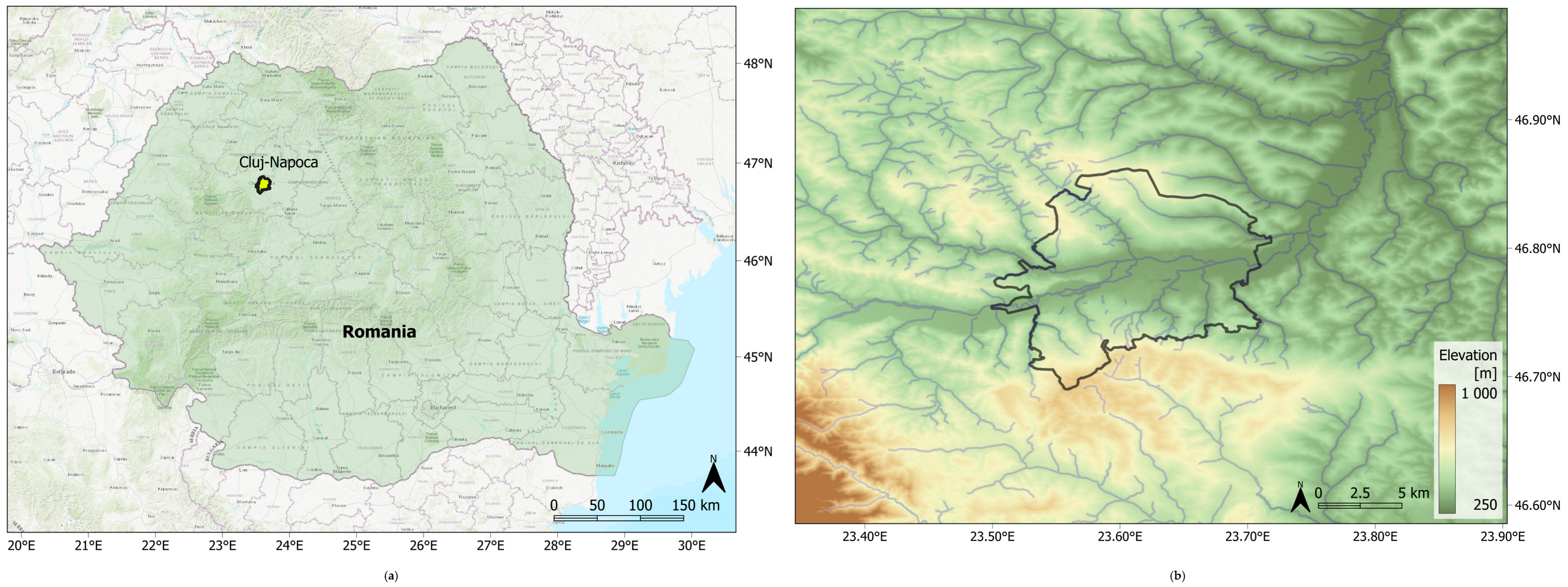
Cluj-Napoca is the second most populous city in Romania, located in the north-western part of the country, in the Someșul Mic river valley (Figure 1). It extends over Neozoic (Eocene–Middle Miocene) age sedimentary succession with alternating marine and continental deposits, being grouped in more than 15 stratigraphic formations [25]. All of these are overlain by a complex system of alluvium and colluvium deposits. The lithological spectrum is similarly very convoluted: red continental clays, marls, grey marine clays, limestone, coal, sands, sandstones, gypsum, salt, gravel, marshy deposits consisting of peat, and soft clays with high organic content [26]. Additionally, the geomorphological setting exhibits considerable variability. The seven terraces of the Someșul Mic River display significant elevation differences, which were later affected by Pleistocene and Holocene landslides that displaced material toward the base of slopes.
The built-up area of the city has been extended by more than 50% in the last 30 years, mostly to the steeper slopes of the surrounding hills. Moreover, human activities, e.g., deforestation, major construction earthworks, and overgrazing, also contributed to the reactivation of the mass movements [27].
Current landslide susceptibility assessments are based on existing landslide inventories or geological and geomorphological determinations [28,29]. In contrast, mapping these movements using satellite radar data represents the sole effective method for acquiring large-scale measurements, offering high spatial and temporal resolution for ongoing deformation processes. Urban expansion is directed precisely toward hazardous areas; thus, delineating movement extents and analyzing their temporal evolution can aid in identifying safer areas for expansion. Investigation of individual structures, whether for geotechnical design or for verifying the efficacy of implemented foundation or wall-stabilization measures, can also play a pivotal role.

2. Materials and Methods

We used a PSI processing chain, with the Interferometric Point Target Analysis (IPTA) method in the Gamma software package (v20241205) [30,31]. With this multi-image InSAR approach, a stack of images is analyzed to identify objects/scatterers on the ground, providing consistent and stable radar reflections back to the satellite, called persistent scatterer (PS) points [32,33]. Python (v3.10) and shell scripts were created to cover all steps, from downloading Single Look Complex (SLC) data to exporting the velocity and displacement results. These scripts were written and assembled to produce a high level of automation, but with some definite visual checkpoints. After each processing step, raster files were created to visually inspect and check the results for errors, e.g., phase jumps at burst edges due to faulty coregistration, phase unwrapping errors, patching effects, and validity of all phase components.
As a start of the chain, data were downloaded from the Alaska Satellite Facility (ASF) in burst SLC format. An automated process was set up to extract the appropriate bursts from the downloaded data, merge them, and then perform the coregistration. To facilitate this and for initial point heights, we used the Copernicus GLO-30 DEM as the input Digital Surface Model (DSM) [34]. Because of the long time base of more than 10 years, the coregistration was performed not only for a scene that is temporally centred, but also for a well-coregistered second scene that is temporally close to the slave image. In the process, we use the Precise Orbit Ephemerides (POEORB) precise orbit data [35], which greatly facilitates the coregistration, as no intensity matching is needed to obtain a first approximation of the sub-pixel shift values.
Focusing on efficiency and data reliability, we use the PSI method only, and do not use multi-look interferograms to identify distributed scatterers (DS) [36,37] and determine their velocities. The closure phase and its associated phase bias could give an unrealistic deformation signal that would hinder us in achieving our accuracy target. The correction of this phase bias is a current research topic and cannot be trivially solved [38], and also the majority of the expected deformations have a velocity under a few cm/year; therefore, to preserve the robustness of the processing, we only used PSI.
First, we determined the PSI candidates from the coregistered stack, based on averaged spectral diversity with a mean/sigma ratio (MSR) threshold of 0.32 and backscatter variability with a 1.25 minimum MSR threshold. A suitable reference point was selected in an area that is considered stable with good coherence, with a small, 15-sample wide averaged window to reduce pointwise effects. Afterwards, we created a reduced candidate list containing only the better-quality PSI points to make the processing more effective. This greatly speeds up the processing while improving the quality of the determined atmospheric phase screen. To efficiently determine the atmosphere, a simple spatial filtering is applied with a window size of 750 samples, with the phases rewrapped and unwrapped again to limit the number of unwrapping errors. The unwrapping is nevertheless also checked visually for errors. After removing the atmospheric phase terms, the point height corrections can be determined. The result of this process is therefore the atmospheric and height phase corrections and the deformation time series. In principle, the density of the final PSI coverage can be determined by the coherence of the points and the statistical error of the time series, which are the parameters we used to define the desired ratio between data reliability and spatial coverage. In this case, we applied minimal coherence filtering with 0.4 to provide as many points as possible for interpretation; meanwhile, we selected a one-sigma phase standard deviation threshold of 1.2 for rejecting unreliable points.
For the accurate displacement mapping, we used Sentinel-1A data: all available ascending observations from 31 October 2014 to 11 February 2025, and descending observations from 06 October 2014 to 05 January 2025. No time sampling was used, but Sentinel-1B observations were not included; therefore, a homogeneous 12-day repeat was achieved for the whole timeframe. By omitting the Sentinel-1B observations, we do not degrade the accuracy of the time series, but the fewer epochs increase the processing speed.
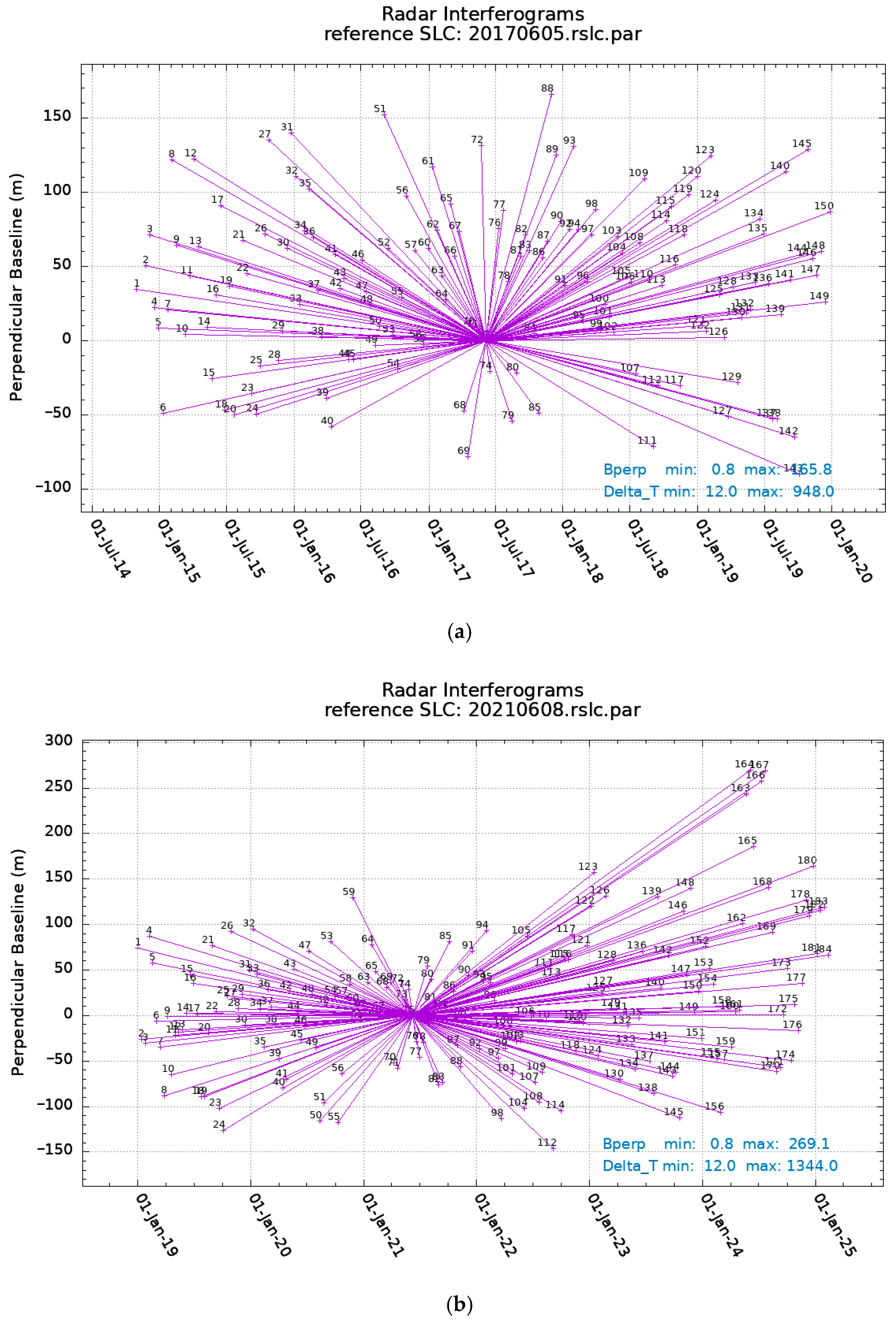
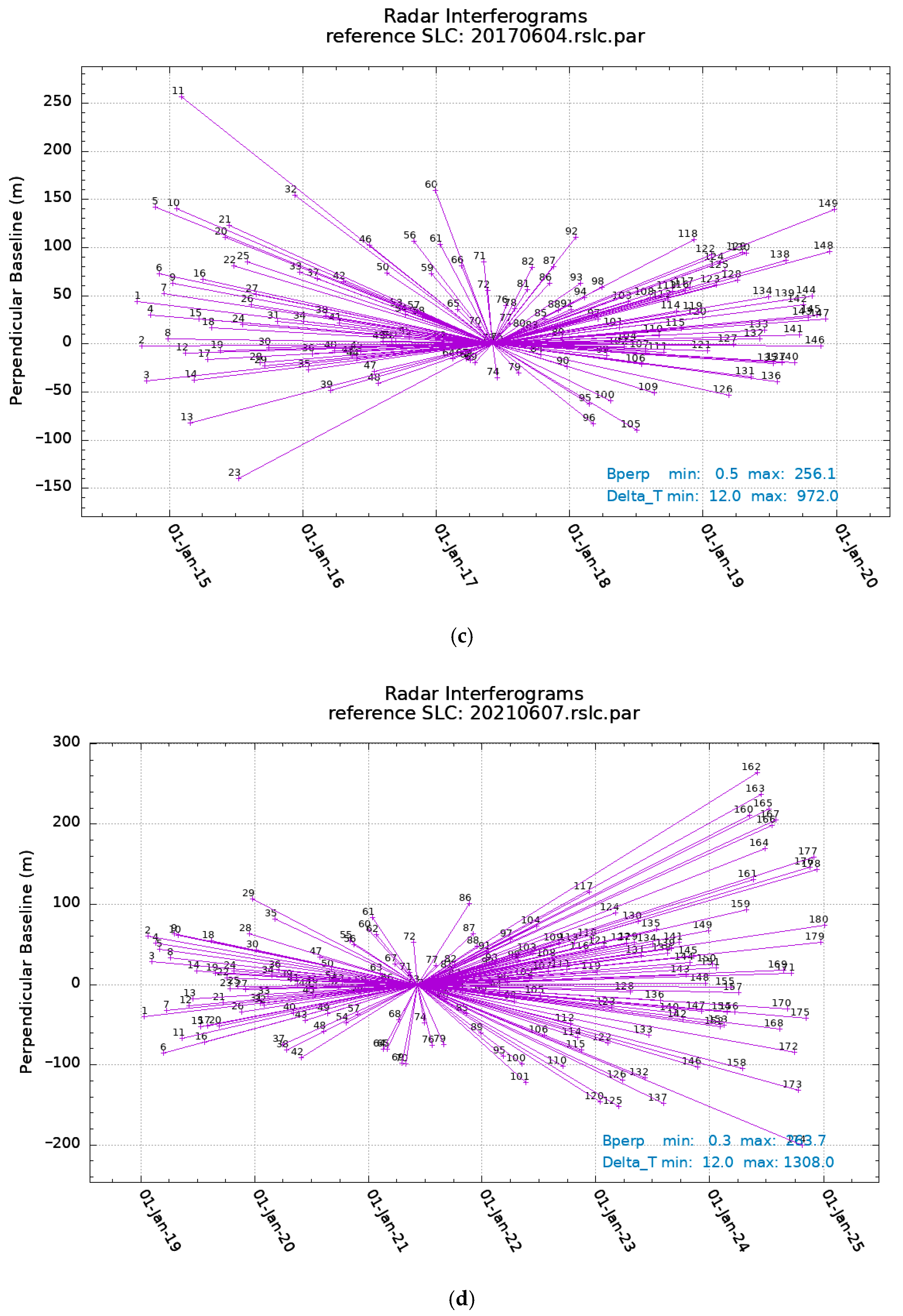
Because of the extensive temporal coverage of more than 10 years, using a single reference would result in low-coherence interferograms [39]. Therefore, two temporal references were selected for the two different temporal processing sets (named A and B). They were separated after the PS point candidate selection, and before the beginning of the IPTA [30]. We decided that both stacks should cover the more or less central year 2019 completely, from January 2019 to December 2019. During the first steps of the data processing, we used the same reference in 2019, scene 20191005 for ascending, and 20191004 for descending datasets. These were used for coregistration and point candidate selection only to have uniform results in each half of the temporal sets. This way, the dual reference approach does not increase the required processing time significantly, as only observations in 2019 were included in both time periods to create a temporal overlap (Table 1). However, having shorter interferograms increased their coherence, and more rapid, non-linear deformations could be better covered, and appearing and disappearing PSs are better captured.
Altogether, after a few scenes were omitted during processing due to decorrelation related to snow cover, a total of 303 and 300 scenes were used for the ascending and the descending analysis, respectively. The two overlapping temporal sets have reference scenes in 2017, the 20170605/20170604 (asc/desc) scene, and in 2021, the 20210608/20210607 (asc/desc) scene (Figure 2). The A/B pairs have the same spatial reference point and the same PS point candidate list.
We created simple Python scripts for concatenating the two resulting datasets after the successful IPTA processing. We calculated the average of the middle five displacement values of 2019 of both A and B sets, and used their difference as the shift for all displacement values in the B set. So the Δd shift that is subtracted from all displacement values of the B set is calculated as
Δd = [(d1,B + d2,B + d3,B + d4,B + d5,B) − (d1,A + d2,A + d3,A + d4,A + d5,A)]/5,
where d1,A is the displacement value of the first epoch from the A set, and 1–5 are the five selected epochs in the middle of the overlapping year of 2019, which are used for the mutual alignment of the time series. Furthermore, since the year 2019 was fully processed in both datasets, the epochs preceding the alignment were retained from dataset A, while those subsequent to the alignment were sourced from dataset B.
Then a linear regression was calculated for all ‘A and B’ PSs based on the total 2014–2025 displacement data time series, and that became the velocity value for that particular ‘A and B’ PS, and the sigma of the regression became its velocity uncertainty value. Where the PS disappears in the B set, or appears in B only, they are handled separately as A and B velocity, and their displacement time series exist respectively.

3. Results

3.1. PSI Results

3.1.1. Ascending

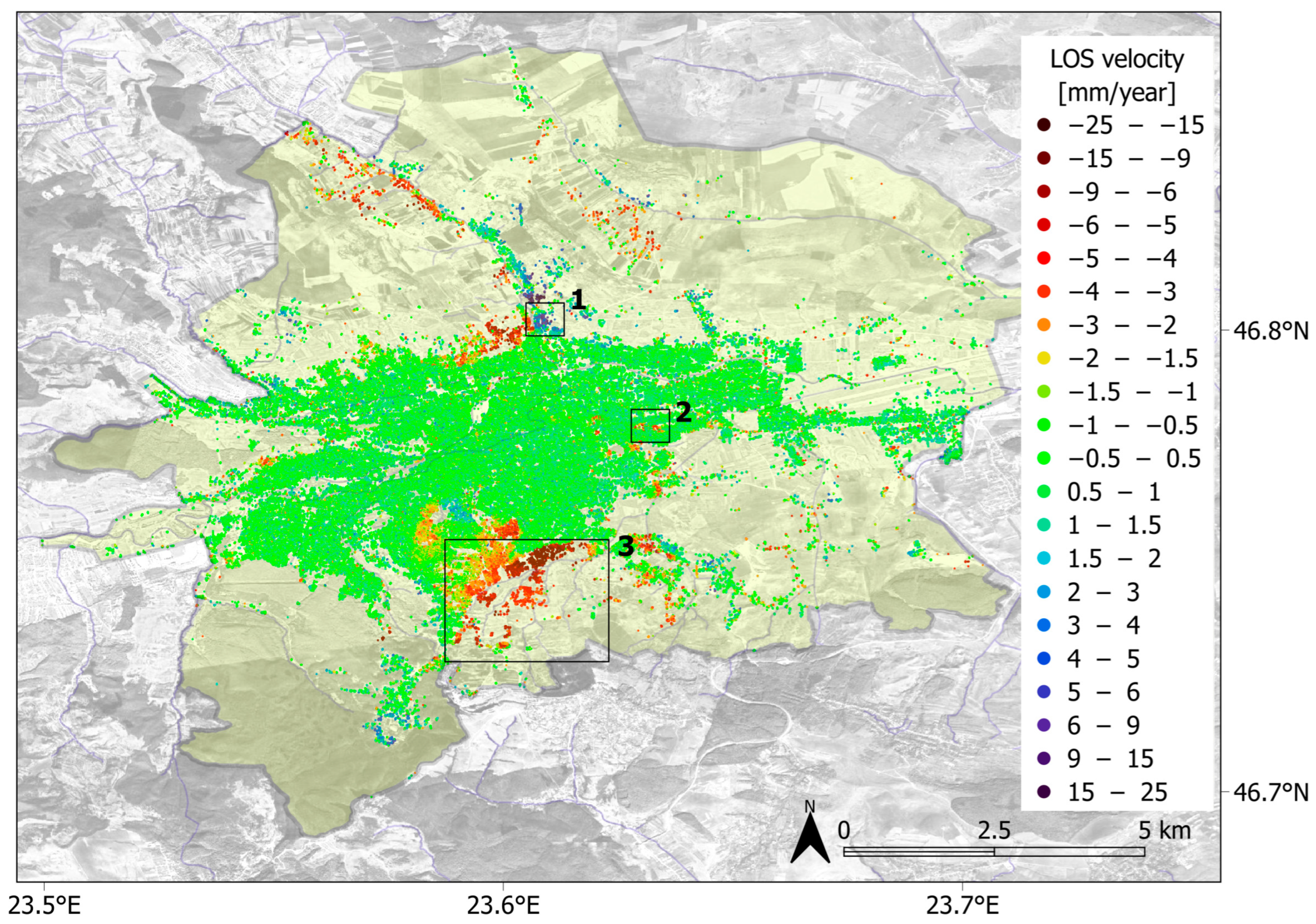
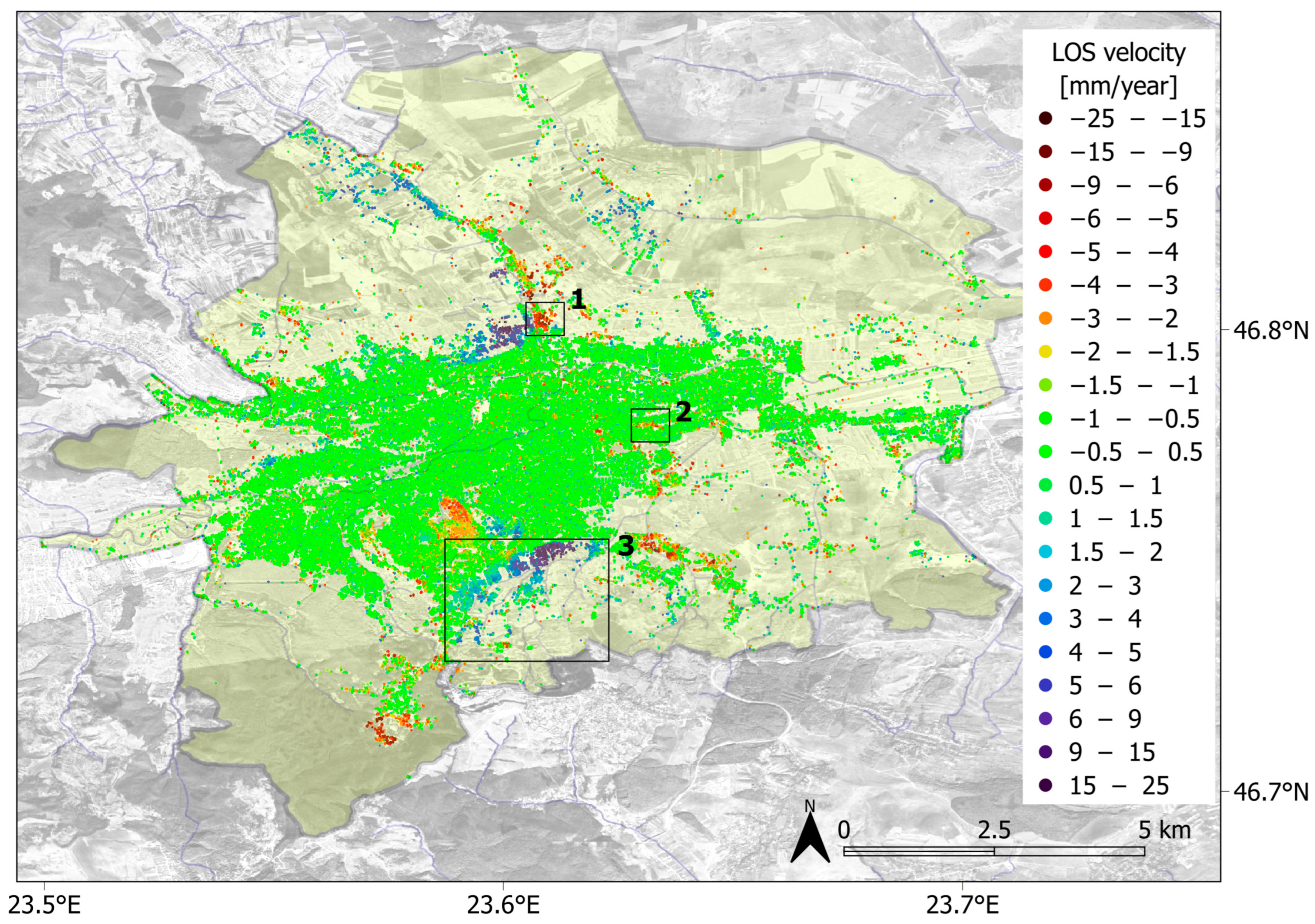
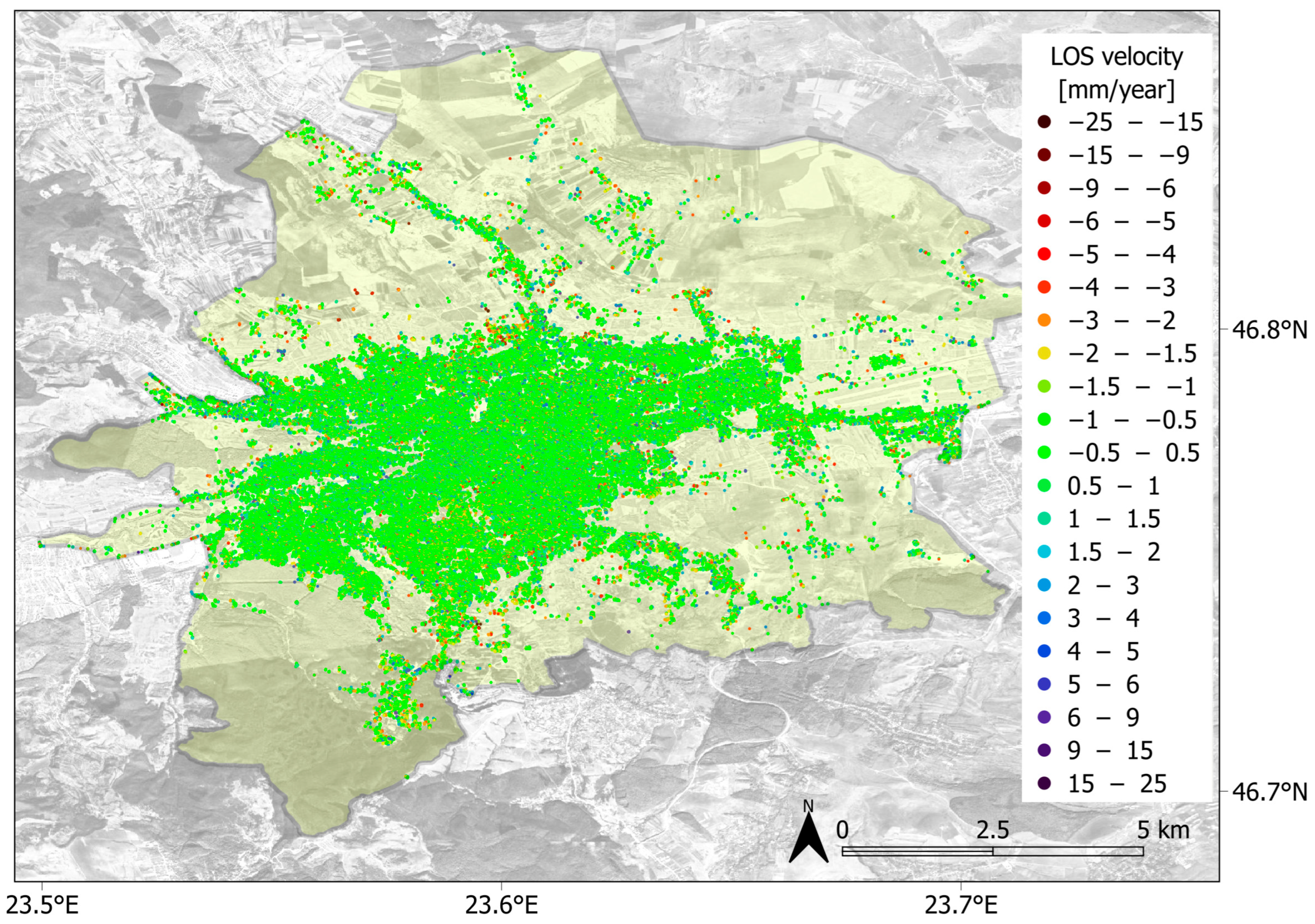
We successfully determined the motion history for 204,668 points using the ascending Sentinel-1A observations (Figure 3). The mean uncertainty of the linear velocity estimates is 0.12 mm/year. The incidence angle of ascending observations is approximately 39° at the centre of the AOI, and the azimuth angle is 11.6°. The larger-scale deformation patterns are mass movements; they are situated at locations where steeper gradients occur in the topography. There are many local, smaller-scale anomalies mapped due to various natural and anthropogenic factors.

3.1.2. Descending

We also successfully determined the motion history for 216,287 points using the descending Sentinel-1A observations (Figure 4). The mean uncertainty of the linear velocity estimates is 0.11 mm/year. The incidence angle of descending observations is approximately 45° at the centre of the AOI, and the azimuth angle is 190.69°. The larger-scale signals follow the same patterns as the ascending result, but at most locations, they have the opposite sign compared to the ascending result. This indicates that these motions are downslope sliding processes with a significant horizontal component. In contrast, the local, smaller-scale subsidence signals generally have the same sign in both geometries, which is indicative of purely vertical subsidence or uplift.

3.2. Local Analysis

Detailed investigation of all mapped anomalies is beyond the scope of this article; therefore, we selected three sites where the ongoing processes demonstrate different combinations of natural and anthropogenic influences in the urban environment. Their location is indicated in Figure 3 and Figure 4, and a summary of their parameters is reported in Table 2 below.

3.2.1. Recultivation–Landslide

The extensive slope movement of the area (~300 m × 300 m) occurs after the reclamation of a former clay mine. Multiple smaller mine pits in the area are confirmed on historical maps as well [40]. The most probable cause of the instability is that the slope created by earlier mining activities is too steep and is not stable in the long term. During the recultivation of the site, the already existing sliding phenomena were covered up, but not resolved. A few years after the recultivation, the previous landslides reappeared, causing damage in the upper areas partly covered with vegetation, but also uplift on the toe part, where infrastructures are affected as well.
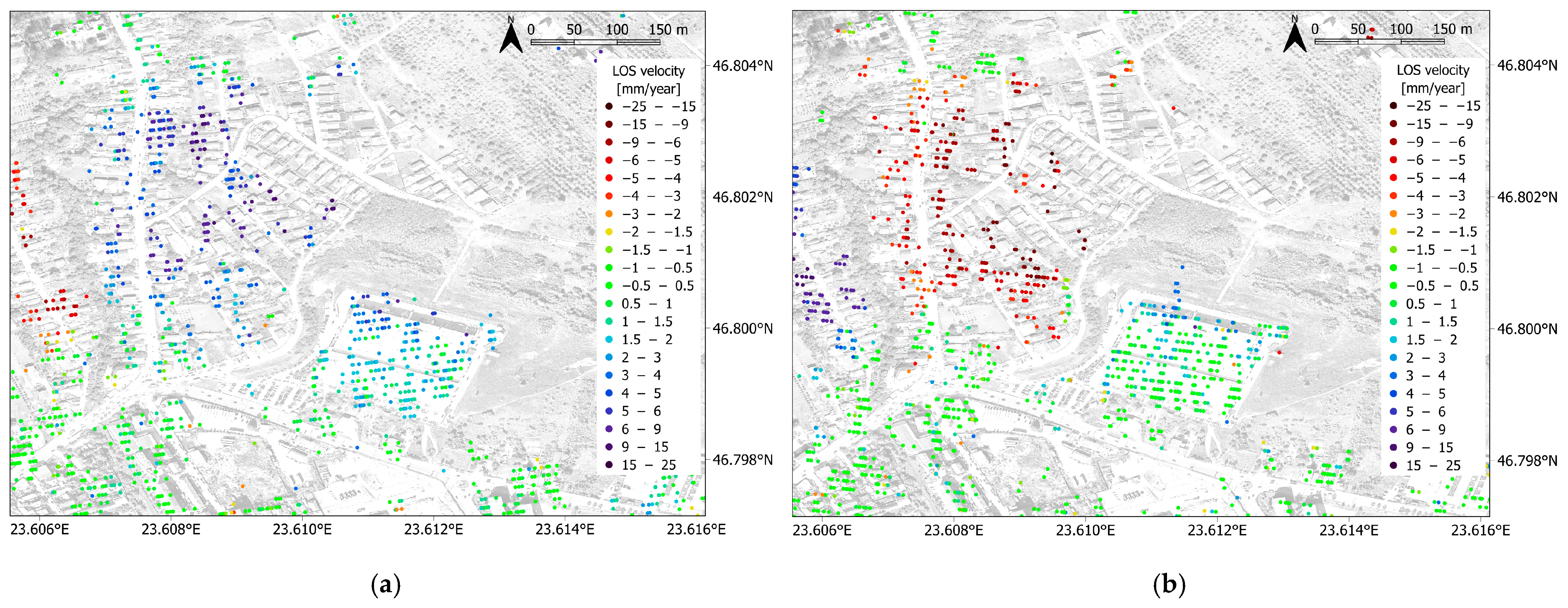
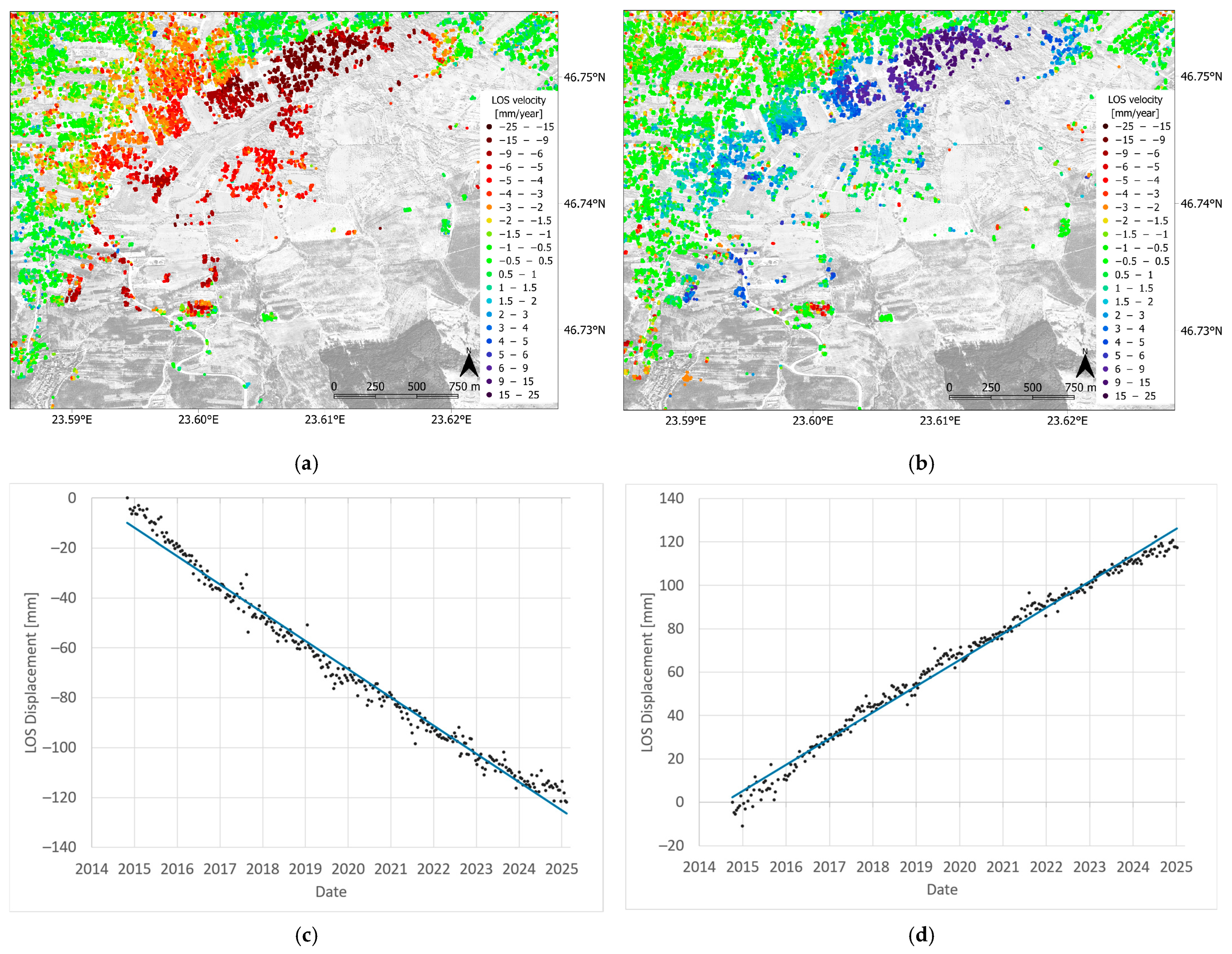
PSI data clearly confirm that the sliding is still ongoing with line-of-sight (LOS) velocities in both directions reaching 1.5 cm/year, as well as the uplift on the toe part, with differential movement affecting the large shopping centre that was built after the recultivation (Figure 5). Time-series analysis of the landslide shows that the slow, ongoing deformation is quite linear, with smaller sudden events with a maximal magnitude of less than 1 cm in LOS (Figure 5c,d).

3.2.2. Water Pumping–Subsidence

The area of the factory hall that was built on the site of a former lake [40] has started to subside heavily, after a large amount of water has been produced from the basements of the neighbouring houses for many years. Borehole data revealed pockets of highly compressible deposits rich in vegetal matter and fine particles, resembling mires and peat [41].
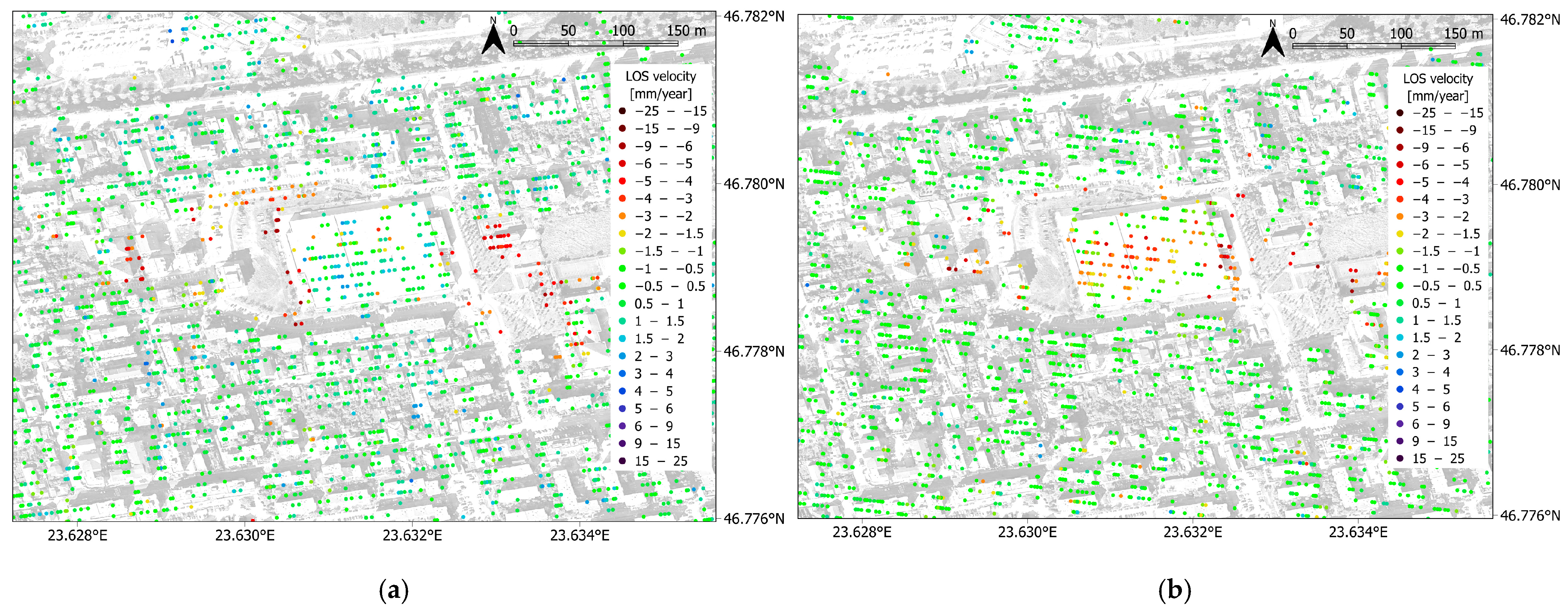
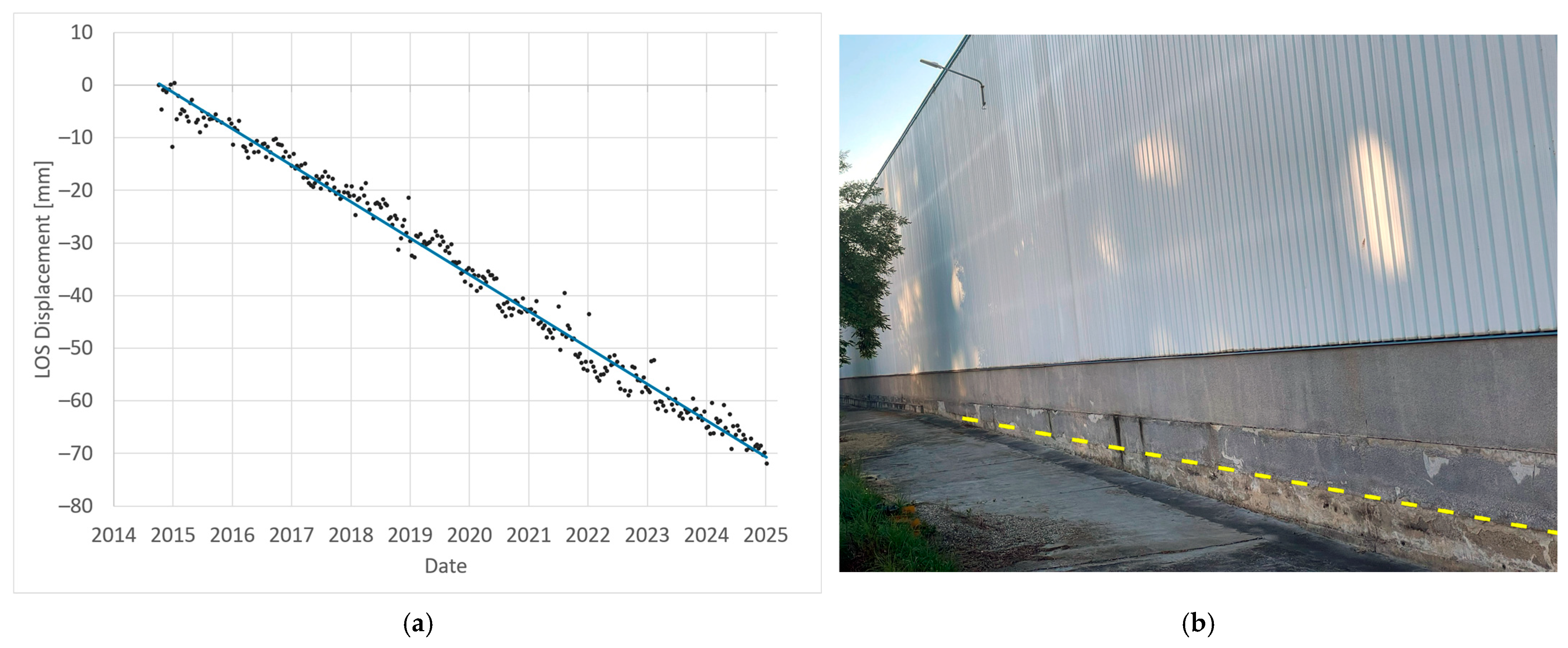
Our measurements show the continuing strong linear subsidence. The factory building appears to be relatively stable, whereas larger LOS velocities reaching 1 cm/year are detectable at the surrounding buildings (Figure 6). Equally large velocities are measured close to the western side of the building on ascending data, and on the eastern side on descending data (Figure 7a). Since the Sentinel-1 satellite looks to the right with respect to its flight direction, these persistent scatterers could be the result of double-bounce effects from the side of the building. This suggests that although the building itself may be relatively stable, the surrounding surface is subsiding, which is also confirmed by our photo taken at the site in 2024 (Figure 7b).

3.2.3. Slope Instability

The deformation with the largest extent in Cluj-Napoca is along the slope on the left bank of the Becaș stream in the Bună Ziua quarter. Even though there is a high geotechnical risk due to the geological structures of the area, there are no signs of major damage to the built environment. However, on the opposite bank of the stream, extended, active, fast landslides can be observed.
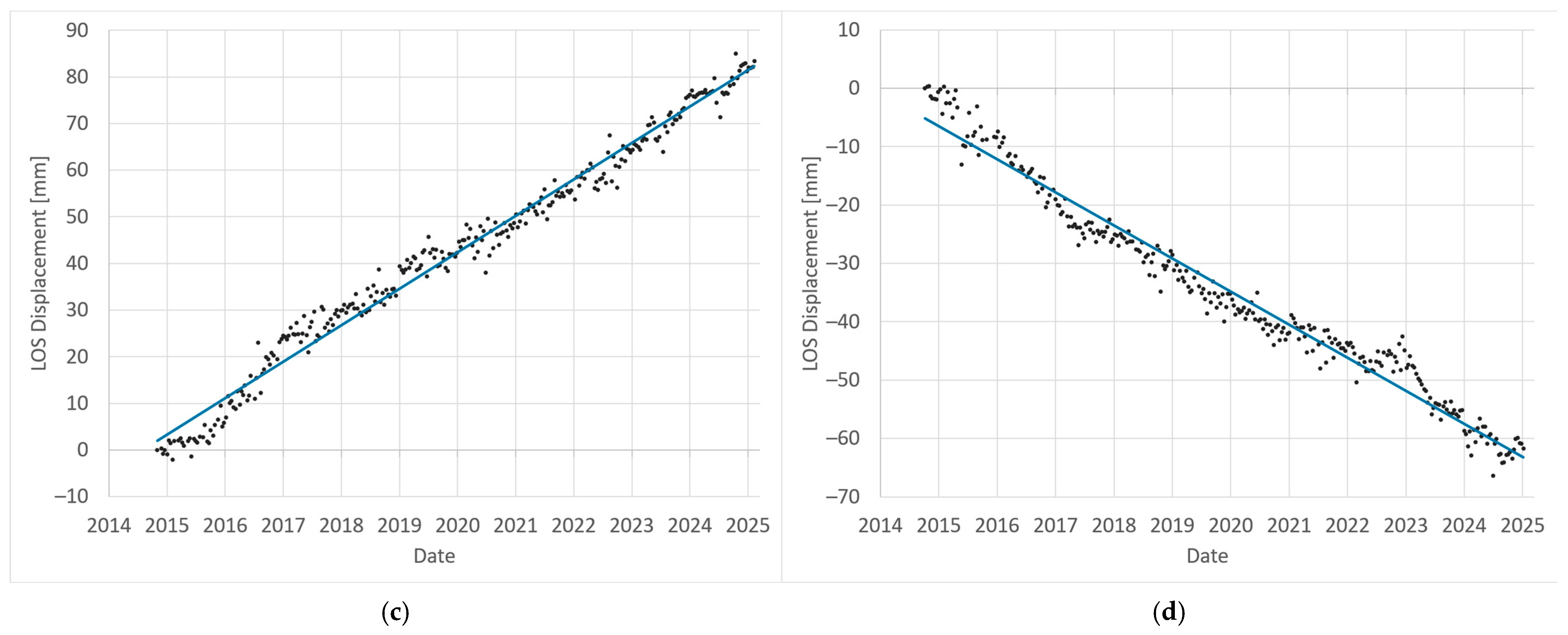
The PSI deformation maps precisely delimit the area affected by this slope movement. The LOS linear deformation rate at the northeastern part of the anomaly reaches 1.8 cm/year and 1.5 cm/year in ascending and descending directions, respectively. Ascending and descending observations with opposite displacement directions unequivocally demonstrate that the regional movement exhibits a substantial horizontal component, predominantly directed eastward, consistent with the valley geometry and slope orientation (Figure 8a,b). Time series were selected from sites with the highest LOS velocities; these reveal decelerating displacements, with trends in recent years exhibiting a sublinear flattening relative to the start of the 10-year period (Figure 8c,d).

4. Discussion

In this study, we mapped the ongoing surface deformation using Sentinel-1 PSI in the vicinity of Cluj-Napoca and revealed the interactions between natural and anthropogenic influences within these processes. Using a simple yet effective method involving dual references, we concatenated more than 10 years of observations, thereby obtaining a continuous time series for the investigated period.
The advantages of the applied dual-reference strategy include long time series, shorter interferograms with higher coherence, and shorter processing time compared with the multi-reference approach. The time series shown in the article (Figure 5c,d, Figure 7a and Figure 8c,d) also demonstrate that this stitching is smooth, with no abrupt change in velocities or jumps in 2019, for these clear, strong signals. However, this method may introduce uncertainties in the time series. First, if the average of the selected five epochs does not adequately represent one half of the time series in a dataset due to poor unwrapping or other reasons, the stitching may be inaccurate, and a jump may appear. To reduce this, we used an average of five epochs, which helps reduce the effect of outliers, and selected summer acquisitions so that possible snow cover would not hinder the fitting. Second, stitching may create an artificial breakpoint in a deformation signal that varies significantly over time; in this case, this break- or inflexion point would not reflect a real change in deformation rate. We tried to quantify this by comparing the one-year velocities of the temporal overlap from each processing set; however, our calculation showed that the inaccuracy of that short velocity estimate is greater than the uncertainty introduced by the concatenation.
Due to the observation geometry, side-looking radar satellites on near north–south orbits are not sensitive to north–south motion: the contribution of that component to the line-of-sight observation is much smaller than that of east–west and vertical displacement. For this reason, when a decomposition based on ascending and descending observations is performed, it is generally assumed that the north–south component is zero, or in the case of along-slope movements, the deformation is converted into along the steepest slope [42]. Obviously, this also makes our observed and mapped motion inventory insensitive to the north–south direction of movement, while east–west slope movements are more prominent, and they appear in the example case studies also.
Previous Geographic Information System (GIS) based studies [27,29], which primarily focus either on large-scale areas such as the entire country or Cluj County, or on highly localized sites, appear insensitive to the slow landslides we detected. These phenomena do not require the conditions associated with rapid, sudden catastrophic events, such as pronounced lithological instability, extreme slope angles or geomorphology, exceptional precipitation, or major changes in surface cover. Therefore, alongside such factors, radar remote sensing measurements of slower, non-obvious anomalies should be considered; these can affect extensive areas, cause significant infrastructure damage if persistent over long periods, and potentially accelerate abruptly, leading to even greater destruction.
The mapped slow landslides warrant sustained monitoring to facilitate early detection of potential destabilization preceding catastrophic failure [43]. The accurately mapped and quantified ground deformations can be used for a better understanding of the geological processes and assessing the risk of urban development in the area. The detected slope instabilities, subsidence, or uplift can have significant impacts on the built environment, and it can be beneficial to take them into account in the planning and design of new buildings and infrastructure.
PSI analysis of anthropogenic movements, illustrated by local groundwater extraction, facilitates the precise identification of subsidence-impacted structures or even identifies which structures have adequate foundations to remain unaffected by dewatering. Furthermore, such results may have the potential to help regulatory authorities in confirming illicit water withdrawals or establishing sustainable extraction thresholds that could support safeguarding the urban environment.
To validate our measurements, we compared the calculated linear velocities with the latest results of the European Ground Motion Service (EGMS) [44] for the descending dataset. We have downloaded the basic (level 2A) datasets and selected the nearest points for each PS in our results. Finally, we calculated the difference between the two LOS linear velocity estimates. Their statistical analysis reveals that the difference is small and only pointwise; the mean value is −0.006 mm/year, the standard deviation is 1.23 mm/year, and the interquartile range is 1.1 mm/year. Displaying these residuals also confirms that there are no larger-scale discrepancies (Figure 9). The pointwise disagreements could be explained by the different time period (2020–2024 vs. 2014–2025), PS selection differences, and the different processing strategies. The ascending results show similarly good agreement, both statistically and visually.
Although we used the single-reference PSI method due to our accuracy objectives, the results suggest that multi-reference and/or multi-look Small Baseline Subset (SBAS) type processing of the area could also be beneficial [5,7,14]. These approaches would provide the opportunity to, on the one hand, detect faster landslides, results of sudden events, potentially reaching >10 cm/year velocities, and on the other hand, obtain deformation information from less densely built-up areas, which are also affected by landslides. This is particularly important because, as the city expands, these areas become subject to increased scrutiny for the purpose of assessing landslide hazards and implementing appropriate building regulations.

5. Conclusions

In our work, we present an extensive continuous Sentinel-1-based ground deformation mapping (2014–2025) in Cluj-Napoca, Romania, revealing significant slow landslides, exceeding 1.5 cm/year in multiple locations, along with numerous smaller anomalies caused by anthropogenic activities such as water pumping and unsuccessful mine recultivation. To achieve this, we used a dual-reference PSI method that enabled efficient processing and fitting of the long time series.
This study is also proof of the necessity of local PSI deformation data and complex studies. Although country- [45,46] and continent-wide [44] PSI maps are useful tools for large-scale oversight, results of local studies are more up-to-date, processing details can be more precisely tailored to the region and the user’s needs. A countrywide Romanian map was created in 2021 [47], and the EGMS products are available only in 5-year windows, with the latest covering the 2020–2024 period. In contrast, our work provides the longest continuous Sentinel-1-based mapping in the region of Cluj-Napoca in both observation geometries, achieved using the dual-reference approach presented.
Furthermore, analysis of individual anomalies is not part of large-scale ground motion inventories, but comprehensive geological and geomorphological investigations are essential to quantify the parameters driving these movements. Thus, our study also highlights the necessity of collaboration between remote sensing and local geological and geotechnical experts to maximize the potential and operational effectiveness of satellite-based deformation monitoring data, as demonstrated by previous studies at other locations [48].

Author Contributions

Conceptualization, P.F.; methodology, P.F.; software, P.F.; validation, G.T.; formal analysis, G.T.; investigation, P.F.; resources, P.F.; data curation, P.F.; writing—original draft preparation, P.F.; writing—review and editing, P.F. and G.T.; visualization, P.F.; supervision, G.T.; project administration, P.F. and G.T. All authors have read and agreed to the published version of the manuscript.

Funding

This research received no external funding.

Data Availability Statement

The original contributions presented in this study are included in the article. Further inquiries can be directed to the corresponding author.

Acknowledgments

Contains modified Copernicus Sentinel data 2014–2025. We thank András Eduard of GeoSearch for the initial ideas and contributions. Additionally, we extend our thanks to Sándor Frey for reviewing the manuscript.

Conflicts of Interest

The authors declare no conflicts of interest. Author Péter Farkas was employed by the company Geo-Sentinel Ltd. The remaining authors declare that the research was conducted in the absence of any commercial or financial relationships that could be construed as a potential conflict of interest.

Abbreviations

The following abbreviations are used in this manuscript:
DSDistributed Scatterer
DSMDigital Surface Model
EGMSEuropean Ground Motion Service
InSARInterferometric Synthetic Aperture Radar
IPTAInterferometric Point Target Analysis
GISGeographic Information System
GNSSGlobal Navigation Satellite Systems
LOSLine-of-sight
MSRMean/Sigma ratio
POEORBPrecise Orbit Ephemerides
PSPersistent Scatterer
PSIPersistent Scatterer Interferometry
SARSynthetic Aperture Radar
SBASSmall Baseline Subset
SLCSingle Look Complex

References

  1. Turner, A.K. Social and Environmental Impacts of Landslides. Innov. Infrastruct. Solut. 2018, 3, 70. [Google Scholar] [CrossRef]
  2. Gariano, S.L.; Guzzetti, F. Landslides in a Changing Climate. Earth-Sci. Rev. 2016, 162, 227–252. [Google Scholar] [CrossRef]
  3. Liu, W.; Zhang, Y.; Liang, Y.; Sun, P.; Li, Y.; Su, X.; Wang, A.; Meng, X. Landslide Risk Assessment Using a Combined Approach Based on InSAR and Random Forest. Remote Sens. 2022, 14, 2131. [Google Scholar] [CrossRef]
  4. Galloway, D.L.; Burbey, T.J. Review: Regional Land Subsidence Accompanying Groundwater Extraction. Hydrogeol. J. 2011, 19, 1459–1486. [Google Scholar] [CrossRef]
  5. Yang, C.; Zhang, D.; Zhao, C.; Han, B.; Sun, R.; Du, J.; Chen, L. Ground Deformation Revealed by Sentinel-1 MSBAS-InSAR Time-Series over Karamay Oilfield, China. Remote Sens. 2019, 11, 2027. [Google Scholar] [CrossRef]
  6. Declercq, P.-Y.; Dusar, M.; Pirard, E.; Verbeurgt, J.; Choopani, A.; Devleeschouwer, X. Post Mining Ground Deformations Transition Related to Coal Mines Closure in the Campine Coal Basin, Belgium, Evidenced by Three Decades of MT-InSAR Data. Remote Sens. 2023, 15, 725. [Google Scholar] [CrossRef]
  7. Hu, B.; Chen, B.; Na, J.; Yao, J.; Zhang, Z.; Du, X. Urban Surface Deformation Management: Assessing Dangerous Subsidence Areas through Regional Surface Deformation, Natural Factors, and Human Activities. Sustainability 2022, 14, 10487. [Google Scholar] [CrossRef]
  8. Herrera-García, G.; Ezquerro, P.; Tomás, R.; Béjar-Pizarro, M.; López-Vinielles, J.; Rossi, M.; Mateos, R.M.; Carreón-Freyre, D.; Lambert, J.; Teatini, P.; et al. Mapping the Global Threat of Land Subsidence. Science 2021, 371, 34–36. [Google Scholar] [CrossRef] [PubMed]
  9. Marfai, M.A.; King, L. Monitoring Land Subsidence in Semarang, Indonesia. Environ. Geol. 2007, 53, 651–659. [Google Scholar] [CrossRef]
  10. Motagh, M.; Walter, T.R.; Sharifi, M.A.; Fielding, E.; Schenk, A.; Anderssohn, J.; Zschau, J. Land Subsidence in Iran Caused by Widespread Water Reservoir Overexploitation. Geophys. Res. Lett. 2008, 35, 2008GL033814. [Google Scholar] [CrossRef]
  11. Li, Y.; Zhang, J.; Li, Z.; Luo, Y.; Jiang, W.; Tian, Y. Measurement of Subsidence in the Yangbajing Geothermal Fields, Tibet, from TerraSAR-X InSAR Time Series Analysis. Int. J. Digit. Earth 2016, 9, 697–709. [Google Scholar] [CrossRef]
  12. Datola, G. Implementing Urban Resilience in Urban Planning: A Comprehensive Framework for Urban Resilience Evaluation. Sustain. Cities Soc. 2023, 98, 104821. [Google Scholar] [CrossRef]
  13. Hu, B.; Zhou, J.; Wang, J.; Chen, Z.; Wang, D.; Xu, S. Risk Assessment of Land Subsidence at Tianjin Coastal Area in China. Environ. Earth Sci. 2009, 59, 269–276. [Google Scholar] [CrossRef]
  14. Shi, X.; Chen, C.; Dai, K.; Deng, J.; Wen, N.; Yin, Y.; Dong, X. Monitoring and Predicting the Subsidence of Dalian Jinzhou Bay International Airport, China by Integrating InSAR Observation and Terzaghi Consolidation Theory. Remote Sens. 2022, 14, 2332. [Google Scholar] [CrossRef]
  15. Huang, F.; Cao, Z.; Guo, J.; Jiang, S.-H.; Li, S.; Guo, Z. Comparisons of Heuristic, General Statistical and Machine Learning Models for Landslide Susceptibility Prediction and Mapping. CATENA 2020, 191, 104580. [Google Scholar] [CrossRef]
  16. Dai, F.C.; Lee, C.F.; Ngai, Y.Y. Landslide Risk Assessment and Management: An Overview. Eng. Geol. 2002, 64, 65–87. [Google Scholar] [CrossRef]
  17. Yalcin, A. GIS-Based Landslide Susceptibility Mapping Using Analytical Hierarchy Process and Bivariate Statistics in Ardesen (Turkey): Comparisons of Results and Confirmations. CATENA 2008, 72, 1–12. [Google Scholar] [CrossRef]
  18. Reichenbach, P.; Rossi, M.; Malamud, B.D.; Mihir, M.; Guzzetti, F. A Review of Statistically-Based Landslide Susceptibility Models. Earth-Sci. Rev. 2018, 180, 60–91. [Google Scholar] [CrossRef]
  19. Ciampalini, A.; Farina, P.; Lombardi, L.; Nocentini, M.; Taurino, V.; Guidi, R.; Pina, F.D.; Tavarini, D. Integration of Satellite InSAR with a Wireless Network of Geotechnical Sensors for Slope Monitoring in Urban Areas: The Pariana Landslide Case (Massa, Italy). Remote Sens. 2021, 13, 2534. [Google Scholar] [CrossRef]
  20. Grenerczy, G.; Wegmüller, U. Persistent Scatterer Interferometry Analysis of the Embankment Failure of a Red Mud Reservoir Using ENVISAT ASAR Data. Nat. Hazards 2011, 59, 1047–1053. [Google Scholar] [CrossRef]
  21. Colesanti, C.; Wasowski, J. Investigating Landslides with Space-Borne Synthetic Aperture Radar (SAR) Interferometry. Eng. Geol. 2006, 88, 173–199. [Google Scholar] [CrossRef]
  22. Zhao, C.; Lu, Z.; Zhang, Q.; De La Fuente, J. Large-Area Landslide Detection and Monitoring with ALOS/PALSAR Imagery Data over Northern California and Southern Oregon, USA. Remote Sens. Environ. 2012, 124, 348–359. [Google Scholar] [CrossRef]
  23. Herrera, G.; Gutiérrez, F.; García-Davalillo, J.C.; Guerrero, J.; Notti, D.; Galve, J.P.; Fernández-Merodo, J.A.; Cooksley, G. Multi-Sensor Advanced DInSAR Monitoring of Very Slow Landslides: The Tena Valley Case Study (Central Spanish Pyrenees). Remote Sens. Environ. 2013, 128, 31–43. [Google Scholar] [CrossRef]
  24. Bell, J.W.; Amelung, F.; Ferretti, A.; Bianchi, M.; Novali, F. Permanent Scatterer InSAR Reveals Seasonal and Long-Term Aquifer-System Response to Groundwater Pumping and Artificial Recharge. Water Resour. Res. 2008, 44, W02407. [Google Scholar] [CrossRef]
  25. Filipescu, S. Cenozoic Lithostratigraphic Units in Transylvania. In Calcareous Algae from Romanian Carpathians: 10th International Symposium on Fossil Algae, Cluj-Napoca, Romania, 12–18 September 2011: Field Trip Guidebook; Presa Universitară Clujeană: Cluj-Napoca, Romania, 2011; ISBN 978-973-595-283-9. [Google Scholar]
  26. Poszet, S. Study of Applied Geomorphology in the Urban Area of Cluj-Napoca; University Cluj-Napoca: Cluj-Napoca, Romania, 2011. [Google Scholar]
  27. Kerekes, A.H.; Poszet, S.L.; Baciu, L.C. Investigating Land Surface Deformation Using InSAR and GIS Techniques in Cluj–Napoca City’s Most Affected Sector by Urban Sprawl (Romania). Rev. Geomorf. 2020, 22, 43–59. [Google Scholar] [CrossRef]
  28. Kerekes, A.; Poszet, S.L.; Gál, A. Landslide Susceptibility Assessment Using the Maximum Entropy Model in a Sector of the Cluj–Napoca Municipality, Romania. Rev. Geomorf. 2018, 20, 130–146. [Google Scholar] [CrossRef]
  29. Moldovan, C.; Roșca, S.; Dolean, B.; Rusu, R.; Ursu, C.-D.; Man, T. Spatial Planning Decision Based on Geomorphic Natural Hazards Distribution Analysis in Cluj County, Romania. Appl. Sci. 2024, 14, 440. [Google Scholar] [CrossRef]
  30. Werner, C.; Wegmüller, U.; Strozzi, T.; Wiesmann, A. Interferometric Point Target Analysis for Deformation Mapping. In IGARSS 2003, Proceedings of the 2003 IEEE International Geoscience and Remote Sensing Symposium, Toulouse, France, 21–25 July 2003; IEEE: Toulouse, France, 2003; Volume 7, pp. 4362–4364. [Google Scholar]
  31. Werner, C.; Wegmüller, U.; Strozzi, T.; Wiesmann, A. Gamma SAR and Interferometric Processing Software. In Proceedings of the Ers-Envisat Symposium, Gothenburg, Sweden, 16–20 October 2000. [Google Scholar]
  32. Ferretti, A.; Prati, C.; Rocca, F. Analysis of Permanent Scatterers in SAR Interferometry. In Proceedings of the IGARSS 2000, IEEE 2000 International Geoscience and Remote Sensing Symposium, Honolulu, HI, USA, 24–28 July 2000; IEEE: Honolulu, HI, USA, 2000; Volume 2, pp. 761–763. [Google Scholar]
  33. Ferretti, A.; Prati, C.; Rocca, F. Permanent Scatterers in SAR Interferometry. IEEE Trans. Geosci. Remote Sens. 2001, 39, 8–20. [Google Scholar] [CrossRef]
  34. European Space Agency. Airbus Copernicus DEM 2022; European Space Agency: Paris, France, 2022.
  35. Peter, H.; Fernández, M.; Arnold, D.; Duan, B.; Simons, W.; Gini, F.; Wermuth, M.; Hackel, S.; Fernández, J.; Jäggi, A.; et al. Copernicus POD Service—Orbit Reprocessing for Copernicus Sentinel-1 Satellites 2021. In Proceedings of the the 23rd EGU General Assembly, Online, 19–30 April 2021. [Google Scholar]
  36. Even, M.; Schulz, K. InSAR Deformation Analysis with Distributed Scatterers: A Review Complemented by New Advances. Remote Sens. 2018, 10, 744. [Google Scholar] [CrossRef]
  37. Ferretti, A.; Fumagalli, A.; Novali, F.; Prati, C.; Rocca, F.; Rucci, A. A New Algorithm for Processing Interferometric Data-Stacks: SqueeSAR. IEEE Trans. Geosci. Remote Sens. 2011, 49, 3460–3470. [Google Scholar] [CrossRef]
  38. Wegmüller, U.; Magnard, C.; Werner, C.; Strozzi, T.; Caduff, R.; Manconi, A. Methods to Avoid Being Affected by Non-Zero Closure Phase in InSAR Time Series Analysis in a Multi-Reference Stack. Procedia Comput. Sci. 2021, 181, 511–518. [Google Scholar] [CrossRef]
  39. Ullmann, T.; Sauerbrey, J.; Hoffmeister, D.; May, S.M.; Baumhauer, R.; Bubenzer, O. Assessing Spatiotemporal Variations of Sentinel-1 InSAR Coherence at Different Time Scales over the Atacama Desert (Chile) between 2015 and 2018. Remote Sens. 2019, 11, 2960. [Google Scholar] [CrossRef]
  40. Előd, B.; Sándor, B.; Gábor, T.; Diána, N.; Gábor, M. Historical Topographic and Cadastral Maps of Europe in Spotlight—Evolution of the MAPIRE Map Portal. In Proceedings of the 12th ICA Conference Digital Approaches to Cartographic Heritage, Venice, Italy, 26–28 April 2017. [Google Scholar]
  41. GeoSearch SRL Geotechnical Study for Fujikura Automotive România (FAR), Cluj. Available online: https://geosearch.ro/en/geotechnical-study-for-fujikura-automotive-romania-far-cluj/ (accessed on 25 February 2026).
  42. Ren, T.; Gong, W.; Gao, L.; Zhao, F.; Cheng, Z. An Interpretation Approach of Ascending–Descending SAR Data for Landslide Identification. Remote Sens. 2022, 14, 1299. [Google Scholar] [CrossRef]
  43. Lacroix, P.; Handwerger, A.L.; Bièvre, G. Life and Death of Slow-Moving Landslides. Nat. Rev. Earth Environ. 2020, 1, 404–419. [Google Scholar] [CrossRef]
  44. Costantini, M.; Minati, F.; Trillo, F.; Ferretti, A.; Novali, F.; Passera, E.; Dehls, J.; Larsen, Y.; Marinkovic, P.; Eineder, M.; et al. European Ground Motion Service (EGMS). In Proceedings of the 2021 IEEE International Geoscience and Remote Sensing Symposium IGARSS, Brussels, Belgium, 11–16 July 2021; IEEE: Brussels, Belgium, 2021; pp. 3293–3296. [Google Scholar]
  45. Dehls, J.F.; Larsen, Y.; Marinkovic, P.; Lauknes, T.R.; Stodle, D.; Moldestad, D.A. INSAR.No: A National Insar Deformation Mapping/Monitoring Service In Norway—From Concept To Operations. In Proceedings of the IGARSS 2019—2019 IEEE International Geoscience and Remote Sensing Symposium, Yokohama, Japan, 28 July–2 August 2019; IEEE: Yokohama, Japan, 2019; pp. 5461–5464. [Google Scholar]
  46. Grenerczy, G.; Farkas, P.; Frey, S. Ground Motion Map of Hungary; Zenodo: Geneva, Switzerland, 2025. [Google Scholar] [CrossRef]
  47. Toma, S.-A.; Teleaga, D.; Poncos, V.; Grozea, C. Ground Motion Patterns Analysis from the National Persistent Scatterer Deformation Map of Romania. In Proceedings of the 2021 IEEE International Geoscience and Remote Sensing Symposium IGARSS, Brussels, Belgium, 11–16 July 2021; IEEE: Brussels, Belgium, 2021; pp. 6237–6239. [Google Scholar]
  48. Tofani, V.; Raspini, F.; Catani, F.; Casagli, N. Persistent Scatterer Interferometry (PSI) Technique for Landslide Characterization and Monitoring. Remote Sens. 2013, 5, 1045–1065. [Google Scholar] [CrossRef]
Figure 1. Location of Cluj-Napoca in Romania (a), the topography of the area of interest, with the Cluj-Napoca metropolitan area outlined (b).
Remotesensing 18 01877 g001
Figure 2. Temporal and spatial baseline plot of the four processing sets: (a) Ascending A set; (b) Ascending B set; (c) Descending A set; (d) Descending B set.
Remotesensing 18 01877 g002aRemotesensing 18 01877 g002b
Figure 3. Line-of-sight, colour-coded linear velocity map based on ascending Sentinel-1 observations (2014–2025). The Cluj-Napoca metropolitan area is indicated in yellow. Rectangles indicated with 1–3 are the selected areas for local analyses.
Remotesensing 18 01877 g003
Figure 4. Line-of-sight, colour-coded average linear velocity map based on descending Sentinel-1 observations (2014–2025). The Cluj-Napoca metropolitan area is indicated in yellow. Rectangles indicated with 1–3 are the selected areas for local analyses.
Remotesensing 18 01877 g004
Figure 5. Line-of-sight, colour-coded average linear velocity maps of the area of the recultivation based on ascending (a) and descending (b) Sentinel-1 observations (2014–2025); displacement time series of an ascending (c) and descending (d) PS selected at the same building in the centre of the anomaly.
Remotesensing 18 01877 g005aRemotesensing 18 01877 g005b
Figure 6. Line-of-sight, colour-coded average linear velocity maps of the area affected by water pumping on ascending (a) and descending (b) Sentinel-1 observations (2014–2025).
Remotesensing 18 01877 g006
Figure 7. Averaged displacement time series of four selected descending PSs near the eastern wall of the building (a); photograph of the southern side, the effect of the subsiding surrounding surface indicated by the yellow dashed line (b).
Remotesensing 18 01877 g007
Figure 8. Line-of-sight, colour-coded average linear velocity maps of the area affected by slope instability on ascending (a) and descending (b) Sentinel-1 observations (2014–2025); displacement time series of a selected ascending (c) and descending (d) PS at the same building in the centre of the anomaly.
Remotesensing 18 01877 g008
Figure 9. Line-of-sight, colour-coded average linear velocity differences between our results (2014–2025) and the latest EGMS basic (level 2A) product (2020–2024), based on descending Sentinel-1 observations. The Cluj-Napoca metropolitan area is indicated in yellow.
Remotesensing 18 01877 g009
Table 1. Summary of Sentinel-1A data used in the four single-reference processing sets.
Processing SetStart DateEnd DateNumber of Scenes
Ascending A31 October 201428 December 2019150
Ascending B02 January 201911 February 2025184
Descending A06 October 201427 December 2019149
Descending B13 January 201905 January 2025180
Table 2. Summary of the presented case studies.
1. Recultivation–Landslide2. Water Pumping–Subsidence3. Slope Instability
Area affected [km2]0.420.103.25
Number of PSAsc: 382
Desc: 398
Asc: 415
Desc: 385
Asc: 3508
Desc: 4023
Mean LOS velocity [mm/year]Asc: 4.71
Desc: −5.02
Asc: −1.01
Desc: −1.71
Asc: −6.44
Desc: 3.85
Largest LOS velocity [mm/year]Asc: 13.80
Desc: −15.33
Asc: −6.78
Desc: −8.43
Asc: −18.82
Desc: 15.18
Mean velocity uncertainty
[1 σ, mm/year]
Asc: 0.12
Desc: 0.11
Asc: 0.09
Desc: 0.08
Asc: 0.11
Desc: 0.08
Dominant directionWest-southwest slideVertical subsidenceSoutheast slide
Evidence for proposed causeField observations; geomorphologyField observations;
geotechnical results
Geology; significant landslides at the southern side of the valley
Disclaimer/Publisher’s Note: The statements, opinions and data contained in all publications are solely those of the individual author(s) and contributor(s) and not of MDPI and/or the editor(s). MDPI and/or the editor(s) disclaim responsibility for any injury to people or property resulting from any ideas, methods, instructions or products referred to in the content.