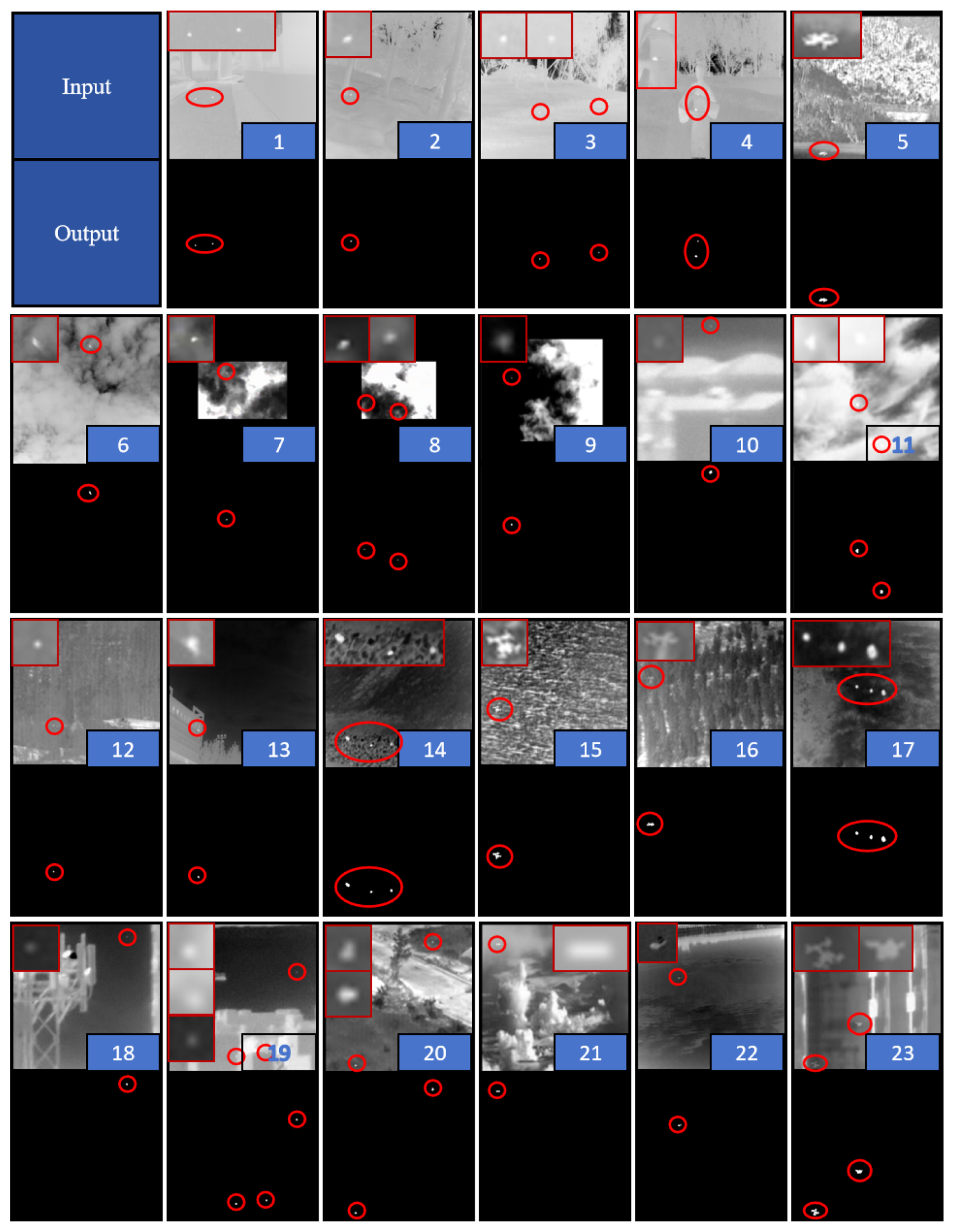


MCC-Net: Efficient Dual-Attention Network for Infrared Small-Target Detection
Highlights
- We propose MCC-Net, an innovative infrared small-target detection method featuring a streamlined architecture with a complementary spatial-channel dual-attention mechanism.
- The proposed model integrates three innovative strategies, namely, Magnitude-Aware Linear Attention, Conditionally Parameterized Convolutions, and Conditional Cross-Channel Fusion, achieving superior detection performance while substantially reducing computational overhead.
- The proposed method achieves state-of-the-art performance across multiple evaluation metrics and visual results on three public benchmark datasets.
- MCC-Net demonstrates substantially lower computational complexity than state-of-the-art methods, enabling efficient deployment in resource-constrained scenarios.
Abstract
1. Introduction
- (1)
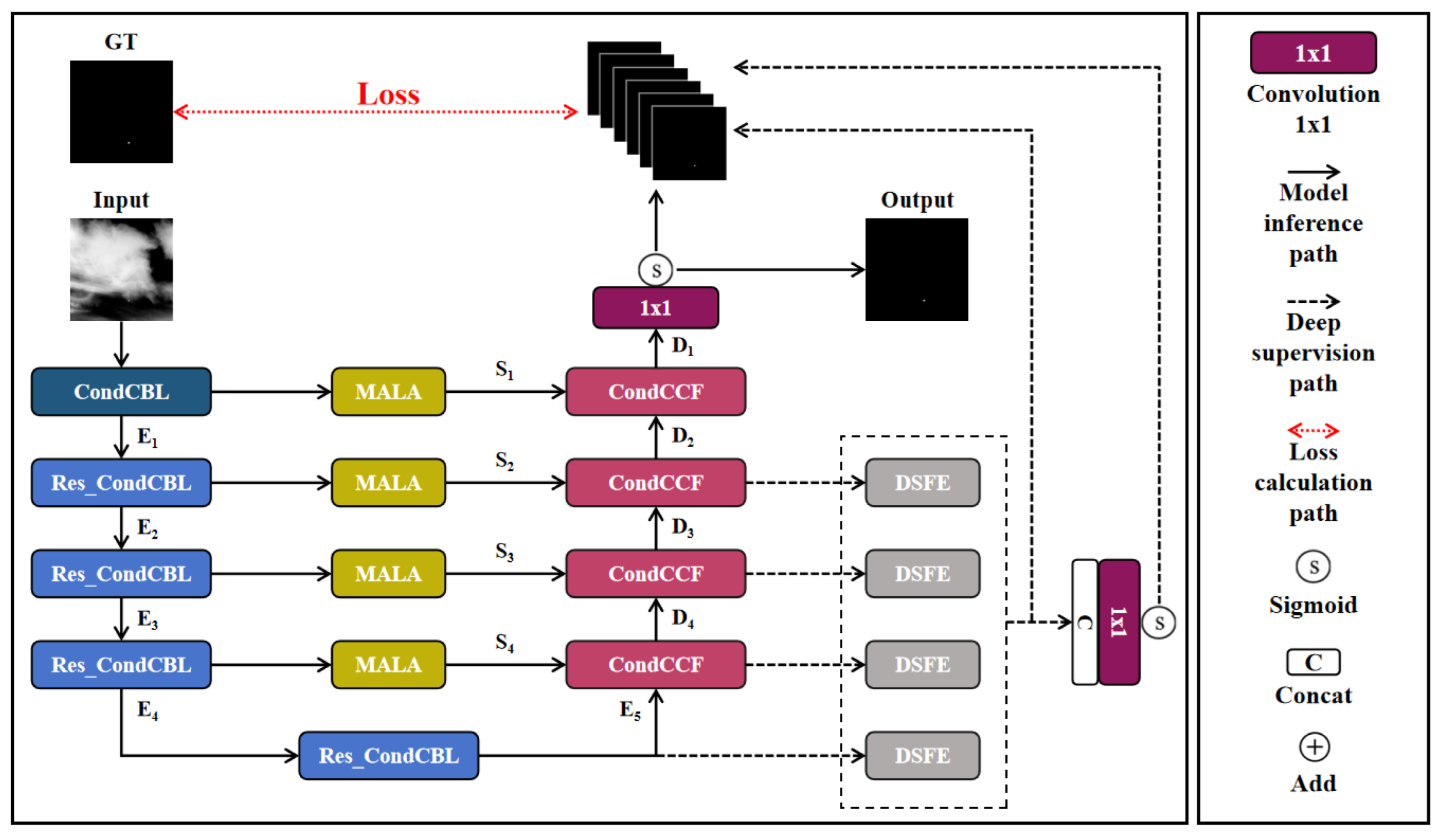
- We propose MCC-Net, an efficient infrared small target detection framework incorporating a dual attention mechanism. The model employs deep supervision during training to accelerate convergence and mitigate the vanishing gradient problem.
- (2)
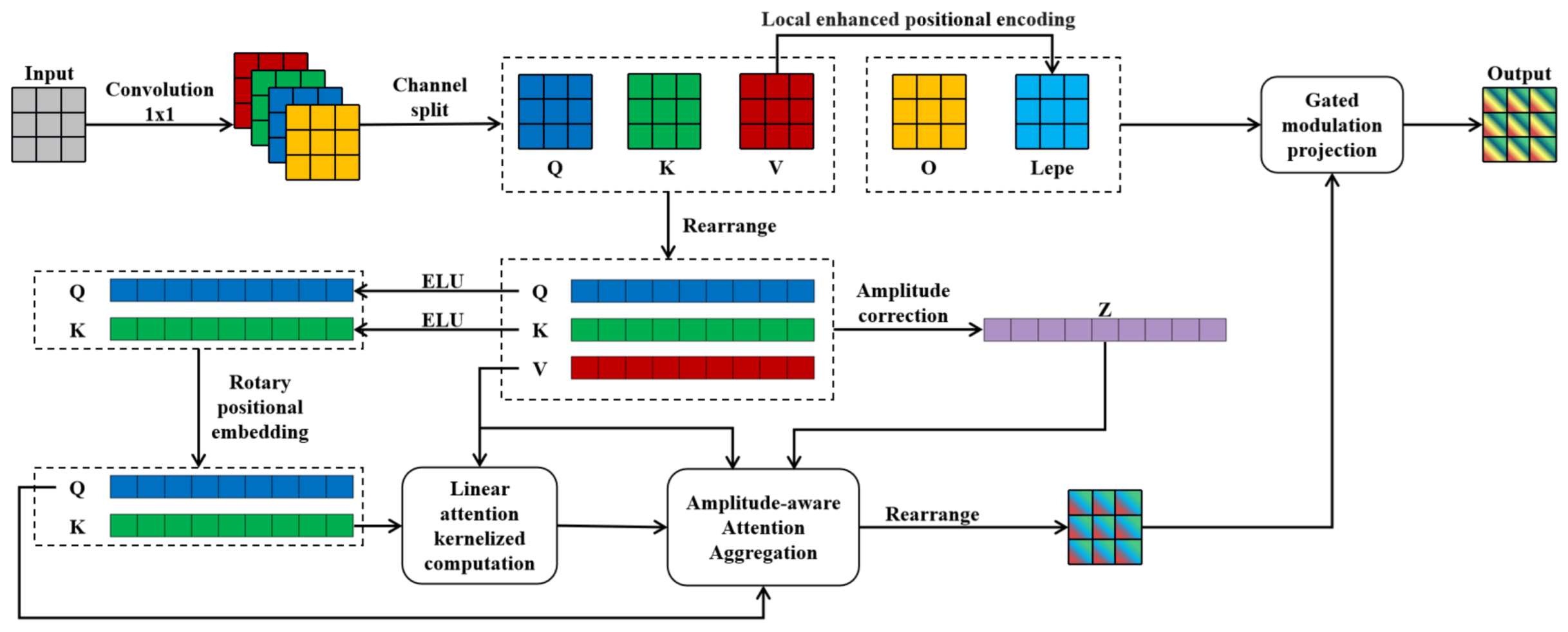
- We integrate the MALA module into skip connections and introduce a unique combination of Local Enhanced Positional Encoding and Rotary Positional Embedding, with optimized computational pathways. This design enables the MALA module to simultaneously perceive global spatial context and capture local fine-grained features, demonstrating powerful spatial contextual modeling capabilities. The approach achieves high-quality feature extraction and precise localization while maintaining significantly lower computational complexity than conventional attention mechanisms.
- (3)
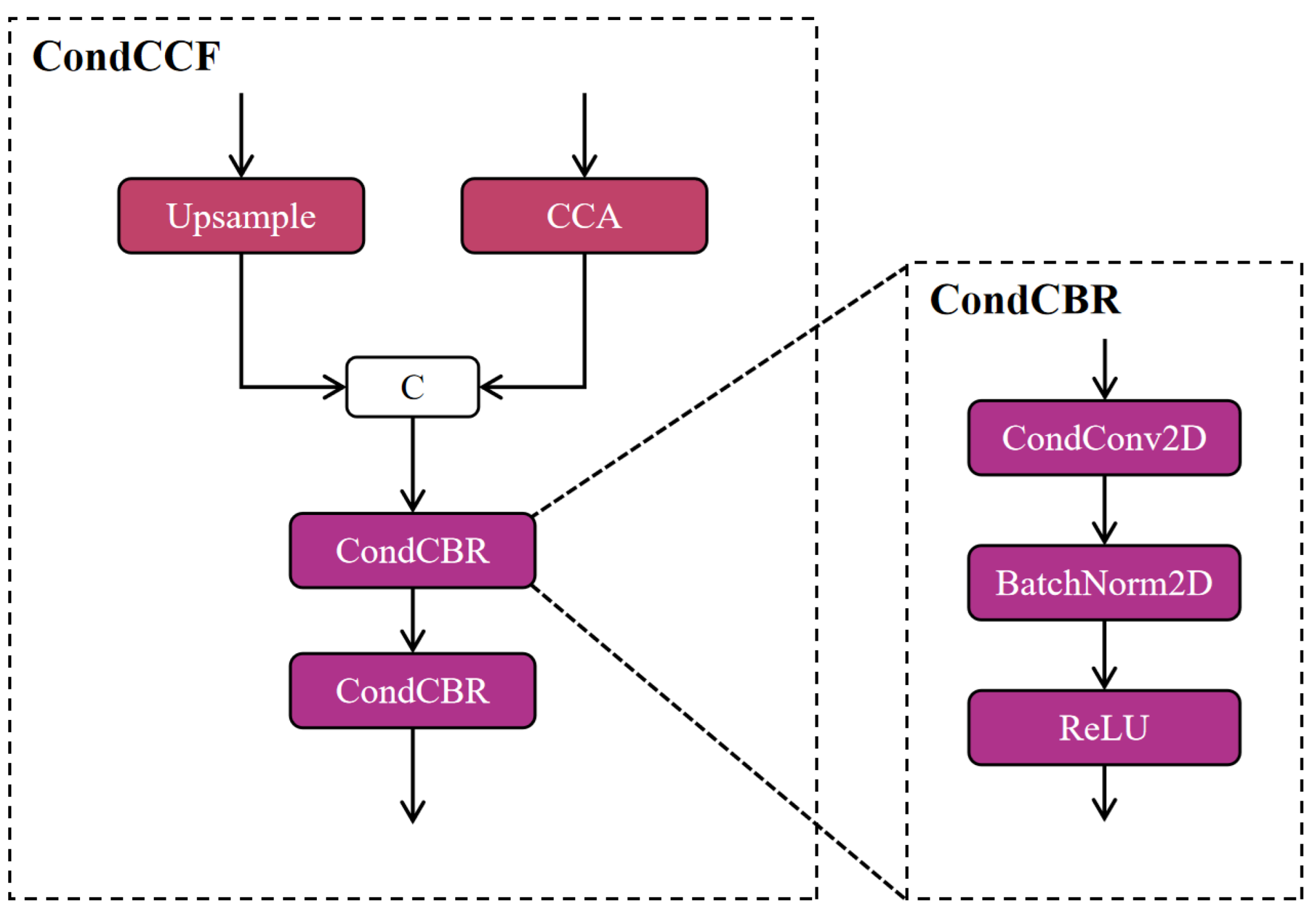
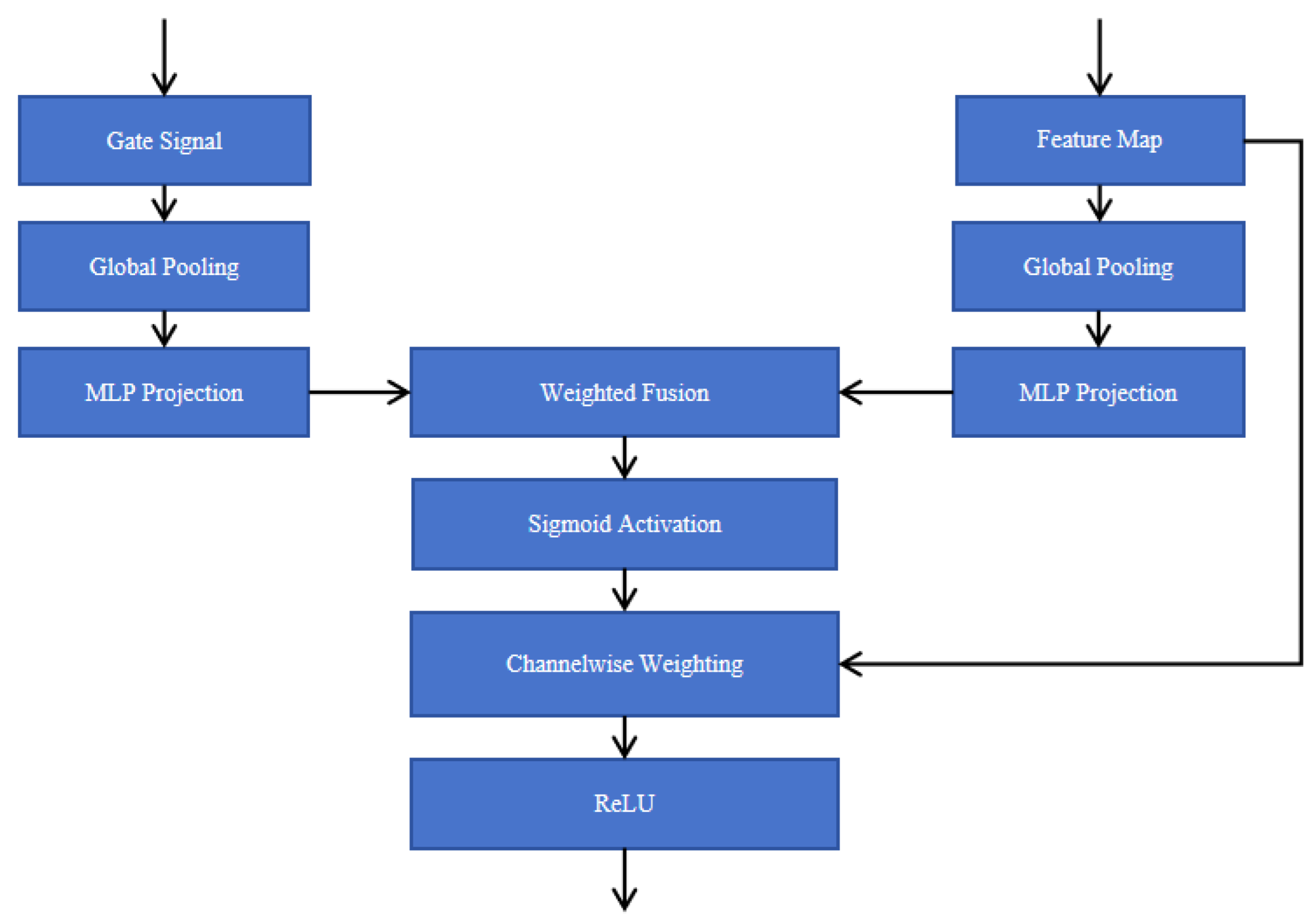
- We design a novel Conditional Cross-Channel Fusion (CondCCF) module to replace traditional decoder architectures. This module fuses features extracted by each MALA layer—after channel attention processing—with deep-level features optimized through bilinear interpolation. This design establishes a complementary spatial-channel dual-attention mechanism in conjunction with the MALA module, facilitating efficient integration of deep and shallow features.
- (4)
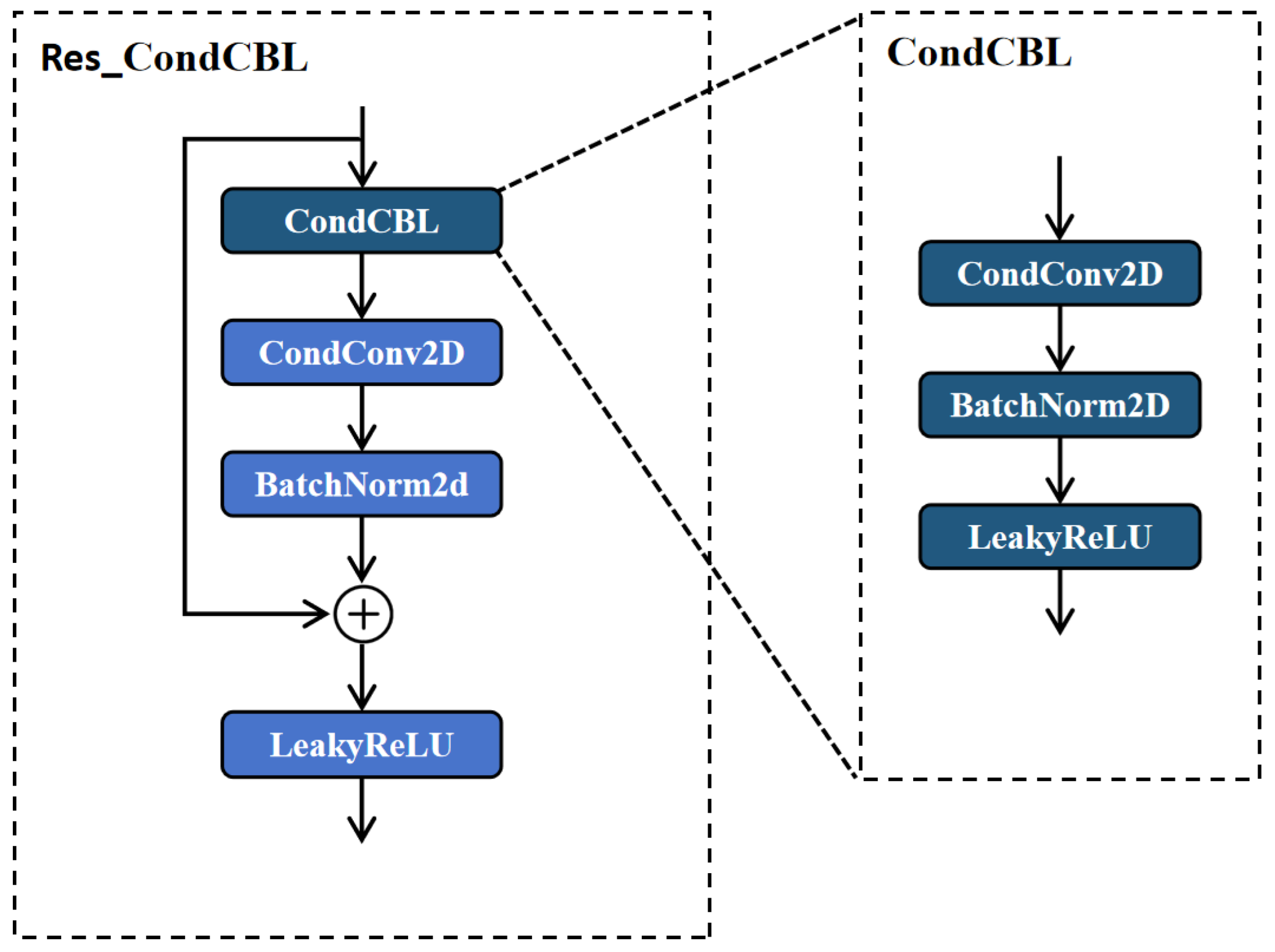
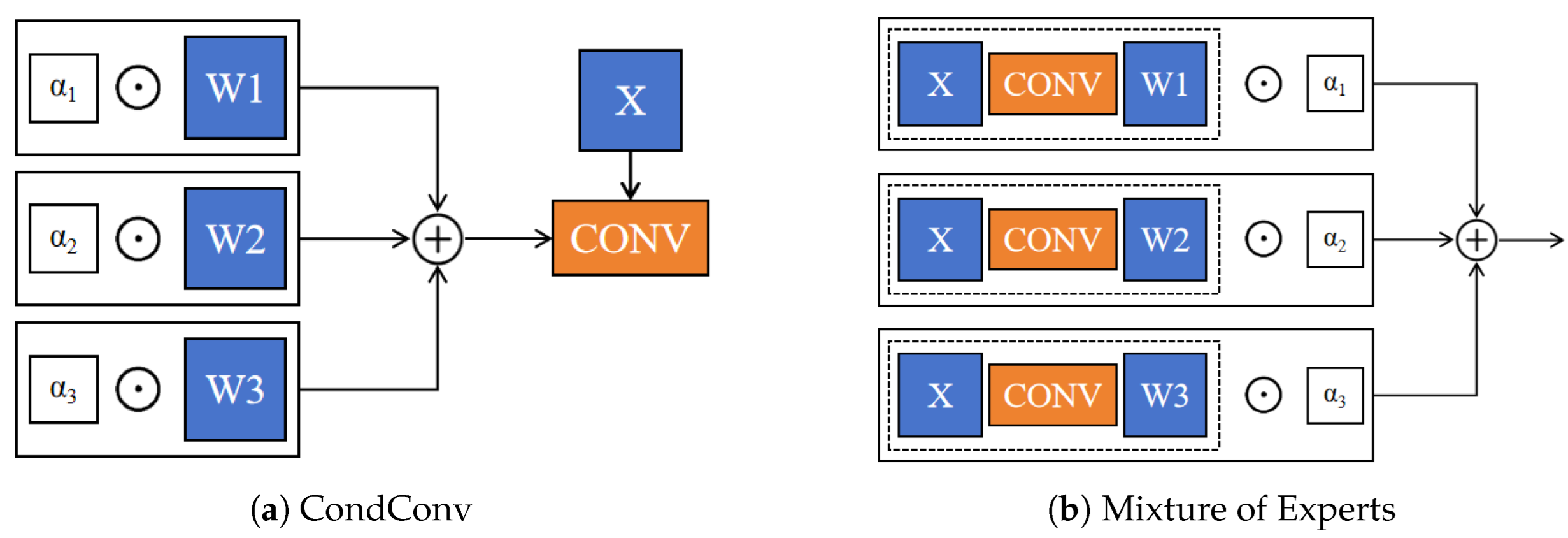
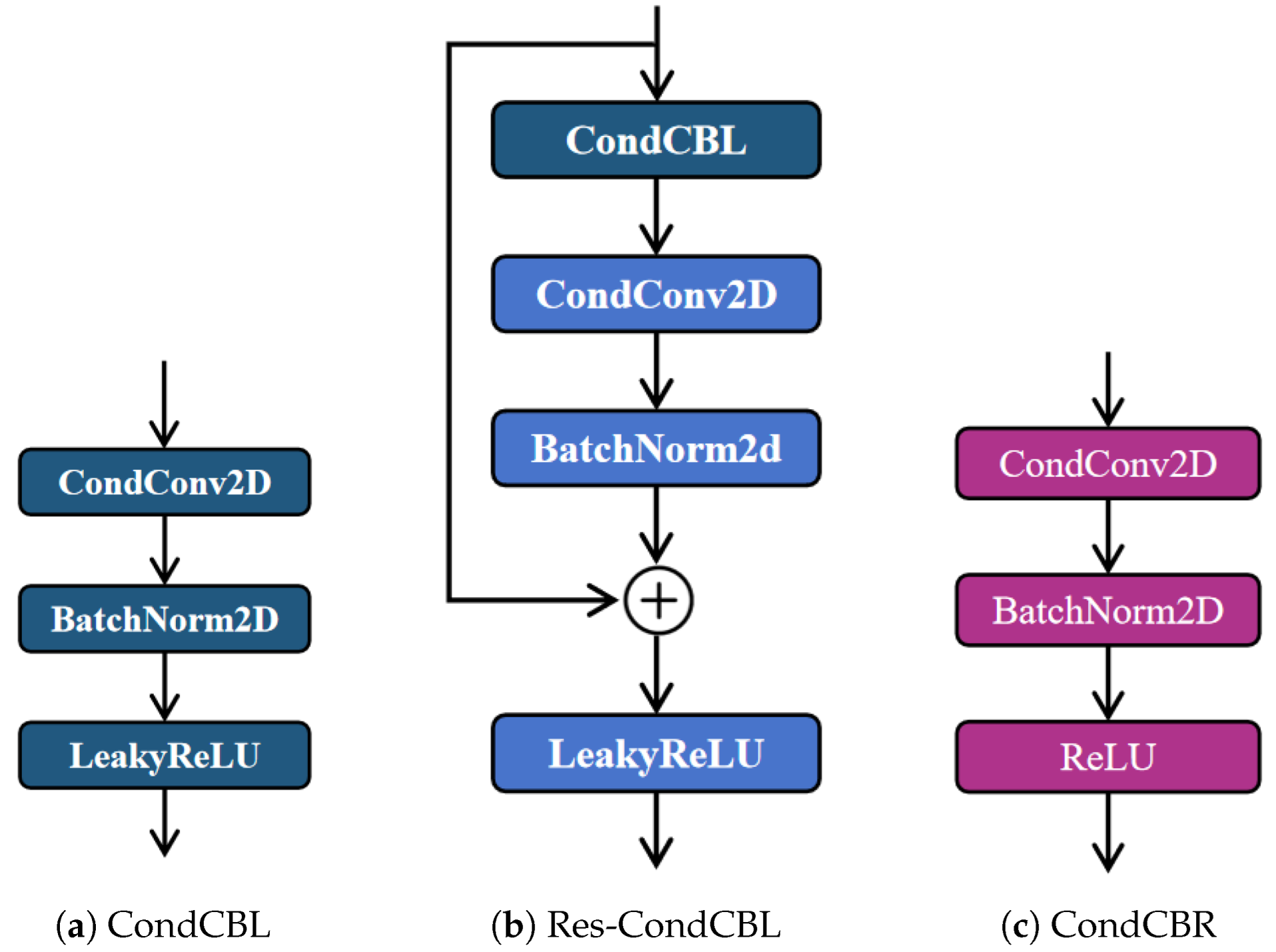
- We replace traditional convolutions with Conditionally Parameterized Convolutions (CondConv), effectively addressing the computational cost explosion that typically occurs when feature extraction capability is enhanced by increasing the size or number of kernels. This innovation enables MCC-Net to achieve superior target feature extraction with remarkably reduced computational complexity.
2. Related Work
2.1. Model-Driven Traditional Methods
- (1)
- Filtering-Based and Morphological Operation–Based Methods: These techniques leverage the characteristics of morphological operations to enhance the contrast between background and targets, thereby facilitating infrared small-target detection. Representative algorithms include the top-hat transform [9] and max–median filtering [10]. While these methods demonstrate satisfactory performance in high-contrast scenarios with simple backgrounds, they exhibit extreme sensitivity to noise and fail to achieve effective detection in complex background environments.
- (2)
- Background Suppression Methods. Exemplified by algorithms such as infrared patch-image (IPI) models [11] and the partial sum of singular values–based tensor nuclear norm (PSTNN) [12], these approaches model the background and targets as low-rank and sparse components, respectively, and separate them through low-rank matrix recovery techniques. Although these methods effectively suppress structured backgrounds, they suffer from sensitivity to parameter configuration and high computational complexity, resulting in poor real-time performance.
- (3)
- Local-Contrast-Based Methods. These methods, including the local contrast measure (LCM) [13], the multiscale patch-based contrast measure (MPCM) [14], the weighted structured LCM (WSLCM) [15], and the temporal–local LCM (TLLCM) [16], are inspired by human visual contrast mechanisms and detect small targets in infrared images by exploiting grayscale differences between targets and their local neighborhoods. Although these approaches feature intuitive algorithmic principles and simple structures, they also demonstrate weak background suppression capabilities, are prone to false alarms in edge regions owing to noise interference, and exhibit sensitivity to threshold and other parameter settings.
2.2. Data-Driven Deep Learning Methods
3. Method
3.1. Model Architecture
3.2. Magnitude-Aware Linear Attention
3.3. Conditionally Parameterized Convolutions
3.4. Conditional Cross-Channel Fusion Module
4. Experiments and Analysis
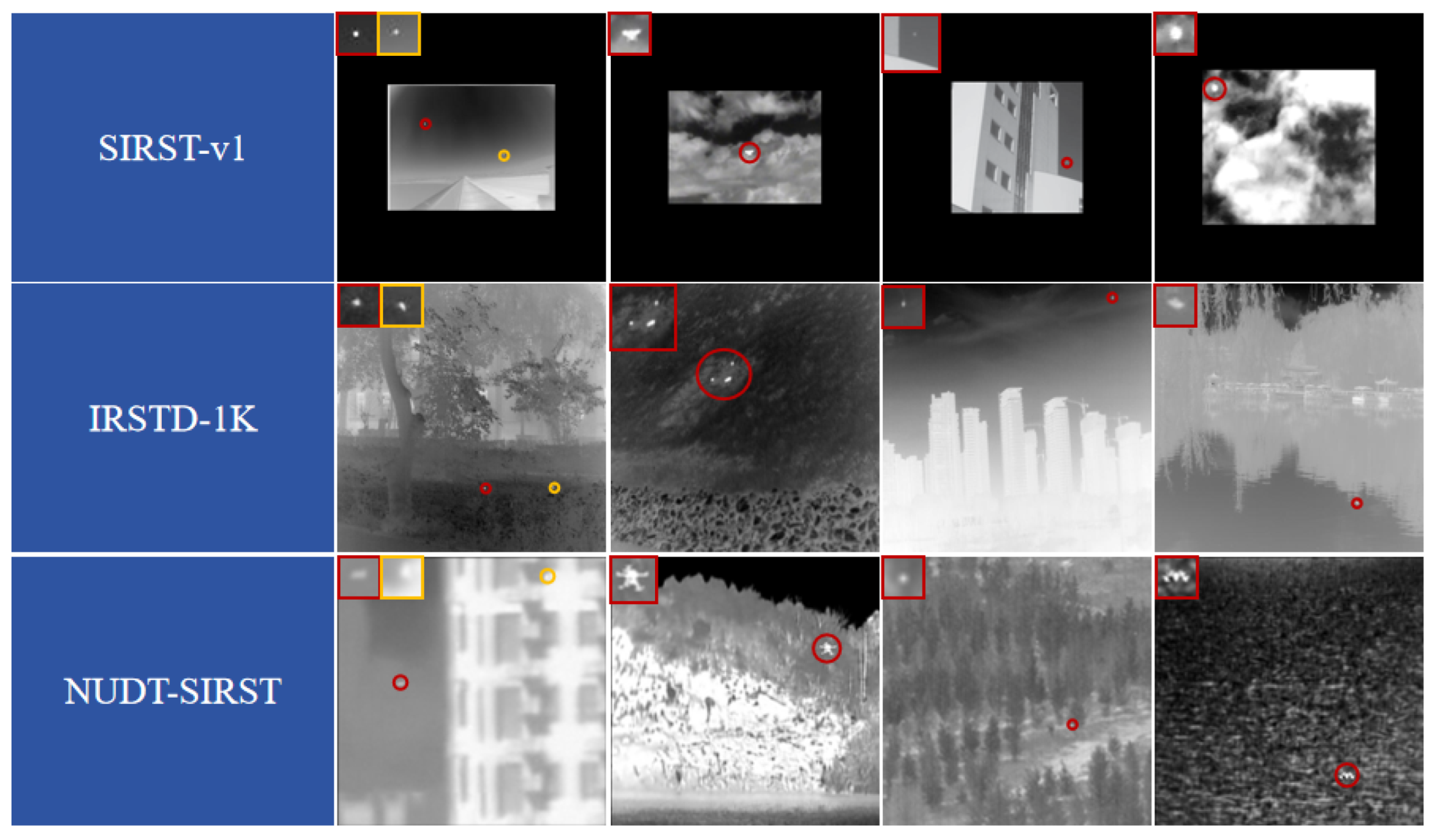
4.1. Dataset
4.2. Evaluation Indicators
- (1)
- mIoU (mean Intersection over Union): As a widely adopted pixel-level evaluation metric, mIoU quantifies the spatial agreement between the predicted segmentation mask and the ground truth by computing the average IoU across all semantic classes. For binary segmentation tasks, it is defined as in Equation (8):where P and G denote the predicted and ground truth binary masks, respectively.
- (2)
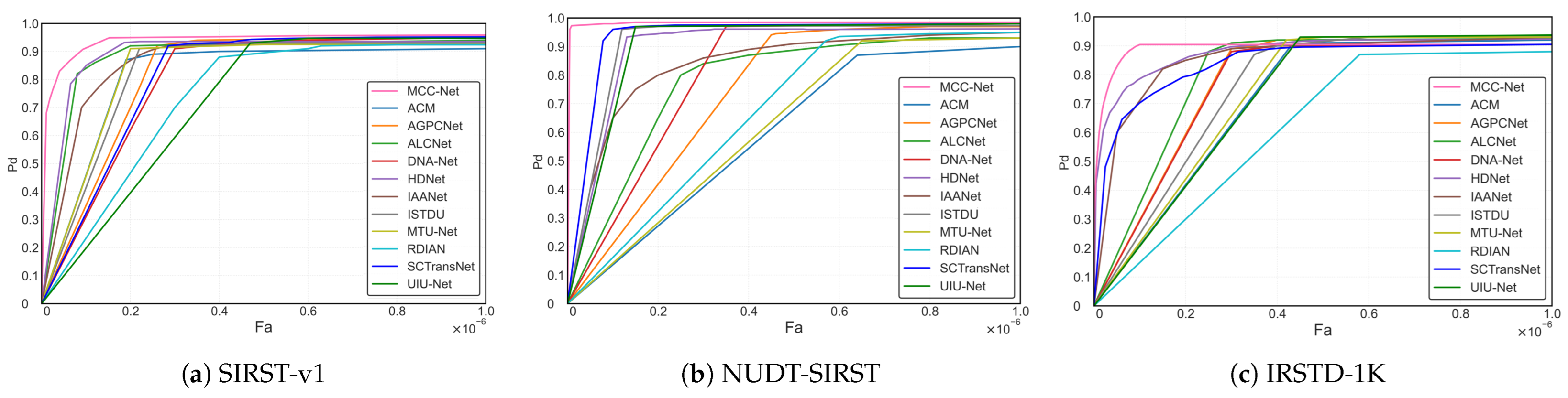
- Pd (Probability of Detection): Pd measures the fraction of ground truth targets that are successfully detected. To account for minor localization inaccuracies—often induced by the point spread function (PSF)—a tolerance radius r is introduced around each ground truth target center. A detection is considered correct if it falls within this radius [22]. In this work, we set pixels. Formally, Pd is computed as the ratio of true positives (TP) to the total number of ground truth targets (ALL), as shown in Equation (9):where TP denotes the number of correctly detected true targets, and ALL denotes the total number of ground truth targets.
- (3)
- Fa (False-Alarm Rate): Fa characterizes the density of spurious detections, defined as the number of false-alarm pixels normalized by the total number of background pixels. Specifically, it is given by Equation (10):where denotes the number of non-target pixels erroneously predicted as targets and represents the total number of background pixels in the image.
- (4)
- F (F-measure): The F-measure provides a balanced assessment of a model’s precision and recall through their harmonic mean. It mitigates the bias that may arise when optimizing for either metric in isolation, e.g., overly conservative predictions (high precision, low recall) or overly aggressive ones (high recall, low precision). With , the F1-score gives equal weight to precision and recall, as formulated in Equation (11).where Pr denotes precision and Re denotes recall, with their computational formulas defined in Equation (12).where TP denotes the number of correctly detected true targets, FP denotes the number of false positive detections, and ALL denotes the total number of ground truth targets.
- (5)
- FPS (frames per second): FPS serves as a fundamental performance metric for evaluating model inference speed, defined as the number of image frames that an algorithm or system can process within a unit time interval of one second.
- (6)
- AUC (area under the curve): The AUC represents the area under the ROC curve, with a value range of [0,1]. It serves as a scalar metric for evaluating the ranking quality and discriminative capability of binary classification models.
4.3. Experimental Details
4.4. Comparative Experiments
4.5. Ablation Experiments
4.6. MCC-Net Performance in Challenging Scenarios
5. Conclusions
Author Contributions
Funding
Data Availability Statement
Acknowledgments
Conflicts of Interest
References
- Liu, Q.; Chen, H.; Zhao, F. Maritime target detection algorithm based on fusion of visible and infrared images. J. Supercomput. 2025, 81, 22. [Google Scholar] [CrossRef]
- Li, R.; An, W.; Wang, Y.; Ying, X.; Dai, Y.; Wang, L.; Li, M.; Guo, Y.; Liu, L. Probing Deep into Temporal Profile Makes the Infrared Small Target Detector Much Better. arXiv 2026, arXiv:2506.12766. [Google Scholar] [CrossRef]
- Zhang, Y.; Zhang, Y.; Shi, Z.; Zhang, J.; Wei, M. Design and training of deep CNN-based fast detector in infrared SUAV surveillance system. IEEE Access 2019, 7, 137365–137377. [Google Scholar] [CrossRef]
- Liu, L.; Zhang, S.; Hu, M. MFE-Net: A Novel Multiscale Feature Enhancement Network for SAR Ship Instance Segmentation. IEEE Geosci. Remote Sens. Lett. 2025, 22, 1–5. [Google Scholar] [CrossRef]
- Li, H.L.; Chen, S.W. Polyhedral Corner Reflectors Multidomain Joint Characterization With Fully Polarimetric Radar. IEEE Trans. Antennas Propag. 2025, 73, 10679–10693. [Google Scholar] [CrossRef]
- Cao, S.; Deng, J.; Luo, J.; Li, Z.; Hu, J.; Peng, Z. Local convergence index-based infrared small target detection against complex scenes. Remote Sens. 2023, 15, 1464. [Google Scholar] [CrossRef]
- Li, H.L.; Chen, S.W. General Polarimetric Correlation Pattern: A Visualization and Characterization Tool for Target Joint-Domain Scattering Mechanisms Investigation. IEEE Trans. Geosci. Remote Sens. 2026, 64, 1–17. [Google Scholar] [CrossRef]
- He, X.; Zhou, Y.; Zhao, J.; Zhang, D.; Yao, R.; Xue, Y. Swin transformer embedding UNet for remote sensing image semantic segmentation. IEEE Trans. Geosci. Remote Sens. 2022, 60, 1–15. [Google Scholar] [CrossRef]
- Bai, X.; Zhou, F. Analysis of new top-hat transformation and the application for infrared dim small target detection. Pattern Recognit. 2010, 43, 2145–2156. [Google Scholar] [CrossRef]
- Deshpande, S.D.; Er, M.H.; Venkateswarlu, R.; Chan, P. Max-mean and max-median filters for detection of small targets. In Proceedings of the SPIE; SPIE: Bellingham, WA, USA, 1999; Volume 3809, pp. 74–83. [Google Scholar]
- Gao, C.; Meng, D.; Yang, Y.; Wang, Y.; Zhou, X.; Hauptmann, A.G. Infrared patch-image model for small target detection in a single image. IEEE Trans. Image Process. 2013, 22, 4996–5009. [Google Scholar] [CrossRef]
- Zhang, L.; Peng, Z. Infrared small target detection based on partial sum of the tensor nuclear norm. Remote Sens. 2019, 11, 382. [Google Scholar] [CrossRef]
- Chen, C.P.; Li, H.; Wei, Y.; Xia, T.; Tang, Y.Y. A local contrast method for small infrared target detection. IEEE Trans. Geosci. Remote Sens. 2013, 52, 574–581. [Google Scholar]
- Wei, Y.; You, X.; Li, H. Multiscale patch-based contrast measure for small infrared target detection. Pattern Recognit. 2016, 58, 216–226. [Google Scholar] [CrossRef]
- Han, J.; Moradi, S.; Faramarzi, I.; Zhang, H.; Zhao, Q.; Zhang, X.; Li, N. Infrared small target detection based on the weighted strengthened local contrast measure. IEEE Geosci. Remote Sens. Lett. 2021, 18, 1670–1674. [Google Scholar]
- Han, J.; Moradi, S.; Faramarzi, I.; Liu, C.; Zhang, H.; Zhao, Q. A local contrast method for infrared small-target detection utilizing a tri-layer window. IEEE Geosci. Remote Sens. Lett. 2020, 17, 1822–1826. [Google Scholar]
- Hou, Q.; Zhang, L.; Tan, F.; Xi, Y.; Zheng, H.; Li, N. ISTDU-Net: Infrared Small-Target Detection U-Net. IEEE Geosci. Remote Sens. Lett. 2022, 19, 1–5. [Google Scholar] [CrossRef]
- Hou, Q.; Wang, Z.; Tan, F.; Zhao, Y.; Zheng, H.; Zhang, W. RISTDnet: Robust Infrared Small Target Detection Network. IEEE Geosci. Remote Sens. Lett. 2022, 19, 1–5. [Google Scholar] [CrossRef]
- Wang, H.; Zhou, L.; Wang, L. Miss detection vs. false alarm: Adversarial learning for small object segmentation in infrared images. In Proceedings of the IEEE/CVF International Conference on Computer Vision, Seoul, Republic of Korea, 27 October–2 November 2019; pp. 8509–8518. [Google Scholar]
- Dai, Y.; Wu, Y.; Zhou, F.; Barnard, K. Asymmetric contextual modulation for infrared small target detection. In Proceedings of the IEEE/CVF Winter Conference on Applications of Computer Vision, Online, 5–9 January 2021; pp. 950–959. [Google Scholar]
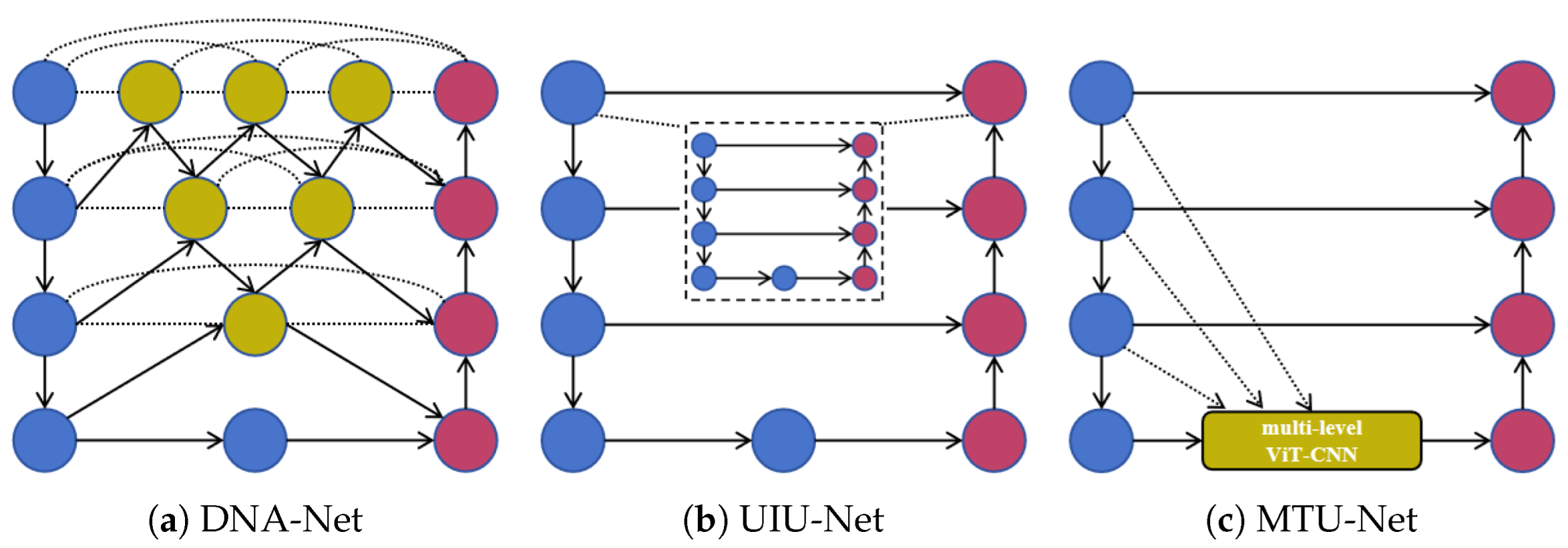
- Wu, X.; Hong, D.; Chanussot, J. UIU-Net: U-Net in U-Net for infrared small object detection. IEEE Trans. Image Process. 2023, 32, 364–376. [Google Scholar]
- Li, B.; Cao, J.; Ning, Y.; Zhao, T.; Li, Z.; Wang, Z.; Zhang, L.; Hao, Q. Dense nested attention network for infrared small target detection. IEEE Trans. Image Process. 2023, 32, 1745–1758. [Google Scholar] [CrossRef]
- Wu, T.; Li, B.; Luo, Y.; Wang, Y.; Xiao, C.; Liu, T.; Yang, J.; An, W.; Guo, Y. MTU-Net: Multilevel TransUnet for space-based infrared tiny ship detection. IEEE Trans. Geosci. Remote Sens. 2023, 61, 5601015. [Google Scholar] [CrossRef]
- Liu, S.; Chen, P.; Woźniak, M. Image enhancement-based detection with small infrared targets. Remote Sens. 2022, 14, 3232. [Google Scholar] [CrossRef]
- Zuo, Z.; Tong, X.; Wei, J.; Su, S.; Wu, P.; Guo, R.; Sun, B. AFFPN: Attention fusion feature pyramid network for small infrared target detection. Remote Sens. 2022, 14, 3412. [Google Scholar]
- Yu, C.; Liu, Y.; Wu, S.; Xia, X.; Hu, Z.; Lan, D.; Liu, X. Pay attention to local contrast learning networks for infrared small target detection. IEEE Geosci. Remote Sens. Lett. 2022, 19, 1–5. [Google Scholar]
- Tong, X.; Sun, B.; Wei, J.; Zuo, Z.; Su, S. EAAU-Net: Enhanced asymmetric attention U-Net for infrared small target detection. Remote Sens. 2021, 13, 3200. [Google Scholar]
- Ronneberger, O.; Fischer, P.; Brox, T. U-net: Convolutional networks for biomedical image segmentation. In Proceedings of the International Conference on Medical Image Computing and Computer-Assisted Intervention; Springer: Berlin/Heidelberg, Germany, 2015; pp. 234–241. [Google Scholar]
- Dai, Y.; Wu, Y.; Zhou, F.; Barnard, K. Attentional local contrast networks for infrared small target detection. IEEE Trans. Geosci. Remote Sens. 2021, 59, 9813–9824. [Google Scholar] [CrossRef]
- Sun, H.; Bai, J.; Yang, F.; Bai, X. Receptive-field and direction induced attention network for infrared dim small target detection with a large-scale dataset IRDST. IEEE Trans. Geosci. Remote Sens. 2023, 61, 5000513. [Google Scholar]
- Wang, K.; Du, S.; Liu, C.; Cao, Z. Interior attention-aware network for infrared small target detection. IEEE Trans. Geosci. Remote Sens. 2022, 60, 5002013. [Google Scholar]
- Zhang, T.; Li, L.; Cao, S.; Pu, T.; Peng, Z. Attention-guided pyramid context networks for detecting infrared small target under complex background. IEEE Trans. Aerosp. Electron. Syst. 2023, 59, 4250–4261. [Google Scholar] [CrossRef]
- Zhang, M.; Bai, H.; Zhang, J.; Zhang, R.; Wang, C.; Guo, J.; Gao, X. Rkformer: Runge-kutta transformer with random-connection attention for infrared small target detection. In Proceedings of the 30th ACM International Conference on Multimedia, Lisbon, Portugal, 10–14 October 2022; pp. 1730–1738. [Google Scholar]
- Pan, P.; Wang, H.; Wang, C.; Nie, C. ABC: Attention with bilinear correlation for infrared small target detection. In Proceedings of the 2023 IEEE International Conference on Multimedia and Expo (ICME), Brisbane, Australia, 10–14 July 2023; pp. 2381–2386. [Google Scholar]
- Liu, F.; Gao, C.; Chen, F.; Meng, D.; Zuo, W.; Gao, X. Infrared small and dim target detection with transformer under complex backgrounds. IEEE Trans. Image Process. 2023, 32, 5921–5932. [Google Scholar] [CrossRef]
- Vaswani, A.; Shazeer, N.; Parmar, N.; Uszkoreit, J.; Jones, L.; Gomez, A.N.; Kaiser, Ł.; Polosukhin, I. Attention is all you need. Adv. Neural Inf. Process. Syst. 2017, 30, 1–11. [Google Scholar]
- Han, D.; Pan, X.; Han, Y.; Song, S.; Huang, G. Flatten transformer: Vision transformer using focused linear attention. In Proceedings of the IEEE/CVF International Conference on Computer Vision, Paris, France, 4–6 October 2023; pp. 5961–5971. [Google Scholar]
- Han, D.; Pu, Y.; Xia, Z.; Han, Y.; Pan, X.; Li, X.; Lu, J.; Song, S.; Huang, G. Bridging the divide: Reconsidering softmax and linear attention. Adv. Neural Inf. Process. Syst. 2024, 37, 79221–79245. [Google Scholar]
- Fan, Q.; Huang, H.; Ai, Y.; He, R. Rectifying magnitude neglect in linear attention. In Proceedings of the IEEE/CVF International Conference on Computer Vision, Honolulu, HI, USA, 19–23 October 2025; pp. 21505–21514. [Google Scholar]
- Yang, B.; Bender, G.; Le, Q.V.; Ngiam, J. Condconv: Conditionally parameterized convolutions for efficient inference. Adv. Neural Inf. Process. Syst. 2019, 32, 1–12. [Google Scholar]
- Wang, H.; Cao, P.; Wang, J.; Zaiane, O.R. Uctransnet: Rethinking the skip connections in u-net from a channel-wise perspective with transformer. In Proceedings of the AAAI Conference on Artificial Intelligence, Online, 22 February–1 March 2022; Volume 36, pp. 2441–2449. [Google Scholar]
- Zhang, M.; Zhang, R.; Yang, Y.; Bai, H.; Zhang, J.; Guo, J. ISNet: Shape matters for infrared small target detection. In Proceedings of the IEEE/CVF Conference on Computer Vision and Pattern Recognition, New Orleans, LA, USA, 19–20 June 2022; pp. 877–886. [Google Scholar]
- Li, Q.; Jia, X.; Zhou, J.; Shen, L.; Duan, J. Rediscovering bce loss for uniform classification. arXiv 2024, arXiv:2403.07289. [Google Scholar] [CrossRef]
- Kingma, D.P.; Ba, J. Adam: A Method for Stochastic Optimization. arXiv 2017, arXiv:1412.6980. [Google Scholar] [CrossRef]
- Loshchilov, I.; Hutter, F. Sgdr: Stochastic gradient descent with warm restarts. arXiv 2016, arXiv:1608.03983. [Google Scholar]
- He, K.; Zhang, X.; Ren, S.; Sun, J. Delving deep into rectifiers: Surpassing human-level performance on imagenet classification. In Proceedings of the IEEE International Conference on Computer Vision (ICCV), Santiago, Chile, 13–16 December 2015; pp. 1026–1034. [Google Scholar] [CrossRef]
- Sun, Y.; Yang, J.; An, W. Infrared Dim and Small Target Detection via Multiple Subspace Learning and Spatial-Temporal Patch-Tensor Model. IEEE Trans. Geosci. Remote Sens. 2021, 59, 3737–3752. [Google Scholar] [CrossRef]
- Yuan, S.; Qin, H.; Yan, X.; Akhtar, N.; Mian, A. SCTransNet: Spatial-Channel Cross Transformer Network for Infrared Small Target Detection. IEEE Trans. Geosci. Remote Sens. 2024, 62, 1–15. [Google Scholar] [CrossRef]
- Xu, M.; Yu, C.; Li, Z.; Tang, H.; Hu, Y.; Nie, L. HDNet: A Hybrid Domain Network With Multiscale High-Frequency Information Enhancement for Infrared Small-Target Detection. IEEE Trans. Geosci. Remote Sens. 2025, 63, 1–15. [Google Scholar] [CrossRef]





| Dataset | Number of Images | Padded Resolution | Training Set Ratio |
|---|---|---|---|
| SIRST-v1 | 427 | 50% | |
| NUDT-SIRST | 1327 | 50% | |
| IRSTD-1K | 1001 | 80% |
| Method | SIRST-v1 | NUDT-SIRST | IRSTD-1K | |||||||||
|---|---|---|---|---|---|---|---|---|---|---|---|---|
| mIoU | F | Pd | Fa | mIoU | F | Pd | Fa | mIoU | F | Pd | Fa | |
| Top-Hat [9] | 7.13 | 14.62 | 79.84 | 1012 | 20.71 | 33.51 | 78.41 | 166 | 10.05 | 16.01 | 75.11 | 1432 |
| Max–Median [10] | 4.15 | 10.66 | 69.18 | 55.33 | 4.18 | 7.62 | 58.39 | 36.89 | 6.98 | 8.14 | 65.19 | 59.73 |
| WSLCM [15] | 1.15 | 4.80 | 77.93 | 5445 | 2.27 | 5.98 | 56.80 | 1309 | 3.44 | 2.12 | 72.42 | 6618 |
| TLLCM [16] | 1.02 | 4.98 | 79.07 | 5898 | 2.16 | 7.22 | 61.99 | 1607 | 3.30 | 2.18 | 77.37 | 6737 |
| IPI [11] | 25.67 | 43.64 | 84.62 | 16.65 | 17.76 | 26.93 | 74.48 | 41.21 | 27.92 | 35.67 | 81.36 | 16.16 |
| PSTNN [12] | 30.30 | 39.16 | 72.80 | 48.97 | 14.85 | 35.63 | 66.13 | 44.15 | 24.57 | 37.18 | 71.99 | 35.24 |
| MSLSTIPT [47] | 10.30 | 18.82 | 82.12 | 1130 | 8.34 | 18.25 | 47.39 | 888 | 11.43 | 12.22 | 79.02 | 1523 |
| ACM [20] | 68.91 | 80.86 | 91.62 | 15.21 | 61.10 | 75.86 | 93.11 | 55.20 | 59.21 | 74.37 | 93.26 | 65.26 |
| ALCNet [29] | 70.82 | 82.91 | 94.30 | 36.15 | 64.73 | 78.58 | 94.18 | 34.61 | 60.59 | 75.46 | 92.98 | 58.82 |
| RDIAN [30] | 68.71 | 81.44 | 93.53 | 43.29 | 76.27 | 86.52 | 95.76 | 34.56 | 56.44 | 72.12 | 88.54 | 26.63 |
| ISTDU [17] | 75.52 | 86.06 | 96.56 | 14.54 | 89.55 | 94.49 | 97.67 | 13.44 | 66.36 | 79.58 | 93.60 | 53.15 |
| MTU-Net [23] | 74.76 | 85.36 | 93.52 | 22.35 | 74.83 | 84.46 | 93.95 | 46.94 | 66.09 | 79.25 | 93.25 | 36.79 |
| IAANet [31] | 74.20 | 85.01 | 93.52 | 22.69 | 90.20 | 94.87 | 97.25 | 8.31 | 66.23 | 78.33 | 93.14 | 14.19 |
| AGPCNet [32] | 75.69 | 85.26 | 96.47 | 14.98 | 88.87 | 93.88 | 97.19 | 10.01 | 66.29 | 79.58 | 92.82 | 13.11 |
| DNA-Net [22] | 75.80 | 86.23 | 95.81 | 8.76 | 88.19 | 93.72 | 98.82 | 8.98 | 65.90 | 79.43 | 90.90 | 12.22 |
| UIU-Net [21] | 76.91 | 86.95 | 95.81 | 14.12 | 93.48 | 96.63 | 98.31 | 7.78 | 66.15 | 79.63 | 93.97 | 22.06 |
| SCTransNet [48] | 75.36 | 85.95 | 96.27 | 18 | 92.24 | 95.96 | 98.82 | 21 | 69.51 | 82.01 | 90.75 | 55 |
| HDNet [49] | 72.82 | 84.27 | 94.14 | 19 | 77.76 | 87.49 | 96.37 | 76 | 67.82 | 80.83 | 92.12 | 49 |
| MCC-Net | 77.98 | 87.62 | 96.58 | 16 | 95.43 | 97.66 | 98.94 | 11 | 70.46 | 82.67 | 90.64 | 51 |
| Method | SIRST-v1 | NUDT-SIRST | IRSTD-1K |
|---|---|---|---|
| ACM [20] | 0.8127 | 0.5970 | 0.7144 |
| ALCNet [29] | 0.8826 | 0.7748 | 0.7997 |
| AGPCNet [32] | 0.8174 | 0.7415 | 0.7772 |
| DNA-Net [22] | 0.7950 | 0.8035 | 0.7625 |
| HDNet [49] | 0.8919 | 0.8937 | 0.8790 |
| IAANet [31] | 0.8579 | 0.8370 | 0.8533 |
| ISTDU [17] | 0.8228 | 0.9125 | 0.7519 |
| MTU-Net [23] | 0.8288 | 0.6228 | 0.7322 |
| RDIAN [30] | 0.7320 | 0.6675 | 0.6198 |
| SCTransNet [48] | 0.8062 | 0.9351 | 0.8388 |
| UIU-Net [21] | 0.7194 | 0.9015 | 0.7227 |
| MCC-Net | 0.9364 | 0.9816 | 0.8918 |
| Model | Params (M) | FLOPs (G) | SIRST-v1 | NUDT-SIRST | IRSTD-1K | |||
|---|---|---|---|---|---|---|---|---|
| mIoU (%) | FPS | mIoU (%) | FPS | mIoU (%) | FPS | |||
| DNA-Net [22] | 4.70 | 14.26 | 75.80 | 12 | 88.19 | 33 | 65.90 | 12 |
| UIU-Net [21] | 45.22 | 39.32 | 76.91 | 11 | 93.48 | 32 | 66.15 | 11 |
| SCTransNet [48] | 11.69 | 40.46 | 75.36 | 16 | 92.24 | 37 | 69.51 | 15 |
| HDNet [49] | 3.68 | 22.73 | 72.82 | 33 | 77.76 | 47 | 67.82 | 33 |
| MCC-Net | 0.64 | 1.54 | 77.98 | 63 | 95.43 | 84 | 70.46 | 63 |
| MALA | CondConv | CondCCF | Params (M) | FLOPs (G) | FPS | mIoU (%) | ||
|---|---|---|---|---|---|---|---|---|
| SIRST-v1 | NUDT-SIRST | IRSTD-1K | ||||||
| 3.38 | 5.82 | 47 | 71.51 | 74.87 | 59.94 | |||
| ✓ | 3.83 | 7.01 | 44 | 75.32 | 90.42 | 64.71 | ||
| ✓ | 0.19 | 0.81 | 72 | 74.82 | 92.73 | 65.71 | ||
| ✓ | 3.56 | 5.85 | 45 | 72.00 | 89.95 | 64.80 | ||
| ✓ | ✓ | 0.46 | 1.23 | 67 | 72.40 | 91.96 | 66.96 | |
| ✓ | ✓ | 0.37 | 1.11 | 69 | 73.52 | 92.91 | 68.06 | |
| ✓ | ✓ | 4.01 | 7.36 | 42 | 75.51 | 90.39 | 66.55 | |
| ✓ | ✓ | ✓ | 0.64 | 1.54 | 63 | 77.98 | 95.43 | 70.46 |
Disclaimer/Publisher’s Note: The statements, opinions and data contained in all publications are solely those of the individual author(s) and contributor(s) and not of MDPI and/or the editor(s). MDPI and/or the editor(s) disclaim responsibility for any injury to people or property resulting from any ideas, methods, instructions or products referred to in the content. |
© 2026 by the authors. Licensee MDPI, Basel, Switzerland. This article is an open access article distributed under the terms and conditions of the Creative Commons Attribution (CC BY) license.
Share and Cite
Zhou, X.; Wang, X.; Tian, Y.; Jiang, K.; Guo, M.; Lian, X.; Ding, L.; Zhang, Q.; Xue, Y. MCC-Net: Efficient Dual-Attention Network for Infrared Small-Target Detection. Remote Sens. 2026, 18, 1858. https://doi.org/10.3390/rs18111858
Zhou X, Wang X, Tian Y, Jiang K, Guo M, Lian X, Ding L, Zhang Q, Xue Y. MCC-Net: Efficient Dual-Attention Network for Infrared Small-Target Detection. Remote Sensing. 2026; 18(11):1858. https://doi.org/10.3390/rs18111858
Chicago/Turabian StyleZhou, Xiaotian, Xin Wang, Yan Tian, Kai Jiang, Min Guo, Xuezheng Lian, Lu Ding, Quanyu Zhang, and Yaqi Xue. 2026. "MCC-Net: Efficient Dual-Attention Network for Infrared Small-Target Detection" Remote Sensing 18, no. 11: 1858. https://doi.org/10.3390/rs18111858
APA StyleZhou, X., Wang, X., Tian, Y., Jiang, K., Guo, M., Lian, X., Ding, L., Zhang, Q., & Xue, Y. (2026). MCC-Net: Efficient Dual-Attention Network for Infrared Small-Target Detection. Remote Sensing, 18(11), 1858. https://doi.org/10.3390/rs18111858