1. Introduction
The Earth is currently the only known habitat for human beings, and therefore, understanding it has always been a fundamental pursuit of humanity. Satellites serve as essential tools for observing and studying the Earth. Earth observation satellites possess characteristics such as large-area coverage, regular revisit cycles, and continuous monitoring, and have played a significant role in natural resource management and global change studies. At present, more than 2340 civilian Earth observation satellites are in operation [
1]. These satellites continuously orbit the Earth and generate massive volumes of data, enabling comprehensive understanding of the Earth’s systems, assessment of human impacts, and support for sustainable environmental and societal development.
Major platforms providing access to civilian Earth observation data include USGS Earth Explorer, NASA Earthdata, the European Space Agency’s Copernicus Data Space, and China’s National Earth Observation Data Center (NODA). In addition, platforms such as Google Earth Engine (GEE) [
2] and the Microsoft Planetary Computer [
3] offer both data access and advanced analytical capabilities. These platforms typically provide basic data retrieval functions, allowing users to query image datasets based on criteria such as region of interest, spatial resolution, and cloud coverage. However, for specific applications—such as land change analysis [
4], informal settlement monitoring [
5,
6], crop yield prediction [
7], pest and disease monitoring [
8], and water resource assessment [
9]—it is often necessary to derive complete coverage of the study area using images acquired at different times and resolutions. A key challenge lies in how to select an optimal subset of images from candidate datasets to achieve full coverage of the target region, while minimizing the number of images and maximizing data quality (e.g., newer acquisition time, higher spatial resolution, and lower cloud coverage).
This problem can be formalized as a regional remote sensing image coverage optimization problem, which is essentially a variant of the classical Set Covering Problem (SCP) [
10,
11]. Given a target region and a set of candidate images, the objective is to select the smallest possible subset of images that jointly cover the entire region while satisfying certain constraints [
12]. The SCP is known to be NP-hard [
13,
14], and its computational complexity increases rapidly with the size of the candidate set [
15,
16]. In practice, approximation algorithms or greedy strategies are commonly adopted. However, under large-scale remote sensing data conditions, traditional implementations based on geometric computations still incur substantial computational overhead, making them insufficient for efficient image selection and coverage optimization.
Existing approaches typically rely on vector-based geometric operations such as intersection, union, and difference to determine coverage relationships between images and target regions [
17,
18]. Although these methods ensure high geometric accuracy, frequent topological operations lead to high computational costs. As the number of candidate images increases, repeated polygon overlay and clipping operations significantly reduce efficiency, limiting their applicability in real-time retrieval and large-scale coverage analysis.
To address these challenges, this paper proposes a DGGS-based regional image coverage retrieval method. By discretizing spatial objects using grid encoding, the method transforms coverage analysis from two-dimensional geometric topology operations into one-dimensional string-based set operations, thereby significantly reducing computational complexity while maintaining spatial accuracy [
19]. Based on this framework, a multi-criteria heuristic function incorporating temporal relevance, spatial resolution, and cloud coverage is designed to guide a greedy image selection strategy. Furthermore, a grid-based coverage update mechanism and iterative optimization process are developed to efficiently filter candidate images and obtain near-optimal coverage results.
3. Materials and Methods
3.1. Overview of Key Steps
The proposed method is based on discrete grid partitioning, which transforms complex two-dimensional spatial computations into more efficient one-dimensional string-based operations, thereby significantly improving computational efficiency.
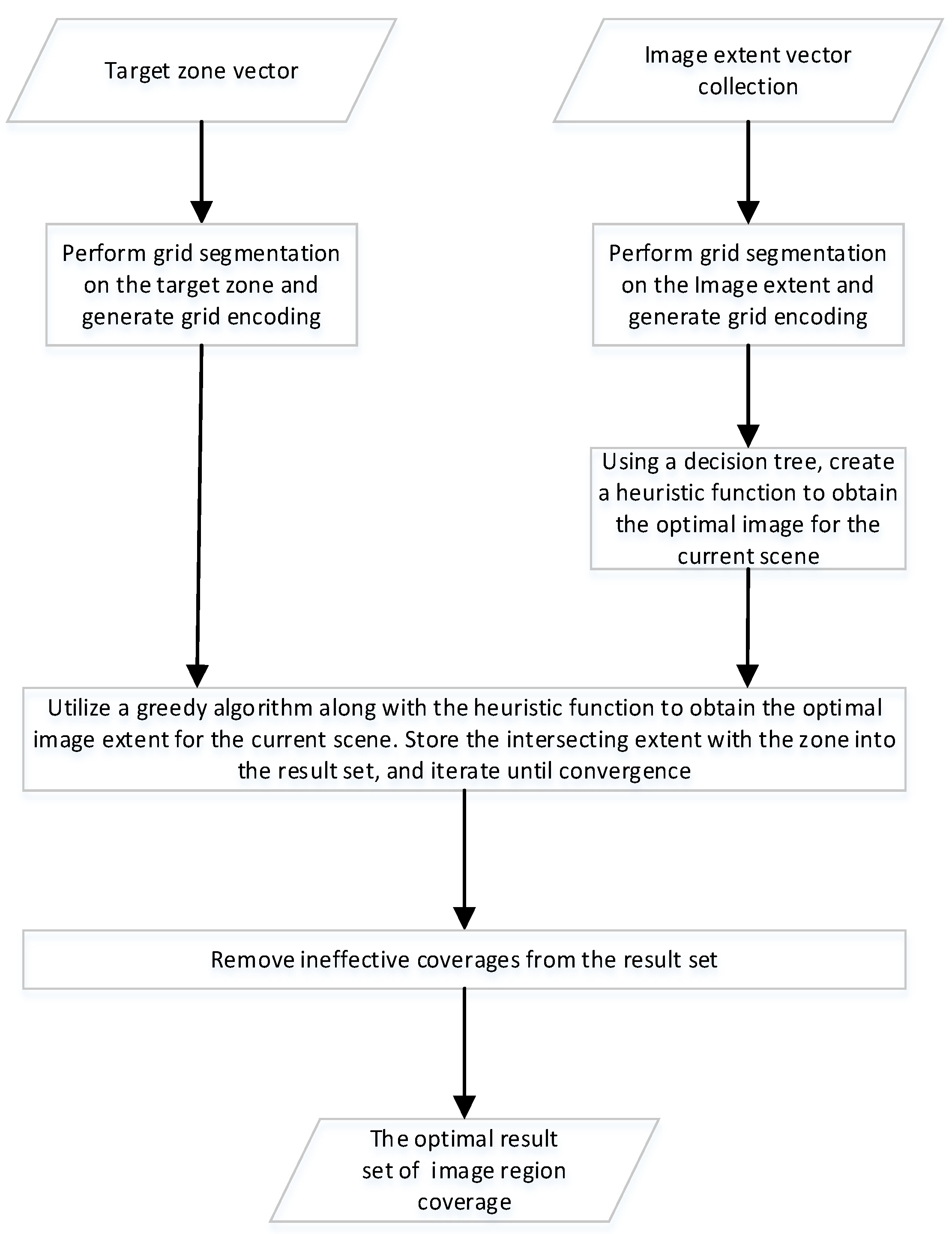
The overall workflow consists of four main steps. First, a data preprocessing procedure is performed to discretize both the target region and the image footprints into grid units at a specified resolution. Second, a heuristic function is constructed to assess candidate images and determine their selection priority according to predefined criteria. Third, a greedy strategy is employed to iteratively select images: in each iteration, the current optimal image is identified and added to the result set, while the grid units covered by this image are removed from the target region. This process continues until a termination condition is met, i.e., no uncovered grid units remain, or the candidate image set is exhausted. Finally, a post-processing step is applied to remove redundant or invalid images, yielding the final near-optimal coverage result.
The overall workflow is illustrated in
Figure 1.
3.2. Data Processing
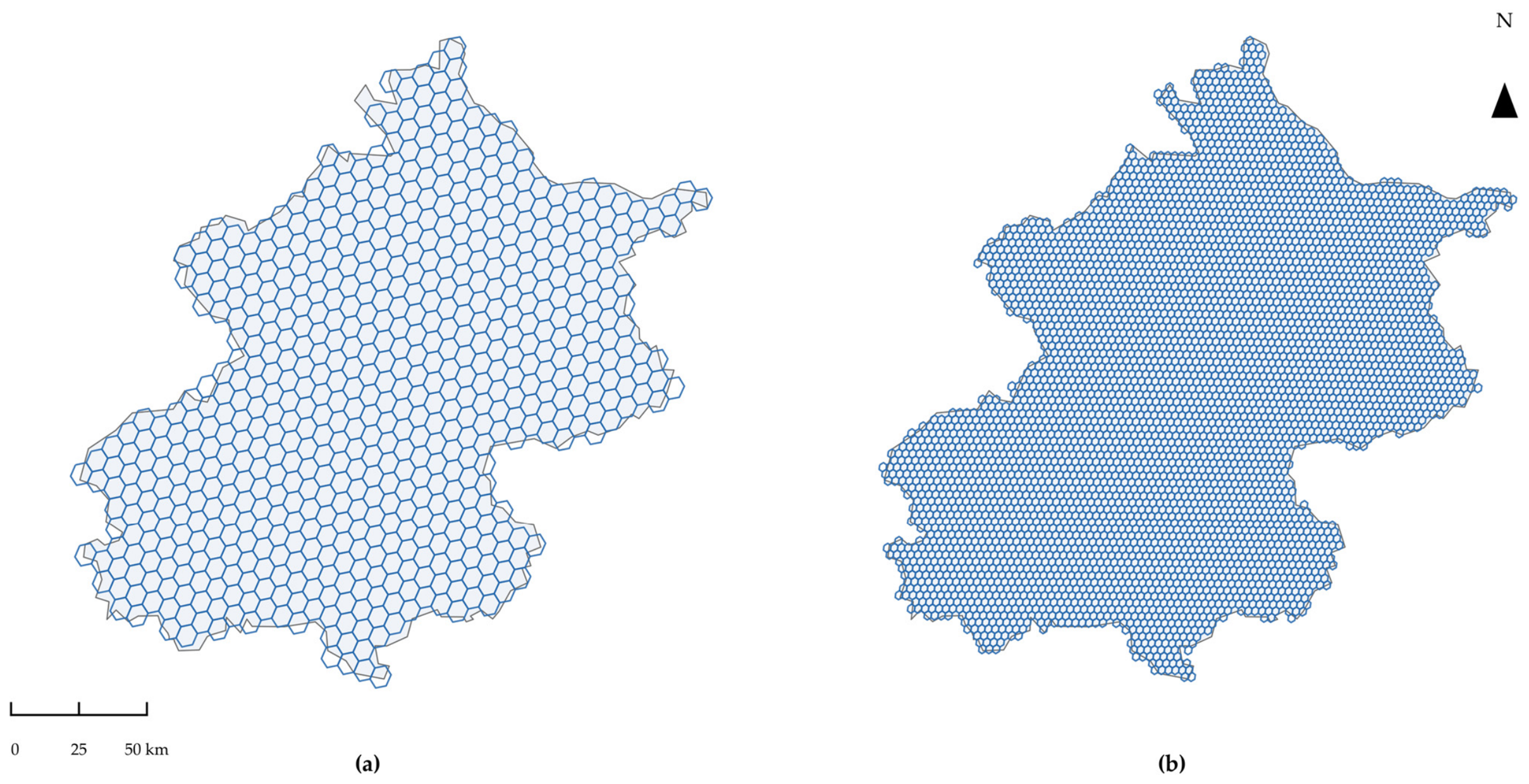
The target region is discretized into hexagonal grids using the H3 algorithm proposed by Uber [
31], which implements a hierarchical hexagonal grid system based on Discrete Global Grid System (DGGS) principles [
32], as shown in
Figure 2. Consequently, a set of grid encodings representing the region is obtained, denoted as
, where
represents the string identifier of the corresponding hexagonal grid cell.
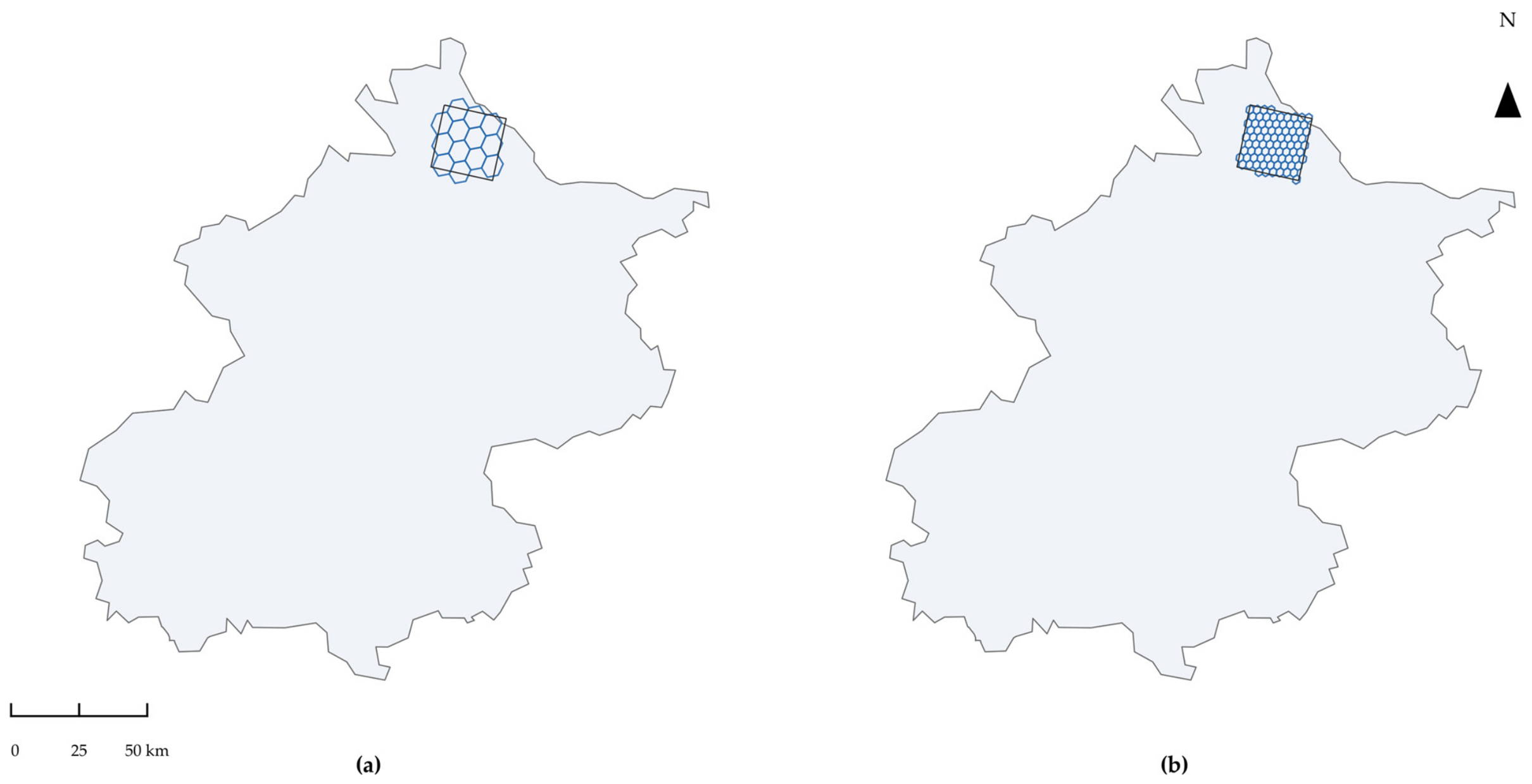
Subsequently, each image is represented as a structured object, denoted by
, where
is the set of string encodings derived from the grid-based partitioning of the image coverage area (as shown in
Figure 3),
denotes the temporal information,
represents the spatial resolution, and
indicates the cloud coverage.
All transformed image objects are organized into an image set, denoted by , where each image object is associated with its corresponding grid coverage set .
When discretizing remote sensing images and the target region into grid cells, the selection of grid resolution should comprehensively consider both the image coverage and computational efficiency. Typically, an appropriate grid scale is determined based on the spatial extent of the image coverage. In the H3 grid system, grid cells at grid level 6 or 7 generally provide an effective trade-off between spatial accuracy and computational cost.
Specifically, grid cells at grid level 6 have an area of approximately 36.13 km2, whereas those at grid level 7 have an area of approximately 5.16 km2. A higher grid level enables a finer spatial representation, thereby enhancing search accuracy; however, it also results in increased computational complexity and longer processing time. Consequently, in practical applications, the grid resolution should be selected appropriately based on the spatial extent of image coverage.
Experimental comparative analysis shows that when the ratio between the image coverage area and the grid cell area falls within the range of 10–100, the proposed algorithm achieves a favorable balance between computational efficiency and search accuracy. Therefore, in this study, an appropriate H3 grid resolution is selected based on the image coverage extent to ensure effective spatial discretization and overall algorithm performance.
3.3. Heuristic Function
A heuristic function
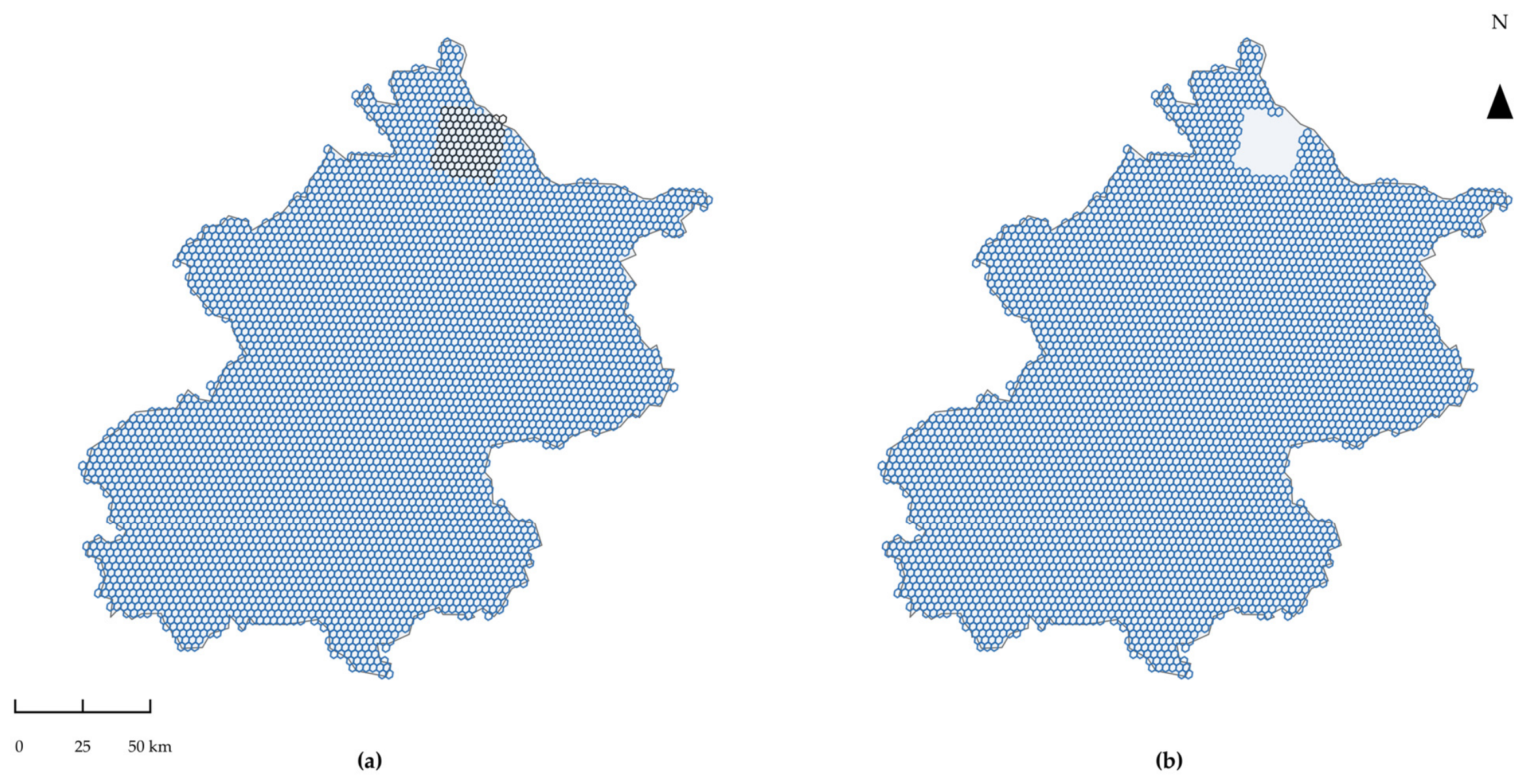
is designed to select the current optimal image (as shown in
Figure 4a). The function takes the image structure set
as input and outputs the optimal image
. It evaluates candidate images comprehensively based on multiple criteria, including temporal relevance, spatial resolution, and cloud coverage, and preferentially selects the image that best satisfies these conditions.
The heuristic function operates as follows. Given a candidate image set , images are first ranked by temporal relevance , and those with the highest value are retained. If only one image remains, it is selected as the current optimal image; otherwise, these images form a subset . Within , images are further evaluated by spatial resolution , and those with the highest resolution are retained. If a unique image exists at this stage, it is selected as the current optimal image; otherwise, the remaining images form subset . Subsequently, images in are filtered based on cloud coverage, , and those with the lowest values are retained. If multiple images remain, the first image is selected as the current optimal image.
The above process provides an example of a heuristic function in which the priority is assigned sequentially to the most recent acquisition time, the highest spatial resolution, and the lowest cloud coverage. It should be noted that this priority order is not fixed and can be flexibly adjusted according to specific application requirements. For instance, in certain scenarios, cloud coverage may be considered more important than temporal factors, while in other tasks, spatial resolution may be designated as the primary criterion.
In addition, other factors related to image quality can be incorporated into a heuristic function, such as radiometric quality, signal-to-noise ratio, observation angle, sensor type, geometric accuracy, and application-specific evaluation metrics. By integrating these factors, the heuristic function can more comprehensively characterize image quality. Therefore, the proposed heuristic function exhibits strong flexibility and extensibility, allowing it to be adapted to different task objectives and data characteristics, thereby better satisfying diverse application requirements.
3.4. Greedy Algorithm
Guided by the heuristic function, a greedy strategy is adopted to iteratively select the current optimal image
from the candidate image set
. Grid-encoding strings are compared to determine whether the set of grid cells covered by an image intersects with the target grid set
. If an intersection exists, the image
is added to the result set
and removed from the candidate set
, and the corresponding covered grid cells are simultaneously removed from
, as shown in
Figure 4. The relevant sets are then updated, and the process continues iteratively. The algorithm converges and terminates when either the candidate image set
becomes empty or the target grid set
is empty.
3.5. Filtering out Invalid Coverage Images
In a grid-based system, invalid coverage refers to grid cells that are simultaneously contained within both an image and the target region but have already been fully covered by grid cells from other images. In such cases, the image does not contribute any additional coverage to the target region. Therefore, this type of coverage is regarded as redundant, i.e., invalid coverage.
Let
denote the grid encoding set of the target region and
denote the image set, where each image
is represented by a set of grid encodings
. Define
. Image
is said to provide valid coverage if
Otherwise, if
is defined as an invalid coverage image.
A short-circuit evaluation strategy is employed to terminate the process once a valid grid cell is identified, thereby improving computational efficiency. The result set is subsequently refined by removing all invalid coverage images, yielding the final regional coverage result.
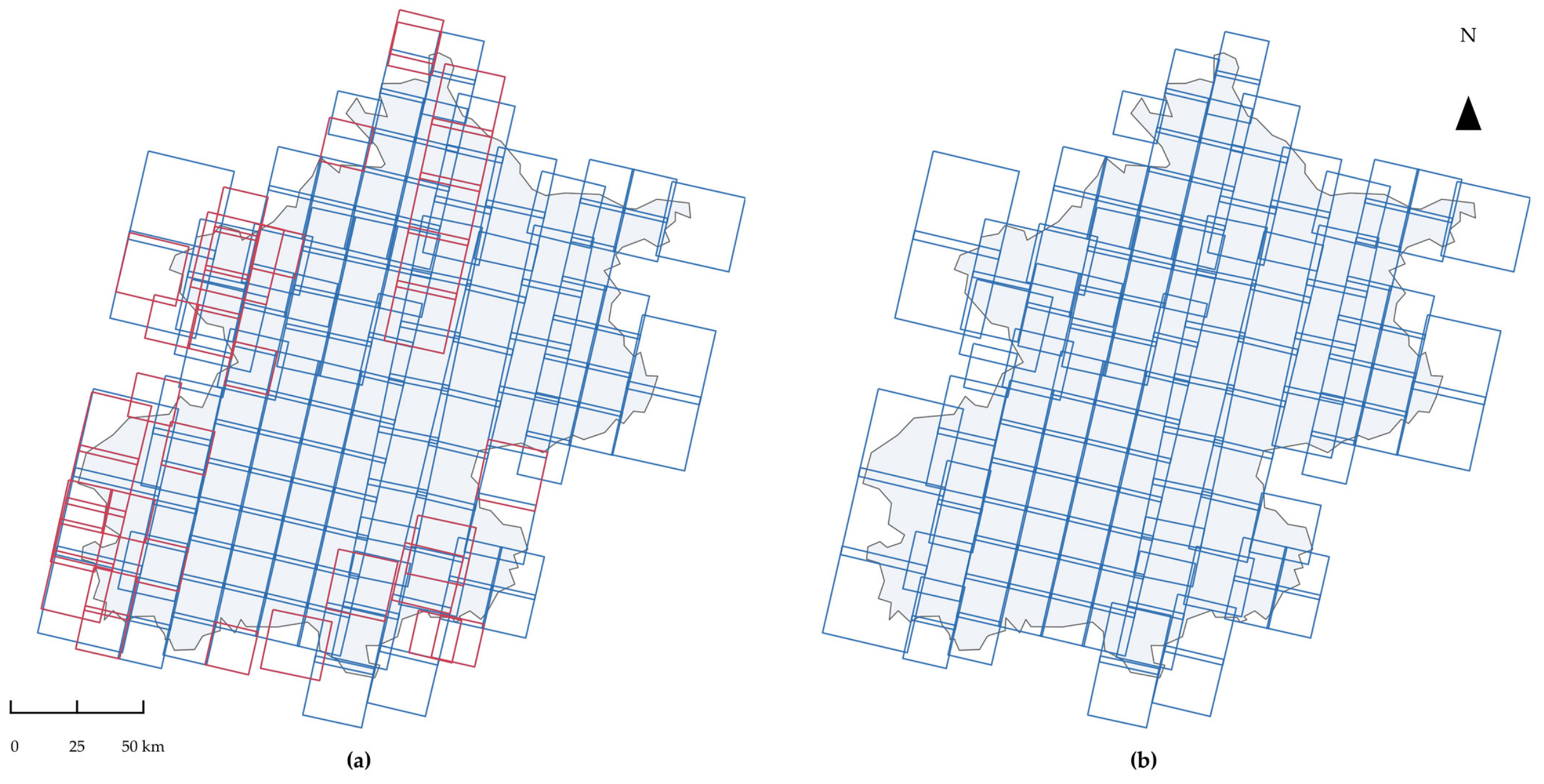
The final regional coverage results after filtering out invalid coverage images are shown in
Figure 5. The red rectangles in
Figure 5a represent invalid images that have been filtered out.
4. Results
To comprehensively evaluate the performance of the proposed DGGS-based regional image coverage retrieval method, a unified experimental framework was established. The evaluation focuses on four aspects: accuracy, computational efficiency, parameter sensitivity, and robustness under varying coverage conditions.
All experiments follow a consistent evaluation protocol. The traditional vector topology-based method is adopted as the baseline to provide reference results in terms of coverage accuracy. The proposed DGGS-based method is implemented under different grid levels depending on the experimental objectives. To ensure fairness, all methods are executed on the same dataset under identical computational conditions.
To quantitatively evaluate the performance of different methods, the following evaluation metrics are adopted.
- (1)
Coverage Rate (CR)
Coverage rate represents the ratio of the total area covered by the retrieved image set to the area of the target region, which is calculated as
where
denotes the actual area covered by the image set and
denotes the total area of the target region. A higher coverage rate indicates a greater degree of coverage of the target region by the image set.
- (2)
Computational Time (T)
Computational time represents the total runtime required to complete the regional image coverage retrieval and is used to evaluate the computational efficiency of the algorithm.
- (3)
Image Count (N)
Image count refers to the number of images selected under a given coverage rate condition. This metric reflects the algorithm’s ability to minimize the number of images while maintaining the required coverage. In general, a smaller image count indicates a more compact coverage result.
All experiments were conducted under a unified hardware environment:
The algorithms were implemented in Java (version 11.0.22) and executed in a single-thread mode to ensure the comparability of experimental results across different methods.
To comprehensively evaluate the proposed method under varying data scales and coverage conditions, a unified experimental framework is established. The performance is assessed in terms of coverage accuracy, computational efficiency, scalability, and robustness.
- (1)
Full coverage scenario: The DGGS-based method at grid level 7 is compared with a traditional vector-based topological approach, focusing on coverage accuracy and computational efficiency.
- (2)
Parameter sensitivity: Experiments are conducted across grid levels 5–8 to analyze variations in coverage rate, computational time, and error, and to investigate the trade-off between accuracy and efficiency.
- (3)
Scalability: Under large-scale and highly overlapping datasets, the number of images is progressively increased to examine the growth of computational time with data size.
- (4)
Robustness: Experiments under sparse coverage conditions with varying initial coverage rates are performed to evaluate the stability of the method.
These experiments collectively validate the performance of the proposed method across different spatial configurations and data scales.
4.1. Experiment I: Full Coverage Scenario
The administrative region of Beijing was selected as the study area, with a total area of approximately 16,400 km
2. To support the experimental analysis, a high-resolution remote sensing image dataset covering the study area was constructed. The dataset consists of 751 scenes acquired from the Jilin-1 constellation and the Tianfu constellation, including 329 high-resolution images and 368 wide-swath images from the Jilin-1 constellation, as well as 54 images from the Dongpo satellite of the Tianfu constellation. The acquisition dates range from 3 August to 31 August 2023. All images have a spatial resolution of 0.5–0.8 m, with cloud coverage controlled between 0% and 20% to ensure data quality. The dataset achieves 100% coverage of the study area, providing a reliable basis for the evaluation of coverage retrieval algorithms.
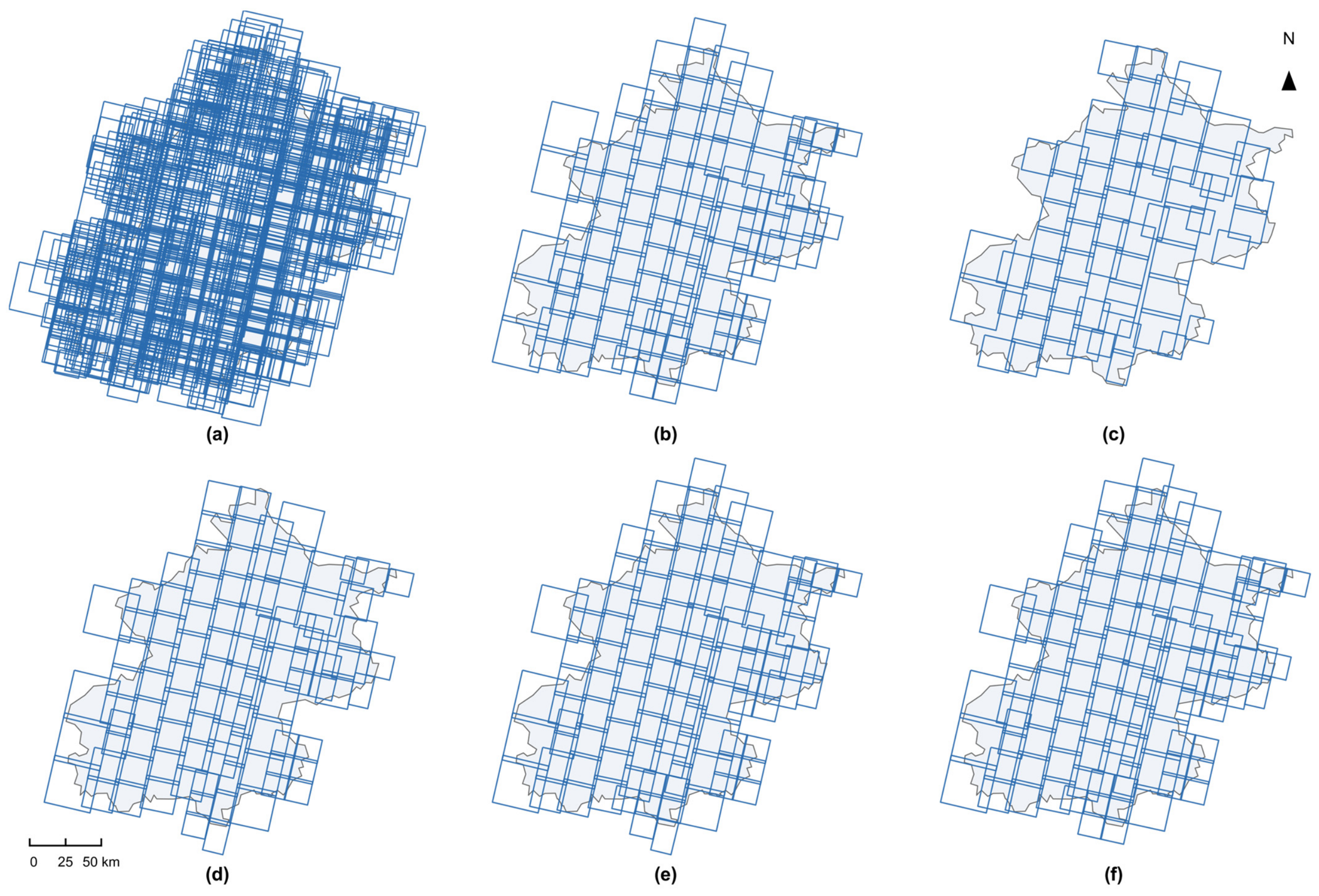
Figure 6a illustrates the spatial distribution of the 751 images over the Beijing administrative region.
In this experiment, the traditional vector-based topological algorithm is adopted as the baseline method and compared with the DGGS-based method at level 7 to evaluate their performance in terms of coverage accuracy and computational efficiency. The results are shown in
Figure 6b,
Figure 6e, and
Table 1.
Figure 6 provides an overview of the results; panels (a), (b), and (e) are analyzed in this section, while the sensitivity analysis shown in panels (c), (d), and (f) will be discussed in detail in
Section 4.2.
The vector-based topological algorithm requires 6109 ms to complete the regional coverage retrieval, selecting 109 images and achieving 100% coverage of the target region. Due to its reliance on precise polygon intersection operations, this method yields mathematically exact coverage results.
In contrast, the DGGS-based method at level 7 completes the same task in 3882 ms, selecting 105 images and achieving a coverage rate of 99.9889%. Compared with the topological method, the relative coverage error is only 0.0111%, indicating that the area deviation introduced by grid discretization is negligible.
The DGGS-based approach achieves near-complete coverage with fewer images by effectively handling edge boundaries and high-overlap areas; while vector methods treat small uncovered polygon fragments as gaps requiring compensation, the DGGS representation aggregates coverage into discrete grid cells that absorb these fragments, thereby eliminating the need for additional images and rendering those with only marginal contributions redundant during the greedy selection process.
According to the quantitative comparison results, the computational time of the DGGS-based method is reduced by approximately 36% compared to the vector topological algorithm. Meanwhile, with a reduction of four images (about 3.67%), the coverage rate exhibits only a negligible decrease.
These results demonstrate that the proposed method can significantly reduce computational cost while maintaining near-complete coverage accuracy, highlighting its advantage in computational efficiency.
4.2. Experiment II: Parameter Sensitivity
This experiment is conducted under the same data conditions as Experiment I. The level 7 grid is used as the baseline, and comparative experiments are performed using grid levels 5, 6, 7, and 8 to evaluate the impact of grid hierarchy on coverage accuracy and computational efficiency, as well as to analyze the sensitivity of the proposed method to grid resolution.
The results indicate that as the grid level increases, the coverage rate gradually improves, while the computational time increases significantly. The detailed results are presented in
Figure 6 and
Table 2.
From the perspective of coverage accuracy, the coverage rate increases monotonically with the grid level, but tends to be saturated beyond level 7, with only an approximate 0.01% improvement when increasing from level 7 to level 8. Meanwhile, the computational time exhibits a nonlinear growth with increasing grid level. At level 8, the number of grid cells increases sharply, leading to a significant rise in computational complexity.
In terms of image selection, the level 5 grid results in a noticeably smaller number of selected images due to insufficient resolution, whereas the results at levels 6 and 7 become relatively stable. At level 8, only one additional image is selected compared to level 7. Considering both coverage accuracy and computational efficiency, the level 7 grid achieves the best trade-off between accuracy and efficiency.
In Experiment II (Parameter Sensitivity), we analyzed the number of DGGS grid cells covered by individual images across different grid levels. The results show that for Level 5 grids, each image covers 0–4 cells; for Level 6, 12–26 cells; for Level 7, 41–140 cells; and for Level 8, 295–1214 cells. Both Level 6 and Level 7 grids achieve a favorable balance between computational efficiency and coverage accuracy. Notably, the number of grid cells per image in Level 6 falls entirely within the recommended range of 10–100, while for Level 7, although the maximum exceeds 100, the majority of images still fall within this range, which aligns with the suggested empirical guideline.
4.3. Experiment III: Scalability
The third experiment aims to evaluate the scalability of the proposed method under large-scale and highly overlapping remote sensing image datasets. By significantly increasing the data volume, the variation in computational time with respect to data scale is analyzed and compared with that of the traditional vector-based topological algorithm to demonstrate the efficiency advantage of the proposed method in large-scale image coverage optimization tasks.
The study area is the administrative region of Shaanxi Province. The dataset consists of 9524 images acquired from the Jilin-1 constellation and the Tianfu constellation, including 2560 high-resolution images and 6458 wide-swath images from the Jilin-1 constellation, as well as 506 images from the Dongpo satellite of the Tianfu constellation. The acquisition period spans from 4 July to 30 September 2023. All images have a spatial resolution of 0.3–0.8 m, with cloud coverage controlled between 0% and 20% to ensure data quality meets the experimental requirements.
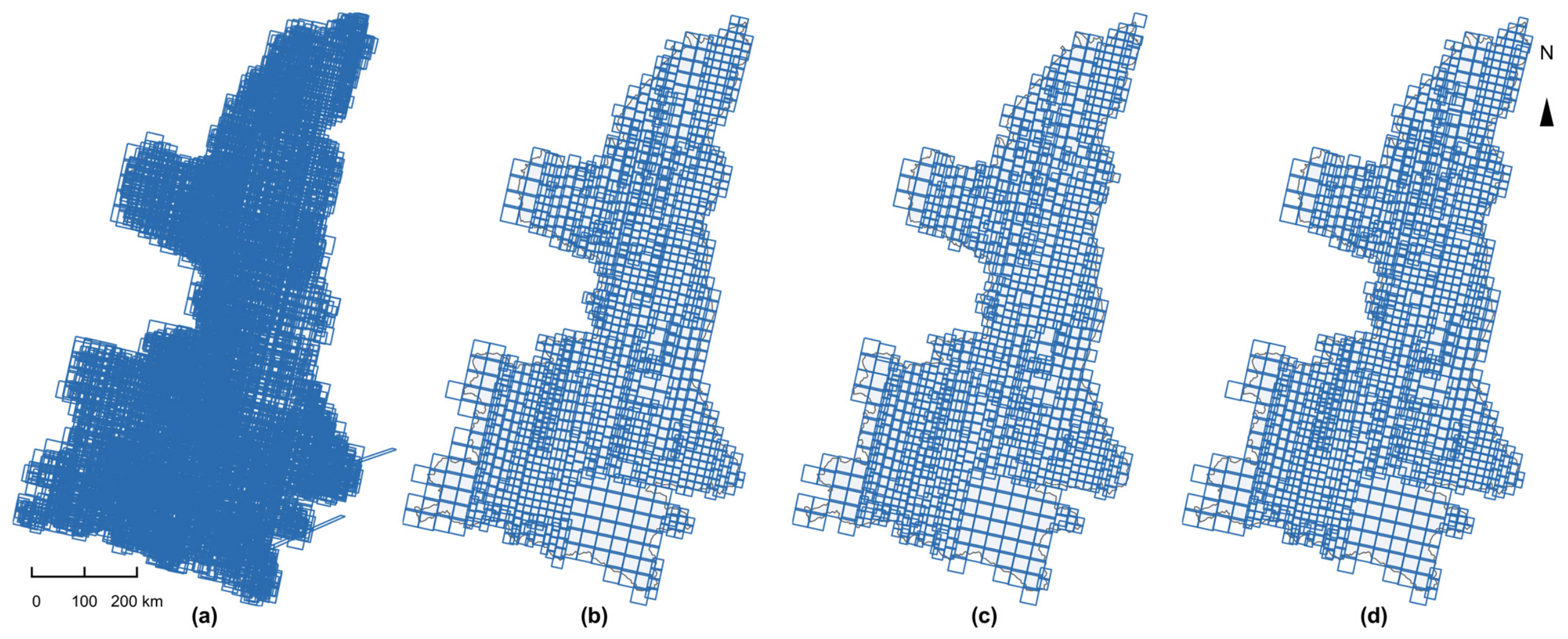
Figure 7a illustrates the spatial distribution of the 9524 images over the Shaanxi administrative region.
Table 3 summarizes the experimental results of different methods on this dataset. In terms of coverage accuracy, the level 7 DGGS method achieves near-complete coverage, with only a 0.0935% difference compared to the vector-based method, indicating negligible area error. The level 6 grid, due to its lower resolution, introduces some discretization errors but still maintains a relatively high coverage level.
Regarding computational efficiency, the DGGS-based methods demonstrate significant advantages. Compared with the vector-based topological algorithm, the level 6 DGGS method reduces computational time by approximately 98.6%, while the level 7 method achieves a reduction of about 90.8%. Even at the higher resolution of level 7, the method still provides an approximately 10.9× speedup.
Furthermore, the level 7 DGGS method selects 43 fewer images (approximately 3.2%) than the vector-based method, with only a marginal decrease in coverage rate. This indicates that, under highly overlapping data conditions, the DGGS-based grid discretization approach can effectively identify redundant images while maintaining near-optimal coverage performance. After discretization into DGGS cells, these marginal contributions are frequently merged into already-covered grid regions, thereby reducing the necessity for additional images. Consequently, the DGGS-based method is able to generate a more compact image subset while preserving near-complete regional coverage.
Overall, under a large-scale and highly overlapping remote sensing image dataset, the computational complexity of traditional vector-based topological methods increases significantly. In contrast, the DGGS-based approach substantially reduces computational cost while maintaining near-complete coverage accuracy, demonstrating strong scalability and practical application potential.
4.4. Experiment IV: Robustness
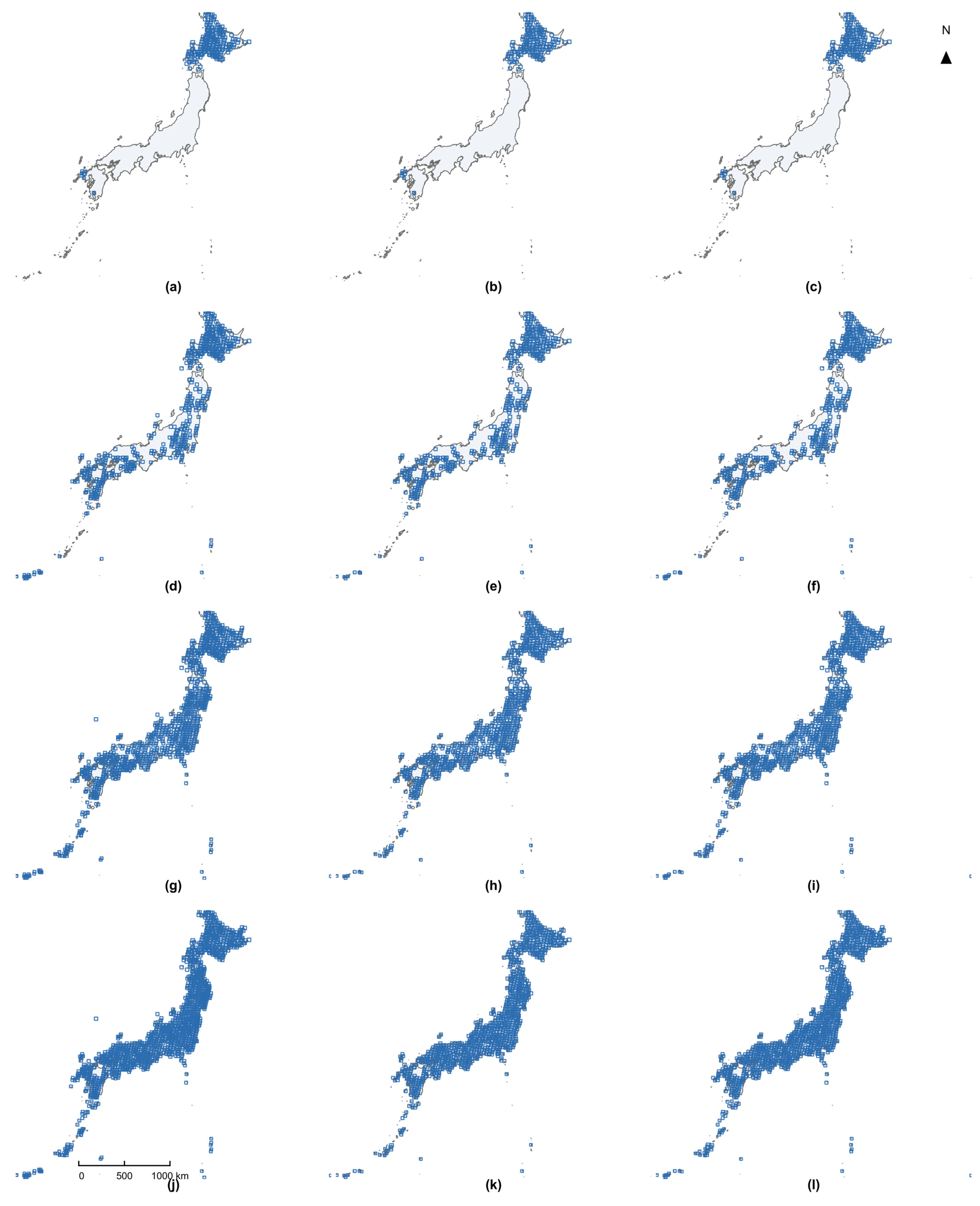
The fourth experiment aims to evaluate the robustness of the proposed method under different initial coverage conditions, with a focus on analyzing its stability and performance degradation in sparse coverage scenarios. Unlike the previous experiments conducted under full coverage conditions, this experiment considers Japan as the study area. Four datasets of different sizes are constructed, containing 210, 563, 1033, and 1464 images, corresponding to initial coverage rates of 18.2667%, 50.0458%, 80.5484%, and 95.4946%, respectively. All images are acquired from GF-2, with acquisition dates ranging from 17 February 2015 to 1 June 2023.
Figure 8 illustrates the spatial distribution of the images over the Japanese study area.
The experimental results are summarized in
Table 4. Overall, under varying coverage rates (18.27–95.49%) and data scales, the coverage rates obtained using level 6 and level 7 grids are highly consistent with the original coverage rates, with errors remaining within a negligible range. This demonstrates that the proposed method exhibits strong stability and robustness under sparse and incomplete coverage scenarios.
From the perspective of accuracy, as the coverage rate and data scale increase, the estimated coverage remains stable but exhibits a slight systematic underestimation. Although the level 7 grid provides minor improvements in accuracy under high coverage conditions, the overall gain is limited, and the discretization-induced bias is small and controlled.
In terms of computational efficiency, the grid level has a significant impact on computational cost. Compared with the level 6 grid, the computational time of the level 7 grid increases by an order of magnitude, while the improvement in accuracy remains marginal, indicating diminishing returns at higher grid levels.
In summary, in most application scenarios, the level 6 grid achieves a better balance between accuracy and efficiency by significantly reducing computational cost while maintaining reliable coverage estimation. The proposed method maintains stable performance under incomplete coverage conditions and demonstrates strong potential for practical applications.
5. Discussion
The results of the four experiments show that the proposed DGGS-based discrete grid retrieval method can greatly reduce computation time while maintaining high spatial coverage. Compared with the traditional vector-based topological method, the proposed method shows better performance and stability in the experiment with large-scale datasets. However, its coverage rate is slightly lower. The results of multiple experiments indicate that this method is efficient and applicable in practical scenarios.
5.1. Spatial Representation Transformation and Its Implications
Vector-based topological methods spend a large amount of time on geometric operations. In the scenario considered in this study, the vector boundary polygons of the study area and images require repeated intersection and clipping operations. This computation becomes more time-consuming when image overlaps are high. To reduce the computational cost, this study converts the study area and images into discrete grids. In this way, the coverage problem is transformed from complex geometric operations into set operations based on grid encoding. This reduces computational complexity and decreases computation time.
Although a small coverage error is introduced, the proposed method greatly improves the efficiency of image selection. With the explosive growth of Earth observation data, this method is suitable for scenarios that require high computational efficiency but do not require complete coverage, such as large-area land cover change analysis, crop yield estimation, pest migration trend analysis, and climate change studies.
5.2. Trade-Off Between Accuracy and Efficiency
The DGGS grid directly affects the coverage accuracy of the study area and the overall computation time. As the grid level increases, the coverage results improve significantly. However, the computation time also increases substantially.
In the context of this study, a level 7 grid is sufficient to achieve near-complete coverage, with differences from the vector-based method being negligible for practical applications (e.g., 0.0111% deviation in Beijing and 0.0935% in Shaanxi datasets). Further increasing the resolution to level 8 yields only marginal improvements in accuracy but incurs a substantial increase in computational time.
The performance of the DGGS-based method is sensitive to the choice of grid level. Higher grid levels provide finer discretization and improved boundary precision but increase computational cost, whereas lower levels reduce computation at the expense of slight approximation errors. This parameter is adjustable, allowing users to select an appropriate grid level according to the precision requirements and computational resources of specific applications. Future work could explore adaptive grid-level selection strategies to further enhance automation and generalizability.
These observations indicate that, although the heuristic-guided greedy strategy employed guarantees local optimality rather than global optimality, the near-optimal results are highly reliable and introduce only minimal errors. Such small deviations are practically acceptable, achieving a favorable balance between accuracy and computational efficiency. For applications requiring stricter optimality guarantees, future work could explore hybrid strategies that combine greedy selection with global optimization methods.
In addition to accuracy–efficiency trade-offs, we further analyzed the computational efficiency of the proposed method to explain observed variations in acceleration across datasets.
5.3. Computational Complexity and Acceleration Analysis
The acceleration factor of the proposed DGGS-based method varies notably across datasets, ranging from approximately 1.57× in the Beijing experiment to 10.9× in the Shaanxi experiment, with an overall range of 1.5× to 11×. This variation can be explained by the computational complexity of the algorithm. The method primarily iterates over the set of candidate images (n) and the grid cells in the , performing set operations to update coverage. Consequently, the overall time complexity can be roughly approximated as . For smaller or sparsely covered datasets, the overhead of these operations dominates, resulting in modest speedup. In contrast, larger datasets or those with higher image overlap allow the algorithm to efficiently avoid redundant computations, achieving higher acceleration. This analysis is consistent with the near-linear growth of computation time observed in our experiments and demonstrates that the proposed method scales effectively with increasing dataset size and coverage density.
In addition, this complexity perspective provides insight into the variability of the reported speedups. For instance, in the Beijing experiment, the small number of candidate images and relatively sparse coverage limited the acceleration to 1.57×, whereas in the Shaanxi experiment, the combination of a larger candidate set and higher overlap enabled a speedup of 10.9×. These observations support the practical applicability of the method to datasets of different scales and justify the reported range of acceleration factors.
5.4. Scalability for Large-Scale Remote Sensing Imagery
Experiment III evaluated the performance of the proposed method under large-scale and highly overlapping data conditions. The comparison between level 6 and level 7 grids shows that a 1% improvement in coverage accuracy increased the computation time by 6.7 times. However, compared with the traditional vector-based topological algorithm, the level 7 grid still achieved a 10.9× computational speedup, while the coverage rate decreased by only 0.0935%. These results indicate that the proposed method maintains good stability and practicality in large-scale and highly overlapping scenarios.
In this scenario, the traditional vector-based method requires each image to be processed against the study area. The large amount of data further increases the cost of geometric operations, which are already time-consuming. In addition, the polygon vertices in the Shaanxi study area were significantly more numerous than those in the Beijing study area. The spatial interaction of complex polygons is also an important reason for the long computation time of traditional vector-based topological algorithms. The set operations based on grid encoding eliminate the need for geometric relationship determination. The standardized grids transform spatial coverage into string comparison operations. This advantage becomes more evident when processing highly overlapping and redundant remote sensing image datasets.
5.5. Stability Under Incomplete Coverage Conditions
In practical remote sensing applications, complete image coverage of the study area is often difficult to achieve due to cloud cover, imaging conditions, and missing data. We frequently encountered this problem in the monitoring of economic crops in Yunnan Province, China. Therefore, we conducted experiments to evaluate the performance of the algorithm under incomplete coverage conditions.
In Experiment IV, we first selected a portion of the image data (18.2667%). Additional data were then gradually added until the coverage reached 95.4946%. The same tests as those in Experiment III were then conducted. The results show that the coverage rate of the proposed DGGS-based method was highly consistent with the actual coverage rate. The method also showed stable performance similar to that under complete coverage conditions. These results indicate that the coverage error introduced by grid discretization is controllable. Large fluctuations do not occur under sparse coverage conditions.
5.6. Compactness of DGGS-Based Coverage Selection
The experimental results indicate that the DGGS-based method consistently selects fewer images than the vector topology-based approach while maintaining nearly identical coverage rates. This phenomenon arises from the discretized spatial representation introduced by DGGS. In traditional vector topology-based methods, coverage relationships are evaluated using precise polygon operations, so even minimal uncovered portions along the boundary can necessitate the selection of additional images.
In the DGGS framework, spatial coverage is represented using discrete grid cells. During discretization, fragmented boundary regions and marginal spatial differences are absorbed into neighboring grid units. Consequently, multiple images with highly overlapping or only marginal coverage contributions often correspond to identical grid sets. This absorption effect leads to a more compact selection of images, emphasizing effective regional coverage rather than exact geometric boundary completeness.
Although this approach significantly reduces redundancy and improves computational efficiency, it inherently introduces minor geometric precision loss at the boundaries. Such discretization-induced errors are localized and controllable and do not compromise overall coverage effectiveness. In other words, the compactness achieved by the DGGS-based method represents a trade-off: fewer images and higher computational efficiency come at the cost of slight boundary approximation errors. This characteristic reflects a fundamental limitation of grid-based algorithms; for applications with very high boundary precision requirements, one can increase the grid resolution or employ more precise coverage algorithms.
6. Conclusions
This study proposes a DGGS-based framework for regional image coverage retrieval to address the computational efficiency challenges in large-scale remote sensing coverage optimization. Traditional coverage computations—typically dependent on vector-based geometric topology—are transformed into grid encoding-based set operations to redefine the regional coverage problem within a structured spatial indexing framework. Combined with a heuristic-guided greedy selection strategy, the proposed method achieves both high computational efficiency and strong scalability while maintaining spatial consistency.
Comprehensive experiments are conducted to evaluate the proposed method from multiple perspectives, including coverage accuracy, computational efficiency, grid-level sensitivity, scalability under large-scale datasets, and robustness under sparse coverage conditions. The results demonstrate that, under full coverage scenarios, the proposed method produces coverage results highly consistent with those of traditional topology-based approaches while significantly reducing computational time. In the experiments, efficiency improvements range from approximately 1.5× to up to 11×, indicating that the advantage of the proposed method becomes more pronounced as the data scale increases. Furthermore, the experimental results reveal that the appropriate DGGS level depends on the target application scenario. Level 7 grids are more suitable for high-accuracy regional coverage optimization tasks, while level 6 grids provide a more computationally efficient alternative for rapid coverage estimation and sparse-coverage applications. This adaptive accuracy–efficiency trade-off further demonstrates the flexibility of the proposed DGGS-based framework.
Under large-scale and highly overlapping data conditions, the method exhibits stable and predictable computational growth, demonstrating strong scalability. In sparse and incomplete coverage scenarios, the estimated coverage remains highly consistent with the actual coverage, indicating that discretization-induced errors are controllable and do not introduce systematic bias. Overall, the results confirm that grid-based spatial modeling can substantially improve computational efficiency while preserving the reliability of coverage results.
In summary, this study demonstrates that integrating DGGS with coverage optimization models provides an efficient and structurally simplified solution for large-scale remote sensing image coverage retrieval. The proposed framework offers a scalable alternative to traditional topology-based methods and is particularly well-suited for applications such as large-scale remote sensing imagery management and rapid coverage analysis.




 ,
,