Article

Optical Water Types and Their Importance in Predicting Water Quality Metrics by Satellite Imagery

by
Patrick L. Brezonik
1 and
Leif G. Olmanson
2,*
1
Department of Civil, Environmental, and Geo- Engineering, University of Minnesota, Minneapolis, MN 55455, USA
2
Department of Forest Resources, University of Minnesota, Saint Paul, MN 55108, USA
*
Author to whom correspondence should be addressed.
Remote Sens. 2026, 18(11), 1818; https://doi.org/10.3390/rs18111818
Submission received: 10 March 2026 / Revised: 20 May 2026 / Accepted: 26 May 2026 / Published: 2 June 2026

Highlights

What are the main findings?
  • Pre-classification of waterbodies into optical water types (OWTs) based on integrative, satellite-based metrics produced better predictions of the water quality variables Secchi depth and colored dissolved organic matter (CDOM) than predictions based on an unclassified dataset of 109 Minnesota and Wisconsin waterbodies.
  • The integrative metric of reflectance spectral shape, apparent visible wavelength (AVW), had distinct relationships with three common water quality variables, Secchi depth, chlorophyll-a, and colored dissolved organic matter (CDOM).
  • AVW was also correlated with another integrative metric of reflectance spectra, the normalized difference index (NDI) for green and red wavelengths.
What are the implications of the main findings?
  • The accuracy of water quality data retrieved from satellite imagery can be improved by straightforward methods to pre-classify waterbodies into optical water types using data that can be calculated directly from satellite reflectance data.
  • AVW is an appropriate metric to use in developing OWTs from multidimensional, satellite-derived data.
  • For lakes in the region of study, OWTs can be derived using just two metrics, AVW and a metric of spectral magnitude, such as the trapezoidal area at red, green, and blue bands, ARGB, or similar metrics.

Abstract

Pre-classification of lakes into optical water types (OWTs) is considered a useful step in analyzing satellite-based reflectance data. We used a dataset of 109 reflectance hyperspectra from Minnesota and Wisconsin lakes and rivers to evaluate the usefulness of pre-classification to improve the retrieval of water quality information from satellite data. Three OWT classes were derived from the dataset by K-means clustering using three integrative metrics of reflectance spectral shape and magnitude as clustering variables. Values of the three metrics can be determined from satellite reflectance data as well as hyperspectral data. The OWT classes had distinct water quality characteristics in terms of Secchi depth, chlorophyll-a, and colored dissolved organic matter (CDOM). Algorithms used to retrieve values of the variables from simulated Sentinel-2 band reflectance data usually yielded more accurate predictions when computed separately for each class than when computed for the entire dataset, although exceptions were found for some fitting metrics and models and results for chlorophyll-a were not definitive. The three water quality variables were related in distinct ways to the integrative shape metric of reflectance spectra, apparent visible wavelength (AVW), supporting its use to develop OWTs to organize waterbodies into water quality classes. AVW was correlated (r = 0.933) with the integrative metric, normalized difference index at green and red wavelengths (NDI). Based on that result, we found that OWTs developed using just two variables, AVW and a metric of spectral magnitude, were nearly the same as classifications using all three integrative metrics.

1. Introduction

Chlorophyll (chl-a), turbidity caused by suspended particles, and colored dissolved organic matter (CDOM), the primary components that affect water clarity, are important indicators of inland water quality. Together, they control light penetration into water and influence ecosystem productivity. Water clarity in lakes is commonly measured as Secchi disk transparency, usually referred to as Secchi depth (SD) [1]. Chl-a measures algal abundance; higher concentrations generally reduce SD by increasing light absorption and scattering. CDOM, derived from decaying organic matter in waterbodies and their watersheds, absorbs light, especially in the blue wavelengths, resulting in darker water and diminishing clarity even when algal levels are low. Suspended matter (SM) in aquatic systems includes organic particles from algal production and food web activities within waterbodies and external sources of mineral and organic particles.
Remote sensing enables monitoring of SD, chl-a, CDOM, and SM over large geographic areas and extended time periods. Satellite-based sensors provide observations that can monitor inaccessible aquatic environments, enabling researchers and managers to identify spatial patterns and long-term trends in water quality. For example, the state of Minnesota, popularly known as the land of 10,000 lakes, has approximately 12,000 lakes with surface areas ≥ 4 ha, of which fewer than 10% are monitored by ground-based methods each year. Satellite remote sensing can play a key role in assessing aquatic ecosystem health, detecting episodic algal blooms and sediment plumes, and evaluating changes driven by natural processes and human activities.
Three approaches are used to retrieve water quality information from satellite data: empirical algorithms, semi-analytical algorithms, and machine learning models. Empirical algorithms use statistical relationships between in situ measurements and remotely sensed light reflectance from water surfaces. Although they are easy to implement, their transferability across regions and conditions is limited. Semi-analytical algorithms combine radiative transfer theory with empirical parameterization to represent the optical properties of water. They provide better transferability but require accurate characterization of optical properties, which is difficult to achieve even for individual lakes [2,3,4,5]. To date, they have had limited success in regional-scale applications to inland waters. Machine learning models use large datasets to “learn” complex relationships between spectral observations and water quality variables [6,7,8,9]. They can achieve high predictive accuracy, but their performance is affected by data availability.
To improve the accuracy of satellite-based water-quality monitoring, it may be desirable to pre-classify waterbodies based on optical water types (OWTs). OWT classification has been a part of ocean and freshwater optics since the early days of remote sensing science [10], when scientists divided waters into two categories: Case 1 waters, where optical properties (reflectance spectra) are determined solely by phytoplankton activity, as measured by chl-a, and Case 2 waters, where optical properties depend on a more complicated set of constituents, including CDOM and mineral SM, that do not covary with chl-a. Open ocean waters were generally considered to behave as Case 1 waters; inland and coastal waters were considered to be Case 2. Scientists recognized decades ago [11] that different models are needed to retrieve chl-a data from Case 2 waters than those that worked for Case 1 waters [12,13]. However, the simple division of optical types into two categories was recognized as overly simplistic more than 20 years ago. Mobley et al. [14] concluded that there is no sharp dividing line between Case 1 and Case 2 waters. CDOM and chl-a do not always covary, even in the open oceans; in addition, marine coccolithophores increase scattering, affecting light reflectance in some but not all deep-ocean environments.
Moore et al. [15] expanded on the idea that Case 1 and Case 2 represent a continuum rather than discrete classes by blending a low-chl-a (oceanic) algorithm based on blue/green bands with a higher chl-a (inland/coastal) algorithm based on red bands. The two algorithms performed better at different chl-a levels, but a blended approach based on OWT classification worked well across a wide range of chl-a levels for sites in Lake Erie. They developed OWTs from a large, in situ hyperspectral dataset using fuzzy c-means clustering and found that the optimal number of clusters (OWTs) for the dataset was seven. A fuzzy logic approach was used to assign the algorithms to a specific OWT.
Inland and coastal waters exhibit widely varying optical characteristics, and consequently, interest has grown in developing OWTs to enhance satellite-based retrieval of water quality data. The goal is to develop customized models for each OWT class to improve accuracy and enhance model transferability and interpretability. Aligning algorithms with dominant optical regimes may minimize overfitting and enable applications across large areas and time series. Whether these goals can be achieved in practice has not been thoroughly investigated.
Two main approaches have been used in recent OWT research. First, site- or region-specific approaches use data from a set of waterbodies (or spatially varying data from a large waterbody) to develop OWTs using some multidimensional clustering method; this might be termed an “ad hoc” approach. The clustering variables used in these studies include satellite reflectance data from visible and near-IR band sensors, in situ hyperspectral reflectance data, optical water quality parameters such as chl-a, CDOM, SD, and turbidity, and various metrics derived from hyperspectral or satellite band data. A wide range has been reported for the number of OWTs needed to classify the waterbodies in a given study: for example, 3 to predict turbidity in Chinese lakes [16]; 3 for chl-a prediction in Chinese reservoirs [17]; 5 for Baltic coastal waters and Estonian lakes based on metrics derived from reflectance spectra [18]; 5 for chl-a prediction in North American and Swedish lakes [19]; 8 for Brazilian waters based on in situ reflectance data [20]; 11 for Australian lakes based on hierarchical clustering of simulated reflectance data [21]; 13 to classify hyperspectra of Chinese lakes [22]; and 13 to classify inland water spectra plus an additional 9 OWTs for coastal water spectra [23]. In a few studies, retrieval models for water quality variables were developed for individual OWTs, yielding improved data fits with the customized models, e.g., refs. [18,19,24].
The second approach seeks to develop a set of OWTs into which all waterbodies across the globe can be placed; this might be termed a “first principles” or “universal OWTs” approach. Using a dataset of 976 in situ reflectance hyperspectra from various countries, Eleveld et al. [25] developed a protocol based on c-means clustering with two variations in OWT classification, one based on reflectance spectral shape only and the other based on spectral shape and the magnitude of the reflectance signal. Both variations yielded 6 OWTs as sufficient to classify the waterbodies in the dataset, but the authors indicated that an additional OWT was likely needed for lakes with floating algae. Spectra for such lakes were not in their dataset. They concluded that the protocol using spectral shape and magnitude worked better to classify turbid lakes with high reflectance into the proper OWT than the protocol based only on spectral shape, but the latter worked better for deep, clear lakes.
Bi and Hieronymi [26] used a “forward modeling” approach [27] to calculate reflectance values at specific wavelengths from inherent optical properties (i.e., light scattering and absorption due to water constituent concentrations) to define a conceptual OWT scheme consisting of 10 classes. They considered this sufficient to classify the optical properties of all global surface waterbodies. From the modeled reflectance data, they calculated three integrative parameters described below and used them to determine which OWT a given reflectance spectrum would best be classified. Jiang et al. [28] recently combined Bi-Hieronymi classes 1 and 2 and the a and b parts of classes 3–5 to obtain 6 classes that they used to fit SD data by various machine learning methods.
Various methods and variables have thus been used to develop OWTs. For our goals, the variables used to develop OWTs should be available from satellite sensors because we wish to use them to classify and monitor waters lacking ground-based data, a common goal of inland water research, e.g., refs. [29,30,31,32]. Some workers have used reflectance hyperspectral data to develop OWTs, but the high dimensionality, complexity and autocorrelation of such data present statistical challenges in creating reliable OWTs [26]. Moreover, satellite systems currently used to assess the water quality of small to moderate-sized lakes do not provide hyperspectral data. OWTs also have been based on surface reflectance (Rrs) measured by environmental satellites. OWTs derived from such data may be applicable only to the satellite system used to develop the scheme, but this may not be a practical concern for regional-scale monitoring. The moderately high dimensionality of satellite data, however, may still lead to statistical issues, including potential information redundancy among the bands.
Several variables have been developed to reduce the dimensionality of reflectance data and integrate the spectral shape and magnitude information in hyperspectral or satellite band data. Apparent visible wavelength, AVW [33], is the harmonic mean of Rrs over a certain wavelength range and is an indicator of spectral shape. Water quality constituents affect light absorption in different parts of the visible spectrum, thereby affecting spectral shape. AVW is thus related to the inherent optical properties of waterbodies. The trapezoidal area at red, green, and blue wavelengths, ARGB, is a measure of reflectance magnitude. The normalized difference index at red and green wavelengths, NDI, is useful in distinguishing between highly turbid and high algal biomass waters [26]. NDI differs from the normalized difference vegetation index (NDVI), which is calculated from red and near-infrared bands and used to assess vegetation cover on land. Similarly, AVW differs from dominant wavelength, λd, which is derived from tristimulus analysis of color and used to calculate the Forel-Ule color index from satellite data [34,35].
The primary objective of this paper is to assess the importance of classifying inland waters into OWTs to improve the retrieval of water quality data from satellite imagery. Our focus is on monitoring the many waterbodies across the geographic region of the U.S. Upper Great Lakes states (Minnesota, Wisconsin, and Michigan), which share similar climate, geology and landscape ecology. For such purposes, empirical models and machine learning techniques (also inherently empirical) are the most effective retrieval methods. To achieve the primary objective, we addressed the following questions: (1) what parameters and methods are available to develop regional-scale OWTs; (2) can the integrative OWT parameters developed from hyperspectral data be estimated from satellite band data; (3) how well do OWTs developed from satellite-based data agree with classes based on water quality data; (4) what is the number of classes needed to define OWTs for the region; and (5) do empirical models work better when fit to OWT subsets than to all the waters in a region or large dataset?
To answer these questions, we used a dataset of in situ hyperspectral reflectance data and accompanying water quality data from 109 surface-water sites distributed across Minnesota and neighboring Wisconsin. The sites were not selected randomly and do not reflect the statistical distribution of regional water quality, but we are confident the dataset reflects the range of regional water quality conditions affecting surface water optical properties. The initial focus of measurements was on waters affected by CDOM [36,37,38], but its scope soon expanded to include waterbodies with a range of regional optical characteristics.

2. Materials and Methods

2.1. Study Region and Dataset

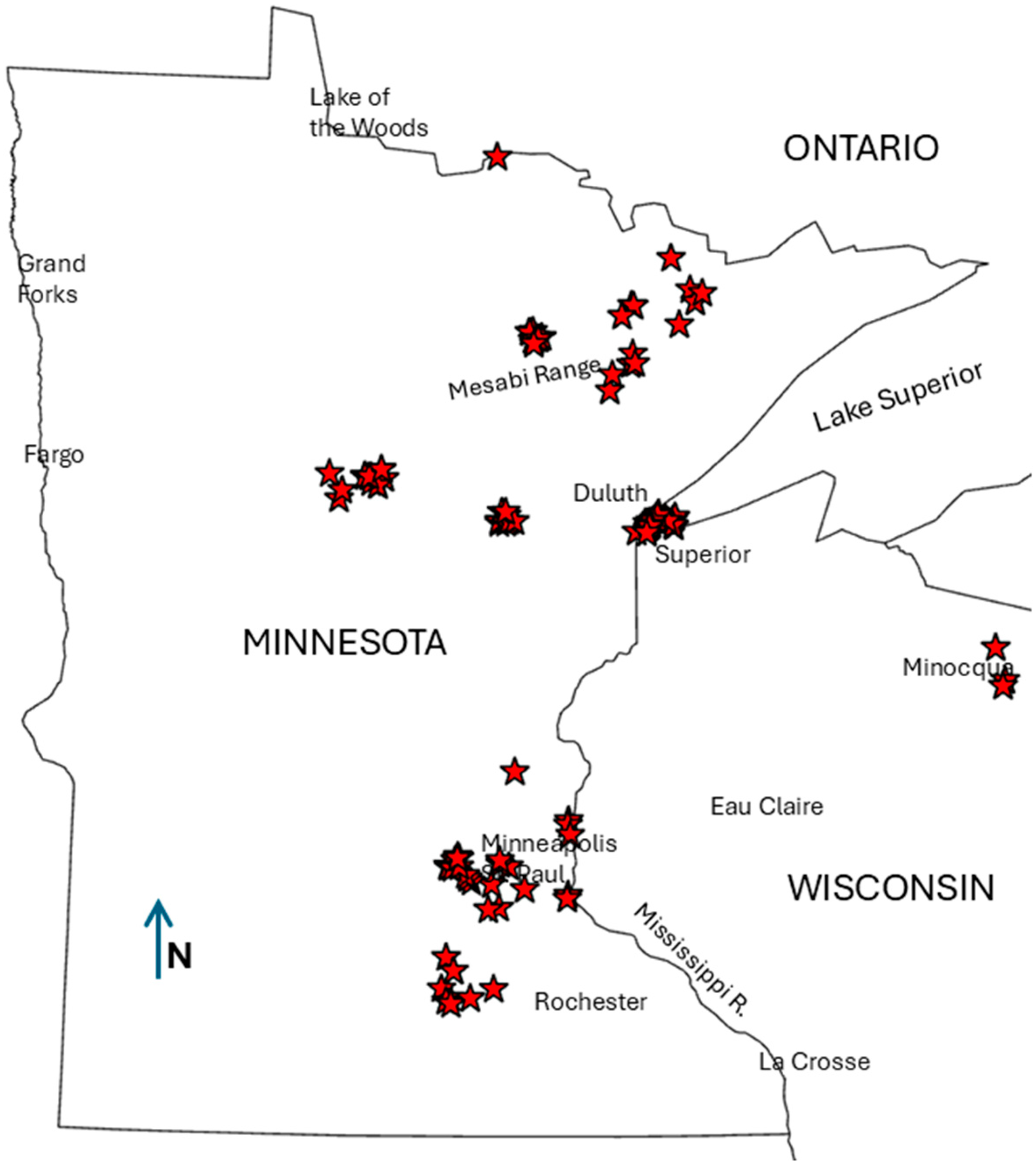
Reflectance hyperspectra and related water-quality information were collected by the authors between May and October from 2013 to 2018 on 101 lake and river sites across the state of Minnesota. Eight waterbodies in northern Wisconsin were also measured, bringing the total to 109 reflectance spectra and water-quality datasets, hereafter for simplicity referred to as the Minnesota dataset. The data are part of a large global dataset [39]. Figure 1 shows the locations of the collection sites, and Figure S1A,B shows the spectra for all sites.
Hyperspectral reflectance data were collected with a system consisting of two Ocean Optics USB-2000+ spectroradiometers with attached fiber-optic cables, a Spectralon calibration panel, and a laptop computer to record and process data using methods described by Brezonik et al. [40]. Spectra were collected at several sites multiple times to evaluate temporal variability. In most cases, the spectra were highly similar over time, but in a few cases, shapes were similar but peak magnitudes differed (Figure S1B). We did not combine multiple measurements at a given site; all spectra represent results from a single date. The 1 nm interval spectral reflectance dataset over the range 400–900 nm, reported as remote sensing reflectance, Rrs, is available from data archive DRUM [41]. Rrs (units of sr−1) is the ratio of water-leaving radiance (Lw) to downwelling irradiance (Ed) just above the water surface (Rrs = Lw/Ed). We measured Rrs just below the water surface, an acceptable alternative that avoids the need to correct for surface scattering.
Chl-a, CDOM (measured as the absorption coefficient at 440 nm, a440), SD, and SM were determined using methods described by Griffin et al. [37] and Brezonik et al. [40]. Water quality data associated with each of the spectra are in Table S1.

2.2. Data Analysis Procedures

We used the hyperspectral Rrs data as the basis for developing test OWTs. We converted the 1 nm hyperspectral Rrs data to simulated Rrs values for the Sentinel-2 satellite sensor bands in the visible to near-IR range by averaging the 1 nm data over each band [42], which we refer to here as simulated satellite data (Table S2). Sentinel-2 satellite data are currently used to assess the water quality of Minnesota lakes [43] and have 9 sensor bands across the visible and near-IR spectrum (Table S3).
Using the 1 nm Rrs spectral data, we calculated values of 3 integrative OWT variables, NDI, AVW, and ARGB, using the following equations [26,33]:
NDI = ( R rs ( B 3 ) R rs ( B 4 ) ) ( R rs ( B 3 ) + R rs ( B 4 ) )   ,
where B3 and B4 are the peak wavelengths of Sentinel-2 bands 3 and 4 (560 and 665 nm, respectively);
AVW = i = λ 1 λ n R rs ( λ i ) i = λ 1 λ n R rs ( λ i ) λ i   ,
where summations are from 400 to 800 nm (at 1 nm intervals);
A RGB = { ( λ R λ G ) ( R rs ( λ R ) R rs ( λ G ) ) + ( λ G λ B ) ( R rs ( λ G ) R rs ( λ B ) ) } / 2 ,
where subscripts R, B, and G refer to the band center wavelengths of the red, green, and blue sensors, 665, 560, and 443 nm. Because the statistical distribution of ARGB was skewed, Bi and Hieronymi [26] transformed it using Equation (4) to the form they used in their analyses:
A BC = A RGB t BC 1 t BC   ,
tBC is a transformation coefficient with a value of 0.22675. We used ABC in our analyses.
We also used an equation analogous to Equation (2) to compute estimated values of AVW from Sentinel-2 band data:
AVW S 2 =   i = B 1 B 8 A R rs ( λ i ) i = B 1 B 8 A R rs ( B i ) B i     ,
where the Bi are the peak wavelengths of the nine Sentinel-2 bands in the range 400–900 nm (Table S3). Values of the OWT variables are in Table S1.

2.3. Statistical Methods

Simple statistical measures, such as means and standard deviations, were calculated in the data spreadsheets. Other statistical analyses were performed using the software package JMP 18.2.2. JMP procedures included two widely used clustering routines to develop OWT classes: hierarchical clustering using Ward’s procedure and K-means clustering. The multivariate procedure, discriminant analysis, was used to evaluate the effectiveness of clustering in assigning sites to unambiguous groups. Simple and stepwise regression was used to evaluate relationships among OWT and water quality variables and to fit models to predict water quality variables from simulated Sentinel-2 band data.
Hierarchical clustering was performed using (1) Rrs for the 9 Sentinel-2 band center wavelengths, (2) the 3 OWT parameters (Equations (1), (2), and (4)), and (3) 3 water quality variables (SD, chl-a, a440) as clustering variables. The last run was included to evaluate the similarity between clusters based on satellite-based measures and those based on the water quality variables derived from satellite data. K-means clustering was performed using the same 3 sets of variables. This method requires a priori specification of the number of groups into which a dataset is to be divided. A range of group numbers can be specified, and we used a range of 3 to 10 groups. For both types of clustering, we used a statistical comparison criterion, the CCC, to help decide the appropriate number of clusters.

2.4. Water Quality Models (Retrieval Algorithms)

To assess the importance of pre-classifying waters into OWTs on the performance of retrieval algorithms for SD, a440, and chl-a from satellite data, we selected published and some newly formulated retrieval algorithms for each variable. We applied them to the Minnesota dataset and to subgroups (test OWTs) developed from the clustering procedures. Because most of the groups developed by hierarchical clustering had too few members for reliable regression analysis, we focused on two groups from the Sentinel-2 9-band clustering that had >30 members and compared calculations based on Rrs data for each group with results from the whole dataset. For groups developed by K-means clustering, we focused on the clusters from the OWT variables because the statistically optimal clustering yielded three groups with distinct water quality characteristics and sufficient members for regression analyses. We used adjusted R2, RMSE, and mean absolute error (MAE) to evaluate model goodness of fit. MAE is the average of the absolute values of the difference between model-predicted and measured values for a variable. We also used the MAE divided by the average of measured values for the variable (MAE/Ave) as a metric of relative error. This metric provides a measure of scale comparability, allowing prediction errors to be compared across variables with different magnitudes.

3. Results

3.1. Characteristics of the Minnesota Dataset

The 109 lake and river sites in the Minnesota dataset span a wide range of optically related water quality conditions, from highly oligotrophic and extremely low CDOM environments to hypereutrophic and dark-brown waters with low water clarity (Table 1). Wide ranges are apparent for the SD, chl-a, and CDOM (a440) data. Table 1 also shows a wide range of SM concentrations in the waterbodies, but because SM was not measured on about 25% of the sites, we did not use it in clustering to produce OWTs. The means were larger than the medians, and the standard deviations were larger than the means, indicating skewed populations, a common situation in water quality datasets. The Forel-Ule index (FUI) values show that the dataset comprises a wide range of apparent color (hue), extending from bluish green (FUI = 5) to dark brown (FUI = 21). FUI, as measured visually, has a long history of use in limnology and oceanography, and techniques have been developed to calculate FUI from satellite imagery data [34,35]. It is a classification variable with a range of 1 (blue) to 21 (dark brown), rather than a continuous variable and was not used in clustering. Waters with high chl-a typically have FUI values of 10–14 and waters with high CDOM have FUI values of 15–21.

3.2. OWT Variables

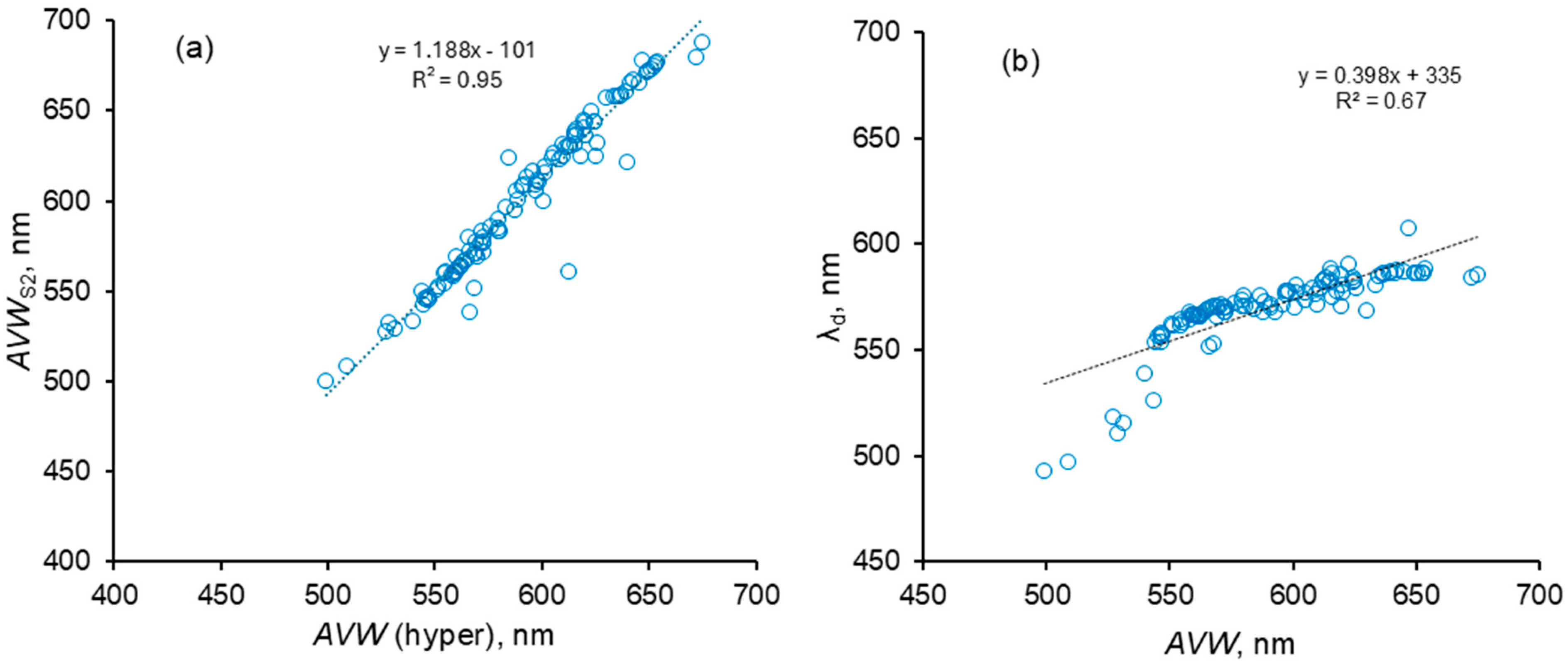
Two of the integrative OWT variables, NDI and ARGB, and their transformation, ABC, rely on Rrs data from satellite sensors and can be computed from both hyperspectral and multispectral satellite data. In contrast, AVW is calculated from 1 nm interval Rrs data over the range 400–800 nm and thus cannot be derived from multispectral satellite data. Vandermeulen et al. [33] estimated AVW using multispectral Rrs band data from several satellites and concluded that the values could be converted to equivalent AVW using a fourth-order polynomial equation with specific coefficients for each satellite sensor; Sentinel-2 coefficients are available elsewhere [26]. A plot of AVW for the Minnesota hyperspectra vs. corresponding AVWS2 values (Figure 2a) shows close correspondence (R2 = 0.95). A simpler alternative for estimating hyperspectral AVW could use the regression results in Figure 2a: AVW = 0.842 × AVWS2 + 101; this likely is sufficiently accurate for using AWT to define OWTs.
AVW is conceptually related to the optical parameter “dominant wavelength,” λd, which is defined as the wavelength of monochromatic light that evokes the same hue perception as a multispectral light source. λd can be computed from hyperspectral reflectance data and estimated from satellite band data [34,35]. The relationship between λd and AVW (Figure 2b), however, is not very tight (R2 = 0.67), and the regression slope is only 0.4. λd has a smaller range in the dataset than AVW does; the maximum λd in the dataset was 607 nm, but the maximum AVW was 675 nm.
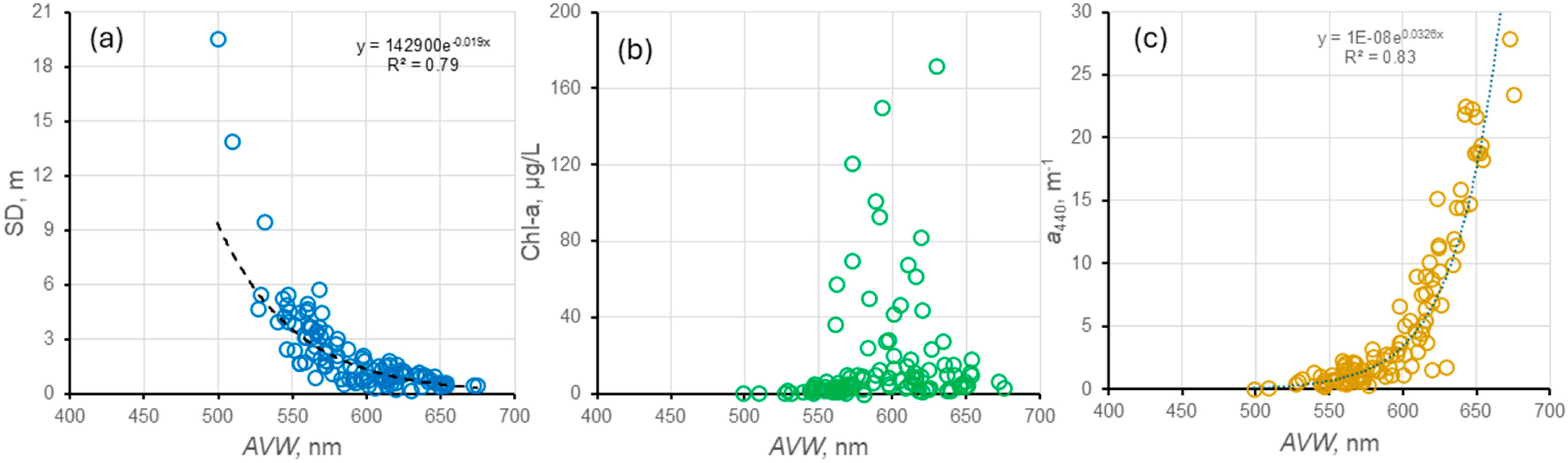
Because of interest in using the OWT parameters to produce optical classes (OWTs) that yield better water quality estimates from satellite data, we explored relationships between the parameters and water quality variables. AVW, a measure of spectral shape, had strong relationships with 2 water quality variables of interest in this study (Figure 3): SD had a negative exponential relationship with AVW, and CDOM (a440) had a positive exponential relationship. Although Chl-a had no simple mathematical relationship with AVW, high chl-a values occurred in the AVW range 550–650 nm. The plots in Figure 3 suggest that AVW should be a useful parameter for developing OWTs.
ARGB and its transformed product ABC are measures of reflectance magnitude. CDOM affects reflectance primarily by absorbing light, thereby decreasing it. Consequently, we speculated that a negative relationship exists between ARGB (or ABC) and a440. For all 109 sites, the relationships were poor (R2 = 0.14 vs. ARGB and 0.29 vs. ABC). This was caused in part by a wide range of chl-a in the dataset; chl-a affects both light absorbance and scattering, thereby affecting spectral magnitude. When we restricted the analysis to more oligotrophic waters (chl-a < 5 µg/L), the relationship improved to R2 = 0.49, indicating that CDOM generally decreases spectral magnitude, but other factors are also important.
Regarding relationships between the three OWT variables, a strong negative relationship was observed between NDI and AVW (Figure S2; R2 = 0.87), suggesting that for our dataset NDI provided only limited additional information beyond that from AVW. In contrast, ABC vs. AVW and ABC vs. NDI were essentially uncorrelated (Figure S2).

3.3. Number of OWTs in the Minnesota Dataset

3.3.1. Hierarchical Clustering

The dendrogram based on Rrs values across the 9 Sentinel-2 band-center wavelengths was selected for analysis (Figure S3). The CCC was not helpful in selecting a cutoff point for the number of classes because the optimal number was >11 (the computational limit for CCC calculation). We considered such a large number undesirable for regional-scale OWTs, although one study concluded that 13 OWTs were needed to classify global lakes [23]. Historically, hierarchical clustering has relied on visual inspection of dendrograms to determine suitable cutoff points, and we initially concluded that a cutoff yielding six classes (labeled 1–6 in Figure S3) provided a good balance between the number of classes and within-class similarity. We inspected the reflectance spectra (Figure S1) and water quality data (Table 1) for the sites in each class and concluded that classes 1, 3, 4, and 5 should be subdivided because of large differences in spectral shape or magnitude and water quality values. We wound up with 11 groups; sub-groups of an initial group were denoted by letters (A–C).
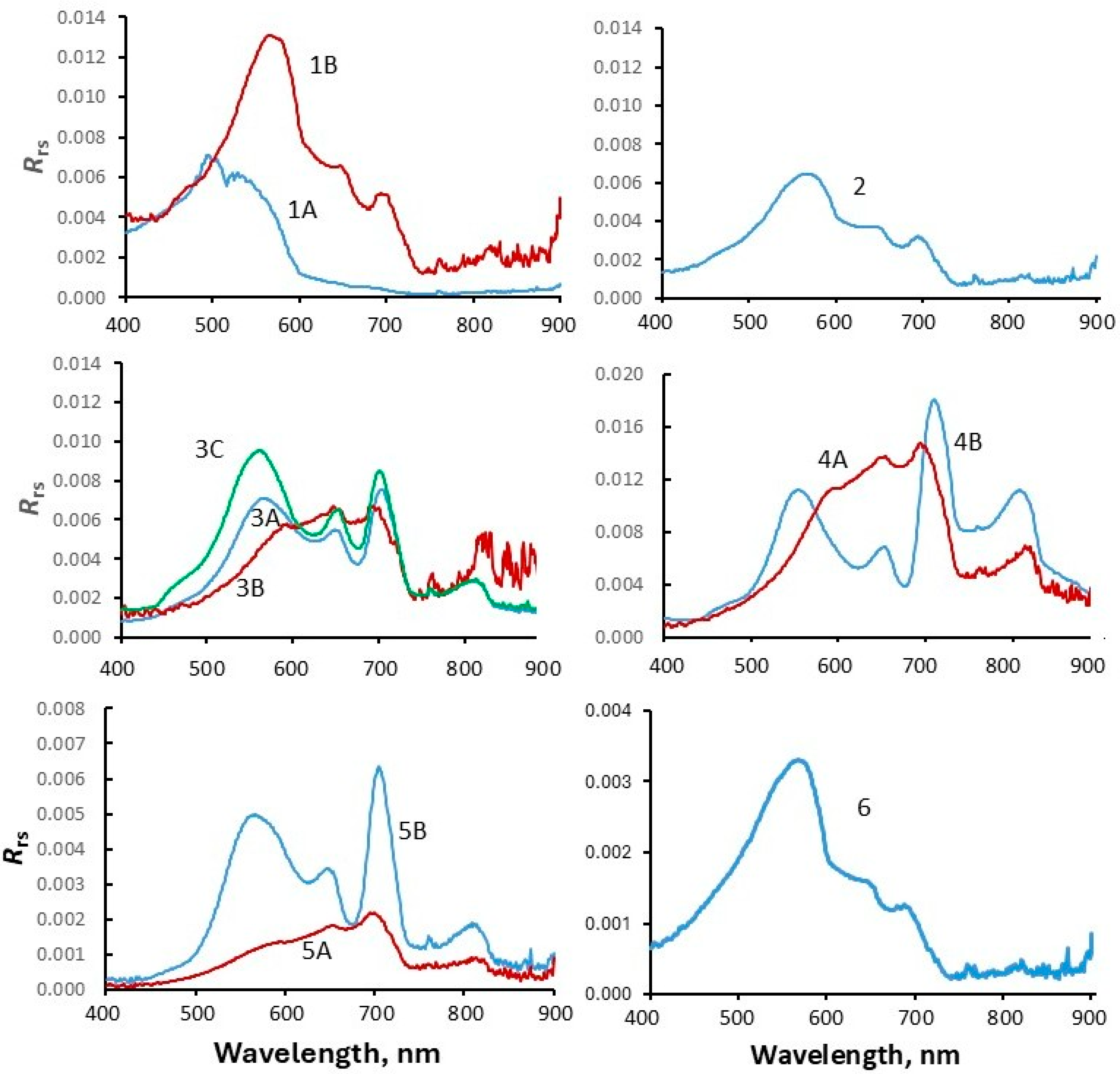
The average spectra for each of the 11 OWTs derived by the above approach show a variety of shapes and magnitudes among the classes (Figure 4). The spectral shapes and magnitudes for types 3A and 3C are similar, suggesting they should be grouped together, although the average a440 in type 3A waters was more than three times that for type 3C, and chl-a was slightly less than three times greater in 3C than in 3A (Table 2). This may be an example of the phenomenon of “spectral ambiguity” (waters with different water quality but similar spectra). Similarly, spectral shapes for types 1B, 2, and 6 are similar but differ by a factor of ~3 in peak magnitude. This agrees with the large range in ABC (−0.7 to +0.7) for these sites. These 3 types comprise low-CDOM, oligotrophic to meso-eutrophic lakes with similar water quality characteristics (Table 2). Types 3B and 4A, which are highly colored, eutrophic river waters with high mineral turbidity, also have similar shapes but differ in magnitude by more than a factor of 2. The higher ABC in type 4A is likely explained by the higher mineral SM in this class. Finally, types 4B and 5B, which each are one highly eutrophic lake, have similar shapes but differ in peak magnitude by a factor of almost 3. In summary, plots of average spectra for the 11 groups delineated by hierarchical clustering and inspection of the spectra suggest that the Minnesota sites comprise 6–10 OWTs, depending on the importance of spectral magnitude in defining OWTs.
We compared the classes produced by the 3 sets of clustering variables for similarity of membership within classes and found large differences between the sets of classes. Discriminant analysis on the 11 clusters produced from the Sentinel-2 band center Rrs variables showed that only 58 sites (53%) were placed into the correct group when the water quality variables, SD, a440, and chl-a, were used to perform the analysis. It is interesting that the two single-member groups were correctly classified. Discriminant analysis of the six classes produced initially by Rrs clustering yielded modestly better results: 68 sites (62.4%) were classified correctly. Clustering based on the three OWT parameters yielded 8 classes, each with 5 to 28 members (Figure S4). The CCC was nearly constant at a range of 4–10 classes, but visual inspection of the dendrogram suggested that a cutoff yielding 8 classes was reasonable. None of the classes had the same membership as those from Sentinel-2 Rrs clustering. Moreover, discriminant analysis showed that only 41 sites (38%) were correctly classified when the 3 water quality variables were used to re-assign sites into the 8 clusters.
The dendrogram based on water variables had an obvious cutoff point that produced 7 clusters ranging in size from 3 to 34 members (Figure S5); none had the same membership as clusters produced by the two other sets of clustering variables. Although some clusters had high within-group similarity for the clustering variables, the largest group in this dendrogram (34 members) had poor within-group similarity, large ranges in CDOM and chl-a, and the sites with the highest SM and highest chl-a. Sites in this group had low to moderate water clarity (SD < 3 m). The group stayed intact with 34 members even when the cutoff line was moved to yield 11 clusters. Overall, hierarchical clustering using satellite-based data (Rrs or integrative OWT parameters derived from Rrs) was not highly effective in producing well-defined, optical water quality classes from the Minnesota dataset.

3.3.2. K-Means Clustering

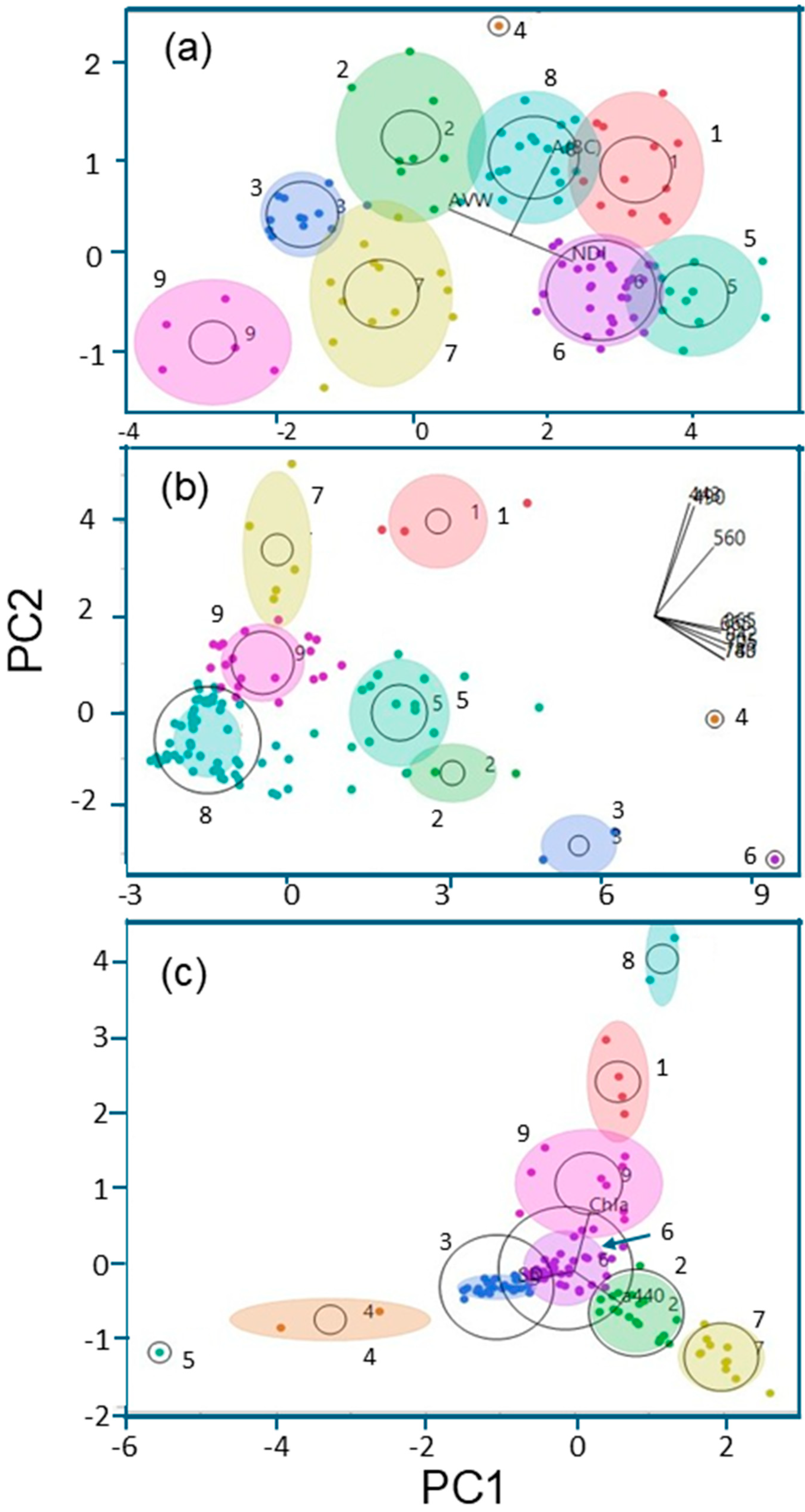
Based on the cluster comparison criterion (CCC), the statistically optimal number of clusters was 3 for the OWT variables, 10 for the Sentinel-2 bands, and 9 for the water quality variables. To compare classifications produced by the three sets of clustering variables, we selected the 9-cluster results for each set. Plots of the first two principal components (PC1 and PC2) for K-means analyses of the three sets of classification variables showed distinct distributions and clusters (Figure 5). In each case, the first two principal components explain a large percentage of the variance in the classification variables: 97% for the OWT parameters, 92% for the Sentinel-2 band Rrs data, and 85% for the water quality variables. The embedded lines (rays) in each diagram illustrate how the classification variables contributed to PC1 and PC2.
In general, sites with extreme values of water quality variables tend to occur near the edges of the K-means diagrams, regardless of clustering variables. For example, two sites with the highest CDOM (Johnson Bog and Section 11 Bog) lie furthest to the left in cluster 9 of the OWT classification (Figure 5a) and furthest to the right, adjacent to cluster 7 in the water quality classification (Figure 5c). Similar trends were observed for extreme SD and chl-a values, although exact locations (top or bottom, left or right) varied. To this extent, all three K-means cluster analyses achieved some separation of the sites based on water quality conditions.
In all the 9-cluster cases, at least one site formed its own unique group. In the OWT and Sentinel-2 cluster runs, Allouez Bay (2013 measurement) formed a unique group 4 (Figure 5a,b). Hypereutrophic Lake Elysian formed a single-member class 6 in the Sentinel-2 clusters (Figure 5b); it also formed a separate class 4B in Figure 4. In the K-means clustering based on water quality variables, Sabin Mine Lake formed a single-member class 5 (Figure 5c) based on its very high SD (19.5 m).
The starkly different data distributions in the K-means cluster plots suggest that the classification variables have fundamentally different structures within their principal components. OWT clustering resulted in a broad, relatively even distribution of the site data, whereas Sentinel-2 clustering placed most of the site data in the lower left portion of the plot (Figure 5a,b, respectively). In contrast, water quality clustering placed most of the data along the rays that define how each variable contributed to PC1 and PC2. This may have implications concerning whether clustering using satellite-based variables can develop useful water quality classifications.
Rays for OWT parameters NDI and AVW acted in almost exact opposite directions, and ABC acted approximately orthogonal to both. (Recall that NDI and AVW are highly negatively correlated; Figure S3). Rrs values for all 9 Sentinel-2 bands contributed positively to PC1. The lower wavelength bands contributed positively and primarily to PC2, but the higher wavelength bands contributed negatively to PC2. For the water quality variables, SD and a440 contributed negatively to PC2, but their primary influence was on PC1, positive for a440 and negative for SD. Chl-a contributed mostly to PC2 with a small, positive contribution to PC1. Based on the placement of high clarity Sabin Mine Lake at the left of the diagram and 2 waters with the highest CDOM levels at the right, it is apparent that increasing PC1 is associated with decreasing water clarity.
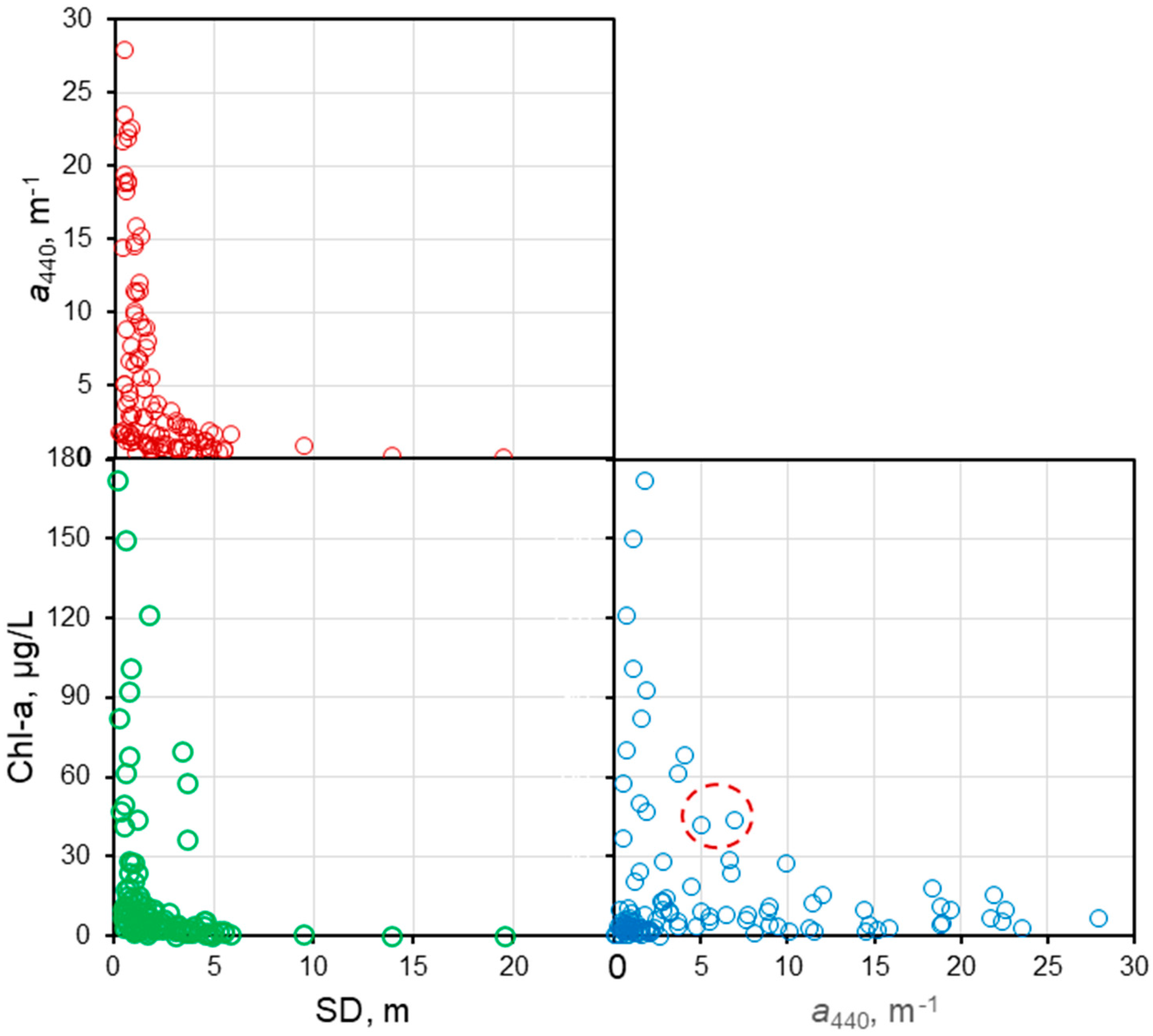
Scatter plots of the water quality variables (Figure 6) provide a more direct illustration of their interrelationships. Chl-a and a440 behave in the same way relative to SD: high SD values occur only at low values of both variables, and high values of both occur only at low SD. For example, SD > 5 m occurs only at chl-a < 2 µg/L and a440 < 2 m−1, and SD is <2 m when a440 exceeds 5 m−1. In contrast, SD values of 3–4 m occur at moderately high chl-a values (30–70 µg/L) but do not exceed 2 m at higher chl-a levels. This likely reflects variations in the ways chl-a is “packaged.” If it occurs in large algal clumps, moderately high chl-a levels may allow moderate SD levels. The chl-a vs. a440 plot is like the plots of those variables vs. SD insofar as extremely high levels of one variable preclude extremely high values of the other. A region exists, however, where moderately high levels of both variables coexist. The circled data in Figure 6 with moderately high chl-a and a440 values suggest that a class of humic-rich eutrophic lakes exists.
Scatter plots of Rrs for the 9 Sentinel-2 band center wavelengths (Figure S6) showed that several bands provide largely redundant data. For example, bands 6 and 7 (740 and 783 peak wavelengths) were almost perfectly correlated (r = 0.995), and high degrees of correlation occurred between bands 1 and 2 (443 and 490 nm; r = 0.975) and bands 8 and 8A (842 and 865 nm; r = 0.98). Consequently, inclusion of both pairs of these bands as clustering variables would provide redundant information that may outweigh those spectral features in statistical analyses.
As mentioned earlier, the optimal number of clusters for the three K-means clustering analyses, determined by the CCC statistic, was 3 for the OWT variables, 10 for the Sentinel-2 bands, and 9 for the water quality variables. What is optimal statistically, however, may differ from what is optimal in terms of classifying sites to improve water quality data retrieval from satellite Rrs data. Discriminant analysis of the 3 clusters produced by the OWT variables showed that 84% of the sites were assigned to the correct group when the 3 water quality variables were used for classification. Thus, for the most part, K-means clustering based on the satellite-derived optical parameters grouped the lakes into distinct optical water quality classes.

3.3.3. Comparison with Bi-Hieronymi Classes

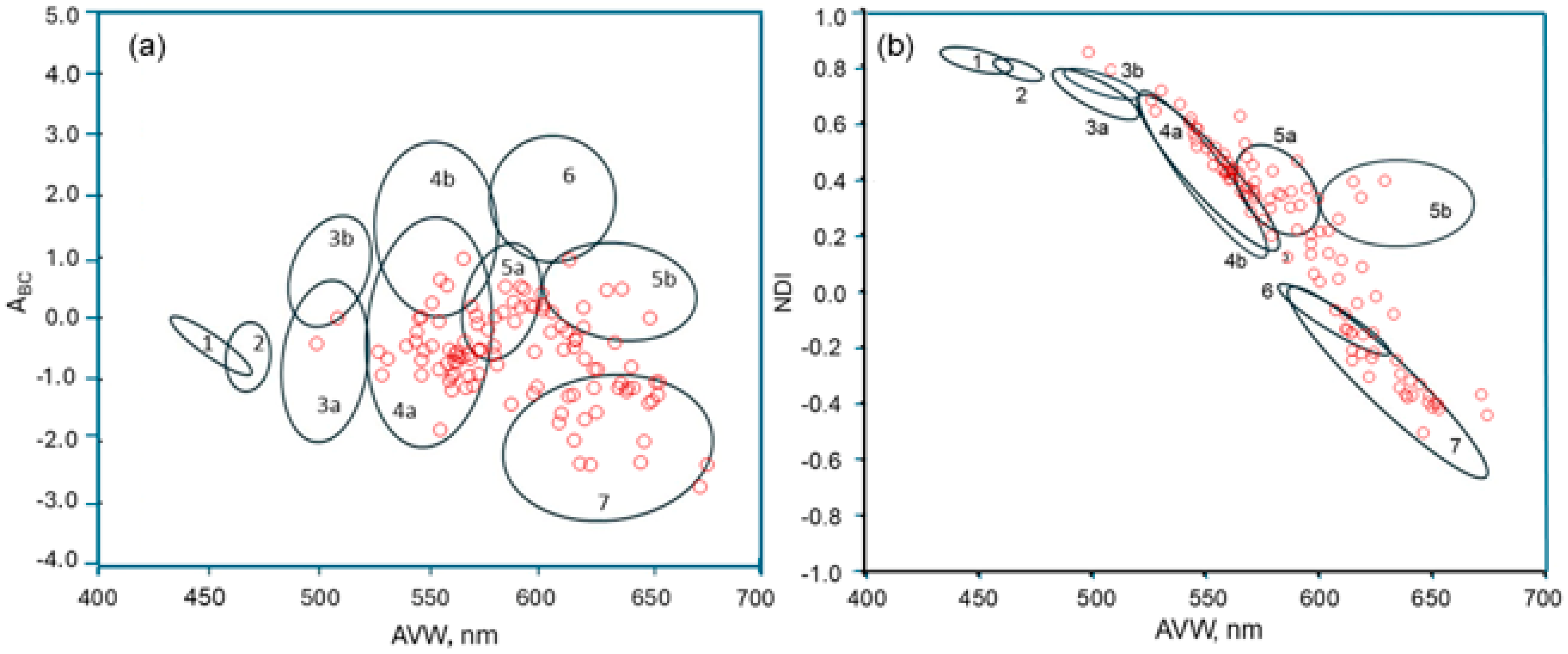
We examined plots of the OWT variables, ABC vs. AVW and NDI vs. AVW, for the 109 sites superimposed on the ovals Bi and Hieronymi [26] developed to delineate their 10 OWTs. Figure 7 shows that the Minnesota waterbodies have broad ranges of all three OWT variables, but ABC (a measure of spectral magnitude) was <1 for all sites. In contrast, the much larger dataset of Bi and Hieronymi has many sites with ABC in the range 1–4. The Minnesota sites thus tend to have relatively low reflectance magnitude compared with the global range. Data points in the NDI vs. AVW plot appear to be slightly offset from the nearest OWT class ovals, but this may reflect the composition of our sites as a subset of the much larger Bi and Hieronymi dataset.
Most of the Minnesota sites occur in classes 4a, 5a, 5b, and 7. The latter class represents waters where light conditions are dominated by CDOM, and sites in or near the class 7 oval all have high CDOM, with a440 increasing from ~5 m−1 near the left side of the oval to >20 m−1 at the right side. Classes 3–5 represent increasing eutrophy, with 3a representing clear, low-CDOM, oligotrophic waters, 4a and 5a representing more eutrophic waters with higher algal biomass, and 5b representing hypereutrophic conditions.
Our dataset has no sites in OWT classes 1 and 2, which are the clearest, lowest CDOM, and most oligotrophic classes, and few if any in classes 3b, 4b, and 6. The b classes are special cases of classes 3 and 4 with high brightness caused by strong scattering and low absorbance, which in marine waters is often caused by coccolithophores. It is uncertain whether any freshwater algal species produce the same degree of scattering and brightness, but clearly, they do not appear to be common in our waters. They probably can be eliminated as functional OWT classes in the region of this study, as Jiang et al. [28] also did for a much larger dataset of inland and coastal waters.
Class 6 is defined as bright brown water caused by light scattering by suspended particles [26]. Such turbid waters are common in rivers and reservoirs in many parts of the United States. Waters with high mineral turbidity are uncommon in our study, but a few sites have high SM concentrations. For example, Allouez Bay (2013 measurement), an area in the St. Louis River estuary at the western end of Lake Superior (Figure 1), receives water from the Nemadji River, the lower reaches of which are deeply incised into highly erodible red-clay soils [44]. We measured SM concentrations in the bay as high as 1400 mg/L, but not on the date of the 2013 spectrum. Based on the data we have, we expect that it belongs in class 6, and its data are on the line for the ABC-AVW class 6 oval and within the NDI-AVW class 6 oval (Figure 7b).
The two sites in Class 3a (Figure 7a), Orebegone and Sabin Mine, are deep mine-pit lakes. The Mesabi Range in northern Minnesota (Figure 1) is the major site of iron mining in the United States. Once mining ends, excavated pits, often more than 100 m deep, gradually fill with water and become highly clear, oligotrophic lakes mostly fed by groundwater and with very small watersheds. Water quality data for both lakes reflect their high clarity and oligotrophy (Table S1). The spectra for these lakes have peak reflectance around 490 nm (Figure 4, plot 1A), lower than the peaks of any other class, but higher than the Rrs peaks for high-clarity Lake Tahoe, California-Nevada, which under the clearest conditions occur around 400 nm [45]. It is interesting that none of the other clear, low-color, oligotrophic lakes in the Minnesota dataset fall into class 3a. For example, a Lake Superior site had SD = 9.5 m, chl-a < 1 µg/L and a440 < 1 m−1, and several other sites had SD > 5 m and similar chl-a and a440 values, indicative of high clarity, highly oligotrophic waters. Nonetheless, their AVW, ABC, and NDI values place them in class 4a. According to Bi and Hieronymi [26], class 4a has greenish water with higher biomass than types 1–3, and reflectance at short wavelengths is depressed by particle and CDOM absorption. In summary, the results in Figure 7 suggest that the waters in our dataset are distributed in 6 of the Bi-Hieronymi OWT classes, but the visual characteristics of some lakes do not match their class descriptions.
The other ways we used to estimate the number of clusters needed to classify the Minnesota sites yielded ranges of 6–10, based on hierarchical clustering and analysis of the spectra and water quality data, and 3–10 based on K-means clustering. Some ambiguity thus appears to be inherent in developing OWT classes for a given dataset.

3.4. Retrieval of Water Quality Data: Are OWTs Useful for Waterbodies in the Upper Great Lakes States?

3.4.1. Test OWTs

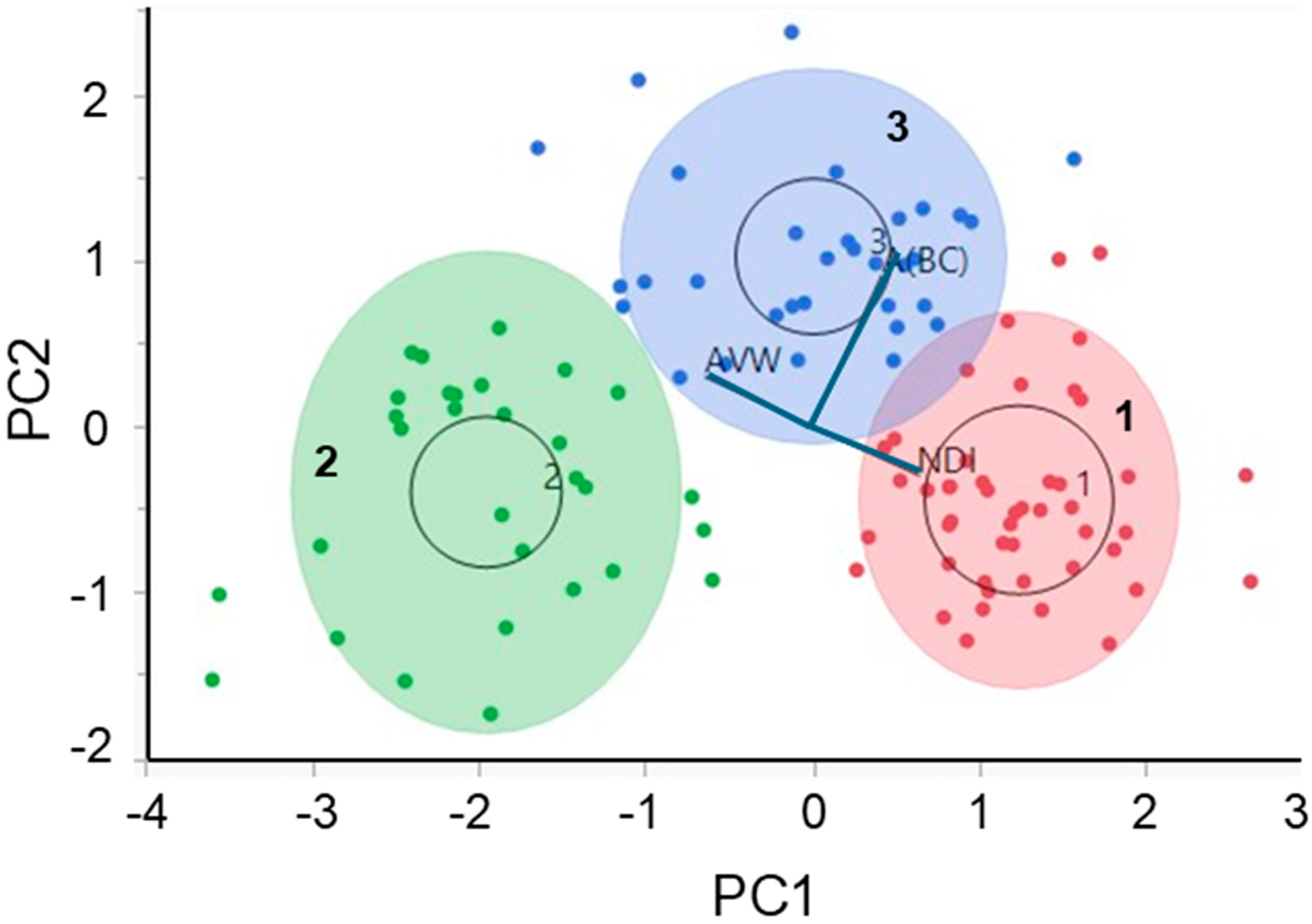
K-means clustering of the Minnesota dataset using the OWT variables ABC, AVW, and NDI yielded 3 groups (Figure 8) as the statistically optimal number. The groups exhibited internal consistency across both the clustering variables and water quality variables, SD, chl-a, and CDOM (a440) (Table 3). In terms of water quality, group 1 sites (N = 47) were low-color, mostly oligotrophic waters with low-CDOM, high transparency (high SD) and low chl-a. The group also had a few high chl-a sites with high transparency, apparently because chl-a was present as clumped algal particles. Group 2 sites (N = 30) are humic-colored waters with high to very high CDOM levels, resulting in low transparency and low chl-a. The more heterogeneous group 3 sites (N = 32) are moderately colored eutrophic to highly eutrophic waters with high chl-a, low to moderately high CDOM, and low transparency.
Because we found that OWT variables NDI and AVW were strongly correlated (Figure S2) and because AVW values were related to SD, chl-a, and a440 (Figure 3), we considered that NDI may not be needed as a K-means clustering variable to produce useful OWTs. K-means clustering of the Minnesota dataset using just AVW (the spectral shape metric) and ABC (the spectral magnitude metric) yielded three clusters (Figure S7) almost identical in shape and membership to the results in Figure 8, and the means and standard deviations for the water quality variables in each group were almost identical to those in Table 3.
Given their sizes and distinct characteristics, the 3 K-means groups appear to be suitable as test OWTs for comparing the accuracy of water quality retrieval data with that from the whole dataset. Similarly, highly colored group 5A and clear, oligotrophic group 6 from hierarchical clustering, with 32 and 36 members, respectively, and each with distinct water quality characteristics (Table 2), were also considered suitable for testing the usefulness of pre-classification in retrieving water quality data.

3.4.2. Secchi Depth Predictions

Table 4 summarizes the results from applying retrieval algorithms for SD to the 5 test OWTs and compares the goodness of fit with the corresponding results for the whole dataset. For SD, we used a model from an early assessment of water clarity (SD) in 10,000 Minnesota lakes (here labeled RSE08; ref. [29]) and an unpublished 2-term band ratio model developed by stepwise regression on the Minnesota spectral dataset and corresponding SD data. In terms of adjusted R2 and RMSE, the original predictive equation [29] did not perform as well as the unpublished model for the all-sites regressions and for most groups, but it performed better than the unpublished model for groups 1 and 6. Cluster 3 of the K-means clustering, which includes a diverse set of sites, did not have acceptable R2 values for either model. Several other models tested as variants of the original model and the new model did not yield higher R2 or lower RMSE values.
Conclusions about the goodness of model fit for the whole dataset versus fit for the test OWTs depend on the model and metric used to assess fit. For all sites, adjusted to remove one large outlier, the adjusted R2 of the original model was lower than that for groups 1, 2, and 6 but provided very low adjusted R2 for groups 3 and 5. The original model RMSE values were lower for all groups than for all sites. For the new model, the adjusted R2 was higher for all sites than for any group, but RMSE values for all groups were lower (indicating a better fit), except for group 3, than the all-sites RMSE. MAE1 values for all 5 groups were smaller than MAE1 for all sites using the original model. Except for groups 1 and 6, MAE1 values for the group regressions using the new model were smaller than MAE1 for all sites. Moreover, across all groups, mean absolute errors for regressions using just the group data (i.e., MAE1) were smaller than corresponding values for each group calculated from the all-sites regression (i.e., MAE2). Overall, these findings support the idea that pre-classifying sites by OWT generally improves data fit, regardless of which model is used.
The MAE for a group divided by the group’s average SD (MAE1/Ave) is a measure of average relative error and was smaller for all groups than the corresponding average relative error across all sites. The average relative error of the original model for the whole data set was initially high (0.99), indicating the average error was almost the same as the mean SD. When one large outlier, Sabin Mine Lake, with a measured SD of 19.5 m and predicted SD of 166 m, was excluded, the average relative error decreased to 0.42. The average relative error for all sites with the new model was 0.28. For the individual groups, average relative errors typically were around 0.20–0.30.

3.4.3. CDOM (a440) Predictions

For CDOM predictions, we used the published model used to assess a440 in Minnesota lakes (here labeled Olm20, [38]) and an unpublished three-term band ratio model (Table 5). The original two-term model had a higher R2 and lower RMSE for the all-sites regression than the unpublished 3-term model, but the latter had a better fit for all the groups except heterogeneous group 3. Groups 1 and 6 had low R2 and high RMSE values with both models; both groups comprise sites with a small range of low a440 values. MAEs for each group calculated from the regression for that group (MAE1) were smaller than those for each group calculated from the all-sites regression (MAE2), except for high-CDOM group 2. In addition, MAE1 across all groups for the original model was smaller than MAE1 for the all-sites regression.
The much smaller MAE1 values for a440 in groups 1 and 6 than those for all sites and the other 3 groups (Table 5) are misleading because groups 1 and 6 have small a440 values and a narrow range. A better metric for comparing the goodness of fit is the relative error (MAE1/Ave), which indicates that the average error for the low CDOM groups was ~40–45% of the average measured a440 for the 2 groups. High CDOM groups 2 and 5 had smaller relative errors (17–24%), but the relative errors for groups 1 and 6 were still lower than those for each group within the all-sites regressions. Finally, all groups for both models had smaller relative errors than those for the all-sites regressions. Overall, these findings support the idea that pre-classifying sites by OWT improves data fit.

3.4.4. Chlorophyll Predictions

We applied 6 models to the Minnesota dataset and 5 test OWT groups in an effort to predict chl-a. The models were: (1) a three-band ratio model (ln(chl-a) = a(B4/B5) + b(B7/B8) + c(B7/B5) + d) developed from Sentinel-2 band data for Minnesota lakes [43]; (2) the normalized difference chlorophyll index NDCI (B5 − B4)/(B5 + B4) [46]; (3) the 3BDA model (ln(chl-a) = B8A(B4−1 − B5−1)) [47]; (4) ln(chl-a) vs. Rrs for simulated bands B2–B7 plus B8A; (5) ln(chl-a) vs. B3, B4, B5; and (6) ln(chl-a) vs. B4/B5. Results were generally poor in terms of model fits for all sites and for the 5 test OWT groups. Although there were some indications of improved fit, the results did not provide definitive information regarding whether classification produced more reliable retrieval models. Consequently, we describe the results only briefly here. We also tried regressing some of the models directly on chl-a concentration, but this did not yield higher R2 values.
The best model for all sites had an adjusted R2 of only 0.49, and most of the models had adjusted R2 < 0.4 for all sites. Group 5 (high CDOM, moderate chl-a) was the only test class with moderately good results, an adjusted R2 of 0.76 for ln(chl-a) vs. Rrs of bands 2-7 and 8A. Most of the other models for group 5 had adjusted R2 < 0.40. Results for group 2, which had a membership similar to group 5, were similar but not as good. ln(chl-a) vs. Rrs for B2–7 and B8A also was the best model for group 3 (adjusted R2 = 0.54). No model yielded acceptable results for groups 1 and 6 (low-CDOM, low-to-moderate chl-a waters); adjusted R2 was < 0.3 for all models. Numerous other empirical models for chl-a exist in the literature; e.g., Uudeberg et al. [7] used 60 model forms to develop the best algorithm for their OWTs, and Neil et al. [24] evaluated 48 algorithms in a similar effort. Possibly, one of those models would provide a satisfactory fit for the 109-site data, but it likely would be more fruitful to conduct such exercises on a much larger dataset.

4. Discussion

Regarding variables to use in developing OWTs from satellite data, Rrs data from visible and near-IR bands and the OWT parameters, AVW, ABC, and NDI, are both possibilities. The OWT variables have the advantage of parsimony in that they integrate two major features of reflectance spectra: shape and magnitude, the former through AVW and the latter through ARGB and its transformation product ABC. The water quality variables studied here were associated with different ranges of AVW (Figure 3). SD decreased and CDOM (a440) increased with AVW, both quasi-exponentially. Chl-a peaked around AVW = 600 nm but did not have a simple mathematical relationship with AVW. Similar relationships were reported for the water quality variables with λd [35], but the SD-λd relationship was quasi-linear, the chl-a peaked at 575 nm, and there was substantial overlap of high chl-a and a440 values at ~575–600 nm, in contrast to better separation in Figure 3b,c. The overlap for λd may be explained by its narrower range relative to AVW; the maximum λd in the data set was 607 nm, compared with 675 nm for AVW.
High concentrations of chl-a and SM, which scatter light and increase reflectance, were associated with high ABC values. In contrast, high CDOM, which absorbs light and decreases reflectance, was associated with low ABC. AVW and ABC thus behaved as indicators of spectral shape and magnitude, respectively. The third OWT variable, NDI, a green-red normalized difference index, was highly correlated with AVW in the Minnesota dataset and provided little additional information. Indeed, K-means clustering with just AVW and ABC yielded clusters nearly identical to those obtained when all 3 OWT variables were used. Nonetheless, NDI may be useful in delineating water quality classes in regions with highly turbid and high algal biomass waters and in parts of the oceans [26].
Although we used AVW calculated from the hyperspectral data in clustering efforts to produce OWTs, it is important to note that AVWS2, the value calculated from Rrs data for Sentinel-2 band center wavelengths, was highly correlated with AVW (R2 = 0.95), and the regression relationship in Figure 2a could have been used to compute AVW from AVWS2. The 3 OWT parameters are thus available not only from in situ hyperspectral data but also from multispectral satellite data.
Despite the usefulness of OWT parameters in encapsulating information about reflectance spectra, they do not capture certain water-quality features. One prominent feature in the Minnesota reflectance spectra is a trough around 620 nm and a peak around 650 nm, indicative of phycocyanin and, hence, cyanobacteria; see Figure 4, sites 3A, 3C, 4B, and 5B. Smaller versions of these signals also are evident in most of the other classes. We did not attempt to incorporate this information into OWT classes because Sentinel-2 and other satellites used for water quality observations lack sensors at this wavelength range. Given how common cyanobacteria are in freshwater lakes and the growing concern about their role in harmful algal blooms, the inclusion of sensors capable of measuring phycocyanin should be a high priority for future satellite sensor platforms, as planned for Landsat 10, scheduled to launch in 2031.
Multidimensional statistical clustering is a natural approach for developing OWTs. Of the two clustering methods we used, K-means is preferable to hierarchical clustering for several reasons. First, hierarchical clustering is cumbersome to use with large datasets; our 109 sites would seem to be near the upper limit for producing readable dendrograms. Although there may be no computational limits to processing large datasets, this type of clustering would be difficult to use to classify all 12,000 Minnesota lakes into OWTs. The cluster to which an object belongs can be identified without visual inspection of a dendrogram, but this requires pre-specification of the number of clusters into which the objects (e.g., lakes) are to be divided. That may not be obvious without viewing the dendrogram. Moreover, as described in Section 3.3.1, the CCC may not always indicate that a particular number of clusters is statistically optimal. In contrast, K-means clustering imposes no similar limits on the number of objects to be clustered.
Even more important, hierarchical clustering groups objects sequentially using a nearest-neighbor metric. Based on our results (Figures S2, S4 and S5, Table 2), lakes with similar water-quality characteristics can end up in different clusters. For example, compare the water quality results for groups 1B and 2 in Table 2. K-means clustering considers all objects simultaneously and appears less prone to this problem. We did not use fuzzy c-means clustering in our study, but others [15,25] have used this method to develop OWTs, and it appears to have similar advantages. One must specify the number of groups into which the objects are to be grouped in C- and K-means clustering, but a range of numbers can be specified. JMP indicates the number of groups that is statistically optimal, although that is not necessarily the same as the optimal number of OWTs for water quality predictions. Consequently, some iterations may be required to achieve optimal OWT groupings for predictive modeling.
Relative to whether OWTs defined by satellite-based variables constitute distinct classes with respect to optical water quality variables, the statistically optimal 3 classes formed by K-means using AVW, ABC, and NDI appeared to meet this goal. As shown in Table 3, mean values for both the OWT parameters and water quality variables differed appreciably across the classes. However, there was relatively high variability, especially for chl-a, within classes, such that some members of a class had values that overlapped the mean and standard deviation of that variable in another group. (This may not be uncommon given that classes are based on closeness of fit in multidimensional space and not just on values for a single dimension.) Discriminant analysis found that membership in the classes was correctly assigned 87% of the time when SD, a440, and chl-a were used as assigning variables. This indicates that site classification by the OWT parameters generally was consonant with their classification based on water quality, but the 13% error rate also suggests that the phenomenon of “spectral ambiguity” (waters with different water quality having similar spectra) may have been an issue. In contrast, discriminant analysis using the water quality variables achieved success rates of only 53–62% for classes formed by hierarchical clustering of the Sentinel-2 band-center Rrs data and only 38% for hierarchical clusters formed by the OWT parameters. These results provide further reasons not to use hierarchical clustering to form OWTs.
Because K-means clustering using just AVW and ABC as clustering variables produced nearly the same clusters as were formed using the 3 OWT variables, it is fair to say that OWTs with distinct water quality characteristics can be formed for the Minnesota dataset using just 2 integrative variables (AVW and ABC) that characterize the shape and magnitude of reflectance spectra.
It is evident from the results in Section 3.3 that clustering and related statistical analyses can produce a range of OWTs with different statistically optimal numbers for a given dataset. The Minnesota dataset produced OWTs with 3–10 classes, depending on the method and variables used. K-means clustering by the OWT parameters yielded 3 classes as statistically optimal, but K-means clustering using the Sentinel-2 Rrs data yielded 10 classes as optimal. Superposition of the ABC vs. AVW and NDI vs. AVW data on plots of the Bi-Hieronymi OWTs (Figure 8) indicated the Minnesota sites fell into 6 of their classes. Which of these classifications is optimal for retrieving water quality information from satellite data could not be determined because the dataset, once clustered into OWTs, was too small for reliable regressions. Only 2 of the 11 classes from the hierarchical clustering had more than 12 members, and even these groups were small (32 and 36 members each) compared with datasets typically used to develop retrieval algorithms. All 3 OWTs produced from the OWT parameters by K-means clustering had memberships > 30. To the extent that water quality retrieval algorithms produced results for the 3 groups with generally smaller errors (lower MAE) than corresponding results from the whole dataset, it is fair to conclude that OWT classification was useful. Nonetheless, it seems unlikely that the 3 groups were an optimal configuration. The large ranges of both chl-a and a440 in group 3 (Table 3) may explain why the retrieval algorithms generally had poor fits for SD and chl-a in group 3; a440 results for group 3 were generally no better than those for the all-sites regressions. This raises the question of what an OWT should look like to optimize water quality retrieval. Ideally, it would seem, one variable should have a broad range to favor good model fitting, and other optical water quality variables should have narrow ranges to minimize impacts on model fit for the variable of interest. It is not clear whether clustering procedures are ideally suited to achieve these conditions.
It is difficult to compare our OWT results directly with previous efforts in the published literature [16,17,18,19,20,21,22,23,24,25,26,27], which generally have used much larger datasets to develop OWTs. Our goals were not to develop OWTs applicable across all lakes in the Upper Great Lakes region but instead were to evaluate different approaches to developing OWTs and to examine whether OWTs are useful in improving predictive relationships for those lakes. Regarding those goals, our results indicate that methods to develop OWTs based on K-means (and likely c-means) clustering are more appropriate than those based on hierarchical clustering. In addition, we found that the integrative spectral parameters, especially AVW and ABC, were useful in OWT development. The classes developed using such methods and metrics usually improved predictive models for water quality variables, although not in all cases. Different models and perhaps different OWT approaches may be needed to optimize predictions across all classes, as Neil et al. [24] found for chl-a. The results of Eleveld et al. [25] also may be instructive. They found that OWTs using only spectral shape metrics worked well for deep, clear lakes, but OWTs based on both spectral shape and magnitude worked better to classify turbid lakes with high reflectance. However, whether these differences affected water quality predictive models was not addressed. Several of the 11 classes developed from hierarchical clustering of the 109 Minnesota sites differed primarily in spectral magnitude rather than spectral shape (Figure 4). It would be interesting to determine whether those classes need different predictive models. Our hyperspectral dataset was too small to evaluate this issue, but we expect to address it using a much larger dataset comprising Sentinel-2 Rrs and water quality data.
Finally, although pre-classification into OWTs usually improved model fit and reduced errors, as measured by RMSE and MAE, the regression results for the test OWTs and water quality variables are complex and cannot be summarized in a single statement. There were exceptions, and the best-fit model for one test OWT was not always the same as the best model for another; e.g., compare the a440 results for groups 2 and 3 in Table 5. Care must be taken when using OWTs to ensure they improve the retrieval of water-quality information from satellite data. Although our dataset is relatively small, it does suggest that OWTs can be beneficial for predicting water quality. To further investigate this, our next steps should involve applying these methods to much larger water-quality datasets, paired with Sentinel-2 imagery from Minnesota, Wisconsin, and Michigan.

5. Conclusions

This study demonstrated that OWTs derived from satellite-accessible variables can summarize the spectral characteristics of inland lakes and enhance the retrieval of water quality parameters. Among the candidate input variables, the integrative OWT parameters AVW and ABC were especially effective. They captured the dominant aspects of spectral shape and magnitude, showing strong relationships with SD and CDOM. Although the third parameter, NDI, contributed little additional information for Minnesota lakes, it may be valuable in other regions.
The clustering results revealed the potential and limitations of current OWT approaches. K-means clustering produced more coherent and interpretable classes than hierarchical methods. The resulting groups exhibited distinct water-quality characteristics but moderately high variability within groups, especially for chl-a and CDOM, indicating that the optimal number of OWTs for predictions may not always correspond with statistically optimal cluster numbers. Additionally, spectral features relevant to monitoring cyanobacteria and harmful algal blooms cannot be detected by current satellite sensors. This highlights the need for expanded spectral coverage in future missions.
Despite these limitations, pre-classification into OWTs usually improved model performance for water quality retrievals. Although exceptions were found for specific fitting metrics, our results overall suggest that OWTs can serve as a valuable intermediate step in algorithm development and use. The variability in model performance across different classes and variables underscores the necessity for careful evaluation before operational implementation. Although the Minnesota dataset is relatively small, the findings support the broader potential of OWT-based approaches for inland water quality monitoring. To refine OWT definitions, enhance retrieval robustness, and assess their generalizability across diverse lake conditions, it will be essential to expand the research to larger, multi-state datasets paired with Sentinel-2 imagery.

Supplementary Materials

The following supporting information can be downloaded at: https://www.mdpi.com/article/10.3390/rs18111818/s1. Figure S1A: Reflectance hyperspectra for the Minnesota dataset grouped based on hierarchical clustering by Ward’s method using Sentinel-2 band peak Rrs data; n = number of sites in each group; Figure S1B: Results for sites with multiple reflectance spectra; Figure S2: Scatter plots of the OWT parameters AVW, ABC, and NDI; Figure S3: Dendrogram of the Minnesota sites clustered by Ward’s method using Sentinel-2 band peak Rrs data showing cut-off lines leading to 10, 6, and 4 clusters; Figure S4: Dendrogram from hierarchical clustering by Ward’s method of the 109 sites using the OWT parameters (AWT, NDI, and ABC) as clustering variables; Figure S5: Dendrogram from hierarchical clustering by Ward’s method using the water quality variables, SD, chl-a, and a440, as clustering variables; Figure S6: Scatter diagrams for Rrs values of the nine Sentinel-2 visible and near-IR band center wavelengths for the dataset of 109 Minnesota-Wisconsin reflectance spectra; Figure S7: Principal components plot of K-means clustering of the 109 sites based on two OWT parameters, AVW and ABC; Table S1: Sampling dates, names, water quality data and values of OWT variables for the 109 sites having in situ reflectance hyperspectra; Table S2: Simulated Sentinel-2 band data for 109 sites in Minnesota dataset; Table S3: Sentinel-2 MSI sensor visible and near-IR bands.

Author Contributions

Conceptualization, P.L.B. and L.G.O.; methodology, P.L.B. and L.G.O.; formal analysis, P.L.B.; investigation, P.L.B. and L.G.O.; resources, P.L.B. and L.G.O.; data curation, P.L.B.; writing—original draft preparation, P.L.B.; writing—review and editing, P.L.B. and L.G.O.; visualization, P.L.B. and L.G.O. All authors have read and agreed to the published version of the manuscript.

Funding

The data analysis and writing of this paper received no external funding. Collection of the in situ spectra and water quality data was supported by grants from the U.S. National Science Foundation, grant number CBET 1510332, the Minnesota Environmental and Natural Resources Trust Fund, as recommended by the Legislative-Citizen Commission on Minnesota Resources, and the University of Minnesota Office of the VP for Research and Retirees Association, U-Spatial Program, Sea Grant Program, Agricultural Experiment Station.

Data Availability Statement

The complete reflectance spectra (400–900 nm at 1 nm intervals) for the 109 sites are available as file Radiometric_data_Minn_2013–2018 from the Data Repository for U of MN (DRUM) at: https://conservancy.umn.edu/drum (accessed on 20 May 2026).

Acknowledgments

We thank Ben Page, U.S. Geol. Survey, for helpful suggestions on retrieval algorithms, literature citations, and comments on the manuscript. We also thank the four anonymous reviewers for their detailed and helpful comments which improved the quality and clarity of this paper.

Conflicts of Interest

The authors declare no conflicts of interest.

Abbreviations

The following abbreviations are used in this manuscript:
a440absorption coefficient at 440 nm, a measure of CDOM
ABCmathematical transformation of ARGB
ARGBtrapezoidal area of reflectance at the red, green and blue wavelengths
AVWapparent visible wavelength
AVWS2apparent visible wavelength estimated using Sentinel-2 visible bands
CDOMcolored dissolved organic matter
chl-achlorophyll a
DRUMData Repository for U of M
FUIForel Ule index of water color (hue)
IRinfrared
λddominant wavelength
MAEmean absolute error
NDCInormalized difference chlorophyll index
NDInormalized difference at the green and red wavelengths
NDVInormalized difference vegetation index
OWToptical water class
PCprincipal component
rregression coefficient
R2square of the regression coefficient (coefficient of determination)
Rrsremote sensing reflectance
RMSEroot mean square error
SDSecchi depth
SMsuspended matter
Srsteradian, the unit of solid angle
3BDAname of a retrieval algorithm for chlorophyll a

References

  1. Bigham Stephens, D.L.; Carlson, R.E.; Horsburgh, C.A.; Hoyer, M.V.; Bachmann, R.W.; Canfield, D.E., Jr. Regional distribution of Secchi disk transparency in waters of the United States. Lake Reserv. Manag. 2015, 31, 55–63. [Google Scholar] [CrossRef]
  2. Lee, Z.P.; Carder, K.L.; Arnone, R.A. Deriving inherent optical properties from water color: A multiband quasi-analytical algorithm for optically deep waters. Appl. Opt. 2002, 41, 5755–5772. [Google Scholar] [CrossRef]
  3. Jorge, S.F.; Loisel, H.; Jamet, C.; Dessailly, D.; Demaria, J.; Bricaud, A.; Maritorena, S.; Zhang, X.; Antoine, D.; Kutser, T.; et al. A three-step semi analytical algorithm (3SAA) for estimating inherent optical properties over oceanic, coastal, and inland waters from remote sensing reflectance. Remote Sens. Environ. 2021, 263, 112537. [Google Scholar] [CrossRef]
  4. Niu, C.; Tan, K.; Wang, X.; Du, P.; Pan, C. A semi-analytical approach for estimating inland water inherent optical properties and chlorophyll a using airborne hyperspectral imagery. Int. J. Appl. Earth Obs. Geoinf. 2024, 128, 103774. [Google Scholar] [CrossRef]
  5. Zheng, Y.; Liu, W.; Chen, F.; Zhu, Y.; Lin, J.; Lyu, H.; Li, Y.; Liu, H.; Guo, H.; Miao, S. Semi-analytical algorithm for estimating particulate absorption coefficient in inland water based on OLCI images. Opt. Express 2025, 33, 40208–40223. [Google Scholar] [CrossRef] [PubMed]
  6. Leggesse, E.S.; Zimale, F.A.; Sultan, D.; Enku, T.; Srinivasan, R.; Tilahun, S.A. Predicting optical water quality indicators from remote sensing using machine learning algorithms in tropical highlands of Ethiopia. Hydrology 2023, 10, 110. [Google Scholar] [CrossRef]
  7. Uudeberg, K.; Aavaste, A.; Kõks, K.-L.; Ansper, A.; Uusõue, M.; Kangro, K.; Ansko, I.; Ligi, M.; Toming, K.; Reinart, A. Optical water-type-guided approach to estimate optical water-quality parameters. Remote Sens. 2020, 12, 931. [Google Scholar] [CrossRef]
  8. Cao, Z.; Ma, R.; Duan, H.; Pahlevan, N.; Melack, J.; Shen, M.; Xue, K. A machine learning approach to estimate chlorophyll-a from Landsat-8 measurements in inland lakes. Remote Sens. Environ. 2020, 248, 111974. [Google Scholar] [CrossRef]
  9. Yang, S.; Ebrahimian, H.; Zhang, Z.; Huang, Q. Deep learning for single-image super-resolution in remote sensing: A review. Int. J. Remote Sens. 2026, 47, 1061–1103. [Google Scholar] [CrossRef]
  10. Morel, A.; Prieur, L. Analysis of variations in ocean color. Limnol. Oceanogr. 1977, 22, 709–720. [Google Scholar] [CrossRef]
  11. Gilerson, A.A.; Gitelson, A.A.; Zhou, J.; Gurlin, D.; Moses, W.; Ioannou, I.; Ahmed, S.A. Algorithms for remote estimation of chlorophyll-a in coastal and inland waters using red and near infrared bands. Opt. Express 2010, 18, 24109–24125. [Google Scholar] [CrossRef]
  12. Morel, A. Optical modeling of the upper ocean in relation to its biogeneous matter content (Case 1 waters). J. Geophys. Res. Ocean. 1988, 93, 10749–11076. [Google Scholar] [CrossRef]
  13. Morel, A.; Maritorena, S. Bio-optical properties of oceanic waters: A reappraisal. J. Geophys. Res. Ocean. 2001, 106, 7163–7167. [Google Scholar] [CrossRef]
  14. Mobley, C.D.; Stramski, D.; Bissett, W.P.; Boss, E. Optical modeling of ocean waters: Is the case 1–case 2 classification still useful? Oceanography 2004, 17, 60–67. [Google Scholar] [CrossRef]
  15. Moore, T.S.; Dowell, M.D.; Bradt, S.; Verdu, A.R. An optical water type framework for selecting and blending retrievals from bio-optical algorithms in lakes and coastal waters. Remote Sens. Environ. 2014, 143, 97–111. [Google Scholar] [CrossRef] [PubMed]
  16. Li, S.; Kutser, T.; Song, K.; Liu, G.; Li, Y. Lake turbidity mapping using an OWTs-bp based framework and Sentinel-2 imagery. Remote Sens. 2003, 15, 2489. [Google Scholar] [CrossRef]
  17. Dang, X.; Du, J.; Wang, C.; Zhang, F.; Wu, L.; Wang, J. A hybrid chlorophyll-a estimation method for oligotrophic and mesotrophic reservoirs based on optical water classification. Remote Sens. 2023, 15, 2209. [Google Scholar] [CrossRef]
  18. Uudeberg, K.; Ansko, I.; Põru, G.; Ansper, A.; Reinart, A. Using optical water types to monitor changes in optically complex inland and coastal waters. Remote Sens. 2019, 11, 2297. [Google Scholar] [CrossRef]
  19. Dallosch, M.A.; Creed, I.F. Optimization of Landsat chl-a retrieval algorithms in freshwater lakes through classification of optical water types. Remote Sens. 2021, 13, 4607. [Google Scholar] [CrossRef]
  20. da Silva, E.F.F.; de Moraes Novo, E.M.L.; de Lucia Lobo, F.; Barbosa, C.C.F.; Noernberg, M.A.; da Silva Rota, L.H.; Cairo, C.T.; Maciel, D.A.; Flores, R., Jr. Optical water types found in Brazilian waters. Limnology 2020, 22, 57–68. [Google Scholar] [CrossRef]
  21. Botha, E.J.; Anstee, J.M.; Sagar, S.; Lehmann, E.; Medeiros, T.A.G. Classification of Australian waterbodies across a wide range of optical water types. Remote Sens. 2020, 12, 3018. [Google Scholar] [CrossRef]
  22. Sang, R.; Wang, Y.; Zhang, F.; Wang, S.; Li, J. A novel water optical types framework for Chinese inland waters with the application of multitype satellite sensor. Int. J. Digit. Earth 2024, 17, 2327834. [Google Scholar] [CrossRef]
  23. Spyrakos, E.; O’Donnell, R.; Hunter, P.D.; Miller, C.; Scott, M.; Simis, S.G.H.; Neil, C.; Barbosa, C.C.F.; Binding, C.E.; Bradt, S.; et al. Optical types of inland and coastal waters. Limnol. Oceanogr. 2018, 63, 846–870. [Google Scholar] [CrossRef]
  24. Neil, C.; Spyrakos, E.; Hunter, P.D.; Tyler, A.N. A global approach for chlorophyll-a retrieval across optically complex inland waters based on optical water types. Remote Sens. Environ. 2019, 229, 159–178. [Google Scholar] [CrossRef]
  25. Eleveld, M.A.; Ruecas, A.B.; Hommersom, A.; Moore, T.S.; Peters, S.W.M.; Brockmann, C. An optical classification tool for global lake waters. Remote Sens. 2017, 9, 420. [Google Scholar] [CrossRef]
  26. Bi, S.; Hieronymi, M. Holistic optical water type classification for ocean, coastal, and inland waters. Limnol. Oceanogr. 2024, 69, 1547–1561. [Google Scholar] [CrossRef]
  27. Feng, H.; Campbell, J.; Dowell, M.; Moore, T. Modeling spectral reflectance of optically complex waters using bio-optical measurements from Tokyo Bay. Remote Sens. Environ. 2005, 99, 232–243. [Google Scholar] [CrossRef]
  28. Jiang, B.; Yang, H.; Deng, L.; Zhao, J. Optical water type guided benchmarking of machine learning generalization for Secchi disk depth retrieval. Remote Sens. 2026, 18, 287. [Google Scholar] [CrossRef]
  29. Olmanson, L.G.; Bauer, M.E.; Brezonik, P.L. A 20-year Landsat record of water clarity in Minnesota’s 10,000 lakes. Remote Sens. Environ. 2008, 112, 4086–4097. [Google Scholar] [CrossRef]
  30. Olmanson, L.G.; Brezonik, P.L.; Bauer, M.E. Geospatial and temporal analysis of a 20-year record of Landsat-based water clarity in Minnesota’s 10,000 lakes. J. Amer. Water Resour. Assoc. 2013, 50, 748–761. [Google Scholar] [CrossRef]
  31. Chipman, J.W.; Lillesand, T.M.; Schmaltz, J.E.; Leale, J.E.; Nordheim, M.J. Mapping Lake water clarity with Landsat images in Wisconsin, USA. Can. J. Remote Sens. 2004, 30, 1–7. [Google Scholar] [CrossRef]
  32. Torbick, N.; Hession, S.; Hagen, S.; Wiangwang, N.; Becker, B.; Qi, J. Mapping inland lake water quality across the Lower Peninsula of Michigan using Landsat TM imagery. Int. J. Remote Sens. 2013, 34, 7607–7624. [Google Scholar] [CrossRef]
  33. Vandermeulen, R.A.; Mannino, A.; Craig, S.E.; Werdell, P.J. 150 shades of green: Using the full spectrum of remote sensing reflectance to elucidate color shifts in the ocean. Remote Sens. Environ. 2020, 247, 111900. [Google Scholar] [CrossRef]
  34. Van der Woerd, H.J.; Wernand, M.R. True colour classification of natural waters with medium-spectral resolution satellites: SeaWiFS, MODIS, MERIS and OLCI. Sensors 2015, 15, 25663–25680. [Google Scholar] [CrossRef] [PubMed]
  35. Burket, M.; Olmanson, L.G.; Brezonik, P.L. Comparison of water color algorithms and implications for remote sensing applications. Sensors 2023, 23, 1071. [Google Scholar] [CrossRef]
  36. Griffin, C.G.; Finlay, J.C.; Brezonik, P.L.; Olmanson, L.G.; Hozalski, R.M. Limitations on using CDOM as a proxy for DOC in temperate lakes. Water Res. 2018, 144, 719–727. [Google Scholar] [CrossRef]
  37. Brezonik, P.L.; Finaly, J.C.; Griffin, C.G.; Arnold, W.A.; Boardman, E.H.; Germolus, N.; Hozalski, R.M.; Olmanson, L.G. Iron influence on dissolved color in lakes of the Upper Great Lakes States. PLoS ONE 2019, 14, e0211979. [Google Scholar] [CrossRef] [PubMed]
  38. Olmanson, L.G.; Page, B.P.; Finlay, J.C.; Brezonik, P.L.; Bauer, M.E.; Griffin, C.G.; Hozalski, R.M. Regional measurements and spatial/temporal analysis of CDOM in 10,000+ optically variable Minnesota Lakes using Landsat 8 imagery. Sci. Tot. Environ. 2020, 724, 138141. [Google Scholar] [CrossRef]
  39. Lehmann, M.K.; Gurlin, D.; Pahlevan, N.; Alikas, K.; Conroy, T.; Anstee, J.; Balasubramanian, S.V.; Barbosa, C.C.F.; Binding, C.; Bracher, A.; et al. GLORIA—A globally representative hyperspectral in situ dataset for optical sensing of water quality. Sci. Data 2023, 10, 100. [Google Scholar] [CrossRef]
  40. Brezonik, P.L.; Olmanson, L.G.; Finlay, J.C.; Bauer, M.E. Factors affecting the measurement of CDOM by remote sensing of optically complex inland waters. Remote Sens. Environ. 2015, 155, 199–215. [Google Scholar] [CrossRef]
  41. Data Repository for the University of Minnesota (DRUM). Available online: https://conservancy.umn.edu/drum (accessed on 20 May 2026).
  42. Burggraff, O. Biases from incorrect reflectance convolution. Opt. Express 2020, 228, 13801–13816. [Google Scholar] [CrossRef]
  43. Olmanson, L.G.; Porter, D. Advanced Water Quality Monitoring of Optically Variable Lake Systems Using Landsat 8 OLI and Sentinel 2 MSI Imagery. University Digital Conservancy, University of Minnesota. 2023. Available online: https://conservancy.umn.edu/items/7a7e3fd5-d02e-4dbe-9455-662447854332 (accessed on 20 May 2026).
  44. Mielke, N. Nemadji River Watershed Assessment and Trends Update. Minnesota Pollution Control Agency, St. Paul. 2026. Available online: https://www.pca.state.mn.us/sites/default/files/wq-ws3-04010301d.pdf (accessed on 20 May 2026).
  45. Watanabe, S.W.; Vincent, F.; Reuter, J.; Hook, S.J.; Shladow, S.G. A quantitative blueness index for oligotrophic waters: Application to Lake Tahoe, California–Nevada. Limnol. Oceanogr. Meth. 2016, 14, 100–109. [Google Scholar] [CrossRef]
  46. Mishra, S.; Mishra, D.P. Normalized difference chlorophyll index: A novel model for remote estimation of chlorophyll-a concentration in turbid productive waters. Remote Sens. Environ. 2012, 117, 394–406. [Google Scholar] [CrossRef]
  47. Buma, W.G.; Lee, S.I. Evaluation of Sentinel-2 and Landsat 8 images for estimating chlorophyll-a concentrations in Lake Chad, Africa. Remote Sens. 2020, 12, 2437. [Google Scholar] [CrossRef]
Figure 1. Map of study area. Stars show lake or river sites where reflectance spectra were measured.
Remotesensing 18 01818 g001
Figure 2. (a) AVWS2 calculated from Rrs values at the Sentinel-2 band center wavelengths in the Minnesota dataset vs. AVW values calculated from the hyperspectral data; (b) dominant wavelength (λd) vs. AVW for the same data (λd values from [35]).
Remotesensing 18 01818 g002
Figure 3. Relationships of (a) SD, (b) chl-a and (c) a440 with AVW for the 109 sites.
Remotesensing 18 01818 g003
Figure 4. Average reflectance spectra for 6 classes derived from hierarchical clustering using Sentinel-2 band center wavelengths data. Classes 1, 3, 4 and 5 were further divided into sub-classes based on visual inspection of the hyperspectra. Types 4B and 5B each consist of a measurement on one lake; the number of sites in each of the 11 sub-classes is given in Table 2.
Remotesensing 18 01818 g004
Figure 5. Principal component diagrams (PC2 vs. PC1) for K-means clustering of the 109 Minnesota sites based on (a) the 3 OWT parameters, (b) Rrs for the band center wavelengths of the 9 Sentinel-2 visible-near IR bands, and (c) water quality variables SD, chl-a, and a440.
Remotesensing 18 01818 g005
Figure 6. Scatter plots of the 3 water quality variables for the 109 Minnesota sites. The dashed circle in the chl-a vs. a440 plot indicates a region where moderately high chl-a and CDOM values coexist.
Remotesensing 18 01818 g006
Figure 7. Values of the 3 OWT parameters for 109 Minnesota sites superimposed on ovals for the 10 OWT classes of Bi and Hieronymi [26]: (a) ABC vs. AVW and (b) NDI vs. AVW. The oval boundaries indicate one standard deviation of the mean bivariate distributions for each class.
Remotesensing 18 01818 g007
Figure 8. Principal components plot for the optimal 3-cluster results of K-means clustering of the Minnesota sites using the 3 OWT parameters. Circle sizes inside the colored ovals are proportional to the number of sites in a group (see Table 3). Lines (rays) in the plot show relative loadings of the variables, AVW, NDI, and ABC, in the first 2 principal components. Note that the data point locations are the same as in the 9-cluster grouping based on the 3 OWT parameters in Figure 5a.
Remotesensing 18 01818 g008
Table 1. Summary of water quality data for the Minnesota dataset.
StatisticSD,
M
Chl-a,
µg/L
CDOM (a440), m−1SM,
mg/L
FUI *
Median1.555.372.103.613
Mean2.3416.65.466.313.8
Std. dev.2.5829.96.618.73.8
Std. error0.252.880.631.00.37
Min.0.220.030.050.45
Max.19.517227.96521
25% quartile0.812.380.971.711
75% quartile3.2713.057.877.617.5
N 10910910981109
* FUI values from [35]. N = number of measurements.
Table 2. Summary of water quality data and the OWT parameters (means and standard deviations) for 11 sub-classes derived from hierarchical clustering and visual inspection of the spectra.
Group *NDescriptor SD, mChl-a, µg/La440, m−1AVW, nmNDIABC
1A2Clear, ultraoligotrophic16.7 ± 4.00.33 ± 0.080.09 ± 0.06504.0 ± 6.90.82 ± 0.04−0.21 §
1B3Clear, mesotrophic1.4 ± 0.44.1 ± 2.30.98 ± 0.54559.5 ± 5.40.45 ± 0.050.70 ± 0.23
212Clear, mesotrophic2.2 ± 1.36.8 ± 6.40.99 ± 0.71564.9 ± 15.90.42 ± 0.13−0.014 §
3A9Eutrophic, mod. color0.8 ± 0.432.2 ± 22.84.4 ± 2.7606.3 ± 13.20.23 §0.034 §
3B5Eutrophic, high color
and turbidity
0.8 ± 0.1411.2 ± 4.56.1 ± 2.4612.7 ± 7.0−0.15 §−0.147 §
3C5Clear, highly eutrophic0.7 ± 0.282.8 ± 49.71.35 ± 0.3591.1 ± 6.00.30 ± 0.050.36 ± 0.15
4A3High turbidity and color0.4 ± 0.18.7 ± 1.613.7 ± 8.3633.0 ± 18.3−0.27 §0.47 ± 0.47
4B1Hypereutrophic0.21721.82629.70.390.46
5A32Highly colored1.1 ± 0.510.0 ± 13.512.8 ± 6.9630.1 ± 21.0−0.22 §−1.42 ± 0.56
5B1Hypereutrophic, mod. color0.661.53.7615.70.39−0.37
636Clear, oligotrophic3.9 ± 1.52.83 ± 2.231.33 ± 0.80560 ± 14.90.66 ± 0.15−0.70 ± 0.23
* Group numbers 1–6 are directly from the hierarchical clustering; letters A–C indicate a sub-group of the original groups derived from visual inspection of the spectra. Clear means low CDOM and high water clarity. § NDI and ABC values for some classes encompassed both positive and negative numbers, making the calculation of standard deviations spurious.
Table 3. Summary of the 3 OWT variables and 3 water quality data (means and standard deviations) for 3 K-means groups of the Minnesota dataset.
VariableGroup 1 (N = 47)Group 2 (N = 30)Group 3 (N = 32)
AVW, nm557.1 ± 17.1631.1 ± 21.3603.6 ± 19.6
ABC *−0.520 (−1.18 to +0.63)−1.447 ± 0.530.081 (−0.65 to +0.96)
NDI *0.639 ± 0.148−0.236 (−0.51 to +0.12)0.149 (−0.37 to +0.46)
SD, m4.13 ± 3.101.14 ± 0.510.84 ± 0.41
Chl-a, µg/L8.8 ± 21.46.9 ± 5.537.2 ± 42.2
CDOM (a440, m−1)1.15 ± 0.7913.28 ± 6.834.46 ± 4.44
* Means and ranges shown where the results include both positive and negative values.
Table 4. Regression statistics for model fit to estimate SD from simulated Sentinel-2 data for all 109 sites and 5 test OWT groups.
GroupModel *Adj. R2RMSEMAE1 MAE2 MAE1/Ave
All sitesRSE08 §0.39/0.540.67/0.562.33/0.992.33/0.991.00/0.42
New0.810.380.650.650.28
K-means 1RSE080.640.310.874.780.23
New0.620.320.971.130.26
K-means 2RSE080.60.290.240.450.21
New0.740.240.210.260.19
K-means 3RSE080.090.470.260.490.31
New0.330.40.230.310.27
Hierarch. 5RSE080.380.360.30.480.27
New0.640.270.210.250.19
Hierarch. 6RSE080.600.220.681.90.15
New0.420.270.841.060.22
* Model forms are: ln(SD) = a(B2/B4) + b(B2) + c for RSE08 and ln(SD) = a(B3/B4) + b(B4/B5) + c for the new model, where the Bi are simulated Sentinel-2 bands (Tables S2 and S3). MAE1 is the mean absolute error for the fit between measured SD (m) and model-fit SD (m) for each group; MAE2 is the mean absolute error for each group extracted from the all-site regression results for each model. § First number includes a large outlier, Sabin Mine Lake; second number excludes the outlier.
Table 5. Regression statistics for model fit to estimate a440 from simulated Sentinel-2 data for all 109 sites and 5 OWT test groups.
GroupModel *Adj. R2RMSEMAE1 MAE2 MAE1/Ave
All sitesOlm200.760.642.822.820.52
Unpub0.620.812.062.060.56
1Olm200.330.650.531.990.46
Unpub0.520.550.522.310.45
2Olm200.770.302.732.610.21
Unpub0.850.242.203.140.17
3Olm200.650.521.284.080.29
Unpub0.460.652.003.520.45
5Olm200.800.292.572.820.23
Unpub0.820.282.163.060.24
6Olm200.130.540.570.590.43
Unpub0.240.540.550.670.41
* Model forms: for Olm20, ln(a440) = a(B4/B3) + b(B5/B3) + c, for Unpub, ln(a440) = (B1/B3) + b(B2/B5) + c (B3/B5) + d where the Bi are simulated Sentinel-2 bands (Tables S2 and S3). Adj. R2 and RMSE are for these model equations. MAE1 is the mean absolute error for the fit between measured a440 (m−1) and model-fit a440 (m−1) for each group; MAE2 is the mean absolute error for each group extracted from the all-site regression results for each model.
Disclaimer/Publisher’s Note: The statements, opinions and data contained in all publications are solely those of the individual author(s) and contributor(s) and not of MDPI and/or the editor(s). MDPI and/or the editor(s) disclaim responsibility for any injury to people or property resulting from any ideas, methods, instructions or products referred to in the content.