A Review of UAV-Based Crack Detection in Civil Infrastructure: A Multi-Level Visual Analysis Framework, Scene Adaptability, and Challenges


Highlights
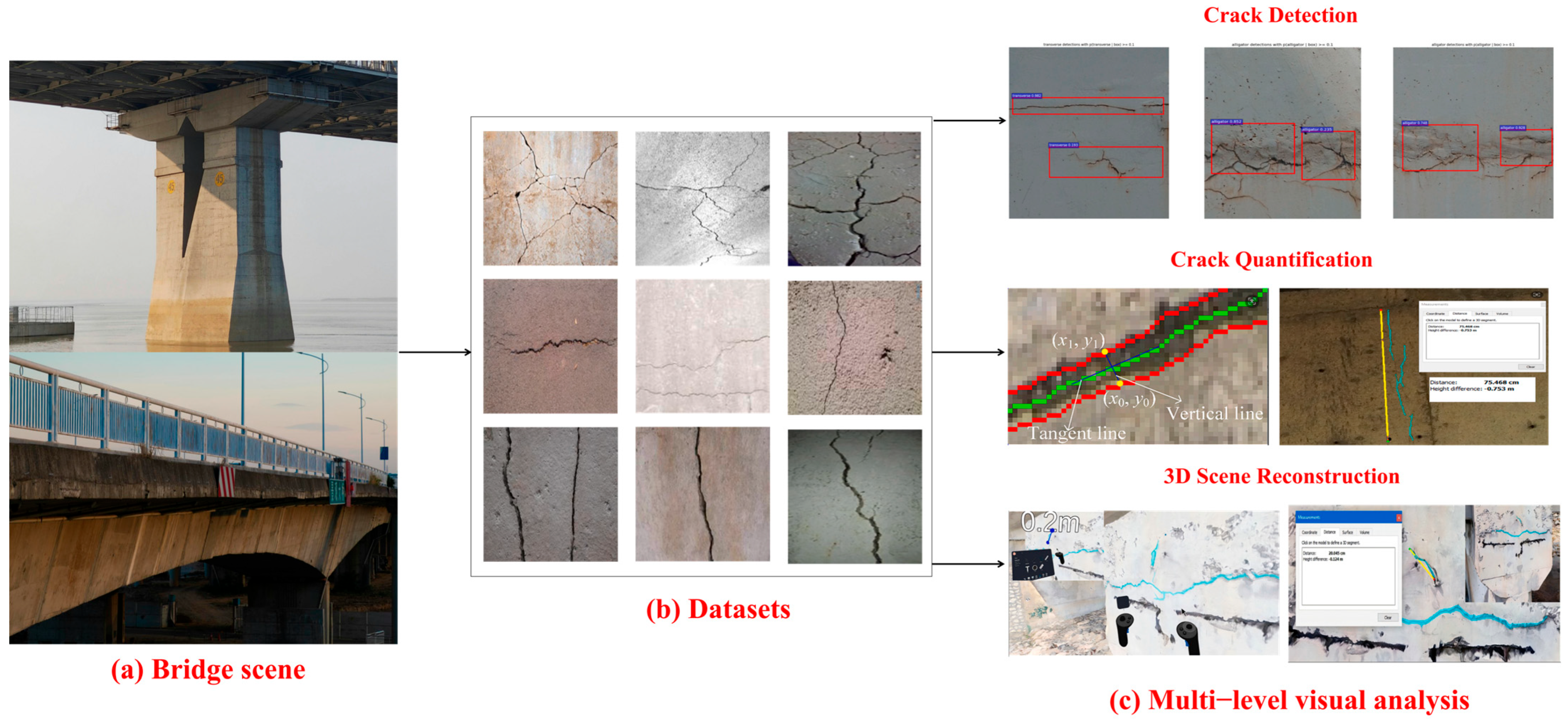
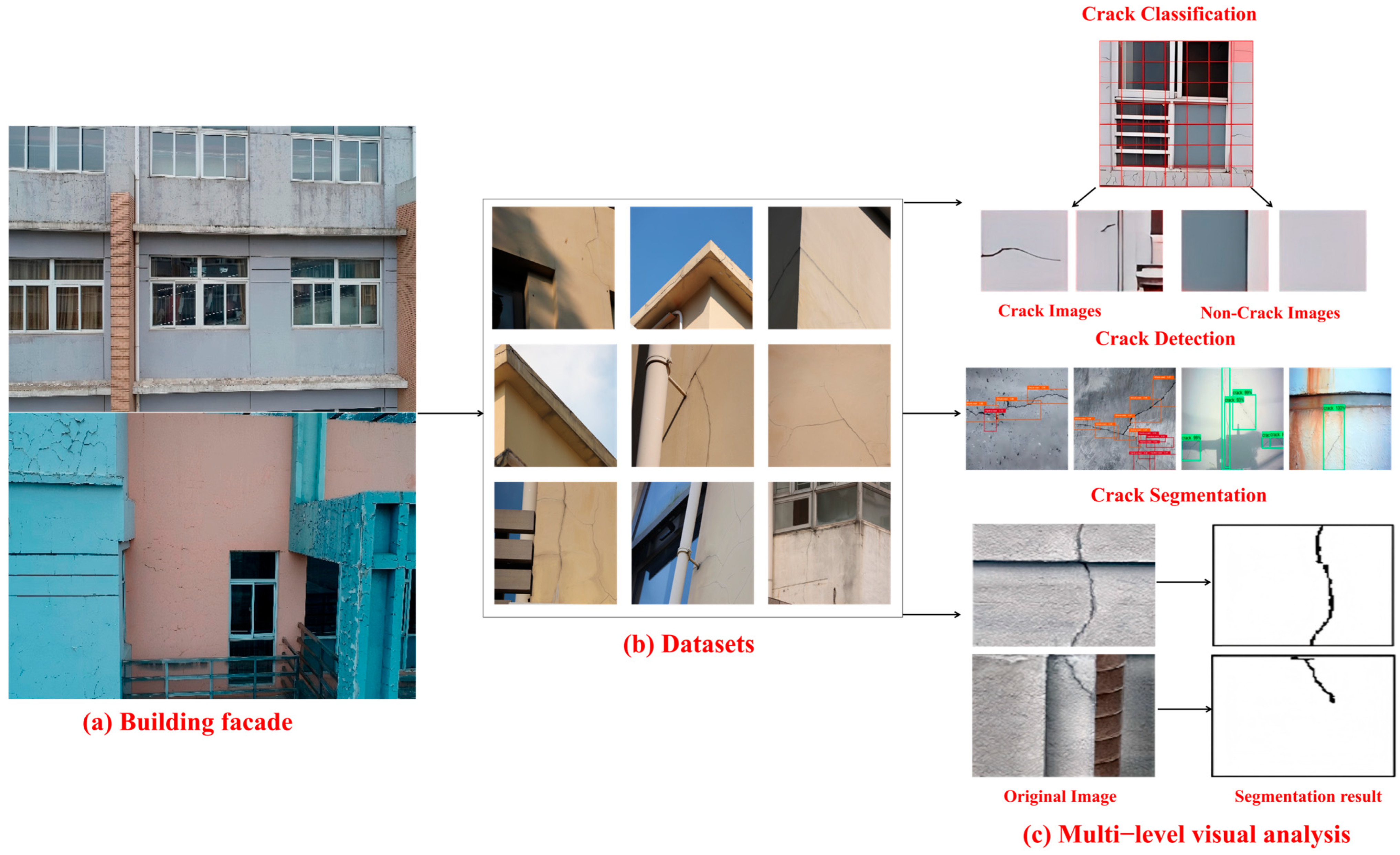
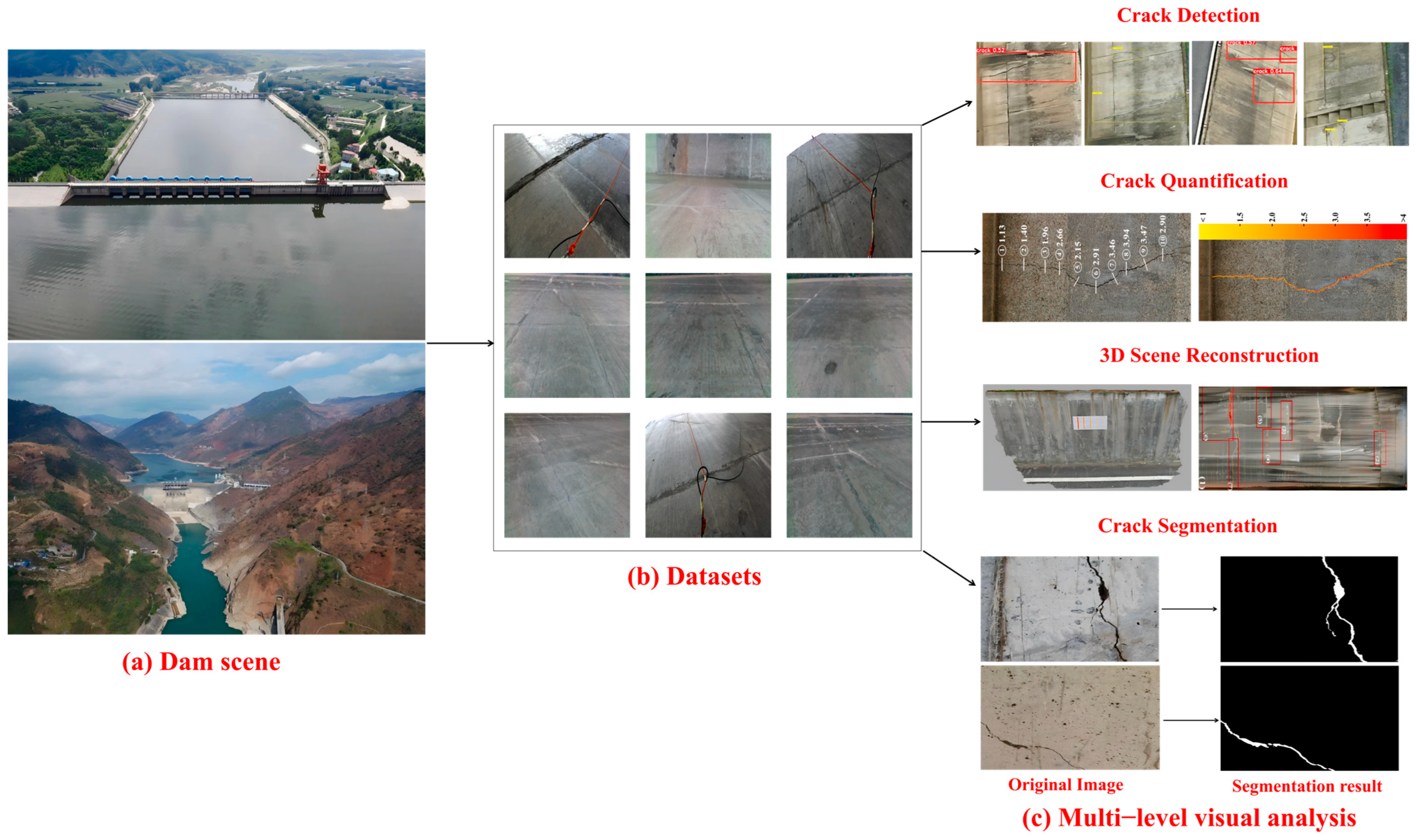
- A multi-level visual analysis framework for UAV-based crack inspection is established, organizing existing methods into image-level classification, object-level detection, pixel-level segmentation, geometric quantification, and 3D reconstruction.
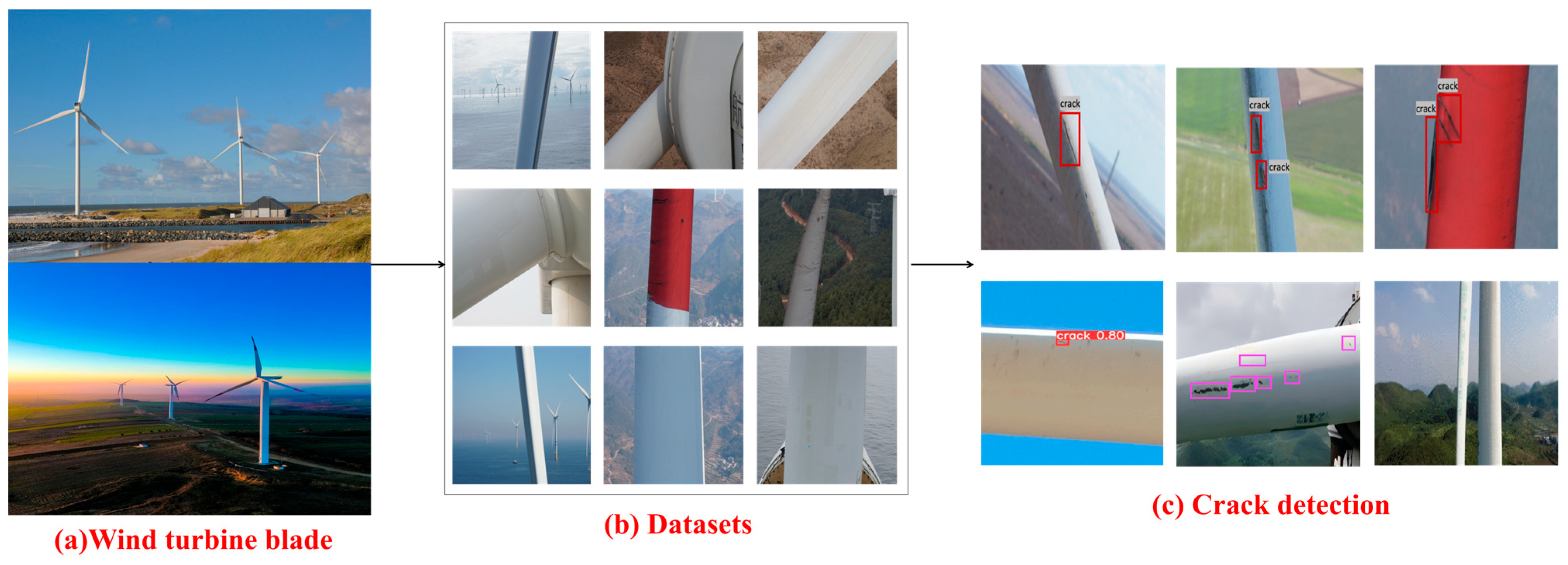
- Our comparative analysis across bridges, pavements, dams, building facades, and wind turbine blades shows that scene-specific differences strongly influence data acquisition strategies, model selection, and method performance.
- This paper provides a systematic methodological reference for advancing UAV-based infrastructure crack inspection from algorithm development toward practical multi-scenario engineering applications.
- We identify current research bottlenecks, such as limited multi-scenario generalization and multi-source heterogeneous data fusion, while highlighting future directions like visual foundation models to ensure stable structural health monitoring.
Abstract
1. Introduction
1.1. Background
1.2. Advantages of UAV-Based Inspection
1.3. Related Work
1.4. Contributions
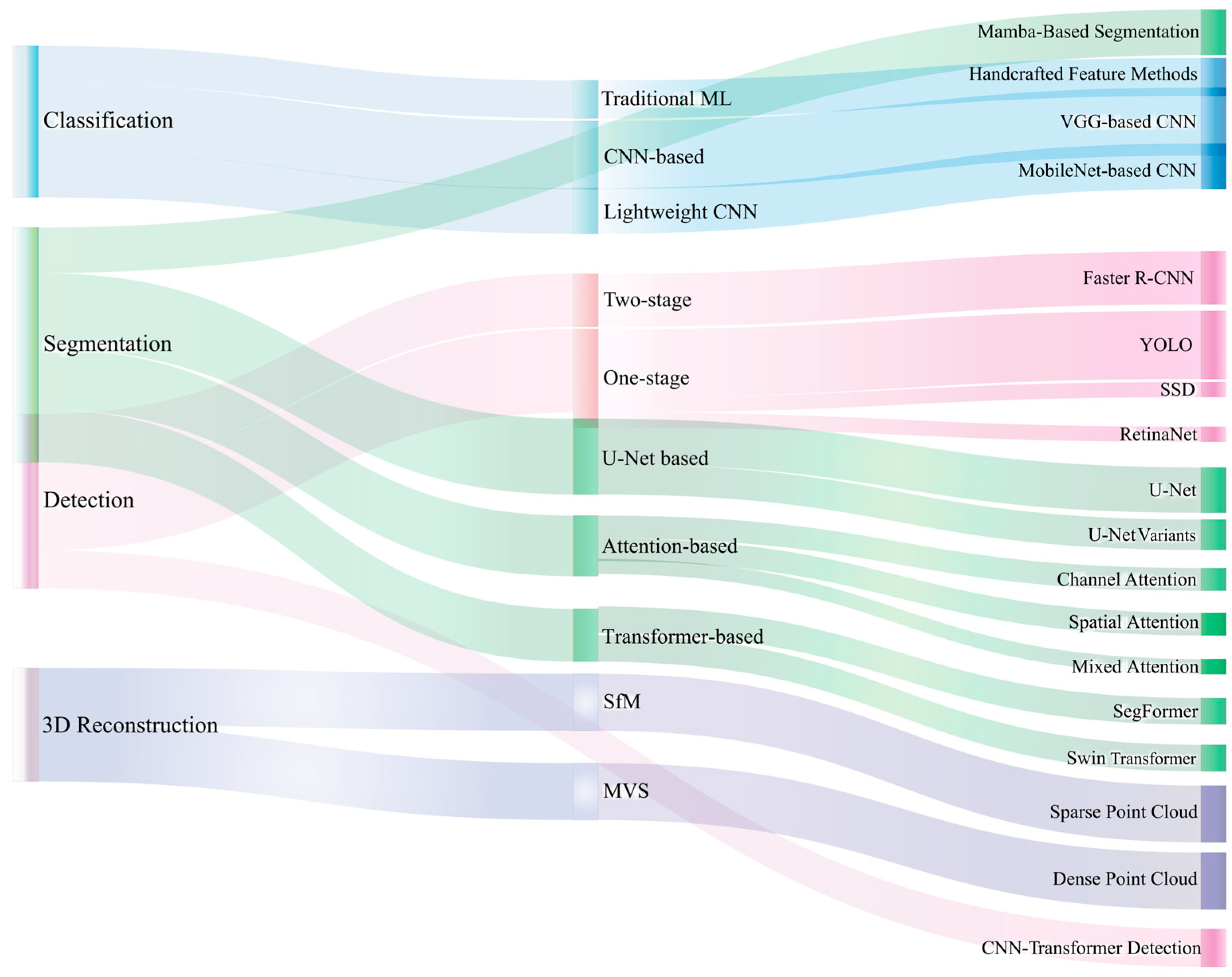
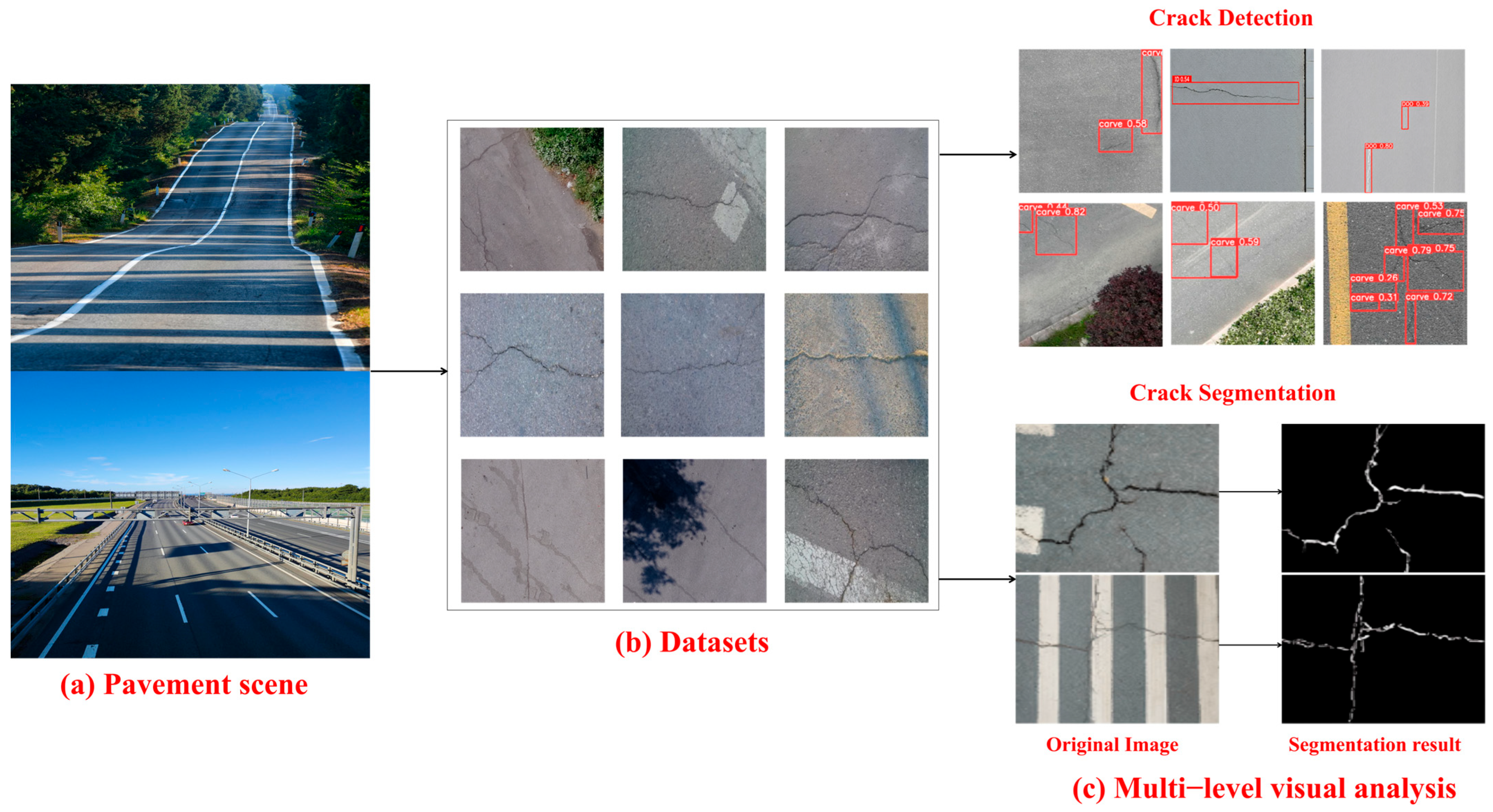
- We establish a multi-level visual analysis framework for UAV-based scenarios. From the perspective of visual task hierarchy, we systematically categorize existing methods into five levels: image-level classification, object-level detection, pixel-level segmentation, geometric quantification and 3D reconstruction. The framework offers a clear methodological structure for civil infrastructure inspection.
- We comparatively analyze the engineering applicability of crack detection methods in multi-scenario UAV-based inspection. We consider typical civil infrastructure scenarios, including bridges, pavements, dams and wind turbine blades. We compare different methods in practical engineering contexts and reveal how scenario-specific differences influence model selection and performance.
- We summarize the key challenges in UAV-based crack inspection and discuss future research directions. We identify current research bottlenecks, including limited multi-scenario generalization, constraints of UAV platforms and challenges in multi-source heterogeneous data fusion. We further discuss future directions in light of advances in remote sensing imaging and intelligent perception technologies.
2. Datasets, UAV Platform and Evaluation Metrics
2.1. Datasets
2.2. UAV Platform
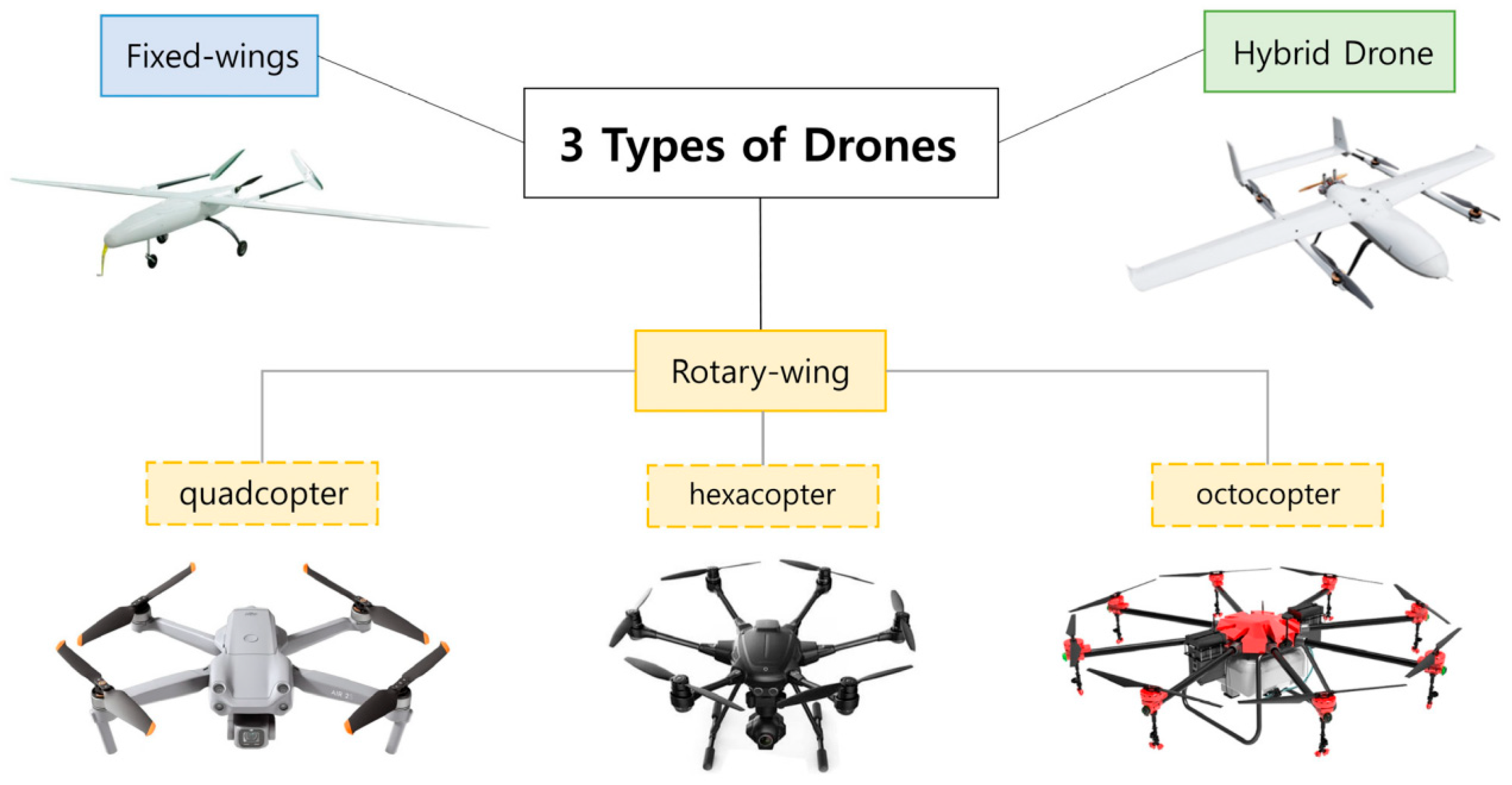
- Multi-rotor UAVs are the most commonly used and operationally mature platform for infrastructure inspection. Their payload capacity, flight stability, and wind resistance generally increase with rotor number. Typical configurations include quadrotor, hexarotor, and octorotor systems [53]. A multi-rotor UAV usually comprises an airframe, a flight controller, an inertial measurement unit, a global navigation satellite system, a power system, and rotors. Its takeoff, landing, and hovering performance make it well-suited to precise fixed-point observation and high-resolution imaging for fine defect detection [49,51,53]. Therefore, based on the structural and imaging characteristics described above, multi-rotor UAVs are often used for close-range inspection scenarios involving complex structures and confined spaces that require local feature extraction, such as towering bridge piers, high-rise building facades, dams, and wind turbine blades [30,48,49]. However, in terms of endurance performance, due to battery capacity, structure size, weather conditions and other factors, the effective operation time of a single flight of multirotor UAVs is usually between 20 and 40 min, and the maximum flight speed is about 60 km/h, which limits their ability and efficiency to perform large-area inspection to some extent [53,54].
- Fixed-wing UAVs offer stable flight, low vibration, long endurance, and high speed. These features enable the acquisition of spatially continuous remote sensing imagery with consistent quality. Fixed-wing platforms are often used for large-scale mapping and data collection [51,53,55]. Their configuration follows the aerodynamic layout of conventional aircraft, including a fuselage, fixed wings, an empennage, and a propulsion system. Lift is generated through the interaction of the wing with the airflow, which is what supports efficient and stable flight [53]. Based on the above dynamic characteristics and design structure, fixed-wing UAVs have a stronger ability to withstand gusts than multi-rotor UAVs, allowing them to maintain stability and capture high quality images even under challenging weather conditions. However, fixed-wing UAVs cannot hover. Their imaging operations also depend on dedicated takeoff and landing areas and careful flight path planning. These constraints place higher demands on site conditions and operator experience. They also limit the use of fixed-wing UAVs for precise close-range inspection in confined spaces [52]. Consequently, fixed wing UAVs are suitable for macroscopic inspection and mapping tasks of large scale infrastructure such as highways and airport runways [56]. These types of scenarios meet the takeoff, landing, and flight requirements of fixed-wing UAVs, while their spatially continuous distribution characteristics facilitate leveraging the technical advantages of fixed-wing UAVs in large area coverage.
- Hybrid UAVs combine the hovering capability of multi-rotor UAVs with the speed and endurance of fixed-wing platforms. They alleviate the endurance limits of multi-rotor systems and reduce the dependence of fixed-wing UAVs on dedicated takeoff and landing sites [57]. Hybrid UAVs integrate both rotor and fixed-wing systems. Rotors support vertical takeoff, landing, and hovering. After transition, fixed wings provide the main lift, and the propulsion system enables efficient cruise flight [58]. Therefore, the endurance and spatial coverage capability of hybrid UAVs are generally superior to those of multi-rotor platforms, but still inferior to those of fixed-wing platforms [59]. Based on the above characteristics, hybrid UAVs offer significant advantages in infrastructure inspection tasks that require multi zone, long endurance, and diverse operations, such as highways and long span bridges crossing rivers or seas [52]. However, Hybrid UAVs have more complex structural designs and power configurations. This increases manufacturing cost and system integration complexity. Flight mode transitions also require more frequent maintenance of key components, which limits their large-scale application to some extent [60].
2.3. Evaluation Metrics
3. Multi-Level Analysis Framework for UAV-Based Crack Detection
3.1. Crack Classification
3.1.1. Traditional Machine Learning and Handcrafted Feature-Based Methods
3.1.2. Traditional CNN and Binary Classification
3.1.3. Lightweight Classification Networks for UAV Edge Computing
3.2. Crack Detection
3.2.1. Two-Stage Detectors
3.2.2. One-Stage Detectors
3.2.3. Attention Mechanisms and Transformer-Based Methods
3.3. Crack Segmentation
3.3.1. U-Net-Based Crack Segmentation
3.3.2. Attention-Based Crack Segmentation
3.3.3. Transformer-Based Crack Segmentation
3.3.4. Mamba-Based Crack Segmentation
3.4. Geometric Quantification and 3D Reconstruction of Cracks
3.4.1. Crack Geometric Quantification
3.4.2. Crack 3D Reconstruction
3.5. Multi-Level Task Workflow
4. Scene Analysis and Key Challenges
4.1. Multi-Scenario UAV-Based Crack Inspection for Civil Infrastructure
4.1.1. Bridge Scenario
4.1.2. Building Facades Scenario
4.1.3. Dam Scenario
4.1.4. Wind Turbine Blade Scenario
4.1.5. Pavement Scenario
4.2. Key Challenges of UAV-Based Inspection Across Diverse Scenarios
- During close-range UAV inspection, rotor systems are affected by gusts, wind shear, and wake effects. These disturbances induce high-frequency vibrations that exceed the gimbal’s compensation capability and introduce motion blur into the imaging system. Illumination conditions also impose strong constraints on aerial image quality. In low-light environments, long exposure and high International Organization for Standardization settings introduce blur and noise. Conversely, intense illumination triggers specular reflection, which causes local overexposure and irreversibly erases critical crack features [29].
- Current battery energy storage and rotor flight efficiency impose a trade-off between payload capacity and endurance, which limits inspection coverage and image quality to some extent. Most UAV platforms currently rely on lithium-polymer batteries. Under normal payload conditions, a single flight usually lasts only about 30 min [125]. As a result, inspection tasks in large-scale infrastructure scenarios often have to be divided into multiple flight segments. Frequent battery replacement or multi-UAV collaboration is therefore required. Such discontinuous data acquisition fragments aerial imagery across time and space. It also aggravates geometric seam artifacts during image stitching and reduces crack detection accuracy.
- To overcome the limitations of single-sensor crack detection in inspection scenarios, UAV platforms are increasingly evolving toward the integration of multi-source heterogeneous sensors, including RGB, thermal infrared, multispectral, and LiDAR sensors [17]. However, heterogeneous sensor integration goes beyond mere hardware stacking. Significant differences exist in sensing mechanisms, imaging modalities, sampling frequencies, and spatial resolutions across sensor types [14]. During UAV inspection under dynamic operating conditions, platform vibration and attitude variation further amplify spatial misalignment among sensors. Different sensors produce inconsistent observations over the same target region, which complicates subsequent image processing and feature extraction.
- UAV inspection is increasingly moving toward edge-cloud collaborative frameworks and real-time onboard detection. However, the integration of multi-source heterogeneous sensors has rapidly increased the volume of high-resolution optical imagery, LiDAR point clouds, and other data. These massive data streams sharply raise the computational demand of network inference, including flops and dynamic memory usage. Meanwhile, UAV platforms are constrained by payload capacity and power consumption, leaving onboard edge computing systems far less capable than ground-based or cloud-based devices in computing power, memory, and bandwidth. The mismatch makes out-of-memory failures and severe real-time performance degradation highly likely [126].
- At the regulatory level, aviation authorities such as the Civil Aviation Administration of China, the Federal Aviation Administration, and the European Union Aviation Safety Agency generally require UAVs to operate within Visual Line of Sight. In addition, inspection tasks in some areas are subject to complex approval and safety certification procedures. These constraints limit the operational range of UAVs and reduce the deployability of large-scale engineering inspection [54]. In dense urban areas or near sensitive facilities, high-resolution sensors may also involve invasive data collection and security risks, raising public concern over privacy infringement and creating substantial regulatory and social resistance. Such regulatory and social resistance constrains the large-scale and routine deployment of UAV inspection [53].
5. Conclusions
- Visual foundation models, such as Segment Anything Model (SAM), may improve the cross-scene generalization of UAV-based crack inspection. However, direct deployment of these models on UAV platforms remains difficult. Cracks in UAV imagery are usually fine grained, low in contrast, and small in scale. These characteristics make it difficult for features learned from general visual data to represent crack boundaries and weak textures accurately. In addition, foundation models usually require large memory, high computational power, and long inference time. These requirements are difficult to satisfy on UAV edge platforms such as NVIDIA Jetson, where payload, battery power, and onboard computing resources are limited. Future work should explore lightweight foundation models, efficient fine tuning, model compression, and edge-cloud collaborative inference to balance generalization ability with real-time deployment feasibility.
- UAV onboard computing remains far less capable than ground stations, limiting real-time model complexity. The airborne edge intelligence and multi-UAV cooperation inspection mechanism can be promoted to reduce the pressure of single machine data processing through distributed processing and collaborative scheduling, and improve the efficiency of large-scale infrastructure inspection tasks.
- Combining RGB, thermal, and LiDAR data can overcome single-modality weaknesses, but dynamic UAV conditions cause severe spatial misalignment. The consistency and complementarity of multi-source heterogeneous remote sensing data in dynamic inspection scenarios are important to ensure the detection reliability.
- The integrated application of UAV remote sensing technology and digital twins is constructed to promote the transformation of apparent damage detection to structural state assessment of infrastructure, so as to ensure long-term monitoring and stable operation of infrastructure.
Author Contributions
Funding
Data Availability Statement
Acknowledgments
Conflicts of Interest
References
- Guo, J.; Liu, P.; Xiao, B.; Deng, L.; Wang, Q. Surface defect detection of civil structures using images: Review from data perspective. Autom. Constr. 2024, 158, 105186. [Google Scholar] [CrossRef]
- Dong, C.-Z.; Catbas, F.N. A review of computer vision–based structural health monitoring at local and global levels. Struct. Health Monit. 2021, 20, 692–743. [Google Scholar] [CrossRef]
- Wang, W.; Su, C. Semi-supervised semantic segmentation network for surface crack detection. Autom. Constr. 2021, 128, 103786. [Google Scholar] [CrossRef]
- Kim, H.; Lee, J.; Ahn, E.; Cho, S.; Shin, M.; Sim, S.-H. Concrete crack identification using a UAV incorporating hybrid image processing. Sensors 2017, 17, 2052. [Google Scholar] [CrossRef] [PubMed]
- Jiang, S.; Zhang, J. Real-time crack assessment using deep neural networks with wall-climbing unmanned aerial system. Comput.-Aided Civ. Infrastruct. Eng. 2020, 35, 549–564. [Google Scholar] [CrossRef]
- Fan, J.; Saadeghvaziri, M.A. Applications of drones in infrastructures: Challenges and opportunities. Int. J. Mech. Mechatron. Eng. 2019, 13, 649–655. [Google Scholar]
- Greenwood, W.W.; Lynch, J.P.; Zekkos, D. Applications of UAVs in civil infrastructure. J. Infrastruct. Syst. 2019, 25, 04019002. [Google Scholar] [CrossRef]
- Kerle, N.; Nex, F.; Gerke, M.; Duarte, D.; Vetrivel, A. UAV-based structural damage mapping: A review. ISPRS Int. J. Geo-Inf. 2019, 9, 14. [Google Scholar] [CrossRef]
- Rudd, J.D.; Roberson, G.T.; Classen, J.J. Application of satellite, unmanned aircraft system, and ground-based sensor data for precision agriculture: A review. In Proceedings of the 2017 ASABE Annual International Meeting; American Society of Agricultural and Biological Engineers: St. Joseph, MI, USA, 2017; p. 1. [Google Scholar]
- Wang, C.; Tang, J. Reliable crack evolution monitoring from UAV remote sensing: Bridging detection and temporal dynamics. Remote Sens. 2025, 18, 51. [Google Scholar] [CrossRef]
- Zhou, S.; Canchila, C.; Song, W. Deep learning-based crack segmentation for civil infrastructure: Data types, architectures, and benchmarked performance. Autom. Constr. 2023, 146, 104678. [Google Scholar] [CrossRef]
- Ali, R.; Chuah, J.H.; Talip, M.S.A.; Mokhtar, N.; Shoaib, M.A. Structural crack detection using deep convolutional neural networks. Autom. Constr. 2022, 133, 103989. [Google Scholar] [CrossRef]
- Ai, D.; Jiang, G.; Lam, S.-K.; He, P.; Li, C. Computer vision framework for crack detection of civil infrastructure—A review. Eng. Appl. Artif. Intell. 2023, 117, 105478. [Google Scholar] [CrossRef]
- Kim, S.Y.; Kwon, D.Y.; Jang, A.; Ju, Y.K.; Lee, J.-S.; Hong, S. A review of UAV integration in forensic civil engineering: From sensor technologies to geotechnical, structural and water infrastructure applications. Measurement 2024, 224, 113886. [Google Scholar] [CrossRef]
- Aela, P.; Chi, H.-L.; Fares, A.; Zayed, T.; Kim, M. UAV-based studies in railway infrastructure monitoring. Autom. Constr. 2024, 167, 105714. [Google Scholar] [CrossRef]
- Feroz, S.; Abu Dabous, S. Uav-based remote sensing applications for bridge condition assessment. Remote Sens. 2021, 13, 1809. [Google Scholar] [CrossRef]
- Meira, G.d.S.; Guedes, J.V.F.; Bias, E.d.S. UAV-embedded sensors and deep learning for pathology identification in building façades: A review. Drones 2024, 8, 341. [Google Scholar] [CrossRef]
- Hamishebahar, Y.; Guan, H.; So, S.; Jo, J. A comprehensive review of deep learning-based crack detection approaches. Appl. Sci. 2022, 12, 1374. [Google Scholar] [CrossRef]
- Yao, Z.; Li, Y.; Fu, H.; Tian, J.; Zhou, Y.; Chin, C.-L.; Ma, C.-K. Research on concrete crack and depression detection method based on multi-level defect fusion segmentation network. Buildings 2025, 15, 1657. [Google Scholar] [CrossRef]
- Zhang, Y.; Lu, Y.; Duan, Y.; Wei, D.; Zhu, X.; Zhang, B.; Pang, B. Robust surface crack detection with structure line guidance. Int. J. Appl. Earth Obs. Geoinf. 2023, 124, 103527. [Google Scholar] [CrossRef]
- Kim, B.; Natarajan, Y.; Preethaa, K.S.; Song, S.; An, J.; Mohan, S. Real-time assessment of surface cracks in concrete structures using integrated deep neural networks with autonomous unmanned aerial vehicle. Eng. Appl. Artif. Intell. 2024, 129, 107537. [Google Scholar] [CrossRef]
- Lei, B.; Ren, Y.; Wang, N.; Huo, L.; Song, G. Design of a new low-cost unmanned aerial vehicle and vision-based concrete crack inspection method. Struct. Health Monit. 2020, 19, 1871–1883. [Google Scholar] [CrossRef]
- Ding, W.; Yang, H.; Yu, K.; Shu, J. Crack detection and quantification for concrete structures using UAV and transformer. Autom. Constr. 2023, 152, 104929. [Google Scholar] [CrossRef]
- Zhao, S.; Kang, F.; Li, J. Intelligent segmentation method for blurred cracks and 3D mapping of width nephograms in concrete dams using UAV photogrammetry. Autom. Constr. 2024, 157, 105145. [Google Scholar] [CrossRef]
- He, X.; Tang, Z.; Deng, Y.; Zhou, G.; Wang, Y.; Li, L. UAV-based road crack object-detection algorithm. Autom. Constr. 2023, 154, 105014. [Google Scholar] [CrossRef]
- Chen, X.; Zhang, X.; Ren, M.; Zhou, B.; Sun, M.; Feng, Z.; Chen, B.; Zhi, X. A multiscale enhanced pavement crack segmentation network coupling spectral and spatial information of UAV hyperspectral imagery. Int. J. Appl. Earth Obs. Geoinf. 2024, 128, 103772. [Google Scholar] [CrossRef]
- An, J.; Dong, S.; Wang, X.; Li, C.; Zhao, W. Research on UAV aerial imagery detection algorithm for Mining-Induced surface cracks based on improved YOLOv10. Sci. Rep. 2025, 15, 30101. [Google Scholar] [CrossRef]
- Zhang, Y.; Zuo, Z.; Xu, X.; Wu, J.; Zhu, J.; Zhang, H.; Wang, J.; Tian, Y. Road damage detection using UAV images based on multi-level attention mechanism. Autom. Constr. 2022, 144, 104613. [Google Scholar] [CrossRef]
- Peng, L.; Liu, J. Detection and analysis of large-scale WT blade surface cracks based on UAV-taken images. IET Image Process. 2018, 12, 2059–2064. [Google Scholar] [CrossRef]
- Wang, L.; Zhang, Z. Automatic detection of wind turbine blade surface cracks based on UAV-taken images. IEEE Trans. Ind. Electron. 2017, 64, 7293–7303. [Google Scholar] [CrossRef]
- Xiaoxun, Z.; Xinyu, H.; Xiaoxia, G.; Xing, Y.; Zixu, X.; Yu, W.; Huaxin, L. Research on crack detection method of wind turbine blade based on a deep learning method. Appl. Energy 2022, 328, 120241. [Google Scholar] [CrossRef]
- Yang, F.; Zhang, L.; Yu, S.; Prokhorov, D.; Mei, X.; Ling, H. Feature pyramid and hierarchical boosting network for pavement crack detection. IEEE Trans. Intell. Transp. Syst. 2019, 21, 1525–1535. [Google Scholar] [CrossRef]
- Zou, Q.; Cao, Y.; Li, Q.; Mao, Q.; Wang, S. CrackTree: Automatic crack detection from pavement images. Pattern Recognit. Lett. 2012, 33, 227–238. [Google Scholar] [CrossRef]
- Liu, Y.; Yao, J.; Lu, X.; Xie, R.; Li, L. DeepCrack: A deep hierarchical feature learning architecture for crack segmentation. Neurocomputing 2019, 338, 139–153. [Google Scholar] [CrossRef]
- Shi, Y.; Cui, L.; Qi, Z.; Meng, F.; Chen, Z. Automatic road crack detection using random structured forests. IEEE Trans. Intell. Transp. Syst. 2016, 17, 3434–3445. [Google Scholar] [CrossRef]
- Eisenbach, M.; Stricker, R.; Seichter, D.; Amende, K.; Debes, K.; Sesselmann, M.; Ebersbach, D.; Stoeckert, U.; Gross, H.-M. How to get pavement distress detection ready for deep learning? A systematic approach. In Proceedings of the 2017 International Joint Conference on Neural Networks (IJCNN); IEEE: New York, NY, USA, 2017; pp. 2039–2047. [Google Scholar]
- He, J.; Gong, L.; Xu, C.; Wang, P.; Zhang, Y.; Zheng, O.; Su, G.; Yang, Y.; Hu, J.; Sun, Y. HighRPD: A high-altitude drone dataset of road pavement distress. Data Brief 2025, 59, 111377. [Google Scholar] [CrossRef]
- Dorafshan, S.; Thomas, R.J.; Maguire, M. SDNET2018: An annotated image dataset for non-contact concrete crack detection using deep convolutional neural networks. Data Brief 2018, 21, 1664–1668. [Google Scholar] [CrossRef]
- Yan, H.; Zhang, J. UAV-PDD2023: A benchmark dataset for pavement distress detection based on UAV images. Data Brief 2023, 51, 109692. [Google Scholar] [CrossRef]
- Xu, H.; Su, X.; Wang, Y.; Cai, H.; Cui, K.; Chen, X. Automatic bridge crack detection using a convolutional neural network. Appl. Sci. 2019, 9, 2867. [Google Scholar] [CrossRef]
- Liu, H.; Jia, C.; Cheng, X.; Liu, X.; Shi, F. Serial Local Patterns and Irregular Dependencies Extract and Cascaded Fusion Network for Structural Crack Segmentation. In Proceedings of the ICASSP 2025-2025 IEEE International Conference on Acoustics, Speech and Signal Processing (ICASSP); IEEE: New York, NY, USA, 2025; pp. 1–5. [Google Scholar]
- Zhao, B.; Zhou, X.; Yang, G.; Wen, J.; Zhang, J.; Dou, J.; Li, G.; Chen, X.; Chen, B.M. High-resolution infrastructure defect detection dataset sourced by unmanned systems and validated with deep learning. Autom. Constr. 2024, 163, 105405. [Google Scholar] [CrossRef]
- Feng, C.; Zhang, H.; Wang, H.; Wang, S.; Li, Y. Automatic pixel-level crack detection on dam surface using deep convolutional network. Sensors 2020, 20, 2069. [Google Scholar] [CrossRef]
- Hong, K.; Wang, H.; Yuan, B.; Wang, T. Multiple defects inspection of dam spillway surface using deep learning and 3D reconstruction techniques. Buildings 2023, 13, 285. [Google Scholar] [CrossRef]
- Shihavuddin, A.; Chen, X. Dtu-Drone Inspection Images of Wind Turbine. 2018. Available online: https://orbit.dtu.dk/en/publications/dtu-drone-inspection-images-of-wind-turbine (accessed on 24 May 2026).
- Gohar, I.; Halimi, A.; See, J.; Yew, W.K.; Yang, C. Slice-aided defect detection in ultra high-resolution wind turbine blade images. Machines 2023, 11, 953. [Google Scholar] [CrossRef]
- Yang, C.; Liu, X.; Zhou, H.; Ke, Y.; See, J. Towards accurate image stitching for drone-based wind turbine blade inspection. Renew. Energy 2023, 203, 267–279. [Google Scholar] [CrossRef]
- Ren, W.; Zhong, Z. Building construction crack detection with BCCD YOLO enhanced feature fusion and attention mechanisms. Sci. Rep. 2025, 15, 23167. [Google Scholar] [CrossRef]
- Kao, S.-P.; Wang, F.-L.; Lin, J.-S.; Tsai, J.; Chu, Y.-D.; Hung, P.-S. Bridge crack inspection efficiency of an unmanned aerial vehicle system with a laser ranging module. Sensors 2022, 22, 4469. [Google Scholar] [CrossRef]
- Choi, D.; Bell, W.; Kim, D.; Kim, J. UAV-driven structural crack detection and location determination using convolutional neural networks. Sensors 2021, 21, 2650. [Google Scholar] [CrossRef] [PubMed]
- Boon, M.A.; Drijfhout, A.P.; Tesfamichael, S. Comparison of a fixed-wing and multi-rotor UAV for environmental mapping applications: A case study. Int. Arch. Photogramm. Remote Sens. Spat. Inf. Sci. 2017, 42, 47–54. [Google Scholar] [CrossRef]
- Choi, H.-W.; Kim, H.-J.; Kim, S.-K.; Na, W.S. An overview of drone applications in the construction industry. Drones 2023, 7, 515. [Google Scholar] [CrossRef]
- Liang, H.; Lee, S.-C.; Bae, W.; Kim, J.; Seo, S. Towards UAVs in construction: Advancements, challenges, and future directions for monitoring and inspection. Drones 2023, 7, 202. [Google Scholar] [CrossRef]
- Mohsan, S.A.H.; Othman, N.Q.H.; Li, Y.; Alsharif, M.H.; Khan, M.A. Unmanned aerial vehicles (UAVs): Practical aspects, applications, open challenges, security issues, and future trends. Intell. Serv. Robot. 2023, 16, 109–137. [Google Scholar] [CrossRef]
- Kim, J.-W.; Kim, S.-B.; Park, J.-C.; Nam, J.-W. Development of crack detection system with unmanned aerial vehicles and digital image processing. Adv. Struct. Eng. Mech. (ASEM15) 2015, 33, 25–29. [Google Scholar]
- Rahnamayiezekavat, P.; Wang, D.; Chai, J.; Moon, S.; Rashidi, M.; Wang, X. Automated pavement marking integrity assessment using a UAV platform—A test case of public parking. J. Asian Archit. Build. Eng. 2025, 24, 1594–1605. [Google Scholar] [CrossRef]
- Hegde, N.T.; George, V.; Nayak, C.G.; Kumar, K. Design, dynamic modelling and control of tilt-rotor UAVs: A review. Int. J. Intell. Unmanned Syst. 2020, 8, 143–161. [Google Scholar] [CrossRef]
- Shah, S.F.A.; Mazhar, T.; Al Shloul, T.; Shahzad, T.; Hu, Y.-C.; Mallek, F.; Hamam, H. Applications, challenges, and solutions of unmanned aerial vehicles in smart city using blockchain. PeerJ Comput. Sci. 2024, 10, e1776. [Google Scholar] [CrossRef]
- Hengyu, L.; Rongguo, M. Sky’s-Eye Perspective: A Multidimensional Review of UAV Applications in Highway Systems. Appl. Sci. 2025, 15, 11199. [Google Scholar]
- Tian, Y.; Lin, F.; Li, Y.; Zhang, T.; Zhang, Q.; Fu, X.; Huang, J.; Dai, X.; Wang, Y.; Tian, C. UAVs meet LLMs: Overviews and perspectives towards agentic low-altitude mobility. Inf. Fusion 2025, 122, 103158. [Google Scholar] [CrossRef]
- Ameli, Z.; Aremanda, Y.; Friess, W.A.; Landis, E.N. Impact of UAV Hardware Options on Bridge Inspection Mission Capabilities. Drones 2022, 6, 64. [Google Scholar] [CrossRef]
- Yuan, Q.; Shi, Y.; Li, M. A review of computer vision-based crack detection methods in civil infrastructure: Progress and challenges. Remote Sens. 2024, 16, 2910. [Google Scholar] [CrossRef]
- Ali, L.; Alnajjar, F.; Jassmi, H.A.; Gocho, M.; Khan, W.; Serhani, M.A. Performance evaluation of deep CNN-based crack detection and localization techniques for concrete structures. Sensors 2021, 21, 1688. [Google Scholar] [CrossRef]
- Golding, V.P.; Gharineiat, Z.; Munawar, H.S.; Ullah, F. Crack detection in concrete structures using deep learning. Sustainability 2022, 14, 8117. [Google Scholar] [CrossRef]
- Tymoshchuk, D.; Didych, I.; Maruschak, P.; Yasniy, O.; Mykytyshyn, A.; Mytnyk, M. Machine Learning Approaches for Classification of Composite Materials. Modelling 2025, 6, 118. [Google Scholar] [CrossRef]
- Mayya, A.M.; Alkayem, N.F. Enhance the concrete crack classification based on a novel multi-stage YOLOV10-ViT framework. Sensors 2024, 24, 8095. [Google Scholar] [CrossRef]
- Karimi, N.; Mishra, M.; Lourenço, P.B. Automated surface crack detection in historical constructions with various materials using deep learning-based YOLO network. Int. J. Archit. Herit. 2025, 19, 581–597. [Google Scholar] [CrossRef]
- Hu, Y.; Chen, S.; Zhao, Z.; Cheng, S. Dual-Path Framework Analysis of Crack Detection Algorithm and Scenario Simulation on Fujian Tulou Surface. Coatings 2025, 15, 1156. [Google Scholar] [CrossRef]
- Kang, D.H.; Cha, Y.-J. Efficient attention-based deep encoder and decoder for automatic crack segmentation. Struct. Health Monit. 2022, 21, 2190–2205. [Google Scholar] [CrossRef]
- Tran, T.V.; Nguyen-Xuan, H.; Zhuang, X. Investigation of crack segmentation and fast evaluation of crack propagation, based on deep learning. Front. Struct. Civ. Eng. 2024, 18, 516–535. [Google Scholar] [CrossRef]
- Nyathi, M.A.; Bai, J.; Wilson, I.D. Deep learning for concrete crack detection and measurement. Metrology 2024, 4, 66–81. [Google Scholar] [CrossRef]
- Gonthina, S.S.; Aditya, S.; Gannoju, A.T.; Das, D.; Sinha, A. CrackScan: Enabling Intelligent Edge Inspection with UAVs for Structural Health Monitoring. IEEE Sens. J. 2025, 25, 42113–42120. [Google Scholar] [CrossRef]
- Wang, Y.; Chen, Y.; Xie, Y.; Zhu, J.; Dang, C.; Zhu, H. BSGNet: Vehicle Detection in UAV Imagery of Construction Scenes via Biomimetic Edge Awareness and Global Receptive Field Modeling. Drones 2026, 10, 32. [Google Scholar] [CrossRef]
- Lee, J.-H.; Gwon, G.-H.; Kim, I.-H.; Jung, H.-J. A motion deblurring network for enhancing UAV image quality in bridge inspection. Drones 2023, 7, 657. [Google Scholar] [CrossRef]
- Cha, Y.J.; Choi, W.; Büyüköztürk, O. Deep learning-based crack damage detection using convolutional neural networks. Comput.-Aided Civ. Infrastruct. Eng. 2017, 32, 361–378. [Google Scholar] [CrossRef]
- Fan, R.; Bocus, M.J.; Zhu, Y.; Jiao, J.; Wang, L.; Ma, F.; Cheng, S.; Liu, M. Road crack detection using deep convolutional neural network and adaptive thresholding. In Proceedings of the 2019 IEEE Intelligent Vehicles Symposium (IV); IEEE: New York, NY, USA, 2019; pp. 474–479. [Google Scholar]
- Wang, J.; Wang, P.; Qu, L.; Pei, Z.; Ueda, T. Automatic detection of building surface cracks using UAV and deep learning-combined approach. Struct. Concr. 2024, 25, 2302–2322. [Google Scholar] [CrossRef]
- Tapkın, S.; Tercan, E.; Bostan, A.; Şengül, G. Crack detection on asphalt runway using unmanned aerial vehicle data with non-crack object removal and deep learning methods. Rev. Constr. 2025, 24, 603–631. [Google Scholar] [CrossRef]
- Li, R.; Yu, J.; Li, F.; Yang, R.; Wang, Y.; Peng, Z. Automatic bridge crack detection using Unmanned aerial vehicle and Faster R-CNN. Constr. Build. Mater. 2023, 362, 129659. [Google Scholar] [CrossRef]
- Chen, X.; Liu, C.; Chen, L.; Zhu, X.; Zhang, Y.; Wang, C. A pavement crack detection and evaluation framework for a UAV inspection system based on deep learning. Appl. Sci. 2024, 14, 1157. [Google Scholar] [CrossRef]
- Zhou, Q.; Ding, S.; Qing, G.; Hu, J. UAV vision detection method for crane surface cracks based on Faster R-CNN and image segmentation. J. Civ. Struct. Health Monit. 2022, 12, 845–855. [Google Scholar] [CrossRef]
- Chen, D.; Chen, D.; Zhong, C.; Zhan, F. NSC-YOLOv8: A Small Target Detection Method for UAV-Acquired Images Based on Self-Adaptive Embedding. Electronics 2025, 14, 1548. [Google Scholar] [CrossRef]
- Li, F.; Lv, X.; Zhao, M.; Wu, W. IFD-YOLO: A Lightweight Infrared Sensor-Based Detector for Small UAV Targets. Sensors 2025, 25, 7449. [Google Scholar] [CrossRef]
- Yu, Z.; Shen, Y.; Shen, C. A real-time detection approach for bridge cracks based on YOLOv4-FPM. Autom. Constr. 2021, 122, 103514. [Google Scholar] [CrossRef]
- Xiang, X.; Hu, H.; Ding, Y.; Zheng, Y.; Wu, S. GC-YOLOv5s: A lightweight detector for UAV road crack detection. Appl. Sci. 2023, 13, 11030. [Google Scholar] [CrossRef]
- Chen, X.; Wang, C.; Liu, C.; Zhu, X.; Zhang, Y.; Luo, T.; Zhang, J. Autonomous crack detection for mountainous roads using UAV inspection system. Sensors 2024, 24, 4751. [Google Scholar] [CrossRef] [PubMed]
- Xing, J.; Liu, Y.; Zhang, G.-Z. Improved YOLOV5-based UAV pavement crack detection. IEEE Sens. J. 2023, 23, 15901–15909. [Google Scholar] [CrossRef]
- Dong, H.; Wang, N.; Fu, D.; Wei, F.; Liu, G.; Liu, B. Precision and Efficiency in Dam Crack Inspection: A Lightweight Object Detection Method Based on Joint Distillation for Unmanned Aerial Vehicles (UAVs). Drones 2024, 8, 692. [Google Scholar] [CrossRef]
- Gao, Y.; Cao, H.; Cai, W.; Zhou, G. Pixel-level road crack detection in UAV remote sensing images based on ARD-Unet. Measurement 2023, 219, 113252. [Google Scholar] [CrossRef]
- Cheng, H.; Li, Y.; Li, H.; Hu, Q. Embankment crack detection in UAV images based on efficient channel attention U2Net. Structures 2023, 50, 430–443. [Google Scholar] [CrossRef]
- Zhu, G.; Liu, J.; Fan, Z.; Yuan, D.; Ma, P.; Wang, M.; Sheng, W.; Wang, K.C. A lightweight encoder–decoder network for automatic pavement crack detection. Comput.-Aided Civ. Infrastruct. Eng. 2024, 39, 1743–1765. [Google Scholar] [CrossRef]
- Chu, H.; Chen, W.; Deng, L. Cascade operation-enhanced high-resolution representation learning for meticulous segmentation of bridge cracks. Adv. Eng. Inform. 2024, 61, 102508. [Google Scholar] [CrossRef]
- He, M.; Lau, T.L. Crackham: A novel automatic crack detection network based on u-net for asphalt pavement. IEEE Access 2024, 12, 12655–12666. [Google Scholar] [CrossRef]
- Xu, H.; Wang, L.; Shu, B.; Zhang, Q.; Li, X. Automatic Detection of Landslide Surface Cracks from UAV Images Using Improved U-Network. Remote Sens. 2025, 17, 2150. [Google Scholar] [CrossRef]
- Feng, M.; Xu, J. Lightweight dual-attention network for concrete crack segmentation. Sensors 2025, 25, 4436. [Google Scholar] [CrossRef]
- Noh, J.; Jang, J.; Jo, J.; Yang, H. Crack Segmentation Using U-Net and Transformer Combined Model. Appl. Sci. 2025, 15, 10737. [Google Scholar] [CrossRef]
- Lin, C.; Tian, D.; Duan, X.; Zhou, J. TransCrack: Revisiting fine-grained road crack detection with a transformer design. Philos. Trans. R. Soc. A Math. Phys. Eng. Sci. 2023, 381, 20220172. [Google Scholar] [CrossRef]
- Tibermacine, A.; Tibermacine, I.E.; Kahhoul, Z.S.; Naidji, I.; Rabehi, A.; Habib, M. A Novel CNN–ViT Model with Cascade Upsampling for Efficient Crack Segmentation. Sensors 2026, 26, 1667. [Google Scholar] [CrossRef] [PubMed]
- Wang, J.; Zeng, Z.; Sharma, P.K.; Alfarraj, O.; Tolba, A.; Zhang, J.; Wang, L. Dual-path network combining CNN and transformer for pavement crack segmentation. Autom. Constr. 2024, 158, 105217. [Google Scholar] [CrossRef]
- Zhang, T.; Qin, L.; Zou, Q.; Zhang, L.; Wang, R.; Zhang, H. Crackscopenet: A lightweight neural network for rapid crack detection on resource-constrained drone platforms. Drones 2024, 8, 417. [Google Scholar] [CrossRef]
- Liu, H.; Jia, C.; Shi, F.; Cheng, X.; Chen, S. SCSegamba: Lightweight Structure-Aware Vision Mamba for Crack Segmentation in Structures. In Proceedings of the 2025 IEEE/CVF Conference on Computer Vision and Pattern Recognition (CVPR), Nashville, TN, USA, 10–17 June 2025; pp. 29406–29416. [Google Scholar]
- Liu, B.; Zhao, Q.; Wang, C.; Xie, H.; Zhang, H. CCMamba: A Multi-Head Criss-Cross Mamba for Pavement Crack Segmentation. IEEE Trans. Intell. Transp. Syst. 2026, 1–15. [Google Scholar] [CrossRef]
- Guan, J.; Cui, L.; Chen, Y.; Yang, C.; Wang, J.; Huo, Y. Lightweight CNN–Mamba Hybrid Network for Multi-Scale Concrete Crack Segmentation Using Vision Sensors. Electronics 2026, 15, 1362. [Google Scholar] [CrossRef]
- Liu, Z.-L.; Zhou, A.; Ran, X.-R.; Wu, Y.-P.; Zhao, W.-G.; Zhang, H. A crack detection and quantification method using matched filter and photograph reconstruction. Sci. Rep. 2025, 15, 25266. [Google Scholar] [CrossRef]
- Xiang, C.; Wang, W.; Deng, L.; Shi, P.; Kong, X. Crack detection algorithm for concrete structures based on super-resolution reconstruction and segmentation network. Autom. Constr. 2022, 140, 104346. [Google Scholar] [CrossRef]
- Xu, Z.; Wang, Y.; Hao, X.; Fan, J. Crack detection of bridge concrete components based on large-scene images using an unmanned aerial vehicle. Sensors 2023, 23, 6271. [Google Scholar] [CrossRef]
- Pereira, V.; Fukai, H. Automated topological analysis of crack networks for data-driven road maintenance decision-making. Int. J. Transp. Dev. Integr. 2025, 9, 919–935. [Google Scholar] [CrossRef]
- Germanese, D.; Leone, G.R.; Moroni, D.; Pascali, M.A.; Tampucci, M. Long-term monitoring of crack patterns in historic structures using UAVs and planar markers: A preliminary study. J. Imaging 2018, 4, 99. [Google Scholar] [CrossRef]
- Yoon, J.; Shin, H.; Song, M.; Gil, H.; Lee, S. A crack width measurement method of UAV Images using high-resolution algorithms. Sustainability 2022, 15, 478. [Google Scholar] [CrossRef]
- Cho, H.; Yoon, H.-J.; Jung, J.-Y. Effects of the ground resolution and thresholding on crack width measurements. Sensors 2018, 18, 2644. [Google Scholar] [CrossRef]
- Zhou, H.-F.; Hu, T.-Y.; Zhang, X.-L.; Lou, Y.-H.; Ni, Y.-Q. Uav-borne thermal imaging and adaptive pixel-level recognition for asphalt pavement crack detection. Infrared Phys. Technol. 2025, 152, 106279. [Google Scholar] [CrossRef]
- Liu, Y.F.; Nie, X.; Fan, J.S.; Liu, X.G. Image-based crack assessment of bridge piers using unmanned aerial vehicles and three-dimensional scene reconstruction. Comput.-Aided Civ. Infrastruct. Eng. 2020, 35, 511–529. [Google Scholar] [CrossRef]
- Yiğit, A.Y.; Uysal, M. Virtual reality visualisation of automatic crack detection for bridge inspection from 3D digital twin generated by UAV photogrammetry. Measurement 2025, 242, 115931. [Google Scholar] [CrossRef]
- Wang, H.-F.; Zhai, L.; Huang, H.; Guan, L.-M.; Mu, K.-N.; Wang, G.-p. Measurement for cracks at the bottom of bridges based on tethered creeping unmanned aerial vehicle. Autom. Constr. 2020, 119, 103330. [Google Scholar] [CrossRef]
- Dorafshan, S.; Maguire, M.; Hoffer, N.V.; Coopmans, C. Challenges in bridge inspection using small unmanned aerial systems: Results and lessons learned. In Proceedings of the 2017 International Conference on Unmanned Aircraft Systems (ICUAS); IEEE: New York, NY, USA, 2017; pp. 1722–1730. [Google Scholar]
- Zhang, L.; Gong, L.; Wang, L.; Wang, Z.; Yan, S. A building crack detection UAV system based on deep learning and linear active disturbance rejection control algorithm. Electronics 2025, 14, 2975. [Google Scholar] [CrossRef]
- Tse, K.-W.; Pi, R.; Sun, Y.; Wen, C.-Y.; Feng, Y. A novel real-time autonomous crack inspection system based on unmanned aerial vehicles. Sensors 2023, 23, 3418. [Google Scholar] [CrossRef]
- Tan, Y.; Yi, W.; Chen, P.; Zou, Y. An adaptive crack inspection method for building surface based on BIM, UAV and edge computing. Autom. Constr. 2024, 157, 105161. [Google Scholar] [CrossRef]
- Chen, K.; Reichard, G.; Xu, X.; Akanmu, A. Automated crack segmentation in close-range building façade inspection images using deep learning techniques. J. Build. Eng. 2021, 43, 102913. [Google Scholar] [CrossRef]
- Han, F.; Gu, C. Surface Damage Detection in Hydraulic Structures from UAV Images Using Lightweight Neural Networks. Remote Sens. 2025, 17, 2668. [Google Scholar] [CrossRef]
- Li, X.; Deng, B.; He, Y.; Chen, Q.; Zhang, Y.; Zhang, B.; Zhang, X. Wind Turbine Blade Surface Defect Detection via UAV High-Resolution Images. IEEE Sens. J. 2025, 26, 2678–2687. [Google Scholar] [CrossRef]
- Pan, R.; Zhang, Y. CrackLite-Net: A Sustainable Transportation-Oriented Real-Time Lightweight Network for Adaptive Road Crack Detection. Sustainability 2025, 17, 10973. [Google Scholar] [CrossRef]
- Zuo, C.; Huang, N.; Yuan, C.; Li, Y. Pavement-DETR: A high-precision real-time detection transformer for pavement defect detection. Sensors 2025, 25, 2426. [Google Scholar] [CrossRef]
- Zhou, J.; Wang, Y.; Zhou, W. Efficient instance segmentation framework for UAV-based pavement distress detection. Autom. Constr. 2025, 175, 106195. [Google Scholar] [CrossRef]
- Martínez-Rozas, S.; Alejo, D.; Carpio, J.J.; Caballero, F.; Merino, L. Long-Duration Inspection of GNSS-Denied Environments with a Tethered UAV-UGV Marsupial System. Drones 2025, 9, 765. [Google Scholar] [CrossRef]
- McEnroe, P.; Wang, S.; Liyanage, M. A survey on the convergence of edge computing and AI for UAVs: Opportunities and challenges. IEEE Internet Things J. 2022, 9, 15435–15459. [Google Scholar] [CrossRef]





| Datasets | Dataset Scale | Acquisition Platform | Task | Scene | Description |
|---|---|---|---|---|---|
| Crack500 | 500 images (512 × 512) | Ground camera | Segmentation | Pavements | Crack500 covers environmental disturbances such as shadows, water stains, and asphalt textures. |
| CrackTree206 | 206 images (800 × 600) | Ground camera | Detection, Segmentation | Pavements | CrackTree206 contains shadow, uneven illumination, low contrast areas, and road cracks are distributed in a complex network. |
| DeepCrack | 537 images (544 × 384) | Ground camera | Detection, Segmentation | Pavements & Concrete surface | DeepCrack covers asphalt pavement and concrete surface images, and cracks show rich multi-scale morphological features. |
| CFD | 118 images (480 × 320) | Ground camera | Detection, Segmentation | Pavements | CFD covers complex environmental disturbances such as shadows, water stains, oil stains and road markings that are common in urban roads. |
| GAPs384 | 384 images (384 × 384) | Ground camera | Segmentation | Pavements | GAPs384 contains high-resolution asphalt pavement images. |
| HighRPD | 11,696 images (640 × 640) | UAV | Classification, Detection | Pavements | HighRPD is a road surface disease dataset collected by a high-altitude UAV. |
| SDNET2018 | 56,000 images (256 × 256) | Ground camera | Classification, Detection | Multi-scenario (Bridges, Buildings, Pavements) | SDNET2018 is a large-scale concrete dataset containing bridges, walls, and pavements. |
| UAV-PDD2023 | 2440 image (2592 × 1944) | UAV | Detection | Pavements | UAV-PDD2023 is a road surface disease dataset collected by UAVs. |
| BCD | 5069 images (224 × 224) | UAV | Classification | Bridges | BCD is a bridge crack classification dataset collected by UAV. |
| TUT | 1408 images (640 × 640) | Ground camera | Segmentation | Multi-scenario (8 material types) | TUT is a crack segmentation dataset consisting of eight different scenes. |
| CUBIT-Det | 5527 images (4624 × 3472; 8000 × 6000) | UAV, Unmanned Ground Vehicle (UGV) | Detection | Multi-scenario (Buildings, Pavements Bridges) | CUBIT-Det is a multi-scenario infrastructure defect detection dataset collected by UAV and UGV. |
| CDDS | 1000 images (5472 × 3648) | UAV | Segmentation | Dam | CDDS is a non-public dataset of pixel-level crack detection on the surface of hydropower DAMS by using UAV. |
| DSI | 1711 images (848 × 480; 1280 × 720) | Wall-climbing robot | Segmentation | Dam | DSI is a dataset of surface defects of the spillway of the dam collected by a climbing robot, including aging, spalling, and repair conditions. |
| DTU | 589 images (5280 × 2890) | UAV | Detection | Wind turbine blades | DTU is an ultra-high resolution wind turbine blade inspection dataset collected by UAV. |
| Blade30 | 1302 images (5400 × 3600) | UAV | Classification, Detection, Segmentation | Wind turbine blades | Blade30 is a wind turbine blade surface defect dataset constructed by UAV inspection. |
| Platform Performance | Multi-Rotor UAVs | Fixed-Wing UAVs | Hybrid UAVs |
|---|---|---|---|
| Platform Architecture | Airframe, FCU, IMU, GNSS, Power System, Multi-rotors | Airframe, Fixed wings, Tail, Propulsion system | Airframe, Rotors + Fixed wings, Propulsion system |
| Flight Characteristic | Vertical Take-off and Landing, Hovering, High maneuverability | Stable, Low vibration, Long endurance, High speed inspection tasks. | Vertical Take-off and Landing, Efficient cruise, Mode switching |
| Endurance | 20–40 min, About 60 km/h | 1–6 h [54] About 80 km/h | 1–3 h, About 60–90 km/h [59] |
| Applicable Scenarios | Close-range fine inspection (bridge piers, dams, blades, etc.) | Large-scale macro inspection (highways, runways, etc.) | Cross-regional inspection (highways, long bridges, etc.), Balances wide coverage |
| Limitation | Short endurance, Limited coverage | Requires runway, No hovering, High pilot skill required | Complex structure, High cost, Difficult integration, High maintenance |
| Metric | TYPE | Equations | Parameter Meanings | Description |
|---|---|---|---|---|
| Precision | Classification | TP (True Positive): Number of crack pixels correctly classified as crack. FP (False Positive): Number of non-crack pixels incorrectly classified as crack. | Precision measures the proportion of correctly identified crack pixels, indicating the capability to suppress false positives and handle background interference [63]. | |
| Accuracy | Classification | TN (True Negative): Number of non-crack pixels correctly classified as non-crack. FN (False Negative): Number of crack pixels incorrectly classified as non-crack. | Accuracy measures the proportion of correctly classified crack pixels and reflects overall model performance [64]. | |
| Recall | Classification | - | Recall represents the proportion of actual crack pixels correctly identified by the model, reflecting its ability to detect crack regions and reduce missed detections [65]. | |
| F1-Score (F1) | Classification | - | F1-Score is the harmonic mean of precision and recall. The range of F1-Score is between 0 and 1 [66]. | |
| IoU | Object Detection | Bp represents the predicted bounding box; Bgt represents the real bounding box annotated by the expert; | IoU measures the overlap between predicted and ground-truth bounding boxes, reflecting localization accuracy [67]. | |
| mAP | Object Detection | N represents the total number of categories; AP represents the average precision; | mAP is defined as the mean of average precision across all classes, serving as a comprehensive indicator of detection performance [68]. | |
| mIoU | Segmentation | TPi: Number of class i pixels correctly classified as i. FPi: Number of non-class i pixels incorrectly classified as i. FNi: Number of class i pixels incorrectly classified as non-class i. | mIoU measures the average overlap between predicted and ground-truth masks across all classes, reflecting segmentation performance [69]. | |
| RMSE | 3D reconstruction | Pi represents the three-dimensional(3D) coordinates of the point cloud predicted by the model or the depth value of the pixel on the depth map; Qi represents the corresponding actual physical coordinates or depth value; N is the total number of registration points used in the error calculation. | RMSE measures the square root of the mean squared error between predicted and ground-truth 3D coordinates or depth values. Lower values indicate higher accuracy [70]. | |
| Crack Width | Engineering quantification | Cw is the crack width in millimeters; Cwp is the crack width in pixels; ac is the conversion factor in (mm/pixels). | Crack width governs the ingress of moisture and chlorides, which accelerates reinforcement corrosion and leads to deterioration in load-bearing capacity [71]. |
| Method | Scenario | UAV Platform | Task | Dataset | Dataset Scale | Metric Performance |
|---|---|---|---|---|---|---|
| Faster R-CNN [79] | Bridge | Multi-rotor | Detection | Self-collected | 637 images | Precision: 92.03% Recall: 96.26% F1-score: 94.10% |
| YOLOv4-FPM [84] | Bridge | Multi-rotor | Detection | Self-collected | 376 images | mAP: 0.976 |
| IBR-Former [23] | Bridge | Multi-rotor | Detection | public datasets & Self-collected | 2800 images | Precision = 86.32% Recall = 71.35% F1-score = 78.12% IoU = 63.34% |
| OTSU [114] | Bridge | Creeping UAV | Quantification | None | None | Crack Width |
| Damage augmented digital twins [113] | Bridge | Multi-rotor | 3D Reconstruction | Self-collected | 176 images | Crack length RMSE: 0.391 cm |
| YOLOv8-CBAM [116] | Building | Multi-rotor | Detection | CSD | 2663 images | Precision: 97% recall: 97.9% mAP50: 98.4% mAP50-95: 54.77% |
| SSDLite-MobileNetV2 [5] | Building | Wall- Climbing UAV | Detection | Self-collected | 1330 images | Accuracy: 94.48% |
| BCCD-YOLO [48] | Building | Multi-rotor | Detection | Self-collected | 800 images | Precision: 91.5% Recall: 86.2% F1-score: 88.7% mAP: 94.9% |
| YOLOv4-SE [117] | Building | Multi-rotor | Detection | UAPD | 4000 images | mAP: 90.02% |
| CNN,U-Net [119] | Building | - | Classification Segmentation | public datasets & Self-collected | 6922 images | Classification: precision: 94% recall: 94% F1-scores: 94% Segmentation: precision: 96% recall: 95% F1-scores: 96% |
| ResNet50,YOLOv8 [77] | Building | Multi-rotor | Detection Classification | public datasets | 18,578 images | Classification accuracy: 99% Detection accuracy: 85% |
| Drone-Yolov5 [88] | Dam | Multi-rotor | Detection | Self-collected | 3157 images | mAP: 80.4% precision: 80% recall: 77% |
| LFPA-EAM-Fast-SCNN [120] | Dam | Multi-rotor | Segmentation | Self-collected | 2479 images | Precision: 94.9% Recall: 89.2% F1-score: 90.6% IoU: 87.92% |
| CDDS [43] | Dam | Multi-rotor | Segmentation | CDDS | 1000 images | Precision: 80.31% Recall: 80.45% F1-score: 79.16% IoU: 66.76% |
| MPViT-Crack [24] | Dam | Multi-rotor | Segmentation, Quantification 3D Reconstruction | Self-collected | 3442 images | mIoU: 95.88% F1-score: 97.86% Precision: 98.04% Recall: 97.68% Accuracy: 97.68% |
| Slice-aided inference strategy [46] | Wind Turbine Blade | Multi-rotor | Detection | DTU | 589 images | YOLOv5 mAP50: 85.1% Faster-RCNN mAP50: 83.4% |
| MI-YOLO [31] | Wind Turbine Blade | - | Detection | Self-collected | 513 images | mAP: 93.2% Precision: 93.1% Recall: 92.2% |
| Coarse-to-fine strategy [47] | Wind Turbine Blade | Multi-rotor | Detection | Blade30 | 1302 images | - |
| KGP-YOLO [121] | Wind Turbine Blade | Multi-rotor | Detection | public datasets & Self-collected | 2003 images | SY-PLUS mAP: 87.3% DTU mAP: 92.4% Blade30 mAP: 88.5% |
| ARD-Unet [89] | Pavement | Multi-rotor | Segmentation | CSRD | 1046 images | MIoU: 76.41% Precision: 70.67% F1-score: 74.24% Recall: 78.21% |
| Pavement-DETR [123] | Pavement | - | Detection | UAV-PDD2023 | 2440 images | Precision: 89.3%; Recall: 83.8%; mAP_0.5: 87.1%; mAP_0.5: 0.95: 59.8% |
| PDIS-Net [124] | Pavement | Multi-rotor | Segmentation | UAPD-Instance | 4373 images | mAP: 78.1% mPrecision: 90.6% mRecall: 94.1% mF1: 92.3% AP: 71.7% |
| CrackLite-Net [122] | Pavement | Multi-rotor | Detection | public datasets & Self-collected | 11,000 images | Precision: 92.4% Recall: 85.2% F1-score: 88.7% mAP: 93.3% |
| MS-CrackSeg [26] | Pavement | Multi-rotor | Segmentation | Self-collected | 1031 images | Precision: 72.47% Recall: 74.74% F1-score: 73.59% mIoU: 78.74% |
| GC-YOLOv5s [85] | Pavement | Multi-rotor | Detection | UMSC | 2056 images | Precision: 76.9% Recall: 69.8% mAP_0.5: 74.3% mAP_0.5: 0.95: 44.6% |
Disclaimer/Publisher’s Note: The statements, opinions and data contained in all publications are solely those of the individual author(s) and contributor(s) and not of MDPI and/or the editor(s). MDPI and/or the editor(s) disclaim responsibility for any injury to people or property resulting from any ideas, methods, instructions or products referred to in the content. |
© 2026 by the authors. Licensee MDPI, Basel, Switzerland. This article is an open access article distributed under the terms and conditions of the Creative Commons Attribution (CC BY) license.
Share and Cite
Bai, Y.; Quan, W.; Shi, X.; Yan, Z.; Yuan, G. A Review of UAV-Based Crack Detection in Civil Infrastructure: A Multi-Level Visual Analysis Framework, Scene Adaptability, and Challenges. Remote Sens. 2026, 18, 1806. https://doi.org/10.3390/rs18111806
Bai Y, Quan W, Shi X, Yan Z, Yuan G. A Review of UAV-Based Crack Detection in Civil Infrastructure: A Multi-Level Visual Analysis Framework, Scene Adaptability, and Challenges. Remote Sensing. 2026; 18(11):1806. https://doi.org/10.3390/rs18111806
Chicago/Turabian StyleBai, Yue, Wei Quan, Xuming Shi, Zeyi Yan, and Guoliang Yuan. 2026. "A Review of UAV-Based Crack Detection in Civil Infrastructure: A Multi-Level Visual Analysis Framework, Scene Adaptability, and Challenges" Remote Sensing 18, no. 11: 1806. https://doi.org/10.3390/rs18111806
APA StyleBai, Y., Quan, W., Shi, X., Yan, Z., & Yuan, G. (2026). A Review of UAV-Based Crack Detection in Civil Infrastructure: A Multi-Level Visual Analysis Framework, Scene Adaptability, and Challenges. Remote Sensing, 18(11), 1806. https://doi.org/10.3390/rs18111806