Curved Megathrust Geometry and Locking Heterogeneity Contributed to the Rupture of the 2025 Mw 8.8 Kamchatka Earthquake, as Inferred from Geodesy and Seismic Data

Highlights
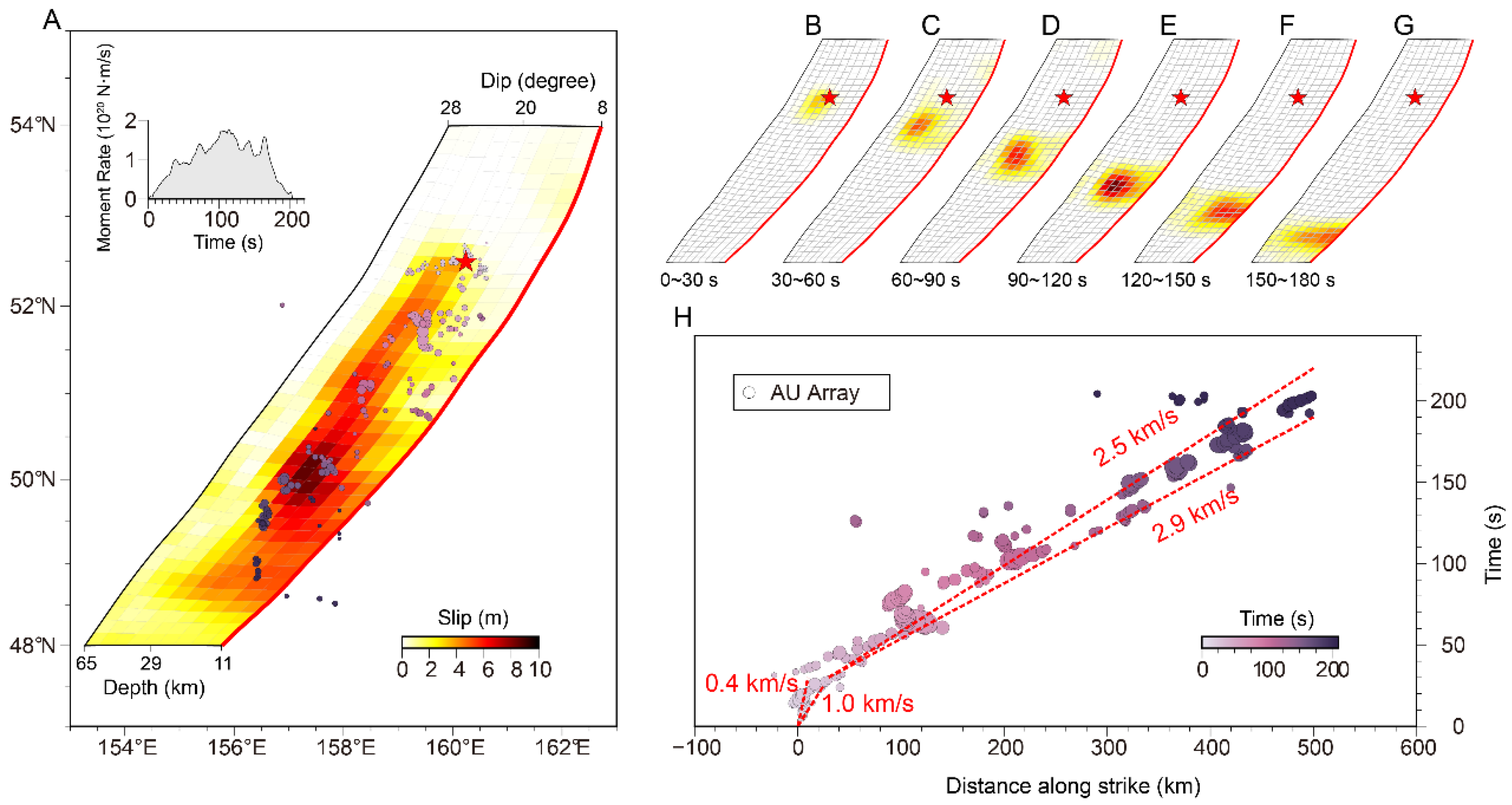
- The 2025 Mw 8.8 Kamchatka earthquake shows a NE-to-SW unilateral rupture (560 km, 200 s) with peak slip ~10 m at 15–30 km depth, jointly controlled by curved megathrust geometry and along-strike locking heterogeneity.
- High-frequency radiation migrated southwestward and concentrated at large-slip boundaries/structural segmentation zones, rather than peak-slip centers, indicating sensitivity to fault friction and geometric discontinuities.
- A curved fault model (instead of planar segments) improves the accuracy of rupture process inversion and tsunami simulation for subduction zone megathrust earthquakes.
- The north–south magnitude contrast along the Kamchatka subduction zone is attributed to along-strike variations in locking strength, megathrust smoothness, and subducted submarine tectonic features, providing key constraints for regional seismic hazard assessment.
Abstract
1. Introduction
2. Data and Methods
2.1. Geodetic and Seismic Data
2.2. Construction of Curved Fault Geometry
2.3. Finite-Fault Inversion Method
2.4. Teleseismic Back-Projection Method
3. Results
3.1. Co-Seismic InSAR and GNSS Deformation Fields
3.2. Rupture Process from Joint Inversion
3.3. Migration of High-Frequency Radiation Revealed by Back-Projection
4. Discussion
4.1. Nucleation and Unilateral Rupture of the 2025 Mainshock
4.2. Controls on the North–South Contrast in Earthquake Magnitude Along the Kamchatka Subduction Zone
5. Conclusions
- The 2025 Kamchatka mainshock was characterized by a long unilateral rupture propagating from northeast to southwest, with a total duration of about 200 s, dominant slip concentrated at depths of 15–30 km on the plate interface, and a peak slip of about 10 m.
- Rupture near the nucleation stage was weak and slow, indicating that the mainshock likely nucleated within a relatively weakened segment. The rupture then accelerated rapidly after entering a strongly locked asperity in the southern segment.
- High-frequency radiation migrated southwestward, but its strongest concentrations were located mainly along slip gradients and possible structural boundaries rather than at the center of peak slip. This indicates that high-frequency radiation is more sensitive to frictional-property variations and geometric discontinuities.
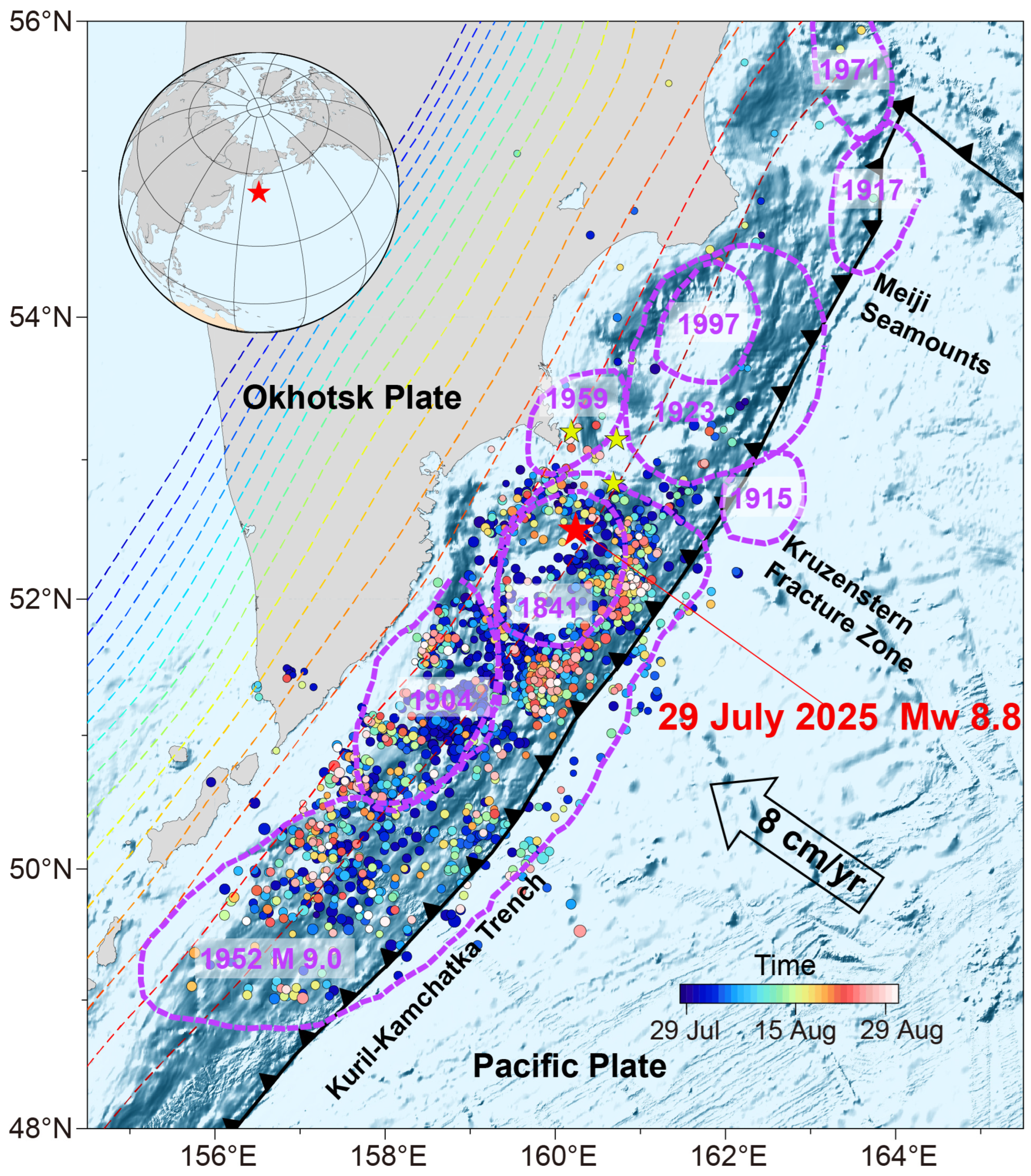
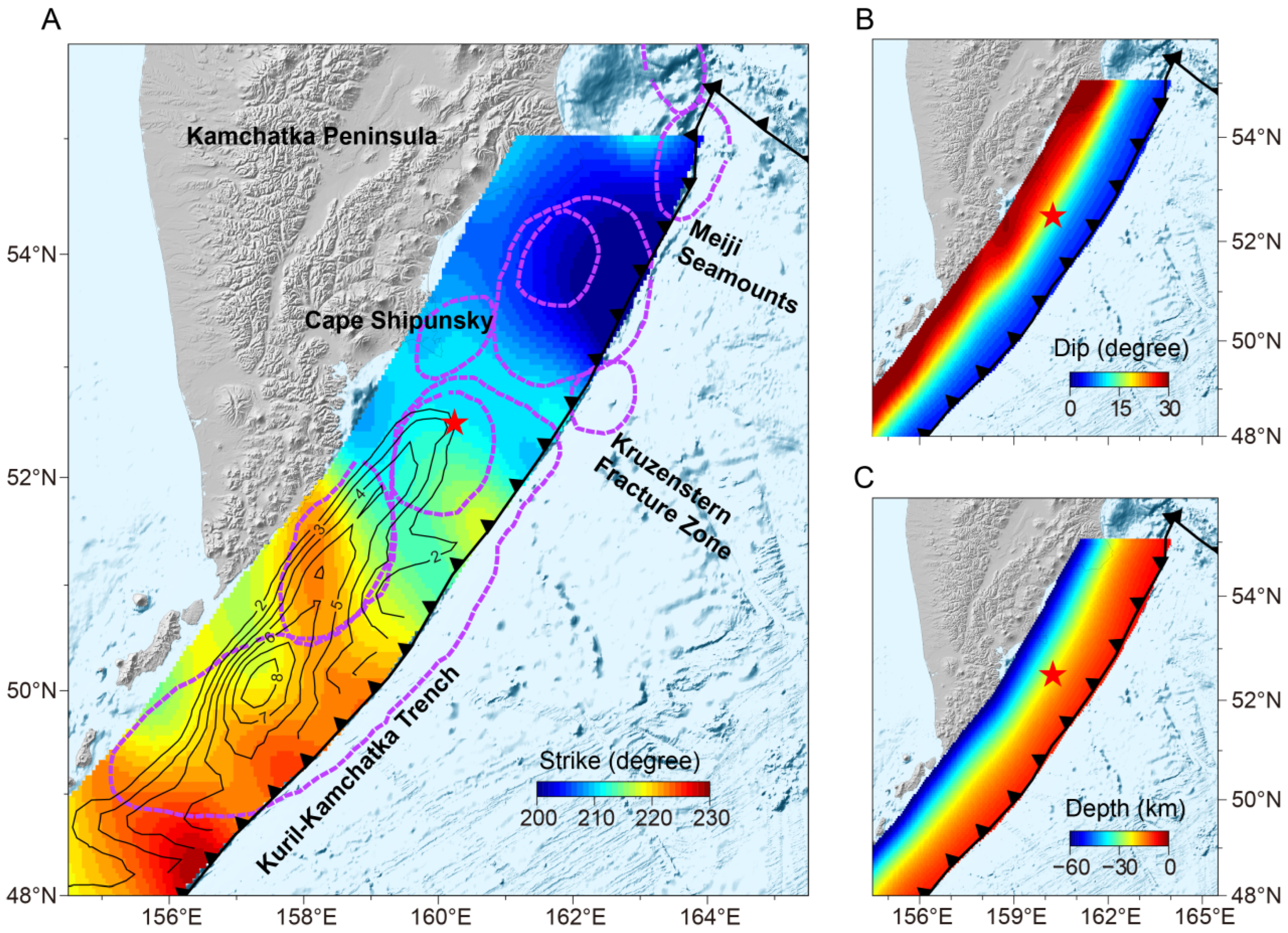
- Curved megathrust geometry and along-strike locking heterogeneity jointly controlled the rupture of the 2025 mainshock. The contrast in earthquake size between the northern and southern Kamchatka subduction zone may be governed by differences in locking strength, smoothness of the geometry, and subducting submarine tectonic features.
Supplementary Materials
Author Contributions
Funding
Data Availability Statement
Acknowledgments
Conflicts of Interest
References
- Gorbatov, A.; Kostoglodov, V.; Suárez, G.; Gordeev, E. Seismicity and structure of the Kamchatka subduction zone. J. Geophys. Res. Solid Earth 1997, 102, 17883–17898. [Google Scholar] [CrossRef] [Scilit]
- Johnson, J.M.; Satake, K. Asperity distribution of the 1952 great Kamchatka earthquake and its relation to future earthquake potential in Kamchatka. Pure Appl. Geophys. 1999, 154, 541–553. [Google Scholar] [CrossRef] [Scilit]
- MacInnes, B.T.; Weiss, R.; Bourgeois, J.; Pinegina, T.K. Slip distribution of the 1952 Kamchatka great earthquake based on near-field tsunami deposits and historical records. Bull. Seismol. Soc. Am. 2010, 100, 1695–1709. [Google Scholar] [CrossRef] [Scilit]
- DeMets, C.; Gordon, R.G.; Argus, D.F.; Stein, S. Current plate motions. Geophys. J. Int. 1990, 101, 425–478. [Google Scholar] [CrossRef] [Scilit]
- Steblov, G.; Kogan, M.; King, R.; Scholz, C.; Bürgmann, R.; Frolov, D. Imprint of the North American plate in Siberia revealed by GPS. Geophys. Res. Lett. 2003, 30, 1924. [Google Scholar] [CrossRef] [Scilit]
- Bürgmann, R.; Kogan, M.G.; Steblov, G.M.; Hilley, G.; Levin, V.E.; Apel, E. Interseismic coupling and asperity distribution along the Kamchatka subduction zone. J. Geophys. Res. Solid Earth 2005, 110, B07405. [Google Scholar] [CrossRef] [Scilit]
- Tomita, F. Re-evaluation of the interseismic slip deficit rates along the Kamchatka subduction zone. Earth Planets Space 2026, 78, 41. [Google Scholar] [CrossRef] [Scilit]
- Mach, P.; Si, X.; Wang, D.; Shcherbakov, R.; He, P.; Taymaz, T.; Ding, C.; Peng, Z. Foreshock behaviors and mainshock rupture properties associated with the 2025 Mw 8.8 Kamchatka earthquake sequence. Earthq. Res. Adv. 2026, 100457. Available online: https://eartharxiv.org/repository/object/10943/download/23143/ (accessed on 9 February 2026).
- Stein, R.; Toda, S.; Lotto, G.; Gonzalez-Huizar, H.; Sevilgen, V. Huge July 2025 Kamchatka earthquake followed unusually productive foreshock sequence. Temblor 2025. [Google Scholar] [CrossRef] [Scilit]
- Yagi, Y.; Fukahata, Y.; Okuwaki, R.; Takagawa, T.; Toda, S. Breaking the Cycle: Short Recurrence and Overshoot of an M9-class Kamchatka Earthquake. Seismica 2025, 4, 1–18. [Google Scholar] [CrossRef] [Scilit]
- Yamanaka, Y.; Atobe, Y.; Tsutsui, Y.; Okada, K.; Takahashi, H.; Tanioka, Y. Comparison of the tsunamis following the 2025 and 1952 Kamchatka Earthquakes, Russia: Field observations along the Japanese coast. Earth Planets Space 2025, 77, 193. [Google Scholar] [CrossRef] [Scilit]
- Liu, C.L.; Bai, Y.F.; Lay, T.; He, P.; Wen, Y.M.; Xiong, X.; Taymaz, T. Simple unilateral rupture of the great Mw8.8 2025 Kamchatka earthquake. Science 2026, 391, 812–817. [Google Scholar] [CrossRef] [Scilit]
- Mikhailov, V.O.; Konvisar, A.M.; Smirnov, V.B.; Timoshkina, E.P.; Titkov, N.N.; Khairetdinov, S.A.; Chebrov, D.V. The Rupture Surface Model of the July 29, 2025 Mw 8.8 Kamchatka Earthquake Based on Satellite Geodesy and Interferometry Data. Dokl. Earth Sci. 2025, 525, 35. [Google Scholar] [CrossRef] [Scilit]
- Xu, D.; Wang, W.; Ren, Z. Preliminary slip distribution of the 29 July 2025 Mw 8.8 Kamchatka, Russia earthquake. Earthq. Res. Adv. 2025, 6, 100427. [Google Scholar] [CrossRef] [Scilit]
- Zhou, Y.; Wang, W.; Xu, D.; Wang, X.; Pan, Z.; He, J.; Yao, Z. Rupture and tectonic controls of the 2025 Mw 8.8 Kamchatka subduction earthquake in Far East Russia. Sci. Bull. 2025, 71, 2192–2195. [Google Scholar] [CrossRef] [Scilit]
- Goldstein, R.M.; Werner, C.L. Radar interferogram filtering for geophysical applications. Geophys. Res. Lett. 1998, 25, 4035–4038. [Google Scholar] [CrossRef] [Scilit]
- Costantini, M. A novel phase unwrapping method based on network programming. IEEE Trans. Geosci. Remote Sens. 2002, 36, 813–821. [Google Scholar] [CrossRef] [Scilit]
- Gao, H.; Liao, M.; Feng, G. An improved quadtree sampling method for InSAR seismic deformation inversion. Remote Sens. 2021, 13, 1678. [Google Scholar] [CrossRef] [Scilit]
- Hayes, G.P.; Moore, G.L.; Portner, D.E.; Hearne, M.; Flamme, H.; Furtney, M.; Smoczyk, G.M. Slab2, a comprehensive subduction zone geometry model. Science 2018, 362, 58–61. [Google Scholar] [CrossRef] [Scilit]
- Geuzaine, C.; Remacle, J.F. Gmsh: A 3-D finite element mesh generator with built-in pre-and post-processing facilities. Int. J. Numer. Methods Eng. 2009, 79, 1309–1331. [Google Scholar] [CrossRef] [Scilit]
- Zhang, Y.; Feng, W.; Chen, Y.; Xu, L.; Li, Z.; Forrest, D. The 2009 L’Aquila MW 6.3 earthquake: A new technique to locate the hypocentre in the joint inversion of earthquake rupture process. Geophys. J. Int. 2012, 191, 1417–1426. [Google Scholar]
- Goldberg, D.E.; Koch, P.; Melgar, D.; Riquelme, S.; Yeck, W.L. Beyond the teleseism: Introducing regional seismic and geodetic data into routine USGS finite-fault modeling. Seismol. Soc. Am. 2022, 93, 3308–3323. [Google Scholar] [CrossRef] [Scilit]
- Laske, G.; Masters, G.; Ma, Z.; Pasyanos, M. Update on CRUST1.0—A 1-Degree Global Model of Earth’s Crust. In Proceedings of the Geophysical Research Abstracts, Vienna, Austria, 7–12 April 2013. [Google Scholar]
- Kiser, E.; Ishii, M. Back-projection imaging of earthquakes. Annu. Rev. Earth Planet. Sci. 2017, 45, 271–299. [Google Scholar] [CrossRef] [Scilit]
- Meng, L.; Inbal, A.; Ampuero, J.P. A window into the complexity of the dynamic rupture of the 2011 Mw 9 Tohoku-Oki earthquake. Geophys. Res. Lett. 2011, 38, L00G07. [Google Scholar] [CrossRef] [Scilit]
- Huang, C.; Xu, W.; Bürgmann, R.; Xie, L.; Feng, G.; Shan, B.; Li, Z.; Aoki, Y.; Zhang, Y.; Zhu, J.; et al. Heterogeneous strong asperities and tectonic complexity control irregular cascading ruptures. Sci. Adv. 2025, 11, eadv6771. [Google Scholar] [CrossRef] [Scilit] [PubMed]
- Liu, J.; Huang, C.; Zhang, G.; Shan, X.; Korzhenkov, A.; Taymaz, T. Immature characteristics of the East Anatolian Fault Zone from SAR, GNSS and strong motion data of the 2023 Türkiye–Syria earthquake doublet. Sci. Rep. 2024, 14, 10625. [Google Scholar] [CrossRef] [Scilit]


Disclaimer/Publisher’s Note: The statements, opinions and data contained in all publications are solely those of the individual author(s) and contributor(s) and not of MDPI and/or the editor(s). MDPI and/or the editor(s) disclaim responsibility for any injury to people or property resulting from any ideas, methods, instructions or products referred to in the content. |
© 2026 by the authors. Licensee MDPI, Basel, Switzerland. This article is an open access article distributed under the terms and conditions of the Creative Commons Attribution (CC BY) license.
Share and Cite
Sun, G.; Song, P.; Zhang, G. Curved Megathrust Geometry and Locking Heterogeneity Contributed to the Rupture of the 2025 Mw 8.8 Kamchatka Earthquake, as Inferred from Geodesy and Seismic Data. Remote Sens. 2026, 18, 1803. https://doi.org/10.3390/rs18111803
Sun G, Song P, Zhang G. Curved Megathrust Geometry and Locking Heterogeneity Contributed to the Rupture of the 2025 Mw 8.8 Kamchatka Earthquake, as Inferred from Geodesy and Seismic Data. Remote Sensing. 2026; 18(11):1803. https://doi.org/10.3390/rs18111803
Chicago/Turabian StyleSun, Guangtong, Ping Song, and Guohong Zhang. 2026. "Curved Megathrust Geometry and Locking Heterogeneity Contributed to the Rupture of the 2025 Mw 8.8 Kamchatka Earthquake, as Inferred from Geodesy and Seismic Data" Remote Sensing 18, no. 11: 1803. https://doi.org/10.3390/rs18111803
APA StyleSun, G., Song, P., & Zhang, G. (2026). Curved Megathrust Geometry and Locking Heterogeneity Contributed to the Rupture of the 2025 Mw 8.8 Kamchatka Earthquake, as Inferred from Geodesy and Seismic Data. Remote Sensing, 18(11), 1803. https://doi.org/10.3390/rs18111803