1. Introduction
Methane (CH
4) is the second-most important contributor to global warming behind carbon dioxide (CO
2), with an atmospheric lifetime of approximately 9 years and a global warming potential 28 times that of CO
2 over 100-year time scales [
1]. Recent observations indicate that methane concentrations are rising at an accelerating rate [
2,
3], positioning methane as a key target for meeting the temperature goals of the Paris Agreement [
4,
5,
6]. Although the Global Methane Pledge has mobilized international commitments [
7] to reduce anthropogenic emissions by 2030, how to achieve this goal efficiently remains a substantial challenge [
8].
Super-emitters are defined as point sources with emission rates exceeding 100 kg h
−1. While 100 kg h
−1 represents the conventional threshold for super-emitter classification in previous studies, this study additionally employs 5000 kg h
−1 as an empirical threshold to better characterize the extreme high-emission tail of the point-source distribution and its structural contribution to total emissions. Studies have shown that super-emitters represent approximately 10% of all point sources by count, yet account for more than 60% of total emissions [
9], making their control the most cost-effective strategy for methane mitigation. Nevertheless, the prevalence and intensity distribution of super-emitters vary substantially across countries and sectors [
10], resulting in divergent abatement difficulties and policy requirements. Existing studies have focused on super-emitter identification within individual regions or basins [
10], or have attempted to extrapolate point-source observations into annual totals [
11,
12]. These limitations point to a broader gap in the literature, one that emerging high-resolution remote sensing technologies are now positioned to address. The rapid development of high-spatial-resolution remote sensing [
13] has significantly expanded the observational boundaries of greenhouse gases monitoring [
14,
15]. Satellite and airborne imaging spectrometer platforms—including GHGSat, Carbon Mapper, and Tanager [
16]—are now capable of directly detecting methane emission plumes at the facility scale, enabling the systematic identification of point sources worldwide [
17]. These point-source observations have revealed pronounced spatial heterogeneity of emissions [
18] and highlighted the significant role of a small number of high-intensity emission events [
19] across sectors and regions [
20]. Fundamentally, the structural characteristics encoded in emission rate distributions directly govern mitigation efficiency and cost.
Yet a systematic quantitative comparison of emission rate distribution curves across countries and sectors remains lacking [
21], particularly regarding the fractional contribution of super-emitters to total emissions and its deterministic influence on abatement difficulty and optimal mitigation pathways [
22].
Here, we integrate multi-source remote sensing and national-scale datasets to construct a comprehensive analytical framework linking instantaneous point-source observations to national-level governance assessment [
23]. We use high-resolution point-source data to characterize the spatial distribution and emission rate profiles of methane point sources globally [
24], and apply probability distribution fitting and cross-scale integration [
25,
26,
27] to quantitatively assess emission rate distributions and super-emitter contribution fractions across countries and sectors [
19]. Building on this, we further incorporate economic capacity indicators [
28] to evaluate the relative positioning of countries along the dimensions of emission structure and governance capacity [
29], thereby elucidating structural disparities in super-emitter prevalence across nations and sectors [
18,
21] and providing a scientific basis for differentiated methane mitigation pathways [
30,
31]. The remainder of this paper is organized as follows:
Section 2 describes the data and methods;
Section 3 presents the main results;
Section 4 discusses methodological uncertainties and limitations; and
Section 5 summarizes the principal findings.
2. Materials and Methods
2.1. Open-Access Datasets
Table 1 provides an overview of the datasets used in this study, encompassing satellite-based point-source emission observations, emission inventories, and economic indicators.
Point-source emission data were retrieved from the Carbon Mapper open-access data portal [
16], originally developed by National Aeronautics and Space Administration (NASA)’s Jet Propulsion Laboratory. The platform integrates observations from diverse hyperspectral systems, including Planet’s Tanager constellation—the cornerstone of Carbon Mapper’s global observing system—and airborne sensors such as NASA’s Earth Surface Mineral Dust Source Investigation (EMIT) [
32], Airborne Visible/Infrared Imaging Spectrometer Next Generation (AVIRIS-NG) [
33], AVIRIS-3, and the Global Airborne Observatory operated by Arizona State University. The dataset provides global methane plume detections along with their associated emission rate retrievals [
23].
A small number of anomalously high values attributable to retrieval artifacts were identified in the raw emission rate data (kg h−1). Quality control was performed using a relative uncertainty filter (<50%) combined with a physically motivated upper-bound threshold (2 × 10⁵ kg h−1), in order to reduce algorithmic noise while preserving genuine super-emitter signals. This study primarily uses instantaneous emission rate data (kg h−1) to construct emission rate distributions.
To systematically investigate cross-platform observational differences, we incorporated two independent datasets derived from high-resolution GHGSat satellite observations [
34].
First, we utilized a global solid waste methane dataset developed by Dogniaux et al. (2025) [
35], which focuses on high-emitting landfills from 2021 to 2022. This dataset serves as a satellite-based reference for the solid waste sector, enabling comparison with airborne point-source observations. Second, we integrated the 2023 energy-sector point-source dataset from Jervis et al. (2025) [
36]. Based on GHGSat observations, it systematically identified and quantified methane emissions from global oil, gas, and coal facilities, producing emission estimates at both the facility level and a 0.2° grid scale. These datasets collectively enhance the robustness of our cross-sectoral and cross-platform comparisons [
24].
National-scale methane emission baselines were obtained from the global inversion dataset reported by East et al. (2025) [
37]. This dataset, constrained by TROPOMI observations, provides optimized annual totals for 161 countries with detailed sectoral attribution (e.g., agriculture, energy, and waste). These data are used as national-level references to assess the representativeness of point-source observations in different national emission structures [
21].
Finally, to characterize the relationship between mitigation responsibility and economic capacity, we incorporated 2023 national income indicators from the World Bank [
28]. These indicators facilitate the joint assessment of governance capability and mitigation priorities across diverse national contexts. Among the datasets described above, Carbon Mapper, GHGSat solid waste, and GHGSat energy products are used directly as published Level 2 emission rate retrievals (kg h
−1), requiring no additional processing by the authors. The Chinese hyperspectral satellite imagery (GF-5/ZY-1), however, does not provide open-access Level 2 methane products; emission rates were therefore independently retrieved using the matched filter algorithm described in the following section.
2.2. Methane Retrieval from Chinese Hyperspectral Satellite Imagery
The open-access point-source datasets described in
Section 2.1 provide broad global coverage but remain limited in their ability to characterize emission structures in data-sparse regions where proprietary or non-commercial satellite platforms dominate the observational record. China’s coal mine methane emissions represent a particularly critical case: despite China’s status as the world’s largest coal producer and a major contributor to global anthropogenic methane [
31], systematic high-resolution facility-level observations over Chinese coal mining regions are not yet available through open-access platforms. To address this gap and provide an independent cross-validation of the emission structures identified in the statistical analysis, this study incorporates methane plume retrievals from Gaofen-5 and Ziyuan-1 Advanced Hyperspectral Imager (AHSI) satellite imagery [
38] over Shanxi Province—China’s most prolific coal-producing region—following the methodology established by Han et al. [
31].
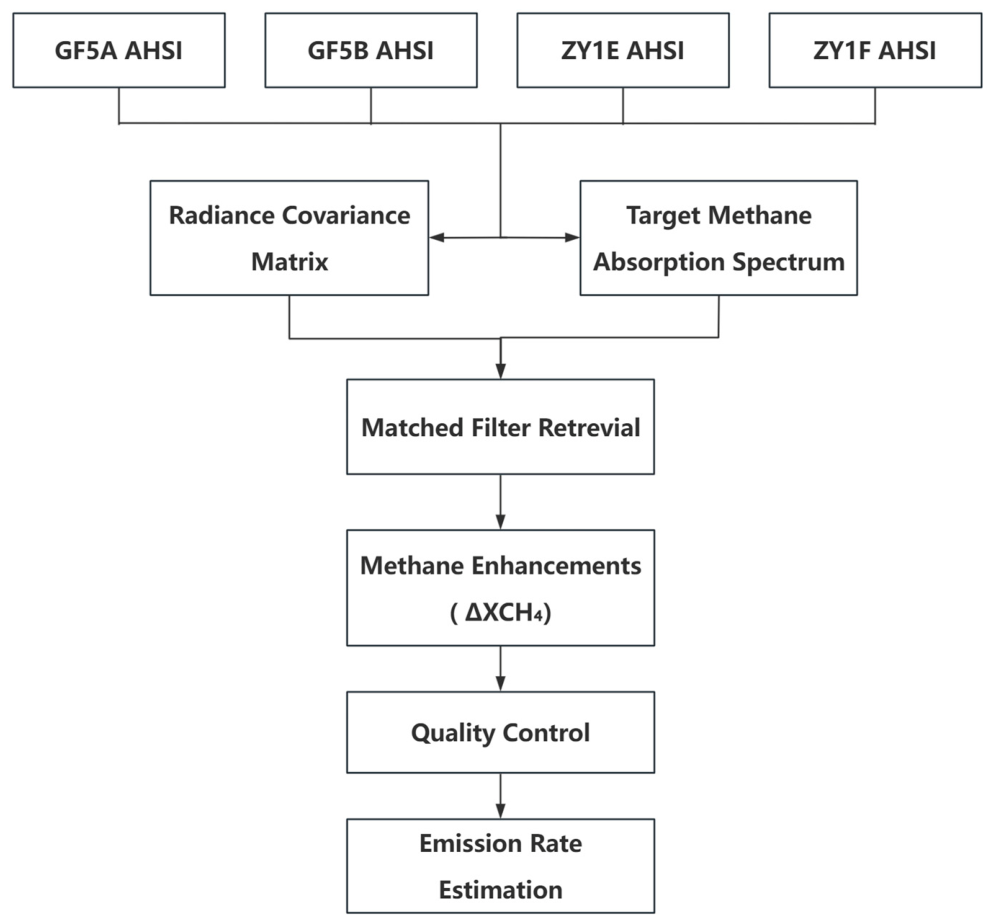
The retrieval workflow is summarized in
Figure 1. Methane column enhancements (
) were retrieved using a matched filter algorithm applied to at-sensor radiance data. Unit methane absorption coefficients were first computed using the MODTRAN v5.2 radiative transfer code [
39] under a standard mid-latitude atmospheric profile, and convolved with the satellite spectral response function to generate the target absorption spectrum
. The matched filter solves for the per-pixel methane enhancement by minimizing the weighted spectral residual between the observed radiance
and the local scene background
:
where
is the observed at-sensor radiance vector,
is the per-column background radiance vector approximated by the column-wise mean of the scene radiance,
is the per-column radiance covariance matrix estimated from methane-free background pixels, and
is the target absorption spectrum. Here,
is the unit absorption coefficient vector simulated using the MODTRAN v5.2 radiative transfer code under a standard mid-latitude atmospheric profile and convolved with the satellite spectral response function, and
denotes the element-wise product. The target vector
enters the numerator of Equation (1) as a projection vector that determines the filter’s spectral sensitivity to methane-specific absorption features. Pixels with negative
values are set to zero. Since the column-mean approximation of
assumes a Gaussian background distribution, which may not hold in spectrally heterogeneous scenes,
and
are updated iteratively to exclude pixels with positive methane enhancements, thereby improving retrieval fidelity and minimizing bias [
39].
Following retrieval, a multi-step quality control procedure was applied to suppress false positives, including cloud masking, water body identification using the Normalized Difference Water Index (NDWI), and removal of solar panel reflectance artifacts using the Solar Panel Index (SPI). Geometric co-registration of multi-temporal satellite scenes was performed to enable consistent multi-pass analysis of individual emission sources.
Candidate plumes were identified by thresholding
at twice the scene standard deviation, retaining spatially connected regions of at least 10 contiguous pixels. Emission rates were subsequently estimated using the Integrated Mass Enhancement (IME) method [
40], which relates the total plume mass to the source emission rate through the effective wind speed
where
denotes the emission rate (kg h
−1),
is the characteristic plume length (
= number of plume pixels,
= pixel area in m
2),
g mol
−1 and
g mol
−1 are the molar masses of methane and dry air, and
is the vertically integrated atmospheric mass density (kg m
−2) obtained from ERA5 reanalysis fields [
41]. The effective wind speed
is derived from ERA5 wind retrievals collocated within 1° of the source location and within ±4 h of the overpass time [
41].
2.3. Core Analytical Framework and Procedure
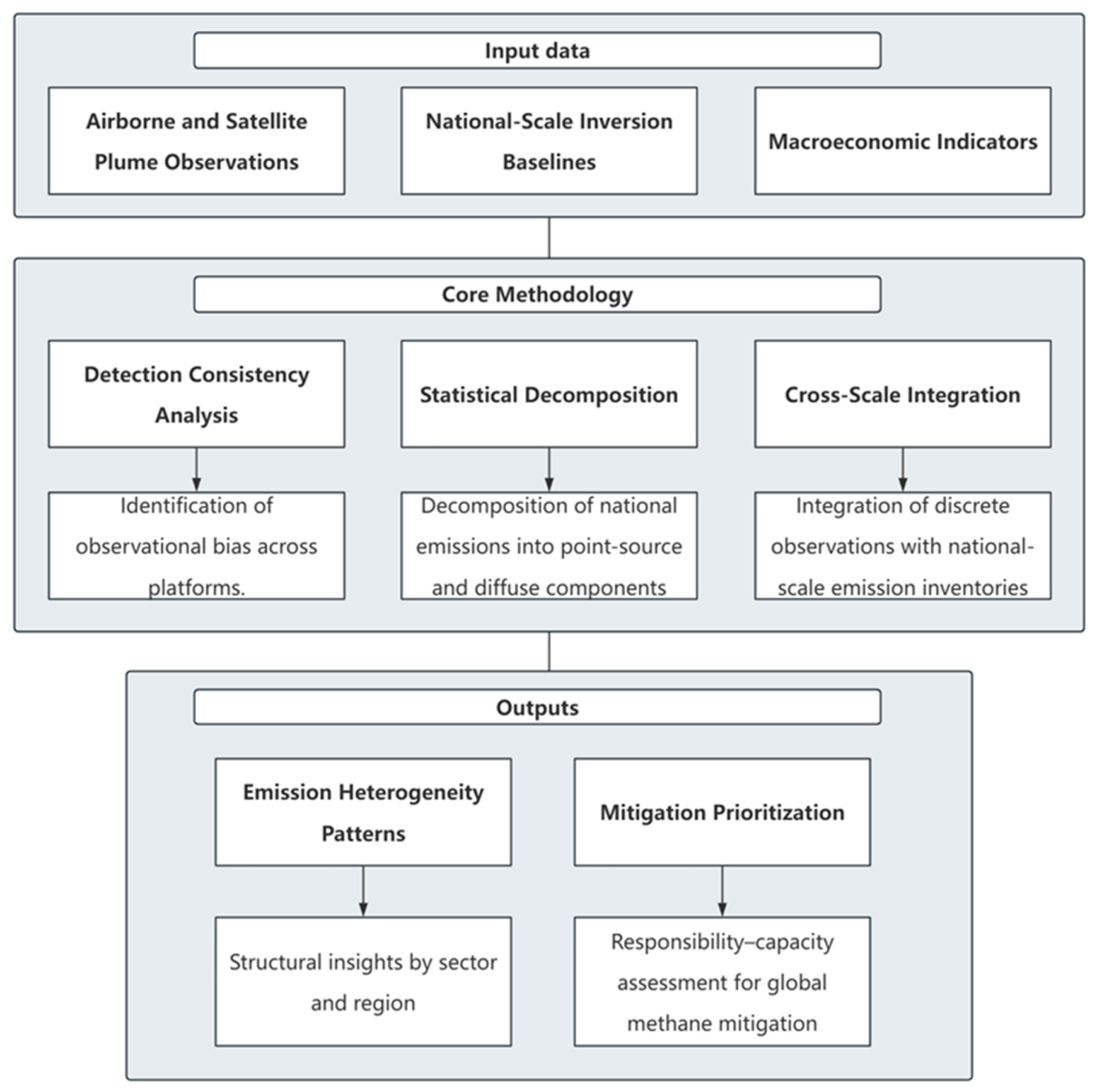
To systematically characterize the structural relationships between point-source observations and national-scale methane emissions, we construct a cross-scale, multi-source analytical framework (
Figure 2). The framework incorporates airborne and satellite point-source observations, national-scale inversion emission baselines, and macroeconomic indicators, and integrates spatial clustering, distribution fitting, cross-scale integration, and joint analysis with Gross National Income (GNI) per capita to extract emission rate distribution characteristics and support the assessment of mitigation responsibility and governance capacity [
27,
42]. To ensure cross-platform comparability, all emission rate data were standardized to kg h
−1 as the common unit; integration was achieved through statistical comparison of emission rate distributions, with platform-specific detection threshold differences explicitly addressed in
Section 3.3.
The analytical procedure is organized around three hierarchical levels: observation, distribution, and mitigation. First, spatial clustering is applied to characterize the global distribution patterns of Carbon Mapper point sources, with selected high-density regions examined at finer spatial scales to reveal spatial heterogeneity. Second, data from different sectors are used to compare the emission characteristics captured by airborne and satellite platforms and to identify inter-platform differences. Third, probability distribution models are fitted to the point-source emission rates of major emitting countries to characterize their emission rate distributions and quantify the contribution of super-emitters. To bridge point-source observations with national-scale emission baselines, instantaneous emission rates were converted to equivalent annualized totals assuming 8760 h of continuous emission, aggregated by country, and compared with national inversion estimates to derive point-source contribution fractions. Finally, these distribution characteristics are integrated with macroeconomic indicators to evaluate cross-country and cross-sector differences in abatement difficulty and to establish mitigation priorities.
2.4. Statistical Modeling of Emission Distributions
To characterize the statistical properties of methane point-source emission rates across different countries, probability distribution models were fitted to the point-source emission data from major emitting countries, where
is consistent with the emission rate notation used throughout
Section 2.2. Given that point-source emissions typically exhibit strong positive skewness and heavy-tailed behavior, a range of single and mixture distributions were tested, including lognormal, gamma, beta, chi-square, inverse Gaussian, and Gaussian Mixture Model (GMM) [
43]. Model parameters were estimated by maximum likelihood estimation, and goodness-of-fit was assessed using information criteria and distributional test statistics [
44,
45].
The Gini coefficient was introduced as a summary measure to quantify the degree of inequality in the emission rate distributions. A higher Gini coefficient indicates greater inequality—that is, a small number of high-intensity point sources contribute the majority of total emissions. Conversely, a lower value indicates a more uniform distribution [
25]. This metric provides an intuitive basis for assessing the relative importance of super-emitters across countries and sectors, informing subsequent mitigation pathway analysis.
For unimodal, positively skewed distributions, the lognormal distribution is used to describe the heavy-tail behavior of emission rates, with probability density function expressed as
where
μ and
σ denote the mean and standard deviation in log-space, respectively. This distribution is widely applied to environmental datasets characterized by significant extreme values. For data exhibiting more flexible skewness, the gamma distribution is employed:
where
is the shape parameter,
θ is the scale parameter, and
denotes the gamma function. This distribution effectively describes emission intensities that are highly concentrated at low values and decay gradually toward high values. To account for potential multimodality arising from the superposition of diverse source types, we additionally apply a Gaussian Mixture Model (GMM):
where
K is the number of mixture components,
are the component weights, and
μi and
are the mean and variance of each component. In this study, a three-component model (GMM-3) is adopted when the data exhibit clear multimodality.
Goodness-of-fit across models is evaluated using the Akaike Information Criterion (AIC) and the Kolmogorov–Smirnov (KS) statistic [
43]. AIC is defined as
where
k is the number of parameters and
L is the maximized likelihood. The KS statistic quantifies the maximum discrepancy between the empirical and theoretical distributions:
where
and
are the empirical and theoretical cumulative distribution functions, respectively. For each country, the model minimizing AIC while maintaining a sufficiently low KS statistic is selected as the optimal distribution to characterize its point-source emission distribution.
3. Results
3.1. Spatial Structure and Regional Heterogeneity of Global Point-Source Emissions
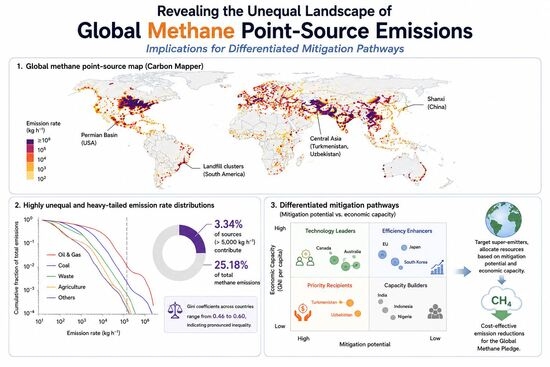
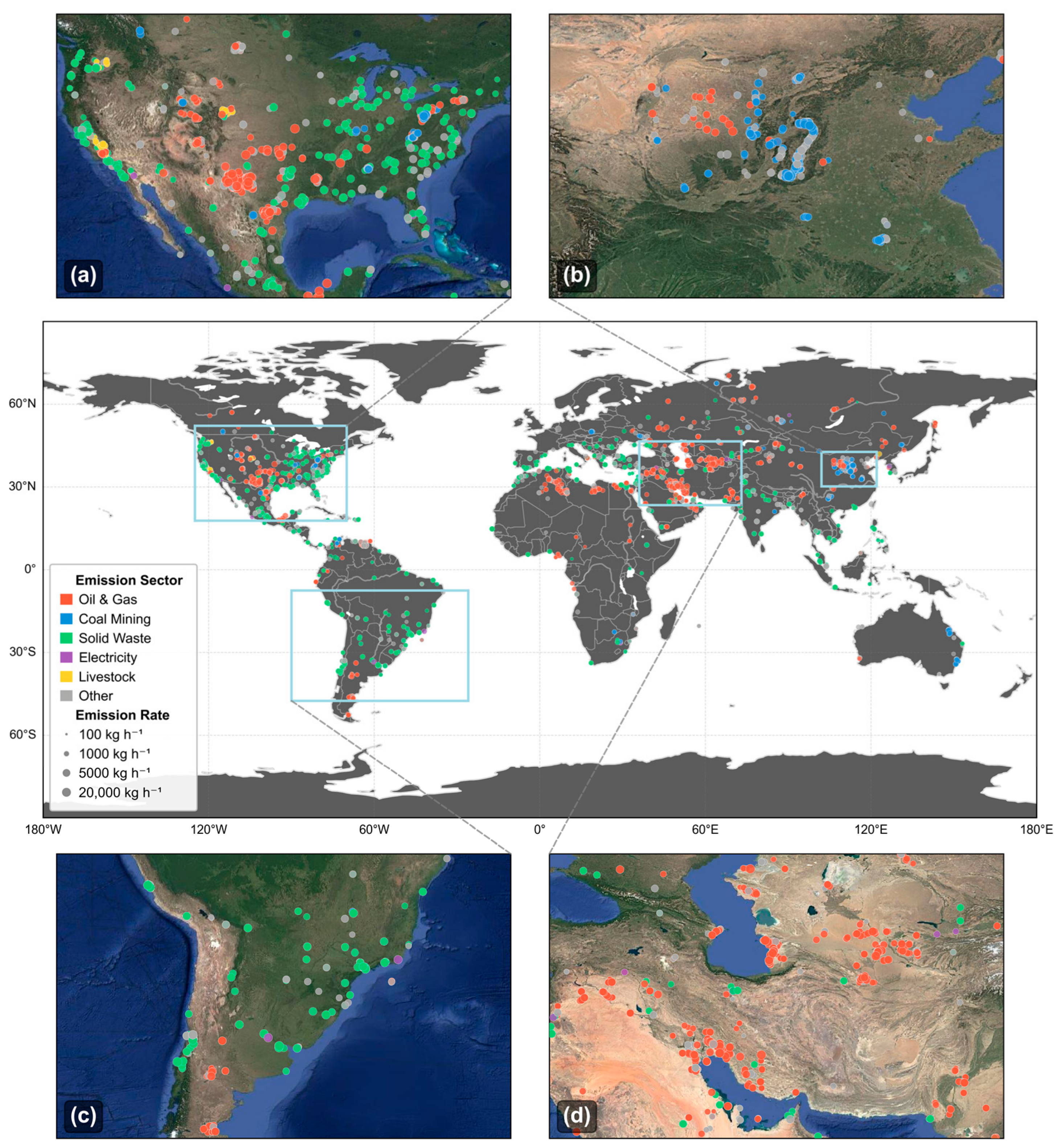
Figure 3 illustrates the global spatial density of methane point sources based on Carbon Mapper observations (2023–2025). Spatial clustering analysis of the cumulative dataset reveals pronounced sectoral aggregation and geographic heterogeneity in global point-source emissions [
18]. At the global scale, high-density emission hotspots are concentrated in active fossil fuel extraction basins, heavy industrial corridors, and the periphery of major urban agglomerations [
18]. Four high-density regions are examined at finer spatial scales to characterize local emission patterns in greater detail.
In North America (
Figure 3a), oil and gas production zones—most notably the Permian Basin—constitute the most prominent point-source cluster globally [
10]. This region accounts for 46.6% of all detected point sources, with a median emission rate of 343 kg h
−1. Airborne observations capture numerous high-intensity emission events associated with wellhead operations, compressor stations, and gathering networks [
46]. These events are spatially fixed yet temporally intermittent [
19], making them difficult to characterize using conventional annual-scale statistics.
In contrast, East Asia (
Figure 3b) is dominated by coal sector emissions [
47],with a median emission rate of 1468 kg h
−1 and 66.5% of sources falling in the 1000–10,000 kg h
−1 range. Hotspots are concentrated around major coal mine clusters, where detected plumes are primarily associated with underground methane outgassing and ventilation shaft emissions. Unlike the spatially concentrated pattern seen in North American oil and gas regions, East Asian coal sources follow a multi-point, moderate-intensity distribution, reflecting emissions that are large-scale and persistent rather than driven by sporadic anomalous events [
31].
South America (
Figure 3c) exhibits a distinct emission profile dominated by solid waste sources, in contrast to the fossil fuel-dominated patterns observed in the other three regions. Point sources are distributed across major urban centers and their peripheries, concentrated around large municipal landfill complexes. It should be noted that this apparent dominance of solid waste partly reflects the targeted observation design of Carbon Mapper campaigns in the region, which included systematic airborne surveys of major landfill facilities conducted in collaboration with international monitoring programs [
48]; this observational emphasis may overrepresent solid waste relative to the true sectoral composition of regional emissions. Within the subset of fossil fuel sources, airborne observations also capture high-intensity plumes associated with hydraulic fracturing operations and early production phases [
49], suggesting that energy-sector emissions in the region remain substantially under-monitored.
In Central Asia and the Middle East (
Figure 3d), point-source emissions are characteristic of energy infrastructure [
50]. The region accounts for 16.0% of globally detected sources, with a median emission rate of 1358 kg h
−1 and 8.9% of sources exceeding 5000 kg h
−1. Hotspots follow oil and gas fields along the eastern Caspian coast and gas transmission corridors, with emissions originating from production facilities, compressor stations, processing plants, and pipeline nodes [
50]. Observation density in this region is constrained by monitoring coverage frequency, and current estimates likely underrepresent true emission intensity.
To quantify the degree of emission concentration across all detected point sources globally, we computed the cumulative emission contribution as a function of emission rate threshold using the full Carbon Mapper dataset. Under the conventional super-emitter threshold of 100 kg h
−1, 98.6% of detected point sources qualify as super-emitters, collectively accounting for 99.9% of total equivalent emissions. This classification reflects the inherently high emission intensities of sources captured in the Carbon Mapper dataset, rendering the 100 kg h
−1 criterion of limited discriminatory power for structural analysis. Sources exceeding 5000 kg h
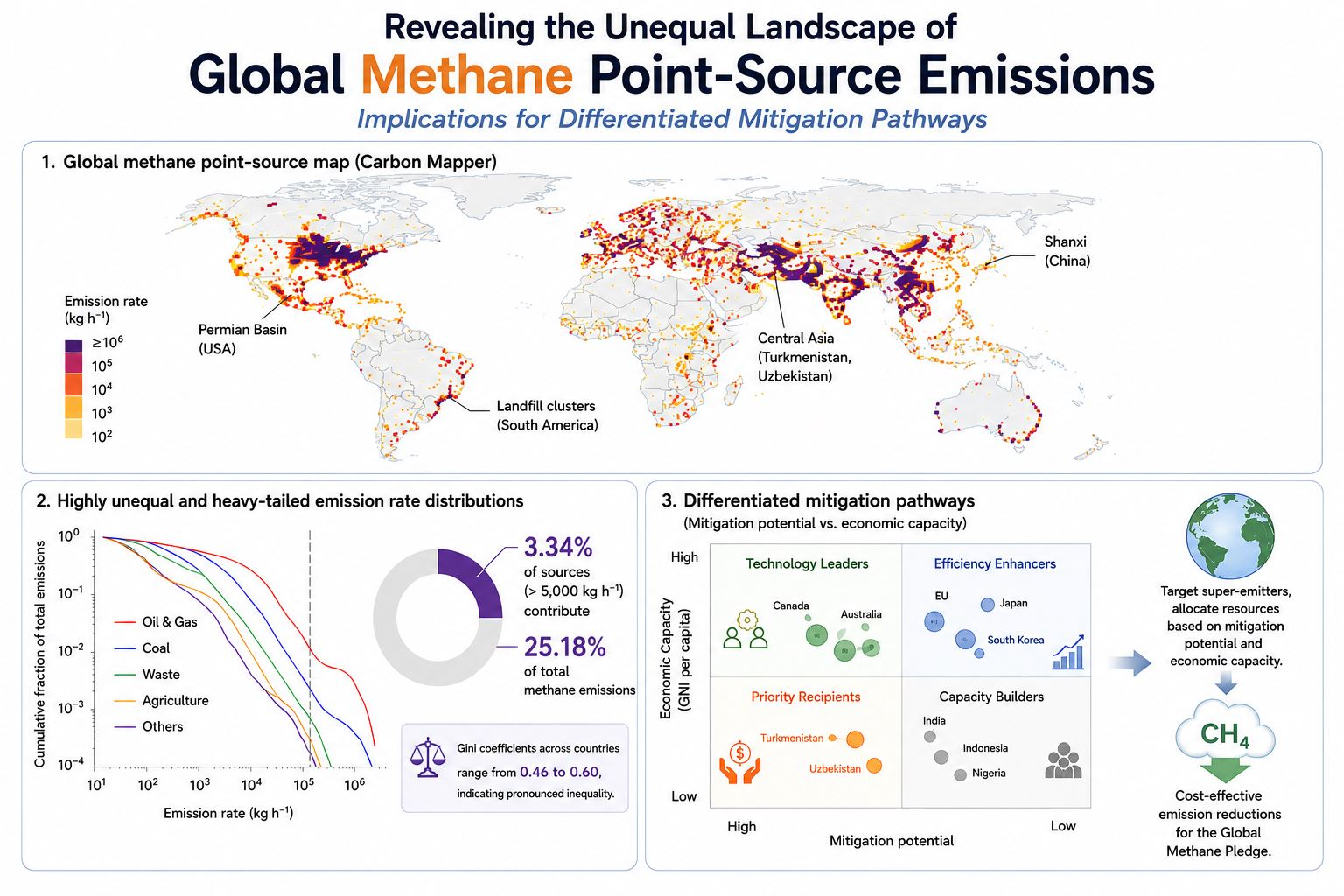
−1 represent only 3.34% of all detected point sources by count, yet account for more than 25.18% of total equivalent emissions—consistent with the heavy-tailed emission distributions documented in individual basins [
19] and confirming that a small fraction of high-intensity sources drives a disproportionate share of global point-source emissions at the global scale [
18]. This structural inequality, quantified here across a globally distributed multi-sector dataset, provides direct empirical support for super-emitter-focused mitigation strategies and motivates the distributional analysis presented in the following sections.
3.2. Independent Methane Plume Retrievals over Shanxi Province
While the global analysis in
Section 3.1 reveals that East Asia is characterized by coal-dominated, moderate-to-high intensity point-source emissions, open-access platforms such as Carbon Mapper provide limited temporal coverage of individual facilities. To complement this global perspective with independent facility-level observations, we applied the retrieval workflow described in
Section 2.2 to 117 quality-screened scenes from GF-5B/AHSI, GF-5A/AHSI, ZY1-02D/AHSI, and ZY1-02E/AHSI satellites over Shanxi Province, yielding 243 observations across 16 point sources (E01–E16), of which 237 (97.5%) produced valid plume detections.
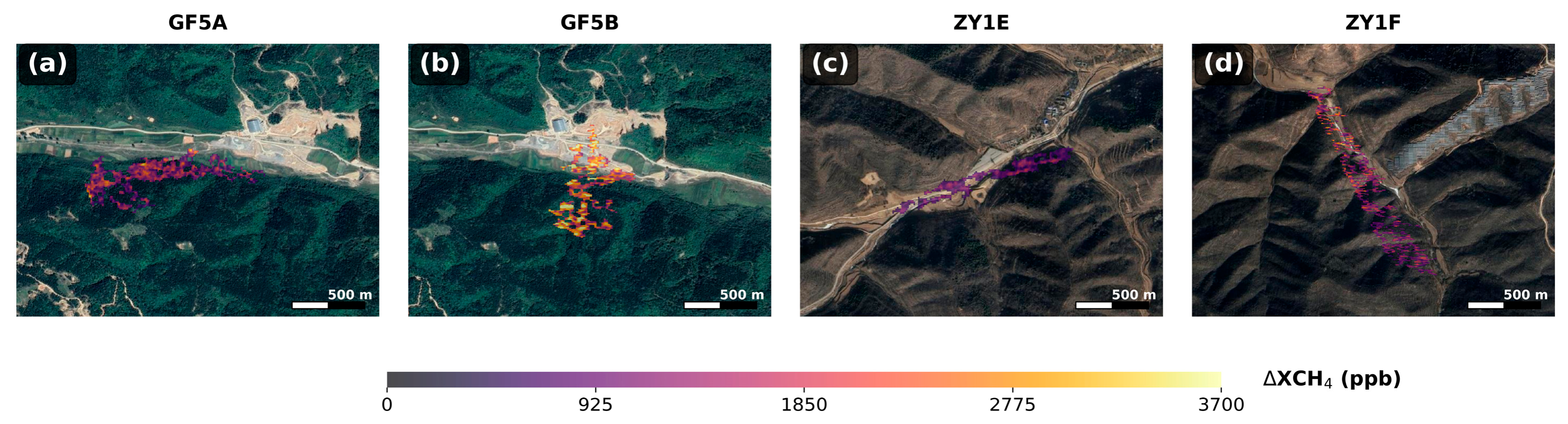
Figure 4 presents representative methane plume detections from four typical high-intensity emission events captured by different satellite platforms. The cases were selected for their well-defined plume morphologies and substantial emission rates, serving to illustrate the characteristic spatial structures of coal mine methane plumes detectable by domestic hyperspectral platforms. In each case, the retrieved ΔXCH
4 enhancement is spatially coherent and downwind-elongated in a pattern consistent with ventilation shaft outgassing [
31]. The four cases demonstrate that plumes of comparable morphology are detectable across all four domestic platforms despite differences in overpass time and solar geometry, confirming the cross-platform consistency of the retrieval approach described in
Section 2.2.
Across all 16 sources, valid emission rates span 794–21,639 kg h
−1, with a mean of 5.34 × 10
3 kg h
−1 and median of 4.56 × 10
3 kg h
−1. The median of approximately 4560 kg h
−1 is higher than the Carbon Mapper East Asia regional median (1468 kg h
−1,
Section 3.1), consistent with the targeted selection of known high-emission facilities rather than spatially unbiased sampling [
36].
Pronounced heterogeneity is observed across sources: E10 records the highest mean emission rate (11.11 × 10
3 kg h
−1), followed by E13 (8.14 × 10
3 kg h
−1) and E05 (7.33 × 10
3 kg h
−1), while E16 exhibits the lowest mean (1.72 × 10
3 kg h
−1)—a nearly seven-fold difference across the 16 sources. Within-source temporal variability is also substantial, with coefficients of variation ranging from 20% (E07) to 81% (E02), reflecting the inherent intermittency of underground coal mine ventilation shaft emissions modulated by mining activity cycles and ventilation system operation [
31].
These facility-level results establish a quantitative baseline for coal mine methane emission intensities in Shanxi Province and provide an independent dataset derived from domestic hyperspectral platforms, complementing the open-access observations used in the remainder of this study.
To further assess the credibility of the GF-5/ZY-1 retrievals, a mobile ground-based validation campaign [
51] was conducted in Shanxi Province in July–August 2025 using a Picarro cavity ring-down spectrometer (Picarro Inc., Santa Clara, CA, USA) [
52] mounted on a mobile platform. For emission source E04, a methane concentration anomaly was detected approximately 2900 m downwind of the source. Gaussian plume fitting yielded an estimated emission rate of 5.4 × 10
3 kg h
−1, broadly consistent with the satellite-derived multi-overpass mean of 5.5 × 10
3 kg h
−1 for the same source, providing independent ground-based support for the reliability of the retrieval approach applied in this study.
3.3. Characterization of Observational Divergences Between Airborne and Satellite Platforms
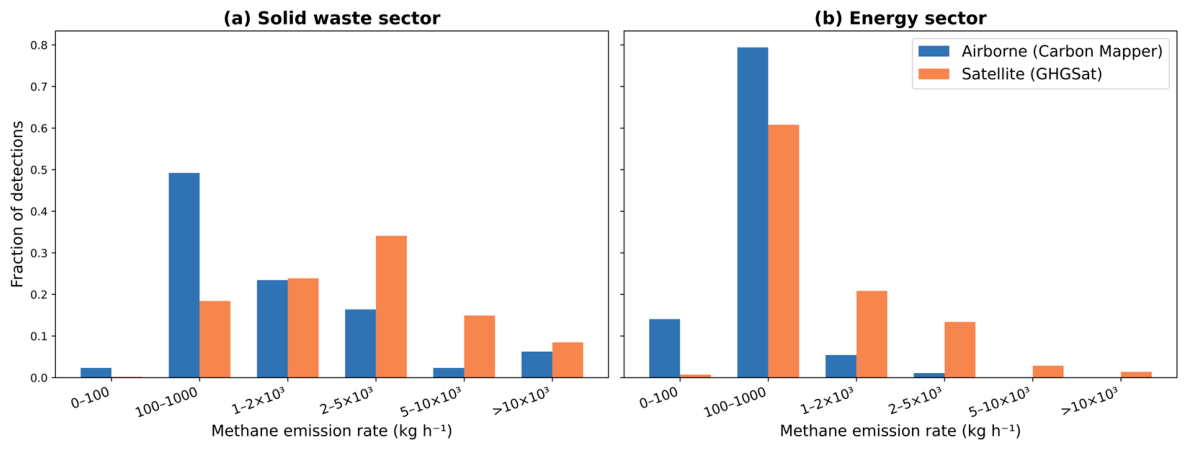
Figure 5 compares methane point-source emission rate distributions observed by airborne and satellite platforms for the solid waste sector (2021–2022) and the energy sector (2023) [
35,
36].
Airborne observations for both sectors are dominated by low-to-moderate emission rates. In the solid waste sector, the 100–1000 kg h
−1 bin accounts for the largest share (
0.49), followed by the 1000–2000 kg h
−1 bin (
0.23). In the energy sector, the 100–1000 kg h
−1 bin rises further (
0.79), becoming the dominant interval. This consistency reflects the lower detection threshold and scheduling flexibility of airborne platforms, which enable stable capture of frequent low-to-moderate emission events at the facility scale [
53].
Satellite observations, by contrast, are skewed toward moderate-to-high emission rates in both sectors. In the solid waste sector, the 2000–5000 kg h−1 bin is substantially more prominent than in airborne data (0.34); in the energy-sector, bins above 1000 kg h−1 account for a larger share, while detections below 1000 kg h−1 are far less frequent. This divergence reflects sector-specific differences in spatial scale and temporal structure: solid waste emissions tend to be spatially extensive and relatively stable, rendering them more detectable by satellite sensors with higher observation thresholds; energy sector emissions are more often associated with dense but individually weaker facilities with high temporal intermittency, biasing satellite observations toward stronger signals.
In the sub-100 kg h−1 range, airborne platforms retain a small number of valid detections, while satellite observations are near-absent in both sectors, consistent with the sensitivity limits of satellite instruments under low signal-contrast conditions.
These platform-specific patterns indicate systematic biases [
53] in how different remote sensing systems characterize emission rate distributions, with implications for cross-platform comparisons at the national scale.
3.4. Cross-Country Differences in Point-Source Emission Structures
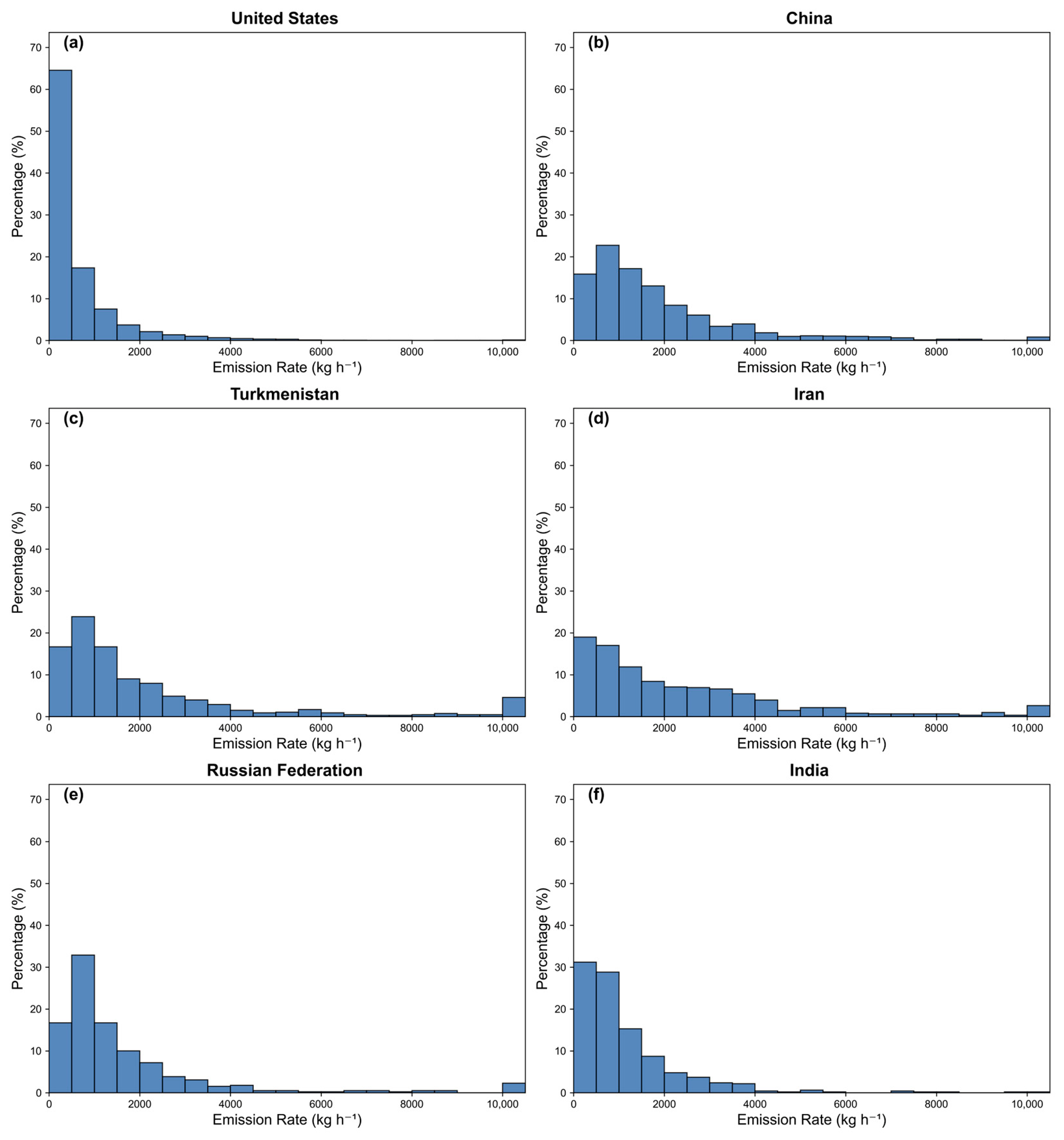
Figure 6 shows the facility-level point-source emission rate distributions for six major emitting countries based on Carbon Mapper observations. Although all countries exhibit pronounced right-skewed, heavy-tailed distributions [
25], they differ in the degree of concentration, tail extent, and the weight of extreme emission events [
54]. This indicates that point-source emission structures diverge substantially even among countries with comparable national totals.
Before cross-country comparisons are made, differences in platform detection capability must be noted. U.S. data include a substantial number of records from airborne platforms (e.g., AVIRIS-3 [
16]) with detection limits as low as a few tens of kg h
−1, whereas data for China and other countries derive primarily from satellite platforms (Tanager and EMIT), with typical detection limits of 400–500 kg h
−1 [
53,
55]. A direct comparison of U.S. airborne and satellite data illustrates this effect: airborne observations place 88.7% of sources below 500 kg h
−1, with a median of 149.9 kg h
−1, while satellite observations reduce this fraction to 56.5% and raise the median to 419.5 kg h
−1. The apparent concentration of low-intensity sources in U.S. data therefore largely reflects the higher sensitivity of airborne platforms. Similar low-intensity concentrations likely exist in other countries but are not fully captured by current satellite observations.
Accounting for these platform differences, U.S. point sources remain relatively concentrated in the moderate range above 500 kg h
−1 (
Figure 6a) [
18]. In contrast, China and Turkmenistan display broader distributions with more pronounced heavy tails (
Figure 6b,c), with medians of 1.31 × 10
3 and 1.25 × 10
3 kg h
−1 and means of 1.89 × 10
3 and 2.42 × 10
3 kg h
−1, respectively. This divergence indicates that total point-source emissions in both countries are significantly driven by a limited number of high-intensity sources. Iran, the Russian Federation, and India fall between these cases (
Figure 6d–f): Iran shows a relatively dispersed distribution, while Russian Federation and India are more concentrated at lower emission rates.
Probability distribution fitting was applied to point-source observations for major emitting countries (
Table 2). The inverse Gaussian distribution provides the best fit for the United States, Turkmenistan, Iran, the Russian Federation, and India, with KS statistics ranging from 0.019 to 0.058, indicating stable fits. China is the sole exception, where the gamma distribution performs best.
The prevalence of the inverse Gaussian distribution reflects a common structural feature: most point sources emit at low rates, while a small number of high-intensity events account for the majority of total emissions. China’s gamma distribution fit, despite a similarly heavy-tailed profile (mean 1.89 × 10³ kg h−1, median 1.31 × 10³ kg h−1), differs from the inverse Gaussian in its low-value decay rate and tail shape.
Across all countries, point-source emission rate distributions are consistently right-skewed and heavy-tailed [
25], but best-fit models and tail thickness vary by country [
21], indicating that national-scale methane point-source emission structures are not governed by a single mechanism. These country-specific distributional differences suggest that no single mitigation approach is universally optimal, and that abatement strategies must be tailored to the structural characteristics of each national emission profile.
3.5. Coupling National Emission Totals with Point-Source Structural Intensities
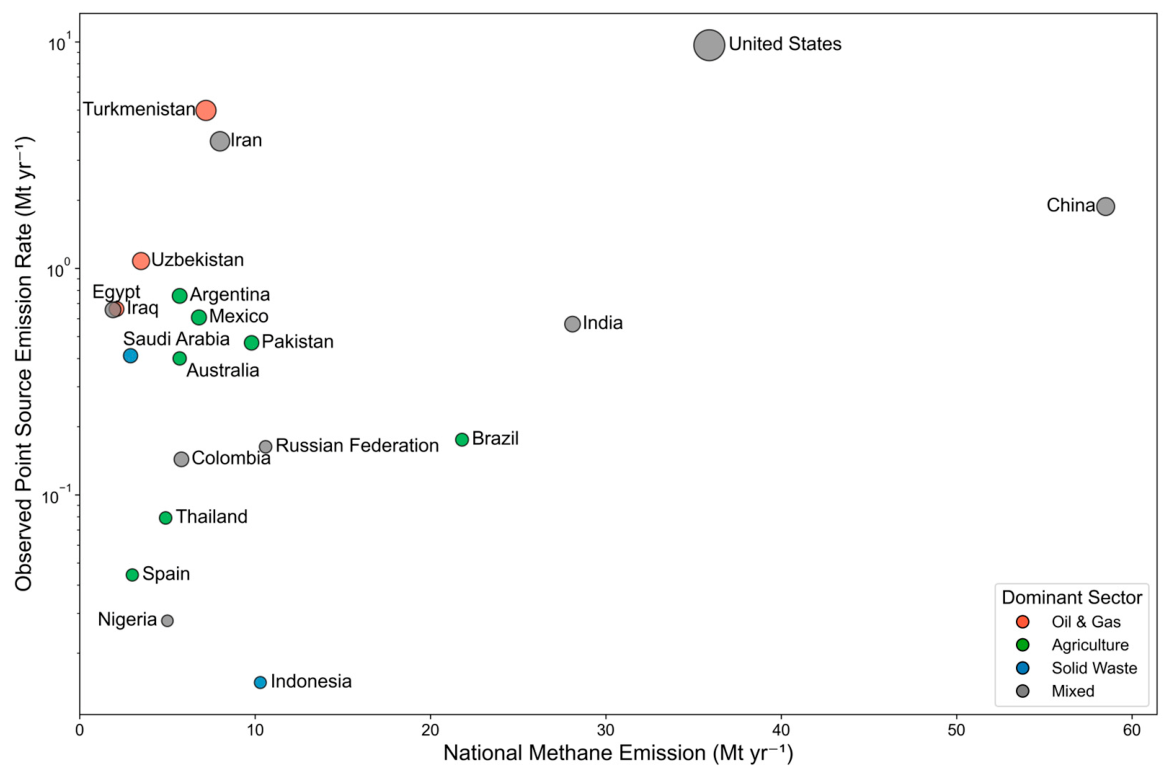
Figure 7 presents the relationship between national anthropogenic methane totals derived from inversion estimates [
37] and equivalent annualized point-source totals derived from Carbon Mapper observations for the 20 highest-emitting nations. The latter are computed by converting instantaneous emission rates (kg h
−1) to annual equivalents assuming 8760 h per year. Given that actual emission persistence varies widely by source type and sector [
36], the metric is therefore interpreted solely in terms of relative ranking and sectoral composition, not absolute magnitude [
11].
The overall distribution shows no monotonic relationship between national emission totals and point-source equivalent totals. China (58.5 Mt yr
−1) has a point-source equivalent of 1.87 Mt yr
−1 (3.2% of national total), the United States (35.9 Mt yr
−1) reaches 9.66 Mt yr
−1 (26.9%), and India (28.1 Mt yr
−1) yields only 0.57 Mt yr
−1 (2.0%). Despite similar total emission magnitudes, the point-source contribution fractions differ by more than an order of magnitude, reflecting differences in sectoral composition [
37]. Agriculture accounts for roughly 44% of global anthropogenic methane emissions [
29], with rice cultivation and livestock as major components. In China, rice cultivation contributes substantially, typically as spatially diffuse area sources; in India, livestock emissions dominate and are similarly difficult to identify as discrete point sources [
56]. The U.S. energy sector, by contrast, is characterized by concentrated point-source emissions, explaining the higher point-source fraction [
18,
36].
Sectoral contrasts are even sharper among countries with comparable total emissions. Russian Federation (10.6 Mt yr
−1) has a point-source equivalent of only 0.16 Mt yr
−1 (1.5%), while Iran (8.0 Mt yr
−1) reaches 3.64 Mt yr
−1 (45.5%)—a roughly 30-fold difference. Although both are energy-dominated economies, Iranian oil and gas facilities are highly concentrated, with satellite observations in the Middle East indicating a prominent super-emitter contribution [
50]. Russian emissions are more distributed across extensive pipeline networks and coal mining operations, with fewer detected point sources and lower observed intensities, further limited by reduced satellite revisit frequency at high latitudes [
18].
Among oil- and gas-dominated nations, point-source fractions are the highest, notably in Turkmenistan (69.2%) and Uzbekistan (30.8%). Since Carbon Mapper observations are primarily targeted at energy and waste facilities, agriculture-related diffuse sources are sparsely captured [
16,
56] which further elevates the apparent point-source fraction in energy-dominated countries. Collectively, the residual national emissions not captured by point-source observations originate from a broad range of lower-intensity and diffuse sources—including small-scale energy facilities, distributed agricultural emissions, wetlands, and other area sources—that fall below Carbon Mapper’s detection threshold or are not systematically targeted by its facility-scale observation design [
29,
56].
Mixed-sector countries are most widely scattered in the figure, with point-source intensities varying substantially at comparable total emission levels. This dispersion confirms that national emission totals alone are insufficient to characterize actual abatement difficulty. Integrating emission rate distributions with economic capacity indicators is therefore necessary to inform differentiated mitigation pathways.
3.6. Responsibility–Capacity Distribution of National Methane Emissions and Economic Development
Building on the cross-country differences in emission structure identified above,
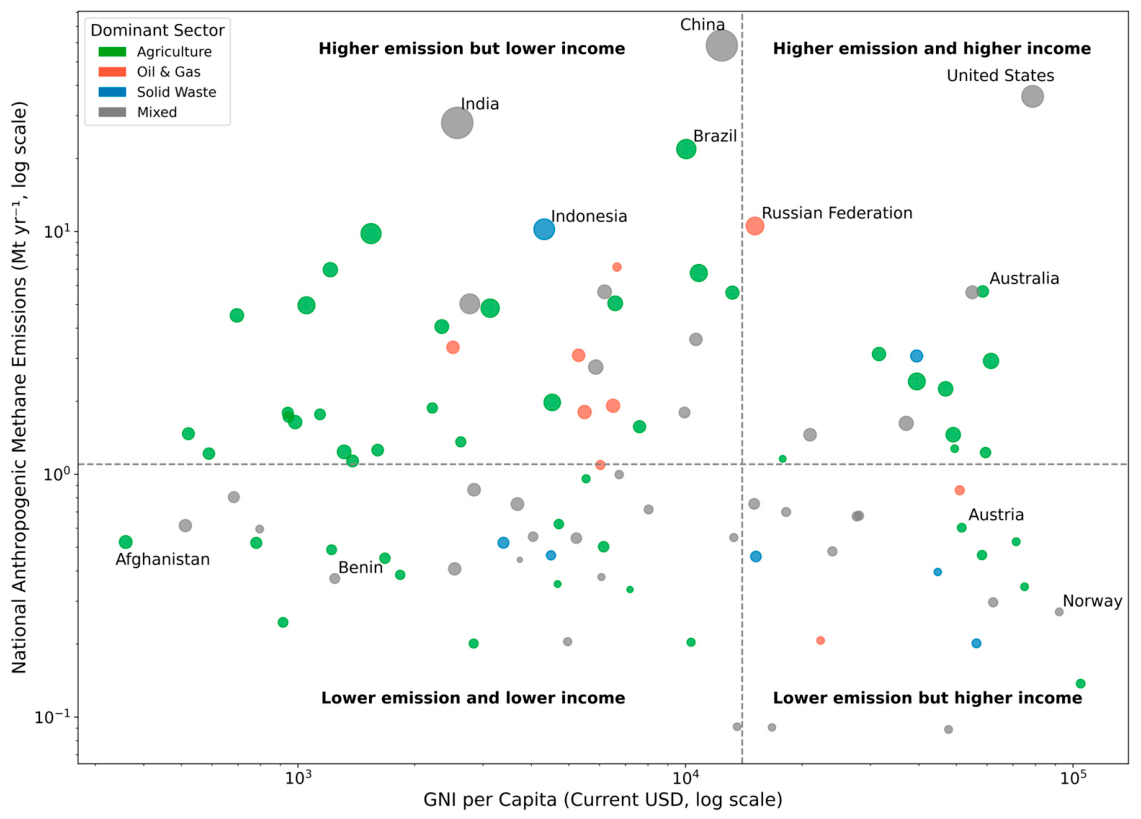
Figure 8 presents a joint analysis of national anthropogenic methane emissions and economic capacity [
28]. GNI per capita serves as a composite indicator of economic strength and technological capability, reflecting both fiscal capacity and the underlying level of environmental governance infrastructure [
28,
30]. Countries are classified relative to the World Bank high-income threshold of USD 14,005 (2023) [
28], providing an internationally standardized and reproducible criterion for cross-country comparison. Plotting national methane emissions (Mt yr
−1) against GNI per capita thus provides a basis for positioning countries within the global mitigation landscape.
The sample spans roughly 0.1–60 Mt yr−1 in anthropogenic methane emissions and four orders of GNI per capita. These two dimensions define four responsibility–capacity quadrants. The World Bank high-income threshold defines the vertical reference line, dividing countries into higher-income and lower-income groups; the median national emission serves as the horizontal reference, yielding four responsibility–capacity quadrants.
The upper-right quadrant contains higher-income, higher-emission countries. The United States (GNI per capita $80,000; emissions 35.9 Mt yr−1) and Australia ($63,320; 5.7 Mt yr−1) are representative examples, combining strong economic and technological capacity with substantial emission pressure. The Russian Federation ($14,460; 10.6 Mt yr−1) falls marginally above the high-income threshold, driven primarily by oil and gas emissions.
The upper-left quadrant concentrates lower-income, higher-emission countries, predominantly agricultural or oil- and gas-dominated economies. China (
$13,750; emissions 58.5 Mt yr
−1)—the largest emitter in the sample—falls just below the high-income threshold, placing its emission burden in this quadrant; its emissions reflect total scale driven by large population and economic activity rather than high per capita intensity [
29]. India (
$2580; 28.1 Mt yr
−1), Brazil (
$9310; 21.8 Mt yr
−1), and Turkmenistan (
$6270; 7.2 Mt yr
−1) are further representative cases. Despite high emission pressure, these countries face economic constraints and require international climate finance and technology transfer to reconcile mitigation and development objectives.
The lower-left quadrant comprises lower-income, lower-emission countries, including Afghanistan ($370; 0.6 Mt yr−1) and Benin ($1390; 0.2 Mt yr−1). These countries are limited in population size, industrial activity, and energy development, resulting in modest contributions to global methane emissions. The lower-right quadrant includes economically advanced countries with relatively low anthropogenic methane emissions, such as Austria ($55,890; 0.5 Mt yr−1) and Norway ($101,640; 0.2 Mt yr−1), both well below the sample median.
The overall distribution reveals systematic differences in the economic–emission positioning of countries by dominant sector: mixed-sector countries span the widest range, oil- and gas-dominated countries concentrate in the mid-to-high emission zone, and agriculture-dominated countries cluster at low-to-moderate emission levels. This pattern provides a quantitative basis for understanding cross-country differences in mitigation responsibility and governance capacity, and offers a framework for designing differentiated global methane abatement strategies.
5. Conclusions
To address the scale-translation challenge in national methane emission assessment, this study integrates Carbon Mapper airborne observations (2021–2025), GHGSat satellite point-source data, and 2023 national-scale inversion estimates into a comprehensive framework linking instantaneous point-source observations to governance analysis. The framework focuses on how emission rate distribution characteristics determine mitigation difficulty and optimal pathways.
Our findings indicate that global methane point-source emissions exhibit pronounced spatial concentration, with hotspots clustered in major energy production regions. Different observing platforms characterize emission structures with systematic divergence, and no monotonic relationship exists between national emission totals and point-source emission intensity. For instance, Turkmenistan has a national total of 7.2 Mt yr−1 but a point-source equivalent of 4.98 Mt yr−1 (69.2% of the national total), while China’s total of 58.5 Mt yr−1 corresponds to a point-source equivalent of only 1.87 Mt yr−1 (3.2%). The U.S. point-source fraction (26.9%) is substantially higher than those of China and India (2.0%). It should be noted that these point-source fractions represent equivalent annualized structural intensity indices rather than true annual emission contributions.
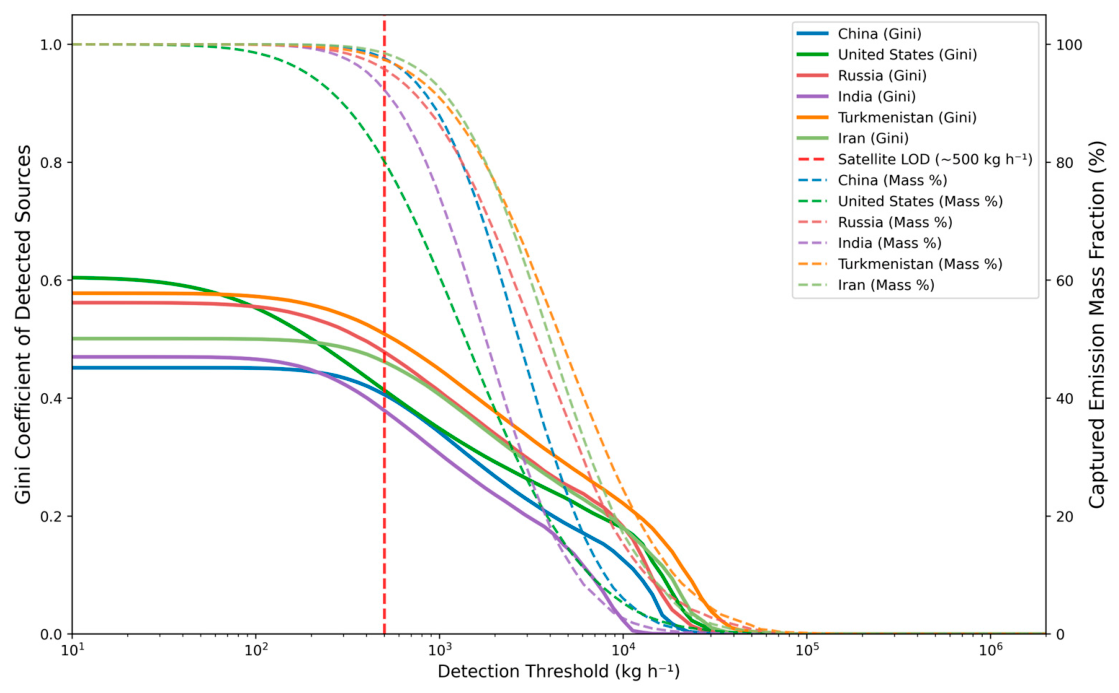
Further analysis reveals marked cross-country differences in point-source emission rate distributions. The United States is characterized by a high density of low-intensity sources with a relatively concentrated distribution, while China and Turkmenistan exhibit more pronounced heavy-tailed behavior, with a small number of high-intensity sources accounting for a substantial share of total emission mass (Gini coefficients: 0.46–0.60). These structural differences directly affect mitigation cost-effectiveness: in countries with heavier-tailed distributions, targeting super-emitters yields disproportionately high abatement efficiency [
19,
21].
High-resolution remote sensing effectively identifies global methane hotspots, yet national-scale interpretation requires integration of multi-source observations and sectoral structure information. Future work should incorporate longer time series and broader sectoral coverage to further enhance the framework’s utility for global methane mitigation assessments.




 ,
,