Article

Airborne Laser Scanning and Hyperspectral Data Fusion to Estimate Tree Species Diversity in a Subtropical Forest


1
School of Ecology, Shenzhen Campus of Sun Yat-sen University, Shenzhen 518107, China
2
Institute of Gardens, Shenzhen Fairy Lake Botanical Garden, Shenzhen 518004, China
*
Author to whom correspondence should be addressed.
Remote Sens. 2026, 18(11), 1733; https://doi.org/10.3390/rs18111733
Submission received: 2 March 2026 / Revised: 14 May 2026 / Accepted: 18 May 2026 / Published: 27 May 2026

Highlights

What are the main findings?
  • ALS–HSI data fusion combined with adaptive fuzzy C-means clustering achieves high-accuracy estimation of subtropical forest tree species diversity (Adj. R2 = 0.725).
  • Variance decomposition reveals that TLS exhibits significant marginal explanatory power but a near-zero independent contribution after controlling for ALS, demonstrating that TLS introduces confounding structural signals rather than complementary information within the multi-source framework.
What are the implications of the main findings?
  • The “structure–spectral” synergy between ALS and HSI provides a reliable technical approach for large-scale, fine-grained forest biodiversity monitoring.
  • Data fusion for biodiversity assessment should prioritize ecologically relevant, non-redundant features over sensor data completeness, guiding targeted application of TLS in future studies.

Abstract

In structurally complex subtropical evergreen broad-leaved forests with dense understories, conventional remote sensing approaches are often limited by spectral saturation and insufficient structural characterization. This study developed a multi-source data fusion framework integrating airborne laser scanning (ALS), terrestrial laser scanning (TLS), and hyperspectral imagery (HSI), using ground truth data from 34 permanent plots in southern China subtropical evergreen broad-leaved forests. Six key structural parameters from ALS/TLS and six spectral indices from HSI were integrated as input features for adaptive fuzzy C-means clustering to estimate tree species diversity. Variance decomposition was conducted to quantify the independent and interactive contributions of ALS- and TLS-derived parameters. The results showed that: (1) ALS-based multi-scale watershed segmentation achieved high individual-tree segmentation accuracy (R2 = 0.873); (2) ALS-derived structural parameters exhibited significant correlations with plot-level species diversity (R2 = 0.385–0.824); (3) inter-crown standard deviations of six vegetation indices showed consistent associations with species diversity (R2 = 0.361–0.479), capturing interspecific spectral and functional variation; (4) combined ALS, HSI, and TLS predictors explained approximately 83% of diversity variation, with TLS contributing minimal unique information beyond ALS; (5) adaptive fuzzy C-means clustering estimated Shannon–Wiener indices with high accuracy (R2 = 0.725), though plot-level aggregated metrics outperformed individual-tree aggregates; (6) TLS inclusion reduced estimation accuracy (R2 = 0.653), likely due to understory liana interference, while silhouette analysis confirmed that clustering stability remained unchanged. These findings demonstrate that ALS–HSI fusion enables robust regional-scale tree species diversity estimation, while TLS may introduce confounding structural signals rather than complementary information in dense understory conditions.

1. Introduction

Earth is currently undergoing its sixth mass extinction event [1], and the persistent decline in biodiversity throughout the 21st century has been well documented [2,3]. However, predictions of biodiversity change remain uncertain [3], primarily due to a fundamental gap in global knowledge of biological diversity: the number of described species falls one to two orders of magnitude short of estimated total species richness [4,5]. This disparity, known as the Linnean shortfall [6], impedes accurate assessment of true biodiversity trends. Under escalating pressures from human activities and climate change, forest ecosystems are under severe threat; thus, accurate, repeatable monitoring of forest species diversity is critical for effective biodiversity conservation and ecological management [7].
Although field surveys provide detailed species diversity information for specific areas, they are constrained by complex topography and high canopy closure, limiting their ability to cover large-scale, highly heterogeneous forest regions and resulting in poor spatial continuity. Moreover, field surveys are time-consuming, labor-intensive, and unable to rapidly respond to dynamic ecological changes, making them inadequate for large-scale, high-temporal-resolution studies [8,9]. The advancement of remote sensing offers a promising alternative. Compared to ground-based methods, remote sensing enables cost-effective monitoring over large areas and extended time periods, facilitating the dynamic tracking of biodiversity over time [10,11]. The ecological basis for this approach is that interspecific competition for living space drives different species to occupy distinct vertical forest layers, such that species-rich forests typically exhibit more complex and heterogeneous canopy structures [12]. Among these, airborne laser scanning (ALS) is not limited by canopy leaf area density and can capture detailed three-dimensional vegetation structure, accurately obtaining forest canopy structure parameters such as tree height and leaf area index (LAI), enabling accurate characterization of canopy architecture [13,14], and supporting indirect estimation of diversity [15]. Recent studies have demonstrated that UAV LiDAR data, combined with diversity indices based on importance values, can enhance biodiversity assessment [10]. Forests with a rich variety of species typically exhibit greater heterogeneity in their canopy structure [16,17]. Research conducted by Rissanen revealed that tree diversity increases the structural complexity of the canopy. However, due to influences from forest type, disturbance history, environmental conditions, and biotic interactions [18,19,20]—particularly in highly diverse subtropical forests—the accuracy of ALS alone for local-scale species diversity monitoring remains insufficient [7,21]. Furthermore, ALS application has significant limitations in subtropical forest ecosystems. These forests typically exhibit a multi-layer vertical structure (canopy, shrub, and herb layers), combined with dense undergrowth and mountainous terrain. This makes it difficult for ALS to penetrate the lower vegetation to obtain detailed tree-level structural parameters, which remains a core constraint for its application in subtropical forestry surveys [22].
Of all remote sensing techniques currently applied in forest research, terrestrial laser scanning (TLS) stands out for its unparalleled capacity to characterize forest structure with high precision and fine spatial detail. Unlike ALS, TLS operates from ground-based platforms, enabling comprehensive fine-scale measurements of understory vegetation as well as overstory canopy layers. When compared with other field-scale approaches, including mobile laser scanning, close-range terrestrial photogrammetry and conventional forest inventory surveys, TLS delivers higher geometric precision and more complete structural information. This capability makes it well-suited for high-resolution modeling of individual-tree morphology and stand-level forest architecture [23,24]. Recent advances in TLS technology have expanded its applications in forest ecology, enabling comprehensive characterization of forest structural attributes and their relationships with biodiversity [16]. The integration of ALS and TLS therefore offers a complementary, non-destructive approach for comprehensive 3D structural characterization. ALS can quantify the overall structural dynamics of a forest [25], while TLS provides a dense point cloud that ALS cannot offer, enabling the extraction of the entire three-dimensional structure of each tree with high precision [25]. In practice, high-precision data and appropriate measurement methods are always the preferred choice [22], which is highly compatible with the monitoring requirements for the complex structures in the subtropical region. Compared to TLS point clouds alone, fusing TLS and ALS data improves the accuracy of tree height estimation [26]. Dobre [27] systematically quantified forest ecosystem services—including provisioning (e.g., timber volume), regulation (e.g., carbon storage), and support (e.g., habitat structural complexity)—by jointly leveraging ALS and TLS datasets. However, the applicability of ALS and TLS must be carefully evaluated in relation to stand structural characteristics. Previous studies have shown that ALS and TLS yield highly consistent estimates of stem and branch volume in mature broadleaf forests [28]; yet their reliability is strongly influenced by stand conditions, with TLS performance notably declining in dense coniferous stands or during early growth stages. However, the ecological utility of TLS in such environments has not been systematically evaluated. In structurally complex subtropical evergreen broad-leaved forests with dense understories, ALS already captures canopy-level structural heterogeneity, including vertical stratification, canopy roughness, and height distribution. Whether TLS-derived fine-scale understory and stem-architecture details provide additional explanatory power for plot-level diversity estimation or whether they largely overlap with ALS-derived metrics remains an open question. Clarifying this relationship is essential for guiding cost-effective sensor deployment in biodiversity monitoring.
The existing literature demonstrates that LiDAR data fusion with hyperspectral datasets is effective for the quantification of forest structural parameters at both the individual-tree and local scales [29]. Hyperspectral imaging (HSI) enables precise capture of forest canopy reflectance characteristics through hundreds of spectral bands, facilitating quantitative estimation of biodiversity. Recent studies have demonstrated that hyperspectral data can effectively detect fine-scale changes in vascular plant β-diversity and support biodiversity monitoring across multiple spatial scales [30]. However, these spectral characteristics cannot reliably serve as species-specific spectral fingerprints, and the key bottleneck lies in the significant intraspecific variation in spectral characteristics [31]: the spectral signatures of a given species can exhibit significant variability over time (e.g., due to phenological changes) or under different environmental conditions (e.g., variations in illumination and moisture) [32]. This issue has led to significant challenges for HSI in biodiversity estimation, especially in tropical ecosystems. In these ecosystems, the higher biodiversity and more complex community structures further increase the risk of spectral feature confusion, posing persistent challenges for the application of HSI in biodiversity monitoring [33]. To address spectral confusion among co-occurring species, unsupervised clustering methods such as fuzzy C-means have been applied to group spectrally similar canopy elements, offering a pathway to estimate diversity without requiring species-level identification.
Although multi-source remote sensing technologies have advanced in the field of ecological monitoring, they have not fully resolved the mismatch between ground-based biodiversity surveys and remotely sensed observations. Establishing robust relationships between field-measured and remotely sensed indicators remains a major challenge in current research [11]. To address this gap, this study focuses on subtropical evergreen broadleaf forests in southern China and integrates TLS, ALS, and HSI data within a multi–source fusion framework. Specifically, we aim to (1) evaluate the accuracy of ALS-based individual-tree segmentation and the relationships between ALS-derived structural parameters and plot-level species diversity, (2) assess the contribution of hyperspectral vegetation indices to diversity estimation, (3) quantify the independent and interactive contributions of ALS and TLS through variance decomposition, and (4) develop an adaptive fuzzy C-means clustering approach for estimating tree species diversity indices. Through this framework, we seek to determine whether ALS–HSI fusion alone provides sufficient predictive power for regional-scale diversity monitoring and to clarify the marginal utility of TLS in structurally complex subtropical forests.

2. Materials and Methods

2.1. Study Area

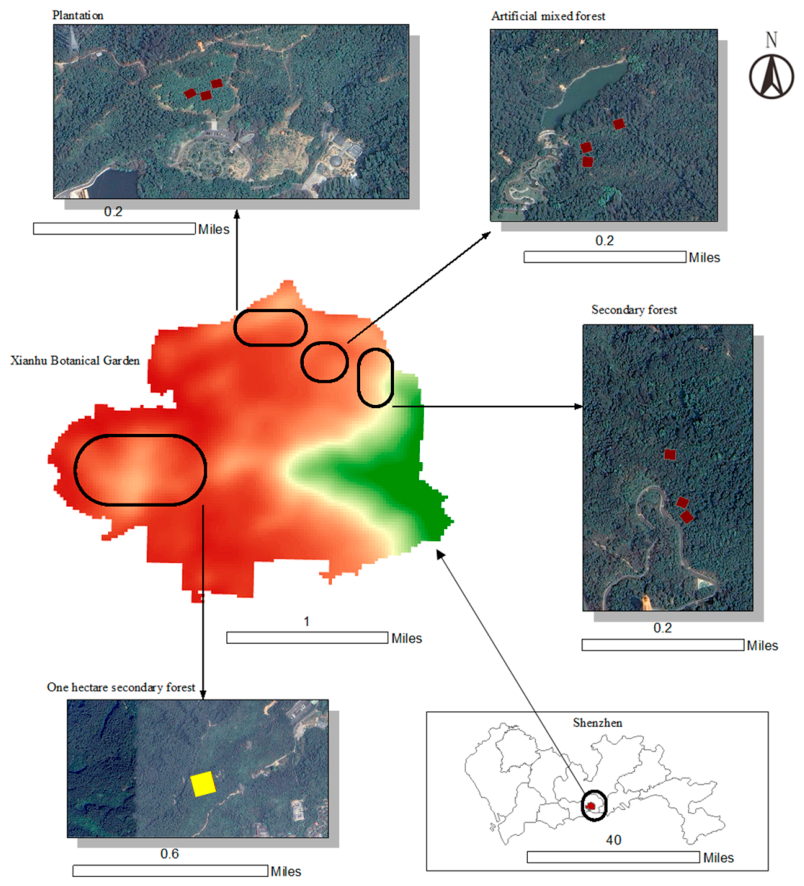
The study area is located within Xianhu Botanical Garden in Shenzhen (E 114°10′51″, N 23°34′43″; Figure 1). The study area has a southern subtropical maritime monsoon climate, with a mean annual temperature of 22.1 °C and a mean annual precipitation of 1940 mm. The terrain is dominated by low hills and undulating topography, with lateritic red soil developed from sandstone. Dominant tree species in the study area include Heptapleurum heptaphyllum, Schima superba, Aporosa dioica, Toxicodendron succedaneum, and Aquilaria sinensis.

2.2. Field Survey

From 27 March to 3 May 2024, 34 permanent plots (20 m × 20 m each) were established within the study area (Table S1). Each plot was subdivided into four 10 m × 10 m quadrats using the adjacent quadrat method. A complete tree-by-tree inventory was conducted for all woody plants with a diameter at breast height (DBH) ≥ 1 cm, and species identity, DBH, tree height, and crown width were recorded. The corner stakes of each plot were georeferenced using real-time kinematic differential positioning (RTK), and the stem base positions of individual trees within the plots were measured using a total station, serving as ground truth for validating individual-tree segmentation results. To quantify species diversity, the Shannon–Wiener index was calculated for each plot based on the field survey data [34], using the following formula:
S W = i = 1 n p i ln p i
where p i represents the proportion of individuals of the i -th species relative to the total number of individuals across all S species in the community.
It should be noted that field surveys were conducted during March–May 2024, while airborne remote sensing data were acquired in September 2024. This temporal offset is ecologically justified: mature southern subtropical evergreen broad-leaved forests exhibit high stability in woody species composition and macro-canopy architecture across single growing seasons, with minimal inter-seasonal turnover in tree height or crown structure. Furthermore, phenological transitions primarily affect leaf-level biochemical traits, which were explicitly controlled for by normalizing hyperspectral indices using the ALS-derived leaf area index (LAI), ensuring that structural and spectral signals remained comparable for modeling.

2.3. Remote Sensing Data

2.3.1. Airborne LiDAR Data (ALS)

ALS data were acquired during clear-sky conditions at solar noon between 10 and 15 September 2024. A DJI Matrice 300 RTK multirotor UAV equipped with the Li Air X3–H LiDAR system (Green Valley International, Beijing, China) was used to survey the study area. The Li Air X3–H scanner has a horizontal field of view of 70.4° and a vertical field of view of 4.5°, with a laser pulse repetition rate of 72,000 points per second. The UAV flew at an absolute altitude of at least 70 m above ground level at a speed of 6 m/s, achieving an average point cloud density of approximately 3000 points/m2. The UAV-borne LiDAR data underwent trajectory post-processing using Green Valley International’s cloud-based base station differential correction service to generate point clouds with high-precision absolute coordinates. Data processing followed Chinese national standards for airborne LiDAR data acquisition and post-processing.
Ground points were classified directly from the raw ALS point cloud using the Cloth Simulation Filtering (CSF) algorithm [35], without requiring any external digital terrain model (DTM) products. The classified ground points were interpolated into a DTM at 0.5 m resolution using a triangulated irregular network (TIN) algorithm. This internally generated DTM served as the reference surface to normalize all ALS return elevations relative to the terrain. Key CSF parameters were configured as follows: cloth resolution = 0.5 m, classification threshold = 0.5 m, and rigidness = 1. These settings were optimized for the study area’s undulating topography to ensure robust ground detection and eliminate non-ground artifacts prior to canopy feature extraction. To more accurately characterize forest canopy structural morphology, a “pit-free” algorithm was applied to the normalized point cloud to generate a canopy height model (CHM), thereby avoiding errors introduced by multiple interpolations inherent in the conventional approach of subtracting a digital elevation model (DEM) from a digital surface model (DSM).

2.3.2. Airborne Hyperspectral Data (HSI)

Airborne hyperspectral data were acquired using the ULTRIS X20P imaging spectrometer (Cubert GmbH, Ulm, Germany) mounted on a DJI M300 RTK UAV (DJI, Shenzhen, China), operating in the spectral range of 350–1000 nm with a spectral resolution of 4 nm. Each raw hyperspectral image was geotagged, and Agisoft Metashape Pro (V2.3.1, Agisoft LLC, St. Petersburg, Russia) was used to perform image mosaicking, geometric correction, and radiometric calibration, resulting in a high-resolution, georeferenced hyperspectral dataset with reflectance values. To minimize interference from non-vegetation elements and shadows, pixels with an NDVI < 0.6 were first excluded to remove bare soil and rock areas. Subsequently, pixels with maximum reflectance across all bands below 0.2 were removed to further eliminate shadow effects.

2.3.3. Terrestrial LiDAR Data (TLS)

TLS data were acquired in September 2024 using an OmniSLAM Mobile SLAM color three-dimensional laser scanner (Ousilai (Beijing) Intelligent Technology Co., Ltd.; Beijing, China), operating at a scanning rate of 640,000 points per second and yielding raw point cloud data with a density of approximately 50,000 points/m2 and angular accuracy of 0.005° in both the horizontal and vertical directions. Due to canopy occlusion, GNSS signals were severely limited within the forest; thus, mobile RTK positioning was disabled during data collection. Instead, 4–5 ground control points were established in areas of lower canopy closure to ensure the absolute georeferencing accuracy of the TLS data.
To ensure methodological consistency in multi-source LiDAR fusion and to isolate the ecological contribution of TLS from technical artifacts of point density, the raw TLS point cloud (~50,000 points/m2) was randomly downsampled to approximately 3000 points/m2, aligning with the nominal acquisition density of the airborne platform. This density-harmonization protocol serves two interrelated purposes: (1) mitigating density-driven weighting bias in joint structural metric extraction, wherein ultra-high TLS density could artificially dominate variance attribution in multivariate models [25], and (2) explicitly testing whether the explanatory power of TLS for plot-level species diversity stems from its unique ground-based perspective or merely from its higher point density.
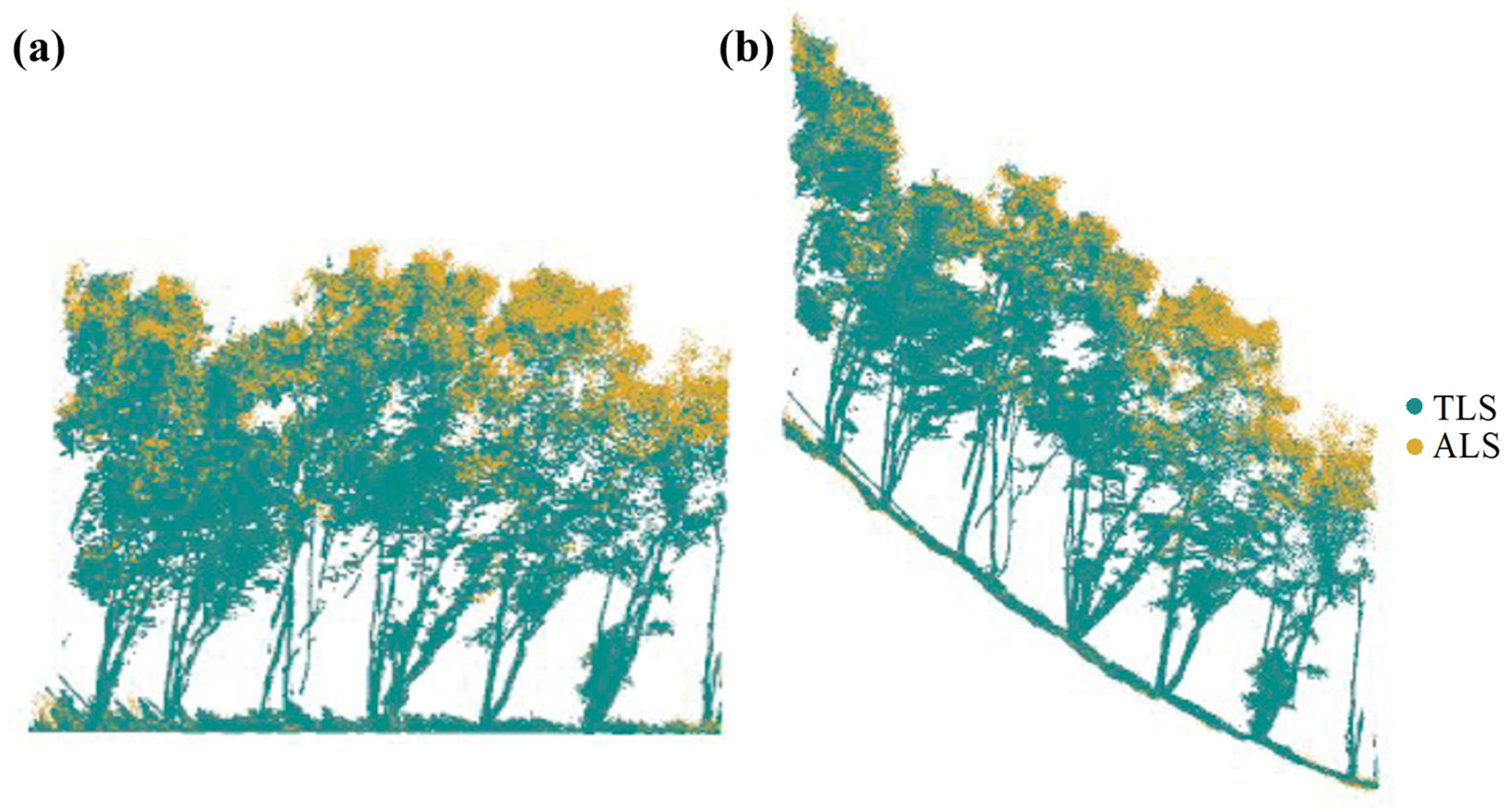
Subsequently, the Cloth Simulation Filtering (CSF) algorithm [35] was applied to classify ground points in both original and downsampled TLS datasets, which were then used to normalize the elevation of the entire point cloud. Finally, the normalized TLS data were co-registered with the ALS data using coordinate transformation, producing fused point cloud datasets for subsequent variance partitioning and individual-tree segmentation analyses (Figure 2a,b). The comparative analysis of original-density versus downsampled TLS data allowed us to assess the sensitivity of structural metrics to point cloud density and determine whether ultra-high-density acquisition provides incremental value for plot-scale biodiversity estimation beyond operational airborne LiDAR densities.

2.4. Methods

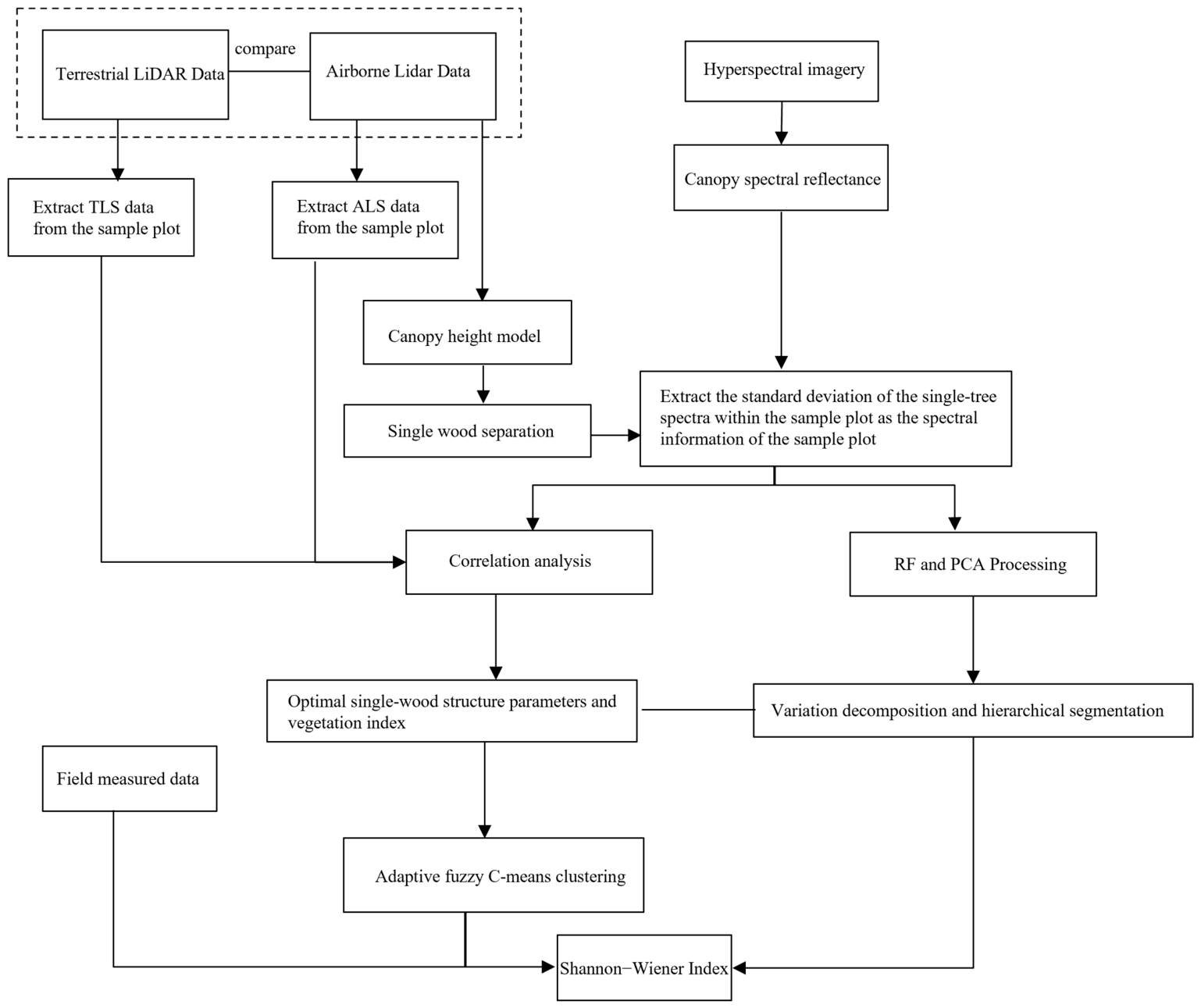
In this study, remote sensing was employed to capture spectral and structural parameters indicative of tree species diversity, following the workflow illustrated in Figure 3. To minimize the influence of understory shrubs and herbs on overstory spectral signals, a hierarchical segmentation strategy was implemented based on the canopy height model (CHM). This process first distinguished overstory canopies from understory vegetation, followed by fine-scale segmentation to delineate individual tree crowns. Building upon this segmentation, spectral and structural parameters were extracted at the individual-tree level. For plot-level analysis, these individual-tree metrics were aggregated and rigorously preprocessed using Random Forest (RF) importance screening coupled with Principal Component Analysis (PCA). This protocol was specifically designed to eliminate within-source multicollinearity and generate orthogonal composite variables, thereby ensuring statistically unbiased variance partitioning. To clarify the driving mechanisms, variance decomposition analysis was conducted using these RF-PCA-derived predictors to quantify the independent explanatory power of spectral and structural parameters, as well as their interactive effects. Based on these insights and correlation analyses with field-measured Shannon–Wiener indices, optimal parameters were selected and served as inputs for an adaptive fuzzy C-Means (AFCM) clustering algorithm to estimate tree species diversity across the study area.

2.4.1. Individual-Tree Segmentation Based on Multi-Scale Watershed Algorithm

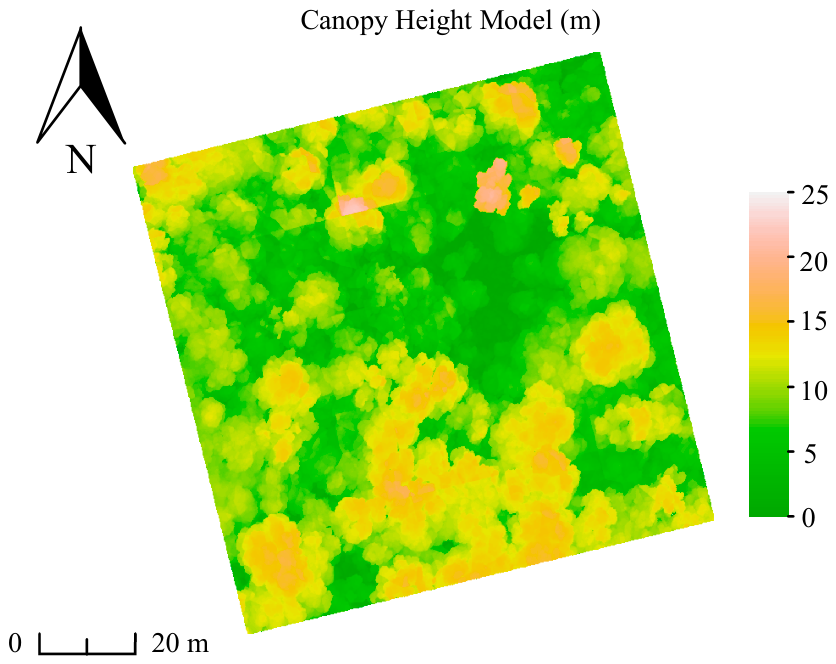
The individual-tree segmentation approach used the canopy height model (CHM) derived from ALS data (Figure 4), with null values filled using a pit-free interpolation, as the input dataset. The multi-scale watershed segmentation algorithm was implemented via the “mcws()” function in the R lidR package, which enhanced crown delineation accuracy through multi-scale analysis and proved particularly effective for complex forest stand structures. To enable accurate diversity estimation at the individual-tree level, point clouds corresponding to individual trees were extracted from the ALS-derived point cloud. Specifically, the “clip_roi()” function in lidR was employed to clip LiDAR points within each segmented crown polygon. Structural LiDAR metrics were then computed for each tree using the lidRmetrics package in R. Furthermore, individual-tree structural attributes derived from ALS alone were compared with those obtained from the fused ALS–TLS dataset. Based on these structural representations, the accuracy of species diversity estimates generated using single-source (ALS-only) versus fused (ALS–TLS) data was evaluated and contrasted.

2.4.2. Extraction of Forest Canopy Structural Parameters from LiDAR Data

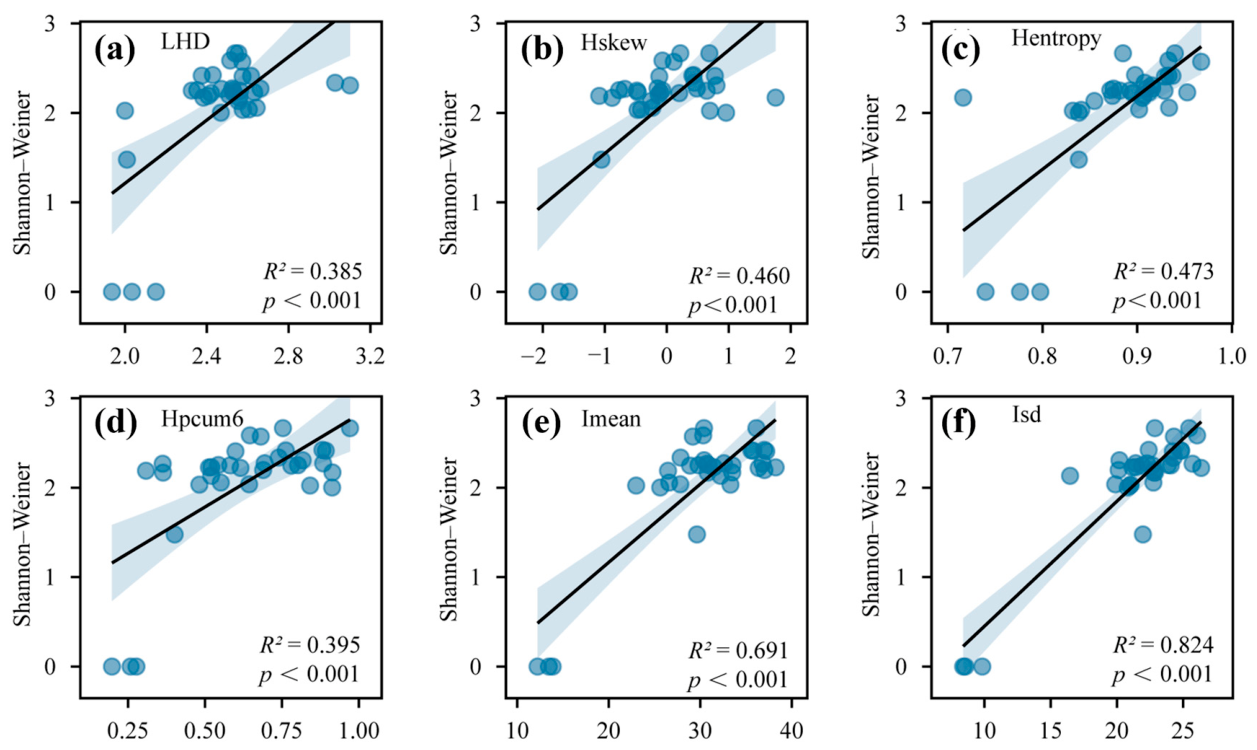
Normalized point cloud data derived from ALS were used to extract forest canopy structural parameters for the 34 study plots. These parameters encompass vertical, horizontal, and internal structural metrics, as summarized in Table 1. Pearson correlation coefficients were calculated between the field-measured Shannon–Wiener diversity indices and the LiDAR-derived structural parameters across the 34 plots. Based on Pearson correlation analysis with plot-level Shannon–Wiener indices, six ALS-derived structural parameters exhibiting the strongest and most statistically significant associations (all p < 0.001) were selected. These parameters, ranked by explanatory power (Adj. R2), are: (1) intensity standard deviation (Isd), (2) mean intensity (Imean), (3) height entropy (Hentropy), (4) height skewness (Hskew), (5) height cumulative proportion below 60% of maximum height (Hpcum6), and (6) leaf height diversity (LHD). Selection prioritized metrics capturing vertical stratification, canopy roughness, and laser return heterogeneity, which are ecologically linked to light partitioning and microhabitat diversification.

2.4.3. Extraction of Optimal Vegetation Indices from Hyperspectral Data

Vegetation indices (VIs) are mathematical combinations of surface reflectance at multiple wavelengths and can quantitatively indicate vegetation vigor and biochemical content under certain conditions [36]. Based on a synthesis of previous studies, 15 hyperspectral vegetation indices (Table 2) were selected, systematically guided by the key biochemical, structural, and spectral characteristics of subtropical evergreen broad-leaved forests [37,38,39,40]. Given the high species richness, multi-layered canopy architecture, and elevated biomass in these ecosystems, remote sensing-based diversity estimation faces three major spectral challenges: (1) early saturation of traditional broadband indices under dense canopy cover; (2) spectral interference from soil, leaf litter, and understory vegetation; and (3) subtle interspecific spectral differentiation driven by evergreen leaf trait variability. To address these, the selected indices were categorized into four ecologically targeted groups: (1) red-edge and chlorophyll-sensitive indices (SR, NSR1, NDVI705, VOG1, CRI, REIP, and mNDVI705), which exploit the steep reflectance gradient near 700–750 nm to detect interspecific variations in leaf pigments while resisting saturation in high-biomass canopies [41,42,43,44,45,46]; (2) soil-background-adjusted indices (NDVI, OSAVI, PVI, MSAVI, MCARI, and MCARI/OSAVI), designed to mitigate noise from exposed soil and complex understories typical of multi-strata subtropical stands [42,47,48,49,50]; (3) biochemical and functional proxies (TCARI) targeting canopy chlorophyll absorption and photosynthetic pigment ratios that underpin niche differentiation among co-occurring broad-leaved species [51]; and (4) physiological and vigor indicators (PRI) capturing xanthophyll cycle dynamics and interspecific stress responses [52]. This trait-driven suite ensures comprehensive coverage of the spectral–functional diversity axes critical for tree species discrimination in evergreen-dominated, high-heterogeneity forests, aligning with the spectral variation hypothesis for biodiversity monitoring. In this study, the 15 VIs were first calculated for individual tree crowns across the 34 plots. However, these indices are influenced by canopy structural variation. To minimize the confounding effect of canopy structure on interspecific spectral differences, each VI was normalized by the corresponding leaf area index (LAI) derived from LiDAR at the individual-tree level [29,40], thereby scaling from canopy to leaf level. Subsequently, Pearson correlation analyses were conducted between the field-measured Shannon–Wiener diversity indices and the inter-crown standard deviations of the 15 LAI-normalized VIs within each plot. The vegetation indices showing the most consistent correlations with species diversity were selected as the optimal spectral indicators to characterizing species spectral variability at the tree level in the study area.

2.4.4. Contribution and Redundancy Analysis of Multi-Source Remote Sensing Data

In order to deeply understand the relative contributions and mutual influences of the three data sources (ALS, HSI, and TLS) in estimating forest tree species diversity, this study employed variance decomposition, hierarchical partitioning, and permutation tests to systematically evaluate the independent contributions, shared information, and redundancy levels of each data source. This section of the analysis was completed in R 4.3.1, using the vegan package for variance decomposition and permutation tests, the glmm.hp package for hierarchical partitioning, and ggplot2 for visualization. Prior to hierarchical partitioning, Principal Component Analysis (PCA) was applied separately to each data source to generate orthogonal composite predictors. This step eliminated within-source multicollinearity and ensured that individual contribution estimates were not inflated by correlated variables. The first few PCs explaining ≥85% of cumulative variance were retained for each source (typically two to three PCs). These PC scores, along with the RF-screened and PCA-transformed variables used in variance partitioning, served as inputs for the “glmm.hp” package in R. Hierarchical partitioning quantifies the independent contribution of each predictor to the total explained variance, while standardized coefficients indicate the direction and relative strength of each PC’s association with plot-level Shannon–Wiener diversity. In this framework, “marginal effects” refer to the explanatory power of a single data source when modeled in isolation, whereas “independent contributions” (or conditional effects) denote the unique variance explained after accounting for overlapping information from other data sources. This distinction is critical for differentiating between standalone predictive capacity and non-redundant ecological information within a multi-source fusion framework.

2.4.5. Adaptive Fuzzy C-Means Clustering

Clustering analysis partitions a dataset into an appropriate number of groups such that data within the same cluster are as similar as possible, while data between different clusters are as distinct as possible. Among various methods, the fuzzy C-means clustering algorithm (FCM) transforms the clustering process into a nonlinear optimization problem and iteratively updates cluster memberships and centers for a predefined number of clusters, making it a key approach in unsupervised pattern recognition. For a given dataset X = { x 1 , x 2 , x n } , FCM divides it into c clusters ( 2 c n ) and identifies the cluster centers V = { v 1 , v 2 , , v n } . The membership of each sample in a cluster is represented by a fuzzy membership matrix U = [ u i j ] R . The objective function J ( U , V ) and its constraints are defined as follows:
J ( U , V ) = j = 1 n i = 1 n u i j m d i j 2
{ u i j [ 0 , 1 ] i = 1 c u i j = 1
where u i j is the membership degree of the j -th sample point to the i -th cluster, d i j = x j v i is the Euclidean distance between the j -th sample point and the i -th cluster center, and m 1 is the fuzziness weighting exponent.
The basic principle of fuzzy C-means clustering is to iteratively update the membership matrix U and the cluster centers V such that the objective function J ( U , V ) is minimized. The conditional extremum of J ( U , V ) is obtained using the Lagrange multiplier method, yielding the iterative update formulas for U and V , where k denotes the iteration step, ε is the convergence threshold, and V 0 k represents the initial cluster centers.
u i j ( k ) = 1 r = 1 c ( d i j ( k ) d r j ( k ) ) 2 m 1
v i ( k + 1 ) = j = 1 n ( u i j ( k ) ) m x j j = 1 n ( u i j ( k ) ) m
The convergence threshold ε serves as the stopping criterion for the iterative optimization. Specifically, at each iteration step k , the algorithm updates the membership matrix U and cluster centers V ( k ) . The iteration terminates when the maximum absolute change in cluster center coordinates between consecutive iterations satisfies the condition m a x V ( k + 1 ) V ( k ) < ε . The convergence threshold (ε = 1 × 10⁻⁵) was selected following standard practices in fuzzy clustering [53]. Ecologically and statistically, this threshold ensures that iterative updates to cluster centers and membership degrees stabilize within a tolerance finer than the natural variability of remote sensing-derived structural–spectral features, thereby preventing premature termination or overfitting to sensor noise while maintaining computational efficiency for large plot-level datasets.
The adaptive fuzzy C-means clustering approach utilized the standard fuzzy C-means (FCM) algorithm in combination with a cluster validity index to determine the optimal number of clusters, thereby reducing sensitivity to initial cluster centers [54]. An improved cluster validity index L ( c ) was defined as follows:
{ L ( c ) = i = 1 c j = 1 n u i j m v i x ¯ 2 / ( c 1 ) i = 1 c j = 1 n u i j m x j v i ¯ 2 / ( n c ) x ¯ = 1 n i = 1 c j = 1 n u i j m x j
The numerator of L ( c ) represented the sum of inter-cluster distances, and the denominator represented the sum of all intra-cluster distances. A larger L ( c ) indicated a more reliable clustering result. The clustering outcome corresponded to species richness within each plot. Based on the optimal number of clusters and the number of individuals in each cluster, the Shannon–Wiener index can be computed.
The clustering effect is quantitatively evaluated using the silhouette coefficient. It calculates the intra-cluster compactness and inter-cluster separation of the samples. The distance matrix is adaptively selected as the Euclidean distance based on the feature dimensions to ensure the robustness of the evaluation results. This algorithm is implemented in R.
To evaluate the sensitivity of diversity estimation to cluster number specification, we conducted a supplementary robustness analysis in which the adaptive cluster number selection was disabled and fixed cluster numbers (c = 10, 15, 20, 25, 30, 35, and 40) were applied uniformly across all 34 plots. The results (Figure S1) demonstrated that RMSE remained stable across this range (varying by less than 0.15 units), confirming that Shannon–Wiener index estimation is robust to the specific choice of cluster number.

3. Results

3.1. Individual-Tree Segmentation

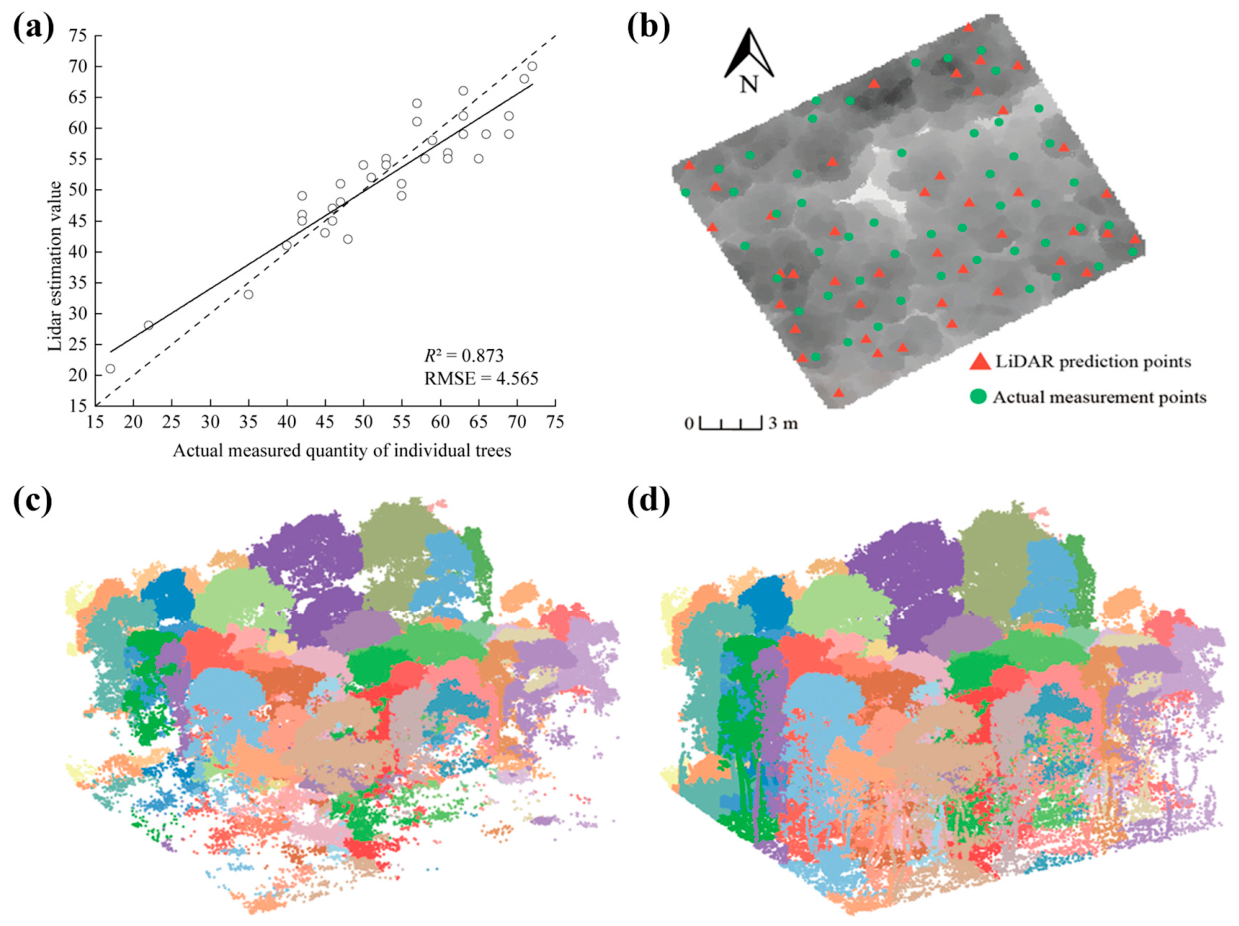
Based on field survey data, the average number of trees per plot in plots 1–3 (artificial monoculture stands) was 54, in plots 4–6 (artificial mixed stands) it was 46, and in plots 7–34 (secondary forests) it was 53. Individual-tree segmentation was performed for all 34 plots using the multi-scale watershed algorithm, with the canopy height model (CHM) derived from ALS data—as filled to remove null values—serving as the input. Validation of the segmentation results against field-measured tree counts across the entire study area revealed high reliability, with a coefficient of determination Adj. R2 = 0.873 (RMSE = 4.565, p < 0.001). Stratified assessment by stand type further confirmed consistent performance across artificial monocultures, mixed plantations, and secondary forests (Table S2). In nine randomly selected plots, individual tree positions were precisely mapped using a total station (with positioning accuracy ≤ 10 cm). These ground-truth locations were then compared with the crown positions derived from ALS-based segmentation. Overall, a high degree of spatial agreement was observed, although minor positional discrepancies were present in localized areas (Figure 5). These deviations may have arisen due to slight misalignments in georeferencing, CHM smoothing effects, or complex crown overlapping in dense secondary forests. Nevertheless, the results confirm that the multi-scale watershed algorithm effectively captures individual-tree distributions in structurally diverse subtropical forests.

3.2. Optimal Structural Parameters

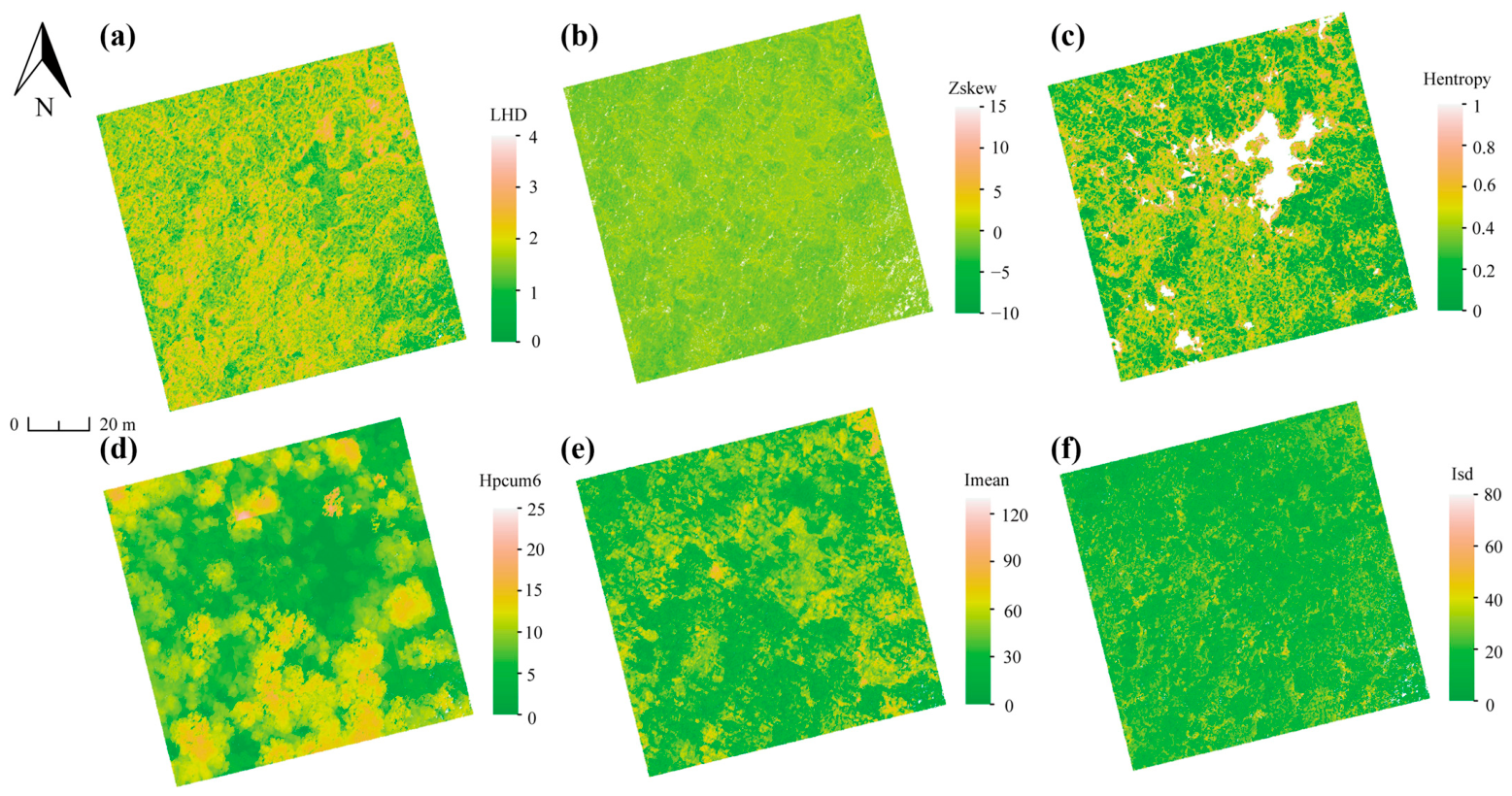
Through Pearson correlation analysis, LiDAR structural parameters indicative of species diversity were effectively selected. The Shannon–Wiener index exhibited differential associations across structural dimensions, with varying degrees of explanatory power (Figure 6). Among internal structure metrics, laser return intensity parameters demonstrated the strongest predictive capacity: intensity standard deviation (Isd) emerged as the dominant predictor (Adj. R2 = 0.824, p < 0.001), followed by mean intensity (Imean, Adj. R2 = 0.691, p < 0.001). In contrast, vertical structure metrics showed moderate but statistically significant correlations: height entropy (Hentropy, Adj. R2 = 0.473, p < 0.001), height skewness (Hskew, Adj. R2 = 0.460, p < 0.001), height cumulative proportion below 60% of maximum height (Hpcum6, Adj. R2 = 0.395, p < 0.001), and leaf height diversity (LHD, Adj. R2 = 0.385, p < 0.001). Notably, no horizontal structure metrics exhibited strong associations with the Shannon–Wiener index (Figure 7).

3.3. Optimal Spectral Parameters

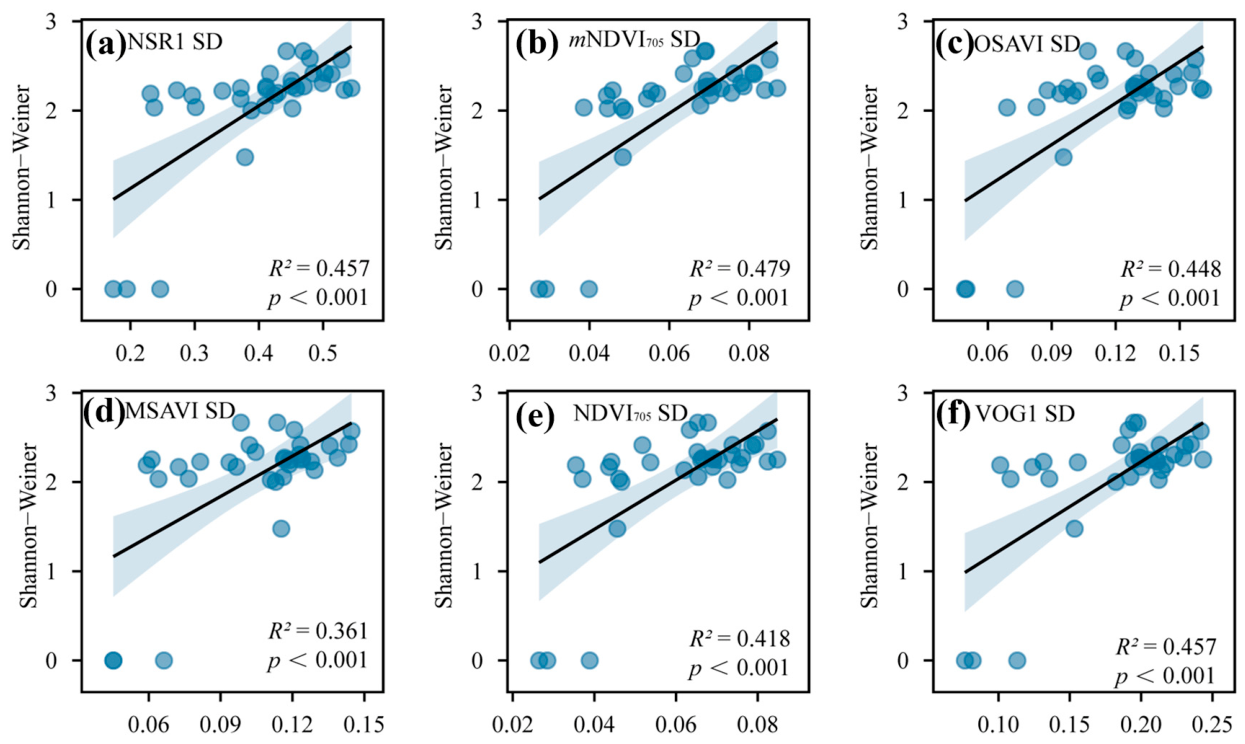
Vegetation indices significantly correlated with species diversity can effectively characterize differences in tree species composition at the regional scale [55]. Correlation analysis of spectral data and plot-level diversity metrics identified the indices most responsive to biodiversity variation. All six selected vegetation indices exhibited statistically significant positive correlations with plot-level diversity (p < 0.01), with 95% confidence intervals tightly bounding the regression slopes (Figure 8).
These six indices showed the highest sensitivity among the 15 candidates tested and were selected as optimal spectral proxies. Their moderate explanatory power (R2 = 0.36–0.48) is typical of single-source spectral predictors in complex subtropical forests, where canopy spectral mixing and structural confounding limit single-source performance. The consistent positive correlations confirm their value as complementary spectral proxies when integrated with ALS-derived structural parameters. Ecologically, they capture distinct physiological and biochemical properties: NSR1 is associated with vegetation stress responses; mNDVI705 and VOG1 are sensitive to canopy chlorophyll concentration and water status; OSAVI and MSAVI effectively mitigate soil background interference while tracking vegetation cover; and NDVI705 reflects canopy vigor.

3.4. The Combined Explanatory Power of Multi-Source Remote Sensing Data for Species Diversity

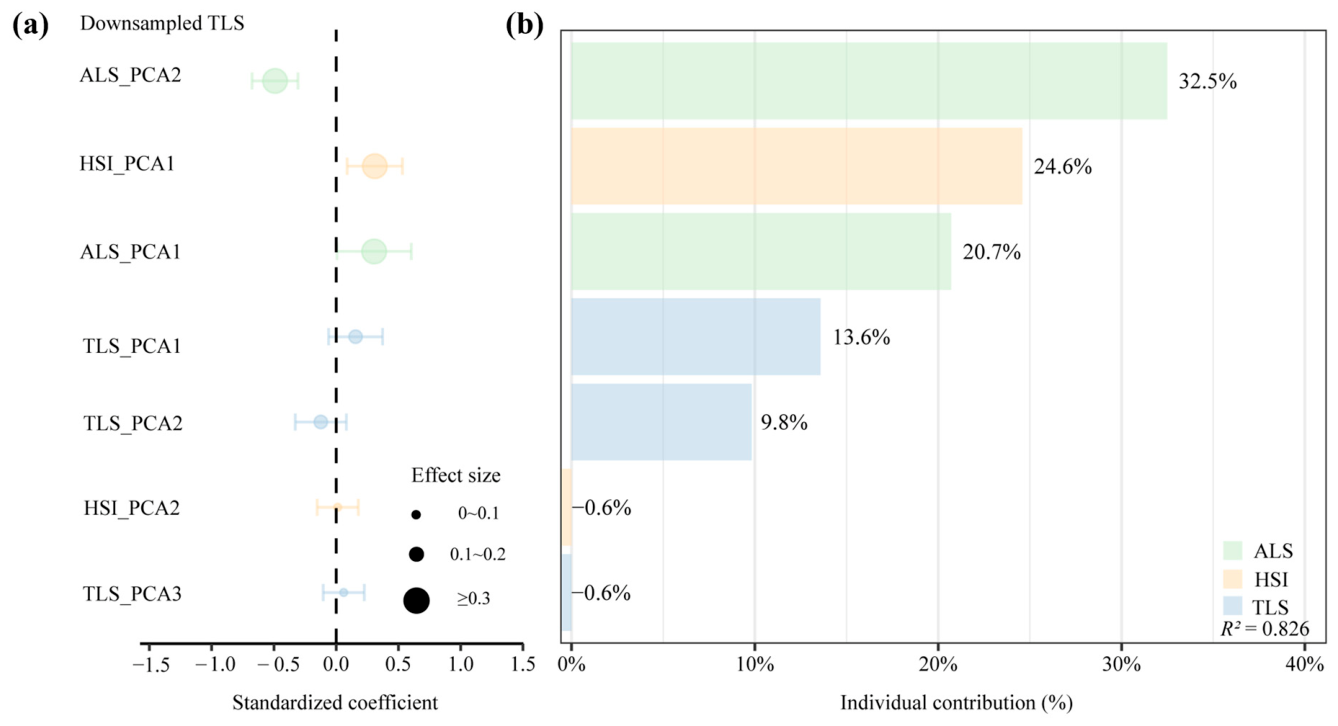
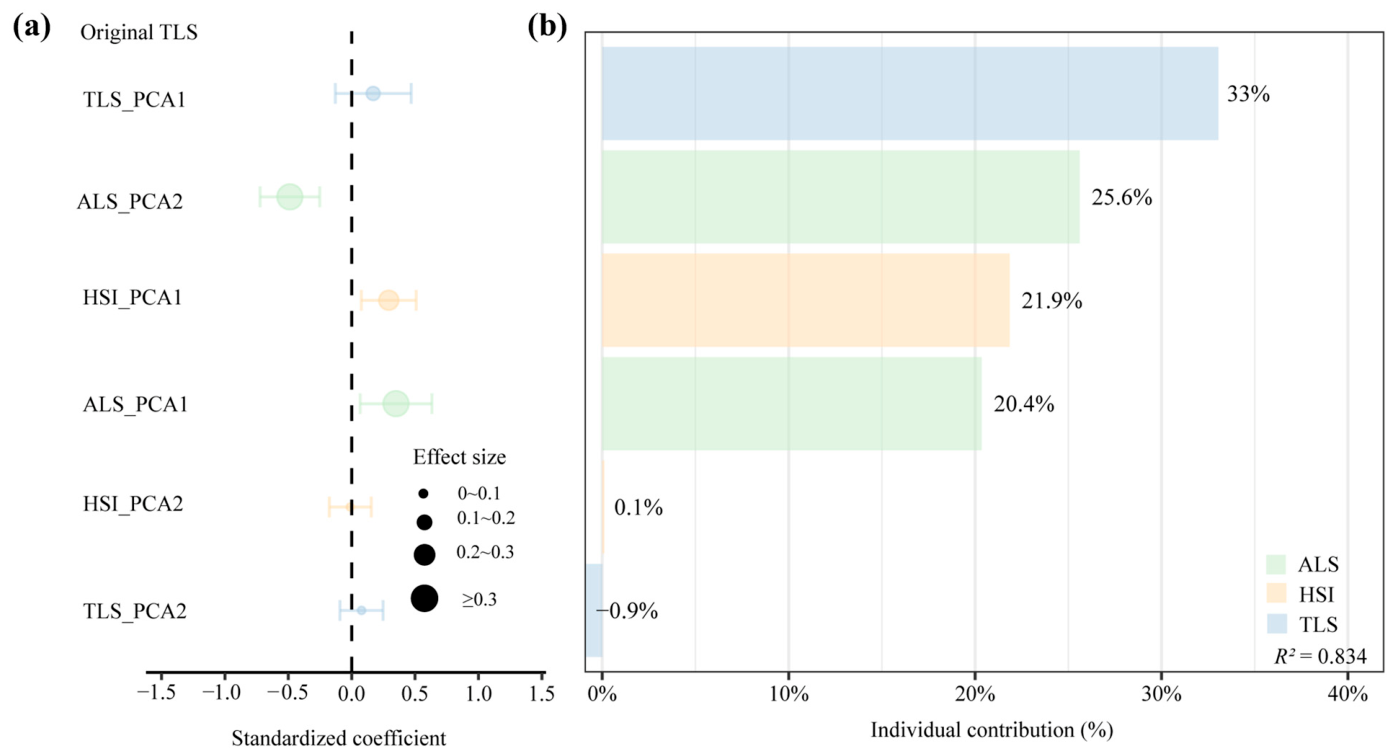
The variance decomposition analysis, conducted on orthogonal predictors derived from RF screening and PCA to eliminate within-source multicollinearity, revealed that ALS, HSI, and TLS collectively explain approximately 82.6% (downsampled TLS configuration) to 83.4% (original-density TLS configuration) of the plot-level species diversity variation (Figure 9). Despite a modest reduction in total explanatory power compared to the analysis using untransformed variables, the refined framework substantially improved the ecological interpretability of variance partitioning.
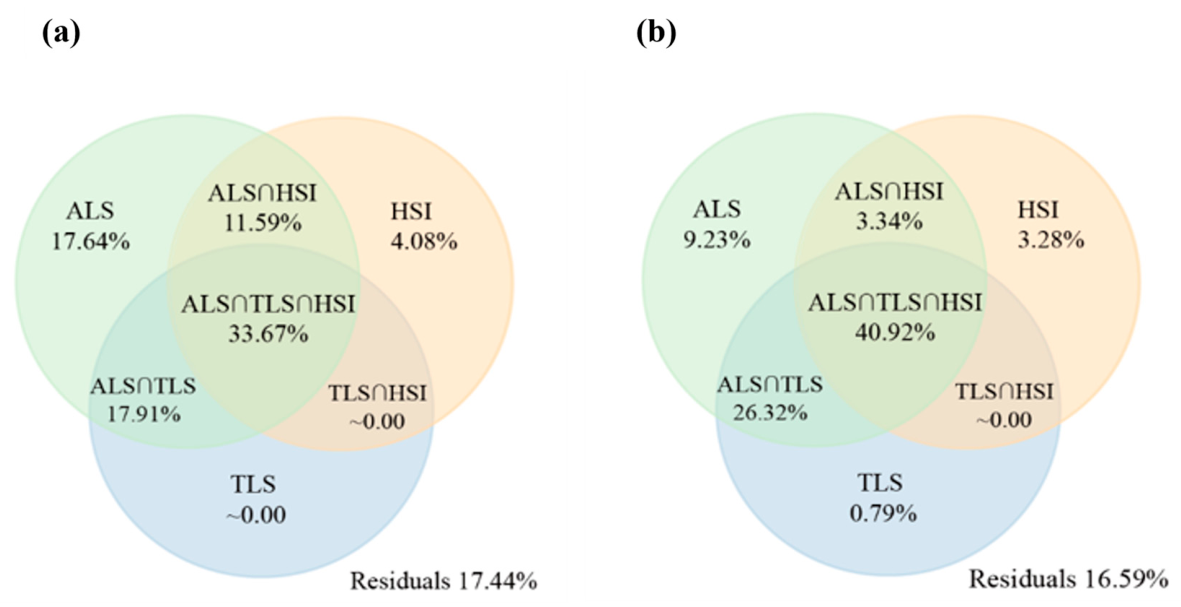
In the density-matched configuration (Figure 9a), both ALS and HSI emerged as data sources with meaningful independent explanatory power. ALS contributed 17.64% unique variance, confirming its irreplaceable role in capturing vertical canopy structural heterogeneity. Critically, HSI provided a substantial pure effect of 4.08%, demonstrating that hyperspectral-derived functional and biochemical information offers complementary value beyond structural metrics alone. This finding supports the spectral variation hypothesis and validates the integration of imaging spectroscopy for subtropical forest biodiversity assessment.
It is important to acknowledge that the near-zero independent contribution of TLS may also reflect methodological and environmental constraints. Dense understory vegetation and undulating terrain induced significant occlusion, limiting TLS point cloud completeness in lower canopy layers. Additionally, GNSS signal denial under closed canopies necessitated reliance on a limited number of ground control points, which may have introduced minor co-registration uncertainties during ALS–TLS fusion. Furthermore, the structural metrics extracted from TLS were intentionally aligned with ALS-sensitive dimensions to isolate ecological redundancy; thus, TLS parameters optimized specifically for understory microhabitat complexity (e.g., liana biomass and fine-scale branching architecture) were not included. These factors collectively constrain TLS’s additive value in this specific framework, though they do not diminish its utility in targeted ecological applications. The interactive components revealed strong ecological coupling among data sources. The three-way interaction accounted for 33.67% in the downsampled configuration, substantially reduced from 40.92% in the original-density setup. More importantly, density matching enhanced the ALS–HSI synergistic effect from 3.34% to 11.59%, while simultaneously reducing the ALS–TLS overlap from 26.32% to 17.91%. This redistribution indicates that ultra-high TLS density suppresses spectral–structural complementarity by introducing technical redundancy, whereas harmonized point cloud densities allow the functional richness captured by HSI to emerge alongside ALS-derived structural complexity.
The persistent near-zero pure effect of TLS across both density regimes confirms that TLS-derived understory structural information is largely redundant with ALS canopy metrics in multi-source fusion frameworks. Conversely, the substantial and stable HSI pure effect, coupled with enhanced ALS–HSI synergy under density matching, establishes ALS–HSI fusion as the optimal framework for plot-level diversity estimation in dense subtropical understories, balancing ecological comprehensiveness with operational efficiency (Figure 10 and Figure 11).
Regarding marginal effects (i.e., the standalone explanatory power of each data source), all three remote sensing sources exhibited statistically significant relationships with plot-level species diversity (Table 3 and Table 4). ALS demonstrated the strongest explanatory capacity (Marginal R2 = 0.798, F = 66.201, p = 0.0001). TLS showed a significant marginal effect in its original form (Marginal R2 = 0.676, F = 35.376, p = 0.0001), but this explanatory power declined substantially to 0.503 (F = 12.112, p = 0.0002) after downsampling to match ALS density—a 25.6% relative reduction. This decline confirms that point cloud density directly influences TLS’s ability to capture structural variation relevant to diversity estimation. HSI also showed a significant marginal effect (Marginal R2 = 0.471, F = 15.672, p = 0.0007). In terms of conditional effects (i.e., the unique explanatory power after accounting for other data sources), the pattern shifted markedly. ALS retained robust predictive ability regardless of TLS density configuration; HSI also maintained a statistically significant, albeit modest, conditional effect. In contrast, the conditional effect of TLS was drastically attenuated by density reduction: after controlling for ALS and HSI, its unique explanatory power dropped from 0.008 (p = 0.203) for original-density TLS to effectively zero for downsampled TLS. This complete loss of conditional explanatory power following downsampling demonstrates that density reduction not only weakens TLS’s marginal performance but also eliminates its already minimal independent contribution, reinforcing that TLS-derived structural information is almost entirely redundant with ALS.
It is important to clarify the apparent discrepancy between the significant marginal effect of downsampled TLS (R2 = 0.503, p = 0.0002) and its near-zero conditional contribution. Marginal effects test whether a data source explains diversity variation when considered in isolation, confirming that TLS-derived structural parameters contain meaningful ecological signals even at reduced density. Conditional effects (which directly correspond to the pure effects in variance decomposition; Figure 9) quantify the unique variance explained after accounting for overlapping information from other sources. The non-significant conditional R2 values align precisely with the ~0.00% pure effects of TLS in Figure 9.
Collectively, these results highlight ALS as the primary, non-redundant driver of diversity estimation, while HSI provides modest but statistically significant complementary spectral information. TLS exhibits density-dependent performance: downsampling from ~50,000 to ~3000 points/m2 reduced its marginal explanatory power by 25.6% and eliminated its conditional contribution entirely. Despite its strong standalone performance at original density, TLS offers limited non-redundant value in a multi-source framework because its structural signals are largely subsumed by ALS. This reinforces our recommendation to prioritize the ALS–HSI synergistic framework for efficient and ecologically robust plot-level diversity monitoring in dense subtropical understories, where TLS data acquisition and processing costs cannot be justified by marginal gains in explanatory power.

3.5. Individual-Tree Clustering Results and Validation

To evaluate the practical applicability of the selected structural–spectral parameters for biodiversity monitoring, we implemented an adaptive fuzzy C-means (AFCM) clustering workflow at the individual-tree level. Unlike the plot-level variance decomposition in Section 3.4, this approach propagates uncertainties through multiple processing stages: (1) individual-tree segmentation from ALS-CHM; (2) per-tree feature extraction; (3) unsupervised clustering to approximate species groups; and (4) aggregation of cluster memberships to estimate plot-level Shannon–Wiener indices. The resulting estimation accuracy (Adj. R2 = 0.725) therefore represents the end-to-end predictive performance of a deployable remote sensing pipeline, complementing the explanatory insights from variance partitioning.
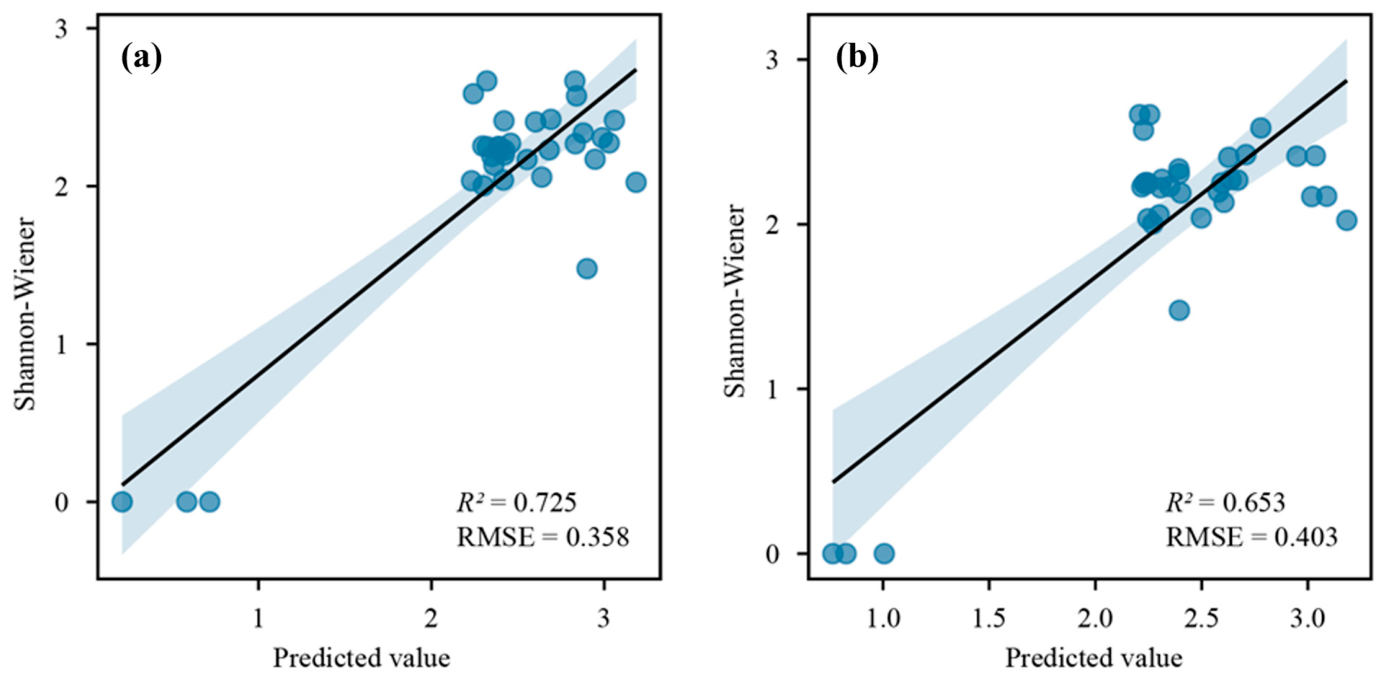
Based on field survey data, the average Shannon–Wiener index in plots 1–3 (artificial monoculture stands) was 0, in plots 4–6 (artificial mixed stands) it was 2.43, and in plots 7–34 (secondary forests) it was 2.23. Using the optimal structural parameters and optimal vegetation indices extracted at the individual-tree level, forest species diversity was estimated via an adaptive fuzzy C-means clustering algorithm. Validation of the clustering results against the measured Shannon–Wiener indices from the 34 plots yielded a high estimation accuracy, with Adj. R2 = 0.725 (Figure 12).
To verify that model predictions were not biased by plot-level tree density, we examined the correlation between prediction residuals (observed–predicted Shannon–Wiener index) and total stem counts per plot (Figure S2). The relationship was weak and statistically non-significant (R = 0.328, p = 0.058, 95% CI: [−0.012, 0.600]), confirming that estimation errors are independent of sampling intensity. This indicates that the model captures species composition and structural heterogeneity rather than merely reflecting stem density artifacts.
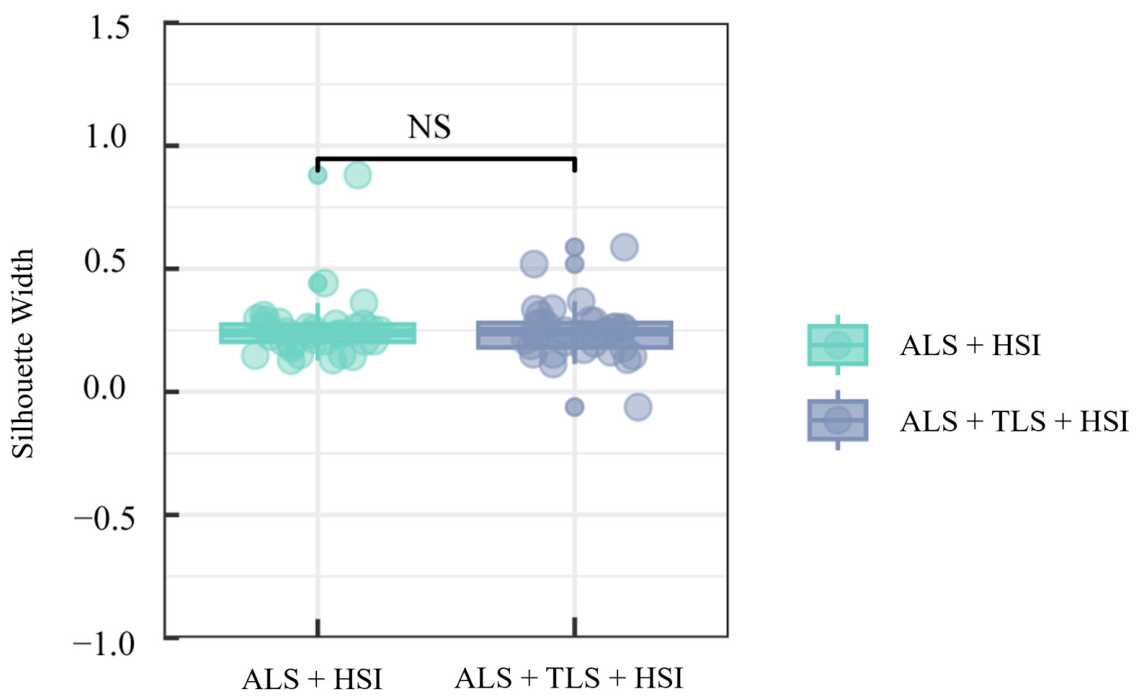
The silhouette coefficient analysis revealed a value of 0.254 for the ALS + HSI clustering configuration, indicating moderate but acceptable cluster separation. While this value appears modest, it is important to contextualize this within the ecological complexity of subtropical forests: (1) high species diversity and functional trait overlap inherently produce fuzzy boundaries in feature space, making perfect clustering separation ecologically unrealistic; (2) silhouette coefficients in the 0.20–0.35 range are typical for unsupervised clustering in high-diversity forest ecosystems using remote sensing data; and (3) the stability of this coefficient upon TLS data introduction (changing to ~0.243) confirms that TLS does not meaningfully improve cluster discrimination. Importantly, despite moderate cluster separation at the individual-tree scale, the aggregated plot-level diversity estimates achieved high accuracy (Adj. R2 = 0.725), demonstrating that the clustering results are ecologically meaningful and statistically reliable for biodiversity assessment at regional scales (Figure 13).

4. Discussion

4.1. Individual-Tree Segmentation and Structural Parameter Extraction

Individual-tree segmentation is a critical prerequisite for accurate remote sensing-based monitoring of canopy species diversity. In high-canopy-closure stands, crown overlap causes under-segmentation, while large crowns with indistinct tops lead to over-segmentation. These errors propagate to individual-tree parameter extraction, compromising diversity estimation. In this study, individual tree crowns were effectively delineated using a multi-scale watershed algorithm applied to the ALS-derived CHM, which mitigated segmentation biases caused by crown overlap or weak crown tops and reduced interference from understory vegetation. Nevertheless, the high canopy closure in the study area still resulted in localized under- or over-segmentation. Despite these challenges, the method achieved high segmentation accuracy (R2 = 0.873; Section 3.1), providing a reliable foundation for subsequent parameter extraction.
Building upon this segmentation, we examined the relationships between extracted structural parameters and species diversity. LiDAR return intensity-related metrics showed the strongest associations (Figure 10). This reflects species differences in leaf morphology, texture, water content, and canopy structure, which produce distinct laser pulse reflections [56]. In species-rich areas, mixed distributions of trees with different reflective properties increase return intensity variability [57]. Complex vertical structures amplify this effect: laser pulses undergo multiple interactions (interception, scattering, and absorption) in multi-layered canopies, enhancing return intensity heterogeneity [58]. Thus, intensity standard deviation (Isd) effectively captures reflectance dispersion caused by species composition and canopy architecture variations, serving as a sensitive biodiversity indicator. This aligns with the understanding that habitat heterogeneity promotes ecological niche differentiation [59].
While LHD and Hpcum6 exhibited statistically significant correlations with species diversity (p < 0.001), their explanatory power was moderate (R2 ≈ 0.39–0.40) compared to intensity-based metrics. This pattern suggests that vertical height distribution metrics capture important but secondary aspects of structural heterogeneity, whereas laser return intensity—reflecting species-specific differences in leaf morphology, canopy architecture, and biochemical properties—serves as the primary structural driver of diversity estimation in subtropical forests. Nevertheless, the inclusion of LHD and Hpcum6 in the multi-parameter framework ensures a more comprehensive representation of canopy structural complexity, consistent with the multi-dimensional nature of biodiversity–structure relationships.
Beyond individual parameter correlations, plot-level variance decomposition revealed that ALS-derived structural heterogeneity contributed 17.64% independent variance, reflecting fundamental ecological mechanisms in subtropical forests. Canopy structural complexity creates niche differentiation through vertical stratification, light gradient partitioning, and microhabitat diversification, which collectively promote species coexistence [60]. Recent studies in Chinese subtropical forests confirm that canopy structural heterogeneity simultaneously drives both community species diversity and population genetic diversity, establishing it as a key determinant of biodiversity maintenance [17].

4.2. Ecological Redundancy and Confounding Effects of TLS

TLS exhibits limited potential in improving diversity estimation, mainly due to ecological redundancy in variance decomposition and confounding interference in predictive modeling. At the variance decomposition level, TLS exhibited significant marginal explanatory power but a near-zero independent contribution after controlling for ALS (Table 4), indicating that TLS-derived information is almost entirely subsumed by ALS-derived canopy metrics. Our density analysis demonstrates that this redundancy is ecological rather than technical. Even at original ultra-high density (~50,000 points/m2), TLS provided no meaningful independent explanatory power beyond ALS. After downsampling to match ALS (~3000 points/m2), TLS’s conditional contribution dropped to exactly zero, while its marginal power declined by 25.6%. This confirms that TLS’s inability to contribute unique information reflects fundamental ecological redundancy: ALS already captures the canopy-level structural heterogeneity—vertical stratification, canopy roughness, and height distribution—that drives species coexistence.
The interactive effects among data sources further support this interpretation. While the three-way interaction decreased from 40.92% to 33.67% after density harmonization, this reduction did not restore TLS’s independent contribution. Instead, it enhanced ALS’s unique explanatory power (from 12.14% to 17.64%) and strengthened ALS–HSI synergy (from 3.34% to 11.59%). This indicates that ultra-high TLS density artificially inflated shared variance without adding unique ecological information, whereas density matching clarified the genuine structure–function–diversity coupling captured by ALS and HSI. The substantial three-way interaction reflects ecological synergy: in these forests, vertical canopy complexity (ALS/TLS) and biochemical spectral variation (HSI) are coupled outcomes of niche differentiation.
Beyond redundancy, TLS fusion actively reduced diversity estimation accuracy (R2 from 0.725 to 0.653), revealing a confounding effect distinct from mere information overlap. This decline stems from a mismatch between TLS data characteristics and ecological objectives. First, fine-scale stem traits (crown base height and branching angle) exhibit limited discriminatory power among dominant co-occurring species—such as Heptapleurum heptaphyllum, Aquilaria sinensis, and Schima superba—which share similar architectures typical of subtropical evergreen broad-leaved forests. Second, dense understory elements, particularly lianas, interfere with automated crown delineation, introducing noise into derived parameters [25]. Consequently, TLS characterization of understory microstructure simultaneously introduces confounding signals that compromise the structural feature space.
These findings align with those of Gelabert et al. [60], who demonstrated that low-density ALS outperformed high-density data in Mediterranean forests by preserving macrostructural differences without fine-scale noise. Similar patterns were reported in Hainan mangrove forests [61], where reduced ALS density improved classification accuracy. In subtropical forests, macrostructural features (canopy top morphology and vertical distribution) carry greater discriminatory power than microstructural parameters. These results confirm that biodiversity monitoring should prioritize ecologically meaningful, non-redundant features over data completeness, as additional data sources may actively degrade accuracy when introducing confounding signals. The persistent near-zero conditional contribution of TLS across density regimes demonstrates that ultra-high-density TLS acquisition cannot overcome its fundamental redundancy with ALS.

4.3. ALS–HSI Synergistic Framework for Diversity Estimation

The ecological basis for ALS–HSI synergy lies in the non-redundancy of the information the methods capture. ALS characterizes canopy height heterogeneity, vertical stratification, and canopy roughness—structural traits reflecting species’ strategies for three-dimensional resource partitioning, aligning with the habitat heterogeneity hypothesis [62]. The dominant role of ALS-derived structural heterogeneity in the multi-source framework (Section 4.1) confirms that these macro-scale structural features are the primary drivers of diversity estimation in subtropical forests. Meanwhile, HSI reveals interspecific differences in photosynthetic physiology and resource use efficiency through red-edge position, chlorophyll content, nitrogen concentration, and other spectral indices, supporting the spectral variation hypothesis (SVH) [10,11]. The significant independent contribution of HSI (4.08%) indicates that spectral data complement structural metrics by detecting species-specific variations in leaf chemistry and functional strategies that are invisible to LiDAR [52,60]. The fusion of ALS and HSI therefore represents a remote sensing-based coupling of two fundamental mechanisms maintaining biodiversity: spatial niche differentiation and functional physiological divergence.
This complementarity translates into strong predictive performance. The ALS–HSI combination achieved high accuracy (Adj. R2 = 0.725), confirming structure–spectral complementarity. This advantage is supported by studies across urban [63], temperate [64], and tropical forests [14], suggesting that the synergistic benefit is not ecosystem-specific but reflects a general ecological principle.
An important methodological finding concerns the scale of analysis. Our comparative analysis revealed that plot-level variance decomposition (Adj. R2 = 0.826) outperformed single-tree clustering aggregates (Adj. R2 = 0.725). This difference highlights that biodiversity is an emergent community property rather than a sum of individual traits. Plot-level metrics directly capture vertical heterogeneity and canopy functional composition, which align with niche differentiation mechanisms. In contrast, bottom-up clustering introduces cumulative uncertainties from segmentation errors and ecological equivalence among co-occurring species. Thus, prioritizing plot-level structural–spectral synergy over individual-tree identification proves more robust for estimating diversity in structurally complex subtropical forests.

4.4. Single-Site Constraints and Multi-Biome Scaling Prospects

This study is subject to several limitations, which define its scope and inform future research. Spatially, the single-site design (Xianhu Botanical Garden, 91–240 m elevation, subtropical monsoon climate) constrains generalizability. Although this setting provided a controlled environment for developing the ALS–HSI framework, the geographic and ecological specificity limits direct extrapolation to other forest biomes. Forests in temperate or boreal zones, at higher elevations, or with distinct disturbance histories may exhibit divergent canopy architectures and spectral–structural couplings. Additionally, the managed context of a botanical garden may not fully represent the understory complexity and successional dynamics of undisturbed natural forests. Future research should prioritize multi-site, cross-gradient validations to test the ALS–HSI synergy across diverse ecological settings, potentially incorporating domain adaptation algorithms or hierarchical Bayesian modeling to enhance transferability. Temporally, the 4–6-month lag between field surveys (March–May) and remote sensing acquisition (September) may have introduced phenological biases. Despite the relative structural stability of subtropical evergreen canopies, phenological transitions and understory dynamics (e.g., liana proliferation and leaf turnover) can affect spectral signals. In this study, hyperspectral vegetation indices were normalized using individual-tree LAI derived from LiDAR [41], which reduces seasonal cover variability by scaling canopy observations to leaf-level biochemical traits. However, LAI retrieval in high-closure canopies may approach saturation thresholds, introducing uncertainty under extremely high-biomass conditions. Future studies should pursue tightly synchronized field–airborne campaigns and consider multi-temporal data fusion to explicitly decouple seasonal dynamics from structural signals.
The exclusive use of the Shannon–Wiener index, while effective for integrating taxonomic richness and evenness and compatible with remote sensing spectral responses, simplifies the multi-dimensional nature of biodiversity. It does not capture phylogenetic relatedness, functional trait dispersion, or species interaction networks. A multi-metric framework incorporating functional and phylogenetic diversity indices would clarify whether the relative contributions of ALS, HSI, and TLS shift when biodiversity is conceptualized beyond purely taxonomic terms.
Finally, the ecological redundancy of TLS observed here is context-dependent. In temperate or boreal forests, or during leaf-off periods, increased canopy openness may enhance ALS understory penetration, potentially reducing structural overlap between airborne and terrestrial LiDAR. Conversely, in highly diverse tropical systems or during peak wet-season understory proliferation, TLS occlusion and ALS signal attenuation could amplify the redundancy patterns documented here. Future research should explicitly test the ALS–HSI–TLS synergy across seasonal gradients, successional stages, and contrasting forest architectures to determine whether TLS redundancy is a general feature of dense-canopy ecosystems or a biome-specific phenomenon.
In summary, successful multi-source fusion depends on ecological relevance and non-redundancy rather than data volume. For tree species diversity estimation in subtropical forests, ALS-derived macro-canopy structure and HSI-based spectral features outperform TLS microstructure, which proves ecologically redundant and potentially confounding under dense understory conditions. TLS is better positioned as an auxiliary tool for segmentation validation rather than as a diversity estimation input. Navigating the spatial, temporal, and methodological constraints outlined above will reinforce this central principle: ecologically non-redundant, functionally relevant features consistently outperform indiscriminate data fusion in forest biodiversity assessment.

5. Conclusions

This study aimed at accurate monitoring of tree species diversity in subtropical forests by integrating ALS, TLS, and HSI. Through a methodological framework of individual-tree segmentation–parameter selection–clustering estimation, we systematically evaluated the potential of multi-source remote sensing for fine-scale forest biodiversity assessment. The main findings and conclusions are as follows:
  • Individual-tree segmentation was a critical prerequisite for improving the accuracy of canopy species diversity monitoring.
  • Structural parameters derived from ALS effectively characterized structural heterogeneity among tree species.
  • Vegetation indices selected from HSI effectively captured spectral differences among tree species, enabling effective discrimination of dominant subtropical tree species based on biochemical characteristics, thus providing essential spectral input for diversity estimation.
  • The synergistic integration of ALS and HSI enabled high-precision estimation of tree species diversity.
  • Strategic application and limitations of TLS in forest diversity monitoring: Although TLS delivers unprecedented fine-scale 3D structural detail, our variance decomposition and clustering analyses reveal that its independent explanatory power for plot-level tree species diversity is negligible. This stems from high informational redundancy with ALS at the canopy scale. Consequently, TLS should not be deployed as a primary input for large-scale biodiversity estimation. Instead, we recommend its strategic use in three targeted scenarios: (i) serving as high-fidelity ground truth to validate and calibrate ALS-based individual-tree segmentation algorithms; (ii) reconstructing species-specific crown architecture and quantifying fine-scale branch/leaf area distributions for functional trait studies; and (iii) mapping plot-level microhabitat complexity where understory stratification is ecologically critical. For operational, landscape-scale forest diversity monitoring, an ALS–HSI synergistic framework provides a more efficient, non-redundant, and ecologically robust alternative.

Supplementary Materials

The following supporting information can be downloaded at https://www.mdpi.com/article/10.3390/rs18111733/s1: Table S1. Basic information of each sample plot. Table S2. Stratified assessment of individual-tree segmentation accuracy across different stand types. Figure S1. Sensitivity analysis of cluster number (c) with respect to classification uncertainty and prediction error. Figure S2. Relationship between prediction residuals and total tree count per plot.

Author Contributions

Conceptualization, Z.S.; methodology, S.C.; formal analysis, S.C.; investigation, S.C.; resources, C.Z.; data curation, W.Z.; writing—original draft preparation, S.C.; writing—review and editing, C.Z. and S.L.; visualization, S.C. and G.X. All authors have read and agreed to the published version of the manuscript.

Funding

This research was funded by the Fundamental and Interdisciplinary Disciplines Breakthrough Plan of the Ministry of Education of China (JYB2025XDXM902); the National Natural Science Foundation of China (42477309); the Guangdong Provincial Field Observation and Research Station for Biodiversity and Biotic Interactions in Chebaling Lingnan Mountain Forests (2025B1212050003); the Shenzhen Science and Technology Program (KCXST20221021111211025); and the Operating Subsidy for the National Positioning Observation and Research Station of Urban Forest Ecosystem in Shenzhen, Guangdong Province (2024132101).

Data Availability Statement

The data that support the findings of this study are available from the corresponding author upon reasonable request.

Acknowledgments

We gratefully acknowledge the staff of Xianhu Botanical Garden for their logistical support during field data collection. We also thank Guangzhou Icom Communication Technology Co., Ltd. for its assistance in acquiring TLS data with accurate absolute georeferencing.

Conflicts of Interest

The authors declare no conflicts of interest. The funders had no role in the design of the study; in the collection, analyses, or interpretation of data; in the writing of the manuscript; or in the decision to publish the results.

Abbreviations

The following abbreviations are used in this manuscript:
UAVUnmanned Aerial Vehicle
ALSAirborne Laser Scanning
TLSTerrestrial Laser Scanning
HSIHyperspectral Imaging
LHDLeaf Height Diversity
HskewHeight Skewness
HentropyHeight Entropy
Hpcum6Height Cumulative Proportion Below 60% of Maximum Height
ImeanMean Intensity
IsdIntensity Standard Deviation
SRRatio Vegetation Index
NSR1Narrow-Band Spectral Ratio 1
NDVINormalized Difference Vegetation Index
PVIPerpendicular Vegetation Index
TCARITransformed Chlorophyll Absorption in Reflectance Index
MASVIModified Soil-Adjusted Vegetation Index
MACRI/OSAVICorrective Soil Adjustment Vegetation Index/Optimized Soil Adjustment
Section Vegetation Index
PRIPhotochemical Reflectance Index
NDVI705Red-Edge Normalized Difference Vegetation Index (centered at 705 nm)
VOG1Vogelmann Red-Edge Index 1
CRICarotenoid Reflectance Index
REIPRed-Edge Inflection Point
mNDVI705Improve the Red-Edge Normalized Vegetation Index

References

  1. Barnosky, A.D.; Matzke, N.; Tomiya, S.; Wogan, G.O.U.; Swartz, B.; Quental, T.B.; Marshall, C.; McGuire, J.L.; Lindsey, E.L.; Maguire, K.C.; et al. Has the Earth’s sixth mass extinction already arrived? Nature 2011, 471, 51–57. [Google Scholar] [CrossRef]
  2. Leutner, B.F.; Reineking, B.; Müller, J.; Bachmann, M.; Beierkuhnlein, C.; Dech, S.; Wegmann, M. Modelling Forest α-Diversity and Floristic Composition—On the Added Value of LiDAR plus Hyperspectral. Remote Sens. 2012, 4, 2818–2845. [Google Scholar] [CrossRef]
  3. Pereira, H.M.; Leadley, P.W.; Proença, V.; Alkemade, R.; Scharlemann, J.P.W.; Fernandez-Manjarrés, J.F.; Araújo, M.B.; Balvanera, P.; Biggs, R.; Cheung, W.W.L.; et al. Scenarios for Global Biodiversity in the 21st Century. Science 2010, 330, 1496–1501. [Google Scholar] [CrossRef]
  4. Brown, J.H. Biogeography: Introduction to Space, Time, and Life, 2nd ed.; Wiley: New York, NY, USA, 1998; pp. 1–564. [Google Scholar]
  5. World Conservation Monitoring Centre. Global Biodiversity: Status of the Earth’s Living Resources; Chapman & Hall: London, UK, 1992; pp. 1–594. [Google Scholar]
  6. Whittaker, R.J.; Araújo, M.B.; Jepson, P.; Ladle, R.J.; Watson, J.E.M.; Willis, K.J. Conservation biogeography: Assessment and prospect. Divers. Distrib. 2010, 11, 3–23. [Google Scholar] [CrossRef]
  7. Li, X.W.; Zheng, Z.J.; Xu, C.; Zhao, P.; Chen, J.; Wu, J.; Zhao, X.; Mu, X.; Zhao, D.; Zeng, Y. Individual tree-based forest species diversity estimation by classification and clustering methods using UAV data. Front. Ecol. Evol. 2023, 11, 1139458. [Google Scholar] [CrossRef]
  8. Aubry, P.; Quaintenne, G.; Dupuy, J.; Francesiaz, C.; Guillemain, M.; Caizergues, A. On using stratified two-stage sampling for large-scale multispecies surveys. Ecol. Inform. 2023, 77, 102229. [Google Scholar] [CrossRef]
  9. Chen, Y.H.; Wang, R.H.; Shen, T.J. Biodiversity survey and estimation for line-transect sampling. Front. Plant Sci. 2023, 14, 1159090. [Google Scholar] [CrossRef] [PubMed]
  10. Liu, J.; Quan, Y.; Zhao, G.; Yuan, B.; Wang, B.; Li, M. UAV LiDAR expands the understanding of forest tree diversity. Ecol. Indic. 2025, 175, 113534. [Google Scholar] [CrossRef]
  11. Wang, R.; Gamon, J.A. Remote sensing of terrestrial plant biodiversity. Remote Sens. Environ. 2019, 231, 111218. [Google Scholar] [CrossRef]
  12. Schnabel, F.; Beugnon, R.; Yang, B.; Richter, R.; Eisenhauer, N.; Huang, Y.; Liu, X.; Wirth, C.; Cesarz, S.; Fichtner, A.; et al. Tree Diversity Increases Forest Temperature Buffering via Enhancing Canopy Density and Structural Diversity. Ecol. Lett. 2025, 28, 3. [Google Scholar] [CrossRef]
  13. Lefsky, M.A.; Cohen, W.B.; Parker, G.G. Lidar Remote Sensing of the Canopy Structure and Biophysical Properties of Douglas-Fir Western Hemlock Forests. Remote Sens. Environ. 1999, 70, 339–361. [Google Scholar] [CrossRef]
  14. Tseng, Y.H.; Lin, L.P.; Wang, C.K. Mapping CHM and LAI for Heterogeneous Forests Using Airborne Full-Waveform LiDAR Data. Terr. Atmos. Ocean. Sci. 2016, 27, 537–548. [Google Scholar] [CrossRef]
  15. de Almeida, D.R.A.; Broadbent, E.N.; Ferreira, M.P.; Meli, P.; Zambrano, A.M.A.; Gorgens, E.B.; Resende, A.F.; de Almeida, C.T.; Amaral, C.H.D.; Corte, A.P.D.; et al. Monitoring restored tropical forest diversity and structure through UAV-borne hyperspectral and lidar fusion. Remote Sens. Environ. 2021, 264, 112582. [Google Scholar] [CrossRef]
  16. Rissanen, K.; Martin-Guay, M.-O.; Riopel-Bouvier, A.-S.; Paquette, A. Light Interception in Experimental Forests Affected by Tree Diversity and Structural Complexity of Dominant Canopy. Agric. For. Meteorol. 2019, 278, 107655. [Google Scholar] [CrossRef]
  17. Xu, Y.Z.; Chen, H.Y.H.; Qiao, X.; Zhang, Y.; Jiang, M. The Control of External and Internal Canopy Structural Heterogeneity on Diversity and Productivity Relationship in a Subtropical Forest. For. Ecosyst. 2024, 11, 100246. [Google Scholar] [CrossRef]
  18. Ali, A. Forest stand structure and functioning: Current knowledge and future challenges. Ecol. Indic. 2019, 98, 665–677. [Google Scholar] [CrossRef]
  19. Haber, L.T.; Fahey, R.T.; Wales, S.B.; Pascuas, N.C.; Currie, W.S.; Hardiman, B.S.; Gough, C.M. Forest structure, diversity, and primary production in relation to disturbance severity. Ecol. Evol. 2020, 10, 4419–4430. [Google Scholar] [CrossRef]
  20. Wang, S.Y.; Jiménez-Alfaro, B.; Pan, S.; Yu, J.; Sanaei, A.; Sayer, E.J.; Ye, J.; Hao, Z.; Fang, S.; Lin, F.; et al. Differential responses of forest strata species richness to paleoclimate and forest structure. For. Ecol. Manag. 2021, 499, 119605. [Google Scholar] [CrossRef]
  21. Marselis, S.M.; Abernethy, K.; Alonso, A.; Armston, J.; Baker, T.R.; Bastin, J.; Bogaert, J.; Boyd, D.S.; Boeckx, P.; Burslem, D.F.R.P.; et al. Evaluating the potential of full-waveform lidar for mapping pan-tropical tree species richness. Glob. Ecol. Biogeogr. 2020, 29, 1799–1816. [Google Scholar] [CrossRef]
  22. Chen, S.L.; Liu, H.Y.; Feng, Z.K.; Shen, C.; Chen, P. Applicability of personal laser scanning in forestry inventory. PLoS ONE 2019, 14, e0211392. [Google Scholar] [CrossRef] [PubMed]
  23. Maeda, E.E.; Brede, B.; Calders, K.; Disney, M.; Herold, M.; Lines, E.R.; Nunes, M.H.; Raumonen, P.; Rautiainen, M.; Saarinen, N.; et al. Expanding forest research with terrestrial LiDAR technology. Nat. Commun. 2025, 16, 8853. [Google Scholar] [CrossRef]
  24. Liang, X.; Kankare, V.; Hyyppä, J.; Wang, Y.; Kukko, A.; Haggrén, H.; Yu, X.; Kaartinen, H.; Jaakkola, A.; Guan, F.; et al. Terrestrial laser scanning in forest inventories. ISPRS J. Photogramm. Remote Sens. 2016, 115, 63–77. [Google Scholar] [CrossRef]
  25. Calders, K.; Adams, J.; Armston, J.; Bartholomeus, H.; Bauwens, S.; Bentley, L.P.; Chave, J.; Danson, F.M.; Demol, M.; Disney, M.; et al. Terrestrial laser scanning in forest ecology: Expanding the horizon. Remote Sens. Environ. 2020, 251, 112102. [Google Scholar] [CrossRef]
  26. Zhou, R.; Sun, H.; Ma, K.; Tang, J.; Chen, S.; Fu, L.; Liu, Q. Improving Estimation of Tree Parameters by Fusing ALS and TLS Point Cloud Data Based on Canopy Gap Shape Feature Points. Drones 2023, 7, 524. [Google Scholar] [CrossRef]
  27. Dobre, A.C.; Pascu, I.-S.; Leca, Ș.; Garcia-Duro, J.; Dobrota, C.-E.; Tudoran, G.M.; Badea, O. Applications of TLS and ALS in Evaluating Forest Ecosystem Services: A Southern Carpathians Case Study. Forests 2021, 12, 1269. [Google Scholar] [CrossRef]
  28. Brede, B.; Calders, K.; Lau, A.; Raumonen, P.; Bartholomeus, H.M.; Herold, M.; Kooistra, L. Non-destructive tree volume estimation through quantitative structure modelling: Comparing UAV laser scanning with terrestrial LIDAR. Remote Sens. Environ. 2019, 233, 111355. [Google Scholar] [CrossRef]
  29. Pirotti, F.; Gagliasso, D.; Marinello, F.; Tasumi, M. LiDAR data fusion to improve forest attribute estimates: A review. Curr. For. Rep. 2024, 10, 281–297. [Google Scholar] [CrossRef]
  30. Everest, J.J.; Van Cleemput, E.; Beamish, A.L.; Spasojevic, M.J.; Humphries, H.C.; Elmendorf, S.C. Evaluating the utility of hyperspectral data to monitor local-scale β-Diversity across space and time. Remote Sens. Environ. 2025, 304, 114941. [Google Scholar] [CrossRef]
  31. Helsen, K.; Bassi, L.; Feilhauer, H.; Kattenborn, T.; Matsushima, H.; Van Cleemput, E.; Somers, B.; Honnay, O. Evaluating Different Methods for Retrieving Intraspecific Leaf Trait Variation from Hyperspectral Leaf Reflectanc. Ecol. Indic. 2021, 130, 108111. [Google Scholar] [CrossRef]
  32. Czyż, E.A.; Schmid, B.; Hueni, A.; Eppinga, M.B.; Schuman, M.C.; Schneider, F.D.; Guillén-Escribà, C.; Schaepman, M.E. Genetic constraints on temporal variation of airborne reflectance spectra and their uncertainties over a temperate forest. Remote Sens. Environ. 2023, 284, 113338. [Google Scholar] [CrossRef]
  33. Nagendra, H.; Rocchini, D. High resolution satellite imagery for tropical biodiversity studies: The devil is in the detail. Biodivers. Conserv. 2008, 17, 3431–3442. [Google Scholar] [CrossRef]
  34. Zhang, W.; Qi, J.; Wan, P.; Wang, H.; Xie, D.; Wang, X.; Yan, G. An Easy-to-Use Airborne LiDAR Data Filtering Method Based on Cloth Simulation. Remote Sens. 2016, 8, 501. [Google Scholar] [CrossRef]
  35. Bollarapu, M.J.; Kuchibhotla, S.; Kvsn, R.; Patel, H. Dynamic perspectives on biodiversity quantification: Beyond conventional metrics. PeerJ 2024, 12, e17924. [Google Scholar] [CrossRef]
  36. Ceccato, P.; Flasse, S.; Tarantola, S.; Jacquemoud, S.; Grégoire, J.-M. Detecting vegetation leaf water content using reflectance in the optical domain. Remote Sens. Environ. 2001, 77, 22–33. [Google Scholar] [CrossRef]
  37. Gitelson, A.A.; Zur, Y.; Chivkunova, O.B.; Merzlyak, M.N. Assessing carotenoid content in plant leaves with reflectance spectroscopy. Photochem. Photobiol. 2002, 75, 272–281. [Google Scholar] [CrossRef] [PubMed]
  38. Serrano, L.; Peñuelas, J.; Ustin, S.L. Remote sensing of nitrogen and lignin in Mediterranean vegetation from AVIRIS data: Decomposing biochemical from structural signals. Remote Sens. Environ. 2002, 81, 355–364. [Google Scholar] [CrossRef]
  39. Carlson, K.M.; Asner, G.P. Hyperspectral Remote Sensing of Canopy Biodiversity in Hawaiian Lowland Rainforests. Ecosystems 2007, 10, 536–549. [Google Scholar] [CrossRef]
  40. Zarco-Tejada, P.J.; Miller, J.R.; Noland, T.L.; Mohammed, G.H.; Sampson, P.H. Scaling-up and model inversion methods with narrowband optical indices for chlorophyll content estimation in closed forest canopies with hyperspectral data. IEEE Trans. Geosci. Remote Sens. 2001, 39, 1491–1507. [Google Scholar] [CrossRef]
  41. Jordan, C.F. Derivation of leaf-area index from quality of light on the forest floor. Ecology 1969, 50, 663–666. [Google Scholar] [CrossRef]
  42. Mutanga, O.; Skidmore, A.K. Narrow band vegetation indices overcome the saturation problem in biomass estimation. Int. J. Remote Sens. 2004, 25, 3999–4014. [Google Scholar] [CrossRef]
  43. Gitelson, A.; Merzlyak, M.N. Spectral reflectance changes as sociated with autumn senescence of Aesculus hippocastanum L. and Acer platanoides L. leaves. J. Plant Physiol. 1994, 143, 286–292. [Google Scholar] [CrossRef]
  44. Vogelmann, J.E.; Rock, B.N.; Moss, D.M. Red edge spectral measurements from sugar maple leaves. Int. J. Remote Sens. 1993, 14, 1563–1575. [Google Scholar] [CrossRef]
  45. Guyot, G.; Baret, F.; Major, D.J. High spectral resolution: Determination of spectral shifts between the red and the near infrared. Int. Arch. Photogramm. Remote Sens. 1988, 27, 11. [Google Scholar]
  46. Sims, D.A.; Gamon, J.A. Relationships between leaf pigment content and spectral reflectance across a wide range of species, leaf structures and development stages. Remote Sens. Environ. 2002, 81, 337–354. [Google Scholar] [CrossRef]
  47. Rondeaux, G.; Steven, M.; Baret, F. Optimization of soil-adjusted vegetation indices. Remote Sens. Environ. 1996, 55, 95–107. [Google Scholar] [CrossRef]
  48. Richardson, A.J.; Everitt, J.H. Using spectral vegetation indices to estimate rangeland productivity. Geocarto Int. 1992, 7, 63–69. [Google Scholar] [CrossRef]
  49. Qi, J.; Chehbouni, A.R.; Huete, A.R.; Kerr, Y.H.; Sorooshian, S. A Modified Soil Adjusted Vegetation Index. Remote Sens. Environ. 1994, 48, 119–126. [Google Scholar] [CrossRef]
  50. Daughtry, C.S.T.; Walthall, C.L.; Kim, M.S.; De Colstoun, E.B.; McMurtrey, J.E., III. Estimating corn leaf chlorophyll concentration from leaf and canopy reflectance. Remote Sens. Environ. 2000, 74, 229–239. [Google Scholar] [CrossRef]
  51. Haboudane, D.; Miller, J.R.; Pattey, E.; Zarco-Tejada, P.J.; Strachan, I.B. Hyperspectral vegetation indices and novel algorithms for predicting green LAI of crop canopies: Modeling and validation in the context of precision agriculture. Remote Sens. Environ. 2004, 90, 337–352. [Google Scholar] [CrossRef]
  52. Gamon, J.A.; Serrano, L.; Surfus, J.S. The photochemical reflectance index: An optical indicator of photosynthetic radiation use efficiency across species, functional types, and nutrient levels. Oecologia 1997, 112, 492–501. [Google Scholar] [CrossRef]
  53. Bezdek, J.C. Pattern Recognition with Fuzzy Objective Function Algorithms; Plenum Press: New York, NY, USA, 1981. [Google Scholar] [CrossRef]
  54. Li, Y.; Yu, F.S. A new validity function for fuzzy clustering. In Proceedings of the International Conference on Computational Intelligence and Natural Computing, Wuhan, China, 6–7 June 2009; IEEE: New York, NY, USA, 2009; pp. 462–465. [Google Scholar] [CrossRef]
  55. Zhao, Y.J.; Zeng, Y.; Zhao, D.; Wu, B.; Zhao, Q. The Optimal Leaf Biochemical Selection for Mapping Species Diversity Based on Imaging Spectroscopy. Remote Sens. 2016, 8, 216. [Google Scholar] [CrossRef]
  56. Tan, S.; Narayanan, R.M.; Helder, D.L. Polarimetric reflectance and depolarization ratio from several tree species using a multiwavelength polarimetric lidar. In Polarization Science and Remote Sensing II; Proceedings of the SPIE Optics + Photonics; SPIE: San Diego, CA, USA, 2005; Volume 5888, p. 58880M. [Google Scholar] [CrossRef]
  57. Persson, Å.; Holmgren, J.; Söderman, U. Detecting and measuring individual trees using an airborne laser scanner. Photogramm. Eng. Remote Sens. 2002, 68, 925–932. [Google Scholar]
  58. Holmgren, J.; Persson, Å. Identifying species of individual trees using airborne laser scanner. Remote Sens. Environ. 2004, 90, 415–423. [Google Scholar] [CrossRef]
  59. MacArthur, R.H.; MacArthur, J.W. On bird species diversity. Ecology 1961, 42, 594–598. [Google Scholar] [CrossRef]
  60. Gelabert, P.J.; Montealegre, A.L.; Lamelas, M.T.; Domingo, D. Assessment of Forest Structural Diversity Differences in Mediterranean Landscapes Affected by Fires Using ALS Data. In Proceedings of the IGARSS 2018-2018 IEEE International Geoscience and Remote Sensing Symposium; IEEE: New York, NY, USA, 2018; pp. 7540–7543. [Google Scholar]
  61. Wang, D.Z.; Wan, B.; Qiu, P.; Tan, X.; Zhang, Q. Mapping mangrove species using combined UAV-LiDAR and Sentinel-2 data: Feature selection and point density effects. Adv. Space Res. 2022, 69, 1494–1512. [Google Scholar] [CrossRef]
  62. Huston, M.A. A General Hypothesis OF Species Diversity. Am. Nat. 1979, 113, 81–101. [Google Scholar] [CrossRef] [PubMed]
  63. Zhang, C.Y.; Qiu, F. Mapping Individual Tree Species in an Urban Forest Using Airborne Lidar Data and Hyperspectral Imagery. Remote Sens. 2012, 78, 1079–1087. [Google Scholar] [CrossRef]
  64. Kim, N.S.; Lim, C.H. Developing a Novel Method for Vegetation Mapping in Temperate Forests Using Airborne LiDAR and Hyperspectral Imaging. Forests 2025, 16, 1158. [Google Scholar] [CrossRef]
Figure 1. Study site map illustrating the spatial configuration of permanent plots within the Xianhu Botanical Garden. The yellow square indicates the 1-ha main plot and brown squares indicate the nine 400-m2 subplots, distributed across both plantation and secondary forest stands at elevations ranging from 91 to 240 m.
Remotesensing 18 01733 g001
Figure 2. Examples of (a) normalized fused data and (b) unnormalized fused point cloud for plot 1.
Remotesensing 18 01733 g002
Figure 3. Data analysis workflow diagram.
Remotesensing 18 01733 g003
Figure 4. Canopy height model for plots 10–34.
Remotesensing 18 01733 g004
Figure 5. Accuracy assessment of individual-tree segmentation using the multi-scale watershed algorithm (plot 1 as an example). (a) Comparison of field-measured and LiDAR-estimated tree counts per plot (n = 34). Open circles represent individual plots; the solid line indicates the linear regression fit, and the dashed line indicates the 1:1 reference line. (b) Spatial comparison of ALS-derived crown positions (red triangles) and total-station-measured stem positions (green circles) overlaid on the CHM. (c) Three-dimensional visualization of segmented individual tree crowns based on ALS data; each color represents a distinct segmented crown. (d) Three-dimensional visualization of segmented individual tree crowns based on ALS data; each color represents a distinct segmented crown.
Remotesensing 18 01733 g005
Figure 6. Pearson correlations between the six ALS-derived structural parameters and the Shannon–Wiener diversity index (Adj. R2 = 0.385–0.824). Each dot represents one plot (n = 34). Solid lines indicate linear regression fits, and shaded regions represent 95% confidence intervals. (a) LHD; (b) Hskew; (c) Hentropy; (d) Hpcum6; (e) Imean; (f) Isd.
Remotesensing 18 01733 g006
Figure 7. Spatial maps of six ALS-derived structural parameters across the study area. (a) LHD; (b) Zskew; (c) Hentropy; (d) Hpcum6; (e) Imean; (f) Isd.
Remotesensing 18 01733 g007
Figure 8. Pearson correlations between the inter-crown standard deviations of six LAI-normalized hyperspectral vegetation indices and the Shannon–Wiener diversity index across 34 plots (R2 = 0.361–0.479). Each dot represents one plot (n = 34). Solid lines indicate linear regression fits, and shaded regions represent 95% confidence intervals. (a) NSR1 SD; (b) mNDVI705 SD; (c) OSAVI SD; (d) MSAVI SD; (e) NDVI705 SD; (f) VOG1 SD.
Remotesensing 18 01733 g008
Figure 9. Variance decomposition analysis illustrating the independent (pure) and shared explanatory power of ALS (green), HSI (orange), and TLS (blue) parameters on plot-level species diversity. Percentage values denote independent contributions (non-overlapping areas) and shared variance (overlapping areas). (a) Downsampled TLS (~3000 points/m2). (b) Original TLS (~50,000 points/m2). Residuals represent unexplained variance.
Remotesensing 18 01733 g009
Figure 10. Hierarchical partitioning results using PCA-transformed predictors (Downsampled TLS, ~3000 points/m2). (a) Standardized coefficients with 95% confidence intervals; dot size indicates effect magnitude. (b) Independent contribution (%) of each principal component. Colors denote data sources: ALS (green), HSI (orange), TLS (blue). Overall model: Adj. R2 = 0.826.
Remotesensing 18 01733 g010
Figure 11. Hierarchical partitioning results using PCA-transformed predictors (original TLS, ~50,000 points/m2). (a) Standardized coefficients with 95% confidence intervals; dot size indicates effect magnitude. (b) Independent contribution (%) of each principal component. Colors denote data sources: ALS (green), HSI (orange), TLS (blue). Overall model: Adj. R2 = 0.834.
Remotesensing 18 01733 g011
Figure 12. Accuracy of Shannon–Wiener index estimation via fuzzy C-means clustering. Each dot represents one plot (n = 34). Solid lines indicate linear regression fits, and shaded regions represent 95% confidence intervals. (a) ALS + HSI fusion (R2 = 0.725); (b) ALS + TLS + HSI fusion (R2 = 0.653).
Remotesensing 18 01733 g012
Figure 13. Per-sample silhouette coefficients for ALS + HSI (green) and ALS + TLS + HSI (blue) clustering configurations. Higher values indicate better cluster separation. Each dot represents one tree; box plots show the median and interquartile range. NS: not significant (paired Wilcoxon signed-rank test, p > 0.05).
Remotesensing 18 01733 g013
Table 1. Extraction of forest canopy structural parameters from LiDAR.
FeatureIndexDescription
Vertical Structural ParametersData Height Metrics (zmax, zmean, zsd, Hskew, and Hentropy)
Cumulative Height Proportion (Hpcum1 to Hpcum9)
Describe the vertical distribution pattern of the canopy, reflecting vegetation height variation, stratification characteristics, and vertical heterogeneity.
Horizontal Structural ParametersCanopy Cover Fraction (canopy cover)Describe the canopy coverage extent, distribution uniformity, or spatial pattern in the horizontal direction.
Internal Structural ParametersIntensity Features (imax, imean, isd, iskew, and ikurt)Describe the internal physical properties of the canopy, as characterized by laser return intensity and multi-return echo features.
Table 2. Vegetation index calculation formulas.
Vegetation IndexCalculation FormulaReferences
SR S R = R 799.09 / R 680.045 Jorden et al. [41]
NSR1 N S R 1 = R 756.01 / R 707.31 Mutanga and Akidomore [42]
NDVI705 N D V I 705 = ( R 750.66 R 704.6 ) / ( R 750.66 + R 704.6 ) Gitelson and Merzlyak [43]
VOG1 V O G 1 = R 739.95 / R 720.88 Vogelmann [44]
CRI C R I 1 = 1 R 510 1 R 550 Gitelson and Merzlyak [43]
REIP R E I P = 699.19 + 40.76 ( ( R i R 699.19 ) ( R 739.95 R 699.19 ) )
R i = ( R 668.98 + R 780.5 ) / 2
Guyot et al. [45]
mNDVI705 m N D V I 705 = ( R 750 R 704 ) / ( R 750 + R 704 2 R 444 ) Sims and Gamnon [46]
NDVI N D V I 1 = ( R 756.01 / R 745.34 ) / ( R 756.01 + R 745.34 ) Mutanga and Akidomore [42]
OSAVI O S A V I = ( 1 + L ) ( R 799.09 R 680.045 ) / ( R 799.09 + R 680.045 + L ) ( L = 0.16 ) Rondeaux [47]
PVI P V I = ( R 799.09 a R 680.045 b ) / a 2 + 1 Richardson and Everitt [48]
MSAVI M S A V I = 0.5 ( 2 R 799.09 + 1 ( 2 R 799.09 + 1 ) 2 8 ( R 799.09 R 680.045 ) ) Qi et al. [49]
MCARI ( ( R 750.66 R 704.6 ) 0.2 ( R 750.66 R 550.67 ) ) ( R 750.66 R 704.6 ) Daughtry et al. [50]
MCARI/OSAVI M C A R I O S A V I = ( ( R 750.66 R 704.6 ) 0.2 ( R 750.66 R 550.67 ) ) ( R 750.66 R 704.6 ) ( 1 + 0.6 ) ( R 750.66 R 704.6 ) / ( R 750.6 + R 704.6 + 0.16 ) Daughtry et al. [50]
TCARI T C A R I = 3 ( R 699.19 R 668.98 ) 0.2 ( R 699.19 R 550.67 ) ( R 699.19 / R 668.98 ) Haboudane, D. et al. [51]
PRI P R I = ( R 531.66 R 569.88 ) / ( R 531.66 + R 569.88 ) Gamon et al. [52]
Table 3. Marginal and conditional effects of ALS and TLS data sources on tree species diversity based on 9999 permutation tests. The TLS data are in their original form.
Data SourcesMarginal R2Marginal F-ValueMarginal p-ValueConditional R2Conditional F-ValueConditional p-Value
ALS0.79866.20120.00010.09229.06160.0011
Original TLS0.675735.37610.00010.00791.69320.2029
HSI0.470715.67220.00070.03283.86470.0336
Table 4. Marginal and conditional effects of ALS and TLS data sources on tree species diversity based on 9999 permutation tests. The TLS data are downsampled.
Data SourcesMarginal R2Marginal F-ValueMarginal p-ValueConditional R2Conditional F-ValueConditional p-Value
ALS0.79866.20120.00010.176415.16010.0001
Downsampled TLS0.502512.11170.000200.96930.4321
HSI0.470715.67220.00070.04084.27400.0266
Disclaimer/Publisher’s Note: The statements, opinions and data contained in all publications are solely those of the individual author(s) and contributor(s) and not of MDPI and/or the editor(s). MDPI and/or the editor(s) disclaim responsibility for any injury to people or property resulting from any ideas, methods, instructions or products referred to in the content.