Article

Digital Landscapes: Assessing Fire Severity and Its Drivers Using Remote Sensing and Google Earth Engine Based on dNBR and NPP Indicators
1
Department of Landscape and Territory Planning, Faculty of Agronomy, Lebanese University, Beirut P.O. Box 6573/14, Lebanon
2
Lebanon Reforestation Initiative, Jdeideh 1202, Lebanon
3
Department of Life and Earth Sciences, Faculty of Sciences, Lebanese University, Fanar 90656, Lebanon
*
Author to whom correspondence should be addressed.
Remote Sens. 2026, 18(10), 1654; https://doi.org/10.3390/rs18101654
Submission received: 22 February 2026 / Revised: 17 April 2026 / Accepted: 12 May 2026 / Published: 20 May 2026
(This article belongs to the Special Issue Advances in Remote Sensing for Burned Area Mapping)

Highlights

What are the main findings?
  • dNBR mapping (2013–2024) revealed heterogeneous fire severity patterns across Akkar’s forests, with FIRMS fire detections being only partially accurate.
  • Vegetation productivity (NPP) exhibited high spatial and temporal variability but showed no consistent relationship with fire severity, whereas topographic variables emerged as the primary controls shaping severity patterns.
What are the implications of the main findings?
  • Terrain features such as elevation and slope aspect must be considered in wildfire risk assessment and severity prediction.
  • Cloud-based remote sensing workflows integrating dNBR, NPP, and topographic variables provide a robust framework for wildfire assessment in data-scarce regions.

Abstract

Wildfires are an increasingly recurrent disturbance in Mediterranean forest landscapes, yet fire severity assessment remains limited in data-scarce regions such as Lebanon. This study aims to assess wildfire severity patterns and identify the main environmental drivers influencing fire severity across the forests of Akkar, northern Lebanon, within a Digital Landscapes framework. Fire severity was mapped using the Differenced Normalized Burn Ratio (dNBR) derived from multi-temporal Landsat-8 imagery (2013–2024) processed in Google Earth Engine. Vegetation productivity was assessed through annual Net Primary Productivity (NPP), while topographic variables (elevation, slope, and aspect) were derived from a Digital Elevation Model. The results reveal heterogeneous fire severity patterns over the study period and pronounced spatial variability in NPP, with no consistent linear relationship between productivity and fire severity. Principal Component Analysis (PCA) was applied to explore multivariate relationships between fire severity, productivity, and terrain. PCA results show that the first two components explain 77.4% of the total variance, indicating that fire severity is primarily structured by topographic factors, particularly elevation and solar exposure, while vegetation productivity plays a secondary role. These findings highlight the dominant influence of terrain on wildfire severity in Mediterranean mountainous landscapes, and demonstrate the value of integrating remote sensing, cloud-based platforms, and multivariate analysis for fire assessment in data-scarce regions. The study contributes to the advancement of Digital Landscapes approaches by providing a scalable and data-driven framework for understanding fire dynamics and supporting future landscape management and risk assessment strategies.

1. Introduction

In recent decades, forest fires have become more frequent and severe. An estimated 340–370 million ha of the Earth’s land surface is affected by fire annually [1,2]. With the increased frequency and severity of wildfires, including areas not previously affected, significant negative impacts at the local, national and global levels are arising. For example, boreal fires have previously been responsible for about 10 percent of global carbon-dioxide emissions due to wildfires; in 2021, however, such fires reached a new high and accounted for nearly one-quarter of total wildfire emissions [3]. Wildfires have increasingly shifted from natural ecological processes to destructive events that have profound environmental, social, and economic consequences. In more than 60 years, damages from fire as natural disasters increased by almost 12 times according to the share in Gross Domestic Product (GDP) globally [4]. This global increase is due to the combination of multiple factors like climate change, land-use changes, and anthropogenic uses [5]. Regionally, the Mediterranean has been declared amongst the most vulnerable regions to the effects of global warming, by the Intergovernmental Panel on Climate Change (IPCC) [6]. The IPCC highlights the Mediterranean as a climate change hotspot, warming 20% faster than the global average, leading to severe threats like extreme heat, water scarcity, sea-level rise, biodiversity loss, and wildfires. Although Mediterranean ecosystems are adapted to fires, considering their role in shaping these ecosystems, the area is experiencing drastic shifts in fire regimes and severity levels [6]; in Lebanon, this transformation is particularly alarming [7,8]. In 2007, losses from forest fires were estimated at 10 million US dollars [8]. Although Lebanon’s national strategy for forest fire management was endorsed in 2009, very few steps have been implemented since then to reduce the risk of fires [7,9]. As the country’s forest cover in 2025 represents 12–14% of its total area, as per FAO’s forest resources assessment, almost every wildfire event that occurs is impactful, and puts said ecosystems under immediate threats for losses in biodiversity, increased greenhouse gas emissions, and ecosystem degradation [1]. With the effects of climate change and the country’s unique topography of rugged mountainous landscapes and dense forests, regions like Akkar in the North governorate of Lebanon are becoming much more susceptible to outbreaks of wildfires. These fires are threatening rural livelihoods and community safety in the region, since many of its households depend on forests for grazing, fuelwood, and ecotourism [10,11,12]. Forest fires are also accelerating soil erosion, biodiversity loss, and habitat fragmentation, while altering natural vegetation succession and forest dynamics [4].
In this context, this study approaches the concept of Digital Landscapes, which is defined as the use of digital technologies to assess, monitor, and support the management of landscapes [13]. This approach aligns with the broader framework of landscape planning and management, where digital tools facilitate the collection, analysis, and simulation of landscape-related data. Digital Landscape methodologies typically involve the integration of ecological, morphological, and behavioral data, enabling a comprehensive understanding of landscape dynamics and performance [14]. By enabling continuous monitoring, multi-temporal analysis, and spatially explicit assessment of fire impacts, digital approaches provide a scalable and data-driven alternative to traditional methods.
The ability to understand fire severity drivers pre-fire risk assessments could inform pre-fire risk assessors, land managers, and policy makers on where and how intensively to manage fuels to reduce the likelihood of damage to ecological or human systems with highly severe fires. The goals of this study were (1) to improve our understanding of the controls on burn severity across vegetation and diverse topography in the Northern region of Akkar, Lebanon, and (2) to advance our understanding for burn severity predictions to help fuel management and impact reduction. In Lebanon, the increasing availability of remote sensing data and geospatial technologies has enabled more advanced forms of landscape analysis, particularly in the context of environmental monitoring and risk assessment. National and academic institutions, like the National Council for Scientific Research in Lebanon (NCSR) and the University of Balamand (UOB), have applied this for land-cover mapping, fire risk assessment, and environmental monitoring [15,16,17]. However, their application in Lebanon remains underexplored, particularly in linking fire severity patterns with underlying environmental drivers such as vegetation productivity and topographic variability. Recent advances in cloud-based geospatial platforms now allow these approaches to be implemented at larger spatial extents and with greater computational efficiency. Within this framework, this study utilizes remote sensing techniques, including Landsat-8 imagery and cloud-based platforms such as Google Earth Engine (GEE), to quantify fire severity and vegetation productivity. By doing so, it demonstrates how Digital Landscapes approaches can support the evaluation of pre- and post-fire conditions and inform future landscape management and restoration strategies. Digital geospatial technologies and platforms such as GEE combined with Geographic Information System-based spatial analysis tools like Quantum GIS (QGIS), play a central role in this transformation by enabling the rapid processing of large multi-temporal satellite imagery and the mapping of fires, making them valuable tools for wildfire management and ecological assessment [18,19,20]. This is because unlike conventional desktop-based remote sensing workflows, the GEE platform provides access for multi-source satellite archives, performs automatic spectral computations, and generates results from newly available satellite data, free of charge. Thus, it enables near-real-time monitoring and assessment of burned areas, as well as reproducible fire severity mapping across extended periods of time and large geographic areas without the need for local data storage or high computational capacity. This means a faster, more practical and cost-efficient way to assess fire-affected landscapes and implement better management measures [18,19,20,21].
This study utilizes the Differenced Normalized Burn Ratio (dNBR) as an index to map out fire severity. The dNBR is a remote sensing spectral index used to map and measure the severity of wildfires by comparing satellite imagery taken before and after a fire [22]. It uses the Near-Infrared (NIR) and Shortwave-Infrared (SWIR) bands to detect drastic changes in vegetation health, where healthy vegetation shows high reflectance in the NIR band and low reflectance in the SWIR band, while burned areas show the opposite [22,23]. Existing fire severity studies rely heavily on spectral indices such as dNBR, which capture burn intensity but do not fully explain the environmental factors driving fire behavior. Such indices primarily describe the outcome of fire rather than the environmental factors that drive its spatial variability. According to Haas et al., and Harrisson et al., multiple non-anthropogenic/environmental factors, and anthropogenic factors affect fire severity [24,25]. Wildfire regimes are controlled by factors related to vegetation productivity, landscape characteristics, topographic factors (slope, aspect, and elevation), climate, and human activities [26,27]. In Mediterranean ecosystems, these interactions are particularly complex due to strong seasonal contrasts, heterogeneous terrain, and long histories of human land use that changed frequently over time [28].
Vegetation productivity represents an important and complex factor influencing fire severity. Areas with higher productivity tend to be areas that have accumulated greater biomass and fuel loads, which thus increased fire intensity with the right ignition and weather conditions [29,30]. Net Primary Productivity (NPP) provides an integrative measure of vegetation growth and carbon assimilation, capturing spatial and temporal variations in biomass availability that are relevant to fuel accumulation and post-fire recovery processes [26,29,30]. Within this framework, the inclusion of vegetation productivity metrics such as NPP is justified as a means to evaluate the role of biomass availability [23,29]. However, productivity alone does not determine fire severity, as fuel continuity, species composition, and fuel moisture strongly mediate how biomass contributes to fire behavior.
When studying topographic factors, we are studying the microclimatic conditions that exist because of the topographic factors. Microclimatic conditions are a key factor in fire severity patterns. Studies show that steeper slopes can accelerate fire spread and flame contact with unburned fuels, while gentler slopes may allow longer residence times and increased heat accumulation in the same spot [31]. Similarly, slope aspect further modifies fire severity through its influence on solar radiation and moisture availability; sun-exposed slopes generally experience higher temperatures and lower fuel moisture, creating conditions conducive to more intense burning compared to shaded slopes [32,33]. However, lower elevations in Mediterranean ecosystems often experience warmer and drier conditions, while higher elevations may support cooler and wetter microclimatic regimes, all of which affect fire severity [29]. Furthermore, human activities further complicate fire studies through different activities like land-use change, grazing, fuel management, ignition sources, and landscape fragmentation [30]. In Mediterranean ecosystems, centuries of human land use have altered vegetation structure, fuel continuity, and fire regimes [34]. These anthropogenic influences interact with existing natural factors, making fire severity patterns highly variable [30,35].
Several studies show that dNBR is widely used as a proxy for burn severity, and have demonstrated its strong relationship with vegetation structure and environmental conditions. For example, a predictive modeling study in Utah [36] showed that dNBR can be reliably explained using vegetation productivity, elevation, and canopy fuels, highlighting the dominant role of vegetation and topographic gradients in structuring burn severity patterns. This supports the use of dNBR not only for post-fire mapping but also as an indicator reflecting underlying landscape conditions. The role of vegetation productivity in fire behavior, however, varies across ecosystem types. A broader biome-scale analysis [37] identified non-linear relationships between biomass and fire intensity, particularly in mixed vegetation systems. However, within forest-dominated environments, higher vegetation density and fuel continuity were associated with increased fire intensity, suggesting more consistent relationships between vegetation condition and fire behavior in such systems. This distinction is particularly relevant to the present study, which focuses specifically on forested landscapes. In addition, research integrating remotely sensed vegetation and structural variables [38] has shown that pre-fire conditions such as vegetation greenness, canopy cover, and tree density are significant predictors of burn severity as measured by dNBR. These findings reinforce the reliability of dNBR as a burn severity indicator, particularly when interpreted alongside vegetation-related variables.
While dNBR has recognized limitations when used in isolation, the literature supports its application within a multi-variable framework that incorporates vegetation productivity and environmental factors. This provides a strong basis for its use in the present study to examine spatial relationships between fire severity, NPP, and topographic variables at the landscape scale. Given the combined complex influence of those factors together, understanding the interaction between them is essential [39], and requires multivariate and spatially explicit approaches that can show multiple interacting drivers together. However, even with current advances in remote sensing studies, these factors are often analyzed separately rather than within a unified framework in Lebanon. This study addresses this gap by integrating dNBR-based fire severity mapping with landscape-scale in a unified, cloud-based Digital Landscapes framework, across the forested landscapes of Akkar, North Lebanon. The objectives are to: (i) produce multi-temporal fire severity maps using the dNBR derived from Landsat-8 imagery processed in GEE; (ii) map the spatial variability of vegetation productivity through annual NPP estimates; and (iii) explore how vegetation productivity and topographic variables, including elevation, slope, and aspect, jointly structure fire severity patterns using multivariate statistical analysis. By integrating spectral indices with terrain information, this study aims to improve the understanding of wildfire behavior in Mediterranean mountainous landscapes and demonstrate the value of cloud-based remote sensing workflows for fire assessment in data-scarce regions.

2. Materials and Methods

2.1. Data Sources and Datasets

This study combined remote sensing data from satellite imagery, as well as supporting spatial data layers that provide environmental, administrative, and topographic context to assess fire severity and monitor post-fire ecological responses within the Akkar governorate of northern Lebanon. Datasets were selected according to their availability and the most recent updates to ensure data relevance and reliability.
Active fire occurrence data across the Lebanese territory, spanning over the period between 2000 and 2024 were sourced from the National Aeronautics and Space Administration (NASA) Fire Information for Resource Management System (FIRMS). This platform provides both near-real-time and archived global fire alerts and fire points with their respective coordinates, derived from the Moderate Resolution Imaging Spectroradiometer (MODIS) and the Visible Infrared Imaging Radiometer Suite (VIIRS), with spatial resolutions of 1 km and 375 m, respectively.
Fire severity mapping relied exclusively on multi-temporal optical imagery from the Landsat-8 Operational Land Imager (OLI) sensor, accessed through the GEE platform using a proposed practice and line-by-line code by UN-SPIDER [40]. The practice can utilize imagery from Landsat-8 satellite or Sentinel-2, as both satellites include the needed spectral bands for dNBR computation. For this study, Landsat-8 was selected over Sentinel-2 due to its longer and more consistent temporal archive. Consequently, the study period (2013–2024) was defined according to the availability of continuous Landsat-8 imagery, which has been operational since, and provides the spectral bands necessary for reliable dNBR and NPP calculations within the study area. The sensor’s 30 m spatial resolution and 16-day revisit cycle [41] made it suitable for fire severity mapping of the annual fire season. For each documented forest-fire season expanding across several months of the year, a pre- and post-fire period ranging from 32 to 48 days was defined. This was done to maximize the number of cloud-free images included in both phases. The Landsat-8 imagery was processed through the GEE platform, generating composite images that represented average surface conditions before and after each fire. This method improved temporal consistency and reduced the influence of outlier scenes or residual cloud contamination. Images were atmospherically corrected through GEE code functions to maintain analysis reliability. Vegetation productivity (NPP) was also assessed using GEE coding and formulas. Data from 2013 to 2024 were accessed via the GEE data catalog and processed to track temporal variations in biomass production across fire-affected areas.
Administrative boundary layers, including governorate and municipal divisions, were obtained from Global Administrative Areas (GADM) data available online. To provide more environmental context to use for analysis, the land-cover data was obtained from the national land-cover map of Lebanon produced by NSRC in 2017. This dataset provides a detailed classification of Lebanon’s land cover into multiple categories, including forests, shrub-lands, agricultural lands, bare lands, and built-up areas, as well as sub-categories of some land-cover types for a more detailed classification. A final layer of vegetation levels, based on an altitudinal gradient, was added to provide the classifications of bioclimatic zones of the forests of Akkar [42].
A Digital Elevation Model (DEM) was used to extract topographic data for this study. The DEM was generated from contour line data under the National Physical Master Plan for the Lebanese Territories (NPMPLT) [43] with a spatial resolution of 30 m. This DEM was used to extract the variables of elevation, slope, and aspect using terrain analysis tools in QGIS (version 3.28.12) software, specifically the GDAL-based Slope and Aspect functions. These variables were subsequently integrated into the multivariate analysis to examine terrain controls on fire severity patterns.
All spatial datasets were reprojected and standardized to the World Geodetic System 1984 (WGS 84) Universal Transverse Mercator (UTM) Zone 36N coordinate system, and to a common spatial resolution of 30 m, ensuring spatial consistency throughout image processing, analysis, and result visualization.

2.2. Methodology

The methodological framework consisted of four phases: (1) choosing the site; (2) generation of fire-severity (dNBR) maps through GEE; (3) generation of vegetation productivity (NPP) maps also through GEE; and (4) Principal Component Analysis conducted in R. All datasets were standardized to the WGS 84/UTM Zone 36N coordinate reference system and clipped to the extent of the defined study area.

2.2.1. Choosing the Site

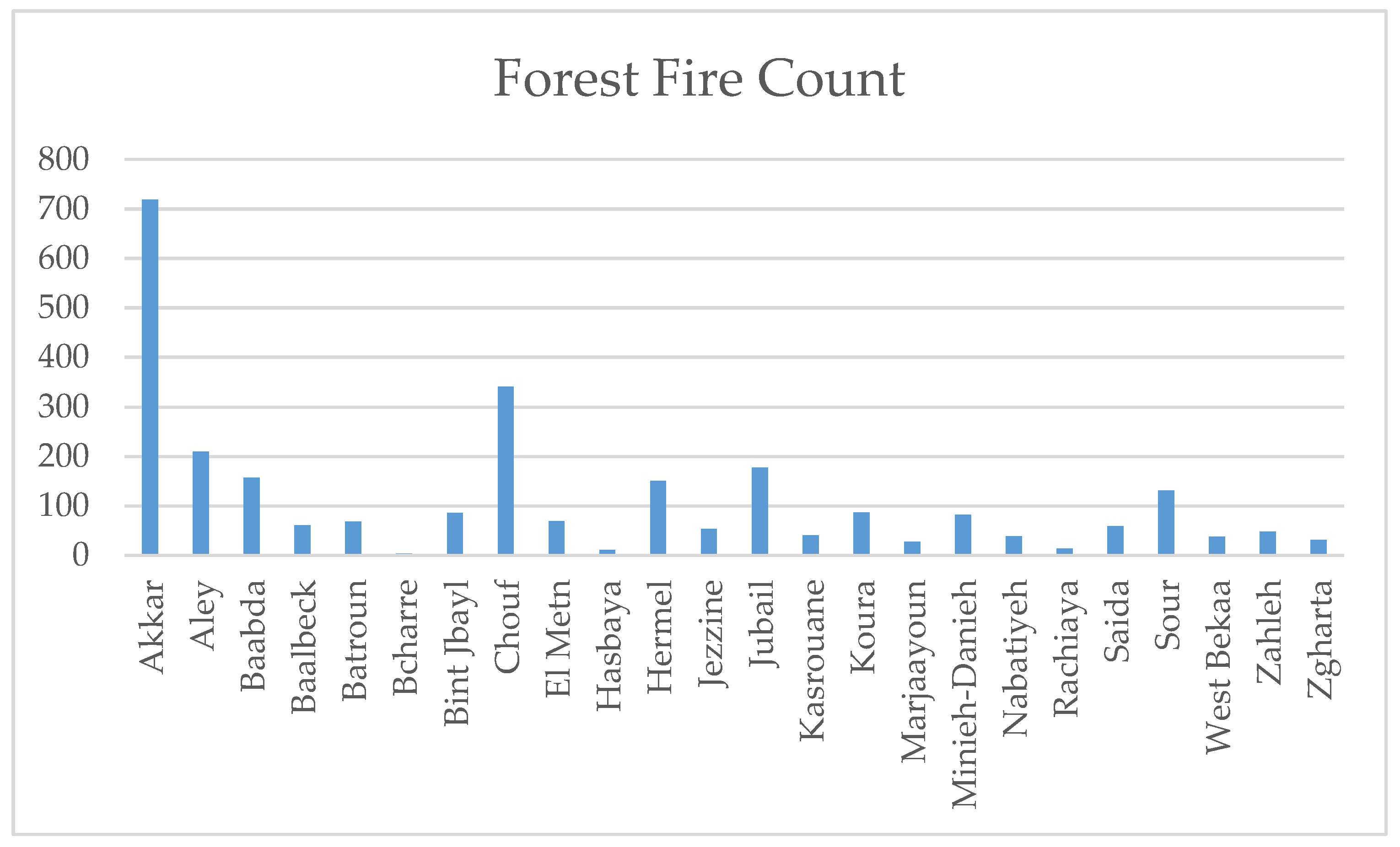
Lebanon represents a relatively under-studied region within the Mediterranean basin in terms of wildfire research. While fire dynamics have been extensively analyzed in countries such as Spain and Greece, studies in Lebanon remain limited and are largely focused on fire occurrence and burned area statistics. The country’s mountainous terrain, diverse vegetation cover, and increasing fire activity create a complex environment where fire behavior is influenced by multiple interacting factors. To further define the study area within Lebanon, FIRMS active fire detections were used, allowing for the examination of the spatial distribution of wildfire occurrences across the country. The selected study area was chosen based on the area with the highest forest-fire occurrence rate in Lebanon. Long-term fire occurrence data was obtained from NASA’s FIRMS platform covering the period 2000–2024. The use of FIRMS allowed the analysis of a longer temporal record of fire detections based on remote sensing observations, to align with the objectives of this study of adopting a Digital Landscapes approach. Fire detections from the FIRMS database were used without applying a confidence threshold in order to allow a comprehensive comparison with dNBR-derived burned areas and to assess the detection performance of the dataset across all levels. The selection of the study area followed a spatial filtering process to keep only forested areas and exclude all other land-cover types based on Lebanon’s national land-cover classification of 2017. The FIRMS data was redefined to the forestland-cover where all other fire data was disregarded, so that the study concentrated solely on forested areas affected by wildfires. Subsequently, the fire occurrence data revealed that the most frequently burned forests were located within the Akkar and Chouf Caza, as shown in Figure 1. This finding is consistent with national fire reports indicating that the Akkar and Chouf Caza are among the regions most affected by wildfires. On-ground reports from first responder teams such as Akkar Trail indicate that approximately 630 hectares burned in 2020, 2645 hectares in 2021, and 84 and 278 hectares in 2022 and 2023, respectively. This accounts to almost to 35% of burned area across Lebanon, on average.
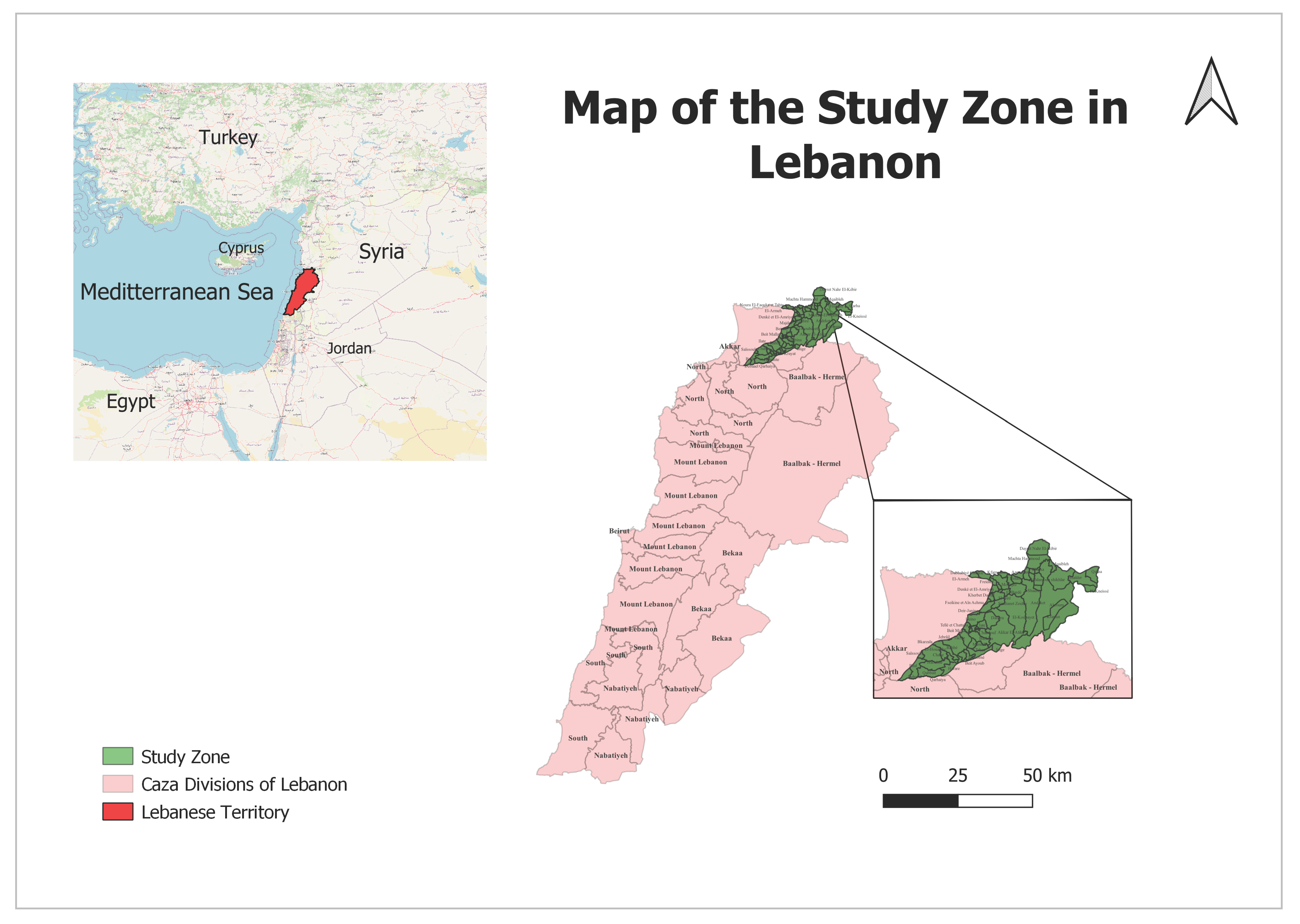
Upon the addition of the vegetation classification layer [42] to further refine the study area, it was discovered that the altitudinal ranges with the most fire occurrence are the Eumediterranean and Thermomediterranean. Accordingly, the study area was defined to fully include the Eumediterranean vegetation level and extend slightly into both the lower Thermomediterranean and upper Supramediterranean belts. The defined zone represents the area with the highest forest fire frequency and ecological relevance, ensuring a representative basis for fire severity analysis in Lebanon. The resulting study area shown in Figure 2 covers approximately 401 km2 and includes forested landscapes under the administrative jurisdiction of several municipalities like the villages of Meshmesh, Fnaydeq, Qobayat, and Andqet, as labeled on the map.
This zone of Akkar is characterized by high fire vulnerability. Its recurrent exposure to large wildfires, combined with its climatic, topographical, ecological, and economic conditions, makes it a high-priority area for investigating fire patterns to support improved management and recovery. It is also representative of Mediterranean forest landscapes, making it a relevant case for examining fire severity and its environmental drivers within a data-scarce context. The area is known for its steep and unmanaged mountains on the western side of Mount Lebanon, which encompass different ecosystems of forests, shrub-lands, grasslands, agricultural terraces, and abandoned lands [10,44]. It is characterized by having hot, dry summers and mild, wet winters. Annual precipitation ranges from 700 mm to 1200 mm, mainly occurring between the months of November and April. The dry summer months are usually characterized by temperatures exceeding 30 °C, and low relative humidity, which are conditions that significantly increase the risk of wildfires [45]. The forests in Akkar represent some of the most ecologically significant and diverse woodland systems in Lebanon. Some dominant forest species include pure and mixed stands of Pinus brutia, Quercus calliprinos, Quercus cerris, and Quercus infectoria [46]. Economically, the Caza of Akkar is among the most disadvantaged regions in Lebanon. It has limited development resources, and lacks research attention, despite being recognized as an area of high environmental and strategic priority. Many of its people depend heavily on agriculture, grazing, and forest-based livelihoods, which make the region particularly vulnerable to the impacts of wildfire [10,47].

2.2.2. dNBR Calculation and Mapping

The dNBR is a satellite-derived index calculated from pre- and post-fire imagery that quantifies the magnitude of vegetation and soil change caused by fire, allowing the classification and mapping of burn severity across affected landscapes, which enables spatial and temporal understanding of fires across large areas [48,49]. This method builds upon and customizes an open-access workflow provided by the United Nations Platform for Space-based Information for Disaster Management and Emergency Response (UN-SPIDER) Earth Observation Toolkit for Burn Severity Mapping [40], with modifications applied to align with local landscape conditions, regional fire regimes, and the requirements of this study area. The pre-processing of Landsat-8 satellite imagery for this study was conducted entirely within the GEE platform, for both dNBR and NPP calculations. The Landsat-8 SR ImageCollection was filtered by date and by the spatial extent of the study area using GEE’s filterDate and filterBounds functions.
For each year, the fire season was determined using FIRMS fire detection data. The date of the first detected fire point and the date of the last detected fire point were used to delimit the annual fire season. Two separate timeframes were defined for each fire season: a pre-fire period and a post-fire period, each spanning 32 days. This temporal window was selected to ensure the availability of at least two images from Landsat-8, which has a 16-day cycle. When cloud cover was present, the period was extended to 48 days to incorporate an additional image, ensuring clearer atmospheric conditions while still minimizing the influence of any changes in vegetation. The full UN-SPIDER code for GEE for dNBR calculation applies cloud, snow, and shadow masking to each image in the collection based on the QA_PIXEL band. Pixels affected by cloud shadow (bit 4) and snow (bit 5) were removed, while only pixels flagged as clear conditions (bit 6) were retained. This masking process ensured that only high-quality observations with minimal atmospheric or surface contamination data remained for further analysis. Following the cloud-masking step, reflectance scaling was applied to convert the raw digital numbers into top-of-canopy surface reflectance values using a scale factor of 0.0000275 and an offset of –0.2, consistent with Landsat-8 Collection 2 metadata specifications. The cloud-masked and scaled images within each pre-fire and post-fire period were then composited into single mosaics using the mosaic function, which prioritized the most recent cloud-free pixels for each location. The resulting pre-fire and post-fire mosaics were clipped to the boundaries of the defined study area using the clip function, and reprojected to the WGS 84 UTM Zone 36N coordinate system, to ensure alignment with ancillary geospatial datasets.
dNBR compares spectral responses in the NIR and SWIR regions, which are sensitive to live green biomass and burned material, respectively. For Landsat-8 data, this corresponds to Band 5 (NIR) and Band 7 (SWIR2). The calculation was executed within the GEE platform using the Normalized Difference function, applied separately to the cloud-masked and scaled pre-fire and post-fire image mosaics, according to the following equation as per Key and Benson [50]:
NBR   =   N I R S W I R N I R + S W I R ,
dNBR was then computed by subtracting the post-fire NBR image from the pre-fire NBR image on a pixel-by-pixel basis, as expressed in the following formula:
dNBR = NBRpre-fire − NBRpost-fire,
The resulting dNBR raster represents the relative change in vegetation reflectance caused by fire events, with higher positive values indicating greater burn severity. Following the recommendations of Key and Benson [50] and the UN-SPIDER Burn Severity Mapping Toolkit [40], the continuous dNBR values were scaled by a factor of 1000 for standardization and ease of classification. The study adopted the United States Geological Survey (USGS) dNBR severity thresholds by Key and Benson to classify the severity, categorizing the landscape into different burn severity levels. These classes were used to generate thematic fire severity maps in GEE, which were later exported and further visualized in QGIS for spatial analysis. The classification thresholds used in this study are presented in Table 1.

2.2.3. Calculation of NPP

NPP represents the rate at which vegetation assimilates carbon through photosynthesis after accounting for plant respiration and serves as a widely used indicator of ecosystem function and post-disturbance response [51,52]. Mapping NPP enabled the evaluation of vegetation conditions within fire-affected forest landscapes before and after wildfire events.
As for NPP mapping, all satellite imagery of the year were included. To ensure optimal image quality, only scenes with less than 10% cloud cover were retained. A median composite was then generated from the filtered images by combining multiple scenes into a single clear, cloud-free representation. This approach ensures more stable and comparable spatial representations of vegetation productivity across years, which is consistent with the study’s objective of analyzing inter-annual and spatial patterns rather than intra-annual phenological dynamics. This composite was subsequently clipped to the boundaries of the study area to refine the spatial extent of analysis. Unlike studies that rely on precomputed MODIS products (e.g., MOD17A3HGF), this research computed NPP directly from Landsat-8 OLI surface reflectance imagery using a simplified Light Use Efficiency (LUE) model implemented in GEE. The model by Monteith 1972 [53] and Monteith 1977 [54] estimates NPP as the product of the absorbed photosynthetically active radiation (APAR) and the Light Use Efficiency (ε). It is a model widely used and approved by authors like Ruimy et al., 1999 [55], Running et al., 2004 [56], and Sugiarto et al., 2008 [57]. It follows the general equation:
NPP = APAR × ε,
where APAR is the absorbed photosynthetically active radiation (MJ·m−2·day−1), and ε is the Light Use Efficiency (gC·MJ−1).
APAR was derived from the fraction of absorbed PAR (FPAR) and the incident PAR (PAR) according to:
APAR = FPAR × PAR,
The FPAR was estimated from the Normalized Difference Vegetation Index (NDVI) using the widely used empirical linear relationship, introduced by Ruimy et al. [55]:
FPAR = 1.24 × NDVI − 0.168,
NDVI was computed from Landsat-8 spectral bands as:
NDVI   =   N I R R E D N I R + R E D ,
where NIR corresponds to band 5 and RED to band 4. Pixels with NDVI values below 0.135 were masked to minimize noise from non-vegetated areas. The PAR was set as a constant value of 45 MJ·m−2·day−1, representing the mean incident radiation for Mediterranean-type ecosystems, while ε was set to 0.5 gC·MJ−1 based on typical LUE values for mixed temperate forests [58,59]. The final annual NPP was calculated as:
Annual NPP = NPP × 365,
The resulting annual NPP maps were exported in GeoTIFF format at 30 m spatial resolution for applying spatial analysis in QGIS. This workflow summarizes the methodological sequence applied for NPP computation and its subsequent comparison with fire-severity data. Landsat-8 surface reflectance imagery was processed in GEE to calculate NDVI, FPAR, APAR, and annual NPP using the LUE model. The resulting NPP raster files were exported to QGIS, where zonal statistics were performed using the classified dNBR layers as zones.

2.3. Data Preparation for Analysis

Following the generation of both dNBR and NPP datasets, a data integration phase was conducted to align, overlay, and prepare the outputs for subsequent spatial and statistical analysis. This step ensured that all spatial layers shared a common coordinate reference system, spatial resolution, and geographic extent.
To understand NPP patterns, forest types according to the land-cover data were classified into three main categories: broad-leaved forests, needle-leaved, and mixed forests. NPP values were then averaged by forest type using zonal statistics. A summary of the forest-class categorization used in this study is presented in Table S1 in the Supplementary Materials.
All datasets were exported from GEE in GeoTIFF format and imported into QGIS for geospatial operations. The derived dNBR rasters were converted into vector polygon layers to facilitate zonal analyses. These vector layers served as the spatial reference zones for the zonal statistics extraction process, wherein corresponding NPP values were computed from the derived NPP raster data for each study year.
The extracted data was then compiled into tabular format and further organized in Microsoft Excel. Within Excel, pivot tables and trend plots were created to visualize temporal and spatial patterns in vegetation productivity across different severity levels. This integrated workflow provided a harmonized dataset that enabled a comparative examination between the remotely sensed indicators and formed the analytical basis for the subsequent Results and Discussion sections.
Principal Component Analysis (PCA) was then performed using the R statistical computing environment (R version 4.3.2), using the FactoMineR package for multivariate analysis and the factoextra package for visualization. It was conducted to understand the environmental factors affecting fire severity by integrating vegetation productivity (NPP) and a DEM layer of topographic variables including elevation, slope, and aspect, which were derived from a Digital Elevation Model.
For the PCA, a pixel-based dataset was constructed by extracting values of dNBR, NPP, slope, and aspect from all forested areas. Each pixel was treated as an independent observation, allowing the analysis to capture spatial variability across the study area. Elevation and slope were retained as continuous numerical variables. However, aspect or orientation of a slope values, expressed in degrees from 0° to 360°, were reclassified into a binary variable to represent shaded and sun-exposed slopes. Lebanon, a country on the Mediterranean, exists in the Northern Hemisphere of the globe. In the northern hemisphere the sun goes from east to west via a southern route; it is located at a southern direction at midday [60]. For aspect classification, the circular range of aspect values was divided into two hemispheres. Slopes with orientations between 270° and 360° and between 0° and 90° were classified as north-facing (shaded) slopes, assigned 0 in binary, while slopes between 90° and 270° were classified as south-facing (sun-exposed) slopes, assigned 1 in binary. This classification reflects differences in solar radiation, where south-facing slopes typically receive higher solar input, which in turn affects the microclimatic conditions on these forests.
Topographic variables were not included in the initial analyses, which focused on pairwise relationships between fire severity and vegetation productivity. They were introduced in the PCA to assess the combined influence of multiple environmental factors. Prior to PCA, all variables were standardized using z-score normalization in the R program to ensure comparability among variables with different measurement units.

3. Results

3.1. Fire Severity Mapping (dNBR)

The dNBR classification produced yearly thematic severity maps with discrete color classes representing seven severity classes as shown in Table 2 below.
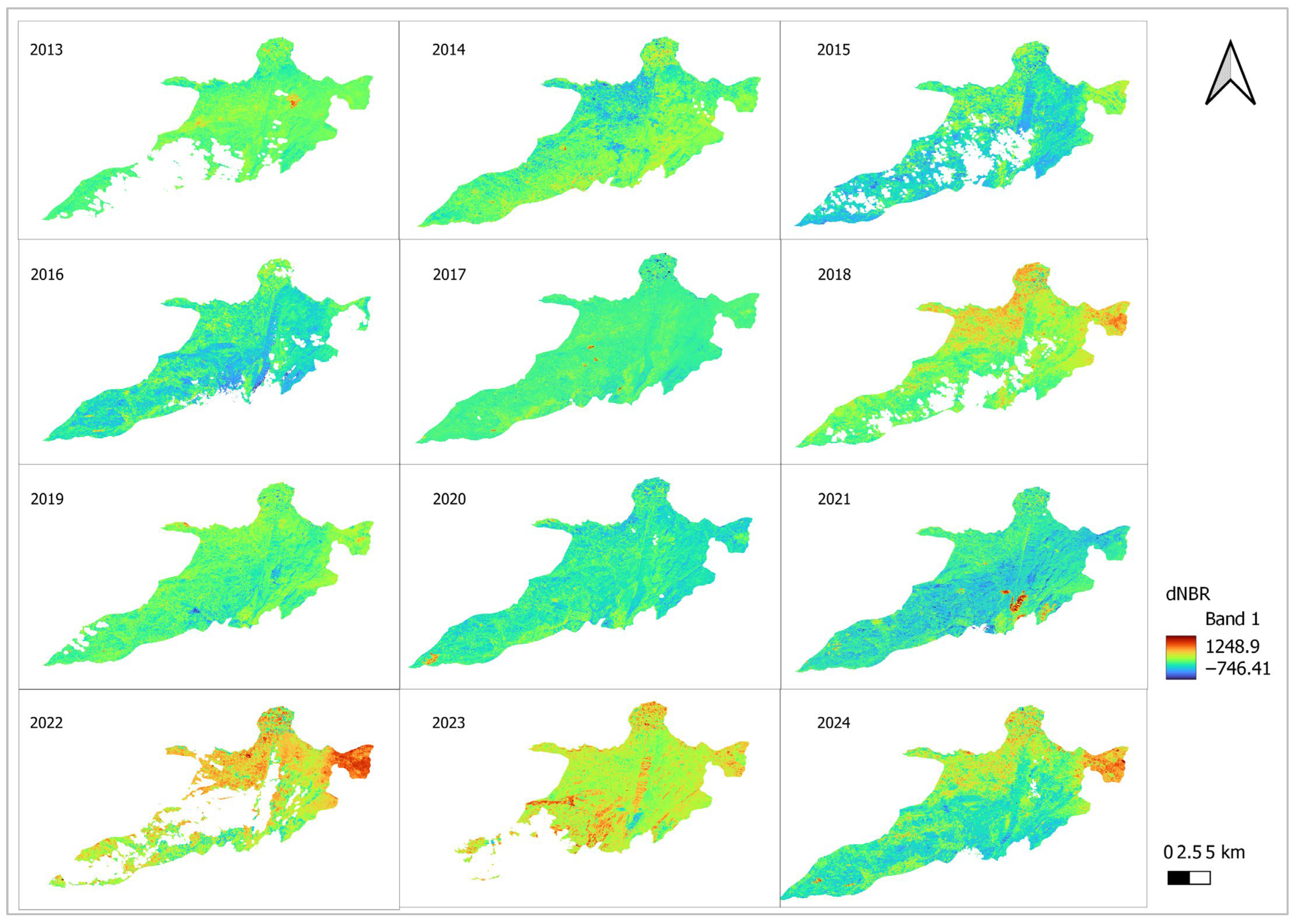
The resulting thematic maps (Figure 3) illustrate the spatial distribution of burned and unburned areas across the study zone for each study year between 2013 and 2024, revealing clear spatial and temporal variations in burned forest areas. These maps clearly delineate the extent and intensity of fire-affected zones, highlighting regions of varying ecological impact, as shown in the following figure, where years such as 2018, 2021, 2022, and 2023 were characterized by large, burned areas, whereas other years showed more scattered, smaller scars. The most affected zones were concentrated around Qobayat, Andqet, and Fneideq villages of the Caza.

3.2. Annual NPP Maps and Results

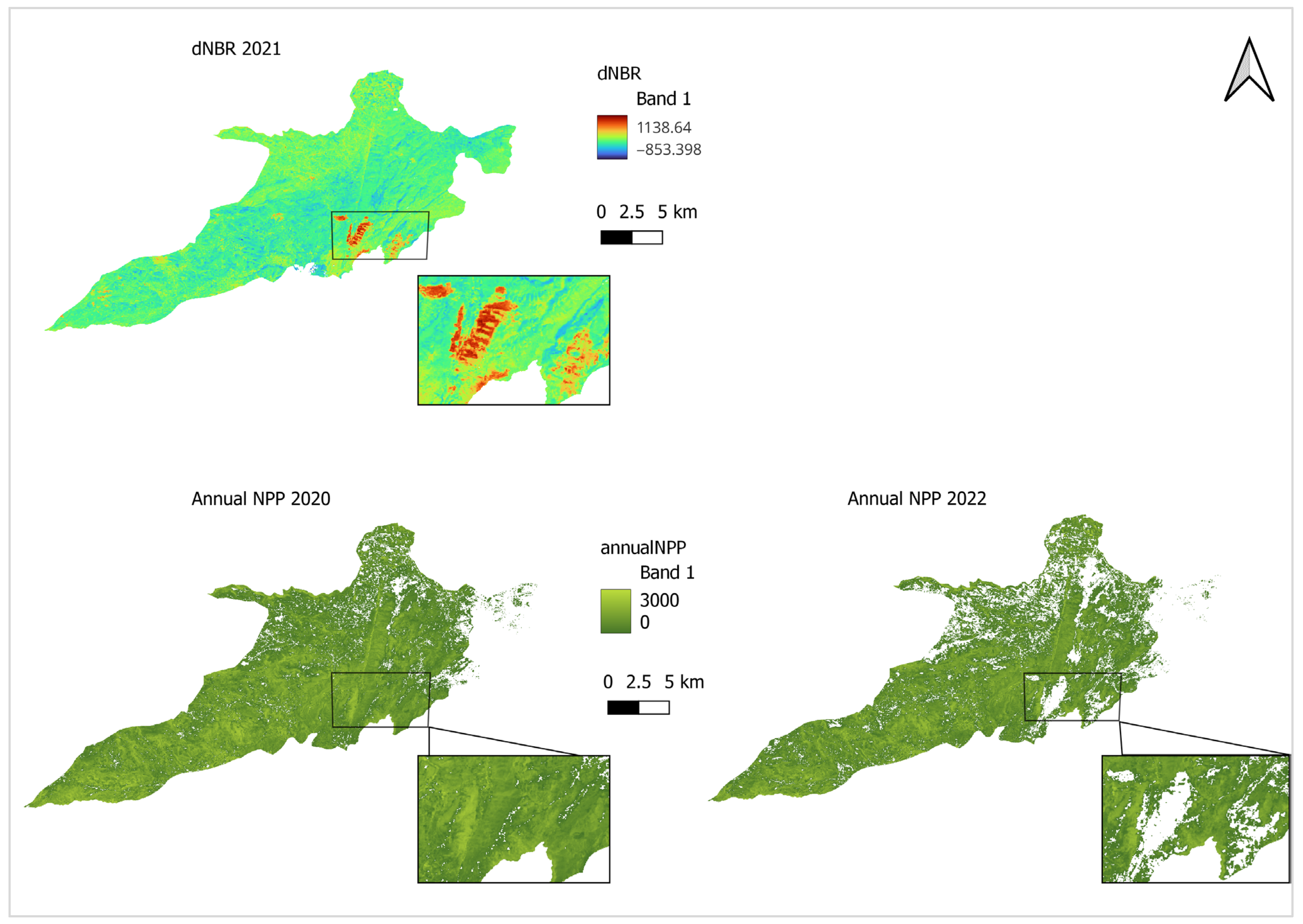
The annual NPP calculated revealed some spatial and temporal fluctuations in vegetation productivity across the study area between 2013 and 2024, as shown in Figure 4. The maps generated from Landsat-8 imagery through GEE revealed a clear spatial differentiation in vegetation productivity.
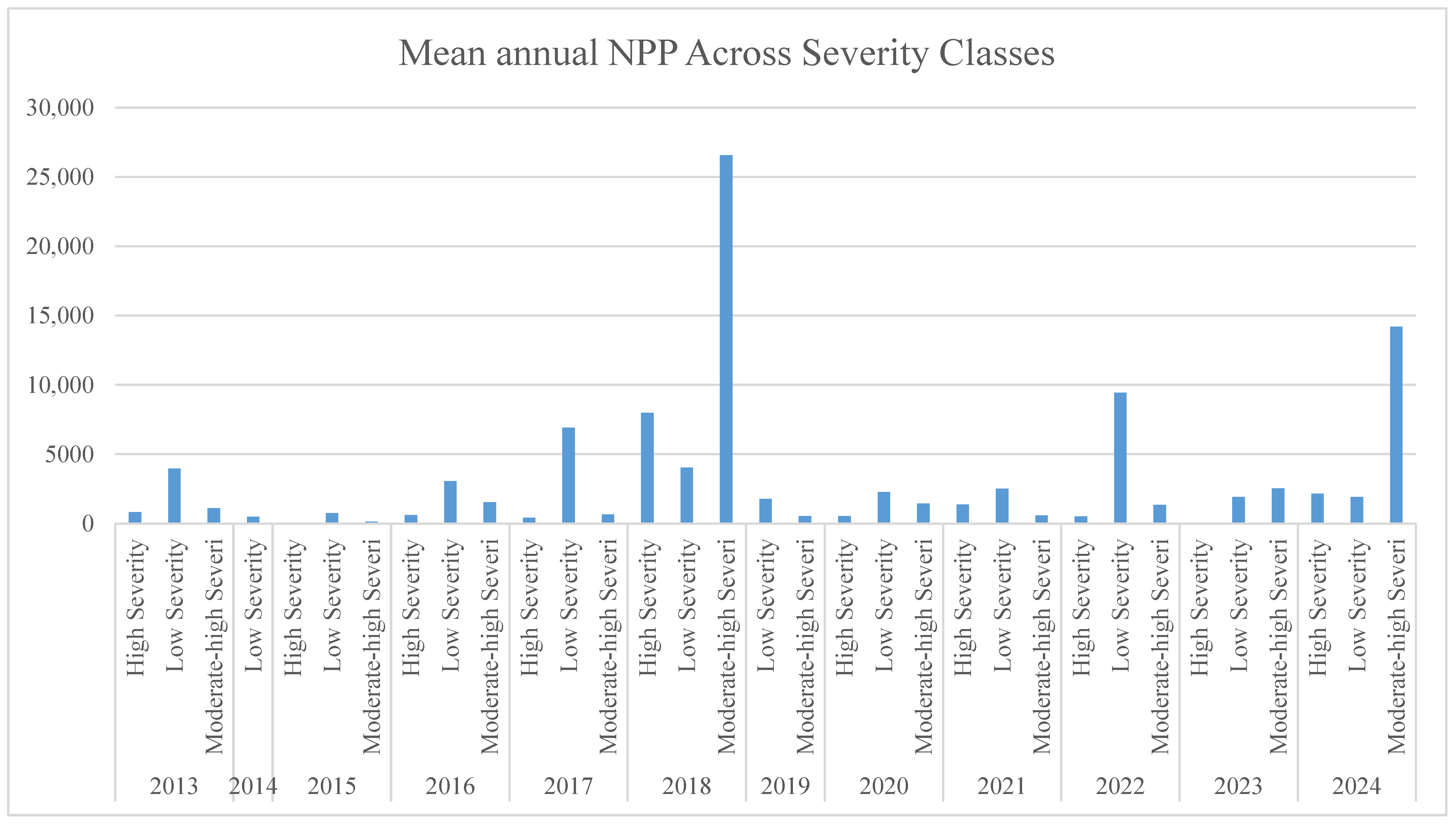
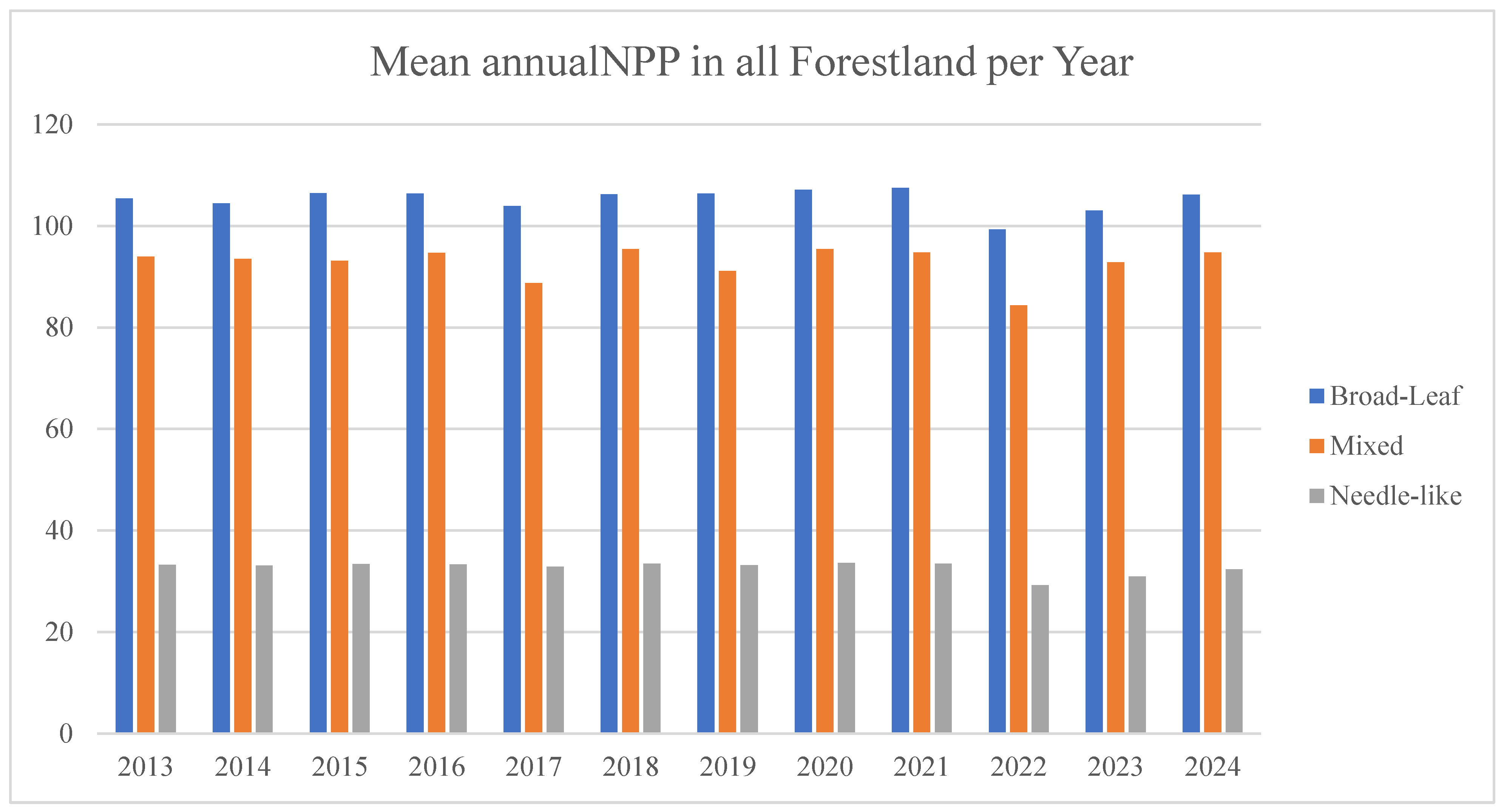
The graph in Figure 5 shows the mean of annual NPP values across the three different categories, over the 12-year period. Higher NPP values were consistently concentrated within broad-leaved and mixed forest areas, while lower productivity values occurred in needle-leaved forests.
Upon spatial evaluation of the annual NPP we observed that areas that experienced fires exhibited lower NPP values in the following year, reflecting a temporary decline in vegetative productivity after a fire occurrence. This trend was particularly evident between 2021 and 2022, where severely burned zones showed a clear reduction in NPP as shown in Figure 4.

3.3. Extraction of Forested Land from CNRS Land Cover Data

The dNBR outputs generated from GEE were exported from GeoTIFF files and imported into QGIS 3.28 for further spatial and statistical analysis. To ensure that the analysis was strictly representative of forested environments, the data was further refined through spatial filtering using the NSRC National Land Cover Map adapted in 2017 where the dNBR rasters for each year were first vectorized and subsequently intersected with the land-cover layer. The data was restricted to only the forested land into forestland, disregarding all other categories, such as agricultural, shrub-land, or built-up areas. This step provided a refined dataset representing only the forest fire extent, which served as the foundation for the subsequent accuracy evaluation and per-village breakdown of burned forest zones. The resulting forest-specific burned area datasets were then used for spatial and statistical analyses, including the validation of FIRMS fire point accuracy and the assessment of post-fire vegetation productivity (NPP).

3.4. Evaluation of FIRMS Fire Points Accuracy

To assess the reliability of satellite-based fire detection datasets, the FIRMS active fire points were spatially compared with the dNBR-derived burned forest polygons for each year between 2013 and 2024. This spatial overlay analysis was also performed in QGIS to determine the positional and detection accuracy of FIRMS in representing actual burned forest areas within the Akkar region. The burned versus unburned classifications were as follows: ‘Low Severity’, ‘Moderate-Low Severity’, ‘Moderate-High Severity’, and ‘High Severity’ were classified as ‘Burned’ while the classes ‘Enhanced Regrowth—Low’, ‘Enhanced Regrowth—High’, and ‘Unburned’ were classified as ‘Unburned’. Table 3 shows a detailed review of FIRMS fire points in burned versus unburned areas according to the dNBR classes.
The analysis revealed only a partial correspondence between FIRMS points and the burned forest polygons that were identified through the dNBR maps. In many cases, FIRMS points were able to detect fire events that actually corresponded to burned patches. However, in other instances, areas that were visibly shown to be burned areas in fires severity maps had no corresponding FIRMS points, meaning that they were missed by the system. The opposite was also observed; some FIRMS detection points did not correspond to any actual burned area, indicating false fire detections. By overlaying the two datasets on QGIS and joining attributes, it was found that less than 50% of the burned forest polygons overlapped with FIRMS fire points. This indicates that FIRMS detected only about half of the actual burned forest areas, suggesting moderate accuracy in representing ground fire occurrences.

3.5. Analysis of the Factors Affecting Fire Severity

3.5.1. Exploratory Analysis of Zonal Statistics and Correlation

Exploratory zonal statistics were performed on QGIS for the two spectral indices to understand the patterns of fire severity across burned forested areas of different classes, applying it on raster NPP data and dNBR vectors, showing NPP values within the different fire severity classes. The zonal statistics analysis summarizes mean annual NPP values within dNBR-derived fire severity classes for each year between 2013 and 2024 as shown in Figure 6. Across the study period, mean NPP values varied substantially both between years and among severity classes. In several years, areas classified as low or moderate severity exhibited higher mean NPP values than high-severity areas; however, this pattern was not consistent through time. Figure 6 shows that some years exhibited comparable or even higher NPP values within high-severity classes, indicating substantial inter-annual variability.
The variability observed in the relationship between NPP and fire severity across different years indicates that zonal statistics and class-based comparisons alone are insufficient to capture consistent patterns at the landscape scale. To further examine this relationship, a correlation analysis was performed in R between dNBR and NPP. The results revealed a weak positive correlation (r = 0.24), indicating a limited linear association between vegetation productivity and fire severity. This finding suggests that fire severity is not controlled by a single factor, but rather emerges from the interaction of multiple environmental variables. Therefore, a multivariate approach was adopted using PCA to better investigate how vegetation productivity and topographic factors jointly influence fire severity patterns. The PCA was conducted using NPP, and topographic variables (elevation, slope, and aspect) derived from a DEM. The dNBR was treated as a supplementary variable to examine how fire severity aligns with the identified environmental gradients.

3.5.2. Principal Components of Dimension 1 and Dimension 2

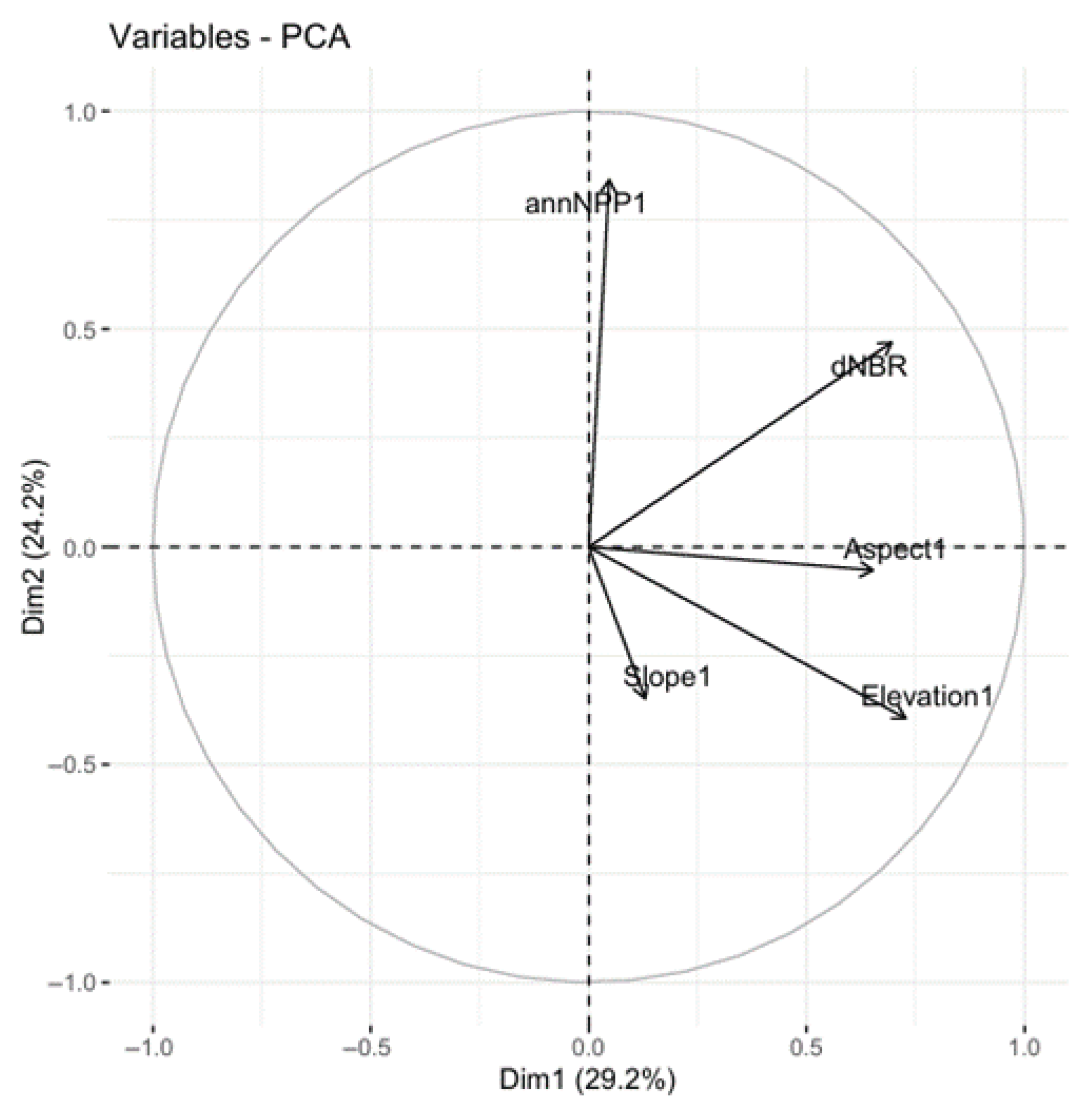
The results of the PCA showed the first two dimensions accounting for 53.4% of the variability (Dim.1: 29.2%; Dim.2: 24.2%), with the remaining two dimensions accounting for the remaining 46.6%, indicating that the main environmental patterns influencing the study area can be effectively summarized along two dominant axes. Figure 7 shows the results in a biplot. The PCA biplot represents individual pixels as observations and environmental variables as vectors. The direction and length of each vector indicate the contribution of the variable to the principal components, while the spatial distribution of points reflects variability across the landscape.
The biplot in Figure 7 illustrates the relationships between fire severity (dNBR), vegetation productivity (NPP), and topographic variables across the study area. The first two principal components explain 53.4% of the total variance (Dim.1: 29.2%; Dim.2: 24.2%), indicating that the main environmental gradients can be reasonably represented in a two-dimensional space. Dim.1 is primarily defined by strong positive contributions from elevation, dNBR, and aspect, forming a gradient associated with topographic conditions and fire severity. In this dimension, higher values correspond to higher elevations and north-facing (shaded) slopes, where higher fire severity values also tend to be observed. In contrast, annual NPP shows minimal contribution to this axis, indicating that vegetation productivity is largely independent of this primary gradient. Dim.2 is mainly driven by annual NPP, which exhibits a strong positive loading, representing a distinct productivity gradient. Slope contributes moderately and negatively to this dimension, suggesting that areas of higher productivity are generally associated with gentler terrain. Aspect shows a limited contribution to Dim.2, reinforcing its secondary role relative to other variables. The angular relationships between variables further support these patterns. The close alignment between elevation, aspect, and dNBR indicates a positive association among these variables, while the near-orthogonal relationship between NPP and dNBR suggests a weak or inconsistent relationship between vegetation productivity and fire severity. Overall, the PCA results highlight that fire severity is more strongly structured by topographic factors than by vegetation productivity. It is important to note that PCA reflects patterns of co-variation among variables and does not imply causal relationships.
The interpretation of the principal components is supported by the variable loadings presented in Table 4, where elevation (0.73), dNBR (0.70), and aspect (0.65) show strong positive contributions to Dim.1, while annual NPP (0.84) dominates Dim.2, confirming the separation between topographic–fire severity gradients and vegetation productivity patterns.

4. Discussion

4.1. Fire Severity Mapping Through dNBR Mapping

The spatial patterns identified in the dNBR maps correspond in severity classifications with on-ground investigation that documented large fire events in Akkar, such as the 2021 Qobayat fire that was reported by local first-response teams and environmental organizations as exhibiting extensive high-severity damage [61]. These results well align with studies that compared burned area mapping using satellite imagery and remote sensing, with field-collected data of severity [39,62]. However, measurements of burned area and the delineation of burned perimeters are considered more accurate, consistent, and clear when using the dNBR index for severity mapping compared to on-field manual documentation, particularly for large or inaccessible fires [39,62,63], like the 2021 Qobayat fire, which partly occurred on steep slopes that are not easily accessible. Although the present study did not include dedicated field-based visits to validate the analyzed fire events, previous assessments conducted in the Akkar forest region, in previous studies we have done, provide supporting evidence for the reliability of dNBR-derived burn severity mapping. Field surveys carried out following major fire events in the region compared CBI measurements with burn severity measures derived from Landsat-8 dNBR analysis, and the analysis showed a statistically significant correlation between field observations and satellite-derived burn severity estimates (Spearman r = 0.44, p = 1.94 × 10⁻⁹), with no statistically significant difference between dNBR and CBI values [64]. In addition, post-fire observations following the 2021 Qobayat fire confirmed burn severity patterns consistent with those identified through dNBR mapping. These findings support the use of Landsat-based dNBR as a suitable approach for assessing fire severity in Mediterranean mountainous landscapes such as Akkar. This is particularly relevant since the present study relies on Landsat-8 imagery for burn severity analysis. Nevertheless, future research could integrate systematic field validation to further improve the interpretation of burn severity dynamics in the region.
When the analysis was limited to forested areas based on the NCSR land cover map, results showed that burned areas were distributed across different forest types without a consistent dominance of any class. The extent and severity of fires fluctuated over the years, highlighting the irregular and spatially heterogeneous nature of fire events in Akkar’s landscape. This spatial dispersion of severity among forest types does not exactly match findings from other Mediterranean-region assessments, where some have said that coniferous forests, or needle-leaf forests, are more prone to fire [65], while others, like Peris-Llopis, said that mixed forests are the most prone to fires, including fire recurrence [66]. This is where the PCA conducted in this study explains this discrepancy, showing the dominating effect of the topographical factors, as explained in the following sections.

4.2. FIRMS Data Accuracy

FIRMS data were used in this study primarily to support the identification of fire-prone regions rather than as a core analytical dataset, a comparison between FIRMS active fire detections and dNBR-derived burned area maps was conducted to provide additional contextual insight. This comparison between FIRMS active fire detections and dNBR-derived burned area maps revealed only moderate spatial agreement, with approximately 50% of burned forest polygons overlapping at least one FIRMS fire point. This finding is consistent with validation studies conducted in Turkey, southern Europe, and parts of South America, which report FIRMS detection rates ranging between 40% and 60% when compared with burned area products or field observations [67]. The inconsistency can be attributed to multiple factors, including temporal resolution, cloud cover, satellite overpass timing, and the thresholds of FIRMS detection, which primarily captures active fire hotspots rather than total burned extent [19,20]. In addition, FIRMS thermal anomaly data may occasionally include non-fire heat sources (e.g., industrial activities), which can introduce further uncertainty in hotspot detection. This finding underscores the added value of using dNBR-based analysis through GEE, which integrates spectral indices with pre- and post-fire images, rather than active-fire datasets that may detect all sorts of hotspots as fires [22,62].
While the present study relies on dNBR as a widely used indicator of fire severity, it is important to discuss other recent advances in remote sensing that emphasize the advantages of multi-temporal and automated approaches for burned-area mapping. Methods such as the Automated Temporal Burn Index (ATBI) and its multi-temporal extension (dATBItm) incorporate multiple post-fire observations to reduce transient noise and improve classification accuracy, achieving significantly higher precision compared to traditional dNBR-based approaches [68]. Similarly, time-series frameworks such as the Breaks For Additive Season and Trend monitor (BFASTMonitor), combined with indices like the Relativized Burn Ratio (RBR), enable the detection of vegetation changes over time and reduce temporal lag errors associated with bi-temporal methods [69]. In addition, enhanced indices such as the Enhanced Burned Area Index (EBAI) integrate spectral information with active fire data to minimize false detections caused by phenological variability and atmospheric disturbances [70].
Integrating these advanced methodologies within the Digital Landscapes framework in future research could serve as an alternative analytical approach, offering new possibilities for more automated and temporally consistent monitoring of fire-affected areas.

4.3. Vegetation Productivity Fluctuations

Among the classified forest types, broad-leaved forests generally displayed the highest mean productivity, followed by mixed and then needle-leaved forests. This trend aligns with their respective canopy densities and photosynthetic capacities, as broad-leaved forests tend to maintain higher leaf-area indices and carbon uptake potential, as well as findings from other studies that said that broadleaf forests often exceed needle-leaf forests in NPP due to better photosynthesis in favorable conditions [63,71].
Years immediately following major fire events showed a clear reduction in productivity within affected forest polygons, while subsequent years exhibited partial increases, suggesting localized regeneration. However, this recovery was inconsistent, probably spatially and temporally, which indicates the effect of the variations in slope, elevation, and forest type, agreeing with findings from Sparks [72], Shen [73], Sparks [72], and Li [35].
One limitation of this study relates to the use of the 2017 National Land Cover Map as a reference dataset while the study period extends to 2024. However, the 2017 product represents the most recent and nationally available land cover dataset for Lebanon. It was therefore used as a consistent baseline for the analysis across the study area. Although land cover changes may have occurred after 2017, the dataset remains the most reliable national reference currently available. Future research could incorporate updated or multi-temporal land cover products as they become available to further refine the analysis.
The applied NPP model uses constant values for incident PAR and LUE (ε). While this simplification enables consistent estimation of NPP from Landsat imagery, it does not account for spatial and seasonal variability in solar radiation or vegetation physiological responses, which can sometimes be significant in mountainous landscapes such as the Akkar region. Consequently, the resulting NPP values were interpreted primarily as relative indicators of productivity rather than absolute measurements, which served the purpose of this study, but it is recommended that future research improve this approach by integrating dynamic PAR datasets or climate-driven LUE models.

4.4. Multivariate Analysis of the Environmental Drivers of Fire Severity

While zonal statistics provided comparisons between fire severity classes and productivity levels, they did not show consistent patterns that can explain fire severity patterns. To address this, a PCA was conducted between environmental factors that affect fire severity (vegetation and topographic variables) to explore how they jointly structure fire severity patterns across the study area.
The PCA results indicate that fire severity in the study area is not controlled by a single dominant factor but rather emerges from the interaction of multiple environmental gradients. The relatively even distribution of eigenvalues across components supports this interpretation, suggesting a complex system where topographic and productivity-related variables jointly structure fire severity patterns. The PCA results indicate that fire severity in Akkar is primarily structured by topographic factors. The first principal component represents an elevation-driven severity gradient, with strong contributions from aspect. Higher fire severity values were associated with elevated and sun-exposed terrain, highlighting the importance of terrain configuration and microclimatic conditions in shaping fire behavior. Vegetation productivity exhibited limited influence along this axis. Similar topographic controls on fire severity have been widely documented in Mediterranean-type ecosystems, where south- and west-facing slopes tend to experience more intense burning regardless of vegetation productivity [33,48,74]. These patterns observed in the PCA results, and similarly reported in previous studies, can be further understood through the influence of topography on microclimatic conditions across mountainous Mediterranean landscapes. In regions such as Akkar, variations in elevation and aspect strongly influence microclimatic conditions like moisture availability, temperatures, and wind conditions. Authors like Haas and Harrison state that high solar radiation exposure leads to higher temperatures, and reduced fuel moisture, which play a role in increased fire severity [24,25]. Studies conducted in Mediterranean mountainous regions have shown that south-facing slopes can receive 50–60% higher annual solar radiation compared to north-facing slopes, resulting in significantly lower fuel moisture content, elevated temperatures, and higher fire severity [75]. Differences in fuel moisture in mountainous Mediterranean environments between sun-exposed and shaded slopes have been reported to reach 10–20% variation during peak fire seasons [75,76]. In addition to that, as cited by authors like Maren et al., topographic position can influence the redistribution of precipitation and soil moisture, with steeper slopes often experiencing faster drainage and ridge tops experiencing higher evapotranspiration rates. Furthermore, higher elevations may be more exposed to wind dynamics that contribute to drier fuel conditions, enhancing fire spread and intensity under certain conditions. On the contrary, lower elevation valleys may retain higher moisture and experience moderated microclimatic conditions, accounting for lower severity; however, these effects were not significant to dNBR in our case.
Vegetation productivity contributed weakly to this primary axis, indicating that productivity alone does not govern fire severity. The second principal component was dominated by NPP, representing a productivity gradient largely independent of the dominant fire severity pattern. Although some overlap between productivity and fire severity exists, productivity did not emerge as a dominant driver of burn severity. Similar findings have been reported in studies done in Mediterranean Europe and Australia, where terrain and weather conditions often override fuel quantity effects. Authors like Tiribelli, who have modeled burn severity as a function of topography, weather, vegetation and productivity concluded that wetter and cooler fire weather conditions would promote lower burn severity in highly productive vegetation types where moister fuel conditions and structure conditions act as fire retardants. Drier and hotter fire seasons would homogenize the landscape, creating conditions for high burn severity across all vegetation types [51,66,77,78]. Others like Ganteaume et al., who studied the main driving factors of forest fire ignition over Europe also concluded that abiotic factors related to topography and weather are the most significant environmental factors that drive ignition of forest fires [79]. The findings from Akkar therefore reflect broader patterns observed in Mediterranean ecosystems while also highlighting regional particularities linked to landscape heterogeneity and local environmental conditions.

4.5. Ecological and Species-Specific Factors Influencing Fire Severity

Although this study primarily focused on remotely sensed indicators of vegetation productivity and topographic controls on fire severity, it is important to acknowledge that fire behavior in Mediterranean forest ecosystems is also influenced by species-specific physiological and structural traits that were not directly analyzed in this study. Factors such as species-composition, fuel structure, and climate adaptation strategies can significantly influence both vegetation productivity and fire dynamics [33,35].
Differences in NPP among forest types observed in this study may partly reflect ecological strategies adopted by different vegetation groups. Broad-leaved forests generally exhibit higher productivity due to their greater leaf-area indices and higher photosynthetic efficiency under favorable environmental conditions [65,80]. In contrast, coniferous and mixed forests often display lower productivity levels, which may be associated with species composition and adaptation strategies to Mediterranean climatic conditions. This was clearly shown in the results, where mean annual NPP was lowest in needle-like leaves, and highest in broad leaves. Coniferous species typically exhibit physiological traits that favor drought tolerance and water-use efficiency rather than maximizing growth rates, which can lead to comparatively lower NPP values [81,82]. In addition, variations in stand density and canopy structure within mixed forests may further influence light interception, competition for resources, and overall carbon assimilation [83].
In the study area, needle-leaved forests are frequently dominated by Pinus brutia, a species widely recognized as one of the most flammable forest types in the eastern Mediterranean region. The high flammability of this species has been attributed to several functional traits, including needle morphology, the accumulation of fine litter fuels, and the presence of volatile terpenes and resin compounds that facilitate ignition and rapid fire spread [84]. Additionally, the vertical distribution of crown fuels in Pinus brutia stands creates conditions that can promote the transition from surface fires to crown fires, potentially increasing fire intensity and severity regardless of the overall biomass levels indicated by NPP [80].
These characteristics suggest that fire severity patterns may not always correspond directly to vegetation productivity alone. Instead, species-specific fuel traits and forest structural characteristics can interact with topographic and climatic factors to shape fire behavior across landscapes. While the present study did not directly assess these physiological or fuel-related parameters, acknowledging their role provides important ecological context for interpreting the observed fire severity patterns and highlights potential directions for future research integrating remote sensing with field-based vegetation and fuel structure analyses.

5. Conclusions

This study developed and implemented a Digital Landscapes-based framework for assessing wildfire impacts across the fire-prone forested landscapes of Akkar, northern Lebanon, using multi-temporal remote sensing and spatial analysis techniques. By integrating Landsat-8-derived fire severity mapping (dNBR), vegetation productivity assessment (NPP), topographic variables, and multivariate statistical analysis within cloud-based and GIS environments, the research provides a spatially explicit and methodologically transferable approach suited to data-scarce Mediterranean contexts.
The dNBR-based fire severity maps captured the spatial distribution of forest fires between 2013 and 2024, revealing heterogeneous fire patterns across Akkar’s landscapes. Restricting the analysis to forested areas enhanced ecological relevance and improved the representation of forest-specific fire impacts. Upon comparison with FIRMS active fire detections, results showed less than 50% overlap of burned areas and FIRMS detected fire points, thus highlighting the limitations of the FIRMS data in representing burned extent and severity. At the same time, it emphasizes the added value of satellite-derived burn severity indices for post-fire assessment in complex mountainous terrain.
Mapping NPP showed post-fire reductions following major fire events, indicating productivity declines with partial recovery in subsequent years. Conducting a PCA provided insight into the environmental context shaping fire severity patterns. The PCA results demonstrated that fire severity in Akkar is primarily associated with topographic controls, particularly elevation and sun exposure, while vegetation productivity represents a secondary and weaker gradient. These findings confirm that wildfire severity results from the interaction of multiple landscape factors. Future research can incorporate time-series analyses to better capture the dynamic relationship between fire severity and vegetation productivity, and focus on the context of post-fire recovery, where changes in productivity can provide valuable insights into ecosystem regeneration processes and landscape resilience.
Overall, this research highlights the value of multivariate approaches within a Digital Landscapes framework in understanding the wildfire dynamics of Mediterranean forest environments. The proposed workflow is scalable, reproducible, and transferable, offering practical support for wildfire monitoring, risk assessment, and even post-fire landscape management in Lebanon and similar regions. While this study provides a comprehensive assessment of wildfire severity in Akkar using remote sensing and topographic and productivity data, it does not incorporate climatic factors such as temperature, precipitation, or wind speed at the time of fire. These variables are indeed important drivers of fire intensity and spread. The focus of this study is on landscape-scale environmental drivers and the application of a Digital Landscape approach using remotely sensed data over a decade-long period. Incorporating climatic variables would require high-resolution, fire-event-specific meteorological data, which are currently limited or unavailable for this region. Future research could integrate climate data to develop a more mechanistic understanding of fire dynamics, potentially combining terrain, vegetation, and weather to improve predictive models of fire severity and support proactive landscape management. In addition, this framework could incorporate anthropogenic variables, such as land use patterns, population density, road networks, and proximity to settlements. This could enhance the understanding of fire dynamics and improve the predictive capacity of future models. Furthermore, the use of machine learning techniques in future research can improve predictive severity capability. Such developments would further support adaptive fire management, post-fire restoration planning, and long-term ecosystem resilience under changing climatic conditions. From a methodological perspective, forest fire risk assessment has traditionally relied on Multi-Criteria Decision Analysis (MCDA) approaches, including subjective methods (e.g., AHP, BWM, DEMATEL), objective methods (e.g., CRITIC, entropy weighting), and combined weighting techniques such as game theory-based models. While these approaches have been widely applied, they may be limited in capturing the complex and non-linear interactions that characterize fire dynamics. Data-driven approaches, including machine learning and deep learning models, are now increasingly recognized for their ability to improve fire risk prediction and analysis. Future research could further expand this approach by integrating advanced analytical techniques such as machine learning models between fire severity and factors that affect it. In addition, statistical methods such as Discriminant Function Analysis (DFA) could be explored as a complementary approach. Unlike PCA, which is exploratory and identifies dominant environmental gradients, DFA requires predefined categories and could therefore be applied to evaluate how well environmental variables differentiate between known landscape classes, such as forest types or fire severity levels. In this context, DFA may serve as a validation or comparative method to support and refine the patterns identified through PCA.

Supplementary Materials

The following supporting information can be downloaded at: https://www.mdpi.com/article/10.3390/rs18101654/s1, Table S1: Forest Class Categorization.

Author Contributions

Conceptualization, D.E.K., G.K. and J.B.; Methodology, D.E.K., J.B. and J.S.; Software, D.E.K. and J.B.; Validation, D.E.K., G.K., M.W. and J.S.; Formal analysis, D.E.K., J.B. and J.S.; Investigation, D.E.K. and J.B.; Resources, J.B. and J.S.; Data curation, D.E.K. and J.B.; Writing—original draft, D.E.K. and J.B.; Writing—review & editing, D.E.K., G.K., M.W. and J.S.; Visualization, D.E.K.; Supervision, G.K.; Project administration, D.E.K. and G.K. All authors have read and agreed to the published version of the manuscript.

Funding

This research received no external funding.

Data Availability Statement

The original contributions presented in this study are included in the article/Supplementary Material. Further inquiries can be directed to the corresponding author.

Conflicts of Interest

The authors declare no conflict of interest.

Abbreviations

The following abbreviations are used in this manuscript:
GDPGross Domestic Product
IPCCIntergovernmental Panel on Climate Change
NCSRNational Council for Scientific Research
UoBUniversity of Balamand
GEEGoogle Earth Engine
QGISQuantum Geographic Information System
dNBRDifferenced Normalized Burn Ratio
NIRNear-Infrared
SWIRShort-Wave Infrared
NASANational Aeronautics and Space Administration
FIRMSFire Information for Resource Management System
MODISModerate Resolution Imaging Spectroradiometer
VIIRSVisible Infrared Imaging Radiometer Suite
OLIOperational Land Imager
GADMGlobal Administrative Areas
DEMDigital Elevation Model
NPMPLTNational Physical Master Plan of Lebanese Territory
GDALGeospatial Data Abstraction Library
WGSWorld Geodetic System
UTMUniversal Transverse Mercator
UN-SPIDERUnited Nations Platform for Space-based Information for Disaster Management and Emergency Response
USGSUnited States Geological Survey
LUELight Use Efficiency
APARAbsorbed Photosynthetic Active Radiation
NDVINormalized Difference Vegetation Index
CBIComposite Burn Index
PCAPrinciple Component Analysis
ATBIAutomated Temporal Burn Index
BFASTMonitorBreaks For Additive Season and Trend Monitor
EBAIEnhanced Burned Area Index
MCDAMulti-Criteria Decision Analysis
AHPAnalytic Hierarchy Process
BWMBest Worst Method
DEMATELDecision-Making Trial and Evaluation Laboratory
CRITICCriteria Importance Through Inter-criteria Correlation
DFADiscriminant Function Analysis

References

  1. FAO. Global Forest Resources Assessment 2025; FAO: Rome, Italy, 2025. [Google Scholar]
  2. Forest Declaration Assessment. Forests under Fire: Tracking Progress on 2030 Forest Goals. In Forest Declaration Assessment 2024; Forest Declaration Assessment: Washington, DC, USA, 2024. [Google Scholar]
  3. Zheng, B.; Ciais, P.; Chevallier, F.; Yang, H.; Canadell, J.G.; Chen, Y.; Van Der Velde, I.R.; Aben, I.; Chuvieco, E.; Davis, S.J.; et al. Record-High CO2 Emissions from Boreal Fires in 2021. Science 2023, 379, 912–917. [Google Scholar] [CrossRef] [PubMed]
  4. Bond, W.J.; Keane, R.E. Fires, Ecological Effects of. In Reference Module in Life Sciences; Elsevier: Amsterdam, The Netherlands, 2017. [Google Scholar]
  5. Wasserman, T.N.; Mueller, S.E. Climate Influences on Future Fire Severity: A Synthesis of Climate-Fire Interactions and Impacts on Fire Regimes, High-Severity Fire, and Forests in the Western United States. Fire Ecol. 2023, 19, 43. [Google Scholar] [CrossRef]
  6. Hilmi, N.; Ali, E.; Carnicer Cols, J.; Cramer, W.; Georgopoulou, E.; Le Cozannet, G.; Tirado, C. IPCC AR6 WGII Cross-Chapter Paper 4: Mediterranean Region 2022. In Proceedings of the EGU22, the 24th EGU General Assembly, Vienna, Austria, 23–27 May 2022. [Google Scholar] [CrossRef]
  7. Mitri, G.; Bou Fakhreddine, S.; Mhanna, C.; Abdullah, C.; Akoum, R. Lebanon’s National Forest Fire Management Strategy; AFDC: Metn, Lebanon, 2022.
  8. Ministry of Environment; United Nations Development Programme. Post-Fire Soil Erosion Protection Guidebook for Lebanon 2024; United Nations Development Programme: Beirut, Lebanon, 2024. [Google Scholar]
  9. Harati, E.; El-Ghali, H.A. A Case Study on Lebanon’s National Strategy for Forest Fire Management; Issam Fares Institute for Public Policy and International Affairs: Beirut, Lebanon, 2011.
  10. Associated Consulting Engineers. Environmental and Social Management Plan for Rehabilitation of the Selected Roads in Akkar Caza; Council for Development and Reconstruction: Beirut, Lebanon, 2020; p. 146.
  11. Ibrahim, S.; Kose, M.; Adamu, B.; Jega, I.M. Remote Sensing for Assessing the Impact of Forest Fire Severity on Ecological and Socio-Economic Activities in Kozan District, Turkey. J. Environ. Stud. Sci. 2025, 15, 342–354. [Google Scholar] [CrossRef]
  12. Ullah, A.; Bavorova, M. Livelihood Impacts of Community-Based Forest Landscape Restoration in the Hindu Kush Himalaya, Pakistan. Eur. J. For. Res. 2024, 143, 1773–1786. [Google Scholar] [CrossRef]
  13. Yin, H.; Chang, L.; Yue, G. Digital landscape architecture design using high resolution remote sensing image interpretation. Arch. Civ. Eng. 2025, 71, 99–112. [Google Scholar] [CrossRef]
  14. Cheng, Y. Digital Landscape Architecture Methodology. In Digital Landscape Architecture: Logic, Structure, Method and Application; Springer Nature Singapore: Singapore, 2023; pp. 144–246. [Google Scholar]
  15. Assaker, A.; Darwish, T.; Faour, G.; Noun, M. Use of Remote Sensing AND GIS to Assess the Anthropogenic Impact on Forest Fires in Nahr Ibrahim Watershed, Lebanon. Leban. Sci. J. 2012, 13, 15–28. [Google Scholar]
  16. Majdalani, G.; Koutsias, N.; Faour, G.; Adjizian-Gerard, J.; Mouillot, F. Fire Regime Analysis in Lebanon (2001–2020): Combining Remote Sensing Data in a Scarcely Documented Area. Fire 2022, 5, 141. [Google Scholar] [CrossRef]
  17. Mitri, G.H. The Use of Earth Observation Data in Wildfire Risk Management: A Case Study from Lebanon. In Applications of Space Techniques on the Natural Hazards in the MENA Region; Al Saud, M.M., Ed.; Springer International Publishing: Cham, Switzerland, 2022; pp. 513–531. [Google Scholar]
  18. Rahimoon, S.U.D.; Yamamoto, K.; Ghafar, M.A.; Anwar, M.M.; Majeed, M.; Khattak, W.A.; Muhammad, M. Exploration of Science of Remote Sensing and GIS with GEE. In Google Earth Engine and Artificial Intelligence for Earth Observation; Elsevier: Amsterdam, The Netherlands, 2025; pp. 49–76. [Google Scholar]
  19. Ahmed, S. Introductory Course to Google Earth Engine; FAO: Rome, Italy, 2022. [Google Scholar]
  20. Cardille, J.A.; Crowley, M.A.; Saah, D.; Clinton, N.E. (Eds.) Cloud-Based Remote Sensing with Google Earth Engine: Fundamentals and Applications; Springer International Publishing: Cham, Switzerland, 2024. [Google Scholar]
  21. Gulci, S.; Wing, M.G. Evaluating Forest Fire Severity and Vegetative Recovery Using Sentinel Imagery and Spectral Indices in a Cloud-Based Environment. Adv. Space Res. 2025, 76, 4092–4105. [Google Scholar] [CrossRef]
  22. Ghazali, N.N.; Saraf, N.M.; Rasam, A.R.A.; Othman, A.N.; Salleh, S.A.; Saad, N.M. Forest Fire Severity Level Using dNBR Spectral Index. Rev. Int. Geomat. 2025, 34, 89–101. [Google Scholar] [CrossRef]
  23. Delcourt, C.J.F.; Combee, A.; Izbicki, B.; Mack, M.C.; Maximov, T.; Petrov, R.; Rogers, B.M.; Scholten, R.C.; Shestakova, T.A.; Van Wees, D.; et al. Evaluating the Differenced Normalized Burn Ratio for Assessing Fire Severity Using Sentinel-2 Imagery in Northeast Siberian Larch Forests. Remote Sens. 2021, 13, 2311. [Google Scholar] [CrossRef]
  24. Haas, O.; Keeping, T.; Gomez-Dans, J.; Prentice, I.C.; Harrison, S.P. The Global Drivers of Wildfire. Front. Environ. Sci. 2024, 12, 1438262. [Google Scholar] [CrossRef]
  25. Harrison, S.P.; Haas, O.; Bartlein, P.J.; Sweeney, L.; Zhang, G. Climate, Vegetation, People: Disentangling the Controls of Fire at Different Timescales. Philos. Trans. R. Soc. Lond. B Biol. Sci. 2025, 380, 20230464. [Google Scholar] [CrossRef]
  26. Bowman, D.M.J.S.; Balch, J.K.; Artaxo, P.; Bond, W.J.; Carlson, J.M.; Cochrane, M.A.; D’Antonio, C.M.; DeFries, R.S.; Doyle, J.C.; Harrison, S.P.; et al. Fire in the Earth System. Science 2009, 324, 481–484. [Google Scholar] [CrossRef]
  27. Bowman, D.M.J.S.; Kolden, C.A.; Abatzoglou, J.T.; Johnston, F.H.; Van Der Werf, G.R.; Flannigan, M. Vegetation Fires in the Anthropocene. Nat. Rev. Earth Environ. 2020, 1, 500–515. [Google Scholar] [CrossRef]
  28. Jimeno-Llorente, L.; Marcos, E.; Fernández-Guisuraga, J.M. The Effects of Fire Severity on Vegetation Structural Complexity Assessed Using SAR Data Are Modulated by Plant Community Types in Mediterranean Fire-Prone Ecosystems. Fire 2023, 6, 450. [Google Scholar] [CrossRef]
  29. Alamo, M.; Álvarez, H.A.; Mingarro, M.; Wilson, R.J. Effects of Elevation and Microclimatic Temperatures on Butterfly-Flower Interaction Networks in a Mediterranean Mountain Range. Insect Conserv. Biodivers. 2026, 19, 93–105. [Google Scholar] [CrossRef]
  30. Butsic, V.; Kelly, M.; Moritz, M. Land Use and Wildfire: A Review of Local Interactions and Teleconnections. Land 2015, 4, 140–156. [Google Scholar] [CrossRef]
  31. Sun, X.; Huang, H.; Zhao, J.; Song, G. Experimental Study of the Effect of Slope on the Spread and Burning Characteristics of a Continuous Oil Spill Fire. Fire 2022, 5, 112. [Google Scholar] [CrossRef]
  32. Van, L.N.; Lee, G. Investigating the Relationship Between Topographic Variables and Wildfire Burn Severity. Geographies 2025, 5, 47. [Google Scholar] [CrossRef]
  33. Oliveras, I.; Gracia, M.; Moré, G.; Retana, J. Factors Influencing the Pattern of Fire Severities in a Large Wildfire under Extreme Meteorological Conditions in the Mediterranean Basin. Int. J. Wildland Fire 2009, 18, 755–764. [Google Scholar] [CrossRef]
  34. El-Khoury, G. Land Use, Land Cover Changes and the Link with Groundwater: Governance in Nahr Al-Jaouz River Basin, Lebanon; United Nations Human Settlements Programme (UN-Habitat): Beirut, Lebanon, 2022. [Google Scholar]
  35. Li, Z.; Chen, J.; Chen, Z.; Sha, Z.; Yin, J.; Chen, Z. Quantifying the Contributions of Climate Factors and Human Activities to Variations of Net Primary Productivity in China from 2000 to 2020. Front. Earth Sci. 2023, 11, 1084399. [Google Scholar] [CrossRef]
  36. Klimas, K.B.; Yocom, L.L.; Murphy, B.P.; David, S.R.; Belmont, P.; Lutz, J.A.; DeRose, R.J.; Wall, S.A. A Machine Learning Model to Predict Wildfire Burn Severity for Pre-Fire Risk Assessments, Utah, USA. Fire Ecol. 2025, 21, 8. [Google Scholar] [CrossRef]
  37. Tinoco-Orozco, D.A.; Vega-Nieva, D.J.; Briseño-Reyes, J.; Dominguez-Amaya, M.E.; Silva-Cardoza, A.I.; Briones-Herrera, C.I.; Álvarez-González, J.G.; Corral Rivas, J.J.; López-Serrano, P.M.; Jardel-Pelaez, E.J.; et al. Where Do Fires Burn More Intensely? Modeling and Mapping Maximum MODIS Fire Radiative Power from Aboveground Biomass by Fuel Type in Mexico. Fire 2025, 8, 54. [Google Scholar] [CrossRef]
  38. Lee, K.; Van Leeuwen, W.J.D.; Gillan, J.K.; Falk, D.A. Examining the Impacts of Pre-Fire Forest Conditions on Burn Severity Using Multiple Remote Sensing Platforms. Remote Sens. 2024, 16, 1803. [Google Scholar] [CrossRef]
  39. Saulino, L.; Rita, A.; Migliozzi, A.; Maffei, C.; Allevato, E.; Garonna, A.P.; Saracino, A. Detecting Burn Severity across Mediterranean Forest Types by Coupling Medium-Spatial Resolution Satellite Imagery and Field Data. Remote Sens. 2020, 12, 741. [Google Scholar] [CrossRef]
  40. UN-Spider. Step by Step: Burn Severity Mapping in Google Earth Engine; UN-Spider: Bonn, Germany, 2023. [Google Scholar]
  41. Ghayour, L.; Neshat, A.; Paryani, S.; Shahabi, H.; Shirzadi, A.; Chen, W.; Al-Ansari, N.; Geertsema, M.; Pourmehdi Amiri, M.; Gholamnia, M.; et al. Performance Evaluation of Sentinel-2 and Landsat 8 OLI Data for Land Cover/Use Classification Using a Comparison between Machine Learning Algorithms. Remote Sens. 2021, 13, 1349. [Google Scholar] [CrossRef]
  42. Abi-Saleh, B.; Safi, S. Carte de la végétation du Liban. Ecol. Mediterr. 1988, 14, 123–141. [Google Scholar] [CrossRef]
  43. Council for Development and Reconstruction (CDR). National Physical Master Plan of Lebanese Territory; Council for Development and Reconstruction (CDR): Beirut, Lebanon, 2005.
  44. Faour, G. La Carte de L’occupation Du Sol de Liban; FAO: Rome, Italy; Le Ministère de l’Agriculture au Liban: Beirut, Lebanon, 2011. [CrossRef]
  45. Chaza, C.; Rayane, S.; Sopheak, N.; Moomen, B.; Baghdad, O. Distribution of Organochlorine Pesticides and Heavy Metals in Lebanese Agricultural Soil: Case Study—Plain of Akkar. Int. J. Environ. Res. 2018, 12, 631–649. [Google Scholar] [CrossRef]
  46. Stephan, J.; Chayban, L.; Vessella, F. Abiotic Factors Affecting the Distribution of Oaks in Lebanon. Turk. J. Bot. 2016, 40, 595–609. [Google Scholar] [CrossRef]
  47. Office of the High Commissioner for Human Rights. North and Akkar Governorates Profile; Office of the High Commissioner for Human Rights: Beirut, Lebanon, 2016. [Google Scholar]
  48. Keeley, J.E. Fire Intensity, Fire Severity and Burn Severity: A Brief Review and Suggested Usage. Int. J. Wildland Fire 2009, 18, 116–126. [Google Scholar] [CrossRef]
  49. Xulu, S.; Mbatha, N.; Peerbhay, K. Burned Area Mapping over the Southern Cape Forestry Region, South Africa Using Sentinel Data within GEE Cloud Platform. ISPRS Int. J. Geo-Inf. 2021, 10, 511. [Google Scholar] [CrossRef]
  50. Key, C.H.; Benson, N.C. Landscape Assessment (LA). In FIREMON: Fire Effects Monitoring and Inventory System; U.S. Department of Agriculture, Forest Service, Rocky Mountain Research Station: Fort Collins, CO, USA, 2006. [Google Scholar]
  51. Zhou, Y.; Shao, M.; Li, X. Temporal and Spatial Evolution, Prediction, and Driving-Factor Analysis of Net Primary Productivity of Vegetation at City Scale: A Case Study from Yangzhou City, China. Sustainability 2023, 15, 14518. [Google Scholar] [CrossRef]
  52. Robinson, N.P.; Allred, B.W.; Smith, W.K.; Jones, M.O.; Moreno, A.; Erickson, T.A.; Naugle, D.E.; Running, S.W. Terrestrial Primary Production for the Conterminous United States Derived from Landsat 30 m and MODIS 250 m. Remote Sens. Ecol. Conserv. 2018, 4, 264–280. [Google Scholar] [CrossRef]
  53. Monteith, J.L. Solar Radiation and Productivity in Tropical Ecosystems. J. Appl. Ecol. 1972, 9, 747. [Google Scholar] [CrossRef]
  54. Monteith, J.L. Climate and the Efficiency of Crop Production in Britain. Philos. Trans. R. Soc. Lond. B Biol. Sci. 1977, 281, 277–294. [Google Scholar] [CrossRef]
  55. Ruimy, A.; Kergoat, L.; Bondeau, A.; ThE. Participants OF. ThE. Potsdam NpP. Model Intercomparison. Comparing Global Models of Terrestrial Net Primary Productivity (NPP): Analysis of Differences in Light Absorption and Light-use Efficiency. Glob. Change Biol. 1999, 5, 56–64. [Google Scholar] [CrossRef]
  56. Running, S.W.; Nemani, R.R.; Heinsch, F.A.; Zhao, M.; Reeves, M.; Hashimoto, H. A Continuous Satellite-Derived Measure of Global Terrestrial Primary Production. BioScience 2004, 54, 547–560. [Google Scholar] [CrossRef]
  57. Sugiarto, Y.; June, T.; Sapto, P.B. Estimation of Net Primary Production (NPP) Using Remote Sensing Approach and Plant Physiological Modeling (Pendugaan Net Primary Production (NPP) Menggunakan Pendekatan Penginderaan Jauh Dan Modeling Fisiologis Tanaman). Agromet 2008, 22, 183–199. [Google Scholar] [CrossRef]
  58. Xiao, F.; Liu, Q.; Xu, Y. Estimation of Terrestrial Net Primary Productivity in the Yellow River Basin of China Using Light Use Efficiency Model. Sustainability 2022, 14, 7399. [Google Scholar] [CrossRef]
  59. Wang, M.; Sun, R.; Zhu, A.; Xiao, Z. Evaluation and Comparison of Light Use Efficiency and Gross Primary Productivity Using Three Different Approaches. Remote Sens. 2020, 12, 1003. [Google Scholar] [CrossRef]
  60. Sandnes, F.E. Determining the Geographical Location of Image Scenes Based on Object Shadow Lengths. J. Signal Process. Syst. 2011, 65, 35–47. [Google Scholar] [CrossRef]
  61. Akkar Trail NGO. Summary of Akkar Trail’s Team Work For the Fire Season Between May and November 2021; Akkar Trail NGO: Mechmech, Lebanon, 2021. [Google Scholar]
  62. Cardil, A.; Mola-Yudego, B.; Blázquez-Casado, Á.; González-Olabarria, J.R. Fire and Burn Severity Assessment: Calibration of Relative Differenced Normalized Burn Ratio (RdNBR) with Field Data. J. Environ. Manag. 2019, 235, 342–349. [Google Scholar] [CrossRef]
  63. Lee, S.-H.; Lee, M.-H.; Kang, T.-H.; Cho, H.-R.; Yun, H.-S.; Lee, S.-J. Comparative Analysis of dNBR, dNDVI, SVM Kernels, and ISODATA for Wildfire-Burned Area Mapping Using Sentinel-2 Imagery. Remote Sens. 2025, 17, 2196. [Google Scholar] [CrossRef]
  64. Mitri, G.; Nasrallah, G.; Gebrael, K.; Bechara, J. Lebanon 2019 Post-Fire Assessment; Land and Natural Resources Program, Institute of the Environment, University of Balamand: Tripoli, Lebanon, 2019. [Google Scholar]
  65. Fernández-García, V.; Fulé, P.Z.; Marcos, E.; Calvo, L. The Role of Fire Frequency and Severity on the Regeneration of Mediterranean Serotinous Pines under Different Environmental Conditions. For. Ecol. Manag. 2019, 444, 59–68. [Google Scholar] [CrossRef]
  66. Peris-Llopis, M.; Vastaranta, M.; Saarinen, N.; González-Olabarria, J.R.; García-Gonzalo, J.; Mola-Yudego, B. Post-Fire Vegetation Dynamics and Location as Main Drivers of Fire Recurrence in Mediterranean Forests. For. Ecol. Manag. 2024, 568, 122126. [Google Scholar] [CrossRef]
  67. Çolak, E.; Sunar, F. The Importance of Ground-Truth and Crowdsourcing Data for the Statistical and Spatial Analyses of the NASA FIRMS Active Fires in the Mediterranean Turkish Forests. Remote Sens. Appl. Soc. Environ. 2020, 19, 100327. [Google Scholar] [CrossRef]
  68. Bilal, M. The Automated Temporal Burn Index (ATBI) for Accurate and Scalable Burned Area Mapping. Int. J. Appl. Earth Obs. Geoinf. 2025, 144, 104866. [Google Scholar] [CrossRef]
  69. Fotakidis, V.; Chrysafis, I.; Mallinis, G.; Koutsias, N. Continuous Burned Area Monitoring Using Bi-Temporal Spectral Index Time Series Analysis. Int. J. Appl. Earth Obs. Geoinf. 2023, 125, 103547. [Google Scholar] [CrossRef]
  70. Ren, H.; Ren, C.; Li, L.; Wang, Y.; Jia, M.; Wang, Z.; Xi, Y.; Liu, P.; Xia, C.; Hou, Q.; et al. Accurate Forest Burned Area Detection by Integrating Active Fire Data with Enhanced Sentinel-2 Multi-Temporal Imagery. Int. J. Appl. Earth Obs. Geoinf. 2026, 146, 105163. [Google Scholar] [CrossRef]
  71. Song, X.; Zeng, X.; Tian, D. Allocation of Forest Net Primary Production Varies by Forest Age and Air Temperature. Ecol. Evol. 2018, 8, 12163–12172. [Google Scholar] [CrossRef]
  72. Sparks, A.M.; Kolden, C.A.; Smith, A.M.S.; Boschetti, L.; Johnson, D.M.; Cochrane, M.A. Fire Intensity Impacts on Post-Fire Temperate Coniferous Forest Net Primary Productivity. Biogeosciences 2018, 15, 1173–1183. [Google Scholar] [CrossRef]
  73. Shen, Y.; Prentice, I.C.; Harrison, S.P. Investigation of Factors That Affect Post-Fire Recovery of Photosynthetic Activity at Global Scale. Ecol. Indic. 2025, 171, 113206. [Google Scholar] [CrossRef]
  74. Naszarkowski, N.A.L.; Cornulier, T.; Woodin, S.J.; Ross, L.C.; Hester, A.J.; Pakeman, R.J. Factors Affecting Severity of Wildfires in Scottish Heathlands and Blanket Bogs. Sci. Total Environ. 2024, 931, 172746. [Google Scholar] [CrossRef]
  75. Elnaker, N.; Zaleski, T. The Impact of Slope Aspect on Soil Temperature and Water Content; Federation of Eurasian Soil Science Societies: Samsun, Turkey, 2022. [Google Scholar]
  76. Måren, I.E.; Karki, S.; Prajapati, C.; Yadav, R.K.; Shrestha, B.B. Facing North or South: Does Slope Aspect Impact Forest Stand Characteristics and Soil Properties in a Semiarid Trans-Himalayan Valley? J. Arid Environ. 2015, 121, 112–123. [Google Scholar] [CrossRef]
  77. Fernández-Guisuraga, J.M.; Calvo, L. Fire Severity Shows Limited Dependence on Fuel Structure under Adverse Fire Weather Conditions: A Case Study of Two Extreme Wildfire Events. Fire Ecol. 2025, 21, 28. [Google Scholar] [CrossRef]
  78. Tiribelli, F.; Paritsis, J.; Barberá, I.; Kitzberger, T. Spatial and Temporal Opportunities for Forest Resilience Promoted by Burn Severity Attenuation across a Productivity Gradient in North Western Patagonia. Int. J. Wildland Fire 2024, 33, WF23098. [Google Scholar] [CrossRef]
  79. Ganteaume, A.; Camia, A.; Jappiot, M.; San-Miguel-Ayanz, J.; Long-Fournel, M.; Lampin, C. A Review of the Main Driving Factors of Forest Fire Ignition Over Europe. Environ. Manag. 2013, 51, 651–662. [Google Scholar] [CrossRef]
  80. García-Jiménez, R.; Palmero-Iniesta, M.; Espelta, J. Contrasting Effects of Fire Severity on the Regeneration of Pinus halepensis Mill. and Resprouter Species in Recently Thinned Thickets. Forests 2017, 8, 55. [Google Scholar] [CrossRef]
  81. Atkins, J.W.; Fahey, R.T.; Hardiman, B.S.; Gough, C.M. Forest Canopy Structural Complexity and Light Absorption Relationships at the Subcontinental Scale. JGR Biogeosci. 2018, 123, 1387–1405. [Google Scholar] [CrossRef]
  82. Gao, J.; Ji, Y.; Zhang, X. Net Primary Productivity Exhibits a Stronger Climatic Response in Planted versus Natural Forests. For. Ecol. Manag. 2023, 529, 120722. [Google Scholar] [CrossRef]
  83. Zhang, J.; Zhao, J.; Cheng, R.; Ge, Z.; Zhang, Z. Effects of Neighborhood Competition and Stand Structure on the Productivity of Pure and Mixed Larix Principis-Rupprechtii Forests. Forests 2022, 13, 1318. [Google Scholar] [CrossRef]
  84. Alexou, M.; Dimitrakopoulos, A.P. Early Physiological Consequences of Fire as an Abiotic Stressor in Metabolic Source and Sink of Young Brutian Pine (Pinus brutia Ten.). Tree Physiol. 2014, 34, 1388–1398. [Google Scholar] [CrossRef] [PubMed]
Figure 1. Total number of fires recorded by FIRMS through the years 2000–2024 across the Lebanese Caza.
Remotesensing 18 01654 g001
Figure 2. Limitations of the study zone in the Caza of Akkar, Lebanon.
Remotesensing 18 01654 g002
Figure 3. Annual forest-fire severity maps (2013–2024) imported into QGIS as GeoTIFF from GEE.
Remotesensing 18 01654 g003
Figure 4. Spatial change in annual NPP (grams of carbon) between pre-fire and post-fire conditions in 2021.
Remotesensing 18 01654 g004
Figure 5. Mean annual NPP (g of carbon) across all forestlands in Akkar per year.
Remotesensing 18 01654 g005
Figure 6. Mean annual NPP within each dNBR fire severity class (2013–2024).
Remotesensing 18 01654 g006
Figure 7. PCA biplot of annual NPP, slope, aspect, and elevation.
Remotesensing 18 01654 g007
Table 1. dNBR classes as proposed by USGS.
ClassdNBR Range (Multiplied by 1000)
Unburned or Regrowth<100
Low severity100–270
Moderate low severity270–440
Moderate high severity440–660
High severity≥660
Table 2. Color codes of burn severity classes.
ColorSeveritydNBR Range
Enhanced Regrowth, high (post-fire)−500 to −251
Enhanced Regrowth, low (post-fire)−250 to −101
Unburned−100 to +99
Low Severity+100 to +269
Moderate-low Severity+270 to +439
Moderate-high Severity+440 to +659
High Severity+660 to +1300
Table 3. FIRMS detection accuracy for forested burned areas between 2013 and 2024 (percentage of burned polygons with FIRMS fire point overlap).
YearNumber of Fire Points in Burned AreaNumber of Fire Points in Unburned AreaDetection Accuracy (%)Burned Area (ha)Unburned Area (ha)
2013142734.151.55148.48
20144833.330.370.67
20153925.000.370.96
2016101343.480.891.26
201751033.330.521.26
201831220.000.371559.88
2019070.000.000.52
2020789644.837.8410.36
2021688345.037.039.10
20229660.000.740.15
20232625.000.150.74
20241233.330.150.22
Total19727941.3919.971733.58
Table 4. PCA variable loadings.
VariableDim.1Dim.2
dNBR0.6960.469
annNPP10.0470.843
Slope10.130−0.348
Aspect10.652−0.054
Elevation10.728−0.393
Disclaimer/Publisher’s Note: The statements, opinions and data contained in all publications are solely those of the individual author(s) and contributor(s) and not of MDPI and/or the editor(s). MDPI and/or the editor(s) disclaim responsibility for any injury to people or property resulting from any ideas, methods, instructions or products referred to in the content.