Article

LMGANet: A Multi-Scale Guided Aggregation Network for Small-Object Detection in Urban Remote Sensing


1
School of Computer Science and Technology, Chongqing University of Posts and Telecommunications, Chongqing 400065, China
2
School of Optical-Electrical and Computer Engineering, University of Shanghai for Science and Technology, Shanghai 200093, China
*
Author to whom correspondence should be addressed.
Remote Sens. 2026, 18(10), 1578; https://doi.org/10.3390/rs18101578
Submission received: 26 March 2026 / Revised: 1 May 2026 / Accepted: 13 May 2026 / Published: 14 May 2026
(This article belongs to the Special Issue Innovative Remote Sensing Methods and Applications for Smart Cities)

Highlights

What are the main findings?
  • We develop LMGANet, a parameter-efficient multi-scale guided network for small-object detection in urban remote sensing imagery. The proposed architecture integrates C3K2-GDF, AMFAN, and LES-head to strengthen local detail extraction, cross-scale feature fusion, and precise localization of small targets in complex urban scenes.
  • Experiments on the AI-TOD and VisDrone2019 benchmarks show that LMGANet consistently outperforms the YOLOv11S baseline, delivering mAP50 improvements of 3.2% and 4.8%, respectively, while maintaining a compact model size of 3.63 M parameters and real-time inference capability.
What are the implications of the main findings?
  • The results demonstrate that accurate small-object detection in cluttered urban remote sensing imagery can be improved with a parameter-efficient and compact model design, highlighting the value of multi-scale feature enhancement and shared prediction for compact and real-time aerial perception.
  • Owing to its favorable balance between accuracy, parameter efficiency, and real-time inference speed, LMGANet shows potential for real-time urban aerial perception tasks such as traffic inspection, public safety monitoring, and infrastructure management, where timely and reliable object screening is required.

Abstract

Small-object detection in urban remote sensing imagery is essential for smart city applications, yet remains challenging due to limited target size, large scale variations, complex urban backgrounds, as well as the trade-off dilemma between detection accuracy and deployment-oriented efficiency. To address these issues, this paper proposes LMGANet, a parameter-efficient and real-time YOLOv11-based detector for urban remote sensing object detection. A C3K2-GDF module is introduced to enhance small-object representation through adaptive receptive-field adjustment and dynamic feature refinement. An Adaptive Multi-scale Feature Aggregation Network (AMFAN) is designed to strengthen cross-scale feature interaction and improve the fusion of spatial details and semantic information. In addition, a Lightweight Enhanced Shared (LES) detection head is developed to reduce parameter redundancy while preserving localization accuracy for small targets. Experiments on the VisDrone2019 and AI-TOD datasets show that LMGANet improves mAP50 by 4.8% and 3.2% over YOLOv11S, respectively, with only 3.63 M parameters and real-time inference capability. These results demonstrate that LMGANet achieves an effective balance among detection accuracy, parameter efficiency, and real-time inference performance for urban remote sensing applications.

1. Introduction

Object detection in urban remote sensing imagery has become a fundamental task for smart city applications, such as traffic monitoring, infrastructure inspection, public safety surveillance, and emergency response [1,2,3,4]. Benefiting from the rapid development of high-resolution satellites, unmanned aerial vehicles (UAVs), and intelligent geospatial sensing technologies, urban areas can now be observed in a continuous, large-scale, and fine-grained manner [5,6,7,8]. Nevertheless, accurate detection of small urban objects in aerial imagery remains difficult because targets such as vehicles, pedestrians, and urban facilities usually occupy very limited pixels, exhibit severe scale variations and are often embedded in cluttered environments. More importantly, the repeated downsampling operations in deep detection networks tend to weaken or even eliminate the already limited visual cues of small objects, making them difficult to distinguish from surrounding background structures. Compared with ground-level imagery, urban remote sensing images cover broader spatial regions and involve more complex background interference, including occlusions, shadows, heterogeneous land-cover patterns, and dense man-made structures. These characteristics greatly increase the difficulty of reliable object localization and recognition [9,10,11,12]. Moreover, practical smart city systems usually require real-time or near-real-time processing on deployment-oriented platforms, which further demands detection models with a favorable trade-off among detection accuracy, model compactness, and inference efficiency [13].
With the rapid advancement of deep learning, object detection methods have achieved remarkable progress in remote sensing image interpretation. Existing detection frameworks for aerial imagery can generally be categorized into CNN-based, Transformer-based, and CNN-Transformer hybrid architectures [14,15]. Transformer-based detectors capture long-range dependencies via self-attention mechanisms, which are beneficial for modeling complex spatial structures in large-scale scenes. In addition to pure Transformer-based detectors, CNN-Transformer hybrid architectures have also been investigated to balance local feature extraction and global context modeling. Representative mobile-friendly designs such as MobileViT combine convolutional inductive biases with Transformer-style representation learning, offering an efficient way to introduce global interactions into mobile vision models [16]. In aerial object detection, similar hybrid ideas have been adopted to enhance UAV infrared vehicle detection and drone detection by integrating MobileViT-like feature extractors or attention-enhanced feature pyramids [17,18]. These studies indicate that combining local detail modeling with global contextual perception is an important trend for efficient aerial detection. Nevertheless, attention-based and hybrid detectors usually require additional global-interaction modules or specialized architectural designs, and their practical efficiency depends not only on theoretical complexity but also on implementation characteristics [19,20]. In contrast, CNN-based detection frameworks remain widely adopted in practical remote sensing applications due to their efficient hierarchical feature extraction, mature convolutional operators, regular feature-processing pipelines, and broad support from existing acceleration toolchains [21,22]. Among them, single-stage detection frameworks represented by the YOLO (You Only Look Once) [23] series have gained significant popularity by transforming the detection task into an end-to-end regression problem. These models directly predict object categories and bounding boxes on dense feature maps, achieving a favorable balance between detection accuracy and inference speed. Consequently, YOLO-based detectors have become one of the most widely used frameworks for real-time object detection in aerial imagery and urban remote sensing applications. However, standard YOLO architectures are still not fully tailored to urban remote sensing small-object detection since small objects are highly vulnerable to detail loss during feature extraction, insufficient cross-scale interaction, and inaccurate localization under complex urban backgrounds.
More recently, state-space models (SSMs), especially Mamba-based architectures, have introduced another important paradigm for visual representation learning. Mamba employs selective state-space modeling to capture long-range dependencies with linear complexity [24], while Vision Mamba and VMamba further extend this idea to vision tasks through bidirectional state-space modeling and two-dimensional selective scanning mechanisms [25,26]. These designs are attractive for high-resolution remote sensing imagery, where large spatial coverage and dense object distributions require effective contextual perception. However, from the perspective of deployment-oriented efficiency, pure CNN-based and SSM-based architectures have different characteristics. SSM/Mamba-based models are advantageous in long-range dependency modeling, but they usually involve scan operations, feature rearrangement, directional propagation, or specialized operators, which may increase implementation complexity on practical inference platforms. In contrast, CNN-based detectors benefit from mature convolutional operators, regular feature processing pipelines, and broad support from existing acceleration toolchains. Therefore, this work follows a CNN-based YOLO framework and improves its parameter efficiency and small-object representation capability through adaptive receptive-field refinement, bidirectional multi-scale aggregation, and shared parameter-efficient decoding.
In recent years, numerous improvements have been proposed to address the challenges of small-object detection in remote sensing imagery. For example, Zhu et al. [27] proposed TPH-YOLOv5, which introduces transformer-based prediction heads to enhance long-range contextual modeling and improve the detection of small targets in aerial scenes. Wang et al. [28] developed LSOD-YOLO, which strengthens shallow–deep feature fusion through compact reconstruction and attention mechanisms, thereby improving the representation of small objects in complex backgrounds. Wang et al. [29] proposed PETNet, which incorporates a prior-guided transformer and one-to-many feature fusion strategy to enhance global awareness and improve the detection of extremely small targets. Li et al. [30] introduced DAE-YOLO, which integrates state-space models with attention mechanisms to capture long-range spatial dependencies and enhance adaptive multi-scale feature representation. Xie et al. [31] proposed MTD-YOLO, which introduces a parallel multi-scale receptive field module together with a shared decoupled dynamic alignment head to improve feature diversity and detection accuracy in UAV imagery. These studies demonstrate that enhancing contextual modeling, multi-scale feature interaction, and detection head design are effective for improving small-object detection in remote sensing imagery.
Nevertheless, several limitations still hinder the accurate and efficient detection of small objects in complex urban remote sensing scenes. First, most existing detectors rely on fixed convolution kernels or insufficiently adaptive feature extraction mechanisms, which limits their ability to capture the diverse receptive-field requirements of small objects under varying scales and cluttered backgrounds. As a result, small objects that occupy only a few pixels are easily overwhelmed by surrounding urban structures. Second, although multi-scale feature fusion has been widely explored, many methods still adopt relatively simple addition or concatenation strategies, which are often inadequate for selectively integrating low-level detail information with high-level semantic context. This weak cross-level interaction leads to suboptimal feature representation for small-object detection in complex scenes. Third, many detection heads process features at different scales independently, resulting in considerable parameter redundancy and computational overhead. Consequently, improving detection accuracy for small objects often comes at the expense of model complexity, making it difficult to achieve a favorable balance among high detection precision, compact model structure, and real-time inference capability in practical smart city applications.
To address the above issues, this paper proposes a parameter-efficient multi-scale guided aggregation network, termed LMGANet, for urban remote sensing small-object detection. Built upon the YOLOv11 architecture, the proposed framework enhances small-object representation from three complementary aspects: adaptive receptive-field refinement in the backbone, bidirectional multi-scale feature aggregation in the neck, and parameter-efficient shared decoding in the detection head. By jointly improving contextual perception, cross-level feature consistency, and structural efficiency, LMGANet achieves a better balance among detection accuracy, parameter efficiency, and real-time inference performance in complex urban aerial scenes. The main contributions of this work are summarized as follows:
  • A parameter-efficient multi-scale guided aggregation network, termed LMGANet, is proposed for small-object detection in remote sensing imagery, achieving a favorable balance among detection accuracy, compact model size, and real-time inference capability.
  • A C3K2-GDF module is designed to adaptively adjust receptive fields and enhance fine-grained feature representation, thereby strengthening the discriminative expression of small objects in complex aerial scenes.
  • An Adaptive Multi-scale Feature Aggregation Network (AMFAN) is constructed to perform bidirectional adaptive multi-scale fusion, effectively bridging the semantic gap between low-level detailed features and high-level semantic features.
  • A Lightweight Enhanced Shared (LES) detection head is developed to significantly reduce model parameters through shared decoding while preserving localization accuracy for small objects.

2. Related Work

2.1. Object Detection

Object detection is a fundamental task in computer vision and has developed rapidly with deep learning, mainly following two paradigms: two-stage and one-stage detectors. Two-stage detectors, represented by the R-CNN family [32,33,34], first generate candidate regions and then perform classification and localization, generally achieving high accuracy but at relatively high computational cost. To enhance multi-scale representation, Feature Pyramid Networks (FPNs) [35] introduced a top-down architecture with lateral connections, which significantly improved the detection of objects at different scales. In contrast, one-stage detectors such as SSD [36] and the YOLO series directly formulate detection as a dense prediction problem, providing a more favorable balance between speed and accuracy for real-time applications. Recent YOLO-based methods have further improved performance through enhanced feature fusion, attention mechanisms, and decoupled prediction heads. However, standard detection frameworks still struggle in UAV-based remote sensing scenarios, where targets are often small, densely distributed, and embedded in cluttered urban backgrounds. Thus, how to simultaneously preserve small-object discriminative cues and maintain high computational efficiency remains a key challenge for urban remote sensing object detection.

2.2. Small Object Detection in Aerial Images

Small object detection in aerial images remains highly challenging because targets usually occupy only a few pixels and often appear in dense scenes with weak texture, severe occlusion, and complex backgrounds. Existing studies have improved this task from several perspectives. First, CNN-based improvements mainly enhance local detail extraction and multi-scale feature interaction to strengthen the representation of small objects. Second, transformer-based and CNN-Transformer hybrid methods introduce global context modeling and long-range dependency learning for dense small-object perception. For example, GM-DETR enhances high–low level feature fusion, refines query selection, and incorporates geometric relation encoding and memory mechanisms to improve robustness in infrared UAV scenarios [37]. In addition, MobileViT-based hybrid detectors have been explored in UAV and remote sensing object detection by combining convolutional locality with Transformer-style global representation. For example, YOLO-ViT introduces MobileViT into a YOLO-based detector for UAV infrared vehicle detection [17], while MobileViT-based multi-scale aggregation designs further demonstrate the potential of hybrid architectures for remote sensing object detection [18]. Third, frequency-aware representation learning has also been explored. For instance, FSSC-Net strengthens feature representation through adaptive frequency–spatial collaborative modeling [38]. Fourth, multimodal or semantic-guided methods further improve feature discrimination by introducing auxiliary priors. For example, RAPT-Net emphasizes reliability-aware multimodal fusion and hierarchy-specific enhancement to alleviate spatial information degradation and annotation ambiguity [39], while CDATOD-Diff introduces CLIP-guided semantic priors and diffusion-based sampling to improve positive-sample quality and regression robustness under large scale variation [40]. Although these methods improve aerial small-object detection from different perspectives, many of them still rely on relatively complex architectures or heavy computation and insufficiently address the joint requirements of compact model design, effective cross-scale feature interaction, and robust fine-grained representation in urban aerial scenes. Therefore, developing a parameter-efficient real-time aerial small-object detector with strong feature representation and efficient multi-scale aggregation remains a challenging problem.

2.3. Efficient and Compact Network Design

With the growing demand for real-time object detection, efficient and compact network design has become an important research direction. Existing studies usually improve deployment efficiency from different perspectives, including reducing parameter redundancy, controlling theoretical computational cost, improving inference latency, and preserving detection accuracy under limited model capacity. Representative compact backbones such as MobileNet [41], MobileNetV2 [42], and MobileNetV3 [43] reduce model complexity through depthwise-separable convolutions, inverted residual structures, linear bottlenecks, and lightweight attention modules. In parallel, model compression techniques such as knowledge distillation [44] and network pruning [45] further help compact models retain competitive performance while reducing redundant parameters or unnecessary operations. These strategies provide useful references for designing efficient detection models in practical aerial remote sensing scenarios.
Recent studies have further explored efficient object detection for UAV and aerial imagery. LUD-YOLO [46] improves multiscale feature fusion through a redesigned feature pyramid and introduces dynamic sparse attention to achieve more flexible computation allocation. LWUAVDet [47] develops a compact detector for edge-oriented UAV scenarios by designing an extended feature pyramid network, a pixel encoder–decoder head, and an auxiliary distillation head. EF-DETR [48] presents an efficient transformer-based detector with an encoder-free neck, where multiscale feature extraction and efficient feature fusion are employed to enhance fine-grained object representation. In addition, RPLFDet [49] focuses on the contradiction between preserving low-level features for small-object detection and controlling computational cost. By introducing rational stride convolution, a down-sampling residual block, and a tailored regression loss, it improves the utilization of low-level features while maintaining a compact structure.
Nevertheless, efficient aerial small-object detection remains challenging because compact model design must balance feature representation capability and inference efficiency. For aerial imagery, small objects are often embedded in dense distributions and cluttered backgrounds, making them highly dependent on fine-grained spatial cues and effective cross-scale feature interaction. Excessive simplification of the backbone, neck, or detection head may reduce model complexity, but it can also weaken the representation of small objects. Moreover, many existing compact detectors mainly focus on backbone simplification and neck optimization, while paying limited attention to parameter redundancy in multi-scale detection heads. Therefore, it remains important to design detectors that can preserve fine-grained small-object features, enhance cross-scale feature aggregation, and improve parameter efficiency while maintaining real-time inference capability.

3. Methods

3.1. Overall Architecture

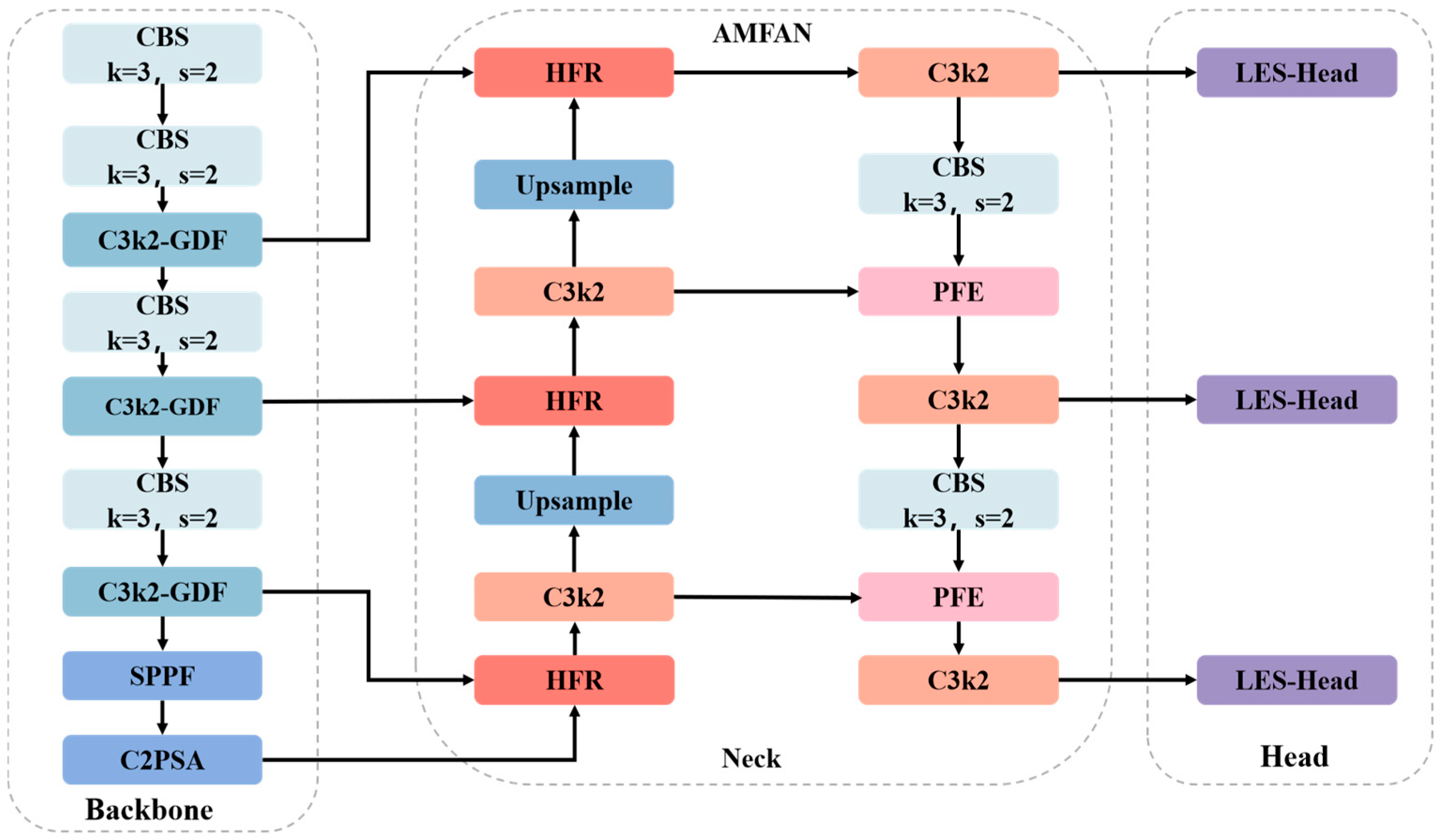
The overall architecture of LMGANet is illustrated in Figure 1.
The proposed detector follows the standard pipeline of modern one-stage object detectors and consists of three main components: a backbone network, a feature aggregation neck, and a detection head. Given an input aerial image, the backbone first extracts hierarchical feature representations at multiple resolutions. To enhance small-object representation under complex urban scenes, the conventional C3K2 modules in the baseline YOLOv11 backbone are replaced by the proposed C3K2-GDF blocks, which introduce granular dynamic feature refinement for adaptive spatial perception and channel modulation. The extracted multi-level features are then fed into the proposed Adaptive Multi-scale Feature Aggregation Network (AMFAN), which performs content-aware bidirectional fusion to strengthen interactions between high-level semantic information and low-level spatial details. Finally, the fused feature maps are processed by the Lightweight Enhanced Shared (LES) detection head, where shared decoding and lightweight detail-enhancement branches are employed to reduce parameter redundancy while preserving scale-sensitive spatial cues for accurate small-object localization. Through the collaborative design of these three components, LMGANet achieves efficient feature representation and detection performance suitable for real-time urban aerial perception scenarios, particularly in terms of model parameter efficiency.
Urban remote sensing small-object detection is mainly constrained by three coupled factors: insufficient fine-grained target cues during feature extraction, semantic–spatial inconsistency during cross-scale feature propagation, and redundant prediction transformations across multiple detection scales. From the imaging perspective, UAV-based urban targets are often represented by tiny and weak-texture pixel clusters, while roads, roofs, shadows, and building boundaries introduce strong structured background responses. Accordingly, LMGANet enhances the standard YOLOv11 pipeline at the backbone, neck, and detection head stages. In the backbone, C3K2-GDF introduces adaptive receptive-field refinement to strengthen scale-sensitive local structures and suppress irrelevant background responses. In the neck, AMFAN performs bidirectional semantic–spatial aggregation to improve the interaction between shallow localization details and deep semantic context, thereby alleviating the dilution of weak localization cues during multi-scale feature propagation. In the detection head, LES-head shares decoding transformations across scales while retaining lightweight detail-enhancement branches, thereby reducing prediction redundancy and preserving localization-sensitive cues. Through these coordinated designs, the proposed framework improves small-object representation, cross-scale feature consistency, and parameter efficiency for complex urban aerial scenes.

3.2. C3K2-GDF Dynamic Multi-Scale Feature Refinement Module

The original C3K2 block in YOLOv11 adopts a largely static feature extraction manner, in which the receptive field and residual refinement path remain fixed once the architecture is defined. Although such a design is efficient for general object detection, it is less suitable for urban remote sensing imagery, where small targets exhibit significant scale variation and are easily submerged in cluttered backgrounds. In high-resolution aerial scenes, objects such as vehicles, pedestrians, and small infrastructure elements often occupy only a few pixels, and their discriminative cues are highly sensitive to the choice of receptive field. Therefore, the key motivation of C3K2-GDF is not simply to enlarge the receptive field, but to adaptively select an appropriate receptive-field pattern according to the local scale, orientation tendency, and background complexity for aerial small-object detection.
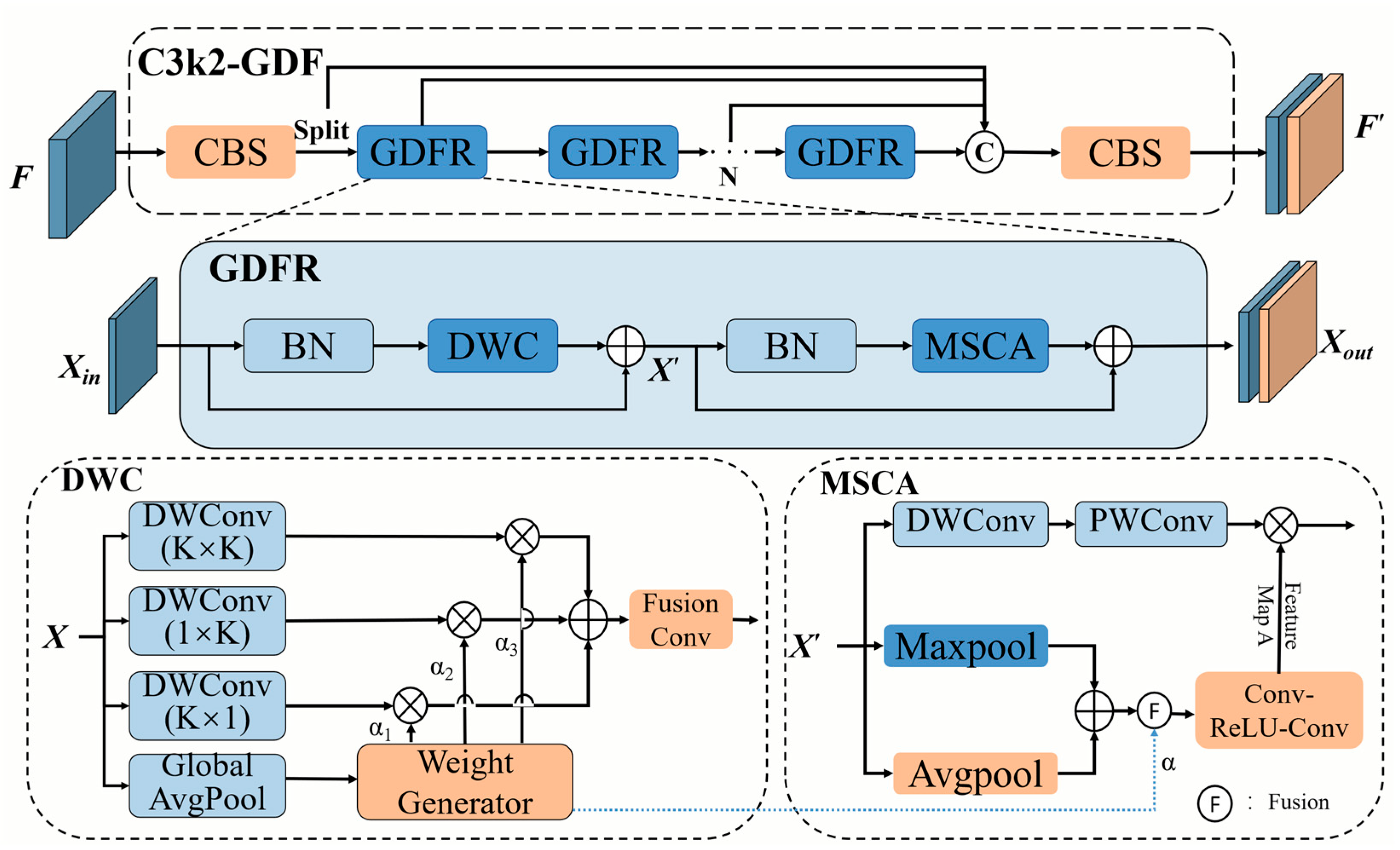
To address the above issue, we propose the C3K2-GDF module, as illustrated in Figure 2. The motivation of C3K2-GDF is to reformulate the original C3K2 block into a dynamically refined feature extractor. Specifically, C3K2-GDF introduces Dynamic Weighting Convolution (DWC) to select scale-sensitive receptive-field patterns according to the input feature content, and Multi-Scale Context Attention (MSCA) to further enhance informative contextual responses while suppressing irrelevant background activation. In this way, the module strengthens local structures of small objects while introducing contextual information at appropriate scales.
Given an input feature map X i n , C3K2-GDF first employs an entry CBS block to project the input representation into a new embedding space. The transformed feature is then progressively refined by a series of GDFR blocks. Finally, the features generated at different refinement stages are concatenated and fused by an exit CBS block to obtain the output feature map. This process can be formulated as:
X 0 = f C B S i n ( X i n ) ,
X i = f G D F R ( i ) ( X i 1 ) , i = 1 , , n ,  
X o u t = f C B S o u t ( C o n c a t ( X 0 , X 1 , , X n ) ) .
Here, X 0 denotes the feature map generated by the entry CBS block, and X i denotes the output of the i -th GDFR block. f C B S i n and f C B S o u t represent the entry and exit CBS transformations, respectively, while f G D F R ( i ) denotes the i -th GDFR refinement operation.
Each GDFR block performs a two-stage residual refinement in both spatial and contextual domains. Specifically, for the i -th GDFR block, the input feature X i 1 is first processed by a Dynamic Weighting Convolution (DWC) to adaptively adjust the receptive field according to the current feature content. This stage produces an intermediate refined feature, which is then further enhanced by a Multi-Scale Context Attention (MSCA) module. The MSCA module leverages contextual information under the guidance of branch weights dynamically generated by DWC, thereby strengthening scale-sensitive and context-aware feature responses. The refinement process is defined as:
R i ( 1 ) = X i 1 + f D W C B N 1 ( X i 1 ) ,
X i = R i ( 1 ) + f M S C A B N 2 ( R i ( 1 ) ) , α i .
where R i ( 1 ) denotes the intermediate feature after the first residual refinement stage, and X i is the final output of the i -th GDFR block. f D W C and f M S C A denote the Dynamic Weighting Convolution and Multi-Scale Context Attention operations, respectively. α i is the dynamic branch-weight vector produced within the DWC module and reused by the MSCA module to guide contextual feature modulation. In this formulation, DWC and MSCA are not two independent plug-in operations. DWC first determines which receptive-field branch is more suitable for the current feature, and MSCA then performs context-aware modulation under the same scale preference. This coupled design helps the module avoid inconsistent feature enhancement across different scales.
The DWC module is designed to select an appropriate receptive-field pattern according to the spatial characteristics of the current feature map. Specifically, a normalized feature representation is forwarded to three parallel depthwise convolution branches with different kernel configurations, including a K × K branch, a 1 × K branch, and a K × 1 branch. The K × K branch captures compact local spatial structures, while the 1 × K and K × 1 branches model horizontal and vertical spatial dependencies, respectively. These directional branches are motivated by the geometric properties of aerial imagery. In UAV and urban remote sensing scenes, objects and background structures often exhibit orientation-related patterns, such as aligned vehicles, road boundaries, building edges, bridges, and elongated shadows. Modeling horizontal and vertical dependencies therefore helps the network capture directional object cues without using heavy global operators. In parallel, global average pooling is applied to the input feature to extract a global context descriptor, which is then fed into a weight generator to produce the dynamic branch-weight vector α = [ α 1 , α 2 , α 3 ] . The responses of the three convolutional branches are then fused using these dynamically generated weights. The operation can be formulated as:
f D W C ( F ) = f 1 × 1 g = 1 3 α g D W C o n v g ( F ) .
where D W C o n v g ( ) denotes the g -th depthwise convolution branch, corresponding to the K × K , 1 × K , and K × 1 branches, respectively. α g represents the corresponding dynamic branch weight generated from the global context descriptor, and f 1 × 1 denotes a fusion convolution used to integrate the weighted branch responses. The Global AvgPool path shown in Figure 2 is used to generate the dynamic branch weights rather than serving as an additional fused feature branch. Through this mechanism, DWC produces both an adaptive spatial feature response and a compact scale-selection prior α , indicating which receptive-field patterns are most informative for the current feature content.
The MSCA module then performs context-aware modulation on the residual feature under the guidance of the scale prior α . Specifically, max-pooling and average-pooling operations are employed to extract complementary contextual cues from the feature map. These contextual descriptors are fused with an expanded version of α to generate a multi-scale attention map. Since α encodes the receptive-field preference of the current feature, it provides scale-aware guidance for the subsequent context-attention generation. The resulting attention map is applied to a lightweight depthwise–pointwise convolution branch to emphasize informative features while suppressing background noise. The MSCA operation can be summarized as:
f M S C A ( F , α ) = A ( F , α ) f c o n v ( F )
where A ( F , α ) denotes the context-aware attention map conditioned on the scale prior α , f c o n v represents the depthwise–pointwise convolution branch, and denotes element-wise modulation. By reusing the scale prior α generated in DWC, the attention mechanism is guided toward the same receptive-field configuration that has already been selected during spatial aggregation. This design encourages the module to focus on spatial regions consistent with the preferred scale rather than distributing attention uniformly across all scales.
By integrating C3K2-GDF into the backbone network, LMGANet achieves adaptive multi-scale feature refinement rather than simple fixed-scale feature extraction. The dynamic branches in DWC correspond to different receptive-field scales, and the selected scale prior is further reused by MSCA to modulate contextual responses. This coupled design allows the network to preserve the weak local structure of small objects while introducing discriminative context only at informative scales, thereby improving small-object representation under cluttered urban backgrounds. Compared with the fixed-scale feature extraction in the original C3K2 block, C3K2-GDF introduces adaptive receptive-field selection and scale-guided contextual modulation for more discriminative small-object representation. The refined multi-scale feature maps generated by C3K2-GDF are subsequently fed into AMFAN for cross-scale aggregation and semantic–spatial interaction enhancement.

3.3. Adaptive Multi-Scale Feature Aggregation Network (AMFAN)

Conventional PAN-style feature fusion usually relies on direct addition or concatenation to aggregate features from different levels. Although such strategies are computationally efficient, they often fail to adequately bridge the semantic gap between shallow detail-dominant features and deep semantic-dominant features. This limitation becomes more critical in urban remote sensing imagery, where small objects are easily submerged in cluttered backgrounds and accurate detection depends on both fine spatial details and sufficient semantic context. In aerial images, small objects such as vehicles, pedestrians, and small facilities often appear as tiny pixel clusters with weak texture and low contrast. Meanwhile, urban backgrounds contain many structured patterns, such as roads, roofs, shadows, building edges, and dense man-made textures, which may produce responses similar to small objects. Therefore, direct feature fusion may either weaken the limited spatial cues of small targets or introduce background-related semantic noise. To address this problem, a more targeted feature aggregation mechanism is needed to enhance cross-scale interaction and reduce the information loss caused by simple fusion operations.
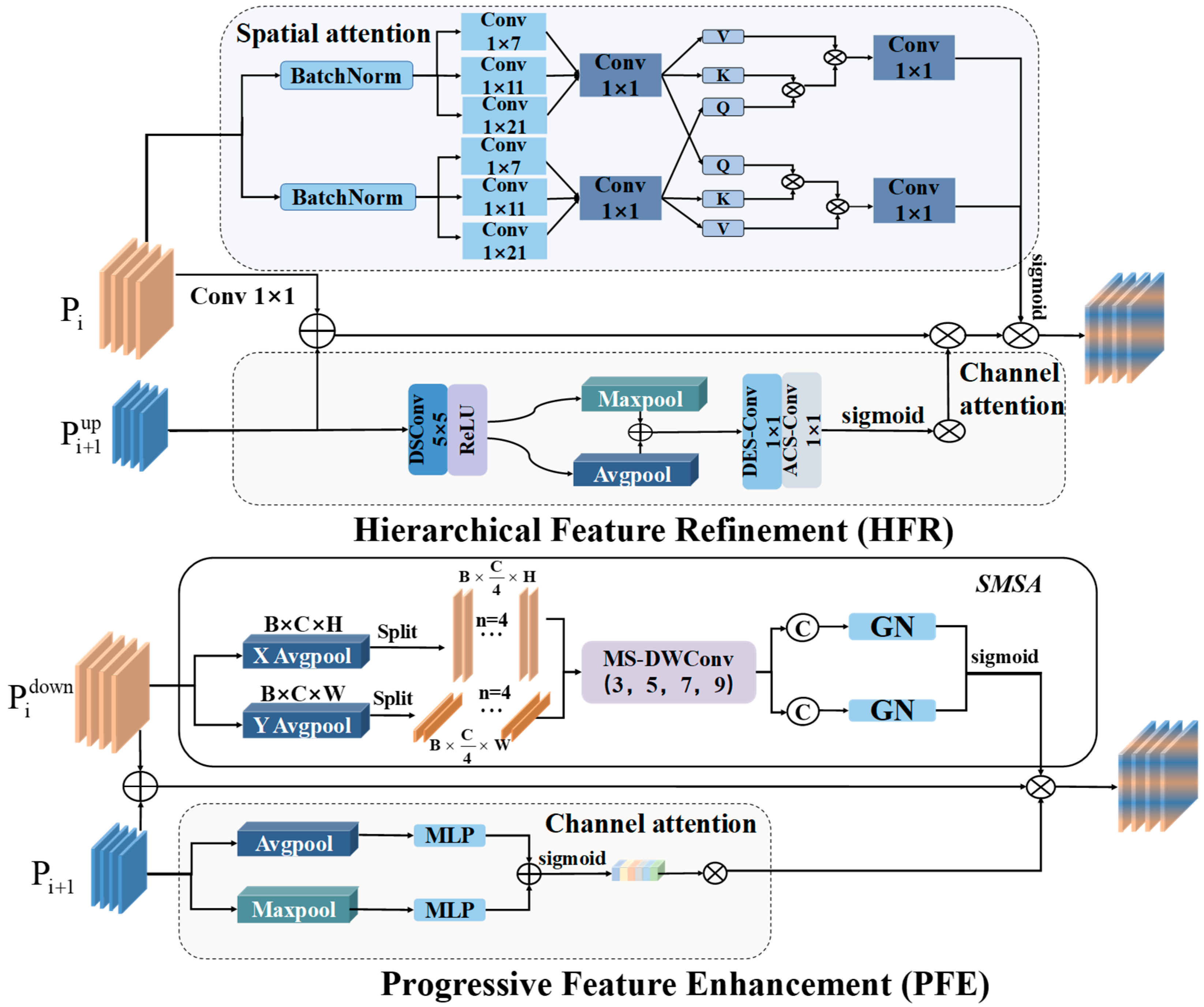
To address this issue, we propose the Adaptive Multi-scale Feature Aggregation Network (AMFAN), which serves as the neck of LMGANet and replaces the conventional PAN-style structure. As illustrated in Figure 3, AMFAN consists of a top-down Hierarchical Feature Refinement (HFR) path and a bottom-up Progressive Feature Enhancement (PFE) path, which together perform bidirectional aggregation between high-level semantic features and low-level spatial details. Compared with the simple addition or concatenation used in standard feature pyramids, AMFAN explicitly separates semantic injection and detail enhancement, enabling each direction to adopt specialized attention mechanisms. Specifically, the HFR path introduces high-level semantic guidance into shallow features to reduce category ambiguity caused by cluttered urban backgrounds, while the PFE path propagates low-level spatial details toward deeper features to compensate for the loss of localization cues during downsampling. In this way, AMFAN performs feature-dependent cross-scale calibration rather than using fixed fusion weights, making the fused representation more suitable for small-object detection in remote sensing scenes.
Along the top-down pathway, HFR receives two spatially aligned inputs from adjacent stages, namely the lower-level feature P i R C 1 × H × W and the upsampled higher-level feature P i + 1 u p R C × H × W . Here, P i + 1 u p denotes the higher-level feature after nearest-neighbor upsampling to the spatial resolution of P i . To ensure channel consistency before fusion, the lower-level feature P i is projected by a 1 × 1 convolution. The coarse top-down fused feature is then obtained by element-wise addition:
P i t d = f 1 × 1 ( P i ) + P i + 1 u p
where f 1 × 1 ( ) denotes the channel projection used to transform P i into the same channel dimension as P i + 1 u p . Therefore, P i t d R C × H × W .
Meanwhile, P i is processed by an MCA-inspired attention generator A i M C A ( ) , which is derived from the multi-dimensional collaborative attention in [50]. The operator adopts elongated depthwise convolution branches together with cross-attention to capture multi-scale spatial interactions. In the HFR path, this spatial attention generator is used to highlight object-sensitive positions in the shallow feature map. This is important because the visual cues of aerial small objects are usually weak and may be easily confused with background textures such as road markings, roof boundaries, and shadows. In our implementation, the two parallel spatial interaction branches are projected by final 1 × 1 convolutions to the same channel dimension as Pitd. Their outputs are then fused by element-wise addition followed by a sigmoid function, producing a feature-size attention map A i M C A ( P i ) R C × H × W . The upsampled higher-level feature Pi + 1up is further processed by a depthwise-separable-convolution-based channel attention operator A i C A ( ) , which exploits pooled channel statistics to emphasize informative channels and generates A i C A ( P i + 1 u p ) R C × 1 × 1 . The refined top-down feature is obtained through multiplicative reweighting:
P ^ i = ( 1 + A i M C A ( P i ) ) ( 1 + A i C A ( P i + 1 u p ) ) P i t d
where 1 denotes a broadcastable all-ones tensor and represents element-wise multiplication. Since A i M C A ( P i ) has the same size as P i t d , it can be directly multiplied with the coarse fused feature. The channel attention map A i C A ( P i + 1 u p ) is broadcast along the spatial dimensions before multiplication. In Equation (9), A i M C A ( P i ) provides spatial reweighting for shallow object cues, while A i C A ( P i + 1 u p ) provides channel-wise semantic reweighting from the higher-level feature. The residual form 1 + A is used to enhance informative responses without completely suppressing the original fused representation. This is helpful for preserving weak small-object signals that may be lost under overly aggressive attention filtering. Through this process, high-level semantic information and shallow spatial interaction cues jointly recalibrate the coarse fused feature, thereby enhancing small-object responses while suppressing background interference.
Along the bottom-up pathway, PFE receives two spatially aligned inputs, namely, the downsampled lower-level feature P i d o w n R C × H × W and the higher-level feature P i + 1 R C × H × W . Here, P i d o w n denotes the lower-level feature after stride-2 convolutional downsampling to the spatial resolution of P i + 1 . The two aligned features are combined by element-wise addition to form the coarse bottom-up fused feature:
P i + 1 b u = P i + 1 + P i d o w n
where P i d o w n provides spatial detail priors from the lower level, and P i + 1 provides high-level semantic information.
To inject spatial priors, P i d o w n is processed by the shared multi-semantic spatial attention A i S M S A ( ) from SCSA [51]. This operator decomposes features along the height and width directions into one-dimensional sequences and applies depthwise 1D convolutions with multiple kernel sizes to capture anisotropic spatial dependencies. This height-wise and width-wise modeling is suitable for urban remote sensing scenes, where many objects and backgrounds exhibit directionally distributed structures, such as road-aligned vehicles, building boundaries, bridges, and elongated shadows. By modeling directional dependencies separately, the network can better preserve spatial layouts relevant to small-object localization. Specifically, global average pooling is first applied along the height and width dimensions of P i d o w n , producing two one-dimensional descriptors that encode horizontal and vertical spatial distributions. These descriptors are then processed by grouped depthwise 1D convolutions with multiple kernel sizes to capture spatial dependencies at different ranges. After concatenation, normalization, and sigmoid activation, height-wise and width-wise attention maps are generated. The resulting feature-size spatial attention map can be written as:
A i S M S A ( P i d o w n ) = A t t n H ( P i d o w n ) A t t n W ( P i d o w n )
where A t t n H ( ) and A t t n W ( ) denote the height-wise and width-wise attention maps, respectively. The two attention maps are broadcast to the same feature size before element-wise multiplication. In this formulation, A i S M S A ( P i d o w n ) R C × H × W , which has the same size as P i + 1 b u and can be directly applied to the coarse bottom-up fused feature. Compared with directly generating a dense two-dimensional spatial attention map, this height–width decomposition provides a lightweight way to model directional spatial layouts in aerial scenes.
In parallel, a lightweight channel attention A i C H ( P i + 1 ) is derived from global average/max pooling followed by a small MLP, providing scale-aware channel modulation for deeper feature maps. The channel attention map satisfies A i C H ( P i + 1 ) R C × 1 × 1 and is broadcast along the spatial dimensions before multiplication. The bottom-up output is therefore expressed as:
Y i = ( 1 + A i S M S A ( P i d o w n ) ) ( 1 + A i C H ( P i + 1 ) ) P i + 1 b u
where P i + 1 b u is the coarse bottom-up fused feature defined in Equation (10). The symbol 1 denotes a broadcastable all-ones tensor, and represents element-wise multiplication. A i S M S A ( P i d o w n ) has the same size as P i + 1 b u , while A i C H ( P i + 1 ) is broadcast along the spatial dimensions before multiplication. The residual attention form 1 + A preserves the original feature response while enhancing informative spatial positions and semantic channels, which helps avoid over-suppressing weak small-object cues. Through this process, spatial detail priors from the lower level and channel-wise semantic responses from the higher level are jointly used to enhance deeper features.
By coupling HFR and PFE within a unified neck architecture, AMFAN performs bidirectional cross-scale feature interaction rather than conventional PAN-style fusion. The top-down HFR path injects high-level semantic information into shallow features to improve category discrimination, whereas the bottom-up PFE path propagates low-level spatial details toward deeper layers to preserve localization-sensitive cues. Since the two directions are optimized by different attention operators, the proposed design reduces the information loss caused by direct summation or concatenation and yields more consistent cross-scale representations for small urban objects embedded in cluttered remote sensing environments. Overall, AMFAN addresses the semantic–spatial mismatch in aerial small-object detection through direction-aware feature calibration. HFR reduces the semantic ambiguity of shallow features in noisy urban backgrounds, while PFE compensates for the loss of fine spatial details in deeper layers. The bidirectionally aggregated multi-scale feature maps produced by AMFAN provide high-quality inputs for the subsequent LES detection head.

3.4. Lightweight Enhanced Shared (LES) Detection Head

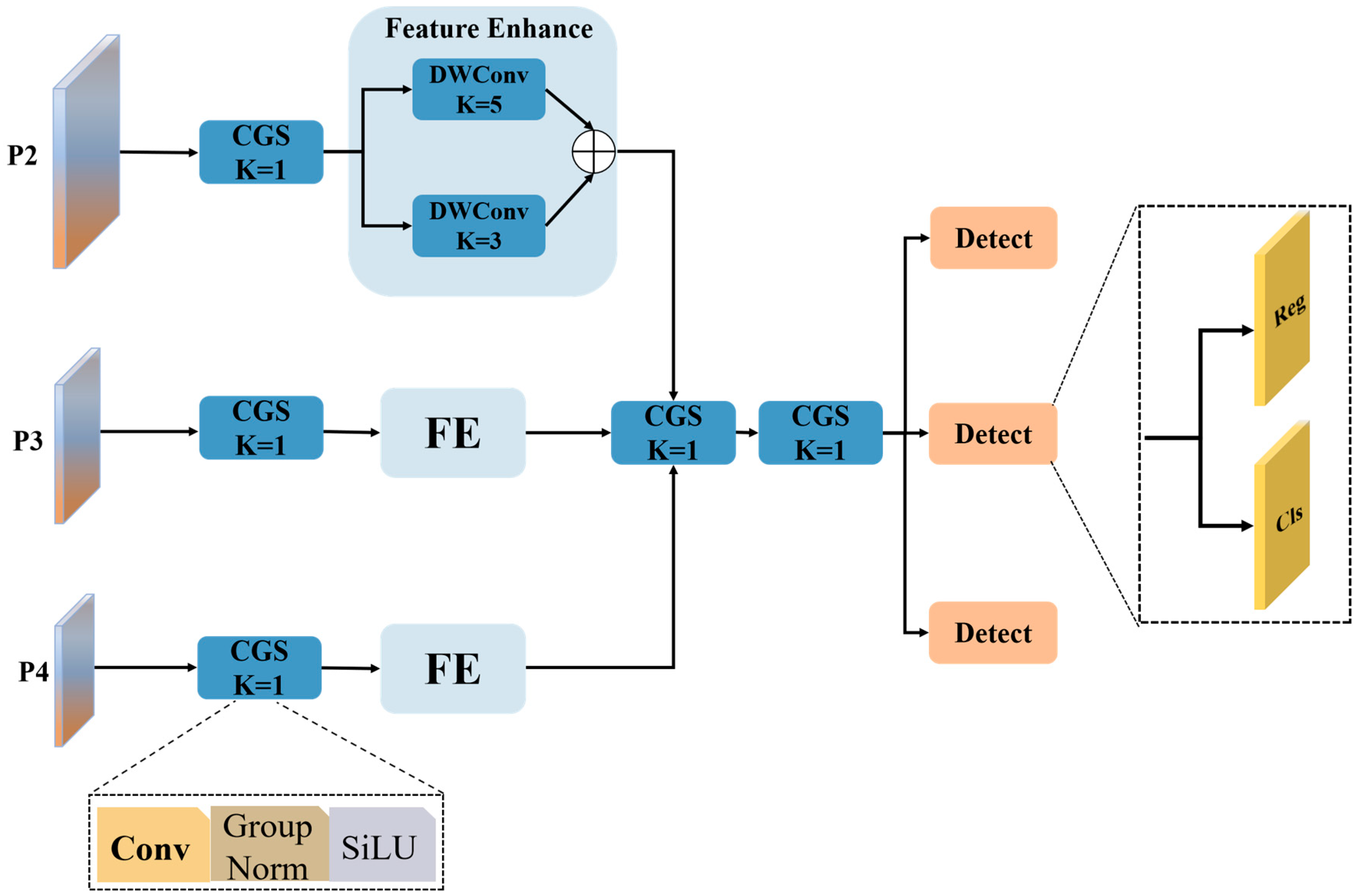
Conventional YOLO-based detectors usually employ independent classification and regression branches for different feature scales, which introduces redundant parameters in the prediction stage. For UAV-based urban remote sensing images, small objects often appear as tiny pixel clusters with weak contours, arbitrary orientations, and complex background interference. Therefore, the detection head should preserve localization-sensitive details while avoiding excessive computation on high-resolution feature maps. To this end, we propose a Lightweight Enhanced Shared detection head, termed LES-head, as illustrated in Figure 4.
The proposed LES-head first applies a scale-specific CGS block to each input feature map from the neck, where CGS denotes a 1 × 1 convolution followed by Group Normalization and SiLU activation. This operation aligns the channel dimensions of different scales and stabilizes their feature distributions before shared prediction. Then, each aligned feature is fed into a shared Feature Enhancement module composed of two parallel depthwise convolution branches with kernel sizes 3 × 3 and 5 × 5 . The 3 × 3 branch captures local structural details such as object boundaries and texture variations, while the 5 × 5 branch provides a larger receptive field for surrounding contextual cues. The two branches are fused by element-wise addition to enhance spatial representation without increasing the channel dimension.
After feature enhancement, two shared 1 × 1 CGS blocks are used for channel interaction and feature refinement, followed by shared classification and regression branches to generate predictions for each scale. During inference, the predictions from all scales are flattened and concatenated for bounding-box decoding and post-processing. It should be noted that the LES-head does not explicitly fuse feature maps with different spatial resolutions; multi-scale feature fusion is mainly performed in the neck, while LES-head focuses on parameter-efficient shared prediction. In this way, the proposed head reduces redundant scale-specific prediction parameters while preserving the local structural and contextual cues required for remote sensing small-object detection.

4. Experiments and Results

4.1. Experimental Setup

The hardware and software configurations for model training are summarized in Table 1, which are consistently adopted for inference along with the same input resolution. All FPS evaluations follow a unified protocol: the batch size is fixed to 1 for FPS testing to simulate real-time deployment, while other inference settings remain unchanged. All comparative models are evaluated under the same inference environment to guarantee the fairness and credibility of efficiency comparison.

4.2. Datasets

To comprehensively evaluate the proposed LMGANet in urban remote sensing scenarios, experiments were conducted on two widely used aerial object detection benchmarks, VisDrone2019 [52] and AI-TOD [53]. Both datasets contain high-resolution UAV images with dense object distributions, cluttered backgrounds, and large-scale variations, making them suitable for smart city applications such as traffic monitoring, infrastructure inspection, and public safety surveillance.
VisDrone2019 consists of real-world UAV images captured under diverse viewpoints and illumination conditions. It includes typical urban targets such as pedestrians and vehicles, and presents significant challenges caused by complex backgrounds, occlusion, and scale variation. Therefore, it is widely used for evaluating object detection methods in urban aerial surveillance.
AI-TOD is designed for small-object detection in aerial imagery and is particularly suitable for assessing the detection of small but important urban targets, such as persons, vehicles, and bridges. Its extremely small object sizes and dense distributions make it a challenging benchmark for evaluating small-object detection performance in large-scale remote sensing imagery.

4.3. Evaluation Metrics

Following the MS COCO evaluation protocol, a prediction is regarded as a true positive (TP) when its Intersection-over-Union (IoU) with a ground-truth box exceeds a given threshold; otherwise, it contributes to false positives (FP) or false negatives (FN). Precision and recall are defined as:
P = T P T P + F P ,
R = T P T P + F N .
Average Precision (AP) is the area under the precision–recall curve for each category, and mean Average Precision (mAP) is computed as:
m A P = 1 N i = 1 N A P i ,
where N is the number of categories. In this work, we report mAP50 (IoU = 0.5) and mAP50–95 (averaged over IoU thresholds from 0.5 to 0.95 with a step of 0.05). In addition, following the MS COCO standard, objects with an area smaller than 32 × 32 pixels are defined as small objects, and the corresponding average precision is denoted as APs. These metrics provide a comprehensive evaluation of the model, especially for small-object detection in aerial imagery.

4.4. Results on VisDrone2019 Dataset

4.4.1. Comparison with State-of-the-Art Detectors

We conduct extensive experiments on the VisDrone2019 dataset to evaluate the effectiveness of the proposed method for small-object detection in aerial imagery. Considering the rapid development of aerial object detection from conventional CNN-based detectors to Transformer-enhanced, CNN-Transformer hybrid and DETR-style paradigms, we compare LMGANet with representative detectors from different architectural categories, including two-stage detectors, YOLO-based detectors, lightweight aerial detectors, Transformer-enhanced detectors, CNN-Transformer hybrid detectors, and DETR-style detectors. The quantitative comparison results are summarized in Table 2.
As shown in Table 2, the proposed method achieves a favorable trade-off between accuracy and efficiency among the selected compared detectors. Specifically, LMGANet attains 54.8% precision, 42.6% recall, 44.5% mAP50, and 27.2% mAP50–95, outperforming recent YOLO variants such as YOLOv8S, YOLOv9S, YOLOv10S, and YOLOv11S. Compared with the baseline YOLOv11S, the proposed method improves mAP50 by 4.8 percentage points, mAP50–95 by 3.8 percentage points, and APs by 5.9 percentage points, demonstrating clear advantages in detecting small objects in complex aerial scenes. The substantial gain in APs is mainly attributed to the complementary effects of C3K2-GDF and AMFAN: C3K2-GDF enhances scale-adaptive feature extraction through adaptive receptive-field refinement, while AMFAN strengthens the aggregation of shallow spatial details and deep semantic information through bidirectional cross-scale fusion. As a result, the proposed framework improves both the representation and fusion quality of small-object features under dense and cluttered backgrounds. Notably, the proposed method also achieves an APs of 19.7%, slightly surpassing YOLOv11M (19.3%) and clearly outperforming FBRT-YOLO-M (17.3%), RT-DETR-R18 (16.5%), Swin Transformer (8.7%), and YOLO-ViT (9.6%), which further verifies its superior sensitivity to small objects.
Another important advantage of the proposed method lies in its parameter-efficient and real-time design. LMGANet contains only 3.63 M parameters, which is significantly smaller than most competing detectors, including YOLOv11S (9.4 M), YOLOv10S (8.07 M), YOLOv5M (20.9 M), YOLOv8M (25.6 M), YOLOv11M (20.0 M), RT-DETR-R18 (20.0 M), ESO-DETR (14.9 M), Swin Transformer (34.2 M), and YOLO-ViT (17.3 M). Although FBRT-YOLO-S uses fewer parameters (2.9 M), its detection accuracy remains lower than that of the proposed method. In contrast, LMGANet achieves higher mAP50, mAP50–95, and APs while maintaining a compact model size, indicating a more favorable balance between model complexity and detection performance. Compared with DETR-style detectors, LMGANet does not achieve the highest absolute accuracy, but it demonstrates clear advantages in compactness and inference efficiency. In addition to its accuracy and compactness, the proposed method also maintains strong inference efficiency. LMGANet runs at 92.1 FPS, which is comparable to YOLOv11S (96.3 FPS), YOLOv10S (92.6 FPS), and YOLOv8S (89.2 FPS), and is substantially faster than heavier detectors such as YOLOv11M (75.3 FPS), RT-DETR-R18 (55.0 FPS), ESO-DETR (58.3 FPS), Swin Transformer (42.1 FPS), and Faster R-CNN (35.4 FPS). Compared with YOLO-ViT, LMGANet also achieves higher mAP50, mAP50–95, and APs with fewer parameters and lower GFLOPs, while maintaining a higher inference speed. These results demonstrate that the proposed method achieves an effective trade-off among detection accuracy, parameter efficiency, and real-time inference speed, although it does not pursue the lowest GFLOPs.
The comparison across different architectural paradigms further clarifies the practical positioning of LMGANet. TPH-YOLOv5 introduces Transformer prediction heads to enhance contextual modeling in drone-captured scenes, Swin Transformer adopts window-based self-attention to model regional dependencies, and YOLO-ViT represents a CNN-Transformer hybrid detector that incorporates Vision Transformer-style feature modeling into the YOLO framework, while RT-DETR-R18 and ESO-DETR represent DETR-style detectors that rely on attention-based global feature interaction. These methods are effective for improving feature representation through contextual or long-range dependency modeling. However, Swin Transformer obtains 37.1% mAP50 and 8.7% APs, while YOLO-ViT achieves 38.5% mAP50 and 9.6% APs, both of which are clearly lower than the 44.5% mAP50 and 19.7% APs achieved by LMGANet. This suggests that introducing Transformer-related representation does not necessarily guarantee stronger small-object sensitivity in dense aerial scenes. In particular, ESO-DETR achieves the highest overall accuracy in Table 2, with 47.1% mAP50, 28.9% mAP50–95, and 20.1% APs. However, this accuracy advantage is accompanied by higher model complexity and lower inference speed, requiring 14.9 M parameters, 66.0 GFLOPs, and achieving 58.3 FPS. In contrast, LMGANet obtains 44.5% mAP50, 27.2% mAP50–95, and 19.7% APs with only 3.63 M parameters, 28.9 GFLOPs, and 92.1 FPS. This comparison indicates that the proposed method is not designed to simply maximize absolute accuracy, but to provide a compact real-time detector with competitive small-object detection performance.
From an architectural perspective, the results also suggest that CNN-based detectors are still valuable for aerial small-object detection when their local representation, cross-scale aggregation, and prediction redundancy are carefully redesigned. Unlike Transformer-enhanced, CNN-Transformer hybrid, and DETR-style detectors that mainly emphasize contextual or long-range dependency modeling, LMGANet strengthens scale-adaptive local feature extraction through C3K2-GDF, enhances semantic–spatial consistency through AMFAN, and reduces multi-scale prediction redundancy through LES-head. Therefore, the proposed CNN-based framework provides a complementary solution to attention-based detectors, especially for scenarios where model compactness and inference speed are important.
The strong performance on small objects mainly benefits from the complementary design of C3K2-GDF and AMFAN. The C3K2-GDF module dynamically adjusts receptive fields through adaptive depthwise aggregation, enabling more effective perception of extremely small targets while reducing background interference. Meanwhile, AMFAN performs content-aware bidirectional feature aggregation through Hierarchical Feature Refinement and Progressive Feature Enhancement, allowing shallow spatial details and deep semantic information to interact more effectively. As a result, the proposed framework improves recall and localization accuracy for small objects while maintaining real-time inference speed. These characteristics make the proposed method particularly suitable for UAV-based urban monitoring tasks in smart city applications, such as traffic observation, urban infrastructure inspection, and public safety surveillance.

4.4.2. Visual Study

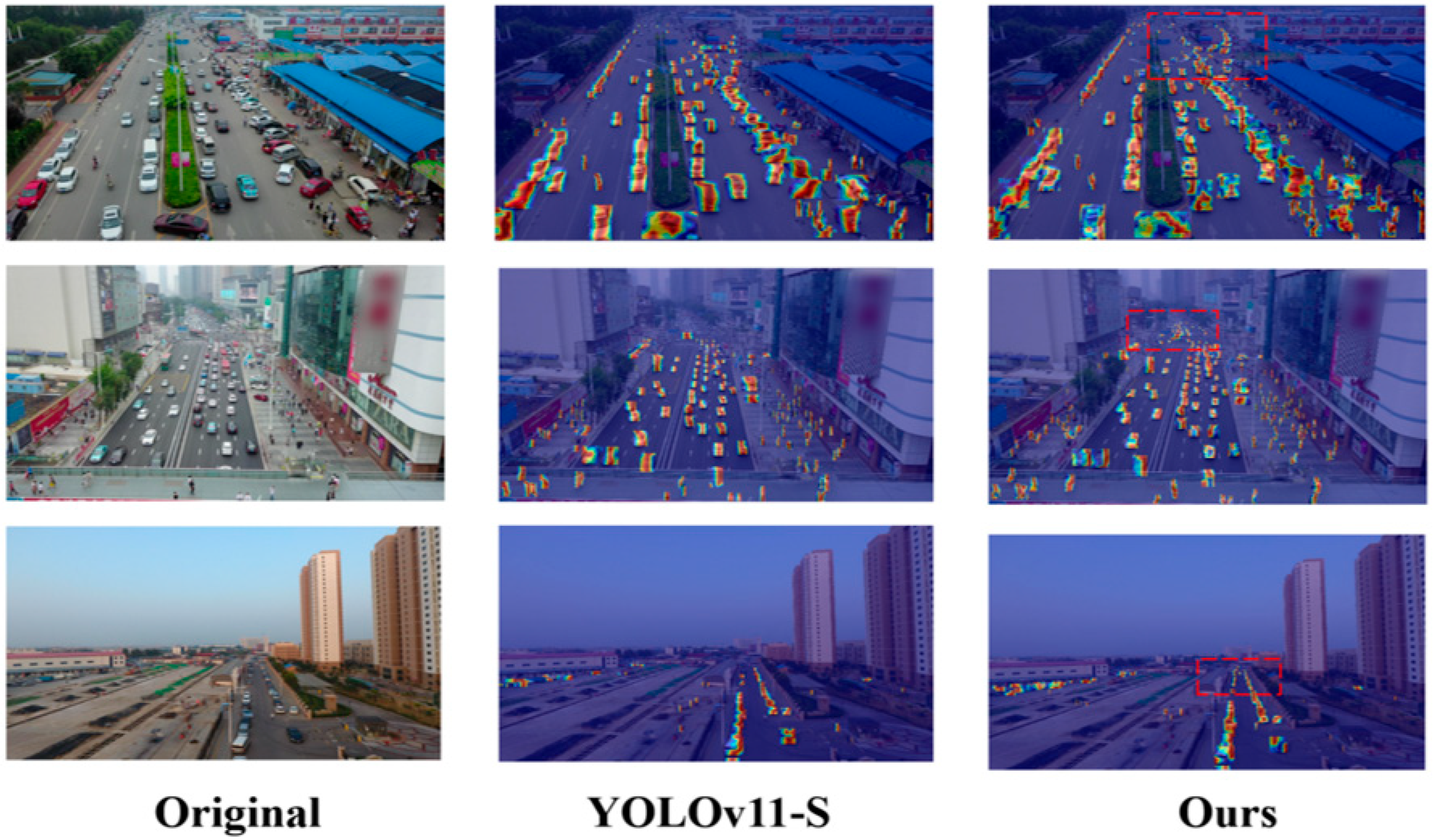
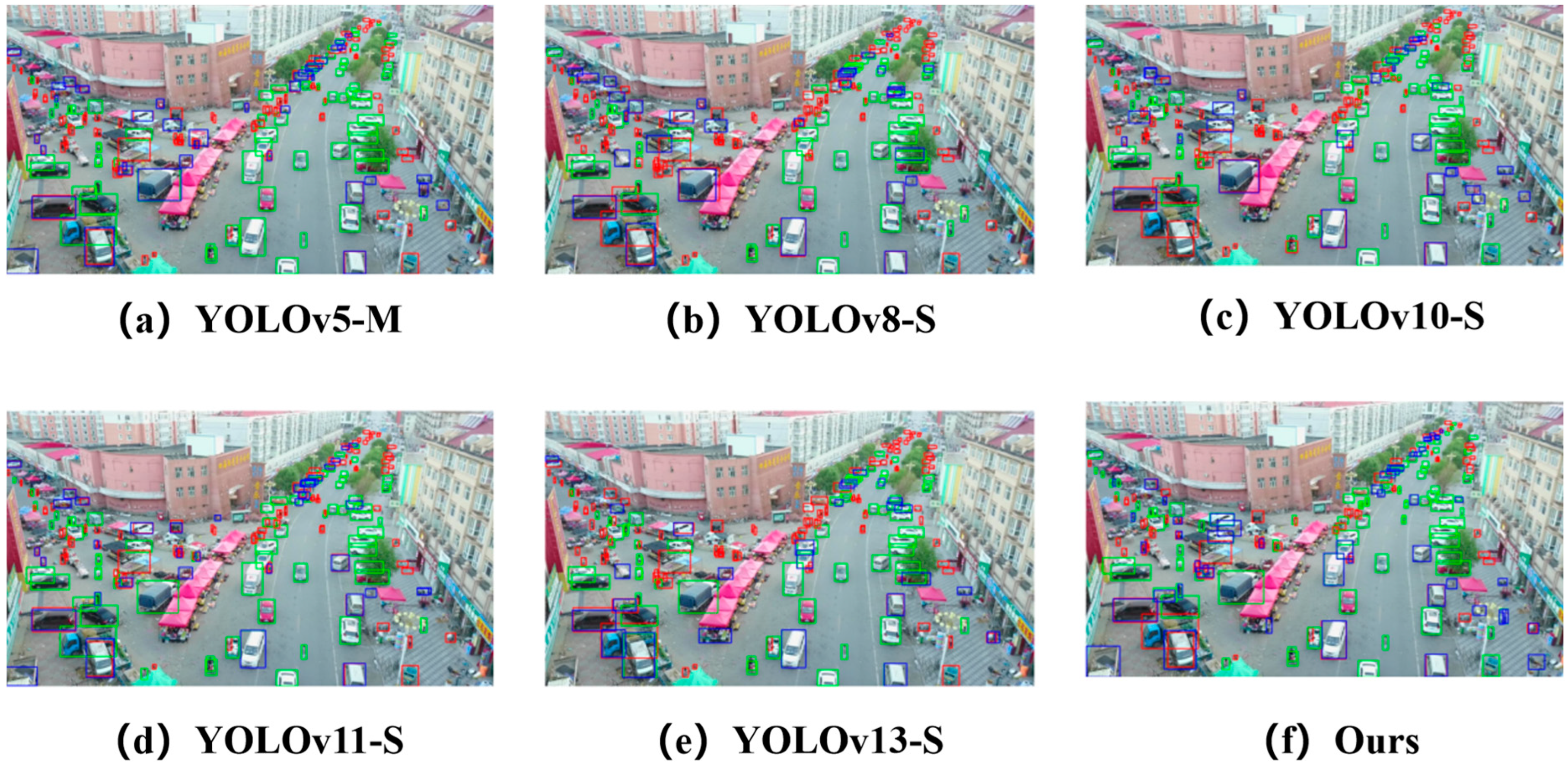
To further analyze the detection capability of the proposed method, qualitative comparisons are conducted through heatmap analysis and detection result visualization on the VisDrone2019 dataset. The visualization results are presented in Figure 5 and Figure 6.
Figure 5 illustrates the activation heatmaps generated by the baseline YOLOv11S and the proposed LMGANet on representative aerial scenes. Compared with the baseline model, LMGANet produces more concentrated and stronger activation responses on object regions, particularly for distant, densely distributed, and partially occluded small objects. This phenomenon indicates that the proposed network can suppress irrelevant background responses more effectively while preserving discriminative cues of small targets. Such behavior is mainly attributed to the C3K2-GDF module, whose adaptive receptive-field refinement enables the backbone to focus on scale-sensitive object structures instead of surrounding clutter. In addition, the bidirectional cross-scale aggregation of AMFAN further improves the consistency of semantic and spatial information, thereby producing more stable and target-focused activation patterns in complex urban aerial imagery.
Figure 6 further compares the detection results of LMGANet with several YOLO-based detectors on challenging VisDrone scenes. In the visualization, green, blue, and red bounding boxes represent true positives (TP), false positives (FP), and false negatives (FN), respectively. The results show that LMGANet significantly reduces missed detections for small and densely distributed objects, while also suppressing false alarms in cluttered backgrounds. In particular, distant vehicles, partially occluded objects, and weak-contrast targets that are often missed by baseline detectors can still be accurately localized by the proposed method. This improvement mainly benefits from the complementary effects of C3K2-GDF and AMFAN: the former strengthens scale-adaptive feature extraction for small objects, while the latter enhances cross-scale feature fusion between shallow spatial details and deep semantic cues. Meanwhile, the LES-head preserves localization-sensitive information through lightweight shared decoding, which further contributes to more accurate and compact predictions.
These visual improvements are not only indicative of stronger feature representation but also highlight the practical importance of small-object detection in smart city applications. In UAV-based urban scenes, many critical targets, such as pedestrians and vehicles, usually occupy only a few pixels, yet they are closely related to traffic monitoring, public safety surveillance, and emergency response. Therefore, reducing missed detections and false alarms for such targets is essential for improving the reliability of urban perception systems. By producing more accurate and stable responses in dense and cluttered scenes, LMGANet provides more dependable support for UAV-based smart city monitoring, where timely and precise detection of small urban objects is required.

4.5. Results on AI-TOD Dataset

4.5.1. Comparison with State-of-the-Art Detectors

To further evaluate the effectiveness of the proposed method for small-object detection, experiments are conducted on the AI-TOD dataset, which contains extremely small objects with an average size of only 12.8 pixels. We compare the proposed approach with several representative detectors, including recent YOLO variants and specialized small-object detection models such as TPH-YOLOv5 and FBRT-YOLO-S. The quantitative comparison results are summarized in Table 3.
As shown in Table 3, the proposed LMGANet achieves the best overall detection performance among all compared methods. Specifically, the proposed model obtains 36.7% mAP50 and 12.4% mAP50–95, outperforming recent YOLO detectors including YOLOv5S, YOLOv8S, YOLOv10S, YOLOv11S, and YOLOv13S. Compared with YOLOv11S, which is the strongest baseline among the YOLO models, the proposed method improves mAP50 from 33.6% to 36.7% and mAP50–95 from 11.0% to 12.4%. In terms of small-object detection, LMGANet achieves the highest APs value of 12.2%, indicating stronger capability in detecting extremely small targets.
Meanwhile, the proposed model maintains competitive efficiency. LMGANet achieves 90.7 FPS under the same hardware configuration, which is comparable to lightweight detectors such as YOLOv8S (89.5 FPS) and YOLOv10S (91.3 FPS). In addition, the model contains only 3.63 M parameters and requires 28.9 GFLOPs, demonstrating that the proposed architecture achieves an effective balance among detection accuracy, parameter efficiency, and real-time inference speed.
The improved performance on extremely small objects mainly benefits from the complementary design of the C3K2-GDF and AMFAN modules. Specifically, the gain in APs is largely associated with the scale-adaptive receptive-field refinement of C3K2-GDF and the bidirectional cross-scale aggregation of AMFAN, which jointly improve the preservation, enhancement, and fusion of weak small-object cues in large-scale aerial scenes. This design enables the network to better capture discriminative structures of objects smaller than 16 pixels while reducing the influence of surrounding background interference.
Overall, the experimental results demonstrate that the proposed method effectively addresses the challenges of small-object detection in aerial imagery, while maintaining real-time inference capability. This makes the proposed framework particularly suitable for UAV-based urban monitoring and smart city remote sensing applications, where reliable detection of extremely small objects is essential.

4.5.2. Visual Study

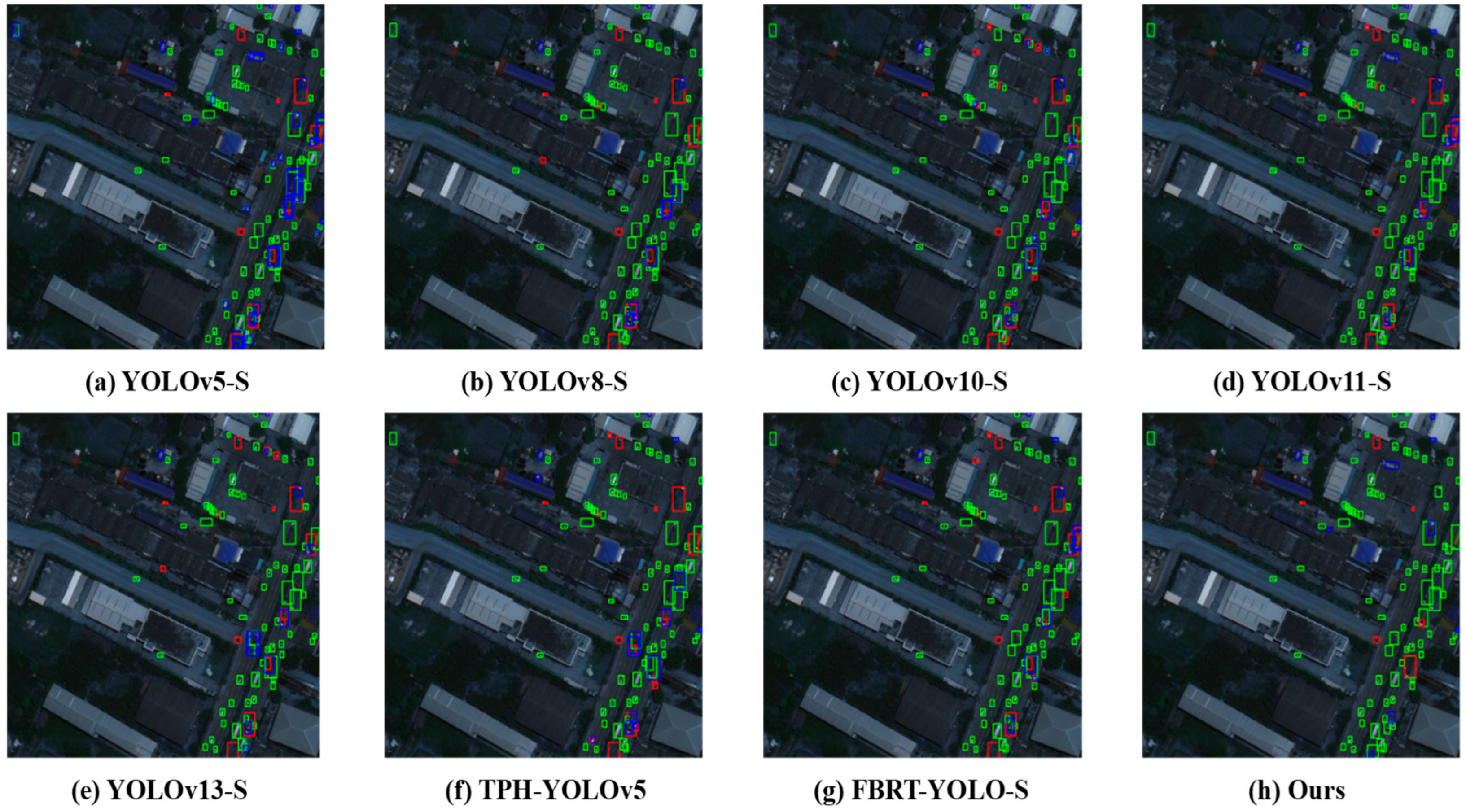
To further validate the effectiveness of the proposed approach for extremely small-object detection, we present comprehensive visual comparisons on the AI-TOD dataset. Figure 7 illustrates detection performance across several state-of-the-art methods on representative aerial images containing small objects. The visualization uses a consistent color-coding scheme in which green, blue, and red bounding boxes indicate true positives (TP), false positives (FP), and false negatives (FN), respectively.
The comparative results show that LMGANet achieves superior detection accuracy in identifying small aerial objects, as evidenced by the predominance of green bounding boxes and the minimal occurrence of red indicators. This performance advantage is particularly notable given the extreme challenges of AI-TOD, where objects average only 12.8 pixels in size. Whereas baseline methods such as YOLOv5S, YOLOv8S, and YOLOv13S struggle with extensive missed detections, particularly for objects smaller than 16 pixels, the proposed approach maintains robust detection capability across the entire scale range.
The visualization further shows that YOLOv10S, YOLOv11S, and YOLOv13S, despite their architectural improvements, still produce considerable numbers of false negatives when processing densely packed small objects or low-contrast targets within complex backgrounds. Similarly, specialized detectors such as TPH-YOLOv5 and FBRT-YOLO-S, although designed for small-object scenarios, exhibit noticeable misclassifications, as indicated by blue bounding boxes.
In contrast, LMGANet demonstrates strong precision in localizing and classifying extremely small objects, with notably fewer false positives and false negatives. This visual advantage mainly arises from the coordinated design of the proposed modules: C3K2-GDF improves the extraction of scale-sensitive local structures for very small objects, AMFAN strengthens bidirectional cross-scale interaction to preserve weak spatial cues, and the LES-head reduces prediction redundancy while maintaining localization-sensitive information. This visual evidence confirms that the proposed framework effectively addresses the unique challenges of small-object detection in aerial imagery, maintaining high accuracy, even for objects occupying minimal pixel areas while maintaining real-time inference speed under the unified experimental setting.
This visual evidence further demonstrates the practical significance of the proposed method for smart city applications. In large-scale urban aerial imagery, many important targets, such as pedestrians and vehicles, appear as extremely small objects, and missing these targets may directly affect the reliability of traffic analysis, public safety monitoring, and emergency management. Compared with the competing methods, LMGANet yields fewer missed detections and false alarms, indicating a stronger capability to perceive critical urban objects under complex conditions. Therefore, the proposed framework not only improves detection accuracy for extremely small objects but also enhances the reliability of UAV-based urban sensing systems for real-time smart city monitoring.

4.6. Ablation Study

4.6.1. Overall Ablation on the Proposed Components

To validate the efficacy of the designed modules, ablation experiments are conducted on the VisDrone2019 dataset with YOLOv11S as the baseline. The quantitative results are listed in Table 4. The baseline achieves 39.7% mAP50 and 13.8% APs with 9.40 M parameters, while our full model reaches 44.5% mAP50 and 19.7% APs with only 3.63 M parameters. This reveals that our method boosts detection accuracy while maintaining a compact, parameter-efficient structure.
The results show that the three proposed modules present obvious complementary and synergistic effects. Compared with YOLOv11S, the full model increases mAP50 from 39.7% to 44.5% and APs from 13.8% to 19.7%, with respective gains of 4.8% and 5.9%. Meanwhile, the parameter count is reduced from 9.40 M to 3.63 M, proving that our design enhances small-object detection while greatly improving parameter efficiency.
In single-module ablation, C3K2-GDF raises mAP50 to 41.3% and APs to 15.2%, and reduces parameters to 8.15 M. Such gains stem from adaptive receptive field refinement, which preserves fine-grained small-object details and suppresses background noise. AMFAN achieves the best standalone performance, with mAP50 of 41.7% and APs of 15.6% and parameters reduced to 6.27 M. This verifies that bidirectional cross-scale aggregation outperforms conventional PAN-based fusion by alleviating feature loss between shallow spatial information and deep semantic representation. LES-head improves mAP50 to 40.6% and APs to 14.3% while cutting parameters to 5.54 M, demonstrating that shared prediction eliminates structural redundancy while retaining localization cues for small objects.
Combining multiple modules brings further performance gains. The dual integration of C3K2-GDF and AMFAN obtains 43.2% mAP50 and 17.4% APs with 5.18 M parameters, confirming clear synergism. The combinations of C3K2-GDF + LES-head and AMFAN + LES-head also surpass the baseline with compact parameter sizes of 4.76 M and 4.08 M, respectively. Integrating all three modules yields the optimal overall performance: 44.5% mAP50, 19.7% APs and only 3.63 M parameters. These results confirm that the proposed backbone, neck and detection head collaboratively enhance small-object feature representation, cross-scale feature interaction and parameter efficiency.
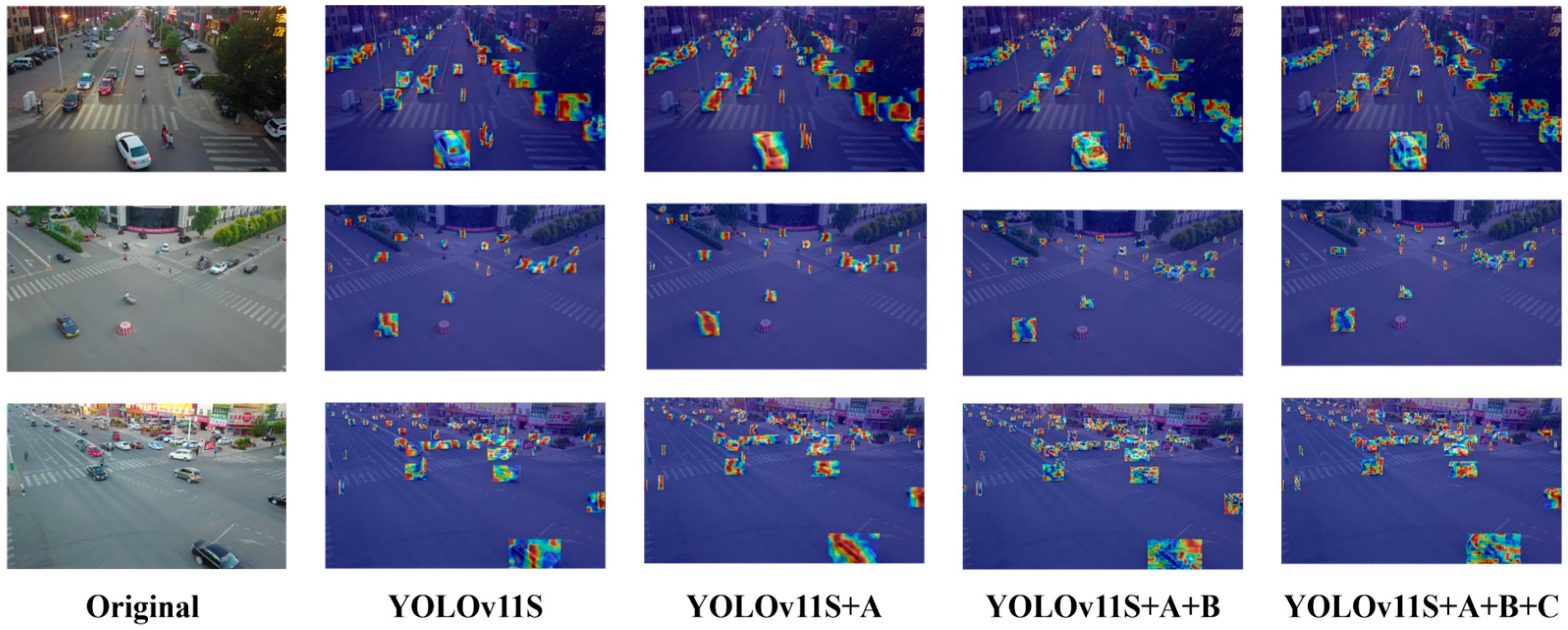
Beyond quantitative results, visual ablation via heatmaps is provided in Figure 8 to intuitively reflect the progressive contribution of each module.
As shown in Figure 8, stepwise integration of the proposed modules makes activation responses more concentrated and target-located in small-object scenarios. The baseline YOLOv11S exhibits scattered, weak activation on small objects and undesired activation on background regions. After embedding C3K2-GDF (Module A), activations are better localized to target areas, validating its capability in enhancing fine-grained feature extraction via adaptive receptive field optimization. Further introducing AMFAN (Module B) produces stronger, more stable heatmap responses, especially for densely distributed and faint small objects, which demonstrates the superiority of AMFAN in facilitating bidirectional cross-scale feature aggregation. The full model with all three modules achieves the most precise target activation and effectively suppresses irrelevant background responses. These visual observations agree well with the quantitative results in Table 4, validating the efficacy and complementarity of our designs.
Overall, C3K2-GDF enhances small-object representation via adaptive multiscale feature refinement; AMFAN strengthens cross-scale feature interaction through bidirectional aggregation; LES-head reduces parameter redundancy with shared prediction. The integration of the three designs enables the model to attain higher detection accuracy, stronger small-object sensitivity, and a better trade-off between detection performance and computational cost.

4.6.2. Comparison of Different Feature Fusion Strategies

To further analyze the effectiveness of the proposed feature fusion design, different representative fusion strategies are compared on the same baseline detector, and the results are reported in Table 5.
As shown in Table 5, different feature fusion strategies exhibit clear differences in detection performance and model complexity. BiFPN has a relatively compact parameter size of 7.1 M, but its detection accuracy is limited, with 38.2% mAP50 and 23.1% mAP50–95. AFPN slightly improves recall to 37.7%, yet its overall accuracy remains close to that of BiFPN, while the parameter count rises substantially to 29.2 M. CS-FPN further improves mAP50 to 39.5% and mAP50–95 to 24.0%, but it introduces the highest model complexity with 30.1 M parameters. In comparison, the proposed AMFAN achieves the best overall detection performance among the compared fusion strategies, reaching 51.3% precision, 40.4% recall, 41.7% mAP50, and 24.9% mAP50–95 with 6.27 M parameters. These results indicate that AMFAN can enhance cross-scale feature aggregation and improve small-object detection performance while maintaining a compact parameter size.

5. Discussion

LMGANet is proposed to address the challenges of urban aerial small-object detection, including weak target cues, complex background interference, and the trade-off among detection accuracy, model compactness, and real-time inference. The performance improvement mainly comes from the coordinated contribution of C3K2-GDF, AMFAN, and LES-head. Specifically, C3K2-GDF enhances scale-adaptive feature extraction, AMFAN strengthens cross-scale interaction between shallow details and deep semantics, and LES-head improves multi-scale prediction through shared decoding. As a result, LMGANet improves APs on VisDrone2019 by 5.9 percentage points over YOLOv11S, while reducing the parameter count to 3.63 M and maintaining 92.1 FPS under the unified experimental setting. Visualization results further show that the proposed method produces more concentrated responses on small-object regions and fewer missed detections in dense urban scenes, demonstrating its practical value for real-time urban aerial perception.
Recent SSM/Mamba-based architectures provide a promising direction for remote sensing object detection because they can model long-range spatial dependencies with linear complexity. However, practical deployment-oriented efficiency depends not only on theoretical complexity but also on operator maturity, memory access, implementation complexity, and inference stability. Therefore, this work follows a CNN-based YOLO framework rather than directly introducing SSM blocks. It should be emphasized that LMGANet is designed as a parameter-efficient detector rather than a pure GFLOPs-lightweight detector. The increase in GFLOPs mainly stems from multi-scale feature refinement in C3K2-GDF and bidirectional cross-scale aggregation in AMFAN, which are essential for improving small-object representation in complex urban aerial scenes. Nevertheless, the model maintains only 3.63 M parameters and 92.1 FPS, making it beneficial for storage-constrained deployment scenarios and satisfying real-time inference requirements under the unified experimental setting. According to the ablation results, the parameter reduction is achieved through the cumulative contribution of the proposed backbone, neck, and detection-head designs, indicating that LMGANet improves parameter efficiency through coordinated architectural optimization. Therefore, LMGANet is more appropriately regarded as a parameter-efficient real-time detector rather than a strictly FLOPs-lightweight detector. Future work will focus on further reducing computational cost, improving robustness under low illumination, haze, and occlusion, and exploring efficient integration of global-context modeling mechanisms, such as MobileViT-like hybrid blocks and SSM/Mamba-based modules, into compact remote sensing detectors.

6. Conclusions

This paper proposed LMGANet, a parameter-efficient real-time detector for small-object detection in urban aerial remote sensing imagery. Experimental results on the VisDrone2019 and AI-TOD datasets demonstrate that LMGANet achieves competitive detection performance while maintaining a compact model structure and real-time inference capability, showing a favorable balance among accuracy, parameter efficiency, and inference speed. In particular, the proposed method improves the detection of small and densely distributed objects in complex urban scenes, indicating its robustness and practical applicability. Overall, LMGANet provides a compact and real-time solution for UAV-based urban remote sensing small-object detection, supporting smart city applications such as traffic monitoring, infrastructure inspection, and emergency response.

Author Contributions

Conceptualization, H.Z. and C.J.; Methodology, H.Z.; Software, H.Z.; Validation, H.Z. and C.J.; Formal analysis, H.Z.; Investigation, H.Z.; Resources, C.J. and X.Z.; Data curation, H.Z.; Writing—original draft preparation, H.Z.; Writing—review and editing, H.Z., C.J. and X.Z.; Visualization, H.Z.; Supervision, C.J.; Project administration, C.J.; Funding acquisition, C.J. All authors have read and agreed to the published version of the manuscript.

Funding

This research was funded by the Scientific Research Foundation of Chongqing University of Posts and Telecommunications, grant number 22001/E012A2023026, and the Science and Technology Research Program of Chongqing Municipal Education Commission, grant number KJQN202500625.

Data Availability Statement

The original contributions presented in this study are included in the article. Further inquiries can be directed to the corresponding author.

Conflicts of Interest

The authors declare no conflicts of interest.

References

  1. Khan, M.R.K.; Rishe, N. A unified framework for vehicle detection, tracking, and counting across ground and aerial views using knowledge distillation with YOLOv10-S. Remote Sens. 2026, 18, 842. [Google Scholar] [CrossRef]
  2. Yang, G.; Zhao, B.; Zhang, J.; Wen, J.; Li, Q.; Lei, L.; Chen, X.; Chen, B.M. Det-Recon-Reg: An intelligent framework toward automated UAV-based large-scale infrastructure inspection. IEEE Trans. Instrum. Meas. 2025, 74, 3539516. [Google Scholar] [CrossRef]
  3. Paulraj, S.; Vairavasundaram, S. Transformer-enabled weakly supervised abnormal event detection in intelligent video surveillance systems. Eng. Appl. Artif. Intell. 2025, 139, 109496. [Google Scholar] [CrossRef]
  4. Yang, F.; Chen, L.; Wang, X.; Zhang, Y.; Li, H.; He, M.; Shen, L. FKIFM-DETR: A multi-domain fusion-based transformer framework for small-target detection in UAV remote sensing imagery. Remote Sens. 2026, 18, 700. [Google Scholar] [CrossRef]
  5. Yu, D. Toward integrated urban observatories: Synthesizing remote and social sensing in urban science. Remote Sens. 2025, 17, 2041. [Google Scholar] [CrossRef]
  6. Wang, Q.; Kavhiza, N.J.; Islam, F.; Huqqani, I.A.; Abbas, M.; Barman, S. Multisensor data fusion for coastal boundary detection by Res-U-Net implementation using high-resolution UAV imagery. IEEE J. Sel. Top. Appl. Earth Obs. Remote Sens. 2025, 18, 16722–16732. [Google Scholar] [CrossRef]
  7. Wang, Z.; Yi, J.; Chen, A.; Chen, L.; Lin, H.; Xu, K. Accurate semantic segmentation of very high-resolution remote sensing images considering feature state sequences: From benchmark datasets to urban applications. ISPRS J. Photogramm. Remote Sens. 2025, 220, 824–840. [Google Scholar] [CrossRef]
  8. Li, Y.; Zhang, C.; Su, W.; Jiang, S.; Nie, D.; Wang, Y.; Wang, Y.; He, H.; Chen, Q.; Martin, S.T.; et al. Copter-type UAV-based sensing in atmospheric chemistry: Recent advances, applications, and future perspectives. Environ. Sci. Technol. 2025, 59, 13532–13550. [Google Scholar] [CrossRef] [PubMed]
  9. Ding, J.; Xue, N.; Xia, G.-S.; Bai, X.; Yang, W.; Yang, M.Y.; Belongie, S.; Luo, J.; Datcu, M.; Pelillo, M.; et al. Object detection in aerial images: A large-scale benchmark and challenges. IEEE Trans. Pattern Anal. Mach. Intell. 2022, 44, 7778–7796. [Google Scholar] [CrossRef]
  10. Leng, J.; Ye, Y.; Mo, M.; Gao, C.; Gan, J.; Xiao, B.; Gao, X. Recent advances for aerial object detection: A survey. ACM Comput. Surv. 2024, 56, 296. [Google Scholar] [CrossRef]
  11. Zhan, Y.; Xiong, Z.; Yuan, Y. RSVG: Exploring data and models for visual grounding on remote sensing data. IEEE Trans. Geosci. Remote Sens. 2023, 61, 5604513. [Google Scholar] [CrossRef]
  12. Hua, W.; Chen, Q. A survey of small object detection based on deep learning in aerial images. Artif. Intell. Rev. 2025, 58, 162. [Google Scholar] [CrossRef]
  13. Bakirci, M. Performance evaluation of low-power and lightweight object detectors for real-time monitoring in resource-constrained drone systems. Eng. Appl. Artif. Intell. 2025, 159, 111775. [Google Scholar] [CrossRef]
  14. Li, Q.; Chen, Y.; Zeng, Y. Transformer with transfer CNN for remote-sensing-image object detection. Remote Sens. 2022, 14, 984. [Google Scholar] [CrossRef]
  15. Zhang, C.; Jiang, W.; Zhang, Y.; Wang, W.; Zhao, Q.; Wang, C. Transformer and CNN hybrid deep neural network for semantic segmentation of very-high-resolution remote sensing imagery. IEEE Trans. Geosci. Remote Sens. 2022, 60, 4408820. [Google Scholar] [CrossRef]
  16. Mehta, S.; Rastegari, M. MobileViT: Light-weight, General-purpose, and Mobile-friendly Vision Transformer. In Proceedings of the ICLR, Virtual, 25 April 2022. [Google Scholar]
  17. Zhao, X.; Xia, Y.; Zhang, W.; Zheng, C.; Zhang, Z. YOLO-ViT-Based Method for Unmanned Aerial Vehicle Infrared Vehicle Target Detection. Remote Sens. 2023, 15, 3778. [Google Scholar] [CrossRef]
  18. Cheng, Q.; Li, X.; Zhu, B.; Shi, Y.; Xie, B. Drone detection method based on MobileViT and CA-PANet. Electronics 2023, 12, 223. [Google Scholar]
  19. Qin, H.; Zhou, D.; Xu, T.; Bian, Z.; Li, J. Factorization vision transformer: Modeling long-range dependency with local window cost. IEEE Trans. Neural Netw. Learn. Syst. 2025, 36, 3151–3164. [Google Scholar] [CrossRef] [PubMed]
  20. Khan, S.; Naseer, M.; Hayat, M.; Zamir, S.W.; Khan, F.S.; Shah, M. Transformers in vision: A survey. ACM Comput. Surv. 2022, 54, 200. [Google Scholar] [CrossRef]
  21. Li, Z.; Wang, Y.; Zhang, N.; Zhang, Y.; Zhao, Z.; Xu, D.; Ben, G.; Gao, Y. Deep learning-based object detection techniques for remote sensing images: A survey. Remote Sens. 2022, 14, 2385. [Google Scholar] [CrossRef]
  22. Zhang, X.; Cheng, S.; Wang, L.; Li, H. Asymmetric cross-attention hierarchical network based on CNN and transformer for bitemporal remote sensing images change detection. IEEE Trans. Geosci. Remote Sens. 2023, 61, 2000415. [Google Scholar] [CrossRef]
  23. Redmon, J.; Divvala, S.; Girshick, R.; Farhadi, A. You only look once: Unified, real-time object detection. In Proceedings of the IEEE Conference on Computer Vision and Pattern Recognition, Las Vegas, NV, USA, 27–30 June 2016. [Google Scholar]
  24. Gu, A.; Dao, T. Mamba: Linear-time sequence modeling with selective state spaces. arXiv 2023, arXiv:2312.00752. [Google Scholar] [CrossRef]
  25. Zhu, L.; Liao, B.; Zhang, Q.; Wang, X.; Liu, W.; Wang, X. Vision Mamba: Efficient visual representation learning with bidirectional state space model. arXiv 2024, arXiv:2401.09417. [Google Scholar] [CrossRef]
  26. Jiao, J.; Liu, Y.; Liu, Y.; Tian, Y.; Wang, Y.; Xie, L.; Ye, Q.; Yu, H.; Zhao, Y. VMamba: Visual state space model. arXiv 2024, arXiv:2401.10166. [Google Scholar]
  27. Zhu, X.; Lyu, S.; Wang, X.; Zhao, Q. TPH-YOLOv5: Improved YOLOv5 Based on Transformer Prediction Head for Object Detection on Drone-Captured Scenarios. In Proceedings of the IEEE/CVF International Conference on Computer Vision (ICCV) Workshops, Montreal, QC, Canada, 11–17 October 2021; pp. 2778–2788. [Google Scholar]
  28. Wang, H.; Liu, J.; Zhao, J.; Zhang, J.; Zhao, D. Precision and speed: LSOD-YOLO for lightweight small object detection. Expert Syst. Appl. 2025, 269, 126440. [Google Scholar] [CrossRef]
  29. Wang, T.; Ma, Z.; Yang, T.; Zou, S. PETNet: A YOLO-based prior enhanced transformer network for aerial image detection. Neurocomputing 2023, 547, 126384. [Google Scholar] [CrossRef]
  30. Li, B.; Kang, Y.; Ding, Y.; Li, S.; Zhang, Z.; Ma, D. DAE-YOLO: Remote sensing small object detection method integrating YOLO and state space models. Remote Sens. 2026, 18, 109. [Google Scholar] [CrossRef]
  31. Xie, H.; Wang, M.; Cao, R.; Wang, J.; Jiang, Y.; Huang, Q.; Jiang, L. MTD-YOLO: A multi-scale perception framework with task decoupling and dynamic alignment for UAV small object detection. Remote Sens. 2025, 17, 3823. [Google Scholar] [CrossRef]
  32. Girshick, R.; Donahue, J.; Darrell, T.; Malik, J. Rich feature hierarchies for accurate object detection and semantic segmentation. In Proceedings of the IEEE Conference on Computer Vision and Pattern Recognition, Columbus, OH, USA, 23–28 June 2014; IEEE: Piscataway, NJ, USA, 2014; pp. 580–587. [Google Scholar]
  33. Girshick, R. Fast R-CNN. In Proceedings of the IEEE International Conference on Computer Vision, Santiago, Chile, 7–13 December 2015; IEEE: Piscataway, NJ, USA, 2015; pp. 1440–1448. [Google Scholar]
  34. Ren, S.; He, K.; Girshick, R.; Sun, J. Faster R-CNN: Towards real-time object detection with region proposal networks. IEEE Trans. Pattern Anal. Mach. Intell. 2017, 39, 1137–1149. [Google Scholar] [CrossRef]
  35. Lin, T.-Y.; Dollár, P.; Girshick, R.; He, K.; Hariharan, B.; Belongie, S. Feature Pyramid Networks for Object Detection. In Proceedings of the IEEE Conference on Computer Vision and Pattern Recognition (CVPR), Honolulu, HI, USA, 21–26 July 2017; pp. 2117–2125. [Google Scholar]
  36. Liu, W.; Anguelov, D.; Erhan, D.; Szegedy, C.; Reed, S.; Fu, C.-Y.; Berg, A.C. SSD: Single shot multibox detector. In Proceedings of the European Conference on Computer Vision, Berlin/Heidelberg, Germany, 2016; Springer: Berlin/Heidelberg, Germany, 2016; pp. 21–37. [Google Scholar]
  37. Liu, X.; Yang, X.; Shao, L.; Wang, X.; Gao, Q.; Shi, H. GM-DETR: Research on a defect detection method based on improved DETR. Sensors 2024, 24, 3610. [Google Scholar] [CrossRef] [PubMed]
  38. Yuan, H.; Zhang, B. FSSC-Net: A frequency-spatial self-calibrated network for task-adaptive remote sensing image understanding. Remote Sens. 2026, 18, 824. [Google Scholar]
  39. Zhou, P.; Guo, X.; Sun, X.; Sun, B.; Su, S.; Jiang, W.; Guo, R.; Dang, Z.; Huang, S. RAPT-Net: Reliability-aware precision-preserving tolerance-enhanced network for tiny target detection in wide-area coverage aerial remote sensing. Remote Sens. 2026, 18, 449. [Google Scholar]
  40. Ma, J.; Bian, M.; Fan, F.; Kuang, H.; Liu, L.; Wang, Z.; Li, T.; Zhang, R. Vision-language guided semantic diffusion sampling for small object detection in remote sensing imagery. Remote Sens. 2025, 17, 3203. [Google Scholar]
  41. Howard, A.G.; Zhu, M.; Chen, B.; Kalenichenko, D.; Wang, W.; Weyand, T.; Andreetto, M.; Adam, H. MobileNets: Efficient Convolutional Neural Networks for Mobile Vision Applications. arXiv 2017, arXiv:1704.04861. [Google Scholar] [CrossRef]
  42. Sandler, M.; Howard, A.; Zhu, M.; Zhmoginov, A.; Chen, L.-C. MobileNetV2: Inverted residuals and linear bottlenecks. In Proceedings of the IEEE/CVF Conference on Computer Vision and Pattern Recognition, Salt Lake City, UT, USA, 18–23 June 2018; pp. 4510–4520. [Google Scholar]
  43. Howard, A.; Sandler, M.; Chen, B.; Wang, W.; Chen, L.-C.; Tan, M.; Chu, G.; Vasudevan, V.; Zhu, Y.; Pang, R.; et al. Searching for MobileNetV3. In Proceedings of the IEEE/CVF International Conference on Computer Vision (ICCV), Seoul, Republic of Korea, 27 October–2 November 2019; pp. 1314–1324. [Google Scholar]
  44. Xue, C.; Xia, Y.; Wu, M.; Chen, Z.; Cheng, F.; Yun, L. EL-YOLO: An Efficient and Lightweight Low-Altitude Aerial Objects Detector for Onboard Applications. Expert Syst. Appl. 2024, 256, 124848. [Google Scholar] [CrossRef]
  45. Jiang, C.; Ren, H.; Ye, X.; Zhu, J.; Zeng, H.; Nan, Y.; Sun, M.; Ren, X.; Huo, H. Object Detection from UAV Thermal Infrared Images and Videos Using YOLO Models. Int. J. Appl. Earth Obs. Geoinf. 2022, 112, 102912. [Google Scholar] [CrossRef]
  46. Fan, Q.; Li, Y.; Deveci, M.; Zhong, K.; Kadry, S. LUD-YOLO: A novel lightweight object detection network for unmanned aerial vehicle. Inf. Sci. 2025, 686, 121366. [Google Scholar]
  47. Min, X.; Zhou, W.; Hu, R.; Wu, Y.; Pang, Y.; Yi, J. LWUAVDet: A lightweight UAV object detection network on edge devices. IEEE Internet Things J. 2024, 11, 24013–24023. [Google Scholar] [CrossRef]
  48. Cheng, S.; Song, J.; Zhou, M.; Wei, X.; Pu, H.; Luo, J.; Jia, W. EF-DETR: A lightweight transformer-based object detector with an encoder-free neck. IEEE Trans. Ind. Inform. 2024, 20, 12994–13002. [Google Scholar]
  49. Wang, R.; Lin, C.; Li, Y. RPLFDet: A lightweight small object detection network for UAV aerial images with rational preservation of low-level features. IEEE Trans. Instrum. Meas. 2025, 74, 5013514. [Google Scholar] [CrossRef]
  50. Yu, Y.; Zhang, Y.; Cheng, Z.; Song, Z.; Tang, C. MCA: Multidimensional collaborative attention in deep convolutional neural networks for image recognition. Eng. Appl. Artif. Intell. 2023, 126, 107079. [Google Scholar] [CrossRef]
  51. Si, Y.; Xu, H.; Zhu, X.; Zhang, W.; Dong, Y.; Chen, Y.; Li, H. SCSA: Exploring the synergistic effects between spatial and channel attention. Neurocomputing 2025, 634, 129866. [Google Scholar] [CrossRef]
  52. Zhu, P.; Wen, L.; Du, D.; Bian, X.; Fan, H.; Hu, Q.; Ling, H. Detection and Tracking Meet Drones Challenge. IEEE Trans. Pattern Anal. Mach. Intell. 2022, 44, 7380–7399. [Google Scholar] [PubMed]
  53. Wang, J.; Yang, W.; Guo, H.; Zhang, R.; Xia, G.-S. Tiny object detection in aerial images. In Proceedings of the 25th International Conference on Pattern Recognition, Milan, Italy, 10–15 January 2021; pp. 3791–3798. [Google Scholar]
  54. Redmon, J.; Farhadi, A. YOLOv3: An incremental improvement. arXiv 2018, arXiv:1804.02767. [Google Scholar] [CrossRef]
  55. Wang, C.-Y.; Bochkovskiy, A.; Liao, H.-Y.M. YOLOv7: Trainable bag-of-freebies sets new state-of-the-art for real-time object detectors. In Proceedings of the IEEE/CVF Conference on Computer Vision and Pattern Recognition, Vancouver, BC, Canada, 18–22 June 2023; pp. 7464–7475. [Google Scholar]
  56. Wang, C.-Y.; Yeh, I.-H.; Liao, H.-Y.M. YOLOv9: Learning what you want to learn using programmable gradient information. In Proceedings of the European Conference on Computer Vision, Milan, Italy, 29 September–4 October 2024; pp. 1–21. [Google Scholar]
  57. Wang, A.; Chen, H.; Liu, L.; Chen, K.; Lin, Z.; Han, J.; Ding, G. YOLOv10: Real-Time End-to-End Object Detection. arXiv 2024, arXiv:2405.14458. [Google Scholar]
  58. Lei, M.; Li, S.; Wu, Y.; Hu, H.; Zhou, Y.; Zheng, X.; Ding, G.; Du, S.; Wu, Z.; Gao, Y. YOLOv13: Real-Time Object Detection with Hypergraph-Enhanced Adaptive Visual Perception. arXiv 2025, arXiv:2506.17733. [Google Scholar]
  59. Xiao, Y.; Xu, T.; Xin, Y.; Li, J. FBRT-YOLO: Faster and Better for Real-Time Aerial Image Detection. In Proceedings of the AAAI Conference on Artificial Intelligence, Philadelphia, PA, USA, 25 February–4 March 2025; Volume 39, pp. 8673–8681. [Google Scholar]
  60. Zhao, Y.; Chen, W.; Wang, X.; Li, Y.; Luo, Z.; Yuan, J. RT-DETR: Real-time detection transformer. arXiv 2023, arXiv:2304.08069. [Google Scholar]
  61. Liu, Y.; He, M.; Hui, B. ESO-DETR: An Improved Real-Time Detection Transformer Model for Enhanced Small Object Detection in UAV Imagery. Drones 2025, 9, 143. [Google Scholar] [CrossRef]
  62. Liu, Z.; Lin, Y.; Cao, Y.; Hu, H.; Wei, Y.; Zhang, Z.; Lin, S.; Guo, B. Swin Transformer: Hierarchical Vision Transformer Using Shifted Windows. In Proceedings of the IEEE/CVF International Conference on Computer Vision, Montreal, BC, Canada, 11–17 October 2021; pp. 10012–10022. [Google Scholar]
  63. Tan, M.; Pang, R.; Le, Q.V. EfficientDet: Scalable and efficient object detection. In Proceedings of the IEEE/CVF Conference on Computer Vision and Pattern Recognition, Virtual, 14–19 June 2020; pp. 10781–10790. [Google Scholar]
  64. Yang, G.; Lei, J.; Zhu, Z.; Cheng, S.; Feng, Z.; Liang, R. AFPN: Asymptotic Feature Pyramid Network for Object Detection. arXiv 2023, arXiv:2306.15988. [Google Scholar] [CrossRef]
  65. Wang, C.; Han, Y.; Yang, C.; Wu, M.; Chen, Z.; Yun, L.; Jin, X. CF-YOLO for Small Target Detection in Drone Imagery Based on YOLOv11 Algorithm. Sci. Rep. 2025, 15, 16741. [Google Scholar] [CrossRef]
Figure 1. Framework of the proposed LMGANet.
Remotesensing 18 01578 g001
Figure 2. Structure of the proposed C3K2-GDF module.
Remotesensing 18 01578 g002
Figure 3. Structure of the proposed AMFAN neck, which consists of a top-down Hierarchical Feature Refinement (HFR) path and a bottom-up Progressive Feature Enhancement (PFE) path for bidirectional multi-scale feature aggregation.
Remotesensing 18 01578 g003
Figure 4. The structure of LES-head.
Remotesensing 18 01578 g004
Figure 5. Heatmap visualization comparison between YOLOv11S and the proposed LMGANet on the VisDrone2019 dataset. Red dashed boxes highlight representative regions.
Remotesensing 18 01578 g005
Figure 6. Visualization comparison of detection results between LMGANet and representative YOLO detectors on VisDrone2019. Green, blue, and red boxes denote TP, FP, and FN, respectively.
Remotesensing 18 01578 g006
Figure 7. Visualization comparison of detection results between LMGANet and representative detectors on the AI-TOD dataset. Green, blue, and red bounding boxes denote true positives (TP), false positives (FP), and false negatives (FN), respectively.
Remotesensing 18 01578 g007
Figure 8. Progressive heatmap visualization of the proposed components on the VisDrone2019 dataset, where A, B, and C denote C3K2-GDF, AMFAN, and LES-head, respectively.
Remotesensing 18 01578 g008
Table 1. Hardware platform and environmental parameters.
ParameterConfiguration
CPUIntel Core i9-10920X
GPUNVIDIA RTX A4000
CUDA Version11.8
Python Version3.11.11
PyTorch Version2.2.2
Input Size640 × 640
Epochs250
Batch Size8
OptimizerSGD
Table 2. Comparison with state-of-the-art detectors on the VisDrone2019 dataset.
MethodsP (%)R (%)mAP50 (%)mAP50–95 (%)APsParams (M)GFLOPsFPS
Faster R-CNN [34]45.13332.218.810.241.40208.035.4
YOLOv3-tiny [54]38.228.421.512.36.88.7012.9109.7
YOLOv5S44.133.634.320.111.89.1024.193.3
YOLOv5M47.236.539.523.214.320.9048.080.6
YOLOv5L50.538.541.424.716.146.20108.069.8
YOLOv7-tiny [55]47.537.435.718.911.26.0010.6113.2
YOLOv8S48.735.338.223.19.811.1028.789.2
YOLOv8M51.238.742.226.212.625.6078.571.9
YOLOv9S [56]52.530.139.123.413.87.3027.490.3
YOLOv10S [57]49.335.938.724.513.28.0724.892.6
YOLOv10M51.43942.426.318.416.5064.075.9
YOLOv11S49.738.639.723.413.89.4021.696.3
YOLOv11M54.342.34426.919.320.0068.275.3
YOLOv13S [58]48.335.736.821.511.59.002197.1
FBRT-YOLO-S [59]50.438.241.325.615.82.9022.989.9
FBRT-YOLO-M [59]53.742.444.126.917.37.2058.770.5
TPH-YOLOv5 [27]44.533.934.720.711.37.5013.8101.2
RT-DETR-R18 [60]51.538.942.526.416.520.0057.155.0
ESO-DETR [61]57.643.147.128.920.114.966.058.3
Swin Transformer [62]46.533.537.121.88.734.244.642.1
YOLO-ViT [17]48.035.138.523.39.617.333.180.3
Ours54.842.644.527.219.73.6328.992.1
Table 3. Comparison with state-of-the-art detectors on the AI-TOD dataset.
MethodsP (%)R (%)mAP50 (%)mAP50–95 (%)APsParams (M)GFLOPsFPS
YOLOv5S26.319.828.79.29.29.1024.194.1
YOLOv8S30.222.733.211.311.311.1028.789.5
YOLOv10S29.822.332.810.910.98.0724.891.3
YOLOv11S30.62333.61111.69.4021.696.1
YOLOv13S30.122.432.510.810.69.002197.0
TPH-YOLOv529.121.831.610.410.27.5013.8102.5
FBRT-YOLO-S28.921.631.210.210.12.9022.991.7
Ours33.225.436.712.412.23.6328.990.7
Table 4. Overall ablation study results on VisDrone2019 dataset. √ indicates the component is included, while × indicates it is replaced with the baseline counterpart.
ModelC3K2-GDFAMFANLES-HeadP (%)R (%)mAP50 (%)APsParams (M)GFLOPs
Baseline×××49.738.639.713.89.4021.6
Model 1××51.639.841.315.28.1523.5
Model 2××51.340.441.715.66.2725.1
Model 3××50.839.240.614.35.5422.1
Model 4×53.241.543.217.45.1827.0
Model 5×52.440.642.116.14.7624.6
Model 6×52.141.142.516.54.0826.2
Ours54.842.644.519.73.6328.9
Table 5. Comparison of different feature fusion strategies on VisDrone2019 dataset.
MethodsP (%)R (%)mAP50 (%)mAP50–95 (%)Params (M)
BiFPN [63]48.336.838.223.17.1
AFPN [64]47.937.738.322.929.2
CS-FPN [65]50.338.239.524.030.1
AMFAN51.340.441.724.96.27
Disclaimer/Publisher’s Note: The statements, opinions and data contained in all publications are solely those of the individual author(s) and contributor(s) and not of MDPI and/or the editor(s). MDPI and/or the editor(s) disclaim responsibility for any injury to people or property resulting from any ideas, methods, instructions or products referred to in the content.