

A Deconvolution-Based Grating Lobes Reduction for Low-Oversampled Staggered SAR Image


Highlights
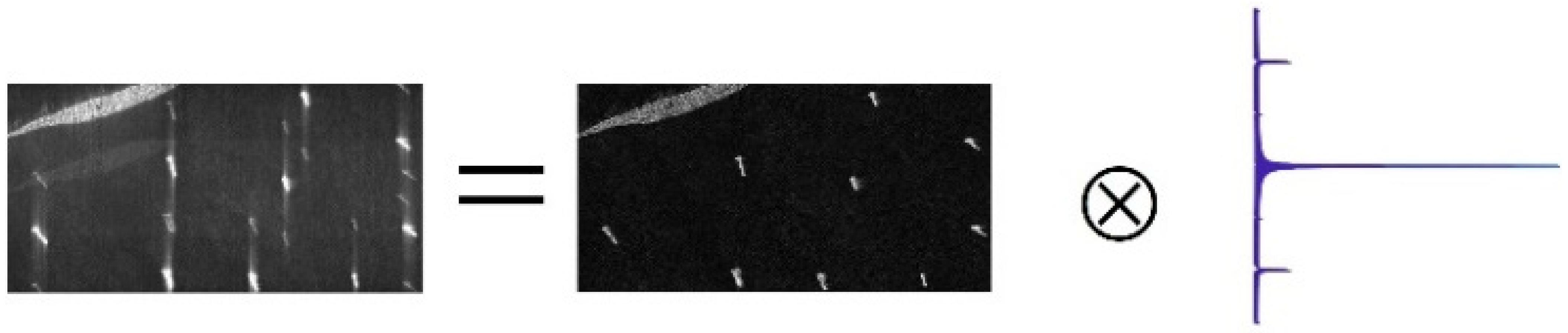
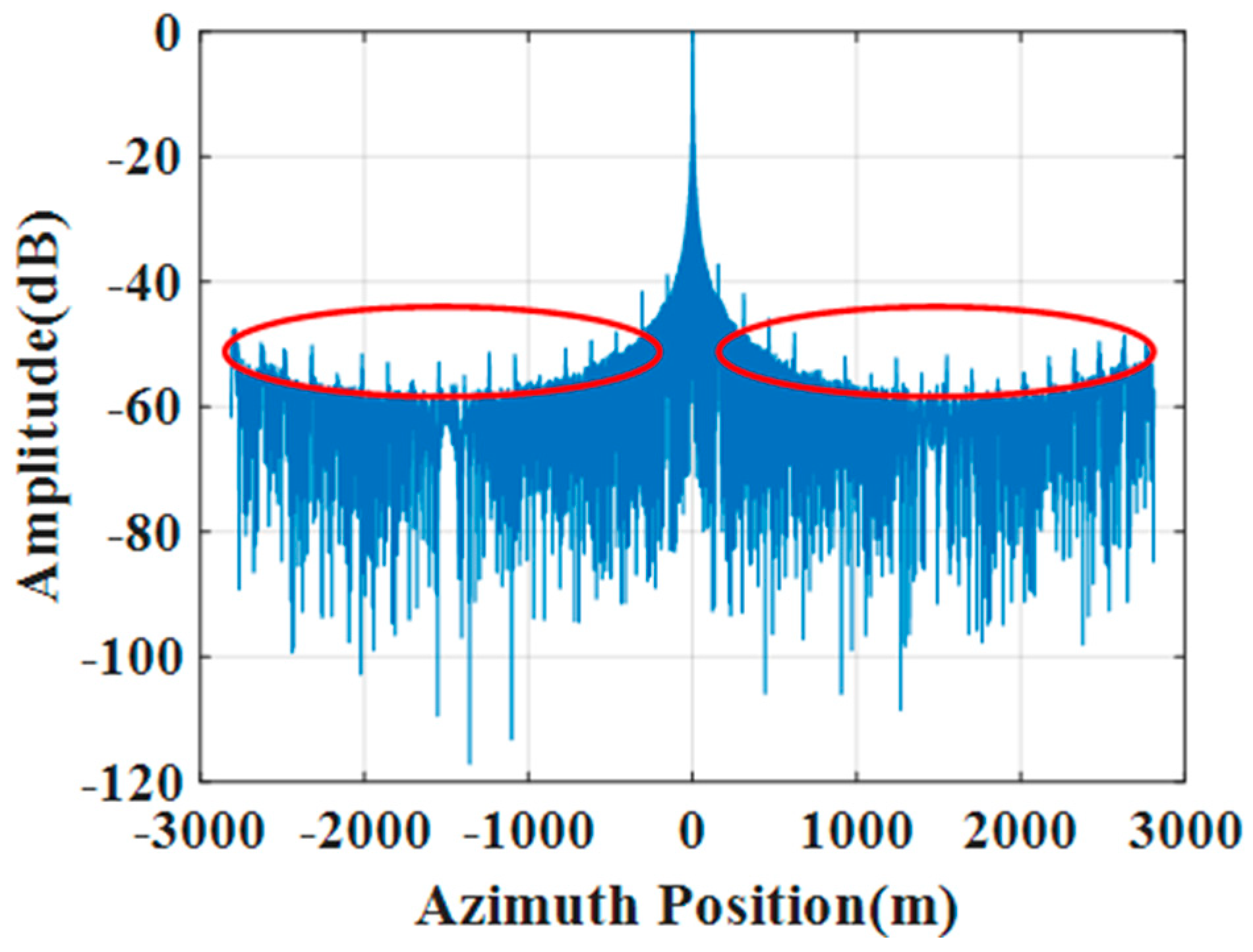
- The position-invariant property of azimuth grating lobes in low-oversampled staggered synthetic aperture radar (LS-SAR) images is theoretically verified, and the LS-SAR image on the same range cell is modeled as the convolution of the scattering scene with the system point spread function (PSF) plus additive noise.
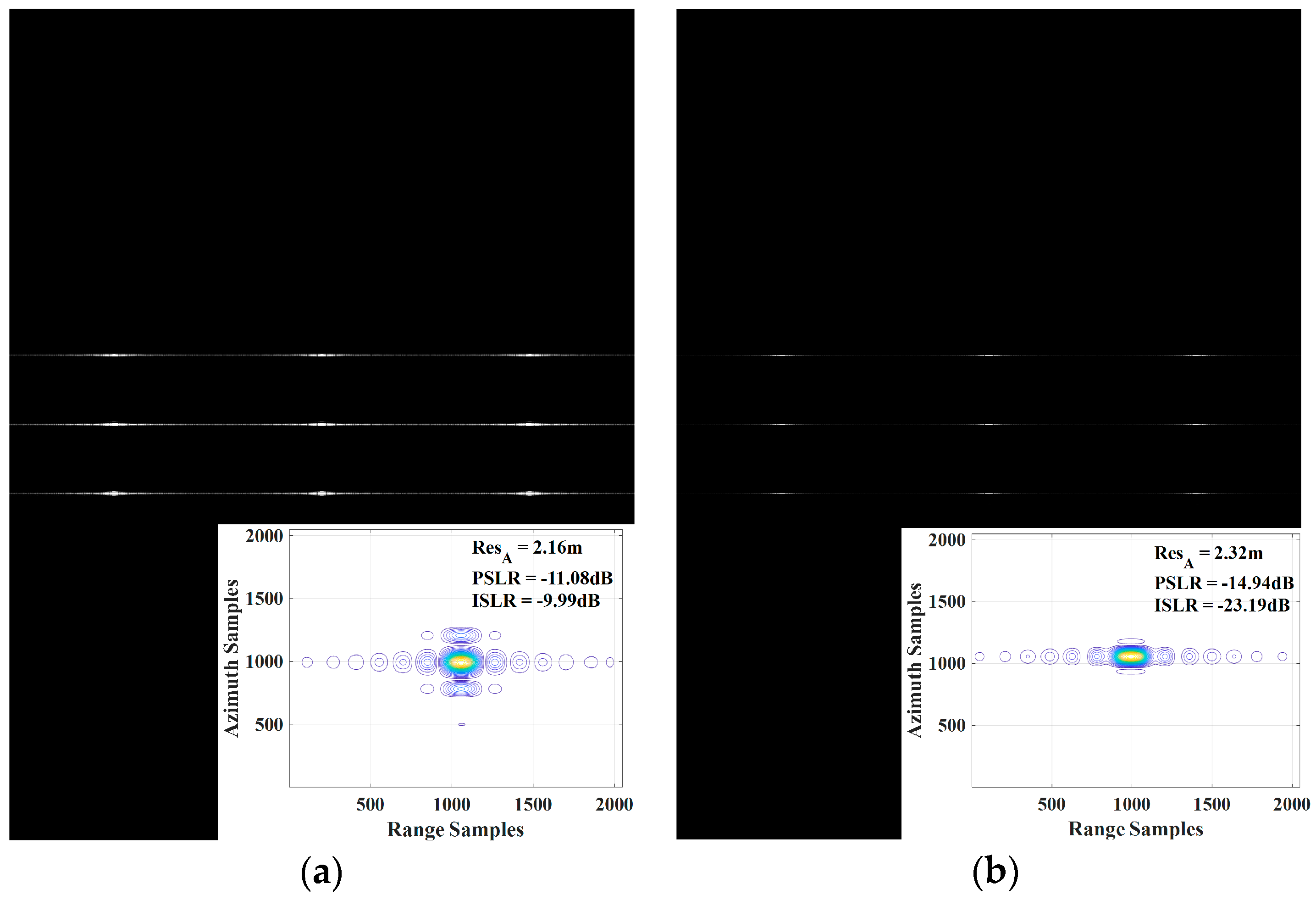
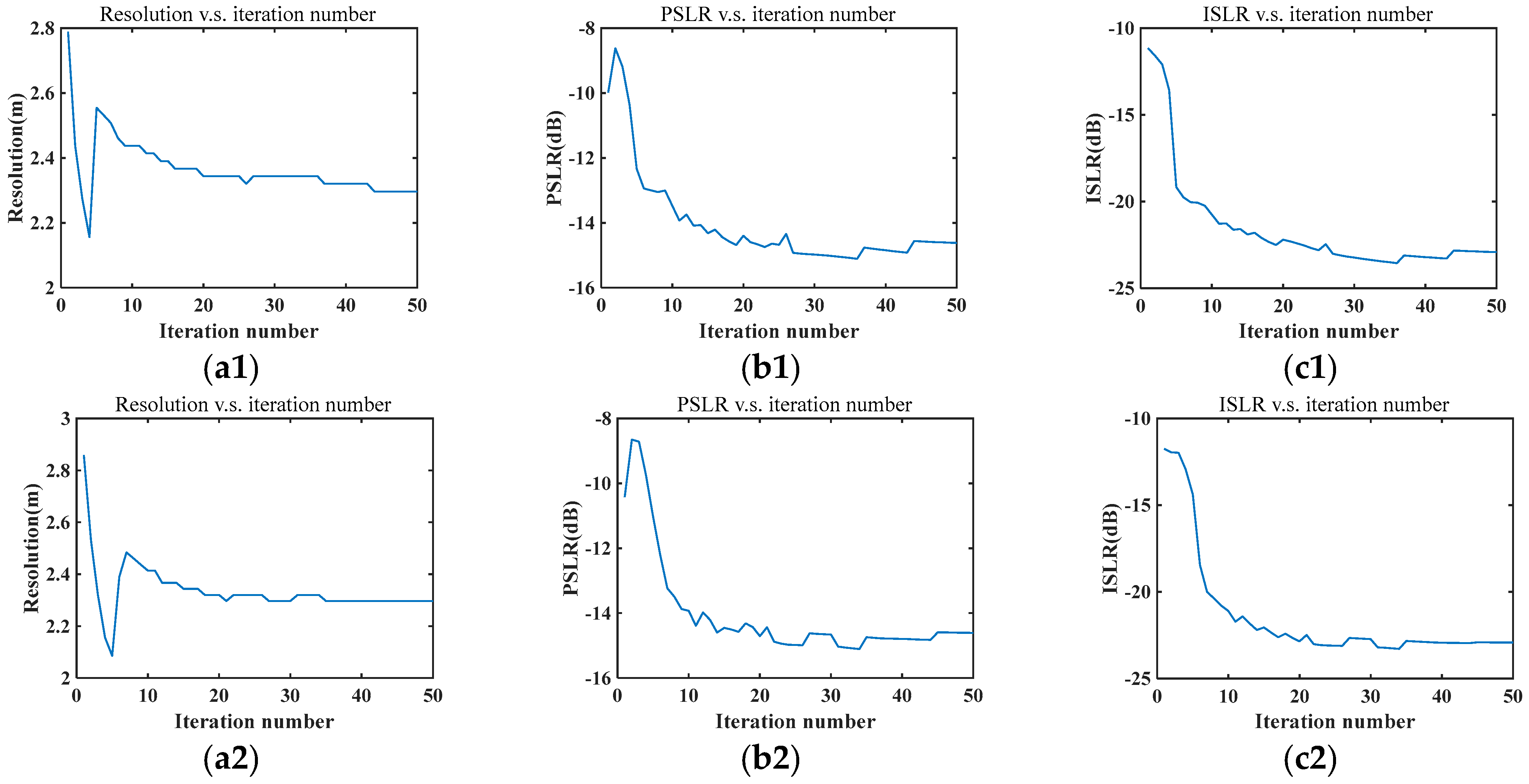
- A deconvolution-based grating lobes reduction method combining numerically calculated PSF and Lucy–Richardson (LR) iterative deconvolution is proposed, which effectively reduces azimuth grating lobes and improves azimuth resolution of LS-SAR images without the restriction on the observed scene.
- The proposed method breaks the limitations of traditional methods, which echo reconstruction and compressed sensing-based methods have the restriction on the observed scene and the complex computation, providing a new technical approach for LS-SAR image quality improvement.
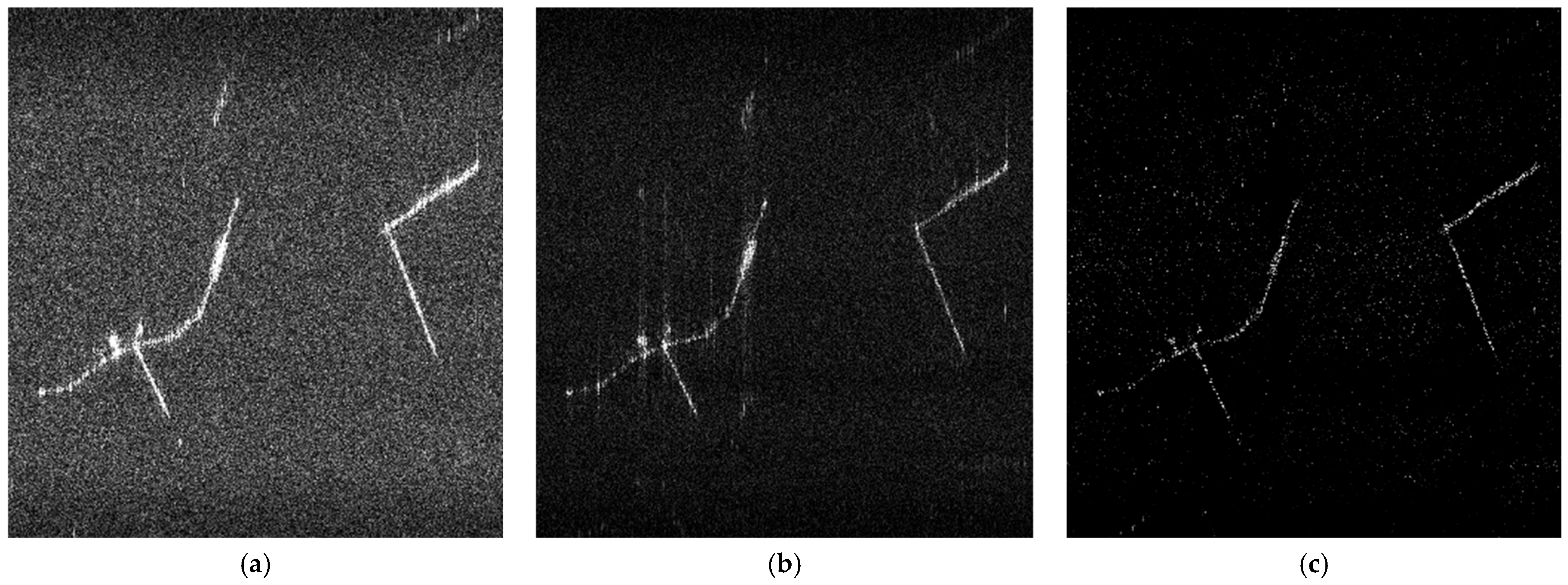
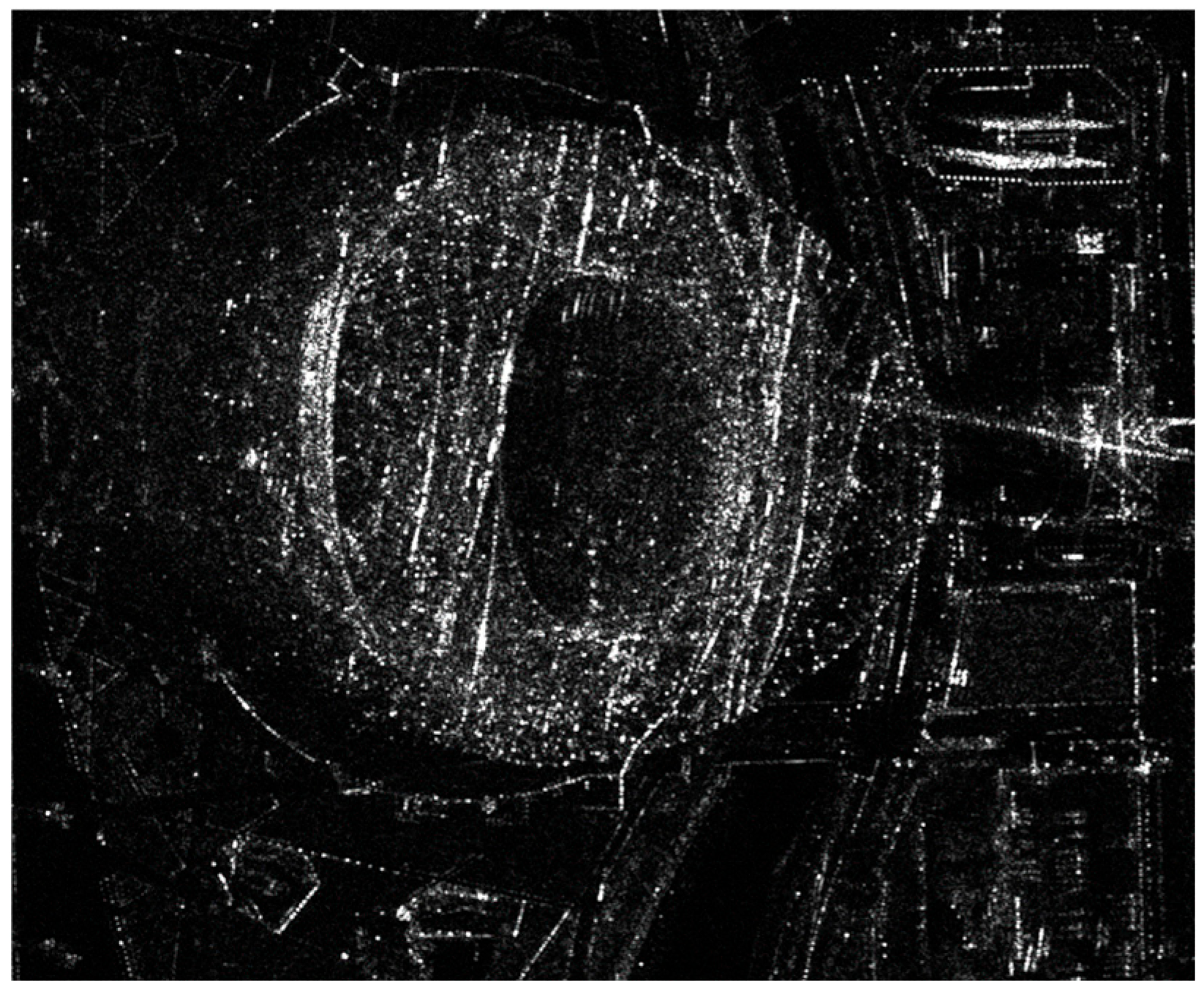
- The method is validated by simulated point-array targets, real SAR images and airborne measured LS-SAR data, and it can solve the grating lobe and defocusing problems in actual LS-SAR data processing, providing a technical foundation for the engineering application of high-resolution wide-swath LS-SAR systems.
Abstract
1. Introduction
2. Materials and Methods
2.1. Convolution Model of LS-SAR Image Grating Lobes Reduction
2.1.1. The Position-Invariant Property of LS-SAR Image Grating Lobes
2.1.2. The Convolution Model of LS-SAR Image Grating Lobes Reduction
2.2. LS-SAR Image Grating Lobes Reduction via Deconvolution
2.2.1. The Obtaining of PSF
- Select a certain range cell , and set the amplitude of the cell ;
- Calculate the slant range and construct the observed and reconstructed matrix
- iii.
- Construct the azimuthal signal .
- iv.
- Obtain the PSF .
- v.
- Repeat i~iv on each range cell.
2.2.2. The LS-SAR Image Grating Lobes Reduction Based on the LR Principle
3. Results
4. Discussion
- (1)
- The inapplicability of the proposed method to the slow PRI variation sampling strategy
- (2)
- The improvement of the azimuth resolution
- (3)
- The iteration number of the proposed method
5. Conclusions
Author Contributions
Funding
Institutional Review Board Statement
Informed Consent Statement
Data Availability Statement
Acknowledgments
Conflicts of Interest
References
- Villano, M.; Krieger, G.; Moreira, A. Staggered SAR: High-Resolution Wide-Swath Imaging by Continuous PRI Variation. IEEE Trans. Geosci. Remote Sens. 2014, 52, 4462–4479. [Google Scholar] [CrossRef]
- Pinheiro, M.; Prats-Iraola, P.; Rodriguez-Cassola, M.; Villano, M. Analysis of Low-Oversampled Staggered SAR Data. IEEE J. Sel. Top. Appl. Earth Obs. Remote Sens. 2020, 13, 241–255. [Google Scholar] [CrossRef]
- Villano, M.; Krieger, G.; Jäger, M.; Moreira, A. Staggered SAR: Performance Analysis and Experiments with Real Data. IEEE Trans. Geosci. Remote Sens. 2017, 55, 6617–6638. [Google Scholar] [CrossRef]
- Hou, S.X.; Deng, Y.K.; Qiu, J.S.; Zhang, H.; Wang, W.; Lv, Z.S.; Chen, Z.; Fan, H.T.; Zhao, F.J. On Low-Oversampled ST-Staggered SAR Signal Reconstruction Scheme. IEEE Trans. Aerosp. Electron. Syst. 2025, 61, 7107–7124. [Google Scholar] [CrossRef]
- Chen, W.; Geng, J.; Meng, F.; Zhu, W. Low-oversampled staggered SAR imaging in present of a random PRI variation strategy. In Proceedings of the IET International Radar Conference (IRC 2023), Chongqing, China, 3–5 December 2023. [Google Scholar]
- Chen, W.; Zhang, L.; Geng, J.; Liu, H. Image Reconstruction for Low-Oversampled Staggered SAR Based on Bayesian Compressive Sensing. In Proceedings of the IGARSS 2023—2023 IEEE International Geoscience and Remote Sensing Symposium, Pasadena, CA, USA, 16–21 July 2023. [Google Scholar]
- Liu, M.Q.; Pan, J.; Zhu, J.B.; Chen, Z.C.; Zhang, B.C.; Wu, Y.R. A Sparse SAR Imaging Method for Low-Oversampled Staggered Mode via Compound Regularization. Remote Sens. 2024, 16, 1459. [Google Scholar] [CrossRef]
- Moreira, A.; Krieger, G.; Hajnsek, I.; Papathanassiou, K.; Younis, M.; Lopez-Dekker, P.; Huber, S.; Villano, M.; Pardini, M.; Eineder, M.; et al. Tandem-L: A Highly Innovative Bistatic SAR Mission for Global Observation of Dynamic Processes on the Earth’s Surface. IEEE Geosci. Remote Sens. Mag. 2015, 3, 8–23. [Google Scholar] [CrossRef]
- Rosen, P.A.; Bawden, G.W.; Barela, P.; Chapman, B.; Fattahi, H.; Jones, C.E.; Joughin, I.R.; Lavalle, M.; Lohman, R.B.; Simons, M.; et al. The NASA-ISRO SAR Mission: A summary. IEEE Geosci. Remote Sens. Mag. 2025, 13, 8–34. [Google Scholar] [CrossRef]
- Agrawal, K.M.; Thakur, S.; Gupta, S.; Ramanujam, V.M. NISAR S-SAR Echo Data Simulation. In Proceedings of the 2024 IEEE India Geoscience and Remote Sensing Symposium (INGARSS), Goa, India, 2–5 December 2024. [Google Scholar]
- Thakur, S.; Agrawal, K.M.; Ramanujam, V.M. Simulation and Analysis of Staggered PRI Sequence for NISAR. In Proceedings of the 2021 IEEE International India Geoscience and Remote Sensing Symposium (InGARSS), Ahmedabad, India, 6–10 December 2021. [Google Scholar]
- Pinheiro, M.; Prats, P.; Villano, M.; Rodriguez-Cassola, M.; Rosen, P.A.; Hawkins, B.; Agram, P. Processing and Performance Analysis of NASA-ISRO SAR (NISAR) Staggered Data. In Proceedings of the 2019 IEEE International Geoscience and Remote Sensing Symposium IGARSS, Yokohama, Japan, 28 July–2 August 2019. [Google Scholar]
- Ustalli, N.; Steinbrecher, U.; Peixoto, M.N.; Krieger, G.; Kraus, T.; Villano, M. Demonstration of Staggered Ambiguous SAR Mode for Ship Monitoring Using TerraSAR-X. In Proceedings of the 2023 8th Asia-Pacific Conference on Synthetic Aperture Radar (APSAR), Bali, Indonesia, 23–27 October 2023. [Google Scholar]
- Ustalli, N.; Peixoto, M.N.; Kraus, T.; Steinbrecher, U.; Krieger, G.; Villano, M. Experimental Demonstration of Staggered Ambiguous SAR Mode for Ship Monitoring With TerraSAR-X. IEEE Trans. Geosci. Remote Sens. 2023, 61, 5221816. [Google Scholar] [CrossRef]
- Wang, X.; Wang, R.; Deng, Y.; Wang, W.; Li, N. SAR Signal Recovery and Reconstruction in Staggered Mode with Low Oversampling Factors. IEEE Geosci. Remote Sens. Lett. 2018, 15, 704–708. [Google Scholar] [CrossRef]
- Huang, H.; Lin, X.; Huang, P.H.; Fan, H.T.; Liu, Y.Y.; Xi, P.L.; Liu, X.Z.; Chen, G.Z. A Novel Signal Restoration Method for Staggered-SAR System. In Proceedings of the 2022 IEEE International Geoscience and Remote Sensing Symposium (IGARSS), Kuala Lumpur, Malaysia, 17–22 July 2022. [Google Scholar]
- Sun, M.Z.; Wei, Q.; Yu, Y.J.; Liu, Z.; Li, W.C. Nonuniform Resampling for Staggered SAR. In Proceedings of the 2015 IEEE International Geoscience and Remote Sensing Symposium (IGARSS), Milan, Italy, 26–31 July 2015. [Google Scholar]
- Xu, W.; Hu, J.L.; Huang, P.P.; Tan, W.X.; Gao, Z.Q.; Dong, Y.F. Continuous PRI Variation and Phase Center Adjustment for Azimuth Uniform Sampling in Staggered SAR. IEEE Trans. Geosci. Remote Sens. 2022, 60, 52085123. [Google Scholar] [CrossRef]
- Wang, X.; Wang, R. A Novel Signal Processing Algorithm for Staggered SAR with Low Oversampling Factors. In Proceedings of the 11th European Conference on Synthetic Aperture Radar (EUSAR), Hamburg, Germany, 7–9 June 2016. [Google Scholar]
- Liu, Z.; Liao, X.; Wu, J. Image Reconstruction for Low-Oversampled Staggered SAR via HDM-FISTA. IEEE Trans. Geosci. Remote Sens. 2022, 60, 5204514. [Google Scholar] [CrossRef]
- Zhang, Y.; Qi, X.; Jiang, Y.; Li, H.; Liu, Z. Image Reconstruction for Low-Oversampled Staggered SAR Based on Sparsity Bayesian Learning in the Presence of a Nonlinear PRI Variation Strategy. IEEE Trans. Geosci. Remote Sens. 2022, 60, 5229824. [Google Scholar] [CrossRef]
- Zhou, Z.X.; Deng, Y.; Wang, W.; Jia, X.; Wang, R. Linear Bayesian Approaches for Low-Oversampled Stepwise Staggered SAR Data. IEEE Trans. Geosci. Remote Sens. 2022, 60, 5206123. [Google Scholar] [CrossRef]
- Liao, X.; Liu, Z.; Jin, C. Compressed Sensing Imaging for Staggered SAR with Low Oversampling Ratio. In Proceedings of the EUSAR 2021—13th European Conference on Synthetic Aperture Radar, Online, Germany, 29 March–1 April 2021. [Google Scholar]
- Lucy, L. An Iterative Technique for the Rectification of Observed Distribution. Astron. J. 1974, 79, 745–754. [Google Scholar] [CrossRef]
- Richardson, W.H. Bayesian-Based Iterative Method of Image Restoration. J. Opt. Soc. Amer. 1972, 62, 55–59. [Google Scholar] [CrossRef]
- He, Z.; Zhang, X.; Li, Y.; Wang, H. A Deconvolutional Reconstruction Method Based on Lucy–Richardson Algorithm for Joint Scanning Laser Thermography. IEEE Trans. Instrum. Meas. 2021, 70, 4501508. [Google Scholar] [CrossRef]
- Cui, Z.Y.; Ren, J.J.; Li, L.J.; Gu, J.; Zhang, J.Y. Defocusing Recovery Technology of Terahertz Image Based on 3-D PSF Simulations. IEEE Trans. Instrum. Meas. 2023, 72, 5021910. [Google Scholar] [CrossRef]
- Cumming, I.; Wong, F. Digital Signal Processing of Synthetic Aperture Radar Data: Algorithms and Implementation; Artech House: Norwood, MA, USA, 2004. [Google Scholar]
- Ozsoy, S.; Ergin, A.A. Pencil back-projection method for SAR imaging. IEEE Trans. Image Process 2009, 18, 573–581. [Google Scholar] [CrossRef] [PubMed]
- Durand, R.; Ginolhac, G.; Thirion-Lefevre, L.; Forster, P. Back Projection Version of Subspace Detector SAR Processors. IEEE Trans. Aerosp. Electron. Syst. 2011, 47, 1489–1497. [Google Scholar] [CrossRef]
- Oppenheim, A.V.; Willsky, A.S.; Nawab, S.H. Signals and Systems, 2nd ed.; Prentice-Hall: Upper Saddle River, NJ, USA, 1997. [Google Scholar]
- Bracewell, R.N. The Fourier Transform and Its Applications, 3rd ed.; McGraw-Hill: New York, NY, USA, 2000. [Google Scholar]
- Wang, Z.; Bovik, A.C.; Sheikh, H.R.; Simoncelli, E.P. Image quality assessment: From error visibility to structural similarity. IEEE Trans. Image Process. 2004, 13, 600–612. [Google Scholar] [CrossRef]
- Liu, Y.; Panezai, S.; Wang, Y.; Stallinga, S. Noise amplification and ill-convergence of Richardson-Lucy deconvolution. Nat. Commun. 2025, 16, 911. [Google Scholar] [CrossRef] [PubMed]




| Parameters | Value of Simulated Parameters in Figure 4 and Figure 5 | Value of Real Measured Airborne Parameters in Figure 6 |
|---|---|---|
| Signal Bandwidth (MHz) | 44.3 | 420 |
| The modulated-frequency rate (MHz/us) | 4.43 | −16.8 |
| Sampling Frequency (MHz) | 70 | 500 |
| Pulse Width (us) | 10 | |
| Wavelength (m) | 0.03 | 0.0086 |
| Height (Km) | 600 | |
| Velocity (m/s) | 7100 | 90.30 |
| Antenna Length (m) | 6 | |
| Resolution (m) | 3 | |
| Squint angle (°) | 0 | 0 |
| The Doppler center (Hz) | 0 | 0 |
| The Doppler bandwidth (Hz) | 2097 | 110 |
| The reference slant range (Km) | 623 | 27.21 |
| Mean oversampling ratio under fast PRI variation sampling strategy (Hz) | 1.15 | 1.45 |
| Mean percentage of lost pulses | 10% | 21% |
| MSE | SSIM | ||
|---|---|---|---|
| The observed scene for the fast PRI variation method | (b4) | 1.2196 | 0.8144 |
| (c4) | 1.0290 | 0.8866 | |
| The observed scene for the elaborate PRI variation method | (b3) | 1.2138 | 0.8146 |
| (c3) | 0.9217 | 0.8841 | |
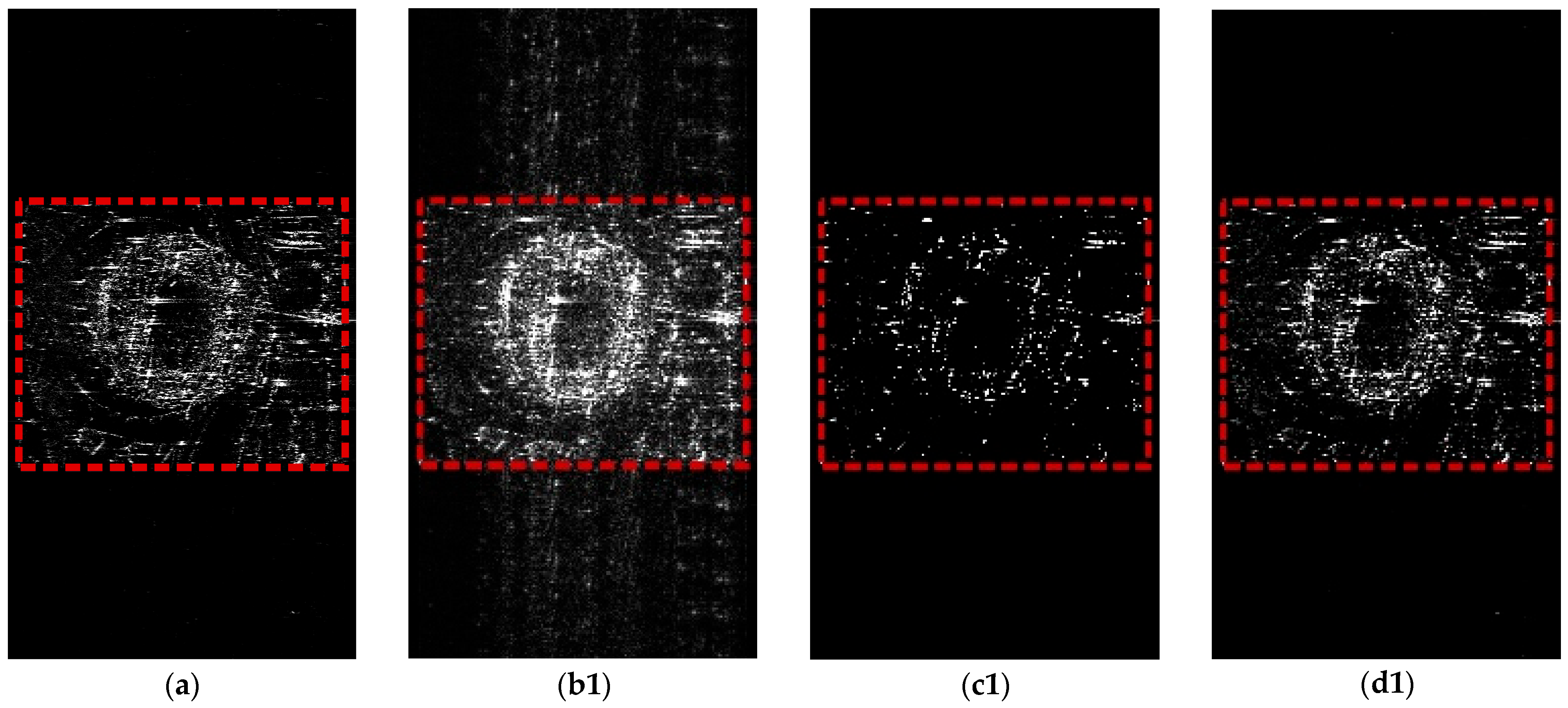
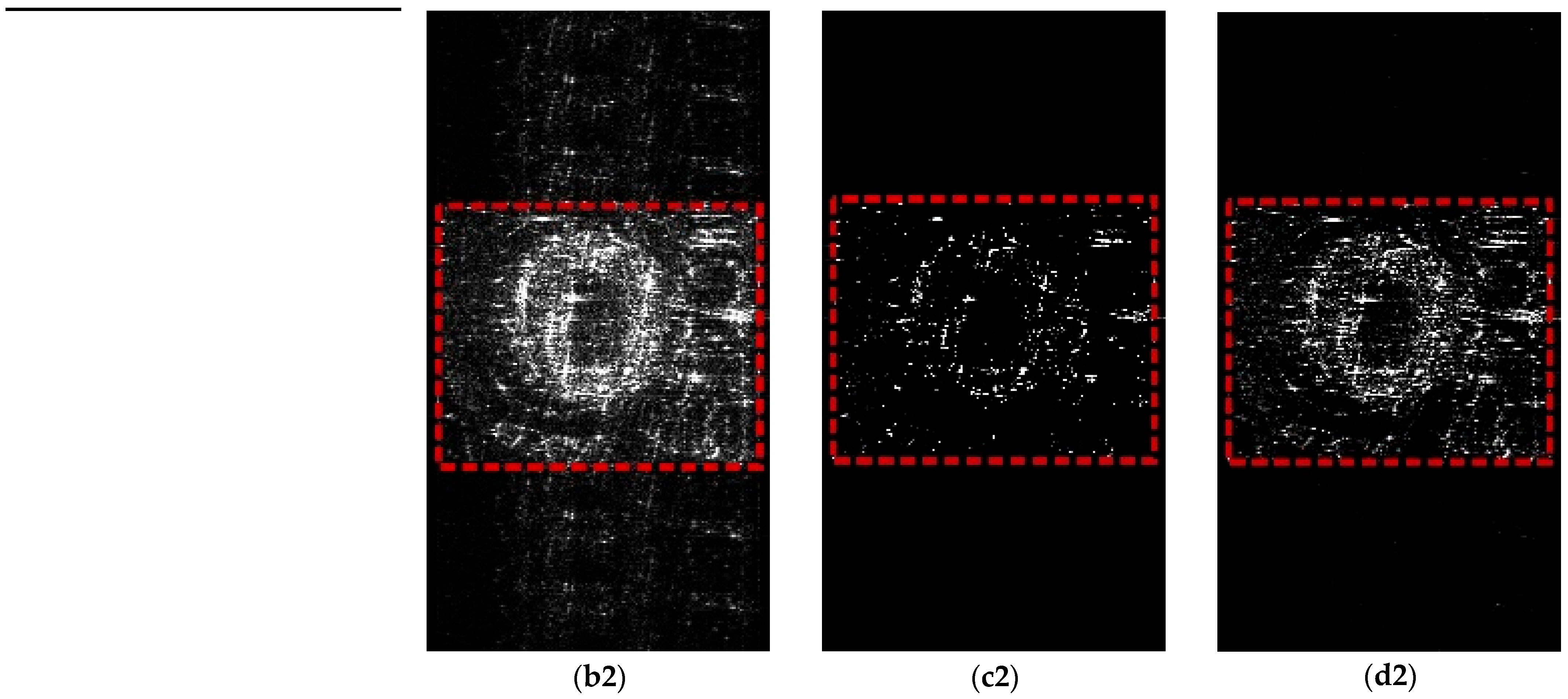
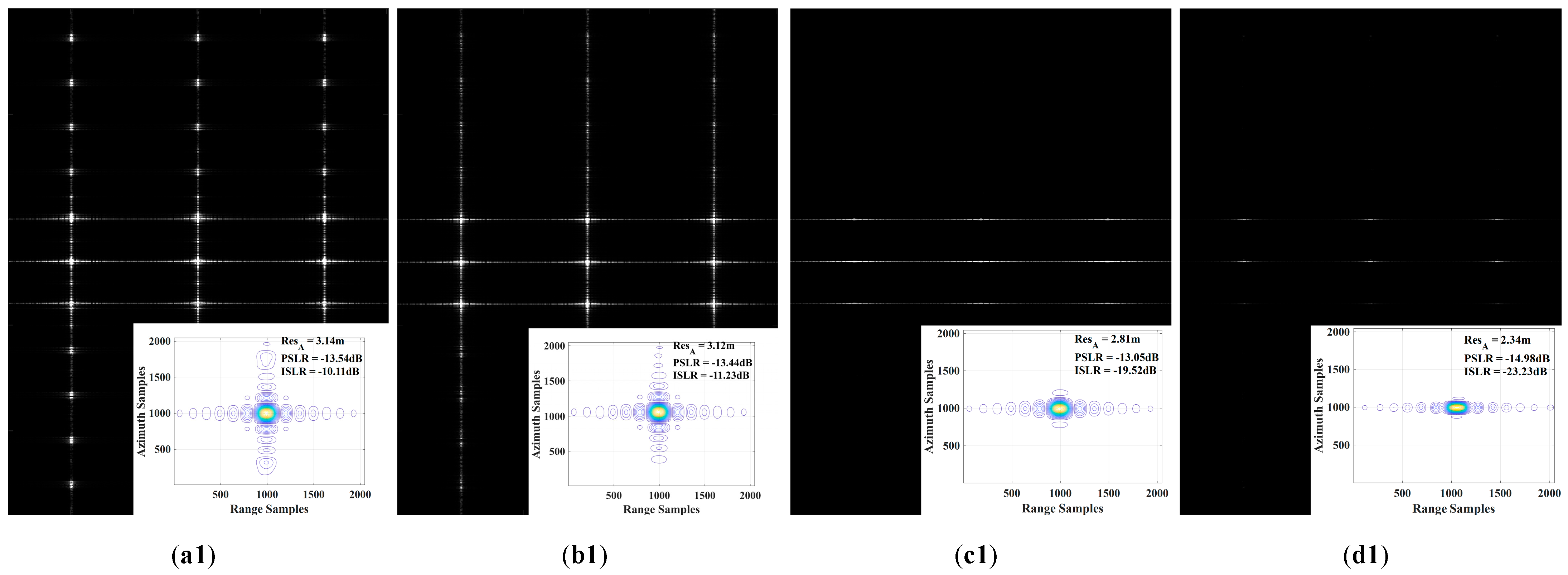
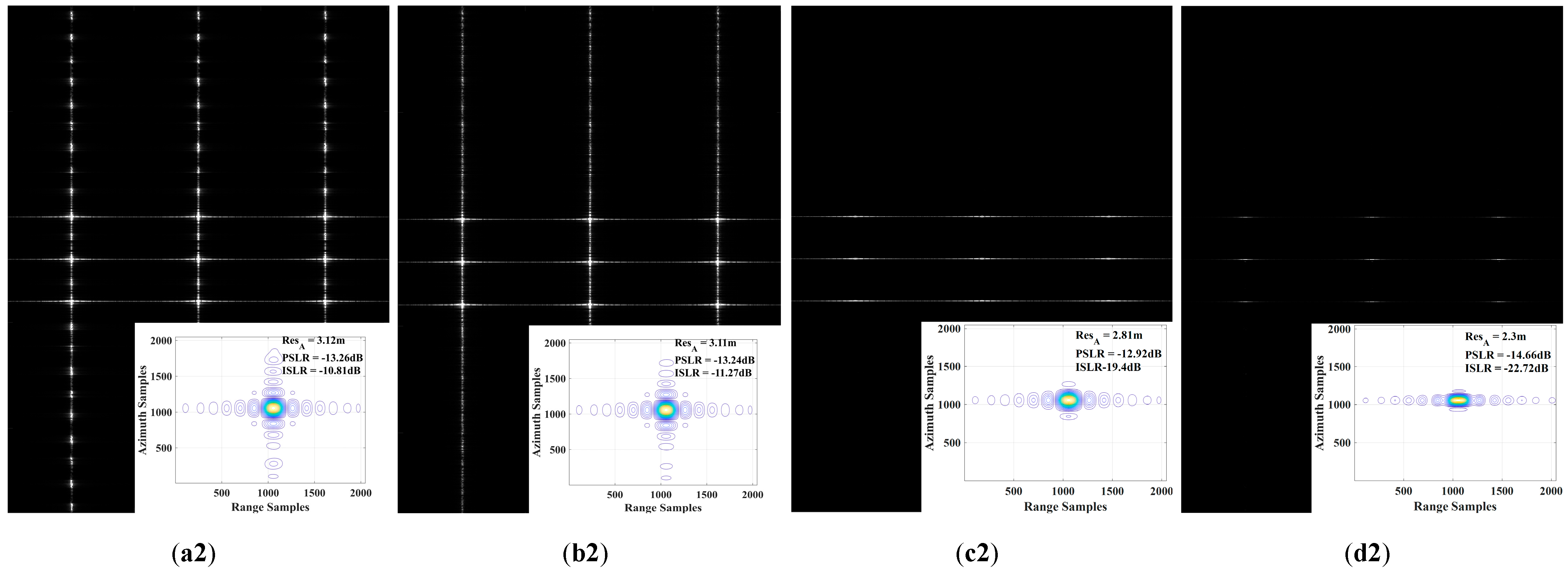
| Caption | Resolution | PSLR | ISLR | |
|---|---|---|---|---|
| BLU-based method | (a1) | 3.14 m | −13.54 dB | −10.11 dB |
| (a2) | 3.12 m | −13.26 dB | −10.81 dB | |
| MIAA combined with the BLU method | (b1) | 3.12 m | −13.44 dB | −11.23 dB |
| (b2) | 3.11 m | −13.24 dB | −11.27 dB | |
| CS-based method | (c1) | 2.81 m | −13.05 dB | −19.52 dB |
| (c2) | 2.81 m | −12.92 dB | −19.40 dB | |
| Proposed method | (d1) | 2.34 m | −14.98 dB | −23.23 dB |
| (d2) | 2.30 m | −14.66 dB | −22.72 dB |
Disclaimer/Publisher’s Note: The statements, opinions and data contained in all publications are solely those of the individual author(s) and contributor(s) and not of MDPI and/or the editor(s). MDPI and/or the editor(s) disclaim responsibility for any injury to people or property resulting from any ideas, methods, instructions or products referred to in the content. |
© 2026 by the authors. Licensee MDPI, Basel, Switzerland. This article is an open access article distributed under the terms and conditions of the Creative Commons Attribution (CC BY) license.
Share and Cite
Chen, W.; Geng, J.; Yu, J.; Wang, C.; Yuan, L. A Deconvolution-Based Grating Lobes Reduction for Low-Oversampled Staggered SAR Image. Remote Sens. 2026, 18, 1489. https://doi.org/10.3390/rs18101489
Chen W, Geng J, Yu J, Wang C, Yuan L. A Deconvolution-Based Grating Lobes Reduction for Low-Oversampled Staggered SAR Image. Remote Sensing. 2026; 18(10):1489. https://doi.org/10.3390/rs18101489
Chicago/Turabian StyleChen, Wenjiao, Jiwen Geng, Jindong Yu, Chenguang Wang, and Limin Yuan. 2026. "A Deconvolution-Based Grating Lobes Reduction for Low-Oversampled Staggered SAR Image" Remote Sensing 18, no. 10: 1489. https://doi.org/10.3390/rs18101489
APA StyleChen, W., Geng, J., Yu, J., Wang, C., & Yuan, L. (2026). A Deconvolution-Based Grating Lobes Reduction for Low-Oversampled Staggered SAR Image. Remote Sensing, 18(10), 1489. https://doi.org/10.3390/rs18101489