

Article

Spatiotemporal Dynamics and Budget of Particulate Organic Carbon in China’s Marginal Seas Based on MODIS-Aqua

Tianjin Key Laboratory for Marine Environmental Research and Service, School of Marine Science and Technology, Tianjin University, Tianjin 300072, China
*
Author to whom correspondence should be addressed.
Remote Sens. 2026, 18(1), 92; https://doi.org/10.3390/rs18010092
Submission received: 22 October 2025 / Revised: 22 December 2025 / Accepted: 24 December 2025 / Published: 26 December 2025
(This article belongs to the Special Issue Remote Sensing for Monitoring Water and Carbon Cycles)

Highlights

What are the main findings?
  • The spatial distribution and seasonal changes in particulate organic carbon were jointly influenced by primary production, water mass exchange, resuspended sediments, and terrestrial inputs.
  • Primary production and respiratory consumption were identified as the predominant input and output fluxes, respectively, in China’s marginal seas.
What are the implications of the main finding?
  • This study enriches the understanding of carbon cycling processes and carbon sink mechanisms in marginal seas and offers a scientific basis for research on the environmental evolution of China’s marginal seas.
  • The findings provide critical scientific support for predicting the marine carbon cycle under climate change and for informing regional “dual carbon” policy goals.

Abstract

Using MODIS-Aqua satellite observations, this study analyzes the spatiotemporal distribution characteristics of particulate organic carbon (POC) in China’s marginal seas from 2003 to 2024. The statistical relationships between various marine environmental variables, including sea surface temperature (SST), nutrients, and primary production (PP), and POC concentrations are explored using partial least squares path modeling (PLS-PM). Finally, a box model approach is conducted to assess the POC budget in the study area. The results indicate that the POC concentration in the marginal seas of China generally exhibits a characteristic of being high in spring and low in summer. The highest concentration of POC is observed in the Bohai Sea, followed by the Yellow Sea, and the lowest in the East China Sea, with coastal waters exhibiting higher POC concentrations compared to the central areas. The spatial distribution and seasonal changes in POC are jointly influenced by PP, water mass exchange, resuspended sediments, and terrestrial inputs. Large-scale climate modes show statistical associations with POC concentration in the open waters of China’s marginal seas. PP and respiratory consumption are identified as the predominant input and output fluxes, respectively, in China’s marginal seas. This study enriches the understanding of carbon cycling processes and carbon sink mechanisms in marginal seas.

1. Introduction

Research indicates that marginal seas, covering under 8% of the global ocean, generate 15–30% of marine primary productivity and account for nearly 90% of organic carbon burial in ocean sediments [1,2]. particulate organic carbon (POC) serves as an essential material basis in the marine food web, closely linked to biological processes and primary production (PP) [3]. It is also a principal form for the fixation and transfer of carbon in seawater [4,5]. The horizontal distribution of POC tends to coincide with the horizontal distribution of nutrients, and concentrations are usually higher in coastal areas than in the central part of the sea, with clear seasonal variations [6]. Previous satellite-based studies demonstrate that POC concentrations in the Bohai Sea exceed those in the Yellow Sea. Water exchange and sediment resuspension are identified as key regulators of POC spatiotemporal variability in this region [7]. Satellite-derived surface POC data enable the quantification of POC inventories and multi-year trends in marginal seas, facilitating the investigation of marine biogeochemistry and ecosystem dynamics [8,9].
The distribution and composition of POC in aquatic systems are controlled by factors such as phytoplankton photosynthesis, organic matter degradation, and sediment resuspension [10,11]. They are also indirectly influenced by environmental variables including light availability, temperature, dissolved oxygen (DO), and Secchi depth (SD) [5,12,13]. Model results demonstrate that factors associated with photosynthetic activity exert significant control over Chlorophyll a (Chl-a) and POC concentrations. In eutrophic waters, PP driven by phytoplankton accounted for more than 80% of the POC contribution [14]. Additionally, DO serves as a key indicator of physicochemical and ecological processes in aquatic systems, such as photosynthesis, water mixing, and circulation [15]. Nutrient levels play a critical role in regulating phytoplankton growth and PP [16]. Previous studies demonstrate that nitrogen and phosphorus concentrations influence both the concentration and composition of POC, highlighting the role of PP in POC dynamics [17]. Strong winds may trigger sediment resuspension in coastal regions and significantly influence current velocities, thereby reshaping the spatial patterns of POC composition and distribution [18]. However, studies investigating the linkages between dynamic changes in POC concentration and environmental forcing in China’s marginal seas remain scarce.
Based on observational data, many scholars have also conducted research on coastal carbon budgets, cycling mechanisms, and simulations of key processes [4,19,20,21]. Taking the Yellow Sea as the study area, the application of an isotope fractionation model combined with multi-seasonal observational data ultimately reduces the uncertainty in POC budget estimates by 20–30% [22]. Atmospheric deposition is identified as a direct source of POC in regional coastal surface waters, contributing up to 35% of the surface POC pool during spring. Its influence on particulate carbon cycling in nearshore areas was determined to be significant [23]. Rivers function as dynamic components of the global carbon cycle, generating organic carbon through internal fluvial processes and consequently modifying the carbon budget of adjacent marginal seas [24,25,26]. The sources of POC in the Yellow Sea and East China Sea shelf regions are diverse, and POC undergoes resuspension–redeposition cycles and extensive degradation prior to burial [27]. In surface waters, POC is primarily derived from in situ production, whereas in bottom waters, resuspended sediments are identified as the dominant source of POC [28]. The sinking POC flux was calculated based on the captured bottom flux and its resuspension ratio of ~90% in the central Yellow Sea [29]. Currently, there remains substantial uncertainty in our estimates of key processes and fluxes in coastal carbon cycling. Recent studies have investigated POC dynamics in the East China Sea, which analyzed MODIS-Aqua POC data from 2003 to 2022 [30]. They report spatial patterns with higher POC in the western nearshore regions and lower POC offshore. This study analyzes the marginal seas of China from 2003 to 2024, integrating both natural and anthropogenic influences. Moreover, by applying a POC budget analysis with Monte Carlo uncertainty estimation, we further quantified the uncertainties associated with key processes and fluxes in coastal carbon cycling.
Few studies examine the linkages between POC dynamics and multiple environmental drivers. Systematic investigations within a structural modeling framework are particularly scarce. Furthermore, current estimates of POC budgets are subject to high uncertainties. This is largely due to the lack of unified constraints for key processes such as riverine input, sediment resuspension, and cross-boundary exchange. This study employs high resolution MODIS-Aqua POC data (2003–2024) to establish a long-term time series. Furthermore, a partial least squares path modeling (PLS-PM) is applied to explore the statistical relationships and potential pathways among nutrients, primary productivity, suspended particulate matter, physical forcing, and POC variability. Finally, by integrating satellite observations, riverine inputs, and sediment processes into a unified box-model framework, the POC budget of the study area was re-evaluated. This integrated approach provides novel insights into the spatial distribution patterns, long-term variability, and potential regulating factors of POC in China’s marginal seas.

2. Materials and Methods

2.1. Study Area

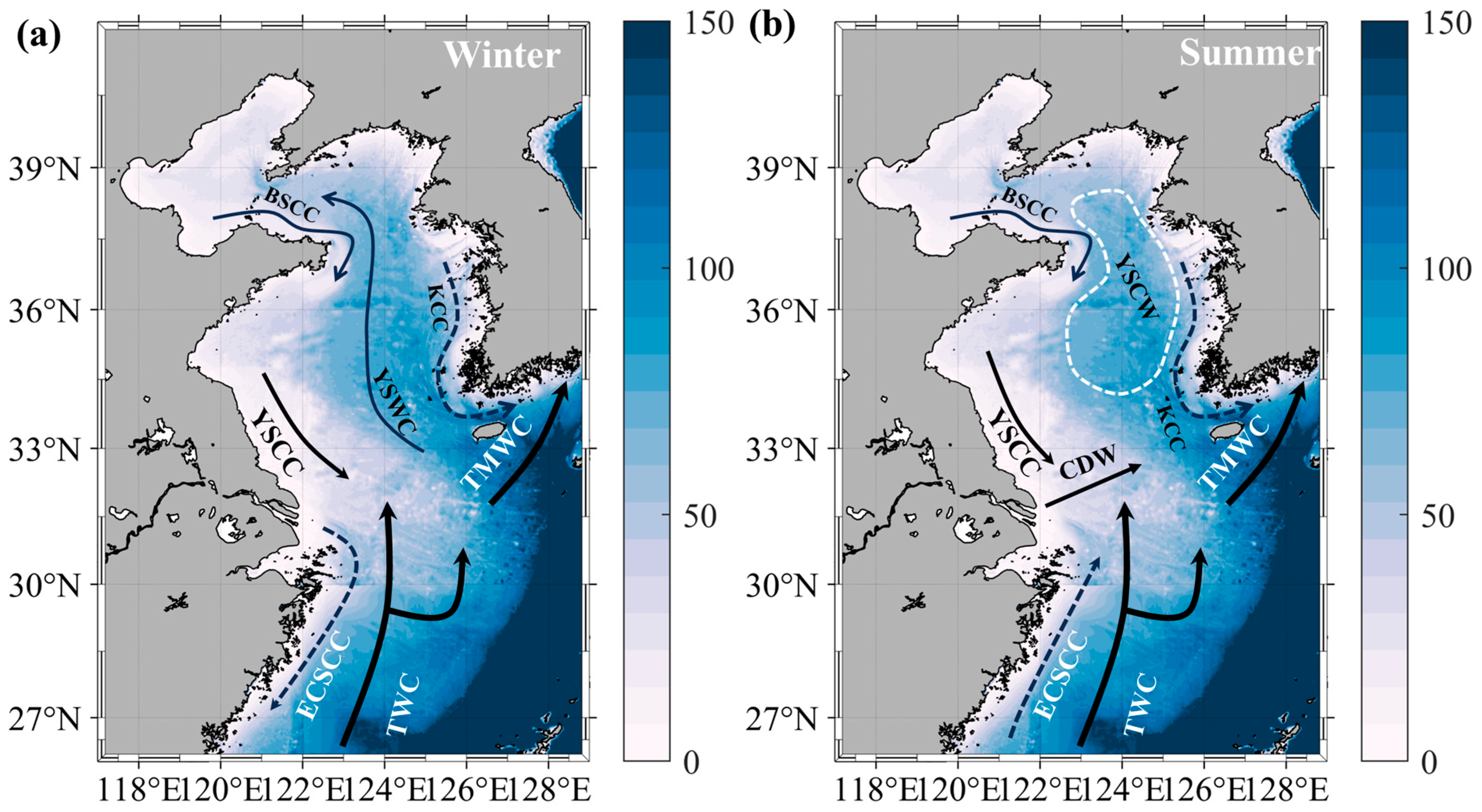
The Bohai Sea is situated in the country’s far north, bordered by the provinces of Liaoning, Hebei, Shandong, and the municipality of Tianjin. Its total area measures approximately 77,000 km2, while its mean depth is 18 m. The North Yellow Sea, adjacent to the Liaodong Peninsula and the west coast of the Korean Peninsula, is relatively shallow with an average depth of 40–50 m. The Southern Yellow Sea borders the coasts of Jiangsu and Shandong provinces and features deeper central waters exceeding 100 m in depth. The Yellow Sea receives input from numerous rivers, which transport large quantities of sediments and nutrients. Major currents include the Yellow Sea Warm Current (YSWC), which exerts significant influence on the physical and biogeochemical processes in the region (Figure 1). The Yellow Sea Cold Water Mass (YSCWM), distinguished by its cold temperature and elevated salinity, develops seasonally in the central Yellow Sea’s bottom waters. This water mass significantly influences regional thermal conditions and the spatial distribution of marine organisms.
The East China Sea covers an area of approximately 770,000 km2, with a mean depth of 370 m and a maximum depth of 2719 m at the Okinawa Trough. The East China Sea exhibits complex hydrographic conditions and is strongly influenced by terrestrial inputs in its estuarine and nearshore zones [31]. Additionally, it features intensive interactions with the Kuroshio Current, a major component of the North Pacific circulation system, which significantly impacts the hydrodynamic structure of the East China Sea. The regional water circulation is primarily governed by the diluted discharge from the Yangtze River, the Kuroshio Current, and the Taiwan Warm Current (TWC) [32]. Due to the influence of the Yangtze River, the East China Sea exhibits elevated primary productivity during the warm season. The continuous input of nutrients and industrial discharges from the Yangtze River leads to increasing concentrations of nitrogen and phosphorus in coastal waters near the estuary, resulting in a high degree of eutrophication [33].

2.2. Data Source and Verification

The primary data sources included MODIS-Aqua ocean color products, featuring monthly averaged POC, sea surface temperature (SST), and Chl-a concentrations downloaded from https://oceandata.sci.gsfc.nasa.gov (accessed on 20 August 2025). Operating on a 48 h temporal resolution, MODIS-Aqua captured global scale visible to near-infrared spectral reflectance data. The Level-3 POC data used in this study had a spatial resolution of 4 km (Standard Mapped Image, SMI), covering the time period from 2003 to 2024 [34]. The calculation formula is
P O C = a × R r s ( 443 ) R r s ( 555 ) b
where the parameters a and b were set to 203.2 and −1.034, respectively. The algorithm demonstrates robust performance in open ocean waters. However, its accuracy may be compromised in optically complex and turbid nearshore regions due to elevated concentrations of total suspended matter (TSM) and colored dissolved organic matter (DOM) [35]. Such interference can lead to biases or saturation effects in the retrieved POC data.
The POC data were obtained from the National Earth System Science Data Center (http://www.geodata.cn, accessed on 1 December 2025) [36]. Water samples were collected in situ using a CTD rosette, immediately filtered through 0.7-μm GF/F membranes, and stored frozen. Subsequently, the POC samples were acidified, dried, and analyzed using an Elementar vario ISOTOPE cube elemental analyzer (Waltham, MA, USA). To validate the satellite-derived POC product, we performed a matchup analysis against in situ measurements collected in 2018 across China’s marginal seas. The validation results revealed a determination coefficient (R2) of 0.84 and a root mean square error (RMSE) of 31.3 mg m−3 for the Bohai Sea, and an R2 of 0.90 with an RMSE of 26.5 mg m−3 for the Yellow Sea. For the East China Sea, we adopted the validation statistics (RMSE = 30.08 mg m−3, R2 = 0.86) from a previously published study [30] (Table S1). A scatter plot comparing satellite-retrieved and in situ POC concentrations is provided in Figure S1. The accuracy and applicability of Chl-a concentration retrieval in China’s marginal seas were validated through comparative analysis between MODIS-derived Chl-a products and in situ measurements. The validation results demonstrated that the MODIS product achieved a 32% uncertainty in China’s coastal waters, exhibiting superior performance compared with other available satellite products [37].
This study defined four subregions: Bohai Sea (118°E–121°E, 37.5°N–40°N), Northern Yellow Sea (121.5°E–124.5°E,37.5°N–40°N), Southern Yellow Sea (119.5°E–125.5°E, 33.5°N–36.5°N), and East China Sea (123°E–128°E, 27°N–33°N). The study utilized nutrient concentrations, DO, SD, and TSM data sourced from the Copernicus Marine Service (https://data.marine.Copernicus.eu/products, accessed on 20 August 2025). Nutrients included silicate (Si), nitrate (NO3-N), and phosphate (PO4-P). Spatial resolution of 1/4 degree was used with monthly average data. Mixed layer depth (MLD) data were sourced from the GLORYS12V1 global ocean physical reanalysis product (https://data.marine.copernicus.eu/product/GLOBAL_MULTIYEAR_PHY_001_030/description, accessed on 20 August 2025). Spatial resolution of 1/12 degree was used with monthly average data. SD data were derived from the Copernicus Global Ocean Colour product (biogeochemical, L4, monthly and interpolated), which was based on satellite observations. Spatial resolution of 4 km. Sea surface wind fields came from the ERA5 dataset, a reanalysis product developed by the European Centre for Medium-Range Weather Forecasts (ECMWF) (https://cds.climate.copernicus.eu/datasets, accessed on 20 August 2025). We also collected monthly data from 2003 to 2024 for three climate mode indices, including the Pacific Decadal Oscillation (PDO) index (data source: https://www.ncei.noaa.gov/access/monitoring/pdo/, accessed on 20 August 2025), the North Pacific Gyre Oscillation (NPGO) index (data source: http://www.o3d.org/npgo/, accessed on 20 August 2025), and the Southern Oscillation Index (SOI) (data source: https://www.ncei.noaa.gov/access/monitoring/enso/soi, accessed on 20 August 2025).
For MODIS-Aqua data, its Level-3 daily products contain missing values due to cloud cover. The generation of the officially provided monthly mean products has incorporated rigorous quality control procedures. For regional data gaps resulting from persistent cloud cover, no spatiotemporal interpolation was conducted in this study to preserve the authenticity of the observational data. Spatial resolution of 1/4 degree was used for monthly average data. The data sources involved in the analysis exhibited inconsistent spatial resolutions. To maintain consistency for regional comparisons, this study adopted a uniform 1/4-degree analysis grid. Data interpolation was performed using the bilinear interpolation method. To mitigate area biases introduced by latitudinal differences, an area-weighted average was applied to all four subregions: the Bohai Sea, the Northern Yellow Sea, the Southern Yellow Sea, and the East China Sea.

2.3. Research Methods

2.3.1. Spatial Variation Analysis

To quantify long-term spatial variation in POC, we applied a cumulative-difference metric. This can better reflect the superimposed spatial changes. This method calculates the total magnitude of interannual changes by summing the absolute differences in annual POC fields between consecutive years:
D = i = 2003 2023 P O C i + 1 P O C i
where P O C i represents the spatial distribution of annual POC in year i. By accumulating the absolute differences, this metric captures the overall intensity of spatial variability over the study period, while avoiding cancelation between positive and negative changes. Higher values of D indicate stronger long-term spatial variability in annual POC.
Spatial heterogeneity was evaluated using the coefficient of variation (CV) [38], calculated as the standard deviation (s) divided by the mean (m).
CV = s/m

2.3.2. Trend Analysis

To account for the strong seasonality in the monthly POC time series, we first removed the climatological seasonal cycle by subtracting the long-term monthly mean for each month, thereby obtaining a deseasonalized anomaly series. The magnitude of the long-term trend was estimated using the Theil–Sen median slope estimator (β), and its statistical significance was evaluated using the Mann–Kendall (MK) test, which is robust to non-normality and outlier [39,40]. The MK Z-statistic (Z) was used to determine whether the estimated Theil–Sen slope was significantly different from zero. Based on the slope (β) and Z-value, the trends were classified into several categories, as summarized in Table S2.

2.3.3. Autocorrelation Function (ACF)

For periodic time series, the ACF exhibited distinct peaks at certain lags, reflecting the underlying cyclical behavior. The ACF was calculated as follows:
A C F k = C o v ( X t , X t k ) V a r ( X t )
A C F k denotes the autocorrelation coefficient at lag k, C o v ( X t , X t k ) represents the covariance between X t and X t k , and V a r ( X t ) is the variance of X t .

2.3.4. PLS-PM Analysis

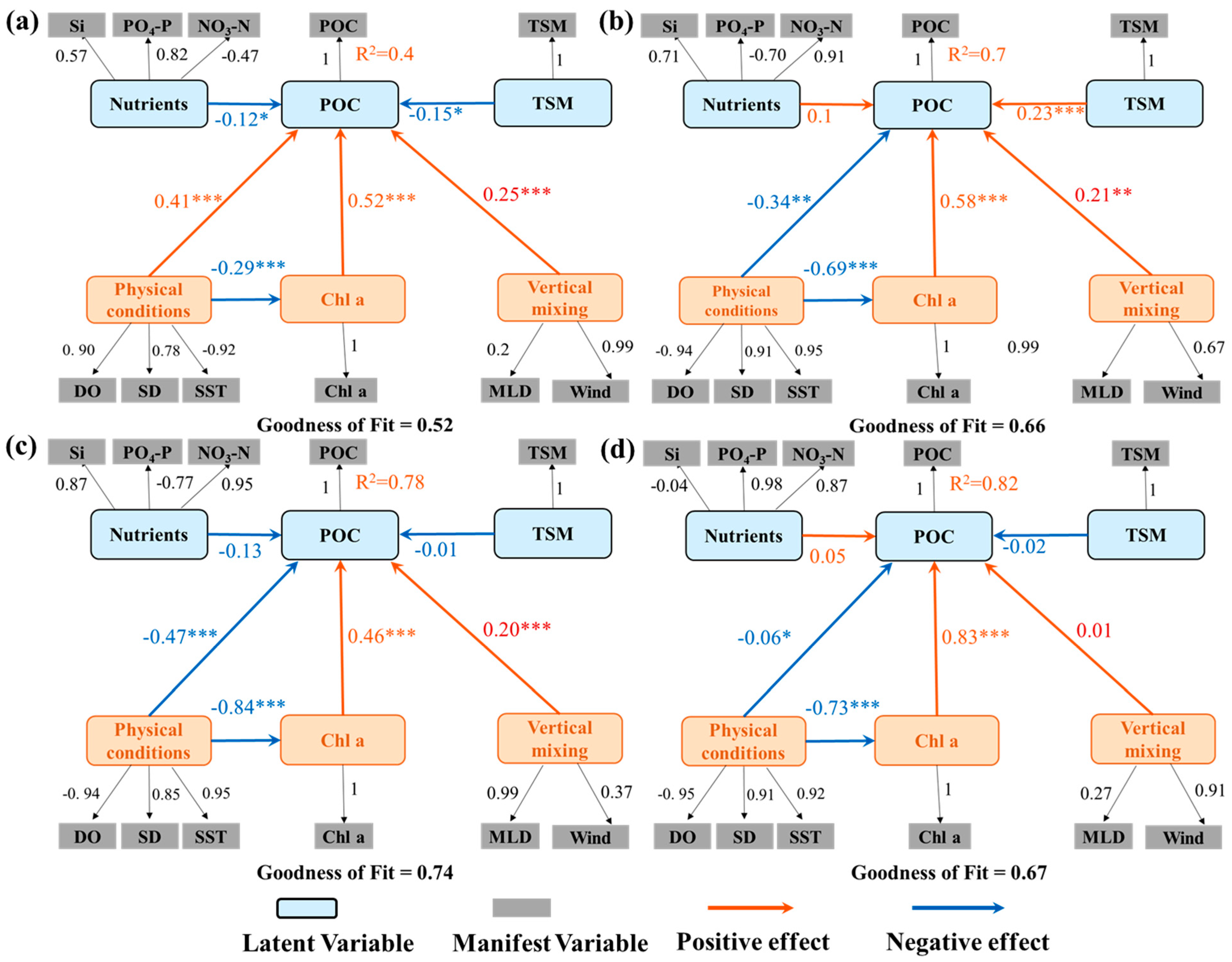
PLS-PM incorporates five latent variables, each with its corresponding observed indicators. Physical Water Conditions are indicated by DO, SD, and SST. Vertical Mixing is indicated by MLD and wind speed. Nutrients are indicated by NO3-N, PO4-P, and Si. TSM is indicated by its concentration. Finally, POC and Chl-a are jointly indicated by satellite-derived surface POC and Chl-a concentrations. All observed variables were standardized using Z-scores to eliminate dimensional effects. Monthly mean values were employed as the temporal scale, and missing values were retained as originally observed. Regional averages were calculated via area-weighted averaging to ensure the spatial representativeness of statistical outcomes. Model evaluation was conducted by assessing the explanatory power of each latent variable through its respective R2 value, while the overall reliability of the model was evaluated by calculating the goodness-of-fit (GoF) index.

2.3.5. Budget Processes

Riverine Input
The study considered major rivers discharging into China’s marginal seas, with particular focus on those exerting significant influences. Riverine POC flux was estimated based on long-term hydrological data and monitored POC concentrations. The flux was calculated by multiplying the average annual river discharge by the POC concentration at the river mouth:
P O C % =   0.16 lg C T S S 3 + 2.83 lg C T S S 2 13.6 lg C T S S + 20.3
F P O C = Q r i v e r × C T S S × P O C %
POC% represents the mass fraction of POC contained in total suspended solids [41]. Equation (6) estimates the riverine POC flux entering the Bohai Sea, Yellow Sea, and East China Sea, where F P O C represents the POC flux (Tg C yr−1), C T S S is the mass concentration of suspended sediment (mg L−1) and Q r i v e r is the multi-year average river discharge (m3 yr−1).
Water Exchange and Cross-Shelf Carbon Transport
The exchange flux between marine regions was calculated by multiplying the average POC concentration in the water body by the annual exchange volume of the water masses:
F j = C j × Q j  
In this equation, F j represents the interregional POC exchange flux (Tg C yr−1), C j is the average POC concentration in the exchanged water body (mg L−1), and Q j denotes the annual volume of exchanged water (m3 a−1).
Sedimentary Burial and Resuspension
The POC fluxes related to sedimentation and resuspension in China’s marginal seas were estimated based on suspended particle settling rates and surface area [42]. The calculation formulas are as follows:
F s = S × C C × D R × ρ × 1 r w × 1000
F r = C C × R s × S
where F s represents the annual POC flux from the water column to the sediments (Tg C yr−1), S is the area of the sea (km2), C C is the POC content in the surface sediments (%), D R is the sedimentation rate of suspended particulate matter (cm a−1), r w is the water content of surface sediments (%), ρ is the density of sediments, R s represents the sediment resuspension rate, and   F r denotes the resuspension flux of POC.
Budget Estimation
Before estimating the budget of POC, it was essential to evaluate the water mass balance in China’s marginal sea, as the accuracy of water balance directly influenced the reliability and precision of the POC budget. Terrestrial runoff primarily referred to riverine input. According to statistics, the annual riverine discharge into the Bohai and Yellow Seas was approximately 2.54 × 10¹¹ m3 a−1 [43]. The water exchange between the East China Sea and Yellow Sea included an inflow of 6.66 × 10¹² m3 a−1 and an outflow of 6.89 × 10¹² m3 a−1, respectively [43]. The precipitation and evaporation in the Bohai Sea were estimated at 4.47 × 10¹⁰ m3 a−1 and 8.47 × 10¹⁰ m3 a−1, respectively, while in the Yellow Sea, the values were 3.73 × 10¹¹ m3 a−1 and 3.03 × 10¹¹ m3 a−1 [44]. In the East China Sea, the riverine input was 8.83 × 10¹¹ m3 a−1, and the net exchange from precipitation and evaporation was 9.15 × 10¹¹ m3 a−1 [45]. The Kuroshio Current contributed an inflow of approximately 4.26 × 10¹³ m3 a−1, while the TWC added 5.17 × 10¹³ m3 a−1, and the Tsushima Warm Current exported about 9.55 × 10¹³ m3 a−1 [46].
Overall, the regional water budget remained largely balanced. This study adopted a zero-dimensional box model framework to estimate the POC budget in China’s marginal sea. The budget focused on the dynamics of POC in water bodies, taking into account both external and internal sources, such as riverine inputs, atmospheric deposition, autochthonous PP water body inflow, sediment resuspension, sinks, exports from water bodies, sediment burial, and respiratory depletion.

3. Results and Discussion

3.1. Spatial Variability Characteristics

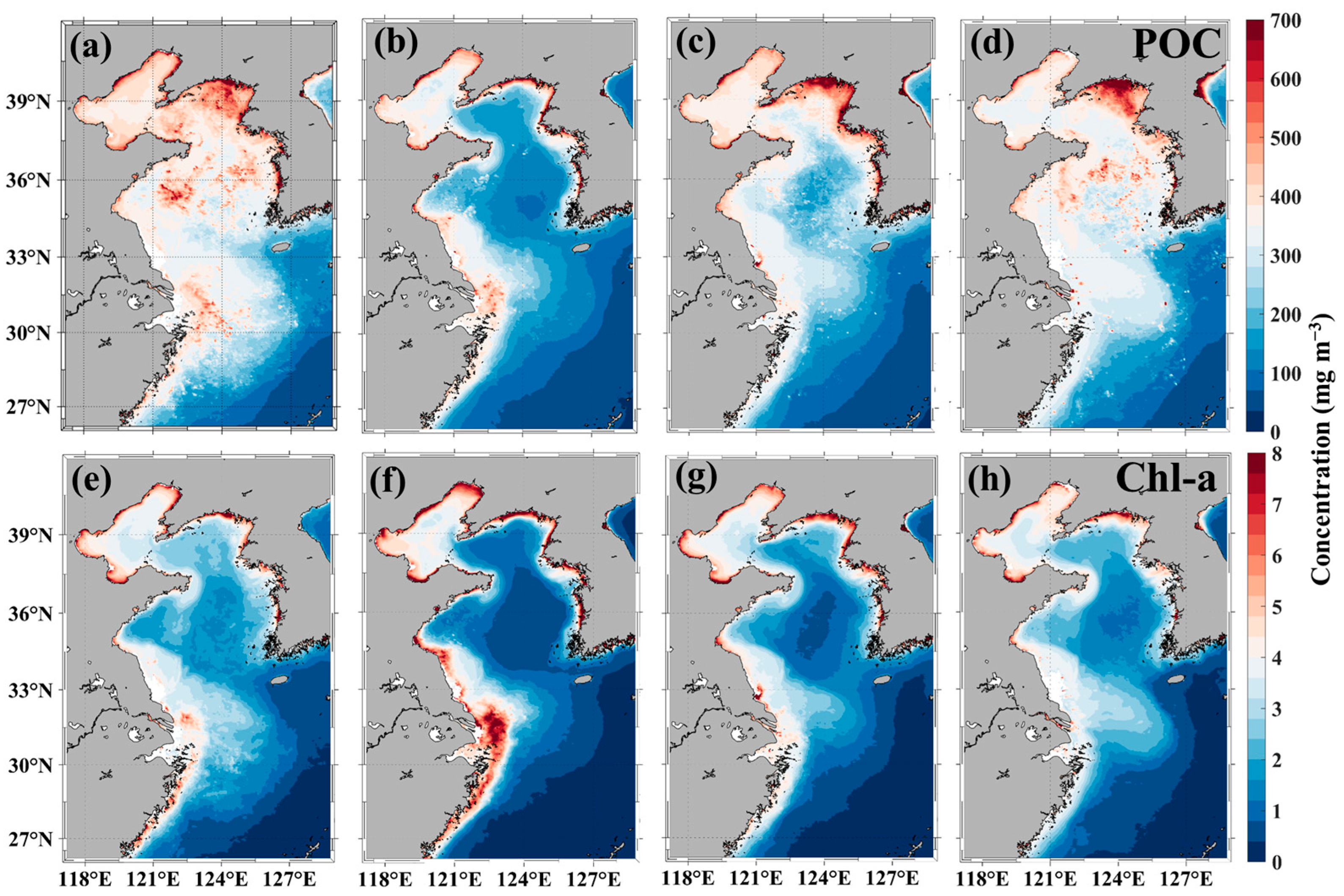
As shown in Figure 2, POC concentrations across China’s marginal seas exhibit pronounced spatial variation and spatial heterogeneity. It is evident that the POC concentration follows the order: Bohai Sea > Northern Yellow Sea > Southern Yellow Sea > East China Sea. The POC concentrations in coastal waters are higher than those in the central sea areas, gradually decreasing from the coast toward the open sea. Additionally, POC levels exhibit a general increasing trend from southern to northern regions across the marginal seas. Previous studies show that PP significantly influences POC levels in coastal waters [47]. The Bohai Sea receives substantial nutrient input from terrestrial sources, which enhances PP. The spatial distribution of POC is affected by multiple processes, including riverine input, sediment resuspension, and water exchange with adjacent seas [48]. The low POC values observed in the East China Sea, particularly near Okinawa, are mainly attributed to the influence of the Kuroshio Current [1]. In contrast, the coastal region of the East China Sea exhibits relatively high POC concentrations due to nutrient input from the Yangtze River estuary and coastal upwelling, which stimulate phytoplankton growth [49]. Studies show that the spatial distribution of PP in the East China Sea closely resembles that of POC [47]. The Bohai Sea and Southern Yellow Sea exhibit higher PP compared to other areas, consistent with the spatial pattern of POC concentrations [50].
As summarized in Table S3 (Supplementary Material), POC concentrations average 382.22, 372.20, 295.74, and 161.75 mg m−3 in the Bohai Sea, Northern Yellow Sea, Southern Yellow Sea, and East China Sea, respectively, from 2003 to 2024. Over the study period, the cumulative-difference analysis shows that the total magnitude of interannual spatial variation in POC reaches 18.35, 73.08, 73.07, and 11.60 mg m−3 in the Bohai Sea, Northern Yellow Sea, Southern Yellow Sea, and East China Sea, respectively. The observed decrease in POC concentrations in China’s marginal seas likely reflects a reduction in PP, which may lead to decreased phytoplankton biomass [51]. POC has been an important component of the carbon cycle in marine waters, and the process of sedimentation is an important pathway for oceanic carbon sequestration [28]. Decreasing POC concentrations may weaken oceanic CO2 uptake, affecting the global carbon cycle [52]. Spatial heterogeneity, as measured by CV, differs substantially among regions. The Bohai Sea exhibits the lowest heterogeneity (mean CV = 0.05), indicating a relatively stable and uniform POC distribution. In contrast, the Northern Yellow Sea shows the highest heterogeneity (mean CV = 0.16), reflecting the most spatially variable and dynamic POC distribution patterns.

3.2. Seasonal Variation in POC Concentration

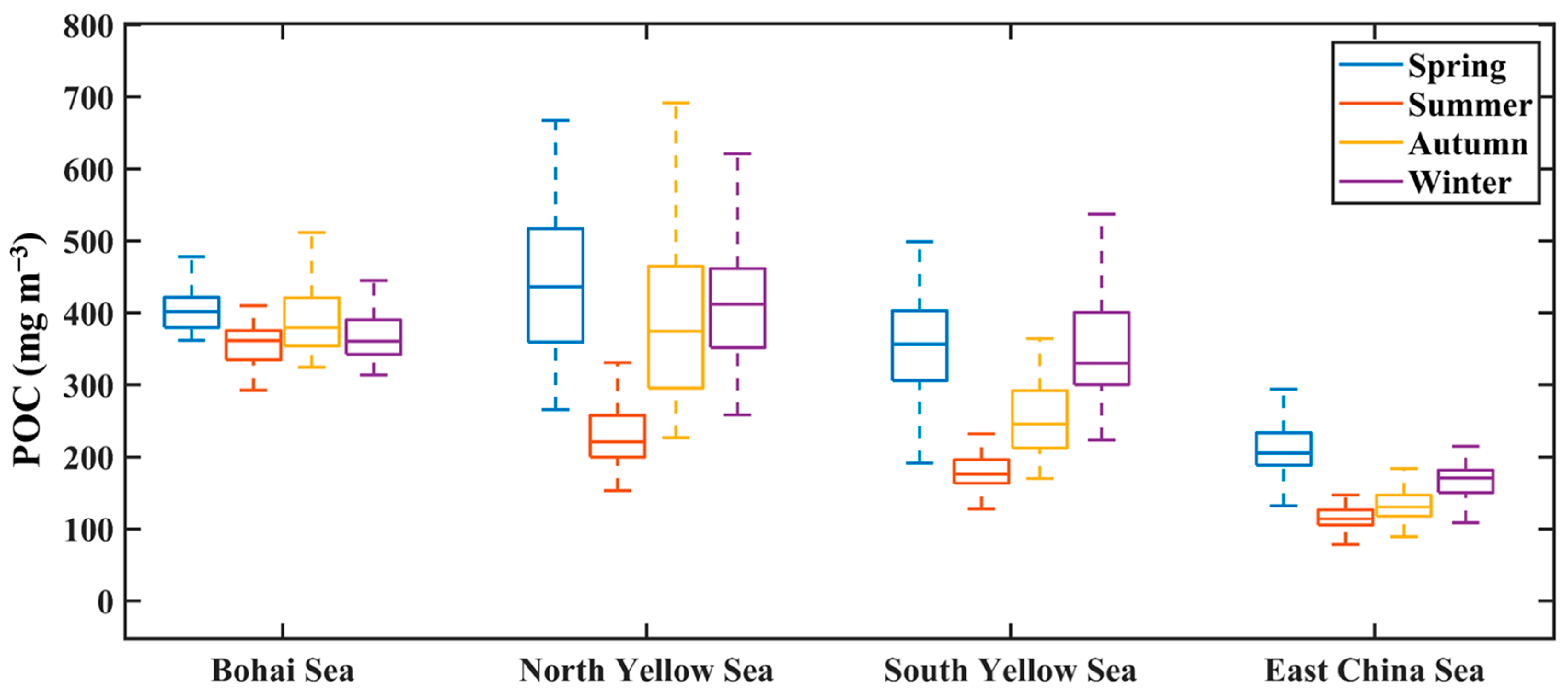
The data clearly demonstrate that POC concentrations in China’s marginal seas peaked during spring, while the Bohai Sea maintained consistently high levels throughout the year (Figure 3). The most pronounced seasonal fluctuations occurred in the central Yellow Sea and the extensive Yangtze River estuary confluence zone. The most pronounced seasonal variation in POC concentrations was observed in the Yellow Sea, whereas the Bohai Sea exhibited relatively minimal changes. Across the four marginal seas, POC concentrations generally exhibited higher values in spring and lower values in summer. The seasonal variation pattern is more pronounced in the Yellow Sea and East China Sea than in the Bohai Sea, where POC concentrations are relatively stable throughout the year. The Bohai Sea exhibited a seasonal pattern of POC concentration with spring > autumn > winter > summer, while the North Yellow Sea followed the order of spring > winter > autumn > summer. In contrast, the South Yellow Sea demonstrated a distinct winter > spring > autumn > summer sequence. The East China Sea shared a similar seasonal trend with the North Yellow Sea, showing spring > winter > autumn > summer in POC concentration levels.
Although the Bohai Sea lacks a cold water mass, its declining trend of POC in summer aligns with that of the Yellow Sea, suggesting that the seasonal variations in both sea areas are primarily governed by common regional processes. During summer, distinct seasonal stratification develops in both regions. The rapid consumption of surface nutrients by phytoplankton blooms, followed by nutrient depletion and enhanced grazing by zooplankton, collectively leads to a continuous decline in surface biogenic POC [7]. In the central Southern Yellow Sea, the YSCWM intensifies this process by reinforcing the stability of the summer thermocline, thereby suppressing vertical nutrient supply. Research indicates that phytoplankton bloom outbreaks in this region might have been closely linked to the maturation and dissipation of the YSCWM [53]. The YSCWM matured in summer and dissipated in winter, a pattern consistent with the development of the seasonal thermocline [54]. During summer, nutrients are extensively consumed by phytoplankton, and the thermocline restricts vertical nutrient transport to the upper layer. Additionally, zooplankton grazing contributes to a rapid decline in surface Chl-a concentrations, ultimately leading to low summer POC levels [55]. In winter, POC increases without a corresponding rise in Chl-a, primarily due to enhanced resuspension and upward transport of POC from the seabed [47]. Horizontal transport of suspended particulate matter is also observed in the Yellow Sea during winter [56]. Therefore, the presence of the YSWC and the YSCWM plays a key role in controlling phytoplankton biomass and community structure, thus driving the seasonal variability of POC in the region [57].
Minimum values in the East China Sea are mainly located around the Okinawa Trough, under the influence of the Kuroshio Current. Coastal regions exhibit relatively high values, primarily attributed to the synergistic effects of primary productivity, terrestrial runoff, and physical processes. The highest POC concentrations are recorded in spring, resulting from elevated nutrient inputs from terrestrial sources and upwelling, which enhance biological activity and consequently increased POC levels [58]. Although river discharge increases during summer, introducing more terrestrial POC into coastal areas, the overall POC concentration decreases [59]. Significant freshwater input strengthens stratification, which inhibits the exchange of nutrients and oxygen between layers [60]. Nutrient limitation restricts phytoplankton growth, while consumption by zooplankton and bacteria further contributes to the reduction in POC concentration [61]. Nevertheless, relatively high POC levels are still observed in the eastern Changjiang (Yangtze) Estuary, likely due to sustained terrestrial input and increased sediment resuspension caused by monsoon activity [62]. In winter, elevated POC values in certain areas of the eastern Changjiang Estuary are associated with sediment resuspension driven by the northeastern monsoon [49].

3.3. Interannual Variability

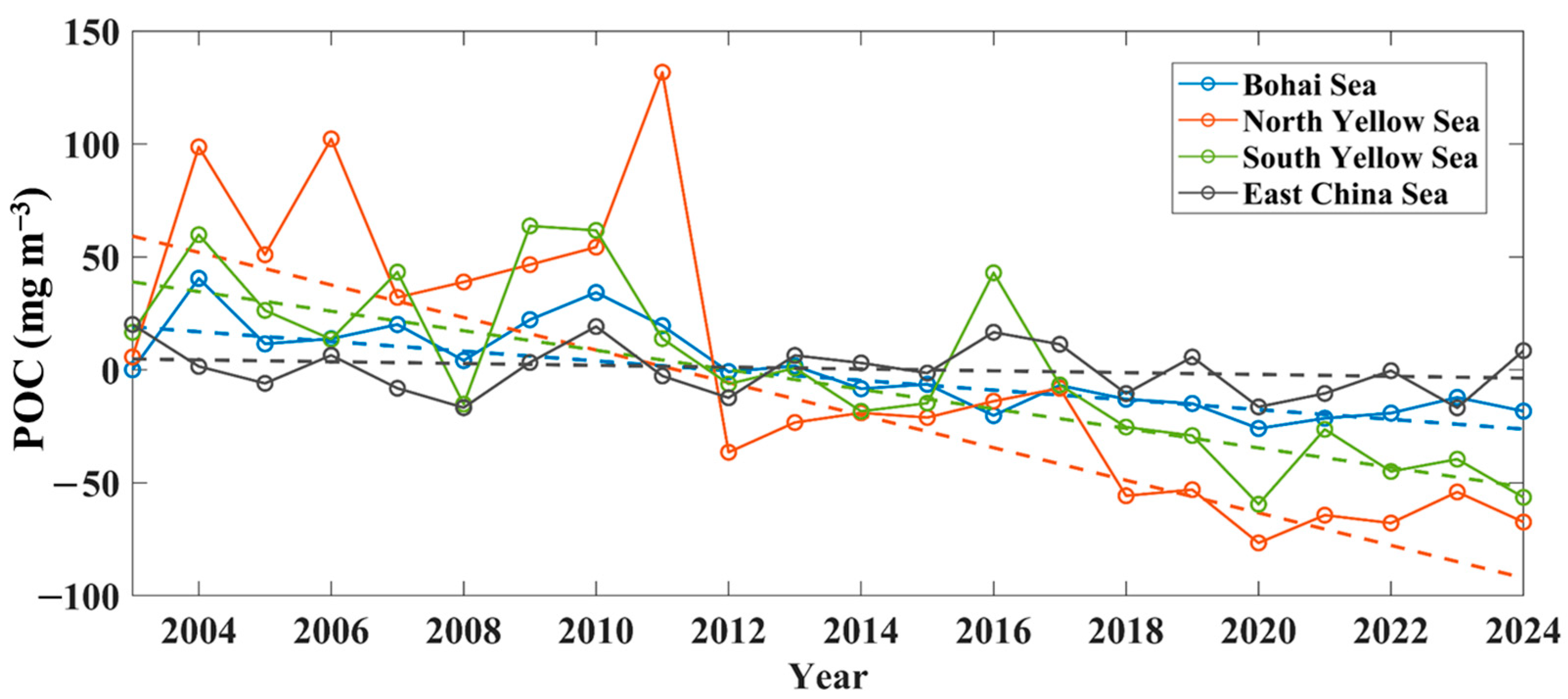
Figure 4 shows the interannual variations in POC concentration anomalies in the marginal seas of China during the 2003–2024 period. After removing the seasonal cycle, the Mann–Kendall test indicates a significant decreasing trend in POC for all four regions (Table S4). The Sen’s slope estimates are −0.16, −0.58, −0.29, and −0.04 mg·m−3·month−1 for the Bohai Sea, North Yellow Sea, South Yellow Sea, and East China Sea. The Z-values ranged from −2.30 to −9.29, and p-values were all below 0.05, confirming the trends are statistically significant. Figure S2 reveals that the POC concentration exhibits seasonal periodicity. POC concentrations show a distinct latitudinal gradient, progressively decreasing from the Bohai Sea to the Yellow Sea and finally to the East China Sea. The decline is most pronounced in the northern Yellow Sea. The surface POC in the Yellow Sea displays both stable interannual and seasonal variation patterns. The annual mean POC concentration peaked in 2011 and reached its lowest level in 2024. Under the context of global warming, anomalous ocean temperature events are observed in Chinese coastal waters [63]. Overall, SST shows an increasing trend, which may have contributed to the observed decline in POC concentrations. A concurrent decline in nutrient levels across Chinese seas may have contributed to diminished phytoplankton biomass during this period [64,65]. In the Yellow Sea, the interannual variability of POC shows a significant negative correlation with SST anomaly (r = −0.665, p < 0.001), while it exhibits a significant positive correlation with PO4 anomaly (r = 0.403, p < 0.001). In the East China Sea, this relationship pattern similarly holds: POC anomaly is significantly negatively correlated with SST anomaly (r = −0.668, p < 0.001) and significantly positively correlated with PO4 anomaly (r = 0.425, p < 0.001). These results support the hypothesis that regional warming and nutrient depletion collectively contribute to the decline in POC.
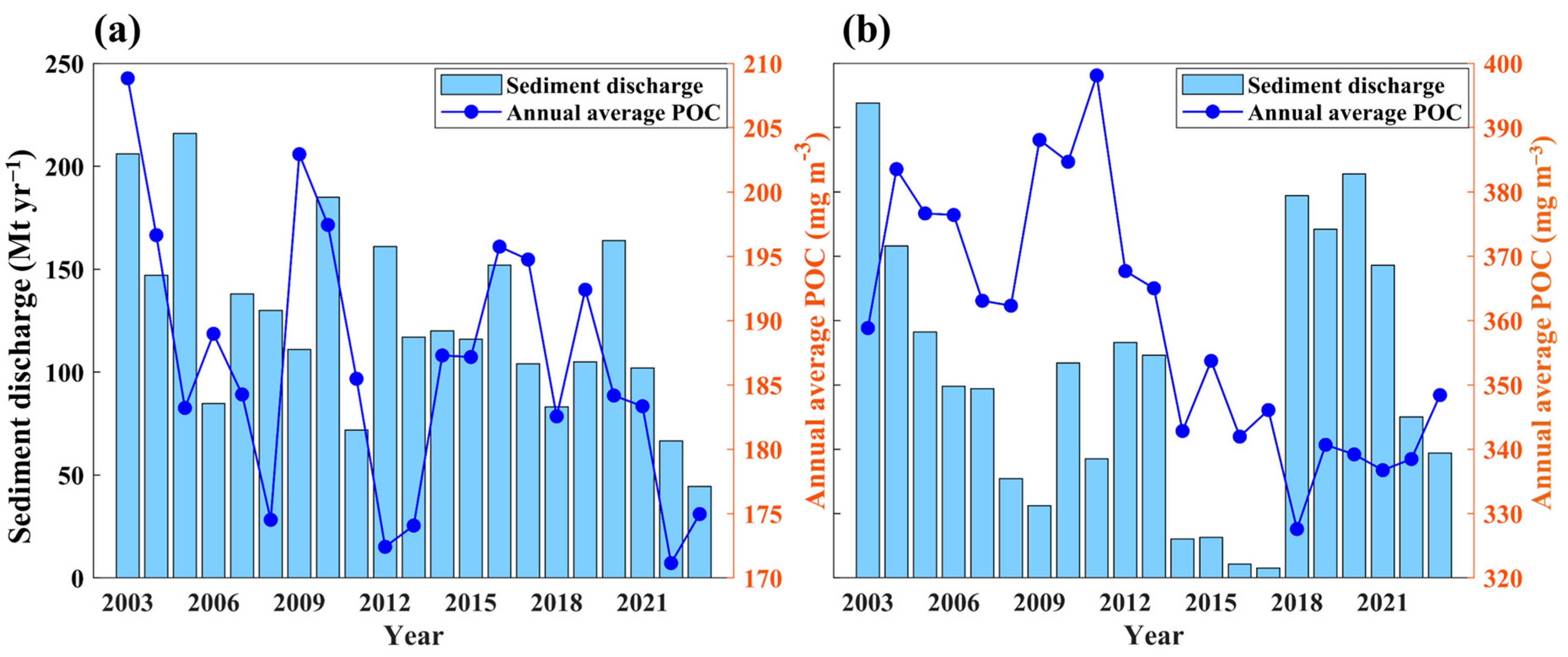
Analysis of POC fluxes in major rivers flowing into the Bohai Sea and Yellow Sea reveals that coastal POC concentrations are likely influenced by both terrestrial inputs and phytoplankton productivity [66,67]. As shown in Figure 5, the sediment discharge of the Yellow River exhibits a downward trend, accompanied by a similar decline in POC concentrations. This highlights the combined influence of riverine sediment input, suspended matter, water exchange processes, and biological activity on POC variability [10,11,68]. In the East China Sea, POC concentrations are highest in spring. Nutrient input from river discharge and upwelling enhances biological productivity, thereby increasing POC levels [26]. The construction of the Three Gorges Dam has led to a marked decline in sediment transport from 2003 to 2017 [69], resulting in a notable decrease in coastal POC concentrations. In coastal regions, POC variability was largely controlled by sediment transport rather than PP [70]. The findings suggest that terrestrial input from rivers was a factor influencing nearshore POC concentrations to some degree [71].
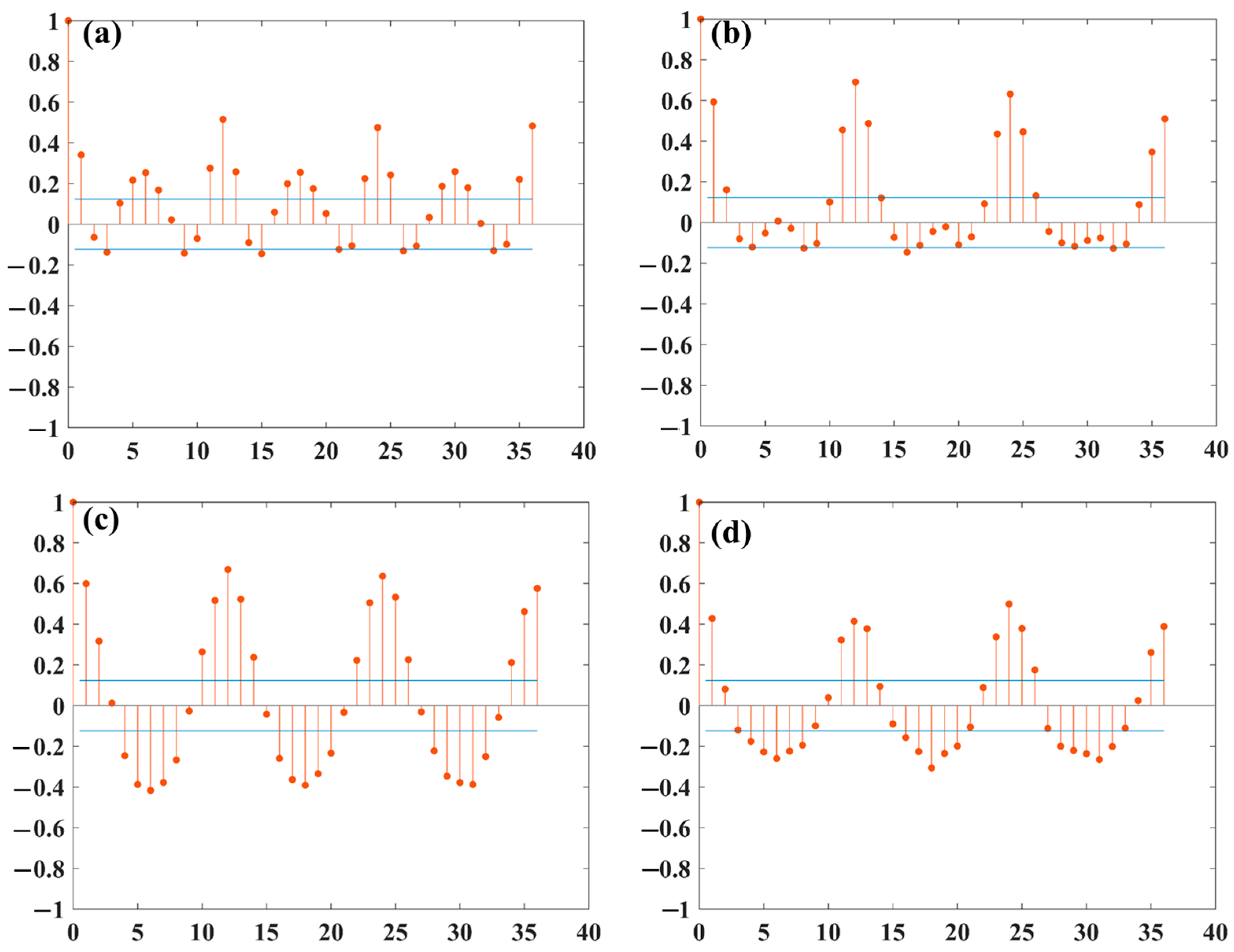
To further investigate the periodic characteristics of POC concentration variations, an ACF is employed for analysis. As shown in Figure 6, the ACF of the POC concentration time series in the Yellow Sea exhibits a clear periodic pattern. The symmetrical curve of the function, with prominent peaks at specific lags, and the autocorrelation coefficients gradually decline, indicating a certain degree of temporal persistence. Although similar periodicity could be observed in other regions, it was most pronounced in the South Yellow Sea. This pattern may be regulated by seasonal physical processes such as water mass exchange, wind-driven mixing, and biological processes such as phytoplankton growth cycles [54,64,72]. In contrast, the Bohai Sea shows overall lower autocorrelation coefficients, lacking a distinct periodic signal. This suggests that POC concentration variability in this region is more stochastic, potentially influenced by its semi-enclosed geography, complex anthropogenic disturbances, and fluctuating riverine inputs [19]. Notably, significant water quality anomalies are observed in both the Bohai Sea and the northern Yellow Sea in 2010. An oil spill incident occurs in Bohai Bay, underscoring the role of environmental and anthropogenic factors in shaping POC dynamics [65]. The East China Sea, by comparison, demonstrated more stable interannual variation, which may be attributed to its larger spatial extent and lower latitudinal location. The relatively small size and high human activity intensity in the Bohai Sea, along with pronounced temperature fluctuations, likely contribute to the greater interannual variability in POC concentrations observed in this region [73].

3.4. Impact of Climate Variability on POC

Research indicates that El Niño events may weaken the East Asian monsoon [74]. A weakened East Asian monsoon can subsequently lead to a reduction in the intensity of the YSWC and a decrease in water exchange capacity between the Bohai Sea, Yellow Sea, and East China Sea [54]. In addition to ENSO, the PDO also influences the East Asian monsoon; during the warm phase of the PDO, the winter monsoon tends to weaken [75]. Both ENSO and PDO likely modulate the East Asian monsoon, thereby influencing the dynamic distribution patterns of surface POC in the open-ocean regions of China’s marginal seas. The NPGO also modulates physical and biogeochemical processes across the northwest Pacific marginal seas on interannual timescales [76].
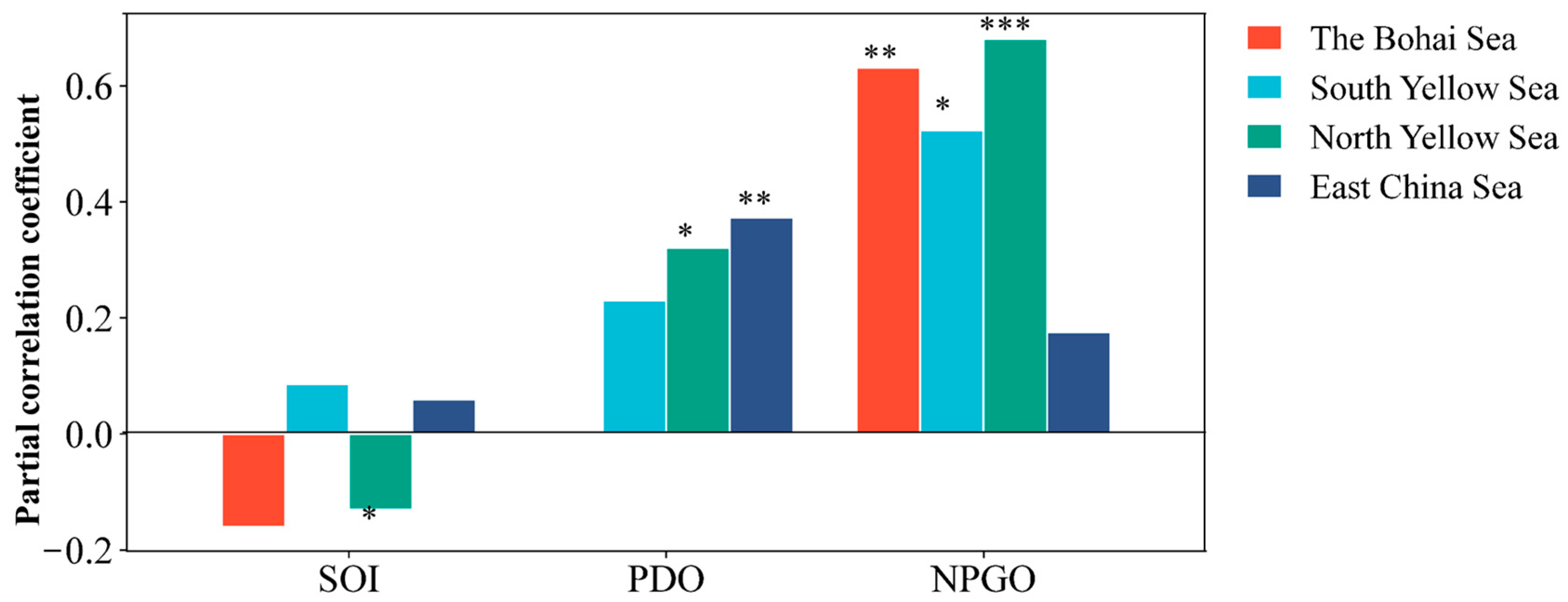
To explore the potential linkages between large-scale climate variability and surface POC, we analyze the statistical relationship between POC and three major climate indices: PDO, NPGO, and SOI (Figure 7). All variables are first converted into monthly anomalies by removing the long-term climatological monthly means and the linear trend over 2003–2024. Partial correlation coefficients are calculated using monthly POC anomalies and corresponding climate index anomalies. The interannual variations in the PDO, NPGO, and SOI indices are shown in Figure S3. The results indicate that POC concentration is positively correlated with the PDO and NPGO indices, and negatively with the SOI. Among these, NPGO shows the strongest partial correlation with POC concentration, particularly in the Yellow Sea region. These relationships suggest that interannual POC variability is statistically associated with large-scale ocean–atmosphere processes. To elucidate the underlying mechanisms, further research incorporating process-based modeling and sustained in situ observations is required.

3.5. Impact of Environmental Factors on POC

The PLS-PM analysis (Figure 8) is employed to explore the statistical relationships and potential pathways through which environmental factors are associated with POC concentrations in China’s marginal seas. In the Bohai Sea region, the model’s explanatory power is relatively weak, which may be related to anthropogenic influences and riverine inputs. The model’s ability to explain POC variations gradually strengthens from the Bohai Sea to the East China Sea. This difference is attributed to the complexity of the marine ecosystems as well as inputs from human activities, terrestrial sources, and biological processes in these sea areas [24,30,77]. Notably, the model performs better in biologically driven systems. Among all drivers, Chl-a exhibits the most pronounced positive statistical association with POC. This suggests that increased phytoplankton biomass is consistently linked to higher surface POC concentrations. In contrast, vertical mixing demonstrates uniformly weak path coefficients across regions, implying its role as a secondary physical factor rather than a primary driver for POC in this statistical framework.
The physical water environment consistently exerts negative effects on Chl-a. This implies that physical conditions likely suppress phytoplankton biomass through altered light availability, water column stability, or physiological stress, thereby indirectly modulating POC concentrations [5]. Nutrients show limited direct effects on POC, instead operating primarily through the mediation of physical conditions and ecological processes. In summary, the PLS-PM results indicate that phytoplankton biomass (represented by Chl-a) shows a consistent positive statistical linkage with POC across all four sea regions. In contrast, physical environmental conditions are statistically associated with reduced Chl-a levels. Nutrient influences are primarily indirect, while physical processes such as vertical mixing and TSM exert relatively weak and regionally dependent effects [18].
To further investigate the relationship between PP and POC, analysis of observational data reveals a decline in primary productivity within China’s marginal seas over the past two decades [51]. This declining trend is identified as the principal driver governing interannual variability in POC concentrations. Under global warming, abnormal SST anomalies are observed in these regions, accompanied by a significant warming trend. Interannual variations in POC concentrations show an opposite trend to sea temperature changes, suggesting that increased seawater temperature may lead to decreased POC levels [1]. Furthermore, between 2009 and 2018, a decrease in nutrient availability in China’s marginal seas likely constrains phytoplankton growth, thereby reducing primary productivity and ultimately leading to a decline in POC concentrations [65,78]. In summary, the seasonal variability of POC in China’s marginal seas is collectively regulated by multiple interacting factors, including PP, riverine inputs, sediment resuspension, water exchange processes, and cold water mass intrusions. These interacting factors collectively shape the seasonal distribution patterns of POC in China’s marginal seas.

3.6. China Marginal Sea POC Budget Process

3.6.1. Riverine Input

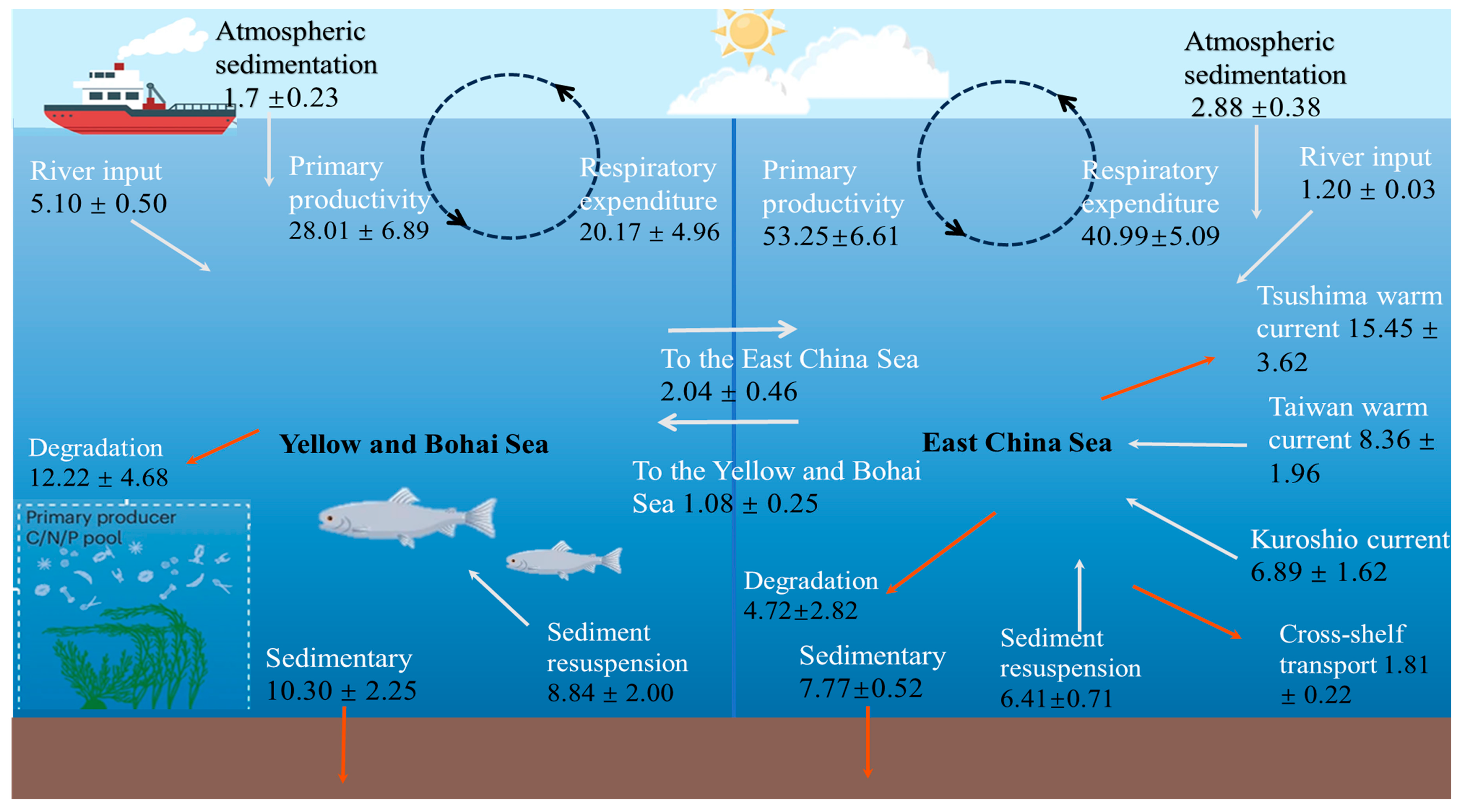
Based on data from the Chinese River Sediment Bulletin, the long-term average river discharge from major rivers such as the Yangtze can be determined. According to previous studies, the estimated POC flux to the East China Sea is 1.20 ± 0.03 Tg C yr−1 [79]. The total riverine POC flux entering the Bohai and Yellow Seas is approximately 5.10 ± 0.50 Tg C yr−1 [25]. The global riverine flux of organic carbon to the ocean is estimated at 462 Tg C yr−1 [25], with rivers discharging into the Yellow Sea and Bohai Sea contributing approximately 1.3% of this total flux.

3.6.2. Water Exchange and Cross-Shelf Carbon Transport

Table S3 indicates an average POC concentration of 161.75 ± 37.90 mg m−3 in the East China Sea, compared to 295.74 ± 66.36 mg m−3 in the southern Yellow Sea. Calculations based on water exchange volumes show a POC flux of 1.08 ± 0.25 Tg C yr−1 from the East China Sea to the Yellow Sea, while the reverse flux is 2.04 ± 0.46 Tg C yr−1. The Kuroshio delivers an estimated 6.89 ± 1.62 Tg C yr−1 of POC into the East China Sea annually, while the TWC contributes approximately 8.36 ± 1.96 Tg C yr−1. The annual average POC flux from the East China Sea to the Tsushima Warm Current is 15.45 ± 3.62 Tg C yr−1. The cross-shelf carbon transport flux in the East China Sea is estimated to be 1.81 ± 0.22 Tg C yr−1 based on carbon concentration observations and simulations from an ocean–atmosphere coupled model [27].

3.6.3. Atmospheric Deposition

The surface area of the East China Sea is approximately 7.7 × 10⁵ km2, and that of the Bohai and Yellow Seas is about 4.57 × 10⁵ km2. Data on atmospheric dry and wet deposition are obtained from seasonal observations at Qianliyan Island (Yellow Sea) and the Shengsi Archipelago (East China Sea), respectively [80]. The carbon-to-nitrogen ratio (C/N) is assumed to be 6.9 [72]. The atmospheric wet deposition flux ranges from 7.65 ± 0.64 mg C m−2 d−1, while the dry deposition flux ranges from 2.6 ± 0.71 mg C m−2 d−1. The total atmospheric deposition flux was as follows: 1.7 ± 0.23 Tg C yr−1 in the Bohai and Yellow Seas, and 2.88 ± 0.38 Tg C yr−1 in the East China Sea.

3.6.4. PP and Respiratory Consumption

PP in China’s marginal seas is extensively studied [2,58]. It is found that approximately 26% of carbon fixed through photosynthesis is released from cells in the form of DOM. Therefore, it is assumed that 74% of PP is fixed as POC. Studies report that the export ratio of POC in the Yellow Sea is estimated to be 2.0–0.4 [29]. This finding is consistent with the observation that 77% of PP in the Bohai Sea is consumed through respiration. PP in the Yellow and Bohai Seas ranges from 472.5 ± 29.16 mg m−2 d−1 [2]. The fixed POC flux was 28.01 ± 6.89 Tg C yr−1, and the flux consumed by respiration was 20.17 ± 4.96 Tg C yr−1. In the East China Sea, PP ranges from 544.5 ± 18.52 mg m−2 d−1 [81]. The fixed POC flux was 53.25 ± 6.61 Tg C yr−1, and the flux consumed by respiration was 40.99 ± 5.09 Tg C yr−1.

3.6.5. Sedimentation and Sediment Resuspension

The combined burial flux for the Bohai and Yellow Seas is estimated at 10.30 ± 2.25 Tg C yr−1. The relevant sediment parameters are presented in Table S5. The vertical transport of marine organic carbon is dominated by POC. Approximately 1000 × 108 tons of organic carbon is produced by photosynthesis in the global marine surface layer each year, with 5–15% of it transported to the deep ocean [82]. The resuspension flux of POC from surface sediments to the water column in the Bohai and Yellow Seas is estimated at 8.84 ± 2.00 Tg C yr−1. The particulate matter in bottom waters is predominantly derived from sediment resuspension. In the Jordan Basin of the Gulf of Maine, approximately 82% of the POC in bottom waters originates from resuspension at the sediment-water interface [83]. A sedimentary organic carbon burial flux of 7.77 ± 0.52 Tg C yr−1 is recorded on the East China Sea continental shelf [84]. In the East China Sea, the resuspension flux of POC from sediments to the water column is estimated at 6.41 ± 0.71 Tg C yr−1.

3.6.6. Degradation and Transformation of POC

In addition to the statistical errors associated with the model, the degradation and transformation of organic carbon (including biodegradation and photochemical oxidation, among other processes) should also be taken into account. In certain estuarine and coastal regions, these processes represent significant pathways for the consumption of marine organic carbon [85,86]. Compared to the open ocean, the Yellow Sea and Bohai Sea exhibit higher concentrations of organic carbon, which is predominantly composed of terrestrial and newly produced labile or semi-labile organic carbon. Consequently, these regions demonstrate relatively higher organic carbon degradation rates. Over 90% of the organic carbon undergoes degradation and/or remineralization within the water column or surface sediments [84]. The degradation fluxes of POC in the Yellow and Bohai Seas and the East China Sea are 10.57 ± 4.68 Tg C yr−1 and 4.72 ± 2.82 Tg C yr−1, respectively.

3.6.7. Net Budget Analysis

The annual total input and output fluxes of POC in the Bohai and Yellow Seas are closely balanced (Figure 9). PP accounts for 62.7 ± 6.5% of the total POC input, indicating that algal production was the dominant contributor to POC fluxes, which is consistent with previous estimates. Resuspended sediments contribute approximately 20%, while riverine input, atmospheric deposition, and water exchange collectively account for less than 17%. Respiration and sedimentation are identified as the major output pathways in the Bohai and Yellow Seas, representing 45.1 ± 8.0% and 23.0 ± 5.2% of the total POC export, respectively. In the East China Sea, PP accounts for 65.7 ± 10.1% of the total POC input, while the contribution of suspended sediments was approximately 8%, with the TWC and the Kuroshio Current contributing 10% and 8%, respectively. Respiration and the Tsushima Warm Current are identified as the primary export pathways, representing 57.1 ± 8.9% and 21.5 ± 5.4% of the total POC export, respectively.
Tidal and wind-driven currents are the primary factors influencing water transport and exchange in marginal seas [73]. Affected by wind and tidal forces, the half-life of water exchange exhibits a variability of 47% [87]. Therefore, the uncertainty associated with water exchange was set at 50% in this study. Uncertainties in POC flux estimates derived from PP are attributed to interannual and seasonal dynamics, as well as phytoplankton-derived DOM release. Significant interannual and seasonal variability in POC fluxes from PP is observed, ranging between 20% and 30% [2]. In different marine systems, the proportion of DOM released during PP is estimated to be between 3.4% and 31.7% [88]. These two factors collectively contribute to an uncertainty of up to 50% in the calculation of POC fluxes derived from PP.
This study performs a Monte Carlo uncertainty analysis with 10,000 iterations. Based on the observed ranges and reported uncertainties of individual flux terms, corresponding probability distributions are assigned. This enables a systematic assessment of the cumulative effects of multi-source errors in the regional POC budget. The results show that in the Bohai–Yellow Sea region, the mean total input flux is 46.77 Tg C yr−1 with a standard deviation of 7.36 Tg C yr−1, corresponding to a 95% confidence interval of 34.58–59.00 Tg C yr−1. The mean output flux is 33.54 ± 5.68 Tg C yr−1, with a 95% confidence interval of 24.23–43.02 Tg C yr−1. In the East China Sea, the total input flux is 75.03 ± 13.48 Tg C yr−1, with a corresponding 95% confidence interval ranging from 52.88 to 97.18 Tg C yr−1. The total output flux in this region is 57.05 ± 10.62 Tg C yr−1, and its 95% confidence interval is 39.21–74.38 Tg C yr−1. These ranges indicate an overall uncertainty of approximately 25–35% in the POC budgets of each region. Future efforts should focus on strengthening the observation and quantitative characterization of PP variability, resuspension dynamics, and physical exchange processes to reduce systematic errors in future carbon budget estimates for marginal seas.

4. Conclusions

This study presents a comprehensive analysis of POC dynamics in the Chinese marginal seas from 2003 to 2024, revealing distinct spatiotemporal patterns and underlying drivers. The multi-year average surface POC concentration is 302.97 mg m−3, with the highest levels in the Bohai Sea and the lowest in the East China Sea. A pronounced overall declining trend is observed, which is associated with the decrease in PP. The North Yellow Sea experiences the most pronounced decline and spatial variability. Autocorrelation analysis reveals periodic oscillations across all regions, with particularly pronounced fluctuations observed in the Yellow Sea. The dynamics of POC in the open waters of China’s marginal seas show statistical associations with large-scale climate modes, including ENSO, PDO, and NPGO. Budget calculations identify PP and respiratory consumption as the dominant input and output fluxes, respectively. The study provides a scientific basis for the management of carbon cycling in marginal seas under the context of carbon peak and carbon neutrality. Future research will integrate field observations and experiments to reduce uncertainties in POC flux estimates and improve the accuracy of carbon flux assessments in marginal seas.

Supplementary Materials

The following supporting information can be downloaded at https://www.mdpi.com/article/10.3390/rs18010092/s1, Figure S1: Remote sensing and in situ POC measurement: Scatter plot comparing the POC concentration obtained by remote sensing with that measured in situ. The blue line represents the linear regression fit. (a) Bohai Sea (b) Yellow Sea. Figure S2: The interannual variability of POC (mg m−3) over two-degree band for (a) the Bohai Sea–north Yellow Sea region (37.5°N–39.5°N) and the (b) South Yellow Sea (34.5°N–36.5°N) and East China Sea (c) (30°N–33°N). Figure S3: Temporal Evolution of the PDO, NPGO, and SOI in the Marginal Seas of China. Table S1: MODIS-Aqua POC product validation statistics. Table S2: Theil–Sen Median Trend Analysis and Mann–Kendall Test Classification for POC Changes in China’s Marginal Seas. Table S3: Average POC concentration in China’s sea areas over the period from 2003 to 2024, cumulative change in POC concentration, and time variation coefficient of POC concentration. Table S4: Theil–Sen Median Trend Analysis and Mann–Kendall Test for POC Changes in China’s Marginal Seas. Table S5: Parameters related to organic carbon deposition in the Chinese Marginal Sea [21,48,84,89,90].

Author Contributions

X.C.: Writing—review and editing, Writing—original draft, Validation, Methodology, Investigation, Conceptualization. G.H.: Writing—review and editing, Validation, Methodology, Investigation, Conceptualization. W.L.: Methodology, Funding acquisition. X.W.: Writing—review and editing, Supervision. H.W.: Writing—review and editing, Supervision. L.C.: Validation, Methodology, Investigation. G.Z.: Formal analysis. Q.Z.: Writing—review and editing, Validation. Y.Z.: Supervision, Visualization. Q.L.: Supervision, Visualization, Review and editing. All authors have read and agreed to the published version of the manuscript.

Funding

This research is cosponsored by grants from the National Natural Science Foundation (42376190 and 41876014) of China.

Data Availability Statement

Publicly available datasets were analyzed in this study. This data can be found at http://oceandata.sci.gsfc.nasa.gov/ (accessed on 20 August 2025).

Acknowledgments

We acknowledge the use of MODIS data provided by NASA. We also acknowledge the data support provided by “National Earth System Science Data Center, National Science & Technology Infrastructure of China” (http://www.geodata.cn).

Conflicts of Interest

The authors declare no conflicts of interest.

References

  1. Chen, D.; Zeng, L.; Boot, K.; Liu, Q. Satellite Observed Spatial and Temporal Variabilities of Particulate Organic Carbon in the East China Sea. Remote Sens. 2022, 14, 1799. [Google Scholar] [CrossRef]
  2. Jang, H.-K.; Youn, S.-H.; Joo, H.; Kim, Y.; Kang, J.-J.; Lee, D.; Jo, N.; Kim, K.; Kim, M.-J.; Kim, S.; et al. First Concurrent Measurement of Primary Production in the Yellow Sea, the South Sea of Korea, and the East/Japan Sea, 2018. J. Mar. Sci. Eng. 2021, 9, 1237. [Google Scholar] [CrossRef]
  3. Song, J.; Qu, B.; Li, X.; Yuan, H.; Li, N.; Duan, L. Carbon sinks/sources in the Yellow and East China Seas—Air-sea interface exchange, dissolution in seawater, and burial in sediments. Sci. China Earth Sci. 2018, 61, 1583–1593. [Google Scholar] [CrossRef]
  4. Zhao, B.; Yao, P.; Bianchi, T.S.; Arellano, A.R.; Wang, X.; Yang, J.; Su, R.; Wang, J.; Xu, Y.; Huang, X.; et al. The remineralization of sedimentary organic carbon in different sedimentary regimes of the Yellow and East China Seas. Chem. Geol. 2018, 495, 104–117. [Google Scholar] [CrossRef]
  5. Wang, S.; Gao, Y.; Jia, J.; Lu, Y.; Sun, K.; Ha, X.; Li, Z.; Deng, W. Vertically stratified water source characteristics and associated driving mechanisms of particulate organic carbon in a large floodplain lake system. Water Res. 2022, 209, 117963. [Google Scholar] [CrossRef]
  6. Najjar, R.G.; Herrmann, M.; Alexander, R.; Boyer, E.W.; Burdige, D.J.; Butman, D.; Cai, W.J.; Canuel, E.A.; Chen, R.F.; Friedrichs, M.A.M.; et al. Carbon Budget of Tidal Wetlands, Estuaries, and Shelf Waters of Eastern North America. Glob. Biogeochem. Cycles 2018, 32, 389–416. [Google Scholar] [CrossRef]
  7. Fan, H.; Wang, X.; Zhang, H.; Yu, Z. Spatial and temporal variations of particulate organic carbon in the Yellow-Bohai Sea over 2002–2016. Sci. Rep. 2018, 8, 7971. [Google Scholar] [CrossRef]
  8. Stramski, D.; Joshi, I.; Reynolds, R.A. Ocean color algorithms to estimate the concentration of particulate organic carbon in surface waters of the global ocean in support of a long-term data record from multiple satellite missions. Remote Sens. Environ. 2022, 269, 112776. [Google Scholar] [CrossRef]
  9. Yu, J.; Wang, X.; Fan, H.; Zhang, R.H. Impacts of Physical and Biological Processes on Spatial and Temporal Variability of Particulate Organic Carbon in the North Pacific Ocean during 2003-2017. Sci. Rep. 2019, 9, 16493. [Google Scholar] [CrossRef]
  10. Gao, Y.; Jia, J.; Lu, Y.; Yang, T.; Lyu, S.; Shi, K.; Zhou, F.; Yu, G. Determining dominating control mechanisms of inland water carbon cycling processes and associated gross primary productivity on regional and global scales. Earth Sci. Rev. 2021, 213, 103497. [Google Scholar] [CrossRef]
  11. Meng, L.; Zhao, Z.; Lu, L.; Zhou, J.; Luo, D.; Fan, R.; Li, S.; Jiang, Q.; Huang, T.; Yang, H.; et al. Source identification of particulate organic carbon using stable isotopes and n-alkanes: Modeling and application. Water Res. 2021, 197, 117083. [Google Scholar] [CrossRef] [PubMed]
  12. Chen, J.; Yang, H.; Zeng, Y.; Guo, J.; Song, Y.; Ding, W. Combined use of radiocarbon and stable carbon isotope to constrain the sources and cycling of particulate organic carbon in a large freshwater lake, China. Sci. Total Environ. 2018, 625, 27–38. [Google Scholar] [CrossRef] [PubMed]
  13. Son, Y.B.; Kim, E.; Cho, J.H.; Choi, S.K.; Kang, D. Analysis of regional variation of water transparency in the Yellow Sea and East China Sea based on MODIS data. Reg. Stud. Mar. Sci. 2025, 84, 104093. [Google Scholar] [CrossRef]
  14. Stuart, E.J.; Christopher, T.S.; Brian, C.W. Subsidy or Subtraction: How Do Terrestrial Inputs Influence Consumer Production in Lakes? Freshw. Rev. 2012, 5, 37–49. [Google Scholar] [CrossRef]
  15. Mader, M.; Schmidt, C.; van Geldern, R.; Barth, J.A.C. Dissolved oxygen in water and its stable isotope effects: A review. Chem. Geol. 2017, 473, 10–21. [Google Scholar] [CrossRef]
  16. Ye, W.; Liu, C.; Cai, Y.; Zhai, H.; Yue, F.; Wang, B.; Shou, L.; Chen, Q.; Du, P. The importance of plankton community respiration rate to carbon flux balance in the Yellow and East China Sea. Oceanol. Limnol. Sin. 2022, 53, 84–95. [Google Scholar] [CrossRef]
  17. Wang, S.; Lu, Y.; Wen, X.; Sun, K.; Jia, J.; Li, Z.; Gao, Y. Long-term effects of nitrogen deposition on carbon assimilation characteristics in the past three decades in a typical subtropical watershed. Agric. For. Meteorol. 2021, 308–309, 108561. [Google Scholar] [CrossRef]
  18. Cai, Y.; Gong, Z.; Qin, B. Benthic macroinvertebrate community structure in Lake Taihu, China: Effects of trophic status, wind-induced disturbance and habitat complexity. J. Great Lakes Res. 2012, 38, 39–48. [Google Scholar] [CrossRef]
  19. Wang, X.; Yu, J.; Fan, H. Spatial and seasonal variability of surface particulate inorganic carbon and relationship with particulate organic carbon in the Yellow-Bohai Sea. J. Oceanogr. 2020, 76, 327–339. [Google Scholar] [CrossRef]
  20. Triana, K.; Wahyudi, A.A.J.; Murakami-Sugihara, N.; Ogawa, H. Spatial and temporal variations in particulate organic carbon in Indonesian waters over two decades. Mar. Freshw. Res. 2021, 72, 1782–1797. [Google Scholar] [CrossRef]
  21. Zhao, G.; Ye, S.; He, L.; Yuan, H.; Ding, X.; Wang, J.; Laws, E.A. Historical change of carbon burial in Late Quaternary sediments of the ancient Yellow River delta on the west coast of Bohai Bay, China. CATENA 2020, 193, 104619. [Google Scholar] [CrossRef]
  22. Guo, C.-C.; Yang, S.; Luan, Q.-S.; Liu, Q.-Q.; Liu, Z.-C.; Zhai, W.-D. A stable-carbon-isotope-based constraint of bulk particulate organic carbon dynamics and budgets in the Yellow Sea: Combining field surveys and isotope fractionation modeling. Prog. Oceanogr. 2025, 236, 103477. [Google Scholar] [CrossRef]
  23. Xie, L.; Gao, X.; Liu, Y.; Yang, B.; Yuan, H.; Li, X.; Song, J.; Zhao, J.; Xing, Q. Atmospheric deposition as a direct source of particulate organic carbon in region coastal surface seawater: Evidence from stable carbon and nitrogen isotope analysis. Sci. Total Environ. 2023, 854, 158540. [Google Scholar] [CrossRef] [PubMed]
  24. Wu, Y.; Eglinton, T.I.; Zhang, J.; Montlucon, D.B. Spatiotemporal Variation of the Quality, Origin, and Age of Particulate Organic Matter Transported by the Yangtze River (Changjiang). J. Geophys. Res. Biogeosci. 2018, 123, 2908–2921. [Google Scholar] [CrossRef]
  25. Liu, D.; Tian, L.; Jiang, X.; Wu, H.; Yu, S. Human activities changed organic carbon transport in Chinese rivers during 2004-2018. Water Res. 2022, 222, 118872. [Google Scholar] [CrossRef]
  26. Wang, H.; Ran, X.; Bouwman, A.F.; Wang, J.; Xu, B.; Song, Z.; Sun, S.; Yao, Q.; Yu, Z. Damming alters the particulate organic carbon sources, burial, export and estuarine biogeochemistry of rivers. J. Hydrol. 2022, 607, 127525. [Google Scholar] [CrossRef]
  27. Hao, J.; Yuan, D.; He, L.; Yuan, H.; Su, J.; Pohlmann, T.; Ran, X. Cross-Shelf Carbon Transport in the East China Sea and Its Future Trend Under Global Warming. J. Geophys. Res. Ocean. 2024, 129, e2022JC019403. [Google Scholar] [CrossRef]
  28. Seo, J.; Kim, G.; Hwang, J. Sources and behavior of particulate organic carbon in the Yellow Sea and the East China Sea based on 13C, 14C, and 234Th. Front. Mar. Sci. 2022, 9, 793556. [Google Scholar] [CrossRef]
  29. Guo, C.; Yang, S.; Zhai, W.; Niu, Y.; Liu, C. Biological–physical oceanographic coupling influencing particulate organic matter in the South Yellow Sea. Front. Mar. Sci. 2022, 9, 919423. [Google Scholar] [CrossRef]
  30. Liu, Z.; Chen, Y.; Lin, X.; Yang, W. Spatio-Temporal Dynamics of Particulate Organic Carbon and Its Response to Climate Change: Evidence of the East China Sea from 2003 to 2022. J. Mar. Sci. Eng. 2025, 13, 963. [Google Scholar] [CrossRef]
  31. Qi, Q.-Q.; Yang, G.-P.; Yang, B.; He, Z. Spatiotemporal distributions and oceanic emissions of short-lived halocarbons in the East China Sea. Sci. Total Environ. 2023, 893, 164879. [Google Scholar] [CrossRef] [PubMed]
  32. Chen, C.; Xue, P.; Ding, P.; Beardsley, R.C.; Xu, Q.; Mao, X.; Gao, G.; Qi, J.; Li, C.; Lin, H.; et al. Physical mechanisms for the offshore detachment of the Changjiang Diluted Water in the East China Sea. J. Geophys. Res. Ocean. 2008, 113, C02002. [Google Scholar] [CrossRef]
  33. Hu, L.; Shi, X.; Yu, Z.; Lin, T.; Wang, H.; Ma, D.; Guo, Z.; Yang, Z. Distribution of sedimentary organic matter in estuarine–inner shelf regions of the East China Sea: Implications for hydrodynamic forces and anthropogenic impact. Mar. Chem. 2012, 142–144, 29–40. [Google Scholar] [CrossRef]
  34. Stramski, D.; Reynolds, R.A.; Babin, M.; Kaczmarek, S.; Lewis, M.R.; Röttgers, R.; Sciandra, A.; Stramska, M.; Twardowski, M.S.; Franz, B.A.; et al. Relationships between the surface concentration of particulate organic carbon and optical properties in the eastern South Pacific and eastern Atlantic Oceans. Biogeosciences 2008, 5, 171–201. [Google Scholar] [CrossRef]
  35. Son, S.; Wang, M. Water properties in Chesapeake Bay from MODIS-Aqua measurements. Remote Sens. Environ. 2012, 123, 163–174. [Google Scholar] [CrossRef]
  36. National Earth System Science Data Center, National Science & Technology Infrastructure of China. Earth System Science Data. 2025. Available online: http://www.geodata.cn (accessed on 1 December 2025).
  37. Cui, T.; Zhang, J.; Tang, J.; Sathyendranath, S.; Groom, S.; Ma, Y.; Zhao, W.; Song, Q. Assessment of satellite ocean color products of MERIS, MODIS and SeaWiFS along the East China Coast (in the Yellow Sea and East China Sea). ISPRS J. Photogramm. Remote Sens. 2014, 87, 137–151. [Google Scholar] [CrossRef]
  38. Getis, A.; Ord, J.K. The Analysis of Spatial Association by Use of Distance Statistics. Geogr. Anal. 1992, 24, 189–206. [Google Scholar] [CrossRef]
  39. Sen, P.K. Estimates of the Regression Coefficient Based on Kendall’s Tau. J. Am. Stat. Assoc. 1968, 63, 1379–1389. [Google Scholar] [CrossRef]
  40. Mann, H.B. Nonparametric Tests Against Trend. Econometrica 1945, 13, 245–259. [Google Scholar] [CrossRef]
  41. Ludwig, W.; Probst, J.-L.; Kempe, S. Predicting the oceanic input of organic carbon by continental erosion. Glob. Biogeochem. Cycles 1996, 10, 23–41. [Google Scholar] [CrossRef]
  42. Ingall, E.; Jahnke, R. Evidence for enhanced phosphorus regeneration from marine sediments overlain by oxygen depleted waters. Geochim. Cosmochim. Acta 1994, 58, 2571–2575. [Google Scholar] [CrossRef]
  43. Liu, S.M.; Zhang, J.; Chen, S.Z.; Chen, H.T.; Hong, G.H.; Wei, H.; Wu, Q.M. Inventory of nutrient compounds in the Yellow Sea. Cont. Shelf Res. 2003, 23, 1161–1174. [Google Scholar] [CrossRef]
  44. Martin, J.M.; Zhang, J.; Shi, M.C.; Zhou, Q. Actual flux of the Huanghe (yellow river) sediment to the Western Pacific ocean. Neth. J. Sea Res. 1993, 31, 243–254. [Google Scholar] [CrossRef]
  45. Meng, X.; Guo, J.; Han, Y. Preliminary assessment of ERA5 reanalysis data. J. Mar. Meteorol. 2018, 38, 91–99. [Google Scholar] [CrossRef]
  46. Zhou, F.; Xue, H.; Huang, D.; Xuan, J.; Ni, X.; Xiu, P.; Hao, Q. Cross-shelf exchange in the shelf of the East China Sea. J. Geophys. Res. Ocean. 2015, 120, 1545–1572. [Google Scholar] [CrossRef]
  47. Hung, C.C.; Tseng, C.W.; Gong, G.C.; Chen, K.S.; Chen, M.H.; Hsu, S.C. Fluxes of particulate organic carbon in the East China Sea in summer. Biogeosciences 2013, 10, 6469–6484. [Google Scholar] [CrossRef]
  48. Hu, L.; Shi, X.; Bai, Y.; Qiao, S.; Li, L.; Yu, Y.; Yang, G.; Ma, D.; Guo, Z. Recent organic carbon sequestration in the shelf sediments of the Bohai Sea and Yellow Sea, China. J. Mar. Syst. 2016, 155, 50–58. [Google Scholar] [CrossRef]
  49. Liu, Q.; Kandasamy, S.; Wang, H.; Wang, L.; Lin, B.; Gao, A.; Chen, C.-T.A. Impact of Hydrological Conditions on the Biogeochemical Dynamics of Suspended Particulate Organic Matter in the Upper Mixed Layer of the Southern East China Sea. J. Geophys. Res. Ocean. 2019, 124, 6120–6140. [Google Scholar] [CrossRef]
  50. Tan Saichun, S.H.I.G. Remote Sensing for Ocean Primary Productivity and Its Spatio-temporal Variability in the China Seas. Acta Geogr. Sin. 2006, 61, 1189–1199. [Google Scholar] [CrossRef]
  51. Fu, Q.; Yan, X.; Hong, Q.; Lin, L.; Zhang, Y. Variability of the Primary Productivity in the Yellow and Bohai Seas from 2003 to 2020 Based on the Estimate of Satellite Remote Sensing. J. Mar. Sci. Eng. 2023, 11, 684. [Google Scholar] [CrossRef]
  52. Falkowski, P.; Scholes, R.J.; Boyle, E.; Canadell, J.; Canfield, D.; Elser, J.; Gruber, N.; Hibbard, K.; Högberg, P.; Linder, S.; et al. The Global Carbon Cycle: A Test of Our Knowledge of Earth as a System. Science 2000, 290, 291–296. [Google Scholar] [CrossRef] [PubMed]
  53. Song, H.; Ji, R.; Xin, M.; Liu, P.; Zhang, Z.; Wang, Z. Spatial heterogeneity of seasonal phytoplankton blooms in a marginal sea: Physical drivers and biological responses. ICES J. Mar. Sci. 2020, 77, 408–418. [Google Scholar] [CrossRef]
  54. Park, S.; Chu, P.C.; Lee, J.-H. Interannual-to-interdecadal variability of the Yellow Sea Cold Water Mass in 1967–2008: Characteristics and seasonal forcings. J. Mar. Syst. 2011, 87, 177–193. [Google Scholar] [CrossRef]
  55. Liu, X.; Huang, B.; Huang, Q.; Wang, L.; Ni, X.; Tang, Q.; Sun, S.; Wei, H.; Liu, S.; Li, C.; et al. Seasonal phytoplankton response to physical processes in the southern Yellow Sea. J. Sea Res. 2015, 95, 45–55. [Google Scholar] [CrossRef]
  56. Zeng, X.; He, R.; Xue, Z.; Wang, H.; Wang, Y.; Yao, Z.; Guan, W.; Warrillow, J. River-derived sediment suspension and transport in the Bohai, Yellow, and East China Seas: A preliminary modeling study. Cont. Shelf Res. 2015, 111, 112–125. [Google Scholar] [CrossRef]
  57. Yang, H.-W.; Cho, Y.-K.; Seo, G.-H.; You, S.H.; Seo, J.-W. Interannual variation of the southern limit in the Yellow Sea Bottom Cold Water and its causes. J. Mar. Syst. 2014, 139, 119–127. [Google Scholar] [CrossRef]
  58. Hung, J.-J.; Lin, P.-L.; Liu, K.-K. Dissolved and particulate organic carbon in the southern East China Sea. Cont. Shelf Res. 2000, 20, 545–569. [Google Scholar] [CrossRef]
  59. Chang, P.-H.; Isobe, A. A numerical study on the Changjiang diluted water in the Yellow and East China Seas. J. Geophys. Res. Ocean. 2003, 108, 3299. [Google Scholar] [CrossRef]
  60. Kim, H.-C.; Yamaguchi, H.; Yoo, S.; Zhu, J.; Okamura, K.; Kiyomoto, Y.; Tanaka, K.; Kim, S.-W.; Park, T.; Oh, I.S.; et al. Distribution of Changjiang Diluted Water detected by satellite chlorophyll-a and its interannual variation during 1998–2007. J. Oceanogr. 2009, 65, 129–135. [Google Scholar] [CrossRef]
  61. Wang, H.; Dai, M.; Liu, J.; Kao, S.-J.; Zhang, C.; Cai, W.-J.; Wang, G.; Qian, W.; Zhao, M.; Sun, Z. Eutrophication-Driven Hypoxia in the East China Sea off the Changjiang Estuary. Environ. Sci. Technol. 2016, 50, 2255–2263. [Google Scholar] [CrossRef]
  62. Ni, X.; Huang, D.; Zeng, D.; Zhang, T.; Li, H.; Chen, J. The impact of wind mixing on the variation of bottom dissolved oxygen off the Changjiang Estuary during summer. J. Mar. Syst. 2016, 154, 122–130. [Google Scholar] [CrossRef]
  63. Dai, A. Drought under global warming: A review. WIREs Clim. Change 2011, 2, 45–65. [Google Scholar] [CrossRef]
  64. Lin, C.; Ning, X.; Su, J.; Lin, Y.; Xu, B. Environmental changes and the responses of the ecosystems of the Yellow Sea during 1976–2000. J. Mar. Syst. 2005, 55, 223–234. [Google Scholar] [CrossRef]
  65. Zhang, K.; Zhao, X.; Xue, J.; Mo, D.; Zhang, D.; Xiao, Z.; Yang, W.; Wu, Y.; Chen, Y. The temporal and spatial variation of chlorophyll a concentration in the China Seas and its impact on marine fisheries. Front. Mar. Sci. 2023, 10, 1212992. [Google Scholar] [CrossRef]
  66. Zhu, G.H.; Liu, Y.L.; Chen, L.H.; Yu, P.S.; Jin, M.; Liu, Z.L. Studies on Phytoplankton and Particulate Organic Carbon in the Southern Ocean. Appl. Mech. Mater. 2011, 137, 344–352. [Google Scholar] [CrossRef]
  67. Gong, G.-C.; Liu, K.-K.; Chiang, K.-P.; Hsiung, T.-M.; Chang, J.; Chen, C.-C.; Hung, C.-C.; Chou, W.-C.; Chung, C.-C.; Chen, H.-Y.; et al. Yangtze River floods enhance coastal ocean phytoplankton biomass and potential fish production. Geophys. Res. Lett. 2011, 38, L13603. [Google Scholar] [CrossRef]
  68. Bauer, J.E.; Cai, W.J.; Raymond, P.A.; Bianchi, T.S.; Hopkinson, C.S.; Regnier, P.A.G. The changing carbon cycle of the coastal ocean. Nature 2013, 504, 61–70. [Google Scholar] [CrossRef]
  69. Zhao, Y.; Zou, X.; Gao, J.; Xu, X.; Wang, C.; Tang, D.; Wang, T.; Wu, X. Quantifying the anthropogenic and climatic contributions to changes in water discharge and sediment load into the sea: A case study of the Yangtze River, China. Sci. Total Environ. 2015, 536, 803–812. [Google Scholar] [CrossRef]
  70. Chen, C.-C.; Shiah, F.-K.; Chiang, K.-P.; Gong, G.-C.; Kemp, W.M. Effects of the Changjiang (Yangtze) River discharge on planktonic community respiration in the East China Sea. J. Geophys. Res. Ocean. 2009, 114, C03005. [Google Scholar] [CrossRef]
  71. Wang, X.; Ma, H.; Li, R.; Song, Z.; Wu, J. Seasonal fluxes and source variation of organic carbon transported by two major Chinese Rivers: The Yellow River and Changjiang (Yangtze) River. Glob. Biogeochem. Cycles 2012, 26, GB2025. [Google Scholar] [CrossRef]
  72. Liu, J.; Yu, Z.; Zang, J.; Sun, T.; Zhao, C.; Ran, X. Distribution and budget of organic carbon in the Bohai and Yellow Seas. Adv. Earth Sci. 2015, 30, 564–578. [Google Scholar]
  73. Bian, C.; Jiang, W.; Pohlmann, T.; Sündermann, J. Hydrography-Physical Description of the Bohai Sea. J. Coast. Res. 2016, 74, 1–12. [Google Scholar] [CrossRef]
  74. Li, C. Interaction between anomalous winter monsoon in East Asia and El Nino events. Adv. Atmos. Sci. 1990, 7, 36–46. [Google Scholar] [CrossRef]
  75. Wang, D.; Cui, T.; Si, D.; Shao, X.; Li, Q.; Sun, C. Features and Possible Causes for East Asian Winter Monsoon in 2014/2015. Meteorol. Mon. 2015, 41, 907–914. [Google Scholar]
  76. Di Lorenzo, E.; Schneider, N.; Cobb, K.M.; Franks, P.J.S.; Chhak, K.; Miller, A.J.; McWilliams, J.C.; Bograd, S.J.; Arango, H.; Curchitser, E.; et al. North Pacific Gyre Oscillation links ocean climate and ecosystem change. Geophys. Res. Lett. 2008, 35, L08607. [Google Scholar] [CrossRef]
  77. Stramska, M.; Bialogrodzka, J. Satellite observations of seasonal and regional variability of particulate organic carbon concentration in the Barents Sea. Oceanologia 2016, 58, 249–263. [Google Scholar] [CrossRef]
  78. Gao, Y.; He, N.; Yu, G.; Tian, J.; Miao, C.; Yang, T. Impact of external nitrogen and phosphorus input between 2006 and 2010 on carbon cycle in China seas. Reg. Environ. Change 2015, 15, 631–641. [Google Scholar] [CrossRef]
  79. Gao, L.; Li, D.; Zhang, Y. Nutrients and particulate organic matter discharged by the Changjiang (Yangtze River): Seasonal variations and temporal trends. J. Geophys. Res. Biogeosci. 2012, 117, G04001. [Google Scholar] [CrossRef]
  80. Zhang, J.; Wu, Y.; Jennerjahn, T.C.; Ittekkot, V.; He, Q. Distribution of organic matter in the Changjiang (Yangtze River) Estuary and their stable carbon and nitrogen isotopic ratios: Implications for source discrimination and sedimentary dynamics. Mar. Chem. 2007, 106, 111–126. [Google Scholar] [CrossRef]
  81. Gong, G.-C.; Shiah, F.-K.; Liu, K.-K.; Wen, Y.-H.; Ming-Hsin, L. Spatial and temporal variation of chlorophyll a, primary productivity and chemical hydrography in the southern East China Sea. Cont. Shelf Res. 2000, 20, 411–436. [Google Scholar] [CrossRef]
  82. Henson, S.A.; Sanders, R.; Madsen, E.; Morris, P.J.; Le Moigne, F.; Quartly, G.D. A reduced estimate of the strength of the ocean’s biological carbon pump. Geophys. Res. Lett. 2011, 38, L04606. [Google Scholar] [CrossRef]
  83. Hwang, J.; Montluçon, D.B.; Pilskaln, C.H.; Eglinton, T.I. Molecular and isotopic insights into particulate organic carbon sources and dynamics in Jordan Basin, Gulf of Maine. Cont. Shelf Res. 2013, 68, 15–22. [Google Scholar] [CrossRef]
  84. Deng, B.; Zhang, J.; Wu, Y. Recent sediment accumulation and carbon burial in the East China Sea. Glob. Biogeochem. Cycles 2006, 20, GB3014. [Google Scholar] [CrossRef]
  85. Moran, M.A.; Sheldon, W.M., Jr.; Zepp, R.G. Carbon loss and optical property changes during long-term photochemical and biological degradation of estuarine dissolved organic matter. Limnol. Oceanogr. 2000, 45, 1254–1264. [Google Scholar] [CrossRef]
  86. Burd, A.B.; Hansell, D.A.; Steinberg, D.K.; Anderson, T.R.; Arístegui, J.; Baltar, F.; Beaupré, S.R.; Buesseler, K.O.; DeHairs, F.; Jackson, G.A.; et al. Assessing the apparent imbalance between geochemical and biochemical indicators of meso- and bathypelagic biological activity: What the @$♯! is wrong with present calculations of carbon budgets? Deep. Sea Res. Part II Top. Stud. Oceanogr. 2010, 57, 1557–1571. [Google Scholar] [CrossRef]
  87. Shang, J.; Sun, J.; Tao, L.; Li, Y.; Nie, Z.; Liu, H.; Chen, R.; Yuan, D. Combined Effect of Tides and Wind on Water Exchange in a Semi-Enclosed Shallow Sea. Water 2019, 11, 1762. [Google Scholar] [CrossRef]
  88. Baines, S.B.; Pace, M.L. The production of dissolved organic matter by phytoplankton and its importance to bacteria: Patterns across marine and freshwater systems. Limnol. Oceanogr. 1991, 36, 1078–1090. [Google Scholar] [CrossRef]
  89. Hu, B.Q.; Li, G.G.; Li, J.; Yang, M.; Wang, L.B.; Bu, R.Y. Spatial variability of the 210Pb sedimentation rates in the Bohai and Huanghai Seas and its influencing factors. Acta Oceanol. Sin. 2011, 33, 125–133. [Google Scholar]
  90. Lu, B.; Li, G.X.; Huang, S.J.; Zhang, F.S. Comparison of acoustic-physical properties of shallow seabed sediments in the Yellow Sea, East China Sea, and northern South China Sea. Ocean. Technol. 2005, 24, 28–33. [Google Scholar]
Figure 1. Schematic diagram of the influential (a) winter and (b) summer currents in the China Seas. Abbreviation of the currents: the Bohai Sea Coastal Current (BSCC), Yellow Sea Coastal Current (YSCC), the Yellow Sea Warm Current (YSWC), the Taiwan Warm Current (TWC), the Korea Coastal Current (KCC) and the East China Sea Coastal Current (ECSCC), the TsushiMa Warm Current (TMWC), the Changjiang Diluted Water (CDW), and the Yellow Sea Cold Water Mass (YSCWM).
Remotesensing 18 00092 g001
Figure 2. Seasonal mean spatial distributions of POC (mg m−3, upper row) and Chl-a (mg m−3, lower row) from 2003 to 2024. Panels (ad) show POC in spring, summer, autumn, and winter, respectively. Panels (eh) show the corresponding Chl-a distributions.
Remotesensing 18 00092 g002
Figure 3. Boxplots showing seasonal variations in POC concentrations in four marginal seas (Bohai Sea, North Yellow Sea, South Yellow Sea, and East China Sea) from 2003 to 2024.
Remotesensing 18 00092 g003
Figure 4. Long-term time series of mean POC concentration anomalies in the four sea regions of China during 2003–2024.
Remotesensing 18 00092 g004
Figure 5. Annual Sediment Discharge (Vertical Bar Chart) and Annual POC Concentration (Blue Line Chart) of the Yangtze River (a) and the Yellow River (b) from 2003 to 2023. The black vertical axis corresponds to sediment discharge, and the orange vertical axis corresponds to POC concentration.
Remotesensing 18 00092 g005
Figure 6. ACF images of four sea areas. The red dots represent the ACF values at each lag. The blue horizontal lines represent the confidence intervals, showing the range within which the ACF values are considered statistically insignificant. The red vertical lines at certain points highlight significant peaks in the ACF values. The black line represents the theoretical model of autocorrelation. (a) Bohai Sea, (b) North Yellow Sea, (c) South Yellow Sea, and (d) the East China Sea.
Remotesensing 18 00092 g006
Figure 7. The partial correlation coefficient between the marginal seas of China and the climate mode index. * indicates statistical significance at p < 0.05; ** indicates p < 0.01; *** indicates p < 0.001. Values without asterisks are not statistically significant.
Remotesensing 18 00092 g007
Figure 8. The results of the PLS-PM illustrate the relationship between environmental factors and POC concentration. The gray box represents a manifest variable, which is the actual observed variable. The blue box represents a latent variable. Red arrows indicate a positive influence of the driving factors on POC concentration, while blue arrows signify a negative influence. The path coefficients are marked with asterisks, where *, **, and *** denote statistical significance at the p < 0.05, p < 0.01, and p < 0.001 levels, respectively. The gray arrow indicates the correlation between the observed indicator and the manifest variable. The subfigures correspond to the Bohai Sea (a), the Northern Yellow Sea (b), the Southern Yellow Sea (c), and the East China Sea (d), respectively.
Remotesensing 18 00092 g008
Figure 9. Carbon budget of POC in China’s marginal seas. Gray and orange arrows indicate input and output fluxes, respectively (Units: Tg C yr−1). The black circle represents primary production and respiratory consumption.
Remotesensing 18 00092 g009
Disclaimer/Publisher’s Note: The statements, opinions and data contained in all publications are solely those of the individual author(s) and contributor(s) and not of MDPI and/or the editor(s). MDPI and/or the editor(s) disclaim responsibility for any injury to people or property resulting from any ideas, methods, instructions or products referred to in the content.