Article

Refinement Assessment of Soil Conservation Service and Analysis of Its Trade-Off/Synergy with Other Key Services in the Guizhou Plateau Based on Satellite-UAV-Ground Systems


1
China National Environmental Monitoring Centre, Beijing 100012, China
2
Institute of Geographic Sciences and Natural Resources Research, Chinese Academy of Sciences, Beijing 100101, China
3
University of Chinese Academy of Sciences, Beijing 100049, China
*
Author to whom correspondence should be addressed.
Remote Sens. 2026, 18(1), 93; https://doi.org/10.3390/rs18010093
Submission received: 4 November 2025 / Revised: 11 December 2025 / Accepted: 24 December 2025 / Published: 26 December 2025
(This article belongs to the Section Ecological Remote Sensing)

Highlights

What are the main findings?
  • The LS and C factors of the RUSLE model were locally adjusted.
  • Soil conservation service in the Guizhou Plateau exhibited an improving trend from 2000 to 2020.
What are the implications of the main findings?
  • The relationship of ecological services exhibited significant spatial variation.
  • Ecological engineering improved the synergy of ecological services in rocky desertification areas.

Abstract
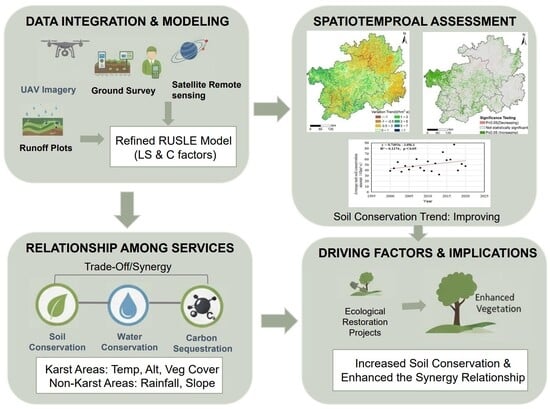
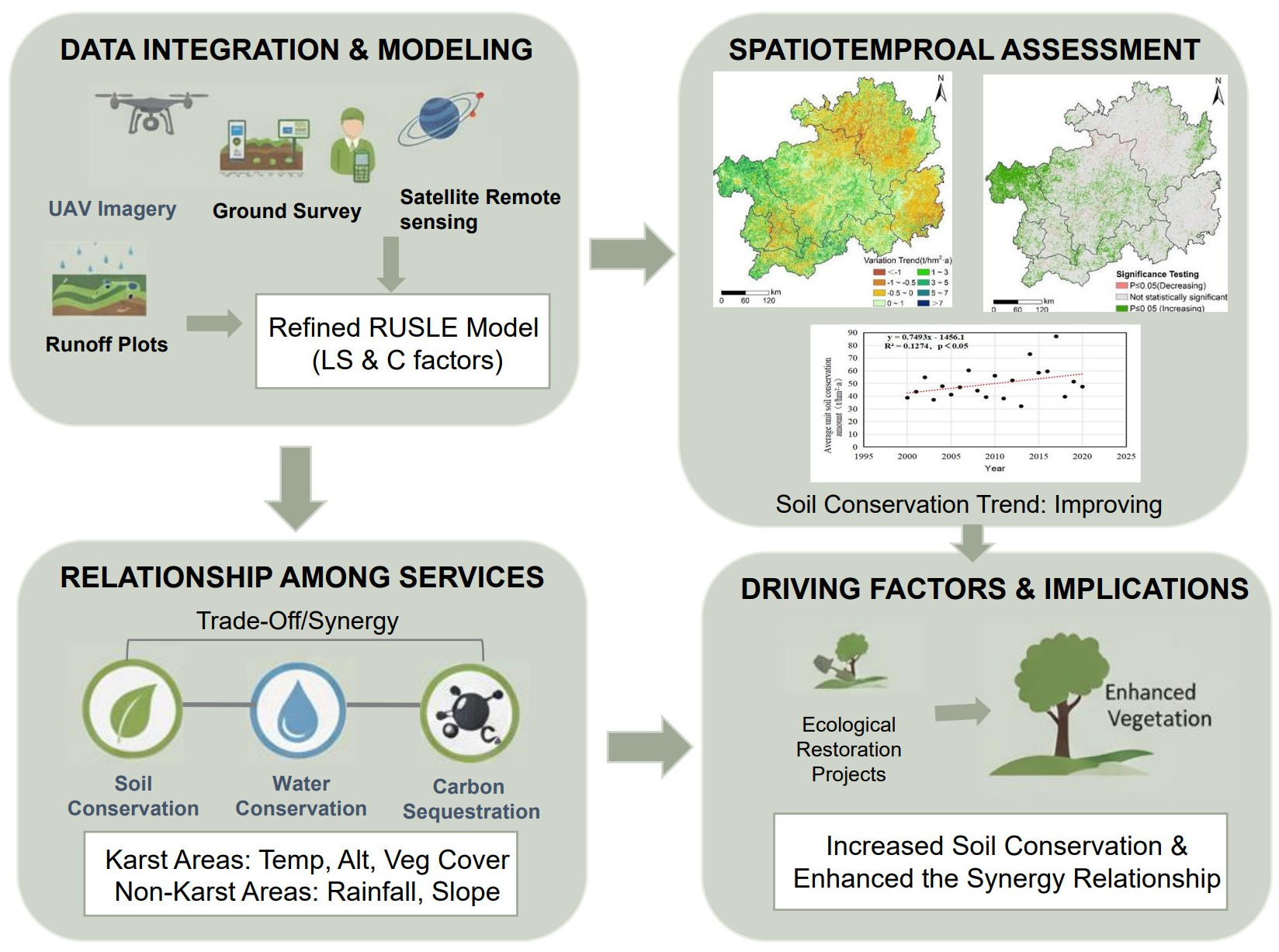
The Guizhou Plateau, with the most extensive and representative karst landforms worldwide, is characterized by severe soil erosion and a highly fragile ecological environment. However, large-scale assessments of soil conservation services in this region remain limited. A key challenge lies in identifying appropriate datasets and methodologies for regional-scale soil conservation service evaluations, particularly under conditions of data scarcity or limited data accuracy. In this study, Unmanned Aerial Vehicle imagery, runoff plot observations, ground survey data, and multi-source satellite remote sensing data were integrated to refine LS and C in the Revised Universal Soil Loss Equation (RUSLE), thereby establishing a parameterized and localized soil erosion model. This improvement provided a methodological foundation for soil conservation service research in the region. Subsequently, the spatiotemporal variations in soil conservation services in the Guizhou Plateau over the past two decades were assessed. Furthermore, the relationships between soil conservation services and other key ecosystem services, including water conservation and carbon sequestration, were quantitatively examined, and the driving factors were analyzed. Soil conservation on the Guizhou Plateau exhibited an improving trend from 2000 to 2020. In karst areas, the relationship between soil conservation and water conservation was primarily influenced by temperature, altitude, and vegetation coverage, whereas in non-karst areas, it was regulated by rainfall and slope. Ecological restoration projects have enhanced the synergy between soil conservation and carbon sequestration by promoting vegetation cover. These findings could contribute to the next stage of ecological engineering initiatives and ecological policy implementation in Guizhou.

Graphical Abstract

1. Introduction

Ecosystem services refer to the benefits provided by ecosystems that underpin essential production processes and human livelihood activities [1,2]. In recent decades, rapid population growth and socioeconomic development have caused considerable damage to the function and structure of global ecosystems. Unbalanced development increasingly threatens the sustainability of human society [3]. Soil erosion has emerged as one of the most severe ecological challenges worldwide, posing a substantial threat to ecological security and agricultural sustainability [4,5]. Soil conservation services play a crucial role in preventing soil erosion, maintaining ecological security, and supporting sustainable land use. Their assessment fundamentally relies on a quantitative evaluation of soil erosion. At the regional scale, the Revised Universal Soil Loss Equation (RUSLE) is the most widely used approach. To meet the requirements of large-scale and long-term erosion prediction, many researchers have integrated remote sensing, spatial analysis, geographic information systems, and soil erosion models.
The Guizhou Plateau holds a prominent ecological position as a key area for forest resource conservation and ecological restoration in China. However, the region is simultaneously characterized by widespread karst landforms, ecosystem vulnerability, poverty, and underdeveloped socioeconomic conditions. These challenges have led to an urgent need for social and economic development, intensifying the conflict between human activity and land [6]. The unique topography and geomorphology of karst regions exert a profound influence on soil erosion. Severe erosion arises from steep slopes, extremely low soil formation rates, and strong horizontal–vertical alternation between surface water and groundwater flow [7]. When evaluating soil loss in such distinctive environments, particular attention must be paid to the treatment of model parameters. Existing studies on soil conservation in the karst regions of southwestern China have mainly focused on small watersheds [8,9] or plot-scale erosion processes [10,11], whereas regional-scale analyses are limited. However, when applied across large spatial extents, RUSLE typically relies on coarse input data and lacks refined, site-specific parameter calibration [12,13], thereby reducing its accuracy in areas with complex terrain. Therefore, for soil conservation assessments on the Guizhou Plateau, it is essential to localize RUSLE parameters to accurately reflect the region’s distinctive topography and landforms. Nevertheless, a substantial gap persists in the localized adaptation of these parameters for this specific region. In addition, current research is constrained by the limited diversity of data sources, with a notable scarcity of field-based observations.
To address this fragile ecological and socioeconomic environment, ecological projects have been implemented in Guizhou since 2000, including the Comprehensive Control Project of Rocky Desertification, Grain for Green Project, and Natural Forest Protection Project. Numerous studies have evaluated the ecological benefits of these initiatives across different project areas and ecologically fragile regions, with ecosystem services frequently serving as a core indicator [14,15]. The accurate assessment of ecosystem services is critical for analyzing ecological engineering measures. Although existing studies have established an initial foundation, most current research focuses on natural driving factors or relies on observations over relatively short time periods [16,17]. Consequently, there is still a significant lack of analyses addressing long-term, high spatiotemporal resolution dynamics and the driving effects of ecological restoration projects. The interrelationships among ecosystem services are complex, and under major ecological projects, factors, human activities and climate change may induce either positive or negative responses. Quantifying trade-off/synergy among ecosystem services is essential for identifying effective ecological management strategies [18].
The present study integrated runoff plot observations from soil and water conservation monitoring stations, ground-based forest survey data, Unmanned Aerial Vehicle (UAV) remote sensing data, and satellite datasets to refine model parameters through localized calibration. Building on these improvements, the spatiotemporal dynamics of soil conservation in the Guizhou Plateau were examined, along with their relationships with water conservation and carbon sequestration. This approach can address the existing limitations of model refinement for karst regions, evaluate the ecological benefits of engineering practices on the Guizhou Plateau, and support the optimization of regional ecosystem service management.

2. Study Area and Methods

2.1. Study Area

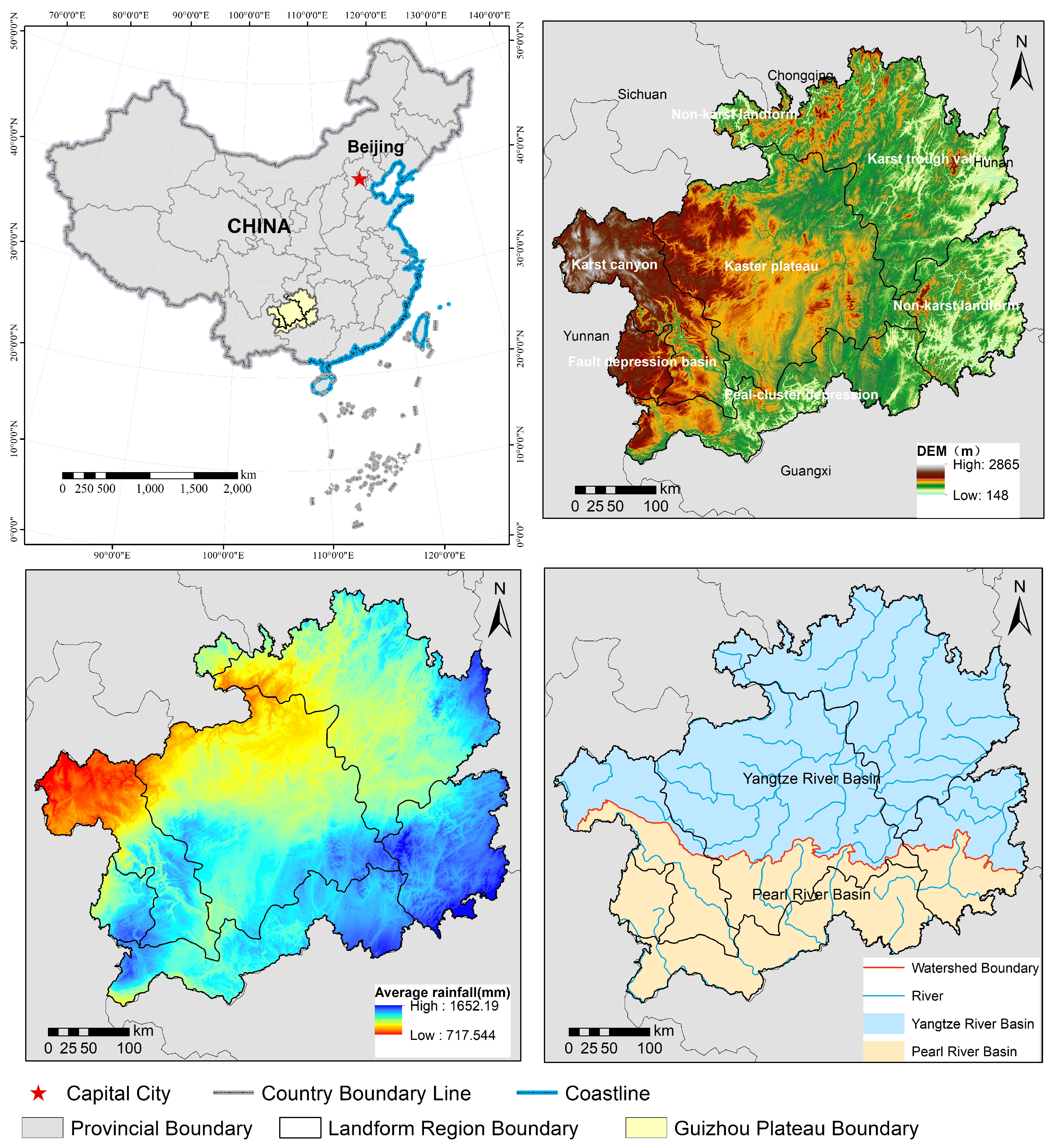
Located in southwestern China, the Guizhou Plateau covers the approximately 176,167 km2 area. Situated within the upper reaches of the Yangtze and Pearl rivers, it serves as an ecological barrier to these river systems. Influenced by the uplift of the Qinghai–Tibet Plateau, the terrain of the Guizhou Plateau is rugged, with 92.5% of the region consisting of mountainous and hilly landscapes. Karst landforms are extensively developed, occupying about 62% of the land area, rendering it one of the most representative and complex karst regions worldwide. It can be regarded as the area that demonstrates the most severe erosion of soil in China. The region has a subtropical humid monsoon climate, with 1000–1400 mm annual precipitation, while both temperature and precipitation exhibit a southeast-northeast reduction (Figure 1).

2.2. Ecosystem Service Model

2.2.1. Soil Conservation Service

In this study, the RUSLE model developed in the United States [19] was implemented. Considering the unique rocky desertification and complex terrain conditions in karst regions and based on previous research regarding the effects of varying bare rock ratios on soil loss [20,21], the RUSLE model was modified using correction coefficients corresponding to different levels of rock exposure (Table 1).
Soil retention capacity is defined as the difference between actual and potential soil erosion under conditions without vegetation cover or soil water conservation measures. The equations are as follows:
A r = R × K × L × S × C × P × ( 1 0.076 2 × α ) ,
A p = R × K × L × S × ( 1 0.076 2 × α ) ,
A C = A P A r ,
where R is the rainfall erosivity factor (MJ·mm·hm−2·h−1); A p represents the potential soil erosion modulus (t·hm−2·a−1); A r represents the actual soil erosion modulus (t·hm−2·a−1); and A C represents the soil retention capacity per unit area (t·hm−2·a−1) [22]; K is the soil erodibility factor (t·hm·h·hm−2·MJ−1·mm−1) [23]; S and L denote the slope and slope length factors, respectively [24]; P, S, and L are dimensionless; P is the soil and water conservation measures factor [25]; C is the vegetation coverage factor; and α is the correction coefficient for the bare rock rate with different degrees of rocky desertification.

2.2.2. Water Conservation Service and Carbon Sequestration Service

The Guizhou Plateau is predominantly affected by land degradation driven by soil erosion. Therefore, enhancing soil and water conservation services is central to regional ecological restoration. In addition, the region’s extensive forest cover provides substantial carbon sequestration capacity, which plays an equally important role [26]. Therefore, this study focused on evaluating the trade-off/synergy among soil conservation, water conservation, and carbon sequestration service.
Water conservation service was calculated using the Water Yield module of the InVEST model. The Water Yield module is based on the Budyko hypothesis of water-heat coupling balance, which computes the annual average water yield depth for each raster cell by subtracting actual evapotranspiration from precipitation. The calculation incorporates parameters such as precipitation, plant transpiration, surface evaporation, plant root depth, plant available water content, and soil maximum root burial depth. Recommended values are adopted for the relevant parameters [27]. The equation is expressed as:
Q w = M i n ( 1 , 249 v ) × M i n ( 1 , 0.9 × T 3 ) × M i n ( 1 , K s a t 300 ) × Y x ,
where Q w represents the water conservation capacity (mm), V represents the flow velocity coefficient, T represents the terrain index, and Ksat represents the saturated hydraulic conductivity of soil. Carbon Sequestration was estimated using NPP data, based on the photosynthesis conversion formula [28]. The equation is expressed as:
C = 1 n ( 1.63 × B × R c ) ,
where C represents the annual carbon sequestration of vegetation (t); B represents the NPP per unit area (gC/m2); R c represents the ratio of C in carbon dioxide, with a value of 27.27%; and n represents the total number of raster pixels.

2.3. UAV Remote Sensing Survey

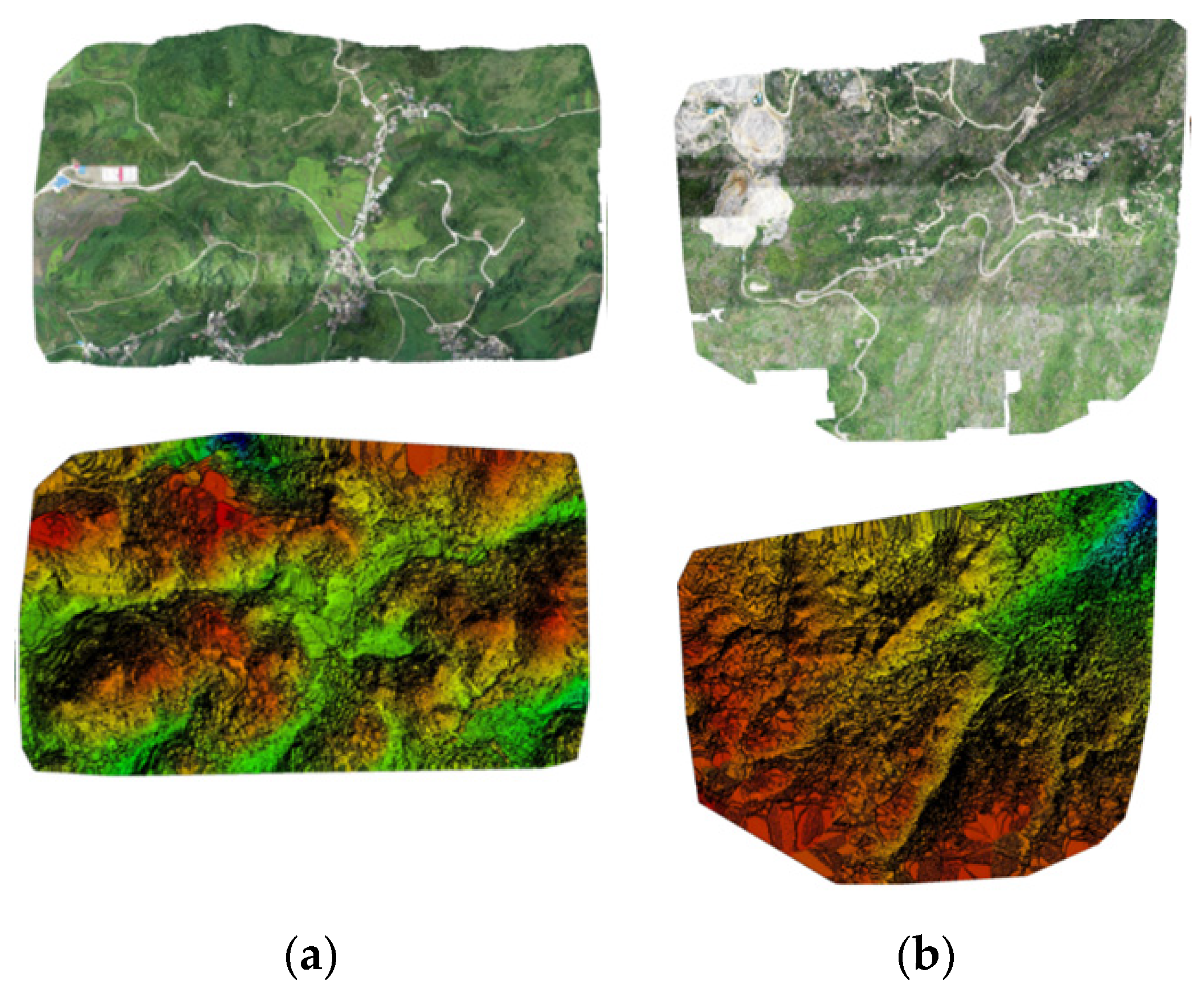
Collaborative UAV- and ground-based surveys were conducted in Guiyang City, Puding County, Anshun City, and Guanling County in Guizhou in 2019. High-resolution remote sensing imagery was obtained using a DJI Phantom 4 UAV equipped with five multispectral cameras and one visible-light camera. The images were processed with Pix4Dmapper and ENVI 5.3.1 [29], including image matching, orthorectification, and mosaicking, to generate Digital Surface Models, Digital Orthophoto Maps, point cloud data, and Digital Elevation Models (DEM). Two sample belts were selected for model parameter localization (Figure 2). Belt 1, located in Chenjiazhai, Puding County, covered approximately 2.152 km2 and included 684 images. Situated in the southwestern part of the Huajiang Canyon in Guanling County, Belt 2 covered approximately 2.539 km2 and included 973 images. Both belts had a spatial resolution of 11.7 cm and were characterized by typical karst landforms such as peak clusters, sinkholes, and peak-cluster valleys. The terrain was highly fragmented, and the degree of rocky desertification was severe.
In this study, histogram matching was used for data scaling. This technique is widely used in the radiometric enhancement of remote sensing imagery, transforming the gray-level histogram of an original image to match that of a target image and thereby improving overall image quality. Using this approach, terrain features extracted from medium- and low-resolution DEMs can be adjusted to better approximate the statistical terrain characteristics of high-resolution DEMs [14]. The frequency–slope relationship within a given terrain type is generally stable, meaning that the cumulative frequency associated with each slope class remains constant [30]. Based on this principle, we used the cumulative frequency curve derived from the high-resolution DEM to identify corresponding slope correction values on the cumulative frequency curve of the lower-resolution DEM. These slope correction values were then used to construct a conversion model linking slope adjustments to slope values extracted from the low-resolution DEM. All value-matching procedures were implemented in Python 3.8.

2.4. Ground Survey

2.4.1. Runoff Plots Observation

Monitoring data on water and soil erosion were collected from 46 runoff plots across four soil and water conservation monitoring sites located in Guanling County (Mahuang Tian), Songtao County (Muzhai River), Zunyi County (Huyangshui), and Longli County (Yangjichong) from 2015 to 2019. The observed variables, including rainfall erosivity, vegetation factors, and soil loss, and their corresponding calculation methods for the runoff plots were obtained from the Water and Soil Conservation Monitoring Manual issued by the Soil and Water Conservation Monitoring Center of the Ministry of Water Resources of China [31].
Rainfall data were primarily recorded using HOBO automatic weather stations, JII siphon-type self-recording rain gauges, and manual rain gauges. Indicators such as rainfall amount, rainfall duration, average rainfall intensity, maximum 30 min rainfall intensity, and erosive rainfall amount were all calculated using RainRecord 3.0. Field-measured rainfall erosivity was calculated using the classic EI30 method [19]. Vegetation features, including canopy closure, shrub and grass cover, and average vegetation height, were observed using visual estimation.

2.4.2. Guizhou Forest Inventory

A primary forest inventory was conducted in 2016 using manual visual surveys and field measurements. The survey encompassed topography, land use types, vegetation types and structure, vegetation coverage, ecological engineering projects, and bedrock exposure rates. More than 3,000,000 subcompartments were included. The survey methods followed the technical regulations for forest inventory established by Guizhou Province.

2.5. Statistical Methods

2.5.1. Multiple Regression Simulation

In simulating the structured vegetation index using remote sensing parameters, multiple regression modeling was primarily employed. Key contributing factors were first identified using Multivariate Adaptive Regression Splines, a machine learning approach for modeling nonlinear relationships. Variable importance was evaluated using generalized cross-validation, with each factor’s contribution quantified based on its number of occurrences in the model subsets (nsubsets) and the sum of squared residuals across the subsets [32].
G C V = 1 n t = 1 M [ y t f ( x t ) ] [ 1 ( N + 1 + b N ) n ] ,
where n is the number of input variables; t = 1, 2, …, M, and M is the sample size; yt is the true value of the target variable; xt is the true value of the influencing variable; and b is the penalty coefficient.
Subsequently, multivariate nonlinear simulations were conducted using the 1stOpt 5.0, which is designed for nonlinear curve fitting and comprehensive optimization [33]. Within 1stOpt, a universal global optimization algorithm was applied to determine the optimal solution and obtain the inversion model with the highest correlation.

2.5.2. Change Trend Analysis

Soil conservation trends were analyzed using the Sen’s slope estimator and the Mann–Kendall significance test. The Sen’s slope method effectively reduces noise interference and does not rely on assumptions about data distribution. The non-parametric Mann–Kendall test similarly accommodates arbitrary data distributions and is robust to outliers. Collectively, these two methods provide a comprehensive framework for assessing trend magnitude and statistical significance in time series analysis. Detailed computational procedures for both methods can be found in the relevant literature [18].

2.5.3. Trade-Off/Synergy Analysis

To identify trade-off/synergy relationships among ecosystem services, correlation analysis remains the most widely adopted approach, typically using Spearman or Pearson correlation coefficients to quantify interrelationships. A positive correlation denotes a synergistic relationship, whereas a negative correlation indicates a trade-off [34]. In this study, Spearman’s rank correlation coefficient was applied to evaluate pairwise relationships among ecosystem services. The direction and absolute magnitude of the correlation coefficient were used to characterize the trade-off/synergy dynamics between provisioning and regulating services, and statistical significance was assessed using t-tests [35,36,37]. Notably, the nominal p-values obtained from Spearman correlation analyses may be subject to bias. Therefore, in this study, these p-values were interpreted as indicative measures of the relative strength and spatial intensity of relationships rather than as strict inferential statistical evidence.

2.6. Data and Data Source

Precipitation and temperature data were extracted from the Guizhou Meteorological Station and the China Meteorological Data Service Center http://data.cma.cn (accessed on 10 September 2020), covering daily records from 2000 to 2020. Soil data were provided by the China High-Resolution National Soil Information Grid established by the Nanjing Institute of Soil Science, Chinese Academy of Sciences [38]. The regional DEM data were extracted from the Advanced Spaceborne Thermal Emission and Reflection Radiometer Global Digital Elevation Model (ASTER GDEM) provided by the Geospatial Data Cloud https://www.gscloud.cn/ (accessed on 12 October 2022), with the 30 m spatial resolution. Land use data for 2000, 2005, 2010, 2015, and 2020 were extracted from the Institute of Geographic Sciences and Natural Resources Research, Chinese Academy of Sciences [39]. Satellite remote sensing indices included net primary productivity (NPP), normalized difference vegetation index (NDVI), leaf area index (LAI), enhanced vegetation index (EVI), gross primary productivity (GPP), evapotranspiration (ET), and land surface temperature (LST) for 2000–2020. These were drawn from MODIS products MOD13Q1, MOD17A3HGF, MOD17A2H, MOD16A2, MOD15A2H, and MOD11A2 from 2000 to 2020, respectively https://modis.gsfc.nasa.gov/ (accessed on 1 October 2022). The study period spanned 2000–2020, and all datasets were resampled to a spatial resolution of 250 m.

3. Results

3.1. Localization/Refinement Correction for RUSLE

3.1.1. LS Factor Correction Model

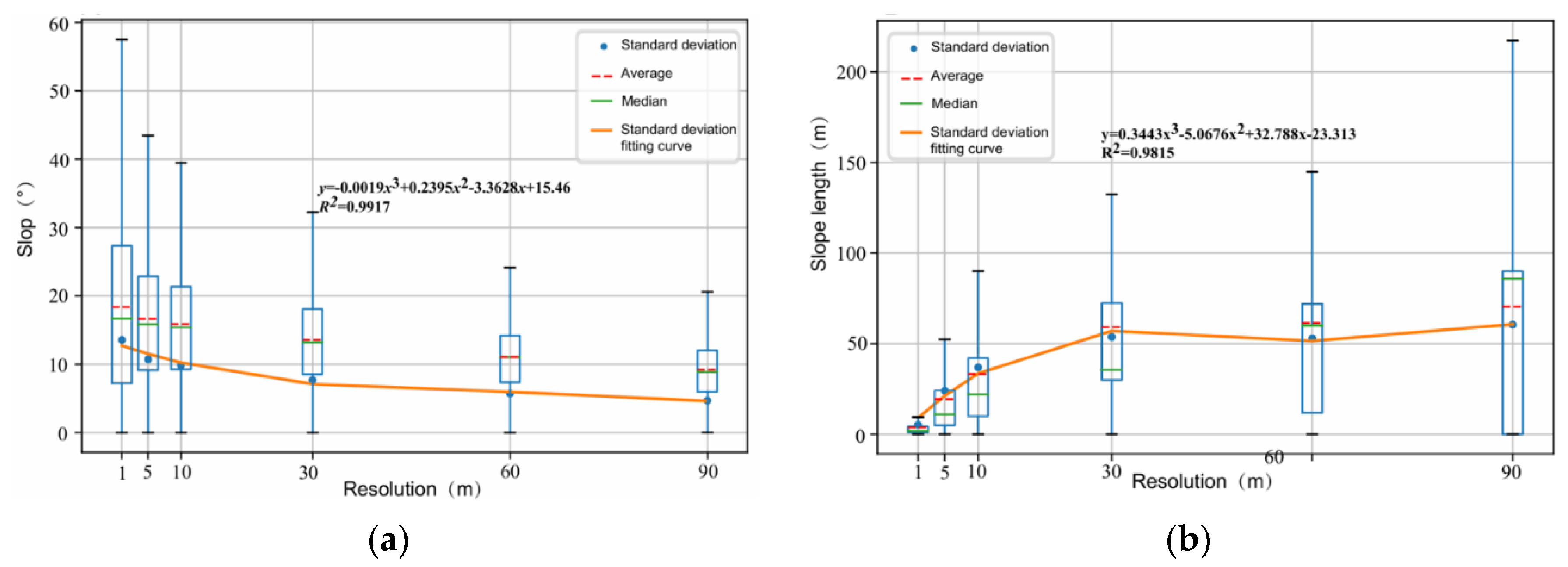
High-resolution remote sensing imagery was obtained through UAV aerial photography, and a DEM with a 1 m spatial resolution was established. The DEM data were further sampled at spatial granularities of 5, 10, 30, 60, and 90 m. The slope and slope length were extracted for each resolution. As the DEM resolution decreased, the slope decreased, whereas the slope length increased, producing a significant slope expansion effect (Figure 3). With lower DEM accuracy, fine terrain details were lost, slopes became gentler, and short slope segments were merged into longer slope lengths, thereby introducing errors.
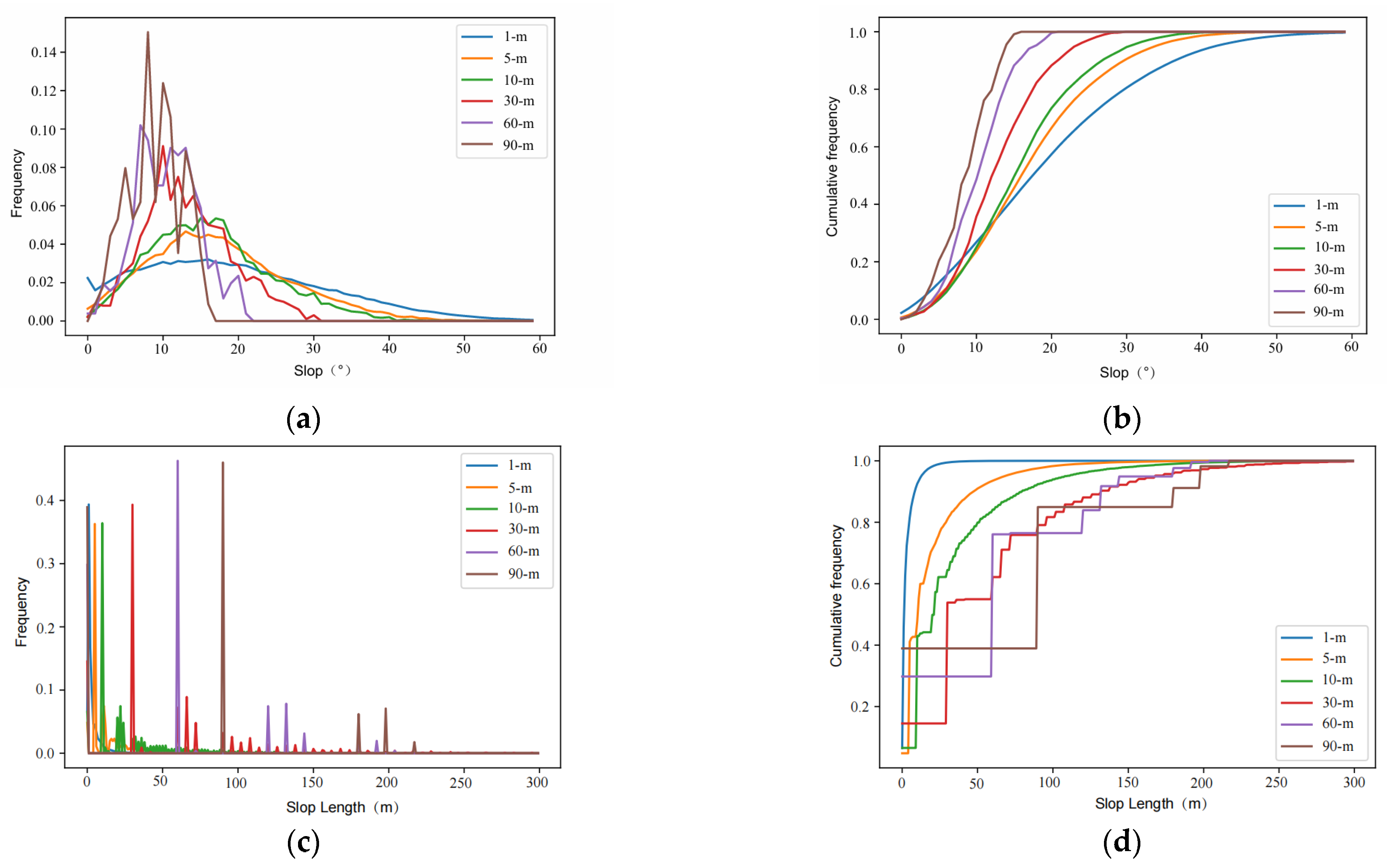
The frequency and cumulative frequency statistics of slopes and slope lengths were further calculated across DEMs of different resolutions. As illustrated in Figure 4, with decreasing spatial resolution, the peak of the slope distribution curve shifted forward, whereas the peak of the slope length distribution curve shifted backward. The cumulative frequency curves exhibited regular and consistent variation patterns. When the DEM resolution was reduced below 30 m, both the slope and slope length began to stabilize. For regional-scale research, the slope and slope length values derived from 30 m DEM data were converted using the histogram matching principle and compared with 5 m DEM results. In contrast, the 1 m DEM data introduced larger errors during conversion, and the effect was unsatisfactory.
The cumulative frequency curve derived from high-resolution DEM data was therefore used to identify slope correction values corresponding to the cumulative frequency curve of lower-resolution DEM data. A conversion model was then established, and the model with the best fit was selected as the scale conversion model. The equation is expressed as:
y = 0.0333x2 + 0.5163x − 3.6022,      R2 = 0.977
Using the same approach, a slope-scale transformation model was also obtained. The equation is expressed as:
y = 0.0007x2 + 0.1378x + 4.8083,      R2 = 0.936
where x represents the low-resolution slope or length before correction, and y represents the low-resolution slope or length after correction.

3.1.2. Vegetation Coverage and Management Factor Correction Model

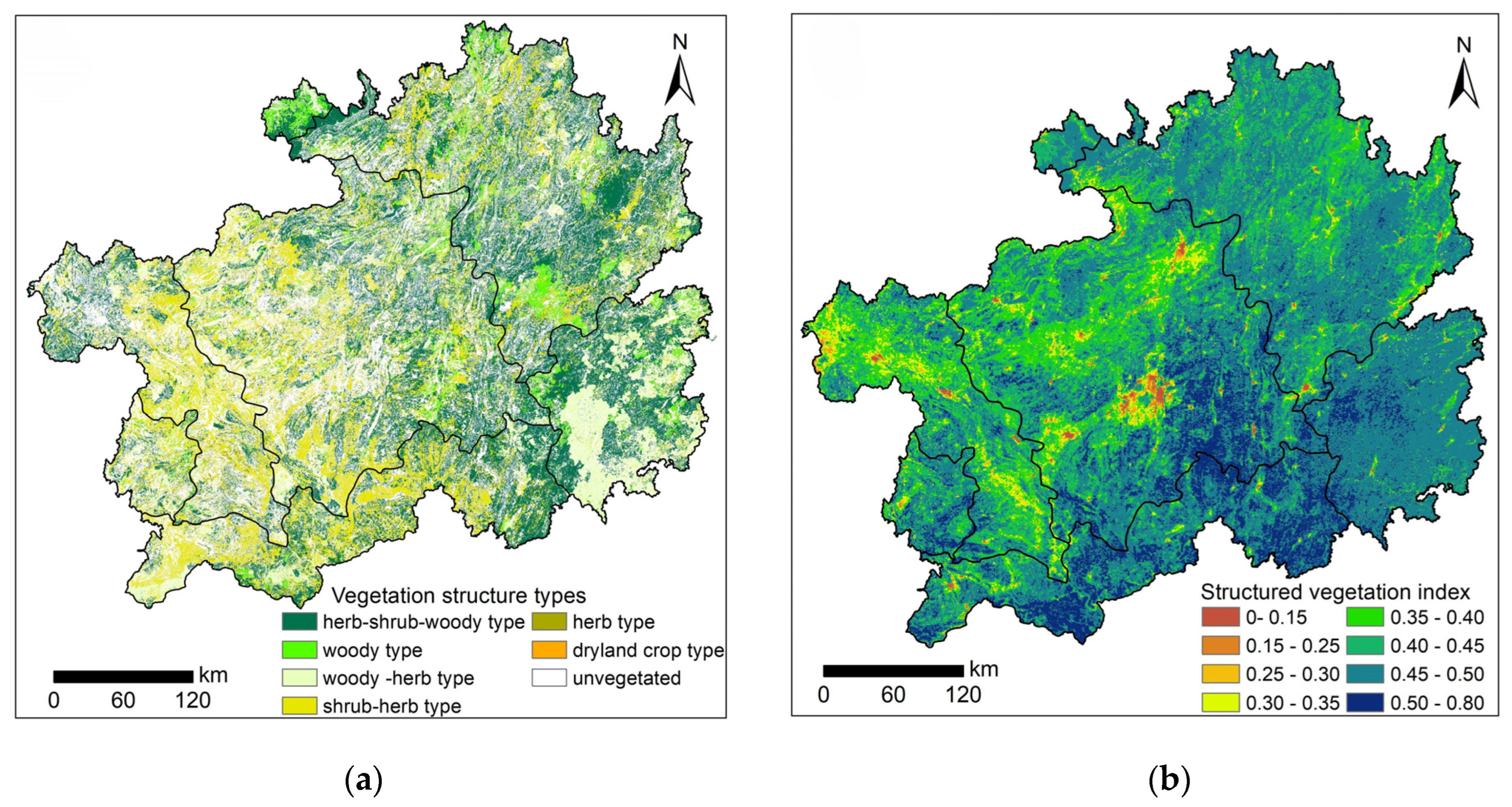
Based on the ground survey data of forest resources in Guizhou, the vegetation structure types were classified into six categories: herb-shrub-woody type, woody type, woody-herb type, shrub-herb type, herb type, and dryland crop type. As shown in Figure 5a, the herb-shrub-woody vegetation was primarily distributed in the eastern area, covering approximately 28.13% of the entire region. Woody vegetation was concentrated in karst trough valleys, whereas woody-herb vegetation was mainly distributed in non-karst regions. Shrub-herb vegetation was also widely distributed across karst plateaus, karst canyons, and peak-cluster depressions. Herb vegetation was mainly identified in peak-cluster depressions and accounted for approximately 1.07% of the total area. Considering the climatic conditions, zonal soils, and vegetation characteristics of the study area, particularly the distribution of vegetation types, the structured vegetation index model for southern China was applied to calculate the actual structured vegetation index of the Guizhou Plateau [12].
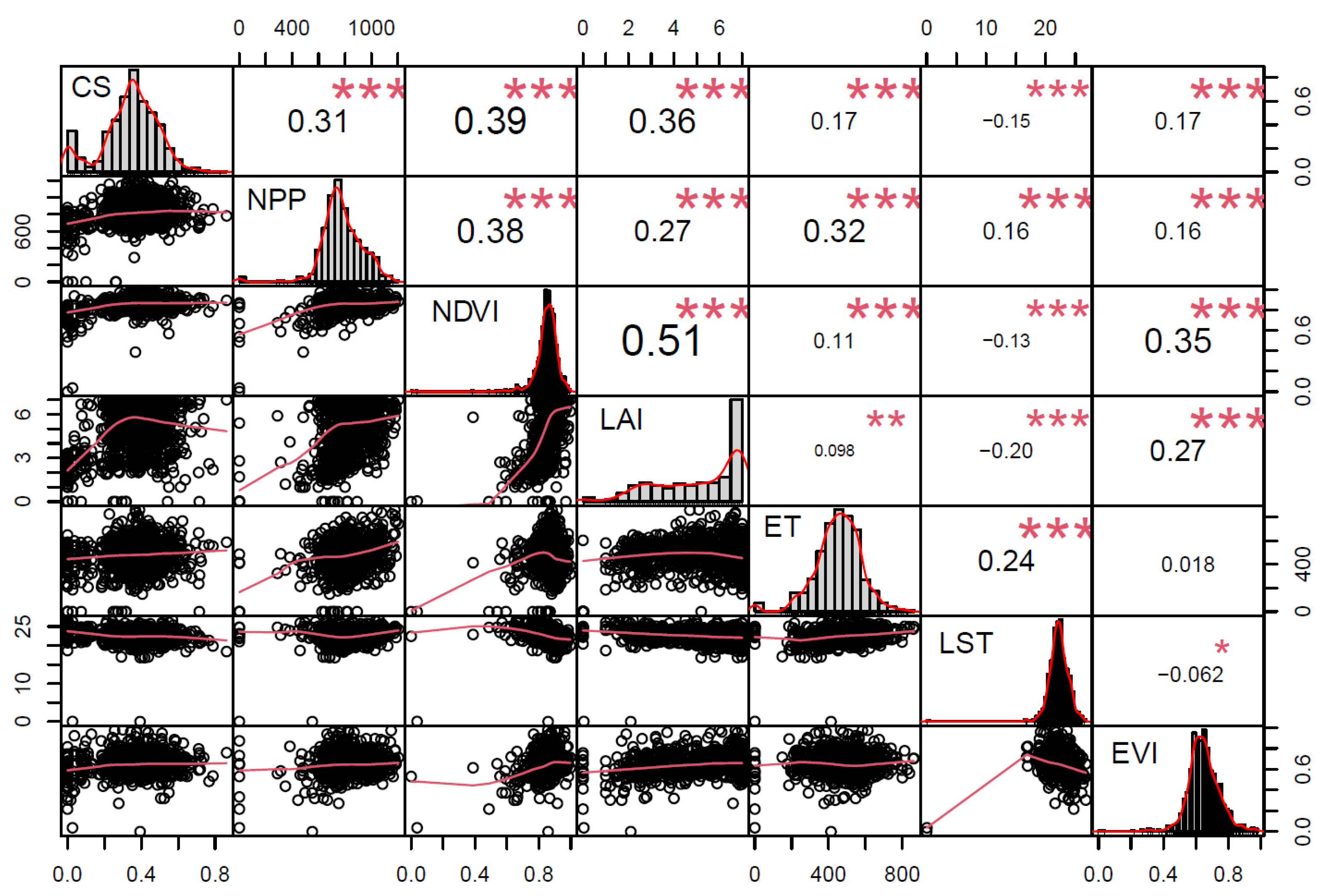
Attributed to the limitations of ground survey data and the difficulty of timely updates, the products of MODIS remote sensing were employed to estimate structured vegetation indices for large-scale and long-term research. The adopted indicators included NDVI, LAI, EVI, NPP, ET, and LST, all closely related to vegetation growth and development. A total of 900 actual structured vegetation index samples were randomly selected, and Pearson correlation analysis was conducted between these indices and the remote sensing variables. As shown in Figure 6, the structured vegetation index exhibited significant correlations with NPP, NDVI, LAI, ET, LST, and EVI at the 0.001 level. The correlation coefficient with NDVI was highest (0.39), followed by LAI (0.35) and NPP (0.31), whereas correlations with ET, LST, and EVI were lower. Variable importance results indicated that NDVI, NPP, and LAI were the most important variables, whereas the importance of the remaining indicators declined markedly. In conclusion, NDVI, NPP, and LAI were selected as the primary remote sensing indicators for inverting structured vegetation indices.
The linear relationships between individual remote sensing indicators and the structured vegetation index were weak. A total of 219 nonlinear models were tested, and the one with the highest correlation coefficient was selected as the inversion model. The model is expressed as:
y = 1 1 + p 1 x 1 + p 2 x 3 + p 3 x 2 p 4 + p 5 x 1 + p 6 x 3 + p 7 x 2 + cos p 8 x 2 e x p ( 1 p 9 x 2 ) 1 / ( p 10 x 2 ) ,
where y represents the structured vegetation indices, x 1 is NPP, x 2 is NDVI, x 3 is LAI, and   p 1   p 10 represents the optimal fitting parameters. The model demonstrated a root mean square error of 0.13 and an R2 of 0.512. As shown in Figure 5b, areas with higher structured vegetation indices were primarily distributed in the non-karst region and the peak-cluster depression zone. Field surveys indicate that these areas exhibit significantly better vegetation structural integrity and higher vegetation coverage than other areas. In contrast, areas with lower index values were mainly located in the karst canyon region and urban clusters such as Guiyang and Zunyi on the karst plateau. Vegetation in these zones is dominated by shrubs and grasses, with few tall trees, resulting in relatively simple vegetation structures and a large proportion of unvegetated surfaces.
This study further utilized observed data from 46 runoff plots collected in 2019 to calculate the structured vegetation index. The measured C factor was obtained using the inverse method of the RUSLE model from runoff plots. Regression analysis was then conducted between the measured C factor and the structured vegetation index. The optimal fitting result was adopted based on correlation coefficients and the sum of squared residuals. Considering that the range of C factor between 0 and 1, the final formula was derived as follows:
C = 1                                                                       C s = 0                    0.08099 0.12575 l n C s 0.04106   0 <   C s 56.62 % 0                                                                       C s > 56.62 %          ,
where C s is the structured vegetation index, and C represents the vegetation coverage and management factor.

3.2. Spatiotemporal Variation and Relationship Between Soil Conservation Service and Other Services

3.2.1. Spatiotemporal Variation in Soil Conservation Services

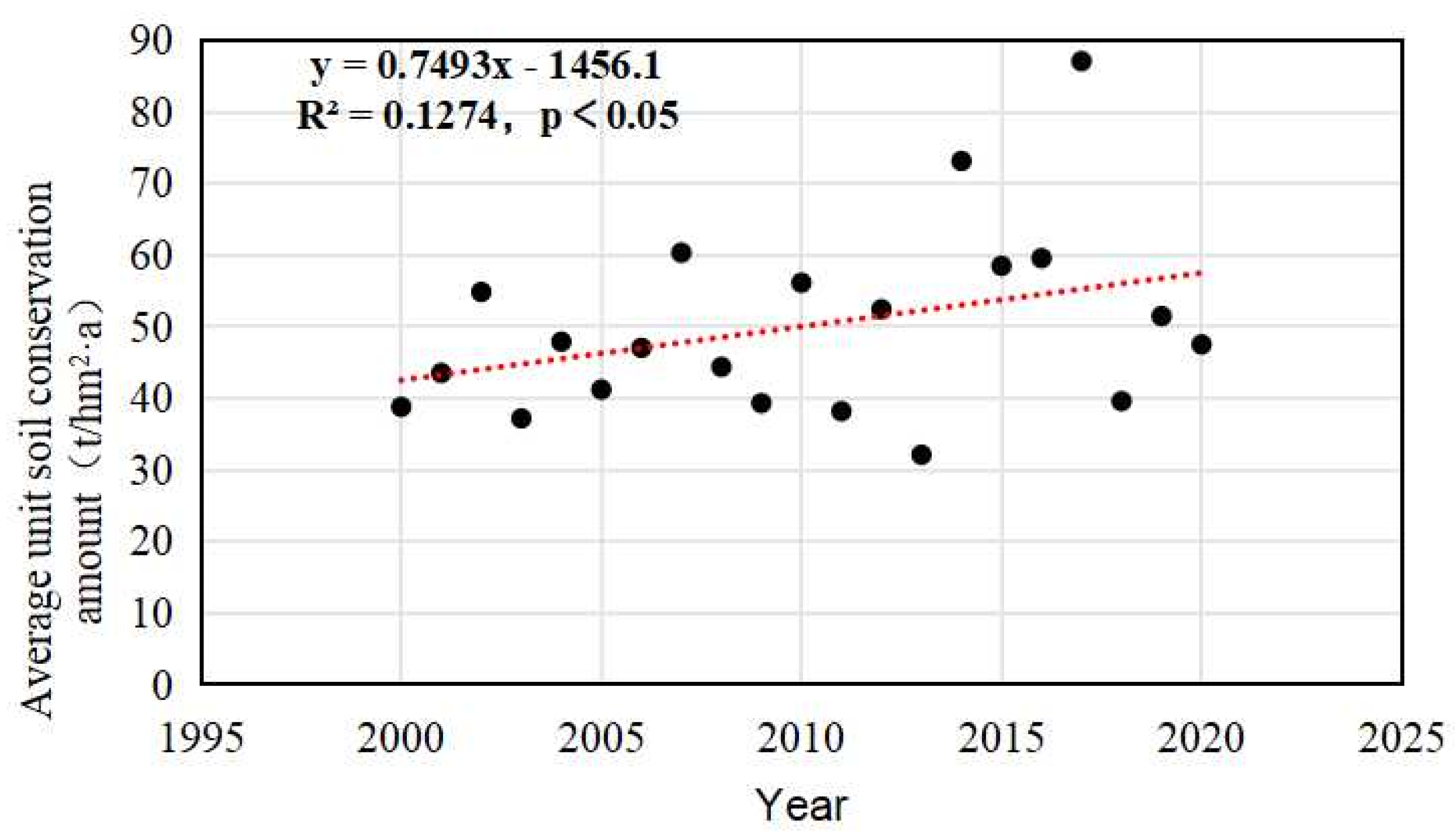
The 2000–2020 average soil conservation in the Guizhou Plateau was 50.00 t·hm−2·a−1 (Figure 7). The lowest value occurred in 2013 (32.09 t·hm−2·a−1), whereas the highest was recorded in 2017 (87.06 t·hm−2·a−1). According to the linear regression analysis, soil conservation per unit area exhibited a significant increase during 2000–2020, with an annual rise of 0.7493 t·hm−2·a−1 (p < 0.05), indicating a general increase in soil conservation over the study period.
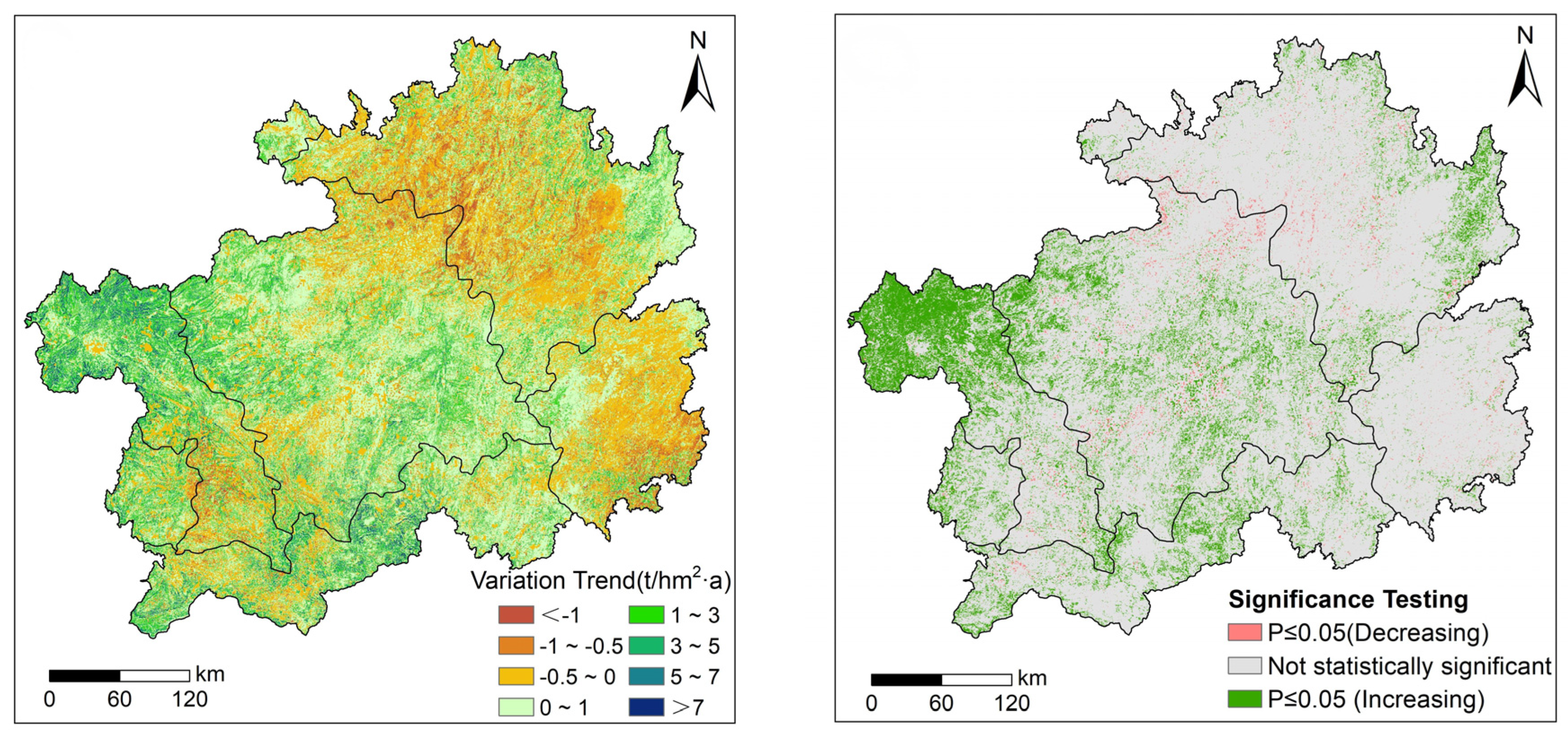
As shown in Figure 8, spatially, soil conservation per unit area exhibited an increasing trend in the western and central regions. The proportion of significantly increasing areas accounted for 14.85% (p < 0.05), mainly concentrated in the western karst canyon. In contrast, the eastern region showed a predominantly slight, non-significant decline, with only 1.82% of the area experiencing a significant decrease (p < 0.05). Overall, soil conservation per unit area demonstrated a spatially increasing trend.

3.2.2. Relationship Between Soil Conservation Service and Other Services

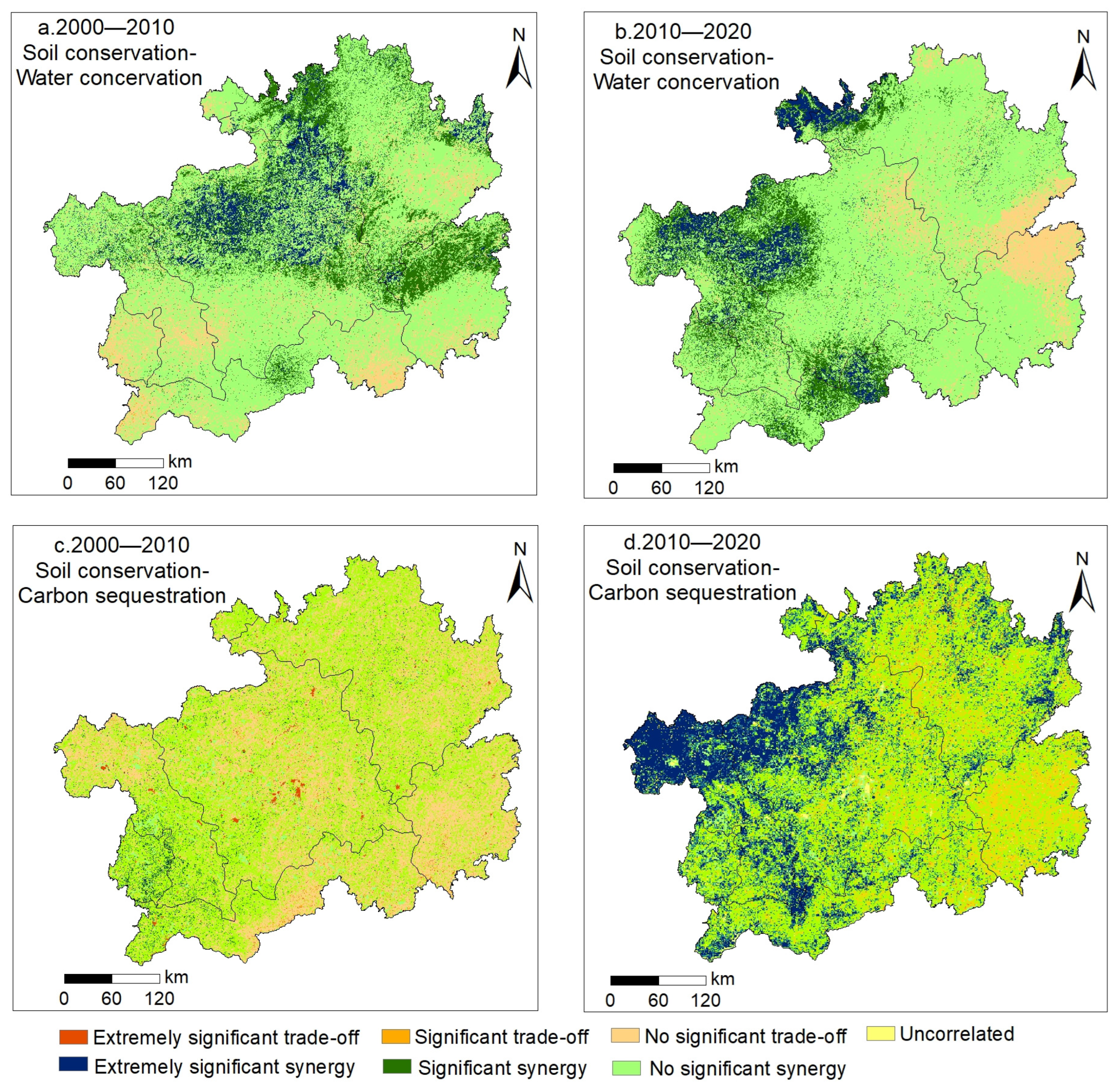
As illustrated in Figure 9a,b, soil conservation and water conservation maintained an overall synergistic relationship in both 2000–2010 and 2010–2020. The proportion of synergistic areas increased slightly from 84.51% in 2000–2010 to 87.04% in 2010–2020. Within this, significant synergistic regions accounted for 15.34% in 2000–2010 and 12.82% in 2010–2020, while extremely significant areas decreased from 7.48% to 6.83%. In contrast, the proportion of areas showing trade-off decreased from 15.25% in 2000–2010 to 12.72% in 2010–2020. Significant trade-off regions represented only 0.14% in 2000–2010 and 0.02% in 2010–2020. Generally, in the 2000–2010, trade-off was primarily concentrated in the southern Guizhou Plateau, whereas synergistic areas dominated the north. In 2010–2020, trade-off was mostly distributed in the southeast, whereas synergistic areas were concentrated in the western region.
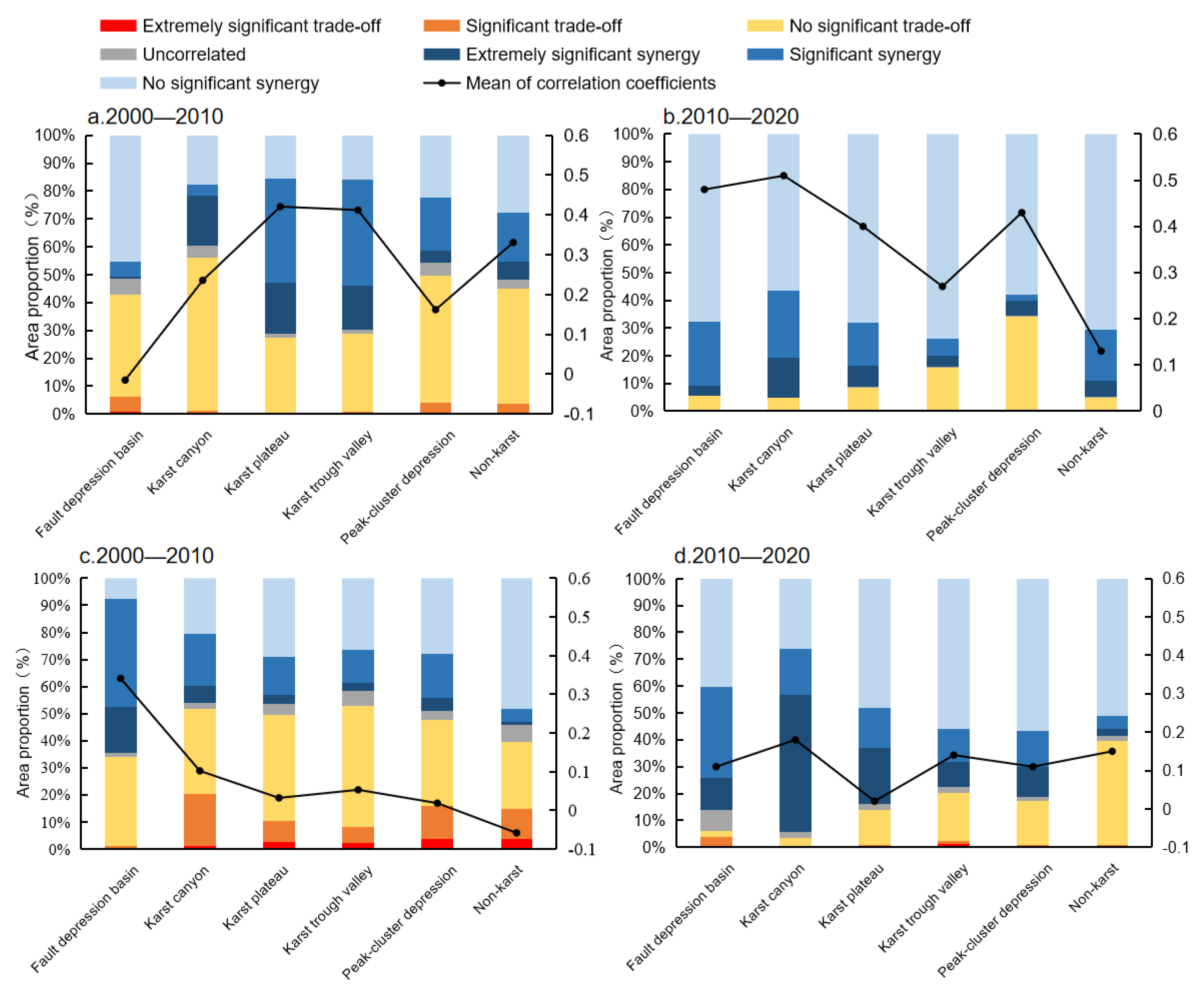
As shown in Figure 10a,b, during 2000–2010, the highest proportion of synergistic relationships was observed in the karst plateau, accounting for 71.26%, with 37.27% of the area being significant. The highest proportion of trade-off occurred in the karst canyon (55.94%). The average degree of trade-off among geomorphic types was ranked as follows: karst plateau (0.42) > karst trough valley (0.41) > non-karst (0.33) > karst canyon (0.24) > peak-cluster depression (0.16) > fault depression basin (|−0.02|). In period A2, the proportion of synergistic areas was the highest in the karst canyon, reaching 95.05%, with significant regions accounting for 24.15%. The greatest proportion of trade-off occurred in peak cluster depressions (34.03%). The average degree of trade-off across geomorphic types was ranked as: karst canyon (0.51) > fault depression basin (0.48) > peak-cluster depression (0.43) > karst plateau (0.40) > karst trough valley (0.27) > non-karst (0.13). From 2000 to 2020, soil conservation and water conservation remained synergistic across all geomorphic types. Overall, the degree of synergy in karst areas was greater than that in non-karst regions.
As shown in Figure 9c,d, the synergistic area accounted for approximately 54.68% of the total area in 2000–2010, increasing to 80.11% in 2010–2020. Within this, the significant synergistic area in 2000–2010 comprised about 2.44% and the extremely significant area 0.65%. In 2010–2020, the significant synergistic area reached about 13.12%, and the extremely significant area was 17.57%. Conversely, the trade-off area declined from 44.90% in 2000–2010 to 17.78% in 2010–2020. The significant trade-off area accounted for about 1.17% in 2000–2010 and 0.76% in 2010–2020. Notably, the 2000–2010 trade-off area was concentrated in the southern Guizhou Plateau, whereas the synergistic area was mainly in the north. In 2010–2020, the trade-off area was primarily observed in the southeast, whereas the synergistic area was concentrated in the west. Overall, trade-off and synergistic areas across the Guizhou Plateau were approximately balanced at a 1:1 ratio. Significant cooperative regions were primarily located in the fault depression basin, whereas in 2010–2020, synergy was concentrated in the western region, particularly in the karst canyon, where extremely significant synergy was observed. In contrast, most trade-off was identified in non-karst areas.
As shown in Figure 10c,d, during 2000–2010, the highest proportion of synergistic relationships occurred in the fault depression basin, accounting for about 64.64%, with significant areas contributing 39.67%. The highest trade-off proportion was identified in non-karst regions (53.01%), with significant areas accounting for 5.90%. The average trade-off/synergy degree across landform types was ranked as follows: fault depression basin (0.34) > karst canyon (0.10) > non-karst (0.06) > karst trough valley (0.05) > karst plateau (0.03) > peak-cluster depression (0.02). In 2010–2020, the highest proportion of synergy occurred in the karst canyon, accounting for 94.33%, with significant synergy of 16.88%. The highest trade-off was again observed in non-karst regions, accounting for 39.57%, with insignificant areas representing 38.67%. The average trade-off/synergy degree in 2010–2020 was ranked as follows: karst plateau (0.02) < fault depression basin (0.11) < peak-cluster depression (0.11) < karst trough valley (0.14) < non-karst (0.15) < karst canyon (0.18). From 2000 to 2020, the soil conservation- carbon sequestration relationship shifted significantly from trade-off to synergy, whereas the degree of trade-off remained relatively high in the peak-cluster depression.

3.2.3. Analysis of the Influencing Factors of the Relationship Between Soil Conservation and Other Services

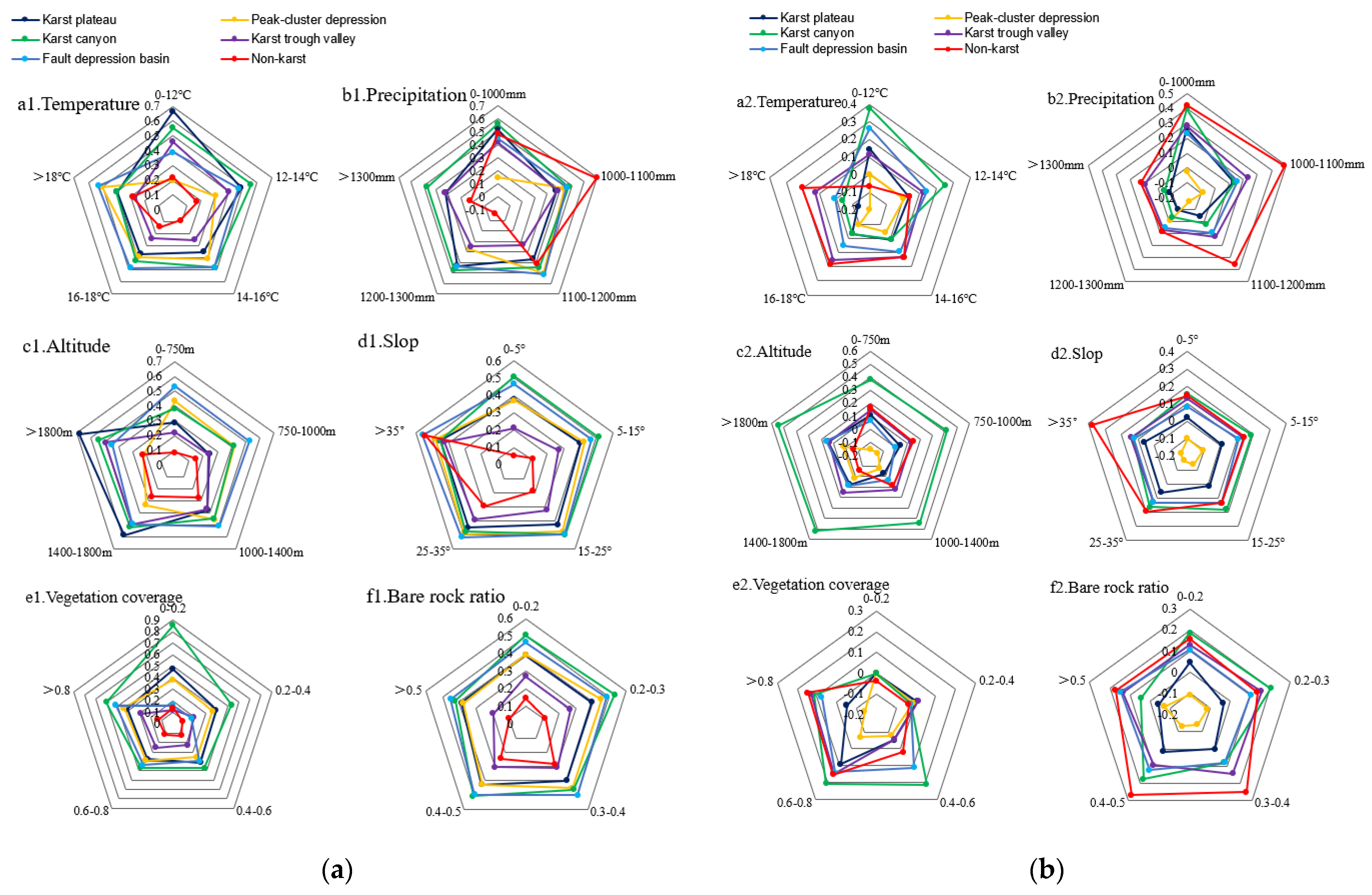
As shown in Figure 11a, under different natural factor gradients, the relationship between soil conservation and water conservation exhibited significant spatial heterogeneity. When the vegetation coverage was between 0 and 0.2, the synergy between soil conservation and water conservation was the strongest, particularly in the karst canyon. As vegetation coverage increased, the degree of synergy gradually decreased. In the karst plateau, karst canyon, and karst trough valley, synergy remained relatively high within the range between 0 °C and 12 °C. Rainfall exerted a significant influence on the soil conservation- water conservation relationship in non-karst regions. Altitude had a stronger impact on the trade-off/synergy relationship in the karst plateau, karst trough valley, and karst canyon, with higher synergy mainly concentrated at elevations above 1800 m. Slope played a greater role in non-karst areas, where regions with higher synergy were mainly distributed at slopes greater than 35°. Non-karst regions were also more affected by bedrock exposure. Overall, the soil conservation-water conservation relationship in karst areas was primarily influenced by temperature, altitude, and vegetation coverage, whereas in non-karst areas, it was more strongly affected by rainfall and slope.
As shown in Figure 11b, under different natural factor gradients, the relationship between soil conservation and carbon sequestration also displayed pronounced spatial heterogeneity. In the fault depression basin, karst canyon, and karst plateau, the degree of synergy was relatively high within the temperature range between 0 °C and 12 °C, whereas in non-karst regions, the differences among temperature intervals were relatively small. High synergy values were mainly concentrated in the rainfall range between 0 and 1000 mm, whereas in the high-rainfall interval (>1200 mm), the soil conservation-carbon sequestration relationship gradually shifted from synergy to trade-off. The synergy in the karst canyon was significantly higher than that in the other regions. In peak-cluster depression, the trade-off relationship appeared across all altitude intervals, whereas the degree of trade-off decreased with increasing altitude. In non-karst regions, slope exerted a stronger effect than in other regions, with the highest synergy degree occurring on slopes greater than 35°. As vegetation coverage increased, the degree of synergy significantly strengthened. Bedrock exposure exerted only a minor influence on the soil conservation-carbon sequestration relationship, and spatial heterogeneity remained evident.
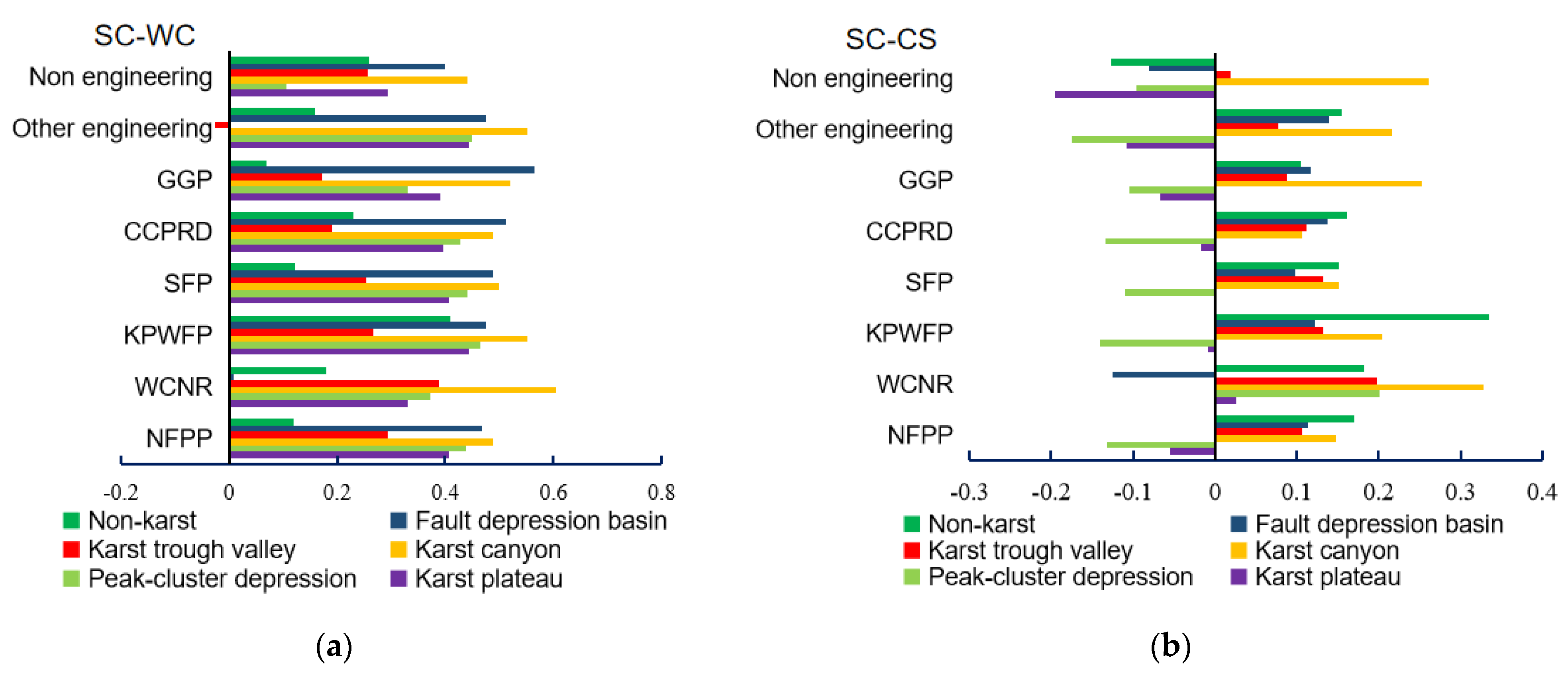
As shown in Figure 12a, across different landform types, the average degree of synergy between soil conservation and water conservation in ecological engineering areas was higher than that in non-ecological engineering areas. The highest average synergy was observed in the Key Public Welfare Forest Project, followed by the Comprehensive Control Project of Rocky Desertification. The Natural Forest Protection Project, the Key Public Welfare Forest Project, the Wildlife Conservation Nature Reserve and the Shelterbelt Forest Project demonstrated higher synergy degrees in the karst trough valleys, with values of 0.49, 0.55, 0.60, and 0.49, respectively. The Grain for Green Project and the Comprehensive Control Project of Rocky Desertification showed higher synergy in the fault depression basin, with values of 0.51 and 0.56, respectively.
As shown in Figure 12b, soil conservation and carbon sequestration in ecological engineering areas generally exhibited a synergistic relationship, whereas in non-engineering areas, they presented a trade-off relationship. In the peak-cluster depression and karst plateau, except for the Wildlife Conservation Nature Reserve, most engineering areas exhibited trade-off relationships. Among the ecological engineering areas, the Wildlife Conservation Nature Reserve demonstrated the largest average synergy degree (0.13), whereas other forestry projects displayed the lowest (0.05). Non-engineering areas predominantly exhibited trade-off relationships. The highest synergy degree was observed in the Key Public Welfare Forest Project within non-karst areas (0.33), whereas the highest trade-off degree was recorded in non-engineering areas of the karst plateau (−0.20).

4. Discussion

4.1. Parameter Correction of the Soil Erosion Equation Model

When applying the RUSLE model for exploring soil erosion in different regions, the assessment results often involve considerable uncertainty [40]. Local parameter correction based on the geographical and environmental characteristics of specific regions is essential. By collecting data on local environmental features and integrating hydrological monitoring data to adjust parameter calculation methods, the accuracy of model simulations can be substantially improved [41]. Guizhou is located in East Asia, a region with one of the world’s highest concentrations of karst landforms. Owing to the dual surface–subsurface geomorphic structure of karst terrain, the LS factor in the RUSLE model is particularly sensitive to topographic conditions. Traditional algorithms for slope length and slope steepness derived from DEM data often yield substantial deviations when representing fine-scale micro-topography [42,43]. To address this issue, this study applied a localized correction of the LS factor using multi-scale topographic analysis combined with UAV-derived terrain measurements. This correction method is particularly suitable for karst landscapes characterized by large elevation variations and dense gully networks. These results align with the findings of Wang C.-M. et al., further supporting the need for topographic parameter scale conversion in similar landform settings [44].
The conventional method for estimating the C factor at a regional scale in the Guizhou Plateau typically involves calculating vegetation coverage from remote sensing data (NDVI). However, this approach introduces some errors. Firstly, the canopy density in the Guizhou Plateau has remained high and relatively stable (above 0.8 for the past five years), and NDVI is unsuitable for calculating vegetation coverage in areas with dense canopies, where pixel saturation is severe [40]. Secondly, the vertical structure of vegetation plays a crucial role in regulating soil erosion. Different vegetation types, hierarchical structures, and morphological characteristics exert varying degrees of influence on soil erosion control [45].
In this study, 10 Pinus massoniana plots were selected within the Yangjichong watershed of the Guizhou Plateau. Among these plots, two exhibited similar vegetation coverage (approximately 82%) based on NDVI but showed substantial differences in the structured vegetation index, primarily due to variations in shrub and grassland components. Vegetation coverage derived solely from NDVI showed minimal differences and therefore could not capture variations in vegetation structural complexity. Soil and water conservation benefits can be significantly enhanced only when increases in vegetation coverage occur within a well-developed, multi-layered vegetation structure [46]. Based on runoff plot monitoring and ground survey data, this study constructed a structured vegetation index from multi-source remote sensing data for the Guizhou Plateau. This index enriches the definition of C in the RUSLE model, which can enhance the effectiveness of evaluating the achievements of ecological engineering projects, prompting the policy to shift from single governance to comprehensive management.

4.2. Trade-Off/Synergy Among Ecosystem Services and Their Influencing Factors

The synergy between water conservation and soil conservation was relatively low, whereas trade-offs mainly occurred in non-rocky regions, which could result from the dual role of high vegetation coverage. It enhances the soil resistance to erosion, while the root systems increase water absorption, thereby reducing surface water availability [47]. High vegetation coverage also enhances carbon sequestration, resulting in a synergy between soil conservation and carbon sequestration. An increase in water production typically accelerates soil erosion. Higher vegetation NPP can reduce water and sediment output, which is beneficial for soil conservation [26]. Ecosystem service on the karst plateau showed relatively high trade-off degrees, largely because cities such as Guiyang and Liupanshui underwent rapid urbanization, where intense human activities and land degradation issues prevailed. Vegetation cover and land use change are among the most common driving factors, and population density and per capita GDP are also key socioeconomic indicators that should be considered [34]. Vegetation coverage exerted the strongest influence on soil conservation- water conservation -carbon sequestration relationships, consistent with earlier findings in karst regions [20]. Landform type also exerted a broad control effect on the trade-off/synergy among ecosystem services. Furthermore, ecological engineering is crucial for enhancing ecosystem service functions and balancing trade-off [23]. Specifically, the soil conservation- water conservation relationships in karst areas were strongly influenced by temperature, altitude, and vegetation coverage, whereas in non-karst areas, they were more affected by rainfall and slope.
Ecological engineering construction significantly contributed to balancing ecosystem services in regions with pronounced terrain variation and severe rock desertification, whereas its effect in non-karst areas was relatively limited. Regions exhibiting strong coordination between carbon sequestration and soil conservation are largely influenced by a series of ecological restoration programs, including the Natural Forest Protection Project, the Comprehensive Rocky Desertification Control Project, and the Grain for Green Project. These initiatives have increased vegetation coverage, enhanced plant carbon sequestration capacity, improved habitat quality, and strengthened rainfall interception, collectively contributing to enhanced soil conservation capacity [48]. It is suggested that differentiated restoration strategies should be formulated based on different geographical regions. In severely degraded areas of rocky desertification, engineering projects can be adopted to enhance the soil conservation capacity of the ecosystem. Whereas, in regions with better ecological environments, it is recommended to focus on natural restoration, minimizing human activities as much as possible, which is more conducive to ecological recovery.

4.3. Limitations and Future Research

With the advancement of remote sensing technology, refined research on soil conservation has become a prevailing trend. This study holds significant scientific value for refining and localizing the processing of model parameters. However, limitations remain in data acquisition and research methods. Low R2 values in structured vegetation index models derived from remote sensing may raise concerns regarding their reliability when extrapolated across space and time. Model predictions may be influenced by multiple sources of uncertainty, including the accuracy of input remote-sensing parameters and the underlying structural assumptions of the model. Moreover, this study did not consider potential errors arising from spatial autocorrelation. Future work will incorporate multi-source datasets to improve the accuracy and robustness of the model and further strengthen quantitative assessments of these uncertainties.
The karst region possesses a complex spatial structure, and its natural conditions, such as hydrology, soil, and landforms, exhibit pronounced spatial non-stationarity [49]. Although the present study corrected the relevant parameters and incorporated the desertification factor, the lack of sufficient data support and plot experiments can constrain the consideration of complex soil erosion mechanisms and processes in karst areas. Future studies should account for the characteristics of the karst region of the Guizhou Plateau to further enhance the accuracy of soil erosion simulations.

5. Conclusions

The Guizhou Plateau demonstrates the characteristics of complex terrain and severe soil erosion, making an accurate assessment of soil conservation in this region essential. This study employed UAV imagery, runoff plot observations, ground survey data, and multi-source remote sensing to locally adjust the LS and C factors of the RUSLE model. The results indicated that soil conservation in the Guizhou Plateau exhibited an improving trend over the past two decades, with the karst canyon area performing the best. The soil conservation–water conservation relationship in karst areas was significantly influenced by temperature, altitude, and vegetation coverage, whereas in non-karst areas, it was primarily regulated by rainfall and slope. Increased vegetation coverage was demonstrated to enhance soil conservation-carbon sequestration synergy. Furthermore, ecological engineering improved the synergy of ecosystem services, particularly in rocky desertification areas. Overall, our research contributes to ecological engineering management and the formulation of sustainable strategies for the Guizhou Plateau.

Author Contributions

Conceptualization, L.N. and Q.S.; methodology, L.N.; software, M.C.; validation, L.N. and Q.S.; formal analysis, L.N.; investigation, L.N. and M.C.; resources, Q.S.; data curation, M.C.; writing—original draft preparation, L.N.; writing—review and editing, Q.S.; visualization, M.C.; supervision, Q.S.; project administration, L.N.; funding acquisition, L.N. All authors have read and agreed to the published version of the manuscript.

Funding

This research was funded by National Natural Science Foundation of China, grant number 32401367.

Data Availability Statement

The data that support the findings of this study are available from the corresponding author upon reasonable request.

Acknowledgments

The authors gratefully acknowledge the availability of the datasets used in this study.

Conflicts of Interest

The authors declare no conflicts of interest.

Abbreviations

The following abbreviations are used in this manuscript:
UAVUnmanned Aerial Vehicle
RUSLERevised Universal Soil Loss Equation
EVIEnhanced Vegetation Index
LAILeaf Area Index
GPPGross Primary Productivity
ETEvapotranspiration
LSTLand Surface Temperature

References

  1. Nations, U. Millennium Ecosystem Assessment. Ecosystems and Human Wellbeing; Island Press: Washington, DC, USA, 2003. [Google Scholar]
  2. Chen, W.; Zhao, H.; Li, J.; Zhu, L.; Wang, Z.; Zeng, J. Land use transitions and the associated impacts on ecosystem services in the Middle Reaches of the Yangtze River Economic Belt in China based on the geo-informatic Tupu method. Sci. Total Environ. 2020, 701, 134690. [Google Scholar] [CrossRef] [PubMed]
  3. Dai, X.; Wang, L.; Huang, C.; Fang, L.; Wang, S.; Wang, L. Spatio-temporal variations of ecosystem services in the urban agglomerations in the middle reaches of the Yangtze River, China. Ecol. Indic. 2020, 115, 106394. [Google Scholar] [CrossRef]
  4. Rey, F.; Bifulco, C.; Bischetti, G.B.; Bourrier, F.; De Cesare, G.; Florineth, F.; Graf, F.; Marden, M.; Mickovski, S.B.; Phillips, C.; et al. Soil and water bioengineering: Practice and research needs for reconciling natural hazard control and ecological restoration. Sci. Total Environ. 2019, 648, 1210–1218. [Google Scholar] [CrossRef]
  5. Mehwish, M.; Nasir, M.J.; Raziq, A.; Ayad, M.; Ghaib, F. Soil erosion vulnerability and soil loss estimation for Siran River watershed, Pakistan: An integrated GIS and remote sensing approach. Environ. Monit. Assess. 2023, 196, 104. [Google Scholar] [CrossRef]
  6. Wang, J.X.; Zou, B.P.; Liu, Y.; Tang, Y.; Zhang, X.; Yang, P. Erosion–creep–collapse mechanism of underground soil loss for the karst rocky desertification in Chenqi village, Puding county, Guizhou, China. Environ. Earth Sci. 2014, 72, 2751–2764. [Google Scholar] [CrossRef]
  7. Wang, H.; Xiong, K.; Zhang, F. Mechanism Study on Effects of Terrain on Soil Erosion of Karst Slope. Bull. Soil Water Conserv. 2015, 35, 1–7. [Google Scholar] [CrossRef]
  8. Dai, Q.; Lin, J.; Zhu, Y.F.; Pan, Y.; Dong, B.; Xu, Y.Y. Remote sensing inversion of vegetation cover management factor based on the southern structured vegetation cover index. Sci. Soil Water Conserv. 2021, 19, 64–71. (In Chinese) [Google Scholar] [CrossRef]
  9. Gao, J.; Zhang, Y.; Zuo, L. The optimal explanatory power of soil erosion and water yield in karst mountainous areas. Acta Geogr. Sin. 2023, 33, 2077–2093. [Google Scholar] [CrossRef]
  10. Luo, Y.; Lu, M.; Wang, H.; Qiu, A. Recent soil erosion in the Hongfeng catchment on the Guizhou Plateau, SW China revealed by analysis of reservoir sediments and soil loss modeling. J. Palelimnol. 2019, 61, 17–35. [Google Scholar] [CrossRef]
  11. Zhang, Y.; Li, R.; Jing, J. Soil erosion gradient and quantitative attribution in southwest China based on karst development degree. Ecol. Indic. 2022, 144, 109496. [Google Scholar] [CrossRef]
  12. Militino, A.F.; Ugarte, M.D.; Pérez-Goya, U. An Introduction to the Spatio–Temporal Analysis of Satellite Remote Sensing Data for Geostatisticians. In Handbook of Mathematical Geosciences: Fifty Years of IAMG; Daya Sagar, B., Cheng, Q., Agterberg, F., Eds.; Springer International Publishing: Cham, Switzerland, 2018; pp. 239–253. [Google Scholar]
  13. Carollo, G.; Serio, M.; Pampalone, V.; Ferro, V. The unit plot of the Universal soil loss equation (USLE): Myth or reality? J. Hydrol. 2024, 632, 130880. [Google Scholar] [CrossRef]
  14. Chen, W.; Zhang, X.; Huang, Y. Spatial and temporal changes in ecosystem service values in karst areas in southwestern China based on land use changes. Environ. Sci. Pollut. Res. Int. 2021, 28, 45724–45738. [Google Scholar] [CrossRef] [PubMed]
  15. Yu, Z.; Deng, X.; Cheshmehzangi, A. The Grain for Green Program Enhanced Synergies Between Ecosystem Regulating Services in Loess Plateau, China. Remote Sens. 2022, 14, 5940. [Google Scholar] [CrossRef]
  16. Zhang, H.; Yang, P.; Gao, X.; Li, S.; Yang, C. An Analysis of the Impact of Vegetation Landscape Pattern Evolution on Soil Conservation in Guizhou Province by Utilizing the RUSLE Model. J. Guizhou Norm. Univ. 2025, 43, 46–59. [Google Scholar] [CrossRef]
  17. Zhou, Y.; Zhao, L. Spatial Differentiation Characteristic Analysis of Soil Conservation and Its Ecological Value in Karst Areas. Geospat. Inf. 2025, 23, 49–53. [Google Scholar]
  18. Niu, L.; Shao, Q.; Ning, J.; Liu, S.; Zhang, X.; Zhang, T. The assessment of ecological restoration effects on Beijing–Tianjin Sandstorm Source Control Project area During 2000–2019. Ecol. Eng. 2023, 186, 106831. [Google Scholar] [CrossRef]
  19. Wischmeier, W.H.; Smith, D.D. Predicting Rainfall Erosion Losses: A Guide to Conservation Planning; U.S. Department of Agriculture, Agriculture Handbook No. 537; U.S. Government Printing Office: Washington, DC, USA, 1978; pp. 17–34. [Google Scholar]
  20. Gao, J.; Wang, H. Temporal analysis on quantitative attribution of karst soil erosion: A case study of a peak–cluster depression basin in Southwest China. CATENA 2019, 172, 369–377. [Google Scholar] [CrossRef]
  21. Dai, G.H.; Sun, H.; Wang, B.; Huang, C.H.; Wang, W.L.; Yao, Y.; Li, N.L.; Ou, X.K.; Zhang, Z.M. Assessment of karst rocky desertification from the local to regional scale based on unmanned aerial vehicle images: A case-study of Shilin County, Yunnan Province, China. Land Degrad. Dev. 2021, 32, 5253–5266. [Google Scholar] [CrossRef]
  22. Zhang, W.B.; Liu, B.Y.; Xie, Y. Rainfall Erosivity Estimation Using Daily Rainfall Amounts. Geogr. Sci. 2002, 22, 705–711. (In Chinese) [Google Scholar] [CrossRef]
  23. Zhang, K.L.; Peng, W.Y.; Yang, H.L. Soil Erodibility and Its Estimation for Oagriculturak Soil in China. Acta Pedol. Sin. 2007, 72, 7–13. (In Chinese) [Google Scholar]
  24. Liu, B.Y.; Bi, X.G.; Fu, S.H.; Duan, S.H.; Li, Y.G.; Ye, Z.H.; Yuan, A.P.; Lu, B.J. Beijing Soil Loss Equation; Science Press: Beijing, China, 2010. [Google Scholar]
  25. Guo, X.J. Study on Soil Conservation Service of Typical Regions Based on UAV-Satellite Remote Sensing-Model. Ph.D. Thesis, Chinese Academy of Sciences, Beijing, China, 2020. [Google Scholar]
  26. Tian, Y.; Wang, S.; Bai, X.; Luo, G.; Xu, Y. Trade-Offs among Ecosystem Services in a Typical Karst Watershed, SW China. Sci. Total Environ. 2016, 566, 1297–1308. [Google Scholar] [CrossRef] [PubMed]
  27. Liu, Y.Y.; Liu, X.Y.; Zhang, B.; Li, M.Y. Spatial features analysis of water conservation function in the hilly areas of the Loess Plateau based on InVEST model. Acta Ecol. Sin. 2020, 40, 6161–6170. (In Chinese) [Google Scholar] [CrossRef]
  28. Liu, S.C.; Shao, Q.Q.; Niu, L.N.; Ning, J.; Liu, G.B.; Zhang, X.Y.; Huang, H.B. Changes of ecological and the characteristics of trade-offs and synergies of ecosystem services in the upper reaches of the Yangtze River. Acta Ecol. Sin. 2023, 43, 1028–1039. (In Chinese) [Google Scholar] [CrossRef]
  29. Jarahizadeh, S.; Salehi, B. A Comparative Analysis of UAV Photogrammetric Software Performance for Forest 3D Modeling: A Case Study Using AgiSoft Photoscan, PIX4DMapper, and DJI Terra. Sensors 2024, 24, 286. [Google Scholar] [CrossRef]
  30. Qinke, Y.; Jupp, D.; Rui, L.; Wei, L. Re-Scaling Lower Resolution Slope by Histogram Matching. In Advances in Digital Terrain Analysis; Zhou, Q., Lees, B., Tang, G., Eds.; Springer: Berlin/Heidelberg, Germany, 2008; pp. 193–210. ISBN 978-3-540-77800-4. [Google Scholar]
  31. Center for Soil and Water Conservation Monitoring; Ministry of Water Resources. Manual of Soil and Water Conservation Monitoring in Runoff Plots and Small Watersheds; China Water & Power Press: Beijing, China, 2015.
  32. Li, G.; Zhai, W.; Wu, L.; Tang, X. Research on Merging Interactions in Weaving Area Based on Multiple Adaptive Regression Splines. J. Southeast Univ. 2022, 52, 796–805. [Google Scholar]
  33. Cheng, X.; Chai, F.; Gao, J.; Zhang, K. 1stOpt and Global Optimization Platform-Comparison and Case Study. In Proceedings of the 2011 4th IEEE International Conference on Computer Science and Information Technology, Chengdu, China, 10–12 June 2011; Volume 4. pp. 328–332. [Google Scholar]
  34. Guo, T.; Ding, H.; Zhang, H.; Zeng, Z.; Liu, X. Research and prospects on ecosystem services and trade-offs/synergies relationships in the karst regions of southwestern China. J. Nat. Resour. 2024, 39, 1384. [Google Scholar] [CrossRef]
  35. Niu, L.; Shao, Q.; Ning, J.; Huang, H. Ecological Changes and the Tradeoff and Synergy of Ecosystem Services in Western China. J. Geogr. Sci. 2022, 32, 1059–1075. [Google Scholar] [CrossRef]
  36. Xu, H.; Zhao, C.; Chen, S.; Shan, S.; Qi, X.; Chen, T.; Wang, X. Spatial Relationships among Regulating Ecosystem Services in Mountainous Regions: Nonlinear and Elevation-Dependent. J. Clean. Prod. 2022, 380, 135050. [Google Scholar] [CrossRef]
  37. Yang, Y.; Yuan, X.; An, J.; Su, Q.; Chen, B. Drivers of Ecosystem Services and Their Trade-Offs and Synergies in Different Land Use Policy Zones of Shaanxi Province, China. J. Clean. Prod. 2024, 452, 142077. [Google Scholar] [CrossRef]
  38. Liu, F.; Wu, H.Y.; Zhao, Y.G.; Li, D.C.; Yang, J.L.; Song, X.D.; Shi, Z.; Zhu, A.X.; Zhang, G.L. Mapping high resolution National Soil Information Grids of China. Sci. Bull. 2022, 67, 328–340. [Google Scholar] [CrossRef]
  39. Liu, J.; Kuang, W.; Zhang, Z.; Xu, X.; Qin, Y.; Ning, J.; Zhou, W.; Zhang, S.; Li, R.; Yan, C.; et al. Spatiotemporal characteristics, patterns, and causes of land–use changes in China since the late 1980s. J. Geogr. Sci. 2014, 24, 195–210. [Google Scholar] [CrossRef]
  40. Yang, J.; Guo, N.; Huang, L.N.; Jia, J.H. Ananlyses on MODIS-NDVI Index Saturation in Northwest China. Plateau Meteorol. 2008, 27, 896–903. (In Chinese) [Google Scholar]
  41. Fu, B.J.; Liu, Y.; Lü, Y.H.; He, C.S.; Zeng, Y.; Wu, B.F. Assessing the soil erosion control service of ecosystems change in the Loess Plateau of China. Ecol. Complex. 2011, 8, 284–293. [Google Scholar] [CrossRef]
  42. Wang, H.; Gao, J.; Hou, W. Quantitative Attribution Analysis of Soil Erosion in Different Geomorphological Types in Karst Areas: Based on the Geodetector Method. J. Geogr. Sci. 2019, 29, 271–286. [Google Scholar] [CrossRef]
  43. Krishna, P.; Lalitha, R.; Shanmugasundaram, K.; Nagarajan, M. Assessment of Topographical Factor (LS-Factor) Estimation Procedures in a Gently Sloping Terrain. J. Indian Soc. Remote Sens. 2019, 47, 1031–1039. [Google Scholar] [CrossRef]
  44. Wang, C.; Shan, L.; Liu, X.; Yang, Q.; Cruse, R.M.; Liu, B.; Li, R.; Zhang, H.; Pang, G. Impacts of Horizontal Resolution and Downscaling on the USLE LS Factor for Different Terrains. Int. Soil Water Conserv. Res. 2020, 8, 363–372. [Google Scholar] [CrossRef]
  45. Xu, X.; Ma, K.; Fu, B.; Liu, X.; Huang, Y.; Qi, J. Research Review of the Relationship between Vegetation and Soil Loss. Acta Ecol. Sin. 2006, 26, 3137–3143. [Google Scholar]
  46. Wei, H.; Li, R.; Yang, Q. Research Advances of Vegetation Effect on Soil and Water Conservation in China. Chin. J. Plant Ecol. 2002, 26, 489–496. [Google Scholar]
  47. Li, C.; Wu, Y.M.; Gao, B.P.; Zheng, K.; Wu, Y.; Li, C. Multi-scenario simulation of ecosystem service value for optimization of land use in the Sichuan-Yunnan ecological barrier, China. Ecol. Indic. 2021, 132, 108328. [Google Scholar] [CrossRef]
  48. Qin, Y.; Xiong, K.; Chen, Q.; Zhang, S.; Yang, S.; Li, T. Ecosystem Service Changes and Trade-Off Synergistic Relationships in Karst Areas. Environ. Sci. Technol. 2021, 44, 228–236. [Google Scholar] [CrossRef]
  49. Zhang, X.M.; Wang, K.L.; Yue, Y.M.; Tong, X.W.; Liao, C.J.; Zhang, M.Y.; Jiang, Y. Factors impacting on vegetation dynamics and spatial non-stationary relationships in karst regions of southwest China. Acta Ecol. Sin. 2017, 37, 4008–4018. (In Chinese) [Google Scholar] [CrossRef]
Figure 1. Study area and general characteristics.
Remotesensing 18 00093 g001
Figure 2. (a) Digital Orthophoto Maps and Digital Surface Models of UAV sample belt 1; (b) Digital Orthophoto Maps and Digital Surface Models of UAV sample belt 2.
Remotesensing 18 00093 g002
Figure 3. (a) Statistical of slope data extracted from DEM with different spatial resolution; (b) Statistical of slope length data extracted from DEM with different spatial resolution.
Remotesensing 18 00093 g003
Figure 4. (a) Slope frequency curve extracted by DEM with different spatial resolution; (b) Slope cumulative frequency curve extracted by DEM with different spatial resolution; (c) Slope length frequency curve extracted by DEM with different spatial resolution; (d) Slope length cumulative frequency curve extracted by DEM with different spatial resolution.
Remotesensing 18 00093 g004
Figure 5. (a) Distribution of vegetation structure types in Guizhou Plateau; (b) Distribution of structured vegetation index in Guizhou Plateau.
Remotesensing 18 00093 g005
Figure 6. Correlation analysis between structured vegetation index and remote sensing data (. denotes a significant correlation at the 0.1 level, * denotes a significant correlation at the 0.05 level, ** denotes a significant correlation at the 0.01 level, and *** denotes a significant correlation at the 0.001 level).
Remotesensing 18 00093 g006
Figure 7. Interannual variation trend of unit soil conservation amount in Guizhou Plateau from 2000 to 2020.
Remotesensing 18 00093 g007
Figure 8. Variation trend and significance test of unit soil conservation amount from 2000 to 2020 in Guizhou Plateau.
Remotesensing 18 00093 g008
Figure 9. Spatial distribution of trade-off/synergy between soil conservation service and water conservation service (a,b), carbon sequestration service (c,d) from 2000 to 2020.
Remotesensing 18 00093 g009
Figure 10. Area proportion and correlations of trade-off/synergy between soil conservation service and water conservation (a,b)/carbon sequestration service (c,d) in geomorphic regions.
Remotesensing 18 00093 g010
Figure 11. (a) Trade-off/synergy between water conservation and soil conservation service under the gradient of natural factor gradients: (a1), temperature factor; (b1), precipitation factor; (c1), altitude factor; (d1), slop factor; (e1), vegetation factor; (f1), bare rock ratio factor; (b) Trade-off/synergy between carbon sequestration service and soil conservation service under the gradient of natural factor gradients: (a2), temperature factor; (b2), precipitation factor; (c2), altitude factor; (d2), slop factor; (e2), vegetation factor; (f2), bare rock ratio factor.
Remotesensing 18 00093 g011
Figure 12. (a) Trade-off/synergy between soil conservation service and water conservation; (b) Trade-off/synergy between soil conservation service and carbon sequestration service in different ecological engineering areas in different geomorphic types. (CCPRD: the Comprehensive Control Project of Rocky Desertification, GGP: the Grain for Green Project, NFPP: the Natural Forest Protection Project, KPWFP: the Key Public Welfare Forest Project; WCNR: the Wildlife Conservation Nature Reserve, SFP: the Shelterbelt Forest Project).
Remotesensing 18 00093 g012
Table 1. Bare rock rate grading evaluation table.
Degree of Rock DesertificationBare Rock Ratio/%Correction Coefficient
None0–20%10
Potential20–30%15
Mild30–50%40
Moderate50–70%60
Intensity70–90%80
Extremely Intensity>90%95
Disclaimer/Publisher’s Note: The statements, opinions and data contained in all publications are solely those of the individual author(s) and contributor(s) and not of MDPI and/or the editor(s). MDPI and/or the editor(s) disclaim responsibility for any injury to people or property resulting from any ideas, methods, instructions or products referred to in the content.