


Spatiotemporal Dynamics and Budget of Particulate Organic Carbon in China’s Marginal Seas Based on MODIS-Aqua
 , , , ,
Highlights
- The spatial distribution and seasonal changes in particulate organic carbon were jointly influenced by primary production, water mass exchange, resuspended sediments, and terrestrial inputs.
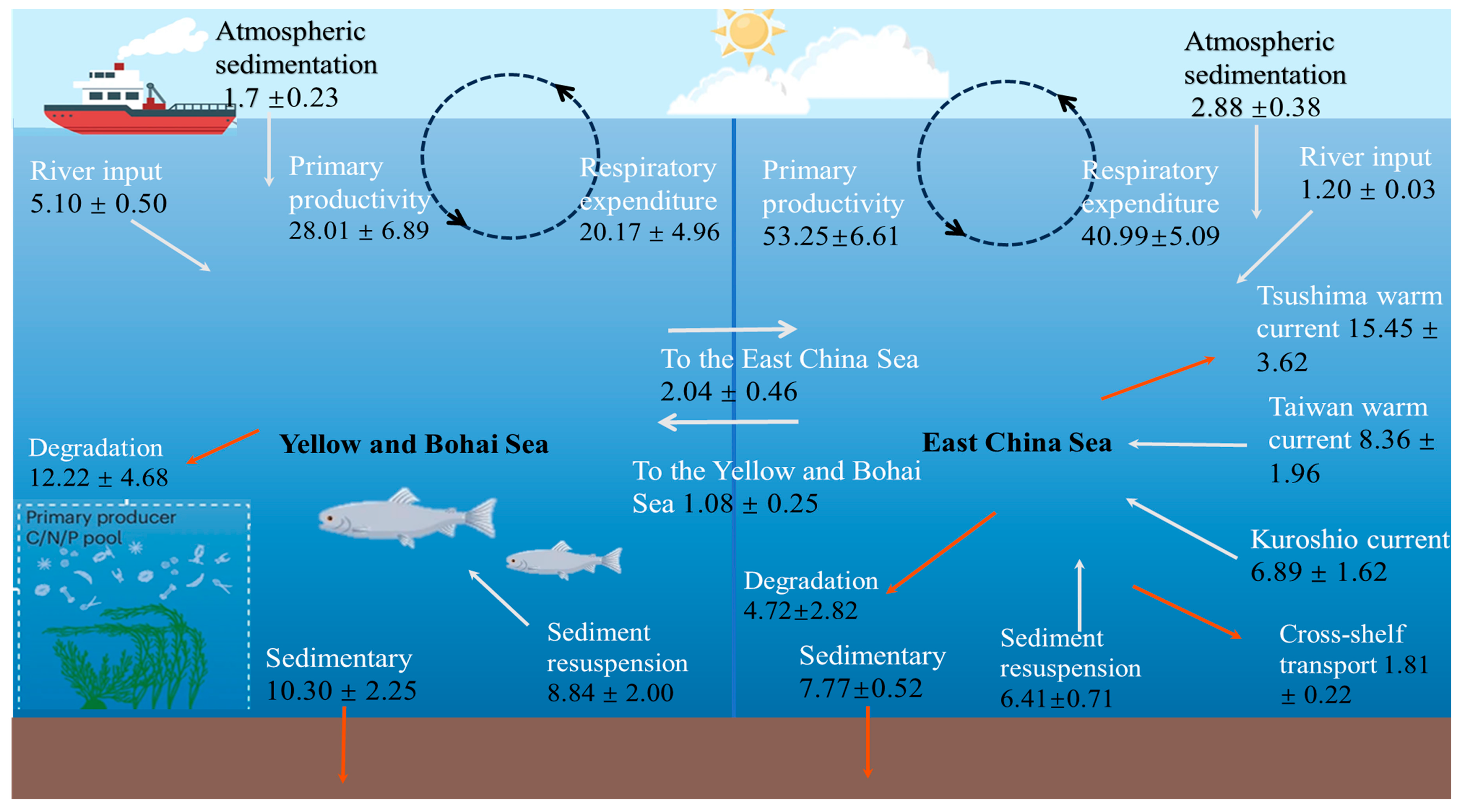
- Primary production and respiratory consumption were identified as the predominant input and output fluxes, respectively, in China’s marginal seas.
- This study enriches the understanding of carbon cycling processes and carbon sink mechanisms in marginal seas and offers a scientific basis for research on the environmental evolution of China’s marginal seas.
- The findings provide critical scientific support for predicting the marine carbon cycle under climate change and for informing regional “dual carbon” policy goals.
Abstract
1. Introduction
2. Materials and Methods
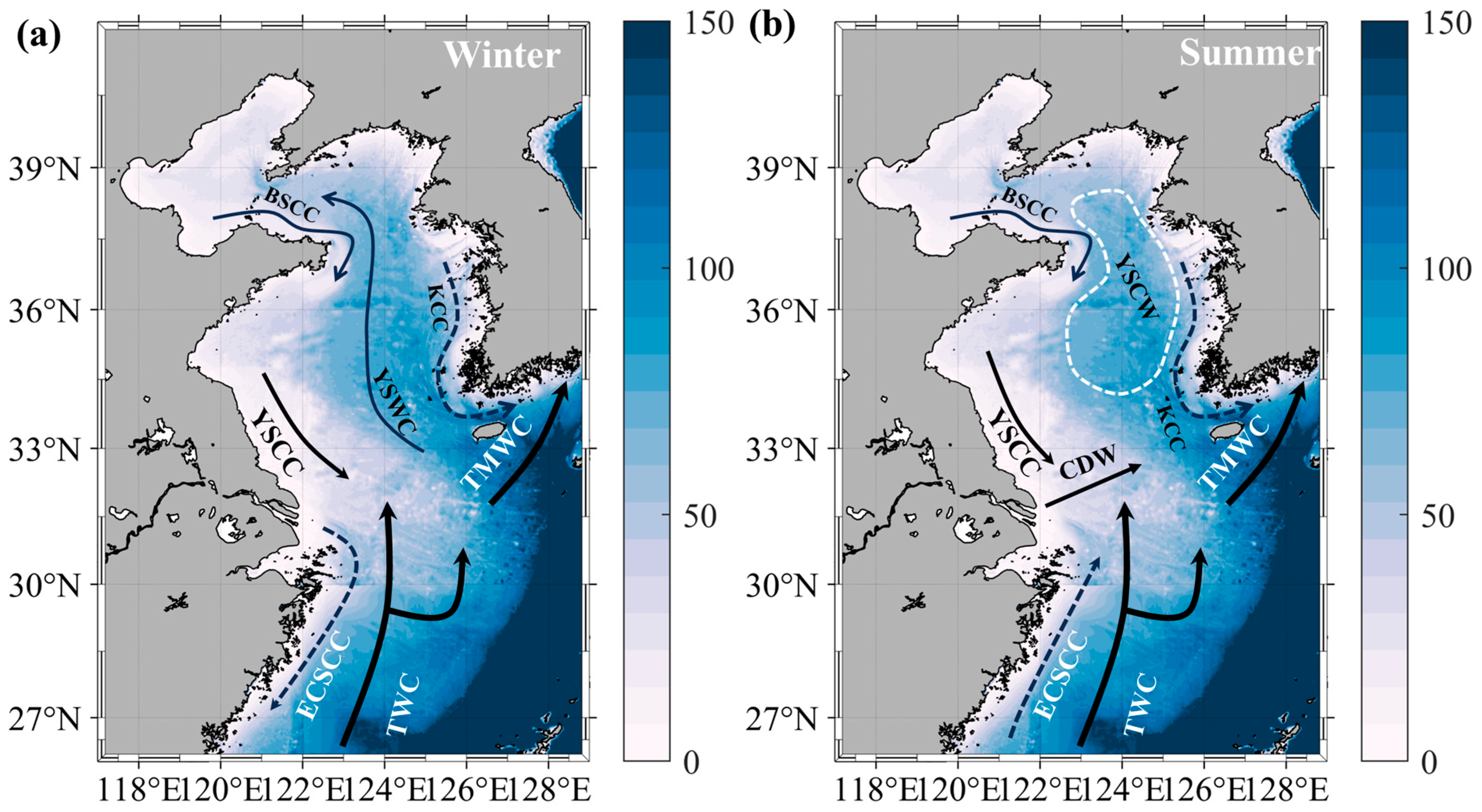
2.1. Study Area
2.2. Data Source and Verification
2.3. Research Methods
2.3.1. Spatial Variation Analysis
2.3.2. Trend Analysis
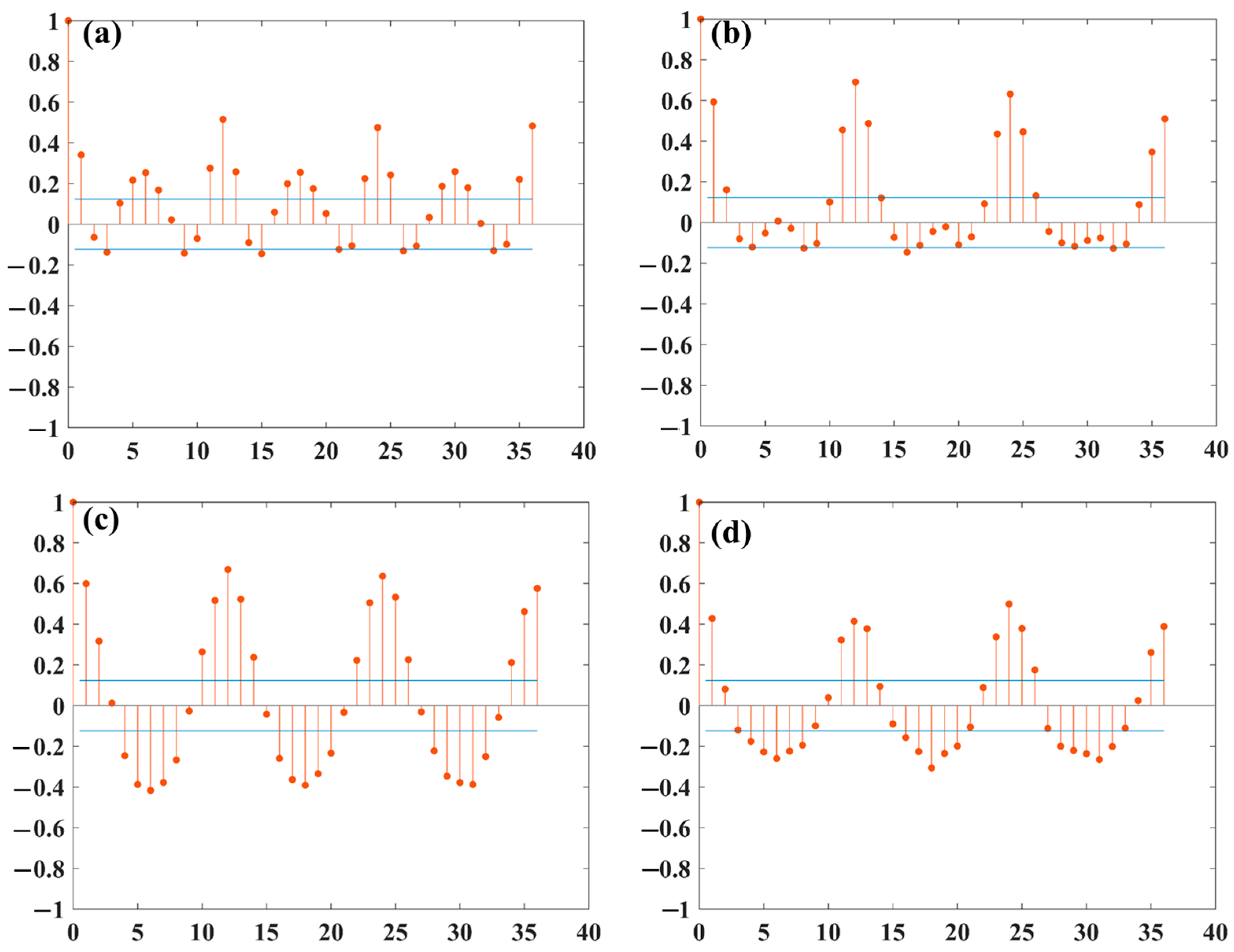
2.3.3. Autocorrelation Function (ACF)
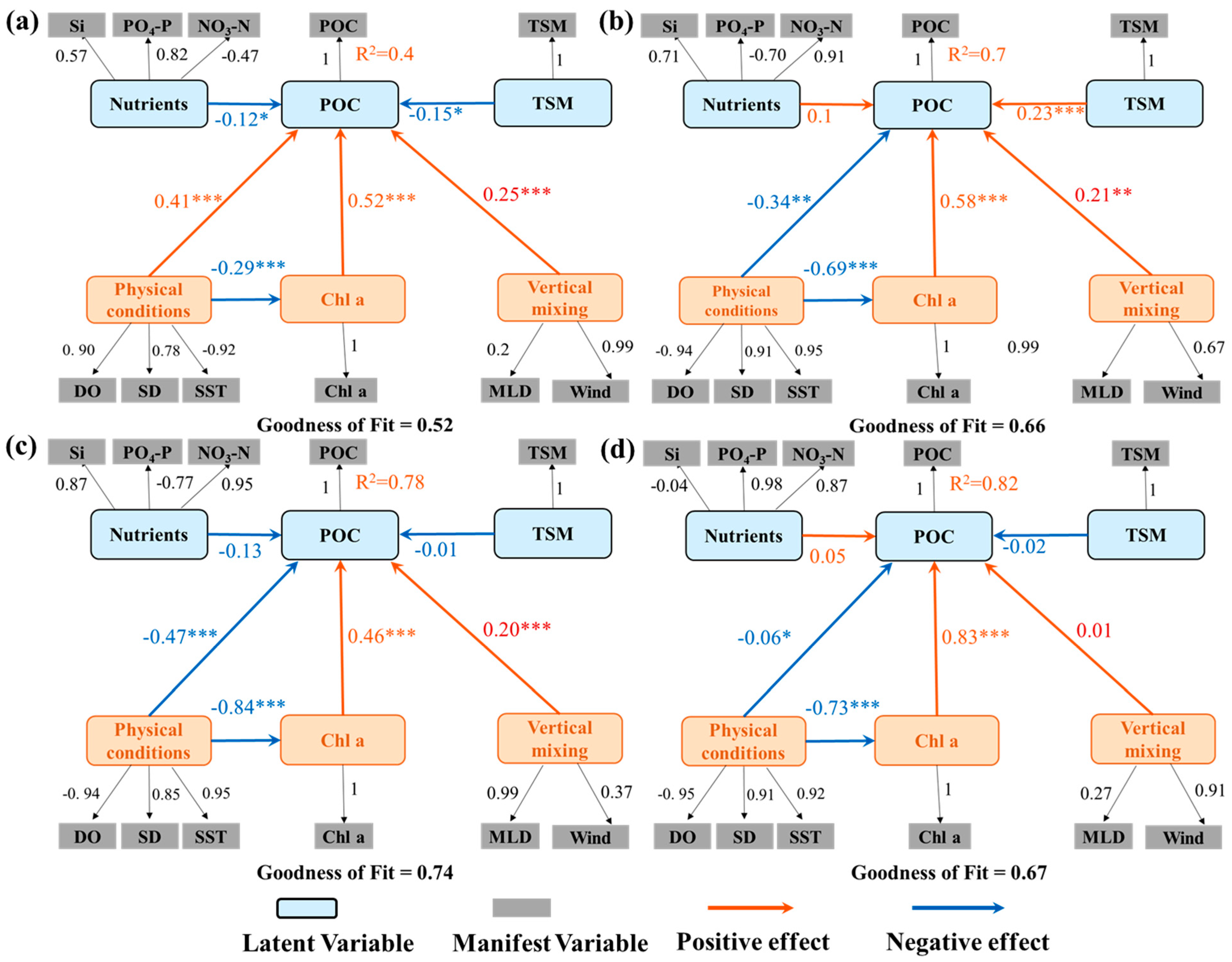
2.3.4. PLS-PM Analysis
2.3.5. Budget Processes
Riverine Input
Water Exchange and Cross-Shelf Carbon Transport
Sedimentary Burial and Resuspension
Budget Estimation
3. Results and Discussion
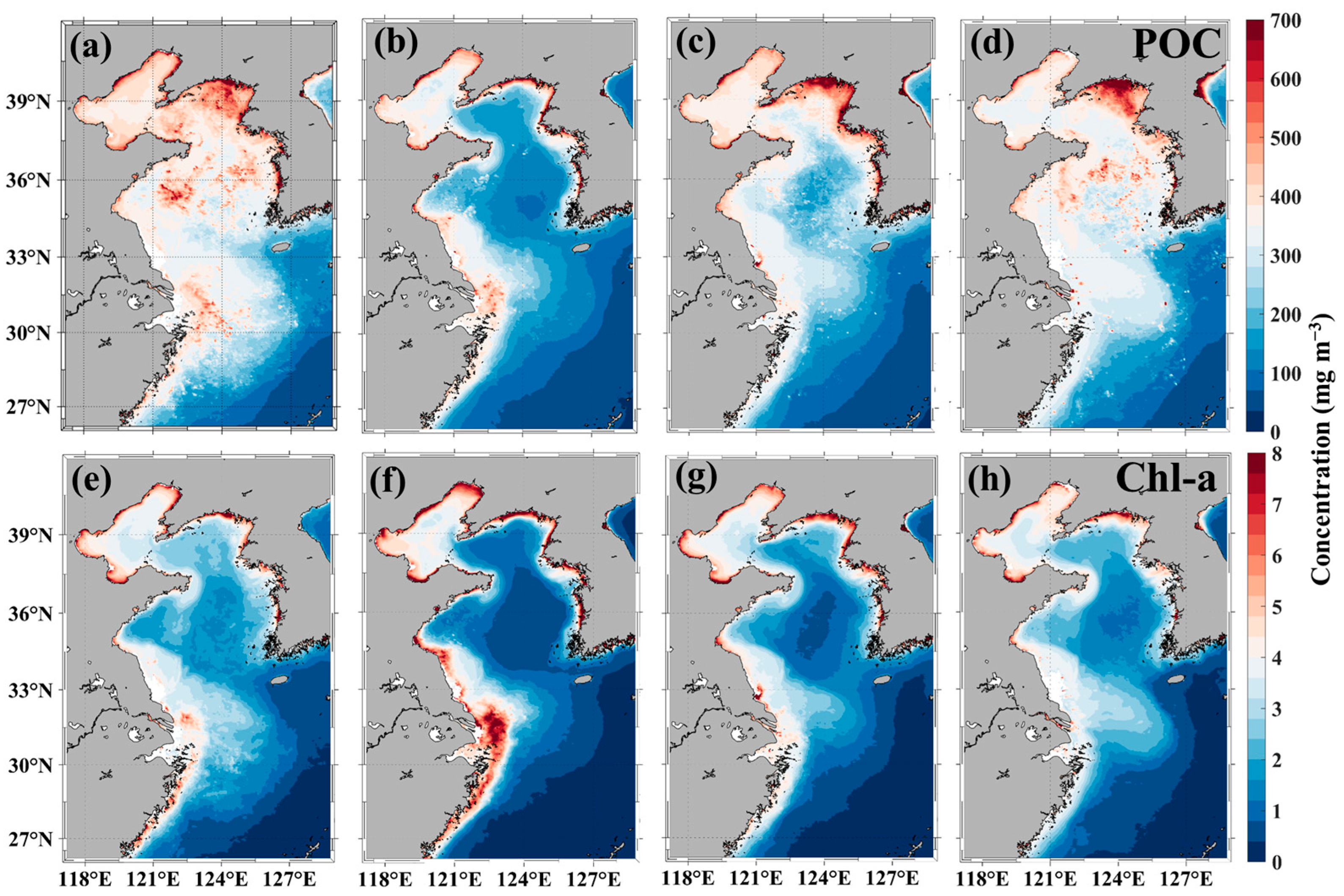
3.1. Spatial Variability Characteristics
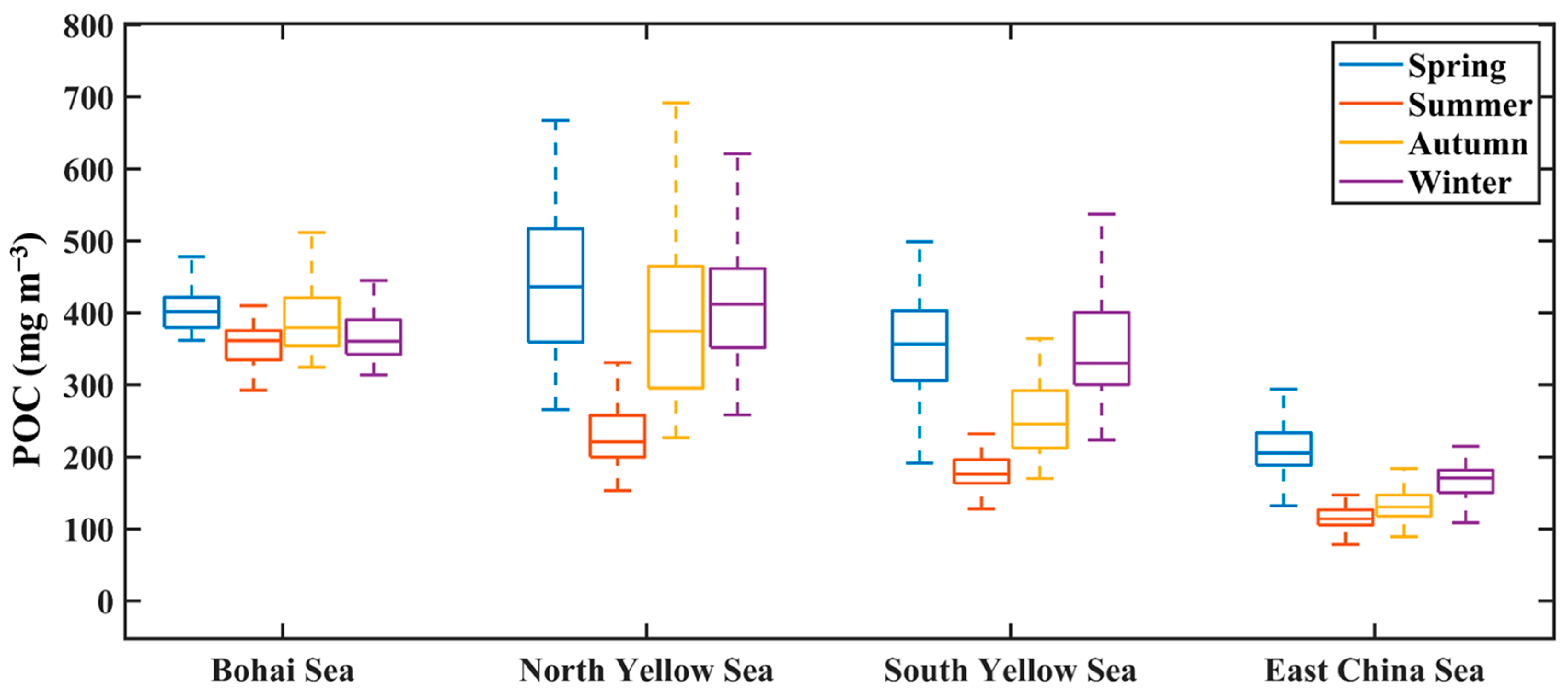
3.2. Seasonal Variation in POC Concentration
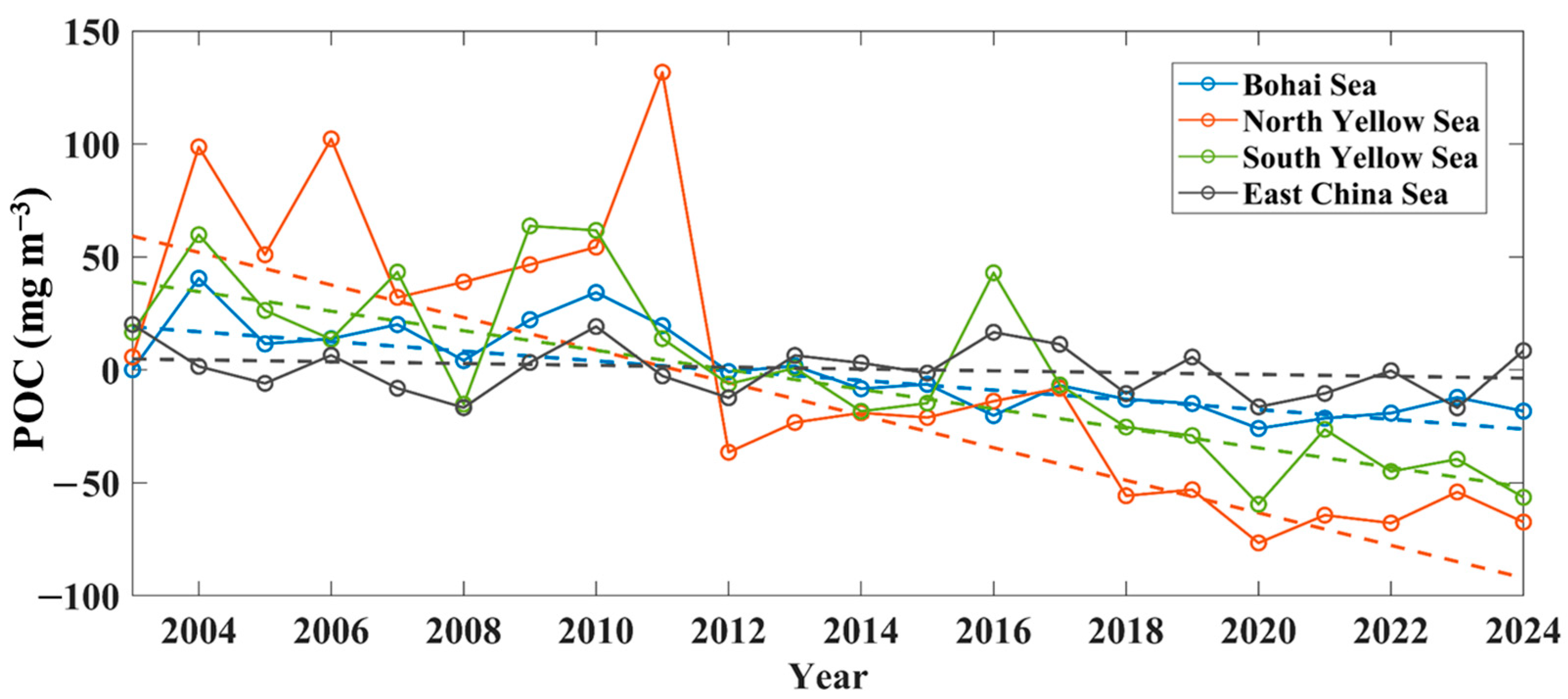
3.3. Interannual Variability
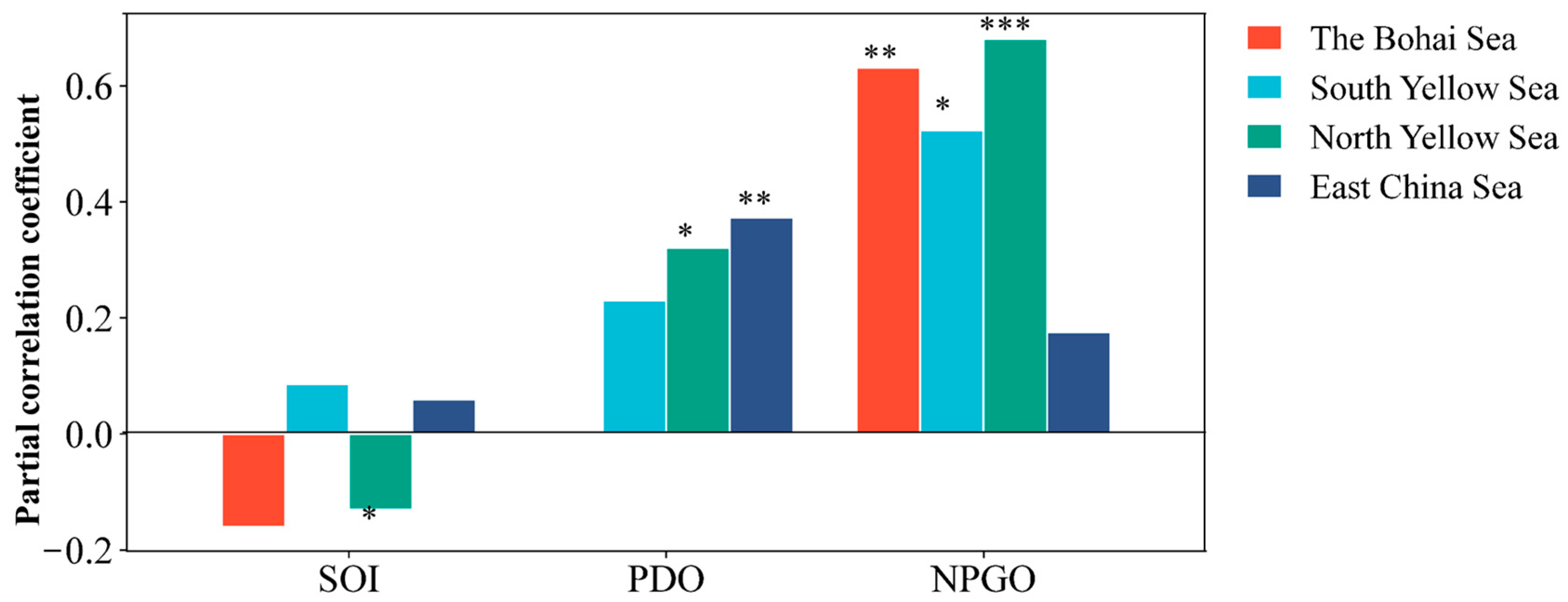
3.4. Impact of Climate Variability on POC
3.5. Impact of Environmental Factors on POC
3.6. China Marginal Sea POC Budget Process
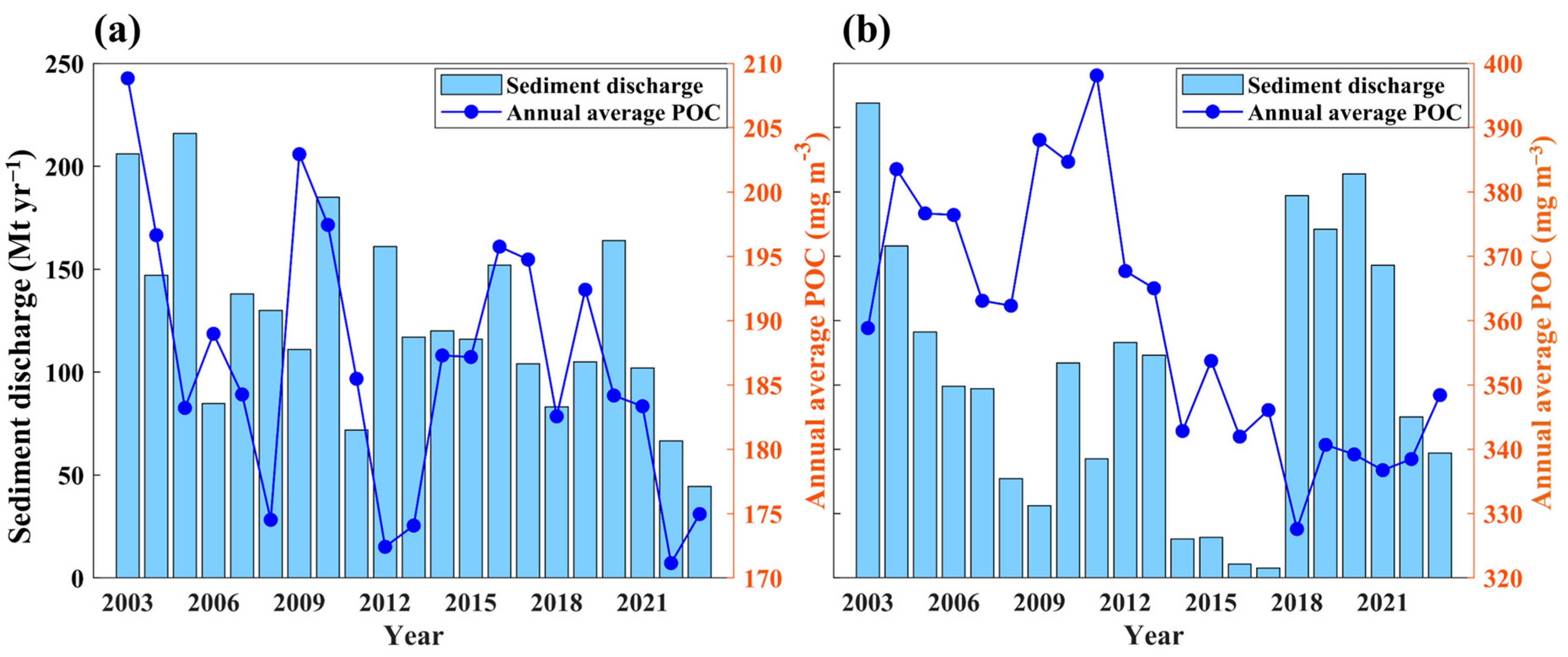
3.6.1. Riverine Input
3.6.2. Water Exchange and Cross-Shelf Carbon Transport
3.6.3. Atmospheric Deposition
3.6.4. PP and Respiratory Consumption
3.6.5. Sedimentation and Sediment Resuspension
3.6.6. Degradation and Transformation of POC
3.6.7. Net Budget Analysis
4. Conclusions
Supplementary Materials
Author Contributions
Funding
Data Availability Statement
Acknowledgments
Conflicts of Interest
References
- Chen, D.; Zeng, L.; Boot, K.; Liu, Q. Satellite Observed Spatial and Temporal Variabilities of Particulate Organic Carbon in the East China Sea. Remote Sens. 2022, 14, 1799. [Google Scholar] [CrossRef]
- Jang, H.-K.; Youn, S.-H.; Joo, H.; Kim, Y.; Kang, J.-J.; Lee, D.; Jo, N.; Kim, K.; Kim, M.-J.; Kim, S.; et al. First Concurrent Measurement of Primary Production in the Yellow Sea, the South Sea of Korea, and the East/Japan Sea, 2018. J. Mar. Sci. Eng. 2021, 9, 1237. [Google Scholar] [CrossRef]
- Song, J.; Qu, B.; Li, X.; Yuan, H.; Li, N.; Duan, L. Carbon sinks/sources in the Yellow and East China Seas—Air-sea interface exchange, dissolution in seawater, and burial in sediments. Sci. China Earth Sci. 2018, 61, 1583–1593. [Google Scholar] [CrossRef]
- Zhao, B.; Yao, P.; Bianchi, T.S.; Arellano, A.R.; Wang, X.; Yang, J.; Su, R.; Wang, J.; Xu, Y.; Huang, X.; et al. The remineralization of sedimentary organic carbon in different sedimentary regimes of the Yellow and East China Seas. Chem. Geol. 2018, 495, 104–117. [Google Scholar] [CrossRef]
- Wang, S.; Gao, Y.; Jia, J.; Lu, Y.; Sun, K.; Ha, X.; Li, Z.; Deng, W. Vertically stratified water source characteristics and associated driving mechanisms of particulate organic carbon in a large floodplain lake system. Water Res. 2022, 209, 117963. [Google Scholar] [CrossRef]
- Najjar, R.G.; Herrmann, M.; Alexander, R.; Boyer, E.W.; Burdige, D.J.; Butman, D.; Cai, W.J.; Canuel, E.A.; Chen, R.F.; Friedrichs, M.A.M.; et al. Carbon Budget of Tidal Wetlands, Estuaries, and Shelf Waters of Eastern North America. Glob. Biogeochem. Cycles 2018, 32, 389–416. [Google Scholar] [CrossRef]
- Fan, H.; Wang, X.; Zhang, H.; Yu, Z. Spatial and temporal variations of particulate organic carbon in the Yellow-Bohai Sea over 2002–2016. Sci. Rep. 2018, 8, 7971. [Google Scholar] [CrossRef]
- Stramski, D.; Joshi, I.; Reynolds, R.A. Ocean color algorithms to estimate the concentration of particulate organic carbon in surface waters of the global ocean in support of a long-term data record from multiple satellite missions. Remote Sens. Environ. 2022, 269, 112776. [Google Scholar] [CrossRef]
- Yu, J.; Wang, X.; Fan, H.; Zhang, R.H. Impacts of Physical and Biological Processes on Spatial and Temporal Variability of Particulate Organic Carbon in the North Pacific Ocean during 2003-2017. Sci. Rep. 2019, 9, 16493. [Google Scholar] [CrossRef]
- Gao, Y.; Jia, J.; Lu, Y.; Yang, T.; Lyu, S.; Shi, K.; Zhou, F.; Yu, G. Determining dominating control mechanisms of inland water carbon cycling processes and associated gross primary productivity on regional and global scales. Earth Sci. Rev. 2021, 213, 103497. [Google Scholar] [CrossRef]
- Meng, L.; Zhao, Z.; Lu, L.; Zhou, J.; Luo, D.; Fan, R.; Li, S.; Jiang, Q.; Huang, T.; Yang, H.; et al. Source identification of particulate organic carbon using stable isotopes and n-alkanes: Modeling and application. Water Res. 2021, 197, 117083. [Google Scholar] [CrossRef] [PubMed]
- Chen, J.; Yang, H.; Zeng, Y.; Guo, J.; Song, Y.; Ding, W. Combined use of radiocarbon and stable carbon isotope to constrain the sources and cycling of particulate organic carbon in a large freshwater lake, China. Sci. Total Environ. 2018, 625, 27–38. [Google Scholar] [CrossRef] [PubMed]
- Son, Y.B.; Kim, E.; Cho, J.H.; Choi, S.K.; Kang, D. Analysis of regional variation of water transparency in the Yellow Sea and East China Sea based on MODIS data. Reg. Stud. Mar. Sci. 2025, 84, 104093. [Google Scholar] [CrossRef]
- Stuart, E.J.; Christopher, T.S.; Brian, C.W. Subsidy or Subtraction: How Do Terrestrial Inputs Influence Consumer Production in Lakes? Freshw. Rev. 2012, 5, 37–49. [Google Scholar] [CrossRef]
- Mader, M.; Schmidt, C.; van Geldern, R.; Barth, J.A.C. Dissolved oxygen in water and its stable isotope effects: A review. Chem. Geol. 2017, 473, 10–21. [Google Scholar] [CrossRef]
- Ye, W.; Liu, C.; Cai, Y.; Zhai, H.; Yue, F.; Wang, B.; Shou, L.; Chen, Q.; Du, P. The importance of plankton community respiration rate to carbon flux balance in the Yellow and East China Sea. Oceanol. Limnol. Sin. 2022, 53, 84–95. [Google Scholar] [CrossRef]
- Wang, S.; Lu, Y.; Wen, X.; Sun, K.; Jia, J.; Li, Z.; Gao, Y. Long-term effects of nitrogen deposition on carbon assimilation characteristics in the past three decades in a typical subtropical watershed. Agric. For. Meteorol. 2021, 308–309, 108561. [Google Scholar] [CrossRef]
- Cai, Y.; Gong, Z.; Qin, B. Benthic macroinvertebrate community structure in Lake Taihu, China: Effects of trophic status, wind-induced disturbance and habitat complexity. J. Great Lakes Res. 2012, 38, 39–48. [Google Scholar] [CrossRef]
- Wang, X.; Yu, J.; Fan, H. Spatial and seasonal variability of surface particulate inorganic carbon and relationship with particulate organic carbon in the Yellow-Bohai Sea. J. Oceanogr. 2020, 76, 327–339. [Google Scholar] [CrossRef]
- Triana, K.; Wahyudi, A.A.J.; Murakami-Sugihara, N.; Ogawa, H. Spatial and temporal variations in particulate organic carbon in Indonesian waters over two decades. Mar. Freshw. Res. 2021, 72, 1782–1797. [Google Scholar] [CrossRef]
- Zhao, G.; Ye, S.; He, L.; Yuan, H.; Ding, X.; Wang, J.; Laws, E.A. Historical change of carbon burial in Late Quaternary sediments of the ancient Yellow River delta on the west coast of Bohai Bay, China. CATENA 2020, 193, 104619. [Google Scholar] [CrossRef]
- Guo, C.-C.; Yang, S.; Luan, Q.-S.; Liu, Q.-Q.; Liu, Z.-C.; Zhai, W.-D. A stable-carbon-isotope-based constraint of bulk particulate organic carbon dynamics and budgets in the Yellow Sea: Combining field surveys and isotope fractionation modeling. Prog. Oceanogr. 2025, 236, 103477. [Google Scholar] [CrossRef]
- Xie, L.; Gao, X.; Liu, Y.; Yang, B.; Yuan, H.; Li, X.; Song, J.; Zhao, J.; Xing, Q. Atmospheric deposition as a direct source of particulate organic carbon in region coastal surface seawater: Evidence from stable carbon and nitrogen isotope analysis. Sci. Total Environ. 2023, 854, 158540. [Google Scholar] [CrossRef] [PubMed]
- Wu, Y.; Eglinton, T.I.; Zhang, J.; Montlucon, D.B. Spatiotemporal Variation of the Quality, Origin, and Age of Particulate Organic Matter Transported by the Yangtze River (Changjiang). J. Geophys. Res. Biogeosci. 2018, 123, 2908–2921. [Google Scholar] [CrossRef]
- Liu, D.; Tian, L.; Jiang, X.; Wu, H.; Yu, S. Human activities changed organic carbon transport in Chinese rivers during 2004-2018. Water Res. 2022, 222, 118872. [Google Scholar] [CrossRef]
- Wang, H.; Ran, X.; Bouwman, A.F.; Wang, J.; Xu, B.; Song, Z.; Sun, S.; Yao, Q.; Yu, Z. Damming alters the particulate organic carbon sources, burial, export and estuarine biogeochemistry of rivers. J. Hydrol. 2022, 607, 127525. [Google Scholar] [CrossRef]
- Hao, J.; Yuan, D.; He, L.; Yuan, H.; Su, J.; Pohlmann, T.; Ran, X. Cross-Shelf Carbon Transport in the East China Sea and Its Future Trend Under Global Warming. J. Geophys. Res. Ocean. 2024, 129, e2022JC019403. [Google Scholar] [CrossRef]
- Seo, J.; Kim, G.; Hwang, J. Sources and behavior of particulate organic carbon in the Yellow Sea and the East China Sea based on 13C, 14C, and 234Th. Front. Mar. Sci. 2022, 9, 793556. [Google Scholar] [CrossRef]
- Guo, C.; Yang, S.; Zhai, W.; Niu, Y.; Liu, C. Biological–physical oceanographic coupling influencing particulate organic matter in the South Yellow Sea. Front. Mar. Sci. 2022, 9, 919423. [Google Scholar] [CrossRef]
- Liu, Z.; Chen, Y.; Lin, X.; Yang, W. Spatio-Temporal Dynamics of Particulate Organic Carbon and Its Response to Climate Change: Evidence of the East China Sea from 2003 to 2022. J. Mar. Sci. Eng. 2025, 13, 963. [Google Scholar] [CrossRef]
- Qi, Q.-Q.; Yang, G.-P.; Yang, B.; He, Z. Spatiotemporal distributions and oceanic emissions of short-lived halocarbons in the East China Sea. Sci. Total Environ. 2023, 893, 164879. [Google Scholar] [CrossRef] [PubMed]
- Chen, C.; Xue, P.; Ding, P.; Beardsley, R.C.; Xu, Q.; Mao, X.; Gao, G.; Qi, J.; Li, C.; Lin, H.; et al. Physical mechanisms for the offshore detachment of the Changjiang Diluted Water in the East China Sea. J. Geophys. Res. Ocean. 2008, 113, C02002. [Google Scholar] [CrossRef]
- Hu, L.; Shi, X.; Yu, Z.; Lin, T.; Wang, H.; Ma, D.; Guo, Z.; Yang, Z. Distribution of sedimentary organic matter in estuarine–inner shelf regions of the East China Sea: Implications for hydrodynamic forces and anthropogenic impact. Mar. Chem. 2012, 142–144, 29–40. [Google Scholar] [CrossRef]
- Stramski, D.; Reynolds, R.A.; Babin, M.; Kaczmarek, S.; Lewis, M.R.; Röttgers, R.; Sciandra, A.; Stramska, M.; Twardowski, M.S.; Franz, B.A.; et al. Relationships between the surface concentration of particulate organic carbon and optical properties in the eastern South Pacific and eastern Atlantic Oceans. Biogeosciences 2008, 5, 171–201. [Google Scholar] [CrossRef]
- Son, S.; Wang, M. Water properties in Chesapeake Bay from MODIS-Aqua measurements. Remote Sens. Environ. 2012, 123, 163–174. [Google Scholar] [CrossRef]
- National Earth System Science Data Center, National Science & Technology Infrastructure of China. Earth System Science Data. 2025. Available online: http://www.geodata.cn (accessed on 1 December 2025).
- Cui, T.; Zhang, J.; Tang, J.; Sathyendranath, S.; Groom, S.; Ma, Y.; Zhao, W.; Song, Q. Assessment of satellite ocean color products of MERIS, MODIS and SeaWiFS along the East China Coast (in the Yellow Sea and East China Sea). ISPRS J. Photogramm. Remote Sens. 2014, 87, 137–151. [Google Scholar] [CrossRef]
- Getis, A.; Ord, J.K. The Analysis of Spatial Association by Use of Distance Statistics. Geogr. Anal. 1992, 24, 189–206. [Google Scholar] [CrossRef]
- Sen, P.K. Estimates of the Regression Coefficient Based on Kendall’s Tau. J. Am. Stat. Assoc. 1968, 63, 1379–1389. [Google Scholar] [CrossRef]
- Mann, H.B. Nonparametric Tests Against Trend. Econometrica 1945, 13, 245–259. [Google Scholar] [CrossRef]
- Ludwig, W.; Probst, J.-L.; Kempe, S. Predicting the oceanic input of organic carbon by continental erosion. Glob. Biogeochem. Cycles 1996, 10, 23–41. [Google Scholar] [CrossRef]
- Ingall, E.; Jahnke, R. Evidence for enhanced phosphorus regeneration from marine sediments overlain by oxygen depleted waters. Geochim. Cosmochim. Acta 1994, 58, 2571–2575. [Google Scholar] [CrossRef]
- Liu, S.M.; Zhang, J.; Chen, S.Z.; Chen, H.T.; Hong, G.H.; Wei, H.; Wu, Q.M. Inventory of nutrient compounds in the Yellow Sea. Cont. Shelf Res. 2003, 23, 1161–1174. [Google Scholar] [CrossRef]
- Martin, J.M.; Zhang, J.; Shi, M.C.; Zhou, Q. Actual flux of the Huanghe (yellow river) sediment to the Western Pacific ocean. Neth. J. Sea Res. 1993, 31, 243–254. [Google Scholar] [CrossRef]
- Meng, X.; Guo, J.; Han, Y. Preliminary assessment of ERA5 reanalysis data. J. Mar. Meteorol. 2018, 38, 91–99. [Google Scholar] [CrossRef]
- Zhou, F.; Xue, H.; Huang, D.; Xuan, J.; Ni, X.; Xiu, P.; Hao, Q. Cross-shelf exchange in the shelf of the East China Sea. J. Geophys. Res. Ocean. 2015, 120, 1545–1572. [Google Scholar] [CrossRef]
- Hung, C.C.; Tseng, C.W.; Gong, G.C.; Chen, K.S.; Chen, M.H.; Hsu, S.C. Fluxes of particulate organic carbon in the East China Sea in summer. Biogeosciences 2013, 10, 6469–6484. [Google Scholar] [CrossRef]
- Hu, L.; Shi, X.; Bai, Y.; Qiao, S.; Li, L.; Yu, Y.; Yang, G.; Ma, D.; Guo, Z. Recent organic carbon sequestration in the shelf sediments of the Bohai Sea and Yellow Sea, China. J. Mar. Syst. 2016, 155, 50–58. [Google Scholar] [CrossRef]
- Liu, Q.; Kandasamy, S.; Wang, H.; Wang, L.; Lin, B.; Gao, A.; Chen, C.-T.A. Impact of Hydrological Conditions on the Biogeochemical Dynamics of Suspended Particulate Organic Matter in the Upper Mixed Layer of the Southern East China Sea. J. Geophys. Res. Ocean. 2019, 124, 6120–6140. [Google Scholar] [CrossRef]
- Tan Saichun, S.H.I.G. Remote Sensing for Ocean Primary Productivity and Its Spatio-temporal Variability in the China Seas. Acta Geogr. Sin. 2006, 61, 1189–1199. [Google Scholar] [CrossRef]
- Fu, Q.; Yan, X.; Hong, Q.; Lin, L.; Zhang, Y. Variability of the Primary Productivity in the Yellow and Bohai Seas from 2003 to 2020 Based on the Estimate of Satellite Remote Sensing. J. Mar. Sci. Eng. 2023, 11, 684. [Google Scholar] [CrossRef]
- Falkowski, P.; Scholes, R.J.; Boyle, E.; Canadell, J.; Canfield, D.; Elser, J.; Gruber, N.; Hibbard, K.; Högberg, P.; Linder, S.; et al. The Global Carbon Cycle: A Test of Our Knowledge of Earth as a System. Science 2000, 290, 291–296. [Google Scholar] [CrossRef] [PubMed]
- Song, H.; Ji, R.; Xin, M.; Liu, P.; Zhang, Z.; Wang, Z. Spatial heterogeneity of seasonal phytoplankton blooms in a marginal sea: Physical drivers and biological responses. ICES J. Mar. Sci. 2020, 77, 408–418. [Google Scholar] [CrossRef]
- Park, S.; Chu, P.C.; Lee, J.-H. Interannual-to-interdecadal variability of the Yellow Sea Cold Water Mass in 1967–2008: Characteristics and seasonal forcings. J. Mar. Syst. 2011, 87, 177–193. [Google Scholar] [CrossRef]
- Liu, X.; Huang, B.; Huang, Q.; Wang, L.; Ni, X.; Tang, Q.; Sun, S.; Wei, H.; Liu, S.; Li, C.; et al. Seasonal phytoplankton response to physical processes in the southern Yellow Sea. J. Sea Res. 2015, 95, 45–55. [Google Scholar] [CrossRef]
- Zeng, X.; He, R.; Xue, Z.; Wang, H.; Wang, Y.; Yao, Z.; Guan, W.; Warrillow, J. River-derived sediment suspension and transport in the Bohai, Yellow, and East China Seas: A preliminary modeling study. Cont. Shelf Res. 2015, 111, 112–125. [Google Scholar] [CrossRef]
- Yang, H.-W.; Cho, Y.-K.; Seo, G.-H.; You, S.H.; Seo, J.-W. Interannual variation of the southern limit in the Yellow Sea Bottom Cold Water and its causes. J. Mar. Syst. 2014, 139, 119–127. [Google Scholar] [CrossRef]
- Hung, J.-J.; Lin, P.-L.; Liu, K.-K. Dissolved and particulate organic carbon in the southern East China Sea. Cont. Shelf Res. 2000, 20, 545–569. [Google Scholar] [CrossRef]
- Chang, P.-H.; Isobe, A. A numerical study on the Changjiang diluted water in the Yellow and East China Seas. J. Geophys. Res. Ocean. 2003, 108, 3299. [Google Scholar] [CrossRef]
- Kim, H.-C.; Yamaguchi, H.; Yoo, S.; Zhu, J.; Okamura, K.; Kiyomoto, Y.; Tanaka, K.; Kim, S.-W.; Park, T.; Oh, I.S.; et al. Distribution of Changjiang Diluted Water detected by satellite chlorophyll-a and its interannual variation during 1998–2007. J. Oceanogr. 2009, 65, 129–135. [Google Scholar] [CrossRef]
- Wang, H.; Dai, M.; Liu, J.; Kao, S.-J.; Zhang, C.; Cai, W.-J.; Wang, G.; Qian, W.; Zhao, M.; Sun, Z. Eutrophication-Driven Hypoxia in the East China Sea off the Changjiang Estuary. Environ. Sci. Technol. 2016, 50, 2255–2263. [Google Scholar] [CrossRef]
- Ni, X.; Huang, D.; Zeng, D.; Zhang, T.; Li, H.; Chen, J. The impact of wind mixing on the variation of bottom dissolved oxygen off the Changjiang Estuary during summer. J. Mar. Syst. 2016, 154, 122–130. [Google Scholar] [CrossRef]
- Dai, A. Drought under global warming: A review. WIREs Clim. Change 2011, 2, 45–65. [Google Scholar] [CrossRef]
- Lin, C.; Ning, X.; Su, J.; Lin, Y.; Xu, B. Environmental changes and the responses of the ecosystems of the Yellow Sea during 1976–2000. J. Mar. Syst. 2005, 55, 223–234. [Google Scholar] [CrossRef]
- Zhang, K.; Zhao, X.; Xue, J.; Mo, D.; Zhang, D.; Xiao, Z.; Yang, W.; Wu, Y.; Chen, Y. The temporal and spatial variation of chlorophyll a concentration in the China Seas and its impact on marine fisheries. Front. Mar. Sci. 2023, 10, 1212992. [Google Scholar] [CrossRef]
- Zhu, G.H.; Liu, Y.L.; Chen, L.H.; Yu, P.S.; Jin, M.; Liu, Z.L. Studies on Phytoplankton and Particulate Organic Carbon in the Southern Ocean. Appl. Mech. Mater. 2011, 137, 344–352. [Google Scholar] [CrossRef]
- Gong, G.-C.; Liu, K.-K.; Chiang, K.-P.; Hsiung, T.-M.; Chang, J.; Chen, C.-C.; Hung, C.-C.; Chou, W.-C.; Chung, C.-C.; Chen, H.-Y.; et al. Yangtze River floods enhance coastal ocean phytoplankton biomass and potential fish production. Geophys. Res. Lett. 2011, 38, L13603. [Google Scholar] [CrossRef]
- Bauer, J.E.; Cai, W.J.; Raymond, P.A.; Bianchi, T.S.; Hopkinson, C.S.; Regnier, P.A.G. The changing carbon cycle of the coastal ocean. Nature 2013, 504, 61–70. [Google Scholar] [CrossRef]
- Zhao, Y.; Zou, X.; Gao, J.; Xu, X.; Wang, C.; Tang, D.; Wang, T.; Wu, X. Quantifying the anthropogenic and climatic contributions to changes in water discharge and sediment load into the sea: A case study of the Yangtze River, China. Sci. Total Environ. 2015, 536, 803–812. [Google Scholar] [CrossRef]
- Chen, C.-C.; Shiah, F.-K.; Chiang, K.-P.; Gong, G.-C.; Kemp, W.M. Effects of the Changjiang (Yangtze) River discharge on planktonic community respiration in the East China Sea. J. Geophys. Res. Ocean. 2009, 114, C03005. [Google Scholar] [CrossRef]
- Wang, X.; Ma, H.; Li, R.; Song, Z.; Wu, J. Seasonal fluxes and source variation of organic carbon transported by two major Chinese Rivers: The Yellow River and Changjiang (Yangtze) River. Glob. Biogeochem. Cycles 2012, 26, GB2025. [Google Scholar] [CrossRef]
- Liu, J.; Yu, Z.; Zang, J.; Sun, T.; Zhao, C.; Ran, X. Distribution and budget of organic carbon in the Bohai and Yellow Seas. Adv. Earth Sci. 2015, 30, 564–578. [Google Scholar]
- Bian, C.; Jiang, W.; Pohlmann, T.; Sündermann, J. Hydrography-Physical Description of the Bohai Sea. J. Coast. Res. 2016, 74, 1–12. [Google Scholar] [CrossRef]
- Li, C. Interaction between anomalous winter monsoon in East Asia and El Nino events. Adv. Atmos. Sci. 1990, 7, 36–46. [Google Scholar] [CrossRef]
- Wang, D.; Cui, T.; Si, D.; Shao, X.; Li, Q.; Sun, C. Features and Possible Causes for East Asian Winter Monsoon in 2014/2015. Meteorol. Mon. 2015, 41, 907–914. [Google Scholar]
- Di Lorenzo, E.; Schneider, N.; Cobb, K.M.; Franks, P.J.S.; Chhak, K.; Miller, A.J.; McWilliams, J.C.; Bograd, S.J.; Arango, H.; Curchitser, E.; et al. North Pacific Gyre Oscillation links ocean climate and ecosystem change. Geophys. Res. Lett. 2008, 35, L08607. [Google Scholar] [CrossRef]
- Stramska, M.; Bialogrodzka, J. Satellite observations of seasonal and regional variability of particulate organic carbon concentration in the Barents Sea. Oceanologia 2016, 58, 249–263. [Google Scholar] [CrossRef]
- Gao, Y.; He, N.; Yu, G.; Tian, J.; Miao, C.; Yang, T. Impact of external nitrogen and phosphorus input between 2006 and 2010 on carbon cycle in China seas. Reg. Environ. Change 2015, 15, 631–641. [Google Scholar] [CrossRef]
- Gao, L.; Li, D.; Zhang, Y. Nutrients and particulate organic matter discharged by the Changjiang (Yangtze River): Seasonal variations and temporal trends. J. Geophys. Res. Biogeosci. 2012, 117, G04001. [Google Scholar] [CrossRef]
- Zhang, J.; Wu, Y.; Jennerjahn, T.C.; Ittekkot, V.; He, Q. Distribution of organic matter in the Changjiang (Yangtze River) Estuary and their stable carbon and nitrogen isotopic ratios: Implications for source discrimination and sedimentary dynamics. Mar. Chem. 2007, 106, 111–126. [Google Scholar] [CrossRef]
- Gong, G.-C.; Shiah, F.-K.; Liu, K.-K.; Wen, Y.-H.; Ming-Hsin, L. Spatial and temporal variation of chlorophyll a, primary productivity and chemical hydrography in the southern East China Sea. Cont. Shelf Res. 2000, 20, 411–436. [Google Scholar] [CrossRef]
- Henson, S.A.; Sanders, R.; Madsen, E.; Morris, P.J.; Le Moigne, F.; Quartly, G.D. A reduced estimate of the strength of the ocean’s biological carbon pump. Geophys. Res. Lett. 2011, 38, L04606. [Google Scholar] [CrossRef]
- Hwang, J.; Montluçon, D.B.; Pilskaln, C.H.; Eglinton, T.I. Molecular and isotopic insights into particulate organic carbon sources and dynamics in Jordan Basin, Gulf of Maine. Cont. Shelf Res. 2013, 68, 15–22. [Google Scholar] [CrossRef]
- Deng, B.; Zhang, J.; Wu, Y. Recent sediment accumulation and carbon burial in the East China Sea. Glob. Biogeochem. Cycles 2006, 20, GB3014. [Google Scholar] [CrossRef]
- Moran, M.A.; Sheldon, W.M., Jr.; Zepp, R.G. Carbon loss and optical property changes during long-term photochemical and biological degradation of estuarine dissolved organic matter. Limnol. Oceanogr. 2000, 45, 1254–1264. [Google Scholar] [CrossRef]
- Burd, A.B.; Hansell, D.A.; Steinberg, D.K.; Anderson, T.R.; Arístegui, J.; Baltar, F.; Beaupré, S.R.; Buesseler, K.O.; DeHairs, F.; Jackson, G.A.; et al. Assessing the apparent imbalance between geochemical and biochemical indicators of meso- and bathypelagic biological activity: What the @$♯! is wrong with present calculations of carbon budgets? Deep. Sea Res. Part II Top. Stud. Oceanogr. 2010, 57, 1557–1571. [Google Scholar] [CrossRef]
- Shang, J.; Sun, J.; Tao, L.; Li, Y.; Nie, Z.; Liu, H.; Chen, R.; Yuan, D. Combined Effect of Tides and Wind on Water Exchange in a Semi-Enclosed Shallow Sea. Water 2019, 11, 1762. [Google Scholar] [CrossRef]
- Baines, S.B.; Pace, M.L. The production of dissolved organic matter by phytoplankton and its importance to bacteria: Patterns across marine and freshwater systems. Limnol. Oceanogr. 1991, 36, 1078–1090. [Google Scholar] [CrossRef]
- Hu, B.Q.; Li, G.G.; Li, J.; Yang, M.; Wang, L.B.; Bu, R.Y. Spatial variability of the 210Pb sedimentation rates in the Bohai and Huanghai Seas and its influencing factors. Acta Oceanol. Sin. 2011, 33, 125–133. [Google Scholar]
- Lu, B.; Li, G.X.; Huang, S.J.; Zhang, F.S. Comparison of acoustic-physical properties of shallow seabed sediments in the Yellow Sea, East China Sea, and northern South China Sea. Ocean. Technol. 2005, 24, 28–33. [Google Scholar]




Disclaimer/Publisher’s Note: The statements, opinions and data contained in all publications are solely those of the individual author(s) and contributor(s) and not of MDPI and/or the editor(s). MDPI and/or the editor(s) disclaim responsibility for any injury to people or property resulting from any ideas, methods, instructions or products referred to in the content. |
© 2025 by the authors. Licensee MDPI, Basel, Switzerland. This article is an open access article distributed under the terms and conditions of the Creative Commons Attribution (CC BY) license.
Share and Cite
Cui, X.; Han, G.; Li, W.; Wang, X.; Wu, H.; Cao, L.; Zhou, G.; Zheng, Q.; Zhang, Y.; Luo, Q. Spatiotemporal Dynamics and Budget of Particulate Organic Carbon in China’s Marginal Seas Based on MODIS-Aqua. Remote Sens. 2026, 18, 92. https://doi.org/10.3390/rs18010092
Cui X, Han G, Li W, Wang X, Wu H, Cao L, Zhou G, Zheng Q, Zhang Y, Luo Q. Spatiotemporal Dynamics and Budget of Particulate Organic Carbon in China’s Marginal Seas Based on MODIS-Aqua. Remote Sensing. 2026; 18(1):92. https://doi.org/10.3390/rs18010092
Chicago/Turabian StyleCui, Xudong, Guijun Han, Wei Li, Xuan Wang, Haowen Wu, Lige Cao, Gongfu Zhou, Qingyu Zheng, Yang Zhang, and Qiang Luo. 2026. "Spatiotemporal Dynamics and Budget of Particulate Organic Carbon in China’s Marginal Seas Based on MODIS-Aqua" Remote Sensing 18, no. 1: 92. https://doi.org/10.3390/rs18010092
APA StyleCui, X., Han, G., Li, W., Wang, X., Wu, H., Cao, L., Zhou, G., Zheng, Q., Zhang, Y., & Luo, Q. (2026). Spatiotemporal Dynamics and Budget of Particulate Organic Carbon in China’s Marginal Seas Based on MODIS-Aqua. Remote Sensing, 18(1), 92. https://doi.org/10.3390/rs18010092