Article

Winter Sea-Surface-Temperature Memory in the East/Japan Sea Under the Arctic Oscillation: Time-Integrated Forcing, Coupled Hot Spots, and Predictability Windows

1
Kyungpook Institute of Oceanography, Kyungpook National University, Daegu 41566, Republic of Korea
2
School of Earth System Sciences, Kyungpook National University, Daegu 41566, Republic of Korea
*
Author to whom correspondence should be addressed.
Remote Sens. 2026, 18(1), 79; https://doi.org/10.3390/rs18010079
Submission received: 5 November 2025 / Revised: 15 December 2025 / Accepted: 23 December 2025 / Published: 25 December 2025

Highlights

What are the main findings?
  • The Arctic Oscillation (AO) conditions winter sea-surface-temperature (SST) memory in the East/Japan Sea. Effective integration timescales are about 2–3 weeks for wind-stress curl and near-surface atmospheric variables, and about 4–7 weeks for sea-level pressure and meridional wind, with longer timescales during the negative AO phase.
  • A covariance-based coupled-pattern analysis consistently identifies East Korea Bay and the Subpolar Front as air–sea coupling hot spots, and time-integrated atmospheric responses reproduce the observed sub-seasonal persistence of SST anomalies.
What are the implications of the main findings?
  • These phase-specific memory windows (for example, 3-week wind-stress-curl/near-surface drivers and 4–7-week sea-level-pressure/meridional-wind drivers during the negative phase) can be used as leading indices for sub-seasonal prediction of winter marine heatwaves and cold-surge-impacted SST anomalies.
  • The combination of satellite SST, reanalysis fields, and simple integration/coupled-pattern/persistence diagnostics provides a lightweight, reproducible framework that can be transferred to other marginal seas and climate modes.

Abstract

We examine how the Arctic Oscillation (AO) shapes winter sea-surface-temperature (SST) variability in the East/Japan Sea, with a focus on sub-seasonal SST memory (how long anomalies persist) and air–sea coupling (where SST and atmospheric anomalies co-vary). Using daily OISST v2.1 and ERA5 reanalysis for 1993–2022, we first analyze winter persistence of SST and key atmospheric drivers and identify East Korea Bay and the Subpolar Front as hotspots of long-lived SST anomalies. A rank-reduced multivariate maximum covariance analysis then extracts the leading coupled mode between SST and a set of atmospheric fields under positive and negative AO phases; in both phases the coupled mode is front-anchored, but its amplitude and spatial focus differ. Finally, to quantify the mixed-layer memory, we construct Ornstein–Uhlenbeck-like time-integrated responses of the atmospheric principal components. The effective integration timescales, determined by maximizing zero-lag correlations with the SST mode, cluster at approximately 2–3 weeks for wind-stress curl and near-surface variables and 4–7 weeks for sea-level pressure and meridional wind, with longer timescales during negative AO. The time-integrated atmospheric responses exhibit SST-like persistence, confirming the mixed layer’s role as a stochastic integrator. These AO-conditioned memory windows define practical lead times over which integrated atmospheric indices can act as predictors of winter marine heatwaves and cold-surge-impacted SST anomalies.

1. Introduction

The East/Japan Sea (EJS)—a deep, semi-enclosed marginal sea bordered by Korea, Japan, and Russia—behaves as a miniature ocean, hosting western boundary currents, sharp fronts, deep winter mixing, and vigorous eddies within a compact basin. This dynamical richness imprints strong wintertime variability on sea-surface temperature (SST) and modulates extremes such as marine heatwaves (MHWs) and cold surges. Previous studies have linked EJS variability to local wind forcing and air–sea heat exchange, as well as to larger-scale climate modes such as the East Asian winter monsoon and El Niño–Southern Oscillation (ENSO) [1,2,3,4,5], which modulate cold-air outbreaks and storm tracks over the basin [6,7,8]. During boreal winter, the Arctic Oscillation (AO) has emerged as an additional and increasingly important driver over the Korea–Japan–Russia sector, reorganizing near-surface winds, sea-level pressure, and storminess [9,10,11,12,13]. Its positive phase (+AO) is typically associated with a weakened East Asian winter monsoon, whereas its negative phase (−AO) strengthens cold-air outbreaks and enhances winter storm activity [6,7,8]. On interannual to decadal scales, AO-related variability has been linked to changes in the Japan Sea Proper Water and to circulation shifts in the north-western EJS [14]. Recent analyses further suggest that AO polarity projects onto wind-stress curl, Ekman pumping, and eddy/sea-surface height (SSH) anomalies that precondition the north-western EJS (NW EJS) for warm or cold SST states and influence the occurrence of winter MHWs [15,16].
From a dynamical perspective, winter SST anomalies in the EJS can be viewed through the lens of stochastic climate theory. In Hasselmann’s framework [17], the ocean mixed layer acts as a slow integrator of rapidly varying atmospheric “weather” forcing, so that high-frequency wind and pressure fluctuations are accumulated into lower-frequency SST anomalies with a reddened spectrum and enhanced persistence [17,18,19,20]. Numerous studies have documented SST persistence and integral timescales in different basins and linked them to air–sea fluxes and large-scale modes, but typically without explicitly quantifying how long the mixed layer effectively integrates each atmospheric driver under specific climate-mode phases. In particular, for the EJS—and for extreme-prone hot spots such as East Korea Bay (EKB) and the Subpolar Front (SPF)—there is still no quantitative estimate of mixed-layer memory times that is (i) conditioned on the phase of the Arctic Oscillation and (ii) separated by atmospheric field (e.g., wind-stress curl vs. sea-level pressure vs. surface temperature).
The main aim of this study is to translate this stochastic mixed-layer view into a practical framework for predicting winter extremes in the EJS. Following Hasselmenn’s stochastic climate model [17], we treat winter SSTA as the outcome of a weighted time-integration of atmospheric forcing by the mixed layer. To diagnose this integration directly from data, we model the atmospheric forcing as Orstein–Uhlenbeck-like (OU-like) stochastic processes, construct time-integrated responses of individual atmospheric fields, and analyze their zero-lag cross-correlation with SSTA. For each field, the integration time at which the correlation peaks or plateaus is interpreted as the effective integration time—that is, the memory time of the mixed layer with respect to that driver. This allows us, for the first time in the EJS, to (i) quantify mixed-layer memory times that are explicitly conditioned on the phase of the Arctic Oscillation and (ii) determine which atmospheric fields and regions provide the most effective leading information for extremes. By providing phase-specific memory scales and spatial air–sea coupling templates, we aim to lay a foundation for probabilistic forecast models of oceanic extreme events, such as winter marine heatwaves and cold-surge-impacted SST anomalies, based on optimized integration of atmospheric predictor fields.
This paper is organized as follows. Section 2 details data and methods, including Detrended Fluctuation Analysis (DFA), AO stratification, rank-reduced multivariate Maximum Covariance Analysis (MCA), and Ornstein–Uhlenbeck-type (OU-type) time integration. Section 3 presents persistence maps, coupled spatial patterns, and memory diagnostics, and contrasts the positive and negative phases of the Arctic Oscillation. Section 4 interprets the findings within a stochastic dynamical framework and discusses implications for sub-seasonal predictability and extremes.

2. Materials and Methods

2.1. Data

2.1.1. Sea Surface Temperature (SST)

We use the gridded daily Optimum Interpolation SST (OISST) version 2.1 product provided by the National Oceanic and Atmospheric Administration (NOAA) [21,22]. These data have a spatial resolution of 0.25° × 0.25°, spanning 1981–present, and combine observations from multiple platforms (satellites, ships, buoys, Argo floats) into a regularly gridded global dataset. For this study, we restrict our analysis to the East/Japan Sea (34°–45°N, 127°–144°E) over the period 1 January 1993 to 31 December 2022, ensuring consistency with previous regional investigations [23,24,25]. Also, the SST anomalies were obtained by removing the daily climatology defined over the full duration (January 1993 to December 2022).

2.1.2. Arctic Oscillation (AO) Phase Classification

The monthly AO index is obtained from the NOAA Climate Prediction Center [26]. It is derived by projecting daily 1000 hPa height anomalies (from NCEP–NCAR reanalysis) onto the AO’s leading mode of variability. Positive (negative) AO phases are characterized by relatively low (high) sea-level pressure over the Arctic and high (low) pressure in the mid-latitudes. For winter (January–February–March, JFM) analyses, we define positive AO years as those in which the seasonal AO mean exceeds +0.8 standard deviations, and negative AO years as those below −0.8 standard deviations [15].

2.1.3. Atmospheric and Oceanic Variables (ERA5)

We employ the ERA5 reanalysis dataset from the European Center for Medium-Range Weather Forecasts (ECMWF) to analyze atmospheric and oceanic drivers influencing SSTA persistence [27]. ERA5 provides hourly and monthly data at a 0.25° × 0.25° resolution from 1940–present, assimilating observations from satellites, radiosondes, and surface stations into a comprehensive global model. For our study, all the ERA5 variables were retrieved at 6-h intervals (00, 06, 12, and 18 UTC), averaged to daily means, and bilinearly re-gridded onto the OISST grid. We considered five atmospheric fields as follows:
(1)
Two-meter atmospheric temperature (ATMP; T 2 m ) indicates temperature at two meters above the surface, reflecting near-surface atmospheric conditions affecting SST.
(2)
Sea-level pressure (SLP; P S L ) indicates atmospheric pressure patterns (hPa), critical for identifying synoptic-scale systems such as the AO.
(3)
U and V wind components at 10 m (U10, V10; and u 10 , v 10 ) are separately considered in this study.
(4)
Wind-stress curl (CurlTau; × τ ) was computed by applying a numerical central difference method to the wind stress fields obtained from a pair of U and V wind components at every grid.

2.1.4. Wintertime Subsampling

To focus on boreal winter seasons of all datasets, we extract only the JFM portion from the full daily time series of each field by applying a cut-and-stitch procedure: the JFM segments from each year are concatenated in chronological order to form a single “wintertime” SSTA and atmospheric time series. Then, each subsampled time series is further divided into two sub-series tagged by its AO phase (positive and negative). Finally, we obtain two AO-tagged datasets for SSTA and atmospheric fields.

2.2. Analysis Methodology

Our analysis combines three complementary diagnostics, each addressing a specific scientific question. First, we use persistence diagnostics to ask whether winter SST anomalies in the East/Japan Sea behave as an integrated response to atmospheric forcing at 10–90-day scales, and to map where persistence is particularly strong. Second, we use a covariance-based coupled-pattern analysis to identify where SST and atmospheric anomalies co-vary most strongly and how this coupled geometry depends on the phase of the Arctic Oscillation. Third, we apply an Ornstein–Uhlenbeck-like time-integration to atmospheric principal components to estimate the effective memory time of the mixed layer for each atmospheric driver and to test whether the time-integrated responses acquire SST-like persistence. Statistical significance is evaluated with phase-randomized surrogates for coupled variance.

2.2.1. Detrended Fluctuation Analysis (DFA)

We use DFA to quantify the persistence properties of winter SST and atmospheric anomalies in the 10–90-day band [28]. In this study, DFA answers the question: do winter SST anomalies in the East/Japan Sea behave like an integrated response to atmospheric forcing, and where is this sub-seasonal memory particularly strong? The DFA exponent H indicates whether a time series behaves like white noise (H  0.5), short-memory red noise (0.5 < H < 1), or an integrated process with enhanced low-frequency variance (H > 1). In this context, we refer to “reddened SST spectra” when the variance of SST anomalies increases towards lower frequencies (weeks to months), as expected for a mixed layer that integrates high-frequency atmospheric forcing [17].
The procedure is as follows:
(1) Signal Profile Construction: Let { x i } for i = 1,2 , , N be a wintertime AO-phase tagged series. Define the signal profile,
X k = i = 1 k x i x
where x is the mean of { x i } over the full duration.
(2) Segmenting the Profile: Choose a range of segment scales s (herein, 10 s 90 days) appropriate for short-term winter analysis. For each s , divide X k into N s = i n t ( N / s ) disjoint segments from the front, and an equal number of the rear, yielding 2 N s segments. Thus, for each segment ν ( ν = 1 , , 2 N s ), we have a pair of segmented time series x ν k , X ν ( k ) for k = 1 , , s .
(3) Detrended Variance Computation: For each segment ν , we remove the local m-th order polynomial fit P ν m from X ν ( k ) and compute
F X 2 ( ν , s ) = 1 s k = 1 s X ν ( k ) P ν m ( k ) × X ν ( k ) P ν m ( k )
We average F X 2 ( ν , s ) over all segments to obtain a detrended fluctuation function,
F X 2 s = 1 2 N s ν = 1 2 N s F X 2 ( ν , s )   .
(4) Scaling-Invariance and Hurst Exponent Estimation: If F X ( s ) scales as a power law in s , we write
F X ( s ) ~ s h X
where h X is the Hurst exponent, an indicator of the persistence of a time series; and h X is estimated by fitting the linear slope in the log–log plot of F X ( s ) vs. s over the chosen range 5 s 45 days.
The Hurst exponent range of 0.5 < h X < 1 indicates persistent behavior of a time series, with that of 0 < h X < 0.5 , suggesting anti-persistence and h X 0.5 , indicating white noise. Notably, the case of h X > 1.0 generally implies a random walk, an integration of a (fractional) random noise with a Hurst exponent being less than 1.0, which is of particular interest in this study; Hasselmann’s hypothesis claims that the oceanic field, SSTA, is an integration of white-noise like atmospheric fields [17].

2.2.2. Multivariate Maximum Covariance Analysis (MCA)

We apply a covariance-based coupled-pattern analysis (maximum covariance analysis; MCA) to extract the leading coupled modes between SST anomalies and atmospheric anomalies. Here, this method answers the question: where in the East/Japan Sea do SST and a multivariate set of atmospheric fields co-vary most strongly, and how do these coupled hot-spot patterns change with the phase of the Arctic Oscillation? The resulting spatial loadings highlight regions where air–sea coupling is strongest, while the associated principal components provide compact time series that are later used in the time-integration analysis.
All anomaly fields are normalized by their JFM standard deviation and weighted by cos φ to compensate for the meridional convergence of grid boxes [29]. In order to analyze the covariance structure between SST anomaly ( X ) and concatenated atmospheric fields anomaly ( Y ), let
X R T × M , Y = T 2 m , × τ , P S L , u 10 , v 10 R T × N
where each row is a winter day, and each column indicates a grid point of the respective anomaly field.
The (sample) cross-covariance matrix
C = 1 T 1 X Τ Y
is decomposed by singular-value decomposition (SVD)
C = U Σ V Τ
yielding paired spatial patterns U (SST anomaly matrix) and V (concatenated atmospheric fields anomaly matrix) along with singular values σ k on the diagonal of Σ . The squared covariance fraction (SCF) of mode k
S C F k = σ k 2 j σ j 2
quantifies the relative contribution of that mode to total squared covariance [29,30].
Sampling-Error Issue for T N
In our AO-stratified composites, the number of independent winter days is modest (+AO: T = 721; −AO: T = 542), whereas the concatenated atmospheric field contains N ≈ 7365 grid columns. When the ratio T/N ≪ 1, the sample cross-covariance C has rank ≤ T−1 and its leading singular vectors are easily contaminated by noise; Monte-Carlo tests show that, for T/N < 0.1, spurious modes can explain >30% of the apparent squared covariance [29].
To mitigate this bias, we follow the rank-reduction strategy widely used in subsequent climate studies; the so-called EOF-truncation pre-filter is given as
(1) EOF reduction in each field: For the SST anomaly matrix X , compute the eigen-decomposition
X = U x S x V x T
and retain the first n x columns (modes) so that a chosen fraction γ of total variance is preserved:
γ = i = 1 n x S x , i i 2 j S x , j j 2
with γ = 0.90 (90% variance; adopted in this study). The reduced SST anomaly matrix is
X ~ = U x : , 1 : n x S x : , 1 : n x R T × n x
Each atmospheric field anomaly Y ( m ) is treated identically, keeping n y ( m ) EOFs. Concatenation of the reduced PCs gives
Y ~ R T × n y
with n y = m n y ( m ) N .
(2) Rank-reduced cross-covariance: The reduced cross-covariance
C ~ = 1 T 1 X ~ Τ Y ~     R n x × n y
is then a well-conditioned ( n x × n y ) matrix with T / n y 5 , yielding the well-determined leading modes (rule-of-thumb in Bretherton et al., 1992) [29].
(3) SVD and Back-projection: The SVD of the rank-reduced cross-covariance matrix
C ~ = U ~ Σ V ~ Τ
produces singular values σ k and vectors U ~ ( : , k ) , V ~ ( : , k ) . The full-grid spatial patterns are obtained by the following back-projection
u k = V x : , 1 : n x U ~ : , k   , v k = V y ( 1 ) | | V y ( 5 ) V ~ : , k .
This EOF-MCA approach reduces the effective atmospheric dimension from N 7400 to n y 90 , raising the sample ratio to T / n y 8.0 (+AO) and 6.0 (−AO), which are well above the threshold recommended by Bretherton et al. (1992) [29]; for SSTA, n x = 23 .

2.2.3. Saliency Mask for MCA 1st-Mode Spatial Loadings

To emphasize robust spatial features, we constructed a saliency mask for the MCA first-mode loadings of SST anomaly ( u 1 ) and for each atmospheric field anomaly ( v 1 ( j ) ,   j T 2 m , × τ , P S L , u 10 , v 10 ). After normalizing each loading vector to unit maximum amplitude, a grid cell was deemed salient if its absolute loading exceeded the area-weighted mean absolute loading. Because this is an effect-size filter rather than a formal significance test, the unmasked (original) loadings are provided in the Appendix A Figure A1, Figure A2, Figure A3 and Figure A4 for reference. The procedures are given as follows.
(1) Normalization: Each loading vector is rescaled to remove arbitrary column-wise amplitudes and enable comparison across AO phases and domains. We use max-absolute normalization
u ^ 1 = u 1 u 1   , v ^ 1 ( j ) = v 1 ( j ) v 1 ( j )  
so that max i u ^ 1 , i = max i v ^ 1 , i ( j ) = 1 . For plotting, we use a fixed color range 1 ,   1 .
(2) Salience mask by area-weighted threshold: Let w i = cos φ i denote the usual latitude-based area weight at grid cell i . The area-weighted mean absolute loading is
θ u = i w i u ^ 1 , i i w i   , θ v ( j ) = i w i v ^ 1 , i ( j ) i w i .
We define the salient sets
S u = i : u ^ 1 , i θ u   , S v ( j ) = i : v ^ 1 , i ( j ) θ v ( j ) .
Only grid cells in S u (or S v ( j ) ) are displayed in the spatial loading maps; all others are masked.

2.2.4. Integrated Atmospheric Response via Ornstein–Uhlenbeck Process

We next ask how long the mixed layer effectively integrates each atmospheric driver. To this end, we model the atmospheric forcing as Ornstein–Uhlenbeck-like stochastic processes, convolve their principal components with an exponential kernel characterized by an e-folding timescale τ , and form time-integrated atmospheric responses. For each atmospheric field, we then compute the zero-lag correlation between the time-integrated atmospheric principal component and the SST principal component as a function of τ . The lag τ at which this correlation peaks or first plateaus is interpreted as the effective integration time, i.e., the memory time of the ocean mixed layer with respect to that atmospheric driver.
Kernel Solution of OU Process
Let a 1 ( t ) denote the first-mode SST anomaly PC from the EOF-MCA, and let b j ( t ) be the paired atmospheric PC for field j T 2 m , × τ , P S L , u 10 , v 10 . We assume that the SST-relevant atmospheric influence enters a linear OU response:
d r τ , j d t = 1 τ r τ , j t + b j t + σ d W t
where r τ , j denotes the integrated response for a given b j . In our study, the stochastic noise term is omitted (we set σ = 0 ) so that the response is entirely determined by the observed b j t . This choice makes the optimal integration time τ * identifiable directly from the τ -dependence of the zero-lag cross-correlation ρ j τ between a 1 and r τ , j .
With the stationary solution (zero as t ), the continuous-time solution becomes the causal exponential convolution
r τ , j t = 0 exp s τ b j t s d s .
Equation (20) is the Green function (impulse response) of Equation (19); it is equivalent to an exponential moving integral with e-folding time τ .
Discrete Implementation and Identification of Memory Timescale
All time series are daily and limited to winter (JFM). Thus, with t = 1 day, the causal exponential convolution (Equation (20)) is implemented as
r τ , j t = k = 0 K 1 exp k t τ b j t k t , τ 2 ,   50   days .
Because we use the cross-correlation for estimation of the characteristic memory timescale, absolute scaling is immaterial. Thus, the inclusion of an explicit t factor would only rescale r τ , j without affecting ρ j τ .
For each atmospheric field j and each τ 2 ,   3 ,   , 50 days, we compute the cross-correlation
ρ j τ = corr a 1 t , r τ , j ( t ) , τ j * = arg max τ     [ 2 , 50 ] ρ j τ
where τ j * denotes the optimal integration time. When determining τ j * , the absolute value ρ j τ is used because MCA eigenvectors are sign-ambiguous.

3. Results

3.1. Wintertime Persistence

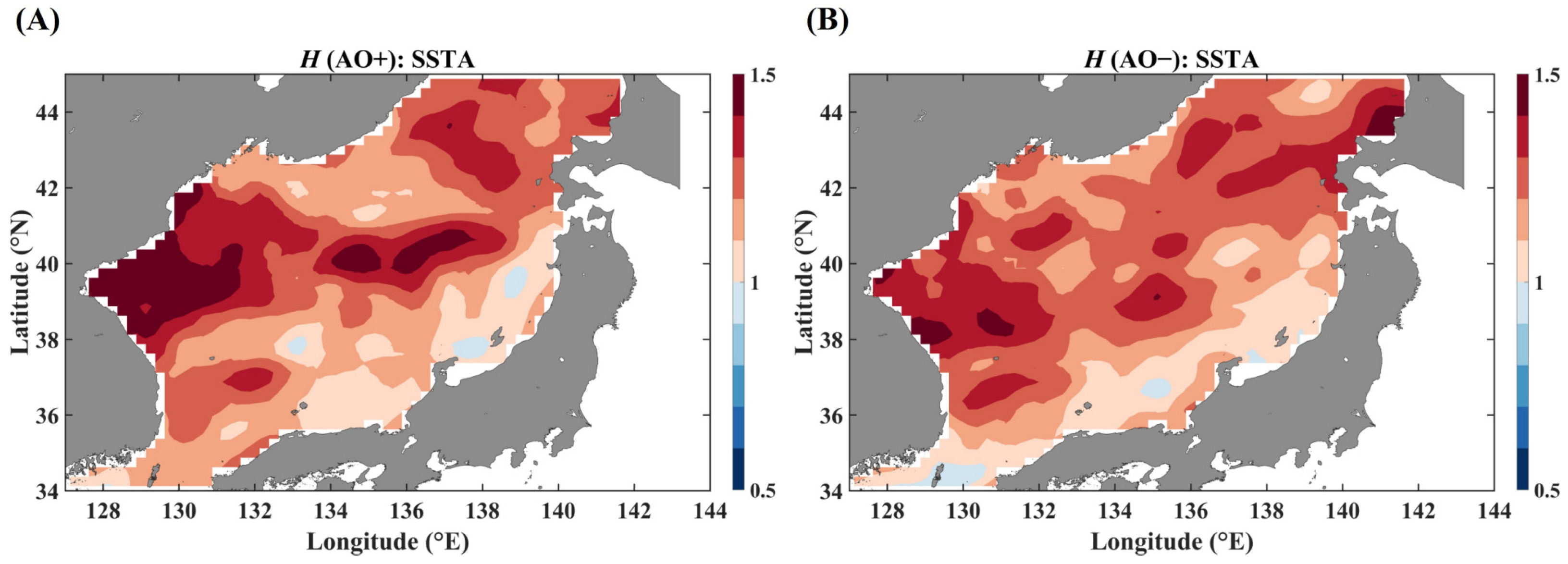
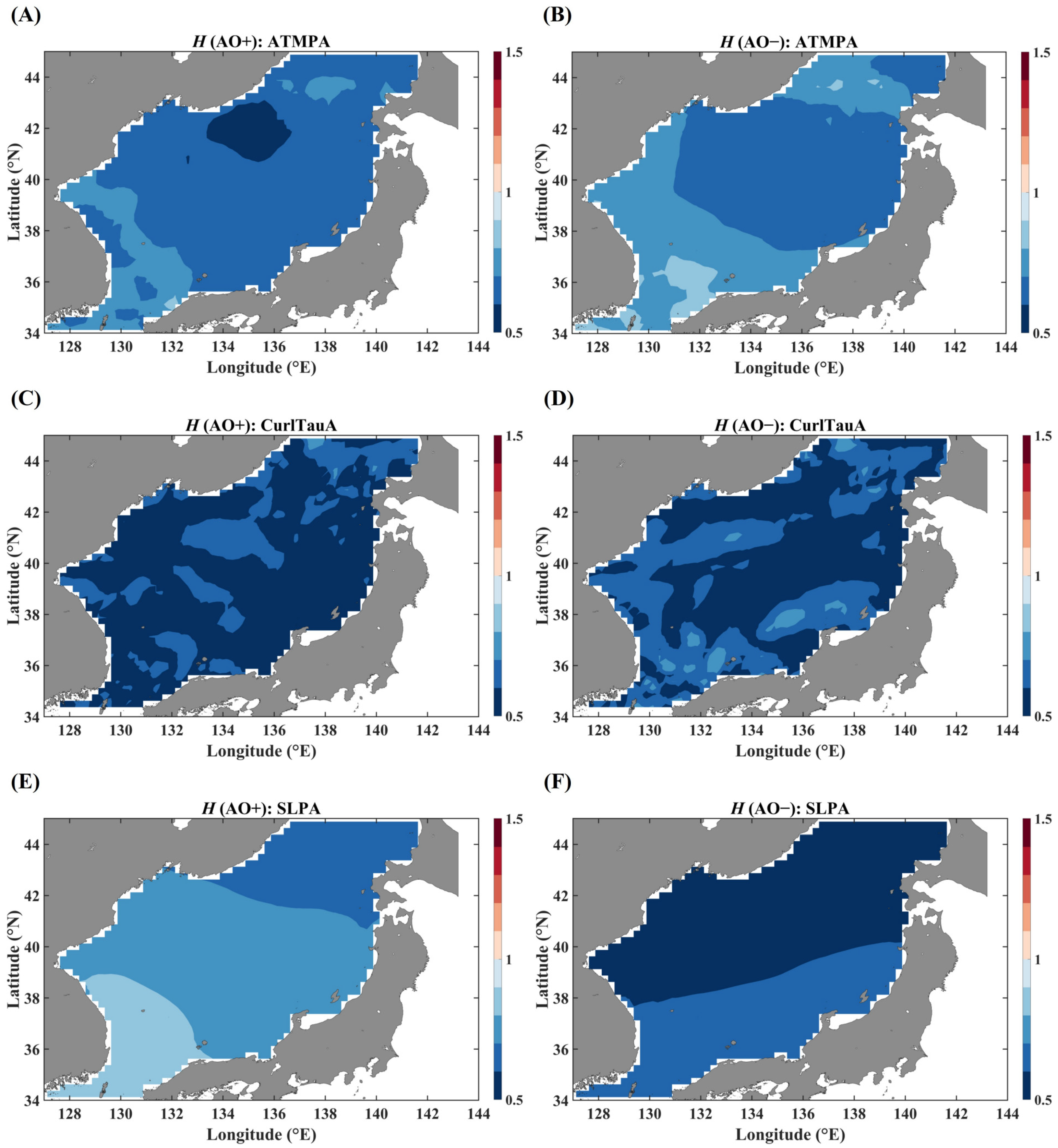
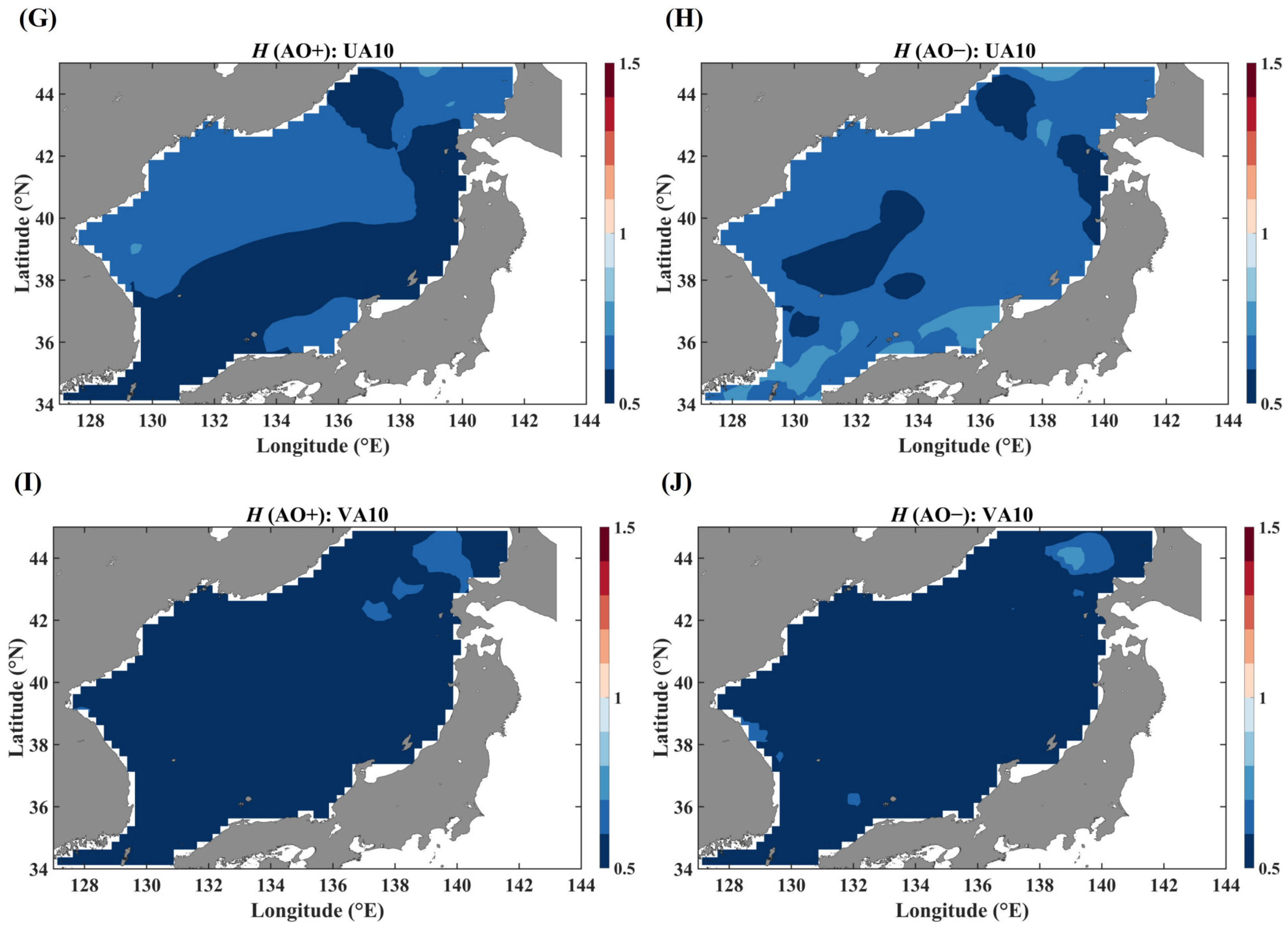
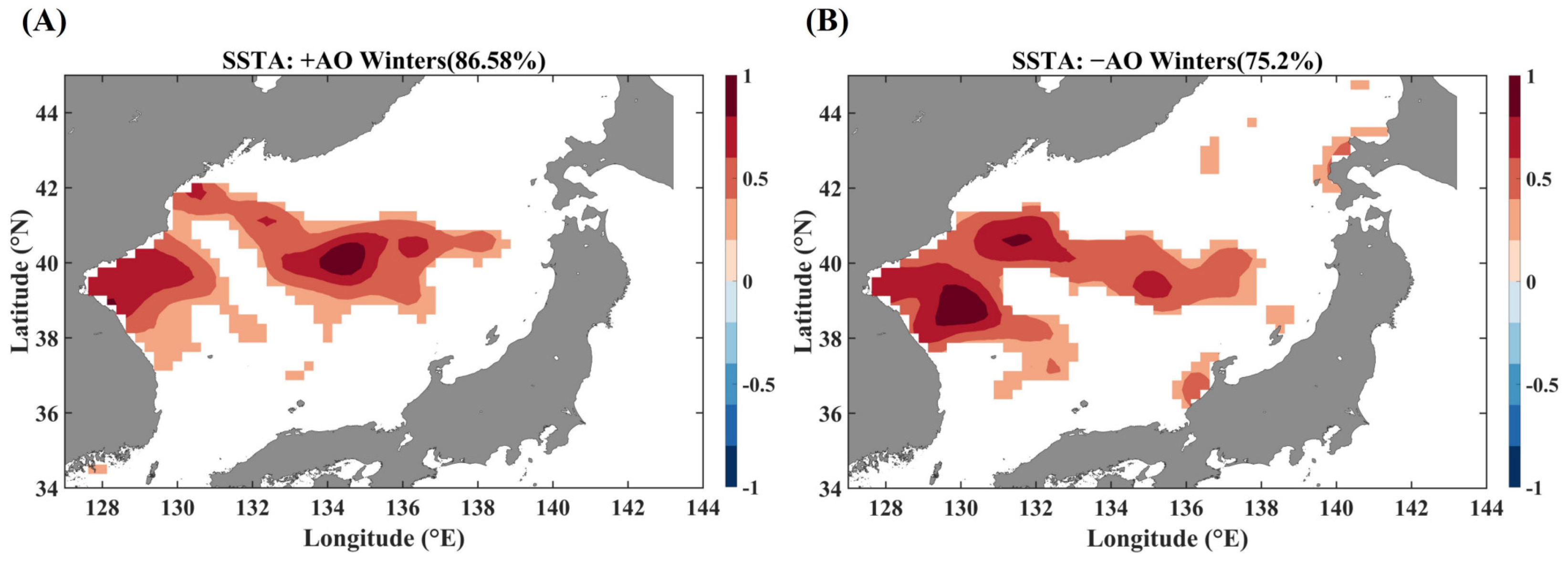
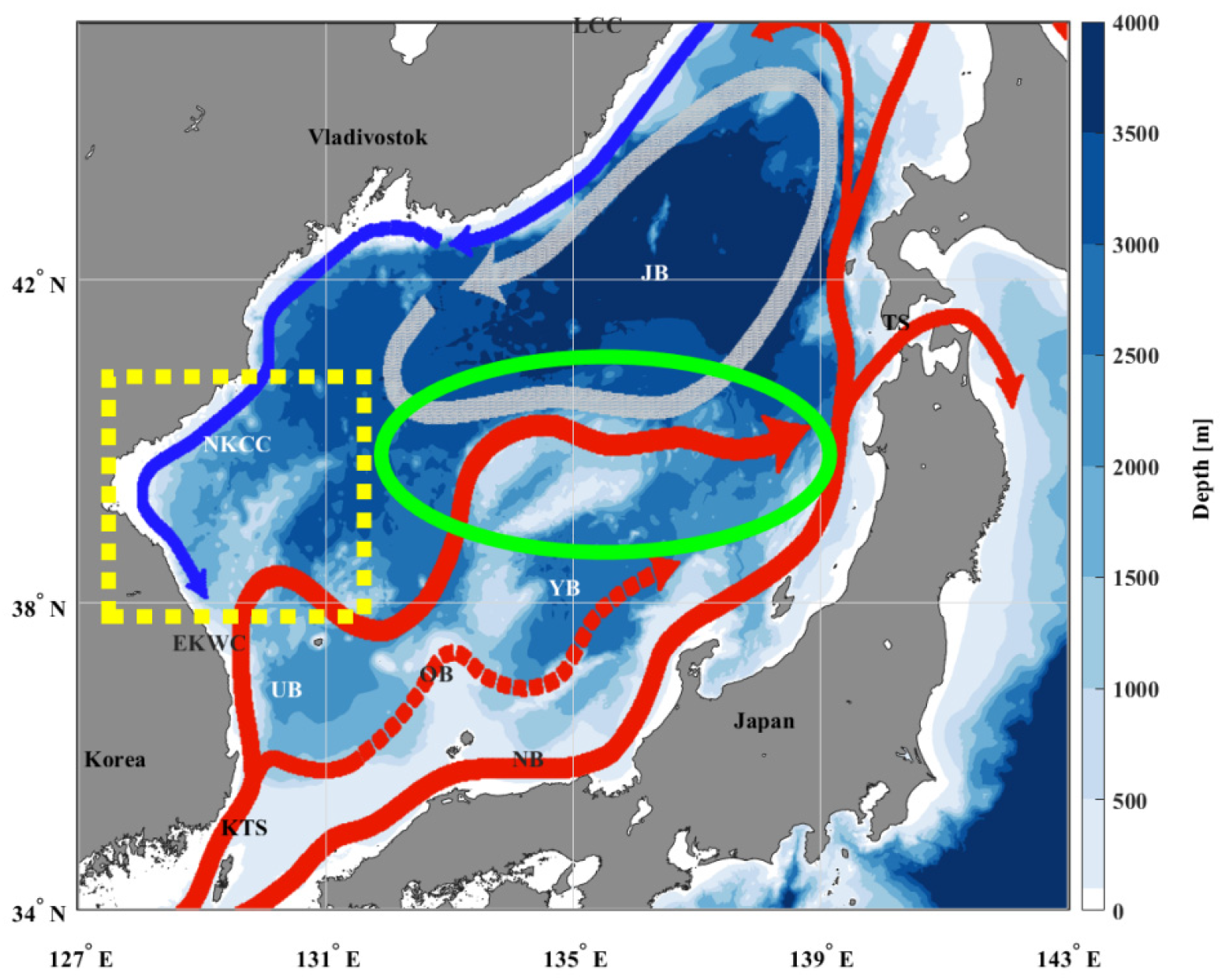
Wintertime SST anomalies in the East/Japan Sea exhibit clear sub-seasonal persistence (Figure 1): once formed, warm or cold anomalies tend to survive for several weeks, especially in East Korea Bay and along the Subpolar Front; these two hot regions are well illustrated in Figure A1. In contrast, near-surface atmospheric anomalies in air temperature, wind, sea-level pressure, and wind-stress curl fluctuate more rapidly and lose memory on much shorter time scales (Figure 2). This contrast indicates that, at 10–90-day scales, the ocean mixed layer behaves as a slow integrator of weather forcing, whereas the atmosphere itself remains dominated by short-lived synoptic variability.
When the analysis is conditioned on the phase of the Arctic Oscillation, the spatial pattern of SST persistence also changes. During the positive phase, the longest-lived SST anomalies tend to occupy a broader area in the north-western basin, whereas during the negative phase, they are more tightly confined to a front-parallel corridor along the Subpolar Front. In both phases, however, the atmospheric fields retain shorter memory than SST, reinforcing the view that winter SST anomalies represent an integrated response to episodes of atmospheric forcing rather than a mirror of individual synoptic events.
These results indicate a sub-seasonal memory in SSTA and relatively shorter persistence in the atmospheric drivers, as evidenced by the 10–90-day persistence maps (Figure 2) and by the fact that the time-integrated atmospheric responses reproduce the observed SST-like persistence only after being integrated over several weeks (Section 3.3).

3.2. Spatial Loadings of MCA Leading Mode

This subsection uses the leading coupled mode to answer where winter SST anomalies in the East/Japan Sea are most strongly linked to atmospheric variability and how this coupled geometry depends on the phase of the Arctic Oscillation.
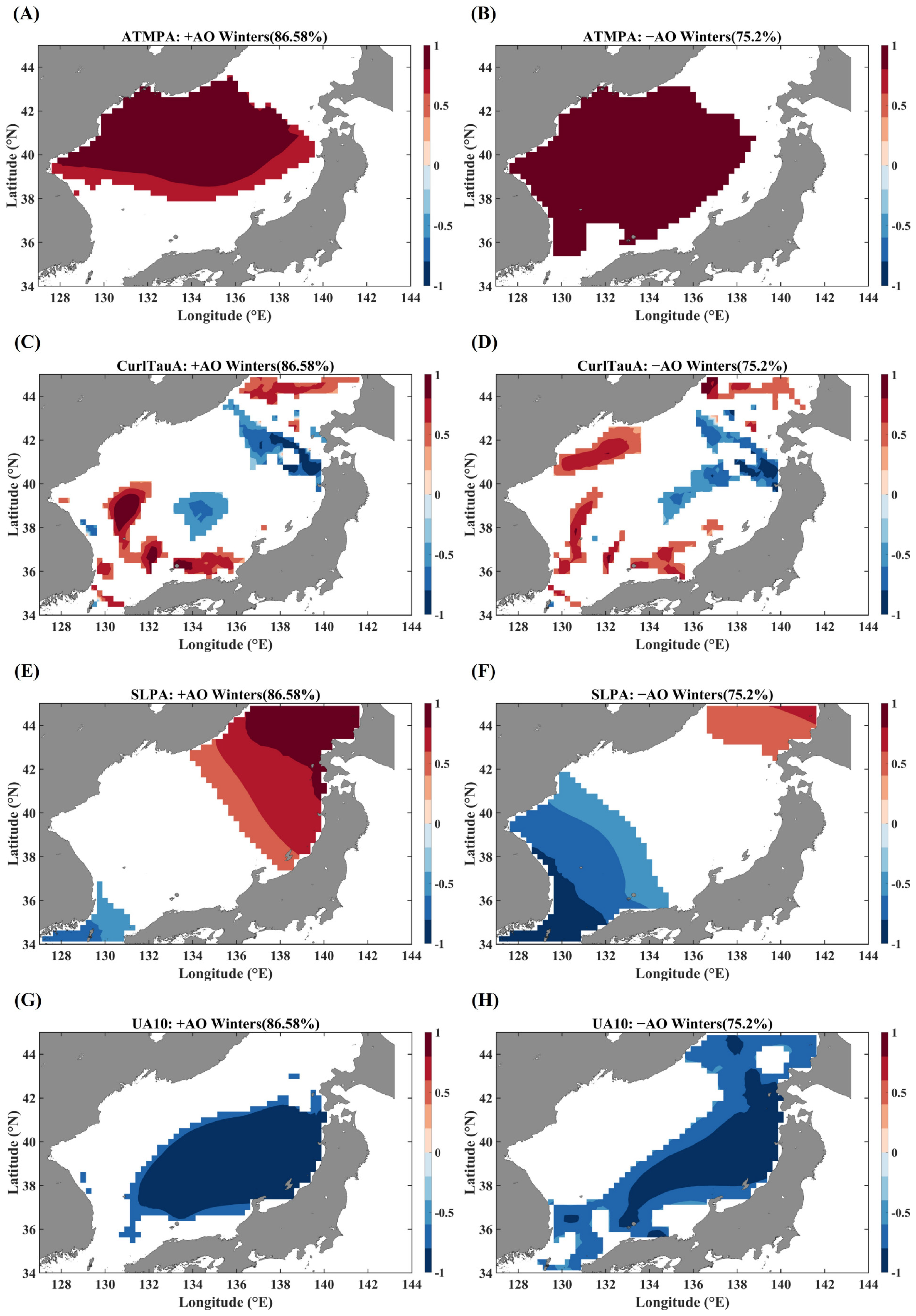
A rank-reduced multivariate MCA between SSTA and the concatenated atmospheric fields yields a leading mode that concentrates SSTA loadings over EKB and along the SPF. The paired atmospheric loadings exhibit basin-scale structures in ATMP/SLP/U10/V10 and front-parallel belts in CurlTau. Figure 3 and Figure 4 show masked versions that retain salient grid cells (Equation (18)), and Figure A2 and Figure A3 provide unmasked fields for reference.
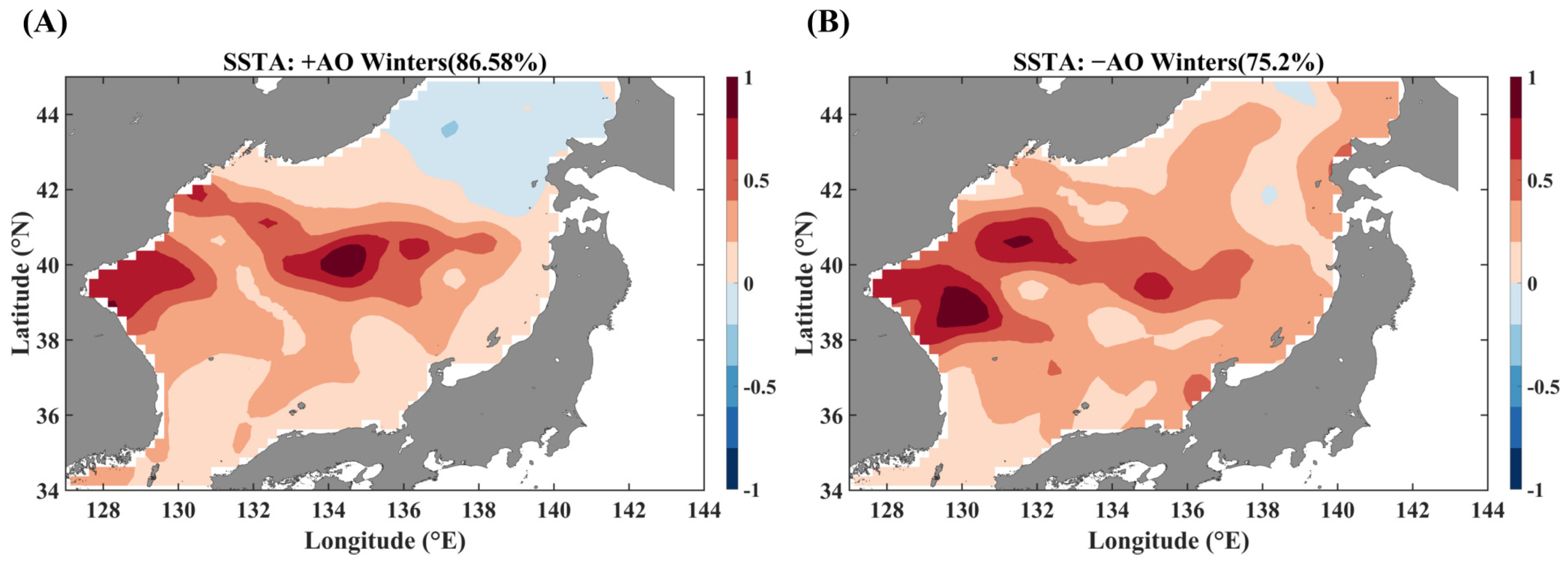
Figure 3. Unit-variance, max-absolute-normalized loadings of the 1st MCA mode for SSTA in (A) +AO and (B) −AO winters (masked by the area-weighted saliency criterion). Positive loadings align with East Korea Bay and a NW-SE belt near the SPF. Unmasked fields are provided in Figure A2.
Remotesensing 18 00079 g003
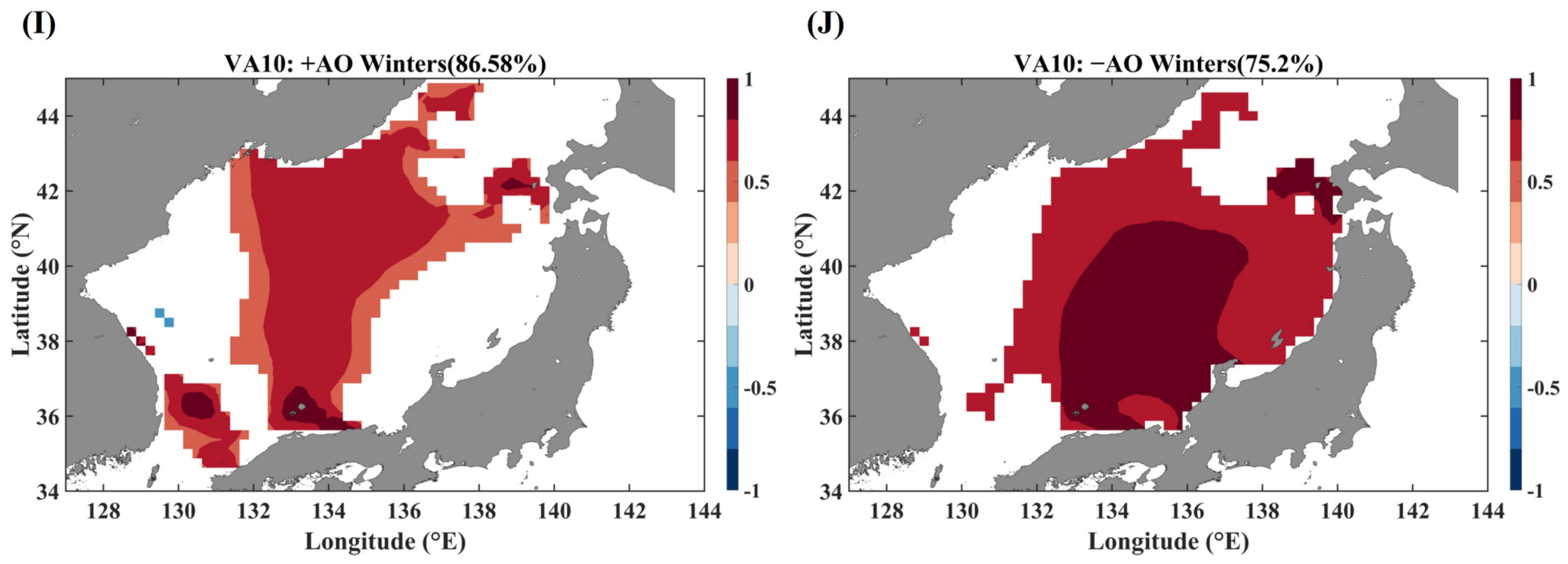
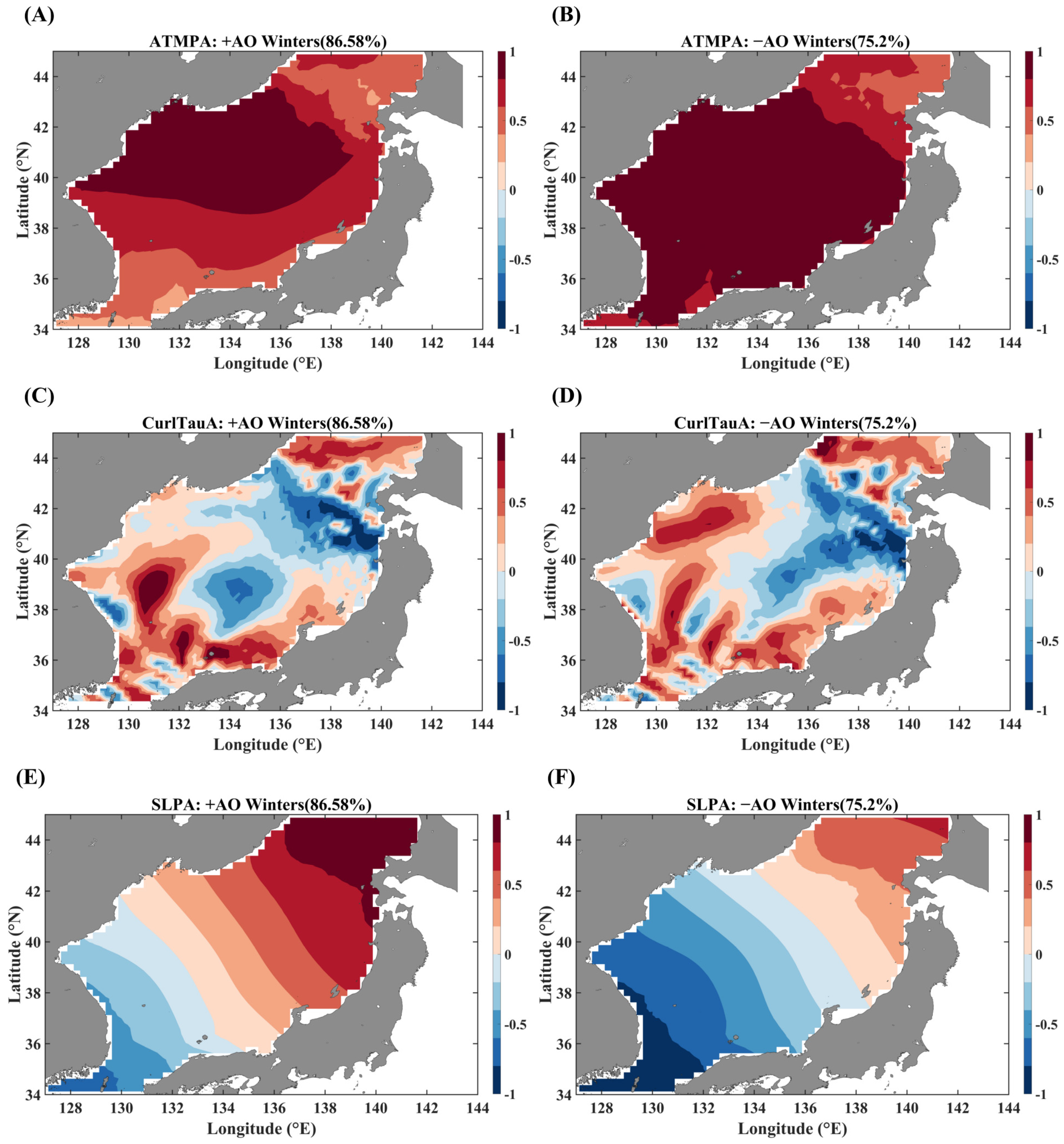
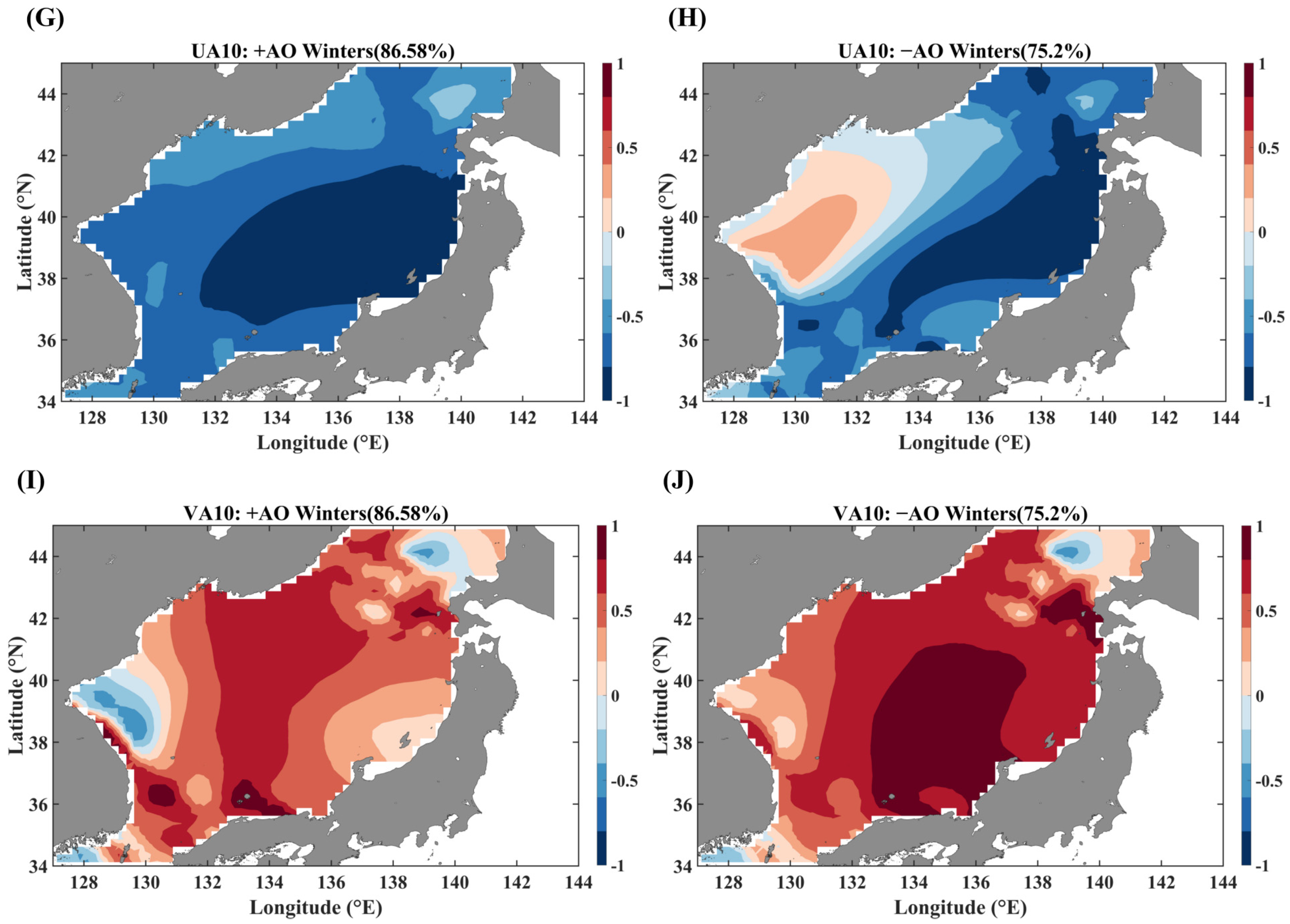
Figure 4. Same format as Figure 3, showing paired atmospheric loadings for ATMPA in (A) +AO and (B) −AO winters. A robust basin-scale pattern is emphasized. Unmasked fields appear in Figure A3A,B. Continued. Paired atmospheric loadings for CurlTauA in (C) +AO and (D) −AO winters. Unmasked fields appear in Figure A3C,D. Continued. Paired atmospheric loadings for SLPA in (E) +AO and (F) −AO winters. Unmasked fields appear in Figure A3E,F. Continued. Paired atmospheric loadings for UA10 in (G) +AO and (H) −AO winters; for VA10 in (I) +AO and (J) −AO winters. Unmasked fields appear in Figure A3G–J.
Remotesensing 18 00079 g004aRemotesensing 18 00079 g004b
As shown in Figure 3, although the leading SST patterns under the positive and negative phases appear similar at first glance—both being anchored to East Korea Bay and the Subpolar Front—the amplitude and spatial focus of the anomalies differ. During the negative phase, the SST loadings strengthen and sharpen along a narrow front-parallel band near 40–41°N, while the positive phase emphasizes a broader lobe in the north-western basin. Moreover, the paired atmospheric loadings (Figure 4) and the effective memory timescales (Section 3.3) differ considerably between phases, indicating that the Arctic Oscillation does affect both the dynamics and the predictability of winter SST anomalies, even when the leading SST maps look superficially similar.
These coupled patterns establish that East Korea Bay and the Subpolar Front are persistent coupling hot spots and that the phase of the Arctic Oscillation modulates the geometry and intensity of the air–sea link. This provides the spatial backdrop for the memory-time diagnostics in Section 3.3.

3.2.1. Wintertime SSTA 1st-Mode Loading

The first MCA-EOF mode of winter SSTA exhibits positive loadings concentrated over the East Korea Bay and along a north-western–south-eastern (NW–SE) belt near 40–41°N in both AO phases, with localized maxima around 38–40°N, 129–132°E and 40–41°N, 133–137°E (Figure 3). In −AO winters, the near-coastal maximum intensifies and extends westward, while in +AO winters, the offshore lobe is relatively stronger. The band-wise geometry broadly follows the climatological subpolar front near ~40°N and the region of largest winter SST variance in the NW EJS. Also, the unmasked SSTA loadings (Figure A2) show that this front-parallel structure is spatially continuous and not an artifact of masking. The pattern, by construction, reflects covariance with the concurrent atmospheric fields.

3.2.2. Wintertime 2 m Air-Temperature Anomaly (ATMPA) First-Mode Loading

ATMPA loadings are basin-wide positive in both AO phases, with broader south–westward coverage in −AO winters (Figure 4A,B). Unmasked panels emphasize a smooth meridional gradient across the basin (Figure A3A,B). Coherent ATMPA-SSTA loadings indicate co-occurrence of warm near-surface air and warm SST over the NW EJS, implying a significant role for ocean dynamic adjustments [15].

3.2.3. Wintertime Wind-Stress-Curl Anomaly (CurlTauA) First-Mode Loading

In +AO winters, CurlTauA loadings form alternating lobes: like-signed cells over the East Korea Bay ( 36–39°N, 129–133°E), an oppositely signed offshore belt along the SW–NE ( 39–41°N, 135–140°E), and additional features north of 42°N (Figure 4C). In −AO winters, a quasi-continuous belt of like-signed loadings aligns along 40–42°N, 130–134°E from the Vladivostok coast toward the North Korean margin (Figure 4D). Unmasked maps highlight the continuity of this along-front belt and its SE counter-lobe near 136–140°E (Figure A3D).

3.2.4. Wintertime Sea-Level Pressure Anomaly (SLPA) First-Mode Loading

SLPA loadings show a north–south gradient: positive over the far-northern sector in +AO and negative basin-wide south of ~41–42°N in −AO (Figure 4E,F and Figure A3E,F). This configuration is consistent with the AO-conditioned lower-tropospheric circulation over the EJS reported by Song et al. [15]; namely, weaker north-westerlies in +AO and stronger north-westerlies in −AO, which set the sign and structure of the surface wind and curl anomalies above.

3.2.5. Wintertime 10 m Zonal/Meridional Wind Anomaly (UA10/VA10) 1st-Mode Loading

UA10 loadings are predominantly of one sign across the basin in both phases (more spatially coherent in +AO; Figure 4G,H), while VA10 loadings are positive over the central-northern basin with a SW–NE tilt (Figure 4I,J). Unmasked panels clarify the basin-scale coherence and reveal secondary tongues near the NW shelf that are partly truncated by the mask (Figure A3G,H). Taken together with SLPA, these wind patterns provide the near-surface forcing that co-varies with CurlTauA.

3.2.6. Dynamical Interpretation

Beyond the spatial geometry, the strength of the instantaneous coupling is also phase dependent. The first-mode squared-covariance fraction is about 86.6% for the positive phase and 75.2% for the negative phase, indicating that, without any time integration of the atmospheric forcing, the leading coupled mode is slightly more dominant in positive-phase winters. This suggests that the instantaneous projection of atmospheric variability onto SST anomalies is somewhat stronger in +AO than in −AO.
The spatial co-location of (i) positive SST loadings over East Korea Bay and along the near−40°N frontal band, (ii) front-parallel belts of wind-stress-curl anomalies, and (iii) sea-level-pressure and wind anomalies consistent with the Arctic Oscillation indicates that the leading coupled mode over the north-western EJS is dynamically tied to the AO-forced surface wind field. This interpretation is consistent with Song et al. [15], who showed that net heat-flux anomalies alone do not reproduce the north-western SST pattern, whereas curl-driven Ekman downwelling/upwelling and eddy-like sea-surface-height responses do (Figures 6–8 in Song et al. [15]). They further demonstrated that the resulting warm/cold anomalies extend through the upper ~100–200 m and propagate seasonally into the subsurface (Figures 10 and 11 in Song et al. [15]), a vertical structure that is compatible with the front-locked geometries recovered by our coupled mode.
Our AO-conditioned loadings also mirror the observed phase dependence of winter SST and marine heatwaves over the north-western EJS. Positive-phase winters favor anticyclonic, eddy-like circulation, enhanced downwelling, elevated sea-surface height, and abnormally warm SSTs conducive to more marine-heatwave days, whereas negative-phase winters favor the opposite configuration [15]. Taken together, the MCA loadings and their connection to previous work support a “wind → wind-stress curl → Ekman pumping → eddy/SSH → SST” pathway, with the Arctic Oscillation phase steering where and how this pathway projects onto the mixed layer.

3.3. Characteristic Memory Timescales with Validity of OU Process

3.3.1. Characteristic Memory Timescales

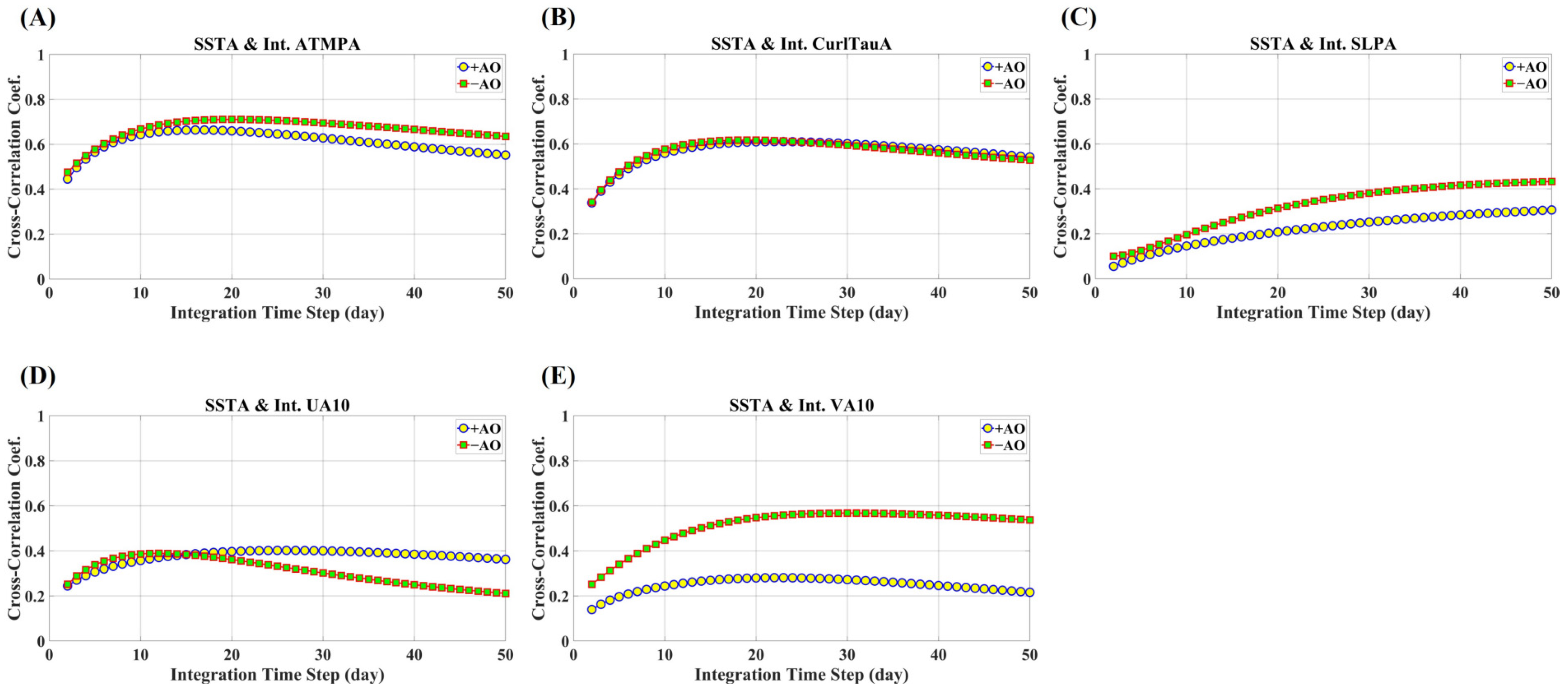
For each atmospheric first-mode PC, we formed a causal OU-integrated response by convolving with an exponential kernel of e-folding τ [ 2 , 50 ] days and computed the zero-lag cross-correlation with the SSTA first-mode PC for +AO and −AO winters separately. We define τ * as the peak or first plateau in ρ ( τ ) (Figure 5).
As shown in Figure 5, the summary of characteristic memory timescales of atmospheric fields is given as follows:
  • ATMPA (2 m air temperature): Cross-correlations rise rapidly and plateau at τ * 15–28 days, reaching ρ ~ 0.65–0.70 in both AO phases; the plateau is slightly broader under −AO.
  • CurlTauA (wind-stress curl): Correlations climb to ρ ~ 0.58–0.62 with a broad plateau at τ * 15–20 days in both AO phases.
  • SLPA (sea-level pressure): Correlations increase more gradually, peaking near the end of the tested window; τ * 40–50 days, with stronger values in −AO ( ρ ~ 0.40–0.45) than in +AO ( ρ ~ 0.30–0.35).
  • UA10 (10 m zonal wind): Correlations peak at τ * 12–25 days with ρ ~ 0.35–0.40, tending to be higher and more sustained in +AO; it is notable that a peaked τ * 12 is observed in −AO.
  • VA10 (10 m meridional wind): Correlations grow longest for meridional wind in −AO, reaching ρ ~ 0.50–0.55 with τ * 30–40 days; in +AO, values are modest ( ρ ~ 0.20–0.30; τ * 20–25 days).
Across atmospheric variables, τ * clusters into ~ 2–4 weeks for curl/ATMPA/UA10 and ~ 4–7 weeks for SLPA/VA10, with longer τ * for SLP/V10 in −AO. Timescales of about 2–4 weeks are consistent with synoptic wind-curl sequences that project onto the frontal zone and are integrated by the mixed layer. About 4–7 weeks for sea-level pressure/meridional wind reflects basin-scale pressure patterns and south–north momentum anomalies that persist beyond the synoptic life cycle, imparting longer conditioning during the negative AO phase.
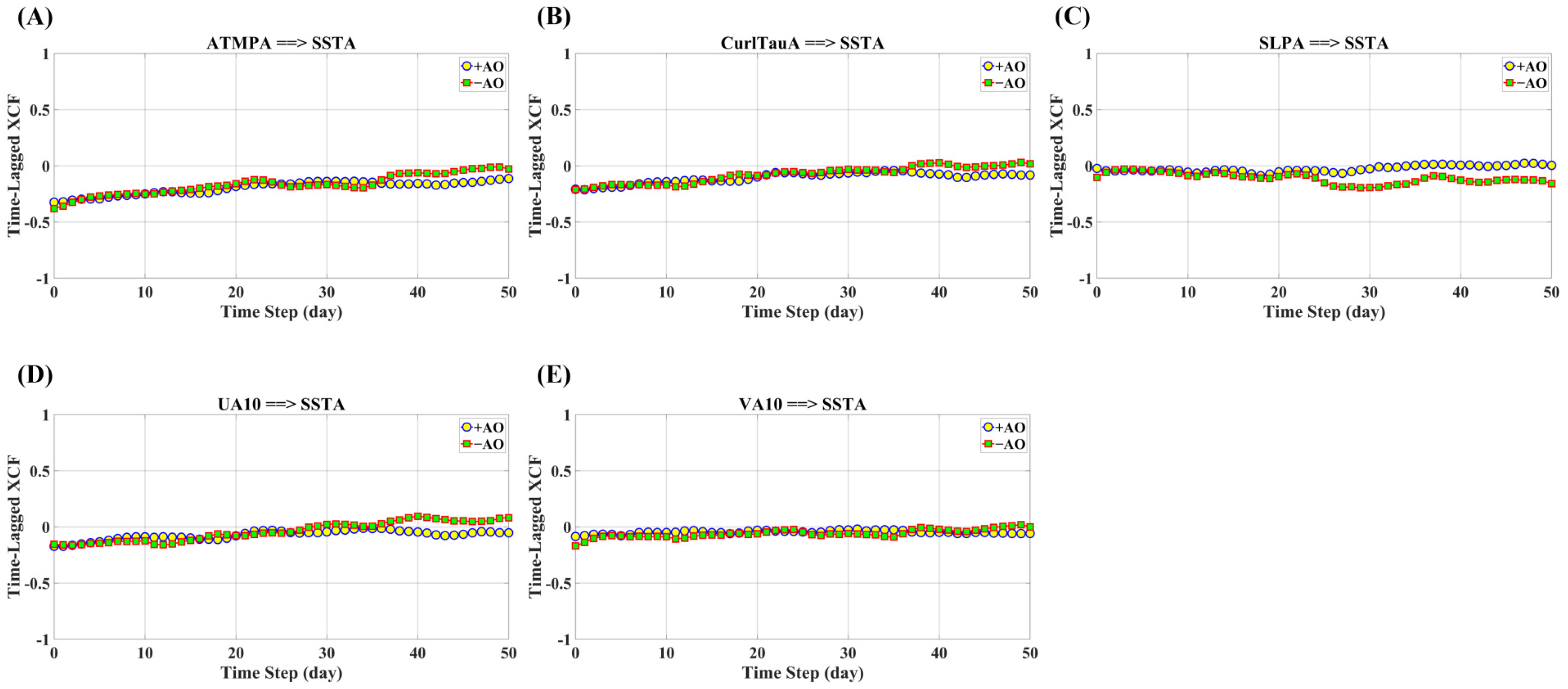
For comparison, we also examined lead–lag cross-correlations between the non-integrated atmospheric principal components (with the atmosphere leading) and the SST principal component. These cross-correlations remain weak ( ρ 0.1–0.2) at short lags and often change sign at multi-week lags across variables and AO phases (Figure A3). In contrast, the OU-integrated responses achieve substantially larger zero-lag correlations (typically ρ ~ 0.4–0.7) with clear plateaus as a function of τ (Figure 5). This contrast underscores that mixed-layer integration over the τ * windows is essential to capture how atmospheric variability imprints on winter SST in the north-western EJS, in line with the mechanism proposed by Song et al. [15], where AO-related wind forcing modulates SST via Ekman pumping and eddy/SSH adjustment rather than by local heat flux alone.

3.3.2. Validity of OU Process

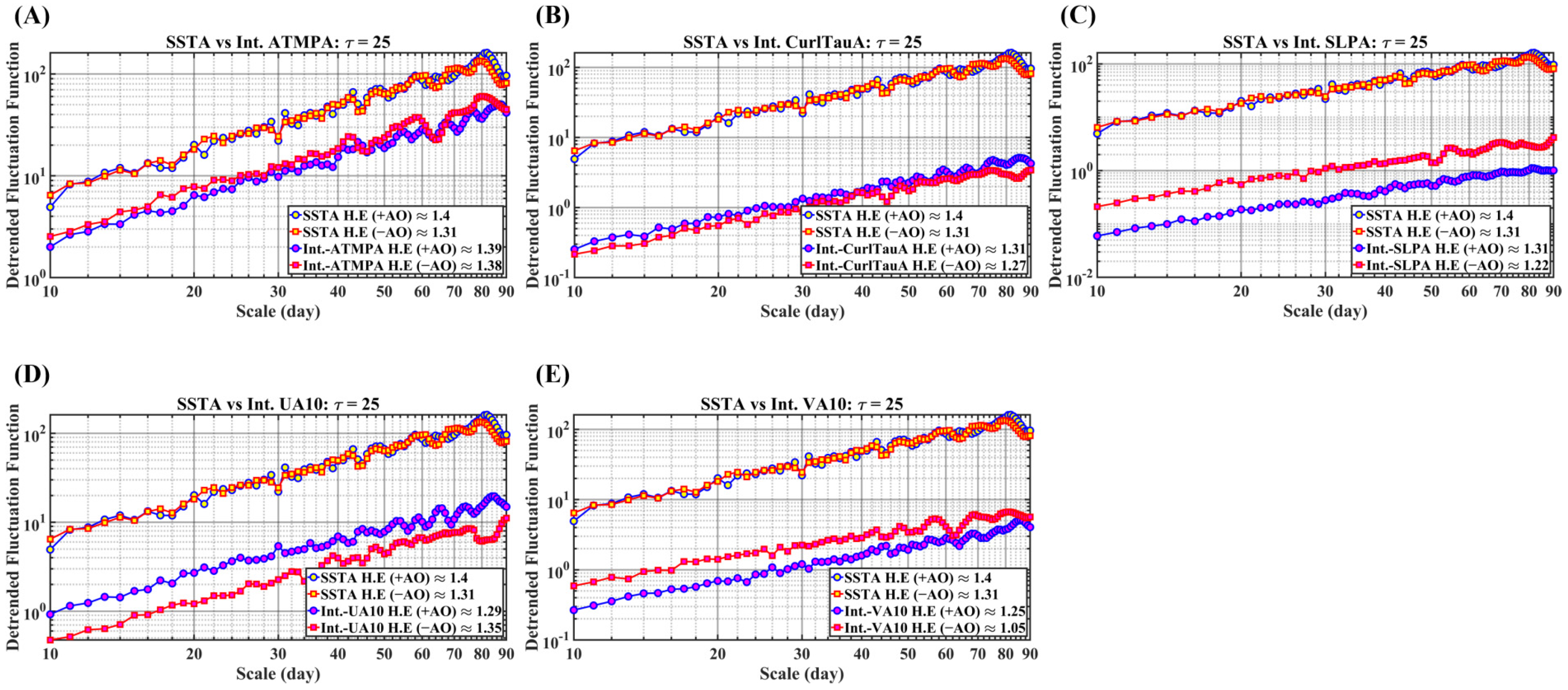
As shown in Figure 6, DFA applied to the leading SST principal component yields Hurst exponents of 1.40 in the positive phase and 1.31 in the negative phase, confirming that winter SST anomalies exhibit reddened, highly persistent behavior at 10–90-day scales. When DFA is applied to the OU-integrated atmospheric responses using the τ * values obtained in Section 3.3.1, the resulting Hurst exponents are comparable: ATMPA ~ 1.39(+AO) and 1.38(−AO); CurlTauA ~ 1.31(+AO) and 1.27(−AO); SLPA ~ 1.31(+AO) and 1.22(−AO); UA10 ~ 1.29(+AO) and 1.35(−AO); and VA10 ~ 1.25(+AO) and 1.05 (−AO). These values indicate that the time-integrated atmospheric responses acquire SST-like persistence, supporting the view that the OU kernel successfully mimics a mixed-layer integrator on sub-seasonal time scales.
In an idealized stochastic framework, integrating a white-noise process over an arbitrarily long-time horizon would increase the Hurst exponent by exactly one, corresponding to a fully integrated (random-walk-like) response [28,31]. In our case, the DFA exponents of the OU-integrated responses do not reach this theoretical limit, but instead lie in the range H 1.0–1.5. This behavior reflects the fact that the OU kernel imposes a “finite integration time scale” τ rather than an infinite memory: the mixed layer integrates atmospheric forcing only over a limited window before damping sets in. The closeness of the integrated-field exponents to those of SST, combined with their departure from the fully integrated limit, emphasizes that the estimated memory timescales τ * are physically meaningful—they are long enough to impart ocean-like persistence, but finite enough to prevent unrealistic, ever-growing memory.

4. Discussion

4.1. Arctic Oscillation Control of Coupling Geometry and Persistence

The diagnostics presented in Section 3 show that the phase of the Arctic Oscillation (AO) systematically restructures both the spatial geometry and the temporal persistence of winter air–sea coupling in the East/Japan Sea (EJS). From a persistence perspective, winter SST anomalies behave as a slowly evolving field with clear sub-seasonal memory, particularly in East Korea Bay (EKB) and along the Subpolar Front (SPF), whereas atmospheric anomalies at the surface tend to fluctuate on much shorter synoptic time scales. This contrast is consistent with a mixed layer that integrates rapidly varying “weather” forcing into lower-frequency SST anomalies.
The coupled-pattern analysis further demonstrates that AO polarity does not merely rescale a fixed SST pattern, but modifies where and how atmospheric forcing projects onto the ocean. Under both phases, the leading coupled mode anchors SST anomalies in EKB and along the SPF, confirming these regions as robust air–sea hot spots. However, the positive phase emphasizes a broader north-western SST lobe, associated with basin-scale warm–pressure and westerly anomalies, whereas the negative phase sharpens a narrow front-parallel SST band near 40–41°N and strengthens meridional wind and wind-stress-curl anomalies aligned with the SPF. These differences in coupled geometry are mirrored in the spatial structure of persistence: during the negative phase, long-lived SST anomalies are more tightly confined to the front, while during the positive phase, they occupy a wider area of the north-western basin.
Taken together, these results support a view in which the AO controls not only the sign of wintertime anomalies over the Korea–Japan–Russia sector, but also the “routes” by which atmospheric forcing reaches the mixed layer. In particular, front-parallel wind-stress-curl belts and meridional wind anomalies along the SPF emerge as key ingredients that transmit AO-related circulation changes into localized, persistent SST anomalies in the north-western EJS.

4.2. Mixed-Layer Memory and Predictor Windows

The time-integration diagnostics provide a quantitative realization of Hasselmann’s stochastic climate model for the EJS. By convolving atmospheric principal components with an exponential kernel and examining their zero-lag correlations with the SST mode as a function of the e-folding time scale, we directly estimate how long the mixed layer effectively “remembers” each atmospheric driver. The resulting effective integration times are not uniform: they cluster at about 2–3 weeks for wind-stress curl and near-surface variables, and at about 4–7 weeks for sea-level pressure and meridional wind, with systematically longer values during the negative phase of the AO.
Physically, 2–3-week integration times are consistent with sequences of synoptic wind-stress-curl events that act repeatedly on the SPF and are accumulated by the mixed layer before being damped, whereas 4–7-week integration times for sea-level pressure and meridional wind reflect slower, basin-scale pressure and momentum anomalies that condition the north-western basin over multiple storm cycles. The DFA results for the time-integrated atmospheric responses confirm that, once integrated over these characteristic windows, the atmospheric signals acquire SST-like persistence at 10–90-day scales, in line with the mixed-layer integrator concept.
An important implication is that the AO phase not only changes the mean forcing patterns but also modifies the effective memory kernel of the mixed layer. During the negative phase, longer integration times for sea-level pressure and meridional wind mean that the mixed layer is more strongly conditioned by persistent pressure and meridional flow anomalies, especially along the SPF. During the positive phase, shorter integration times emphasize high-frequency episodes of wind-stress-curl and near-surface temperature anomalies. In both phases, the combination of coupled hot spots and field-specific memory windows yields a set of phase-aware “predictor windows” that can be exploited for sub-seasonal prediction.

4.3. Implications for Extremes, Limitations, and Outlook

The persistence maps and coupled patterns highlight EKB and the SPF as recurrent sites of long-lived SST anomalies and strong air–sea coupling. These regions have also been identified as preferred locations for winter marine heatwaves and cold-surge-impacted SST anomalies in previous studies, and our results provide a mechanistic link between AO-conditioned atmospheric forcing, mixed-layer memory, and the occurrence of extremes. In particular, the 2–3-week memory for wind-stress curl and near-surface fields, and the 4–7-week memory for sea-level pressure and meridional wind in the negative AO phase, suggest concrete lead times over which integrated atmospheric indices can serve as early-warning predictors for winter extremes.
At the same time, several limitations of the present framework should be acknowledged. First, the time-integration kernel is represented by a single e-folding time scale for each driver, whereas real mixed-layer responses may involve multiple time scales and state dependence. Second, we focus on the leading coupled mode and do not explicitly resolve the contribution of higher-order modes or mesoscale eddies that are not linearly aligned with the primary SST pattern. Third, our diagnostics are based on historical satellite SST and reanalysis and have not yet been embedded in an explicit predictive model or formally cross-validated hindcast system.
These limitations point to several natural extensions. Future work will test multi-scale or bi-exponential kernels, explore the role of additional coupled modes, and implement cross-validated hindcasts in which the AO-conditioned predictor windows diagnosed here are used to forecast the probability and intensity of winter marine heatwaves and cold-surge-impacted SST anomalies. The workflow developed in this study—combining satellite SST, reanalysis, and simple integration/coupled-pattern/persistence diagnostics—is light-weight and reproducible, and can be readily transferred to other marginal seas and climate modes to support process-aware prediction of oceanic extremes.

5. Conclusions

This study quantified how the Arctic Oscillation conditions winter sea-surface-temperature (SST) persistence and air–sea coupling in the East/Japan Sea using daily satellite SST and ERA5 reanalysis. Persistence diagnostics showed that winter SST anomalies behave as a slowly evolving field with clear sub-seasonal memory, especially in East Korea Bay and along the Subpolar Front, whereas near-surface atmospheric variables remain dominated by short-lived synoptic variability. A covariance-based coupled-pattern analysis revealed that, under both positive and negative phases of the Arctic Oscillation, the leading coupled mode anchors SST anomalies to these frontal hot spots, while the amplitude and spatial focus of the atmospheric and SST loadings differ markedly between phases.
By constructing exponentially weighted, time-integrated atmospheric responses and maximizing their zero-lag correlation with the SST mode, we estimated field-specific mixed-layer memory timescales. Integration times cluster around 2–3 weeks for wind-stress curl and near-surface variables and 4–7 weeks for sea-level pressure and meridional wind, with systematically longer timescales during negative Arctic Oscillation winters. Detrended Fluctuation Analysis confirmed that the time-integrated atmospheric signals acquire SST-like persistence at 10–90-day scales, consistent with a stochastic mixed-layer integrator. Together, these results define phase-aware “predictor windows” over which integrated atmospheric indices can serve as early-warning predictors for winter marine heatwaves and cold-surge-impacted SST anomalies, and they provide a light-weight, transferable framework for process-aware prediction of oceanic extremes in other marginal seas.

Author Contributions

Conceptualization, G.L. and J.-J.P.; methodology, G.L.; formal analysis, G.L.; investigation, G.L.; data curation, G.L.; writing—original draft preparation, G.L.; writing—review and editing, G.L. and J.-J.P.; visualization, G.L.; supervision, J.-J.P.; funding acquisition, G.L. and J.-J.P. All authors have read and agreed to the published version of the manuscript.

Funding

This research was supported by the Korea Institute of Marine Science & Technology Promotion (KIMST), funded by the Ministry of Oceans and Fisheries (RS-2023-00256005). This work was also supported by the National Research Foundation of Korea (NRF) grant funded by the Korean government (MSIT) (RS-2022-NR069134). G.L. was supported by the National Research Foundation of Korea (NRF) grant funded by the Korean government (MSIT) (RS-2024-00507484).

Data Availability Statement

The monthly AO index was obtained from the NOAA Climate Prediction Center (CPC) website at https://www.cpc.ncep.noaa.gov/ (accessed on 10 April 2024). The daily NOAA OI SST V2 High Resolution Dataset used in this study is publicly available from the NOAA Physical Sciences Laboratory (PSL) at https://psl.noaa.gov/data/gridded/data.noaa.oisst.v2.highres.html (accessed on 4 April 2023). The ERA5 reanalysis data, including 10 m U and V wind components, sea-level pressure, and 2 m atmospheric temperature, are publicly available from the Copernicus Climate Data Store (CDS) at https://cds.climate.copernicus.eu/cdsapp#!/dataset/reanalysis-era5-single-levels (accessed on 10 April 2025).

Acknowledgments

Monthly AO indices are taken from the NOAA Climate Prediction Center website at www.cpc.ncep.noaa.gov (accessed on 10 April 2024). NOAA OI SST V2 High Resolution Dataset was provided by the NOAA PSL, Boulder, CO, USA, from their website at https://psl.noaa.gov (accessed on 4 April 2023). Portions of the manuscript text (e.g., language polishing, structural editing of the Introduction and Results, and drafting of figure captions) were assisted by ChatGPT (OpenAI, GPT-5). The tool was used for writing assistance only; it was not used to generate, analyze, or alter data, code, or figures. All AI-assisted text was reviewed, revised, and verified by the authors, who take full responsibility for the content.

Conflicts of Interest

The authors declare no conflicts of interest.

Appendix A

Figure A1. A map of surface oceanic currents in the EJS, with bathymetry and two hot regions: a yellow dotted box for EKB, and a green solid box for SPF. TWC: Tsushima Warm Current, EKWC: East Korea Warm Current, NB: Nearshore Branch of TWC, OB: Offshore Branch of TWC, NKCC: North Korea Cold Current, LCC: Liman Cold Current, KTC: Korea–Tsushima Strait, TS: Tsugaru Strait, JB: Japan Basin, YB: Yamato Basin, UB: Ulleung Basin.
Remotesensing 18 00079 g0a1
Figure A2. As Figure 3, but without the saliency mask; fields are spatially continuous along the Sub-Polar Front and in East Korea Bay. Spatial loadings of MCA for SSTA during (A) +AO and (B) −AO.
Remotesensing 18 00079 g0a2
Figure A3. As Figure 4, but without masking. Spatial loadings of MCA for atmospheric fields: paired ATMPA loadings for (A) +AO and (B) −AO; paired CurlTauA loadings for (C) +AO and (D) −AO; paired SLPA loadings for (E) +AO and (F) −AO; paired UA10 loadings for (G) +AO and (H) −AO; paired VA10 loadings for (I) +AO and (J) −AO. For −AO, the CurlTauA field exhibits a quasi-continuous belt along 40–42°N from the Vladivostok coast toward the North Korean margin.
Remotesensing 18 00079 g0a3aRemotesensing 18 00079 g0a3b
Figure A4. Lead-time cross-correlations (XCF) between non-integrated atmospheric 1st-mode PCs and the SSTA 1st-mode PC for +AO (blue) and −AO (red): (A) ATMPA→SSTA XCF, (B) CurlTauA→SSTA XCF, (C) SLPA→SSTA XCF, (D) UA10→SSTA XCF, (E) VA10→SSTA XCF. Correlations are weak and sign-variable compared with Figure 5, emphasizing the need for mixed-layer (OU-based) integration when diagnosing air–sea coupling.
Remotesensing 18 00079 g0a4

References

  1. Park, K.; Chung, J.Y. Spatial and temporal scale variations of sea surface temperature in the East Sea using NOAA/AVHRR data. J. Oceanogr. 1999, 55, 271–288. [Google Scholar] [CrossRef]
  2. Park, W.-S.; Oh, I.S. Interannual and interdecadal variations of sea surface temperature in the East Asian marginal seas. Prog. Oceanogr. 2000, 47, 191–204. [Google Scholar] [CrossRef]
  3. Minobe, S.; Sako, A.; Nakamura, M. Interannual to interdecadal variability in the Japan Sea based on a new gridded upper water temperature dataset. J. Phys. Oceanogr. 2004, 34, 2382–2397. [Google Scholar] [CrossRef]
  4. Jeong, Y.; Nam, S.; Kwon, J.-I.; Uppara, U.; Jo, Y.-H. Surface warming slowdown with continued subsurface warming in the East Sea (Japan Sea) over recent decades (2000–2014). Front. Mar. Sci. 2022, 9, 173. [Google Scholar] [CrossRef]
  5. Ma, T.; Chen, W. Recent progress in understanding the interaction between ENSO and the East Asian winter monsoon: A review. Front. Earth Sci. 2023, 20, 1098517. [Google Scholar] [CrossRef]
  6. Thompson, D.W.; Wallace, J.M. Annual modes in the extratropical circulation. Part I: Month-to-month variability. J. Clim. 2000, 13, 1000–1016. [Google Scholar] [CrossRef]
  7. Park, T.-W.; Ho, C.-H.; Yang, S. Relationship between the Arctic oscillation and cold surges over East Asia. J. Clim. 2011, 24, 68–83. [Google Scholar] [CrossRef]
  8. Kim, S.-H.; Kryjov, V.N.; Ahn, J.-B. The roles of global warming and Arctic Oscillation in the winter 2020 extremes in East Asia. Environ. Res. Lett. 2022, 17, 065010. [Google Scholar] [CrossRef]
  9. Park, S.; Chu, P.C. Interannual SST variability in the Japan/East Sea and relationship with environmental variables. J. Oceanogr. 2006, 62, 115–132. [Google Scholar] [CrossRef]
  10. Lee, Y.; Lim, G.-H.; Kug, J.-S. Influence of the East Asian winter monsoon on the storm track activity over the North Pacific. J. Geophys. Res. 2010, 115, D09102. [Google Scholar] [CrossRef]
  11. Gong, D.Y.; Wang, S.W.; Zhu, J.H. East Asian winter monsoon and Arctic oscillation. Geophys. Res. Lett. 2001, 28, 2073–2076. [Google Scholar] [CrossRef]
  12. Zhang, M.; Qi, Y.; Hu, X. Impact of East Asian winter monsoon on the Pacific storm track. Meteorol. Appl. 2014, 21, 873–878. [Google Scholar] [CrossRef]
  13. He, S.; Gao, Y.; Li, F.; Wang, H.; He, Y. Impact of Arctic oscillation on the East Asian climate: A review. Earch-Sci. Rev. Appl. 2017, 164, 48–62. [Google Scholar] [CrossRef]
  14. Cui, Y.; Senjyu, T. Interdecadal oscillations in the Japan Sea proper water related to the arctic oscillation. J. Oceanogr. 2010, 66, 337–348. [Google Scholar] [CrossRef]
  15. Song, S.-Y.; Kim, Y.-J.; Lee, E.-J.; Yeh, S.-W.; Park, J.-H.; Park, Y.-G. Wintertime sea surface temperature variability modulated by Arctic Oscillation in the northwestern part of the East/Japan Sea and its relationship with marine heatwaves. Front. Mar. Sci. 2023, 10, 1198418. [Google Scholar] [CrossRef]
  16. Hobday, A.J.; Alexander, L.V.; Perkins, S.E.; Smale, D.A.; Straub, S.C.; Oliver, E.C.J.; Benthuysen, J.A.; Burrows, M.T.; Donat, M.G.; Feng, M.; et al. A hierarchical approach to defining marine heatwaves. Prog. Oceanogr. 2016, 141, 227–238. [Google Scholar] [CrossRef]
  17. Hasselmann, K. Stochastic climate models Part I. Theory. Tellus 1976, 28, 473–485. [Google Scholar] [CrossRef]
  18. Frankignoul, C.; Hasselmann, K. Stochastic climate models, Part II Application to sea-surface temperature anomalies and thermoclinic variability. Tellus 1977, 29, 289–305. [Google Scholar] [CrossRef]
  19. Frankignoul, C. Sea surface temperature anomalies, planetary waves and air-sea feedback in middle latitudes. Rev. Geophys. 1985, 23, 357–390. [Google Scholar] [CrossRef]
  20. Bulgin, C.E.; Merchant, C.J.; Ferreira, D. Tendencies, variability and persistence of sea surface temperature anomalies. Sci. Rep. 2020, 10, 7986. [Google Scholar] [CrossRef] [PubMed]
  21. Huang, B.; Liu, C.; Freeman, E.; Graham, G.; Smith, T.; Zhang, H.-M. Assessment and intercomparison of NOAA daily optimum interpolation sea surface temperature (DOISST) version 2.1. J. Clim. 2021, 34, 7421–7441. [Google Scholar] [CrossRef]
  22. Reynolds, R.W.; Smith, T.M.; Liu, C.; Chelton, D.B.; Casey, K.S.; Schlax, M.G. Daily high-resolution-blended analyses for sea surface temperature. J. Clim. 2007, 20, 5473–5496. [Google Scholar] [CrossRef]
  23. Lim, G.; Park, J.-J. Exploring Long-Term Persistence in Sea Surface Temperature and Ocean Parameters via Detrended Cross-Correlation Approach. Remote Sens. 2024, 16, 2501. [Google Scholar] [CrossRef]
  24. Lim, G.; Park, J.-J. Auto- and Cross-Correlation Multifractal Analysis of Sea Surface Temperature Variability. Fractal Fract. 2024, 8, 239. [Google Scholar] [CrossRef]
  25. Lim, G.; Park, J.-J. Wintertime Cross-Correlational Structures Between Sea Surface Temperature Anomaly and Atmospheric-and-Oceanic Fields in the East/Japan Sea Under Arctic Oscillation. Fractal Fract. 2025, 9, 684. [Google Scholar] [CrossRef]
  26. NOAA CPC. Arctic Oscillation (AO) Index. National Oceanic and Atmospheric Administration Climate Prediction Center. 2023. Available online: https://www.cpc.ncep.noaa.gov/products/precip/CWlink/daily_ao_index/ao.shtml (accessed on 10 April 2024).
  27. Hersbach, H.; Bell, B.; Berrisford, P.; Hirahara, S.; Horányi, A.; Muñoz-Sabater, J.; Nicolas, J.; Peubey, C.; Radu, R.; Schepers, D.; et al. The ERA5 global reanalysis. Q. J. R. Meteorol. Soc. 2020, 146, 1999–2049. [Google Scholar] [CrossRef]
  28. Peng, C.-K.; Buldyrev, S.V.; Havlin, S.; Simons, M.; Stanley, H.E.; Goldberger, A.L. Mosaic organization of DNA nucleotides. Phys. Rev. E 1994, 49, 1685. [Google Scholar] [CrossRef]
  29. Bretherton, C.S.; Smith, C.; Wallace, J.M. An intercomparison of methods for finding coupled patterns in climate data. J. Clim. 1992, 5, 541–560. [Google Scholar] [CrossRef]
  30. Tenenhaus, A.; Tenenhaus, M. Regularized generalized canonical correlation analysis for multiblock or multigroup data analysis. Eur. J. Oper. Res. 2014, 238, 391–403. [Google Scholar] [CrossRef]
  31. Kantelhardt, J.W.; Zschiegner, S.A.; Bunde, E.K.; Havlin, S.; Bunde, A.; Stanley, H.E. Multifractal detrended fluctuation analysis of nonstationary time series. Phys. A 2002, 316, 87–114. [Google Scholar] [CrossRef]
Figure 1. Spatial distribution of the Hurst exponent H for wintertime (JFM) SST anomalies (SSTA) over the East/Japan Sea. Panels show (A) positive-AO winters and (B) negative-AO winters. H was estimated with DFA over 10–90-day scales. Values H > 1 indicate random-walk persistence consistent with mixed-layer integration of weather noise. Notable hot spots occur in East Korea Bay and along the Sub-Polar Front (~40–41°N), with higher persistence under +AO.
Remotesensing 18 00079 g001
Figure 2. Hurst exponent H maps (10–90-day scales) for (A,B) 2 m air temperature anomaly (ATMPA), (C,D) wind-stress-curl anomaly (CurlTauA), (E,F) sea-level-pressure anomaly (SLPA), (G,H) 10 m zonal wind anomaly (UA10), and (I,J) 10 m meridional wind anomaly (VA10), for +AO and −AO winters, respectively. Atmospheric fields generally exhibit H < 1, consistent with their role as stochastic forcings; CurlTauA shows front-parallel patchiness near 40–42°N (−AO), indicative of localized Ekman-pumping control.
Remotesensing 18 00079 g002aRemotesensing 18 00079 g002b
Figure 5. For each atmospheric variable, the 1st-mode atmospheric PC was convolved with an exponential kernel of e-folding τ (2–50 days) to form an integrated response series. Curves show the zero-lag cross-correlation with the SSTA 1st PC for +AO (blue) and −AO (red): (A) SSTA–ATMPA, (B) SSTA–CurlTauA, (C) SSTA–SLPA, (D) SSTA–UA10, (E) SSTA–VA10. Optimal integration time τ * is defined by the peak or onset of a plateau.
Remotesensing 18 00079 g005
Figure 6. Comparison map of Hurst exponents for a pair of SSTA 1st PC and the OU-based integrated response of each atmospheric 1st PC: (A) SSTA vs response of ATMPA, (B) SSTA vs response of CurlTauA, (C) SSTA vs response of SLPA, (D) SSTA vs response of UA10, (E) SSTA vs response of VA10.
Remotesensing 18 00079 g006
Disclaimer/Publisher’s Note: The statements, opinions and data contained in all publications are solely those of the individual author(s) and contributor(s) and not of MDPI and/or the editor(s). MDPI and/or the editor(s) disclaim responsibility for any injury to people or property resulting from any ideas, methods, instructions or products referred to in the content.