Article

Vertical Monitoring of Chlorophyll-a and Phycocyanin Concentrations High-Latitude Inland Lakes Using Sentinel-3 OLCI


1
College of Modern Industry, Jilin Jianzhu University, Changchun 130118, China
2
State Key Laboratory of Black Soils Conservation and Utilization, Northeast Institute of Geography and Agroecology, Chinese Academy of Sciences, Changchun 130102, China
3
School of Geomatics and Prospecting Engineering, Jilin Jianzhu University, Changchun 130118, China
4
School of Geography and Environment, Liaocheng University, Liaocheng 252059, China
5
School of Geography, State Key Laboratory of Climate System Prediction and Risk Management, Nanjing Normal University, Nanjing 210023, China
*
Author to whom correspondence should be addressed.
Remote Sens. 2026, 18(1), 139; https://doi.org/10.3390/rs18010139
Submission received: 7 November 2025 / Revised: 27 December 2025 / Accepted: 29 December 2025 / Published: 31 December 2025
(This article belongs to the Special Issue Intelligent Remote Sensing for Wetland Mapping and Monitoring)

Highlights

What are the main findings?
  • Remote sensing vertical inversion of vertical Chla and PC in lakes and reservoirs.
  • Spatiotemporal distribution of Chla and PC at different water depths.
What are the implications of the main findings?
  • Relationship between Chla and PC across different water depths.
  • Driving factors of variation in the vertical distribution of Chla and PC.

Abstract

Massive phytoplankton blooms threaten lake ecosystems, causing significant ecological and socio-economic damage. While remote sensing is vital for monitoring, the vertical stratification of algae influences light propagation and distorts remote sensing reflectance signals. This effect is particularly understudied in high-latitude lakes, leaving a gap in understanding phytoplankton biomass patterns. To address this, our study investigated three high-latitude water bodies: Lake Hulun, Fengman Reservoir, and Lake Khanka. We collected water samples from three depths based on total and euphotic zone depth and developed layer-specific inversion models for chlorophyll-a (Chal) and phycocyanin (PC) using a random forest algorithm. These models demonstrated strong performance and were applied to Sentinel-3 OLCI imagery from 2016–2024. Our results show that Chla generally decreases exponentially with depth, whereas PC exhibits a Gaussian-like vertical distribution with a pronounced subsurface maximum at approximately 1 m. In addition, a significant positive correlation between Chla and PC was observed in surface waters. In Lake Khanka, the northern basin exhibited a significant interannual increase in phytoplankton biomass. At 3 m, PC correlated negatively with turbidity and responded strongly to cyanobacterial blooms, while organic suspended matter correlated positively with Chla. This work establishes a robust framework for multilayer water quality monitoring in high-latitude lakes, providing critical insights for eutrophication management and cyanobacterial bloom early warning.

1. Introduction

Under the combined influence of intensified global climate change and human activities, lake aquatic vegetation has undergone significant changes at a global scale, reflecting broader ecological transformations within lake ecosystems [1,2]; the aquatic environments of lakes and reservoirs have undergone significant transformations [3,4,5]. The proliferation of cyanobacteria in inland lakes has emerged as a major global environmental concern in recent years [4,6,7]. Lake water quality has changed markedly, particularly in high-latitude regions of China, where the degradation of aquatic ecosystems has led to increasingly frequent algal bloom events. Moreover, certain cyanobacteria within these blooms can release harmful algal toxins, posing risks to drinking water and recreational resources [8].
To promote sustainable social and environmental development, the United Nations established 17 Sustainable Development Goals (SDGs). Among them, Goal 6 emphasizes the management and protection of water resources, aiming to ensure universal and equitable access to safe drinking water by 2030 (UN, 2015). As critical reservoirs of freshwater [9], lakes require careful monitoring and regulation. Phycocyanin (PC) concentration is widely recognized as a key indicator for monitoring cyanobacterial blooms [10,11,12], while chlorophyll-a (Chal) serves as a fundamental proxy for phytoplankton abundance and biomass [13,14,15,16,17]. Therefore, regular monitoring of Chla and PC concentrations in high-latitude lakes across China is essential for maintaining aquatic ecosystem health and supporting water quality management.
With the rapid advancement of remote sensing technologies, remote sensing-based approaches have been increasingly adopted for Chla retrieval and monitoring [18,19,20]. Concurrently, the emergence of machine learning techniques has greatly enhanced the prediction of water quality parameters. Commonly used models include artificial neural networks [21,22,23], random forests [24,25], and support vector machines [26,27,28,29]. The integration of remote sensing and machine learning has facilitated large-scale, long-term analyses of Chla dynamics, improving the capability for continuous monitoring and prediction [30].
Phytoplankton cyanophysin, a cyanobacteria-specific pigment, serves as a reliable indicator of bloom outbreaks and cyanobacterial biomass in aquatic systems [31,32,33]. In recent years, remote sensing has been extensively applied to the monitoring of cyanobacterial blooms in inland waters [7,11,29,34,35,36]. Unlike Chla, PC exhibits distinct optical absorption features near the 620 nm wavelength [31]. To detect and quantify PC, various empirical [37,38], semi-empirical [10,39,40], semi-analytical [31,41], and quasi-analytical algorithms (QAA) [42,43], as well as machine learning models [44,45], have been developed.
Most existing research on lake water quality in China’s high-latitude regions has focused primarily on surface layers [11,46]. However, the non-uniform vertical distribution of optically active substances presents significant challenges to conventional remote sensing inversion models [47]. Satellite sensors mainly detect the water-leaving radiance from the optically active upper layer, and contributions from deeper water decrease rapidly with depth and vary among wavelengths. The vertical distribution of phytoplankton is influenced by numerous factors, including meteorological, biological, and hydrological conditions [9,48]. Wind indirectly affects cyanobacterial vertical positioning by modulating mixing (temperature), surface reflection (light), and upwelling (nutrient availability) [12,28]. Due to these complex interactions, vertical analyses of Chla are necessary beyond traditional surface-based approaches [28,49].
With the advancement of research on vertical structures, studies on vertical inversion of chlorophyll a have reached a relatively mature stage. Some researchers have employed neural network methods combined with remote sensing data to predict the vertical structure of Chla, confirming the feasibility of inferring vertical profiles of algal biomass using surface information [50]. Some researchers have also combined lidar data with environmental factors to construct vertical distribution models, thereby validating the feasibility of lidar for vertical monitoring [51,52,53]. In marine vertical studies, researchers have developed Gaussian models to conduct vertical inversion research for chlorophyll-a [54,55]. In inland lakes, vertical profiling has revealed diverse non-uniform distribution patterns of Chla [28,56]. In the PC domain, researchers have employed GOCI satellite observations to study algal bloom patterns and investigate the vertical movement of cyanobacteria, thereby developing predictive models for floating algal blooms [57]. Cyanobacteria, as buoyant phytoplankton, can actively adjust their position within the water column to optimize light capture [58]. Under favorable conditions, they may aggregate near the surface, leading to the rapid formation and disappearance of bloom events [59,60]. Consequently, advancing the study of vertical variations in cyanobacterial and phytoplankton biomass across water layers is essential for improving lake management practices and understanding bloom dynamics.
Therefore, to monitor eutrophication-induced algal blooms and investigate the vertical distribution of phytoplankton at different depths in high-latitude lakes of China, this study selected three representative lakes that differ markedly in size, depth, surface area, and climatic conditions. These lakes encompass eutrophic, clear, and turbid lake types. By establishing relationships between Chla and PC concentrations at different water depths and combining these with reflectance data, predictions of Chla and PC concentrations can be achieved. The specific objectives were to (1) develop remote sensing-based inversion models for estimating Chla and PC concentrations at multiple vertical layers using Sentinel-3 OLCI imagery; (2) characterize the spatiotemporal patterns of vertical Chla and PC distribution during the ice-free periods from 2016 to 2024; and (3) identify key factors influencing the vertical distribution patterns of Chla and PC in these lakes.

2. Materials and Methods

2.1. Study Area

Lake Khanka (131.92°E, 44.52°N, 133.08°E, 45.33°N), Lake Hulun (117.00°E, 48.50°N, 117.80°E, 49.25°N), and Fengman Reservoir (126.73°E, 43.55°N, 127.55°E, 43.95°N) (refer to Figure 1) are three major lakes located in the high-latitude regions of China, each characterized by distinct climatic conditions and varying water depths. Lake Hulun is one of China’s largest seasonally frozen lakes, remaining ice-covered for approximately 180 days each year (from November to May of the following year). Lake Khanka, situated on the China–Russia border, is the largest freshwater lake in Northeast China; this study focuses on the portion within Chinese territory. Lake Khanka typically freezes in December and thaws by late April of the following year [46]. Fengman Reservoir, located in Northeast China, is an important component of the Fengman Reservoir basin—the country’s third-longest river system. Collectively, these three lakes play vital ecological and economic roles, contributing significantly to regional sustainable development, ecological security, and cultural prosperity.

2.2. Field Sampling and Laboratory Analysis

Between 2023 and 2024, six field sampling campaigns were conducted, during which a total of 237 water samples were collected: 136 surface samples, 72 samples from a depth of 1 m, and 29 samples from a depth of 3 m (exact dates are summarized in Table S1). Sampling points were evenly distributed across each lake. We used a depth-marked rod together with a 2 L water sampler to collect water at specific depths. When the marks corresponding to 1 m and 3 m passed below the lake surface, the sampler was operated to collect water at those nominal depths (Because the rod was positioned manually under small surface waves and boat motion, the actual sampling depths may deviate from the nominal values by on the order of several decimetres; therefore, “1 m” and “3 m” should be interpreted as depth classes rather than exact point depths.). To prevent phytoplankton decomposition, water samples were stored in 1.5 L black high-density polyethylene (HDPE) bottles and kept in portable coolers at 4 °C. Filtration for Chla and PC was carried out on the same day as collection, typically within 4–6 h and always within 11 h after sampling. Chla and PC were filtered on the night of collection using cellulose filters (Peninsula, pore size 0.45 μm) and Whatman GF/F filters (pore size 0.7 μm).
In the laboratory, PC filter membranes were first ground into a slurry using a mortar and pestle. During grinding, phosphate-buffered solution (10 mmol/L) was added dropwise in five successive additions. The mixture was transferred to centrifuge tubes and refrigerated overnight to allow sedimentation. After natural settling, the extract was clarified by centrifugation (500 N). The PC concentration in the supernatant was determined using a fluorescence spectrophotometer (Hitachi F-7000; excitation wavelength 620 nm, emission wavelength 647 nm) with Sigma standards [11].
For Chla analysis [61], the filter membranes were cut into small pieces and immersed in 90% acetone under light-protected conditions. After 20 h of extraction, the solution was clarified by centrifugation (500 N). The supernatant was then measured using a spectrophotometer (UV-2660 PC, Shimadzu Corporation, Kyoto, Japan). Suspended particulate matter (SPM), inorganic suspended particulate matter (SPIM), and organic suspended particulate matter (SPOM) were determined following standard methods [62]. Turbidity (TU) and pH were measured according to the procedures described in [63]. The distributions of in situ Chla and PC across lakes and sampling depths are summarized in Figure 1, and summary statistics are provided in Table 1 and Table 2.

2.3. OLCI Data

The Ocean and Land Color Instrument (OLCI) is a multispectral imaging sensor onboard the European Space Agency’s Sentinel-3 satellite series (Sentinel-3A and Sentinel-3B) [3], with a revisit period of approximately 1.8 days. The instrument is well-suited for inland lake monitoring, as its 21 spectral bands cover the visible to near-infrared range (400–1020 nm), enabling the spatiotemporal observation of optically active substances in water bodies. In this study, high-quality, cloud-free OLCI remote sensing data acquired over the study areas from 2016 to 2024 were used. Atmospheric correction of the OLCI images was performed using the ACOLITE algorithm developed by the Royal Belgian Institute of Natural Sciences (RBINS), which is particularly well-suited for processing data from turbid inland waters [64]. For the satellite–in situ matchups, each sampling station was paired with OLCI reflectance extracted from a 3 × 3-pixel window centered on the station location, corresponding to an effective horizontal footprint of approximately 0.9 × 0.9 km. Within this window, the normalized difference water index (NDWI) was computed from OLCI green and near-infrared bands, and pixels with NDWI < 0.1 were discarded as potentially affected by land adjacency or mixed land–water signals.
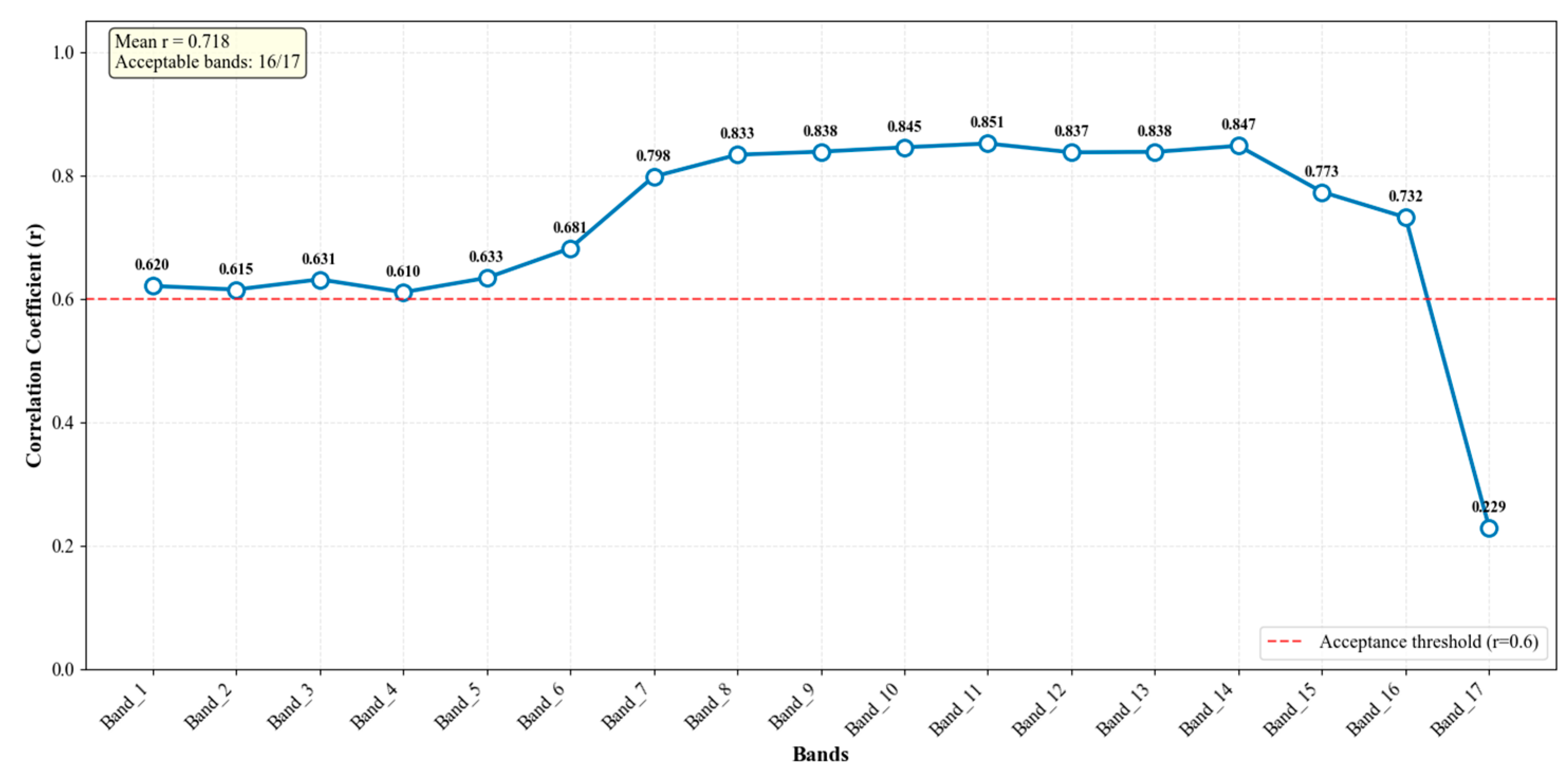
We calculated the correlation between in situ measurements and surface reflectance after atmospheric correction using ACOLITE (Figure 2). The results showed that the correlation coefficients for bands 1–16 were greater than 0.6, indicating that the ACOLITE-derived reflectance is reliable [11].

2.4. RF Model Establishment

To ensure that empirical remote sensing inversions represent typical water column conditions rather than being dominated by extreme biological events, this study used the Floating Algae Index (FAI) to identify and exclude algal bloom-affected pixels within the study region, thereby minimizing the influence of algal blooms on model development [65]. Compared with traditional single-band threshold and two-band ratio methods for water index extraction, the FAI is less sensitive to environmental variations and provides more stable extraction results. Based on multiple experimental validations, the FAI threshold was set to 0.005.
Machine learning models are capable of fitting nonlinear relationships between input and output variables by constructing complex architectures that capture intricate data patterns. This allows for the development of accurate estimation models that effectively leverage the rich spectral features of the input variables. In this study, the Random Forest (RF) algorithm—a widely used machine learning method in remote sensing and environmental sciences—was adopted. A layer-by-layer inversion approach was employed to estimate biomass at different water depths [66,67]. To ensure consistency between the field and satellite datasets used for model training, OLCI images were selected according to the sampling records, using a ±1-day time window around each sampling date. The specific image selections are summarized in Table S1.
Unlike traditional surface-based Chla and PC inversion approaches, our surface biomass estimation utilized several spectral indices as input variables, including band ratios (BR), the three-band algorithm (TBA), the four-band algorithm (FBA) [68], the PC Index (PCI) [69], the Fluorescence Line Height (FLH) algorithm, and the MERIS Maximum Chlorophyll Index (MCI). Additionally, various combinations of spectral bands and raw reflectance values (using addition, subtraction, multiplication, and division) were examined for model training. Only combinations achieving a statistically significant Pearson correlation coefficient (p < 0.05, R ≥ 0.5) were retained.
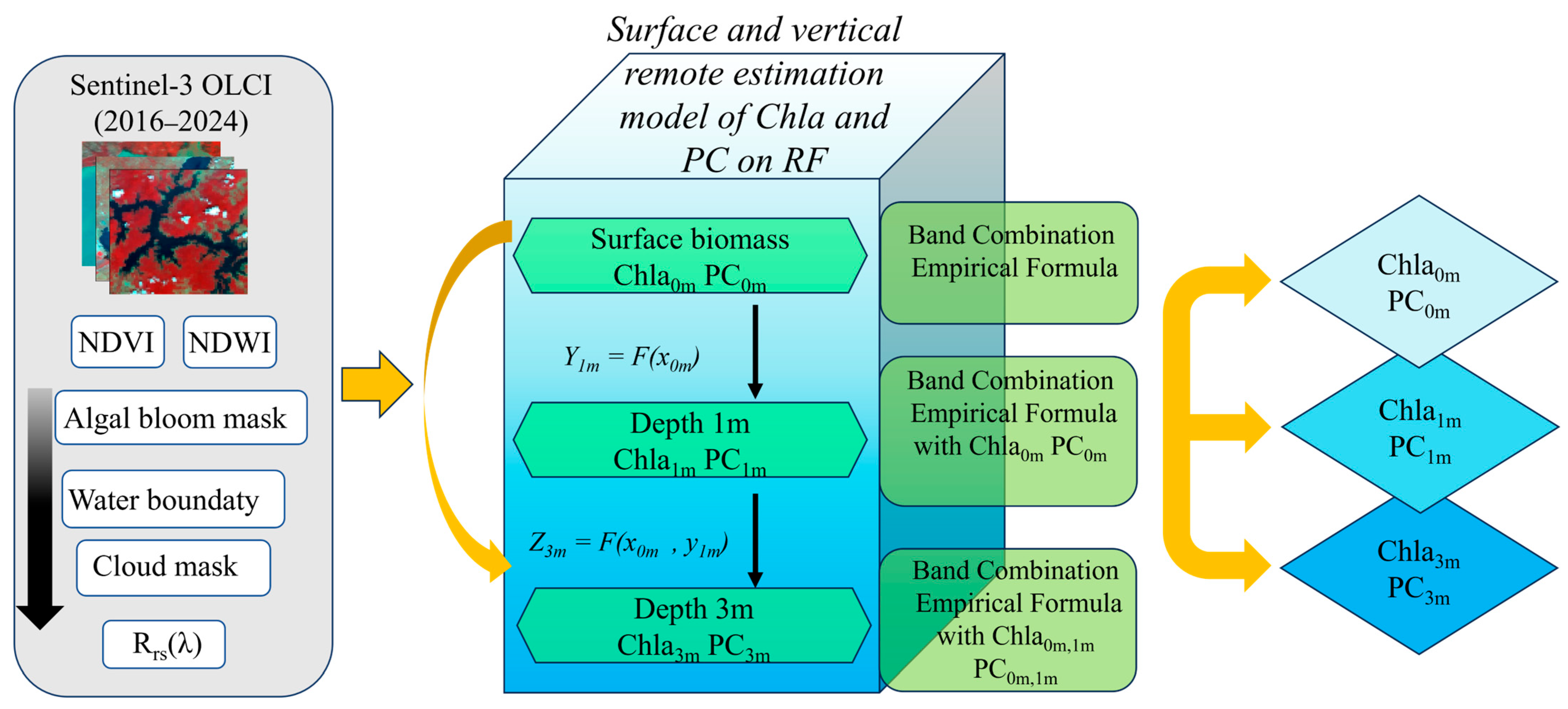
For modeling biomass at different vertical depths, the correlations among layers were also incorporated and combined with spectral band variables to construct the layer-specific machine learning inversion models [70]. Specifically, for the 1 m depth model, both the aforementioned band combinations and the functional relationship between biomass at 1 m and the surface biomass were used as input features. Similarly, for the 3 m depth model, input variables included the band combinations and the relationships among biomass at 3 m, 1 m, and the surface layer, as well as their cross-layer interactions (refer to Figure 3).
The model performance was evaluated using three statistical metrics: the Coefficient of Determination (R2), Root Mean Square Error (RMSE), and Symmetric Mean Absolute Percentage Error (SMAPE), defined as follows:
R 2 = 1 i = 1 n ( y i y i ) 2 i = 1 n ( y i y i ¯ ) 2
RMSE = i = 1 n ( y i y i ) 2 n
S M A P E = 100 % n i = 1 n | y i y i | ( | y i | + | y i | ) / 2
where n represents the number of samples, and yi and y′i denote the measured and estimated values, respectively. R2 is typically used to assess the model’s predictive performance, whereas RMSE and SMAPE evaluate the agreement between observed and predicted values.

2.5. Model Development

Based on the eigenvalue selection method described in Section 2.2, this study sequentially modeled Chla and PC concentrations at the water surface, 1 m below the surface, and 3 m below the surface. Due to data volume constraints, the dataset was divided into two subsets: 75% for model training and 25% for testing. Following the approach outlined in Section 2.4, a series of spectral indices and empirical models were developed to invert phytoplankton biomass at different water depths.
When screening spectral band combinations, combinations with autocorrelation coefficients exceeding 0.95 were first excluded to prevent feature redundancy. Subsequently, an appropriate number of band combinations were selected as model features based on the sample size. For empirical models across different water depths, multiple curve-fitting simulations were performed, and curve models with correlation coefficients exceeding 0.6 were retained as features. Specific feature selections are summarized in Table S2.

3. Results

3.1. Model Accuracy

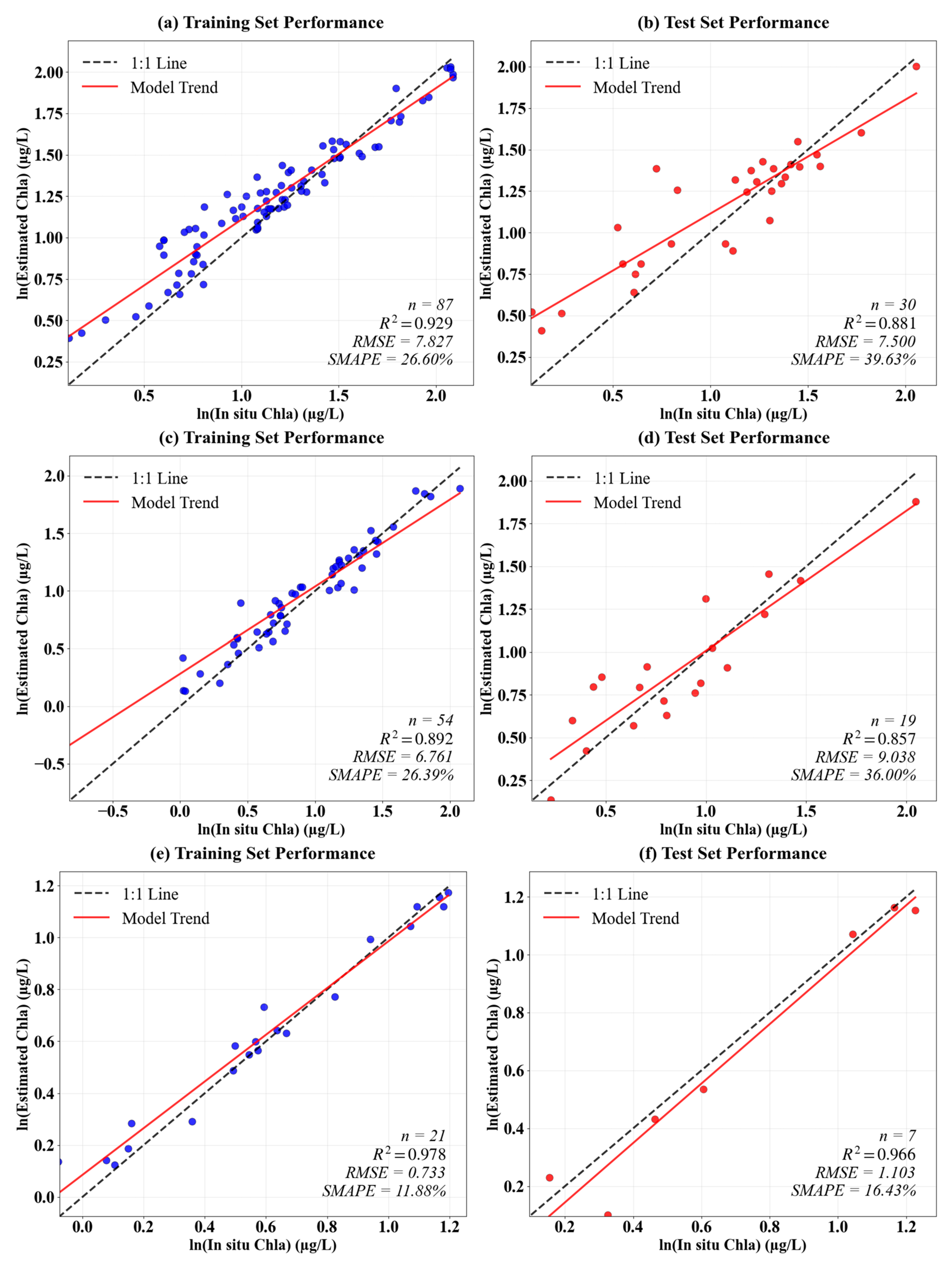
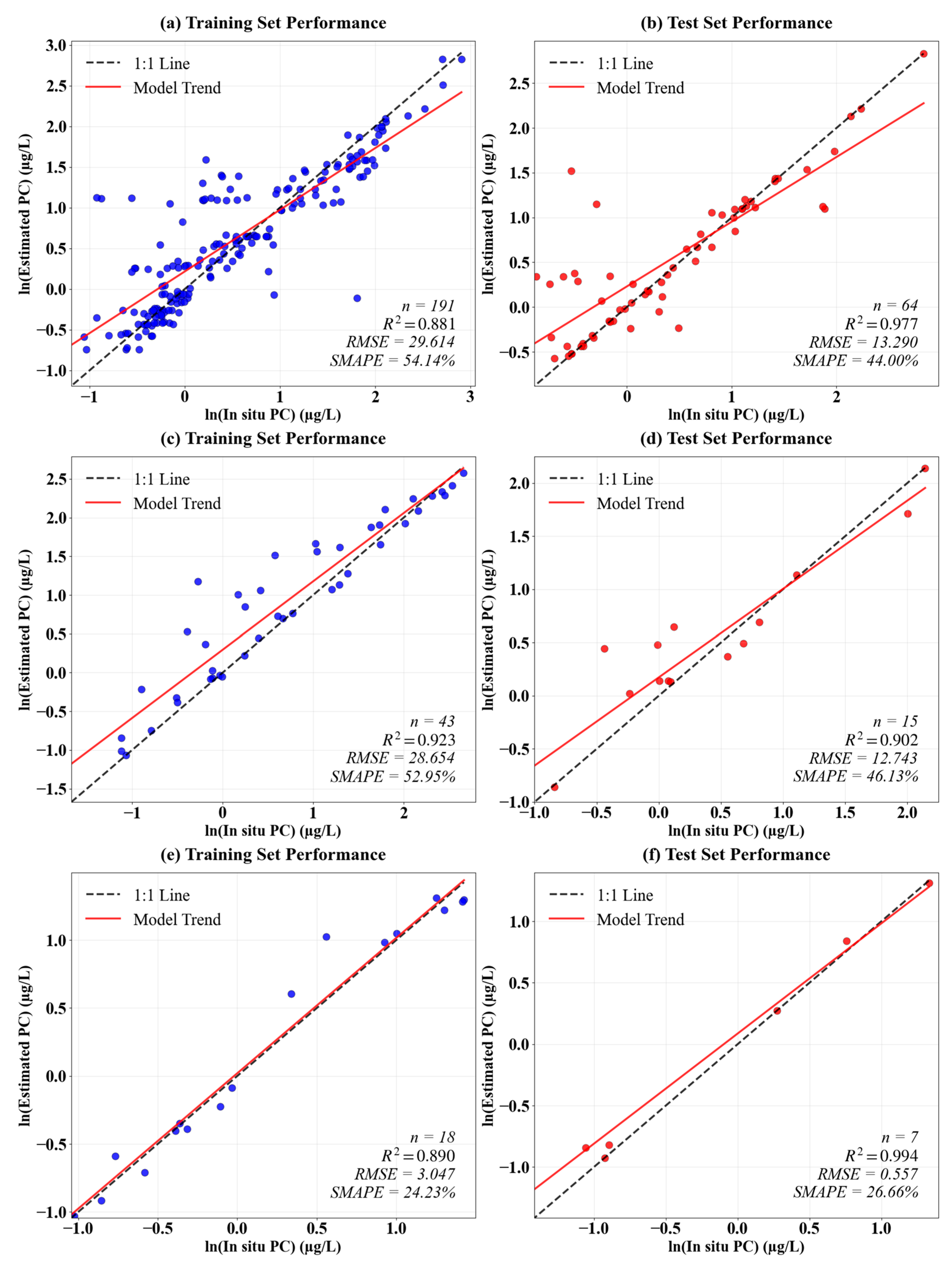
For surface Chla concentration (Chla0m), multiple band combinations and ratios derived from remote sensing reflectance were evaluated, achieving R2 = 0.881, RMSE = 7.500 μg/L, and SMAPE = 39.63% (Figure 4b). At a depth of 1 m (Chla1m), the model achieved R2 = 0.857, RMSE = 9.038 μg/L, and SMAPE = 36.00% (Figure 4d). At a depth of 3 m (Chla3m), performance improved markedly, with R2 = 0.966, RMSE = 1.103 μg/L, and SMAPE = 16.43% (Figure 4f). For surface PC concentration (PC0m), model accuracy was high, with R2 = 0.977, RMSE = 13.290 μg/L, and SMAPE = 44.00% (Figure 5b). At 1 m depth (PC1m), the model achieved R2 = 0.902, RMSE = 12.743 μg/L, and SMAPE = 46.13% (Figure 5d). At 3 m (PC3m), model performance remained strong, with R2 = 0.994, RMSE = 0.557 μg/L, and SMAPE = 26.66% (Figure 5f). This structured, depth-resolved modeling framework demonstrated consistent and reliable performance across varying biomass conditions and water depths (Figure 4 and Figure 5), confirming its suitability for phytoplankton biomass retrieval in the three high-latitude lakes studied.

3.2. In Situ Measurement of Chla and PC

Laboratory measurements of Chla and PC in Lake Hulun, the Fengman Reservoir, and Lake Khanka revealed that both PC and Chla concentrations decreased progressively with depth (1 m and 3 m) compared to surface waters (0 m). Across all three lakes, average PC and Chla concentrations exhibited a consistent decline with increasing depth. Among them, Lake Hulun displayed the highest phytoplankton biomass (Chla: 43.15 ± 68.14 μg/L) in surface waters, followed by Lake Khanka (Chla: 40.25 ± 55.65 μg/L), while the Fengman Reservoir maintained consistently low nutrient levels across all depths (Chla: 2.32–3.37 μg/L). The average cyanobacterial biomass was highest in Lake Khanka (PC: 246.49 ± 429.64 μg/L), followed by Lake Hulun (PC: 138.63 ± 432.03 μg/L), with the Fengman Reservoir showing the lowest values among the three systems (PC: 6.03–11.93 μg/L).

3.3. Spatiotemporal Variation in Chla and PC Concentration

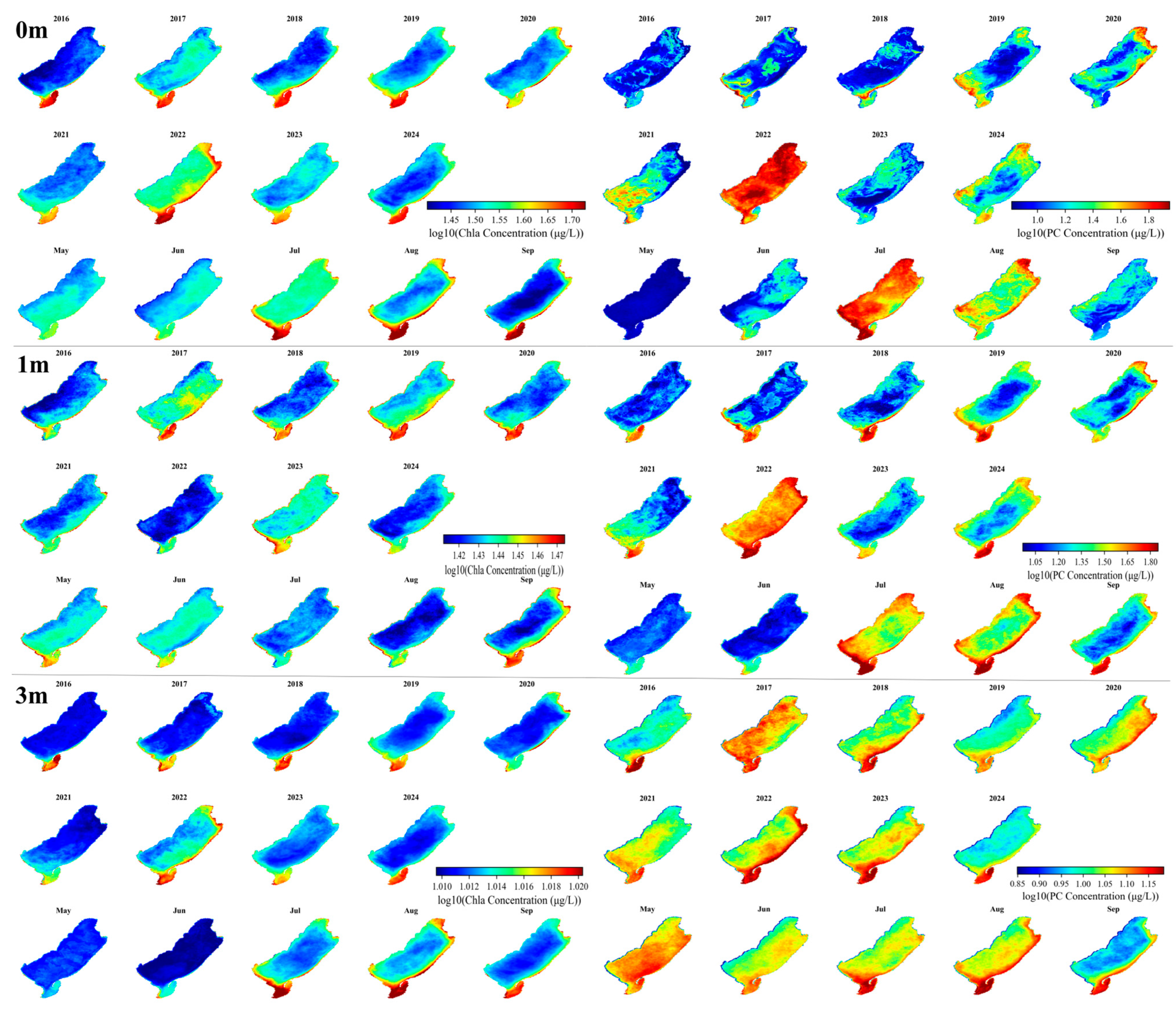
Based on the Random Forest (RF) model, the spatial distribution of surface-water Chla and PC concentrations in Lake Hulun, the Fengman Reservoir, and Lake Khanka from 2016 to 2024 was mapped. As shown in Figure 6, surface-layer PC and Chla concentrations in Lake Hulun were generally higher in the southern region and along the littoral zones, while the central open-water area tended to exhibit lower concentrations on average. Moreover, Lake Hulun exhibited substantial interannual variability. The southeastern region consistently maintained relatively high values, whereas the northwestern and central regions exhibited larger interannual fluctuations. For instance, in 2017 and 2022, concentrations in the lake’s central area were markedly higher than in other years. PC and Chla concentrations showed similar spatial and temporal variation patterns.
On a monthly scale, July and August exhibited the most pronounced Chla fluctuations in Lake Hulun. In 2017 and 2024, concentrations in the central region were significantly higher than in other years. Both PC and Chla reached their highest annual averages in July and August. Notably, in May, Chla and PC did not show the nearly synchronous changes observed during other months. At a depth of 1 m, pronounced high-concentration zones were observed in both the northern and southern parts of the lake, with PC concentrations in some areas even exceeding those at the surface. In contrast, relatively low concentrations were found along the eastern and western shorelines. At a depth of 3 m, elevated concentrations persisted in nearshore regions—particularly along the southern boundary—and exhibited a gradual extension toward the central lake area.
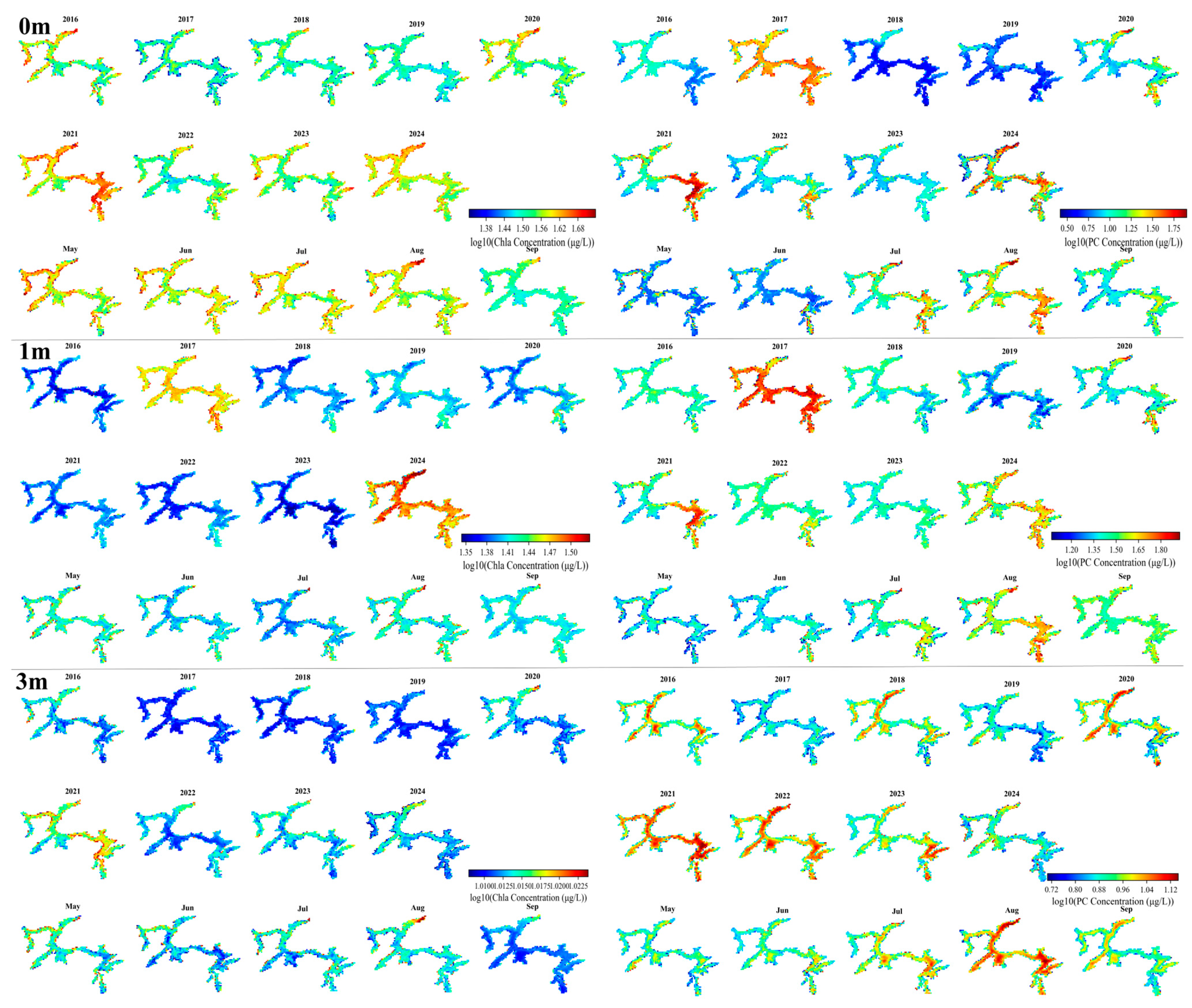
In the Fengman Reservoir (Figure 7), Chla and PC concentrations were higher along the eastern and western sides of the surface layer of Fengman Reservoir. Chla concentrations exhibited an increasing trend over the years, while PC showed no significant overall variation between 2016 and 2024. No clear correlation was observed between Chla and PC concentrations. Monthly variations indicated that Chla remained high from May to August, whereas PC showed a more pronounced increase in July and August. At the surface, both Chla and PC concentrations were higher on the eastern and western sides of the lake, and this spatial distribution pattern remained consistent at depths of 1 m and 3 m.
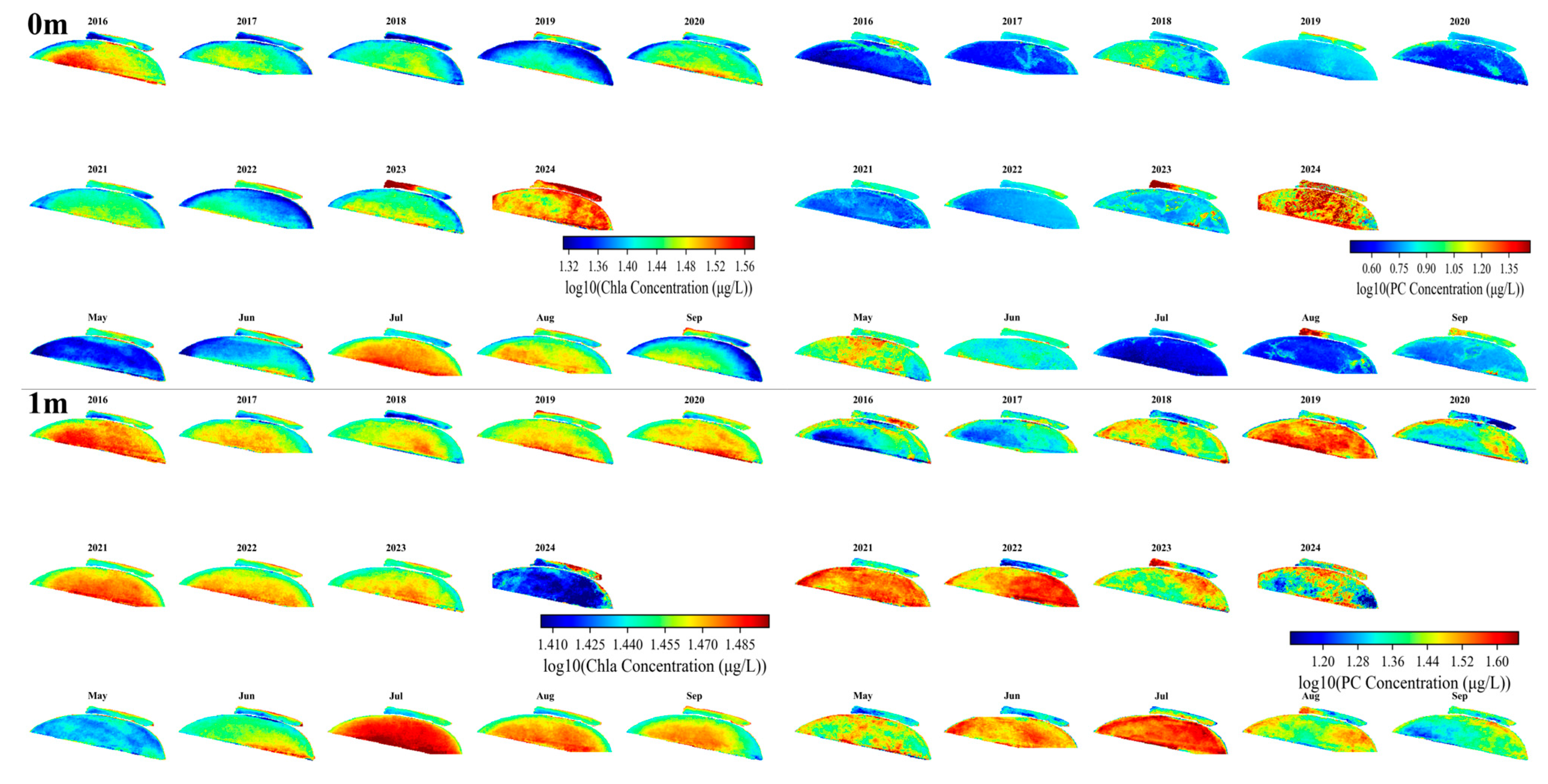
Lake Khanka is divided into northern and southern sections (Figure 8). In the northern section, both PC and Chla concentrations were higher along the eastern and western margins. Although no consistent pattern was observed across different years, higher concentrations occurred more frequently on the western side. Chla and PC exhibited nearly identical patterns of variation. Monthly analyses revealed that Chla peaked from May to August, while PC concentrations remained elevated from August to September. At 1 m depth, Chla concentrations were more spatially stable than those at the surface, whereas PC maintained a spatial distribution pattern similar to that observed in the surface layer.
In the southern section, both PC and Chla concentrations were highest in the central area, gradually decreasing toward the periphery. Across different years, the variation patterns of Chla and PC in the southern section were less similar than those in the northern section, showing no obvious correlation. From a monthly perspective, Chla in the southern section reached its maximum during July–August, whereas PC followed the same trend as in the northern section, peaking between July and September.

3.4. Vertical Variations of Chla and PC Months

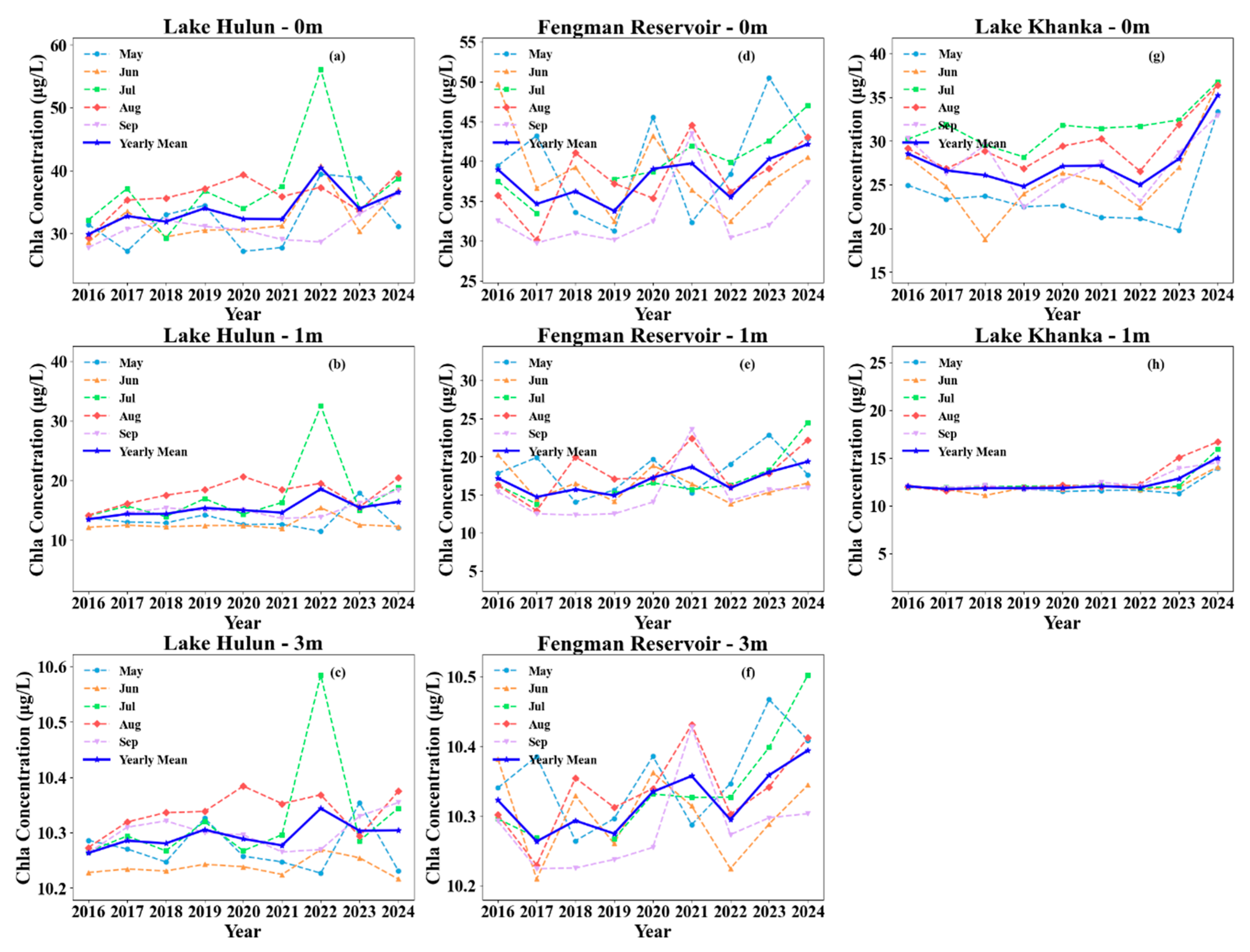
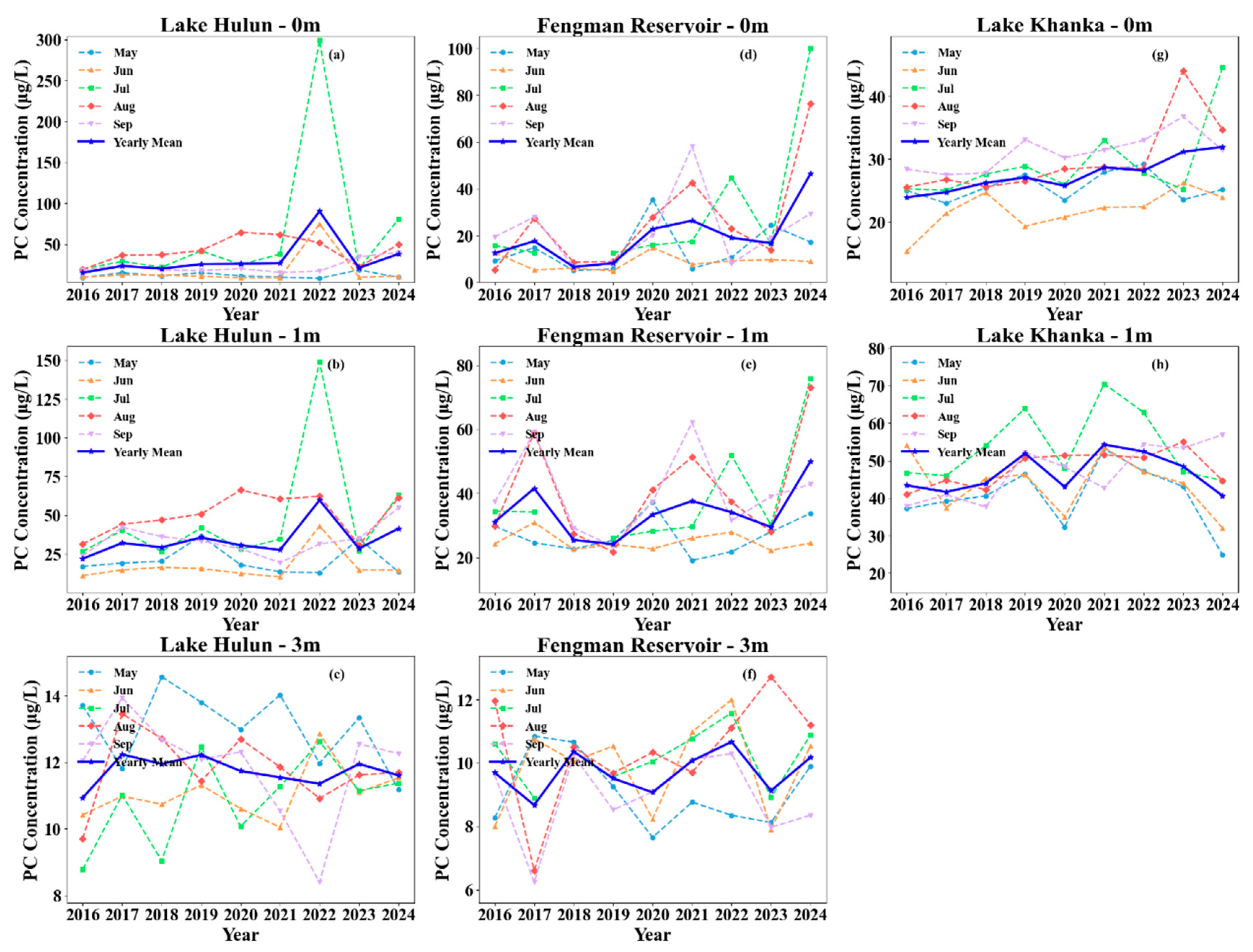
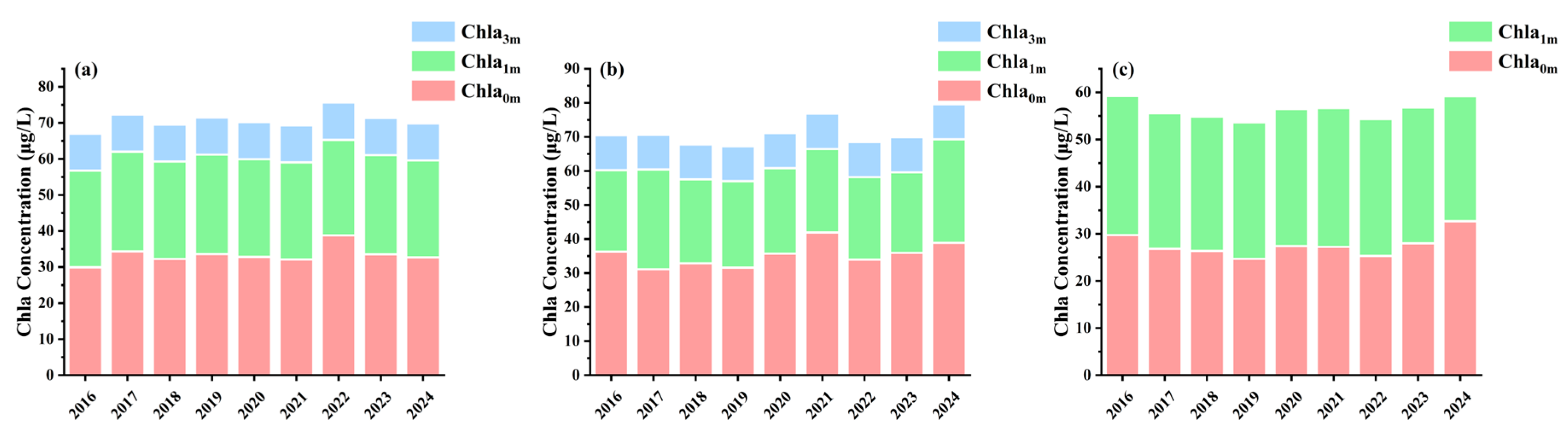
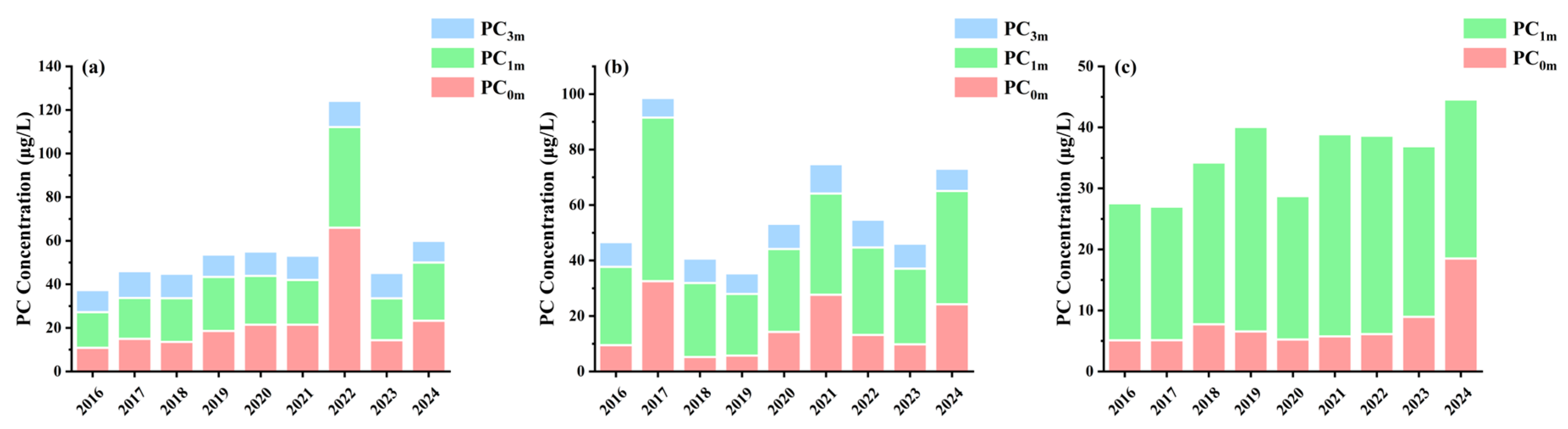
Annual and monthly average variations in Chla and PC concentrations in Lake Hulun, Fengman Reservoir, and Lake Khanka between 2016 and 2024 are summarized in Figure 9, Figure 10, Figure 11 and Figure 12. In Lake Hulun, Chla concentrations remained relatively stable across all depths from 2016 to 2024. The highest surface Chla concentration (38.77 μg/L) was observed in 2022, accompanied by values of 26.50 μg/L at 1 m and 10.33 μg/L at 3 m. Interannual differences diminished with increasing depth. Seasonally, Chla peaked in August during the May–September period, with a pronounced surge in July 2022 associated with an algal bloom. PC concentrations also peaked during the 2022 cyanobacterial bloom, reaching 65.9864 μg/L at the surface and 46.18 μg/L at 1 m depth, while the maximum at 3 m (12.06 μg/L) occurred in 2018. Excluding the 2022 event, PC levels were generally higher at 1 m than at the surface. PC exhibited an increasing trend from 2016 to 2019, a subsequent decline until 2021, and a renewed increase from 2023 onward. At 3 m depth, concentrations stabilized similarly to Chla. Seasonal PC peaks occurred in August at the surface and 1 m depth, whereas higher concentrations were observed in May at 3 m.
In the Fengman Reservoir, Chla levels also remained stable throughout the study period, peaking in 2021 at 41.92 μg/L (surface), 24.54 μg/L (1 m), and 10.29 μg/L (3 m). As in Lake Hulun, interannual variability decreased with depth. Seasonally, surface Chla exhibited opposite trends between May and August, while July and September showed similar upward tendencies, with generally lower concentrations in September. Depths of 1 m and 3 m followed comparable seasonal variation patterns. PC concentrations peaked in different years at each depth: surface PC reached 13.17 μg/L in 2021, 1 m depth peaked at 31.52 μg/L in 2018, and 3 m depth reached 8.83 μg/L in 2018. PC concentrations at 1 m were typically higher than at the surface, and during 2018–2019, 3 m concentrations also exceeded surface values. Seasonally, surface PC was relatively low and stable in June, while August and September showed higher values at both the surface and 1 m depth. The 3 m depth displayed distinct monthly patterns, with relatively lower concentrations in September.
In Lake Khanka, Chla concentrations remained stable across all depths between 2016 and 2024. A peak occurred in 2024, with surface concentrations reaching 32.66 μg/L and 26.52 μg/L at 1 m depth. Lake Khanka exhibited an overall increasing annual trend in recent years, while remaining relatively stable at 1 m depth. Chla concentrations showed seasonal variations across depths, with an overall upward trend from June to September. Samples collected at 1 m depth showed higher concentrations in August and September. The surface peak Chla concentration occurred in 2023 (27.96 μg/L), while the maximum at 1 m depth was recorded in 2021 (27.23 μg/L). Surface and 1 m PC concentrations followed similar seasonal patterns: surface levels peaked in August and September, while 1 m concentrations peaked in July and August. Overall, surface PC concentrations reached their maximum in September, and 1 m depths peaked in July.

3.5. Vertical Influencing Factors of Chla and PC

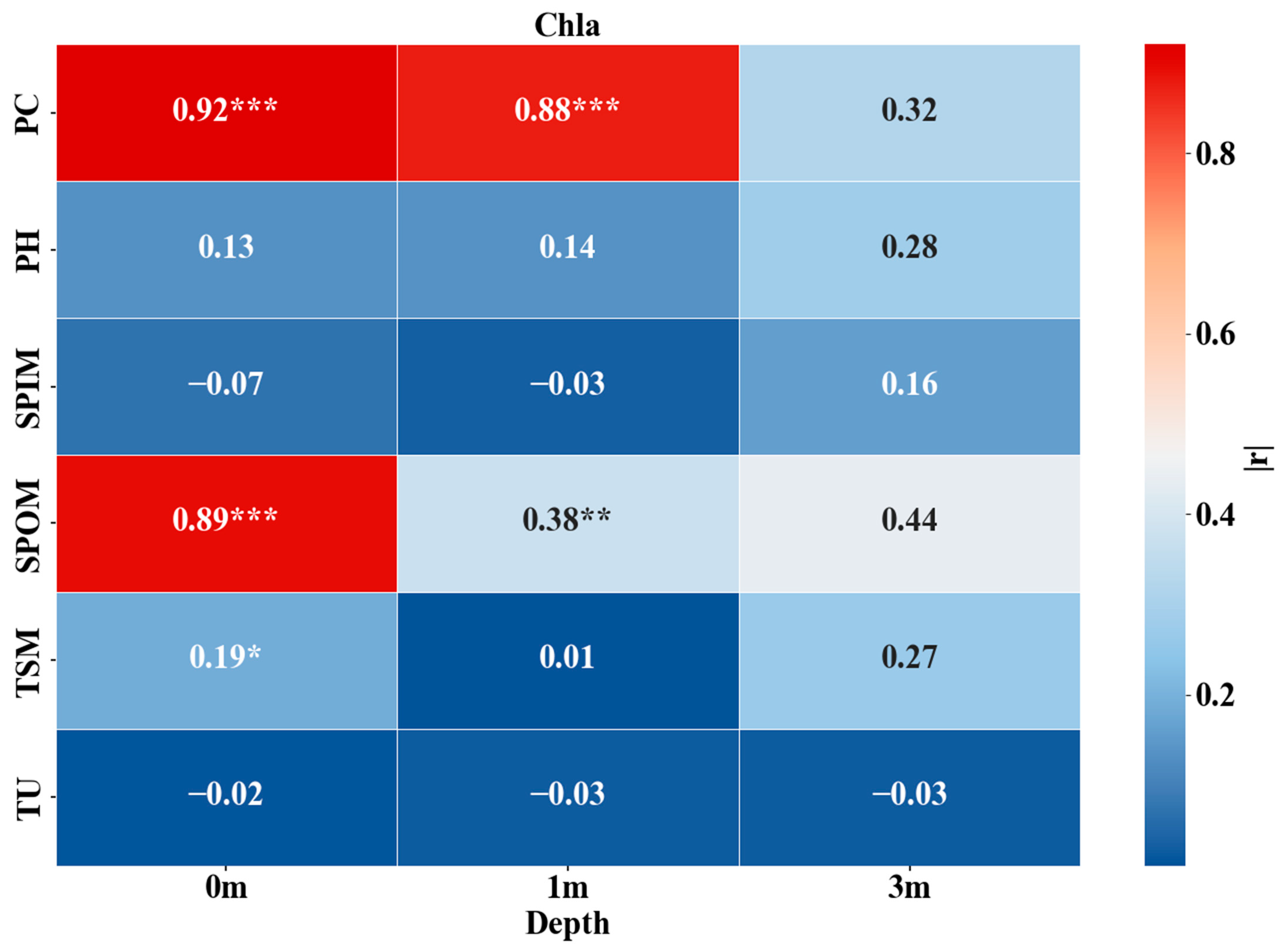
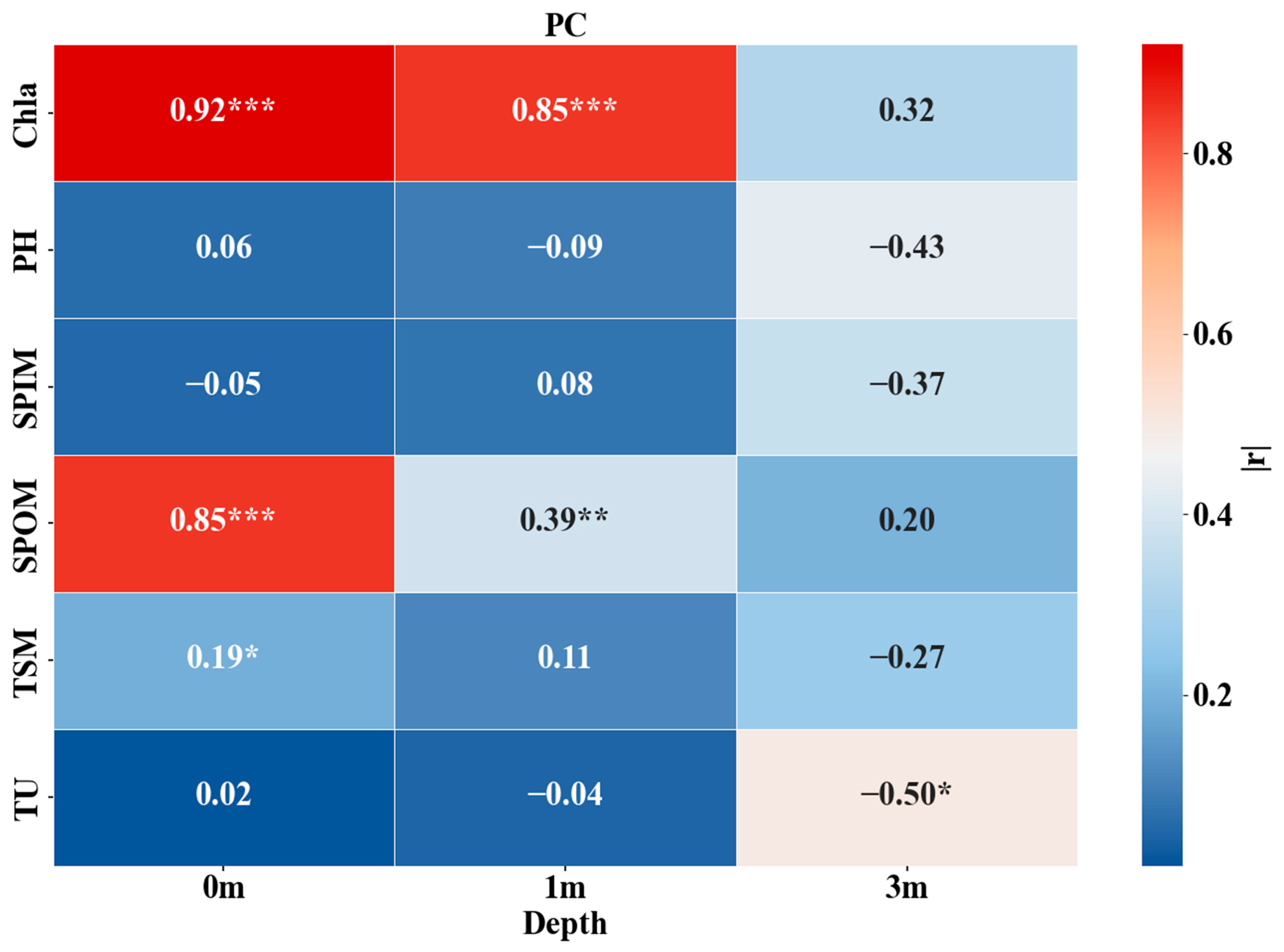
To further explore the relationships between PC and Chla across depths, we examined their associations with six additional phytoplankton-related parameters. Correlation coefficients and corresponding statistical significance values (p-values) were computed to evaluate these relationships (Figure 13 and Figure 14).
A significant positive correlation was identified between PC and Chla in the surface layer and at 1 m depth, indicating that elevated Chla concentrations coincide with active cyanobacterial proliferation, resulting in increased PC levels. In contrast, no significant correlation was observed between PC and Chla at 3 m depth. This may be attributed to the limited photosynthetic activity of cyanobacteria in deeper waters, which alters the typical relationship between these pigments.
Furthermore, Chla demonstrated a significant positive correlation with organic suspended matter, particularly at 1 m depth—consistent with the Chla–PC relationship observed at this level. This correlation likely reflects the composition of organic suspended matter, which includes detritus from aquatic plants, bacteria, and zooplankton. At 3 m depth, Chla showed no significant correlation with other parameters. However, PC at this depth exhibited a negative correlation with turbidity, likely due to reduced light penetration under turbid conditions, which suppresses PC production.

4. Discussion

4.1. Vertical of Chla and PC

Previous studies have shown that satellite-derived reflectance represents the integrated optical signal from a finite upper layer of the water column, and that surface biomass alone is often insufficient to characterize lake water quality [47]. Understanding the vertical distribution of phytoplankton is essential for accurately estimating biomass and assessing lake trophic status.
Despite differing natural conditions, Chla exhibited nearly identical vertical distribution patterns in Lake Hulun, the Fengman Reservoir, and Lake Khanka. The results indicate that, in eutrophic inland lakes, Chla generally follows an exponentially decreasing vertical profile, with concentrations stabilizing at greater depths—consistent with findings from previous studies [24]. In contrast, PC concentrations tend to peak in intermediate layers. This pattern may arise because cyanobacterial biomass can only accumulate near the surface under favorable conditions for growth and buoyancy [58]. Accordingly, PC appears to follow a power-law type vertical distribution, largely attributed to the buoyancy regulation mechanisms of cyanobacteria [58], with wind speed identified as a key factor influencing surface cyanobacterial proliferation [71].
This study adopted a layer-by-layer analytical approach to relate surface OLCI reflectance to pigment concentrations at three discrete depths (surface, 1 m and 3 m). Analysis of the model outputs revealed strong correlations between Chla and PC among these depth classes, and the inversion results indicate that depth-specific empirical relationships can be established within the upper water column. These findings suggest that a layer-by-layer approach can provide a first-order description of the vertical patterns of Chla and PC in these shallow lakes. However, because only three discrete depths were sampled, the present data do not allow us to resolve the full vertical structure of the water column or to rigorously derive a continuous functional profile with depth. Our results should therefore be interpreted as coarse vertical classes within the epilimnion rather than a complete description of the lake’s vertical structure.
Certain limitations remain in this study. First, the dataset covers only three lakes, which restricts the generalizability of the findings. Second, the limited number of sampling points and depth layers reduces the ability to capture the detailed vertical structure of Chla and PC. Future research should incorporate a broader range of water bodies with varying hydrological and ecological characteristics, as well as greater sampling depth, to construct a more comprehensive vertical profile for model calibration and validation.

4.2. Monthly Trend in Vertical Chla and PC Distribution

In this study, different lakes exhibited distinct patterns of monthly variation. This variation likely results from the strong influence of climatic factors on phytoplankton, where latitude and photoperiod exert differential effects on algal species. The monthly average PC concentration (Figure 9) showed a general upward trend across years, primarily because cyanobacterial proliferation is closely linked to temperature. With ongoing global warming [72], cyanobacteria tend to recover earlier in spring and delay dormancy in winter [40].
In deeper layers (3 m), the magnitude of change differed from that observed at the surface or at 1 m depth. This is likely due to the reduced influence of wind speed on deeper water layers [58]. Consequently, despite variations in climatic conditions, monthly PC fluctuations at 3 m remained relatively stable. Chla exhibited similar variation patterns across depths, though significant differences were observed in Lake Khanka. This disparity likely reflects Lake Khanka’s shallower depth and higher turbidity compared to the other two lakes, making it more susceptible to anthropogenic disturbances and hydrodynamic forces [73].

4.3. Applicability and Uncertainty of the Model

The RF model demonstrates strong predictive capability in the field of water quality monitoring [74], and its performance in estimating Chla and PC concentrations is well recognized [73,75]. Owing to its robustness against multicollinearity and minimal requirements for data normalization, the RF model successfully retrieved Chla and PC concentrations at different depths.
However, the model’s performance strongly depends on dataset quality—specifically, on having an adequate number of representative samples that encompass diverse environmental conditions. Insufficient sample size or a lack of representativeness may lead to overfitting, producing unrealistically high performance during training but poor generalization in practical applications. Conversely, underfitting can result in reduced accuracy and unstable predictive performance in subsequent research. Therefore, it is crucial to maintain sufficiently large, diverse, and representative datasets when developing models for universal application.
Moreover, this study focused solely on depth-specific concentrations of Chla and PC without considering other water quality indicators or optical properties that vary among lakes. These factors can directly influence inversion accuracy and should be incorporated in future research to enhance model reliability. Depth-specific variations in Chla and PC also affect correlations with remote sensing reflectance (Rrs) features. In lakes with low concentrations of Chla or chlorophyll-c, such correlations may vary due to the influence of other optically active substances [11], such as Total Phosphorus (TP) and colored dissolved organic matter.
Although Sentinel-3 OLCI provides higher spectral resolution and a better signal-to-noise ratio than many other sensors [70], improving its sensitivity to different lake constituents, variations in atmospheric correction algorithms can still affect image accuracy [76]. In addition, the penetration depth of spectral bands varies across wavelengths, with longer wavelengths generally providing better results in turbid waters. Temporal resolution is another challenge, as the dominant algal species in lakes are dynamic and change seasonally, leading to fluctuations in spectral characteristics. Therefore, continued improvements in sensor performance and data processing techniques are essential for enhancing the accuracy and consistency of water quality assessments in the future.

5. Conclusions

This study investigated three high-latitude lakes in China—Lake Hulun, Fengman Reservoir, and Lake Khanka—with the aim of developing an inversion method for estimating Cha and PC concentrations using Sentinel-3 OLCI imagery. Models were constructed to retrieve Chla and PC concentrations at the surface, as well as at depths of 1 m and 3 m. These models were applied to images acquired during the ice-free seasons from 2016 to 2022 to analyze the spatiotemporal variability of PC concentrations and identify key influencing factors.
The results revealed strong correlations between Chla and PC at the surface and 1 m depths, where PC concentrations were generally higher than at the surface. Cyanobacteria were predominantly distributed below 1 m. With the exception of the northern section of Lake Khanka—which showed an increasing trend in both PC and Chla over time—the concentrations of these parameters remained relatively stable in the other lakes, although the timing of peak values varied among systems. Further analysis confirmed significant positive correlations between Chla and PC at the surface and 1 m depths, while at 3 m, PC exhibited a negative correlation with turbidity.
Despite the promising results, this study has several limitations. The inclusion of only three lakes constrains the broader applicability of the findings. Moreover, includes issues such as an insufficiently small dataset due to data collection problems and a lack of model validation, the limited number of sampling sites and depth layers reduced the ability to fully capture the vertical structure of Chla and PC. Furthermore, hydrodynamic processes—which may substantially influence the vertical and spatial distribution of Chla and PC—were not incorporated into the models. Future research should expand the spatial coverage to include lakes with diverse hydrological and bio-optical properties, increase the vertical sampling resolution, and develop a more comprehensive dataset to support improved model calibration and validation.

Supplementary Materials

The following supporting information can be downloaded at: https://www.mdpi.com/article/10.3390/rs18010139/s1, Table S1: Field sampling and image date selection; Table S2: Model feature selection; Table S3: Hyperparameter sttings of model title.

Author Contributions

Conceptualization, J.S. and Z.W.; methodology, J.S. and Z.W.; software, H.T. and S.L.; validation, Z.Y., C.F. and L.L.; formal analysis, not mentioned; investigation, not mentioned; resources, K.S. and L.L.; data curation, Z.Y. and C.F.; writing—original draft preparation, J.S.; writing—review and editing, Z.W. and C.F.; visualization, H.T. and S.L.; supervision, not mentioned; project administration, not mentioned; funding acquisition, K.S. and L.L. All authors have read and agreed to the published version of the manuscript.

Funding

This work was supported by the Natural Science Foundation of China (42401480, U2243230, 42171374, 42471358), Jilin Provincial Department of Ecology and Environment (2024-01), Young Scientist Group Proiect of Northeast Institute of Geography and Agroecology, Chinese Academy of Sciences (20230NXZ01), Youth Innovation Promotion Association of Chinese Academy of Sciences, China (2022228), the Natural Science Foundation of Jilin Province, China (YDZJ202501ZYTS484) and the Key Project of Science and Technology Research of the Education Department of Jilin Province (JJKH20251012KJ).

Data Availability Statement

Sentinel-3 data are openly available for download from the EarthData www.earthdata.nasa.gov (accessed on 1 June 2024).

Acknowledgments

The author sincerely thanks Chong Fang, as well as Zhaojang Yan and Shizhuo Liu, for their assistance in the laboratory work.

Conflicts of Interest

The authors declare that they have no known competing financial interests or personal relationships that could have appeared to influence the work reported in this paper.

Abbreviations

The following abbreviations are used in this manuscript:
Chlachlorophyll-a
PCphycocyanin
Rrsremote sensing reflectance
SPMSuspended particulate matter
SPIMInorganic suspended particulate matter
SPOMOrganic suspended particulate matter
TUTurbidity

References

  1. Hou, X.; Liu, J.; Huang, H.; Zhang, Y.; Liu, C.; Gong, P. Mapping global lake aquatic vegetation dynamics using 10-m resolution satellite observations. Sci. Bull. 2024, 69, 3115–3126. [Google Scholar] [CrossRef]
  2. Liu, J.; Huang, H.; Hou, X.; Feng, L.; Pi, X.; Kyzivat, E.D.; Zhang, Y.; Woodman, S.G.; Tang, L.; Cheng, X.; et al. Expansion of aquatic vegetation in northern lakes amplified methane emissions. Nat. Geosci. 2025, 18, 322–329. [Google Scholar] [CrossRef]
  3. Bansal, S.; Ganesan, G. Advanced Evaluation Methodology for Water Quality Assessment Using Artificial Neural Network Approach. Water Resour. Manag. 2019, 33, 3127–3141. [Google Scholar] [CrossRef]
  4. Qin, B.; Paerl, H.W.; Brookes, J.D.; Liu, J.; Jeppesen, E.; Zhu, G.; Zhang, Y.; Xu, H.; Shi, K.; Deng, J. Why Lake Taihu continues to be plagued with cyanobacterial blooms through 10 years (2007–2017) efforts. Sci. Bull. 2019, 64, 354–356. [Google Scholar] [CrossRef]
  5. Isenstein, E.M.; Kim, D.; Park, M.-H. Modeling for multi-temporal cyanobacterial bloom dominance and distributions using landsat imagery. Ecol. Inform. 2020, 59, 101119. [Google Scholar] [CrossRef]
  6. Carey, C.C.; Ibelings, B.W.; Hoffmann, E.P.; Hamilton, D.P.; Brookes, J.D. Eco-physiological adaptations that favour freshwater cyanobacteria in a changing climate. Water Res. 2012, 46, 1394–1407. [Google Scholar] [CrossRef]
  7. Fang, C.; Song, K.; Paerl, H.W.; Jacinthe, P.-A.; Wen, Z.; Liu, G.; Tao, H.; Xu, X.; Kutser, T.; Wang, Z.; et al. Global divergent trends of algal blooms detected by satellite during 1982–2018. Glob. Change Biol. 2022, 28, 2327–2340. [Google Scholar] [CrossRef]
  8. Wang, Z.; Akbar, S.; Sun, Y.; Gu, L.; Zhang, L.; Lyu, K.; Huang, Y.; Yang, Z. Cyanobacterial dominance and succession: Factors, mechanisms, predictions, and managements. J. Environ. Manag. 2021, 297, 113281. [Google Scholar] [CrossRef]
  9. Zhang, Y.; Deng, J.; Qin, B.; Zhu, G.; Zhang, Y.; Jeppesen, E.; Tong, Y. Importance and vulnerability of lakes and reservoirs supporting drinking water in China. Fundam. Res. 2023, 3, 265–273. [Google Scholar] [CrossRef]
  10. Lyu, L.; Song, K.; Wen, Z.; Liu, G.; Fang, C.; Shang, Y.; Li, S.; Tao, H.; Wang, X.; Li, Y.; et al. Remote estimation of phycocyanin concentration in inland waters based on optical classification. Sci. Total Environ. 2023, 899, 166363. [Google Scholar] [CrossRef]
  11. Wang, X.; Fang, C.; Song, K.; Lyu, L.; Li, Y.; Lai, F.; Lyu, Y.; Wei, X. Monitoring phycocyanin concentrations in high-latitude inland lakes using Sentinel-3 OLCI data: The case of Lake Hulun, China. Ecol. Indic. 2023, 155, 110960. [Google Scholar] [CrossRef]
  12. Fang, C.; Song, K.; Yan, Z.; Liu, G. Monitoring phycocyanin in global inland waters by remote sensing: Progress and future developments. Water Res. 2025, 275, 123176. [Google Scholar] [CrossRef]
  13. Verdin, J.P. Monitoring water quality conditions in a large western reservoir with Landsat imagery. Photogramm. Eng. Remote Sens. 1985, 51, 343–353. [Google Scholar]
  14. Vos, W.; Donze, M.; Buiteveld, H. On the reflectance spectrum of algae in water: The nature of the peak at 700 nm and its shift with varying concentration. Commun. Sanit. Eng. Water Manag. 1986, 86–122. [Google Scholar]
  15. Ekstrand, S. Landsat TM based quantification of chlorophyll-a during algae blooms in coastal waters. Int. J. Remote Sens. 1992, 13, 1913–1926. [Google Scholar] [CrossRef]
  16. Stumpf, R.P.; Tomlinson, M.C. Remote Sensing of Harmful Algal Blooms. In Remote Sensing of Coastal Aquatic Environments: Technologies, Techniques and Applications; Miller, R.L., Del Castillo, C.E., McKee, B.A., Eds.; Springer: Dordrecht, The Netherlands, 2005; pp. 277–296. [Google Scholar]
  17. Beck, R.; Zhan, S.; Liu, H.; Tong, S.; Yang, B.; Xu, M.; Ye, Z.; Huang, Y.; Shu, S.; Wu, Q.; et al. Comparison of satellite reflectance algorithms for estimating chlorophyll-a in a temperate reservoir using coincident hyperspectral aircraft imagery and dense coincident surface observations. Remote Sens. Environ. 2016, 178, 15–30. [Google Scholar] [CrossRef]
  18. Rao, K.; Cao, X.; Wang, Y.; Zhang, Y.; Huang, H.; Ma, Y.; Xu, J. Spatial-temporal distributions of phytoplankton shifting, chlorophyll-a, and their influencing factors in shallow lakes using remote sensing. Ecol. Inform. 2024, 82, 102765. [Google Scholar] [CrossRef]
  19. Yang, Y.; Hou, X.; Gao, W.; Li, F.; Guo, F.; Zhang, Y. Retrieving Lake Chla concentration from remote Sensing: Sampling time matters. Ecol. Indic. 2024, 158, 111290. [Google Scholar] [CrossRef]
  20. Zhang, J.; Meng, F.; Fu, P.; Jing, T.; Xu, J.; Yang, X. Tracking changes in chlorophyll-a concentration and turbidity in Nansi Lake using Sentinel-2 imagery: A novel machine learning approach. Ecol. Inform. 2024, 81, 102597. [Google Scholar] [CrossRef]
  21. González Vilas, L.; Spyrakos, E.; Torres Palenzuela, J.M. Neural network estimation of chlorophyll a from MERIS full resolution data for the coastal waters of Galician rias (NW Spain). Remote Sens. Environ. 2011, 115, 524–535. [Google Scholar] [CrossRef]
  22. Alizadeh, M.J.; Kavianpour, M.R. Development of wavelet-ANN models to predict water quality parameters in Hilo Bay, Pacific Ocean. Mar. Pollut. Bull. 2015, 98, 171–178. [Google Scholar] [CrossRef]
  23. Sinshaw Tadesse, A.; Surbeck Cristiane, Q.; Yasarer, H.; Najjar, Y. Artificial Neural Network for Prediction of Total Nitrogen and Phosphorus in US Lakes. J. Environ. Eng. 2019, 145, 04019032. [Google Scholar] [CrossRef]
  24. Li, B.; Yang, G.; Wan, R.; Hörmann, G.; Huang, J.; Fohrer, N.; Zhang, L. Combining multivariate statistical techniques and random forests model to assess and diagnose the trophic status of Poyang Lake in China. Ecol. Indic. 2017, 83, 74–83. [Google Scholar] [CrossRef]
  25. Yajima, H.; Derot, J. Application of the Random Forest model for chlorophyll-a forecasts in fresh and brackish water bodies in Japan, using multivariate long-term databases. J. Hydroinformatics 2017, 20, 206–220. [Google Scholar] [CrossRef]
  26. Noori, R.; Yeh, H.-D.; Abbasi, M.; Kachoosangi, F.T.; Moazami, S. Uncertainty analysis of support vector machine for online prediction of five-day biochemical oxygen demand. J. Hydrol. 2015, 527, 833–843. [Google Scholar] [CrossRef]
  27. Park, Y.; Cho, K.H.; Park, J.; Cha, S.M.; Kim, J.H. Development of early-warning protocol for predicting chlorophyll-a concentration using machine learning models in freshwater and estuarine reservoirs, Korea. Sci. Total Environ. 2015, 502, 31–41. [Google Scholar] [CrossRef]
  28. Xue, K.; Zhang, Y.; Duan, H.; Ma, R.; Loiselle, S.; Zhang, M. A Remote Sensing Approach to Estimate Vertical Profile Classes of Phytoplankton in a Eutrophic Lake. Remote Sens. 2015, 7, 14403–14427. [Google Scholar] [CrossRef]
  29. Song, C.; Xu, Y.; Fang, C.; Zhang, C.; Xin, Z.; Liu, Z. SVR model and OLCI images reveal a declining trend in phycocyanin levels in typical lakes across Northeast China. Ecol. Inform. 2025, 85, 102965. [Google Scholar] [CrossRef]
  30. Zhang, L.; Zhang, C.; Ma, C.F.; Chen, X.; Li, Q.; Ye, X.M.; Yu, Z.F.; Tian, L.Q. Machine learning-based retrieval of chlorophyll-a and total suspended matter from HY-3A CZI: Model development, validation, and application. ISPRS J. Photogramm. Remote Sens. 2025, 227, 613–631. [Google Scholar] [CrossRef]
  31. Simis, S.G.H.; Peters, S.W.M.; Gons, H.J. Remote sensing of the cyanobacterial pigment phycocyanin in turbid inland water. Limnol. Oceanogr. 2005, 50, 237–245. [Google Scholar] [CrossRef]
  32. Matthews, M.W. A current review of empirical procedures of remote sensing in inland and near-coastal transitional waters. Int. J. Remote Sens. 2011, 32, 6855–6899. [Google Scholar] [CrossRef]
  33. Liu, G.; Simis, S.G.H.; Li, L.; Wang, Q.; Li, Y.; Song, K.; Lyu, H.; Zheng, Z.; Shi, K. A Four-Band Semi-Analytical Model for Estimating Phycocyanin in Inland Waters From Simulated MERIS and OLCI Data. IEEE Trans. Geosci. Remote Sens. 2018, 56, 1374–1385. [Google Scholar] [CrossRef]
  34. Sharp, S.L.; Cortés, A.; Forrest, A.L.; Legleiter, C.J.; Guild, L.S.; Jin, Y.; Schladow, S.G. Monitoring cyanobacteria temporal dynamics in a hypereutrophic lake using remote sensing: From multispectral to hyperspectral. Remote Sens. Appl. Soc. Environ. 2025, 39, 101704. [Google Scholar] [CrossRef]
  35. Hou, X.; Feng, L.; Dai, Y.; Hu, C.; Gibson, L.; Tang, J.; Lee, Z.; Wang, Y.; Cai, X.; Liu, J.; et al. Global mapping reveals increase in lacustrine algal blooms over the past decade. Nat. Geosci. 2022, 15, 130–134. [Google Scholar] [CrossRef]
  36. Dai, Y.; Yang, S.; Zhao, D.; Hu, C.; Xu, W.; Anderson, D.M.; Li, Y.; Song, X.-P.; Boyce, D.G.; Gibson, L.; et al. Coastal phytoplankton blooms expand and intensify in the 21st century. Nature 2023, 615, 280–284. [Google Scholar] [CrossRef] [PubMed]
  37. Chi, G.; Ma, J.; Shi, Y.; Chen, X. Hyperspectral remote sensing of cyanobacterial pigments as indicators of the iron nutritional status of cyanobacteria-dominant algal blooms in eutrophic lakes. Ecol. Indic. 2016, 71, 609–617. [Google Scholar] [CrossRef]
  38. Kwon, Y.S.; Pyo, J.; Kwon, Y.-H.; Duan, H.; Cho, K.H.; Park, Y. Drone-based hyperspectral remote sensing of cyanobacteria using vertical cumulative pigment concentration in a deep reservoir. Remote Sens. Environ. 2020, 236, 111517. [Google Scholar] [CrossRef]
  39. Duan, H.; Ma, R.; Hu, C. Evaluation of remote sensing algorithms for cyanobacterial pigment retrievals during spring bloom formation in several lakes of East China. Remote Sens. Environ. 2012, 126, 126–135. [Google Scholar] [CrossRef]
  40. Huisman, J.; Codd, G.A.; Paerl, H.W.; Ibelings, B.W.; Verspagen, J.M.H.; Visser, P.M. Cyanobacterial blooms. Nat. Rev. Microbiol. 2018, 16, 471–483. [Google Scholar] [CrossRef]
  41. Randolph, K.; Wilson, J.; Tedesco, L.; Li, L.; Pascual, D.L.; Soyeux, E. Hyperspectral remote sensing of cyanobacteria in turbid productive water using optically active pigments, chlorophyll a and phycocyanin. Remote Sens. Environ. 2008, 112, 4009–4019. [Google Scholar] [CrossRef]
  42. Becker, R.H.; Sultan, M.I.; Boyer, G.L.; Twiss, M.R.; Konopko, E. Mapping cyanobacterial blooms in the Great Lakes using MODIS. J. Great Lakes Res. 2009, 35, 447–453. [Google Scholar] [CrossRef]
  43. Mishra, S.; Mishra, D.R.; Lee, Z.; Tucker, C.S. Quantifying cyanobacterial phycocyanin concentration in turbid productive waters: A quasi-analytical approach. Remote Sens. Environ. 2013, 133, 141–151. [Google Scholar] [CrossRef]
  44. Song, K.; Li, L.; Li, S.; Tedesco, L.; Hall, B.; Li, Z. Hyperspectral retrieval of phycocyanin in potable water sources using genetic algorithm–partial least squares (GA–PLS) modeling. Int. J. Appl. Earth Obs. Geoinf. 2012, 18, 368–385. [Google Scholar] [CrossRef]
  45. Wang, J.; Wang, Z.; Cui, Y.; Yan, S. Dynamic monitoring of phycocyanin concentration in Chaohu Lake of China using Sentinel-3 images and its indication of cyanobacterial blooms. Ecol. Indic. 2022, 143, 109340. [Google Scholar] [CrossRef]
  46. Fu, L.; Zhou, Y.; Liu, G.; Song, K.; Tao, H.; Zhao, F.; Li, S.; Shi, S.; Shang, Y. Retrieval of Chla Concentrations in Lake Xingkai Using OLCI Images. Remote Sens. 2023, 15, 3809. [Google Scholar] [CrossRef]
  47. Ma, R.; Zhang, Y.; Duan, H. The status and development of the non-traditional lake water color remote sensing. J. Lake Sci. 2016, 28, 237–245. [Google Scholar] [CrossRef]
  48. Hu, M.; Zhang, Y.; Ma, R.; Xue, K.; Cao, Z.; Chu, Q.; Jing, Y. Optimized remote sensing estimation of the lake algal biomass by considering the vertically heterogeneous chlorophyll distribution: Study case in Lake Chaohu of China. Sci. Total Environ. 2021, 771, 144811. [Google Scholar] [CrossRef]
  49. Grósz, J.; Waltner, I.; Vekerdy, Z. First analysis results of in situ measurements for algae monitoring in lake Naplás (Hungary). Carpathian J. Earth Environ. Sci. 2019, 14, 385–398. [Google Scholar] [CrossRef]
  50. Sammartino, M.; Marullo, S.; Santoleri, R.; Scardi, M. Modelling the Vertical Distribution of Phytoplankton Biomass in the Mediterranean Sea from Satellite Data: A Neural Network Approach. Remote Sens. 2018, 10, 1666. [Google Scholar] [CrossRef]
  51. Zheng, H.; Ma, Y.; Huang, J.; Yang, J.; Su, D.; Wang, X.H. Deriving vertical profiles of chlorophyll-a concentration in the upper layer of seawaters using ICESat-2 photon-counting lidar. Opt. Express 2022, 30, 33320–33336. [Google Scholar] [CrossRef]
  52. Zhang, X.; Ma, Y.; Li, Z.; Zhang, J. Synergistic detection of chlorophyll-a concentration vertical profile by spaceborne lidar ICESat-2 and passive optical observations. Int. J. Appl. Earth Obs. Geoinf. 2024, 132, 104035. [Google Scholar] [CrossRef]
  53. Zhao, H.; Zhou, Y.; Gu, Q.; Han, Y.; Wu, H.; Xu, P.; Lin, L.; Lv, W.; Wu, L.; Wu, L.; et al. Lidar-Observed Diel Vertical Variations of Inland Chlorophyll a Concentration. Remote Sens. 2024, 16, 3579. [Google Scholar] [CrossRef]
  54. André, J.-M. Ocean color remote-sensing and the subsurface vertical structure of phytoplankton pigments. Deep. Sea Res. Part A. Oceanogr. Res. Pap. 1992, 39, 763–779. [Google Scholar] [CrossRef]
  55. Silulwane, N.F.; Richardson, A.J.; Shillington, F.A.; Mitchell-Innes, B.A. Identification and classification of vertical chlorophyll patterns in the Benguela upwelling system and Angola-Benguela front using an artificial neural network. Afr. J. Mar. Sci. 2006, 23, 37–51. [Google Scholar] [CrossRef]
  56. Li, H.H.; Wei, X.Q.; Huang, Z.H.; Liu, H.Z.; Ma, R.H.; Wang, M.H.; Hu, M.Q.; Jiang, L.D.; Xue, K. Monitoring the Vertical Variations in Chlorophyll-a Concentration in Lake Chaohu Using the Geostationary Ocean Color Imager. Remote Sens. 2024, 16, 2611. [Google Scholar] [CrossRef]
  57. Xue, K.; Ma, R.; Shen, M.; Wu, J.; Hu, M.; Guo, Y.; Cao, Z.; Xiong, J. Horizontal and vertical migration of cyanobacterial blooms in two eutrophic lakes observed from the GOCI satellite. Water Res. 2023, 240, 120099. [Google Scholar] [CrossRef]
  58. Li, J.; Li, Y.; Bi, S.; Xu, J.; Guo, F.; Lyu, H.; Dong, X.; Cai, X. Utilization of GOCI data to evaluate the diurnal vertical migration of Microcystis aeruginosa and the underlying driving factors. J. Environ. Manag. 2022, 310, 114734. [Google Scholar] [CrossRef]
  59. O’Brien, K.R.; Meyer, D.L.; Waite, A.M.; Ivey, G.N.; Hamilton, D.P. Disaggregation of Microcystis aeruginosa colonies under turbulent mixing: Laboratory experiments in a grid-stirred tank. Hydrobiologia 2004, 519, 143–152. [Google Scholar] [CrossRef]
  60. Wang, H.; Zhang, Z.; Liang, D.; Du, H.; Pang, Y.; Hu, K.; Wang, J. Separation of wind’s influence on harmful cyanobacterial blooms. Water Res. 2016, 98, 280–292. [Google Scholar] [CrossRef]
  61. Wen, Z.; Shang, Y.; Song, K.; Liu, G.; Hou, J.; Lyu, L.; Tao, H.; Li, S.; He, C.; Shi, Q.; et al. Composition of dissolved organic matter (DOM) in lakes responds to the trophic state and phytoplankton community succession. Water Res. 2022, 224, 119073. [Google Scholar] [CrossRef]
  62. Song, K.; Li, L.; Tedesco, L.P.; Li, S.; Clercin, N.A.; Hall, B.E.; Li, Z.; Shi, K. Hyperspectral determination of eutrophication for a water supply source via genetic algorithm–partial least squares (GA–PLS) modeling. Sci. Total Environ. 2012, 426, 220–232. [Google Scholar] [CrossRef] [PubMed]
  63. Song, K.; Lu, D.; Li, L.; Li, S.; Wang, Z.; Du, J. Remote sensing of chlorophyll-a concentration for drinking water source using genetic algorithms (GA)-partial least square (PLS) modeling. Ecol. Inform. 2012, 10, 25–36. [Google Scholar] [CrossRef]
  64. Vanhellemont, Q.; Ruddick, K. Atmospheric correction of Sentinel-3/OLCI data for mapping of suspended particulate matter and chlorophyll-a concentration in Belgian turbid coastal waters. Remote Sens. Environ. 2021, 256, 112284. [Google Scholar] [CrossRef]
  65. Hu, C. A novel ocean color index to detect floating algae in the global oceans. Remote Sens. Environ. 2009, 113, 2118–2129. [Google Scholar] [CrossRef]
  66. Zhao, L.; Song, C.; Fang, C.; Xu, Y.; Xin, Z.; Liu, Z.; Zhang, C. Spatiotemporal variation of long-term surface and vertical suspended particulate matter in the Liaohe estuary, China. Ecol. Indic. 2023, 151, 110288. [Google Scholar] [CrossRef]
  67. Lei, S.; Xu, J.; Li, Y.; Du, C.; Liu, G.; Zheng, Z.; Xu, Y.; Lyu, H.; Mu, M.; Miao, S.; et al. An approach for retrieval of horizontal and vertical distribution of total suspended matter concentration from GOCI data over Lake Hongze. Sci. Total Environ. 2020, 700, 134524. [Google Scholar] [CrossRef]
  68. Liu, G.; Li, L.; Song, K.; Li, Y.; Lyu, H.; Wen, Z.; Fang, C.; Bi, S.; Sun, X.; Wang, Z.; et al. An OLCI-based algorithm for semi-empirically partitioning absorption coefficient and estimating chlorophyll a concentration in various turbid case-2 waters. Remote Sens. Environ. 2020, 239, 111648. [Google Scholar] [CrossRef]
  69. Qi, L.; Hu, C.; Duan, H.; Cannizzaro, J.; Ma, R. A novel MERIS algorithm to derive cyanobacterial phycocyanin pigment concentrations in a eutrophic lake: Theoretical basis and practical considerations. Remote Sens. Environ. 2014, 154, 298–317. [Google Scholar] [CrossRef]
  70. Yan, Z.; Fang, C.; Song, K.; Wang, X.; Wen, Z.; Shang, Y.; Tao, H.; Lyu, Y. Spatiotemporal variation in biomass abundance of different algal species in Lake Hulun using machine learning and Sentinel-3 images. Sci. Rep. 2025, 15, 2739. [Google Scholar] [CrossRef]
  71. Wu, T.; Qin, B.; Brookes, J.D.; Shi, K.; Zhu, G.; Zhu, M.; Yan, W.; Wang, Z. The influence of changes in wind patterns on the areal extension of surface cyanobacterial blooms in a large shallow lake in China. Sci. Total Environ. 2015, 518–519, 24–30. [Google Scholar] [CrossRef]
  72. Chen, J.; Wang, J.; Wang, Q.; Lv, J.; Liu, X.; Chen, J.; Li, N. Common fate of sister lakes in Hulunbuir Grassland: Long-term harmful algal bloom crisis from multi-source remote sensing insights. J. Hydrol. 2021, 594, 125970. [Google Scholar] [CrossRef]
  73. Shen, M.; Luo, J.; Cao, Z.; Xue, K.; Qi, T.; Ma, J.; Liu, D.; Song, K.; Feng, L.; Duan, H. Random forest: An optimal chlorophyll-a algorithm for optically complex inland water suffering atmospheric correction uncertainties. J. Hydrol. 2022, 615, 128685. [Google Scholar] [CrossRef]
  74. Zhao, R. Intention Recognition Method for Spatial Non-cooperative Target Based on Improved Random Forest. Adv. Space Res. 2025, 77, 714–728. [Google Scholar] [CrossRef]
  75. Zhang, J.; Zhi, M.; Zhang, Y. Combined Generalized Additive model and Random Forest to evaluate the influence of environmental factors on phytoplankton biomass in a large eutrophic lake. Ecol. Indic. 2021, 130, 108082. [Google Scholar] [CrossRef]
  76. Lyu, H.; Wang, Q.; Wu, C.; Zhu, L.; Li, Y.; Huang, J. Variations in optical scattering and backscattering by organic and inorganic particulates in Chinese lakes of Taihu, Chaohu and Dianchi. Chin. Geogr. Sci. 2015, 25, 26–38. [Google Scholar] [CrossRef]
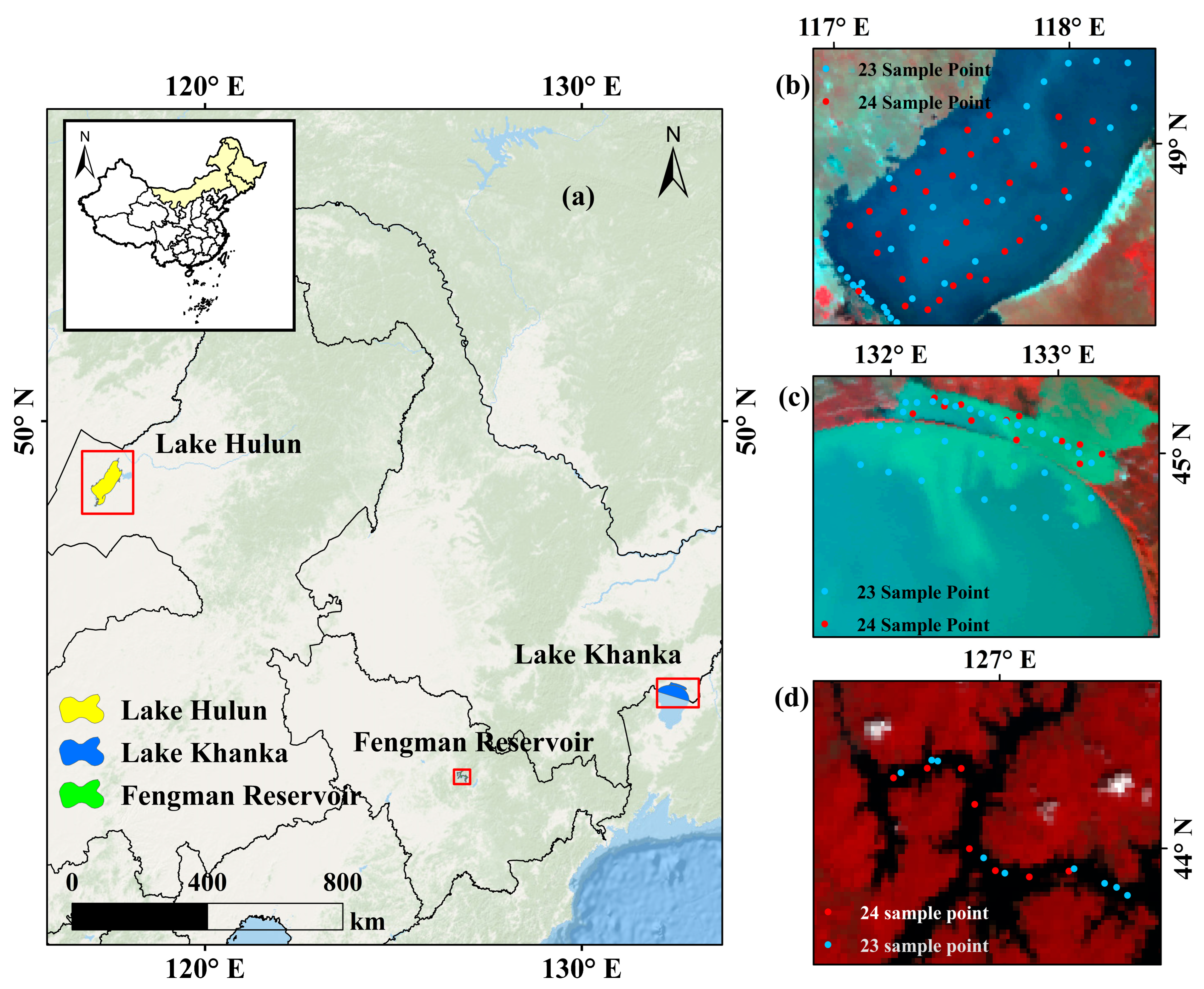
Figure 1. Overview of the study area. (a) Geographical location of three lakes in this study. (b) Distribution of sampling points in Lake Hulun. (c) Distribution of sampling points in Lake Khanka. (d) Distribution of sampling points in Fengman Reservoir.
Remotesensing 18 00139 g001
Figure 2. Correlation coefficients between the measured reflectance of the water body and the reflectance of the atmospherically corrected OLCI images using ACOLITE (v20231023.0) software.
Remotesensing 18 00139 g002
Figure 3. General framework employed in this study. Chla0m,1m,3m and PC0m,1m,3m represent Chla and PC concentrations at the surface, 1 m below the surface, and 3 m below the surface, respectively.
Remotesensing 18 00139 g003
Figure 4. Model evaluation of Chla0m,1m,3m. (a) Chla0m Training set; (b) Chla0m Test set; (c) Chla1m Training set; (d) Chla1m Test set; (e) Chla3m Training set; (f) Chla3m Test set.
Remotesensing 18 00139 g004
Figure 5. Model evaluation of PC0m,1m,3m. (a) PC0m Training set; (b) PC0m Test set; (c) PC1m Training set; (d) PC1m Test set; (e) PC3m Training set; (f) PC3m Test set.
Remotesensing 18 00139 g005
Figure 6. Chla and PC inverted image at water depth of 0, 1, 3 m in Lake Hunlun.
Remotesensing 18 00139 g006
Figure 7. Chla and PC inverted image at water depths of 0, 1, and 3 m in Fengman Reservoir.
Remotesensing 18 00139 g007
Figure 8. Chla and PC inverted image at a water depths of 0 and 1 m in Khanka Lake.
Remotesensing 18 00139 g008
Figure 9. Distribution of Chla concentrations in Lake. (a,d,g) Variations at 0 m depth, (b,e,h) variations at 1 m depth, and (c,f) variations at 3 m depth from 2016–2024.
Remotesensing 18 00139 g009
Figure 10. Distribution of PC concentrations in Lake. (a,d,g) Variations at 0 m depth. (b,e,h) Variations at 1 m depth. (c,f)Variations at 3 m depth. From 2016–2024.
Remotesensing 18 00139 g010
Figure 11. Distribution of Chla concentrations at different depths in Hulun Lake (a), Songhua Lake (b) and Khanka Lake (c) from 2016 to 2024.
Remotesensing 18 00139 g011
Figure 12. Distribution of PC concentrations at different depths in Hulun Lake (a), Songhua Lake (b) and Khanka Lake (c) from 2016 to 2024.
Remotesensing 18 00139 g012
Figure 13. Relationships between other water quality parameters and Chla. SPM, SPIM, SPOM, TU. with * representing p  <  0.05, ** representing p  <  0.01 and *** representing p  <  0.01.
Remotesensing 18 00139 g013
Figure 14. Relationships between other water quality parameters and PC. SPM, SPIM, SPOM, TU. with * representing p  <  0.05, ** representing p  <  0.01 and *** representing p  <  0.01.
Remotesensing 18 00139 g014
Table 1. Field Measurement Chla (μg/L).
DepthLakeSample SizeMeanMinMax
0 mHulun Lake7243.153.35380.58
0 mSonghua Lake183.371.216.37
0 mKhanka Lake4640.253.98254.81
1 mHulun Lake2211.450.1429.55
1 mSonghua Lake122.541.054.84
1 mKhanka Lake3831.602.74166.00
3 mHulun Lake168.942.9116.85
3 mSonghua Lake112.320.834.63
Table 2. Field Measurement PC (μg/L).
DepthLakeSample SizeMeanMinMax
0 mHulun Lake72138.630.122548.47
0 mSonghua Lake1811.930.0562.14
0 mKhanka Lake46246.490.621862.44
1 mHulun Lake228.650.3186.24
1 mSonghua Lake129.360.0255.30
1 mKhanka Lake38202.950.732112.49
3 mHulun Lake1611.720.1794.19
3 mSonghua Lake116.030.0326.09
Disclaimer/Publisher’s Note: The statements, opinions and data contained in all publications are solely those of the individual author(s) and contributor(s) and not of MDPI and/or the editor(s). MDPI and/or the editor(s) disclaim responsibility for any injury to people or property resulting from any ideas, methods, instructions or products referred to in the content.