Next Article in Journal
Shape-Aware Refinement of Deep Learning Detections from UAS Imagery for Tornado-Induced Treefall Mapping
Previous Article in Journal
Vertical Monitoring of Chlorophyll-a and Phycocyanin Concentrations High-Latitude Inland Lakes Using Sentinel-3 OLCI
Previous Article in Special Issue
The Evolution of the Mars Year (MY) 35 Anomalous Spring Dust Storm and Its Influence on the Chryse and Utopia Plains
 
 
Due to scheduled maintenance work on our servers, there may be short service disruptions on this website between 11:00 and 12:00 CEST on March 28th.
Article

Compositional and Mineralogical Diversity of Jezero Western Fan, Mars, Revealed by Elemental Observations


1
Shandong Key Laboratory of Space Environment and Exploration Technology, Institute of Space Sciences, School of Space Science and Technology, Shandong University, Weihai 264209, China
2
SDU-ANU Joint Science College, Shandong University, Weihai 264209, China
3
Xi’an Institute of Optics and Precision Mechanics (XIOPM), Chinese Academy of Sciences, Xi’an 710119, China
*
Author to whom correspondence should be addressed.
Remote Sens. 2026, 18(1), 140; https://doi.org/10.3390/rs18010140
Submission received: 3 December 2025 / Revised: 21 December 2025 / Accepted: 29 December 2025 / Published: 31 December 2025
(This article belongs to the Special Issue Planetary Remote Sensing and Applications to Mars and Chang’E-6/7)

Highlights

What are the main findings?
  • Elemental and mineralogical diversity was revealed by abrasion analyses conducted by the Perseverance rover across the Jezero western fan.
  • Western fan rocks are more enriched in Mg and Fe and alteration phases than those from the crater floor.
What are the implications of the main findings?
  • Low to medium CIA and MIA values, coupled with elevated halogen concentrations, suggest limited weathering and episodic brine mobilization.
  • The rocks likely record the imprint of both fluvial and hydrothermal processes, reflecting a complex post-depositional history.

Abstract
The NASA Mars 2020 Mission Perseverance rover has conducted a four-Martian-year scientific campaign in the Jezero western fan, a typical fluvial–deltaic–lacustrine system on Mars. Equipped with the Planetary Instrument for X-ray Lithochemistry (PIXL) and SuperCam, the rover has collected high-resolution elemental data from abraded rock outcrops, providing a detailed geochemical and mineralogical characterization of key stratigraphic units. This work presents a systematic analysis of these targets, revealing distinct geochemical trends. Rocks from the delta front, upper fan, and margin units are enriched in Mg and Fe (e.g., mafic to ultramafic lithologies) and are depleted in Si, Al, Na, and Ca. These units share comparable mineral parageneses and exhibit pervasive alteration textures, in contrast to the more limited alteration observed in crater floor targets. Despite this, we also discussed insights derived from elemental data: (1) Low to medium chemical index of alteration (CIA) and modified index of alteration (MIA) values indicate limited silicate weathering. (2) Localized enrichments in Cl and Br suggest episodic mobilization of brines. (3) The presence of high-silica phases near the margin unit further points to hydrothermal processes. These observations suggest that sedimentation and diagenesis in the Jezero western delta were shaped by a complex interplay of fluvial, lacustrine, and localized hydrothermal processes.

Graphical Abstract

1. Introduction

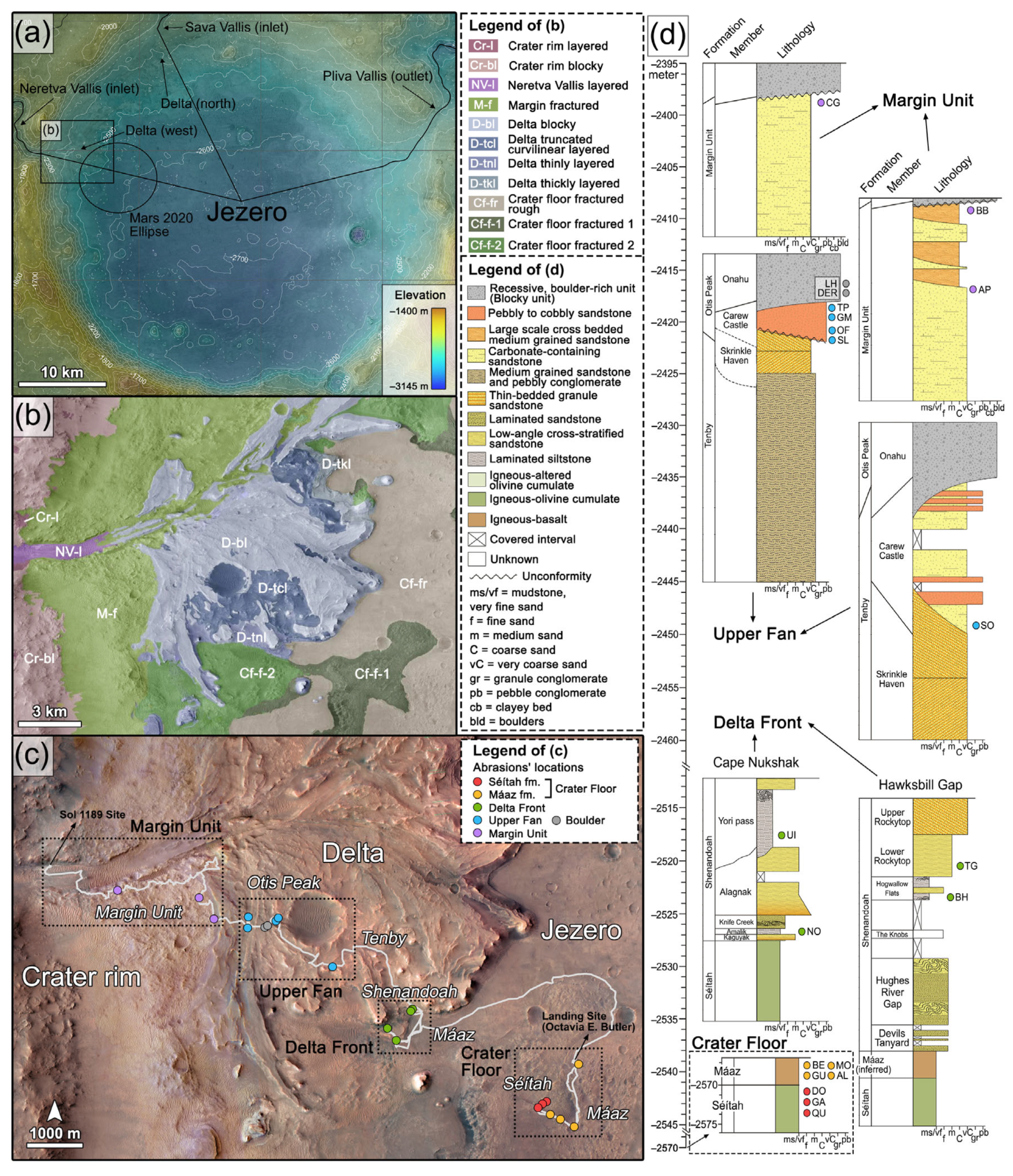
Jezero crater (18.4°N, 77.7°E; ~48 km diameter) is situated on the Nili Plateau, which is adjacent to the western edge of the ~3.9 Ga Isidis basin [1]. Crater size–frequency distribution measurements indicate that Jezero crater formed between ~3.96 and ~3.82 Ga [2,3], preserving a remarkably well-exposed record of Noachian geology. Between the late Noachian to early Hesperian epochs (~3.7–3.6 Ga), the crater evolved into a hydrologically active basin that is characterized by two inlet valleys (Neretva Vallis and Sava Vallis), an outlet channel (Pliva Vallis), and two fan-shaped delta deposits on its western and northern margins (Figure 1a), which are indicative of an open-basin paleolake system [4,5,6,7]. Subsequent lake-level decline led to hydrological closure of the basin, transitioning into a closed-lake system in its later stages [8]. The western fan, the primary focus of the Perseverance rover, was emplaced as a point-sourced fluvial–deltaic system at the mouth of Neretva Vallis [4]. With an estimated age of ~3.5 Ga, it is the youngest major geological unit within the crater [5] and provides a key window into the evolution of sedimentary processes and paleoenvironment conditions on early Mars.
On 18 February 2021, NASA’s Perseverance rover began its exploration of Jezero crater with the primary goals of collecting Martian samples, characterizing the geology of the landing site, reconstructing past and present climate conditions, supporting future human exploration, and searching for potential biosignatures [9]. During its first four-Martian-year exploration, Perseverance has completed four major geological campaigns [7], each focused on distinct stratigraphic units across the crater floor and western fan (Figure 1b,c). These include the Crater Floor Campaign (sols 83–370), targeting the Séítah (formerly Cf-f-1) and Máaz formations (formerly Cf-fr); the Delta Front Campaign (sols 415–663), primarily investigating the Shenandoah formation (formerly D-tnl); the Upper Fan Campaign (sols 708–910), consisting of the Tenby (formerly D-tcl) and Otis Peak formations (formerly D-bl); and the Margin Unit Campaign (sols 910–1243), focusing on the Margin Unit formation (formerly M-f). Collectively, these investigative campaigns delineate a stratigraphic transect spanning a fluvial-deltaic-lacustrine system and provide a unique opportunity to reconstruct sediment transport processes and paleoclimate conditions during a period when sustained surface water activity was likely driven by a climate favorable to fluvial deposition.
Remote sensing observations reveal extensive exposures of carbonate-bearing outcrops in Neretva Vallis [10], with widespread occurrences of water-rock interaction products (e.g., clay minerals) across Jezero western fan [11,12]. The large-scale formation of carbonates is likely attributable to the low-to-moderate temperature alteration of fresh ultramafic volcanic ash through interactions with rainfall or snowmelt, indicative of in situ mineral precipitation in a slightly alkaline lacustrine or shoreline environment [11,12]. In contrast, the clay minerals exhibit clastic distribution patterns, suggesting derivation from detrital sources in the surrounding terrain. In situ measurements by the Perseverance rover indicate that the crater floor basalts have experienced moderate aqueous alteration [13], resulting in the formation of minor hydrous salts (e.g., carbonates, sulfates, and perchlorates) [13,14,15]. Within the delta front and upper fan deposits, Perseverance has detected abundant clay minerals co-located with carbonates and sulfate assemblages, potentially reflecting open-system chemical weathering within the former paleolake basin [16,17]. Additionally, the margin unit of Jezero western fan is enriched in amorphous phyllosilicates, Mg/Fe-carbonates, and silica cement, suggesting a specific paragenetic sequence of secondary mineral precipitation [18].
Figure 1. Overview of Jezero crater and the Perseverance rover’s traverse pathway, highlighting key geological units and study areas. (a) The topography of Jezero crater shows the landing ellipse (black outline). (b) Geologic map of the Jezero western fan region with major bedrock units [7]. (c) Close-up views of selected exploration areas, with the Perseverance rover’s traverse pathway across the crater floor, delta front, upper fan, and margin units outlined by dashed boxes. (d) Stratigraphic columns for multiple regions along the rover’s traverse through the western fan [19,20]. Analytical targets are color-coded to correspond to their respective geological units in the stratigraphy.
Remotesensing 18 00140 g001
Different geological units within Jezero western fan have likely experienced distinct and complex sedimentary alteration processes, providing valuable insights into past environmental conditions. However, previous works have primarily focused on localized mineralogical characterizations, with relatively limited geochemical analyses of this region. To address this gap, elemental data acquired by the Planetary Instrument for X-Ray Lithochemistry (PIXL) [21] and SuperCam [22,23], both capable of resolving the elemental compositions of target surface materials, were systematically analyzed. By synthesizing compositional data from multiple geological units investigated by the Perseverance rover, this study characterizes the spatial variability in elemental and mineralogical signatures across the delta, including the extent of chemical alteration, halogen mobility, and silica phase transitions. The results provide new constraints on the hydrological and potentially hydrothermal processes that operated within Jezero paleolake system, and contribute to a broader understanding of the climatic history of ancient Mars.

2. Materials and Methods

2.1. Abrasion

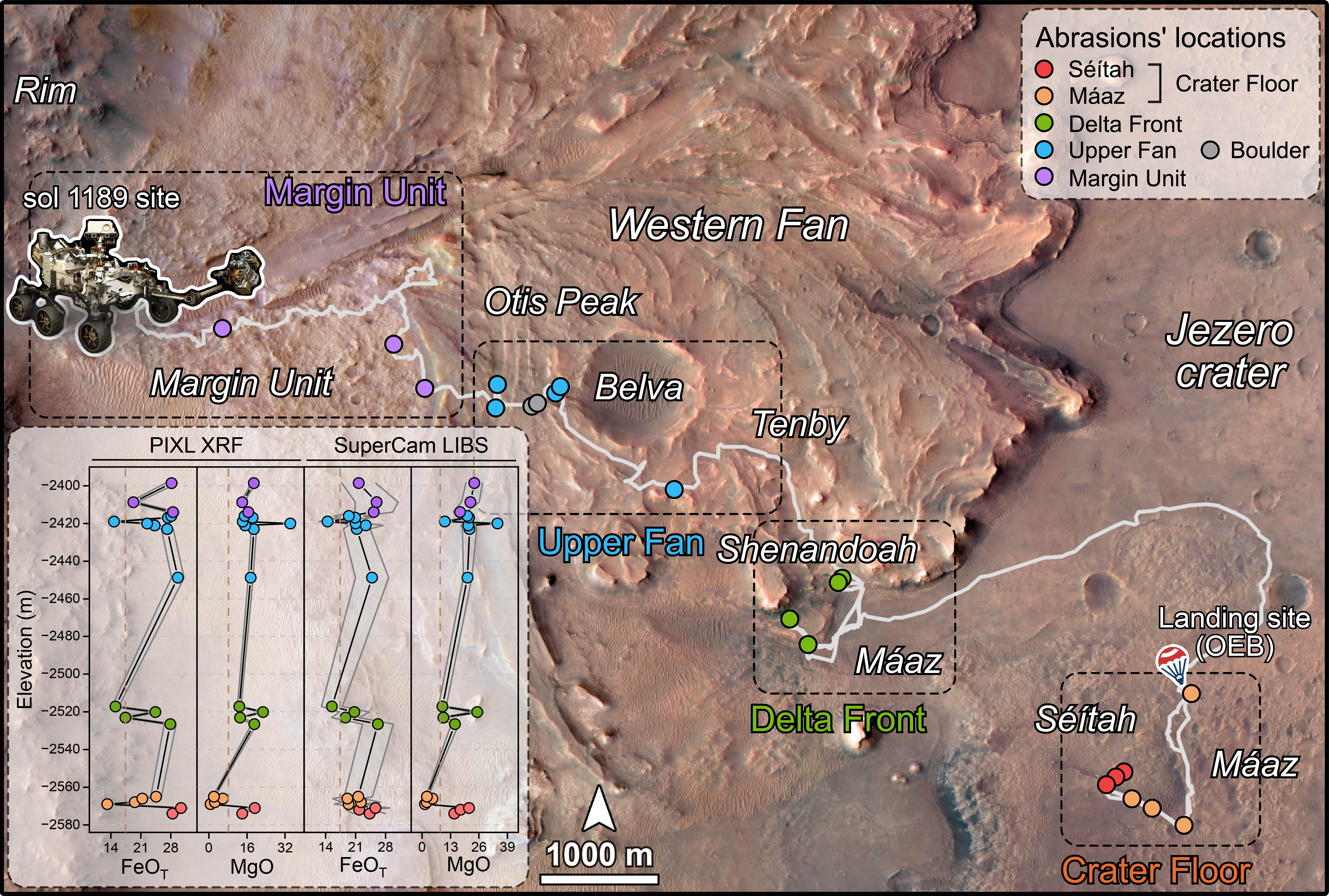
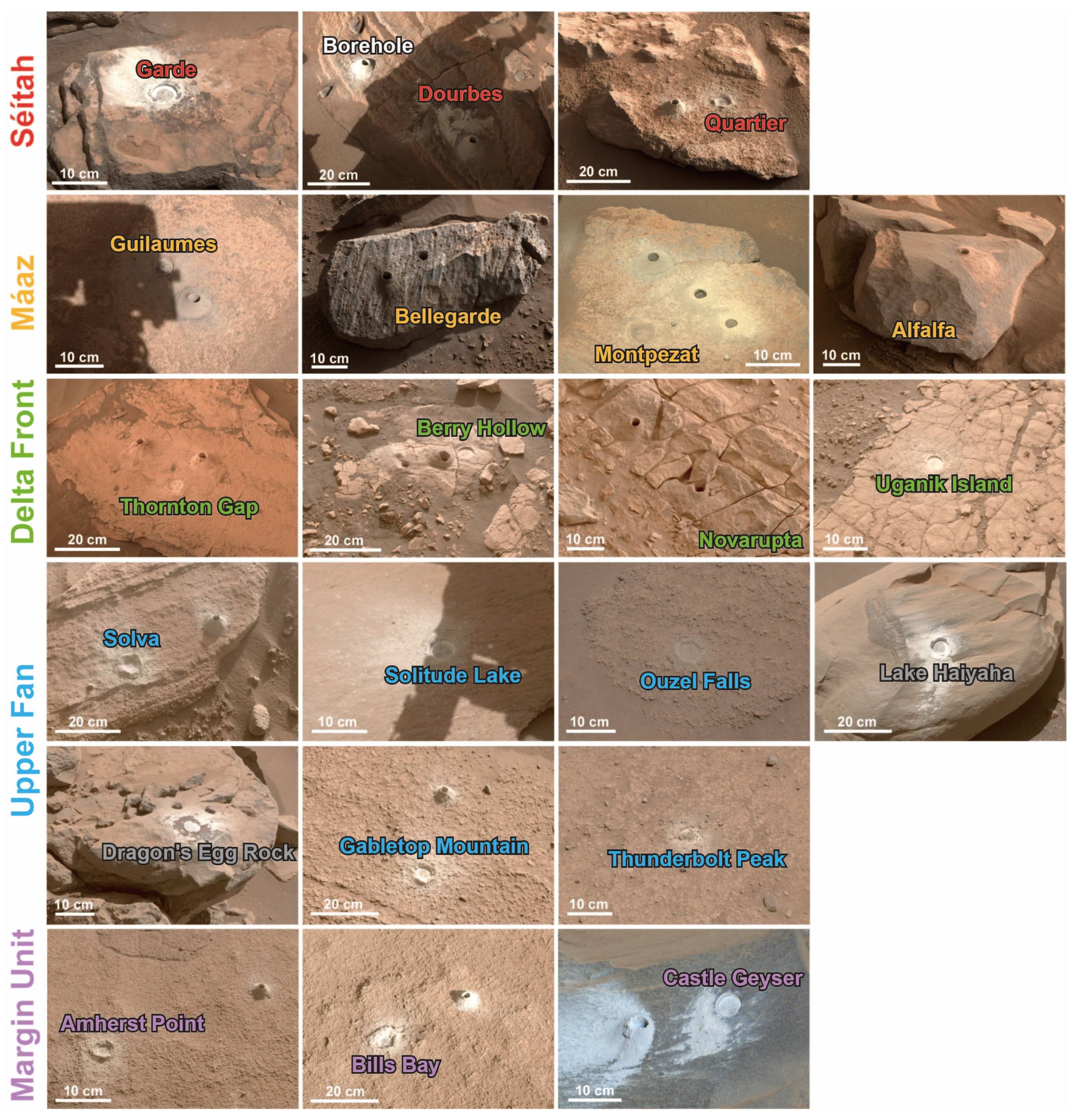
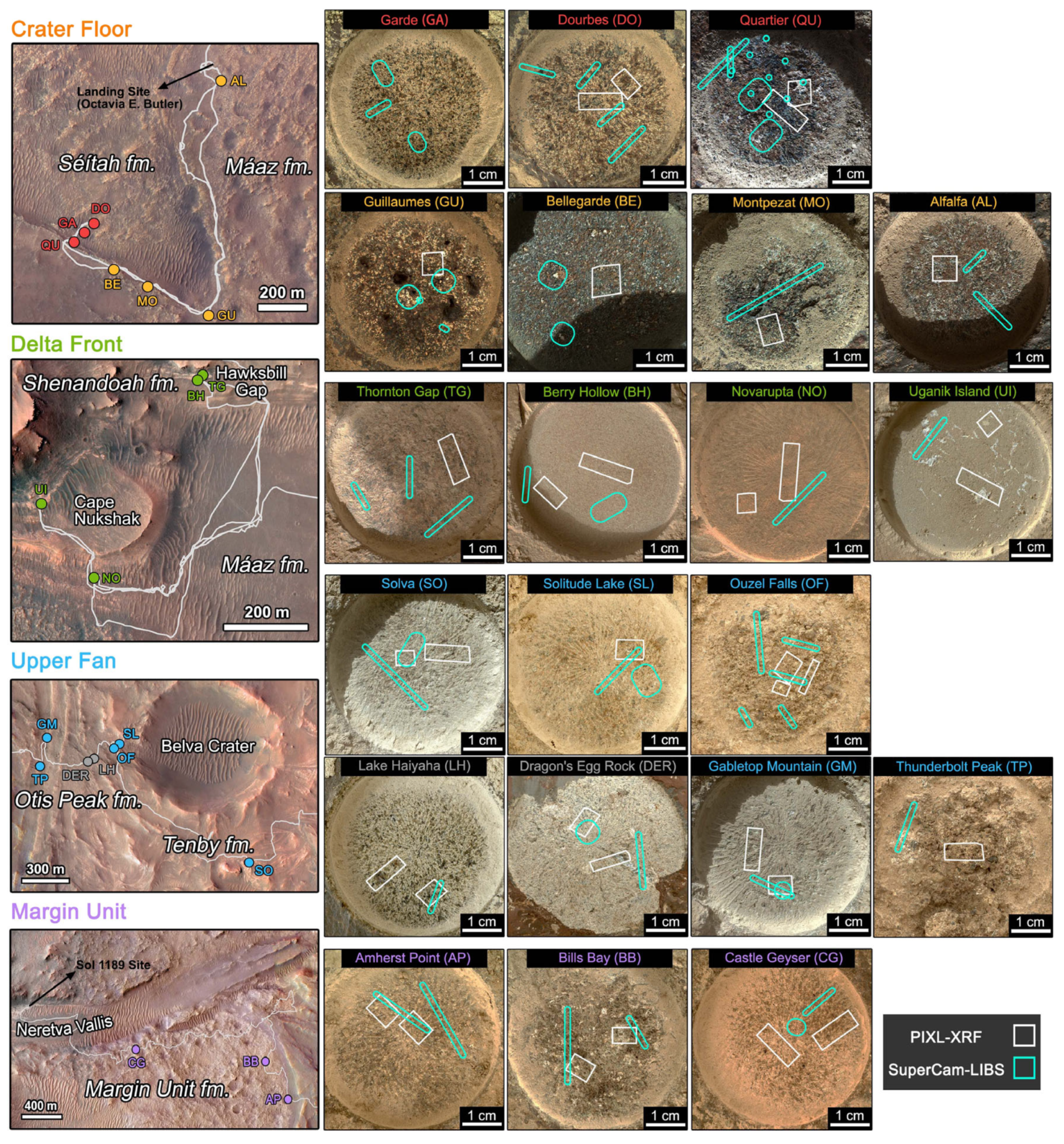
All targets analyzed in this work correspond to abraded surface patches prepared by the Perseverance rover. Abrasion was performed using the Rock Abrasion Tool (RAT), which produces flat-bottomed circular patches (~45 mm in diameter and ~5–10 mm deep) on blocky or layered outcrops. Following abrasion, the Gaseous Dust Removal Tool (gDRT) was employed to clear residual dust and debris using a high-velocity jet of nitrogen gas [9,24], thereby minimizing the influence of iron-rich Martian surface dust [25]. On the crater floor, we analyzed seven targets: Garde (GA), Dourbes (DO), and Quartier (QU) in the Séítah formation, and Guilaumes (GU), Bellegarde (BE), Montpezat (MO), and Alfalfa (AL) in the Máaz formation. In the delta front, we examined four abrasions within the Shenandoah formation, including Thornton Gap (TG), Berry Hollow (BH), Novarupta (NO), and Uganik Island (UI). In the upper fan, we investigated seven patches, including Solva (SO) and Solitude Lake (SL) in the Tenby formation and Ouzel Falls (OF), Lake Haiyaha (LH), Dragon’s Egg Rock (DER), Gabletop Mountain (GM), and Thunderbolt Peak (TP) in the Otis Peak formation (LH and DER are located on float boulders). Additionally, in the margin unit, we investigated Amherst Point (AP), Bills Bay (BB), and Castle Geyser (CG) within the Margin Unit formation (Figure 2 and Figure 3 and Table S1). High-resolution imagery of these abraded surfaces (Figure 3) was acquired using the Wide Angle Topographic Sensor for Operations and eNgineering (WATSON) of the Scanning Habitable Environments with Raman and Luminescence for Organics and Chemicals (SHERLOC), providing detailed documentation of texture, sedimentary structures, and grain characteristics of each target [26].

2.2. PIXL XRF

PIXL is a micro-X-ray fluorescence (XRF) spectrometer designed to produce high-resolution elemental maps, and it operates in coordination with an integrated micro-context camera (MCC) for contextual imaging [14,21,27]. It utilizes a rhodium-anode X-ray tube operating at 28 kV and 20 μA, with grazing-incidence optics that focus the beam onto the sample surface. The resulting fluorescence is detected by two silicon drift detectors (SDD), each with an energy resolution of 160 eV at 5.9 keV and a count rate of ~8000 counts per second per detector. This configuration enables quantification of a broad suite of major and minor elements, including Si, Ti, Al, Cr, Fe, Mn, Mg, Ca, Na, K, P, S, Cl, and Br, although it does not directly detect low-atomic-number elements (e.g., H and C). The incident beam diameter is typically ~120 μm but varies slightly depending on the element due to differences in excitation efficiency and fluorescence yield [21]. For example, lighter elements (e.g., Na, Mg, Al, and Si) generally produce a slightly broader effective footprint. PIXL supports multiple scanning modes, including line, grid, and map modes, with spot spacings of 5 mm, 1 mm, and 120 μm, respectively. The analyses presented in this work are derived exclusively from map-mode scans (Figure 3), which provide the highest spatial resolution.
Figure 2. The host rocks of the abrasions, including blocky and layered rock outcrops, with locations marked by circles.
Remotesensing 18 00140 g002
XRF elemental data were acquired from the Planetary Data System (PDS) and already quantified using the open-source PIQUANT software package (Version 3.2.8) [28], which applies an iterative fundamental-parameter model to convert X-ray peak intensities into oxide concentrations, including SiO2, TiO2, Al2O3, Cr2O3, FeOT, MnO, MgO, CaO, Na2O, K2O, P2O5, SO3, Cl, and Br (Table S2). While PIXL provides reliable quantification across a wide compositional range, accuracy may be significantly reduced for Na2O when concentrations fall below ~3.0 wt.%, complicating the interpretation of associated elements such as Cl [29]; thus, data points affected by low Na2O were excluded from the halogen analysis. Elemental calibration relies on pre-flight measurements of 30 homogeneous geological reference materials, as well as pure-element and compound standards analyzed under Earth-based laboratory conditions [28,30].
Figure 3. Four geological units and their corresponding abrasions, including locations and WATSON images. The positions of PIXL XRF map scans and SuperCam LIBS scans are marked by white and cyan boxes, respectively.
Remotesensing 18 00140 g003

2.3. SuperCam LIBS

SuperCam provides critical information on mineral distribution and chemical composition of Martian rocks and soils [22,23] through a suite of complementary remote-sensing techniques, including laser-induced breakdown spectroscopy (LIBS), visible and infrared reflectance spectroscopy (VISIR), time-resolved Raman and luminescence spectroscopy, a remote micro-imager for contextual color imaging, and a microphone. In LIBS mode, a pulsed Nd-YAG laser operating a 1064 nm beam (diameter 250–450 μm) delivers 3–4 ns pulses at a repetition rate of 3 Hz to ablate material from the target surface [22]. The resulting plasma emission is captured by an onboard telescope and dispersed through three spectrometers covering the ultraviolet (243.7–345.0 nm), violet (379.0–465.0 nm), and visible (532.0–858.8 nm) spectral ranges. Analysis of the resulting atomic and ionic emission lines enables the detection of major rock-forming elements, including Si, Ti, Al, Fe, Mg, Ca, Na, and K [31]. LIBS measurements are typically acquired over rasters, either linear sequences or 3 × 3 grids, consisting of 5–10 analysis points per target. Each point receives ~30 laser shots, with the initial few pulses often sampling surface dust [32].
Quantification of major-element oxide composition (MOC) from LIBS spectra is performed using a suite of multivariate calibration models trained on well-characterized geological standards, which has been previously reported [31]. Studied oxides include SiO2, TiO2, Al2O3, FeOT, MgO, CaO, Na2O, and K2O (Table S3). Recent algorithmic improvements have expanded LIBS capabilities to include light and trace element detection, such as H, C, S, P, Cl, and Cr [32,33,34]. However, due to current limitations in the training set and impacts of the Martian atmosphere carbon, predicted values are considered to be systematically overestimated and are therefore excluded from this work.

2.4. Mineral Identification

Quantitative modal mineralogy was derived from PIXL XRF map data. Mineral phases were identified using the Mineral Identification by SToichiometry (MIST) algorithm [35], which compares each Pixel Motion Counter (PMC) elemental composition against a reference library of known minerals. S and Cl contents were corrected prior to mineral classification to reduce the influence of surface dust [36]. Based on previous work [36], uncertainty in mineral identification was assessed through Monte Carlo simulations, retaining only those phases with high statistical confidence. Major mineral groups, including pyroxenes, olivines, feldspars, oxides, phyllosilicates, sulfates, phosphates, halogen-bearing salts, and silica polymorphs, were classified with high reliability (Table S4). Ambiguous pixels were subjected to additional filtering using stoichiometric and elemental ratio criteria to minimize spectral mixing artifacts subsequently. Potential carbonates were identified by incorporating constraints on bulk composition and elemental indicators. All classification thresholds were informed by PIXL calibration datasets and tailored for in situ analytical conditions [14,27,37]. Final modal abundances were calculated from each PMC counting in the scan area and under the assumption that the analyzed area is representative of the overall abrasion, while recognizing that resolution limits may introduce uncertainty in the detection of minor phases. In other words, the XRF spot (~120 μm) may be larger than the mineral grains, significantly increasing the uncertainty in quantification [36], yet reflecting the trend of mineral content to some extent. See Text S1 for details of the mineral identification protocol.

3. Results

3.1. Crater Floor

Jezero crater’s floor consists of two principal geologic formations: Séítah and Máaz. Séítah is dominated by olivine-rich cumulate rocks, which were interpreted to result from the differentiation of an intrusive body, thick lava flow, or possibly an impact melt sheet [14,15,27,37,38]. Overlying Séítah stratigraphically (Figure 1d), the Máaz formation is composed primarily of pyroxene- and plagioclase-rich rocks, consistent with crystallization from basaltic lava flows [13,15]. Within Máaz, the Perseverance rover has abraded seven rock targets, exhibiting diverse textures that include both pitted and smooth surfaces, mixed grain sizes within glassy matrices, and fine-grained materials (<2 mm), collectively resembling terrestrial basaltic lava flows [38].
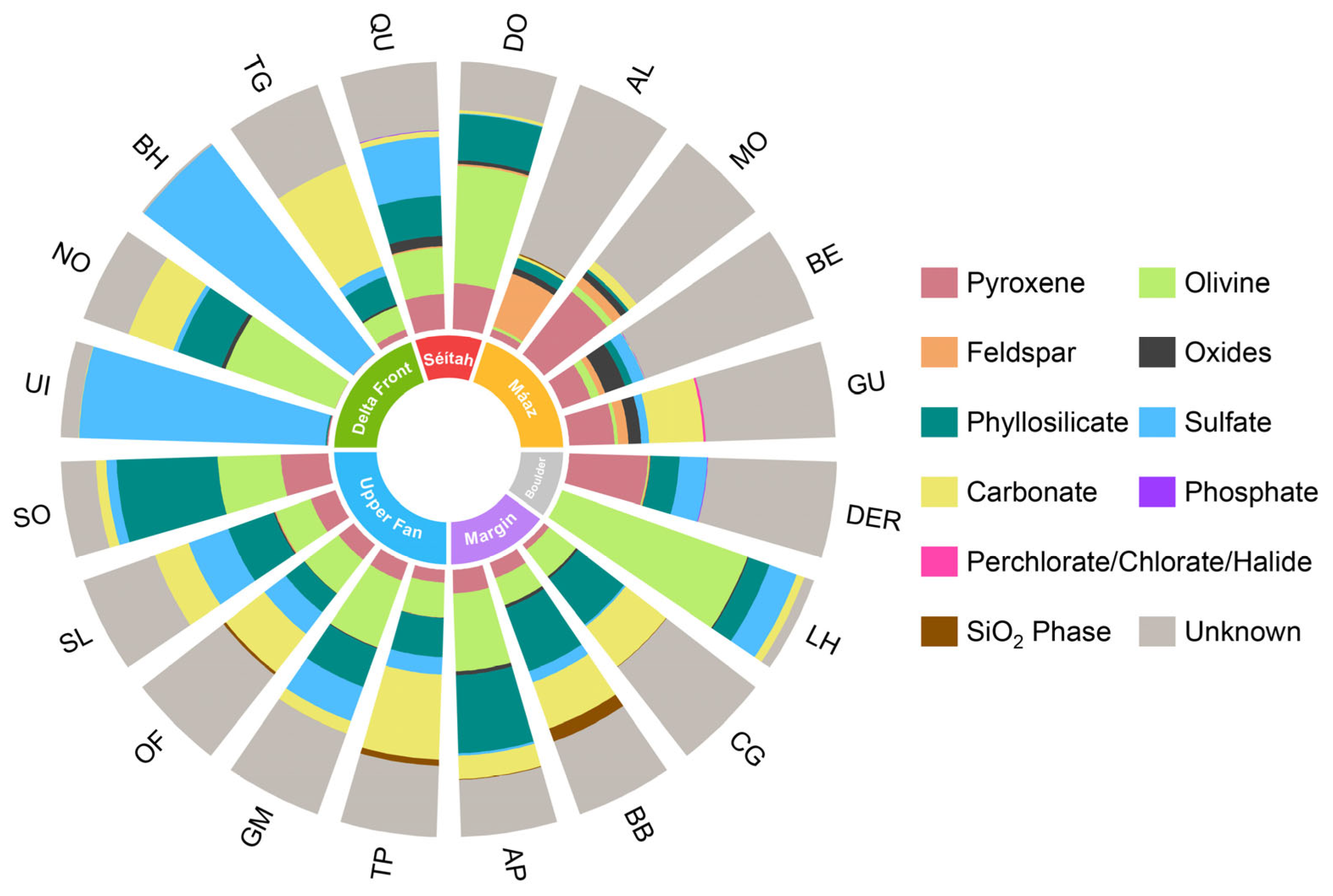
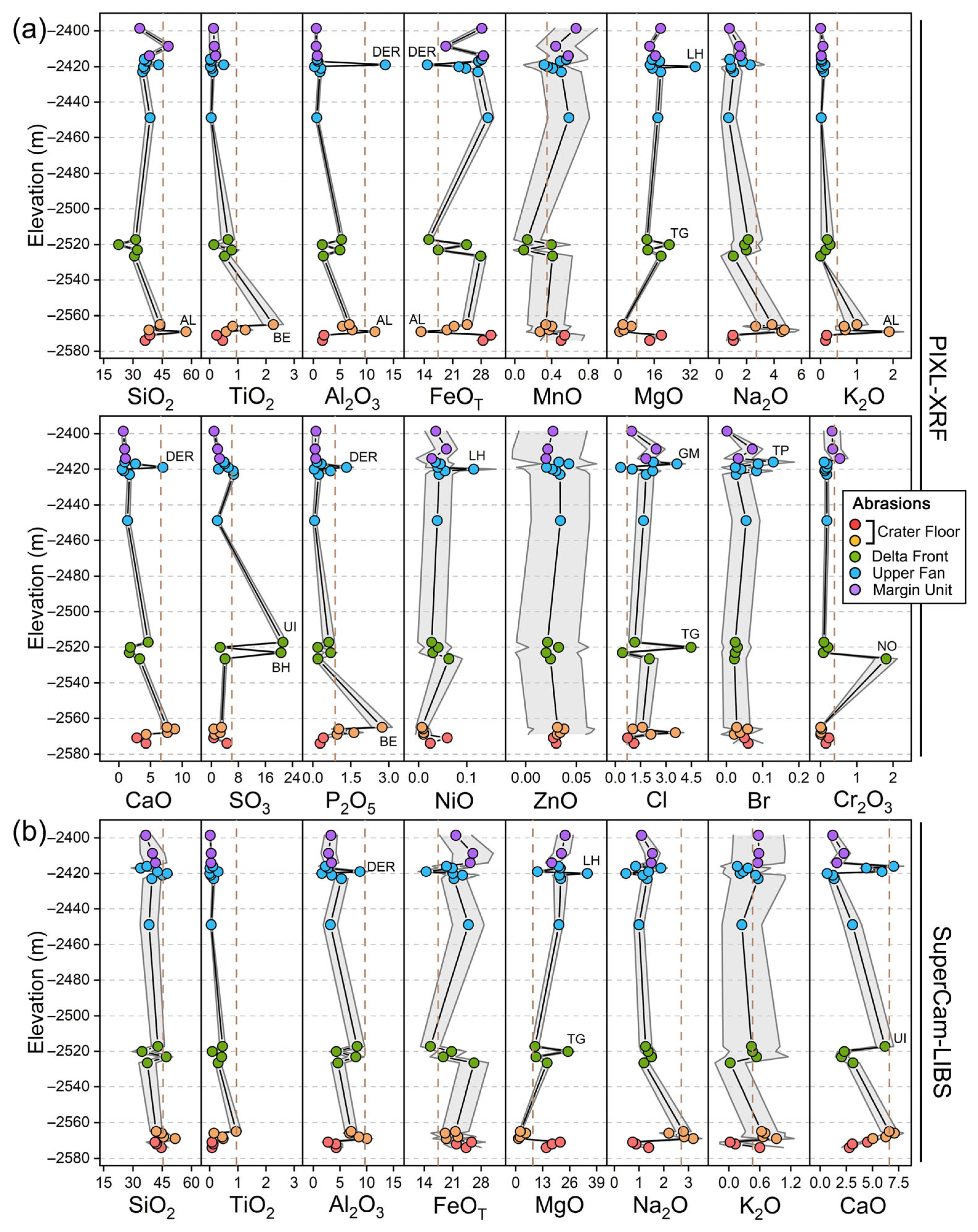
Geochemically, Séítah targets (GA, DO, and QU) exhibit lower concentrations of Ti, Al, Na, K, and Ca but elevated Fe and Mg levels compared to Máaz targets (GU, BE, and MO; Tables S2 and S3). In Figure 4, DO and QU are composed predominantly of olivine, along with interstitial pyroxene and minor feldspar crystals, which are indicative of an ultramafic composition. Olivine typically occurs as 2–3 mm grains (Fo~42–57). By contrast, Máaz targets (GU, BE, MO) show interlocking textures of pyroxene and feldspar and contain only minor, compositionally depleted olivine (Fo<40). The pyroxene assemblages define a trend from Fe-rich augite to pigeonite, and possibly to ferrosilite, while feldspars are sodic in composition (~Ab66An28Or6) [38]. These rocks are characterized by lower FeO content (20–25 wt.%) and more evolved compositions than their Séítah counterparts. Among the Máaz targets, AL is compositionally distinct. It contains elevated SiO2 (~57 wt.%), Al2O3 (~12 wt.%), and K2O (~2 wt.%) concentrations, coupled with reduced FeO (~13 wt.%) and MgO (~1 wt.%) levels (Figure 5). This target is dominated by feldspar, likely plagioclase, which exhibits reverse zoning and is hosted within a K-rich groundmass [37]. The observed disequilibrium textures are consistent with crystallization in a crustal magma staging reservoir [37]. Additionally, AL contains minor high-silica phases (SiO2 > 70 wt.%) that are not previously reported in crater floor rocks [37].
In addition to primary igneous mineralogy, all crater floor targets exhibit evidence of secondary alteration. Carbonates, interpreted as (Fe,Mg)-carbonates, are identified in QU, DO, and MO [14,32]. Sulfate phases, likely variably hydrated Mg[SO4nH2O (2 < n ≤ 5 and n ≤ 1), are present in QU, GU, and BE [17,39]. Cl-bearing phases associated with Na are observed in QU and GU, and are interpreted as Na-perchlorate [40,41]. In BE, trace quantities of phosphate, likely Ca-phosphate, have also been detected [37]. Widespread occurrences of phyllosilicates further support post-depositional aqueous activity (Figure 3). Collectively, the spatial and compositional diversity of these secondary minerals indicates that the crater floor experienced multiple episodes of limited aqueous alteration under distinct geochemical regimes.

3.2. Delta Front

The Perseverance investigated the Shenandoah region, which consists predominantly of sandstone deposits up to ~25 m thick and forms part of the present-day delta front [20,42]. Within this deltaic sequence, the rover abraded four targets, each exhibiting finer grain sizes than those observed in the underlying crater floor unit (Figure 3). Among these, target TG is composed of medium- to coarse-grained sandstones (0.0625–2 mm), while targets NO, BH, and UI consist of finer grains, including silt, fine sand, and very fine sand (<0.0625 mm).
Figure 5. Changes in elemental and oxide concentrations (wt.%) obtained from (a) PIXL XRF and (b) SuperCam LIBS with elevation (m) for Jezero western delta, including Séítah, Máaz, Shenandoah, Tenby, Otis Peak, and Margin Unit formation. Diagenetic/alteration features and/or vein-induced deviations have not been eliminated. Symbols are colored to correspond with their respective geological unit in the stratigraphic column (See Figure 1). Grey areas represent the error and dashed brown vertical lines represent the average composition of Martian igneous soil [43].
Remotesensing 18 00140 g005
Compared to crater floor samples (Tables S2 and S3), the delta front targets are depleted in Si, Ti, Al, Na, and K, but higher Mg. TG and NO exhibit broadly similar mineralogical assemblages (Figure 4), dominated by olivine, phyllosilicates, and carbonates. However, TG also contains distinctive olivine phenocrysts and minor pyroxene (Figure 3 and Figure 4), absent from NO. In contrast, targets BH and UI exhibit markedly different mineralogies, dominated by sulfates, although these values are likely overestimated due to spectral mixing and phase identification limitations. The high MgO (9–13 wt.%) and CaO (2–7 wt.%) contents support the presence of Mg/Ca-bearing sulfates, which commonly form under conditions of sustained aqueous alteration, including surface runoff or subsurface fluid interactions within deltaic environments [16]. Residual SiO2 in these targets is primarily sequestered in phyllosilicate phases. These mineralogical interpretations are corroborated by Raman, VISIR, and morphological observations acquired by SHERLOC and SuperCam [16,17]. Notably, target NO is characterized by elevated FeO (~27 wt.%) with localized Fe/Si molar ratios > 5, consistent with the presence of Fe-oxides such as hematite. This mineralogical distinction further differentiates NO from the other delta front targets (Figure 4). The widespread distribution of alteration products across these outcrops highlights the pivotal role of diagenetic and surface alteration in shaping delta front mineralogy. Coupled with their fine-grained textures, these deposits likely represent physically reworked sedimentary clasts derived from the erosion and transport of pre-existing lithologies.

3.3. Upper Fan

The upper fan region includes the Tenby (formerly D-tcl) and Otis Peak (formerly D-bl) formations, which overlie the Shenandoah unit (Figure 1). These stratigraphic units exhibit a systematic upward coarsening in grain size, transitioning from sandstones to conglomerates as the depositional environment shifts from the delta front to the fan top [20].
Perseverance abraded seven patches across the upper fan, five of which, SO, SL, OF, GM, and TP, were sampled from layered outcrops. These targets are generally depleted in Si, Ti, Al, Na, K, and Ca, and enriched in Fe and Mg compared to lower stratigraphic units (Tables S3 and S4). Despite compositional variability, they exhibit a broadly consistent mineralogical assemblage (Figure 4), dominated by detrital grains including pyroxene and weathered olivine (Figure 4). Secondary minerals are abundant, with phyllosilicates and cement phases such as Fe/Mg-carbonates and Ca-sulfates commonly observed (Figure 4), in agreement with spectral interpretations from Raman and VISIR datasets [17,44,45]. Notably, silica phases are present in OF and TP, typically occurring as cementing agents in association with alteration phases. These SiO2 phases differ from those found in crater floor target AL, where silica co-occurs with primary igneous minerals, suggesting a distinct diagenetic origin. This alteration assemblage is consistently expressed across both Tenby (SO, SL) and Otis Peak (OF, GM, TP) targets, all of which display ultramafic affinities. Although the five-layered targets exhibit broadly similar bulk compositions (Figure 5 and Tables S3 and S4), they differ markedly from LH and DER, which were abraded from more massive, blocky rock and suggest spatial and/or temporal heterogeneity in aqueous alteration processes.
Targets LH and DER were sampled from meter-scale boulders (Figure 2) interpreted as being of igneous origin [46]. Target LH is characterized by elevated FeO (~22 wt.%) and MgO (~34 wt.%), low SiO2 (~41 wt.%), and an Mg-rich olivine composition (Fo~74; ~74% modal abundance), indicative of crystallization from a relatively primitive magma (Figure 4). It also hosts secondary phases including layered phyllosilicates, tentatively identified as serpentine [47], with minor Mg/Fe-carbonates and Mg-sulfates. In contrast, DER is enriched in Al, Ca, and P but relatively depleted in Fe. Its mineralogy is dominated by pyroxene, phyllosilicates, Ca-sulfates, and Ca/Fe-phosphates (Figure 4). The high Al2O3 content (~8–14 wt.%; Figure 6) is attributed to pyroxene rather than feldspar, consistent with an interpretation of DER as an impact melt rock derived from an aqueously altered (leached) basaltic protolith [48]. The host lithologies of both LH and DER are likely sourced from Nili Planum and transported into the fan system by high-energy floods or multiple episodes of fluvial activity [46,47,48].

3.4. Margin Unit

The margin unit, as defined by orbital and in situ observations, forms part of the transitional zone at the edge of Jezero fan. Remote sensing observations reveal strong carbonate signatures, which have been interpreted as evidence for lacustrine shoreline deposits [10]. As of sol 1089, three abrasions (AP, BB, and CG) have been analyzed within this unit.
Elemental differences among the margin unit targets show minimal variability (Figure 5; Tables S3 and S4), and their bulk chemistry closely resembles that of the upper fan targets. Relative to crater floor samples, these targets exhibit lower abundances of Si, Ti, Al, Na, K, and Ca, but are enriched in Mg. Their mineral assemblages include detrital and alteration products such as pyroxene, olivine, phyllosilicates, Fe/Mg-carbonates, minor Mg/Ca-sulfates, and Cr/Ti-bearing phases (Figure 4). Notably, AP and BB contain either large carbonate clasts or are cemented by silica phases (Figure 4), similar to the silica-cemented targets OF and TP in the upper fan. Silica cement has been proposed as a favorable medium for biosignature preservation [49], highlighting the margin unit as a promising setting for the retention of paleoenvironmental and potential paleobiological information.

3.5. Summary

In contrast to the deltaic units, abraded crater floor targets are of distinct igneous origin, likely representing products of partial melting of the mantle or crust, followed by magma differentiation, emplacement, and subsequent impact processing [15,27], with only limited post-formational aqueous alteration. Conversely, targets from the delta front, upper fan, and margin units are dominantly characterized by secondary minerals indicative of extensive aqueous processes and chemical weathering. The spatial and stratigraphic variability in geochemical and mineralogical signatures across these units reflects evolving paleoenvironmental conditions during delta construction and diagenesis and highlights multiple aqueous episodes that shaped the habitability potential of ancient Jezero crater.

4. Discussion

4.1. Chemical Alteration

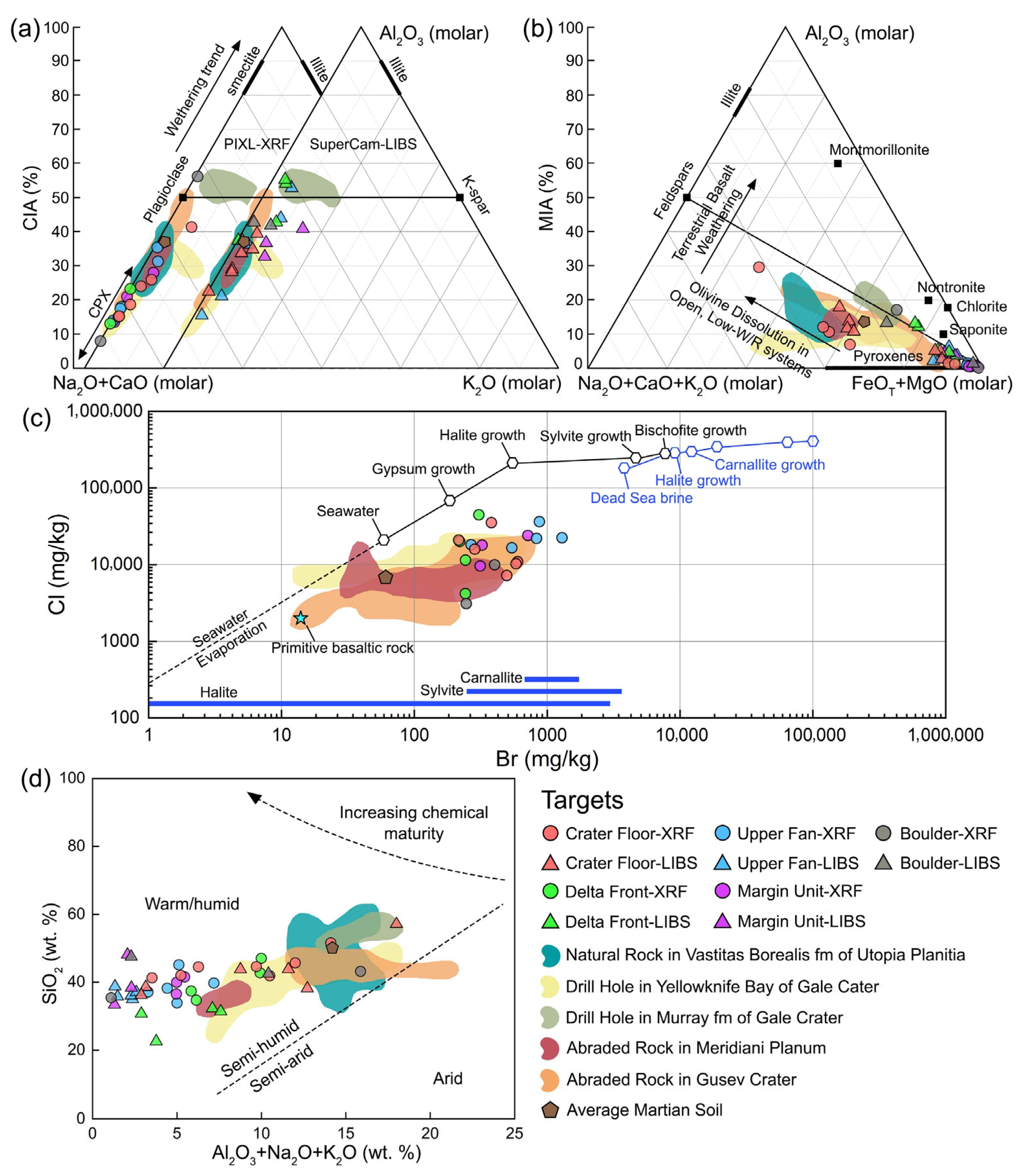
The extent of chemical alteration in both igneous and sedimentary targets was evaluated using the chemical index of alteration (CIA) and the modified index of alteration (MIA). The CIA quantifies the relative depletion of mobile cations (Na, Ca, and K) with respect to immobile Al and is commonly visualized in Al2O3-(CaO + Na2O)-K2O ternary space (Figure 7a) [50]. The MIA, by contrast, accounts for the loss of Fe and Mg from mafic phases under oxidizing conditions, and is represented in Al2O3-(CaO + Na2O + K2O)-(FeOT + MgO) space (Figure 7b) [51].
Across all abraded targets in the crater floor, delta front, upper fan, and margin unit, CIA values are generally low (<50), indicating limited chemical weathering. The crater floor exhibits the lowest average CIA (~27), while the delta front (~23), margin unit (~24), and upper fan (~37) show similarly low to medium values, albeit with slight differences among them. These values are broadly consistent with limited pre-depositional chemical alteration. However, low CIA values can also result from mineralogical biases (e.g., low abundances of Al-bearing phases or enrichment in alkaline components) rather than reflecting true weathering intensity. Notably, targets AL and DER, which contain feldspar and Al-rich pyroxenes, respectively, exhibit relatively higher CIA values (~42 and ~56). Although the average CIA for delta front targets appears elevated, this may reflect the presence of fine-grained phyllosilicates rather than enhanced weathering. Overall, the CIA values across geologic units in Jezero crater span a wide range (10–56), comparable to those measured in Gusev crater and the Yellowknife Bay drill cores in Gale crater (Figure 7) [55,58]. The crater floor targets, excluding AL, show the narrowest CIA range (20–40), suggesting more uniform alteration processes, despite possible differences in provenance and emplacement between the Séítah and Máaz formations [13,14,38]. In open-system weathering environments, sediments typically exhibit elevated CIA values relative to their source rocks. For example, the Murray formation in Gale crater shows average CIA values of ~53 [56]. Even more extreme examples include light-toned, Al-rich float rocks scattered across Jezero western fan, which display CIA values > 88, potentially indicating extensive weathering before their transport into the crater from ultramafic sources [59].
The MIA values for Jezero rocks are uniformly low across all units, suggesting limited oxidative leaching of Fe and Mg (Figure 7b). However, targets from the crater floor generally exhibit slightly higher MIA values than those from the delta front, upper fan, or margin unit, consistent with a relatively greater degree of chemical weathering. Taken together, these data indicate that the abraded rocks analyzed thus far record relatively limited chemical weathering, which are regardless of their depositional setting. This suggests that the host lithologies sampled at the surface may post-date the peak of lacustrine activity and are not representative of the earliest or most heavily weathered materials in Jezero western fan.

4.2. Halogen Analysis

Cl and Br may be volatile elements that likely share a common origin in volcanic outgassing and are intimately related to fluid-mediated alteration processes and secondary mineral formation [60]. On Mars, the geochemical cycling of Cl and Br is primarily controlled by atmospheric deposition and aqueous activity. While variations in Cl and Br concentrations within soils are largely attributed to atmospheric inputs [52,61], their abundances in rock interiors are generally considered to reflect water-rock interactions, including evaporative concentration, hydrothermal alteration, and post-depositional fluid migration. Analyses of abrasions, which reduce the influence of surficial dust coatings, often reveal the intrinsic halogen content of Martian rocks, thereby providing a more accurate record of primary geochemical processes.
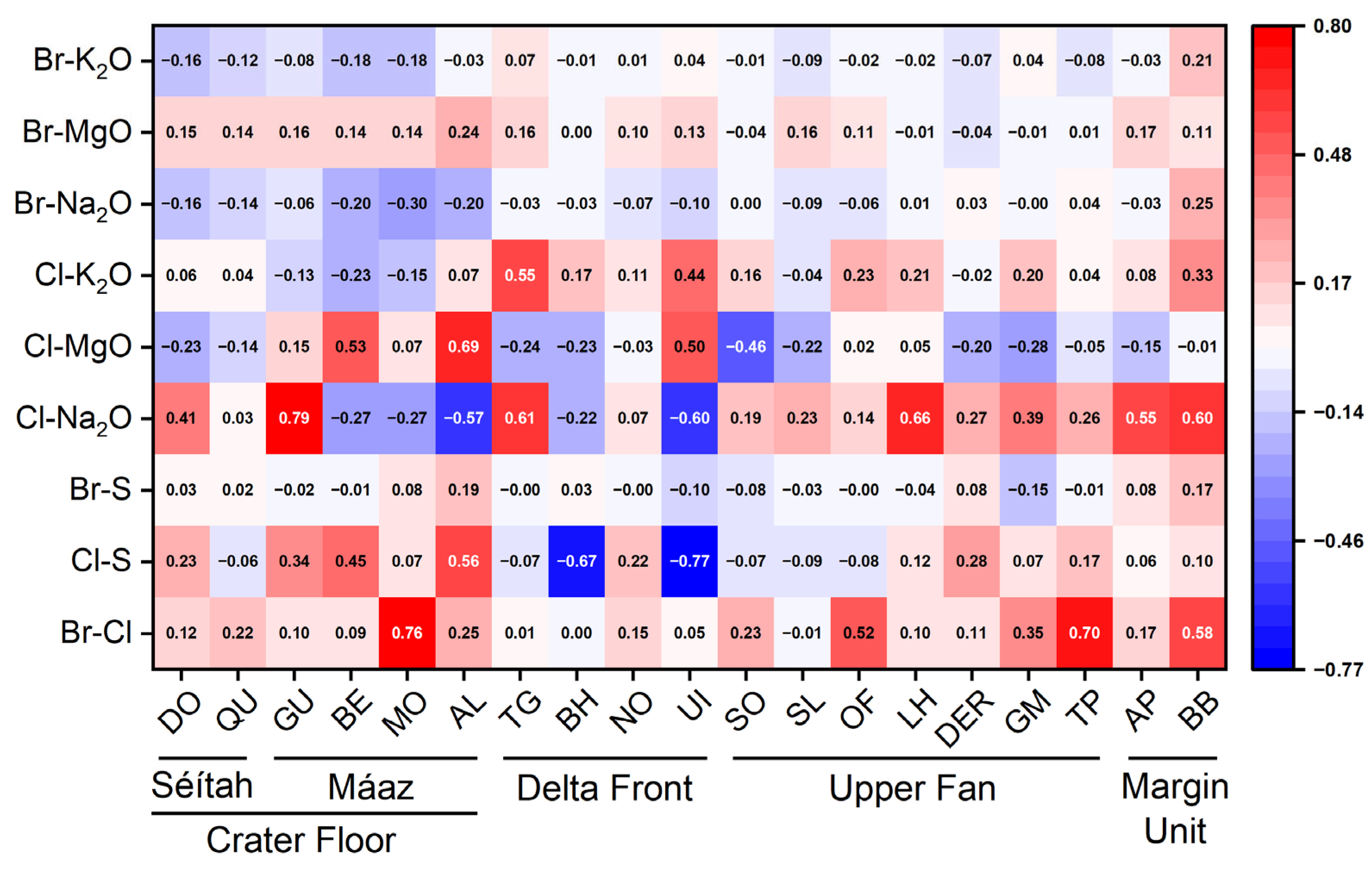
Halogen concentrations in rocks from Jezero western delta are elevated by 1–2 orders of magnitude relative to typical unaltered igneous compositions [52], strongly suggesting a non-igneous origin and implicating fluid-driven processes in their enrichment (Figure 7c). Most targets fall well outside the terrestrial seawater evaporation trend, exhibiting relative Br enrichment over Cl, particularly in the upper fan and margin unit, where Br concentrations show the greatest variability. In contrast, the delta front exhibits the lowest Br abundances, potentially reflecting reduced aqueous alteration or lower degrees of halogen retention. Compared to other Martian sites, Cl and Br concentrations in Jezero western delta are both higher and more homogeneous, consistent with pervasive, possibly prolonged brine activity across the region. This homogeneity may have facilitated extensive halogen mobilization and redistribution, leading to relatively homogeneous enrichment across multiple depositional units. However, the generally low abundances of Cl, Br, and S in the rock interiors challenge definitive interpretations of the halogen cycle. Correlative trends among individual targets vary across stratigraphic units. Moderate to strong Br-Cl correlations (R2 = 0.5–0.7 and >0.7) are observed in the margin unit, upper fan, and crater floor, whereas no significant correlation exists within the delta front (R2 < 0.2; Figure 8), suggesting that halogen enrichment occurred in distinct aqueous environments across the region. A lack of correlation between Br and S (R2 < 0.2) further supports the decoupling of these two volatiles. In contrast, Cl and S exhibit stronger associations, implying that some Cl may have been co-transported or co-precipitated with sulfur species. Additionally, Cl shows correlations with Na2O, MgO, and K2O, whereas Br does not, pointing to a divergence in cation affinity and retention (Figure 8). The differential behavior of Br and Cl likely reflects their distinct redox chemistries and volatilities. Br, which exhibits faster redox cycling and weaker binding to cations, is more prone to volatilization [62], consistent with the observation that Cl concentrations generally exceed Br in the analyzed patches (Figure 7c and Figure 8).
Considered collectively, these observations indicate that halogens in Jezero western fan underwent mobilization through brine-mediated processes, followed by variable preservation, degradation, or volatilization. As the Martian climate evolved from more humid to semi-arid conditions, prolonged halogen cycling (potentially aided by oxidants) and/or local environmental heterogeneity may have contributed to the formation of a chemically reactive surface layer that persisted into later stages of geological history in Jezero crater.

4.3. Implications from Silica Phases

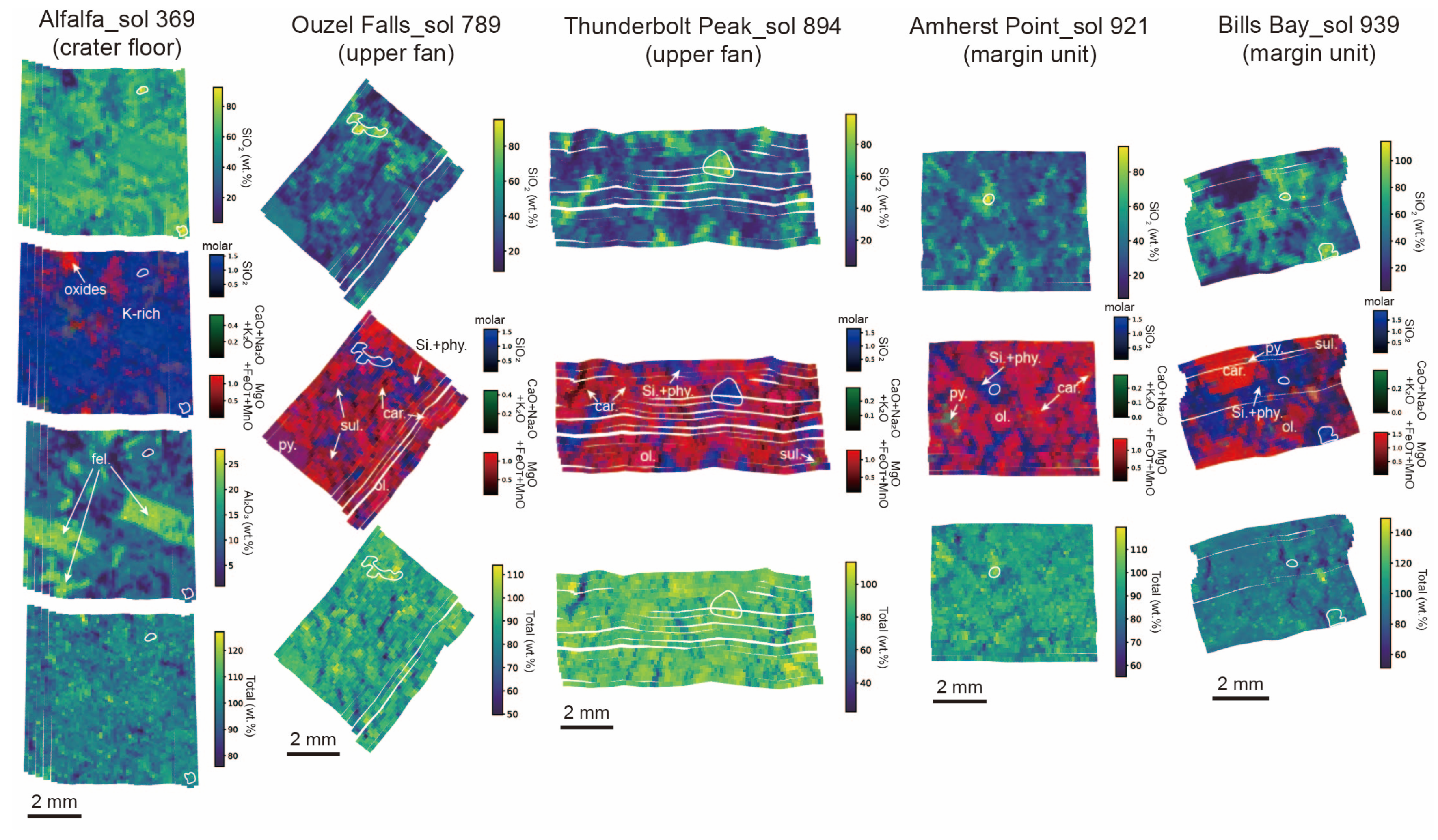
Silica-rich phases, including both hydrated varieties (e.g., opal) and silica cement, are key indicators of geological processes and play a critical role in preserving taphonomic biosignatures. Their occurrence can also record the thermal and chemical histories of magmatic and hydrothermal systems. Recent SuperCam Raman and VISIR observations reveal the presence of hydrated silica-rich cobbles and float rocks within the margin unit, including chert-like lithologies [34]. However, due to the relatively low abundance compared to other mineral phases, silica signatures were not detected by Raman and VISIR in the abrasions (AL, OF, TP, AP, and BB). Instead, the hydration state of silica phases was inferred from their total modeled mass fraction (Figure 9). The near-total mass contribution of SiO2 phases in these targets (~100 wt.%) suggests the presence of anhydrous forms, such as quartz.
In AL, silica coexists with primary igneous minerals such as feldspar, pyroxene, and K-rich groundmass, consistent with igneous crystallization processes. In contrast, silica in OF, TP, AP, and BB occurs alongside phyllosilicates, carbonates, and sulfates, suggesting formation through sedimentary processes, chemical weathering, or hydrothermal alteration. These phases are likely formed via the mobilization of silica by fluids or wind, followed by deposition, compaction, and diagenetic cementation in a sedimentary environment. The float cobbles and silica-rich rocks observed in the margin unit may represent surface hydrothermal deposits; however, their source may lie outside the margin unit itself [34]. Together, these observations support three possible modes of silica formation in Jezero crater: (1) primary magmatic crystallization, (2) low-temperature aqueous alteration and diagenetic cementation, and (3) hydrothermal deposition. The spatial distribution and diversity of silica-bearing rocks in the margin unit, which are more abundant than in other stratigraphic units, prompt further investigation into: Do these observations reflect localized silica-rich deposits within the margin unit? Could they indicate past hydrothermal activity at the crater rim? Or do they instead represent extensive fluid-mediated silica transport and deposition during the post-palaeolake epoch? These scenarios provide important constraints on past aqueous conditions and help refine our understanding of paleoenvironmental evolution in Jezero.
Figure 9. An RGB map of the abrasion targets containing silica phases (AL, OF, TP, AP, and BB), where the color channels represent the molar proximity to the poles of a ternary system: SiO2 (blue), CaO + Na2O + K2O (green), and MgO + FeOT + MnO (red). Total oxide mass and SiO2 concentrations are provided for all targets, with Al2O3 data shown for AL only. Representative mineral phases are labeled. Irregular white contours delineate areas interpreted to host potential silica phases (SiO2 > 70 wt.%).
Remotesensing 18 00140 g009

5. Conclusions

This work synthesizes elemental and mineralogical data to reconstruct the geological and climatic evolution of the Jezero western fan. Abraded surfaces from the delta front, upper fan, and margin units consistently exhibit high Mg and Fe concentrations and low abundances of Si, Al, Na, and Ca, which are characteristic of mafic to ultramafic source lithologies. These targets share a common mineralogical assemblage dominated by pyroxene, olivine, and phyllosilicates. Elevated levels of Cl and Br with anomalously high concentrations of S (e.g., UI and BH) suggest the presence of secondary phases such as sulfates. Additional enrichments in Fe-, Cr-, and Ti-rich oxides and occurrences of discrete SiO2 phases in the margin unit further point to diverse alteration pathways, particularly on the crater floor.
These observations imply that the Jezero crater floor and delta deposits reflect a complex interplay between primary igneous processes and secondary fluvial and/or hydrothermal alteration. Low to medium CIA and MIA values across the abraded targets suggest either limited subaerial weathering or sediment derivation from Al-depleted source rocks. The relatively high halogen (Cl and Br) abundances may reflect active brine mobilization and halogen cycling, while localized SiO2 enrichment in the margin unit is consistent with silica precipitation from hydrothermal or aqueous systems. Collectively, the geochemical and mineralogical data reflect a history shaped by magmatism, aqueous alteration, weathering, and fluid-mediated deposition. These findings provide new constraints on the paleoenvironmental evolution of Jezero crater.

Supplementary Materials

The following supporting information can be downloaded at https://www.mdpi.com/article/10.3390/rs18010140/s1, (Refs. [63,64,65,66,67,68,69] have been cited in the supplementary materials), Text S1: Mineral identification protocol for PIXL XRF; Text S2: Comparison of target compositions; Text S3: Data sources from other Mars mission; Text S4: Chemical Index of Alteration (CIA); Text S5: Modified Index of Alteration (MIA); Table S1: Information of the abrasions, including the types of host rock and locations, with PIXL XRF and SuperCam LIBS scan durations, types, and IDs; Table S2: PIXL XRF data averaged for each map scan (wt.%); Table S3: SuperCam LIBS data averaged for each scan (wt.%); Table S4: Model mineralogy (%) of the abrasions.

Author Contributions

Conceptualization, Y.X. and H.C.; methodology, W.H. and Y.X.; software, J.C. and W.H.; validation, Y.X., H.C. and Z.L.; formal analysis, W.H.; investigation, W.H., Y.X. and H.C.; data curation, Y.X. and J.C.; writing—original draft preparation, W.H.; writing—review and editing, W.H., Y.X., H.C., C.L., J.C., Y.Z., B.X. and Z.L.; visualization, W.H.; supervision, Y.X. and H.C.; project administration, Y.X. and H.C.; funding acquisition, Y.X., H.C., C.L. and Z.L. All authors have read and agreed to the published version of the manuscript.

Funding

This research was funded by the National Natural Science Foundation of China (42430204, 12303067), the National Key Research and Development Program of China (2024YFF0807700), and the Shandong Provincial Natural Science Foundation (ZR2023MD010, ZR2023QD157).

Data Availability Statement

The data used for the work are available at the NASA Planetary Data System GeoSciences Node (https://pds-geosciences.wustl.edu/missions/mars2020/) (accessed on 28 December 2025). PIXL data https://doi.org/10.17189/1522645, SuperCam data https://doi.org/10.17189/1522646, and SHERLOC data https://doi.org/10.17189/1522643.

Acknowledgments

We gratefully thank the Perseverance engineering team for enabling the collection of these exceptional scientific datasets and valuable suggestions from Sen Hu.

Conflicts of Interest

The authors declare no conflicts of interest.

References

  1. Scheller, E.L.; Ehlmann, B.L. Composition, stratigraphy, and geological history of the Noachian basement surrounding the Isidis impact basin. J. Geophys. Res. Planets 2020, 125, e2019JE006190. [Google Scholar] [CrossRef] [PubMed]
  2. Fassett, C.I.; Head, J.W. Sequence and timing of conditions on early Mars. Icarus 2011, 211, 1204–1214. [Google Scholar] [CrossRef]
  3. Mandon, L.; Quantin-Nataf, C.; Thollot, P.; Mangold, N.; Lozac’h, L.; Dromart, G.; Beck, P.; Dehouck, E.; Breton, S.; Millot, C.; et al. Refining the age, emplacement and alteration scenarios of the olivine-rich unit in the Nili Fossae region, Mars. Icarus 2020, 336, 113436. [Google Scholar] [CrossRef]
  4. Goudge, T.A.; Mohrig, D.; Cardenas, B.T.; Hughes, C.M.; Fassett, C.I. Stratigraphy and paleohydrology of delta channel deposits, Jezero crater, Mars. Icarus 2018, 301, 58–75. [Google Scholar] [CrossRef]
  5. Mangold, N.; Dromart, G.; Ansan, V.; Salese, F.; Kleinhans, M.G.; Masse, M.; Quantin-Nataf, C.; Stack, K.M. Fluvial regimes, morphometry, and age of Jezero crater paleolake inlet valleys and their exobiological significance for the 2020 rover mission landing site. Astrobiology 2020, 20, 994–1013. [Google Scholar] [CrossRef]
  6. Schon, S.C.; Head, J.W.; Fassett, C.I. An overfilled lacustrine system and progradational delta in Jezero crater, Mars: Implications for Noachian climate. Planet. Space Sci. 2012, 67, 28–45. [Google Scholar] [CrossRef]
  7. Stack, K.M.; Williams, N.R.; Calef, F., III; Sun, V.Z.; Williford, K.H.; Farley, K.A.; Eide, S.; Flannery, D.; Hughes, C.; Jacob, S.R.; et al. Photogeologic map of the Perseverance rover field site in Jezero crater constructed by the Mars 2020 science team. Space Sci. Rev. 2020, 216, 127. [Google Scholar] [CrossRef]
  8. Mangold, N.; Gupta, S.; Gasnault, O.; Dromart, G.; Tarnas, J.D.; Sholes, S.F.; Horgan, B.; Quantin-Nataf, C.; Brown, A.J.; Le Mouelic, S.; et al. Perseverance rover reveals an ancient delta-lake system and flood deposits at Jezero crater, Mars. Science 2021, 374, 711–717. [Google Scholar] [CrossRef]
  9. Farley, K.A.; Williford, K.H.; Stack, K.M.; Bhartia, R.; Chen, A.; de la Torre, M.; Hand, K.; Goreva, Y.; Herd, C.D.K.; Hueso, R.; et al. Mars 2020 Mission overview. Space Sci. Rev. 2020, 216, 142. [Google Scholar] [CrossRef]
  10. Horgan, B.H.N.; Anderson, R.B.; Dromart, G.; Amador, E.S.; Rice, M.S. The mineral diversity of Jezero crater: Evidence for possible lacustrine carbonates on Mars. Icarus 2020, 339, 113526. [Google Scholar] [CrossRef]
  11. Ehlmann, B.L.; Edwards, C.S. Mineralogy of the Martian surface. Annu. Rev. Earth Planet. Sci. 2014, 42, 291–315. [Google Scholar] [CrossRef]
  12. Goudge, T.A.; Milliken, R.E.; Head, J.W.; Mustard, J.F.; Fassett, C.I. Sedimentological evidence for a deltaic origin of the western fan deposit in Jezero crater, Mars and implications for future exploration. Earth Planet. Sci. Lett. 2017, 458, 357–365. [Google Scholar] [CrossRef]
  13. Farley, K.A.; Stack, K.M.; Shuster, D.L.; Horgan, B.H.N.; Hurowitz, J.A.; Tarnas, J.D.; Simon, J.I.; Sun, V.Z.; Scheller, E.L.; Moore, K.R.; et al. Aqueously altered igneous rocks sampled on the floor of Jezero crater, Mars. Science 2022, 377, eabo2196. [Google Scholar] [CrossRef] [PubMed]
  14. Tice, M.M.; Hurowitz, J.A.; Allwood, A.C.; Jones, M.W.M.; Orenstein, B.J.; Davidoff, S.; Wright, A.P.; Pedersen, D.A.K.; Henneke, J.; Tosca, N.J.; et al. Alteration history of Séítah formation rocks inferred by PIXL X-ray fluorescence, X-ray diffraction, and multispectral imaging on Mars. Sci. Adv. 2022, 8, eabp9084. [Google Scholar] [CrossRef] [PubMed]
  15. Wiens, R.C.; Udry, A.; Beyssac, O.; Quantin-Nataf, C.; Mangold, N.; Cousin, A.; Mandon, L.; Bosak, T.; Forni, O.; McLennan, S.M.; et al. Compositionally and density stratified igneous terrain in Jezero crater, Mars. Sci. Adv. 2022, 8, eabo3399. [Google Scholar] [CrossRef]
  16. Benison, K.C.; Gill, K.K.; Sharma, S.; Siljeström, S.; Zawaski, M.; Bosak, T.; Broz, A.; Clark, B.C.; Cloutis, E.; Czaja, A.D.; et al. Depositional and diagenetic sulfates of Hogwallow Flats and Yori Pass, Jezero crater: Evaluating preservation potential of environmental indicators and possible biosignatures from past Martian surface waters and groundwaters. J. Geophys. Res. Planets 2024, 129, e2023JE008155. [Google Scholar] [CrossRef]
  17. Phua, Y.Y.; Ehlmann, B.L.; Siljeström, S.; Czaja, A.D.; Beck, P.; Connell, S.; Wiens, R.C.; Jakubek, R.S.; Williams, R.M.E.; Zorzano, M.P.; et al. Characterizing hydrated sulfates and altered phases in Jezero crater fan and floor geologic units with SHERLOC on Mars 2020. J. Geophys. Res. Planets 2024, 129, e2023JE008251. [Google Scholar] [CrossRef]
  18. Hurowitz, J.A.; Flannery, D.T.; Allwood, A.C.; Cable, M.L.; Tice, M.M.; Clark, B.C.; Horgan, B.H.; Klevang, D.A.; Schmidt, M.E.; Siebach, K.L.; et al. PIXL results from Jezero crater’s margin unit. In Proceedings of the 55th Lunar and Planetary Science Conference, Woodlands, TX, USA, 11–15 March 2024; p. 2541. [Google Scholar]
  19. Randazzo, N.; Herd, C.D.K.; Barnes, R.; Benison, K.; Brown, A.J.; Bosak, T.; Caravaca, G.; Gomez, F.; Gupta, S.; Horgan, B.H.N.; et al. Depositional hypotheses for the emplacement of the margin unit, Jezero crater, Mars, and the implications for habitability and organic preservation. In Proceedings of the Tenth International Conference on Mars 2024, Pasadena, CA, USA, 22–25 July 2024; p. 3485. [Google Scholar]
  20. Stack, K.M.; Ives, L.R.W.; Gupta, S.; Lamb, M.P.; Tebolt, M.; Caravaca, G.; Grotzinger, J.P.; Russell, P.; Shuster, D.L.; Williams, A.J.; et al. Sedimentology and stratigraphy of the Shenandoah formation, western fan, Jezero crater, Mars. J. Geophys. Res. Planets 2024, 129, e2023JE008187. [Google Scholar] [CrossRef]
  21. Allwood, A.C.; Wade, L.A.; Foote, M.C.; Elam, W.T.; Hurowitz, J.A.; Battel, S.; Dawson, D.E.; Denise, R.W.; Ek, E.M.; Gilbert, M.S.; et al. PIXL: Planetary Instrument for X-ray Lithochemistry. Space Sci. Rev. 2020, 216, 134. [Google Scholar] [CrossRef]
  22. Maurice, S.; Wiens, R.C.; Bernardi, P.; Caïs, P.; Robinson, S.; Nelson, T.; Gasnault, O.; Reess, J.M.; Deleuze, M.; Rull, F.; et al. The SuperCam instrument suite on the Mars 2020 rover: Science objectives and mast-unit description. Space Sci. Rev. 2021, 217, 47. [Google Scholar] [CrossRef]
  23. Wiens, R.C.; Maurice, S.; Robinson, S.H.; Nelson, A.E.; Cais, P.; Bernardi, P.; Newell, R.T.; Clegg, S.; Sharma, S.K.; Storms, S.; et al. The SuperCam instrument suite on the NASA Mars 2020 rover: Body unit and combined system tests. Space Sci. Rev. 2021, 217, 4. [Google Scholar] [CrossRef] [PubMed]
  24. Moeller, R.C.; Jandura, L.; Rosette, K.; Robinson, M.; Samuels, J.; Silverman, M.; Brown, K.; Duffy, E.; Yazzie, A.; Jens, E.; et al. The Sampling and Caching Subsystem (SCS) for the scientific exploration of Jezero crater by the Mars 2020 Perseverance rover. Space Sci. Rev. 2021, 217, 5. [Google Scholar] [CrossRef]
  25. Taylor, S.R.; McLennan, S. Planetary Crusts: Their Composition, Origin and Evolution; Cambridge University Press: Cambridge, UK, 2009; Volume 10. [Google Scholar]
  26. Wogsland, B.V.; Minitti, M.E.; Kah, L.C.; Yingst, R.A.; Abbey, W.; Bhartia, R.; Beegle, L.; Bleefeld, B.L.; Cardarelli, E.L.; Conrad, P.G.; et al. Science and science-enabling activities of the SHERLOC and WATSON imaging systems in Jezero crater, Mars. Earth Space Sci. 2023, 10, e2022EA002544. [Google Scholar] [CrossRef]
  27. Liu, Y.; Tice, M.M.; Schmidt, M.E.; Treiman, A.H.; Kizovski, T.V.; Hurowitz, J.A.; Allwood, A.C.; Henneke, J.; Pedersen, D.A.K.; VanBommel, S.J.; et al. An olivine cumulate outcrop on the floor of Jezero crater, Mars. Science 2022, 377, 1513–1519. [Google Scholar] [CrossRef]
  28. Heirwegh, C.M.; Elam, W.T.; O’Neil, L.P.; Sinclair, K.P.; Das, A. The focused beam X-ray fluorescence elemental quantification software package PIQUANT. Spectrochim. Acta Part A 2022, 196, 106520. [Google Scholar] [CrossRef]
  29. Heirwegh, C.M.; Elam, W.T.; Liu, Y.; Das, A.; Hummel, C.; Naylor, B.; Wade, L.A.; Allwood, A.C.; Hurowitz, J.A.; Armstrong, L.G. Pre-flight calibration of PIXL for X-ray fluorescence elemental quantification. arXiv 2024, arXiv:2402.01544. [Google Scholar] [CrossRef]
  30. Heirwegh, C.M.; Liu, Y.; Clark, B.C.; Elam, W.T.; O’Neil, L.P.; Sinclair, K.P.; Tice, M.; Hurowitz, J.A.; Allwood, A.C. Calibrating PIXL for elemental analysis on Mars. In Proceedings of the 52nd Lunar and Planetary Science Conference, Woodlands, TX, USA, 15–19 March 2021; p. 1260. [Google Scholar]
  31. Anderson, R.B.; Forni, O.; Cousin, A.; Wiens, R.C.; Clegg, S.M.; Frydenvang, J.; Gabriel, T.S.J.; Ollila, A.; Schröder, S.; Beyssac, O.; et al. Post-landing major element quantification using SuperCam laser induced breakdown spectroscopy. Spectrochim. Acta Part B 2022, 188, 106347. [Google Scholar] [CrossRef]
  32. Clavé, E.; Benzerara, K.; Meslin, P.Y.; Forni, O.; Royer, C.; Mandon, L.; Beck, P.; Quantin-Nataf, C.; Beyssac, O.; Cousin, A.; et al. Carbonate detection with SuperCam in igneous rocks on the floor of Jezero crater, Mars. J. Geophys. Res. Planets 2023, 128, e2022JE007463. [Google Scholar] [CrossRef]
  33. Anderson, R.B.; Gabriel, T.S.; Forni, O.; Manrique, J.A.; Gasda, P.; Vogt, D.; Ollila, A.M. Trace and minor element quantification with SuperCam laser induced breakdown spectroscopy (LIBS). In Proceedings of the 54th Lunar and Planetary Science Conference, Woodlands, TX, USA, 13–17 March 2023; p. 2182. [Google Scholar]
  34. Beck, P.; Beyssac, O.; Dehouck, E.; Bernard, S.; Pineau, M.; Mandon, L.; Royer, C.; Clavé, E.; Schröder, S.; Forni, O. From hydrated silica to quartz: Potential hydrothermal precipitates found in Jezero crater, Mars. Earth Planet. Sci. Lett. 2025, 656, 119256. [Google Scholar] [CrossRef]
  35. Siebach, K.; Moreland, E.; Costin, G.; Jiang, Y. MIST: An online tool automating Mineral Identification by Stoichiometry in geochemical datasets. In Proceedings of the 54th Lunar and Planetary Science Conference, Woodlands, TX, USA, 13–17 March 2023; p. 2253. [Google Scholar]
  36. Moreland, E.L.; Siebach, K.L.; Costin, G.; Tice, M.M.; Hurowitz, J.A.; Treiman, A.H.; Simon, J.I.; Liu, Y.; Jiang, Y.; Udry, A.; et al. Multiple episodes of fluid alteration in Jezero crater indicated by MIST mineral identifications in PIXL XRF data from the first 1100 sols of the Mars 2020 mission. J. Geophys. Res. Planets 2025, 130, e2024JE008797. [Google Scholar] [CrossRef]
  37. Schmidt, M.E.; Kizovski, T.V.; Liu, Y.; Hernandez-Montenegro, J.D.; Tice, M.M.; Treiman, A.H.; Hurowitz, J.A.; Klevang, D.A.; Knight, A.L.; Labrie, J.; et al. Diverse and highly differentiated lava suite in Jezero crater, Mars: Constraints on intracrustal magmatism revealed by Mars 2020 PIXL. Sci. Adv. 2025, 11, eadr2613. [Google Scholar] [CrossRef] [PubMed]
  38. Udry, A.; Ostwald, A.; Sautter, V.; Cousin, A.; Beyssac, O.; Forni, O.; Dromart, G.; Benzerara, K.; Nachon, M.; Horgan, B.; et al. A Mars 2020 Perseverance SuperCam perspective on the igneous nature of the Máaz formation at Jezero crater and link with Séítah, Mars. J. Geophys. Res. Planets 2023, 128, e2022JE007440. [Google Scholar] [CrossRef]
  39. Siljeström, S.; Czaja, A.D.; Corpolongo, A.; Berger, E.L.; Li, A.Y.; Cardarelli, E.; Abbey, W.; Asher, S.A.; Beegle, L.W.; Benison, K.C.; et al. Evidence of sulfate-rich fluid alteration in Jezero crater floor, Mars. J. Geophys. Res. Planets 2024, 129, e2023JE007989. [Google Scholar] [CrossRef]
  40. Corpolongo, A.; Jakubek, R.S.; Burton, A.S.; Brown, A.J.; Yanchilina, A.; Czaja, A.D.; Steele, A.; Wogsland, B.V.; Lee, C.; Flannery, D.; et al. SHERLOC Raman mineral class detections of the Mars 2020 crater floor campaign. J. Geophys. Res. Planets 2023, 128, e2022JE007455. [Google Scholar] [CrossRef]
  41. Scheller, E.L.; Razzell Hollis, J.; Cardarelli, E.L.; Steele, A.; Beegle, L.W.; Bhartia, R.; Conrad, P.; Uckert, K.; Sharma, S.; Ehlmann, B.L.; et al. Aqueous alteration processes in Jezero crater, Mars-implications for organic geochemistry. Science 2022, 378, 1105–1110. [Google Scholar] [CrossRef]
  42. Broz, A.P.; Horgan, B.; Kalucha, H.; Johnson, J.R.; Royer, C.; Dehouck, E.; Mandon, L.; Cardarelli, E.L.; Garczynski, B.; Haber, J.H.; et al. Diagenetic history and biosignature preservation potential of fine-grained rocks at Hogwallow Flats, Jezero crater, Mars. J. Geophys. Res. Planets 2024, 129, e2024JE008520. [Google Scholar] [CrossRef]
  43. O’Connell-Cooper, C.D.; Spray, J.G.; Thompson, L.M.; Gellert, R.; Berger, J.A.; Boyd, N.I.; Desouza, E.D.; Perrett, G.M.; Schmidt, M.; VanBommel, S.J. APXS-derived chemistry of the Bagnold dune sands: Comparisons with Gale crater soils and the global Martian average. J. Geophys. Res. Planets 2017, 122, 2623–2643. [Google Scholar] [CrossRef]
  44. Huang, W.B.; Cao, H.J.; Xin, Y.Q.; Zeng, X.J.; Ling, Z.C.; Shi, E.B.; Liu, C.Q.; Su, M.Y. Mineralogical diversity in the Upper Fan Campaign at Jezero crater, Mars. J. Geophys. Res. Planets 2025, 130, e2024JE008750. [Google Scholar] [CrossRef]
  45. Royer, C.; Poulet, F.; Wiens, R.C.; Montmessin, F.; Beck, P.; Beyssac, O.; Clavé, É.; Dehouck, E.; Fouchet, T.; Johnson, J.R.; et al. The mineralogical composition of Jezero crater western fan: Multigaussian modeling of Perseverance/SuperCam near-infrared observations and overview of major units. Icarus 2025, 434, 116538. [Google Scholar] [CrossRef]
  46. Vaughan, A.F.; Rice, M.; Klidaras, A.; Johnson, J.R.; Gwizd, S.; Horgan, B.; Kah, L.C.; Cianciolo, O.; Paar, G.; Bell, J. The boulder-rich blocky unit of the western Jezero upper fan: Discriminating olivine and pyroxene compositions and constraining provenance. J. Geophys. Res. Planets 2025, 130, e2025JE009159. [Google Scholar] [CrossRef]
  47. Moreland, E.L.; Siebach, K.L.; Liu, Y.; Treiman, A.H.; Tice, M.M.; Hurowitz, J.A.; Gasada, P.J.; Kizovski, T.V.; Clark, B.C.; Costin, G. Falcon Lake: An olivine-rich boulder in Jezero crater, Mars. In Proceedings of the 55th Lunar and Planetary Science Conference, Woodlands, TX, USA, 11–15 March 2024; p. 2030. [Google Scholar]
  48. Treiman, A.H.; Hurowitz, J.A.; Clark, B.C.; Liu, Y.; Hernandez-Montenegro, J.D.; Tice, M.M.; Kizovski, T.; Moreland, E.L.; Siebach, K.L.; Jones, M.W.M. Mount Meeker: A boulder of aluminous melt rock in Jezero crater, Mars. In Proceedings of the 55th Lunar and Planetary Science Conference, Woodlands, TX, USA, 11–15 March 2024; p. 1283. [Google Scholar]
  49. Bosak, T.; Moore, K.R.; Gong, J.; Grotzinger, J.P. Searching for biosignatures in sedimentary rocks from early Earth and Mars. Nat. Rev. Earth Environ. 2021, 2, 490–506. [Google Scholar] [CrossRef]
  50. Nesbitt, H.W.; Young, G.M. Early Proterozoic climates and plate motions inferred from major element chemistry of lutites. Nature 1982, 299, 715–717. [Google Scholar] [CrossRef]
  51. Babechuk, M.G.; Widdowson, M.; Kamber, B.S. Quantifying chemical weathering intensity and trace element release from two contrasting basalt profiles, Deccan Traps, India. Chem. Geol. 2014, 363, 56–75. [Google Scholar] [CrossRef]
  52. Wang, X.; Zhao, Y.Y.S.; Hood, D.R.; Karunatillake, S.; Laczniak, D.; Schmidt, M.E.; Vithanage, M. Multiphase volatilization of halogens at the soil-atmosphere interface on Mars. J. Geophys. Res. Planets 2021, 126, e2021JE006929. [Google Scholar] [CrossRef]
  53. Suttner, L.J.; Dutta, P.K. Alluvial sandstone composition and paleoclimate; I, Framework mineralogy. J. Sediment. Res. 1986, 56, 329–345. [Google Scholar] [CrossRef]
  54. Liu, C.Q.; Ling, Z.C.; Wu, Z.C.; Zhang, J.; Chen, J.; Fu, X.H.; Qiao, L.; Liu, P.; Li, B.; Zhang, L.; et al. Aqueous alteration of the Vastitas Borealis Formation at the Tianwen-1 landing site. Commun. Earth Environ. 2022, 3, 280. [Google Scholar] [CrossRef]
  55. McLennan, S.M.; Anderson, R.B.; Bell, J.F.; Bridges, J.C.; Calef, F.; Campbell, J.L.; Clark, B.C.; Clegg, S.; Conrad, P.; Cousin, A.; et al. Elemental geochemistry of sedimentary rocks at Yellowknife Bay, Gale crater, Mars. Science 2014, 343, 1244734. [Google Scholar] [CrossRef]
  56. Mangold, N.; Dehouck, E.; Fedo, C.; Forni, O.; Achilles, C.; Bristow, T.; Downs, R.T.; Frydenvang, J.; Gasnault, O.; L’Haridon, J.; et al. Chemical alteration of fine-grained sedimentary rocks at Gale crater. Icarus 2019, 321, 619–631. [Google Scholar] [CrossRef]
  57. Knoll, A.H.; Jolliff, B.L.; Farrand, W.H.; Bell, J.F.; Clark, B.C.; Gellert, R.; Golombek, M.P.; Grotzinger, J.P.; Herkenhoff, K.E.; Johnson, J.R.; et al. Veneers, rinds, and fracture fills: Relatively late alteration of sedimentary rocks at Meridiani Planum, Mars. J. Geophys. Res. Planets 2008, 113, E06S16. [Google Scholar] [CrossRef]
  58. Gellert, R.; Rieder, R.; Brückner, J.; Clark, B.C.; Dreibus, G.; Klingelhöfer, G.; Lugmair, G.; Ming, D.W.; Wänke, H.; Yen, A.; et al. Alpha Particle X-Ray Spectrometer (APXS): Results from Gusev crater and calibration report. J. Geophys. Res. Planets 2006, 111, E02S05. [Google Scholar] [CrossRef]
  59. Royer, C.; Bedford, C.C.; Johnson, J.R.; Horgan, B.H.N.; Broz, A.; Forni, O.; Connell, S.; Wiens, R.C.; Mandon, L.; Kathir, B.S.; et al. Intense alteration on early Mars revealed by high-aluminum rocks at Jezero crater. Commun. Earth Environ. 2024, 5, 671. [Google Scholar] [CrossRef] [PubMed]
  60. Harlov, D.E.; Aranovich, L. The role of halogens in terrestrial and extraterrestrial geochemical processes: Surface, crust, and mantle. In The Role of Halogens in Terrestrial and Extraterrestrial Geochemical Processes: Surface, Crust, and Mantle; Harlov, D.E., Aranovich, L., Eds.; Springer International Publishing: Cham, Switzerland, 2018; pp. 21–121. [Google Scholar]
  61. Yen, A.S.; Gellert, R.; Schroder, C.; Morris, R.V.; Bell, J.F., 3rd; Knudson, A.T.; Clark, B.C.; Ming, D.W.; Crisp, J.A.; Arvidson, R.E.; et al. An integrated view of the chemistry and mineralogy of martian soils. Nature 2005, 436, 49–54. [Google Scholar] [CrossRef] [PubMed]
  62. Zhao, Y.-Y.S.; McLennan, S.M.; Jackson, W.A.; Karunatillake, S. Photochemical controls on chlorine and bromine geochemistry at the Martian surface. Earth Planet. Sci. Lett. 2018, 497, 102–112. [Google Scholar] [CrossRef]
  63. Berger, J.A.; Schmidt, M.E.; Gellert, R.; Campbell, J.L.; King, P.L.; Flemming, R.L.; Ming, D.W.; Clark, B.C.; Pradler, I.; VanBommel, S.J. A global Mars dust composition refined by the alpha-particle X-ray spectrometer in Gale crater. Geophys. Res. Lett. 2016, 43, 67–75. [Google Scholar] [CrossRef]
  64. Beyssac, O.; Forni, O.; Cousin, A.; Udry, A.; Kah, L.C.; Mandon, L.; Clavé, O.E.; Liu, Y.; Poulet, F.; Quantin Nataf, C.; et al. Petrological traverse of the olivine cumulate Séítah formation at Jezero crater, Mars: A perspective from SuperCam onboard Perseverance. J. Geophys. Res. Planets 2023, 128, e2022JE007638. [Google Scholar] [CrossRef]
  65. Gellert, R.; Arvidson, R.; Clark, B.; Mittlefehldt, D.; Morris, R.; Squyres, S.; VanBommel, S. Igneous and sedimentary compositions from four landing sites on Mars from the Alpha Particle X-ray Spectrometer (APXS). In Proceedings of the 79th Annual Meeting of the Meteoritical Society, Berlin, Germany, 7–12 August 2016; p. 6114. [Google Scholar]
  66. Goudge, T.A.; Mustard, J.F.; Head, J.W.; Fassett, C.I.; Wiseman, S.M. Assessing the mineralogy of the watershed and fan deposits of the Jezero crater paleolake system, Mars. J. Geophys. Res. Planets 2015, 120, 775–808. [Google Scholar] [CrossRef]
  67. Lopez-Reyes, G.; Manrique, J.A.; Clavé, E.; Ollila, A.; Beyssac, O.; Pilleri, P.; Bernard, S.; Dehouck, E.; Veneranda, M.; Sharma, S.K.; et al. SuperCam Raman activities at Jezero crater, Mars: Observational strategies, data processing, and mineral detections during the first 1000 sols. J. Geophys. Res. Planets 2025, 130, e2025JE008943. [Google Scholar] [CrossRef]
  68. Mandon, L.; Ehlmann, B.; Wiens, R.; Garczynski, B.; Horgan, B.; Fouchet, T.; Loche, M.; Dehouck, E.; Gasda, P.; Johnson, J. Variable iron mineralogy and redox conditions recorded in ancient rocks measured by in situ visible/near-infrared spectroscopy at Jezero crater, Mars. J. Geophys. Res. Planets 2024, 129, e2023JE008254. [Google Scholar] [CrossRef]
  69. Warner, N.H.; Schuyler, A.J.; Rogers, A.D.; Golombek, M.P.; Grant, J.; Wilson, S.; Weitz, C.; Williams, N.; Calef, F. Crater morphometry on the mafic floor unit at Jezero crater, Mars: Comparisons to a known basaltic lava plain at the InSight landing site. Geophys. Res. Lett. 2020, 47, e2020GL089607. [Google Scholar] [CrossRef]
Figure 4. Mineral abundances of abrasions across target sectors. Mineralogical compositions are shown for each target, with “oxides” denoting Fe-, Cr-, and Ti-bearing phases. Due to limitations in phase mixing and the identification protocol, the abundances of P- and Cl-bearing phases may be systematically underestimated, while those of S- and C-bearing minerals may be overestimated. Data for GA are unavailable due to the absence of PIXL XRF scans. All mineral abundances are normalized to 100% on a closed-system basis (detailed data are listed in Table S4).
Remotesensing 18 00140 g004
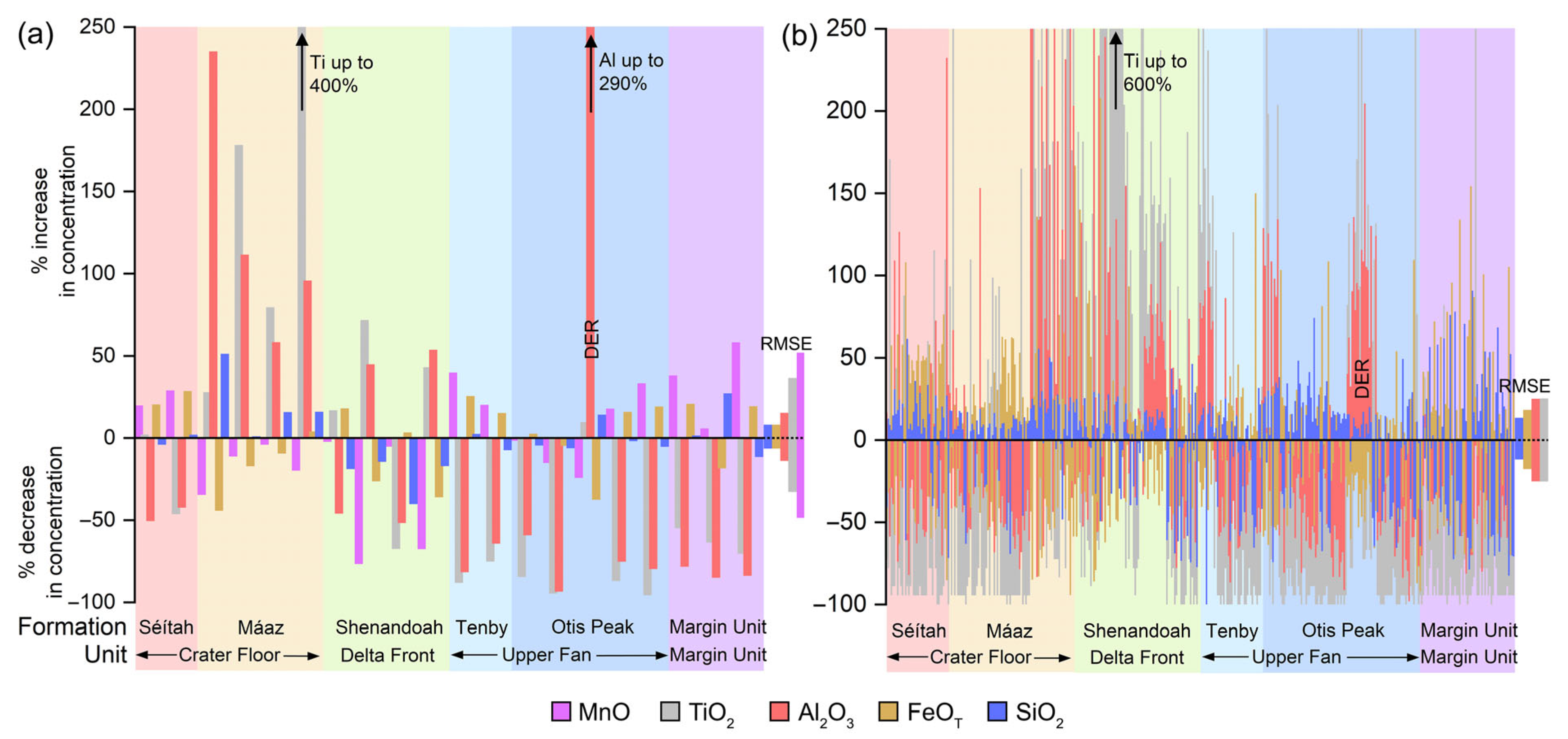
Figure 6. Comparison of SiO2, TiO2, Al2O3, FeOT, and MnO concentrations (wt.%) for the abrasions relative to their average weight percent. (a,b) display the results from PIXL-XRF (averaged) and SuperCam-LIBS data, respectively. Error bars indicate the measurement uncertainties.
Remotesensing 18 00140 g006
Figure 7. Chemical alteration indices, halogen systematics, and paleoclimatic indicators. (a) Ternary Al2O3-(CaO + Na2O)-K2O diagram indicating the CIA across targets. (b) Al2O3-(CaO + Na2O + K2O)-(FeOT + MgO) ternary diagram illustrating the MIA, where FeOT denotes total iron as FeO. Corrections for sulfate, carbonate, perchlorate/chlorate/halide, and phosphate species have been applied. (c) Cl and Br concentrations in Jezero rocks, contextualized by terrestrial brine evaporation pathways, modified from [52]. The black line represents the evaporation trajectory of terrestrial seawater, with open hexagons marking the initial precipitation of key evaporite minerals (gypsum, halite, sylvite, bischofite, and carnallite). The dark blue line shows the evaporation trend for Dead Sea brine. Horizontal dark blue bars denote Br concentrations in natural terrestrial halides, which are typically low (<20 mg/kg) due to atmospheric volatilization. (d) SiO2 vs. (Al2O3 + NaO + K2O) with the weathering threshold delineated by the dashed line from [53]. Comparative data from Martian sedimentary units, including the Vastitas Borealis formation (Utopia Planitia), Yellowknife Bay and Murray formations (Gale crater), and abraded rocks in Meridiani Planum and Gusev crater, are compiled from [54,55,56,57,58]. The average composition of Martian soil is from [25].
Remotesensing 18 00140 g007
Figure 8. A heatmap illustrating the correlations between Br-Cl, Cl-S, Br-S, and Cl or Br with Na2O, MgO, and K2O in the abrasions from different units of the Jezero western delta is presented. Statistically, correlations are categorized as follows: R2 < 0.3 indicates no correlation, 0.3 ≤ R2 < 0.5 indicates a weak correlation, 0.5 ≤ R2 < 0.7 indicates a moderate correlation, and R2 ≥ 0.7 indicates a strong correlation.
Remotesensing 18 00140 g008
Disclaimer/Publisher’s Note: The statements, opinions and data contained in all publications are solely those of the individual author(s) and contributor(s) and not of MDPI and/or the editor(s). MDPI and/or the editor(s) disclaim responsibility for any injury to people or property resulting from any ideas, methods, instructions or products referred to in the content.