Four-Decade CDOM Dynamics in Amur River Basin Lakes from Landsat and Machine Learning

 ,
,
Highlights
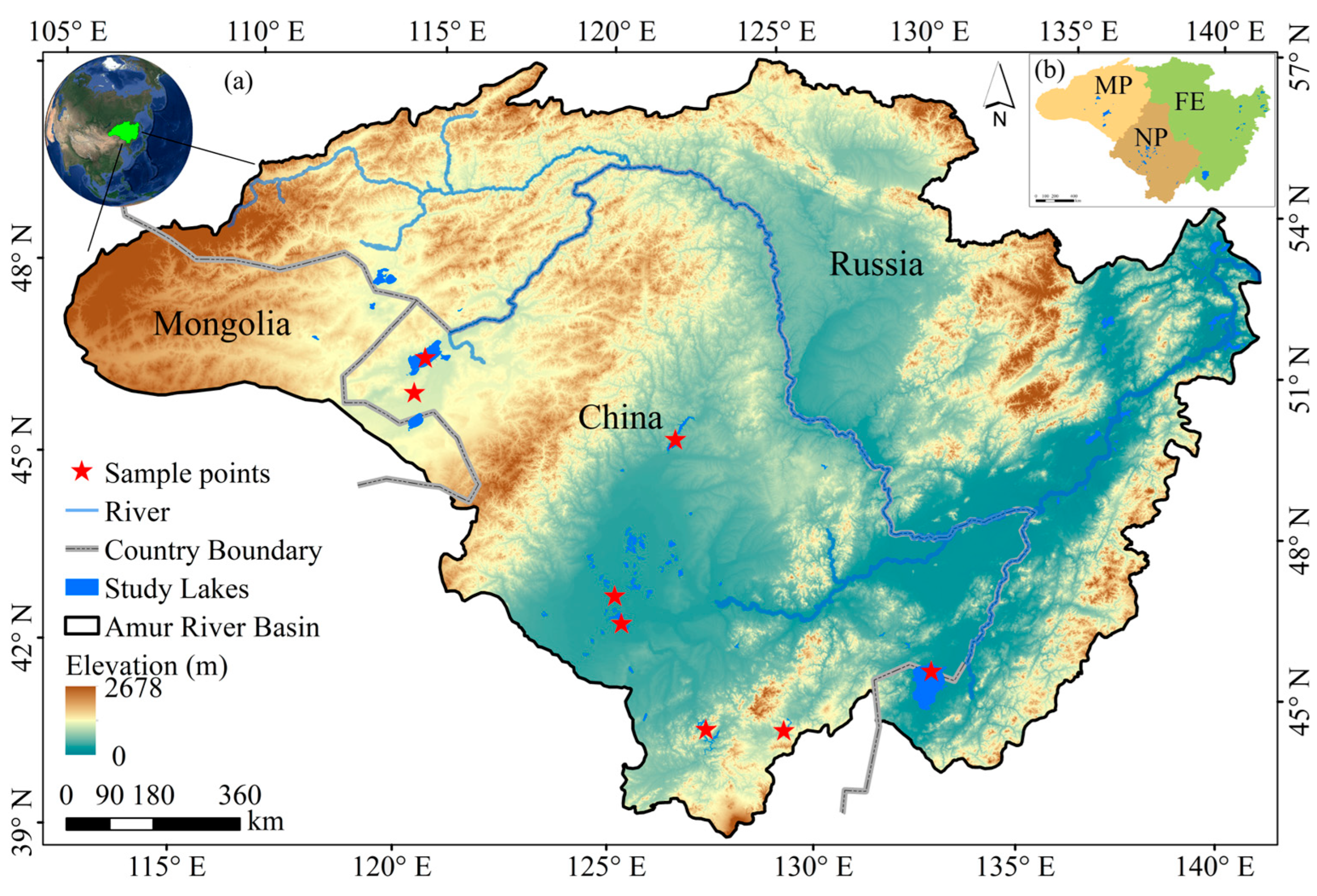
- A 40-year CDOM dataset (1984–2023) was constructed for 69 large lakes within the Amur River Basin based on support vector regression (SVR) model and multi-decadal Landsat imagery, enabling basin-wide spatiotemporal analysis;
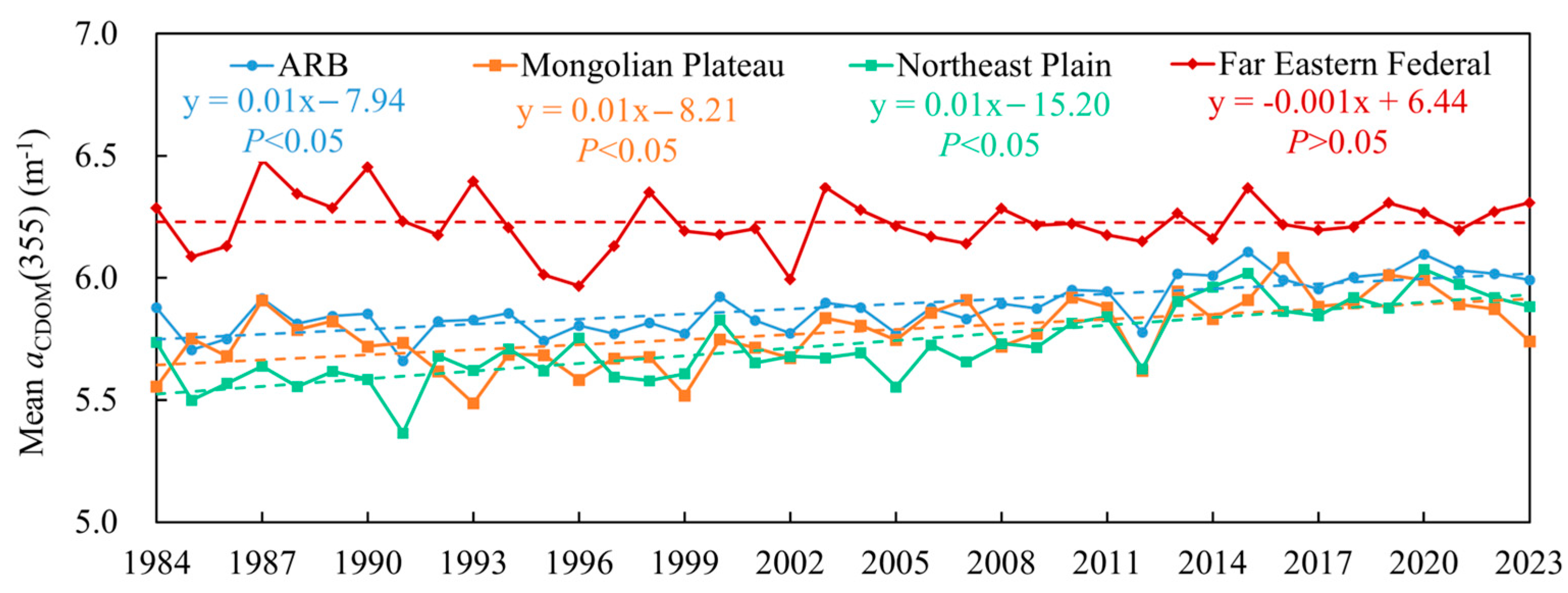
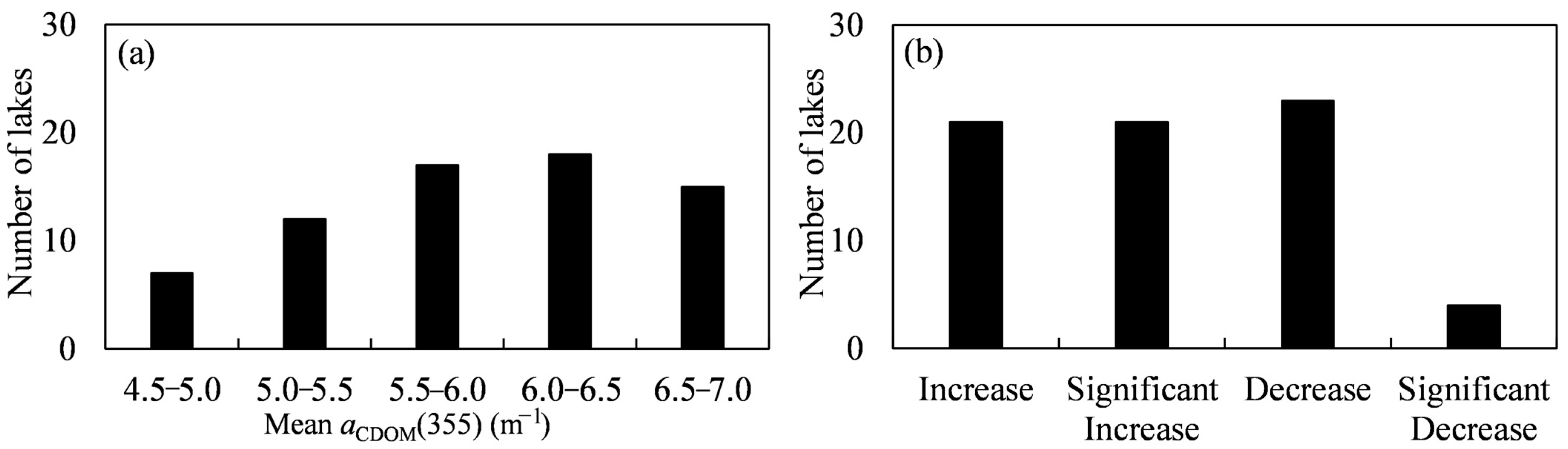
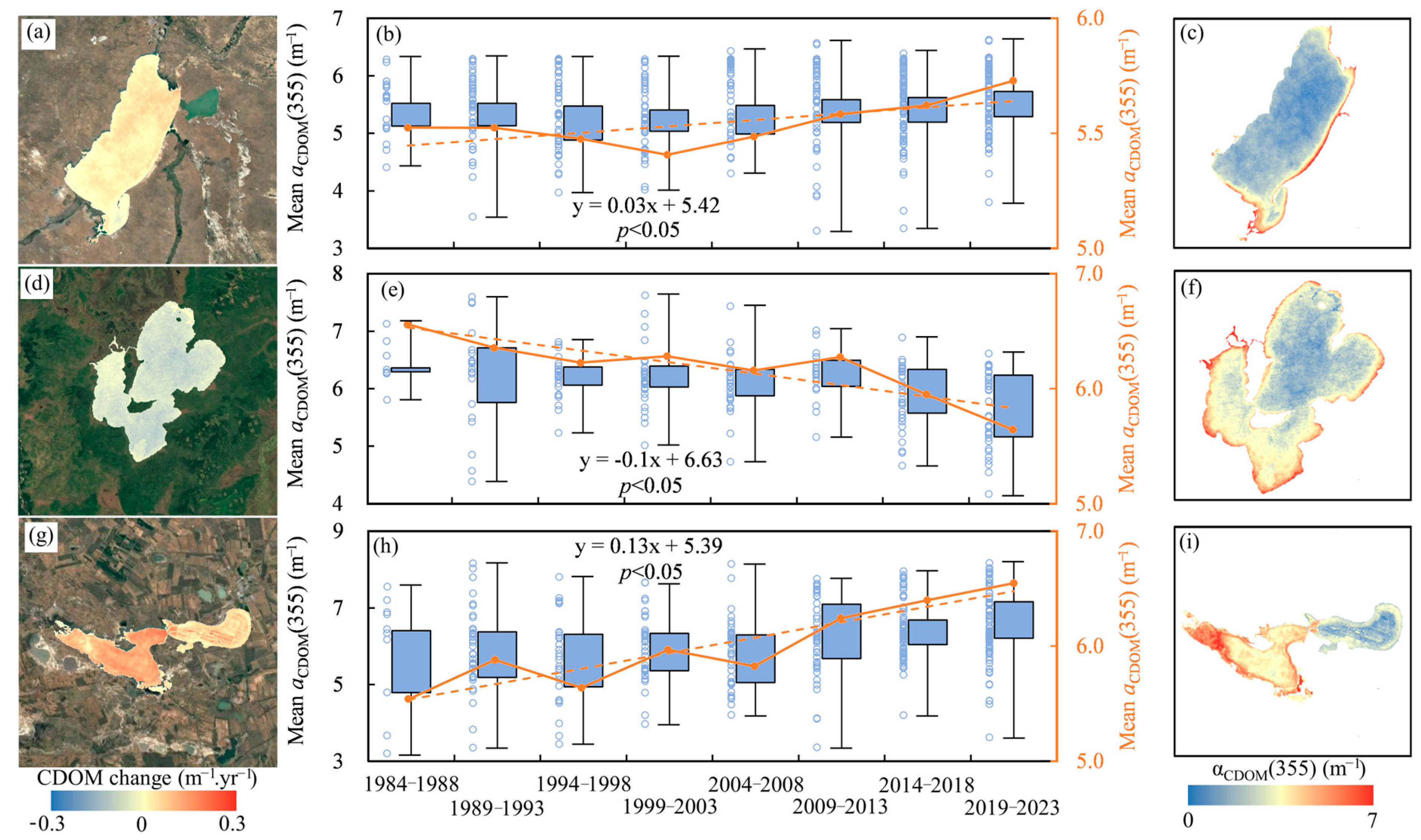
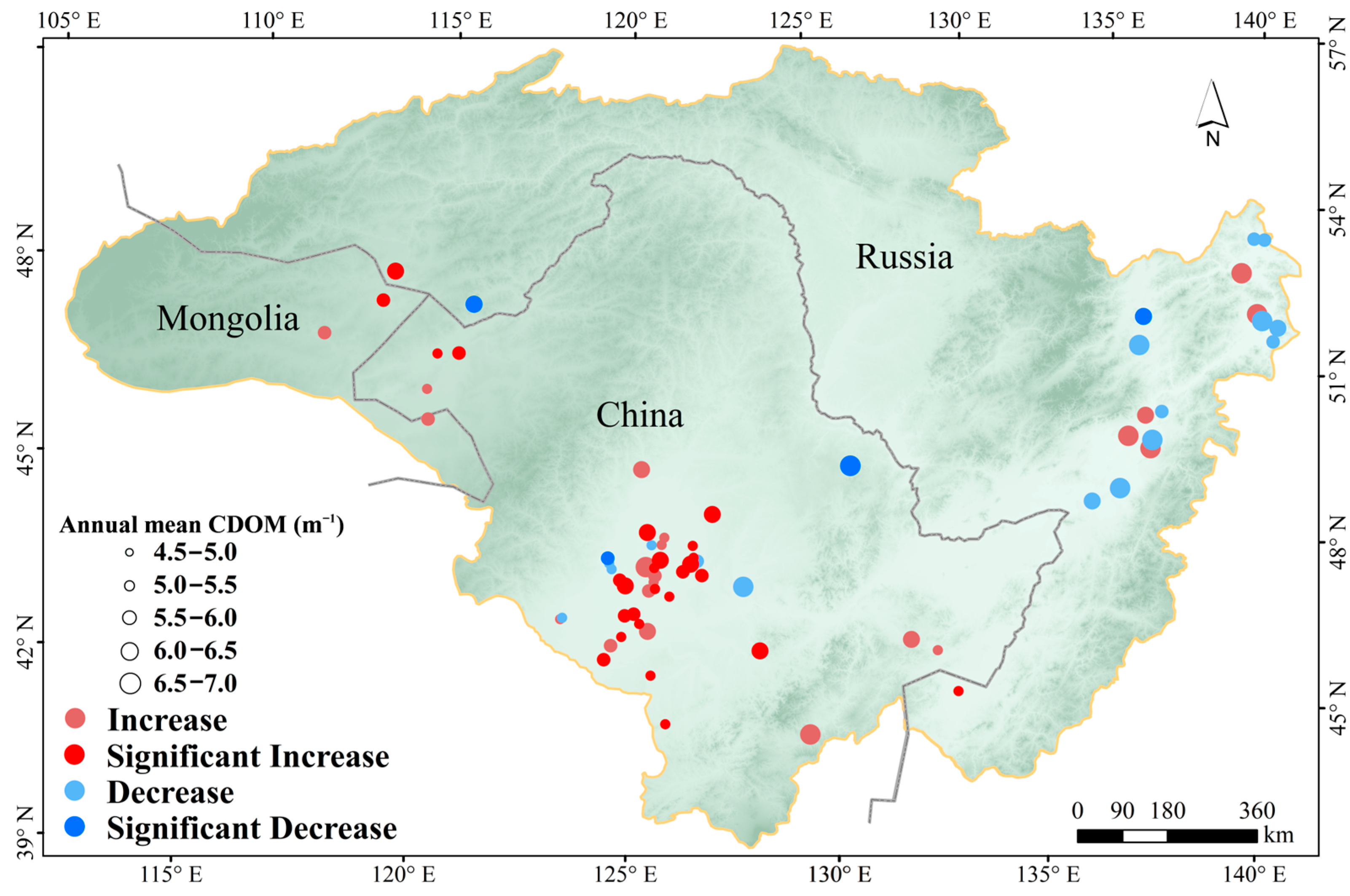
- Results reveal a significant increasing trend of CDOM in 27 lakes, mainly located in the Mongolian Plateau and Northeast Plain, while four lakes show significant declines;
- Hydro-climatic drivers (wind speed, temperature) and anthropogenic pressures (irrigation, grazing) exert regionally distinct influences on lake CDOM dynamics.
- The multi-decadal CDOM dataset offers critical evidence for guiding basin-level monitoring priorities;
- The revealed combined roles of climate forcing and human activities offer guidance for developing adaptive water-quality management strategies at the watershed level.
Abstract
1. Introduction
2. Study Area and Data
2.1. Study Area
2.2. Sampling Sites
2.3. Satellite Data and Processing
2.4. Auxiliary Data
3. Methodology
3.1. Algorithm Development

| Statistical Technique | Band/Ratio | Adjusted Model | Reference | rRMSE (%) | R2 | MAE |
|---|---|---|---|---|---|---|
| LR | x = Rred/Rgreen | y = −0.18x + 6.12 | [59] | 37.6 | 0.23 | 6.54 |
| LR | x = (Rgreen + Rnir)/(Rblue/Rnir) | y = 0.28x + 4.76 | [51] | 42.3 | 0.39 | 5.27 |
| Power | x = Rblue/Rred | y = 5.65x0.021 | [52] | 41.8 | 0.43 | 4.52 |
| ER | x = Rred | y = 5.32e2.14x | [60] | 33.7 | 0.35 | 4.93 |
| LR | x = Rblue/Rgreen | y = 0.67ln(x) + 6.03 | [50] | 32.2 | 0.33 | 5.31 |
| QAA-CDOM | x = Rred, Rgreen, Rnir, Rblue | / / / / | [53] | 30.2 | 0.59 | 4.37 |
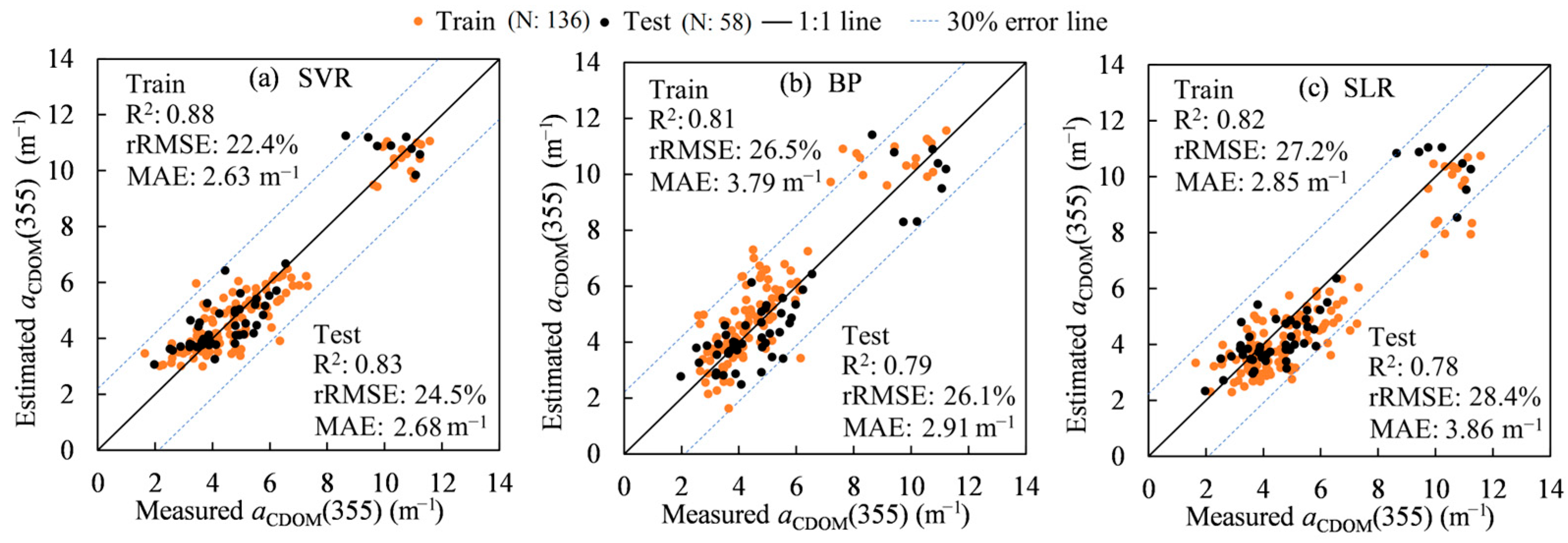
| BP | [4] | 26.5 | 0.81 | 3.79 | ||
| SLR | [61] | 27.2 | 0.82 | 2.85 | ||
| SVR | [18] | 22.4 | 0.88 | 2.63 |
3.2. Statistical Analysis
3.3. Accuracy Assessment
4. Results
4.1. Performance of CDOM Estimation Models
4.2. Spatial-Temporal Variation of CDOM in the ARB
4.3. Spatial-Temporal Variation of CDOM in Three Representative Lakes
4.4. Potential Driving Forces of CDOM Changes
5. Discussion
5.1. Uncertainties of the Estimated CDOM
5.2. Additional Potential Factors in Lake CDOM
5.3. Drivers of the Observed Spatial and Temporal Heterogeneity in CDOM
5.4. Implications for Safeguarding Lake Ecology
6. Conclusions
Supplementary Materials
Author Contributions
Funding
Data Availability Statement
Conflicts of Interest
References
- Brezonik, P.L.; Olmanson, L.G.; Finlay, J.C.; Bauer, M.E. Factors affecting the measurement of CDOM by remote sensing of optically complex inland waters. Remote Sens. Environ. 2015, 157, 199–215. [Google Scholar] [CrossRef]
- Kim, J.; Kim, J.H.; Jang, W.; Pyo, J.; Lee, H.; Byeon, S.; Lee, H.; Park, Y.; Kim, S. Enhancing Machine Learning Performance in Estimating CDOM Absorption Coefficient via Data Resampling. Remote Sens. 2024, 16, 2313. [Google Scholar] [CrossRef]
- Li, J.; Yu, Q.; Tian, Y.Q.; Becker, B.L.; Siqueira, P.; Torbick, N. Spatio-temporal variations of CDOM in shallow inland waters from a semi-analytical inversion of Landsat-8. Remote Sens. Environ. 2018, 218, 189–200. [Google Scholar] [CrossRef]
- Shao, T.; Song, K.; Du, J.; Zhao, Y.; Liu, Z.; Zhang, B. Retrieval of CDOM and DOC using in situ hyperspectral data: A case study for potable waters in Northeast China. J. Indian Soc. Remote Sens. 2016, 44, 77–89. [Google Scholar] [CrossRef]
- Shang, Y.; Song, K.; Jacinthe, P.A.; Wen, Z.; Lyu, L.; Fang, C.; Liu, G. Characterization of CDOM in reservoirs and its linkage to trophic status assessment across China using spectroscopic analysis. J. Hydrol. 2019, 576, 1–11. [Google Scholar] [CrossRef]
- Wei, J.; Lee, Z.; Shang, S.; Yu, X. Semianalytical derivation of phytoplankton, CDOM, and detritus absorption coefficients from the Landsat 8/OLI reflectance in coastal waters. J. Geophys. Res. Ocean. 2019, 124, 3682–3699. [Google Scholar] [CrossRef]
- Fan, T.; Yao, X.; Sang, D.; Liu, L.; Sun, Z.; Deng, H.; Zhang, Y.; Sun, X. Composition characteristics and metal binding behavior of macrophyte-derived DOM (MDOM) under microbial combined photodegradation: A state closer to actual macrophytic lakes. J. Hazard. Mater. 2024, 465, 133124. [Google Scholar] [CrossRef]
- Griffin, C.; McClelland, J.; Frey, K.; Fiske, G.; Holmes, R. Quantifying CDOM and DOC in major Arctic rivers during ice-free conditions using Landsat TM and ETM+ data. Remote Sens. Environ. 2018, 209, 395–409. [Google Scholar] [CrossRef]
- Lønborg, C.; Carreira, C.; Jickells, T.; Álvarez-Salgado, X.A. Impacts of Global Change on Ocean Dissolved Organic Carbon (DOC) Cycling. Front. Mar. Sci. 2020, 7, 466. [Google Scholar] [CrossRef]
- Mao, D.; Tian, Y.; Wang, Z.; Jia, M.; Du, J.; Song, C. Wetland changes in the Amur River Basin: Differing trends and proximate causes on the Chinese and Russian sides. J. Environ. Manag. 2021, 280, 111670. [Google Scholar] [CrossRef]
- Borsch, S.; Khristoforov, A.; Krovotyntsev, V.; Leontieva, E.; Simonov, Y.; Zatyagalova, V. A basin approach to a hydrological service delivery system in the Amur River Basin. Geosciences 2018, 8, 93. [Google Scholar] [CrossRef]
- Yi, K.; Zhang, J.; Batbayar, N.; Higuchi, H.; Natsagdorj, T.; Bysykatova, I.P. Using tracking data to identify gaps in knowledge and conservation of the critically endangered Siberian crane (Leucogeranus leucogeranus). Remote Sens. 2022, 14, 5101. [Google Scholar]
- Zhang, C.; Xiao, X.; Wang, X.; Yi, S.; Meng, C.; Qin, Y.; Yao, Y.; Yin, L.; Celis, J.; Pan, L. Climate-induced losses of surface water and total water storage in Northeast Asia. Commun. Earth Environ. 2025, 6, 479. [Google Scholar] [CrossRef]
- Liu, H.; Yin, Y.; Piao, S.; Zhao, F.; Engels, M.; Ciais, P. Disappearing lakes in semiarid northern China: Drivers and environmental impact. Environ. Sci. Technol. 2013, 47, 12107–12114. [Google Scholar] [CrossRef]
- Peng, X.; Zhang, T.; Frauenfeld, O.W.; Wang, S.; Qiao, L.; Du, R.; Mu, C. Northern Hemisphere greening in association with warming permafrost. J. Geophys. Res. Biogeosci 2020, 125, e2019JG005086. [Google Scholar]
- Zhou, S.; Zhang, W.; Guo, Y. Impacts of climate and land-use changes on the hydrological processes in the Amur River Basin. Water 2019, 12, 76. [Google Scholar] [CrossRef]
- Wang, Y.; Xin, Z.; Zhang, C.; Han, P.; Pi, X.; Song, C. Revealing lake dynamics across the Amur River Basin over the past two decades using multi-source remote sensing datasets. J. Hydrol. Reg. Stud. 2024, 55, 101928. [Google Scholar] [CrossRef]
- Zhang, L.; Xin, Z.; Guan, Q.; Feng, L.; Hu, C.; Zhang, C.; Zhou, H. Monitoring and understanding chlorophyll-a concentration changes in lakes in northeastern China using MERIS and OLCI satellite data. GIScience Remote Sens. 2024, 61, 2285166. [Google Scholar] [CrossRef]
- Feng, P.; Song, K.; Wen, Z.; Tao, H.; Yu, X.; Shang, Y. Remote Sensing Estimation of CDOM for Songhua River of China: Distributions and Implications. Remote Sens. 2024, 16, 4608. [Google Scholar] [CrossRef]
- Shi, J.; Zhao, Y.; Wei, D.; Zhang, D.; Wei, Z.; Wu, J. Insight into transformation of dissolved organic matter in the Heilongjiang River. Environ. Sci. Pollut. Res. 2019, 26, 3340–3349. [Google Scholar]
- Zhu, L.; Zhao, Y.; Bai, S.; Zhou, H.; Chen, X.; Wei, Z. New insights into the variation of dissolved organic matter components in different latitudinal lakes of northeast China. Limnol. Oceanogr. 2020, 65, 471–481. [Google Scholar] [CrossRef]
- Zhang, Y.; van Dijk, M.A.; Liu, M.; Zhu, G.; Qin, B. The contribution of phytoplankton degradation to chromophoric dissolved organic matter (CDOM) in eutrophic shallow lakes: Field and experimental evidence. Water Res. 2009, 43, 4685–4697. [Google Scholar] [CrossRef] [PubMed]
- Olmanson, L.G.; Brezonik, P.L.; Finlay, J.C.; Bauer, M.E. Comparison of Landsat 8 and Landsat 7 for regional measurements of CDOM and water clarity in lakes. Remote Sens. Environ. 2016, 185, 119–128. [Google Scholar] [CrossRef]
- Sun, X.; Zhang, Y.; Zhang, Y.; Shi, K.; Zhou, Y.; Li, N. Machine learning algorithms for chromophoric dissolved organic matter (CDOM) estimation based on Landsat 8 images. Remote Sens. 2021, 13, 3560. [Google Scholar] [CrossRef]
- Li, J.; Yu, Q.; Tian, Y.Q.; Becker, B.L. Remote sensing estimation of colored dissolved organic matter (CDOM) in optically shallow waters. ISPRS J. Photogramm. Remote Sens. 2017, 128, 98–110. [Google Scholar] [CrossRef]
- Hoge, F.E.; Lyon, P.E. Satellite retrieval of inherent optical properties by linear matrix inversion of oceanic radiance models: An analysis of model and radiance measurement errors. J. Geophys. Res. Ocean. 1996, 101, 16631–16648. [Google Scholar] [CrossRef]
- Ogashawara, I.; Mishra, D.R.; Nascimento, R.F.; Alcântara, E.H.; Kampel, M.; Stech, J.L. Re-parameterization of a quasi-analytical algorithm for colored dissolved organic matter dominant inland waters. Int. J. Appl. Earth Obs. Geoinf 2016, 53, 128–145. [Google Scholar] [CrossRef]
- Chen, J.; de Hoogh, K.; Gulliver, J.; Hoffmann, B.; Hertel, O.; Ketzel, M.; Bauwelinck, M.; Van Donkelaar, A.; Hvidtfeldt, U.A.; Katsouyanni, K. A comparison of linear regression, regularization, and machine learning algorithms to develop Europe-wide spatial models of fine particles and nitrogen dioxide. Environ. Int. 2019, 130, 104934. [Google Scholar] [CrossRef]
- Ciancia, E.; Campanelli, A.; Colonna, R.; Palombo, A.; Pascucci, S.; Pignatti, S.; Pergola, N. Improving Colored Dissolved Organic Matter (CDOM) Retrievals by Sentinel2-MSI Data through a Total Suspended Matter (TSM)-Driven Classification: The Case of Pertusillo Lake (Southern Italy). Remote Sens. 2023, 15, 5718. [Google Scholar] [CrossRef]
- Menken, K.; Brezonik, P.; Bauer, M. Influence of chlorophyll and humic color on reflectance spectra of lakes: Implications for measurement of lake-water properties by remote sensing. Lake Reserv. Manage 2006, 22, 179–190. [Google Scholar] [CrossRef]
- Keller, S.; Maier, P.M.; Riese, F.M.; Norra, S.; Holbach, A.; Börsig, N.; Wilhelms, A.; Moldaenke, C.; Zaake, A.; Hinz, S. Hyperspectral data and machine learning for estimating CDOM, chlorophyll a, diatoms, green algae and turbidity. Int. J. Environ. Res. Public Health 2018, 15, 1881. [Google Scholar] [CrossRef]
- Verrelst, J.; Muñoz, J.; Alonso, L.; Delegido, J.; Rivera, J.P.; Camps-Valls, G.; Moreno, J. Machine learning regression algorithms for biophysical parameter retrieval: Opportunities for Sentinel-2 and-3. Remote Sens. Environ. 2012, 118, 127–139. [Google Scholar] [CrossRef]
- Yan, B.; Xia, Z.; Huang, F.; Guo, L.; Zhang, X. Climate change detection and annual extreme temperature analysis of the amur river basin. Adv. Meteorol. 2016, 2016, 6268938. [Google Scholar] [CrossRef]
- Zhou, S.; Zhang, W.; Wang, S.; Zhang, B.; Xu, Q. Spatial–Temporal Vegetation Dynamics and Their Relationships with Climatic, Anthropogenic, and Hydrological Factors in the Amur River Basin. Remote Sens. 2021, 13, 684. [Google Scholar] [CrossRef]
- Kim, J.; Jang, W.; Kim, J.H.; Lee, J.; Cho, K.H.; Lee, Y.-G.; Chon, K.; Park, S.; Pyo, J.; Park, Y. Application of airborne hyperspectral imagery to retrieve spatiotemporal CDOM distribution using machine learning in a reservoir. Int. J. Appl. Earth Obs. Geoinf 2022, 114, 103053. [Google Scholar] [CrossRef]
- Xu, Y.; Feng, L.; Hou, X.; Wang, J.; Tang, J. Four-decade dynamics of the water color in 61 large lakes on the Yangtze Plain and the impacts of reclaimed aquaculture zones. Sci. Total Environ. 2021, 781, 146688. [Google Scholar] [CrossRef]
- Skakun, S.; Vermote, E.F.; Roger, J.-C.; Justice, C.O.; Masek, J.G. Validation of the LaSRC cloud detection algorithm for Landsat 8 images. IEEE J. Sel. Top. Appl. Earth Obs. Remote Sens. 2019, 12, 2439–2446. [Google Scholar] [CrossRef]
- Roy, D.P.; Wulder, M.A.; Loveland, T.R.; Woodcock, C.E.; Allen, R.G.; Anderson, M.C.; Helder, D.; Irons, J.R.; Johnson, D.M.; Kennedy, R. Landsat-8: Science and product vision for terrestrial global change research. Remote Sens. Environ. 2014, 145, 154–172. [Google Scholar] [CrossRef]
- Wang, X.; Song, K.; Wen, Z.; Liu, G.; Shang, Y.; Fang, C.; Lyu, L.; Wang, Q. Quantifying turbidity variation for lakes in Daqing of Northeast China using Landsat images from 1984 to 2018. IEEE J. Sel. Top. Appl. Earth Obs. Remote Sens. 2021, 14, 8884–8897. [Google Scholar] [CrossRef]
- Skakun, S.; Wevers, J.; Brockmann, C.; Doxani, G.; Aleksandrov, M.; Batič, M.; Frantz, D.; Gascon, F.; Gómez-Chova, L.; Hagolle, O. Cloud Mask Intercomparison eXercise (CMIX): An evaluation of cloud masking algorithms for Landsat 8 and Sentinel-2. Remote Sens. Environ. 2022, 274, 112990. [Google Scholar] [CrossRef]
- Wei, J.; Huang, W.; Li, Z.; Sun, L.; Zhu, X.; Yuan, Q.; Liu, L.; Cribb, M. Cloud detection for Landsat imagery by combining the random forest and superpixels extracted via energy-driven sampling segmentation approaches. Remote Sens. Environ. 2020, 248, 112005. [Google Scholar] [CrossRef]
- Feng, L.; Hou, X.; Zheng, Y. Monitoring and understanding the water transparency changes of fifty large lakes on the Yangtze Plain based on long-term MODIS observations. Remote Sens. Environ. 2019, 221, 675–686. [Google Scholar] [CrossRef]
- Hou, X.; Feng, L.; Dai, Y.; Hu, C.; Gibson, L.; Tang, J.; Lee, Z.; Wang, Y.; Cai, X.; Liu, J.; et al. Global mapping reveals increase in lacustrine algal blooms over the past decade. Nat. Geosci. 2022, 15, 130–134. [Google Scholar] [CrossRef]
- Zhang, H.; Li, Y.; Yao, B.; Huang, Y.; Wang, S.; Ni, S. Untangling the coupling effect of water quality and quantity on lake algal blooms in Lake Hulun from a dual perspective of remote sensing and sediment cores. J. Hydrol. 2024, 645, 132141. [Google Scholar] [CrossRef]
- Dee, D.P.; Uppala, S.M.; Simmons, A.J.; Berrisford, P.; Poli, P.; Kobayashi, S.; Andrae, U.; Balmaseda, M.; Balsamo, G.; Bauer, d.P. The ERA-Interim reanalysis: Configuration and performance of the data assimilation system. Q. J. R. Meteorol. Soc. 2011, 137, 553–597. [Google Scholar] [CrossRef]
- Xu, Y.; Gun, Z.; Zhao, J.; Cheng, X. Variations in lake water storage over Inner Mongolia during recent three decades based on multi-mission satellites. J. Hydrol. 2022, 609, 127719. [Google Scholar] [CrossRef]
- Zhang, Y.; Zhang, E.; Yin, Y.; Van Dijk, M.A.; Feng, L.; Shi, Z.; Liu, M.; Qina, B. Characteristics and sources of chromophoric dissolved organic matter in lakes of the Yungui Plateau, China, differing in trophic state and altitude. Limnol. Oceanogr. 2010, 55, 2645–2659. [Google Scholar] [CrossRef]
- Zhao, D.; Feng, L.; He, X. Global gridded aerosol models established for atmospheric correction over inland and nearshore coastal waters. J. Geophys. Res. Atmos. 2023, 128, e2023JD038815. [Google Scholar] [CrossRef]
- Huang, S.; Tang, L.; Hupy, J.P.; Wang, Y.; Shao, G. A commentary review on the use of normalized difference vegetation index (NDVI) in the era of popular remote sensing. J. For. Res. 2021, 32, 1–6. [Google Scholar] [CrossRef]
- Mannino, A.; Russ, M.E.; Hooker, S.B. Algorithm development and validation for satellite-derived distributions of DOC and CDOM in the US Middle Atlantic Bight. J. Geophys. Res. Ocean. 2008, 113. [Google Scholar] [CrossRef]
- Qiang, S.; Song, K.; Shang, Y.; Lai, F.; Wen, Z.; Liu, G.; Tao, H.; Lyu, Y. Remote sensing estimation of CDOM and DOC with the environmental implications for Lake Khanka. Remote Sens. 2023, 15, 5707. [Google Scholar] [CrossRef]
- Zhao, Z.; Shi, K.; Peng, Y.; Wang, W.; Lai, L.; Zhang, Y.; Zhou, Y.; Zhang, Y.; Qin, B. Widespread decrease in chromophoric dissolved organic matter in Chinese lakes derived from satellite observations. Remote Sens. Environ. 2023, 298, 113848. [Google Scholar] [CrossRef]
- Zhu, W.; Yu, Q. Inversion of Chromophoric Dissolved Organic Matter From EO-1 Hyperion Imagery for Turbid Estuarine and Coastal Waters. IEEE Trans. Geosci. Remote Sens. 2013, 51, 3286–3298. [Google Scholar] [CrossRef]
- Zhu, W.; Yu, Q.; Tian, Y.Q.; Becker, B.L.; Zheng, T.; Carrick, H.J. An assessment of remote sensing algorithms for colored dissolved organic matter in complex freshwater environments. Remote Sens. Environ. 2014, 140, 766–778. [Google Scholar] [CrossRef]
- Hu, C. A novel ocean color index to detect floating algae in the global oceans. Remote Sens. Environ. 2009, 113, 2118–2129. [Google Scholar] [CrossRef]
- Rumelhart, D.E.; Hinton, G.E.; McClelland, J.L. A general framework for parallel distributed processing. Parallel Distrib. Process. Explor. Microstruct. Cogn. 1986, 1, 26. [Google Scholar]
- Cortes, C.; Vapnik, V. Support-vector networks. Mach. Learn. 1995, 20, 273–297. [Google Scholar] [CrossRef]
- Zhang, B.; Li, J.; Shen, Q.; Chen, D. A bio-optical model based method of estimating total suspended matter of Lake Taihu from near-infrared remote sensing reflectance. Environ. Monit. Assess. 2008, 145, 339–347. [Google Scholar]
- Ficek, D.; Zapadka, T.; Dera, J. Remote sensing reflectance of Pomeranian lakes and the Baltic. Oceanologia 2011, 53, 959–970. [Google Scholar] [CrossRef]
- Ling, Z.; Sun, D.; Wang, S.; Qiu, Z.; Huan, Y.; Mao, Z.; He, Y. Remote sensing estimation of colored dissolved organic matter (CDOM) from GOCI measurements in the Bohai Sea and Yellow Sea. Environ. Sci. Pollut. Res. 2020, 27, 6872–6885. [Google Scholar] [CrossRef] [PubMed]
- Massicotte, P.; Assani, A.A.; Gratton, D.; Frenette, J.-J. Relationship between water color, water levels, and climate indices in large rivers: Case of the St. Lawrence River (Canada). Water Resour. Res. 2013, 49, 2303–2307. [Google Scholar] [CrossRef]
- Tong, Y.; Zhang, W.; Wang, X.; Couture, R.-M.; Larssen, T.; Zhao, Y.; Li, J.; Liang, H.; Liu, X.; Bu, X. Decline in Chinese lake phosphorus concentration accompanied by shift in sources since 2006. Nat. Geosci. 2017, 10, 507–511. [Google Scholar] [CrossRef]
- Wang, L.; Zhao, D.; Yang, J.; Chen, Y. Retrieval of total suspended matter from MODIS 250 m imagery in the Bohai Sea of China. J. Oceanogr. 2012, 68, 719–725. [Google Scholar] [CrossRef]
- Song, W.; Yinglan, A.; Wang, Y.; Fang, Q.; Tang, R. Study on remote sensing inversion and temporal-spatial variation of Hulun lake water quality based on machine learning. J. Contam. Hydrol. 2024, 260, 104282. [Google Scholar] [CrossRef] [PubMed]
- Zhao, J.; Cao, W.; Xu, Z.; Ai, B.; Yang, Y.; Jin, G.; Wang, G.; Zhou, W.; Chen, Y.; Chen, H. Estimating CDOM concentration in highly turbid estuarine coastal waters. J. Geophys. Res. Ocean. 2018, 123, 5856–5873. [Google Scholar] [CrossRef]
- Zhou, J.; Leavitt, P.R.; Zhang, Y.; Qin, B. Anthropogenic eutrophication of shallow lakes: Is it occasional? Water Res. 2022, 221, 118728. [Google Scholar] [CrossRef]
- Phillips, A.J.; Govedich, F.R.; Moser, W.E. Leeches in the extreme: Morphological, physiological, and behavioral adaptations to inhospitable habitats. Int. J. Parasitol. Parasites Wildl. 2020, 12, 318–325. [Google Scholar] [CrossRef]
- Lv, Z.; Liu, C.; Wang, J.; Li, C.; Teng, X.; Tan, Y. Spectral diversities of chromophoric dissolved organic matter in paddy field water adjacent to black soil regions of Northeast China. RSC Adv. 2025, 15, 18732–18741. [Google Scholar] [CrossRef]
- Hu, Y.; Lu, Y.; Edmonds, J.; Liu, C.; Zhang, Q.; Zheng, C. Irrigation alters source-composition characteristics of groundwater dissolved organic matter in a large arid river basin, Northwestern China. Sci. Total Environ. 2021, 767, 144372. [Google Scholar] [CrossRef]
- Du, Y.; Chen, F.; Zhang, Y.; He, H.; Wen, S.; Huang, X.; Song, C.; Li, K.; Wang, J.; Keellings, D.; et al. Human Activity Coupled With Climate Change Strengthens the Role of Lakes as an Active Pipe of Dissolved Organic Matter. Earth’s Future 2023, 11, e2022EF003412. [Google Scholar] [CrossRef]
- Vione, D.; Minero, C.; Carena, L. Fluorophores in surface freshwaters: Importance, likely structures, and possible impacts of climate change. Environ. Sci. Process. Impacts 2021, 23, 1429–1442. [Google Scholar] [CrossRef]
- Hamdan, M.; Byström, P.; Hotchkiss, E.R.; Al-Haidarey, M.J.; Karlsson, J. An experimental test of climate change effects in northern lakes: Increasing allochthonous organic matter and warming alters autumn primary production. Freshw. Biol. 2021, 66, 815–825. [Google Scholar] [CrossRef]
- Mahlasi, C. Remote Sensing of Water Quality in Inland Water Bodies; University of Johannesburg: Johannesburg, South Africa, 2017. [Google Scholar]
- Wiangwang, N. Hyperspectral Data Modeling for Water Quality Studies in Michigan’s Inland Lakes; Michigan State University: East Lansing, MI, USA, 2006. [Google Scholar]
- Wang, M.; Jiang, L. Atmospheric correction using the information from the short blue band. IEEE Trans. Geosci. Remote Sens. 2018, 56, 6224–6237. [Google Scholar] [CrossRef]
- Zhang, M.; Hu, C.; Cannizzaro, J.; English, D.; Barnes, B.B.; Carlson, P.; Yarbro, L. Comparison of two atmospheric correction approaches applied to MODIS measurements over North American waters. Remote Sens. Environ. 2018, 216, 442–455. [Google Scholar] [CrossRef]
- Hou, X.; Feng, L.; Duan, H.; Chen, X.; Sun, D.; Shi, K. Fifteen-year monitoring of the turbidity dynamics in large lakes and reservoirs in the middle and lower basin of the Yangtze River, China. Remote Sens. Environ. 2017, 190, 107–121. [Google Scholar] [CrossRef]
- Cao, Z.; Ma, R.; Duan, H.; Pahlevan, N.; Melack, J.; Shen, M.; Xue, K. A machine learning approach to estimate chlorophyll-a from Landsat-8 measurements in inland lakes. Remote Sens. Environ. 2020, 248, 111974. [Google Scholar] [CrossRef]
- Chen, J.; Zhu, W.; Tian, Y.Q.; Yu, Q. Monitoring dissolved organic carbon by combining Landsat-8 and Sentinel-2 satellites: Case study in Saginaw River estuary, Lake Huron. Sci. Total Environ. 2020, 718, 137374. [Google Scholar]
- Wu, T.; Wang, Z.; Niu, C.; Zhang, Y.; Li, B.; Li, P. The effect of intense hydrodynamic disturbance on chromophoric dissolved organic matter in a shallow eutrophic lake. J. Freshw. Ecol. 2015, 30, 143–156. [Google Scholar]
- Kieber, R.J.; Adams, M.B.; Willey, J.D.; Whitehead, R.F.; Avery, G.B., Jr.; Mullaugh, K.M.; Mead, R.N. Short term temporal variability in the photochemically mediated alteration of chromophoric dissolved organic matter (CDOM) in rainwater. Atmos. Environ. 2012, 50, 112–119. [Google Scholar] [CrossRef]
- Wang, Y.; Feng, L.; Liu, J.; Hou, X.; Chen, D. Changes of inundation area and water turbidity of Tonle Sap Lake: Responses to climate changes or upstream dam construction? Environ. Res. Lett. 2020, 15, 0940a0941. [Google Scholar] [CrossRef]
- Wang, B.; Xu, G.; Li, P.; Li, Z.; Zhang, Y.; Cheng, Y.; Jia, L.; Zhang, J. Vegetation dynamics and their relationships with climatic factors in the Qinling Mountains of China. Ecol. Indic. 2020, 108, 105719. [Google Scholar] [CrossRef]
- Wauthy, M.; Rautio, M.; Christoffersen, K.S.; Forsström, L.; Laurion, I.; Mariash, H.L.; Peura, S.; Vincent, W.F. Increasing dominance of terrigenous organic matter in circumpolar freshwaters due to permafrost thaw. Limnol. Oceanogr. Lett. 2018, 3, 186–198. [Google Scholar] [CrossRef]
- Grunert, B.K.; Tzortziou, M.; Neale, P.; Menendez, A.; Hernes, P. DOM degradation by light and microbes along the Yukon River-coastal ocean continuum. Sci. Rep. 2021, 11, 10236. [Google Scholar] [CrossRef]
- Liu, D.; Du, Y.; Yu, S.; Luo, J.; Duan, H. Human activities determine quantity and composition of dissolved organic matter in lakes along the Yangtze River. Water Res. 2020, 168, 115132. [Google Scholar] [CrossRef] [PubMed]
- Dupouy, C.; Röttgers, R.; Tedetti, M.; Frouin, R.; Lantoine, F.; Rodier, M.; Martias, C.; Goutx, M. Impact of contrasted weather conditions on CDOM absorption/fluorescence and biogeochemistry in the eastern lagoon of New Caledonia. Front. Earth Sci. 2020, 8, 54. [Google Scholar] [CrossRef]
- Cai, Y.; Qi, L.; Shan, T.; Liu, Y.; Zhang, N.; Lu, X.; Fan, Y. Application of phytoplankton taxonomic α-diversity indices to assess trophic states in Barrier Lake: A case of Jingpo Lake. Diversity 2022, 14, 1003. [Google Scholar] [CrossRef]
- Bao, T.; Wang, P.; Hu, B.; Wang, X.; Qian, J. Mobilization of colloids during sediment resuspension and its effect on the release of heavy metals and dissolved organic matter. Sci. Total Environ. 2023, 861, 160678. [Google Scholar] [CrossRef]
- Zhou, Y.; Dong, J.; Xiao, X.; Liu, R.; Zou, Z.; Zhao, G.; Ge, Q. Continuous monitoring of lake dynamics on the Mongolian Plateau using all available Landsat imagery and Google Earth Engine. Sci. Total Environ. 2019, 689, 366–380. [Google Scholar] [CrossRef]
- Wen, Z.; Song, K.; Zhao, Y.; Du, J.; Ma, J. Influence of environmental factors on spectral characteristics of chromophoric dissolved organic matter (CDOM) in Inner Mongolia Plateau, China. Hydrol. Earth Syst. Sci. 2016, 20, 787–801. [Google Scholar] [CrossRef]




Disclaimer/Publisher’s Note: The statements, opinions and data contained in all publications are solely those of the individual author(s) and contributor(s) and not of MDPI and/or the editor(s). MDPI and/or the editor(s) disclaim responsibility for any injury to people or property resulting from any ideas, methods, instructions or products referred to in the content. |
© 2025 by the authors. Licensee MDPI, Basel, Switzerland. This article is an open access article distributed under the terms and conditions of the Creative Commons Attribution (CC BY) license.
Share and Cite
Wang, Y.; Han, P.; Zhang, C.; Xin, Z.; Zhang, L.; Lu, X.; Huang, J. Four-Decade CDOM Dynamics in Amur River Basin Lakes from Landsat and Machine Learning. Remote Sens. 2026, 18, 125. https://doi.org/10.3390/rs18010125
Wang Y, Han P, Zhang C, Xin Z, Zhang L, Lu X, Huang J. Four-Decade CDOM Dynamics in Amur River Basin Lakes from Landsat and Machine Learning. Remote Sensing. 2026; 18(1):125. https://doi.org/10.3390/rs18010125
Chicago/Turabian StyleWang, Ye, Pengfei Han, Chi Zhang, Zhuohang Xin, Lu Zhang, Xixin Lu, and Jinkun Huang. 2026. "Four-Decade CDOM Dynamics in Amur River Basin Lakes from Landsat and Machine Learning" Remote Sensing 18, no. 1: 125. https://doi.org/10.3390/rs18010125
APA StyleWang, Y., Han, P., Zhang, C., Xin, Z., Zhang, L., Lu, X., & Huang, J. (2026). Four-Decade CDOM Dynamics in Amur River Basin Lakes from Landsat and Machine Learning. Remote Sensing, 18(1), 125. https://doi.org/10.3390/rs18010125