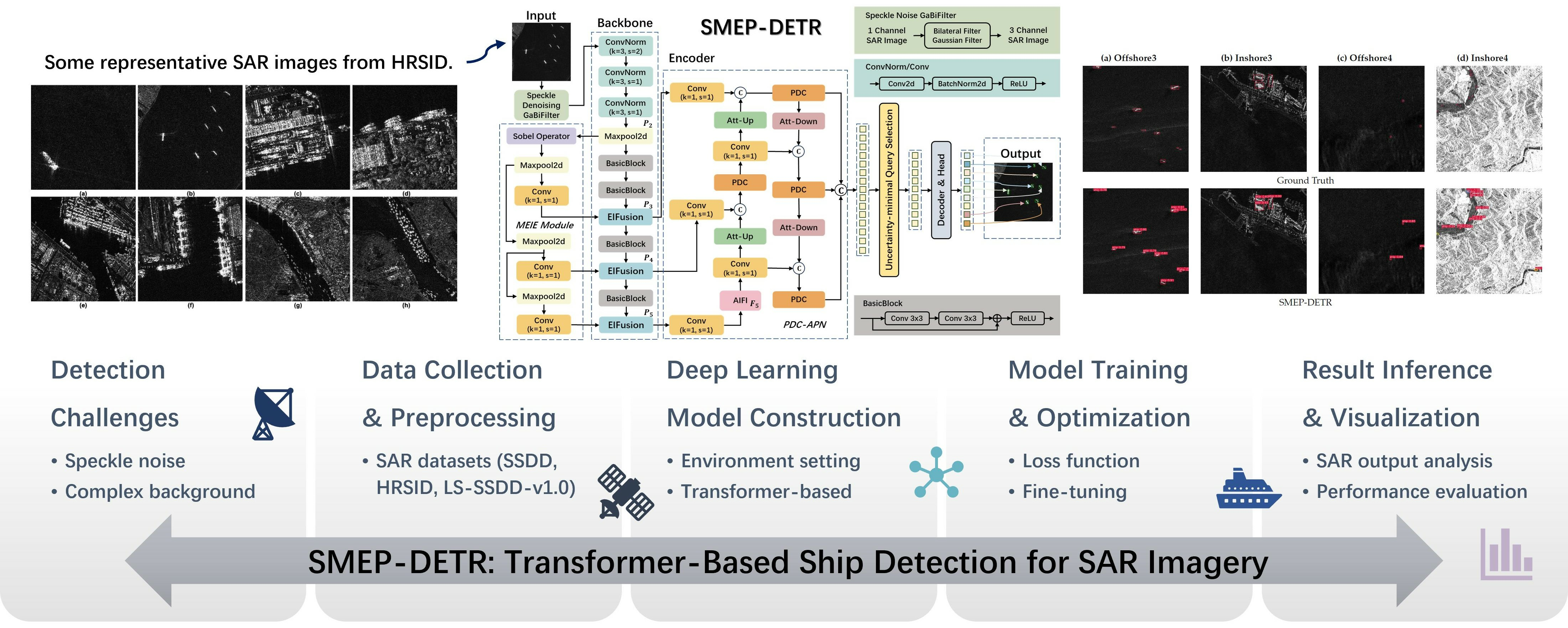
SMEP-DETR: Transformer-Based Ship Detection for SAR Imagery with Multi-Edge Enhancement and Parallel Dilated Convolutions

Abstract
Share and Cite
Yu, C.; Shin, Y. SMEP-DETR: Transformer-Based Ship Detection for SAR Imagery with Multi-Edge Enhancement and Parallel Dilated Convolutions. Remote Sens. 2025, 17, 953. https://doi.org/10.3390/rs17060953
Yu C, Shin Y. SMEP-DETR: Transformer-Based Ship Detection for SAR Imagery with Multi-Edge Enhancement and Parallel Dilated Convolutions. Remote Sensing. 2025; 17(6):953. https://doi.org/10.3390/rs17060953
Chicago/Turabian StyleYu, Chushi, and Yoan Shin. 2025. "SMEP-DETR: Transformer-Based Ship Detection for SAR Imagery with Multi-Edge Enhancement and Parallel Dilated Convolutions" Remote Sensing 17, no. 6: 953. https://doi.org/10.3390/rs17060953
APA StyleYu, C., & Shin, Y. (2025). SMEP-DETR: Transformer-Based Ship Detection for SAR Imagery with Multi-Edge Enhancement and Parallel Dilated Convolutions. Remote Sensing, 17(6), 953. https://doi.org/10.3390/rs17060953