Joint Hyperspectral Images and LiDAR Data Classification Combined with Quantum-Inspired Entangled Mamba

 ,
,  ,
,  ,
,  , and
, and 
Highlights
- We propose a novel CNN-GCN framework coordinated with wavelet transform for HSI and LiDAR classification. Its core innovation is a set of dedicated modules that work in concert to effectively balance local detail extraction with global contextual modeling.
- The proposed method achieves state-of-the-art classification performance, significantly outperforming existing advanced methods across three standard benchmark datasets.
- This study provides an effective solution to key challenges in multimodal remote sensing, such as balancing local details with global contexts and enabling computationally efficient deep feature interaction.
- The framework’s superior generalization capability across diverse scenes demonstrates its strong potential as a reliable tool for enhancing accuracy in practical applications like environmental monitoring and urban planning.
Abstract
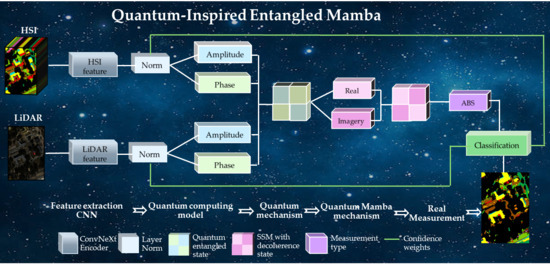
1. Introduction
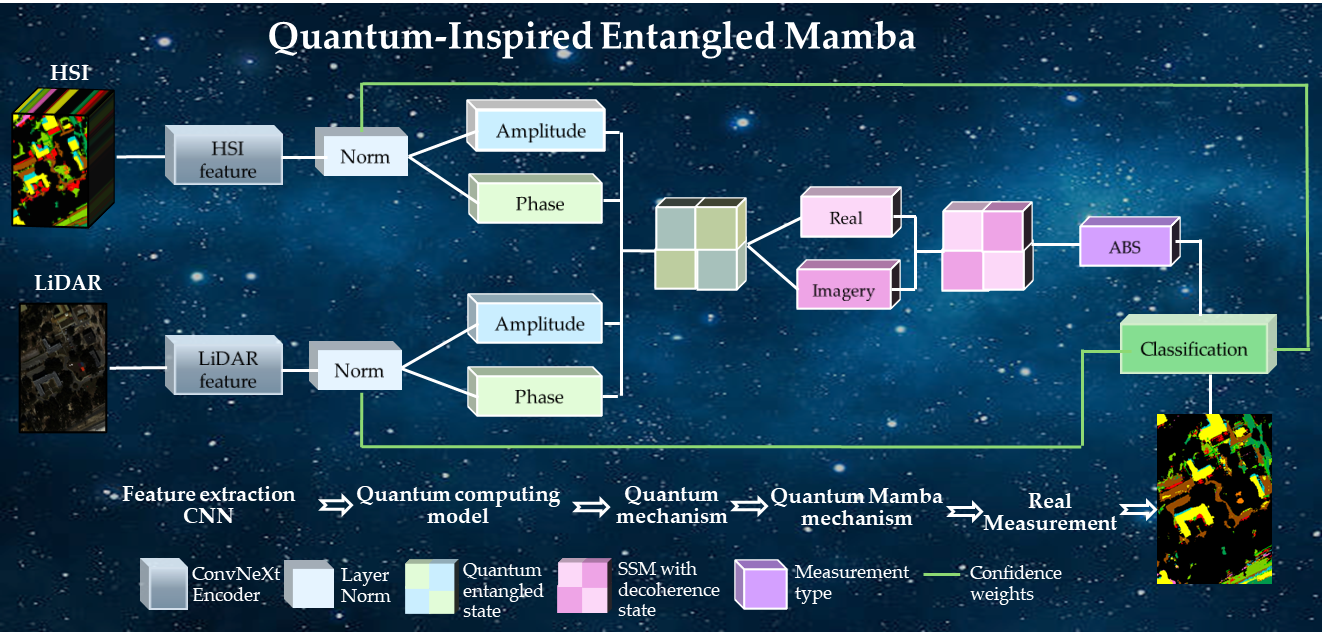
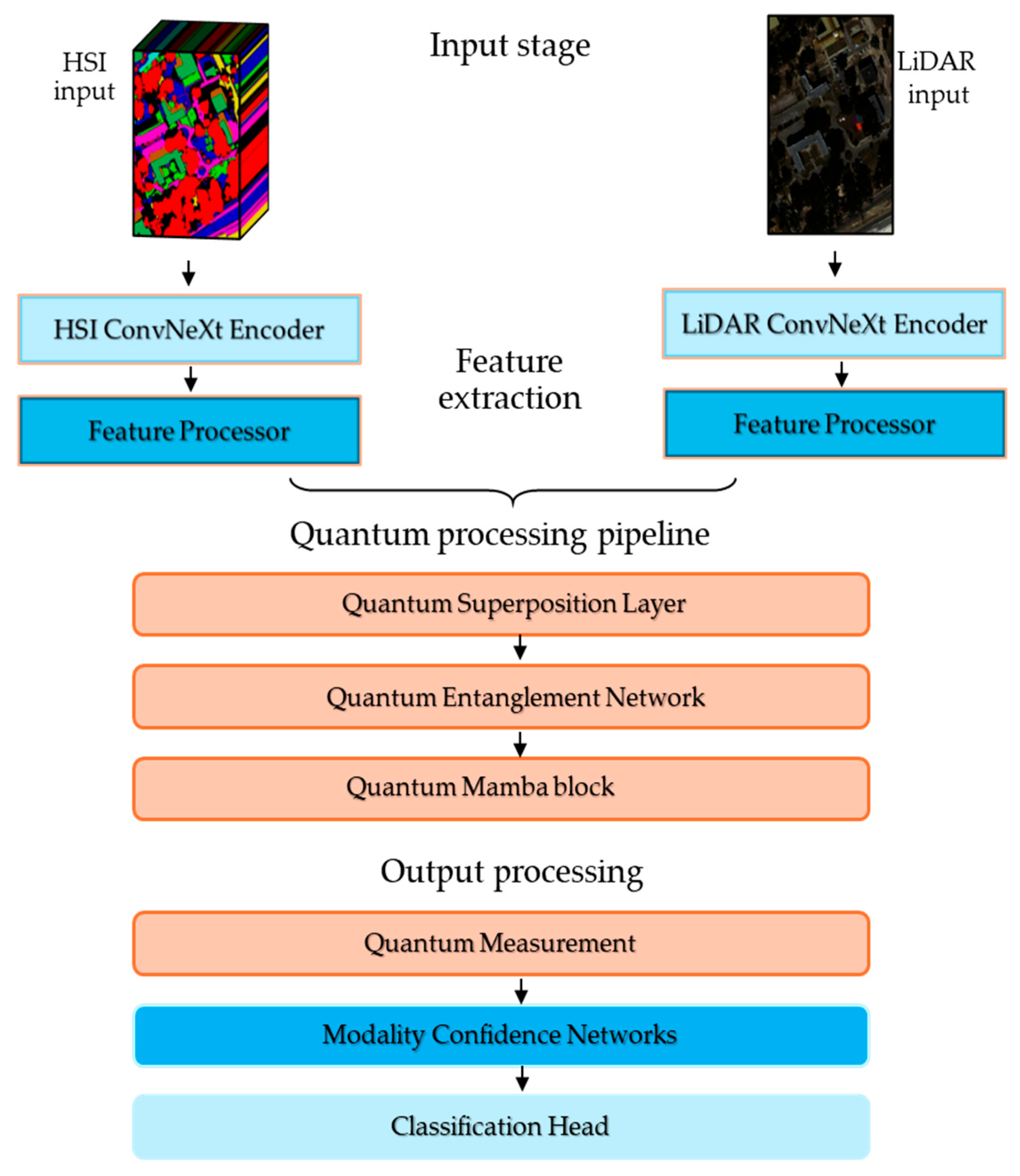
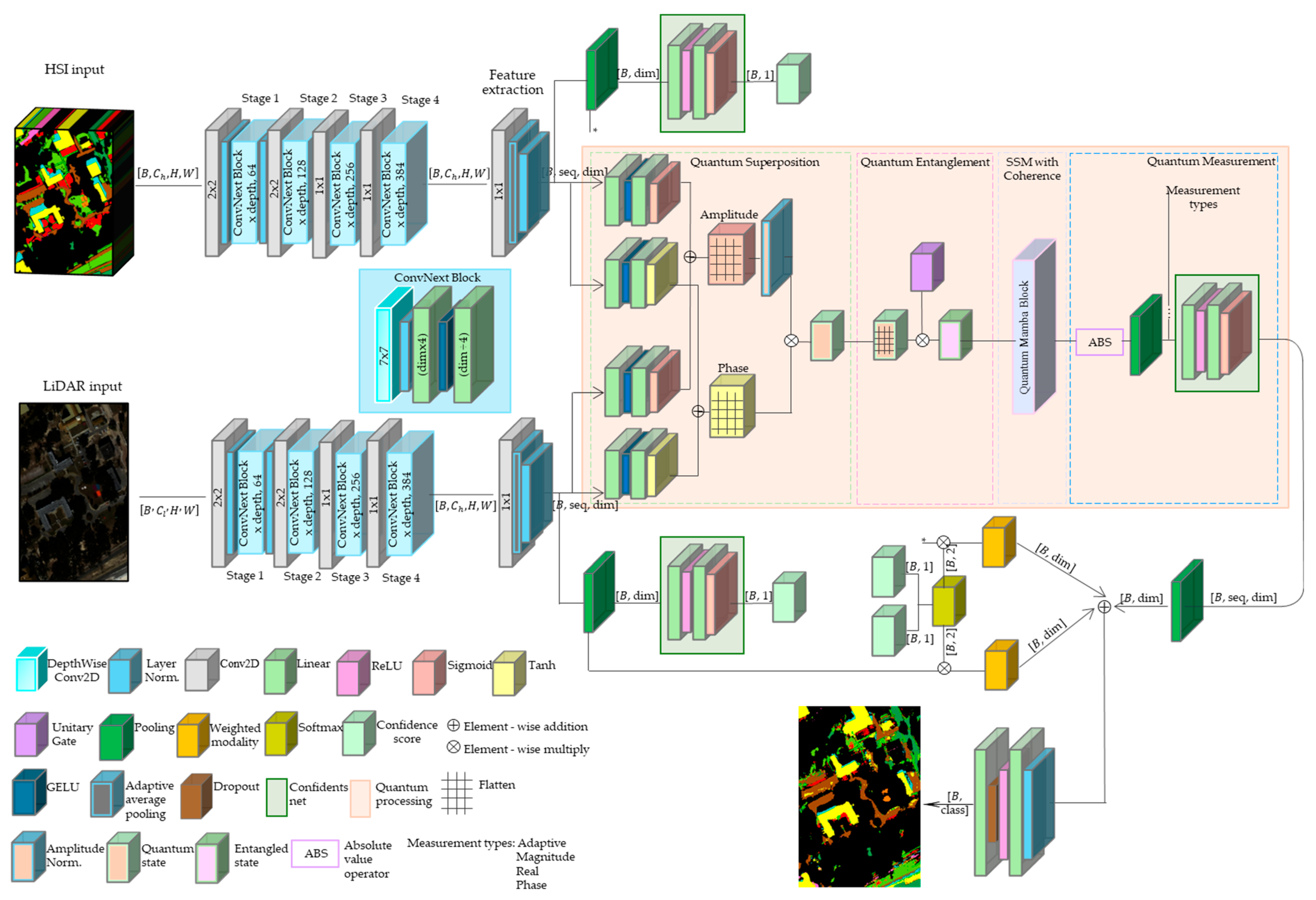
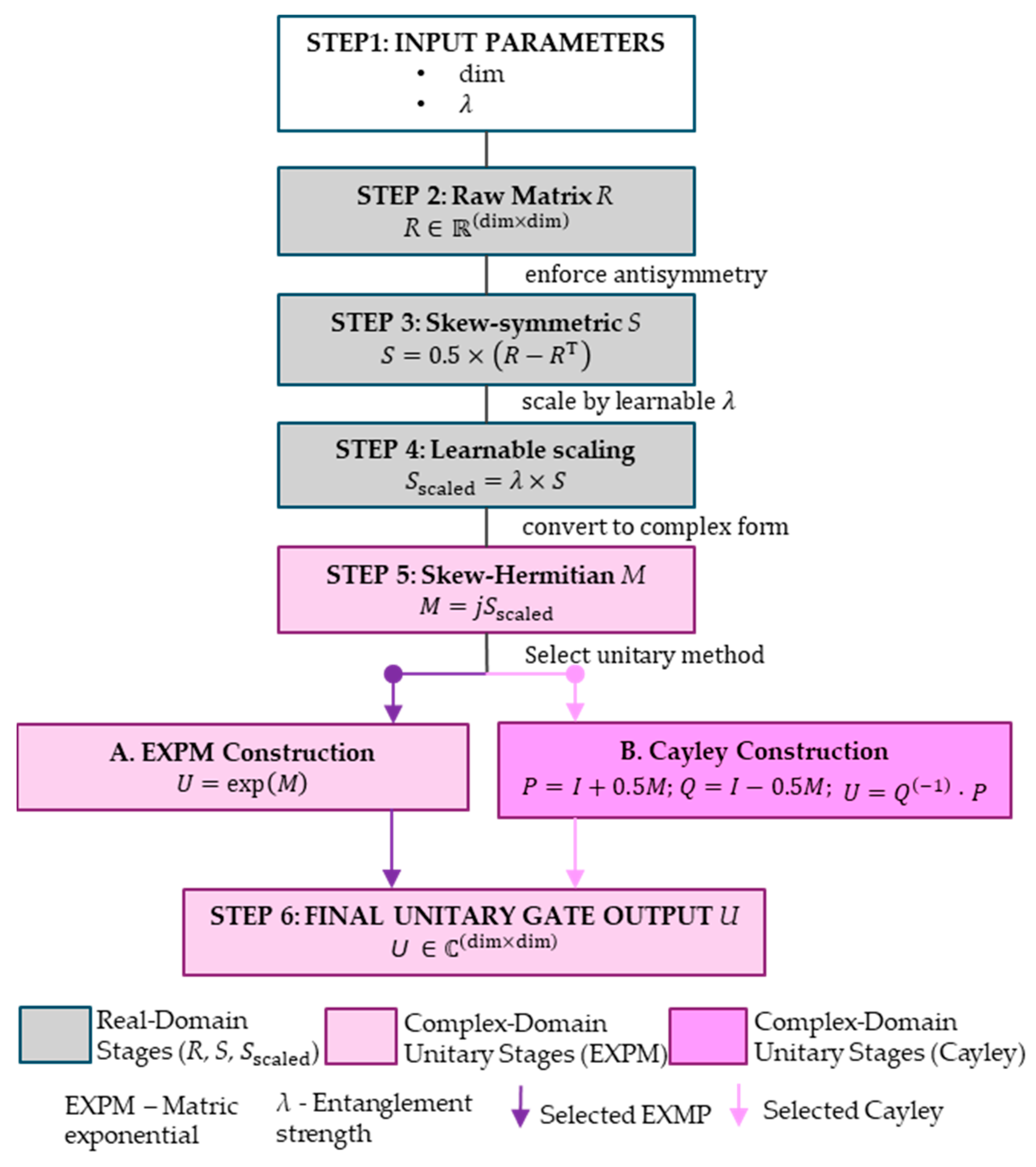
- Quantum-enhanced state-space architecture. By combining complex-valued quantum superposition with integrated entanglement networks (validated by Cayley transforms and matrix exponentials) within selective state-space models, we can achieve improved cross-modal correlation modeling beyond the classical coupling approach.
- Confidence-weighted quantum measurement. A confidence mechanism based on quantum measurement uncertainty provides adaptive per-sample weighting, contributing +0.57% percentage point improvement over superposition alone (95.45%→96.02% on Houston2013). Combined with real measurement extraction of amplitude relationships and dataset-adaptive decoherence rates (γ = 0.005–0.1), the system achieves stable quantum-to-classical state collapse while maintaining discriminative cross-modal information.
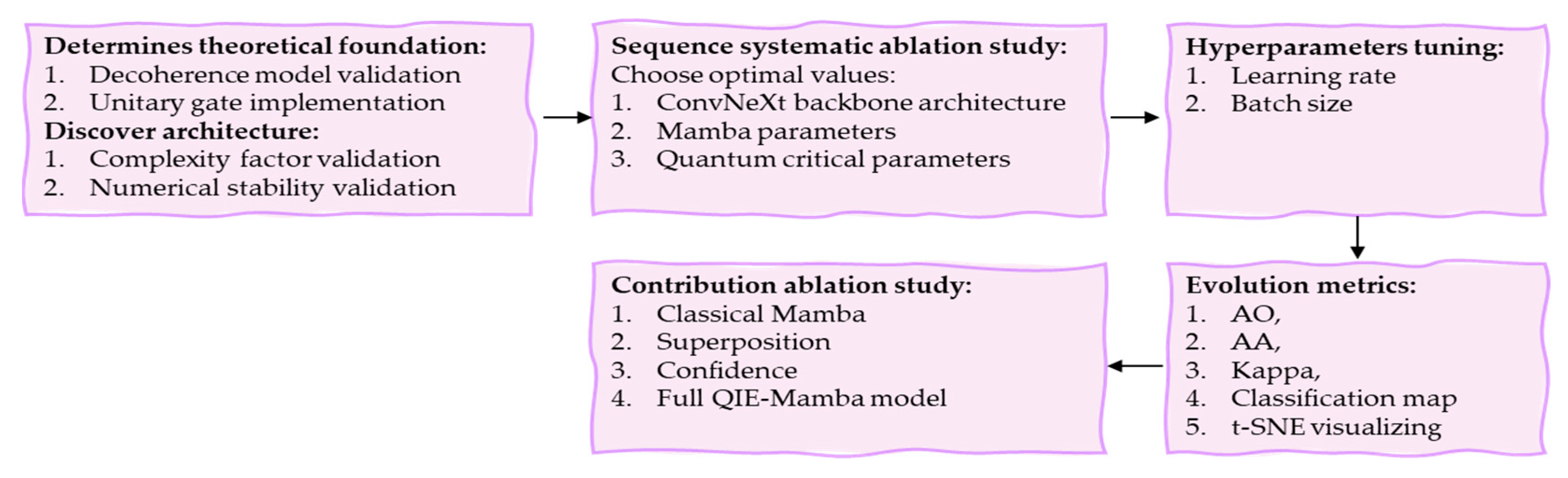
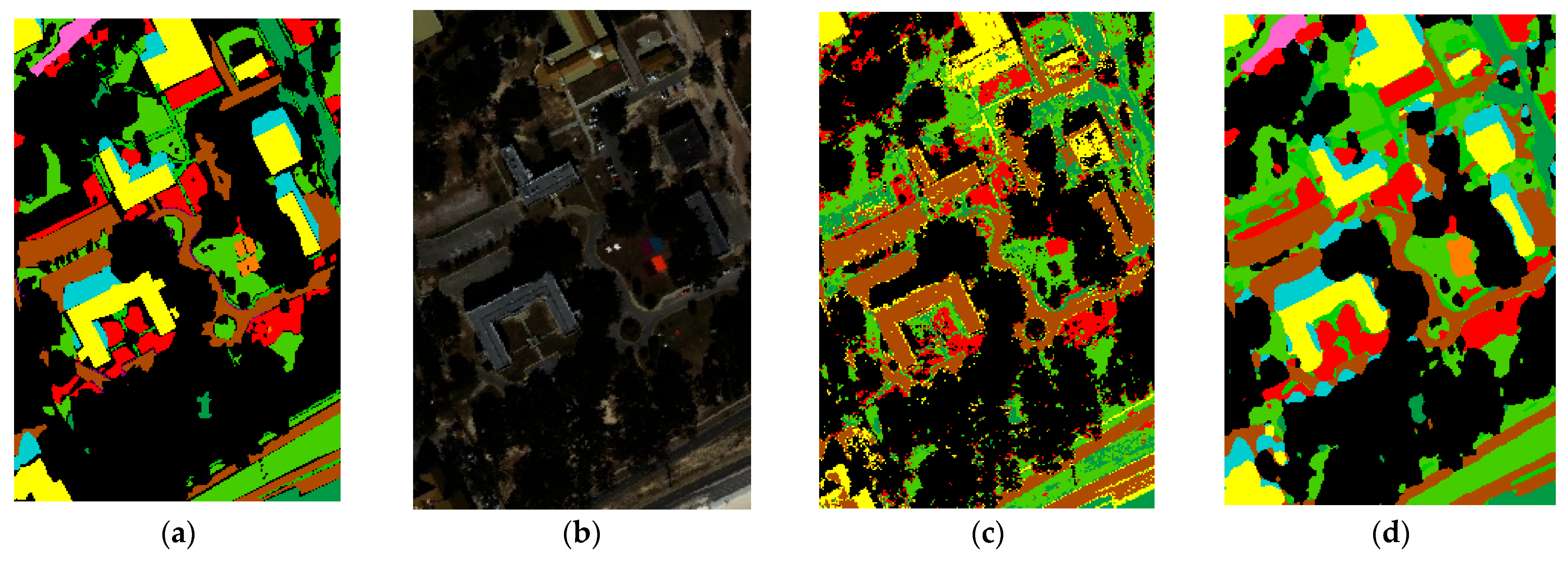
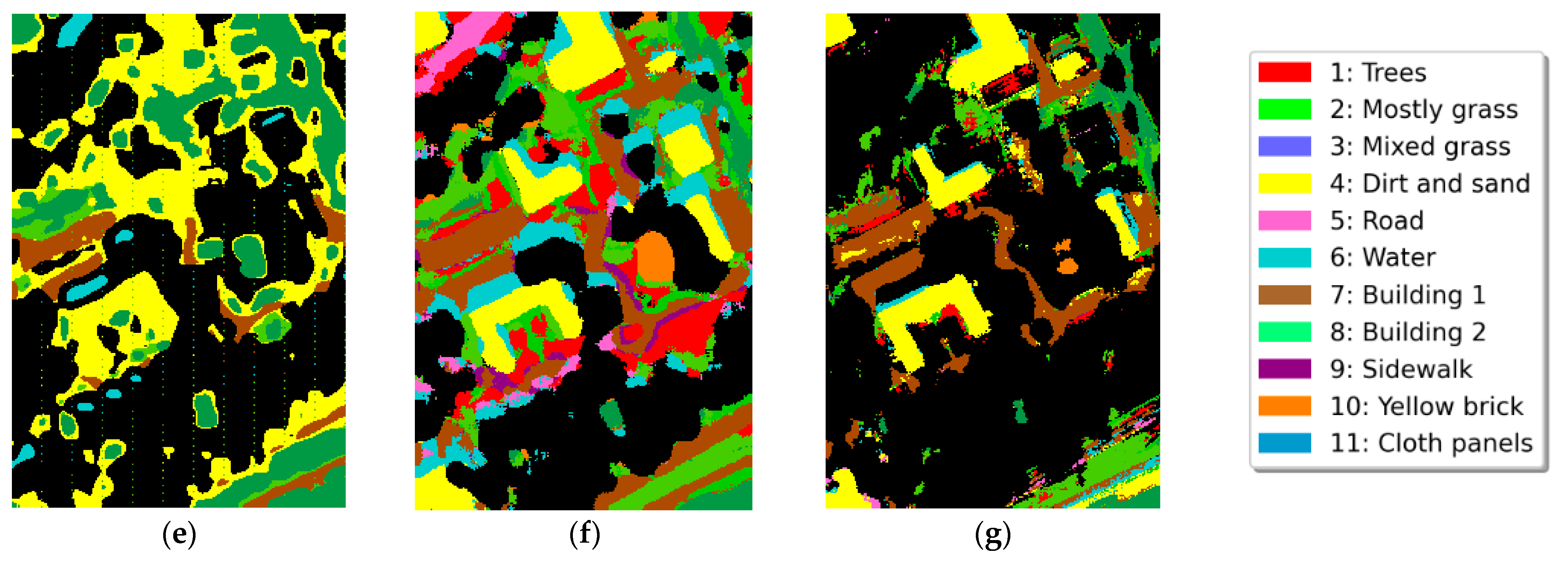
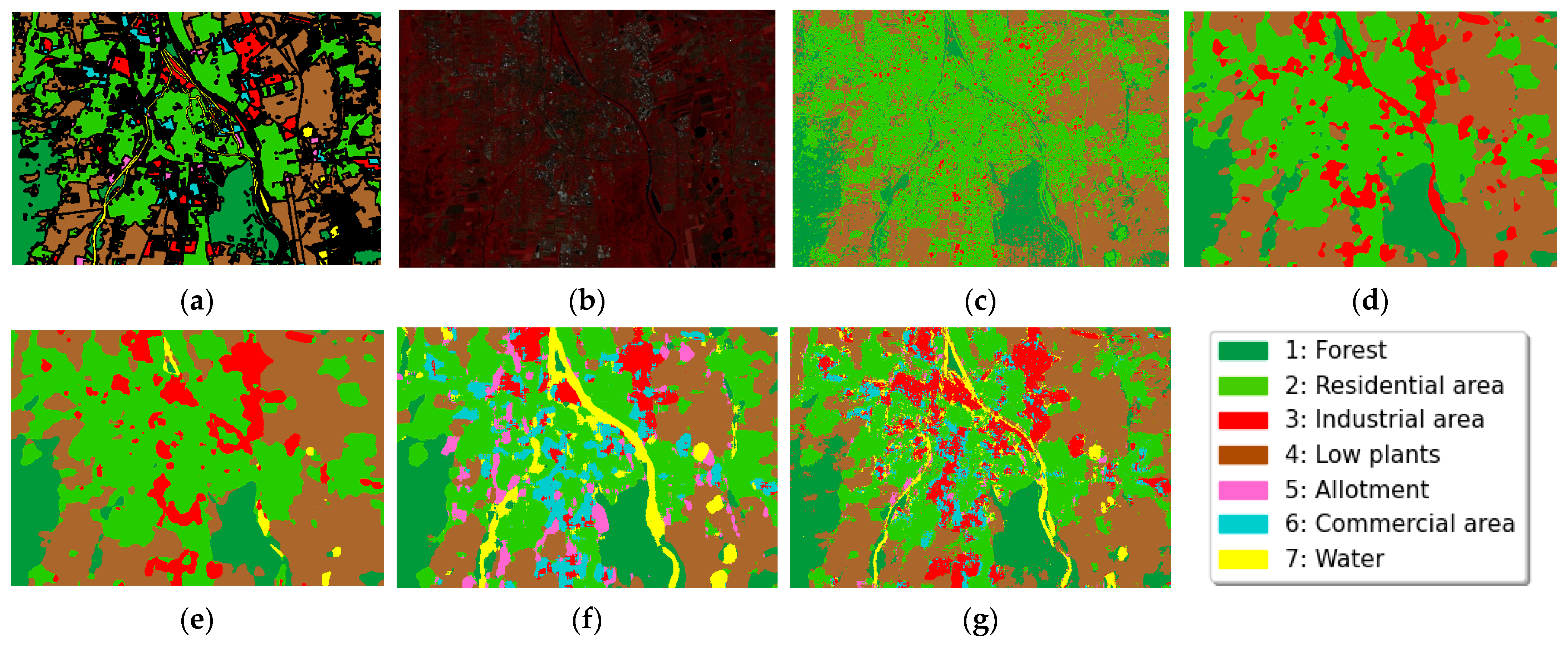
- Systematic validation framework. A three-stage sequential optimization methodology (ConvNeXt architecture → Mamba parameters → quantum components) reduces the complexity of hyperparameter search by 93.5% compared to full search, achieving 99.62%, 96.31%, and 96.30% accuracies in Houston2013, Muufl, and Augsburg, providing reproducible guidelines for quantum-inspired multimodal fusion in remote sensing applications.
2. Related Works
2.1. Multimodal Remote Sensing Fusion: Context and Obstacles
2.2. Deep Learning Architectures for Remote Sensing Fusion
2.3. State-Space and Quantum-Inspired Models
3. Method
3.1. Problem Formulation
- Detailed complexity representation, which encodes both amplitude (feature size) and phase (relationship between modals) [47];
- Uniform transformation, which preserves information with inverse operations [48];
- Systematic validation framework. A measurement technique elucidates the fundamental attributes of the transition from quantum to classical features [49].
3.2. Hierarchical Feature Extraction with ConvNeXt Encoders
3.2.1. Stem Layer with Patchify Operation
3.2.2. ConvNeXt Stage Architecture
3.2.3. ConvNeXt Block
3.2.4. Sequence Conversion Module
3.3. Quantum-Inspired Entanglement Fusion
3.3.1. Quantum Superposition Layer
3.3.2. Unitary Entanglement Network
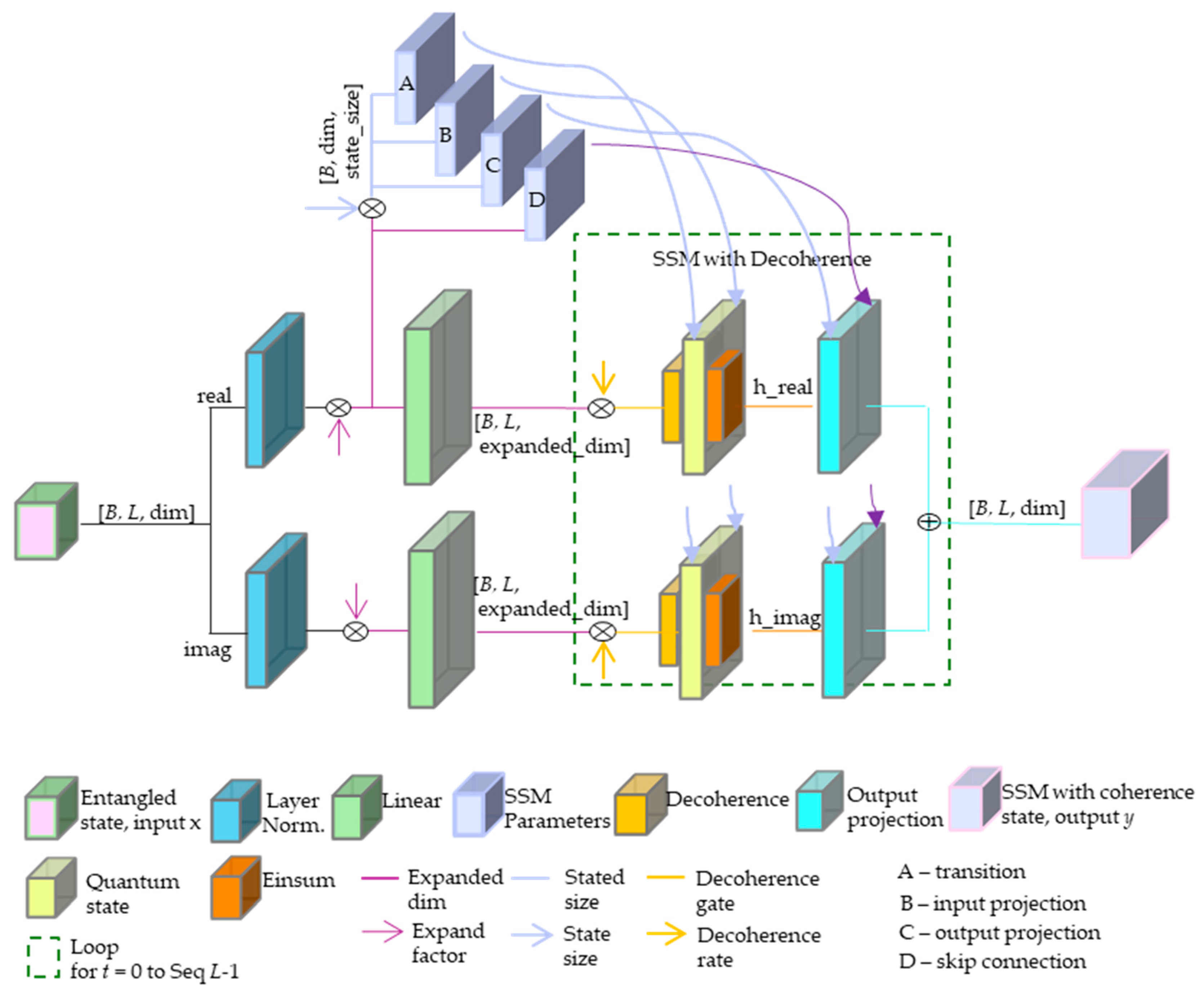
3.3.3. Quantum-Enhanced Mamba State-Space Model
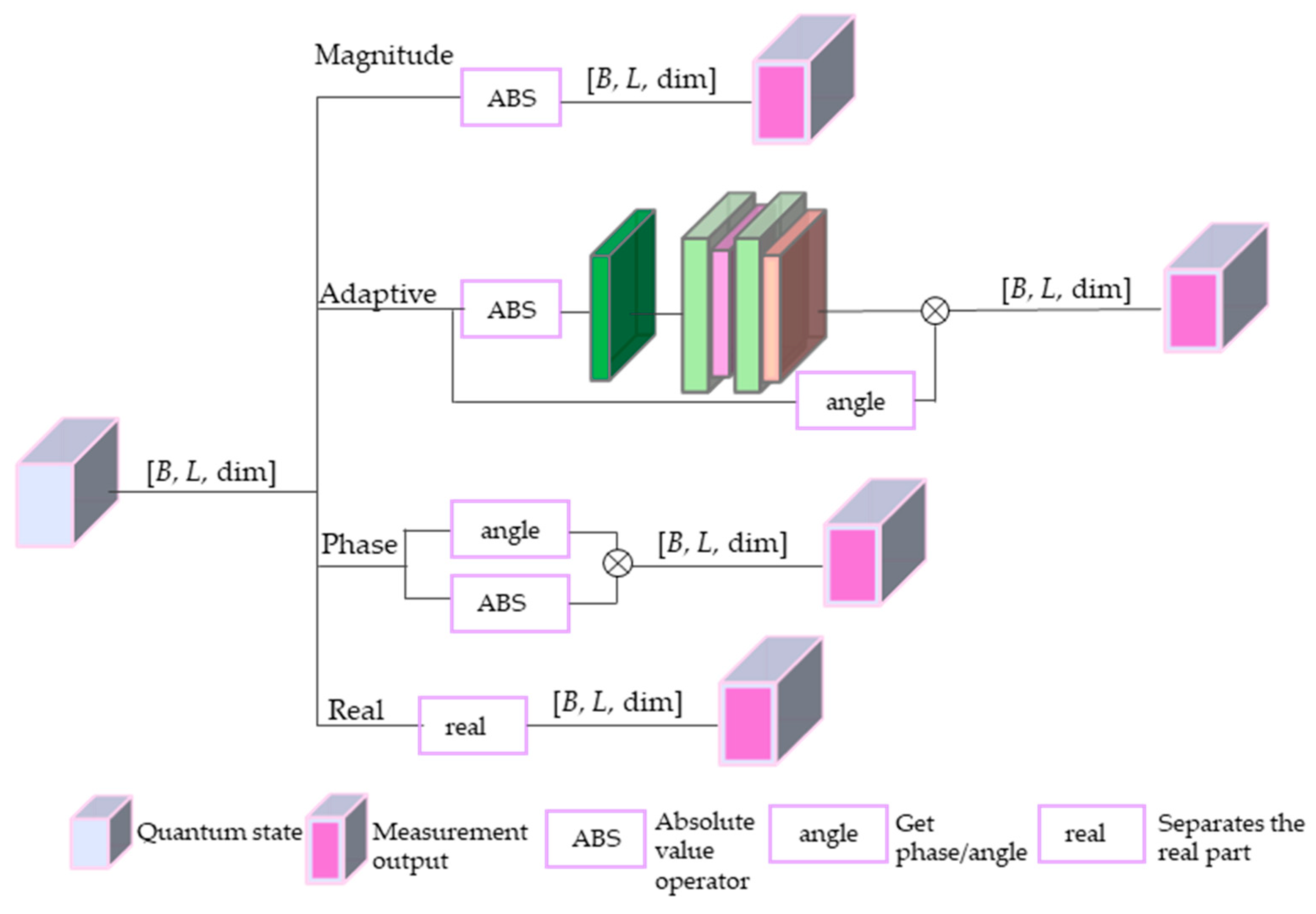
3.3.4. Quantum Measurement Selection Framework
- Magnitude measurement—calculates the absolute value of the quantum state magnitude:
- 2.
- Real projection—extracts only the real (Hermitian/observable) component:
- 3.
- Phase-aware measurement—combines the magnitude with phase information to preserve phase relationships:
- 4.
- Adaptive measurement (for comparative analysis during development)—uses a learned confidence network to explore different measurement strategies:
3.4. Confidence-Based Modality Fusion
3.5. Classification Head and Training
3.6. Theoretical Foundation
- ConvNeXt Encoder: Each stage performs convolutions and linear transformations. For feature map size with channels:
4. Experiments Results and Analysis
4.1. Experiment Setup
4.1.1. Datasets
4.1.2. Implementation Details
4.2. Determines Theoretical Foundation
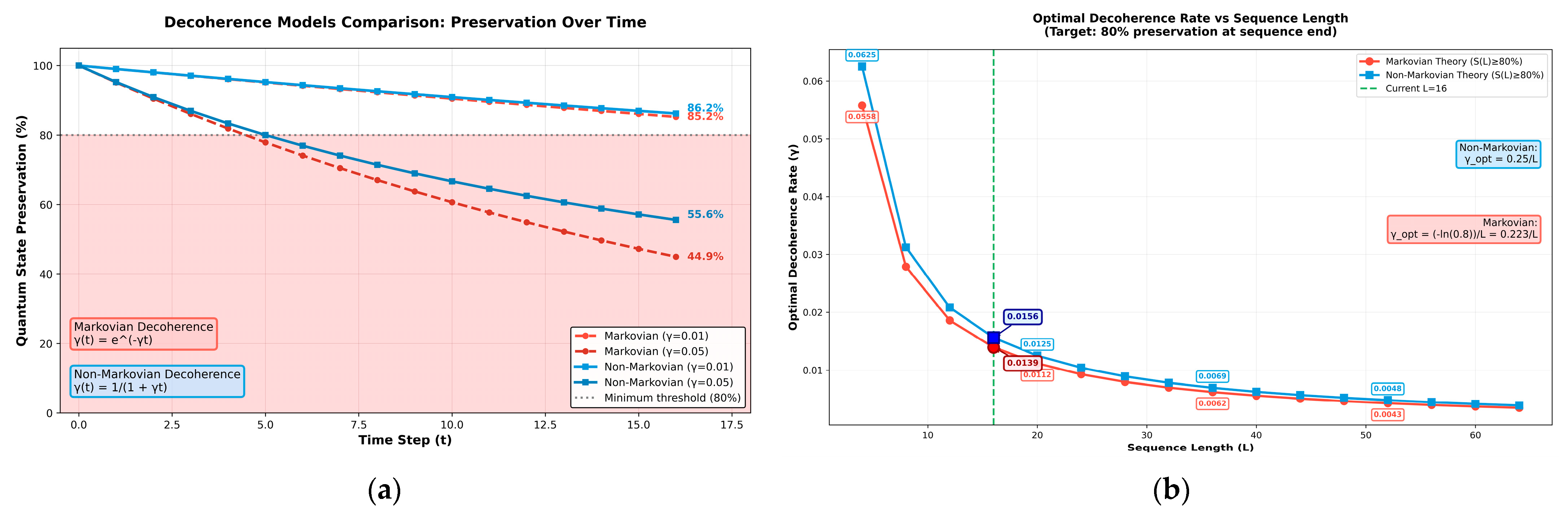
4.2.1. Decoherence Model Validation
4.2.2. Ablation Analysis of Complex Factor
4.2.3. Numerical Stability Validation
4.2.4. Unitary Gate Implementation
4.2.5. Decomposition Method Strategies Comparison
4.2.6. Domain Difference and Stability of Pseudomodalities
4.3. Optimal Selection of Key Parameters and Training Hyperparameters
4.3.1. Optimal Selection of Key Parameters
4.3.2. Training Hyperparameter Ablation
4.4. Comparison of Benchmark Approaches
4.5. Ablation Study
4.5.1. Contribution Ablation
4.5.2. Theoretical Validation Study
5. Discussion
6. Conclusions
Author Contributions
Funding
Data Availability Statement
Conflicts of Interest
References
- Chen, B.; Huang, B.; Xu, B. Multi-source remotely sensed data fusion for improving land cover classification. ISPRS J. Photogramm. Remote Sens. 2017, 124, 27–39. [Google Scholar] [CrossRef]
- Bhargava, A.; Sachdeva, A.; Sharma, K.; Alsharif, M.H.; Uthansakul, P.; Uthansakul, M. Hyperspectral imaging and its applications: A review. Heliyon 2024, 10, e33208. [Google Scholar] [CrossRef]
- Khan, M.J.; Khan, H.S.; Yousaf, A.; Khurshid, K.; Abbas, A. Modern Trends in Hyperspectral Image Analysis: A Review. IEEE Access 2018, 6, 14118–14129. [Google Scholar] [CrossRef]
- Liu, G.; Song, J.; Chu, Y.; Zhang, L.; Li, P.; Xia, J. Deep Fuzzy Fusion Network for Joint Hyperspectral and LiDAR Data Classification. Remote Sens. 2025, 17, 2923. [Google Scholar] [CrossRef]
- Wang, A.; Lei, G.; Dai, S.; Wu, H.; Iwahori, Y. Multiscale Attention Feature Fusion Based on Improved Transformer for Hyperspectral Image and LiDAR Data Classification. IEEE J. Sel. Top. Appl. Earth Obs. Remote Sens. 2025, 18, 4124–4140. [Google Scholar] [CrossRef]
- Ni, K.; Li, Z.; Yuan, C.; Zheng, Z.; Wang, P. Selective Spectral–Spatial Aggregation Transformer for Hyperspectral and LiDAR Classification. IEEE Geosci. Remote Sens. Lett. 2025, 22, 1–5. [Google Scholar] [CrossRef]
- Rehman, M.Z.U.; Islam, S.M.S.; Blake, D.; Ulhaq, A.; Janjua, N. Deep learning for land use classification: A systematic review of HS-LiDAR imagery. Artif. Intell. Rev. 2025, 58, 272. [Google Scholar] [CrossRef]
- Wang, X.; Feng, Y.; Song, R.; Mu, Z.; Song, C. Multi-attentive hierarchical dense fusion net for fusion classification of hyperspectral and LiDAR data. Inf. Fusion 2022, 82, 1–18. [Google Scholar] [CrossRef]
- Han, K.; Wang, Y.; Chen, H.; Chen, X.; Guo, J.; Liu, Z.; Tang, Y.; Xiao, A.; Xu, C.; Xu, Y.; et al. A Survey on Vision Transformer. IEEE Trans. Pattern Anal. Mach. Intell. 2023, 45, 87–110. [Google Scholar] [CrossRef]
- Ye, M.; Ruiwen, N.; Chang, Z.; He, G.; Tianli, H.; Shijun, L.; Yu, S.; Tong, Z.; Ying, G. A Lightweight Model of VGG-16 for Remote Sensing Image Classification. IEEE J. Sel. Top. Appl. Earth Obs. Remote Sens. 2021, 14, 6916–6922. [Google Scholar] [CrossRef]
- Zhu, H.; Ma, M.; Ma, W.; Jiao, L.; Hong, S.; Shen, J.; Hou, B. A spatial-channel progressive fusion ResNet for remote sensing classification. Inf. Fusion 2021, 70, 72–87. [Google Scholar] [CrossRef]
- Dosovitskiy, A.; Beyer, L.; Kolesnikov, A.; Weissenborn, D.; Zhai, X.; Unterthiner, T.; Dehghani, M.; Minderer, M.; Heigold, G.; Gelly, S. An image is worth 16 × 16 words: Transformers for image recognition at scale. arXiv 2020, arXiv:2010.11929. [Google Scholar]
- Radford, A.; Kim, J.W.; Hallacy, C.; Ramesh, A.; Goh, G.; Agarwal, S.; Sastry, G.; Askell, A.; Mishkin, P.; Clark, J. Learning transferable visual models from natural language supervision. In Proceedings of the International Conference on Machine Learning, Virtual Event, 18–24 July 2021; pp. 8748–8763. [Google Scholar]
- Gu, A.; Dao, T. Mamba: Linear-time sequence modeling with selective state spaces. arXiv 2023, arXiv:2312.00752. [Google Scholar] [CrossRef]
- Kalman, R.E. A new approach to linear filtering and prediction problems. J. Basic Eng. 1960, 82, 35–45. [Google Scholar] [CrossRef]
- Gu, A.; Dao, T.; Ermon, S.; Rudra, A.; Ré, C. Hippo: Recurrent memory with optimal polynomial projections. Adv. Neural Inf. Process. Syst. 2020, 33, 1474–1487. [Google Scholar]
- Gu, A.; Goel, K.; Ré, C. Efficiently modeling long sequences with structured state spaces. arXiv 2021, arXiv:2111.00396. [Google Scholar] [CrossRef]
- Schuld, M.; Sinayskiy, I.; Petruccione, F. An introduction to quantum machine learning. Contemp. Phys. 2015, 56, 172–185. [Google Scholar] [CrossRef]
- Meedinti, G.N.; Srirekha, K.S.; Delhibabu, R. A quantum convolutional neural network approach for object detection and classification. arXiv 2023, arXiv:2307.08204. [Google Scholar] [CrossRef]
- Ghamisi, P.; Rasti, B.; Yokoya, N.; Wang, Q.; Hofle, B.; Bruzzone, L.; Bovolo, F.; Chi, M.; Anders, K.; Gloaguen, R.; et al. Multisource and Multitemporal Data Fusion in Remote Sensing: A Comprehensive Review of the State of the Art. IEEE Geosci. Remote Sens. Mag. 2019, 7, 6–39. [Google Scholar] [CrossRef]
- Hu, Q.; Wang, F.; Fang, J.; Li, Y. Semantic Labeling of High-Resolution Images Combining a Self-Cascaded Multimodal Fully Convolution Neural Network with Fully Conditional Random Field. Remote Sens. 2024, 16, 3300. [Google Scholar] [CrossRef]
- Liu, X.; Liu, Q.; Wang, Y. Remote sensing image fusion based on two-stream fusion network. Inf. Fusion 2020, 55, 1–15. [Google Scholar] [CrossRef]
- Li, H.; Ghamisi, P.; Soergel, U.; Zhu, X.X. Hyperspectral and LiDAR fusion using deep three-stream convolutional neural networks. Remote Sens. 2018, 10, 1649. [Google Scholar] [CrossRef]
- Xu, Y.; Mao, Y.; Li, H.; Shen, J.; Xu, X.; Wang, S.; Zaman, S.; Ding, Z.; Wang, Y. A deep learning model based on RGB and hyperspectral images for efficiently detecting tea green leafhopper damage symptoms. Smart Agric. Technol. 2025, 10, 100817. [Google Scholar] [CrossRef]
- Sha, W.; Hu, K.; Weng, S. Statistic and Network Features of RGB and Hyperspectral Imaging for Determination of Black Root Mold Infection in Apples. Foods 2023, 12, 1608. [Google Scholar] [CrossRef]
- Habili, N.; Kwan, E.; Li, W.; Webers, C.; Oorloff, J.; Armin, A.; Petersson, L. A Hyperspectral and RGB Dataset for Building Facade Segmentation; Springer: Cham, Switzerland, 2022. [Google Scholar]
- Li, S.; Song, W.; Fang, L.; Chen, Y.; Ghamisi, P.; Benediktsson, J.A. Deep Learning for Hyperspectral Image Classification: An Overview. IEEE Trans. Geosci. Remote Sens. 2019, 57, 6690–6709. [Google Scholar] [CrossRef]
- Sun, E.; Cui, Y.; Liu, P.; Yan, J. A decade of deep learning for remote sensing spatiotemporal fusion: Advances, challenges, and opportunities. Inf. Fusion 2026, 126, 103675. [Google Scholar] [CrossRef]
- Yang, B.; Wang, X.; Xing, Y.; Cheng, C.; Jiang, W.; Feng, Q. Modality Fusion Vision Transformer for Hyperspectral and LiDAR Data Collaborative Classification. IEEE J. Sel. Top. Appl. Earth Obs. Remote Sens. 2024, 17, 17052–17065. [Google Scholar] [CrossRef]
- Bai, M.; Zhou, Z.; Li, J.; Chen, Y.; Liu, J.; Zhao, X.; Yu, D. Deep graph gated recurrent unit network-based spatial–temporal multi-task learning for intelligent information fusion of multiple sites with application in short-term spatial–temporal probabilistic forecast of photovoltaic power. Expert Syst. Appl. 2024, 240, 122072. [Google Scholar] [CrossRef]
- Hussain, M.; O’Nils, M.; Lundgren, J.; Mousavirad, S.J. A Comprehensive Review On Deep Learning-Based Data Fusion. IEEE Access 2024, 12, 180093–180124. [Google Scholar] [CrossRef]
- Tang, Y.; Feng, Y.; Fung, S.; Xomchuk, V.R.; Jiang, M.; Moore, T.; Beckler, J. Spatiotemporal Deep-Learning-Based Algal Bloom Prediction for Lake Okeechobee Using Multisource Data Fusion. IEEE J. Sel. Top. Appl. Earth Obs. Remote Sens. 2022, 15, 8318–8331. [Google Scholar] [CrossRef]
- Xie, S.; Girshick, R.; Dollár, P.; Tu, Z.; He, K. Aggregated residual transformations for deep neural networks. In Proceedings of the IEEE Conference on Computer Vision and Pattern Recognition, Honolulu, HI, USA, 21–26 July 2017; pp. 1492–1500. [Google Scholar]
- Sivasubramanian, A.; Prashanth, V.R.; Hari, T.; Sowmya, V.; Gopalakrishnan, E.A.; Ravi, V. Transformer-based convolutional neural network approach for remote sensing natural scene classification. Remote Sens. Appl. Soc. Environ. 2024, 33, 101126. [Google Scholar] [CrossRef]
- Liu, Z.; Mao, H.; Wu, C.Y.; Feichtenhofer, C.; Darrell, T.; Xie, S. A ConvNet for the 2020s. In Proceedings of the 2022 IEEE/CVF Conference on Computer Vision and Pattern Recognition (CVPR), New Orleans, LA, USA, 18–24 June 2022; pp. 11966–11976. [Google Scholar]
- Roy, S.; Krishna, G.; Dubey, S.R.; Chaudhuri, B. HybridSN: Exploring 3D-2D CNN Feature Hierarchy for Hyperspectral Image Classification. IEEE Geosci. Remote. Sens. Lett. 2019, 17, 277–281. [Google Scholar] [CrossRef]
- Zhu, Y.; Yuan, K.; Zhong, W.; Xu, L. Spatial–Spectral ConvNeXt for Hyperspectral Image Classification. IEEE J. Sel. Top. Appl. Earth Obs. Remote Sens. 2023, 16, 5453–5463. [Google Scholar] [CrossRef]
- Wu, H.; Dai, S.; Liu, C.; Wang, A.; Iwahori, Y. A Novel Dual-Encoder Model for Hyperspectral and LiDAR Joint Classification via Contrastive Learning. Remote Sens. 2023, 15, 924. [Google Scholar] [CrossRef]
- Ai, J.; Mao, Y.; Luo, Q.; Jia, L.; Xing, M. SAR Target Classification Using the Multikernel-Size Feature Fusion-Based Convolutional Neural Network. IEEE Trans. Geosci. Remote Sens. 2022, 60, 1–13. [Google Scholar] [CrossRef]
- Xue, W.; Ai, J.; Zhu, Y.; Chen, J.; Zhuang, S. AIS-FCANet: Long-Term AIS Data Assisted Frequency-Spatial Contextual Awareness Network for Salient Ship Detection in SAR Imagery. IEEE Trans. Aerosp. Electron. Syst. 2025, 40, 15166–15171. [Google Scholar] [CrossRef]
- Zhang, Y.; Gao, H.; Chen, Z.; Fei, S.; Zhou, J.; Ghamisi, H.; Zhang, B. Adaptive multi-stage fusion of hyperspectral and LiDAR data via selective state space models. Inf. Fusion 2026, 125, 103488. [Google Scholar] [CrossRef]
- Hussain, K.M.; Zhao, K.; Zhou, Y.; Ali, A.; Li, Y. Cross Attention Based Dual-Modality Collaboration for Hyperspectral Image and LiDAR Data Classification. Remote Sens. 2025, 17, 2836. [Google Scholar] [CrossRef]
- Bloemheuvel, S.; van den Hoogen, J.; Atzmueller, M. Graph construction on complex spatiotemporal data for enhancing graph neural network-based approaches. Int. J. Data Sci. Anal. 2024, 18, 157–174. [Google Scholar] [CrossRef]
- Vaswani, A.; Shazeer, N.; Parmar, N.; Uszkoreit, J.; Jones, L.; Gomez, A.N.; Kaiser, Ł.; Polosukhin, I. Attention is all you need. Adv. Neural Inf. Process. Syst. 2017, 30. [Google Scholar]
- Hua, W.; Dai, Z.; Liu, H.; Le, Q. Transformer quality in linear time. In Proceedings of the International Conference on Machine Learning, PMLR, Baltimore, MD, USA, 17–23 July 2022; pp. 9099–9117. [Google Scholar]
- Huang, J.; Zhang, Y.; Yang, F.; Chai, L. Attention-Guided Fusion and Classification for Hyperspectral and LiDAR Data. Remote Sens. 2024, 16, 94. [Google Scholar] [CrossRef]
- Preskill, J. Quantum computing in the NISQ era and beyond. Quantum 2018, 2, 79. [Google Scholar] [CrossRef]
- Lloyd, S.; Mohseni, M.; Rebentrost, P. Quantum principal component analysis. Nat. Phys. 2014, 10, 631–633. [Google Scholar] [CrossRef]
- Biamonte, J.; Wittek, P.; Pancotti, N.; Rebentrost, P.; Wiebe, N.; Lloyd, S. Quantum machine learning. Nature 2017, 549, 195–202. [Google Scholar] [CrossRef] [PubMed]
- Nevalainen, O.; Honkavaara, E.; Tuominen, S.; Viljanen, N.; Hakala, T.; Yu, X.; Hyyppä, J.; Saari, H.; Pölönen, I.; Imai, N.N.; et al. Individual Tree Detection and Classification with UAV-Based Photogrammetric Point Clouds and Hyperspectral Imaging. Remote Sens. 2017, 9, 185. [Google Scholar] [CrossRef]
- Ba, J.L.; Kiros, J.R.; Hinton, G.E. Layer normalization. arXiv 2016, arXiv:1607.06450. [Google Scholar] [CrossRef]
- Hendrycks, D.; Gimpel, K. Gaussian error linear units (gelus). arXiv 2016, arXiv:1606.08415. [Google Scholar]
- Huang, G.; Sun, Y.; Liu, Z.; Sedra, D.; Weinberger, K.Q. Deep networks with stochastic depth. In Proceedings of the European Conference on Computer Vision, Amsterdam, The Netherlands, 11–14 October 2016; pp. 646–661. [Google Scholar]
- Yang, J.X.; Zhou, J.; Wang, J.; Tian, H.; Liew, A.W.C. LiDAR-Guided Cross-Attention Fusion for Hyperspectral Band Selection and Image Classification. IEEE Trans. Geosci. Remote Sens. 2024, 62, 1–15. [Google Scholar] [CrossRef]
- Nielsen, M.A.; Chuang, I.L. Quantum Computation and Quantum Information; Cambridge University Press: Cambridge, UK, 2010. [Google Scholar]
- Helfrich, K.; Willmott, D.; Ye, Q. Orthogonal recurrent neural networks with scaled Cayley transform. In Proceedings of the International Conference on Machine Learning, Stockholm, Sweden, 10–15 July 2018; pp. 1969–1978. [Google Scholar]
- Mhammedi, Z.; Hellicar, A.; Rahman, A.; Bailey, J. Efficient orthogonal parametrisation of recurrent neural networks using householder reflections. In Proceedings of the International Conference on Machine Learning, Sydney, Australia, 6–11 August 2017; pp. 2401–2409. [Google Scholar]
- Arjovsky, M.; Shah, A.; Bengio, Y. Unitary evolution recurrent neural networks. In Proceedings of the International Conference on Machine Learning, New York, NY, USA, 19–24 June 2016; pp. 1120–1128. [Google Scholar]
- Zurek, W.H. Decoherence, einselection, and the quantum origins of the classical. Rev. Mod. Phys. 2003, 75, 715. [Google Scholar] [CrossRef]
- Breuer, H.-P.; Petruccione, F. The Theory of Open Quantum Systems; OUP: Oxford, UK, 2002. [Google Scholar]
- Rivas, Á.; Huelga, S.F.; Plenio, M.B. Quantum non-Markovianity: Characterization, quantification and detection. Rep. Prog. Phys. 2014, 77, 094001. [Google Scholar] [CrossRef] [PubMed]
- Paz, J.P.; Zurek, W.H. Environment-induced decoherence and the transition from quantum to classical. In Fundamentals of Quantum Information: Quantum Computation, Communication, Decoherence and All That; Springer: Berlin/Heidelberg, Germany, 2002; pp. 77–148. [Google Scholar]
- Garraway, B. Nonperturbative decay of an atomic system in a cavity. Phys. Rev. A 1997, 55, 2290. [Google Scholar] [CrossRef]
- Berberan-Santos, M.; Bodunov, E.; Valeur, B. Mathematical functions for the analysis of luminescence decays with underlying distributions 1. Kohlrausch decay function (stretched exponential). Chem. Phys. 2005, 315, 171–182. [Google Scholar] [CrossRef]
- Rasti, B.; Hong, D.; Hang, R.; Ghamisi, P.; Kang, X.; Chanussot, J.; Benediktsson, J.A. Feature extraction for hyperspectral imagery: The evolution from shallow to deep: Overview and toolbox. IEEE Geosci. Remote Sens. Mag. 2020, 8, 60–88. [Google Scholar] [CrossRef]
- Hong, D.; Gao, L.; Yokoya, N.; Yao, J.; Chanussot, J.; Du, Q.; Zhang, B. More Diverse Means Better: Multimodal Deep Learning Meets Remote-Sensing Imagery Classification. IEEE Trans. Geosci. Remote Sens. 2021, 59, 4340–4354. [Google Scholar] [CrossRef]
- Burnham, K.P.; Anderson, D.R. Model Selection and Multimodel Inference: A Practical Information-Theoretic Approach; Springer: Berlin/Heidelberg, Germany, 2002. [Google Scholar]
- Trabelsi, C.; Bilaniuk, O.; Zhang, Y.; Serdyuk, D.; Subramanian, S.; Santos, J.F.; Mehri, S.; Rostamzadeh, N.; Bengio, Y.; Pal, C.J. Deep complex networks. arXiv 2017, arXiv:1705.09792. [Google Scholar]
- Aharonov, Y.; Albert, D.Z.; Vaidman, L. How the result of a measurement of a component of the spin of a spin-1/2 particle can turn out to be 100. Phys. Rev. Lett. 1988, 60, 1351. [Google Scholar] [CrossRef] [PubMed]
- Ramachandram, D.; Taylor, G.W. Deep multimodal learning: A survey on recent advances and trends. IEEE Signal Process. Mag. 2017, 34, 96–108. [Google Scholar] [CrossRef]
- Hu, W.; Huang, Y.; Wei, L.; Zhang, F.; Li, H. Deep Convolutional Neural Networks for Hyperspectral Image Classification. J. Sens. 2015, 2015, 258619. [Google Scholar] [CrossRef]
- Roy, S.K.; Deria, A.; Hong, D.; Rasti, B.; Plaza, A.; Chanussot, J. Multimodal fusion transformer for remote sensing image classification. IEEE Trans. Geosci. Remote Sens. 2023, 61, 1–20. [Google Scholar] [CrossRef]
- Lu, T.; Ding, K.; Fu, W.; Li, S.; Guo, A. Coupled adversarial learning for fusion classification of hyperspectral and LiDAR data. Inf. Fusion 2023, 93, 118–131. [Google Scholar] [CrossRef]



| Houston2013 | Muufl | Augsburg | |||
|---|---|---|---|---|---|
| Classes | Train/Test | Classes | Train/Test | Classes | Train/Test |
| Grass healthy | 250/1001 | Trees | 4649/18,597 | Forest | 2701/10,806 |
| Grass stressed | 250/1004 | Mostly grass | 854/3416 | Residential area | 6065/24,264 |
| Grass synthetic | 139/558 | Mixed ground | 1376/5506 | Industrial area | 770/3081 |
| Trees | 248/996 | Dirt and sand | 365/1461 | Low plants | 5371/21,486 |
| Soil | 248/994 | Road | 1337/5350 | Allotment | 115/460 |
| Water | 65/260 | Water | 93/373 | Commercial area | 329/1316 |
| Residential | 253/1015 | Building shadow | 446/1787 | Water | 306/1224 |
| Commercial | 248/996 | Building | 1248/4992 | ||
| Road | 250/1002 | Sidewalk | 277/1108 | ||
| Highway | 245/982 | Yellow curb | 36/147 | ||
| Railway | 247/988 | Cloth panels | 53/216 | ||
| Parking lot1 | 246/987 | ||||
| Parking lot2 | 93/376 | ||||
| Tennis court | 85/343 | ||||
| Running track | 132/528 | ||||
| Decoherence Rate | Decoherence Model | Houston2013 | Muufl | Augsburg | Preservation (%) | ||||||
|---|---|---|---|---|---|---|---|---|---|---|---|
| OA (%) | AA (%) | 100 | OA (%) | AA (%) | 100 | OA (%) | AA (%) | 100 | |||
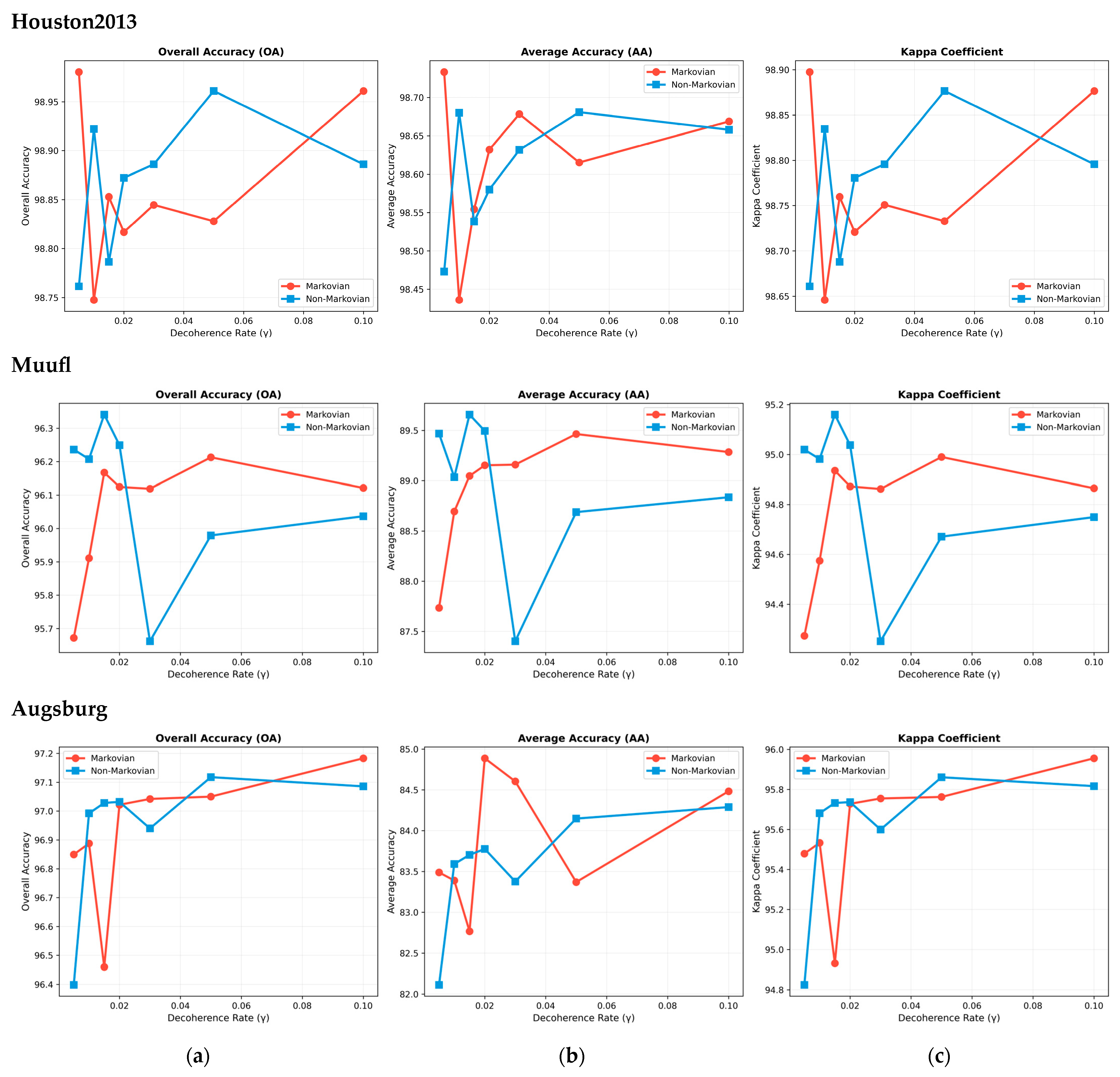
| 0.005 | Markovian | 98.98 | 98.73 | 98.90 | 95.67 | 87.73 | 94.27 | 96.85 | 83.49 | 95.48 | 92.31 |
| Non-Markovian | 98.76 | 98.47 | 98.66 | 96.24 | 89.47 | 95.02 | 96.40 | 82.11 | 84.82 | 92.59 | |
| 0.01 | Markovian | 98.75 | 98.44 | 98.65 | 95.91 | 88.69 | 94.57 | 96.89 | 83.39 | 95.53 | 85.21 |
| Non-Markovian | 98.92 | 98.68 | 98.83 | 96.21 | 89.03 | 94.98 | 96.99 | 83.59 | 95.68 | 86.21 | |
| 0.015 | Markovian | 98.85 | 98.55 | 98.76 | 96.17 | 89.05 | 94.94 | 96.46 | 82.77 | 94.93 | 78.66 |
| Non-Markovian | 98.79 | 98.54 | 98.69 | 96.34 | 89.66 | 95.16 | 97.03 | 83.70 | 95.73 | 80.65 | |
| 0.02 | Markovian | 98.82 | 98.63 | 98.72 | 96.12 | 89.15 | 94.87 | 97.02 | 84.89 | 95.73 | 72.61 |
| Non-Markovian | 98.87 | 98.58 | 98.78 | 96.25 | 89.50 | 95.04 | 97.03 | 83.78 | 95.73 | 75.76 | |
| 0.03 | Markovian | 98.84 | 98.68 | 98.75 | 96.12 | 89.16 | 94.86 | 97.04 | 84.60 | 95.73 | 61.88 |
| Non-Markovian | 98.89 | 98.63 | 98.80 | 95.66 | 87.40 | 94.25 | 96.94 | 83.38 | 95.60 | 67.57 | |
| 0.05 | Markovian | 98.83 | 98.62 | 98.73 | 96.21 | 89.46 | 94.99 | 97.05 | 83.37 | 95.76 | 44.93 |
| Non-Markovian | 98.96 | 98.68 | 98.88 | 95.98 | 88.69 | 94.67 | 97.12 | 84.15 | 95.86 | 55.56 | |
| 0.1 | Markovian | 98.96 | 98.67 | 98.88 | 96.12 | 89.28 | 94.87 | 97.18 | 84.48 | 95.96 | 20.19 |
| Non-Markovian | 98.89 | 98.66 | 98.80 | 96.04 | 88.84 | 94.75 | 97.09 | 84.29 | 95.82 | 38.46 | |
| Hidden Dimension | Parameters (M) | Houston2013 | Muufl | Augsburg | |||||||
|---|---|---|---|---|---|---|---|---|---|---|---|
| OA (%) | AA (%) | Kappa | OA (%) | AA (%) | Kappa | OA (%) | AA (%) | Kappa | |||
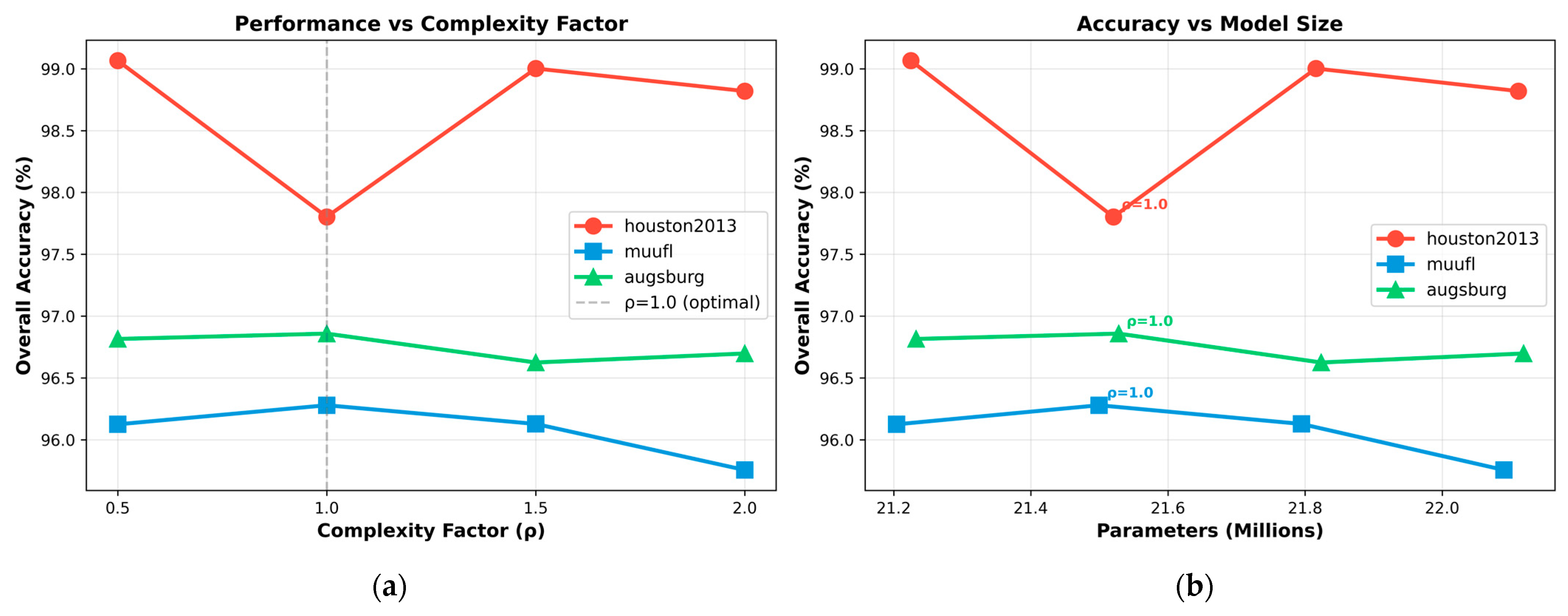
| 0.5 | 192 | 21.2 | 99.07 | 98.88 | 98.99 | 96.12 | 89.47 | 94.87 | 96.81 | 83.64 | 95.43 |
| 1.0 | 384 | 21.5 | 97.80 | 97.78 | 97.63 | 96.28 | 89.73 | 95.08 | 96.86 | 83.38 | 95.48 |
| 1.5 | 576 | 21.8 | 99.00 | 98.79 | 98.92 | 96.13 | 88.88 | 94.88 | 96.62 | 81.59 | 95.14 |
| 2.0 | 768 | 22.1 | 98.82 | 98.51 | 98.72 | 95.76 | 88.39 | 94.37 | 96.70 | 82.97 | 95.27 |
| Metric | Houston2013 | Muufl | Augsburg | ||||||
|---|---|---|---|---|---|---|---|---|---|
| HSI Amplitude | LiDAR Amplitude | Combined Sum | HSI Amplitude | LiDAR Amplitude | Combined Sum | HSI Amplitude | LiDAR Amplitude | Combined Sum | |
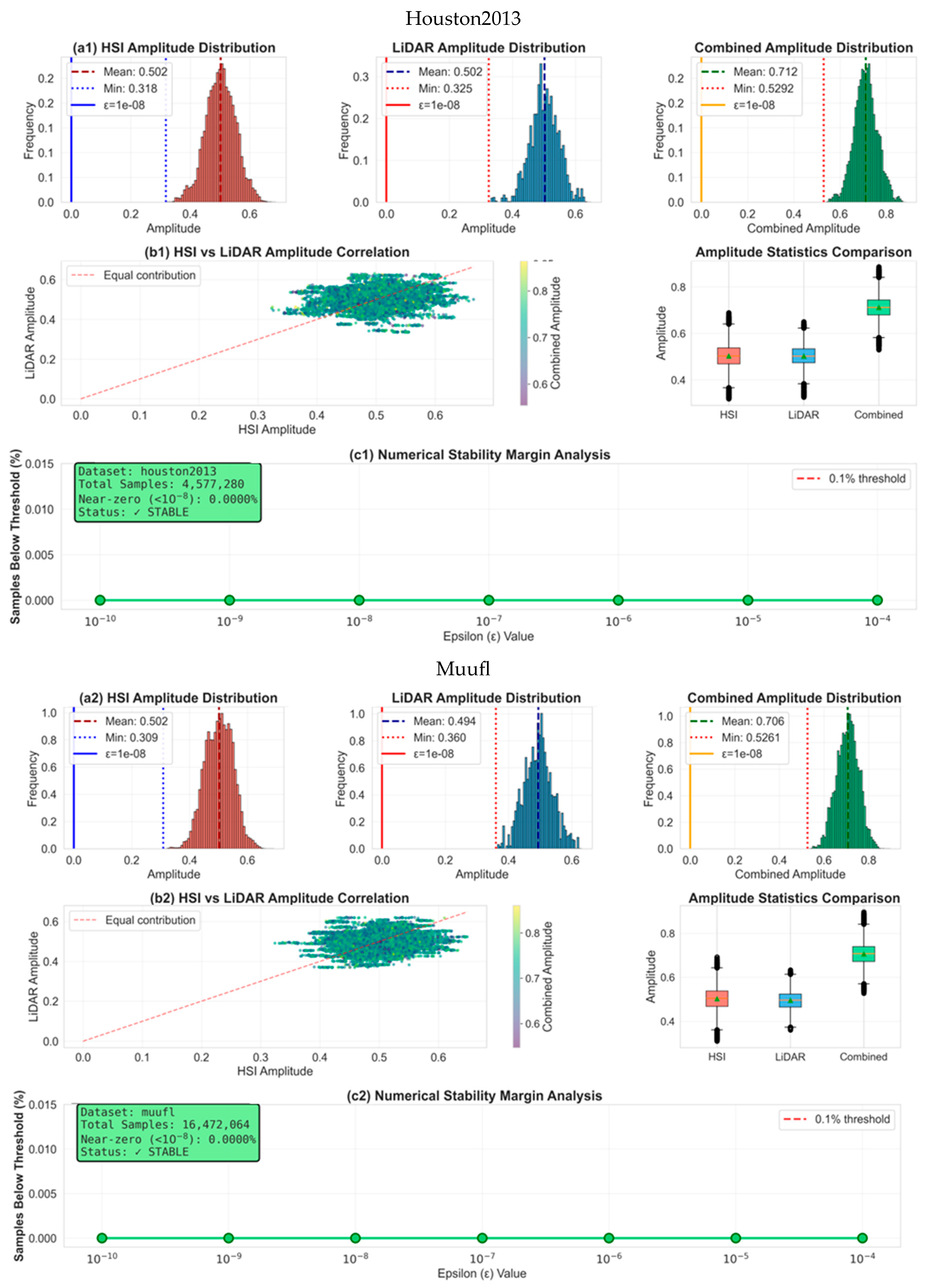
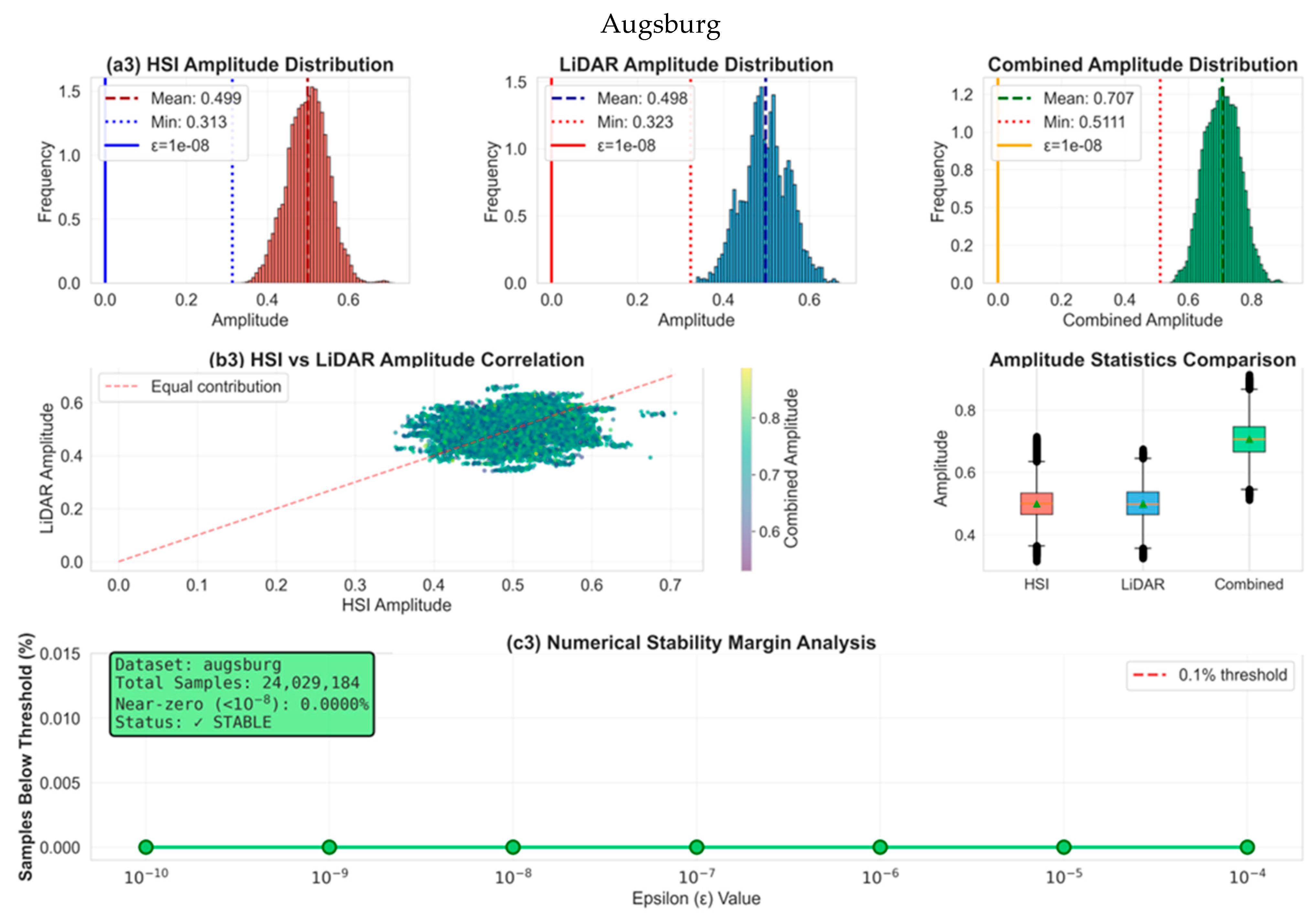
| Mean | 0.5023 | 0.5020 | 0.7116 | 0.5019 | 0.4943 | 0.7058 | 0.4990 | 0.4983 | 0.7068 |
| Std Dev | 0.0504 | 0.0460 | 0.0505 | 0.0482 | 0.0459 | 0.0495 | 0.0495 | 0.0539 | 0.0555 |
| Min | 0.3180 | 0.3252 | 0.5292 | 0.3088 | 0.3597 | 0.5261 | 0.3133 | 0.3235 | 0.5111 |
| Max | 0.6882 | 0.6494 | 0.8861 | 0.6918 | 0.6328 | 0.8979 | 0.7146 | 0.6745 | 0.9139 |
| Metric | Houston2013 | Muufl | Augsburg | ||||||
|---|---|---|---|---|---|---|---|---|---|
| Real– Imaginary | Amplitude– Phase | Δ | Real– Imaginary | Amplitude– Phase | Δ | Real– Imaginary | Amplitude– Phase | Δ | |
| Accuracy (%) | 98.71 ± 0.14 | 98.65 ± 0.13 | +0.06 | 96.04 ± 0.03 | 96.00 ± 0.05 | +0.04 | 97.27 ± 0.03 | 96.94 ± 0.03 | +0.32 |
| Final loss | 0.00 ± 0.00 | 0.00 ± 0.00 | 0.00 | 0.00 ± 0.00 | 0.00 ± 0.00 | 0.00 | 0.00 ± 0.00 | 0.00 ± 0.00 | 0.00 |
| Gradient norm | 1.88 ± 1.86 | 1.76 ± 1.75 | +0.12 | 2.36 ± 3.17 | 3.48 ± 5.74 | −1.12 | 0.76 ± 1.00 | 0.81 ± 1.09 | −0.05 |
| Training time (s) | 3536 ± 126 | 4131 ± 422 | −14.4% | 6264.1 ± 9.7 | 6352.7 ± 4.6 | −1.4% | 9436.5 ± 14.1 | 9563.4 ± 2.6 | −1.3% |
| Stability (σ) | 0.14% | 0.13% | +0.01% | 0.03% | 0.05% | +0.02% | 0.03% | 0.03% | 0.00 |
| Metric | Houston2013 | Muufl | Augsburg | ||||||
|---|---|---|---|---|---|---|---|---|---|
| HSI | LiDAR | OA (%) | HSI | LiDAR | OA (%) | HSI | LiDAR | OA (%) | |
| Cosine | 0.6930 | 0.5380 | 98.35 | 0.8144 | 0.2574 | 96.14 | 0.6034 | 0.7329 | 96.72 |
| MMD | 0.003 | 0.001 | 0.002 | 0.388 | 0.002 | 0.006 | |||
| Training Stage | Parameters | Initial Value | Variable Values |
|---|---|---|---|
| Phase 1 | Depth | [3, 3, 9, 3] | [2, 2, 6, 2], [3, 3, 9, 3], [3, 3, 27, 3], [4, 4, 12, 4] |
| Phase 2A | State size | 16.0 | 8.0, 16.0, 32.0, 64.0 |
| Phase 2B | Expand factor | 2.0 | 1.5, 2.0, 2.5, 3.0 |
| Phase 3A | Quantum block | 2.0 | 1.0, 2.0, 3.0, 4.0, 5.0 |
| Phase 3B | Entanglement strength | 0.3 | 0.1, 0.3, 0.5, 0.7, 1.0 |
| Phase 3C | Measurement type | Adaptive | Adaptive, Magnitude, Real, Phase |
| Phase 1: | ConvNeXt Backbone Architecture Validation | ||||
| Architecture | Depths | Blocks | Parameters (M) | Training (s) | Houston2013 |
| Tiny | [2, 2, 6, 2] | 12 | 15.24 | 288.5 | 98.40 |
| Small | [3, 3, 9, 3] | 18 | 21.23 | 323.0 | 98.35 |
| Custom | [4, 4, 12, 4] | 24 | 27.21 | 352.8 | 98.23 |
| Base | [3, 3, 27, 3] | 36 | 40.63 | 418.6 | 98.20 |
| Phase 2: | Mamba parameter validation | ||||
| State size | Parameters (M) | Houston2013 | Expand factor | Parameters (M) | Houston2013 |
| 8 | 15.20 | 98.14 | 1.5 | 14.94 | 98.15 |
| 16 | 15.24 | 98.41 | 2.0 | 15.46 | 98.25 |
| 32 | 15.31 | 98.29 | 2.5 | 15.97 | 98.10 |
| 64 | 15.46 | 98.55 | 3.0 | 16.49 | 98.26 |
| Phase 3: |
| ||||
| Num block | Parameters (M) | Training (s) | Houston2013 | ||
| 1.0 | 14.94 | 577.9 | 98.44 ± 0.20 | ||
| 2.0 | 16.49 | 667.0 | 98.19 ± 0.22 | ||
| 3.0 | 18.05 | 756.5 | 98.32 ± 0.13 | ||
| 4.0 | 19.60 | 851.3 | 98.06 ± 0.27 | ||
| 5.0 | 21.15 | 936.2 | 98.13 ± 0.30 | ||
|
| ||||
| Strength | Parameters (M) | Houston2013 | Type | Houston2013 | |
| 0.1 | 14.94 | 98.15 ± 0.11 | Adaptive | 98.17 ± 0.07 | |
| 0.3 | 14.94 | 98.39 ± 0.16 | Magnitude | 98.22 ± 0.21 | |
| 0.5 | 14.94 | 98.39 ± 0.08 | Real | 98.53 ± 0.13 | |
| 0.7 | 14.94 | 98.33 ± 0.12 | Phase | 98.44 ± 0.05 | |
| 1.0 | 14.94 | 98.55 ± 0.23 | |||
| Phase 1: | ConvNeXt Backbone Architecture Validation | ||||
| Architecture | Depths | Blocks | Parameters (M) | Training (s) | Muufl |
| Tiny | [2, 2, 6, 2] | 12 | 15.51 | 948.6 | 95.00 |
| Small | [3, 3, 9, 3] | 18 | 21.50 | 1157.3 | 94.28 |
| Custom | [4, 4, 12, 4] | 24 | 27.49 | 968.2 | 94.88 |
| Base | [3, 3, 27, 3] | 36 | 40.91 | 1408.8 | 94.60 |
| Phase 2: | Mamba parameter validation | ||||
| State size | Parameters (M) | Muufl | Expand factor | Parameters (M) | Muufl |
| 8 | 15.47 | 94.11 | 1.5 | 15.21 | 94.65 |
| 16 | 15.51 | 94.51 | 2.0 | 15.73 | 94.14 |
| 32 | 15.58 | 94.75 | 2.5 | 16.25 | 94.22 |
| 64 | 15.73 | 94.85 | 3.0 | 16.77 | 95.21 |
| Phase 3: |
| ||||
| Num block | Parameters (M) | Training (s) | Muufl | ||
| 1.0 | 15.21 | 1983.3 | 95.02 ± 0.48 | ||
| 2.0 | 16.77 | 2274.3 | 94.28 ± 0.35 | ||
| 3.0 | 18.32 | 2773.0 | 94.72 ± 0.03 | ||
| 4.0 | 19.87 | 3341.0 | 94.23 ± 0.19 | ||
| 5.0 | 21.43 | 3477.3 | 94.54 ± 0.13 | ||
|
| ||||
| Strength | Parameters (M) | Muufl | Type | Muufl | |
| 0.1 | 15.21 | 94.50 ± 0.33 | Adaptive | 94.85 ± 0.17 | |
| 0.3 | 15.21 | 94.71 ± 0.17 | Magnitude | 94.61 ± 0.15 | |
| 0.5 | 15.21 | 94.68 ± 0.23 | Real | 94.87 ± 0.24 | |
| 0.7 | 15.21 | 94.32 ± 0.69 | Phase | 94.75 ± 0.22 | |
| 1.0 | 15.21 | 94.38 ± 0.28 | |||
| Phase 1: | ConvNeXt backbone architecture validation | ||||
| Architecture | Depths | Blocks | Parameters (M) | Training (s) | Augsburg |
| Tiny | [2, 2, 6, 2] | 12 | 15.54 | 1553.1 | 95.03 |
| Small | [3, 3, 9, 3] | 18 | 21.53 | 1733.4 | 95.50 |
| Custom | [4, 4, 12, 4] | 24 | 27.52 | 1901.1 | 95.11 |
| Base | [3, 3, 27, 3] | 36 | 40.94 | 2231.4 | 95.08 |
| Phase 2: | Mamba parameter validation | ||||
| State size | Parameters (M) | Augsburg | Expand factor | Parameters (M) | Augsburg |
| 8 | 21.49 | 95.50 | 1.5 | 21.23 | 95.27 |
| 16 | 21.53 | 95.34 | 2.0 | 21.75 | 95.09 |
| 32 | 21.60 | 95.17 | 2.5 | 22.27 | 95.61 |
| 64 | 21.75 | 95.87 | 3.0 | 22.78 | 95.37 |
| Phase 3: |
| ||||
| Num block | Parameters (M) | Training (s) | Augsburg | ||
| 1.0 | 20.97 | 3410.5 | 95.62 ± 0.18 | ||
| 2.0 | 22.27 | 3849.4 | 95.32 ± 0.33 | ||
| 3.0 | 23.56 | 4597.0 | 95.31 ± 0.20 | ||
| 4.0 | 24.86 | 6484.0 | 95.53 ± 0.25 | ||
| 5.0 | 26.15 | 6255.8 | 95.32 ± 0.23 | ||
|
| ||||
| Strength | Parameters (M) | Augsburg | Type | Augsburg | |
| 0.1 | 20.97 | 95.55 ± 0.02 | Adaptive | 95.50 ± 0.22 | |
| 0.3 | 20.97 | 95.37 ± 0.28 | Magnitude | 95.56 ± 0.13 | |
| 0.5 | 20.97 | 95.72 ± 0.12 | Real | 95.57 ± 0.07 | |
| 0.7 | 20.97 | 95.53 ± 0.32 | Phase | 95.55 ± 0.05 | |
| 1.0 | 20.97 | 95.73 ± 0.27 | |||
| Class | 1D-CNN [71] | HybridSN [36] | MFT [72] | CALC [73] | Proposed |
|---|---|---|---|---|---|
| Grass healthy | 92.09 | 99.35 | 80.25 | 93.74 | 99.30 |
| Grass stressed | 79.93 | 98.52 | 96.33 | 98.86 | 100.00 |
| Grass synthetic | 97.19 | 100.00 | 95.25 | 99.70 | 100.00 |
| Trees | 88.26 | 97.29 | 96.12 | 93.63 | 99.90 |
| Soil | 88.93 | 100.00 | 99.90 | 99.67 | 99.90 |
| Water | 97.55 | 100.00 | 93.71 | 99.67 | 100.00 |
| Residential | 47.30 | 93.74 | 81.06 | 96.63 | 98.52 |
| Commercial | 78.33 | 99.71 | 87.17 | 86.76 | 99.90 |
| Road | 51.74 | 95.68 | 92.06 | 90.75 | 99.50 |
| Highway | 25.87 | 91.10 | 59.17 | 94.20 | 99.80 |
| Railway | 58.86 | 99.90 | 99.91 | 86.91 | 99.60 |
| Parking lot1 | 44.70 | 89.61 | 92.99 | 91.34 | 99.09 |
| Parking lot2 | 00.00 | 96.48 | 85.26 | 87.53 | 99.73 |
| Tennis court | 80.43 | 95.31 | 100.00 | 100.00 | 100.00 |
| Running track | 92.64 | 96.90 | 81.82 | 99.53 | 100.00 |
| OA (%) | 69.40 | 96.58 | 88.78 | 93.97 | 99.62 |
| AA (%) | 69.63 | 96.37 | 89.40 | 94.59 | 99.68 |
| 100 | 66.86 | 96.30 | 87.81 | 93.48 | 99.59 |
| Class | 1D-CNN | HybridSN | MFT | CALC | Proposed |
|---|---|---|---|---|---|
| Trees | 95.35 | 96.73 | 97.64 | 86.58 | 98.38 |
| Mostly grass | 66.62 | 82.34 | 89.81 | 73.01 | 92.30 |
| Mixed ground | 82.25 | 95.22 | 85.40 | 54.12 | 93.55 |
| Dirt and sand | 66.44 | 88.58 | 85.82 | 86.43 | 96.65 |
| Road | 86.07 | 93.06 | 94.63 | 81.22 | 97.35 |
| Water | 14.29 | 97.98 | 71.78 | 100.00 | 94.91 |
| Building shadow | 48.33 | 84.89 | 88.35 | 83.96 | 94.63 |
| Building | 88.33 | 97.41 | 97.26 | 94.86 | 98.36 |
| Sidewalk | 58.76 | 66.22 | 50.30 | 62.93 | 82.40 |
| Yellow curb | 71.19 | 37.68 | 0.00 | 50.92 | 53.74 |
| Cloth panels | 77.11 | 76.74 | 61.71 | 95.98 | 92.59 |
| OA (%) | 83.55 | 93.14 | 92.28 | 80.96 | 96.31 |
| AA (%) | 67.57 | 83.02 | 74.79 | 79.09 | 90.44 |
| 100 | 78.52 | 90.93 | 89.77 | 75.53 | 95.12 |
| Class | 1D-CNN | HybridSN | MFT | CALC | Proposed |
|---|---|---|---|---|---|
| Forest | 79.68 | 96.09 | 97.07 | 97.01 | 98.64 |
| Residential area | 74.82 | 97.03 | 96.06 | 91.55 | 98.13 |
| Industrial area | 62.80 | 71.05 | 69.48 | 56.85 | 89.91 |
| Low plants | 81.95 | 97.75 | 96.66 | 80.21 | 98.12 |
| Allotment | 0.00 | 0.00 | 0.00 | 77.83 | 64.13 |
| Commercial area | 0.00 | 0.00 | 0.00 | 68.55 | 65.96 |
| Water | 0.00 | 0.00 | 62.09 | 70.19 | 68.14 |
| OA (%) | 78.18 | 93.17 | 91.74 | 85.91 | 96.30 |
| AA (%) | 39.47 | 54.93 | 60.19 | 80.32 | 89.23 |
| 100 | 67.65 | 90.13 | 88.01 | 77.45 | 94.69 |
| Model | Fusion Method | Processing Blocks | Classical Mamba | Superposition | Confidence | OA (%) | AA (%) | Kappa |
|---|---|---|---|---|---|---|---|---|
| Classical Mamba | Simple average | Transformer | ✓ | ✗ | ✗ | 92.80 | 92.13 | 92.22 |
| w/o Superposition | Simple concatenation | Quantum Mamba | ✗ | ✗ | ✗ | 91.68 | 91.59 | 91.01 |
| w/o Confidence | Quantum superposition | Quantum Mamba | ✗ | ✓ | ✗ | 95.45 | 95.10 | 95.08 |
| Full QIE-Mamba | Quantum superposition | Quantum Mamba | ✗ | ✓ | ✓ | 96.02 | 95.90 | 95.69 |
| Validation Information | Details | Value |
|---|---|---|
| Information capacity (MI) | Classical MI | 5.1493 |
| Quantum MI | 6.9966 | |
| Advantage | 1.8472 | |
| Relative improvement | 35.8738 | |
| Validation status | Pass | |
| Phase information | 2.1089 | |
| 2.1174 | ||
| 0.0084 | ||
| Quantum advantage | True | |
| Validation status | Pass | |
| Convergence | Theoretical bound | 100.00 |
| Max observed norm | 0.00 | |
| Mean Norm | 0.00 | |
| Std Norm | 0.00 | |
| Validation status | Pass | |
| Complexity parameters | Actual parameters | 20897354 |
| Theoretical parameters | 1360832 | |
| Complexity estimate | 8709120000 | |
| Validation status | Pass | |
| Quantum advantage | Classical ratio | 1.2726 |
| Quantum ratio | 1.6988 | |
| Advantage | 0.4261 | |
| Validation status | Pass | |
| Run time | Sequence lengths | {8, 16, 24, 32} |
| Runtimes, milliseconds | {15.59, 13.76, 14.32, 13.01} | |
| Linear MSE | 0.0000 | |
| Linear r2 | 0.7260 | |
| Quadratic MSE | 0.0000 | |
| Quadratic r2 | 0.7442 | |
| Validation status | Pass |
Disclaimer/Publisher’s Note: The statements, opinions and data contained in all publications are solely those of the individual author(s) and contributor(s) and not of MDPI and/or the editor(s). MDPI and/or the editor(s) disclaim responsibility for any injury to people or property resulting from any ideas, methods, instructions or products referred to in the content. |
© 2025 by the authors. Licensee MDPI, Basel, Switzerland. This article is an open access article distributed under the terms and conditions of the Creative Commons Attribution (CC BY) license (https://creativecommons.org/licenses/by/4.0/).
Share and Cite
Myagmarsuren, D.; Wang, A.; Lv, H.; Wu, H.; Molnar, G.; Yu, L. Joint Hyperspectral Images and LiDAR Data Classification Combined with Quantum-Inspired Entangled Mamba. Remote Sens. 2025, 17, 4065. https://doi.org/10.3390/rs17244065
Myagmarsuren D, Wang A, Lv H, Wu H, Molnar G, Yu L. Joint Hyperspectral Images and LiDAR Data Classification Combined with Quantum-Inspired Entangled Mamba. Remote Sensing. 2025; 17(24):4065. https://doi.org/10.3390/rs17244065
Chicago/Turabian StyleMyagmarsuren, Davaajargal, Aili Wang, Haoran Lv, Haibin Wu, Gabor Molnar, and Liang Yu. 2025. "Joint Hyperspectral Images and LiDAR Data Classification Combined with Quantum-Inspired Entangled Mamba" Remote Sensing 17, no. 24: 4065. https://doi.org/10.3390/rs17244065
APA StyleMyagmarsuren, D., Wang, A., Lv, H., Wu, H., Molnar, G., & Yu, L. (2025). Joint Hyperspectral Images and LiDAR Data Classification Combined with Quantum-Inspired Entangled Mamba. Remote Sensing, 17(24), 4065. https://doi.org/10.3390/rs17244065