


Highlights
What are the main findings?
- This study proposes a method for constructing allometric models of tree stems and branches using a terrestrial laser scanning and quantitative structural model (TLS-QSM) and compares it with traditional allometric models. The results indicate that traditional models generally overestimate stem biomass and significantly underestimate branch biomass, with a deviation range of −1.34% to 92.85%.
- The crown overlap rate within a 1-hectare plot (DBH ≥ 5 cm) was quantified as 59.1%. Furthermore, it was observed that the crown overlap rate gradually decreases as tree size increases.
What are the implications of the main findings?
- The study provides an effective alternative for developing and improving allometric equations and establishes a solid foundation for future development and application of allometric models.
- Crown overlap rate serves as a key indicator for assessing both vertical and horizontal forest structure. It offers scientific insights into revealing differences in competitive pressure within communities, evaluating the stability and dynamics of forest ecosystems, guiding forest management practices, and understanding complex interactions within forest communities.
Abstract
Accurate assessment of stand structure is fundamental for elucidating the relationship between forest structure and ecological function, which is vital for enhancing forest quality and ecosystem services. This study, conducted in a 1 hm2 plot of old-growth broadleaved-Korean pine forest in Changbai Mountain, integrated Terrestrial Laser Scanning (TLS), precise geographic coordinates, Quantitative Structure Models (QSM), and wood density data. This methodology enabled a precise, non-destructive quantification of key structural parameters—DBH, tree height, crown overlap, stand volume, and carbon storage—and the development of species-specific allometric equations. The results demonstrated that TLS-derived DBH estimates were 99% accurate, consistent across diameter classes. The overall crown overlap rate (DBH ≥ 5 cm) was 59.1%, decreasing markedly to 26.7% and 19.2% at DBH thresholds of 20 cm and 30 cm, respectively. Allometric models based on DBH showed higher predictive accuracy for stem biomass than for branches, and for broadleaved species over conifers. Notably, conventional models overestimated stem biomass while underestimating branch biomass by 1.34–92.85%, highlighting biases from limited large-tree samples. The integrated TLS-QSM approach provides a robust alternative for accurate biomass estimation, establishing a critical foundation for large-scale, non-destructive allometric modeling. Its broader applicability, however, necessitates further validation across diverse forest ecosystems.
1. Introduction
Forest structure plays a fundamental role in determining the function and stability of ecosystems [1,2,3]. Understanding forest structure is crucial for gaining insights into the mechanisms that underpin the formation and maintenance of forest ecological functions and for protecting biodiversity and managing resources sustainably [4,5,6]. Forest structure comprises both vertical and horizontal elements [7,8]. Traditional studies have mostly relied on measurements such as DBH, tree location data, and crown projections to either describe or estimate forest stand structure parameters using empirical equations. These methods are labor-intensive, time-consuming, costly, and often lack precision, making them inefficient for large-scale forest surveys and the accurate estimation of structural parameters [9,10,11].
LiDAR (Light Detection and Ranging) is an active remote sensing technology that emits laser beams to illuminate object surfaces. It calculates the distance to the target by recording the time it takes for the reflected signals to return [12]. TLS (Terrestrial Laser Scanning) collects millions of distance measurements with millimeter-level accuracy from multiple positions, allowing for precise and non-destructive acquisition of the 3D structure of individual trees and forests [13]. It has been widely applied in forestry and ecological research [14]. TLS technology has been used to obtain structural parameters of individual trees such as DBH, tree height, crown area, and crown volume [15,16,17]. Based on these data, research into forest stand structure parameters and harvesting methods has been conducted resulting in favorable outcomes [9].
Individual tree crown diameter, volume, and biomass are critical structural parameters for forest stands. These parameters are not directly measurable in practice and are often estimated using univariate (DBH) or bivariate (DBH and height, H) empirical equations [18,19]. However, due to influences from stand density, the size of neighboring trees, and site conditions, these estimates often result in substantial errors. By using TLS individual tree point clouds and quantitative structure models (TLS-QSM), the three-dimensional structure of trees can be reconstructed. This can be used to quantify the crown shape and branch volume at various levels, providing information on stand crown diameter and volume [20,21,22]. By incorporating branch wood density, it is possible to calculate biomass and its vertical distribution patterns. In the birch and larch forests of the Greater Khingan Range, biomass estimated from TLS point clouds showed high accuracy compared to field measurements (R2 ≥ 0.84). Similarly, in tropical and subtropical natural forests, there was strong consistency (CCC = 0.98), with no systematic bias, and the results were independent of tree species and DBH size [23,24]. TLS technology enables the precise measurement of forest stand structure, offering an effective method for accurate and non-destructive monitoring of forest parameters in strictly protected areas.
The primary broadleaf Korean pine forest in the Changbai Mountain Nature Reserve, a temperate vegetation type, has experienced long-term natural succession in its composition and stand structure. It is often used as a reference for forest resource restoration [25]. Traditional methods like hypsometers and theodolites often yield inaccurate tree height and crown area data due to environmental, operator-induced, and instrumental errors [26,27,28]. These inaccuracies propagate into flawed estimates of crown overlap and vertical stratification, thereby obscuring forest structure and impairing the assessment of key ecological attributes—from stand density and competition to productivity, biomass, and biodiversity [29,30,31]. Acquiring critical stand structure parameters—including horizontal and vertical structure, canopy projection area, stock volume, and carbon storage—remains challenging in forest ecosystems [32,33].
In biomass assessment, allometric equations based on diameter at breast height (DBH) are a traditional, efficient tool, using power-law relationships to rapidly estimate biomass via easily measured DBH. For Northeast China’s forests, researchers like Chen Changuo [34], He [35], Dai Haijun [36], Dong Lihu [37], and Zhou Guoyi [38] developed region-specific DBH-biomass equations for dominant species (e.g., Larix gmelinii, Pinus koraiensis), validated with field data to provide the first local parameters for large-scale carbon accounting, gaining wide early application. These equations remain a critical benchmark for evaluating new allometric models. However, generalized or empirical allometric equations exhibit significant systematic biases in structurally complex primary forests: aboveground biomass is frequently overestimated 30%, while belowground biomass is systematically underestimated 20%, leading to substantial cumulative errors 50% in mixed-species stands [39]. This limited applicability in heterogeneous forests dominated by large trees is a recognized consensus.
Despite this recognition, critical uncertainties persist that hinder the development of more robust models. A primary source of uncertainty, as highlighted by the reviewer, is the systematic underrepresentation of large-diameter trees in the calibration datasets of empirical equations [40,41,42]. This sampling bias inevitably amplifies estimation errors for these ecologically crucial individuals, casting doubt on large-scale carbon accounting. Furthermore, it remains uncertain how to effectively integrate advanced measurements, such as TLS-derived parameters, to correct for these biases and develop truly representative, species-specific equations for dominant taxa in such ecosystems [43,44]. Therefore, integrating advanced techniques like TLS is imperative not only to acquire precise structural parameters but also specifically to address these known biases and unresolved uncertainties.
This study presents a preliminary exploration and validation of a TLS-QSM methodology within a 1 hm2 plot to address limitations in traditional biomass estimation. We leverage high-resolution TLS data to reconstruct 3D forest structure and calculate individual tree biomass, thereby deriving new, site-specific DBH-based allometric equations for dominant species. These models are compared against generalized equations to elucidate systematic errors, providing a technical framework for improved monitoring while acknowledging that the broader applicability of these findings awaits future validation in more extensive and diverse forests.
2. Materials and Methods
2.1. Study Area
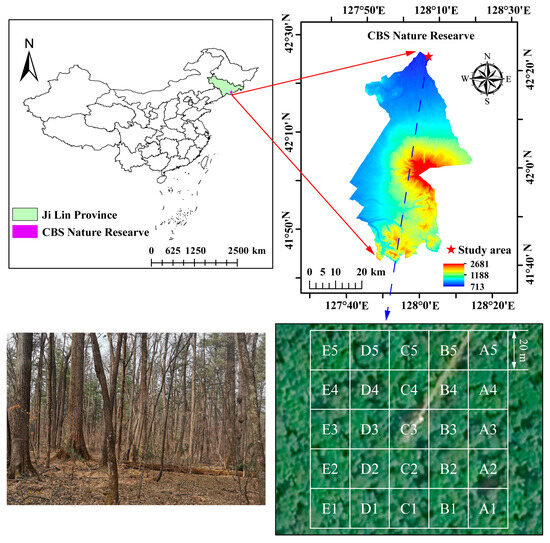
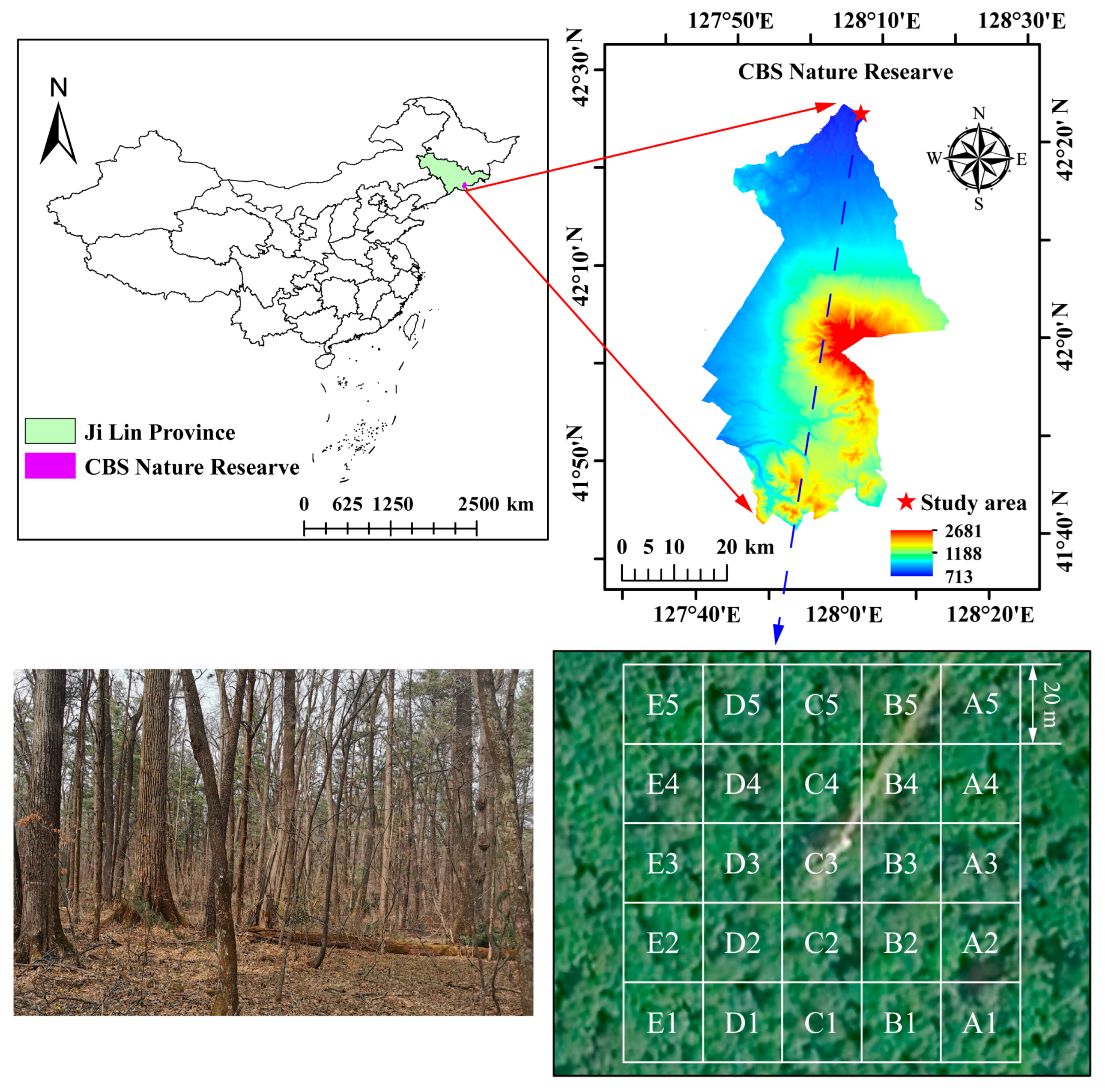
The study area is located on the northern slope of the Changbai Mountain Nature Reserve in the eastern part of Jilin Province (128°28′E, 42°24′N). The Changbai Mountain Nature Reserve has the largest and most well-preserved primary forest ecosystem in China’s temperate zone. Found at elevations between 740 and 1100 m, the broadleaf Korean pine forest is a climax vegetation type of the temperate zone. It is often used as a reference for forest resource management and restoration. Dominant tree species include Pinus koraiensis (P. koraiensis, Korean pine), Tilia amurensis (T. amurensis, Amur linden), Fraxinus mandshurica (F. mandshurica, Manchurian ash), Quercus mongolica (Q. mongolica Mongolian oak), Acer mono (A. mono, painted maple), Ulmus japonica (Japanese elm), Juglans mandshurica, Amur cork tree (Phellodendron amurense), Amur lilac (Syringa reticulata var. amurensis), and Maackia amurensis. The reserve has a temperate continental monsoon climate, with an average annual temperature of −2.8 °C and an average annual precipitation of 600 to 900 mm. The soil is predominantly dark brown forest soil, typical of mountainous areas.
2.2. Plot Setup and Data Collection
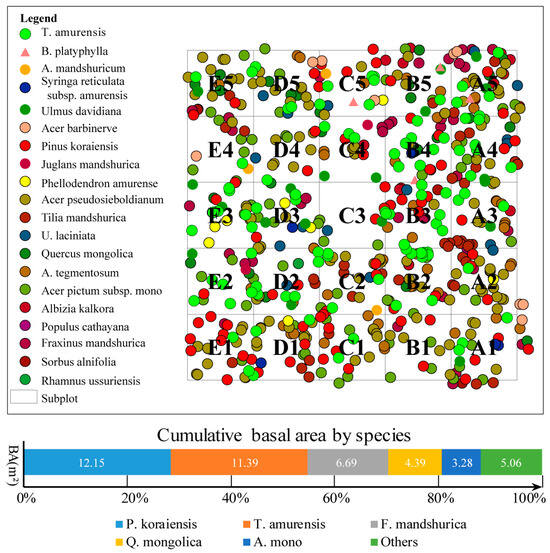
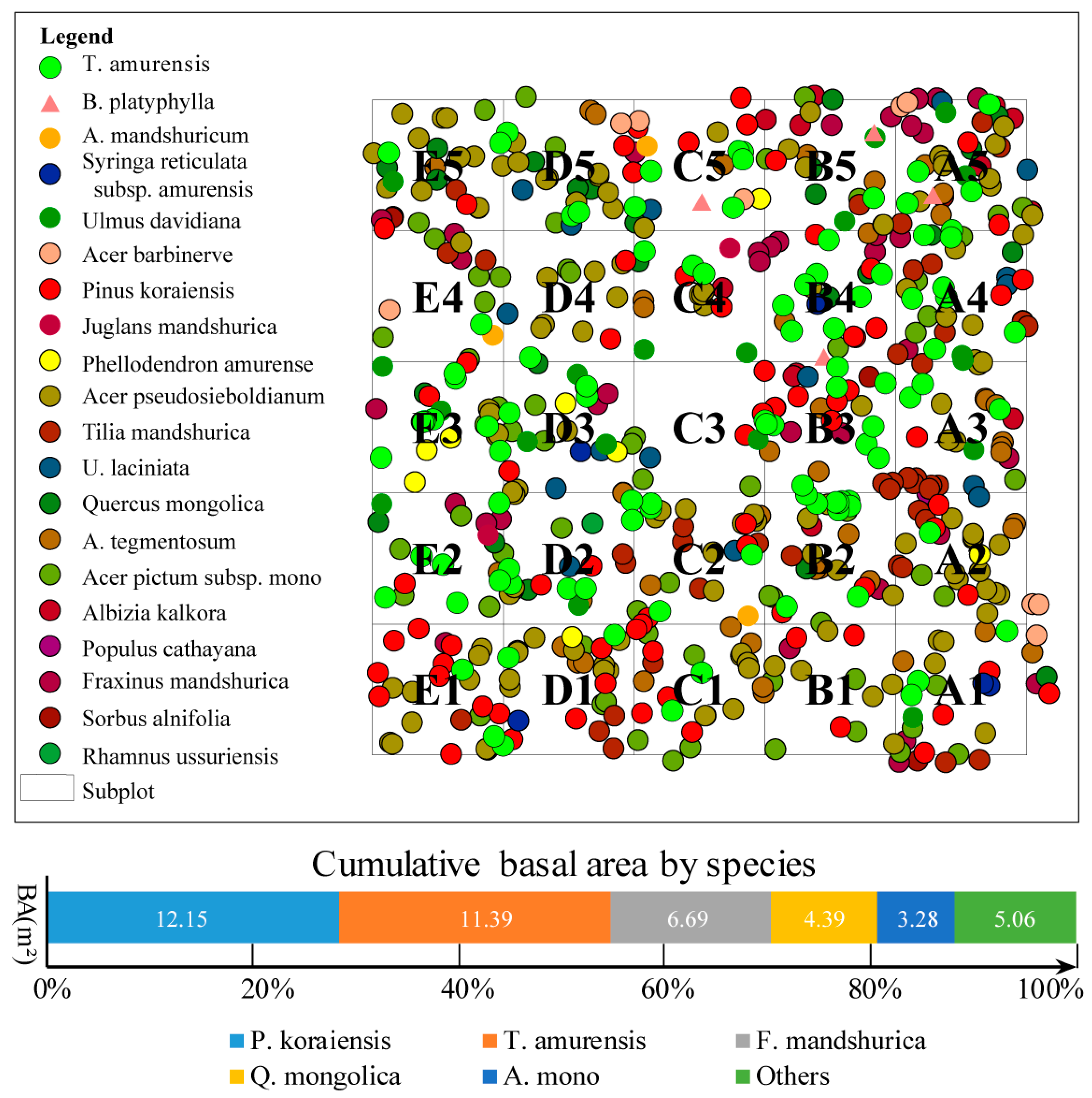
A 1 hm2 (100 m × 100 m)sample plot was established in the primary broadleaf Korean pine forest, following the fixed monitoring plot method. The plot was subdivided into a 5 × 5 grid of 25 contiguous quadrats, each measuring 20 m × 20 m (see Figure 1). Each quadrat was assigned a unique code from A1 to E5 for precise spatial mapping and long-term monitoring of forest structure and composition. All trees with a DBH ≥ 5 cm within these subplots were measured for DBH, and the taxon name and DBH were recorded. The geographic coordinates of the trees were obtained using the Qianxun CORS-RTK (Continuously Operating Reference Stations—Real Time Kinematic) SR6 system with CGCS2000 (China Geodetic Coordinate System 2000). A total of 580 trees were recorded, with a cumulative basal area of 42.96 m2 at breast height (see Figure 2). The five taxa with the largest basal area accounted for 88.2% of the total, including P. koraiensis (12.15 m2, 28.3%), T. amurensis (11.39 m2, 26.5%), F. mandshurica (6.69 m2, 15.6%), Q. mongolica (4.39 m2, 10.2%), and A. mono (3.28 m2, 7.6%) (see Figure 2). These tree taxa had counts of 73, 134, 34, 21, and 57, respectively, representing 55% of the total number of trees.
Figure 1.
Grid layout of the 1-ha permanent plot in Changbai Mountain Nature Reserve. The plot is subdivided into 25 standardized 20 m × 20 m quadrats arranged in a 5 × 5 array (coded A1–E5).
Figure 2.
Species Distribution and Cumulative Basal Area within a 1 hm2 Plot. The plot is subdivided into 25 standardized 20 m × 20 m quadrats arranged in a 5 × 5 array (coded A1–E5).
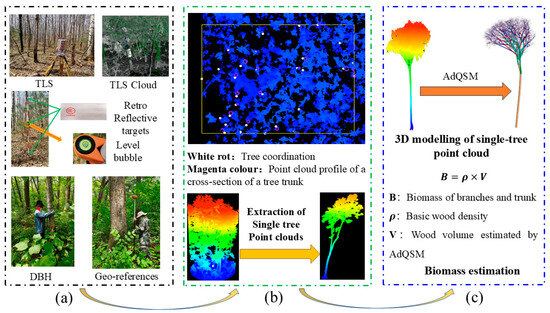
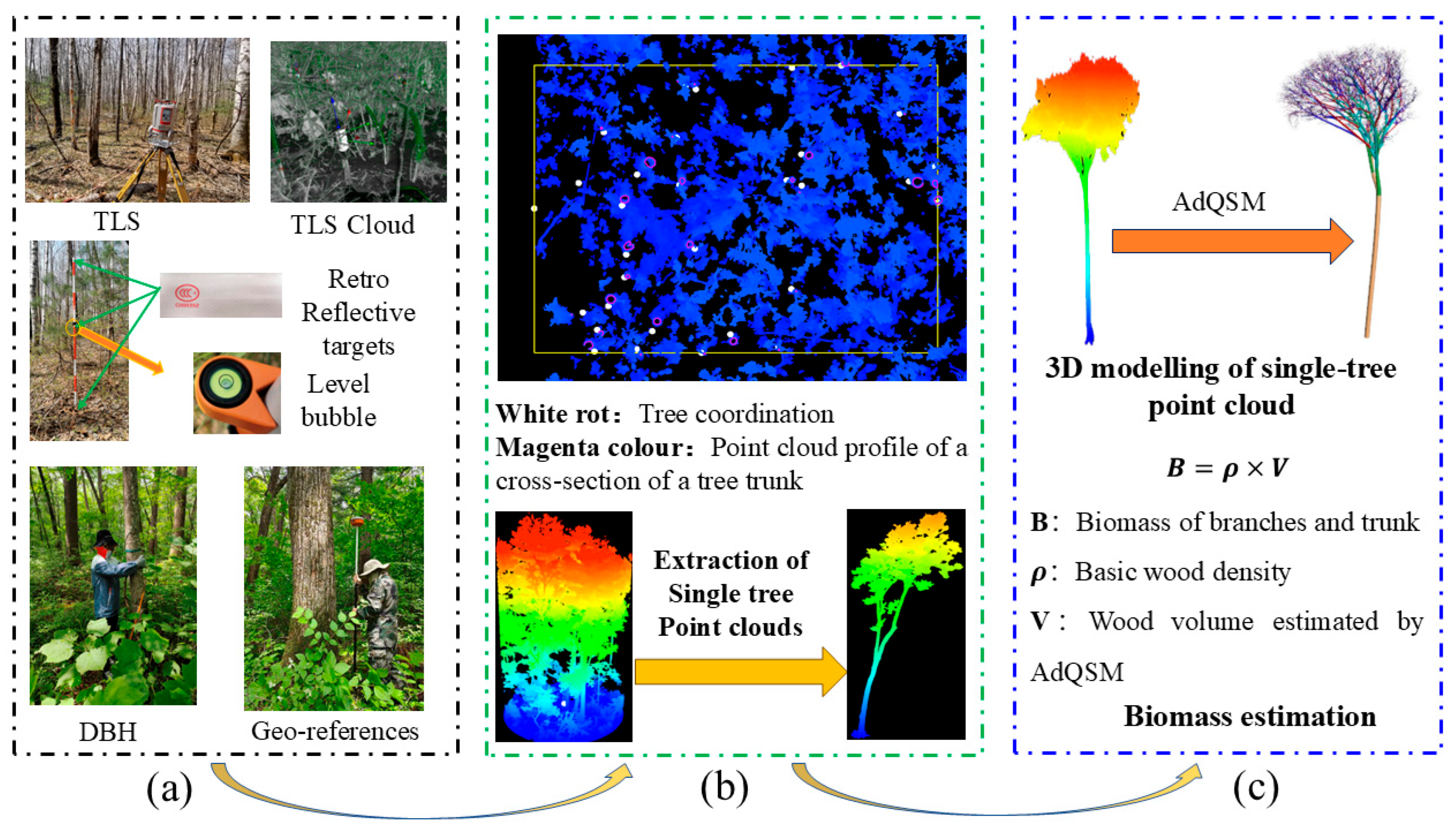
The forest has a complex structural hierarchy, with dense leaf cover and substantial shading, which makes it difficult to quantify the three-dimensional structure of the trees and introduces substantial errors in point cloud data. Therefore, we used the RiEGL VZ-400i TLS to conduct forest scans during the leaf-off periods of broadleaf trees at the end of November 2022 and April 2023. We collected point cloud data to quantify forest structure parameters and estimate volume and biomass, and the process is illustrated in Figure 3.
Figure 3.
Workflow of forest tree species identification and biomass estimation. (a) Data acquisition, (b) Species identification and single-tree extraction, (c) Single-tree point cloud modeling and biomass estimation.
To minimize the influence of tree shading on the point cloud data, multiple scanning stations at different angles were used to capture complete point clouds for each sample plot. All the data collection was performed using the same scanning resolution to eliminate any effects from varying resolutions, resulting in a complete tree point cloud dataset. Scanning stations were placed at the four corners and the center of each subplot, with two scans conducted at each station including one horizontal scan and one inclined scan at 75°.
To acquire point cloud data for each tree, at least five targets were randomly placed within the sample plot before scanning began. Reflective tape was applied to the upper, middle, and lower sections of each target, and a leveling bubble was attached to the center of each target. Once the targets had been fixed in place, the leveling bubble was adjusted to the center to ensure that the target poles remained vertical. After the sample plot had been scanned, the positions of the targets were measured using CORS-RTK. Their geographic coordinates in the CGCS2000 system were obtained for point cloud coordinate transformation.
2.3. TLS Point Cloud Data Processing
For each 20 m × 20 m subplot, the point cloud stitching was initially performed in RiSCAN PRO 2.10 software. The coordinates of the target point clouds were then matched with their geographic coordinates for coordinate transformation, and the point cloud in the CGCS2000 system was exported. The transformed point cloud was imported into LiDAR360 5.2 software, where resampling was conducted with a point spacing ≥0.01 m before denoising and normalization, The tree coordinates from the sample plot were then imported into LiDAR360 5.2. A 10 m radius circle centered on the tree stem coordinates was used to obtain cylindrical point clouds, from which individual tree point clouds were extracted. For trees with a crown radius larger than 10 m, the remaining point clouds were incorporated into the sample plot to complete the point cloud and generate a full individual tree point cloud. Point clouds between tree heights of 1.27 m and 1.33 m were extracted from the individual tree point cloud DBH was estimated to use a least-squares method to fit a circle [45]. Tree height (H) was extracted from LiDAR360 V5.2. The individual tree point cloud was then imported into Cloud Compare, where the point cloud segmentation function was used to extract the point cloud contours. These contours were then imported into ArcGIS 10.4, where the feature to polygon function was applied to calculate parameters including crown position, area, and crown overlap. To correct for edge effects, we applied the stem-mapping method. Only trees with stems inside the plot were included in the crown area and overlap analysis, with their entire crown projection considered, even if it extended beyond the boundary. This approach is appropriate for closed canopies where crown delineation beyond the plot is impractical.
2.4. Estimation of Individual Tree Volume and Biomass
Volume Estimation: The branch and stem volumes were estimated using TLS individual tree point cloud data and QSM. Common QSM models include TreeQSM and AdQSM among others [46,47], proposed by Fan (2020), the AdQSM model used is a tree species-specific structural model based on point cloud reconstruction. It fits the geometry of the stem and branches using a series of cylinders, forming a convex hull polyhedron. The branch and stem volumes are then calculated from this reconstructed individual tree model. AdQSM provides higher accuracy than the TreeQSM model and directly estimates the volumes of the stem and branches. There are two key parameters in the AdQSM modeling process, namely, height segmentation (HS) and cloud parameter (CP). The HS value influences the quality of point cloud reconstruction. During individual tree modeling, it must be adjusted according to tree taxon to ensure the estimated DBH and tree height match the measured values. AdQSM is not sensitive to point cloud density, with the default value of CP typically set to 0.0003. The volumes of branches and stems were estimated to be 580 trees.
Biomass Estimation Method: Biomass is estimated using the following Formula (1):
where B represents the biomass of the individual tree’s branches and stems, is the basic wood density, and V denotes the volume of the branches and stems in the tree model reconstructed by AdQSM.
In this case, is based on data from existing literature, the taxa A. mono, T. amurensis, Q. mongolica, F. mandshurica, and P. koraiensis are as follows: 0.64, 0.43, 0.61, 0.55, and 0.36 g/cm3.
2.5. Biomass Model Construction Using TLS Point Cloud Data
To illustrate the deviation in biomass estimation for specific forest stands using allometric biomass models, we constructed biomass models for the stem and branches based on commonly used allometric equations:
where B represents the biomass of the branches or stem, DBH is the diameter at breast height (cm), and a and b are the fitting coefficients. The model performance is evaluated using the coefficient of determination (R2) and the relative root mean square error (rRMSE).
ln(B) = a + b ln(DBH)
To compare the accuracy of biomass models, biomass models for the tree taxa were constructed using data obtained from TLS point clouds, and the results were compared with previous biomass estimates. This allowed for an assessment of the accuracy of different biomass models in the sample plots. The biomass models published to date include Chen Changuo (Chen model), He (He model), Dai Haijun (Dai model), Dong Lihu (Dong model), and Zhou Guoyi (Zhou model) [34,35,36,37,38]. The parameters of the branch and stem biomass models for different tree taxa are shown in Appendix A.1.
2.6. Data Processing
The accuracy of TLS-derived DBH is evaluated using four metrics, that is, Bias (cm), relative bias (rBias%), root mean square error (RMSE, cm), and relative root mean square error (rRMSE%). The calculation formulas are as follows:
where represents the TLS-derived DBH estimate for the ith tree, represents the measured DBH value for the i-th tree in the sample plot, represents the average of the measured data, and n represents the number of trees.
The calculation formula for the canopy overlap ratio are as follows:
where TCA denotes the total canopy area of all individual trees, whereas CPA represents the total projection area of all individual tree canopies.
The calculation formula for volume or biomass ratio is as follows:
where Total volume or Total biomass denotes the total volume or total biomass of all individual trees, whereas represents the aggregate volume or biomass of all individual trees classified by different categories.
Preliminary data analysis was performed using Excel 365, data visualization was conducted in Origin 2020, and variance comparison and regression analysis were performed using SPSS 21.0.
3. Results
3.1. Accuracy of TLS Point Cloud Inversion
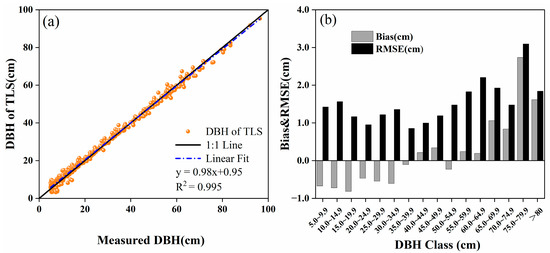
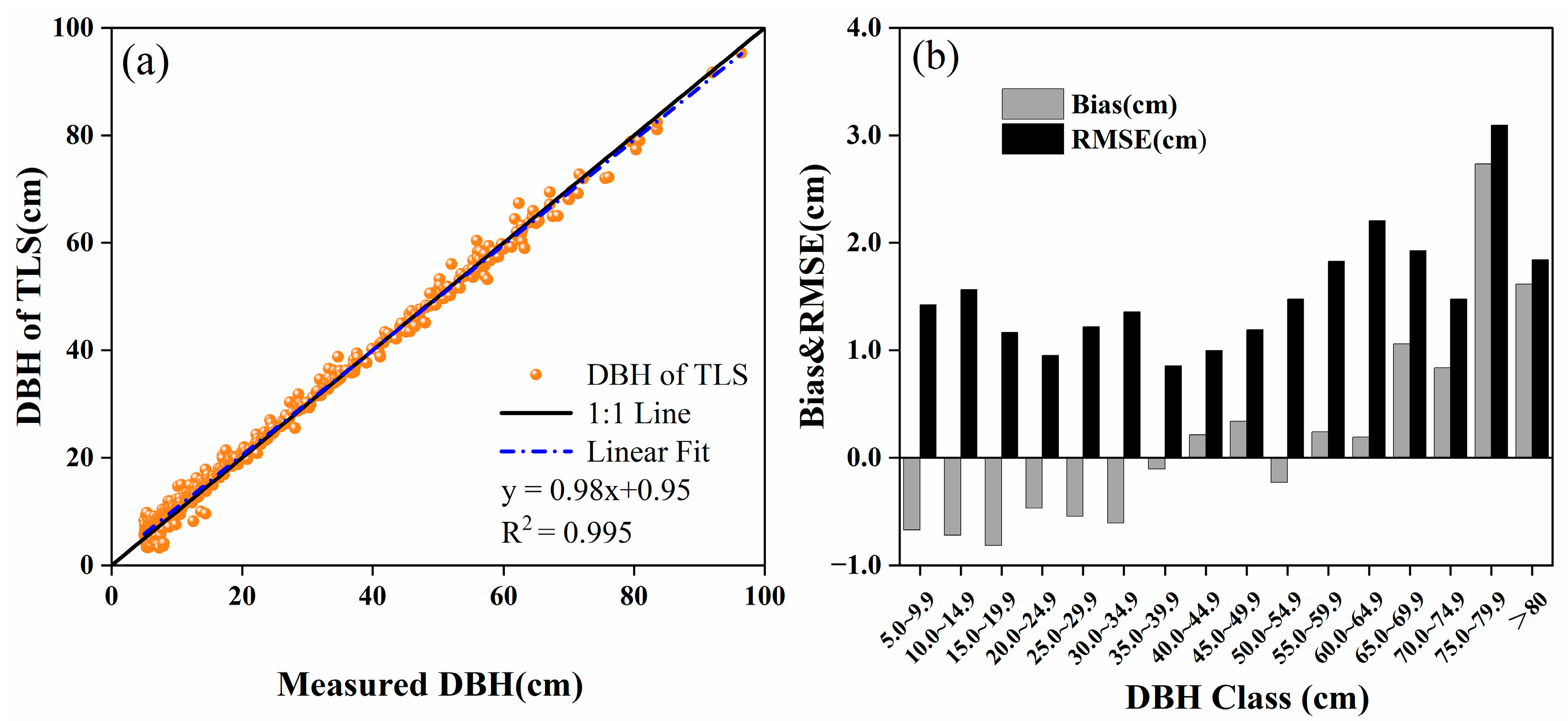
The TLS-derived DBH of all the trees in the sample plot was compared with the measured values. The TLS-inverted values closely matched the measured values (R2 = 0.99, Figure 4a). For different diameter classes (Figure 4b), the RMSE exceeded 2 cm for trees in the 60–65 cm and 75–80 cm diameter classes. Meanwhile, the RMSE for other classes ranged from 1 to 2 cm. The TLS inversion underestimated DBH for trees with a DBH below 65 cm (Bias < 0) and overestimated DBH for trees with a DBH above 65 cm. The bias of the TLS-inverted DBH for trees in the sample plot was 0.43 cm, with a rBias of 0.08%. The RMSE was 2.04 cm, and the rRMSE was 0.25%. This indicates that TLS point cloud data provided high precision in estimating the DBH of individual trees.
Figure 4.
Correlation between TLS point cloud-derived DBH and measured values (a), and Bias and RMSE of TLS-derived DBH across different DBH classes (b).
3.2. Dendrometric Information of Broadleaf Korean Pine Forest
Information on trees in the sample plot derived from TLS point clouds is shown in Table 1. The average DBH and height (H) of the stand are 23.10 cm and 14.32 m, respectively. Among them, 528 trees were healthy, with an average DBH and height of 23.56 cm and 14.72 m, respectively. There were 52 poorly growing trees, accounting for 9.0% of the total, including 23 standing dead trees with an average DBH of 11.44 cm and a height of 7.83 m. Additionally, 29 trees with defects such as tilting or broken branches had an average DBH of 24.00 cm and a height of 12.34 m.
Table 1.
Plot measurement indicators.
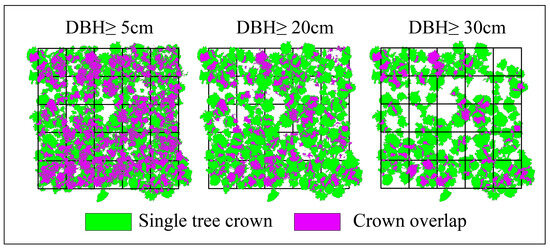
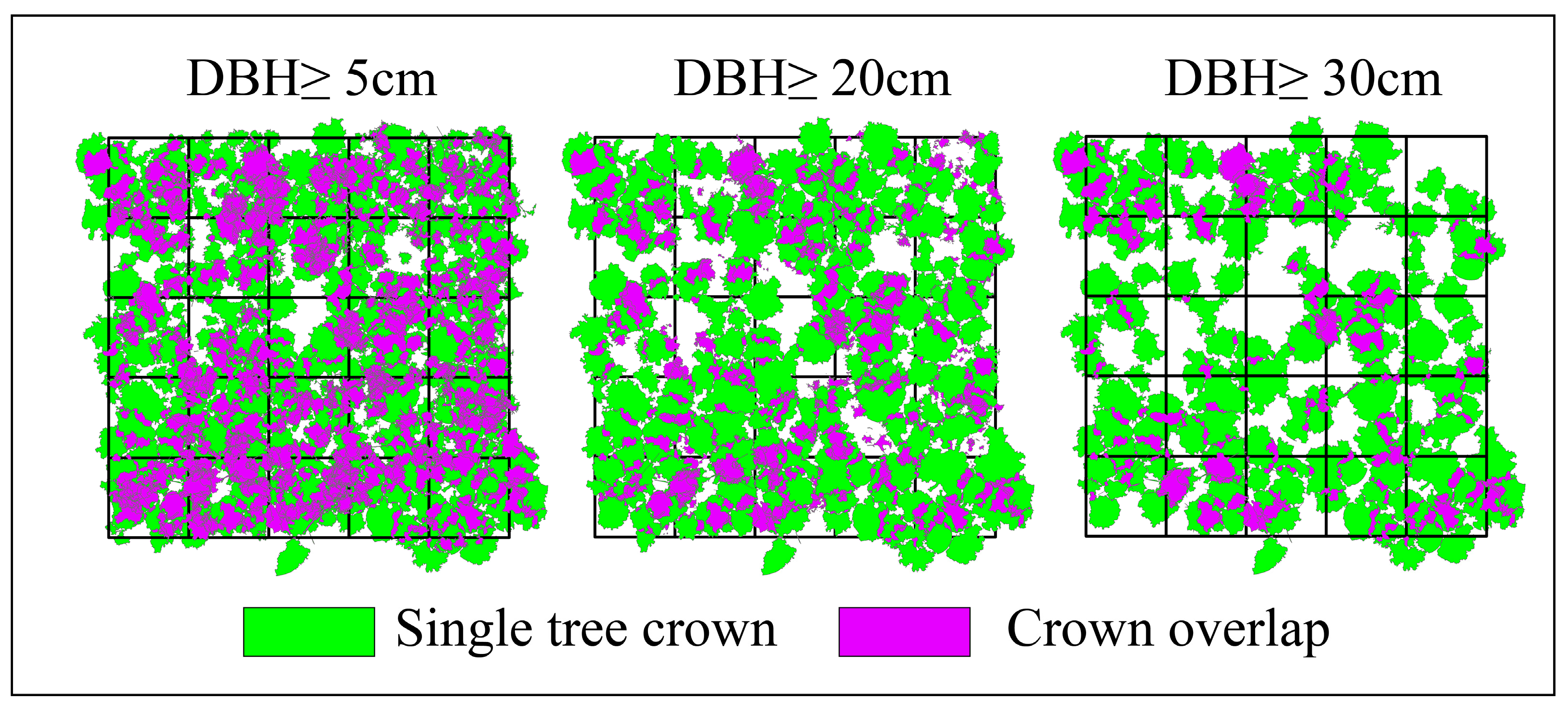
The total crown area (TCA) of the stand was 14,882.56 m2, including the crowns of trees within the plot and those extending beyond it, totaling 798.94 m2. The area without crown cover was 1446.54 m2, while the crown projection area covered 9352.40 m2, accounting for 88.3% of the total land area. The crown overlap rate was 59.1%. For healthy trees (HT), those with DBH ≥ 20 cm and DBH ≥ 30 cm contributed 68.8%, 86.5%, and 57.8% and 77.2% of the total crown and projection areas of the stand, respectively. Their projection areas accounted for 74.8% and 66.8% of the land area, with crown overlap rates of 26.7% and 19.2%, respectively (Figure 5.). For the five main tree taxa (MT), their total crown and projection areas comprised 68.3% and 83.3% of the stand, respectively, with a crown overlap rate of 30.6%. The projection areas of trees with DBH ≥ 20 cm and DBH ≥ 30 cm covered 68.1% and 60.57% of the land area, with crown overlap rates of 23.9% and 18.4%, respectively (Table 1).
Figure 5.
Crown overlap in a 100 m × 100 m gridded area (20 m × 20 m per cell) for trees above different DBH thresholds. Patterns are shown for DBH ≥ 5 cm, DBH ≥ 20 cm, and DBH ≥ 30 cm. Single and overlapping crowns are colored green and purple, respectively, illustrating the decrease in overlap with increasing tree size.
The total volume of tree stems and branches (TV) in the stand was 762.7 m3, with tree stems volume (TTV) accounting for 424.12 m3 (55.6%) and branches accounting for 338.58 m3 (44.4%). Healthy trees contributed 723.1 m3, or 94.9% of the total volume. For large-diameter trees (DBH ≥ 20 cm), their volume and stem volume comprised 91.3% and 90.9% of the stand, respectively. Trees with DBH ≥ 30 cm represented 86.2% and 87.6% of the total volume and stem volume, respectively. The five main tree taxa accounted for 85.2% and 85.4% of the stand total volume and stem volume, respectively. Among these, trees with DBH ≥ 20 cm and DBH ≥ 30 cm contributed 83.7%, 83.2%, 79.4%, and 78.2% of the total volume and stem volume, respectively (Table 1).
The total aboveground biomass (TAB) was 350.84 t, with 155.00 t for branches and 195.85 t for stem biomass (SB), representing 44.2% and 55.8% of the total biomass, respectively. The biomass of trees with DBH ≥ 20 cm and DBH ≥ 30 cm accounted for 83.8% and 78.9% of the total aboveground biomass, respectively. The five main tree taxa comprised 24.4%, 21.4%, 17.6%, 13%, and 8.2% of the total biomass, totaling 84.6%. Of these, trees with DBH ≥ 20 cm and DBH ≥ 30 cm accounted for 82.6% and 78.2% of the total biomass, respectively (Table 1).
The stem-to-branch volume ratios (VRSB) and stem-to-branch biomass ratios (BRSB) of the trees in the stand were relatively consistent, with averages of 1.25 and 1.26, respectively. The ratio decreased as DBH increased. Among the five main tree taxa, F. mandshurica showed the highest stem-to-branch ratio (1.97 for volume, 1.98 for biomass), followed by A. mono (1.28 for both volume and biomass), while Q. mongolica had the lowest (0.95 for both volume and biomass).
3.3. The Relationship Between Canopy Spread, Volume, Biomass, and DBH
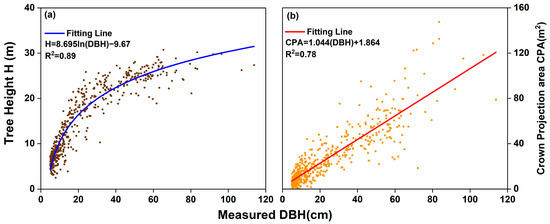
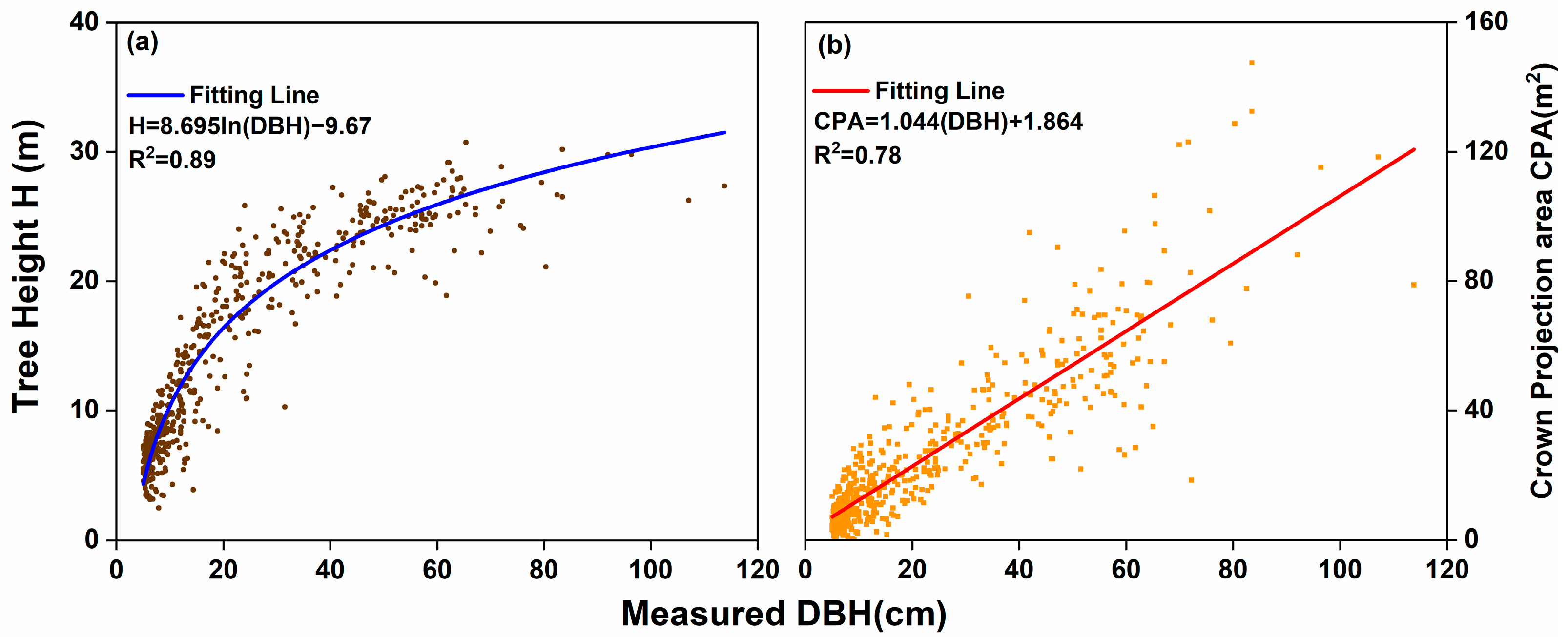
Among the 528 healthy trees in the forest, tree height (H) showed a significant logarithmic relationship with DBH (R2 = 0.89) (Figure 6a). Meanwhile, the canopy area had a significant linear relationship with DBH (R2 = 0.78) (Figure 6b).
Figure 6.
(a) Logarithmic relationship between DBH and tree height, (b) Power function relationship between DBH and CPA.
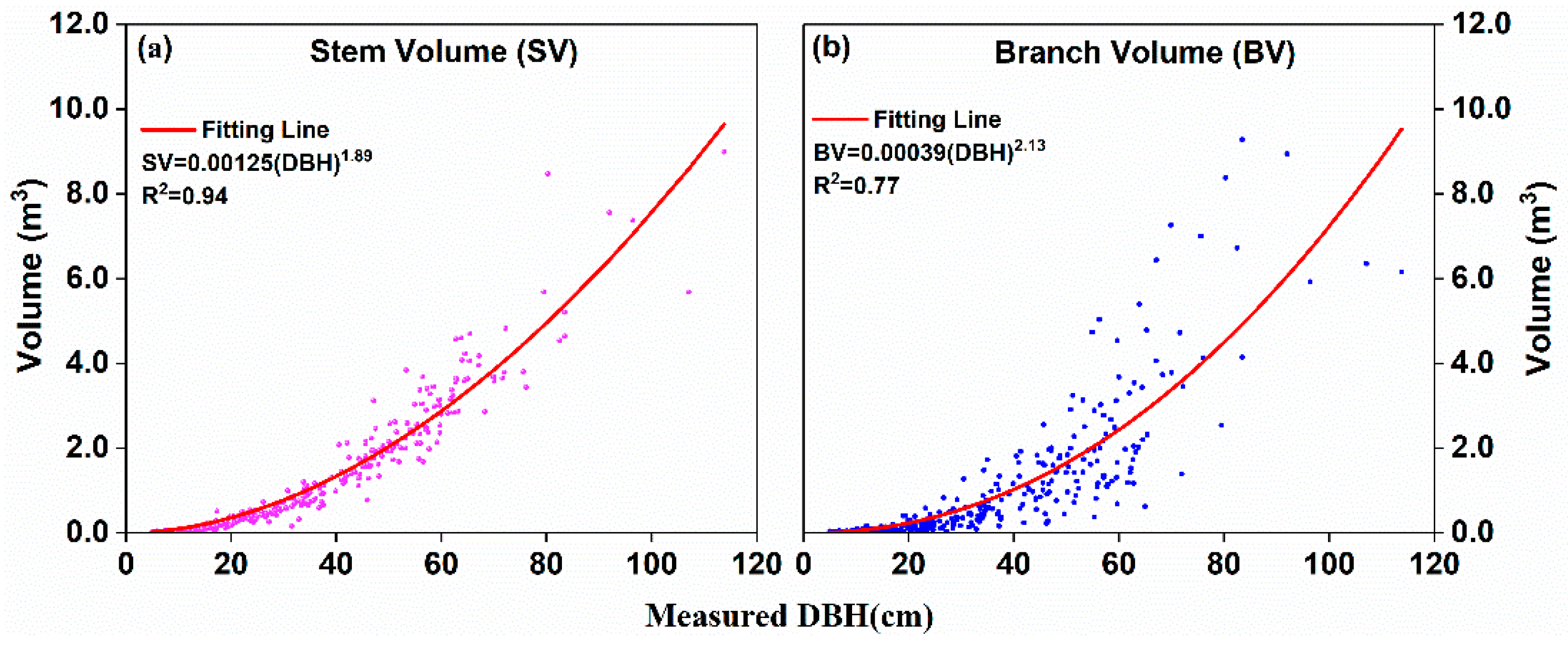
Stem and branch volumes showed significant power-law relationships with DBH, with R2 values of 0.94 (Figure 7a) and 0.77 (Figure 7b), respectively. However, branch volumes had greater variability compared to the stems.
Figure 7.
Relationship between DBH, stem volume (a), and branch volume (b).
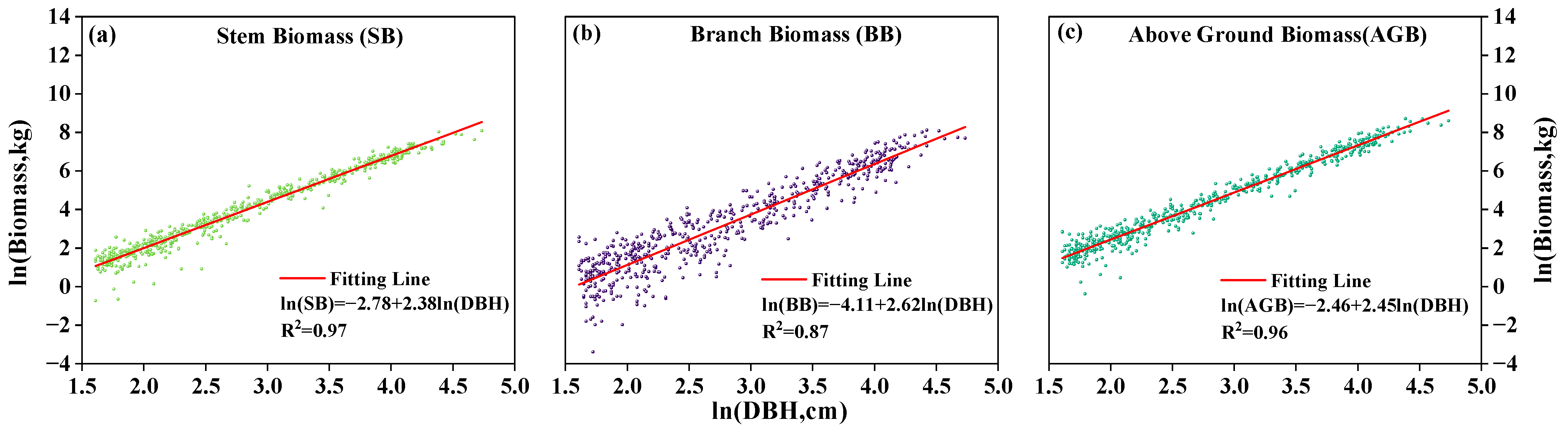
The total biomass of all the trees in the plot had a strong power-law relationship with DBH, with stem biomass (R2 = 0.97) (Figure 8a) and total aboveground biomass (R2 = 0.96) (Figure 8b) achieving superior fits compared to branch biomass (R2 = 0.87) (Figure 8c).
Figure 8.
Relationship between DBH and stem biomass (a), branch biomass (b), and aboveground biomass (c).
3.4. Development and Validation of a TLS-Derived Stem Biomass Model
Branch and stem biomass models were developed for five dominant tree taxa based on DBH using Equation (2) (Table 2). These taxa had DBH ranges from 5–6 cm to over 70 cm and tree heights of approximately 5 m to 30 m, covering small understory saplings to dominant canopy trees. The models showed satisfactory fitting performance, with stem biomass models (R2 = 0.97) outperforming branch biomass models (R2 = 0.90). Among the tree taxa, broadleaf trees had better fits (R2 = 0.97) compared to P. koraiensis (R2 = 0.88). RMSE analysis indicated that Q. mongolic and F. mandshurica had relatively higher RMSE values. Meanwhile, A. mono and T. amurensis exhibited lower RMSE values. Stem biomass parameter b was relatively consistent across taxa, ranging from 2.16 to 2.51. In contrast, branch biomass parameter b showed greater variability, with significantly higher values for T. amurensis (3.13) and Q. mongolica (3.36) compared to the other taxa (2.41–2.78).
Table 2.
Relative growth models of branch and stem biomass of different tree taxa.
3.5. Performance of Different Biomass Models
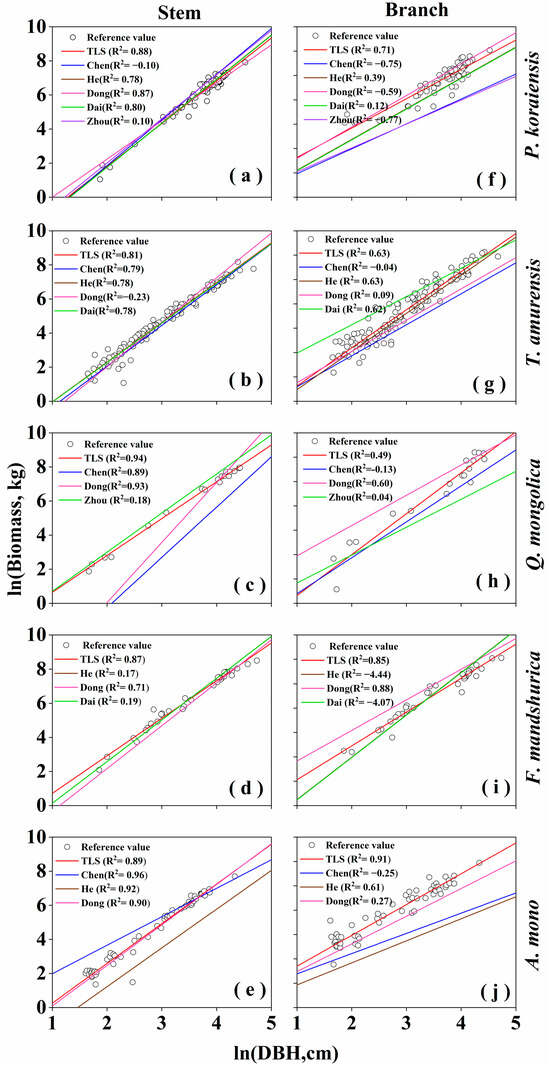
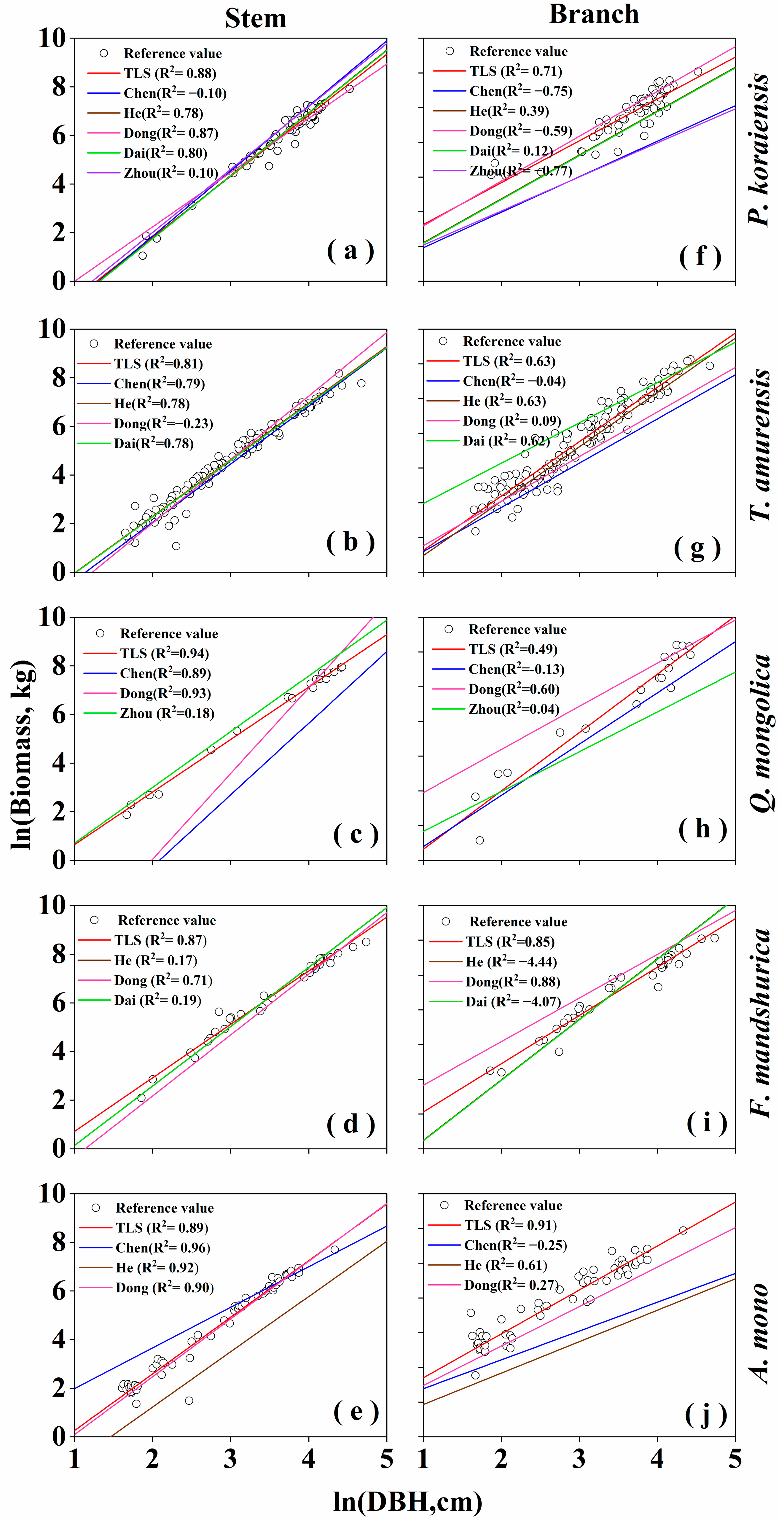
The TLS model developed in this study was compared with existing biomass models and measured values (Figure 9). Stem biomass estimates showed less variation among models compared to branch biomass estimates. For P. koraiensis (Figure 9a), T. amurensis (Figure 9b), and F. mandshurica (Figure 9d), stem biomass estimates were relatively consistent across models. However, the Chen model underestimated the stem biomass of Q. mongolica compared to other models (Figure 9c). Similarly, for A. mono, stem biomass estimates from the Chen and He models were lower than the measured values (Figure 9e). The Chen model produced significantly lower estimates for branch biomass than other models (Figure 9f–j). The results of comparisons between the biomass reference values and estimates from various allometric models, including fitting equations, R2, RMSE, and confidence intervals, are summarized in Appendix A.2.
Figure 9.
Comparison of results from different biomass models. Row left: Stem Biomass, (a) P. koraiensis, (b) T.amurensis, (c) Q.mongolica, (d) F.mandshurica, (e) A.mono. Row right: Branch Biomass, (f) P. koraiensis, (g) T.amurensis, (h) Q.mongolica, (i) F.mandshurica, (j) A.mono.
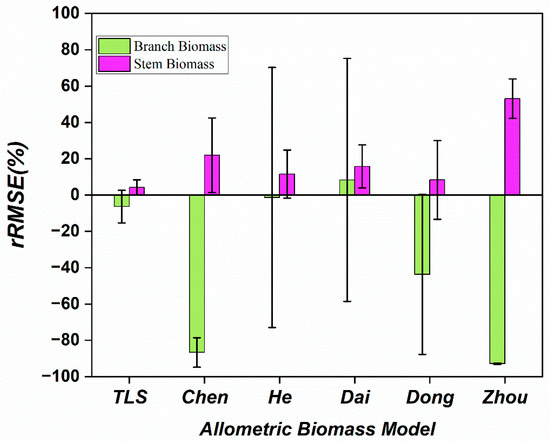
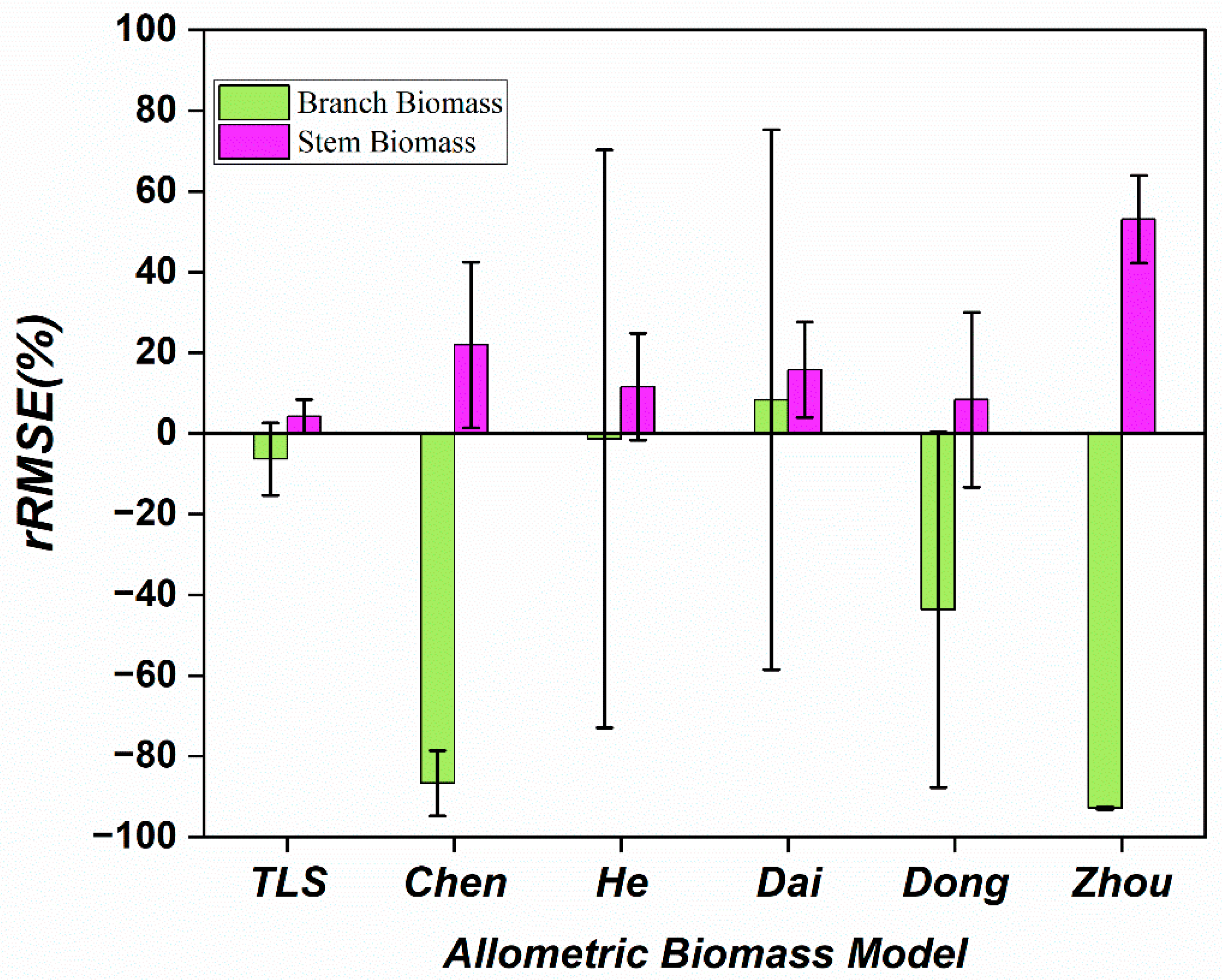
Aggregating the estimation results across all five tree taxa, stem biomass was generally overestimated, with rRMSE values ranging from 4.22% to 53.08%. Zhou’s model had the highest error (53.08%), followed by Chen’s (21.92%). In contrast, Dong’s model and the TLS model achieved lower errors, at 8.38% and 4.22%. The maximum difference between different models is 48.86%.
For branch biomass, estimates were generally underestimated (Figure 10), with rRMSE values ranging from −92.85% to 8.3%. Dai’s model slightly overestimated branch biomass by 8.3%, while Zhou’s model exhibited the largest underestimation at −92.85%. Chen’s and Dong’s models also underestimated branch biomass, by −86.66% and −43.65%, respectively (Figure 10). The maximum difference between different models is 101.15%.
Figure 10.
Comparison of RMSE for stem and branch estimates across different models.
Based on the tabulated rBias% values for the five tree taxa, the estimation biases for stem and branch biomass exhibit distinct and contrasting patterns across models and species. Stem biomass estimation bias showed a mixed pattern of over- and underestimation, with substantial variation among species and models. For P. koraiensis, stem bias ranged from a slight underestimation (−0.62% for TLS) to a pronounced overestimation (42.67% for Zhou). T. amurensis stems were significantly overestimated by Dong’s model (45.92%), while estimates for Q. mongolica stems were highest in Zhou’s model (56.27%). Stems of F. mandshurica were consistently overestimated, particularly by He’s and Dai’s models (approximately 34%). In contrast, stem estimates for A. monodisplayed relatively minor deviations, generally within ±5%. Overall, despite instances of underestimation, stem biomass was predominantly overestimated by most models. Branch biomass estimation bias was characterized by a widespread and pronounced underestimation. This was particularly evident for P. koraiensis, T. amurensis, Q. mongolica, and A. mono, where most models yielded strongly negative biases, often below −80% (e.g., −93.02% for Zhou’s model on P. koraiensis branches). A notable exception was observed for F. mandshurica branches, which were substantially overestimated by He’s and Dai’s models (exceeding 120%), representing a clear divergence from the general trend. In summary, the rBias% analysis reveals that stem biomass estimates were generally biased upward, albeit with considerable interspecific and intermodel variability. In stark contrast, branch biomass was severely and consistently underestimated across most taxa, with F. mandshurica being a marked exception. This indicates a higher model sensitivity and greater uncertainty in branch biomass prediction, which varies significantly by species.
4. Discussion
The main conclusions of this study are derived from observations within a single 1-hectare plot. Although the plot exhibited rich floristic and diameter class diversity, it represents a forest type under specific regional conditions. This single source of data means that our findings may be influenced by local habitat characteristics (e.g., soil, microclimate) and stochastic ecological processes. Consequently, direct extrapolation of the conclusions to forests with differing species compositions, stand structures, or geo-climatic conditions should be approached with caution. This limitation underscores the imperative for repeated experiments across a wider spatial scale and a greater variety of forest types to verify the broad applicability of the method.
4.1. TLS Inversion Accuracy
TLS is an efficient and precise tool for obtaining detailed and accurate information about complex forest stands and individual trees. Its high-resolution point cloud data facilitates the extraction of a wide array of forestry-relevant geometric and statistical variables [3]. The reliability of TLS technology for accurately measuring DBH, canopy spread, and other forestry parameters has been well established. This study highlighted the feasibility of applying TLS technology to measure stand factors. A fundamental metric in community surveys, DBH is directly measured, while most other structural parameters are indirectly estimated from DBH. In this study, TLS-derived DBH values showed strong agreement with the measured values (R2 = 0.99). The average height of dominant canopy trees (DBH > 30 cm) derived from TLS point clouds was approximately 25 m, consistent with previous estimates. The total stem volume (stand volume) was calculated at 424.12 m3, closely aligning with results obtained from single-entry volume tables. Stand tree biomass, estimated using an underground-to-aboveground biomass ratio of 0.248 for mixed needle leaf and broadleaf forests, was 437.85 Mg/ha. The results align well with previous studies, which estimated stand tree carbon densities of 201.22 Mg C/ha [48] and 182.59 Mg C/ha [49] for 2010, indicating their validity. This highlights the high reliability of TLS in estimating stand factors, demonstrating its suitability for community surveys and structural parameter measurements [50]. The TLS-derived results showed substantial errors only in cases of irregular stem cross-sections or severe occlusions that hindered capturing the full stem profile. In this study, measurement errors were substantially reduced by strategically selecting measurement locations and optimizing station setups, leveraging overlay analysis of multiple images. Of the 580 sampled trees, only 10, comprising 1.7% of the total, had partial stem occlusion. With its precision and efficiency, the use of TLS technology in forest structural surveys is poised to increase.
4.2. Using TLS for Assessing Forest Vertical Structure at High Resolution
Primary forests are critical reference ecosystems for forest restoration and management targets. Understanding the spatial structure of natural forests, shaped by long-term evolution, is vital for developing uneven-aged mixed-forest systems and close-to-nature management strategies. TLS point cloud data excels in its precision for accurately characterizing the vertical structure of forest stands. One of the main challenges in measuring canopy area is addressing the irregularity of its projected shape. Traditional methods that approximate canopy area as a circle or ellipse using east–west and north–south measurements often lead to substantial estimation errors [51]. In this study (Table 1), we used TLS to measure the average canopy area of trees (DBH ≥ 5 cm) in the primary broadleaf Korean pine forest of Changbai Mountain, yielding a value of 25.66 m2. Canopy trees (DBH ≥ 30 cm) had an average canopy area of 55.18 m2, while dominant species exhibited a slightly larger average of 56.11 m2. The use of TLS point clouds to extract realistic crown projections for crown area estimation demonstrates an efficient, convenient, and accurate approach, which underscores the significant potential of TLS as a powerful tool for quantifying forest structural parameters.
The crown overlap rate was 59.1%, with a canopy tree intersection rate of 19.2% and 18.4% for the five dominant species (Table 1 and Figure 5). Canopy overlap rate serves as a critical indicator for assessing both vertical and horizontal forest structure [52], as well as an essential parameter for evaluating forest health, photosynthetic efficiency, and carbon sequestration capacity [53,54,55]. In mixed forests, canopy overlap directly reflects the intensity of competition among trees for key resources such as light, water, and nutrients [56]. Comparing canopy overlap rates across different diameter classes at the community level not only reveals variations in competitive pressure within the community but also contributes to understanding how dominant species shape forest structure and species composition [57,58]. Furthermore, it provides valuable insights for assessing the stability and dynamics of forest ecosystems. If needed, canopy areas and intersection rates could also be specified for different forest strata. Since the sum of canopy areas is a key factor in determining the maximum retained tree density in stands, the precise estimations of canopy areas and overlap rates across forest layers provide a robust basis for stratified density management and crown arrangement strategies [59,60]. It is important to note that the use of leaf-off LiDAR data means that the derived Crown Projection Area (CPA) represents the projected area of the woody components (branches and twigs) rather than the foliated crown. This likely results in an underestimation of the true leaf-on CPA, a factor that should be considered when interpreting the results [61].
Traditional forest stock volume assessments have primarily focused on tree stems (Tree-length). In this study, TLS technology was used to quantify branch volume, demonstrating that branches represent a considerable proportion (44.4%) of the total volume in primary forests. This enabled a precise calculation of branch biomass, which accounted for 44.2% of the combined biomass of stems and branches (Table 1). The analysis also showed a consistent stem-to-branch ratio for volume and biomass, both of which decline with increasing tree size. Stand-level averages ranged between 1.25 and 1.27, while for trees with DBH ≥ 30 cm, the ratio was slightly lower at 1.21–1.23. TLS technology allowed for the detailed analysis of the vertical distribution of branch and stem volume and biomass, providing critical insights into the mechanisms shaping vertical stand structure and function.
4.3. Convergence Trends in Allometric Growth Across Tree Species in Primary Forests
A major finding of this study is the significant fitted relationships between DBH and H (Figure 6a), crown projected area (CPA) (Figure 6b), stem and branch volume (Figure 7a), and biomass (Figure 7a) for all trees with DBH ≥ 5 cm in the stand. Although the equations linking DBH with branch volume and biomass explained less variance than those for stems, the fits were still statistically significant (R2 = 0.87). This indicates that in primary broadleaf Korean pine forests, DBH is a unifying indicator closely associated with key attributes such as tree taxa, individual size, and forest layer, reflecting a convergence in their relationships. While previous studies have advocated for constructing species- and age-specific allometric equations for biomass estimation, the results of this study provide a novel framework for estimating biomass in primary forests. However, further investigation is necessary to determine whether these patterns persist across different successional stages, in natural forests subjected to logging disturbances, or in uneven-aged, multi-storied plantations.
4.4. Simulation and Modeling of Stand Structural Parameters Using TLS Technology
This study employed TLS and QSM techniques to non-destructively estimate tree biomass and develop allometric equations, with comparisons made against classical models established in the region by Chen, He, Dong, Dai, and Zhou. The results show that the TLS-QSM modeling approach significantly improved the accuracy of biomass estimation. Specifically, aggregating the estimation results across all five tree taxa, stem biomass was generally overestimated, with rRMSE values ranging from 4.22% to 53.08% (Figure 10). Among these, the TLS model yielded the lowest error (4.22%), while the models by Zhou and Chen showed the highest errors. This highlights the limitations of conventional models, which, due to the constraints of their calibration data (e.g., DBH range, varying sample plot sources), exhibit considerable uncertainty when extended to diverse forest stands [62,63]. In contrast, TLS technology reduces such extrapolation-dependent uncertainty by directly capturing the true three-dimensional geometry of trees [64,65].
More critically, greater discrepancies and systematic biases were observed in branch biomass estimation. Branch biomass estimation bias was characterized by a widespread and pronounced underestimation. Most models severely underestimated branch biomass (e.g., Zhou’s model underestimated branch biomass of P. koraiensis by −93.02%) (Table 3). This arises from the far more complex architecture of branches compared to stems, which conventional diameter-based models fail to adequately capture [66]. The exceptional cases where branch biomass of F. mandshurica was overestimated by more than 120% in He’s and Dai’s models (Table 3) further illustrate that such models may be effective for specific species but lack general applicability. In summary, this study validates the considerable potential of the TLS-QSM method in addressing the challenge of branch biomass estimation. Future efforts should prioritize the development of such non-destructive, component-specific models to enhance the reliability of regional carbon stock assessments.
Table 3.
Table 3. Relative bias (rBias%) of stem and branch biomass estimation for five tree species using different models. (Note: “--” indicates that the rBias% is not applicable or not available).
5. Conclusions
Our study has demonstrated that TLS can achieve an accuracy of 99% in measuring the DBH of individual trees. Based on this, we found that in the pristine broadleaf Korean pine forest of Changbai Mountain, the total crown overlap rate is 59.1%, the total stem volume is 424.12 m3/ha, the total branch volume is 338.58 m3/ha, the total stem dry weight is 195.85 t, and the total branch dry weight is 155.00 t. The branch-to-stem ratio of the dominant tree species ranges from 0.95 to 1.98.
This study has demonstrated that the relationships between tree height, crown width, volume, biomass, and DBH are consistent across all trees in the stand. The TLS-QSM method allows for the non-destructive construction of biomass models for different tree taxa, providing higher accuracy compared to commonly used biomass models in the same region, and is not affected by tree taxa or DBH size. This research has introduced a novel technical approach for quantifying forest structure parameters and biomass at the stand level.
Author Contributions
D.Y., Writing—review & editing, Methodology, and Conceptualization. L.Z., Funding acquisition, review & editing. J.D., Funding acquisition, review & editing. Y.Z., Review & editing. Q.C., Formal analysis. Z.W., Formal analysis. J.L., Writing—original draft, Project administration, Methodology, Investigation, Formal analysis, and Data curation. T.G., Writing—review & editing and Methodology. All authors have read and agreed to the published version of the manuscript.
Funding
This work was supported by National Key Research and Development Program of China (2021YFD2200405-4), the National Natural Science Foundation of China (32071553), the National Natural Science Foundation of China (32201331), and the Postdoctoral Fellowship Program of CPSF (GZC20232876).
Data Availability Statement
The original contributions presented in this study are included in the article. Further inquiries can be directed to the corresponding author.
Acknowledgments
The authors are grateful for helpful comments from many researchers and colleagues.
Conflicts of Interest
The authors declare that they have no conflict of interest.
Appendix A
Appendix A.1
Table A1.
Different biomass allometric equations based on DBH, developed by researchers such as Chen Changuo, Dong Lihu, He, Dai Haijun, and Zhou Guoyi.
Appendix A.2
Table A2.
The fitted equations corresponding to the traditional allometric models for each tree species, along with their coefficients of determination and confidence intervals.
References
- Stephenson, N.L.; Das, A.J.; Condit, R.; Russo, S.E.; Baker, P.J.; Beckman, N.G.; Coomes, D.A.; Lines, E.R.; Morris, W.K.; Rüger, N.; et al. Rate of Tree Carbon Accumulation Increases Continuously with Tree Size. Nature 2014, 507, 90–93. [Google Scholar] [CrossRef] [Scilit]
- Qiao, X.; Lamy, T.; Wang, S.; Hautier, Y.; Geng, Y.; White, H.J.; Zhang, N.; Zhang, Z.; Zhang, C.; Zhao, X.; et al. Latitudinal Patterns of Forest Ecosystem Stability across Spatial Scales as Affected by Biodiversity and Environmental Heterogeneity. Global Change Biol. 2023, 29, 2242–2255. [Google Scholar] [CrossRef] [Scilit]
- Fayaz, A.; Chaudhary, P.; Mankotia, S. Impacts of Climate Change on Forest Ecosystem Dynamics and Management Strategies. Int. J. Environ. Clim. Change 2025, 15, 273–286. [Google Scholar] [CrossRef] [Scilit]
- Maure, L.A.; Diniz, M.F.; Pacheco Coelho, M.T.; Molin, P.G.; Rodrigues da Silva, F.; Hasui, E. Biodiversity and Carbon Conservation under the Ecosystem Stability of Tropical Forests. J. Environ. Manag. 2023, 345, 118929. [Google Scholar] [CrossRef] [Scilit]
- Liu, X.; Feng, Y.; Hu, T.; Luo, Y.; Zhao, X.; Wu, J.; Maeda, E.E.; Ju, W.; Liu, L.; Guo, Q.; et al. Enhancing Ecosystem Productivity and Stability with Increasing Canopy Structural Complexity in Global Forests. Sci. Adv. 2024, 10, eadl1947. [Google Scholar] [CrossRef] [Scilit] [PubMed]
- Wieczynski, D.J.; Boyle, B.; Buzzard, V.; Duran, S.M.; Henderson, A.N.; Hulshof, C.M.; Kerkhoff, A.J.; McCarthy, M.C.; Michaletz, S.T.; Swenson, N.G.; et al. Climate Shapes and Shifts Functional Biodiversity in Forests Worldwide. Proc. Natl. Acad. Sci. USA 2019, 116, 587–592. [Google Scholar] [CrossRef] [Scilit] [PubMed]
- Moreno-Fernández, D.; Oliveira, N.; Myllymäki, M.; Cañellas, I.; Kuronen, M.; Alberdi, I. Evaluation of the Performance of Forest Structural Indices under Different National Forest Inventory Plot Designs. Ecol. Indic. 2025, 181, 114434. [Google Scholar] [CrossRef] [Scilit]
- Li, Y.; Fu, H.; Zhu, J. An ICESat-2 Photon Cloud Classification Model Coupling Slope and Complex Canopy Structure in Forest Areas. Remote Sens. Environ. 2025, 331, 115022. [Google Scholar] [CrossRef] [Scilit]
- Huang, L.; Zhen, Z.; Zhao, Y.H. Stand spatial structure characterization of broad-leaved Pinus koraiensis forest based on multi-source LiDAR data. J. Cent. South Univ. For. Technol. 2023, 43, 36–50. [Google Scholar] [CrossRef]
- He, C.; Tian, X.; Wang, H. Integrating Species Functional and Architectural Traits for Improving Crown Width Prediction in Subtropical Multispecies Forests Using Nonlinear Hierarchical Models. Ecol. Inf. 2025, 90, 103215. [Google Scholar] [CrossRef] [Scilit]
- Ghasemi, M.; Latifi, H.; Iranmanesh, Y. Geometry-Based Point Cloud Fusion of Dual-Layer UAV Photogrammetry and a Modified Unsupervised Generative Adversarial Network for 3D Tree Reconstruction in Semi-Arid Forests. Comput. Electron. Agric. 2025, 239, 111024. [Google Scholar] [CrossRef] [Scilit]
- Olagoke, A.; Proisy, C.; Féret, J.-B.; Blanchard, E.; Fromard, F.; Mehlig, U.; De Menezes, M.M.; Dos Santos, V.F.; Berger, U. Extended Biomass Allometric Equations for Large Mangrove Trees from Terrestrial LiDAR Data. Trees 2016, 30, 935–947. [Google Scholar] [CrossRef] [Scilit]
- Stovall, A.E.L.; Vorster, A.; Anderson, R.; Evangelista, P. Developing Nondestructive Species-specific Tree Allometry with Terrestrial Laser Scanning. Methods Ecol Evol 2023, 14, 280–290. [Google Scholar] [CrossRef] [Scilit]
- Duncanson, L.; Armston, J.; Disney, M.; Avitabile, V.; Barbier, N.; Calders, K.; Carter, S.; Chave, J.; Herold, M.; Crowther, T.W.; et al. The Importance of Consistent Global Forest Aboveground Biomass Product Validation. Surv. Geophys. 2019, 40, 979–999. [Google Scholar] [CrossRef] [Scilit]
- Meng, Y.; Dong, X.; Liu, W.; Lin, W. Modeling Biomass of White Birch in the Lesser Khingan Range of China Based on Terrestrial 3D Laser Scanning System. Nat. Resour. Model. 2020, 33, e12240. [Google Scholar] [CrossRef] [Scilit]
- Loudermilk, E.L.; Pokswinski, S.; Hawley, C.M.; Maxwell, A.; Gallagher, M.R.; Skowronski, N.S.; Hudak, A.T.; Hoffman, C.; Hiers, J.K. Terrestrial Laser Scan Metrics Predict Surface Vegetation Biomass and Consumption in a Frequently Burned Southeastern US Ecosystem. Fire 2023, 6, 151. [Google Scholar] [CrossRef] [Scilit]
- Muumbe, T.P.; Singh, J.; Baade, J.; Raumonen, P.; Coetsee, C.; Thau, C.; Schmullius, C. Individual Tree-Scale Aboveground Biomass Estimation of Woody Vegetation in a Semi-Arid Savanna Using 3D Data. Remote Sens. 2024, 16, 399. [Google Scholar] [CrossRef] [Scilit]
- Jodas, D.S.; Brazolin, S.; Velasco, G.D.N.; de Lima, R.A.; Yojo, T.; Papa, J.P. Urban Tree Failure Probability Prediction Based on Dendrometric Aspects and Machine Learning Models. Comput. Environ. Urban Syst. 2024, 108, 102074. [Google Scholar] [CrossRef] [Scilit]
- Fu, H.; Zhao, H.; Jiang, J.; Zhang, Y.; Liu, G.; Xiao, W.; Du, S.; Guo, W.; Liu, X. Automatic Detection Tree Crown and Height Using Mask R-CNN Based on Unmanned Aerial Vehicles Images for Biomass Mapping. For. Ecol. Manag. 2024, 555, 121712. [Google Scholar] [CrossRef] [Scilit]
- Kunz, M.; Fichtner, A.; Härdtle, W.; Raumonen, P.; Bruelheide, H.; von Oheimb, G. Neighbour Species Richness and Local Structural Variability Modulate Aboveground Allocation Patterns and Crown Morphology of Individual Trees. Ecol. Lett. 2019, 22, 2130–2140. [Google Scholar] [CrossRef] [Scilit] [PubMed]
- Dong, Y.; Fan, G.; Zhou, Z.; Liu, J.; Wang, Y.; Chen, F. Low Cost Automatic Reconstruction of Tree Structure by AdQSM with Terrestrial Close-Range Photogrammetry. Forests 2021, 12, 1020. [Google Scholar] [CrossRef] [Scilit]
- Lau, A.; Bentley, L.P.; Martius, C.; Shenkin, A.; Bartholomeus, H.; Raumonen, P.; Malhi, Y.; Jackson, T.; Herold, M. Quantifying Branch Architecture of Tropical Trees Using Terrestrial LiDAR and 3D Modelling. Trees 2018, 32, 1219–1231. [Google Scholar] [CrossRef] [Scilit]
- Bornand, A.; Rehush, N.; Morsdorf, F.; Thürig, E.; Abegg, M. Individual Tree Volume Estimation with Terrestrial Laser Scanning: Evaluating Reconstructive and Allometric Approaches. Agric. For. Meteorol. 2023, 341, 109654. [Google Scholar] [CrossRef] [Scilit]
- Gonzalez De Tanago, J.; Lau, A.; Bartholomeus, H.; Herold, M.; Avitabile, V.; Raumonen, P.; Martius, C.; Goodman, R.C.; Disney, M.; Manuri, S.; et al. Estimation of Above-ground Biomass of Large Tropical Trees with Terrestrial LiDAR. Methods Ecol. Evol. 2018, 9, 223–234. [Google Scholar] [CrossRef] [Scilit]
- Dai, L.; Qi, L.; Wang, Q.; Su, D.; Yu, D.; Wang, Y.; Ye, Y.; Jiang, S.; Zhao, W. Changes in Forest Structure and Composition on Changbai Mountain in Northeast China. Ann. For. Sci. 2011, 68, 889–897. [Google Scholar] [CrossRef] [Scilit]
- Jurjević, L.; Liang, X.; Gašparović, M.; Balenović, I. Is Field-Measured Tree Height as Reliable as Believed—Part II, a Comparison Study of Tree Height Estimates from Conventional Field Measurement and Low-Cost Close-Range Remote Sensing in a Deciduous Forest. ISPRS J. Photogramm. Remote Sens. 2020, 169, 227–241. [Google Scholar] [CrossRef] [Scilit]
- Hongya, H.; Lihai, W.; Huadong, X.; Shiquan, S.; Tianyong, S. Error Analysis of Tree Height Estimation Based on Eye Measurement. For. Eng. 2012, 28, 6–8. [Google Scholar] [CrossRef]
- Fleck, S.; Mölder, I.; Jacob, M.; Gebauer, T.; Jungkunst, H.F.; Leuschner, C. Comparison of Conventional Eight-Point Crown Projections with LIDAR-Based Virtual Crown Projections in a Temperate Old-Growth Forest. Ann. For. Sci. 2011, 68, 1173–1185. [Google Scholar] [CrossRef] [Scilit]
- Li, Q.; Liu, Z.; Jin, G. Impacts of Stand Density on Tree Crown Structure and Biomass: A Global Meta-Analysis. Agric. For. Meteorol. 2022, 326, 109181. [Google Scholar] [CrossRef] [Scilit]
- Condés, S.; Aguirre, A.; del Río, M. Crown Plasticity of Five Pine Species in Response to Competition along an Aridity Gradient. For. Ecol. Manag. 2020, 473, 118302. [Google Scholar] [CrossRef] [Scilit]
- Tian, D.; Zhang, Z.; Shen, Y.; Yan, Y.; He, P.; Jiang, L. Tree Size Inequality and Precipitation Modulate the Effect of Functional Diversity on Height to Crown Base in Uneven-Aged Mixed Forests. For. Ecol. Manag. 2025, 595, 123049. [Google Scholar] [CrossRef] [Scilit]
- Atkins, J.W.; Bhatt, P.; Carrasco, L.; Francis, E.; Garabedian, J.E.; Hakkenberg, C.R.; Hardiman, B.S.; Jung, J.; Koirala, A.; LaRue, E.A.; et al. Integrating Forest Structural Diversity Measurement into Ecological Research. Ecosphere 2023, 14, e4633. [Google Scholar] [CrossRef] [Scilit]
- Qin, Z.; Yang, H.; Shu, Q.; Yu, J.; Xu, L.; Wang, M.; Xia, C.; Duan, D. Estimation of Leaf Area Index for Dendrocalamus Giganteus Based on Multi-Source Remote Sensing Data. Forests 2024, 15, 1257. [Google Scholar] [CrossRef] [Scilit]
- Chen, C.G.; Zhu, J.F. Handbook of Biomass of Main Trees in Northeast China; China Forestry Publishing House: Beijing, China, 1989. [Google Scholar]
- He, H.; Zhang, C.; Zhao, X.; Fousseni, F.; Wang, J.; Dai, H.; Yang, S.; Zuo, Q. Allometric Biomass Equations for 12 Tree Species in Coniferous and Broadleaved Mixed Forests, Northeastern China. PLoS ONE 2018, 13, e0186226. [Google Scholar] [CrossRef] [Scilit]
- Dai, H. Allometric Models of Dominant Tree Species in Korean Pine Broadleaf Forest in Jiaohe, Jilin Province. Master’s Thesis, Beijing Forestry University, Beijing, China, 2013. [Google Scholar]
- Dong, L. Developing Individual and Stand-Level Biomass Equation in Northeast China Forest Area. Doctoral Dissertation, Northeast Forestry University, Harbin, China, 2016. [Google Scholar]
- Zhou, G.; Yin, G.; Tang, X.; Wen, D.; Liu, C.; Kuang, Y.; Wang, W. Carbon Storage in China’s Forest Ecosystems: Biomass Equations; Science Press: Beijing, China, 2018. [Google Scholar]
- Xu, Z.; Du, W.; Zhou, G.; Qin, L.; Meng, S.; Yu, J.; Sun, Z.; SiQing, B.; Liu, Q. Aboveground Biomass Allocation and Additive Allometric Models of Fifteen Tree Species in Northeast China Based on Improved Investigation Methods. For. Ecol. Manag. 2022, 505, 119918. [Google Scholar] [CrossRef] [Scilit]
- Terryn, L.; Ellsworth, D.; Medlyn, B.E.; Boer, M.; Verhelst, T.E.; Calders, K. New-Allometric-Models-for-Eucalyptus-Tereticornis-Using-Terrestrial-Laser-Scanning-Show-Increased-Carbon-Storage-in-Larger-Trees. Agric. For. Meteorol. 2025, 373, 110708. [Google Scholar] [CrossRef] [Scilit]
- Yambayamba, A.M.; Handavu, F.; Kapinga, K.; Jucker, T. Tree Height Uncertainty Biases Aboveground Biomass Estimation More than Wood Density in Miombo Woodlands. Biogeosciences 2025, 2025, 1–37. [Google Scholar] [CrossRef] [Scilit]
- Moeys, K.; den Bossche, A.V.; Verhelst, T.; Frenne, P.D.; Thomaes, A.; Brunet, J.; Cousins, S.A.O.; Pauw, K.D.; Diekmann, M.; Graae, B.J.; et al. Allometric-Equations-Underestimate-Woody-Volumes-of-Large-Solitary-Trees-Outside-Forests. Urban For. Urban Greening 2025, 2025, 128839. [Google Scholar] [CrossRef] [Scilit]
- Chavana-Bryant, C.; Wilkes, P.; Yang, W.; Burt, A.; Vines, P.; Bennett, A.C.; Pickavance, G.C.; Cooper, D.L.M.; Lewis, S.L.; Phillips, O.L.; et al. ForestScan: A Unique Multiscale Dataset of Tropical Forest Structure across 3 Continents Including Terrestrial, UAV and Airborne LiDAR and in-Situ Forest Census Data. Earth Syst. Sci. Data Discuss. 2025, 2025, 1–52. [Google Scholar] [CrossRef] [Scilit]
- Cai, S.; Pang, Y. Trunk Cross-Section Reconstruction and DBH Calculation from Handheld Laser Scanning Data Using Kalman Filter. J. For. Res. 2025, 37, 12. [Google Scholar] [CrossRef] [Scilit]
- Tansey, K.; Selmes, N.; Anstee, A.; Tate, N.J.; Denniss, A. Estimating Tree and Stand Variables in a Corsican Pine Woodland from Terrestrial Laser Scanner Data. Int. J. Remote Sens. 2009, 30, 5195–5209. [Google Scholar] [CrossRef] [Scilit]
- Markku, Å.; Raumonen, P.; Kaasalainen, M.; Casella, E. Analysis of Geometric Primitives in Quantitative Structure Models of Tree Stems. Remote Sens. 2015, 7, 4581–4603. [Google Scholar] [CrossRef] [Scilit]
- Fan, G.; Nan, L.; Dong, Y.; Su, X.; Chen, F. AdQSM: A New Method for Estimating above-Ground Biomass from TLS Point Clouds. Remote Sens. 2020, 12, 3089. [Google Scholar] [CrossRef] [Scilit]
- Yu, D.; Liu, J.; Benard, J.L.; Zhou, L.; Zhou, W.; Fang, X.; Wei, Y.; Jiang, S.; Dai, L. Spatial Variation and Temporal Instability in the Climate–Growth Relationship of Korean Pine in the Changbai Mountain Region of Northeast China. For. Ecol. Manag. 2013, 300, 96–105. [Google Scholar] [CrossRef] [Scilit]
- Zhou, L.; Dai, L.; Wang, S.; Huang, X.; Wang, X.; Qi, L.; Wang, Q.; Li, G.; Wei, Y.; Shao, G. Changes in Carbon Density for Three Old-Growth Forests on Changbai Mountain, Northeast China: 1981–2010. Ann. For. Sci. 2011, 68, 953–958. [Google Scholar] [CrossRef] [Scilit]
- Kükenbrink, D.; Gardi, O.; Morsdorf, F.; Thürig, E.; Schellenberger, A.; Mathys, L. Above-Ground Biomass References for Urban Trees from Terrestrial Laser Scanning Data. Ann. Bot. 2021, 128, 709–724. [Google Scholar] [CrossRef] [Scilit]
- Zhang, M.; Bi, H.; Jin, X.; McLean, M. A New Method of Calculating Crown Projection Area and Its Comparative Accuracy with Conventional Calculations for Asymmetric Tree Crowns. J. For. Res. 2024, 35, 79. [Google Scholar] [CrossRef] [Scilit]
- Fang, R.; Strimbu, B.M. Comparison of Mature Douglas-Firs’ Crown Structures Developed with Two Quantitative Structural Models Using TLS Point Clouds for Neighboring Trees in a Natural Regime Stand. Remote Sens. 2019, 11, 1661. [Google Scholar] [CrossRef] [Scilit]
- Ma, Q.; Su, Y.; Hu, T.; Jiang, L.; Mi, X.; Lin, L.; Cao, M.; Wang, X.; Lin, F.; Wang, B.; et al. The Coordinated Impact of Forest Internal Structural Complexity and Tree Species Diversity on Forest Productivity across Forest Biomes. Fundam. Res. 2024, 4, 1185–1195. [Google Scholar] [CrossRef] [Scilit]
- Eitel, J.U.H.; Basler, D.; Braun, S.; Buchmann, N.; D’Odorico, P.; Etzold, S.; Gessler, A.; Griffin, K.L.; Krejza, J.; Luo, Y.; et al. Towards Monitoring Stem Growth Phenology from Space with High Resolution Satellite Data. Agric. For. Meteorol. 2023, 339, 109549. [Google Scholar] [CrossRef] [Scilit]
- Song, Q.; Xiao, H.; Xiao, X.; Zhu, X.-G. A New Canopy Photosynthesis and Transpiration Measurement System (CAPTS) for Canopy Gas Exchange Research. Agric. For. Meteorol. 2016, 217, 101–107. [Google Scholar] [CrossRef] [Scilit]
- Georgi, L.; Kunz, M.; Fichtner, A.; Reich, K.F.; Bienert, A.; Maas, H.-G.; von Oheimb, G. Effects of Local Neighbourhood Diversity on Crown Structure and Productivity of Individual Trees in Mature Mixed-Species Forests. For. Ecosyst. 2021, 8, 26. [Google Scholar] [CrossRef] [Scilit]
- Zambrano, J.; Fagan, W.F.; Worthy, S.J.; Thompson, J.; Uriarte, M.; Zimmerman, J.K.; Umaña, M.N.; Swenson, N.G. Tree Crown Overlap Improves Predictions of the Functional Neighbourhood Effects on Tree Survival and Growth. J. Ecol. 2019, 107, 887–900. [Google Scholar] [CrossRef] [Scilit]
- Muñoz Mazón, M.; Klanderud, K.; Finegan, B.; Veintimilla, D.; Bermeo, D.; Murrieta, E.; Delgado, D.; Sheil, D. How Forest Structure Varies with Elevation in Old Growth and Secondary Forest in Costa Rica. For. Ecol. Manag. 2020, 469, 118191. [Google Scholar] [CrossRef] [Scilit]
- Cannon, J.B.; Gannon, B.M.; Feinstein, J.A.; Padley, E.A.; Metz, L.J. Simulating Spatial Complexity in Dry Conifer Forest Restoration: Implications for Conservation Prioritization and Scenario Evaluation. Landsc. Ecol. 2020, 35, 2301–2319. [Google Scholar] [CrossRef] [Scilit]
- Gao, X.; Dong, S.; Li, S.; Xu, Y.; Liu, S.; Zhao, H.; Yeomans, J.; Li, Y.; Shen, H.; Wu, S.; et al. Using the Random Forest Model and Validated MODIS with the Field Spectrometer Measurement Promote the Accuracy of Estimating Aboveground Biomass and Coverage of Alpine Grasslands on the Qinghai-Tibetan Plateau. Ecol. Indic. 2020, 112, 106114. [Google Scholar] [CrossRef] [Scilit]
- Zou, J.; Zhuang, Y.; Chianucci, F.; Mai, C.; Lin, W.; Leng, P.; Luo, S.; Yan, B. Comparison of Seven Inversion Models for Estimating Plant and Woody Area Indices of Leaf-on and Leaf-off Forest Canopy Using Explicit 3D Forest Scenes. Remote Sens. 2018, 10, 1297. [Google Scholar] [CrossRef] [Scilit]
- Hackenberg, J.; Morhart, C.; Sheppard, J.; Spiecker, H.; Disney, M. Highly Accurate Tree Models Derived from Terrestrial Laser Scan Data: A Method Description. Forests 2014, 5, 1069. [Google Scholar] [CrossRef] [Scilit]
- Bernasconi, L.; Chirici, G.; Marchetti, M. Biomass Estimation of Xerophytic Forests Using Visible Aerial Imagery: Contrasting Single-Tree and Area-Based Approaches. Remote Sens. 2017, 9, 334. [Google Scholar] [CrossRef] [Scilit]
- Chen, S.; Feng, Z.; Chen, P.; Ullah Khan, T.; Lian, Y. Nondestructive Estimation of the Above-Ground Biomass of Multiple Tree Species in Boreal Forests of China Using Terrestrial Laser Scanning. Forests 2019, 10, 936. [Google Scholar] [CrossRef] [Scilit]
- de Almeida Papa, D.; de Almeida, D.R.A.; Silva, C.A.; Figueiredo, E.O.; Stark, S.C.; Valbuena, R.; Rodriguez, L.C.E.; d’Oliveira, M.V.N. Evaluating Tropical Forest Classification and Field Sampling Stratification from Lidar to Reduce Effort and Enable Landscape Monitoring. For. Ecol. Manag. 2020, 457, 117634. [Google Scholar] [CrossRef] [Scilit]
- Tong, Y.; Chen, D.; Sun, X.; Gao, H. A Comprehensive Crown Profile Model of Planted Larix Kaempferi from Different Latitudes in China. Eur. J. For. Res. 2024, 143, 1429–1446. [Google Scholar] [CrossRef] [Scilit]

Disclaimer/Publisher’s Note: The statements, opinions and data contained in all publications are solely those of the individual author(s) and contributor(s) and not of MDPI and/or the editor(s). MDPI and/or the editor(s) disclaim responsibility for any injury to people or property resulting from any ideas, methods, instructions or products referred to in the content. |
© 2025 by the authors. Licensee MDPI, Basel, Switzerland. This article is an open access article distributed under the terms and conditions of the Creative Commons Attribution (CC BY) license (https://creativecommons.org/licenses/by/4.0/).