


Highlights
What are the main findings?
- ET dynamics were more strongly controlled by the compositional transition pathway than by greening intensity, with transpiration dominating overall but accompanied by opposite soil evaporation responses.
- Compositional transition directionality governs hydrological responses: temperature-driven ET (soil drying) in AM-origin vs. precipitation-driven ET (soil wetting) in AS-origin grasslands.
What are the implications of the main findings?
- Compositional transitions must be incorporated into water balance models for accurate alpine hydrological predictions, which conventional vegetation index approaches often neglect.
- Divergent ET trajectories among compositional transitions demand pathway-specific conservation strategies for the source region of Yellow River sustainability.
Abstract
Understanding evapotranspiration (ET) dynamics under community composition transitions in grasslands is crucial for interpreting alpine ecosystem responses to climate change. We investigated variations in ET and its components during the growing season across five alpine grassland transition types in the Source Region of the Yellow River (SRYR) from 1986 to 2018, integrating climatic, vegetation, and soil factors. Under warming and wetting conditions, ET increased significantly by 1.17 mm yr−1, accounting for 79.39% of annual precipitation, while soil moisture declined slightly. A pronounced temperature–precipitation decoupling emerged between alpine meadow-origin (AM-origin) and alpine steppe-origin (AS-origin) transitions, indicating differential hydrological responses driven by community composition. Vegetation growth increased across all transitions, yet its regulation of ET components varied by transition type. Transpiration dominated ET increases, contributing over 80% in AM-origin and 100% in AS-origin transitions. Soil evaporation exhibited contrasting trends: decreasing in AS-origin transitions due to enhanced soil insulation from vegetation growth, but increasing in AM-origin transitions, thereby reducing soil moisture. Interannual ET growth rates and seasonal fluctuations were greater in AM-origin than in AS-origin transitions. A critical turning point in ET trends, caused by changes in precipitation, revealed the divergent hydrological trajectories among the transitions. In AM-origin transitions, temperature primarily drove ET increases, causing soil drying (strongest in AM to TS), whereas in AS-origin transitions, precipitation dominated, resulting in soil wetting (more pronounced in AS to AM). These findings demonstrate that the directionality of compositional transitions governs hydrological responses more strongly than absolute vegetation states.
1. Introduction
Evapotranspiration (ET), a key process in the energy and water balance of terrestrial ecosystems, is significantly influenced by climate change [1,2], land use/cover change (LUCC) [3,4,5], and vegetation dynamics [6,7,8]. Previous studies have demonstrated that rising temperatures significantly increase atmospheric saturated water vapor pressure (VPD) [9], while increased precipitation enhances ecosystem water availability [10], both of which contribute to elevated ET in grassland ecosystems. The LUCC substantially reshapes ET patterns through conversions between different ecosystem types, modifying both water availability and atmospheric demand [11]. Vegetation plays a critical role in mediating ET by linking soil moisture to atmospheric water demand. Positive vegetation dynamics, indicated by increases in fractional vegetation cover (FVC) or leaf area index (LAI), promote plant transpiration (Tr) and canopy interception evaporation (Ei) [12,13,14]. Meanwhile, increased vegetation cover reduces soil evaporation (Es) through shading effects [15,16]. Overall, the net effect of vegetation greening is to enhance ET [17]. However, documented studies have predominantly focused on the correlations between ET and vegetation growth under climate change, with limited attention to how shifts in vegetation composition influence ET, thereby limiting a comprehensive understanding of vegetation–hydrology feedback mechanisms in response to climate change.
ET is directly or indirectly regulated by vegetation change, including both growth dynamics and shifts in community composition [18,19]. Earlier research has largely emphasized vegetation greening or browning trends and their influence on ET, or has compared ET differences among vegetation types across distinct ecosystems [20]. However, these index-based assessments of greenness (e.g., NDVI) cannot capture transitions in dominant functional groups or structural traits, and therefore overlook the ecological implications of community composition transitions within the same ecosystem. Such transitions involve changes in species composition [21,22], plant functional traits (e.g., rooting depth, canopy structure) [23,24,25], and climate-response strategies [26]. These traits fundamentally alter soil–vegetation coupling and the efficiency of water–energy exchange, which strongly shape ET regulation. Recent studies have highlighted that community composition can exert stronger hydrological impacts than biomass change alone by modifying surface resistance, boundary-layer processes, and subsurface water access [27,28,29]. Consequently, compositional transitions may trigger larger hydrological chain reactions than simple greening trends. Despite their importance, the ET consequences of community composition transitions remain insufficiently understood, limiting our ability to predict ET responses to climate change and constraining evidence-based strategies for ecosystem management and water resource conservation.
The Source Region of the Yellow River (SRYR), located in a semi-arid to semi-humid climatic zone on the northeastern Qinghai–Tibet Plateau, is dominated by alpine grasslands that cover over 70% of the area [30]. Owing to its high elevation and cold climate, the region is highly sensitive to climate variability and change, with significant implications for ecohydrological processes [31]. As a critical water source area for the Yellow River Basin, the SRYR contributes approximately 35–40% of the basin’s annual runoff despite occupying only 16% of its total area [32]. Consequently, vegetation changes in this region can substantially influence local water cycling and downstream water availability. Most previous studies in the SRYR have used vegetation indices (e.g., NDVI, FVC, LAI) to assess the impacts of grassland growth on ET [33,34]. Although these approaches effectively quantify the responses of ET to vegetation growth, they frequently fail to account for the hydrological impacts associated with transitions in vegetation composition and community structure. Without incorporating community-level changes, predictions of ET dynamics and regional water balance may be substantially biased. Such knowledge gaps could undermine effective water resource management and grassland conservation strategies, with implications for both local ecosystem sustainability and downstream water security across the Yellow River Basin.
Recent studies have shown significant increases in the coverage of alpine meadows dominated by Kobresia pygmaea and alpine steppes dominated by Stipa purpurea in the SRYR since 1980 [35,36]. These compositional shifts reflect not only spatial expansion but also transition in community composition, which may fundamentally alter ecosystem structure and function. To better reveal the hydrological implications of such transitions—particularly their effects on ET via physiological differences among community compositions—we investigated ET responses to plant community transitions in the SRYR over the past 33 years (since 1986). The primary objectives are (1) to identify the key environmental factors that differ across alpine grassland community composition transitions and their temporal changes; (2) to quantify differences in ET and its components among these transitions; and (3) to determine the dominant environmental drivers of ET changes under different transition types.
2. Materials and Methods
2.1. Study Area
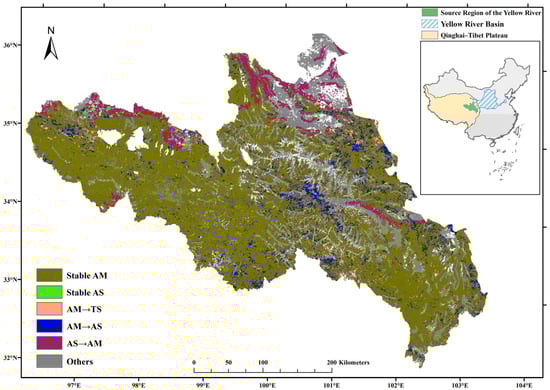
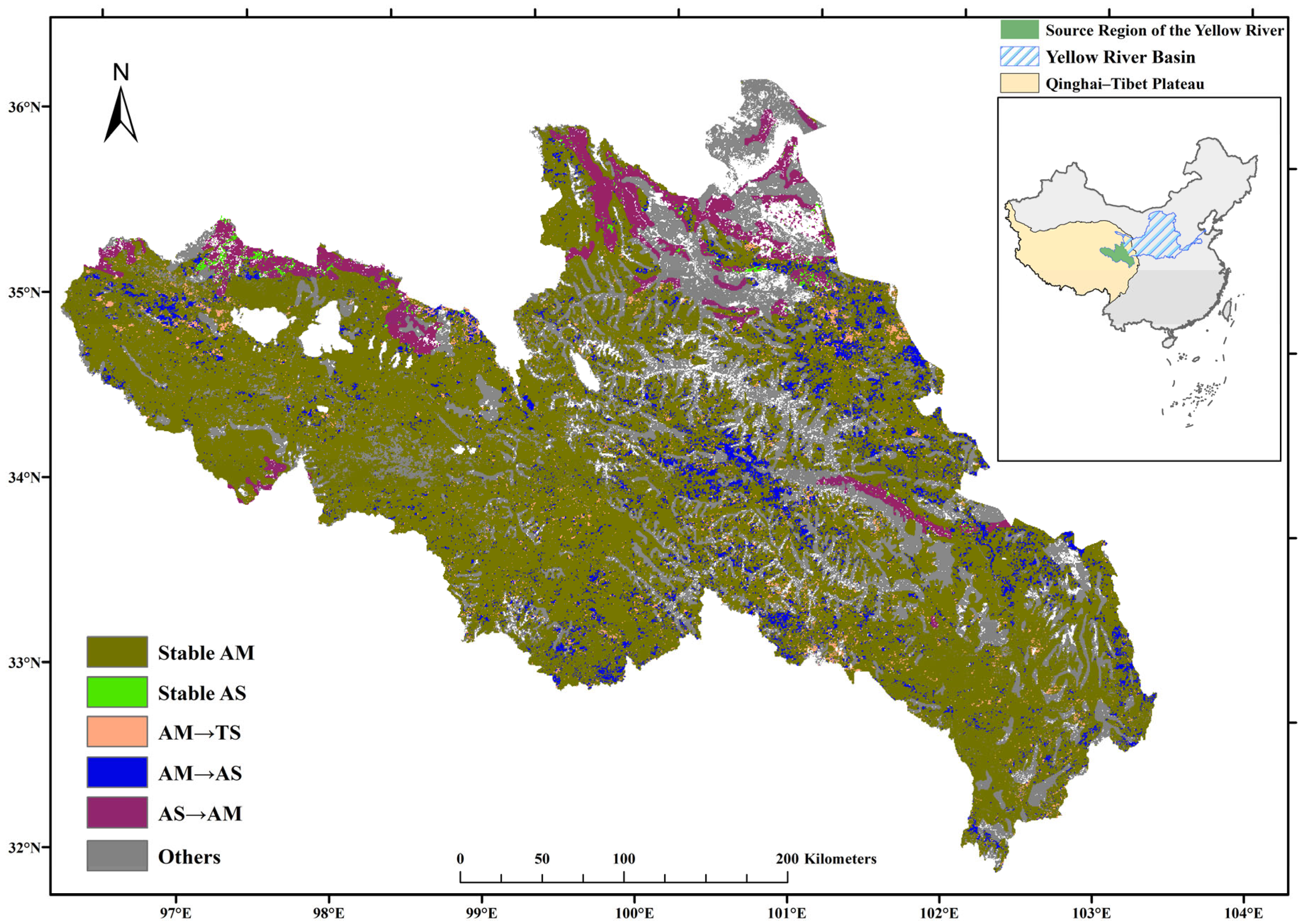
The SRYR, located on the northeastern Qinghai–Tibet Plateau (32°09′–36°25′N, 95°53′–103°25′E; Figure 1), is underlain by seasonally frozen ground and permafrost and has a semi-arid to semi-humid climate. Within the SRYR, landforms include mountains, basins, valleys, lakes, wetlands, glaciers and, predominantly, grasslands [30]. Alpine meadow (AM) and alpine steppe (AS) are widely distributed and are the two focal community types in this study. Elevation ranges from 2539 to 6277 m (mean 4408 m), increasing from southeast to northwest. The alpine topography causes low annual mean temperatures (−4 to 5 °C) but large diurnal ranges, so daily means exceed 0 °C in the growing season (May–September).
Figure 1.
Grassland community composition transition in SRYR from 1980s to 2018 (Note: AM, alpine meadows; AS, alpine steppes; TS, temperate steppes; “A→B” means “A transfer to B”, e.g., “AM→TS” means “alpine meadows to temperate steppes”).
2.2. Data Collection
2.2.1. Grassland Community Composition Data
Although vegetation transitions are gradual and continuous, determining their exact timing is difficult; therefore, changes shown in vegetation classification maps across time periods provide a practical basis for analysis. We overlaid two vegetation maps (1980s and 2010s) with a 40-year interval [35]. At consistent spatial locations, vegetation types on the two maps define transition categories (e.g., “AM→AS” indicates AM in the 1980s and AS in the 2010s). Transition information was extracted in ArcMap 10.7. The study period was divided into three phases: 1986–2000, representing pre-transition conditions consistent with the 1980s vegetation map (reflecting vegetation in the 1980s–1990s [37]); 2001–2003, a short transition window; and 2004–2018, representing post-transition conditions aligned with the 2010s map. This symmetric partitioning of pre- and post-transition periods reduces potential bias in the before–after comparisons, although the exact timing of community shifts within 2001–2003 cannot be determined from the available data. Based on the two vegetation maps (Figure 1), ~63% of alpine grasslands remained stable (mostly AM), ~5% transitioned in each direction between AM and AS, and ~2% of AM shifted to temperate steppe (TS) (Table 1).
Table 1.
Detailed information of the grassland community composition transitions in this study. (Note: AM refers to Alpine Meadow, while AS and TS indicate as Alpine Steppe and Temperate Steppe, respectively.).
2.2.2. Meteorological Data
This study utilized the China Meteorological Forcing Dataset (1979–2018) from the National Tibetan Plateau Data Center (http://data.tpdc.ac.cn/ (accessed on 5 April 2025)), with spatial resolution of 0.1° and maximum temporal resolution of 3 h to investigate the trends in surface meteorological elements in the SRYR since the mid-1980s [38]. Six ET-related variables during the growing season (May–September) were selected: temperature (Tmp), surface air pressure (P), specific humidity (SHum), 10 m wind speed (WS), downward shortwave radiation (SRad), and precipitation (Pr). For each year, mean Tmp and WS were extracted, whereas Pr and SRad were aggregated as growing season totals. Additionally, the mean relative humidity (RHum) was calculated following the equation below:
where represents relative humidity (%), is specific humidity (kg/kg), is saturation specific humidity (kg/kg), refers to saturation vapor pressure (Pa) calculated using the Tetens formula [39], P is air pressure (Pa) and Tmp indicates mean temperature (°C).
2.2.3. Evapotranspiration and Soil Moisture Data
A global dataset of terrestrial ET and soil moisture (SM) spanning from 1982 to 2020 was adopted in this study [40]. This dataset includes daily-scale ET and its three components: plant transpiration (Tr), soil evaporation (Es), and vegetation interception (Ei), as well as three-layer SM data (0–10 cm, 10–30 cm, and 30–50 cm). It was generated using a modified version of the Simple Terrestrial Hydrosphere model (SiTHv2), driven by hydro-meteorological variables derived from multi-source satellite observations and reanalysis data. With a spatial resolution of 0.1°, this dataset effectively captures hydrological variations caused by continuous vegetation changes in the study area, owing to its high accuracy and long-term temporal continuity (Figure S1). Furthermore, the ET and SM data produced under the same modeling framework significantly reduce discrepancies arising from errors between models or data products, as well as technical issues associated with data fusion. Although the 0.1° spatial resolution may smooth fine-scale heterogeneity, it remains adequate for detecting regional-scale ET patterns and transition-related differences across the SRYR.
2.2.4. Vegetation Index Data
In this study, vegetation growth status was characterized using Normalized Difference Vegetation Index (NDVI) products derived from the Advanced Very High Resolution Radiometer (AVHRR; https://developers.google.com/earth-engine/datasets/catalog/NOAA_CDR_AVHRR_NDVI_V5 (accessed on 8 June 2024)). This dataset, provided by the National Oceanic and Atmospheric Administration (NOAA), has a spatial resolution of 0.05° and offers continuous records from 1981 to the present. Using the Google Earth Engine (GEE) platform, we extracted monthly NDVI during the grassland growing season for each study year and applied the Maximum Value Composite (MVC) method, whereby the highest growing season NDVI was used to represent annual vegetation growth status, reflecting the maximum potential vegetation growth under prevailing conditions.
2.3. Data Analysis
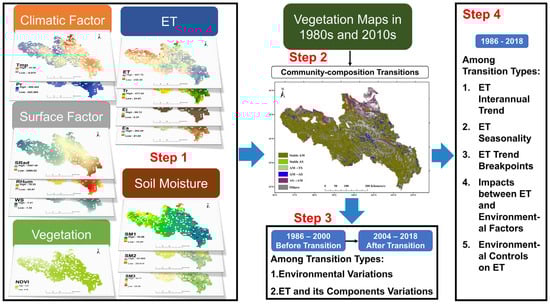
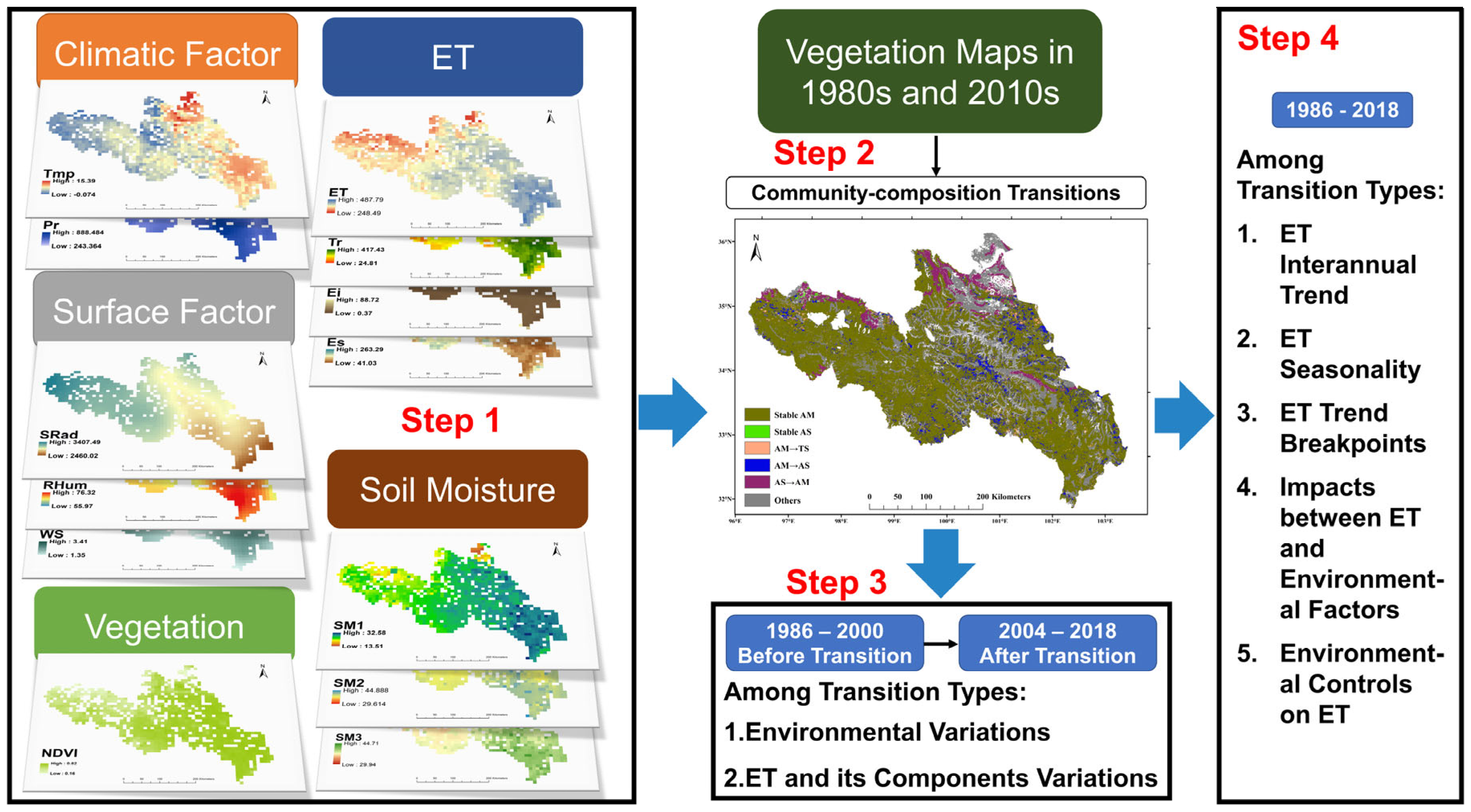
By integrating multi-source remote sensing data, we adopted four-step analytical approach to address the scientific questions mentioned above (Figure 2).
Figure 2.
Methodological framework for analyzing ET responses to community composition transitions in alpine grasslands. Four-step analytical approach: (1) environmental data processing and extraction (1986–2018); (2) community composition transition identification through vegetation map overlay analysis (1980s vs. 2010s); (3) comparative analysis of environmental and ET variations between pre-transition (1986–2000) and post-transition (2004–2018) periods; (4) time-series analysis of ET characteristics (interannual trends, seasonality, breakpoints) and environmental controls across transition types for the entire 33-year period.
2.3.1. Impacts of Variables on ET and Its Components
To identify the key factors which can significantly affecting ET and its components in the alpine grassland ecosystem of the SRYR, grid-based statistics and partial correlation analyses were conducted for interannual variations in meteorological, vegetation, soil moisture factors, and ET (including Tr, Es and Ei). Data analysis was implemented by “ppcor” package in R (Version 4.4.0) [41], which calculates partial correlation coefficients with three method options while providing statistical significance levels. This method serves as an effective approach for exploring direct linkages between environmental factors and ET in ecosystems [42,43].
2.3.2. Variations in ET and Its Component Detection Under Compositional Transitions
The one-way analysis of variance (ANOVA) method was adopted to separately investigate discrepancies of ET and its components among two stable grassland communities and three community composition transitions during 1986 to 2018. The ANOVA analysis focuses on two aspects: (1) assessing whether grassland ET underwent significant transitions under the transitions in community composition; and (2) evaluating the differences in ET among different transitions. Before ANOVA, all grouped datasets were subjected to normality and homogeneity of variance tests. Upon passing these tests, the Least Significant Difference (LSD) post hoc method was used to assess significant variances between groups. Additionally, Tukey’s HSD multiple comparisons test was applied to detect significantly changes in ET and its components between pre- and post-transition periods in each community composition transition. All ANOVA and multiple comparison analyses were conducted using the “stats” and “agricolae” packages in R (Version 4.4.0).
2.3.3. Variations in ET Trend and Seasonality Detection Under Compositional Transitions
The Prophet model was adopted in this study to obtain a better understanding in discrepancies of ET dynamics among community composition transitions under climate change. Compared with classical decomposition methods such as STL and change-detection frameworks like BFAST, Prophet provides a practical balance for jointly estimating long-term trend, seasonality, and breakpoints within a single framework, while being robust to missing values and noise, which makes it well-suited to environmental time-series applications [44,45,46].
We implemented the open-source “Prophet” package in Python (Version 3.14) to run workflow of this model due to its exceptional flexibility and robustness in handling time series with strong seasonality and trend change points [47]. In the model, core additive model was adopted to model time series as follows:
where refers to the trend component, which is fitted using a piecewise linear model. refers to the seasonality component used by the Fourier series to model annual seasonality [48]. represents holiday terms which are not explicitly defined in this study because of highly correlated and stable impacts from variables on ET. represents Gaussian white noise. The coefficient of determination (R2) was employed to quantify the model’s fitting performance on historical data. R2 calculation is based on residual sum of squares and total sum of squares, with values closer to 1 indicating stronger model explanatory power. The calculation formula is as follows:
where is the change rate, is the base offset, are trend change points automatically identified by the model, and are the changes in growth rate at change points. The model implements sparse selection of change points by setting Laplace priors ( ~ Laplace (0, τ)) on to prevent overfitting. is calculated by the following equation:
where period is set to 153 days aligned with the length of growing season, is the Fourier order (set to 3 in this study). The model sets normal distribution priors on Fourier coefficients (, ) to ensure smoothness of seasonal curves.
2.3.4. Environmental Controls on ET Under Community Compositional Transitions
This study used structural equation modeling (SEM; R package piecewiseSEM) to identify dominant environmental controls and pathways of ET across five alpine grassland transition types and partition direct and indirect effects. Piecewise SEM is suitable for complex systems, such as grassland ET under multiple environmental controls [49]. We used annual data for 1986–2018 and treated all transition pixels as samples to capture long-term regulation. In the SEM, mean Tmp and accumulated Pr were specified as primary climatic drivers. SRad, WS and NDVI were included as underlying surface mediators that respond to climate and regulate ET. Soil moisture in two shallow layers was modeled as driven by climatic and surface variables, exerting cascading effects on ET. Paths from climate to surface to soil represent indirect climatic control of ET via ecosystems, while direct climate→ET paths describe residual effects not mediated by the ecosystem. WS was retained because of its strong association with vegetation dynamics and its influence on land–atmosphere water exchange and soil moisture dynamics in high-elevation alpine areas [50,51]. Although SM and ET are tightly coupled and potentially two-way [15], we specified a one-way path from SM to ET because annual data cannot resolve short-term feedbacks and maintain model identifiability and stability.
3. Results
3.1. Environmental Variations in the SRYR
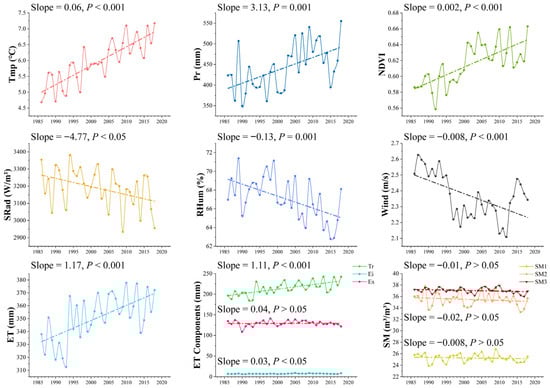
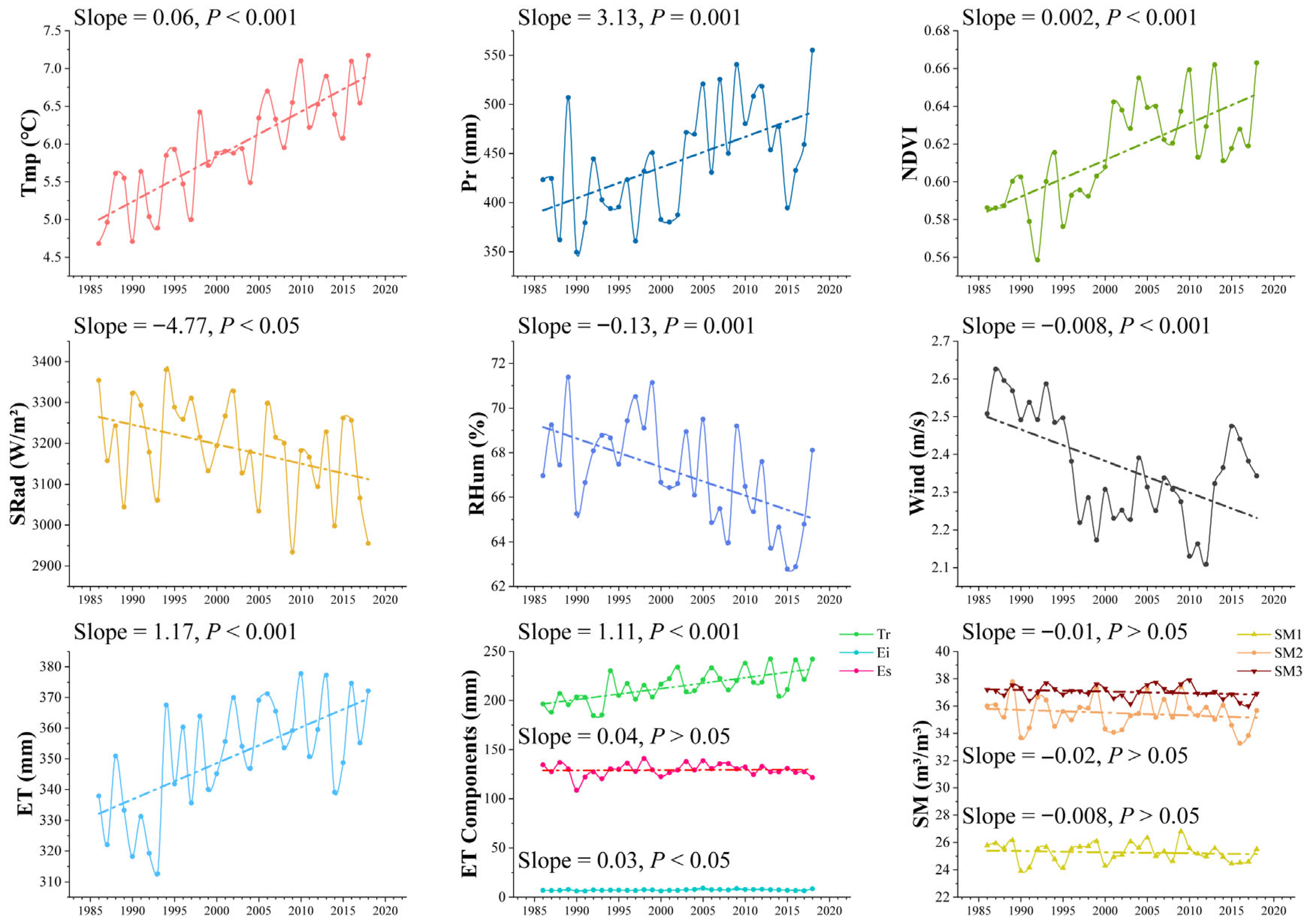
A pronounced warming and wetting trend was observed in the SRYR during 1986–2018 (Figure 3). The mean growing season temperature was 5.95 °C, exhibiting an annual increase of 0.06 °C (p < 0.001). Growing season precipitation averaged 441.95 mm yr−1 and increased at a rate of 3.13 mm yr−1 (p = 0.001). Concurrent with these warming and wetting conditions, grassland NDVI in the SRYR increased (slope = 0.002, p < 0.001), with a multi-year mean of 0.62. SRad, RHum, and WS all exhibited decreasing trends (p < 0.05). Despite the significant increase in water input and marked improvement in vegetation condition, grassland soil water storage capacity showed no increasing trend. Soil moisture in the 0–10 cm (SM1), 10–30 cm (SM2), and 30–50 cm (SM3) layers exhibited slight, non-significant decreasing trends.
Figure 3.
The variations in mean value in annual growing season of climate, grass vegetation and soil moisture in SRYR during 1986–2018. Note: The dot dash lines represent the linear regression fit of the temporal trend.
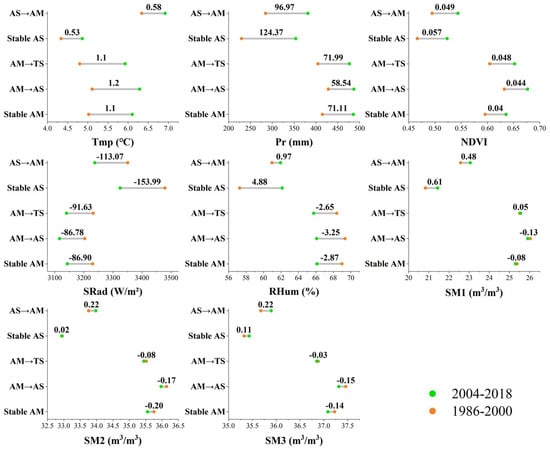
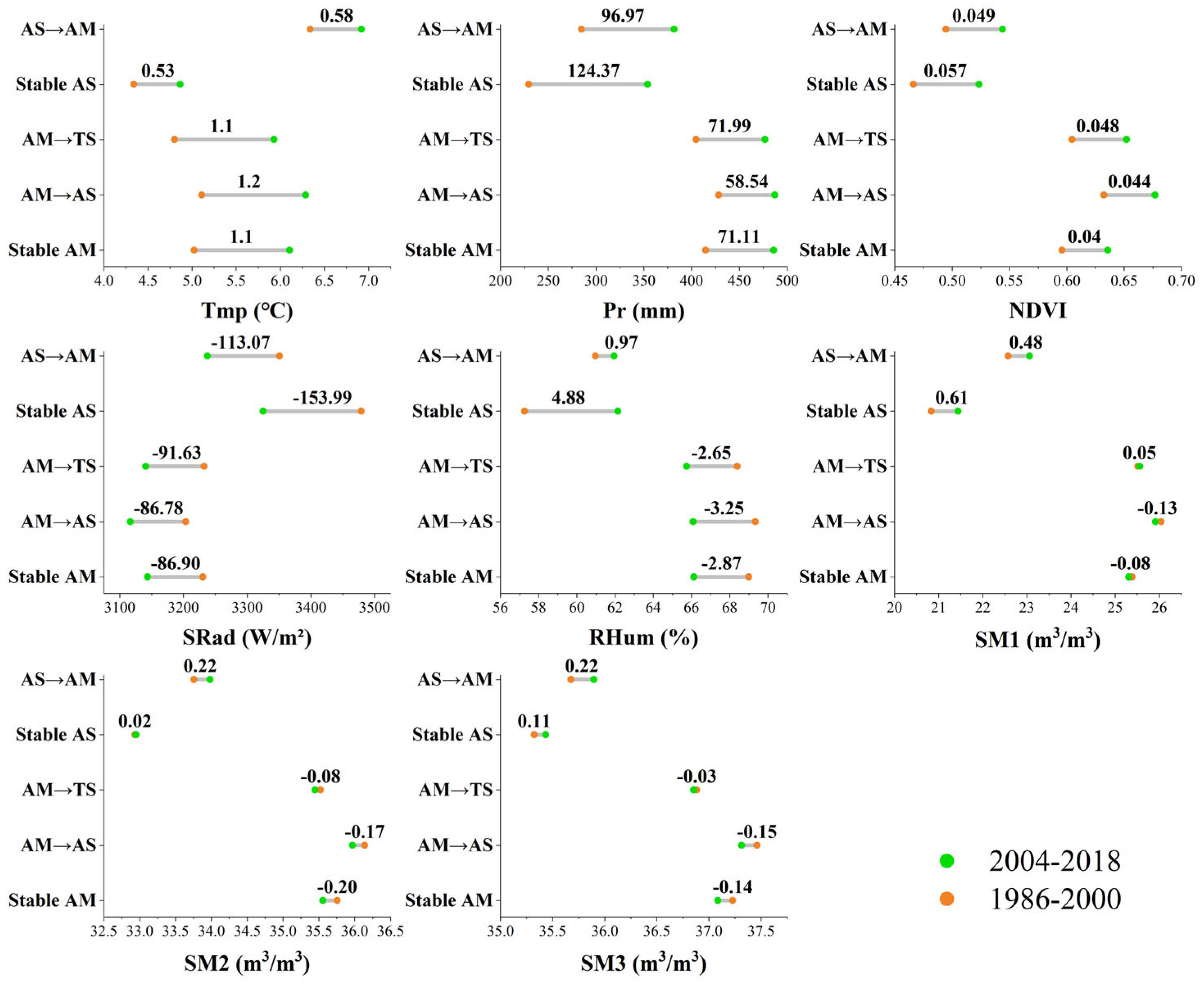
A striking pattern emerged in the contrasting responses of temperature and precipitation across transition types (Figure 4). Transitions originating from AM experienced substantially greater temperature increases (mean increase: 1.1–1.2 °C) compared to AS-origin transitions (0.53–0.58 °C), while precipitation changes exhibited the opposite trend. The observation that Stable AS grasslands, despite having the lowest baseline precipitation (approximately 250 mm), experienced the most substantial precipitation increase (124.37 mm, representing a ~50% increase) is particularly noteworthy. Conversely, AM to AS transitions occurred in areas that received the highest precipitation (>450 mm) but experienced the smallest precipitation increase (58.54 mm). Among declining radiation, NDVI increased significantly across all transitions, where NDVI growth rate was approximately 20% higher in AS-origin transitions. Both RHum and SM decreased in AM-origin transitions during the study period, while both variables increased in AS-origin transitions. Beyond these trends, the average levels of RHum and SM in AM-origin transitions remained higher than those in AS-origin transitions throughout the study period due to higher moisture level in it.
Figure 4.
Environmental factor status before and after community composition transitions in grasslands.
3.2. ET and Its Components Variations Under Compositional Transitions in Grasslands
Growing season ET in SRYR grasslands showed an increasing trend (slope = 1.17 mm yr−1, p < 0.001), with a multi-year mean of 350.88 mm (Figure 3). Annual ET accounted for 79.39% of total precipitation, with its rate of increase representing 37.38% of the overall rise in precipitation.
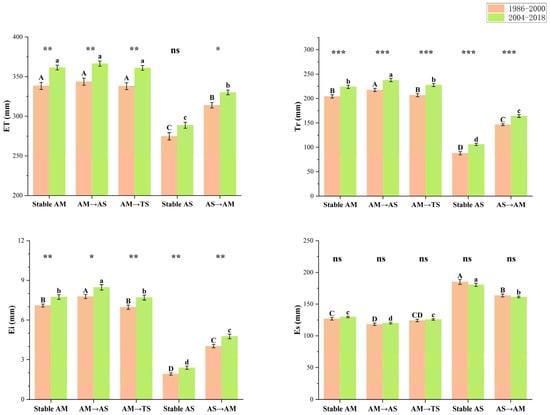
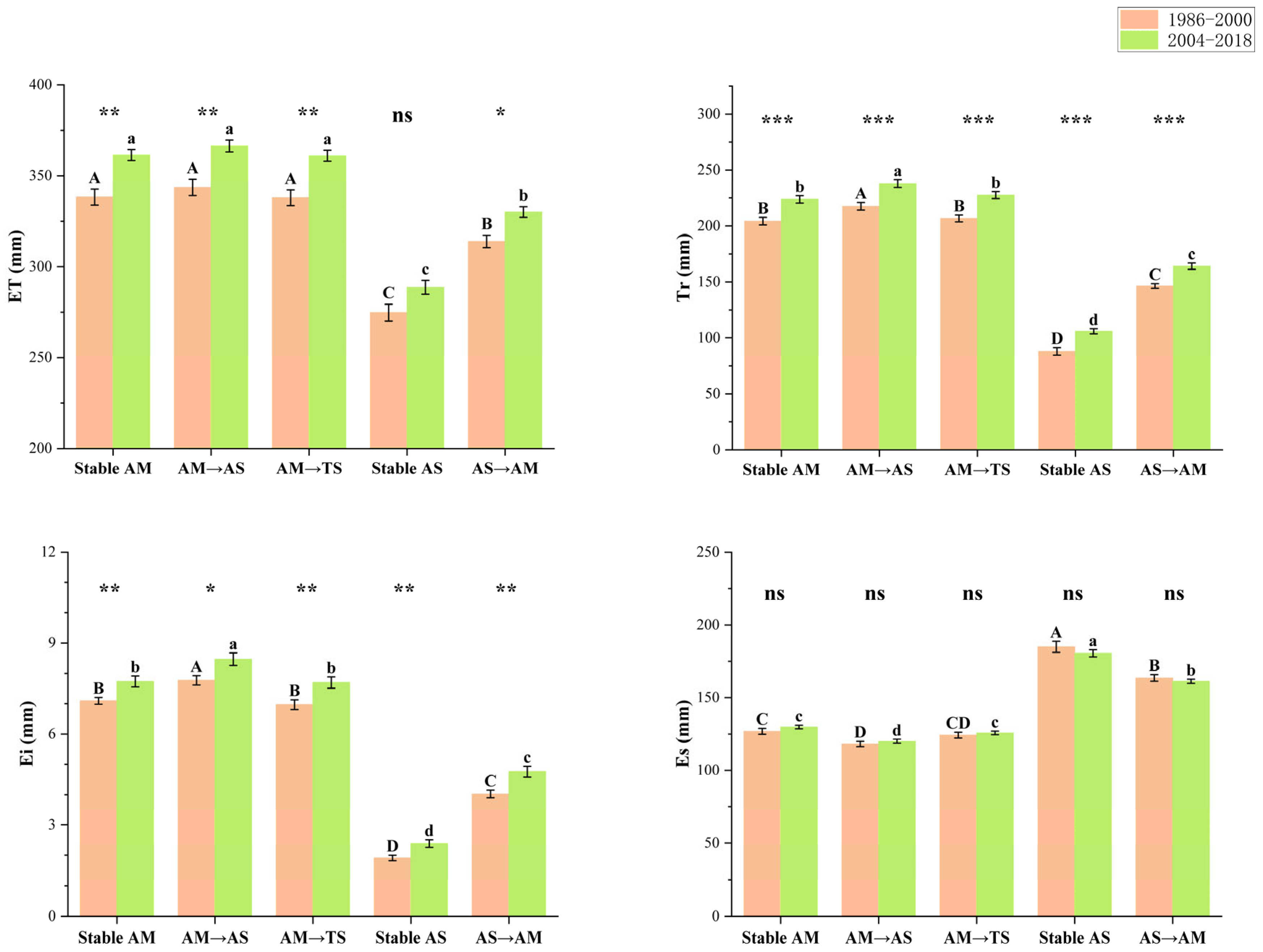
ET increasing occurred among all types of transitions (Figure 5). However, only Stable AS did not exhibit a statistically significant change in ET during transitions (p > 0.05). AM-origin transitions exhibited 16.41% and 52.54% higher ET in terms of mean levels and variations, respectively, compared to those of AS-origin transitions. The increase in transpiration accounted for more than 80% of the ET changes across AM-origin transitions, whereas this proportion exceeded 100% in AS-origin transitions. (Table 2). Except for Es, transpiration and Ei experienced significant increases among all transitions. Even so, the direction of Es changes varied. It increased following AM-origin transitions, while a slight decrease was observed in those of AS-origin transitions.
Figure 5.
One-way ANOVA of ET before and after community composition transitions in grasslands. Note: Error bars represent standard errors. Asterisks indicate significant levels of statistical differences between two periods: *** p < 0.001; ** p < 0.01; * p < 0.05; ns, not significant. Uppercase letters (A, B, C, D) denote statistical differences in 1986–2000; lowercase letters (a, b, c, d) denote statistical differences in 2004–2018 (Tukey’s HSD, α = 0.05). Groups sharing the same letter are not significantly different.
Table 2.
Growing season ET and their variations under grassland community composition transitions.
Among AM-origin transitions, although total ET did not differ significantly among these transitions within the same period, its components varied. For transitions originated as AS, there were significant differences in total ET and its components during the same period (p < 0.05). The ET in AS to AM was 14.29% higher on average than that of Stable AS, and 15.93% greater in ET variation. In Stable AS, although transpiration, and Ei followed the similar amplitude as in AS to AM, the decrease in Es was 1.94 times greater than that observed in AS to AM. As a result, the overall ET in Stable AS showed a slight increase over time, but the change was not statistically significant (p > 0.05).
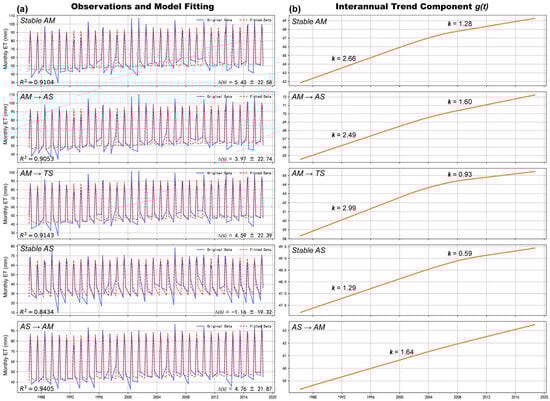
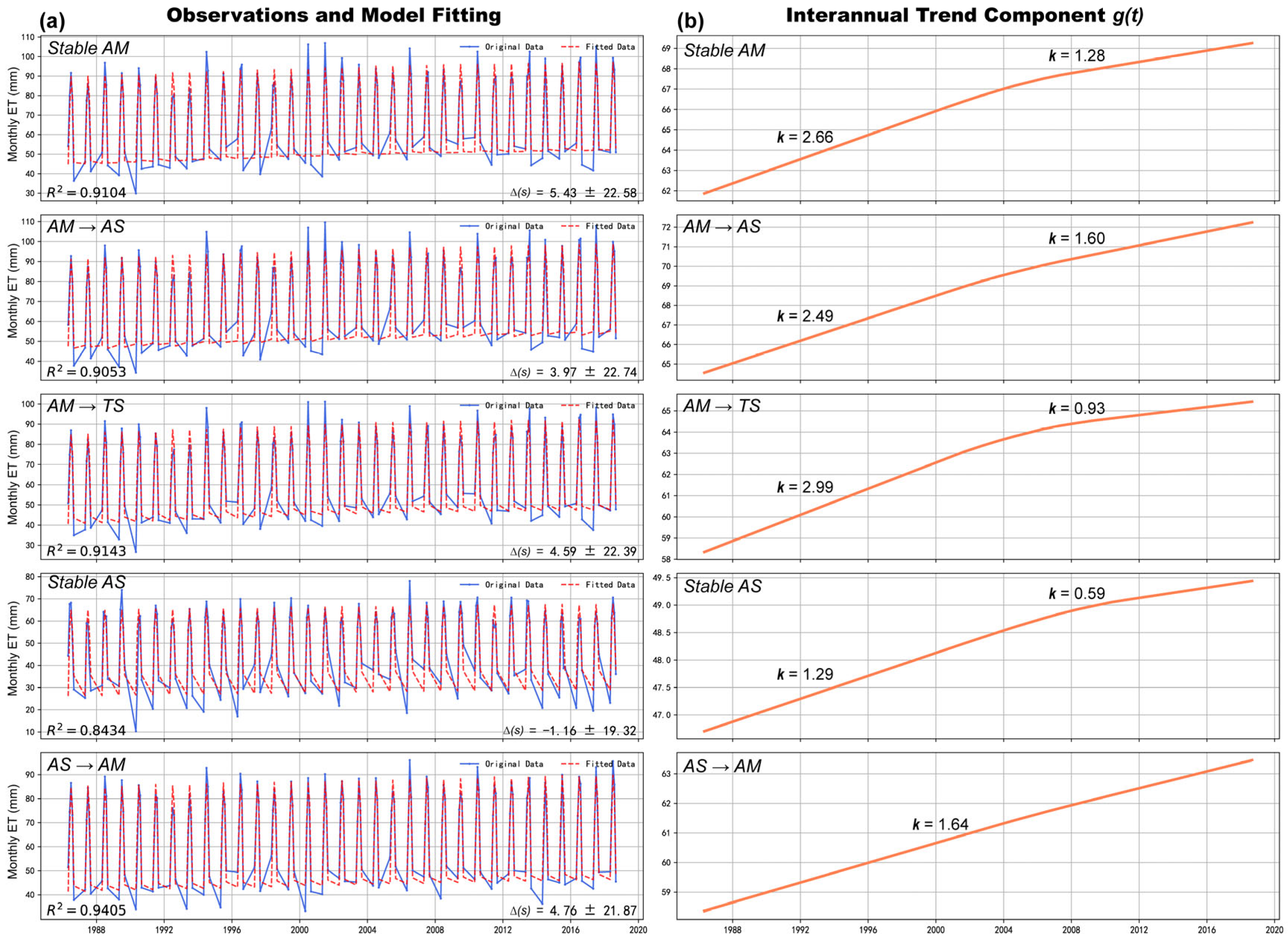
The Prophet decomposition model revealed differences in interannual and intraannual ET dynamics among grassland transitions (Figure 6). The models showed consistently high explanatory power across all transition types, with R2 values of 0.84–0.94, indicating predictable ET dynamics during each transition (Figure 6a). Regarding seasonality, AM-origin transitions exhibited larger seasonal amplitudes than those of AS-origin transitions. All grassland transitions showed positive interannual ET growth rates, but with magnitudes that reflect distinct ecohydrological responses under community composition transitions (Figure 6b). Significant turning points in interannual ET trends for Stable AM and Stable AS indicate that ET dynamics were affected by environmental changes between transition periods, with ET trend slopes in both stable grasslands declining by nearly 50%. In contrast, the AM to AS transition showed a moderate reduction in ET growth rate, from 2.49 to 1.60 mm yr−1, representing a 35.53% decrease in interannual ET enhancement capacity. The AM to TS transition showed the most severe deterioration, with the growth rate decreasing from 2.99 to 0.93 mm yr−1—a 69.05% reduction. The AS to AM transition maintained a consistent ET growth rate (1.64 mm yr−1).
Figure 6.
Interannual trend and seasonality decomposition on ET under community composition transitions in grasslands. (a) Monthly ET observations and Prophet model fitting in each growing season from 1986 to 2018. (b) Interannual trend decomposition and trend change identification. Notes: In (a), the blue solid lines refer to monthly ET observation anomalies, while red dashed lines are cyclical variations in monthly ET with interannual trends fitted by model; the R2 value indicates the explanatory power of model fitting; the Δ(s) represents seasonality features with the combination of baseline offset and cyclical fluctuation (mm). In (b), the k indicates interannual trend (mm/yr).
3.3. Effects of Environmental Factors on ET Under Compositional Transitions in Grasslands
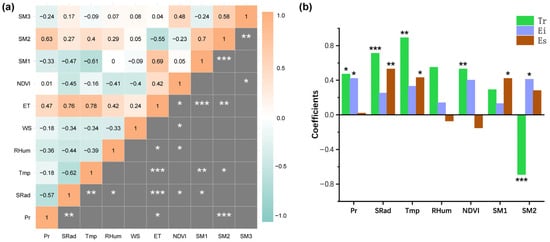
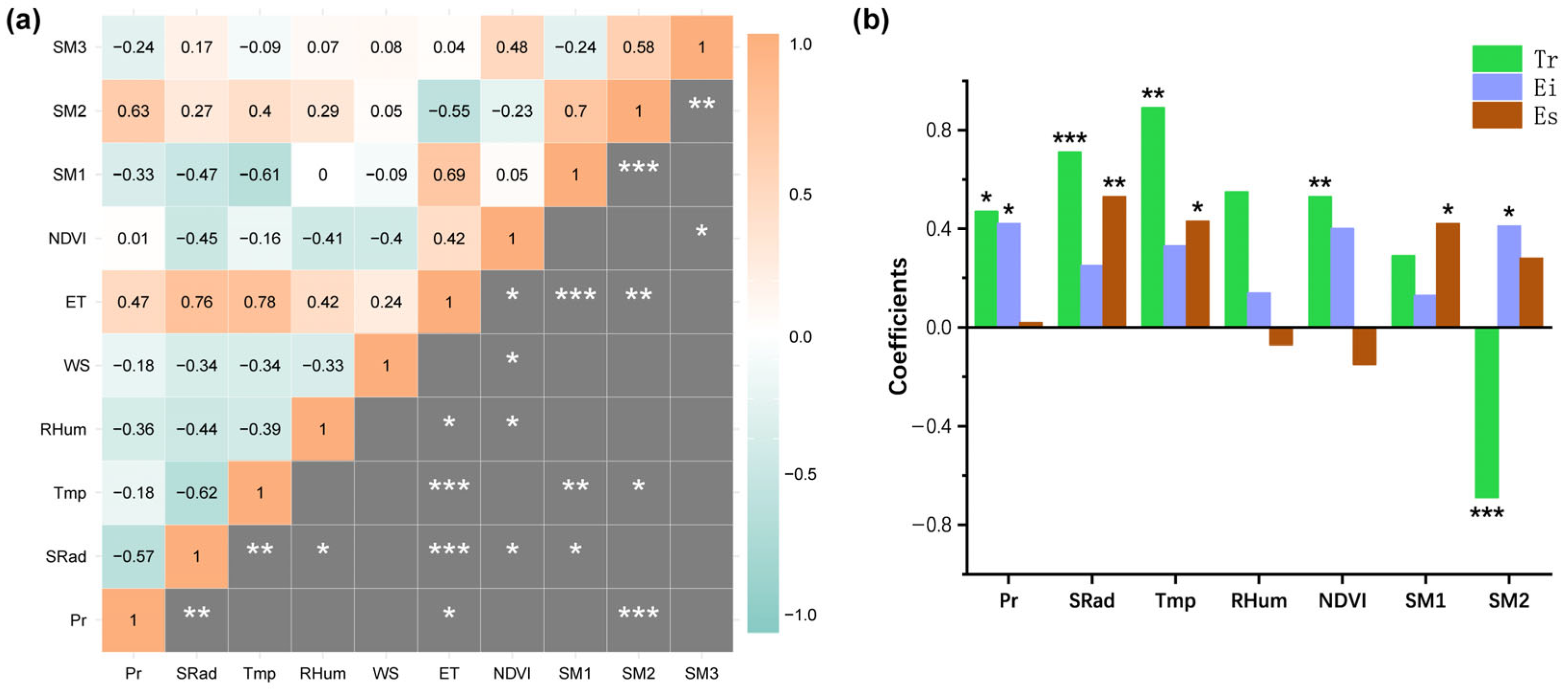
Meteorological variables (Tmp, Pr, SRad, RHum), vegetation (NDVI), and soil moisture (SM1, SM2) were all significantly correlated with ET in the SRYR (p < 0.05; Figure 7a). Among meteorological factors, Tmp (r = 0.78) and SRad (r = 0.76) showed extremely significant correlations with ET, followed by Pr (r = 0.47) and RHum (r = 0.42). NDVI was positively correlated with both ET (r = 0.42) and SM3 (r = 0.48) during the study period. Among soil moisture variables, SM1 had a positive correlation with ET (r = 0.69, p < 0.001), while SM2 exhibited a highly negative correlation with ET (r = −0.55, p < 0.01). From the perspective of ET components (Figure 7b), Tmp exhibited the strongest positive correlation with Tr (r = 0.89, p < 0.01). On the contrary, SM2 was negatively correlated with Tr (r = −0.69, p < 0.001). In Es, SRad obtained the strongest positive correlation with it (r = 0.53, p < 0.01). Notably, although the correlation between NDVI and Es was not statistically significant, they exhibited a negative relationship (r = −0.15, p > 0.05).
Figure 7.
Partial correlation analysis in ET (a) and each of its component (b) with environmental factors. Note: Asterisks denote statistical significance levels between two factors: *** p < 0.001; ** p < 0.01; * p < 0.05.
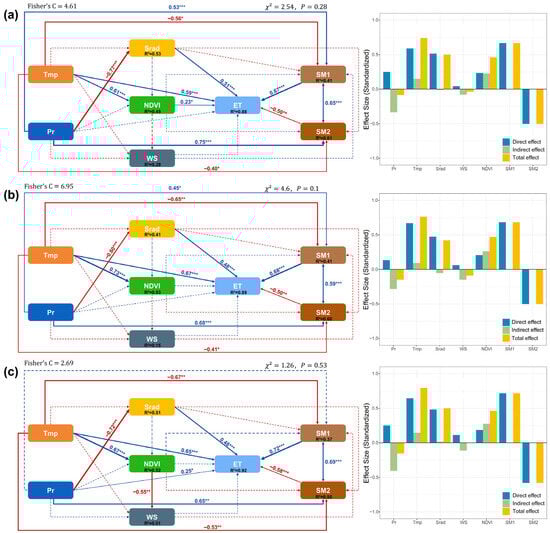
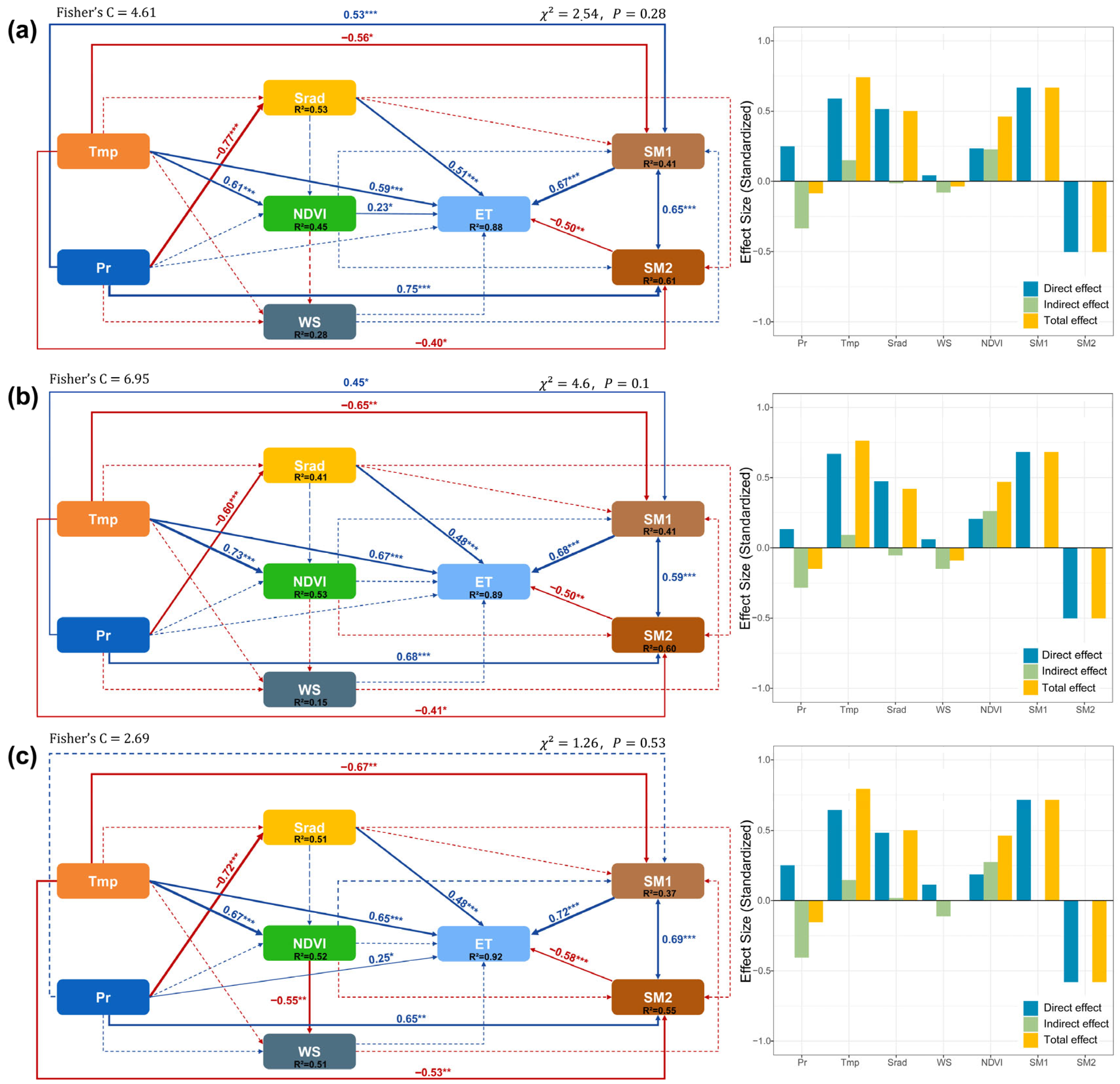
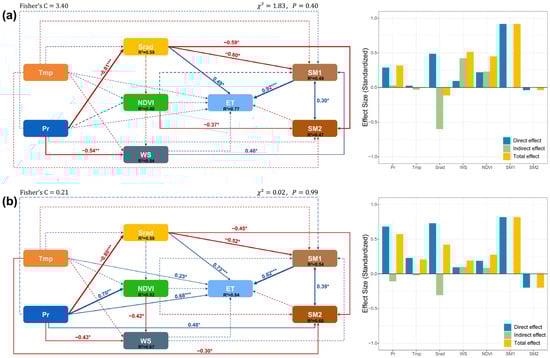
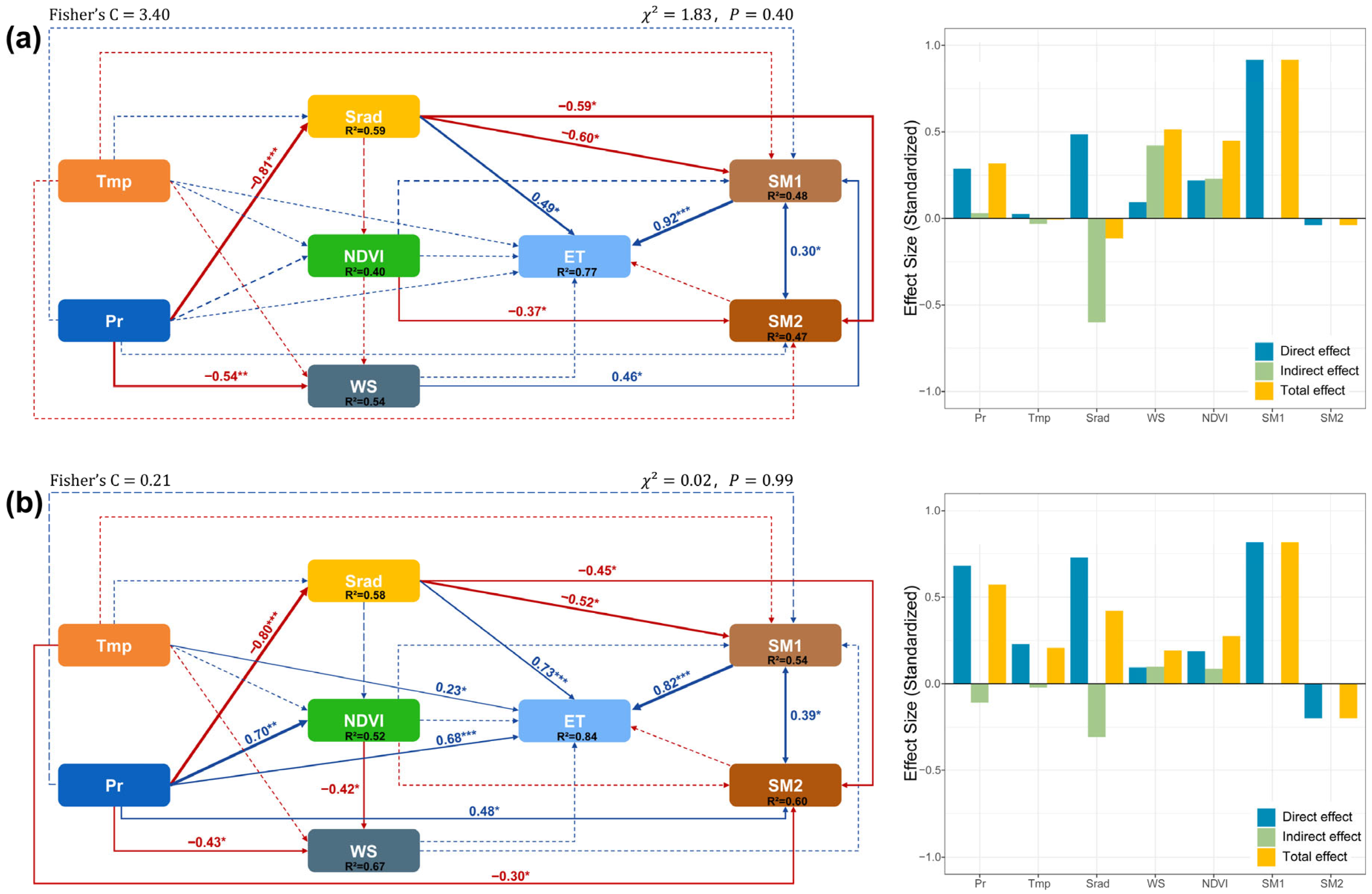
All SEMs showed an adequate overall fit to the data, with Fisher’s C ranging from 0.21 to 6.95 (p > 0.05; Figure 8 and Figure 9). For AM-origin transitions, temperature is the primary climatic factor that generated a comprehensively positive effect on ET, followed by SM1 and SRad (Figure 8). In addition, temperature had a positive effect on NDVI (p < 0.001), with the strongest effect observed in the AM to AS transition (β = 0.73), followed by AM to TS (β = 0.61). It also exerted negative effects on SM1 and SM2 (p < 0.05), with the strongest effect in AM to TS, followed by AM to AS. In contrast, although precipitation had an extremely significant positive effect on SM, the stronger negative effect of precipitation on SRad—being strongest in Stable AM (β = −0.77), followed by the AM to TS transition (β = −0.72)—offset the direct positive effect of precipitation on ET. It is worth noting that although the direct effect of NDVI on ET was relatively weak among AM-origin transitions, and was only statistically significant in Stable AM (β = 0.23, p < 0.05), NDVI still generally played a positive impact on ET.
Figure 8.
Structural equation modeling and the direct and indirect effects of climatic and vegetation factors on ET under different community composition transitions originated in AM. (a) Stable AM. (b) AM to AS. (c) AM to TS. Note: Standardized path coefficients are shown on arrows (*** p < 0.001; ** p < 0.01; * p < 0.05). R2 values indicate variance explained. Arrow width reflects coefficient magnitude. Solid arrows denote significant paths. Model fit indices (Fisher’s C, reported as Chi-squared (𝜒2), and associated p-values) are shown in each panel.
Figure 9.
Structural equation modeling and the direct and indirect effects of climatic and vegetation factors on ET under different community composition transitions originated in AS. (a) Stable AS. (b) AS to AM. Note: Standardized path coefficients are shown on arrows (*** p < 0.001; ** p < 0.01; * p < 0.05). R2 values indicate variance explained. Arrow width reflects coefficient magnitude. Solid arrows denote significant paths. Model fit indices (Fisher’s C, reported as Chi-squared (𝜒2), and associated p-values) are shown in each panel.
Precipitation played a dominantly climatic role in promoting ET among AS-origin transitions (Figure 9). Specifically, precipitation exerted a comparatively stronger direct effect on ET in all AS-origin transitions, particularly in the AS to AM transitions (β = 0.68, p < 0.001). It also had a greater stimulatory effect on NDVI compared to the AM-origin transitions, with the strongest effect observed in the AS to AM transition (β = 0.70, p < 0.01), which further indirectly enhanced ET. In addition, a more pronounced suppressive effect of precipitation on SRad was observed in AS-origin transitions. Notably, due to the significantly negative effects of SRad on SM1 and SM2, reductions in SRad indirectly increased SM levels, thereby further facilitating ET.
4. Discussion
Our findings revealed distinct environmental control mechanisms governing grassland transition pathways, with environmental changes fundamentally dependent on the originating community composition. A pronounced temperature–precipitation decoupling emerged between AM-origin and AS-origin transitions, indicating differential responses to regional climate forcing. In AM-origin transitions, the substantial temperature increases potentially offset precipitation gains and create effectively drier conditions. In AS-origin transitions, the pronounced wetting trend in water-limited steppe systems reflected beneficial effects of increased moisture availability in overcoming the primary constraint for vegetation growth.
4.1. Environmental Discrepancies Among Compositional Transitions of Grasslands in the SRYR
Water availability has been demonstrated as the dominant limiting factor in AS ecosystems across the Qinghai–Tibet Plateau [52,53,54]. Our results suggest that recent precipitation increases have begun alleviating this limitation, especially in AS-origin transitions. The Stable AS grasslands experienced a 124.37 mm precipitation increase despite having the lowest baseline (Figure 4), underscoring a pronounced moisture-driven transformation. Although this enhancement slightly exceeds basin-average trends in the SRYR (~2.7 mm yr−1 during 1979–2015 [55]), it is consistent with previous reports that the strongest wetting occurs in northwestern high-altitude subregions [56,57]. Conversely, the counterintuitive pattern in AM to AS transitions—where well-watered meadows degraded despite relatively high precipitation—suggests that factors beyond total precipitation drive meadow degradation. Although some studies attribute AM to AS transitions to decreased temperature and precipitation simplifying vegetation structure [54,58], substantial temperature increases in AM-origin transitions likely enhanced ET rates through increased evaporative demand [59], and intensive grazing may further accelerate this degradation [60,61]. This interpretation aligns with observations that warming-induced increases in atmospheric vapor pressure deficit have intensified moisture stress in alpine meadows [62,63]. The divergent trends in relative humidity and soil moisture between AM-origin and AS-origin transitions reflect this temperature–precipitation decoupling underlying compositional shifts. The universal decline in solar radiation across all transitions likely reflects complex climate–vegetation feedback, potentially attributable to increased cloudiness associated with enhanced precipitation [64]. Despite declining radiation, NDVI increased significantly across all transitions, indicating that benefits from increased precipitation [10,65] and CO2 fertilization [66,67] outweighed reduced light availability. Besides the climate effects, ecological restoration projects in the SRYR also have enhanced alpine grassland structure and productivity [68,69]. These changes may shift the partitioning of ET, promoting higher ecosystem water use efficiency and stabilizing water availability. The strong coupling between solar radiation, NDVI, and precipitation patterns highlights the paramount importance of water availability in these water-limited alpine ecosystems.
4.2. ET Responses Among Compositional Transitions in Grasslands Under Climate Change in the SRYR
While previous studies have demonstrated that vegetation shading uniformly reduces solar radiation reaching the ground and decreases soil evaporation [34], our findings found that vegetation growth impacts soil evaporation non-uniformly, modulated by community composition and water availability. These contrasting soil evaporation responses are consistent with functional differences among communities: deeper-rooted steppe species can tap subsoil water and sustain transpiration during dry conditions, whereas shallow-rooted meadow species rely more on near-surface moisture, increasing soil evaporation under warming. In addition, greater LAI and canopy density reduce ground-level radiation and vapor diffusion, thereby modulating soil evaporation and ET partitioning across transitions [70]. Moreover, grazing-induced changes in vegetation cover and litter can substantially modify soil evaporation, with heavy grazing enhancing it, whereas grazing exclusion reduces it by increasing canopy and litter cover [71]. Under rising temperatures, this contrast resulted in soil wetting in AS-origin and drying in AM-origin transitions (Figure 4). In AM-origin transitions, soil evaporation increases diminished with declining water availability, consistent with observations that water availability progressively decreases from AM to AS to TS grasslands, reflected by increasing ET/Pr ratios and declining soil moisture [72,73]. Conversely, in AS-origin transitions, reductions in soil evaporation intensified as water availability declined, underscoring the positive relationship between water availability and Es. Under long-term adequate precipitation, AM-origin communities accelerated water loss via ET, leading to surface soil drying, whereas under water-limited conditions, AS-origin vegetation suppressed ET to conserve water, resulting in surface soil wetting. This mechanism explains the significantly higher water use efficiency in AM versus AS ecosystems [74]. Nevertheless, rapid vegetation growth strengthened the soil surface insulating effect regardless of compositional transitions [75], reducing soil evaporation sensitivity to climate change. Consequently, no significant changes in soil evaporation were observed across the study period for any transition.
Discrepancies in interannual trends and seasonal fluctuations in ET between AM-origin and AS-origin transitions reflected the constrained water–energy exchange capacity of AS ecosystems, driven by altered community structure and water availability. Distinct ET growth rate patterns emerged between AM-origin and AS-origin transitions, with a significant turning point around 2006 across all transitions, likely caused by decreased precipitation (Figure S2). Post-turning point, AM to AS maintained higher ET growth rates than Stable AM (Figure 6b), indicating enhanced hydrological exchange that diminished soil moisture and caused drying. Conversely, the dramatic ET growth rate decrease in AM to TS indicated substantial hydrological degradation during soil drying. Among AS-origin transitions, AS to AM maintained stronger and more sustainable hydrological exchange than Stable AS during soil wetting. These contrasting patterns reveal asymmetric ET responses depending on transition directionality, highlighting the differential sensitivity of alpine grassland water balance to compositional shifts and the inherent resilience of certain transition pathways.
4.3. Dominant Mechanism of Climate Change on ET Under Compositional Transitions in Grasslands
From 1986 to 2018, grassland condition in the SRYR improved significantly under warming and wetting trends, consistent with previous regional studies [76,77]. ET exhibited a significant positive correlation with NDVI, with the increase primarily driven by enhanced transpiration and vegetation interception evaporation, aligning with alpine ecosystem observations where transpiration dominates water use under warming [78,79]. In addition, climate change directly facilitated ET (Figure 7), as rising temperatures promoted plant transpiration through enhanced thermoregulation and metabolic activity [8,80]. Increased transpiration consumed soil moisture mainly from the 10–30 cm layer where alpine grassland roots are concentrated [81], while enhanced precipitation drove vegetation interception evaporation. Soil evaporation, sourced from 0 to 10 cm depth, correlated positively with solar radiation [34] but increased only slightly despite radiation attenuation. Warmer temperatures significantly reduced surface soil moisture through evaporation [82], further facilitated by elevated shallow soil temperatures from increased vegetation growth [59].
The key climate drivers and their regulatory pathways of climate change regulating ET differ between transitions originating from AM and those from AS (Figure 8 and Figure 9). To clarify the physical meaning of the SEM pathways, standardized direct, indirect, and total effects were summarized to indicate the relative contribution of each factor to ET. Climatic variables exerted primary forcing, underlying surface factors mediated biophysical regulation, and soil moisture represented feedback linking surface conditions to ET responses. These quantified path coefficients highlight the dominant drivers of ET under each transition type. ET is predominantly regulated by temperature among AM transitions. The AM to TS drove up transpiration variation to represent approximately 90% of total ET increase under warming condition—similar to findings that greening disproportionately elevates transpiration relative to soil evaporation [79]. Due to effects of community composition transitions, temperature produced the most significant effect on ET via increased soil water consumption in the AM to TS. In semi-arid regions, this phenomenon—whereby increased ET driven by greater soil water consumption further reduces water availability—has also been observed [83]. In the AM to AS, temperature variations were the main control—consistent with studies showing alpine grassland ET is highly sensitive to warming [84]. Hence, temperature obtained the strongest direct effect on ET in the AM to AS transition. While in the Stable AM, although temperature rising brought comparatively limited growth in vegetation, highest ET variation was observed in it, indicating that temperature produced the strongest effect on ET via stimulating vegetation growth.
In transitions originating from AS, the direct and overall effects of precipitation on ET are much stronger compared with those in AM-origin transitions. This aligns with research showing that steppe ecosystems are precipitation-sensitive and that increased rainfall tends to elevate transpiration and vegetation interception evaporation while suppressing soil evaporation [85]. In the AS to AM, precipitation obtained the most significant effects on ET separately via stimulating vegetation growth and shallow soil moisture (10–30 cm) improvement. Under wetter soil conditions, plants improve water uptake efficiency and increase stomatal conductance, leading to a marked rise in leaf transpiration [86]. While in the Stable AS, larger precipitation increase obtained stronger impacts on reducing solar radiation and wind speed, which reserved surface soil moisture (0–10 cm) and subsequently stimulates ET.
4.4. Limitations and Future Work
In this study, results of factor-driven ET in SEM should be interpreted as model-informed diagnostics of regional ecohydrological behavior rather than a full process-level decomposition due to the ET data used here being obtained from the model-based SiTHv2 product, in which part of the relationships between ET and its drivers are embedded in the model structure. Accordingly, our SEM quantifies how SiTHv2-simulated ET covaries with observed environmental gradients across alpine grassland transitions. Moreover, we did not account for the “CO2 fertilization effect,” which may influence vegetation-driven ET. The processes of vertical soil water movement and groundwater recharge were not considered when assessing the influence of soil moisture on ET. Future research should incorporate these factors to better clarify the contributions of different drivers to ET and improve the accuracy of ET modeling. Technically, this study was limited by the spatial resolution of the long-term remote sensing datasets used. With the ongoing development of high-resolution, long-term datasets for climate, vegetation, and soil moisture, future studies should apply finer-resolution remote sensing products to better capture ET responses under alpine grassland transitions. The bidirectional causality between soil moisture and ET is not explicitly represented in our SEM analysis, and fully resolving this feedback would require higher-frequency data and dynamic or cross-lagged approaches in future work.
5. Conclusions
In this study, we conducted an integrated analysis of climatic, vegetation, and soil factors to investigate variations in ET and its components during the growing season of alpine grasslands in the SRYR from 1986 to 2018. Based on community composition transitions in alpine grasslands, discrepant environmental variations among transition types were identified, and the responses of ET and its components (including variations, interannual trends, and seasonality) to different community transitions and their regulation mechanisms by environmental factors were investigated.
During the study period, warming–wetting climates increased growing season ET across SRYR alpine grasslands at 1.17 mm yr−1, with 79% of precipitation lost through ET and a slight decline in soil moisture. Transition pathways originating from AM and AS exhibited fundamentally distinct environmental control mechanisms. Clear temperature–precipitation decoupling emerged between the two transition groups: AM-origin transitions experienced more substantial warming than precipitation gains, whereas AS-origin transitions showed more pronounced wetting trends than warming. ET responses differed markedly between transition types. Vegetation greening significantly elevated ET in most transitions except Stable AS. Under greening conditions, soil evaporation increased in AM-origin transitions but declined in AS-origin transitions, highlighting the nonuniform influence of vegetation growth on surface water loss. Interannual variability and seasonal patterns of ET contrasted between AM-origin and AS-origin transitions, reflecting the constrained water–energy exchange capacity of AS ecosystems driven by altered community structure and water availability. Mechanistically, temperature increases dominated in AM-origin grasslands, accelerating transpiration (>80% of ET change) and coupling with increased soil evaporation to intensify soil desiccation, with effects strongest in AM to TS transitions, moderate in AM to AS transitions, and weakest in Stable AM. In AS-origin grasslands, precipitation increases dominated, enhancing transpiration (>100% of ET change) while suppressing soil evaporation and promoting soil wetting; effects were more pronounced in AS to AM transitions than in Stable AS. These results provide critical guidance for differentiated grassland conservation strategies, suggesting that AM-origin systems require water retention measures while AS-origin systems could benefit from restoration interventions, informing regional water security planning and adaptive ecosystem management frameworks.
Supplementary Materials
The following supporting information can be downloaded at: https://www.mdpi.com/article/10.3390/rs17244046/s1, Table S1: Sites of flux tower measurement in alpine grassland ecosystems; Figure S1: Validation of satellite-based ET products against eddy covariance observations in alpine ecosystems; Figure S2: Trend reversal in precipitation in the grasslands of SRYR around 2006 during study period (1986–2018).
Author Contributions
Conceptualization, S.G. and Y.H.; methodology, S.G. and L.Z.; software, S.H.; validation, Y.X. and S.H.; formal analysis, C.L.; investigation, S.G.; resources, R.H.; data curation, Z.Z.; writing—original draft preparation, S.G. and L.Z.; writing—review and editing, Y.H. and X.C.; visualization, X.K.; supervision, J.D.; project administration, Y.W. and K.X.; funding acquisition, Y.W. All authors have read and agreed to the published version of the manuscript.
Funding
This research was funded by the National Natural Science Foundation of China (42041005).
Data Availability Statement
The raw data supporting the conclusions of this article will be made available by the authors on request.
Conflicts of Interest
The authors declare no conflict of interest.
References
- Brümmer, C.; Black, T.A.; Jassal, R.S.; Grant, N.J.; Spittlehouse, D.L.; Chen, B.; Nesic, Z.; Amiro, B.D.; Arain, M.A.; Barr, A.G.; et al. How climate and vegetation type influence evapotranspiration and water use efficiency in Canadian forest, peatland and grassland ecosystems. Agr. For. Meteorol. 2012, 153, 14–30. [Google Scholar] [CrossRef] [Scilit]
- Su, T.; Xie, D.; Feng, T.; Huang, B.; Qian, Z.; Feng, G.; Wu, Y. Quantifying the contribution of terrestrial water storage to actual evapotranspiration trends by the extended Budyko model in Northwest China. Atmos. Res. 2022, 273, 106147. [Google Scholar] [CrossRef] [Scilit]
- Deng, X.Z.; Shi, Q.L.; Zhang, Q.; Shi, C.C.; Yin, F. Impacts of land use and land cover changes on surface energy and water balance in the Heihe River Basin of China, 2000–2010. Phys. Chem. Earth 2015, 79–82, 2–10. [Google Scholar] [CrossRef] [Scilit]
- Getachew, B.; Manjunatha, B.R.; Bhat, H.G. Modeling projected impacts of climate and land use/land cover changes on hydrological responses in the Lake Tana Basin, upper Blue Nile River Basin, Ethiopia. J. Hydrol. 2021, 595, 20. [Google Scholar] [CrossRef] [Scilit]
- Gwate, O.; Mantel, S.K.; Gibson, L.A.; Munch, Z.; Palmer, A.R. Exploring dynamics of evapotranspiration in selected land cover classes in a sub-humid grassland: A case study in quaternary catchment S50E, South Africa. J. Arid Environ. 2018, 157, 66–76. [Google Scholar] [CrossRef] [Scilit]
- Feng, X.; Fu, B.; Piao, S.; Wang, S.; Ciais, P.; Zeng, Z.; Lü, Y.; Zeng, Y.; Li, Y.; Jiang, X.; et al. Revegetation in China’s Loess Plateau is approaching sustainable water resource limits. Nat. Clim. Chang. 2016, 6, 1019–1022. [Google Scholar] [CrossRef] [Scilit]
- Shen, M.; Piao, S.; Jeong, S.J.; Zhou, L.; Zeng, Z.; Ciais, P.; Chen, D.; Huang, M.; Jin, C.S.; Li, L.Z.; et al. Evaporative cooling over the Tibetan Plateau induced by vegetation growth. Proc. Natl. Acad. Sci. USA 2015, 112, 9299–9304. [Google Scholar] [CrossRef] [Scilit]
- Zhao, F.; Ma, S.; Wu, Y.; Qiu, L.; Wang, W.; Lian, Y.; Chen, J.; Sivakumar, B. The role of climate change and vegetation greening on evapotranspiration variation in the Yellow River Basin, China. Agr. For. Meteorol. 2022, 316, 108842. [Google Scholar] [CrossRef] [Scilit]
- Zhao, Y.; Chen, Y.; Wu, C.; Li, G.; Ma, M.; Fan, L.; Zheng, H.; Song, L.; Tang, X. Exploring the contribution of environmental factors to evapotranspiration dynamics in the Three-River-Source region, China. J. Hydrol. 2023, 626, 130222. [Google Scholar] [CrossRef] [Scilit]
- Li, Y.; Xu, R.; Yang, K.; Liu, Y.X.; Wang, S.; Zhou, S.; Yang, Z.; Feng, X.M.; He, C.Y.; Xu, Z.J.; et al. Contribution of Tibetan Plateau ecosystems to local and remote precipitation through moisture recycling. Glob. Chang. Biol. 2023, 29, 702–718. [Google Scholar] [CrossRef] [Scilit]
- Li, X.; Zou, L.; Xia, J.; Dou, M.; Li, H.; Song, Z. Untangling the effects of climate change and land use/cover change on spatiotemporal variation of evapotranspiration over China. J. Hydrol. 2022, 612, 128189. [Google Scholar] [CrossRef] [Scilit]
- Cui, Z.; Zhang, Y.; Wang, A.; Wu, J. Forest evapotranspiration trends and their driving factors under climate change. J. Hydrol. 2024, 644, 132114. [Google Scholar] [CrossRef] [Scilit]
- Qiu, L.; Wu, Y.; Shi, Z.; Chen, Y.; Zhao, F. Quantifying the Responses of Evapotranspiration and Its Components to Vegetation Restoration and Climate Change on the Loess Plateau of China. Remote Sens. 2021, 13, 2358. [Google Scholar] [CrossRef] [Scilit]
- Schlesinger, W.H.; Jasechko, S. Transpiration in the global water cycle. Agr. For. Meteorol. 2014, 189–190, 115–117. [Google Scholar] [CrossRef] [Scilit]
- Li, W.; Yan, D.; Weng, B.; Lai, Y.; Zhu, L.; Qin, T.; Dong, Z.; Bi, W. Nonlinear effects of surface soil moisture changes on vegetation greenness over the Tibetan plateau. Remote Sens. Environ. 2024, 302, 113971. [Google Scholar] [CrossRef] [Scilit]
- Xue, X.; Peng, F.; You, Q.; Xu, M.; Dong, S. Belowground carbon responses to experimental warming regulated by soil moisture change in an alpine ecosystem of the Qinghai-Tibet Plateau. Ecol. Evol. 2015, 5, 4063–4078. [Google Scholar] [CrossRef] [Scilit]
- Zhu, Z.; Wang, H.; Harrison, S.P.; Prentice, I.C.; Qiao, S.; Tan, S. Optimality principles explaining divergent responses of alpine vegetation to environmental change. Glob. Chang. Biol. 2022, 29, 126–142. [Google Scholar] [CrossRef] [Scilit]
- Yang, Y.; Roderick, M.L.; Guo, H.; Miralles, D.G.; Zhang, L.; Fatichi, S.; Luo, X.; Zhang, Y.; McVicar, T.R.; Tu, Z.; et al. Evapotranspiration on a greening Earth. Nat. Rev. Earth Environ. 2023, 4, 626–641. [Google Scholar] [CrossRef] [Scilit]
- He, M.; Wu, W.; Xiao, Y.; Zhang, H.; Li, D.; Yao, T.; Luo, Y.; Weng, H.; Chang, Y.; Bi, Y.; et al. Spatial Climate Heterogeneity as a Moderator of Vegetation Migration Dynamics on the Qinghai-Tibet Plateau. Geophys. Res. Lett. 2025, 52, e2025GL117697. [Google Scholar] [CrossRef] [Scilit]
- Zhu, Y.; Zheng, Z.; Zhao, G.; Zhu, J.; Zhao, B.; Sun, Y.; Gao, J.; Zhang, Y. Evapotranspiration increase is more sensitive to vegetation greening than to vegetation type conversion in arid and semi-arid regions of China. Glob. Planet. Change 2025, 244, 104634. [Google Scholar] [CrossRef] [Scilit]
- Su, Y.; Guo, Q.; Hu, T.; Guan, H.; Jin, S.; An, S.; Chen, X.; Guo, K.; Hao, Z.; Hu, Y.; et al. An updated Vegetation Map of China (1:1000000). Sci. Bull. 2020, 65, 1125–1136. [Google Scholar] [CrossRef] [Scilit] [PubMed]
- Wang, W.Y.; Wang, Q.J.; Wang, H.C. The effect of land management on plant community composition, species diversity, and productivity of alpine Kobersia steppe meadow. Ecol. Res. 2006, 21, 181–187. [Google Scholar] [CrossRef] [Scilit]
- de Klerk, H.M.; Burgess, N.D.; Visser, V. Probabilistic description of vegetation ecotones using remote sensing. Ecol. Inform. 2018, 46, 125–132. [Google Scholar] [CrossRef] [Scilit]
- García-Gutiérrez, T.; Jiménez-Alfaro, B.; Fernández-Pascual, E.; Müller, J.V. Functional diversity and ecological requirements of alpine vegetation types in a biogeographical transition zone. Phytocoenologia 2018, 48, 77–89. [Google Scholar] [CrossRef] [Scilit]
- Liu, Z.; Li, Q.; Chen, D.; Zhai, W.; Zhao, L.; Xu, S.; Zhao, X. Patterns of plant species diversity along an altitudinal gradient and its effect on above-ground biomass in alpine meadows in Qinghai-Tibet Plateau. Biodivers. Sci. 2015, 23, 451–462. [Google Scholar] [CrossRef] [Scilit]
- Li, H.X.; Guo, J.P.; Wang, Y.D.; Wang, W.Y.; Jia, Q.; Wan, H.W.; Li, F.Y. Boundary migration between zonal vegetation types in Inner Mongolia over the past two decades. Catena 2024, 246, 108354. [Google Scholar] [CrossRef] [Scilit]
- Viglizzo, E.F.; Nosetto, M.D.; Jobbágy, E.G.; Ricard, M.F.; Frank, F.C. The ecohydrology of ecosystem transitions: A meta-analysis. Ecohydrology 2015, 8, 911–921. [Google Scholar] [CrossRef] [Scilit]
- Zhu, K.; Song, Y.; Lesage, J.C.; Luong, J.C.; Bartolome, J.W.; Chiariello, N.R.; Dudney, J.; Field, C.B.; Hallett, L.M.; Hammond, M.; et al. Rapid shifts in grassland communities driven by climate change. Nat. Ecol. Evol. 2024, 8, 2252–2264. [Google Scholar] [CrossRef] [Scilit]
- Sun, J.Y.; Sun, X.Y.; Wang, G.X.; Dong, W.C.; Hu, Z.Y.; Sun, S.Q.; Wang, F.; Song, C.L.; Lin, S. Soil water components control plant water uptake along a subalpine elevation gradient on the Eastern Qinghai-Tibet Plateau. Agr. For. Meteorol. 2024, 345, 109827. [Google Scholar] [CrossRef] [Scilit]
- Hu, G.; Jin, H.; Dong, Z.; Yan, C.; Lu, J. Research of land-use and land-cover change (LUCC) in the source regions of the Yellow River. J. Glaciol. Geocryol. 2014, 36, 573–581. [Google Scholar]
- Wang, L.; Zhu, Q.A.; Zhang, J.; Liu, J.; Zhu, C.F.; Qu, L.S. Vegetation dynamics alter the hydrological interconnections between upper and mid-lower reaches of the Yellow River Basin, China. Ecol. Indic. 2023, 148, 110083. [Google Scholar] [CrossRef] [Scilit]
- Wang, T.; Yang, H.; Yang, D.; Qin, Y.; Wang, Y. Quantifying the streamflow response to frozen ground degradation in the source region of the Yellow River within the Budyko framework. J. Hydrol. 2018, 558, 301–313. [Google Scholar] [CrossRef] [Scilit]
- Qin, Y.; Yang, D.; Gao, B.; Wang, T.; Chen, J.; Chen, Y.; Wang, Y.; Zheng, G. Impacts of climate warming on the frozen ground and eco-hydrology in the Yellow River source region, China. Sci. Total Environ. 2017, 605–606, 830–841. [Google Scholar] [CrossRef] [Scilit] [PubMed]
- Zhuang, J.; Li, Y.; Bai, P.; Chen, L.; Guo, X.; Xing, Y.; Feng, A.; Yu, W.; Huang, M. Changed evapotranspiration and its components induced by greening vegetation in the Three Rivers Source of the Tibetan Plateau. J. Hydrol. 2024, 633, 130970. [Google Scholar] [CrossRef] [Scilit]
- Wang, Y.; Xue, K.; Hu, R.; Ding, B.; Zeng, H.; Li, R.; Xu, B.; Pang, Z.; Song, X.; Li, C.; et al. Vegetation structural shift tells environmental changes on the Tibetan Plateau over 40 years. Sci. Bull. 2023, 68, 1928–1937. [Google Scholar] [CrossRef] [Scilit]
- Miehe, G.; Schleuss, P.M.; Seeber, E.; Babel, W.; Biermann, T.; Braendle, M.; Chen, F.; Coners, H.; Foken, T.; Gerken, T.; et al. The Kobresia pygmaea ecosystem of the Tibetan highlands—Origin, functioning and degradation of the world’s largest pastoral alpine ecosystem: Kobresia pastures of Tibet. Sci. Total Environ. 2019, 648, 754–771. [Google Scholar] [CrossRef] [Scilit]
- Wu, F.; Ren, H.; Zhou, G. The 30 m vegetation maps from 1990 to 2020 in the Tibetan Plateau. Sci. Data 2024, 11, 804. [Google Scholar] [CrossRef] [Scilit]
- He, J.; Yang, K.; Tang, W.; Lu, H.; Qin, J.; Chen, Y.; Li, X. The first high-resolution meteorological forcing dataset for land process studies over China. Sci. Data 2020, 7, 25. [Google Scholar] [CrossRef] [Scilit]
- Junzeng, X.U.; Qi, W.E.I.; Shizhang, P.; Yanmei, Y.U. Error of Saturation Vapor Pressure Calculated by Different Formulas and Its Effect on Calculation of Reference Evapotranspiration in High Latitude Cold Region. Procedia Eng. 2012, 28, 43–48. [Google Scholar] [CrossRef] [Scilit]
- Zhang, K.; Chen, H.; Ma, N.; Shang, S.; Wang, Y.; Xu, Q.; Zhu, G. A global dataset of terrestrial evapotranspiration and soil moisture dynamics from 1982 to 2020. Sci. Data 2024, 11, 445. [Google Scholar] [CrossRef] [Scilit]
- Kim, S. ppcor: An R Package for a Fast Calculation to Semi-partial Correlation Coefficients. Commun. Stat. Appl. Methods 2015, 22, 665–674. [Google Scholar] [CrossRef] [Scilit] [PubMed]
- Kim, S.; Koo, I.; Jeong, J.; Wu, S.; Shi, X.; Zhang, X. Compound Identification Using Partial and Semipartial Correlations for Gas Chromatography–Mass Spectrometry Data. Anal. Chem. 2012, 84, 6477–6487. [Google Scholar] [CrossRef] [Scilit] [PubMed]
- Stevens, J. Applied Multivariate Statistics for the Social Sciences; Lawrence Erlbaum Associates: Mahwah, NJ, USA, 2002; Volume 4. [Google Scholar]
- Rahman, A.S.; Hosono, T.; Kisi, O.; Dennis, B.; Imon, A.R. A minimalistic approach for evapotranspiration estimation using the Prophet model. Hydrol. Sci. J. 2020, 65, 1994–2006. [Google Scholar] [CrossRef] [Scilit]
- Hossain, M.A.; Rahman, M.M.; Hasan, S.S.; Mahmud, A.; Bai, L. Analysis and forecasting of meteorological drought using PROPHET and SARIMA models deploying Machine Learning Technique for southwestern region of Bangladesh. Environ. Sustain. Indic. 2025, 27, 100761. [Google Scholar] [CrossRef] [Scilit]
- Aguilera, H.; Guardiola-Albert, C.; Naranjo-Fernández, N.; Kohfahl, C. Towards flexible groundwater-level prediction for adaptive water management: Using Facebook’s Prophet forecasting approach. Hydrol. Sci. J. 2019, 64, 1504–1518. [Google Scholar] [CrossRef] [Scilit]
- Taylor, S.J.; Letham, B. Forecasting at scale. Am. Stat. 2018, 72, 37–45. [Google Scholar] [CrossRef] [Scilit]
- Bracewell, R.; Kahn, P.B. The Fourier transform and its applications. Am. J. Phys. 1966, 34, 712. [Google Scholar] [CrossRef] [Scilit]
- Zur, R.M.; Aballea, S.; Sherman, S. Implementation of Piecewise Structural Equation Modelling (Sem) as an Alternative to Traditional Sem: A Simulation Study. Value Health 2018, 21, S215. [Google Scholar] [CrossRef] [Scilit]
- Wang, S.; Zhang, Y.; Meng, X.; Shang, L.; Li, S.; Li, Z.; Su, Y. Biophysical factors control the interannual variability of evapotranspiration in an alpine meadow on the eastern Tibetan Plateau. Agr. For. Meteorol. 2023, 341, 109673. [Google Scholar] [CrossRef] [Scilit]
- Si, M.; Guo, X.; Lan, Y.; Fan, B.; Cao, G. Effects of Climatic Variability on Soil Water Content in an Alpine Kobresia Meadow, Northern Qinghai–Tibetan Plateau, China. Water 2022, 14, 2754. [Google Scholar] [CrossRef] [Scilit]
- Duan, H.; Xue, X.; Wang, T.; Kang, W.; Liao, J.; Liu, S. Spatial and Temporal Differences in Alpine Meadow, Alpine Steppe and All Vegetation of the Qinghai-Tibetan Plateau and Their Responses to Climate Change. Remote Sens. 2021, 13, 669. [Google Scholar] [CrossRef] [Scilit]
- Ganjurjav, H.; Gao, Q.Z.; Gornish, E.S.; Schwartz, M.W.; Liang, Y.; Cao, X.J.; Zhang, W.N.; Zhang, Y.; Li, W.H.; Wan, Y.F.; et al. Differential response of alpine steppe and alpine meadow to climate warming in the central Qinghai-Tibetan Plateau. Agr. For. Meteorol. 2016, 223, 233–240. [Google Scholar] [CrossRef] [Scilit]
- Wang, Y.; Sun, J.; He, W.; Ye, C.; Liu, B.; Chen, Y.; Zeng, T.; Ma, S.; Gan, X.; Miao, C.; et al. Migration of vegetation boundary between alpine steppe and meadow on a century-scale across the Tibetan Plateau. Ecol. Indic. 2022, 136, 108599. [Google Scholar] [CrossRef] [Scilit]
- Gu, H.; Yu, Z.; Li, G.; Luo, J.; Ju, Q.; Huang, Y.; Fu, X. Entropy-based research on precipitation variability in the source region of China’s Yellow River. Water 2020, 12, 2486. [Google Scholar] [CrossRef] [Scilit]
- Li, Q.; Yang, M.; Wan, G.; Wang, X. Spatial and temporal precipitation variability in the source region of the Yellow River. Environ. Earth Sci. 2016, 75, 594. [Google Scholar] [CrossRef] [Scilit]
- Iqbal, M.; Wen, J.; Wang, S.; Tian, H.; Adnan, M. Variations of precipitation characteristics during the period 1960–2014 in the Source Region of the Yellow River, China. J. Arid Land 2018, 10, 388–401. [Google Scholar] [CrossRef] [Scilit]
- Zhao, D.; Wu, S.; Yin, Y.; Yin, Z. Vegetation distribution on Tibetan Plateau under climate change scenario. Reg. Environ. Chang. 2011, 11, 905–915. [Google Scholar] [CrossRef] [Scilit]
- Li, N.; Wang, L.; Chen, D. Vegetation greening amplifies shallow soil temperature warming on the Tibetan Plateau. Npj Clim. Atmos. Sci. 2024, 7, 118. [Google Scholar] [CrossRef] [Scilit]
- Miehe, G.; Mlehe, S.; Kaiser, K.; Liu, J.Q.; Zhao, X.Q. Status and dynamics of Kobresia pygmaea ecosystem on the Tibetan plateau. Ambio 2008, 37, 272–279. [Google Scholar] [CrossRef] [Scilit]
- Wang, Y.; Lv, W.; Xue, K.; Wang, S.; Zhang, L.; Hu, R.; Zeng, H.; Xu, X.; Li, Y.; Jiang, L.; et al. Grassland changes and adaptive management on the Qinghai–Tibetan Plateau. Nat. Rev. Earth Environ. 2022, 3, 668–683. [Google Scholar] [CrossRef] [Scilit]
- Liu, Y.; Li, Z.; Chen, Y.; Jin, L.; Li, F.; Wang, X.; Long, Y.; Liu, C.; Kayumba, P.M. Global greening drives significant soil moisture loss. Commun. Earth Environ. 2025, 6, 600. [Google Scholar] [CrossRef] [Scilit]
- Kannenberg, S.A.; Anderegg, W.R.L.; Barnes, M.L.; Dannenberg, M.P.; Knapp, A.K. Dominant role of soil moisture in mediating carbon and water fluxes in dryland ecosystems. Nat. Geosci. 2024, 17, 38–43. [Google Scholar] [CrossRef] [Scilit]
- Song, F.; Mao, Y.; Liu, S.; Wu, L.; Dong, L.; Su, H.; Wang, Y.; Chtirkova, B.; Wu, P.; Wild, M. A long-term decline in downward surface solar radiation. Natl. Sci. Rev. 2025, 12, nwaf007. [Google Scholar] [CrossRef] [Scilit] [PubMed]
- Li, Y.; Su, F.G.; Chen, D.L.; Tang, Q.H. Atmospheric Water Transport to the Endorheic Tibetan Plateau and Its Effect on the Hydrological Status in the Region. J. Geophys. Res. Biogeosci. 2019, 124, 12864–12881. [Google Scholar] [CrossRef] [Scilit]
- Liu, Z.; Rogers, B.M.; Keppel-Aleks, G.; Helbig, M.; Ballantyne, A.P.; Kimball, J.S.; Chatterjee, A.; Foster, A.; Kaushik, A.; Virkkala, A.-M.; et al. Seasonal CO2 amplitude in northern high latitudes. Nat. Rev. Earth Environ. 2024, 5, 802–817. [Google Scholar] [CrossRef] [Scilit]
- Wu, J.; Feng, Y.; Li, L.Z.X.; Ciais, P.; Piao, S.; Chen, A.; Zeng, Z. Earth greening mitigates hot temperature extremes despite the effect being dampened by rising CO2. One Earth 2024, 7, 100–109. [Google Scholar] [CrossRef] [Scilit]
- Shao, Q.; Liu, S.; Ning, J.; Liu, G.; Yang, F.; Zhang, X.; Niu, L.; Huang, H.; Fan, J.; Liu, J. Remote sensing assessment of the ecological benefits provided by national key ecological projects in China during 2000–2019. J. Geogr. Sci. 2023, 33, 1587–1613. [Google Scholar] [CrossRef] [Scilit]
- Yao, X.; Wu, J.; Gong, X.; Lang, X.; Wang, C.; Song, S.; Ali Ahmad, A. Effects of long term fencing on biomass, coverage, density, biodiversity and nutritional values of vegetation community in an alpine meadow of the Qinghai-Tibet Plateau. Ecol. Eng. 2019, 130, 80–93. [Google Scholar] [CrossRef] [Scilit]
- Künzi, Y.; Zeiter, M.; Fischer, M.; Stampfli, A. Rooting depth and specific leaf area modify the impact of experimental drought duration on temperate grassland species. J. Ecol. 2025, 113, 445–458. [Google Scholar] [CrossRef] [Scilit]
- Zhang, Z.; Zhao, Y.; Lin, H.; Li, Y.; Fu, J.; Wang, Y.; Sun, J.; Zhao, Y. Comprehensive analysis of grazing intensity impacts alpine grasslands across the Qinghai-Tibetan Plateau: A meta-analysis. Front. Plant Sci. 2022, 13, 1083709. [Google Scholar] [CrossRef] [Scilit]
- Chang, Y.P.; Ding, Y.J.; Zhang, S.Q.; Qin, J.; Zhao, Q.D. Dynamics and environmental controls of evapotranspiration for typical alpine meadow in the northeastern Tibetan Plateau. J. Hydrol. 2022, 612, 128282. [Google Scholar] [CrossRef] [Scilit]
- Niu, S.L.; Xing, X.R.; Zhang, Z.; Xia, J.Y.; Zhou, X.H.; Song, B.; Li, L.H.; Wan, S.Q. Water-use efficiency in response to climate change: From leaf to ecosystem in a temperate steppe. Glob. Chang. Biol. 2011, 17, 1073–1082. [Google Scholar] [CrossRef] [Scilit]
- Li, J.; Jiang, S.; Wang, B.; Jiang, W.-w.; Tang, Y.-h.; Du, M.-y.; Gu, S. Evapotranspiration and Its Energy Exchange in Alpine Meadow Ecosystem on the Qinghai-Tibetan Plateau. J. Integr. Agric. 2013, 12, 1396–1401. [Google Scholar] [CrossRef] [Scilit]
- Alkama, R.; Forzieri, G.; Duveiller, G.; Grassi, G.; Liang, S.; Cescatti, A. Vegetation-based climate mitigation in a warmer and greener World. Nat. Commun. 2022, 13, 606. [Google Scholar] [CrossRef] [Scilit] [PubMed]
- Huang, K.; Zhang, Y.; Zhu, J.; Liu, Y.; Zu, J.; Zhang, J. The Influences of Climate Change and Human Activities on Vegetation Dynamics in the Qinghai-Tibet Plateau. Remote Sens. 2016, 8, 876. [Google Scholar] [CrossRef] [Scilit]
- Zhang, X.; Jin, X. Vegetation dynamics and responses to climate change and anthropogenic activities in the Three-River Headwaters Region, China. Ecol. Indic. 2021, 131, 108223. [Google Scholar] [CrossRef] [Scilit]
- Hu, Z.; Yu, G.; Fu, Y.; Sun, X.; Li, Y.; Shi, P.; Wang, Y.; Zheng, Z. Effects of vegetation control on ecosystem water use efficiency within and among four grassland ecosystems in China. Glob. Change Biol. 2008, 14, 1609–1619. [Google Scholar] [CrossRef] [Scilit]
- Quan, Q.; Zhang, F.; Tian, D.; Zhou, Q.; Wang, L.; Niu, S. Transpiration Dominates Ecosystem Water-Use Efficiency in Response to Warming in an Alpine Meadow. J. Geophys. Res. Biogeosci. 2018, 123, 453–462. [Google Scholar] [CrossRef] [Scilit]
- Li, Y.; Li, Z.L.; Wu, H.; Zhou, C.; Liu, X.; Leng, P.; Yang, P.; Wu, W.; Tang, R.; Shang, G.F.; et al. Biophysical impacts of earth greening can substantially mitigate regional land surface temperature warming. Nat. Commun. 2023, 14, 121. [Google Scholar] [CrossRef] [Scilit]
- Li, X.; Zhang, X.; Wu, J.; Shen, Z.; Zhang, Y.; Xu, X.; Fan, Y.; Zhao, Y.; Yan, W. Root biomass distribution in alpine ecosystems of the northern Tibetan Plateau. Environ. Earth Sci. 2011, 64, 1911–1919. [Google Scholar] [CrossRef] [Scilit]
- Fan, K.; Slater, L.; Zhang, Q.; Sheffield, J.; Gentine, P.; Sun, S.; Wu, W. Climate warming accelerates surface soil moisture drying in the Yellow River Basin, China. J. Hydrol. 2022, 615, 128735. [Google Scholar] [CrossRef] [Scilit]
- Zhao, M.; Geruo, A.; Liu, Y.; Konings, A.G. Evapotranspiration frequently increases during droughts. Nat. Clim. Chang. 2022, 12, 1024–1030. [Google Scholar] [CrossRef] [Scilit]
- Song, L.; Zhuang, Q.; Yin, Y.; Zhu, X.; Wu, S. Spatio-temporal dynamics of evapotranspiration on the Tibetan Plateau from 2000 to 2010. Environ. Res. Lett. 2017, 12, 014011. [Google Scholar] [CrossRef] [Scilit]
- Wang, Z.; Zhang, X.; Niu, B.; Zheng, Y.; He, Y.; Cao, Y.; Feng, Y.; Wu, J. Divergent Climate Sensitivities of the Alpine Grasslands to Early Growing Season Precipitation on the Tibetan Plateau. Remote Sens. 2022, 14, 2484. [Google Scholar] [CrossRef] [Scilit]
- Buckley, T.N. How do stomata respond to water status? New Phytol. 2019, 224, 21–36. [Google Scholar] [CrossRef] [Scilit]

Disclaimer/Publisher’s Note: The statements, opinions and data contained in all publications are solely those of the individual author(s) and contributor(s) and not of MDPI and/or the editor(s). MDPI and/or the editor(s) disclaim responsibility for any injury to people or property resulting from any ideas, methods, instructions or products referred to in the content. |
© 2025 by the authors. Licensee MDPI, Basel, Switzerland. This article is an open access article distributed under the terms and conditions of the Creative Commons Attribution (CC BY) license (https://creativecommons.org/licenses/by/4.0/).