Article

Quantitative Assessment of Satellite-Observed Atmospheric CO2 Concentrations over Oceanic Regions


State Key Laboratory of Satellite Ocean Environment Dynamics, Second Institute of Oceanography, Ministry of Natural Resources, Hangzhou 310012, China
*
Author to whom correspondence should be addressed.
Remote Sens. 2025, 17(24), 4026; https://doi.org/10.3390/rs17244026 (registering DOI)
Submission received: 24 October 2025 / Revised: 5 December 2025 / Accepted: 10 December 2025 / Published: 13 December 2025
(This article belongs to the Section Ocean Remote Sensing)

Highlights

What are the main findings?
  • The column-averaged atmospheric XCO2 can serve as a proxy for atmospheric XCO2 in the ocean boundary layer, with associated uncertainties.
  • Based on the longest data record from AIRS, the atmospheric XCO2 has been increasing at a rate of 1.87–1.97 ppm year−1 over global oceans in the past two decades.
What is the implication of the main finding?
  • The uncertainties induced from the column-averaged atmospheric XCO2 should be finely evaluated in the estimates of air–sea CO2 fluxes.

Abstract

Atmospheric carbon dioxide in mole fraction (XCO2) is one of the key parameters in estimating CO2 fluxes at the air–sea interface. Satellite-derived column-averaged XCO2 has been widely used in the estimates of air–sea CO2 fluxes, yet the uncertainties induced by using column-averaged XCO2 instead of atmospheric XCO2 in the ocean boundary layer have been generally unknown. In this study, based on an extensive dataset of atmospheric XCO2 measured in the ocean boundary layer from global ocean mooring arrays (N = 945,243) and historical cruises (N = 170,000) between 2002 and 2024, for the first time, we quantitatively evaluated the performance of four satellites, including the Greenhouse gases Observing SATellite (GOSAT and GOSAT-2), the Orbiting Carbon Observatory-2 (OCO-2), and the Atmospheric InfraRed Sounder (AIRS), in monitoring the atmospheric XCO2 over oceanic regions. The atmospheric XCO2 has been increasing from 375 ppm in 2002 to 417 ppm in 2024 based on the longest data record from AIRS. We found that the column-averaged atmospheric XCO2 can serve as a good proxy for atmospheric XCO2 in the ocean boundary layer, with associated uncertainties of 2.48 ppm (0.46%) for GOSAT, 1.01 ppm (0.24%) for GOSAT-2, 2.45 ppm (0.45%) for OCO-2, and 4.22 ppm (0.83%) for AIRS. We also investigated the consistency of these satellites in monitoring the growth rates of atmospheric XCO2 in the global ocean basins. Based on the longest data record from AIRS, the atmospheric XCO2 has been increasing at a rate of 1.87–1.97 ppm year−1 over oceanic regions in the past two decades. These findings contribute to improving the reliability of satellite-derived column-averaged XCO2 observations in the estimates of air–sea CO2 fluxes and support future efforts in monitoring ocean carbon dynamics through satellite remote sensing.

1. Introduction

Due to human activities such as fossil fuel and land use changes, carbon dioxide (CO2) concentrations in the atmosphere have shown a huge increase from 278 ppm in the year 1750 to 419 ppm in 2022, based on the latest global carbon budget [1]. The ocean serves as a strong carbon sink by taking up ~25% (2.7 ± 0.3 Pg C year−1) of the anthropogenic CO2 emissions, playing an important role in global carbon cycling and climate change [2,3]. The strength of the ocean carbon sink can be quantified by estimating air–sea CO2 fluxes [4,5,6]. Under global climate change, it is critical to know about how air–sea CO2 fluxes change on different spatial and temporal scales.
The estimates of air–sea CO2 fluxes require the partial pressure of CO2 both in the ocean (pCO2sw, μatm) and in the atmosphere (pCO2air) at the air–sea interface [7]. With the advances in satellite remote sensing, many studies have been conducted to estimate air–sea CO2 fluxes from satellites. In terms of sea surface pCO2sw, different remote sensing algorithms were developed based on semi-analytical and empirical regression approaches using related environmental variables such as sea surface temperature, salinity, and chlorophyll-a concentration as model inputs [8,9,10,11], and the uncertainty (i.e., root mean square difference (RMSD)) of pCO2sw can be ≤10 μatm [12]. Different from pCO2sw, pCO2air is derived from atmospheric CO2 concentrations [13,14], namely, the mole fraction of CO2 (XCO2, ppm), which is retrieved from satellite sensors based on the strong CO2 absorption in near-infrared bands [15]. Several carbon satellites have been launched to monitor the atmospheric XCO2, such as the Atmospheric InfraRed Sounder (AIRS) carried on the National Aeronautics and Space Administration (NASA) Aqua satellite [16], the Greenhouse gases Observing SATellite (GOSAT and GOSAT-2) [17,18], and the Orbiting Carbon Observatory-2 (OCO-2) [19]. These satellite observations of atmospheric XCO2 have been widely used in monitoring the dynamics of global CO2 emissions [20,21], and they are also important data sources in estimating air–sea CO2 fluxes from satellite remote sensing.
The data accuracy of the atmospheric XCO2 from satellite remote sensing is the top concern of carbon communities, and several studies have been conducted to evaluate the performance of these satellite sensors in observing XCO2 using field observations from the Total Carbon Column Observing Network (TCCON), which is a network of ground-based sites with high-resolution Fourier transform spectrometers recording solar absorption spectra in the near-infrared bands [22,23]. High-precision column XCO2 are retrieved from the recorded spectra. It was reported that the precision of retrieved XCO2 at these TCCON sites can be 0.1% [24,25]. Using a time window of ±0.5 h and a spatial window of ±0.5° in data matchups between TCCON and satellite observations, previous studies reported that the uncertainties of XCO2 from GOSAT and OCO-2 were within 2 ppm [26]. Yoshida et al. [27] compared XCO2 between GOSAT and GOSAT-2, and reported a standard deviation of 2.18 ppm. These studies suggest the high reliability of these carbon satellites in monitoring the dynamics of atmospheric CO2 over land [28,29,30].
However, for areas with harsh geographic or meteorological conditions, particularly over the global ocean, it is impossible to have a ground-based TCCON site. For coastal waters, using column-averaged XCO2 observations at 10 TCCON sites deployed on coastal islands, as well as a time window of ±0.2 h and a spatial window of 110 km, Zhang et al. [31] reported that the XCO2 observations from OCO-2 had a RMSD of 1.04 ppm in coastal regions. However, considering the scarcity of TCCON sites in the global ocean, it is still very challenging to fully assess the accuracy of the satellite-derived atmospheric XCO2 over global ocean. To augment TCCON data for validating XCO2 estimates from satellites over oceanic waters, Müller et al. [32] proposed an approach to reconstruct XCO2 profiles over the west Pacific using atmospheric CO2 measurements from commercial aircraft (8–12 km height) and from commercial cargo ships (30 m above sea level). With a spatial window of 10° × 20° on a monthly scale in data matchups, they reported that XCO2 from GOSAT and OCO-2 revealed similar seasonal and interannual patterns to in situ XCO2 observations, with a coefficient of determination (R2) of 0.64–0.88 and RMSD of 0.70–1.70 ppm. Yet, they found that the satellite-derived XCO2 is less sensitive to interannual variations than in situ observations due to the lack of validation data over the open ocean.
On the other hand, it should be noted that, in the estimates of air–sea CO2 fluxes from in situ measurements, the boundary layer atmospheric XCO2 at a height of about 1.5 m from the air–sea interface is typically used [33,34], yet in the estimates of air–sea CO2 fluxes from satellite remote sensing, many studies use the column-averaged XCO2 instead [35,36,37,38]. With the advances of satellite remote sensing in the past decades, it has been a dominant approach in quantifying air–sea CO2 fluxes for its advantages in spatial and temporal coverage [39,40]. As such, to understand how much uncertainty or bias would be introduced by using the column-averaged XCO2 in the remote estimates of air–sea CO2 fluxes from satellites, as well as the potential of the ocean in absorbing anthropogenic CO2 under global climate change, it is necessary to know the difference between the column-averaged XCO2 from satellites and the in situ observed atmospheric XCO2 in the boundary layer over oceanic waters. However, to the best of our knowledge, the accuracy of the column-averaged XCO2 from satellites in representing the boundary layer atmospheric XCO2 over oceanic regions is generally unknown.
The CO2 mooring arrays in the global ocean deployed by the National Oceanic and Atmospheric Administration Pacific Marine Environmental Laboratory (NOAA PMEL) have accumulated extensive observations of atmospheric CO2 in the ocean boundary layer. In addition, the Surface Ocean CO2 Atlas (SOCAT, Version 2024) has synthesized millions of quality-controlled CO2 observations by the international marine carbon research community. Therefore, in this study, based on the extensive in situ dataset of atmospheric XCO2 in the ocean boundary layer from NOAA PMEL and SOCAT, we aim to evaluate the performance of four satellites, including GOSAT, GOSAT-2, OCO-2, and AIRS, in observing atmospheric XCO2 over the global ocean. The main objectives include the following: (1) quantify the difference between the column-averaged XCO2 from different satellites and the in situ atmospheric XCO2 observed in the ocean boundary layer and (2) investigate the consistency of these satellites in monitoring the growth rates of atmospheric XCO2 over different ocean basins. The study will promote future advances in the estimates of air–sea CO2 fluxes from satellite remote sensing.

2. Materials and Methods

2.1. Data

2.1.1. Satellite Data

For the column-averaged XCO2 observations, the four satellite sensors (GOSAT, GOSAT-2, AIRS, and OCO-2), including their spectral bands, spatial and temporal resolutions, orbital altitudes, and data periods, are summarized in Table 1.
Specifically, Japan’s GOSAT (launched in 2009) has a revisit period of 3 days and a spatial resolution of 10.5 km × 10.5 km. Onboard the GOSAT, the Thermal and Near-infrared Sensor for Carbon Observation-Fourier Transform Spectrometer (TANSO-FTS) measures reflected radiance at bands of 1.6 and 2.0 μm, with a weak and strong CO2 absorption, respectively, enabling estimates of XCO2 [18]. As the successor to GOSAT, GOSAT-2 (launched in 2018) carried TANSO-FTS-2 for CO2 observations, with a revisit period of 6 days and a spatial resolution of 9.7 km × 9.7 km. GOSAT Level 2 dataset (Version 02.97) [27] between April 2009 and October 2021, was obtained from the GOSAT Data Archive Service (GDAS) (https:/data2.gosat.nies.go.jp/index_en.html (accessed on 30 April 2024)). The GOSAT-2 Level 2 dataset (Version 02.00) [41] between March 2019 and December 2023 was downloaded from the GOSAT-2 Product Archive (https://prdct.gosat-2.nies.go.jp/index.html.en (accessed on 30 April 2024)).
NASA’s AIRS (launched in 2002) and OCO-2 (launched in 2014) operate with a longer revisit period of 16 days but with spatial resolution of 13.5 km × 13.5 km and 2.25 km × 1.29 km, respectively. The XCO2 retrievals from AIRS are based on a single thermal infrared band at 15 μm, while the XCO2 retrievals from OCO-2 are based on a three-channel imaging grating spectrometer at wavelengths of 1.6 and 2.06 μm [19]. The OCO-2 Level 2 dataset (Version 11r) [42] between September 2014 and March 2024 was accessed from Goddard Earth Sciences Data and Information Services Center (GES-DISC) platform (https://disc.gsfc.nasa.gov/ (accessed on 30 April 2024)). Due to the shorter temporal coverage of the AIRS Level 2 dataset, Level 3 dataset processed by the Community Long-term Infrared Microwave Combined Atmospheric Product System (CLIMCAPS) algorithm (Version 2) [43] in the period between August 2002 and April 2024 was obtained from the GES-DISC platform (https://disc.gsfc.nasa.gov/ (accessed on 30 April 2024)).
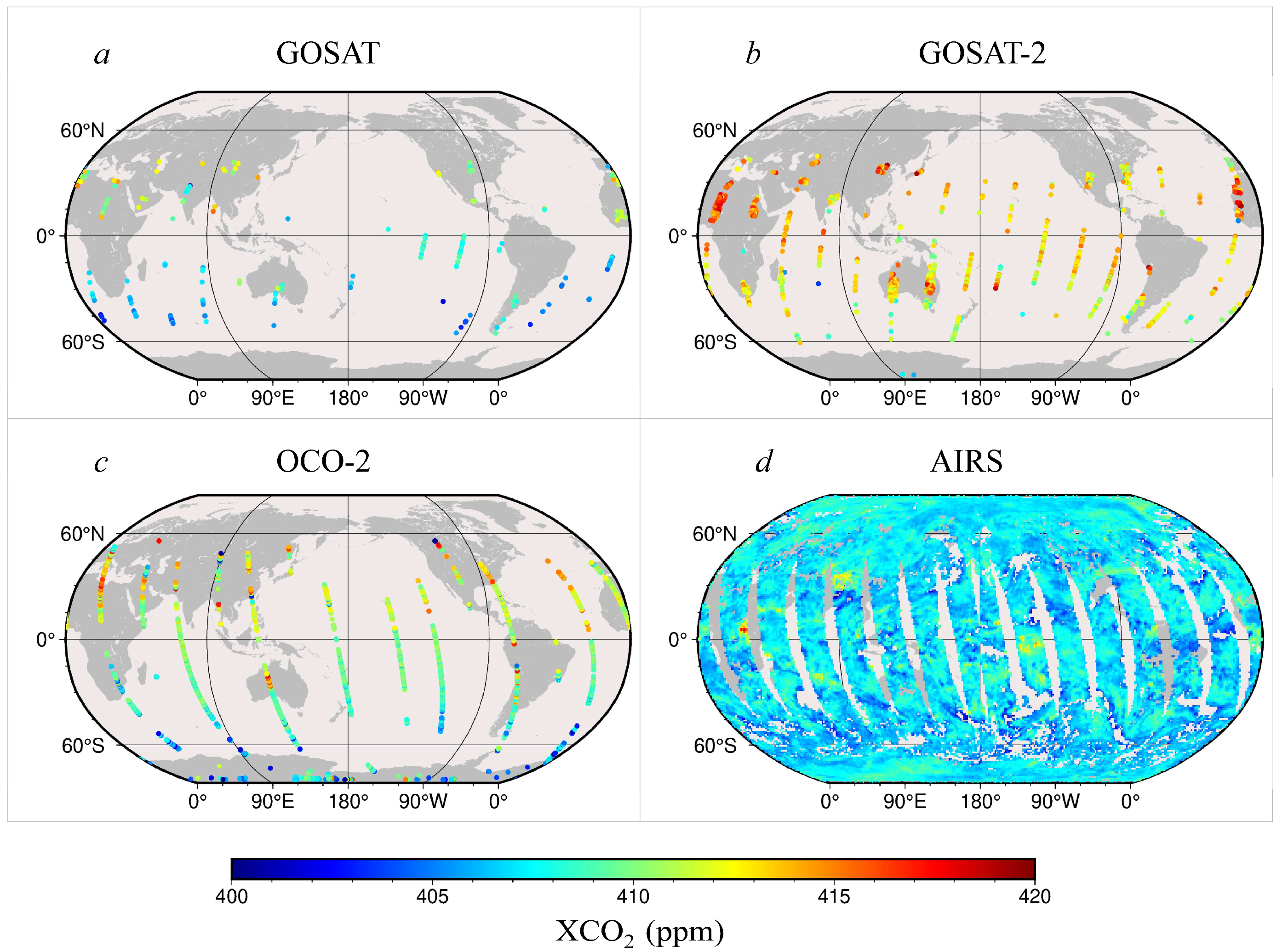
Figure 1 shows an example of a daily column-averaged XCO2 image from GOSAT, GOSAT-2, OCO-2, and AIRS, respectively, on 1 January 2020. Due to the different characteristics among these sensors and different algorithms in retrieving column XCO2, it is seen that the GOSAT, GOSAT-2, and OCO-2 only have single sampling along the satellite orbit track, while AIRS has swath coverage along the track. Even on the same day, it is also noted that there is a visible difference in XCO2 among these sensors.

2.1.2. Field Data

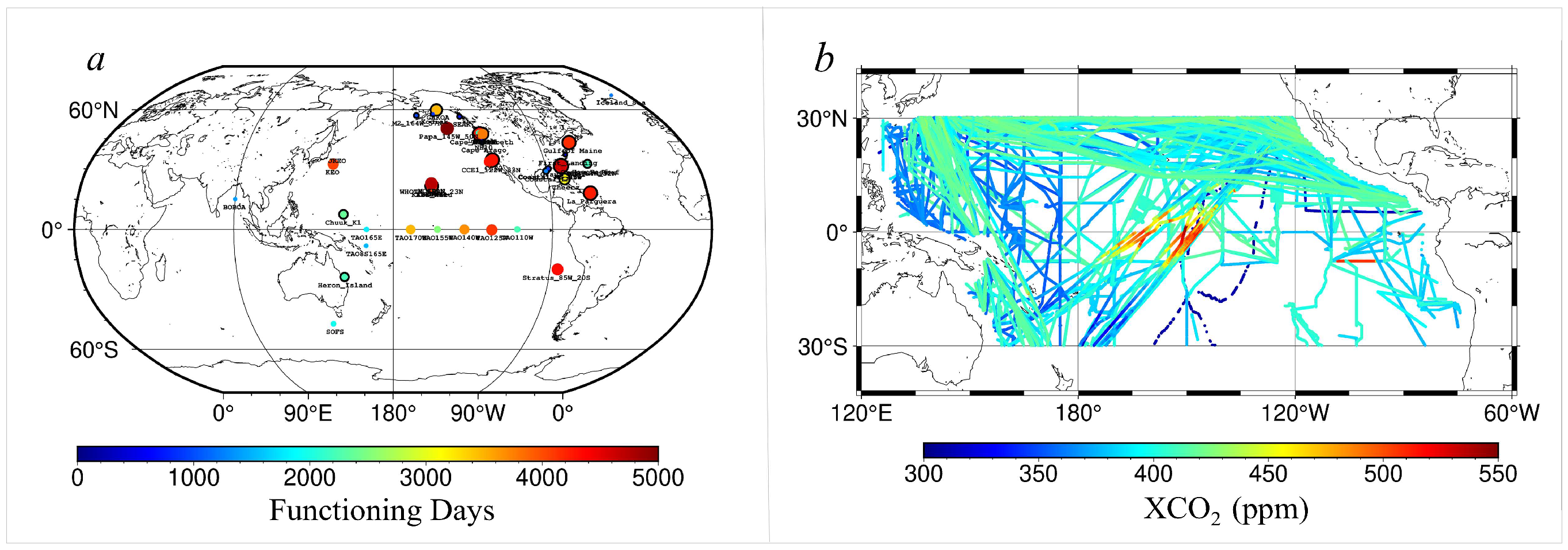
Field observations of atmospheric XCO2 from mooring buoys and scientific cruises were used in this study. The mooring data were accessed from NOAA PMEL carbon program, which is developing a global network of CO2 time series observations to monitor air–sea CO2 fluxes and ocean acidification [44,45]. Both the atmospheric and oceanic XCO2 are measured by a non-dispersive infrared gas analyzer (LI-COR, model LI-820), equipped in a Moored Autonomous pCO2 (MAPCO2) system on the mooring, every 3 h and sometimes every 30 min, following the same data measurement and calibration protocols. The atmospheric CO2 is typically collected at a height of 0.5–1 m in the marine boundary layer [46], with uncertainty <0.6 ppm [47]. So far, NOAA PMEL has deployed a total of 46 buoys worldwide, primarily in the Pacific Ocean and along the U.S. coast (Figure 2a), of which 26 are coastal buoys with bathymetry depth of <1000 m. These buoys have yielded a total number of 945,243 atmospheric XCO2 measurements after quality control, varying in the range of 375~425 ppm. These mooring data time series, covering the period from 2004 to 2023 with operational lifespan ranging from a few months to several years, were obtained from the NOAA PMEL CO2 Data Discovery platform (https://www.pmel.noaa.gov/co2/ (accessed on 30 April 2024)), and were used to evaluate the satellite-derived XCO2 in oceanic waters on global scales.
In addition, a large dataset of atmospheric XCO2 accumulated from scientific cruises in the tropical Pacific was also used in this study. These data were compiled from SOCAT, which is a global synthesis initiative that provides quality-controlled atmospheric and oceanic CO2 observations in the ocean boundary layer, contributed to by the international ocean carbon research community [48]. First released in 2011 and updated annually, the SOCAT database includes cruise records dating back to 1961 [49,50]. These data are primarily collected using flow-through systems aboard research vessels, where both atmospheric and seawater XCO2 were typically measured every 30 min or every 3 h using LI-COR analyzers (e.g., LI-820, LI-6262), with uncertainty of <2 ppm [51]. Here we focused on the tropical Pacific (30°N–30°S), a region with the most intense air–sea CO2 exchange. This regional cruise data between 2002 and 2023 were accessed from SOCAT (https://socat.info/index.php/previous-versions/, Version 2024 (accessed on 30 April 2024)). In the past two decades, there have been 725 cruises that have collected a total number of 170,000 atmospheric XCO2 over the tropical Pacific during different seasons (Figure 2b). These XCO2 ranged between 308 ppm and 531 ppm, with larger values (>450 ppm) most concentrated in the equatorial Pacific upwelling zone. These data were used to evaluate the satellite-derived XCO2 over oceanic waters on regional scales, particularly in the tropical Pacific.

2.2. Methods

2.2.1. Data Preprocessing and Matchup Criteria

For the column-averaged XCO2 observations from the four satellites, we screened the data using the quality flag of 0, which indicates the highest quality. We also conducted quality control for the in situ data using the associated quality flags. Then, co-located and concurrent field and satellite XCO2 were matched using the following criteria. According to the literature [52], the time window of ±30 min and ±60 min between field and satellite measurements were used. Valid satellite data within a 1° × 1° box centered on the location of each in situ XCO2 measurement were extracted and averaged for each satellite.

2.2.2. Atmospheric XCO2 Growth Rates over Different Ocean Basins

In addition to the assessment of the satellite-derived XCO2 in representing the atmospheric XCO2 dynamics in the ocean boundary layer, with the long data time series from satellites, we also examined and compared the atmospheric XCO2 growth rates observed by the four satellites across global and regional oceanic regions. Specifically, based on the sixth IPCC Assessment Report [53], we divided the global ocean into four ocean basins (Pacific, Atlantic, Arctic, and Indian Oceans) and quantified the annual growth rates of XCO2 for each region using the following steps. We first generated the monthly XCO2 images across the study period and the monthly XCO2 climatologies. Then we derived the monthly anomalies of XCO2 in each region by subtracting the monthly climatologies from the monthly means of XCO2. The annual growth rates of XCO2 were calculated based on the monthly anomalies [54].

2.2.3. Statistics Metrics

We used four statistical measures to quantitatively evaluate the performance of the four satellites in observing atmospheric XCO2 over oceanic regions, including R2 (Equation (1)), RMSD (Equation (2)), mean absolute error (MAE, Equation (3)), and mean absolute percentage error (MAPE, Equation (4)).
R 2 = 1 i = 1 N X i Y i 2 i = 1 N X i X ¯ i 2 ,
R M S D = 1 N i = 1 N X i Y i 2 ,
M A E = 1 N i = 1 N X i Y i ,
M A P E = 1 N i = 1 N X i Y i X i × 100 ,
In each equation, N represents the total number of the data matchup pairs, Xi denotes field-observed XCO2 in the ocean boundary layer, X i ¯ is the mean of the field-observed values, and Yi represents the satellite-derived XCO2.

3. Results

3.1. Validation Based on Mooring Data

We first evaluated the performance of the XCO2 data products from GOSAT, GOSAT-2, OCO-2, and AIRS based on the 46 PMEL buoys.
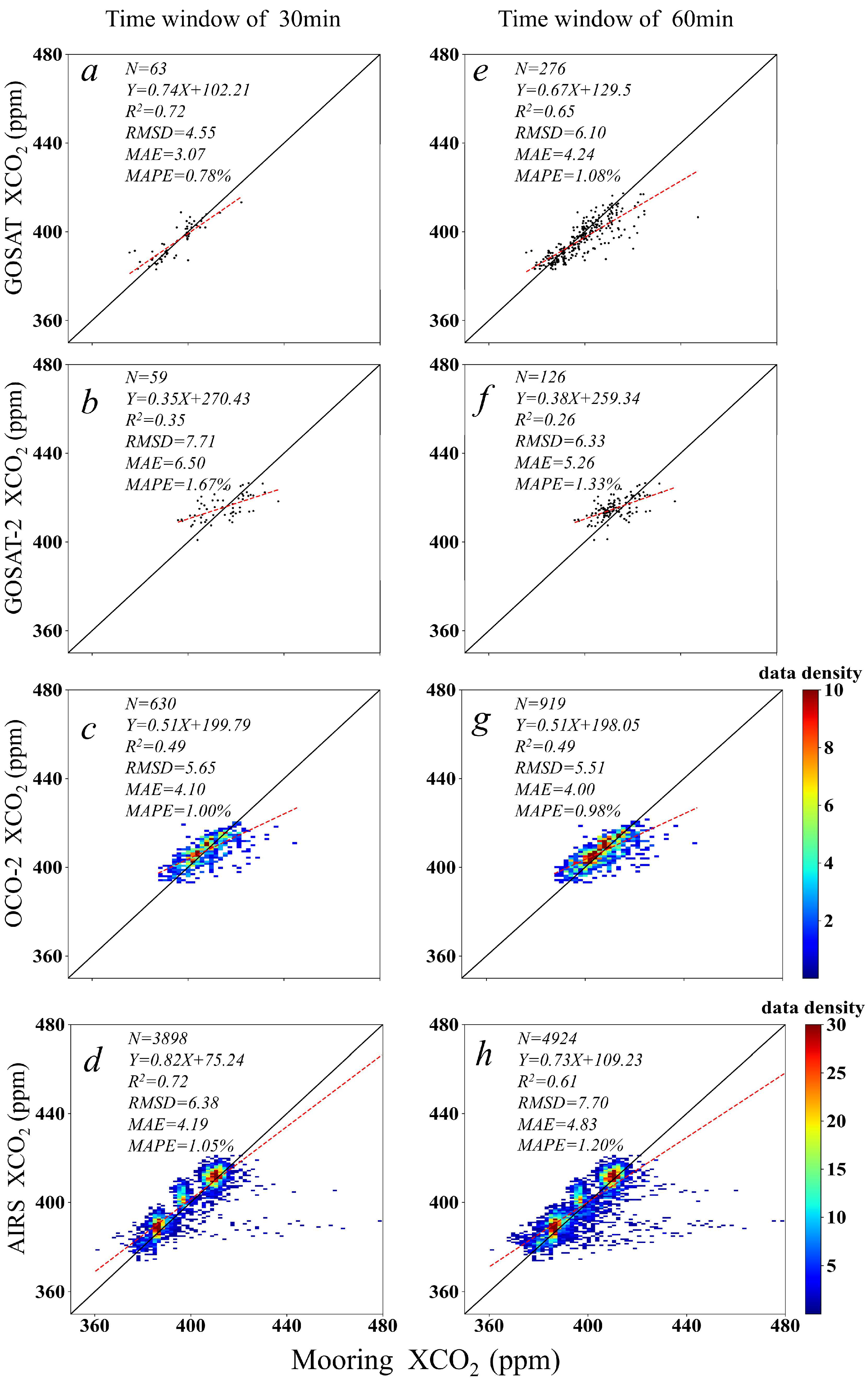
With time windows of ±30 and ±60 min (see Section 2.2.1), Figure 3 and Table 2 show the comparison between mooring-observed XCO2 and satellite-derived XCO2 from each satellite. With a time window of ±30 min, a total number of 63, 59, 630, and 3898 conjugate matchups of satellite-derived XCO2 and mooring-observed XCO2 were determined to be valid and available for GOSAT, GOSAT-2, OCO-2, and AIRS, respectively. These numbers increased to 276, 126, 919, and 4924 with a time window of ±60 min. Due to the narrow field of view (see Figure 1), GOSAT and GOSAT-2 had the minimum number of matchups [55]. In contrast, despite the narrow field of view, OCO-2 had more matchups due to its high sampling frequency (i.e., 24 measurements per second). AIRS had the most matchups because of its wide swath (see Figure 1). Here we loosened the time window to ±60 min, mainly to co-locate more data matchups for more meaningful statistics, particularly for GOSAT and GOSAT-2, though this may slightly reduce the data quality.
In terms of GOSAT, with a time window of ±30 min (Figure 3a), the column-averaged XCO2 from GOSAT generally compared well with the field-measured XCO2 in the marine boundary layer. Most of the data pairs are distributed along the 1:1 line with R2 of 0.72 and RMSD of 4.55 ppm, with 39 data matchups from open ocean moorings contributing approximately 61.9% of the total (N = 63). The XCO2 from both buoy and satellite observations showed a relatively wide variation range of 375–422 ppm and 383–413 ppm, respectively. This wide variation in XCO2 in the matched dataset was most likely caused by the relatively long service period of GOSAT (i.e., 2009–2021). It is noted that the matched data were mainly concentrated at certain times of the day. When the time window was extended to ±60 min (Figure 3e), there were more data matchups found (N = 276), and the data pairs showed similar scattering, yet the slope of the fitting curve decreased from 0.74 to 0.67, the R2 decreased from 0.72 to 0.65, RMSD increased from 4.55 to 6.10 ppm, MAE increased from 3.07 to 4.24 ppm, and MAPE increased from 0.78% to 1.08% (Table 2). It is noted that most of the increased data pairs were from the coastal buoys.
Different from GOSAT, GOSAT-2 was a more recent satellite, which has been in orbit since the year of 2019. With a time window of ±30 min (Figure 3b), the matched data pairs of field and GOSAT-2 XCO2 fall in the range of 395–437 ppm and 400–426 ppm. The data showed a wider scattering along the 1:1 line than GOSAT, even with the same time window. Due to the narrow variation range of matched XCO2 in the short period (2019–2023), the statistics were also worse than GOSAT, with R2 of 0.35 and RMSD of 7.71 ppm (N = 59), and all the data matchups came from coastal moorings. When the time window was extended to ±60 min (Figure 3f), more data pairs were matched (N = 126), while the variability of matched XCO2 remained limited. Notably, most of the additional data pair were located in the upper-left of the 1:1 line, which slightly increased the slope of the linear fitting curve from 0.35 to 0.38 (i.e., red line in Figure 3b,f), the R2 decreased from 0.35 to 0.26, but RMSD decreased from 7.71 to 6.33 ppm, MAE decreased from 6.50 to 5.26 ppm, and MAPE decreased from 1.67% to 1.33%. It is noted that, in both cases, the coastal buoy measurements contributed most of the data matchups.
In terms of OCO-2, there were significantly more conjugated matchups identified either with a time window of ±30 min (N = 630) or ±60 min (N = 919); the satellite-derived XCO2 generally had better performance than GOSAT-2 and slightly worse than GOSAT. Due to the increased number of data matchups, scatter density plots were applied to better visualize the data distribution. Specifically, with a time window of ±30 min (Figure 3c), it is found that most of the data points were evenly distributed along the 1:1 line, with R2 of 0.49 and RMSD of 5.65 ppm. The open ocean moorings had 220 data matchups, contributing approximately 35% of the total matchups (N = 630). The matched XCO2 from buoy observations in the ocean boundary layer ranged from 387 to 445 ppm, and the corresponding XCO2 from OCO-2 varied from 392 to 420 ppm. When the time window was expanded to ±60 min (Figure 3g), the number of matchups increased by 289, and these additional points were most distributed closer to the 1:1 line, which resulted in slightly better statistics in the comparison between field-observed XCO2 and satellite-derived XCO2 (R2 = 0.49, RMSD = 5.51 ppm, MAE = 4.00 ppm, and MAPE = 0.98%). Overall, thanks to its high temporal and spatial resolution that effectively captures CO2 variability [56], the OCO-2 demonstrated good resilience in column-averaged XCO2 retrieval accuracy in representing atmospheric XCO2 in the ocean boundary layer.
Relative to GOSAT, GOSAT-2, and OCO-2, AIRS maintained the longest data record starting in 2002. As such, AIRS had the most data matchups of all, with either a time window of ±30 min or ±60 min. In both cases, the AIRS-derived XCO2 compared well with the field-observed XCO2, with most data concentrated along the 1:1 line, despite some outliers. Specifically, with a time window of ±30 min (Figure 3d), the AIRS-derived XCO2 and the corresponding mooring-observed XCO2 fall in the range of 373–421 ppm and 360–479 ppm, respectively, with R2 of 0.72 and RMSD of 6.38 ppm. The open ocean moorings had 696 data matchups, contributing approximately 17.8% of the total matchups (N = 3898). When the time window was expanded to ±60 min (Figure 3h), the number of matchups increased by 1026 (N = 4924), with similar data scattering along the 1:1 line. Statistically, the R2 showed a slight decrease from 0.72 to 0.61, RMSD increased from 6.38 to 7.70 ppm, MAE increased from 4.19 to 4.83 ppm, and MAPE increased from 1.05% to 1.2%. In both cases, open-ocean buoys contribute ~18% of the total matchups, while over 50% of the matchups came from the buoy deployed at the Heron Island (22°S, 152°E). The outliers in both cases were introduced from two coastal moorings, deployed at Twanoh (123°W, 47°N) and First Landing (76°W, 37°N). We did not find a dysfunctional report in the metadata file, although these data are very suspicious. Considering it was deployed along the coast, we suspect that the strong short-term fluctuations of XCO2 in the ocean boundary layer may be introduced by rapid changes in the oceanic boundary layer, potentially caused by coastal meteorology, tidal activity, or localized anthropogenic emissions, and such local dynamics in atmospheric XCO2 cannot be well represented by the column-averaged XCO2 measurements from satellites.

3.2. Validation Based on Cruise Data

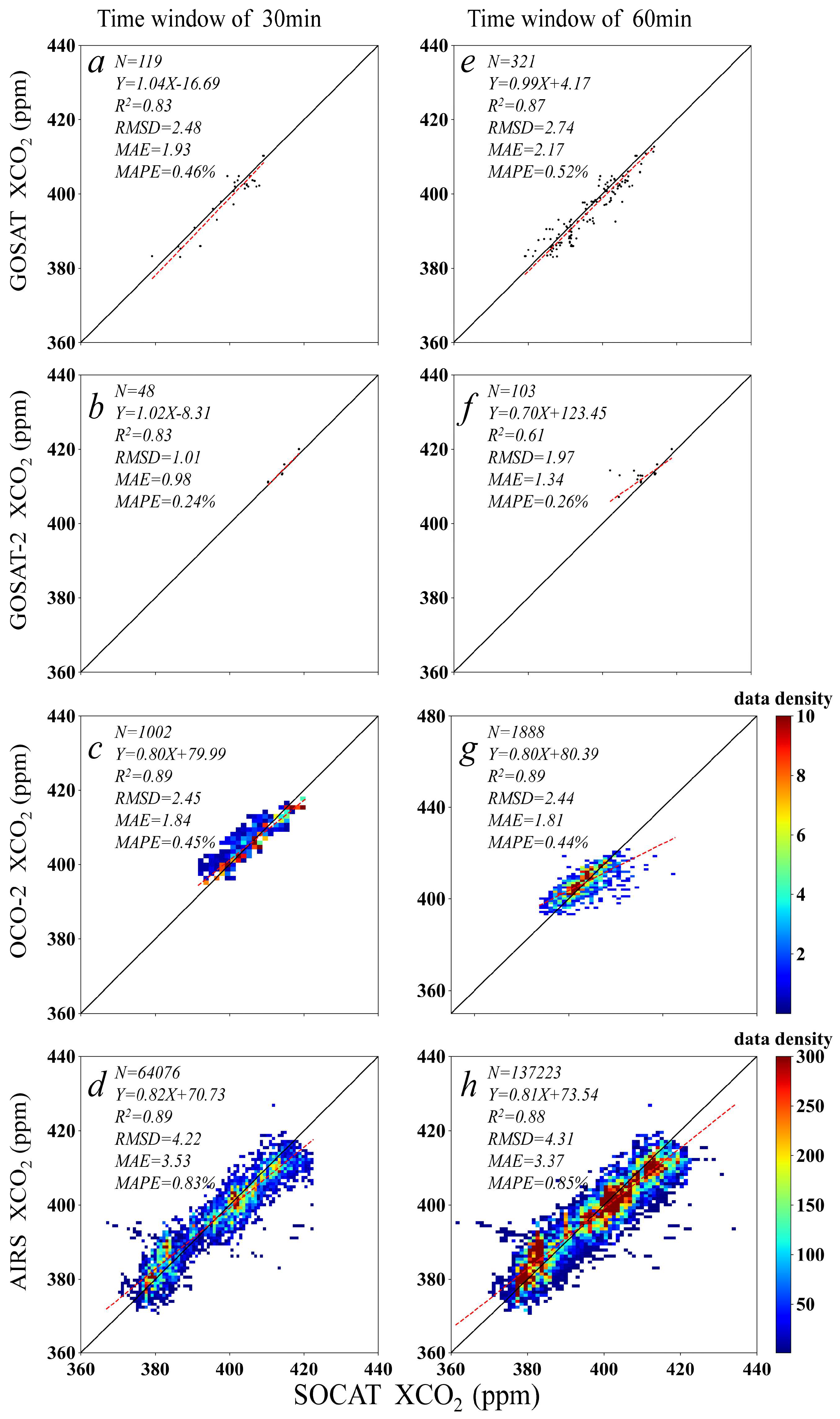
In addition to the validations based on the limited global mooring arrays, to further quantify the regional differences among GOSAT, GOSAT-2, OCO-2, and AIRS, we also assessed the XCO2 data products from the four satellites by performing spatiotemporal cross-matching with the SOCAT (Version 2024) atmospheric XCO2 data collected from scientific cruises in the tropical Pacific, a region known for its intense air–sea CO2 exchange. Similar to the mooring-based analyses, we also applied two time windows in the data matchups between cruise data and satellite data. Details of the matchup results are summarized in Figure 4 and Table 3.
For GOSAT, with a time window of ±30 min (Figure 4a), the satellite-derived XCO2 aligned closely with the 1:1 line when compared with cruise observations, with R2 of 0.83 and RMSD of 2.48 ppm (N = 119). The cruise-observed XCO2 values ranged from 379 to 409 ppm, while the satellite retrievals ranged from 383 to 410 ppm. When the time window was extended to ±60 min (Figure 4e), the variability of the matched XCO2 values was similar to those in Figure 4a, and the slope of the regression line remained close to 1, indicating strong consistency between the datasets. The statistical metrics show an R2 of 0.87, RMSD of 2.74 ppm, MAE of 2.17 ppm, and MAPE of 0.52% (N = 321). Clearly, the cruise-based data showed better agreement with the XCO2 from GOSAT than the mooring-based data.
In terms of GOSAT-2, there were only 48 data matchups identified in a narrow variation range of XCO2 from 410 to 420 ppm, with a time window of ±30 min applied (Figure 4b). Still, different from the poor performance based on the limited global mooring data, the matched satellite XCO2 agreed well with the cruise-measured XCO2, with R2 of 0.83 and RMSD of 1.01 ppm. When the time window was extended to ±60 min (Figure 4f), more data matchups were identified, yet these data led to a noticeable reduction in the regression slope from 1.02 to 0.72, with R2 decreased from 0.83 to 0.61, RMSD increased from 1.01 to 1.97 ppm, MAE increased from 0.98 to 1.34 ppm, and MAPE increased from 0.24% to 0.26%. In comparison, the statistical results from the buoy data (RMSD = 7.71 ppm, see Table 2) may lack robustness due to the small sample size in the global ocean (N = 59), and the cruise-based results (RMSD = 1.01 ppm) may be more representative of its performance in the tropical Pacific. The better performance of GOSAT-2 in the cruise-based validation is likely due to the more favorable observation time and geometry during ship tracks, whereas the buoy-based validation may suffer from land contamination (i.e., mooring close to land) and less optimal atmospheric conditions over the fixed moorings.
For OCO-2, similar to those based on mooring arrays, the satellite-derived XCO2 also compared well with the cruise-measured XCO2 either with a time window of ±30 min or ±60 min, but with more data pairs available for the statistics. Specifically, with a time window of ±30 min (Figure 4c), there was a total number of 1002 data matchups, and these data pairs most clustered along the 1:1 line, with XCO2 varying in the range of 390–420 ppm, R2 of 0.89, and RMSD of 2.45 ppm. When the time window was expanded to ±60 min (Figure 4g), the additional data matchups led to a slight scattering in data distribution, with R2 of 0.89 and RMSD of 2.44 ppm (N = 1888). It seems that the observational stability of OCO-2 becomes increasingly prominent as the study area narrows from the global scale to the tropical Pacific.
We identified the most data matchups for AIRS based on the SOCAT cruise data in the tropical Pacific (Figure 4d,h). Because of the longest data record and wide swath design of AIRS, both the satellite-derived XCO2 and corresponding cruise-measured XCO2 had a wide variation range from around 360 ppm to 430 ppm. With a time window of ±30 min (Figure 4d), a total number of 64,076 matchups were identified, and the satellite-derived XCO2 showed good agreement with the cruise-measured XCO2, with R2 of 0.89 and RMSD of 4.22 ppm. In contrast to the high scattering distribution in Figure 4d, here the data pairs were closely aligned with the 1:1 line. Similarly, with a time window of ±60 min (Figure 4h), the satellite-derived XCO2 also compared well with the field-measured XCO2, with R2 of 0.88 and RMSD of 4.31 ppm (N = 137,223, see more statistics in Table 3).

3.3. Atmospheric XCO2 Growth Rates

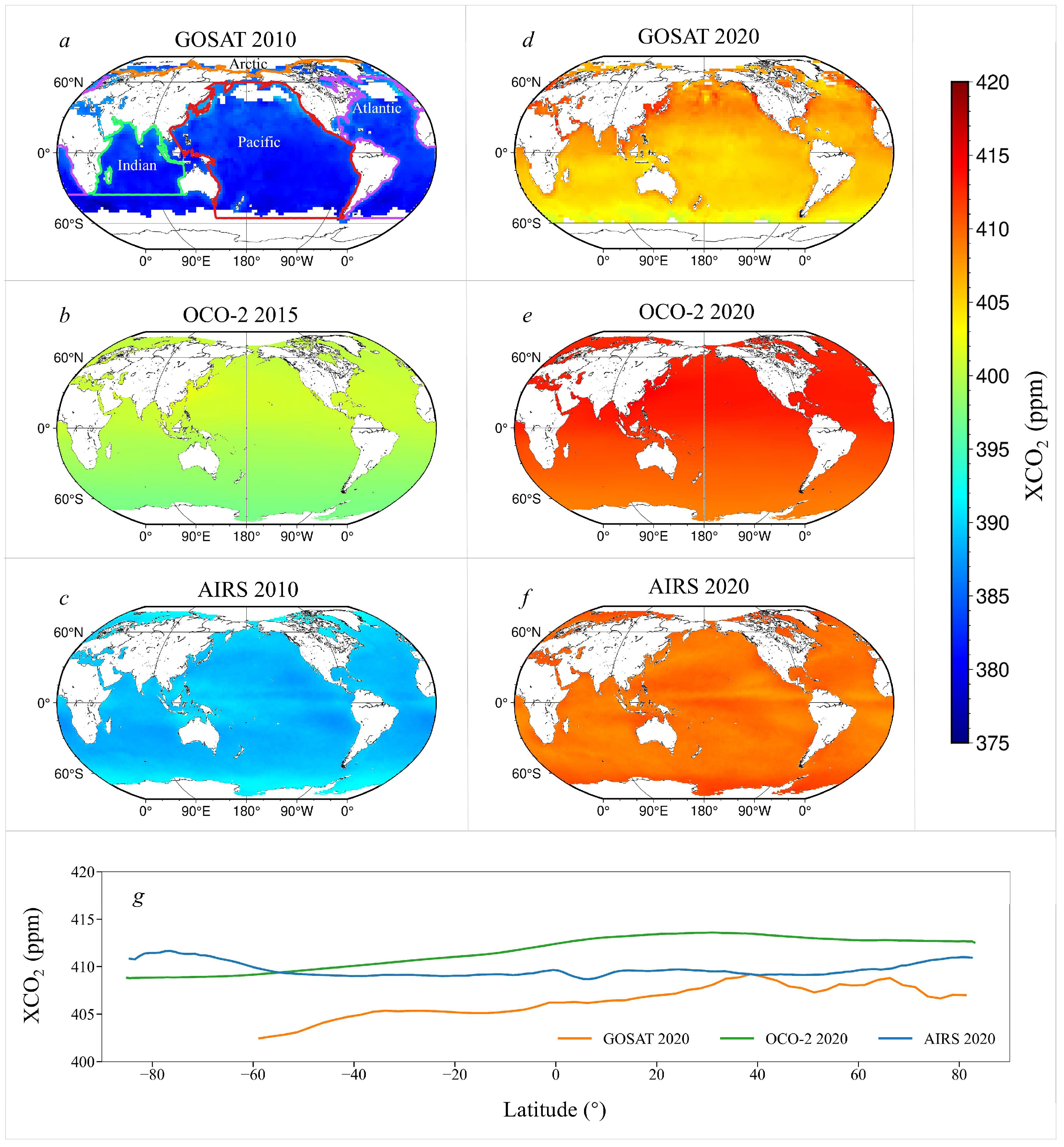
Based on the column-averaged XCO2 time series from different satellites, we also examined the atmospheric XCO2 growth rates over the global ocean, as well as in different ocean basins, including the Pacific, Atlantic, Arctic, and Indian Oceans, as delineated in Figure 5a.
We first conducted a decadal comparison by comparing the yearly global XCO2 images from different satellite sensors between 2010 and 2020. For OCO-2, the comparison was between 2015 and 2020 due to its late launch. Figure 5 shows the global distributions of annual XCO2 retrieved from GOSAT, OCO-2, and AIRS in the two distinct years. It is found that the XCO2 from AIRS tends to report a higher CO2 concentration than GOSAT for the same year. Specifically, the global XCO2 from GOSAT and AIRS in the oceanic area in 2010 was 387 ppm and 390 ppm, respectively. Both satellites recorded a remarkable increase in XCO2, with values of 409 ppm and 410 ppm in 2020, and OCO-2 also had a similar XCO2 observation of 411 ppm in 2020. Within ten years, the atmosphere had an increase of 22 ppm and 20 ppm, respectively, from GOSAT and AIRS. In addition, the XCO2 image from GOSAT in 2020 revealed a pronounced latitudinal gradient, with notably higher CO2 concentrations in the Northern Hemisphere and lower CO2 concentrations in the Southern Hemisphere, with XCO2 ranging from 402 to 409 ppm (Figure 5g). However, such latitudinal gradient was not visible from either OCO-2 or AIRS (Figure 5g). XCO2 from OCO-2 ranged from 408 to 413 ppm, with slightly higher values in the northern mid-latitudes, and XCO2 from AIRS showed an even narrower range of 408–411 ppm, with elevated values in the southern high latitudes.
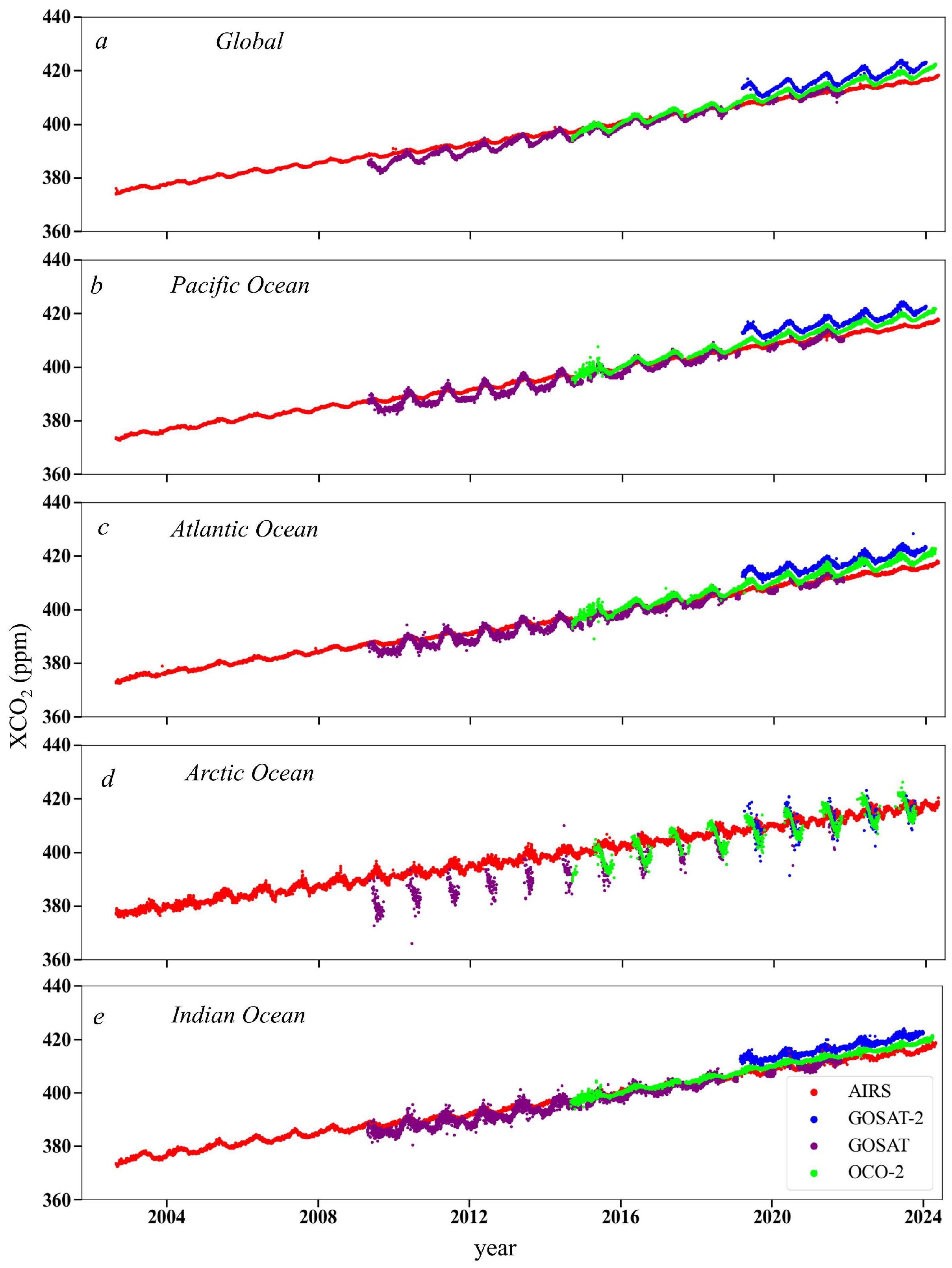
We processed all the atmospheric XCO2 images from each satellite and generated the monthly mean time series of XCO2 over the global oceans as well as over each ocean basin. Figure 6 presents the time series of XCO2 from GOSAT in 2009–2021, GOSAT-2 in 2019–2023, OCO-2 in 2014–2024, and AIRS in 2002–2024. Across the four satellites on both global and basin scales, the time series of XCO2 from GOSAT and OCO-2 matched well in their overlapped period, indicating strong agreement between these two satellites. Although AIRS exhibits the smallest variability in its measurements of atmospheric XCO2 and maintains the longest data record, it tends to report relatively higher XCO2 than GOSAT in early years and lower values than other sensors in recent years. GOSAT-2 was the most recent launched satellite, which maintained the shortest data record, yet it consistently reported higher XCO2 than other sensors after 2019.
Across the different ocean basins in the global ocean (Figure 6), it is noted that, while the seasonal XCO2 from GOSAT, GOSAT-2, and OCO-2 were consistent with each other, the seasonal variabilities of XCO2 observed by AIRS differed notably from other sensors. Particularly in the Arctic Ocean, the atmospheric XCO2 observed from GOSAT, GOSAT-2, and OCO-2 showed a seasonal variation of 8.2~10.1 ppm, yet the XCO2 from AIRS had a quite narrow seasonality of 2.7 ppm. On interannual scales, OCO-2 shows a cluster of scattered data points around 2015. The atmospheric XCO2 observations over the Arctic Ocean (Figure 6d) shows the largest difference between AIRS and GOSAT in the period of 2009–2015, while XCO2 from other sensors in the same period were consistent. After the year 2015, the atmospheric XCO2 observations over the Arctic Ocean became consistent despite the seasonal dynamics among sensors; in contrast, the XCO2 differences in other ocean basins became evident, with steadily higher XCO2 reported from GOSAT-2 and OCO-2.
Statistically, on global ocean scales, the atmospheric column-averaged XCO2 was increasing at a rate of 1.94–2.42 ppm year−1 (Figure 6a and Table 4). OCO-2 reported the highest XCO2 growth rate of 2.42 ppm year−1, which was close to GOSAT, differing by only 0.13 ppm year−1. Moreover, the annual XCO2 growth rate derived from OCO-2 matched well with the value reported by the NOAA Global Monitoring Laboratory (rate = 2.43 ± 0.11 ppm year−1) [38]. In contrast, AIRS maintained the longest data record since 2002; however, due to its relatively higher and lower estimates of XCO2 in earlier and later years, AIRS turned out to report the lowest increasing rate (1.94 ppm year−1) of XCO2 over the global ocean.
Similar to the case on global ocean scales, it is noted that the OCO-2 and AIRS also recorded the highest and lowest XCO2 growth rates, respectively, on basin scales (see Table 4). For example, over the Pacific Ocean, the OCO-2 and AIRS reported the atmospheric XCO2 was increasing at a rate of 2.39 ppm year−1 and 1.97 ppm year−1. Compared to the Pacific Ocean, the atmospheric XCO2 over the Atlantic Ocean basin seems to increase at a slightly larger rate, according to GOSAT (2.29 ppm year−1), GOSAT-2 (2.06 ppm year−1), OCO-2 (2.42 ppm year−1), and AIRS (1.97 ppm year−1). There were substantial differences in the calculated growth rates of atmospheric XCO2 over the Arctic Ocean, with GOSAT (2.57 ppm year−1) and OCO-2 (2.60 ppm year−1) showing significantly higher rates than AIRS (1.87 ppm year−1) and GOSAT-2 (1.70 ppm year−1). Over the Indian Ocean, the atmospheric XCO2 was increasing at a rate of 1.96–2.33 ppm year−1 based on observations from different sensors. This generally agrees with the results in Uma et al. [57], which reported a regional CO2 growth rate of 2.19 ppm year−1 based on tropical coastal station data between 2017 and 2021. Furthermore, it is noted that the atmospheric XCO2 observed from the same satellite generally increases at similar rates in different ocean basins, yet still with some differences, highlighting the spatial heterogeneity in atmospheric CO2 trends.

4. Discussion

4.1. Differences Between Satellite and In Situ XCO2 Data

By comparing them to the atmospheric XCO2 collected from the global mooring buoys, the four satellites revealed notable differences in their sensitivity to temporal and spatial variability of XCO2. Among them, the performance of GOSAT, GOSAT-2, and AIRS deteriorated significantly when the time window was extended from ±30 min to ±60 min (Figure 3 and Table 2). This suggests that these satellites are more sensitive to temporal resolution, possibly due to time-lag effects or the cumulative impact of atmospheric variability over longer windows. In contrast, the OCO-2 matchup precision shows minimal change across time windows, suggesting that OCO-2 provides the most stable XCO2 observations among the four satellites, likely owing to its finer temporal resolution and dense spatial sampling [19]. Across the four satellites, the buoy-based XCO2 observations exhibited a wider range than satellite retrievals, highlighting the limited ability of satellites in capturing short-term or extreme fluctuations, especially in dynamic coastal regions [58]. For instance, XCO2 measurements from a buoy near the surface can be influenced by factors such as wind speed and turbulence fluctuations [59]. This reflects the inherent differences between the column-averaged measurements from satellites and field measurements in the ocean boundary layer data. Furthermore, the uneven spatial distribution of buoy sites particularly, most of the data matchups were from the coastal moorings, may also introduce biases in the statistical results. These biases could be a result of limitations in satellite sensor calibration, land contamination (for coastal moorings), atmospheric model assumptions [60], or the inherent differences between column-averaged integrated XCO2 measurements and the surface-level in situ data obtained from moorings.
Compared to the validations based on global mooring buoys, the validation based on the underway cruise data in the tropical Pacific shows better statistics (Table 3), and the data pairs fall closer to the 1:1 line with less outliers (Figure 4). The column-averaged XCO2 from different sensors can represent the atmospheric XCO2 in the ocean boundary layer with uncertainties of 1.01–4.31 ppm. Particularly, the OCO-2 exhibits stable statistics on both global and regional scales. This stability may be attributed to the validation and bias correction of OCO-2 data using CO2 retrievals from the TCCON, which are linked to the World Meteorological Organization CO2 mole fraction scales via calibrated in situ vertical profiles [25,61]. The tropical Pacific region, known for its intense air–sea CO2 exchange, provides a valuable context for assessing satellite-derived CO2 measurements, and our results suggest that, in this region, the four satellites provide reasonable column-averaged XCO2 data in air–sea CO2 fluxes quantification in this region, yet the uncertainties introduced cannot be ignored. These findings highlight the challenges and uncertainties in satellite-based CO2 estimates, particularly for CO2 flux inversion models, and further reinforce the reliability of OCO-2, as also supported by previous studies [38,62].

4.2. Differences Among Satellite-Derived Atmospheric XCO2

As presented in Section 3.3, to some extent, the four satellites, including GOSAT, GOSAT-2, OCO-2, and AIRS, showed both spatial and temporal differences in observing column-averaged atmospheric XCO2 over global oceanic regions (Figure 5 and Figure 6). These differences should mainly arise from their distinct retrieval algorithms and sensor characteristics (see Section 2.2.1). Specifically, OCO-2 applies strict cloud and aerosol screening, with approximately 20–35% of the observations retained for XCO2 retrieval [63,64]. After 3D cloud correction, the retrieval noise can be reduced to 0.5 ppm [65]. In contrast, GOSAT uses a looser filtering scheme. Around 20% of the soundings are processed, but only ~5% are classified as high-quality retrievals, showing a seasonal bias of 0.2–0.6 ppm relative to OCO-2 [66]. AIRS retrievals are more sensitive to temperature, humidity, and cloud contamination, leading to regional biases, particularly in humid areas, though specific magnitudes vary across studies [67]. The atmospheric XCO2 retrieved from OCO-2, GOSAT, and GOSAT-2 are generally based on the reflected radiance at shortwave-infrared bands (i.e., ~1.6 and 2.0 μm), capturing the XCO2 dynamics from the land/ocean boundary layer to the altitude of the satellites [68,69,70]. However, XCO2 retrieved from AIRS mainly covered the column of tropospheric layers, based on a single channel in thermal infrared bands (i.e., 15 μm), which may have limited ability to observe the seasonal dynamics in the boundary layer driven seasonal changes, resulting in a weaker seasonal signal [71]. As such, the varying sensitivities of the algorithm retrievals to ocean-atmosphere dynamics and different sensor/algorithm designs across these sensors led to the differences in capturing the spatial and temporal dynamics of atmospheric XCO2.
Despite the cross-sensor differences in the spatial and temporal dynamics of atmospheric XCO2, the atmospheric XCO2 growth rates observed from the same sensor over different ocean basins fall within a relatively narrow range (Table 4). The varying atmospheric XCO2 growth rates over different ocean basins likely reflect regional dynamics of carbon sources, sinks, and atmospheric transport. The XCO2 growth rates over the Pacific Ocean are lower than the global average, likely reflecting the strong net CO2 uptake of the basin. The higher XCO2 growth rates over the Atlantic Ocean may be associated with ocean-atmosphere exchange processes and atmospheric circulation [72,73]. The elevated growth rates over the Arctic Ocean may be linked to Arctic amplification, which accelerates permafrost thaw and carbon release, potentially enhancing atmospheric CO2 accumulation [74]. The XCO2 growth rates over the Indian Ocean are relatively moderate compared to other ocean basins, which may attribute to the dynamics of carbon fluxes from a net carbon sink in the southern and subtropical regions of the Indian Ocean to a net carbon source in the northern tropical and upwelling regions [75]. Still, further studies are needed to investigate the dynamics of carbon fluxes on regional or basin scales. On the other hand, the different atmospheric XCO2 growth rates reported from GOSAT, GOSAT-2, OCO-2, and AIRS, even in the same ocean basin, may be related to the different study periods according to the data availability as well as the difference in sensor and algorithm designs (see Section 2.2.1), highlighting the need of cross-sensor calibration over at least oceanic regions in the future.

4.3. Implications on Air–Sea CO2 Fluxes from Satellites

The column-averaged atmospheric XCO2 data products from satellites are commonly used in the estimates of air–sea CO2 fluxes. However, little is known about the uncertainties introduced by using column-averaged XCO2 instead of the atmospheric XCO2 in the ocean boundary layer. Accurate assessment of these differences has significant implications for evaluating oceanic carbon sources and sinks [76]. For instance, Deng et al. [77] demonstrated that integrating GOSAT XCO2 data with both terrestrial and oceanic observations in the tropics improved the consistency of CO2 concentration estimates with those derived from land-based data assimilation alone. In recent years, various algorithms have been developed to optimize satellite-derived XCO2 over oceanic regions to improve air–sea CO2 flux estimates. Nevertheless, discrepancy remains between CO2 flux estimates derived from satellite data and those based on direct field measurements [78,79,80], and this discrepancy arises not only from satellite retrieval errors but also from the true physical difference between column-averaged XCO2 and near-surface XCO2 (e.g., influenced by the atmospheric vertical profile). These discrepancies not only highlight the necessity of continuing to refine satellite retrieval methods and validate them with high-quality in situ datasets, but they also draw attention to the importance of considering these factors in the estimates of air–sea CO2 fluxes from satellite remote sensing. Our study contributes to this effort by systematically quantifying the discrepancies between satellite-based column-averaged XCO2 and in situ XCO2 observations in the ocean boundary layer. Based on the extensive field datasets from moorings and cruises, our study shows that, despite column-averaged XCO2 being able to be used as a good proxy of the XCO2 at the ocean boundary layer, this processing would introduce an uncertainty of 1.0–4.2 ppm in terms of RMSD in the atmospheric XCO2 (see Table 3). Such uncertainties may affect the sign of CO2 fluxes from a weak sink to a weak source or vice versa; therefore, they need to be well assessed in the estimates of air–sea CO2 fluxes from remote sensing in the future.

5. Conclusions

In this study, based on extensive field datasets collected in the global ocean from moorings and cruises archived by NOAA PMEL and SOCAT, we systematically evaluated the performance of four satellites (GOSAT, GOSAT-2, OCO-2, and AIRS) in observing atmospheric XCO2 over the global ocean. Our results show that the column-averaged atmospheric XCO2 can be used as a proxy of atmospheric XCO2 in the ocean boundary layer, with varying uncertainties of 2.48 ppm for GOSAT, 1.01 ppm for GOSAT-2, 2.45 ppm for OCO-2, and 4.22 ppm for AIRS. We emphasize the advances in using satellite-derived column-averaged atmospheric XCO2 in the estimates of air–sea CO2 fluxes, and the uncertainties introduced in the CO2 fluxes need to be finely quantified in the future. These satellites generally observe consistent interannual XCO2 dynamics in the global ocean; however, there was visible difference in the growth rates of XCO2 in their different operational periods. Globally, GOSAT, GOSAT-2, OCO-2, and AIRS detected a growth rate of atmospheric XCO2 of 2.21–2.57 ppm year−1, 1.70–2.19 ppm year−1, 2.33–2.60 ppm year−1, and 1.87–1.97 ppm year−1, respectively, in the period of 2009–2021, 2019–2023, 2014–2024, and 2002–2024, and these different rates were probably raised by the difference in covering periods, orbit design, and retrieval algorithms among these satellites. Further studies are needed to investigate the cross-sensor differences, particularly in the growth rates of XCO2 and the absolute observations at the same time. More field data collections will also promote the cross-sensor calibrations and validations of the atmospheric XCO2 measured over the global oceans from these satellites.

Author Contributions

Conceptualization, S.C.; formal analysis, X.H., S.C. and J.X.; funding acquisition, S.C. and Y.W.; methodology, X.H. and S.C.; project administration, S.C.; visualization, X.H.; writing—original draft preparation, X.H. and S.C.; writing—review and editing, all authors. All authors have read and agreed to the published version of the manuscript.

Funding

This work was supported by the National Key Research and Development Program of China [2023YFC3108104, Y.W.], the National Natural Science Foundation of China [42276184, S.C.], and the Scientific Research Fund of the Second Institute of Oceanography, MNR [QNYC2302, S.C.], the National Natural Science Foundation of China [42030708, S.C.].

Data Availability Statement

The satellite data used in this study were accessed from the GDAS (https://data2.gosat.nies.go.jp/index_en.html (accessed on 30 April 2024)), the GOSAT-2 Product Archive (https://prdct.gosat-2.nies.go.jp/index.html.en (accessed on 30 April 2024)), and the GES-DISC platform (https://disc.gsfc.nasa.gov/ (accessed on 30 April 2024)). The field data used in this study were accessed from the NOAA PMEL CO2 Data Discovery platform (https://www.pmel.noaa.gov/co2/ (accessed on 30 April 2024)), and from the SOCAT (https://socat.info/index.php/previous-versions/, Version 2024, (accessed on 30 April 2024)).

Acknowledgments

The authors thank NOAA PMEL for maintaining and providing the mooring dataset used in this study. The authors thank SOCAT to archive the quality-controlled surface ocean CO2 database, and the many researchers and funding agencies responsible for the collection of data and quality control are thanked for their contributions to SOCAT. The authors thank the Japan Aerospace Exploration Agency of Japan for providing the XCO2 data from GOSAT and GOSAT-2. The authors also thank the NASA Goddard Earth Sciences Data and Information Services Center for providing the XCO2 data from OCO-2, and the NASA Jet Propulsion Laboratory for providing the XCO2 data from AIRS. We thank all the data providers and mission teams for making these satellite products publicly available. We also thank the three anonymous reviewers and editor for their valuable comments helping improve the manuscript.

Conflicts of Interest

The authors declare no conflicts of interest.

References

  1. Friedlingstein, P.; O’Sullivan, M.; Jones, M.W.; Andrew, R.M.; Gregor, L.; Hauck, J.; Le Quéré, C.; Luijkx, I.T.; Olsen, A.; Peters, G.P.; et al. Global Carbon Budget 2022. Earth Syst. Sci. Data 2022, 14, 4811–4900. [Google Scholar] [CrossRef]
  2. Watson, A.J.; Schuster, U.; Shutler, J.D.; Holding, T.; Ashton, I.G.C.; Landschützer, P.; Woolf, D.K.; Goddijn-Murphy, L. Revised Estimates of Ocean-Atmosphere CO2 Flux Are Consistent with Ocean Carbon Inventory. Nat. Commun. 2020, 11, 4422. [Google Scholar] [CrossRef]
  3. Gruber, N.; Bakker, D.C.E.; DeVries, T.; Gregor, L.; Hauck, J.; Landschützer, P.; McKinley, G.A.; Müller, J.D. Trends and Variability in the Ocean Carbon Sink. Nat. Rev. Earth Environ. 2023, 4, 119–134. [Google Scholar] [CrossRef]
  4. Lohrenz, S.E.; Cai, W.-J.; Chakraborty, S.; Huang, W.-J.; Guo, X.; He, R.; Xue, Z.; Fennel, K.; Howden, S.; Tian, H. Satellite Estimation of Coastal pCO2 and Air-Sea Flux of Carbon Dioxide in the Northern Gulf of Mexico. Remote Sens. Environ. 2018, 207, 71–83. [Google Scholar] [CrossRef]
  5. Rustogi, P.; Landschützer, P.; Brune, S.; Baehr, J. The Impact of Seasonality on the Annual Air-Sea Carbon Flux and Its Interannual Variability. npj Clim. Atmos. Sci. 2023, 6, 66. [Google Scholar] [CrossRef]
  6. Bunsen, F.; Nissen, C.; Hauck, J. The Impact of Recent Climate Change on the Global Ocean Carbon Sink. Geophys. Res. Lett. 2024, 51, e2023GL107030. [Google Scholar] [CrossRef]
  7. Wanninkhof, R. Relationship between Wind Speed and Gas Exchange over the Ocean. J. Geophys. Res. 1992, 97, 7373–7382. [Google Scholar] [CrossRef]
  8. Bai, Y.; Cai, W.; He, X.; Zhai, W.; Pan, D.; Dai, M.; Yu, P. A Mechanistic Semi-analytical Method for Remotely Sensing Sea Surface pCO2 in River-dominated Coastal Oceans: A Case Study from the East China Sea. J. Geophys. Res. Ocean. 2015, 120, 2331–2349. [Google Scholar] [CrossRef]
  9. Chen, S.; Hu, C.; Cai, W.-J.; Yang, B. Estimating Surface pCO2 in the Northern Gulf of Mexico: Which Remote Sensing Model to Use? Cont. Shelf Res. 2017, 151, 94–110. [Google Scholar] [CrossRef]
  10. Fu, Z.; Hu, L.; Chen, Z.; Zhang, F.; Shi, Z.; Hu, B.; Du, Z.; Liu, R. Estimating Spatial and Temporal Variation in Ocean Surface pCO2 in the Gulf of Mexico Using Remote Sensing and Machine Learning Techniques. Sci. Total Environ. 2020, 745, 140965. [Google Scholar] [CrossRef] [PubMed]
  11. Wang, Y.; Wu, Z.; Lu, W.; Yu, S.; Li, S.; Meng, L.; Geng, X.; Yan, X.-H. Remote Sensing Estimations of the Seawater Partial Pressure of CO2 Using Sea Surface Roughness Derived from Synthetic Aperture Radar. IEEE Trans. Geosci. Remote Sens. 2024, 62, 4204913. [Google Scholar] [CrossRef]
  12. Chen, S.; Hu, C.; Barnes, B.B.; Wanninkhof, R.; Cai, W.-J.; Barbero, L.; Pierrot, D. A Machine Learning Approach to Estimate Surface Ocean pCO2 from Satellite Measurements. Remote Sens. Environ. 2019, 228, 203–226. [Google Scholar] [CrossRef]
  13. Weiss, R.F.; Price, B.A. Nitrous Oxide Solubility in Water and Seawater. Mar. Chem. 1980, 8, 347–359. [Google Scholar] [CrossRef]
  14. Huang, W.; Cai, W.; Wang, Y.; Lohrenz, S.E.; Murrell, M.C. The Carbon Dioxide System on the Mississippi River-dominated Continental Shelf in the Northern Gulf of Mexico: 1. Distribution and Air-sea CO2 Flux. J. Geophys. Res. Ocean. 2015, 120, 1429–1445. [Google Scholar] [CrossRef]
  15. Roche, S.; Strong, K.; Wunch, D.; Mendonca, J.; Sweeney, C.; Baier, B.; Biraud, S.C.; Laughner, J.L.; Toon, G.C.; Connor, B.J. Retrieval of Atmospheric CO2 Vertical Profiles from Ground-Based near-Infrared Spectra. Atmos. Meas. Tech. 2021, 14, 3087–3118. [Google Scholar] [CrossRef]
  16. Yang, H.; Feng, G.; Xiang, R.; Xu, Y.; Qin, Y.; Li, S. Spatio-Temporal Validation of AIRS CO2 Observations Using GAW, HIPPO and TCCON. Remote Sens. 2020, 12, 3583. [Google Scholar] [CrossRef]
  17. Kuze, A.; Suto, H.; Nakajima, M.; Hamazaki, T. Thermal and near Infrared Sensor for Carbon Observation Fourier-Transform Spectrometer on the Greenhouse Gases Observing Satellite for Greenhouse Gases Monitoring. Appl. Opt. 2009, 48, 6716. [Google Scholar] [CrossRef]
  18. Kuze, A.; Suto, H.; Shiomi, K.; Kawakami, S.; Tanaka, M.; Ueda, Y.; Deguchi, A.; Yoshida, J.; Yamamoto, Y.; Kataoka, F.; et al. Update on GOSAT TANSO-FTS Performance, Operations, and Data Products after More than 6 Years in Space. Atmos. Meas. Tech. 2016, 9, 2445–2461. [Google Scholar] [CrossRef]
  19. Crisp, D.; Pollock, H.R.; Rosenberg, R.; Chapsky, L.; Lee, R.A.M.; Oyafuso, F.A.; Frankenberg, C.; O’Dell, C.W.; Bruegge, C.J.; Doran, G.B.; et al. The On-Orbit Performance of the Orbiting Carbon Observatory-2(OCO-2) Instrument and Its Radiometrically Calibrated Products. Atmos. Meas. Tech. 2017, 10, 59–81. [Google Scholar] [CrossRef]
  20. Liu, S.; Pan, X.; Xiong, X.; Sun, T.; Xue, L.; Zhang, H.; Fang, J.; Fang, J.; Zhang, G.; Xu, H.; et al. Integration of Surface-Based and Space-Based Atmospheric CO2 Measurements for Improving Carbon Flux Estimates Using a New Developed 3-GAS Inversion Model. Atmos. Res. 2024, 307, 107477. [Google Scholar] [CrossRef]
  21. Su, W.; Wang, B.; Chen, H.; Zhu, L.; Zheng, X.; Chen, S.X. A New Global Carbon Flux Estimation Methodology by Assimilation of Both in Situ and Satellite CO2 Observations. npj Clim. Atmos. Sci. 2024, 7, 287. [Google Scholar] [CrossRef]
  22. Wunch, D.; Wennberg, P.O.; Osterman, G.; Fisher, B.; Naylor, B.; Roehl, C.M.; O’Dell, C.; Mandrake, L.; Viatte, C.; Kiel, M.; et al. Comparisons of the Orbiting Carbon Observatory-2 (OCO-2) XCO2 Measurements with TCCON. Atmos. Meas. Tech. 2017, 10, 2209–2238. [Google Scholar] [CrossRef]
  23. Zhang, L.L.; Yue, T.X.; Wilson, J.P.; Zhao, N.; Zhao, Y.P.; Du, Z.P.; Liu, Y. A Comparison of Satellite Observations with the XCO2 Surface Obtained by Fusing TCCON Measurements and GEOS-Chem Model Outputs. Sci. Total Environ. 2017, 601–602, 1575–1590. [Google Scholar] [CrossRef]
  24. Wunch, D.; Toon, G.C.; Blavier, J.-F.L.; Washenfelder, R.A.; Notholt, J.; Connor, B.J.; Griffith, D.W.T.; Sherlock, V.; Wennberg, P.O. The Total Carbon Column Observing Network. Phil. Trans. R. Soc. A 2011, 369, 2087–2112. [Google Scholar] [CrossRef]
  25. Laughner, J.L.; Toon, G.C.; Mendonca, J.; Petri, C.; Roche, S.; Wunch, D.; Blavier, J.-F.; Griffith, D.W.T.; Heikkinen, P.; Keeling, R.F.; et al. The Total Carbon Column Observing Network’s GGG2020 Data Version. Earth Syst. Sci. Data 2024, 16, 2197–2260. [Google Scholar] [CrossRef]
  26. Kong, Y.; Chen, B.; Measho, S. Spatio-Temporal Consistency Evaluation of XCO2 Retrievals from GOSAT and OCO-2 Based on TCCON and Model Data for Joint Utilization in Carbon Cycle Research. Atmosphere 2019, 10, 354. [Google Scholar] [CrossRef]
  27. Yoshida, Y.; Someya, Y.; Ohyama, H.; Morino, I.; Matsunaga, T.; Deutscher, N.M.; Griffith, D.W.T.; Hase, F.; Iraci, L.T.; Kivi, R.; et al. Quality Evaluation of the Column-Averaged Dry Air Mole Fractions of Carbon Dioxide and Methane Observed by GOSAT and GOSAT-2. SOLA 2023, 19, 173–184. [Google Scholar] [CrossRef]
  28. Liang, A.; Gong, W.; Han, G.; Xiang, C. Comparison of Satellite-Observed XCO2 from GOSAT, OCO-2, and Ground-Based TCCON. Remote Sens. 2017, 9, 1033. [Google Scholar] [CrossRef]
  29. Fang, J.; Chen, B.; Zhang, H.; Dilawar, A.; Guo, M.; Liu, C.; Liu, S.; Gemechu, T.M.; Zhang, X. Global Evaluation and Intercomparison of XCO2 Retrievals from GOSAT, OCO-2, and TANSAT with TCCON. Remote Sens. 2023, 15, 5073. [Google Scholar] [CrossRef]
  30. Zheng, J.; Zhang, H.; Zhang, S. Comparison of Atmospheric Carbon Dioxide Concentrations Based on GOSAT, OCO-2 Observations and Ground-Based TCCON Data. Remote Sens. 2023, 15, 5172. [Google Scholar] [CrossRef]
  31. Zhang, S.; Bai, Y.; He, X.; Huang, H.; Zhu, Q.; Gong, F. Comparisons of OCO-2 Satellite Derived XCO2 with in Situ and Modeled Data over Global Ocean. Acta Oceanol. Sin. 2021, 40, 136–142. [Google Scholar] [CrossRef]
  32. Müller, A.; Tanimoto, H.; Sugita, T.; Machida, T.; Nakaoka, S.; Patra, P.K.; Laughner, J.; Crisp, D. New Approach to Evaluate Satellite-Derived XCO2 over Oceans by Integrating Ship and Aircraft Observations. Atmos. Chem. Phys. 2021, 21, 8255–8271. [Google Scholar] [CrossRef]
  33. Curbelo-Hernández, D.; González-Dávila, M.; González, A.G.; González-Santana, D.; Santana-Casiano, J.M. CO2 Fluxes in the Northeast Atlantic Ocean Based on Measurements from a Surface Ocean Observation Platform. Sci. Total Environ. 2021, 775, 145804. [Google Scholar] [CrossRef]
  34. Jersild, A.; Landschützer, P. A Spatially Explicit Uncertainty Analysis of the Air-Sea CO2 Flux From Observations. Geophys. Res. Lett. 2024, 51, e2023GL106636. [Google Scholar] [CrossRef]
  35. Xue, Z.; He, R.; Fennel, K.; Cai, W.-J.; Lohrenz, S.; Huang, W.-J.; Tian, H.; Ren, W.; Zang, Z. Modeling pCO2 Variability in the Gulf of Mexico. Biogeosciences 2016, 13, 4359–4377. [Google Scholar] [CrossRef]
  36. Basu, S.; Guerlet, S.; Butz, A.; Houweling, S.; Hasekamp, O.; Aben, I.; Krummel, P.; Steele, P.; Langenfelds, R.; Torn, M.; et al. Global CO2 Fluxes Estimated from GOSAT Retrievals of Total Column CO2. Atmos. Chem. Phys. 2013, 13, 8695–8717. [Google Scholar] [CrossRef]
  37. Jiang, F.; Wang, H.; Chen, J.M.; Ju, W.; Tian, X.; Feng, S.; Li, G.; Chen, Z.; Zhang, S.; Lu, X.; et al. Regional CO2 Fluxes from 2010 to 2015 Inferred from GOSAT XCO2 Retrievals Using a New Version of the Global Carbon Assimilation System. Atmos. Chem. Phys. 2021, 21, 1963–1985. [Google Scholar] [CrossRef]
  38. Jin, Z.; Tian, X.; Wang, Y.; Zhang, H.; Zhao, M.; Wang, T.; Ding, J.; Piao, S. A Global Surface CO2 Flux Dataset (2015–2022) Inferred from OCO-2 Retrievals Using the GONGGA Inversion System. Earth Syst. Sci. Data 2024, 16, 2857–2876. [Google Scholar] [CrossRef]
  39. Yu, S.; Song, Z.; Bai, Y.; Guo, X.; He, X.; Zhai, W.; Zhao, H.; Dai, M. Satellite-Estimated Air-Sea CO2 Fluxes in the Bohai Sea, Yellow Sea, and East China Sea: Patterns and Variations during 2003–2019. Sci. Total Environ. 2023, 904, 166804. [Google Scholar] [CrossRef]
  40. Zhao, S.; Liu, M.; Tao, M.; Zhou, W.; Lu, X.; Xiong, Y.; Li, F.; Wang, Q. The Role of Satellite Remote Sensing in Mitigating and Adapting to Global Climate Change. Sci. Total Environ. 2023, 904, 166820. [Google Scholar] [CrossRef]
  41. Yoshida, Y.; Kikuchi, N.; Morino, I.; Uchino, O.; Oshchepkov, S.; Bril, A.; Saeki, T.; Schutgens, N.; Toon, G.C.; Wunch, D.; et al. Improvement of the Retrieval Algorithm for GOSAT SWIR XCO2 and XCH4 and Their Validation Using TCCON Data. Atmos. Meas. Tech. 2013, 6, 1533–1547. [Google Scholar] [CrossRef]
  42. Jacobs, N.; O’Dell, C.W.; Taylor, T.E.; Logan, T.L.; Byrne, B.; Kiel, M.; Kivi, R.; Heikkinen, P.; Merrelli, A.; Payne, V.H.; et al. The Importance of Digital Elevation Model Accuracy in XCO2 Retrievals: Improving the Orbiting Carbon Observatory 2 Atmospheric Carbon Observations from Space Version 11 Retrieval Product. Atmos. Meas. Tech. 2024, 17, 1375–1401. [Google Scholar] [CrossRef]
  43. Smith, N.; Barnet, C.D. CLIMCAPS Observing Capability for Temperature, Moisture, and Trace Gases from AIRS/AMSU and CrIS/ATMS. Atmos. Meas. Tech. 2020, 13, 4437–4459. [Google Scholar] [CrossRef]
  44. Xue, L.; Cai, W.-J.; Hu, X.; Sabine, C.; Jones, S.; Sutton, A.J.; Jiang, L.-Q.; Reimer, J.J. Sea Surface Carbon Dioxide at the Georgia Time Series Site (2006–2007): Air–Sea Flux and Controlling Processes. Prog. Oceanogr. 2016, 140, 14–26. [Google Scholar] [CrossRef]
  45. Sutton, A.J.; Wanninkhof, R.; Sabine, C.L.; Feely, R.A.; Cronin, M.F.; Weller, R.A. Variability and Trends in Surface Seawater pCO2 and CO2 Flux in the Pacific Ocean. Geophys. Res. Lett. 2017, 44, 5627–5636. [Google Scholar] [CrossRef]
  46. Sutton, A.J.; Feely, R.A.; Maenner-Jones, S.; Musielwicz, S.; Osborne, J.; Dietrich, C.; Monacci, N.; Cross, J.; Bott, R.; Kozyr, A.; et al. Autonomous Seawater pCO2 and pH Time Series from 40 Surface Buoys and the Emergence of Anthropogenic Trends. Earth Syst. Sci. Data 2019, 11, 421–439. [Google Scholar] [CrossRef]
  47. Sutton, A.J.; Sabine, C.L.; Maenner-Jones, S.; Lawrence-Slavas, N.; Meinig, C.; Feely, R.A.; Mathis, J.T.; Musielewicz, S.; Bott, R.; McLain, P.D.; et al. A High-Frequency Atmospheric and Seawater pCO2 Data Set from 14 Open-Ocean Sites Using a Moored Autonomous System. Earth Syst. Sci. Data 2014, 6, 353–366. [Google Scholar] [CrossRef]
  48. Pfeil, B.; Olsen, A.; Bakker, D.C.E.; Hankin, S.; Koyuk, H.; Kozyr, A.; Malczyk, J.; Manke, A.; Metzl, N.; Sabine, C.L.; et al. A Uniform, Quality Controlled Surface Ocean CO2 Atlas (SOCAT). Earth Syst. Sci. Data 2013, 5, 125–143. [Google Scholar] [CrossRef]
  49. Bakker, D.C.E.; Pfeil, B.; Landa, C.S.; Metzl, N.; O’Brien, K.M.; Olsen, A.; Smith, K.; Cosca, C.; Harasawa, S.; Jones, S.D.; et al. A Multi-Decade Record of High-Quality fCO2 Data in Version 3 of the Surface Ocean CO2 Atlas (SOCAT). Earth Syst. Sci. Data 2016, 8, 383–413. [Google Scholar] [CrossRef]
  50. Fay, A.R.; Munro, D.R.; McKinley, G.A.; Pierrot, D.; Sutherland, S.C.; Sweeney, C.; Wanninkhof, R. Updated Climatological Mean ΔfCO2 and Net Sea–Air CO2 Flux over the Global Open Ocean Regions. Earth Syst. Sci. Data 2024, 16, 2123–2139. [Google Scholar] [CrossRef]
  51. Pierrot, D.; Neill, C.; Sullivan, K.; Castle, R.; Wanninkhof, R.; Lüger, H.; Johannessen, T.; Olsen, A.; Feely, R.A.; Cosca, C.E. Recommendations for Autonomous Underway pCO2 Measuring Systems and Data-Reduction Routines. Deep Sea Res. Part II Top. Stud. Oceanogr. 2009, 56, 512–522. [Google Scholar] [CrossRef]
  52. Li, R.; Zhou, X.; Cheng, T.; Tao, Z.; Gu, X.; Wang, N.; Zhang, H.; Lv, T. The Influence of Validation Colocation on XCO2 Satellite–Terrestrial Joint Observations. Remote Sens. 2023, 15, 5270. [Google Scholar] [CrossRef]
  53. Iturbide, M.; Gutiérrez, J.M.; Alves, L.M.; Bedia, J.; Cerezo-Mota, R.; Cimadevilla, E.; Cofiño, A.S.; Di Luca, A.; Faria, S.H.; Gorodetskaya, I.V.; et al. An Update of IPCC Climate Reference Regions for Subcontinental Analysis of Climate Model Data: Definition and Aggregated Datasets. Earth Syst. Sci. Data 2020, 12, 2959–2970. [Google Scholar] [CrossRef]
  54. Buchwitz, M.; Reuter, M.; Schneising, O.; Noël, S.; Gier, B.; Bovensmann, H.; Burrows, J.P.; Boesch, H.; Anand, J.; Parker, R.J.; et al. Computation and Analysis of Atmospheric Carbon Dioxide Annual Mean Growth Rates from Satellite Observations during 2003–2016. Atmos. Chem. Phys. 2018, 18, 17355–17370. [Google Scholar] [CrossRef]
  55. Butz, A.; Guerlet, S.; Hasekamp, O.; Schepers, D.; Galli, A.; Aben, I.; Frankenberg, C.; Hartmann, J.-M.; Tran, H.; Kuze, A.; et al. Toward Accurate CO2 and CH4 Observations from GOSAT. Geophys. Res. Lett. 2011, 38, L14812. [Google Scholar] [CrossRef]
  56. Wu, L.; Aan De Brugh, J.; Meijer, Y.; Sierk, B.; Hasekamp, O.; Butz, A.; Landgraf, J. XCO2 Observations Using Satellite Measurements with Moderate Spectral Resolution: Investigation Using GOSAT and OCO-2 Measurements. Atmos. Meas. Tech. 2020, 13, 713–729. [Google Scholar] [CrossRef]
  57. Uma, K.N.; Girach, I.A.; Chandra, N.; Patra, P.K.; Kumar, N.V.P.K.; Nair, P.R. CO2 Variability over a Tropical Coastal Station in India: Synergy of Observation and Model. Sci. Total Environ. 2024, 957, 177371. [Google Scholar] [CrossRef]
  58. Takahashi, T.; Sutherland, S.C.; Wanninkhof, R.; Sweeney, C.; Feely, R.A.; Chipman, D.W.; Hales, B.; Friederich, G.; Chavez, F.; Sabine, C.; et al. Climatological Mean and Decadal Change in Surface Ocean pCO2, and Net Sea–Air CO2 Flux over the Global Oceans. Deep Sea Res. Part II Top. Stud. Oceanogr. 2009, 56, 554–577. [Google Scholar] [CrossRef]
  59. Nemoto, K.; Midorikawa, T.; Wada, A.; Ogawa, K.; Takatani, S.; Kimoto, H.; Ishii, M.; Inoue, H.Y. Continuous Observations of Atmospheric and Oceanic CO2 Using a Moored Buoy in the East China Sea: Variations during the Passage of Typhoons. Deep Sea Res. Part II Top. Stud. Oceanogr. 2009, 56, 542–553. [Google Scholar] [CrossRef]
  60. Buchwitz, M.; Reuter, M.; Schneising, O.; Boesch, H.; Guerlet, S.; Dils, B.; Aben, I.; Armante, R.; Bergamaschi, P.; Blumenstock, T.; et al. The Greenhouse Gas Climate Change Initiative (GHG-CCI): Comparison and Quality Assessment of near-Surface-Sensitive Satellite-Derived CO2 and CH4 Global Data Sets. Remote Sens. Environ. 2015, 162, 344–362. [Google Scholar] [CrossRef]
  61. Taylor, T.E.; O’Dell, C.W.; Baker, D.; Bruegge, C.; Chang, A.; Chapsky, L.; Chatterjee, A.; Cheng, C.; Chevallier, F.; Crisp, D.; et al. Evaluating the Consistency between OCO-2 and OCO-3 XCO2 Estimates Derived from the NASA ACOS Version 10 Retrieval Algorithm. Atmos. Meas. Tech. 2023, 16, 3173–3209. [Google Scholar] [CrossRef]
  62. Feldman, A.F.; Zhang, Z.; Yoshida, Y.; Chatterjee, A.; Poulter, B. Using Orbiting Carbon Observatory-2 (OCO-2) Column CO2 Retrievals to Rapidly Detect and Estimate Biospheric Surface Carbon Flux Anomalies. Atmos. Chem. Phys. 2023, 23, 1545–1563. [Google Scholar] [CrossRef]
  63. Taylor, T.E.; O’Dell, C.W.; Frankenberg, C.; Partain, P.T.; Cronk, H.Q.; Savtchenko, A.; Nelson, R.R.; Rosenthal, E.J.; Chang, A.Y.; Fisher, B.; et al. Orbiting Carbon Observatory-2 (OCO-2) Cloud Screening Algorithms: Validation against Collocated MODIS and CALIOP Data. Atmos. Meas. Tech. 2016, 9, 973–989. [Google Scholar] [CrossRef]
  64. Wu, L.; Hasekamp, O.; Hu, H.; Landgraf, J.; Butz, A.; Aan De Brugh, J.; Aben, I.; Pollard, D.F.; Griffith, D.W.T.; Feist, D.G.; et al. Carbon Dioxide Retrieval from OCO-2 Satellite Observations Using the RemoTeC Algorithm and Validation with TCCON Measurements. Atmos. Meas. Tech. 2018, 11, 3111–3130. [Google Scholar] [CrossRef]
  65. Massie, S.T.; Cronk, H.; Merrelli, A.; O’Dell, C.; Schmidt, K.S.; Chen, H.; Baker, D. Analysis of 3D Cloud Effects in OCO-2 XCO2 Retrievals. Atmos. Meas. Tech. 2021, 14, 1475–1499. [Google Scholar] [CrossRef]
  66. Taylor, T.E.; O’Dell, C.W.; Crisp, D.; Kuze, A.; Lindqvist, H.; Wennberg, P.O.; Chatterjee, A.; Gunson, M.; Eldering, A.; Fisher, B.; et al. An 11-Year Record of XCO2 Estimates Derived from GOSAT Measurements Using the NASA ACOS Version 9 Retrieval Algorithm. Earth Syst. Sci. Data 2022, 14, 325–360. [Google Scholar] [CrossRef]
  67. Wong, S.; Fetzer, E.J.; Schreier, M.; Manipon, G.; Fishbein, E.F.; Kahn, B.H.; Yue, Q.; Irion, F.W. Cloud-induced Uncertainties in AIRS and ECMWF Temperature and Specific Humidity. J. Geophys. Res. Atmos. 2015, 120, 1880–1901. [Google Scholar] [CrossRef]
  68. Connor, B.; Bösch, H.; McDuffie, J.; Taylor, T.; Fu, D.; Frankenberg, C.; O’Dell, C.; Payne, V.H.; Gunson, M.; Pollock, R.; et al. Quantification of Uncertainties in OCO-2 Measurements of XCO2: Simulations and Linear Error Analysis. Atmos. Meas. Tech. 2016, 9, 5227–5238. [Google Scholar] [CrossRef]
  69. Eldering, A.; Wennberg, P.O.; Crisp, D.; Schimel, D.S.; Gunson, M.R.; Chatterjee, A.; Liu, J.; Schwandner, F.M.; Sun, Y.; O’Dell, C.W.; et al. The Orbiting Carbon Observatory-2 Early Science Investigations of Regional Carbon Dioxide Fluxes. Science 2017, 358, eaam5745. [Google Scholar] [CrossRef]
  70. Imasu, R.; Matsunaga, T.; Nakajima, M.; Yoshida, Y.; Shiomi, K.; Morino, I.; Saitoh, N.; Niwa, Y.; Someya, Y.; Oishi, Y.; et al. Greenhouse Gases Observing SATellite 2 (GOSAT-2): Mission Overview. Prog. Earth Planet. Sci. 2023, 10, 33. [Google Scholar] [CrossRef]
  71. Chevallier, F.; Engelen, R.J.; Peylin, P. The Contribution of AIRS Data to the Estimation of CO2 Sources and Sinks. Geophys. Res. Lett. 2005, 32, 2005GL024229. [Google Scholar] [CrossRef]
  72. Caínzos, V.; Velo, A.; Pérez, F.F.; Hernández-Guerra, A. Anthropogenic Carbon Transport Variability in the Atlantic Ocean Over Three Decades. Glob. Biogeochem. Cycles 2022, 36, e2022GB007475. [Google Scholar] [CrossRef]
  73. Monteiro, T.; Batista, M.; Henley, S.; Machado, E.D.C.; Araujo, M.; Kerr, R. Contrasting Sea-Air CO2 Exchanges in the Western Tropical Atlantic Ocean. Glob. Biogeochem. Cycles 2022, 36, e2022GB007385. [Google Scholar] [CrossRef]
  74. Natali, S.M.; Holdren, J.P.; Rogers, B.M.; Treharne, R.; Duffy, P.B.; Pomerance, R.; MacDonald, E. Permafrost Carbon Feedbacks Threaten Global Climate Goals. Proc. Natl. Acad. Sci. USA 2021, 118, e2100163118. [Google Scholar] [CrossRef]
  75. Ghosh, J.; Chakraborty, K.; Valsala, V.; Bhattacharya, T.; Ghoshal, P.K. A review of the Indian Ocean carbon dynamics, acidity, and productivity in a changing environment. Prog. Oceanogr. 2024, 221, 103210. [Google Scholar] [CrossRef]
  76. Shutler, J.D.; Gruber, N.; Findlay, H.S.; Land, P.E.; Gregor, L.; Holding, T.; Sims, R.P.; Green, H.; Piolle, J.-F.; Chapron, B.; et al. The Increasing Importance of Satellite Observations to Assess the Ocean Carbon Sink and Ocean Acidification. Earth-Sci. Rev. 2024, 250, 104682. [Google Scholar] [CrossRef]
  77. Deng, F.; Jones, D.B.A.; O’Dell, C.W.; Nassar, R.; Parazoo, N.C. Combining GOSAT XCO2 Observations over Land and Ocean to Improve Regional CO2 Flux Estimates. J. Geophys. Res. Atmos. 2016, 121, 1896–1913. [Google Scholar] [CrossRef]
  78. Patra, P.K.; Hajima, T.; Saito, R.; Chandra, N.; Yoshida, Y.; Ichii, K.; Kawamiya, M.; Kondo, M.; Ito, A.; Crisp, D. Evaluation of Earth System Model and Atmospheric Inversion Using Total Column CO2 Observations from GOSAT and OCO-2. Prog. Earth Planet. Sci. 2021, 8, 25. [Google Scholar] [CrossRef]
  79. Shi, T.; Han, G.; Ma, X.; Gong, W.; Chen, W.; Liu, J.; Zhang, X.; Pei, Z.; Gou, H.; Bu, L. Quantifying CO2 Uptakes Over Oceans Using LIDAR: A Tentative Experiment in Bohai Bay. Geophys. Res. Lett. 2021, 48, e2020GL091160. [Google Scholar] [CrossRef]
  80. Yang, D.; Liu, Y.; Feng, L.; Wang, J.; Yao, L.; Cai, Z.; Zhu, S.; Lu, N.; Lyu, D. The First Global Carbon Dioxide Flux Map Derived from TanSat Measurements. Adv. Atmos. Sci. 2021, 38, 1433–1443. [Google Scholar] [CrossRef]
Figure 1. Spatial distribution of column-averaged CO2 (XCO2) on daily scales, retrieved from GOSAT (a), GOSAT-2 (b), OCO-2 (c), and AIRS (d), based on data collected on 1 January 2020. It is noted that the four satellites displayed very different orbital characteristics in observing atmospheric CO2, due to their respective observation strategies and retrieval algorithms.
Remotesensing 17 04026 g001
Figure 2. Spatial distribution of the global mooring buoys (N = 64) deployed by the NOAA PMEL carbon program (a) and the SOCAT cruise tracks of atmospheric XCO2 in the tropical Pacific (b). Note that the colors and sizes of the solid circles in (a) indicate the quantity of atmospheric CO2 measurements in terms of the functioning days of the mooring buoys, and the coastal moorings were specified with black circles.
Remotesensing 17 04026 g002
Figure 3. Comparison between mooring-observed XCO2 and the concurrent and collocated satellite-observed XCO2 from GOSAT (a,e), GOSAT-2 (b,f), OCO-2 (c,g), and AIRS (d,h), respectively, with a spatial matching within ±0.5° and time windows of ±30 min (ad) and ±60 min (eh). The black and red lines in each panel are the 1:1 line and the fitting curve, respectively. Note that the colors in (c,d,g,h) represent data density, considering the relatively larger number of matched data pairs from OCO-2 and AIRS.
Remotesensing 17 04026 g003
Figure 4. Same as Figure 3, but comparison between cruise-observed XCO2 from SOCAT and the concurrent and collocated satellite-observed XCO2 from GOSAT (a,e), GOSAT-2 (b,f), OCO-2 (c,g), and AIRS (d,h), respectively, based on a spatial matching within ±0.5° and a temporal windows of ±30 min (ad) and ±60 min (eh). The black and red lines in each panel are the 1:1 line and the fitting curve, respectively. Note that the colors in (c,d,g,h) represent data density, considering the relatively larger number of matched data pairs from OCO-2 and AIRS.
Remotesensing 17 04026 g004
Figure 5. Decadal comparison of the XCO2 between 2010 and 2020, from GOSAT (a,d), OCO-2 (b,e), and AIRS (c,f), as well as the latitudinal gradients of XCO2 (g) from each satellite based on the XCO2 maps in 2020 (df), calculated as the average over all longitudes along latitude; solid lines correspond to GOSAT, OCO-2, and AIRS, colored orange, green, and blue, respectively. Note that we chose the year 2015 for OCO-2 due to its late launch. The four ocean basins based on the sixth IPCC Assessment Report [53] were delineated in different colors in (a): Pacific Ocean (red), Indian Ocean (green), Arctic Ocean (orange), and Atlantic Ocean (purple).
Remotesensing 17 04026 g005
Figure 6. Time series of atmospheric CO2 observed by satellites over different oceanic regions: global ocean (a), Pacific (b), Atlantic (c), Arctic (d), and Indian Oceans (e).
Remotesensing 17 04026 g006
Table 1. Characteristics of the four atmospheric XCO2 satellites used in this study.
Satellite/SensorBands (μm)Revisit Period (Day)Spatial Resolution (km)Altitude (km)Period
GOSAT1.6, 2.0310.5 × 10.56662009.04–2021.10
GOSAT-21.6, 2.069.7 × 9.76132019.03–2023.12
OCO-21.6, 2.0162.25 × 1.297052014.09–2024.03
AIRS151613.5 × 13.57052002.08–2024.04
Table 2. Statistics of the comparison between satellite-derived XCO2 and mooring-observed XCO2, in terms of R2, RMSD, MAE, and MAPE. Note that N represents the number of conjugated data matchups (see Section 2.2.1 for more details).
Satellite/SensorTime Window (min)NR2RMSD (ppm)MAE (ppm)MAPE (%)
GOSAT±30630.724.553.070.78
±602760.656.104.241.08
GOSAT-2±30590.357.716.501.67
±601260.266.335.261.33
OCO-2±306300.495.654.101.00
±609190.495.514.000.98
AIRS±3038980.726.384.191.05
±6049240.617.704.831.20
Table 3. Statistics of the comparison between satellite-derived XCO2 and cruise-observed XCO2 in terms of R2, RMSD, MAE, and MAPE. Note that N represents the number of conjugated data matchups (see Section 2.2.1 for more details).
Satellite/SensorTime Window (min)NR2RMSD (ppm)MAE (ppm)MAPE (%)
GOSAT±301190.832.481.930.46
±603210.872.742.170.52
GOSAT-2±30480.831.010.980.24
±601030.611.971.340.26
OCO-2±3010020.892.451.840.45
±6018880.892.441.810.44
AIRS±3064,0760.894.223.530.83
±60137,2230.884.313.370.85
Table 4. Atmospheric XCO2 growth rates in global and four ocean basins, in units of ppm year−1. The four ocean basins used in this study (see Figure 5a) were based on the sixth IPCC Assessment Report [53].
Ocean RegionSatellite/Sensor
GOSATGOSAT-2OCO-2AIRS
Global2.292.192.421.94
Pacific Ocean2.212.062.391.97
Atlantic Ocean2.292.142.421.97
Arctic Ocean2.571.702.601.87
Indian Ocean2.202.152.331.96
Disclaimer/Publisher’s Note: The statements, opinions and data contained in all publications are solely those of the individual author(s) and contributor(s) and not of MDPI and/or the editor(s). MDPI and/or the editor(s) disclaim responsibility for any injury to people or property resulting from any ideas, methods, instructions or products referred to in the content.