Highlights
What are the main findings?
- A computational framework integrating Dynamic Time Warping (DTW) and Persistent Homology (PH) quantified both geometric and topological aspects of coastal recovery from satellite imagery (2010–2024).
- Sendai coastline evolved toward a new dynamic equilibrium rather than returning to its pre-tsunami state, marked by increased topological complexity and structural diversity.
What are the implications of the main findings?
- The integration of DTW and PH can provide a powerful tool for detecting multi-scale morphological reorganization.
- Long-term coastal recovery can lead to alternative stable states with intensified resilience, providing deep understanding for coastal monitoring and post-disaster management.
Abstract
This study presents a computational framework combining Dynamic Time Warping (DTW) and Persistent Homology to quantify the long-term morphological evolution of the Sendai coastline following the 2011 Tōhoku tsunami. Using multispectral satellite imagery from Landsat 5 TM, Landsat 8 OLI, and Sentinel-2 MSI (2010–2024), instantaneous shorelines were extracted via the Modified Normalized Difference Water Index (MNDWI) and reconstructed with parametric B-spline curves. DTW analysis indicated severe initial deformation, with a 90,927 m difference between pre- and post-tsunami instantaneous shorelines, followed by gradual stabilization as distances declined to 59,584 m by 2024. Persistent Homology revealed a more complex topological trajectory, with the number of 1-dimensional features (H1) rising sharply after the tsunami, consolidating by 2015, and expanding again to over 8000 by 2020–2024. The Stable Distance of Persistent Homology (SDPH) identified 2015–2020 as the key phase of transformation (38,088 m), marking a shift toward higher morphological complexity. A weak negative correlation (r = −0.362) between DTW and SDPH confirmed their complementarity in describing geometric and topological change. Overall, the results suggest that post-tsunami recovery followed a non-linear path toward a new dynamic equilibrium characterized by increased structural complexity and resilience.
1. Introduction
Coastal systems represent critical interfaces between terrestrial and marine environments that are increasingly subjected to extreme disturbance events, yet our understanding of long-term morphological recovery processes remains fundamentally limited by conventional analytical approaches. Recent multi-decadal monitoring studies utilizing all-available Landsat archives have documented persistent coastal erosion patterns with strong spatial heterogeneity, attributing major changes to sea-level rise, hurricane impacts, and extensive anthropogenic modifications including reclamation and coastal engineering [1,2]. These long-term records reveal that episodic extreme events frequently produce cliff retreat and shoreline displacement rates substantially exceeding long-term averages, introducing significant uncertainty into conventional linear forecasting approaches [3,4]. While satellite-derived shorelines have demonstrated high horizontal accuracy (within half-pixel resolution) for detecting seasonal to multi-decadal planform changes, comprehensive validation studies show that their utility in quantifying three-dimensional morphology and sediment volume changes remains limited without extensive in situ calibration and auxiliary measurements [5,6]. Furthermore, detailed analyses of salt marsh and deltaic coastlines reveal highly localized and temporally asynchronous recovery patterns, with adjacent segments exhibiting divergent trajectories despite similar forcing conditions [7]. Advanced predictive frameworks combining long satellite records with statistical models have improved shoreline forecasts but highlight persistent uncertainties regarding system thresholds, resilience mechanisms, and the potential for transitions to alternative stable states under future environmental conditions [1,3]. The 2011 Tōhoku tsunami, which devastated over 2000 km of Japanese coastline, created an unprecedented natural laboratory for investigating such decadal-scale coastal evolution dynamics [8].
Traditional morphological assessment methods have relied on two primary approaches, (1) empirical orthogonal function (EOF) analysis applied to time series of cross-shore beach profile surveys to extract dominant modes of elevation change, and (2) bathymetric differencing from repeated hydrographic soundings to quantify volumetric sediment redistribution. These methods have successfully documented rapid initial recovery of beach profiles and shoreline positions within 2–4 years following the tsunami [9,10]. Recent studies of Sendai coastal segments demonstrate that while geometric stabilization occurs relatively quickly, the underlying structural complexity of recovered coastlines may fundamentally differ from pre-disturbance states [11]. Contemporary coastal morphology research increasingly recognizes the need for integrated analytical frameworks that can simultaneously quantify shape-based deformation and multi-scale topological features across extended temporal scales. However, existing methodologies remain fragmented, with temporal alignment techniques and topological analysis approaches developing largely in parallel without substantive integration. This gap motivates the development of novel computational frameworks that bridge these complementary analytical domains.
1.1. Dynamic Time Warping in Coastal and Environmental Monitoring
Dynamic Time Warping (DTW) has emerged as a powerful technique for aligning and comparing temporal sequences in environmental monitoring applications, particularly in the context of remote sensing time series analysis. DTW addresses a fundamental challenge in geospatial time series, the presence of temporal distortions, phase shifts, and irregular sampling intervals that complicate direct comparison of morphological trajectories [12]. Recent methodological advances have significantly enhanced DTW’s applicability to coastal monitoring. The Time-Weighted Dynamic Time Warping (TWDTW) variant incorporates temporal penalties that improve sensitivity to seasonal and phenological shifts, demonstrating superior performance in land cover classification from Sentinel-1/2 vegetation index time series [13]. Parallel implementations such as P-TWDTW 2.0 have addressed computational scalability through GPU optimization, enabling operational processing of large coastal image time series across regional scales [14]. Applications of DTW to marine and coastal environments have demonstrated the method’s capacity to partition dynamic regimes and link morphological patterns to physical drivers [15]. Despite these advances, DTW-based approaches exhibit inherent limitations when applied to coastal morphology assessment, primarily quantifying temporal alignment and shape-based similarity but lacking mechanisms to capture spatial connectivity, topological structure, or multi-scale morphological features [16,17].
1.2. Persistent Homology and Topological Data Analysis in Morphological Studies
Topological Data Analysis (TDA), particularly persistent homology (PH), offers a fundamentally different perspective on morphological evolution by quantifying multi-scale structural features that persist across parameter ranges. Unlike geometric measures that capture instantaneous shape characteristics, persistent homology tracks the birth, persistence, and death of topological features, such as connected components, loops, and voids, as a scale parameter varies [18]. This multi-scale perspective is particularly valuable for coastal morphology, where relevant processes operate across spatial scales ranging from individual sediment particles to regional circulation patterns. Recent applications of TDA to spatial morphology have demonstrated its capacity to detect and localize topological structures in complex datasets. Hickok et al. [19] developed a spatiotemporal anomaly detection framework using persistent homology, successfully identifying evolving spatial anomalies. Hu [20] advanced practical tools for localizing topological features through efficient partitioning and local homology computation, enabling detection of holes and voids in digital images, a capability directly applicable to mapping coastal embayments and tidal channels. Despite its powerful capabilities for characterizing spatial structure, persistent homology faces challenges when applied to temporally varying coastal datasets, requiring consistent spatial sampling and careful treatment of observational biases [21].
1.3. Long-Term Coastal Monitoring Studies
Recent advances in satellite-based long-term coastal monitoring have demonstrated the capability of multi-decadal shoreline time series to quantify coastal change and inform management decisions. Studies utilizing available Landsat data have successfully tracked shoreline evolution over 30–40 year periods, revealing both gradual trends and episodic changes driven by storms and human interventions [2,22]. Validation efforts comparing satellite-derived shorelines against in situ surveys have established horizontal accuracies within half-pixel resolution, enabling detection of seasonal to decadal processes [5,7]. Machine learning approaches such as random forests, have improved automated shoreline extraction accuracy to >95% for long-term monitoring applications [23]. Recent studies have also developed predictive frameworks combining long satellite records with statistical models to forecast future shoreline positions with uncertainty quantification [1,24]. While methodological capabilities have improved considerably, most long-term monitoring studies still focus mainly on horizontal shoreline position, with relatively limited incorporation of topological or three-dimensional approaches that could provide additional insight into structural reorganization.
1.4. Research Gaps and Study Rationale
Three critical gaps in current coastal morphology monitoring methodologies motivated this study.
Gap 1: Temporal-Topological Integration. Dynamic Time Warping and persistent homology have developed as separate analytical traditions with complementary strengths, DTW for temporal alignment and shape-based comparison, PH for multi-scale topological characterization, yet no existing studies combine these methods to simultaneously quantify temporal evolution and topological reorganization of coastal systems.
Gap 2: Multi-Scale Structural Change Detection. Existing coastal monitoring approaches primarily quantify changes in overall shoreline position, beach width, or sediment volume but lack tools to systematically detect and track multi-scale topological features such as the formation of channel networks or the development of barrier-lagoon systems.
Gap 3: Long-Term Recovery Characterization. Most post-disaster coastal studies focus on short-term recovery (2–4 years) and assume that systems return to pre-disturbance states. However, emerging theory on complex adaptive systems suggests that major disturbances may drive transitions to alternative stable states with different structural characteristics [25]. Existing methodologies lack quantitative tools to distinguish between simple restoration and reorganization toward a new dynamic equilibrium.
1.5. Study Objectives
This study addressed the identified gaps by developing and applying an integrated computational framework that combines Dynamic Time Warping and Persistent Homology to quantify the long-term morphological evolution of the Sendai coastline following the 2011 Tōhoku tsunami. The specific objectives were as mentioned below.

Objective 1: To develop a computational methodology for quantifying structural change in geospatial time-series data, integrating B-spline curve reconstruction with a shape-based distance metric (Dynamic Time Warping) and a topological approach utilizing Persistent Homology and the Stable Distance of Persistent Homology (SDPH) framework.
Objective 2: To quantify the magnitude and characteristics of the topological disruption to the Sendai coastline resulting from the 2011 tsunami by comparing its pre-event (2010) and immediate post-event (2011) states using both shape-based (DTW) and topological (SDPH) metrics.
Objective 3: To investigate the temporal dynamics of post-disaster landscape evolution by analyzing the trajectory of the coastline’s shape and topological complexity and connectivity across the recovery period (2015, 2020, 2024), employing both DTW and Persistent Homology.
Objective 4: To evaluate the complementarity of DTW and SDPH metrics through comparative analysis, determining whether the coastline’s recovery trajectory represents simple geometric restoration or fundamental topological reorganization.
The novelty of this study lied in three key contributions: (1) the first integration of DTW and persistent homology for coastal morphology analysis; (2) the application of the SDPH framework to detect multi-scale structural evolution in a natural coastal system; and (3) quantitative evidence for alternative stable states in post-disaster coastal recovery through combined geometric and topological metrics.
2. Materials and Methods
2.1. Study Area
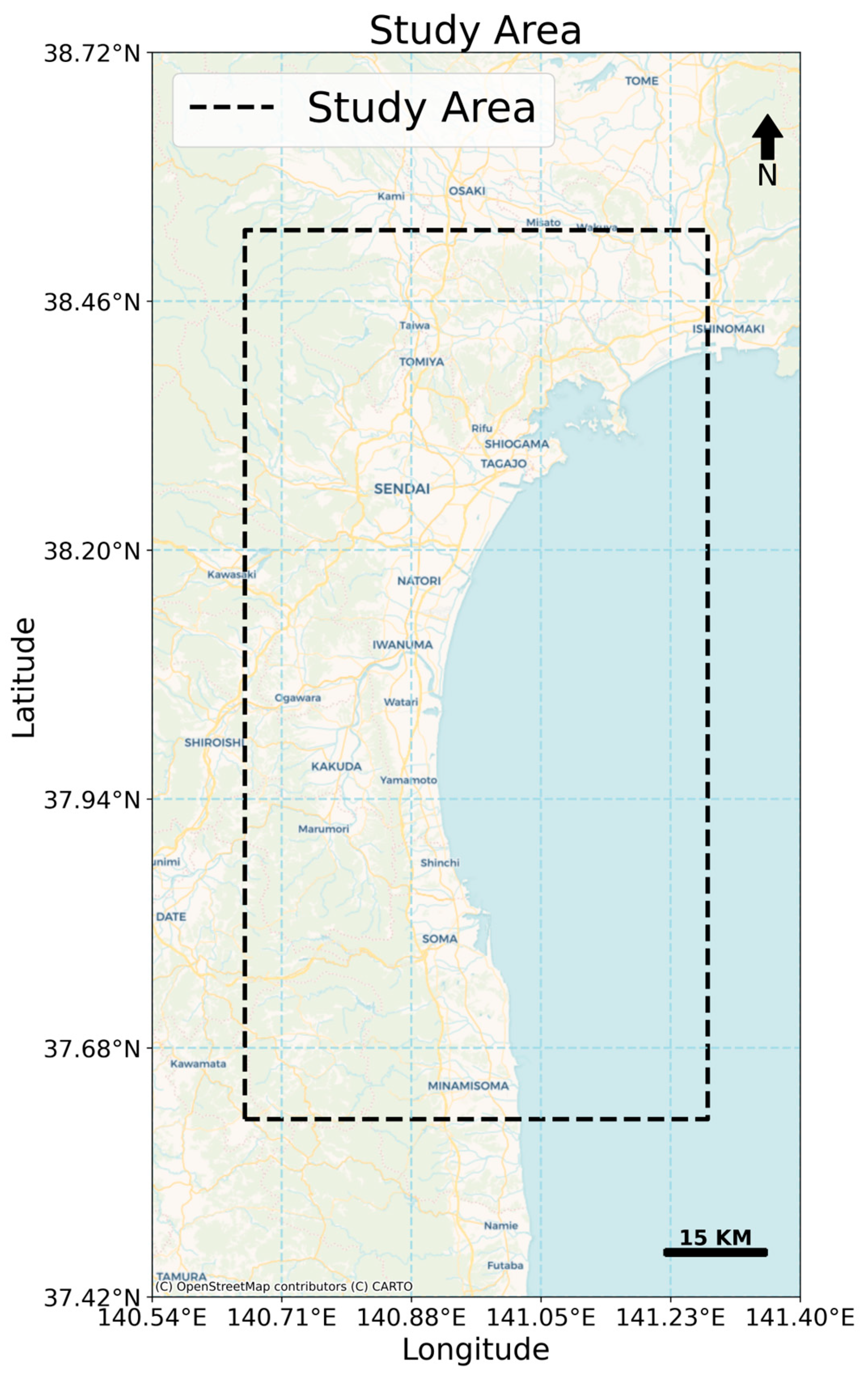
The study focused on the Sendai coastline in northeastern Japan, one of the region’s most severely affected by the 2011 Tōhoku earthquake and tsunami (Figure 1). Extending along the Pacific coast of Miyagi Prefecture, the Sendai coastal plain is characterized by wide sandy beaches, low-lying agricultural land, and engineered coastal defenses, all of which were extensively disrupted by the tsunami. The disaster caused massive shoreline retreat, loss of beach sediments, and alteration of nearshore geomorphology across more than 2000 km of coastline [8].
Figure 1.
The Study Area.
This region represents an ideal natural laboratory for studying long-term coastal recovery because it experienced both catastrophic disturbance and sustained human intervention in the following decade. It also exhibits characteristics common to many tsunami-affected coasts, mixed natural and engineered features, complex sediment transport pathways, and multi-scale morphological elements ranging from individual beach cusps to regional barrier systems. The availability of consistent multispectral satellite imagery from Landsat and Sentinel missions spanning the pre-tsunami period (2010) through recent years (2024) provided the temporal depth necessary to detect long-term reorganization patterns.
Despite extensive field monitoring and remote sensing analyses since 2011, existing studies have largely focused on short-term morphological recovery, typically within two to four years.
For instance, Tanaka et al. (2012) analyzed beach profile recovery along the Sendai coast during the first 18 months following the 2011 tsunami, documenting rapid initial sediment redistribution [26]. In a numerical study, Yamashita et al. (2016) showed that the 2011 tsunami induced large-scale morphological changes, with the first wave particularly its return flow being responsible for eroding the majority of coastal sand dunes in Hirota Bay [27]. A 2011–2015 monitoring study by Udo et al. (2016) concluded that the Rikuzen-Takata coast was severely eroded by the tsunami’s backwash and failed to recover naturally, with coastal structures like submerged breakwaters trapping sediment but being insufficient to prevent major land loss without human intervention [28]. These studies collectively illustrate the predominant temporal scope of existing post-tsunami coastal research, reinforcing our rationale for extending the analysis to a 14-year period (2010–2024).
These approaches have relied on geometric measurements such as shoreline retreat and bathymetric differencing, which describe visible changes but are limited in capturing deeper structural and topological transformations that govern system resilience. Thus, the shoreline here presents a critical research problem of how to quantify decadal-scale coastal reorganization that goes beyond simple shape recovery. By combining Dynamic Time Warping and Persistent Homology, this study tried to address that gap, offering a more complete representation of how coastal systems adapt, reorganize, and stabilize in the aftermath of extreme natural disturbances.
2.2. Methodology
The study utilized multispectral satellite imagery from three different sensors to construct a time-series analysis of the Sendai coastline for the years 2010, 2011, 2015, 2020, and 2024. Data for the pre-tsunami (2010), immediate post-tsunami (2011), and early recovery (2015) periods were acquired from the NASA/USGS Landsat 5 TM and Landsat 8 OLI Collection 2 Level-2 surface reflectance archives. For the more recent mid-recovery (2020) and current-state (2024) analyses, higher-resolution surface reflectance data from the Copernicus Sentinel-2 MSI sensor was used. For each year, we did not rely on a single image. Instead, we used Google Earth Engine to create a single, cloud-reduced annual median composite from all available images in that year. This approach helped us to minimize the impact of clouds, shadows, and other atmospheric effects.
The use of annual median composites is also our primary method for mitigating seasonal effects. By taking the median value of all pixels throughout the year, we were averaging out the seasonal variations in the shoreline position, providing a more representative depiction of the shoreline for each year.
All primary image generation was performed within the Google Earth Engine platform. For each year, a single, cloud-reduced annual median composite was generated from all available images intersecting the defined study area. The Modified Normalized Difference Water Index (MNDWI) was calculated from these composites to effectively delineate the land-water interface. The final data products were exported as GeoTIFF files with spatial resolutions of 30 m for Landsat data and 10 m for Sentinel-2 data, with all outputs projected to the WGS 84/UTM Zone 54N (EPSG:32654) coordinate reference system.
This study systematically investigated the complex morphological evolution of the Sendai coastline in the aftermath of the 2011 tsunami through a dual-approach analytical framework combining Dynamic Time Warping (DTW) for geometric analysis and Persistent Homology (PH) for topological characterization.
A Framework for Geospatial Curve Extraction and Reconstruction
First, to extract the land-water interface, the Modified Normalized Difference Water Index (MNDWI) was calculated for each temporal scene. MNDWI was chosen for its adeptness at highlighting open water while suppressing noise from soil and terrestrial vegetation. It was calculated as-
where represented the surface reflectance of the green band and corresponded to the first Short-Wave Infrared band. A binary land-water classification was achieved by applying a threshold where pixels with were classified as water. From this binary mask, a set of raw contour points representing the full coastline was extracted using the marching squares algorithm.
Second, to focus the analysis on a specific region of interest, the full coastline contour (represented as a LineString geometry) was clipped. Using two pre-defined boundary lines, and , loaded from a shapefile, the intersection points and were computed. The indices of the vertices on closest to these intersection points, and , were identified. The final analysis-ready point cloud, , was derived by selecting the ordered subset of vertices from between these two indices.
Third, to create a smooth, differentiable representation of the coastline, a parametric B-spline curve was fitted to the bounded point cloud This B-spline is defined as-
where,
were the control points
was the degree of the curve and
were the B-spline basis functions defined over a knot vector
A non-periodic cubic spline was employed by minimizing the squared errors between the points and the spline. The interpolation was performed using the splprep function from the SciPy library with cubic splines (k = 3) and a smoothing parameter of s = 0 to minimize squared errors between the coastline vertices and the fitted curve. This yielded smooth, and continuous mathematical representation, , for each year’s coastline segment.
2.3. Quantifying Post-Disaster Structural Disruption
The immediate disruption to the coastline’s geometry caused by the 2011 tsunami was quantified by computing the shape dissimilarity between the pre-tsunami and immediate post-tsunami reconstructed curves, and . Thus, a quantitative baseline for the magnitude of the initial shock was found.
2.4. Implementation of a Shape-Based Resilience Metric via Dynamic Time Warping (DTW)
Dynamic Time Warping (DTW) is an algorithm that measures the similarity between two sequences. It is particularly effective when the sequences have different lengths or are out of phase, as it finds the optimal alignment between them. We chose DTW to compare the shape of the shorelines from different years. Each shoreline was treated as a long sequence of thousands of coordinate points. DTW provided a single, robust number that quantified the geometric difference between two shorelines, making it ideal for measuring the impact of the tsunami and the subsequent recovery.
We proposed a resilience metric based on DTW, designed to find the optimal alignment and distance between two ordered sequences of points. Given two discretized curves and , DTW computed an distance matrix where each element was the Euclidean distance . It then found a warping path that minimized the cumulative distance from to . The total distance was governed by the recurrence relation-
The final value, , represented the total geometric deformation cost to optimally map one curve onto the other. This distance was our quantitative metric for shape dissimilarity, where a larger value indicated a more significant difference in the physical shape of the coastline segments.
2.5. Time-Series Analysis of Landscape Recovery
The temporal dynamics of the coastline’s recovery was investigated by applying the DTW metric across the time-series of reconstructed curves. A sequence of DTW distances was computed for each interval , , and .
These distances represented sequential comparisons between the reconstructed shoreline of a given year and that of the subsequent period, rather than comparisons against a single fixed baseline. The resulting time series of distances, , was used to quantify the recovery rate of the shoreline for each period, expressed as the average rate of geometric deformation in meters per year (m/year). A decreasing trend in this rate was interpreted as evidence of landscape stabilization, where the magnitude of year-over-year change diminished as the shoreline approached a new geometric equilibrium.
2.6. Topological Data Analysis for Coastal Recovery
To complement the traditional shape-based analysis, a computational methodology from Topological Data Analysis (TDA) was adopted to quantify the structural evolution of the coastline. This approach leveraged Persistent Homology (PH) to extract and track topological features, providing a multi-scale understanding of morphological change. The methodology was inspired by recent advancements in applying PH to dynamic systems, particularly as outlined in the paper “Stable distance of persistent homology for dynamic graph comparison” [29].
2.7. Coastline Graph Model Construction
The initial step involved transforming the yearly coastline point clouds into a graph-based representation suitable for topological analysis. For each year , the extracted coastline points
were treated as nodes in a graph . Edges were implicitly formed by the sequential ordering of points along the coastline, and their weights were assigned based on the Euclidean distance between adjacent points.
Thus, a sequence of graph models were achieved representing the dynamic evolution of the coastline.
2.8. Topological Feature Extraction via Persistent Homology
From these graph models, topological features were extracted using Persistent Homology. Instead of directly analyzing the graph structure, each set of yearly coastline points was considered as a point cloud from which a “Vietoris-Rips complex” was constructed. A Vietoris-Rips complex for a point cloud is a simplicial complex where a -simplex is formed by any points in that are all pairwise within a distance . By varying the parameter from 0 to a maximum edge length, a filtration of simplicial complexes was generated, . Persistent Homology tracked the birth and death of topological features (e.g., connected components, loops, voids) across this filtration. For this study, 1-dimensional homology (H1), corresponding to loops or enclosed regions, was of primary interest. Each H1 feature was characterized by a birth time (the value at which the loop appeared) and a death time (the value at which the loop was filled or merged). These pairs were summarized in a persistence diagram for each year .
The “persistence” of a feature, , indicated its topological significance and robustness to noise.
2.9. Quantification of Topological Change (Stable Distance of Persistent Homology (SDPH))
To quantify the dissimilarity between the topological structures of the coastline across different years, the 2-Wasserstein distance was employed. This metric, a core component of the Stable Distance of Persistent Homology (SDPH) framework, measured the “cost” of transforming one persistence diagram into another. For two persistence diagrams and , the 2-Wasserstein distance was calculated as-
where,
represented a perfect matching between the points in and , and was the diagonal. This distance was a stable measure of topological change, that was treated as a quantitative comparison of the coastline’s topological evolution over time.
3. Results
The initial processing of satellite imagery, the bounded coastline segments for each study year were extracted as discrete point clouds (Figure 2).
Figure 2.
Discrete Point Clouds of Waterline (2010–2024).
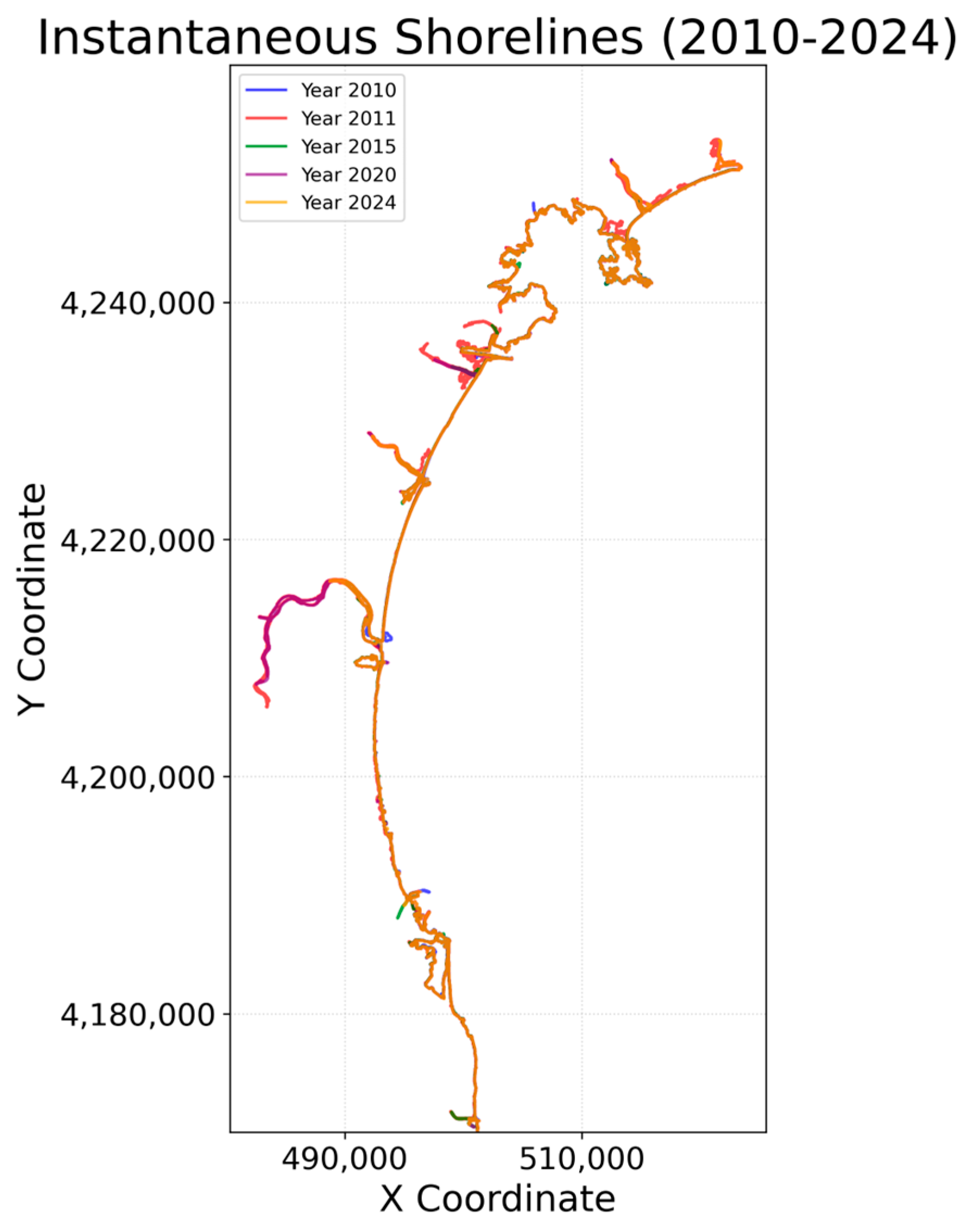
The reconstructed instantaneous shorelines for all five study years were overlaid on a single map (Figure 3). The figure shows a landward retreat immediately following the 2011, followed by a progressive, non-linear recovery and stabilization towards a new configuration by 2024.
Figure 3.
Evolution of Instantaneous Shorelines on the Sendai Coastline (2010–2024).
It is important to note that no tidal correction was applied during the extraction of these waterlines, therefore the term ‘instantaneous shoreline’ is used throughout this study to accurately reflect their representation of the water’s edge at the time of image acquisition.
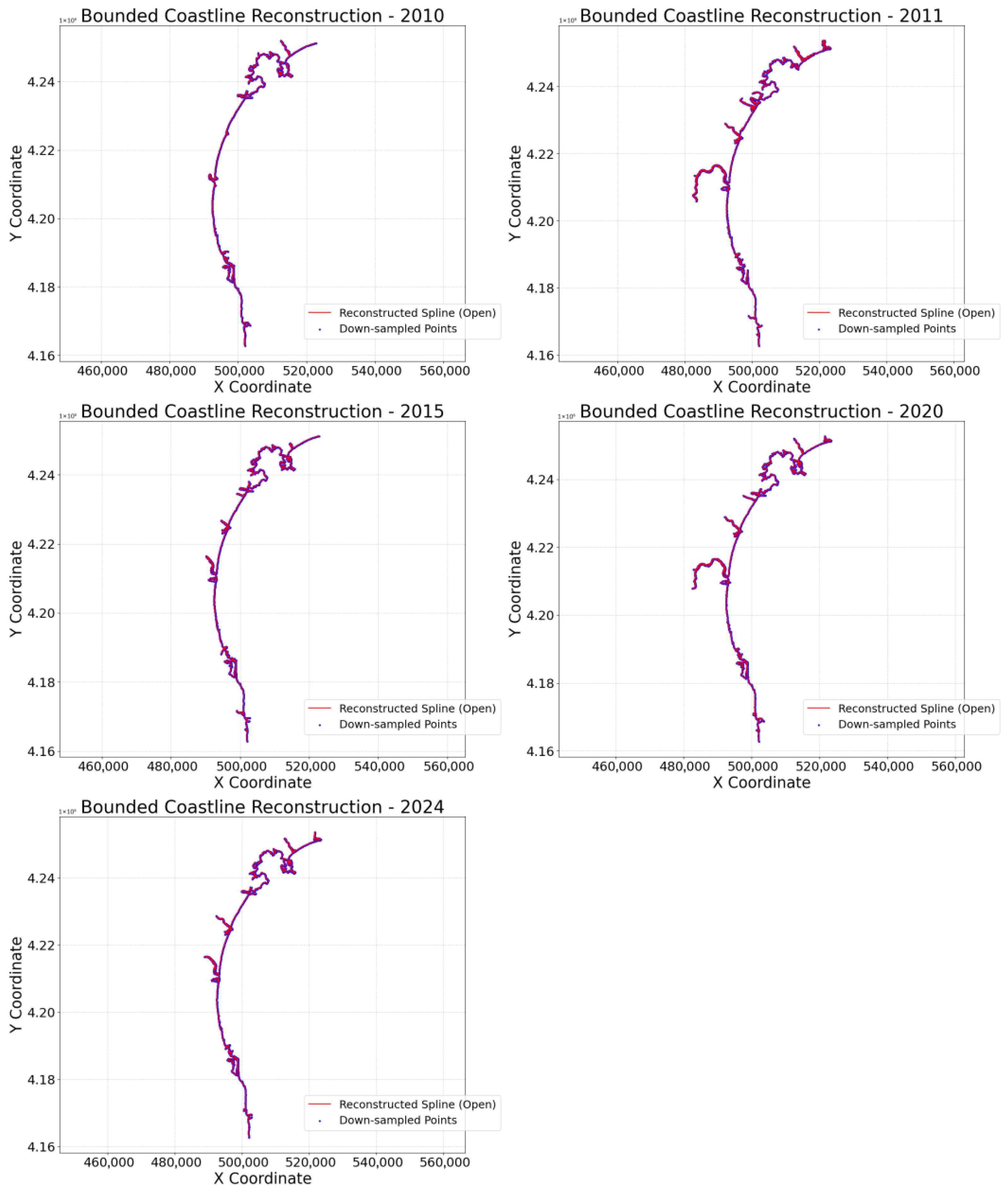
The number of extracted points representing the bounded instantaneous shorelines varied across the study period, primarily reflecting the spatial resolution of the source imagery (Table 1). Contours derived from the higher-resolution Sentinel-2 data (2020 and 2024) captured finer geometric detail, resulting in a substantially greater number of points compared to those extracted from the lower-resolution Landsat imagery (2010, 2011, and 2015). After the extraction of bounded instantaneous shorelines point clouds, a B-spline curve reconstruction method was applied to each annual dataset. This process involved fitting a non-periodic cubic B-spline (degree 3) to a down-sampled representation of the extracted points, effectively smoothing the raw data while preserving the essential geometric characteristics of the coastline segment.
Table 1.
Number of Extracted Coastline Points per Year.
The reconstructed curves were defined by a varying number of control points across the years which pointed to the underlying complexity of the input point clouds and the adaptive nature of the spline fitting process (Table 2). For instance, the 2010 coastline was represented by 708 control points, while the 2011 and 2015 curves utilized 894 and 792 control points, respectively. The later years, 2020 and 2024, were characterized by 880 and 823 control points. These smooth, continuous parametric representations were used as the input for the subsequent shape-based distance analysis.
Table 2.
B-Spline Curve Parameters for Reconstructed Coastline Segments.
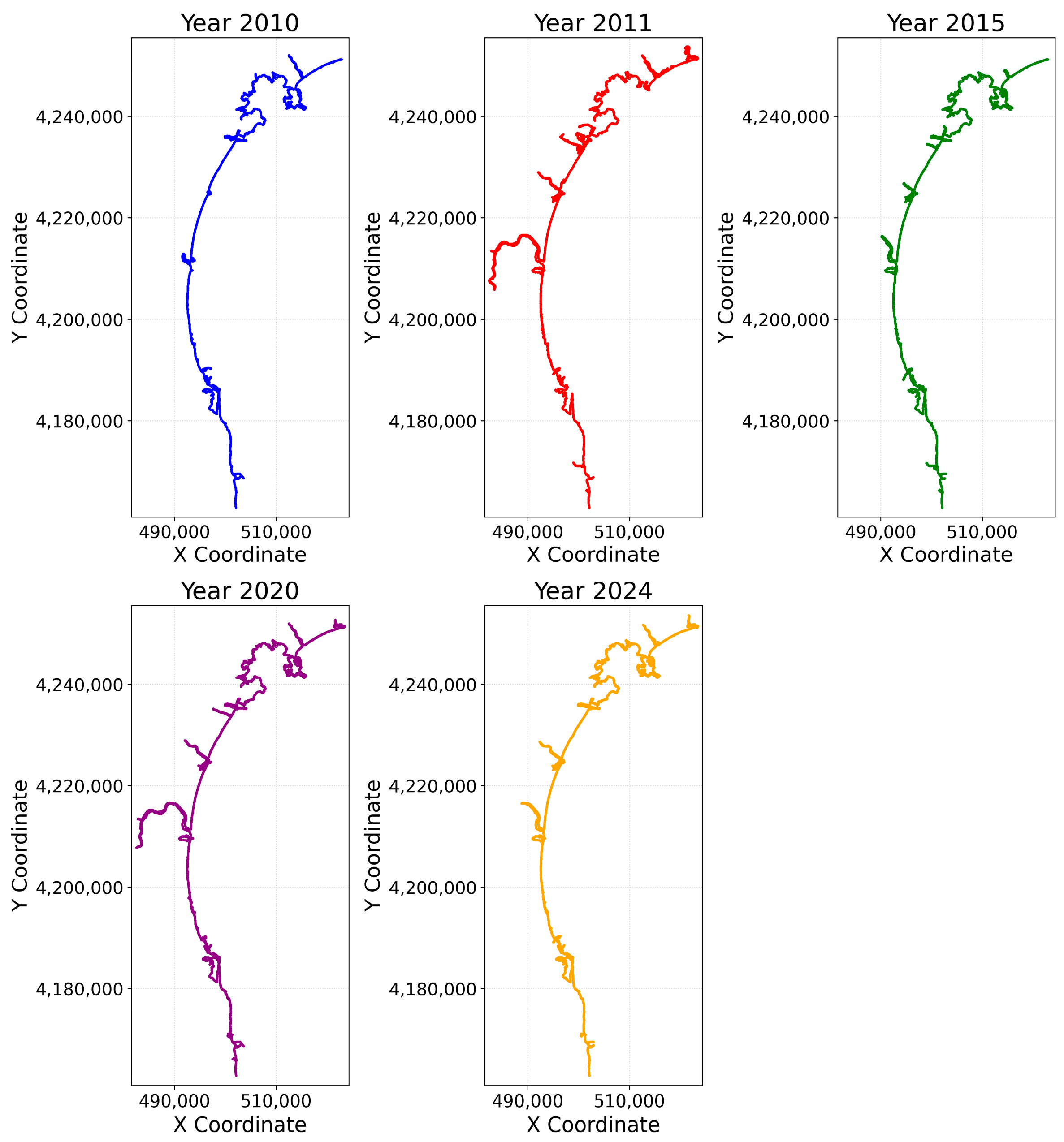
The visual representation of these reconstructed segments across the study period is presented in (Figure 4). These plots show the smoothed coastline for each year, allowing for a direct visual assessment of the geometric changes and the overall evolution of the coastal morphology. Later, the shape-based resilience metric involved calculating the Dynamic Time Warping (DTW) distance between the reconstructed coastline segments of consecutive years. This metric quantified the geometric dissimilarity, used as a measure of the structural change over time.
Figure 4.
Reconstructed Bounded Coastline Segments for Each Study Year.
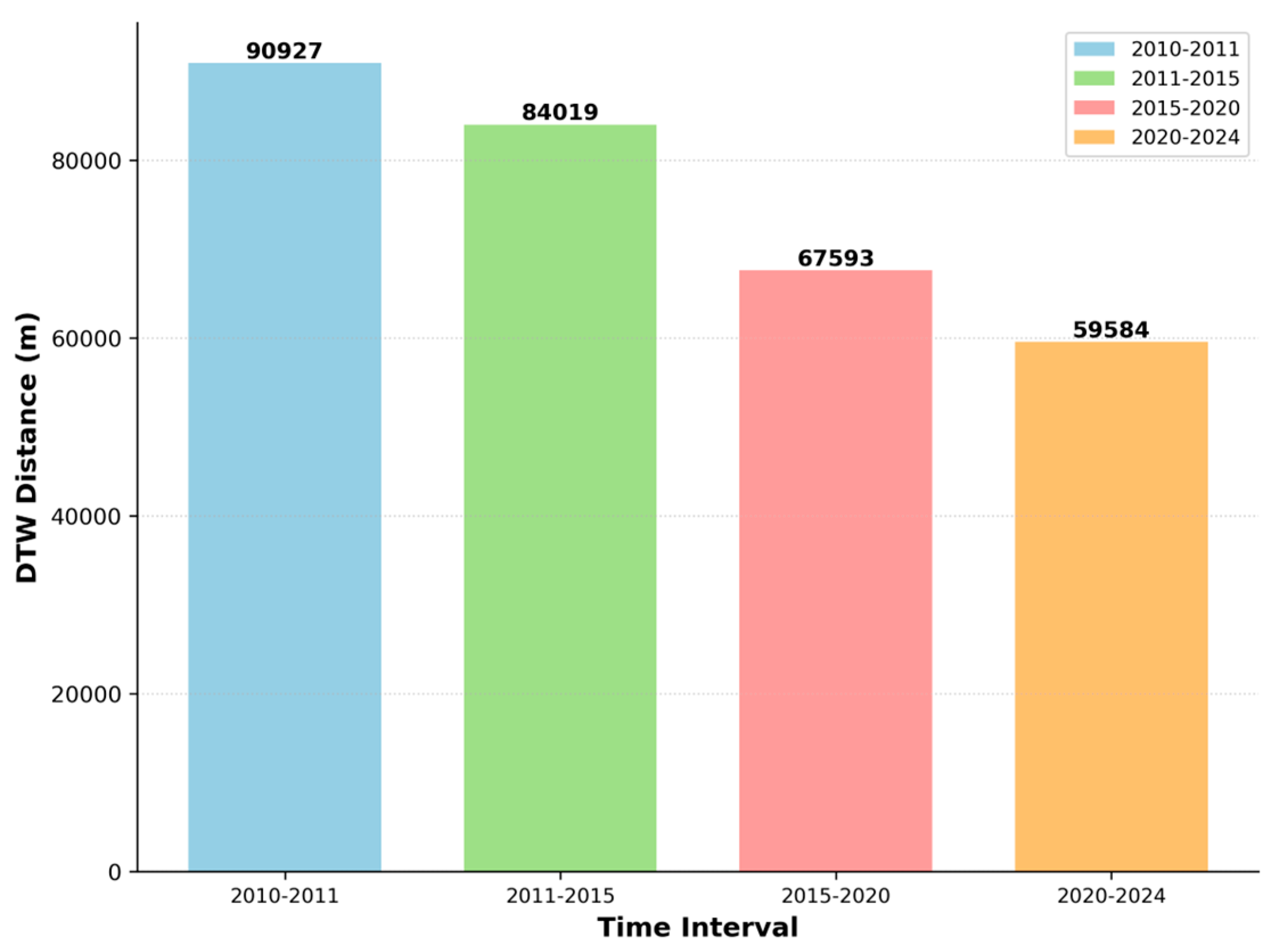
The analysis revealed a substantial initial impact from the 2011 tsunami, with a DTW distance of 90,927 m between the 2010 and 2011 coastline segments (Figure 5). This value represented the most significant shape alteration observed across the study period. Subsequently, the DTW distances consistently decreased in the post-tsunami intervals, indicating a progressive stabilization of the coastline’s morphology. The distance between 2011 and 2015 was 84,019 m, followed by a further reduction to 67,593 m for the 2015–2020 period. The most recent interval, 2020–2024, exhibited the lowest DTW distance of 59,584 m, suggesting that the coastline was approaching a new, more stable geometric equilibrium. This decreasing trend in DTW distances was indicative of the landscape’s recovery and stabilization over the 13 years post-tsunami.
Figure 5.
Bar Chart of Dynamic Time Warping Distances Between Consecutive Coastline Segments.
3.1. Coastline Representation as Graph Models
The extracted coastline point clouds for each year were transformed into formal graph structures. Each coordinate pair from the yearly coastline data was represented as a node in a graph, with its position stored as node attributes. Edges were constructed sequentially between nodes, forming a path graph that traced the specific geometry of the coastline for that year. The weight of each edge was defined by the Euclidean distance between the two nodes it connected. This process was repeated for each of the five years under investigation (2010, 2011, 2015, 2020, and 2024), resulting in a time-series of five distinct graph models. For instance, the pre-tsunami 2010 coastline was modeled as a graph consisting of 11,872 nodes and 11,871 edges. This sequence of graphs was the input dataset for the subsequent persistent homology and SDPH distance calculations, representing the dynamic evolution of the coastline’s topology over the study period. The graph models of the coastline were analyzed using persistent homology to extract their topological features. A Rips complex was constructed for each yearly point cloud, and the persistence of 1-dimensional (H1) topological features was computed.
These H1 features corresponded to loops, which in the context of the coastline data, represented enclosed or semi-enclosed bodies of water, such as lagoons, bays, and complex inlets formed by spits and bars (Table 3). The analysis revealed a dynamic and non-linear evolution of the coastline’s topological structure over the time period. The key findings were as follows:
Table 3.
Count of 1-Dimensional Topological Features (Loops) Detected.
Pre-Tsunami (2010): The pre-tsunami coastline was topologically complex, presenting 940 distinct 1-dimensional features. This was regarded as the baseline morphology.
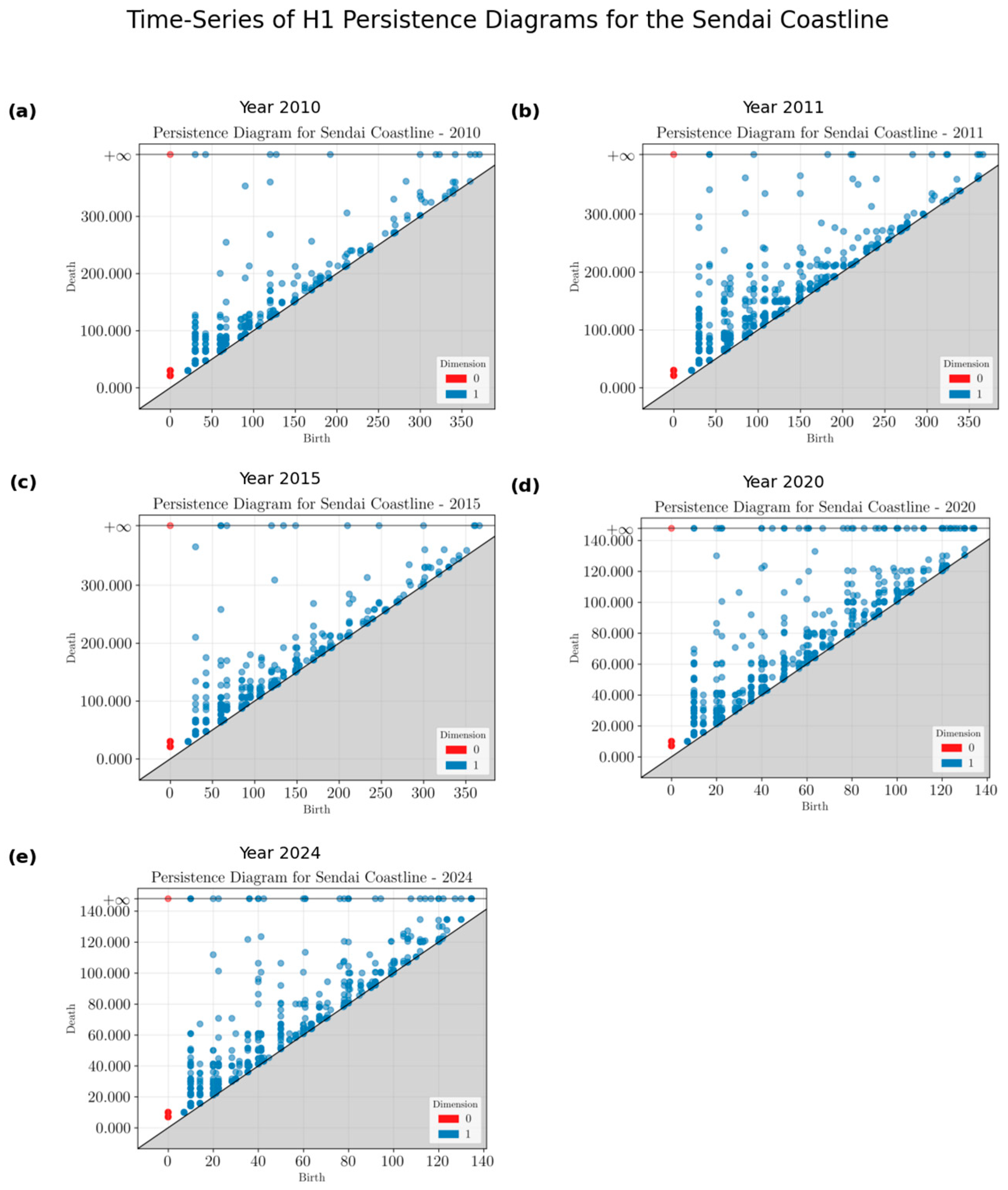
Post-Tsunami (2011): Immediately following the tsunami, the coastline’s complexity increased dramatically. The number of H1 features nearly doubled to 1798. Visually, the 2011 persistence diagram showed a dense cloud of new points, indicating the tsunami’s role in fragmenting the coast and creating numerous new lagoons and inlets.
Initial Recovery (2015): By 2015, the coastline showed signs of consolidation. The number of H1 features decreased to 1127. This suggests that many of the smaller, less stable loops created by the tsunami had been filled in by sediment or reconnected to the sea, a typical early phase of post-disaster landscape recovery.
Later-Stage Complexity (2020–2024): Contrary to a simple trajectory of continued simplification, the analysis of the 2020 and 2024 data, sourced from Sentinel-2, revealed a surprising and massive increase in topological complexity. The number of H1 features surged to 8098 in 2020 and remained exceptionally high at 6999 in 2024.
The persistence diagrams for these years were characterized by an extremely dense cluster of low-persistence features (points close to the diagonal) (Figure 6). This indicates the formation of a highly intricate and fine-scaled coastal morphology, potentially representing the development of complex braided channel systems, small-scale sediment bars, or tidal flats. This also suggests that the long-term recovery process is not a simple return to the pre-tsunami state but rather an evolution towards a new, and in some ways more complex, coastal form. Furthermore, the persistence diagrams provided a more granular understanding of this morphological transformation beyond the raw feature counts. The dense clustering of points near the diagonal in the 2020 and 2024 diagrams (Figure 6) reveals that the dramatic increase in topological complexity is primarily driven by the emergence of numerous low-persistence features of topological loops that exist only across small spatial scales. These ephemeral structures may have represented transient geomorphic elements such as small tidal channels, temporary sandbars, and shallow inundation patterns that form and dissipate with tidal cycles and seasonal sediment transport. The vertical distribution of points in these later-year diagrams indicates features with substantial spatial extent (large birth values), yet their proximity to the diagonal signifies short lifespans relative to their scale. The pattern suggests a highly dynamic coastal system where large but unstable geomorphic features are continuously being formed and destroyed. Particularly important is the presence of several high-persistence features (points far from the diagonal) in the 2020 and 2024 diagrams, indicating the stabilization of some major coastal structures likely representing more permanent lagoonal systems or substantial barrier formations that have endured through multiple tidal and seasonal cycles. The temporal evolution visible across the diagram sequence reveals a clear trajectory, from the moderate complexity of 2010, through the scattered disruption of 2011, toward the consolidated but still evolving state of 2015, and finally to the sophisticated, multi-scalar complexity of 2020–2024. This progression illustrates how the coastline has not merely recovered but has fundamentally reorganized itself into a more complex morphological system, likely exhibiting increased resilience through its enhanced capacity to dissipate energy across multiple spatial scales. The contrast between the earlier Landsat-derived diagrams and the Sentinel-2 era diagrams also highlights an important methodological consideration. While the improved resolution certainly enables detection of finer features, the consistent pattern across 2020 and 2024 suggests we are observing a genuine geomorphic trend rather than merely an artifact of improved sensing capabilities. This complex topological signature may represent the coastline’s self-organization toward a new dynamic equilibrium, characterized by distributed flow pathways and sediment redistribution mechanisms that were absent in the pre-tsunami morphology.
Figure 6.
Persistence Diagrams of 1-Dimensional Homology (H1) for 2010 to 2024.
3.2. Topological Distance Analysis Using Persistent Homology
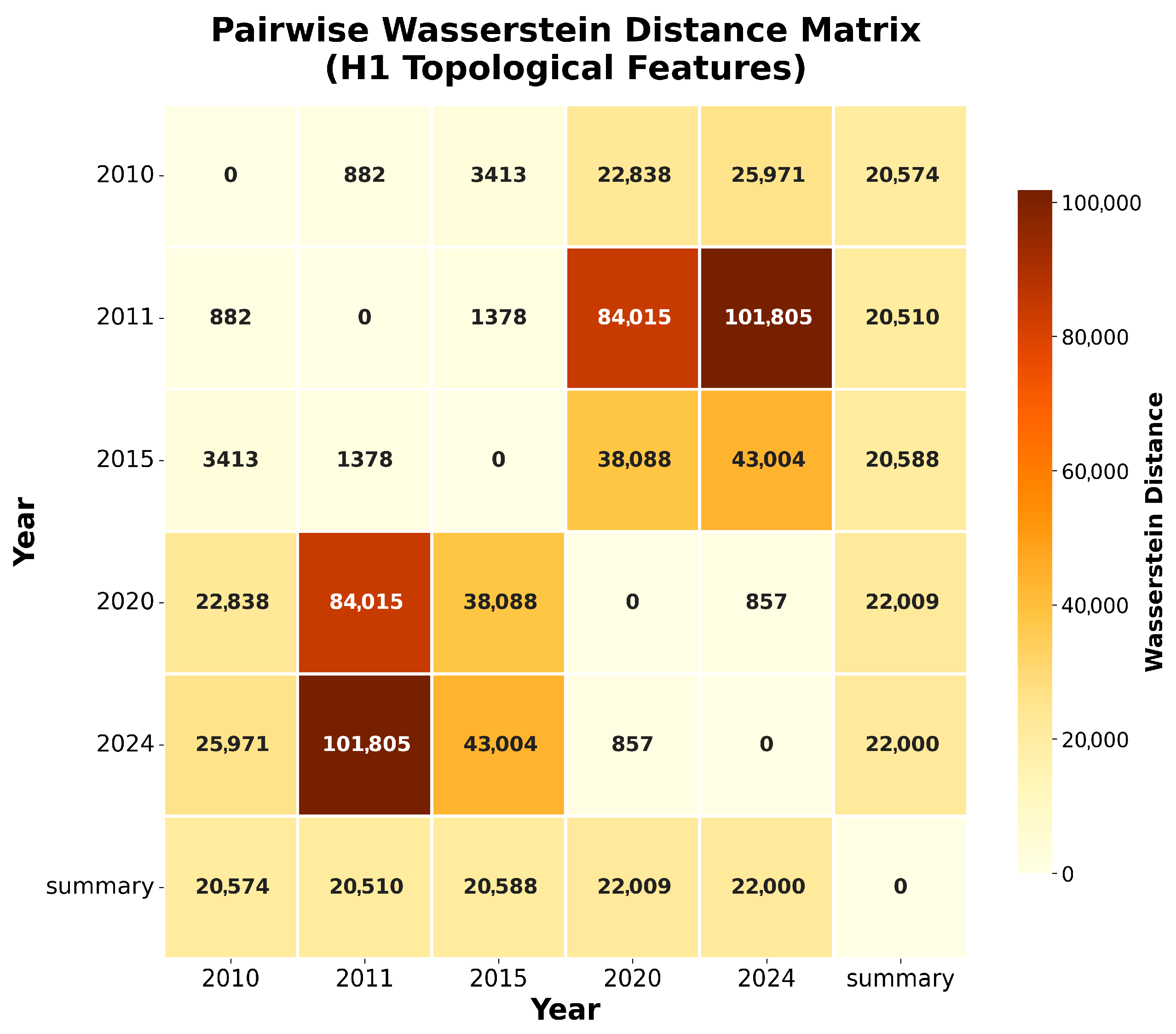
The structural evolution of the coastline was further quantified using a topological distance metric derived from persistent homology. After extracting the H1 persistence diagrams for each year, the 2-Wasserstein distance was computed between each pair to measure the dissimilarity of their topological signatures. This process was executed successfully for all ten pairwise comparisons. The resulting distance matrix revealed a complex, non-linear pattern of coastal evolution. The initial impact of the 2011 tsunami, measured by the distance between the 2010 and 2011 topologies, was 882 (Figure 7). While not the largest value in the matrix, this figure represented the significant initial shock, corresponding to the formation of nearly double the number of topological loops, as seen in the persistence diagrams. The subsequent recovery period from 2011 to 2015 yielded a value of 1378, suggesting that the coastline did not simply revert to its prior state but underwent continued, active reorganization.
Figure 7.
Heatmap Visualization of Pairwise Topological Distances.
However, the most profound topological transformation occurred in the 2015–2020 interval, which registered a massive distance of 38,088 relative to the 2015 state. This value, an order of magnitude larger than the initial tsunami impact, points to a major phase transition in the coastal system. This transition is clearly visualized in the distance heatmap (Figure 7), which delineates two primary temporal clusters, an early period (2010–2015) and a recent, morphologically distinct period (2020–2024). The bright, high-distance values separating these two clusters visually emphasized the substantial topological reorganization that occurred between 2015 and 2020, corroborating the feature count surge identified in the persistence diagram analysis. Notably, the system appeared to stabilize in this new, more complex state. The distance between 2020 and 2024 was only 857, a value comparable to the initial 2010–2011 tsunami shock, indicating relative stability in the new morphology. The persistence of large distances between the early and recent years (e.g., 2011 to 2024 distance of 101,805) confirmed that the coastline had not returned to its pre-tsunami topological state. Instead, the results strongly suggest the system established a new, structurally distinct, and more intricate equilibrium. These findings point to the emerging understanding of coastal systems as complex adaptive systems that may reorganize into alternative stable states following major disturbances.
3.3. Comparative Analysis of DTW and SDPH Metrics
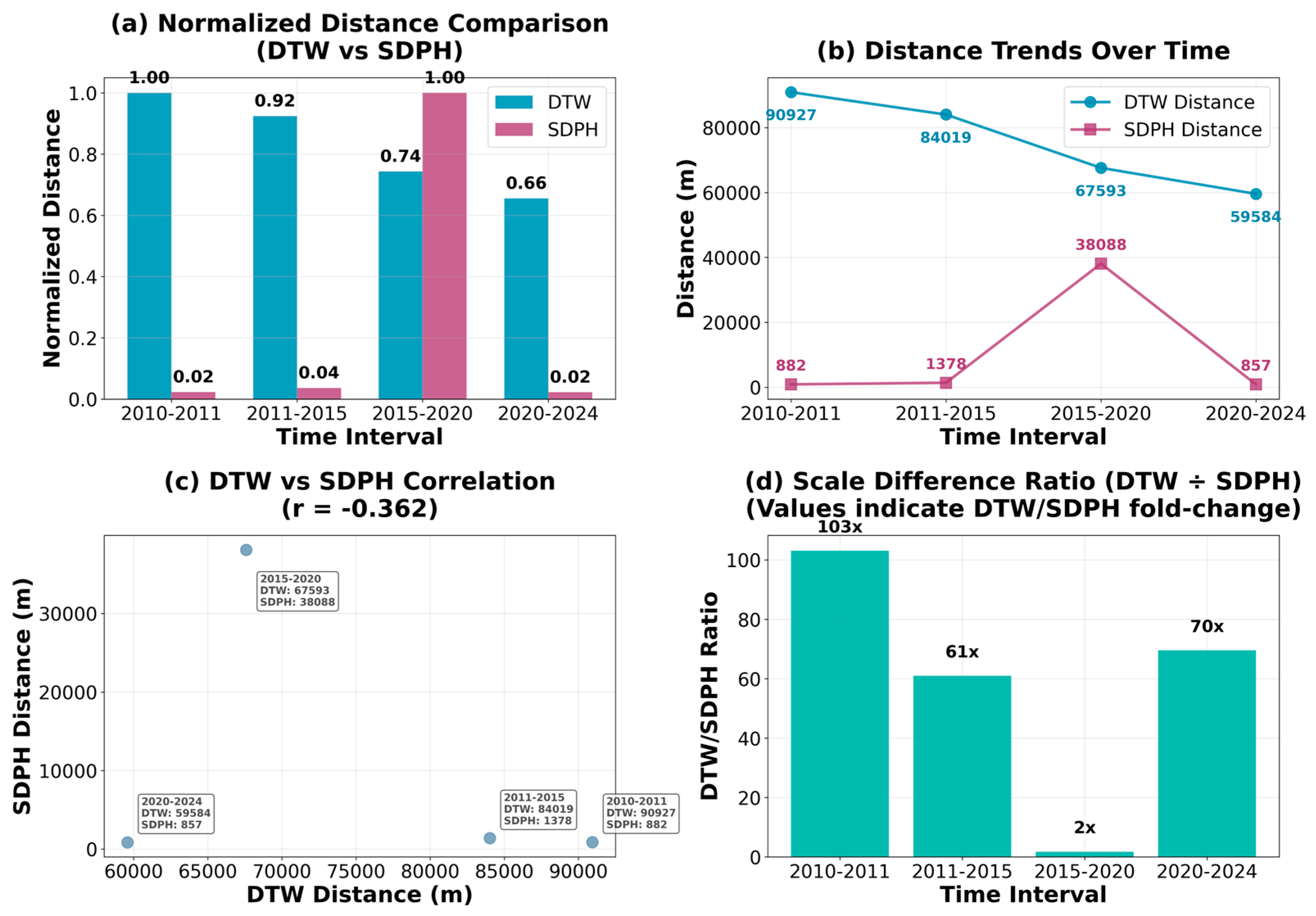
A comprehensive comparative analysis was conducted to evaluate the performance and perception provided by both the Dynamic Time Warping (DTW) and the Stable Distance of Persistent Homology (SDPH) methodologies in quantifying coastline evolution. It integrated the time-series shape differences derived from DTW with the topological dissimilarities calculated using SDPH. The comparison revealed that both metrics captured the dynamic nature of coastal change, albeit at significantly different scales and with subtle interpretations (Figure 8). The DTW distances, reflecting overall shape deformation, consistently exhibited larger absolute values, ranging from approximately 59,584 to 90,927 units (Figure 8b).
Figure 8.
Comprehensive Comparison of Normalized DTW and SDPH Distances with Trends Over Time.
In contrast, the SDPH distances, quantifying topological structural changes, ranged from 857 to 38,088 units. On average, DTW distances were found to be approximately 59 times larger than SDPH distances, emphasizing their inherent differences in scale and sensitivity. Despite these scale differences, both methods generally indicated periods of higher and lower change. For instance, the 2010–2011 interval, representing the immediate post-tsunami impact, showed a DTW distance of 90,927 and an SDPH distance of 882. The 2015–2020 interval, identified as a period of significant topological transformation by SDPH (38,088), also registered a notable DTW distance of 67,593. A Pearson correlation coefficient of −0.362 was calculated between the two sets of distances. This indicated a weak negative relationship, suggesting that while both methods generally track changes in coastline morphology, they capture distinct aspects of this evolution. DTW primarily measured the overall geometric alignment and deformation of the coastline’s shape, whereas SDPH focused on the emergence, persistence, and disappearance of topological features (loops and holes). The weak correlation implies that these two perspectives offer complementary information into the complex processes of coastal recovery and reorganization. The analysis confirmed that the coastline’s recovery trajectory was non-linear, with both methods highlighting significant changes in the immediate post-tsunami period and a subsequent, complex evolution. The SDPH metric, in particular, provided a sound measure of topological reorganization, revealing a phase transition towards a new, more complex structural regime in the later years of the study period.
4. Discussion
The findings of this study revealed a complex, non-linear trajectory of coastal recovery following the 2011 tsunami in Japan, characterized by distinct phases of morphological reorganization that diverged significantly from simple restoration to pre-disaster conditions. The initial DTW distance of 90,927 m between 2010 and 2011 coastlines quantified the immediate geometric disruption, aligning with previous observations of severe erosional damage along the Sendai coast [30]. However, the subsequent recovery pattern contradicted expectations of monotonic stabilization, instead exhibiting a sophisticated evolution toward a new morphological equilibrium. The decreasing trend in DTW distances from 2011 to 2024 (84,019 m to 59,584 m) suggested progressive geometric stabilization, consistent with empirical orthogonal function analyses that documented convergence of beach profiles within 2–4 years post-tsunami [9,31]. This geometric recovery trajectory paralleled findings from other Sendai coastal segments, where rapid early recovery occurred within the first two years, followed by longer-term stabilization [10]. The DTW methodology successfully captured this shape-based recovery, providing quantitative validation of visual observations reported in previous studies. The topological analysis revealed the most striking finding, the dramatic increase in H1 features from 1127 in 2015 to over 8000 in 2020–2024 (Table 3). This surge in topological complexity, quantified by SDPH distances reaching 38,088 units between 2015–2020, indicated a fundamental phase transition in coastal morphology. A central finding of this study emerged from the 2015–2020 interval, where the geometric and topological analyses presented a compelling and seemingly paradoxical narrative. Our geometric analysis, based on DTW distances, indicated that this period was one of progressive stabilization, as the rate of shape change slowed significantly compared to the immediate post-tsunami years. However, our topological analysis revealed that this same period of geometric stabilization was, in fact, when the most profound structural transformation occurred, with the topological distance peaking at a massive 38,088 m. This indicated that while the shoreline’s geometry was stabilizing, its internal structure was simultaneously reorganizing into a vastly more complex state, characterized by a dramatic increase in features. This apparent paradox is central to our paper’s contribution, demonstrating that a conventional, geometry-based analysis alone would be insufficient to capture the full picture of coastal evolution. The integration of topological data analysis was therefore essential to reveal that the Sendai coastline did not simply recover, but transitioned towards a new, more intricate dynamic equilibrium. The pattern suggested that the coastline had not merely recovered but had self-organized into a more intricate system capable of enhanced energy dissipation across multiple spatial scales [8]. Traditional coastal morphological assessment methods have primarily relied on three approaches, (1) cross-shore beach profile analysis using empirical orthogonal functions (EOF), (2) bathymetric differencing from repeated hydrographic surveys, and (3) simple shoreline position tracking through transect-based measurements [32,33]. While these methods have proven effective for quantifying volumetric sediment changes and horizontal displacement, they possess fundamental limitations in capturing the multi-scale structural complexity that can be revealed by integrated DTW-Persistent Homology framework. Tanaka and Nguyen (2019) [8] monitored four river mouths in Miyagi Prefecture for over eight years after the tsunami. They concluded that self-recovery was insufficient in most cases, with the Natori River’s sandy beach retaining 50% less area and the Kitakami River’s recovery hindered by unfavorable topography, highlighting the need for and role of human intervention in the restoration process. Similarly, bathymetric surveys by Udo et al. (2016) quantified massive sediment volume losses from the 2011 tsunami and concluded that the coast showed no signs of natural sedimentary recovery or stabilization in the years following the event [28]. These findings align with our DTW-based geometric analysis, which showed decreasing distances from 90,927 m (2010–2011) to 84,019 m (2011–2015), confirming rapid initial recovery. However, traditional methods failed to detect the profound topological reorganization that can be revealed by Persistent Homology analysis as seen during 2015–2020, when H1 features surged from 1127 to over 8000 despite geometric stabilization. Conventional transect-based approaches, such as the Digital Shoreline Analysis System (DSAS), calculate linear regression rates and endpoint rate statistics but it is difficult to capture the emergence of complex channel networks or the formation of multi-scale geomorphic features by these [34,35]. The complementarity of our approach is further evidenced by the weak negative correlation (r = −0.362) between DTW and SDPH, demonstrating that geometric and topological dimensions capture orthogonal aspects of coastal evolution. Traditional methods, focusing exclusively on geometric parameters, would have concluded that recovery was complete by 2015, entirely missing the subsequent phase transition toward increased morphological complexity that this framework revealed. The weak negative correlation (r = −0.362) between DTW and SDPH metrics demonstrated their complementary nature in capturing different aspects of coastal evolution. While DTW quantified overall shape deformation, SDPH revealed subtle topological reorganization invisible to geometric measures alone. This methodological innovation addressed a critical gap in coastal morphology studies. The integration of persistent homology into coastal analysis thus represented a significant advancement, enabling detection of multi-scale morphological features that conventional methods might overlook. The observed transition to increased topological complexity challenges traditional concepts of coastal recovery as simple restoration to pre-disturbance states. Instead, the results supported emerging theories of coastal systems as complex adaptive systems capable of alternative stable states [29]. The stabilization of SDPH distances between 2020–2024 (857 units) suggested that the coastline had achieved a new dynamic equilibrium, characterized by enhanced structural diversity and potentially greater resilience to future disturbances. The demonstration that recovery trajectories can lead to morphologically distinct but stable configurations suggests that restoration efforts can consider alternative target states rather than strict pre-disaster conditions. The methodological framework developed here provides researchers with quantitative tools to monitor and assess recovery progress across both geometric and topological dimensions, enabling more precise understanding of coastal system resilience.
5. Limitations
This study acknowledges a few limitations that should be considered when interpreting the results. First, sensor selection was constrained by data availability and temporal coverage requirements. While Landsat 5 TM (30 m), Landsat 8 OLI (30 m), and Sentinel-2 MSI (10 m) provided adequate spatial resolution for regional-scale coastline extraction, higher-resolution sensors such as Rapid Eye (5 m) were not utilized due to limited temporal coverage, particularly for the critical 2010–2011 period, and cost constraints for multi-decadal analysis [16]. Second, no explicit tidal correction was applied to the imagery. Our analysis therefore represents ‘instantaneous shorelines’ captured at the time of satellite overpass rather than tide-corrected coastlines. The use of annual median composites partially mitigates tidal influence by averaging waterline positions across multiple tidal stages throughout each year [36]. Third, seasonal variations in shoreline position, driven by wave climate and sediment transport patterns, may influence the extracted coastlines. The annual median composite approach reduces but does not eliminate these effects [37]. Fourth, geometric accuracy relies on Level-2 surface reflectance products with orthorectification errors typically within one pixel [38]. For large-scale morphological analysis, this precision is considered sufficient, though localized positional uncertainties may affect fine-scale topological features. Finally, a formal accuracy assessment of the pixel classification was not performed. The waterline was delineated using a standard threshold (MNDWI > 0), a widely accepted method for water body extraction. The primary source of classification error stems from mixed pixels at the land-water interface, where a single pixel may contain both land and water, leading to potential misclassification at the boundary. The use of annual median composites, however, helped to stabilize the waterline and reduce the impact of random classification errors from individual images. The validation of the overall analysis was therefore qualitative, based on the logical consistency of the results with the known catastrophic event and the subsequent, observable patterns of coastal evolution.
6. Conclusions
We successfully developed and applied a computational framework for quantifying the structural evolution of coastal systems through the integration of Dynamic Time Warping and Persistent Homology methodologies. The dual-approach analytical framework provided interesting insights into the complex morphological recovery of the Sendai coastline following the 2011 tsunami, revealing a sophisticated, non-linear trajectory that fundamentally challenges our conventional understanding of coastal recovery processes. The research demonstrated that the Sendai coastline underwent distinct phases of reorganization rather than simple restoration to pre-disaster conditions. The initial geometric disruption, quantified at 90,927 m through DTW analysis, was followed by progressive shape stabilization over the subsequent 13-year period. However, the topological analysis revealed the most significant finding, a dramatic phase transition between 2015 and 2020 characterized by the emergence of over 8000 topological features representing a new, highly complex morphological regime. The methodological innovation of applying Persistent Homology to coastal morphology analysis proved particularly useful, enabling detection of multi-scale structural changes invisible to traditional geometric approaches. The weak negative correlation between DTW and SDPH metrics confirmed their complementary nature, with DTW capturing overall shape deformation while SDPH quantified subtle topological reorganization patterns. The findings established that coastal recovery constituted a complex adaptive process leading to alternative stable states rather than simple restoration. The coastline evolved toward a new dynamic equilibrium characterized by enhanced topological complexity and potentially greater resilience through distributed energy dissipation mechanisms. This transformation represented a fundamental shift in coastal morphology, with implications extending beyond the immediate study area. The computational framework developed here provides scientists and researchers with powerful quantitative tools for monitoring recovery trajectories and assessing system resilience across multiple spatial and temporal scales in order to contribute to our overall understanding of coastal system dynamics and post-disaster landscape evolution.

Author Contributions
Conceptualization, A.B. and M.N.; methodology, A.B. and M.N.; software, A.B.; validation, A.B. and M.D.I.b.H.; formal analysis, A.B.; investigation, A.B.; resources, A.B.; data curation, A.B.; writing—original draft preparation, A.B.; writing, review and editing, A.B. and M.D.I.b.H.; visualization, A.B. and M.D.I.b.H.; All authors have read and agreed to the published version of the manuscript.
Funding
This research received no external funding.
Data Availability Statement
The data presented in this study are available on request from the corresponding author.
Acknowledgments
During the preparation of this manuscript, the author used ChatGPT (GPT-5, OpenAI, 2025) for language editing and refinement of text clarity. The author reviewed and edited all AI-generated content and takes full responsibility for the final version of the manuscript.
Conflicts of Interest
Author Arnob Bormudoi was employed by the company New Space Intelligence. The remaining authors declare that the research was conducted in the absence of any commercial or financial relationships that could be construed as a potential conflict of interest.
References
- Mu, K.; Tang, C.; Tosi, L.; Li, Y.; Zheng, X.; Donnici, S.; Sun, J.; Liu, J.; Gao, X. Coastline monitoring and prediction based on long-term remote sensing data—A case study of the eastern coast of laizhou bay, China. Remote Sens. 2024, 16, 185. [Google Scholar] [CrossRef]
- Xu, N. Detecting coastline change with all available landsat data over 1986–2015: A case study for the state of Texas, USA. Atmosphere 2018, 9, 107. [Google Scholar] [CrossRef]
- Crawford, T.W.; Rahman, M.K.; Miah, M.d.G.; Islam, M.d.R.; Paul, B.K.; Curtis, S.; Islam, M.d.S. Coupled Adaptive Cycles of Shoreline Change and Households in Deltaic Bangladesh: Analysis of a 30-Year Shoreline Change Record and Recent Population Impacts. Ann. Am. Assoc. Geogr. 2021, 111, 1002–1024. [Google Scholar] [CrossRef]
- Leisner, M.M.; De Paula, D.P.; Alves, D.C.L.; Da Guia Albuquerque, M.; De Holanda Bastos, F.; Vasconcelos, Y.G. Long-term and short-term analysis of shoreline change and cliff retreat on Brazilian equatorial coast. Earth Surf. Process. Landf. 2023, 48, 2987–3002. [Google Scholar] [CrossRef]
- da Silva, P.G.; Jara, M.S.; Medina, R.; Beck, A.-L.; Taji, M.A. On the use of satellite information to detect coastal change: Demonstration case on the coast of Spain. Coast. Eng. 2024, 191, 104517. [Google Scholar] [CrossRef]
- Do, A.T.; De Vries, S.; Stive, M.J. The estimation and evaluation of shoreline locations, shoreline-change rates, and coastal volume changes derived from Landsat images. J. Coast. Res. 2019, 35, 56–71. [Google Scholar] [CrossRef]
- Castro, I.J.; Dias, J.M.; Lopes, C.L. Assessing shoreline changes in fringing salt marshes from satellite remote sensing data. Remote Sens. 2023, 15, 4475. [Google Scholar] [CrossRef]
- Tanaka, H.; Nguyen, T.H. Decadal Morphological Recovery of Estuaries and Coasts After the 2011 Tohoku Tsunami. In Proceedings of the International Conference on Sustainable Civil Engineering and Architecture, Ho Chi Minh City, Vietnam, 24–26 October 2019; Volume 80. [Google Scholar]
- Hiep, N.T.; Tanaka, H.; Tinh, N.X. Morphology Recovery and Convergence of Topographic Evolution in the Natori River Mouth after the 2011 Tohoku Tsunami. Water 2022, 14, 715. [Google Scholar] [CrossRef]
- Hoang, V.C.; Tanaka, H.; Mitobe, Y. Morphological recovery of beach severely damaged by the 2011 great east Japan tsunami. Estuar. Coast. Shelf Sci. 2019, 226, 106274. [Google Scholar] [CrossRef]
- Imura, H.; Goto, K.; Minamidate, K.; Koiwa, N. Effects of the 2011 Tohoku-oki tsunami and human activities on long-term coastal geomorphic development in northeastern Tohoku, Japan. Earth Surf. Process. Landf. 2024, 49, 949–963. [Google Scholar] [CrossRef]
- Petitjean, F.; Inglada, J.; Gançarski, P. Satellite image time series analysis under time warping. IEEE Trans. Geosci. Remote Sens. 2012, 50, 3081–3095. [Google Scholar] [CrossRef]
- Narin, O.G.; Bayik, C.; Abdikan, S.; Balik Sanli, F. Using rvi and ndvi time series for cropland mapping with time-weighted dynamic time warping. Int. Arch. Photogramm. Remote Sens. Spat. Inf. Sci. 2022, 48, 97–101. [Google Scholar] [CrossRef]
- Paiva, R.U.; Oliveira, S.S.; Martins, W.S. P-TWDTW 2.0—An optimization in the use of computational resources for parallel processing of remote sensing time series. In Proceedings of the Escola Regional de Alto Desempenho do Centro-Oeste (ERAD-CO), Online, 14–18 September 2020; SBC: Rio de Janeiro, Brazil, 2020; pp. 13–16. Available online: https://sol.sbc.org.br/index.php/eradco/article/view/12646 (accessed on 23 November 2025).
- Suominen, T.; Westerholm, J.; Kalliola, R.; Attila, J. Partition of marine environment dynamics according to remote sensing reflectance and relations of dynamics to physical factors. Remote Sens. 2021, 13, 2104. [Google Scholar] [CrossRef]
- Vos, K.; Splinter, K.D.; Harley, M.D.; Simmons, J.A.; Turner, I.L. CoastSat: A Google Earth Engine-enabled Python toolkit to extract shorelines from publicly available satellite imagery. Environ. Model. Softw. 2019, 122, 104528. [Google Scholar] [CrossRef]
- Maus, V.; Câmara, G.; Cartaxo, R.; Sanchez, A.; Ramos, F.M.; De Queiroz, G.R. A time-weighted dynamic time warping method for land-use and land-cover mapping. IEEE J. Sel. Top. Appl. Earth Obs. Remote Sens. 2016, 9, 3729–3739. [Google Scholar] [CrossRef]
- Edelsbrunner, H.; Harer, J. Computational Topology: An Introduction; American Mathematical Society: Providence, RI, USA, 2010; Available online: https://books.google.com/books?hl=en&lr=&id=MDXa6gFRZuIC&oi=fnd&pg=PR11&dq=Edelsbrunner,+H.,+%26+Harer,+J.+(2010).+Computational+Topology:+An+Introduction.+American+Mathematical+Society.&ots=CTVqeaQAnE&sig=jVDmOaTJaOStyYFWUfWSUl7_NsM (accessed on 23 November 2025).
- Hickok, A.; Needell, D.; Porter, M.A. Analysis of Spatial and Spatiotemporal Anomalies Using Persistent Homology: Case Studies with COVID-19 Data. SIAM J. Math. Data Sci. 2022, 4, 1116–1144. [Google Scholar] [CrossRef]
- Hu, C.-S. Locating topological structures in digital images via local homology. arXiv 2025, arXiv:2301.05474. [Google Scholar] [CrossRef]
- Ding, Y.; Yang, X.; Jin, H.; Wang, Z.; Liu, Y.; Liu, B.; Zhang, J.; Liu, X.; Gao, K.; Meng, D. Monitoring coastline changes of the Malay Islands based on Google Earth Engine and dense time-series remote sensing images. Remote Sens. 2021, 13, 3842. [Google Scholar] [CrossRef]
- Konstantinou, A.; Scott, T.; Masselink, G.; Stokes, C.; Hamilton, T.; Castelle, B. Multi-decadal gravel beach dynamics in the United Kingdom and Ireland: Insights from satellite-derived shorelines. Earth Surf. Process. Landf. 2025, 50, e70160. [Google Scholar] [CrossRef]
- Boussetta, A.; Niculescu, S.; Bengoufa, S.; Zagrarni, M.F. Deep and machine learning methods for the (semi-) automatic extraction of sandy shoreline and erosion risk assessment basing on remote sensing data (case of Jerba island-Tunisia). Remote Sens. Appl. Soc. Environ. 2023, 32, 101084. [Google Scholar] [CrossRef]
- Lundine, M.; Trembanis, A. Data-Driven Shoreline Modeling: Historical Remote Sensing and Prediction Methods. SSRN 2024. [Google Scholar] [CrossRef]
- Scheffer, M.; Carpenter, S.; Foley, J.A.; Folke, C.; Walker, B. Catastrophic shifts in ecosystems. Nature 2001, 413, 591–596. [Google Scholar] [CrossRef]
- Tanaka, H.; Tinh, N.X.; Umeda, M.; Hirao, R.; Pradjoko, E.; Mano, A.; Udo, K. Coastal and Estuarine Morphology Changes Induced by the 2011 Great East Japan Earthquake Tsunami. Coast. Eng. J. 2012, 54, 1250010-1–1250010-25. [Google Scholar] [CrossRef]
- Yamashita, K.; Sugawara, D.; Takahashi, T.; Imamura, F.; Saito, Y.; Imato, Y.; Kai, T.; Uehara, H.; Kato, T.; Nakata, K.; et al. Numerical Simulations of Large-Scale Sediment Transport Caused by the 2011 Tohoku Earthquake Tsunami in Hirota Bay, Southern Sanriku Coast. Coast. Eng. J. 2016, 58, 1640015-1–1640015-28. [Google Scholar] [CrossRef]
- Udo, K.; Takeda, Y.; Tanaka, H. Coastal Morphology Change Before and After 2011 Off the Pacific Coast of Tohoku Earthquake Tsunami at Rikuzen-Takata Coast. Coast. Eng. J. 2016, 58, 1640016-1–1640016-16. [Google Scholar] [CrossRef]
- Ye, D.; Jiang, H.; Jiang, Y.; Li, H. Stable distance of persistent homology for dynamic graph comparison. Knowl.-Based Syst. 2023, 278, 110855. [Google Scholar] [CrossRef]
- Udo, K.; Takeda, Y.; Takamura, M.; Mano, A. Serious Erosion of the Southern Sendai Coast Due to the 2011 Tohoku Earthquake Tsunami and Its Recovery Process. In Post-Tsunami Hazard; Santiago-Fandiño, V., Kontar, Y.A., Kaneda, Y., Eds.; Advances in Natural and Technological Hazards Research; Springer International Publishing: Cham, Switzerland, 2015; Volume 44, pp. 225–236. [Google Scholar] [CrossRef]
- Vo, H.C.; Mitobe, Y.; Tanaka, H. Analysis of shoreline behavior on Sendai coast before and after the 2011 Tsunami. Coast. Eng. Proc. 2014, 34, 82. [Google Scholar] [CrossRef]
- Kraus, N.C.; Rosati, J.D. Interpretation of Shoreline-Position Data for Coastal Engineering Analysis. 1997. Available online: https://apps.dtic.mil/sti/html/tr/ADA591274/ (accessed on 25 November 2025).
- Honeycutt, M.G.; Crowell, M.; Douglas, B.C. Shoreline-position forecasting: Impact of storms, rate-calculation methodologies, and temporal scales. J. Coast. Res. 2001, 17, 721–730. [Google Scholar]
- Thieler, E.R.; Himmelstoss, E.A.; Zichichi, J.L.; Ergul, A. The Digital Shoreline Analysis System (DSAS) Version 4.0—An ArcGIS Extension for Calculating Shoreline Change; US Geological Survey: Reston, VA, USA, 2009. Available online: https://pubs.usgs.gov/publication/ofr20081278 (accessed on 25 November 2025).
- Himmelstoss, E.A.; Henderson, R.E.; Kratzmann, M.G.; Farris, A.S. Digital Shoreline Analysis System (DSAS) Version 5.1 User Guide; US Geological Survey: Reston, VA, USA, 2021. Available online: https://pubs.usgs.gov/publication/ofr20211091 (accessed on 25 November 2025).
- Pardo-Pascual, J.E.; Almonacid-Caballer, J.; Ruiz, L.A.; Palomar-Vázquez, J. Automatic extraction of shorelines from Landsat TM and ETM+ multi-temporal images with subpixel precision. Remote Sens. Environ. 2012, 123, 1–11. [Google Scholar] [CrossRef]
- Luijendijk, A.; Hagenaars, G.; Ranasinghe, R.; Baart, F.; Donchyts, G.; Aarninkhof, S. The state of the world’s beaches. Sci. Rep. 2018, 8, 6641. [Google Scholar] [CrossRef] [PubMed]
- Zhou, S.; Pan, H.; Huang, T.; Zhou, P. High accuracy georeferencing of GF-6 wide field of view scenes toward analysis ready data. IEEE Trans. Geosci. Remote Sens. 2023, 61, 5614512. [Google Scholar] [CrossRef]
Disclaimer/Publisher’s Note: The statements, opinions and data contained in all publications are solely those of the individual author(s) and contributor(s) and not of MDPI and/or the editor(s). MDPI and/or the editor(s) disclaim responsibility for any injury to people or property resulting from any ideas, methods, instructions or products referred to in the content. |
© 2025 by the authors. Licensee MDPI, Basel, Switzerland. This article is an open access article distributed under the terms and conditions of the Creative Commons Attribution (CC BY) license (https://creativecommons.org/licenses/by/4.0/).