Discriminative Anchor Learning for Hyperspectral Image Clustering


Highlights
- An anchor learning strategy that explicitly accounts for the distribution consistency between anchors and samples is proposed, and a discriminative anchor-based hyperspectral image clustering algorithm is developed accordingly.
- Imposing low-rank and probabilistic constraints on the consensus coefficient matrix excavates the intrinsic structure of anchors and further enhances their discriminative capability.
- The new anchor strategy provides an effective tool for anchor-based clustering algorithm.
- The proposed algorithm significantly improves the accuracy of hyperspectral image clustering and yields high-quality clustering maps.
Abstract
1. Introduction
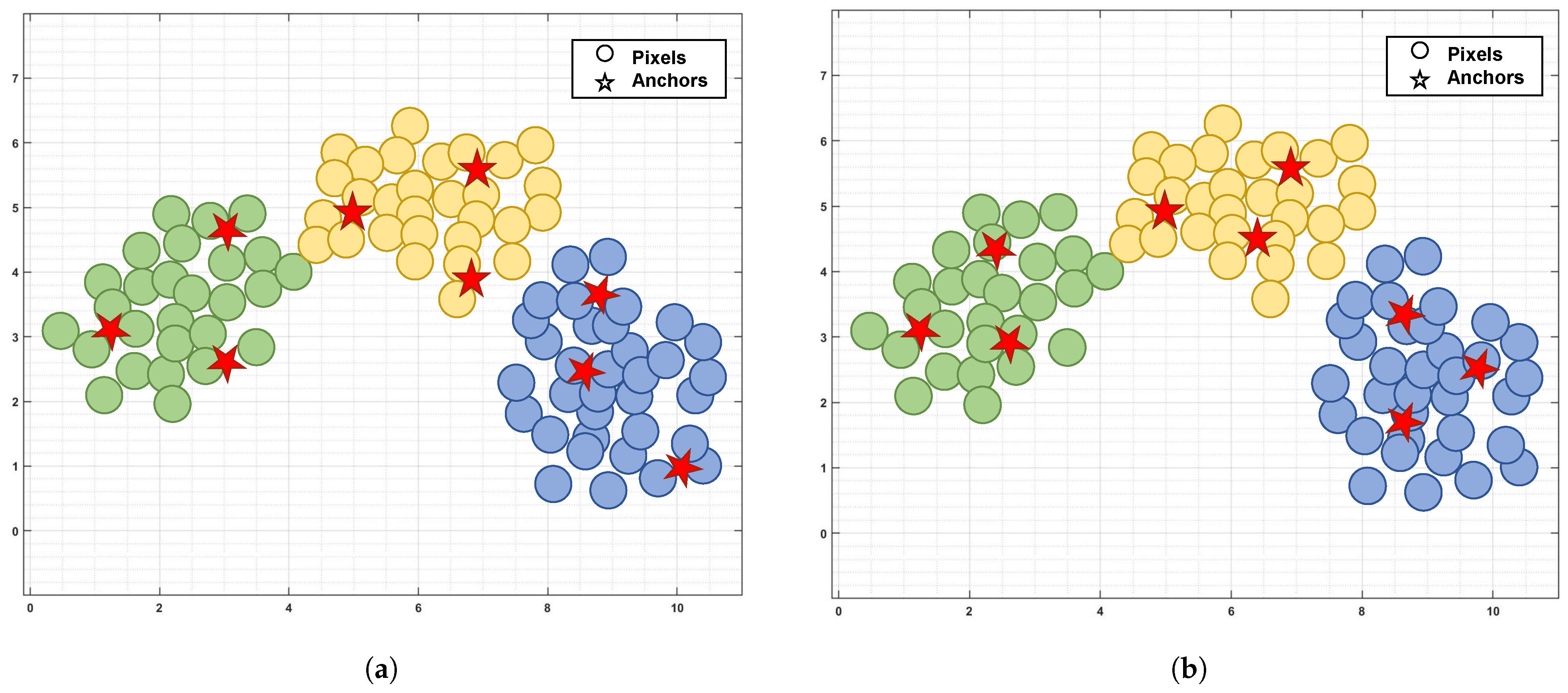
- We propose a discriminative anchor learning strategy to capture the intrinsic structure of anchors. By sharing the coefficient matrix, this strategy aligns the anchors distribution with the pixels distribution, facilitating the effective clustering.
- We impose low-rank and probabilistic constraints on the consensus coefficient matrix, which not only excavates the global structures but also enhances the discriminative capability of the anchors.
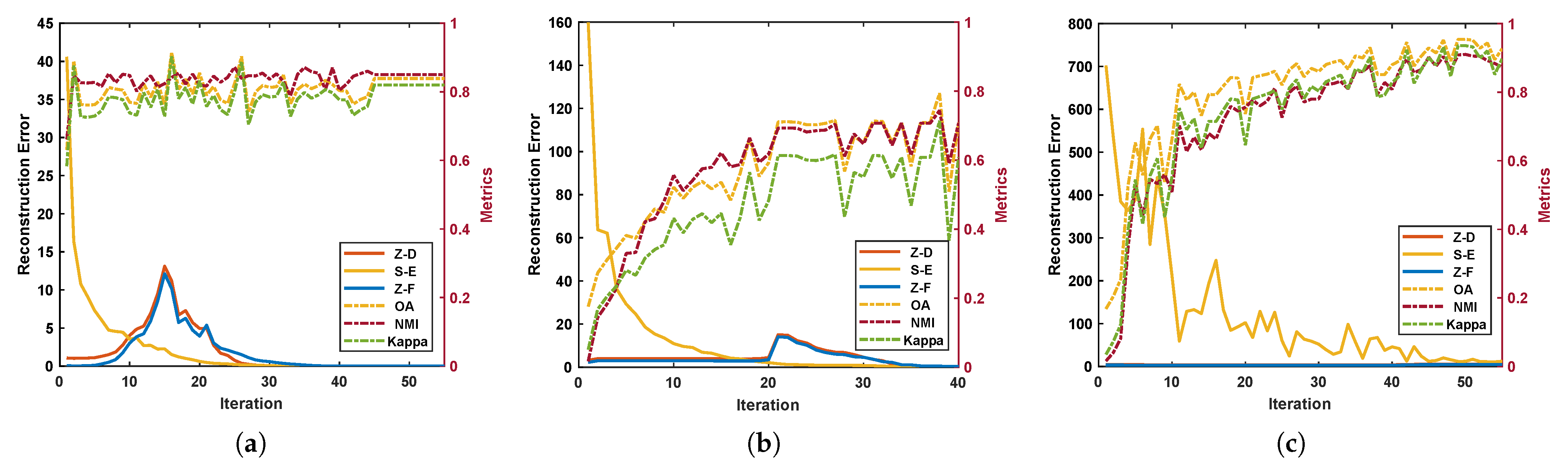
- We present an alternating optimization strategy to solve the proposed formulation. Extensive experimental results demonstrate the superiority and effectiveness of the proposed method.
2. Related Work
3. Methodology
3.1. Problem Formulation and Objective Function
3.2. Optimization
| Algorithm 1: Discriminative anchor learning for hyperspectral image clustering. |
Input: HSI matrix , number of superpixels M, parameters , and . |
Output: Clustering labels.
|
3.3. Complexity Analysis
4. Experiments
4.1. Experiment Settings
4.2. Experimental Results and Analysis
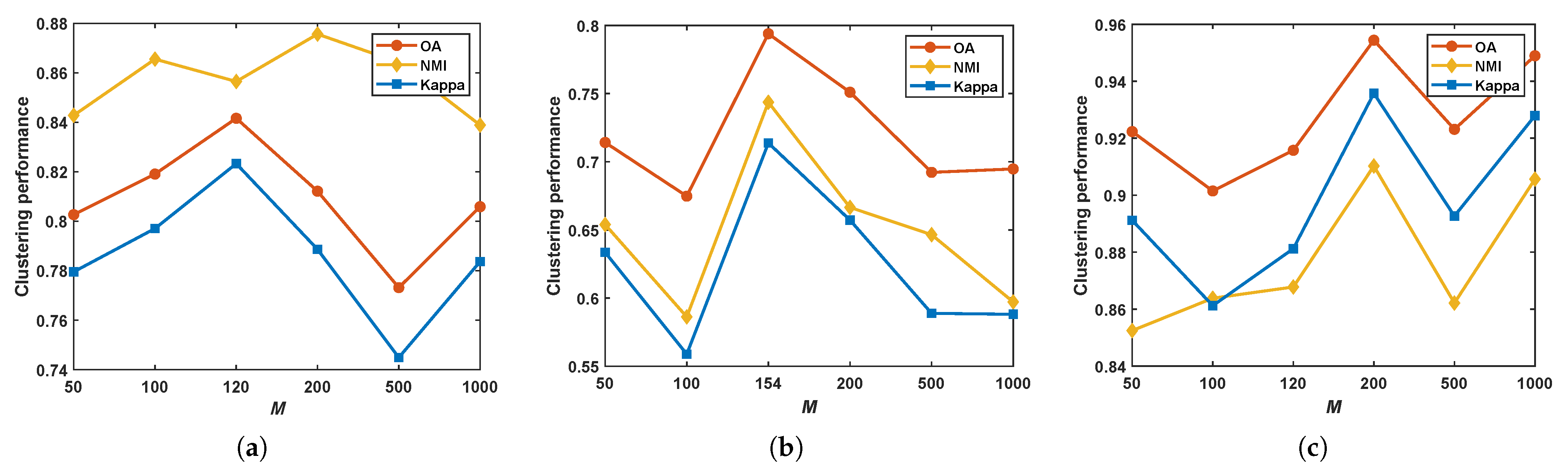
- Parameter M. We investigate the effect of M for our algorithm and record the clustering performance results (OA, NMI, and Kappa) as shown in Figure 6. Overall, the proposed method reaches the optimal outcomes when M is set to [120 200]. Furthermore, we can discover that these metrics curves do not monotonically increase with M. This implies that it is unnecessary to employ numerous anchors for clustering.
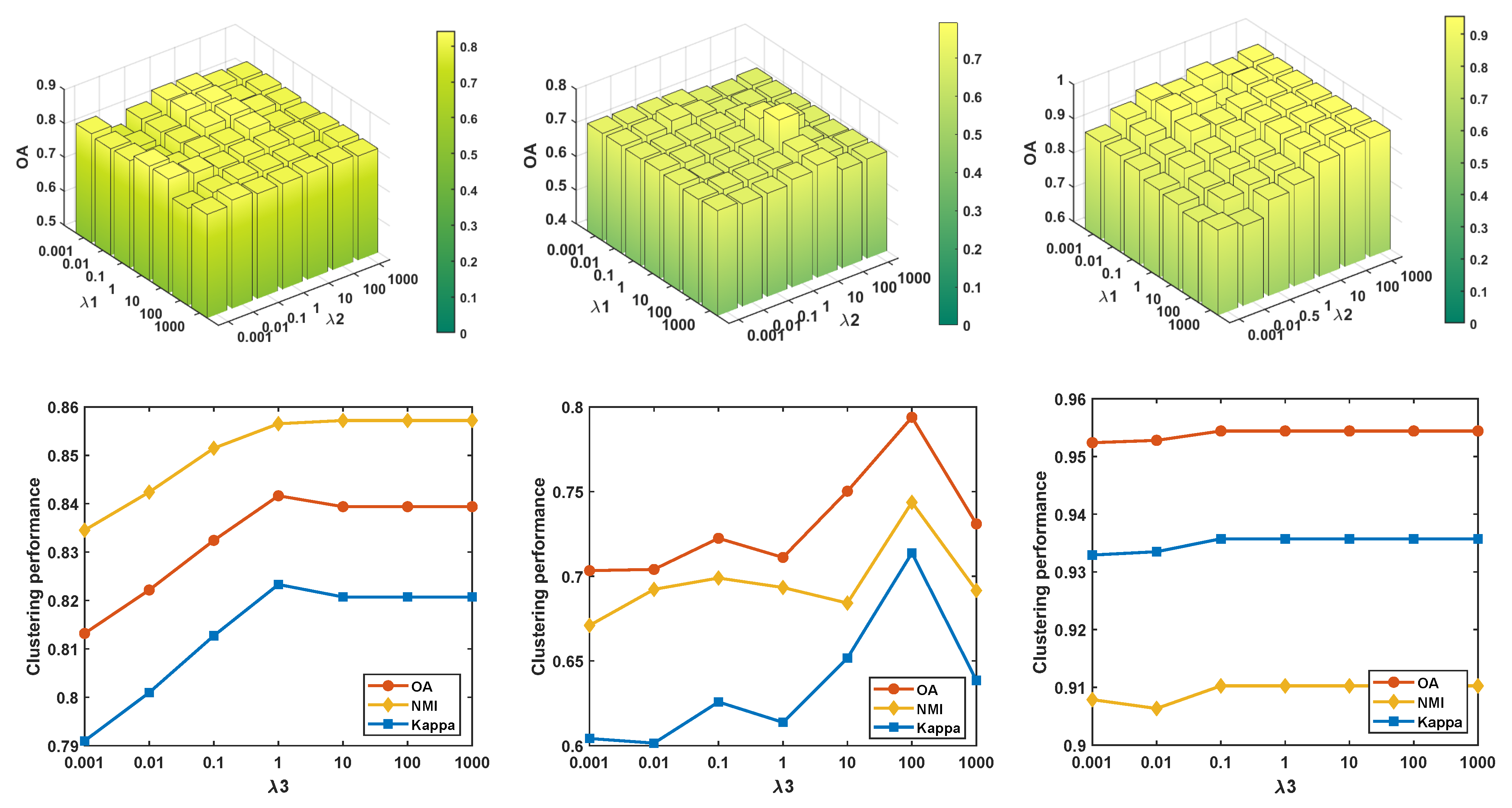
- Parameters , and . To facilitate observation, we analyze the effect of the parameters and for our method when is fixed. The results are shown in the first row of Figure 7. It can be observed that as and are varied, OA exhibits significant fluctuations, indicating that these parameters need to be carefully adjusted to optimize the clustering performances. Satisfactory clustering results are typically achieved when and are set within the range [0.1, 10]. The second row of Figure 7 shows the variation curve corresponding to . Obviously, the clustering results are notably impacted by these parameters, especially for the Salinas and PaviaU datasets. Because of the discrepancy in the distribution of dataset, different parameters are selected to achieve the optimal clustering results. When is set to 1, our method achieves the optimal clustering results on the Salinas and PaviaC datasets. And when is set to 100, our method achieves the optimal clustering results on the PaviaU dataset.


5. Conclusions
Author Contributions
Funding
Data Availability Statement
Conflicts of Interest
References
- Yang, G.; Huang, K.; Sun, W.; Meng, X.; Mao, D.; Ge, Y. Enhanced mangrove vegetation index based on hyperspectral images for mapping mangrove. ISPRS J. Photogramm. Remote Sens. 2022, 189, 236–254. [Google Scholar] [CrossRef]
- Tu, B.; He, W.; Li, Q.; Peng, Y.; Plaza, A. A New Context-Aware Framework for Defending Against Adversarial Attacks in Hyperspectral Image Classification. IEEE Trans. Geosci. Remote Sens. 2023, 61, 5505114. [Google Scholar] [CrossRef]
- Zhang, B.; Li, S.; Wu, C.; Gao, L.; Zhang, W.; Peng, M. A neighbourhood-constrained k-means approach to classify very high spatial resolution hyperspectral imagery. Remote Sens. Lett. 2013, 4, 161–170. [Google Scholar] [CrossRef]
- Ranjan, S.; Nayak, D.R.; Kumar, K.S.; Dash, R.; Majhi, B. Hyperspectral image classification: A k-means clustering based approach. In Proceedings of the 2017 4th International Conference on Advanced Computing and Communication Systems (ICACCS), Coimbatore, India, 6–7 January 2017; pp. 1–7. [Google Scholar]
- Ghaffarian, S.; Ghaffarian, S. Automatic histogram-based fuzzy C-means clustering for remote sensing imagery. ISPRS J. Photogramm. Remote Sens. 2014, 97, 46–57. [Google Scholar] [CrossRef]
- Rodriguez, A.; Laio, A. Clustering by fast search and find of density peaks. Science 2014, 344, 1492–1496. [Google Scholar] [CrossRef]
- Ester, M.; Kriegel, H.-P.; Sander, J.; Xu, X. A Density-Based Algorithm for Discovering Clusters in Large Spatial Databases with Noise. In Proceedings of the International Conference on Knowledge Discovery and Data Mining (KDD-96), Portland, OR, USA, 2–4 August 1996; pp. 226–231. [Google Scholar]
- Xie, H.; Zhao, A.; Huang, S.; Han, J.; Liu, S.; Xu, X.; Luo, X.; Pan, H.; Du, Q.; Tong, X. Unsupervised Hyperspectral Remote Sensing Image Clustering Based on Adaptive Density. IEEE Geosci. Remote Sens. Lett. 2018, 15, 632–636. [Google Scholar] [CrossRef]
- Zhao, Y.; Yuan, Y.; Wang, Q. Fast Spectral Clustering for Unsupervised Hyperspectral Image Classification. Remote Sens. 2019, 11, 399. [Google Scholar] [CrossRef]
- Huang, N.; Xiao, L.; Liu, J.; Chanussot, J. Graph Convolutional Sparse Subspace Coclustering With Nonnegative Orthogonal Factorization for Large Hyperspectral Images. IEEE Trans. Geosci. Remote Sens. 2023, 60, 5512016. [Google Scholar] [CrossRef]
- Cai, Y.; Zeng, M.; Cai, Z.; Liu, X.; Zhang, Z. Graph Regularized Residual Subspace Clustering Network for Hyperspectral Image Clustering. Inf. Sci. 2021, 578, 85–101. [Google Scholar] [CrossRef]
- Li, T.; Cai, Y.; Zhang, Y.; Cai, Z.; Liu, X. Deep Mutual Information Subspace Clustering Network for Hyperspectral Images. IEEE Geosci. Remote Sens. Lett. 2022, 19, 6009905. [Google Scholar] [CrossRef]
- Lei, J.; Li, X.; Peng, B.; Fang, L.; Ling, N.; Huang, Q. Deep Spatial-Spectral Subspace Clustering for Hyperspectral Image. IEEE Trans. Circuits Syst. Video Technol. 2021, 31, 2686–2697. [Google Scholar] [CrossRef]
- Zhao, Y.; Li, X. Deep Spectral Clustering With Regularized Linear Embedding for Hyperspectral Image Clustering. IEEE Trans. Geosci. Remote Sens. 2023, 61, 5509311. [Google Scholar] [CrossRef]
- Zhang, Y.; Wang, Y.; Chen, X.; Jiang, X.; Zhou, Y. Spectral–Spatial Feature Extraction With Dual Graph Autoencoder for Hyperspectral Image Clustering. IEEE Trans. Circuits Syst. Video Technol. 2022, 32, 8500–8511. [Google Scholar] [CrossRef]
- Hu, X.; Li, T.; Zhou, T.; Peng, Y. Deep Spatial-Spectral Subspace Clustering for Hyperspectral Images Based on Contrastive Learning. Remote Sens. 2021, 13, 4418. [Google Scholar] [CrossRef]
- Guan, R.; Tu, W.; Li, Z.; Yu, H.; Hu, D.; Chen, Y.; Tang, C.; Yuan, Q.; Liu, X. Spatial–Spectral Graph Contrastive Clustering With Hard Sample Mining for Hyperspectral Images. IEEE Trans. Geosci. Remote Sens. 2024, 62, 5535216. [Google Scholar] [CrossRef]
- Liu, W.; Liu, K.; Sun, W.; Yang, G.; Ren, K.; Meng, X.; Peng, J. Self-Supervised Feature Learning Based on Spectral Masking for Hyperspectral Image Classification. IEEE Trans. Geosci. Remote Sens. 2023, 61, 4407715. [Google Scholar] [CrossRef]
- Luo, F.; Liu, Y.; Duan, Y.; Guo, T.; Zhang, L.; Du, B. SDST: Self-Supervised Double-Structure Transformer for Hyperspectral Images Clustering. IEEE Trans. Geosci. Remote Sens. 2024, 62, 5511614. [Google Scholar] [CrossRef]
- Elhamifar, E.; Vidal, R. Sparse Subspace Clustering: Algorithm, Theory, and Applications. IEEE Trans. Pattern Anal. Mach. Intell. 2013, 35, 2765–2781. [Google Scholar] [CrossRef]
- Zhang, H.; Zhai, H.; Zhang, L.; Li, P. Spectral-Spatial Sparse Subspace Clustering for Hyperspectral Remote Sensing Images. IEEE Trans. Geosci. Remote Sens. 2016, 54, 3672–3684. [Google Scholar] [CrossRef]
- Zhai, H.; Zhang, H.; Zhang, L.; Li, P.; Plaza, A. A New Sparse Subspace Clustering Algorithm for Hyperspectral Remote Sensing Imagery. IEEE Geosci. Remote Sens. Lett. 2017, 14, 43–47. [Google Scholar] [CrossRef]
- Cai, Y.; Zhang, Z.; Cai, Z.; Liu, X.; Jiang, X.; Yan, Q. Graph convolutional subspace clustering: A robust subspace clustering framework for hyperspectral image. IEEE Trans. Geosci. Remote Sens. 2021, 59, 4191–4202. [Google Scholar] [CrossRef]
- Huang, S.; Zhang, H.; Pizurica, A. Subspace clustering for hyperspectral images via dictionary learning with adaptive regularization. IEEE Trans. Geosci. Remote Sens. 2022, 60, 5524017. [Google Scholar] [CrossRef]
- Zhai, H.; Zhang, H.; Zhang, L.; Li, P. Sparsity-Based Clustering for Large Hyperspectral Remote Sensing Images. IEEE Trans. Geosci. Remote Sens. 2021, 59, 10410–10424. [Google Scholar] [CrossRef]
- Huang, S.; Zeng, H.; Chen, H.; Zhang, H. Spatial and Cluster Structural Prior-Guided Subspace Clustering for Hyperspectral Image. IEEE Trans. Geosci. Remote Sens. 2024, 62, 5511115. [Google Scholar] [CrossRef]
- Huang, S.; Zhang, H.; Du, Q.; Pizurica, A. Sketch-Based Subspace Clustering of Hyperspectral Images. Remote Sens. 2020, 12, 775. [Google Scholar] [CrossRef]
- Zhai, H.; Zhang, H.; Zhang, L.; Li, P. Nonlocal Means Regularized Sketched Reweighted Sparse and Low-Rank Subspace Clustering for Large Hyperspectral Images. IEEE Trans. Geosci. Remote Sens. 2021, 59, 4164–4178. [Google Scholar] [CrossRef]
- Zhang, Y.; Jiang, G.; Cai, Z.; Zhou, Y. Bipartite Graph-Based Projected Clustering With Local Region Guidance for Hyperspectral Imagery. IEEE Trans. Multim. 2024, 26, 9551–9563. [Google Scholar] [CrossRef]
- Zhao, H.; Zhou, F.; Bruzzone, L.; Guan, R.; Yang, C. Superpixel-level Global and Local Similarity Graph-based Clustering for Large Hyperspectral Images. IEEE Trans. Geosci. Remote Sens. 2022, 60, 5519316. [Google Scholar] [CrossRef]
- Cui, K.; Li, R.; Polk, S.L.; Lin, Y.; Zhang, H.; Murphy, J.M.; Plemmons, R.J.; Chan, R.H. Superpixel-based and Spatially-regularized Diffusion Learning for Unsupervised Hyperspectral Image Clustering. IEEE Trans. Geosci. Remote Sens. 2024, 62, 4405818. [Google Scholar] [CrossRef]
- Wang, R.; Nie, F.; Wang, Z.; He, F.; Li, X. Scalable Graph-Based Clustering With Nonnegative Relaxation for Large Hyperspectral Image. IEEE Trans. Geosci. Remote Sens. 2019, 57, 7352–7364. [Google Scholar] [CrossRef]
- Wang, R.; Nie, F.; Yu, W. Fast Spectral Clustering With Anchor Graph for Large Hyperspectral Images. IEEE Geosci. Remote Sens. Lett. 2017, 14, 2003–2007. [Google Scholar] [CrossRef]
- Wang, Q.; Miao, Y.; Chen, M.; Yuan, Y. Spatial-Spectral Clustering With Anchor Graph for Hyperspectral Image. IEEE Trans. Geosci. Remote Sens. 2022, 60, 5542413. [Google Scholar] [CrossRef]
- Chen, X.; Zhang, Y.; Feng, X.; Jiang, X.; Cai, Z. Spectral-Spatial Superpixel Anchor Graph-Based Clustering for Hyperspectral Imagery. IEEE Geosci. Remote Sens. Lett. 2023, 20, 5507405. [Google Scholar] [CrossRef]
- Cai, Y.; Zhang, Z.; Ghamisi, P.; Ding, Y.; Liu, X.; Cai, Z.; Gloaguen, R. Superpixel Contracted Neighborhood Contrastive Subspace Clustering Network for Hyperspectral Images. IEEE Trans. Geosci. Remote Sens. 2021, 60, 5530113. [Google Scholar] [CrossRef]
- Zhang, Y.; Wang, X.; Jiang, X.; Zhang, L.; Du, B. Elastic Graph Fusion Subspace Clustering for Large Hyperspectral Image. IEEE Trans. Circuits Syst. Video Technol. 2025, 35, 6300–6312. [Google Scholar] [CrossRef]
- Zhang, L.; Zhang, L.; Du, B.; You, J.; Tao, D. Hyperspectral image unsupervised classification by robust manifold matrix factorization. Inf. Sci. 2019, 485, 154–169. [Google Scholar] [CrossRef]
- Jiang, G.; Zhang, Y.; Wang, X.; Jiang, X.; Zhang, L. Structured Anchor Learning for Large-Scale Hyperspectral Image Projected Clustering. IEEE Trans. Circuits Syst. Video Technol. 2025, 35, 2328–2340. [Google Scholar] [CrossRef]
- Wang, N.; Cui, Z.; Lan, Y.; Zhang, C.; Xue, Y.; Su, Y.; Li, A. Large-Scale Hyperspectral Image-Projected Clustering via Doubly Stochastic Graph Learning. Remote Sens. 2025, 17, 1526. [Google Scholar] [CrossRef]
- Liu, M.-Y.; Tuzel, O.; Ramalingam, S.; Chellappa, R. Entropy rate superpixel segmentation. In Proceedings of the IEEE Conference on Computer Vision and Pattern Recognition (CVPR), Colorado Springs, CO, USA, 20–25 June 2011; pp. 2097–2104. [Google Scholar]
- Lin, Z.; Liu, R.; Su, Z. Linearized Alternating Direction Method with Adaptive Penalty for Low-Rank Representation. In Proceedings of the Advances in Neural Information Processing Systems 24 (NIPS 2011), Granada, Spain, 12–15 December 2011; pp. 612–620. [Google Scholar]
- Gao, Q.; Zhang, P.; Xia, W.; Xie, D.; Gao, X.; Tao, D. Enhanced Tensor RPCA and Its Application. IEEE Trans. Pattern Anal. Mach. Intell. 2021, 43, 2133–2140. [Google Scholar] [CrossRef]
- Cai, J.-F.; Candès, E.J.; Shen, Z. A singular value thresholding algorithm for matrix completion. SIAM J. Optim. 2010, 20, 1956–1982. [Google Scholar] [CrossRef]
- Nie, F.; Wang, X.; Jordan, M.; Huang, H. The constrained laplacian rank algorithm for graph-based clustering. In Proceedings of the AAAI Conference on Artificial Intelligence, Phoenix, AZ, USA, 12–17 February 2016; pp. 1969–1976. [Google Scholar]
- Shahi, K.R.; Khodadadzadeh, M.; Tusa, L.; Ghamisi, P.; Tolosana-Delgado, R.; Gloaguen, R. Hierarchical Sparse Subspace Clustering (HESSC): An Automatic Approach for Hyperspectral Image Analysis. Remote Sens. 2020, 12, 2421. [Google Scholar] [CrossRef]





| Notation | Definition |
|---|---|
| N, M, B | number of pixels, anchors, bands |
| original HSI tensor | |
| HSI matrix | |
| Denoised HSI matrix | |
| the i-th superpixel | |
| anchor matrix | |
| anchor graph | |
| coefficient matrix | |
| the trace of matrix | |
| identity matrix |
| Datasets | Salinas | PaviaU | PaviaC |
|---|---|---|---|
| Pixels | 512 × 217 | 610 × 340 | 1096 × 715 |
| Bands | 204 | 103 | 102 |
| Clusters | 16 | 9 | 9 |
| Samples | 54,129 | 42,776 | 148,152 |
| Methods | FSCAG | HESSC | NCSC | S3AGC | BGPC | SDST | SSGCC | SAPC | HPCDL | Our | |
|---|---|---|---|---|---|---|---|---|---|---|---|
| parameter sharing | ✓ | ✓ | |||||||||
| stochastic | row | ✓ | ✓ | ✓ | ✓ | ✓ | |||||
| doubly | ✓ | ||||||||||
| regularization | low-rank | ✓ | |||||||||
| graph | ✓ | ✓ | ✓ | ||||||||
| contrastive | ✓ | ✓ | |||||||||
| end-to-end | ✓ | ✓ | ✓ | ✓ | ✓ | ✓ | ✓ | ||||
| Datasets | Metrics | FSCAG | HESSC | NCSC | S3AGC | BGPC | SDST | SSGCC | SAPC | HPCDL | OUR |
|---|---|---|---|---|---|---|---|---|---|---|---|
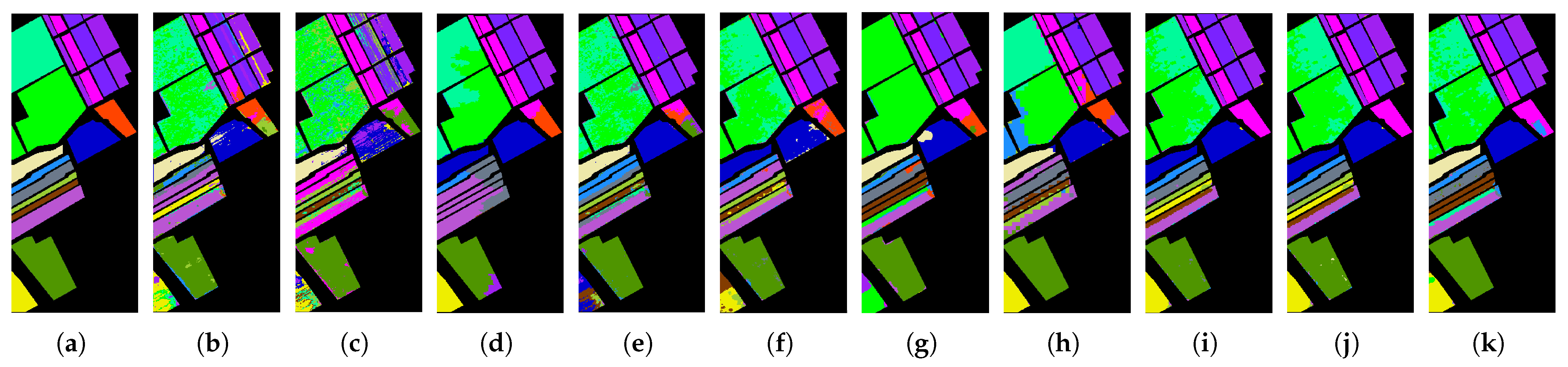
| Salinas | AA | 0.6615 | 0.4947 | 0.6052 | 0.7154 | 0.7315 | 0.7199 | 0.7166 | 0.7373 | 0.7440 | 0.8068 |
| OA | 0.7207 | 0.5293 | 0.7497 | 0.7465 | 0.7703 | 0.7462 | 0.8199 | 0.7881 | 0.7923 | 0.8416 | |
| Kappa | 0.6894 | 0.4787 | 0.7206 | 0.7181 | 0.7447 | 0.7121 | 0.7636 | 0.7637 | 0.7685 | 0.8233 | |
| NMI | 0.7450 | 0.6238 | 0.8169 | 0.7836 | 0.8165 | 0.8187 | 0.8030 | 0.8464 | 0.8513 | 0.8565 | |
| Purity | 0.7332 | 0.5881 | 0.7638 | 0.7521 | 0.7762 | 0.7468 | 0.8268 | 0.8056 | 0.8106 | 0.8417 | |
| PaviaU | AA | 0.5640 | 0.4227 | 0.4877 | 0.5431 | 0.6087 | 0.5365 | 0.5888 | 0.5920 | 0.5720 | 0.6592 |
| OA | 0.5622 | 0.4771 | 0.5275 | 0.5545 | 0.7096 | 0.6050 | 0.6275 | 0.6394 | 0.6337 | 0.7939 | |
| Kappa | 0.4567 | 0.3626 | 0.4236 | 0.4404 | 0.6056 | 0.4941 | 0.5353 | 0.5294 | 0.5272 | 0.7137 | |
| NMI | 0.5638 | 0.5089 | 0.4457 | 0.4955 | 0.6494 | 0.5302 | 0.5641 | 0.6189 | 0.5638 | 0.7437 | |
| Purity | 0.7093 | 0.6194 | 0.6436 | 0.6378 | 0.7100 | 0.7056 | 0.7307 | 0.7132 | 0.7005 | 0.7943 | |
| PaviaC | AA | 0.6391 | 0.4790 | 0.4064 | 0.5577 | 0.8080 | 0.6547 | 0.6254 | 0.7139 | 0.7223 | 0.8981 |
| OA | 0.8027 | 0.7884 | 0.6685 | 0.8548 | 0.9484 | 0.8596 | 0.8245 | 0.9334 | 0.9248 | 0.9544 | |
| Kappa | 0.7276 | 0.7007 | 0.5535 | 0.7905 | 0.9268 | 0.8030 | 0.7560 | 0.9055 | 0.8933 | 0.9357 | |
| NMI | 0.7357 | 0.7435 | 0.6374 | 0.7937 | 0.9224 | 0.7718 | 0.7551 | 0.9097 | 0.8975 | 0.9102 | |
| Purity | 0.8445 | 0.8689 | 0.8028 | 0.8718 | 0.9484 | 0.8632 | 0.8848 | 0.9351 | 0.9307 | 0.9544 |
| Datasets | Segmentation | OA | Kappa | NMI |
|---|---|---|---|---|
| Salinas | SLIC | 0.8310 | 0.8119 | 0.8401 |
| LSC | 0.8302 | 0.8104 | 0.8384 | |
| ERS | 0.8416 | 0.8233 | 0.8565 | |
| PaviaU | SLIC | 0.7317 | 0.6345 | 0.6703 |
| LSC | 0.7498 | 0.6620 | 0.6963 | |
| ERS | 0.7939 | 0.7137 | 0.7437 | |
| PaviaC | SLIC | 0.8324 | 0.7716 | 0.8196 |
| LSC | 0.9369 | 0.9113 | 0.8813 | |
| ERS | 0.9544 | 0.9357 | 0.9102 |
| Datasets | DA | LR | OA | Kappa | NMI |
|---|---|---|---|---|---|
| Salinas | ✓ | × | 0.7762 | 0.7484 | 0.8576 |
| × | ✓ | 0.8208 | 0.8005 | 0.8449 | |
| ✓ | ✓ | 0.8416 | 0.8233 | 0.8565 | |
| PaviaU | ✓ | × | 0.7424 | 0.6404 | 0.6558 |
| × | ✓ | 0.7179 | 0.6225 | 0.6617 | |
| ✓ | ✓ | 0.7939 | 0.7137 | 0.7437 | |
| PaviaC | ✓ | × | 0.9480 | 0.9268 | 0.8963 |
| × | ✓ | 0.8998 | 0.8599 | 0.8448 | |
| × | ✓ | 0.9544 | 0.9357 | 0.9102 |
Disclaimer/Publisher’s Note: The statements, opinions and data contained in all publications are solely those of the individual author(s) and contributor(s) and not of MDPI and/or the editor(s). MDPI and/or the editor(s) disclaim responsibility for any injury to people or property resulting from any ideas, methods, instructions or products referred to in the content. |
© 2025 by the authors. Licensee MDPI, Basel, Switzerland. This article is an open access article distributed under the terms and conditions of the Creative Commons Attribution (CC BY) license (https://creativecommons.org/licenses/by/4.0/).
Share and Cite
Yun, Y.; Gao, Q.; Zhao, J.; Duan, Y.; Deng, C. Discriminative Anchor Learning for Hyperspectral Image Clustering. Remote Sens. 2025, 17, 3969. https://doi.org/10.3390/rs17243969
Yun Y, Gao Q, Zhao J, Duan Y, Deng C. Discriminative Anchor Learning for Hyperspectral Image Clustering. Remote Sensing. 2025; 17(24):3969. https://doi.org/10.3390/rs17243969
Chicago/Turabian StyleYun, Yu, Quanxue Gao, Jianwei Zhao, Yu Duan, and Cheng Deng. 2025. "Discriminative Anchor Learning for Hyperspectral Image Clustering" Remote Sensing 17, no. 24: 3969. https://doi.org/10.3390/rs17243969
APA StyleYun, Y., Gao, Q., Zhao, J., Duan, Y., & Deng, C. (2025). Discriminative Anchor Learning for Hyperspectral Image Clustering. Remote Sensing, 17(24), 3969. https://doi.org/10.3390/rs17243969