


Highlights
What are the main findings?
- UAV multispectral data combined with machine learning enabled the estimation of grapevine biophysical parameters, including LAI, pruning wood biomass, and yield.
- Geometric features, such as canopy area and volume, improved model accuracy and reduced the number of predictors, while the integration of spectral and geometric data improved prediction robustness across different phenological stages.
What is the implication of the main finding?
- UAV-based monitoring can be applied in different grapevine varieties without cultivar-specific calibration, providing a non-invasive tool for vineyard assessment.
- Identifying the most informative features and suitable acquisition periods supports more accurate decisions in vineyard management, including pruning, canopy control, and yield estimation.
Abstract
The accurate estimation of grapevine biophysical parameters is important for decision support in precision viticulture. This study addresses the use of unmanned aerial vehicle (UAV) multispectral data and machine learning (ML) techniques to estimate leaf area index (LAI), pruning wood biomass, and yield, across mixed-variety vineyards in the Douro Region of Portugal. Data were collected at three phenological stages, from veraison to maturation and two modeling approaches were tested: one using only spectral features, and another combining spectral and geometric features derived from photogrammetric elevation data. Multiple linear regression (MLR) and five ML algorithms were applied, with feature selection performed using both forward and backward selection procedures. Logarithmic transformations were used to mitigate data skewness. Overall, ML algorithms provided better predictive performance than MLR, particularly when geometric features were included. At harvest-ready, Random Forest achieved the highest accuracy for LAI (R2 = 0.83) and yield (R2 = 0.75), while MLR produced the most accurate estimates for pruning wood biomass (R2 = 0.83). Among geometric variables, canopy area was the most informative. For spectral data, the Modified Soil-Adjusted Vegetation Index (MSAVI) and the Soil-Adjusted Vegetation Index (SAVI) were the most relevant. The models performed well across grapevine varieties, indicating that UAV-based monitoring can serve as a practical, non-invasive, and scalable approach for vineyard management in heterogeneous vineyards.
1. Introduction
Viticulture is an important element of global economic, cultural, and environmental landscapes, with particular relevance in Mediterranean regions [1]. In Portugal, this relevance is evident in regions such as the Douro Valley, a UNESCO World Heritage Site known for its distinctive terroir and production of premium wines [2]. The wine sector contributes nearly 10 billion euros to the national economy and supports 3.4% of total employment [3], supporting rural communities and preserving traditional landscapes [4]. Despite having a small territory, Portugal is among the top ten wine-producing countries [5], with diverse terroirs and microclimates ranging from the Atlantic-influenced Vinho Verde to the dry interior regions of Alentejo and Douro [6]. Nevertheless, Portuguese viticulture, similar to other Mediterranean countries, faces challenges, including climate variability, rural depopulation, and increasing production costs [7]. Climatic variability, extreme events, and drought can affect grapevine phenology, yield, and quality [8].
Precision viticulture (PV) can help mitigate these effects by using remote sensing, particularly unmanned aerial vehicles (UAVs), to monitor grapevine health, canopy structure, and productivity at high spatial and temporal resolutions [9]. UAV-based imagery allows the estimation of biophysical parameters such as leaf area index (LAI), pruning wood biomass, and yield [10], supporting decision-making on irrigation, fertilization, and canopy management [11,12,13,14,15]. While the estimation of yield and pruning wood biomass is useful for harvesting logistics and market planning, LAI can serve as an indicator of canopy development and photosynthetic activity, useful in crop coefficient () estimation and irrigation scheduling [16,17,18]. However, accurate LAI quantification is often time-consuming, which has led to the adoption of UAV and artificial intelligence approaches as efficient alternatives [19,20].
Several studies have explored vegetation indices and structural metrics for vineyard characterization. The normalized difference vegetation index (NDVI) [21] is among the most widely used, showing strong correlations with LAI [18,22], although its accuracy tends to decrease at later stages due to canopy management and NDVI saturation [23,24]. Combining NDVI with 3D canopy metrics, such as canopy volume and projected area from photogrammetric processing, improves predictive accuracy [16,25]. Machine learning (ML) models, such as Random Forest (RF) and relevance vector machine have also been successfully applied [24], while convolutional neural networks using RGB data have achieved comparable results [26], though overfitting and data cost remain issues [27,28]. Alternative estimation appraoches include grapevine canopy shadow projection analysis [29] and biomass–leaf area correlations [30].
Pruning wood biomass, although less studied, can be estimated from UAV-based data [30,31,32]. Vegetation indices such as NDVI, normalized difference red edge (NDRE), and green normalized vegetation index (GNDVI) showed good relationships with pruning wood biomass [33,34,35]. Yield prediction studies have demonstrated moderate to strong correlations with spectral and structural variables [31,33,36,37,38,39,40,41,42,43]. However, challenges persist due to leaf occlusion, lighting variability, and spatial heterogeneity [36,43]. Model performance often decreases from veraison to harvest-ready as a result of NDVI saturation, phytosanitary issues, and management practices such as defoliation and trimming [16,24,25,26,28,31,32,42].
Recent advances in quantitative remote sensing have introduced approaches that extend beyond the use of vegetation indices and canopy geometry. UAV-based RGB and NIR imagery combined with transfer-learning algorithms has enabled automated grapevine detection, canopy segmentation, and vineyard zoning [44]. Physically based methods such as 2D/3D radiative transfer models (RTMs), including the three-source energy balance model, have improved evapotranspiration partitioning and assessments of canopy–soil interactions [45]. At the regional scale, the fraction of absorbed photosynthetically active radiation (FAPAR) has been applied as an indicator of vineyard productivity, with studies in the Douro Demarcated Region showing strong relationships with wine production () when derived from satellite data [46]. In addition, data fusion strategies that combine high-resolution UAV features with Sentinel-2 spectral information have improved vineyard monitoring and reduced field sampling requirements [47]. These developments indicate a transition toward hybrid frameworks that integrate remote sensing, physically based modeling, and data-driven learning in viticulture. However, RTMs and transfer-learning approaches are constrained by data requirements, the need for accurate canopy parameterization, sensitivity to illumination geometry, and the limited availability of multi-season datasets for model transferability [48,49,50,51,52].
To address these limitations, combining spectral reflectance, vegetation indices, and structural variables from UAV-based multispectral imagery with regression methods can provide a practical alternative that balances accuracy, interpretability, and vineyard operational feasibility. The objective of this study is to improve UAV-based estimation of biophysical parameters (LAI, pruning wood biomass, and yield) in Portuguese grapevine cultivars from the Douro Demarcated Region, while previous studies have often focused on NDVI or multispectral data and on single-variety systems, this article aims to examine three cultivars and to incorporate a broader set of spectral and geometric variables. It also focus on the mid- to late-season interval (veraison to harvest-ready), a period less examined despite its relevance for vineyard management. By exploring multiple modeling approaches, including ML, this study aims to produce more accurate, scalable, and variety-adaptable tools for PV.
2. Materials and Methods
2.1. Study Area
This study was conducted in an experimental vineyard plot located on the campus of the University of Trás-os-Montes e Alto Douro, Vila Real, Portugal (41°17′08.1″N, 7°44′09.9″W; altitude: 472 m), with an approximate area of 5600 m2. The vineyard consists of 55 rows of grapevines trained in the traditional double Guyot system characteristic of the DDR [53]. Three grapevine varieties, planted in 1996, are distributed as follows: cv. Tinto Cão covers 1425 m2 (20 rows), cv. Touriga Franca occupies 1600 m2 (15 rows), and cv. Tinta Barroca extends over 2575 m2 (20 rows), as shown in Figure 1.
Figure 1.
Overview of the vineyard, with the grapevine varieties and row blocks identified. Representative leaf images of each grapevine variety are also shown.
The rows are spaced 2 m apart, with 1.25 m between the grapevines. To standardize the area analyzed between varieties, 40 m segments from three consecutive rows were selected and subdivided into eight 5 m sections (locations in Figure 1). These sections served as measurement areas for different parameters. This approach accounted for spatial differences in row dimensions. For instance, while Tinto Cão and Tinta Barroca grapevines have the same number of rows, their cultivated areas differ. Similarly, Touriga Franca grapevines, with fewer rows, occupy a larger area on the vineyard plot than Tinto Cão.
2.2. Data Acquisition and Processing
2.2.1. Field Data
The LAI-2200C plant canopy analyzer (LI-COR, Inc., Lincoln, NE, USA) was used to determine LAI. This instrument quantifies diffuse radiation attenuation through simultaneous measurements at five zenith angles (7°, 23°, 38°, 53°, and 68°). Canopy transmittance values were derived by computing the ratio between the corresponding above and below canopy readings for each angle. For each vineyard row section, the sensor was kept parallel to the ground surface during measurements. The protocol consisted of five readings: one reference measurement above the canopy (A) and four below-canopy measurements (B) positioned at the end points and midpoints of horizontal transects (1A, 4B). A 90° view cap was used to maintain a consistent orientation of the sensor lens toward the rows.
The integrated “clip” function was applied to minimize estimation errors. This correction adjusts any below-canopy reading showing transmittance values exceeding the corresponding above-canopy reference (resulting from operator error or variable sky conditions) by standardizing the value to 1. As recommended by the manufacturer, this function is relevant for measuring sparse canopies, where gaps between vineyard rows may lead to LAI overestimation. All measurements were corrected for scattering using the FV2200 software (version 2.1.1) to account for radiation dispersion within the canopy, thus improving the accuracy of transmittance estimates. The correction algorithm incorporated site-specific coordinates and measurement timestamps to normalize for solar angle, geographic location, and atmospheric conditions. Furthermore, the manufacturer’s protocol for isolated row measurements was to improve measurement precision.
Canopy architecture was quantified in each 5 m section by measuring the depth (X) and height (Z) perpendicular to the row and the length (Y) along the row. The ratio Y/X was used to generate virtual canopy models in FV2200 using the “Change Canopy Model” function. Only zenith angles intersecting the canopy were included in the final LAI calculations. In total, LAI was measured three times, on 25 July, 22 August, and 23 September 2019.
Yield estimation was conducted during harvest on 14 October 2019. For each 5 m section (Figure 1), the total number of grape clusters and their combined weight were recorded for the three varieties. Similarly, pruning wood biomass was quantified on 11 December 2019 in the same 72 experimental sections. Both yield and pruning wood biomass were measured in kilograms (kg) per 5 m row section, representing the experimental unit used for modeling purposes rather than a per-area normalization (e.g., kg ha−1).
2.2.2. UAV Data Acquisition and Photogrammetric Processing
A DJI Phantom 4 UAV (DJI, Shenzhen, China) equipped with a 12 MP integrated RGB camera was used to acquire aerial imagery during flight missions conducted at 40 m height relative to its take-off point. The UAV was modified to support the simultaneous acquisition of multispectral data using a Parrot Sequoia sensor (Parrot SA, Paris, France), which captures data in four spectral bands: green (550 nm, ±40 nm), red (660 nm, ±40 nm), red edge (735 nm, ±10 nm), and near-infrared (790 nm, ±40 nm), 1.2 MP resolution. Imagery overlap for both sensors was set to 80% (longitudinal) and 70% (lateral). A reflectance panel was used before each flight for radiometric calibration purposes.
Three flight campaigns were conducted during the 2019 growing season on 25 July, 22 August, and 23 September, corresponding to different phenological stages: veraison onset (initial berry color change and expansion), softening of berries and harvest-ready, corresponding to BBCH codes 81, 85, and 89.
The UAV imagery was processed using Pix4Dmapper (version 4.5.6, Pix4D, Lausanne, Switzerland). The workflow began with the generation of a sparse point cloud from key points detected in overlapping images. Several terrain elements visible in both RGB and multispectral imagery were manually identified and used as tie points to refine alignment and ensure geometric consistency between datasets and flight campaigns [54]. After re-optimizing, a high-density point cloud was produced and automatically classified into predefined classes (ground, road surface, high vegetation, building, or human-made object) using ML [55], improving ground-canopy separation. Subsequently, noise filtering and spatial interpolation using the inverse distance weighting method were applied to create centimeter-level orthorectified raster products, including RGB orthophoto mosaics, digital terrain models (DTMs), digital surface models (DSMs), and a canopy surface model (CSM) obtained by subtracting DTM from DSM. Multispectral imagery followed a similar workflow, producing radiometrically calibrated reflectance for each band, which served for vegetation index computation from arithmetic combinations of the four multispectral bands.
The selection of vegetation indices was based on two criteria: their relationship with the vegetation biophysical parameters [56], and their compatibility with the four available multispectral bands. Fourteen indices were selected, prioritizing those using all available spectral bands (Table A1).
2.3. Feature Extraction from UAV-Based Data
The workflow for extracting predictor variables from UAV-based data are shown in Figure 2. To isolate geometric and spectral predictor variables from grapevine pixels only, a segmentation-based approach was applied to generate binary masks from the orthorectified raster products.
Figure 2.
Data extraction workflow from the orthorectified raster products. UAV: unmanned aerial vehicle; CSM: crop surface model; NDVI: normalized difference vegetation index.
Two binary masks were created for each flight campaign: an NDVI-based mask generated using Otsu’s thresholding [57], and a CSM-based mask excluding pixels below 0.5 m to remove inter-row vegetation [58]. The 0.5 m threshold was determined from field observations and CSM inspection, as the inter-row vegetation rarely exceeded 0.4 m, while the grapevine canopy was generally taller. These masks were then combined to form a final binary mask in which grapevine pixels are assigned a value of 1.
The binary masks were converted into a vector format using QGIS. Then, a 5 m × 1.4 m grid was overlaid on the binary mask to match the 5 m sections along the vineyard rows (Figure 1), allowing the extraction of geometric and spectral data per section. The grid was used to clip the vectorized grapevine mask to allow value extraction from most grapevine vegetation areas.
To reduce variability introduced by missing plants or low-density sections, a logarithmic transformation was applied to the response variables (LAI, pruning wood, and yield). These sections tend to produce low values, increasing the data range and potentially degrading model performance, particularly for multiple linear regression. The transformation reduced extreme value influence, stabilized variance, and may improve the normality of the distributions, conditions that benefit many regression algorithms [59].
The binary mask was superimposed on the CSM to derive the mean and maximum canopy height parameters for each section of the vineyard. The projected grapevine canopy area was extracted by computing the area of the polygonal features corresponding to each section. To quantify canopy volume (CV), a raster was generated by multiplying the CSM by the squared spatial resolution [60]. The total canopy volume was then obtained by summing the values of all relevant pixels, as defined in (1), where CC refers to pixels defined as canopy cover and i and j denote the row and column indices of an image. The binary mask was also used to compute the mean values of each spectral band and vegetation index within each row segment.
2.4. Features Selection
Feature selection represents an important step in model development, especially when dealing with high-dimensional datasets. By identifying and selecting the most relevant predictors, this process improves model performance, reduces the risk of overfitting, and increases computational efficiency [61]. It also improves interpretability, facilitating the translation of analytical outputs into agronomic decision-making.
To address multicollinearity, an issue in which predictor variables exhibit strong interdependence [62], a Spearman rank correlation analysis was conducted (Figure 3). Variables with absolute correlation values greater than 0.9 were considered redundant and further excluded. This step led to the removal of normalized spectral bands (red, red edge, and NIR) and three vegetation indices (CCCI, EVI2, and RERI).
Figure 3.
Heatmap of Spearman correlations between all predictor variables.
Subsequently, a stepwise feature selection approach was used to identify optimal subsets of predictors for each target variable (LAI, pruning wood, and yield). This iterative process modifies the composition of predictors based on statistical significance thresholds (typically p-values), achieving an optimal balance between the simplicity of the model and the predictive performance [63]. Two complementary implementations were used: forward selection, which adds variables sequentially, and backward elimination, which removes non-significant variables from a full model.
Stepwise feature selection was applied because MLR requires a clear and statistically based procedure for defining predictor sets. Using this approach ensured consistent predictor choice for MLR. To maintain a comparable framework across all modeling approaches, the feature subsets obtained from stepwise selection were also used as inputs for the ML models. This allowed a direct comparison between the linear model and the ML models that which can capture non-linear relationships. Even so, model-specific or embedded feature-selection methods may improve performance in some situations.
Different strategies were applied based on the characteristics of the response variable. For LAI estimation, temporal datasets were aggregated to capture the phenological progression throughout the growing season. In contrast, pruning wood and yield predictions were performed for each phenological stage (veraison, berries softening, and harvest-ready), considering seasonal variability of predictor variables. Independent stepwise selection procedures were performed for each month-variable combination.
2.5. Modeling LAI, Pruning Wood Biomass, and Yield
Two different modeling approaches were used in this study: multiple linear regression (Section 2.5.1) and ML regression methods (Section 2.5.2). For all models, the dataset was partitioned using a 70/30 split for training and validation. In the case of LAI, a stratified split by variety resulted in 151 training samples and 65 test samples. For pruning wood biomass and yield, stratification was performed by both variety and phenological stage. Since the data were split independently for each date, this procedure resulted in 50 training samples and 22 test samples per acquisition period. Model evaluation followed a 5-fold cross-validation strategy applied to all evaluated regression methods, with the coefficient of determination (R2) as the scoring metric. Predictor variables were neither standardized nor normalized, while the response variables (LAI, pruning wood biomass, and yield) were also log-transformed to reduce skewness, stabilize variance, and improve model training.
2.5.1. Multiple Linear Regression
MLR is an extension of simple linear regression by incorporating multiple predictor variables into a single multivariate model [64]. This approach enables the examination of complex relationships while simultaneously assessing the individual contribution of each predictor variable after adjusting for the effects of other variables. The analysis was performed using R statistical software (version 4.3.2; R Core Team, 2023), using the caret package for model training and evaluation and the stats package for statistical analyses.
2.5.2. Machine Learning
Five ML algorithms were evaluated to identify the optimal predictive model: Extreme Gradient Boosting (XGBoost), Gradient Boosting (GB), Adaptive Boosting (AdaBoost), Extremely Randomized Trees (ET), and RF. Hyperparameter optimization was performed using the GridSearchCV function from the scikit-learn package (version 1.3.2) in Python 3.12 to maximize model performance.
RF is an ensemble method that uses multiple decision trees (DT) and aggregates their predictions to improve accuracy and mitigate overfitting [65]. Its robustness derives from random feature selection at each node split and prediction averaging. ET further increases randomness by introducing random feature selection and split thresholds during tree construction, improving computational efficiency and reducing overfitting risk compared to standard DTs [66]. XGBoost incorporates regularization, tree pruning, and parallel processing to achieve high predictive performance [67]. GB sequentially builds an ensemble of weak learners (typically DTs) through loss function minimization [68]. Although effective for complex patterns, GB requires thorough parameter tuning to avoid overfitting. AdaBoost improves prediction accuracy by iteratively redefining weights for misclassified instances, but its sensitivity to noisy data and outliers can limit performance [69].
The hyperparameters considered for tuning are summarized in Table 1, while all other parameters were kept at their default values.
Table 1.
List of hyperparameters tuned for each machine learning model. RF: Random Forest; ET: Extremely Randomized Trees; XGBoost: Extreme Gradient Boosting; GB: Gradient Boosting; AdaBoost: Adaptive Boosting.
The hyperparameter optimization process explored a range of values for each parameter to ensure robust model tuning. For the number of estimators (n_estimators), the values of 50, 100, 150, and 200 were tested. The maximum depth (max_depth) varied among None, 3, 5, 7, and 10, while the minimum samples required to split a node (min_samples_split) ranged from 5 to 15 with 7, 10, and 12 also being tested. The minimum samples per leaf (min_samples_leaf) was set between 2 and 5. For feature selection, max_features included None, sqrt, and log2. The bootstrap option was toggled between True and False. For boosting algorithms, the learning rate (learning_rate) was tested at 0.01, 0.05, 0.1, and 0.2, and the subsampling ratio (subsample) and column sampling ratio (colsample_bytree) were varied across 0.6, 0.8, and 1.0. Regularization parameters (XGBoost) included gamma (0, 1, 3, 5), alpha (0, 0.1, 0.5, 1), and lambda (1, 1.5, 2).
2.6. Statistical Analysis and Model Evaluation
To assess differences between grapevine varieties, both response variables (pruning wood, yield, and LAI) and predictor variables (geometrical features, spectral bands, and vegetation indices) were analyzed. The normality and homogeneity of variance assumptions were verified using Shapiro–Wilk and Levene’s tests, respectively, in SPSS Statistics 26 (IBM, Armonk, NY, USA). For variables meeting both assumptions (p > 0.05), one-way ANOVA with Tukey’s post hoc test was applied to identify significant pairwise differences. Variables that did not meet these parametric assumptions (p < 0.05) were analyzed using the nonparametric Kruskal–Wallis test in Python (SciPy library), followed by Dunn’s test for multiple comparisons (scikit-post hocs package). This procedure can result in boxplots with letter-based significance annotation for further analysis and visualization.
As most of the variables did not meet the parametric assumptions, Spearman’s rank correlation coefficient was used to evaluate the associations between the predictors and the response variables. This nonparametric approach also allowed the assessment of relationships between UAV-based features and field-measured parameters between grapevine varieties. All correlations were interpreted at a 95% confidence level, considering both magnitude and direction of the relationships.
Model performance was evaluated using three regression metrics: coefficient of determination (R2), root mean square error (RMSE), and mean absolute error (MAE). These metrics were selected to assess the accuracy and robustness of the developed predictive models. The R2 measures the proportion of variance in the dependent variable explained by the model, serving as an indicator of predictive capacity. RMSE measures the standard deviation of the residuals, quantifying the average magnitude of prediction errors. Due to its quadratic nature, RMSE is particularly sensitive to larger errors, underscoring deviations from the predicted values. In contrast, MAE computes the average absolute difference between predicted and observed values, weighting all errors equally regardless of magnitude, while RMSE penalizes outliers more heavily, MAE provides a more balanced measure of the overall accuracy of the model.
For pruning wood biomass and yield estimations, these evaluation metrics were calculated for each phenological stage (veraison, berries softening, and harvest-ready) to account for temporal variability in model performance and seasonal changes in the data. For LAI estimations, the metrics were computed using the full dataset aggregated across all acquisition dates, allowing an overall and robust assessment of model accuracy throughout the growing season.
3. Results
3.1. Data Characterization
3.1.1. Leaf Area Index, Pruning Wood Biomass and Yield
The measurements of LAI, pruning wood biomass, and yield in the three grapevine varieties revealed differences among them. Regarding LAI, Touriga Franca showed statistically significant differences from the other two varieties in veraison and in the combined data with the three observation dates (Figure 4a). Tinto Cão showed the highest vegetative growth throughout the season, reaching a maximum LAI of 2.70 at berries softening and a seasonal mean of 1.7. In contrast, Touriga Franca presented the lowest LAI values, with a maximum of 2.49 in berries softening and an overall seasonal mean of 1.42. Tinta Barroca showed intermediate values, reaching a maximum LAI of 2.54 in berries softening and a seasonal mean of 1.52. All varieties followed a similar pattern, characterized by an increase in LAI from veraison to berries softening, followed by a decline in harvest-ready, demonstrating the expected seasonal dynamics.
Figure 4.
Boxplots of leaf area index (LAI) measured in veraison, berries softening, and harvest-ready, as well as across all dates (a); pruning wood biomass (b); and yield (c). Values for three different grapevine varieties (Tinta Barroca, Touriga Franca, and Tinto Cão). Different lower-case letters represent significant differences between varieties within each date and parameter (p < 0.05).
For pruning wood biomass, no statistically significant differences were observed between varieties (Figure 4b). The highest registered biomass, 3.7 kg, was verified in both Tinto Cão and Touriga Franca. The mean biomass values followed a similar trend, with Tinto Cão having a mean of 2.3 kg, followed by Touriga Franca with 1.9 kg, and Tinta Barroca with 1.8 kg.
In terms of yield, statistically significant differences were found between Tinta Barroca and the other varieties (Figure 4c). Touriga Franca reached the highest yield, with a maximum of 21.6 kg per 5 m section. However, the mean yield for Touriga Franca and Tinto Cão was equivalent at 11.5 kg, while in Tinta Barroca a lower mean yield of 6.2 kg was observed.
3.1.2. Geometrical Features
The structural UAV-based parameters of the grapevine canopy revealed different growth dynamics between the three grapevine varieties throughout the season. In terms of mean height (Figure 5a), Tinto Cão had the tallest plants, with a mean of 1.3 m throughout the observed periods, followed by Touriga Franca (1.2 m) while Tinta Barroca showed the shortest mean height (0.9 m). Despite these differences, all varieties showed a similar trend, characterized by an average increase of ~0.2 m (representing 18% growth) between veraison and berries softening, followed by a stabilization or a slight decrease by harvest-ready. The maximum height (Figure 5b) demonstrated a similar pattern. Tinto Cão achieved the highest value (2 m in berries softening). However, the differences among varieties declined over time. At harvest-ready, all varieties had converged to a similar height (~1.8 m), with no statistically significant differences observed.
Figure 5.
Boxplots of geometrical features measured in veraison, berries softening, and harvest-ready, as well as across all dates: maximum height (a); mean height (b); projected canopy volume (c); and projected canopy area (d). Values for three different grapevine varieties (Tinta Barroca, Touriga Franca, and Tinto Cão). The different lower-case letters represent significant differences between varieties within each date and parameter (p < 0.05).
In contrast to height metrics, canopy volume and area showed different temporal behaviors. For canopy volume (Figure 5c), Tinto Cão showed again the highest mean along the three flight campaigns (3.3 m3), followed by Touriga Franca (2.5 m3) and Tinta Barroca (2.1 m3). The maximum volume value was observed in Tinto Cão during veraison (4.7 m3), while the minimum volume was measured in Tinta Barroca during berries softening (0.4 m3), due to missing plants in some sections. Unlike the height patterns (Figure 5a,b), canopy volume generally decreased by ~0.3 m3 (9%) from veraison to berries softening, followed by an increase of ~0.5 m3 (26%) from berries softening to harvest-ready. Canopy area (Figure 5d) values followed similar patterns to canopy volume. Tinto Cão maintained the highest mean area throughout the growing season (2.5 m2), with a peak of 4.7 m2 during veraison. Touriga Franca recorded the lowest seasonal mean (2.1 m2), while the minimum value (0.8 m2) was observed in Tinta Barroca during berries softening. As with volume, the projected canopy area decreased by ~0.6 m2 (22%) from veraison to berries softening, followed by a slight increase of ~0.2 m2 (11%) from berries softening to harvest-ready.
3.1.3. Spectral Features
The canopy spectral reflectance patterns also revealed temporal differences between the varieties (Figure 6). Tinta Barroca and Touriga Franca demonstrated a trend of decline in green and red reflectance and an increase in red edge and NIR reflectance over time. In contrast, Tinto Cão showed the opposite behavior, with increases in red and NIR reflectance and decreases in green and red edge reflectance throughout the season.
Figure 6.
Mean spectral reflectance in green, red, red edge, and near-infrared (NIR) for the three different grapevine varieties (Tinta Barroca, Touriga Franca, and Tinto Cão) in veraison, berries softening, and harvest-ready, as well as across all campaigns. The different lower-case letters represent significant differences between varieties within each date and parameter (p < 0.05).
For Tinta Barroca, green and red reflectance were highest during veraison and decreased by 21% in both bands by harvest-ready. Red edge and the NIR reflectance reached their maximum mean reflectance by harvest-ready (increase of 65% and 8%, respectively). Touriga Franca followed a similar pattern, with maximum green and red reflectance observed in veraison, followed by the respective reductions of 5% and 40% in harvest-ready, while red edge and NIR reflectance increased by 75% and 3% in harvest-ready compared to veraison. Among the studied varieties, Touriga Franca had the greater temporal stability in green and NIR reflectance than Tinta Barroca. Tinto Cão followed a divergent profile, with green and red edge reflectance showing their maximum at harvest-ready (increase of 5% and 50% from veraison, respectively), while red and NIR reflectance peaked at veraison and subsequently decreased by 18% and 9%, respectively, by harvest-ready.
When considering the mean reflectance across all periods, Tinto Cão showed the highest values across all spectral bands (green: 6.6%; red: 3.6%; red edge: 26.0%; NIR: 31.1%), while Tinta Barroca had the lowest values (green: 4.9%; red: 3.5%; red edge: 20.9%; NIR: 25.0%). The red reflectance showed a minimal variability among varieties, whereas the reflectance from the NIR band showed the most differences.
The temporal variation in vegetation indices during the growing season revealed four distinct patterns, consistent across grapevine varieties (Figure 7). The most common was a gradual increase from veraison to harvest-ready, observed in GNDVI (%), GRNDVI (%), GRVI (%), NDVI (%), REGI (%), and SAVI (%), all combining NIR with visible (green or red) reflectance. In contrast, indices based solely on NIR and red-edge reflectance, such as CIRE (%) and NDRE (%), declined over the season. MSAVI and NDExRE peaked mid-season, increasing from veraison to berry softening before declining by harvest-ready, while NDExNIR showed the opposite trend. NDExRE and NDExNIR, which incorporate all spectral bands, exhibited dynamics distinct from indices limited to NIR and visible bands.
Figure 7.
Distribution of vegetation indices estimated for the three grapevine varieties (Tinta Barroca, Touriga Franca, and Tinto Cão) in veraison, berries softening, and harvest-ready, as well as across all dates. The different lower-case letters represent significant differences between varieties within each date and parameter (p < 0.05). Vér.: veraison; B. Soft.: berries softening; Harv.: harvest-ready.
Across the three grapevine varieties, Tinto Cão consistently presented the highest vigor, followed by Touriga Franca and Tinta Barroca, which showed the lowest vigor. Tinta Barroca had the lowest values in vegetation indices that increased over time, such as NDVI (0.73), GNDVI (0.66) and SAVI (0.39), but higher values in indices that decreased over the season, such as CIRE (0.27) and NDRE (0.09). Touriga Franca showed intermediate values for most vegetation indices, with mean values of NDVI (0.73), GRNDVI (0.50), and MSAVI (0.45). Tinto Cão showed the highest values in indices that demonstrate progressive increases, such as NDVI (0.78), GRVI (0.29) and SAVI (0.46), and the lowest end-of-season values for CIRE (0.26) and NDRE (0.07).
3.2. Correlation Between Predictor and Response Variables
Since most variables did not satisfy the assumptions of parametric tests, Spearman’s rank correlation coefficient was applied to assess the relationships between predictors and response variables. The analysis of correlations between the extracted geometric and spectral features and the three target variables (pruning wood biomass, yield, and LAI) revealed varying degrees of predictive relevance, as summarized in Table 2.
Table 2.
Spearman correlation coefficients between pruning wood, yield, and leaf area index (LAI) in different phenological stages (veraison, berries softening, and harvest-ready) and across all dates, using geometrical features, spectral bands, normalized bands, and vegetation indices.
Among geometric features, canopy volume showed the strongest correlations across variables. For pruning wood and LAI, both canopy volume and projected canopy area correlated strongly, while for yield estimation, canopy volume (r = 0.62 at veraison) and height (r = 0.59 at veraison) were the most informative geometrical indicators.
Regarding spectral features, NIR reflectance, MSAVI, and SAVI were among the top predictors for all parameters. MSAVI (r = 0.78) and SAVI (r = 0.63) were particularly satisfactory for LAI, while SAVI (r = 0.86) and NDVI (r = 0.84) showed the highest correlations with pruning wood during berry softening. In contrast, NDRE, CIRE, and red reflectance consistently showed weak correlations with the variables considered in this study.
Temporal patterns were also verified. For pruning wood, geometrical features (volume and area) were most effective at harvest-ready, whereas spectral predictors performed best during berry softening, with SAVI reaching r = 0.86. For yield, geometrical features were most informative at veraison, while spectral features showed variable correlations across phenological stages without a clear dominant period.
3.3. Feature Importance Across Selected Models
To generate the results in this section, six models (RF, XGBoost, GBoost, AdaBoost, ExtraTrees, and MLR) were trained to estimate LAI, pruning wood biomass, and yield. For LAI, data from the three acquisition dates (veraison, berry softening, and harvest-ready) were combined, since a value was available for each plant at each date, yielding 24 models (six models × two data scales × two stepwise methods), tested with and without geometric features. In contrast, pruning wood biomass and yield were measured only once at the end of the season, so models were trained separately for each predictor date, resulting in 72 models per variable (six models × two data scales × two selection methods × three dates), again with and without geometric features.
From this full set, only the best-performing models were retained for feature importance analysis: six for LAI with geometric features and six without, and 18 each for pruning wood biomass and yield, with and without geometric features. Figure 8 therefore presents results exclusively from these selected models, reporting both mean feature importance values and the frequency with which each feature was chosen.
Figure 8.
Mean feature importance and number of occurrences for each used feature across selected models to estimate: (a) leaf area index; (b) pruning wood biomass; (c) yield.
Spectral data presented a higher influence for LAI estimation, while pruning wood biomass and yield predictions depended more on geometrical features. Yield prediction showed the greatest diversity of features, while LAI estimation required the fewest, indicating differences in complexity and data requirements. Furthermore, vegetation indices such as MSAVI, NDVI, and SAVI appear as influential in multiple predictive models.
For LAI estimation, models integrating geometrical and spectral data demonstrated a strong dependence on the canopy projected area, a feature that was used in all model configurations and showed the highest mean importance score (0.28) among geometrical descriptors (Figure 8a). Vegetation indices, such as MSAVI, NDRE, and SAVI, were also used in all model iterations, with MSAVI achieving the highest mean feature importance (0.39), indicative of its sensitivity to variations in canopy density. In contrast, maximum height, projected canopy volume, and the NIR spectral band were not included in the models. When using only spectral features, GNDVI, GRNDVI, NDRE, and SAVI were incorporated in the models.
For pruning wood biomass, geometrical features were more critical than in LAI estimation (Figure 8b). Canopy volume and area were the geometrical features most used and influential, with the area showing the highest mean feature importance (0.71). Among the spectral features, SAVI was the most used and also achieved the highest mean feature importance (0.62). As in LAI modeling, maximum height was excluded. When using only spectral features, the lack of geometrical features was mitigated by the selection of indices such as GRVI, GRNDVI, MSAVI, and NDExNIR. Compared to LAI, pruning wood models used a broader set of features, particularly geometric, consistent with the nature of this variable.
Yield prediction presented a balanced use of geometrical and spectral features (Figure 8c). Canopy projected area and volume were the most frequently used geometrical features, with area used in all models and achieving the highest mean importance of 0.22. When using only spectral features, MSAVI and REGI were more frequently selected, while NIR reflectance had the highest mean feature importance (0.35). Unlike LAI and pruning wood, all features were used at least once, highlighting the multifaceted nature of grape production. When geometric features were excluded, indices, such as GNDVI, MSAVI, NDExNIR, and NDExRE, were frequently selected.
3.4. Best Performing Models
Performance metrics (R2, RMSE, and MAE) of the best-performing models for each target variable, using combined geometrical and spectral features as well as spectral-only data, are presented in Table 3, with the detailed results for all models being provided in Table A2 and Table A3. For LAI estimation, the RF model using both data types achieved the highest accuracy (R2 = 0.83, RMSE = 0.23, MAE = 0.19). The best spectral-only model, based on ET, performed slightly worse (R2 = 0.74).
Table 3.
Results of the best models for each predictive variable across dates using geometrical and spectral features.
For pruning wood biomass estimation, geometrical and spectral features contributed in a comparable way. In veraison, the ET model using combined inputs presented a better performance than the RF model using only spectral features (R2 = 0.74 and R2 = 0.66, respectively). During berry softening, AdaBoost models with both data types achieved identical results (R2 = 0.80, RMSE = 0.31, MAE = 0.22). At harvest-ready, the inclusion of geometrical features achieved the best performance in the MLR model (R2 = 0.83). Although no single regression model approach exceeded others, model performance remained robust and stable across periods.
Grape yield prediction showed the clearest benefits of incorporating geometrical data. RF models integrating both geometrical and spectral features consistently outperformed spectral-only models, where MLR demonstrated the best results. At veraison, RF slightly outperformed MLR (R2 = 0.67 and R2 = 0.64, respectively), while in berry softening, the performance difference became larger (R2 = 0.71 and R2 = 0.56, respectively). At harvest-ready, although R2 values were comparable (R2 = 0.75 and R2 = 0.74, respectively), error metrics differed, with the model only based on multispectral data showing a higher RMSE (4.48 kg) and MAE (3.82 kg) than the RF model incorporating geometrical features (RMSE = 2.31 kg, MAE = 1.97 kg). Overall, these results demonstrate that while the accuracy varied across algorithms and phenological stages, the models combining spectral and geometrical features generally achieved higher stability and lower prediction errors.
Figure 9 and Figure 10 present the most efficient models for predicting LAI, pruning wood biomass, and yield using only spectral features and in combination with geometric features.
Figure 9.
Cross-validation scatter plots of the observed versus the predicted values derived from the best-performing models using only spectral features: (a) pruning wood biomass; (b) yield; and (c) leaf area index. The dashed diagonal line represents the 1:1 line. The red line shows the fitted regression line, and the surrounding grey shaded area indicates the 95% confidence interval of the regression.
Figure 10.
Cross-validation scatter plots of the observed versus the predicted values derived from the best-performing models using geometrical and spectral features: (a) pruning wood biomass; (b) yield; and (c) leaf area index.The dashed diagonal line represents the 1:1 line. The red line shows the fitted regression line, and the surrounding grey shaded area indicates the 95% confidence interval of the regression.
To fully analyze the causes of these performance differences, the importance of individual features was also analyzed. This analysis showed clear differences according to the target variable and input data type (Figure 11).
Figure 11.
Feature importance of the best-performing models for estimating leaf area index, pruning wood, and grape yield, using combined geometrical and spectral data as well as exclusively spectral data. Vér.: veraison; B. Soft.: berries softening; Harv.: harvest-ready; RF: Random Forest; ET: Extremely Randomized Trees; AB: Adaptive Boosting; MLR: Multiple Linear Regression.
For LAI, spectral features, such as MSAVI and NDExRE, were prioritized, while canopy projected area was the only geometrical feature consistently selected in the best-performing models. For pruning wood biomass, a temporal shift in relevance was observed: projected canopy area was more important early in the season, whereas canopy volume gained influence later. Yield prediction displayed the broadest distribution of feature relevance, with canopy projected area and green reflectance emerging as dominant predictors (mean importance = 0.35 and 0.50, respectively), followed by indices such as GRNDVI, GRVI, and REGI. Compared to pruning wood, yield presented an inverse temporal pattern, with canopy volume more influential early in the season and canopy projected area becoming more important later. Across all parameters, geometrical features generally improved model efficiency by reducing the number of predictors required, with canopy area emerging as the most frequently selected and influential (mean importance = 0.42). Among spectral features, SAVI stood out as the most relevant overall (mean importance = 0.43).
3.5. Spatial Distribution of Estimated Leaf Area Index, Pruning Wood Biomass, and Yield
Following model tuning and validation, the trained models were applied throughout the studied vineyard plot to predict the spatial distributions of LAI, pruning wood biomass, and grape yield, using 5 m × 2 m blocks along the vineyard rows. The resulting maps provide a description of spatial variability within the vineyard, offering information to support site-specific management and PV interventions. These maps were generated using data from September (harvest-ready), which achieved the best model performances. For LAI, the selected model was RF with geometric features, linear scale, and stepwise forward selection, based on MSAVI, NDExRE, and canopy area. For pruning wood biomass, the best-performing model was MLR with geometric features, logarithmic scale, and stepwise forward selection, using canopy volume, NIR reflectance, and NDRE. For yield, the chosen model was RF with geometric features, logarithmic scale, and stepwise forward selection, with canopy area and green reflectance as predictors.
The results of model application revealed considerable heterogeneity in the vineyard for all estimated parameters (Figure 12). Despite the distinct nature of the biophysical variables, a similar spatial pattern was observed among the three parameters. The upper sector of the vineyard plot showed higher values of LAI and pruning wood biomass, indicating more vigorous vegetative growth and suggesting the presence of more favorable conditions in this area.
Figure 12.
Maps of biophysical parameters prediction in the studied vineyard plot: (a) leaf area index; (b) pruning wood biomass; and (c) yield.
The spatial distribution by grapevine variety revealed different results. The sections planted with Tinto Cão and Tinta Barroca, located in the peripheral zones of the vineyard, generally showed higher values of LAI and pruning wood biomass. In contrast, Touriga Franca, located in the central section of the vineyard, was characterized by lower vegetative development. As for yield, specific spatial patterns were less pronounced. The spatial distribution appeared to be more spread in the upper part of the vineyard, without distinct patterns or clear boundaries between varieties.
The prediction results for the vineyard are presented in Table 4. For LAI, predicted values ranged from 1.21 to 1.79 across the different grapevine varieties and phenological stages. The mean deviations from ground-truth measurements generally remained within , which indicates a good predictive accuracy. Pruning wood biomass estimations, in turn, showed greater discrepancies, particularly at the veraison for the Tinto Cão and Tinta Barroca, where overestimations of 18.9 kg and 14.8 kg, respectively, were observed. These deviations decreased as the season progressed towards harvest-ready. Yield predictions demonstrated the highest variability, being more pronounced for Tinta Barroca at veraison ( kg), and for Touriga Franca during berry softening and harvest-ready stages ( kg and kg, respectively).
Table 4.
Predicted values of LAI, pruning wood biomass, and yield by grapevine variety, analyzed blocks, and entire vineyard, aggregated by phenological stage. Differences between predicted and ground truth values are also provided. Vér.: veraison; B. Soft.: berries softening; Harv.: harvest-ready.
Among the three parameters, both pruning wood biomass and yield showed a constant temporal pattern across the phenological stages. Model prediction errors were highest at veraison and decreased over time, reaching their lowest levels at harvest-ready. For instance, across the blocks analyzed in this study, the prediction errors for pruning wood biomass and yield at veraison were kg and kg, respectively, while in harvest-ready, these errors were reduced to kg and kg, respectively. In contrast, LAI estimation errors remained stable from veraison to harvest-ready, with the highest deviations recorded during the berry softening stage. At harvest-ready, when the highest predictive precision was achieved, variety-specific performance showed distinct patterns. For LAI, Tinta Barroca achieved near-optimal predictions. For pruning wood biomass, Touriga Franca had the lowest deviations, although Tinta Barroca also showed minimal errors. Nevertheless, yield prediction errors were less accurate for both Tinta Barroca and Touriga Franca (exceeding 40 kg), while Tinto Cão achieved the most accurate results, with deviations of about 27 kg.
4. Discussion
4.1. Model Performance and Feature Relevance
Overall, ML models showed better predictive performance than MLR (Section 3.4), particularly in LAI. This was verified regardless of whether only spectral features were used or in combination with geometric parameters. However, MLR also showed good performance; for example, it achieved the highest R2 for pruning wood biomass estimation at harvest-ready and performed better than ML models in yield estimation at veraison and harvest-ready stages when using only multispectral data (Table 3). However, it is important to note that a higher R2 did not always correspond to lower prediction errors. For instance, MLR reached an R2 of 0.74 for yield prediction at harvest-ready using spectral features, but its RMSE was 4.48 kg. In comparison, the RF model, despite a lower R2 of 0.62 (Table A3), achieved a lower RMSE (3.12 kg).
Among the ensemble-based models, RF, ET, and AdaBoost performed well. In contrast, GBoost was among the weakest performing models in terms of both accuracy and robustness. XGBoost, despite its popularity in regression tasks [70,71,72], was not present among the top-performing models for any parameter (Table 3).
Regarding the spectral predictor variables, MSAVI and SAVI were the vegetation indices with the greatest influence across several models (Figure 8). The strong performance of these indices is related to their sensitivity to canopy structure and reflectance patterns. Both indices combine red and NIR reflectance, which are directly linked to biophysical processes: chlorophyll absorption in the red region and high reflectance from leaf internal structure in the NIR [73]. This contrast increases with leaf density, making these indices suitable indicators of canopy vigor and leaf area development. In addition, SAVI and MSAVI include soil adjustment terms that reduce the effect of exposed soil by limiting soil brightness and minimizing saturation at higher LAI values. This is relevant for vineyard plots with discontinuous canopies along rows and variable inter-row conditions, as observed in this study. These characteristics explain their usefulness for estimating LAI and other variables linked to canopy structure, such as pruning wood biomass, as well as yield, which is indirectly associated with vegetative growth. Previous studies have also reported the effectiveness of soil-adjusted and modified vegetation indices for describing vigor and structural attributes in row crops and vineyards [74,75,76,77].
Other vegetation indices, such as NDExRE, NDExNIR, and GRNDVI, were relevant for specific parameters. NDVI, although widely used in previous studies as a key predictor for LAI, pruning biomass, and yield [18,22,33], showed low feature importance (below 0.1) and was rarely selected in the best performing models (Figure 8), despite its strong correlation with pruning wood biomass at berry softening (Table 2). These results suggest alternative vegetation indices or a combination of spectral and geometric features may be more suitable for modeling in mixed-variety vineyards during mid-to-late-season stages. Red reflectance showed minimal variation among grapevine varieties (Figure 6), limiting its usefulness for distinguishing differences among varieties. In contrast, NIR reflectance varied more significantly and was more informative for assessing canopy structure and physiological status across varieties. This aligns with the stronger performance of SAVI and MSAVI, which include soil adjustment components that help reduce background interference and mitigate NDVI saturation at high canopy densities [23,24].
Feature selection methods also showed distinct patterns. When geometric features were included, forward selection generally produced more effective predictor subsets, especially for LAI and pruning wood biomass (Table A3). In contrast, backward elimination was more common in models using only spectral data, often resulting in larger sets of features to address the absence of structural information (Table A2). Yield prediction proved to be the most difficult to model (Table A2 and Table A3), with a lower overall model performance and with a reliance on backward elimination regardless of feature type.
These results are consistent with previous UAV-based studies and offer some methodological contributions. For LAI estimation, the RF model using combined features achieved R2 = 0.83 and RMSE = 0.23 (Table 3), comparable to Gao et al. [24], who reported R2 = 0.84 and RMSE = 0.28 using a more complex pipeline that integrated multispectral, thermal, DSM, and 3D point-cloud data to extract over 200 features and tested multiple ML and hybrid models (RF, XGBoost, RVM) within a multi-stage selection and validation framework. This suggests that a simpler feature set as presented in this study, offers a similar accuracy.
For pruning wood biomass, the models presented a better performance than those reported by García-Fernández et al. [32], who showed R2 values up to 0.71 using 3D canopy volume, while in this study, the best-performing MLR model achieved R2 = 0.83 and RMSE = 0.29 kg (Table 3). During berry softening, AdaBoost using SAVI achieved R2 = 0.80 and RMSE = 0.22 kg. The results highlight the usefulness of the canopy projected area as a predictor, while canopy volume showed more variable relevance depending on the context, which is consistent with Torres-Sánchez et al. [30] and Pastonchi et al. [36].
Yield prediction had the lowest overall performance but aligns with previous studies using UAV-based data. Orlandi et al. [38] and López-García et al. [41] reported R2 values of 0.85 and 0.80, respectively, using RGB and 3D data. In this study, the models reached up to R2 = 0.75, despite relying on less complex input features (whether using geometric features or not). Although some studies achieved higher accuracy (R2 > 0.9), they required defoliation or ideal lighting conditions to detect grape bunches [78]. The approach used in this study is indirect and non-destructive, making it practical for commercial applications. Additionally, while López-García et al. [41] highlighted the importance of GCC, this study found that canopy area (as a proxy for canopy greenness) provided a similar predictive value, particularly when combined with green reflectance at harvest-ready.
4.2. Temporal Dynamics Across Phenological Stages
The influence of phenology on model behavior varied depending on the target variable and the type of features used. LAI was modeled using data aggregated across all acquisition dates (veraison, berry softening, and harvest-ready); consequently, its results reflect generalization across the three stages rather than comparisons between them. In contrast, pruning wood biomass and yield were evaluated separately at each phenological stage, allowing for direct analysis of temporal patterns (Figure 9 and Figure 10).
For pruning wood biomass and yield, prediction accuracy improved as the season progressed. The models generally showed higher errors at veraison and lower errors by harvest-ready, a pattern consistent with studies in vineyards where performance often improves toward maturity due to canopy stabilization and stronger spectral–biophysical relationships [33,36,41,79]. This trend can be associated with the increasing stability of canopy and fruit load later in the season, which strengthens the statistical relationship between predictors and outcomes [23,80]. In the case of LAI, performance remained stable across the aggregated dataset, indicating that multi-date models can generalize across phenological stages without relying on a specific acquisition window [24,59].
Feature importance also changed with phenology (Figure 11). For pruning wood, projected canopy area was more informative at veraison, whereas canopy volume became more relevant at harvest-ready, reflecting the transition from earlier vegetative growth to accumulated woody biomass [32,60,81,82]. Yield showed the opposite pattern: canopy volume was more influential earlier in the season, and canopy area gained importance later, consistent with the gradual alignment between canopy structure and fruit load [30,39,41,79]. Spectral indices also showed temporal variability. Indices that reduce soil background effects, such as SAVI, were relevant around berry softening for pruning wood biomass, while red-edge-sensitive or chlorophyll-oriented indices (e.g., CCCI/related red-edge metrics) tended to show greater sensitivity later in the season [23,56,73,83].
These results suggest that the most suitable timing for UAV-based monitoring depends on the parameter being assessed. For parameters related to end-of-season outcomes, such as pruning wood biomass and yield, data collected at later phenological stages provided more reliable predictions [32,33,41]. Moreover, temporal effects may be influenced by vineyard management practices such as trimming or defoliation, as well as by seasonal variability [16,84,85].
4.3. Contribution of Geometric Features
The inclusion of canopy volume, area, and height led to improvements in predictive accuracy, with a greater impact on LAI and pruning wood biomass. Additionally, geometric features contributed to model efficiency by reducing the number of required predictors. For example, in LAI estimation, the number of predictors decreased from nine to three while maintaining performance. From a practical standpoint, reducing the number of required variables simplifies data processing and lowers computational demands, supporting the scalability of UAV-based methods for vineyard monitoring. These improvements were most evident in ML models, which are better suited to capture non-linear relationships between input features and biophysical parameters.
For instance, the RF model for LAI improved from an R2 of 0.73 (Table A3) using only spectral features to 0.83 when geometric features were included. Similarly, for pruning wood biomass prediction at harvest-ready, MLR improved from R2 = 0.78 to 0.83 (Table 3), with RMSE decreasing from 0.41 to 0.37 kg. In contrast, the yield models showed smaller improvements. At harvest-ready, MLR using only spectral features achieved an R2 of 0.74, while RF using canopy area reached 0.75. This suggests that yield prediction depends on physiological factors that are not fully captured by canopy geometry.
Feature selection procedures also revealed differences in the contribution of geometric features. Canopy area was the most influential predictor across parameters and models, showing high feature importance and strong correlations with pruning wood biomass and LAI. Maximum height had limited influence, with low importance and fewer selections. At harvest-ready, all varieties reached similar heights, with no significant differences, indicating uniform vertical growth (Figure 5). Canopy volume demonstrated a more context-dependent role; it was useful for estimating pruning wood biomass at harvest-ready and yield at veraison, and its correlations with pruning wood and LAI support its relevance as a structural indicator of vegetative growth. The association of canopy volume and height with yield early in the season suggests that structural features may provide early signals of productivity.
These results align with previous studies. Caruso et al. [23] and Comba et al. [86] found that canopy volume derived from 3D point clouds was among the most reliable predictors of LAI, often outperforming traditional vegetation indices. Burchard-Levine et al. [27] also identified canopy area and height as important features for LAI modeling, although the results obtained in this study suggest that height alone may be less effective in vineyards with limited vertical variation. Aboutalebi et al. [28] showed that combining structural metrics with spectral indices improved LAI prediction and reduced NDVI saturation at high canopy densities. Similar conclusions were reported by Kalisperakis et al. [25] and Torres-Sánchez et al. [30], who demonstrated that integrating UAV-derived 3D data with spectral inputs improves predictions of vegetative parameters such as LAI and pruning wood biomass.
For yield prediction, geometric features had a smaller relevance, with only modest improvements in model performance. Yield estimation relied on a broader set of features, as shown in Figure 8c, indicating that grape production is influenced by both canopy structure and physiological status. This supports the use of combined spectral and geometric data to better represent the multiple factors affecting yield. From an operational perspective, it also suggests that UAV-based monitoring strategies should integrate both data types to support vineyard management. This is consistent with Šupčík et al. [42], who reported high seasonal variability in yield prediction based on morphological canopy parameters. Similarly, Williams et al. [43] highlighted the importance of indirect indicators, such as cover crop reflectance and early-season yield components, in improving yield estimates. The variability in yield, influenced by factors such as bunch compactness, berry size, disease, and environmental stress, may explain why canopy geometry alone provides limited predictive accuracy.
4.4. Methodological Considerations
In this study, a logarithmic transformation was applied to the response variables to address non-normal distributions and reduce the influence of extreme values. This approach aimed to stabilize variance and improve model performance, particularly when working with skewed datasets, a common feature in viticultural environments with heterogeneous canopy structures and low planting densities, such as those found in the Douro region. Similar observations were made by Burchard-Levine et al. [27], who reported a decline in model performance during validation when extreme LAI values were present, highlighting the usefulness of transformation techniques for improving generalization.
Among the models evaluated, MLR showed the most benefit from the logarithmic transformation. Across most target variables and phenological stages, MLR consistently used the logarithmic scale. This preference reflects the characteristic sensitivity of linear models to heteroscedasticity and non-normal residual distributions, issues that are widely verified in agronomic datasets [87]. The transformation helped approximate linear relationships and supported key model assumptions, such as homoscedasticity and normality of residuals. Leolini et al. [31] also noted the importance of accounting for spatial and seasonal variability in biomass estimation, challenges that logarithmic scaling can help address by reducing error dispersion. In contrast, ML models, due to their non-parametric nature and ability to model non-linear relationships, were generally less affected by data distribution [88]. This explains their lower reliance on the logarithmic scale, as their internal learning mechanisms, such as tree-based splits or kernel transformations, allow them to handle skewed data without requiring transformation.
An exception to this pattern was observed when only spectral variables were used. Under these conditions, both MLR and ML models performed better with logarithmic transformation across all parameters. This can be attributed to the saturation and limited dynamic range of vegetation indices, especially in dense canopies. The logarithmic transformation improved sensitivity at both ends of the value range, allowing better modeling of spectral-biomass relationships. These results corroborate those of Burchard-Levine et al. [27], who found that spectral and thermal indicators alone were insufficient for predicting extreme values, and with Caruso et al. [18], who reported reduced correlations between NDVI and LAI in later phenological stages due to canopy saturation and structural complexity.
Another important methodological aspect was the timing of image acquisition, which was limited to the period from veraison to harvest-ready. This mid-to-late season window is characterized by canopy stability, full foliage development, and greater spatial variation in vine vigor and yield potential. Focusing on this period helped reduce variability caused by early-season growth or management interventions. This strategy aligns with Ferro et al. [33], who observed stronger correlations between NDVI, GNDVI, and yield during ripening, and Caruso et al. [18], who observed peak NDVI-LAI correlations early in the season but declined by August.
Although the dataset used in this study was restricted to a single growing season (2019), the inclusion of three phenological stages (veraison, berry softening, and harvest-ready) and three grapevine cultivars (Tinto Cão, Tinta Barroca, and Touriga Franca) provided sufficient variability for model calibration and validation, particularly for LAI estimation. The consistent performance across varieties suggests that intra-annual and inter-varietal variation can support stable model behavior, even in mixed-variety systems where structural and phenological differences often require recalibration [16,32]. Features, such as canopy area and vegetation indices, combined with the flexibility of ensemble ML models, appeared to be informative enough to handle this variability. Expanding the dataset to include multiple growing seasons would further improve generalization and model stability, especially for pruning wood biomass and yield, which are more sensitive to year-to-year climatic variation and management practices. Therefore, future work should incorporate multi-year and multi-site datasets to assess model transferability and performance.
4.5. Implications for Viticulture and Future Research
This study contributes to the development of PV approaches in wine regions characterized by complex terrain and widespread mixed-variety vineyards, such as the Douro region. By combining UAV-acquired multi-temporal imagery with vegetation indices and geometric canopy features, the proposed methodology offers a non-invasive approach to support vineyard monitoring throughout important stages of the growing season [58,89]. Its regional relevance is reinforced by previous work in Portugal and the Douro, which has linked remote sensing to viticultural management and yield variability [7,90].
The ability to train models on multi-varietal datasets without requiring cultivar-specific calibration demonstrates the feasibility of applying this approach in vineyards with diverse grapevine compositions. This is particularly relevant in the Douro region, where vineyard plots often contain a mix of varieties with different growth patterns, vigor levels, and canopy structure. The performance of ensemble ML algorithms and MLR models under these conditions suggests that UAV-based monitoring can be extended to larger vineyard areas, reducing the need for variety-specific model development, a limitation verified in previous studies [16,32]. Results from inter-platform comparisons and spatio-temporal analyses further support the potential for broader application [33,37].
The results also point to opportunities for improving vineyard management practices. Accurate UAV-based estimates of LAI and pruning wood biomass provide decision support for operations related to pruning, fertilization, and canopy management, contributing to better resource use and grapevine balance [17,31,91], while yield prediction remains more challenging, the improvements achieved by combining geometric and spectral features suggest that further progress is possible [41,79]. Incorporating additional information, such as meteorological data, soil moisture, or modeled fluxes may help account for environmental influences on growth and production [15,92], while LAI and pruning wood biomass are directly related to canopy management at the vineyard plot level, yield estimation may benefit from stratifying models by variety to better account for physiological differences when intra-varietal variability is high [41,79].
Future work should aim to improve model resolution and adaptability. Since the current analysis was performed at the vineyard row-section scale, future studies could explore the potential of grapevine-level modeling using UAV-based point clouds to capture structural attributes such as canopy volume and projected area more accurately [32,81]. In parallel, satellite multispectral data could support large-scale monitoring, despite its lower spatial resolution. Future research should also include white grape varieties, whose earlier phenological development may shift the optimal time for data acquisition [23,56]. Moreover, combining remote-sensing features with environmental variables such as soil moisture or meteorological data could also improve model robustness under varying climatic conditions.
5. Conclusions
This study demonstrated the potential of integrating UAV-based multispectral and multi-temporal imagery with modeling techniques to estimate important biophysical parameters (LAI, pruning wood biomass, and yield) in the presence of multiple grapevine varieties. By evaluating MLR and ML algorithms using multispectral data alone or combined with geometric features, a result-based empirical perspective regarding the viability of monitoring vineyards under real conditions could be achieved. Ensemble-based ML models generally outperformed MLR, especially when geometric features were included. Among these, the canopy projected area was the most informative predictor, while canopy volume showed relevance for pruning wood biomass. For spectral variables, MSAVI and SAVI contributed more than NDVI, especially when NDVI saturation was observed.
Model performance was generally highest at harvest-ready, which can be related to canopy stability and associations between input features and the parameters to predict. Nonetheless, MLR also showed competitive results when logarithmic transformations were applied, indicating that simpler models can still perform adequately when appropriately adjusted. Comparisons between models using only spectral data and those incorporating geometric features confirmed that structural information improves accuracy, as models without geometric inputs produced higher errors. Logarithmic transformations improved model performance, particularly for MLR, by reducing the effects of skewed distributions and heteroscedasticity. Additionally, restricting data collection to the mid-to-late season, when canopy structure is more stable, contributed to consistent predictions across variables.
Future work should focus on improving model robustness and scalability by incorporating multiple data sources, including soil moisture, meteorological conditions, and disease indicators. The use of high-resolution satellite imagery can support broader spatial and temporal monitoring beyond the limitations of UAV flight schedules. Advanced methods such as convolutional neural networks and hybrid architectures that combine spectral and structural variables may improve predictive accuracy by capturing complex spatial and temporal patterns. Transfer learning approaches could also help generalize models across different years, grape varieties, and vineyard environments while reducing calibration requirements. Expanding data collection to earlier phenological stages and developing variety-specific models may improve early-season decision support in PV.
Author Contributions
Conceptualization, P.M., L.F. and L.P.; methodology, P.M., L.F. and L.P.; software, P.M., L.F. and L.P.; validation, P.M. and L.F.; formal analysis, P.M. and L.F.; investigation, P.M., T.A., J.J.S. and L.P.; resources, J.J.S., R.M. and E.P.; data curation, P.M. and L.P.; writing—original draft preparation, P.M., L.F. and T.A.; writing—review and editing, J.J.S., R.M., E.P. and L.P.; visualization, P.M. and L.F.; supervision, J.J.S. and L.P.; project administration, E.P. and R.M.; funding acquisition, J.J.S., R.M. and E.P. All authors have read and agreed to the published version of the manuscript.
Funding
This research activity was supported by the Vine&Wine Portugal Project, co-financed by the RRP—Recovery and Resilience Plan and the European NextGeneration EU Funds, within the scope of the Mobilizing Agendas for Reindustrialization, under ref. C644866286-00000011.
Data Availability Statement
The data that support the findings of this study are available from the corresponding author upon reasonable request.
Acknowledgments
This work is supported by National Funds by FCT–Portuguese Foundation for Science and Technology, under the projects UID/04033/2025: Centre for the Research and Technology of Agro-Environmental and Biological Sciences and LA/P/0126/2020 (https://doi.org/10.54499/LA/P/0126/2020). The authors would like to acknowledge the support from the staff of University of Trás-os-Montes e Alto Douro that helped in grape harvesting and pruning wood biomass collection.
Conflicts of Interest
The authors declare no conflicts of interest. The funders had no role in the design of the study; in the collection, analyses, or interpretation of data; in the writing of the manuscript; or in the decision to publish the results.
Appendix A
Table A1.
Selected vegetation indices and their respective equations.
Table A2.
Results of the best combination between data scale and stepwise type by model for each predictive variable across dates using geometrical and spectral features. Bold values represents the models with the highest R2 and lowest RMSE and MAE for each predictive variable across dates. Vér.: veraison; B. Soft.: berries softening; Harv.: harvest-ready. RMSE and MAE are expressed in kg for pruning wood biomass and yield.
Table A3.
Results of the best combination between data scale and stepwise type by model for each predictive variable across dates using only spectral features. Bold values represents the models with the highest R2 and lowest RMSE and MAE for each predictive variable across dates. Vér.: veraison; B. Soft.: berries softening; Harv.: harvest-ready. RMSE and MAE are expressed in kg for pruning wood biomass and yield.
References
- Paiola, A.; Assandri, G.; Brambilla, M.; Zottini, M.; Pedrini, P.; Nascimbene, J. Exploring the potential of vineyards for biodiversity conservation and delivery of biodiversity-mediated ecosystem services: A global-scale systematic review. Sci. Total Environ. 2020, 706, 135839. [Google Scholar] [CrossRef] [Scilit]
- Fraga, H.; Costa, R.; Santos, J. Modelling the terroir of the Douro demarcated region, Portugal. In Proceedings of the E3S Web of Conferences, Zaragoza, Spain, 18–22 June 2018; EDP Sciences: Les Ulis, France, 2018; Volume 50, p. 02009. [Google Scholar]
- Duarte, J.B.; Brinca, P.; Gonçalves, M.J. Setor do Vinho-Avaliação de Impacto Socioeconómico em Portugal; Technical Report; Nova School of Business & Economics: Lisbon, Portugal, 2022. [Google Scholar]
- da Silva, A.L.; Fernão-Pires, M.J.; Bianchi-de Aguiar, F. Portuguese vines and wines: Heritage, quality symbol, tourism asset. Cienc. E Tec. Vitivinic. 2018, 33, 31–46. [Google Scholar] [CrossRef] [Scilit]
- Balogh, J.M.; Jámbor, A. The global competitiveness of European wine producers. Br. Food J. 2017, 119, 2076–2088. [Google Scholar] [CrossRef] [Scilit]
- Cunha, J.; Teixeira-Santos, M.; Brazaão, J.; Fevereiro, P.; Eiras-Dias, J.E. Portuguese Vitis vinifera L. germplasm: Accessing its diversity and strategies for conservation. In The Mediterranean Genetic Code-Grapevine and Olive; Intechopen: London, UK, 2013; pp. 125–145. [Google Scholar]
- Fraga, H.; de Cortázar Atauri, I.G.; Malheiro, A.C.; Moutinho-Pereira, J.; Santos, J.A. Viticulture in Portugal: A review of recent trends and climate change projections. OENO One 2017, 51, 61–69. [Google Scholar] [CrossRef] [Scilit]
- Van Leeuwen, C.; Darriet, P. The impact of climate change on viticulture and wine quality. J. Wine Econ. 2016, 11, 150–167. [Google Scholar] [CrossRef] [Scilit]
- Matese, A.; Toscano, P.; Di Gennaro, S.F.; Genesio, L.; Vaccari, F.P.; Primicerio, J.; Belli, C.; Zaldei, A.; Bianconi, R.; Gioli, B. Intercomparison of UAV, aircraft and satellite remote sensing platforms for precision viticulture. Remote Sens. 2015, 7, 2971–2990. [Google Scholar] [CrossRef] [Scilit]
- Librán-Embid, F.; Klaus, F.; Tscharntke, T.; Grass, I. Unmanned aerial vehicles for biodiversity-friendly agricultural landscapes—A systematic review. Sci. Total Environ. 2020, 732, 139204. [Google Scholar] [CrossRef] [Scilit]
- Bréda, N.J. Ground-based measurements of leaf area index: A review of methods, instruments and current controversies. J. Exp. Bot. 2003, 54, 2403–2417. [Google Scholar] [CrossRef] [Scilit]
- Jonckheere, I.; Fleck, S.; Nackaerts, K.; Muys, B.; Coppin, P.; Weiss, M.; Baret, F. Review of methods for in situ leaf area index determination: Part I. Theories, sensors and hemispherical photography. Agric. For. Meteorol. 2004, 121, 19–35. [Google Scholar] [CrossRef] [Scilit]
- Mokhtari, A.; Noory, H.; Vazifedoust, M. Improving crop yield estimation by assimilating LAI and inputting satellite-based surface incoming solar radiation into SWAP model. Agric. For. Meteorol. 2018, 250, 159–170. [Google Scholar] [CrossRef] [Scilit]
- Wang, H.; Zhu, Y.; Li, W.; Cao, W.; Tian, Y. Integrating remotely sensed leaf area index and leaf nitrogen accumulation with RiceGrow model based on particle swarm optimization algorithm for rice grain yield assessment. J. Appl. Remote Sens. 2014, 8, 083674. [Google Scholar] [CrossRef] [Scilit]
- Paul, M.; Rajib, A.; Negahban-Azar, M.; Shirmohammadi, A.; Srivastava, P. Improved agricultural Water management in data-scarce semi-arid watersheds: Value of integrating remotely sensed leaf area index in hydrological modeling. Sci. Total Environ. 2021, 791, 148177. [Google Scholar] [CrossRef] [Scilit] [PubMed]
- Ballesteros, R.; Ortega, J.F.; Hernández, D.; Moreno, M.Á. Characterization of Vitis vinifera L. canopy using unmanned aerial vehicle-based remote sensing and photogrammetry techniques. Am. J. Enol. Vitic. 2015, 66, 120–129. [Google Scholar] [CrossRef] [Scilit]
- Munitz, S.; Schwartz, A.; Netzer, Y. Water consumption, crop coefficient and leaf area relations of a Vitis vinifera cv.‘Cabernet Sauvignon’vineyard. Agric. Water Manag. 2019, 219, 86–94. [Google Scholar] [CrossRef] [Scilit]
- Caruso, G.; Tozzini, L.; Rallo, G.; Primicerio, J.; Moriondo, M.; Palai, G.; Gucci, R. Estimating biophysical and geometrical parameters of grapevine canopies (‘Sangiovese’) by an unmanned aerial vehicle (UAV) and VIS-NIR cameras. Vitis 2017, 56, 63–70. [Google Scholar]
- Turner, D.; Lucieer, A.; Watson, C. Development of an Unmanned Aerial Vehicle (UAV) for hyper resolution vineyard mapping based on visible, multispectral, and thermal imagery. In Proceedings of the 34th International Symposium on Remote Sensing of Environment, Sydney, NSW, Australia, 10–15 April 2011; Volume 4. [Google Scholar]
- Tondriaux, C.; Costard, A.; Bertin, C.; Duthoit, S.; Hourdel, J.; Rousseau, J. How can remote sensing techniques help monitoring the vine and maximize the terroir potential? In Proceedings of the E3S Web of Conferences, Zaragoza, Spain, 18–22 June 2018; EDP Sciences: Les Ulis, France, 2018; Volume 50, p. 02007. [Google Scholar] [CrossRef] [Scilit]
- Rouse, J.W.; Haas, R.H.; Schell, J.A.; Deering, D.W. Monitoring Vegetation Systems in the Great Plains with ERTS; NASA Special Publication; NASA: Washington, DC, USA, 1974; Volume 351, pp. 309–317.
- Puig-Sirera, À.; Antichi, D.; Warren Raffa, D.; Rallo, G. Application of remote sensing techniques to discriminate the effect of different soil management treatments over rainfed vineyards in chianti terroir. Remote Sens. 2021, 13, 716. [Google Scholar] [CrossRef] [Scilit]
- Caruso, G.; Palai, G.; Tozzini, L.; D’Onofrio, C.; Gucci, R. The role of LAI and leaf chlorophyll on NDVI estimated by UAV in grapevine canopies. Sci. Hortic. 2023, 322, 112398. [Google Scholar] [CrossRef] [Scilit]
- Gao, R.; Torres-Rua, A.F.; Aboutalebi, M.; White, W.A.; Anderson, M.; Kustas, W.P.; Agam, N.; Alsina, M.M.; Alfieri, J.; Hipps, L.; et al. LAI estimation across California vineyards using sUAS multi-seasonal multi-spectral, thermal, and elevation information and machine learning. Irrig. Sci. 2022, 40, 731–759. [Google Scholar] [CrossRef] [Scilit]
- Kalisperakis, I.; Stentoumis, C.; Grammatikopoulos, L.; Karantzalos, K. Leaf area index estimation in vineyards from UAV hyperspectral data, 2D image mosaics and 3D canopy surface models. Int. Arch. Photogramm. Remote Sens. Spat. Inf. Sci. 2015, 40, 299–303. [Google Scholar] [CrossRef] [Scilit]
- Ilniyaz, O.; Du, Q.; Shen, H.; He, W.; Feng, L.; Azadi, H.; Kurban, A.; Chen, X. Leaf area index estimation of pergola-trained vineyards in arid regions using classical and deep learning methods based on UAV-based RGB images. Comput. Electron. Agric. 2023, 207, 107723. [Google Scholar] [CrossRef] [Scilit]
- Burchard-Levine, V.; Guerra, J.G.; Borra-Serrano, I.; Nieto, H.; Mesías-Ruiz, G.; Dorado, J.; de Castro, A.; Herrezuelo, M.; Mary, B.; Aguirre, E.; et al. Evaluating the utility of combining high resolution thermal, multispectral and 3D imagery from unmanned aerial vehicles to monitor water stress in vineyards. Precis. Agric. 2024, 25, 2447–2476. [Google Scholar] [CrossRef] [Scilit]
- Aboutalebi, M.; Torres-Rua, A.F.; McKee, M.; Kustas, W.P.; Nieto, H.; Alsina, M.M.; White, A.; Prueger, J.H.; McKee, L.; Alfieri, J.; et al. Incorporation of unmanned aerial vehicle (UAV) point cloud products into remote sensing evapotranspiration models. Remote Sens. 2019, 12, 50. [Google Scholar] [CrossRef] [Scilit]
- Vélez, S.; Poblete-Echeverría, C.; Rubio, J.A.; Barajas, E. Estimation of Leaf Area Index in vineyards by analysing projected shadows using UAV imagery. OENO One 2021, 55, 159–180. [Google Scholar] [CrossRef] [Scilit]
- Torres-Sánchez, J.; Ramírez-Pérez, P.; León-Gutiérrez, J.M.; Jiménez-Brenes, F.M.; López-Granados, F. Estimation of vineyard vegetative growth: Analysis of 3D point cloud from unmanned aerial vehicle imagery. Asoc. Interprofesional Para El Desarro. Agrar. 2022, 118, 165–180. [Google Scholar] [CrossRef] [Scilit]
- Leolini, L.; Bregaglio, S.; Ginaldi, F.; Costafreda-Aumedes, S.; Di Gennaro, S.; Matese, A.; Maselli, F.; Caruso, G.; Palai, G.; Bajocco, S.; et al. Use of remote sensing-derived fPAR data in a grapevine simulation model for estimating vine biomass accumulation and yield variability at sub-field level. Precis. Agric. 2023, 24, 705–726. [Google Scholar] [CrossRef] [Scilit]
- García-Fernández, M.; Sanz-Ablanedo, E.; Pereira-Obaya, D.; Rodríguez-Pérez, J.R. Vineyard pruning weight prediction using 3D point clouds generated from UAV imagery and structure from motion photogrammetry. Agronomy 2021, 11, 2489. [Google Scholar] [CrossRef] [Scilit]
- Ferro, M.V.; Catania, P.; Micciche, D.; Pisciotta, A.; Vallone, M.; Orlando, S. Assessment of vineyard vigour and yield spatio-temporal variability based on UAV high resolution multispectral images. Biosyst. Eng. 2023, 231, 36–56. [Google Scholar] [CrossRef] [Scilit]
- Barnes, E.; Clarke, T.; Richards, S.; Colaizzi, P.; Haberland, J.; Kostrzewski, M.; Waller, P.; Choi, C.; Riley, E.; Thompson, T.; et al. Coincident detection of crop water stress, nitrogen status and canopy density using ground based multispectral data. In Proceedings of the Fifth International Conference on Precision Agriculture, Bloomington, MN, USA, 16–19 July 2000; Volume 1619. [Google Scholar]
- Gitelson, A.A.; Kaufman, Y.J.; Merzlyak, M.N. Use of a green channel in remote sensing of global vegetation from EOS-MODIS. Remote Sens. Environ. 1996, 58, 289–298. [Google Scholar] [CrossRef] [Scilit]
- Pastonchi, L.; Di Gennaro, S.F.; Toscano, P.; Matese, A. Comparison between satellite and ground data with UAV-based information to analyse vineyard spatio-temporal variability: This article is published in cooperation with the XIIIth International Terroir Congress November 17–18 2020, Adelaide, Australia. Guest editors: Cassandra Collins and Roberta De Bei. OENO One 2020, 54, 919–934. [Google Scholar]
- Kasimati, A.; Psiroukis, V.; Darra, N.; Kalogrias, A.; Kalivas, D.; Taylor, J.; Fountas, S. Investigation of the similarities between NDVI maps from different proximal and remote sensing platforms in explaining vineyard variability. Precis. Agric. 2023, 24, 1220–1240. [Google Scholar] [CrossRef] [Scilit]
- Orlandi, G.; Matese, A.; Ulrici, A.; Calvini, R.; Berton, A.; Di Gennaro, S.F. Automated yield prediction in vineyard using RGB images acquired by a UAV prototype platform. OENO One 2025, 59. [Google Scholar] [CrossRef] [Scilit]
- Torres-Sánchez, J.; Mesas-Carrascosa, F.J.; Santesteban, L.G.; Jiménez-Brenes, F.M.; Oneka, O.; Villa-Llop, A.; Loidi, M.; López-Granados, F. Grape cluster detection using UAV photogrammetric point clouds as a low-cost tool for yield forecasting in vineyards. Sensors 2021, 21, 3083. [Google Scholar] [CrossRef] [Scilit]
- Codes-Alcaraz, A.M.; Furnitto, N.; Sottosanti, G.; Failla, S.; Puerto, H.; Rocamora-Osorio, C.; Freire-García, P.; Ramírez-Cuesta, J.M. Automatic Grape Cluster Detection Combining YOLO Model and Remote Sensing Imagery. Remote Sens. 2025, 17, 243. [Google Scholar] [CrossRef] [Scilit]
- López-García, P.; Ortega, J.F.; Pérez-Álvarez, E.P.; Moreno, M.A.; Ramírez, J.M.; Intrigliolo, D.S.; Ballesteros, R. Yield estimations in a vineyard based on high-resolution spatial imagery acquired by a UAV. Biosyst. Eng. 2022, 224, 227–245. [Google Scholar] [CrossRef] [Scilit]
- Šupčík, A.; Milics, G.; Matečnỳ, I. Predicting Grape Yield with Vine Canopy Morphology Analysis from 3D Point Clouds Generated by UAV Imagery. Drones 2024, 8, 216. [Google Scholar] [CrossRef] [Scilit]
- Williams, M.; Burnside, N.G.; Brolly, M.; Joyce, C.B. Investigating the Role of Cover-Crop Spectra for Vineyard Monitoring from Airborne and Spaceborne Remote Sensing. Remote Sens. 2024, 16, 3942. [Google Scholar] [CrossRef] [Scilit]
- Gavrilović, M.; Jovanović, D.; Božović, P.; Benka, P.; Govedarica, M. Vineyard Zoning and Vine Detection Using Machine Learning in Unmanned Aerial Vehicle Imagery. Remote Sens. 2024, 16, 584. [Google Scholar] [CrossRef] [Scilit]
- Burchard-Levine, V.; Nieto, H.; Kustas, W.P.; Gao, F.; Alfieri, J.G.; Prueger, J.H.; Hipps, L.E.; Bambach-Ortiz, N.; McElrone, A.J.; Castro, S.J.; et al. Application of a remote-sensing three-source energy balance model to improve evapotranspiration partitioning in vineyards. Irrig. Sci. 2022, 40, 593–608. [Google Scholar] [CrossRef] [Scilit] [PubMed]
- Magarreiro, C.; Gouveia, C.M.; Barroso, C.M.; Trigo, I.F. Modelling of wine production using land surface temperature and FAPAR—The case of the Douro Wine Region. Remote Sens. 2019, 11, 604. [Google Scholar] [CrossRef] [Scilit]
- Zhou, X.; Yang, L.; Wang, W.; Chen, B. Uav data as an alternative to field sampling to monitor vineyards using machine learning based on uav/sentinel-2 data fusion. Remote Sens. 2021, 13, 457. [Google Scholar] [CrossRef] [Scilit]
- Fenghua, Y.; Tongyu, X.; Wen, D.; Hang, M.; Guosheng, Z.; Chunling, C. Radiative transfer models (RTMs) for field phenotyping inversion of rice based on UAV hyperspectral remote sensing. Int. J. Agric. Biol. Eng. 2017, 10, 150–157. [Google Scholar] [CrossRef] [Scilit]
- Liu, L.; Li, S.; Yang, W.; Wang, X.; Luo, X.; Ran, P.; Zhang, H. Forest canopy water content monitoring using radiative transfer models and machine learning. Forests 2023, 14, 1418. [Google Scholar] [CrossRef] [Scilit]
- Kang, Y.; Gao, F.; Anderson, M.; Kustas, W.; Nieto, H.; Knipper, K.; Yang, Y.; White, W.; Alfieri, J.; Torres-Rua, A.; et al. Evaluation of satellite Leaf Area Index in California vineyards for improving water use estimation. Irrig. Sci. 2022, 40, 531–551. [Google Scholar] [CrossRef] [Scilit]
- Hossen, M.I.; Awrangjeb, M.; Pan, S.; Mamun, A.A. Transfer learning in agriculture: A review. Artif. Intell. Rev. 2025, 58, 97. [Google Scholar] [CrossRef] [Scilit]
- Takáts, T.; Pásztor, L.; Árvai, M.; Albert, G.; Mészáros, J. Testing the Applicability and Transferability of Data-Driven Geospatial Models for Predicting Soil Erosion in Vineyards. Land 2025, 14, 163. [Google Scholar] [CrossRef] [Scilit]
- Costa, R.; Fraga, H.; Malheiro, A.C.; Santos, J.A. Application of crop modelling to portuguese viticulture: Implementation and added-values for strategic planning. Ciênc. E Téc. Vitiviníc. 2015, 30, 29–42. [Google Scholar] [CrossRef] [Scilit]
- Pádua, L.; Matese, A.; Di Gennaro, S.F.; Morais, R.; Peres, E.; Sousa, J.J. Vineyard classification using OBIA on UAV-based RGB and multispectral data: A case study in different wine regions. Comput. Electron. Agric. 2022, 196, 106905. [Google Scholar] [CrossRef] [Scilit]
- Becker, C.; Rosinskaya, E.; Häni, N.; D’Angelo, E.; Strecha, C. Classification of aerial photogrammetric 3D point clouds. Photogramm. Eng. Remote Sens. 2018, 84, 287–295. [Google Scholar] [CrossRef] [Scilit]
- Giovos, R.; Tassopoulos, D.; Kalivas, D.; Lougkos, N.; Priovolou, A. Remote sensing vegetation indices in viticulture: A critical review. Agriculture 2021, 11, 457. [Google Scholar] [CrossRef] [Scilit]
- Otsu, N. A Threshold Selection Method from Gray-Level Histograms. IEEE Trans. Syst. Man Cybern. 1979, 9, 62–66. [Google Scholar] [CrossRef] [Scilit]
- Stolarski, O.; Fraga, H.; Sousa, J.J.; Pádua, L. Synergistic use of sentinel-2 and uav multispectral data to improve and optimize viticulture management. Drones 2022, 6, 366. [Google Scholar] [CrossRef] [Scilit]
- Pádua, L.; Chiroque-Solano, P.M.; Marques, P.; Sousa, J.J.; Peres, E. Mapping the leaf area index of castanea sativa miller using uav-based multispectral and geometrical data. Drones 2022, 6, 422. [Google Scholar] [CrossRef] [Scilit]
- Banerjee, B.P.; Spangenberg, G.; Kant, S. Fusion of spectral and structural information from aerial images for improved biomass estimation. Remote Sens. 2020, 12, 3164. [Google Scholar] [CrossRef] [Scilit]
- Cheng, X. A Comprehensive Study of Feature Selection Techniques in Machine Learning Models. Insights Comput. Signals Syst. 2024, 1, 10-70088. [Google Scholar] [CrossRef]
- Graham, M.H. Confronting multicollinearity in ecological multiple regression. Ecology 2003, 84, 2809–2815. [Google Scholar] [CrossRef] [Scilit]
- Sauerbrei, W.; Royston, P.; Binder, H. Selection of important variables and determination of functional form for continuous predictors in multivariable model building. Stat. Med. 2007, 26, 5512–5528. [Google Scholar] [CrossRef] [Scilit] [PubMed]
- Marill, K.A. Advanced statistics: Linear regression, part II: Multiple linear regression. Acad. Emerg. Med. 2004, 11, 94–102. [Google Scholar] [CrossRef] [Scilit]
- Rodriguez-Galiano, V.; Sanchez-Castillo, M.; Chica-Olmo, M.; Chica-Rivas, M. Machine learning predictive models for mineral prospectivity: An evaluation of neural networks, random forest, regression trees and support vector machines. Ore Geol. Rev. 2015, 71, 804–818. [Google Scholar] [CrossRef] [Scilit]
- Geurts, P.; Ernst, D.; Wehenkel, L. Extremely randomized trees. Mach. Learn. 2006, 63, 3–42. [Google Scholar] [CrossRef] [Scilit]
- Chen, T. Xgboost: Extreme Gradient Boosting; R Package Version 0.4-2; 2015; Volume 1. Available online: https://cran.r-project.org/web/packages/xgboost/index.html (accessed on 30 November 2025).
- Natekin, A.; Knoll, A. Gradient boosting machines, a tutorial. Front. Neurorobotics 2013, 7, 21. [Google Scholar] [CrossRef] [Scilit]
- Hastie, T.; Rosset, S.; Zhu, J.; Zou, H. Multi-class adaboost. Stat. Its Interface 2009, 2, 349–360. [Google Scholar] [CrossRef] [Scilit]
- Guimarães, N.; Fraga, H.; Sousa, J.J.; Pádua, L.; Bento, A.; Couto, P. Comparative Evaluation of Remote Sensing Platforms for Almond Yield Prediction. AgriEngineering 2024, 6, 240–258. [Google Scholar] [CrossRef] [Scilit]
- Joshi, A.; Pradhan, B.; Chakraborty, S.; Behera, M.D. Winter wheat yield prediction in the conterminous United States using solar-induced chlorophyll fluorescence data and XGBoost and random forest algorithm. Ecol. Inform. 2023, 77, 102194. [Google Scholar] [CrossRef] [Scilit]
- Huber, F.; Yushchenko, A.; Stratmann, B.; Steinhage, V. Extreme Gradient Boosting for yield estimation compared with Deep Learning approaches. Comput. Electron. Agric. 2022, 202, 107346. [Google Scholar] [CrossRef] [Scilit]
- Huete, A.R. A soil-adjusted vegetation index (SAVI). Remote Sens. Environ. 1988, 25, 295–309. [Google Scholar] [CrossRef] [Scilit]
- Haboudane, D.; Miller, J.R.; Pattey, E.; Zarco-Tejada, P.J.; Strachan, I. Effects of chlorophyll concentration on green LAI prediction in crop canopies: Modelling and assessment. In Proceedings of the First International Sysmposium on Recent Advances in Quantitative Remote Sensing, Valencia, Spain, 16–20 September 2002. [Google Scholar]
- Towers, P.C.; Strever, A.; Poblete-Echeverría, C. Comparison of vegetation indices for leaf area index estimation in vertical shoot positioned vine canopies with and without grenbiule hail-protection netting. Remote Sens. 2019, 11, 1073. [Google Scholar] [CrossRef] [Scilit]
- Darra, N.; Psomiadis, E.; Kasimati, A.; Anastasiou, A.; Anastasiou, E.; Fountas, S. Remote and proximal sensing-derived spectral indices and biophysical variables for spatial variation determination in vineyards. Agronomy 2021, 11, 741. [Google Scholar] [CrossRef] [Scilit]
- Vera-Esmeraldas, A.; Pizarro-Oteíza, S.; Labbé, M.; Rojo, F.; Salazar, F. UAV-Based Spectral and Thermal Indices in Precision Viticulture: A Review of NDVI, NDRE, SAVI, GNDVI, and CWSI. Agronomy 2025, 15, 2569. [Google Scholar] [CrossRef] [Scilit]
- Di Gennaro, S.F.; Toscano, P.; Cinat, P.; Berton, A.; Matese, A. A low-cost and unsupervised image recognition methodology for yield estimation in a vineyard. Front. Plant Sci. 2019, 10, 559. [Google Scholar] [CrossRef] [Scilit]
- Ballesteros, R.; Intrigliolo, D.S.; Ortega, J.F.; Ramírez-Cuesta, J.M.; Buesa, I.; Moreno, M.A. Vineyard yield estimation by combining remote sensing, computer vision and artificial neural network techniques. Precis. Agric. 2020, 21, 1242–1262. [Google Scholar] [CrossRef] [Scilit]
- Johnson, L.F. Temporal stability of an NDVI-LAI relationship in a Napa Valley vineyard. Aust. J. Grape Wine Res. 2003, 9, 96–101. [Google Scholar] [CrossRef] [Scilit]
- De Castro, A.I.; Jiménez-Brenes, F.M.; Torres-Sánchez, J.; Peña, J.M.; Borra-Serrano, I.; López-Granados, F. 3-D characterization of vineyards using a novel UAV imagery-based OBIA procedure for precision viticulture applications. Remote Sens. 2018, 10, 584. [Google Scholar] [CrossRef] [Scilit]
- Matese, A.; Di Gennaro, S.F.; Berton, A. Assessment of a canopy height model (CHM) in a vineyard using UAV-based multispectral imaging. Int. J. Remote Sens. 2017, 38, 2150–2160. [Google Scholar] [CrossRef] [Scilit]
- Fitzgerald, G.; Rodriguez, D.; O’Leary, G. Measuring and predicting canopy nitrogen nutrition in wheat using a spectral index—The canopy chlorophyll content index (CCCI). Field Crops Res. 2010, 116, 318–324. [Google Scholar] [CrossRef] [Scilit]
- Matese, A.; Di Gennaro, S.F.; Santesteban, L.G. Methods to compare the spatial variability of UAV-based spectral and geometric information with ground autocorrelated data. A case of study for precision viticulture. Comput. Electron. Agric. 2019, 162, 931–940. [Google Scholar] [CrossRef] [Scilit]
- Matese, A.; Di Gennaro, S.F. Practical applications of a multisensor UAV platform based on multispectral, thermal and RGB high resolution images in precision viticulture. Agriculture 2018, 8, 116. [Google Scholar] [CrossRef] [Scilit]
- Comba, L.; Biglia, A.; Ricauda Aimonino, D.; Tortia, C.; Mania, E.; Guidoni, S.; Gay, P. Leaf Area Index evaluation in vineyards using 3D point clouds from UAV imagery. Precis. Agric. 2020, 21, 881–896. [Google Scholar] [CrossRef] [Scilit]
- Lim, C.; Sen, P.K.; Peddada, S.D. Robust nonlinear regression in applications. J. Indian Soc. Agric. Stat. Indian Soc. Agric. Stat. 2013, 67, 215. [Google Scholar]
- Farokhi, F. Distributionally-robust machine learning using locally differentially-private data. Optim. Lett. 2022, 16, 1167–1179. [Google Scholar] [CrossRef] [Scilit]
- Pádua, L.; Marques, P.; Hruška, J.; Adão, T.; Bessa, J.; Sousa, A.; Peres, E.; Morais, R.; Sousa, J.J. Vineyard properties extraction combining UAS-based RGB imagery with elevation data. Int. J. Remote Sens. 2018, 39, 5377–5401. [Google Scholar] [CrossRef] [Scilit]
- Barriguinha, A.; Jardim, B.; de Castro Neto, M.; Gil, A. Using NDVI, climate data and machine learning to estimate yield in the Douro wine region. Int. J. Appl. Earth Obs. Geoinf. 2022, 114, 103069. [Google Scholar] [CrossRef] [Scilit]
- White, W.A.; Alsina, M.M.; Nieto, H.; McKee, L.G.; Gao, F.; Kustas, W.P. Determining a robust indirect measurement of leaf area index in California vineyards for validating remote sensing-based retrievals. Irrig. Sci. 2019, 37, 269–280. [Google Scholar] [CrossRef] [Scilit]
- Ghiat, I.; Mackey, H.R.; Al-Ansari, T. A review of evapotranspiration measurement models, techniques and methods for open and closed agricultural field applications. Water 2021, 13, 2523. [Google Scholar] [CrossRef] [Scilit]
- Jiang, Z.; Huete, A.R.; Didan, K.; Miura, T. Development of a two-band enhanced vegetation index without a blue band. Remote Sens. Environ. 2008, 112, 3833–3845. [Google Scholar] [CrossRef] [Scilit]
- Wang, F.M.; Huang, J.F.; Tang, Y.L.; Wang, X.Z. New vegetation index and its application in estimating leaf area index of rice. Rice Sci. 2007, 14, 195–203. [Google Scholar] [CrossRef] [Scilit]
- Tucker, C.J. Red and photographic infrared linear combinations for monitoring vegetation. Remote Sens. Environ. 1979, 8, 127–150. [Google Scholar] [CrossRef] [Scilit]
- Qi, J.; Chehbouni, A.; Huete, A.R.; Kerr, Y.H.; Sorooshian, S. A modified soil adjusted vegetation index. Remote Sens. Environ. 1994, 48, 119–126. [Google Scholar] [CrossRef] [Scilit]
- Pádua, L.; Marques, P.; Martins, L.; Sousa, A.; Peres, E.; Sousa, J.J. Monitoring of chestnut trees using machine learning techniques applied to UAV-based multispectral data. Remote Sens. 2020, 12, 3032. [Google Scholar] [CrossRef] [Scilit]
- Gitelson, A.A.; Viña, A.; Ciganda, V.; Rundquist, D.C.; Arkebauer, T.J. Remote estimation of canopy chlorophyll content in crops. Geophys. Res. Lett. 2005, 32, L08403. [Google Scholar] [CrossRef] [Scilit]
- Albetis, J.; Jacquin, A.; Goulard, M.; Poilvé, H.; Rousseau, J.; Clenet, H.; Dedieu, G.; Duthoit, S. On the potentiality of UAV multispectral imagery to detect Flavescence dorée and Grapevine Trunk Diseases. Remote Sens. 2018, 11, 23. [Google Scholar] [CrossRef] [Scilit]
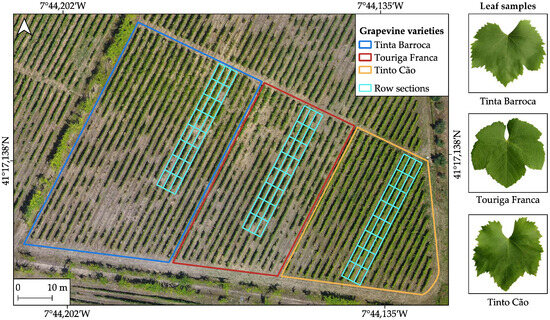
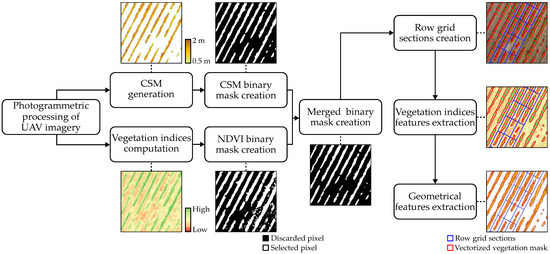
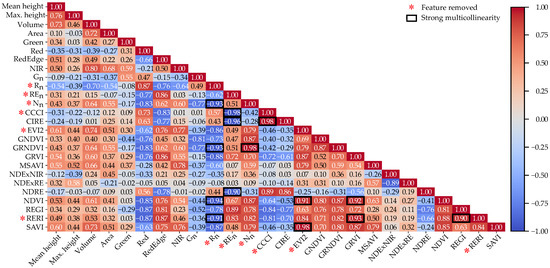
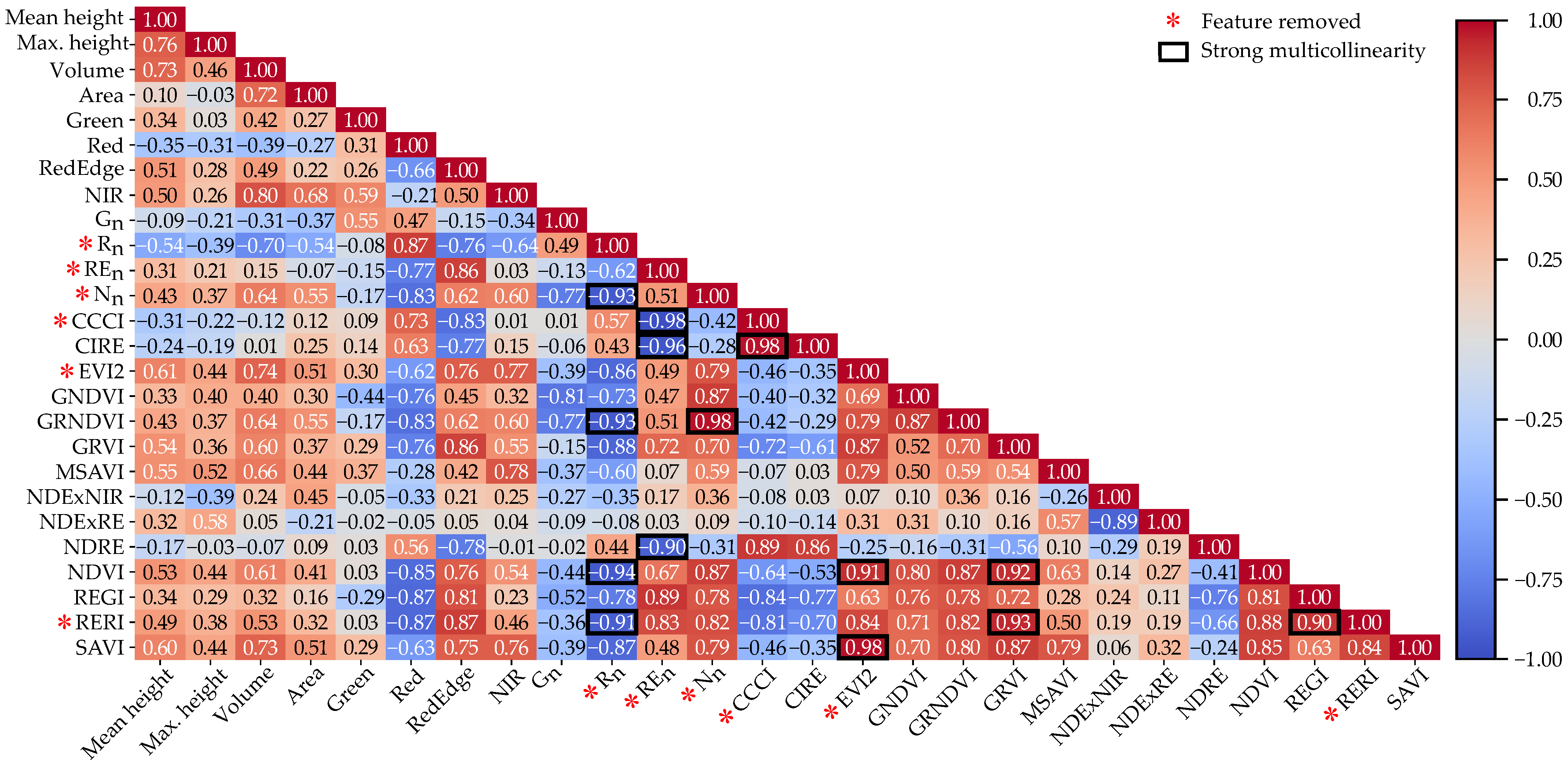
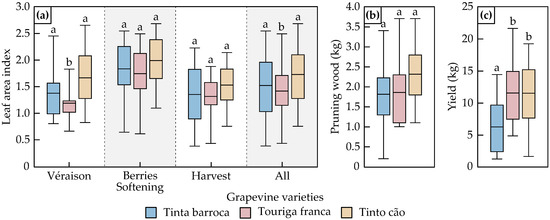
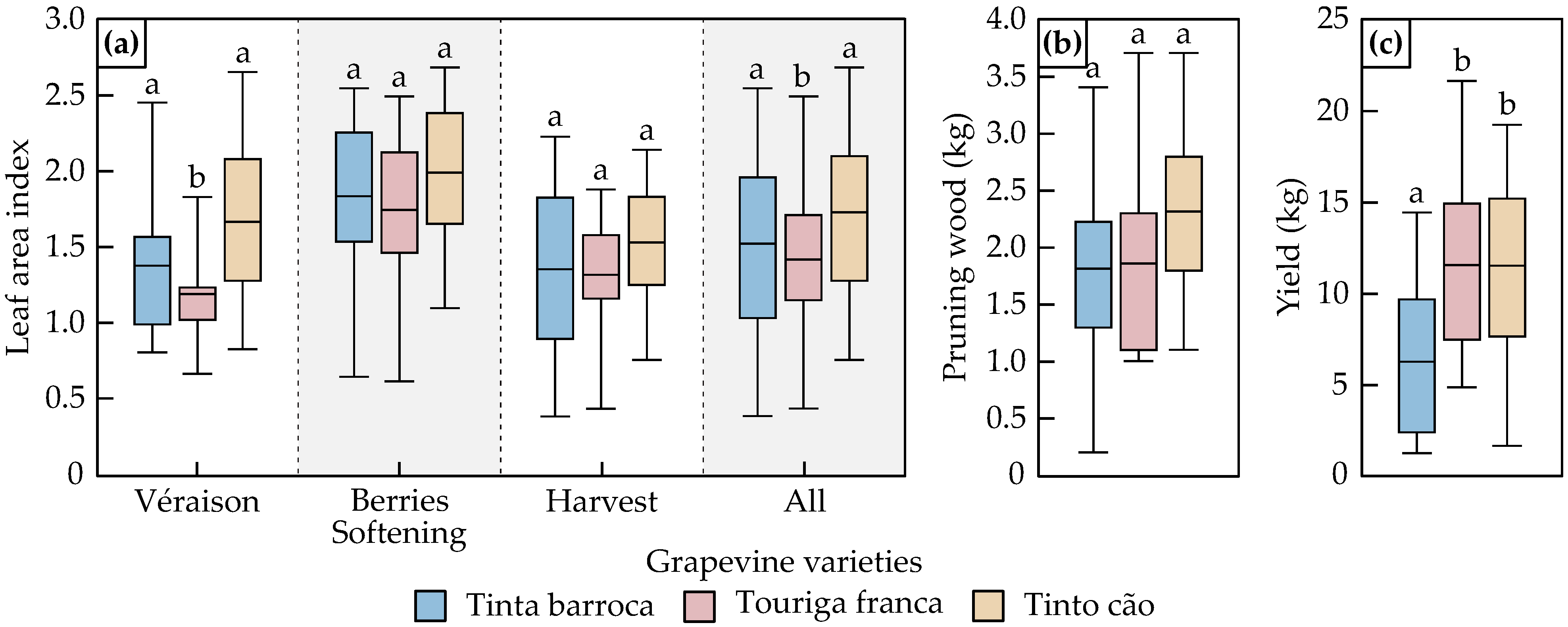
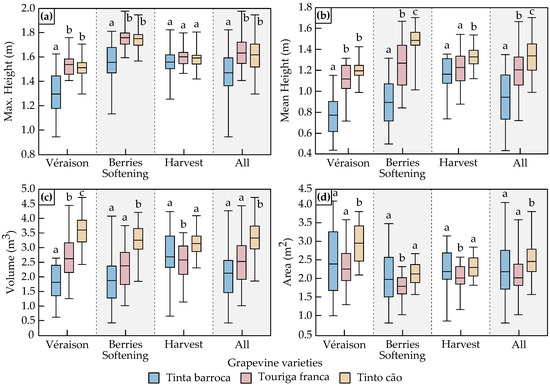
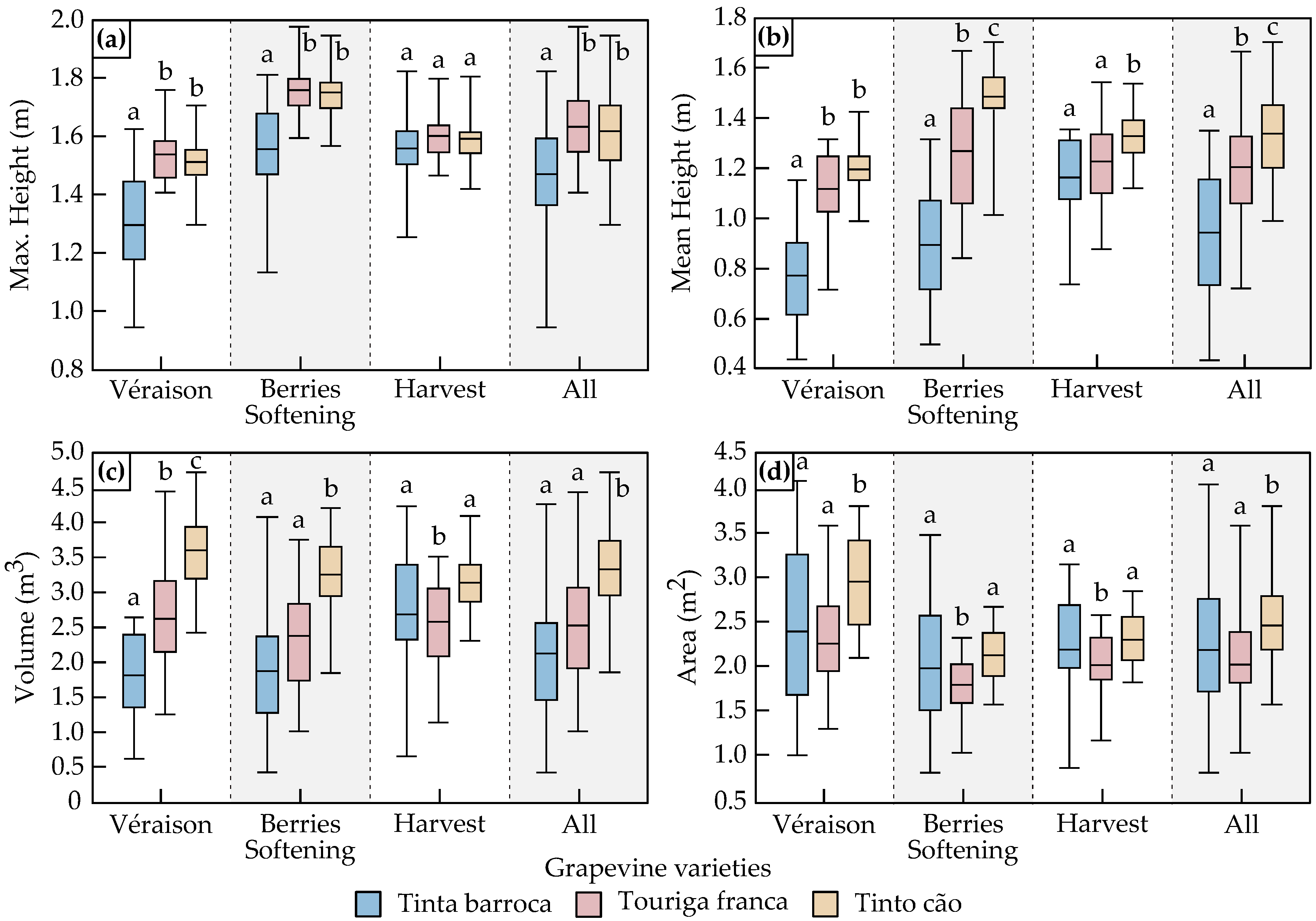
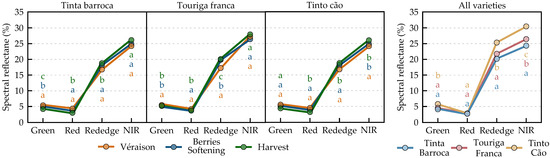
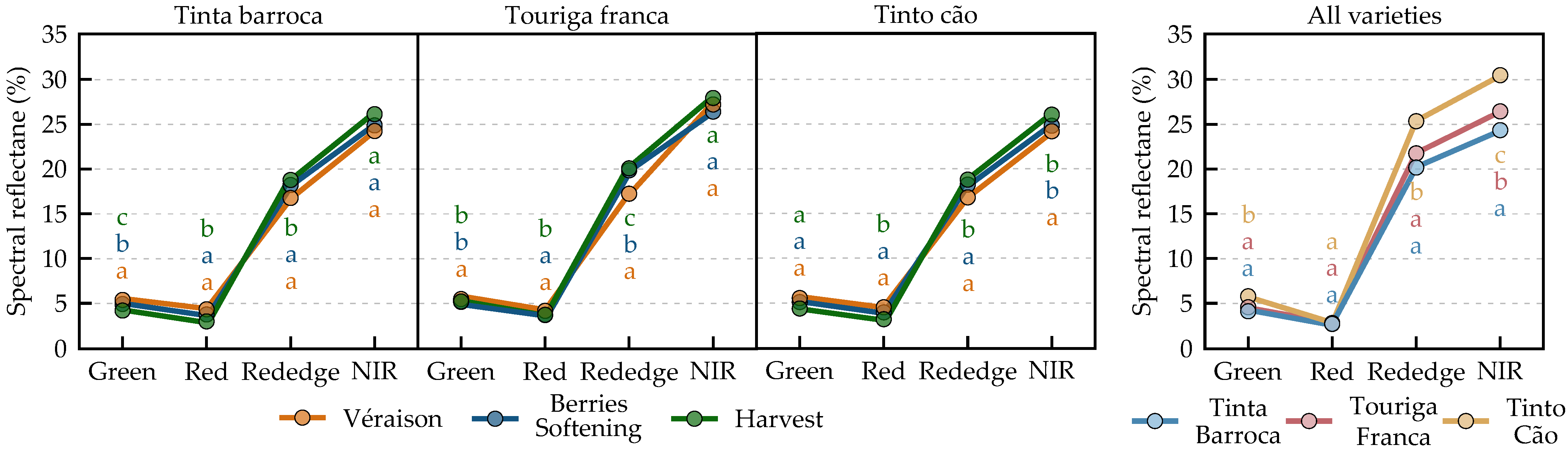
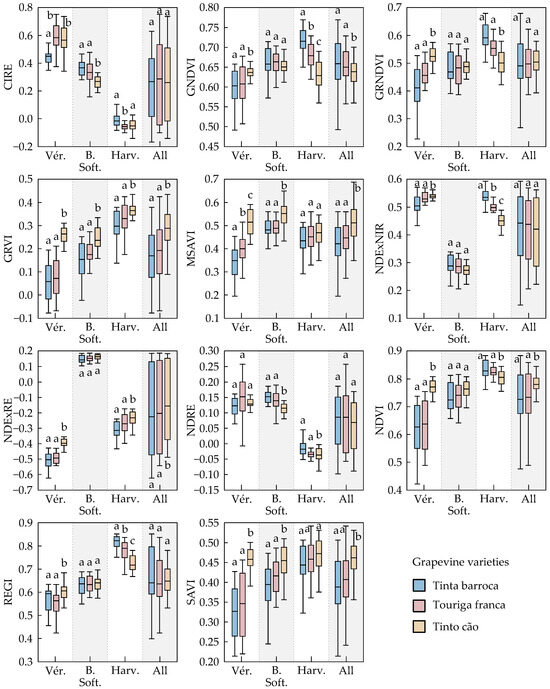
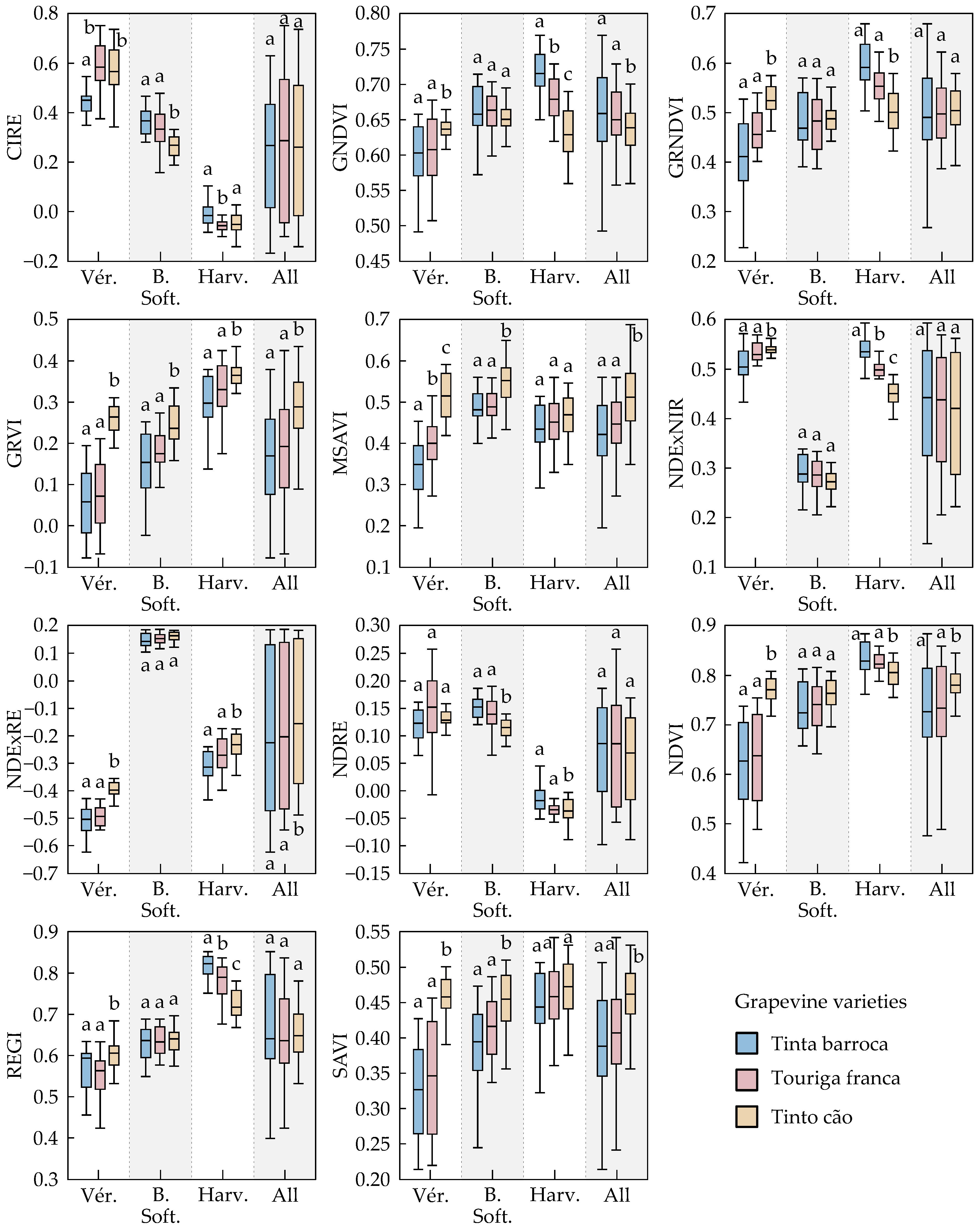
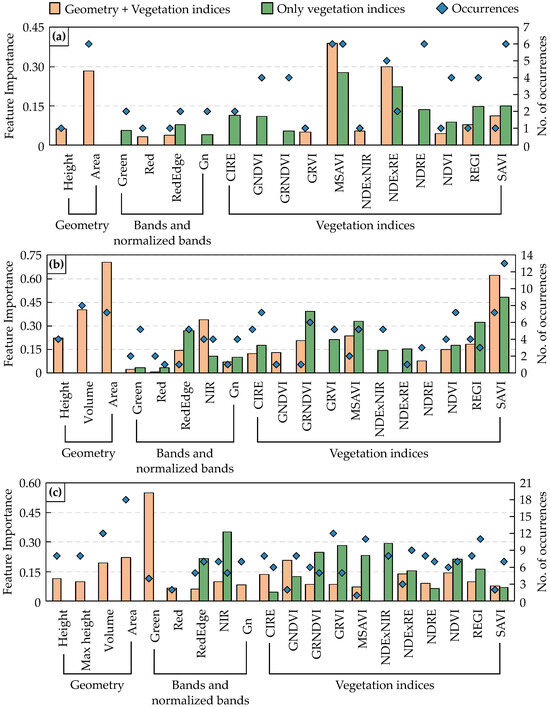
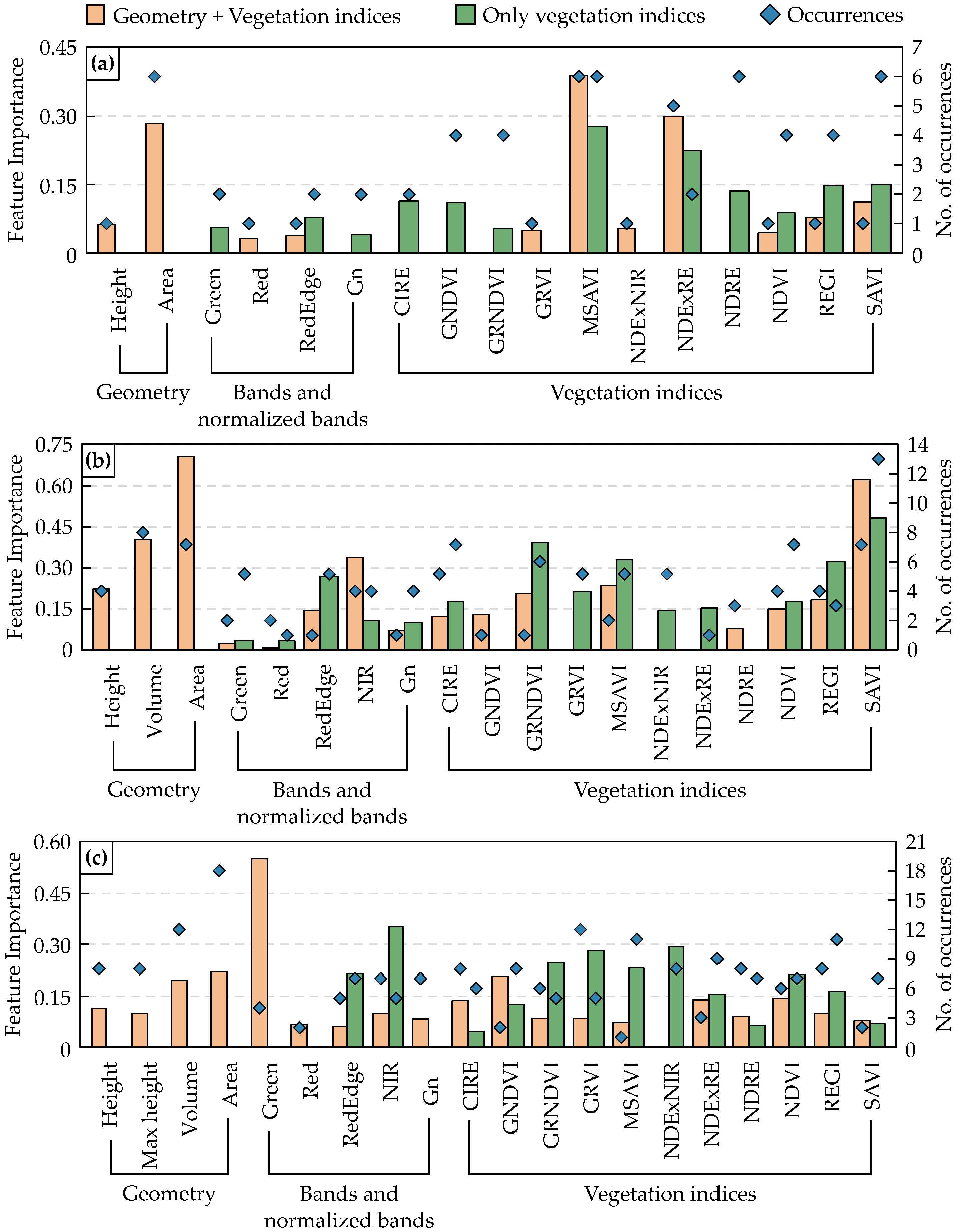
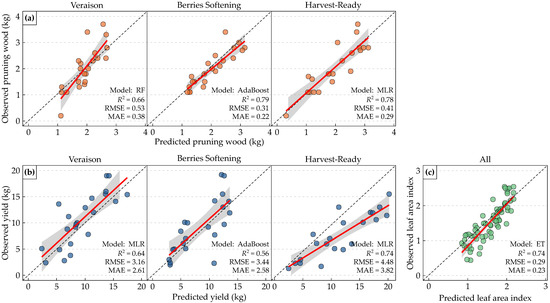
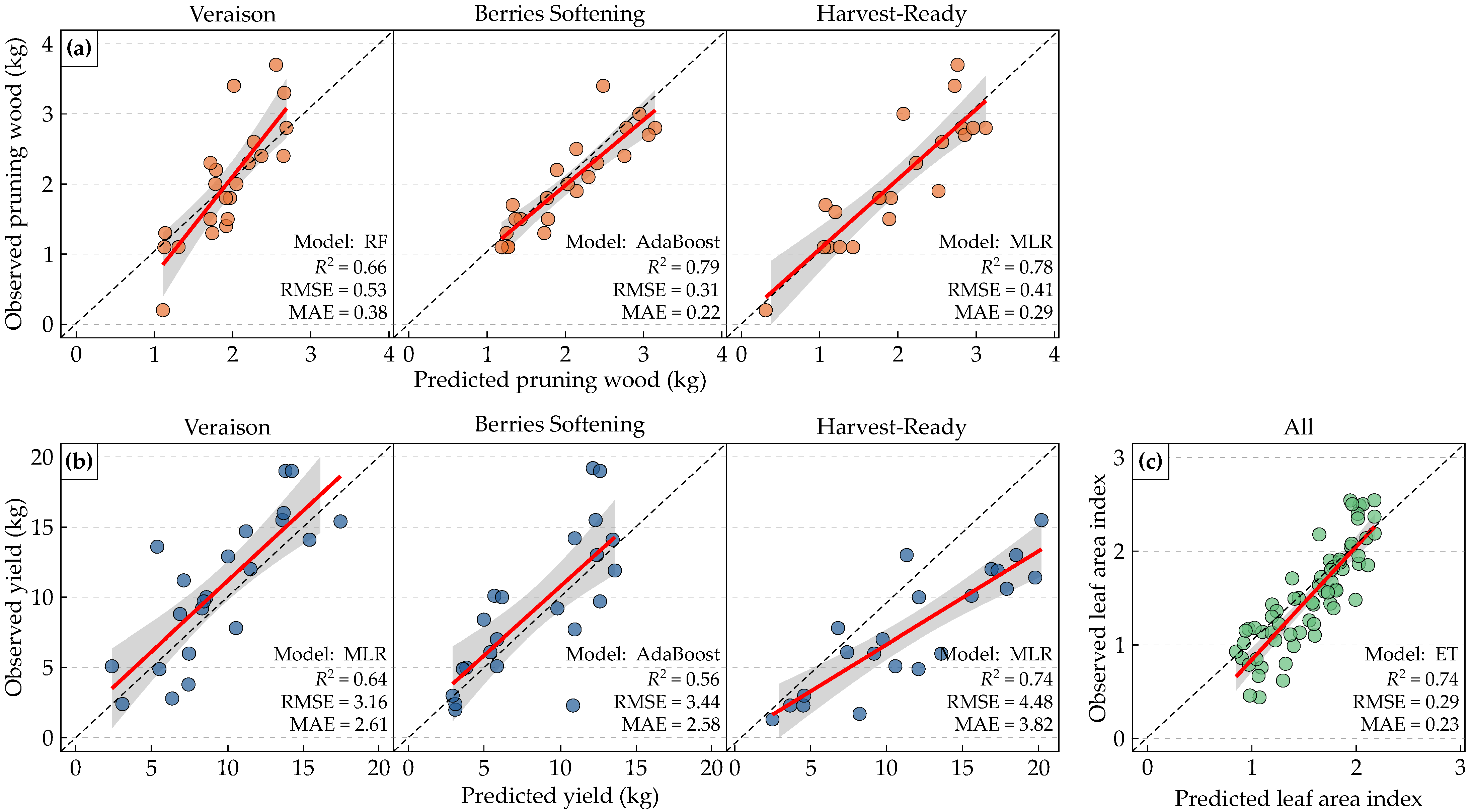
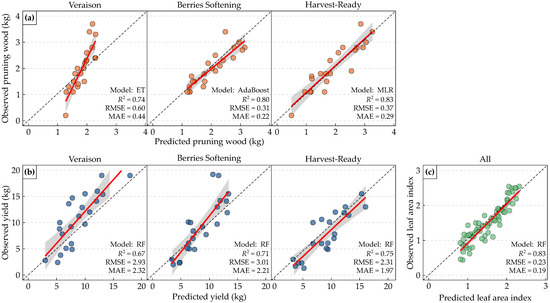
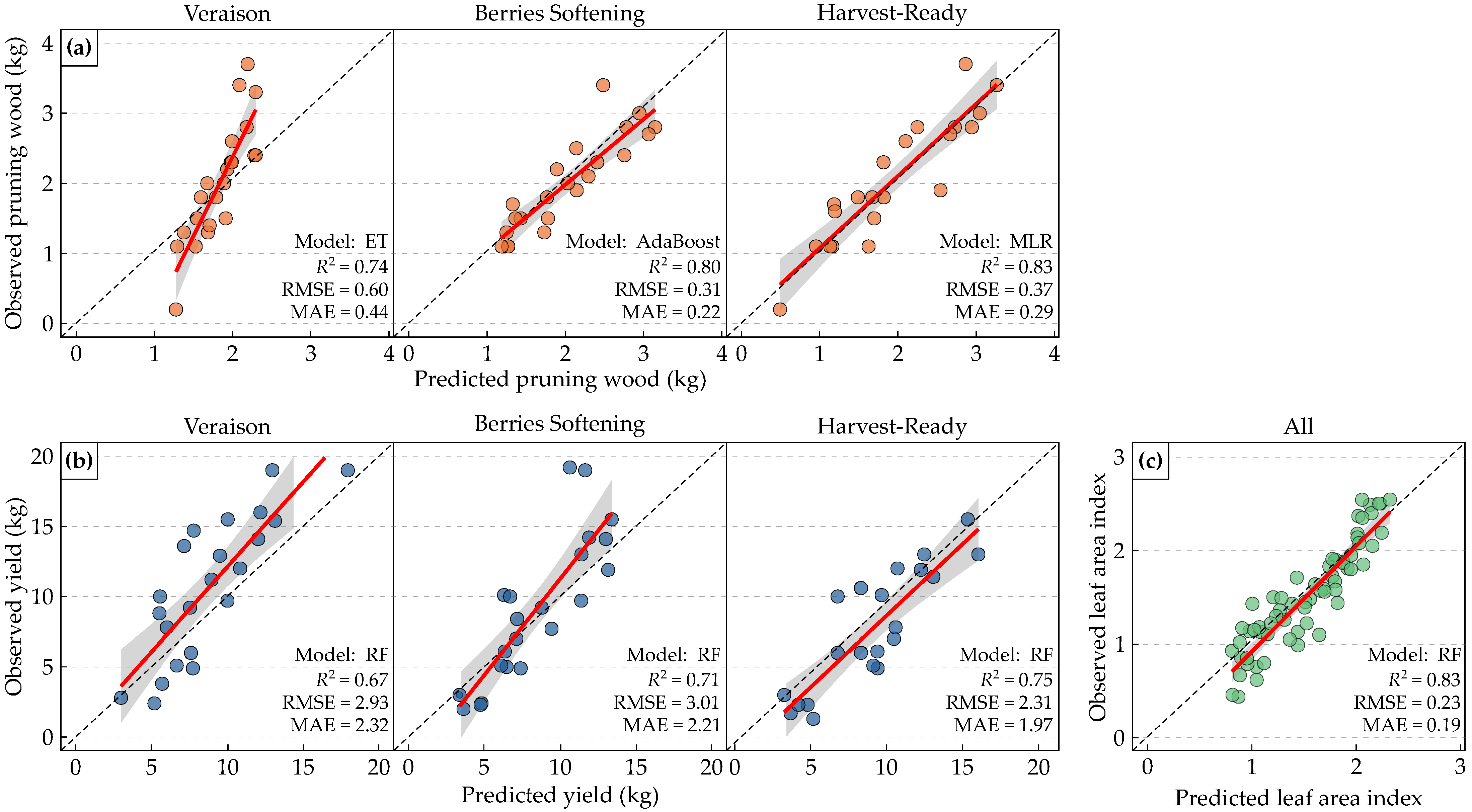
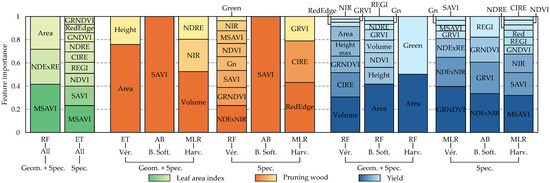
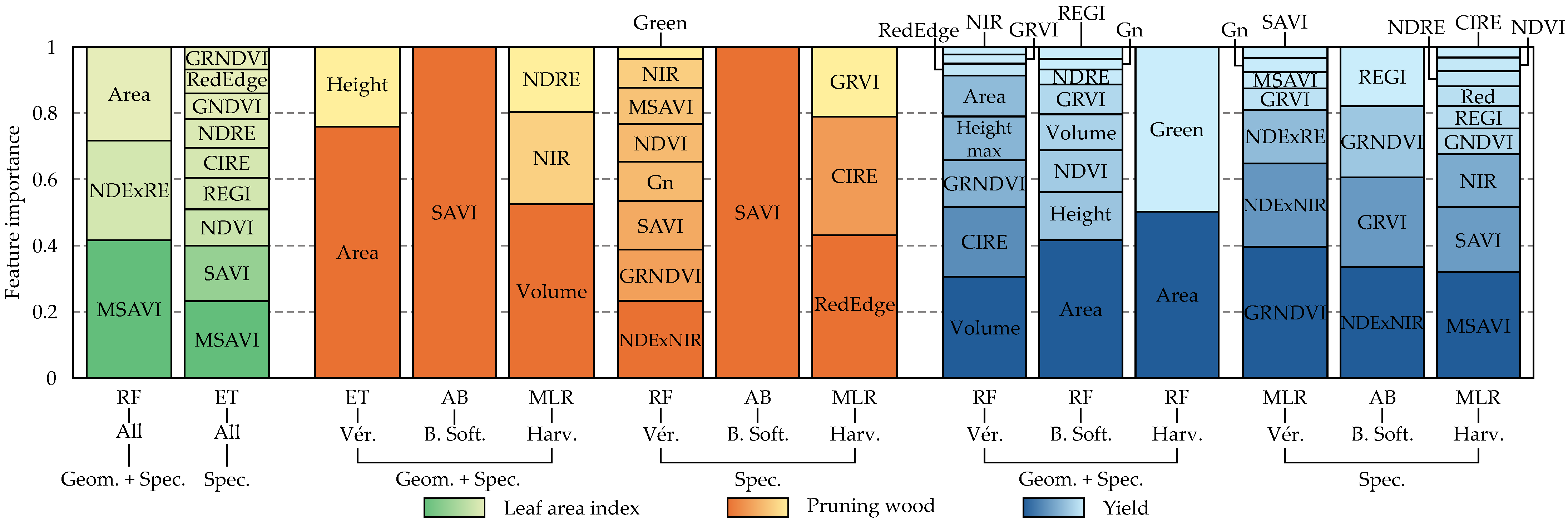
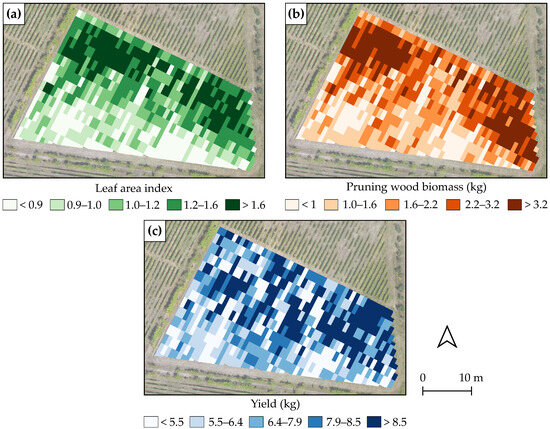
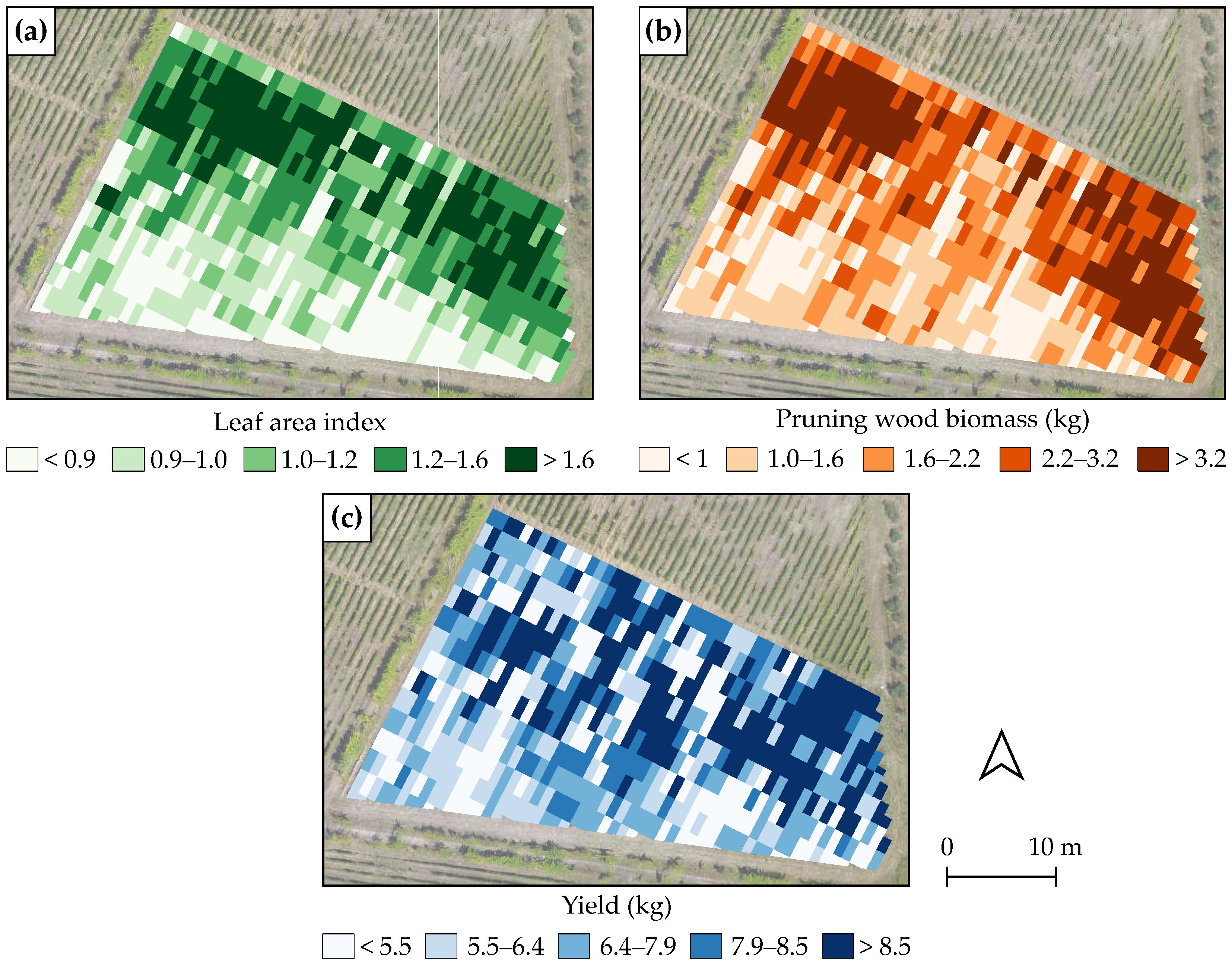

Disclaimer/Publisher’s Note: The statements, opinions and data contained in all publications are solely those of the individual author(s) and contributor(s) and not of MDPI and/or the editor(s). MDPI and/or the editor(s) disclaim responsibility for any injury to people or property resulting from any ideas, methods, instructions or products referred to in the content. |
© 2025 by the authors. Licensee MDPI, Basel, Switzerland. This article is an open access article distributed under the terms and conditions of the Creative Commons Attribution (CC BY) license (https://creativecommons.org/licenses/by/4.0/).